The Thrall in the Hall: Randall Goosby and Zhu Wang Violin and Piano Duo at Hahn Hall


Violinist Randall Goosby

Though this was ostensibly Randall Goosby ’s show, the music making was a wonderfully integrated duo with pianist Zhu Wang, These two fine young musicians shared the virtuosic duties that the music in this concert demands. Both are clearly hard working and dedicated artists. Both have technical and interpretive prowess. And they clearly embody a mutual respect for each other.

Pianist Zhu Wang

The music on the program served to demonstrate the duo’s creative selection of music:

Coleridge-Taylor: Suite for Violin and Piano, op. 3 
Brahms: Violin Sonata No. 2 in A Major, op. 100 (“Thun”) 
Still: Suite for Violin and Piano
Price:Two Fantasies 
Strauss: Violin Sonata in E-flat Major, op. 18

Curiously, due to this reviewer’s lack of familiarity with the violin and piano repertoire and having written some recent reviews of black composers’ music, the only familiar pieces were two of the three pieces by black composers. Now, overall, this is a marvelously chosen set of pieces that reflect the eclecticism and technical skill of both of these musicians.

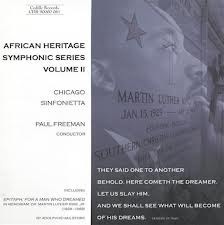
The classic Paul Freeman conducted set of music by black composers.

The Brahms was perhaps the most familiar to audiences but the other works were equally substantive and worthy of being heard. It is these rather visionary choices that characterizes this duo as fresh and innovative. In addition their obvious knowledge of the music along with their enthusiasm and affection for it conspired to make for a delightful evening and even nudged this reviewer to try to become more familiar with the violin and piano repertory in general.

Samuel Coleridge-Taylor (1875-1912) was a black British composer who has of late had a much needed revival of his music. He was named in honor of the celebrated British poet Samuel Taylor-Coleridge (1772-1834). During his rather brief lifetime, Samuel had been hailed as “the British Mahler but, after his death, his music lay largely fallow until revived by the late, great American black conductor, Paul Freeman (1935-2015). His revelatory series for Columbia records (now Sony) opened listeners’ ears to a fascinating selection of music by black composers internationally.

The Coleridge-Taylor opus 3 Suite for violin and piano (1893) is an early work cast in the high romantic late 19th century style of broad melodies and virtuosic demands. It served as the introduction to an intoxicating evening of (partly) seldom performed works alongside some fairly established works in the repertoire.

The Johannes Brahms (1833-1897) second violin sonata (of three) was written in 1879 and was named “Thun” after the Swiss city where he composed it. The three movements follow the classical fast, slow, fast structure common to this genre.

It is a product of high romanticism and it remains a staple of the repertoire. It, as with most of this composer’s music, is technically challenging for both instrumentalists. It was a fine vehicle to confirm the incredible technical skills of these young artists.

William Grant Still (1895-1978) was one of the finest composers of the early to mid twentieth century. Like Coleridge-Taylor and Florence Price (1887-1953), his music was lauded during his lifetime but was neglected until fairly recently in the aforementioned Black Composers set. These musical choices revealed another aspect of this delightful pair of musicians, that of being essentially musical archeologists uncovering forgotten gems much as Lord Carnarvan’s work availed the world to the marvelous Egyptian art of King Tut’s tomb.

Still’s Suite for Violin and Piano was inspired by three sculptures–Richmond Barthé’s African Dancer, Sargent Johnson’s Mother and Child, and Augusta Savage’s Gamin. Written in 1943, it synthesizes elements of blues, pop, and classical music to create musical description of this ethnically inflected visual art.

Richmond Barthé’s African Dancer
Sargent Claude Johnson’s Mother and Child (ca. 1932)
Augusta Savage’s Gamin

The three movements comprise essentially tone poems based on the visual artwork. It was after the second piece, depicting the Mother and Child sculpture that the spell cast by the duo’s that revealed the “Thrall” of this blog’s title.

Goosby embodies a calm and casual confidence and he let the audience know early on that it is OK to applaud after a single movement if you are so inclined. He has a warmth that put the audience at ease, embracing us in a most genial manner. There is, of course, nothing wrong with musicians who might seem more aloof but Goosby’s warmth was both generous and welcome. However, it became clear that this audience, after hearing that gorgeous second movement so beautifully played, paused in a seemingly hypnotic response to the impassioned performance that captured the beauty of the music. It felt as though we had become collectively and deeply engaged. That is the meaning of “thrall” and that was a beautiful experience that spoke of connections between composer, performers, and audience that represent the pinnacle of the art of chamber music performance. All three movements were wonderfully executed but that moment and the collective reaction was a truly moving experience.

Following a brief intermission we got to hear both of Florence Price’s two Fantasies for Violin and Piano (1933, 1940). Though I’ve become familiar with much of Price’s work (her three surviving symphonies and Goosby’s own reading of her two violin concerti have been released in the last couple of years) I had not heard these fantasies before.

Though written only seven years apart, the works embody distinctively different qualities. Both are certainly “capricious”, embodying a variety of moods, but the second is a bit longer and seemed to reflect the composer’s maturing style. Both works were enjoyable and seemed to please the audience.

This led us to the final work on the program, the Violin and Piano Sonata (1888) by Richard Strauss (1864-1949). Best known for his big orchestral tone poems and his grand operas, this was an early work which has found an audience due to its lyrical and friendly character.

It is cast in three movements, and it was at the end of the slow movement that we again saw/heard a sort of “agreed upon” silence in which the audience seemed to have shared a deep impact from that lovely movement played so passionately. No one applauded as a reverent silence came upon us.

The much busier third movement again presented the virtuosity and broad melodies of high romanticism. And there was applause and, much deserved standing ovations. It was a joy to have heard these talented and hard working musicians in an ecstatic night of chamber music.
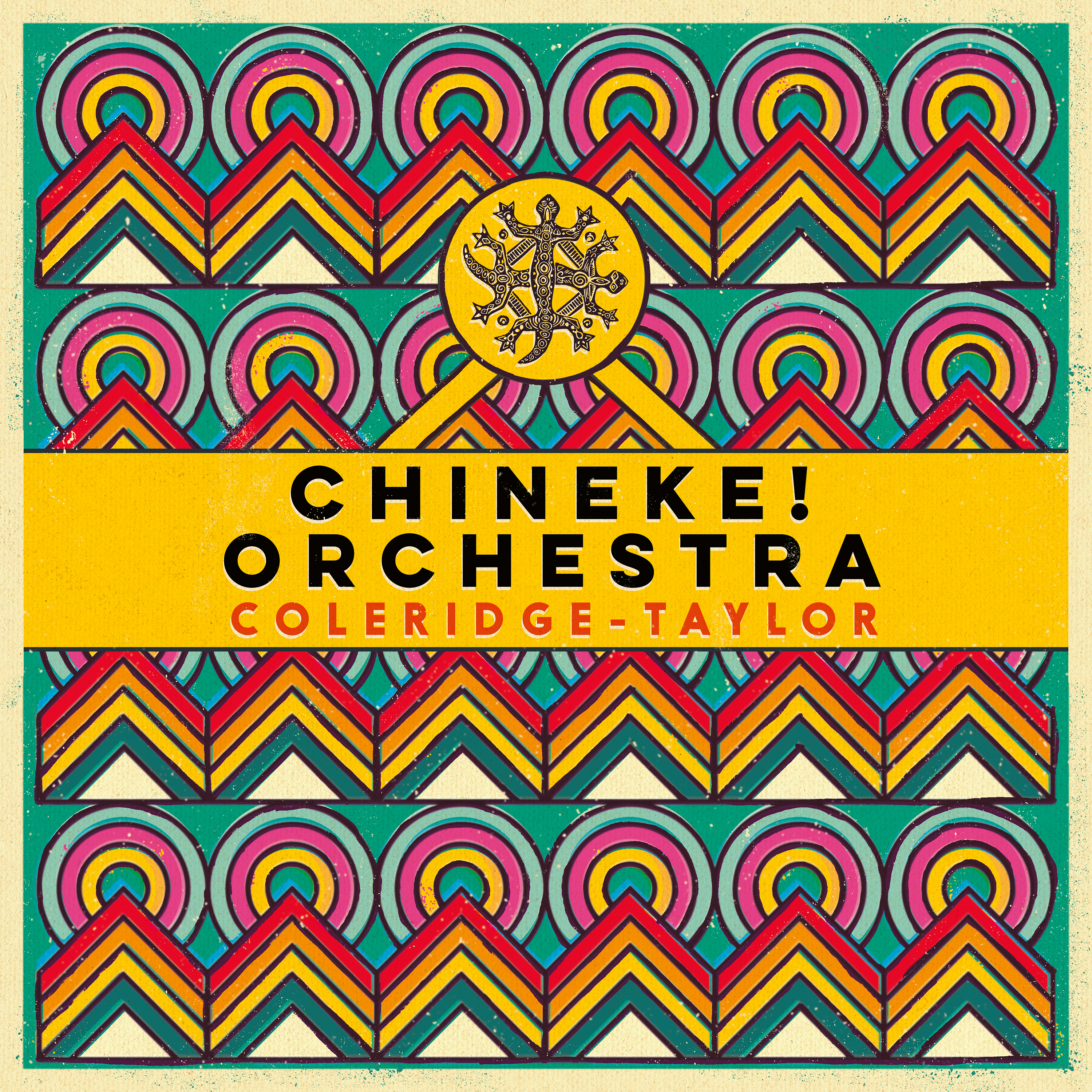
Samuel Coleridge Taylor, A Defining Survey of His Orchestral and Chamber Music


Chineke Records (in partnership with DECCA)

Samuel Taylor Coleridge begat Samuel Coleridge-Taylor, who begat Coleridge Taylor Perkinson… Wait, that’s not right. But these three men, listed in chronological order, became intertwined, much as they were admired, by their names. Samuel Taylor Coleridge (1792-1834) is the great (white) British poet. Samuel Coleridge-Taylor (1875-1912), named in honor of that poet (and the subject of this review) was a much lauded, though subsequently neglected British composer, as it happens a black British composer. Taylor Coleridge Perkinson (1932-2004), a much lauded and subsequently neglected black American composer named in honor of those predecessors. Stick with me, this comes together (for the purposes of this review) with the name of the orchestra on this recording, “Chineke”, a word taken from the African Igbo religion, meaning, “God”. Add an exclamation point and you get “Chineke!”, the orchestra which was founded in 2015 by the double bass player, Chi-chi Nwanoku CBE, to provide career opportunities for Black and ethnically diverse classical musicians in the UK and Europe.

All that to introduce listeners to this landmark of the recording industry, fulfilling in part the mission of this fine orchestra. This two CD set provides an intelligent selection of the music of Samuel Taylor-Coleridge which is nothing short of revelatory. Knowledge (at least outside of Britain) of his music, up until this release pretty much limited to his fine choral work “Hiawatha’s Wedding Feast” and perhaps a short orchestra movement. The late great Paul Freeman included an aria from that choral work and one movement (Danse Negre) from his African Suite in his defining set of recordings on Columbia/Sony, “Black Composers”. These brief pieces were the introduction for many people, this writer included, to this composer’s work.

The last family Christmas card, 1912

Chineke! now presents a far more representative selection of this man’s work with a truly nice touch of alreleasing the first recording of music by Coleridge-Taylor’s daughter Gwendolyn Avril Coleridge-Taylor (1903-1998) who wrote under the pen name Peter Riley (it is hardly a secret that both black people and women suffer from lack of recognition in the world of classical music).

Coleridge-Taylor’s output was large, comprising some 82 pieces with opus numbers and unpublished works as well. That’s a lot of music from a man who died at age 37 from pneumonia. This two disc set does a very nice job of presenting music from all eras of his brief career. From the Opus 2 Nonet (1894) to the Opus 80 Violin Concerto (1912) this release provides a larger perspective on this artist (dubbed by white musicians in New York, in what today would be judged a pejorative appellation, “The Black Mahler”). My guess is that the same people who would speak condescendingly about Coleridge-Taylor were also not appreciative of that Jewish Austrian conductor/composer.

Though it appears that all these works have appeared previously in recordings (appropriately on mostly British labels) this collection does a great service in demonstrating the arc of his truncated life’s work. Only the Avril Coleridge-Taylor work, “Sussex Landscape” (1940), is a world premiere recording.

Track list

For the purposes of this review I will be discussing these works in chronological order rather than the order on the recordings. Even a short career demonstrably goes through changes over time, led by social, political, historical, and musical experiences. A photo (above) shows the order on the discs.

The Nonet Op. 2 (1894) for strings, winds, and piano was written by the 19 year old (still a student at the Royal College of Music). This unusual combination, nearly a chamber orchestra in dimension as is the grand, late romantic, Brahmsian dimension. His skill in orchestration is evident here and serves to clarify the musical lines in these four large movements. It is virtually a symphony with a virtuoso piano obbligato.

Here, emissaries of the nascent Harlem Renaissance came to England in the the form of a 1896 concert by the Fisk Jubilee Singers who presented a program of “Negro Spirituals” (Fisk is one of the so called “Historically Black Colleges and Universities” which were formed to provide educational opportunities for Black Americans who were barred from admittance to other colleges). The following year Coleridge-Taylor met the Black American poet Paul Laurence Dunbar (1872-1906), who had come to England on a literary tour. His parents were freed slaves in Kentucky. Both of these experiences had a profound effect on Coleridge-Taylor and his music. Coleridge-Taylor would attend the first Pan-African Conference in London in July 1900. There he would explore the ideas and philosophies of Pan-Africanism which emphasised the importance of a shared African heritage. The orchestral works “Ballade in A minor” Op. 33 and the “African Suite” Op. 35, (both 1898) reflect those influences.

The two movement Ballade is a grand romantic work with no particular program but one that demonstrates the composer’s amazing command of the orchestra. The African Suite, one of his more popular works, was directly influenced by the work of Dunbar (whose career, like Coleridge-Taylor’s, also ended prematurely).

The two movement “Romance” Op. 39 (1899) for violin and orchestra is a foreshadowing of the later Violin Concerto. It is a heavily late romantic work with a beautiful and substantial violin part.

His “Petite Suite” Op. 77 (1911) is among his most popular works and arguably served as a precursor to what would later be termed, “Light Music”. The second movement strikes deep into this writer’s memory as one of those pieces whose charm prompted me to find out what it was so I might hear it again. Very charming and immediately listener friendly music.

The first work on this set, The five movement, “Othello” Orchestral Suite Op. 79 was published in 1909 and first performed in 1911. It was conceived and written as an orchestral suite, not a suite of music drawn from another work and is complete as performed here. It is a stunning example of the composer’s skills with orchestration and with dramatic writing.

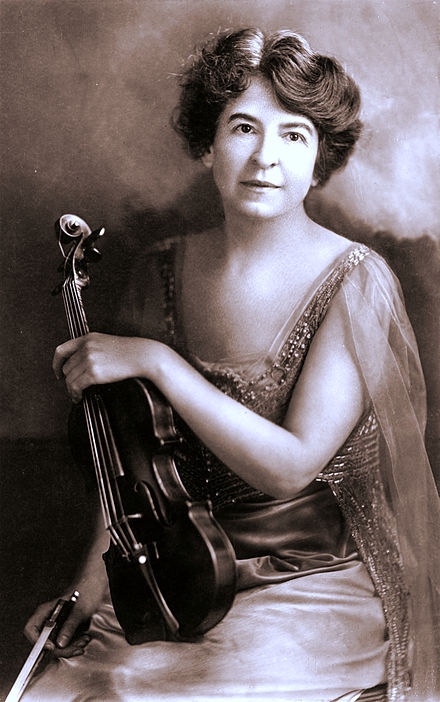
Maud Powell (1867-1920)

Now we come to the Op. 80 Violin Concerto of 1911-2 which is dedicated to American violinist Maud Powell, a staunch advocate for female musicians, black composers, and new music in general (an early model for the likes of Rachel Barton Pine). This work of high late romanticism echoes Brahms and Bruch in its Melodie’s, it’s harmonies, and the grand sweep of its gorgeously orchestrated three movements. It is easy to imagine this as a regular repertoire piece.

Avril Coleridge Taylor (1903-1998)

Last and most certainly not least is the world premiere recording by Coleridge-Taylor’s daughter, Gwendoline Avril Coleridge-Taylor (1903-1998), her “Sussex Landscape” Op. 27 (1940). This is just a taste of her 60+ compositions but it is compelling enough to prompt listeners (and hopefully progressive organizations such as “Chineke!”) to pursue more exploration of her oeuvre.

Chineke! Truly achieves their goal in producing this wonderful portrait of a composer whose work has, until very recently languished in relative obscurity. Even this writer, whose obsessive interest in the new and interesting, has been seriously transformed by this release. You really have to hear this release. My thanks and congratulations to everyone involved in this fine Chineke! release.

Rachel Barton, Uncovering Valuable Legacy


Cedille Records CDR 90000 214

This album, largely a re-release of Barton’s groundbreaking recording of 1987 without the Violin Concerto No. 4 in D Major by CHEVALIER J.J.O. DE MEUDE-MONPAS (FL. C. 1786) but with the wonderful addition of Florence Price’s Second Violin Concerto of 1952. That alone is worth the price of this disc.

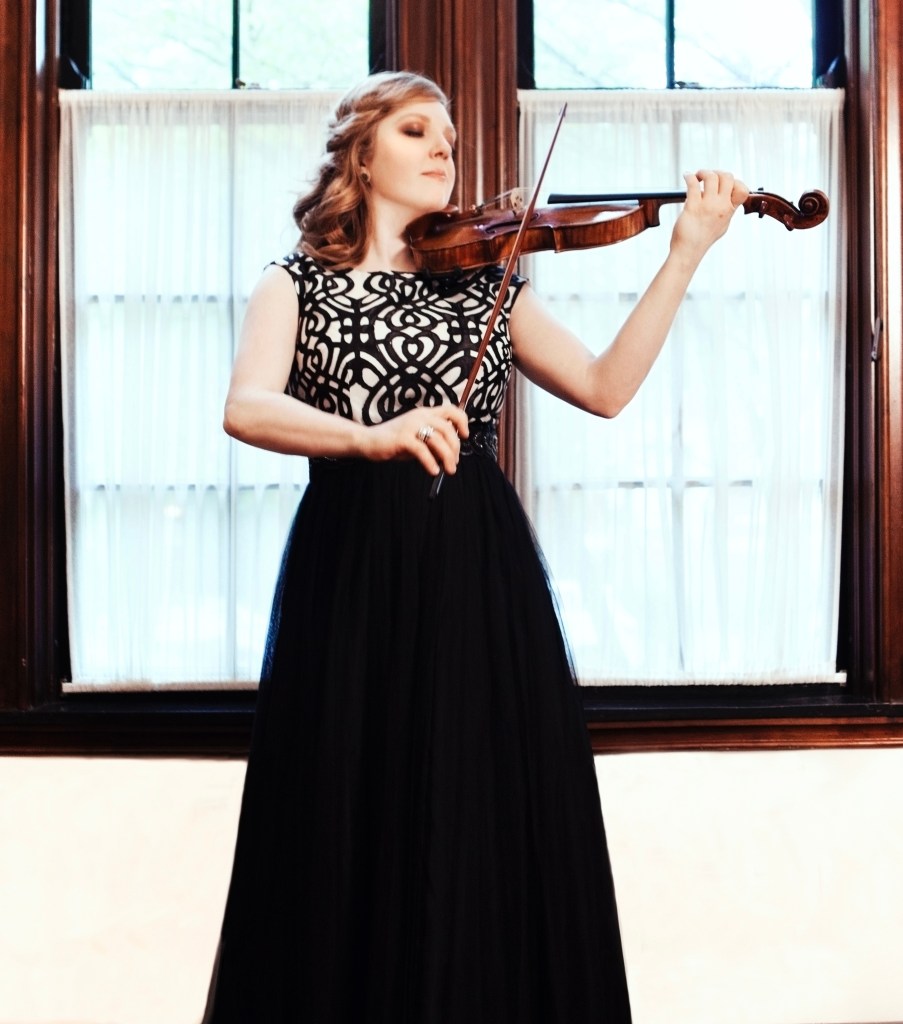
Rachel Barton

Rachel Barton Pine who made her debut at age 10 with the Chicago Symphony is a world renowned violinist and activist. With this, her 22nd release for Cedille she is clearly a darling of that fabulous hometown label. Her wide range of repertoire reflect a unique sensibility and a revelatory exploration of the work of black composers.

Cedille records has a pretty amazing history of paying attention to black composers. Four of their releases featured the late great black conductor Paul Freeman (1936-2015) whose groundbreaking survey of black composers for Columbia records remain indisputable evidence of their inexcusable neglect as artists. The Cedille recordings mentioned are an extension of Freeman’s original survey.

So let’s take a look at this new release.

JOSEPH BOLOGNE, CHEVALIER DE SAINT-GEORGES (1745-1799)
Violin Concerto in A major, Op. 5, No. 2 (1775) (23:44)

1 Allegro moderato (10:22)
2 Largo (8:35)
3 Rondeau (4:35)

The new lavish biopic will happily reignite interest in this composer. The late conductor Paul Freeman (1936-2015) is the person who really first rescued this man’s work from oblivion. In the first volume of his landmark Black Composers series released March 8th, 1974. He devoted an entire disc to four works by this composer, a contemporary of Mozart and every bit the Austrian’s equal both as composer and performer. Freeman released recordings of his first (of two) symphonies, the first (of some 18) string quartets, one of the few surviving arias from his first opera, “Ernestine”, and the last of his eight symphonies concertante. Barton’s beautiful reading of the A major violin concerto of 1775 (he wrote 14) is her entry into this much needed and ongoing revival. Her reading is warm and very much up to the challenge of the virtuosity of the writing.


JOSÉ WHITE LAFITTE (1835–1918)
Violin Concerto in F-sharp minor (21:32)

4 Allegro (11:39)
5 Adagio ma non troppo (4:50)
6 Allegro moderato (4:58)

This composer, also first brought to light by Maestro Freeman in its premiere recording in volume 7 of the Black Composers series released in June, 1975. The wonderful Aaron Rosand played the violin. Barton’s, released in 1997 is only the second recording of this little known Afro-Cuban composer. The concerto fits with her passion for the high romantic era where virtuosity was (nearly) all.


SAMUEL COLERIDGE-TAYLOR (1875–1912)
Romance in G major for Violin and Orchestra, Op. 39
(12:32)

Encore Chamber Orchestra
Daniel Hege, conductor

This brief Romance for violin and orchestra mirrors similar works by Beethoven and Dvorak. Again her facility with high romanticism serves her well in one of this black English composer’s best known works.


FLORENCE PRICE (1887-1953)
Violin Concerto No. 2 (1952) (14:42)

Royal Scottish National Orchestra
Jonathon Heyward, conductor

This, along with Price’s first concerto, fourth symphony we’re found in 2009 in a now abandoned house that once belonged to Price. The second concerto is presented in its second recording (both concerti were released on Albany Records in 2018. I haven’t heard that one but after hearing this performance from 2022 it’s hard to imagine it being done better.

Catalyzing Blackness, Volume Three: The Catalyst Quartet plays 20th Century music by Black Americans


This is the third volume in the Catalyst Quartet’s wonderful and insightful survey of neglected works by black composers. The first focused on music by the black English composer Samuel Taylor Coleridge (1875-1912), the second on music of late nineteenth to mid-twentieth century American composer Florence Price (1887-1953). The present disc focuses on the works of three men whose musical careers were entirely in the twentieth century: William Grant Still (1895-1978), George Walker (1922-2018), and Coleridge-Taylor Perkinson (1932-2004).

William Grant Still is roughly contemporary with Aaron Copland (1900-1990). Copland has often been called the “Dean of American Composers” and Still has been called the “Dean of Afro-American Composers”. Such honorifics, while well intended, do nothing to describe the true depth and significance of either of these composers.

Similarly their best known works, Copland’s “Appalachian Spring” (1944), and Still’s “Afro-American Symphony” (1930) are fine pieces of music but cannot represent the whole of their respective authors’ outputs. Both produced quite a bit of music and went through stylistic changes as their artistic sensibilities evolved. Copland’s oeuvre is pretty well documented, allowing listeners to grasp its entirety while Still’s work has not enjoyed the same distinction. That is changing, slowly, and that is reason to celebrate.

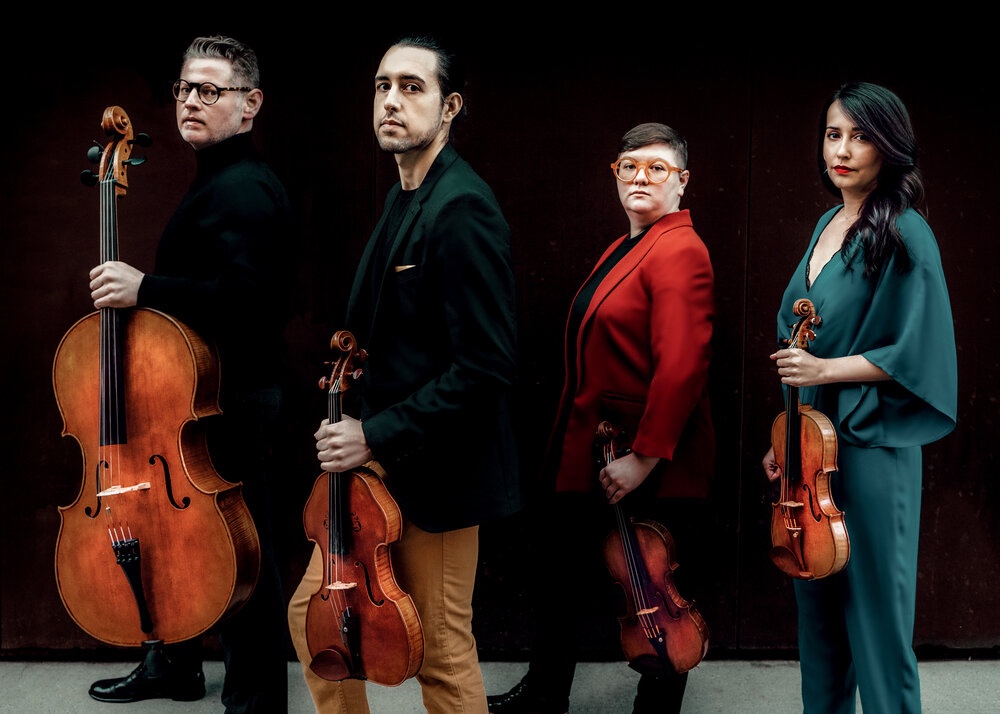
The Catalyst Quartet (Karla Donehew Perez, violin; Abi Fayette, violin; Paul Laraia, viola; and Karlos Rodriguez, cello) from their website

Still is represented here by his “Lyric Quartette” (published in 1960 but likely written 1939-1945). These three movements for string quartet are intended to represent a plantation, the mountains of Peru, and a pioneer settlement, respectively. This appears to be the first commercial recording of the work, a set of vignettes (Still never wrote a string quartet as such) seemingly published as an afterthought after looking back over his files. That’s not to denigrate the music. It is finely crafted and reflects a composer closer to the folk eclecticism of his contemporaries William L. Dawson (1899-1980) whose use of folk idioms resembles that of Aaron Copland (1900-1990) and Virgil Thomson (1896-1989), two white contemporaries (rather than his later more post romantic style). These composers’ use of folk idioms and the comforting tonal harmonies, very much in vogue when the music was first written, sound rather old fashioned in their year of the Lyric Quartette’s publication. Nonetheless, it is a vital work in understanding Still and his development as a composer. This would make for a great encore or second selection following a Haydn or Mozart Quartet.

George Walker was a sought after concert pianist and he forever holds the distinction of being the first Black American to be awarded the Pulitzer Prize in music (for his 1996 “Lilacs” for voice and orchestra). I learned from one of my personal favorite Chicago broadcasters that he, Bruce Duffie (WNIB host 1975-2001) played Walker’s “Lyric for Strings” (1946, orch. 1990) as the final sign off music at the closing of the beloved independent station (reportedly very satisfying to that terminal audience). The link provided is to a transcript of his subsequent conversation he had with Walker in 2001, worth your time to read.

So what does all this have to do with this release? Well, that, “Lyric for strings” is actually Walker’s orchestration for string orchestra of the second movement, “molto adagio“ of his three movement String Quartet No.1 (1946) “Lyric”. Samuel Barber garnered a great audience with his “Adagio for Strings” from the molto adagio of his String Quartet (1935-36).

The outer movements (1 and 3) of Walker’s quartet (carefully conceived and thoughtfully developed at length) frame the beautiful adagio with a passionate elaborately developed allegro and a high energy, virtuosic finale (much as in the Barber work). The quartet’s title, derived from the slow movement which was originally titled “lament” is dedicated to Walker’s grandmother, a former slave. A very different perspective of America, for sure, but a truly spectacular example of string quartet writing.

I wrote my review in chronological order to clarify my narrative but the actual track order is:

String Quartet No. 1 “Calvary” Coleridge-Taylor Perkinson (1932-2004)

  1. Allegro
  2. Adagio
  3. Allegro vivace
    Lyric Quartet William Grant Still (1895-1978)
  4. The Sentimental One
  5. The Quiet One
  6. The Jovial One
    String Quartet No. 1 “Lyric” George Walker (1922-2018)
  7. Allegro
  8. Molto adagio
  9. Allegro con fuoco

So String Quartet No. 1 “Calvary” (1956) by Coleridge-Taylor Perkinson is leaving the most recent for last. This work, shares with the other two it’s having been written fairly early in the composer’s career (he was about 24 when he wrote this piece, Still was in his 40s and Walker about 24 when they wrote their respective quartets). So Catalyst adheres to these important but early utterances from these three important artists. And for clarity the name permutations we encounter here comprise: Samuel Taylor Coleridge (1772-1834) is the English poet, Samuel Coleridge-Taylor (1875-1912) is the black English composer honorifically named after that poet, and Coleridge Taylor Perkinson (1932-2004) the black American composer honorifically named in honor of said English composer.

This is another outstanding but neglected American composer who happens to be black. This fine string quartet is defined by its serious tone and elaborate development in a passionate romantic tonal idiom. Of course the composer shares his prominent jazz (Perkins was nothing if not eclectic) influences in rhythms and harmonic structure. Based loosely on the hymn, “Calvary” from which it takes its name, it was actually premiered in Carnegie Hall as part of a memorial for composer and baritone Harry T. Burleigh (1866-1949). The opening allegro is a searching and unsettling matter followed by a calming slow movement characterized by an incessant pizzicato repeating figure. The finale, a touch more hopeful sounds almost improvisatory at times much in the manner of some jazz forms. Truly another outstanding example of good string quartet writing. This is powerful music!

These recordings are both beautifully done and, arguably, definitive in their interpretation of these delightful and essential additions to the quartet literature. The Catalyst does a fine and honorable job in their ongoing mission to reclaim forgotten gems such as these for present and future listeners. Thank you for that. Please keep working on this body of work lest it be lost to history.

Rachel Barton Pine: Black and Blue


Cedille CDR 9000 182


Rachel Barton Pine is one of the brightest lights of the solo violin in Chicago and worldwide. Her partnership with Cedille records (also a venerable Chicago based institution) has been both fruitful and revelatory.

In addition to the standard virtuoso repertoire such as Brahms and Beethoven this soloist has demonstrated a passion and a genuine interpretive feel for music by black composers. Were we living in a less racially charged time this focus would be of minor interest. But the fact remains that music by black composers, regardless of the composer’s national origin or the quality of the music, have been seriously neglected.

Indeed this soloist has become a sort of shepherd of the lost and neglected. Her recorded catalog is testament to her achievements in a really wide range of repertoire from the Bach solo violin music to neglected concertos and occasional pieces ranging from the 17th century to the present.

The present disc was an October, 2018 release I am reviewing for Black History Month. And it is a gem. No fewer than 11 composers, 5 of whom are still living. It is both an acknowledgement of some of the classics produced by black composers over the last 100 years and an introduction to new and emerging voices.

The recently deceased David N. Baker (1931-2016) is represented here in the first track, Blues (Deliver My Soul ) and provides a context immediately. The word “blues” is used to refer to the uniquely black musical form which consists of a poetic form in which the first line is repeated. The vocal styles that are the blues are probably the most recognizable aspect of this musical form. But one can’t miss the persistent subtext of the neglect of such fine music as yet another insult to widen the racial divide.

In fact many of these pieces are not, strictly speaking, blues. But that is not the main point here. Pine, along with her quite able accompanist Matthew Hagle, present a beautiful and wide ranging selection which presents some wonderful music and, for those with a conscience, illustrate what can be lost when listening choices are hampered by prejudice.

The Baker piece helps to create a context. It is followed by Coleridge-TaylorPerkinson’s (1932-2004) Blue/s Forms for solo violin. This man’s career alone is worth a book at least. His eclectic and learned musical style found him writing music for movies, television, and the concert hall. He was also versed in jazz and blues and even played drums with Max Roach for a while. These solo violin songs are a beautiful example of the composer’s melodic gifts. One can easily imagine these pieces programmed alongside the Bach solo music.

William Grant Still (1895-1978), truly the dean of black American composers, is next. His Suite for Violin and Piano is happily performed with some frequency and deserves to be recognized as one of the masterpieces by this really still too little known composer. The piece is in three movements, each a representation in music of a painting.

Noel Da Costa (1929-2002) is a new name to this writer. He hails originally from Nigeria but made his career in New York City. His “Set of Dance Tunes for Solo Violin” makes a nice companion to the Perkinson pieces. This is one of the world premieres on the disc. Here’s hoping we get to hear more of this man’s work.

Clarence Cameron White (1880-1960) is another unfamiliar name. His Levee Dance is next. He was one of the lesser known of the group of early twentieth century black composers which included R. Nathaniel Dett, Dorothy Rudd Moore, Florence Price, and Samuel Coleridge-Taylor.

By far the best known name here is Edward Kennedy “Duke” Ellington (1899-1974). One out of eleven here has “household name” status. He is represented by Wendell Logan’s arrangement of, “In a Sentimental Mood”. This is the premiere of this arrangement.

Now to the living black composers. This is a forward looking recording which pays homage to the past but also acknowledges a living tradition. Dolores White (1932- ). Her “Blues Dialogues for Solo Violin” add admirably to the solo violin repertoire.

Belize born Errollyn Warren is next with her brief, “Boogie Woogie”. Warren is a composer with a wide range and, while this is a fun piece, she has composed a wealth of music for various sized ensembles including orchestra. She was the first black composer to be represented at the famed Proms concerts. Wallen was a featured composer at Other Minds in San Francisco.

A slightly longer piece by Billy Childs (1957- ), “Incident a Larpenteur Avenue” gives the listener a taste of the work of this prolific composer. This is a world premiere which was written for the soloist. Childs won a Grammy for his jazz album, “Rebirth” in 2018.

Daniel Bernard Roumain is of Haitian roots and works in New York City where he works with turntables and digital sampling to augment his classical compositions. His work, “Filter for Unaccompanied Violin” is given its world premiere recording here.

Charles S. Brown (1940- ) concludes this amazing recital with, “A Song Without Words”.

This is a rich and rewarding recital which will take the interested listener into wonderful new territories. Listen, read about these composers, enjoy their artistry. This is just a beginning.

Lara Downes Making Magic at Noon in San Francisco


cordell0007

Old St. Mary’s Cathedral in San Francisco

A much needed light rain fell as I ventured out to hear Lara Downes play at the noontime concert series at Old St. Mary’s Cathedral in San Francisco’s Chinatown neighborhood.  I had just recently reviewed this artist’s new CD release (here) and I jumped at the opportunity to hear her live.

The trip from my home in Alameda to this venue, a distance of some 15 miles took me almost two hours.  Construction rules right now.  In the course of the concert Ms. Downes commented that it took her 45 minutes to get there from her hotel in San Francisco (no doubt less than 2 miles).

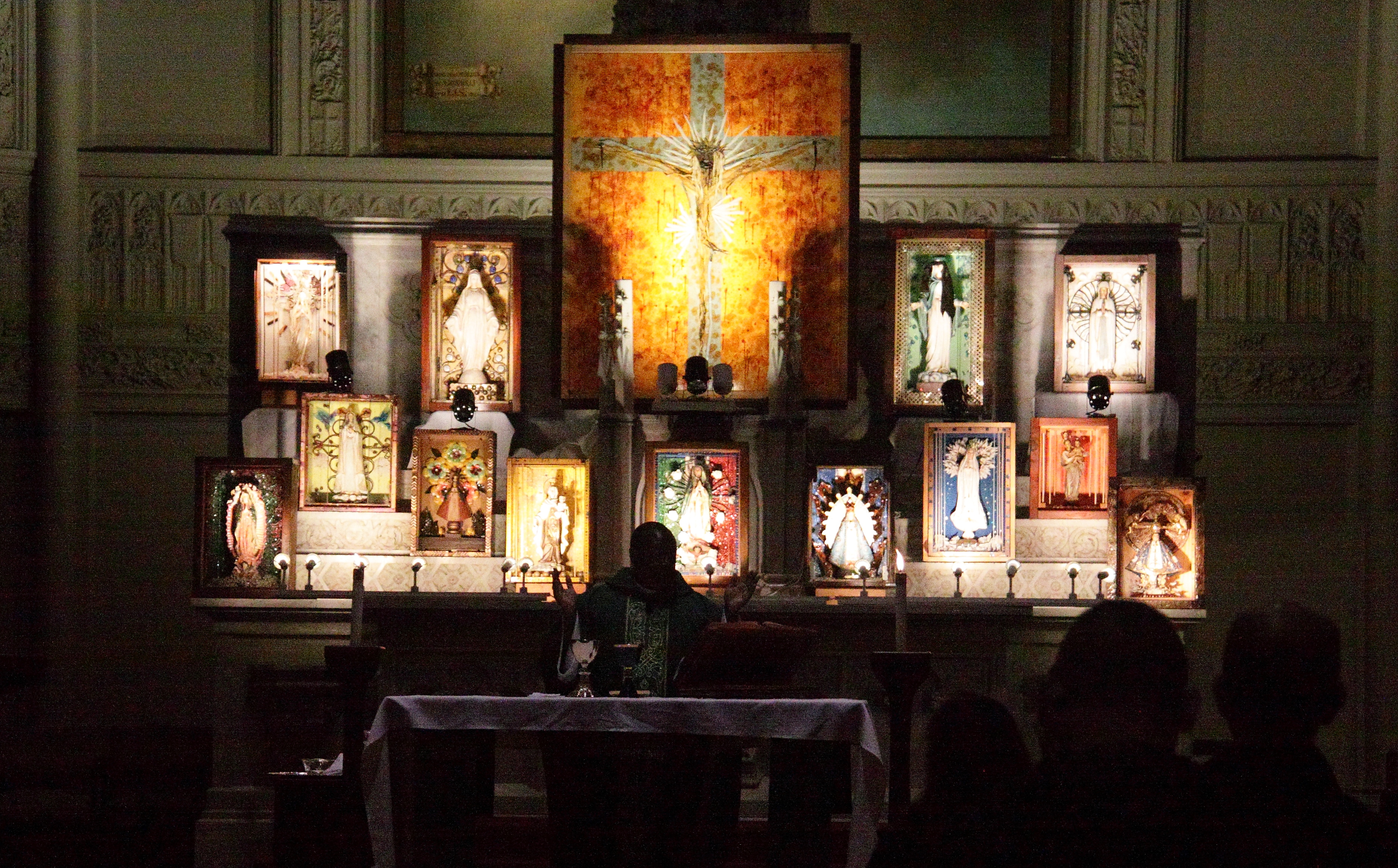
Being familiar with this trip I managed to arrive at about 12:15PM.  When I arrived I was a bit surprised to find a service in progress so I sat quietly observing this beautiful little church.  Though raised Catholic I haven’t ventured into a church in some years.  The experience did place a sort of spiritual context on my concert experience.

cordell0002

Priest saying mass at Old St. Mary’s Cathedral

The service ended a little after 12:30 and, after some of the congregants left I moved closer to the front.  Technicians moved the piano in place and Ms. Downes was introduced.

cordell0004

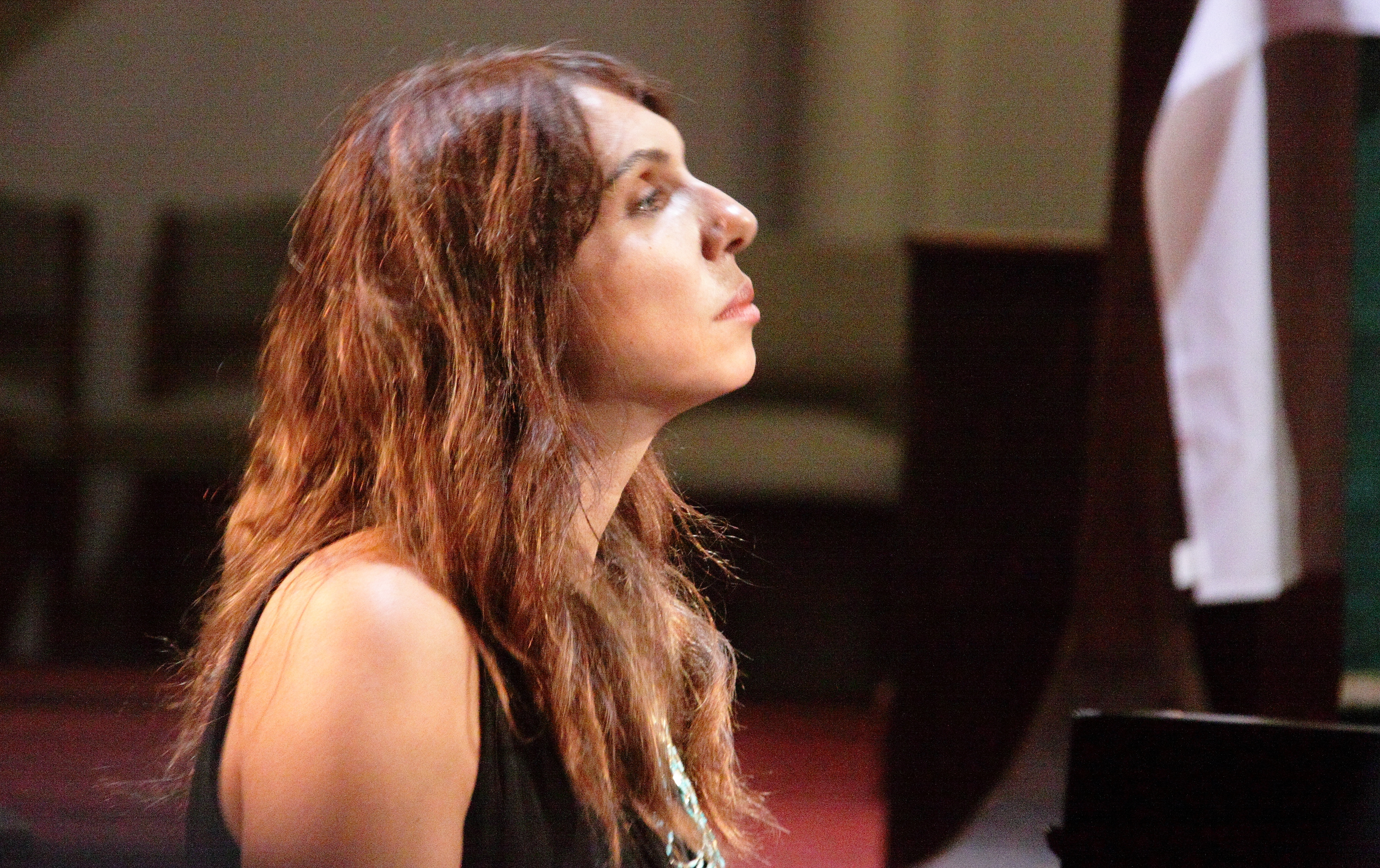
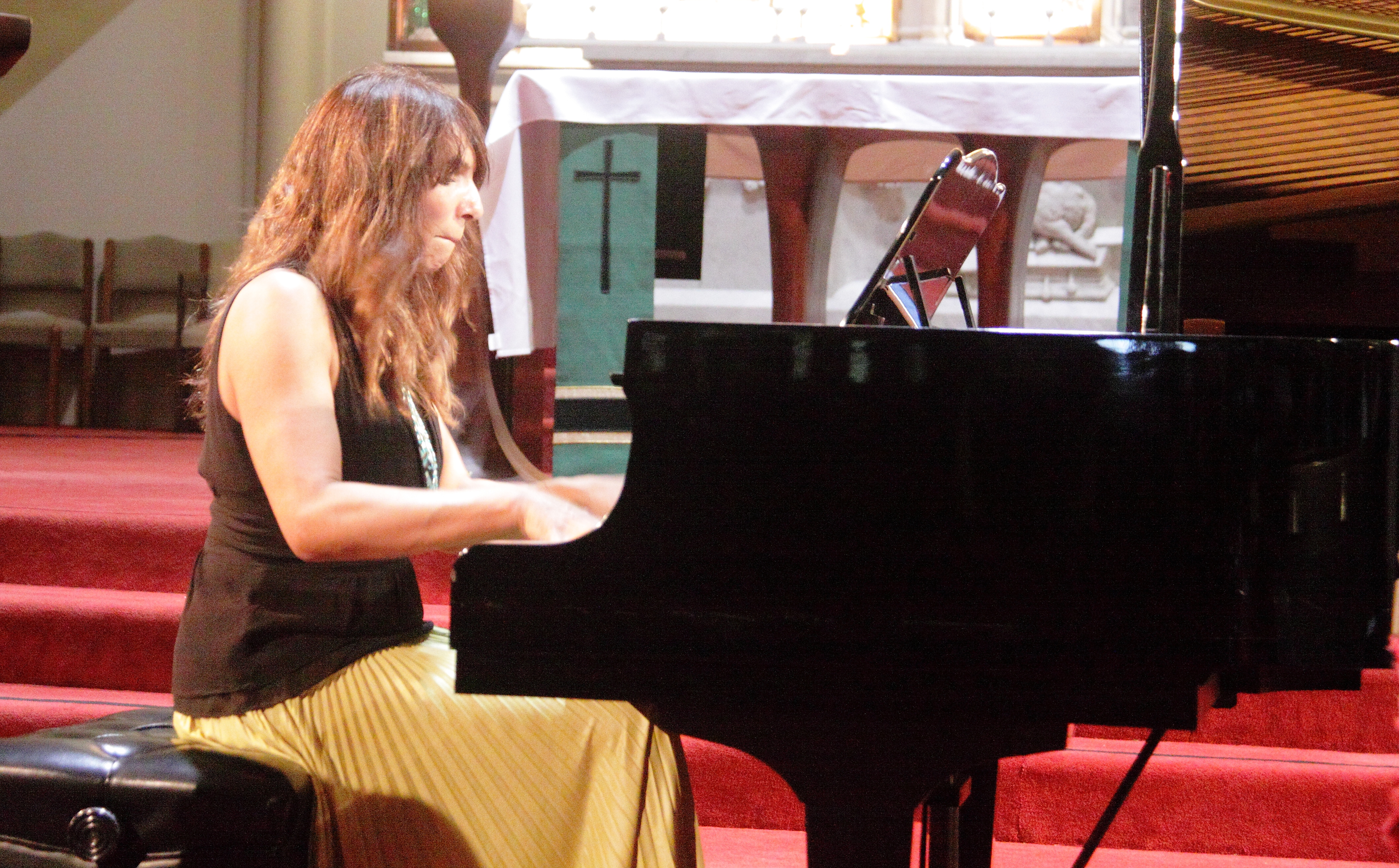
Downes intensely focused as she plays Schumann’s Fantasy Pieces

She chose to open with Robert Schumann’s (1810-1856) Op. 12 Fantasy Pieces Nos. 1, 2, 3 and 5 (1837).  I have but a passing knowledge of Schumann’s music.  It is highly virtuosic romanticism. Beautiful melodies, classical harmonies with just a dash of dissonance and a very high level of technical difficulty which characterizes these pieces.  Downes played them with confidence and ease seemingly casting a spell as she did.  She played the set without interruption and received much deserved applause from the somewhat sparse audience of perhaps 50 or so people.

She followed with a selection from her upcoming release America Again, Samuel Coleridge-Taylor’s (1875-1912) setting of the spiritual Deep River Op. 59 No. 10 (1905), one of a set of 24 so-called “Negro Melodies”. Coleridge-Taylor was a black British composer of the late 19th century sometimes referred to as the “African Mahler”.  This setting, very much in the same spirit as the Schumann was pretty much what one might have expected had Schumann encountered black spirituals.  This selection added again to the spiritual dimension.  Deep River is a majestic and celebratory piece which, like the Schumann, was well received.

Downes deviated from the printed program to play another selection from that forthcoming album, Morton Gould’s (1913-1996) American Caprice.  This short piece was a delightful foray into jazz reminding us of Gould’s connections with his contemporaries like Aaron Copland and George Gershwin.  Gould is a composer whose work deserves more attention and this listener is grateful to the artist for bringing this little masterpiece back into the light.

cordell0006

Downes making Rhapsody in Blue sound anew.

In some ways this functioned like a precursor to the next piece on the program, Gershwin’s (1898-1937) Rhapsody in Blue (1924) in the composer’s arrangement for solo piano. Downes, whose speaking was as comfortable and natural as her playing, asked the audience to try to hear this oh so familiar piece with new ears.  Indeed her fluid and dynamic playing put her own stamp on this popular gem and demonstrated again her seasoned virtuosity.  She played the work with passion but also with ease and confidence.

The ample applause and standing ovation brought her back for a wonderful encore.  It was Gershwin again for sure but this time in an amazing arrangement by Nina Simone (1933-2003) whose spirit seemed to be channeled by Downes.  “I loves you Porgy” from Porgy and Bess is featured on her new CD and it brought the afternoon to a very pleasing close.

I took the opportunity to meet and thank Ms. Downes who was, in turn, gracious and pleasant.  I went back out to the ordinary world charmed and invigorated and that is what I had hoped for.


Black Notes Matter: Lara Downes’ America Again


laradownes

Sono Luminus DSL-92207

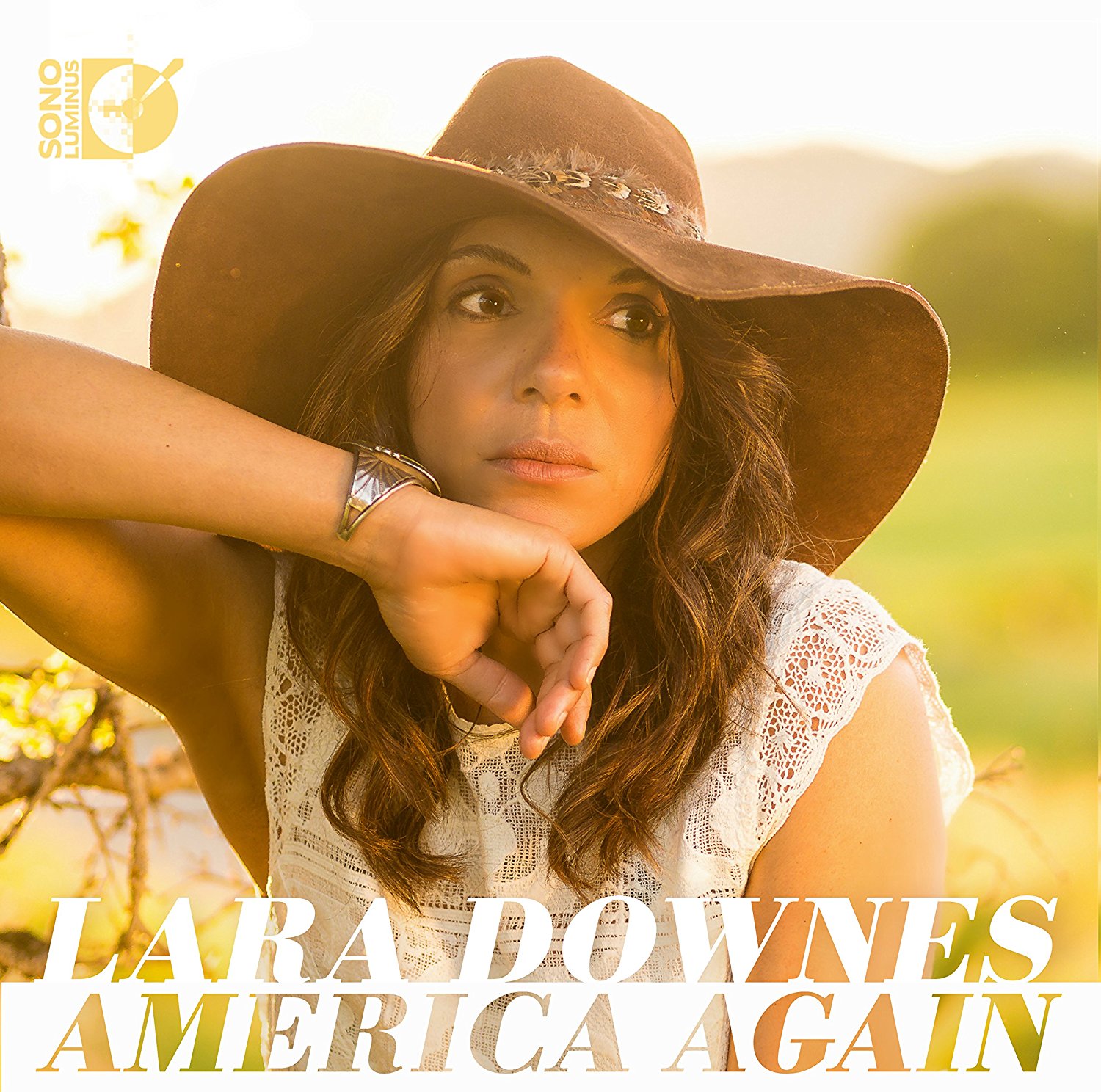
The lovely cover photo for this album by San Francisco born pianist Lara Downes is reminiscent of any number of socially conscious folk/rock stars of the 60s and 70s. It would seem that this is no accident.  This delightful album of short pieces by a wide variety of American composers takes its title from the Langston Hughes (1902-1967) poem, Let America Be America Again (1935).  By so doing the pianist places this interesting selection of short piano pieces firmly in the context of black racial politics and the artistic expression of black America as well as those influenced by this vital vein of American culture (both musical and literary).  It is a graceful and deeply felt effort and I hope that the metaphor of the title of my review is not too tortured a one to reflect that.

This is also a very personal album.  Downes seems to share some deeply felt connections with her materials.  This artist, born to a white mother and a black father, invokes a careful selection of short piano pieces steeped sometimes in jazz and blues but also the political directness (and optimism) which was characteristic of the inter-war years that brought forth the Hughes poem.  There is both sadness and celebration in these virtuosic and technically demanding little gems (most apparently recorded for the first time or at least the first time in a while).  The pianist’s comments on each individual piece are also critical to the understanding of this disc as she shares the impact and meaning that the music has had for her.

There are 21 tracks by 19 composers in all and the selections themselves are quite a feat. They range from the 19th to the 21st centuries and are composed by both men and women of a variety of racial and ethnic backgrounds.  All seem to share the sort of  populist charm befitting the idealized America yearned for in the poem which is to say that they represent a kind of idealized or hopeful nationalism.  Downes is well acquainted with a large variety of American music and recognizes no distinction between classical and so-called “vernacular” traditions.

In fact none of these things are atypical for this artist.  Her previous albums Exiles Cafe (2013) featured music by composers exiled from their homelands, A Billie Holiday Songbook (2015) celebrated the life of this iconic black artist and her American Ballads (2001) demonstrated her deep mastery and affection for populist (but not jingoistic) nationalism.  Her tastefully issue oriented albums define a very individual path and the present album appears to be a very logical and well executed next entry into her discography.

This disc shares a similar heritage to that of Alan Feinberg’s four discs on Argo/Decca entitled, The American Innovator, The American Virtuoso, The American Romantic and Fascinating Rhythm: American Syncopation.  Another notable antecedent is Natalie Hinderas’ groundbreaking two disc set of music by African-American composers.

And now on to the music:

Morton Gould (1913-1996) was a Pulitzer Prize winning composer and conductor with a style informed by his study of jazz and blues in a vein similar to that of Bernstein and Copland.  He is represented here by American Caprice (1940).

Lou Harrison (1917-2003)  was a composer, conductor and teacher.  He was a modernist and an innovator in the promotion of non-western musical cultures.  His New York Waltzes (1944-1994) are three brief essays in that dance form.

The traditional folk song Shenandoah (apparently in the pianist’s transcription) is next.   This tune will be familiar to most listeners as a popular selection by choral groups and the melody is a common metaphor for things American.

Amy Marcy Cheney Beach (1867-1944) was one of the first successful female American composers.  Her “From Blackbird Hills” Op. 83 (1922) is representative of her late romantic style and her incorporation of Native American (Omaha) elements in her music.

Samuel Coleridge-Taylor (1875-1912) is a English composer with Creole roots, a black composer, known as the “African Mahler” in his day.  Deep River (1905) is his setting of this spiritual which also was one of Marian Anderson’s signature pieces.

Dan Visconti (1982- ) was commissioned by the International Beethoven Festival to write his Lonesome Roads Nocturne (2013) for Lara Downes.  It receives its world premiere recording in this collection.

Swiss-American composer and teacher Ernest Bloch (1880-1959) is certainly deserving of more attention.  His At Sea (1922) is used here to represent the sea voyages of the many immigrants (willing and unwilling) whose journey defined in part who they were.

George Gershwin (1898-1937) mastered both the vernacular tradition (as one of the finest song writers of the 20th Century) and the classical tradition in his too few compositions written in his sadly abbreviated life.  His opera Porgy and Bess (1935) is contemporary with the Langston Hughes poem mentioned earlier.  Downes most arrestingly chooses the arrangement of “I loves you, Porgy” by the classically trained iconic singer, musician and civil rights activist Nina Simone (1933-2003).  Quoting from Downes’ notes (Nina Simone expresses what she knew) “…about being a woman, being black and about being strong and powerless all at the same time.”  Indeed one of the most potent lines of the Hughes poem reads, “America was never America to me.”

Angelica Negrón (1981- ) was born in Puerto Rico and  now lives and works in New York. Her Sueno Recurrente (Recurring Dream, 2002) is a lovely little nocturne which is here given its world premiere.

Leonard Bernstein (1918-1990) held credentials as composer, conductor, teacher and ardent civil rights supporter.  His Anniversary for Stephen Sondheim (1988) is one of a series of Anniversary piano pieces he wrote.  Bernstein did much to help modern audiences (including this reviewer) comprehend the vital musicality of jazz and blues. Like Downes, he drew little distinction between popular and classical and celebrated all the music he believed was good.

David Sanford (1963- ) is a trombonist, teacher and composer who works in both classical and jazz idioms.  His work Promise (2009) was written for Downes and this is the world premiere recording.

Howard Hanson (1896-1981) was a conductor, teacher and Pulitzer Prize winning composer (though not at all an advocate of ragtime, jazz or blues).  His brief but lovely piano piece Slumber Song (1915) is a nice discovery and one hopes that it will be taken up by more pianists.

Scott Joplin (1867/68-1917) was discovered largely due to the scholarship and recordings of musicologist Joshua Rifkin (who incidentally did some arrangements for folkie Judy Collins) whose three volumes of piano rags on Nonesuch records introduced this wonderful black composer’s work to a wider audience once again.  Marvin Hamlisch famously incorporated Joplin’s music into his score for the motion picture The Sting (1973).  Downes chooses the Gladiolus Rag (1907) to represent this composer.

Irving Berlin (born Israel Isidore Baline 1888-1989) is another of the greatest song composers this country has produced.  In another characteristically clever choice Downes chooses the arrangement of this hugely optimistic song, “Blue Skies”(1926) by the great jazz pianist Art Tatum (1909-1956).

Florence Price (1887-1953) was a black female composer (the first to have one of her orchestral works programmed by a major symphony orchestra) whose work is only recently getting some much needed exposure.  Her Fantasy Negre (1929) is based on a spiritual, “Sinner, Please Don’t Let This Harvest Pass”.  Price was involved in the New Negro Arts Movement of the Harlem Renaissance and was professionally connected with Langston Hughes among others.

Aaron Copland (1900-1990) is perhaps the most iconic American composer.  Dubbed the “Dean of American Composers” his earliest work has strong jazz influences and his later work created the American romantic/nationalist sound incorporating folk songs and rhythms.  For this recording the artist chose the first of the composer’s Four Piano Blues (1926) which also appeared on her 2001 album of American Ballads.

Edward Kennedy “Duke” Ellington (1899-1974) was a composer and band leader whose sound virtually defined the Harlem Renaissance during his tenure at the famed Cotton Club.  Melancholia (1959) is the piece chosen here, again a nice little discovery.

Roy Harris (1898-1979) was, like Copland, a populist but the Oklahoma born composer studied Native American music as well as American folk songs.  His American Ballads (1946) was included on Downes’ American Ballads album.  Here she includes an unpublished work from a projected (but never finished) American Ballads Volume II.  This piece is a setting of the spiritual, “Lil Boy Named David”.

The album concludes with one of the ultimate hopeful dreamer songs, Harold Arlen’s (1905-1986) Over the Rainbow (1939) from his score for The Wizard of Oz (1939).  The adolescent yearning of Dorothy for something better than her dust bowl farm life touched a chord in many over the years and it is a fitting conclusion to this beautiful and hopeful collection.

As mentioned earlier the insightful liner notes by Lara Downes complement this production and tactfully position its politics.  She shares a personal journey that is as American as the proverbial apple pie.  The album is dedicated to the artist’s ancestors in recognition of their struggles as well as to her children in hopes that dreams for a better future can become their reality.

This beautiful sound of this album is the result of work of Producer Dan Merceruio and Executive Producer Collin J. Rae along with Daniel Shores and David Angell.  The lovely photography is by Rik Keller and as with the previous release Skylark: Crossing Over (reviewed here) the graphic design by Caleb Nei deserves special mention for its ability to truly complement this disc.

It is scheduled for release on October 28, 2016.


A shamanic effort to raise consciousness and further socially progressive ideas.

Black Classical Part Four


As promised in a previous blog I am here continuing a little personal survey of recordings of music by black classical composers in honor of Black History Month. I suppose it is worth adding that I pursue these recordings because they present interesting and exciting repertoire that has not gotten the circulation it deserves. Sadly this is most likely the result of the failure of producers, performers audiences and investors to look at the value of the art itself, looking instead through the lens of racial prejudice. I hope that readers of these blogs will avail themselves of this music, these performers, these recordings and maybe come to realize that those old prejudices serve only to limit one’s world view and prevent a rewarding artistic experience. Art, like people, must come to be valued by its own merits, not limited on the basis of skin color. MLK definitely phrased that more elegantly.

20130218-185316.jpg

And further proof of such valuable art can be found in a series of recordings on the Chicago-based label Cedille. In fact their website cedillerecords.org contains a link to the six albums of music by black composers they have thus far issued.

Building on the work he had begun with the Black Composers series for Columbia in the 1970s conductor Paul Freeman released three CDs in the Cedille series called ‘African Heritage Symphonic Series’. With the orchestra he founded Freeman presents music by Samuel Coleridge-Taylor, Fela Sowande, William Grant Still, Ulysses Kay, George Walker, Roque Cordero, Adolphus Hailstork, Hale Smith, David Abel’s, David Baker, William Banfield and Coleridge-Taylor Perkinson. Freeman released a CD dedicated exclusively to the music of Coleridge-Taylor Perkinson as well.

Violinist Rachel Barton-Pine released a disc of violin concertos by 18th and19th century black composers on Cedille and there is a disc of choral music which includes music by black composers.

Let’s turn now to the Albany www.albanyrecords.com label where you can find more of the artistry of Paul Freeman in 18 albums where he presents neglected music of the 20th century by a wide variety of composers black and white. Most of it is by American composers and much of that in styles related to the mid-century styles of the likes of William Schuman, Aaron Copland and their students. While these discs include music by many of the previously mentioned black composers there are no duplications of works or performances. I have heard but a few of these discs but what I have heard is enough to convince me to plan to purchase the others. Freeman, in addition to bringing the music of black composers to the listening audience has done a fine job of documenting many whose work has been little heard until now.

20130218-183122.jpg

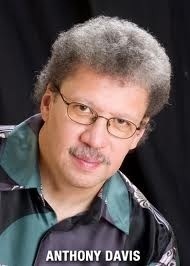
Another composer who fits more or less into the context of the conventions of the western concert traditions whose work has informed my listening is that of Anthony Davis (1951- ). While he has played with musicians from more experimental traditions the influence of the western concert traditions is more easily heard.

His study of jazz as well as western classical and eastern gamelan are all evident in his work (though not necessarily all at the same time). The New York City Opera produced his, ‘X, the Life and Times of Malcolm X’ in 1986 and the Lyric Opera of Chicago produced ‘Amistad’ in 1997. He has written concertos for piano and for violin as well as music for orchestra and smaller ensembles. At the time of this writing he is professor of music at the University of California San Diego.

So far the music we have discussed has been of the sort more commonly heard in concert halls these days. Freeman’s efforts have seemingly jump-started the recording industry to pay some attention to the music of black and other neglected composers. Certainly there is much more gold to be mined there. But we have yet to address the contemporary scene, the new and creative artists who are bringing innovative ideas and sounds and advancing the musical arts for subsequent generations. Following on the innovations of great jazz artists such as Charlie Parker, John Coltrane and Ornette Coleman (among many) there was increasing focus on techniques being used by contemporary “classical” composers

20130218-190530.jpg

To these ends there is no better place to start than with the AACM, the American Association of Creative Musicians. Founded in Chicago in 1965 this collective has strived to bring various elements of black culture in an incredibly eclectic and experimental milieu which has had and continues to have an influence on music, musicians and audiences. This collective was finally given a proper overview in George Lewis’ book, ‘A Power Stronger Than Itself’. Lewis, a trombonist, composer and currently professor of music at Columbia University in New York was a member of the AACM.

The AACM was not the only such collective but it was one of the most visible, at least to me. And it continues to develop and evolve bringing the complex and innovative musical ideas evolving from the black roots of jazz to a level of recognition and respect formerly accorded pretty much exclusively to European academic models. The AACM, dubbed “Great Black Music” also strives to retain the identity of black music by black peoples of the world looking to non-western models that predate European colonialism marrying them to the best of European models as absorbed by the diaspora. Many of their members now hold academic positions including Roscoe Mitchell, Anthony Braxton, Wadada Leo Smith and Nicole Mitchell.

20130218-190751.jpg

Perhaps the best known ensemble to come out of the AACM is the flexibly-membered Art Ensemble of Chicago. Their album ‘Third Decade’ released in 1984 is representative of their work and also marks a sort of end to one creative era for this flexibly-membered group. Most listeners will hear this as progressive jazz and it certainly has those elements. But repeated listenings reveal many layers to this work. And this is but one of a large catalog of albums as diverse as they are numerous (about 50 albums and still counting). More on their work at their website www.artensembleofchicago.com.

20130218-190928.jpg

Another prominent figure that was a member of AACM is Anthony Braxton, saxophonist, composer, chess master who dislikes the term ‘jazz’ in reference to his music. He is currently professor of music at Wesleyan University. And indeed his music which ranges from solo saxophone work to small ensemble and orchestral music and opera are difficult to classify. His experimentalism is related to but not derivative of the work of John Cage. It would be impossible to represent his musical output in a single album but the solo saxophone ‘For Alto’ (1968) and ‘Creative Orchestra Music’ (1976) are good places to start in his discography of well over 100 albums. His website tricentricfoundatio.org offers many of his recordings for sale and even offers free downloads of bootleg recordings.

20130218-185224.jpg

<a

For the sake of brevity I will discuss only one more artist in this blog entry, Julius Eastman (1940-1990). He was a composer, vocalist, pianist and dancer. As a vocalist he sang and recorded the music of Meredith Monk, Peter Gordon, Morton Feldman, Arthur Russell and Peter Maxwell-Davies. He was very much a part of the avant garde downtown scene in New York of the 1970s.

At the time of his sad death from a heart attack at the age of 49 there were but a few recordings of his work (collected in a nice 3 CD set on the New World label). And many of his scores were lost when he was unceremoniously evicted from his apartment. The composer Mary Jane Leach is attempting to collect and preserve his legacy and has made many of his extant scores on her website http://www.mjleach.com/eastman.htm.

Without a doubt there are many more black classical and avant-garde artists I have yet to discover. I welcome suggestions and I hope that the preceding ideas will stimulate and encourage others to explore these artists and works.