Bob and Blue, A Musical Pilgrimage


Littlefield Hall (photo copyright by author)

…tell the old story for our modern times. Find the beginning.

-Homer, The Odyssey (Emily Wilson translation)

When I first got the email notice of this concert, I was, to say the least, intrigued. A two piano concert at Littlefield Concert Hall on the campus of Mills College featuring two composer/performers who figured prominently in that Temple of new music and in my personal listening life. Alas, I live some 350 miles from that location. But further intrigue came from the featured artists: Sarah Cahill and Joseph Kubera, two of the finest working new music pianists anywhere and both worked with the evening’s composers. This was just too compelling and I decided that I would regret missing this if I failed to go hear it.

So it was, I planned my little odyssey, leaving at about 9AM from Santa Barbara on a nice lightly trafficked trip, more a pilgrimage than an odyssey. A pilgrimage, frequently defined as a personal spiritual journey ostensibly in search of insight or enlightenment is how I’ve come to identify my listener’s adventure to the secular temple of Mills College featuring music of former Mills faculty Robert Ashley (1930-2014) and Robert Sheff (1945-2020), better known by his stage name, “Blue Gene Tyrrany”.
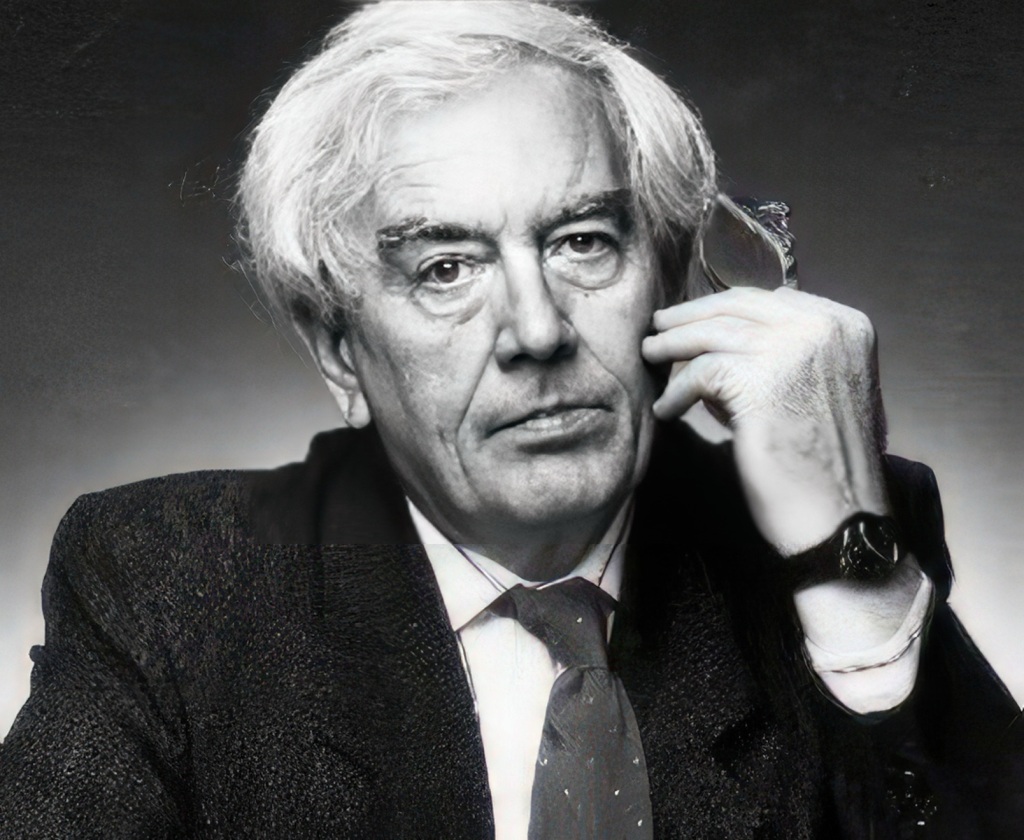
Robert Ashley (copyright unknown)
“Bob and Blue” (copyright by Other Minds)

The two featured composers had a strong connection to the Bay Area, mostly via their work at Mills College. This intelligent but modest production left little room to print program notes so the performers spoke of the music at various points during the concert and the excellent liner notes were made available by a QR code in the program book.

Sarah Cahill, pianist, radio host, producer, tireless advocate for new music (photo copyright by Other Minds)
Joseph Kubera, pianist, member of the SEM ensemble, Downtown Music, and countless collaborations promoting new music with many fine recordings to his name. (Photo copyright by Other Minds)

Our two performers are no strangers to each other or the composers on the program, having collaborated on numerous performances and recordings. The well rehearsed duo turned in riveting performances of this largely unknown repertoire which made a strong case that it be better known. Their playing and choice of repertoire compelled this listener’s attention such that I forgot to take all but a few performance shots. See those program notes for further biographical info on these two fine musical celebrants.
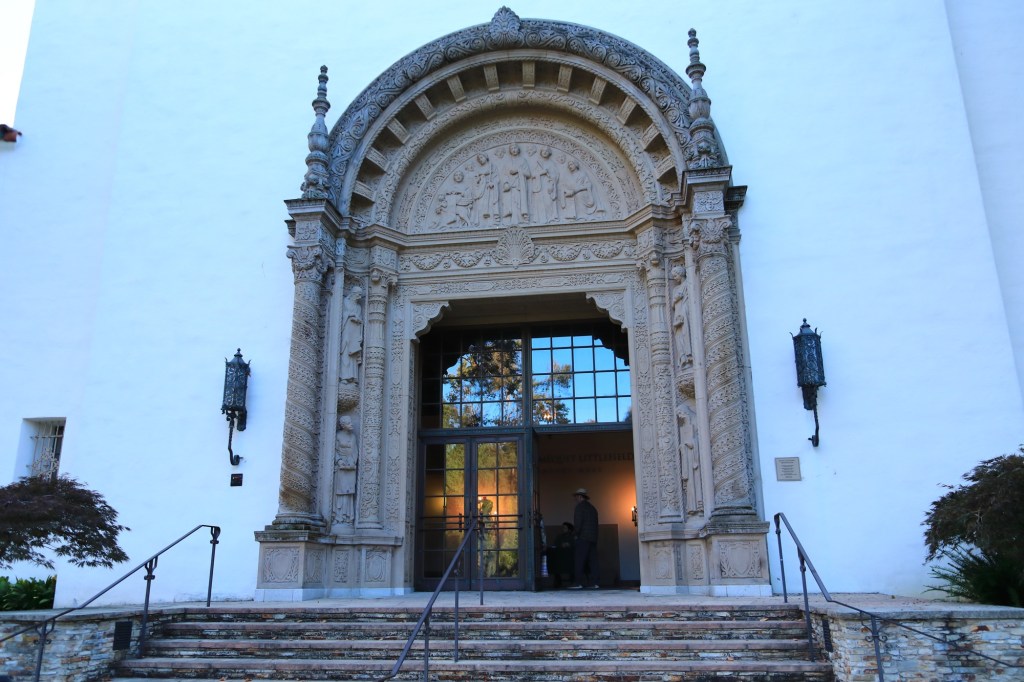
Entrance to Littlefield Concert Hall (copyright by author)

Mills College has long been a temple, a Mecca for new music in the Bay Area of California. Its roster of faculty and students comprises some of the finest post 1945 composers and performers. Darius Milhaud (1892-1974) and Luciano Berio (1925-2003) and students as diverse as Terry Riley (1935- ), Steve Reich (1936- ), and Dave Brubeck (1920-2012) to name but a few. Many artistic spirits musical and otherwise, exert their presence here. It’s a perfect destination for a pilgrimage.

A bust of frequent Mills visitor Lou Silver Harrison (1917-2003) in the lobby, a persistent benevolent spirit. (photo copright by author)

The concert was organized by Charles Amirkhanian and his Other Minds organization, another guiding light in the San Francisco/Oakland new music scene. Pianists Sarah Cahill and Joseph Kubera were to be the celebrants in the concert ritual paying homage to “Bob and Blue” as well as to the oracular Mills College.

Scene from the lobby (photo copyright by author)

Let me tell you about this concert hall. It is the work of legendary California architect Julia Morgan (1872-1957) who famously also worked on Hearst Castle. This is one of her several architectural gems on campus. Her spirit was also witness to this celebration by virtue of her fine architecture.
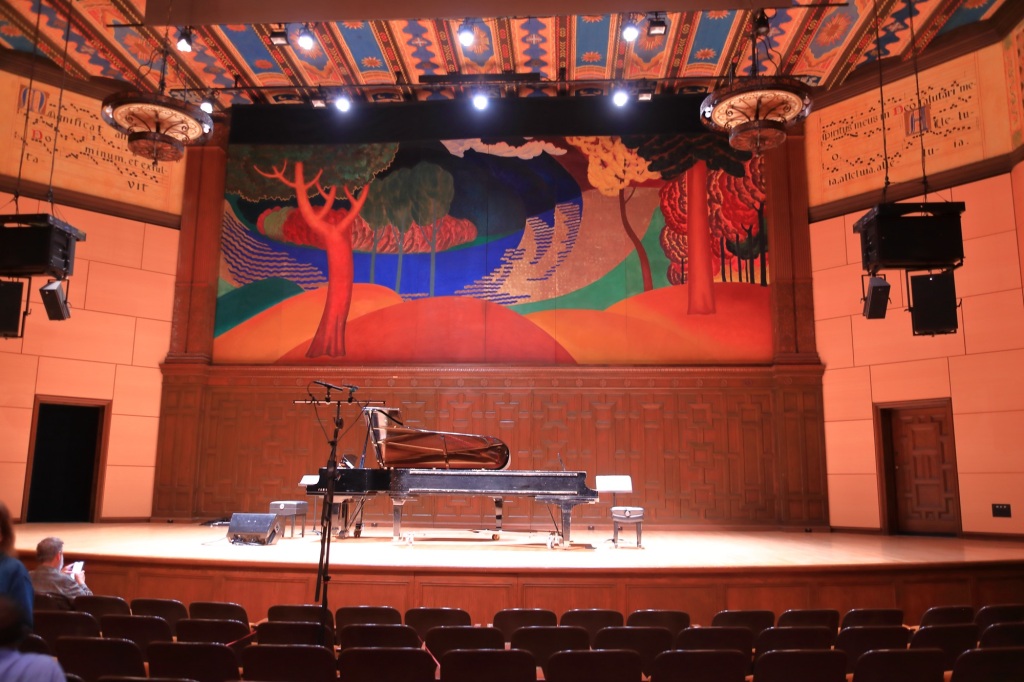
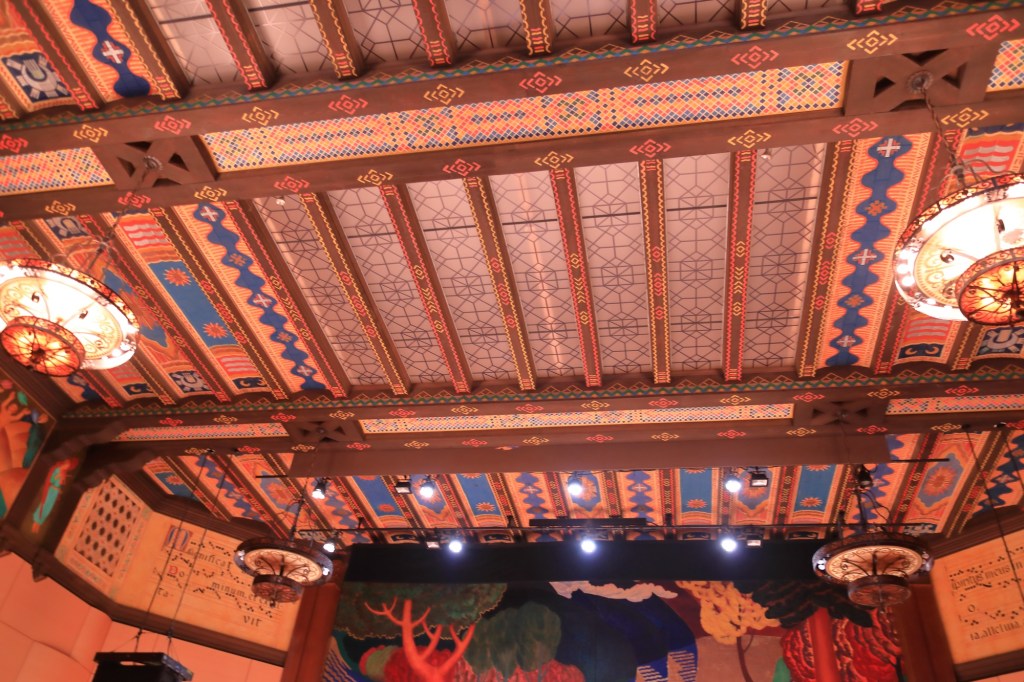
Stage at Littlefield Hall showing the ornate, colorful detailed designs (photo copyright by the author)
Look at that ceiling and those chandeliers (photo copyright by the author)

Two pianos, a new Steinway stage left and a slightly worn Baldwin stage right were placed such that the pianists seated at their respective keyboards could see each other. The Steinway with its lid open to reflect the sound to the audience and that well worn Baldwin with no lid at all (for reasons to be revealed later). The sonics of the hall and tuning of those pianos were excellent.
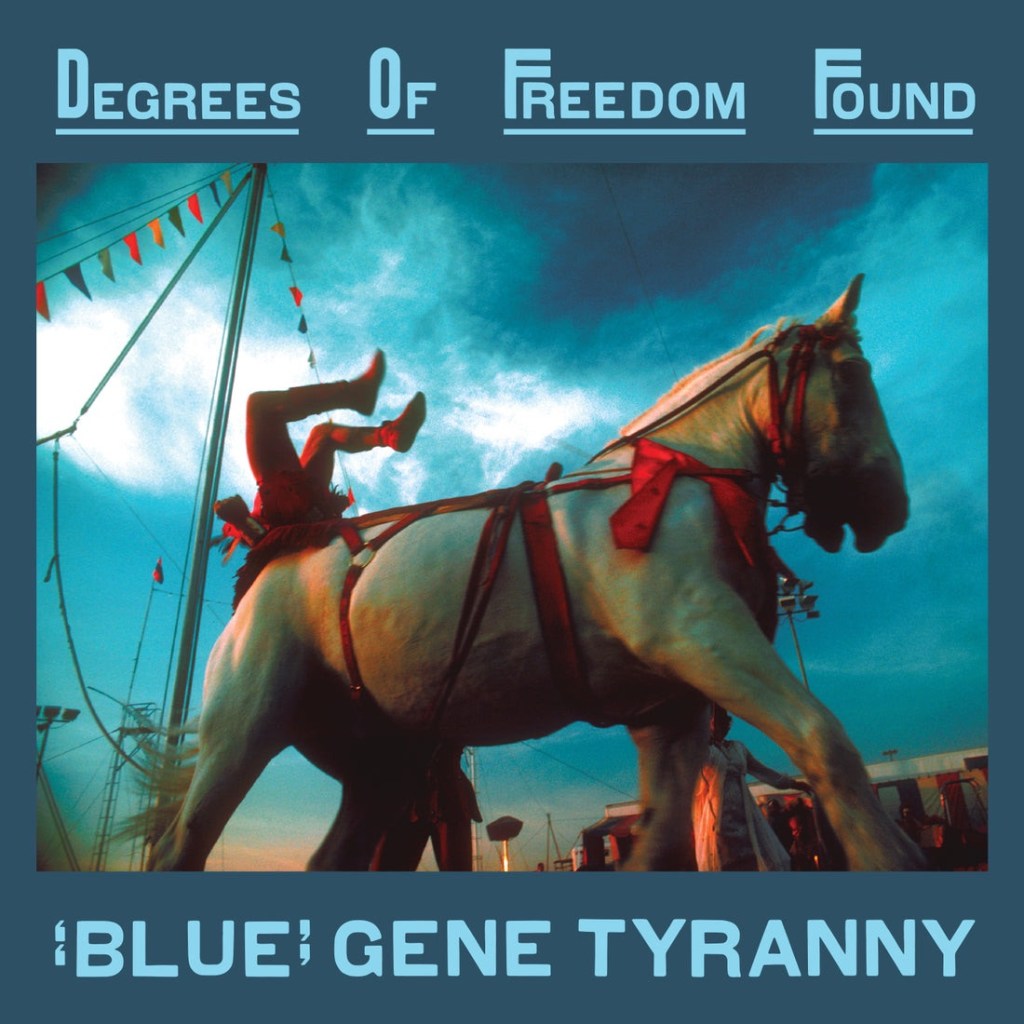
Unseen Worlds’ wonderful survey of Blue’s ensemble works.

The concert opened with Blue Gene Tyrrany’s peaen to old Route 66 in his “Decertified Highway of Dreams” (1999) for two pianos. It was clear from this first selection, that our performers were well rehearsed and in sync despite rhythmic complexities inherent in this quite beautiful work. It is cinematic and sweetly nostalgic, a fine example of “Blue”’s genius. The performance was riveting and worthy as the first performance ritual of the evening.

This was followed by a real rarity, a performance of Robert Ashley’s Piano Sonata (1959, 1979, 1985). In fact, it appears to have been the first complete performance of the two piano version of this impressive serially structured piece. Previous recordings are available, one with the composer performing the first movement at the ONCE Festival from 1966, the other by Blue Gene Tyrrany on his album, “Just for the Record”. This writer also found some useful analysis by musicologist Kyle Gann on his website. Gann worked with Ashley and later published a fine survey of Ashley’s music that is well worth your time. The result was a convincing, almost romantic sounding performance of this foundational work in Ashley’s oeuvre.

This was followed by a solo rendition by Joe Kubera of Tyrrany’s “The Drifter” (1994), which was written for Mr. Kubera. He spoke briefly about the structure of this work (which he also recorded on his recent “Horizons” album). This piece has a meandering quality created by the intricate evolving structure. Kubera’s performance was hypnotic and a fine tribute.

The second half began with Ms. Cahill solo at that stage left Steinway playing first Tyranny’s “Nocturne With and Without Memory” (1989), one of his better known works. Then she played his “Spirit” (1996/2002), a piece that is a sort of homage to the experimental composer/performer Henry Cowell (1897-1965). It was rather unusual in that it involved harmonics over which the pianist plays. The title is an homage to Cowell’s famous piano piece, “The Banshee”, a malevolent spirit in Irish mythology. Both were vintage Blue Gene pieces.

Two pianists, one piano.

Then Kubera returned, taking a seat at the blemished Baldwin with Cahill standing at that same piano, at a 90 degree angle to Kubera. Here, in these two obscure Ashley pieces, Viva’s Boy (1991), and “Details” (2b, 1962), Cahill played like a chef at a chef’s table, playing the strings inside the piano while Kubera manned the keyboard. These true rarities getting perhaps their first performance, were certainly a highlight of the concert.

It was Blue Gene Tyrrany’s spirit that was the final ritual celebration on this magical night with both pianists at their respective pianos to give a heartfelt reading of his, “A Letter From Home” (2002). This brought this learned, well rehearsed, beautifully collaborative evening’s ritual to a satisfying close.

The modest, self selected audience, applauded warmly and gave an extended, much deserved ovation and seemed as enthralled as this listener whose musico-spiritual pilgrimage found an ecstatic height. I drove home that same night, blessedly lifted, if only briefly, from the chaos of the world by this wonderful artistic ritual. They will now take this great program to New York.

Linda Twine, A Musician You Should Know


Linda-K-Twine-Image-page-001

Linda Twine

I have found it strange that the few articles I have written (and, full disclosure, I’m a white guy) on black musicians seem to have placed me in the position of being one of apparently a limited number of writers/bloggers who pay attention to the topic.  Happily these articles have gained an audience.  The rather simple piece I wrote on black conductors, a little essay composed in honor of Black History Month, remains by far one of my most read articles.

The vicissitudes of race and racism are such that we need to say, “black lives matter” because even the most cursory examination of statistics shows that they seem to matter far less than lives with other racial identities.  The same is true with music and musicians..  There are organizations dedicated to the promotion of black musicians because they remain far less well represented.

It is in this spirit that I am writing this little sketch to highlight a black musician who does not have a Wikipedia page or even a personal web page that I have been able to find.  You can find her easily with a Google search but you will find some of the same segregation of which I spoke.  One finds her on the “Broadway Black” website which does a fine job of promoting her and her work.  And what fine work it is.

To be fair she is also on the “Internet Broadway Database“, “Playbill“, the “Internet Movie Database“, and one can find her most recent work listed on the “Broadway World” site.  Her cantata, “Changed My Name” can be found on You Tube.  And it is there where, curiously enough, one can find the most comprehensive information on her.  I present it here:

From the Muskogee Phoenix, 11/10/2007, we have this information about Linda Twine:

Twine, a native of Muskogee, OK, graduated from Oklahoma City University in 1966, with a bachelor of arts degree in music. There, she studied piano with the esteemed Dr. Clarence Burg and Professor Nancy Apgar. After graduating from OCU, Twine studied at the Manhattan School of Music in New York, where she earned a master’s degree, and made New York her home. She began her musical career in New York, teaching music in public school by day and accompanying classical and jazz artists at night. At one of these engagements, she was asked if she would like to substitute for the keyboardist of the Tony Award winning Broadway hit, “The Wiz.” Her positive response began a long career in Broadway musicals from keyboard substitute to assistant conductor of Broadway orchestras. In 1981, to conductor when Lena Horne asked her to conduct her one-woman hit, “Lena Horne: The Lady and Her Music.” This garnered Twine the respect of her peers and as a much sought-after Broadway musical conductor. In addition to “The Wiz” and “Lena Horne,” Twine’s Broadway credits include, “Ain’t Misbehavin’,” “Big River” (the score composed by Oklahoman Roger Miller), “Jelly’s Last Jam,” “Frog and Toad,” “Caroline or Change,” “Purlie,” and the current “The Color Purple,” starring Fantasia. Not only a distinguished conductor, Twine is also a composer and arranger. She composed “Changed My Name,” a cantata inspired by slave women Sojourner Truth and Harriet Tubman, and written for two actresses, four soloists, and a chorus. Her popular spiritual arrangements are published by Hinshaw. As a producer, instrumental and vocal arranger, her work can be seen and heard in the books and CDs of the Silver Burdett Publishing company, which are used by many public schools in the United States. Community commitment and involvement have also marked Twine’s outstanding career. She has arranged and composed for the renowned Boys Choir of Harlem, and she served for 14 years as minister of music for St. James Presbyterian Church of New York. Among her many awards and honors is the “Personal Best Award for Achievement and the Pursuit of Excellence,” for her role as a writer and arranger for the Boys Choir of Harlem, her artistic achievements in the world of Musical Theatre, and her concern for humanity. Twine, a proud Oklahoman, is the granddaughter of William Henry Twine, a pioneer lawyer who made a homestead claim in the 1891 Sac and Fox Run, and along with G.W.F. Sawner and E.I. Saddler established the first black law partnership in Oklahoma Territory.

So here, in honor of Black History Month, I wish to present this fine musician whose art deserves the world’s attention.  Take note please.

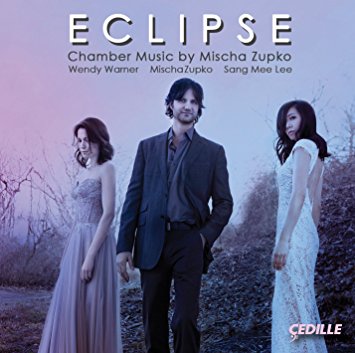
Eclipse of the Son: Mischa Zupko


zupko

Mischa Zupko (1971- ) is a composer, a pianist, and a professor of music at Chicago’s De Paul University.  He is the son of avant garde composer Ramon Zupko (1932- ).  Mischa’s work featured on this Cedille release suggests that the proverbial apple has fallen quite a distance from the family musical tree.  That is neither bad nor good but it is striking.

The elder Zupko’s work, despite its significance, is too little known.  A few recordings exist on the old CRI recordings label and this writer recalls being impressed by them. According to the Chicago Reader article he really didn’t want his son to go into the music business but apparently what is in the blood is in the blood.  A curious note too is that one can find articles on both these composers on Wikipedia but not the English/American one, rather curiously both are to be found on the Dutch Wikipedia site.

The present disc is apparently the first dedicated entirely to this emerging composer’s work (now numbering some 50 pieces).  It is a disc of chamber music and from the first the listener is immediately aware that the younger Zupko is possessed of a sort of retro romantic bent.  Think of the great virtuoso composer/pianists of the 19th century like Franz Liszt and Anton Rubinstein.  He does gratefully acknowledge his father as inspiration but clearly follows a different path.

This music is about passion and virtuosity.  The composer defines this clearly in his liner notes.  The performers Mischa Zupko on piano, Wendy Warner on cello, and Sang Mee Lee on violin demonstrate both passion and virtuosity on this lucid recording.  They play very well together and they all have ample opportunities to show off their respective skills.

There are seven works on ten tracks dating from 2005 to 2015.  The first five tracks consist of “Rising” (violin and piano, 2009), “Fallen” (cello and piano, 2010), “From Twilight” (solo violin, 2015), “Eclipse” (violin and cello, 2014), and, “Nebula” (solo cello, 2015).

There then follows the four movement”Shades of Grey” (2005) for violin and piano.  This is the earliest work on the disc but stylistically it is consistent with the rest of the disc. Zupko certainly develops as a composer but his style seems pretty firmly established.

The last track seems to be the big feature here.  “Love Obsession” (cello, piano, 6 pre-recorded cello tracks; 2013) is perhaps the most adventurous and grand of the works on this recording.  As with the other works on the disc the composer cites various literary influences and inspirations consistent with the apparently romantic ethic which seems to drive his creativity.  And as with the other tracks we hear a tonal romantic idiom filled with passion.

My title for this review is not intended to suggest that the younger Zupko has surpassed his father in any way except perhaps in that his work has, whether by accident, timing, design, or whatever, gotten more attention.  This is not a case of Johann Strauss Jr. and Sr. in jealous competition, this is simply another generation responding to it’s muse and that is worth celebrating.


Notes From the Underground, A major new recording of Anthony Davis’ orchestral music


Album cover

Album cover

In March, 2014 the Boston Modern Orchestra Project released Notes From the Underground, a major retrospective recording of the composer’s work for large ensembles.  The recording includes Notes from the Underground (1988) a two movement work for orchestra, You Have the Right to Remain Silent (2007) a concerto for clarinet and contra-alto clarinet and Kurzweil processor and a new recording of the piano concerto Wayang No. 5 (1984) with the composer as soloist.  The Boston Modern Orchestra Project is conducted by Gil Rose.

There are liner notes by the composer and also by the great musician/composer/historian George Lewis (and a frequent musical collaborator with Davis).  The notes are relatively brief but contain a wealth of information and provide useful insights into both the musical processes and the sociopolitical forces that drive Davis’ music.  Davis describes his compositional processes and Lewis, a frequent musical collaborator,  places the music in historic and sociopolitical contexts.

Only the Wayang No. 5 has had a previous recording.  It was one of the two works included on the Gramavision release which included the equally engaging Violin Concerto “Maps” (1988) written for and performed by violinist Shem Guibbory.  The concerto reflects Davis’ interest in jazz as well as his study of gamelan music from whence comes the title “Wayang”. Davis has written a series of compositions for various combinations of instruments titled sequentially Wayang No. 1, No. 2, etc.  The term refers to the shadow puppet theater of  Bali which are accompanied by a gamelan orchestra, an ensemble largely of tuned gongs and other percussion instruments.  Davis studied gamelan music and wrote six compositions (so far) titled Wayang of which the fifth is the piano concerto on this recording.

Wayang No. V is the earliest composition on the disc and consists of four movements.  Opening-Dance begins with an improvisatory section with the pianist playing over unresolved harmonies in the orchestra which then leads to the main section of the movement which is characterized by ostinati in the orchestra as well as on the piano.  There is a seamless transition to the second movement Undine, a slow movement with an impressionistic feel.  March also begins without pause from the previous movement.  It is a scherzo like piece where the polyrhythmic structures are quite clear.   The finale, Keçak, a reference to the monkey chant in the ritual enactment of a scene from the Ramayana where the monkey-like Vanara help Prince Rama fight the evil King Ravana.  It begins with a long solo piano introduction followed  by a sort of dialog between the piano and several percussion instruments.  Davis demonstrates his virtuosity here in writing that is indebted as much to gamelan as it is to jazz and modernism from Schoenberg to Bartok, Stravinsky, Hans Werner Henze and Thelonius Monk.

This is a concerto that is more concerned more with expression than empty virtuosity though the piano part could hardly be called easy.  I am amazed that there have been no pianists who have added this wonderful piece to their repertory.  It is a very entertaining piece of music making.

The title track is the orchestral composition, Notes from the Underground (1988).  It is a two movement work dedicated to the writer Ralph Ellison (1914-1994), best known for his National Book Award winning novel The Invisible Man (1952).   The title evokes Dostoevsky’s existential 1864 novel as well as Ellison’s collection of essays, Shadow and Act (1964). The composer describes it as a “riff” on Duke Ellington’s Diminuendo and Crescendo in Blue (1937).  It is, to this listener, a grand set of orchestral variations.

Ralph Ellison

Ralph Ellison (Photo credit: Wikipedia)

The first movement, Shadow, is described by the composer as one that introduces fragments which will be heard in the second movement.  It features a prominent solo for the percussionist.  The second movement, Act is the longer of the two and is described as being written in ten steps with an elaborate polyrhythmic structures described in more detail in the accompanying notes. The writing here probably comes as close to minimalist or process music as anything the composer has done.  It is not minimalism per se  but it is perhaps proto-minimalist techniques whose roots are at least partly in jazz as musicologist Robert Fink suggests.   It produces a ritualistic and meditative feel to this richly orchestrated, reverent and mysterious sounding piece.   It is a fitting tribute to a great American man of letters as well as to the great composer Duke Ellington.

The concerto, You Have the Right to Remain Silent (2007) is the most recent as well as the most overtly political piece on the album and it is a gem.  It is written for clarinet doubling alto clarinet and a Kurzweil synthesizer/sampler and orchestra.  Longtime collaborator, the wonderful J. D. Parran  plays the clarinets winding his way through a balanced hybrid of styles including bebop, modern classical and free jazz styles comprising rhythmic complexity and multiphonics.  One could hardly imagine a soloist better suited for this music.  Earl Howard plays the Kurzweil which intones sampled speech of words from the Miranda Rights which are supposed to be presented at the time of an arrest.  Here they are presented strategically in poetic dialogue with the music controlled by the keyboard player.

Here again the individual movements have their own titles poetically referencing the issues which the composer attempts to invoke in this piece. He says in his notes, “I tried to approach ‘silence’ as, rather than John Cage’s apolitical world of ‘white privilege’, a much more dangerous place.”  The first, Interrogation, is intended to evoke the clarinet as being interrogated by the orchestra.  The second, Loss  features an improvised duet between the Kurzweil and the clarinet.  It ends with an homage to Charles Mingus, a major influence on Davis.  The third, Incarceration includes more text from the Miranda and the Kurzweil processes both the words and the clarinet solo.   And finally, Dance of the Other, intending to evoke the fantasy and the feeling of otherness and presumably alienation.

It is a concerto in the classical sense of a dialogue between soloist and orchestra and it seamlessly blends various classical and jazz harmonies and techniques which challenge the expertise of the soloist.  All the while it clearly presents a political context which meditates on the inhumanities and inequalities inherent in our “correctional” system and in our society as a whole.  As political music it lies within a grand tradition taking a place beside earlier masterpieces of that genre like Henze’s Essay on Pigs (1968) and Rzewski’s Coming Together (1971).  And as a concerto it is a challenge to the soloist and a delight to the listener.

This is a wonderful disc, well recorded and performed.  It presents some amazing and substantial music by one of the living treasures of American composers.  Anthony Davis has had a long and influential presence on the American music scene in his jazz performances as well as his chamber and orchestral music.  His operas like X: The Life and Times of Malcolm X (1986), Amistad(1997 ) and the more recent Wakonda’s Dream (2007) have been performed to critical acclaim. Hopefully this recording will introduce people to this composer’s works and remind those already familiar with the power and depth of Davis’ music.  Bravo to the Boston Modern Orchestra Project for bringing this music to the listening public.  I hope the major orchestras and theaters and recording companies are paying attention so we can hear more from this still too little known composer.

Enhanced by Zemanta