Exceptional New Album of Harp Music: Karen Gottlieb


gottlieb hp

Innova 927

This is simply one of the most beautiful and satisfying albums to come across my desk.  Karen Gottlieb is a bay area harpist and harp technician.   She holds degrees from the University of Washington, Seattle and the Cleveland Institute of Music.  She is also a certified Lyon& Healy and Salvi Harps technician.

kghp

Harpist Karen Gottlieb

Ms Gottlieb teaches at Mills College and SF State University.  She plays with the San Francisco Contemporary Music Players as well as other bay area institutions.  She also teaches harp privately and her entertaining website also includes some of her favorite recipes.

From the cover photograph to the recording, to the choice of repertoire and the fellow musicians this is an absolutely gorgeous and satisfying album.  The cover photo by Peter Neibert expertly represents the material within.  The recording by the wonderful Robert Shumaker is superb.  This is both celebration and homage to composers and musicians of Northern California.

Ms. Gottlieb enlists the talents of fellow bay area artists Dan Reiter, cello, Tod Brody, flute, Daniel Kennedy, percussion and William Winant, percussion in a celebration of bay area composers Lou Harrison (1917-2003), Wayne Peterson (1927- ), John Cage (1912-1992) (OK, Cage isn’t really a “bay area” composer but he was and is well-loved in the area) and Dan Reiter (1951- ).

Harrison’s deceptively simple sounding music is joyful and tuneful but that simplicity belies a great emotional depth as well as evidence of his studies in world music.  He is represented here by his Suite for Cello and Harp (1949) and Music for Harp with Percussion (1967-1977).  These pieces, respectively, open and close the disc.

Peterson’s Colloquy for Flute and Harp (1999) us actually the most recent piece on the program and it evokes much of the sound world of, perhaps, Ravel in its intense dialogue.  

Cage’s In a Landscape (1949) is written for harp or piano and is one of his best known works.  The simplicity of this work’s sound world is actually pretty intricate in structure and, like many of his pieces of that era, was written to accompany a dancer.  Gottlieb’s reading is thoroughly convincing and satisfying.

Reiter’s Sonata for Flute and Harp (1982), like the Harrison, evokes world music through its imitation of shakuhachi and koto.  I hadn’t heard Reiter’s compositions before and now I look forward to hearing more.

What makes this disc particularly endearing is this generation of musicians’ interpretations of these classic and newer works.  None of these works are commonly heard but all deserve more exposure.  The musicians, led by Gottlieb, seem to exude a sort of native understanding of these compositions or at least manage to convincingly make them sound both loving and definitive.


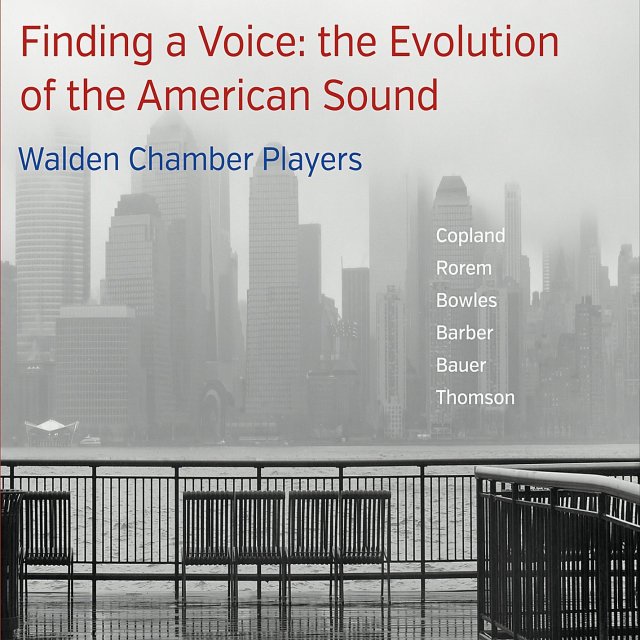
Filling Vital Gaps in the Recorded Repertoire: The Walden Chamber Players Do America


walden ch pl evolution

The only name that might not be familiar to fans of early to mid-twentieth century American music feature in this recording is that of Marion Bauer (1882-1955).  The rest of these composers are clearly established in both recordings and the performing repertoire.  One of the great things about this recording is that the collector runs practically no risk of duplication.  While the Rorem, Barber and Bowles have been recorded before I am not aware of any currently available recordings of the Thomson, Copland and Bauer pieces.

I don’t know how profoundly significant all these works are, only time (and more performances/recordings) will tell.  But these are attractive pieces that fill historical gaps and that is apparently the goal of this clever ensemble.  Even if these are not first order masterpieces they do speak to the historical evolution of the American sound in the twentieth century.

Marion Bauer is herself in need of a reassessment.  This woman, 20 years older than Aaron Copland was essential in the establishment of the foundational institutions of American music.  Few of her works have been recorded and even fewer given good or great recordings.  So this 1944 Trio Sonata No. 1 recording is a very good start.  This, like the other works on the album do not stray far from basic romantic tonality but were the “modern” idiom for the works of their day.  The sound of mid-century neo-romanticism is clearly in evidence in this lovely and lyrical three movement sonata.

Virgil Thomson (1896-1989) is now better known for his excellent music criticism but he was also one of the finest examples of the American neo-romantic tradition (and the only composer to win a Pulitzer Prize for a film score) and his work is sadly under-appreciated. The five brief movements are infused with the composer’s folk and hymn references like much of his work.  I do not think this lovely little Serenade for Flute and Violin (1941) has been recorded before and, hearing it now, I can’t imagine why not.

Aaron Copland (1900-1990) is represented here by two late works from 1971 and 1973, both entitled Threnody.  The first is dedicated to Igor Stravinsky (1882-1971) and the second to Copland’s friend Beatrice Cunningham.

As far as I know this is the first recording of these two works.  They are short and intense pieces whose apparent simplicity most likely belies some complexity but these are very approachable works.  It is a great service to have them available for listening.

Samuel Barber (1910-1981) is probably the foremost representative of American romanticism.  The brief Canzone for Flute and Piano (1961) was originally written for a friend.  The melody made its way into Barber’s Piano Concerto Op. 38 (1962) and has been given the opus number 38a.

Ned Rorem (1923- ), composer and diarist is also a strong contender for the romantic crown in American music.  He is the youngest of the composers represented on this recording (though this reviewer would like to make the case to perhaps include David Del Tredici 1937- for inclusion in this survey of mid-century American romantics).  Best known for his songs, Rorem’s orchestral and chamber music have only recently begun to get the attention they deserve.

His Trio for Flute, Cello and Piano (1960) is very strong example of the quality of his chamber music.  The four movement trio has been recorded before but this performance is about as fine and definitive as one could imagine.

Paul Bowles (1910-1999) is far better known for his literary endeavors and is connected to the beat writers.  His novel, The Sheltering Sky (1949) secured his literary fame.  Bowles spent much less time on composition after 1956 but his music has (though painfully slowly) been going through some reckoning in recent years.  And so it should.  This contemporary of Aaron Copland  has written a fair amount of music, much of that in the form of incidental music for various plays.  This Sonata for Flute and Piano (1932) has been recorded before but it is good to see it made available in a competent recent version.

Ned Rorem, the only composer here still living, gets the final word in The Unquestioned Answer (2002).  It is essentially a reflection on Charles Ives’ The Unanswered Question (1908, rev. 1930-5) and provides a fitting conclusion to this wonderful survey.

I very favorably reviewed a previous release by the Walden Chamber Players (Marianne Gedigian, flute; Curtis Macomber, violin; Tatiana Dimitraes, violin; Christof Huebner, viola; Ashima Scripp, cello and Jonathan Bass, piano).  And they continue their intelligent and very personal survey of chamber music.

This is a very satisfying album which achieves its goal of displaying music which clearly contributes to the collective voice of American music as it developed in the early to mid- twentieth century.  This intelligent selection of music, well-performed, fills gaps in the recorded repertoire and, one hope, will encourage others to bring more of this work to recordings and performances.


A Really Great Brass and Organ Album, Chicago Gargoyle Brass and Organ Ensemble


gargoylebrass

MSR Classics MS 1598

At first this disc seemed to be one of those “audiophile spectacular” niche market items designed to show off one’s stereo system.  I expected a well-recorded album with wide dynamic range and a clarity that would stun the listener but these types of albums frequently have well-recorded but uninteresting music or, worse, cloying showpieces that don’t bear repeated listening.

The first listen dissuaded me from that notion immediately because this is interesting and well-played music.  Except for three clever transcriptions of late 19th/early 20 century pieces all the music is from 2005-2013 (as are the transcriptions for that matter).

The music is, on the whole of a somewhat conservative nature but that is not a negative thing.  All of the music is pleasantly engaging and/or downright exciting.

The first four (of a total of 15) tracks present the music of Carlisle Sharpe (1965- ).  The first work Flourishes (2005/10) is a festive fanfare which was revised for this ensemble. The next three tracks contain the Prelude, Elegy and Scherzo (2012) is a commission by the present artists.

Next we move on to one of the arrangements by Craig Garner (1959- ).  This is, I think, a difficult arrangement to play but is handled with such ease by these players that one could be fooled into thinking it was easy.  The arrangement of the popular drinking song from Verdi’s La Traviata (1853) is a lucid and detailed transcription.  It is the clarify of the recording that makes this obvious as we are able to hear the various challenging lines that allow pretty much everyone in the ensemble to demonstrate their facility.

William Whyte (1983- ) is the next featured composer with a satisfying little suite called Dwarf Planets (2012).  It is in five brief movements.  The piece was also commissioned by and dedicated to Chicago Gargoyle Brass and artistic director Rodney Holmes.

Earthscape (2011) by David Marlatt is cast in a similar vein and, with the previous five tracks these are effectively musical appendices to Holst.  Marlatt, a Canadian composer has written this lyrical piece for the Gargoyle Brass.

Tracks 12 and 13 are another great transcription of a type of work which conductor Sir Thomas Beecham was fond of calling “bon-bons”, an appellation that was a proto-pop concert concept describing short, popular encore pieces.  It is the Polka and Fugue from “Schwanda the Bagpiper” by Jaromir Weinberger (1896-1967), a Czech composer whose reputation lies pretty much entirely on this work.   Originally for orchestra, this engaging work is very effectively arranged for this ensemble.

Tracks 14 and 15 comprise another transcription, this time of two movements from Camille Saint-Saens’ (1835-1921) 3rd Symphony (1886).  This is another truly great piece of music that always plays well with audiences.  The original is for a large orchestra and an organ.  The transcription is remarkably faithful to the score and it’s hard not to get hooked on that finale.  The entire symphony is actually based on the “Dies Irae” chant from the Requiem Mass though this is not a somber piece at all.

The last track is Velvet Blue (2012) by Peter Meechan (1983- ), a British born Canadian composer.  Originally written for a “rock” organ (the Hammond variety) and here played on a traditional pipe organ this is one of the most unusual pieces here.  It’s blues/jazz inflections harken back to big band sounds of the 1930s.

Brass instruments and organs are not instruments known for their agility.  Combine that with the resonant recording space of the churches involved and you have some serious engineering challenges.  Hudson Fair at Hudsonic has met these challenges and succeeded in capturing these performances in lucid detail with a true audiophile recording.  The dynamic range is wide and the the recording is about as clear as I have ever heard done  in this setting.

The musicians Lev Garbar, trumpet; Andrew Hunter, trumpet and flugelhorn; Amy Krueger, horn; Kathryn Swope, horn; John Grodrian, trombone; Graham Middleton, trombone; Ryan Miller, trombone; Andrew Vandevender, tuba; Paul Ramsler, tuba; Joshua Wort, tuba; Michael Schraft, tympani and drum set; Jared Stellmacher, organ; Mark Sudeth, piano; and Steven Squires, conductor all play with precision, lyricism and feeling.

One more piece of what I call “audio porn” is nicely included, the statistics on the two beautiful organs played at the two churches where these recordings were made.  Nice touch. Great fun album.


Between the Lines, New Percussion Music by Neil Thornock


Between the Lines

Between the Lines

Other than the information on this CD and the composer’s faculty page (here) information seems limited on this composer,.  He earned a BM, Organ Performance, Brigham Young University, 2001, an MM, Music Composition, Brigham Young University, 2003 and a DM, Music Composition, Indiana University Jacobs School of Music, 2006.  Currently he is associate professor of music at BYU where he teaches theory and composition as well as electronic music.

Thornock is that rare breed of percussionist (or is it keyboardist?), a carriloneur  and he takes the opportunity to display those skills on this all percussion release, apparently the first recording of this composer’s music.

It is very difficult to assess a composer based solely on their percussion music and sometimes that genre can take on the insider feel of, say, band music or some more rarefied and sequestered niche of music.  As popular as percussion music has become in the 20-21st century it seems sometimes to be an orphan genre.  This is also, no doubt, due to the all-inclusive nature of the term “percussion” which leaves a huge list of potential instruments to consider.  So an album of tympani music or bongo music or marimba music (conceivably even piano and harp can be included under the percussion rubric).might all be spoken of generically as percussion music.  This recording uses a wide variety of instruments.

Having said that this disc appears to show a composer with a wide palette and knowledge of the medium and it is an opportunity to hear carillon music which is itself a relatively rare experience in recordings.  His writing is accessible and, no doubt, well-tailored to the skills of the musicians.

There is nothing familiar here.  All are new works written, presumably, in the last few years.  It would be interesting to hear more of this composer’s output in the areas of chamber, orchestral and electronic music.  But this little tease will have to do for now.

Matthew Coley, the percussionist, seems to be the real star here.   He plays on all tracks and seems to be a highly skilled player.  His website was the most useful to this reviewer as well.  Along with him are the Iowa Percussion Group, the Iowa State University Percussion Ensemble and, as mentioned earlier, the composer on carillon on tracks 7-10 with Gerard Norris conducting.

This New Focus recording FCR 156 is beautifully recorded and I think that is no simple task given the variety of instruments involved.

Other Minds 21, the Dawn of a New Chapter and the Raising of the Dead


BHM160008

Charles Amirkhanian with the composers of OM 21

Much needed rain pummeled the city by the bay on all three days of OM 21 dampening, perhaps, some attendance but not the enthusiasm of the audience or the performers.  In most ways this concert was a continuation of the celebration begun last year commemorating 20 years of this festival.  Returning this year were Gavin Bryars (OM7) and Meredith Monk (OM1).

Until last year no composer had appeared more than once at this series.  For those unfamiliar with OM it is worth noting that the process has been for the 8-10 selected composers spend a week at the Djerassi Arts Center in Woodside, California sharing and discussing their work before coming to San Francisco for performances of their work.

As it turns out this year’s concert series will be the last to follow that format.  Apparently OM has become the victim of gentrification and has had to move out of its Valencia Street offices and will now opt for various concerts throughout the year as they have done but without the big three-day annual festival and the residency at Djerassi.

The archives of OM are now going to be housed at the University of California Santa Cruz where they will reside along with the Grateful Dead archives.  I do believe that Mr. Amirkhanian lived near Phil Lesh of the Grateful Dead when he lived in San Francisco some years ago so it seems fitting that these two archives will peacefully coexist in that space (also coming to UCSC will be OM 21 composer Larry Polansky though not in an archive).

This is certainly a change but this is a festival which has endured various changes in time and venue led throughout by the steady hand of the Bill Graham of contemporary music concerts, Charles Amirkhanian (both men have had a huge impact on music in the bay area as well as elsewhere and it is worth noting that the Contemporary Jewish Museum will have a tribute to Graham this year).

Actually Other Minds traces its provenance to the Telluride, Colorado Composer to Composer festival (also led by Amirkhanian) and later morphed into OM with the leadership of president (now emeritus) Jim Newman back in the early 1990s.  There is a short excellent film describing OM’s history on Vimeo here.

It is the end of a chapter but, as Amirkhanian explained, there are many exciting concerts coming up which will keep Other Minds in the earshot of the astute contemporary music aficionados on the west coast.  Next year, for example, will include several very exciting concerts celebrating the 100th birthday anniversary of beloved bay area composer Lou Harrison.

My apologies for the delay in posting which was due to both the richness of the experience and the exigencies of my day job and other responsibilities.  I hope that readers will find this post to have been worth the wait.

BHM160009

Nordic Voices

Starting our rainy day were the extremely talented singers known as Nordic Voices.  Lasse Thoresen‘s Solbøn ( Sun Prayer) (2012) and Himmelske Fader (Heavenly Father) (2012) both required keen listening and required the use of extended vocal techniques such as multiphonics.  The singing appeared effortless and even fun for the ensemble but that speaks more to their expertise and preparedness than any ease in terms of the score.

It is always difficult to judge a composer’s work by only a small selection from their output  but Thoresen’s virtuosity and subtle use of vocal effects suggests a highly developed artist and it would seem worth one’s time to explore more of this gentleman’s oeuvre.

BHM160010

Lasse Thoresen takes the stage to acknowledge the applause.

Next was an unusual, humorous/dramatic work by Cecile Ore called Dead Pope on Trial (2015/16) with a libretto by Bibbi Moslet.   This Other Minds commission was given its world premiere at this concert.  The work is based on the story of a medieval pope who was taken from his grave no fewer than six times for various perceived offenses.  It is a mix of irony and humor in a sort of madrigal context.  The work was in English and had the nature of a conversation between the singers.  No doubt a challenging piece, it was sung very well and the composer seemed as pleased with the performance as much as the audience.

BHM160011

Cecile Ore smiling as she acknowledges the applause for the wonderful premiere performance of her new work, Dead Pope on Trial.

As if in a demonstration of sheer stamina in addition to virtuosity Nordic Voices took the stage again, this time for some Madrigals (2002/2016) by returning artist Gavin Bryars.  Bryars is no stranger to Other Minds or to madrigals and such older musical forms from the renaissance and before.  He has extensively explored vocal writing and medieval harmonies in many previous works.  Though categorized as being a “minimalist”, Bryars actually has produced a huge range of music in all forms including opera, chamber and orchestral music.

His madrigals have been written for the Hilliard Ensemble and each book is distinguished by the madrigals having been written on a specific day of the week.  The first book on Mondays, etc.  They are settings of Petrach’s sonnets and are sung in the original Italian of his day.  On this night we were treated to four madrigals from Book Two and the premiere of a madrigal from Book Four.  That madrigal was dedicated to Benjamin Amirkhanian, the father of Charles Amirkhanian who celebrates his 101st birthday this summer.

I had the opportunity to meet and speak briefly with the affable Mr. Bryars.  His generous spirit pervaded our conversation and he spoke very highly of both his visits to Other Minds.  If you don’t know this man’s music you are doing yourself a great disservice.

BHM160016

A very pleased Gavin Bryars deflects the applause and adulation to the amazing Nordic Voices for their astounding performance of five of his madrigals.

The singers of Nordic Voices sustained a high level of virtuosity as well as sheer stamina as they sang for nearly two hours in the opening pieces of this concert series.  No time was lost setting the stage for the performance of the next piece, another premiere, Algebra of Need (2016) for electronic sampling and string quartet by Bang on a Can member Phil Kline.

BHM160045

FLUX Quartet playing at SF Jazz, 2016

The Flux Quartet was featured in the next two (and last) works on this long program.  Algebra of Need is Kline’s meditation on the words and the cadences of the iconic writing and voice of the late William S. Burroughs (gone 19 years as of this writing).  The familiar voice seemed to go in and out of clearly audible, at times mixed more closely with the string writing in this intense homage.
BHM160014

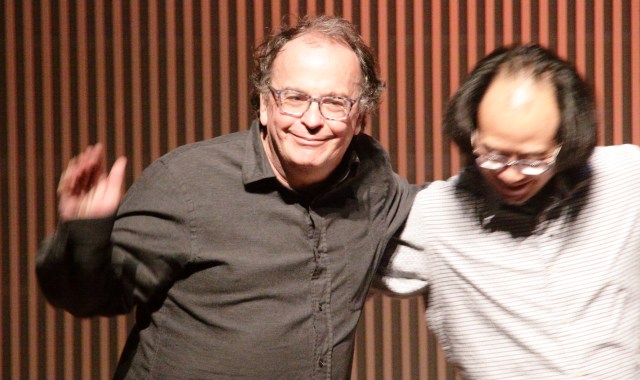
A satisfied looking Phil Kline leans in to embrace the first violin of the Flux Quartet after their premiere of his Algebra of Need.

The Bang on a Can collective was also represented tonight by Michael Gordon.  The Sad Park (2008) for string quartet and electronics put a most decidedly disturbing conclusion on the evening.  This piece, which samples the voices of children (one of them Gordon’s) as they spoke of their experience of the 9/11 Twin Towers attacks.

The effect was, as no doubt intended, harrowing leaving a pretty strange and unsettling feeling as we walked away from the concert into the still rainy night.

BHM160017

Michael Gordon embraces the FLUX Quartet’s first violin after a stunning performance of The Sad Park.

The rain continued on Saturday but the crowd was noticeably larger for the second night which opened with the usual panel discussion.

BHM160030

left to right: Meredith Monk, John Oswald, Nicole Lizee, Eliot Simpson, Larry Polansky, Oliver Lake and Charles Amirkhanian in a panel discussion prior to the concert

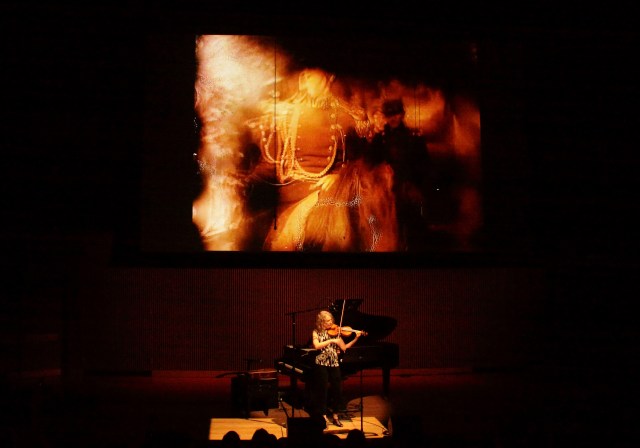
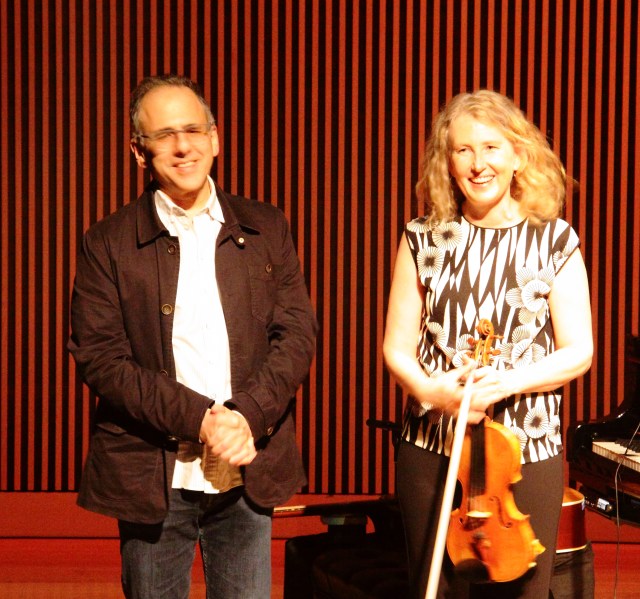
This evening began with a performance by the wonderful bay area violinist Kate Stenberg of a piece which was a sort of antidote to the somber, The Sad Park from the previous night.  Again the composer was Michael Gordon and the piece was Light is Calling (2004), a collaboration with filmmaker Bill Morrison.  Though hardly a happy piece Light is Calling is perhaps elegiac and the composer seems to achieve some of his stated intent to find some healing in the wake of a disaster to which he was all too close.
BHM160031

Kate Stenberg plays violin beneath the projection of a Bill Morrison film in Michael Gordon’s, Light is Calling
BHM160032

Michael Gordon and Kate Stenberg accepting the applause of an appreciative audience.

Next up was John Oswald, a Canadian composer whose career took off in infamy when his Plunderphonic CD, released to radio stations in the early 1980s, became the subject of legal battles over the meaning of copyright law in light of digital sampling.  Fortunately Oswald won the right to publish his work and his Plundrphonics concepts now underlie much of his compositional process.  Until this night I had not heard any but his Plunderphonic CDs so the introduction to his live music was a revelation.
BHM160033

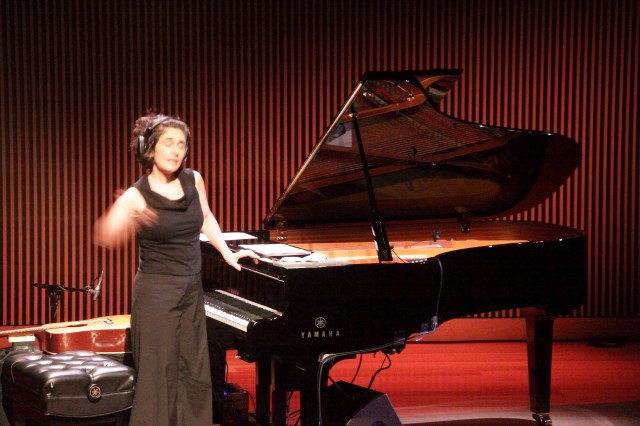
Pianist and (at least here) multi-instrumentalist Eve Egoyan performing with a Yamaha Disklavier and other instruments.

The first piece she did was called Homonymy (1998/2015) was originally written for chamber orchestra and was then transcribed for Egoyan and her prepared disklavier et al.  It is a piece based on linguistic elements and with a visual component as well.

BHM160034

Eve Egoyan performing Homonymy with overhead projections.

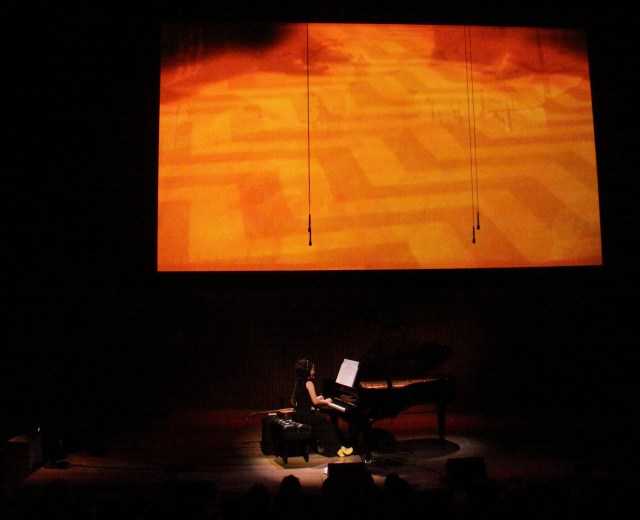
Nicole Lizee’s David Lynch Etudes (2015) was the next piece  and also made use of the projection screen.  The subtitle of the piece indicates it is for “disklavier and glitch”.  Well life imitated art as some sort of glitch prevented the projection from functioning at first but this was rather quickly resolved and we were treated to excerpts of scenes from several David Lynch films with the piano playing some of the rhythms of the dialog in an exchange that puts this writer in the mind of music like Scott Johnson’s “John Somebody” and Steve Reich’s incorporation of speech rhythms in works like, “The Cave”.

Nicole Lizee is a Canadian composer and was the youngest composer on this year’s program.
BHM160035

Eve Egoyan playing Nicole Lizee’s David Lynch Etudes with projected scenes/glitches from Lynch’s films.

The work is one of a series of pieces inspired by films and was executed with apparent ease by pianist Eve Egoyan who played the disklavier (both the keyboard and directly on the strings), a guitar and perhaps other gadgets .  The piece kept her quite busy and the associations I described above sound nothing like this work actually.  These etudes were a unique, typically Other Minds sort of experience, one that expands the definition of musical composition.

BHM160036

Nicole Lizee (l) with Eve Egoyan absorbing the audience’s appreciation of the David Lynch Etudes.

Two more John Oswald compositions graced the program next.  Palimpia (2016) is a six movement piece for disklavier with pianist playing as well.  Oswald says it is actually his first composition for piano.

BHM160046

John Oswald embracing pianist Egoyan and enjoying the audience applause for his work.

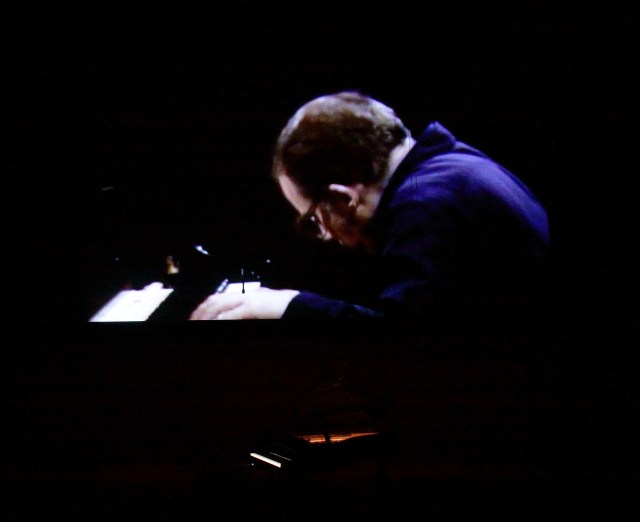
Well I did say there were two more Oswald pieces but this last one was a masterful plunder by this truly unusual composer.  Here Oswald conjured the playing as well as the image of the late great Glenn Gould who was seen actually playing Invaria (1999) with the disklavier performing along with the film of Gould performing this music.  It was, for this writer, a spellbinding experience.  He has raised the dead in the name of music.  Wow!  It was an amazing and heartfelt homage to a fellow great Canadian musician.
BHM160038

Glenn Gould playing John Oswald

Larry Polansky (1954- ) is well known as a teacher and as a composer but one is hard pressed to find much in the conventional discography of his work.  The few discs out of his amazing electronic music (and one disc of piano variations) represent only a small fraction of his output and represent only one genre of music which he has mastered.  However the astute listener needs to be advised to look online to look, listen and hear some of the bounty of his creative output.  Check out the following sites: Frog Peak Music (Polansky’s publishing site which includes music and scores by a great many interesting composer in addition to himself and Dartmouth Page (which contains link to various recordings, writings, computer software, etc.

BHM160039

Giacomo Fiore (left) and Larry Polansky playing Polansky’s ii-v-i (1997)

As an amateur musician who has enough trouble simply tuning a guitar it made my knees weak to watch these musicians effortlessly retune as they played.   Polansky’s experimentation with alternate tunings is an essential part of many of his compositions.

BHM160040

Fiore and Polansky changing their tunings mid-phrase in a stunning demonstration of virtuosity with pitch changes.

The program then moved from the electric to the acoustic realm with Polansky’s folk song arrangements.  Eliot Simpson, the pedagogical progeny of the great David Tanenbaum (who played these concerts last year at OM 20), played the just intonation National Steel Guitar and sang.

Let me say just two things here.  First, these are not arrangements like Copland’s Old American Songs and second, I will never hear these folk songs quite the same way again.  Polansky’s interest in folk music and Hebrew cantillation along with alternate tunings produces what the ears hear as perhaps a different focus.  In these pieces he did not stray too far from the original (as he does in his Cantillation Studies) but one is left with distinctly different ways of hearing and thinking about this music and the listener is left richer for that.  It is a journey worth taking and Simpson played with both passion and command.

Eliot Simpson playing a selection of Larry Plansky's Songs and Toods

Eliot Simpson playing a selection of Larry Plansky’s Songs and Toods

Polansky returned to the stage for a performance of his 34 Chords (Christian Wolff in Hanover and Royalton) (1995). Again we were treated to the virtuosic use of alternate tunings performed live (and again with live re-tunings) by the composer.

Oliver Lake delivering a blistering free jazz improvisation.

Oliver Lake delivering a blistering free jazz improvisation.

Continuing with the solo performer theme we were privileged to hear the virtuosic jams of Oliver Lake (1942- ) whose long career is legendary in the jazz world.  The “mostly improvised” (according to the composer) Stick was played on two different saxophones in what appeared to be as intense an experience for the performer as it was for the audience.

Oliver Lake takes a final bow at the end of the second concert of OM 21

Oliver Lake takes a final bow at the end of the second concert of OM 21

The emotional workout was received warmly by the audience.

Charles Amirkhanian introduces Meredith Monk on the final day of OM 21

Charles Amirkhanian introduces Meredith Monk on the final day of OM 21

There was no panel discussion on the third day of OM 21.  This matinée was dedicated entirely to the work of Meredith Monk (1942) who, fittingly was one of the featured artists in the first Other Minds gathering in 1993.  Now a recipient of the National Medal of the Arts this beloved artist returns to OM 21.  Though the rain continued the house appeared to be full.
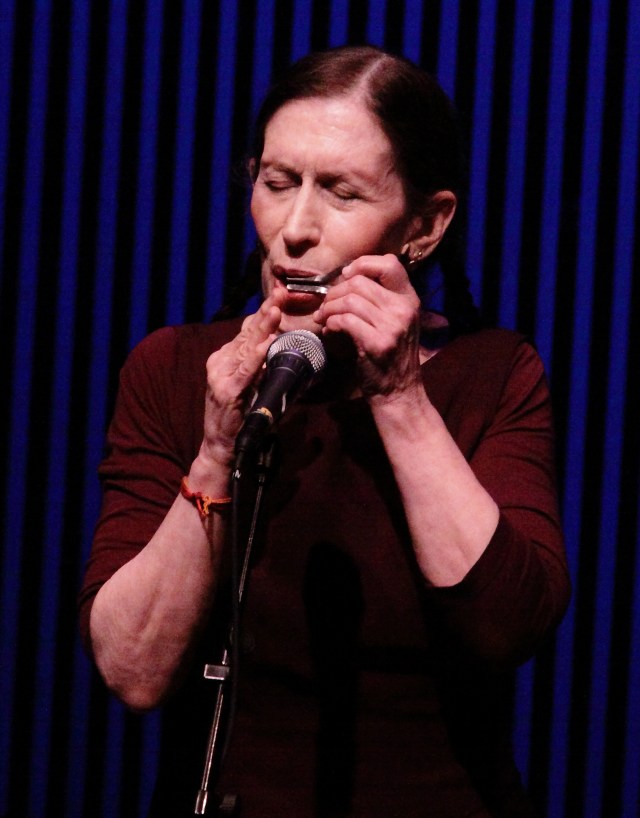
Meredith Monk playing a Jaw Harp in one of her early solo songs.

Meredith Monk playing a Jaw Harp and singing in one of her early solo songs.

Monk played a selection of material from various periods in her career in a mostly chronological survey which she called The Soul’s Messenger.  She began with selections from her solo songs and proceeded to her voice and piano music, then to her work with multiple voices and instruments.
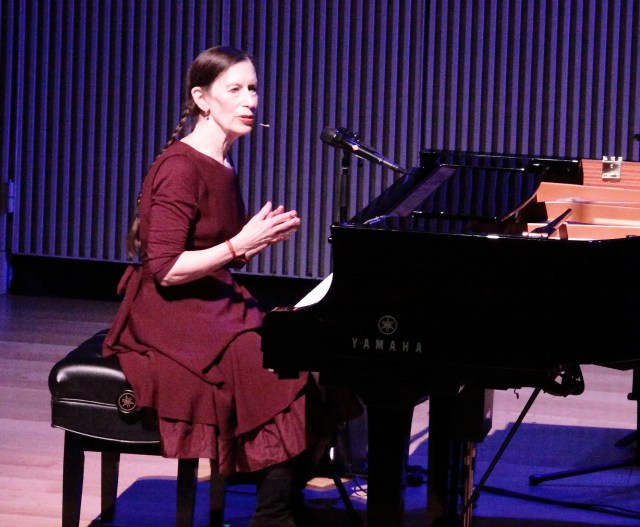
Meredith Monk performing her signature Gotham Lullaby

Meredith Monk performing her signature Gotham Lullaby

Most of the audience seemed to have a comfortable familiarity with the individual works she offered on this night which effectively gave a picture of her career.  Monk was in good voice and appeared to enjoy her performance.
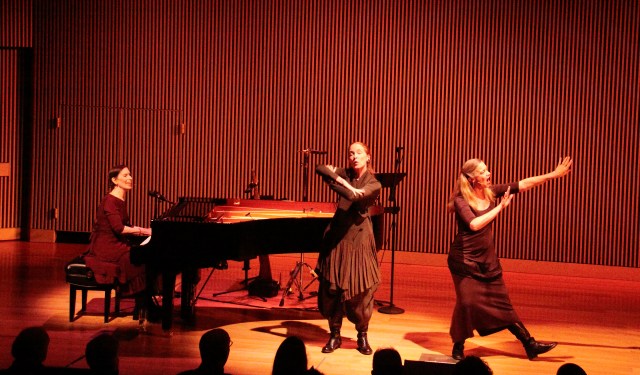
Long time collaborator Katie Geissinger and Allson Sniffin joined in the next selection

Long time collaborator Katie Geissinger and Allson Sniffin joined in the next selection

The stage was set to allow for the dance/movement that is an essential part of Monk’s works.  She originally trained as a dancer.
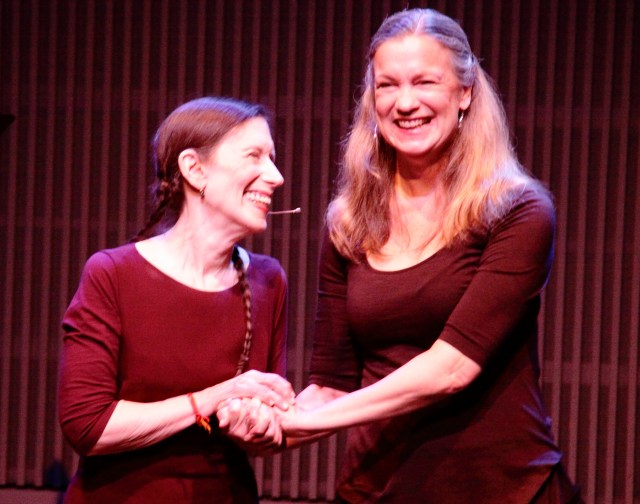
Monk and long time collaborator Katie Geissinger reacting to the appreciative audience

Monk and long time collaborator Katie Geissinger reacting to the appreciative audience

In addition to the grand piano the stage was set with two electronic keyboards, an essential sound in many of Monk’s works.
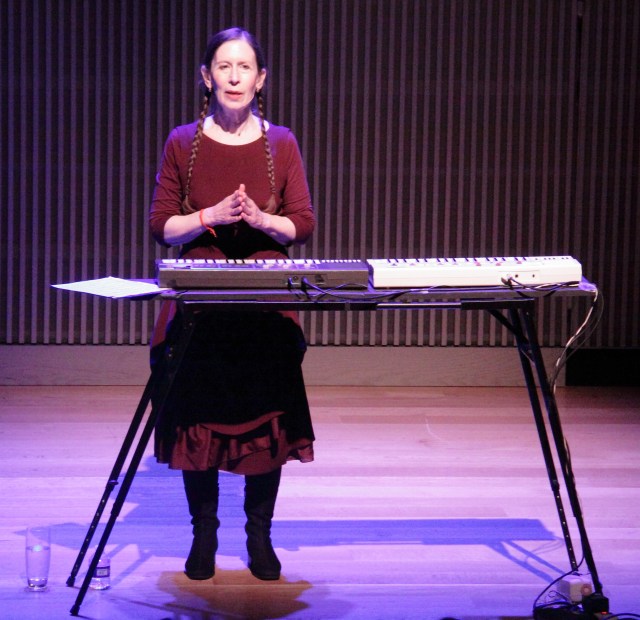
Monk at one of the electronic keyboards

Monk at one of the electronic keyboards

Woodwind player Bodhan Hilash joined the ensemble for the last set of pieces.
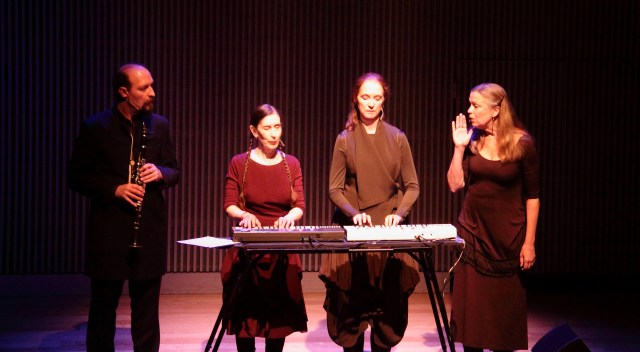
From left: Bodhan Hilash, Meredith Monk, Allison Sniffin and Katie Geissinger

From left: Bodhan Hilash, Meredith Monk, Allison Sniffin and Katie Geissinger

The audience gave a standing ovation at the end resulting in 3 curtain calls.
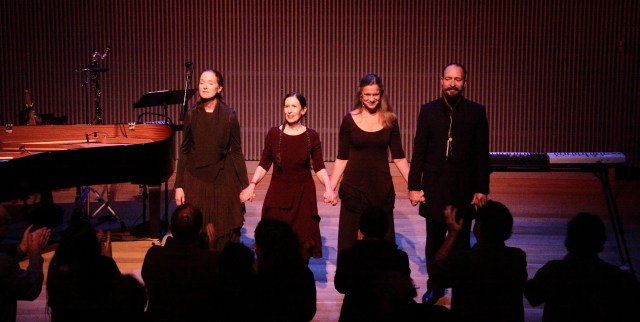
Left to right Allison Sniffin, Meredith Monk, Katie Geissinger and Bodhan Hilash receiving a standing ovation.

Left to right Allison Sniffin, Meredith Monk, Katie Geissinger and Bodhan Hilash receiving a standing ovation.

And the properly prepared artist came back for an encore of her song Details.
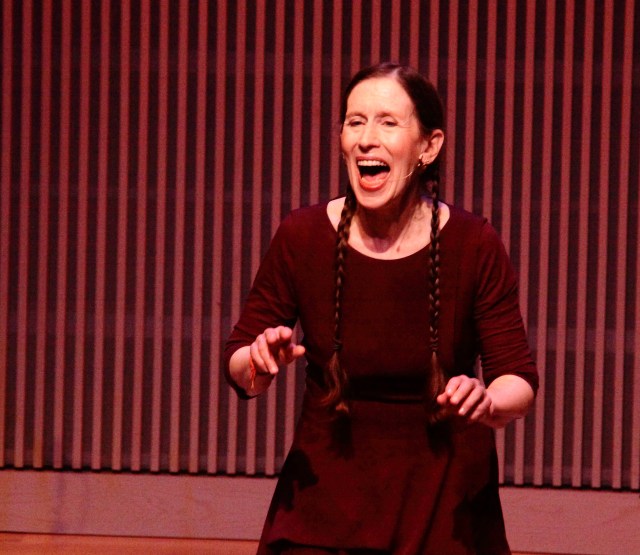
Meredith Monk performing an encore at the final concert of OM 21

Meredith Monk performing an encore at the final concert of OM 21


It was a fitting finale to a great OM 21, fitting to have this artist who appeared on the first iteration of Other Minds returning now crowned with a National Medal of the Arts and clearly beloved by the audience.  Her music like her lovely smile fade to the edge of memory like that of the Cheshire Cat on a truly triumphant finale.

And, despite some format changes, who knows what treasures continue to lie in store?  I will be watching/listening and so, apparently will many others.  Keep an eye on www.otherminds.org .  I know I will.


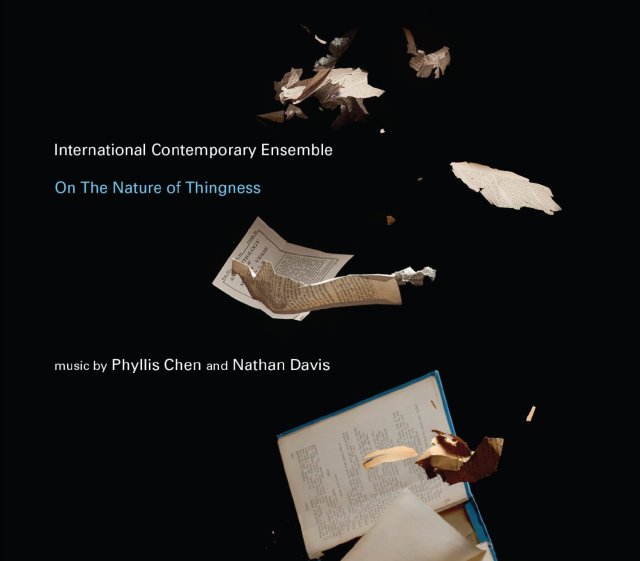
ICE Debuts on Starkland: Music by Phyllis Chen and Nathan Davis


71suob4pdtL._SL1500_

Starkland is one of those labels whose releases seem to be so carefully chosen that one is pretty much guaranteed a great listening experience even if that experience might challenge the ears sometimes.  If one were to purchase their complete catalog (as I pretty much have over the years) one would have a really impressive and wide-ranging selection of new music.

I recently reviewed a very fine ICE (International Contemporary Ensemble) recording of music by Anna Thorvaldsdottir here. The present disc is the first appearance on Starkland of this ensemble whose performance skills and repertoire choices show the same depth of understanding as the producers of the label upon which they now appear.

ICE was founded in Chicago in 2001 by executive director and flautist extraordinaire Claire Chase.  The discography on their website now numbers 21 albums including the present release.  The group features some 30+ artists and musicians including a live sound engineer (like the Philip Glass Ensemble) and a lighting designer.  Do yourself a favor and check out the ICE Vimeo page to get some ideas about why having a lighting designer is a good idea.  Their performances are visually as well as musically compelling.  And who knows, perhaps there is a Starkland DVD release in their future.

About half their albums feature music by members of ICE and that is the case with this release.  One always has to wonder at the process that is involved in choosing repertoire to perform and/or record but there is no doubt that this group seems to have good instincts in regards to such decisions as evidenced by the already wild popularity of this disc on WQXR and the positive initial reviews so far.

chen_phyllis_toypiano3Resized

Phyllis Chen‘s biographical data is a bit sparse on both the ICE website and her own so I am going to assume that this talented young keyboard player likely began playing at an early age.  Like fellow pioneers Margaret Leng Tan and Jeanne Kirstein before her she has embraced toy pianos and, by extension I suppose, music boxes, and electronics into her performing arsenal.  In addition to being a composer she is one of the regular members of ICE.

NathanDavis_Obraz9

Nathan Davis is a regular percussionist with ICE as well as a composer.  His works range from opera to chamber and solo pieces for various instruments as well as electronics.

The tracks on this release pretty much alternate between these two featured composers.

The first track is Ghostlight (2013) by Nathan Davis, a sort of ragged moto perpetuo for “gently”prepared piano.  This is a good example of how these musicians (pianist Jacob Greenberg in this instance) have really fully integrated what were once exotic extended techniques into a comprehensive catalog of timbral options which are used to expand the palette of creative expression.  This is not a second rate John Cage clone but rather another generation’s incorporation of timbral exploration into their integral canon of sonic options.  This is an exciting and well-written tour de force deftly executed.

The next two tracks take us into the different but complimentary sound world of Phyllis Chen.  Hush (2011) for two pianos, toy pianos, bowls (presumably of the Tibetan singing variety) and music boxes is a playful gamelan-like piece played by the composer along with pianist Cory Smythe.

Chimers (2011) is a similarly playful work requiring the assistance of clarinetist Joshua Rubin, violinist Erik Carlson and Eric Lamb (on tuning forks) along with Chen and Smythe once again.  Again we hear these unusual instruments and timbres not as outliers in the musical soundscape but rather simply as artistic elements that are part of the composer’s vision.

Track number 4 features a work for bassoon and live processing.  Davis’ On Speaking a Hundred Names (2010) is played by Rebekah Heller and again the (to this listener) usually uncomfortable fit of acoustic and electronic are achieved very smoothly.  Music like this gives me hope that some day I will be able to drop the inevitable negative connotations I have associated with the term “electroacoustic”.  This is very convincing music and not just in the “golly gee, see what they’re doing” sense either.  The experimentation here (including the multiphonics) appears to have preceded the composition giving us an integrated and satisfying listening experience.

Chen comes back on track 5 with another successful integration of acoustic and electronic in her, Beneath a Trace of Vapor (2011).  Eric Lamb handles the flute here playing with (or against) the composer’s prepared tape.  This electroacoustic trend continues in the following track (also by Chen) called Mobius (201-) in which Chen, Smythe and Lamb are credited with playing “music boxes and electronics”.  Once again the integration of electric and acoustic speaks of a high level of music making.

The final four tracks are the big work here and the work that lends its name to this disc, On the Nature of Thingness (2011) by Nathan Davis.  Apparently taking its title from Lucretius’ On the Nature of Things (ca. 1B.C.) the work earlier also inspired Henry Brant in his spatial composition, On the Nature of Things (1956), but the work in this disc does not seem to make any direct reference to that Roman classic poem except perhaps metaphorically.

tony_8305

Soprano Tony Arnold

The work here is an exploration of language, sound and expression.  This most eclectic and ponderous of the selections is a wonderful opportunity to hear the considerable skills of resident vocalist Tony Arnold who sense of pitch and articulation are incredibly well-suited to this work.  Her performance leaves nothing to be desired and is likely as authoritative as it gets.  The work seems to require a great deal of concentration and coordination on the parts of all involved and ICE takes the opportunity to demonstrate their well-honed skills as they clearly listen to each other and go all out in terms of achieving the subtlety of expression required in this demanding and complex work.

As usual the Starkland recording is clear and detailed without the sense of claustrophobia that such detail can take on and the liner notes are useful without extraneous detail.  This is an ensemble to watch/listen for both for the performers and for the music they choose to program.  You won’t be disappointed.