75 Years of Classical Music in Israel


Utter the name “Israel” and probably only a handful of people will think, “classical music”. As a lifelong new music fan I’ve made many wonderful discoveries by looking at work done by composers in countries that aren’t part of the typical America, Germany, Italy, France, Russia nexus. Throw in the Nordic countries, Canada, and Australia more recently and you have perhaps 90% of what is marketed (even if not efficiently distributed) as new classical music. Israel, at 75, remains a young country but its participation with world class classical composers and musicians is among their proudest contributions to the world at large and those contributions are both extensive and interesting.

Neuma 177

This fine release gives only the briefest taste with a curious selection of pieces that will likely lead listeners to the “more where that came from” path to discover a huge trove of music that really needs to be heard. The only problem with this release is that it’s not a 20 or 30 CD box set of representative western classical music from a comparatively new country in a very old artistic/cultural hotbed.

This fine Neuma release is actually a very nice taste whetting collection of three generations of Israeli composers. I wish I could call it “representative” but that would be a tall order. It is an intelligent selection that will hopefully inspire further exploration of Israel’s classical music artistic legacy. Israel is, in many ways, a country of challenges and this release is, similarly, an extension of this country’s challenges to the canon of western art music in its way and a gentle nudge to curious listeners.

Professor Robert Fleisher (photo: Darsha Primich, courtesy Navona Records)

This project began with a 1986 Israel residency by American composer/musicologist (now Professor Emeritus at NIU) Robert Fleisher. The culmination of this residency resulted in his marvelous book, “Twenty Israeli Composers” (1997) and all but one track on this disc from an earlier concert at NIU in 1987. which was fortunately recorded rather nicely. You can download the book for free by clicking on the title above. Fleisher wrote the very useful liner notes which are also available as a free download. Those two sources can help guide the avid listener to a wider range of music from Israel’s first 75 years.

Track list

German refugee Paul Frankenburger (1897-1984), better known as Paul Ben-Haim is doubtless the one name in this collection that listeners may have heard. He emigrated to the (then British Mandate of Palestine) in 1933 just ahead of the onslaught of the Third Reich in Germany. He Hebraicized his name when he became an Israeli citizen at that country’s inception in 1948. Truly, he was there at the beginning.

His pupils Tvi Avni, Eliahu Inbal, Henri Lazarof, Ami Maayani, Ben-Zion Orgad, and Shulamit Ran (to name just a few) all went on to make significant impacts on the musical world. Some made their careers in Israel, others established the Israeli artistic diaspora but that is another story.

The disc opens with one of Ben-Haim’s finest and best known compositions, his 1943 protominimal “Toccata” for piano. This brief piece is a virtuoso showpiece that this listener found immediately appealing having heard it played as an encore after a concerto performance. Here, a wonderful rendition by Liora Ziv-Li makes a strong case for this piece to be heard more often. This first release of this live performance is, happily, not the only recording of the work. Ben-Haim whose style is of a post romantic/nationalistic style somewhat like an Israeli Aaron Copland, creative and nationalist with just a dash of liturgical. His work is fairly well represented on recordings and on YouTube but he is far less known outside his adopted country where his pedagogy also sowed further seeds.

This second track is one of two (with Tsippi Fleischer’s “The Gown of Night”) that did not appear on the 1987 concert referenced in the intro. Bashrav (2004) by Betty Olivero (the first Israeli born composer represented on this recording) was recorded in Tel Aviv in 2020. The inclusion of this work can stand as a challenge to get listeners to hear one of the finest living composers from Israel. Olivero (1954- ) is very well known in Israel but less so elsewhere despite the fact that some major American orchestras have embraced her work. She is a lyrical and substantive composer whose work is quite appealing. Bashrav is an instrumental chamber orchestra piece based on a Turkish/Iranian musical form from which the work’s title is drawn. It was commissioned and first performed by the San Francisco Contemporary Chamber Players. This is the first commercial recording.

Now we come to another name changer. Tzvi Avni (1927- ) was born Hermann Jakob Steinke in Saarbrucken, Germany. He, like Ben-Haim (with whom he later studied) fled Germany (in 1935) for the safety of the British Mandate of Palestine and took a name reflecting his adopted national alliance. Avni is probably the second best known Israeli composer outside of Israel. His somewhat Stravinskian (to this listener’s ears) neoclassicism is another voice seriously in need of a wider hearing. His brief Capriccio (1955/1975) for piano has had several recordings and performances and the release of this live recording provides an opportunity to hear the work as well as the opportunity to hear another artist’s interpretation of the work. Avni had the foresight to tap into the emerging world of electronic and computer music and added a stint at the justly famed Columbia Princeton Electronic Music Studio to his musical training. Sadly, though he may have name recognition, his representation in recordings is nothing short of abysmal.

Ami Maayani (1936-2019) is, in this writer’s opinion, the third best known composer of those represented here outside of Israel. He was the founder of several fine Israeli music ensembles including the Israel Youth Orchestra. Like Avni, he chose to supplement his traditional music studies at the fledgling Columbia Princeton Electronic Music Center. He also counts Paul Ben-Haim among his teachers. His musical style derives from Arabic traditional music (one of the few folk musics routinely incorporating the microtonal quarter tone) as well as Ashkenazi and Sephardic folk music. In addition to training in music, he studied architecture and has written several books.

While he has written more experimental work, the majority of his available music sounds basically tonal with folk and sometimes electronic elements. Maayani was a prolific composer who, like his “best known” colleagues, suffers from a distribution problem. His architectural work is represented in several portions of Israel’s infrastructure. His three volume study in Hebrew of Richard Wagner challenged Israel’s (understandable) dislike of Wagner’s music. And now time is nigh for a fair reckoning of Maayani’s own music. This is not the first recording of his Arabesque No. 2 (1973) scored for flute and harp. His sister Ruth Maayani (1948-1921), herself an accomplished musician plays the harp in this 1987 performance. His orchestral work, “Qumran” (1970) was the first Israeli composition to be performed in Germany after World War II (even that took nearly thirty years to achieve).

Now we come to another refugee from early to mid century European fascism. Abel Ehrlich (1915-2003) was born in east Prussia and took a more circuitous route to Israel, arriving in the Palestine Mandate in 1939. Unlike some of his predecessors he made no changes to his name. He did study at the Eretz-Israel Conservatory in Jerusalem and went on to write music and teach at Israel Conservatory, the Rubin Academy of Music, Jerusalem; the Rubin Academy of Music, Tel Aviv; Bar-Ilan University and Oranim Academic College. He was of an age that didn’t create a web page but even Wikipedia has very little to say about him except that he was recognized during his lifetime with various prizes and I was able to find this laudatory 2004 concert review in Ha’aretz which reports a count of some 3500 compositions (sic)! It also makes mention of one of his best known compositions, his 1953 “Bashrav” for solo violin. This is a piece based on the Arabic musical form for which it is named. Astute listeners/readers will recognize the name from the earlier Betty Olivero work with which it shares both its name and structure. Would that a performance could have been included here but listeners can easily find several recordings of that other Bashrav on YouTube.

Abel is represented on this recording by two works, both from 1986 and both world premiere recordings from the 1987 concert that forms the core of this album. Track five documents a piano work called, “The Death of Dan Pagis”. It is a sort of lament for Pagis (1930-1986) some of whose poetry Abel set musically but was sadly never heard by the poet. Track eight gives us a hearing of Ehrlich’s “The Dream About Strange Terrors” for two flutes. Both are brief but effective works and, like much of the music here (and a lot of art) seem to be a form of sublimation, a Freudian derived term which refers to an adaptive psychological mechanism, a transformation of pain, anxiety, anger, etc. into something positive. The otherwise informative liner notes say little about these two works but given the composer’s history, both works would seem to fall into that category. Both are in a sort of mid century post romantic style that challenge the performers but speak pretty directly, in a musical sense, to the listener.

Track six introduces us to another native born Israeli composer, Tsippi Fleischer (1948- ). This one is a graphic score which is realized electronically. “The Gown of Night” (1988) is a setting of a poem. It is performed in the original Arabic. The English translation is below.

THE GOWN OF NIGHT
Muhammad Ghana’im


The gown of night
Envelops the desert
Engulfing tent and well
From the boundaries of night
The howling of jackals descends
To raise the dawn
Engulfing tent and well
Then came the dawn …

A portion of the graphic score is reproduced in both physical and digital formats of the album. It is one of the pieces that has actually been released before but those releases on small limited distribution independent labels has likely remained obscure to all but the most tenacious listeners and collectors. It is a fine example of purely electronic music and was composed using recordings of Bedouin children reciting the poem.

I was astounded and oh so pleased to learn that all of Fleischer’s recorded output (including liner notes) is available for free downloads via her website the link for which can be accessed by clicking on the composer’s name in this review. Well, brava Maestra Fleischer for striking a blow against obscurity.

Arie Shapira (1915-2013) is another substantial and prolific composer with no personal website, no government generated website, no publisher generated website, and a way too brief Wikipedia page. In fact Professor Fleisher’s book remains the “go to” resource for this man’s work. A quick look on the discogs site, not surprisingly, list only two CD releases.

He is represented in this collection by “Off Piano” (1984) written for the Michal Tal who performs it here. The 1984 premiere was broadcast by Israeli media. This all too brief work immediately suggested the pianistic fireworks of Frederic Rzewski.

Tracks nine, ten, and eleven comprise the second largest offering by time of all the composers on this album. The “Three Romances” (1986) for piano by Ari Ben-Shabetai (1954- )The works, premiered in 1986 and were written for Liora Ziv-Li whose 1987 performance are on the present disc. Ostensibly an homage to Robert Schumann’s similarly titled work are a modernist and highly virtuosic set of pieces.

Lastly we have by far the longest offering of music of all the represented composers with Oded Zehavi’s “Wire” (1986) for chamber orchestra and soprano (Zehavi plays the piano part in the ensemble). Born in 1961, he is by far the youngest composer this collection. Wire is a setting of a poem in Hebrew by Chaya Shenhav, English text given below.

Chaya Shenhav, “Strange Brightness,”
(‘Thread: Poems’), Hakibbutz Hameuchad
Publishers Ltd, 1984, p. 22; Translated by
Oded Zehavi. ©All rights reserved.


In those awful shadowless
minutes before sunset
when greenish lights rise
from the valley
When the trees on the slopes
glow with a sudden great light
but beingless, perhaps,
And the children slowly climb the path,
their faces shining with a strange brightness . . .
Call out to them quickly, “speak,” “shout,”
like the partridges screaming in the valley
scream,
You see, you know, don’t you?
that they are moving away

This release is a testament to Professor Fleisher’s musicological efforts that help raise awareness that Israel has some truly world class composers of new classical music. It is also a fine place for listeners to begin their explorations of this repertoire.

My 2022, Best of and Worst of…


Mount Lassen in Northeastern California

Let me start with a positive image from a brief photography trip which I managed this year. It was one of the highlights of what has been a difficult year for many of us. Weather, politics, COVID, itinerant employment issues, financial, and personal difficulties were an encumbrance but now stand in relief to the many positive aspects of 2022.

First, let me say that nothing musical fell into the category of “worst of” so fear not, what follows is essentially my “best of” from 2022. In my head I blame the aforementioned encumbrances for delays and sheer lack of production on my part. Whether that is the ultimate truth does not matter really so here, for better or worse, is my celebration of the positive experiences enumerated in this music blog in 2022.

This is one of the albums that stoked my interest.

My first post for the year struck a sad note. It was my personal tribute to a composer, A Belated Fan Letter: Homage to George Crumb described George Crumb, who had been one of my “gateway drugs”, so to speak, which helped put me on the exciting roads of new music upon with I continue to travel with great joy. Recordings of his complete works are still being released on the visionary Bridge Records.

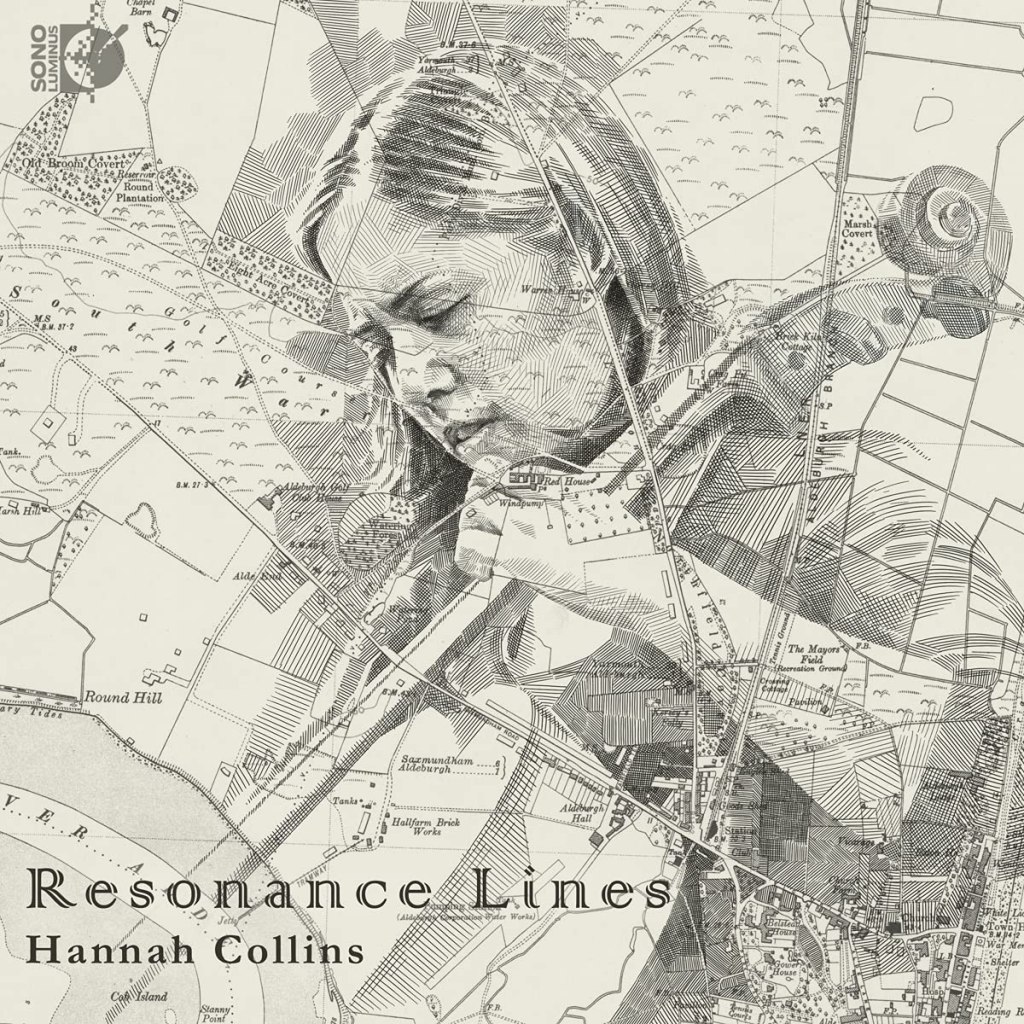
Hannah Collins debut on Sono Luminus was a compelling offering from this rising star.

Carolyn Shaw’s striking and much performed “In Manus Tuas” (on solo viola as well as solo cello) was originally written for Collins. Her selections on this album, including that Shaw work, suggest to this writer/listener that she has both vision and an encyclopedic knowledge of music, especially that written for her instrument. She will be among the major shapers of this repertoire via her vision as well as her interpretive talents. And Sono Luminus’ superb sonics certainly helps make this a great release.

The first volume of Sarah Cahill’s landmark trilogy of piano music by women composers.

I have followed the work of Sarah Cahill since her first solo CD (music of Ravel). Like Collins, she has been an artist who, by her intelligent selection of repertoire, serves as a guide to listeners (and musicians) as well. She has championed many composers as a pianist and as a broadcaster on her weekly KALW broadcasts. Her curation of concerts throughout the Bay Area, such as her solstice concerts at Oakland’s Chapel of the Chimes, have showcased a large variety of creative performers.

As she focuses her lens on women composers (neglected is implied) she embraces a stunning range of styles from the baroque era to the present and it seems as though she can play anything she chooses well. She is also collaborative with an amazing ability to discern the substance in the works she chooses to play. And she has discovered (or rescued?) much music from obscurity via scholarship and intelligent collaboration. Can’t wait for the next release. She is consistently interesting and relevant.

This release on Lars Hannibal’s OUR records was a brilliant new recording of
some of Ligeti’s music and introduced me to Kodaly’s solo choral works.

This album was sent to me by a friend. I knew the Ligeti pieces but heard them with new ears in this release and I was amazed by the Kodaly works too. Marcus Creed may not be as well known in the U.S. as he is across the pond but he should be.

Another debut album by a cellist.

This album was kindly sent to me for review by John Schneider of Microfest records. Read the review. Listen to this album. And watch for more from Chris Votek, another rising star in 2022.

Dan Lippel’s virtual manifesto displaying his vision and skill as he furthers the mission of the guitarist in all their guises.

Dan Lippel is one of the founders of the fabulous new music label, New Focus Recordings. Here he is acoustic, electric, conventional, and experimental but always interesting. Keep his name on your radar.

Languishing no longer.

This is a gorgeously designed, very collectible art object. It is a beautiful hard cover, full color book which also contains a CD of a recording (from acetate masters) which had languished in the archives of the Eastman/Rochester Music School where Harry Partch gave this lucid lecture/performance in 1942. Mr. Schneider, who sent me the Votek release as well, fronts an ensemble called PARTCH which, in addition to performing Harry Partch ‘s work, is recording Partch’s complete works for David and Becky Starobin’s Bridge label. This one is both eye and ear candy to my ears.

Rescuing those acetate masters from obscurity is a major find that rises in significance (in the musical sense) almost to the level of the archeological discovery of Tut’s Tomb. Schneider is a musician, a composer, a radio broadcaster, and an archivist and now a sonic archeologist I suppose. He also sports a collection of authentic copies of Partch’s curious instruments which were built to play the microtonal scales required. Partch is a major American composer whose work is now gaining its rightful place among the best of American classical music.

Seminal work by an American post minimalist composer.

I first discovered Mr. Susman’s work when I was asked to review a performance of another composer’s work. I heard one of his works played by the remarkable San Jose Chamber Orchestra on that same concert. Here we have another multi volume release of these lovely and significant piano works. The remarkable pianist (mentioned often in these pages) has contracted to record all 4 books of this sort of “Well Tempered Clavier” type gesture which effectively provides much insight to this composer. Nicolas Horvath, known for marathon concerts performing (and subsequently recording) all of Philip Glass’ piano music, among others. (We’re talking 15 hours or so. There is also a 35 hour live rendition of Erik Satie’s “Vexations” on you tube.) Who better to record these? The remaining three volumes are due some time this year. Who better to take on this post minimalist set of pieces? Can’t wait for the next volume.

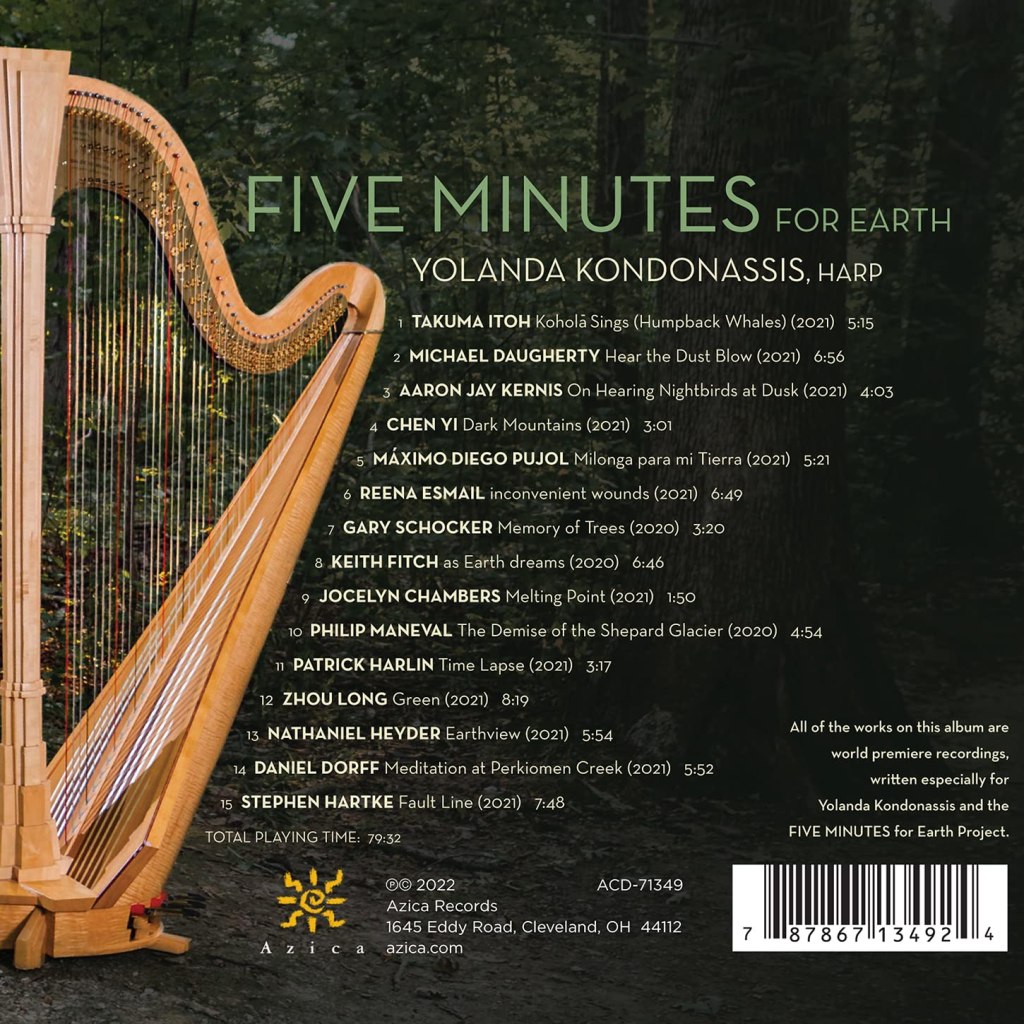
Kondonassis’ new music manifesto for the Harp (and the earth).

Yolanda Kondonassis is about as household a name that you can find among harpists. These five minute (more or less) pieces are a significant addition to the solo harp repertoire. They are forward looking works for her instrument. Very interesting work, excellently performed.

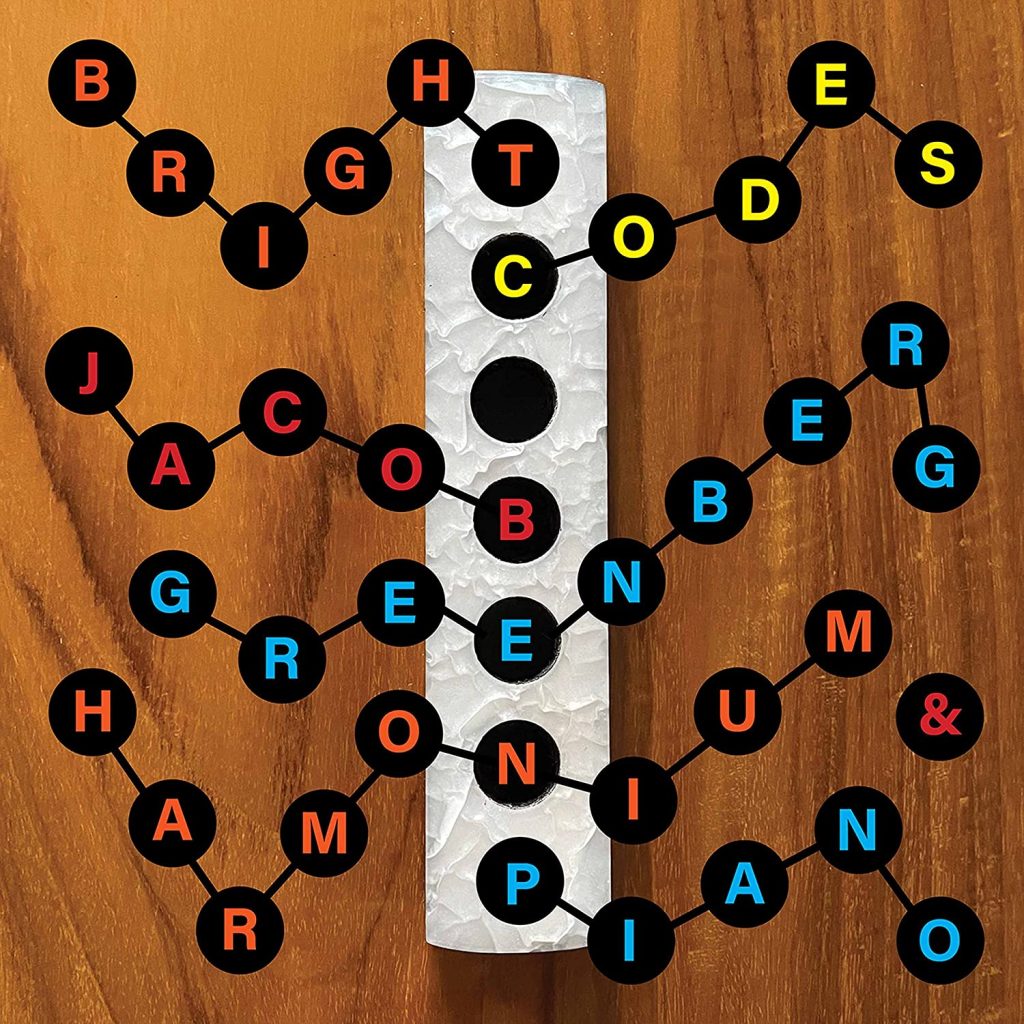
New piano music written for Jacob Greenberg

I remain in awe at the curatorial and historically aware work of this truly fine pianist. Greenberg helped me grasp the historical context of the Second Viennese School in a new way with his earlier release “Book of the Hanging Gardens”. In that release he played all the Debussy Preludes along with Schoenberg’s pre twelve tone song cycle, Webern’s Variations, and the Berg Sonata which helped this listener to better grasp the historical context of this music. This small collection of works written for him reflects a collaborative and visionary ethic akin to that of Sarah Cahill’s. Keep an ear out for this guy.

Lou Harrison’s brief Solo Violin Sonata

I have received some good natured teasing about the fact that this, one of my longer reviews, is of a 15 minute piece of music. But this act of musical archeology by the bay area’s Kate Stenberg (who is a regular collaborator with Sarah Cahill BTW) has made the first recording of this little work. It’s Webernian duration belies a style very much in character with this beloved composer’s other work. My review was as much about the music and the recording as it was about the dedication of Stenberg to new music. This release is from Other Minds, another shining example of advocacy of new music and collaboration among composers and performers. Get it. Listen to it. And don’t miss a chance to hear Stenberg live performances or to hear anything Harrison has written.

Music between the wars

The Chicago based Cedille label is one of my favorite classical music labels. Producer James Ginsburg has a golden ear and Cedille is the finest Chicago based classical label since the justly fabled Mercury records. All their releases deserve attention but this two disc set of little known works for String Trio written between the world wars is a feast of substantive, if slightly conservative, voices. This one is a great listen and, trust me, none of this music is in your collection.

Other Minds Executive and Artistic Director of Other Minds Charles Amirkhanian applauds a rare performance of his own music at OM 26.

While circumstances conspired to limit my attendance to only one of the three days of OM 26, I would be loathe to leave this world class music festival off my “best of” list. My first published blog of 2023 was of the 30th anniversary celebration which showcased Marc-Andre Hamelin’s stunning reading of Charles Ives’ massive Concord Sonata. Anything OM does deserves your attention but the roughly annual festival continues to present composers and performers from around the world. Not to be missed.

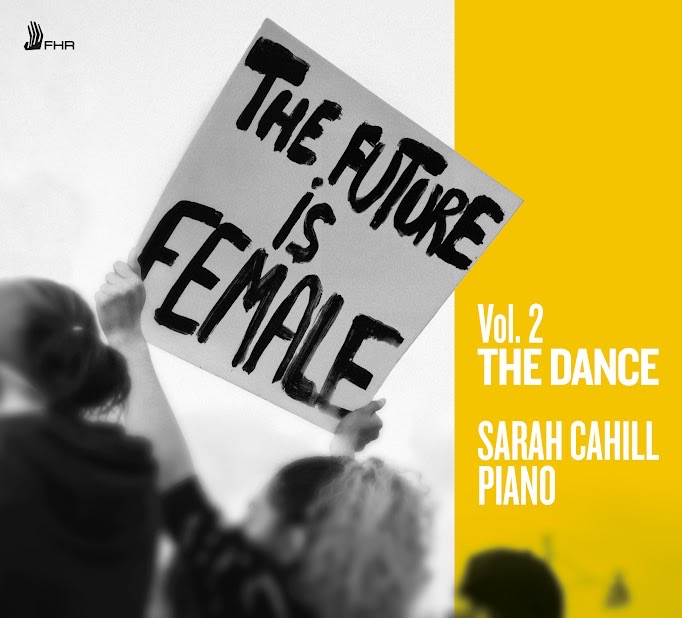
Volume two of three

Another exciting release of Cahill’s visionary series. Like the previous volume (and the aforementioned Cedille release) the consumer will suffer no unnecessary duplications if the music herein. Fascinating and expertly done. This set (the third volume due this year) is a testament to Cahill’s encyclopedic knowledge of piano music as well as her collaborative nature and, of course, her skills as a pianist.

A new voice in electroacoustic composition Kataro Suzuki.

I’m cheating a bit here since I wasn’t able to complete my review until 2023 but this Starkland disc was released in 2022 and definitely earns its place in my “best of” list. This rising star is another one to watch. Starkland, run by the dynamic Tom Steenland is one of those labels that reliably finds interesting and substantive new music. This one is no exception. It goes a long way to alleviating my skepticism of the electroacoustic genre.

DVD OM 4001

And, in order to be fair I must cheat equitably. Charles Amirkhanian kindly sent me this exciting and excellent DVD of his collaboration with his partner in life and in artistic crimes, Carol Law. My more extensive review will appear shortly but this was a major release in 2022. Amirkhanian spends far less time promoting and performing his own unique compositions so this is an especially welcome release.

Neuma

Last but not least of my best of 2022 is this wonderful Neuma release which, when I began my research to write a cogent and informed review, left me stunned at how little I actually knew about composer David Tudor and the astounding dimensions of this unusual piece that evolves with every performance. After gathering a whole ton of data I finally decided that I could not write a comprehensive review without more research so I settled on a tasteful (I hope) summary with the expectation that I will write a larger piece on Tudor and his work. The review will be out very shortly. This is an amazing and significant release.

Happy 2023 to all my readers and thanks to those who kept reading my blog during more fallow times. I have many blogs currently in preparation that I look forward to sharing in the months to come. Peace, health, and music to all.

The Ecological Harp, Yolanda Kondonassis’ Five Minutes for Earth


Azica ACD-71349

Yolanda Kondonassis‘ name is practically synonymous with her instrument, the classical concert harp. Her discography (via discogs) numbers over 50 albums, most of which demonstrate her interest and dedication to music of our time. She has played both as soloist and as orchestral musician with many major orchestras and has had many works written for her. If you collect new music recordings you probably have one or more of her recordings (I certainly do).

So this album continues her ongoing legacy promoting new music for her instrument. But it also demonstrates her interest in ecology with these 15 compositions written for her, at her instigation, on the theme of Earth in many of its guises as chosen by the composer. The project begun in 2020 features compositions written over the last two years in response to her request.

The project, by her description, has grown beyond its original plans and has included videos, live performances of these works, publication of these pieces as well as a collection of works for younger musicians. Each time one of these pieces is reported as having been performed a donation is made via the Kondonassis’ charity organization Earth at Heart to various ecological organizations.

These 15 composers are a delightfully diverse group, some well known, some rising stars. All reportedly responded quickly with 15 similarly diverse compositions (2-8 minutes in duration) inspired by the theme of the commission, all with the composers’ unique perspectives on the subject. This writer hopes that more composers will participate in this worthy project which promotes ecology, the harp, and expands the repertoire for her instrument. No electronics, no other instruments. Just the lone harp in all its glory.

This beautiful and thoughtful production includes useful liner notes (which enhance the listener’s perspective on the music) from Ms. Kondonassis and brief biographies of each of the composers (with more notes available on her website). Technical analysis of this music is beyond this writers expertise so let me just say that each of these works are compelling additions to the solo harp repertory and are concise, carefully conceived pieces that benefit from repeated hearings. You might be challenged but you won’t be bored. Here’s hoping that this disc gets many hearings and furthers the artist’s goals for the instrument and the planet upon which she plays it. Brava!

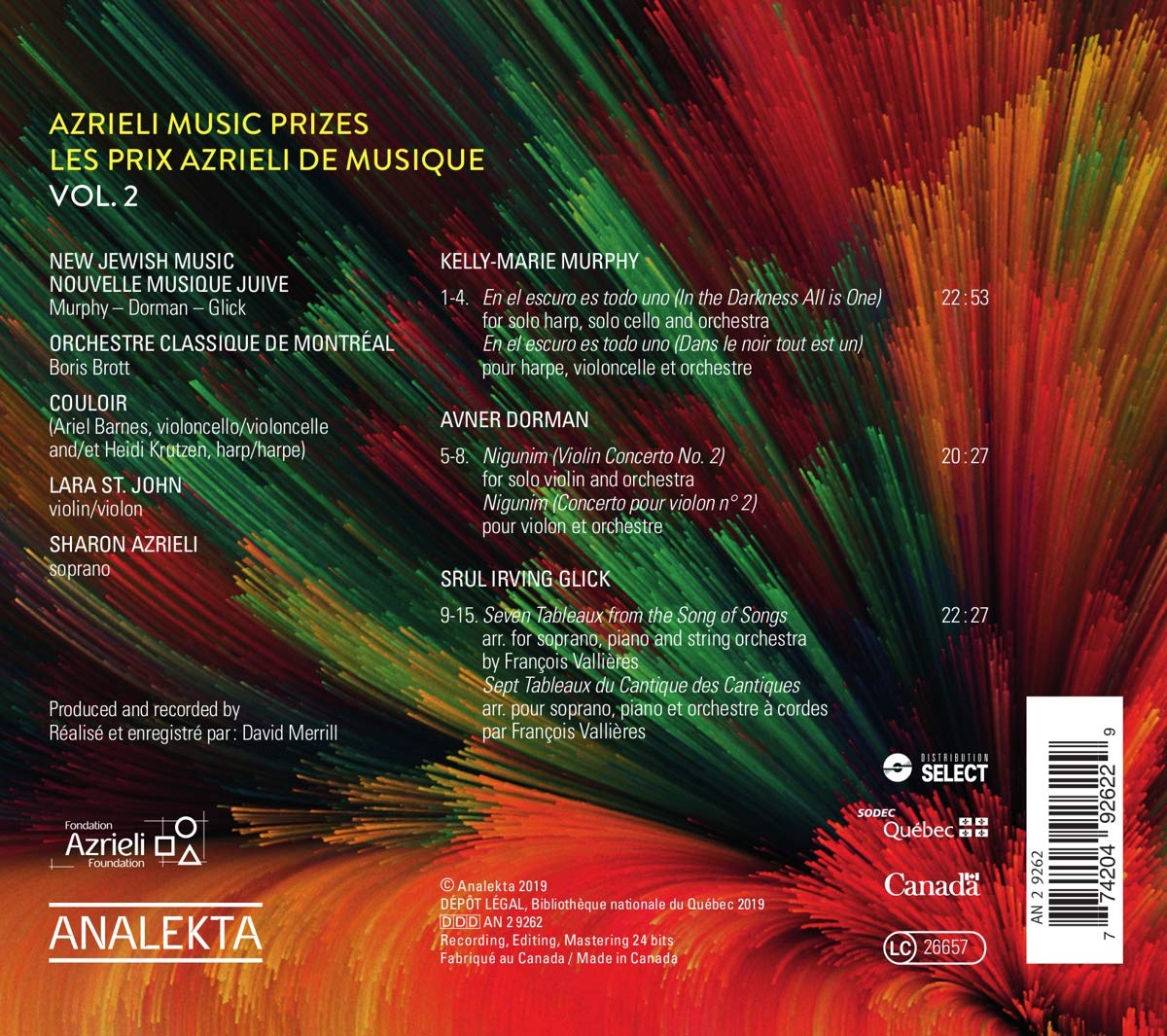
Azrieli Music Prizes Volume II: Jewish Music from Canada


newjewishII

Analekta AN 2 9862

So you read “New Jewish Music” and you think, well, Israel.  At least I did at first.  But the richness of the Canadian musical landscape embraces a wide range of excellent music both pop and classical and this disc (I haven’t heard volume I) serves to illustrate my point. These three works, two for instrumental soloist and orchestra and one for soprano and orchestra are indeed imbued with music that takes its inspiration from the folk traditions common to Jewry around the world.

The musical radar of Canadian producers is truly astounding.  One need only peruse the wonderfully organized Canadian Music Centre web site to get a flavor of which I speak.  You will find classical music by many composers, not just Canadians.  And the range of styles runs the gamut from the experimental (in traditions largely unheard in the United States) to more traditional sounding pieces all of which sound quite substantive to these ears.  Frank Horvat’s “For Those Who Died Trying” made my “best of 2019” list for example.

azrieli2

So back to the disc at hand.  More about the amazing Azrieli Foundation and their various projects is worth your attention.  Their efforts are indeed wide ranging and include the arts most prominently along with their other humanistic endeavors.  The disc includes the 2018 prize winning works by Kelly-Marie Murphy and Avner Dorman along with an arrangement by François Vallieres of the late elder statesman of Canadian music, Srul Irving Glick (1934-2002).

Kelly-Marie-Murphy-495x400-300x242

Photo from composer’s website

Murphy’s “En el Oscuro es Todo Uno” (2018) is for cello, harp and orchestra.  The soloists are the duo Couloir whose album was reviewed previously in these pages.  Its four movements comprise essentially a double concerto (has anyone else done a double concerto for this combo?).  The varied moods in this tonal and melodic work draw the listener in and beg to be heard again.  The piece won the 2018 Azrieli Music Prize.  It is a major work by an established composer whose star continues to rise.

Avner-Dorman-Music-495x400

Avner Dorman photo from the composer’s web site

The second work is Avner Dorman’s “Nigunim” (Violin Concerto No. 2) (2017) with the great Lara St. John on violin.  Winner of the 2018 Azrieli Prize for New Jewish Music, this concerto is a delight to the listener as well as a showcase for a talented soloist.  Imbued with references to Jewish folk music, this piece is a melodic delight.  Like the previous work, the listener will likely find themselves returning for another hearing.

glickinshul

Srul Irving Glick photo from the composer’s web site.

The disc concludes with a lovely setting of some of the much beloved texts from the biblical Song of Songs titled, “Seven Tableaux from the Song of Songs” (1992).  It was originally scored for soprano and piano trio and arranged for this recording for soprano, piano, and string orchestra by François Vallieres.  Glick was known both for his concert and his liturgical works.  These texts have inspired countless composers and will doubtless inspire many more with the beauty of the words.  Soprano Sharon Azrieli is very much up to the task and delivers a heartfelt and lyrical performance.

borisbrott

Photo of Boris Brott form the orchestra’s web site

Last but not least the Orchestre Classique de Montréal under the direction of (too little known conductor) Boris Brott deliver a sensitive and nuanced approach to these works.  All in all an extremely entertaining disc that will likely appeal to a wide audience regardless of religious or political affiliations.  This is just great music making.


American Neoromantics: Higdon, Barber, and Harlin


higdonrapture

Two contemporary world premieres paired with Samuel Barber’s masterful First Symphony make this disc a delicious sampling of neoromanticism in American music.

The standout here, and the main reason to buy this disc is the glorious Jennifer Higdon Harp Concerto (2017).  Higdon, the third woman to win a Pulitzer Prize (by my count) is clearly schooled in a wide variety of compositional techniques which she uses judiciously.  She is unabashedly a romantic but her sound is hardly retro.  She, like many well trained and talented composers, uses her many skills and techniques judiciously.  Nothing experimental here, just good writing for both orchestra and soloist.

Higdon’s concerto is cast in four movements and grabs the listener’s interest immediately.  Using her gift for writing melody and effective use of extended harmonies she crafts a truly great concerto for the instrument.  It is bright, playful, and engaging.  Her writing for the harp (and Kondonassis’ seemingly easy grasp of astounding virtuosity and lyricism) work well with the orchestral writing making a very satisfying listening experience.

The soloist, Yolanda Kondonassis, is a familiar name to fans of harp music.  Her many albums demonstrate a range of interests and skills that keep her name in the public eye/ear.  Her recording of the Ginastera concerto was reviewed previously on this blog here.  Listeners are advised to explore her web site for more exciting and listenable music.

The second piece, Samuel Barber‘s First Symphony Op. 9 (1936) is an acknowledged masterpiece of the mid-century American neoromantic tradition.  Barber’s music hearkened back to the romanticism of the late 19th century at a time that also saw the birth of a great deal of post-Schoenberg modernism.  Some of the similarities between Barber’s work and Higdon’s is doubtless the reason for the inclusion of this too little heard masterwork.  It is cast in one movement and makes wonderful use of a large orchestral palette.

This is followed by the second world premiere on the disc by one Patrick Harlin, a name unfamiliar to this reviewer but one with, apparently, a similar aesthetic and some serious skills as a composer/orchestrator.  Rapture (2016-7) certainly shares some of the sonic fingerprint of the previous two pieces and raises the specter of another talented composer emerging into the light of said American Rapture.

The Rochester Philharmonic Orchestra is clearly up to the task as is conductor, Ward Stare who is another rising star you’ll want to keep on your collector’s radar.  His grasp of conducting and insight into this music suggests he will continue to surprise and please audiences.

The recording on Cleveland based Azica records is well recorded and all the music supports repeated listenings where the attractive surface of the music gives way to more detail.  All in all a CD that fans of Jennifer Higdon, Yolanda Kondonassis, and American Romanticism will want to own.