Organist Carson Cooman plays Peter Garland’s “plain songs” (after Robert Creeley)


Any release by composer/musicologist Peter Garland is a reason to take notice. The same can be said for organist Carson Cooman and, for that matter, Cold Blue recordings. Add to that the inspiration gleaned from poet Robert Creeley and I dare say we have a major event begging to sound from your favorite speakers or headphones.

Cold Blue is a visionary record label from Southern California. You owe it to yourself to peruse their releases available from various sources. But I digress.

Carson Cooman is an organist and composer whose lovely recordings of new music for organ appear regularly in my YouTube feed. It is most fitting that he has commissioned these fine works.

Peter Garland is known both as a musicologist (most famously known for his scholarship on the music of Mexican composer Silvestre Revueltas) and a composer with a varied and unique body of work that might be described as “gently avant-garde”. His work definitely deserves your attention.

These seven tracks ranging in length from about 5-8 minutes are inspired by the poetry of Robert Creeley. These are not vocal settings, they are musical impressions or perhaps reactions to his work. As such these “tone poems” are characteristic of Garland’s deeply felt and personal style.

Adding this disc to the Cold Blue catalog is yet another “brick in the wall” in the overall sonic tapestry that defines the vision of this label and the loosely defined group of California composers generically categorized as “ambient”. And while that term carries connotations of mediocrity, Garland, Cold Blue, and Cooman are anything but mediocre. This is a lovely production and a valuable addition to the recorded repertoire.

Duo Aya Debut Album


Neuma 218

I’ve listened to this utterly charming debut album from this flute and marimba duo several times. It is an engaging and charming selection of music by composers all unfamiliar to this listener but all seem to have the gift of substance.

I will not attempt to survey each of these composers’ works or even their biographies except to provide references for listeners who wish to explore these composers more in depth. Many do not (yet?) have web pages. They are:

Ney Rosauro (1952- )

Evan Williams (1988- )

Gareth Farr (1968- )

Paul Millette (1992- )

Makoto Shinohara (1931- )

Miriama Young (1975- )

Fumihiro Ono (1990- )

They all contribute compositions delightfully suited to this combination of instruments. Many were written for this duo.

All the compositions have characteristics ranging from jazz to light classical chamber music. And when I say “light” I simply mean basically friendly works with tonal melodic content but the music here has depth and substance.

Duo Aya consists of Rachel Woolf, flute and Makana Jimbu, marimba.

There is a clear and wonderful synergy of just really good dedicated musicians whose interpretive skills that flatter the composers’ works. Rather than attempt to describe each of the pieces on this album, I am choosing in this brief review to simply report the experience of this reviewer’s multiple listenings.

I have played this through many times, each time in varying contexts, some with no distraction, focused listens, sometimes in the background letting the music draw its gentle spell in the background, and all revealed joyful, seductive musicianship of music with creative substance. I will leave further analysis to those trained far better than me. I’m just a happy listener. As Shakespeare said, “…play on”!

The Neave Trio’s Post Romantic Gloss on French Piano Trios


CHAN 20337

Chandos is one of my favorite classical labels with an intelligent selection of repertoire. The Neave Trio consisting of violinist Anna Williams, cellist Mikhail Veselov, and pianist Eri Nakamura is clearly a fit for Chandos. This trio’s releases have been consistently interesting and creative. This most recent release is a perfect example.

The recording includes three works by three composers (and a brilliant arranger) for piano trio. The first is by the venerable Brahmsian Charles-Camille Saint-Saens, his second Piano Trio Op. 92 (1892). I am not familiar with the chamber music portion of this prolific, virtuoso pianist/composer’s oeuvre but I’ve yet to have heard anything by him that failed to impress. Indeed, this 5 movement trio is a gloriously engaging fin de siècle salon music. Cast in 5 movements, it is a handsome piece of chamber music that deserves more hearings. And The Neave Trio clearly make a case for that in a lively execution of this virtuosic music.

The next work is a fine example of the curiosity and vision of these artists. These two movements for piano trio entitled “Soir-Matin” Op. 76 (1907) are by a composer wholly unknown, even to your eclectically curious reviewer. Mélanie Hélène “Mel” Bonis (1858-1937) is a new name to this listener and likely to most listeners. The lack of recognition of female composers is slowly being remedied by artists such as these who have here found a composer whose reputation deserves at least a little boost. I mean, she was a student of Cesar Franck and her music was lauded by no less than Saint-Saens. She was also a classmate of Debussy at the Paris Conservatoire. And this leads us to…

As if these first two entries alone weren’t enough to recommend this fine release, behold the ear opening arrangement (yes, for piano trio) of the masterful La Mer (1905) by Claude Debussy. The arrangement is by one Sally Beamish from 2013.

As a listener, I have frequently been amazed by the power of the long tradition of “arrangements” of music generally better known in a different form. Some use reduced forces to allow music to be performed more affordably (chamber ensemble vs. orchestra). Take Maurice Ravel’s brilliant orchestration of Modest Mussorgsky’s “Pictures at an Exhibition”, or the two piano arrangement of Igor Stravinsky’s seminal “Rite of Spring” ballet (1913) as examples. Comparatively few people even know that Pictures at an Exhibition was originally a solo piano piece. But both versions each have their charms, and each communicate the musical message differently. And though audiences are doubtless more familiar with the colorful orchestral original, The Rite of Spring, reduced to the work of four busy hands on two keyboards is a more portable experience. Especially before the flourishing of the recording industry, it made this music accessible to more listeners at less cost (2 musicians instead of a whole orchestra).

In both cases, the one vastly and gloriously expanding the evoked pictures described in sound, the other compacting a big orchestral tapestry into a more intimate “salon” experience. Each carries its own message and provides its own insights.

And it is here in the last three tracks of this fine album that we hear the ultimate glory, the real reason you want to add this disc to your collection. I have not heard any but the original orchestration (requiring an orchestra of some 60 musicians) of this French impressionist masterpiece. I could not imagine how one could squeeze these fully orchestrated harmonies and have that make sense to a listener using but three instruments. But the Neaves (if I may mint a friendly collective noun), with this arrangement by Beamish, provided this listener with a revelatory experience comparable to Joshua Rifkin’s brilliant arrangement of Joni Mitchell’s “Clouds” sung by the equally brilliant Judy Collins. Or, even more eclectic, the Anton Webern orchestration of the J.S. Bach Ricercar from his Musical Offering. The point here is that great performances of great arrangements have the effect of opening your ears and mind.

So let the “The Neaves” open your ears and mind with this delightfully unusual and very effective recording.

Charles in Charge, Composer/Producer/Impresario Charles Amirkhanian at 80


Charles Amirkhanian (photo by Carol Law, all rights reserved)

An overflow crowd packed the lovely auditorium at Berkeley’s David Brower Center this past January 19th. Octogenarians (and younger folks as well) populated both stage and audience in a show of appreciation for a man whose work as music director of KPFA (1969- 1992) and subsequently as an arts promoter and curator of new music in California’s Bay Area continues to enhance the artistic reputation of the Bay Area.

A rare and exciting aspect of this evening were the rare opportunities to hear Charles’ music, including representative sound poetry classics and a recent major opus capped off by a world premiere of a new work.

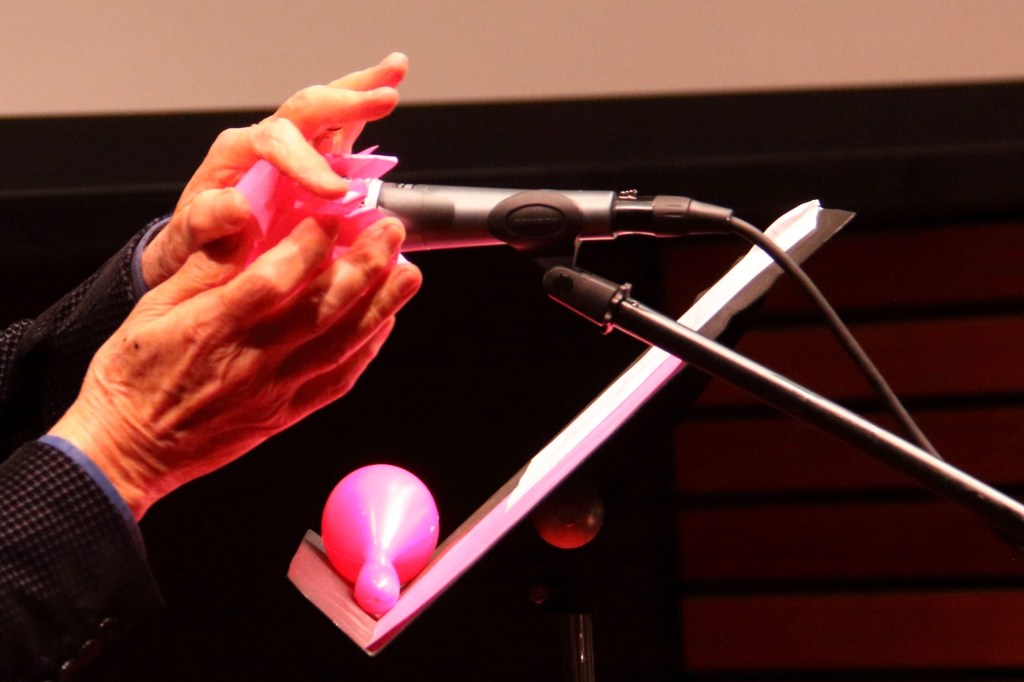
The hands of the artist. Photo by Allan J. Cronin

The genuine affection, appreciation, and respect was palpable as the honored guest demonstrated his skill at hosting when a couple of technical glitches slowed (but did not stop) the amiable birthday celebration. The audience waited calmly and quietly.

Both the guest of honor and the host (Liam Herb) used a well honed, self effacing humor used most skillfully to entertain the sympathetic audience while the technical difficulties were surmounted in real time.

Panel discussion featuring (left to right) Susan Stone, Anthony Gnazzo, Paul Dresher, Charles Amirkhanian, Sarah Cahill, and Liam Herb (Photo by Allan J. Cronin, Creative Commons license)

Herb, a composer and performer, introduced himself in the midst of the technical resolutions, graciously announcing that, as producer, he accepts responsibility for the glitches. Charles maintained his familiar master of ceremonies crowd pleasing good humor as Herb worked goodnauturedly (if that’s a word) with the rest of the crew to resolve the issues and get on with the show.

The formal opening remarks were given by Other Minds’ associate director, Blaine Todd. And the evening began in force.

Blaine Todd (photo by Allan J. Cronin, Creative Commons license)

The program glided past the initial hiccup to present a film about our guest of honor. The bevy of fans and bona fide new music professionals sat with rapt attention as the film, featuring the familiar faces of several “Bang on a Can” artists.

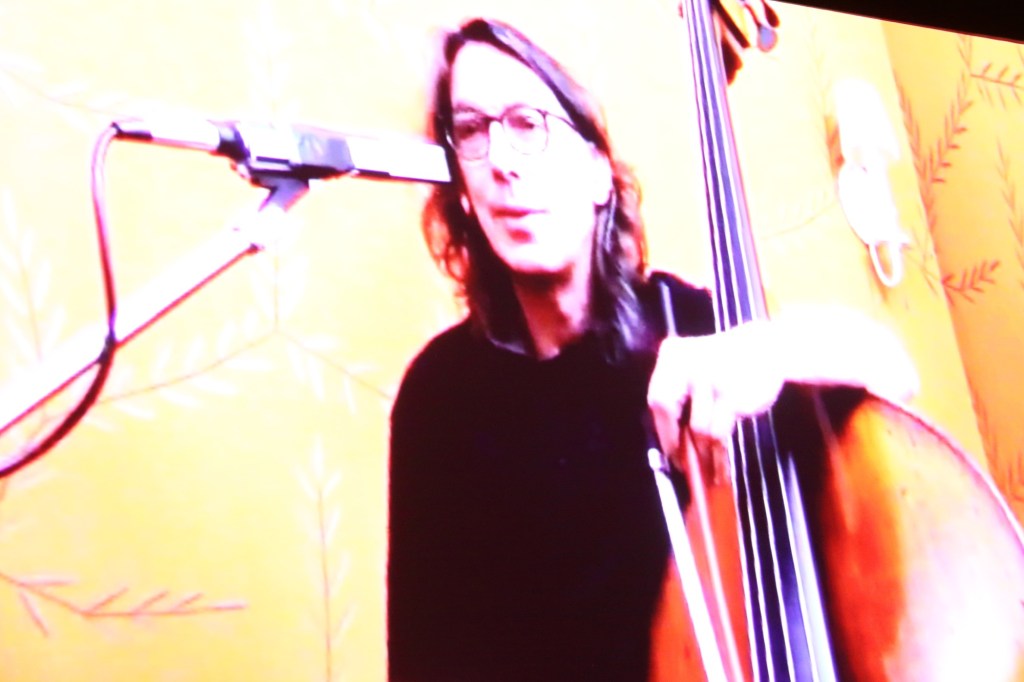
The late great Robert Black interviewed by Amirkhanian in the streaming premiere of Audible Autopsy. (Photo of film appearance by Allan J. Cronin)

Excerpts from the 2015 Other Minds 20 documentary featured Julia Wolfe, David Lang, and Peter Gordon (now, it seems elder statesmen (and women) in their own right.

Production manager Liam Herb then served as moderator for a conversation or live interview (with Amirkhanian) for the next segment. This was followed by some videos with music by the guest of honor:

Real Time/T.V. Time Video with Amirkhanian’s “Muchrooms”

The film, presented in its entirety was accompanied by “Muchrooms”, from the CD recording of that standalone work.

Next was Amirkhanian’s and Carol Law’s classic collaboration: History of Collage (1981). This is a major work and a great collaboration with his partner in life and arts. I’m pleased to add my own shot from the performance at the Other Minds 23 experience, my favorite OM festival(so far).

History of Collage (1981) photo by Allan J. Cronin taken at the Other Minds 23 wonderful live performance of this work (Photo by Allan J. Cronin is Creative Commons license 2015)

We also heard and saw Audience (1978) with photography by Law and music/poetry by Amirkhanian followed by Chairs with photography by James Petrillo and music/poetry by Amirkhanian (excerpts from Seat Belt, Seat Belt (1973).

There followed a panel discussion led by Carol Law with Betsy Davids discussing David’s’ work and her connections via her work as a book artist. These two embody the experimental visual arts that characterize the skills of these fellow artists both onstage and off tonight. In fact, interactive collaboration and both respect and friendship were everywhere to be seen in this warm and pleasantly nostalgic evening.

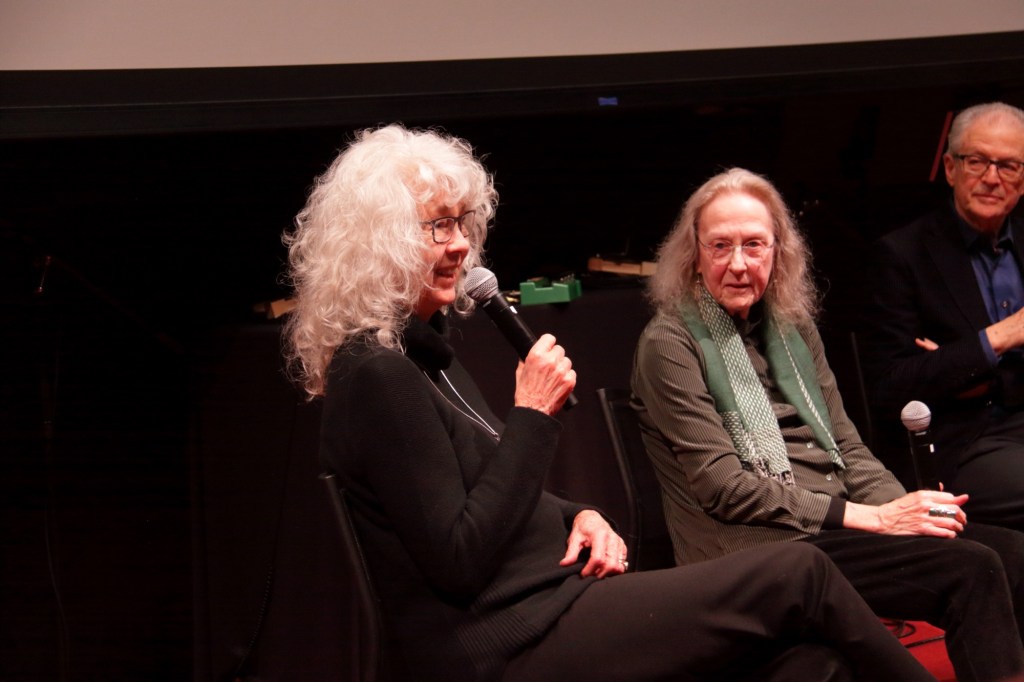
Carol Law speaking with Betsy Davids (Photo by Allan J. Cronin, Creative Commons license)

This was followed by a recording of a major opus, Ratchet Attach It (2021) recently played at one of the (still ongoing) Other Minds Festival. This work is a major opus by Mr. Amirkhanian, one I’m pleased to say I heard live at the Chinese Theater in San Francisco a few years ago. Scored for a huge percussion ensemble, with audio recordings, and a conductor who moves between the podium and a space among the performers playing with the ensemble. It is perhaps one of his most integrated and evolved compositions. Stunning to hear it live. Glad to hear the (always too short) excerpts.

In fact Mr. Amirkhanian, a fixture in the arts of the Bay Area, continues to influence musical taste and present new and interesting music as he has for well over 50 years. His work as Executive Director of Other Minds includes the fabulous OM Records as well as the annual Other Minds Festival and a continual flow of carefully curated concert events by luminaries (or soon to be luminaries) throughout the Bay Area and beyond. There is also the huge archive of thousands of hours of interviews and concerts that are available in streaming audio and video via the Other Minds website.

Many of the artists featured in the Other Minds concert series continue to work, innovate, and expand musical concepts. An Other Minds commission, Henry Brant’s Organ Concerto, Ice Field, earned him a Pulitzer Prize. Many have gone on to greater achievements in their respective careers. Of course not every composer started their musical careers at Other Minds concerts. Many mid or late career musicians have joyfully been represented over the years. Its one of those festivals that innovative musicians seek to participate.

Such achievements reflect on Amirkhanian’s leadership and curatorial acumen, but more importantly his relationships with his fellow artists. Charles has earned a reputation for his support and his collaborative nature. Arguably, everyone in the house (and the overflow in the lobby) all have a degree of connection to Charles and his guests. It is why we’re all here tonight.

Charles Amirkhanian and Joseph Bohigian performing with Liam Herb’s electronics (Photo by Allan J. Cronin, Creative Commons license)

Following a brief intermission we were treated to a world premiere of a new work by our guest of honor, Noose Ratchet (2025) for two percussionists and electronics. Amirkhanian performing and/or promoting his own music is a relatively rare event and this alone was certainly worth the trip.

The work is arguably a trio for two percussionists playing ratchets, a curious instrument whose sound, if not entirely ubiquitous, is familiar. And the two play interactively with the electronics (the third member of the trio). Extended techniques and other duties get assigned (when in doubt it’s responsibility of the percussion section, right)?

There followed a lively and friendly panel discussion amongst frequent and past collaborators Susan Stone, Anthony Gnazzo, Paul Dresher, Sarah Cahill, and Liam Herb. This truly felt like a gathering of friends.

Happy Birthday, Charles.

The Elegant Icelandic Pianist and the Woman with Blurry Hands: Òlafsson and Wang Duo Pianos in Santa Barbara


Vinkingur Òlafsson
Yuja Wang

Program 
Berio:Wasserklavier
Schubert: Fantasia in F minor for Four Hands
Cage:Experiences No. 1
Nancarrow (arr. Thomas Adès): Study No. 6
John Adams:Hallelujah Junction
Arvo Pärt:Hymn to a Great City
Rachmaninoff:Symphonic Dances

From the very beginning this concert defied convention in so many ways. The Granada Theater hosted a sold out crowd for these two distinctly different rock stars. The two pianos were arranged so that the artists were sitting next to each other, Wang was seated slightly upstage and stage right while Òlafsson was stage left and a bit downstage (the conventional staging for two piano concerts has the pianists facing each other and equally center stage). Also noted was Wang using the iPad score reader whilst Òlafsson had a page turner for the hard copy paper score.

On the surface these two artists have distinctly different personas. Both are possessed of a high level of technical skill along with interpretive abilities that communicate with their audiences. But the juxtaposition of these two pianists is a pairing that had this listener wonder if they could occupy the same space. Òlafsson the contemplative man in the dapper blue suit and the introspective facade contrasted just a bit with Wang’s more extroverted showmanship. And Wang’s fashionable but characteristically flashy outfit (which was even “flashier” after intermission).

The concert began with a brief and generally lesser known piece by the great Italian composer, Luciano Berio (1925-2003), his Wasserklavier (1965). This short, contemplative work functioned as an appetizer as the duo segued directly to Franz Schubert’s (1797-1828) gorgeous Fantasy in F minor (1828). This work originally written for one piano, four hands, was played here on two pianos. The work, written in the year of Schubert’s death is of symphonic dimension. The duo played rather uptempo but delivered a very convincing performance.

After acknowledging applause they gave us a sort of brief palate cleanser, John Cage’s (1918-1997) Experiences No. 1 (1945-8), a work for two pianos. The soft and sparse texture segued to Thomas Adès arrangement of Conlon Nancarrow’s Player Piano Study No. 6 (ca. 1962). This study, one of about 50 studies, sounds gentle and bluesy but belies the actual rhythmic complexities which characterize all the studies. This team handled the complexities most deftly.

This was followed by another work of symphonic dimension, that of John Adams’ (1960- ) Hallelujah Junction (1996). It was this writer’s first hearing of the work and it was a charming and engaging post minimalist work that challenged the virtuosity of the artists and gave ample evidence of how well they performed together. The rousing ovation then took us to intermission.

(Photo by David Bazemore, all rights reserved)

The second half included Wang in a more revealing outfit more characteristic of much of the publicity photos I’ve lately seen of her. But most important is the artist’s virtuosity and interpretive power. She is a force of nature. Òlafsson is just a gentler expression that managed to link most successfully with his upstage partner on this night.

They began with Arvo Pärt’s (1955- ) Hymn to a Great City (1984-2004). This ca. 3 minute work (the city of greatness is not named) was a soft meditative work, perhaps echoing the Berio work which opened the concert.

It led without pause into Rachmaninoff’s (1873-1943) Symphonic Dances (1940) I had only been familiar with the lovely version for large orchestra (apparently written concurrently with the orchestral version) so it took a bit to grasp the intricacies that suggest that this music was written for two skilled pianists. Òlafsson and Wang traded moments to shine in this truly symphonic work but it worked very successfully with these two artists in their respective driver’s seats.

A standing ovation brought the two back to the stage where they sat next to each other for a rendition of Schubert’s bouncy Marche Militaire. A second encore two dances, by Dvorák and Brahms, eased into a calmer Brahms’ familiar Waltz in A-flat Major capped off a truly fine concert, not a union of opposites but rather a collaboration of genius.

Ilhan Mimaroglu and Agitprop (Political Classical Again)


İlhan Kemaleddin Mimaroğlu (1926-2012) photo credit unknown, fair use

Portrait of Ahmet M. Ertegun and Nesuhi Ertegun, Turkish Embassy (record room), Washington, D.C., 193- (Photo credit: Wikipedia)

It would be difficult to underestimate the impact of Turkish immigrant brothers Ahmet and Nesuhi Ertegun on the American music industry in the last half of the 20th century with their promotion and production of jazz and rhythm and blues artists. Their lesser known colleague, Ilhan Mimaroglu labored under a slightly different esthetic. In addition to having been involved with the production of many artists’ work on the Atlantic label (including Charles Mingus, Freddie Hubbard, et al) his study of the developing techniques of electronic and tape-based music helped him develop a unique voice as a composer where he worked with electronics, tape, acoustic instruments, musique concrete, and combinations of these media. He was equally skilled in the art of music production and recording and he utilized this knowledge to produce an impressive body of work which deserves to be better known. He also curated the sub label Finnadar to release his own music and that of other artists with similar vision like Anthony Braxton, Frederic Rzewski, Morton Feldman and others.

Mimaroglu wrote a number of works reflecting his political views during the same turbulent years during which Atlantic records shaped the popular soundtrack of the sixties era. Using his knowledge of studio technology in combination with emerging developments in electronic music synthesis he created many purely electronic studies, musique concrete, at least 4 string quartets, solo piano pieces, and more that has yet to be fully catalogued.

First let me clarify the term ‘Agitprop’. This is a hybrid word or ‘portmanteau’ for the terms ‘agitation’ and ‘propaganda’. The word appears to have first been coined and used in conjunction with the Russian Bolshevik revolution and it’s political tactics. The idea was to create a form of propaganda that would not only inform but also encourage action.

I will focus here on his overtly political statements embodied in ‘Sing Me a Song of Songmy” (with Freddie Hubbard‘ 1971).

(subtitled “A Fantasy For Electromagnetic Tape”)

This unusual piece, a concatenation of an electronic score, the Freddie Hubbard Quintet, organ, and strings is perhaps his greatest example of Mimaroglu’s brand of political music. It is by no means his only agitprop/ political piece but it may be his finest and one of the best works of this thorny, frequently controversial genre.

The title is a combination of the name of the town (Son My), the location of the My Lai massacre, and the ironic words, “Sing me a song of Songmy”. The collage and non-linear format of the piece actually contains a dizzying mix of concurrent horrors including the Sharon Tate murders and others whose subjects await a comprehensive analysis by a historian and/or a musicologist. The work includes poetry by Fazil Husnu Daglarca, news clippings, etc. Luciano Berio did something similar in his similarly political masterpiece, Sinfonia (1968). That work is rife with musical and textural references subsequently enumerated by the late American composer/musicologist, Alan Stout.

This is also one of the most expensive productions of a mix of evolving musical genres with a strongly controversial and ugly subject. It can stand in comparison to Picasso’s Guernica for its power to provoke. Add the thorny early electronics with the free jazz of Hubbard and the jazz/blues inflected writing, and you have a powerful indictment of war crimes but hardly a best seller. And it is only with the healing of time and the fading of the sting of those memories that this work has begun to be appreciated more fully.

Participating musicians included:

  • Freddie Hubbard  trumpet, flugelhorn (#1, 3, 4, 7), recitation (6)
  • Junior Cook- tenor saxophone (1-4, 7)
  • Kenny Barron- piano (1-4, 7)
  • Art Booth  bass (1, 3, 4, 7)
  • Louis Hayes  drums (1, 3, 4, 7)
  • Ilhan Mimaroglu  synthesizer, processed sound
  • Arif Mardin  organ, conductor
  • Barnard-Columbia Chorus directed by Daniel Paget
  • Strings directed by Gene Orlo and Selwart Clarke
  • Mary Ann Hoxworth (1, 3), Nha-Khe (3, 8), Charles Grau (3), Gungor Bozkurt (3, 10) – recitation
  • The music is divided into ten sections as follows:
  • PART I
  • “Threnody for Sharon Tate” – 2:04
  • “This Is Combat I Know” – 8:56
  • “The Crowd” – 7:03
  • “What a Good Time for Kent State” – 1:28
  • PART II
  • “Monodrama” – 2:54
  • “Black Soldier” – 2:19
  • “Interlude I” – 5:48
  • “Interlude II” – 4:30
  • “And Yet There Could Be Love” – 4:28
  • “Postlude” – 1:05

The work has been released on CD.

The Thrall in the Hall: Randall Goosby and Zhu Wang Violin and Piano Duo at Hahn Hall


Violinist Randall Goosby

Though this was ostensibly Randall Goosby ’s show, the music making was a wonderfully integrated duo with pianist Zhu Wang, These two fine young musicians shared the virtuosic duties that the music in this concert demands. Both are clearly hard working and dedicated artists. Both have technical and interpretive prowess. And they clearly embody a mutual respect for each other.

Pianist Zhu Wang

The music on the program served to demonstrate the duo’s creative selection of music:

Coleridge-Taylor: Suite for Violin and Piano, op. 3 
Brahms: Violin Sonata No. 2 in A Major, op. 100 (“Thun”) 
Still: Suite for Violin and Piano
Price:Two Fantasies 
Strauss: Violin Sonata in E-flat Major, op. 18

Curiously, due to this reviewer’s lack of familiarity with the violin and piano repertoire and having written some recent reviews of black composers’ music, the only familiar pieces were two of the three pieces by black composers. Now, overall, this is a marvelously chosen set of pieces that reflect the eclecticism and technical skill of both of these musicians.

The classic Paul Freeman conducted set of music by black composers.

The Brahms was perhaps the most familiar to audiences but the other works were equally substantive and worthy of being heard. It is these rather visionary choices that characterizes this duo as fresh and innovative. In addition their obvious knowledge of the music along with their enthusiasm and affection for it conspired to make for a delightful evening and even nudged this reviewer to try to become more familiar with the violin and piano repertory in general.

Samuel Coleridge-Taylor (1875-1912) was a black British composer who has of late had a much needed revival of his music. He was named in honor of the celebrated British poet Samuel Taylor-Coleridge (1772-1834). During his rather brief lifetime, Samuel had been hailed as “the British Mahler but, after his death, his music lay largely fallow until revived by the late, great American black conductor, Paul Freeman (1935-2015). His revelatory series for Columbia records (now Sony) opened listeners’ ears to a fascinating selection of music by black composers internationally.

The Coleridge-Taylor opus 3 Suite for violin and piano (1893) is an early work cast in the high romantic late 19th century style of broad melodies and virtuosic demands. It served as the introduction to an intoxicating evening of (partly) seldom performed works alongside some fairly established works in the repertoire.

The Johannes Brahms (1833-1897) second violin sonata (of three) was written in 1879 and was named “Thun” after the Swiss city where he composed it. The three movements follow the classical fast, slow, fast structure common to this genre.

It is a product of high romanticism and it remains a staple of the repertoire. It, as with most of this composer’s music, is technically challenging for both instrumentalists. It was a fine vehicle to confirm the incredible technical skills of these young artists.

William Grant Still (1895-1978) was one of the finest composers of the early to mid twentieth century. Like Coleridge-Taylor and Florence Price (1887-1953), his music was lauded during his lifetime but was neglected until fairly recently in the aforementioned Black Composers set. These musical choices revealed another aspect of this delightful pair of musicians, that of being essentially musical archeologists uncovering forgotten gems much as Lord Carnarvan’s work availed the world to the marvelous Egyptian art of King Tut’s tomb.

Still’s Suite for Violin and Piano was inspired by three sculptures–Richmond Barthé’s African Dancer, Sargent Johnson’s Mother and Child, and Augusta Savage’s Gamin. Written in 1943, it synthesizes elements of blues, pop, and classical music to create musical description of this ethnically inflected visual art.

Richmond Barthé’s African Dancer
Sargent Claude Johnson’s Mother and Child (ca. 1932)
Augusta Savage’s Gamin

The three movements comprise essentially tone poems based on the visual artwork. It was after the second piece, depicting the Mother and Child sculpture that the spell cast by the duo’s that revealed the “Thrall” of this blog’s title.

Goosby embodies a calm and casual confidence and he let the audience know early on that it is OK to applaud after a single movement if you are so inclined. He has a warmth that put the audience at ease, embracing us in a most genial manner. There is, of course, nothing wrong with musicians who might seem more aloof but Goosby’s warmth was both generous and welcome. However, it became clear that this audience, after hearing that gorgeous second movement so beautifully played, paused in a seemingly hypnotic response to the impassioned performance that captured the beauty of the music. It felt as though we had become collectively and deeply engaged. That is the meaning of “thrall” and that was a beautiful experience that spoke of connections between composer, performers, and audience that represent the pinnacle of the art of chamber music performance. All three movements were wonderfully executed but that moment and the collective reaction was a truly moving experience.

Following a brief intermission we got to hear both of Florence Price’s two Fantasies for Violin and Piano (1933, 1940). Though I’ve become familiar with much of Price’s work (her three surviving symphonies and Goosby’s own reading of her two violin concerti have been released in the last couple of years) I had not heard these fantasies before.

Though written only seven years apart, the works embody distinctively different qualities. Both are certainly “capricious”, embodying a variety of moods, but the second is a bit longer and seemed to reflect the composer’s maturing style. Both works were enjoyable and seemed to please the audience.

This led us to the final work on the program, the Violin and Piano Sonata (1888) by Richard Strauss (1864-1949). Best known for his big orchestral tone poems and his grand operas, this was an early work which has found an audience due to its lyrical and friendly character.

It is cast in three movements, and it was at the end of the slow movement that we again saw/heard a sort of “agreed upon” silence in which the audience seemed to have shared a deep impact from that lovely movement played so passionately. No one applauded as a reverent silence came upon us.

The much busier third movement again presented the virtuosity and broad melodies of high romanticism. And there was applause and, much deserved standing ovations. It was a joy to have heard these talented and hard working musicians in an ecstatic night of chamber music.

Mahler and Klezmer in Santa Barbara Featuring Clarinetist David Krakauer


Santa Barbara conductor Nir Kabaretti (photo copyright David Bazemore)

It was the day before Passover and all through the lovely acoustics of the Granada Theater, nostalgia was afoot. It came in the form of a Mozart Overture, a Mahler Symphony, and some new music for clarinet, the klezmer clarinet of David Krakauer. (N.B. Klezmer is a style of playing common to the Ashkenazi Jewish communities of Eastern Europe and Russia).

Maestro Kabaretti’s thoughtfully crafted program featured the integration on non-western vernacular (folk) musics into the western classical idiom. The incorporation of an age’s popular music into the newly written concert music of that era is a time honored tradition in music history.

Today’s concert would feature Wolfgang Amadeus Mozart’s imitation of the exotic music (to Viennese audiences) of Turkish Janissary music in the overture to his opera, “The Abduction from the Seraglio”. The plot consists of a story that involves a Turkish Pasha who has kidnapped the lover of the leading man. (Spoiler: He rescues her).

There was a personal nostalgia in that the first opera recording I bought was the budget LP of the Josef Krips conducted performance of that opera. The overture quotes some of the music of the opera and sets the exotic locale with the imitation of Turkish music.

The relative exoticism of Turkish music was imitated by Mozart in his 5th Violin Concerto, subtitled “Turkish”, as well. Listeners may recall the imitation of Turkish martial music in the finale of Beethoven’s 9th Symphony (just after the cherub stands before God). Mozart’s inclusion of piccolo, triangle, big drum, and cymbals (rarely seen in classical era orchestras) typify the European imitation of this ethnic music.

Mozart’s overture works well as a standalone piece and Kabaretti’s Santa Barbarans stimulated at least this listener’s sense of nostalgia in a beautifully crafted reading of this music. From the familiar opening notes this overture this listener was transported to nostalgic reverie and simultaneously enthralled by the energetic reading of the work. It was a delightful balance of both nostalgia and an opportunity to somehow hear this work anew.

Clarinetist David Krakauer (c)Linus Lintner Fotografie

What followed that delightful overture brought featured performer David Krakauer to the stage for a performance of a new (2018) concerto for klezmer clarinet. But before that, we were treated to what Krakauer described as “an arrangement” of a classic klezmer wedding tune. The affably chatty Krakauer is apparently possessed of a genuine humility here because this was virtually a mini concerto for clarinet and string orchestra whose style had some resemblance to the Mahler Symphony programmed post intermission.

Krakauer is a seriously accomplished musician, composer, musicologist, and teacher. His technical and interpretive skills are of Olympian dimension and his ability to relate to fellow musicians and the audience were a joy to behold. Readers of this blog might recall an earlier review of yet another klezmer concerto also championed by Krakauer. You can read that blog entry here.

The youngest music by the youngest composer on the program was next. Wlad Marhulets (1986- ) is a Polish born and educated composer. His name had been unfamiliar to me but a quick look at his website and a few listens on YouTube revealed this man to be a marvelously skilled and creative composer. Put this man’s name on your listener’s radar.

Doubtless our soloist had some input on the performance of this concerto but Marhulets appears to have an in depth understanding of klezmer performance along with a solid grounding in western classical music and a marvelously nuanced skill at orchestration. This is a substantial concerto and a great addition to the repertory.

Like the Mahler Symphony which would follow in the second half of the concert, Mr. Marhulets demonstrated a range of compositional skills. He can evoke humor, terror, nostalgia, joy. He handles a large orchestra augmented by an electric bass guitar and a drum kit. And he has a subtle but effective sense of orchestral color. The soloist, who has a lot to do, winds in and out of passages that pit his clarinet variously against the full orchestra and in duet pairings, sometimes fleetingly, that suggest images of pub, dance hall, and street concerts. All of these the natural milieu of Klezmer music.

The concerto began loudly, raucously, and assertively. The soloist navigated the complex rhythms and subtle balances of texture as only a master musician can do. Kabaretti and his fine orchestra were clearly up to the significant challenges of this music and clearly enjoyed their labors.

The loud, declarative, opening gave way to a lovely and lyrical slow movement followed by a long and engaging cadenza, sometimes punctuated briefly at times by the orchestra. It then led into a really fun (though hardly trite) finale.

Following a richly deserved standing ovation, Krakauer and the orchestra gifted the audience with an encore. Echoes of klezmer in the many moods evoked by this afternoon’s music making left this listener reflecting on the chaos in our world here, in this beautiful hall, in this beautiful city, on the eve of Passover. I fancy that there is a gentle activism here, one in which the sharing of the beauty of a culture’s esteemed artists (composers and performers) acts as a proud display of some of the best that that culture has to offer. The quality of the music and the music making can’t fix the world’s problems but they can give us hope and joy. Great art elevates the soul. At least that’s what this reviewer felt.

The intermission was needed to replenish listeners’ emotional reserves for the second half. No doubt the musicians needed to recharge as well.

The Mahler First Symphony (1888) triggers more personal nostalgia for two reasons. One, my first Mahler purchase was the Bruno Walter reading of this and the ninth symphony. Second, I will forever associate that first movement depicting dawn in its opening. Astute listeners may recognize television and film composer Alexander Courage’s appropriation of this music in his now iconic theme for the original Star Trek series (which debuted in 1964 when your humble reviewer was 9 years old). I would encounter Mahler some years later.

It is difficult over 100 years after the symphony’s premiere to understand how radical this music seemed to players and listeners. Its Budapest premiere has been described as a disaster mediated by uncooperative musicians in the orchestra and an unsympathetic audience. After his death in 1911, Mahler’s compositional star rose to new heights when the late, great Leonard Bernstein championed his work during his long and fruitful career, even reintroducing Mahler’s music to the Vienna of its beginnings. This is the Vienna where Maestro Kabaretti was trained. And he gets this music deeply.

To be fair, this piece presents many challenges for players and conductors but, when it is well done, it thrills audiences. Maestro Kabaretti and his Santa Barbarans delivered as fine a performance of this symphony that this reviewer has heard. It was positively thrilling and, unlike the musicians who played in the disastrous premiere, the Santa Barbara Symphony clearly enjoyed their hard work and respected their leader.

This was a thrilling and invigorating concert experience. The hometown orchestra put in a world class performance and our esteemed soloist was matched in his expertise by their skills. The nearly full house was most obviously pleased as was this reviewer.

Opus 961, Violist Noémie Chemali’s Auspicious Debut: New Music Activism From Emerging Lebanese Composers


There are many ways to debut on the world stage and there are many ways to represent political activism. Violist Noémie Chemali has chosen, as her important first impression in her recorded debut, a selection of music from young composers whose heritage includes political oppression. The albums profits are promised to MSF, also known as Doctors Without Borders. These works are not directly political, rather they are a carefully curated selection of new works produced by composers who, in varying degrees, have experiences of dealing with or having friends and family whose lives are negatively impacted by political conflicts and oppression. This is gorgeous music by emerging talents.

The good news is that these wonderfully creative artists persevere in creating great art and it is the celebration of that creative drive that lies at the heart of this fine release. While the pieces here variously reference tunings, rhythms, and melodies representative of their individual ethnic heritages, they are not confrontational. Rather the music here stands as evidence of the beauty of artistic invention which stands defiantly in contrast to the cruelty of oppression and warfare. That gentle activism casts a kinder and gentler image of people more commonly represented in the media as terrorists (actually a numerical minority) in a culture with ancient roots and a powerful artistic soul (the better descriptor of the actual majority).

Links to the composers’ web sites can be accessed by clicking the names of said composers.

The album’s contents are as follows:

Wajdi Abou Diab (1991- )

1. “The Moraba’ Dance” (2020)

This, the composer’s Opus 13C, is based on an Arabic rhythm called “Al Mouraba”. It is for solo viola and is cast in the unusual meter of 13/4, using an Arabic scale. The music imitates traditional music which ostensibly enticed horses to dance in times past.

Sami Seif (1998- )

2. “La’ib an-nard / The Dice Player” (2019)

This musical impression of a poem of the same name by Mahmoud Darwish. It is, in the composer’s description, a meditation on the random elements that affect our lives. It is scored for viola, cello, and double bass.

Layale Chaker (1990- )

3. Cadenza from “The Brown Texts”; movement one (2017-2020)

4. Cadenza from “The Brown Texts”;movement two

The term “cadenza” derives from the word “cadence” and it generally refers to the improvisations (by the soloist) in a concerto. The notion of a solo cadenza does not appear, as far as this listener’s encounters, until the mid to late twentieth century. Penderecki’s Cadenza for Viola is the only example that immediately comes to mind. Though that work is sometimes performed separate from the viola concerto from which it derives, its origin is in the classical/romantic tradition of a virtuoso work that displays the skills of the soloist. As with the previous work, this one is a musical rendition of originally poetic ideas, those of the late Nadia Tueni. And, unlike any other cadenza I’ve known, it is cast in two separate movements. The piece is a fine showcase for Ms. Chemali’s technical and interpretive skills.

Noemie Chemali:

5. “Kadishat” (2021)

Delightfully, Ms. Chemali has chosen to include one of her own compositions. She describes this as a set of variations on the ancient Aramaic Trisagion “Qadishat aloho”, a tune which has been firmly ensconced in the composer/performer’s consciousness from having heard it since her childhood. One could characterize it as one of the greatest hits of the Eastern Orthodox Church and one of its most deeply felt pieces. Chemali casts this work for violin, viola, and cello. This writer is reminded of another fine example of the incorporation of sacred hymns into the classical music tradition, that of Carolyn Shaw’s fine “In Manus Tuas” which mines that composer’s memory of hearing a sacred chant. Both works reflect the composer’s internal process of hearing and attempt to convey that spiritual experience to the listener.

Mary Kouyoumdjian (1983- ):

6. “The Revolt of the Stars” (2018/2020)

This piece, another musical expression of a literary work, namely, the Armenian fable that provides the title for this work which is cast for cello, voice, and electronics. It is presented here in a transcription for viola by the soloist. The fable deals with the strength in numbers that rise up against those in positions of power. It is a delightful work with dark implications.

Saad Haddad (1992- ):

7. “Dohree” (movements 1&2)

8. “Dohree” (movement 3)

This work, scored for viola, harp, and flute is cleverly written in three movements which, in turn, each give a solo to each of the musicians who are, in turn, accompanied by the others in the group. “Dohree” is an Arabic word which translates as “my turn”.

Six pieces over eight tracks with chamber groups ranging from solo viola to viola with electronics (in the Kouyoumdjian work) and small chamber groupings in the others. All in all a fine and engaging selection of music that bear witness to the beauty and creativity of people living with oppression. This music reflects the human experience that can get erased by merely identifying ethnicity.

In addition to Ms. Chemali this recording includes the following musicians: Shaleah Feinstein, violin; Raffi Boden, violoncello; Kebra-Seyoun Charles, double bass; Lauren Scanio, flute; Deanna Cirielli, harp. They really do honor to the spirit of this music and this album is beautifully recorded as well.

Kouyoumdjian was the only composer known to this reviewer prior to hearing this album but she is apparently in very good company here and listeners would do well to make note of these rising stars. We will doubtless hear from them again. Here’s hoping.

Noemi Chemali (from the Orchestra of St. Luke’s web page)

This is the artist’s biography as it appears on her website (linked above):

French-Lebanese-American violist Noémie Chemali received her Bachelor’s degree from McGill  University’s Schulich School of Music, her Artist Diploma from the Robert McDuffie Center for Strings at Mercer University, and her Master’s Degree from The Juilliard School. Her principal teachers include Becca Albers, Hsin-Yun Huang, and Carol Rodland.

During her time at Juilliard, she made her Carnegie Weill Hall solo debut in the UN Chamber Music Society’s Arabic Language Day concert and collaborated with dancers of the New York City Ballet. During her time at the McDuffie Center for Strings, she performed alongside faculty members of the Cavani and Ehnes String Quartets. In 2019, she also performed in “A Night of Georgia Music,” a tour the American South with violinist Robert McDuffie,  guitarist Mike Mills of the band R.E.M., and pianist Chuck Leavell of the Allman Brothers Band/Rolling Stones. Some performance highlights from McGill include playing a concert with clarinetist David Krakauer in a program of Klezmer music, being selected to perform a chamber work by John Rea in a concert presented by the Société de musique contemporaine du Québec (SMCQ) alongside Schulich faculty and students, and participating in the 2018 Musical Chairs Chamber Music Festival, where she collaborated with students from the Mozarteum (Austria) and the Yong Siew Toh Conservatory of Music (Singapore).

Noemie has spent her summers at music festivals such as The Music Academy of the West, Sarasota Music Festival,  Orford Musique, The Lunenburg Academy of Music Performance (LAMP), Scotia Festival of Music, Manhattan in the Mountains, and Green Mountain music festivals. While Ms. Chemali was a fellow at the Music Academy of the West, she played under the baton of esteemed conductors Larry Rachleff, Stéphane Denève, Gustavo Dudamel, and James Conlon. While at Sarasota Music Festival, she served as principal violist of the festival orchestra under the baton of Jeffrey Kahane and performed in a faculty concert as a member of a quintet with bassoonist Frank Morelli. She has, throughout the years, participated in various masterclasses with artists such as Joseph Silverstein, Ida Kavafian, Cynthia Phelps, Karen Dreyfus, Richard O’Neill, James Dunham, Jutta Puchhammer and the Pacifica String Quartet.

Passionate about diversifying musical audiences, she co-founded the Hildegard Project, which aims to bring music written by women composers to women’s shelters in the greater Montreal area and was invited to speak about her work at the Classical Evolution/Revolution Conference in Santa Barbara, CA. Most recently, she founded Music@Daybreak, an interdisciplinary performance and research project which features performances at homeless shelters in collaboration with the Sociology department at Mercer University.

Noémie is the recipient of a Juilliard Career Grant, George J. Jakob Global Enrichment Grant, Gluck Community Engagement Fellowship, Juilliard Entrepreneurship Grant, Barenboim-Said Foundation (USA) Grant, and a Lower Manhattan Cultural Council Creative Engagement Grant. In January 2024, she will be releasing Opus 961, her debut album of music written by contemporary Lebanese composers.

Her website includes some YouTube videos reflecting the artist’s fascinating choices of repertory. Along with fervent activism, she demonstrates a pretty unique take on what she chooses to play. Her biography evidences an eclectic group of collaborators and influences that will likely characterize her career.

This is quite an impressive first impression from an artist who greets us at the beginnings of what this reviewer believes will be a long and interesting career representing a new generation of musicians with a unique and (hopefully more effective) approach to the ills of our age. Great art inspires, if not action, at least hope. And we desperately need hope. Thanks for that Ms. Chemali.

Not Just Another Black Composer Compilation: Kellen Gray Revives Neglected American Masterpieces


LINN CKD 731

For the humble listener, a musician’s technical and interpretive performance skills are one of the most compelling reasons to buy a concert ticket or a recording of said musician. But your humble reviewer has another, perhaps equally important reason for investing time and money in the work of a musician. And that skill is what I like to call “musical radar”. It is the (sometimes uncanny) ability of such gifted musicians to intelligently choose repertoire.

Conductor Kellen Gray demonstrates a keen sense of what music sounds good and also has the weight of substance. Following in the footsteps of incisive conductors like Leopold Stokowski (1882-1977), Dean Dixon (1915-1976), and Paul Freeman (1936-2015) Gray is clearly a champion for contemporary music and is now into the second volume of what this listener hopes will be many more releases of substantive music by black composers whose work has lain fallow for reasons unrelated to quality.

The first volume included early to mid twentieth century masterworks like William Levi Dawson’s 1934 “Negro Folksong Symphony”, William Grant Still’s First Symphony “Afro American” (1930), and George Walker’s “Lyric for Strings” (1946, orch 1990). These are certainly great and foundational works that deserve a place in concert programs but these works have had at least some exposure via recordings. Nonetheless they are fine foundation on which to build this series. Gray demonstrates a depth of understanding for these works and his skills as a conductor were displayed well here. But that was just the first volley in an exciting survey in progress.

In this second volume we see more deeply the acumen of this conductor’s musical radar. These are new commercial recordings of orchestral works by mid to late 20th century black composers, works of obvious substance that remain unjustly neglected. It is this “not the usual suspects” angle that finds this enterprising conductor demonstrating his personal perspective and respect for music history. And they are revelatory. Hearing these definitive performances will leave listeners wanting more as we get to hear some very exciting music that deserves at least a reckoning if not a place in the repertoire.

The four victims of the Birmingham Church bombing.

The disc begins with Margaret Bonds’ “Montgomery Variations” (1964), a classical set of variations, in this case on a gospel tune, “I want Jesus to walk with me”. But this work was “lost” and was only rediscovered in 2017. Its neglect was likely due both to the work being by a black woman, and the fact that it is a response to the 1963 Birmingham church bombing, a hate crime that killed four little girls. So, here it is, Bonds’ only surviving purely orchestral work getting a truly fine hearing. And what a great piece it is.

Margaret Bonds (1913-1972)

The work is structured in distinct sections with titles (Decision, Prayer Meeting, March, Dawn in Dixie, One Sunday in the South, Lament, Benediction). Each title is reflected in the musical mood of each section. It is an overt and powerful denunciation of a horrific hate crime. It is harrowing at times, somber and reverent at others, but Bonds’ composition is also effective in the metaphorical quality of the music itself. It is also very nearly a concerto for orchestra in its broad symphonic dimensions and clever orchestration most deftly handled in this recording.

The genre of “variations” is common throughout musical practice but only took on the guise of monolithic large orchestral works in the late 19th century. Well known examples include, Elgar’s “Enigma Variations”, Britten’s “Variations and Fugue on a theme of Henry Purcell”, Brahms’ “Haydn Variations”, etc. It’s hard to say if this work will find a place in the concert hall alongside those proven classics but Maestro Gray and the talented musicians of his Royal Scottish National Orchestra really make a strong case to do just that.

Ulysses Kay (1917-1995)

Next we are introduced to Ulysses Kay’s “Concerto for Orchestra” (1948). This work, first performed by the similarly incisive conductor, Leopold Stokowski has been sorely in need of a new recording and Maestro Gray serves up a taught and insightful performance that, like all the works on this release, stand as a challenge to performers, broadcasters, and listeners to not let this music fade into obscurity. The “Concerto for Orchestra” genre was first heard in a 1925 Hindemith work with that title and the work best known in the genre is without doubt Bartok’s 1943 “Concerto for Orchestra”. Where Kay’s work will stand in relation to other concerti for orchestra remains to be seen/heard (as with the Bonds work) but at least it now has a chance to be heard in all its glory.

It is one of Kay’s major works and it is of grand symphonic scale. This neoclassical work was written in 1948 and is cast in three movements. The work is eminently listenable but it puts challenges to the orchestra which this orchestra handles quite well.

Coleridge Taylor Perkinson (1932-2004)

The disc concludes with a rather brief work by a composer with whom even adventurous listeners (including myself) have limited familiarity. Coleridge Taylor-Perkinson. It is the only work here that comes from the 21st century. This 2001 Concert Overture subtitled, “Worship” reflects Perkinson’s exposure to black church music which he utilizes in this tone poem written for a sizable orchestra.

Gayle Murchison’s fine liner notes help guide the listener by providing context and by understandable descriptions of the compositional processes. This is an exciting release that builds nicely on the first volume and leaves this listener excitedly anticipating Kellen Gray’s next installment.

Unintentional Elegies, (the late) Robert Black’s Gorgeous Survey of John Luther Adams’ Compositions for Double Bass (es)


Cold Blue

When Bassist Robert Black (1956-2023) succumbed to colon cancer this past June, the music world lost one of its finest advocates, performers, and teachers. This posthumous release of composer John Luther Adams’ (1953- ) works for solo and multiple bassists receive definitively beautiful renditions here in this satisfying release in which Maestro Black plays all parts (two works are for solo double bass and one work is for 5 double basses). It strikes this listener as a fitting eulogy for Robert Black and his fine performance legacy.

Robert Alan Black (1956-2023)

First, let me say that the Cold Blue label has defined its own take on post minimalist experimentation, it’s one of those labels that I recommend you just buy anything they choose to release. So this chamber music by John Luther Adams fits most comfortably within the little niche that Cold Blue defines (sort of). In fact this is Adams’ 9th CD on this label. And Robert Black is perhaps the ideal musician to plumb the sonic depths of this “other John Adams”. This listener can’t imagine these works having been done better. These performances are definitive, an example of interpretation with which all subsequent performers will have to contend.

The opening work, “Those High Places” (2007) is a work in three movements, originally for solo violin, played here for the first time on a double bass. Black pretty much reimagines Adams’ piece for his instrument. This is not mere transcription. This version is virtually a new work in the soloist’s sensitive and insightful hands.

Those three movements serve, as do the last three tracks on this album, as bookends, nicely framing the centerpiece, “Darkness and Scattered Light” (2023). Unlike those bookends, this work is in one large movement and is scored for 5 double basses. This multitrack recording is an essential and very effectively produced effort that does as much justice to the composer’s intent as does the effort of the performer.

The last three tracks are, in their compositional processes, intimately linked to that first three tracks. Both rely on special tunings to produce the intended effects.

This release is also a fine example of the artistic style that characterizes the look that accompanies the sounds within. The photography, the overall design, visually pleasing, creating a metaphor for the sound of the recording, and paying respectful homage to composer and performer. This just fires on all cylinders for me. This is Cold Blue at their best.

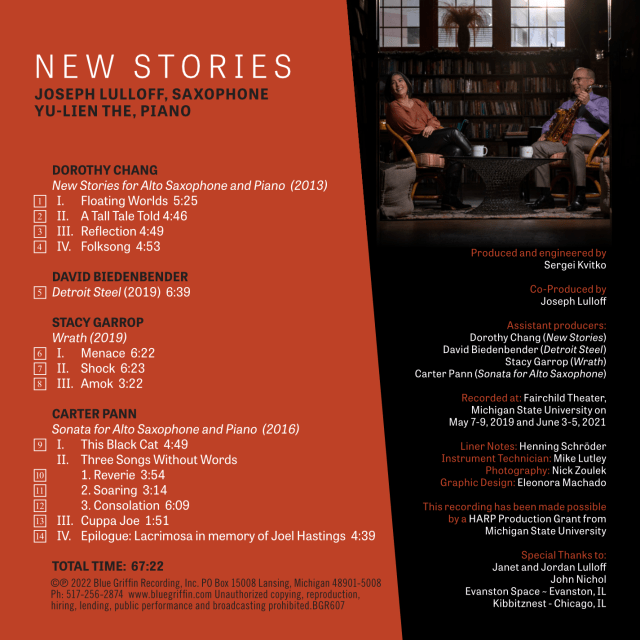
Joseph Luloff: New Stories for Saxophone and Piano


Blue Griffin

Joseph Lulloff (1960- ) is an internationally known artist with at least 10 CDs currently available. He is on the woodwind faculty of Michigan State University. Lulloff reportedly started playing saxophone in part to deal with asthma (a useful adjunct to pharmaceutical treatment) and has made quite a career since. Lulloff is a new name to this writer but, after hearing this latest release, a name that will trigger alerts on my listening radar. He, like most saxophone soloists working today, is equally comfortable and competent in both jazz and classical idioms for his instrument.

The present release is a collection of works, all written for the Joseph Lulloff. Four works are presented by four composers, two of which (Dorothy Chang and David Biedenbender) are new names to this listener. Overall this is one exciting release with deeply substantive music which makes a case that tonality and quasi romantic writing are not dead, just evolving.

Pianist Yu-Liien The is a fellow faculty at Michigan State and one who is clearly a sympathetic collaborator. The Netherlands born pianist has a wide range of international performances to her credit and is a major asset in the interpretation of the works on this CD. Their friendly collaboration is reflected well in the album cover photo by Nick Zoulek.

The recording itself is lucidly captured by producer/engineer Sergei Kvitko. Subtlties of both the saxophone and the piano come across clearly and this album is rife with subtle but very effective inflections of tone. It is a warm listening experience.

tracklist

Dorothy Chang contributes the work from which the album derives its title. New Stories (2013) is a four movement work that is major opus, practically a concerto in all but name. At ca. 20 minutes total duration it reveals several moods and many challenges for the performer. This American composer writes in the useful liner notes that she attempts to utilize Chinese elements in her composition. These are not immediately apparent to this listener’s ears but what is apparent is the composer’s ability to create a very compelling listening experience.

The four movements include: “Floating Worlds”, an ethereal melodic/impressionistic movement which demonstrate the soloist’s fine and nuanced breath control and ability to integrate microtonal and multiphonic inflections in this relaxing movement punctuated with mildly dissonant piano chords. It is followed by “Tall Tale”, a scherzo-like movement which demands intricate interplay between the saxophone and the piano. The third movement, “Reflection”, is a somber solo for the saxophone, almost a cadenza. It is a lyrical slow movement that is relaxing for the listener but a challenge for the soloist, one that Lulloff handles effortlessly. The last movement, titled “Folksong” is a playful, busy movement that also incorporates a solo cadenza-like passage. It is a challenging interplay between saxophone and piano with rhythmic intricacies that sound difficult to execute. All in all a large and substantial work that almost begs to be orchestrated. But it stands clearly on its own very satisfyingly as a chamber work.

David Biedenbender is a composer new to these ears. His “Detroit Steel” is a solo saxophone work, a paean of sorts to the workers of the steel industry. This is the shortest work on the album but Biedenberger manages to create a cohesive soliloquy that sustains attention for the entirety of its 6 minute duration. Doubtless there are references in the work that were not immediately obvious to this reviewer but, like its companions on this release, it is an appealing sonic document.

Stacy Garrop, whose work has received praise in several reviews on this blog, again does not disappoint in her three movement, “Wrath” (2019), another concerto like work which is, according to the composer’s liner notes, is a sort of reimagining of an earlier work, “Tantrum” (2000), also for saxophone and piano. Written for Mr. Lulloff, Wrath is perhaps a representation of the composer’s evolving style and maturity.

The work is is three movements (Menace, Shock, and Amok). The sinister first movement gives way to the second, “Shock” which is more like a post shock experience (PTSD perhaps) seemingly reflecting some resolution of said shock presumably from the encounters in that sinister first movement. The finale, “Amok” picks up in a way from the menace of the first movement in a sort of return to that first movement in a cohesive transformation of that makes for a very satisfying finale. Garrop’s work seems to these ears to have a cinematic dimension and that is also the case here.

The album concludes with a large work by Carter Pann, an American composer whose star is steadily rising. The work, “Sonata for Alto Saxophone and Piano” (2016) is a four movement work which, despite its ordinary sounding title, is quite a fascinating piece. It shares a similar sound world to that of Paul Creston and mid 20th century neoromantics. The four movements (the second broken into three separate songs without words) are:

  1. Black Cat, apparently a set of variations which give the saxophone time to shine.
  2. Songs Without Words, three separate songs ranging from the melodic, romantic “Reverie” to the “Soaring”, a faster piece, and “Consolation”, a slow contemplative piece.
  3. Cuppa Joe, fast virtuosic scale work with manic piano accompaniment, sort of a scherzo.
  4. Epilogue Lacrimosa (In memoriam Joel Hastings), a somber homage to the Canadian pianist who championed Pann’s work.

This is a very exciting release by two fine musicians whom listeners will want to keep on their radar. This album is a significant contribution to the chamber literature for saxophone and a pretty wild listening experience.

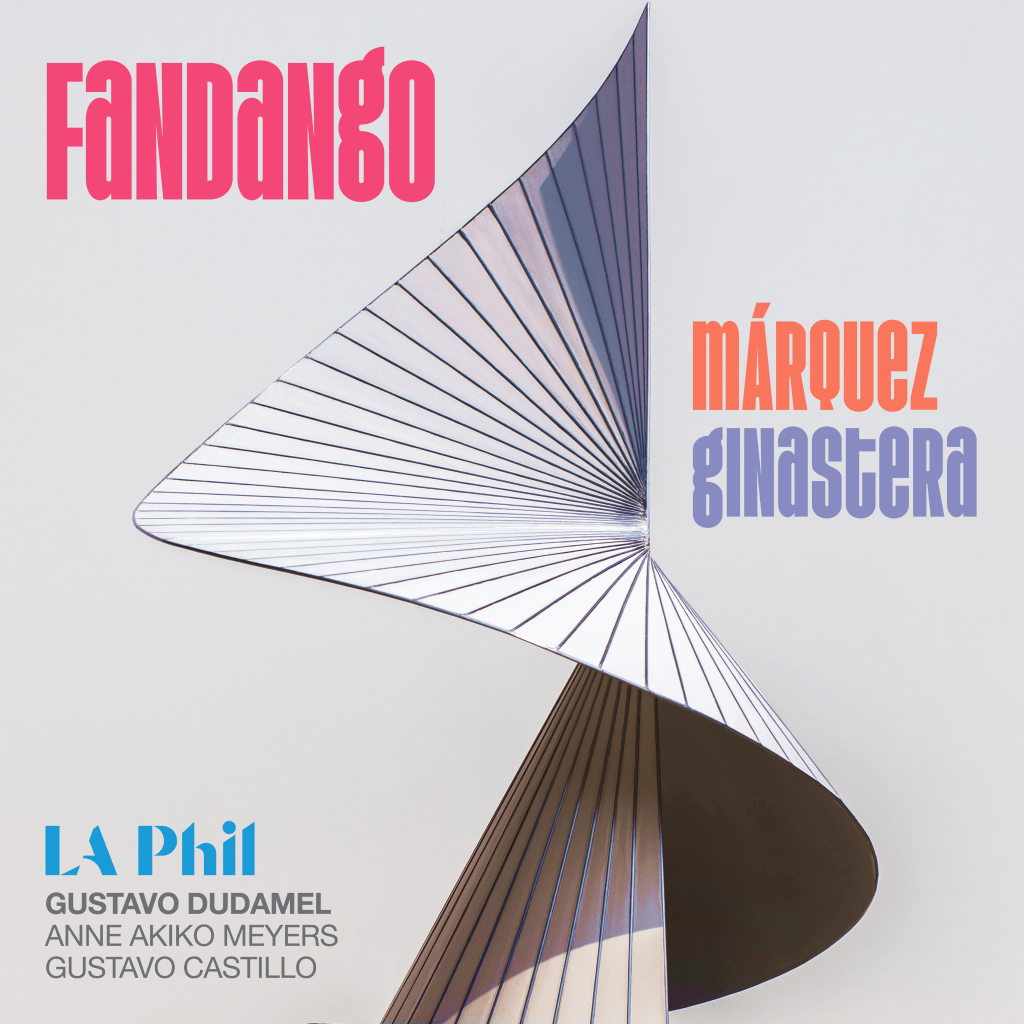
Fandango! Diversity Within Identities


Avie AV 2386

The primary importance of this new release is, of course, the presentation of these two major works but it also an exposition of the diversity (or do you prefer, “heterogeneity”?) that can become obscured by well intended terms like, “Latino” and “Hispanic”, or even conductor Gustavo Dudamel’s “Pan American”. All are well intended but racial, nationalist, and other categories are insufficient on their own in recognizing the rich diversity inherent in their cultures. Here we go, just in time for Latin History Month.

The concise liner notes tell us that even the album’s title, “Fandango” has multiple meanings depending on cultural contexts. The fact is that no single style or genre can be said to be representative of the marvelous diversity that exists within their intended scope which attempts to represent practically the whole of the western hemisphere as is the case with this release. So, while Fandango is certainly about the musical works presented, it also touches on the issue of diversity by the choice of two major works separated chronologically by some 80 years and representing composers from Argentina on the one hand, and Mexico on the other. Two different cultures that share a language in both words and , to some extent, music.

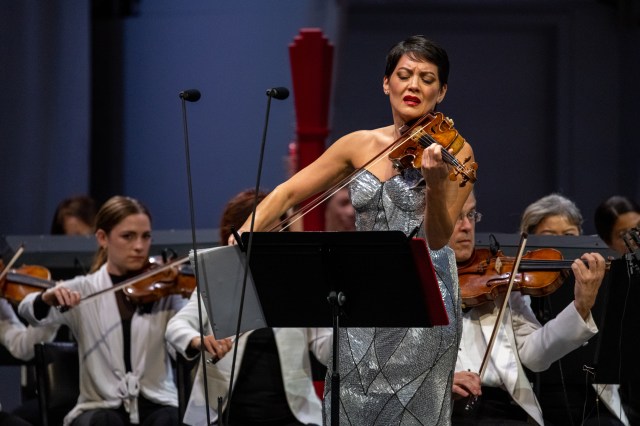
The centerpiece of this album is, of courses, the concerto that Maestra Akiko-Meyers commissioned from Mexican composer Arturo Márquez Navarro (1950- ). I’m sad to say that I am only now learning of this composer but delighted in his mastery of the orchestra and the grand romantic gestures of a past era along with an acute and personal appreciation of the folk idioms of his culture. At first I was skeptical of a “mariachi” inspired concerto because such attempts, even the most sincere, don’t always seem to work. Well, that is certainly not the case here. This is a strong contender for regular inclusion in the current canon of widely performed violin concertos. This one is a masterpiece which poses challenges to the soloist (which give her a chance to show her virtuosity) and surround it with rich, subtly, ultimately beautiful orchestral textures that support the soloist but which demand much of the orchestra and its conductor as well.

The concerto (written in 2020) is in the traditional three movements. The first, entitled “Folia Tropical” (tropical leaves) embraces the spirit of late romantic concerti like those of Bruch and Brahms. It is an extended movement that introduces and develops many moods and themes. It is a big symphonic movement worthy of a symphony and it gives the soloist much to do and upon which to demonstrate her musical and interpretive skills all the while with a very busy orchestra accompanying her.

The second movement, “Plegaria” (prayer) is a hugely substantive chaconne, the baroque contrapuntal variation form with a repeating bass line and thematic variations over the harmonic structures supported by those notes.. At least that is my listener’s understanding. But what is not necessary to “understand” technically is the emotional impact of this movement. This is an amazing use of the form. The soloist moves into different roles, sometimes very much upstage, sometimes an adjunct to the orchestra, sometimes not there at all. There is a slow, meditative beauty in this movement which is also characteristic of the romantic idiom in which this is written.

The third movement, “Fandanguito” (little Fandango) is a somewhat lighter and very energetic finale one might expect in a movement following the previous deeply emotional ones. And the composer does not disappoint. He writes a joyous, energetic finale which nonetheless stands up as substantially as its predecessors.

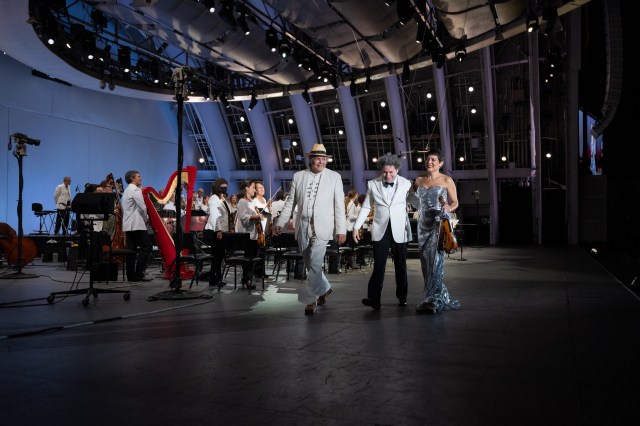
The composer Arturo Marquez with Maestro Dudamel and Anne Akiko-Meyers leaving the stage after a successful performance.

The joy, to this listener, is to hear a master composer in collaboration with a fine soloist both technically and interpretively. The composer has integrated his experiences and study of his own cultural folk musics and infuses the spirit of the music into his grand romantic idiom. That is, the concerto does not, for the most part use direct quotation from folk sources but uses structural elements in his composition. Maestra Akiko Meyers discharges her soloist duties with both startling facility and a deep understanding of the music and the composer’s intent.

Gustavo Dudamel is a joyfully rising star who brings his cultural proclivities and his own lens on western orchestral music. He is an exciting and incisive conductor. I don’t know the extent of Dudamel’s study of Latin folk musics but he really gets this work and brings out the composer’s subtleties in this gorgeous and exciting concerto.

The “B side” as they used to be called is no mere filler, it is the entirety of the Alberto Ginastera (1916-1983) ballet, “Estancia” Op. 8 (1941). Here, 15 separate movements are used in a five scene scenario. The work, usually heard in its four movement suite format and, even more frequently, just the spectacular finale, the Malambo.

In addition to its large orchestra, the ballet calls for a singer/speaker soloist who acts as both narrator and as soloist with orchestra. In this performance the challenge is admirably met by baritone GUSTAVO CASTILLO, another shining light cultivated by El Sistema. He performs well in both his baritone vocal duties and his narrator task in which he speaks Spanish in an elegant and, I’d say, almost Shakespearean grasp of the beauty of the language. The man understands drama as well as music.

This ballet is clearly a masterpiece. It reminds this listener of Prokofiev if he was born in Argentina. Nothing derivative here though. This is an intensely entertaining work, as substantial as Romeo and Juliet, similarly constructed in relatively brief musical segments designed to accompany a dance whose scenario is the story of the “gaucho” or cowboy that lived and worked hard lives, lives that were romanticized into a poem by Argentinian poet José Hernández (1834-1886). (click on the word “poem” for a link to an English translation of the poem).

All that to say that this is a truly enjoyable and important release. A valuable addition to the discography of Latin classical music.

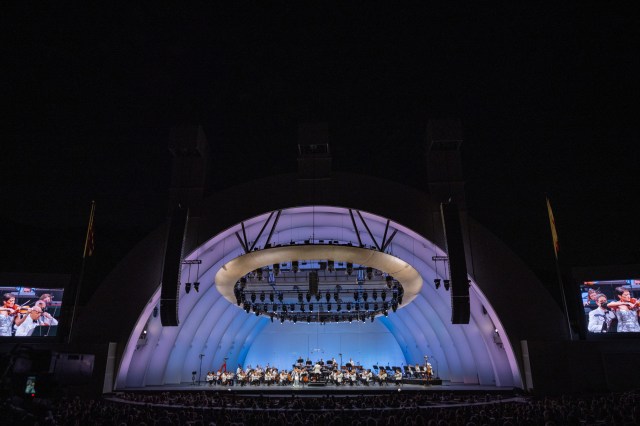
Dudamel and his LA Philharmonic at the Hollywood Bowl.

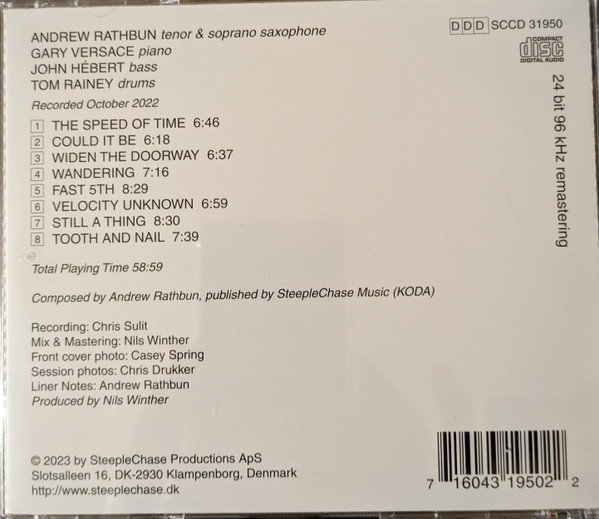
Andrew Rathbun’s “The Speed of Time”


SteepleChase Records 391950

I rarely write about jazz, mostly because it is a genre with which I am less familiar. I confess to a lack of knowledge (though I’m working on it) of jazz, especially of the last twenty years or so. And as a result I have some reluctance to write about jazz but when I first listened to this disc I found that the music spoke to this listener’s ears immediately and directly. My desire to “understand” the music vanished in the face of this seriously entertaining and eminently listenable release.

All the music was written by Andrew Rathbun who has 18 previously released albums listed on his nicely designed website. This album seems to draw in part on bebop (think John Coltrane et al) and the band consisting of Rathbun on tenor and soprano saxophone (with a little help from multitracking), Gary Versace on piano, John Hebert on bass, and Tom Rainer on drums. though the saxophone clearly holds the lead here, Rathbun includes ample solo opportunities for each of the musicians. And they play with the coordination only accomplished by hours of practice and, I’m guessing, some personal musical familiarity.Kudos to all.

All 8 tracks succeed in their ability to engage the listener and they range from Post Bebop to a pleasant lounge jazz feel. There are many moods here nicely sequenced for a great listening experience. Though released on the Danish label Steeplechase, Rathbun is a Toronto native with a degree in performance from the New England Conservatory and a Doctorate in Jazz Studies from the Manhattan School of Music. He now teaches at Western Michigan University in Kalamazoo, a North American (to coin a term).

This is a highly entertaining release and has sent this listener to the composer’s website to begin to hear some of his other work which apparently includes forays into classical realms as well. This release now puts Rathbun on my listener’s radar which will alert me to pay attention to the next project from a truly fine musician/composer.

To Dance and Sing, Meredith Monk on ECM


Meredith Monk on ECM

Being asked to review this retrospective of the work of this virtually uncategorizable dancer, singer, composer, dramatist is the telling of my personal experience of growing up nurtured by this artist. Monk is not, of course the only artist whose presence has nurtured me and so many friends but her work is a case where I learned how to tune my curious radar to find more of the music that touched me deeply.

I first discovered her work when I purchased her album, “Key” (1971), self released and marketed via the late lamented New Music Distribution Center in New York. That album, later released on the Lovely Music label along with two releases on the great German avant garde label Wergo (Our Lady of Late, 1973 and Songs from the Hill/Tablet, 1979), constitute the minimalist, SOHO loft music which characterizes her style even now. But with her first ECM release she clearly hit her stride. Those early albums are definitely worth hearing but her mature style blossomed on ECM. It was, in retrospect, a sort of quantum leap, if you will.

LP album cover of “Key”
“Our Lady of Late”
“Songs from The Hill”

In that first album one can find Dick Higgins among the singers and Colin Walcott producing and playing percussion (as well as singing). Walcott, along with the yet to be known Julius Eastman would later participate in the Dolmen Music release. Monk, who studied dance at Sarah Lawrence College along with fellow student Alwyn Nikolais established “The House”, her flexible performing group in 1968 at a time which saw a great deal of artistic energy in and around Manhattan’s SOHO district where she encountered musicians like Philip Glass, Steve Reich, and performers sympathetic to new innovations and ideas. She also taught and continues to teach her characteristic extended vocal techniques. Monk, along with John Cage, Philip Glass, and Robert Ashley was featured in Peter Greenaway’s “Four American Composers (1983).

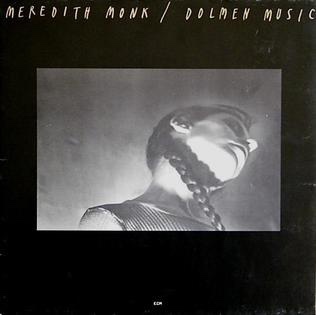
The release of her first ECM disc, “Dolmen Music” (1981) can now be seen as a sort of watershed event. It was followed by “Turtle Dreams” (1983) a work which was prominently featured at New Music America 1982 in Chicago along with Robert Ashley’s “Perfect Lives”. Monk’s appearance on ECM occurred at about the same time as Steve Reich’s masterful “Music for 18 Musicians”. Monk found her mature voice more or less at the same time that Steve Reich and Philip Glass had found theirs. And anyone following new music in those years will recall the flow of new musical ideas that established many now acknowledged masters as legitimate artists.

While the major masterpiece, “Dolmen Music” dominates the album, Monk’s quirky mix of humor and pathos in pieces like “Gotham Lullaby” and “Biography” remain signature pieces in her oeuvre. And Turtle Dreams was made into a performance film for public television by visual artist Ping Chong in 1983, now available on YouTube.

She followed with “Do You Be” (1987) and “Book of Days” (1990) which also exists in at least two film versions and the CD itself which has been described as a “film for the ears”.

Following “Facing North” (1992) Monk released her only opera (though she refers to much of her works as “operas” this is the only one that comes close to the more generic concept of western music operas) to date, “Atlas” (1993) which was commissioned and subsequently performed at the Houston Opera. This represented another phase in her artistic development as she utilized her structured improvisation techniques along with her now familiar extended vocal techniques with an expanded set of performers both vocal and instrumental. Atlas is arguably similarly creative (and transgressive) as Philip Glass’ 1976 “Einstein on the Beach”. Both were developed in an unconventional manner and uses a similar harmonic language with really none of the standard conventions of western music in opera. Would that we can some day see a filming of this work.

I was privileged to see Monk in person for the first time when she performed excerpts from “Volcano Songs” (1997) in Chicago. Those images involving, among other things, light sensitive areas where Monk lay down and left a ghostly shadow upon arising. In addition to her engaging minimalist inflected music, Monk is a master at creating compelling images.

“Mercy” (2002) was followed by “Impermanence” (2008) which I was thrilled to see at Stanford. “Songs of Ascension” (2011) was another landmark in this piece conceived and performed in conjunction with installation artist Ann Hamilton in her tower in Northern California. Attendees to this event were brought in by bus due to the lack of actual parking facilities in that tower. I wish I could have experienced this but hopefully a cohesive video release will be forthcoming. Excerpts are available for viewing on YouTube and on Monk’s website.

“Piano Songs” (2014) by the wonderful new music championing pianists Bruce Brubaker and Ursula Oppens filled an inexcusable gap in the documentation of Monk’s piano music. And following her receiving the National Medal for the Arts in 2015 she released “On Behalf of Nature”(2016).

Monk is a well documented artist largely due to her productive affiliation with Manfred Eicher and ECM and, while gaps remain these recordings represent a major artistic accomplishment and an enduring legacy for new music, for women composers, for western art music. This lovely box set is truly a joy to behold.

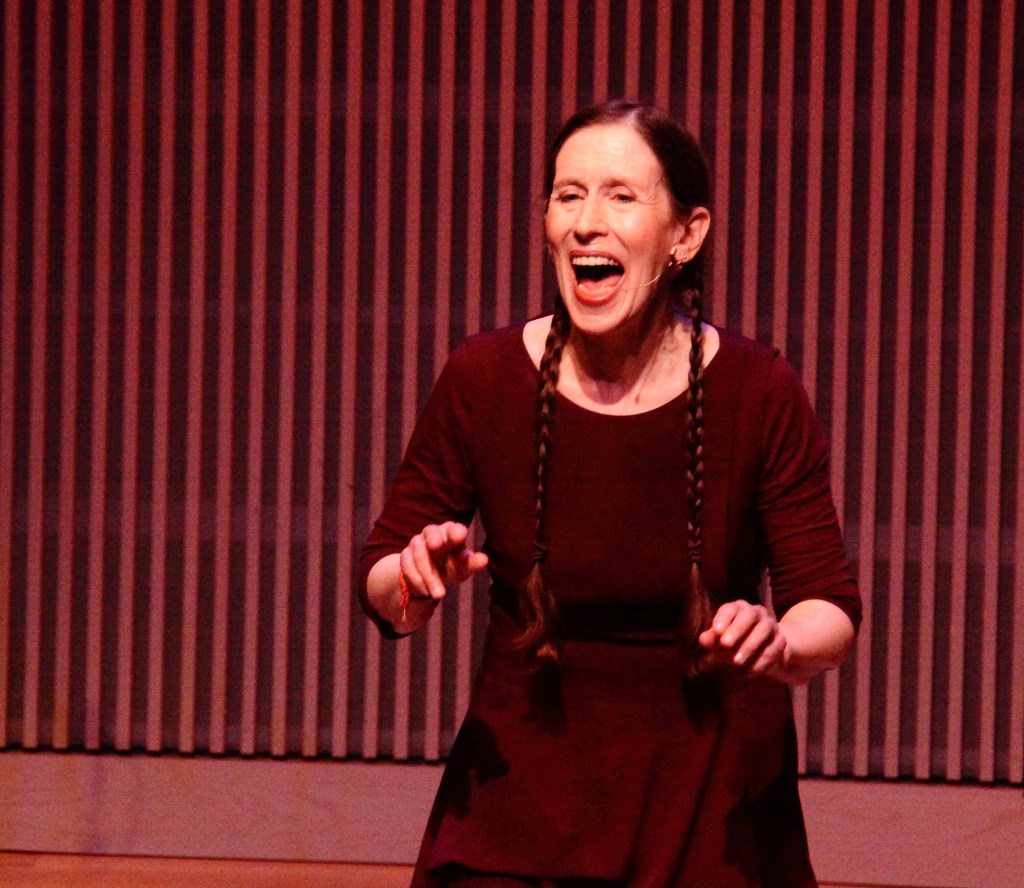
Meredith Monk performing an encore at the final concert of OM 21 (2016) in San Francisco

Lara Downes’ “Love at Last” Transgressions in the Name of Inclusion


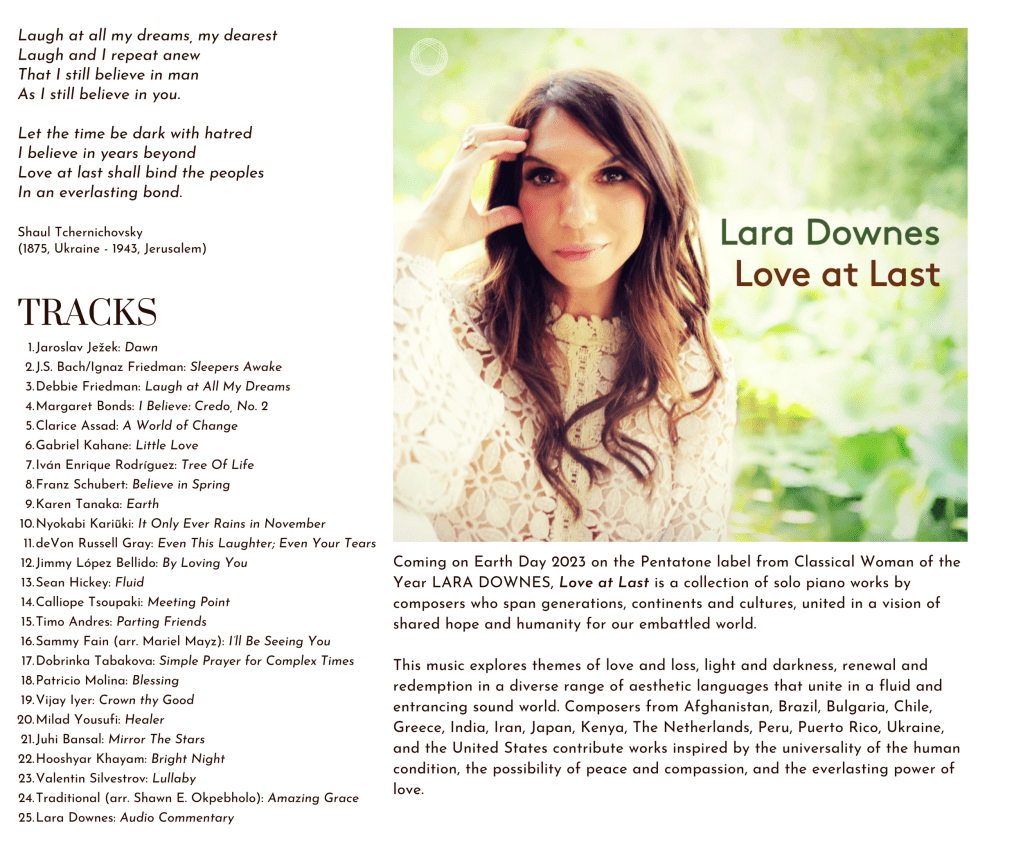
Wow, what an engaging album!

Though I have enjoyed Downes’ albums since I first heard “America Again” (2016) I found myself approaching this new release with some trepidation. 24 tracks by multiple composers, most of their names unfamiliar to me left me with few clues as to the character of this album. So I decided to take Lara on a trip with me. I had a few hours of errands to do which required a bit of driving, a fine opportunity to hear this music while strapped into the driver’s seat. This sort of passive listening would give me a first impression and I wouldn’t be tempted to any distractions (other than driving).

After the first two or three tracks I found myself inextricably drawn into Downes’ obviously very personal choices. As with all her albums (this one is her tenth by my count), she shares a diverse cornucopia of music featuring music from Bach to young contemporary composers (women and men) and styles from classical to jazz, gospel, blues, and pop. On all tracks she has ample opportunity to exert her interpretive skills and her virtuosity. These are a quirky but ultimately eye opening (or ear opening?) pieces that draw the listener in. Her choice in repertoire has always been both creative and, some might say, “transgressive” because of her lack of respect for boundaries like “classical”, “jazz”, “pop”, “folk”, “male composers”, “female composers”, etc. whereby Benny Golson stands beside Aaron Copland or Rhiannon Giddens and Judy Collins alongside Bernstein, etc. But I prefer to think of her work as “inclusive”. Music is best appreciated not by racial, political, or gender issues but on its own merits. Here she sets her sights on the elusive concept of “love”, another concept that does best when it transgresses boundaries and embraces inclusion.

Downes’ keyboard mastery and her ability to clearly articulate the inner details of this music succeeded very well in engaging this listener from the very start. After about 12 tracks I had to stop, pull over, and look at the track listings. This far ranging but ultimately cohesive selection sounding at times like a fin de siecle drawing room recital of unabashedly romantic music. Of course many of these pieces are of more recent vintage but Downes succeeds in making her choices sound inevitably related to each other. There is much to explore here and the pieces seem to fit together like a sonic jigsaw puzzle into a cohesive whole while retaining their individual detail and beauty, indeed “love at last.”

Rather than attempting to delve into the individual composers here I am choosing to review this in the context of its presentation. It is a characteristic of Ms. Downes’ releases to identify some sort of context, sometimes fairly specific, sometimes cleverly vague in which to present a carefully chosen portion of her repertoire. Here Ms. Downes gives a loving and personal gift to her fans.

Of course I will look into all the composers and music presented here over time but, for now I just want to listen and savor these gifts. You will too.

Native American Classical: The Lakota Music Project of the South Dakota Symphony Orchestra


The first time I heard Native American Music was on a Pete Seeger album when I was in high school. Later I heard the Native American flute player R. Carlos Nakai whose artistry was being marketed in a “new age” context.

I had known for some years that American composer Charles Wakefield Cadman (1881-1946), famed for his song, based on “indian themes” which was famously conscripted for use in a beer commercial. Many on the baby boomer ranks will likely recall the melody if I provide a small portion of the lyrics, “From the land of sky blue waters…”

In fact there was a relatively short lived group of American composers known as “ Indianists” who attempted to incorporate Native American music into their work. This group flourished from roughly 1880 to about 1920 and included Cadman along with Charles Sanford Skilton, Arthur Nevin, and Arthur Farwell among a few others. This interest parallels the burgeoning interests in the incorporation of “folk music”, especially that of the land of the composers’ origin. Bela Bartok and Zoltan Kodaly famously travelled the Eastern European countryside recording and transcribing music that would later be included in their own compositions. This archeology of sound approach was also done in the United States with people like Charles Seeger and his second wife, Ruth Crawford collected and transcribed American folk music. John and Alan Lomax carried this on further in their massive sound recording projects.

Florence Tsianina Evans (1882-1985), known as Tsianina Redfeather, a member of the Creek/Muskogee Nation, was a s classically trained singer, activist and educator who toured with Charles Wakefield Cadman singing his “Indianist” compositions including an opera “Shanewis” (produced at the Met) in which she collaborated on the libretto and sang the title role.

As far as I can determine, the majority of music collected by these people paid most attention to music whose origins come from three distinct sources, first are the colonialists who brought their folk traditions with them, second are the music of the forcibly relocated slave populations, and third, Native American music. Interest in “American” folk music and the parallel folk traditions of slaves drove much of the folk revival of the 1950s and 60s as well as driving the folk nationalism of American classical composers. Much less attention was given to actual indigenous musics.

To be fair, many native Americans seem to have a different relationship to music but that’s the realm of cultural anthropologists. I’m just glad to see/hear indigenous composers getting some exposure. It’s beautiful and it’s now a part of the whole of “American music”, a part that deserves to be better known. And, of course, mention must be made that Raven Chacon, a Navajo composer, was the first Native American to win a Pulitzer Prize in music for 2022.

So the recording being reviewed here can be seen as a reckoning of sorts. It presents classical music written by indigenous artists and incorporating indigenous music. Therein lies the importance of this release. The Lakota Music Project is a lovingly produced album giving voice to five Native American composers who work largely in the western classical idiom but composers whose work reveals distinct creative voices worthy of a wider audience.

Delta David Gier , conductor (photo from Wikipedia)

Credit must be given to innovative conductor Delta David Gier who appears to be one of those visionary musicians poised to make change and open minds as well as ears. This writer fondly hopes that this release will be the first of many by the South Dakota Symphony and by musicians in general exploring these uniquely American voices.

This disc, the first commercial recording by the South Dakota Symphony, features five commissioned compositions by four Native American composers:

Brent Michael Davids (photo courtesy composer)

1. Black Hills Olowan by Brent Michael Davids (13:25) The album opens with this hybrid orchestral/choral work that embraces the western classical tradition as well as the indigenous music of Native Americans. David’s works as a film composer and this seems evident in the rich sound painting in his work.

Jeffrey Paul (from website)

2.Wind on Clear Lake by Jeffery Paul II is one of two works by this composer/performer who also happens to be the principal oboe of the South Dakota Symphony. This work incorporates a Lakota song.

Jerod Impichchaachaaha’ Tate–Photo by Shevaun Williams

3. Waktégli olówaŋ (Victory Songs) by Jerod Impichchaachaaha’ Tate. Perhaps the most familiar name in this list of composers, Tate is known as a composer, conductor, and pianist of Chickasaw heritage. His entry here is the largest work on the album, a major song cycle. Tate was composer in residence with the South Dakota Symphony in 2017.

4. Desert Wind by by Jeffrey Paul II is the second entry on the disc by Mr. Paul. It is a sort of mini concerto for cedar flute and orchestra.

Theodore Wiprud (from composer’s website)

5. Amazing Grace (Arr. T. Wiprud for Orchestra) is an interesting set of variations on the familiar hymn. Wiprud is a fantastically busy musician which he documents nicely on his website. He is the successor to Tate as composer in residence.The choice of this song and this arrangement make for a rather spectacular finale to this forward looking collections of new music by Native American composers. The song, an old tune, was given new lyrics by a slave trader after he had the personally devastating revelation of the evils of his pursuits. It was incorporated into civil rights efforts and is arguably one of the most familiar hymn tunes. It’s use here can be read as a sort of attempt at reconciliation for the colonial atrocities that have plagued the United States since it’s “discovery” by Christopher Columbus in 1492.

Much work needs to be done investigating and celebrating the plurality of music subsumed under the term, “Native American Music” and this album takes a significant step in promoting the living composers, singers, dancers, and musicians who’s work was the whole of “American Music”.

Aaron Jay Myers, Superbly Integrated Eclecticism in “Late Night Banter”


Neuma 175

Aaron Jay Myers’ third album grabbed my attention immediately and didn’t let go til the album ended. Working un-self consciously in a stunning plurality of styles (this guy clearly paid attention to his 20th century music history classes) he has produced some mighty substantial works. His ability to integrate a wide variety of techniques and styles into his artistic persona is simply astounding. His references to other composers’ works, rather than sounding derivative, evoke nostalgic homage, at least in this listeners ears. Indeed there seem to be more references per square inch than in a Thomas Pynchon novel. And the fact that he shares this writer’s passion for Star Trek, Deep Space Nine only endeared him more to me (more on that later).

His very listenable music seemingly embraces the whole of the twentieth century stylistically and his very judicious use of extended techniques for pretty much all instruments including voice demonstrate a firm understanding of where those techniques best serve his artistic vision. Fortunately he has managed to find performers who both meet his technical demands and have a real grasp of his musical vision. This Neuma release is truly something special.

There are six works divided among the thirteen tracks. These chamber works were written between 2011 and 2021. None require more than ten minutes or so of your time and left this listener satisfied with the music and optimistic for the future of classical music in general.

“Save One Life, You Save the World Entire” (2017) for the unusual combination of flute and baritone saxophone opens this album with a surprisingly engaging work. It sounds like a challenge for the musicians who handle those challenges seamlessly and engage the listener in this rather brief essay.

When I listen to “Late Night Banter” (2011 rev. 2015) now, I do so in bare feet (it knocks my socks off). This piece for ten musicians with a conductor is a finely crafted piece that grabbed this listener’s attention by that craftsmanship but also by what seem to be a plethora of sonic references to 20th century music. The style of Stravinsky, an homage to Luciano Berio, etc. These brief references evoked emotional responses which led me to recall similar emotions I had attached to the apparent (at least to me) object of said reference. Even minimalist references occur matter of factly. Such efforts can sound derivative or at least imitative but not so in this piece. Rather it had the quality of a tour of the twentieth century in respectful jogs of memory. But even if you don’t get the references, this is a substantial and entertaining work. The evanescence of those references had me questioning whether they were actually there or just my mental figment. (I guess I’ll just have to listen again). Either way I was thrillingly engaged.

Avery Brooks as Captain Benjamin Sisko, commander of Deep Space Nine

“You Get On My Nerves, And I Don’t Like Your Hat” (2020) is the Deep Space Nine reference mentioned at the beginning of this review. If you haven’t seen this series I highly recommend it. And so, apparently, does Aaron Michael Myers. This work for vocal quartet (SATB) takes its title from a witty utterance by Captain Sisko (my fave Star Trek Captain). Of course you don’t have to know Star Trek lore to appreciate this work, but it helps. It is a challenging work for four unaccompanied soloists which reflects the composer’s sense of humor as well as his connection to pop culture.

Aaron Jay Myers

“Lichens III” (2018) is scored for soprano voice but the singer also does the work of a percussionist. In addition to the vocal challenges the singer is asked to perform on “body percussion”, the various sounds one can make by percussing (pounding) on one’s body. It is more commonly an idiom of folk and blues but soloist Stephanie Lamprea handles both the singing and the percussing as though it is her everyday practice accomplished with ease.

Clairsentience (2016) is another wind instrument duo, this time for clarinet and alto saxophone, a similarly unusual choice of instruments. This one is about twice the duration of that first piece and every bit as engaging as well as challenging.

The last track is a marvel of multitasking. Other than Aaron Trant (who does a fine job) on drums, all of the parts (three electric guitars, and bass) are handled by the composer. “Perception Stains Reality” (2002) is a tour de force consistent with the other works on this disc. Here he shows his rock/pop sensibilities, clearly as essential a part of his artistic endeavors as his “classical” training.

Myers is one to put on your hot list. He is certainly on mine. If you can hear a performance of his work, whether live or recorded, you would do well to check it out.

John Bruce Yeh: Chicago Clarinet Classics


Cedille CDR 90000 218

Professor Yeh has been assistant principal clarinet with the Chicago Symphony since 1977 when he was just 19. As a former Chicagoan I can recall that Yeh’s hiring seems to have marked a change in the more traditional image of an orchestral musician. In addition to being an inspiration to aspiring musicians of Asian heritage his media presence also drew interest from both listeners of Asian Heritage but also young listeners (I turned 21 when he was hired and was pleased to find an artist who communicated to me and my age group).

In addition to his duties with the CSO, he has actively supported music and music making in his adopted home town. It is his support for local composers that he showcases here. This disc features music by Alexander Tcherepnin (1899-1977), Stacy Garrop (1969- ), Leo Sowerby (1895-1968), Shulamit Ran (1949- ), Teresa Reilly (1976- ), and Robert Muczinski (1929-2010).

Alexander Tcherepnin, whose father Nikolai was a student of Rimsky-Korsakov, and whose sons, Serge and Ivan, along with grandsons Sergei and Stephan are all highly accomplished composers comprise a multigenerational artistic dynasty of sorts. Russian born Alexander taught in Chicago thus qualifying him for inclusion in Cedille recordings’ mission to promote artists with a “second city” connection. He is well represented in recordings but is less present in the concert hall these days. His brief Sonata in one movement for clarinet and piano (1939) takes the first track on this fine chamber music release. It is a deservedly popular recital piece with a style that sounds a bit like Shostakovich, one of his contemporaries.

Stacy Garrop is a favorite of this reviewer. Her work has been reviewed elsewhere in this blog. She is a freelance composer of immense talent and skill. Her work is featured on at least 12 Cedille albums as well as other labels. Phoenix Rising (2016-18) was originally for alto saxophone (subsequent versions were made for flute and for violin) is presented here in a world premiere transcription for clarinet. As with all her music, Garrop shows herself to be a master of color and texture. She uses both traditional and extended techniques to achieve her compositional visions. These can be challenging for performers but the end result is always worth the effort. Garrop derives inspiration, as she frequently does, from world mythology. Here, of course, the familiar Phoenix bird that lives some 500 years and rises again from the ashes of its funeral pyre.

Leo Sowerby, long associated with Chicago as an organist, composer, and teacher, is represented here by his 1944 clarinet sonata (here in its world premiere recording). Written in the year which saw him win the Pulitzer Prize for music (for Canticle of the Sun), this sonata takes on near symphonic dimensions in its four movements. Sowerby is generally well represented on recordings (8 discs on Cedille alone). His lyrical writing is expressive and accessible and it is perhaps just a matter of time before someone orchestrates this work to present it as a concerto. At just a bit under 30 minutes, it is the largest work on this release.

Shulamit Ran, Israeli/American composer and pianist, student of the great Ralph Shapey, 1991 Pulitzer Prize winner (for her 1989-90 Symphony), Andrew MacLeish Distinguished Service Professor Emerita at the University of Chicago is represented on this recording by her Spirit for solo clarinet (2017). The work is dedicated to the composer’s friend, clarinetist Laura Flax (1952-2017). This is its world premiere recording. Ran’s music has gotten some recordings but her large and substantial orchestral works like the Symphony and a fine Concerto for Orchestra remain unavailable on recordings (even more egregious is the general lack of representation of her mentor, Ralph Shapey’s music). This solo clarinet work is a testament to her compositional talents. Here’s hoping we get to hear more.

Teresa Reilly is a clarinetist, composer, and life partner of Mr. Yeh. The Forgiveness Train (2020) is described as, in part, a response to the COVID epidemic (Yeh notes that much of this album is similarly inspired). The three movement work is essentially a sonata with a loosely poetical program. It is a lyrical work with nods to minimalism and jazz. This is the world premiere recording.

The disc concludes with the four movement Time Pieces for clarinet and piano (1983). This work (the second longest on the disc) is, like the Sowerby piece, substantially a concerto that waits an orchestrator for the piano part. Robert Muczinski, Chicago born composer studied under Alexander Tcherepnin whose music opens this release. The Opus 43 work was commissioned and premiered by former CSO principal clarinet Mitchell Lurie with Muczinski at the piano.

Mr. Yeh is, as always, a joy to hear. He is most ably supported by pianist Patrick Godon on piano (tracks 1, 4-7, and 12-15) and, of course by (more properly with) Teresa Reilly (tracks 9-11). This release, from the Art Institute depicted in (Chicago artist) Steve Shanabruch’s distinctive cover art to the composers represented, is pure Chicago in the best ways.

Perspectives: Spectacular World Premiere Recordings from Third Coast Percussion


Cedille CDR 90000 210

There were no percussion ensembles in Western music until the early twentieth century, at least not anything close to the size and instrumental diversity we see now, but since then there have been a variety of percussion ensembles which have popped up. some touring, some recording, but all investigating the possibilities of this collection of pitched and unpitched instruments. Notable examples from this writer’s memory include the Paul Price Percussion Ensemble, the Donald Knaack Percussion Ensemble, Amadinda, and the Canadian group, “Nexus”. Each of these ensembles (the list is not comprehensive) has put their own stamp on the flexibly nebulous group subsumed under the title, “Percussion Ensemble”.

All of these groups have chosen which instruments to include in their group, which to exclude, and they have done their own curation of music to expand their respective repertoires and the percussion group repertoire as a whole. And the present recording presents yet another Third Coast Percussion CD on Cedille Records for this busy Chicago based group. The relationship between this energetic ensemble and the equally energetic Cedille Records has been a mutually beneficial one artistically. this release is the fifth release for that label. They have at least nine other albums as a group and have collaborated on many more recordings.

As noted on the album this disc contains all world premiere recordings that reflect varying degrees of collaboration. One of the unifying threads of this CD is the variety of compositional approaches. The Elfman piece being perhaps the most traditionally notated and structured. The others involve different compositional methods which are not exactly traditional in classical music. It is the exploration of such non-traditional methods and the expansion of the definition of composition that is a characteristic of this always interesting classically trained group of musicians.

Let me just start by saying WOW!!!

The first work on the album is by Danny Elfman (1953- ) is best known for his work in movies and television as the composer of “The Simpsons” theme and similarly energetic scores for Tim Burton’s films among others. His roots were in his work with the unusual pop band “Oingo Boingo” whose manic style is still present in much of Elfman’s work. And this is not his first appearance in this new music blog either. His Violin Concerto was reviewed here. He manages to succeed in pop, film, and the concert hall, a feat that few can match.

Elfman’s rather blandly named, Percussion Quartet (2019) is appropriately described in the liner notes as the most conventional work here in terms of how it was written. It is fully notated in in traditional notation and consists of four movements ranging in length from about 4 minutes to about 6 and a half. The work resembles traditional sonata forms with Elfman’s energetic and sometimes quirky melodies that successfully draw the listener through the composer’s journey. That bland title is almost ironic as it belies the really entertaining qualities of this piece. Third Coast’s realization is definitive as one would hope for a world premiere recording.

The second composition is a transcription by Third Coast of a popular Philip Glass piano work, “Metamorphosis No. 1.” But this is a transcription influenced by another transcription, that of the Brazilian group, “Uakti”. So this can be said to be tantamount to a collaboration with another performing ensemble. Clocking in at nearly ten minutes this track is a familiar interlude that cleanses the aural pallet for what is to come.

Photo by Cary Huws

And what does come next is a collaboratively composed seven movement work entitled, “Perspective”. This more poetic title is the source of the album’s title. This work by Jlin (Jerrilynn Patton 1987- ) was originally written by first recording multiple tracks or layers and then working with the musicians of Third Coast to transcribe these ideas into traditional notation and into a form playable by the quartet of percussionists. This, of course, resembles the methodology that brought forth the wonderful Devonte Hynes album (also on Cedille) reviewed here.

The music is arguably entirely composed by Jlin with the orchestration creatively realized by Third Coast Percussion (doubtless in direct discussion with Jlin). What results is a dizzying and energetic set of movements whose styles derive in part from minimalism and from the rhythmic complexities of African drumming and contemporary dance music. Jlin, who hails from Gary, Indiana, works from a perspective of a DJ spinning dance music. But this is hardly your typical DJ. This is a fascinating musical mind who just happened to have started with DJ equipment.

Flutronix (photo from their website)

Another example of Third Coast Percussion’s creative collaborations has resulted in “Rubix”, a three movement work written (mostly) by Flutronix, a genre busting duo. Flutronix is Nathalie Joachim and Allison Loggins-Hull, both classically trained flautists who aren’t afraid to cross dated boundaries to create music that speaks their minds.

This is some high energy music which reflects a variety of styles but always demands much from all players involved. The duo, whose rendition of Steve Reich’s “Vermont Counterpoint” demonstrates their virtuosity and interpretive rigor. Rubix is essentially a chamber work for flutes and percussion but their defiance of categories seems to be as much a critical element of their music as is their virtuosity. Bottom line is that this is engaging, creative work that leaves the listener wanting more even as they may be unsure what they just heard. Kudos, all!

Steve Reich, Not Redefining the String Quartet


Deutsche Grammophon DG

This album is satisfying on several levels. It is a return to the label that contained the composer’s his first big release, the three disc set on DG which contained “Drumming” (1971), “Six Pianos”, and “Music for Mallet Instruments, Voices, and Organ” (both from 1973). Of course it was the ECM release of “Music for 18 Musicians” (1974-6) that became his signature work incorporating the experimentation heard in the music in that DG box set into the composer’s now familiar mature compositional language. The present release, also available on vinyl, seemingly reflects the post experimental composer’s grappling with the oh, so classical form of the string quartet. It’s a truly fine release and an homage to the composer.

DG 2740 106

Like many of his peers, Reich eschewed many of the conventions of western art music. His work at the San Francisco Tape Music Center helped him discover “phasing” and use of the speaking voice as a compositional element. His study with master drummers in Ghana taught him about quasi improvisational large ensembles and his subsequent study of Hebrew cantillation further refined his understanding of speech and song in his compositional contexts.

As he is quoted in the accompanying booklet, Reich never thought of attempting to use the string quartet form in his work. But along came the delightfully forward looking and genre breaking Kronos Quartet. That collaboration brought forth his landmark, “Different Trains” (1988). And the rest is, as they say, history. “Triple Quartet” for string quartet and tape (but no voices) came in 1998 and his WTC 9/11 (2010) which used sampled voices much as he did in Different Trains.

To be fair, Reich never appears to have intended to engage with the classical form of the string quartet (or any other classical forms for that matter). He uses the convenient availability of musicians sympathetic and sufficiently skilled to perform his compositions. The fact that they happen to be in string quartets is incidental. Much as the inclusion of a singer (as Schoenberg did) bent the quartet to fit his compositional goals, many have subsequently done similar alterations and additions to that classical ensemble. The difference is that Schoenberg adding a soprano, Kirchner (among others) adding electronics, etc. did so but clearly defined their works as “string quartets”. Reich did not do this but this disengagement with classical forms (string quartet, concerto, symphony, etc.) does not detract from the absolute quality of his music.

It would be unfair and would miss the point to try to judge these works via comparison and contrast with Haydn, Beethoven, Bartok, etc. In fact these works are not a part of that canon. Ultimately they stand on their own as part of Reich’s unique vision as a composer and, as such, they succeed very well.

WTC 9/11 and Different Trains are political statements with specific spoken word samples entered into a musical counterpoint. They succeed very well as protest and memorial for the respective events they frame. Triple Quartet, however, is absolute music concerned solely with Reich’s largely contrapuntal techniques of shifting repeated patterns. All three works succeed very well in their ability to engage audiences. All three are finely wrought compositions by by a major composer true to his maverick, experimental beginnings, true to the artist’s personal vision.

The Mivos Quartet does a fine job of navigating these technically difficult works and produce a fitting homage to a wonderful composer and make a strong case for the deeply substantial nature of this music. This is a great release. Highly recommended.

Emanuele Arciuli plays Duckworth


Neuma 174

I had previously reviewed an Innova release by this fine Italian pianist whose compelling musical choices and interpretive skills make him one of the bright lights on the current musical scene. And his European perspective (and affinity for) American composers provide an extremely valuable perspective for both listeners and performers.

It comes as no surprise that that Innova album was produced during Philip Blackburn’s tenure and this release is another illuminating journey guided by Arciuli’s finely tuned curatorial and interpretive skills. The journey here focuses on the late post-minimalist William Duckworth (1943-2012).

The first 12 tracks comprise book I (of two) of Duckworth’s genre defining work, “The Time Curve Preludes” (1977-8). These have been recorded three times, first in 1983 by Neely Bruce (who premiered them in 1979 at Wesleyan). Bruce Brubaker recorded Book I in 2009 and R. Andrew Lee recorded the entire set in 2011.

In addition to Arciuli’s take on this composition (I expect a future release will contain Arciuli’s interpretation of Book II) we get a previously unrecorded set of songs for voice and piano, “Simple Songs About Sex and War” (1983-4) to texts by Hayden Carruth. Here Arciuli is joined by Costanza Savarese, a classical guitarist and vocalist, an artist new to this writer. Here she displays her vocal prowess in these pithy little songs reminiscent in some ways of Barber’s “Hermit Songs”.

Track list

Duckworth deserves more exposure and Arciuli’s work is always revelatory. So what Duckworth will be paired with the Book II recording? Delighted listeners want to know.

Philip Bush’s Concord


Neuma 169

This release appears to be as much about the musician as it is about the music. Ives’ second piano sonata has had numerous recordings since John Kirkpatrick’s landmark recording of 1948. It is a gargantuan work that requires formidable technical skills simply to play it and interpretive skills at a very high level. Here is a recording by an artist who certainly possesses the skill sets required.

Philip Bush

Pianist Philip Bush has spent over twenty years playing, teaching and recording. He is well known in new music circles as a versatile and committed artist very familiar with Charles Ives’ music. Doubtless many have heard his work but his name is far better known among his peers than his listeners. Why? Well despite at least 24 releases his role as accompanist or ensemble member leaves his name recognition to his fellow artists and to fans who read credit listings on those recordings. This writer is reminded of another artist of a previous generation whose skills were unquestioned but his name less known. I’m talking about the wonderful Gerald Moore whose work as an accompanist graced many recordings of the 50s, 60s, and 70s where he worked alongside many different instrumentalists and singers. Moore’s charming album, “The Unashamed Accompanist” (1955) is a good humored tour of the hard work of the accompanist, the unsung hero. I don’t mean to suggest that Mr. Bush is an exact match for this analogy, but this album certainly puts him more in that soloist spotlight than any other he has done.

Despite many recordings of this masterpiece, ostensibly a landmark of American modernist composition, this work has yet to achieve the prominence it deserves in the recital hall. Bush’s performance along with his very clever inclusion of lesser known Ives contemporary, Marion Bauer’s Six Preludes for Piano, Op. 15 (1922) helps to provide context for the listener. Bauer was later the first American to study with Nadia Boulanger whose pedagogy would shape the careers of many of the great composers of the 20th century in many countries. The preludes are apparently included here as representing American music played more commonly in recitals of that time.

Kyle Gann’s perspectives on the Concord

For a thorough summary and perspective on the Concord Sonata I have found Kyle Gann’s recent book on the subject to be illuminating. Ives himself felt the need to “explain himself” when he wrote a little book to be published concurrently with the sonata. Ives’ title for his book “Essays Before a Sonata” provide the inspiration for Gann’s subtitle (Essays After a Sonata). Ives’ near constant revisions add to the difficulties in even determining a final version of the score itself. The composer’s revisions and the partial recordings he did of the work add to the performer’s burden in the performance of the work. There’s even optional parts for flute (included in Bush’s recording played by Jennifer Parker-Harley) and for viola (not in Bush’s recording).

Track listing.

The Bauer preludes are far more conservative musically than the Ives of course but one could argue that nearly everything contemporary with the Concord Sonata sounds conservative by contrast. Bauer’s Op, 15 are relatively early works in her output. She lived and worked another 33 years after these little works which were apparently influenced by French Impressionism. There is no indication that Bauer and Ives ever met or discussed music but her work was the new music more commonly heard than that of the roughly concurrent work of Ives. The use of the stereopticon style slide on the album cover, a current technology of the time, also serves to provide a charming nostalgic reference to an era about to experience many rapid changes historically, technically, and conceptually in which the Concord becomes an American work analogous to The Rite of Spring (1913) as a signpost of the beginning of another era.

Despite the complexities, Bush’s reading of the Concord and the Bauer preludes are eminently listenable. That clarity is ultimately the value of this release. This recording is a wonderful opportunity to hear the artistry of a dedicated artist and academic. It helps make a case for the Concord to be recognized as an important work whose complexities are made clearer with each interpretation. Bravo, Professor Bush!

The Young Person’s Guide to Ben Johnston


Microfest MF 23

I’m guessing that my title has its origins in the Benjamin Britten piece, “The Young Person’s Guide to the Orchestra”. That phrasing has been used by the likes of Phill Niblock and King Crimson to title retrospective compilation discs. While the disc under consideration here is not, strictly speaking, a retrospective it is a fine representation of the chamber music of the late great Ben Johnston (1926-2019).

Johnston, a former associate of Harry Partch (Johnston played in Partch’s ensemble) was a composer in his own right. His ten string quartets are a landmark of the genre. Two of those quartets are featured here played by the Lyris Quartet (Nos. 4 and 9) along with what is apparently his last composition, “Ashokan Farewell” (1999) scored for an octet in which the Lyris is augmented with flute, clarinet, bassoon, and double bass.

Like so many composers before him, Johnston was fond of incorporating folk tunes into his compositions. The composer’s fourth quartet (included here) from 1973, which incorporates “Amazing Grace”, is likely his best known work. Despite its incredible complexity (nicely summarized in Kyle Gann’s lucid liner notes) this set of variations keeps that familiar tune near the surface and effectively make for music that is friendly to the audience, easy on the ears. It’s single movement clocks in at just under 12 minutes, the piece ends long before listeners have time to worry about that complexity.

Not all of the quartets incorporate familiar tunes but they explore various aspects of just intonation tunings. The ninth quartet (1987) is about twice the length of the fourth and is set in the familiar four movements that characterize the majority of the classical string quartet literature. The use of the classical format along with Johnston’s masterful writing also make this slightly odd sounding work just familiar enough that few listeners will find unpleasant. In fact the work is a joy to experience though very difficult to play.

Listeners may want to seek out Mr. Gann’s very readable work on microtonal tuning systems, “The Arithmetic of Listening” available. Your humble reviewer is working through this text and finding it useful in understanding microtonality.

The final work (both the last on the disc and the last in the composer’s ouevre) is a delightful set of variations on a tune called “Ashokan Farewell”, a pretty folk like melody that pervades the Ken Burns Civil War documentary. I say “folk like” because the time was written by Jay Ungar and Molly Mason. Johnston mistakenly believed it to be a folk song in the public domain and, seeing its possibilities for his compositional aspirations, simply used it. Like the fourth quartet it is a set of variations in a single movement of similar length. This is the world premiere recording.

Musicians include Alyssa Park, violin; Shalini Vijayan, violin; Luke Maurer, viola; Timothy Loo, cello; Sara Andon, flute; James Sullivan, clarinet; Scott Worthington, double bass.

In researching this review I discovered that the tune actually has lyrics (also under copyright) and they are presented below:

The sun is sinking low in the sky above Ashokan
The pines and the willows know soon we will part
There’s a whisper in the wind of promises unspoken
And a love that will always remain in my heart

My thoughts will return to the sound of your laughter
The magic of moving as one
And a time we’ll remember long ever after
The moonlight and music and dancing are done

Will we climb the hills once more?
Will we walk the woods together?
Will I feel you holding me close once again?
Will every song we’ve sung stay with us forever?
Will you dance in my dreams or my arms until then?

Under the moon the mountains lie sleeping
Over the lake the stars shine
They wonder if you and I will be keeping
The magic and music, or leave them behind.

Ben Johnston

Those lyrics make for a fond farewell to a true musical genius who gave us both magic and music. Grab this lovely disc and honor his memory.

Evan Ziporyn: Bang on a Pop


Attempts to meld pop, jazz, and classical music are abundant but many, like some of the poorly done string quartet transcriptions (there are a few good ones but most are guaranteed to offend pop and classical audiences alike). But this set of chamber group incorporations of essentially “pop” music is among the most engaging and convincing.

Here the truly fabulous Reed player, composer, conductor, and Bang on a Can member Evan Ziporyn takes listeners on a journey which, to this listener, are a modern equivalent of Aaron Copland’s “Old American Songs” and, for that matter, Luciano Berio’s “Folksongs”. It is a personal selection with (sometimes) quirky but ultimately convincing transcriptions which rise to the level of full blown compositions that function as an homage to the chosen songs.

Actually these “chamber transcriptions” are for multiple clarinets, all played by Maestro Ziporyn. Doubtless many will hear echoes of Steve Reich’s multitracked instrument pieces in his “counterpoint” series. In that sense this is also a set of pieces that does homage to Reich’s work as well.

Tracks
01 UNCLE ALBERT/ADMIRAL HALSEY (5:05)
(Wings) Paul & Linda McCartney
02 RIDE CAPTAIN RIDE (5:07)
(Blues Image) Mike Pinera, Frank Konte
03 WOODSTOCK (5:32)
(Joni Mitchell) Joni Mitchell
04 ALONG COMES MARY (3:00)
(The Association) Tandyn Almer
05 WOODSTOCK IMPROVISATION/VILLANOVA JUNCTION (6:42) 06 SHINING STAR (2:17)
(Earth Wind & Fire) P. Bailey, L. Dunn, V. White, M. White, S. Burke
07 THAT’S THE WAY OF THE WORLD (5:56)
(Earth Wind & Fire) C.Stepney, V. White, M. White
08 PORTRAIT OF TRACY (2:23)
(Jaco Pastorius) Jaco Pastorius
09 I LIVE ABOVE THE HOBBY SHOP (3:43)
(McFabulous) Benjamin McFadden
10 DEADBEAT CLUB (4:12)
(B-52s) C. Wilson, F. Schneider, K. Strickland, K. Pierson
11 STRAWBERRY LETTER #23 (5:24)
(Brothers Johnson) Shuggie Otis
12 YOUR GOLD TEETH II (4:03)
(Steely Dan) Walter Becker & Donald Fagen

Ziporyn, born in 1959, played in Reich’s ensemble and that sound world is a surprisingly effective one for Ziporyn to share the pop music of his era. Certainly this music can benefit from musicological analysis but it speaks clearly and entertainingly as well to the casual listener. It is helpful but not absolutely necessary that listeners know the music upon which these pieces are based but this may have significant nostalgia for those who do.

Mr. Ziporyn’s familiarity with a wide variety of music ranging from avant garde classical to jazz and pop along with his composer’s acumen of form combine to make this one of, at least for this writer, most convincing and satisfying efforts to appropriate (or perhaps more like simply incorporate) some familiar pop standards. This is a marvelously entertaining album.