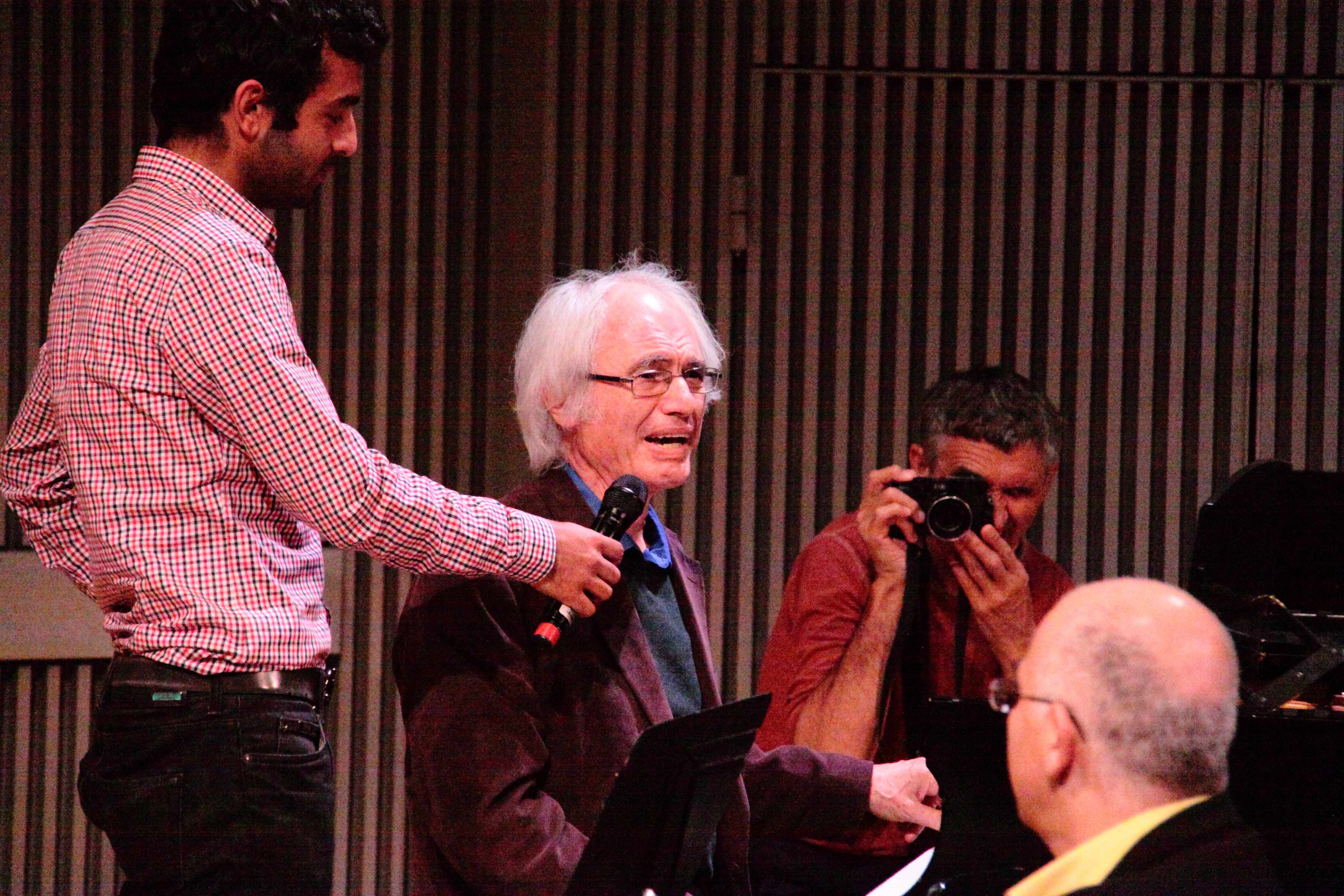
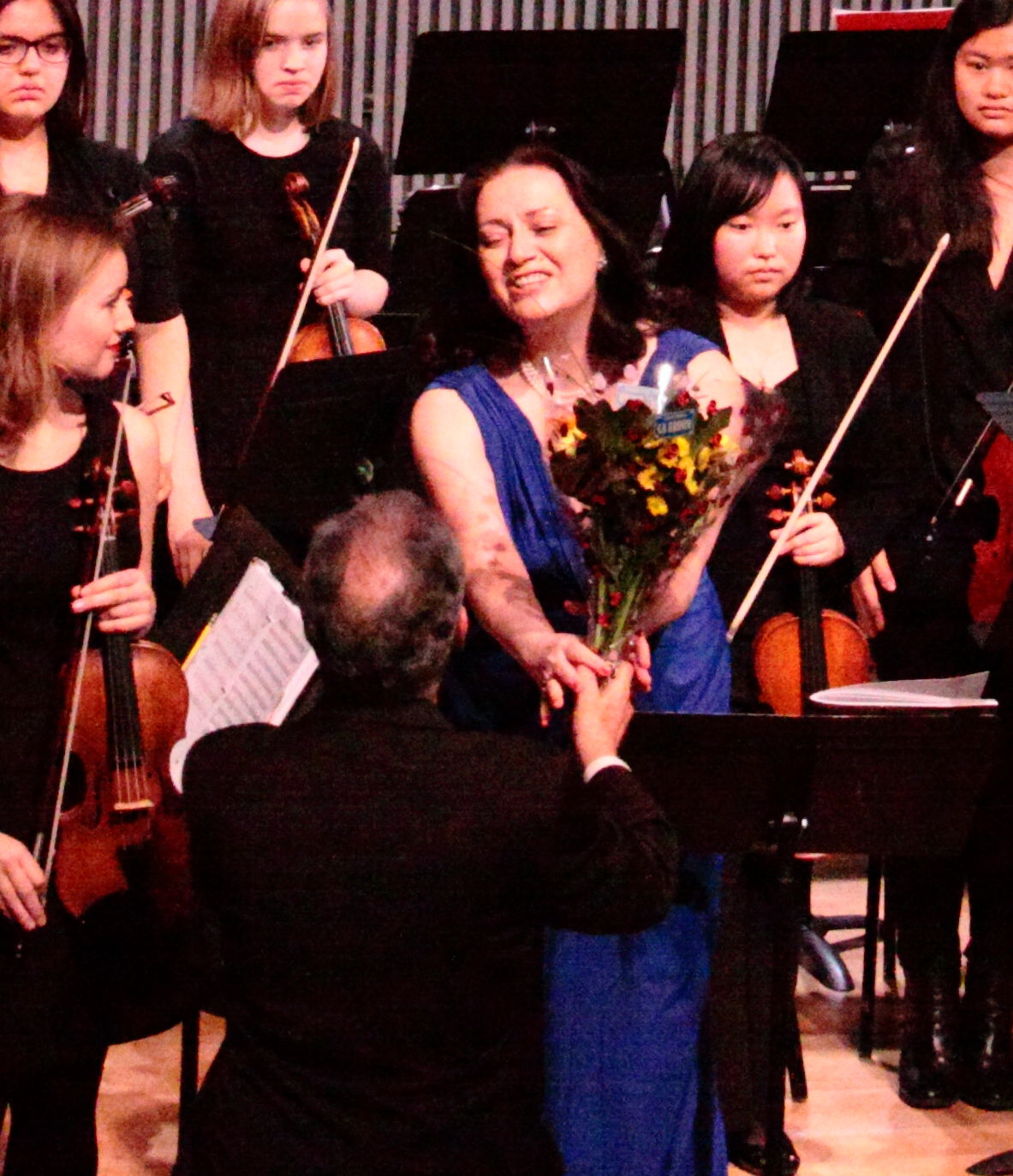
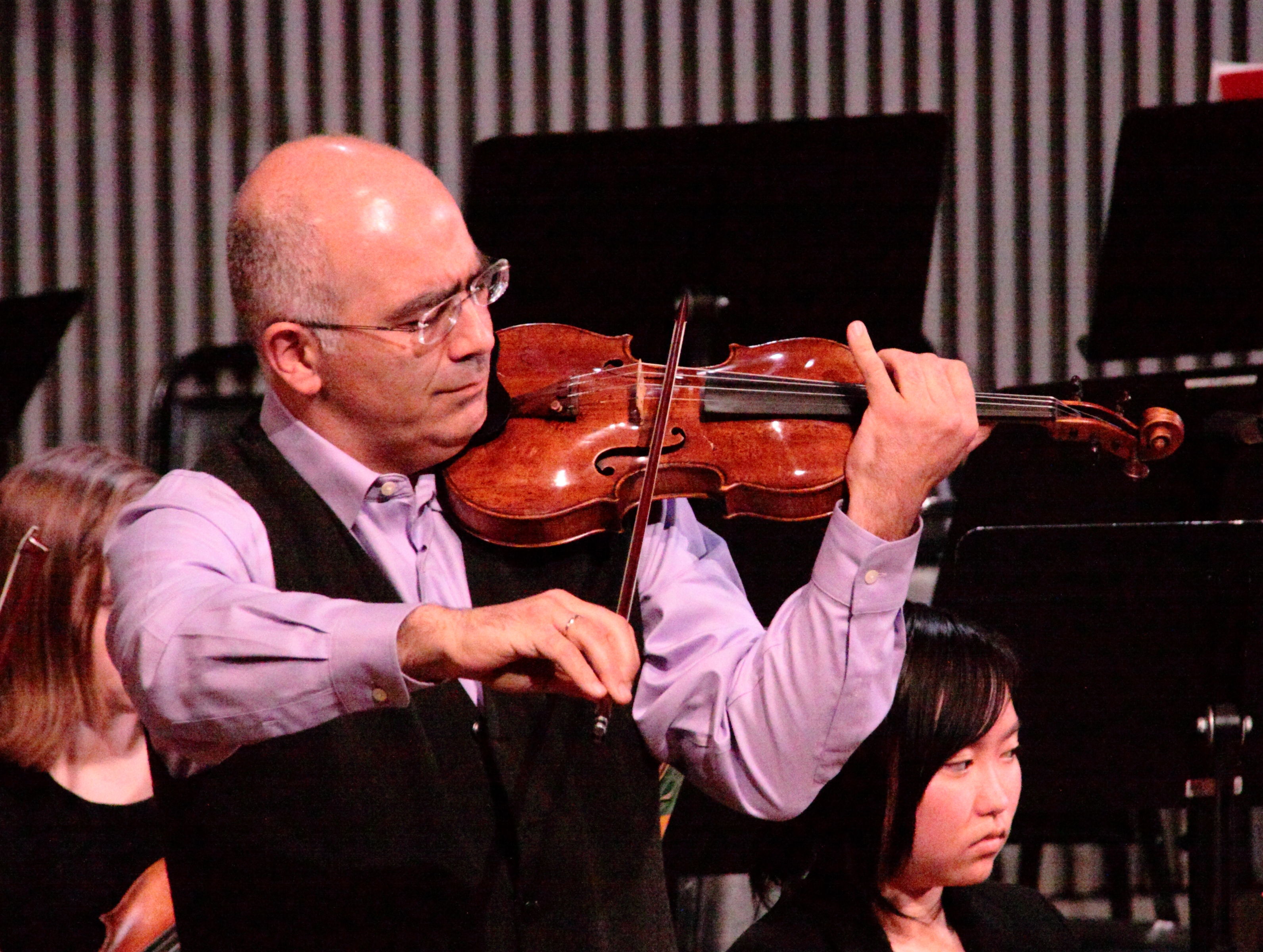
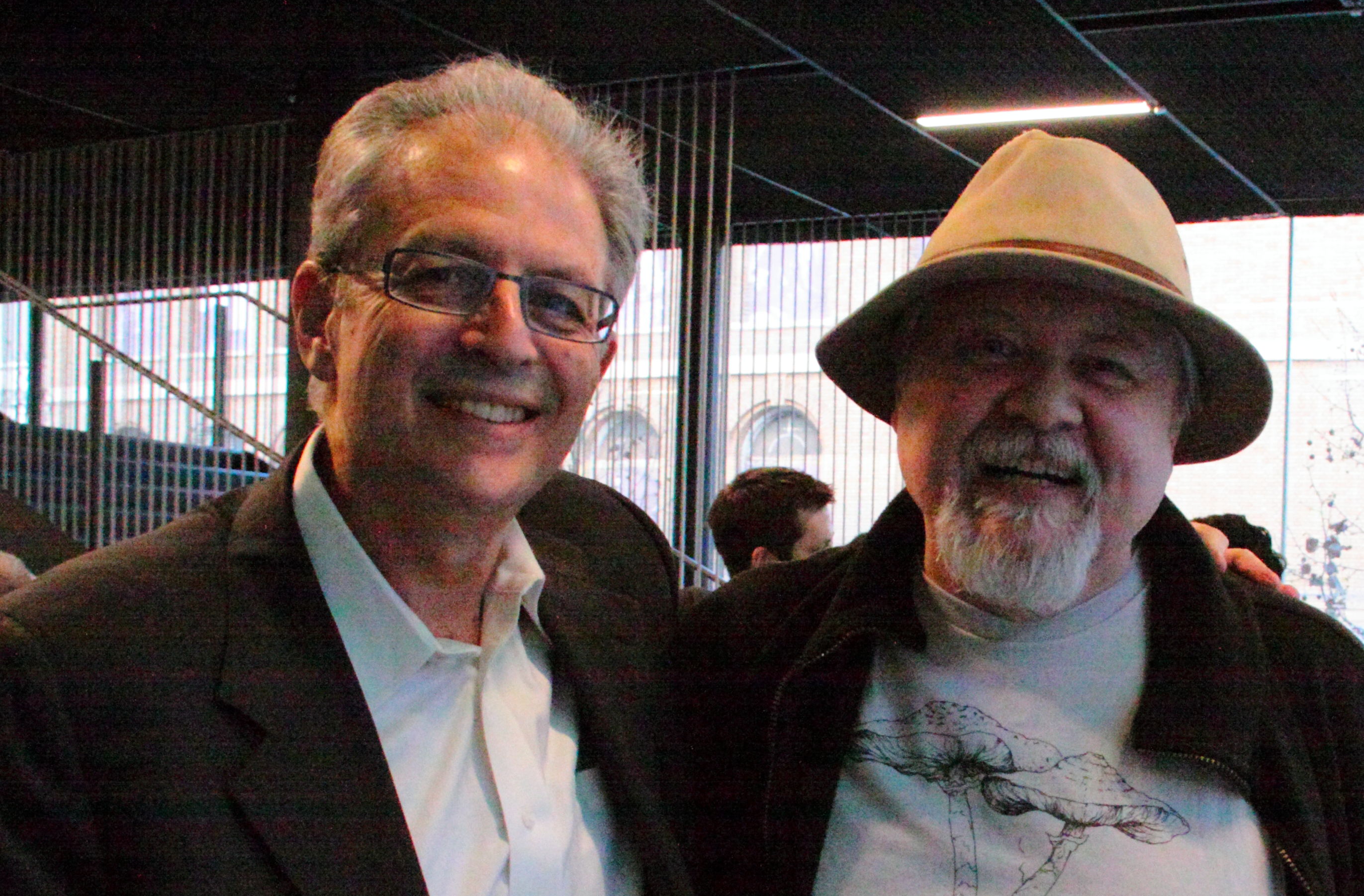
The Musical Mother of Us All: Pauline Oliveros, a Personal Appreciation


oliverosione

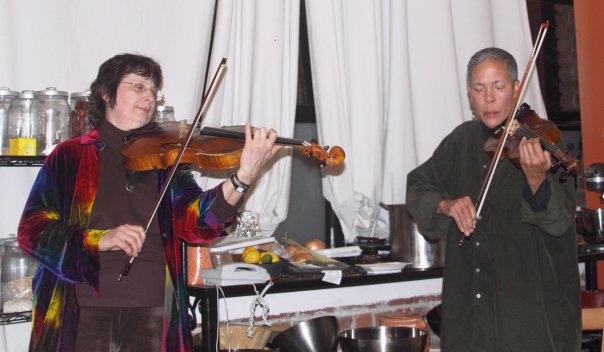
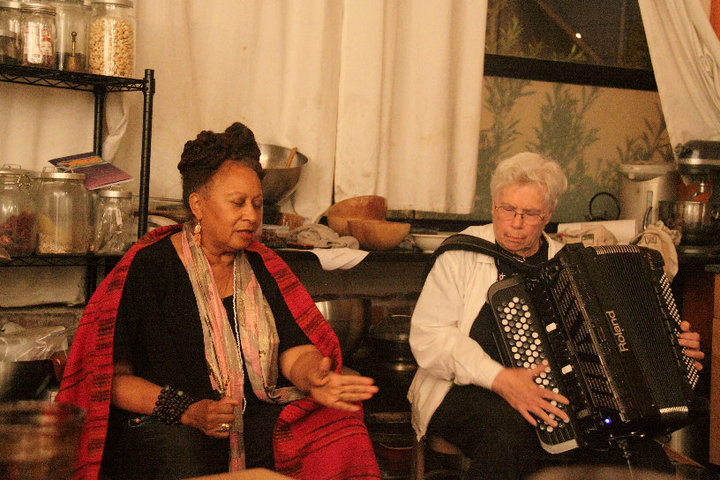
Pauline Oliveros at one of Philip Gelb’s dinner concerts in Oakland.  I published this photo on Pauline’s Wikipedia page.

I woke at about 3PM on the day after Thanksgiving (having worked the previous night shift) and I checked my e-mail and then, on Facebook I learned of the passing of theorist, composer, musician, teacher and all round wonderful human being Pauline Oliveros (1932-2016). She had died peacefully in her sleep on Thanksgiving Day.  Going over the copious posts and comments I was saddened at her passing but oddly comforted by the fact that these posts honoring her are effectively eclipsing the ones on the obnoxious political issues as well as demonstrating the incredible reach of her influence.  Thankfully, Pauline will not have to endure the regressive politics which now dominate our country and, indeed, the world.

I first encountered Pauline’s work, as many did, through the Columbia Odyssey LP curated by none other than David Behrman in his Music of Our Time series.  There are several composers on the disc including Steve Reich (Come Out), Richard Maxfield (Night Music), and Pauline Oliveros (I of IV).  Over the years I collected and listened to most of her recordings Discogs lists 55 recordings but no doubt there are many more and likely a plethora of unreleased material which will grace our ears for years to come.  Like her older contemporary John Cage it is difficult to identify a “masterpiece” and, also like Cage, she didn’t aspire to such notions because she aspired to learn and subsequently teach the art of listening. Her Deep Listening Institute is based in Kingston, New York.


dempster9

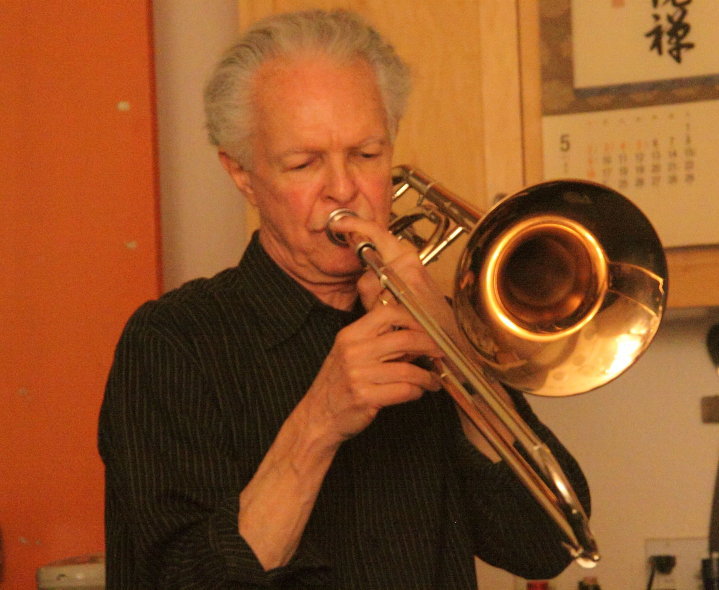
Stuart Dempster at another of Philip Gelb’s dinner concerts. Stuart is one of the members of Oliveros’ Deep Listening Band

I was pleased to be able to see one of the incarnations of the Deep Listening Band in Chicago at the Harold Washington Library.  This concert occurred on the night of the famed “Chicago Flood” (1992) in which a construction mishap diverted thousands of gallons of water from the Chicago River into the disused coal delivery railway tunnels which connect most of the downtown buildings.  I brought along a postcard from her album The Well and the Gentle hoping to get her autograph.  It was my first face to face meeting with this icon of new music.  She graciously took the card into her hand and immediately exclaimed with a smile, “Oh, this is from the Well”.  She quipped that next time they would hold their concert in one of the “deep tunnels” which are a part of the Chicago’s massive flood control rainfall overflow system.  I still treasure that autograph and the memory of my first meeting with Pauline.

oliverosione3

Ione (l) doing verbal improvisation while Pauline improvises in parallel on her digital accordion at a memorable dinner concert curated by Philip Gelb.

I can hardly tell you my level of excitement when vegan chef and musician Philip Gelb announced that Pauline with her partner Ione would be appearing at his next dinner concert.  The opportunity for a close encounter with this master was certainly heaven sent. (Pauline later wrote the lovely introduction to Philip’s first vegan cookbook.)

garden20151047

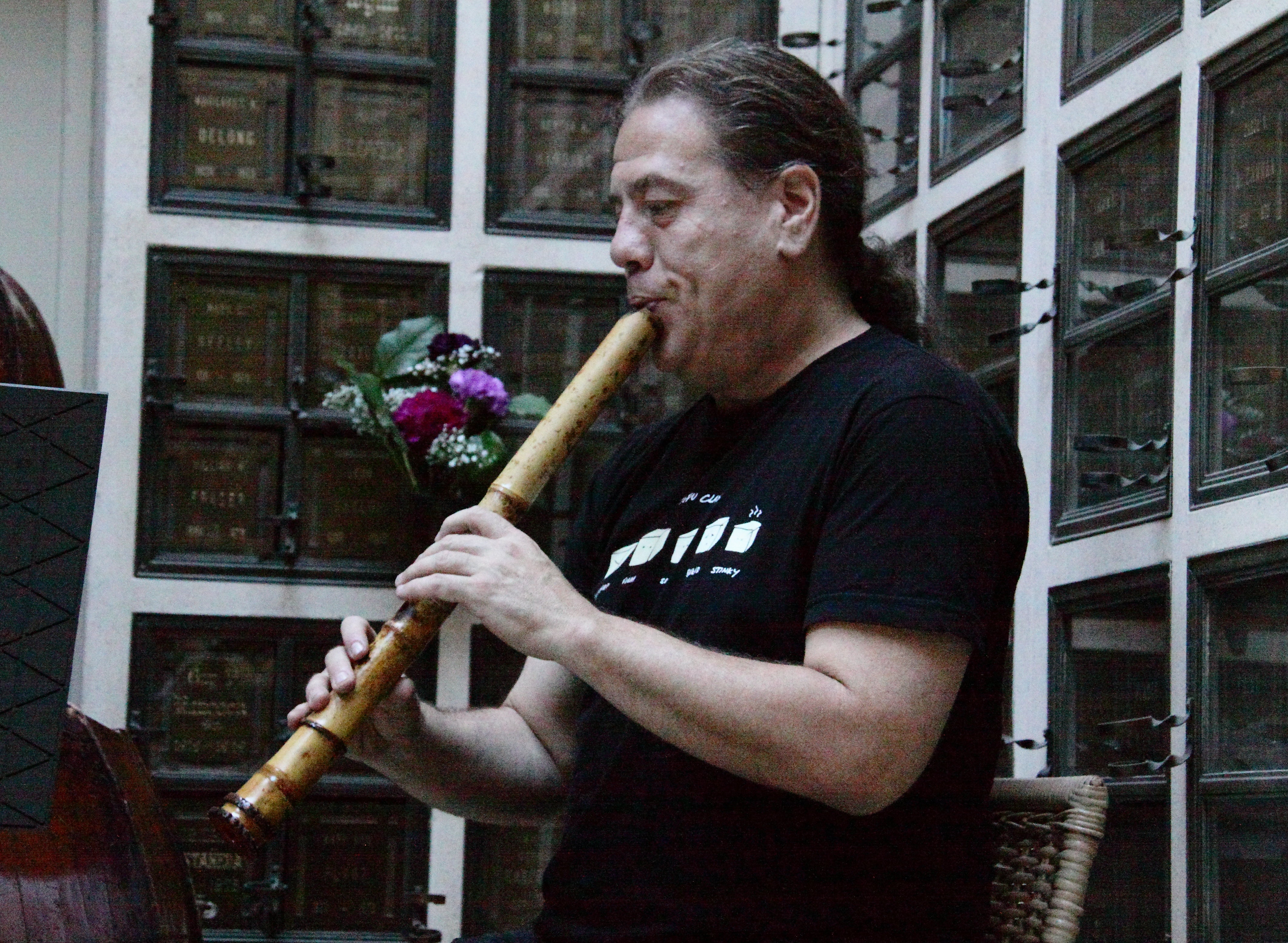
Philip Gelb performing at the June 21, 2015 Garden of Memory Concert at Oakland’s Chapel of the Chimes. This vegan chef and cookbook author plays and teaches shakuhachi and curates a wonderful dinner/concert series at his loft in West Oakland.  Philip also appears on several albums with Pauline and others.

Indeed, as I sat across from Pauline no doubt babbling some starstruck nonsense, I encountered in both her and her partner Ione two warm and unpretentious people.  While I knew I was in the presence of genius I was given to feel very welcome as they both engaged me and the other guests in lively conversation at this spectacular vegan meal.  In the pause just before dessert they gave a wonderful performance with Ione speaking improvised and passionate poetic utterances while Oliveros played her quirky improvisations in parallel on her digital accordion.

OM202021

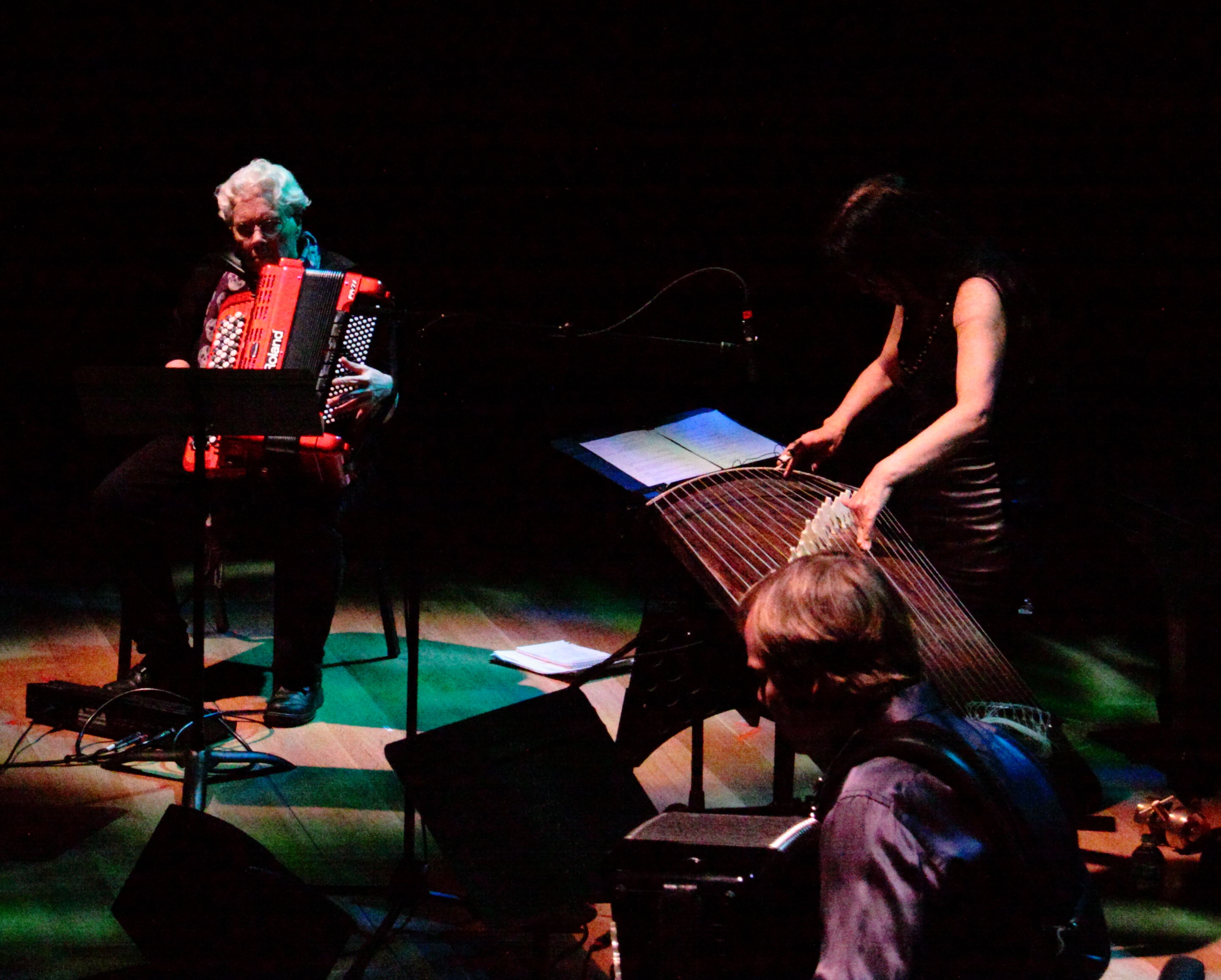
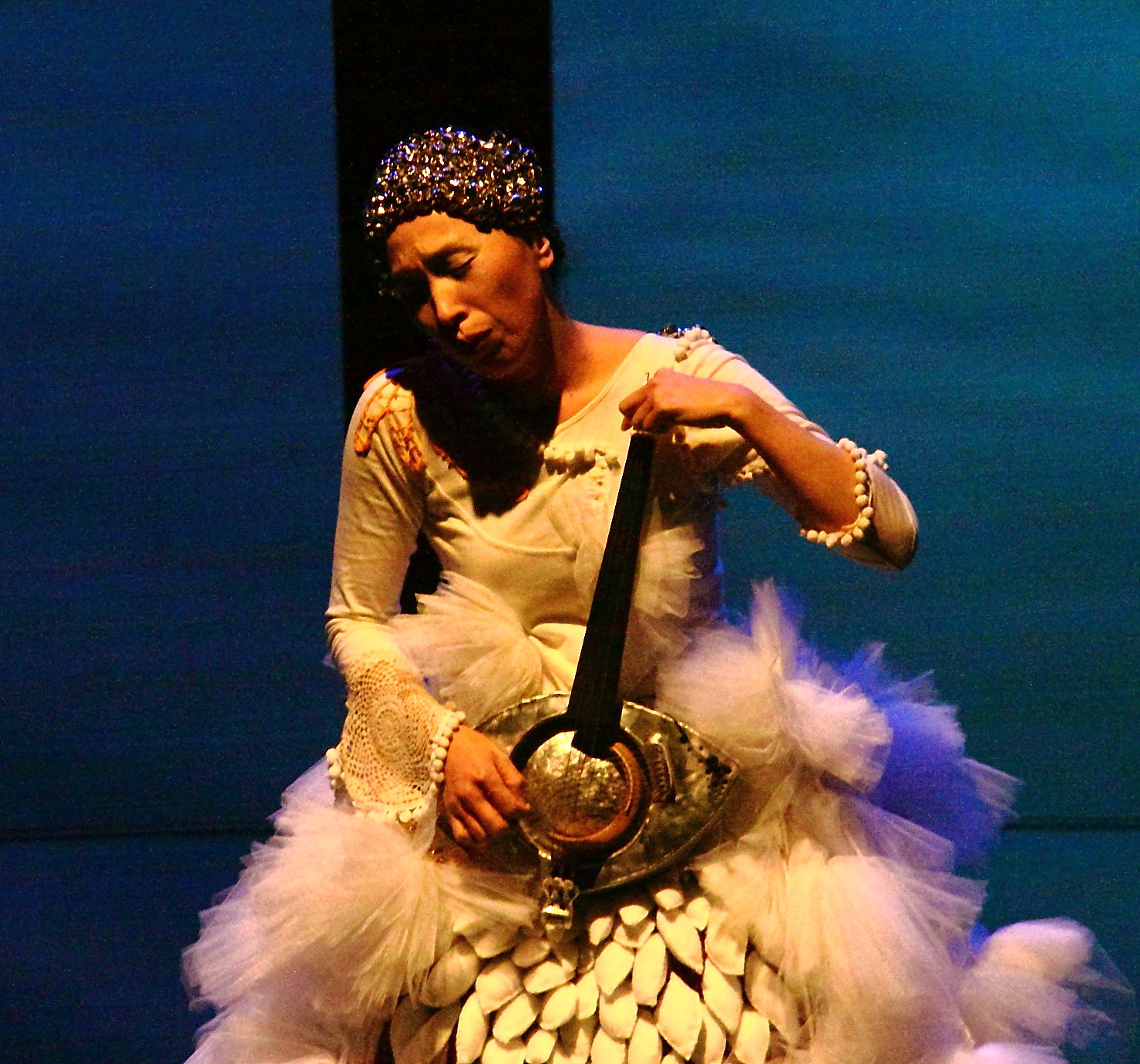
Pauline Oliveros, Miya Masaoka and Frode Haltli performing Oliveros’ Twins Peeking at Koto (2014) at Other Minds 20 in 2015

I later got to see Pauline as a returning guest composer/performer at Other Minds 20, a series lovingly and painstakingly curated by composer, broadcaster and new music impresario Charles Amirkhanian.  I believe this was her last major bay area appearance.

OM202022

A clearly happy Pauline Oliveros acknowledges the warm applause of the Other Minds 20 audience after her performance at the SF Jazz Center in 2015.

Every year at the Garden of Memory summer solstice concert the open membership Cornelius Cardew Choir performs Oliveros’ Heart Sutra every year.  The verbal score describes how one enters the singing circle and intones basically the note of their choice with one hand over their heart and the other on the back of another singer.  I screwed up my courage to participate in this ritual a few years ago and it is now an essential part of the beginning of my summer.  Pauline has taught me much and no doubt will continue to teach me through her writings and recordings.  For that I am eternally grateful.


Paula Matthusen’s Pieces for People


matthusen

This is the first disc devoted entirely to the music of Paula Matthusen who as of July is a newly minted associate professor at Wesleyan University where she walks at least partly in the footsteps of emeritus professor Alvin Lucier whose course Music 109 she inherited from him.  I had the pleasure of meeting Ms. Matthusen at Other Minds 18 where she was one of the featured composers.  In our all too brief conversation she was affable and unpretentious but certainly passionate about music.

Paula Matthusen

Paula Matthusen performing her work, ‘…and believing in…’ at Other Minds in 2013


She holds a B.M. from the University of Wisconsin and an M.A. and PhD. from New York University.  She announced her recent promotion to associate professor on Facebook as is, I suppose, customary for people of her generation.  It is on Facebook that I contacted her to request a review copy of this CD to which she quickly and graciously agreed.

This CD contains 9 tracks representing 8 works.  They range from solo to small ensemble works, some with electronics as well.  Her musical ideas seem to have much in common with her emeritus colleague Alvin Lucier but her sound world is her own despite some similarities in techniques, especially her attention to sonic spaces and her use of electronics to amplify sonic micro-events which might even include her heartbeat.


sparrows in supermarkets (2011) for recorder looks at the sound of birds in the acoustic space of a supermarket and their melodic repetition.  It is for recorder (Terri Hron) and electronics

limerance (2008) is another solo work, this time for banjo (James Moore) with electronics.  She says she is working with the concept of reciprocation here but that seems rather a subjective construct.  Like the previous piece this is a contemplative and spare work with some spectral sounds as well.

the days are nouns (2013) is for soprano and percussion ensemble and electronics.  Here she is concerned with resonances within the vibrators of the instruments as well as the acoustics of the room.  It is a dreamy, impressionistic setting of a poem by Naomi Shihab Nye whose poem supplies the title but the text is fragments of a Norwegian table prayer.  A very subtle and effective work.

AEG (2011) is represented by two movements (of four?) all of which were written for the Estonian ballet.  It is similarly concerned with resonances and words at times.  Of course it would be interesting to hear those other movements but perhaps another time.

of architecture and accumulation (2012) is the first of two purely acoustic compositions on this disc.  This one is for organ solo (Will Smith) and explores long tones within the acoustic space.  It is a very satisfying work even if one doesn’t go into the underlying complexities.

corpo/Cage (2009) is  the longest and largest work here and is the second purely acoustic piece on this recording.  It has echoes of Stravinsky at and it is an enticing example of Matthusen’s writing for orchestra.  This reviewer certainly looks forward to hearing more of this composer’s works for larger ensembles.  Very effective writing.

in absentia (2008) is the earliest work here.  It is written for violin, piano, glasses and miniature electronics (not quite sure what that means).  Like many of the works on this disc the concern or focus seems to be on small events and sounds.  This is a rather contemplative piece that nicely rounds out the recording.

Matthusen resembles Lucier in some of her techniques and focus on small sounds otherwise missed and she certainly owes a debt to people like Pauline Oliveros.  But in truth she sounds like no one as much as Paula Matthusen.  The composer presents a strong and intelligent voice and one wishes for more from this interesting artist.  Thank you for the opportunity to review this.

Other Minds 21, the Dawn of a New Chapter and the Raising of the Dead


BHM160008

Charles Amirkhanian with the composers of OM 21

Much needed rain pummeled the city by the bay on all three days of OM 21 dampening, perhaps, some attendance but not the enthusiasm of the audience or the performers.  In most ways this concert was a continuation of the celebration begun last year commemorating 20 years of this festival.  Returning this year were Gavin Bryars (OM7) and Meredith Monk (OM1).

Until last year no composer had appeared more than once at this series.  For those unfamiliar with OM it is worth noting that the process has been for the 8-10 selected composers spend a week at the Djerassi Arts Center in Woodside, California sharing and discussing their work before coming to San Francisco for performances of their work.

As it turns out this year’s concert series will be the last to follow that format.  Apparently OM has become the victim of gentrification and has had to move out of its Valencia Street offices and will now opt for various concerts throughout the year as they have done but without the big three-day annual festival and the residency at Djerassi.

The archives of OM are now going to be housed at the University of California Santa Cruz where they will reside along with the Grateful Dead archives.  I do believe that Mr. Amirkhanian lived near Phil Lesh of the Grateful Dead when he lived in San Francisco some years ago so it seems fitting that these two archives will peacefully coexist in that space (also coming to UCSC will be OM 21 composer Larry Polansky though not in an archive).

This is certainly a change but this is a festival which has endured various changes in time and venue led throughout by the steady hand of the Bill Graham of contemporary music concerts, Charles Amirkhanian (both men have had a huge impact on music in the bay area as well as elsewhere and it is worth noting that the Contemporary Jewish Museum will have a tribute to Graham this year).

Actually Other Minds traces its provenance to the Telluride, Colorado Composer to Composer festival (also led by Amirkhanian) and later morphed into OM with the leadership of president (now emeritus) Jim Newman back in the early 1990s.  There is a short excellent film describing OM’s history on Vimeo here.

It is the end of a chapter but, as Amirkhanian explained, there are many exciting concerts coming up which will keep Other Minds in the earshot of the astute contemporary music aficionados on the west coast.  Next year, for example, will include several very exciting concerts celebrating the 100th birthday anniversary of beloved bay area composer Lou Harrison.

My apologies for the delay in posting which was due to both the richness of the experience and the exigencies of my day job and other responsibilities.  I hope that readers will find this post to have been worth the wait.

BHM160009

Nordic Voices

Starting our rainy day were the extremely talented singers known as Nordic Voices.  Lasse Thoresen‘s Solbøn ( Sun Prayer) (2012) and Himmelske Fader (Heavenly Father) (2012) both required keen listening and required the use of extended vocal techniques such as multiphonics.  The singing appeared effortless and even fun for the ensemble but that speaks more to their expertise and preparedness than any ease in terms of the score.

It is always difficult to judge a composer’s work by only a small selection from their output  but Thoresen’s virtuosity and subtle use of vocal effects suggests a highly developed artist and it would seem worth one’s time to explore more of this gentleman’s oeuvre.

BHM160010

Lasse Thoresen takes the stage to acknowledge the applause.

Next was an unusual, humorous/dramatic work by Cecile Ore called Dead Pope on Trial (2015/16) with a libretto by Bibbi Moslet.   This Other Minds commission was given its world premiere at this concert.  The work is based on the story of a medieval pope who was taken from his grave no fewer than six times for various perceived offenses.  It is a mix of irony and humor in a sort of madrigal context.  The work was in English and had the nature of a conversation between the singers.  No doubt a challenging piece, it was sung very well and the composer seemed as pleased with the performance as much as the audience.

BHM160011

Cecile Ore smiling as she acknowledges the applause for the wonderful premiere performance of her new work, Dead Pope on Trial.

As if in a demonstration of sheer stamina in addition to virtuosity Nordic Voices took the stage again, this time for some Madrigals (2002/2016) by returning artist Gavin Bryars.  Bryars is no stranger to Other Minds or to madrigals and such older musical forms from the renaissance and before.  He has extensively explored vocal writing and medieval harmonies in many previous works.  Though categorized as being a “minimalist”, Bryars actually has produced a huge range of music in all forms including opera, chamber and orchestral music.

His madrigals have been written for the Hilliard Ensemble and each book is distinguished by the madrigals having been written on a specific day of the week.  The first book on Mondays, etc.  They are settings of Petrach’s sonnets and are sung in the original Italian of his day.  On this night we were treated to four madrigals from Book Two and the premiere of a madrigal from Book Four.  That madrigal was dedicated to Benjamin Amirkhanian, the father of Charles Amirkhanian who celebrates his 101st birthday this summer.

I had the opportunity to meet and speak briefly with the affable Mr. Bryars.  His generous spirit pervaded our conversation and he spoke very highly of both his visits to Other Minds.  If you don’t know this man’s music you are doing yourself a great disservice.

BHM160016

A very pleased Gavin Bryars deflects the applause and adulation to the amazing Nordic Voices for their astounding performance of five of his madrigals.

The singers of Nordic Voices sustained a high level of virtuosity as well as sheer stamina as they sang for nearly two hours in the opening pieces of this concert series.  No time was lost setting the stage for the performance of the next piece, another premiere, Algebra of Need (2016) for electronic sampling and string quartet by Bang on a Can member Phil Kline.

BHM160045

FLUX Quartet playing at SF Jazz, 2016

The Flux Quartet was featured in the next two (and last) works on this long program.  Algebra of Need is Kline’s meditation on the words and the cadences of the iconic writing and voice of the late William S. Burroughs (gone 19 years as of this writing).  The familiar voice seemed to go in and out of clearly audible, at times mixed more closely with the string writing in this intense homage.
BHM160014

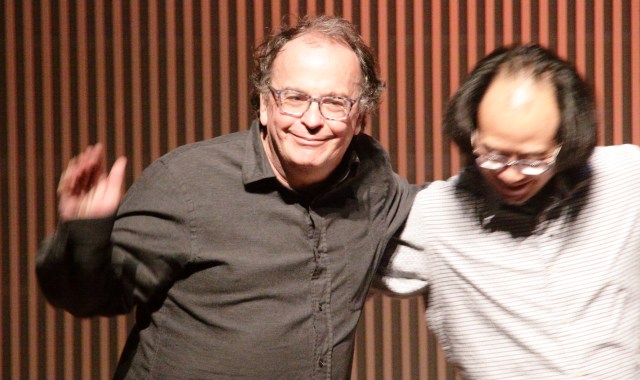
A satisfied looking Phil Kline leans in to embrace the first violin of the Flux Quartet after their premiere of his Algebra of Need.

The Bang on a Can collective was also represented tonight by Michael Gordon.  The Sad Park (2008) for string quartet and electronics put a most decidedly disturbing conclusion on the evening.  This piece, which samples the voices of children (one of them Gordon’s) as they spoke of their experience of the 9/11 Twin Towers attacks.

The effect was, as no doubt intended, harrowing leaving a pretty strange and unsettling feeling as we walked away from the concert into the still rainy night.

BHM160017

Michael Gordon embraces the FLUX Quartet’s first violin after a stunning performance of The Sad Park.

The rain continued on Saturday but the crowd was noticeably larger for the second night which opened with the usual panel discussion.

BHM160030

left to right: Meredith Monk, John Oswald, Nicole Lizee, Eliot Simpson, Larry Polansky, Oliver Lake and Charles Amirkhanian in a panel discussion prior to the concert

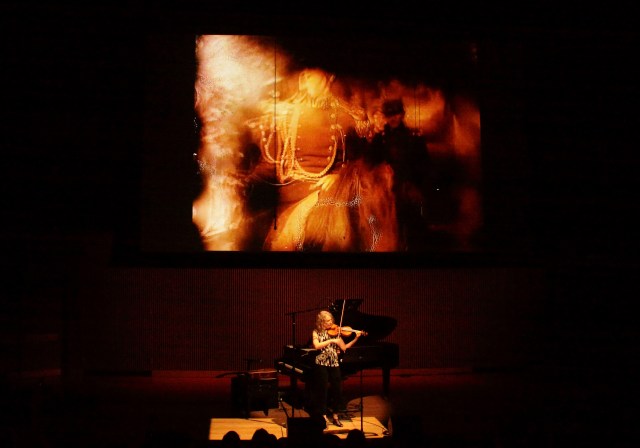
This evening began with a performance by the wonderful bay area violinist Kate Stenberg of a piece which was a sort of antidote to the somber, The Sad Park from the previous night.  Again the composer was Michael Gordon and the piece was Light is Calling (2004), a collaboration with filmmaker Bill Morrison.  Though hardly a happy piece Light is Calling is perhaps elegiac and the composer seems to achieve some of his stated intent to find some healing in the wake of a disaster to which he was all too close.
BHM160031

Kate Stenberg plays violin beneath the projection of a Bill Morrison film in Michael Gordon’s, Light is Calling
BHM160032

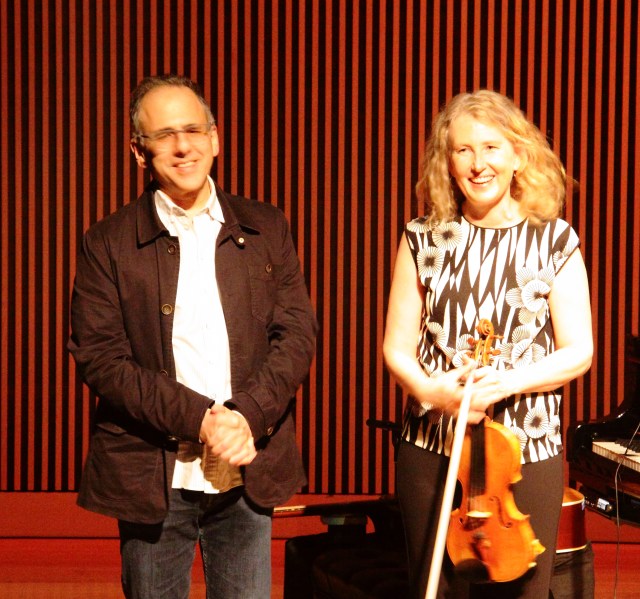
Michael Gordon and Kate Stenberg accepting the applause of an appreciative audience.

Next up was John Oswald, a Canadian composer whose career took off in infamy when his Plunderphonic CD, released to radio stations in the early 1980s, became the subject of legal battles over the meaning of copyright law in light of digital sampling.  Fortunately Oswald won the right to publish his work and his Plundrphonics concepts now underlie much of his compositional process.  Until this night I had not heard any but his Plunderphonic CDs so the introduction to his live music was a revelation.
BHM160033

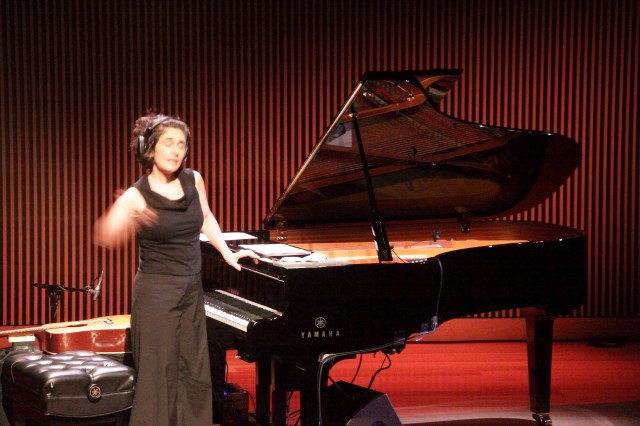
Pianist and (at least here) multi-instrumentalist Eve Egoyan performing with a Yamaha Disklavier and other instruments.

The first piece she did was called Homonymy (1998/2015) was originally written for chamber orchestra and was then transcribed for Egoyan and her prepared disklavier et al.  It is a piece based on linguistic elements and with a visual component as well.

BHM160034

Eve Egoyan performing Homonymy with overhead projections.

Nicole Lizee’s David Lynch Etudes (2015) was the next piece  and also made use of the projection screen.  The subtitle of the piece indicates it is for “disklavier and glitch”.  Well life imitated art as some sort of glitch prevented the projection from functioning at first but this was rather quickly resolved and we were treated to excerpts of scenes from several David Lynch films with the piano playing some of the rhythms of the dialog in an exchange that puts this writer in the mind of music like Scott Johnson’s “John Somebody” and Steve Reich’s incorporation of speech rhythms in works like, “The Cave”.

Nicole Lizee is a Canadian composer and was the youngest composer on this year’s program.
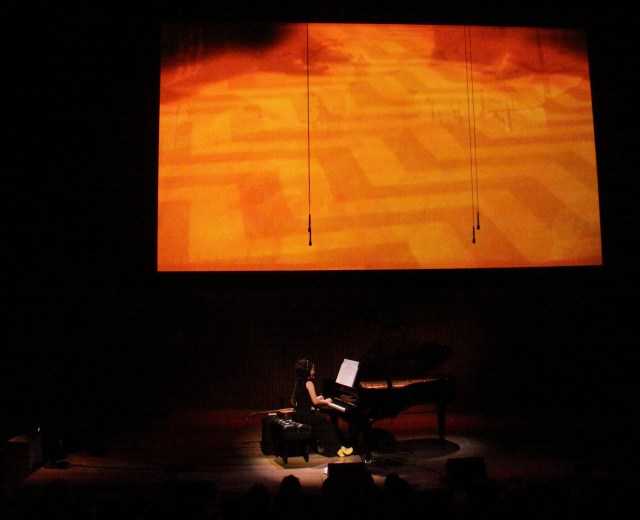
BHM160035

Eve Egoyan playing Nicole Lizee’s David Lynch Etudes with projected scenes/glitches from Lynch’s films.

The work is one of a series of pieces inspired by films and was executed with apparent ease by pianist Eve Egoyan who played the disklavier (both the keyboard and directly on the strings), a guitar and perhaps other gadgets .  The piece kept her quite busy and the associations I described above sound nothing like this work actually.  These etudes were a unique, typically Other Minds sort of experience, one that expands the definition of musical composition.

BHM160036

Nicole Lizee (l) with Eve Egoyan absorbing the audience’s appreciation of the David Lynch Etudes.

Two more John Oswald compositions graced the program next.  Palimpia (2016) is a six movement piece for disklavier with pianist playing as well.  Oswald says it is actually his first composition for piano.

BHM160046

John Oswald embracing pianist Egoyan and enjoying the audience applause for his work.

Well I did say there were two more Oswald pieces but this last one was a masterful plunder by this truly unusual composer.  Here Oswald conjured the playing as well as the image of the late great Glenn Gould who was seen actually playing Invaria (1999) with the disklavier performing along with the film of Gould performing this music.  It was, for this writer, a spellbinding experience.  He has raised the dead in the name of music.  Wow!  It was an amazing and heartfelt homage to a fellow great Canadian musician.
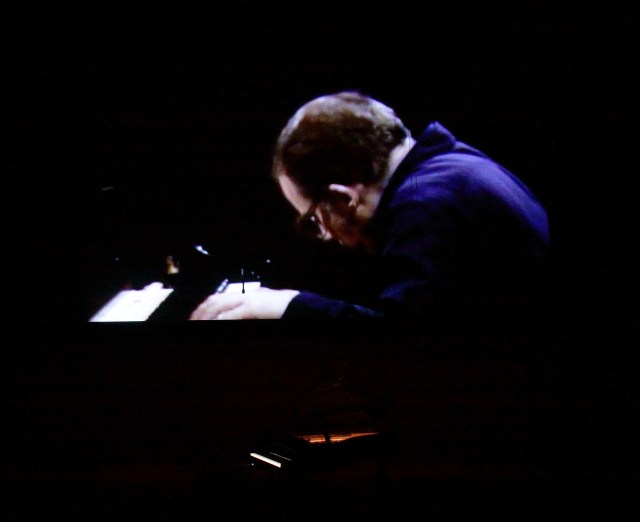
BHM160038

Glenn Gould playing John Oswald

Larry Polansky (1954- ) is well known as a teacher and as a composer but one is hard pressed to find much in the conventional discography of his work.  The few discs out of his amazing electronic music (and one disc of piano variations) represent only a small fraction of his output and represent only one genre of music which he has mastered.  However the astute listener needs to be advised to look online to look, listen and hear some of the bounty of his creative output.  Check out the following sites: Frog Peak Music (Polansky’s publishing site which includes music and scores by a great many interesting composer in addition to himself and Dartmouth Page (which contains link to various recordings, writings, computer software, etc.

BHM160039

Giacomo Fiore (left) and Larry Polansky playing Polansky’s ii-v-i (1997)

As an amateur musician who has enough trouble simply tuning a guitar it made my knees weak to watch these musicians effortlessly retune as they played.   Polansky’s experimentation with alternate tunings is an essential part of many of his compositions.

BHM160040

Fiore and Polansky changing their tunings mid-phrase in a stunning demonstration of virtuosity with pitch changes.

The program then moved from the electric to the acoustic realm with Polansky’s folk song arrangements.  Eliot Simpson, the pedagogical progeny of the great David Tanenbaum (who played these concerts last year at OM 20), played the just intonation National Steel Guitar and sang.

Let me say just two things here.  First, these are not arrangements like Copland’s Old American Songs and second, I will never hear these folk songs quite the same way again.  Polansky’s interest in folk music and Hebrew cantillation along with alternate tunings produces what the ears hear as perhaps a different focus.  In these pieces he did not stray too far from the original (as he does in his Cantillation Studies) but one is left with distinctly different ways of hearing and thinking about this music and the listener is left richer for that.  It is a journey worth taking and Simpson played with both passion and command.

Eliot Simpson playing a selection of Larry Plansky's Songs and Toods

Eliot Simpson playing a selection of Larry Plansky’s Songs and Toods

Polansky returned to the stage for a performance of his 34 Chords (Christian Wolff in Hanover and Royalton) (1995). Again we were treated to the virtuosic use of alternate tunings performed live (and again with live re-tunings) by the composer.

Oliver Lake delivering a blistering free jazz improvisation.

Oliver Lake delivering a blistering free jazz improvisation.

Continuing with the solo performer theme we were privileged to hear the virtuosic jams of Oliver Lake (1942- ) whose long career is legendary in the jazz world.  The “mostly improvised” (according to the composer) Stick was played on two different saxophones in what appeared to be as intense an experience for the performer as it was for the audience.

Oliver Lake takes a final bow at the end of the second concert of OM 21

Oliver Lake takes a final bow at the end of the second concert of OM 21

The emotional workout was received warmly by the audience.

Charles Amirkhanian introduces Meredith Monk on the final day of OM 21

Charles Amirkhanian introduces Meredith Monk on the final day of OM 21

There was no panel discussion on the third day of OM 21.  This matinée was dedicated entirely to the work of Meredith Monk (1942) who, fittingly was one of the featured artists in the first Other Minds gathering in 1993.  Now a recipient of the National Medal of the Arts this beloved artist returns to OM 21.  Though the rain continued the house appeared to be full.
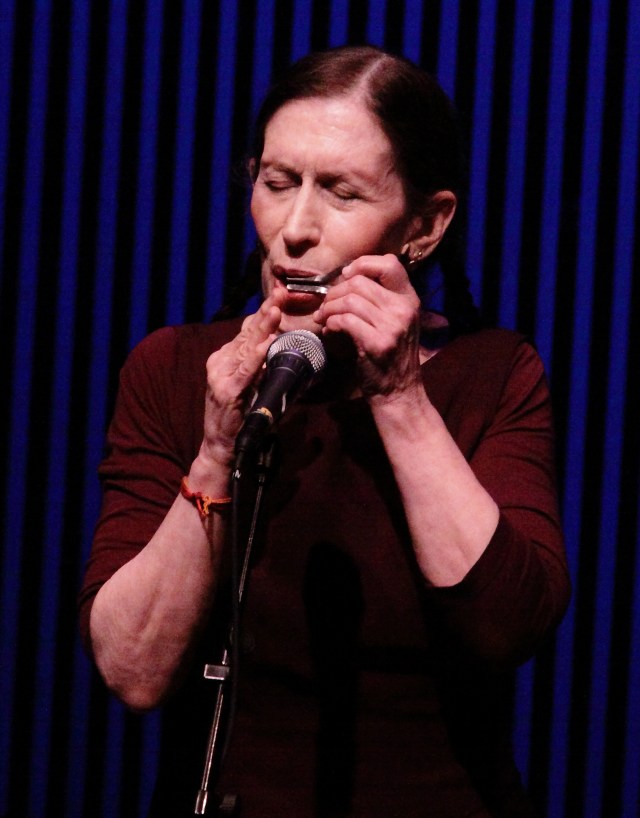
Meredith Monk playing a Jaw Harp in one of her early solo songs.

Meredith Monk playing a Jaw Harp and singing in one of her early solo songs.

Monk played a selection of material from various periods in her career in a mostly chronological survey which she called The Soul’s Messenger.  She began with selections from her solo songs and proceeded to her voice and piano music, then to her work with multiple voices and instruments.
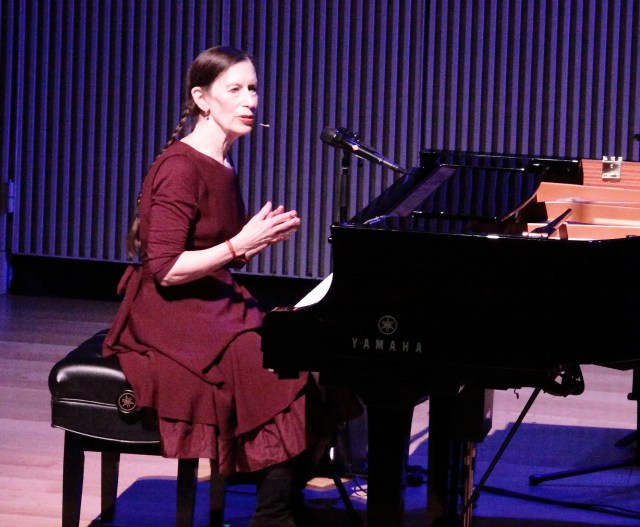
Meredith Monk performing her signature Gotham Lullaby

Meredith Monk performing her signature Gotham Lullaby

Most of the audience seemed to have a comfortable familiarity with the individual works she offered on this night which effectively gave a picture of her career.  Monk was in good voice and appeared to enjoy her performance.
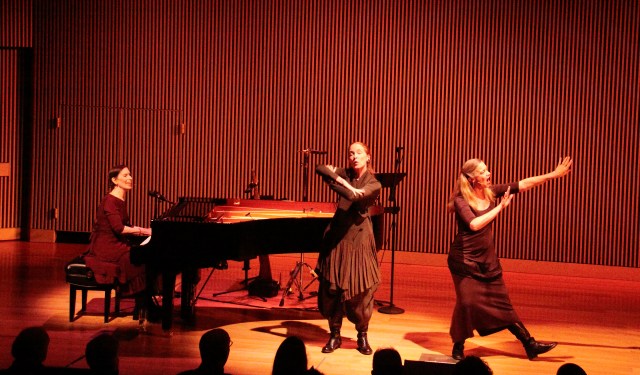
Long time collaborator Katie Geissinger and Allson Sniffin joined in the next selection

Long time collaborator Katie Geissinger and Allson Sniffin joined in the next selection

The stage was set to allow for the dance/movement that is an essential part of Monk’s works.  She originally trained as a dancer.
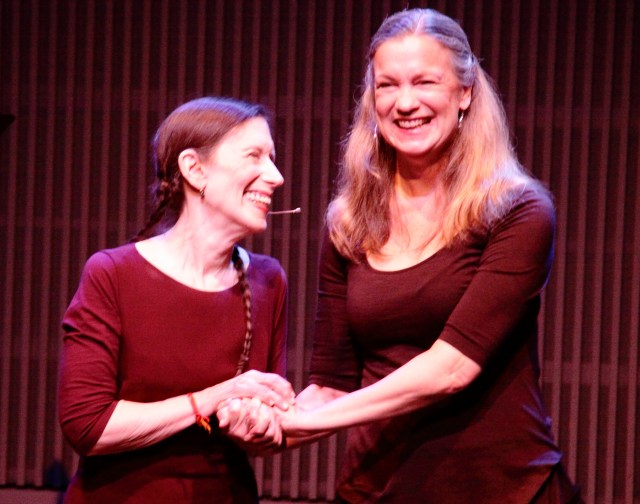
Monk and long time collaborator Katie Geissinger reacting to the appreciative audience

Monk and long time collaborator Katie Geissinger reacting to the appreciative audience

In addition to the grand piano the stage was set with two electronic keyboards, an essential sound in many of Monk’s works.
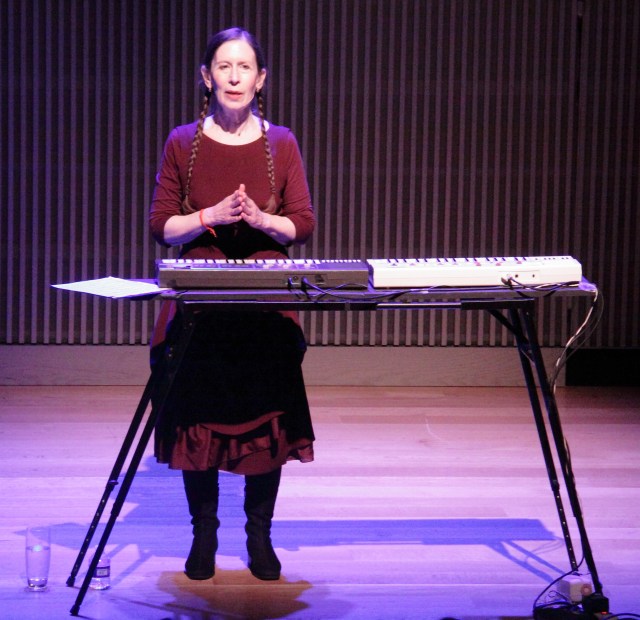
Monk at one of the electronic keyboards

Monk at one of the electronic keyboards

Woodwind player Bodhan Hilash joined the ensemble for the last set of pieces.
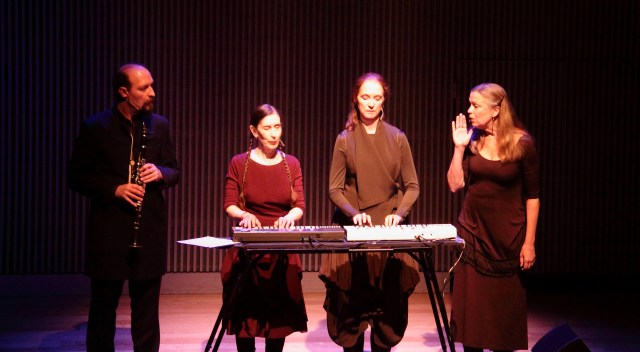
From left: Bodhan Hilash, Meredith Monk, Allison Sniffin and Katie Geissinger

From left: Bodhan Hilash, Meredith Monk, Allison Sniffin and Katie Geissinger

The audience gave a standing ovation at the end resulting in 3 curtain calls.
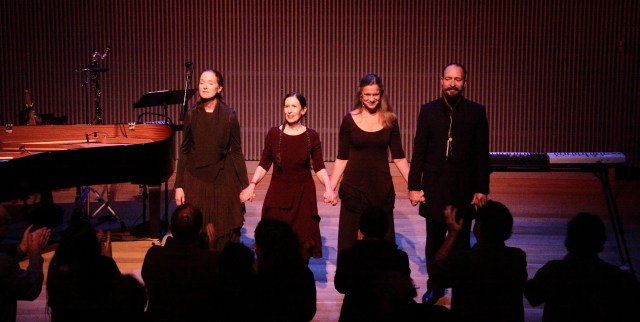
Left to right Allison Sniffin, Meredith Monk, Katie Geissinger and Bodhan Hilash receiving a standing ovation.

Left to right Allison Sniffin, Meredith Monk, Katie Geissinger and Bodhan Hilash receiving a standing ovation.

And the properly prepared artist came back for an encore of her song Details.
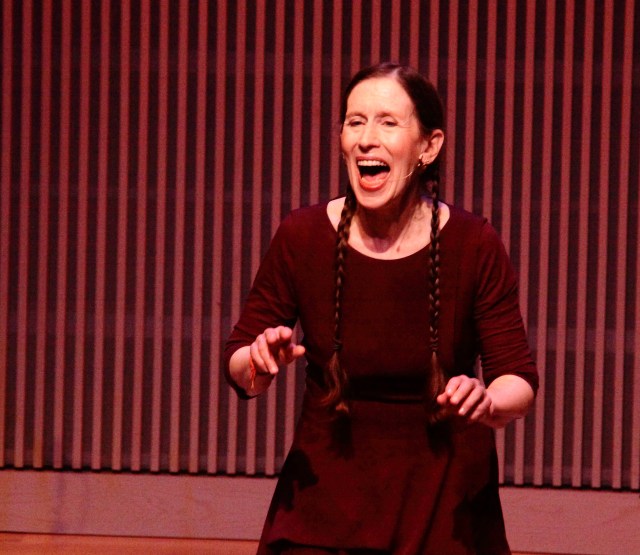
Meredith Monk performing an encore at the final concert of OM 21

Meredith Monk performing an encore at the final concert of OM 21


It was a fitting finale to a great OM 21, fitting to have this artist who appeared on the first iteration of Other Minds returning now crowned with a National Medal of the Arts and clearly beloved by the audience.  Her music like her lovely smile fade to the edge of memory like that of the Cheshire Cat on a truly triumphant finale.

And, despite some format changes, who knows what treasures continue to lie in store?  I will be watching/listening and so, apparently will many others.  Keep an eye on www.otherminds.org .  I know I will.


BMOP Opening Concert Commemorates Armenian Genocide


BMOP20_logo

ADDENDUM:  Unfortunately the pianist Nareh Arghamanyan will not be able to perform.  BMOP informs me that they are substituting a piece by the wonder.ful Israeli composer Betty Olivero called Neharot Neharot (2006-7) for two string orchestras, accordion, percussion, tape and viola.  It will feature none other than violist extraordinaire Kim Kashkashian.  

The Boston Modern Orchestra Project begins it 20th season on Sunday October 18th with a concert in honor of the 1915 Armenian genocide with a celebration of that country’s artistic heritage.  Titled Resilient Voices 1915-2015, the concert will feature works by Komitas (1869-1935), Alan Hovhaness (1911-2000), Dmitri Shostakovich (1906-1975) and Tigran Mansurian (1939- ).

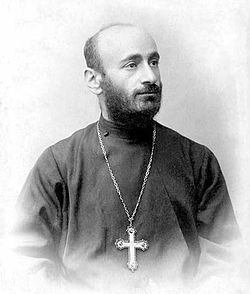
Komitas_1902

Komitas, born Soghomon Soghomonian, is generally regarded as the foundational composer for Armenian classical music in the 20th and 21st centuries.  Like Bartok and Kodaly, he collected and transcribed folk music from his country.  He is considered an early founder of the practice of ethnomusicology collecting Armenian and Kurdish folk music.  He was ordained a priest in the Armenian rite church and took the name Komitas.  The impact of the genocide affected him deeply and he spent the last 20 years of his life in a psychiatric facility where he died in 1935.

Alan Hovhaness

Alan Hovhaness

American composer Alan Hovhaness also embraced a musicological approach to his composition by including Armenian folk songs and that of other musical cultures he had explored including Korean and South Asian. He also acknowledges a debt to Komitas (Hovhaness released a recording on his own Poseidon label of him performing Komitas’ complete piano music).

Hovhaness remains less well-represented than he deserves in the concert hall so this performance of Khrimian Hairig (1944, rev 1948) is a welcome one.  The piece is in three continuous movements titled, “Chalice of Holiness”, “Wings of Compassion” and “Triumph of Faith”.  It is scored for string orchestra with solo trumpet.  The solo here will be played by prominent new music trumpeter Terry Everson (whose talents are to be required in the next piece on the program).  Hairig was a prominent Armenian cleric and mystic of the 19th century.

This work is early in Hovhaness’ prolific output and is characteristic of his Armenian period utilizing Armenian folk melodies and writing on Armenian themes.  He would later gain wider fame when Leopold Stokowski premiered his 2nd Symphony “Mysterious Mountain” in 1955 on NBC television.  Hovhaness died in 2001 leaving over 400 compositions of which 67 are symphonies.

Arghamanyan_Nareh

Nareh Arghamanyan

The Armenian connection to the next piece is apparently the BMOP début of the young Armenian pianist, Nareh Arghamanyan (1989- ) in the First Piano Concerto Op. 35 (1933) of Dmitri Shostakovich.  This unusual piece is scored for piano, string orchestra and trumpet (I told you Everson would be back).  It is one of those neo-baroque experiments and quotes from well-known classical pieces.  It is quite challenge for a pianist and the début of this rising artist will doubtless be one of the highlights of the concert.

The title of the concert is Resilient Voices 1915-2015 and is given in commemoration of the Armenian Genocide (1915-1923) but more so in celebration of the voices and the talents that have endured.  Controversy remains evidenced by the fact that Azerbaijan and Turkey continue to deny the genocide but the estimated death toll was 1.5 million and this is the event for which the term “genocide” was first used.

Artistic Director and Conductor Gil Rose

Artistic Director and Conductor Gil Rose

It is the genius of Gil Rose, conductor and artistic director whose creative vision in a couple of releases  I recently reviewed ( Anthony Davis and Irving Fine) that first alerted me to the work of this fine ensemble (a little late, I know).  But I discovered a great orchestra with some of the most innovative programming with attention to new and recent music.  I was graciously offered a seat at this concert but it will have to be one of my regrets.  This sounds like a fantastic program.

Tigran Mansurian

Tigran Mansurian

How very appropriate then to have the BMOP premiere of the Requiem (2009) by Tigran Mansurian (1930- ) by far Armenia’s best known living composer.  The Requiem was written in memory of the holocaust and is scored for large orchestra, chorus and soprano and baritone soloists (not announced when last I checked yesterday).  Gil Rose conducts the Harvard-Radcliffe Collegium Musicum with the Boston University Marsh Chapel Choir.  This is indeed a species of political music and BMOP is to be applauded for this as a contribution to the recognition of human rights. through music.

Tigran Mansurian at the piano at Other Minds in San Francisco.

Tigran Mansurian at the piano at Other Minds in San Francisco.

Mansurian previously appeared at the Other Minds 20th Anniversary concert (also dedicated to the holocaust) in March of 2015 in San Francisco.  At that concert I captured a moment from the pre-concert discussion in which Mansurian agreed to sing a traditional Armenian song accompanying himself at the piano, a very personal moment from a composer whose art is deeply felt.

Please, BMOP, record this.  Thanks in advance!!!

End of an Era and a Summation: In the Mood for Food Dinner/Concert Series


Philip Gelb performing at the June 21, 2015 Garden of Memory Concert at Oakland's Chapel of the Chimes.

Philip Gelb performing at the June 21, 2015 Garden of Memory Concert at Oakland’s Chapel of the Chimes.

For a variety of reasons I have not been able to spend any time with this blog for the last month or two but recent events tell me that I must find the time to get back online and publish.  My apologies to all who are awaiting reviews and such.  They will now be forthcoming.

This past Saturday night June 27, 2015 is among the last of this East Bay series which has been with us for the last 10 years.  Philip Gelb, vegan chef extraordinaire, shakuhachi player and teacher has announced that he will be relocating to New York in the next few months.

I personally discovered this series shortly after I moved to the bay area.  In a nondescript West Oakland neighborhood in a modest loft live/work space I found a vegan dinner which also featured a performance by Bay Area composer/performer Pamela Z.  One concert/dinner and I was hooked.   The opportunity to meet and hear many wonderful musicians and enjoy the amazing culinary magic was just too much to resist.  I have been a regular attendee at many of these concerts and they all are valued memories.

Philip Gelb with Joelle Leandre at one of his dinner/concerts.

Philip Gelb with Joelle Leandre at one of his dinner/concerts.

Phil, who studied music, ethnomusicology and shakuhachi has been a familiar performer in the Bay Area.  In addition to performing and teaching the Japanese bamboo flute, Phil has run a vegan catering business and began this series some ten years ago modeled on a creative music series founded in part by the late Sam Rivers.  As a musician Phil has gotten to know many talented and creative musicians who performed on his series.  Phil is a friendly, unpretentious man with great talents which he successfully combined here.

phil1011

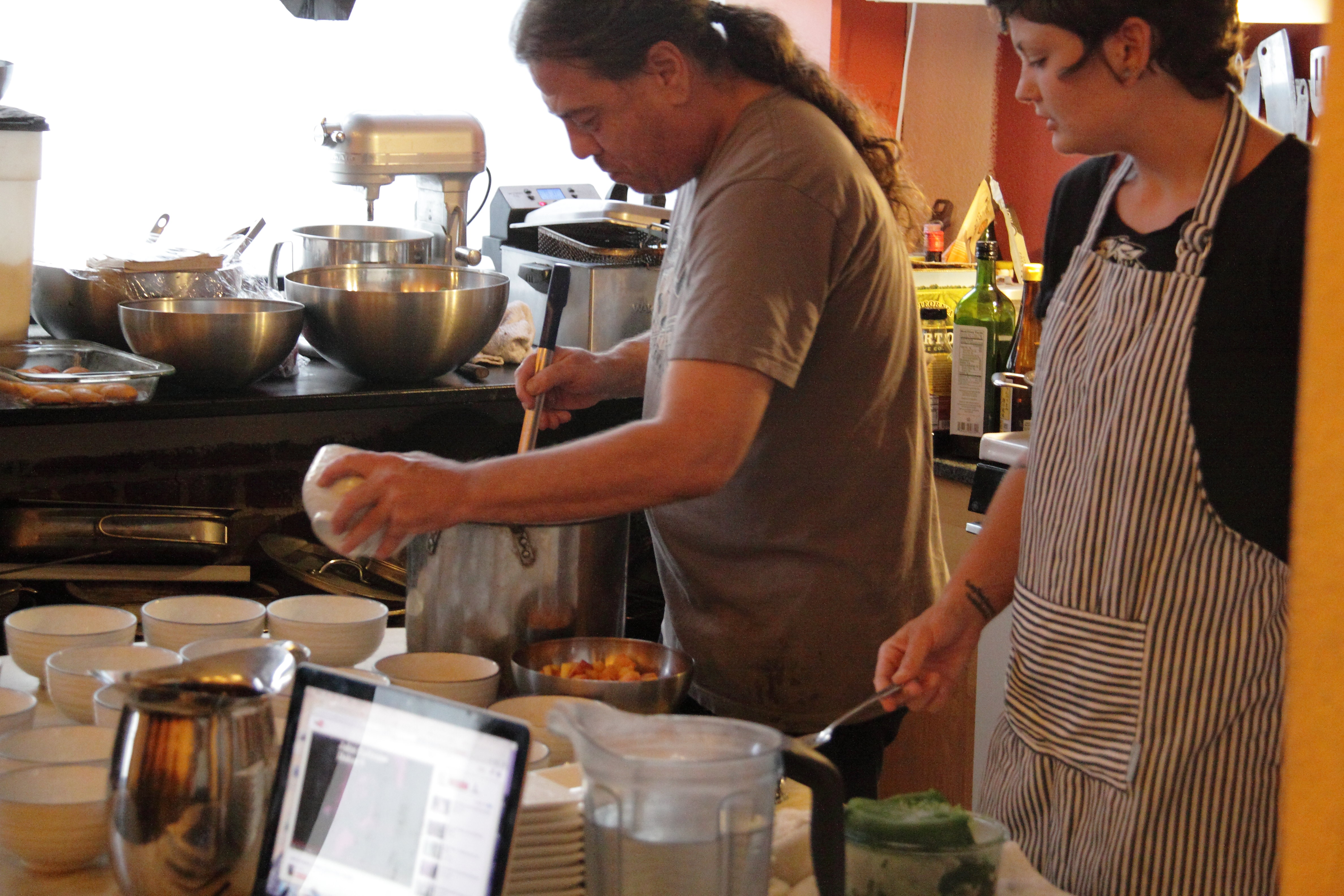
Phil and sous chef Cori preparing the evening’s feast.

The 20 seats were sold out for the annual Masumoto Peach dinner.  At the peak of the harvest each year Phil has put together multiple course dinners featuring locally grown organic peaches from the now four generation Masumoto family orchard near Fresno .  In fact a recent film (information on the Masumoto page linked above) has been made about them called, “Changing Seasons” and one of the filmmakers was in attendance.  There was a short discussion with Q and A at one point.

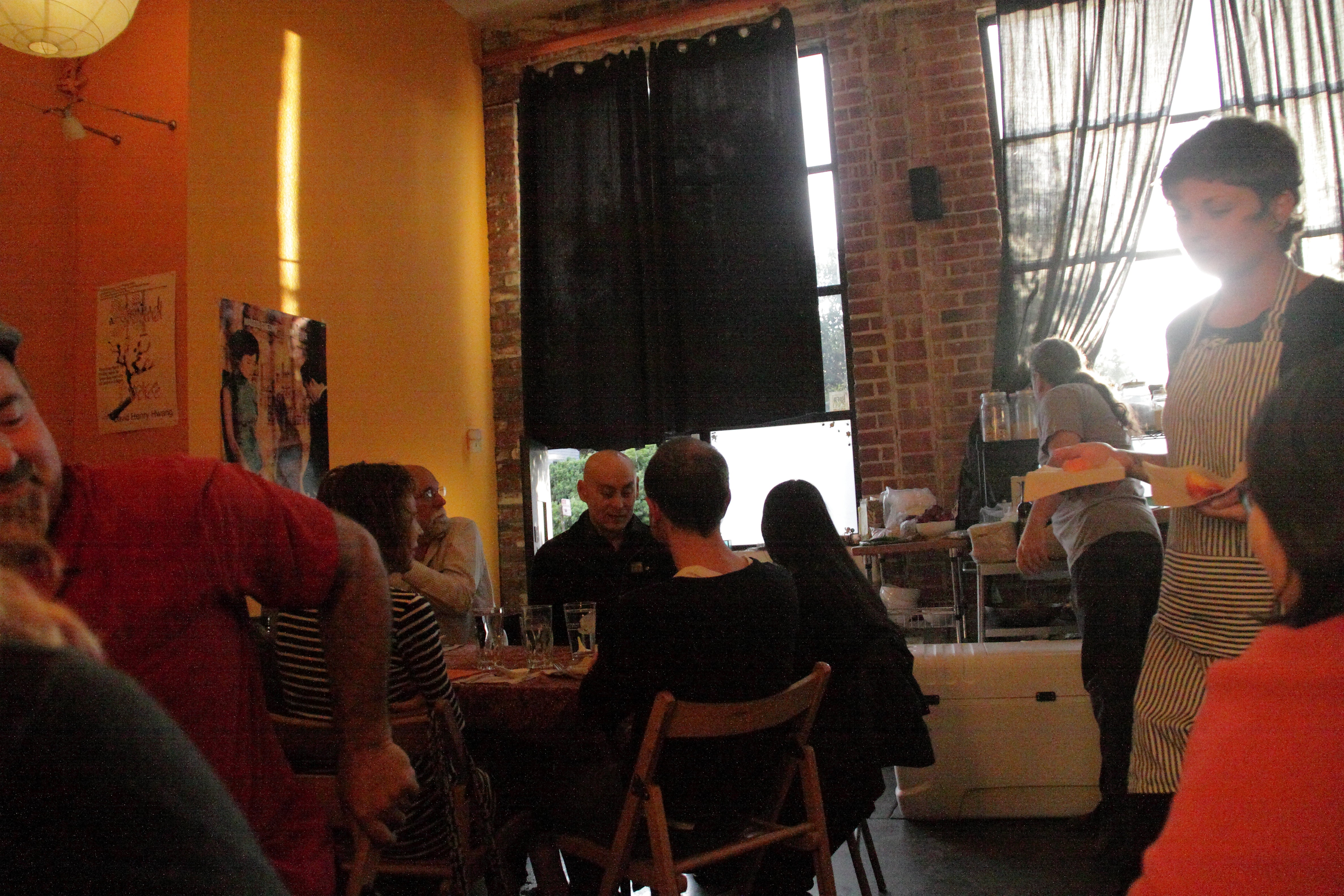
Happy diners anticipating the next course.

Happy diners anticipating the next course.

No music this night but wonderful food and friendly conversations filled the evening.  The meal began with, of course, a taste of the actual peaches.

sous chef Cori serving the peach halves that began the dinner.

sous chef Cori serving the peach halves that began the dinner.

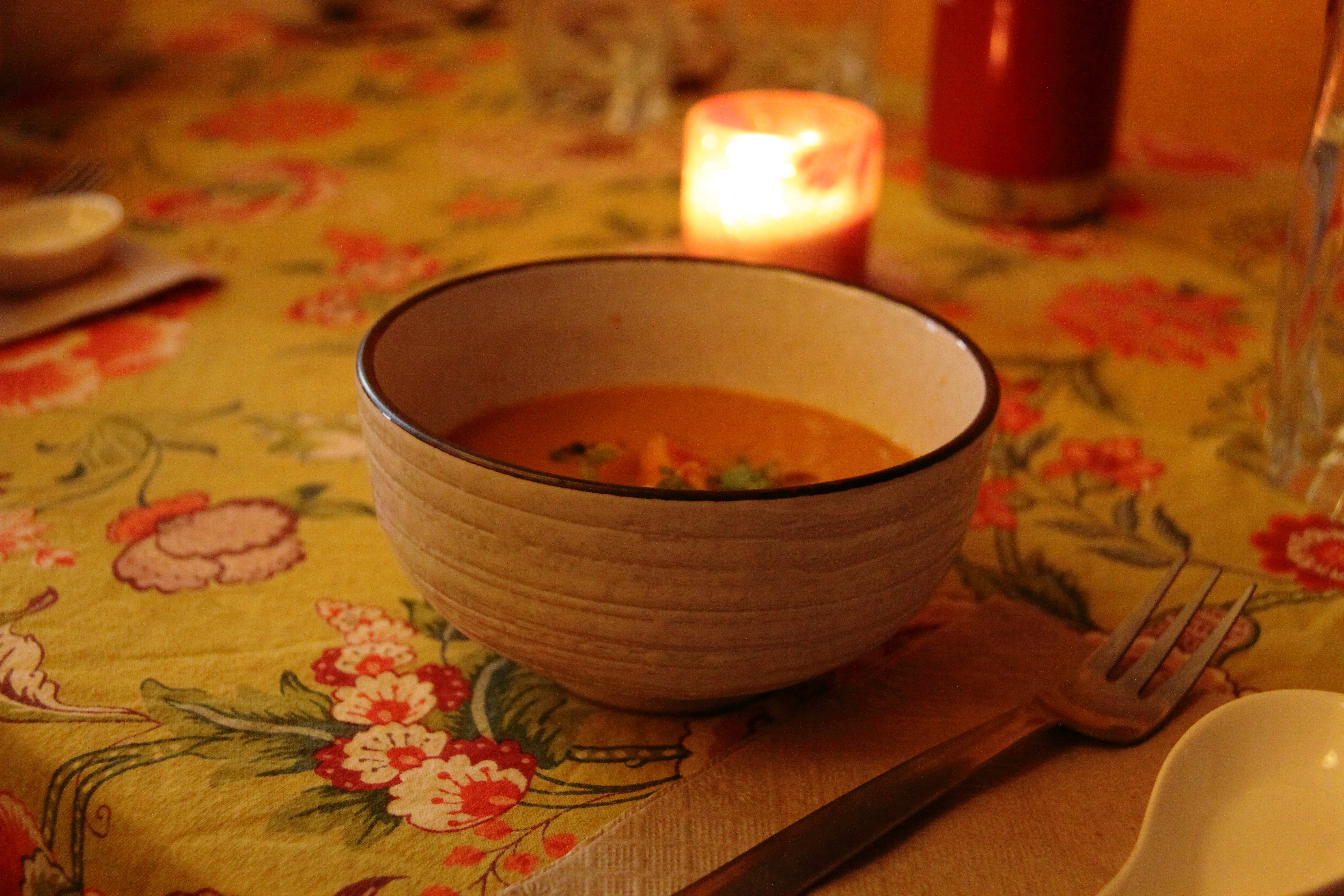
The next course, a peach tomato gazpacho.

phil1014

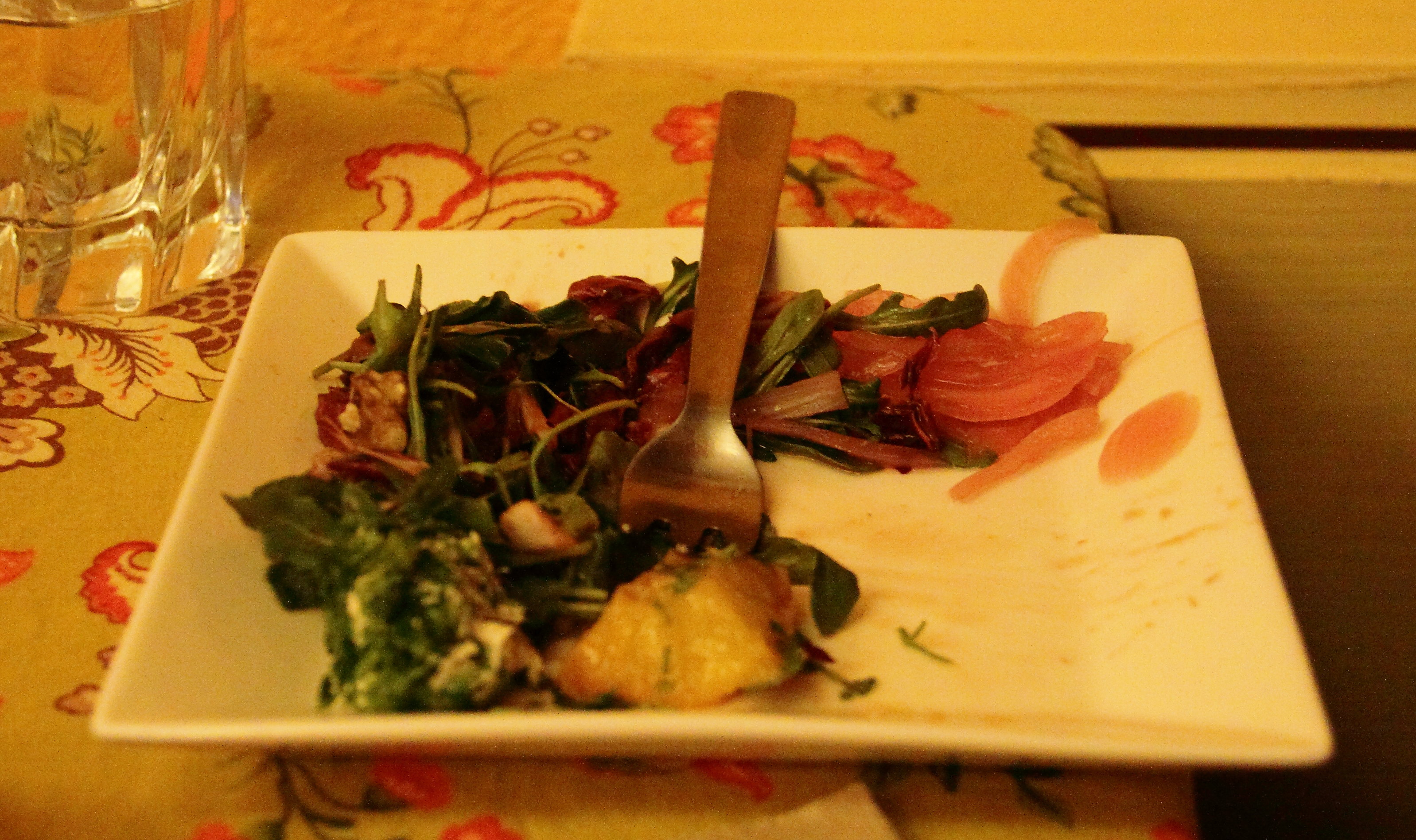
Followed by a grilled peach salad with cashew cheese balls, arugula radicchio,, pickled red onions, and a cherry balsamic dressing.

phil1016

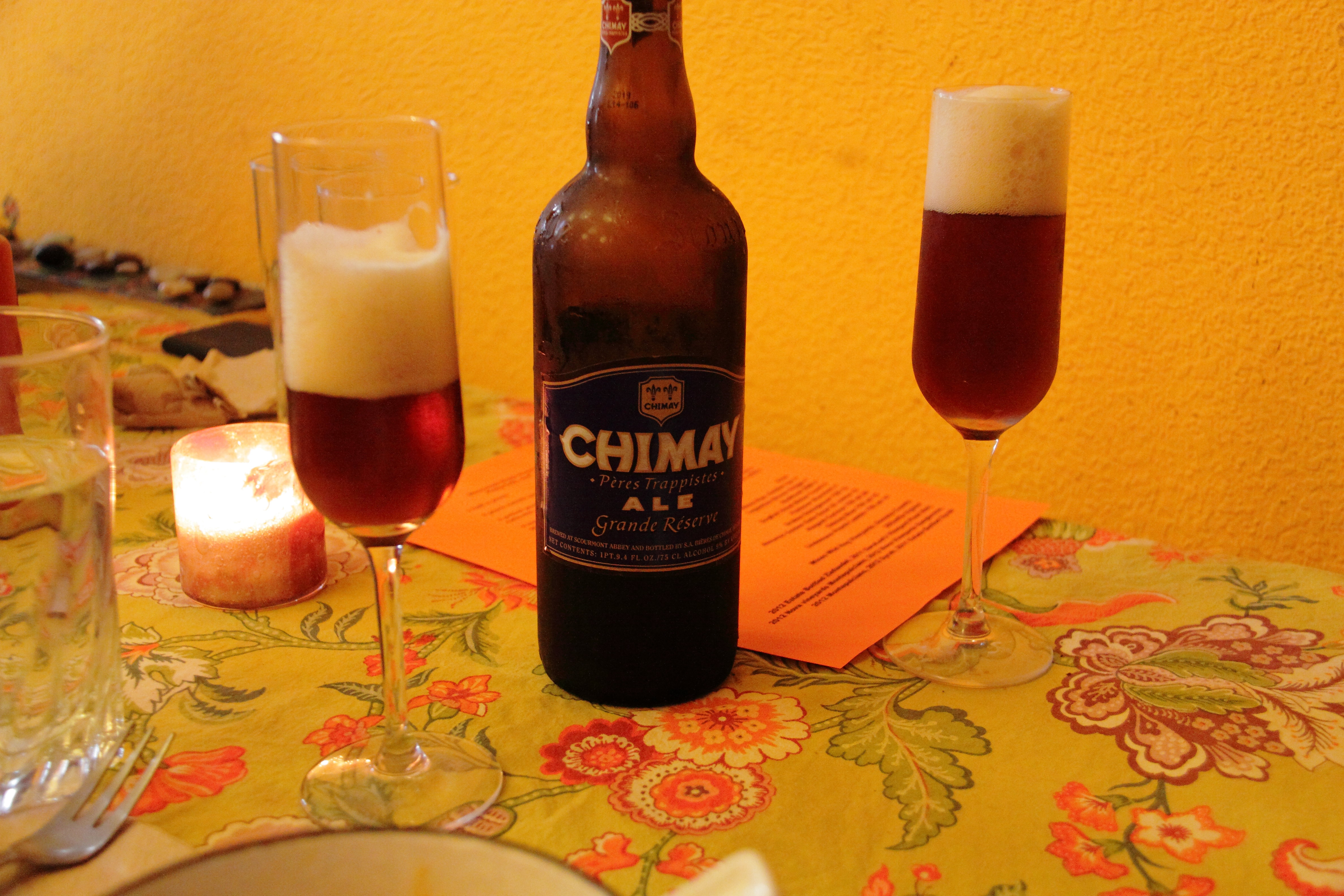
Oh, yes, a nice Chimay to quench the thirst.

phil1015

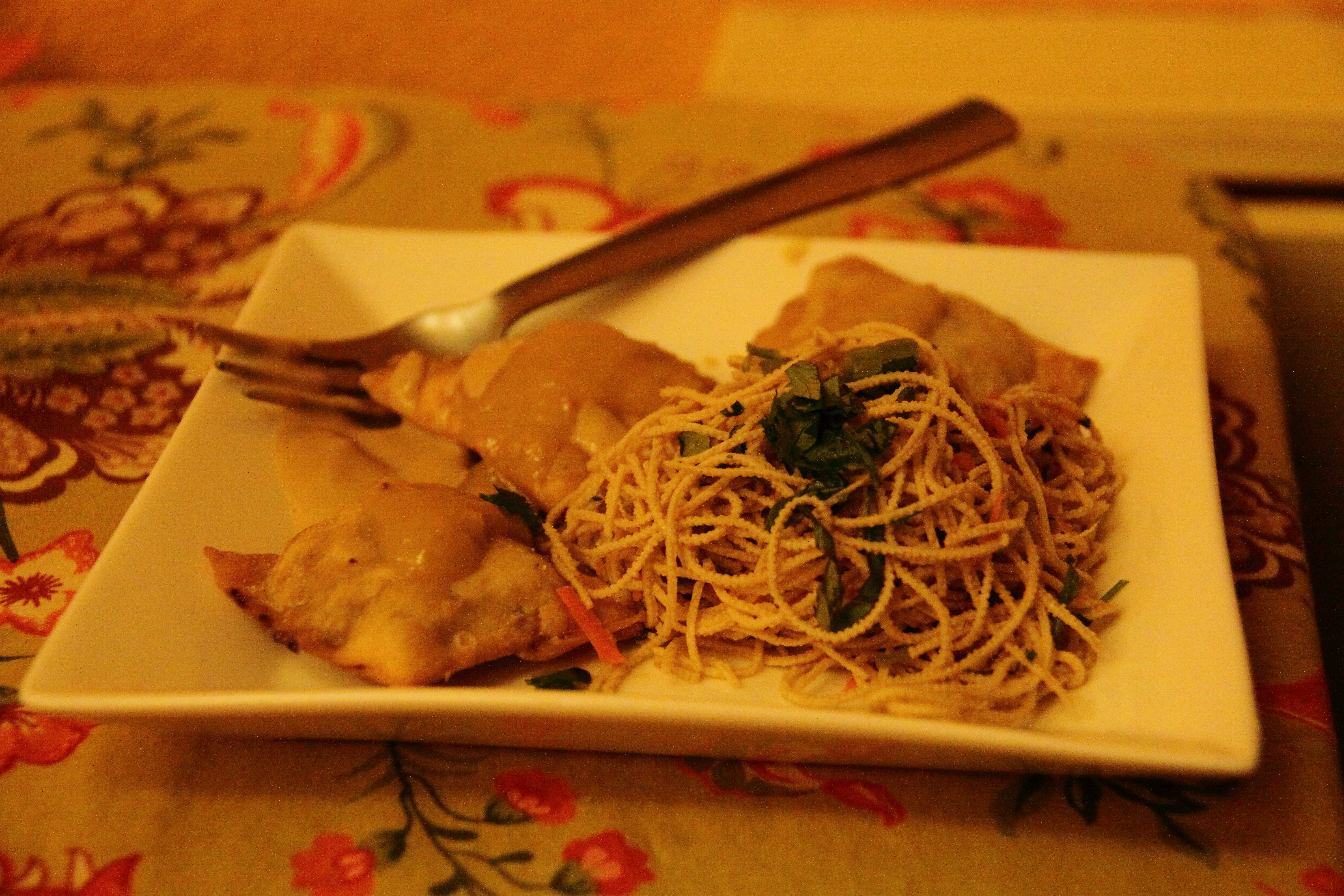
And then tempeh char siu wontons (from the local Rhizocali Tempeh), flat tofu noodles, a really great hot peach mustard and peach sweet and sour sauce.

phil1018

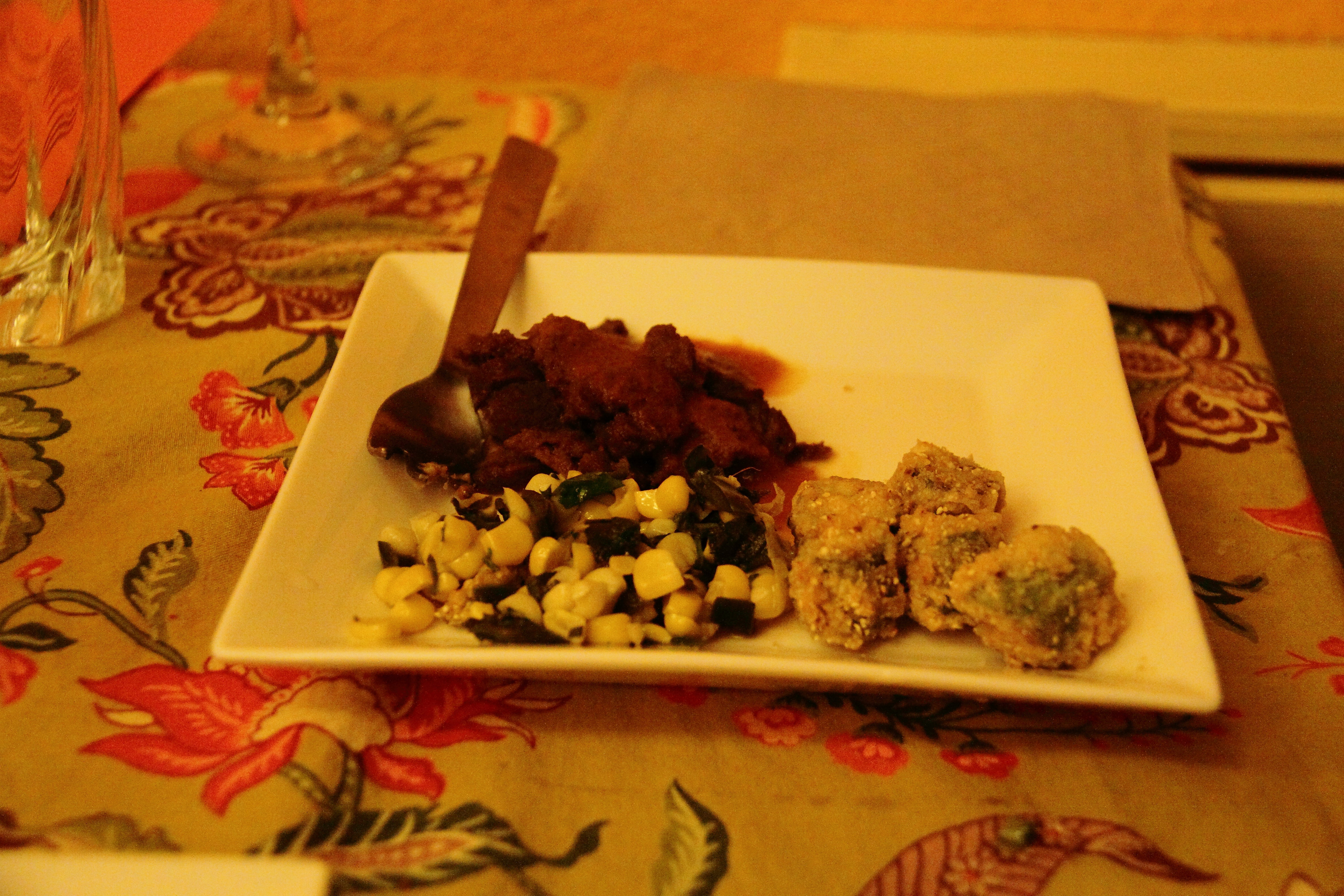
The main course: peach grilled seitan, peach barbecue sauce, roasted corn and peppers, and some crunchy fried okra.

phil1020

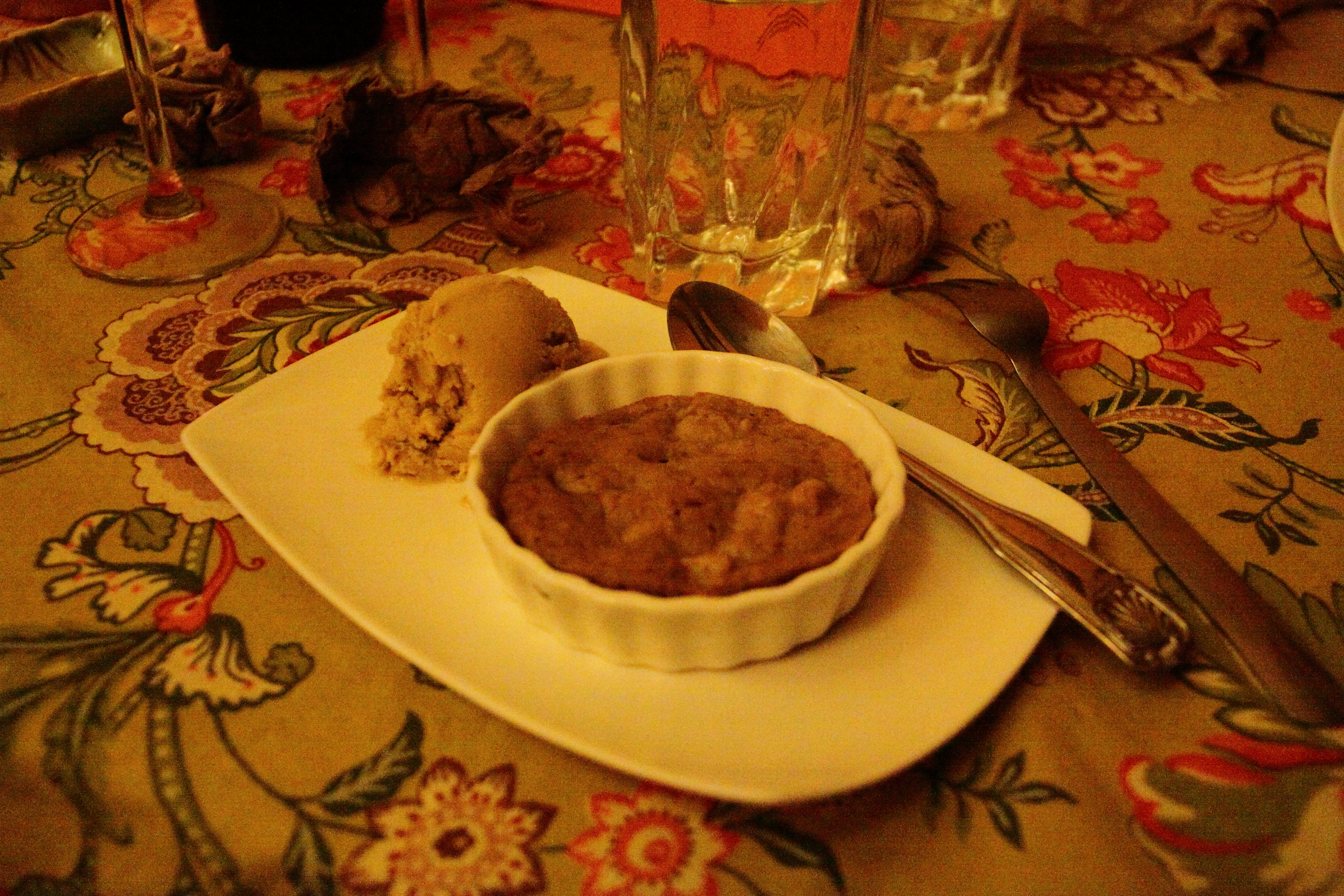
And, for dessert, peach rosewater cake with peach walnut sorbet.  As is his custom Phil went around offering more of that sorbet which most folks, present writer  included, availed themselves.

phil1021

This was a thoroughly enjoyable evening.

But, as I said, this tradition is coming to an end.  Not to fear, however.  Phil is in the process of writing a cookbook sharing the secrets of his culinary mastery and the book will also document some of the many musicians whose talents graced many an evening here.

La Donna Smith and India Cooke playing an improvised duet.

La Donna Smith and India Cooke playing an improvised duet.

Bassists Mark Dresser and Barre Phillips play together for the first time at In the Mood for Food.

Bassists Mark Dresser and Barre Phillips play together for the first time at In the Mood for Food.

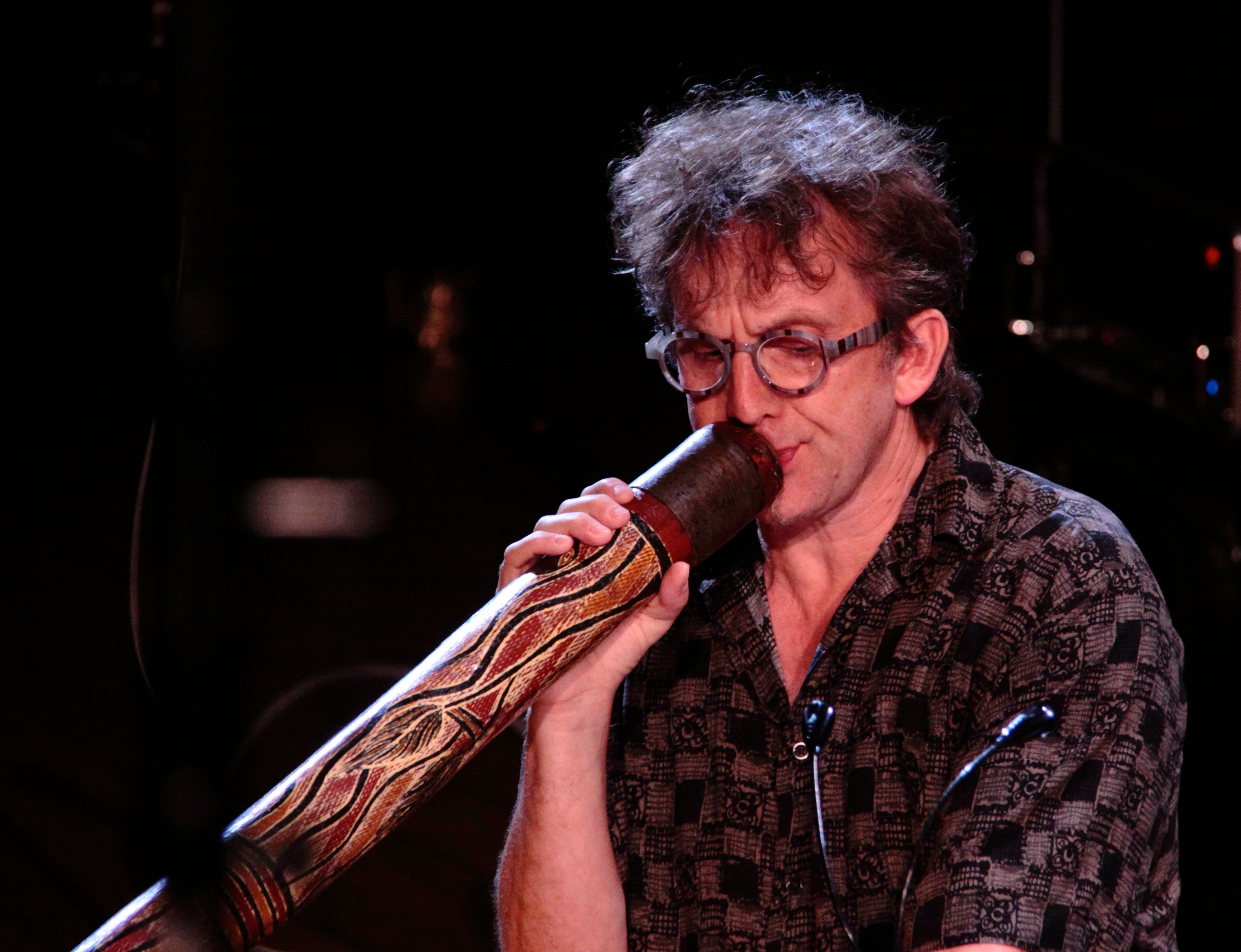
The amazing Stuart Dempster at Phil's loft a few years ago.

The amazing Stuart Dempster at Phil’s loft a few years ago.

Gyan Riley, Terry Riley and Loren Rush attending the dinner/concert which featured Stuart Dempster.

Gyan Riley, Terry Riley and Loren Rush attending the dinner/concert which featured Stuart Dempster.

Pauline Oliveros and her partner Ione performing at a recent dinner.

Pauline Oliveros and her partner Ione performing at a recent dinner.

So this little sampling of photos provides some idea of the scope and significance of this series.  Happily it is being documented in a book for which an Indiegogo campaign is presently in process.  You can donate and receive any or many of a variety of perks ranging from a copy of the book for $40 and perks including an invitation to celebratory dinners planned in both New York and Oakland.  My copy and my dinner invite are reserved.

There are 34 days left in the campaign at the time of this writing and the project is now at 106% of its funding goal.  This is a piece of Bay Area music and culinary history that will please music enthusiasts and those who appreciate creative vegan cuisine.

Here is a list of musicians taken from the campaign site to give you an idea of the scope of the series:

Tim Berne – alto saxophone (Brooklyn)

Shay Black – voice, guitar (Berkeley via Ireland)

Cornelius Boots shakuhachi/bass clarinet

Monique Buzzarte – trombone, electronics (NYC)

Chris Caswell (2) – harp (Berkeley)

Stuart Dempster – trombone (Seattle)

Robert Dick (flute) NYC

Mark Dresser (2) – bass (Los Angeles)

Mark Dresser/Jen Shyu duet – bass, voice/dance

Sinan Erdemsel – oud (Istanbul)

Sinan Erdemsel/ Sami Shumay duet – oud, violin

Gianni Gebbia – saxophones (Palermo, Italy)

Vinny Golia- winds (Los Angeles)

Lori Goldston – cello (Seattle)

Frank Gratkowski (2) – clarinets, alto sax (Berlin)

Daniel Hoffman/Jeanette Lewicki duet violin, voice/accordion (Berkeley, Tel Aviv)

Shoko Hikage – koto (Japan-San Francisco)

Yang Jing – pipa (Beijing)

Kaoru Kakizakai (4) – shakuhachi (Tokyo)

Marco Lienhard shakuhachi (Zurich-NYC)

Mari Kimura – violin, electronics (Tokyo-NYC)

Yoshio Kurahashi (5) – shakuhachi (Kyoto)

Joelle Leandre – contrabass (Paris)

Oliver Lake – alto sax (NYC)

Riley Lee (2) shakuhachi (Australia)

Jie Ma – pipa (China, LA)

Thollem Mcdonas Jon Raskin duet piano/sax (wanderer/Berkeley)

Roscoe Mitchell – alto, soprano saxophones (Oakland)

David Murray – tenor sax (Paris)

Michael Manring (5) – electric bass (Oakland)

Hafez Modirzadeh – winds (San Jose)

John Kaizan Neptune – shakuhachi (Japan)

Rich O’Donnell – percussion (St. Louis)

Pauline Oliveros (2) – accordion (NY)

Tim Perkis/John Bischoff duet computers (Berkeley)

Barre Phillips solo and duet with Mark Dresser – contrabass (France)

Alcvin Ramos shakuhachi (Vancouver)

Tim Rayborn/Annette duet oud, strings, recorders (Berkeley/Germany)

Jon Raskin/Liz Albee duet sax/trumpet (Berkeley/Berlin)

Jane Rigler – flute (Colorado)

Gyan Riley (5) – guitar (NYC)

Terry Riley (2) – voice, harmonium (universe)

Diana Rowan (2) – harp (Berkeley/Ireland)

Bon Singer/Shira Kammen duet (voice, violin) (Berkeley)

LaDonna Smith/India Cooke duet (2) violin, viola (Birmingham, AL, Oakland)

Lily Storm/Diana Rowan – voice, harp (Oakland/Ireland)

Lily Storm/Dan Cantrell (2) – voice/accordion (Oakland)

Howard Wiley – tenor Saxophone solo and duet with Faye Carol voice

Theresa Wong/ Ellen Fullman duet

Amy X (3) – voice, electronics (Oakland)

Pamela Z – voice, electronics (San Francisco)

A Glorious Other Minds 20th Anniversary


The 20th Other Minds festival completed its three concert run on March 6, 7 and 8 of 2015.  This was the first time in which composers who had appeared before came for a second time.  Ten composers were featured and a total of some 25 or so works were performed.  It also marked the first time that a full symphony orchestra was featured.

Ruth Asawa San Francisco School of the Arts Orchestra just fitting on the stage at SF Jazz

Ruth Asawa San Francisco School of the Arts Orchestra just fitting on the stage at SF Jazz

The first night opened with the wonderful guitarist David Tanenbaum performing music by the late Peter Sculthorpe who was to have attended this festival.  Sculthorpe sadly passed away in August of 2014.  Tanenbaum played his “From Kakadu” (1993) a suite for guitar in four movements.  This was moving and quite virtuosic music which was performed with passion and ease.

Lou Harrison (1917-2003)

Lou Harrison (1917-2003)

Tanenbaum followed Sculthorpe’s piece with the last composition by the beloved Lou Harrison called Scenes fromNek Chand (2001-2) played on a National Steel Guitar in just intonation.  As with the Sculthorpe, Tanenbaum displayed his well-known facility in interpretation of new music and left the appreciative audience wanting more.

David Tanenbaum holding his National Steel Guitar as he acknowledges the warm applause

David Tanenbaum holding his National Steel Guitar as he acknowledges the warm applause

Next up was a too rare opportunity to hear a composition by Other Minds Artistic Director Charles Amirkhanian.  Bay area violinist Kate Stenberg took the stage to perform the solo violin part with prerecorded tape.  The piece called Rippling the Lamp (2007) is a musical depiction of a visual the composer saw involving the reflection of a lamp in water.  But regardless of the genesis this was a powerful and engaging piece even on a purely musical level.  Stenberg executed her part flawlessly in what was an almost romantic piece at times.

Kate Stenberg playing Amirkhanian's Rippling the Lamp.

Kate Stenberg playing Amirkhanian’s Rippling the Lamp.

Charles Amirkhanian warmly embraces Kate Stenberg following her performance of his piece.

Charles Amirkhanian warmly embraces Kate Stenberg following her performance of his piece.

And the first half concluded with a performance by the Del Sol Quartet of the world premiere of Miya Masaoka‘s Second String Quartet “Tilt” (2014-5).  This was a complex piece requiring a great deal of knowledge of special performance techniques that would be a challenge for any string quartet.  This complex work was difficult to grasp in only one hearing but it was a joy to see how easily these musicians handled the work.

The Del Sol Quartet performing Miya Masaoka's Second String Quartet

The Del Sol Quartet performing Miya Masaoka’s Second String Quartet

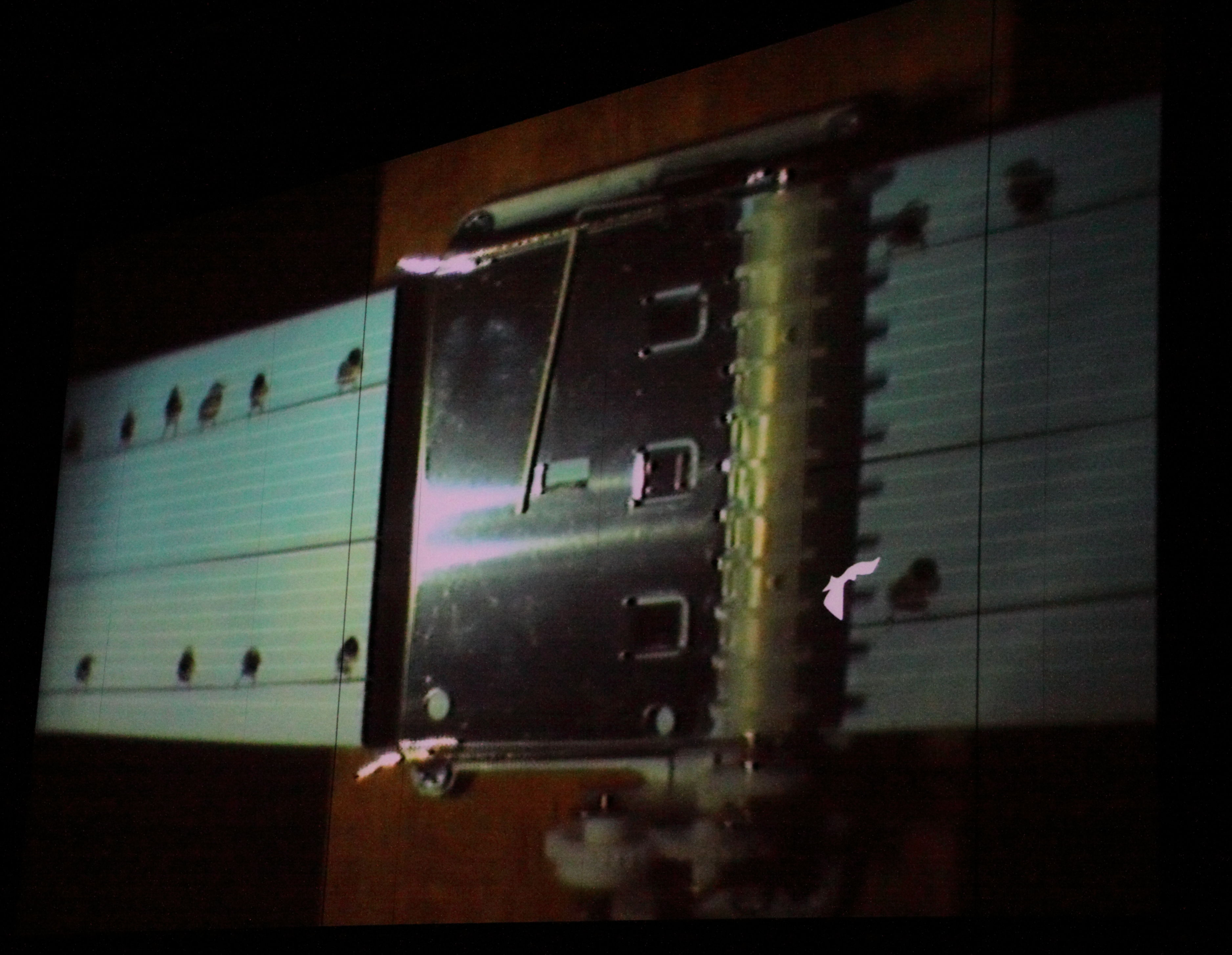
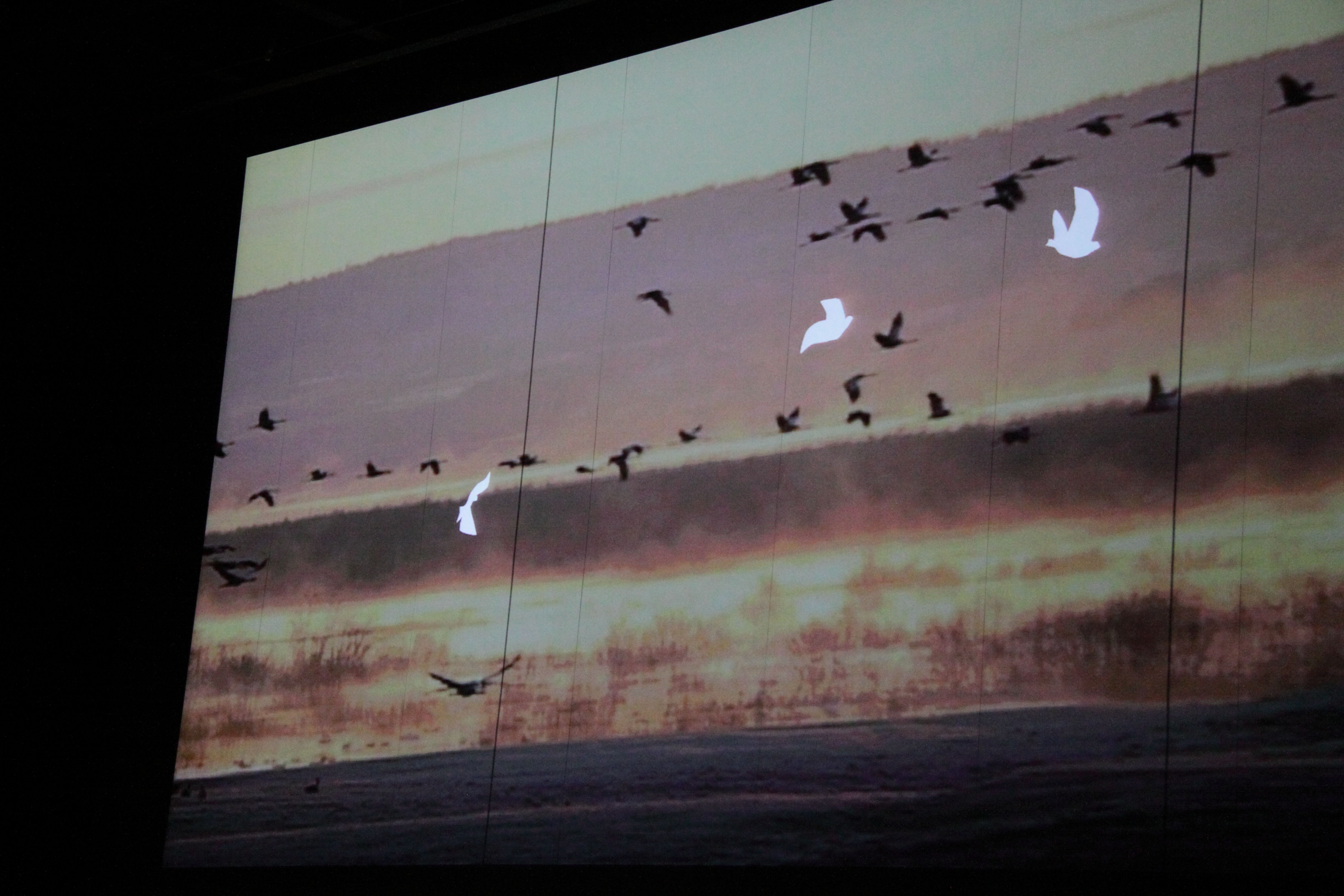
Following intermission we came to know what the origami birds were all about.  These along with video projections and a great deal of electronics came together to give utterance to Maja S.K. Ratkje’s Birds and Traces II (2015), another world premiere.  This was by far one of the most complex pieces involving a great deal of media as well as performers Kathy Hinde and accordionist Frode Haltli.  In addition to electronics and voice the musicians used bird whistles, computer controlled slide whistles and animated sculpture along with the projected videos.  This was more of the character of one of Allan Kaprow‘s “happenings” from the 1960s.  Truly a maverick piece in a concert series that prides itself on such.  The audience was clearly entertained.

Maja S.K. Ratkje, voice and electronics

Maja S.K. Ratkje, voice and electronics

OM200018 OM200019

Three scenes from the video

Three scenes from the video

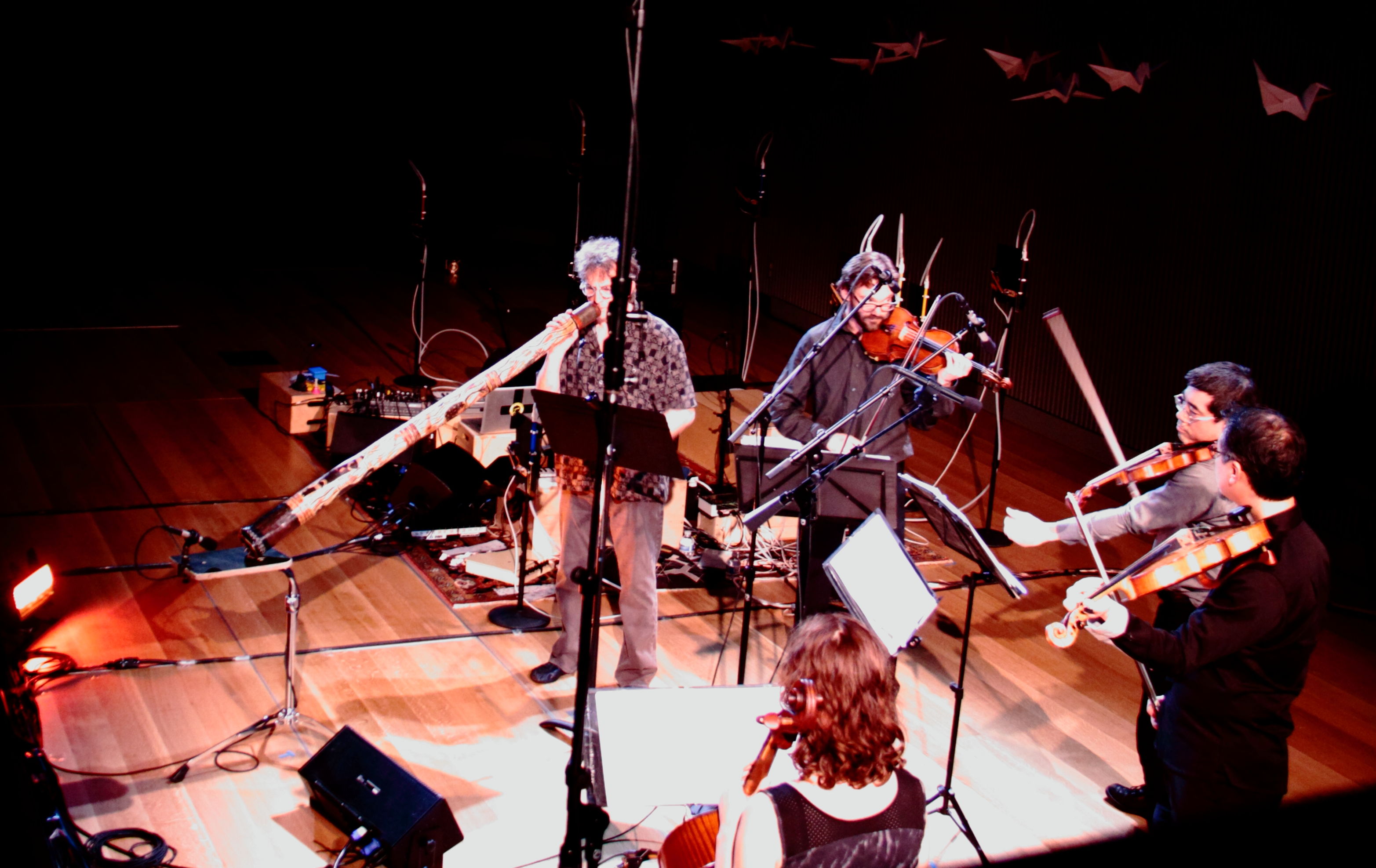
The first night concluded with a performance of Peter Sculthorpe’s String Quartet No. 14 “Quamby”(1998) which includes a didjeridu.  Stephen Kent, who played the didjeridu, spoke a warm dedication in memory of the late composer.  The Del Sol Quartet along with Kent gave a deeply emotional reading of this beautiful work (I went a bought a copy of their recording of all of the composer’s string quartets with didjeridu right after this performance).  I had heard that uniquely Australian instrument before but had no idea how expressive it could be.  The audience was clearly moved and this was a fitting deeply felt tribute to the composer.

OM200023

The Del Sol String Quartet with Stephen Kent on didjeridu

The Del Sol String Quartet with Stephen Kent on didjeridu

I took the opportunity to speak to a few people after this performance and it confirmed for me that this performance affected and moved us all in what I think is the highest achievement of a composer and a performer, that of communicating emotionally with a audience.  We all seemed to share the sadness of Mr. Sculthorpe’s passing but also the joy of his having been with us to make this music which lives on.

Peter Sculthorpe (1929-2014)

Peter Sculthorpe (1929-2014)

Those animated origami sculptures remained (though no longer animated) just above the stage for the remaining two nights and certainly added a bit of unusual flair which distinguished the look of this year’s series.  It is also worth mentioning that the stage management and creative lighting add to the professional and polished look for this series and those commonly unsung heroes deserve credit for their fine work.

Let me also mention that this year’s program booklet surveying the whole of the Other Minds series was chock full of beautiful by resident photographer extraordinaire John Fago.


The second concert opened with what was, for this writer, worth the price of admission, that of Charles Amirkhanian performing his sound poetry live with multi-track tape.  His roles as sort of the Bill Graham of the avant-garde and his previous work as music director at KPFA could satisfy a life’s work just by themselves but he is also an accomplished composer and one of the most interesting and innovative sound poets/artists of the late 20th and early 21st centuries.  So this live performance would have brought me to the theater were it the only thing on the program.

Charles Amirkhanian performing his sound poetry live with tape.

Charles Amirkhanian performing his sound poetry live with tape.

The pieces performed, Dumbek Bookache (1986), Ka Himeni Hehena (The Raving Mad Hymn, 1997) and Marathon (1997) all demonstrate the composer’s love of language and sound and, as Mr. Amirkhanian advised, his background as a percussionist.  This is music that seems to fit somewhere between poetry and music and, prior to hearing his work, I didn’t even know that there was a such a space.  His mellifluous voice, no doubt seasoned by years of hosting radio, executed the complex rhythms in sync with the tape flawlessly, just as the composer intended.

There is a humor and playfulness that is engaging as he deconstructs and reconstructs words and sounds (Amirkhanian is possessed of a great sense of humor).  The first and last pieces were plays on English language words and sounds.  The middle piece utilizes Hawaiian native language as its material.  All reflect the composer’s deep understanding and love of the sounds of languages and are intricately constructed musical compositions that deserve to be heard more frequently.  And recorded too.

Wallen performing her birthday song with the captive host of the evening looking on amused.

Wallen performing her birthday song with the captive host of the evening looking on amused.

Next we met Errollyn Wallen who performed 7 songs from her Errollyn Wallen Songbook but before she did that she surprised Mr. Amirkhanian with a newly composed song for his 70th birthday and for Other Minds 20th.  He sat, captive but appreciative as she rolled out the surreptitiously rehearsed dittie in which she called him “Charlesey” in a clearly affectionate tribute.

Errollyn Wallen at the piano with the Del Sol String Quartet.

Errollyn Wallen at the piano with the Del Sol String Quartet.

Wallen, in her set, sang first at the piano, then standing at a stage mic accompanied by the ever versatile Del Sol Quartet.  She sings a difficult to describe type of song that owes as much to jazz and pop and it does to classical and seems to have as much fun with language in song and Amirkhanian has with spoken words.  Wallen is a skilled and virtuosic performer and, as I found later when I chatted with her in the lobby during intermission, a delightful conversationalist.  Her performance left the audience wanting more but it was time for intermission and, after a grateful bow, she exited the stage.

This is the first time that this writer had heard her work and I can tell you that its friendly melodies and rhythms combined with her facility with lyrics make for a really compelling experience.

Pauline Oliveros, Miya Masaoka and Frode Haltli performing Oliveros' Twins Peeking at Koto (2014)

Pauline Oliveros, Miya Masaoka and Frode Haltli performing Oliveros’ Twins Peeking at Koto (2014)

After intermission we were treated to another world premiere from the great Pauline Oliveros.  Pauline, a beloved teacher and performer in the bay area, is based now in Kingston, New York but, as she acknowledges, she maintains ties with the bay area through performances, teaching, composing and now apparently through leaving her archive to Mills College where she was one of the founders of the Mills Tape Music Center (now the Mills Center for Contemporary Music).  Mr. Amirkhanian referred to her as the “Dean of American Composers”, a title once given to Aaron Copland, but equally suitable for this major composer/theorist/teacher/performer whose very presence adds to the auspicious nature of this series of concerts.

Her score is a written set of instructions for a sort of controlled improvisation that is common in her output.  Pauline’s warm personality and sense of humor are a part of this work which references the San Francisco landmark Twin Peaks and punningly refers to twin accordions as they peek at the koto which was played by Miya Masaoka.  Frode Haltli, who had performed yesterday did double duty as the second accordion in this work which requires, as does most of Oliveros’ work, close listening by performers as they execute the instructions creating the piece.  The most important lesson Oliveros has taught is the active nature of listening and that includes the performers as well as the audience because listening is itself a creative act.  And all who participated in active listening as the performers clearly did came to experience her wonderful view of the world of sound.

OM202024 OM202026 OM202027

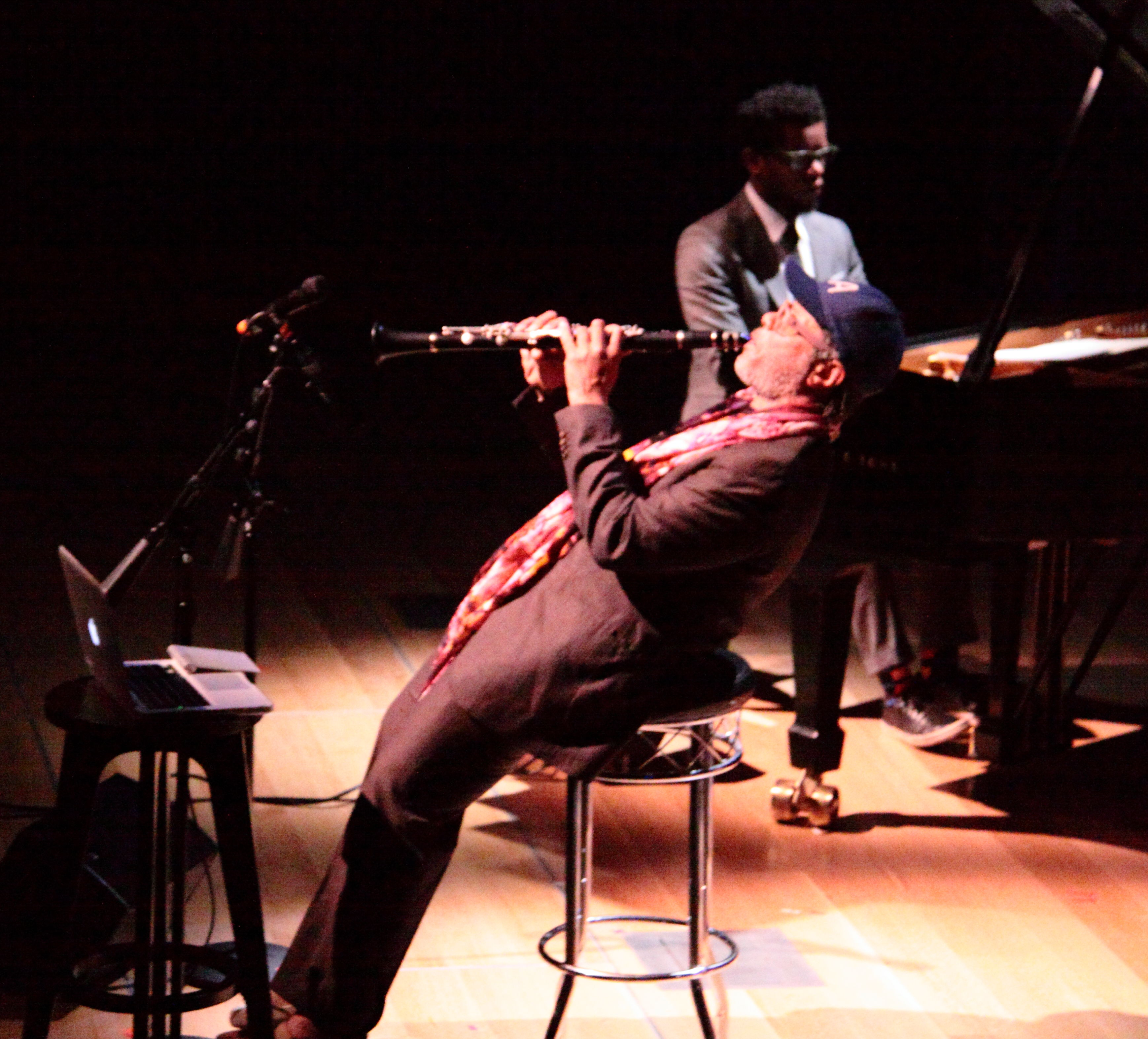
Four views of Don Byron and his quartet.

Four views of Don Byron and his quartet.

Don Byron, backed by veterans double bassist Cameron Brown and drummer John Betsch along with a young and interesting Cuban pianist, Aruán Ortiz.  In addition to some amazing work on clarinet (playing sometimes inside the piano) the peripatetic Byron crooned a cover of a blues song in his unique vocal style announcing the disclaimer  that it was a “cover and this was supposed to be all new music but what the hell”.  Byron’s good humor, stage presence and eclecticism was supported well by his quartet who were given some nice opportunities to show off their chops.  A very satisfying set leaving the audience and this writer once again aching for more.

Tigran Mansurian singing an Armenian tune and accompanying himself at the piano.

Tigran Mansurian singing an Armenian tune and accompanying himself at the piano.

The last concert of OM 20 took place uncharacteristically in a matinee performance at 4PM.  This concert, also uncharacteristically, was given a political theme.  Sunday’s concert was dedicated in memory of the victims of the Armenian genocide which took place 100 years ago at the hands of the Ottoman Turks, a fact recognized by most countries but not, unfortunately, by the Turkish government.

This last concert occurred on what would have been the 104th birthday of famed Armenian-American composer Alan Hovhaness and this was acknowledged as well.  In the pre-concert discussion we learned that Mr. Mansurian had met Mr. Hovhaness and very much liked his music.  Then, in what I learned was a spontaneous decision, Charles Amirkhanian asked Mr. Mansurian to play some music by Komitas, an Armenian composer who collected Armenian folk songs and wrote music based on those distinctive tunes.  Komitas stopped composing after the 1915 genocide as he saw these atrocities and had much of his research destroyed.  Tigran Mansurian seemed almost to jump at the opportunity and he immediately went to the piano and gave a very focused rendition of one of his favorite tunes.

Charles Amirkhanian giving the background for his tape composition Miatsoom.

Charles Amirkhanian giving the background for his tape composition Miatsoom.

Opening Sunday afternoon’s concert was another opportunity to hear one Mr. Amirkhanian’s major musical creations.  This one, Miatsoom (1994-7), a word meaning, appropriately for this year’s festival, Reunion was, he said, about the only trip he ever took to Armenia accompanied by his father (born in 1915) to visit relatives in that country.  The piece is a sonic travelogue about that trip.  It features the voice of the composer’s father Benjamin and various sounds and voices from that visit.  Clearly this trip and this piece are very personal and cherished  things close to the composer’s heart.  Bringing the sounds of Armenia and its people into the concert space seemed like a wonderful way to set the tone for this concert as both celebration and memorial.  And isn’t the key to a memorial the act of memory, of remembering?

SOTA orchestral string with piano to accompany soprano Hasmik Papian in Mansurian's Canti Paralleli.

SOTA orchestral string with piano to accompany soprano Hasmik Papian in Mansurian’s Canti Paralleli.

The Canti Paralleli (2007-8) by Tigran Mansurian were written in memory of his late wife who by coincidence had also been one of the soprano soloist’s teachers.  These settings of Armenian poetry were lovingly delivered by Ms. Papian.  Her beautiful voice filled the hall with what seemed to be an air of sadness.  The SOTA orchestra with a pretty accomplished young pianist rendered these somber tunes poignantly in this U.S. premiere.

OM203021

The triumphant soloist and conductor accept the gratitude of the audience, the producers and the composer.

The triumphant soloist and conductor accept the gratitude of the audience, the producers and the composer.

Following intermission we were treated to an even more recent work by Mr. Mansurian, the 2011 Romance for Violin and Strings, also in a U.S. premiere.  The violin was played with both passion and virtuosity by the Armenian-American violinist Movses Pogossian.  The orchestra seemed to rally behind him nicely accompanying him in what was a beautiful, almost romantic piece that would no doubt please any concert audience.

OM203026

Movses Pogossian with the SOTA orchestra conducted by Bradley Hogarth.

Movses Pogossian with the SOTA orchestra conducted by Bradley Hogarth.

I haven’t yet mentioned our young conductor for this evening.  Bradley Hogarth is a trumpet player and an accomplished conductor who leads this wonderful youth orchestra.  Their ability to fit on stage in the final work requiring some 60 musicians was in doubt but fit they did.  And their performance of Michael Nyman’s Second Symphony (2014), another U.S. premiere was nothing short of amazing.


Mr. Nyman, who was unfortunately unable to attend due to illness, began writing symphonies in 2014 and has of the time of this writing written no fewer than 11 such works.  This second symphony was written for a youth orchestra in Mexico where it received its world premiere.  The four movement work traverses familiar territory with Nyman’s characteristic driving rhythms.  It is hard to imagine that he actually had a youth orchestra in mind because this work for strings, woodwinds, brass, piano, percussion and harp was anything but simple or easy to play.  Nonetheless the orchestra under Hogarth’s direction discharged their duties in an electrifying performance that brought the audience to its feet with appreciation.

All in all a very successful and satisfying set of concerts, a successful 20th anniversary.  Time to look forward to OM 21.  It would be hard to top this but I am sure that Other Minds will give its all to do so.  Thanks to all who composed, performed, supported and attended.  And, yes, that’s me sporting the OM 20 t-shirt with Mr. Amirkhanian.  See you next year if not sooner.

New music buff gets a photo-op with Charles Amirkhanian.

New music buff gets a photo-op with Charles Amirkhanian.

Blackness, Race and Music, What I Have Learned So Far


Two years ago, when I was just at the start of my blogging adventures, I decided it would be a good idea to do a few articles in honor of Black History Month. I am not black and I have no expertise in the area of black music but, in keeping with the personal perspective of this blog, I decided that my interest in these subjects is sufficient reason to express some opinions and ideas.  I chose Carl van Vechten’s portrait of William Grant Still, considered by many to the first major black composer to receive recognition in the 20th Century as my symbol for this article.  Much of his music remains unknown and little performed though there have been some significant recordings released in the last few years.

I called that first set of articles “Black Classical”. Curiously my brief article on black conductors has been one of my most read pieces (947  views as of the time I write these words).   So I continued to write on this subject in the following year. For my second set of articles I took the opportunity to look at the 50 year anniversary of the Civil Rights Act of 1964, by all measures a landmark piece of legislation. I asked a question, in part rhetorical because I had a basic idea of the answers I expected, but also to elicit opinions and to discuss issues of race and music.

I sent queries to a random set of composers and conductors and received a few very gracious replies. Comments ranged from carefully worded egalitarian musings on how black music and music by other racial minorities should be integrated and heard throughout the concert seasons to seemingly careful statements suggesting that this might not even be the right question or that it shouldn’t be asked. Not all comments were published but I am grateful to all who replied. And I have been able to continue this discussion in the various groups on Facebook.

I learned in a (yet to be published) interview with Anthony Davis some fascinating perspectives. Professor Davis did not address my question as I originally asked but he provided some valuable food for thought. It is worth noting that Davis is a composer whose politics are frequently very much in evidence in his music. In a discussion of the current state of music he commented regarding John Cage‘s apolitical stance by saying that, “John Cage’s silence is the silence of white privilege.” One could argue that taking an apolitical stance may have contributed to Cage’s ability to get grants and commissions.  Politically charged music generally does not fare as well.

In general I found more or less what I expected. The Civil Rights Act of 1964 has had little, if any, benefit for black musicians and composers. And given the ongoing killing of unarmed black men by police one must wonder if we have been going backwards as a society. But I don’t want to do a grand social critique here. That is a subject for another blog and is a bit outside of my scope at least for now.

I found some musicians who did not want to address racial and discriminatory issues. It seems the issue is too “hot” and that one could face consequences for even asking the question. And some did not feel sufficiently well-versed in Civil Rights history to make a truly informed assessment of this issues.  Perhaps it is a form of white privilege that allows me to ask such a question. We shall see if any reactions result in verbal attacks or (not likely I think) in a reduction in my readership.

What I have learned is that black classical musicians (who are not in short supply) occupy very few prominent positions in academia, in the public sphere of conductors and performers and in the representation in recorded performances of what is a rich but virtually untapped repertoire.  The inequality remains with perhaps some progress but not enough to pronounce the issues here as resolved to a truly significant degree.  But there is a vibrant community of black musicians who are working as did their predecessors to contribute to our collective culture and the discussions are both lively and stimulating.

In 2014 there was a performance by the Cincinnati Symphony of an Oratorio, “The Ordering of Moses” (1937) by R. Nathaniel Dett. The premiere performance of the piece (a beautiful and listener friendly piece of music) was broadcast live. But that broadcast was truncated, leaving out the finale when white listeners complained about music by a black composer getting so much airtime. Happily the entire piece was broadcast uninterrupted and made available in streaming format. However there is no commercial recording of this grand biblical choral work.

I was pleased to be able to review the fully staged performance in May, 2014 of Zenobia Powell Perry‘s opera Tawawa House (1984) in the unlikely venue of Modesto, California by Townsend Opera.  It was a heartfelt and beautiful production and was reviewed here.

Another interesting event in 2014 was the first appearance of three black counter tenors in a performance of a Purcell Opera in Los Angeles.  My blog on this subject can be found here.  I was pleased to make the acquaintance of Mr. Bill Doggett who has been very helpful in keeping me up on the latest developments with black musicians and composers and was the person who alerted me to this historic event.

Coming up in March at the Other Minds festival there will be performances by Errollyn Wallen and Don Byron.

I have been able to dialog with various black musicians on Facebook most notably through the groups Black Composers, The National Association of Negro Composers and Opera Noir.  Composer, performer and conductor Anthony R. Green is posting the name of a black composer every day for the month of February with examples of their work.

Some recent films have done much to tell the very unpretty history of black people in the United States including: 12 Years a Slave (2013), after Solomon Northrup‘s harrowing memoir,  Fruitvale Station (2013), a retelling of the execution style shooting of Oscar Grant at the hands of police in Oakland, California, Selma (2014), a dramatization of the 1965 march in support of voting rights (musical direction by Jason Moran).  And this trend, happily, seems to be on the rise providing artistic historical narratives to aid in the processing of the complex, shameful and painful histories depicted.  The lack of recognition by the motion picture industry supports my arguments for the poor representation and acknowledgement of black artists in general.
I have to mention that the wonderful set of recordings by Paul Freeman originally released on Columbia records remains available as a boxed set of 9 vinyl records with notes from the College Music Society now being offered at only $17.50 (that is not a typo either) via mail order.  I’m going to buy a couple of extra copies to give away as gifts.  It’s a really nice set.

Perhaps the most useful thing I learned is the egalitarian approach by conductor Michael Morgan who stated his desire that music by ethnic groups be integrated into programming on a regular basis rather than being highlighted in a given month.  (I am pleased to report that maestro Morgan will be receiving an award for his service to new music from the American Composers Forum.)  I am now using that approach with this blog in which I will continue to highlight the work of musicians and other artists whose work I find interesting and worth promoting.  So please stay tuned.


My 2014, a Summation and (sort of) “Best of…” List


The stage at Kanbar Hall stands ready to receive performers on opening night of OM 18

The stage at Kanbar Hall stands ready to receive performers on opening night of OM 18

As New Music Buff heads on into its fourth year in the online realm I find that I have a steadily increasing readership averaging 18 hits per day with an international reach of about 88 countries. I say readers, not followers because the stats provided have no way to track returning visitors but you know who you are.  And I thank WordPress for their entertaining summary published earlier here.


Last year I provided a list of my greatest hits (i.e. my most read articles in 2013) so here is a list of 2014’s top ten:

Black Classical Conductors (Black Classical Part Two)
This is a 2013 article which continues to be popular. I did an addendum called: Black Conductors, A Belated Addendum  and received a note from Tania Leon who remarked quite correctly that she is indeed a black American conductor.  Clearly I will need to expand this survey once again.

Maybe Music Remains Forever
This review of the excellent newly released Martin Bresnick CD went the equivalent of viral for my blog and I was pleased to have discovered the work of this wonderful American composer.

Primous Fountain World Tour Begins in Moldova
This relatively little known living black American composer was a child prodigy whose second symphony was commissioned by Quincy Jones had his sixth symphony premiered in Moldova in 2014.

Tawawa House in Modesto?
I was granted a comp ticket to see this really great performance of a little known 20th century opera by a black female American composer, Zenobia Powell Perry.  It was a great experience, a passionate, entertaining performance and put Modesto on the musical map for me.

Other Minds 18, Three Nights on the Leading Edge
Curiously this review was read more than the one about the 2014 Other Minds 19. More to come about the upcoming Other Minds 20.  For anyone who doesn’t know this is my favorite new music festival.

Far Famed Tim Rayborn Takes on the Vikings
This article about a 2013 performance by this very talented multi-instrumentalist, singer and scholar/historian continues to be popular. I’m hoping to catch another of his performances in 2015.

Black Composers Since the 1964 Civil Rights Act: Primous Fountain
I started in 2013 writing an occasional series of articles for Black History Month. I had no idea how popular this would become. The theme for the 2014 series is given in the title and you can rest assured that I will continue the series in 2015.

Tom Johnson and Samuel Vriezen, Great New Recording
A review of a crowd sourced recording project and one of my favorites of 2014.

Black Composers Since the 1964 Civil Rights Act
This is the introductory article for the 2014 series. Many thanks for the comments and support on this article and its successors.  I plan to give my summation of the various responses on this received both on and off the books.

Abraham Lincoln and the Avant Garde
This is one of an ongoing series of articles on political expression in music. It was after I friended Dorothy Martirano on Facebook and mentioned this piece that the article got a few new readers. Perhaps I should have mentioned the composer in my title.  Kudos to the late great Salvatore Martirano, gone too soon and too little known even now some twenty years after his passing.


SOME OF MY FAVORITES FROM 2014

Now regarding my personal favorite recordings of 2014 I have to insert a disclaimer to the effect that I make no claim whatsoever to this list being comprehensive or representing anything more than a few of my personal favorite recordings encountered in this past year. My apologies in advance to those I missed. I hope to catch up some day. So, in no particular order:

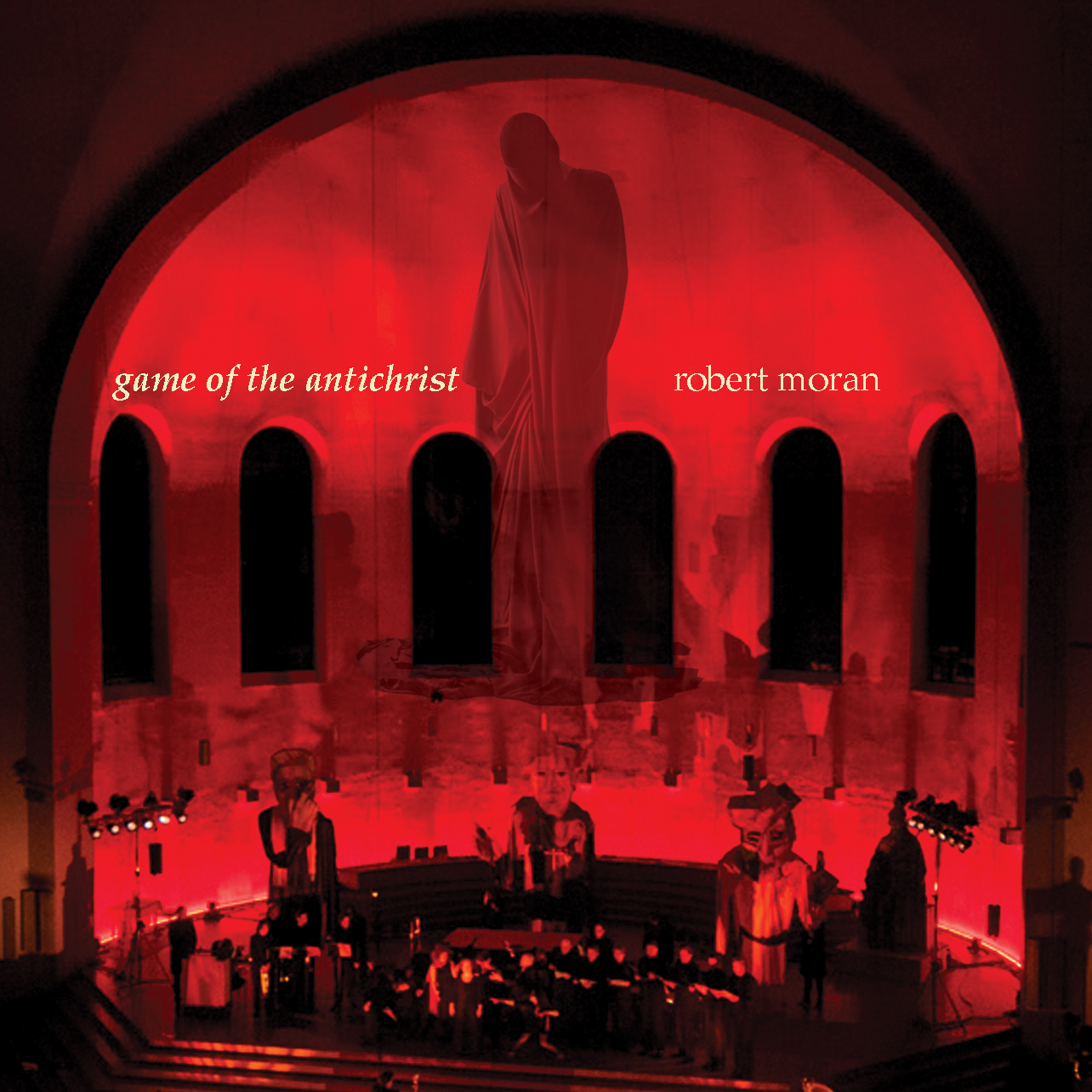
Mysterienspiel 2012

Game of the Antichrist by Robert Moran (Innova 251)
I promise a more comprehensive review soon but this is a great CD by a too little known American composer.  Mr. Moran recommended the disc to me after I wrote to him praising his wonderful “Trinity Requiem”.  I plan a more comprehensive article soon.  Meanwhile here is a link to a performance on Vimeo.

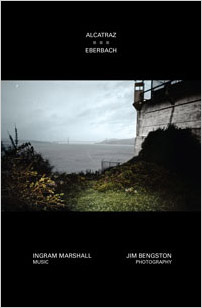
AZ spread

Alcatraz/Eberbach by Ingram Marshall and Jim Bengston  (Starkland S-2019)

This DVD is essentially the completion of a collaboration of photographer Jim Bengston and composer Ingram Marshall.  As such it is the most complete artistic statement superseding the audio only release (still worth having by the way) from some years ago.


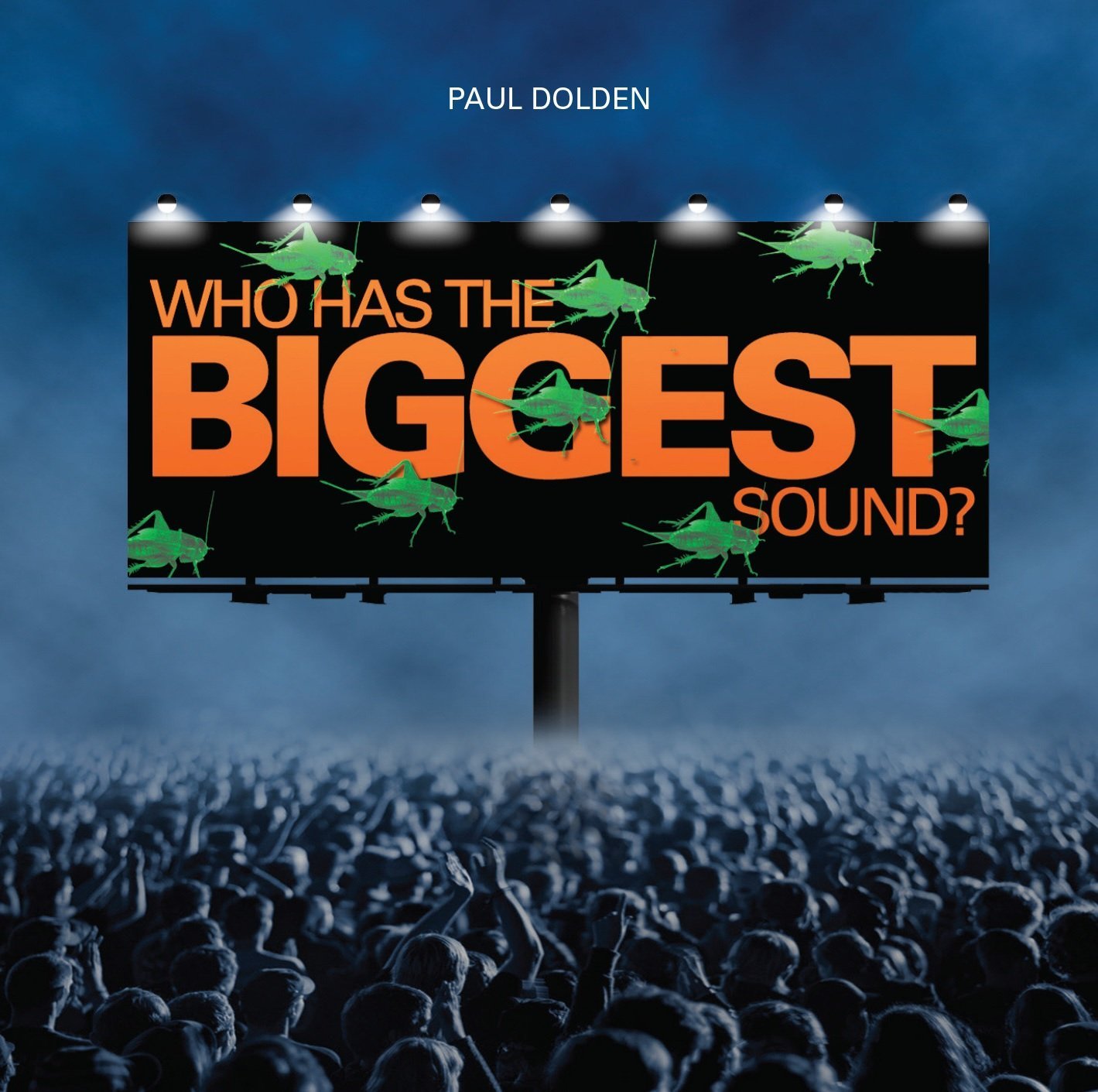
Who Has the Biggest Sound? by Paul Dolden. (Starkland ST-220)
A difficult to categorize recording that brings two major works by this (previously unknown to me) Canadian composer to the listening audience. I reviewed this disc here.  I am still working on absorbing its subtleties.

221CoverB

Prayers Remain Forever by Martin Bresnick (Starkland ST-221)
In addition to providing me with quite a few readers the opportunity to review this recording introduced me to the work of this too little known living American composer.  My review garnered quite an amazing amount of readers as well as an appreciative response from Mr. Bresnick himself.  And now I find myself buying his other recordings.  Really great music.


Album cover

Album cover

Notes from the Underground by Anthony Davis. (BMOP sound 1036)

I have been a fan on Anthony Davis and his music for some years now and I was pleased to be able to review this disc.   I  was later able to obtain an interview with Professor Davis which will be forthcoming later this year.

download

Tom Johnson/Samuel Vriezen Chord Catalog/Within Fourths, Within Fifths. (Edition Vandelweiser)

I eagerly reviewed this crowd sourced CD in which I was proud to be one of the contributors to its production.  It is only the second recording of Johnson’s landmark of minimalism and an opportunity to hear the work of the fine composer/performer Samuel Vriezen.

basketmonk

Basket Rondo/Jukebox in the Tavern of Love by Meredith Monk/Eric Salzman. (Labor LAB 7094)

This Labor Records release would have escaped my attention were it not for my having run across it while researching another new music article.  New music aficionados might remember Eric Salzman for earlier works such as “Civilization and It’s Discontents” and his involvement with Nonesuch records or one of his many other significant involvements in the new music scene over the last 40 years or so.  This disc is the première recording of Meredith Monk’s “Basket Rondo”, one of her best realized new works as well as the première of a great new sound/music drama by Salzman.  A more thorough review is in the works.

howardhersh2

Something by Howard Hersh ( Snow Leopard Music 888295062350)

Mr. Hersh kindly sent me this CD for review which will be forthcoming but it easily makes it to my favorites list for 2014.

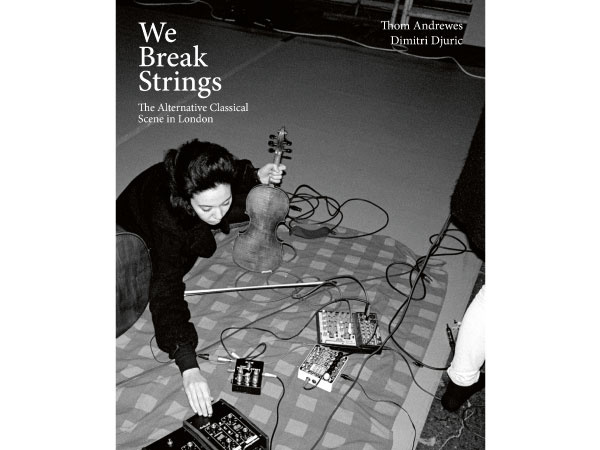
webreaknonclass

I also have to mention another crowd sourced project, “We Break Strings” by Thom Andrews and Dimitri Djuric, a book about the “alternative classical scene in London”.  The book which includes a CD sampler languishes in my “to be read” stack but my initial perusal left me with the impression of a beautifully conceived and executed volume which has much to offer the musically curious.  More about this book in a future blog.


A Piece of the Action, or How Other Minds Brought Out My Inner Trekkie


20130218-134428.jpg

I have been a fan of Other Minds for many years.  While I lived in Chicago I read the reports on the concert series with great interest and was fascinated with the choices of composers since they tended to mirror my own interests in new music as well as introduce me to tantalizing new artists.  I am not a professional musician but I have a long-standing passion for new music and attended many concerts of new music while I lived in Chicago reading liner notes and music history texts eager for more of the exhilarating experience of great new music as it was happening and wanting to know what was just around the corner.

I recall vividly New Music America 1982 which was held in Chicago and was hosted by Charles Amirkhanian, the executive and artistic director of Other Minds.  He spoke with authority and seemed to know just about every musician whose work I admired and countless whose work I hadn’t yet heard.  He conversed knowledgeably with the likes of John Cage, Robert Ashley, Glenn Branca, Meredith Monk, Tom Johnson, Robert Moran and the list goes on.

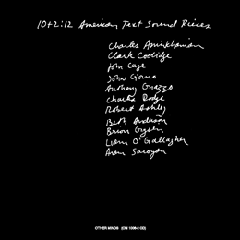
10+2 Anthology 10+2 Anthology

Early on I had purchased and listened with delight to the masterful spoken word anthology: 10+2: 12 American Text Sound Pieces [OM-1006-2] containing a couple of Amirkhanian’s compositions  alongside other contemporary masters of that genre in the original vinyl release and listened with great interest to the landmark recordings of Conlon Nancarrow’s Player Piano Studies [OM-1012-15-2] both discs largely the work of Mr. Amirkhanian who managed to get these recordings made in Mexico City on Nancarrow’s own player pianos.  So I have been familiar with him as both composer and producer.  He had been for many years the broadcast broker of contemporary music at KPFA in Berkeley where he served as music director from 1969 to 1992.

Charles Amirkhanian with Rex Lawson Charles Amirkhanian holding the microphone while Rex Lawson sings along with one of his piano rolls.

When I moved to the bay area in late 2008 one of my first priorities was to attend my first Other Minds concerts.  I saw the OM 14 concerts and was not disappointed.  But my recollection was that it was at OM 15 that I checked the little box on one of the audience surveys saying that I would be willing to volunteer for the organization.  I did not know what to expect but shortly after OM 15 I was contacted by the OM office and asked to provide a résumé.  Well I have worked my entire career as a psychiatric nurse so I added to that résumé that I had what I termed “extensive knowledge” (not to mention a near obsession) of new music.  I got a call back and wound up spending 4 hour shifts approximately weekly over much of the following two years doing various tasks but mostly scanning photos and other materials for use in their web page and archives.

Dohee Lee at OM 18 Dohee Lee at OM 18

My first direct interaction at the office was with Adrienne Cardwell, a pleasant, hard-working young woman who I would later learn was (and remains) the longest  tenured employee other than Mr. Amirkhanian and his co-founder (now President Emeritus) Jim Newman.  Adrienne is in charge of the massive archival goings on and would direct my tasks over the next 2 years.

I worked in the same room as Adam Fong, the associate director at the time (now director of the Center for New Music and a composer/musician in his own right).  I also had the pleasure of working with fund-raisers Emma Moon and later Cynthia Mei who are also highly accomplished musicians and arts advocates.  I had  the pleasure of meeting the Other Minds librarian Steven Upjohn and the hard-working OM radio host Richard Friedman as well as the opportunity to meet interns and even some very interesting scholars and musicians who visited the office while I was there.  In short it was a great volunteer experience which garnered me more than I originally bargained for.

Adam Fong performing at “Something Else” The F... Adam Fong performing at “Something Else” The Fluxus Semicentenary he produced in September, 2011 (Photo credit: Wikipedia)

In the course of those two years I had many conversations with the OM staff particularly with Adam and later Mr. Amirkhanian about music and programming as I went through scanning, filing and doing whatever tasks were needed at the times I was there.  I recall making some references to some relatively obscure composers which resulted in Charles asking me (somewhat rhetorically), “How do you know that?”.   I just replied that I read a lot but later gave some thought about the nature of my relationship with this fine organization as well as the nature of my interest in new music.

Ruggles_cover_1024x1024

In the ensuing two years I would have some fascinating experiences meeting some of my heroes in new music and dabbling in the inner workings of Other Minds.  My enthusiasm was responded to by the staff at OM by allowing me to work on some of their other projects.  I greatly enjoyed the opportunity to participate and I was thanked most wonderfully once from the stage of one of the OM concerts by Charles Amirkhanian and at least a few more times by having special thanks acknowledged in various concert programs and, most notably for me, in the liner notes of their CD release of the complete music of Carl Ruggles (OM-1020-21-2).  I knew and loved those recordings when they were released on vinyl and was ecstatic to participate in the work on the CD release.  It was great on vinyl and it’s even better on CD.

OK, here is where Star Trek comes in:

75px-Star_Trek_TOS_logo_(1)

After some reflection I came up with what I think is an apt metaphor that fairly accurately describes my experience of my relationship with Other Minds.  Some may recall (you can fact check this if you aren’t old enough to have seen the original broadcast) an episode of the original Star Trek series which was titled, “A Piece of the Action”.  The plot involved Captain Kirk and his crew beaming down to a planet where the inhabitants were living out the equivalent of prohibition era gangsters’ lives.  At one  point this little boy (that would be me in this metaphor) offers some information which would allow Kirk and his crew to get over on the bad guys but only at a price.  The price, he says, is, “a piece of the action”.   The resolution of the plot involves the Enterprise crew successfully resolving the conflict and the little boy being able to experience just a taste of the perceived glamour of the experience of the Enterprise crew (dressed as depression era gangsters to fit in), as Captain Kirk says to him in his best cool gangster voice, “There ya go, kid.  A piece of the action.”

Star_Trek_William_Shatner

I came away from my volunteer experience even more impressed and pleased with this organization and I continue to support them in any way I can.  My thanks to Captain Kirk and his crew for bringing out my inner Trekkie and for availing me of more than just one piece of the action.  You guys run a truly great ship.  Live long and prosper.

I look forward to the upcoming 20th Other Minds concerts.  More on that in blogs to come.


Oh, No! Not Another Minimalist! John McGuire


When I posted my introductory article to the “Not Another Minimalist!” series I got the suggestion on Facebook from composer/writer Walter Zimmerman that I do a piece on John McGuire.  Many will remember Zimmerman for his important book of interviews called Desert Plants (1976) in which he interviewed a series of 23 American composers in the early to mid-1970s.  His choices virtually defined an era much like Robert Ashley’s Music with Roots in the Ether would later do.  He is also a fine composer in his own right and will be featured in a future essay on this blog.  I am honored to receive a challenge from him and I also thought it was a fine selection of a minimalist-type composer whose work deserves wider dissemination so I am using McGuire as my first article in the series.

Unfortunately there is precious little to be found on this American composer.  In Zimmerman’s book he gets only one page so I am essentially updating his earlier efforts.  However, even 38 years later, McGuire does not appear to have a web page and I have been able to find reference to only a few recordings of his music.

mcguire1r

Cover image from one of McGuire’s recordings.

John McGuire (1942- ) studied with Robert Gross at Occidental College in Los Angeles, where he earned his BA in 1964, with Ingolf Dahl at the University of Southern California in Los Angeles and with Seymour Shifrin at the University of California, Berkeley, where he earned his MA in 1970. He also studied composition privately with Karl Kohn, composition and orchestration with Krzysztof Penderecki at the Folkwang Universität der Künste in Essen from 1966–68 and composition with Karlheinz Stockhausen at the Ferienkurse in Darmstadt in 1967–68. He then studied computer composition with Gottfried Michael Koenig at the Instituut voor Sonologie of the Universiteit Utrecht in 1970–71 and electronic music with Hans Ulrich Humpert at the Hochschule für Musik und Tanz in Cologne from 1975–77.

I came to know the work of John McGuire when I found a remaindered copy of a Largo CD containing his 48 variations for two pianos in the great though now sadly gone Rose Records  store in Chicago in the 1980s.  It was a gamble as I had never even heard of this composer but the album somehow spoke to me from the CD bin.

Variations for 2 pianos CD

Variations for 2 pianos CD

My gamble paid off because I had found in that piece a new take  on minimalism and pattern music.  It seemed to be closer to classical variation form than to strict process-oriented patterns but clearly there were rhythmic cells being subjected to development.  It clocks in at about 48 minutes and is a tour de force.

As it turns out McGuire makes use of minimalism as only one of his compositional techniques and has a distinctly different take on it which appears to be informed by the various techniques gleaned from his teachers.  After finding and bonding with this CD I began to look for more of this man’s music.

The intelligent vigilance of Richard Friedman and the Other Minds organization broadcast McGuire’s 1974 Frieze for 4 pianos and his 1985 Cadence Music for 21 Instruments in a RadiOM program dedicated to the composer’s music. Both recordings were broadcast from a 2 CD release on the RZ label.   Again the unmistakable sound of minimalism in a very unique approach.

The east coast equivalent of RadiOM is WNYC’s New Sounds hosted by John Schaefer.  The program of November 12, 2013 included McGuire’s Pulse Music III from 1978.  This is a great example at the composer’s facility with electronics.  This piece realized on tape was apparently originally for a multiple speaker installation  but is mesmerizing even in the stereo presentation which was broadcast.  Another inspired new music show, Kalvos and Damian did a program on the genesis of this music which remains available as streaming content.

McGuire spent 25 years living and working in Germany returning to the United States in 1998.  He then worked for Carl Fischer music as an editor and was a visiting adjunct professor at Columbia from 2000-2002.

I’m not sure I’ve been able to do much more than Walter Zimmerman did in his book but it is my hope that this article may spark interest in musicians, producers and broadcasters to keep this fascinating composer in mind for future projects and performances.

Enhanced by Zemanta

Coming Up, Other Minds 19 at the SF Jazz Center


Official Other Minds logo

Official Other Minds logo (Photo credit: Wikipedia)

On February 28 and March 1 the SF Jazz Center will host Other Minds for the first time.  OM 19 is the latest incarnation of this annual festival which presents an amazing range of new music.

The Other Minds Festival, brainchild of filmmaker/producer Jim Newman and musician, composer and broadcaster Charles Amirkhanian, was first heard in 1993 and, except for the years 1994, 1998 and  2007, has been an annual event in San Francisco  gathering mostly new but  always innovative composers to share their inspirations and innovations with each other and with bay area audiences.  Being curious about those apparent gaps in this festival I sent a query to the Other Minds office and received a prompt reply from none other than Charles Amirkhanian.  He stated as follows:

Executive Director Charles Amirkhanian in his ...

Executive Director Charles Amirkhanian in his office with ASCAP award in background (Photo credit: Wikipedia)

“Hi Allan,
Here’s the story:
After our first festival in November 1993, we needed time to raise more funds to produce OM 2 and get back on the Yerba Buena Center’s schedule. So we postponed until March 1995, the next available spot in the Djerassi schedule. Our timing for the festival is determined by when we have access to empty rooms at DRAP, so we need to be there either in Feb/March or November.
In 1997, once again, we needed time to raise more funds and simply postponed to the next available Djerassi time. Same for OM 13.
In each case, the delay was about eight months (for a November event) or four months (for a March event), giving us a festival in succeeding concert seasons, but not “annual” events. (A concert season is Fall ’07 through Spring ’08, for example.)
Thus the mysterious gaps.
Charles”

This internationally known festival is not just a series of concerts.  The diverse selection of composers gathers first for an artistic residency at the Djerassi Resident Artist Program (DRAP in Mr. Amirkhanian’s note), a pastoral setting nestled between the Pacific coastline and the hills west of Palo Alto, where the invited composers live, work and share ideas for a week prior to the public concerts. The Djerassi Foundation for the Arts was founded by biochemist Carl Djerassi whose daughter, an artist, committed suicide in 1978.  The area is a sculpture park and the facility operates all year round with residencies for artists of all media.  Charles Amirkhanian is one of the former directors of this venerable artist colony and is now the executive and artistic director of Other Minds. The selection process for OM artists is based on the incredible range of interests of the Other Minds Operating Board and in consultation with their advisory board which are very open to suggestions from the general public.  Just e-mail them.  They actually read all their e-mails and respond. This along with New Music America, the ONCE festival, the Telluride Festival (also one of Amirkhanian’s efforts) are among the important music festivals which have yet to receive adequate treatment and exposition of their histories. This year’s OM 19 (which also looks forward with eager anticipation to a very promising gala OM 20) includes Mark Applebaum, John Bischoff, Donald Buchla, Joseph Byrd, Charles Celeste Hutchins, Myra Melford, Roscoe Mitchell, Wendy Reid and John Schott.  For the first time in the history of the festival all the composers will be from northern California.  The dates for the festival, which moves this year to the new SF Jazz Center, are Friday February 28 and Saturday March 1. One might think that limiting the selection of composers would be limiting in the variety of artistic efforts to be had but one would be quite wrong.  In fact it would not be difficult to argue that music by musicians from northern California have been unjustly neglected in favor of the more dominant musical cultures of New York City, Chicago and Los Angeles.  A quick look at the roster for OM 19 reveals a great deal of variety:

Mark Applebaum at TEDx Stanford

Mark Applebaum at TEDx Stanford (Photo credit: Tamer Shabani Photography)

The Chicago born Mark Applebaum is currently associate professor of composition and theory at Stanford University.  He counts Brian Ferneyhough, Joji Yuasa, Rand Steiger, Roger Reynolds and Philip Rhodes among his teachers.  He also performs as a jazz pianist. He appears to be the first composer at these concerts to have given a TED talk.  In this talk he speaks of being “bored with music”, at least with traditional music and how he used that boredom to break through to another level of creativity creating new instruments and elaborate scores.  He is an engaging speaker and his presentation will no doubt be fascinating.

John Bischoff (1949- )

John Bischoff (1949- )

John Bischoff studied at the California Institute of the Arts and Mills College.  His teachers include Robert Moran, James Tenney and Robert Ashley.  He is currently visiting professor and composer at Mills College. He is one of the pioneers of live computer performance and he is a frequent performer at the Garden of Memory concerts held annually on the summer solstice at Oakland’s beautiful Chapel of the Chimes. Mills College with its Center for Contemporary Music can be said to be the primary life blood of northern California composers.  Bischoff is part of a long line of composers who  have guided musical pedagogy in the Bay Area and have included Chris Brown, Luciano Berio, Darius Milhaud, Lou Harrison, Steve Reich, Terry Riley, Pauline Oliveros, Morton Subotnick, Ramon Sender, John Cage, Chris Brown, Maryann Amacher, Maggie Payne, Larry Polansky, Robert Ashley, and many others. Bischoff has released 16 albums and numerous publications.  He founded the League of Automatic Composers, the first computer network band and continues to be a driving force in the computer music scene. Don_Buchla_and_200e

Donald Buchla is one of the elder statesmen of new music in California.  His collaboration with Ramon Sender and Morton Subotnick produced one of the first modular synthesizers in 1963.  He continues to develop synthesizers with his Buchla and Associates corporation (founded in Berkeley in 1962) . He studied physics, physiology and music.  His importance in the field of electronic music and music synthesis cannot be underestimated.  His electronics have driven many classical, rock and jazz music.  He and his corporation continue to make new electronic instruments such as the marimba lumina and the piano bar and has made available again some of the classic analog electronics which first made his name familiar to musicians worldwide. I was able to find very little about his musical compositions but it is worth noting that his electronics will power the performances of several of the artists in this concert series in addition to his own.

Joe Byrd in 1968

Joe Byrd in 1968

Kentucky born Joseph Byrd is an electronic musician, composer and producer.  His album, “The American Metaphysical Circus” (1969) is legendary and considered a cult album which has been reissued on CD and can also be heard on You Tube.  His band, Joe Byrd and the Field Hippies never performed live but this work of 60s psychedelia has established itself as a landmark recording and a cult classic.  He also did an album of synthesized Christmas Carols in 1975. Byrd has also been a producer with estimable credits such as producer and arranger of Ry Cooder’s amazing ‘Jazz’ album from 1978.

I can’t imagine how his latest work sounds but I am looking forward to it.

Charles Céleste Hutchins at SOUNDkitchen

Charles Céleste Hutchins at SOUNDkitchen (Photo credit: hellocatfood)

Charles Celeste Hutchins is, as far as I can tell, the first instance in which an Other Minds operating board member has been featured as a composer in this series.  The advisory board consists largely of composers who have already been featured on OM concerts.  Until this booking I was not aware of this man’s work.

Hutchins worked in the dot com business for a time and is now working on his musical interests.  His work involves the digital music program called Supercollider which he uses to manipulate sounds.  Discogs lists an MP3 compilation of some of his work in this area.

Melford in Helsinki, 1993

Melford in Helsinki, 1993

Myra Melford is an internationally known jazz pianist and composer with some 17 albums and some 20 years of playing.  Melford is originally from Illinois.

She has played with AACM musicians like Leroy Jenkins, Joseph Jarman and other musicians including Marty Ehrlich, Henry Threadgill, Mark Dresser, OM alumni Han Benink and Tyshawn Sorey.  Currently she teaches at the University of California Berkeley.

saxophonist Roscoe Mitchell at the Pomigliano ...

saxophonist Roscoe Mitchell at the Pomigliano Jazz Festival (Photo credit: Wikipedia)

Roscoe Mitchell is one of the founding members of the venerable AACM (American Association of Creative Musicians) which redefined both jazz and contemporary classical music from its founding in 1965 to the present.  Other notable members include Anthony Braxton, Lester Bowie, Malachi Favors, George Lewis and Lester Bowie among others.  Mitchell is currently professor of music at Mills College where he holds the Darius Milhaud chair.  He has collaborated with Frederic Rzewski, George Lewis, Anthony Braxton, Joseph Jarman, Malachi Favors, Muhal Richard Abrams, Albert Ayler, Henry Threadgill, Thomas Buckner and many others.

Mitchell is one of the acknowledged living masters of American music and he plays and teaches widely.  In 2012 her performed at the “All Tomorrow’s Parties” festival in Minehead, England.  Any performance by this musician is an event.

Wendy Reid is a new name for me.  She is a composer who works with nature sounds.  I did buy her CD entitled “Tree Music” which features 5 of her Tree Pieces with various combinations of violin, percussion, piano, mandolin, oboe and Don Buchla on “thunder” interacting with nature sounds.  For her OM performance she will be sharing the stage with a parrot.  Yes, it does sound like a Monty Python sketch, but this promises to be interesting if not revelatory.  Her work is clearly concerned with the sounds of nature and is at least distantly related to the work of Pauline Oliveros whose album ‘Troglodyte’s Delight’ involves musicians responding to the sounds of water in a limestone cave.

John Schott is another name with which I am not familiar.  But lack of familiarity spells adventure in this series of concerts.  A quick internet search reveals that he is a Berkeley based composer, guitar player and banjo player.  His web site is a blog which reveals his interest in a wide range of musical styles and literary interests.  He lists 8 CDs which feature his work.  He also lists his “compositions in the classical grain”.  It’s anyone’s guess as to what he will present at Other Minds but if the preceding artists are any indication it will be unique and interesting.

All in all this promises to be a very exciting event with the ‘revelatory’ music which Other Minds uses as a tag line in their publicity materials. I won’t miss it and neither should you.

Enhanced by Zemanta

MLK, the Classical Playlist


President Lyndon B. Johnson meets with Martin ...

President Lyndon B. Johnson meets with Martin Luther King, Jr. (Photo credit: Wikipedia)

There is no doubt that rhythm and blues is the soundtrack of the Civil Rights Movement but in this, the 50th anniversary of the 1964 Civil Rights Act, I am issuing a programming challenge to the classical music world.  Hey there all you classical music stations, both internet based and broadcast.   Hey there Spotify and Pandora.  Have you explored the music written for and about the Civil Rights era?  Well, here’s your chance.

I begin my programming day with Joseph Schwantner’s “New Morning for the World” (“Daybreak of Freedom”), written in 1982.  Comparisons to Copland’s “Lincoln Portrait” are made due to the similarity in character and the use of a narrator.  The other work on this  Oregon Symphony CD under the late great James De Preist is  a work by an older composer Nicolas Flagello.  The cantata, “The Passion of Martin Luther King” from 1968, was composed in the shadow of the assassination of Dr. King and first performed in 1969.  Both works deserve more hearings for their musical accomplishments as well as for the subject of their dedications.

Description unavailable

Description unavailable (Photo credit: pennstatenews)

Moving on to the next segment I will move on to Adolphus Hailstork‘s 1978 “Epitaph for a Man Who Dreamed”  followed by William Grant 1930 Symphony No. 1 “Afro-American”.  Still is rightfully known as Dean of Afro-American composers.  A contemporary of Aaron Copland, his accomplishments established without a doubt the place in classical music for black composers.  Hailstork acknowledges his debt to the older master.  He is the next generation of black musicians contributing to the repertoire.  I will conclude this segment with Hailstork’s Symphony No. 2 which contains his impressions upon visiting the slave market areas of western Africa, places where began the shameful history of black slavery.

And on we go now to Luciano Berio’s 1968 “O King”, a chamber piece later incorporated into his masterwork, “Sinfonia” of the same year.  I program the version from Sinfonia, it’s my favorite rendering.  The vocal parts of this piece are solely comprised of the name “Martin Luther King”.  Also from 1968 there is Michael Colgrass’ “The Earth’s a Baked Apple” which is subtitled, “A Musical Celebration in Honor of Dr. Martin Luther King, Jr.” (psst, I have a bootleg of it).

We move on to afternoon programming featuring Anthony Davis’ opera, “X”, based on the life of Malcolm X.  This is  a work that deserves a new production.  Following this I will move on to Duke Ellington‘s 1943 “Black, Brown and Beige” Suite and then his “Three Black Kings” titled in French with rhyming wordplay as “Les Trois Roi Noir”.

Album cover

Album cover

The program would be incomplete without programming the wonderful Other Minds CD of Sarah Cahill’s album “A Sweeter Music” featuring a diverse collection of compositions written for her on commission by Terry Riley, Meredith Monk, Frederic Rzewski, Kyle Gann, Carl Stone, Phil Kline, Yoko Ono and The Residents.  The title is taken from Dr. King’s Nobel Prized lecture in which he refers to peace as “a sweeter music”.

Dizzy Gillespie

Cover of Dizzy Gillespie

I will end my fantasy program with Dizzy Gillespie’s “Brother K’ and Hale Smith’s “In Memoriam Dr. Martin Luther King, Jr.”  But fear not I leave you with a useful reference I have recently discovered.  “A Catalog of Music Written in Honor of Martin Luther King, Jr.” edited by Anthony McDonald.

Stay tuned for more on these subjects coming up during February for Black History Month.  Peace, Dr. King.

A mural painted on the side of the African Ame...

A mural painted on the side of the African American Museum depicts the Hough riots, the civil rights movement and a family looking towards a bright new future for the city and the community. (Photo credit: Wikipedia)


Enhanced by Zemanta

Belated Happy New Year and My Personal Best


Having taken a bit of a hiatus in blogging I am now preparing to get back to work on several projects languishing in the digital storage of WordPress and the recesses of my own mind.

2014 is the 50th anniversary of the enactment of the 1964 Civil Rights Act as well as the 50th anniversary of the “war on poverty”.  As I read further I’m sure I will find many more such milestones and, in the spirit of this blog, will explore connections to music and musicians.

Among the issues pressing for my attention in the beginning of this year are Black History Month, the upcoming Other Minds 19 and some overdue reviews of recent recordings.  I haven’t looked further into 2014 as yet.

I have actively avoided creating one of those “best of” lists that are ubiquitous at the end of every year.  I do read those lists but have no desire to compete at this point by creating yet another.  I have, however, taken a look back at the most viewed blog posts published in this blog.

Aside from my Home Page, About Page and Archives the top ten posts for the past year have been:

1. Secret Rose Blooms: Rhys Chatham at the Craneway Pavilion (actually my all time most viewed post)

2. Other Minds 18, three nights on the leading edge

3. Black Classical Conductors (Black Classical Part Two)

4. Far Famed Tim Rayborn Takes on the Vikings

5. Alvin Curran at 75, Experimentalism with an Ethnic and Social Conscience

6. Political Classical Music in the Twentieth and Twenty First Centuries

7. Annie Lewandowski, Luciano Chessa and Theresa Wong in Berkeley

8. A Fitting 100th Birthday Celebration for Conlon Nancarrow

9. Undercover Performance Practices in the Bay Area

10. The Feeling of the Idea of Robert Ashley: Kyle Gann‘s Appreciation of the Composer

You can certainly expect me to address some of the subject matter in these most read posts.  Revisiting the site of the crime is a time-honored tradition.  I responded with “shock and awe” at the amount of hits that the Chatham article evoked (418 hits in one day, my top score).  My follow-up gallery of some of those 100 guitars did become my 11th top viewed of the past year.

But as intoxicating as that boost of views was  I will not be able to resist focusing on that which finds its way into my attention for whatever reason.  I am grateful for the support and encouragement I have received from Adam Fong, Charles Amirkhanian, Steve Layton, David Toub, Tom Steenland, Tim Rayborn, Philip Gelb and all of my readers.  I apologize in advance if I have left someone out of this impromptu list but hope that my gratitude is understood among you as well.


Enhanced by Zemanta

The Petals of the Secret Rose


Even before I saw the impressive response to my last post I had decided to do an addendum for the main purpose of showing some pictures that didn’t make the cut in the original article.  No, really, I did.

I arrived at the Craneway Pavilion in Richmond, CA at about 4:30PM.  The performance wasn’t til 7PM so that gave me some time to survey the scene.

OMChathfinal0003OMChathfinal0002

It was open so I went inside.

Looking toward the seating and the stage in the performance space at Craneway Pavilion.

Looking toward the seating and the stage in the performance space at Craneway Pavilion.

OMChathfinal0018There was an opportunity to check backstage.

Lo and behold, the petals of the Secret Rose:

OMChathfinal0014

OMChathfinal0015

OMChathfinal0016

OMChathfinal0017

OMChathfinal0019

OMChathfinal0021

OMChathfinal0022

OMChathfinal0023

OMChathfinal0025

OMChathfinal0026

OMChathfinal0027

OMChathfinal0028

OMChathfinal0029

OMChathfinal0030

OMChathfinal0031

OMChathfinal0032

OMChathfinal0033

OMChathfinal0034

OMChathfinal0035

OMChathfinal0037

OMChathfinal0038

OMChathfinal0040

OMChathfinal0045

OMChathfinal0049

OMChathfinal0044

OMChathfinal0074

As the sun set it was time to find my seat.

OMChathfinal0077

OMChathfinal0071

Secret Rose Blooms: Rhys Chatham at the Craneway Pavilion


Craneway Pavilion

Craneway Pavilion

On Sunday November 17th I attended one of the most unusual concerts in my experience.  The performance of Rhys Chatham‘s ‘A Secret Rose’ at the beautiful Craneway Pavilion in Richmond was produced by Other Minds and the eclectic bay area new music bloodhound Charles Amirkhanian.

Charles Amirkhanian speaking briefly to introduce the performance.

Charles Amirkhanian speaking briefly to introduce the performance.

Rhys Chatham is an American musician and composer who has spent much of his career in living in France.  He was a part of the New York post-punk downtown music scene in the 70s working with musicians like Glenn Branca, La Monte Young and Charlemagne Palestine.OMChathfinal0131

English: Rhys Chatham at Islington Mill, Salford

Sunday’s concert was the west coast première of this piece which is scored for 100 electric guitars, bass guitar and drum kit.  It is sufficiently complex as to require at least 3 conductors in addition to the principal conductor (Chatham).  In this respect it brings to mind the work of Charles Ives and Henry Brant.  But this music resembles neither of these composers, at least not precisely so.  Beginning with his work with drones and harmonics Chatham has developed compositional techniques and honed them to a point of mastery.  The multi-movement work was microtonal, polymetric, aleatory/improvisatory, dissonant, melodic and enthralling.  Did I mention that it was loud?  No?  Well loudness may be the most obvious aspect of this music but that loudness is organic to the music.  The volume paired with the very live acoustics of the cavernous performance space elicited a wide range of harmonics which, through Chatham’s skillful techniques evoked a variety of timbres.  (Complementary ear plugs were provided.  I took a pair but did not use them.)  I heard guitars, certainly and drums and bass.  But at times it sounded like there were brass instruments and even vocals.  (I swear I heard words being sung.)

Craneway Pavilion is a 45,000 square foot former Ford assembly plant that was remodeled for use as a performance space and conference center.  Its size and waterfront location remind me of Chicago’s ‘Navy Pier’ on  the lakefront.  Craneway is on San Franciso Bay and faces south with a view of the bay bridge eastern span as well as views of San Francisco.  The appearance is that of a large loft space with metal beams and a general industrial appearance.  Its floor, walls and ceiling are surfaces that are highly reflective of sound and therefore ideal for this performance.  As promised in the promotional materials the full moon rose in the east over the bay before the performance began.

Full Moon rising over the bay just before the performance.

Full Moon rising over the bay just before the performance.

Looking toward the seating and the stage in the performance space at Craneway Pavilion.

Looking toward the seating and the stage in the performance space at Craneway Pavilion.

Chatham’s music was not about complexity for the sake of complexity.  His compositional strategies required the complex goings on we heard on Sunday.  The room itself became a sounding chamber itself amplifying, canceling and propagating the swirling harmonics that resulted from specialized tunings in addition to the other techniques mentioned.OMChathfinal0101

OMChathfinal0100

The multiple movements ranged from drone-like structures to more rhythmically complex sections and even melody.  Yes, melody. Chatham writes catchy melodies and motives that sound like they’ve been taken from one rock album or another.  Sonic gestures evoked impressions of Ozzie Osbourne, Eric Clapton, and many others depending on your personal listening experiences.  This music was ritual as much as expository.  His techniques were not limited to rock music but extended to free jazz and classical techniques as well.  Taken as a whole the piece was a multi-movement symphony, each movement sustaining its own argument in service of the whole.  For the finale Chatham set aside his conductor’s baton and picked up his guitar, not for a solo as one might expect in an ordinary concert, but to participate in the ecstasy of performance.

Chatham conducting.

Chatham conducting.

It is tempting, if a bit cliché, to suggest that this ritual music stirred the ghosts of the past.  While standing in the ticket line one gentleman said to me, “I walked out of a Jimi Hendrix concert in 1967 because it was too loud”.  Almost immediately someone else said, “I was at that concert…”.  Perhaps the Grateful Dead, Jefferson Airplane and Pretty Things were stirred from their slumbers.  They were certainly evoked.  I don’t know if the aforementioned gentleman ultimately stayed for the performance but I suspect he probably did, maybe in honor of Jimi.

Chatham playing guitar in the finale of 'A Secret Rose'

Chatham playing guitar in the finale of ‘A Secret Rose’

The crowd was several hundred strong ranging in age from about 5 to 85.  Most appeared to be enjoying this loud and driving rhythmic composition.  Some rocked or nodded to the beat.  Some sat entranced and/or perplexed but attentive.  At the end there was a standing ovation and, from Mr. Chatham, a welcome encore featuring seriously de-tuned guitars.

The encore piece was also captivating and inventive though certainly not as long.   Chatham’s music is not easy to categorize or describe.  Even having heard a fair amount of his music on recordings over the years I could not have anticipated what I heard at this concert.  I now understand how some music cannot be adequately represented even by our best recording technology.

I’m not sure of the significance of the title but it does bring to mind William Butler Yeats’ book, ‘The Secret Rose’.  Its stories steeped in Irish mythology are introduced by an opening poem which reads in part:


Far of, most secret, and inviolate

Rose,

Enfold me in my hour of hours; where

those

Who sought thee at the Holy Sepulchre,

Or in the wine-vat, dwell beyond the stir

And tumult of defeated dreams; and deep

Among pale eyelids heavy with the sleep

Men have named beauty.

OMChathfinal0140

OMChathfinal0138OMChathfinal0141

Peace through “A Sweeter Music”


President Lyndon B. Johnson signs the 1964 Civ...

President Lyndon B. Johnson signs the 1964 Civil Rights Act as Martin Luther King, Jr., and others, look on. (Photo credit: Wikipedia)

Album cover

Album cover

It is fitting that this CD, this music has been released in the 50th anniversary year of the March on Washington and just prior to the 50th anniversary of the Civil Rights Act of 1964.  The series of 18 pieces in this major commissioning project by the wonderful bay area pianist, producer and new music advocate Sarah Cahill called “A Sweeter Music”, its title taken from a phrase in Martin Luther King, Jr.’s 1964 Nobel Prize lecture.  Though only 8 composers are represented on this recording this is a fine document of some truly wonderful and heartfelt music.  And Cahill’s introductory note indicates that there are plans to record the other ten pieces as well.

The project was planned to include video projections by Cahill’s husband, the skillful video artist John Sanborn.  The first formal performance took place on the Berkeley campus and the video projections across three screens added a dramatic perspective on the various pieces.  I was present at the first performance in Berkeley and later at a small multi-purpose hall in Point Reyes in the north bay.  At the smaller venue the projections were limited to a single screen but the images still added to the impact.  At the time of this writing Sanborn has posted some of these videos on You Tube ( http://www.youtube.com/user/sanborn707?feature=watch).

Still from one of Sanborn's videos.

Still from one of Sanborn’s videos.

Each of the recitals contained a selection of the pieces commissioned.  Sarah Cahill kindly provided the complete list which includes: Be Kind to One Another by Terry Riley, Peace Dances by Frederic Rzewski, There is a Field by Jerome Kitzke, Dar al-Harb by Preben Antonsen, The Olive Branch Speaks by Mamoru Fujieda, The Long Winter by Phil Kiline, Two, Entwined by Paul Dresher, War is Just a Racket by Kyle Gann, B’midbar by Larry Polansky, drum no fife by The Residents, Devotion to Peace by Michael Byron, Sonamu by Carl Stone, After the Wars by Peter Garland, A New Indigo Peace by Pauline Oliveros, Movement (Deep in My Heart) by Ingram Marshall, Study War No More by Bernice Johnson Reagon, toning by Yoko Ono and excerpts from Steppe Music by Meredith Monk.

The pieces represented on this recording are a diverse set including those by Frederic Rzewski, Terry Riley, Meredith Monk, Yoko Ono, The Residents, Phil Kline, Kyle Gann, and Carl Stone.  Missing from this disc, and planned for a future release, are the pieces by Jerome Kitzke, Larry Polansky, Pauline Oliveros, Preben Antonsen,  Sanborn’s images definitely enhanced the experience of the music and this writer hopes that some day this music might be released in a DVD format with those images but the pieces here stand easily on their own merits.

The disc opens with Terry Riley’s ‘Be Kind to One Another (rag)’ (2008-10).  Riley takes his title from a statement made by Alice Walker which followed the 9/11 attack on the World Trade Center.  Rather than express an anti-war stance Riley harkens to the days of his youth when he played barrel house piano music while he studied composition.  This is a jaunty and entertaining but substantial piece which expresses the wish for kindness.  It is a challenging work to play but not to hear.

‘Steppe Music’ (1997) is apparently a reworking of a 30 minute piano piece (the piece at hand lasts about 8 minutes) commissioned by Sarah Cahill for another masterful pianist, Nurit Tilles.  Meredith Monk is of course best known for her extended vocal techniques and dance/theater pieces.  Little of her piano music has been recorded and one hopes that there will be more to come.  This is a less literal contribution which, the composer says, is about “color, texture, resonance, and gesture…”.  Like her performance pieces this is music about images which evoke emotion and it is unlike any of Monk’s recorded piano music.

The seven ‘Peace Dances’ (2007/8) were written by a composer/pianist well-known for his political statements in music as well as for his virtuosic music.  Frederic Rzewski is probably best known for his massive set of variations on the protest song ‘El Pueblo Unido Jamas Sera Vencido‘ (The People United Will Never Be Defeated) commissioned in 1976 for Ursula Oppens.  His catalog contains a great deal of music with explicit and implicit political references.  Rzewski’s music sounds deceptively simple but is in fact very challenging to play.  These are part of a much larger set of compositions called “Nanosonatas”.  The dances here contain a variety of musical and political references that will entertain and frustrate musicologists for years to come but present the listener with some welcome additions to the repertoire.  Cahill plays them effortlessly and repeated listenings reveal more of the rich textures.  Rzewski’s inspiration, like that which inspired this series, is rooted in the same struggles as represented by Martin Luther King, Pete Seeger, gospel music and contemporary folk music.  The last of these dances was a birthday present for the 100th birthday of Elliott Carter.

Kyle Gann’s ‘War Is Just a Racket’ (2008) is written for speaking pianist.  He takes Christian Wolff’s ‘Accompaniments’, which was written for Frederic Rzewski in 1972 requiring the pianist to sing and speak as well as play.  It reminds this writer of Rzewski’s own ‘De Profundis’ of 1992 for speaking pianist using a text by Oscar Wilde.  Gann takes as his text a very interesting text by one General Smedley Butler who gave this speech in 1933.  Like Rzewski, Gann is no stranger to politics in his music.  This addition to the “speaking pianist” repertoire is spoken with feeling by Cahill as she pounds out the angry chords and melodies.  This is perhaps the most literal of the pieces on the disc and probably the least friendly to a conservative audience.

Sonamu (2010) was written by Carl Stone for piano and electronics.  It’s not the electronics your grandmother listened to either.  Stone uses a computer to perform “spectral convolution”, a process, the composer explains, which isolates various aspects of the sounds to “…shape and enclose the pitch and harmonies of separate voices…”.   The intention stated by Stone is to evoke ghosts and memories of the aftermath of war.  This most complex and abstract piece reminds me of the ghost electronics compositions by Morton Subotnick.  This piece requires repeated listenings and would no doubt be enhanced by Sanborn’s images.

Composer Phil Kline describes a process of using various musical fragments edited together to evoke images of living in a land under siege.  Kline was an eyewitness to the World Trade Center disaster and his personal experiences contained metaphorically in ‘The Long Winter’ (2009) have a memorial-like quality.  In the liner notes he describes his fantasy images leading to the realization that he (and we) do live in a land (or perhaps a world?) under siege.  The piece is in two sections ‘Crash’ and ‘Embers’.

Yoko Ono’s ‘Toning’ (2008) purports to be an effort to heal both performer and audience through sound.  As with much of her work this piece has an anti-art quality like the work she produced for the Fluxus performances.  This is perhaps the technically simplest of the pieces on this recording.  I think that reactions will vary to this music much the way that they vary to Ono’s oeuvre.  Those familiar with her work will see the threads that connect and others may simply dismiss her work entirely.

The enigmatic San Francisco based group “The Residents” aspire to anonymity as individuals in the hope that their audiences will focus on their art.  This is clearly one of their performance art pieces and is fairly explicit in its anti-war stance.  It consists of recorded voices and sounds in addition to the live piano performance and demonstrates the eclectic range involved in these commissions.

This CD was recorded at the recital hall at the University of California at Santa Cruz by Tom Lazarus.  It was released as another of the fine recordings of contemporary music on the Other Minds label with Charles Amirkhanian of ‘Other Minds’ as executive producer.  It is a major addition to the recordings of this political classical genre and a significant contribution to the solo piano repertoire as well as a snapshot of an eclectic range of contemporary music of the moment.  Highly recommended.

Henry Brant?…never heard of him: A Centennial Sketch


Aerial photo: Santa Barbara, California

Aerial photo: Santa Barbara, California (Photo credit: Wikipedia)

I was sitting in the Sojourner Cafe, my favorite little restaurant/hangout just off downtown in Santa Barbara, California.  I was having one of many conversations with the great and interesting staff and patrons when I mentioned the name of Henry Brant, saying he lived in Santa Barbara.  “I never heard of him” came the response from Chris, a musician when not serving at the restaurant.  No one else showed any signs of recognition either.  I proceeded to tell him about the Pulitzer Prize winning composer.  It was then that flicker of recognition came across his face.  He told me that the frail figure using his walker was a familiar sight in the neighborhood, his eyes widened with interest as I told him about this major American musician.

Henry Brant

Henry Brant (1913-2008) was born in Montreal, Quebec, Canada to American parents.  His father was a professional musician. Henry played violin, flute, tin whistle, piano, organ, and percussion at a professional level and was fluent with the playing techniques for all of the standard orchestral instruments.   Henry went on to study at McGill University and later in New York at a school later named Julliard.  He was the youngest composer mentioned in Henry Cowell’s anthology, “American Composers on American Music” to which Brant contributed an article on what he called “oblique harmony”.

Brant, who had an early connection and affinity with the American experimental music tradition, would go on to develop “spatial music” in which musicians were scattered around the performance space as an essential part of the composition and performance.  He began writing music in the sort of post modern style of the time as in his Symphony No. 1 (1945 rev. 1950) and pithy little jazz inflected pieces like Whoopee In D (1938, Rev. 1984), Jazz Toccata On A Bach Theme (Toccata On “Wachet Auf”) (1940) and Double-Crank Hand Organ Music (1933, Rev. 1984).

He would write for unusual combinations of instruments such as Angels And Devils (1931), a concerto for flute and orchestra of flutes, Ghosts and Gargoyles (2002) also for flute and flute orchestra or Orbits (1979) for 80 trombones, organ and sopranino voice.  His first spatial composition, Rural Antiphonies (1953) predates Stockhausen’s famed experimental opus, Gruppen (1955-7).  In all he composed over 100 “spatial” works along with chamber music such as Homeless People (1997) for piano and string quartet.  His composition Ice Field (2001) commissioned by Other Minds and performed in Michael Tilson Thomas‘ “American Mavericks” series won him the 2002 Pulitzer Prize for music.

Brant had worked as an orchestrator and conductor in Hollywood assisting with scores by Alex North and with the likes of Virgil Thomson, Aaron Copland, George Antheil, Douglas Moore and Gordon Parks.  His extensive knowledge of orchestration led him to write his textbook (published posthumously) ‘Textures and Timbres’.  And one of his last musical works was the orchestration of Charles Ives‘ massive and complex Second Piano Sonata which Brant titled the “Concord Symphony”.  This major opus has been performed several times and recorded twice.  A series of recordings on the Innova label have begun to release new recordings, many of them first recordings, of Brant’s huge catalog of compositions.

Brant was a member of the American Academy of Arts and Letters and the recipient several prizes and honorary degrees.  He was and continues to be a great force in music as well as a connection the American experimental traditions of Ives, Cowell and their contemporaries.  There is much to do in researching and documenting the work of this now past master who would have been 100 years old on September 15th.  His archive of over 300 scores is now in the venerable archives of the Paul Sacher Institute in Basel, Switzerland.   But I am left with the image of the frail figure walking the streets of Santa Barbara no doubt followed by more of his industrious efforts when he got back home to his studio.  Happy Birthday, Henry!

Guitar Gods Go Classical? Give them a ‘Secret Rose’


Cover of "Crimson Grail"

Cover of Crimson Grail

The implicitly condescending appellation “Guitar God” has been perhaps somewhat jealously applied to virtuosic guitarists in various popular rock bands. Whether your taste runs to Eric Clapton, Jimmy Page, Jimi Hendrix or Eddie Van Halen you cannot discount the technical skill of these and so many other rock/pop guitar players.

Rock and pop artists have distanced themselves from the classical music circles who initially disdained and even condemned their work. But that did not and does not mean that they eschew classical music. Many were initially schooled in classical performance technique and/or were provided a favorable view of some classical masterpieces.

Ian Anderson’s group ‘Jethro Tull’ utilized a movement from a Bach Lute Suite (taking a few rhythmic liberties) in their piece, ‘Bouree’. Roger McGuinn of ‘The Byrds’ acknowledged channeling Bach when he created the now instantly recognizable intro to their version of Bob Dylan’sMr. Tambourine Man‘. Rick Wakeman, keyboardist of the band ‘Yes’ as well as a solo artist peppers his work with snippets of classical melodies no doubt learned in his piano lessons that served him so well. Keith Emerson of ‘Emerson, Lake and Palmer‘ went as far as to write a piano concerto.

From the classical side of the aisle there have been composers who wanted to utilize some of the techniques and ideas of rock and pop within the context of their classical training. Stanley Silverman wrote an opera titled, ‘Elephant Steps’ which was championed by the ever eclectic Michael Tilson Thomas. (This piece deserves at least a second hearing and I hope that Columbia will some day release it as a CD.)

Leonard Bernstein, no stranger to popular musical theater, embraced rock and blues including such ensembles alongside the orchestra in major works such as his ‘Mass’. Similar, though less successful collaborations occurred when symphony orchestras were added to the production of albums by the likes of ‘Deep Purple and, more notably, ‘The Moody Blues’.

Many such collaborations have been and occasionally continue to be attempted but the end result most often appears to keep the division between classical and ‘pop’ rather separate. That is not necessarily a bad thing either. Philip Glass‘ work appears to have been pretty heavily informed by rock music. He played piano in a couple of tracks on one of the New York punk rock band, ‘Polyrock’. The driving rhythms of rock are endemic to much of Glass’ music. Steve Reich’s work as a jazz drummer seems to be evidenced in his intricate use of rhythm patterns in his music.

So while ‘pop’ musicians incorporated some of their classical training and influences and ‘classical’ musicians acknowledged and collaborated with their pop counterparts the classical aspects remained for better or worse more decorative than organic. Jazz became an organic part of many classical works starting in the 1920s. And, as mentioned before, rock influences have certainly found an organic role in the music of Philip Glass and, more recently in the music of Michael Daugherty.

Along came Glenn Branca, Rhys Chatham, Jeffery Lohn and their various collaborators. These musicians with strong roots in rock music began to explore what has become, in this writer’s opinion, the epitome of the organic implementation of classical music into the ‘pop’ medium. Using primarily guitars (in ever-increasing numbers) as well as drum kits and the usual accoutrements of rock bands these musicians began writing music that is definitely not pop or rock (neither does it actually resemble classical at times).

English: A self-portrait photograph by and of ...

English: A self-portrait photograph by and of Rhys Chatham. (Photo credit: Wikipedia)

Branca who had worked with Jeffrey Lohn began writing his Symphonies in the 1970s. They now number 12 or 13. Working with multiples of guitars, modified keyboard instruments, alternate tunings and basking in the glory of loud he has created an arguably classical set of works grown out of clearly rock/pop beginnings.

Rhys Chatham, a trumpet player initially, worked with Branca and Lohn for a while and began to develop his own classical path within the rock ethic. Beginning with Guitar Trio (1977).   And continuing into increasingly massive multiple guitar works he has created another distinct set of works that are clearly not rock or pop. He does not use the classical form titles like ‘symphony’ favored by Branca but these pieces like, ‘An Angel Moves Too Fast to See’ and ‘Crimson Grail‘ feature large numbers of guitarists which by necessity must be locally sourced. Even without classical form or titles these are clearly not pop or rock pieces. And perhaps they can’t be called classical either but they are certainly of symphonic proportion.

Both Branca’s and Chatham’s works have been recorded and I highly recommend the recordings. But these musics cannot be fully captured by current recording technology. The acoustics of the space in which they’re performed and the volume levels which elicit their own effects are best experienced live because of the volume levels and also because of the overtones which are elicited by the instruments in the performing space and more audible because of the overall volume and the characteristics of the listening space.

Such a rare opportunity awaits Bay Area audiences this November when Rhys Chatham comes to town under auspices of ‘Other Minds’ and the delightfully insightful and eclectic producer Charles Amirkhanian. They have engaged the architecturally and sonically fascinating space of the Crane Pavilion in Richmond (a few miles north of Berkeley and Oakland) with sweeping views if San Francisco Bay and enlisted many locally sourced musicians to produce the west coast premiere of Chatham’s “A Secret Rose” (2011) for 100 guitarists.

Official Other Minds logo

Official Other Minds logo (Photo credit: Wikipedia)

Tickets can be purchased through the Other Minds website (www.otherminds.org).

This is a rare opportunity to hear a uniquely different music in a visually stunning and acoustically interesting space.  Hope to see you there.


Other Minds 18, three nights on the leading edge


The stage at Kanbar Hall stands ready to receive performers on opening night of OM 18

The stage at Kanbar Hall stands ready to receive performers on opening night of OM 18

OM 18 has been my fifth experience at the Other Minds festival.  The most amazing thing about Other Minds is their ability to find new music by casting a wide net in the search for new, unusual and always interesting music.  As I said in my preview blog for these concerts this year’s selection of composers was largely unfamiliar to me.  Now I am no expert but my own listening interests casts a pretty wide net.  Well this year I had the pleasure of being introduced to many of these composers and performers with no introduction save for the little research I did just before writing the preview blog (part of my motivation for doing the preview blog was to learn something about what I was soon to hear).

Gáman

Danish folk trio Gáman

The first night of the series consisted of what is generally classified as “folk” or “traditional” music.  Not surprisingly these terms fail to describe what the audience heard on Thursday night.

First up was the Danish folk trio ‘Gáman’ consisting of violin, accordion and recorder.  This is not a typical folk trio but rather one which uses the creative forces of three virtuosic musicians arranging traditional musics for this unusual ensemble.  On recorder was Bolette Roed who played various sizes of recorders from sopranino to bass recorder.  Andreas Borregaard played accordion.  And Rune Tonsgaard Sørensen was on violin.

The first piece, ‘Brestiskvædi’ was their rendering of this traditional song from the Faroe Islands (a group of islands which is under the general administration of Denmark but which has its own identity and a significant degree of independence).  It struck my ears as similar in sound to the music of Scotland and Ireland, lilting beautiful melodies with a curiously nostalgic quality.

Next was a piece by Faroese composer Sunleif Rasmussen.  It was the U.S. premiere of his ‘Accvire’ from 2008, a name derived from the two first letters of the instruments for which it was written (as we learned in the always interesting pre-concert panel).  It was commissioned by this ensemble.  The work reflected the composer’s facility with instrumentation and retained some suggestion of folk roots as well.  It employed a rich harmonic language within a tonal framework in what sounded almost like a post-minimalist piece.  The trio met the challenges of the music and delivered a lucid reading of this music which seemed to satisfy both the musicians and the audience.

The trio followed this with three more folk arrangements, two more from the Faroe Islands and one from Denmark.  Like the first piece they played these had a similar ambience of calm nostalgia.

The Danish folk piece set the stage for the next work, a world premiere by one of Denmark’s best known living composers, Pelle Gudmunsen-Holmgreen.  The piece ‘Together or Not’ from 2013 is an Other Minds commission.  The composer, who was not present, wrote to Other Minds director Charles Amirkhanian saying, “the title is the program note”.  While the statement was rather cryptic the music was not.  This was less overtly tonal than the Rasmussen work and was filled with extended instrumental techniques and good humor.  Again the instrumentalists demonstrated a comfortable facility with the technical challenges of the music and delivered a fine reading of this entertaining piece.

The nicely framed program continued with two traditional drum songs from Greenland (the violinist, holding his instrument rather like a guitar produced a sort of modified pizzicato technique which played the drum part).  These haunting melodies seemed to evoke the desolate landscape of their origin.

The program ended with a Swedish polka and, in response to a very appreciative audience, an encore of another spirited polka.  These were upbeat dance music that all but got the audience up and dancing.  The audience seemed uplifted by their positive energy.

Sachdev

G.S. Sachdev (left) and Swapan Chaudhuri.

The second half of the first night’s concert consisted of two traditional Hindustani Ragas.  These pieces are structured in aspects of the the music but allow for a great deal of repetition and improvisation in which the musicians bring the music to life.  Hindustani music is deeply rooted in culture and spirituality.  The ragas are associated with yogic chakras, moods and time of day.  Their performance is intended to enhance the audience esthetically and spiritually.

G.S. Sachdev is a bansuri player.  The bansuri is a wooden flute common in this type of music (though Sachdev’s level of mastery is hardly common).  He was accompanied by the familiar tanpura drone produced by digital drone boxes instead of the actual instruments which produce the familiar drone sound that underlies Hindustani music performances.  Swapan Chaudhuri played tabla.  It is difficult to see the tabla as an “accompanying” instrument as much as it is a complementary instruments especially when played by a master such as he.  Chaudhuri is the head of the percussion department at the Ali Akbar Khan school in San Rafael in the north bay.  Sachdev has also taught there.  Both men have ties to the bay area.

The musicians performed Raga Shyam Kalyaan followed by Raga Bahar.  Originally I had thought of trying to describe these ragas in their technical aspects but my knowledge of Hindustani music cannot do justice to such an analysis.  Rather I will focus on the performances.

Raga Shyam Kalyaan was first and received an extended reading.  How long?  Well I’m not sure but this music does create a sort of suspended sense of timelessness when performed well.  Indeed that was the effect on this listener.  The whole performance of both ragas could not have exceeded one hour  but the performances by these master musicians achieved the height of their art in producing riveting performances of this beautiful music.  Sachdev’s mastery certainly has virtuosity but his genius lies in being able to infuse his performance with spirituality from within himself and to impart that spiritual resonance to his audience.  He was ably aided in that endeavor by Chaudhuri who, clearly a master of his instrument and connected with Sachdev, channeled his connection with the infinite.

The audience responded with great warmth and appreciation concluding the first day of the festival.

D. Lee OM18

Composer, performer, designer, shaman Dohee Lee performing her work, ‘ARA’.

Friday night began with the world premiere of the music theater performance piece, ‘ARA’ by Korean-American artist Dohee Lee.  Continuing with the spiritual tone set by yesterday’s Raga performances Lee introduced her multi-disciplinary art derived from her study of Korean music, dance and shamanism as well as costume design and music performance.

She was aided in her efforts by the unique instrument designed for her by sculptor and multi-disciplinary artist Colin Ernst.  The Eye Harp (seen in the above photo) is an instrument that is played by bowing and plucking strings and is connected to electronics as well.

The art of lighting designer David Robertson, whose work subtly enhanced all the performances, was clearly in evidence here.  This was  a feast for the eyes, ears and souls.  Dohee Lee’s creative costume design was integrated with the visually striking Eye Harp instrument.  And the music with sound design processing her instrument nicely complimented her vocalizations.  All were lit so as to enhance the visual design and create a unified whole of this performance.

Dohee Lee on the carefully lit stage off Kanbar Hall.

Dohee Lee on the carefully lit stage off Kanbar Hall.

Her performance began slowly with Lee in her beautiful costume took on the role of a modern shaman conjuring glossolalia in shamanic trance along with choreographed movement and accompanied by her Eye Harp and electronic sounds through the theater’s great sound system.   Like the raga performances of the previous night I wasn’t aware of how long this timeless performance lasted (the program said it was 10 minutes) .  But I wished it would have gone on longer.  Even with photographs the experience here is difficult to articulate.  The sound enveloped the audience who viewed the carefully lit stage in the otherwise darkened hall as the sounds communicated a connection with the sacred.

I am still trying to digest what I saw and heard on this Friday night.  I don’t know how most of the audience experienced this piece but they seemed to have connected with it and responded with grateful applause.  She seemed to connect as both artist and shaman.

Anna Petrini performing with her Paetzold contrabass recorder.

Anna Petrini performing with her Paetzold contrabass recorder.

Following Dohee Lee were three pieces for an instrument called the Paetzold contrabass recorder (two before intermission and one after).  Paetzold is the manufacturer who specializes in the manufacture of recorders, forerunner of the modern flute.  The square contrabass recorder is a modern design of this woodwind instrument.  However, knowing the sound of the recorder in music of Bach and his contemporaries, gives the listener no useful clues as to what to expect from the unusual looking instrument pictured above.

Anna Petrini is a Swedish recorder virtuoso who specializes in baroque and modern music written for the recorder.  At this performance she played her contrabass instrument augmented variously by modifications, additions of microphones, little speakers and electronic processing.  These pieces were perhaps the most avant-garde and the most abstract music in this festival.

Anna Petrini performing on the stage of Kanbar Hall at the Other Minds festival.

Anna Petrini performing on the stage of Kanbar Hall at the Other Minds festival.

The creative stage lighting provided a useful visual counterpoint to the music.  The first piece, ‘Split Rudder’ (2011) by fellow Swede Malin Bang was here given it’s U.S. premiere.  This piece is concerned with the sounds made inside the instrument captured by small microphones inserted into the instrument.  The resulting sounds were unlike any recorder sound that this listener has heard.  The piece created percussive sounds and wind sounds.

The next piece, ‘Seascape’ (1994) by the late Italian composer Fausto Rominelli (1963-2004) used amplification but no electronic processing.  These abstract works were received well by the audience.

‘SinewOod’ (2008) by Mattias Petersson involved introducing sound into the body of the  instrument as well as miking it internally and setting up electronic processing with which the performer interacts.  Like the two pieces that preceded it this was a complex exercise in the interaction between music and technology which is to my ears more opaque and requires repeated listenings to fully appreciate.

Taborn

Craig Taborn performing on the stage of Kanbar Hall at the 2013

The second concert was brought to its conclusion by the young jazz pianist and ECM recording artist Craig Taborn.  Detroit born, Taborn came under the influence of Roscoe Mitchell (of AACM fame) and began developing his unique style.  Here the term jazz does little to describe what the audience was about to hear.

Taborn sat at the keyboard with a look of intense concentration and began slowly playing rather sparse and disconnected sounding notes.  Gradually his playing became more complex.  I listened searching for a context to help me understand what he was doing.  Am I hearing influences of Cecil Taylor?  Thelonius Monk?  Keith Jarrett maybe?

Well comparisons have their limits.  As Taborn played on his music became more complex and incredibly virtuosic.  He demonstrated a highly acute sense of dynamics and used this to add to his style of playing.  I was unprepared for the density and power of this music. Despite the complexity it never became muddy.  All the lines were distinct and clear.  And despite his powerful and sustained hammering at that keyboard the piano sustained no damage.  But the audience clearly picked up on the raw energy of the performance.

This is very difficult music to describe except to say that it had power and presence and the performer is a creative virtuoso whose work I intend to follow.

Amy X Neuberg along with the William Winant percussion group playing Aaron Gervais.

Amy X Neuberg along with the William Winant percussion group playing Aaron Gervais.

The final concert on Saturday began with the world premiere of another Other Minds commissioned work, ‘Work Around the World’ (2012) for live voice with looping electronics and percussion ensemble.  This, we learned in the pre-concert panel is another iteration in a series of language based works, this one featuring the word ‘work’ in 12 different languages.

Amy X Neuberg singing at the premiere of Aaron Gervais' 'Work Around the World'.

Amy X Neuberg singing at the premiere of Aaron Gervais’ ‘Work Around the World’.

Language is an essential part of the work of local vocal/techno diva Amy X Neuberg’s compositions and performance work.  With her live looping electronics she was one instrument, if you will, in the orchestra of this rhythmically complex work.  William Winant presided over the complexity leading all successfully in the performance which the musicians appeared to enjoy.  The audience was also apparently pleased with the great musicianship and the novelty of the work.  Its complexities would no doubt reveal more on repeated listenings but the piece definitely spoke to the audience which seemed to have absorbed some of the incredible energy of the performance.

Michala Petri performing Sunleif Rasmussen's 'Vogelstimmung'.

Michala Petri performing Sunleif Rasmussen’s ‘Vogelstimmung’.

Back to the recorder again but this time to the more familiar instrument if not to more familiar repertoire.  Recorder virtuoso Michala Petri whose work was first made known to the record buying public some years ago is familiar to most (this writer as well) for her fine performances of the baroque repertoire.

Tonight she shared her passion for contemporary music.  First she played Sunleif Rasmussen’s ‘Vogelstimmung’ (2011) which he wrote for her.  It was the U.S. premiere of this solo recorder piece.  Vogelstimmung is inspired by pictures of birds and is a technically challenging piece that Petri performed with confidence.  At 17 minutes it was virtually a solo concerto.

And then back to electronics, this time with Paula Matthusen who now teaches at Wesleyan holding the position once held by the now emeritus professor Alvin Lucier.  Her piece for recorder and electronics, ‘sparrows in supermarkets’ (2011) was performed by Ms. Petri with Ms. Matthusen on live electronic processing.  This was a multi-channel work with speakers surrounding the audience immersing all in a complex but not unfriendly soundfield.

Michael Straus (left) with Charles Amirkhanian

Michael Straus (left) with Charles Amirkhanian


Some technical difficulties plagued the beginning of the first piece after intermission so the always resourceful emcee, Other Minds executive director Charles Amirkhanian took the opportunity to introduce the new Operations Director Michael Straus.  Straus replaces Adam Fong who has gone on to head a new music center elsewhere in San Francisco.

Mr. Amirkhanian also spoke of big plans in the works for the 20th Other Minds concert scheduled for 2015 which will reportedly bring back some of the previous composers in celebration of 20 years of this cutting edge festival.  No doubt Mr. Straus has his work cut out for him in the coming months.


Ström, part of the video projection

Ström, part of the video projection

With the difficulties sufficiently resolved it was time to see and hear Mattias Petersson’s ‘Ström’ (2011) for live electronics and interactive video in its U.S. premiere.  Petersson collaborated with video artist Frederik Olofsson to produce this work in which the video responds to the 5 channels of electronics which are manipulated live by the composer and the five lines on the video respond to the sounds made.  The hall was darkened so that just about all the audience could see was the large projected video screen whilst surrounded by the electronic sounds.

The work started at first with silence, then a few scratching sounds, clicks and pops.  By the end the sound was loud and driving and all-encompassing.  It ended rather abruptly.  The audience which was no doubt skeptical at the beginning warmed to the piece and gave an appreciative round of applause.

Paula Matthusen performing her work, '...and believing in...'

Paula Matthusen performing her work, ‘…and believing in…’

Next up, again in a darkened hall was a piece for solo performer and electronics.  Composer Paula Matthusen came out on stage and assumed the posture in the above photograph all the while holding a stethoscope to her heart.  The details of this work were not given in the program but this appears to be related to the work of Alvin Lucier and his biofeedback work on the 1970s.  Again the sounds surrounded the audience as the lonely crouching figure remained apparently motionless on stage providing a curious visual to accompany the again complex but not unfriendly sounds.  Again the audience was appreciative of this rather meditative piece.

Pamela Z (left) improvising with Paula Matthusen

Pamela Z (left) improvising with Paula Matthusen

Following that Ms. Mathussen joined another bay area singer and electronics diva, Pamela Z for a joint improvisation.  Ms. Z, using her proximity triggered devices and a computer looped her voice creating familiar sounds for those who know her work while the diminutive academic sat at her desk stage right manipulating her electronics.  It was an interesting collaboration which the musicians seemed to enjoy and which the audience also clearly appreciated.

Pamela Z performing Meredith Monk's 'Scared Song'

Pamela Z performing Meredith Monk’s ‘Scared Song’

For the finale Pamela Z performed her 2009 arrangement of Meredith Monk’s ‘Scared Song’ 1986) which appeared on a crowd sourced CD curated by another Other Minds alum, DJ Spooky.  Z effectively imitated Monks complex vocalizations and multi-tracked her voice as accompaniment providing a fitting tribute to yet another vocal diva and Other Minds alumnus.  The audience showed their appreciation with long and sustained applause.

All the composers of Other Minds 18

All the composers of Other Minds 18

Left Coast Classical


20130218-134428.jpg

Dear friends of new music,

The annual Other Minds concert series is coming up on February 28, March 1 and 2. Now in its 18th iteration the festival seems to constantly be able to find new and interesting music from all over the world. And it gives every season’s musicians a week’s retreat at the Djerassi Resident Artists program during which they perform and discuss their music with each other sharing what must be a wonderful mind-expanding experience for them.

Kanbar Hall at the Jewish Community Center of San Francisco provides a comfortable venue that is both visually and acoustically well-suited to the marvelously diverse collections of composers and musicians that come together for three nights following their week-long workshop/retreat. Under the direction of Charles Amirkhanian who was music director at KPFA radio from 1969 to 1992 this concert series threatens to invade the musical consciousness and tastes of Northern California and beyond. At the very least it holds off the danger of the music scene becoming stuck in a rut. And at best it cross pollinates the DNA of the musical world to yield as yet unknown artistic mutations.

For die hard fans of new music like myself the festival provides an opportunity to hear some exciting artists whose work has interested me as well as an opportunity to widen my horizons and hear younger artists whose work is yet known only to a smaller audience. There are world and local premieres every year. And one of the thrills, at least for me, is the chance to hear artists who later rise to greater fame, “I remember when I first heard…”

This year’s line up is no less varied than previous years. Casting its usual wide net composers are included from Denmark, India, South Korea, Sweden, Canada and the United States. For me it will be the first time in which I will have had practically no knowledge before hand of these composers. But some of the performers are known to me including electronic diva gurus Amy X Neuberg and Pamela Z, two Bay Area artists with distinctly different approaches to the ‘voice with electronics’ genre. Having appeared previously in the ‘Other Minds’ concerts presenting their own compositions (composers thus far have only been allowed a single appearance presumably to make room for the new) they are engaged to perform music by other composers.

20130218-132045.jpg

Neuberg recently appeared doing her own arrangement of Joni Mitchell’s ‘California’ in a well-received performance with 9 other bands playing their arrangements of the other nine tracks from Mitchell’s classic album, ‘Blue’. This wonderful concert was reviewed in a previous blog. She will perform along with virtuoso percussionist William Winant and his percussion group in the world premiere of Canadian American Aaron Gervais ‘Work Around the World’.

20130218-132303.jpg

Pamela Z is also well known and is pictured above in a performance at the annual Chapel of the Chimes Summer Solstice concert. The world premiere of her Kronos Quartet commission, ‘And the Movement of the Tongue’ for string quartet and electronics occurs on February 20 and 21 at San Francisco’s Yerba Buena Center. She will be performing an improvisation with another soloist with electronics performer, Paula Matthusen as well as her own arrangement of Meredith Monk’s ‘Scared Song’ on the last day (Saturday).

While I had been aware of recorder player Michala Petri I am only familiar with her recordings of baroque music. But we will get to hear her artistry in performances of fellow Danes Sunlief Rasmussen and Paula Matthusen in contemporary pieces, one a U.S. premiere.

In addition there will be performances by Danish folk trio (recorder, accordion, violin) and Indian Bansuri master G.S. Sachdev as well as a performance by jazz pianist and ECM recording artist Craig Taborn.

Swedish contrabass recorder artist Anna Petrini will perform three works for contrabass recorder and electronics (an unusual combination to say the least) by three Scandinavian composers. Mattias Petersson is featured in a performance with video and electronics of his work ‘Strom’ from 2006 in its U.S. premiere.

And the second (of three) nights will feature the world premiere of a theatrical work, ‘ARA’ by the South Korean vocalist Dohee Lee featuring video and multi-channel electronics. I’m betting that this may be a major premiere.

If, as most biologists now believe, diversity is crucial to the survival of a species then the Other Minds festival appears to be mixing enough artistic DNA to keep new music alive for a couple of hundred years. I don’t know how many friends and acquaintances will be awed in 5-10 years when I tell them I was at the premiere of ‘ARA’ or ‘Work Around the World’ or try to describe the sound of a contrabass recorder with electronic enhancement but even the blank stares with some scratching their heads won’t detract from my own self satisfaction of having been there.

Hoping to see you at Other Minds,

Allan

A Fitting 100th Birthday Celebration for Conlon Nancarrow


Nancarrow birthday cake.

Happy 100th Birthday to Conlon Nancarrow

October 27th, 2012 would have been the 100th birthday of composer Conlon Nancarrow.  While still not a household name his work has become better known through recordings and live performances over the last 30 years or so.  He spent the majority of his creative life working in relative obscurity in Mexico City. While known by some of his contemporaries his music first became widely known through a 1969 Columbia Records release, part of that label’s ‘Music of Our Time’ series curated by David Behrman.

The evening’s celebration of his 100th birthday I’m sure would have made him proud.  Curated by bay area new music advocates Other Minds and hosted by the Piedmont Piano Company in downtown Oakland was a sort of preview of the next weekend’s three day event.

In the beautiful space of that showroom the audience was treated to hors d’ouerves, wine before the concert.  The event opened with a portion of a film by Jim Greeson, a documentary about the life and music of Nancarrow that painted him as another (if the most radical) of the musicians who were born in Texarkana, Arkansas which claims Scott Joplin as one of it’s famous sons.  This was followed by pianola virtuoso Rex Lawson who played a few of Nancarrow’s early studies.

The pianola is not the same thing as a player piano, as Lawson informed the audience.  It is a device which fits over the keyboard of a traditional piano and depresses the keys based on the instructions of a paper roll inserted as one would in a player piano.  However the pianola allows the performer to vary dynamics and phrasing and actually perform the music.  And Lawson demonstrated this beautifully.

pianola

Pianola showing the place where the paper roll is inserted.

At the intermission birthday candles were lit and Lawson was accorded the honor of blowing them out in the late composer’s honor.  Nancarrow died in 1997 having lived to see a tremendous resurgence in interest in his music and an acknowledgement of his contribution to music.  His complex rhythm studies for player piano number just over 50.  And though he wrote some chamber and orchestral music as well, these are the pieces on which rest his fame as an innovator.

Rex Lawson blowing out the candles on Nancarrow's birthday cake.

Rex Lawson blowing out the candles on Nancarrow’s birthday cake.

Just prior to the intermission we were treated to the multi-talented artist an composer Trimpin‘s computer controlled pianola.  Attached to two pianos were devices for pressing the keys which were in turn controlled by a computer program.

Piano with Trimpin’s computer controlled pianola attached to the keyboard

Piano number two with Trimpin's computer controlled pianola attached to the keyboard

Piano number two with Trimpin’s computer controlled pianola attached to the keyboard

They played the massively complex Study No. 40b and did so very effectively.  The audience left their seats to stand around the two upright pianos which behind the seating area.  The sound cannot be described in words and the audience, some perhaps mystified, were very appreciative.  Trimpin later spoke of this work reconstructing one of Nancarrow’s abandoned project, a percussion orchestra controlled by a piano roll.  It was abandoned when Nancarrow realized that the technology could not perform the music accurately, something which is now possible with Trimpin’s research.  The results of that research, Trimpin: Nancarrow Percussion Orchestra / MATRIX 244 will be installed in the Pacific Film Archive and be available to the public from November 2nd to December 23rd.

Trimpin holding a prototype for Nancarrow's aborted percussion orchestra experiment's

Trimpin holding a prototype for Nancarrow’s aborted percussion orchestra experiment’s

After the candles were out the audience, led by Charles Amirkhanian, sang happy birthday which prompted Lawson to spontaneously run to one of the pianos to accompany the traditional song.  Charles Amirkhanian, composer, radio host and impresario produced the first complete recording of Nancarrow’s player piano studies (and the only recording made on Nancarrow’s player pianos in his Mexico City studio) in 1980 which brought the composer to a much wider audience and got him invited to the 1982 New Music America festival and later helped him get a Mac Arthur genius grant.  A chance find in a record store in Paris inspired Hungarian composer Gyorgy Ligeti to write his masterful piano etudes after hearing these recordings.

Charles Amirkhanian with Rex Lawson

Charles Amirkhanian holding the microphone while Rex Lawson sings along with one of his piano rolls.

Trimpin scanned all of Nancarrow’s piano rolls into a computer and made it possible for the music to be studied more widely as well as preserving it on a hard drive.  He went from the piano rolls which are essentially a digital medium the equivalent of punch cards for historians and those of us old enough to remember to digital storage on a magnetic drive.

As I noted at the beginning this was a most appropriate tribute occurring on Nancarrow’s actual birthday and featuring people like Amirkhanian, Lawson and Trimpin who were inspired by Nancarrow’s work and have done so much to bring it to light and to preserve it for posterity.

Following the intermission we were again treated to Rex Lawson who provided a perspective on the importance of player pianos and pianolas in early 20th Century culture.  He illustrated the function of the pianolist explaining as he said, “Why I need to be here at all…” by playing a Rachmaninoff polka first without any nuance executed by the pianolist and then with him demonstrating how the pianolist puts life into the piece, a world of difference.  He spoke of composers who actually wrote for the pianola.  It is different from writing for a pianist because the pianola is not limited to the size of one’s hand or the number of fingers one has.  It afforded composers a technology to write a more orchestral fabric.

He demonstrated with pieces by Sir Arnold Bax, an early 20th century British composer and by Stravisnksy (a marvelous arrangement of the scene from Petroushka when the puppet first comes to life).  He also spoke of now forgotten composers who had the career of being arrangers for the pianola.  While many homes had pianos and many could play the piano, the pianola allowed them to play larger and more difficult works beyond the skills of the average pianist and, frequently, beyond the skills of any human being.

The evening ended with another demonstration of Trimpin’s computer driven pianola this time playing one of Nancarrow’s early boogie woogie pieces.  And then there was time to speak with the artists and audience members who showed enthusiasm and interest.

Tonight’s event, we were told, was organized by Other Mind’s development director Cynthia Mei and she made a plea for funding this and next weekend’s events through Kickstarter (http://www.kickstarter.com/projects/otherminds/nancarrow-at-100-a-centennial-celebration?ref=card) where the rewards for participating in the funding range from mention in the program booklet to CDs, t-shirts and downloadable recordings of the performances.  This writer is a proud part of the kickstarter campaign and would like to encourage others as well.  We are honoring a true genius in American music and preserving his influence and legacy for future generations.  I think Mr. Nancarrow would have heartily approved.