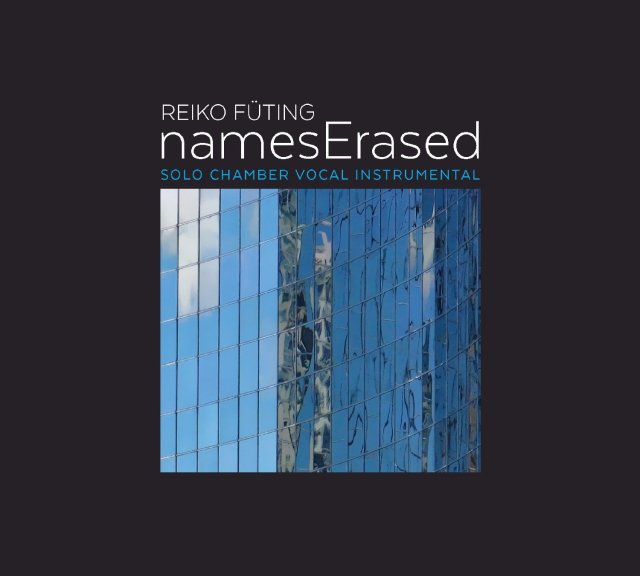
Reiko Füting: names Erased


names erased

Reiko Füting (1970- ) is the chair of the music department at the Manhattan School of music.  The present album is actually my introduction to this man and his work.  It consists of a series of 15 works written between 2000 and 2014.

These works tend to emphasize brevity especially the solo vocal pieces (tracks 2, 4, 6, 8,  and 10).  These, originally for baritone and piano are here rendered very effectively as solo vocal pieces.  They are used as a sort of punctuation in this recording of mostly brief pieces which remind this listener of Webern at times.  They are in fact the movements of a collection called, “…gesammeltes Schweigen”  (2004/2011, translated as Collected Silence).  It is worth the trouble to listen to these in order as a complete set.

The first track here is also the longest piece on the album at 15:43.  Kaddish: The Art of Losing (2014) for cello and piano is an elegiac piece inspired by several people and seems to be about both loss and remembrance.  The writing in this powerful and affecting piece is of an almost symphonic quality in which both instruments are completely interdependent as they share notes and phrases.  The cello is called upon to use a variety of extended techniques and the piano part is so fully integrated as to make this seem like a single instrument rather than solo with accompaniment.  It has a nostalgic quality and is a stunning start to this collection of highly original compositions.

tanz, tanz (dance, dance) (2010) is a sort of Bachian exegesis of the Chaconne from the D minor violin partita.  This sort of homage is not uncommon especially in the 20th/21st century and this is a fascinating example of this genre.  The writing is similar to what was heard in the cello writing in the first track.  This piece is challenging and highly demanding of the performer.  It is a delicate though complex piece but those complexities do not make for difficult listening.

leaving without/palimpsest (2006) for clarinet and piano begins with a piano introduction after which the clarinet enters in almost pointillistic fashion as it becomes integrated to the structure initiated by the piano.  Again the composer is fond of delicate sounds and a very close relationship between the musicians.

names erased (Prelude, 2012) is for solo cello and is, similar to the solo violin piece “tanz, tanz”, a Bach homage.  The performer executes the composer’s signature delicate textures which utilize quotes from various sources including the composer himself.  And again the complexities and extended techniques challenge the performer far more than the listener in this lovely piece.

Track 9 contains two pieces: “ist-Mensch-geworden” (was-made-man, 2014) for flute and piano and “land-haus-berg” (land-house-mountain, 2008) for piano.  Both pieces involve quotation from other music in this composer’s compact and unique style. Here he includes references to Morton Feldman, J.S. Bach, Alban Berg, Gyorgy Ligeti, Schumann, Debussy, Nils Vigeland, Beat Furrer, Jo Kondo and Tristan Murail.

light, asleep (2002/2010) for violin and piano apparently began its life as a piece based on quotation but, as the liner notes say, lost those actual quotes in the process of revision.

finden-suchen (to find-to search, 2003/2011) for alto flute, cello and piano is a lyrical piece with the same interdependent writing that seems to be characteristic of this composer’s style.

…und ich bin Dein Spiegel (…and I am Your Reflection, 2000/2012) is a setting of fragments by a medieval mystic Mechthild von Magdeburg for mezzo soprano and string quartet.  This is deeply introspective music.

All of Fùting’s compositions have a very personal quality with deeply embedded references.  His aesthetic seems to be derived from his roots in the German Democratic Republic having been born into that unique nation state both separate from the West German state and still deeply connected to it.  He is of a generation distant from the historical events that gave birth to that artificially separate German nation but, no doubt, affected by its atmosphere.

The musicians on this recording include David Broome, piano; Miranda Cuckson, violin; Nani Füting (the composer’s wife), mezzo soprano; Luna Cholong Kang, flutes; Eric Lamb, flutes; Joshua Rubin, clarinet; John Popham, cello; Yegor Shevtsov, piano; Jing Yang, piano; and the Mivos Quartet.  All are dedicated and thoughtful performances executed effortlessly.

The recording is the composer’s production engineered by Ryan Streber.  This is a very original set of compositions which benefit from multiple hearings.


Jennie Oh Brown and Friends: Music for Flutes by Joseph Schwantner


jennieoh

Innova 919

At first an all flute album featuring a contemporary composer would seem to be a risky idea at best but this disc of some of Joseph Schwantner‘s flute compositions works very well.  Pulitzer Prize winning Schwantner is no stranger to the concert or recording scene and deservedly so.  He writes a modern, though not terribly experimental, style which works well in the concert hall and on disc.  He won the Pulitzer for his wonderful 1978 Aftertones of Infinity and wrote a substantial guitar concerto championed by Sharon Isbin among many other works.

Jenny Oh Brown is an unfamiliar name to this reviewer but I suspect that will not be the case for long.  This is one talented and charismatic artist and she has recruited some marvelous fellow musicians for this album.  This is not the complete flute music of Mr. Schwantner but it is certainly a very nice representative sampling.

The album starts with Black Anemones (1980), a piece which is pretty much part of the standard flute and piano repertoire now.  The performance of this lyrical post-romantic essay clearly demonstrates why this piece has become popular.  It requires a great deal of skill and virtuosity for both the flautist and the pianist and both musicians handle their roles expertly.

The next three tracks are the separate movements of a piece,, again for flute and piano, called, Looking Back (2009).  The first movement, called Scurry About is a frenetic and virtuosic little romp which gives both musicians ample opportunities to demonstrate their chops.  The second movement, Remembering, is a sort of nostalgic solo flute cadenza and the finale, titled Just Follow brings the work to a satisfying conclusion.

The highlight for this listener, though, is the three movement quartet for flutes, Silver Halo (2007).  No piano here but every member of the flute family pretty much and each gets what sounds like a very satisfying role.

In addition to Jennie the album features Jeffrey Panko on piano, Karin Ursin, flute and piccolo; Janice McDonald, flute and alto flute; and Susan Saylor, flute and bass flute.  This Innova release is a must for fanciers of the flute and of Mr. Schwantner’s music.


The Piano is Calling Me: Nicolas Horvath’s New Music Pilgrimages


Nicolas Horvath Lyon

Nicolas Horvath at the piano in Lyon

I first heard of this young Monacan pianist and composer when a composer friend, David Toub, told me that he was going to program one of this piano pieces.  That piece along with quite a few other performances are available on Nicolas Horvath’s You Tube video channel here.

Horvath developed a strong interest in contemporary music from Gerard Frémy among others and has been programming a great deal of new music ranging from the more familiar such as Philip Glass to a host of others including quite a few pieces written for or premiered by him as well as his own transcriptions and reconstructions.  He is known for his concerts in non-traditional venues with very non-traditional lengths of performance as well as traditional concerts.

His current projects include Night of Minimalism in which he performs continuously for 10-15 hours with a wide variety of minimalist and post-minimalist pieces and Glass Worlds in which he performs the complete solo piano works of Philip Glass (approximately 15 hours) along with pieces by an international list of composers written in tribute to Glass.  He is also an electroacoustic composer (he counts Francois Bayle among his teachers) and a visual artist all with a passion for contemporary works.

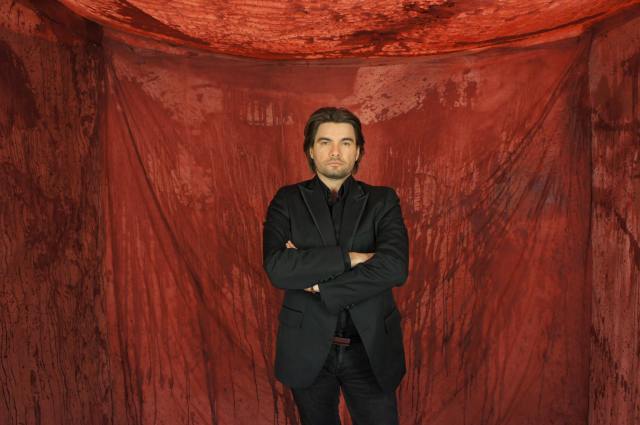
inside my own exhibit

The artist standing in one of his installations.

We had corresponded via e-mail over the last year or so and when I suggested the idea of interviewing him he responded by arranging time after a (traditional length) concert he gave in Minsk, Belarus on December 1, 2014.  I prepared for what I anticipated would be a one hour interview after which I imagined he would probably need to get to sleep.  But when I attempted to wrap up our conversation (at a couple of points) he immediately asked, “Don’t you have any more questions?”.  What followed resulted in approximately three and an half hours of delightful and wide-ranging conversation about this man and his art which he ended with the comment, “I must go, the piano is calling me.”  It appears that his seemingly boundless energy extends well beyond the stage.  The following January (2015) he gave the world premiere performance of all of Philip Glass’ 20 Etudes in none other than Carnegie Hall.

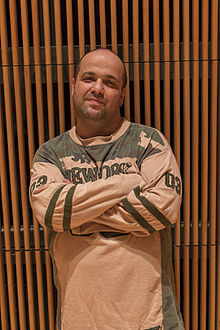
Nicolas Horvath (c) Jean Thierry Boisseau

Horvath with spent score pages as he traverses one of his extended performance ventures. (copyright Jean Therry Boisseau)

Since that time we have continued our correspondence and this affable, patient young artist continues on various projects and no sign of his interest or energy waning.  He recently sent me various photos of him in various settings pursuing his varied artistic interests for this article.

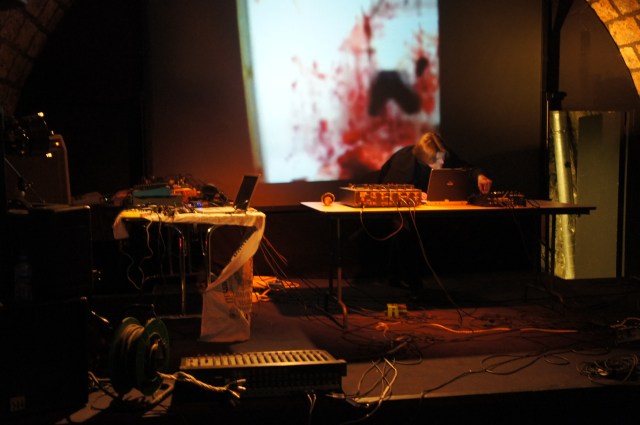
SONY DSC

Composer as well as performer in an electroacoustic performance without piano.

Horvath was born in Monaco in 1977.  He studied piano at the Académie de Musique Rainier III de Monaco and the École  Normale de Musique de Paris.  At 16, Lawrence Foster took notice of him in a concert and, securing a three year scholarship for him from the Princess Grace Foundation, was able to invite him to the Aspen Music Festival. After his studies in the École Normale de Musique in Paris, he worked for three years with
Bruno-Léonardo Gelber, Gérard Frémy who instilled in him a sensitivity to music of our time as well as Eric Heidsieck, Gabriel Tacchino, Nelson Delle-Vigne, Philippe Entremont and Oxana Yablonskaya. Leslie Howard got to know him and invited him to perform before the Liszt Society in the United Kingdom. He has been playing professionally for 7 years and puts his own characteristic style into his productions and performances.

In a move reminiscent of Terry Riley’s all night solo improv fests Horvath has performed several lengthy programs.  He has performed Erik Satie’s proto-minimalist Vexations (1893) in performances that ranged widely in length. One notable performance at the Palais de Tokyo lasted 35 hours, the longest solo piano performance on record as far as I can determine.  Previously this piece has been performed by tag teams of pianists (the first in 1967 in New York was curated by John Cage) to perform the 840 repetitions of the piece whose tempo or recommended duration is not specified.  Horvath, taking on a musicological mantle is preparing his own edition of this unique work.  He has published an 24 hour version on his You Tube channel here.

Given his intense schedule and vast repertoire he has been remarkably responsive and has an irrepressibly strong appetite for new music.  He tells me that he had worked on a project in which he planned to play all the piano music of the French composer Jean Catoire (1923-2005),  some 35 hours of material (in a single program, of course). Unfortunately that composer’s relative obscurity seems to have resulted  in insufficient support for the project which is, for now, on hold.  Here’s hoping that this can be realized sometime soon.

Horvath’s fascination with authenticity, completeness and performances of unconventional lengths uninterrupted by applause where audiences are invited to lay on the floor with blankets and sleeping bags and approach the piano seems unusual but he has been getting enthusiastic audiences and has enjoyed overflow crowds.  Like Terry Riley and perhaps even some of Keith Jarrett’s solo concerts there is a ritual feel to these marathon performances.  Regrettably I have not yet been able to attend one but I would love to partake in what must be a powerful shared experience.  He invites people to come to the piano and to watch, look at the score.  It is unlike the conventional recital and therein lies some of its charm.  At least one of his videos features a small sign which reads, “Don’t feed the pianist” and attests to his warmth and wonderful sense of humor.

His passion has parallels in his spirituality and he has pursued sacred pilgrimages which require a great deal of time and energy but without doubt fill a very deep and sincere need. More details and photos are available on his blog.  And, as with music, he is very open to discussing this very personal aspect of his life.

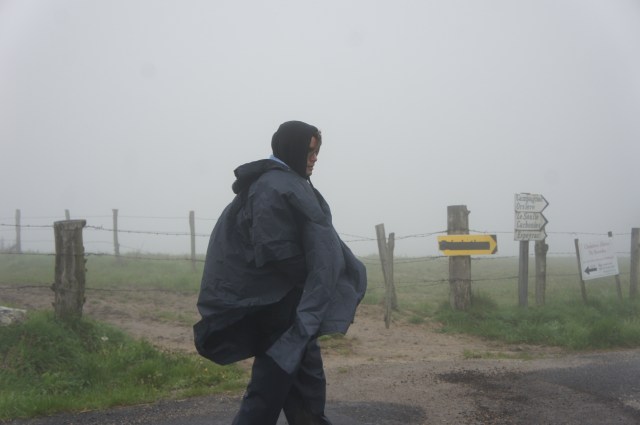
SONY DSC

The artist braving the elements on one of his pilgrimages.

There are conventional two hour with intermission style recitals in more conventional concert venues that he has played and Horvath also enjoys playing with an orchestra.  His performances of both of Philip Glass’ piano concertos can be viewed on You Tube and you can see the intensity of his execution.  This came through in the course of our interview as well when Mr. Horvath would speak of the music and then verbally imitate the rhythms (no doubt endlessly practiced) which drive his enthusiasm.  The music seems to be deeply integrated into his very being.

His first solo commercial recording was released in 2012.  It consists of Franz Liszt’s ‘Christus’, an oratorio composed in 1862-66 for narrator, soloists, chorus and orchestra.  Horvath plays a piano reduction done by the composer.  This is the first known recording of this unique and virtuosic set of piano works.  It is certainly an unusual choice for a debut recording but it is consistent with his very personal tastes.  (He lists Scriabin and Chopin as among his favorite composers.).   He is in the process of recording all of Philip Glass’ piano music for Grand Piano records distributed by Naxos.  At the time of this writing four well-received volumes have been released.  He is also planning to record all of Satie’s piano music and he has just recently released his rendition of Cornelius Cardew’s indeterminate masterpiece, Treatise.

I have seldom encountered a musician with such intensity and drive.  He is also one of the most skilled in using the internet to promote himself and his projects.  And though this is no doubt a man with a considerable ego he is in fact very unpretentious and very genuinely turned on, driven by the music itself.  Don’t get me wrong, he is concerned with developing his image and career but he seems happy to be doing the work he has been doing and he is, like any really good musician, self-critical and a perfectionist.

A quick look at his YouTube channel here reveals some of the range of his interests which include the standard repertoire along with interest in contemporary works.  Just released is a creative video with Horvath playing Glass’ Morning Passages while he apparently experiences a reverie involving a beautiful woman which could have been on MTV at its height.  Perhaps he is even channeling Oscar Levant who embraced roles in films along with his pianistic talents.  His website is a good resource for updates on his various projects and performances.

c _______ ______

Focused concentration at the keyboard.

As of the time of this writing his discography includes:

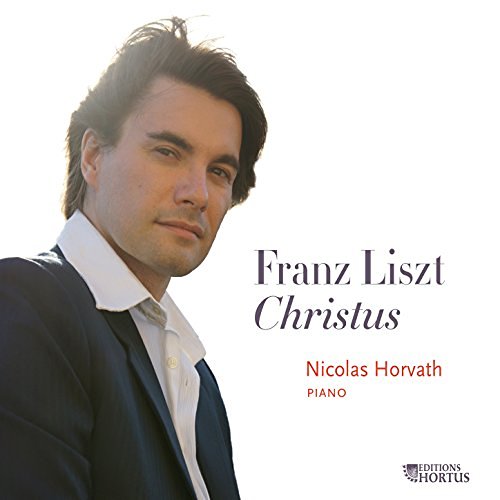
horvathchristus

Hortus Records 100 (2012)

A very unusual choice for a debut recording.  Nonetheless this is a distinctive recording which reflects the virtuosity as well as the careful scholarship which continues to characterize his work.  He managed to locate a couple of previously lost pieces in this set of composer transcriptions.  One also can’t miss the spiritual dimension here, as close to his heart as music and an equally important aspect of his personality.

glassw1

Grand Piano GP 677 (2015)

This first disc in the series manages to provide the listener with truly inspired interpretations of Glass’ keyboard oeuvre and gives us a world premiere recording of How Now as well.

glassw2

Grand Piano GP 690 (2015)

The complete Piano Etudes by the man who premiered the set at Carnegie Hall.  These etudes were also recorded by the wonderful Maki Namekawa and the opportunity to hear these really different takes is positively revelatory.

glassw3

Grand Piano GP 691 (2016)

The third disc in the traversal of Glass’ piano music (original and transcribed) also offers world premieres.  Horvath’s inclusion of Glass’ early Sonatina No. 2 reflects his work under the tutelage of Darius Milhaud and provides insight into the composer’s early development before he developed his more familiar mature style.

glassw4

Grand Piano GP 692 (2016)

Haven’t yet heard this disc but I have in queued for ordering in the next few weeks.

acedia

Demerara Records (2016)

Haven’t heard this one yet either but, again, it’s in my Amazon shopping cart.


horvathcardewtreat

Horvath’s interpretation of this important work by Cornelius Cardew

Cornelius Cardew (1936-1981) was sort of England’s John Cage, a major voice in 20th Century experimental music.  Scholarship has yet to do justice to the late composer’s work but this disc is an important contribution toward that end..

Horvath’s career is characterized by innovation and passion combined with astute scholarship and a keen sense of what is new and interesting in music  while clearly being schooled in the classic repertoire.  The piano calls him as do his other passions and I highly recommend paying attention as he answers those calls.  He is truly an artist to watch.
N.B.  Mr. Horvath generously read and approved an advance draft of this article shortly after arriving in the United States for concerts at Steinway Hall in Rockville with a Chopin program and a recital at The Spectrum in New York City which will include two pieces written for him by Michael Vincent Waller along with some Chopin pieces.

Poems to Sing at Night, New Piano Music by Brian Buch


buch

This is the second album by composer/pianist Brian Buch.  He holds a B.M. in composition with emphasis in piano performance from Indiana University and a Doctorate from Boston University.

He studied composition with a variety of notable teachers including Don Freund, P.Q. Phan, Sven-David Sandstrøm, Nancy van de Vate, Sam Headrick and Richard Cornell.  He lists his mentor as Alla Cohen, a name unfamiliar to this writer but no doubt a significant teacher and composer.

This album was released in 2015 and contains tracks comprising 5 compositions with multiple movements.  These represent a small portion of his output which apparently includes music for various ensembles including vocal, orchestral and chamber music.  All the pieces on the present album were written between 2014 and 2015.

These seem to be very personal pieces and the poetic titles reflect a sort of post-romantic style reminiscent of Bartok and Scriabin and perhaps even Debussy. This music benefits from multiple hearings and his performances are engaging and, no doubt, definitive. His muscular and assertive playing matches the poetic intensity of the music.

Poems to Sing at Night 1 and 2 both have poems which are to be recited before each performance though that is not done on the recording for some reason.  Both pieces are in four distinct movements while all the others are in three movements.

One hears jazz and classical influences here and the medium is basically tonal.He is not afraid of dissonance and unusual harmonies but the listener need not fear either because the music is always listenable.

John Weston recorded and engineered this album which was recorded in April, 2015 at the Futura Studios in Roslindale, MA.  The sound is warm and lucid.

In some ways this album seems to hearken back to the romantic composer/performer of the 19th century with its very personal style and poetic rather than classical forms.  This young man (b. 1984) has established and is developing a very personal style which bears watching/listening.  Very enjoyable album.


Zenobia Powell Perry, a Lost Thread


zenobia

Cambria CD-1235

These artists and this composer have graced these pages twice previously.  First in the wonderful production of Perry’s opera, Tawawa House and some of the musicians appeared in an article on Valerie Capers.  The present disc and the two previously mentioned articles are all indebted to a significant degree to the work of musicologist and composer Jeannie Gayle Pool.  It was she who kindly sent me this disc for review and her scholarship which brought forth the production of the opera (Perry was the subject of her doctoral thesis).

Zenobia Powell Perry (1908-2004) was an American composer. pianist and teacher who counts R. Nathaniel Dett and Darius Milhaud among her teachers.  Her sound is not far from that of Aaron Copland in her use of basically tonal harmonies and folk elements.  She is, in a sense, a lost populist and quite a gem.

This 25 track disc fills a major gap in the discography of American music in general and music of black Americans in particular.  Perry has roots in African and Native American (Creek) ancestry and Pool’s work may very well have rescued her from total obscurity.  The lost thread of which I refer in my title is to suggest that there is more populist and jazz influenced American music that needs to be brought to light.

Listening to this disc is pure entertainment.  These are undiscovered gems lovingly rendered with love and authority by Josephine Gandolfi, Deanne Tucker and (civil rights advocate and retired judge) La Doris Hazzard Cordell.  The entire project seems to be a labor of love and one can only hope that it will not be the last installment in the recorded canon of Perry’s work.

These 25 tracks are all brief pieces.  They range from the 1935 Childhood Capers to the 1985 suite from Tawawa House arranged for piano four hands by Josephine Gandolfi.  The entertainment here ranges from light pieces like the Childhood Capers to some more deeply thoughtful pieces with jazz inflected harmonies.  Some are quite demanding technically, a tribute to Perry’s skills as a pianist.

The Homage to William Levi Dawson on his 90th Birthday, Times Seven, Soliloquy, Nocturne, A Jazz Trifle and Rhapsody seems to be rather substantive works and pique the curiosity as to what else lies undiscovered.  The suite form Tawawa House is great but it will have to hold that place until the full opera can be recorded.  It is worth hearing, especially as one of the few operas dealing with slavery.

The very fine recording done a Bosendorfer piano at Stanford University by engineer Mark Dalrymple.  The production by Pool and Gandolfi leave this writer wanting to hear more.  Kudos!

Gene Pritsker and Some of His Collaborators, a Heady Mix


Gene_Pritsker

Gene Pritsker

We have here three very different CDs all of which feature composer/performer Gene Pritsker along with a variety of his colleagues and collaborators.  Each of these CDs is a unique production and reflects a marvelously creative group of composers and performers.

I first came to know of Pritsker’s work when he sent me a copy of his wonderful chamber opera, Manhattan in Charcoal and when I began to learn of the scope of his work through his numerous You Tube videos and his website I found myself rather overwhelmed and wholly intrigued.  In fact I can’t shake a comment which Leonard Bernstein once made about Igor Stravinsky to the effect that he was able to switch between different styles at different times with seeming ease and certainly skill (It was a comment made on a vinyl disc in which Bernstein spoke of Stravinsky in general on one cut and described the imagery of Petroushka on another.).  Pritsker’s Russian origins certainly play a part in reminding me of this association but it is the sheer extent and variety of his compositional visions and techniques that drive me to be reminded of this.  His virtuosity on the guitar also puts me in the mind of Frank Zappa at times too.  And he seems to be doing it pretty much all at once too, utilizing a wide palette of styles selectively with care and subtlety.  Pritsker switches between some very classical sounds to rock, jazz, rap, etc. as though the distinctions don’t exist or matter.  In the end they don’t matter really.  All is music I suppose and he seems be able to use them all pretty well and these discs are a nice sampling of some of this interesting musician’s various guises and interests.

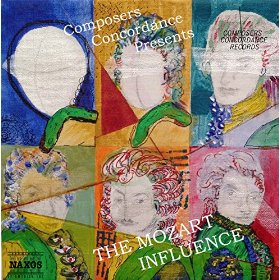
mozart inf

ComCon0030

Fortunately I am not attempting a comprehensive cataloging of all that but rather reviewing a nice little selection of some current releases which Mr. Pritsker was kind enough to entrust to my critical ear.  First up here will be a Mozart tribute of sorts. Regular readers may recall another entertaining Mozart-based recording by John Clark (here). Indeed Mr. Clark makes an appearance here both as composer and performer.  This curious little disc consists of short, clever glosses on Mozart by Gene Pritsker, Patrick Grant, John Clark, Milica Paranosic, Dan Cooper and David Taylor.  Pritsker in particular seems to have a penchant for reworking music by other composers.  His Bach-based works also deserve attention as well.  But that is another matter.

There are 13 tracks and all have a somewhat improvisational character.  Of course variation forms are ubiquitous and varied throughout music history and these are, if not strictly speaking, “variations”, then something close which is why I have chosen the term glosses.  But all are entertaining and reflect a sort of new music take on Mozart who appears to have some meaning for each of the composers (Mozart is my desert island composer by the way).  I am sure that Mozart himself would have been amused and honored.  These are most certainly homage at the very least.

The CompCord Ensemble consists of Charles Coleman, voice; Chanda Rule, voice; Milica Paranosic, voice/gusle; Patrick Grant, voice/harpsichord; Lynn Bechtold, violin; Dan Barrett, cello; John Clark, horn; David Taylor, bass trombone; Gene Pritsker, guitar; Dan Cooper, bass; Javier Diaz, percussion/voice; Gernot Bernroider, drums; Franz Hackl, trumpet.

There are no liner notes here and perhaps that is for the best.  I have no doubt that there are a great deal of personal stories here as to how these pieces came about and what they mean to the respective musicians but they do stand on their own as entertainment and to my ear sound like they could even work as a film soundtrack (most likely a non-American film). This is entertaining material, perhaps a bit “inside” with its references but not difficult or obscure.   I will leave it to some future musical archaeologist to elucidate those details. The listener need only sit back and be entertained.

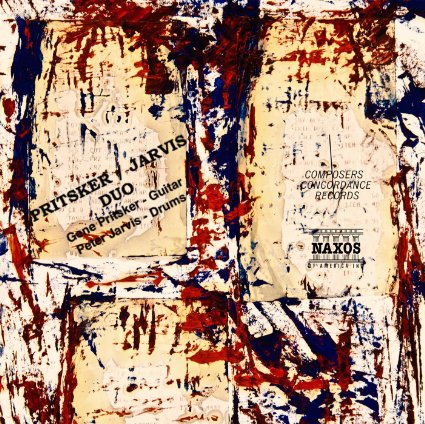
pritssker jarvis

ComCon0032


Now to the second disc.  This is quite different in character being a duo between a guitarist (Gene Pritsker) and a drummer (Peter Jarvis).  Such scant scoring tells one nothing about what is to come.  Each of the six tracks is by a different composer (Peter Jarvis, Gene Pritsker, David Saperstein, Joseph Pehrson, Jessica Wells and Daniel Palkowski).  As with the previous disc there are no liner notes so one is left with nothing but the sound.

This appears to be much more of an improvisational nature than the previous recording considered above.  The style here ranges from free jazz to rock and perhaps some contemporary musical styles as well.  Each track is a succinct statement and none of the tracks seem to go longer than necessary.  The musicianship is superb so if you are fond of the sound of guitars and drums played creatively and well you will enjoy this disc.  These musicians extract a great deal of varied sounds from their instruments.

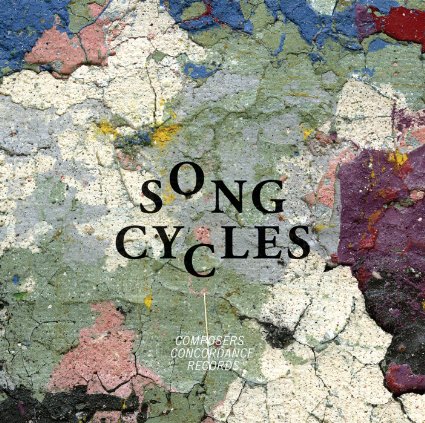
song cycles

ComCon0029


Finally we have this disc of song cycles.  Now the only song cycles I know at all well are those of Franz Schubert but that is, I think, an adequate place to begin to understand what is going on here (still flying without liner notes).

Eight composers and eight poets are featured in six song cycles. The first and last cycles (tracks 1-3 and 16-19) are the only ones which include instruments in addition to the voice and piano.  Only one song here (Inside on track 15) features poetry by the composer.  The rest, like Schubert utilized existing poetry.

Most of these composers are unknown to me which is both the joy and the bane of reviewing such discs.  All of these fall roughly into the classical art song tradition even with their occasional blues inflections (as in the Pritsker songs) or extended instrumental techniques.  David Gutay, Zach Seely, Patrick Hardish, Luis Andrei Cobo, Eleanor Cory are all new names to me and it Mr. Pritsker is to be commended for his efforts to promote others’ music.  The two composers here who are familiar are Mr. Pritsker and, another reason for commendation, Lester Trimble (1923-1986), a man embraced by Leonard Bernstein and cut from similar sonic cloth as both Bernstein and Copland.  This recording of Trimble’s Canterbury Tales is a welcome addition to the discography of mid to late twentieth century masters who deserve at least another listen.

The poets include: Tony Roberts, Jacob Miller, Dorrie Weiss, Jennifer Michael Hecht, Emily Dickinson, Richard Wilbur, Eleanor Cory and Geoffrey Chaucer.

Performers include Elizabeth Cherry, soprano; Thomas Carlo Bo, piano; Katie Cox, flute; Charles Coleman, voice; Derin Oge, piano; Patricia Songego, soprano; Taka Kigawa, piano; Lynn Norris, soprano; Amir Khorsrowpour, piano; Eleanor Taylor, soprano; Christopher Oldfather, piano; Circadia Ensemble consisting of: Melissa Fogarty, soprano; Kaoru Hinata, flute; Christopher Cullen, clarinet; Jenifer Griesbach, harpsichord (in the Trimble cycle).

The performances are uniformly excellent albeit a collection of separate recordings all mastered, as were the previous two discs by Sheldon Steiger.  If you love art song this is a treasure trove of current compositions but with a healthy respect for the past.


Other Minds 21, the Dawn of a New Chapter and the Raising of the Dead


BHM160008

Charles Amirkhanian with the composers of OM 21

Much needed rain pummeled the city by the bay on all three days of OM 21 dampening, perhaps, some attendance but not the enthusiasm of the audience or the performers.  In most ways this concert was a continuation of the celebration begun last year commemorating 20 years of this festival.  Returning this year were Gavin Bryars (OM7) and Meredith Monk (OM1).

Until last year no composer had appeared more than once at this series.  For those unfamiliar with OM it is worth noting that the process has been for the 8-10 selected composers spend a week at the Djerassi Arts Center in Woodside, California sharing and discussing their work before coming to San Francisco for performances of their work.

As it turns out this year’s concert series will be the last to follow that format.  Apparently OM has become the victim of gentrification and has had to move out of its Valencia Street offices and will now opt for various concerts throughout the year as they have done but without the big three-day annual festival and the residency at Djerassi.

The archives of OM are now going to be housed at the University of California Santa Cruz where they will reside along with the Grateful Dead archives.  I do believe that Mr. Amirkhanian lived near Phil Lesh of the Grateful Dead when he lived in San Francisco some years ago so it seems fitting that these two archives will peacefully coexist in that space (also coming to UCSC will be OM 21 composer Larry Polansky though not in an archive).

This is certainly a change but this is a festival which has endured various changes in time and venue led throughout by the steady hand of the Bill Graham of contemporary music concerts, Charles Amirkhanian (both men have had a huge impact on music in the bay area as well as elsewhere and it is worth noting that the Contemporary Jewish Museum will have a tribute to Graham this year).

Actually Other Minds traces its provenance to the Telluride, Colorado Composer to Composer festival (also led by Amirkhanian) and later morphed into OM with the leadership of president (now emeritus) Jim Newman back in the early 1990s.  There is a short excellent film describing OM’s history on Vimeo here.

It is the end of a chapter but, as Amirkhanian explained, there are many exciting concerts coming up which will keep Other Minds in the earshot of the astute contemporary music aficionados on the west coast.  Next year, for example, will include several very exciting concerts celebrating the 100th birthday anniversary of beloved bay area composer Lou Harrison.

My apologies for the delay in posting which was due to both the richness of the experience and the exigencies of my day job and other responsibilities.  I hope that readers will find this post to have been worth the wait.

BHM160009

Nordic Voices

Starting our rainy day were the extremely talented singers known as Nordic Voices.  Lasse Thoresen‘s Solbøn ( Sun Prayer) (2012) and Himmelske Fader (Heavenly Father) (2012) both required keen listening and required the use of extended vocal techniques such as multiphonics.  The singing appeared effortless and even fun for the ensemble but that speaks more to their expertise and preparedness than any ease in terms of the score.

It is always difficult to judge a composer’s work by only a small selection from their output  but Thoresen’s virtuosity and subtle use of vocal effects suggests a highly developed artist and it would seem worth one’s time to explore more of this gentleman’s oeuvre.

BHM160010

Lasse Thoresen takes the stage to acknowledge the applause.

Next was an unusual, humorous/dramatic work by Cecile Ore called Dead Pope on Trial (2015/16) with a libretto by Bibbi Moslet.   This Other Minds commission was given its world premiere at this concert.  The work is based on the story of a medieval pope who was taken from his grave no fewer than six times for various perceived offenses.  It is a mix of irony and humor in a sort of madrigal context.  The work was in English and had the nature of a conversation between the singers.  No doubt a challenging piece, it was sung very well and the composer seemed as pleased with the performance as much as the audience.

BHM160011

Cecile Ore smiling as she acknowledges the applause for the wonderful premiere performance of her new work, Dead Pope on Trial.

As if in a demonstration of sheer stamina in addition to virtuosity Nordic Voices took the stage again, this time for some Madrigals (2002/2016) by returning artist Gavin Bryars.  Bryars is no stranger to Other Minds or to madrigals and such older musical forms from the renaissance and before.  He has extensively explored vocal writing and medieval harmonies in many previous works.  Though categorized as being a “minimalist”, Bryars actually has produced a huge range of music in all forms including opera, chamber and orchestral music.

His madrigals have been written for the Hilliard Ensemble and each book is distinguished by the madrigals having been written on a specific day of the week.  The first book on Mondays, etc.  They are settings of Petrach’s sonnets and are sung in the original Italian of his day.  On this night we were treated to four madrigals from Book Two and the premiere of a madrigal from Book Four.  That madrigal was dedicated to Benjamin Amirkhanian, the father of Charles Amirkhanian who celebrates his 101st birthday this summer.

I had the opportunity to meet and speak briefly with the affable Mr. Bryars.  His generous spirit pervaded our conversation and he spoke very highly of both his visits to Other Minds.  If you don’t know this man’s music you are doing yourself a great disservice.

BHM160016

A very pleased Gavin Bryars deflects the applause and adulation to the amazing Nordic Voices for their astounding performance of five of his madrigals.

The singers of Nordic Voices sustained a high level of virtuosity as well as sheer stamina as they sang for nearly two hours in the opening pieces of this concert series.  No time was lost setting the stage for the performance of the next piece, another premiere, Algebra of Need (2016) for electronic sampling and string quartet by Bang on a Can member Phil Kline.

BHM160045

FLUX Quartet playing at SF Jazz, 2016

The Flux Quartet was featured in the next two (and last) works on this long program.  Algebra of Need is Kline’s meditation on the words and the cadences of the iconic writing and voice of the late William S. Burroughs (gone 19 years as of this writing).  The familiar voice seemed to go in and out of clearly audible, at times mixed more closely with the string writing in this intense homage.
BHM160014

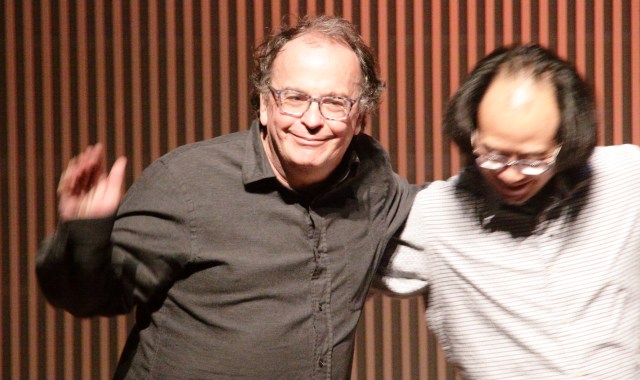
A satisfied looking Phil Kline leans in to embrace the first violin of the Flux Quartet after their premiere of his Algebra of Need.

The Bang on a Can collective was also represented tonight by Michael Gordon.  The Sad Park (2008) for string quartet and electronics put a most decidedly disturbing conclusion on the evening.  This piece, which samples the voices of children (one of them Gordon’s) as they spoke of their experience of the 9/11 Twin Towers attacks.

The effect was, as no doubt intended, harrowing leaving a pretty strange and unsettling feeling as we walked away from the concert into the still rainy night.

BHM160017

Michael Gordon embraces the FLUX Quartet’s first violin after a stunning performance of The Sad Park.

The rain continued on Saturday but the crowd was noticeably larger for the second night which opened with the usual panel discussion.

BHM160030

left to right: Meredith Monk, John Oswald, Nicole Lizee, Eliot Simpson, Larry Polansky, Oliver Lake and Charles Amirkhanian in a panel discussion prior to the concert

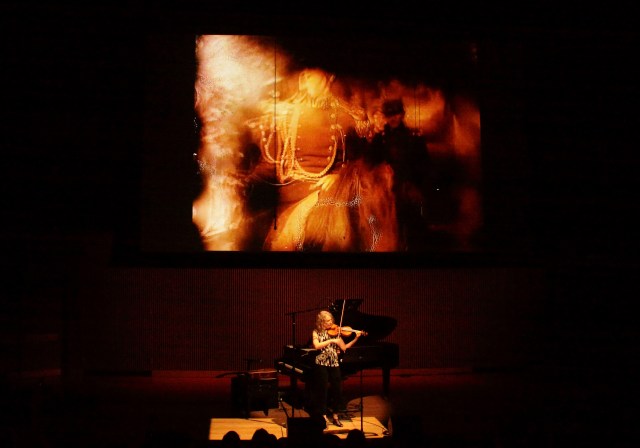
This evening began with a performance by the wonderful bay area violinist Kate Stenberg of a piece which was a sort of antidote to the somber, The Sad Park from the previous night.  Again the composer was Michael Gordon and the piece was Light is Calling (2004), a collaboration with filmmaker Bill Morrison.  Though hardly a happy piece Light is Calling is perhaps elegiac and the composer seems to achieve some of his stated intent to find some healing in the wake of a disaster to which he was all too close.
BHM160031

Kate Stenberg plays violin beneath the projection of a Bill Morrison film in Michael Gordon’s, Light is Calling
BHM160032

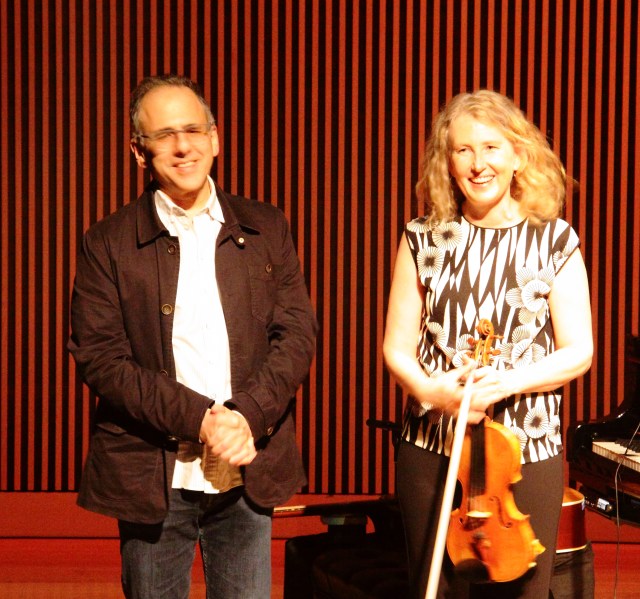
Michael Gordon and Kate Stenberg accepting the applause of an appreciative audience.

Next up was John Oswald, a Canadian composer whose career took off in infamy when his Plunderphonic CD, released to radio stations in the early 1980s, became the subject of legal battles over the meaning of copyright law in light of digital sampling.  Fortunately Oswald won the right to publish his work and his Plundrphonics concepts now underlie much of his compositional process.  Until this night I had not heard any but his Plunderphonic CDs so the introduction to his live music was a revelation.
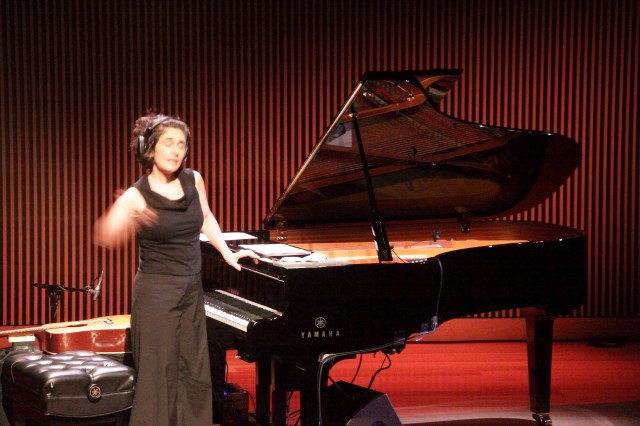
BHM160033

Pianist and (at least here) multi-instrumentalist Eve Egoyan performing with a Yamaha Disklavier and other instruments.

The first piece she did was called Homonymy (1998/2015) was originally written for chamber orchestra and was then transcribed for Egoyan and her prepared disklavier et al.  It is a piece based on linguistic elements and with a visual component as well.

BHM160034

Eve Egoyan performing Homonymy with overhead projections.

Nicole Lizee’s David Lynch Etudes (2015) was the next piece  and also made use of the projection screen.  The subtitle of the piece indicates it is for “disklavier and glitch”.  Well life imitated art as some sort of glitch prevented the projection from functioning at first but this was rather quickly resolved and we were treated to excerpts of scenes from several David Lynch films with the piano playing some of the rhythms of the dialog in an exchange that puts this writer in the mind of music like Scott Johnson’s “John Somebody” and Steve Reich’s incorporation of speech rhythms in works like, “The Cave”.

Nicole Lizee is a Canadian composer and was the youngest composer on this year’s program.
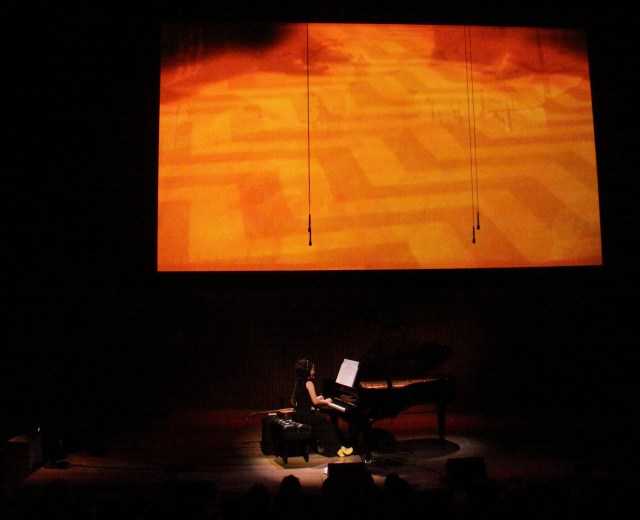
BHM160035

Eve Egoyan playing Nicole Lizee’s David Lynch Etudes with projected scenes/glitches from Lynch’s films.

The work is one of a series of pieces inspired by films and was executed with apparent ease by pianist Eve Egoyan who played the disklavier (both the keyboard and directly on the strings), a guitar and perhaps other gadgets .  The piece kept her quite busy and the associations I described above sound nothing like this work actually.  These etudes were a unique, typically Other Minds sort of experience, one that expands the definition of musical composition.

BHM160036

Nicole Lizee (l) with Eve Egoyan absorbing the audience’s appreciation of the David Lynch Etudes.

Two more John Oswald compositions graced the program next.  Palimpia (2016) is a six movement piece for disklavier with pianist playing as well.  Oswald says it is actually his first composition for piano.

BHM160046

John Oswald embracing pianist Egoyan and enjoying the audience applause for his work.

Well I did say there were two more Oswald pieces but this last one was a masterful plunder by this truly unusual composer.  Here Oswald conjured the playing as well as the image of the late great Glenn Gould who was seen actually playing Invaria (1999) with the disklavier performing along with the film of Gould performing this music.  It was, for this writer, a spellbinding experience.  He has raised the dead in the name of music.  Wow!  It was an amazing and heartfelt homage to a fellow great Canadian musician.
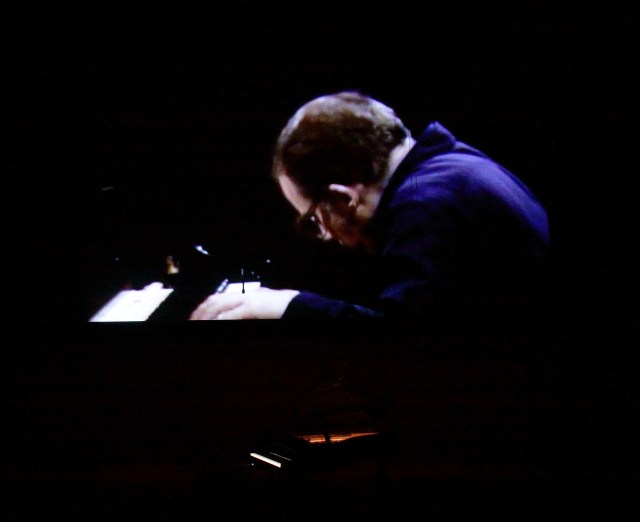
BHM160038

Glenn Gould playing John Oswald

Larry Polansky (1954- ) is well known as a teacher and as a composer but one is hard pressed to find much in the conventional discography of his work.  The few discs out of his amazing electronic music (and one disc of piano variations) represent only a small fraction of his output and represent only one genre of music which he has mastered.  However the astute listener needs to be advised to look online to look, listen and hear some of the bounty of his creative output.  Check out the following sites: Frog Peak Music (Polansky’s publishing site which includes music and scores by a great many interesting composer in addition to himself and Dartmouth Page (which contains link to various recordings, writings, computer software, etc.

BHM160039

Giacomo Fiore (left) and Larry Polansky playing Polansky’s ii-v-i (1997)

As an amateur musician who has enough trouble simply tuning a guitar it made my knees weak to watch these musicians effortlessly retune as they played.   Polansky’s experimentation with alternate tunings is an essential part of many of his compositions.

BHM160040

Fiore and Polansky changing their tunings mid-phrase in a stunning demonstration of virtuosity with pitch changes.

The program then moved from the electric to the acoustic realm with Polansky’s folk song arrangements.  Eliot Simpson, the pedagogical progeny of the great David Tanenbaum (who played these concerts last year at OM 20), played the just intonation National Steel Guitar and sang.

Let me say just two things here.  First, these are not arrangements like Copland’s Old American Songs and second, I will never hear these folk songs quite the same way again.  Polansky’s interest in folk music and Hebrew cantillation along with alternate tunings produces what the ears hear as perhaps a different focus.  In these pieces he did not stray too far from the original (as he does in his Cantillation Studies) but one is left with distinctly different ways of hearing and thinking about this music and the listener is left richer for that.  It is a journey worth taking and Simpson played with both passion and command.

Eliot Simpson playing a selection of Larry Plansky's Songs and Toods

Eliot Simpson playing a selection of Larry Plansky’s Songs and Toods

Polansky returned to the stage for a performance of his 34 Chords (Christian Wolff in Hanover and Royalton) (1995). Again we were treated to the virtuosic use of alternate tunings performed live (and again with live re-tunings) by the composer.

Oliver Lake delivering a blistering free jazz improvisation.

Oliver Lake delivering a blistering free jazz improvisation.

Continuing with the solo performer theme we were privileged to hear the virtuosic jams of Oliver Lake (1942- ) whose long career is legendary in the jazz world.  The “mostly improvised” (according to the composer) Stick was played on two different saxophones in what appeared to be as intense an experience for the performer as it was for the audience.

Oliver Lake takes a final bow at the end of the second concert of OM 21

Oliver Lake takes a final bow at the end of the second concert of OM 21

The emotional workout was received warmly by the audience.

Charles Amirkhanian introduces Meredith Monk on the final day of OM 21

Charles Amirkhanian introduces Meredith Monk on the final day of OM 21

There was no panel discussion on the third day of OM 21.  This matinée was dedicated entirely to the work of Meredith Monk (1942) who, fittingly was one of the featured artists in the first Other Minds gathering in 1993.  Now a recipient of the National Medal of the Arts this beloved artist returns to OM 21.  Though the rain continued the house appeared to be full.
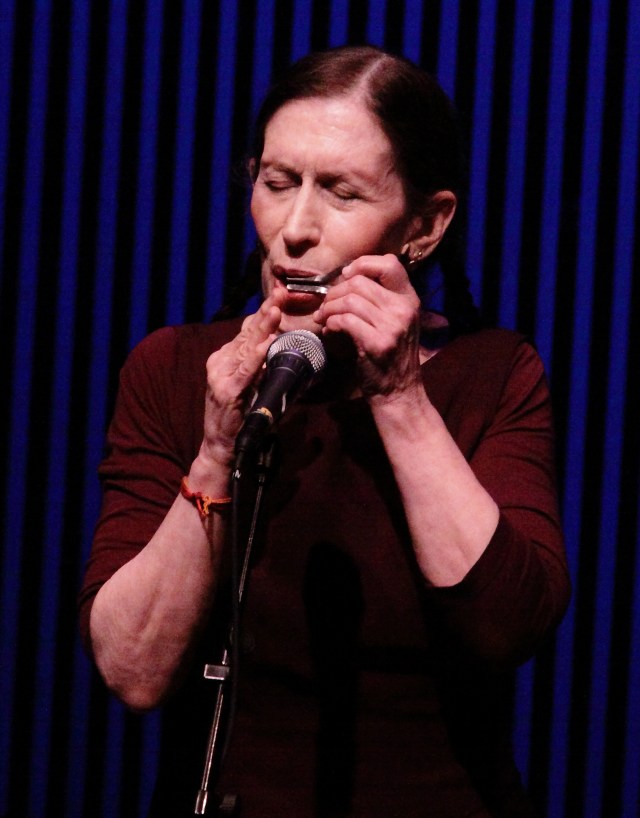
Meredith Monk playing a Jaw Harp in one of her early solo songs.

Meredith Monk playing a Jaw Harp and singing in one of her early solo songs.

Monk played a selection of material from various periods in her career in a mostly chronological survey which she called The Soul’s Messenger.  She began with selections from her solo songs and proceeded to her voice and piano music, then to her work with multiple voices and instruments.
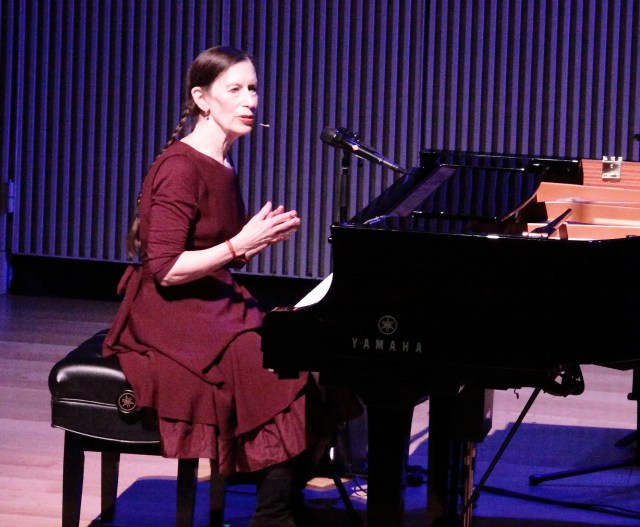
Meredith Monk performing her signature Gotham Lullaby

Meredith Monk performing her signature Gotham Lullaby

Most of the audience seemed to have a comfortable familiarity with the individual works she offered on this night which effectively gave a picture of her career.  Monk was in good voice and appeared to enjoy her performance.
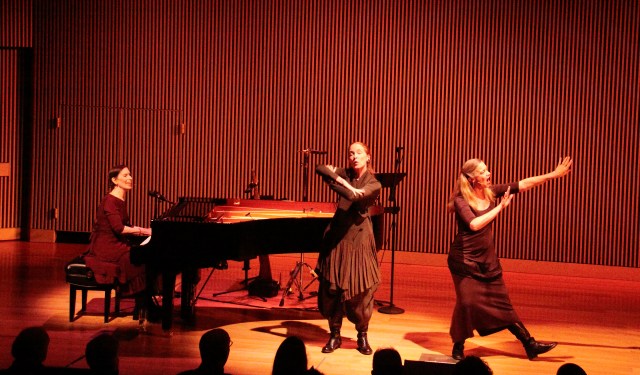
Long time collaborator Katie Geissinger and Allson Sniffin joined in the next selection

Long time collaborator Katie Geissinger and Allson Sniffin joined in the next selection

The stage was set to allow for the dance/movement that is an essential part of Monk’s works.  She originally trained as a dancer.
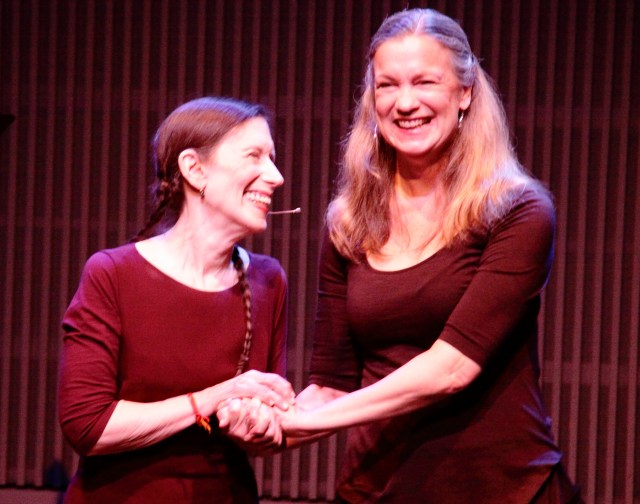
Monk and long time collaborator Katie Geissinger reacting to the appreciative audience

Monk and long time collaborator Katie Geissinger reacting to the appreciative audience

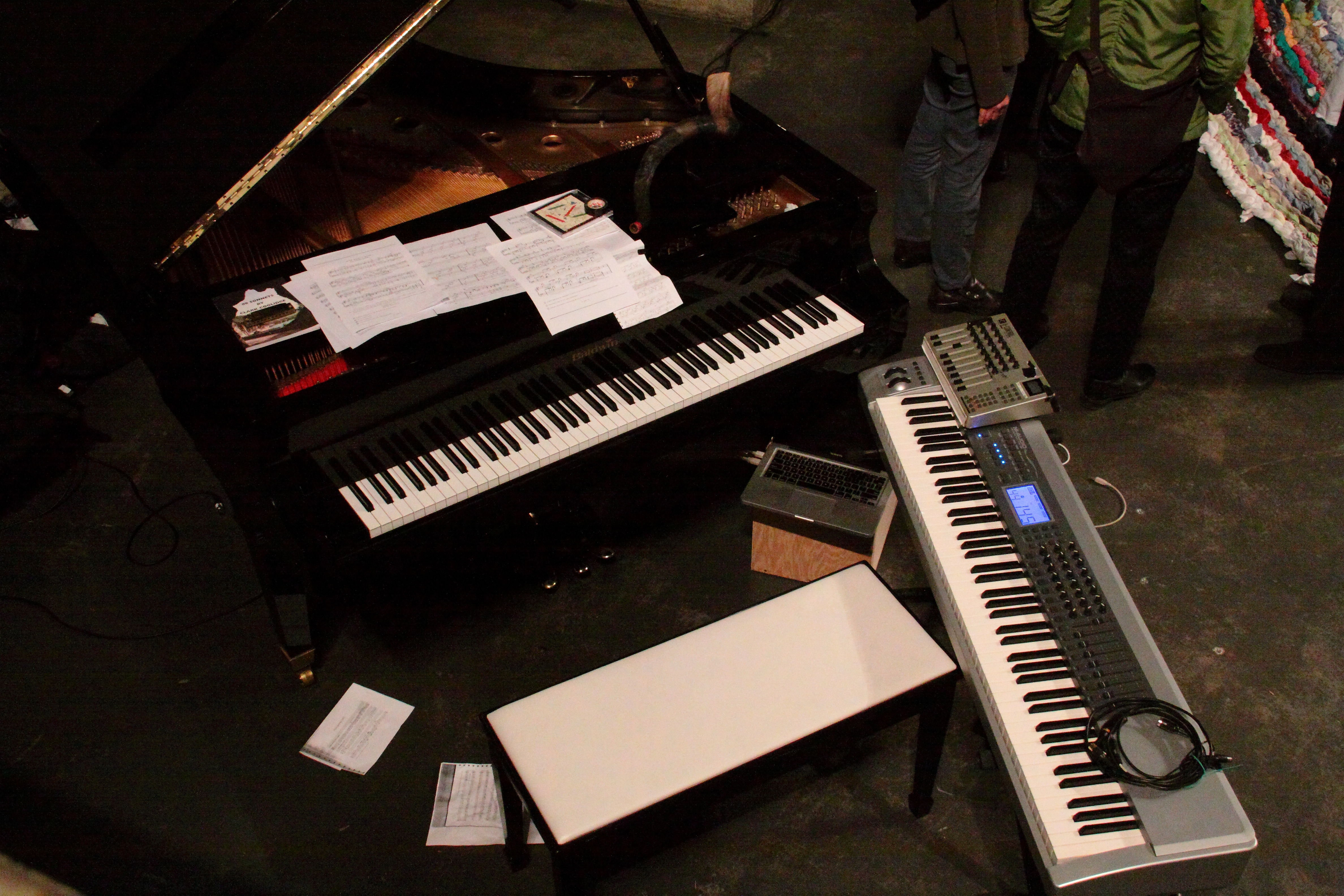
In addition to the grand piano the stage was set with two electronic keyboards, an essential sound in many of Monk’s works.
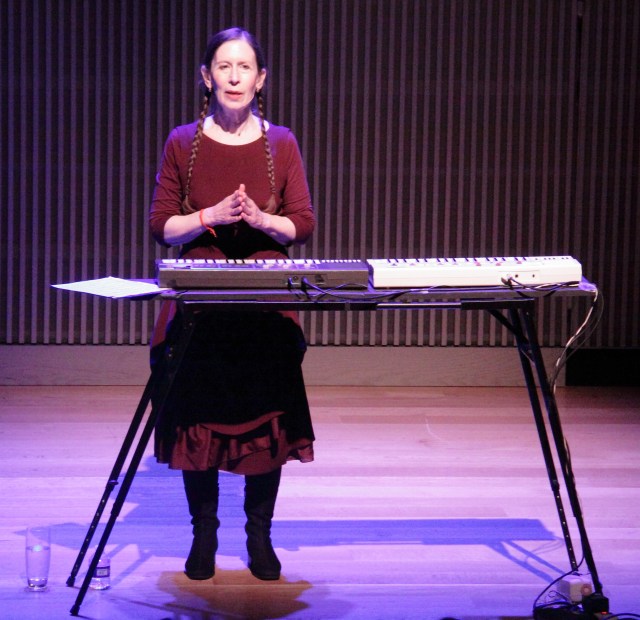
Monk at one of the electronic keyboards

Monk at one of the electronic keyboards

Woodwind player Bodhan Hilash joined the ensemble for the last set of pieces.
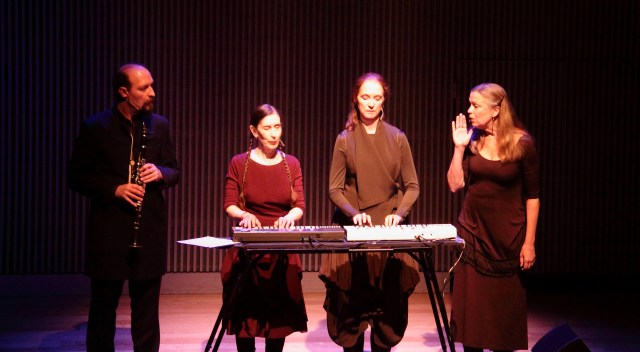
From left: Bodhan Hilash, Meredith Monk, Allison Sniffin and Katie Geissinger

From left: Bodhan Hilash, Meredith Monk, Allison Sniffin and Katie Geissinger

The audience gave a standing ovation at the end resulting in 3 curtain calls.
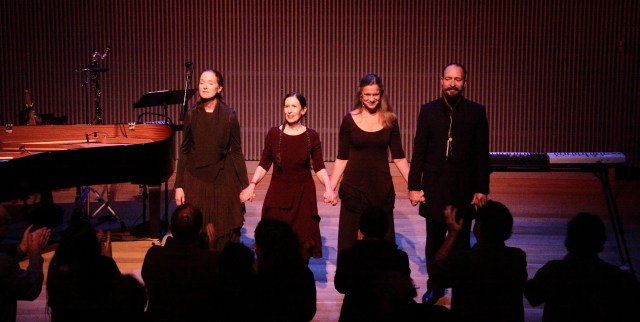
Left to right Allison Sniffin, Meredith Monk, Katie Geissinger and Bodhan Hilash receiving a standing ovation.

Left to right Allison Sniffin, Meredith Monk, Katie Geissinger and Bodhan Hilash receiving a standing ovation.

And the properly prepared artist came back for an encore of her song Details.
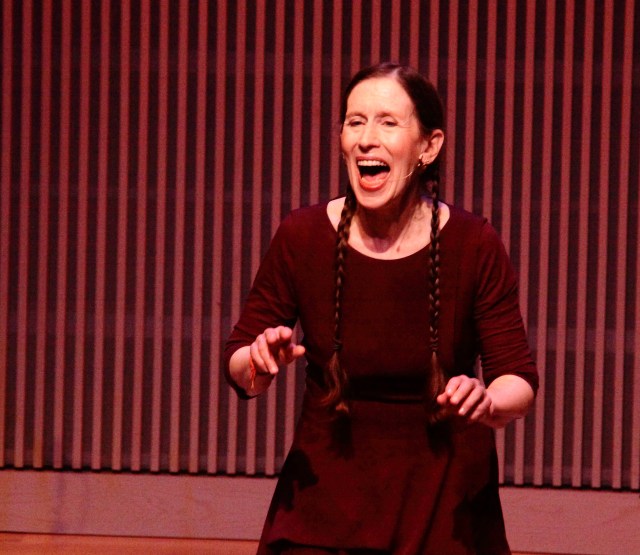
Meredith Monk performing an encore at the final concert of OM 21

Meredith Monk performing an encore at the final concert of OM 21


It was a fitting finale to a great OM 21, fitting to have this artist who appeared on the first iteration of Other Minds returning now crowned with a National Medal of the Arts and clearly beloved by the audience.  Her music like her lovely smile fade to the edge of memory like that of the Cheshire Cat on a truly triumphant finale.

And, despite some format changes, who knows what treasures continue to lie in store?  I will be watching/listening and so, apparently will many others.  Keep an eye on www.otherminds.org .  I know I will.
 

Spirituals Re-Imagined


411Wkh4lXuL._SS280
I managed to squeeze a delightful brunch meeting with my busy friend and colleague Bill Doggett on New Years Day.  It was there at a favorite Oakland cafe that we discussed many topics and Bill gave me a copy of this beautiful CD by a young black composer whose work is entirely new to me.

Okpebholo

Shawn Opkebholo (1981- )

Shawn Okpebholo (1981-  ) was born in Lexington, Kentucky.  He earned his B.A. in music at Asbury College and his M.M. and D.M.A. degrees at the  Unniversity of Cincinatti.  Doctor. Okpebholo is currently on faculty at Wheaton College  in Illinois.

The present disc is Opkebholo’s first CD dedicated entirely to his own compositions and is the composer’s “reimagining” of spirituals.  Drawing on the folk tradition of spirituals, worksongs, etc. as well as classical art song traditions he fashions his personal take on these much loved melodies.

I do feel compelled to mention the beauty of the photography and album design.  Greg Halvorsen Schreck took the pictures and Jeremy Botts did the overall design.  Powerful stuff.

In a slight deviation from the classic voice and piano arrangements the composer chose to score this little cycle for baritone, mezzo-soprano, viola and flue along with piano.  For this writer this was an interesting and suitably entertaining choice.

jnai

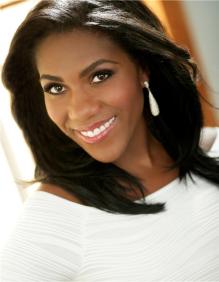
J’nai Bridges

Willnewheadshot

Will Liverman

The singers Will Liverman, baritone and J’nai Bridges, mezzo-soprano are marvelous and sensuous voices and discharge their duties most beautifully.  The pianist Paul Tuntland Sànchez is also a composer and very accomplished soloist.

Sanchez_Photo

Paul Tuntland Sanchez


The violist is Dorthy White Opkebholo and is the composer’s wife.  She is an accomplished musician in her own right.

The flute is played by Caen Thomason-Redus.

This is a beautiful recording of these loving arrangements of spirituals which can occupy that place in the literature populated by the likes of Aaron Copland’s Old American Songs.  A must for art song and folk song fans and a great opportunity to hear some fine musicians at the beginnings of what is hoped to be long and successful careers.

The Big Piano Variations, a great new recording of Bach, Beethoven and Rzewski


71Dr+79MpxL._SL1200_

Let me start by saying that I specifically requested the opportunity to review this October, 2015 release because I was pleased and fascinated to see this representation of three major masterworks of the large variation form included in a single collection.  To my knowledge this is the first time that these three works have been represented in a single release.

Variation form is one of the staples of the composer’s arsenal of techniques for well over 400 years now but the form is most commonly used as one technique in one  of several movements of a larger work. Consequently these types of variations generally last a few minutes.  A favorite example is the variations movement from Schubert’s “Trout” Quintet, a set of variations on his song, “Die Forelle” (trout in English) which subsequently lends the title to the entire work for piano quintet. This variation movement runs about 7 minutes or so in performance.  The Goldberg Variations (1741) can run up to 2 hours if one includes all the repeats but generally performances take about an hour.

So, along comes Johann Sebastian Bach who is commissioned by one Count Herman Karl von Keyserling (1697-1764) to compose some music for harpsichord (the predominant keyboard instrument of the day) to be performed by his personal musician Johann Gottlieb Goldberg (1727-1756) to aid the count’s insomnia.  The original intent apparently was to have the player perform one or two of said variations as a sleep-inducing remedy upon the Count’s request.  The work, using a brief Sarabande from the Bach’s own Anna Magdalena Notebook collection of pieces, has since taken the performer’s name as the Goldberg Variations.

It is not clear when the practice of performing the work in it’s entirety began but there is little doubt that Glenn Gould’s 1955 recording for Columbia Records (now Sony Classical) placed this piece firmly in the repertoire and in the minds and hearts of musicians and the listening public.  The variations had been recorded before by Rudolf Serkin, Wanda Landowska, Claudio Arrau, Ralph Kirkpatrick, Gustav Leonhardt and Roslyn Tureck but Gould’s quirky interpretation apparently defined a moment.

In 1819 the publisher Anton Diabelli composed a waltz and sent it out to many composers of the time asking them to write a variation on his piece with the promise that the collection would then be published.  This was not an uncommon practice at the time and it is certainly a workable business plan.

Indeed Diabelli did publish a compendium of these 50 plus variations by many composers of the day (including Franz Schubert and the 11 year old Franz Liszt) as Vaterländischer Künstlerverein (the link will take you to the downloadable score of the non-Beethoven variations on the waltz) but these are largely now forgotten.  Beethoven apparently balked at the idea or simply saw a larger potential in Diabelli’s brief waltz because he chose to write not one but 33 variations on the theme which subsequently became Volume II of Diabelli’s project.

Unlike the Goldberg Variations the Diabelli Variations (1823) were intended as a concert piece to be performed in its entirety.  Like most of Beethoven’s music this piece found a place in the repertoire and remains a staple for many pianists.  It is not clear if Beethoven was familiar with Bach’s work but the gesture is certainly similar in creating a large cohesive set of variations.

In 1975 the fabulous pianist Ursula Oppens commissioned Frederic Rzewski to write a set of variations that could be a companion piece to the Diabelli Variations.  Rzewski composed the music and Oppens premiered it in 1976.  Her subsequent recording from 1979 was nominated for a Grammy Award.

Frederic Rzewski (1938- ) is a composer/performer as were Bach and Beethoven.  He is a highly virtuosic pianist and a prolific composer whose influence extends widely from his involvement in the European avant garde including his own innovative use of early electronics in his ensemble Musica Elletronica Viva with Alvin Curran, Richard Teitelbaum, Allan Bryant, Carol Plantamura and John Phetteplace.

Rzewski’s variations are based on a revolutionary song by Sergio Ortega called, “El Pueblo Unido Jamás Será Vencido” (The People United Will Never Be Defeated), a song popular during the Chilean revolution that deposed Salvador Allende.  Unlike Bach and Beethoven, Rzewski’s music frequently takes on political associations, usually pretty explicitly as seen in this piece.

There are  36 Variations (6 groups of 6) and, like the preceding pieces are a reflection of much of the performance practice of their respective times.  Various “extended techniques” include slamming the lid of the keyboard, whistling and others are carefully integrated into this very cohesive mostly tonal work.

This piece seems to be gaining ground as familiar repertoire in the concert hall and, whether by accident or design, the inclusion of this piece along with the other two by Sony (who, you will recall released the establishing version of the Goldberg Variations) in effect is a major acknowledgement of this piece as perhaps the foremost representation of the large variation form in the 20th century much as the Goldberg and Diabelli Variations represent the 18th and 19th.  Bravo, Sony!

The interest here too is the emergence of a new artist, the Russian pianist Igor Levit (1987- ). This is his third release on Sony Classical, the previous two being the 2 disc set of the Beethoven late piano sonatas and the 2 disc set of the Bach Partitas for keyboard.

I won’t go into the nuances of interpretation that distinguish Levit from other performers of these variations except to say that he has to my ears a lighter touch, more Chopin in spirit than Liszt perhaps.  His performances leave no doubt as to his virtuosity and interpretive abilities but, of course, there are always discussions of individual preferences for one or another pianist in such repertoire.  What is undeniable is his ability to grasp the larger picture and to perform these large masterpieces in such a way as to convince the listener of the integrity of each work and to hold the interest of the listener throughout the performances.  There is, in the end, no definitive recording of any music really but these are certainly candidates in the debate.

In short this is a fine set of discs, beautifully recorded, which would please anyone interested in classical music and piano music in general.  Over time one might want to hear other interpretations but these recordings are extremely satisfying and represent  their composers as well as any I’ve heard.

BMOP Opening Concert Commemorates Armenian Genocide


BMOP20_logo

ADDENDUM:  Unfortunately the pianist Nareh Arghamanyan will not be able to perform.  BMOP informs me that they are substituting a piece by the wonder.ful Israeli composer Betty Olivero called Neharot Neharot (2006-7) for two string orchestras, accordion, percussion, tape and viola.  It will feature none other than violist extraordinaire Kim Kashkashian.  

The Boston Modern Orchestra Project begins it 20th season on Sunday October 18th with a concert in honor of the 1915 Armenian genocide with a celebration of that country’s artistic heritage.  Titled Resilient Voices 1915-2015, the concert will feature works by Komitas (1869-1935), Alan Hovhaness (1911-2000), Dmitri Shostakovich (1906-1975) and Tigran Mansurian (1939- ).

Komitas_1902

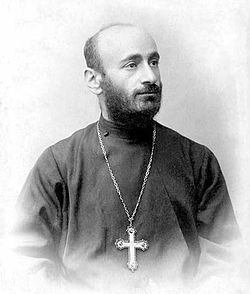
Komitas, born Soghomon Soghomonian, is generally regarded as the foundational composer for Armenian classical music in the 20th and 21st centuries.  Like Bartok and Kodaly, he collected and transcribed folk music from his country.  He is considered an early founder of the practice of ethnomusicology collecting Armenian and Kurdish folk music.  He was ordained a priest in the Armenian rite church and took the name Komitas.  The impact of the genocide affected him deeply and he spent the last 20 years of his life in a psychiatric facility where he died in 1935.

Alan Hovhaness

Alan Hovhaness

American composer Alan Hovhaness also embraced a musicological approach to his composition by including Armenian folk songs and that of other musical cultures he had explored including Korean and South Asian. He also acknowledges a debt to Komitas (Hovhaness released a recording on his own Poseidon label of him performing Komitas’ complete piano music).

Hovhaness remains less well-represented than he deserves in the concert hall so this performance of Khrimian Hairig (1944, rev 1948) is a welcome one.  The piece is in three continuous movements titled, “Chalice of Holiness”, “Wings of Compassion” and “Triumph of Faith”.  It is scored for string orchestra with solo trumpet.  The solo here will be played by prominent new music trumpeter Terry Everson (whose talents are to be required in the next piece on the program).  Hairig was a prominent Armenian cleric and mystic of the 19th century.

This work is early in Hovhaness’ prolific output and is characteristic of his Armenian period utilizing Armenian folk melodies and writing on Armenian themes.  He would later gain wider fame when Leopold Stokowski premiered his 2nd Symphony “Mysterious Mountain” in 1955 on NBC television.  Hovhaness died in 2001 leaving over 400 compositions of which 67 are symphonies.

Arghamanyan_Nareh

Nareh Arghamanyan

The Armenian connection to the next piece is apparently the BMOP début of the young Armenian pianist, Nareh Arghamanyan (1989- ) in the First Piano Concerto Op. 35 (1933) of Dmitri Shostakovich.  This unusual piece is scored for piano, string orchestra and trumpet (I told you Everson would be back).  It is one of those neo-baroque experiments and quotes from well-known classical pieces.  It is quite challenge for a pianist and the début of this rising artist will doubtless be one of the highlights of the concert.

The title of the concert is Resilient Voices 1915-2015 and is given in commemoration of the Armenian Genocide (1915-1923) but more so in celebration of the voices and the talents that have endured.  Controversy remains evidenced by the fact that Azerbaijan and Turkey continue to deny the genocide but the estimated death toll was 1.5 million and this is the event for which the term “genocide” was first used.

Artistic Director and Conductor Gil Rose

Artistic Director and Conductor Gil Rose

It is the genius of Gil Rose, conductor and artistic director whose creative vision in a couple of releases  I recently reviewed ( Anthony Davis and Irving Fine) that first alerted me to the work of this fine ensemble (a little late, I know).  But I discovered a great orchestra with some of the most innovative programming with attention to new and recent music.  I was graciously offered a seat at this concert but it will have to be one of my regrets.  This sounds like a fantastic program.

Tigran Mansurian

Tigran Mansurian

How very appropriate then to have the BMOP premiere of the Requiem (2009) by Tigran Mansurian (1930- ) by far Armenia’s best known living composer.  The Requiem was written in memory of the holocaust and is scored for large orchestra, chorus and soprano and baritone soloists (not announced when last I checked yesterday).  Gil Rose conducts the Harvard-Radcliffe Collegium Musicum with the Boston University Marsh Chapel Choir.  This is indeed a species of political music and BMOP is to be applauded for this as a contribution to the recognition of human rights. through music.

Tigran Mansurian at the piano at Other Minds in San Francisco.

Tigran Mansurian at the piano at Other Minds in San Francisco.

Mansurian previously appeared at the Other Minds 20th Anniversary concert (also dedicated to the holocaust) in March of 2015 in San Francisco.  At that concert I captured a moment from the pre-concert discussion in which Mansurian agreed to sing a traditional Armenian song accompanying himself at the piano, a very personal moment from a composer whose art is deeply felt.

Please, BMOP, record this.  Thanks in advance!!!

The Varieties of E#, a new Elliott Sharp Release on Starkland


Elliott Sharp

Elliott Sharp

I think the first time I heard of Elliott Sharp was when a friend played a vinyl copy of 1988s Larynx. I later got hooked on the delightfully noisy string quartets of 1987s Hammer, Anvil, Stirrup. With 89 albums to his credit (according to discogs.com) Sharp writes and plays music in a range of styles and for a range of ensembles.

Only two years older than John Zorn their musical paths are similar in that they both learned multiple instruments as children. While they are both incredibly creative, intelligent and productive artists, Sharp initially took a more traditionally academic path while Zorn is largely self taught (an amazing feat in itself).

Sharp studied music, anthropology, improvisation and electronic music with teachers like Benjamin Boretz, Roswell Rudd, Morton Feldman and Lejaren Hiller. His music frequently uses Fibonacci numbers, fractals, chaos theory and genetic metaphors. His collaborators have included blues guitarist Hubert Sumlin, Qawalli singer Nusret Fateh Ali Khan (and many others) and practically a who’s who of the Downtown New York scene.

He produced the Nonesuch album of Ornette Coleman covers by John Zorn (Spy vs. Spy, 1988) which is definitely worth a listen. It is one of a series of such recordings of covers of various artists which have also included Ennio Morricone among others.

The present recording comprises works written between 2004-2008 and, like the previous release of music by Martin Bresnick (reviewed previously in this blog here), comprises a sort of snapshot of the composer’s recent work. Like the Bresnick disc this recording samples Sharp’s writing for a variety of ensembles and is an effective portrait of his mature style.

As a long-standing performer in the New York downtown scene Sharp experimented with a variety of compositional and  instrumental techniques consistent with his scientific interests.  Now such experimentation by itself is of little interest except on a theoretical level but what we hear in the works in this recording is a composer who has integrated these techniques into a sound that is pretty uniquely identifiable as Elliott Sharp much as J.S. Bach’s techniques are easily recognizable in identifying that composer.

The first work (and the one that lends its title to the album) is The Boreal (2008).  It is the most recent of the compositions and is another chapter in Sharp’s reinvention of string quartet writing.  Written for the noted JACK quartet, it involves the use of different types of non-traditional bows fashioned by the composer and creates sounds full of harmonics. It is probably unlike any string quartet music you have ever heard and it expands the notion of what that traditional classical ensemble can do.  The recording, though recorded live at the Ostrava Festival, is remarkably free of ambient noise which allows the listener to hear the subtleties of the rather wide dynamic range to be heard without the interference.  The work resides in more or less the same sound world as his other quartets and its four movements seem to follow logically creating a conceptual whole as with any of the more conventional quartets in the repertory.

Jenny Lin

Jenny Lin

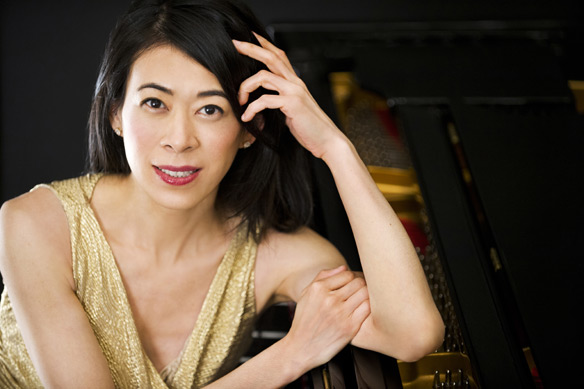
The second work, Oligosono (2004) is for solo piano.  As the liner notes tell us it is Sharp’s application of extended instrumental techniques which he developed on his guitars to the piano (a pretty interesting accomplishment).  It is written for and played by the wonderful Jenny Lin who navigates the inside of the piano as well as the keyboard in some rhythmically complex and virtuosic playing.  She executes the three movements with seeming ease.

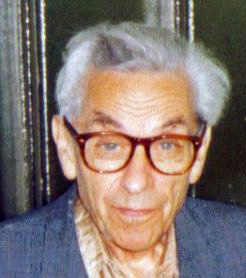
Paul Erdös "Erdos head budapest fall 1992" by Topsy Kretts - Own work. Licensed under CC BY 3.0 via Commons - https://commons.wikimedia.org/wiki/File:Erdos_head_budapest_fall_1992.jpg#/media/File:Erdos_head_budapest_fall_1992.jpg

Paul Erdös

Now we come to the composer’s work for larger ensembles.  Proof of Erdös (2006) is named for the mathematician Paul Erdös (1913-1996) perhaps most famous for the Erdös Number which is an indicator of the degree of separation a given person has with another (Erdös’ number would be a zero and his direct collaborators would be a one.  I’m guessing my Erdös Number with regard to Mr. Sharp would probably be at best a three for having reviewed this album).

Proof of Erdös is a four movement work written for Orchestra Carbon (one of Sharp’s various ensembles) and it is ably conducted by the American composer/conductor David Bloom.  It is a studio recording.  The work shares some of the sound world of the last piece on the album but the ensemble is more of a chamber group than the full orchestra but produces a similarly large and complex sonic image.

On Corlear’s Hook (2007) is a work for full orchestra and, for this reviewer, it is a great opportunity to hear Sharp’s ability to write for large orchestra.  It’s title is taken from a the lower east side neighborhood in Manhattan where Sharp resided with his family.  As the composer says in the notes there is no attempt to be programmatic or pictorial that the music is, “a reflection of the spectra of my existence (there) from one frequency band to another”.

The performance by the fine Janacek Philharmonic is conducted by the German conductor Peter Rundel (1958- ). Rundel, whose credits include a Grand Prix du Disque for his recording of the works of Jean Barraque (1928-1973), delivers a convincing performance of this tour de force.  The four movements, reflecting Sharp’s “spectra” coalesce to a unity which suggests that this piece could easily be called “symphony” if one wanted to use that apparently dated term.  The audience seems attentive or at least respectfully quiet which makes for a pretty definitive recording.

A great debt is acknowledged here to the fine work of the Ostrava Days festival under the guidance of Petr Kotik (1942- ) for curating this amazing annual new music event.  There are very useful liner notes by legendary boundary defying cellist (and sometime Sharp collaborator) Frances-Marie Uitti.   Sharp himself provides notes in the accompanying booklet. As usual with Starkland the recording is of very high quality and Tom Steenland’s gift for graphic design (using an 1888 photo of electrical “effluvia” from the surface of a coin) is well suited to represent the contents of the recording.

The Boreal Starkland ST-222

The Boreal
Starkland ST-222

Like many of Starkland’s releases this album challenges the listener but meeting that challenge and giving this a serious listen is ultimately very rewarding.  This is a fine example of a composer whose work deserves to be better known and this is a good sampling of some of his most refined work.  Hopefully this release will help to position Sharp as a composer with roots in the downtown improv scene who has taken his experimentation successfully into the larger world of the contemporary classical scene.


Certitude and Joy, the World of Wold


MinMax 019

MinMax 019

This is one of those operas whose title evokes irony right at the start.  Like Ruggero Leoncavallo‘s “Cavalleria Rusticana” (Rustic Chivalry) and Virgil Thomson‘s “Four Saints in Three Acts” the title Certitude and Joy hardly seems to evoke the right emotions in this harrowing story taken right from the headlines of a case in 2005 in which a mother kills her children and dumps their bodies in San Francisco Bay.  This is contrasted with the biblical story of Abraham and Isaac in which God tells Abraham to slay his son.  Of course God stopped Abraham in the bible story but that was not the case with the more recent story.

English: portrait of composer Erling Wold, pai...

English: portrait of composer Erling Wold, painted by Lynne Rutter. oil on panel, 2002 (Photo credit: Wikipedia)

Erling Wold (1958- ) is a composer of whom I had been only distantly aware.  He is a California native and has studied with Andrew Imbrie, Gerard Grisey and John Chowning.  That right there gives you a clue to this man’s compositional range and skills.  He completed a Ph.D. from the University of California Berkeley in 1987 and has worked for Yamaha creating new synthesizer programs in addition to pursuing his musical interests.

The San Francisco Bay Area has such a rich and varied musical culture that it is not all that surprising to me that I hadn’t come to know this fascinating composer.  And it’s taken me a while to absorb enough about Mr. Wold to feel that I could write something intelligent about this CD.

The composer’s web site (click here) contains a plethora of scores and sound recordings of this prolific and interesting composer.  And there are numerous offerings on You Tube and there is a blog linked on his web site in which he discusses a variety of topics not the least of which is his own music.  It seems that he has created several operas including one based on William S. Burroughs’ early but long suppressed novel, Queer.  His chamber operas, A Little Girl Contemplates Taking the Veil and his opera on Pontius Pilate illustrate his interest in both religious and political themes.

I won’t even try to get into his orchestral, chamber and solo piano works.  That is the job of a future blog which I can assure you will happen.  But the main point of this blog is to look at this most recent offering of his chamber opera Certitude and Joy.

As best as I can describe in words, Wold’s accompaniment figures remind me of Philip Glass or John Adams at times but he is not a simple derivative  of these composers.  His vocal lines, almost all sung as opposed to spoken, are more like recitatives than arias and  suggest a more ensemble feel as opposed to the grand opera style of arias, duets, etc.

Aldous Huxley, Famous Last Words

Aldous Huxley, Famous Last Words (Photo credit: Wikipedia)

His libretto, ripped from the headlines so to speak, is a combination of philosophical musings, imagined dialogue and commentary from texts as diverse as Aldous Huxley’s writings on psychedelics and the more pedestrian musings of newspaper columns.  I think there is some affinity for Robert Ashley’s mysterious texts but again nothing derivative.  The work is perhaps political as social commentary but not as social protest.

What is important is that this work, thinly scored (though hardly thin in sound) for two pianos and a cast of singers, speaks directly and affectingly to the audience.  He manages to tell this tale in a fairly straightforward manner with occasional digressions for philosophical commentary.  But he never loses control of the narrative which flows on drawing you in to this sad story and leaves you with the questions he raises, albeit rhetorically, about the nature of religious revelation, mental  illness and the current state of our society and our world.  This is a tall order but Wold manages to fill it with just the right amount of drama and music that leaves the listener (and viewer if you see it live in person or on You Tube) seemingly with exactly the emotions I think the composer wrestled with in writing it.

Like the aforementioned Four Saints and Cavalleria, Certitude and Joy is a listener friendly opera with messages that are disturbing and go to the core of what it means to be human.  The performances by the fine duo piano team of Keisuke Nakagoshi and Eva-Maria Zimmerman (ZOFO) and singers Laura Bohn, Talya Patrick, Jo Vincent Parks, Kerry Mehling, Tranvis Santell Rowland with Bob Ernst, speaker and a cameo by the composer (I’ll leave that for listeners to find).  The beautiful recording on Paul Dresher’s MinMax label is distributed by Starkland and is available on Amazon and other outlets.  A worthwhile experience for all lovers of contemporary opera and drama.

Other Minds 20 and Why You Shouldn’t Miss It


Official Other Minds Logo

Official Other Minds Logo

The three days of concerts scheduled for March 6, 7 and 8 of this year at the beautiful SF Jazz Center will mark the 20th anniversary of Other Minds opening the ears and minds of bay area new music audiences.  Previously composers could only appear once at this festival (thought performers frequently return) but the anniversary celebration is marked by the return of several alumni.  In fact the entire program consists of composer alums.

Other Minds is an annual festival of new and unusual music curated by bay area composer, producer, broadcaster Charles Amirkhanian and his crew at Other Minds.  Along with co-founder, now president emeritus Jim Newman and a varied and sometimes changing crew of talented and dedicated archivists, fund-raisers and coordinators this festival was born in 1993.

OLYMPUS DIGITAL CAMERA

Every year (though the actual month has changed for various reasons related to venue availability and funding) an international group of composers is brought together first at the Djerassi Arts Center just west of Palo Alto where they share their work and ideas with each other for a week in preparation for the performances of their work to come at the concert series.  This residency is a sort of private retreat open only to the composers and the staff of the center.  And given the range of musical styles it must be a fascinating thing to witness as composers largely unfamiliar with each others’ work gather to share and wonder at each others’ strange and innovative ideas.  Who knows what seeds may have been sown?

Sadly, Dr. Carl Djerassi who founded the center passed away on January 30, 2015.  His arts advocacy will live on through his beloved Djerassi Arts Center and this OM 20 will be a testament to that legacy.

What makes this festival so significant is the fine tuned and prescient nature of the selected composers.  Just a quick look at the list of composers and performers who have participated in the past looks almost like a who’s who of new music as practiced in the late 20th and early 21st centuries.  One of their commissions, Henry Brant’s (1913-2008)  won a Pulitzer Prize (Ice Field, 2001, Pulitzer Prize, 2002).  And it is programming with a uniquely west coast ethic, whatever that means.  I just know these programs are a different take on new music than that of the east coast.  Not a value judgement there, just a celebration of a different, equally important, point of view.


WHY YOU SHOULDN’T MISS OM 20

First you will find a generous (though hardly complete) selection of music by Charles Amirkhanian (1945- ) who has been at the helm of this festival from the beginning and was for 23 years the music director of KPFA radio where his programming and interviews with composers and performers of new music spanned a wide and eclectic gamut of styles and techniques.  Perhaps most significant has been his support of northern California composers whose work would otherwise have been poorly represented.  Amirkhanian’s keen ear has introduced a great deal of new and interesting music to bay area audiences and beyond.

Executive Director Charles Amirkhanian in his ...

Executive Director Charles Amirkhanian in his office with ASCAP award in background (Photo credit: Wikipedia)

In addition to his abilities as producer and interviewer Charles is also a noted composer.  Trained as a percussionist, he has written quite a bit of music which deserves recognition for its innovation.  His best known works are those with tape recording, sound poetry and the uses of language.   His music will be featured in several performances and will be a welcome and tantalizing complement to the overall diverse tone that characterizes OM programming.

Amirkhanian’s oeuvre will be represented by “Rippling the Lamp” (2007) for violin and tape, three short pieces for voice and tape, “Dumbek Bookache IV” (1988), “Ka Himeni” (1997), “Marathon” (1997) and, on the third concert, “Miatsoom” (1994-97), a piece based on sounds (vocal, ambient and musical) recorded during the only trip Charles and his father made to Armenia in 1994.  This approximately half hour work is typical of his ability to create a fascinating and meaningful sound collage.  Miatsoom is Armenian for reunion, indeed the apparent theme of OM 20.

In an uncharacteristically political expression this year’s festival is in commemoration of the 100th anniversary of the Armenian genocide.  Amirkhanian is the descendant (both he and his father Benjamin were born here) of Armenian immigrants and grew up in Fresno, California.  The genocide of 1915 (also the year of Benjamin’s birth) was in fact only the most infamous and fatal of the ongoing abuses by the Ottoman Turk government in response to Armenians seeking equal rights (a familiar social issue both then and still today).  Charles has been tactfully apolitical in his programming but his music at times has paid respectful homage to his ancestry and their struggles. It seems right to pay respect to one’s ancestors and perhaps acknowledge that we still have much to do and learn in our imperfect world.

Tigran Mansurian

Tigran Mansurian

Appropriately the esteemed Armenian composer Tigran Mansurian (1939-  ) has been welcomed back and will be represented by two major works.  Romance for Violin and Strings (2011) and Canti Paralleli (2007-8) for soprano and string orchestra are both scheduled for the third concert of the festival.  I was unable to find any details about these pieces but Mansurian’s work certainly deserves to be better known and these performances are a welcome opportunity to hear this major compositional voice.

Lou Harrison

Lou Harrison (Photo credit: Wikipedia)

Homage will be paid to two past masters who are no longer with us, American  composer Lou Harrison (1917-2003) and Australian composer Peter Sculthorpe (1929-2014).  Harrison was a beloved bay area figure whose work with gamelan and other world musics led him to experimentation with alternate tuning systems.  Harrison will be represented by his “Scenes from Nek Chand” (2001-2) played on a National Steel Guitar tuned in just intonation by the wonderful guitarist David Tannenbaum who will also play Sculthorpe’s “From Kakadu” (1993) for conventionally tuned classical guitar.  Sculthorpe, born in Tasmania, was one of Australia’s best known composers who essayed widely in chamber, choral and orchestral music. His 14th string quartet (with didgeridoo played by Stephen Kent) “Quamby” (1998), played by the amazing Del Sol Quartet (who recorded all 18 of the composer’s string quartets) is scheduled to conclude the first concert.

Peter Sculthorpe

Peter Sculthorpe


Pauline Oliveros

Pauline Oliveros

Pauline Oliveros (1932- ) is one of the grand ladies of new music.  Her theoretical work in defining music and the act of listening as partners in the creative process and her subsequent compositions including ground breaking work with early electronics with the San Francisco Tape Music Center and later at Mills College characterize her wide range of interests and her insights.  Her principal instrument, strangely enough, is an accordion and she will be performing as well.  OM has commissioned a new work from her, “Twins Peeking at a Koto” (2015, world premiere) for two accordions and koto.  to be presented at the second concert.  Playing the koto will be Miya Masaoka (1958-  ) whose second string quartet will receive its world première on the first night by the  Del Sol Quartet.  Masaoka, Japanese/American native of Washington D.C., is a New York based composer whose work brings her to the west coast frequently where she is a founding member of the Bay Area experimental improv trio Maybe Monday.  Her work involves improvisation and frequently uses unusual sound sources like bees and even cockroaches (not to worry, no insects are slated to perform) and creates site specific multi-disciplinary works in collaboration with musicians and dancers.

Miya Masaoka

Miya Masaoka

Errolyn Wallen (1958-  ) can be said to embody the OM ethic.  Born in Belize, Wallen  left the Dance Theater of Harlem to study composition in England and says of her work, “We don’t break down barriers in music…we don’t see any.”  Her Percussion Concerto (1994)  was the first work by a black woman to have been performed at the London Proms Concerts.   Her “London’s Burning and other songs” will be played on the second night by the SOTA string quartet and Wallen voice and piano.

Errollyn Wallen

Errollyn Wallen

Don Byron (1958- ) similarly states that he strives for “a sound beyond genre”.  Steeped in classical, jazz and folk musics, Byron’s quartet (Don Byron, clarinet; Aruán Ortiz, piano; Cameron Brown, bass; John Betsch, drums) is featured at the conclusion of the second night of the festival.

Don Byron

Don Byron

Maja S.K. Ratkje (1973- ) from Norway whose work is perhaps related to Mr. Amirkhanian’s  in her exploration of the possibilities of the human voice.  Her “Traces 2” (2014-5) will receive its U.S. premiere on the first night’s concert.

Maja Ratkje

Maja Ratkje

The third concert will be unusual for two reasons.  First it will take place beginning at 3PM and, second it will feature a full orchestra.  This night will conclude with U.S. premiere of the Second Symphony (2014) by Michael Nyman (1945- ) .  Nyman is perhaps best known for his numerous wonderful film scores but is also highly accomplished in his work in the concert hall.  In the past three years Nyman has turned for the first time to the Symphony form and has completed to date no fewer than 11  symphonies.  Quite a feat.

Michael Nyman in Sant Cugat del Vallès

Michael Nyman in Sant Cugat del Vallès (Photo credit: Wikipedia)

Tickets still available as low as $15/night.  Quite a festival!


Finding Angels, Energetic Eclecticism from Howard Hersh


Angels and Watermarks

Angels and Watermarks

Howard Hersh (1940- ) studied music and earned Bachelor’s and Master’s degrees at Stanford University.  He is a California native and he succeeded Charles Amirkhanian as music director at KPFA.  His Pony Concerto (2005), Braided River Nights (2004) and Sonata for Violin and Percussion with String Bass obligato (2000) were released on Albany Records in 2007 and his Dancing at the Pink House (2006) is available as a free download on Bandcamp.

I had not been familiar with Mr. Hersh’s music when I agreed to review this disc but I found that liked it immediately and it made my  list of favorite releases for 2014. The  featured piece here is the Concerto for Piano and Ten Instruments (2008) and it is a tour de force.  Hersh writes in a tonal idiom that sounds to this reviewer’s ears like a mix of Conlon Nancarrow and Francis Poulenc.  This concerto is virtuosic in the extreme but not the empty virtuosity of the romantic composer pianists (Anton Rubinstein bores me to tears).  This work in three movements sounds very difficult to play but manages to remain playful and entertaining, never taking itself too seriously.  Pianist Brenda Tom does a fantastic job (she must have fingers of steel) and is very ably supported by the small ensemble conducted by Barbara Day Turner.  Rapid attacks, scales and arpeggios keep the soloist very busy and the ensemble clearly listens and collaborates in what is an electrifying performance.

The other pieces on the disc are a sort of strange contrast to the concerto.  First is a suite for harpsichord, Angels and Watermarks (2004) was composed during Hersh’s residency at the Djerassi Arts Center.  The piece is in five movements and is a significant contribution to the contemporary literature for that instrument.  Cast in the manner of a baroque suite, each movement plays on familiar forms.  The first movement is a ponderous prelude which is followed by a playful moto perpetuo, a gentle lullaby, then a spectacular jazz inflected toccata and finally a sort of non-literal recapitulation of the prelude.  Again we are treated to the dynamic keyboard work of Brenda Tom who executes each movement flawlessly and with great expressiveness.

The final work on the disc is Dream (2012)  which the composer (who wrote the liner notes) says is his exploration of how to incorporate tonal harmony in his work.  It is a soft, slow meandering piece in which he manages to make his explorations into a beautiful and restful work.  Brenda Tom is the dedicatee of both this and the harpsichord suite and she demonstrates her ability to work with soft expressive textures.

All in all a great CD which will delight any new music fan.  It is available from CD Baby and Amazon.  Highly recommended.

My 2014, a Summation and (sort of) “Best of…” List


The stage at Kanbar Hall stands ready to receive performers on opening night of OM 18

The stage at Kanbar Hall stands ready to receive performers on opening night of OM 18

As New Music Buff heads on into its fourth year in the online realm I find that I have a steadily increasing readership averaging 18 hits per day with an international reach of about 88 countries. I say readers, not followers because the stats provided have no way to track returning visitors but you know who you are.  And I thank WordPress for their entertaining summary published earlier here.


Last year I provided a list of my greatest hits (i.e. my most read articles in 2013) so here is a list of 2014’s top ten:

Black Classical Conductors (Black Classical Part Two)
This is a 2013 article which continues to be popular. I did an addendum called: Black Conductors, A Belated Addendum  and received a note from Tania Leon who remarked quite correctly that she is indeed a black American conductor.  Clearly I will need to expand this survey once again.

Maybe Music Remains Forever
This review of the excellent newly released Martin Bresnick CD went the equivalent of viral for my blog and I was pleased to have discovered the work of this wonderful American composer.

Primous Fountain World Tour Begins in Moldova
This relatively little known living black American composer was a child prodigy whose second symphony was commissioned by Quincy Jones had his sixth symphony premiered in Moldova in 2014.

Tawawa House in Modesto?
I was granted a comp ticket to see this really great performance of a little known 20th century opera by a black female American composer, Zenobia Powell Perry.  It was a great experience, a passionate, entertaining performance and put Modesto on the musical map for me.

Other Minds 18, Three Nights on the Leading Edge
Curiously this review was read more than the one about the 2014 Other Minds 19. More to come about the upcoming Other Minds 20.  For anyone who doesn’t know this is my favorite new music festival.

Far Famed Tim Rayborn Takes on the Vikings
This article about a 2013 performance by this very talented multi-instrumentalist, singer and scholar/historian continues to be popular. I’m hoping to catch another of his performances in 2015.

Black Composers Since the 1964 Civil Rights Act: Primous Fountain
I started in 2013 writing an occasional series of articles for Black History Month. I had no idea how popular this would become. The theme for the 2014 series is given in the title and you can rest assured that I will continue the series in 2015.

Tom Johnson and Samuel Vriezen, Great New Recording
A review of a crowd sourced recording project and one of my favorites of 2014.

Black Composers Since the 1964 Civil Rights Act
This is the introductory article for the 2014 series. Many thanks for the comments and support on this article and its successors.  I plan to give my summation of the various responses on this received both on and off the books.

Abraham Lincoln and the Avant Garde
This is one of an ongoing series of articles on political expression in music. It was after I friended Dorothy Martirano on Facebook and mentioned this piece that the article got a few new readers. Perhaps I should have mentioned the composer in my title.  Kudos to the late great Salvatore Martirano, gone too soon and too little known even now some twenty years after his passing.


SOME OF MY FAVORITES FROM 2014

Now regarding my personal favorite recordings of 2014 I have to insert a disclaimer to the effect that I make no claim whatsoever to this list being comprehensive or representing anything more than a few of my personal favorite recordings encountered in this past year. My apologies in advance to those I missed. I hope to catch up some day. So, in no particular order:

Mysterienspiel 2012

Game of the Antichrist by Robert Moran (Innova 251)
I promise a more comprehensive review soon but this is a great CD by a too little known American composer.  Mr. Moran recommended the disc to me after I wrote to him praising his wonderful “Trinity Requiem”.  I plan a more comprehensive article soon.  Meanwhile here is a link to a performance on Vimeo.

AZ spread

Alcatraz/Eberbach by Ingram Marshall and Jim Bengston  (Starkland S-2019)

This DVD is essentially the completion of a collaboration of photographer Jim Bengston and composer Ingram Marshall.  As such it is the most complete artistic statement superseding the audio only release (still worth having by the way) from some years ago.


Who Has the Biggest Sound? by Paul Dolden. (Starkland ST-220)
A difficult to categorize recording that brings two major works by this (previously unknown to me) Canadian composer to the listening audience. I reviewed this disc here.  I am still working on absorbing its subtleties.

221CoverB

Prayers Remain Forever by Martin Bresnick (Starkland ST-221)
In addition to providing me with quite a few readers the opportunity to review this recording introduced me to the work of this too little known living American composer.  My review garnered quite an amazing amount of readers as well as an appreciative response from Mr. Bresnick himself.  And now I find myself buying his other recordings.  Really great music.


Album cover

Album cover

Notes from the Underground by Anthony Davis. (BMOP sound 1036)

I have been a fan on Anthony Davis and his music for some years now and I was pleased to be able to review this disc.   I  was later able to obtain an interview with Professor Davis which will be forthcoming later this year.

download

Tom Johnson/Samuel Vriezen Chord Catalog/Within Fourths, Within Fifths. (Edition Vandelweiser)

I eagerly reviewed this crowd sourced CD in which I was proud to be one of the contributors to its production.  It is only the second recording of Johnson’s landmark of minimalism and an opportunity to hear the work of the fine composer/performer Samuel Vriezen.

basketmonk

Basket Rondo/Jukebox in the Tavern of Love by Meredith Monk/Eric Salzman. (Labor LAB 7094)

This Labor Records release would have escaped my attention were it not for my having run across it while researching another new music article.  New music aficionados might remember Eric Salzman for earlier works such as “Civilization and It’s Discontents” and his involvement with Nonesuch records or one of his many other significant involvements in the new music scene over the last 40 years or so.  This disc is the première recording of Meredith Monk’s “Basket Rondo”, one of her best realized new works as well as the première of a great new sound/music drama by Salzman.  A more thorough review is in the works.

howardhersh2

Something by Howard Hersh ( Snow Leopard Music 888295062350)

Mr. Hersh kindly sent me this CD for review which will be forthcoming but it easily makes it to my favorites list for 2014.

webreaknonclass

I also have to mention another crowd sourced project, “We Break Strings” by Thom Andrews and Dimitri Djuric, a book about the “alternative classical scene in London”.  The book which includes a CD sampler languishes in my “to be read” stack but my initial perusal left me with the impression of a beautifully conceived and executed volume which has much to offer the musically curious.  More about this book in a future blog.


CD Review-Hegarty, Steinbeck and Robles: Time/Space, an atypical jazz trio


HegartySteinbeck-TimeSpace

An old school twelve tone composer, an AACM composer and Julliard composer walked into a bar.  They sat down to play an out came, well, this album. And the bar I am imagining is perhaps a sort of post beat, post bop version of the bar from Star Wars.  I guess I am awash with metaphors here.

Imagine, if you can, a melding of musical styles.  Take a little Milton Babbitt, a little Anthony Davis, a touch of Wadada Leo Smith and perhaps a bit of Oscar Peterson (there is a little bit of a traditional lounge jazz touch here).  I have struggled to characterize this music and struggled perhaps even more to envision its ideal audience but that is not a criticism and is not intended to say anything negative about this album.

To be fair one of the main reasons I think I am struggling to describe this release is that it is a download only release which fortunately is accompanied by some nice cover art by Anna Hegarty and some liner notes which are essentially a  quote from some reviews but contain very useful information about the musicians and their history.  I guess I would feel differently if this had been a physical instead of digital release but perhaps I am just being nostalgic.  Oh, and keep in mind this is a free download.

The varied backgrounds of these musicians have resulted in a blending of styles creating a unique and enjoyable listening experience.  You can listen to this relatively short pieces as chamber music of a new classical variety but I think that would be missing the point.  This is basically an album of lounge jazz written and performed by some really good musicians who play well together.  Calling it “avant-garde” serves only to add a layer of fear and confusion to what should be a pleasant or at least innocuous experience.   That is why I called these guys an “atypical” jazz trio in the title of this review.

The musicians include James Hegarty on piano, Paul Steinbeck, electric bass and Shane Del Robles on drums.  According to the liner notes these musicians  have a pretty varied experience including free jazz,  AACM jazz, rock and various other projects.  They come together here very well.

In 12 short pieces (a metaphor for serialism?) this album manages to be lyrical and understated.  A few tracks use some studio effect of playing the tape backwards but most of what you hear is just acoustic instruments playing short numbers whose titles may mean more to the musicians than to the music itself but that is consistent with the type of music they are playing.  The music and the musicianship are good and sincere.

I would love to hear these guys play live in a smoky bar while sipping single malt scotch and hobnobbing with some kindred artistic spirits but I’ll have to settle for hearing it on my CD player (you have to hear this on a decent sound system).  I might even try to slip this in to some background music at a party just to see if anyone would notice it as different from whatever other background music might be played.  Very nice album and you can’t beat the price.

Tom Johnson and Samuel Vriezen, Great New Recording


A few of months ago received my copy of the newly minted CD by pianist/composer Samuel Vriezen.  This is one of those crowd-sourced projects on Indiegogo .  The disc consists of a new recording of a sort of minimalist classic and a new works by the pianist, Within Fourths/Within Fifths (2006) which is, essentially his artistic response to this piece.  The piece is dedicated to Johnson.

download

This is only the second recording of the Tom Johnson work committed to disc. That by itself is an achievement. The first was recorded by the composer and released on XI records in 1999.  That recording clocks in at about one hour.  By contrast Mr. Vriezen’s recording takes only about 30 minutes to play the piece.  Johnson, who is also known as the former music critic for the Village Voice is one of the few composers who actually embraces the term “minimalist”, in fact he was there witnessing the very birth of that style during his tenure at the Village Voice (1972-1982).

The Chord Catalog (1985) consists of, in order, all the possible chords in a single octave that are possible with two notes, three notes, four notes, etc. up to 13 notes with the doubling of the octave.  That’s a total of 8178 chords. This sounds like a potentially bland academic exercise like many minimalist or process music concepts.  No tempo is specified in the score.  It is an important piece which may not appeal to all audiences but will likely entertain anyone whose listening interests lie in the realm of minimalism, process music and conceptual art.

TheChordCatalogue-page-001

According to Kurt Gottschalk in his article for I Care If You Listen Johnson is a fan of Vriezen’s interpretation and, in fact, is one of the many contributors to the project.  Vriezen has been performing the piece for about 10 years now in public concerts and he posted a video of a performance of Chord Catalog with commentary by Tom Johnson and himself.  There are also scenes of Johnson with Vriezen as he performs a portion of Within Fourths/Within Fifths.

Vriezen’s piece by contrast lasts about 45 minutes and, though using similar methods, produces a different sound world.  He correctly describes the piece as lyrical and it is a wonderful piece on its own, more wonderful in context with its predecessor.  This disc is an artistic dialogue, a call and response between to kindred spirits of different generations.

Samuel Vriezen is a Dutch pianist, composer and writer born in 1973.  His web site lists his compositions and writings and there are downloadable mp3 files and scores.  There is also a Vriezen page on Ubuweb which contains mp3 files and pdf files of several of his pieces and includes useful program notes.  He also produced Johnson’s CD Symmetries (1980) featuring Vriezen and fellow pianist Dante Oei on Karnatic records.

This is the solo début recording by a composer and pianist with keen instincts and talents that leave this reviewer in excited anticipation of what he  will do next.  I am also proud to have sponsored this wonderful recording.

Enhanced by Zemanta

Alvin Curran’s Fake Book at the Berkeley Arts Museum


Staging set up for the Alvin Curran solo performance at the Berkeley Arts Museum

Staging set up for the Alvin Curran solo performance at the Berkeley Arts Museum

On a cool Friday evening in Berkeley April 11th I proceeded to the Berkeley Arts Museum which sits across the street from the University.  It is a beautiful modern architectural creation with a large and resonant space where there was a large and colorful rug, a series of pillows and behind that a set of conventional chairs for the audience.  Many chose to sit on the rug close to the performer.

The set up consisted of a piano on loan from the Piedmont Piano Company, an electronic keyboard on loan from Paul Dresher along with Mr. Curran’s computer and and amplifier driving two speakers on either side of the keyboards.  The open space is just off the entry way of the museum and tends to have a fair amount of traffic and ambient noise of the people on the various levels.

Curran, now 75, has been a prominent figure on the contemporary music scene internationally since about 1964 when he was partnered with fellow expatriates Frederic Rzewski, Allan Bryant, Richard Teitlebaum and Carol Plantamura among others in the ground breaking Musica  Elletronica Viva.  They created events and happenings using live electronics in the days before such things were easily accessible.  He has continued to explore the leading edge of musical creativity throughout his long and ongoing career.

Curran playing a harmonica at the opening of the concert.

Curran playing a harmonica at the opening of the concert.

The concert began with Curran circumnavigating the audience in clockwise fashion beginning stage right and going around the audience making a full circle and returning to the front of the audience stage center.  he began by playing two simple chords on the instrument repeating them several times.  He then switched to another woodwind type instrument playing some unusual sounds.  When he took his place in front of the keyboards he set those instruments down.

Curran completing his circumnavigation which opened the performance.

Curran completing his circumnavigation which opened the performance.

He alternated between playing the piano and the electronic keyboard sometimes playing both.  He began with some simple sounding piano music and then turned to the electronic keyboard and began playing some of the samples on it.  They ranged from speech to electronic sounds.

At first the ambient noise of the crowd echoed gently in the museum along with the music.  Gradually as the music became more complex and louder the audience seemed entranced, taken on the ritualistic journey that comprises Curran’s work, Fake Book, a reference to books of musical lead sheets that musicians have used over the years to quickly and easily access a variety of materials for live performances.

The louder music then suddenly changed back to a softer dynamic and the reduction in the ambient noise of the audience and casual museum goers had noticeably decreased and one sense an increased attention and focus on the music.  All seemed to be drawn in to the variety of sounds and styles which Curran refers to as his “common practice”, a practice in which the composer uses any and all sounds, instruments and styles strategically to evoke the things the composer wishes to express.

Alvin Curran at the keyboards performing his Fake Book.

Alvin Curran at the keyboards performing his Fake Book.

Curran played for just over an hour without pause an encyclopedic diversity of styles and ideas evoking the musical past in classical sounds, jazz sounds, modernist sounds.  The electronic keyboard samples played voices, radio snippets, electronic sounds and electronic manipulations of these sounds.

Curran effectively involved us all in a ritual performance respectfully evoking the past and blending it all into our experience of the moment.  From the beginning as he walked clockwise around the audience and through the complex collage of musical and sonic ideas he created a genuine ritual, a sacred performance if you will.  His music this night was an homage to the past and a celebration of the present.

Curran blowing the ancient shofar (ram's horn) over the undamped piano strings.

Curran blowing the ancient shofar (ram’s horn) over the undamped piano strings.

He signaled the end of the performance as he blew the ancient shofar, an instrument fashioned from a ram’s horn, over the undamped piano strings creating a beautiful sympathetic resonance.

The audience responded with warm applause and appreciation.  Curran, who told me that he began work on this music while he was in residence at nearby Mills College, is clearly embraced and appreciated by the local audience.  He continues his tour and will return to his adopted  home in Rome, Italy but this evening he was clearly one of our own.

Overhead view of the keyboard set  up for the April 11th performance.

Overhead view of the keyboard set up for the April 11th performance.

Enhanced by Zemanta

Notes From the Underground, A major new recording of Anthony Davis’ orchestral music


Album cover

Album cover

In March, 2014 the Boston Modern Orchestra Project released Notes From the Underground, a major retrospective recording of the composer’s work for large ensembles.  The recording includes Notes from the Underground (1988) a two movement work for orchestra, You Have the Right to Remain Silent (2007) a concerto for clarinet and contra-alto clarinet and Kurzweil processor and a new recording of the piano concerto Wayang No. 5 (1984) with the composer as soloist.  The Boston Modern Orchestra Project is conducted by Gil Rose.

There are liner notes by the composer and also by the great musician/composer/historian George Lewis (and a frequent musical collaborator with Davis).  The notes are relatively brief but contain a wealth of information and provide useful insights into both the musical processes and the sociopolitical forces that drive Davis’ music.  Davis describes his compositional processes and Lewis, a frequent musical collaborator,  places the music in historic and sociopolitical contexts.

Only the Wayang No. 5 has had a previous recording.  It was one of the two works included on the Gramavision release which included the equally engaging Violin Concerto “Maps” (1988) written for and performed by violinist Shem Guibbory.  The concerto reflects Davis’ interest in jazz as well as his study of gamelan music from whence comes the title “Wayang”. Davis has written a series of compositions for various combinations of instruments titled sequentially Wayang No. 1, No. 2, etc.  The term refers to the shadow puppet theater of  Bali which are accompanied by a gamelan orchestra, an ensemble largely of tuned gongs and other percussion instruments.  Davis studied gamelan music and wrote six compositions (so far) titled Wayang of which the fifth is the piano concerto on this recording.

Wayang No. V is the earliest composition on the disc and consists of four movements.  Opening-Dance begins with an improvisatory section with the pianist playing over unresolved harmonies in the orchestra which then leads to the main section of the movement which is characterized by ostinati in the orchestra as well as on the piano.  There is a seamless transition to the second movement Undine, a slow movement with an impressionistic feel.  March also begins without pause from the previous movement.  It is a scherzo like piece where the polyrhythmic structures are quite clear.   The finale, Keçak, a reference to the monkey chant in the ritual enactment of a scene from the Ramayana where the monkey-like Vanara help Prince Rama fight the evil King Ravana.  It begins with a long solo piano introduction followed  by a sort of dialog between the piano and several percussion instruments.  Davis demonstrates his virtuosity here in writing that is indebted as much to gamelan as it is to jazz and modernism from Schoenberg to Bartok, Stravinsky, Hans Werner Henze and Thelonius Monk.
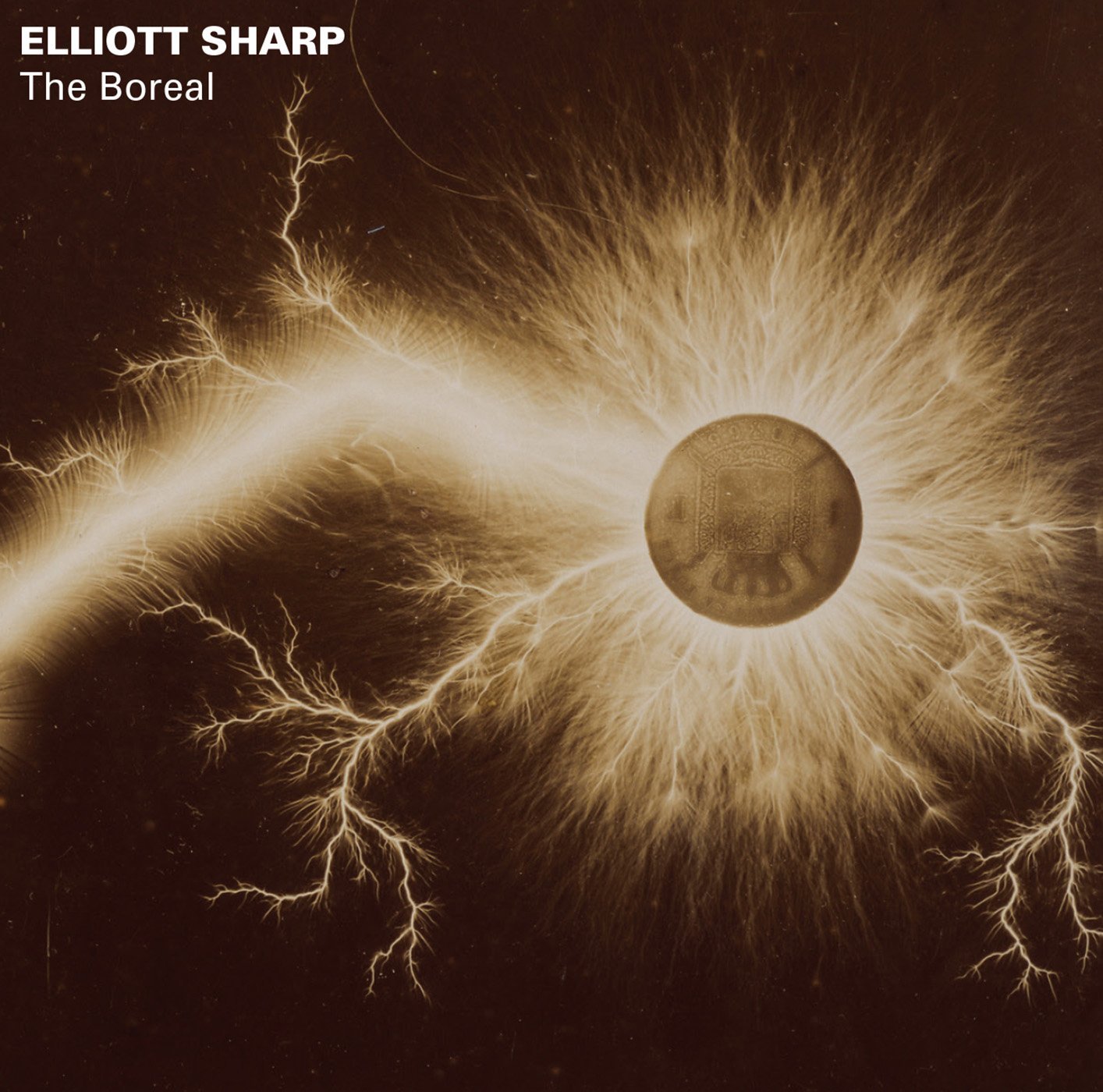
This is a concerto that is more concerned more with expression than empty virtuosity though the piano part could hardly be called easy.  I am amazed that there have been no pianists who have added this wonderful piece to their repertory.  It is a very entertaining piece of music making.

The title track is the orchestral composition, Notes from the Underground (1988).  It is a two movement work dedicated to the writer Ralph Ellison (1914-1994), best known for his National Book Award winning novel The Invisible Man (1952).   The title evokes Dostoevsky’s existential 1864 novel as well as Ellison’s collection of essays, Shadow and Act (1964). The composer describes it as a “riff” on Duke Ellington’s Diminuendo and Crescendo in Blue (1937).  It is, to this listener, a grand set of orchestral variations.

Ralph Ellison

Ralph Ellison (Photo credit: Wikipedia)

The first movement, Shadow, is described by the composer as one that introduces fragments which will be heard in the second movement.  It features a prominent solo for the percussionist.  The second movement, Act is the longer of the two and is described as being written in ten steps with an elaborate polyrhythmic structures described in more detail in the accompanying notes. The writing here probably comes as close to minimalist or process music as anything the composer has done.  It is not minimalism per se  but it is perhaps proto-minimalist techniques whose roots are at least partly in jazz as musicologist Robert Fink suggests.   It produces a ritualistic and meditative feel to this richly orchestrated, reverent and mysterious sounding piece.   It is a fitting tribute to a great American man of letters as well as to the great composer Duke Ellington.

The concerto, You Have the Right to Remain Silent (2007) is the most recent as well as the most overtly political piece on the album and it is a gem.  It is written for clarinet doubling alto clarinet and a Kurzweil synthesizer/sampler and orchestra.  Longtime collaborator, the wonderful J. D. Parran  plays the clarinets winding his way through a balanced hybrid of styles including bebop, modern classical and free jazz styles comprising rhythmic complexity and multiphonics.  One could hardly imagine a soloist better suited for this music.  Earl Howard plays the Kurzweil which intones sampled speech of words from the Miranda Rights which are supposed to be presented at the time of an arrest.  Here they are presented strategically in poetic dialogue with the music controlled by the keyboard player.

Here again the individual movements have their own titles poetically referencing the issues which the composer attempts to invoke in this piece. He says in his notes, “I tried to approach ‘silence’ as, rather than John Cage’s apolitical world of ‘white privilege’, a much more dangerous place.”  The first, Interrogation, is intended to evoke the clarinet as being interrogated by the orchestra.  The second, Loss  features an improvised duet between the Kurzweil and the clarinet.  It ends with an homage to Charles Mingus, a major influence on Davis.  The third, Incarceration includes more text from the Miranda and the Kurzweil processes both the words and the clarinet solo.   And finally, Dance of the Other, intending to evoke the fantasy and the feeling of otherness and presumably alienation.

It is a concerto in the classical sense of a dialogue between soloist and orchestra and it seamlessly blends various classical and jazz harmonies and techniques which challenge the expertise of the soloist.  All the while it clearly presents a political context which meditates on the inhumanities and inequalities inherent in our “correctional” system and in our society as a whole.  As political music it lies within a grand tradition taking a place beside earlier masterpieces of that genre like Henze’s Essay on Pigs (1968) and Rzewski’s Coming Together (1971).  And as a concerto it is a challenge to the soloist and a delight to the listener.

This is a wonderful disc, well recorded and performed.  It presents some amazing and substantial music by one of the living treasures of American composers.  Anthony Davis has had a long and influential presence on the American music scene in his jazz performances as well as his chamber and orchestral music.  His operas like X: The Life and Times of Malcolm X (1986), Amistad(1997 ) and the more recent Wakonda’s Dream (2007) have been performed to critical acclaim. Hopefully this recording will introduce people to this composer’s works and remind those already familiar with the power and depth of Davis’ music.  Bravo to the Boston Modern Orchestra Project for bringing this music to the listening public.  I hope the major orchestras and theaters and recording companies are paying attention so we can hear more from this still too little known composer.

Enhanced by Zemanta