A Glorious Other Minds 20th Anniversary


The 20th Other Minds festival completed its three concert run on March 6, 7 and 8 of 2015.  This was the first time in which composers who had appeared before came for a second time.  Ten composers were featured and a total of some 25 or so works were performed.  It also marked the first time that a full symphony orchestra was featured.

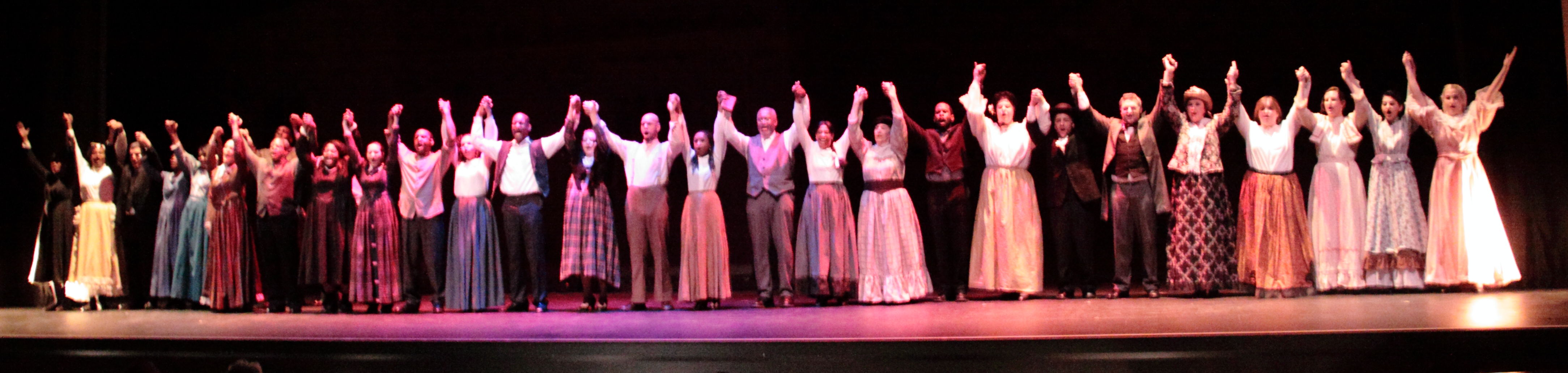
Ruth Asawa San Francisco School of the Arts Orchestra just fitting on the stage at SF Jazz

Ruth Asawa San Francisco School of the Arts Orchestra just fitting on the stage at SF Jazz

The first night opened with the wonderful guitarist David Tanenbaum performing music by the late Peter Sculthorpe who was to have attended this festival.  Sculthorpe sadly passed away in August of 2014.  Tanenbaum played his “From Kakadu” (1993) a suite for guitar in four movements.  This was moving and quite virtuosic music which was performed with passion and ease.

Lou Harrison (1917-2003)

Lou Harrison (1917-2003)

Tanenbaum followed Sculthorpe’s piece with the last composition by the beloved Lou Harrison called Scenes fromNek Chand (2001-2) played on a National Steel Guitar in just intonation.  As with the Sculthorpe, Tanenbaum displayed his well-known facility in interpretation of new music and left the appreciative audience wanting more.

David Tanenbaum holding his National Steel Guitar as he acknowledges the warm applause

David Tanenbaum holding his National Steel Guitar as he acknowledges the warm applause

Next up was a too rare opportunity to hear a composition by Other Minds Artistic Director Charles Amirkhanian.  Bay area violinist Kate Stenberg took the stage to perform the solo violin part with prerecorded tape.  The piece called Rippling the Lamp (2007) is a musical depiction of a visual the composer saw involving the reflection of a lamp in water.  But regardless of the genesis this was a powerful and engaging piece even on a purely musical level.  Stenberg executed her part flawlessly in what was an almost romantic piece at times.

Kate Stenberg playing Amirkhanian's Rippling the Lamp.

Kate Stenberg playing Amirkhanian’s Rippling the Lamp.

Charles Amirkhanian warmly embraces Kate Stenberg following her performance of his piece.

Charles Amirkhanian warmly embraces Kate Stenberg following her performance of his piece.

And the first half concluded with a performance by the Del Sol Quartet of the world premiere of Miya Masaoka‘s Second String Quartet “Tilt” (2014-5).  This was a complex piece requiring a great deal of knowledge of special performance techniques that would be a challenge for any string quartet.  This complex work was difficult to grasp in only one hearing but it was a joy to see how easily these musicians handled the work.

The Del Sol Quartet performing Miya Masaoka's Second String Quartet

The Del Sol Quartet performing Miya Masaoka’s Second String Quartet

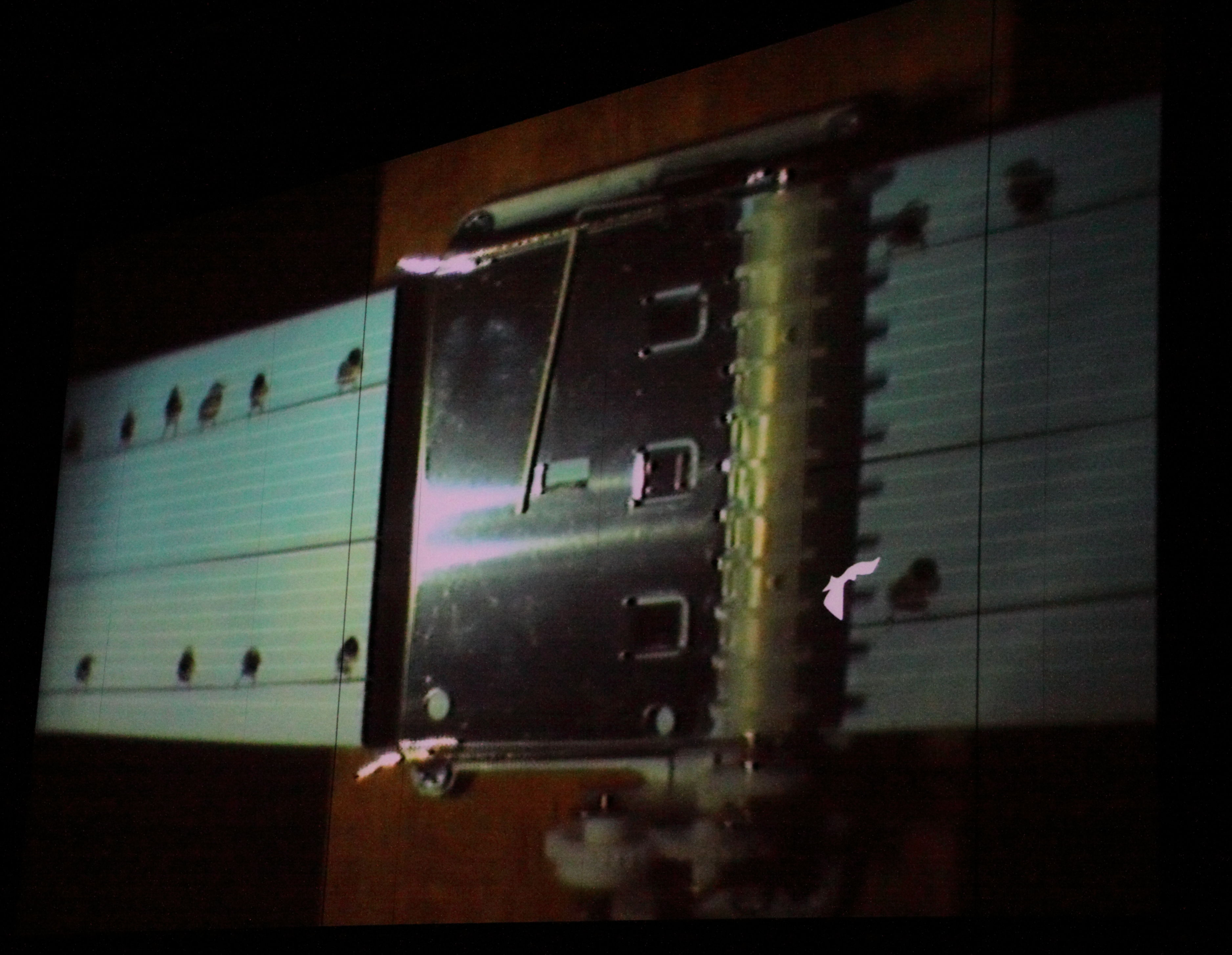
Following intermission we came to know what the origami birds were all about.  These along with video projections and a great deal of electronics came together to give utterance to Maja S.K. Ratkje’s Birds and Traces II (2015), another world premiere.  This was by far one of the most complex pieces involving a great deal of media as well as performers Kathy Hinde and accordionist Frode Haltli.  In addition to electronics and voice the musicians used bird whistles, computer controlled slide whistles and animated sculpture along with the projected videos.  This was more of the character of one of Allan Kaprow‘s “happenings” from the 1960s.  Truly a maverick piece in a concert series that prides itself on such.  The audience was clearly entertained.

Maja S.K. Ratkje, voice and electronics
Maja S.K. Ratkje, voice and electronics
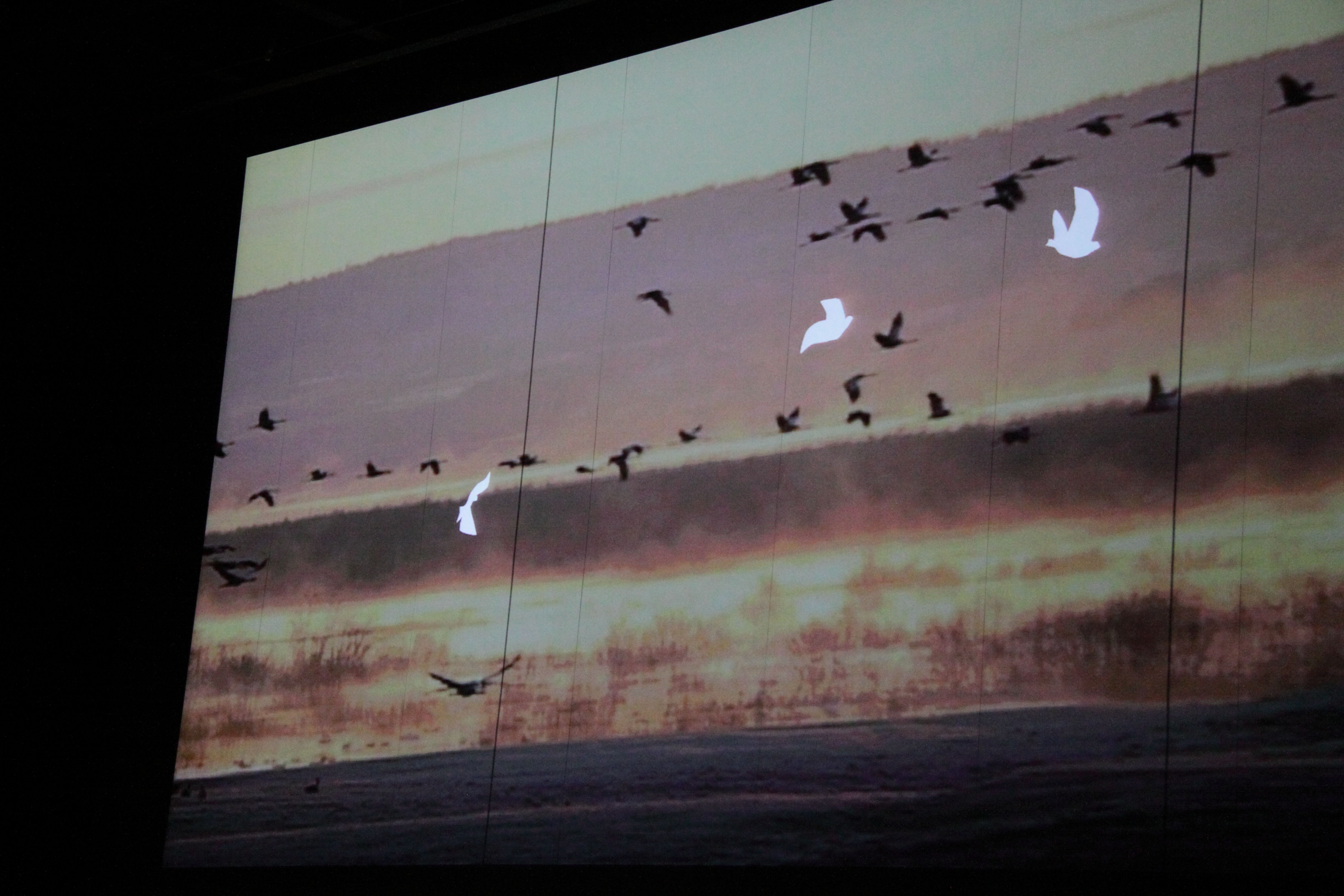
OM200018 OM200019

Three scenes from the video

Three scenes from the video

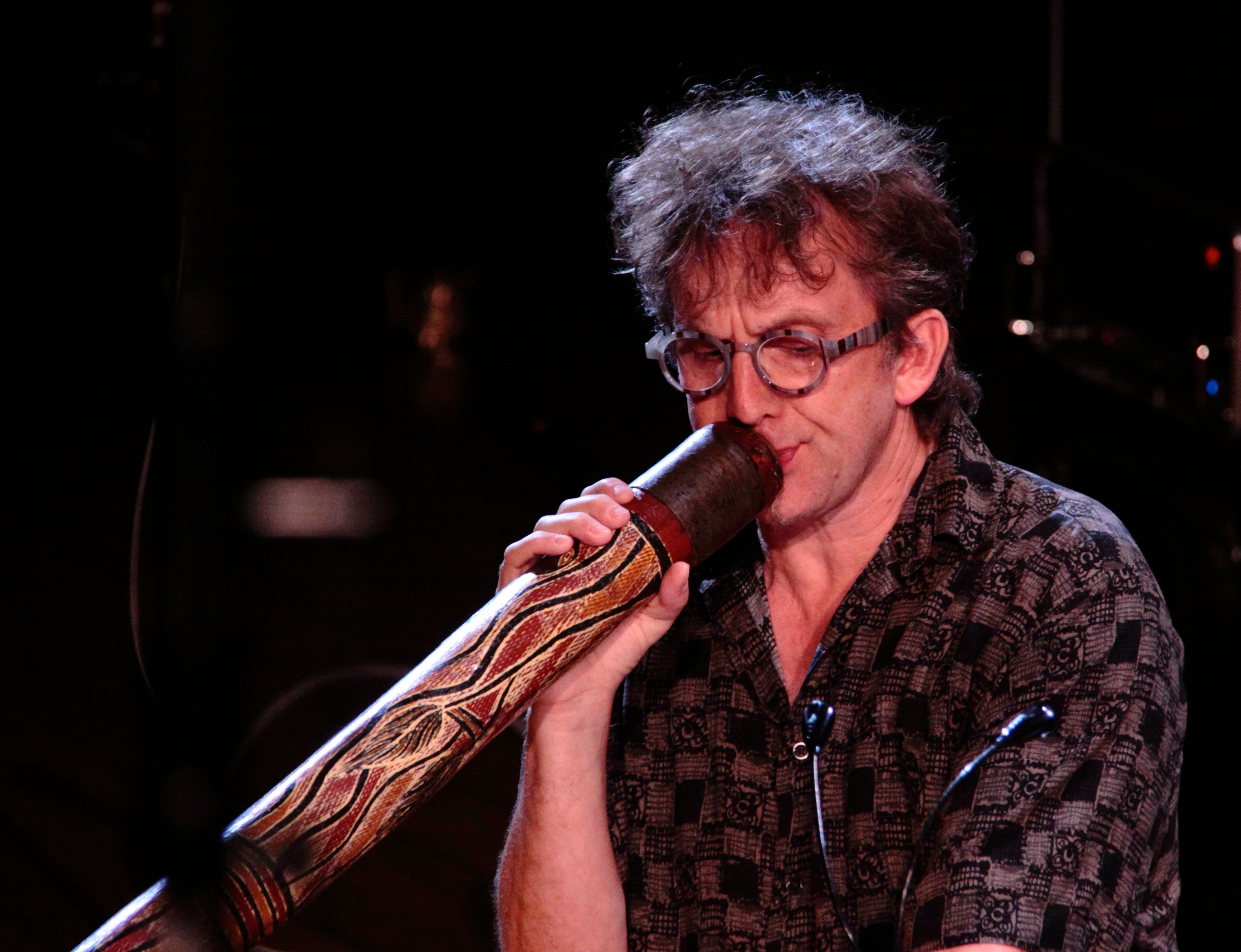
The first night concluded with a performance of Peter Sculthorpe’s String Quartet No. 14 “Quamby”(1998) which includes a didjeridu.  Stephen Kent, who played the didjeridu, spoke a warm dedication in memory of the late composer.  The Del Sol Quartet along with Kent gave a deeply emotional reading of this beautiful work (I went a bought a copy of their recording of all of the composer’s string quartets with didjeridu right after this performance).  I had heard that uniquely Australian instrument before but had no idea how expressive it could be.  The audience was clearly moved and this was a fitting deeply felt tribute to the composer.
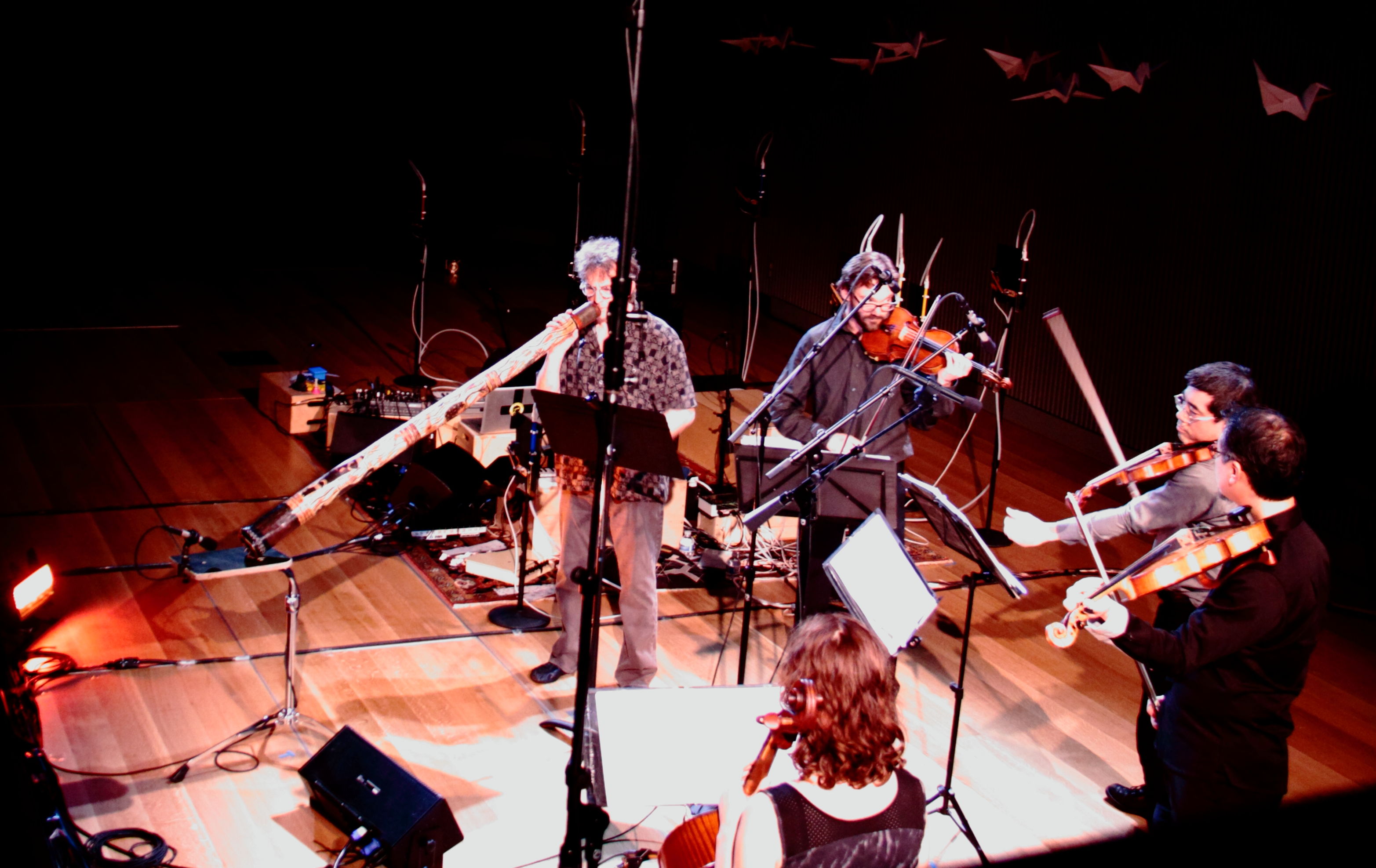
OM200023

The Del Sol String Quartet with Stephen Kent on didjeridu

The Del Sol String Quartet with Stephen Kent on didjeridu

I took the opportunity to speak to a few people after this performance and it confirmed for me that this performance affected and moved us all in what I think is the highest achievement of a composer and a performer, that of communicating emotionally with a audience.  We all seemed to share the sadness of Mr. Sculthorpe’s passing but also the joy of his having been with us to make this music which lives on.

Peter Sculthorpe (1929-2014)

Peter Sculthorpe (1929-2014)

Those animated origami sculptures remained (though no longer animated) just above the stage for the remaining two nights and certainly added a bit of unusual flair which distinguished the look of this year’s series.  It is also worth mentioning that the stage management and creative lighting add to the professional and polished look for this series and those commonly unsung heroes deserve credit for their fine work.

Let me also mention that this year’s program booklet surveying the whole of the Other Minds series was chock full of beautiful by resident photographer extraordinaire John Fago.


The second concert opened with what was, for this writer, worth the price of admission, that of Charles Amirkhanian performing his sound poetry live with multi-track tape.  His roles as sort of the Bill Graham of the avant-garde and his previous work as music director at KPFA could satisfy a life’s work just by themselves but he is also an accomplished composer and one of the most interesting and innovative sound poets/artists of the late 20th and early 21st centuries.  So this live performance would have brought me to the theater were it the only thing on the program.

Charles Amirkhanian performing his sound poetry live with tape.

Charles Amirkhanian performing his sound poetry live with tape.

The pieces performed, Dumbek Bookache (1986), Ka Himeni Hehena (The Raving Mad Hymn, 1997) and Marathon (1997) all demonstrate the composer’s love of language and sound and, as Mr. Amirkhanian advised, his background as a percussionist.  This is music that seems to fit somewhere between poetry and music and, prior to hearing his work, I didn’t even know that there was a such a space.  His mellifluous voice, no doubt seasoned by years of hosting radio, executed the complex rhythms in sync with the tape flawlessly, just as the composer intended.

There is a humor and playfulness that is engaging as he deconstructs and reconstructs words and sounds (Amirkhanian is possessed of a great sense of humor).  The first and last pieces were plays on English language words and sounds.  The middle piece utilizes Hawaiian native language as its material.  All reflect the composer’s deep understanding and love of the sounds of languages and are intricately constructed musical compositions that deserve to be heard more frequently.  And recorded too.

Wallen performing her birthday song with the captive host of the evening looking on amused.

Wallen performing her birthday song with the captive host of the evening looking on amused.

Next we met Errollyn Wallen who performed 7 songs from her Errollyn Wallen Songbook but before she did that she surprised Mr. Amirkhanian with a newly composed song for his 70th birthday and for Other Minds 20th.  He sat, captive but appreciative as she rolled out the surreptitiously rehearsed dittie in which she called him “Charlesey” in a clearly affectionate tribute.

Errollyn Wallen at the piano with the Del Sol String Quartet.

Errollyn Wallen at the piano with the Del Sol String Quartet.

Wallen, in her set, sang first at the piano, then standing at a stage mic accompanied by the ever versatile Del Sol Quartet.  She sings a difficult to describe type of song that owes as much to jazz and pop and it does to classical and seems to have as much fun with language in song and Amirkhanian has with spoken words.  Wallen is a skilled and virtuosic performer and, as I found later when I chatted with her in the lobby during intermission, a delightful conversationalist.  Her performance left the audience wanting more but it was time for intermission and, after a grateful bow, she exited the stage.

This is the first time that this writer had heard her work and I can tell you that its friendly melodies and rhythms combined with her facility with lyrics make for a really compelling experience.
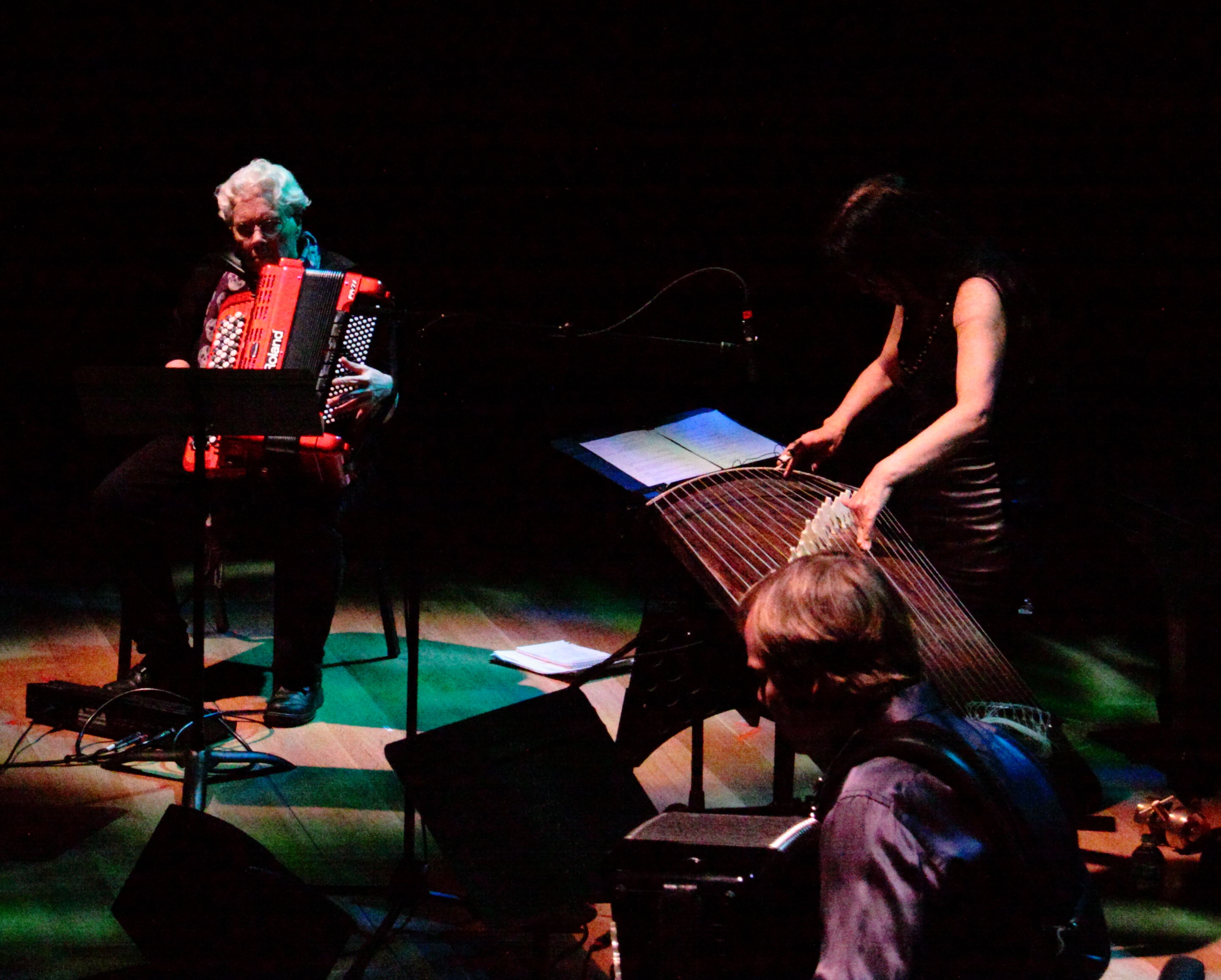
Pauline Oliveros, Miya Masaoka and Frode Haltli performing Oliveros' Twins Peeking at Koto (2014)

Pauline Oliveros, Miya Masaoka and Frode Haltli performing Oliveros’ Twins Peeking at Koto (2014)

After intermission we were treated to another world premiere from the great Pauline Oliveros.  Pauline, a beloved teacher and performer in the bay area, is based now in Kingston, New York but, as she acknowledges, she maintains ties with the bay area through performances, teaching, composing and now apparently through leaving her archive to Mills College where she was one of the founders of the Mills Tape Music Center (now the Mills Center for Contemporary Music).  Mr. Amirkhanian referred to her as the “Dean of American Composers”, a title once given to Aaron Copland, but equally suitable for this major composer/theorist/teacher/performer whose very presence adds to the auspicious nature of this series of concerts.

Her score is a written set of instructions for a sort of controlled improvisation that is common in her output.  Pauline’s warm personality and sense of humor are a part of this work which references the San Francisco landmark Twin Peaks and punningly refers to twin accordions as they peek at the koto which was played by Miya Masaoka.  Frode Haltli, who had performed yesterday did double duty as the second accordion in this work which requires, as does most of Oliveros’ work, close listening by performers as they execute the instructions creating the piece.  The most important lesson Oliveros has taught is the active nature of listening and that includes the performers as well as the audience because listening is itself a creative act.  And all who participated in active listening as the performers clearly did came to experience her wonderful view of the world of sound.
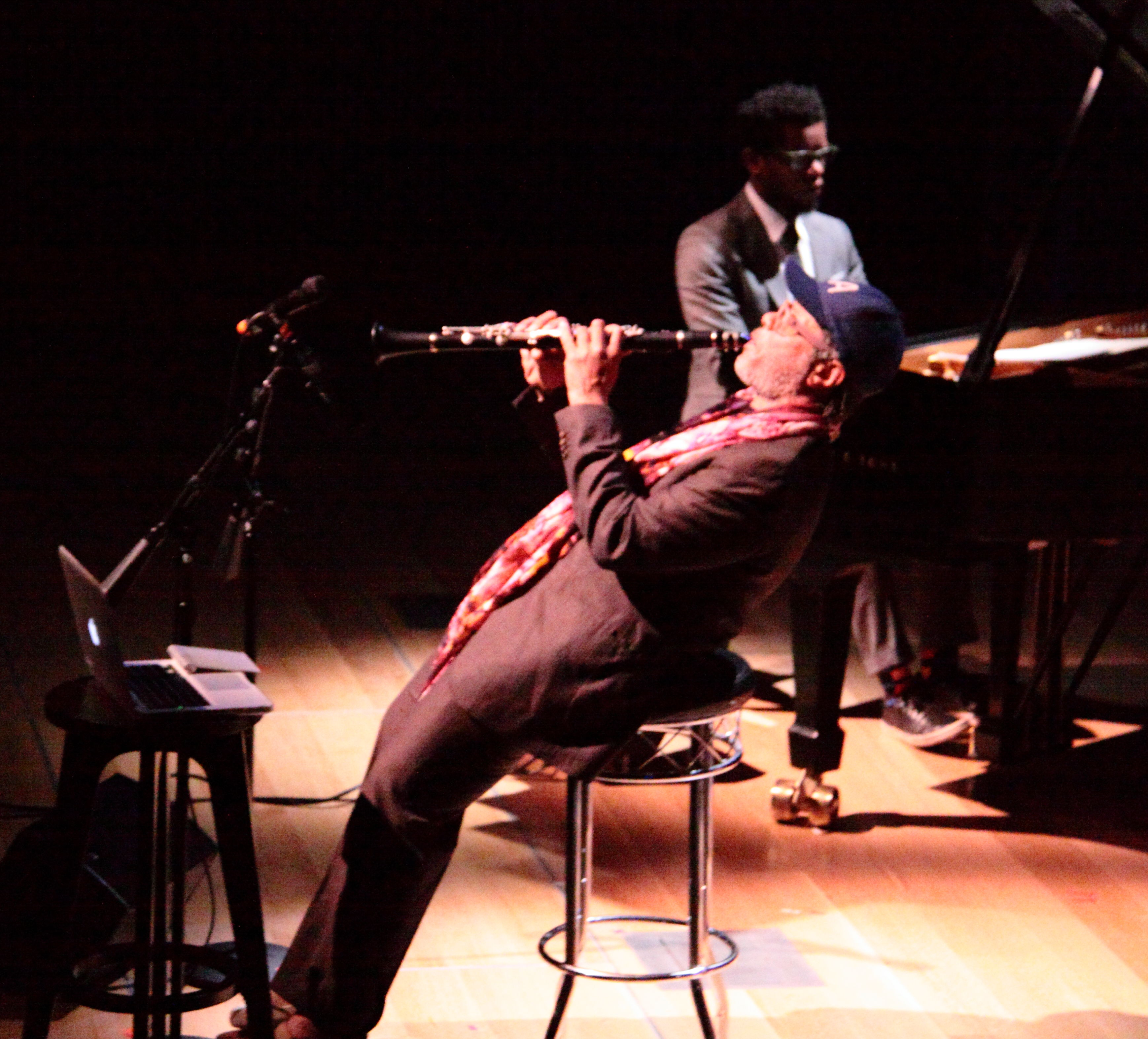
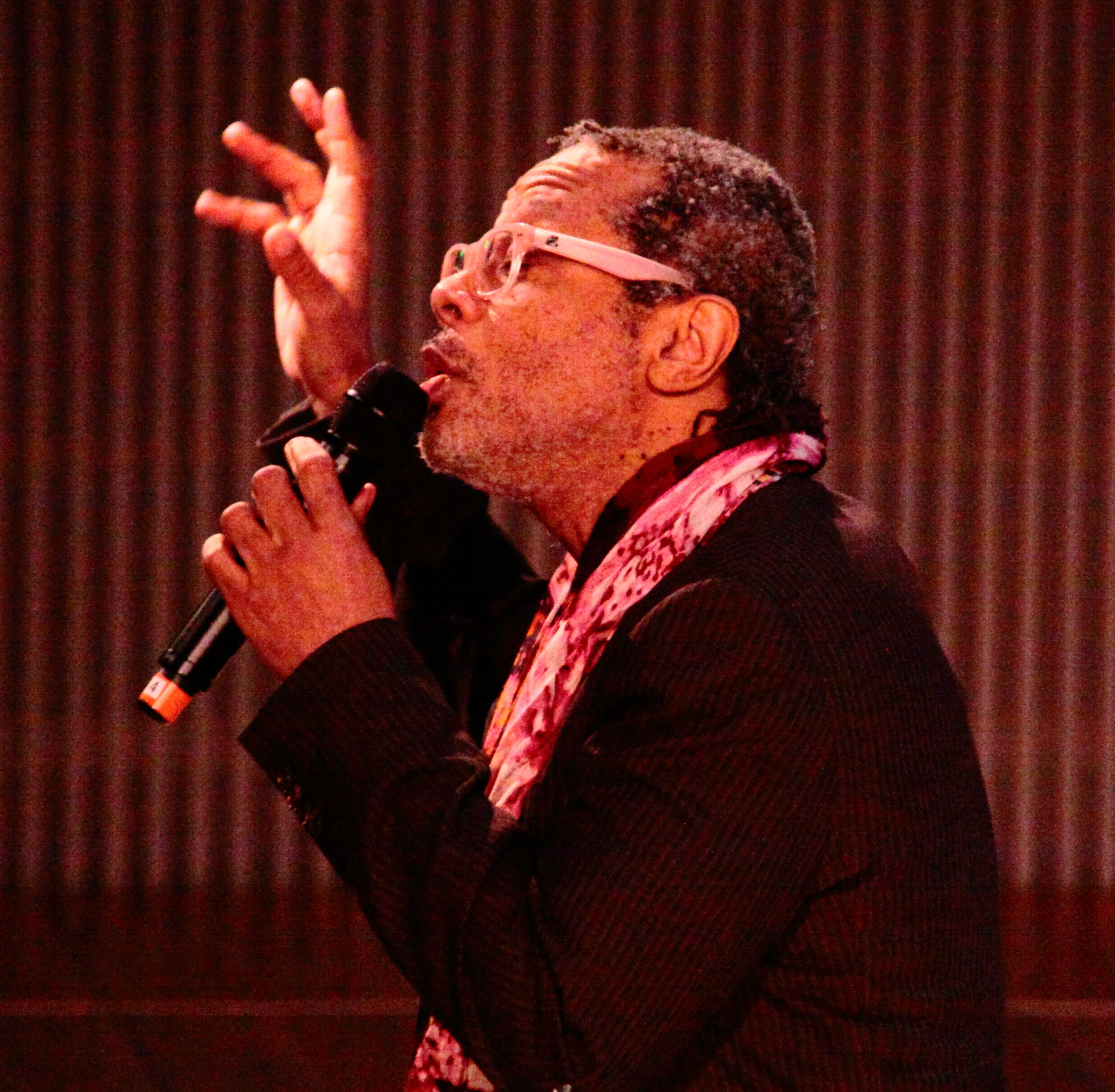
OM202024 OM202026 OM202027

Four views of Don Byron and his quartet.

Four views of Don Byron and his quartet.

Don Byron, backed by veterans double bassist Cameron Brown and drummer John Betsch along with a young and interesting Cuban pianist, Aruán Ortiz.  In addition to some amazing work on clarinet (playing sometimes inside the piano) the peripatetic Byron crooned a cover of a blues song in his unique vocal style announcing the disclaimer  that it was a “cover and this was supposed to be all new music but what the hell”.  Byron’s good humor, stage presence and eclecticism was supported well by his quartet who were given some nice opportunities to show off their chops.  A very satisfying set leaving the audience and this writer once again aching for more.
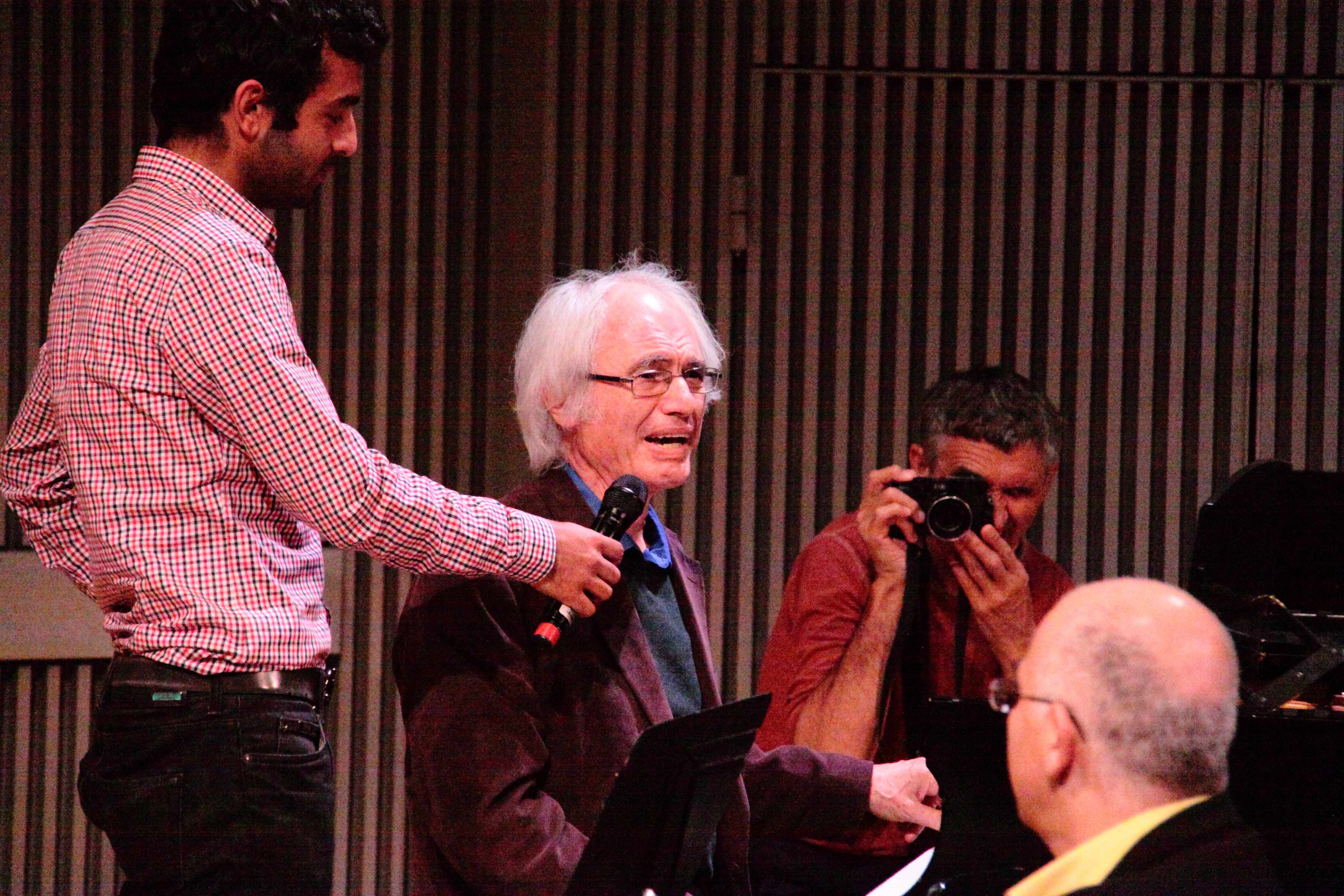
Tigran Mansurian singing an Armenian tune and accompanying himself at the piano.

Tigran Mansurian singing an Armenian tune and accompanying himself at the piano.

The last concert of OM 20 took place uncharacteristically in a matinee performance at 4PM.  This concert, also uncharacteristically, was given a political theme.  Sunday’s concert was dedicated in memory of the victims of the Armenian genocide which took place 100 years ago at the hands of the Ottoman Turks, a fact recognized by most countries but not, unfortunately, by the Turkish government.

This last concert occurred on what would have been the 104th birthday of famed Armenian-American composer Alan Hovhaness and this was acknowledged as well.  In the pre-concert discussion we learned that Mr. Mansurian had met Mr. Hovhaness and very much liked his music.  Then, in what I learned was a spontaneous decision, Charles Amirkhanian asked Mr. Mansurian to play some music by Komitas, an Armenian composer who collected Armenian folk songs and wrote music based on those distinctive tunes.  Komitas stopped composing after the 1915 genocide as he saw these atrocities and had much of his research destroyed.  Tigran Mansurian seemed almost to jump at the opportunity and he immediately went to the piano and gave a very focused rendition of one of his favorite tunes.

Charles Amirkhanian giving the background for his tape composition Miatsoom.

Charles Amirkhanian giving the background for his tape composition Miatsoom.

Opening Sunday afternoon’s concert was another opportunity to hear one Mr. Amirkhanian’s major musical creations.  This one, Miatsoom (1994-7), a word meaning, appropriately for this year’s festival, Reunion was, he said, about the only trip he ever took to Armenia accompanied by his father (born in 1915) to visit relatives in that country.  The piece is a sonic travelogue about that trip.  It features the voice of the composer’s father Benjamin and various sounds and voices from that visit.  Clearly this trip and this piece are very personal and cherished  things close to the composer’s heart.  Bringing the sounds of Armenia and its people into the concert space seemed like a wonderful way to set the tone for this concert as both celebration and memorial.  And isn’t the key to a memorial the act of memory, of remembering?

SOTA orchestral string with piano to accompany soprano Hasmik Papian in Mansurian's Canti Paralleli.

SOTA orchestral string with piano to accompany soprano Hasmik Papian in Mansurian’s Canti Paralleli.

The Canti Paralleli (2007-8) by Tigran Mansurian were written in memory of his late wife who by coincidence had also been one of the soprano soloist’s teachers.  These settings of Armenian poetry were lovingly delivered by Ms. Papian.  Her beautiful voice filled the hall with what seemed to be an air of sadness.  The SOTA orchestra with a pretty accomplished young pianist rendered these somber tunes poignantly in this U.S. premiere.
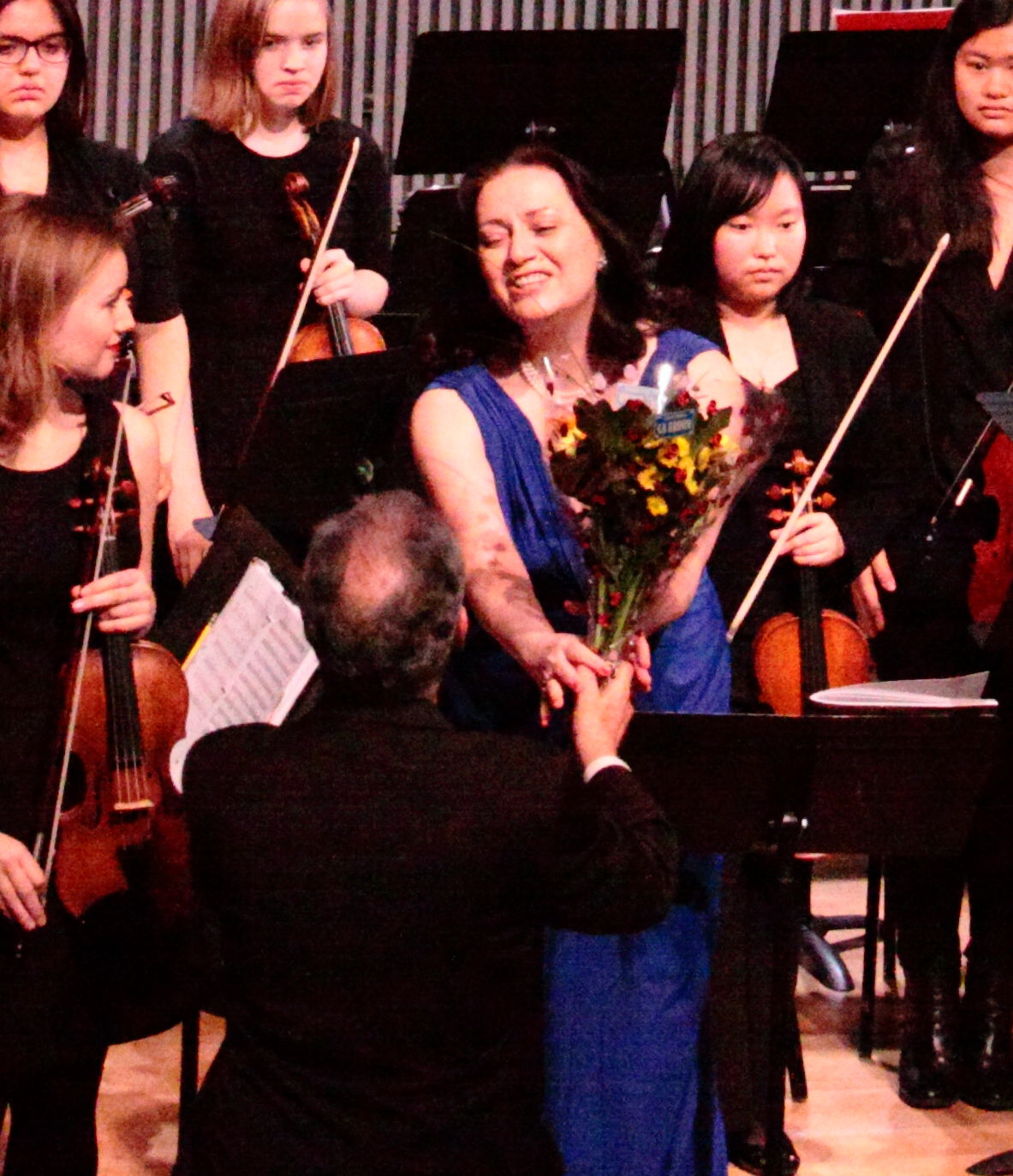
OM203021

The triumphant soloist and conductor accept the gratitude of the audience, the producers and the composer.

The triumphant soloist and conductor accept the gratitude of the audience, the producers and the composer.

Following intermission we were treated to an even more recent work by Mr. Mansurian, the 2011 Romance for Violin and Strings, also in a U.S. premiere.  The violin was played with both passion and virtuosity by the Armenian-American violinist Movses Pogossian.  The orchestra seemed to rally behind him nicely accompanying him in what was a beautiful, almost romantic piece that would no doubt please any concert audience.
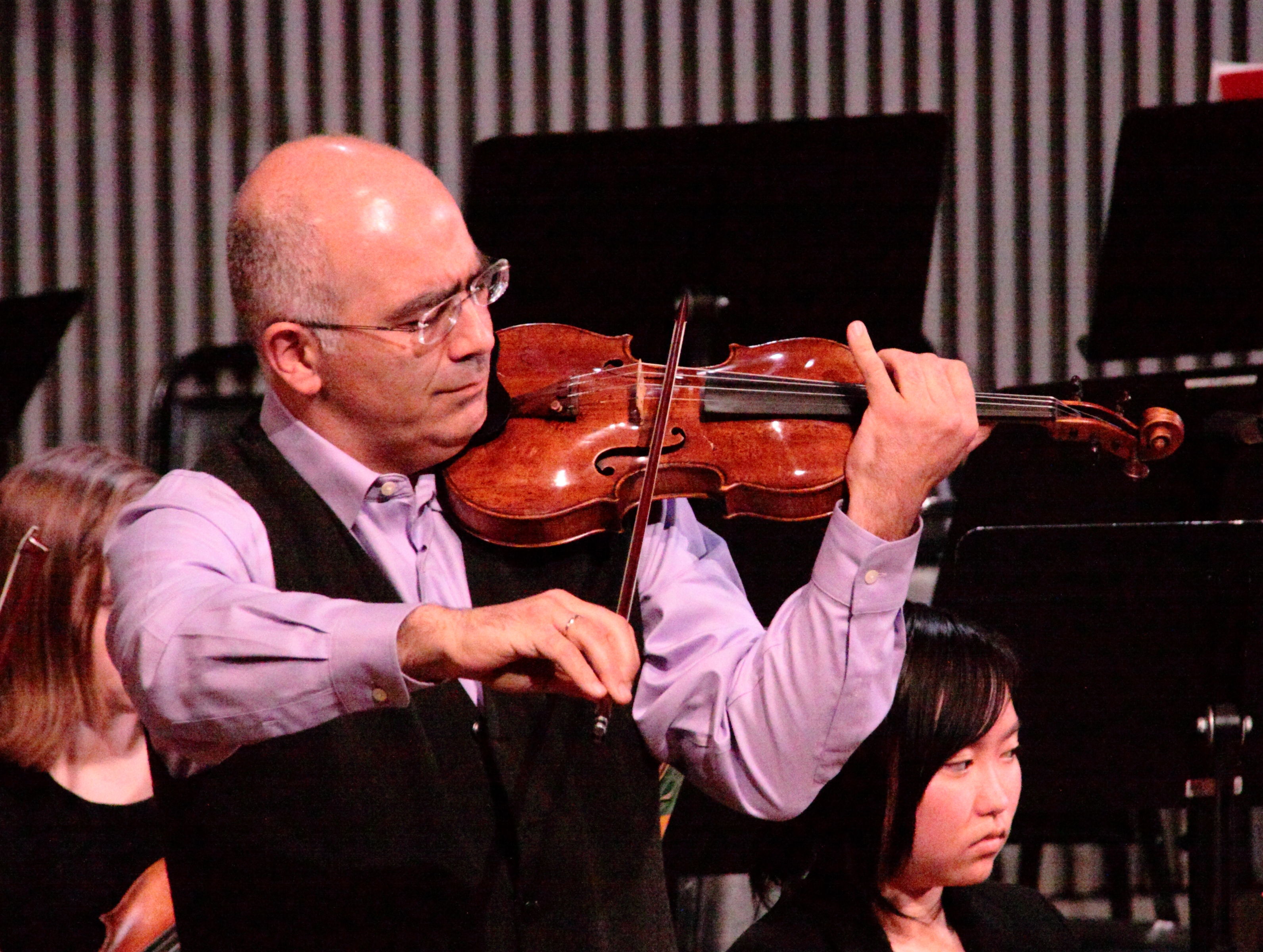
OM203026

Movses Pogossian with the SOTA orchestra conducted by Bradley Hogarth.

Movses Pogossian with the SOTA orchestra conducted by Bradley Hogarth.

I haven’t yet mentioned our young conductor for this evening.  Bradley Hogarth is a trumpet player and an accomplished conductor who leads this wonderful youth orchestra.  Their ability to fit on stage in the final work requiring some 60 musicians was in doubt but fit they did.  And their performance of Michael Nyman’s Second Symphony (2014), another U.S. premiere was nothing short of amazing.


Mr. Nyman, who was unfortunately unable to attend due to illness, began writing symphonies in 2014 and has of the time of this writing written no fewer than 11 such works.  This second symphony was written for a youth orchestra in Mexico where it received its world premiere.  The four movement work traverses familiar territory with Nyman’s characteristic driving rhythms.  It is hard to imagine that he actually had a youth orchestra in mind because this work for strings, woodwinds, brass, piano, percussion and harp was anything but simple or easy to play.  Nonetheless the orchestra under Hogarth’s direction discharged their duties in an electrifying performance that brought the audience to its feet with appreciation.

All in all a very successful and satisfying set of concerts, a successful 20th anniversary.  Time to look forward to OM 21.  It would be hard to top this but I am sure that Other Minds will give its all to do so.  Thanks to all who composed, performed, supported and attended.  And, yes, that’s me sporting the OM 20 t-shirt with Mr. Amirkhanian.  See you next year if not sooner.
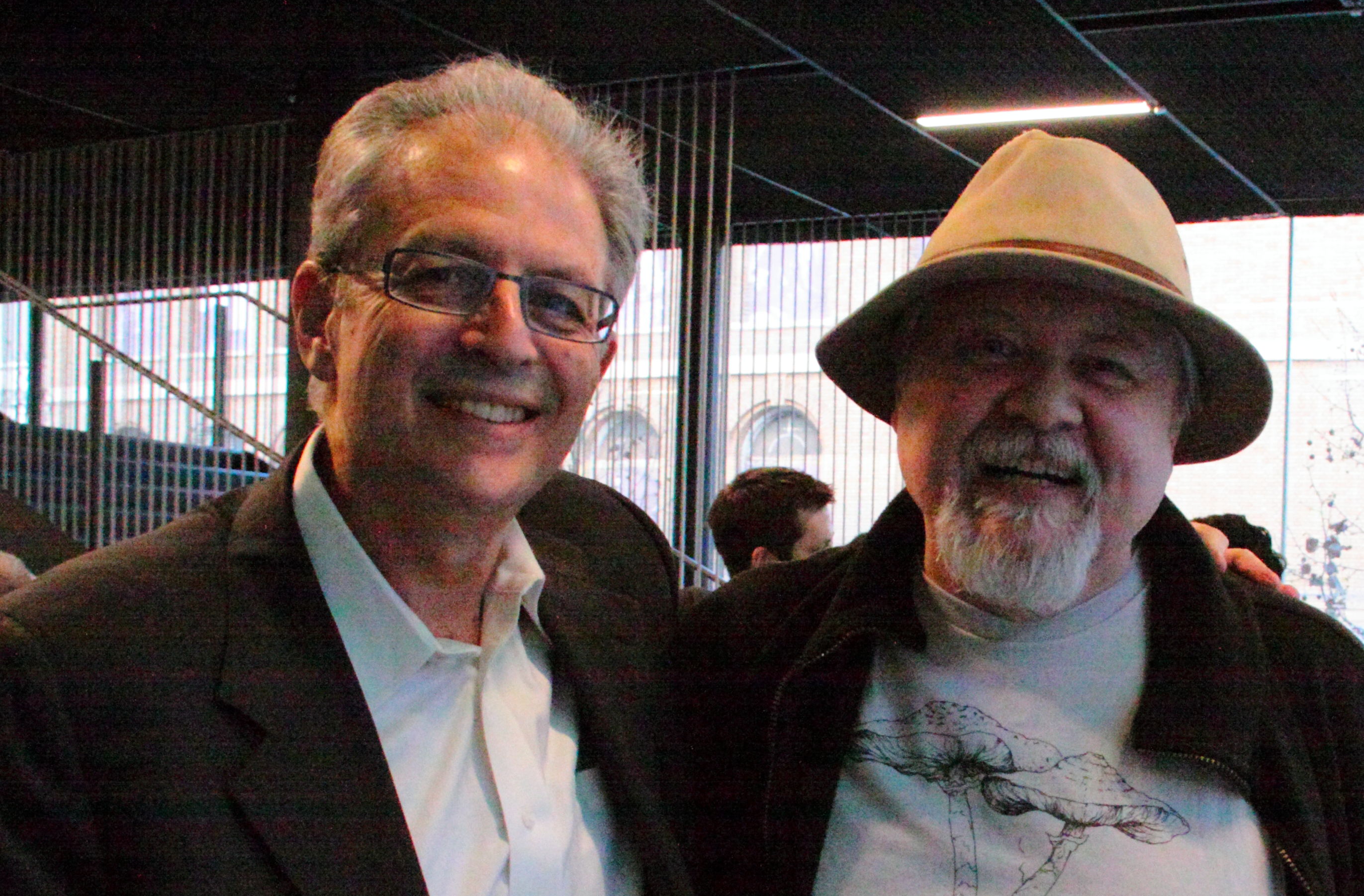
New music buff gets a photo-op with Charles Amirkhanian.

New music buff gets a photo-op with Charles Amirkhanian.

Blackness, Race and Music, What I Have Learned So Far


Two years ago, when I was just at the start of my blogging adventures, I decided it would be a good idea to do a few articles in honor of Black History Month. I am not black and I have no expertise in the area of black music but, in keeping with the personal perspective of this blog, I decided that my interest in these subjects is sufficient reason to express some opinions and ideas.  I chose Carl van Vechten’s portrait of William Grant Still, considered by many to the first major black composer to receive recognition in the 20th Century as my symbol for this article.  Much of his music remains unknown and little performed though there have been some significant recordings released in the last few years.

I called that first set of articles “Black Classical”. Curiously my brief article on black conductors has been one of my most read pieces (947  views as of the time I write these words).   So I continued to write on this subject in the following year. For my second set of articles I took the opportunity to look at the 50 year anniversary of the Civil Rights Act of 1964, by all measures a landmark piece of legislation. I asked a question, in part rhetorical because I had a basic idea of the answers I expected, but also to elicit opinions and to discuss issues of race and music.

I sent queries to a random set of composers and conductors and received a few very gracious replies. Comments ranged from carefully worded egalitarian musings on how black music and music by other racial minorities should be integrated and heard throughout the concert seasons to seemingly careful statements suggesting that this might not even be the right question or that it shouldn’t be asked. Not all comments were published but I am grateful to all who replied. And I have been able to continue this discussion in the various groups on Facebook.

I learned in a (yet to be published) interview with Anthony Davis some fascinating perspectives. Professor Davis did not address my question as I originally asked but he provided some valuable food for thought. It is worth noting that Davis is a composer whose politics are frequently very much in evidence in his music. In a discussion of the current state of music he commented regarding John Cage‘s apolitical stance by saying that, “John Cage’s silence is the silence of white privilege.” One could argue that taking an apolitical stance may have contributed to Cage’s ability to get grants and commissions.  Politically charged music generally does not fare as well.

In general I found more or less what I expected. The Civil Rights Act of 1964 has had little, if any, benefit for black musicians and composers. And given the ongoing killing of unarmed black men by police one must wonder if we have been going backwards as a society. But I don’t want to do a grand social critique here. That is a subject for another blog and is a bit outside of my scope at least for now.

I found some musicians who did not want to address racial and discriminatory issues. It seems the issue is too “hot” and that one could face consequences for even asking the question. And some did not feel sufficiently well-versed in Civil Rights history to make a truly informed assessment of this issues.  Perhaps it is a form of white privilege that allows me to ask such a question. We shall see if any reactions result in verbal attacks or (not likely I think) in a reduction in my readership.

What I have learned is that black classical musicians (who are not in short supply) occupy very few prominent positions in academia, in the public sphere of conductors and performers and in the representation in recorded performances of what is a rich but virtually untapped repertoire.  The inequality remains with perhaps some progress but not enough to pronounce the issues here as resolved to a truly significant degree.  But there is a vibrant community of black musicians who are working as did their predecessors to contribute to our collective culture and the discussions are both lively and stimulating.

In 2014 there was a performance by the Cincinnati Symphony of an Oratorio, “The Ordering of Moses” (1937) by R. Nathaniel Dett. The premiere performance of the piece (a beautiful and listener friendly piece of music) was broadcast live. But that broadcast was truncated, leaving out the finale when white listeners complained about music by a black composer getting so much airtime. Happily the entire piece was broadcast uninterrupted and made available in streaming format. However there is no commercial recording of this grand biblical choral work.

I was pleased to be able to review the fully staged performance in May, 2014 of Zenobia Powell Perry‘s opera Tawawa House (1984) in the unlikely venue of Modesto, California by Townsend Opera.  It was a heartfelt and beautiful production and was reviewed here.

Another interesting event in 2014 was the first appearance of three black counter tenors in a performance of a Purcell Opera in Los Angeles.  My blog on this subject can be found here.  I was pleased to make the acquaintance of Mr. Bill Doggett who has been very helpful in keeping me up on the latest developments with black musicians and composers and was the person who alerted me to this historic event.

Coming up in March at the Other Minds festival there will be performances by Errollyn Wallen and Don Byron.

I have been able to dialog with various black musicians on Facebook most notably through the groups Black Composers, The National Association of Negro Composers and Opera Noir.  Composer, performer and conductor Anthony R. Green is posting the name of a black composer every day for the month of February with examples of their work.

Some recent films have done much to tell the very unpretty history of black people in the United States including: 12 Years a Slave (2013), after Solomon Northrup‘s harrowing memoir,  Fruitvale Station (2013), a retelling of the execution style shooting of Oscar Grant at the hands of police in Oakland, California, Selma (2014), a dramatization of the 1965 march in support of voting rights (musical direction by Jason Moran).  And this trend, happily, seems to be on the rise providing artistic historical narratives to aid in the processing of the complex, shameful and painful histories depicted.  The lack of recognition by the motion picture industry supports my arguments for the poor representation and acknowledgement of black artists in general.

I have to mention that the wonderful set of recordings by Paul Freeman originally released on Columbia records remains available as a boxed set of 9 vinyl records with notes from the College Music Society now being offered at only $17.50 (that is not a typo either) via mail order.  I’m going to buy a couple of extra copies to give away as gifts.  It’s a really nice set.

Perhaps the most useful thing I learned is the egalitarian approach by conductor Michael Morgan who stated his desire that music by ethnic groups be integrated into programming on a regular basis rather than being highlighted in a given month.  (I am pleased to report that maestro Morgan will be receiving an award for his service to new music from the American Composers Forum.)  I am now using that approach with this blog in which I will continue to highlight the work of musicians and other artists whose work I find interesting and worth promoting.  So please stay tuned.


Other Minds 20 and Why You Shouldn’t Miss It


Official Other Minds Logo

Official Other Minds Logo

The three days of concerts scheduled for March 6, 7 and 8 of this year at the beautiful SF Jazz Center will mark the 20th anniversary of Other Minds opening the ears and minds of bay area new music audiences.  Previously composers could only appear once at this festival (thought performers frequently return) but the anniversary celebration is marked by the return of several alumni.  In fact the entire program consists of composer alums.

Other Minds is an annual festival of new and unusual music curated by bay area composer, producer, broadcaster Charles Amirkhanian and his crew at Other Minds.  Along with co-founder, now president emeritus Jim Newman and a varied and sometimes changing crew of talented and dedicated archivists, fund-raisers and coordinators this festival was born in 1993.

OLYMPUS DIGITAL CAMERA

Every year (though the actual month has changed for various reasons related to venue availability and funding) an international group of composers is brought together first at the Djerassi Arts Center just west of Palo Alto where they share their work and ideas with each other for a week in preparation for the performances of their work to come at the concert series.  This residency is a sort of private retreat open only to the composers and the staff of the center.  And given the range of musical styles it must be a fascinating thing to witness as composers largely unfamiliar with each others’ work gather to share and wonder at each others’ strange and innovative ideas.  Who knows what seeds may have been sown?

Sadly, Dr. Carl Djerassi who founded the center passed away on January 30, 2015.  His arts advocacy will live on through his beloved Djerassi Arts Center and this OM 20 will be a testament to that legacy.

What makes this festival so significant is the fine tuned and prescient nature of the selected composers.  Just a quick look at the list of composers and performers who have participated in the past looks almost like a who’s who of new music as practiced in the late 20th and early 21st centuries.  One of their commissions, Henry Brant’s (1913-2008)  won a Pulitzer Prize (Ice Field, 2001, Pulitzer Prize, 2002).  And it is programming with a uniquely west coast ethic, whatever that means.  I just know these programs are a different take on new music than that of the east coast.  Not a value judgement there, just a celebration of a different, equally important, point of view.


WHY YOU SHOULDN’T MISS OM 20

First you will find a generous (though hardly complete) selection of music by Charles Amirkhanian (1945- ) who has been at the helm of this festival from the beginning and was for 23 years the music director of KPFA radio where his programming and interviews with composers and performers of new music spanned a wide and eclectic gamut of styles and techniques.  Perhaps most significant has been his support of northern California composers whose work would otherwise have been poorly represented.  Amirkhanian’s keen ear has introduced a great deal of new and interesting music to bay area audiences and beyond.

Executive Director Charles Amirkhanian in his ...

Executive Director Charles Amirkhanian in his office with ASCAP award in background (Photo credit: Wikipedia)

In addition to his abilities as producer and interviewer Charles is also a noted composer.  Trained as a percussionist, he has written quite a bit of music which deserves recognition for its innovation.  His best known works are those with tape recording, sound poetry and the uses of language.   His music will be featured in several performances and will be a welcome and tantalizing complement to the overall diverse tone that characterizes OM programming.

Amirkhanian’s oeuvre will be represented by “Rippling the Lamp” (2007) for violin and tape, three short pieces for voice and tape, “Dumbek Bookache IV” (1988), “Ka Himeni” (1997), “Marathon” (1997) and, on the third concert, “Miatsoom” (1994-97), a piece based on sounds (vocal, ambient and musical) recorded during the only trip Charles and his father made to Armenia in 1994.  This approximately half hour work is typical of his ability to create a fascinating and meaningful sound collage.  Miatsoom is Armenian for reunion, indeed the apparent theme of OM 20.

In an uncharacteristically political expression this year’s festival is in commemoration of the 100th anniversary of the Armenian genocide.  Amirkhanian is the descendant (both he and his father Benjamin were born here) of Armenian immigrants and grew up in Fresno, California.  The genocide of 1915 (also the year of Benjamin’s birth) was in fact only the most infamous and fatal of the ongoing abuses by the Ottoman Turk government in response to Armenians seeking equal rights (a familiar social issue both then and still today).  Charles has been tactfully apolitical in his programming but his music at times has paid respectful homage to his ancestry and their struggles. It seems right to pay respect to one’s ancestors and perhaps acknowledge that we still have much to do and learn in our imperfect world.

Tigran Mansurian

Tigran Mansurian

Appropriately the esteemed Armenian composer Tigran Mansurian (1939-  ) has been welcomed back and will be represented by two major works.  Romance for Violin and Strings (2011) and Canti Paralleli (2007-8) for soprano and string orchestra are both scheduled for the third concert of the festival.  I was unable to find any details about these pieces but Mansurian’s work certainly deserves to be better known and these performances are a welcome opportunity to hear this major compositional voice.

Lou Harrison

Lou Harrison (Photo credit: Wikipedia)

Homage will be paid to two past masters who are no longer with us, American  composer Lou Harrison (1917-2003) and Australian composer Peter Sculthorpe (1929-2014).  Harrison was a beloved bay area figure whose work with gamelan and other world musics led him to experimentation with alternate tuning systems.  Harrison will be represented by his “Scenes from Nek Chand” (2001-2) played on a National Steel Guitar tuned in just intonation by the wonderful guitarist David Tannenbaum who will also play Sculthorpe’s “From Kakadu” (1993) for conventionally tuned classical guitar.  Sculthorpe, born in Tasmania, was one of Australia’s best known composers who essayed widely in chamber, choral and orchestral music. His 14th string quartet (with didgeridoo played by Stephen Kent) “Quamby” (1998), played by the amazing Del Sol Quartet (who recorded all 18 of the composer’s string quartets) is scheduled to conclude the first concert.

Peter Sculthorpe

Peter Sculthorpe


Pauline Oliveros

Pauline Oliveros

Pauline Oliveros (1932- ) is one of the grand ladies of new music.  Her theoretical work in defining music and the act of listening as partners in the creative process and her subsequent compositions including ground breaking work with early electronics with the San Francisco Tape Music Center and later at Mills College characterize her wide range of interests and her insights.  Her principal instrument, strangely enough, is an accordion and she will be performing as well.  OM has commissioned a new work from her, “Twins Peeking at a Koto” (2015, world premiere) for two accordions and koto.  to be presented at the second concert.  Playing the koto will be Miya Masaoka (1958-  ) whose second string quartet will receive its world première on the first night by the  Del Sol Quartet.  Masaoka, Japanese/American native of Washington D.C., is a New York based composer whose work brings her to the west coast frequently where she is a founding member of the Bay Area experimental improv trio Maybe Monday.  Her work involves improvisation and frequently uses unusual sound sources like bees and even cockroaches (not to worry, no insects are slated to perform) and creates site specific multi-disciplinary works in collaboration with musicians and dancers.

Miya Masaoka

Miya Masaoka

Errolyn Wallen (1958-  ) can be said to embody the OM ethic.  Born in Belize, Wallen  left the Dance Theater of Harlem to study composition in England and says of her work, “We don’t break down barriers in music…we don’t see any.”  Her Percussion Concerto (1994)  was the first work by a black woman to have been performed at the London Proms Concerts.   Her “London’s Burning and other songs” will be played on the second night by the SOTA string quartet and Wallen voice and piano.

Errollyn Wallen

Errollyn Wallen

Don Byron (1958- ) similarly states that he strives for “a sound beyond genre”.  Steeped in classical, jazz and folk musics, Byron’s quartet (Don Byron, clarinet; Aruán Ortiz, piano; Cameron Brown, bass; John Betsch, drums) is featured at the conclusion of the second night of the festival.

Don Byron

Don Byron

Maja S.K. Ratkje (1973- ) from Norway whose work is perhaps related to Mr. Amirkhanian’s  in her exploration of the possibilities of the human voice.  Her “Traces 2” (2014-5) will receive its U.S. premiere on the first night’s concert.

Maja Ratkje

Maja Ratkje

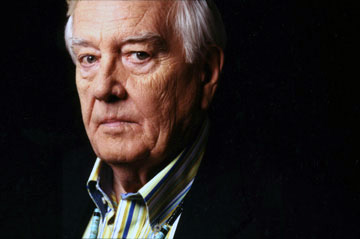
The third concert will be unusual for two reasons.  First it will take place beginning at 3PM and, second it will feature a full orchestra.  This night will conclude with U.S. premiere of the Second Symphony (2014) by Michael Nyman (1945- ) .  Nyman is perhaps best known for his numerous wonderful film scores but is also highly accomplished in his work in the concert hall.  In the past three years Nyman has turned for the first time to the Symphony form and has completed to date no fewer than 11  symphonies.  Quite a feat.

Michael Nyman in Sant Cugat del Vallès

Michael Nyman in Sant Cugat del Vallès (Photo credit: Wikipedia)

Tickets still available as low as $15/night.  Quite a festival!


Tawawa House in Modesto? A New Staging of Zenobia Perry’s Opera.


Modesto California is not a common destination for new music productions but I learned of an upcoming performance of Tawawa House by Zenobia Powell Perry (1908-2004).  It was written in 1984 and premiered in 1987 at Central State University in Wilberforce, Ohio (actually the geographic setting of this opera) where she was part of the music faculty from 1955-1982.

I only learned of this performance due to my Facebook contact with Bill Doggett, a bay area business developer and marketing consultant who focuses on music by people of color.  The production is staged by Townsend Opera at the Gallo Center for the Arts in Modesto, CA.  It was the world première of a revised libretto and orchestration by Perry scholar Jeannie Gayle Poole.

After a mostly pleasant two-hour drive I arrived for my first visit to the central valley town.  I  located the beautiful arts complex and proceeded from a warm sunny spring day into one of several theaters housed in the same building, an arts multiplex, if you will.  The theater was about 2/3 full, a good sign.  It is a large and well-designed theater with great site lines, comfortable seats and a large fully equipped stage with a nicely nested orchestra pit.

The program book listed other productions that Townsend has done and it is an impressive list.  While they program popular standard repertory like La Boheme and Aida (no small feat) I did note that they have also done less frequently performed works such as Menotti’s Amahl and the Night Visitors and Offenbach;s Christopher Columbus.  Under the direction of Matthew Buckman since 2008 this is their first world premiere and perhaps their most adventurous production.

The staging (Heike Hambly), costumes (Tara Roe), lighting (Erik Vose), choreography (Erikka Reenstierna) and scenic design (Jean-Francois Revon) were excellent and well suited to what is essentially a chamber opera with spoken dialogue.  The singers were simply amazing both in their vocal artistry and their acting and dancing abilities.  The cast appeared quite comfortable with each other and clearly enjoyed what they were doing.  The orchestra was most ably led by conductor Ryan Murray.  This was a loving, beautiful production with amazing singers who appeared to put their hearts and souls along with their sizable talents to this opera.

The spectacular vocal cast included baritone Lawrence Craig, tenor Anthony P. McGlaun, baritone V. Savoy McIlwain, soprano Leslie Sandefur, baritone Barry Robinson and soprano Shawnette Sulker along with supporting singers and chorus.  These artists alone justified the price of a seat for this performance.

Dramatically staged scene from the second act.

Dramatically staged scene from the second act.

Tawawa House is based on a real place which existed in Ohio and served both as a luxury hotel for white visitors with purported healing waters as well as a major stop on the underground railroad with socially progressive whites assisting in the rescue of slaves from their forced servitude even before the emancipation proclamation.  The story begins before the civil war and ends just after.  It is a story nearly lost to history and one that deserves to be told.

The joyful multiple weddings scene as one happy couple "jumps the broom" in a traditional practice of the era.

The joyful multiple weddings scene as one happy couple “jumps the broom” in a traditional practice of the era.

As an opera it is cast in a conservative musical style relying on spirituals and popular songs of the era with some quotation of both genres.  It consists of choral sections, a few arias and some ensemble singing.  Like many operas this one suffers from a weak libretto at times which nonetheless serves to support the overall structure of the musical work.  This is a gentle retelling of a tale from a sordid and shameful time in our collective history.

The orchestration ranged from a theater orchestra style to some Hollywood-like film score that one might hear in motion pictures from the 1940s.  I don’t know how this edition differed from the original 1987 performance or why the decision was made to revise it.

The cast taking their first bow to the appreciative audience.

The cast taking their first bow to the appreciative audience.

It is difficult to say where this work will take its place in musical history but it certainly deserves to be revived.  I hope that the success of this production will encourage adventurous opera companies such as Townsend to seek out other neglected works in that deserve revival and, in many cases, first performances.

Despite some minor weaknesses the performance was very professionally executed,  full of joy and clearly pleased the audience.  After all theater goers are accustomed to the sometimes silly plots common to a lot of operas and musicals but they are seeking entertainment by talented performers and that is definitely what they got.  This was a wonderful production which now puts Townsend opera on my radar.  Looking forward  to more from this company.  Congratulations on a great show!


Enhanced by Zemanta

Black Composers since 1964: Dreams Deferred?


For Black History Month this year I have posed a question: How has the 1964 Civil Rights Act impacted black composers? I assumed, even as I posed the question, that there had been relatively little progress but I have been able to document an increase in recordings of music by black composers.  However what I am finding and expect will continue to find is far less than the dream envisioned by the likes of Dr. Martin Luther King, Jr., Malcolm X and others who are of that generation. I have received some responses, two of which I have published here, which are carefully diplomatic though not without a note of skepticism.  I have received other responses which are far less optimistic which I have agreed not to publish.  And I will continue to write on this subject even after this American 28 day annual celebration of Black History Month. I did receive the following less optimistic reply from a concert promoter named Bill Doggett.  He is the nephew of the late keyboard player whose name he shares.  The musician Bill Doggett played with various jazz and rhythm and blues groups.  The concert promoter who carries on a commitment to black music agreed to write a response to my question and asked that I publish it. Here on the last day of Black History Month is Mr. Doggett’s commentary:

As we mark the end of Black History Month 2014, The 50th Anniversary of the 1964 Civil Rights Act and the critical new “My Brother’s Keeper”Initiative http://www.whitehouse.gov/my-brothers-keeper launched by the first African-American President, Barack Obama, the impact of these events on and for current and future contemporary African-American composers has promise
 
However, the promise is still a mixed one…
 
That is to say, while there was a major flowering and great showcase of programming and recording of music by contemporary black composers during the late 1960s-70s, i.e. Primous Fountain, George Walker, Adolphus Hailstork et al,   eager and invited programming of new music by black composers in symphony subscription concerts, much of that came to a screeching halt with the social conservatism that arrived during the administrations of President George H Walker Bush and with George Bush.
Adolphus Hailstork (1941- )

Adolphus Hailstork (1941- )

Primjous Fountain (1949- )

Primous Fountain (1949- )

The social political pulse of the country changed……from the heightened sense of social responsibility and accountability of the era of LBJ’s  “The Great Society”     If you will, there was a cultural “backlash” to the perception of “African-American” as synonymous with “welfare mother”, “food stamps”,”housing projects run amok”…and  “drugs”.  The social political tempo of the country was mirrored and linked to the iconic  Nancy Reagan motto “Just Say No” Anti Drug campaign.
Symphony orchestras stopped aggressively inviting and programming new music by Black Composers-except during February, Black History Month.
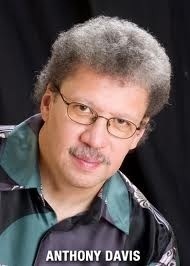
Yet, there were silver linings and sunshine in the dark clouds:  Anthony Davis’ 1986 landmark opera: X, The Life and Times of Malcolm X premiered at the recently closed New York City Opera,1995 Olly Wilson’s Shango Memory for Orchestra, commissioned for the 150th Anniversary of The New York Philharmonic,1997, Amistad: The Story of The Slave Ship Rebellion premiered at Lyric Opera of Chicago, the emergence of a new important generation of composers in the late 1990s including Jonathan Bailey Holland, James Lee III, Trevor Weston and Anthony R. Green.

Anthony Davis (1951- )

Anthony Davis (1951- )

The challenge in 2014 for Black Composers is one that was on full view at the recent Sphinx Con think tank conference in Detroit sponsored by Aaron Dworkin’s Sphinx Music  www.sphinxmusic.org
Anthony R. Green (1984- )

Anthony R. Green (1984- )

 Artistic administrators and the major symphony orchestras consist of  predominantly upper to upper middle class white male and female musicians who are not interested in notable change that embraces a deep commitment to diversity in the classical performing arts.   
As Dworkin as passionately stated, Black Musicians only make up at maximum 2% of the composition of America’s orchestras.  Institutionally, American orchestras and their administrations are comfortable in this ivory tower status.     The entrenched practice of holding auditions with screens actually makes it nearly impossible to advance the goal of making Symphony Orchestras more ethnically diverse.
Jonathan Bailey Holland (1974- )

Jonathan Bailey Holland (1974- )

This applies even more so to the world of The Black Composer. Black Composers’ music is in 2014 rarely programmed on subscription concerts, excepting special events: like  “A Black History Month Concert”
Worse, at Sphinx Con, one white male presenter declared quite openly and declaratively…. that because white men are in charge of most of the leading artistic organizations, that white male privilege…..reigned and Black and Latinos seeking more rapid diversity….needed to get over it 
 Worse still, the suggestion followed that  White Male dominated artistic organizations should be PROUD OF their “incremental change” of 1% or 2% improvements ….
THAT is not a recipe for creative collaboration with American orchestras that the established and emerging contemporary Black Composer need to embrace.
In this light, thank goodness for the progressive vision and work of Conductor, Leonard Slatkin and The Detroit Symphony for inviting a conversation about nurturing and developing Diversity in Classical Music.   On March 9/10 2014, there is a showcase of music by contemporary African-American composers and a related Symposium.      A similar new energy has found its way to The Atlanta Symphony Orchestra with the hiring of African-American conductor, Joseph Young as Assistant Conductor and Music Director of The Atlanta Youth Orchestra.
Indeed, promise….is on the horizon.     Let us collectively ensure that we are called
to celebrate the truth of the old Negro Spiritual “This Little Light of Mine…Im gonna let it shine…”
Written by Bill Doggett, strategic marketer and rep for Black Composers at Bill Doggett Productions
I have articles currently in preparation on Anthony Davis, Primous Fountain, Jonathan Bailey Holland and Anthony R. Green among others.  If you don’t know these composers you should give a listen to their work.  I continue to welcome comments both on my question and on the composers and their music.

Black Composers Since the 1964 Civil Rights Act


In this, the 50th anniversary year of the landmark 1964 Civil Rights act I have decided to do a survey of black composers who have come of age in the aftermath.  The push for equal rights in the way people are treated, given access to voting, education, business and financial opportunities was the spirit of that legislation.  Though many speak of a “post-racial” America it is clear from any fair analysis that we have a long way to go.

President Lyndon B. Johnson meets with Civil R...

President Lyndon B. Johnson meets with Civil Rights leaders Martin Luther King, Jr., Whitney Young, James Farmer (Photo credit: Wikipedia)

I am beginning a series of articles in honor of Black History Month and in honor of this legislation which attempts to address this inequality. Each article will feature a composer or composers whose work I personally find interesting and worth promoting and which was written or premiered in or after 1964.  I will not necessarily limit myself to Americans both because that would be unnecessarily constricting and inconsistent with the spirit of Black History Month and because non-American black composers suffer similar obscurity and may have even benefited from the 1964 legislation.

Civil Rights Act of 1964

Civil Rights Act of 1964 (Photo credit: Wikipedia)

Whether the legislation has improved the opportunities for black composers is, of course, open to debate but the quality of these artists stand alone on their own merits.  They may have had opportunities not available to their predecessors and this may be a positive result of this legislation.  But the fact that awareness of their work is limited and promoted in relatively obscure contexts such as this blog suggests that true equality in the area of recognition of artistic merit remains elusive (though the availability of recordings of the music of black composers has certainly increased) .  Curiously the United States has chosen the shortest month of the year to celebrate Black History whereas England, who abolished slavery before the U.S., celebrates it in October.  Yes, it’s only 3 days, but the irony is hard to miss.

The pioneering work of musicologist Dominique-Rene de Lerma has done a great service in promoting the work of black composers internationally.  He was involved in the production of the landmark series for Columbia Records along with the great (now retired) conductor Paul Freeman recording a variety of music from black composers world-wide. I had discussed this set in a blog last year and it is worth mentioning that the complete set of recordings has been reissued on 9 vinyl discs as a result of a Ford Foundation grant and remains available through the College Music Society in Missoula, Montana for $35.  This beautifully produced box set deserves an honored place in any record collection.

This pioneering set has inspired similar series by Albany Records and Cedille Records which have made recordings available of some very attractive music of black composers which deserves a wider audience.  It is largely these sets and the writing of Professor de Lerma which serve as the source for the series I am doing on this blog.

The internet site africalssical blog is also a very useful resource which is updated frequently and reports the work of black musicians working in the so-called classical world.  It is difficult and perhaps superfluous to try to separate jazz and classical so I will include composers without concern for specific genre categories except, perhaps, pop composers whose work is well-represented in the mainstream.

Pioneering black musicians like Natalie Hinderas, Martina Arroyo, Marian Anderson, Dean Dixon, William Grant Still and their like paved the way for their successors such as Kathleen Battle, Jessye Norman, Paul Freeman, George Walker and others whose stars became visible to the casual onlooker.  Of course there are fine black classical artists whose talents remain too little known.  How many people know Awadagin Pratt, Mark Doss, Michael Morgan and other active black musical artists?  It takes much more work for listeners to find and appreciate their talents.

It takes even more work to find black composers, especially if they are not also performers.  Most people, even most musicians, would have difficulty naming a single black classical composer.

I contacted several prominent black musicians to pose the question of how the Civil Rights Act of 1964 has impacted black classical composers.  To date I am pleased to say that I have received two gracious replies.  The first is from Michael Morgan who currently serves as conductor of the Oakland East Bay Symphony, the Sacramento Philharmonic and the Festival Opera in Walnut Creek.  He has numerous recordings to his credit as well.  Maestro Morgan replied as follows:

Michael Morgan (1957- )

Michael Morgan (1957- )

“I don’t believe the 64 Civil Rights Act has impacted black composers directly, however, the national conversation it inspired did cause performing arts groups (and their philanthropic supporters) to look for new ways to expand their audiences into communities not traditionally as well represented in concert halls. Orchestras are still making efforts (some more sincere than others) to connect with various minority communities. Unfortunately, rather than sprinkle such efforts throughout their seasons, some have opted for the annual Martin Luther King or Black History Month (or Cinco de Mayo, or Chinese New Year, etc. etc.) concert resulting in less sustained contact than might otherwise be possible. Such concerts have, however, been something of a boon for black composers, performers and conductors who find themselves at least included on orchestra programs on those annual occasions.

There may have been a more direct impact on the integration of some concert halls in particularly segregated cities, but the performing arts have historically been somewhat ahead of society in general in terms of promoting fully integrated events, at least in communities where there was significant acceptance of such integration.”

Morgan’s practical approach to programming is evident here and the point is well-taken that consistent programming of minority composers would result in a more sustained impact than simply having focused efforts during given months or weeks.  In fact this notion has convinced me that my blogs on the subject might be more effective if I were to spread them throughout the year, something which I will now incorporate.  My previous blog post on black classical conductors which included Maestro Morgan has been one of my most frequently viewed posts and I will expand on that subject in the months to come.

Adolphus Hailstork

Adolphus Hailstork

The second reply was from eminent composer Adolphus Hailstork who was the subject of my first blog post for black history month from last year.  He replied very thoughtfully as follows:

“Fifty Years After the 1964 Civil Rights Act

Having grown up in New York State and not experienced “legalized” segregation as practiced in the South, I had enjoyed as a youth, all the rights and privileges of American citizenship due me. There were no “colored” this and “white” that signs or classrooms, or lunch counters, etc. So the Civil Rights Act of 1964 did not have a direct effect on my life at that time.

(I much later came to appreciate the value of the changes in the south when I came to live there as a working adult.)

Actually, it was the assassination of Dr. King that opened doors to my beginning my doctorate degree that same year when I got out of the army (1968).

Also, that tragic event influenced the unfolding of my career, because it led to an interest in the music of African-American classical composers for the honoring of Dr. King’s birthday celebration in January and, by extension, the heightened interest in such music during the February Black History Month observance.

I believe the history of African-Americans is tragic, heroic, triumphant, and, of course, filled with awesomely dramatic stories. It is an honor to attempt in some small way to pay tribute through music to our story.”

Clearly Dr. Hailstork notes the difference between his experiences in the north where he was born and was able to see the profound contrast he experienced working in the south at Old Dominion University in Virginia particularly during the early civil rights struggles and their aftermath.  The emotional impact of the assassination of Dr. Martin Luther King in the same year he concluded his military service  is noted as a formative issue as well.

One can easily hear the deep emotional impact of which he speaks in works like his second symphony from 1999 which reflects his feelings after having visited the slave markets of West Africa and his American Guernica (1983) which is about the Birmingham 16th Baptist Church bombing which killed 4 little girls in 1963.  Other works such as his Epitaph for a Man Who Dreamed, In Memoriam Martin Luther King, Jr. (1979) also reflect the impact of these events on him personally and reflect what he describes as his feeling of honor in being able to pay tribute to these tragedies describing them aptly as “our story”.

I think it is important to begin to see the tragic and triumphant events of the civil rights era as our American story and not just as the story of black Americans.  Indeed these events are part of our collective history as human beings and as Americans.  These are stories that need telling and re-telling as a part of the healing process and the exorcising of the evil deeds of our collective past.

Enhanced by Zemanta

MLK, the Classical Playlist


President Lyndon B. Johnson meets with Martin ...

President Lyndon B. Johnson meets with Martin Luther King, Jr. (Photo credit: Wikipedia)

There is no doubt that rhythm and blues is the soundtrack of the Civil Rights Movement but in this, the 50th anniversary of the 1964 Civil Rights Act, I am issuing a programming challenge to the classical music world.  Hey there all you classical music stations, both internet based and broadcast.   Hey there Spotify and Pandora.  Have you explored the music written for and about the Civil Rights era?  Well, here’s your chance.

I begin my programming day with Joseph Schwantner’s “New Morning for the World” (“Daybreak of Freedom”), written in 1982.  Comparisons to Copland’s “Lincoln Portrait” are made due to the similarity in character and the use of a narrator.  The other work on this  Oregon Symphony CD under the late great James De Preist is  a work by an older composer Nicolas Flagello.  The cantata, “The Passion of Martin Luther King” from 1968, was composed in the shadow of the assassination of Dr. King and first performed in 1969.  Both works deserve more hearings for their musical accomplishments as well as for the subject of their dedications.

Description unavailable

Description unavailable (Photo credit: pennstatenews)

Moving on to the next segment I will move on to Adolphus Hailstork‘s 1978 “Epitaph for a Man Who Dreamed”  followed by William Grant 1930 Symphony No. 1 “Afro-American”.  Still is rightfully known as Dean of Afro-American composers.  A contemporary of Aaron Copland, his accomplishments established without a doubt the place in classical music for black composers.  Hailstork acknowledges his debt to the older master.  He is the next generation of black musicians contributing to the repertoire.  I will conclude this segment with Hailstork’s Symphony No. 2 which contains his impressions upon visiting the slave market areas of western Africa, places where began the shameful history of black slavery.

And on we go now to Luciano Berio’s 1968 “O King”, a chamber piece later incorporated into his masterwork, “Sinfonia” of the same year.  I program the version from Sinfonia, it’s my favorite rendering.  The vocal parts of this piece are solely comprised of the name “Martin Luther King”.  Also from 1968 there is Michael Colgrass’ “The Earth’s a Baked Apple” which is subtitled, “A Musical Celebration in Honor of Dr. Martin Luther King, Jr.” (psst, I have a bootleg of it).

We move on to afternoon programming featuring Anthony Davis’ opera, “X”, based on the life of Malcolm X.  This is  a work that deserves a new production.  Following this I will move on to Duke Ellington‘s 1943 “Black, Brown and Beige” Suite and then his “Three Black Kings” titled in French with rhyming wordplay as “Les Trois Roi Noir”.

Album cover

Album cover

The program would be incomplete without programming the wonderful Other Minds CD of Sarah Cahill’s album “A Sweeter Music” featuring a diverse collection of compositions written for her on commission by Terry Riley, Meredith Monk, Frederic Rzewski, Kyle Gann, Carl Stone, Phil Kline, Yoko Ono and The Residents.  The title is taken from Dr. King’s Nobel Prized lecture in which he refers to peace as “a sweeter music”.

Dizzy Gillespie

Cover of Dizzy Gillespie

I will end my fantasy program with Dizzy Gillespie’s “Brother K’ and Hale Smith’s “In Memoriam Dr. Martin Luther King, Jr.”  But fear not I leave you with a useful reference I have recently discovered.  “A Catalog of Music Written in Honor of Martin Luther King, Jr.” edited by Anthony McDonald.

Stay tuned for more on these subjects coming up during February for Black History Month.  Peace, Dr. King.

A mural painted on the side of the African Ame...

A mural painted on the side of the African American Museum depicts the Hough riots, the civil rights movement and a family looking towards a bright new future for the city and the community. (Photo credit: Wikipedia)


Enhanced by Zemanta

Belated Happy New Year and My Personal Best


Having taken a bit of a hiatus in blogging I am now preparing to get back to work on several projects languishing in the digital storage of WordPress and the recesses of my own mind.

2014 is the 50th anniversary of the enactment of the 1964 Civil Rights Act as well as the 50th anniversary of the “war on poverty”.  As I read further I’m sure I will find many more such milestones and, in the spirit of this blog, will explore connections to music and musicians.

Among the issues pressing for my attention in the beginning of this year are Black History Month, the upcoming Other Minds 19 and some overdue reviews of recent recordings.  I haven’t looked further into 2014 as yet.

I have actively avoided creating one of those “best of” lists that are ubiquitous at the end of every year.  I do read those lists but have no desire to compete at this point by creating yet another.  I have, however, taken a look back at the most viewed blog posts published in this blog.

Aside from my Home Page, About Page and Archives the top ten posts for the past year have been:

1. Secret Rose Blooms: Rhys Chatham at the Craneway Pavilion (actually my all time most viewed post)

2. Other Minds 18, three nights on the leading edge

3. Black Classical Conductors (Black Classical Part Two)

4. Far Famed Tim Rayborn Takes on the Vikings

5. Alvin Curran at 75, Experimentalism with an Ethnic and Social Conscience

6. Political Classical Music in the Twentieth and Twenty First Centuries

7. Annie Lewandowski, Luciano Chessa and Theresa Wong in Berkeley

8. A Fitting 100th Birthday Celebration for Conlon Nancarrow

9. Undercover Performance Practices in the Bay Area

10. The Feeling of the Idea of Robert Ashley: Kyle Gann‘s Appreciation of the Composer

You can certainly expect me to address some of the subject matter in these most read posts.  Revisiting the site of the crime is a time-honored tradition.  I responded with “shock and awe” at the amount of hits that the Chatham article evoked (418 hits in one day, my top score).  My follow-up gallery of some of those 100 guitars did become my 11th top viewed of the past year.

But as intoxicating as that boost of views was  I will not be able to resist focusing on that which finds its way into my attention for whatever reason.  I am grateful for the support and encouragement I have received from Adam Fong, Charles Amirkhanian, Steve Layton, David Toub, Tom Steenland, Tim Rayborn, Philip Gelb and all of my readers.  I apologize in advance if I have left someone out of this impromptu list but hope that my gratitude is understood among you as well.


Enhanced by Zemanta

Alvin Curran at 75, Experimentalism with an Ethnic and Social Conscience


English: The American composer Alvin Curran pl...

English: The American composer Alvin Curran playing the shofar in his composition “Shofar 3,” for shofar and live electronics (2007). Photo taken at a concert of Curran’s music in Warner Concert Hall, Oberlin Conservatory of Music, Oberlin College, Oberlin, Ohio, United States. (Photo credit: Wikipedia

Alvin Curran (1938- ) is an American composer currently living and teaching in Rome whose career began as an expatriate artist working with the cutting edge improv electronics group Musica Elletronica Viva (MEV) in 1966. He turns 75 on December 13, 2013.

Curran was born in Providence, Rhode Island.  His father was a musician in a dance band and he learned to play piano and trombone early on.  He was exposed to big band music, jazz, traditional Jewish music and western classical music during his formative years.  Following his father’s example he also played in dance bands during boat crossings of the Atlantic.  He earned a B.A. in music from Brown University in 1960 where he studied composition with Ron Nelson.  He went on to complete his M.M. at Yale in 1963 were he studied with Elliott Carter and Mel Powell.

A 1964 Ford Foundation grant allowed him to go study in Darmstadt where he met the likes of Stravinsky, Xenakis, Berio, Yuji Takahashi, Andriessen, Remo Remotti, and above all Frederic Rzewski.  He joined with Rzewski,  Richard Teitelbaum and Allan Bryant, all fellow expatriate American musician/composers, with whom he formed the legendary ‘Musica Elettronica Viva‘ or MEV.  This was in early 1966 where their use of largely home made electronics in their improvisational ensemble live performances preceded the days of easily obtainable and operated electronic musical instruments. That wouldn’t begin to happen until about 1964 when Don Buchla, in collaboration with Ramon Sender, Morton Subotnick and the San Franciso Tape Music Center created the first modular instrument, the “music easel” later known as the ‘Buchla Box’ and Robert Moog on the east coast developed the “Moog” synthesizer.  Curran crossed paths with many of these people during his tenure teaching (1999-2006) at Mills College in Oakland where the San Francisco Tape Music Center had been integrated into the Mills Center for Contemporary Music.

Curran says that during all his years in Rome he met and interacted with many in the Italian avantgarde and new music circles like Franco Donatoni and Guiseppe Chiari.  He was mentored by the reclusive (think Thomas Pynchon) Giacinto Scelsi who held regular salons at his villa.  It was in these days that Curran developed his individual style further.  He lived and taught in Rome from 1966 to 1999 and was very active on the European scene.  After his teaching stint at Mills College Curran returned again to Rome.

Buchla 100 series modular synthesizer at NYU

Buchla 100 series modular synthesizer at NYU (Photo credit: Wikipedia)

In addition to electronics he uses acoustic instruments ranging from conventional instruments such as piano, strings, woodwinds, voices, etc. to the ancient shofar and environmental sounds including site-specific sound installations, multi-media works and film scores.  His works include the massive set of piano pieces ‘Inner Cities’ (1993-2010) which lasts about 6 hours in a complete performance, the early multi-media Songs and Views from the Magnetic Garden (1973), Maritime Rites (1984) written to be played by musicians in boats in various harbors incorporating, of course, the ambience of the given harbor’s acoustic properties.  Maritime Rites has been performed in its various incarnations in Central Park in New York as well as Philadelphia, Berlin and Sydney.

In a wonderful interview from 2003 with the ever vigilant composer/journalist Frank Oteri (published online at New Music Box) he was asked about the political and ethnic/religious content of his music.  Curran replied that he did not set out to express these things as aspects of himself, that the pieces  just happened due to an inspiration at the time.  He says that he is composing all the time and his influences are as wide ranging as his teachers and his milieu.  His style varies widely in part due to his many influences but also because a given style seems to work for the piece.  It sounds as though music is channeled through him.

Unfortunately, as with most expatriate composers, his music is generally less well known in his native country but there are quite a few recordings including some recent releases of some out of print recordings.  In addition there are quite a few videos on YouTube including pianist Kurt Jordan’s live performance of Inner Cities 1-13 from 2009 at Azusa Pacific University which is more than the previously complete recording by Daan Vandewalle who recorded 1-11 (as of 2010 there are 14 parts according  to Curran’s official web site).   As is frequently the case with much contemporary music YouTube provides a great resource, especially for the casual and/or cash-strapped listener.  It is a really good way to get familiar with this man’s diverse and fascinating music.

Not infrequently his music takes on sociopolitical issues as well as inspiration from the composer’s Jewish heritage.  His Schtetl Variations (1987), dedicated to Morton Feldman is an improvisatory meditation on these poor villages of eastern Europe and Russia (think of Fiddler on the Roof) which became the settings for the notorious anti-semitic pogroms. A later piano piece called 11 Schtetl Settings (1988) continues his exploration of this part of his ancestry.  Animal Behavior (1992) for sampler keyboard and optional percussion is a pretty transparent indictment of 1990s American politics.  And the list goes on.

His “Nineteen Eighty Five: Piece for Peace” (1985) involved three ensembles performing at 3 different radio stations in Venice, Amsterdam and Frankfurt (which was simulcast by all three countries) is a a sort of precursor to what is perhaps his most integrated and powerful political composition, his ‘Crystal Psalms’ of 1988.  Here the historical, sociopolitical, ethnic and even geographical are joined to the avant garde in a stunning sonic commemoration and condemnation of the fascism and genocide that characterized the horrors of the second world war.

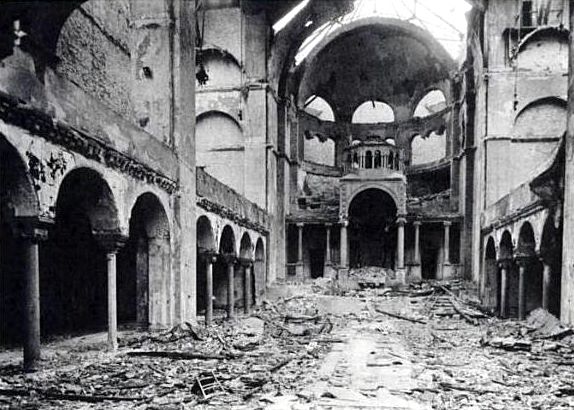
Interior of a Berlin Synagogue after Kristallnacht

Interior of a Berlin Synagogue after Kristallnacht

Seventy Five years ago this November (9th and 10th) Jewish shops and synagogues were vandalized and looted over those two nights throughout much of Nazi Germany and Austria in a most extreme incarnation of the “pogroms” that became known as “Kristallnacht” or the “Night of Broken Glass“.  It was one of the first major and overt expressions of Hitler’s genocidal plans then still being formulated. Unfortunately this event continues to be imitated by like-minded hateful individuals and groups worldwide. So the sociopolitical context of this musical work written for the 50th anniversary of that event sadly has an ongoing relevance for our contemporary world even 25 years after its creation.

At its most basic level this piece is a sort of concerto for six instrumental ensembles playing in radio stations in six different countries live mixed by the composer and broadcast throughout Northern Europe on October 20th of 1988. There is no text as such but the sounds of people praying and the apparently random Hebrew letters and German numbers are scattered throughout the piece along with environmental and found sounds on the tape Curran prepared which plays throughout the performance as a sort of political pedal point.

English: "Hebrew alphabet" in Hebrew...

English: “Hebrew alphabet” in Hebrew, modern serif typeface. (Photo credit: Wikipedia)

The liner notes of the recording describe the piece as “radio concert for six choruses; six sextets each including a quartet (violas, cellos, bass clarinets, bass flutes, trombones, tenor sax/tuba) plus accordion and percussion; tape.”  All were individually conducted with the conductors coordinated by a click track and mixed live by the composer. The recording on New World records is the document of that broadcast.

The effect is that of a collage connected by the electronic nervous system, the radio stations, which link the various performances.  The program is largely implicit here and listening to this piece evokes images that can vary from one listener to the next as any great piece of art provokes different experiences. The sound images here are not pretty and the work is very emotionally intense. Those images are guided by the tone of the music and fueled by the cryptic words and sounds mixed in with the live performances.  It is, in effect, his Mitzvah to the memories of the fallen.  You will not come away unmoved.

Kristallnacht occurred in November of 1938, a month before Curran was born but  the impact of that action continues to resound from that generation to this.  As a politically aware artist he was compelled to respond and he did so in a most emphatic, creative and powerful manner.  Perhaps it is the inherited duty of one generation to exorcise the demons and the atrocities of the previous ones.  Curran has certainly contributed most memorably to such an effort with this work.

Thank you, Mr. Curran, for your prolific and varied contributions to music and your efforts through your art to exorcise the demons of our collective past.  I wish you a happy 75th birthday and wishes for many more creative years to come.

Classical Protest Music: Hans Werner Henze “Essay on Pigs” (Versuch über Schweine)


German composer Hans Werner Henze (1926-2012) left Germany in 1953 because of his dissatisfaction with German intolerance of both his leftist politics and his homosexuality. He settled in Italy where he lived with his partner and had a long, prolific career composing music for orchestra, chamber ensembles, theater, soloists and film. Much of his music was an expression of his politics.

The “Versuch über Schweine”or in English, “Essay on Pigs” of 1968 is scored for woodwinds, brass, strings, percussion, “beat organ” and electric guitar with vocal soloist. It was created at one of the composers most overtly political periods which included the Sixth Symphony (1969), El Cimarrón (1969-70) and Das Floss Der Medusa (1968). Indeed there was much political conflict in the world at this time.   The musicians have a challenging instrumental score to interpret but this is no ordinary vocal part as it calls for the extended vocal techniques of the singer for whom it was written. Henze was reportedly very impressed with having heard the Rolling Stones and this encounter appears to have influenced his musical sound as well.

As near as I can determine the work was performed only once on February 14, 1969 with Roy Hart and the English Chamber Orchestra conducted by the composer and subsequently recorded with those forces. The vocalist in the Deutsche Gramophone recording is Roy Hart as well and he appears to be an early practitioner of what we now call ‘extended vocal techniques’. He precedes the likes of Cathy Berberian, Diamanda Galas, Julius Eastman, Joan La Barbara and Meredith Monk. Monk’s students like Robert Een, Andrea Goodman and Anthony De Mare (among others) also carry on the tradition but I know of no one who has attempted this piece since Hart.

English: Photo of Gaston Salvatore

English: Photo of Gaston Salvatore (Photo credit: Wikipedia)

Essay on Pigs is a setting of poetry by Chilean poet Gaston Salvatore (1941-  ) who collaborated with Henze on several works. The music reflects the angry and sometimes hysterical tone of the poetry making this anything but easy listening.

I recall a musicologist, Dr. Richard Norton, who had corresponded with Henze, playing this piece in its entirety (some 20+ minutes) during one of his classes (at the University of Illinois Chicago in the mid-seventies). I always felt that was a sort of revolutionary act to do that. From what I recall I think I was probably the only person in the class who was already familiar with the work. The reaction of confusion or stunned silence from my fellow students was what one would expect from anyone who had not heard the piece before.

I have been unable to find any critical reviews or reports of audience reactions to performances but this is a piece that has the potential to clear a room or provoke anger.  It must have been quite a show. The piece certainly deserves a revival and I think it is a very significant piece of political music whose expressionism reflects well the issues of the times.  The problem is finding a vocalist to navigate this highly unique and unusual piece..  Any takers?

Enhanced by Zemanta

Peace through “A Sweeter Music”


President Lyndon B. Johnson signs the 1964 Civ...

President Lyndon B. Johnson signs the 1964 Civil Rights Act as Martin Luther King, Jr., and others, look on. (Photo credit: Wikipedia)

Album cover

Album cover

It is fitting that this CD, this music has been released in the 50th anniversary year of the March on Washington and just prior to the 50th anniversary of the Civil Rights Act of 1964.  The series of 18 pieces in this major commissioning project by the wonderful bay area pianist, producer and new music advocate Sarah Cahill called “A Sweeter Music”, its title taken from a phrase in Martin Luther King, Jr.’s 1964 Nobel Prize lecture.  Though only 8 composers are represented on this recording this is a fine document of some truly wonderful and heartfelt music.  And Cahill’s introductory note indicates that there are plans to record the other ten pieces as well.

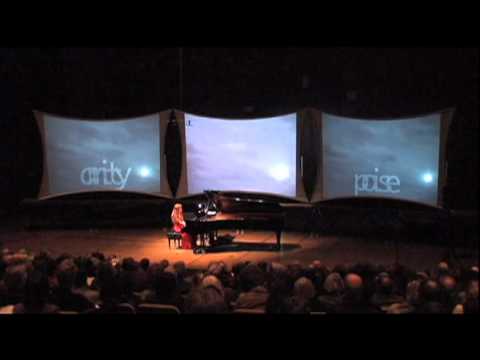
The project was planned to include video projections by Cahill’s husband, the skillful video artist John Sanborn.  The first formal performance took place on the Berkeley campus and the video projections across three screens added a dramatic perspective on the various pieces.  I was present at the first performance in Berkeley and later at a small multi-purpose hall in Point Reyes in the north bay.  At the smaller venue the projections were limited to a single screen but the images still added to the impact.  At the time of this writing Sanborn has posted some of these videos on You Tube ( http://www.youtube.com/user/sanborn707?feature=watch).

Still from one of Sanborn's videos.

Still from one of Sanborn’s videos.

Each of the recitals contained a selection of the pieces commissioned.  Sarah Cahill kindly provided the complete list which includes: Be Kind to One Another by Terry Riley, Peace Dances by Frederic Rzewski, There is a Field by Jerome Kitzke, Dar al-Harb by Preben Antonsen, The Olive Branch Speaks by Mamoru Fujieda, The Long Winter by Phil Kiline, Two, Entwined by Paul Dresher, War is Just a Racket by Kyle Gann, B’midbar by Larry Polansky, drum no fife by The Residents, Devotion to Peace by Michael Byron, Sonamu by Carl Stone, After the Wars by Peter Garland, A New Indigo Peace by Pauline Oliveros, Movement (Deep in My Heart) by Ingram Marshall, Study War No More by Bernice Johnson Reagon, toning by Yoko Ono and excerpts from Steppe Music by Meredith Monk.

The pieces represented on this recording are a diverse set including those by Frederic Rzewski, Terry Riley, Meredith Monk, Yoko Ono, The Residents, Phil Kline, Kyle Gann, and Carl Stone.  Missing from this disc, and planned for a future release, are the pieces by Jerome Kitzke, Larry Polansky, Pauline Oliveros, Preben Antonsen,  Sanborn’s images definitely enhanced the experience of the music and this writer hopes that some day this music might be released in a DVD format with those images but the pieces here stand easily on their own merits.

The disc opens with Terry Riley’s ‘Be Kind to One Another (rag)’ (2008-10).  Riley takes his title from a statement made by Alice Walker which followed the 9/11 attack on the World Trade Center.  Rather than express an anti-war stance Riley harkens to the days of his youth when he played barrel house piano music while he studied composition.  This is a jaunty and entertaining but substantial piece which expresses the wish for kindness.  It is a challenging work to play but not to hear.

‘Steppe Music’ (1997) is apparently a reworking of a 30 minute piano piece (the piece at hand lasts about 8 minutes) commissioned by Sarah Cahill for another masterful pianist, Nurit Tilles.  Meredith Monk is of course best known for her extended vocal techniques and dance/theater pieces.  Little of her piano music has been recorded and one hopes that there will be more to come.  This is a less literal contribution which, the composer says, is about “color, texture, resonance, and gesture…”.  Like her performance pieces this is music about images which evoke emotion and it is unlike any of Monk’s recorded piano music.

The seven ‘Peace Dances’ (2007/8) were written by a composer/pianist well-known for his political statements in music as well as for his virtuosic music.  Frederic Rzewski is probably best known for his massive set of variations on the protest song ‘El Pueblo Unido Jamas Sera Vencido‘ (The People United Will Never Be Defeated) commissioned in 1976 for Ursula Oppens.  His catalog contains a great deal of music with explicit and implicit political references.  Rzewski’s music sounds deceptively simple but is in fact very challenging to play.  These are part of a much larger set of compositions called “Nanosonatas”.  The dances here contain a variety of musical and political references that will entertain and frustrate musicologists for years to come but present the listener with some welcome additions to the repertoire.  Cahill plays them effortlessly and repeated listenings reveal more of the rich textures.  Rzewski’s inspiration, like that which inspired this series, is rooted in the same struggles as represented by Martin Luther King, Pete Seeger, gospel music and contemporary folk music.  The last of these dances was a birthday present for the 100th birthday of Elliott Carter.

Kyle Gann’s ‘War Is Just a Racket’ (2008) is written for speaking pianist.  He takes Christian Wolff’s ‘Accompaniments’, which was written for Frederic Rzewski in 1972 requiring the pianist to sing and speak as well as play.  It reminds this writer of Rzewski’s own ‘De Profundis’ of 1992 for speaking pianist using a text by Oscar Wilde.  Gann takes as his text a very interesting text by one General Smedley Butler who gave this speech in 1933.  Like Rzewski, Gann is no stranger to politics in his music.  This addition to the “speaking pianist” repertoire is spoken with feeling by Cahill as she pounds out the angry chords and melodies.  This is perhaps the most literal of the pieces on the disc and probably the least friendly to a conservative audience.

Sonamu (2010) was written by Carl Stone for piano and electronics.  It’s not the electronics your grandmother listened to either.  Stone uses a computer to perform “spectral convolution”, a process, the composer explains, which isolates various aspects of the sounds to “…shape and enclose the pitch and harmonies of separate voices…”.   The intention stated by Stone is to evoke ghosts and memories of the aftermath of war.  This most complex and abstract piece reminds me of the ghost electronics compositions by Morton Subotnick.  This piece requires repeated listenings and would no doubt be enhanced by Sanborn’s images.

Composer Phil Kline describes a process of using various musical fragments edited together to evoke images of living in a land under siege.  Kline was an eyewitness to the World Trade Center disaster and his personal experiences contained metaphorically in ‘The Long Winter’ (2009) have a memorial-like quality.  In the liner notes he describes his fantasy images leading to the realization that he (and we) do live in a land (or perhaps a world?) under siege.  The piece is in two sections ‘Crash’ and ‘Embers’.

Yoko Ono’s ‘Toning’ (2008) purports to be an effort to heal both performer and audience through sound.  As with much of her work this piece has an anti-art quality like the work she produced for the Fluxus performances.  This is perhaps the technically simplest of the pieces on this recording.  I think that reactions will vary to this music much the way that they vary to Ono’s oeuvre.  Those familiar with her work will see the threads that connect and others may simply dismiss her work entirely.

The enigmatic San Francisco based group “The Residents” aspire to anonymity as individuals in the hope that their audiences will focus on their art.  This is clearly one of their performance art pieces and is fairly explicit in its anti-war stance.  It consists of recorded voices and sounds in addition to the live piano performance and demonstrates the eclectic range involved in these commissions.

This CD was recorded at the recital hall at the University of California at Santa Cruz by Tom Lazarus.  It was released as another of the fine recordings of contemporary music on the Other Minds label with Charles Amirkhanian of ‘Other Minds’ as executive producer.  It is a major addition to the recordings of this political classical genre and a significant contribution to the solo piano repertoire as well as a snapshot of an eclectic range of contemporary music of the moment.  Highly recommended.

The Feeling of the Idea of Robert Ashley: Kyle Gann’s Appreciation of the Composer


Kyle Gann Kyle Gann (Photo credit: Wikipedia)

I first encountered the work of Robert Ashley in the early 1980s when I purchased the Lovely Music vinyl LP titled ‘Private Parts: (the record)’. It contained two tracks, one on each side, called, respectively, ‘The Park’ and, ‘The Back Yard’ (which happen to be the first and last acts of ‘Perfect Lives’). I took to the music rather quickly listening to its various layers of musical sounds and Mr. Ashley’s unique voice intoning the equally unique and unusual texts.

That record earned a special place in my mental favorites library (iTunes had yet to be invented) and spurred me on to the purchase of more of Ashley’s music. But other than the liner notes (which I read closely and repeatedly) there was surprisingly little information on this mysterious and wonderful composer whose music and words so captured my sensibilities.  The publication of this volume, ‘Robert Ashley’ (one of a great series of books on contemporary composers from the University of Illinois Press) fills this long standing void in the realms of music scholarship and biography.

I encountered the author’s work at about the same time as I did Ashley’s.  He was writing fascinating and accessible reviews in the local (Chicago) free newspaper, ‘The Reader’. He would later be selected as classical music reporter for New York’s ‘Village Voice’. Kyle Gann, composer, critic, musicologist and new music raconteur contributes a most essential work to help fill that void. His biographical sketch, analysis, bibliographic and discographic references serve also as a much needed exegesis of Robert Ashley’s work.

As it happens, the author was involved in the premiere of ‘Perfect Lives’ when he was a student at Northwestern University in Illinois in 1979. He developed and maintained a close connection with the composer and his music.

Photo by Joanne Savio, 2006 Photo by Joanne Savio, 2006

Robert Ashley (1930- ) is an American composer born in Ann Arbor, Michigan. His experience growing up in the American Midwest informed his vision, speech and temperament affecting his compositional style. He spent the formative years of his youth in Ann Arbor.  He studied at the University of Michigan with Ross Lee Finney and at the Manhattan School of Music earning, respectively, undergraduate and graduate degrees in music.  Ashley declined an offer to pursue a doctorate in speech pathology (one of his many interests) to pursue music.  He organized and participated in the ONCE Festival of contemporary music in Ann Arbor from 1961 to 1969.  In 1972, he accepted an appointment at Mills College as director of the Center for Contemporary Music succeeding Pauline Oliveros, Lowell Cross and Anthony Gnazzo. In 1978 he left for New York which would become his new creative home base.

Ashley and his collaborators have performed internationally and a great deal of his music has been recorded.  His collaborators include Alvin Lucier, Gordon Mumma and David Behrman (who along with Ashley formed the performing group Sonic Arts Union), Roger Reynolds, “Blue Gene Tyrrany”(aka Robert Sheff), Pauline Oliveros, filmmaker George Manupelli and many more.  There were recent performances in New York and Miami of his early operas and a big new opera ‘Quicksand’is reportedly in progress and due to be premiered some time after this book was issued.

Gann acknowledges the limitations of his analyses saying quite correctly that Ashley’s work will require more time as well as access to the composer’s sound archive and consideration of his unrecorded works. He never pretends that this is more than a relatively brief treatment of a very large subject. Many works are not analyzed and little attention is given to either the ONCE Festival or the Sonic Arts Union.  His collaborations and influences get little space.  And George Manupelli’s films for which Ashley composed soundtracks deserve a book to themselves.  Nevertheless there is an awful lot accomplished in under 200 pages.

Gann discusses some of Ashley’s early works, his involvement in the too little known ‘ONCE festival‘ and his very important time teaching at Mills College where he became director of their Contemporary Music Center. But the real substance of this book comes in Gann’s analysis of Ashley’s operas which most certainly form the core of his creative output. It is the music that gets the closest attention here.   The author’s detailed analyses of the rhythmic schemes and harmonic structures that underlie the (mostly spoken or chanted) texts reveal the complexities of these deceptively simple sounding and seemingly impenetrable works and provide a means of appreciating and even understanding these unusual pieces that hardly fit any conventional definition of opera.

Gann also discusses some of the literary and intellectual ideas that permeate Ashley’s work.  The ideas come from a variety of sources including speech, speech pathology, geography, television, film, history, culture, the Tibetan Book of the Dead, writings of the Italian mystic and martyr Giordano Bruno and the writings of scholar Frances Yates in ‘The Art of Memory’ and ‘Giordano Bruno and the Hermetic Tradition‘ among many others.

Beginning with the earliest ‘Music With Roots in the Aether’ and then continuing with the most familiar ‘Perfect Lives’ the reader is treated to loving and insightful descriptions of the series of works which comprise his trilogy: ‘Atalanta’, ‘Perfect Lives’ and ‘Now Eleanor’s Idea’.  He proceeds to subsequent opera projects and “spin off” works.  At one point Ashley told Gann that he had figured out the structure for his “next 72 operas”.  This writer is eager for more on the man, his works and his wide artistic circle.

The electronic version of this book (unlike that of Gann’s ‘No Such Thing as Silence’) contains all the images in the hard copies and is formatted, for the most part, very skillfully.

If you already know and love the work of Robert Ashley this volume will deepen your appreciation and if you don’t know this man’s work this is the book which will tell you why you should.

Abraham Lincoln and the Avant Garde


Abraham Lincoln’s speeches and writings are well liked and frequently quoted in many contexts. Perhaps their most famous use in music is that of Copland’s ‘Lincoln Portrait’ for narrator and orchestra. And without doubt his most famous words are those of the ‘Gettysburg Address’ first read on Thursday November 19th, 1863 at the dedication of the Soldier’s National Cemetery in Gettysburg, Pennsylvania. That’s 150 years ago.

20130409-215729.jpg

Those words were brought to the service of the avant garde in 1967 when Salvatore Martirano employed them in his overtly political ‘L’s GA’ for “gassed masked politico”, “helium bomb”, three 16mm movie projectors and two channel tape recorder. The piece was updated to a version for three video tapes played simultaneously on three monitors sometime in the 1980s.

<code><br />
20130409-210826.jpg

Salvatore Martirano (1925-1999) was a major pioneer in electronic music. He graduated from Oberlin College in 1951 where he studied composition with Herbert Ellwell. In 1952 he completed a masters degree at the Eastman-Rochester School having studied with Bernard Rogers. He studied with Luigi Dallapicola in Italy from 1952 to 1954 on a Fulbright Fellowship.

While his early work is influenced by the twelve tone traditions which also characterize Dallapicola’s music nothing in his various teachers’ work could possibly prepare one for the music he would produce in his mature works. His long association with the University of Illinois afforded him access to technology and developers with cutting edge ideas that he absorbed and mastered. Until a fair assessment is made of the work and achievements of the computer labs there it is difficult to say if they exceeded that of the Columbia Princeton lab (with the brilliant Milton Babbitt at the punchcards).

The piece at hand in this essay defies verbal description and is not easy listening. It utilizes the text of the Gettysburg Address read by a man in a gas mask breathing helium (which raises the pitch of his voice in a cartoon-like way), 3 sixteen millimeter film projectors and electronic score on tape. The original recording lasts some 25 minutes. I recall that the version for three videotapes on simultaneously running monitors lasted about the same time. But the experience is one of a complex wall of sound and images that is unrelenting until it actually ends. It was embraced as a sort of “cri de coeur” in sympathy with the escalating anti-war protests of the time.

Unfortunately the posts on you tube do not contain the video footage which definitely enhances the experience of this true multimedia masterpiece. And it is a prime example of classical political protest music. It is and should be disturbing.

But even in retrospect I doubt that the passing of time can be seen to have diminished the importance of this composition both as music and of sociopolitical protest (that never seems to become irrelevant actually). This work certainly deserves to be heard and experienced much more widely and studied along with Martirano’s other mature works and the body of work which has come out of the hybridization of music and technology of that era.

Right of Spring, Left of Spring but Not Necessarily in Spring


Disruptions, dissatisfactions and even stronger reactions are not actually that uncommon in classical concerts. But some of these disruptions have taken on a sort of mythical dimension while others remain lesser known. The significance of these disruptions is usually based on failure of expectation or fulfillment of a foregone conclusion. Either the audience is unpleasantly surprised by the music or they come with preconceived notions of the inherent difficulty and/or insignificance of modern music. I think that these events signal a revolution not so much in music as in hearing. Audiences’ horizons are being expanded and many rebel against being taken out of their comfort zones. It is much like the paradigm shifts in science delineated by Thomas Kuhn in ‘The Structure of Scientific Revolutions’. Indeed some of these concerts seem to signal aesthetic revolutions.

English: Kiss to the Earth. 2nd variant. Scene...

English: Kiss to the Earth. 2nd variant. Scenery sketch. 1912 (from a reproduction) For Diaghilev’s production, Théâtre des Champs-Élysées, Paris, 1913 (Photo credit: Wikipedia)

May 29th, 2013 will mark the 100th anniversary of the first performance of Igor Stravinsky’s ‘The Rite of Spring’ at the then newly constructed Champs-ÉlyséesTheatre in Paris. The performance was a dance concert with the Ballets Russe with the mercurial Vaclav Nijinsky and with choreography by Serge Dhiagalev and sets by Nicholas Roerich with Pierre Monteux conducting the orchestra. The audience reaction disrupting the performance and the composer subsequently sneaking out the back way is the stuff of legend now (if not strictly truth). The public and the news media love anniversaries so it is no surprise that a great deal of writing, lectures and concerts fill this, the year of that anniversary.

The score went through several revisions (1921, 1926, 1929 and 1943). It is the 1929 score that is the one most performances now follow. Curiously the 1943 revision of the Sacrificial Dance has never been performed as far as I can determine. The Paul Sacher Foundation is making the 1913 version of the score available for the first time in celebration of the centennial.

The first work on that concert was a performance of Les Sylphides, a ballet consisting of piano music by Frederic Chopin orchestrated by Alexander Glazounov. For this concert orchestrations were commissioned from Anatoly Liadov, Nicholas Tcherepnin, Sergey Taneyev and Igor Stravinsky. It was followed by the Hector Berlioz 1841 orchestration of Carl Maria von Weber’s piano piece,’Invitation to the Dance’ (1819). This certainly satisfied mainstream expectations but provided a stark contrast for the next work which was the now infamous Rite of Spring. In the tradition of well-trained professional performers the musicians and dancers continued in spite of the disruptions and even concluded with another tamer work, the ‘Polovetsian Dances’ from Alexander Borodin’s Opera ‘Prince Igor’ (1887).

Musikverein - Dumbastrasse - Innere Stadt -Vienna-

Musikverein – Dumbastrasse – Innere Stadt -Vienna- (Photo credit: Million Seven)

Almost two months before on March 31, 1913 there was a concert in the Musikverein in Vienna by the RSO Wien (Vienna Radio Symphony) under the direction of Arnold Schoenberg. Alex Ross brought this incident to my attention in his blog. The music on the concert was Anton Webern’s ‘Six Orchestral Pieces’ (1909-13), Alexander Zemlinsky’s ‘Four Songs on Poems by Maurice Maeterlinck’ (1913), Arnold Schoenberg’s ‘First Chamber Symphony in E major Opus 9’ (1906, played in version with an augmented string ensemble of 1913), two (out of five) of Alban Berg’s ‘Altenberg Lieder Opus 4’ of 1912 (“Sahst du nach dem Gewitterregen den Wald”, op. 4/2 and “Über die Grenzen des All”, op. 4/3) and the last programmed (but not played due to the police shutting the concert down) first of Gustav Mahler’s ‘Kindertotenlieder’ (1904).

Photo of Arnold Schoenberg in Los Angeles, bel...

Photo of Arnold Schoenberg in Los Angeles, believed to be taken in 1948. (Photo credit: Wikipedia)

Even before this there was the unwelcome reception of musicians and audiences to Claude Debussy’s 1902 opera ‘Pelleas and Mellisande’. Both the musical language and the frank treatment of sex in the libretto contributed to the initial hostile reception. Of course the work is now acknowledged as a masterpiece.

The 1926 première of George Antheil’s ‘Ballet Mecanique’ (1924) in Paris was promoted as radical new music seemingly to create another controversy like that of the Rite of Spring some 13 years before in the very same theater. As near as I can determine there was only one other work on the program (Symphony en fa) and it is not clear whether or not it was the first or last piece on the program (though I suspect it was last). The audience was clearly divided and perplexed by the music and likely also by the technical failures that occurred in this complex work whose demands on mechanically operated instruments wouldn’t actually be executable as the composer intended until the year 1999 . The première in Carnegie Hall New York in 1927, again a concert entirely of Antheil’s works also created controversy and supposedly the controversy continued outside the concert hall with some minor rioting in the street. This concert was duplicated by conductor/historian Maurice Peress and recorded on CD. That concert began with the 1925 Jazz Symphony (played by the W.C. Handy orchestra) followed by the 1923 Sonata for Violin, Piano and Drum and then the String Quartet of 1925. The second half of the concert contained the Ballet Mecanique. While both the Paris and New York premieres were significant and somewhat controversial they did not quite have the impact of the Rite of Spring.

English: Shiraz Art Festival: David Tudor (lef...

English: Shiraz Art Festival: David Tudor (left) and John Cage performing at the 1971 festival.(Photo courtesy Cunningham Dance Foundation archive) (Photo credit: Wikipedia)

On August 29th, 1952 pianist David Tudor performed one of the most controversial musical pieces of all time. In Woodstock, New York audiences sat (mostly perplexed) as Tudor opened and closed the lid of the piano and marked time with a stopwatch. It was the première of 4’33” by John Cage in the aptly named “Maverick” concert hall. Kyle Gann writes in his book, ‘No Such Thing as Silence’ (written in commemoration of the 50th anniversary of the première) that, like the Schoenberg concert, the program consisted of other contemporary pieces. Morton Feldman’s ‘Extensions 3’ (1952) began the program followed by one of the pieces from Christian Wolff’s ‘For Prepared Piano’ (1951) and then the very complex Piano Sonata no. 1 (1946) by Pierre Boulez.

Cage’s was the penultimate work which was followed by Henry Cowell’s ‘Banshee’ (1925). The concert was followed by a question and answer session. There was no riot in the cool intellectual atmosphere of this concert venue but Gann states that one artist exclaimed at one point, “Good people of Woodstock, let’s run these people out of town.”

John Cage would have a much more unpleasant experience at the hands of the New York Philharmonic with the première of his ‘Atlas Eclipticalis’ (1962). On February 9, 1964 under the baton of Leonard Bernstein this piece was performed as part of a series of contemporary pieces played by the orchestra that year. Concert programmers sandwiched the work between performances of Vivaldi’s ‘Four Seasons’ and the Tchaikovsky 6th Symphony.

Benjamin Piekut, in his excellent book, “Experimentalism Otherwise”, investigated the circumstances surrounding this concert attempting to separate history from legend by interviewing some of the musicians who participated. He reports that there were technical problems with contact microphones, mixing consoles and amplification. But there was also rebellion by the musicians some of whom destroyed the contact microphones and/or declined to play the notes provided. These technical issues which occurred seem similar to the Antheil concert in that technology was behind the composer’s intentions but the willful destruction and misuse of the technology by the musicians themselves suggests an added level of hostility which of course did not help the audience’s reaction which was anything but favorable.

A 1971 concert by the Boston Symphony under Michael Tilson Thomas included a work for 4 organs and maracas by Steve Reich. The piece, titled simply ‘Four Organs’ (1970) is a study in ‘augmentation’ the lengthening of notes and musical phrases, stretching time as it were. The maracas simply play steady 8th notes creating a pulse that the musicians can count. They wind up having to count up to 120 beats at times and concentration is paramount in a successful performance of this music.

The first recording of Four Organs

The first recording of Four Organs

The piece had been premiered at the Guggenheim Museum in 1970 and was reportedly pretty well received. The context of a new music concert in a non-traditional venue no doubt contributed to the more favorable response because the audience was expecting a challenge. Reich was skeptical about the presentation of this music in a more traditional venue and indeed he was correct in assuming that it would receive a different response.

The theme of the concert was ‘multiples’. The first piece on the program was the Sinfonia for two orchestras by Johann Christian Bach (one of the sons of J.S. Bach). It was followed by Mozart’s Notturno for four orchestras and the Bartok Music for Strings, Percussion and Celesta of 1936. Again the newest and most controversial piece would hold the penultimate position followed by Franz Liszt’s Hexameron Variations for six pianos.

English: Michael Tilson Thomas

English: Michael Tilson Thomas (Photo credit: Wikipedia)

Michael Tilson Thomas, who was at one of the farfisa organs (along with the composer, Ayrton Pinto and Newton Wayland), reports that there were wide differences in the reactions to the music, a great deal of noisy reactions both pro and con. Thomas appeared to like the music (and likely the reaction to it) well enough to program the piece again in 1973 in New York’s Carnegie Hall to an even more hostile response which, according to Thomas, included a woman who came to the stage and banged her head against it saying, “Stop, please, I surrender”. Clearly the issue here in not one of technology but definitely one of failure to meet expectations of many listeners. It was a very different sound especially in the context of the concert hall and programmed with far more conservative music preceding and following it.

These are just a few of the most prominent such responses in the twentieth century. One is left to wonder when and where such a strong reaction might occur again. It is one of the joys, I believe, of going to concerts. The audience response is a valuable part of the experience.

Hiroshima After the Fact


English: Photo of Polish composer, Krzysztof P...

English: Photo of Polish composer, Krzysztof Penderecki (Photo credit: Wikipedia)

Krzysztof Penderecki’s ‘Threnody to the Victims of Hiroshima’ was an experiment in extended techniques for string instruments and the use of tone clusters written in unconventional musical notation using specialized symbols for the extended techniques and marking time in seconds rather than a tempo and metric divisions. It is scored for 52 solo strings which play sounds, not melodies for the indicated durations in the score.

20130409-165958.jpg
It was written in 1959 and was originally titled, ‘8’ 37″‘ perhaps a reference to John Cage’s ‘4’ 33″‘ of 1952. The composer had just won prizes for three works (Strophen, Psalms of David and Emanations) at the Warsaw Autumn Festival earlier that year. The Threnody effectively launched his career as a composer.

20130409-165841.jpg

Penderecki states that he simply changed his mind about the title and decided to dedicate it as “Threnody for the Victims of Hiroshima”, a title which was certainly topical in the Cold War paranoia of the times about nuclear holocaust. It is under that title that the piece has received numerous performances and recordings. It was used briefly in the film, ‘The Lives of Men’.

Penderecki’s music has been used in films such as ‘The Exorcist’ (which first introduced me to this composer), ‘The Shining’ and ‘Shutter Island’ among others. But the sound world or sonic signature of his work has been very influential.

He has not been largely political in his musical output but the ‘Lacrimosa’ (1980 later incorporated into the ‘Polish Requiem’, 1980-2005) was commissioned in commemoration of the Solidarity struggles which signaled the end of communist rule in Poland. His composition, ‘Dies Irae’ (1967) has been subtitled the ‘Auschwitz Oratorio’ and is dedicated to the victims of the infamous Nazi death camp.

Political Classical Music in the Twentieth and Twenty First Centuries


My earliest listening adventures in new music, the ones that shaped my present interests, included the early Odyssey vinyl which contained Steve Reich’s tape piece of 1966, “Come Out”, Frederic Rzewski’s 1974 recording which contained Attica (1972) and Coming Together (1972) and the RCA budget disc of new music which contained Penderecki’s harrowing Threnody for the Victims of Hiroshima (1960). In addition to satisfying my fascination with new sounds they were also pointedly political in their messages.

In late 2008 or very early in 2009 I read of a recital to be held at Mills College premiering some of the pieces in a set of piano pieces commissioned by Sarah Cahill called, “A Sweeter Music”, a title taken from a speech by Martin Luther King. I was already familiar with Cahill’s fine pianism and her support of new music. Pieces had been commissioned from Meredith Monk, Frederic Rzewski, Terry Riley, Yoko Ono, Bernice Johnson Reagon, Pauline Oliveros, Peter Garland, Kyle Gann, Paul Dresher, Carl Stone, Ingram Marshall, Jerome Kitzke, Phil Kline, Mamoru Fujieda, Larry Polansky, Michael Byron, The Residents, and Preben Antonsen. I think this was a significant set of commissions and I am happy to read on Cahill’s website that a recording will be forthcoming from Other Minds records.

The recital was a very informal affair in a small concert room at Mills. Many of the pieces were in stages of rehearsal and none of them had the later added multi-screen video projections which were created by Cahill’s husband, the fine videographer and filmmaker, John Sanborn. The audience was small and only a few pieces were actually played but Cahill discussed the project plans and afforded the opportunity for the audience to examine the actual scores.

Needless to say I enjoyed the evening. I spoke with Ms. Cahill and asked if she knew of any books on the subject of political classical music. She concentrated seriously for a moment, searching her knowledge of the literature and replied, “No, I don’t know of any, you should write one.”

That idea has continued to intrigue me so I have decided to begin a series of blog posts on what I do know about contemporary classical music written with the intention of stating a political or social issue. It didn’t take much thought or research to know that this would be a big topic.

At some point I will need to construct a sort of taxonomy of the types of political music to more widely define the area. Fo)r now, though, I decided to limit my research to music written after 1950 by non-pop composers (much has been written about folk/pop political music) which was written with the intention of stating and/or influencing a political or social issue.

I found a great article by Kyle Gann (he always seems to know about music I like, including his own) which appeared in 2003. It is a fine starting point for these efforts.

I will begin by trying to construct a list of such music and, in addition to the pieces listed above, I would suggest  Rzewski’s magnum opus The People United Will Never Be Defeated (1975), Salvatore Martirano’s L’s GA (1968), Karel Husa’s Music for Prague 1968, Luigi Nono’s Intolleranza (1960), Hans Werner Henze’s Essay on Pigs (1968), George Crumb’s Black Angels (1970).

I am open to suggestions in the construction of this list and welcome comments as I attempt this project.

RIP Hans Werner Henze


I just learned last night that the great German composer Hans Werner Henze died on Saturday October 27th at the age of 86.  I have been fascinated by this man and his music since the mid 1970s.  While generally classified as a sort of neo-romantic these days I recall the man and the music of controversy.

Henze was, for me, one of the great political composers and stands with the likes of Luigi Nono, Hans Eisler.  His compositions like ‘Essay on Pigs’, ‘The Raft of the Frigate Medusa’, ‘El Cimmaron’, and the 6th Symphony stand out as some of the finest political commentary achieved in classical music.  The premiere of The Raft of the Frigate Medusa had to be cancelled due to political protests which broke out in the concert hall and among the musicians themselves.

Though he may be better known for his wonderful operas and film scores (which I like as well) I will always remember when DGG suddenly dropped Henze from their catalog in the 1970s due to how politically hot he was.  I recall his interview in Stereo Review, I believe, where he discussed his homosexuality and denigrated his German homeland for their discriminatory practices.  Henze had moved to Italy where he spent many productive years.

Much of his music has, for me, a sort of “in your face” quality that reminds me of the expressionism of Schoenberg and the sound world of Varese.  Pieces like the Essay on Pigs will still not fail to offend, repel and fascinate listeners because of it’s dissonant style and unusual extended vocal techniques as well as the political content of the text.  One of my favorite Henze pieces will always be the noisy and very dissonant 6th Symphony which he composed during a stay in Cuba.  And while his style mellowed somewhat after that his compositional approaches were frequently pushing the envelope using tape, spoken voices and dissonances that worked well in the context of his work.

The sweeping grandiose orchestral works include ballets, 10 symphonies, various concerti.  His operas are rather frequently performed.  And his chamber music, including 5 string quartets, deserve more attention.  It is clear as to why he is considered a sort of neo-romantic and I don’t think that that is at odds with his political convictions.  Henze seems to me to have been an idealist, supporting progressive and radical political ideas as a part of his grand and all embracing  style.  Harsh sounds did not need to be excluded from his sonic pallete.  He seems to have embraced a wide variety of techniques and sustained a long and productive career.  Perhaps he was the ideal post-modern romantic.

RIP, Hans.  We go on listening.  Thank you for the sounds.

henze