A Brassy 75th Birthday Celebration for John Corigliano


Cedille CDR 90000 169

John Corigliano (1938- ) is one of America’s finest composers.  He is to classical music in New York what Woody Allen is to the movies.  Corigliano is musical royalty.  His father was concertmaster under Leonard Bernstein among others (in fact he apparently worked as assistant to the producer on several of the Young Peoples’ Concerts).  His own accomplishments musically are many including a the very first Grawemeyer Award for his first symphony and a Pulitzer Prize for his second.  One could hardly find another musician as deserving of being honored.

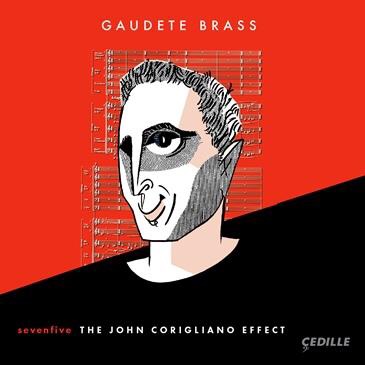
From the very New Yorker style cover art this album affirms this composer’s iconic status.  But the artists here are good Chicago Brass players.  As a native born Chicagoan I have become accustomed to assuming that one can find some of the world’s finest brass players there and this album lays testament to that.  Gaudete Brass is an ensemble that definitely deserves your attention.

This is a fine tribute album featuring mostly world premieres but also some nice transcriptions.  This is effective though not overwhelmingly modern music for brass.  It is intended as and functions very well as entertainment and, from the sound of it, is also fun to play.

The original works are welcome as are the transcriptions of Corigliano’s Gazebo Dances. by the long time Chicago musician/conductor Cliff Colnot.  (One transcription is by the composer).  There are a total of three Corigliano pieces here and 13 by others.  One can only imagine the joy the composer will feel on hearing these tributes and the joy that any number of brass players will experience hearing this fine album.  As usual the Cedille recording is lucid giving a clear sound image of some truly fine musicianship.

The pieces here are good middle of the road compositions which pose challenges on the players but manage to be entertaining and nothing here sounds like an academic exercise.  Rather this disc is about celebration exactly as it purports.  Very enjoyable disc.

Duo Stephanie and Saar: Bach Art of Fugue


duo bach

New Focus Recordings FCR 181

One of Bach’s last works (It is dated 1748) was thought for many years to have been a sort of academic thesis which was not meant for performance.  Even though it has received performances it is problematic in many ways for performers and listeners. it has spawned many different approaches to this score which specifies no instrumentation, no ordering to the separate movements, and leaves it’s last fugue tantalizingly incomplete.

There have been many orchestrations for ensembles ranging from various chamber groupings to full orchestra.  It has been done on harpsichord, organ and piano, organ, string quartet, brass ensemble, saxophone quartet to name a few.  In fact all of these approaches would seem perfectly appropriate and authentic within the context of baroque performance practice.  Undoubtedly we can expect more of this pluralistic approach to come to terms with Bach’s final utterance.

Sometimes the most salient characteristic of a recording of this work is about a new orchestration or some new scholarship, including yet another effort to complete the fugue which Bach left incomplete in the manuscript.  In this two disc recording the motivation seems to be simple clarity.  Duo Stephanie and Saar (pianists Stephanie Ho and Saar Ahuvia) perform the pieces on piano 4 hands, two pianos and solo piano as befits their artistic vision.  They order the pieces by playing the first 12 fugues (or contrapuncti, as Bach refers to them) followed by alternately performing the four canons in between the remaining fugues and ending with the Canon in Augmentation to create a sense of an arch of unity with increasing complexity followed by the comparatively simple postlude of the final canon.  As with many of the recordings Stephanie and Saar choose to leave the last fugue incomplete as Bach left it which is slightly jarring, leaving the sensation of having missed a step in the descent of a staircase but the final canon then does serve to bring the listener down gently.

Not until the minimalist movement would we see such a long focus on a single key (D minor), a potential deal breaker for a lesser composer.  However the lucidity of these performances and recordings allows the listener to focus on the beautiful intricacy of counterpoint that represents one of the pinnacles of western musical art.  Actually I have found that this recording works as well with focused listening as it does as background music where its energy sneaks in to your consciousness in a different but no less exhilarating way.  This is doubtless due to the quality of interpretation.

Nothing flashy here, no overblown musicological perspectives, just strong playing by artists who clearly know and love this music.  The Art of Fugue is not the easiest of Bach’s works to appreciate.  Indeed it took this listener many years and multiple different recordings to finally grasp the depth of the work.  And while it may not have been intended for performance per se this recording does a good job of finding the unity in these contrapuntal etudes which are effectively a summing up of the techniques of the high baroque era.  Stephanie and Saar take us on a wonderful journey, one you will want to take many times.

Michala Petri Goes Brazilian


OUR Recordings 6.220618

Since her debut in 1969 at the tender age of 11 Danish born recorder virtuoso Michala Petri has been one of the finest masters of the recorder.  This ancient instrument, a forerunner of the flute, has existed since the Middle Ages and has amassed a huge repertoire and Petri seems to have demonstrated mastery over all of it and has been an advocate and promoter of new music for her instrument as well.  She has inspired composers to write new works for her and she continues to entertain audiences and has assembled an ever growing discography of startling range and diversity.  Nearly single handed she has managed to honor past repertoire and firmly ensconce this instrument in the 21st century.

In this release, produced by Lars Hannibal (himself a fine guitarist and frequent Petri collaborator) Petri takes on the music of Brazil and, despite the fact that recorders have seldom found their way into the music of this geographic region, she delivers a convincing and hugely entertaining program on this disc.  Along with Marilyn Mazur on percussion and Daniel Murray on guitar the listener is given an entertaining cross section of Brazilian music ranging from the more classically oriented work of Heitor Villa-Lobos (1887-1959) and Ernesto Nazareth (1863-1934) to the smooth jazz/pop sounds of Antonio Carlos Jobim (1925-1994) and Egberto Gismonti (1947- ).  In between are included works by the album’s guitarist Daniel Murray (1981- ) and a few names unfamiliar to this reviewer including Paulo Porto Alegre (1953- ), Paulo Bellinati (1950- ), Hermeto Pascoal (1936- ), and Antonio Ribero (1971- ).

There is a remarkable unity in this Danish production which stems from a meeting between producer Lars Hannibal and Daniel Murray in Vienna in 2014.  Hannibal’s ear found a kindred spirit whose musicality is a good match for that of Petri.  And like a good chef he added the delicate and necessary spice of the tastefully understated (but extraordinary) percussionist Marilyn Mazur to create a unique trio that sounds as though they’ve played together for years.  Here’s hoping that they’ve secretly recorded enough material for a second album.

All the tracks appear to be transcriptions though the transcriber is not named (I’m guessing they’re collaborative).  What’s nice is that there is nothing artificial or uncomfortable about these arrangements.  The overall impression left is that of a skilled ensemble and listeners encountering the original forms of these works might well assume those to be the transcriptions.  So convincing are these performances.

One last thing.  The sound.  This super audio CD release was engineered by Mikkel Nymand and Preben Iwan and the sound is fabulous.  I don’t have a machine that can read the super audio tracks on this hybrid disc but what I can hear is a lucid recording which embraces the subtleties of this unique ensemble.  Enjoy!

Black Notes Matter: Lara Downes’ America Again


laradownes

Sono Luminus DSL-92207

The lovely cover photo for this album by San Francisco born pianist Lara Downes is reminiscent of any number of socially conscious folk/rock stars of the 60s and 70s. It would seem that this is no accident.  This delightful album of short pieces by a wide variety of American composers takes its title from the Langston Hughes (1902-1967) poem, Let America Be America Again (1935).  By so doing the pianist places this interesting selection of short piano pieces firmly in the context of black racial politics and the artistic expression of black America as well as those influenced by this vital vein of American culture (both musical and literary).  It is a graceful and deeply felt effort and I hope that the metaphor of the title of my review is not too tortured a one to reflect that.

This is also a very personal album.  Downes seems to share some deeply felt connections with her materials.  This artist, born to a white mother and a black father, invokes a careful selection of short piano pieces steeped sometimes in jazz and blues but also the political directness (and optimism) which was characteristic of the inter-war years that brought forth the Hughes poem.  There is both sadness and celebration in these virtuosic and technically demanding little gems (most apparently recorded for the first time or at least the first time in a while).  The pianist’s comments on each individual piece are also critical to the understanding of this disc as she shares the impact and meaning that the music has had for her.

There are 21 tracks by 19 composers in all and the selections themselves are quite a feat. They range from the 19th to the 21st centuries and are composed by both men and women of a variety of racial and ethnic backgrounds.  All seem to share the sort of  populist charm befitting the idealized America yearned for in the poem which is to say that they represent a kind of idealized or hopeful nationalism.  Downes is well acquainted with a large variety of American music and recognizes no distinction between classical and so-called “vernacular” traditions.

In fact none of these things are atypical for this artist.  Her previous albums Exiles Cafe (2013) featured music by composers exiled from their homelands, A Billie Holiday Songbook (2015) celebrated the life of this iconic black artist and her American Ballads (2001) demonstrated her deep mastery and affection for populist (but not jingoistic) nationalism.  Her tastefully issue oriented albums define a very individual path and the present album appears to be a very logical and well executed next entry into her discography.

This disc shares a similar heritage to that of Alan Feinberg’s four discs on Argo/Decca entitled, The American Innovator, The American Virtuoso, The American Romantic and Fascinating Rhythm: American Syncopation.  Another notable antecedent is Natalie Hinderas’ groundbreaking two disc set of music by African-American composers.

And now on to the music:

Morton Gould (1913-1996) was a Pulitzer Prize winning composer and conductor with a style informed by his study of jazz and blues in a vein similar to that of Bernstein and Copland.  He is represented here by American Caprice (1940).

Lou Harrison (1917-2003)  was a composer, conductor and teacher.  He was a modernist and an innovator in the promotion of non-western musical cultures.  His New York Waltzes (1944-1994) are three brief essays in that dance form.

The traditional folk song Shenandoah (apparently in the pianist’s transcription) is next.   This tune will be familiar to most listeners as a popular selection by choral groups and the melody is a common metaphor for things American.

Amy Marcy Cheney Beach (1867-1944) was one of the first successful female American composers.  Her “From Blackbird Hills” Op. 83 (1922) is representative of her late romantic style and her incorporation of Native American (Omaha) elements in her music.

Samuel Coleridge-Taylor (1875-1912) is a English composer with Creole roots, a black composer, known as the “African Mahler” in his day.  Deep River (1905) is his setting of this spiritual which also was one of Marian Anderson’s signature pieces.

Dan Visconti (1982- ) was commissioned by the International Beethoven Festival to write his Lonesome Roads Nocturne (2013) for Lara Downes.  It receives its world premiere recording in this collection.

Swiss-American composer and teacher Ernest Bloch (1880-1959) is certainly deserving of more attention.  His At Sea (1922) is used here to represent the sea voyages of the many immigrants (willing and unwilling) whose journey defined in part who they were.

George Gershwin (1898-1937) mastered both the vernacular tradition (as one of the finest song writers of the 20th Century) and the classical tradition in his too few compositions written in his sadly abbreviated life.  His opera Porgy and Bess (1935) is contemporary with the Langston Hughes poem mentioned earlier.  Downes most arrestingly chooses the arrangement of “I loves you, Porgy” by the classically trained iconic singer, musician and civil rights activist Nina Simone (1933-2003).  Quoting from Downes’ notes (Nina Simone expresses what she knew) “…about being a woman, being black and about being strong and powerless all at the same time.”  Indeed one of the most potent lines of the Hughes poem reads, “America was never America to me.”

Angelica Negrón (1981- ) was born in Puerto Rico and  now lives and works in New York. Her Sueno Recurrente (Recurring Dream, 2002) is a lovely little nocturne which is here given its world premiere.

Leonard Bernstein (1918-1990) held credentials as composer, conductor, teacher and ardent civil rights supporter.  His Anniversary for Stephen Sondheim (1988) is one of a series of Anniversary piano pieces he wrote.  Bernstein did much to help modern audiences (including this reviewer) comprehend the vital musicality of jazz and blues. Like Downes, he drew little distinction between popular and classical and celebrated all the music he believed was good.

David Sanford (1963- ) is a trombonist, teacher and composer who works in both classical and jazz idioms.  His work Promise (2009) was written for Downes and this is the world premiere recording.

Howard Hanson (1896-1981) was a conductor, teacher and Pulitzer Prize winning composer (though not at all an advocate of ragtime, jazz or blues).  His brief but lovely piano piece Slumber Song (1915) is a nice discovery and one hopes that it will be taken up by more pianists.

Scott Joplin (1867/68-1917) was discovered largely due to the scholarship and recordings of musicologist Joshua Rifkin (who incidentally did some arrangements for folkie Judy Collins) whose three volumes of piano rags on Nonesuch records introduced this wonderful black composer’s work to a wider audience once again.  Marvin Hamlisch famously incorporated Joplin’s music into his score for the motion picture The Sting (1973).  Downes chooses the Gladiolus Rag (1907) to represent this composer.

Irving Berlin (born Israel Isidore Baline 1888-1989) is another of the greatest song composers this country has produced.  In another characteristically clever choice Downes chooses the arrangement of this hugely optimistic song, “Blue Skies”(1926) by the great jazz pianist Art Tatum (1909-1956).

Florence Price (1887-1953) was a black female composer (the first to have one of her orchestral works programmed by a major symphony orchestra) whose work is only recently getting some much needed exposure.  Her Fantasy Negre (1929) is based on a spiritual, “Sinner, Please Don’t Let This Harvest Pass”.  Price was involved in the New Negro Arts Movement of the Harlem Renaissance and was professionally connected with Langston Hughes among others.

Aaron Copland (1900-1990) is perhaps the most iconic American composer.  Dubbed the “Dean of American Composers” his earliest work has strong jazz influences and his later work created the American romantic/nationalist sound incorporating folk songs and rhythms.  For this recording the artist chose the first of the composer’s Four Piano Blues (1926) which also appeared on her 2001 album of American Ballads.

Edward Kennedy “Duke” Ellington (1899-1974) was a composer and band leader whose sound virtually defined the Harlem Renaissance during his tenure at the famed Cotton Club.  Melancholia (1959) is the piece chosen here, again a nice little discovery.

Roy Harris (1898-1979) was, like Copland, a populist but the Oklahoma born composer studied Native American music as well as American folk songs.  His American Ballads (1946) was included on Downes’ American Ballads album.  Here she includes an unpublished work from a projected (but never finished) American Ballads Volume II.  This piece is a setting of the spiritual, “Lil Boy Named David”.

The album concludes with one of the ultimate hopeful dreamer songs, Harold Arlen’s (1905-1986) Over the Rainbow (1939) from his score for The Wizard of Oz (1939).  The adolescent yearning of Dorothy for something better than her dust bowl farm life touched a chord in many over the years and it is a fitting conclusion to this beautiful and hopeful collection.

As mentioned earlier the insightful liner notes by Lara Downes complement this production and tactfully position its politics.  She shares a personal journey that is as American as the proverbial apple pie.  The album is dedicated to the artist’s ancestors in recognition of their struggles as well as to her children in hopes that dreams for a better future can become their reality.

This beautiful sound of this album is the result of work of Producer Dan Merceruio and Executive Producer Collin J. Rae along with Daniel Shores and David Angell.  The lovely photography is by Rik Keller and as with the previous release Skylark: Crossing Over (reviewed here) the graphic design by Caleb Nei deserves special mention for its ability to truly complement this disc.

It is scheduled for release on October 28, 2016.


A shamanic effort to raise consciousness and further socially progressive ideas.

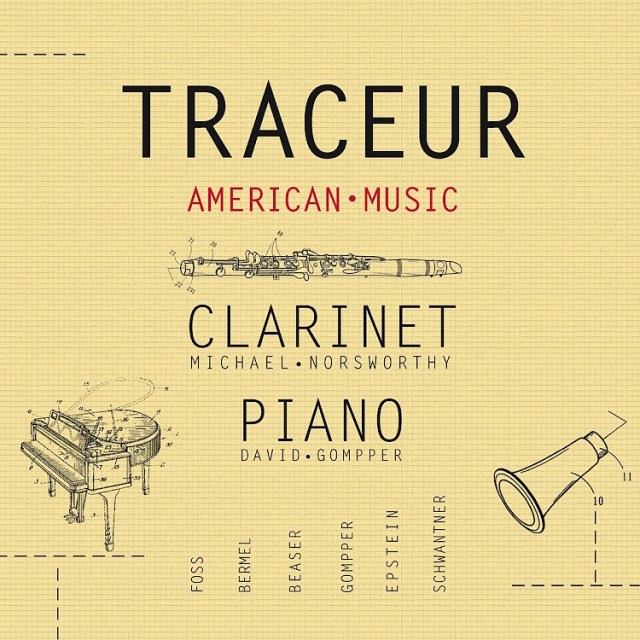
Traceur, American Music for Clarinet and Piano


traceur

New Focus Recordings FCR-172

This is a nice little program of pieces for clarinet and piano by 20-21st century composers. It might even be a representation of the state of the art for this genre.  All of these pieces are basically tonal and would work well in a recital.

Michael Norsworthy, professor of clarinet at Boston Conservatory at Berklee has an impressive set of credentials in the interpretation and performance and teaching of new music.  This performing academic has quite a list of recordings to his credit.

David Gompper is a composer and pianist with a similarly extensive set of credentials in support of new music (his own and others’).

The disc opens with a six movement suite of short pieces by Robert Beaser (1954- ) called, Souvenirs (2001-2).  Beaser is one of the finest composers of his generation and his tonal style was a hallmark of his work from the very beginnings.  These short, personal sketches are a delightful example of his work.  These pieces were originally written for piccolo and piano and are here presented in the composer’s transcription for clarinet and piano.

The next piece, Black Anemones (1980) is originally for flute and piano and is a sort of modern classic (here is a recent review of the flute and piano version).  The Pulitzer Prize winning Joseph Schwantner (1943- ) is also among the finest composers working today. This transcription for clarinet by Mr. Norsworthy will most certainly guarantee further performances.  This is truly lovely music inspired by poetry of Agueda Pizarro.

Three American Pieces (1944-5) by Lukas Foss (1922-2009) are another sort of classic set of pieces.  These are early compositions in a neo-classical/nationalist style characteristic of this period of Foss’ compositional style.  It is great to have a new recording of these entertaining pieces.  Foss is due for a reckoning I think.

Marti Epstein (1959- ), also a professor at Berklee was represented in an earlier review of a disc (here) dedicated entirely to her gentle music imbued with memories of her upbringing in the great plains of the Midwest.  Nebraska Impromptu (2013) is characteristic of this composer’s gentle but substantial music.  Her website also contains a very interesting occasional blog that is worth your time.

Derek Bermel (1967- ) is here represented by schiZm (1993-4).  Originally for oboe and piano the composer also made this transcription for clarinet and piano.  Bermel describes some of the fascinating techniques that underlie the structure of this two movement piece but the result of those techniques is a very interesting piece of music.

Last but definitely not least is the title track Traceur (2014-5) by composer/pianist David Gompper (1954-).  It is the longest and most complex of the pieces presented and requires the most involvement on the part of the musicians as well as the listener.  I don’t mean to imply that this is difficult music because it isn’t.  It is substantial music whose charms demand close listening, an effort for which one will be rewarded.

This lucid recording was produced by Norsworthy and Gompper (with the assistance of Robert Beaser in the recording of his work).  It was recorded in 2015 with editing and mastering by Patrick Keating.  Very nice disc.  Highly recommended.


Next Gen Steve Reich: Two Great New Recordings


One of the hurdles on the way to long-term historical recognition is finding the next generation of interpreters for whom the music itself is not new but whose interpretation is needed anew in light of the music’s place in the canon of performed and recorded music. So Mr. Reich has now arrived in two fantastic new recordings.


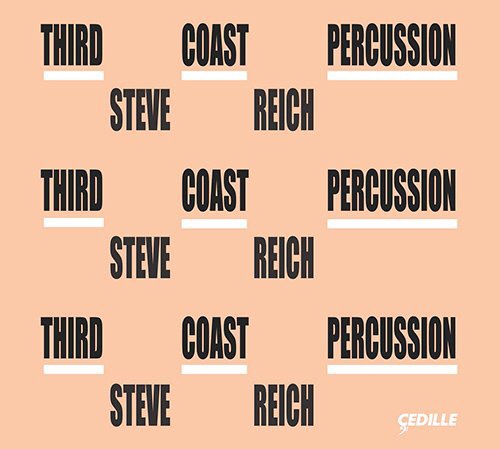
The first CD here is the Cedille (Cedille 90000 161) label debut by Third Coast Percussion, a young Chicago based group.  The label itself is reason enough to pay attention with their intelligently selected and well-recorded releases.  But even so this one stands out for a couple of reasons.

As  Reich reaches his 80th birthday (as are many composers whose work informed my listening life since the 70s) we are seeing the next generation (or so)  of performers, musicians for whom this music is not new.  (Third Coast Percussion is Sean Connors, Robert Dillon, Peter Martin and David Skidmore. They were founded in Chicago in 2005.). As these dedicated musicians traverse this repertoire they see it from a different perspective and they acknowledge this in the accompanying notes by Robert Dillon.  No doubt they are familiar with the music and have heard some if not all previous recordings. This music is no longer new and novel the way it was to those who first heard it.  And that is what we have here, a new take on music already familiar giving us the perspective of another generation.

The second reason to get this recording is the sheer beauty of the sound.  It is a masterpiece of recorded sound which does justice to the work of these fine musicians as well as the music.  The album was recorded at the University of Notre Dame’s DeBartolo Performing Arts Center (where Third Coast is in residency).  Dan Nichols was the engineer assisted by Matt Ponio.  It was mastered by Jessie Lewis and Kyle Pyke.
The CD opens with the recent Mallett Quartet (2009) which has been recorded only once before.  The piece is in three sections fast-slow-fast split over the first three tracks.  It is one of Reich’s finest compositions showing him as a still vital artist and it will no doubt receive many more performances but it would be hard to imagine a better recording.

The second selection is, for this writer, one of Reich’s more unusual pieces.  The Sextet (1984) is scored for two keyboards (pianos doubling synthesizers used for long held tones) and percussion.  David Friend and Oliver Hagen lend their formidable keyboard skills to this work and help it to swing.

I must admit that this performance has resulted in me giving this work some serious close listening again and I am liking it better.  Some of these movements seem like precursors to some of the writing in Reich’s wonderful The Four Sections (1987), another work that deserves more attention.

The brief but lovely Nagoya Marimbas (1994) is pretty much an accepted staple of the classical marimba repertoire and has also been transcribed and performed on guitars as well.  As with the preceding the performance is faithful and lively.

For the final track a decision was made to go back to early in Reich’s output with Music for Pieces of Wood (1973).  As with much of his early work we see his experimental side focusing as much as possible on a single process.  It uses the same rhythmic pattern as the 1972 Clapping Music but uses additive rather than phasing techniques (I believe), a great example of the roots of minimalism.  The group does some toying with the choice of percussion but, as in the preceding tracks, manage to create a performance worthy of the best interpreters in their generation.  Happy Birthday Mr. Reich!!


This second CD (New Focus fcr 165) is another aspect of crafting a legitimate new interpretation of a given piece of music.  Guitarist Daniel Lippel goes back to some of the roots of Reich’s mature style, Ghanaian drumming.  Reich seems to have achieved his personal artistic synthesis after his encounter and study with the master drummers of Ghana.  It is here that he was finally able to synthesize the gifts received from his study of jazz (Reich was/is a jazz drummer) and his tape music experiments into the larger forms for which he is now known through these studies with West African musicians.  And it is here that Lippel goes, with an assist from musicologist Martin Scherzinger, to create his (re)vision of this classic Reich composition.

Electric Counterpoint (1987) was written for and first recorded by the still wonderful jazz guitarist Pat Metheny.  His recording is certainly definitive but, as with all music performance, hardly the last word.  Several artists have presented their versions (David Tanenbaum’s acoustic guitar version deserves more attention by the way).  It is a very appealing and interesting piece cast in a classic fast-slow-fast format that presents formidable challenges for the musician but not for the listener.

It is difficult (and certainly beyond the scope of this review) to say specifically what Mr. Lippel has done differently but there is clearly a difference (further notes can be found here).  I am loathe to find adjectives to describe this recording except to say that it is well worth your time to hear it.  It provides a different way of hearing much as Glenn Gould has done for Bach.  Just sit back and enjoy.

A Really Great Brass and Organ Album, Chicago Gargoyle Brass and Organ Ensemble


gargoylebrass

MSR Classics MS 1598

At first this disc seemed to be one of those “audiophile spectacular” niche market items designed to show off one’s stereo system.  I expected a well-recorded album with wide dynamic range and a clarity that would stun the listener but these types of albums frequently have well-recorded but uninteresting music or, worse, cloying showpieces that don’t bear repeated listening.

The first listen dissuaded me from that notion immediately because this is interesting and well-played music.  Except for three clever transcriptions of late 19th/early 20 century pieces all the music is from 2005-2013 (as are the transcriptions for that matter).

The music is, on the whole of a somewhat conservative nature but that is not a negative thing.  All of the music is pleasantly engaging and/or downright exciting.

The first four (of a total of 15) tracks present the music of Carlisle Sharpe (1965- ).  The first work Flourishes (2005/10) is a festive fanfare which was revised for this ensemble. The next three tracks contain the Prelude, Elegy and Scherzo (2012) is a commission by the present artists.

Next we move on to one of the arrangements by Craig Garner (1959- ).  This is, I think, a difficult arrangement to play but is handled with such ease by these players that one could be fooled into thinking it was easy.  The arrangement of the popular drinking song from Verdi’s La Traviata (1853) is a lucid and detailed transcription.  It is the clarify of the recording that makes this obvious as we are able to hear the various challenging lines that allow pretty much everyone in the ensemble to demonstrate their facility.

William Whyte (1983- ) is the next featured composer with a satisfying little suite called Dwarf Planets (2012).  It is in five brief movements.  The piece was also commissioned by and dedicated to Chicago Gargoyle Brass and artistic director Rodney Holmes.

Earthscape (2011) by David Marlatt is cast in a similar vein and, with the previous five tracks these are effectively musical appendices to Holst.  Marlatt, a Canadian composer has written this lyrical piece for the Gargoyle Brass.

Tracks 12 and 13 are another great transcription of a type of work which conductor Sir Thomas Beecham was fond of calling “bon-bons”, an appellation that was a proto-pop concert concept describing short, popular encore pieces.  It is the Polka and Fugue from “Schwanda the Bagpiper” by Jaromir Weinberger (1896-1967), a Czech composer whose reputation lies pretty much entirely on this work.   Originally for orchestra, this engaging work is very effectively arranged for this ensemble.

Tracks 14 and 15 comprise another transcription, this time of two movements from Camille Saint-Saens’ (1835-1921) 3rd Symphony (1886).  This is another truly great piece of music that always plays well with audiences.  The original is for a large orchestra and an organ.  The transcription is remarkably faithful to the score and it’s hard not to get hooked on that finale.  The entire symphony is actually based on the “Dies Irae” chant from the Requiem Mass though this is not a somber piece at all.

The last track is Velvet Blue (2012) by Peter Meechan (1983- ), a British born Canadian composer.  Originally written for a “rock” organ (the Hammond variety) and here played on a traditional pipe organ this is one of the most unusual pieces here.  It’s blues/jazz inflections harken back to big band sounds of the 1930s.

Brass instruments and organs are not instruments known for their agility.  Combine that with the resonant recording space of the churches involved and you have some serious engineering challenges.  Hudson Fair at Hudsonic has met these challenges and succeeded in capturing these performances in lucid detail with a true audiophile recording.  The dynamic range is wide and the the recording is about as clear as I have ever heard done  in this setting.

The musicians Lev Garbar, trumpet; Andrew Hunter, trumpet and flugelhorn; Amy Krueger, horn; Kathryn Swope, horn; John Grodrian, trombone; Graham Middleton, trombone; Ryan Miller, trombone; Andrew Vandevender, tuba; Paul Ramsler, tuba; Joshua Wort, tuba; Michael Schraft, tympani and drum set; Jared Stellmacher, organ; Mark Sudeth, piano; and Steven Squires, conductor all play with precision, lyricism and feeling.

One more piece of what I call “audio porn” is nicely included, the statistics on the two beautiful organs played at the two churches where these recordings were made.  Nice touch. Great fun album.


Other Minds 21, the Dawn of a New Chapter and the Raising of the Dead


BHM160008

Charles Amirkhanian with the composers of OM 21

Much needed rain pummeled the city by the bay on all three days of OM 21 dampening, perhaps, some attendance but not the enthusiasm of the audience or the performers.  In most ways this concert was a continuation of the celebration begun last year commemorating 20 years of this festival.  Returning this year were Gavin Bryars (OM7) and Meredith Monk (OM1).

Until last year no composer had appeared more than once at this series.  For those unfamiliar with OM it is worth noting that the process has been for the 8-10 selected composers spend a week at the Djerassi Arts Center in Woodside, California sharing and discussing their work before coming to San Francisco for performances of their work.

As it turns out this year’s concert series will be the last to follow that format.  Apparently OM has become the victim of gentrification and has had to move out of its Valencia Street offices and will now opt for various concerts throughout the year as they have done but without the big three-day annual festival and the residency at Djerassi.

The archives of OM are now going to be housed at the University of California Santa Cruz where they will reside along with the Grateful Dead archives.  I do believe that Mr. Amirkhanian lived near Phil Lesh of the Grateful Dead when he lived in San Francisco some years ago so it seems fitting that these two archives will peacefully coexist in that space (also coming to UCSC will be OM 21 composer Larry Polansky though not in an archive).

This is certainly a change but this is a festival which has endured various changes in time and venue led throughout by the steady hand of the Bill Graham of contemporary music concerts, Charles Amirkhanian (both men have had a huge impact on music in the bay area as well as elsewhere and it is worth noting that the Contemporary Jewish Museum will have a tribute to Graham this year).

Actually Other Minds traces its provenance to the Telluride, Colorado Composer to Composer festival (also led by Amirkhanian) and later morphed into OM with the leadership of president (now emeritus) Jim Newman back in the early 1990s.  There is a short excellent film describing OM’s history on Vimeo here.

It is the end of a chapter but, as Amirkhanian explained, there are many exciting concerts coming up which will keep Other Minds in the earshot of the astute contemporary music aficionados on the west coast.  Next year, for example, will include several very exciting concerts celebrating the 100th birthday anniversary of beloved bay area composer Lou Harrison.

My apologies for the delay in posting which was due to both the richness of the experience and the exigencies of my day job and other responsibilities.  I hope that readers will find this post to have been worth the wait.

BHM160009

Nordic Voices

Starting our rainy day were the extremely talented singers known as Nordic Voices.  Lasse Thoresen‘s Solbøn ( Sun Prayer) (2012) and Himmelske Fader (Heavenly Father) (2012) both required keen listening and required the use of extended vocal techniques such as multiphonics.  The singing appeared effortless and even fun for the ensemble but that speaks more to their expertise and preparedness than any ease in terms of the score.

It is always difficult to judge a composer’s work by only a small selection from their output  but Thoresen’s virtuosity and subtle use of vocal effects suggests a highly developed artist and it would seem worth one’s time to explore more of this gentleman’s oeuvre.

BHM160010

Lasse Thoresen takes the stage to acknowledge the applause.

Next was an unusual, humorous/dramatic work by Cecile Ore called Dead Pope on Trial (2015/16) with a libretto by Bibbi Moslet.   This Other Minds commission was given its world premiere at this concert.  The work is based on the story of a medieval pope who was taken from his grave no fewer than six times for various perceived offenses.  It is a mix of irony and humor in a sort of madrigal context.  The work was in English and had the nature of a conversation between the singers.  No doubt a challenging piece, it was sung very well and the composer seemed as pleased with the performance as much as the audience.

BHM160011

Cecile Ore smiling as she acknowledges the applause for the wonderful premiere performance of her new work, Dead Pope on Trial.

As if in a demonstration of sheer stamina in addition to virtuosity Nordic Voices took the stage again, this time for some Madrigals (2002/2016) by returning artist Gavin Bryars.  Bryars is no stranger to Other Minds or to madrigals and such older musical forms from the renaissance and before.  He has extensively explored vocal writing and medieval harmonies in many previous works.  Though categorized as being a “minimalist”, Bryars actually has produced a huge range of music in all forms including opera, chamber and orchestral music.

His madrigals have been written for the Hilliard Ensemble and each book is distinguished by the madrigals having been written on a specific day of the week.  The first book on Mondays, etc.  They are settings of Petrach’s sonnets and are sung in the original Italian of his day.  On this night we were treated to four madrigals from Book Two and the premiere of a madrigal from Book Four.  That madrigal was dedicated to Benjamin Amirkhanian, the father of Charles Amirkhanian who celebrates his 101st birthday this summer.

I had the opportunity to meet and speak briefly with the affable Mr. Bryars.  His generous spirit pervaded our conversation and he spoke very highly of both his visits to Other Minds.  If you don’t know this man’s music you are doing yourself a great disservice.

BHM160016

A very pleased Gavin Bryars deflects the applause and adulation to the amazing Nordic Voices for their astounding performance of five of his madrigals.

The singers of Nordic Voices sustained a high level of virtuosity as well as sheer stamina as they sang for nearly two hours in the opening pieces of this concert series.  No time was lost setting the stage for the performance of the next piece, another premiere, Algebra of Need (2016) for electronic sampling and string quartet by Bang on a Can member Phil Kline.

BHM160045

FLUX Quartet playing at SF Jazz, 2016

The Flux Quartet was featured in the next two (and last) works on this long program.  Algebra of Need is Kline’s meditation on the words and the cadences of the iconic writing and voice of the late William S. Burroughs (gone 19 years as of this writing).  The familiar voice seemed to go in and out of clearly audible, at times mixed more closely with the string writing in this intense homage.
BHM160014

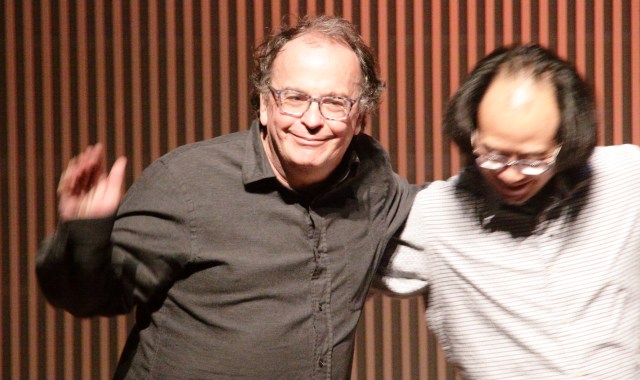
A satisfied looking Phil Kline leans in to embrace the first violin of the Flux Quartet after their premiere of his Algebra of Need.

The Bang on a Can collective was also represented tonight by Michael Gordon.  The Sad Park (2008) for string quartet and electronics put a most decidedly disturbing conclusion on the evening.  This piece, which samples the voices of children (one of them Gordon’s) as they spoke of their experience of the 9/11 Twin Towers attacks.

The effect was, as no doubt intended, harrowing leaving a pretty strange and unsettling feeling as we walked away from the concert into the still rainy night.

BHM160017

Michael Gordon embraces the FLUX Quartet’s first violin after a stunning performance of The Sad Park.

The rain continued on Saturday but the crowd was noticeably larger for the second night which opened with the usual panel discussion.

BHM160030

left to right: Meredith Monk, John Oswald, Nicole Lizee, Eliot Simpson, Larry Polansky, Oliver Lake and Charles Amirkhanian in a panel discussion prior to the concert

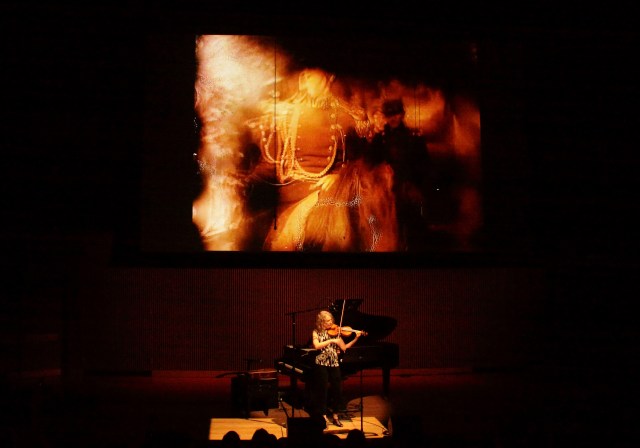
This evening began with a performance by the wonderful bay area violinist Kate Stenberg of a piece which was a sort of antidote to the somber, The Sad Park from the previous night.  Again the composer was Michael Gordon and the piece was Light is Calling (2004), a collaboration with filmmaker Bill Morrison.  Though hardly a happy piece Light is Calling is perhaps elegiac and the composer seems to achieve some of his stated intent to find some healing in the wake of a disaster to which he was all too close.
BHM160031

Kate Stenberg plays violin beneath the projection of a Bill Morrison film in Michael Gordon’s, Light is Calling
BHM160032

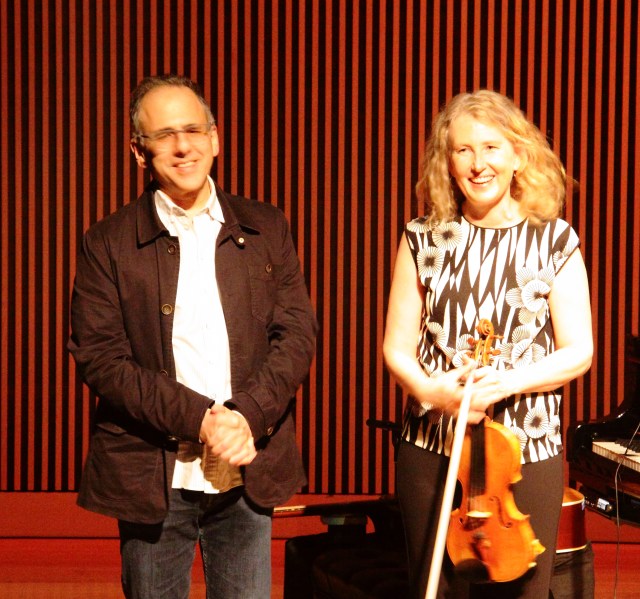
Michael Gordon and Kate Stenberg accepting the applause of an appreciative audience.

Next up was John Oswald, a Canadian composer whose career took off in infamy when his Plunderphonic CD, released to radio stations in the early 1980s, became the subject of legal battles over the meaning of copyright law in light of digital sampling.  Fortunately Oswald won the right to publish his work and his Plundrphonics concepts now underlie much of his compositional process.  Until this night I had not heard any but his Plunderphonic CDs so the introduction to his live music was a revelation.
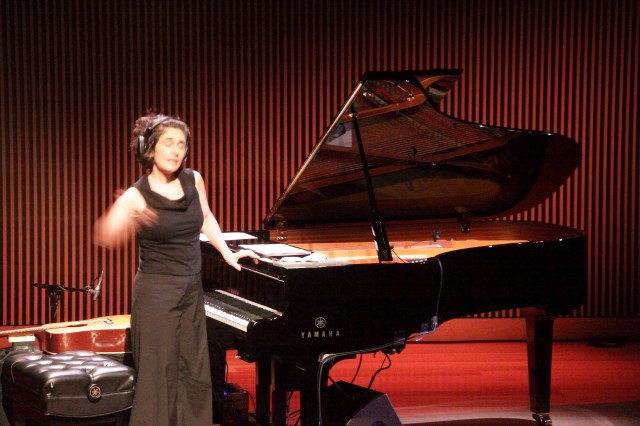
BHM160033

Pianist and (at least here) multi-instrumentalist Eve Egoyan performing with a Yamaha Disklavier and other instruments.

The first piece she did was called Homonymy (1998/2015) was originally written for chamber orchestra and was then transcribed for Egoyan and her prepared disklavier et al.  It is a piece based on linguistic elements and with a visual component as well.

BHM160034

Eve Egoyan performing Homonymy with overhead projections.

Nicole Lizee’s David Lynch Etudes (2015) was the next piece  and also made use of the projection screen.  The subtitle of the piece indicates it is for “disklavier and glitch”.  Well life imitated art as some sort of glitch prevented the projection from functioning at first but this was rather quickly resolved and we were treated to excerpts of scenes from several David Lynch films with the piano playing some of the rhythms of the dialog in an exchange that puts this writer in the mind of music like Scott Johnson’s “John Somebody” and Steve Reich’s incorporation of speech rhythms in works like, “The Cave”.

Nicole Lizee is a Canadian composer and was the youngest composer on this year’s program.
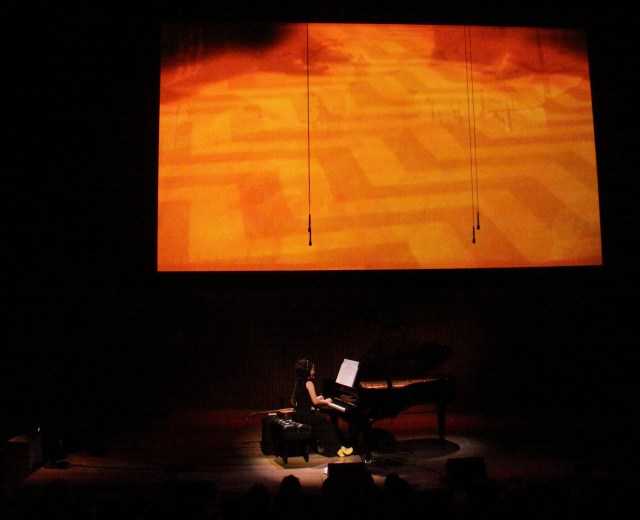
BHM160035

Eve Egoyan playing Nicole Lizee’s David Lynch Etudes with projected scenes/glitches from Lynch’s films.

The work is one of a series of pieces inspired by films and was executed with apparent ease by pianist Eve Egoyan who played the disklavier (both the keyboard and directly on the strings), a guitar and perhaps other gadgets .  The piece kept her quite busy and the associations I described above sound nothing like this work actually.  These etudes were a unique, typically Other Minds sort of experience, one that expands the definition of musical composition.

BHM160036

Nicole Lizee (l) with Eve Egoyan absorbing the audience’s appreciation of the David Lynch Etudes.

Two more John Oswald compositions graced the program next.  Palimpia (2016) is a six movement piece for disklavier with pianist playing as well.  Oswald says it is actually his first composition for piano.

BHM160046

John Oswald embracing pianist Egoyan and enjoying the audience applause for his work.

Well I did say there were two more Oswald pieces but this last one was a masterful plunder by this truly unusual composer.  Here Oswald conjured the playing as well as the image of the late great Glenn Gould who was seen actually playing Invaria (1999) with the disklavier performing along with the film of Gould performing this music.  It was, for this writer, a spellbinding experience.  He has raised the dead in the name of music.  Wow!  It was an amazing and heartfelt homage to a fellow great Canadian musician.
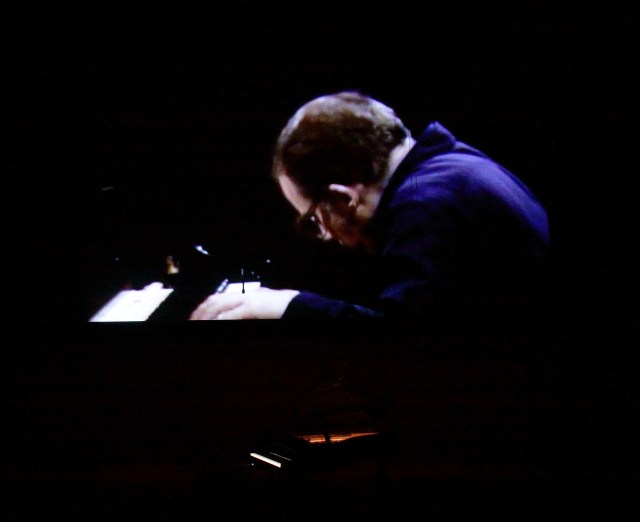
BHM160038

Glenn Gould playing John Oswald

Larry Polansky (1954- ) is well known as a teacher and as a composer but one is hard pressed to find much in the conventional discography of his work.  The few discs out of his amazing electronic music (and one disc of piano variations) represent only a small fraction of his output and represent only one genre of music which he has mastered.  However the astute listener needs to be advised to look online to look, listen and hear some of the bounty of his creative output.  Check out the following sites: Frog Peak Music (Polansky’s publishing site which includes music and scores by a great many interesting composer in addition to himself and Dartmouth Page (which contains link to various recordings, writings, computer software, etc.

BHM160039

Giacomo Fiore (left) and Larry Polansky playing Polansky’s ii-v-i (1997)

As an amateur musician who has enough trouble simply tuning a guitar it made my knees weak to watch these musicians effortlessly retune as they played.   Polansky’s experimentation with alternate tunings is an essential part of many of his compositions.

BHM160040

Fiore and Polansky changing their tunings mid-phrase in a stunning demonstration of virtuosity with pitch changes.

The program then moved from the electric to the acoustic realm with Polansky’s folk song arrangements.  Eliot Simpson, the pedagogical progeny of the great David Tanenbaum (who played these concerts last year at OM 20), played the just intonation National Steel Guitar and sang.

Let me say just two things here.  First, these are not arrangements like Copland’s Old American Songs and second, I will never hear these folk songs quite the same way again.  Polansky’s interest in folk music and Hebrew cantillation along with alternate tunings produces what the ears hear as perhaps a different focus.  In these pieces he did not stray too far from the original (as he does in his Cantillation Studies) but one is left with distinctly different ways of hearing and thinking about this music and the listener is left richer for that.  It is a journey worth taking and Simpson played with both passion and command.

Eliot Simpson playing a selection of Larry Plansky's Songs and Toods

Eliot Simpson playing a selection of Larry Plansky’s Songs and Toods

Polansky returned to the stage for a performance of his 34 Chords (Christian Wolff in Hanover and Royalton) (1995). Again we were treated to the virtuosic use of alternate tunings performed live (and again with live re-tunings) by the composer.

Oliver Lake delivering a blistering free jazz improvisation.

Oliver Lake delivering a blistering free jazz improvisation.

Continuing with the solo performer theme we were privileged to hear the virtuosic jams of Oliver Lake (1942- ) whose long career is legendary in the jazz world.  The “mostly improvised” (according to the composer) Stick was played on two different saxophones in what appeared to be as intense an experience for the performer as it was for the audience.

Oliver Lake takes a final bow at the end of the second concert of OM 21

Oliver Lake takes a final bow at the end of the second concert of OM 21

The emotional workout was received warmly by the audience.

Charles Amirkhanian introduces Meredith Monk on the final day of OM 21

Charles Amirkhanian introduces Meredith Monk on the final day of OM 21

There was no panel discussion on the third day of OM 21.  This matinée was dedicated entirely to the work of Meredith Monk (1942) who, fittingly was one of the featured artists in the first Other Minds gathering in 1993.  Now a recipient of the National Medal of the Arts this beloved artist returns to OM 21.  Though the rain continued the house appeared to be full.
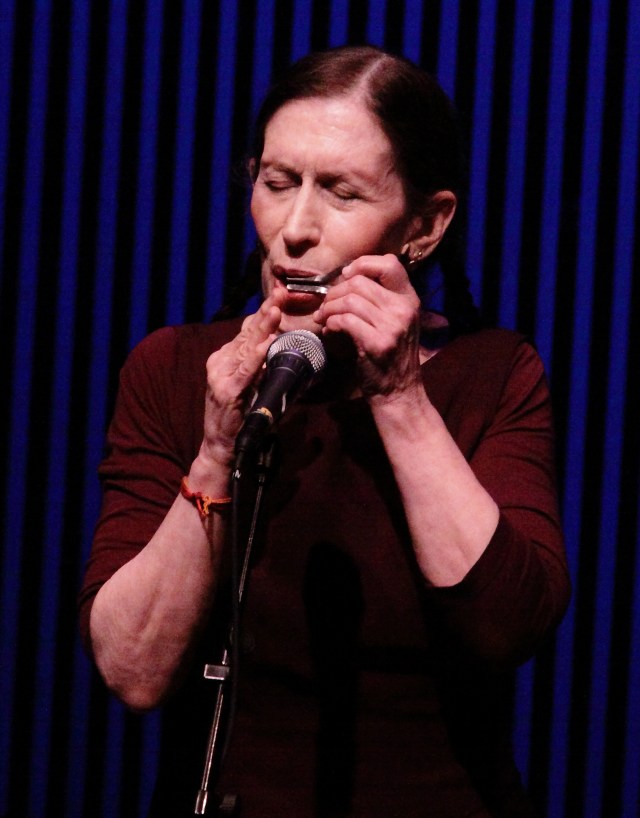
Meredith Monk playing a Jaw Harp in one of her early solo songs.

Meredith Monk playing a Jaw Harp and singing in one of her early solo songs.

Monk played a selection of material from various periods in her career in a mostly chronological survey which she called The Soul’s Messenger.  She began with selections from her solo songs and proceeded to her voice and piano music, then to her work with multiple voices and instruments.
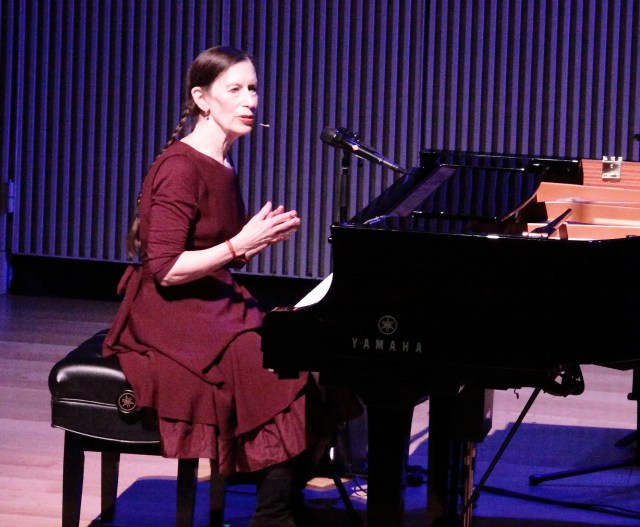
Meredith Monk performing her signature Gotham Lullaby

Meredith Monk performing her signature Gotham Lullaby

Most of the audience seemed to have a comfortable familiarity with the individual works she offered on this night which effectively gave a picture of her career.  Monk was in good voice and appeared to enjoy her performance.
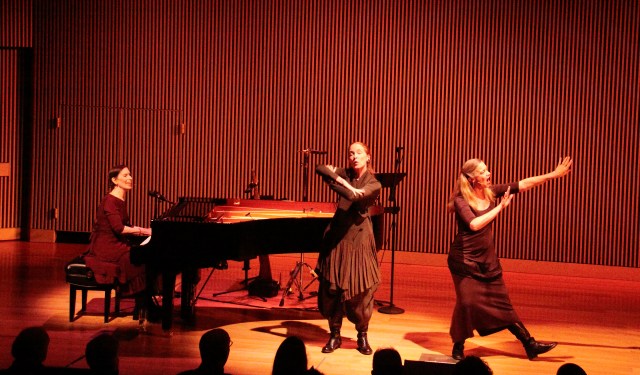
Long time collaborator Katie Geissinger and Allson Sniffin joined in the next selection

Long time collaborator Katie Geissinger and Allson Sniffin joined in the next selection

The stage was set to allow for the dance/movement that is an essential part of Monk’s works.  She originally trained as a dancer.
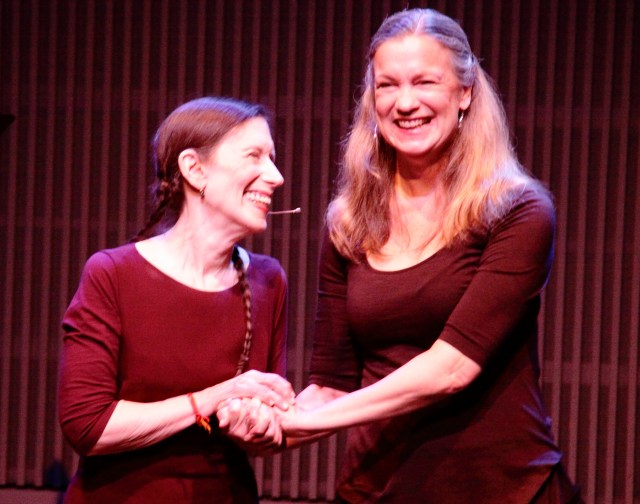
Monk and long time collaborator Katie Geissinger reacting to the appreciative audience

Monk and long time collaborator Katie Geissinger reacting to the appreciative audience

In addition to the grand piano the stage was set with two electronic keyboards, an essential sound in many of Monk’s works.
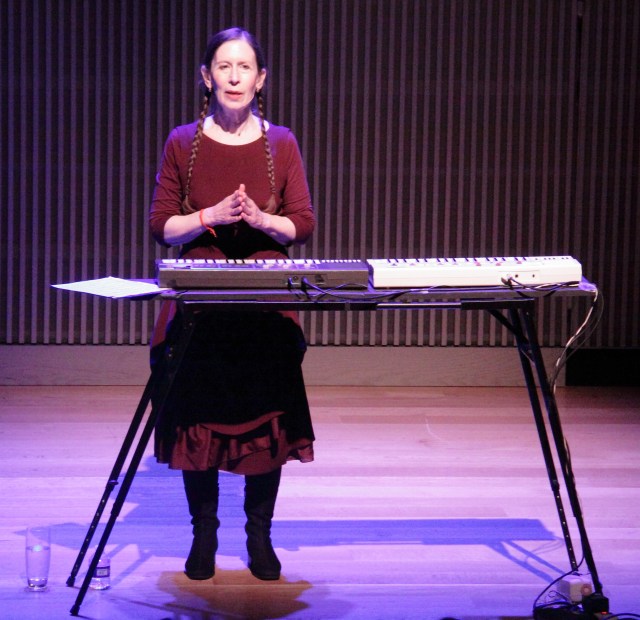
Monk at one of the electronic keyboards

Monk at one of the electronic keyboards

Woodwind player Bodhan Hilash joined the ensemble for the last set of pieces.
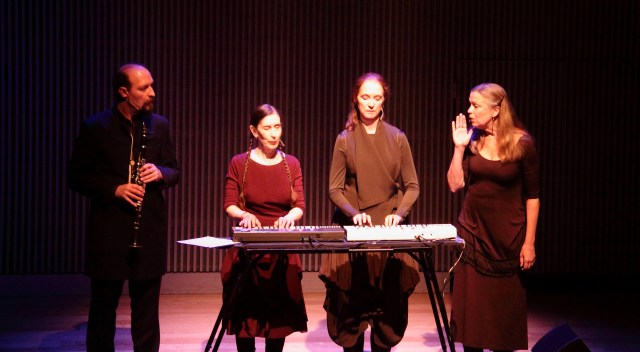
From left: Bodhan Hilash, Meredith Monk, Allison Sniffin and Katie Geissinger

From left: Bodhan Hilash, Meredith Monk, Allison Sniffin and Katie Geissinger

The audience gave a standing ovation at the end resulting in 3 curtain calls.
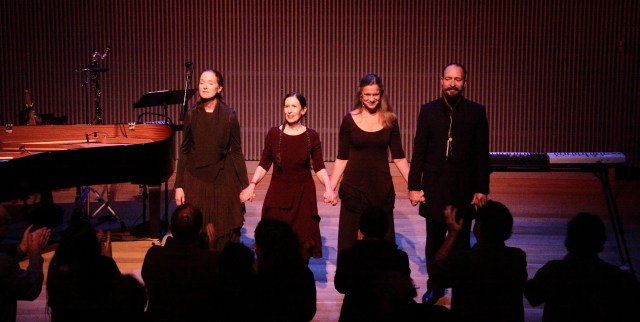
Left to right Allison Sniffin, Meredith Monk, Katie Geissinger and Bodhan Hilash receiving a standing ovation.

Left to right Allison Sniffin, Meredith Monk, Katie Geissinger and Bodhan Hilash receiving a standing ovation.

And the properly prepared artist came back for an encore of her song Details.
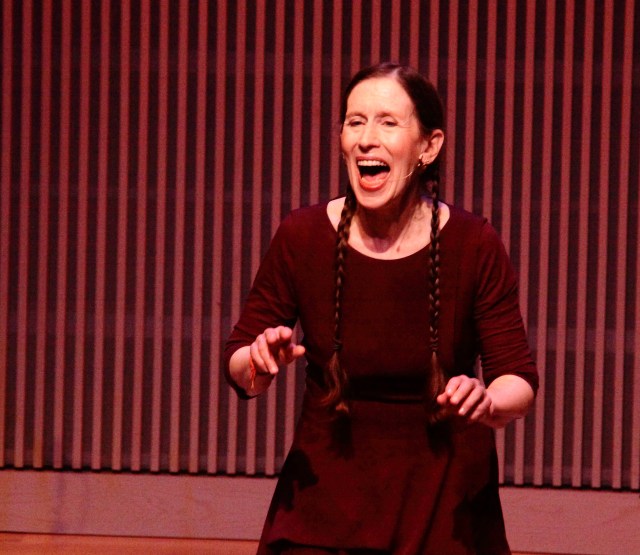
Meredith Monk performing an encore at the final concert of OM 21

Meredith Monk performing an encore at the final concert of OM 21


It was a fitting finale to a great OM 21, fitting to have this artist who appeared on the first iteration of Other Minds returning now crowned with a National Medal of the Arts and clearly beloved by the audience.  Her music like her lovely smile fade to the edge of memory like that of the Cheshire Cat on a truly triumphant finale.

And, despite some format changes, who knows what treasures continue to lie in store?  I will be watching/listening and so, apparently will many others.  Keep an eye on www.otherminds.org .  I know I will.
 

Undercover Performance Practices in the Bay Area


The practice of “covers” in pop music is part of the long tradition in music of making arrangements, variations, homages, etc. in response to a given composition.  To be sure the majority of these efforts are, though well-meaning, mediocre or worse.  But on the whole they can be quite fascinating and even revelatory.  Ravel’s masterful orchestration of Mussorgsky’s ‘Pictures at an Exhibition’ is so well done that few people are even aware that the original is a piano solo work.  The orchestration so enhances the original as to immortalize it and upstage the original version.  Similarly The Byrds’ cover of Bob Dylan’s ‘Mr. Tambourine Man’ has become the most recognized version of that song.

‘Undercover Presents’ is a concert organization which has been producing a very unusual set of concerts.  Taking an album by a given artist and recruiting a different band/musician to cover each of the songs and then presenting  both a studio recording and a live concert of the results.  So far they have done  Velvet Underground and Nico, Pixies’ Doolittle, Nick Drake’s Pink Moon, Black Sabbath’s Paranoid and, most recently, Joni Mitchell’s Blue.  The musicians are all from the San Francisco Bay Area and that comprises a huge trove of talented and innovative artists.  Their albums are available on bandcamp.com

I saw the production of Blue this past September and I will be there again this coming Monday having recruited some additional friends, “You gotta come see this!”

1Killbossa

The first band, ‘Killbossa’ is inspired by the Brazilian art/music/political movement of the late 1960s known as ‘tropicalismo’ and is a combination of a variety of different musical styles including bossa nova, psychedelic rock, avant-garde and Brazilian popular music.  They covered the first song on the album, ‘All I Want’.

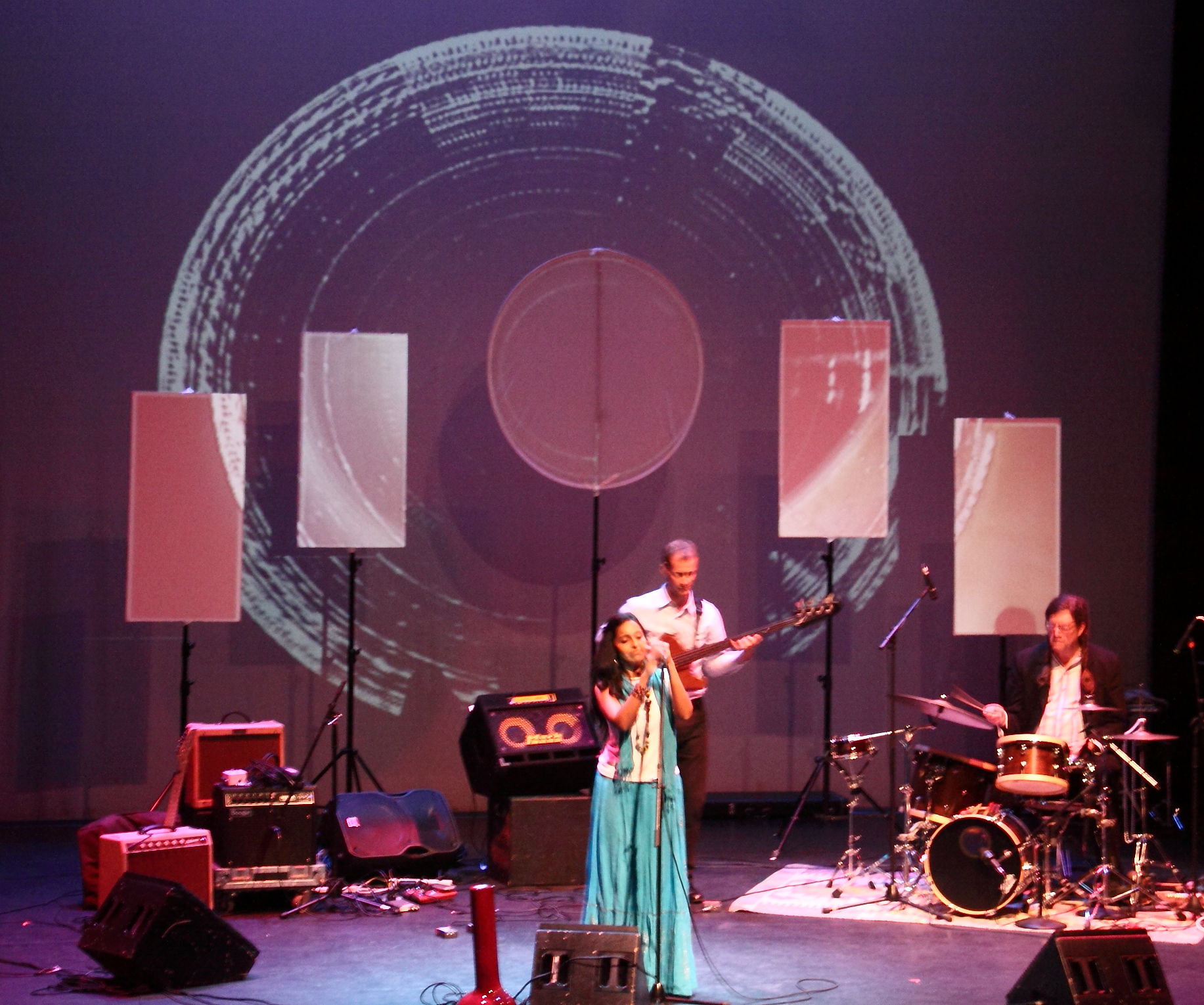
Next up Bharathi Palivela, a singer with traditional Hindustani vocal training teamed up with San Francisco bassist and teacher Daniel Fabricant covering ‘My Old Man’.

Georgia native, now San Francisco based bluegrass singer with her banjo and band put their spin on ‘Little Green’.

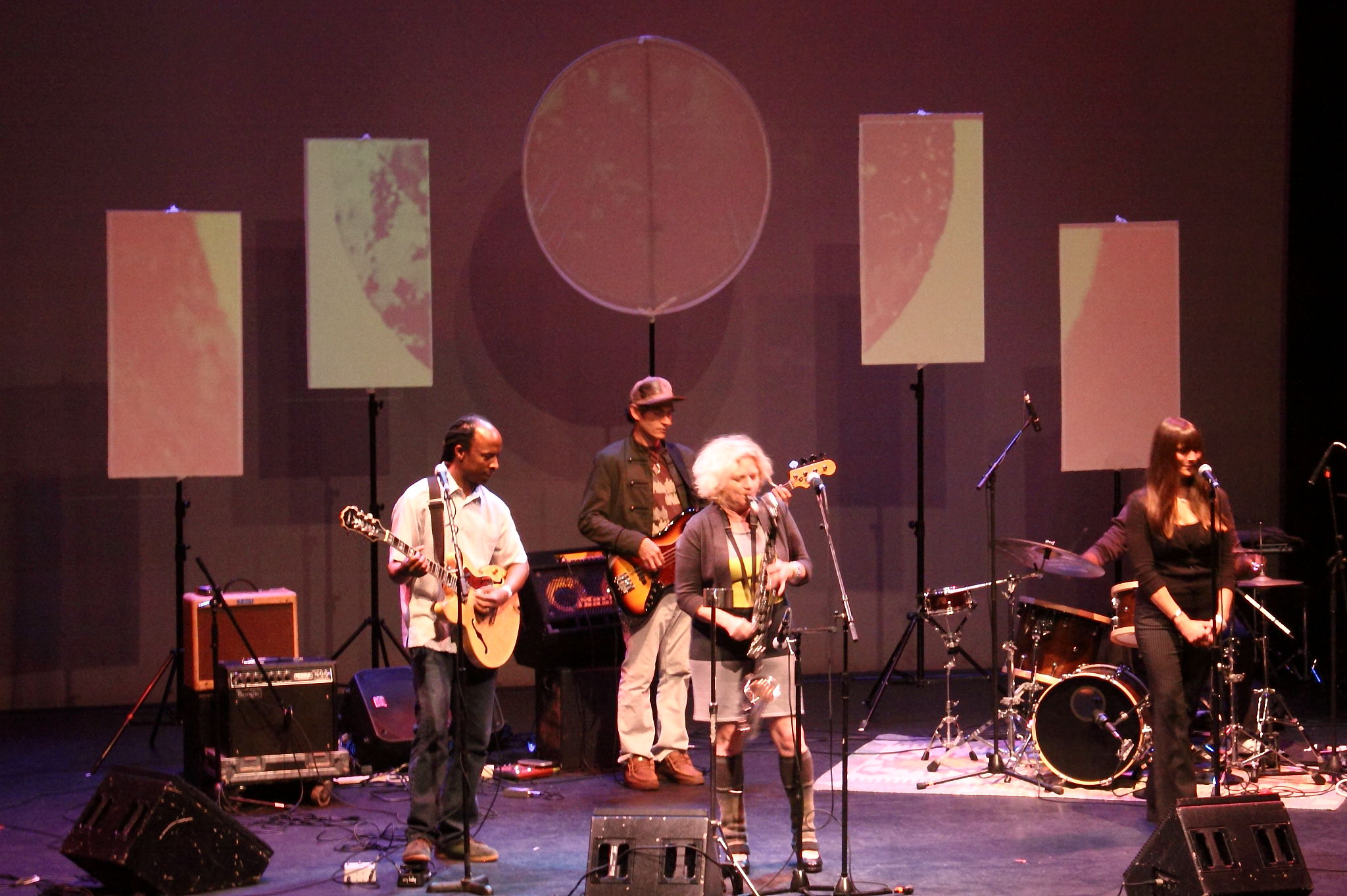
‘Carey’ was given a reading by clarinetist, vocalist Beth Custer with her strongly jazz inflected ensemble.

Kitka is an all female a capella group specializing in eastern european style folk singing.   Their a capella cover of ‘Blue’ was alone worth the price of admission.

Amy X Neuberg is an Oakland based singer, performer and tech wizard.  With her voice and electronics she created a unique version of ‘California’.

7mafia

Jazz/funk/hip-hop/R and B Jazz Mafia with  Aima the Dreamer and Erica Dee did a raucous version of ‘This Flight Tonight’.

Cajun/blues/southern fiddler and singer with her band did a country blues version of ‘River’.

The Seshen is an electro-pop ensemble that, like the other musicians in this show, is hard to categorize.  They did an ecstatic cover of ‘A Case of You’.

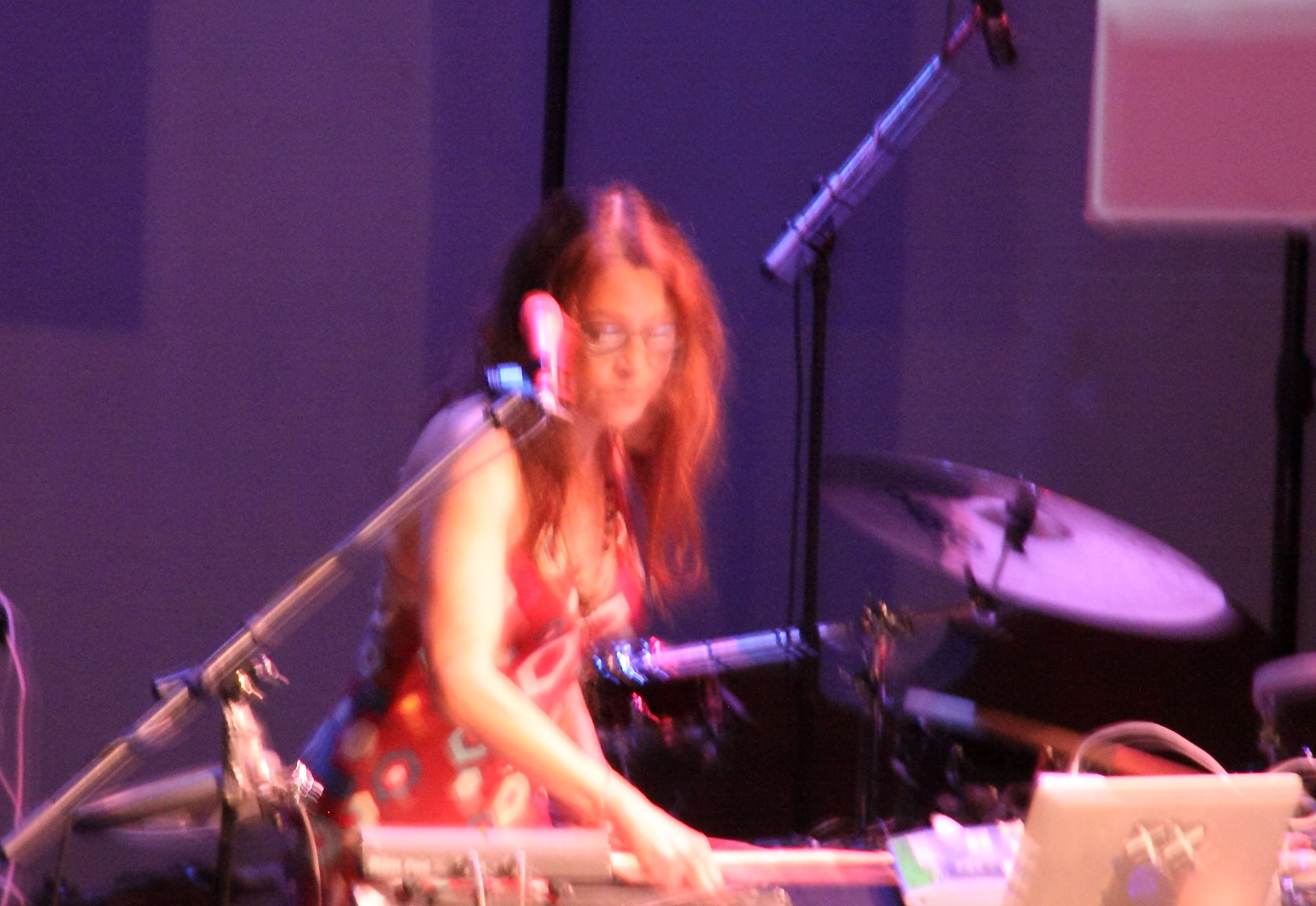
Katy Stephan and her group Classical Revolution ended the evening with ‘The Last Time I Saw Richard’.

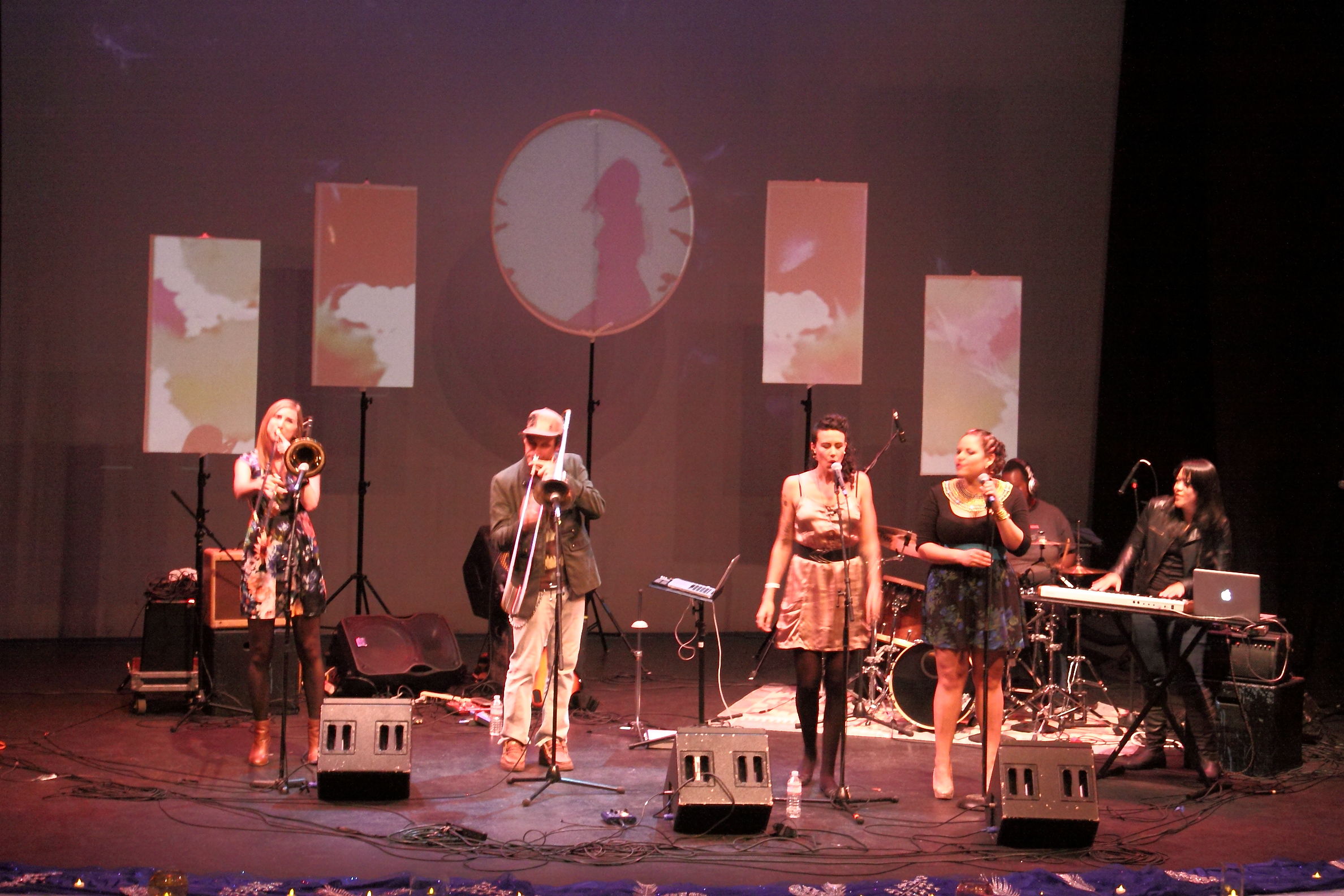
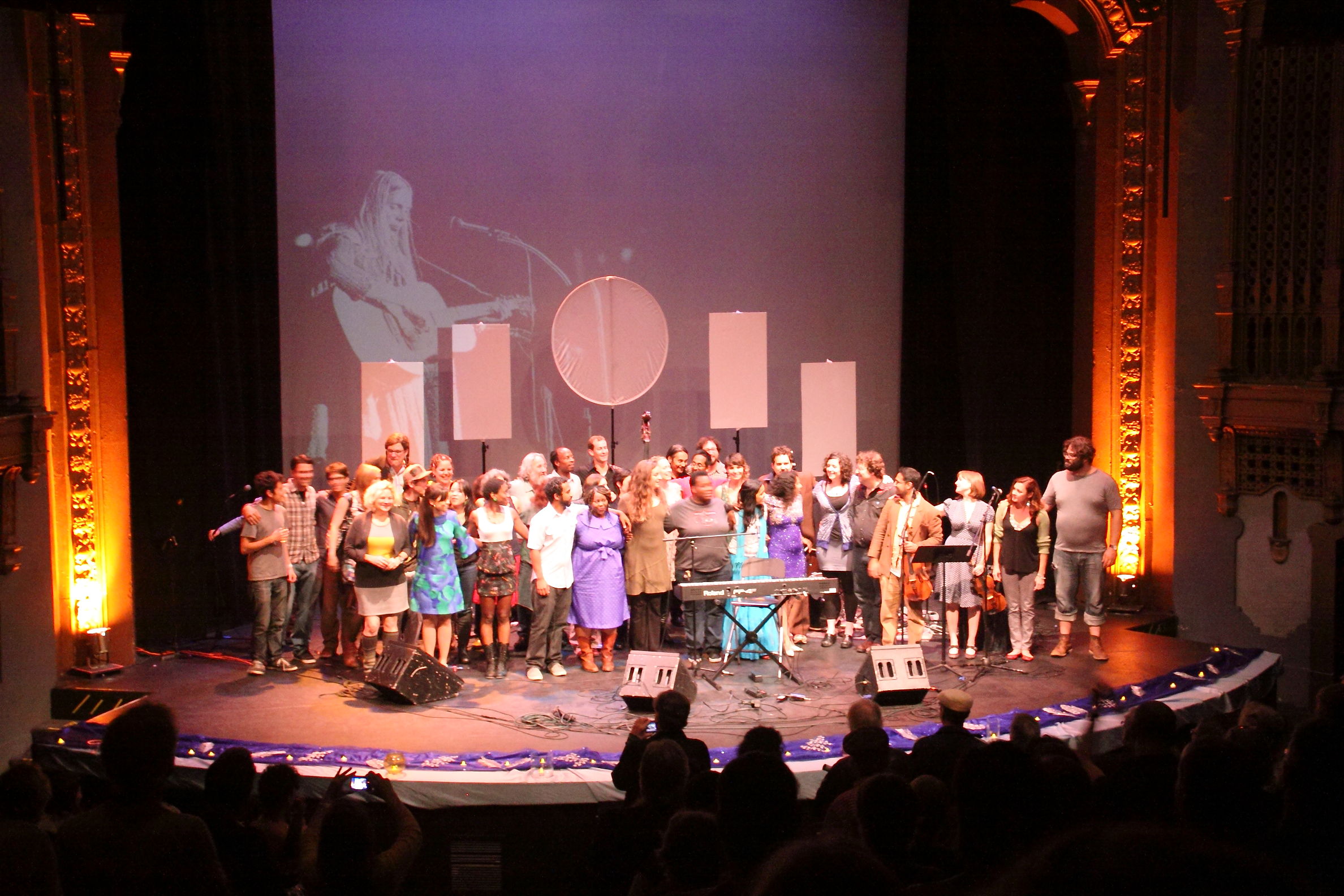
All the musicians barely crowded on to the stage to acknowledge the standing ovation from the very appreciative crowd.

Whether you know the original Joni Mitchell album or not you can’t fail to find something exciting, eye-opening and enjoyable in these performances.  The range of creativity and talent is staggering.  The bands played with a subtle but effective visual display that unified their efforts and added another aspect to both the music and the performance.  I’m sure Joni would be pleased.

Did I say that the ticket price includes a free download of the studio album?  Well it does and it serves as a great reminder of a truly unique bay area experience.  Maybe I’ll see you there.


A Fitting 100th Birthday Celebration for Conlon Nancarrow


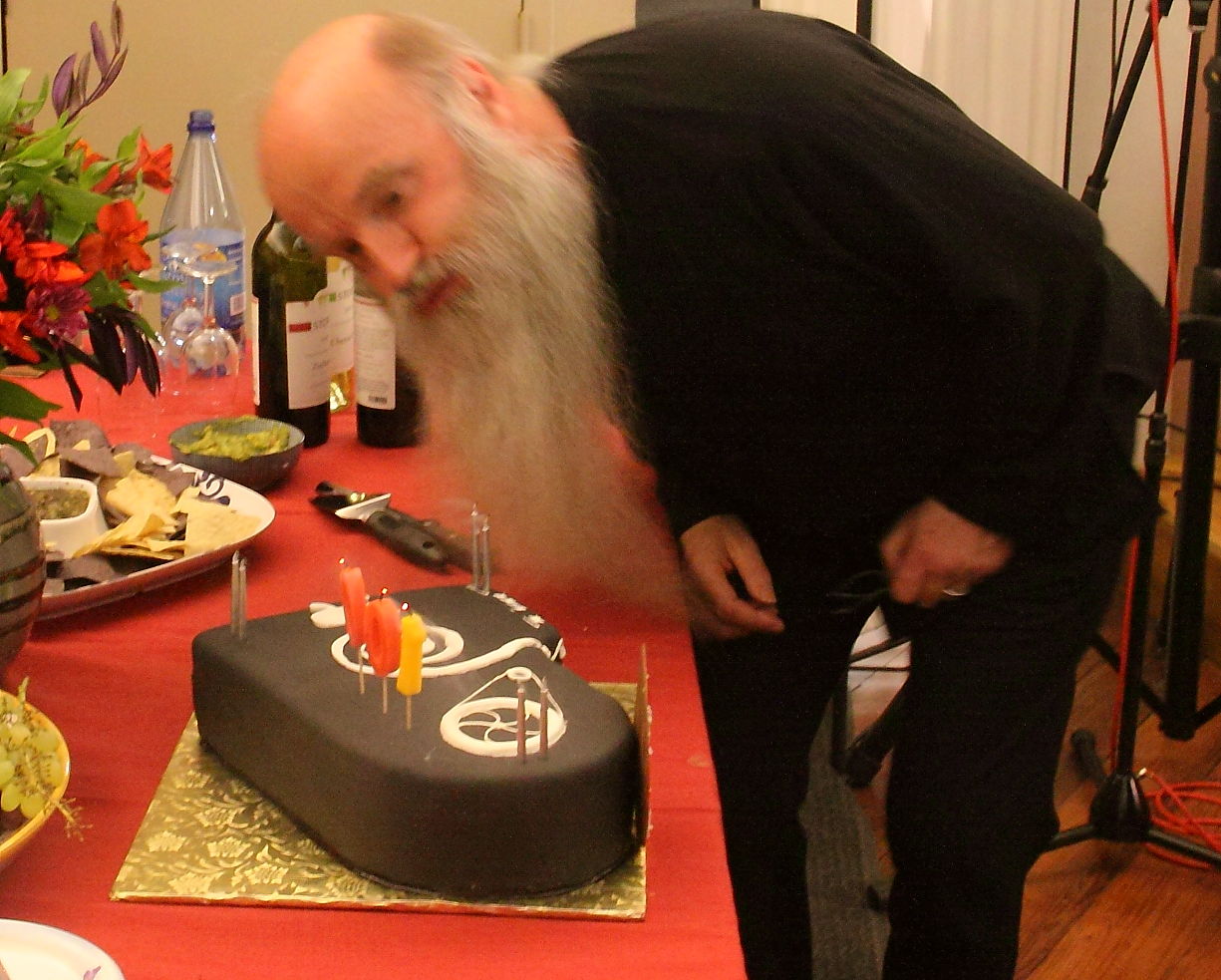
Nancarrow birthday cake.

Happy 100th Birthday to Conlon Nancarrow

October 27th, 2012 would have been the 100th birthday of composer Conlon Nancarrow.  While still not a household name his work has become better known through recordings and live performances over the last 30 years or so.  He spent the majority of his creative life working in relative obscurity in Mexico City. While known by some of his contemporaries his music first became widely known through a 1969 Columbia Records release, part of that label’s ‘Music of Our Time’ series curated by David Behrman.

The evening’s celebration of his 100th birthday I’m sure would have made him proud.  Curated by bay area new music advocates Other Minds and hosted by the Piedmont Piano Company in downtown Oakland was a sort of preview of the next weekend’s three day event.

In the beautiful space of that showroom the audience was treated to hors d’ouerves, wine before the concert.  The event opened with a portion of a film by Jim Greeson, a documentary about the life and music of Nancarrow that painted him as another (if the most radical) of the musicians who were born in Texarkana, Arkansas which claims Scott Joplin as one of it’s famous sons.  This was followed by pianola virtuoso Rex Lawson who played a few of Nancarrow’s early studies.

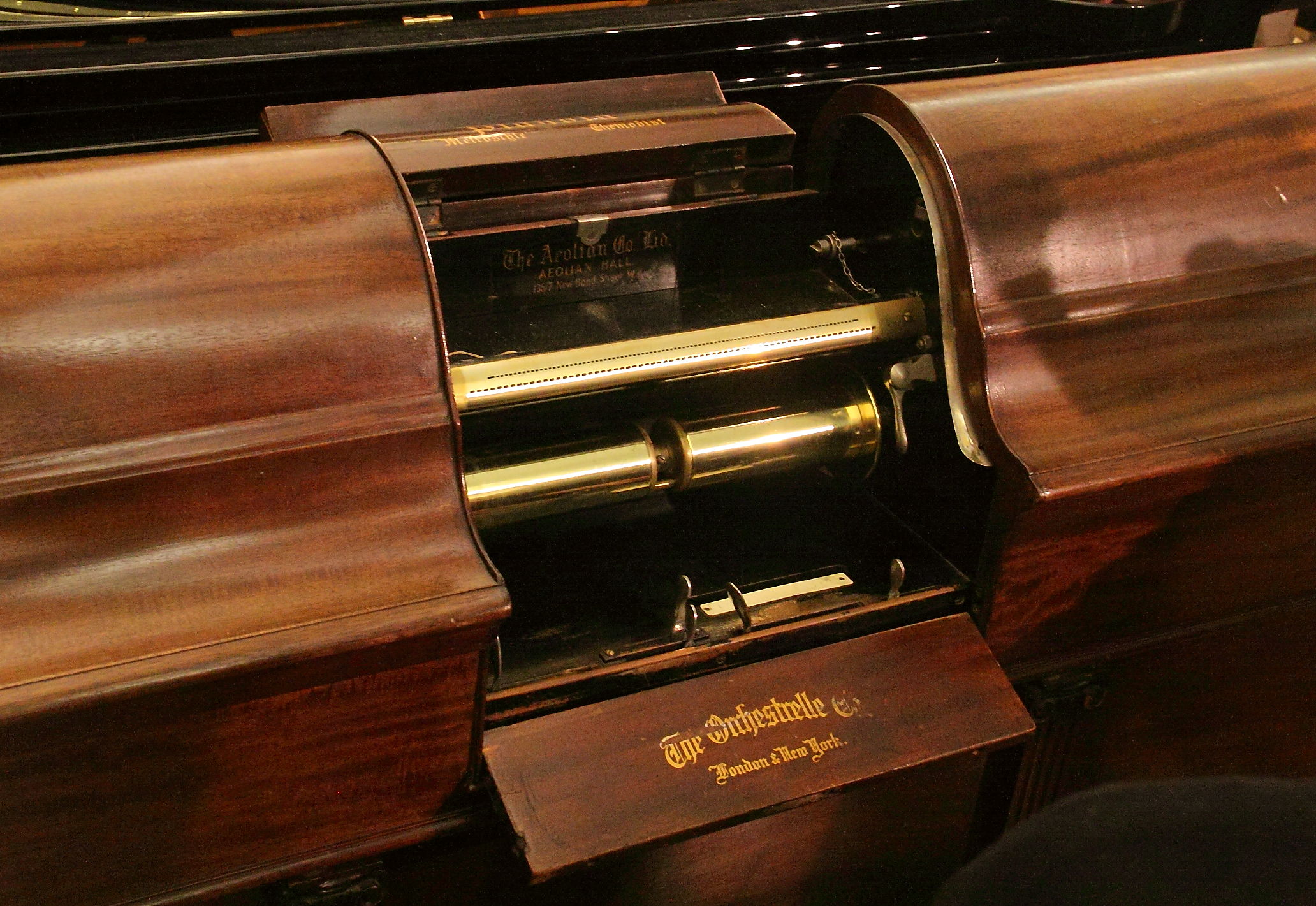
The pianola is not the same thing as a player piano, as Lawson informed the audience.  It is a device which fits over the keyboard of a traditional piano and depresses the keys based on the instructions of a paper roll inserted as one would in a player piano.  However the pianola allows the performer to vary dynamics and phrasing and actually perform the music.  And Lawson demonstrated this beautifully.

pianola

Pianola showing the place where the paper roll is inserted.

At the intermission birthday candles were lit and Lawson was accorded the honor of blowing them out in the late composer’s honor.  Nancarrow died in 1997 having lived to see a tremendous resurgence in interest in his music and an acknowledgement of his contribution to music.  His complex rhythm studies for player piano number just over 50.  And though he wrote some chamber and orchestral music as well, these are the pieces on which rest his fame as an innovator.

Rex Lawson blowing out the candles on Nancarrow's birthday cake.

Rex Lawson blowing out the candles on Nancarrow’s birthday cake.

Just prior to the intermission we were treated to the multi-talented artist an composer Trimpin‘s computer controlled pianola.  Attached to two pianos were devices for pressing the keys which were in turn controlled by a computer program.

Piano with Trimpin’s computer controlled pianola attached to the keyboard

Piano number two with Trimpin's computer controlled pianola attached to the keyboard

Piano number two with Trimpin’s computer controlled pianola attached to the keyboard

They played the massively complex Study No. 40b and did so very effectively.  The audience left their seats to stand around the two upright pianos which behind the seating area.  The sound cannot be described in words and the audience, some perhaps mystified, were very appreciative.  Trimpin later spoke of this work reconstructing one of Nancarrow’s abandoned project, a percussion orchestra controlled by a piano roll.  It was abandoned when Nancarrow realized that the technology could not perform the music accurately, something which is now possible with Trimpin’s research.  The results of that research, Trimpin: Nancarrow Percussion Orchestra / MATRIX 244 will be installed in the Pacific Film Archive and be available to the public from November 2nd to December 23rd.

Trimpin holding a prototype for Nancarrow's aborted percussion orchestra experiment's

Trimpin holding a prototype for Nancarrow’s aborted percussion orchestra experiment’s

After the candles were out the audience, led by Charles Amirkhanian, sang happy birthday which prompted Lawson to spontaneously run to one of the pianos to accompany the traditional song.  Charles Amirkhanian, composer, radio host and impresario produced the first complete recording of Nancarrow’s player piano studies (and the only recording made on Nancarrow’s player pianos in his Mexico City studio) in 1980 which brought the composer to a much wider audience and got him invited to the 1982 New Music America festival and later helped him get a Mac Arthur genius grant.  A chance find in a record store in Paris inspired Hungarian composer Gyorgy Ligeti to write his masterful piano etudes after hearing these recordings.

Charles Amirkhanian with Rex Lawson

Charles Amirkhanian holding the microphone while Rex Lawson sings along with one of his piano rolls.

Trimpin scanned all of Nancarrow’s piano rolls into a computer and made it possible for the music to be studied more widely as well as preserving it on a hard drive.  He went from the piano rolls which are essentially a digital medium the equivalent of punch cards for historians and those of us old enough to remember to digital storage on a magnetic drive.

As I noted at the beginning this was a most appropriate tribute occurring on Nancarrow’s actual birthday and featuring people like Amirkhanian, Lawson and Trimpin who were inspired by Nancarrow’s work and have done so much to bring it to light and to preserve it for posterity.

Following the intermission we were again treated to Rex Lawson who provided a perspective on the importance of player pianos and pianolas in early 20th Century culture.  He illustrated the function of the pianolist explaining as he said, “Why I need to be here at all…” by playing a Rachmaninoff polka first without any nuance executed by the pianolist and then with him demonstrating how the pianolist puts life into the piece, a world of difference.  He spoke of composers who actually wrote for the pianola.  It is different from writing for a pianist because the pianola is not limited to the size of one’s hand or the number of fingers one has.  It afforded composers a technology to write a more orchestral fabric.

He demonstrated with pieces by Sir Arnold Bax, an early 20th century British composer and by Stravisnksy (a marvelous arrangement of the scene from Petroushka when the puppet first comes to life).  He also spoke of now forgotten composers who had the career of being arrangers for the pianola.  While many homes had pianos and many could play the piano, the pianola allowed them to play larger and more difficult works beyond the skills of the average pianist and, frequently, beyond the skills of any human being.

The evening ended with another demonstration of Trimpin’s computer driven pianola this time playing one of Nancarrow’s early boogie woogie pieces.  And then there was time to speak with the artists and audience members who showed enthusiasm and interest.

Tonight’s event, we were told, was organized by Other Mind’s development director Cynthia Mei and she made a plea for funding this and next weekend’s events through Kickstarter (http://www.kickstarter.com/projects/otherminds/nancarrow-at-100-a-centennial-celebration?ref=card) where the rewards for participating in the funding range from mention in the program booklet to CDs, t-shirts and downloadable recordings of the performances.  This writer is a proud part of the kickstarter campaign and would like to encourage others as well.  We are honoring a true genius in American music and preserving his influence and legacy for future generations.  I think Mr. Nancarrow would have heartily approved.