An overflow crowd packed the lovely auditorium at Berkeley’s David Brower Center this past January 19th. Octogenarians (and younger folks as well) populated both stage and audience in a show of appreciation for a man whose work as music director of KPFA (1969- 1992) and subsequently as an arts promoter and curator of new music in California’s Bay Area continues to enhance the artistic reputation of the Bay Area.
A rare and exciting aspect of this evening were the rare opportunities to hear Charles’ music, including representative sound poetry classics and a recent major opus capped off by a world premiere of a new work.
The hands of the artist. Photo by Allan J. Cronin
The genuine affection, appreciation, and respect was palpable as the honored guest demonstrated his skill at hosting when a couple of technical glitches slowed (but did not stop) the amiable birthday celebration. The audience waited calmly and quietly.
Both the guest of honor and the host (Liam Herb) used a well honed, self effacing humor used most skillfully to entertain the sympathetic audience while the technical difficulties were surmounted in real time.
Panel discussion featuring (left to right) Susan Stone, Anthony Gnazzo, Paul Dresher, Charles Amirkhanian, Sarah Cahill, and Liam Herb (Photo by Allan J. Cronin, Creative Commons license)
Herb, a composer and performer, introduced himself in the midst of the technical resolutions, graciously announcing that, as producer, he accepts responsibility for the glitches. Charles maintained his familiar master of ceremonies crowd pleasing good humor as Herb worked goodnauturedly (if that’s a word) with the rest of the crew to resolve the issues and get on with the show.
The formal opening remarks were given by Other Minds’ associate director, Blaine Todd. And the evening began in force.
Blaine Todd (photo by Allan J. Cronin, Creative Commons license)
The program glided past the initial hiccup to present a film about our guest of honor. The bevy of fans and bona fide new music professionals sat with rapt attention as the film, featuring the familiar faces of several “Bang on a Can” artists.
The late great Robert Black interviewed by Amirkhanian in the streaming premiere of Audible Autopsy. (Photo of film appearance by Allan J. Cronin)
Excerpts from the 2015 Other Minds 20 documentary featured Julia Wolfe, David Lang, and Peter Gordon (now, it seems elder statesmen (and women) in their own right.
Production manager Liam Herb then served as moderator for a conversation or live interview (with Amirkhanian) for the next segment. This was followed by some videos with music by the guest of honor:
Real Time/T.V. Time Video with Amirkhanian’s “Muchrooms”
The film, presented in its entirety was accompanied by “Muchrooms”, from the CD recording of that standalone work.
Next was Amirkhanian’s and Carol Law’s classic collaboration: History of Collage (1981). This is a major work and a great collaboration with his partner in life and arts. I’m pleased to add my own shot from the performance at the Other Minds 23 experience, my favorite OM festival(so far).
History of Collage (1981) photo by Allan J. Cronin taken at the Other Minds 23 wonderful live performance of this work (Photo by Allan J. Cronin is Creative Commons license 2015)
We also heard and saw Audience (1978) with photography by Law and music/poetry by Amirkhanian followed by Chairs with photography by James Petrillo and music/poetry by Amirkhanian (excerpts from Seat Belt, Seat Belt (1973).
There followed a panel discussion led by Carol Law with Betsy Davids discussing David’s’ work and her connections via her work as a book artist. These two embody the experimental visual arts that characterize the skills of these fellow artists both onstage and off tonight. In fact, interactive collaboration and both respect and friendship were everywhere to be seen in this warm and pleasantly nostalgic evening.
Carol Law speaking with Betsy Davids (Photo by Allan J. Cronin, Creative Commons license)
This was followed by a recording of a major opus, Ratchet Attach It (2021) recently played at one of the (still ongoing) Other Minds Festival. This work is a major opus by Mr. Amirkhanian, one I’m pleased to say I heard live at the Chinese Theater in San Francisco a few years ago. Scored for a huge percussion ensemble, with audio recordings, and a conductor who moves between the podium and a space among the performers playing with the ensemble. It is perhaps one of his most integrated and evolved compositions. Stunning to hear it live. Glad to hear the (always too short) excerpts.
In fact Mr. Amirkhanian, a fixture in the arts of the Bay Area, continues to influence musical taste and present new and interesting music as he has for well over 50 years. His work as Executive Director of Other Minds includes the fabulous OM Records as well as the annual Other Minds Festival and a continual flow of carefully curated concert events by luminaries (or soon to be luminaries) throughout the Bay Area and beyond. There is also the huge archive of thousands of hours of interviews and concerts that are available in streaming audio and video via the Other Minds website.
Many of the artists featured in the Other Minds concert series continue to work, innovate, and expand musical concepts. An Other Minds commission, Henry Brant’s Organ Concerto, Ice Field, earned him a Pulitzer Prize. Many have gone on to greater achievements in their respective careers. Of course not every composer started their musical careers at Other Minds concerts. Many mid or late career musicians have joyfully been represented over the years. Its one of those festivals that innovative musicians seek to participate.
Such achievements reflect on Amirkhanian’s leadership and curatorial acumen, but more importantly his relationships with his fellow artists. Charles has earned a reputation for his support and his collaborative nature. Arguably, everyone in the house (and the overflow in the lobby) all have a degree of connection to Charles and his guests. It is why we’re all here tonight.
Charles Amirkhanian and Joseph Bohigian performing with Liam Herb’s electronics (Photo by Allan J. Cronin, Creative Commons license)
Following a brief intermission we were treated to a world premiere of a new work by our guest of honor, Noose Ratchet (2025) for two percussionists and electronics. Amirkhanian performing and/or promoting his own music is a relatively rare event and this alone was certainly worth the trip.
The work is arguably a trio for two percussionists playing ratchets, a curious instrument whose sound, if not entirely ubiquitous, is familiar. And the two play interactively with the electronics (the third member of the trio). Extended techniques and other duties get assigned (when in doubt it’s responsibility of the percussion section, right)?
There followed a lively and friendly panel discussion amongst frequent and past collaborators Susan Stone, Anthony Gnazzo, Paul Dresher, Sarah Cahill, and Liam Herb. This truly felt like a gathering of friends.
Terry Riley with a t-shirt displaying the entire score of “In C” (photo from Facebook, copyright unknown)
November 4th, 2024 marks the 60th anniversary of the premiere of Terry Riley’s seminal masterpiece, “In C”. After having completed a variety of respectable compositional efforts, Terry Riley (1935- ) was jolted by the Muse to write this defining work that charted a path very different from that of the western classical mold of the composer’s formal education. It premiered in the very unconventional venue of a house in San Francisco, not in an auditorium designed for concerts. And it’s one of those pieces that now marks the transition from almost purely experimental writing to a style later dubbed “minimalism” (though many composers whose music is subsumed under this title eschew it in varying degrees). And whether you call it minimalism, trance music, drone, etc., the style would come to dominate a huge portion of concert works and recordings.
The score consists of 53 short musical phrases with no specified instrumentation and with no conductor’s score, just parts with a seemingly simple set of instructions. One page is what one might expect of a sketch of a larger work to be, not a complete score but, that’s it, One page with the instruction for the musician to repeat each cell or phrase ad libitum and then move on to the next. It was ostensibly the suggestion of composer/performer Steve Reich to have a pianist play eighth note repetitions of the top two highest octaves on the keyboard. In addition to this “click track” like strategy, the playing of those high “C”s also serves to anchor the tonality much as continuo does in that quasi improvisational baroque practice.
There is simply no finer account and analysis of this music than that of Robert Carl’s “In C”. Robert Carl (1954- ) is a teacher, composer, performer, and musicologist. I do not presume to have as extensive an analysis as he does but I’m interested here in providing a celebratory perspective from where I sit (and have been seated).
This music (as does all art) stands in a context with concurrent and recent events surrounding its conception and performance. Temporally it stands along with other notable compositions from 1964: Witold Lutoslawski- String Quartet, John Coltrane (admittedly one of Riley’s influences)- the albums, “Bessie’s Blues” and “Lonnie’s Lament”, Igor Stravinsky- Elegy for JFK and Variations in Memoriam Aldous Huxley (both men died on November 23rd, 1963), Roger Sessions- Symphony No. 5 and his opera, “Montezuma”, Milton Babbitt- Philomel, Karlheinz Stockhausen- Mixtur, Ben Johnston- Sonata for Microtonal Piano, Luciano Berio- Folksongs (written and premiered at Mills College, the later home of the Tape Music Center where Berio was teaching then), Olivier Messiaen- Et Expecto Ressurectionem Mortuorum, Iannis Xenakis- Eonta, and La Monte Young- (the first iteration of his masterpiece), The Well Tuned Piano.
My little list here is just a sampling of the western classical and jazz works that graced the natal year of “In C”. Admittedly, it is a cornucopia of some more experimental, some less so music that lie in this historical orbit. But, among the works in this list, it is the work of John Coltrane and La Monte Young that shares musical DNA with Riley’s aesthetic in this music. The other works contemporary mentioned represent a sort of “Garden of Forking Paths“ to a panoply of styles very different from the work at hand.
At a time when the style of American pop music had just recently met The Beatles, this work was a sort of coalescence of experiments done by La Monte Young, Steve Reich, and others. “In C” seems to have come out fully formed in its way. It was seemingly influenced by pop, jazz, and blues (whose use of repetition is endemic). 60 years later it is performed frequently and there exists at least 40 or so recordings of the work.
When I began writing this article I realized that Robert Carl’s book on this work fully covers the history and provides a definitive analysis to which I cannot contribute anything additionally useful. I then considered eliciting commentary from musicians and listeners about this music but found little interest because that has been well covered by several previous anniversary essays. So I decided to share a discography and photos of some the recordings I could find that have given me further insights into this touchstone work.
This discography is not comprehensive but my intent here is to celebrate this anniversary with the cover artwork that adorns the ever increasing documenting of this landmark of western art music. I will present what I believe is a representative selection of some 40+ versions.
Your humble author was 8 at the time of this work’s premiere. And my first hearing of ‘In C’ was in 1976 when my local radio station, the great WFMT in Chicago, aired a program curated by Raymond Wilding-White, a composer and professor of music at De Paul University. His task was to present representative works of American music, one for each day of the nation’s bicentennial year. ‘in C’ was one of them.
Since then I have heard many interpretations of this work. The original performance was at 321 Divisadero Street in San Francisco, California on November 4th, 1964. The original performers were: Terry Riley, Steve Reich, Jon Gibson, Pauline Oliveros, Stuart Dempster, Morton Subotnick, Warner Jepson, Tony Martin, William Maginnis, and Ramon Sender (who celebrated his 90th birthday this past week). This venue was the second and last home of the San Francisco Tape Music Center before it relocated and was renamed The Mills College Center for Contemporary Music in 1966 in Oakland.
Here, with brief commentaries, are my favorites. There are at least 38 versions according to the Wikipedia article. Here are my personal favorites in chronological order of release date:
The original Columbia Records release (1968)
If you only have one recording this is probably the one you want. Recorded in 1968, this brought the work effectively to a wide audience via international distribution. The instrumentation (some overdubbed) includes: saxophone, oboe, bassoon, trumpet, clarinet, flute, viola, trombone, vibraphone, marimbaphone.
Riley with the Chinese Film Orchestra (1989)
This important recording was made in China around the time of the Tiananmen Square uprising and the tapes were in effect smuggled out of the country in the aftermath of that incident. It stands as a fascinating document of eastern musicians encountering and interpreting this masterpiece.
The 25th anniversary release on New Albion (1990)
Don’t you just love anniversaries? By the time of this release (1989), this work had been disseminated into wide geographic regions and cultures. This version includes many of the musicians who premiered the work and this “traditional” reading is a loving homage to Riley’s work.
The Bang on a Can release (1998)
The Bang on a Can All Stars are among the finest ambassadors of new music. They have earned the right to put their stamp on any new work they choose and subsequently bring it anew to another generation of listeners.
Prog Rock does homage to Terry Riley (2001)
If you want to hear the wide range of musicians who have chosen to pay homage to this work this is a fine place to start.
The Africa Express release (2015)
Another fine example of the way this work can sound from a Central African perspective. This performance from Mali is absolutely electrifying.
Another fine culturally tinged version (2017)
This album is a personal favorite from the Brooklyn based collective featuring instruments from Hindustani traditions and others alongside western instruments. You can read my enthusiastic review here.
There are probably at least 50 recordings of this work. Some are private, maybe even bootleg versions. Clearly this work continues to become more and more essential and influential piece of music. It is not unlike a musical version of the Iconic monolith from the movie 2001: A Space Odyssey. The anomalous structure was of alien origin and was purported to accelerate the evolution of species who encounter it.
Riley’s work is most .definitely of terrestrial origin (well, San Francisco anyway) but, clearly this work continues to intrigue musicians worldwide and has arguably influenced the development of music itself.
Ever since the introduction of digital recording in the 1980s there has been an ongoing controversy as to the merits of the new medium over the old. And unlike the leap from acoustic to electrical recording which happened about 1929 and the move to stereo recording in the mid 1950s the adoption of digital recording in the 1980s was not universally embraced as a step forward in recording technology by audiophiles.
So what is the issue? Well it’s really quite simple. Acoustic recording involved a needle connected to a membrane which vibrated analogously (more or less) to the sounds stimulating that membrane. Electrical recording basically extended this technology by having the membrane (in the microphone) translate the sounds into analogous electrical impulses which were then recorded to a disc and later to magnetic tape. This in turn would be used to drive a cutting lathe which cut the vinyl discs. The discs are played with a needle in the groove which reads the little bumps and translates them into electrical impulses which are amplified to drive speaker cones which excite the air and produce sound.
Digital recording involves a sampling technique in which certain sounds or parts of sounds get encoded digitally and then reproduced or re-converted back to electrical impulses which then drive speaker cones. The problem is that this is a sampling involving choices on the part of programmers as to which sounds/parameters will get encoded. So potentially this would not be as accurate a representation of the sound as analog recording which responded directly to the sound as it occurred. Of course more sampling containing more information produces a better recording than one which uses less sampling.
Now to be fair, all recording technologies have their flaws. Even the best analog recordings do not reproduce the experience of hearing the sound live and in person. Characteristics and flaws in the analog equipment can and do limit aspects of the recording. There is a limit to what this equipment can record so there are choices made even in the best case scenario as to what portions of the sound spectrum will get captured. The frequency range and dynamic range are limited for example. But the sonic experience of an analog recording is said by connoisseurs to be a warmer and more genuine sound than digital.
Certainly most people can hear the difference between early digital recordings and more recent ones. That is because the sampling has gotten better, a wider range of frequencies and dynamics are being included. But die hards will insist that analog recording was the finest recording technology for reproducing a satisfying listening experience and for faithfully reproducing the experience of the live sound.
I am not an engineer but as a person with ears I still enjoy the warm sound of analog recording. Of course I listen to digital recordings because it is the dominant technology and I want to hear new recordings. I am not advocating a change here, just pointing out the essential differences.
OK, you ask, this is all about sound but your title said it wasn’t all about sound. So what gives?
Well my intention here is to use this simple exposition of recording technology as a metaphor for the digital sampling of opinions which are rampant in today’s business driven culture. Everywhere we are asked for our opinions. Whether you are approached by an interviewer, filling out a warranty card, or evaluating some experience you’ve just had at a concert or theater your opinions are being surveyed and placed into some sort of database which in turn undergoes some kind of analysis and that analysis, in turn, drives future choices made in a given business model.
Most of the audience at the première of Igor Stravinsky‘s Le Sacre du Printemps (The Rite of Spring) were rather famously not pleased with their listening experience on that night in 1913. Yet today there are few people who would deny that this music is one of the most significant compositions of the twentieth century. Modern business practices however would dictate that such music should not be programmed because it displeased the audience who would likely not return if they expected a repeat of such an experience.
The great musicologist/conductor/composer Nicolas Slonimsky (1894-1995) identified this phenomenon in his marvelous Lexicon of Musical Invective (1953) in which he documents quite a number of critical reviews of music which is now acknowledged as great but which, on first hearing by said critics, was described as inferior. The point is well-taken. Our initial experience of a new piece of music may be very different from our subsequent opinion after hearing it again.
With the elevation of statistical modeling to a religious practice there is increasing belief that those models embody the essence of truth and clear vision. But what are the motivations behind this modeling? Anyone who has taken a statistics course or who thinks about it for a bit will realize that statistics can obscure outcomes just as efficiently as they can clarify it. So if the motivation is profit (as it should be in a business model) then there would necessarily be less of a focus on quality (whatever that is).
I have had many exciting and joyful experiences of hearing a new piece of music at a concert which I had never heard before. I have experience the exhilaration of discovery. Now not every new piece of music has this effect and, as I’ve said before, I have had that exhilaration of discovery after a second or third hearing.
I used to be very much a fan of classical broadcast radio. At the time, in my adolescence, classical music was an adventure of discovery. Of course I heard a lot of average and even poor music alongside the masterpieces but I also recall that there was an element of risk at times in programming new and less familiar music. Sometimes I was bored, sometimes I was repelled, but sometimes I discovered something new to add to my listening repertoire choices.
That was in Chicago in the 1970s and 80s with Zenith’s WEFM, WFMT and the late lamented independent WNIB. But radio seems to have changed in similar fashion in terms of its programming to that of the concert hall. Those radio stations frequently broadcast concerts of various orchestras including the Chicago Symphony, Milwaukee Symphony, Boston Symphony and various foreign orchestras. Their programming also contained a fair amount of new music.
Over the last 5-10 years or so I have found classical broadcast radio to be increasingly dull and predictable. Sure it’s good to hear Beethoven Symphonies and Mozart Piano Concertos but some stations have gone to a “request” model for their broadcasting which has resulted in an over representation of Bolero, the 1812 Overture and the broadcasting of what one writer called “wallpaper music”. Wallpaper music is a reference to any number of newly recorded repertoire which is so mediocre as to make me almost scream with boredom and ennui.
I am not advocating ditching digital recording or a libertarian approach to concert programming. Certainly both radio stations and concert organizations need to make at least a slim profit to survive. What I am advocating is the inclusion of adventure and discovery in those business models to which I referred earlier.
Democratizing musical programming and playing to the center or the majority appears to produce mediocrity. Every concert program and every broadcast classical station now are largely the same. Of course there are notable exceptions as some orchestras employ resident composers and play the occasional premiere of a new work. Less common is a second performance of a new work.
There are adventurous festivals of new music which program interesting music. But these stand outside of the vast majority of classical programming today. So, at the end of the day (or the end of this little essay) listen to what gives you joy, but don’t be afraid of new musical ideas. And just be aware of new (and old) sound recording/reproducing technology and its impact on what you hear. It is not just about the music, it’s about the sound.
After agonizing about writing a “best of” blog and publishing it before January 1, I decided to take a pause and enjoy the holidays. So here I look back on my 2023 in the rear view mirror but with memories still pretty fresh.
Regular readers of this blog likely already know of my oft shared opinion of the superfluous nature of “best of” lists and of my acquiescence in producing such on an annual basis. I certainly don’t think of this as a meaningless exercise and I think the process has grown on me. It is a chance to achieve a perspective which would be missed by simply plowing on ahead with the usual flow of reviews and articles. But drawing down that 12 month perspective is an opportunity to evaluate those months, to see where we’ve been and to hopefully get a smidgen of insight into where I/we are likely headed.
My Facebook friends will recognize the representative meme at the head of this article which is one of the more cloying aspects of “AI”, whatever that is. So indulge me for a moment to look at this seemingly new intrusion into the reality we thought we knew. So, what is “AI” and what will it do to us? Ultimately I’m not the one to answer that question but I’d like to throw some ideas to add to the speculation.
First, the choices a composer makes, like the choices of a painter, a writer, etc. are the stuff of the mystery of creation itself. Why “A major”, or why that tuning, or scale, or rhythm, or orchestration, etc? So along comes the notion of removing, or at least distancing, the artist from their creative product. That notion started not with famed proponent John Cage but rather with Johannes Chrysostymous Wolfgang Amadeus Mozart in his K. 516f musical dice game. Voila! Algorithmic composition (actually fairly common practice in the classical era). An early manifestation of “AI”? Perhaps.
Lejaren Hiller (1924-1994) was the first composer to employ electronic data processing in a musical work in his Fourth String Quartet subtitled “Iliac Suite” in 1957. There followed similar experiments with various iterations of electronic creations at music centers worldwide including The University of Illinois at Champaign, Columbia-Princeton, Stanford, The University of California Berkeley and San Diego, The San Francisco Tape Music Center (later subsumed into the Mills College Center for Contemporary Music, IRCAM in Paris, Israel Electronic Music Studio, and counterparts in the Nordic countries, Germany, Belgium, etc. Proto “AI”?
While historically interesting I raise this issue to say that, as far as I can tell, “AI” has not made this writer’s greatest hits list but it is interesting and maybe even useful. With that, my concern for the subject officially goes to the back burner for a later time.
2023 has been a year of great personal changes for the writer of this blog. A job change, a geographical relocation, and many things unrelated to this blog characterized a busy year for New Music Buff. So here in a sort of holiday tradition I present my “Best of 2023” from my little listener’s corner of the world. For the sake of simplicity I present a more or less chronological exposition of my sonic adventures. (N.B. Not one portion of this article made use of “AI”).
I begin with not with my 20 most read posts, a practice that characterized previous iterations of this annual exercise. Instead I am providing my top 20 favorite releases that were reviewed in 2023. Please note a couple of caveats. First, I receive a lot of review requests, more than I can even listen to, much less give a reasonably intelligent review. Albums that I’ve not reviewed should not be assumed to be bad or insignificant and my reviews are personal observations. I really only review albums that interest me anyway. Second, this article is only one reviewer’s opinion and not intended to be definitive or to supersede anyone else’s opinions. Third, this is not the end of my attention to music that was released in 2023. Some releases require more time to give a fair listen and a respectful review. There are more to come in 2024.
First a few stats: 2023 saw the publication of some 45 blog posts on New Music Buff, earning me 9693 views for the year. I rarely get comments on my posts (though I welcome and invite comments both positive and negative). Not bad, I think, for the overall less appreciated musical styles that fuel my desire to write about.
Now, in chronological order (of publication) are my personal favorites as a listener:
Neuma 158
Binaural Beats in the Tudor Rainforeststarted my new year with a bang. Reviewing this disc required me to take a closer look at the astounding work of David Tudor and his unique contributions to new music. This important release is a recording of a work which, by its own concept cannot receive a “definitive” performance. But this recording comes mighty close, involving “binaural” recording utilizing a mobile set of binaural microphones which are worn by the recordist. In addition this recording involved a collaboration with Pauline Oliveros and a group called, “Composers Inside Electronics”. The recording was done during Oliveros’ tenure at UCSD. Rainforest IV is so called because it is the fourth iteration of the instructions that form the original concepts of Tudor’s composition, “Rainforest”. It is an immersive sonic experience heard on headphones but actually not bad even heard on stereo speakers. A rich and wonderful release.
Starkland S-236
From a 1960s electroacoustic to a budding 21st Century composer Kotoka Suzuki released on the reliably interesting and even visionary Starkland label. Next Gen Electroacoustic: Kotoka Suzukiwill introduce the listener to this rising star who doubtless will produce more of her compelling compositions.
Sony 194399434826
Igor Levit is a fine concert pianist whose albums are effectively redefining the way we, as listeners, perceive the western classical oeuvre. Igor Levit: Defining Tristandoes for the various musical pieces inspired by the Tristan legend what Levit did for the concept of the great keyboard variations in which he selected Beethoven’s “Diabelli Variations” and Frederic Rzewski’s “El Pueblo Unido Variations” to join his recording of the Bach “Goldberg Variations” in a 3 disc package placing these three large sets of variations as emblematic of the genre in three different centuries (18th, 19th, and 20th). Levit, by his recorded output, is providing a valuable perspective which may influence repertory choices for years to come.
Levit’s traversal of the Tristan legend here ranges from the second recording of Hans Werner Henze’s too seldom heard “Tristan Preludes” back to works by Wagner (of course) and Liszt. He even slips in his wonderful solo piano transcription of the Adagio of Mahler’s unfinished 10th Symphony into the mix. This is a very compelling Tristan anthology by a deservedly still rising star.
Cantaloupe
This Cantaloupe release by Bang on a Can composer and master clarinetist Evan Ziporyn is both masterful and great fun. Evan Ziporyn: Bang on a Popconsists of transcriptions of “pop” songs for multiple clarinets all played by Ziporyn via his very effective multi-track recordings. The album is very personal and pretty much cliche free with these engaging and insightful transcriptions. It is an homage to the songwriters as well as a showcase for Ziporyn both as composer and as performer.
Microfest MF 23
The Young Person’s Guide to Ben Johnston is an ideal way to introduce listeners to the wonderful world of the late Ben Johnston’s music. Johnston, a student and colleague of Harry Partch shows his compositional skills utilizing non-traditional western tunings in these representative works. Johnston here does for some quasi pop tunes what Evan Ziporyn did with his clarinetist perspective for the tunes on Pop Matters. But Johnston’s pretty, accessible work belies fascinating complexities that don’t actually sound complex to the listener. This disc contains Johnston’s last completed work, “Ashokan Farewell” (which Johnston took to be a public domain folk tune but is in fact a piece written by Jay Ungar). It is paired with the 4th String Quartet (a set of ingenious variations on “Amazing Grace”) from 1982 and the 9th String Quartet of 1997. Profound, lovely to listen to, and a great homage.
DVD OM 4001
This DVD is a major addition to the discography of Charles Amirkhanian’s sound poetry as fine sampling of one aspect of Carol Law’s (Amirkhanian’s life partner) complementary visual art. These collaborations are also important contributions to the visual and performative aspect of these collaborative works. Amirkhanian has been a fine curator and promoter of the work of others but he has rather seldom stepped into the spotlight himself. This quirky genre got some fabulous exposure at the 7 day Other Minds 23 festival in 2018 in which Amirkhanian’s work was presented in the (surprisingly varied) context of sound poetry of the amazing international collection of artists who were hosted at those events. This DVD should be in the collection of anyone interested in new music sound poetry and performance art. It is both entertaining and mind bending featuring a juxtaposition of images and sound reviewed in greater detail in the post “Dyadic Dreams”. But words cannot do justice to these works. You really have to see them.
Cedille CDR 90000 210
Readers of this blog know my fondness for the Chicago based label Cedille and their promotion of Chicago based musicians. This disc stands out in this group’s embrace of non-traditional composers alongside more traditional works. The inclusion of works by DJ composer Jlin and the academy based genre defying duo Flutronics alongside composers like Danny Elfman and Philip Glass demonstrate the wide ranging repertoire of Third Coast Percussion. Much more information can be found in Perspectives: Spectacular World Premiere Recordings from Third Coast Percussionon my blog. This one reimagines the percussion ensemble.
Neuma 176
This disc is a good example of why listeners and collectors should pay attention to the Neuma record label. Philip Blackburn, who had been the very successful curator of Innova records, took over the defunct Neuma label which was founded with the intention of promoting largely electroacoustic music though not exclusively.
Agnese Toniutti‘s New Music Visionis actually a review of two discs by this rising star, a dedicated new music pianist that needs to be on your radar. The other Neuma disc contains Toniutti’s traversal of John Cage’s reluctant masterpiece, “Sonatas and Interludes for prepared piano”.
The disc pictured here is Toniutti’s vision beyond the Cage work. This one focuses on mostly living composers Lucia Dlugoszewski, Tan Dun, Philip Corner, and Toniutti’s herself. Basically, if Toniutti plays it, you should probably at least give a listen.
2023 saw the completion of Bay Area pianist Sarah Cahill’s epic survey of piano music by female composers. Cahill is another (predominantly) new music focused pianist about whom I would also assert that, if she plays it, you should probably give at least one listen.
The End of the Beginning: Sarah Cahill’s “The Future is Female” Trilogy Completedwill tell you all you need to know about this trilogy which encompasses about 300 years of music history and sheds light on some fascinating and substantial music written by women. Most of the works on this trilogy of albums are, in fact, world premieres but, fear not, even the pieces which are not premieres are likely not in your collection. This is a brilliant selection of music that effectively throws down the gauntlet to challenge other artists to explore this repertory. This trilogy is a true landmark and a joy to the ears.
This third volume in the wonderful Catalyst Quartet’s survey of another unjustly neglected group of composers focuses on the music of three black Americans of the twentieth century. Catalyzing Blackness, Volume Three: The Catalyst Quartet plays 20th Century music by Black Americans was nominated (but didn’t win) for a Grammy Award and, happily, I’m told that more volumes are in preparation. Again, this music is a pleasant revelation that does for black composers what Sarah Cahill has done for women composers (N.B. The first volume by the Catalyst Quartet focused on the black female composer Florence Price). And here’s hoping that Coleridge Taylor Perkinson, George Walker and William Grant Still will become household names in the concert hall.
Microfest MF 21
Son of Partch, Carrying on a Traditionis a really wonderful disc which, though I reviewed it in exceedingly positive terms, provoked a strongly negative reaction from the artist. The reaction apparently also provoked enough interest to have made this review one of my most read of 2023.
But, aside from the unfortunate negative reaction, I still maintain that this is a fine release worthy of attention from anyone who likes new music, microtonality, and the music of Harry Partch. Cris Forster is a composer, theoretician, and instrument builder clearly descended from the Partch tradition. His work deserves attention and this disc is a very satisfying experience.
Islandia IMR 011
Steven Schick is a master percussionist and conductor. This release is the first volume of his personal choices of solo percussion repertoire. Solo Percussion Manifesto Volume I: Steven Schick’s “A Hard Rain” is a manifesto of sorts and does for solo percussion music what Sarah Cahill has done for women composers and the Catalyst Quartet is doing for black composers. There are not many recordings of solo percussion music and Maestro Schick essentially presents his favorite works in definitive performances on a label produced by Bang on a Can cellist Maya Beiser. The second volume is in my review queue and, if this first volume is any indication, it will be a landmark survey.
Cedille
Rising Star Seth Parker Woods’ “Difficult Grace” is a Classic in the Making. Here’sanother Grammy nominee that did not win but, this second album by this fine American new music cellist is a winner in my book (er, blog). This is actually the audio of what was developed as a staged performance but the music speaks for itself. Keep an eye/ear out for this rising star who, even now, is storming the new music cello scene in invigorating ways.
Neuma 128
A Reason to Listen: Roger Reynolds’ Latest, “For a Reason”,new recordings on Neuma Records. Here we see Neuma following its original electroacoustic mission with this remarkable set in celebration of Roger Reynolds’s 90th year. This is a lavish 2 CD box set with a beautiful booklet and lucid liner notes. It is a worthy production which showcases recent works by this prolific and important American composer.
Readers of this blog likely are aware of my interest in music that is suppressed and/or neglected so this disc grabbed my attention immediately. Israel does a great job of funding the arts and this can be seen in the proliferation of truly fine performers nurtured by that funding. Less well known are the composers who have flourished in the art healthy politics of this country. Some 50 years of history are represented here. This is but a sampling, albeit finely curated, of several generations of composers displaying a plurality of styles with substantial results. This entertaining disc will whet the appetites of intelligent and curious listeners and, hopefully, bring about more recognition of the world class composers who deserve an audience.
It is the duty of performers to infuse their performance with their nuances of interpretive skills until they (and, hopefully, composer and audience) are satisfied that they are doing justice to the music. When the music at hand challenges established norms and expectations that task becomes quite large. One need only look at the plethora of performances of Terry Riley’s seminal “In C” to realize that the nature and structure of this piece invites, by design as it were, experimentation with instrumentation and experimentation with the music itself which consists of 51 short notated cells.
This is the whole score
The original release in 1968 has been followed by at least 40 recordings reflecting choices made related to tempo, instrumentation, etc. In an earlier review of the “In C” version by Brooklyn Raga Massive, I addressed the inherently heretical nature of this music in light of the etymology of the term “heresy” (derived from “hairesis”, the Greek word for decision or choice). And this music demands intelligent choices.
This 1964 composition has been definitively analyzed in Robert Carl’s fine volume, “Terry Riley’s in C” so interested readers should seek out this book for definitive analytical detail. My main point here is that the musics elicits the making of choices much more so than the traditional western classical notated score. And the present release says nearly as much about the performer/producer, as it does about the composer. It is Maya Beiser’s expertise on her instrument, certainly. It is her experience performing at the center of the new music performance scene to have a definitive grasp of the pluralities that are the nature of new music. And, finally, it is her daring to make choices that threaten to make her not merely a performer but virtually a co-composer. All that with managing to flatter the composer and engage adventurous listeners. She did something similar in her Philip Glass album. She even did it with her recording of the Bach cello suites. Now that’s heresy at its best.
There can never be a definitive recording of this work. That is a huge part of this music’s charms as well as its importance as a challenge to the very nature of western classical music. The music itself is heretical.
Not all listeners may appreciate this significantly new, innovative, and very personal performance but the composer shared an appreciative blurb on the album’s back cover and the reviews this writer has seen have been unanimously positive.
Beiser’s use of harmonics and, indeed, quite a few of her instrument’s extended capabilities (pizzicati, harmonics, etc) all conspire to her revisioning of this music. On top of that she even uses her own voice and employs two percussionists to round out her orchestration of the work.
The percussion accentuates the ritual nature of the music. The harmonics and multiphonics place this version in the spectral realm of new music and even suggested to this listener the Phil Spector “wall of sound”, another hallmark of some ritual musics.
It is an album that invites repeated hearings to grasp the subtleties and insights of this interpretation. Beiser here, even at her most transgressive, is not seeking to supplant other interpretations, rather she simply shows the power of this landmark work to inspire another generation of talented performers (and enlightened listeners, for that matter) to experience the enduring cultural significance of this masterpiece. Brava, Maya! And sincere thanks, Terry.
When Bassist Robert Black (1956-2023) succumbed to colon cancer this past June, the music world lost one of its finest advocates, performers, and teachers. This posthumous release of composer John Luther Adams’ (1953- ) works for solo and multiple bassists receive definitively beautiful renditions here in this satisfying release in which Maestro Black plays all parts (two works are for solo double bass and one work is for 5 double basses). It strikes this listener as a fitting eulogy for Robert Black and his fine performance legacy.
Robert Alan Black (1956-2023)
First, let me say that the Cold Blue label has defined its own take on post minimalist experimentation, it’s one of those labels that I recommend you just buy anything they choose to release. So this chamber music by John Luther Adams fits most comfortably within the little niche that Cold Blue defines (sort of). In fact this is Adams’ 9th CD on this label. And Robert Black is perhaps the ideal musician to plumb the sonic depths of this “other John Adams”. This listener can’t imagine these works having been done better. These performances are definitive, an example of interpretation with which all subsequent performers will have to contend.
The opening work, “Those High Places” (2007) is a work in three movements, originally for solo violin, played here for the first time on a double bass. Black pretty much reimagines Adams’ piece for his instrument. This is not mere transcription. This version is virtually a new work in the soloist’s sensitive and insightful hands.
Those three movements serve, as do the last three tracks on this album, as bookends, nicely framing the centerpiece, “Darkness and Scattered Light” (2023). Unlike those bookends, this work is in one large movement and is scored for 5 double basses. This multitrack recording is an essential and very effectively produced effort that does as much justice to the composer’s intent as does the effort of the performer.
The last three tracks are, in their compositional processes, intimately linked to that first three tracks. Both rely on special tunings to produce the intended effects.
This release is also a fine example of the artistic style that characterizes the look that accompanies the sounds within. The photography, the overall design, visually pleasing, creating a metaphor for the sound of the recording, and paying respectful homage to composer and performer. This just fires on all cylinders for me. This is Cold Blue at their best.
Steven Schick is a multi-talented and skilled musician. A quick look at his website demonstrates the sheer scope of his musical career. He is probably best known as a master percussionist having played with the San Diego Symphony and a host of others internationally. He is also a fine conductor and composer. His website is a must visit to grasp the scope of this man’s work.
Steven Schick (photo from composer’s website)
Now, solo percussionists are somewhat of a rarity even in the 21st century. Percussion is ostensibly the “junk drawer” of the orchestra by which I mean it becomes the home to pretty much anything that doesn’t fit into the categories of keyboards, strings, woodwinds, and brass instruments. Anyone who has studied any theoretical taxonomy knows that you have to have a “junk drawer” (so to speak) to place things that don’t fit elsewhere at least until you can find a useful category in which to place them. The point here is that a solo percussionist has a huge amount of instruments from which to choose and subsequently master (some of which might also fit other categories like piano, harp, etc. but also things like taxi horns, for example, which Gershwin used in his tone poem, “An American in Paris”). Add to that the artists who regularly add instruments to this group and the task of mastering these becomes even more daunting.
Percussion, aside from tympani and the occasional military drum is largely absent from western music. That began to change with the work of Henry Cowell, John Cage, and Lou Harrison in the early 20th century. As interest grew, so did repertoire.
Despite attending many contemporary music concerts I cannot recall any by a single percussionist. Percussion ensembles began to appear in the early 20th century including Paul Price (1921-1986), Donald Knaack, and Les Percussions de Strasbourg. After 1962 or so the number of percussion ensembles increased along with a rapidly growing repertoire.
With this release Steven Schick begins what appears to be the first of a multi-volume survey of works for solo percussion under the collective title of “Weather Systems”. This first volume is subtitled, “A Hard Rain”, a two disc set that is both manifesto and innovation. It is released by Bang on a Can cellist Maya Beiser’s Islandia Records, not to be confused with the pop music Island Records.
Schick’s book on percussion published in 2006 is a sort of precursor to this CD release.
Here, Schick appears to be doing two related things. First, he is establishing a repertoire for the solo percussionist. And, second, he is presenting his own insights and ideas to both define and expand that repertoire. Having already released definitive recordings of percussion music by Xenakis and Stockhausen, among others, he is apparently ready to blaze a trail that will increase the possibility of hearing a solo percussion concert and establishing a canon of music for those concerts.
There are 7 works (3 by German composers, 4 by American composers) on these two discs largely focused on mid 20th century works and presented (mostly) in chronological order:
1. John Cage (1912-1992) 27’10.554” for a percussionist (1956) arguably one of the must difficult of the pieces here. It is more like a set of tasks than a conventional score and may be the first great solo percussion piece.
2. Karlheinz Stockhausen (1928-2007) Zyklus (1959) experimenting differently from Cage but producing a similarly difficult and masterful work.
3. Morton Feldman (1926-1987) “The King of Denmark” (1964) the second name in the self defined “New York School” of composers, this is about soft sounds and, like the Cage work, unconventionally scored.
4. Charles Wourinen (1938-2020) “Jannissary Music” (1966) a lifelong devotee of post Schoebergian 12 tone music manages to be relevant. And this one of his earliest masterpieces.
5. Helmet Lachenmann (1935- ) “Intérieur I” (1966), this is among the earliest acknowledged works by this prolific German composer.
6. William Hibbard (1939-1989) “Parson’s Piece” (1968), an early work by an artist who died in mid career.
7. Kurt Schwitters (1887-1948) “Ursonate” (1922-1932). This realization of Schwitters’ spoken vocal score is a modern revisioning of this unusual dada-like work. Many recorded versions exist (including one by Schwitters) demonstrating a surprising diversity of interpretation, sometimes with visual components. This is actually pretty frequently performed but this is the first version explicitly designed with a percussionist in mind. It is here that Schick is at his most transgressional and creative. In addition to his percussion Schick includes his voice in the mix and teams with Sharokh Shadegari on electronics and voice. This is the only non-solo work on this set and it is a radically effective take on Schwitters’ strange opus.
All are engaging and all will thrill percussionists who work in new music as well as new music enthusiasts. It remains to be seen if solo percussion performances begin to proliferate but, after all, this is only volume one.
Attempts to meld pop, jazz, and classical music are abundant but many, like some of the poorly done string quartet transcriptions (there are a few good ones but most are guaranteed to offend pop and classical audiences alike). But this set of chamber group incorporations of essentially “pop” music is among the most engaging and convincing.
Here the truly fabulous Reed player, composer, conductor, and Bang on a Can member Evan Ziporyn takes listeners on a journey which, to this listener, are a modern equivalent of Aaron Copland’s “Old American Songs” and, for that matter, Luciano Berio’s “Folksongs”. It is a personal selection with (sometimes) quirky but ultimately convincing transcriptions which rise to the level of full blown compositions that function as an homage to the chosen songs.
Actually these “chamber transcriptions” are for multiple clarinets, all played by Maestro Ziporyn. Doubtless many will hear echoes of Steve Reich’s multitracked instrument pieces in his “counterpoint” series. In that sense this is also a set of pieces that does homage to Reich’s work as well.
Tracks 01 UNCLE ALBERT/ADMIRAL HALSEY (5:05) (Wings) Paul & Linda McCartney 02 RIDE CAPTAIN RIDE (5:07) (Blues Image) Mike Pinera, Frank Konte 03 WOODSTOCK (5:32) (Joni Mitchell) Joni Mitchell 04 ALONG COMES MARY (3:00) (The Association) Tandyn Almer 05 WOODSTOCK IMPROVISATION/VILLANOVA JUNCTION (6:42) 06 SHINING STAR (2:17) (Earth Wind & Fire) P. Bailey, L. Dunn, V. White, M. White, S. Burke 07 THAT’S THE WAY OF THE WORLD (5:56) (Earth Wind & Fire) C.Stepney, V. White, M. White 08 PORTRAIT OF TRACY (2:23) (Jaco Pastorius) Jaco Pastorius 09 I LIVE ABOVE THE HOBBY SHOP (3:43) (McFabulous) Benjamin McFadden 10 DEADBEAT CLUB (4:12) (B-52s) C. Wilson, F. Schneider, K. Strickland, K. Pierson 11 STRAWBERRY LETTER #23 (5:24) (Brothers Johnson) Shuggie Otis 12 YOUR GOLD TEETH II (4:03) (Steely Dan) Walter Becker & Donald Fagen
Ziporyn, born in 1959, played in Reich’s ensemble and that sound world is a surprisingly effective one for Ziporyn to share the pop music of his era. Certainly this music can benefit from musicological analysis but it speaks clearly and entertainingly as well to the casual listener. It is helpful but not absolutely necessary that listeners know the music upon which these pieces are based but this may have significant nostalgia for those who do.
Mr. Ziporyn’s familiarity with a wide variety of music ranging from avant garde classical to jazz and pop along with his composer’s acumen of form combine to make this one of, at least for this writer, most convincing and satisfying efforts to appropriate (or perhaps more like simply incorporate) some familiar pop standards. This is a marvelously entertaining album.
William Robin is a musicologist whose credentials (nicely enumerated on his web site) are more than adequate to the task at hand. This is a socioeconomic and political perspective on the seminal Bang on a Can organization. At its core, Bang on a Can is the foundational work of three people now recognized as major American composers: Julia Wolfe, David Lang, and Michael Gordon, all of whom met as students at Yale University.
Julia Wolfe, image from composer’s web site
This is the (much needed) first book on the history of the collaboration of these composers and how their work helped transform and move ahead the new music scene. First in New York, then nationally, and now internationally these individuals experimented and embraced innovative ideas while navigating the labyrinth of of social, political and economic hurdles involved in the production and promotion of non-pop new music. Therein lies the “agony” referenced in my title. This essential background information makes for some slow going reading but also serves to demonstrate how daunting their task has been.
David Lang, image from composer’s web site
The book documents the early efforts both to define their concepts and to learn the politics of the new music economy. But, painful as they are, these efforts are ultimately instructive for anyone involved in the production of new music. This reader comes away with a new found respect for those who wrangle with the varied and complex elements behind the production of concerts in general, and new music in particular. It is “how the sausage is made” so to speak. And it is a useful perspective for the average listener to better understand the incredible complexity of new music production and promotion.
Michael Gordon, image from the composer’s web site
The book is divided into 7 chapters and an epilogue which focuses not just on the trials and tribulations of the gestation of Bang on a Can but also its context among several other new music initiatives that preceded BOC. Meet the Composer, New Music America, and the New York Philharmonic’s New Horizons Festival loomed large in their time and the “downtown” loft scene which nurtured the likes of Philip Glass, Meredith Monk, Rhys Chatham, etc. contributed to the promotion of new music during their respective eras.
Robin identifies the innovative efforts by BOC in their use of marathon open air concerts to showcase their innovative programming which effectively blurred the lines of genres like jazz, free jazz, classical, pop, rock, etc. But their challenges were essentially the some, the politics of concert production, funding, advertising, etc. They characterized their efforts in contrast to the economically dominant Lincoln Center. The evolution of BOC from its beginnings through the establishment of the Bang on a Can All Stars touring ensemble, the establishment of a record label (Cantaloupe) and their later performances at Lincoln Center, the stodgy institution against which they railed dubbing their music as “downtown” as an alternative to the “uptown” mainstream. There is the beginnings of a history of new music in recordings that remains to be written but the point here is context and the socioeconomic and political motivations involved.
Author William Robin does his work well in this academic tome which is richly annotated and referenced with a bibliography to take the interested reader to a wealth of information on new music and its production. And while this is more about “how the sausage is made” so to speak, it is a necessary exposition which provides both history and context, something to think about the next time you buy a ticket to hear new music. Admittedly its not a pretty picture but it certainly illuminates the side of new music virtually unknown to the average listener.
While this reader had hoped for more information on the music performed (which deserves a book unto itself) this book takes its place alongside Tom Johnson”s “The Voice of New Music”, Kyle Gann’s “Downtown Music”, Renee Levine Packer’s wonderful history of the Buffalo New Music scene, “This Life of Sounds”, Benjamin Piekut’s “Experimentalism Otherwise”, George Lewis’ “A Power Stronger than Itself”, Luciano Chessa’s “Luigi Russolo, Futurist”, and David Bernstein’s “The San Francisco Tape Music Center” (to name a few) as an essential history of new music.
I don’t recall when I first heard Guy Klucevsek but I think it was the early 90s. I grew up hearing a great deal of accordions in polka bands at weddings throughout my childhood. This instrument had, pretty much since its beginnings in the early 19th century, been associated primarily with folk bands and not at all with classical music. I don’t think one can find an accordion used in a classical orchestra before Tchaikovsky’s 1822 Second Orchestral Suite and only sparingly after that. So when I discovered this New York musician via his releases on the Starkland label, Transylvanian Software (1999) and Free Range Accordion (2000) and the CRI disc Manhattan Cascade (1992). I was curious to see what this musician would do with this traditionally “low brow” folk instrument.
Free Range Accordion Starkland ST-209
Transylvanian Software Starkland ST-207
I had come to trust the Starkland label (which began in 1991) as one whose releases were usually very much to my taste and I was not disappointed to hear Klucevsek’s playing of pieces written by him and other composers for this instrument. Unlike Pauline Oliveros who did much to expand the very nature of the instrument itself, Klucevsek retained, and sometimes parodied, the humble folk/pop origins and reputation of the instrument while still pursuing its possibilities in the New York downtown experimental music scene where he worked with people like Laurie Anderson, Bang On a Can, Brave Combo, Anthony Braxton, Anthony Coleman, Dave Douglas, Bill Frisell, Rahim al Haj, Robin Holcomb, Kepa Junkera, the Kronos Quartet, Natalie Merchant, Present Music, Relâche, Zeitgeist, and John Zorn among many others. Klucevsek expanded the role of the accordion in his own way.
Klucevsek later put together a commissioning project called, “Polka from the Fringe” (1992), a project which echoes the 1981 “Waltz Project” by Robert Moran and presages another accordionist William Schimmel’s “The Tango Project” of 2006. All of these commissioning projects utilized dance forms common in the 20th century as a “stepping off” place for a new musical piece. And it was Starkland which rescued the fascinating two disc release of Polka from the Fringe (2013) from over two decades languishing in “out of print” status. These projects are significant in that they invite composers to get out of their comfort zone and demonstrate their take on the given dance form. Like Klucevsek’s earlier releases this Polka collection is a veritable Who’s Who of working composers of the era much as the Variations (1819) project of Anton Diabelli collected some 51 composers’ works based on Diabelli’s waltz-like theme (Beethoven’s gargantuan set of variations was published as volume 1 and the other 50 variations in volume 2 which included composers like Schubert and Liszt).
Polka from the Fringe Starkland ST-218
So here comes Starkland to the rescue again in this (languished for some 25 years after only having been available for two years) very personal recording which displays Klucevsek’s substantial compositional chops as well as his knowledge and use of extended instrumental techniques for his instrument. It presents pieces written for a dance performances and shows a very different side of Klucevsek, one which shows more of his substance as a composer alongside his virtuosic skills on his instrument. In this digital only release there is an option to include (for a mere $3.00 more on the Bandcamp site) a series of 13 videos featuring Guy Klucevsek talking about the music on this album and his various musical interests. A gorgeous 10 page booklet providing further detail including the original liner notes with updates is included in all purchases. The album will also be available on Spotify, You Tube, and other streaming services but the videos are only available on Bandcamp.
Teetering on the Verge of Normalcy Starkland ST-225
Listeners may find this new release has some in common with Starkland’s previous Klucevsek release from Starkland, “Teetering on the Verge of Normalcy” (2016) which features some similar compositional diversity in a disc entirely of Klucevsek’s works. The line from Citrus, My Love to Teetering on the Edge of Normalcy seems to be a logical succession in Klucevsek’s compositional development. In addition to his accordion studies Klucevsek studied composition in Pittsburgh but it was the influence of Morton Subotnick with whom he studied in his independent post graduate work at the California Institute of the Arts that exposed this east coast artist to some of the splendors of the west coast encountering artists like Terry Riley and Pauline Oliveros. Indeed Klucevsek can be said to be “bi-coastal” in his compositional endeavors. And though this is a “tongue in cheek” characterization it does speak to the roots of Klucevsek’s diversity in style.
There are 12 tracks on “Citrus, My Love” representing 3 separate works: the three movement, “Passage North” (1990), the single movement, “Patience and Thyme” (1991), and the eponymous, “Citrus, My Love” (1990) in 8 movements. The production of this album is by none other than Bobby Previte, another valued east coast musician and colleague. The notes have been updated under the guidance of Tom Steenland with input from Klucevsek who, understandably, expresses great joy in having this album available again.
The first three tracks are dedicated to a single work, “Passage North” (1990) written for accordion and string trio consisting of Mary Rowell, violin/viola, Erik Friedlander, cello, and Jonathan Storck, double bass. They are dubbed “The Bantam Orchestra”. This Copland-esque work was commissioned by Angela Caponigro Dance Ensemble. The second movement is for string trio alone and is dedicated to the memory of Aaron Copland who died in 1990.
Patience and Thyme (1991) according to the composer “is a love note to my wife, Jan.” He composed the work while in residence at the Yellow Springs Institute in Pennsylvania, which coincided with his 22nd wedding anniversary. It is scored for piano and string trio, no accordion. Compositionally it seems at home between the larger pieces.
Citrus, My Love was commissioned by Stuart Pimsler for the dance of the same name. It is in 8 scenes and is scored for Klucevsek’s accordion accompanied by his personally chosen Bantam Orchestra. Klucevsek describes the music on this album as representing his transition from hard core minimalism to a more melody driven style and this is the missing link, the “hole” to which I referred in the Beatles metaphor in the title of this review.
For those who already appreciate Klucevsek’s work this album is a must have. To those who have not gotten to know this unique talent this is a good place to start.
For those seeking to get more deeply into Klucevsek’s work (a worthwhile endeavor) and to provide a perspective on the range of this artist’s work I’m appending a discography (shamelessly lifted and updated from the Free Reed Journal) :
SOLOIST/LEADER
Scenes from a Mirage (Review) Who Stole the Polka? (out-of-print) Flying Vegetables of the Apocalypse (Experimental Intermedia) Polka Dots & Laser Beams (out-of-print) Manhattan Cascade (CRI) Transylvanian Softwear (Starkland) Citrus, My Love (Starkland) Stolen Memories (Tzadik) Altered Landscapes (out-of-print) Accordance with Alan Bern (Winter & Winter) Free Range Accordion (Starkland) The Heart of the Andes (Winter & Winter) Tales from the Cryptic with Phillip Johnston (Winter & Winter) Notefalls with Alan Bern (Winter & Winter) Song of Remembrance (Tzadik) Dancing On the Volcano (Tzadik) The Multiple Personality Reunion Tour (Innova) Polka From The Fringe (Starkland) Teetering On the Verge of Normalcy (Starkland)
COMPILATIONS
Great Jewish Music: Burt Bacharach, Who Gets the Guy?, This Guy’s in Love With You (Tzadik) Planet Squeezebox, The Grass, It Is Blue, Ellipsis Arts Legends of Accordion, Awakening (Rhino) The Composer-Performer, Samba D Hiccup (CRI) Koroshi No Blues, Sukiyaki Etoufee, Maki Gami Koechi (Toshiba EMI) Norwegian Wood, Monk’s Intermezzo, Aki Takahashi (Toshiba EMI) Music by Lukas Foss, Curriculum Vitae (CRI) Here and Now, Oscillation No. 2, Relache (Callisto) A Haymish Groove, Transylvanian Softwear (Extraplatte) A Confederacy of Dances, Vol. I. Sylvan Steps (Einstein) A Classic Guide to No Man’s Land, Samba D Hiccup (No Man’s Land)
WITH JOHN ZORN
The Big Gundown (Nonesuch Icon) Cobra (Hat Art) Lost in the Stars: The Music of Kurt Weill, Der Kleine Leutnant Des Lieben Gottes (A&M)
WITH RELACHE
On Edge (Mode) Open Boundaries, Parterre (Minnesota Composers Forum McKnight Recording) Pauline Oliveros: The Well and The Gentle (Hat Art)
WITH OTHERS
Laurie Anderson: Bright Red (Warner Bros) Anthony Braxton: Four Ensemble Compositions, 1992(Black Saint) Mary Ellen Childs: Kilter (XI) Anthony Coleman: Disco by Night (Avante) Nicolas Collins: It Was a Dark and Stormy Night (Trace Elements) Fast Forward: Same Same (XI) Bill Frisell: Have A Little Faith (Elektra Musician) David Garland: Control Songs (Review) Robin Holcomb: Rockabye (Elektra Musician) Guy Klucevsek/Pauline Oliveros: Sounding/Way, private cassette release (out-of-print) Orchestra of Our Time: Virgil Thomson, Four Saints in Three Acts (Nonesuch) Bobby Previte: Claude’s Late Morning (Gramavision)
Like many innovative young artists in New York City in the early 60s Meredith Monk had to train musicians to work with her unusual vocal methods. Her first album, Key (1971), was the first time her vocal art began to be dispersed outside the intimate, neo-bohemian loft space where the album was recorded. After graduating from Sarah Lawrence College in 1964 Monk moved to Manhattan where she and many other young, creative experimental musicians populated what became known as the “downtown scene” or SOHO. Many musicians worked with her over the years including composer/cellist Robert Een, Pianist Anthony De Mare both of whom incorporated their extended vocal techniques learned in the loft of the master herself.
Bang on a Can was formed from a very similar aesthetic (that of providing an alternative to the “uptown scene” which generally refers to the “establishment” or “mainstream” of classical music epitomized by Julliard and Lincoln Center. Founded in 1987, Bang on a Can and their subsequent touring group, Bang on a Can All Stars (begun in 1992) can be said to be another generation’s effort to achieve what Monk and the many musicians who followed such as Philip Glass, Steve Reich, LaMonte Young, among many others whose musical vision stood in contrast to the established uptown, more academic leanings.
It was Bang on a Can’s transcription of Brian Eno’s famous studio produced album (no live musicians), “Music for Airports” that demonstrated their ability to revision some of the work of their forebears and bring it into the concert hall. This is pretty much what we see here in this loving collaboration/tribute to one of New York’s finest composer/performers from the early downtown/SOHO era.
Monk began her artistic life as a dancer and dance/choreography remains an essential part of her artistic vision. 2014-2015 marks the 50th anniversary of Meredith Monk as a performer. “–M—EM–O-R—Y —-G-A—-ME—” (2020) is a wonderful production which sits somewhere between a “greatest hits” record and that of another generation’s reverent celebration of a unique artist. Bang on a Can shares the duties of transcription and performing with Monk and her ensemble. Most of Monk’s work involves (generally) one to five musicians (playing minimalist style music) onstage but here we see an expansion into a larger ensemble not unlike her collaborations which resulted in one of her largest works, the masterful “Atlas” (1993) produced by the Houston Opera. (Would that a new recording of Atlas may eventually come from such a collaboration).
back cover
So what we have here is a combination of transcription, performance, but most importantly a respectful sharing out of a mutual educational experience between Monk’s ensemble and that of BOC. There are nine tracks comprising nine distinct compositions from Monk’s oeuvre. BOC composers provided transcriptions of “Spaceship” (Michael Gordon), “Memory Song” (Julia Wolfe), “Downfall” (Ken Thomson), “Totentanz” and “Double Fiesta” (David Lang). The other tracks appear in transcriptions by members of Monk’s ensemble: “Gamemaster’s Song” and “Migration” (Monk), “Waltz in 5s” (Monk and Sniffin), and “Tokyo Cha Cha” (Sniffin).
Monk’s ensemble in this recording consists of Meredith Monk, Theo Bleckmann, Katie Geissinger, Allison Sniffin, and guest artist Michael Cerveris. The Bang on a Can All Stars include Ashley Bathgate, cello and voice; Robert Black, electric and acoustic bass; Vicky Chow, piano, keyboard, and melodica; David Cossin, percussion; Mark Stewart, electric guitar, banjo, and voice; and Ken Thomson, clarinets and saxophones. The expansion of the ensemble adds favorably to the sound (as it did in Atlas) and the transcriptions enhance the music (as was the case in “Music for Airports”).
The 2012 collaboration produced by Monk’s House Foundation deserves mention here because it is a crowd sourced two CD production of covers by a variety of artists paying homage to Monk’s work. It is not clear if this release had any influence over the Memory Game album but it does speak to the influence of the artist.
The House Foundation for the Arts ASIN : B00A1JCY1I
Fans of Meredith Monk and her various music/dance/theater works will find a comforting familiarity in these performances of music which, at one time were the leading edge of the new and experimental, now become familiar and, more importantly, embraced by another generation who clearly took the time to look, listen, and understand the work of this now acknowledged American Master. Those unfamiliar will find this a great introduction to Monk’s legacy.
Though chosen from a variety of compositions which date from 1983 to 2006, this selection comes together in a satisfying unity. The very tasteful album design is itself an homage to the look of Monk’s ECM recordings (under Manfred Eicher’s direction) who released the majority of her work. Kudos to the production team of David Cossin and Rob Friedman whose work here is among the finest of Bang on a Can Allstars’ recordings and a very satisfying addition to Monk’s discography. The little liner notes booklet includes an essay by the composer as well as a copy of the lyrics to “Migration” and “Memory Song”, just enough to inform and not overwhelm the casual listener. This is one fantastic release.
Meredith Monk performing her signature Gotham Lullaby in San Francisco, 2016 Other Minds
Kathleen Supové is one of a handful of new music pianists whose repertoire choices are such that anything she does is worthy of at least one listen and most frequently many more. (She was previously reviewed on this blog for her wonderful The Debussy Effect album from 2017 on New Focus recordings.) Starkland, analogously, is a label whose choices of both repertoire and artists is similarly reliable. So it is with this most recent release.
Five composers are represented on 16 tracks. All but one utilize some form of electronics (computer, sampler, etc.). It is difficult to characterize the sort of choices Supové makes except to say that she leans toward the experimental but includes a variety of genres that run the gamut from minimalism to obtuse and complex experimentalism. The issue here is not the genres but the quality of the performer’s choices and that is what makes this release so compelling.
The title track is by the still too little known Mary Ellen Childs (1957- ). Eye to Ivory (2005) is a commission written for Supové is described in the brief but useful program notes as a composition focused on the sound densities of the various ranges of the keyboard and one which requires a variety of movements by the pianist (including sitting standing, etc.). Obviously the visual component is not captured here but the sound clusters, no doubt analogous in some way with the movements, make for compelling listening.
Talkback IV (2010/12) by one Guy Barash, a composer new to this reviewer’s ears. It is described as one of a series of pieces exploring the interaction between the piano and a computer in real time (i.e. the computer responds to what the piano is playing. Barash does the real time digital processing. Here is some of the edgy, perhaps even somewhat obtuse (to the casual listener I think) music where Supové and Starkland excel. Its not easy listening but it is substantial enough to prompt this reviewer to bookmark the composer’s internet page (you should too).
It is with Rama Broom (2000) by Nick Didkovsky aka Dr. Nerve (1958- ) that we begin to hear a more intimate music making via the use of the performer’s voice speaking a text of her own composition. Written for this artist, the piece is an opportunity to showcase her dramatic abilities both as a writer and as a vocal performer. There are algorithmic composition processes here but the music belies these complexities and what comes through is the drama in music, text, and performance. Play this one on Halloween (that’s all I’m gonna say).
Also of 2000 vintage and continuing the intimate aspects of this album is the next selection, “In the Privacy of My Own Home” written by the Bang on a Can composer Randall Woolf. He is also Supové’s husband and a composer of serious note. If you haven’t yet encountered his work then you owe it to yourself to do so.
The intimacy of the work involves Woolf’s sampling of the pianist’s various types of laughter and playing the laughter on a sampling keyboard more or less simultaneously with the piano. This twelve movement work has got to be this writer’s favorite of the group both for its melodic invention and the novel use of what is basically involuntary sounds made by or provoke from the pianist. It’s like, “tickle me, I want to play piano” and it is a piece full of good humor and also deeply personal, even kind of sweet actually. Will this be played by other artists using Supové’s sampled laugh or will they need to be tickled and sampled? It is a delightful work.
Dafna Naphtali is yet another composer unfamiliar to this reviewer, also one with a fascinating, now bookmarked, internet page. Her work Landmine (1999-2017) is another work written for Supové and another work involving real time interaction between a computer (which alters the timbre of the piano). Its four movements are named with computer code (which adds a curious dimension especially to the tech challenged such as I). And yes, this is probably one of the more obtuse and complex works but one which, with the curation of this artist, demands at least a listen or two.
Enjoy this album for its sonic beauties (Silas Brown’s mastering is always an event in itself) but also as a sort of advance guard suggesting the path of music yet to come. It is in some ways similar to the CRI SD 288 recordings discs by the late Robert Helps from 1971 which helped guide this writer into the realms of new music. It is a rich realm.
It was only a few days after receiving this CD that I received a visit from a friend similarly interested in new music. Shortly after that visit I discovered that the CD was missing. My friend confessed to having taken it immediately when I asked but I already knew why he had taken it and why I might have done the same thing. After all it’s a Starkland CD and this new performing ensemble have chosen for this, their debut recording, to do an arrangement of one of the finest pieces of political classical music ever. It is their clever interpretation/homage of Frederic Rzewski’s Coming Together (1971) that provoked my friend’s larceny and laid bare my own moral weakness. How could anyone resist that? (I told him took keep it and bought myself a new copy).
Nakedeye Ensemble was founded in 2011 with the intent of performing new music. They were founded in Philadelphia
Curiously, of the six compositions featured on this release, three are “sociopolitical” and the other three I suppose come closer to a category like “absolute music”, the notion that music can be just about music. While all art is a victim (or product) of its sociopolitical, geographical, and economic context one can at least say that there is a continuum in which some music actually depends on those contexts in a greater degree. Sociopolitical music is a pet obsession with your humble reviewer.
The disc begins innocently enough with a fine rendition of Sextet (2010) by Jonathan Russell (1979). This is a pleasant post-minimal work with rock influences and provides a gentle introduction to an apparently carefully constructed playlist designed to demonstrate some of the range of skills possessed by this group. The influence of Steve Reich is present and functions almost like a framework for the post minimal music that emerges. Another generation puts its stamp on this genre which is now older than anyone in this ensemble.
With the second track we get to one of those political pieces and to the second oldest composer represented. Zack Browning‘s Decade of the Dragon (2015) was written to commemorate the 40th anniversary of the end of the Vietnam War and the 50th anniversary of its beginning. Browning (1957- ) is professor emeritus at the University of Illinois and the director of the Salvatore Martirano Composition Award (Sal was also no stranger to politics).
Decade of the Dragon sounds like a post-modern sort of tone poem, evoking through musical quotation and development of original themes, the composer’s memories of the travesties that permeated those years formative to his development much as they were to your reviewer’s and doubtless many whom I imagine to be an ideal target audience for this music (and all the music on this disc actually). And there is a sort of painful irony to hearing the artistic expressions of these sad historical events played (very effectively) by an ensemble for whom the events are solely history.
Rusty Banks‘ (1974- ) “Surface Tensions” (2015) is another playful post-minimalist essay which is not afraid of a little experimentation. Banks is among the younger composers here but this little sampling of his work suggests we will be hearing much more from his pen.
Randal Woolf (1959) is a name which will likely be more familiar to listeners as he is a seasoned member of the so called “downtown” musicians. He applies his considerable compositional skills to a politically infused work, “Punching the Clock” (2015).
There is a dedication and respect communicated by these musicians for their art, the artists whose work they interpret, and for the history that inspired some of them. Nowhere is this better demonstrated than by the last track, Frederic Rzewski’s Coming Together (1971).
This piece has been done by many ensembles over the years but the only recording other than Rzewski’s original on Opus One records is one by the Hungarian ensemble “Amadinda”. The text is spoken clearly, dramatically, and effectively and in English, albeit with a charming Hungarian accent. There are also various lovely and interesting readings to be found on You Tube (including an uncharacteristically hesitant reading by rapper/actor Mos Def) but the arrangement by resident composer Richard Belcastro does a stunning (Am I too old to say “reboot”?) or reworking of the original.
Using different voices, intonations, and inflections this arrangement uses the voices in a sort of pointillistic counterpoint with voices having solos, sometimes answering each other, sometimes together. Ranging from plain speech to whispers to various different vocal inflections this arrangement sort of democratizes the voices and creates a scenario in which the listener could envision their own voice and struggles.
The music here is great all the way through but the special joy of this release is the discovery of these youthful artists whose insights belie their age and whose technical skills suggest that Nakedeye can now take their place (alongside Eighth Blackbird, ICE, Alarm Will Sound, Band on a Can All Stars, etc.) Definitely a group that bears watching/listening.
Ken Thomson is one of the rapidly rising stars of the New York music scene and beyond. His involvement with his group Slow/Fast which includes Ken Thomson, Russ Johnson, Nir Felder, Adam Armstrong and Fred Kennedy as well as Bang on a Can and others in the new music/new jazz community demonstrates his level of drive. Thomson is a saxophone player and a composer.
The present album showcases his talents as a composer and are different than what I had expected from a musician with roots in free jazz and with saxophone as his principal instrument. This is a set of two suites in the classical manner, a collection of movements. They do not appear to have any direct influence from jazz but rather they are quite clearly in a classical new music vein.
The first, Restless (2014) is a four movement piece for cello and piano. It could have been called a sonata for all its complexity and development. It is a lyrical and very listenable piece which is restless at times (though I think the title actually suggests multiple meanings) and loaded with fascinating musical ideas. The writing for both the cello and the piano are apparently technically challenging but both are handled very well by Ashley Bathgate (cello) and Karl Larson (piano). This disc is worth the price if only for the fantastic musicianship of these performers.
Ashley Bathgate (cellist) and Karl Larson (pianist) (Photo by Gabriel Gomez, all rights reserved)
The three movement suite, Me vs. (2012) is a pianistic tour de force that makes great use of various pianistic effects involving judicious use of the sustain pedal and the creation of after image type effects which allow the harmonics to vibrate on strings not struck by the keys. Again the nod to a basic three movement classical piano sonata with a complex first movement followed by a lyrical slow movement and a spritely virtuosic finale which resembles a moto perpetuo.
More about the internal dialogue that went on in the composer’s head is available in his commentary but this music doesn’t really require much explanation. It is pretty clear and very effective music. This is simply a wonderful recording of some fascinating new music.
As someone who grew up attending Polish weddings and hearing more than his share of polka music I was fascinated at the unusual role of the accordion as I began to get interested in new music. People like Pauline Oliveros and Guy Klucevsek completely upended my notions of what this instrument is and what it can do. The accordion came into being in the early 19th century and was primarily associated with folk and popular musics until the early 20th century. It has been used by composers as diverse as Tchaikovsky and Paul Hindemith but the developments since the 1960s have taken this folk instrument into realms not even dreamed of by its creators.
Guy Klucevsek with some of his accordions
Guy Klucevsek (1947- ) brought the accordion to the burgeoning New York “downtown” new music scene in the 1970s. He began his accordion studies in 1955, holds a B.A. in theory and composition from Indiana University of Pennsylvania and an M.A. (also in theory and composition) from the University of Pittsburgh. He also did post graduate work at the California Institute of the Arts. His composition teachers have included Morton Subotnick, Gerald Shapiro and Robert Bernat. He draws creatively on his instrument’s past even as he blazes new trails expanding its possibilities. The accordion will never be the same.
Klucevsek has worked with most all of the major innovators in new music over the years including Laurie Anderson, Bang on a Can, Brave Combo, Anthony Braxton, Dave Douglas, Bill Frisell, Rahim al Haj, Robin Holcomb, Kepa Junkera, the Kronos Quartet, Natalie Merchant, Present Music, Relâche, Zeitgeist, and John Zorn (who also recorded him on his wonderful Tzadik label). He has released over 20 albums and maintains an active touring schedule. He recently completed a residency (April, 2016) at Sausalito’s Headlands Center for the Arts.
Starkland ST-225
Starkland ST-209
Starkland has released no fewer than three previous albums by this unusual artist (all of which found their way into my personal collection over the years) including a re-release of his Polka from the Fringe recordings from the early 1990s. This landmark set of new music commissions from some 28 composers helped to redefine the polka (as well as the accordion) in much the same way as Michael Sahl’s 1981 Tango and Robert Moran’s 1976 Waltz projects did for those dance genres.
Starkland ST-218
The present recording, Teetering on the Edge of Normalcy (scheduled for release on September 30, 2016), continues this composer/performer’s saga. His familiar humor and his unique experimentalism remain present but there is also a bittersweet aspect in that most of these compositions are homages and many of the dedicatees have passed from this world. Klucevsek himself will turn 70 in February of 2017 and it is fitting that he has chosen to release this compilation honoring his colleagues.
On first hearing, many of Klucevsek’s compositions sound simple and straightforward but the complexities lie just beneath the surface. What sounds like a simple accordion tune is written in complex meters and sometimes maniacal speed. To be sure there are conservative elements melodically and harmonically but these belie the subversive nature of Klucevsek’s work which put this formerly lowly folk instrument in the forefront with the best of the “downtown” scene described by critics such as Tom Johnson and Kyle Gann. You might mistake yourself as hearing a traditional music only to find that you had in fact wandered into the universe next door.
Many favorite collaborators have been recruited for this recording. Most tracks feature the composer with other musicians. Four tracks feature solo accordion, two are for solo piano and the rest are little chamber groupings from duets to small combos with drum kit.
The first three tracks are duets with the fine violinist Todd Reynolds. Klucevsek’s playful titles are more evocative than indicative and suggest a framework with which to appreciate the music. There follows two solo piano tracks ably handled by Alan Bern. Bern (who has collaborated on several albums) and Klucevsek follow on the next track with a duet between them.
Song of Remembrance is one of the more extended pieces on the album featuring the beautiful voice of Kamala Sankaram along with Todd Reynolds and Peggy Kampmeier on piano. No accordion on this evocative song which had this listener wanting to hear more of Sankaram’s beautiful voice.
The brief but affecting post minimalist Shimmer (In Memory of William Duckworth) for solo accordion is then followed by the longer but equally touching Bob Flath Waltzes with the Angels. William Duckworth (1943-2012) is generally seen as the inventor of the post-minimalist ethic (with his 1977-8 Time Curve Preludes) and he was, by all reports, a wonderful teacher, writer and composer. Bob Flath (1928-2014) was philanthropist and supporter of new music who apparently worked closely with Klucevsek.
Tracks 10-12 feature small combos with drum kit. The first two include (in addition to Klucevsek) Michael Lowenstern on mellifluous bass clarinet with Peter Donovan on bass and Barbara Merjan on drums. Lowenstern who almost threatens to play klezmer tunes at times sits out on the last of these tracks. Little Big Top is in memory of film composer Nino Rota and Three Quarter Moon in memory of German theater composer Kurt Weill. These pieces would not be out of place in that bar in Star Wars with their pithy humor that swings. They also evoke a sort of nostalgia for the downtown music scene of the 70s and 80s and the likes of Peter Gordon and even the Lounge Lizards.
The impressionistic Ice Flowers for solo accordion, inspired by ice crystals outside the composer’s window during a particularly harsh winter, is then followed by four more wonderful duets with Todd Reynolds (The Asphalt Orchid is in memory of composer Astor Piazolla) and then the brief, touching For Lars, Again (in memory of Lars Hollmer) to bring this collection to a very satisfying end. Hollmer (1948-2008) was a Swedish accordionist and composer who died of cancer.
As somber as all of this may sound the recording is actually a pretty upbeat experience with some definitely danceable tracks and some beautiful impressionistic ones. Like Klucevsek’s previous albums this is a fairly eclectic mix of ideas imbued as much with humor and clever invention as with sorrow and nostalgia. This is not a retrospective, though that would be another good idea for a release, but it is a nice collection of pieces not previously heard which hold a special significance for the artists involved. Happily I think we can expect even more from this unique artist in the future.
Guy Klucevsek, looking back but also forward.
The informative gatefold notes by the great Bay Area pianist/producer/radio host Sarah Cahill also suggest the affinity of this east coast boy for the aesthetic of the west coast where he is gratefully embraced and which is never far from his heart (after all he did study at the California Institute of the Arts and has worked with various Bay Area artists). Booklet notes are by the composer and give some personal clues as to the meaning of some of the works herein. Recordings are by John Kilgore, George Wellington and Bryce Goggin. Mastering is by the wonderful Silas Brown. All of this, of course, overseen by Thomas Steenland, executive producer at Starkland.
Fans of new music, Guy Klucevsek, accordions, great sound…you will want this disc.
Eighth Blackbird is Chicago’s more than adequate answer to New York’s Bang on a Can and this album is solid proof of that. The liner notes tell us that this is “a collection inspired by a collection” and these 9 tracks are sonic impressions by the individual composers of an art exhibit. The end result is very much like the romantic/impressionistic Mussourgsky gem updated to the post-minimalist era.
It is well worth your time to check out the artwork which inspired this music (here) and this writer imagines that this piece could really work well as a film score, a DVD perhaps of these images. The music invokes various minimalist and post-minimalist composers and styles. It is almost a sonic tour of post-minimalism. And apparently there are plans for a multimedia tour of this piece as well. Sounds like a wonderful idea.
This album is the work of a composer’s collective called Sleeping Giant and consists of Timo Andres, Andrew Norman, Robert Honstein, Christopher Cerrone, Ted Hearne and Jacob Cooper. Each has chosen a selection of art to which they wrote a piece of music providing their musical impressions. The result is a remarkably coherent set of pieces which, while each different, seem to flow into a unity.
Casual listeners may be familiar with the names of Timo Andres or Andrew Norman but all these composers are basically new to these ears and it appears to be a talented lot that deserves some serious attention as they may very well be THE ones to watch/listen to in the coming years. They utilize a variety of techniques in their compositions but there is never a feeling of this being experimental or tentative. These are fully fleshed out works by master composers.
The music is appealing immediately upon first listen. One hears the influences of Terry Riley here, John Adams there, David Lang, etc. In short these pieces are informed by the preceding generations of minimalists much as they also address their debt and do honor to their mentors. It has some of the character of Lang’s “Child” in that this is essentially a suite of pieces of post-minimalist chamber music (though this music has an almost symphonic quality at times).
The recording is superb and up to the high standards of Cedille releases and the musicianship, as always, is superb. The liner notes by Sleeping Giant along with Tim Munro are lucid and the album design by Karl Jensen is eye-poppingly psychedelic. This project was funded by the Maxine and Stuart Frankel Foundation for the Great Lakes Chamber Music Festival, Carnegie Hall, the Andrew W. Mellon and the Texas Performing Arts at the University of Texas at Austin.

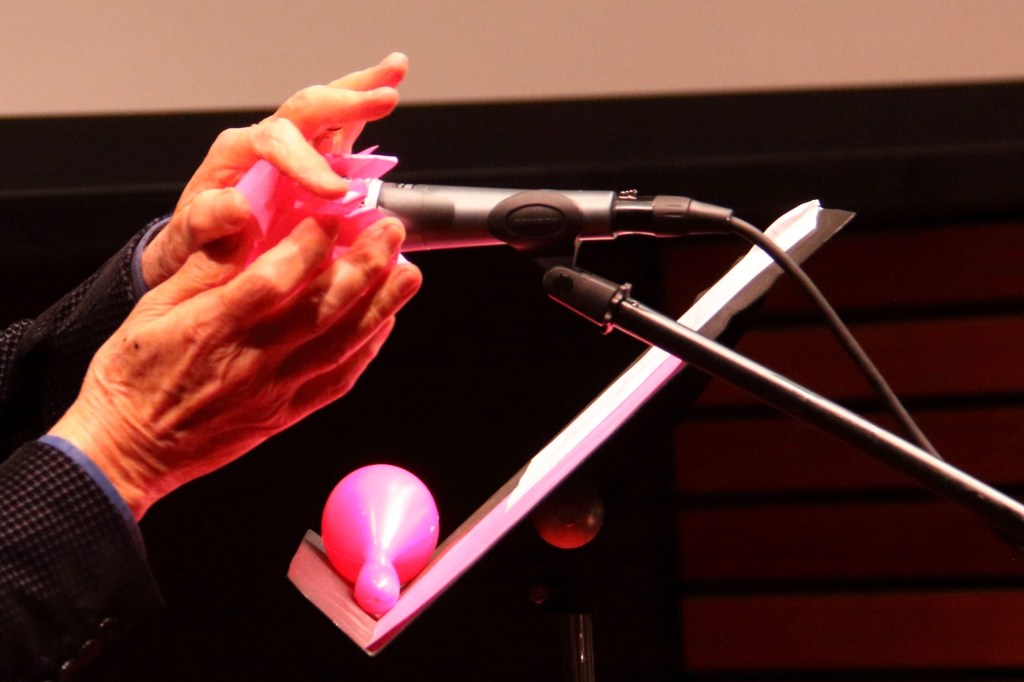


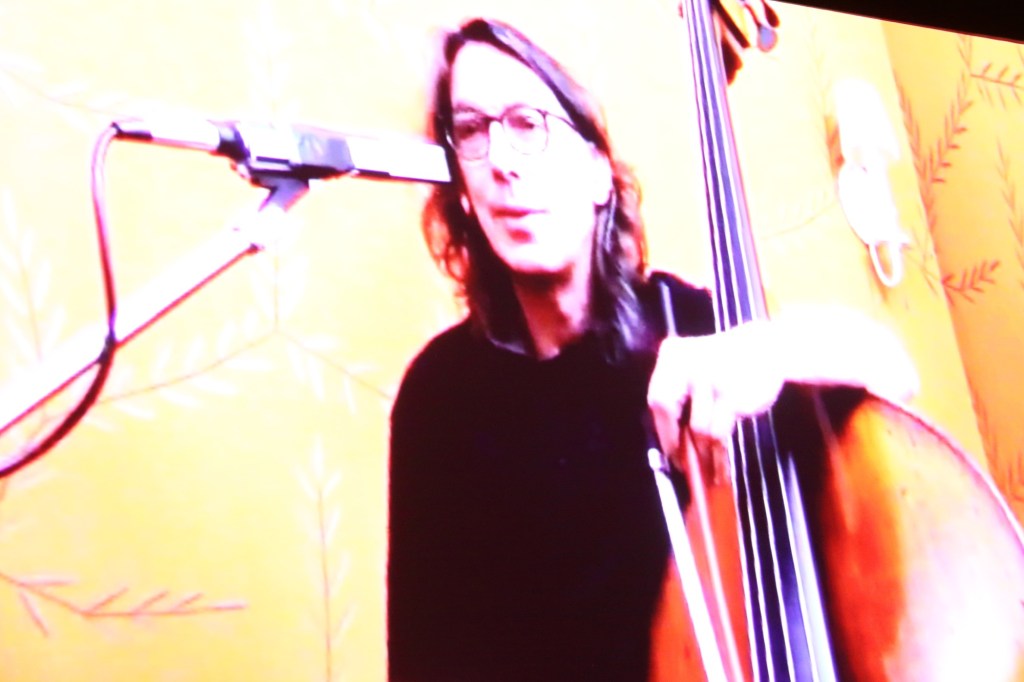


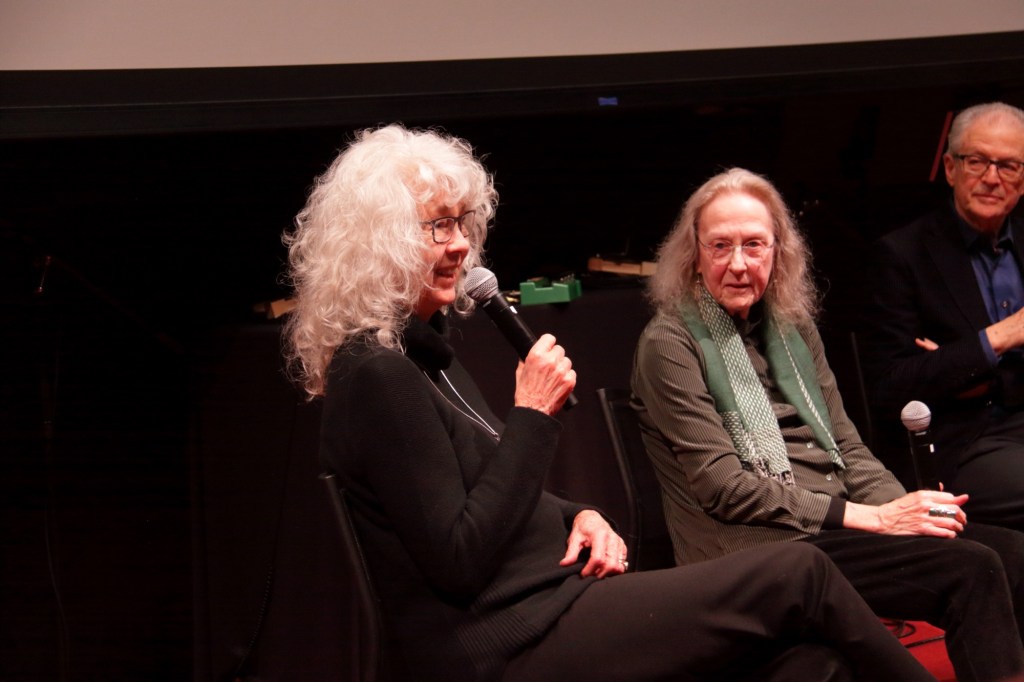


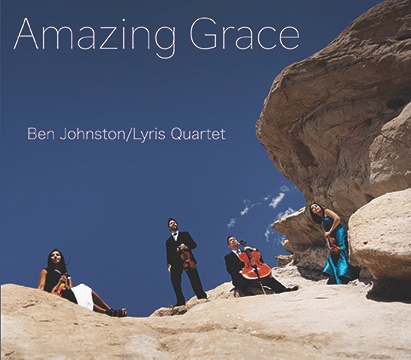


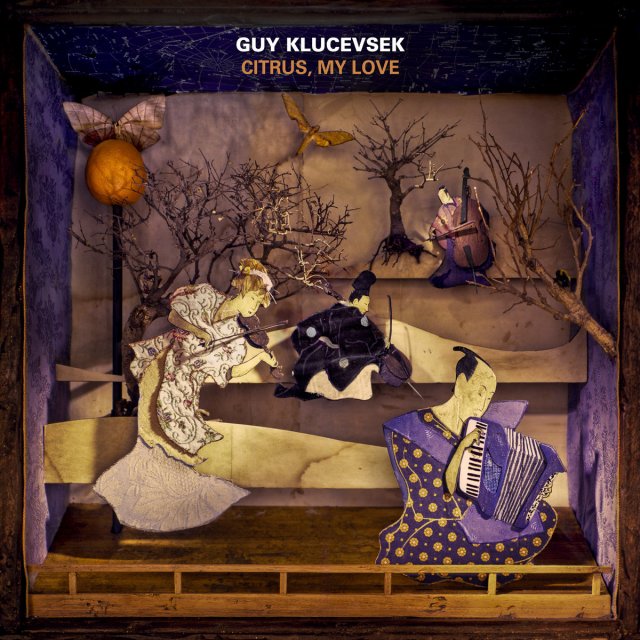
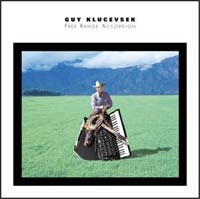

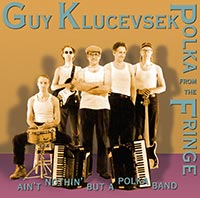
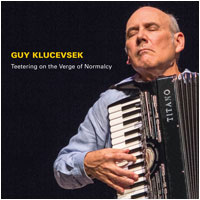
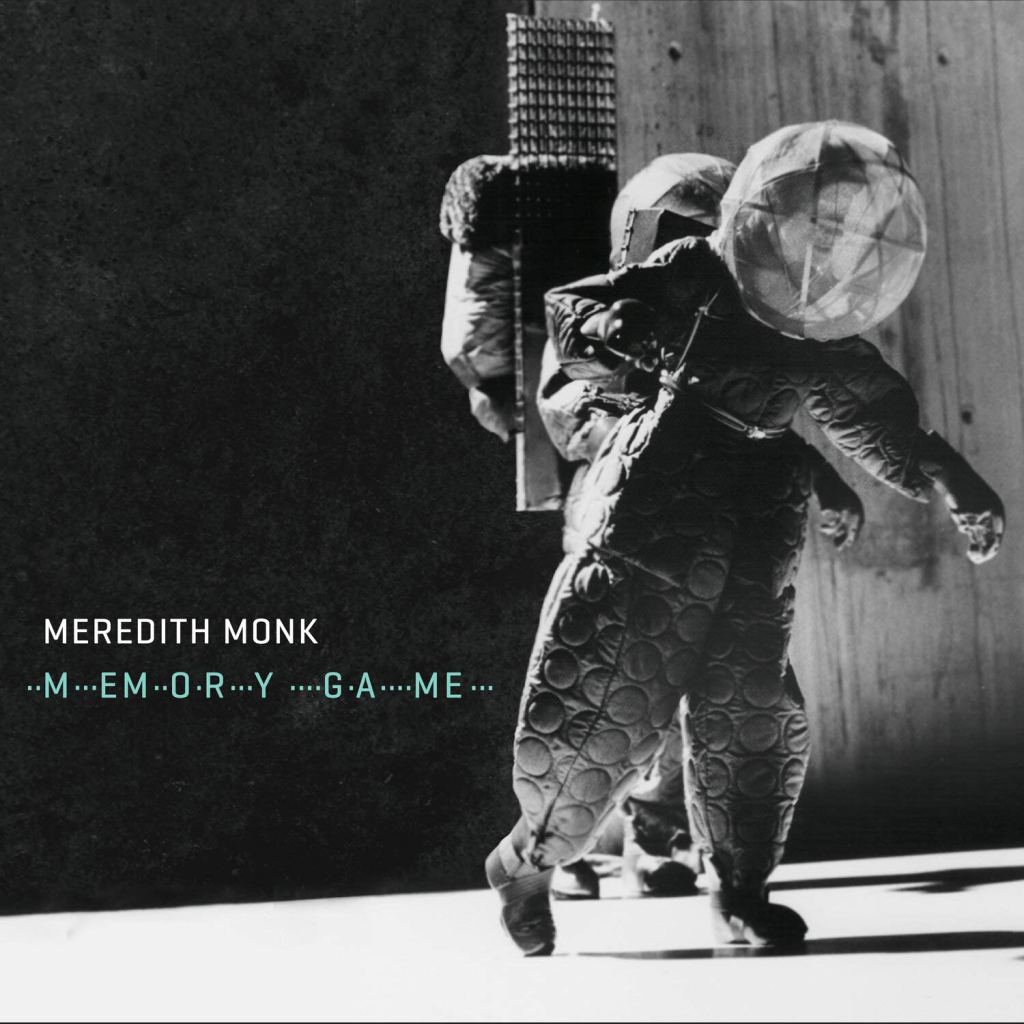
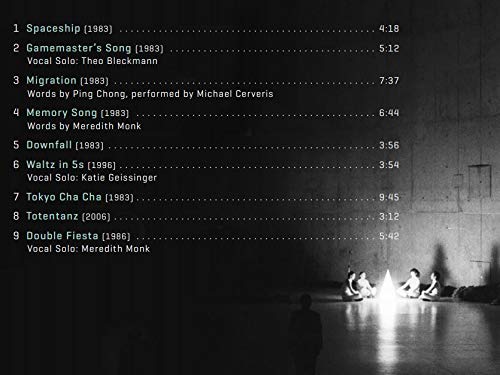
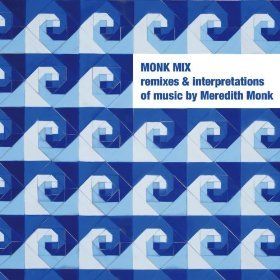
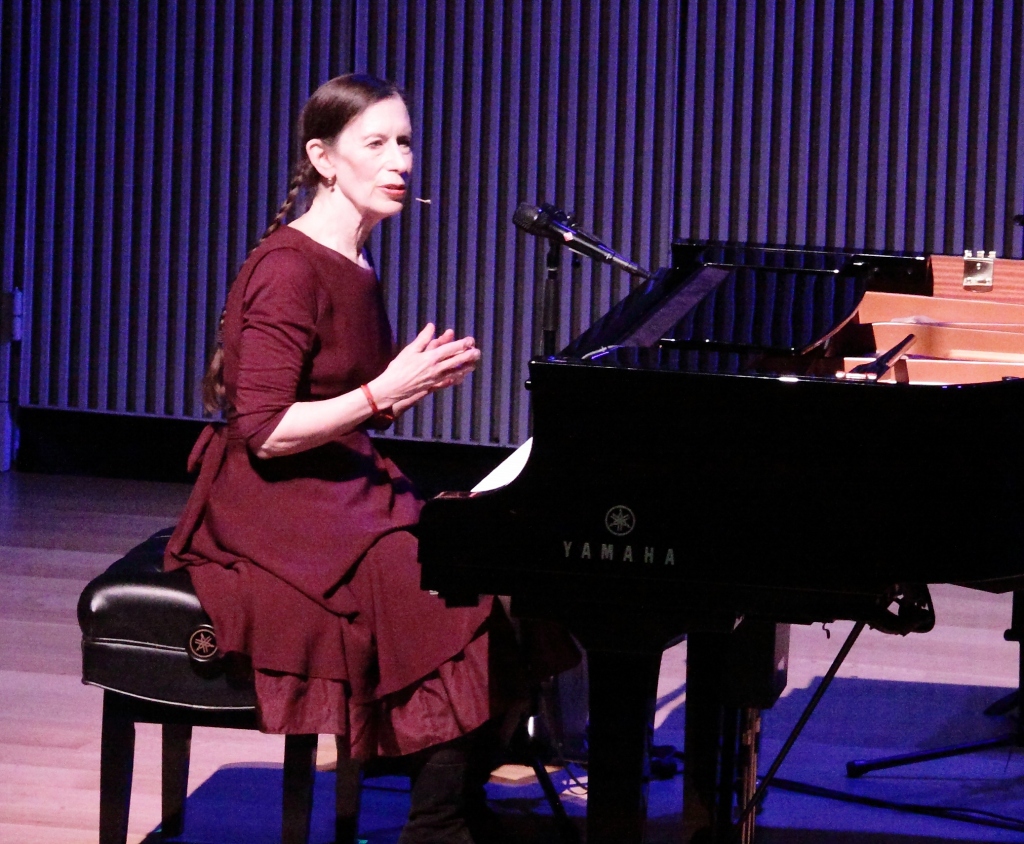

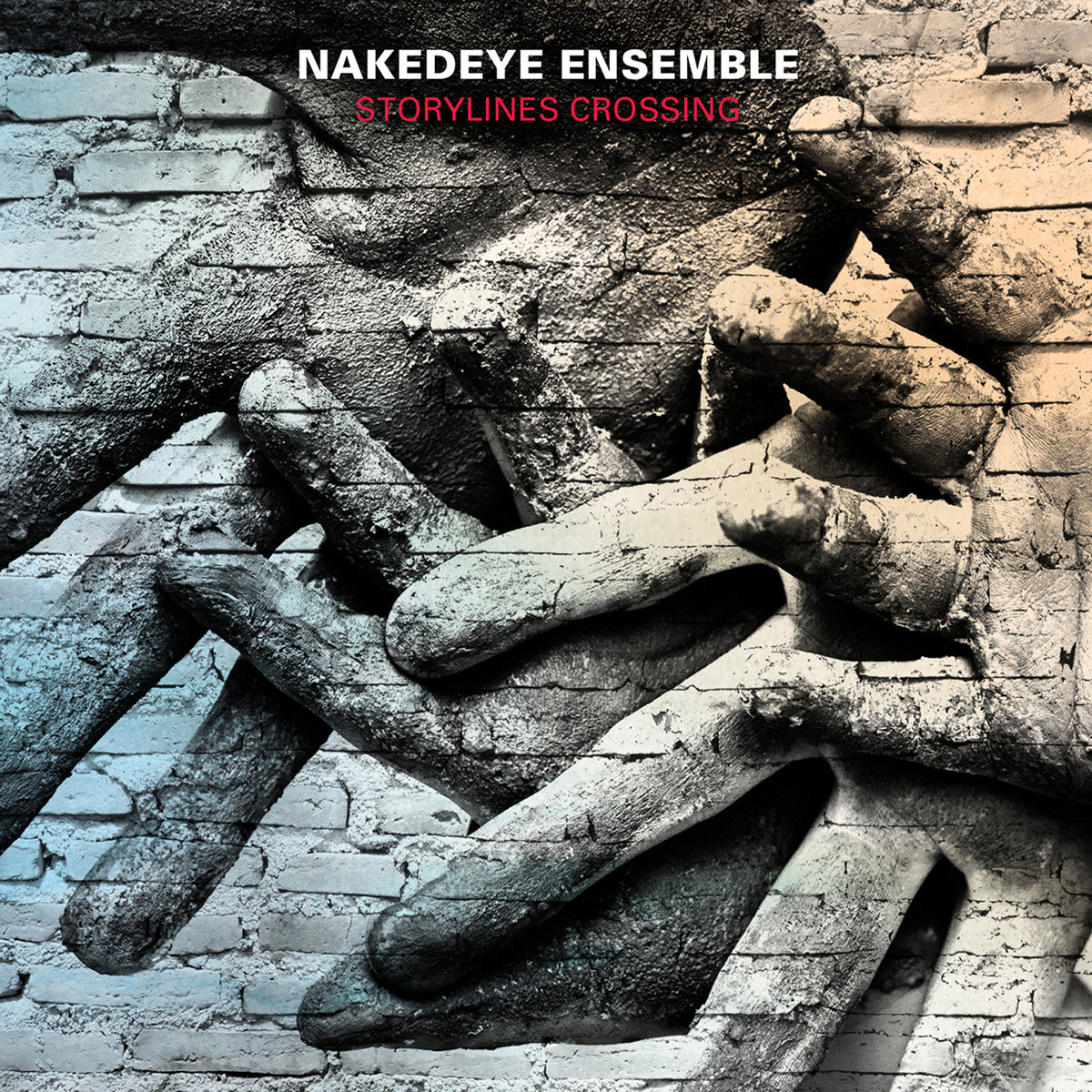


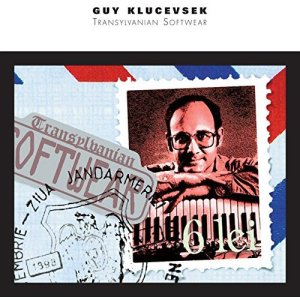
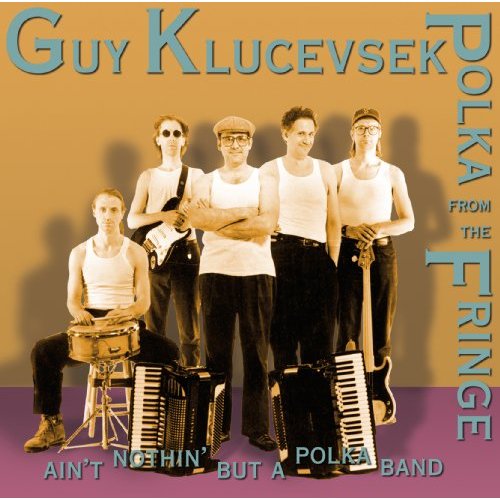
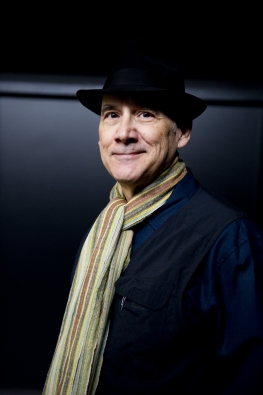
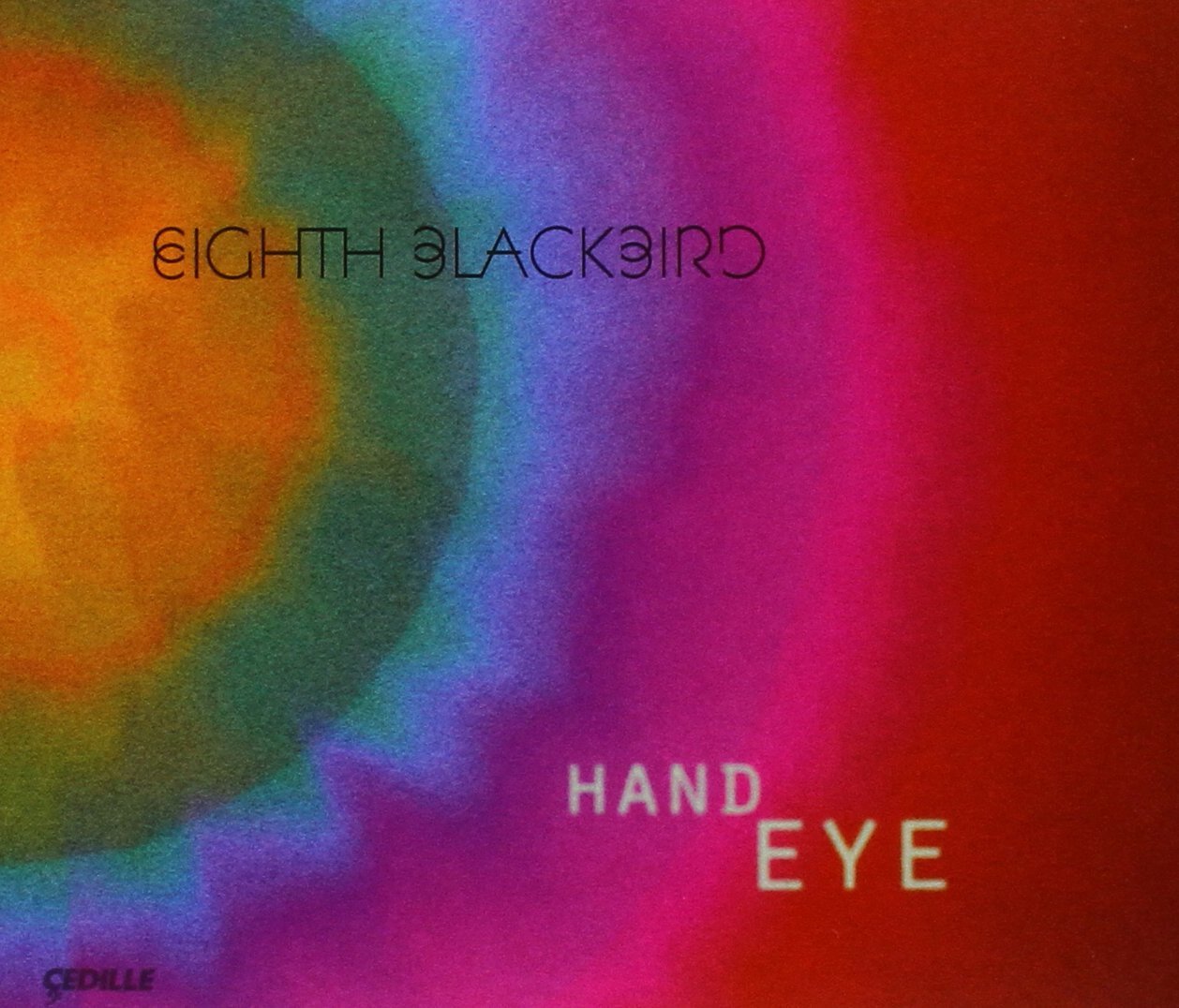
 New Music Buff