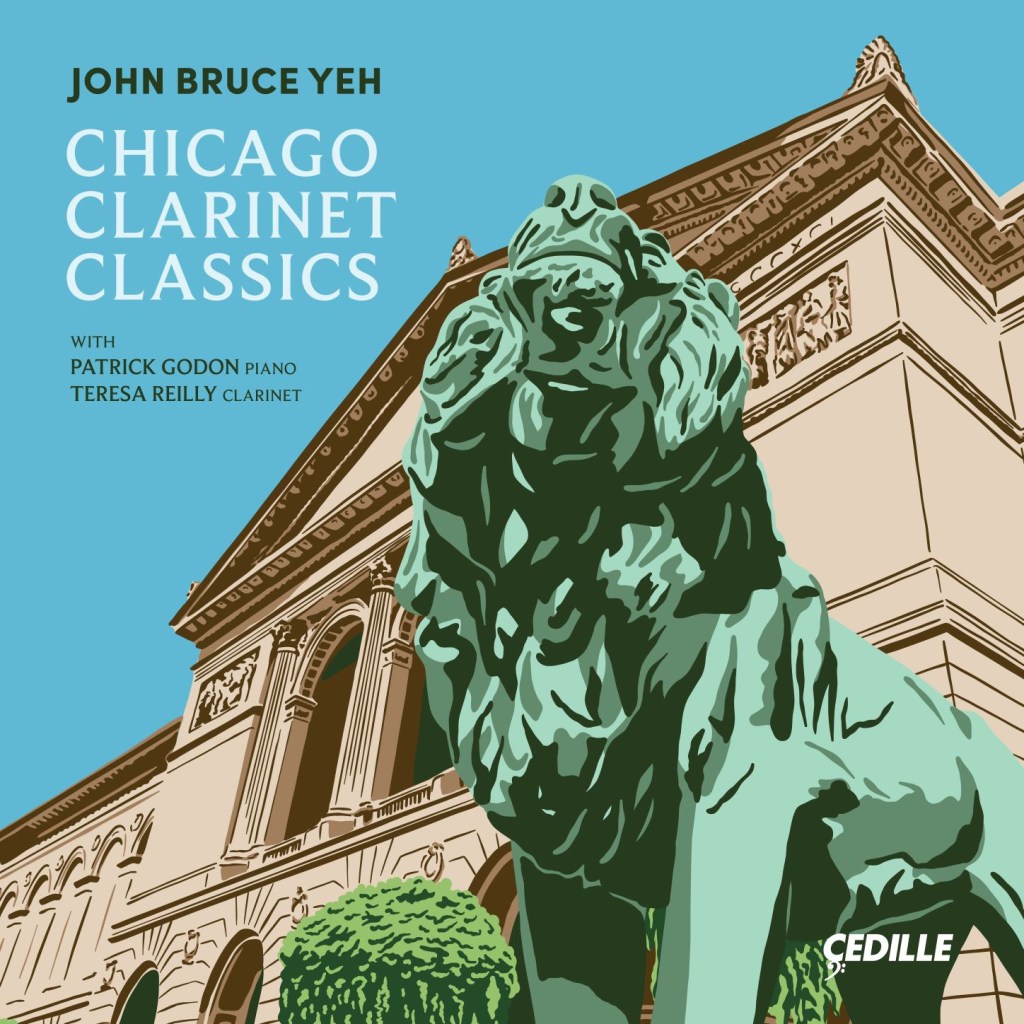
John Bruce Yeh: Chicago Clarinet Classics


Cedille CDR 90000 218

Professor Yeh has been assistant principal clarinet with the Chicago Symphony since 1977 when he was just 19. As a former Chicagoan I can recall that Yeh’s hiring seems to have marked a change in the more traditional image of an orchestral musician. In addition to being an inspiration to aspiring musicians of Asian heritage his media presence also drew interest from both listeners of Asian Heritage but also young listeners (I turned 21 when he was hired and was pleased to find an artist who communicated to me and my age group).

In addition to his duties with the CSO, he has actively supported music and music making in his adopted home town. It is his support for local composers that he showcases here. This disc features music by Alexander Tcherepnin (1899-1977), Stacy Garrop (1969- ), Leo Sowerby (1895-1968), Shulamit Ran (1949- ), Teresa Reilly (1976- ), and Robert Muczinski (1929-2010).

Alexander Tcherepnin, whose father Nikolai was a student of Rimsky-Korsakov, and whose sons, Serge and Ivan, along with grandsons Sergei and Stephan are all highly accomplished composers comprise a multigenerational artistic dynasty of sorts. Russian born Alexander taught in Chicago thus qualifying him for inclusion in Cedille recordings’ mission to promote artists with a “second city” connection. He is well represented in recordings but is less present in the concert hall these days. His brief Sonata in one movement for clarinet and piano (1939) takes the first track on this fine chamber music release. It is a deservedly popular recital piece with a style that sounds a bit like Shostakovich, one of his contemporaries.

Stacy Garrop is a favorite of this reviewer. Her work has been reviewed elsewhere in this blog. She is a freelance composer of immense talent and skill. Her work is featured on at least 12 Cedille albums as well as other labels. Phoenix Rising (2016-18) was originally for alto saxophone (subsequent versions were made for flute and for violin) is presented here in a world premiere transcription for clarinet. As with all her music, Garrop shows herself to be a master of color and texture. She uses both traditional and extended techniques to achieve her compositional visions. These can be challenging for performers but the end result is always worth the effort. Garrop derives inspiration, as she frequently does, from world mythology. Here, of course, the familiar Phoenix bird that lives some 500 years and rises again from the ashes of its funeral pyre.

Leo Sowerby, long associated with Chicago as an organist, composer, and teacher, is represented here by his 1944 clarinet sonata (here in its world premiere recording). Written in the year which saw him win the Pulitzer Prize for music (for Canticle of the Sun), this sonata takes on near symphonic dimensions in its four movements. Sowerby is generally well represented on recordings (8 discs on Cedille alone). His lyrical writing is expressive and accessible and it is perhaps just a matter of time before someone orchestrates this work to present it as a concerto. At just a bit under 30 minutes, it is the largest work on this release.

Shulamit Ran, Israeli/American composer and pianist, student of the great Ralph Shapey, 1991 Pulitzer Prize winner (for her 1989-90 Symphony), Andrew MacLeish Distinguished Service Professor Emerita at the University of Chicago is represented on this recording by her Spirit for solo clarinet (2017). The work is dedicated to the composer’s friend, clarinetist Laura Flax (1952-2017). This is its world premiere recording. Ran’s music has gotten some recordings but her large and substantial orchestral works like the Symphony and a fine Concerto for Orchestra remain unavailable on recordings (even more egregious is the general lack of representation of her mentor, Ralph Shapey’s music). This solo clarinet work is a testament to her compositional talents. Here’s hoping we get to hear more.

Teresa Reilly is a clarinetist, composer, and life partner of Mr. Yeh. The Forgiveness Train (2020) is described as, in part, a response to the COVID epidemic (Yeh notes that much of this album is similarly inspired). The three movement work is essentially a sonata with a loosely poetical program. It is a lyrical work with nods to minimalism and jazz. This is the world premiere recording.

The disc concludes with the four movement Time Pieces for clarinet and piano (1983). This work (the second longest on the disc) is, like the Sowerby piece, substantially a concerto that waits an orchestrator for the piano part. Robert Muczinski, Chicago born composer studied under Alexander Tcherepnin whose music opens this release. The Opus 43 work was commissioned and premiered by former CSO principal clarinet Mitchell Lurie with Muczinski at the piano.

Mr. Yeh is, as always, a joy to hear. He is most ably supported by pianist Patrick Godon on piano (tracks 1, 4-7, and 12-15) and, of course by (more properly with) Teresa Reilly (tracks 9-11). This release, from the Art Institute depicted in (Chicago artist) Steve Shanabruch’s distinctive cover art to the composers represented, is pure Chicago in the best ways.

The Lincoln Trio Plays Contemporary Piano Trios from Chicago


Cedille CDR 90000 211

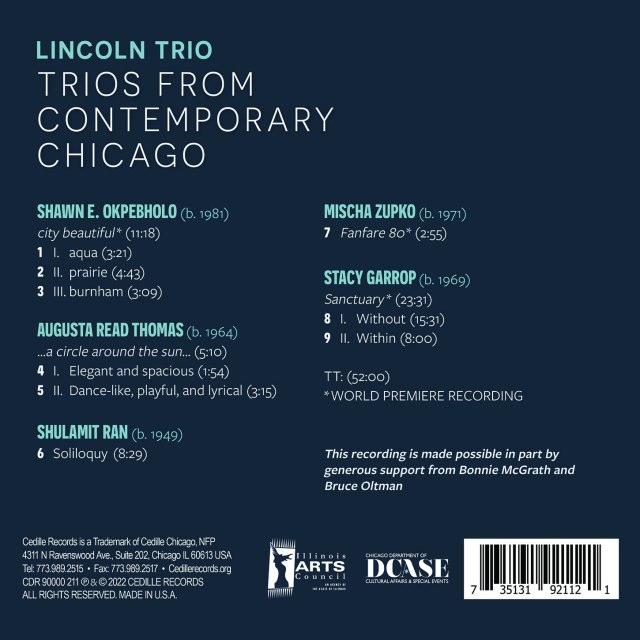
This is another entry in an ongoing series of music for piano trio by the tried and true Lincoln Trio. In this fine release they play a delightful collection of five works (three are world premiere recordings) by living composers. This is their eighth Cedille release by my count. It is the second recording of piano trios from Chicago based composers, a follow up to their previous survey of early to mid-twentieth century piano trios, Trios from the City of Big Shoulders.

back cover

The five works presented here are but a sampling of the available repertoire from Chicago based composers. That said it is a fine sampling of the current state of the art and one would do well to explore more of the music of all these composers.

The first selection is the three movement, “city beautiful” (2021) by the American composer of Nigerian/American Heritage, Shawn E. Okpebholo (1981- ), a world premiere recording. The title is taken from that of the 19th century initiative that helped build the now familiar skyline which had been ravaged by the 1871 Chicago Fire.

Okpebholo is no stranger to this blog. His fine album of spiritual arrangements Steal Away (2016), and his contributions to Will Liverman’s album, “Dreams of a New Day” (2021) revealed his interest in and expertise with spirituals and art song. “city beautiful” by contrast is essentially three tone poems inspired by Chicago architecture, perhaps one of the city’s finest distinctions. The three movements, aqua, prairie, and burnham are effectively homages to architects Jeanne Gang (whose Aqua Tower is a most recent major addition to the famous skyline), Frank Lloyd Wright (whose Robie House is a classic example of the “prairie school” design), and Daniel Burnham (whose 19th century designs define the famously beautiful lakefront and the iconic Union Station).

Opkebholo’s idiom is basically tonal and could be characterized as post romantic. But regardless of how you categorize it the music is eminently listener friendly and a fine vehicle for the estimable Lincoln Trio. This is the work of a rapidly emerging composer with both substance and style. Keep his name on your radar. I expect to hear much more from this talented and prolific composer who currently holds a professorship at Wheaton College in that western suburb of Chicago.

Next is a two movement work by Augusta Read Thomas (1964- ) entitled, “…a circle around the sun” (2021). This work was a commission by the Children’s Memorial Foundation for the Amelia Piano Trio in honor of George D. Kennedy. Thomas has long been a fixture in Chicago’s music life where she was a composer in residence with the Chicago Symphony from 1997-2006. She is currently professor of music at the University of Chicago and a former professor at Northwestern University. Her work also tends toward the tonal idiom and this rather brief two movement work is a fine example of her writing for chamber ensemble.

“Soliloquy” (2003) by the truly fine, if still too little known, Shulamit Ran (1949- ), an Israeli born American composer. She was a student of the esteemed Ralph Shapey (1921-2002) to whom she dedicated her Pulitzer Prize winning Symphony (1990). The composer states in her liner notes that the origins of this work come from her opera “Dybbuk”. It is a pleasant piece perhaps less complex and more lyrical in sound than some of her larger works. Ran was professor of music at the University of Chicago from 1973 to her retirement in 2015.

Mischa Zupko (1971- ) contributes the briefest work to this collection. Clocking in at just under three minutes, “Fanfare 80” (2010) was written in celebration of the 80th anniversary of the Music Institute of Chicago. The brevity here belies the complexities within this ear catching piece.

The album concludes with a substantial two movement work (just over 23 minutes), “Sanctuary” by Stacy Garrop (1969- ) is the work of another prolific composer whose work is, happily, getting much deserved recognition. The 2016 recording of her wonderful orchestral work was reviewed in these pages. Garrop’s work is invariably kinetic and deeply felt with a dramatic flair. Garrop was on the composition faculty of Roosevelt University in Chicago from 2000 to 2016 and is now a freelance composer.

The usual audiophile production (Bill Maylone, engineer) which characterizes Cedille releases is evident here. This is a fine sampling of music which is roughly representative of the musical riches producer James Ginsburg has mined from the “city beautiful”.

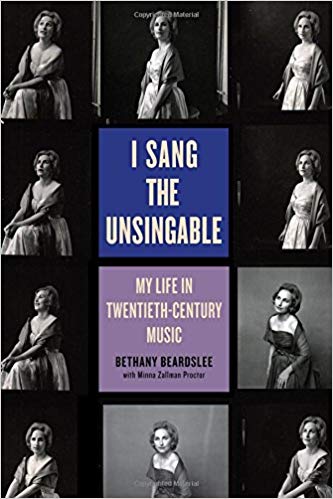
Singing the Unsingable, Bethany Beardslee’s Autobiography


beardslee

by Bethany Beardslee and Minna Zallman Proctor

This is not, strictly speaking, an autobiography.  It is perhaps more in the style of a memoir.  It traces the career and life of a woman whose voice drove much of the avant garde from the 1950’s to the 1980’s.  It is told with a sober tone as the artist looks back on the highs and lows of life and career well spent.  She tactfully shares just enough of her personal life and relationships to provide a context for her tales.

Anyone with an interest in new music during those years had to encounter Beardslee’s carefully cultivated soprano voice.  Along with names like Phyllis Bryn-Julson, Cathy Berberian, and Jan De Gaetani, hers was a very familiar and welcome voice which led listeners (including this writer) reliably and frequently definitively through the plurality of styles that comprise the 20th Century.  Of course she was trained in and also sang the so called “classics” meaning Mozart, Beethoven, Schubert, Schumann etc. but she will likely be best known for her extraordinary service to new music.

Beardslee’s lengthy and sometimes rambling tome is a very personal look at a long and productive career.   She recounts teachers, other singers, composers, conductors, accompanists, and husbands over the span of a rich and interesting career.  The rambling quality of her prose serves only to cast an even more personal light on these accounts of her life and artistry.  Never is there a dull moment and this book will delight singers, composers, historians, and just plain listeners.

In the end this was a very satisfying read and the intelligent decision to include a discography as well as a list of Ms. Beardslee’s world and US premieres makes this book a useful document for further research into her career and the music which drove it.