Oh Say Can You “C”? Terry Riley’s “In C” Turns 60 Years Old


Terry Riley with a t-shirt displaying the entire score of “In C” (photo from Facebook, copyright unknown)

November 4th, 2024 marks the 60th anniversary of the premiere of Terry Riley’s seminal masterpiece, “In C”. After having completed a variety of respectable compositional efforts, Terry Riley (1935- ) was jolted by the Muse to write this defining work that charted a path very different from that of the western classical mold of the composer’s formal education. It premiered in the very unconventional venue of a house in San Francisco, not in an auditorium designed for concerts. And it’s one of those pieces that now marks the transition from almost purely experimental writing to a style later dubbed “minimalism” (though many composers whose music is subsumed under this title eschew it in varying degrees). And whether you call it minimalism, trance music, drone, etc., the style would come to dominate a huge portion of concert works and recordings.

The score consists of 53 short musical phrases with no specified instrumentation and with no conductor’s score, just parts with a seemingly simple set of instructions. One page is what one might expect of a sketch of a larger work to be, not a complete score but, that’s it, One page with the instruction for the musician to repeat each cell or phrase ad libitum and then move on to the next. It was ostensibly the suggestion of composer/performer Steve Reich to have a pianist play eighth note repetitions of the top two highest octaves on the keyboard. In addition to this “click track” like strategy, the playing of those high “C”s also serves to anchor the tonality much as continuo does in that quasi improvisational baroque practice.

There is simply no finer account and analysis of this music than that of Robert Carl’s “In C”. Robert Carl (1954- ) is a teacher, composer, performer, and musicologist. I do not presume to have as extensive an analysis as he does but I’m interested here in providing a celebratory perspective from where I sit (and have been seated).

This music (as does all art) stands in a context with concurrent and recent events surrounding its conception and performance. Temporally it stands along with other notable compositions from 1964: Witold Lutoslawski- String Quartet, John Coltrane (admittedly one of Riley’s influences)- the albums, “Bessie’s Blues” and “Lonnie’s Lament”, Igor Stravinsky- Elegy for JFK and Variations in Memoriam Aldous Huxley (both men died on November 23rd, 1963), Roger Sessions- Symphony No. 5 and his opera, “Montezuma”, Milton Babbitt- Philomel, Karlheinz Stockhausen- Mixtur, Ben Johnston- Sonata for Microtonal Piano, Luciano Berio- Folksongs (written and premiered at Mills College, the later home of the Tape Music Center where Berio was teaching then), Olivier Messiaen- Et Expecto Ressurectionem Mortuorum, Iannis Xenakis- Eonta, and La Monte Young- (the first iteration of his masterpiece), The Well Tuned Piano.

My little list here is just a sampling of the western classical and jazz works that graced the natal year of “In C”. Admittedly, it is a cornucopia of some more experimental, some less so music that lie in this historical orbit. But, among the works in this list, it is the work of John Coltrane and La Monte Young that shares musical DNA with Riley’s aesthetic in this music. The other works contemporary mentioned represent a sort of “Garden of Forking Paths“ to a panoply of styles very different from the work at hand.

At a time when the style of American pop music had just recently met The Beatles, this work was a sort of coalescence of experiments done by La Monte Young, Steve Reich, and others. “In C” seems to have come out fully formed in its way. It was seemingly influenced by pop, jazz, and blues (whose use of repetition is endemic). 60 years later it is performed frequently and there exists at least 40 or so recordings of the work.

When I began writing this article I realized that Robert Carl’s book on this work fully covers the history and provides a definitive analysis to which I cannot contribute anything additionally useful. I then considered eliciting commentary from musicians and listeners about this music but found little interest because that has been well covered by several previous anniversary essays. So I decided to share a discography and photos of some the recordings I could find that have given me further insights into this touchstone work.

This discography is not comprehensive but my intent here is to celebrate this anniversary with the cover artwork that adorns the ever increasing documenting of this landmark of western art music. I will present what I believe is a representative selection of some 40+ versions.

Your humble author was 8 at the time of this work’s premiere. And my first hearing of ‘In C’ was in 1976 when my local radio station, the great WFMT in Chicago, aired a program curated by Raymond Wilding-White, a composer and professor of music at De Paul University. His task was to present representative works of American music, one for each day of the nation’s bicentennial year. ‘in C’ was one of them.

Since then I have heard many interpretations of this work. The original performance was at 321 Divisadero Street in San Francisco, California on November 4th, 1964. The original performers were: Terry Riley, Steve Reich, Jon Gibson, Pauline Oliveros, Stuart Dempster, Morton Subotnick, Warner Jepson, Tony Martin, William Maginnis, and Ramon Sender (who celebrated his 90th birthday this past week). This venue was the second and last home of the San Francisco Tape Music Center before it relocated and was renamed The Mills College Center for Contemporary Music in 1966 in Oakland.

Here, with brief commentaries, are my favorites. There are at least 38 versions according to the Wikipedia article. Here are my personal favorites in chronological order of release date:

The original Columbia Records release (1968)

If you only have one recording this is probably the one you want. Recorded in 1968, this brought the work effectively to a wide audience via international distribution. The instrumentation (some overdubbed) includes: saxophone, oboe, bassoon, trumpet, clarinet, flute, viola, trombone, vibraphone, marimbaphone.

Riley with the Chinese Film Orchestra (1989)

This important recording was made in China around the time of the Tiananmen Square uprising and the tapes were in effect smuggled out of the country in the aftermath of that incident. It stands as a fascinating document of eastern musicians encountering and interpreting this masterpiece.

The 25th anniversary release on New Albion (1990)

Don’t you just love anniversaries? By the time of this release (1989), this work had been disseminated into wide geographic regions and cultures. This version includes many of the musicians who premiered the work and this “traditional” reading is a loving homage to Riley’s work.

The Bang on a Can release (1998)

The Bang on a Can All Stars are among the finest ambassadors of new music. They have earned the right to put their stamp on any new work they choose and subsequently bring it anew to another generation of listeners.

Prog Rock does homage to Terry Riley (2001)

If you want to hear the wide range of musicians who have chosen to pay homage to this work this is a fine place to start.

The Africa Express release (2015)

Another fine example of the way this work can sound from a Central African perspective. This performance from Mali is absolutely electrifying.

Another fine culturally tinged version (2017)

This album is a personal favorite from the Brooklyn based collective featuring instruments from Hindustani traditions and others alongside western instruments. You can read my enthusiastic review here.

There are probably at least 50 recordings of this work. Some are private, maybe even bootleg versions. Clearly this work continues to become more and more essential and influential piece of music. It is not unlike a musical version of the Iconic monolith from the movie 2001: A Space Odyssey. The anomalous structure was of alien origin and was purported to accelerate the evolution of species who encounter it.

Riley’s work is most .definitely of terrestrial origin (well, San Francisco anyway) but, clearly this work continues to intrigue musicians worldwide and has arguably influenced the development of music itself.

Evolution supercharged by an alien presence.

Ramón Sender Barayón, Always Going Toward the Light


Raysender

Ramón Sender Barayón at Arion Press in San Francisco (Photo Creative Commons 2011 by Allan J. Cronin)


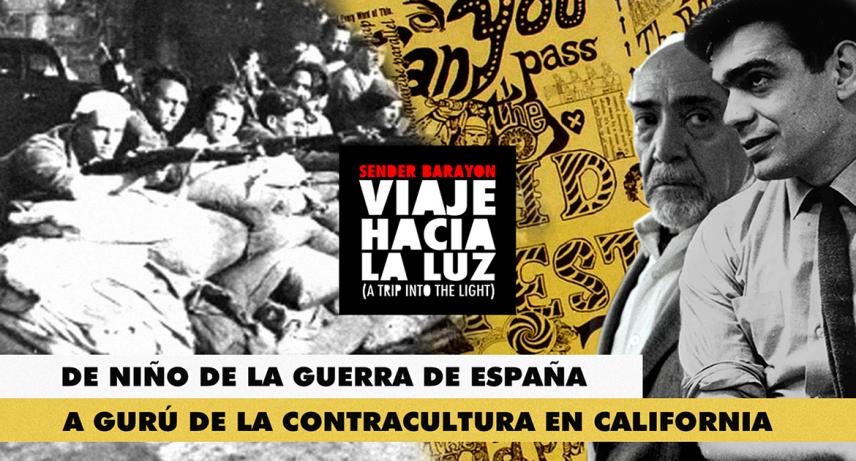
This crowd sourced video opens with a sort of exposition of the various identities of its subject Ramón Sender Barayón (also known as Ramon Sender, Ramon Sender Morningstar, Ray Sender, and Ramon Sender Barayón).  His father was the renowned Spanish novelist Ramón J. Sender whose work was unappreciated (to say the least) by the Franco regime resulting in his spending the last part of his life as an expatriate in the United States of America.  His mother Amparo Barayón fared far less well.  Her short life and her death at the hands of the Franco regime are memorialized in her son’s book, “A Death in Zamora“, an experience which has understandably informed his life.  As a writer, in order to distinguish himself from his father, he adopted his mother’s maiden name appended to his given name.  Happily this and some of his other works are making it to the kindle format.

img_0745

The film unfortunately does not appear to be available in any commercial outlets at the time of this writing but one hopes that Amazon or some internet distributor will make it more widely available.  One small critique is the use of sometimes English narration and sometimes Spanish narration with attendant translation subtitles in the opposite languages is a bit difficult to get used to but hardly an insurmountable issue.

Sender’s personal website continues to be a source of useful information.  Links can be found here to many of his writings and other work as well as some discussion of his musical compositions.

deathzamora

In addition to being a writer he is an acknowledged pioneer in the area of experimental music.  He, along with Morton Subotnick, Pauline Oliveros, Joseph Byrd, William Maginnis, Tony Martin, Joseph Byrd, and Terry Riley (among others) founded the San Francisco Tape Music Center in 1962.  This later became the Mills College Center for Contemporary Music and remains in operation as of the date of this review.  Barayon’s ” novelized history of this time in his life titled, “Naked Close Up” finally found itself in a Kindle release after having circulated in PDF format for years on the internet.  (This history is also further documented in David Bernstein’s excellent, “The San Francisco Tape Music Center: 1960s Counterculture and the Avant-Garde“)

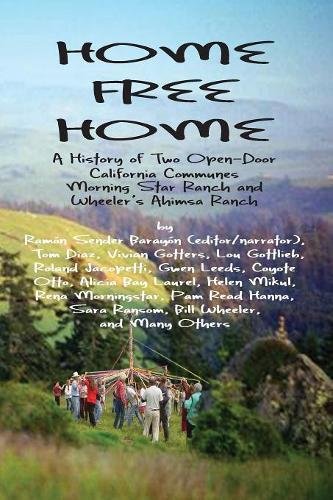
His curiosity and wide ranging interests saw him participating in alternative commune living situations (beginning in 1966) in northern California exploring spirituality and challenging established social norms through the exploration of viable alternatives.  He writes most eloquently about this in his recently published “Home Free Home“, a large edited tome on the Morningstar Ranch and Wheeler’s Ahimsa Ranch which includes material by several other former residents.  The book is as much compilation as it is historical writing and memoir.  It is a fascinating read and is filled with historically significant recollections and commentary by many of those one time residents of these (now sadly defunct) communities.

homefree

This DVD is one of those increasingly popular crowd sourced productions (here is the Indiegogo link) which has allowed independent publication of countless books and CDs and countless other projects which stimulate little interest among traditional venues despite the significance of their content.  The content here is of a profoundly important nature to fans of new music as well as fans of alternative living experiments and 60s counterculture and philosophy.  It is contemporary history and biography.

Ramón is man possessed of both wisdom and humor as well as deep thought.  This film is the first documentary to cover the diverse interest and involvement of this affable cultural polymath.  It begins with an interview of Mr. Sender in the living room of his home in San Francisco.  From there it traverses more or less chronologically among the dizzyingly diverse events which comprise his life thus far.

From his birth in Spain in 1934 to his present role as a sort of spiritual/intellectual guru running a lecture series called, “Odd Mondays” in San Francisco’s Noe Valley neighborhood which he and Judith Levy have managed for some 17 years with a variety of carefully chosen speakers.  The film covers a variety of topics and while it leaves out details at times it is a cogent and balanced biographical documentary.

His early involvement in the establishment of the influential San Francisco Tape Music Center finds him connected with fellow luminaries such as Pauline Oliveros, Terry Riley, Morton Subotnick, William Maginnis, Steve Reich, Joseph Byrd, Tony Martin, and Donald Buchla.  This institution, now relocated as the Center for Contemporary Music at Mills College, saw the creation of a great deal of musical technology and significant musical compositions (Terry Riley’s groundbreaking “In C” was first performed there in 1964).

Sender was one of the organizers of the Trips Festival in 1966 along with Stewart Brand (later of Whole Earth Catalog fame), Bill Graham, Ken Kesey with his Merry Pranksters. Following this he left San Francisco for Sonoma County in northern California.

He states at one point that he has not wanted to be identified with a single career (as his father was) so, following his experimental music work, he became among the first to experiment with communal living in the Morningstar Ranch and later in the Wheeler Ranch in Sonoma County, California.  These are now well documented in his book, “Home Free Home” mentioned earlier.

Happily the film does a nice job of acknowledging the role that his wife Judith Levy has played in his life since their marriage in 1982.  In particular her support in Sender’s research into his mother’s death at the hands of Franco’s thugs in Spain is both sweet and heartbreaking.  The two appear to be constant companions in a mutually supportive relationship he sought for many years.  They are frequently seen together.

A segment of his work which gets less attention here are his fiction and spiritual writings including Zero Weather, Being of the Sun (co-authored with Alicia Bay Laurel), Zero Summer, and Planetary Sojourn.  He has a collection of unpublished manuscripts and is reportedly now working on his autobiography.  Something which will doubtless be worth the wait.

senderchapelchimes

Sender with unidentified man walking out of the Pauline Oliveros Memorial Concert at Oakland’s Chapel of the Chimes in December, 2016 (Photo Creative Commons 2016 by Allan J. Cronin)

Sarah Cahill et al: By and for Terry Riley


Sarah Cahill - Eighty Trips Around the Sun- Music by and for Terry Riley - cover.png

Had to save this one for Christmas.  If ever there was an album that conjures more of the positive intents of the Christmas season this one gets my vote.  Imagine celebrating a living acknowledged master artist in a milieu of his actual and artistically extended family.  That may seem an extreme notion to some but this writer is utterly charmed and thrilled to hear this “one of a kind” collection.  Other interpretations will, of course, be valid but none will ever match this one.  It’s like the Carter family of the avant-garde (and I mean that unambiguously with great respect).

Any release by Bay Area pianist Sarah Cahill is reason enough alone to perk up one’s ears but this massive four disc collection of all new recordings in honor of Terry Riley’s 80th birthday (Terry was born in 1935) is a major release of (almost) all of Riley’s music for piano, piano four hands and two pianos.  In addition two of the discs are dedicated to pieces commissioned in honor of Riley.  This set belongs in the collection of anyone interested in mid to late twentieth century music and especially fans of minimalism and the curiously west coast iterations of modernism.

As a listener I have always treated every Terry Riley release as a major event as well and this collection does about as fine a job as one can imagine in paying homage to one of the brightest artistic lights of the Bay Area.  Riley came to prominence (at least historically speaking) with his open score piece, In C (1964).  It is among the earliest examples of the style which, for better or worse, became known as “minimalism”.  Since then he has continued to produce music in pretty much all genres, chamber music, orchestral music, solo music, concerti, etc.

Riley’s style, however, continued to evolve and his later works show diverse influences from his days playing barrel house piano, his interest in progressive jazz, and his studies of Hindustani and Carnatic musics (under the tutelage of Pandit Pran Nath).  Like pretty much every composer of that first wave of “minimalists” Riley has evolved a much deeper and individualized style but, even with the diversity of influences as mentioned, he remains uniquely Terry Riley.

Throughout his career as composer and performer Terry has been a teacher and an advocate of new music.  His enthusiasm and talent has affected all who know him and, I dare say, all who have experienced his work.

This collection ranges over his entire career from the early “Two Pieces” (1958/9) to later solo and four hand compositions on the first two discs.  It is worth noting that Be Kind to One Another (2008/14) was one of the commissions in Sarah Cahill’s wonderful series of anti-war pieces, “A Sweeter Music”.  It then goes on to the homages which, of course, can also be said to be influenced by Riley’s work.

This is not simply a collection of Riley’s piano music.  What we have here is a lively celebration of most of Riley’s music for piano, two pianos and piano four hands from the full spectrum of his career (as the liner notes say a couple of large compositions were not included, most likely a matter of space) along with a touching set of homages by composers related musically and aesthetically to Mr. Riley.  They range from contemporaries to students, artistic descendants to actual family.  It is a multi-generational tribute and a loving artifact that celebrates this artist on a very personal level.

Regina Myers supplies the other two hands in the disc of four hand piano pieces by Riley.  She credits another Bay Area composer/teacher/conductor, the Mills College based Steed Cowart for recommending her for this crucial role.  Such touches add to the sense of this being a Bay Area family project on so many levels.

The interrelationships that comprise this lovely production make it stand distinctly apart from the (no less significant or lovely) homages to fellow minimalists Philip Glass and Steve Reich.  This is a much more personal album which reflects Riley as composer, teacher, inspiration, father, icon and friend.  Anyone who has met Terry or experienced him in performance has experienced a certain warmth like that of a wise and gentle guru.

After the two discs of Riley’s music we are treated to music inspired by another generation of artists and, last, by long time colleague, the late great Pauline Oliveros (1932-2016), another wise and gentle guru who died just about a year before the release of this album.  She and Terry worked together (along with Morton Subotnick, Ramon Sender, Steve Reich, William Maginnis, and Tony Martin) as founders of the San Francisco Tape Music Center which would become the Mills College Center for Contemporary Music (still operating today).  The producers wisely dedicated an entire disc to one of Oliveros’ last compositions, this loving tribute to her friend and colleague. It is now, sadly, a tribute to her memory as well.   Samuel Adams shares the performing duties along with Ms. Cahill on this extended homage.

There is little doubt that the other composers whose music graces this tribute will continue on their unique paths to continued success always acknowledging their connections to Mr. Riley.  Danny Clay is among the less familiar (to this reviewer) names here but his Circle Songs seem to fit quite well to open the first tribute disc.  Gyan Riley is, of course, one of Terry’s children and a fine guitarist and composer  in his own right.  Anyone who has had the pleasure of seeing Gyan and Terry play together cannot miss the close bond personally and musically of these two.  They are a joy to behold.  The affectionate Poppy Infinite is a reference to the elder Riley’s Poppy Nogood’s Phantom Band which was the “B side” of his classic Rainbow in Curved Air.  Samuel Adams is the son of Pulitzer Prize winner John Adams whose early work China Gates was written for and championed by his fellow classmate at the San Francisco Conservatory, Sarah Cahill.  The younger Adams’ contribution here is called Shade Studies.

The eclectic Christine Southworth also seems to embody the (perhaps loosely defined) West Coast style.  Her interests in electronics and world music describe this superficially but her sound is a welcome one here as well.  Keeril Makan earned his PhD. in music at Berkeley which doubtless has left a stamp on his style.  His composition “Before C” makes reference to what is doubtless Terry Riley’s best known work, the oft performed, “In C”.  Elena Ruehr is a composer whose connection is not as clear as some of the others here but her work, “In C too” demonstrates her understanding of and her respect for Riley’s work.  Last on this disc of tributes is Dylan Mattingly.  He is a Berkeley native and can frequently be seen/heard performing in various venues in the Bay Area.  His contribution YEAR demonstrates both his individual style and his connection to the West Coast Style mentioned earlier.

The liner notes by Sarah Cahill are part of the tribute and a good description of the various influences behind the man of the hour, Terry Riley.  Credit is properly given to the artistic influences that inspired Mr. Riley and a brief description of what must have been an intimidating but loving project.  It is likely that there are even more connections involved in this undertaking but that must be left to future musicological and historical research.

The Kronos Quartet has long ago championed Riley’s work for that medium and new versions of his classic, “In C” continue to come on the scene.  One can only hope that the energy embodied here will inspire recordings of some of Riley’s lesser known work with orchestra which richly deserves hearings.  But regardless there is much to celebrate here and best holiday wishes go out to Mr. Riley and his talented progeny.  Happy listening, all.