The Heresy and the Ecstasy: Brooklyn Raga Massive Does “In C”


brminc

This is heresy.  It is not, strictly speaking, faithful to the 1964 score and it is a sort of cultural appropriation which is actually the very basis of Brooklyn Raga Massive, a sort of latter day “Oregon” (to those who recall that band) which takes on all sorts of music and filters it through the unique lens of this flexibly populated group of musicians whose backgrounds range primarily from Hindustani and Carnatic traditions (though hardly in the most classical sense) but also from western classical and jazz.  Their “heresy” comes from their choices.  The root of heresy is the Greek word, “hairesis” which means choice.  There is a lovely selection of their musical heresies on their You Tube Channel.

No this is not purely heresy and it is certainly not blasphemy.  Quite the opposite actually.  And I would prefer to think of this effort as cultural integration.  The choices made here instead lead to some mighty ecstatic music making which pays honor to Terry Riley who turned 80 in 2015 and provides a unique perspective on this classic work.

“In C” (1964) is without doubt Riley’s best known work by far and the one which pretty much defined what would later become known for better or worse as “minimalism”.  It is an open score meaning that no instruments are specified for performance making this music heretical in nature as well.  In addition there is no conductor’s score as such.  Rather there are 53 melodic cells numbered 1 to 53 and the ensemble is held together by the expression of an 8th note pulse played by at least one of the musicians involved.  The defining reference on the intricacies of this work is composer/musicologist Robert Carl’s masterful book entitled simply, “In C”.  He describes the wide variety of potential choices which can be made in performance and the different results which can be achieved.

There are a great deal of recordings available of this work from the first (released 1968)  on Columbia’s “Music of Our Time” series curated by the insightful David Behrman to versions involving a wide variety of instrumental combinations of varying sizes.  The first “world music” version this writer has heard is the version for mostly percussion instruments by Africa Express titled, “In C Mali” (released in 2014).

Not surprisingly BRM, as they are known, have chosen a largely Hindustani/Carnatic take on this music.  The unprepared listener might easily mistake this for a traditional Indian music recording with the introduction which incorporates a raga scale and adheres to the traditional slow free rhythm improvisation of the introductory “alap” section common to such traditional or classical performances.

The familiar sound of these (largely) South Asian instruments with their rich harmonics sets the tone gently.  This writer has at best a perfunctory working knowledge of these complex and beautiful musical traditions but one must surmise that the choice of Raga Bihag may have some intended meaning.  Indeed such music is by definition integrated into the larger cosmology of Hinduism, the Vedas, the Gita, the Sanskrit language, and, no doubt other references.  This is not discussed in the brief liner notes but is worthy perhaps as a future interview question.

It appears that many of the musical decisions were made by sitarist Neel Murgai though it becomes clear as the performance develops that individual soloists are allowed wonderful improvisational freedoms at various points.  The recording is intelligently divided to let the listener know which set of melodic cells is being expressed at a given time.

The alap gives way to the sound of the tablas which initiate the pulse mentioned earlier.  The structure of this piece produces a range of musical experiences from a sort of didactic beginning to the swirling psychedelic waves of sound which stereotypically define much of the music born in the mid 1960s in this country.  In fact Terry Riley’s deep study of South Asian musics (most famously under vocalist Pandit Pran Nath) did not occur until later in his career.  Nonetheless there seems to have always been some affinity between Riley’s vision and the sort of music whose popularity was driven in the United States most famously by the efforts such as Pandit Ravi Shankar and Ustad Alla Rakha in the 1970s.

What follows is a riot of musical ecstasy involving some inspired improvisational riffs and some stunning vocalizations as well giving us a fascinating take on this music which was written well before these musicians came into the world.  We have a later generation paying homage to the beloved American composer and to the beautiful traditions of their own eclectic ethnic heritage.

The set concludes in this live and lively recording with a traditional fast paced Jhalla, the traditional ending to classical Indian musical performances. This will likely become known as the “Indian” recording of “In C” but it is so much more than that.  It is an homage.  It is a look back from the view of at least a couple of generations of artists.  And it is heresy in the best sense of that word, choices made judiciously to achieve higher artistic goals.  Not all art is heresy and not all heresy is art but the heresies perpetrated here definitely deserve our ears.

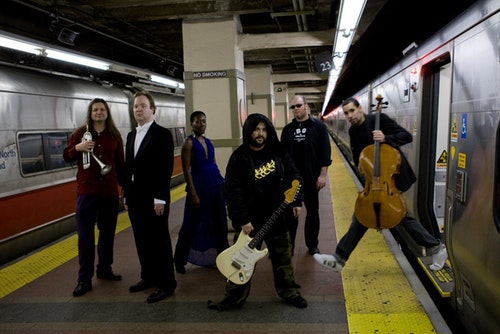
The heretics are: Neel Murgai, Sitar and Vocal; Arun Ramamurthy, Violin; Andrew Shantz, Vocal; Josh Geisler, Bansuri; Sameer Gupta, Tabla; Roshni Samlal, Tabla; Eric Fraser, Bansuri; Timothy Hill, vocal; Trina Basu, Violin; Ken Shoji, Violin; Kane Mathis, Oud; Adam Malouf, Cello; Michael Gam, Bass; Lauren Crump, Cajon; David Ellenbogen, Guitar; Max ZT, Hammered Dulcimer; Vin Scialla, Riq and Frame Drum; Aaron Shragge, Dragon Mouth Trumpet.

Namaste, folks.


Sarah Cahill et al: By and for Terry Riley


Sarah Cahill - Eighty Trips Around the Sun- Music by and for Terry Riley - cover.png

Had to save this one for Christmas.  If ever there was an album that conjures more of the positive intents of the Christmas season this one gets my vote.  Imagine celebrating a living acknowledged master artist in a milieu of his actual and artistically extended family.  That may seem an extreme notion to some but this writer is utterly charmed and thrilled to hear this “one of a kind” collection.  Other interpretations will, of course, be valid but none will ever match this one.  It’s like the Carter family of the avant-garde (and I mean that unambiguously with great respect).

Any release by Bay Area pianist Sarah Cahill is reason enough alone to perk up one’s ears but this massive four disc collection of all new recordings in honor of Terry Riley’s 80th birthday (Terry was born in 1935) is a major release of (almost) all of Riley’s music for piano, piano four hands and two pianos.  In addition two of the discs are dedicated to pieces commissioned in honor of Riley.  This set belongs in the collection of anyone interested in mid to late twentieth century music and especially fans of minimalism and the curiously west coast iterations of modernism.

As a listener I have always treated every Terry Riley release as a major event as well and this collection does about as fine a job as one can imagine in paying homage to one of the brightest artistic lights of the Bay Area.  Riley came to prominence (at least historically speaking) with his open score piece, In C (1964).  It is among the earliest examples of the style which, for better or worse, became known as “minimalism”.  Since then he has continued to produce music in pretty much all genres, chamber music, orchestral music, solo music, concerti, etc.

Riley’s style, however, continued to evolve and his later works show diverse influences from his days playing barrel house piano, his interest in progressive jazz, and his studies of Hindustani and Carnatic musics (under the tutelage of Pandit Pran Nath).  Like pretty much every composer of that first wave of “minimalists” Riley has evolved a much deeper and individualized style but, even with the diversity of influences as mentioned, he remains uniquely Terry Riley.

Throughout his career as composer and performer Terry has been a teacher and an advocate of new music.  His enthusiasm and talent has affected all who know him and, I dare say, all who have experienced his work.

This collection ranges over his entire career from the early “Two Pieces” (1958/9) to later solo and four hand compositions on the first two discs.  It is worth noting that Be Kind to One Another (2008/14) was one of the commissions in Sarah Cahill’s wonderful series of anti-war pieces, “A Sweeter Music”.  It then goes on to the homages which, of course, can also be said to be influenced by Riley’s work.

This is not simply a collection of Riley’s piano music.  What we have here is a lively celebration of most of Riley’s music for piano, two pianos and piano four hands from the full spectrum of his career (as the liner notes say a couple of large compositions were not included, most likely a matter of space) along with a touching set of homages by composers related musically and aesthetically to Mr. Riley.  They range from contemporaries to students, artistic descendants to actual family.  It is a multi-generational tribute and a loving artifact that celebrates this artist on a very personal level.

Regina Myers supplies the other two hands in the disc of four hand piano pieces by Riley.  She credits another Bay Area composer/teacher/conductor, the Mills College based Steed Cowart for recommending her for this crucial role.  Such touches add to the sense of this being a Bay Area family project on so many levels.

The interrelationships that comprise this lovely production make it stand distinctly apart from the (no less significant or lovely) homages to fellow minimalists Philip Glass and Steve Reich.  This is a much more personal album which reflects Riley as composer, teacher, inspiration, father, icon and friend.  Anyone who has met Terry or experienced him in performance has experienced a certain warmth like that of a wise and gentle guru.

After the two discs of Riley’s music we are treated to music inspired by another generation of artists and, last, by long time colleague, the late great Pauline Oliveros (1932-2016), another wise and gentle guru who died just about a year before the release of this album.  She and Terry worked together (along with Morton Subotnick, Ramon Sender, Steve Reich, William Maginnis, and Tony Martin) as founders of the San Francisco Tape Music Center which would become the Mills College Center for Contemporary Music (still operating today).  The producers wisely dedicated an entire disc to one of Oliveros’ last compositions, this loving tribute to her friend and colleague. It is now, sadly, a tribute to her memory as well.   Samuel Adams shares the performing duties along with Ms. Cahill on this extended homage.

There is little doubt that the other composers whose music graces this tribute will continue on their unique paths to continued success always acknowledging their connections to Mr. Riley.  Danny Clay is among the less familiar (to this reviewer) names here but his Circle Songs seem to fit quite well to open the first tribute disc.  Gyan Riley is, of course, one of Terry’s children and a fine guitarist and composer  in his own right.  Anyone who has had the pleasure of seeing Gyan and Terry play together cannot miss the close bond personally and musically of these two.  They are a joy to behold.  The affectionate Poppy Infinite is a reference to the elder Riley’s Poppy Nogood’s Phantom Band which was the “B side” of his classic Rainbow in Curved Air.  Samuel Adams is the son of Pulitzer Prize winner John Adams whose early work China Gates was written for and championed by his fellow classmate at the San Francisco Conservatory, Sarah Cahill.  The younger Adams’ contribution here is called Shade Studies.

The eclectic Christine Southworth also seems to embody the (perhaps loosely defined) West Coast style.  Her interests in electronics and world music describe this superficially but her sound is a welcome one here as well.  Keeril Makan earned his PhD. in music at Berkeley which doubtless has left a stamp on his style.  His composition “Before C” makes reference to what is doubtless Terry Riley’s best known work, the oft performed, “In C”.  Elena Ruehr is a composer whose connection is not as clear as some of the others here but her work, “In C too” demonstrates her understanding of and her respect for Riley’s work.  Last on this disc of tributes is Dylan Mattingly.  He is a Berkeley native and can frequently be seen/heard performing in various venues in the Bay Area.  His contribution YEAR demonstrates both his individual style and his connection to the West Coast Style mentioned earlier.

The liner notes by Sarah Cahill are part of the tribute and a good description of the various influences behind the man of the hour, Terry Riley.  Credit is properly given to the artistic influences that inspired Mr. Riley and a brief description of what must have been an intimidating but loving project.  It is likely that there are even more connections involved in this undertaking but that must be left to future musicological and historical research.

The Kronos Quartet has long ago championed Riley’s work for that medium and new versions of his classic, “In C” continue to come on the scene.  One can only hope that the energy embodied here will inspire recordings of some of Riley’s lesser known work with orchestra which richly deserves hearings.  But regardless there is much to celebrate here and best holiday wishes go out to Mr. Riley and his talented progeny.  Happy listening, all.


LA Percussion in High Definition


Having been a bit overwhelmed with a LOT of percussion recordings lately I placed this Los Angeles Percussion Quartet recording a bit further back in my review queue.  My apologies but I did it because I really wanted to give this recording my full attention and then to have something useful to say.

So I listened.  I put this on in my car when making a trip long enough to allow me to hear one of the two discs without interruption.  And I chose a relatively non-distracting drive in which I could actually pay attention to the music without incurring some danger on the road.

Of course the first thing that strikes the listener here is the lucidity of the recording.  Sono Luminus is showing off their signal processing prowess as well as their sensitivity with things like microphone placement and all the things that only great engineers know.

Let me make one thing very clear.  I am not a fan of sonic spectacle for its own sake.  I recall one incarnation of vinyl/analog fetish releases which a friend drooled over but whose content bored me to death.  Fortunately Sono Luminus seems to be steering clear of that sand trap.

This two disc set (well, three if you count the Blu-Ray Audio disc) collects music by largely little known composers (at least to these ears).  But fear not, this is not music that sounds like someone knocked over the stainless steel pot rack at Sur le Table.  Quite the opposite.  This is some intelligent music which compels the listener to stick with each piece and follow its development.  This is apparently the fourth album by LAPQ, the previous three also being Sono Luminus productions.

The first disc begins with the first of two Icelandic composers both of whom were represented on a previously reviewed discDaniel Bjarnason is a conductor and composer and his Qui Tollis, a work of wide dynamic range and a variety of moods from more assertive to more contemplative.  The second work is by the current darling of Icelandic classical music.  I am speaking, of course, of the very talented Anna Thorvaldsdottir.  Her work, Aura, is more consistently contemplative in nature and, like all her work, the listener is rewarded for paying close attention as she weaves magical impressionistic tapestries.

Memory Palace by Brooklyn based Christopher Cerrone piqued serious interest in this listener.  This man would seem to be a composer whose work deserves watching/listening.  This five movement suite for percussion indeed makes for compelling listening as he moves through a variety of moods and isn’t afraid of frank melodic invention during the journey.  This does not strike this reviewer as run of the mill percussion music (not that the preceding two works did either).  Rather this work suggests a distinctive compositional voice worthy of further attention.  Mr. Cerrone’s collection of awards including a Rome Prize and a runner up for a Pulitzer Prize suggests that he will be heard from again soon.

Fear-Release by Ellen Reid is a shorter though no less rewarding journey down yet another compositional path for percussion.  At just short of nine minutes this is a compact movement which relies on a fairly wide dynamic range and strategic use of silences and is a fitting close to the first disc.

The brief, rather poetic, liner notes draw a parallel between the multiplicity of languages found in the Los Angeles area and the multiplicity of musical languages found on this recording.  Indeed these are distinctive voices that extract a wide variety of sound from this percussion quartet.  This reviewer is somehow strongly reminded of Nexus, the Canadian percussion group which dominated the 1990s for a bit.  The similarity is in their enthusiasm and in their musical skills.  LAPQ is a distinct ensemble in its way and is a group that is not shy to be innovative.

I have to say, though, that I could have used a great deal more info and commentary on these compositions.  As one would benefit from multilingual dictionaries in Los Angeles the listener could gain much from learning more about the structure and intentions behind these fascinating compositions.  And, unless I have failed to find them (I looked closely) the liner notes carry lovely photos but fail to name the musicians whose sound was so lovingly preserved.  They are: Matt Cook, Justin DeHart, Nick Terry, and Justin Hills.

The concluding work coming in at almost 40 minutes is divided into tracks but is in fact one large movement.  It is probably the most contemplative work here though it has some pretty assertive moments.  I Hold the Lion’s Paw by Andrew McIntosh is a great show piece for demonstrating the range of these musicians.  Though continuous this piece delves through a variety of moods and uses apparently a wide variety of instruments as well.

Fans of percussion will love this disc as will fans of audio porn (there is something erotic about technology for the ears).  This is not easy listening and though seeking innovation makes no moves toward populism.  This is serious music making.


The Rite Through an Eclectic Spectrum


spring

Composers Concordance com/con 0041

Gene Pritsker strikes again.  In this new work just released on CD he manages to pay homage to Igor Stravinsky in this eclectic parody of The Rite of Spring.  And one can’t possibly miss this as being a reference to Gil Evans orchestrations of Rodrigo in the classic Miles Davis album Sketches of Spain.

This is a parody in the classical sense that it uses melodies from the original to create a different musical context.  This is neither an imitation of Stravinsky nor of the Davis/Evans disc.  It is more like an updating of the Evans/Davis concept with an eclectic mix of musical styles which incorporates jazz and classical elements and is perhaps freer harmonically than the older disc and more angular in its treatment of themes.

Franz Hackl’s prominent trumpet takes on the initial bassoon riff which opens the actual ballet and along with Pritsker’s guitar these two instruments seem to provide a sort of backbone for the later inclusion of Chanda Rule (what a voice!) and the four other musicians.  Everyone gets a chance to shine much like traditional jazz and the listener will likely always be able to identify the section referenced from the original score.  This is not a deconstruction…well, not entirely anyway.

What is very clear is that these musicians are having a lot of fun (and so is the audience from the few moments where you can hear them).  There are 8 discrete tracks all recorded live (which tells you much about the musicians’ confidence in their virtuosity).  This writer can’t get over the impression that much of the inspiration here comes from  1970s musical styles.  Now that is not generally thought of as the high point of musical inspiration in the pop world but here it functions as nostalgic fun.  There is fusion reminiscent of some incarnations of Gong, guitar solos that would be the envy of any hair band guitarist, vocals, scat singing and rap that put this writer in the mind of Earth, Wind, and Fire at various times and perhaps even a touch of Chick Corea as he tried to hang a tapestry of jazz on Alice in Wonderland.

Each of the sections makes reference more or less directly to various sections of the original ballet score and the entire ballet is pretty much represented (or torn apart) depending on your point of view.  This is serious high energy virtuosic jazz by a truly driven and dedicated group consisting of: Gene Pritsker (guitar, rap, DJ), Chanda Rule (voice), Max Pollak (tap dancer, percussion, rap), Franz Hackl (trumpet), Greg Baker (guitar), Philipp Moll (bass), Gernot Bernroider (drums).

This is a very appealing album though all Stravinsky fans might not like it and maybe all jazz fans might not like it.  But those same statements could be made about the Miles Davis/Gil Evans recording reference earlier.

This live recording from the Outreach Music Festival 2014 in Austria was recorded by Sigi Konzett and Andreas Wein with mixing by Wein.  This release is on Composers Concordance Records.  It was set for release on December 8th.  Check it out.  It will rock your world.