Patricia Kopatchinskaja and Jay Campbell in Santa Barbara


img_0826

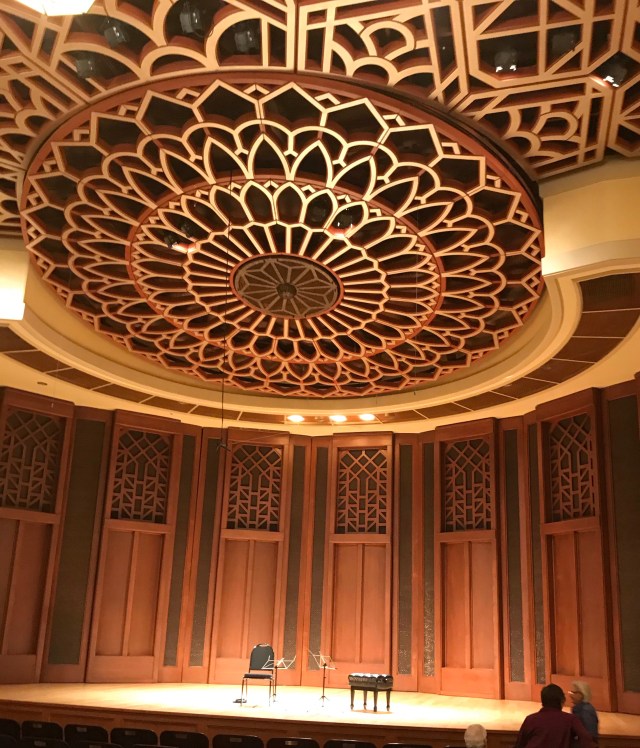
Shot of the stage of Hahn Hall at Santa Barbara’s historic Music Academy of the West (Photo by author)

The beautiful and acoustically excellent Hahn Hall at the Music Academy of the West in Santa Barbara was the venue for a powerful chamber music concert on Saturday, January 25th.  The not too common combination of violin and cello played respectively by violinist extraordinaire Patricia Kopatchinskaja and the equally matched musicianship of cellist Jay Campbell delighted a near full house with a carefully chosen set of pieces from the 642 CE to the present.  Who knew that there was so much music for this combination of instruments and that it would be so marvelously engaging?

kopacampbellMA

Patricia Kopatchinskaja and Jay Campbell in Massachusetts (Photo from Patricia’s web site)

This concert was part of the UC Santa Barbara’s always excellent Arts and Lectures series.  Kopatchinskaja was clearly the big name on the marquee for this event but Campbell was clearly a match both in skill and enthusiasm for this night’s event.

A slight change in the program was announced at the beginning which, if this reviewer heard correctly placed a piece originally slated for the second half of the program in the number two slot on the first half.

The concert opened with an anonymous “Alleluia” from a collection of works only recently (the past 50 years or so) deciphered by scholars.  The slow melismatic voice lines transcribed here for these string instruments was played with the sort of approximate intonation common to so called “period performances” which attempt to provide as much as possible some sense of how the music may have sounded in its time.  It was a slow piece rich in harmonics and reverent in execution.

The next piece, a clearly modern piece from the look of the oversized score on the music stand, was (again if this reviewer heard this correctly) by Hungarian composer Márton Illés (1975- ).  It was the world premiere of “Én-kör III”, a piece that brought us nearly 1500 years forward and evoked the modernist sound world of Darmstadt and the sort of modernism that dominated the 1950s in Europe.  It was a challenging piece for both listeners and players involving special techniques of playing that doubtless made for a fascinating looking score.  On sheer virtuosity and powerful performance alone the piece was well received.  It is complex music that doubtless benefits from repeated hearings and this premiere suggests that that will be the case.  The interested listener would do well to explore the web site of this fascinating composer whose name and music was new to this writer’s ears.

Next up, music by another modernist composer, the German, Jörg Widmann (1973- ).  Two selections (numbers 21 and 24) from his 24 duos for violin and cello (2008) were also of the Darmstadt style modernism mentioned earlier.  The Valse Bavaroise (Bavarian Waltz) had echoes of the 19th century Viennese traditions while the Toccatina all’inglese which followed it was a finger busting virtuosic showpiece, another audience pleaser actually.

Then, as if to cleanse our aural pallets the duo played Orlando Gibbons’ (1583-1625) Fantasia a 2, No. 4 for two “viols”.  As in the opening piece these are transcriptions since the violin and cello as we know them today did not exist.  This little instrumental miniature was a charming and relaxing interlude.

The final piece on the first half of this concert was the too seldom heard Sonata for Violin and Cello (1920) by French composer Maurice Ravel (1875-1937).  This again set the mood to virtuosic modernism.  Even people in the audience familiar with Ravel’s better known works were astounded at the modern sound.  According to the program notes this work was written in the shadow of both the death of his esteemed fellow French luminary Claude Debussy (1862-1918) and the end of the First World War (also 1918).  Indeed there were angry dissonances to be heard but this four movement sonata remains an astounding work and this performance was a powerful and forceful reading conveying the respect that this masterpiece deserves.  It is filled with both jazz influences as well as gypsy music (no doubt dear to the Moldovan born Kopatchinskaja).  And were it not for the visual cues that only two instruments were actually playing one might guess that there were certainly more.  At this point we all needed an intermission just to breathe.

The second half of the concert consisted of (with one exception) music from the region of Kopatchinskaja’s birth.  The Romanian born Iannis Xenakis (1922-2001) produced a great deal of music in the high modernism and experimental traditions but the work which opened the second half of this concert was an early work “Dhipli Zyia” (1951) which sounded much like the work of (also Romanian born) Hungarian composer Bela Bartok (1881-1945) with whom Xenakis had familiarity and, apparently, affection.

The program continued without the punctuation of applause into the 14th century with a work by the French composer Guillaume de Machaut (ca.1300-1377), his Ballade 4.  This is apparently originally a vocal work and was played in transcription for tonight’s soloists.

Again without the transition signal of applause the duo launched into another work which, like the Xenakis, is atypical of his largely modernist oeuvre.  György Ligeti (1923-2006) is perhaps best know for his music’s (unapproved) inclusion in Stanley Kubrick’s 2001: A Space Odyssey (1968).  The work played on this night was “Hommage à Hilding Rosenberg” (1982).  Hilding Rosenberg (1892-1985) was among the earliest Swedish modernist composers and this work was written on the occasion of his 90th birthday.  The piece echoed Ligeti’s affection for the aforementioned Bela Bartok and folk tunes predominated this brief but lovely score.

The duo launched with little pause into a piece by Bartok’s contemporary Zoltán Kodály (1882-1967).  His “Duo for Violin and Cello” Op. 7 (1914) sounded almost like a model for the later Ravel piece heard at the conclusion of the first half of the concert.  This three movement work is unusual in this composer’s catalog in that it is more aggressively modern than much of his more folk inflected pieces (Bartok and Kodaly were early pioneers in ethnomusicology and they collected and recorded a great deal of folk music from the region of Hungary, Romania, etc.)  It was a fantastic finale which garnered the artists an enthusiastic standing ovation.  The smiling and obviously satisfied performers received the traditional bouquets of flowers and returned for a brief little piece (didn’t catch the name) which was a little token of thanks to the equally satisfied and smiling audience.

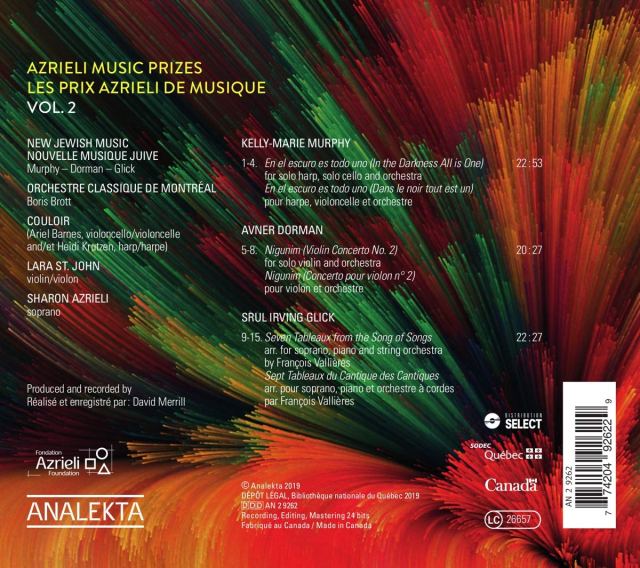
Azrieli Music Prizes Volume II: Jewish Music from Canada


newjewishII

Analekta AN 2 9862

So you read “New Jewish Music” and you think, well, Israel.  At least I did at first.  But the richness of the Canadian musical landscape embraces a wide range of excellent music both pop and classical and this disc (I haven’t heard volume I) serves to illustrate my point. These three works, two for instrumental soloist and orchestra and one for soprano and orchestra are indeed imbued with music that takes its inspiration from the folk traditions common to Jewry around the world.

The musical radar of Canadian producers is truly astounding.  One need only peruse the wonderfully organized Canadian Music Centre web site to get a flavor of which I speak.  You will find classical music by many composers, not just Canadians.  And the range of styles runs the gamut from the experimental (in traditions largely unheard in the United States) to more traditional sounding pieces all of which sound quite substantive to these ears.  Frank Horvat’s “For Those Who Died Trying” made my “best of 2019” list for example.

azrieli2

So back to the disc at hand.  More about the amazing Azrieli Foundation and their various projects is worth your attention.  Their efforts are indeed wide ranging and include the arts most prominently along with their other humanistic endeavors.  The disc includes the 2018 prize winning works by Kelly-Marie Murphy and Avner Dorman along with an arrangement by François Vallieres of the late elder statesman of Canadian music, Srul Irving Glick (1934-2002).

Kelly-Marie-Murphy-495x400-300x242

Photo from composer’s website

Murphy’s “En el Oscuro es Todo Uno” (2018) is for cello, harp and orchestra.  The soloists are the duo Couloir whose album was reviewed previously in these pages.  Its four movements comprise essentially a double concerto (has anyone else done a double concerto for this combo?).  The varied moods in this tonal and melodic work draw the listener in and beg to be heard again.  The piece won the 2018 Azrieli Music Prize.  It is a major work by an established composer whose star continues to rise.

Avner-Dorman-Music-495x400

Avner Dorman photo from the composer’s web site

The second work is Avner Dorman’s “Nigunim” (Violin Concerto No. 2) (2017) with the great Lara St. John on violin.  Winner of the 2018 Azrieli Prize for New Jewish Music, this concerto is a delight to the listener as well as a showcase for a talented soloist.  Imbued with references to Jewish folk music, this piece is a melodic delight.  Like the previous work, the listener will likely find themselves returning for another hearing.

glickinshul

Srul Irving Glick photo from the composer’s web site.

The disc concludes with a lovely setting of some of the much beloved texts from the biblical Song of Songs titled, “Seven Tableaux from the Song of Songs” (1992).  It was originally scored for soprano and piano trio and arranged for this recording for soprano, piano, and string orchestra by François Vallieres.  Glick was known both for his concert and his liturgical works.  These texts have inspired countless composers and will doubtless inspire many more with the beauty of the words.  Soprano Sharon Azrieli is very much up to the task and delivers a heartfelt and lyrical performance.

borisbrott

Photo of Boris Brott form the orchestra’s web site

Last but not least the Orchestre Classique de Montréal under the direction of (too little known conductor) Boris Brott deliver a sensitive and nuanced approach to these works.  All in all an extremely entertaining disc that will likely appeal to a wide audience regardless of religious or political affiliations.  This is just great music making.


Ramón Sender Barayón, Always Going Toward the Light


Raysender

Ramón Sender Barayón at Arion Press in San Francisco (Photo Creative Commons 2011 by Allan J. Cronin)


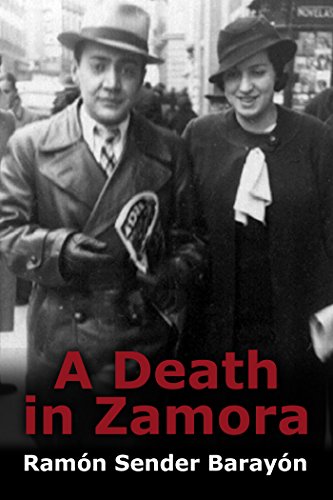
This crowd sourced video opens with a sort of exposition of the various identities of its subject Ramón Sender Barayón (also known as Ramon Sender, Ramon Sender Morningstar, Ray Sender, and Ramon Sender Barayón).  His father was the renowned Spanish novelist Ramón J. Sender whose work was unappreciated (to say the least) by the Franco regime resulting in his spending the last part of his life as an expatriate in the United States of America.  His mother Amparo Barayón fared far less well.  Her short life and her death at the hands of the Franco regime are memorialized in her son’s book, “A Death in Zamora“, an experience which has understandably informed his life.  As a writer, in order to distinguish himself from his father, he adopted his mother’s maiden name appended to his given name.  Happily this and some of his other works are making it to the kindle format.

img_0745

The film unfortunately does not appear to be available in any commercial outlets at the time of this writing but one hopes that Amazon or some internet distributor will make it more widely available.  One small critique is the use of sometimes English narration and sometimes Spanish narration with attendant translation subtitles in the opposite languages is a bit difficult to get used to but hardly an insurmountable issue.

Sender’s personal website continues to be a source of useful information.  Links can be found here to many of his writings and other work as well as some discussion of his musical compositions.

deathzamora

In addition to being a writer he is an acknowledged pioneer in the area of experimental music.  He, along with Morton Subotnick, Pauline Oliveros, Joseph Byrd, William Maginnis, Tony Martin, Joseph Byrd, and Terry Riley (among others) founded the San Francisco Tape Music Center in 1962.  This later became the Mills College Center for Contemporary Music and remains in operation as of the date of this review.  Barayon’s ” novelized history of this time in his life titled, “Naked Close Up” finally found itself in a Kindle release after having circulated in PDF format for years on the internet.  (This history is also further documented in David Bernstein’s excellent, “The San Francisco Tape Music Center: 1960s Counterculture and the Avant-Garde“)

His curiosity and wide ranging interests saw him participating in alternative commune living situations (beginning in 1966) in northern California exploring spirituality and challenging established social norms through the exploration of viable alternatives.  He writes most eloquently about this in his recently published “Home Free Home“, a large edited tome on the Morningstar Ranch and Wheeler’s Ahimsa Ranch which includes material by several other former residents.  The book is as much compilation as it is historical writing and memoir.  It is a fascinating read and is filled with historically significant recollections and commentary by many of those one time residents of these (now sadly defunct) communities.

homefree

This DVD is one of those increasingly popular crowd sourced productions (here is the Indiegogo link) which has allowed independent publication of countless books and CDs and countless other projects which stimulate little interest among traditional venues despite the significance of their content.  The content here is of a profoundly important nature to fans of new music as well as fans of alternative living experiments and 60s counterculture and philosophy.  It is contemporary history and biography.

Ramón is man possessed of both wisdom and humor as well as deep thought.  This film is the first documentary to cover the diverse interest and involvement of this affable cultural polymath.  It begins with an interview of Mr. Sender in the living room of his home in San Francisco.  From there it traverses more or less chronologically among the dizzyingly diverse events which comprise his life thus far.

From his birth in Spain in 1934 to his present role as a sort of spiritual/intellectual guru running a lecture series called, “Odd Mondays” in San Francisco’s Noe Valley neighborhood which he and Judith Levy have managed for some 17 years with a variety of carefully chosen speakers.  The film covers a variety of topics and while it leaves out details at times it is a cogent and balanced biographical documentary.

His early involvement in the establishment of the influential San Francisco Tape Music Center finds him connected with fellow luminaries such as Pauline Oliveros, Terry Riley, Morton Subotnick, William Maginnis, Steve Reich, Joseph Byrd, Tony Martin, and Donald Buchla.  This institution, now relocated as the Center for Contemporary Music at Mills College, saw the creation of a great deal of musical technology and significant musical compositions (Terry Riley’s groundbreaking “In C” was first performed there in 1964).

Sender was one of the organizers of the Trips Festival in 1966 along with Stewart Brand (later of Whole Earth Catalog fame), Bill Graham, Ken Kesey with his Merry Pranksters. Following this he left San Francisco for Sonoma County in northern California.

He states at one point that he has not wanted to be identified with a single career (as his father was) so, following his experimental music work, he became among the first to experiment with communal living in the Morningstar Ranch and later in the Wheeler Ranch in Sonoma County, California.  These are now well documented in his book, “Home Free Home” mentioned earlier.

Happily the film does a nice job of acknowledging the role that his wife Judith Levy has played in his life since their marriage in 1982.  In particular her support in Sender’s research into his mother’s death at the hands of Franco’s thugs in Spain is both sweet and heartbreaking.  The two appear to be constant companions in a mutually supportive relationship he sought for many years.  They are frequently seen together.

A segment of his work which gets less attention here are his fiction and spiritual writings including Zero Weather, Being of the Sun (co-authored with Alicia Bay Laurel), Zero Summer, and Planetary Sojourn.  He has a collection of unpublished manuscripts and is reportedly now working on his autobiography.  Something which will doubtless be worth the wait.

senderchapelchimes

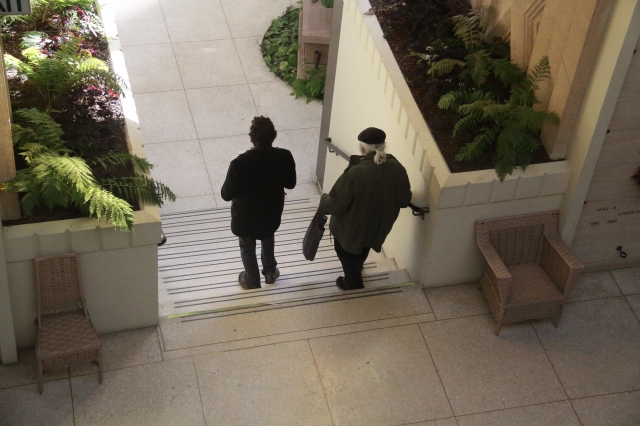
Sender with unidentified man walking out of the Pauline Oliveros Memorial Concert at Oakland’s Chapel of the Chimes in December, 2016 (Photo Creative Commons 2016 by Allan J. Cronin)

Poul Ruders’ Fifth Opera is Another Gem from Bridge Records


Bridge 9257

Bridge records is an outstanding company which has taken on the production of several “complete works” sets of some of the finest 20th and 21st century composers (Elliott Carter, George Crumb, Harry Partch et al).  A combination of excellent scholarship, top notch musicians, and state of the art recording techniques virtually assures that these will be definitive productions.  Any Bridge release is a cause for celebration and this is a fine example of why that is so.

Poul  Ruders  (1949- ) is the subject of one of those complete works projects.  If you like modern classical and haven’t yet encountered this composer you are in for a treat. Ruders is a highly skilled composer with positively lucid orchestration skills. I first encountered his work on the 1988 album Manhattan Abstraction which led my hungry ears to the 1992 Bridge release Psalmodies, then Gong/Tundra on Chandos and now anything with Ruders’ name on it compels my attention.

This release contains Ruders’ fifth opera. It is a relatively brief (all on one disc) but very charming piece in which producers David Starobin and Becky Starobin play multiple roles including as librettists, conductor (David Starobin shares conducting duties with Benjamin Shwartz), and production design all done with loving attention to detail.

13th child

The opera is a charming little fairy tale which showcases Ruders’ facility with drama. Speaking of the composer’s style (this reviewer hears him, especially in his earlier works, as a sort of noisy modernist but one who has not abandoned lyricism) is ultimately a minor detail because his music engages (as opposed to challenges) the listener in the natural flow of the narrative.  This is a very listenable and entertaining little opera whose two acts fit on a single CD.  Included is a set of notes and the libretto in a beautifully designed slipcase.

The opera was a joint commission from the Odense Symphony and the wonderfully adventurous Santa Fe Opera.  It is a fairy tale opera with a happy ending.  I won’t go into detail as to the story except to say that it follows some of the more charming conventions of fantasy including kings, queens, princes, successors, family conflicts, and magical occurrences which move the story along.  The recording is wonderful as per the standards of the Bridge brand and the performances are heartfelt.  Any opera lover will likely love this release and anyone interested in contemporary composition, particularly of the wonderful Poul Ruders must have this record.