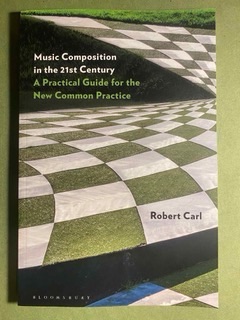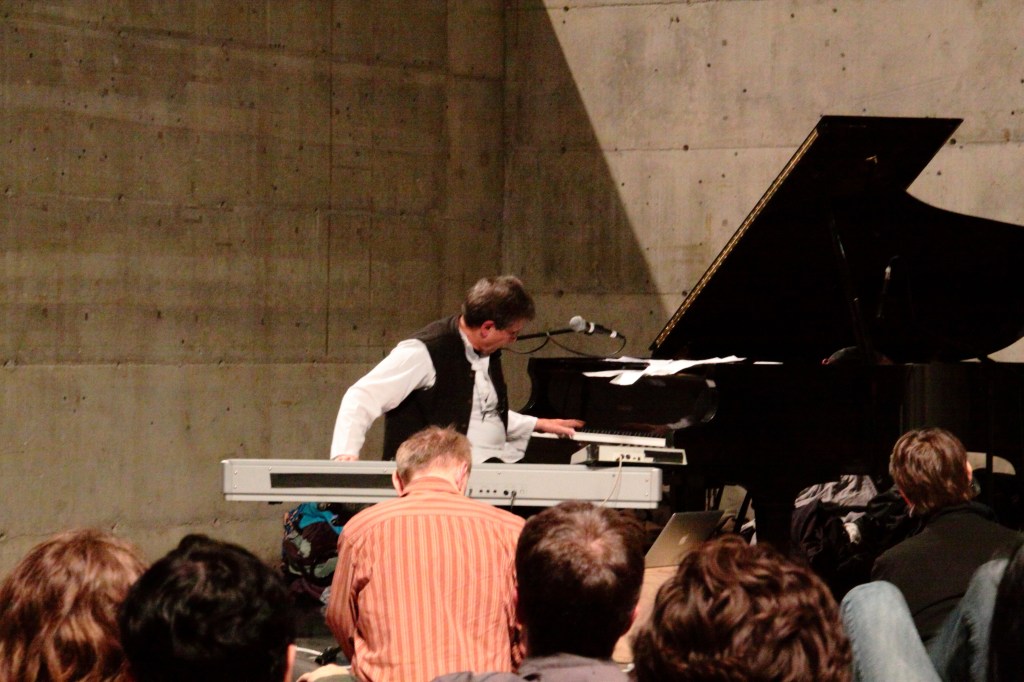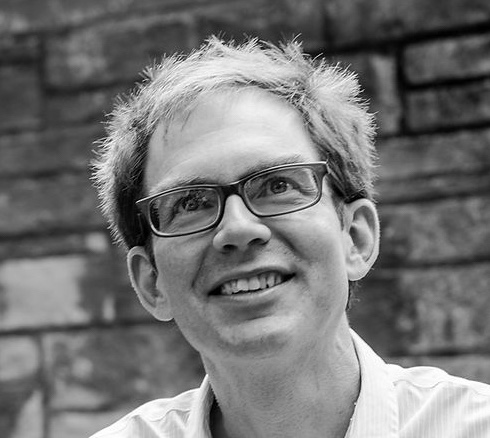
Composer/musicologist Robert Carl gives his perspective of the “new common practice”, a term which attempts to describe the current state of compositional and performance practices. I first heard that term from Alvin Curran, a composer who indulges (most successfully) in a wide variety of musical practices. And the term appears now to be generally accepted by contemporary musicians and music journalists as a way to give a name to this historical moment in music history.
That’s great but Carl’s book goes beyond mere academic musical history and invites listeners of all stripes to experience and engage with these interesting, increasingly divergent practices. His lucid writing gave this reviewer marvelous insights into the current “scene”, the variety of music and performances that adventurous listeners will encounter.
Professor Carl’s earlier publication presented a comprehensive analysis (the last word in this writer’s opinion) of Terry Riley’s manifesto of minimalism, “In C”. That book provided me with insights to a work I thought I knew well. Well, I like it even more after reading that book. And his friendly, knowledgeable writing is very much evident in this most recent tome from one of the finest writers on the subject.
Robert Carl (1954- ) is a prolific composer and a wonderfully readable scholar of music. His music partakes creatively from a wide variety of musical practices so, in that time honored adage, he “writes what he knows”. His passion for new music feeds directly to my insatiable curiosity for what the heck they’re all doing these days. It is an adventure worth your time and Carl is a dutiful docent, offering context and analysis for the eternally curious. You will not be disappointed.
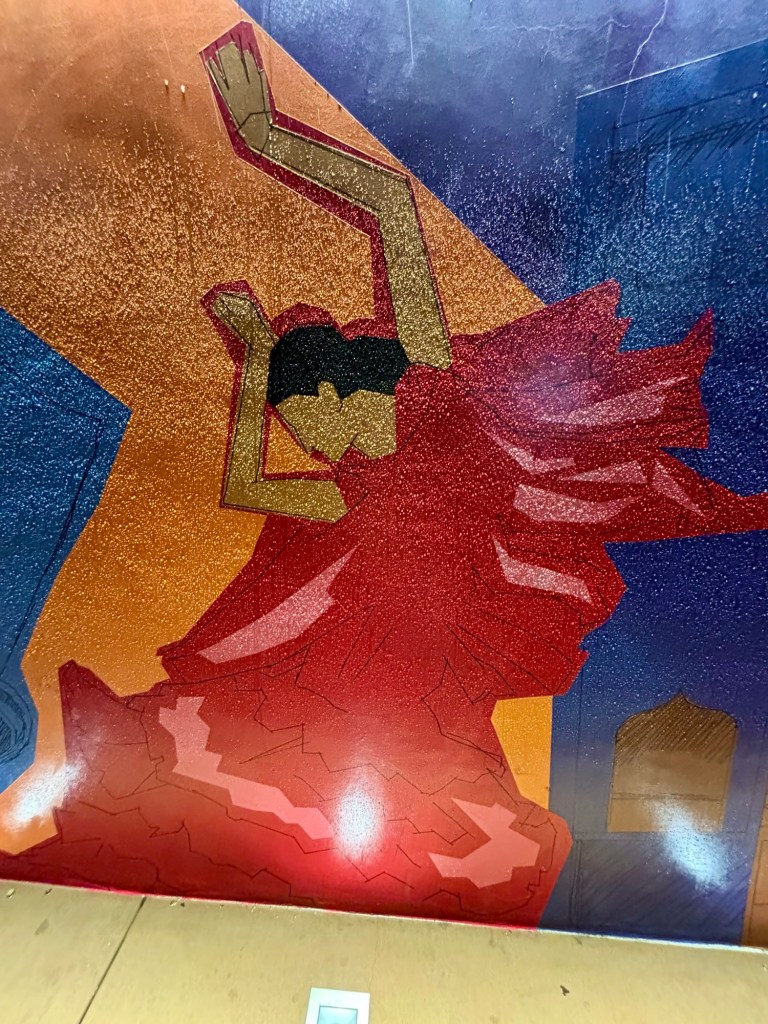
This photo was taken by me on my iPhone. What caught my eye was the effects caused by the raindrops, and the lighting on this commercial mural just off State Street in Santa Barbara. This (mostly) epitomizes the spirit of the title of this speculative essay.
The embattled National Public Radio in the United States happily (in spite of draconian funding cuts) still pursues intelligent discussions on a huge variety of relevant issues present, past, and evolving. Such is the case with a recent series of discussions (some shorter, some longer) that have focused on AI generated music. Of course the primary genre in these discussions is that of “pop” (read “economically viable”). But what of all the music that makes no money? Like mine, lol, but they make me happy.
My point here is not to denigrate NPR, rather to append a perspective on my musings about new classical music and AI. Since I am hardly an expert on this, all I can reasonably do is provide an interesting example that I have stumbled upon.
Henry Lowengard “Living Large”
OK, this is probably my first encounter with AI in music, at least as far as I am aware. It is an album on Bandcamp by a friend of mine. Henry Lowengard is a musician, actor, instrument builder, programmer, hacker, and performer. He was interviewed by another friend of mine who has a radio program out of Kingston, New York. Here is the fascinating program that aired last year in which program host Peter Wetzler interviewed Mr. Lowengard about this album.
Peter Wetzler in his studio
Peter is a composer, pianist, and a driving force in the arts community that is Kingston. His weekly show features music from all times and all places. He frequently plays new music and has introduced this writer to a great deal of music.
So, to the album at hand. Give it a listen. It’s a fascinating album that puts this listener in the mind of composers like Ken Nordine, Robert Ashley, Pamela Z, Charles Amirkhanian, and Laurie Anderson. Not that other listeners will have the same experience.
Henry Lowengard
Give a listen to that broadcast in which Henry talks about how he made the album. That helped me to grasp what was going on. It reminded me of the free floating improvisational texts that comprise Ashley’s operas, in particular, Perfect Lives. The pieces on Lowengard’s album are stream of consciousness. But whose consciousness? Henry’s or AI’s?
Apparently, Henry uses various programs and programs via the large language model of AI. His commands instruct it to produce some kind of music with some kind of texts. He is not actually writing the music or the texts. Rather he is asking AI to interpret his very linguistic ideas to produce both text and sound.
This album surely has its antecedents but, in many ways it also sounds like nothing I’ve heard before. If you like creative experimentation, give this a listen. It is but one incarnation of AI non-pop music. I doubt it will crack the Billboard charts but it made it into my listening queue and I’m glad it did.
İlhan Kemaleddin Mimaroğlu (1926-2012) photo credit unknown, fair use
Portrait of Ahmet M. Ertegun and Nesuhi Ertegun, Turkish Embassy (record room), Washington, D.C., 193- (Photo credit: Wikipedia)
It would be difficult to underestimate the impact of Turkish immigrant brothers Ahmet and Nesuhi Ertegun on the American music industry in the last half of the 20th century with their promotion and production of jazz and rhythm and blues artists. Their lesser known colleague, Ilhan Mimaroglu labored under a slightly different esthetic. In addition to having been involved with the production of many artists’ work on the Atlantic label (including Charles Mingus, Freddie Hubbard, et al) his study of the developing techniques of electronic and tape-based music helped him develop a unique voice as a composer where he worked with electronics, tape, acoustic instruments, musique concrete, and combinations of these media. He was equally skilled in the art of music production and recording and he utilized this knowledge to produce an impressive body of work which deserves to be better known. He also curated the sub label Finnadar to release his own music and that of other artists with similar vision like Anthony Braxton, Frederic Rzewski, Morton Feldman and others.
Mimaroglu wrote a number of works reflecting his political views during the same turbulent years during which Atlantic records shaped the popular soundtrack of the sixties era. Using his knowledge of studio technology in combination with emerging developments in electronic music synthesis he created many purely electronic studies, musique concrete, at least 4 string quartets, solo piano pieces, and more that has yet to be fully catalogued.
First let me clarify the term ‘Agitprop’. This is a hybrid word or ‘portmanteau’ for the terms ‘agitation’ and ‘propaganda’. The word appears to have first been coined and used in conjunction with the Russian Bolshevik revolution and it’s political tactics. The idea was to create a form of propaganda that would not only inform but also encourage action.
This unusual piece, a concatenation of an electronic score, the Freddie Hubbard Quintet, organ, and strings is perhaps his greatest example of Mimaroglu’s brand of political music. It is by no means his only agitprop/ political piece but it may be his finest and one of the best works of this thorny, frequently controversial genre.
The title is a combination of the name of the town (Son My), the location of the My Lai massacre, and the ironic words, “Sing me a song of Songmy”. The collage and non-linear format of the piece actually contains a dizzying mix of concurrent horrors including the Sharon Tate murders and others whose subjects await a comprehensive analysis by a historian and/or a musicologist. The work includes poetry by Fazil Husnu Daglarca, news clippings, etc. Luciano Berio did something similar in his similarly political masterpiece, Sinfonia (1968). That work is rife with musical and textural references subsequently enumerated by the late American composer/musicologist, Alan Stout.
This is also one of the most expensive productions of a mix of evolving musical genres with a strongly controversial and ugly subject. It can stand in comparison to Picasso’s Guernica for its power to provoke. Add the thorny early electronics with the free jazz of Hubbard and the jazz/blues inflected writing, and you have a powerful indictment of war crimes but hardly a best seller. And it is only with the healing of time and the fading of the sting of those memories that this work has begun to be appreciated more fully.
Terry Riley with a t-shirt displaying the entire score of “In C” (photo from Facebook, copyright unknown)
November 4th, 2024 marks the 60th anniversary of the premiere of Terry Riley’s seminal masterpiece, “In C”. After having completed a variety of respectable compositional efforts, Terry Riley (1935- ) was jolted by the Muse to write this defining work that charted a path very different from that of the western classical mold of the composer’s formal education. It premiered in the very unconventional venue of a house in San Francisco, not in an auditorium designed for concerts. And it’s one of those pieces that now marks the transition from almost purely experimental writing to a style later dubbed “minimalism” (though many composers whose music is subsumed under this title eschew it in varying degrees). And whether you call it minimalism, trance music, drone, etc., the style would come to dominate a huge portion of concert works and recordings.
The score consists of 53 short musical phrases with no specified instrumentation and with no conductor’s score, just parts with a seemingly simple set of instructions. One page is what one might expect of a sketch of a larger work to be, not a complete score but, that’s it, One page with the instruction for the musician to repeat each cell or phrase ad libitum and then move on to the next. It was ostensibly the suggestion of composer/performer Steve Reich to have a pianist play eighth note repetitions of the top two highest octaves on the keyboard. In addition to this “click track” like strategy, the playing of those high “C”s also serves to anchor the tonality much as continuo does in that quasi improvisational baroque practice.
There is simply no finer account and analysis of this music than that of Robert Carl’s “In C”. Robert Carl (1954- ) is a teacher, composer, performer, and musicologist. I do not presume to have as extensive an analysis as he does but I’m interested here in providing a celebratory perspective from where I sit (and have been seated).
This music (as does all art) stands in a context with concurrent and recent events surrounding its conception and performance. Temporally it stands along with other notable compositions from 1964: Witold Lutoslawski- String Quartet, John Coltrane (admittedly one of Riley’s influences)- the albums, “Bessie’s Blues” and “Lonnie’s Lament”, Igor Stravinsky- Elegy for JFK and Variations in Memoriam Aldous Huxley (both men died on November 23rd, 1963), Roger Sessions- Symphony No. 5 and his opera, “Montezuma”, Milton Babbitt- Philomel, Karlheinz Stockhausen- Mixtur, Ben Johnston- Sonata for Microtonal Piano, Luciano Berio- Folksongs (written and premiered at Mills College, the later home of the Tape Music Center where Berio was teaching then), Olivier Messiaen- Et Expecto Ressurectionem Mortuorum, Iannis Xenakis- Eonta, and La Monte Young- (the first iteration of his masterpiece), The Well Tuned Piano.
My little list here is just a sampling of the western classical and jazz works that graced the natal year of “In C”. Admittedly, it is a cornucopia of some more experimental, some less so music that lie in this historical orbit. But, among the works in this list, it is the work of John Coltrane and La Monte Young that shares musical DNA with Riley’s aesthetic in this music. The other works contemporary mentioned represent a sort of “Garden of Forking Paths“ to a panoply of styles very different from the work at hand.
At a time when the style of American pop music had just recently met The Beatles, this work was a sort of coalescence of experiments done by La Monte Young, Steve Reich, and others. “In C” seems to have come out fully formed in its way. It was seemingly influenced by pop, jazz, and blues (whose use of repetition is endemic). 60 years later it is performed frequently and there exists at least 40 or so recordings of the work.
When I began writing this article I realized that Robert Carl’s book on this work fully covers the history and provides a definitive analysis to which I cannot contribute anything additionally useful. I then considered eliciting commentary from musicians and listeners about this music but found little interest because that has been well covered by several previous anniversary essays. So I decided to share a discography and photos of some the recordings I could find that have given me further insights into this touchstone work.
This discography is not comprehensive but my intent here is to celebrate this anniversary with the cover artwork that adorns the ever increasing documenting of this landmark of western art music. I will present what I believe is a representative selection of some 40+ versions.
Your humble author was 8 at the time of this work’s premiere. And my first hearing of ‘In C’ was in 1976 when my local radio station, the great WFMT in Chicago, aired a program curated by Raymond Wilding-White, a composer and professor of music at De Paul University. His task was to present representative works of American music, one for each day of the nation’s bicentennial year. ‘in C’ was one of them.
Since then I have heard many interpretations of this work. The original performance was at 321 Divisadero Street in San Francisco, California on November 4th, 1964. The original performers were: Terry Riley, Steve Reich, Jon Gibson, Pauline Oliveros, Stuart Dempster, Morton Subotnick, Warner Jepson, Tony Martin, William Maginnis, and Ramon Sender (who celebrated his 90th birthday this past week). This venue was the second and last home of the San Francisco Tape Music Center before it relocated and was renamed The Mills College Center for Contemporary Music in 1966 in Oakland.
Here, with brief commentaries, are my favorites. There are at least 38 versions according to the Wikipedia article. Here are my personal favorites in chronological order of release date:
The original Columbia Records release (1968)
If you only have one recording this is probably the one you want. Recorded in 1968, this brought the work effectively to a wide audience via international distribution. The instrumentation (some overdubbed) includes: saxophone, oboe, bassoon, trumpet, clarinet, flute, viola, trombone, vibraphone, marimbaphone.
Riley with the Chinese Film Orchestra (1989)
This important recording was made in China around the time of the Tiananmen Square uprising and the tapes were in effect smuggled out of the country in the aftermath of that incident. It stands as a fascinating document of eastern musicians encountering and interpreting this masterpiece.
The 25th anniversary release on New Albion (1990)
Don’t you just love anniversaries? By the time of this release (1989), this work had been disseminated into wide geographic regions and cultures. This version includes many of the musicians who premiered the work and this “traditional” reading is a loving homage to Riley’s work.
The Bang on a Can release (1998)
The Bang on a Can All Stars are among the finest ambassadors of new music. They have earned the right to put their stamp on any new work they choose and subsequently bring it anew to another generation of listeners.
Prog Rock does homage to Terry Riley (2001)
If you want to hear the wide range of musicians who have chosen to pay homage to this work this is a fine place to start.
The Africa Express release (2015)
Another fine example of the way this work can sound from a Central African perspective. This performance from Mali is absolutely electrifying.
Another fine culturally tinged version (2017)
This album is a personal favorite from the Brooklyn based collective featuring instruments from Hindustani traditions and others alongside western instruments. You can read my enthusiastic review here.
There are probably at least 50 recordings of this work. Some are private, maybe even bootleg versions. Clearly this work continues to become more and more essential and influential piece of music. It is not unlike a musical version of the Iconic monolith from the movie 2001: A Space Odyssey. The anomalous structure was of alien origin and was purported to accelerate the evolution of species who encounter it.
Riley’s work is most .definitely of terrestrial origin (well, San Francisco anyway) but, clearly this work continues to intrigue musicians worldwide and has arguably influenced the development of music itself.
After agonizing about writing a “best of” blog and publishing it before January 1, I decided to take a pause and enjoy the holidays. So here I look back on my 2023 in the rear view mirror but with memories still pretty fresh.
Regular readers of this blog likely already know of my oft shared opinion of the superfluous nature of “best of” lists and of my acquiescence in producing such on an annual basis. I certainly don’t think of this as a meaningless exercise and I think the process has grown on me. It is a chance to achieve a perspective which would be missed by simply plowing on ahead with the usual flow of reviews and articles. But drawing down that 12 month perspective is an opportunity to evaluate those months, to see where we’ve been and to hopefully get a smidgen of insight into where I/we are likely headed.
My Facebook friends will recognize the representative meme at the head of this article which is one of the more cloying aspects of “AI”, whatever that is. So indulge me for a moment to look at this seemingly new intrusion into the reality we thought we knew. So, what is “AI” and what will it do to us? Ultimately I’m not the one to answer that question but I’d like to throw some ideas to add to the speculation.
First, the choices a composer makes, like the choices of a painter, a writer, etc. are the stuff of the mystery of creation itself. Why “A major”, or why that tuning, or scale, or rhythm, or orchestration, etc? So along comes the notion of removing, or at least distancing, the artist from their creative product. That notion started not with famed proponent John Cage but rather with Johannes Chrysostymous Wolfgang Amadeus Mozart in his K. 516f musical dice game. Voila! Algorithmic composition (actually fairly common practice in the classical era). An early manifestation of “AI”? Perhaps.
Lejaren Hiller (1924-1994) was the first composer to employ electronic data processing in a musical work in his Fourth String Quartet subtitled “Iliac Suite” in 1957. There followed similar experiments with various iterations of electronic creations at music centers worldwide including The University of Illinois at Champaign, Columbia-Princeton, Stanford, The University of California Berkeley and San Diego, The San Francisco Tape Music Center (later subsumed into the Mills College Center for Contemporary Music, IRCAM in Paris, Israel Electronic Music Studio, and counterparts in the Nordic countries, Germany, Belgium, etc. Proto “AI”?
While historically interesting I raise this issue to say that, as far as I can tell, “AI” has not made this writer’s greatest hits list but it is interesting and maybe even useful. With that, my concern for the subject officially goes to the back burner for a later time.
2023 has been a year of great personal changes for the writer of this blog. A job change, a geographical relocation, and many things unrelated to this blog characterized a busy year for New Music Buff. So here in a sort of holiday tradition I present my “Best of 2023” from my little listener’s corner of the world. For the sake of simplicity I present a more or less chronological exposition of my sonic adventures. (N.B. Not one portion of this article made use of “AI”).
I begin with not with my 20 most read posts, a practice that characterized previous iterations of this annual exercise. Instead I am providing my top 20 favorite releases that were reviewed in 2023. Please note a couple of caveats. First, I receive a lot of review requests, more than I can even listen to, much less give a reasonably intelligent review. Albums that I’ve not reviewed should not be assumed to be bad or insignificant and my reviews are personal observations. I really only review albums that interest me anyway. Second, this article is only one reviewer’s opinion and not intended to be definitive or to supersede anyone else’s opinions. Third, this is not the end of my attention to music that was released in 2023. Some releases require more time to give a fair listen and a respectful review. There are more to come in 2024.
First a few stats: 2023 saw the publication of some 45 blog posts on New Music Buff, earning me 9693 views for the year. I rarely get comments on my posts (though I welcome and invite comments both positive and negative). Not bad, I think, for the overall less appreciated musical styles that fuel my desire to write about.
Now, in chronological order (of publication) are my personal favorites as a listener:
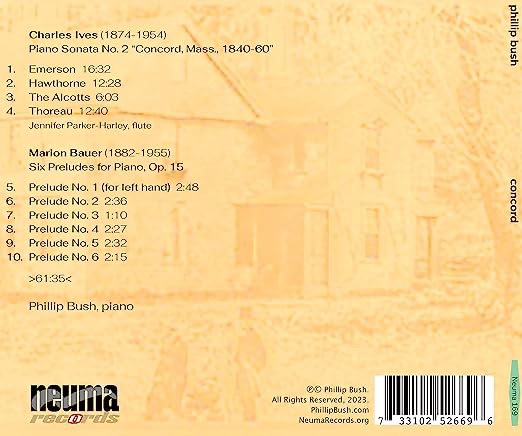
Neuma 158
Binaural Beats in the Tudor Rainforeststarted my new year with a bang. Reviewing this disc required me to take a closer look at the astounding work of David Tudor and his unique contributions to new music. This important release is a recording of a work which, by its own concept cannot receive a “definitive” performance. But this recording comes mighty close, involving “binaural” recording utilizing a mobile set of binaural microphones which are worn by the recordist. In addition this recording involved a collaboration with Pauline Oliveros and a group called, “Composers Inside Electronics”. The recording was done during Oliveros’ tenure at UCSD. Rainforest IV is so called because it is the fourth iteration of the instructions that form the original concepts of Tudor’s composition, “Rainforest”. It is an immersive sonic experience heard on headphones but actually not bad even heard on stereo speakers. A rich and wonderful release.
Starkland S-236
From a 1960s electroacoustic to a budding 21st Century composer Kotoka Suzuki released on the reliably interesting and even visionary Starkland label. Next Gen Electroacoustic: Kotoka Suzukiwill introduce the listener to this rising star who doubtless will produce more of her compelling compositions.
Sony 194399434826
Igor Levit is a fine concert pianist whose albums are effectively redefining the way we, as listeners, perceive the western classical oeuvre. Igor Levit: Defining Tristandoes for the various musical pieces inspired by the Tristan legend what Levit did for the concept of the great keyboard variations in which he selected Beethoven’s “Diabelli Variations” and Frederic Rzewski’s “El Pueblo Unido Variations” to join his recording of the Bach “Goldberg Variations” in a 3 disc package placing these three large sets of variations as emblematic of the genre in three different centuries (18th, 19th, and 20th). Levit, by his recorded output, is providing a valuable perspective which may influence repertory choices for years to come.
Levit’s traversal of the Tristan legend here ranges from the second recording of Hans Werner Henze’s too seldom heard “Tristan Preludes” back to works by Wagner (of course) and Liszt. He even slips in his wonderful solo piano transcription of the Adagio of Mahler’s unfinished 10th Symphony into the mix. This is a very compelling Tristan anthology by a deservedly still rising star.
Cantaloupe
This Cantaloupe release by Bang on a Can composer and master clarinetist Evan Ziporyn is both masterful and great fun. Evan Ziporyn: Bang on a Popconsists of transcriptions of “pop” songs for multiple clarinets all played by Ziporyn via his very effective multi-track recordings. The album is very personal and pretty much cliche free with these engaging and insightful transcriptions. It is an homage to the songwriters as well as a showcase for Ziporyn both as composer and as performer.
Microfest MF 23
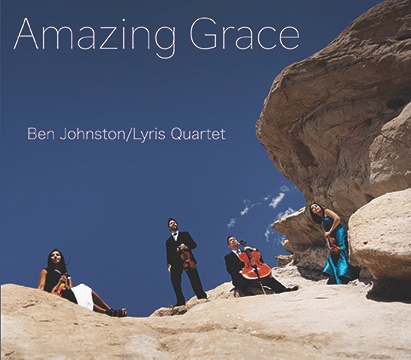
The Young Person’s Guide to Ben Johnston is an ideal way to introduce listeners to the wonderful world of the late Ben Johnston’s music. Johnston, a student and colleague of Harry Partch shows his compositional skills utilizing non-traditional western tunings in these representative works. Johnston here does for some quasi pop tunes what Evan Ziporyn did with his clarinetist perspective for the tunes on Pop Matters. But Johnston’s pretty, accessible work belies fascinating complexities that don’t actually sound complex to the listener. This disc contains Johnston’s last completed work, “Ashokan Farewell” (which Johnston took to be a public domain folk tune but is in fact a piece written by Jay Ungar). It is paired with the 4th String Quartet (a set of ingenious variations on “Amazing Grace”) from 1982 and the 9th String Quartet of 1997. Profound, lovely to listen to, and a great homage.
DVD OM 4001
This DVD is a major addition to the discography of Charles Amirkhanian’s sound poetry as fine sampling of one aspect of Carol Law’s (Amirkhanian’s life partner) complementary visual art. These collaborations are also important contributions to the visual and performative aspect of these collaborative works. Amirkhanian has been a fine curator and promoter of the work of others but he has rather seldom stepped into the spotlight himself. This quirky genre got some fabulous exposure at the 7 day Other Minds 23 festival in 2018 in which Amirkhanian’s work was presented in the (surprisingly varied) context of sound poetry of the amazing international collection of artists who were hosted at those events. This DVD should be in the collection of anyone interested in new music sound poetry and performance art. It is both entertaining and mind bending featuring a juxtaposition of images and sound reviewed in greater detail in the post “Dyadic Dreams”. But words cannot do justice to these works. You really have to see them.
Cedille CDR 90000 210
Readers of this blog know my fondness for the Chicago based label Cedille and their promotion of Chicago based musicians. This disc stands out in this group’s embrace of non-traditional composers alongside more traditional works. The inclusion of works by DJ composer Jlin and the academy based genre defying duo Flutronics alongside composers like Danny Elfman and Philip Glass demonstrate the wide ranging repertoire of Third Coast Percussion. Much more information can be found in Perspectives: Spectacular World Premiere Recordings from Third Coast Percussionon my blog. This one reimagines the percussion ensemble.
Neuma 176
This disc is a good example of why listeners and collectors should pay attention to the Neuma record label. Philip Blackburn, who had been the very successful curator of Innova records, took over the defunct Neuma label which was founded with the intention of promoting largely electroacoustic music though not exclusively.
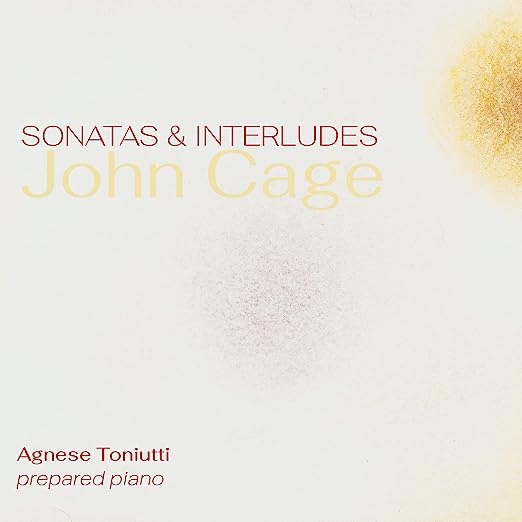
Agnese Toniutti‘s New Music Visionis actually a review of two discs by this rising star, a dedicated new music pianist that needs to be on your radar. The other Neuma disc contains Toniutti’s traversal of John Cage’s reluctant masterpiece, “Sonatas and Interludes for prepared piano”.
The disc pictured here is Toniutti’s vision beyond the Cage work. This one focuses on mostly living composers Lucia Dlugoszewski, Tan Dun, Philip Corner, and Toniutti’s herself. Basically, if Toniutti plays it, you should probably at least give a listen.
2023 saw the completion of Bay Area pianist Sarah Cahill’s epic survey of piano music by female composers. Cahill is another (predominantly) new music focused pianist about whom I would also assert that, if she plays it, you should probably give at least one listen.
The End of the Beginning: Sarah Cahill’s “The Future is Female” Trilogy Completedwill tell you all you need to know about this trilogy which encompasses about 300 years of music history and sheds light on some fascinating and substantial music written by women. Most of the works on this trilogy of albums are, in fact, world premieres but, fear not, even the pieces which are not premieres are likely not in your collection. This is a brilliant selection of music that effectively throws down the gauntlet to challenge other artists to explore this repertory. This trilogy is a true landmark and a joy to the ears.
This third volume in the wonderful Catalyst Quartet’s survey of another unjustly neglected group of composers focuses on the music of three black Americans of the twentieth century. Catalyzing Blackness, Volume Three: The Catalyst Quartet plays 20th Century music by Black Americans was nominated (but didn’t win) for a Grammy Award and, happily, I’m told that more volumes are in preparation. Again, this music is a pleasant revelation that does for black composers what Sarah Cahill has done for women composers (N.B. The first volume by the Catalyst Quartet focused on the black female composer Florence Price). And here’s hoping that Coleridge Taylor Perkinson, George Walker and William Grant Still will become household names in the concert hall.
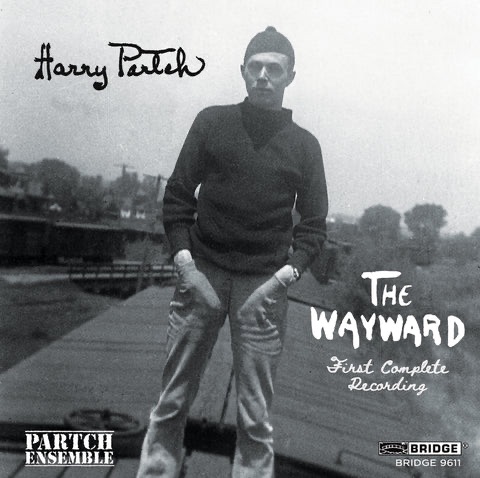
Microfest MF 21
Son of Partch, Carrying on a Traditionis a really wonderful disc which, though I reviewed it in exceedingly positive terms, provoked a strongly negative reaction from the artist. The reaction apparently also provoked enough interest to have made this review one of my most read of 2023.
But, aside from the unfortunate negative reaction, I still maintain that this is a fine release worthy of attention from anyone who likes new music, microtonality, and the music of Harry Partch. Cris Forster is a composer, theoretician, and instrument builder clearly descended from the Partch tradition. His work deserves attention and this disc is a very satisfying experience.
Islandia IMR 011
Steven Schick is a master percussionist and conductor. This release is the first volume of his personal choices of solo percussion repertoire. Solo Percussion Manifesto Volume I: Steven Schick’s “A Hard Rain” is a manifesto of sorts and does for solo percussion music what Sarah Cahill has done for women composers and the Catalyst Quartet is doing for black composers. There are not many recordings of solo percussion music and Maestro Schick essentially presents his favorite works in definitive performances on a label produced by Bang on a Can cellist Maya Beiser. The second volume is in my review queue and, if this first volume is any indication, it will be a landmark survey.
Cedille
Rising Star Seth Parker Woods’ “Difficult Grace” is a Classic in the Making. Here’sanother Grammy nominee that did not win but, this second album by this fine American new music cellist is a winner in my book (er, blog). This is actually the audio of what was developed as a staged performance but the music speaks for itself. Keep an eye/ear out for this rising star who, even now, is storming the new music cello scene in invigorating ways.
Neuma 128
A Reason to Listen: Roger Reynolds’ Latest, “For a Reason”,new recordings on Neuma Records. Here we see Neuma following its original electroacoustic mission with this remarkable set in celebration of Roger Reynolds’s 90th year. This is a lavish 2 CD box set with a beautiful booklet and lucid liner notes. It is a worthy production which showcases recent works by this prolific and important American composer.
Readers of this blog likely are aware of my interest in music that is suppressed and/or neglected so this disc grabbed my attention immediately. Israel does a great job of funding the arts and this can be seen in the proliferation of truly fine performers nurtured by that funding. Less well known are the composers who have flourished in the art healthy politics of this country. Some 50 years of history are represented here. This is but a sampling, albeit finely curated, of several generations of composers displaying a plurality of styles with substantial results. This entertaining disc will whet the appetites of intelligent and curious listeners and, hopefully, bring about more recognition of the world class composers who deserve an audience.
Elon Musk’s rockets could be said to rise more slowly in contrast to this fabulous young artist’s career. His local debut occurred some 50 miles south of that Vandenburg Space X launch pad.
Born to Chinese parents in the waning years of the 20th century in Montreal, this intensely focused man was in command of the stage (and the piano) from the very beginning at the beautiful Hahn Hall of the Music Academy of the West this past May 16th. He continues the launch of one promising career.
Liu’s command of the stage is a combination of dignity, focus, and confidence in his (admirable) skill set that suggests that he can handle anything that he chooses to play. His intensity and focus (along with some challenging tempi) will likely trigger memories of fellow countryman, Glenn Gould. And, while maestro Liu’s skills are his own, he embodies the dignity of grand virtuosi of old who communicate by their artistry, connecting wordlessly but clearly and decisively with their audience.
The selection of music also defined an astute and individual curatorial choice. Yes, this 2021 winner of the Warsaw Chopin competition included Chopin on his program. But he also chose a Haydn Piano Sonata (a too little explored segment of the repertory), classical (Haydn, rather than Mozart), baroque with (Jean Phillips Rameau, rather than Bach, (romantic (Chopin, of course), and 20th century (Prokofiev and Kapustin).
The hall was about 2/3 full by my estimate but the audience seemed quite attentive and appropriately respectful. That’s a good start but adding a soloist such as this cemented a bond with these sympathetic listeners with an auspicious debut by this (just barely pre-millennial) musician.
He became one with that gorgeous Steinway as he introduced the piano sonata Hob XVI:32 by Franz Josef Haydn (1732 to1809). This little gem seemed to echo both the keyboard works of Domenico Scarlatti and the much younger Wolfgang Amadeus Mozart (1756-1791). Haydn wrote some 50? Keyboard sonatas (compared to Mozart’s 17) but Haydn’s are curiously less frequently programmed than those of Mozart.
He continued with another piano sonata, Chopin’s second piano sonata Op.35 (the one with the oft quoted “funeral march”). Liu’s virtuosity and meticulous performance made it clear as to why he won that 2021 Chopin competition in Warsaw.
This writer was not familiar with most of the music on the program. Save for that “Funeral March” and the Rameau “La Poule” the works on this recital were Liu’s intelligent choices of works that have not been frequent visitors to the concert hall. But the works , very personal choices that showcase this artist’s strengths, range, and passions.
The first half of the program concluded Nikolai Kapustin’s (1932-2020) Variations Op. 41. From 1984. The work owes a great deal to the influence of jazz and Liu’s makes a compelling case that this work deserves to be heard with more frequency. The late composer was quite prolific (including 20 Piano Sonatas and a catalog that includes a catalog of some 161 opuses). A standing ovation with multiple curtain calls preceded the brief intermission.
Maestro Liu returned to the stage and delighted the audience with a selection of Jean Phillipe Rameau (1683-1764) from his Pièces de clavecin en concerts (1741), a major set of baroque keyboard works. Rameau was a contemporary of Bach but his work is not commonly featured in recitals. Liu effectively made a case that this work get more hearings.
After the well received performance of the Rameau pieces Liu brought us back to the twentieth century with a performance of Sergei Prokofiev’s (1891-1953) 7th Piano Sonata (1942), the middle work of the composer’s trilogy of the so called “War” Sonatas. It is an outstanding work into which Liu infused his virtuosity, interpretive skill, and sheer energy.
Another 3 curtain calls prompted Mr. Liu to grace us with some lovely encores including a hauntingly beautiful rendition of Johann Sebastian Bach’s prelude in E minor (triggering this listener to think again of Glenn Gould’s unique take on Bach). Liu then followed with a real crowd pleaser, the so called “minute waltz” by Chopin. I didn’t clock his performance but it was as full of the same life and energy as in the preceding works on this fine evening.
This was truly an exciting evening and I advise listeners to seek out anything this artist does. He does not disappoint.
Though this was ostensibly Randall Goosby ’s show, the music making was a wonderfully integrated duo with pianist Zhu Wang, These two fine young musicians shared the virtuosic duties that the music in this concert demands. Both are clearly hard working and dedicated artists. Both have technical and interpretive prowess. And they clearly embody a mutual respect for each other.
Pianist Zhu Wang
The music on the program served to demonstrate the duo’s creative selection of music:
Coleridge-Taylor: Suite for Violin and Piano, op. 3 Brahms: Violin Sonata No. 2 in A Major, op. 100 (“Thun”) Still: Suite for Violin and Piano Price:Two Fantasies Strauss: Violin Sonata in E-flat Major, op. 18
Curiously, due to this reviewer’s lack of familiarity with the violin and piano repertoire and having written some recent reviews of black composers’ music, the only familiar pieces were two of the three pieces by black composers. Now, overall, this is a marvelously chosen set of pieces that reflect the eclecticism and technical skill of both of these musicians.
The classic Paul Freeman conducted set of music by black composers.
The Brahms was perhaps the most familiar to audiences but the other works were equally substantive and worthy of being heard. It is these rather visionary choices that characterizes this duo as fresh and innovative. In addition their obvious knowledge of the music along with their enthusiasm and affection for it conspired to make for a delightful evening and even nudged this reviewer to try to become more familiar with the violin and piano repertory in general.
Samuel Coleridge-Taylor (1875-1912) was a black British composer who has of late had a much needed revival of his music. He was named in honor of the celebrated British poet Samuel Taylor-Coleridge (1772-1834). During his rather brief lifetime, Samuel had been hailed as “the British Mahler but, after his death, his music lay largely fallow until revived by the late, great American black conductor, Paul Freeman (1935-2015). His revelatory series for Columbia records (now Sony) opened listeners’ ears to a fascinating selection of music by black composers internationally.
The Coleridge-Taylor opus 3 Suite for violin and piano (1893) is an early work cast in the high romantic late 19th century style of broad melodies and virtuosic demands. It served as the introduction to an intoxicating evening of (partly) seldom performed works alongside some fairly established works in the repertoire.
The Johannes Brahms (1833-1897) second violin sonata (of three) was written in 1879 and was named “Thun” after the Swiss city where he composed it. The three movements follow the classical fast, slow, fast structure common to this genre.
It is a product of high romanticism and it remains a staple of the repertoire. It, as with most of this composer’s music, is technically challenging for both instrumentalists. It was a fine vehicle to confirm the incredible technical skills of these young artists.
William Grant Still (1895-1978) was one of the finest composers of the early to mid twentieth century. Like Coleridge-Taylor and Florence Price (1887-1953), his music was lauded during his lifetime but was neglected until fairly recently in the aforementioned Black Composers set. These musical choices revealed another aspect of this delightful pair of musicians, that of being essentially musical archeologists uncovering forgotten gems much as Lord Carnarvan’s work availed the world to the marvelous Egyptian art of King Tut’s tomb.
Still’s Suite for Violin and Piano was inspired by three sculptures–Richmond Barthé’s African Dancer, Sargent Johnson’s Mother and Child, and Augusta Savage’s Gamin. Written in 1943, it synthesizes elements of blues, pop, and classical music to create musical description of this ethnically inflected visual art.
Richmond Barthé’s African Dancer
Sargent Claude Johnson’s Mother and Child (ca. 1932)
Augusta Savage’s Gamin
The three movements comprise essentially tone poems based on the visual artwork. It was after the second piece, depicting the Mother and Child sculpture that the spell cast by the duo’s that revealed the “Thrall” of this blog’s title.
Goosby embodies a calm and casual confidence and he let the audience know early on that it is OK to applaud after a single movement if you are so inclined. He has a warmth that put the audience at ease, embracing us in a most genial manner. There is, of course, nothing wrong with musicians who might seem more aloof but Goosby’s warmth was both generous and welcome. However, it became clear that this audience, after hearing that gorgeous second movement so beautifully played, paused in a seemingly hypnotic response to the impassioned performance that captured the beauty of the music. It felt as though we had become collectively and deeply engaged. That is the meaning of “thrall” and that was a beautiful experience that spoke of connections between composer, performers, and audience that represent the pinnacle of the art of chamber music performance. All three movements were wonderfully executed but that moment and the collective reaction was a truly moving experience.
Following a brief intermission we got to hear both of Florence Price’s two Fantasies for Violin and Piano (1933, 1940). Though I’ve become familiar with much of Price’s work (her three surviving symphonies and Goosby’s own reading of her two violin concerti have been released in the last couple of years) I had not heard these fantasies before.
Though written only seven years apart, the works embody distinctively different qualities. Both are certainly “capricious”, embodying a variety of moods, but the second is a bit longer and seemed to reflect the composer’s maturing style. Both works were enjoyable and seemed to please the audience.
This led us to the final work on the program, the Violin and Piano Sonata (1888) by Richard Strauss (1864-1949). Best known for his big orchestral tone poems and his grand operas, this was an early work which has found an audience due to its lyrical and friendly character.
It is cast in three movements, and it was at the end of the slow movement that we again saw/heard a sort of “agreed upon” silence in which the audience seemed to have shared a deep impact from that lovely movement played so passionately. No one applauded as a reverent silence came upon us.
The much busier third movement again presented the virtuosity and broad melodies of high romanticism. And there was applause and, much deserved standing ovations. It was a joy to have heard these talented and hard working musicians in an ecstatic night of chamber music.
It is the duty of performers to infuse their performance with their nuances of interpretive skills until they (and, hopefully, composer and audience) are satisfied that they are doing justice to the music. When the music at hand challenges established norms and expectations that task becomes quite large. One need only look at the plethora of performances of Terry Riley’s seminal “In C” to realize that the nature and structure of this piece invites, by design as it were, experimentation with instrumentation and experimentation with the music itself which consists of 51 short notated cells.
This is the whole score
The original release in 1968 has been followed by at least 40 recordings reflecting choices made related to tempo, instrumentation, etc. In an earlier review of the “In C” version by Brooklyn Raga Massive, I addressed the inherently heretical nature of this music in light of the etymology of the term “heresy” (derived from “hairesis”, the Greek word for decision or choice). And this music demands intelligent choices.
This 1964 composition has been definitively analyzed in Robert Carl’s fine volume, “Terry Riley’s in C” so interested readers should seek out this book for definitive analytical detail. My main point here is that the musics elicits the making of choices much more so than the traditional western classical notated score. And the present release says nearly as much about the performer/producer, as it does about the composer. It is Maya Beiser’s expertise on her instrument, certainly. It is her experience performing at the center of the new music performance scene to have a definitive grasp of the pluralities that are the nature of new music. And, finally, it is her daring to make choices that threaten to make her not merely a performer but virtually a co-composer. All that with managing to flatter the composer and engage adventurous listeners. She did something similar in her Philip Glass album. She even did it with her recording of the Bach cello suites. Now that’s heresy at its best.
There can never be a definitive recording of this work. That is a huge part of this music’s charms as well as its importance as a challenge to the very nature of western classical music. The music itself is heretical.
Not all listeners may appreciate this significantly new, innovative, and very personal performance but the composer shared an appreciative blurb on the album’s back cover and the reviews this writer has seen have been unanimously positive.
Beiser’s use of harmonics and, indeed, quite a few of her instrument’s extended capabilities (pizzicati, harmonics, etc) all conspire to her revisioning of this music. On top of that she even uses her own voice and employs two percussionists to round out her orchestration of the work.
The percussion accentuates the ritual nature of the music. The harmonics and multiphonics place this version in the spectral realm of new music and even suggested to this listener the Phil Spector “wall of sound”, another hallmark of some ritual musics.
It is an album that invites repeated hearings to grasp the subtleties and insights of this interpretation. Beiser here, even at her most transgressive, is not seeking to supplant other interpretations, rather she simply shows the power of this landmark work to inspire another generation of talented performers (and enlightened listeners, for that matter) to experience the enduring cultural significance of this masterpiece. Brava, Maya! And sincere thanks, Terry.
There is an aptness that accompanies the publication of my first blog of the new year. Much as we aspire to review our past year and resolve improvements for the next, this book effectively plays a similar role.
Arnold Schoenberg (1874-1951) was born into tumultuous times. His life intersected with political change, social changes, two world wars, and huge changes in the way music would be written and heard. His life and the above mentioned changes in the world are the subjects of Harvey Sachs’ relatively brief review of Schoenberg’s life and career. But the relative brevity does not sacrifice the apparent aim of presenting this composer’s work in the context of the times thereby providing the reader/listener with a perspective that aids an understanding of the man, his music, and his (arguably still evolving) place in history.
“You can see it isn’t easy to get on with me. But don’t lose heart because of that.”- Arnold Schoenberg
At 272 pages this book wisely focuses on the composer’s published work and the drama of its performance along with critical and audience responses. This is not a comprehensive review of all things Schoenberg. While Sachs makes references to the composer’s earlier works, he focuses primarily on the published music and the responses of musicians, critics, and audiences. More importantly he focuses on the massive socio-political changes that paralleled the music thereby providing a useful context for future listeners and performers to better understand Schoenberg and his place in musical history.
Sachs places less emphasis on the composer’s paintings and even his writings. What the author achieves is a very readable and understandable essay that listeners (your humble reviewer included) can use to take another look/listen and to come to a new reckoning of Schoenberg and his place in the world. To, as the subtitle suggests, better understand, “Why he matters.”
I must admit that I did not understand and appreciate the music of Arnold Schoenberg immediately, and even when I ventured to read this volume, I found that my familiarity with this composer was limited primarily to “Transfigured Night”, “Pierrot Lunaire”, the “Second String Quartet”, Moses und Aron” (the Solti recording), Piano Concerto, Violin Concerto, the String Trio, and a fleeting listen or two to the piano music.
The joy of this book was in its chronological exposition of all of the composer’s major works and their historical and political contexts. As a result I found myself listening for the first time (or at least the first in many years) to the two chamber symphonies, the other string quartets, etc. It was an opportunity to reset my perceptions/misperceptions and acquire a better understanding and appreciation of his oeuvre.
As Sachs concludes:
“There are cycles in the arts. Perhaps we have reached the end of one great, centuries long cycle of individualistic European Art Music and its global offshoots. We cannot know. But, in the unlikely case that the subspecies Homo Sapiens Sapiens doesn’t destroy itself in the meantime, there is good reason to expect that sooner or later a new cycle will begin. And, for now, we have an enormous treasure of outstanding creations that continue to speak to anyone who is willing to listen to them.”
Just had to post this for all my readers and friends but especially those living near or able to get to Rome. Curran’s wife, Dr. Susan Levenstein, graciously sent this announcement to me. She is an American physician (and webmaster).Her very entertaining memoir, “Dottoresa” is her accounting of moving her practice to Italy.
Alvin Curran, (1938- ) is the co-founder of the seminal live electric music performance group, “Musica Elletronica Viva” along with his late colleagues Frederic Rzewski (1938-2021) and Richard Teitelbaum (1939-2020). The group formed in 1966 and later included kindred spirits including George Lewis and Garrett List among others. The group did its final tour in 2016.
Click on Curran’s name to look at his fascinating and well organized website which gives a fairly comprehensive accounting of the incredible range of musical styles and a very large bevy of collaborators.
Curran discussing some of his work with interviewer Charles Amirkhanian in Berkeley in 2016 (photo by Allan J. Cronin)
Curran, who taught at the venerable Mills College in Oakland, California is an always welcome visitor in the Bay Area. While he has made his home in Italy for many years now, he is truly an artistic citizen of the world. The warm and affable composer exudes an infectious enthusiasm which doubtless is why he has so many collaborators. His aesthetic which he documented in an article called, “The New Common Practice” in 1994 documents his all inclusive style, one that is very difficult to convey. His works include music for piano, chamber ensembles, orchestra, and even things most folk never thought of as musical.
He is a giant in late twentieth and early twenty first century music and this retrospective is most welcome.
“HEAR ALVIN HERE”
ALVIN CURRAN
…a retrospective
part of the #CHAMBERMUSIC series
The show consists in a listening room where a new sound work plays continuously—a mixtape comprising fragments from many different compositions, improvisations, and installations. It leads the audience on an autobiographical listening journey, freely mixing styles, periods, and languages, from free improvisation to Fluxus to Artificial Intelligence, from compositions for shiphorns to works for hundreds of musicians, from Sargentini’s L’Attico and the Beat 72 to MAXXI and the Tate, from Angelo Mai and The American Pavilion of Expo 58 to No Mans Land and the Théâtre de Chaillot.
The Museum of Contemporary Art of Rome (MACRO), Via Nizza, 138
inauguration September 20, 2023, from 6 pm to 9 pm
running until March 17, 2024
***************
Curran in performance at the Pacific Film Archive in Berkeley in 2014.
Roger Reynolds (1934- ) turns 90 next year. This prolific American artist’s work is being collected and preserved by the Library of Congress. The present recording is the most recent release documenting Reynolds’ music, now numbering about 30 CDs and DVDs. And this is but a fraction of his musical works.
I first encountered Reynolds’ music when I heard a broadcast of the first commercial recording of his music. The disc, released in 1969 on Nonesuch records documented performances of Frederic Myrow’s “Songs from the Japanese” (1964) paired with Reynolds’ “Quick are the Mouths of the Earth” (1965), a work that actually uses the text of the title to derive the music. I recall that the sound of this music sent chills up my spine and sent me to a record store to purchase a copy. This first encounter was a visceral experience, one of many I would encounter as I heard his subsequent music, and that of his contemporaries.
Reynolds has been a prolific composer, writer, and reader. His father was an architect, Roger would go on initially to study engineering and then also encountered some of the new interest in experimental music at the ONCE Festival in Ann Arbor, Michigan in the early 60s. His studies in music and literature continued to be wide ranging and the fine liner notes by Thomas May in “For a Reason” are extremely useful in grasping the range of inspirations that inform Reynolds’ music. This is one of those gorgeous new music releases that will likely become one of those odd but much sought after collectibles. The booklet jdesign by Karen Reynolds, Stacie Birky Greene, and producer Philip Blackburn is by itself, worth the price of this release.
While listeners can certainly appreciate Reynolds’ work without those details, they add a dimension of understanding and provide contexts as well. In some ways, Reynolds is unclassifiable but this writer finds him to be the consummate experimentalist and modernist, two aspects that appear to have been in his work from the very beginning. His work is rarely easy listening but, even if you don’t get it on first hearing, his compositions tend to reveal weight and substance with repeated listenings.
That said, Reynolds’ music produces sounds that might be heard as romantic, expressionist, and even classical at times. Much of his work, as is the case with most of this 2 CD set, is electroacoustic. It is not heavily dissonant or overly complex to the listener’s ear but his music presents unique challenges to performers. And, as mentioned, this beautifully designed set includes a decent set of liner notes to help navigate this voyage.
Three of the four works here are “electroacoustic”, meaning that some form of electronics interacts with the performer. The one work that does not fit that category pretty much needs it’s own category. Pieces for speaking pianist are getting more common in the last 20 years or so but pieces for speaking percussionist are far less common. Frederic Rzewski’s “To the Earth” for speaking percussionist playing on clay flower pots comes to mind. Of course John Cage also wrote in this genre but Reynolds’ essay is the longest, most complex work this listener has encountered for solo percussionist with speaking duties.
The first track is “Dream Mirror” (2010), the first of Reynolds’ “Sharespace” series of compositions in which an instrumental performer interacts in the shared performance space with a computer musician in a duet. This first sharespace work is for guitar and computer musician. It features the fine Mexican guitarist, Pablo Gomez Cano. The fact that Cano is not a familiar name is likely that his work has focused on challenging new music such as this. Dream Mirror is a big work, at over 20 minutes in performance, but it has a chamber music quality consistent with the composer’s focus on the interaction of this duet in their shared performance space.
The second track introduces listeners to the fourth in the Sharespace series, this time, for violin. “Shifting/Drifting” (2015) was written for Irvine Arditti, one of the finest working musicians of our time supporting new music via his solo efforts and his work with his esteemed “Arditti Quartet”. Like the preceding track, this big duet takes some 20+ minutes in performance.
On to CD 2 for the third offering, “Here and There” (2018), both the longest work and the most recent. This one is for solo percussionist with a substantial speaking part designed to be spoken by the percussionist (in this case, Steven Schick, one of Reynolds’ fellow faculty at UCSD). Solo percussion works are relatively uncommon, though readers will want to familiarize themselves with volume one of Mr. Schick’s ongoing series of the solo percussion repertoire Hard Rain.
This will likely become a showpiece but, at the time of this writing only Schick and the ubiquitous William Winant come to mind as being both willing and able to perform this work right now. And it is apparently a beast of a challenge for the performer but remarkably engaging for the listener. The texts, from Samuel Beckett, are referenced in the liner notes. Not surprisingly, Schick delivers a stunning performance, setting a bar for successive performers and performances. The texts are non-narrative and have a more musical than didactic or dramatic function.
Last but not least is the earliest work on the album, “Sketchbook”(1985), originally written for Joan LaBarbara but never performed. Here, singer, Liz Pearse effectively took a page from Irvine Arditti (whose doctoral studies resulted in research that culminated in John Cage being able to finish his partially completed solo violin work, “Freeman Etudes”). Pearse, also pursuing doctoral studies came upon this work and collaborated with Reynolds in creating a performance. His texts here come from Milan Kundera. The work, while dramatic and challenging, is not a species of opera or monodrama but, like the preceding works, a piece that, like Reynolds, thrives on collaboration. In addition to requiring some pianistic skills, the singer collaborates with interactive computer electronics.
These four works, despite their differences, clearly fit Reynolds’ interest in literature, collaboration, and in various technical aspects described in the well documented liner notes. Those notes provide technical detail and insights beyond the scope of your humble reviewer’s skills but what I can tell you is that this release is a marvelously engaging experience revealing fascinating aspects of this composer’s work.
The experience of listening and reading and the visual experience of the graphics was an immersive one and a delightful use of my time. Heads up to all my fellow new music aficionados. This is truly spectacular.
Every solo artist, regardless of what instrument they play seeks to define themselves. Generally that means setting limits. Some set limits by specializing in an era (baroque, classical, etc.). Some specialize in working with electronics, some with jazz, some with experimental music, some with standard recital repertoire, etc. Seth Parker Woods (1984- ) seems almost unaware of such limits. He plays what he chooses. And, oh, what choices. From standard classics to the leading edge of musical creativity woods is poised at the beginning of a very promising career.
Seth Parker Woods (photo from his faculty page at USC Thornton School of Music)
This album is in fact the musical portions of what was produced as a staged presentation with Woods playing, singing, talking. No doubt something is lost without the staging but Woods’ asserts himself with great clarity on the sonic aspect alone. Think of this as a sort of cast album, though it is more than just a souvenir. It is Woods’ second album and it has this writer enthralled at where he may go next. You will be too.
Parker’s first solo release “asinglewordisnotenough” available on bandcamp reveals his dedication to new and recent music.
I feel privileged to have known this artist via digital media and to have watched with increasing interest his development as a true rising star in the new music world. I only recently acquired his first album via bandcamp. It was released “across the pond” when he was completing his Ph.D. at the University of Huddersfield.
Born in Houston, his father, a jazz and gospel singer, Woods was exposed to a great deal of music. He rehearsed in a home studio and somehow came to a fascination and deep appreciation for a wide variety of repertory.
His affiliations continue to be wide ranging from Peter Gabriel to George Lewis. He has appeared on many recordings but this is only the second disc dedicated entirely to Woods as performer and the first such solo efforts on a US label. Woods is apparently able and willing to tackle music of all eras and genres including the wildly experimental, like his “Ice Cello” homage to Charlotte Moorman and the theatrical, which brings to the the album at hand.
Track listing.
Four of the seven works presented are world premieres. And, despite this being a sort of “cast album” which lacks the visuals, this is a major release that presents a characteristic variety of musical choices and is a fine calling card for the artist. This is one classy production.
Frederic Gifford (photo from composer’s website)
He begins with the title track, “Difficult Grace” by Chicago based composer Frederic Gifford (1972- ). It is a setting of poetry by Dudley Randall subjected to some Cageian mesostic like manipulation. This first track tells us we are dealing with modern music and sort of sets the tone of this project. This is a complex work in concept (lucidly described in the composer’s notes) and involves projections of the texts onto the performer as well as electronics which, by careful use of both the sounds and the spoken text (spoken by the cellist) which then contributes to the musical structure. Photographs in the booklet show some of the striking visual design for this project.
Coleridge Taylor Perkinson (photo from Wikipedia)
Woods follows with what is to this listener a stunningly beautiful piece, “Calvary Ostinato” (1973) by the late, sadly neglected Coleridge Taylor Perkinson (1932-2004), a black American composer (actually represented admirably in a fine earlier Cedille release CDR 90000 087). The Ostinato is one movement from Perkinson’s “Lamentations: Black/Folk Song Suite For Solo Cello” (1973). Woods’ performance is available on YouTube. It’s truly enthralling. One gets the feeling that Woods really gets inside the music he performs and that deep feel for the music is delightfully obvious in this track, the second oldest work on the disc and one that is for the solo cello sans electronics or vocals but using a dazzling variety of extended instrumental techniques, none involving a bow.
Monty Adkins (photo from electro cd website)
Then we hear Monty Adkins’ (y. 1972- ) “Winter Tendrils” (2019) written for cellist who, in addition to playing his instrument, is asked to use his voice and work with electronics, albeit in a different manner than the title track. Adkins worked closely with Woods on the creation of this work. The work essentially an impressionistic piece with clever use of counterpoint to depict fresh fallen snow on the branches of a tree.
Nathalie Joachim (1983- ), a Haitian-American vocalist, flautist, and composer, is represented by two works. The first, “The Race 1915” (2019), a work that contributes to the Chicago centered Cedille label by its use of historical quotations from The Defender, a major and influential black newspaper in Chicago. Woods is again asked to use his vocal skills in this work which celebrates efforts to undo social inequalities.
The multitalented Joachim lends her vocal skills to Woods’ performance in Joachim’s second piece on the album, “Dam Men Yo” (2017). The title is Haitian Creole for “they are my ladies”. It is a sort of black feminist peaen celebrating the strength of the women with whom the composer was raised in her native Haiti. (NB: Haiti is the site of the only successful slave revolt in history, a fact that continues to be reflected in their turbulent politics).
Alvin Singleton (photo from Schott website)
In between those two pieces we get to hear perhaps the best known composer in this mix, Alvin Singleton (1940- ). Singleton is represented by “Argoru II” (1970) for solo cello (the Argoru series is a set of pieces for solo instruments akin to Luciano Berio’s “Sequenza” series). The title is from the Twi language (spoken in Ghana) and translates as “to play”. It is a virtuosic piece employing extended instrumental techniques which Woods accomplishes with almost supernatural ease. He does honor to this living elder statesman of American music.
Ted Hearne (photo by Jen Rosenstein from composer’s website)
And here we are back in Chicago now with Maestro Woods’ performance of a work by Chicago born composer Ted Hearne (1982- ), a name which did make it to this writer’s musical radar but one whose work I have just begun to explore. But this is a fine example of one of the reasons for my admiration for Woods’ scope of musical interest. I think he is one of those artists to whom I will turn to look for good new music. His instincts for repertory choices are amazing.
This is perhaps the most unusual entry on this disc as well as one that, if any controversy is forthcoming, it will likely originate with this set of songs to poetry by Keri Alabi. A casual listen to some of Hearne’s music on YouTube suggests a sort of post minimalist ethic but this last work is not discernibly minimal. Like the music that preceded it, this cycle is overtly about politics and equality.
Hearne’s little 6 movement song cycle is a combination of poetry, electronics, cello (of course), and the voice of said cellist. Hearne’s expletive title, “free fucked”, is apparently very much in line with the composer’s assertive and playfully humorous style.
We return in these tracks to the avant garde and complex with which the album opened. Again we have a multitasking role for the cellist demanding his vocal participation and working in a distinctly electroacoustic genre. Hearne lends his voice to the final track of this unusual work.
While political themes and references abound in this release it is as much about black politics and civil rights as well as feminist, gender, and global equality issues. But ultimately this recording is a landmark in the career of this fine young musician who works fearlessly with a variety of composers, poets, designers, political activists, progressive ideas, and new music in general.
Cedille is one of my top favorite new music record labels and has been since they first started in 1987. Their releases (not limited to new music) are consistently well recorded and produced but producer James Ginsburg really pulls out all the stops on this one. From concept to recording, from lucid liner notes to gorgeous package design this has all the marks of a classic and collectible release. I mean, the music is great, but the whole package is something you’ll want to own. That’s right, I’m calling for “collector’s item” status here. Now is the time to get your copy.
Steven Schick is a multi-talented and skilled musician. A quick look at his website demonstrates the sheer scope of his musical career. He is probably best known as a master percussionist having played with the San Diego Symphony and a host of others internationally. He is also a fine conductor and composer. His website is a must visit to grasp the scope of this man’s work.
Steven Schick (photo from composer’s website)
Now, solo percussionists are somewhat of a rarity even in the 21st century. Percussion is ostensibly the “junk drawer” of the orchestra by which I mean it becomes the home to pretty much anything that doesn’t fit into the categories of keyboards, strings, woodwinds, and brass instruments. Anyone who has studied any theoretical taxonomy knows that you have to have a “junk drawer” (so to speak) to place things that don’t fit elsewhere at least until you can find a useful category in which to place them. The point here is that a solo percussionist has a huge amount of instruments from which to choose and subsequently master (some of which might also fit other categories like piano, harp, etc. but also things like taxi horns, for example, which Gershwin used in his tone poem, “An American in Paris”). Add to that the artists who regularly add instruments to this group and the task of mastering these becomes even more daunting.
Percussion, aside from tympani and the occasional military drum is largely absent from western music. That began to change with the work of Henry Cowell, John Cage, and Lou Harrison in the early 20th century. As interest grew, so did repertoire.
Despite attending many contemporary music concerts I cannot recall any by a single percussionist. Percussion ensembles began to appear in the early 20th century including Paul Price (1921-1986), Donald Knaack, and Les Percussions de Strasbourg. After 1962 or so the number of percussion ensembles increased along with a rapidly growing repertoire.
With this release Steven Schick begins what appears to be the first of a multi-volume survey of works for solo percussion under the collective title of “Weather Systems”. This first volume is subtitled, “A Hard Rain”, a two disc set that is both manifesto and innovation. It is released by Bang on a Can cellist Maya Beiser’s Islandia Records, not to be confused with the pop music Island Records.
Schick’s book on percussion published in 2006 is a sort of precursor to this CD release.
Here, Schick appears to be doing two related things. First, he is establishing a repertoire for the solo percussionist. And, second, he is presenting his own insights and ideas to both define and expand that repertoire. Having already released definitive recordings of percussion music by Xenakis and Stockhausen, among others, he is apparently ready to blaze a trail that will increase the possibility of hearing a solo percussion concert and establishing a canon of music for those concerts.
There are 7 works (3 by German composers, 4 by American composers) on these two discs largely focused on mid 20th century works and presented (mostly) in chronological order:
1. John Cage (1912-1992) 27’10.554” for a percussionist (1956) arguably one of the must difficult of the pieces here. It is more like a set of tasks than a conventional score and may be the first great solo percussion piece.
2. Karlheinz Stockhausen (1928-2007) Zyklus (1959) experimenting differently from Cage but producing a similarly difficult and masterful work.
3. Morton Feldman (1926-1987) “The King of Denmark” (1964) the second name in the self defined “New York School” of composers, this is about soft sounds and, like the Cage work, unconventionally scored.
4. Charles Wourinen (1938-2020) “Jannissary Music” (1966) a lifelong devotee of post Schoebergian 12 tone music manages to be relevant. And this one of his earliest masterpieces.
5. Helmet Lachenmann (1935- ) “Intérieur I” (1966), this is among the earliest acknowledged works by this prolific German composer.
6. William Hibbard (1939-1989) “Parson’s Piece” (1968), an early work by an artist who died in mid career.
7. Kurt Schwitters (1887-1948) “Ursonate” (1922-1932). This realization of Schwitters’ spoken vocal score is a modern revisioning of this unusual dada-like work. Many recorded versions exist (including one by Schwitters) demonstrating a surprising diversity of interpretation, sometimes with visual components. This is actually pretty frequently performed but this is the first version explicitly designed with a percussionist in mind. It is here that Schick is at his most transgressional and creative. In addition to his percussion Schick includes his voice in the mix and teams with Sharokh Shadegari on electronics and voice. This is the only non-solo work on this set and it is a radically effective take on Schwitters’ strange opus.
All are engaging and all will thrill percussionists who work in new music as well as new music enthusiasts. It remains to be seen if solo percussion performances begin to proliferate but, after all, this is only volume one.
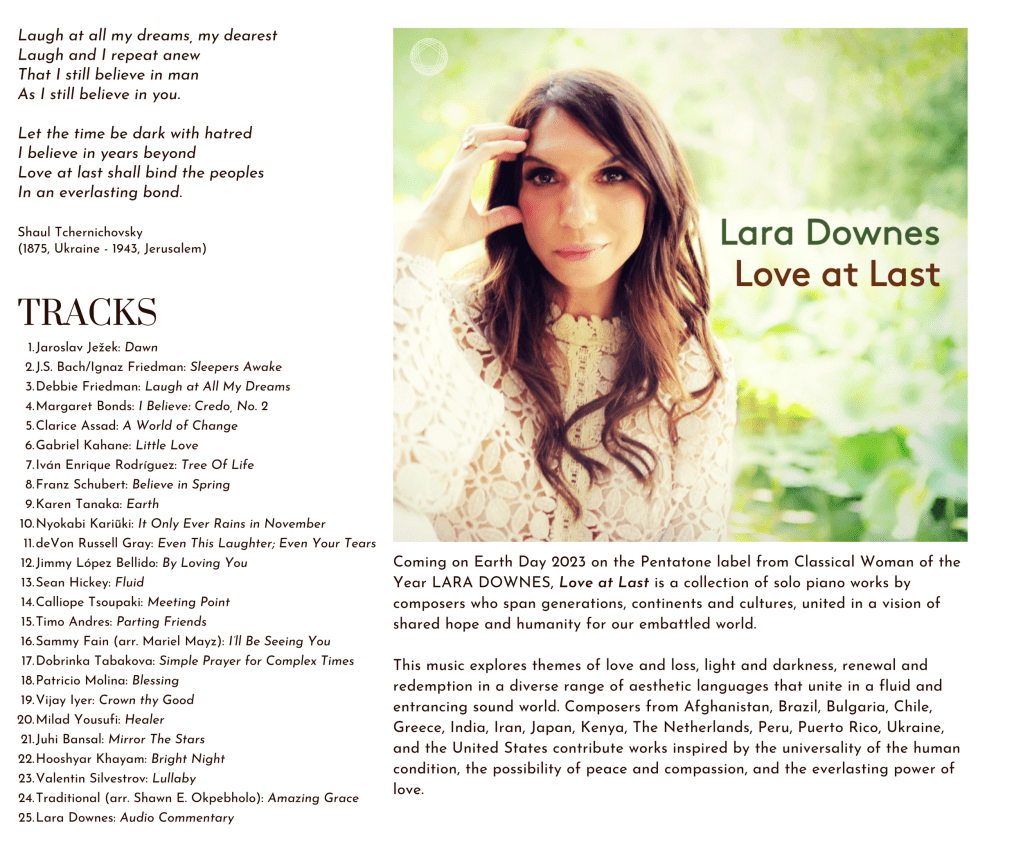
Though I have enjoyed Downes’ albums since I first heard “America Again” (2016) I found myself approaching this new release with some trepidation. 24 tracks by multiple composers, most of their names unfamiliar to me left me with few clues as to the character of this album. So I decided to take Lara on a trip with me. I had a few hours of errands to do which required a bit of driving, a fine opportunity to hear this music while strapped into the driver’s seat. This sort of passive listening would give me a first impression and I wouldn’t be tempted to any distractions (other than driving).
After the first two or three tracks I found myself inextricably drawn into Downes’ obviously very personal choices. As with all her albums (this one is her tenth by my count), she shares a diverse cornucopia of music featuring music from Bach to young contemporary composers (women and men) and styles from classical to jazz, gospel, blues, and pop. On all tracks she has ample opportunity to exert her interpretive skills and her virtuosity. These are a quirky but ultimately eye opening (or ear opening?) pieces that draw the listener in. Her choice in repertoire has always been both creative and, some might say, “transgressive” because of her lack of respect for boundaries like “classical”, “jazz”, “pop”, “folk”, “male composers”, “female composers”, etc. whereby Benny Golson stands beside Aaron Copland or Rhiannon Giddens and Judy Collins alongside Bernstein, etc. But I prefer to think of her work as “inclusive”. Music is best appreciated not by racial, political, or gender issues but on its own merits. Here she sets her sights on the elusive concept of “love”, another concept that does best when it transgresses boundaries and embraces inclusion.
Downes’ keyboard mastery and her ability to clearly articulate the inner details of this music succeeded very well in engaging this listener from the very start. After about 12 tracks I had to stop, pull over, and look at the track listings. This far ranging but ultimately cohesive selection sounding at times like a fin de siecle drawing room recital of unabashedly romantic music. Of course many of these pieces are of more recent vintage but Downes succeeds in making her choices sound inevitably related to each other. There is much to explore here and the pieces seem to fit together like a sonic jigsaw puzzle into a cohesive whole while retaining their individual detail and beauty, indeed “love at last.”
Rather than attempting to delve into the individual composers here I am choosing to review this in the context of its presentation. It is a characteristic of Ms. Downes’ releases to identify some sort of context, sometimes fairly specific, sometimes cleverly vague in which to present a carefully chosen portion of her repertoire. Here Ms. Downes gives a loving and personal gift to her fans.
Of course I will look into all the composers and music presented here over time but, for now I just want to listen and savor these gifts. You will too.
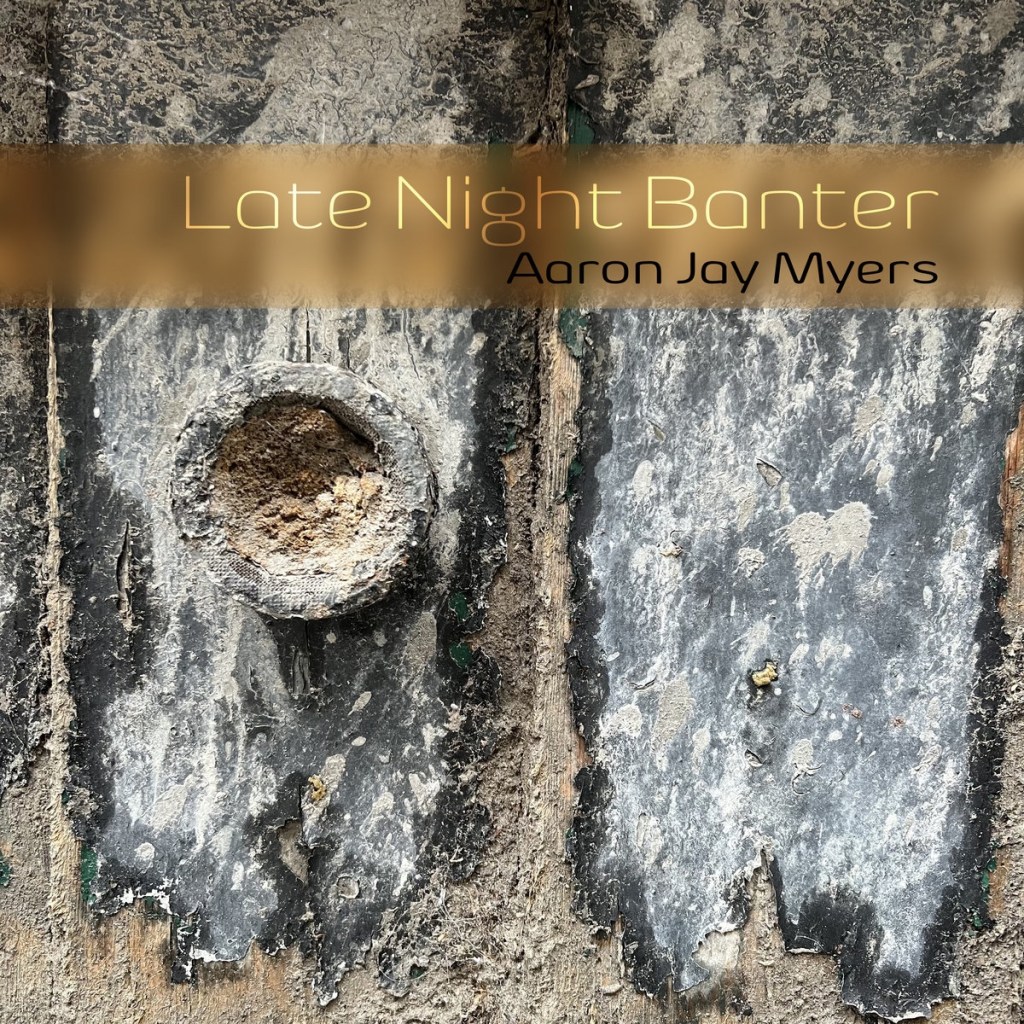
Aaron Jay Myers’ third album grabbed my attention immediately and didn’t let go til the album ended. Working un-self consciously in a stunning plurality of styles (this guy clearly paid attention to his 20th century music history classes) he has produced some mighty substantial works. His ability to integrate a wide variety of techniques and styles into his artistic persona is simply astounding. His references to other composers’ works, rather than sounding derivative, evoke nostalgic homage, at least in this listeners ears. Indeed there seem to be more references per square inch than in a Thomas Pynchon novel. And the fact that he shares this writer’s passion for Star Trek, Deep Space Nine only endeared him more to me (more on that later).
His very listenable music seemingly embraces the whole of the twentieth century stylistically and his very judicious use of extended techniques for pretty much all instruments including voice demonstrate a firm understanding of where those techniques best serve his artistic vision. Fortunately he has managed to find performers who both meet his technical demands and have a real grasp of his musical vision. This Neuma release is truly something special.
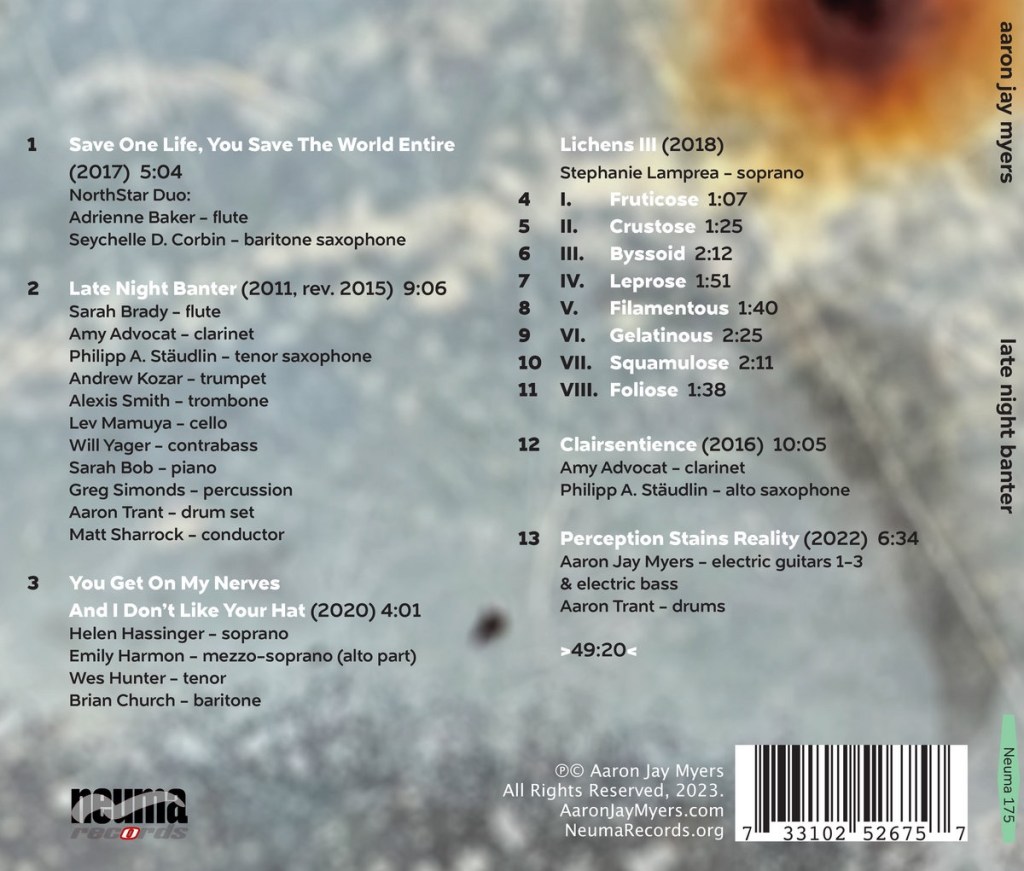
There are six works divided among the thirteen tracks. These chamber works were written between 2011 and 2021. None require more than ten minutes or so of your time and left this listener satisfied with the music and optimistic for the future of classical music in general.
“Save One Life, You Save the World Entire” (2017) for the unusual combination of flute and baritone saxophone opens this album with a surprisingly engaging work. It sounds like a challenge for the musicians who handle those challenges seamlessly and engage the listener in this rather brief essay.
When I listen to “Late Night Banter” (2011 rev. 2015) now, I do so in bare feet (it knocks my socks off). This piece for ten musicians with a conductor is a finely crafted piece that grabbed this listener’s attention by that craftsmanship but also by what seem to be a plethora of sonic references to 20th century music. The style of Stravinsky, an homage to Luciano Berio, etc. These brief references evoked emotional responses which led me to recall similar emotions I had attached to the apparent (at least to me) object of said reference. Even minimalist references occur matter of factly. Such efforts can sound derivative or at least imitative but not so in this piece. Rather it had the quality of a tour of the twentieth century in respectful jogs of memory. But even if you don’t get the references, this is a substantial and entertaining work. The evanescence of those references had me questioning whether they were actually there or just my mental figment. (I guess I’ll just have to listen again). Either way I was thrillingly engaged.
Avery Brooks as Captain Benjamin Sisko, commander of Deep Space Nine
“You Get On My Nerves, And I Don’t Like Your Hat” (2020) is the Deep Space Nine reference mentioned at the beginning of this review. If you haven’t seen this series I highly recommend it. And so, apparently, does Aaron Michael Myers. This work for vocal quartet (SATB) takes its title from a witty utterance by Captain Sisko (my fave Star Trek Captain). Of course you don’t have to know Star Trek lore to appreciate this work, but it helps. It is a challenging work for four unaccompanied soloists which reflects the composer’s sense of humor as well as his connection to pop culture.
Aaron Jay Myers
“Lichens III” (2018) is scored for soprano voice but the singer also does the work of a percussionist. In addition to the vocal challenges the singer is asked to perform on “body percussion”, the various sounds one can make by percussing (pounding) on one’s body. It is more commonly an idiom of folk and blues but soloist Stephanie Lamprea handles both the singing and the percussing as though it is her everyday practice accomplished with ease.
Clairsentience (2016) is another wind instrument duo, this time for clarinet and alto saxophone, a similarly unusual choice of instruments. This one is about twice the duration of that first piece and every bit as engaging as well as challenging.
The last track is a marvel of multitasking. Other than Aaron Trant (who does a fine job) on drums, all of the parts (three electric guitars, and bass) are handled by the composer. “Perception Stains Reality” (2002) is a tour de force consistent with the other works on this disc. Here he shows his rock/pop sensibilities, clearly as essential a part of his artistic endeavors as his “classical” training.
Myers is one to put on your hot list. He is certainly on mine. If you can hear a performance of his work, whether live or recorded, you would do well to check it out.
This is Tim Brady’s fourth Starkland release, a distinction shared by only two other composers, the late Tod Dockstader and (the delightfully very much living) Guy Klucevsek. And given the impressive track record of the Starkland label’s ability to find and promote innovative composers and performers who later achieve much wider recognition, this is an event that demands serious attention.
ST-232, released in 2019 contained works by Brady along with several associates from his “Instruments of Happiness” ensemble (and others) and is essentially a Brady album which features his “Instruments of Happiness” guitar quartet playing works by various Canadian composers.STS-230, also a 2019 release contained Brady’s Concerto for Electric Guitar and Chamber Ensemble along with Brady’s “Eight Songs for: Symphony No. 7”STS-224, a 2016 release, the recording premiere of this live performance guitar quartet, contained, along with a couple of shorter works by fellow Canadians, two versions of Brady’s Symphony 5.0, one for ensemble and a second version for solo guitar with electronics (arguably Brady’s first solo guitar symphony but the original version is for this guitar quartet).
With a catalog presently numbering some 39 plus CDs and a CV that boasts 4 operas and a massive catalog of compositions for ensembles ranging from solo to large orchestra, this proudly Canadian composer has mounted (metaphorically, of course) an invasion from the United State’s northern border of his distinctive artistic vision prompting this reviewer to suggest a comparison to the pop “invasion” of the Beatles in the early 60s.
Track listing
My admittedly tongue in cheek Beatles comparison is not meant to eclipse the incredible artistry of this obviously very industrious artist. My previous reviews compared his work to electric guitar giants like Rhys Chatham and the late Glenn Branca. But this only serves to illuminate a fraction of this man’s work. I invite listeners to peruse his well organized website to get a perspective.
But let me get back to this release. It is undoubtedly a bold move to use the term “symphony” to describe a work for a solo artist. Charles Valentine Alkan (1813-1888) wrote a symphony for solo piano (opus 39 nos. 4-10 from 1857) Kaikhosru Shapurji Sorabji (1892-1988) referred to his third piano sonata (1922) as a symphony and later wrote six more symphonies for solo piano between 1938 and 1976. And more recently the late Glenn Branca (1948-2018) wrote several works for various configurations of guitars he called symphonies. But this is the first symphony written expressly for solo guitar as far as I can determine.
“Symphony in 18 Parts for solo electric guitar (2021) – 50 minutes For solo electric guitar, FX pedals and looper, in 18 movements” as it is listed on the composer’s website is (if I counted correctly) his 8th Symphony. Brady apparently numbers his symphonies in order of composition without reference to instrumentation. While several of his symphonies involve one or more electric guitars, this is the first solo guitar work to which he gives the weighty title of “Symphony” (unless, as noted above, you count the solo version of Symphony No. 5).
The term “symphony” carries with it connotations, at least, of grandeur, painstaking structure, and serious music making. And this work is very serious and meticulously constructed. It is, of course, reflective of a mid career composer who has written a great deal and has learned from that experience. It has as much a right to be called a “symphony” as any similarly large and painstakingly written piece of music.
First, let me say that, other than a tendency to use one (or a lot more than one) electric guitar in his music, Brady’s music has relatively little in common with Glenn Branca and Rhys Chatham. In fact, Brady seems to have more in common with Steve Reich and Elliott Sharp. But while Chatham and Branca emerged from a music scene dominated by punk in all its iterations, Brady seems more connected to the Beatles and Les Paul.
The work is divided into 18 sections, each running a modest 1.5 to just under 5 minutes. It is a structure similar in this listeners mind to American composer Alan Hovhaness (1911-2008), whose Symphony No. 9 (1949-50) “St. Vartan”, a similarly epic masterpiece in no fewer than 24 short movements. It is the interrelatedness of those movements that make them a part of the whole symphony. And so it is with Brady’s Symphony. David Lang (Pulitzer Prize Winner and founding Bang on a Can” member) says essentially this in his segment of the liner notes that come with the recording. Tim Brady acknowledges much the same in his segment of the liner notes.
The cover art by fellow adventuring guitarist and composer Elliott Sharp is functionally an homage to Brady and his work. The recording by Tim Brady and Morris Apelbaum, mastered by Brady, Apelbaum, and John Klepko is lucid (and great on headphones especially when Brady pans the sounds across the stereo field).
The 18 movements all have titles which are metaphorically related to the music therein. David Lang aptly describes these varied and intense movements as sort of biographical statements about what the composer can do with his instrument. Each movement has both form and development much as one would expect of a symphonic movement.
On the one hand, this symphony is not easy listening. On the other hand it is likely catnip to electric guitarists as well as to new music enthusiasts including your humble reviewer. Brady’s Canadian invasion, far from a takeover, is simply a musician sharing his substantial art from across the northern border and presenting his latest efforts. Like the Beatles, Brady deserves to be welcomed. This prolific composer/performer/teacher/innovator has interesting things to say.
At first I attempted to write something about each of the 18 movements but I don’t think that would have added anything useful for prospective listeners. This piece taken as a whole most aptly deserves the descriptor “tour de force” as each movement seems to have its own character deriving from the composer’s use of various (apparently deeply studied and judiciously chosen) techniques and ideas which sometimes threaten to overwhelm the listener, sometimes with sheer volume, sometimes with dazzling virtuosity, sometimes with softness, sometimes with silence, and always with interesting ideas.
In some ways this is a collections of ideas and techniques the composer has amassed over some 50 + years of playing. Each movement seems to be a more or less self contained exposition of playing techniques and the composers own approach to harmony and invention. That sounds potentially very dull but this is not a collection of etudes didactically accounting for and crystallizing his ideas. It is the organic appropriation of personal achievements in developing his compositional style. And it is an homage to electric guitarists that preceded him. Not a textbook as much as perhaps a signpost defining his present stage of development even as he moves forward with other projects.
I suppose one could challenge the notion of calling this a work for solo guitar given the effects pedals, looping systems, etc. but the use of electronics and looping techniques as a compositional aid or method is so ubiquitous that point is moot. Call it what you like but just listen. Let the music flow over your ears. At the very least this is a defining milestone in Brady’s long and productive career. It’s hard to to imagine what he might do next but I’m sure he’ll think of something.
This is the most recent recording by Italian pianist Agnese Toniutti. (her third release by my research). It is also the most recent recording of John Cage’s masterful Sonatas and Interludes (1946-8) for prepared piano, a defining work for that unusual instrument. It has been recorded at least 30 times but is rather rarely heard in live performance.
John Cage is perhaps best known for his challenges to the philosophy and the very definition of music itself epitomized in his infamous silent piece titled 4’33” premiered in 1952. The composer eschewed the notion of a “masterpiece” but irony loving “fate” would hand him that title at least for this set of pieces.
Toniutti, a graduate of The Conservatory of Venice, seems to be as much a researcher and activist as she is a widely skilled pianist. While doubtless schooled in the commonly played repertoire for her instrument, she favors new music and music undeservedly neglected in her performances and recordings as well as the commissioning of new works and finding yet unplayed that strike her fancy.
The Sonatas and Interludes, now some 80 years old doesn’t really qualify as “new music” per se nor can it really be called neglected having been recorded 30+ times. In the context of this release this cycle of pieces seems to function much as a new recording of the Goldberg Variations or the late Beethoven Sonatas might function to introduce the skills of a musician whose trajectory was aimed at the conventional recital hall circuit. Toniutti clearly has other plans.
I won’t attempt to compare this most recent interpretation to the other available recordings. I believe this recording does much to validate the music as an essential work in the western canon of art music and to display the estimable understanding and widely skilled competence of the performer whose work is and will continue to embrace new music and advocate for that music to earn an esteemed place in the minds and hearts of listeners and other performers.
This is a very enjoyable recording whether it is to be a collector’s only recording of this music or one that stands most favorably in comparison to previous recordings. If this is to be your first recording of this work or if you simply want to hear another interpretation, you will not be disappointed. This is a wonderful performance.
Pianist Agnese Toniutti previously released a very forward looking recording on Neuma Records. The 2021 release pictured below is a collection of much more recent music. I listened numerous times and didn’t feel I “got it” well enough to say something reasonably intelligent (if not insightful) until this second release. And while I may not fully understand these “subtle matters” I now have a better context.
Neuma 138
This collection which I had yet to review represents Toniutti’s understanding and appreciation as well as her apparent mission to expand the experimental repertoire for piano. Here is a fascinating set of composers, each with a unique view of her instrument. Just listen, trust this artist. You’ll be glad you did.
Track listing
Keep your eyes and ears open for Agnese Toniutti, an advocate for and a master of the avant garde. And to Ms. Toniutti, I greet you at the beginning of a great career.
There were no percussion ensembles in Western music until the early twentieth century, at least not anything close to the size and instrumental diversity we see now, but since then there have been a variety of percussion ensembles which have popped up. some touring, some recording, but all investigating the possibilities of this collection of pitched and unpitched instruments. Notable examples from this writer’s memory include the Paul Price Percussion Ensemble, the Donald Knaack Percussion Ensemble, Amadinda, and the Canadian group, “Nexus”. Each of these ensembles (the list is not comprehensive) has put their own stamp on the flexibly nebulous group subsumed under the title, “Percussion Ensemble”.
All of these groups have chosen which instruments to include in their group, which to exclude, and they have done their own curation of music to expand their respective repertoires and the percussion group repertoire as a whole. And the present recording presents yet another Third Coast Percussion CD on Cedille Records for this busy Chicago based group. The relationship between this energetic ensemble and the equally energetic Cedille Records has been a mutually beneficial one artistically. this release is the fifth release for that label. They have at least nine other albums as a group and have collaborated on many more recordings.
As noted on the album this disc contains all world premiere recordings that reflect varying degrees of collaboration. One of the unifying threads of this CD is the variety of compositional approaches. The Elfman piece being perhaps the most traditionally notated and structured. The others involve different compositional methods which are not exactly traditional in classical music. It is the exploration of such non-traditional methods and the expansion of the definition of composition that is a characteristic of this always interesting classically trained group of musicians.
Let me just start by saying WOW!!!
The first work on the album is by Danny Elfman (1953- ) is best known for his work in movies and television as the composer of “The Simpsons” theme and similarly energetic scores for Tim Burton’s films among others. His roots were in his work with the unusual pop band “Oingo Boingo” whose manic style is still present in much of Elfman’s work. And this is not his first appearance in this new music blog either. His Violin Concerto was reviewed here. He manages to succeed in pop, film, and the concert hall, a feat that few can match.
Elfman’s rather blandly named, Percussion Quartet (2019) is appropriately described in the liner notes as the most conventional work here in terms of how it was written. It is fully notated in in traditional notation and consists of four movements ranging in length from about 4 minutes to about 6 and a half. The work resembles traditional sonata forms with Elfman’s energetic and sometimes quirky melodies that successfully draw the listener through the composer’s journey. That bland title is almost ironic as it belies the really entertaining qualities of this piece. Third Coast’s realization is definitive as one would hope for a world premiere recording.
The second composition is a transcription by Third Coast of a popular Philip Glass piano work, “Metamorphosis No. 1.” But this is a transcription influenced by another transcription, that of the Brazilian group, “Uakti”. So this can be said to be tantamount to a collaboration with another performing ensemble. Clocking in at nearly ten minutes this track is a familiar interlude that cleanses the aural pallet for what is to come.
Photo by Cary Huws
And what does come next is a collaboratively composed seven movement work entitled, “Perspective”. This more poetic title is the source of the album’s title. This work by Jlin (Jerrilynn Patton 1987- ) was originally written by first recording multiple tracks or layers and then working with the musicians of Third Coast to transcribe these ideas into traditional notation and into a form playable by the quartet of percussionists. This, of course, resembles the methodology that brought forth the wonderful Devonte Hynes album (also on Cedille) reviewed here.
The music is arguably entirely composed by Jlin with the orchestration creatively realized by Third Coast Percussion (doubtless in direct discussion with Jlin). What results is a dizzying and energetic set of movements whose styles derive in part from minimalism and from the rhythmic complexities of African drumming and contemporary dance music. Jlin, who hails from Gary, Indiana, works from a perspective of a DJ spinning dance music. But this is hardly your typical DJ. This is a fascinating musical mind who just happened to have started with DJ equipment.
Flutronix (photo from their website)
Another example of Third Coast Percussion’s creative collaborations has resulted in “Rubix”, a three movement work written (mostly) by Flutronix, a genre busting duo. Flutronix is Nathalie Joachim and Allison Loggins-Hull, both classically trained flautists who aren’t afraid to cross dated boundaries to create music that speaks their minds.
This is some high energy music which reflects a variety of styles but always demands much from all players involved. The duo, whose rendition of Steve Reich’s “Vermont Counterpoint” demonstrates their virtuosity and interpretive rigor. Rubix is essentially a chamber work for flutes and percussion but their defiance of categories seems to be as much a critical element of their music as is their virtuosity. Bottom line is that this is engaging, creative work that leaves the listener wanting more even as they may be unsure what they just heard. Kudos, all!
Make no mistake. This release, a long time in coming, is an essential document of the work of two Bay Area artists whose contributions (frequently behind the scenes) receives some richly deserved attention.
The dyad here consists of Carol Law and Charles Amirkhanian, partners in both life and art, collaborators in sound and image now release this collection of their collaborative works from 1973 to 1985 entitled, “Hypothetical Moments: Collaborative Works (1975-1985)”. This lovingly produced DVD brings together a series of performance art pieces demonstrating an intimate set of collaborations between these two Bay Area artists. Law is a photographer and visual artist whose art works have been displayed internationally in several galleries. Her designs can also be found in some of the striking wearable art she made as promotional/souvenir collectible items sold at concerts and online from the OM store. Amirkhanian is a composer and sound artist as well as a broadcaster and producer who has curated concerts and produced radio programs promoting new and innovative music in the bay area (and beyond) since about 1969.
Carol Law and Charles Amirkhanian acknowledging audience applause at OM 23 in 2018 (Photo by Allan Cronin, Creative Commons License)
Their respective artistic outputs include both individual and collaborative works but, until now, the only chance to experience their collaborative efforts has been in the rare occasions in which these works were performed live. The booklet accompanying this DVD gives a partial list of live performances the most recent of which was in 2018 when OM 23 “The Wages of Syntax” presented a 6 day series of concerts which was an international survey of linguistic sonic arts. Visual analogues and deconstructions of vocal sounds as practiced by artists inspired by language and the expansion of the very definition of art, music, and performance.
Dominic Murcott, peripatetic conductor/drummer about to lead a major new opus by Charles Amirkhanian. (Photo by Allan Cronin, Creative Commons license)
My tardiness in completing this review afforded me a unanticipated perspective on Amirkhanian’s art. The performance of his new composition, “Ratchet Attach It” (2021) at OM 26, pictured here integrates his roots as a percussionist with his penchant for spoken word and sound sampling.
Charles Amirkhanian performing in front of images by Carol Law at OM 23 in 2018 (Photo by Allan Cronin, Creative Commons License)
The collaborations here have roots going back at least to the early twentieth century with the experimental visual innovations of Vassily Kandinsky, Picasso, Miro, and the photographic experiments of Man Ray, etc. Their sonic antecedents include the work of Gertrude Stein, James Joyce, Antonin Artaud, Luigi Russolo, and a panoply of sound artists that Law and Amirkhanian visited in the late 1960s.
In addition to these early experiments one must understand that these creative meldings of sonic and visual art were flourishing in the Bay Area, most obviously in San Francisco where Allan Kaprow’s “happenings”, Bill Graham’s rock concert productions, and similar sound/light shows dominated the fare at performance venues like the Fillmore and similar spaces where innovation in pop/rock music mixed with innovation in visual light shows combined with bands performing for audiences immersing them in mind manifesting artistic assaults that drew crowds frequently also experimenting with not yet illegal psychedelic drugs (the word “psychedelic” is a neologism which means “mind manifesting”). The emblematic event here was the so called “Trips Festival“, a three day event held in 1966 at the Longshoreman’s Hall. I have elsewhere referred to Mr. Amirkhanian as the “Bill Graham of new music”, a comparison which still seems valid.
speaking is speaking (by Bay Area poet Richard Brautigan)
We repeat what we speak and then we are speaking again and that speaking is speaking. Tokyo June sometime, 1976
Well, drugs are not the issue here but mind expansion is. What is documented here is the multimedia collaboration of two essential Bay Area artists who, via their individual and collective efforts effectively expanded the possibilities of both visual and sonic media. These are innovative on many levels. Amirkhanian’s unique take on sound poetry (his anthology “10 + 2: 12 American Text Sound Pieces”) is an essential survey of that genre released on vinyl (now available on OM records ). And Law’s photographs, design, deconstruction and collage methods are integrated into her own unique style of visual art. The performances on this DVD constitute another uniquely San Francisco Bay Area chapter in multimedia, collaborative performance art now made available to a larger audience.
Other Minds (OM 1006-2)
This defining anthology of Law and Amirkhanian’s explorations of sound poetry (first released on vinyl in 1975 on the now defunct 1750 Arch Records) has defined the genre for many (this writer included). Aram Saroyan, Clark Coolidge and Beth Anderson would later appear live at Other Minds 23 in 2018 which outdid the aforementioned “Trips Festival” in a week long festival of sound poetry from an international roster of poets and sound artists.
Now keep in mind that the original presentations of these works from the early 80s utilized the technology of its era, analog recording, magnetic tape, and slide projectors (remember those?). So this 21st century rendition takes this work into contemporary technology and makes available for the first time since their premieres the original marriage of sound and image as intended by the artists. Without getting into McLuhan-esque analyses of the differences and subsequent meanings of the original media versus those on this DVD one need only celebrate the fact that listeners/viewers can now see these works with their originally intended melding of sound and image.
There are 12 tracks:
History of Collage (1981) (original audio release on Mental Radio CRI, 1985)
Audience (1978)
Tremolo Bank (1982)
Dog of Stravinsky (1982) (original audio release on Mental Radio CRI, 1985)
Maroa (1981) (original audio release on Mental Radio CRI, 1985)
Hypothetical Moments (in the intellectual life of southern California) (1981) (original audio release on Mental Radio CRI, 1985)
Awe (1973)
Andas (1982)
Dreams Freud Dreamed (1979)
Too True (1982)
The first nine tracks are the digital adaptation of sound and image accomplished by Dave Taylor. These are the pieces originally performed live in an era using equipment as distant from current technology as MP 3 files are now from magnetic tape. The last three bonus tracks are actual live performance videos (restored by Jim Petrillo) of three 1985 performances which give some of the flavor of the original experience of these works.
Several of these pieces have been released as audio only tracks on Amirkhanian’s CD releases (as noted) and, while they certainly work as audio only experiences, the images add a welcome dimension. The equally striking design by OM resident design master Mark Abramson add a deserving touch of class to the videos and the accompanying booklet which features informative texts on the works as well as a nostalgic collection of photographs featuring the dyadic duo.
I am honored to have a quote reprinted there from my blog review of OM 23 where I and a sizable audience were treated to a fabulous week long live experience of sound poetry featuring this duo’s work alongside that of exhilarating selections of other similar minds’ work. Of course nothing can take the place of the live experience but this production comes close.
This is a must have collectible document for anyone interested in sound poetry and Bay Area artists.
“Whereof one cannot speak, thereof one must remain silent.”- Ludwig Wittgenstein (1921)
This album is satisfying on several levels. It is a return to the label that contained the composer’s his first big release, the three disc set on DG which contained “Drumming” (1971), “Six Pianos”, and “Music for Mallet Instruments, Voices, and Organ” (both from 1973). Of course it was the ECM release of “Music for 18 Musicians” (1974-6) that became his signature work incorporating the experimentation heard in the music in that DG box set into the composer’s now familiar mature compositional language. The present release, also available on vinyl, seemingly reflects the post experimental composer’s grappling with the oh, so classical form of the string quartet. It’s a truly fine release and an homage to the composer.
DG 2740 106
Like many of his peers, Reich eschewed many of the conventions of western art music. His work at the San Francisco Tape Music Center helped him discover “phasing” and use of the speaking voice as a compositional element. His study with master drummers in Ghana taught him about quasi improvisational large ensembles and his subsequent study of Hebrew cantillation further refined his understanding of speech and song in his compositional contexts.
As he is quoted in the accompanying booklet, Reich never thought of attempting to use the string quartet form in his work. But along came the delightfully forward looking and genre breaking Kronos Quartet. That collaboration brought forth his landmark, “Different Trains” (1988). And the rest is, as they say, history. “Triple Quartet” for string quartet and tape (but no voices) came in 1998 and his WTC 9/11 (2010) which used sampled voices much as he did in Different Trains.
To be fair, Reich never appears to have intended to engage with the classical form of the string quartet (or any other classical forms for that matter). He uses the convenient availability of musicians sympathetic and sufficiently skilled to perform his compositions. The fact that they happen to be in string quartets is incidental. Much as the inclusion of a singer (as Schoenberg did) bent the quartet to fit his compositional goals, many have subsequently done similar alterations and additions to that classical ensemble. The difference is that Schoenberg adding a soprano, Kirchner (among others) adding electronics, etc. did so but clearly defined their works as “string quartets”. Reich did not do this but this disengagement with classical forms (string quartet, concerto, symphony, etc.) does not detract from the absolute quality of his music.
It would be unfair and would miss the point to try to judge these works via comparison and contrast with Haydn, Beethoven, Bartok, etc. In fact these works are not a part of that canon. Ultimately they stand on their own as part of Reich’s unique vision as a composer and, as such, they succeed very well.
WTC 9/11 and Different Trains are political statements with specific spoken word samples entered into a musical counterpoint. They succeed very well as protest and memorial for the respective events they frame. Triple Quartet, however, is absolute music concerned solely with Reich’s largely contrapuntal techniques of shifting repeated patterns. All three works succeed very well in their ability to engage audiences. All three are finely wrought compositions by by a major composer true to his maverick, experimental beginnings, true to the artist’s personal vision.
The Mivos Quartet does a fine job of navigating these technically difficult works and produce a fitting homage to a wonderful composer and make a strong case for the deeply substantial nature of this music. This is a great release. Highly recommended.
This release appears to be as much about the musician as it is about the music. Ives’ second piano sonata has had numerous recordings since John Kirkpatrick’s landmark recording of 1948. It is a gargantuan work that requires formidable technical skills simply to play it and interpretive skills at a very high level. Here is a recording by an artist who certainly possesses the skill sets required.
Philip Bush
Pianist Philip Bush has spent over twenty years playing, teaching and recording. He is well known in new music circles as a versatile and committed artist very familiar with Charles Ives’ music. Doubtless many have heard his work but his name is far better known among his peers than his listeners. Why? Well despite at least 24 releases his role as accompanist or ensemble member leaves his name recognition to his fellow artists and to fans who read credit listings on those recordings. This writer is reminded of another artist of a previous generation whose skills were unquestioned but his name less known. I’m talking about the wonderful Gerald Moore whose work as an accompanist graced many recordings of the 50s, 60s, and 70s where he worked alongside many different instrumentalists and singers. Moore’s charming album, “The Unashamed Accompanist” (1955) is a good humored tour of the hard work of the accompanist, the unsung hero. I don’t mean to suggest that Mr. Bush is an exact match for this analogy, but this album certainly puts him more in that soloist spotlight than any other he has done.
Despite many recordings of this masterpiece, ostensibly a landmark of American modernist composition, this work has yet to achieve the prominence it deserves in the recital hall. Bush’s performance along with his very clever inclusion of lesser known Ives contemporary, Marion Bauer’s Six Preludes for Piano, Op. 15 (1922) helps to provide context for the listener. Bauer was later the first American to study with Nadia Boulanger whose pedagogy would shape the careers of many of the great composers of the 20th century in many countries. The preludes are apparently included here as representing American music played more commonly in recitals of that time.
Kyle Gann’s perspectives on the Concord
For a thorough summary and perspective on the Concord Sonata I have found Kyle Gann’s recent book on the subject to be illuminating. Ives himself felt the need to “explain himself” when he wrote a little book to be published concurrently with the sonata. Ives’ title for his book “Essays Before a Sonata” provide the inspiration for Gann’s subtitle (Essays After a Sonata). Ives’ near constant revisions add to the difficulties in even determining a final version of the score itself. The composer’s revisions and the partial recordings he did of the work add to the performer’s burden in the performance of the work. There’s even optional parts for flute (included in Bush’s recording played by Jennifer Parker-Harley) and for viola (not in Bush’s recording).
Track listing.
The Bauer preludes are far more conservative musically than the Ives of course but one could argue that nearly everything contemporary with the Concord Sonata sounds conservative by contrast. Bauer’s Op, 15 are relatively early works in her output. She lived and worked another 33 years after these little works which were apparently influenced by French Impressionism. There is no indication that Bauer and Ives ever met or discussed music but her work was the new music more commonly heard than that of the roughly concurrent work of Ives. The use of the stereopticon style slide on the album cover, a current technology of the time, also serves to provide a charming nostalgic reference to an era about to experience many rapid changes historically, technically, and conceptually in which the Concord becomes an American work analogous to The Rite of Spring (1913) as a signpost of the beginning of another era.
Despite the complexities, Bush’s reading of the Concord and the Bauer preludes are eminently listenable. That clarity is ultimately the value of this release. This recording is a wonderful opportunity to hear the artistry of a dedicated artist and academic. It helps make a case for the Concord to be recognized as an important work whose complexities are made clearer with each interpretation. Bravo, Professor Bush!
On the back of the CD case, in the right upper hand corner, like a warning on the back of a medicine bottle, an entreaty:
“Binaural Recording: Please use headphones.”
Even those of you who think they know this masterpiece of experimental electronics by David Tudor (1926-1996) will find here a unique and important collaboration in this production initiated by Pauline Oliveros, then director of the Center for Music Experiment (CME) at UCSD. She invited a group called CIE (Composers Inside Electronics). And the resulting product of that collaboration documented here advances the understanding of this music and will henceforth be an influence on all future performances.
Unfortunately for this writer’s timing, the wealth of information gathered in the course of researching this review, the sheer volume of possibilities in performance and the wider scope of historical and technical elements embraced by this work required a deeper reading and contemplation on my part. In short, it has taken some time for this reviewer to get a grasp of how to express the significance of the deeply substantive work at hand. I simply didn’t know enough about the history of electronic music and the work of this seminal musician.
So now, after some serious study, this is my perspective on this landmark composition and, in particular, the deeper significance of this performance. In short, there will likely be many more performances of this work but this one will always be a standout. Not the ultimate version perhaps, but one of the most memorable.
David Tudor ca. 1950
David Tudor was a pianist who championed contemporary piano music and then began a career as a composer. But he was no ordinary composer. Taking inspiration from the composers whose work he championed, Tudor developed musical ideas with structures that contain indeterminate elements within a larger structure. Such is the case with Rainforest which was first developed in 1968 against a cultural backdrop of the height of the psychedelic sixties and the political “days of rage”, a time of artistic innovation like Allen Kaprow’s “happenings” which expanded the concepts of what constituted art, a time of wild experimentation. His work crossed paths with the San Francisco Tape Music Center (which later became the Mills College New Music Center). Tudor traversed some of the same territory as Donald Buchla, Pauline Oliveros, Maggie Payne, Morton Subotnick, Ramon Sender, as well as many others.
The first iteration of Tudor’s innovative and experimental “Rainforest” was in 1968. It is a testament to Tudor’s creativity to have created a structure that contains the indeterminate sonic events called for in the score (not a formal score but a set of performance instructions) in such a way that the piece evolves with each iteration, each performance. That, rather than the varying sonic content, is the heart of this major work of contemporary sonic art.
First, this is a binaural recording, meaning that it was recorded with a technology intended to deliver the sound directly to headphones of the listener hopefully producing an experience much as would have been experienced by sitting in the audience. Earlier versions of this technology involved, basically, microphones embedded in the ear canals of an anthropomorphic head which is placed in front of the performance as a listener would sit in their seat. However, the present recording recording involved another generation of this technology which is particularly well suited to this music. Here the microphones are worn in the ears of the recordist(s) as they meander through the space in which the piece is being performed. The result is the listener being able to (almost literally) get inside the head of the person wandering within the space and listening to the sounds created, sometimes at a distance, sometimes more closely.
Despite the entreaty that the listener wear headphones when listening to this recording (you really should try that at least once), one can play this recording as one would any other musical recording. It can also be appreciated by playing it on speakers in any space as a sort of sound installation. This piece challenges conventional concepts of music and its audience.
William Robin is a musicologist whose credentials (nicely enumerated on his web site) are more than adequate to the task at hand. This is a socioeconomic and political perspective on the seminal Bang on a Can organization. At its core, Bang on a Can is the foundational work of three people now recognized as major American composers: Julia Wolfe, David Lang, and Michael Gordon, all of whom met as students at Yale University.
Julia Wolfe, image from composer’s web site
This is the (much needed) first book on the history of the collaboration of these composers and how their work helped transform and move ahead the new music scene. First in New York, then nationally, and now internationally these individuals experimented and embraced innovative ideas while navigating the labyrinth of of social, political and economic hurdles involved in the production and promotion of non-pop new music. Therein lies the “agony” referenced in my title. This essential background information makes for some slow going reading but also serves to demonstrate how daunting their task has been.
David Lang, image from composer’s web site
The book documents the early efforts both to define their concepts and to learn the politics of the new music economy. But, painful as they are, these efforts are ultimately instructive for anyone involved in the production of new music. This reader comes away with a new found respect for those who wrangle with the varied and complex elements behind the production of concerts in general, and new music in particular. It is “how the sausage is made” so to speak. And it is a useful perspective for the average listener to better understand the incredible complexity of new music production and promotion.
Michael Gordon, image from the composer’s web site
The book is divided into 7 chapters and an epilogue which focuses not just on the trials and tribulations of the gestation of Bang on a Can but also its context among several other new music initiatives that preceded BOC. Meet the Composer, New Music America, and the New York Philharmonic’s New Horizons Festival loomed large in their time and the “downtown” loft scene which nurtured the likes of Philip Glass, Meredith Monk, Rhys Chatham, etc. contributed to the promotion of new music during their respective eras.
Robin identifies the innovative efforts by BOC in their use of marathon open air concerts to showcase their innovative programming which effectively blurred the lines of genres like jazz, free jazz, classical, pop, rock, etc. But their challenges were essentially the some, the politics of concert production, funding, advertising, etc. They characterized their efforts in contrast to the economically dominant Lincoln Center. The evolution of BOC from its beginnings through the establishment of the Bang on a Can All Stars touring ensemble, the establishment of a record label (Cantaloupe) and their later performances at Lincoln Center, the stodgy institution against which they railed dubbing their music as “downtown” as an alternative to the “uptown” mainstream. There is the beginnings of a history of new music in recordings that remains to be written but the point here is context and the socioeconomic and political motivations involved.
Author William Robin does his work well in this academic tome which is richly annotated and referenced with a bibliography to take the interested reader to a wealth of information on new music and its production. And while this is more about “how the sausage is made” so to speak, it is a necessary exposition which provides both history and context, something to think about the next time you buy a ticket to hear new music. Admittedly its not a pretty picture but it certainly illuminates the side of new music virtually unknown to the average listener.
While this reader had hoped for more information on the music performed (which deserves a book unto itself) this book takes its place alongside Tom Johnson”s “The Voice of New Music”, Kyle Gann’s “Downtown Music”, Renee Levine Packer’s wonderful history of the Buffalo New Music scene, “This Life of Sounds”, Benjamin Piekut’s “Experimentalism Otherwise”, George Lewis’ “A Power Stronger than Itself”, Luciano Chessa’s “Luigi Russolo, Futurist”, and David Bernstein’s “The San Francisco Tape Music Center” (to name a few) as an essential history of new music.
This is John Pitts‘ second incursion into adapting non-western music for the conventional piano. In doing so he follows a long tradition of fascination with non-western musics by western composers. Listeners will likely be familiar with Beethoven or Mozart who imitated Turkish music to add an exotic dimension to their compositions (Beethoven with his Turkish March sequence in the finale of the 9th Symphony; Mozart imitating Turkish music to add the exotic sound to enhance the geographic setting of his opera, The Abduction from the Seraglio). This fascination gained traction over the years as the great romantics such as Rimsky-Korsakov, Stravinsky, Debussy (whose encounter with gamelan music at the Paris World Fair was formative), and their successors took on similarly exotic interests in their music.
Serious study of non-western music with attention to tunings and rhythms is virtually unknown in the western canon before the twentieth century. Colin McPhee, the Canadian-American composer did his landmark study of Balinese Gamelan music in the 1920s and 1930s (some of which is influenced Benjamin Britten’s ballet, The Prince of the Pagodas) which was the first of a series of such explorations done subsequently by the likes of Lou Harrison, Terry Riley, La Monte Young, Alan Hovhaness, David Fanshawe, and others of Balinese, Javanese, Chinese, Japanese, Korean, and other cultures. Unlike their forebears, this new generation studied tunings, instrument construction, rhythmic construction, performance practice, compositional methods, etc. instead of basically just fitting the music to the mold of the western paradigm.
The present volume is, as mentioned, the second such effort by British composer/musicologist John Pitts. His first effort detailed suggestions for playing Hindustani Ragas (raags in the British spelling) and was reviewed here on this blog. In that study, as in this one, Pitts takes the fixed tuning of the piano that is familiar to western ears as a given, without getting into the complex issues of tuning (that is a subject unto itself). Neither Hindustani Ragas nor Javanese composition can be played on pianos tuned to the current western standard of twelve tone equal temperament but there are riches to be had in understanding compositional techniques other than tuning and harmony. Pitts uses the piano as a starting point from which to learn about music of other cultures. This appears to have grown out of his own efforts as a western trained musician trying to learn what techniques can be incorporated into the creative processes of western music. Many of the author’s compositions appear to be in part the product of lessons learned from his study of various musical systems including gamelan (Javanese and Balinese), Hindustani raga, and balafon music from Burkina Faso.
For the present volume Pitts consulted with western gamelan masters including Jody Diamond and other members of the international gamelan community. He did his homework well and one of the strengths of this book is in its remarkably lucid exposition of javanese music in a way that is understandable by anyone with a reasonable grasp of western music theory. Here is where the use of the piano serves as a springboard from which one might grasp this musical system in part via the differences in the two. It is this pedagogical aspect to which I refer in my parody in the title of this article. As one with a largely self driven learning of music this volume presents an opportunity to expand my knowledge of gamelan music. It is a friendly approach which makes me no longer “afraid to ask” or afraid to learn.
In the space of approximately 50 pages the author provides a marvelous distillation of the essentials of gamelan music including terminology, descriptions of the various traditional instruments commonly used, and, most crucially, descriptions of some of the processes of composition, melody, and performance practice. There seems to be more data here than one would reasonably expect to fit in those pages. It is a concise reference which many listeners and musicians will want to keep close at hand. These pages alone are worth the price of the book.
What follows is about seventy pages of transcriptions by the author of a traditional javanese composition playable by one or more pianists. Don’t get me wrong, this doesn’t simplify the learning of these processes. Rather it clarifies the material so that these concepts are learnable by motivated individuals. The transcriptions are the musical description, if you will, of the processes outlined in the preceding chapters. These are basically teaching etudes in lucidly engraved western notation. Even if the reader lacks sufficient skill at the keyboard (as is the case with your humble reviewer) to actually play these works, the illustration of the concepts described verbally can be understood more completely when one sees them in western notation.
As a listener to a wide variety of music I personally find it useful to be able to learn about music which had previously been just a bit out of reach due to my perception of its impenetrable nature and the lack of easily accessible guides such as this. While it has taken me a while to grasp some of the concepts so as to be able to write a reasonably coherent review of the book I’m gaining insights that are aiding my understanding of gamelan music. The book requires some work to understand largely due to the unusual nature of this music but grasping more as I continue to read and re-read, I find it both compelling and rewarding.
Mr. Pitts concludes with a comprehensive and insightful description of his justification of using the ubiquitous piano as his starting point. He compares it briefly with the common nineteenth century practice of imitating various asian musics with western instruments as noted at the beginning of this review and goes on to enumerate other benefits to be had by using the piano as a learning tool in the study of this music. The book concludes with a very useful bibliography and links to internet resources for those who want to go further in gamelan studies. Far from the dreaded “cultural appropriation”, Pitts’ work is more of a respectful anthropological exploration which acknowledges the value of this music and looks to learn from it. That is celebration and it is invaluable.
OK, I admit that using the term “rogue” is a stretch. But titles of reviews should help draw the reader to it. And “clickbait” is the new “catchy”. But, in another sense one doesn’t generally think of the bass clarinet as a standalone recital instrument, even with electronics. Increasingly, it seems, new music purveyors are liberating instruments once unthinkable outside an orchestra or chamber ensemble. Jazz players have long used the bass clarinet as a solo instrument alongside the ubiquitous family of saxophones and the flute as the woodwinds that comprise most jazz ensembles,
Classical music has been slow to accept the bass clarinet until relatively recently. I don’t know when the first use of a bass clarinet either as a standalone solo or as part of a chamber ensemble occurred but certainly post 1950. Without getting in to the “whys” of this one can simply embrace the increasing presence of this instrument and its fascinating players.
Here, we get another of the subgenre of “COVID Isolation music”, itself a category worth further exploration.
There are five selections with composition dates ranging from 1983 to 2020 and composers from the still underappreciated Isang Yun to a new name, Hidiaki Aomori, a composer and friend of the soloist. And the remainder are risen and rising stars including the late conductor/composer Pierre Boulez, Grawmeyer Award winner Unsuk Chin, and the prolific Japanese composer Dai Fujikura.
The Fujikura work opens this isolated recital with a melancholy piece which appears to be a set of variations and has the character of a cadenza calling upon both technical and interpretive skills of the performer. And do I hear a nod to minimalism at the end? “Contour” (2020) is a fine opener where Lee displays her technical skills and insight to the composer’s vision.
Then its back to 1985 with one of the technical peaks of Boulez’ work at IRCAM, “Dialogue de L’Ombre Double” for bass clarinet with inscrutably complex electronics. This once leading edge example of the avant garde in its day actually sounds a bit dated but the soloist here seems to humanize the piece with her warm interpretation. And, despite what you may hear in the other tracks here, it is the only one using electronics on this disc.
Isang Yun (1917-1995), the late prolific Korean master is beginning to get more of a reckoning, and this 1983 piece, “Monolog for Bass Clarinet” is a fine entry to the expanding recorded oeuvre of this mid/late-twentieth century embattled and neglected genius. This piece speaks deeply of alone-ness.
Unsuk Chin (1961- ), a rising star and Grawmeyer Award winner is represented by a bass clarinet solo from her much lauded opera “Alice in Wonderland”. This stand alone solo, titled “Advice from a Caterpillar” is a maze of hallucinatory nods to Gershwin, Carl Stalling, and perhaps Prokofiev (in a “Peter and the Wolf” sense) using multiphonics and seems to expand the possibilities of this instrument to limits which might only be transcended with electronic assistance.
Hideaki Aomori‘s “Split” is a rather personal addition, a submission from one friend to another, a gift from one alone to another alone. It is another fine solo work which sits stylistically somewhere between the technical extremes of Boulez and Unsuk Chin and the more melodic work of Fujikura and Yun.
This is a very personal disc on many levels and it is a fine calling card by which to introduce listeners to this fine musician.