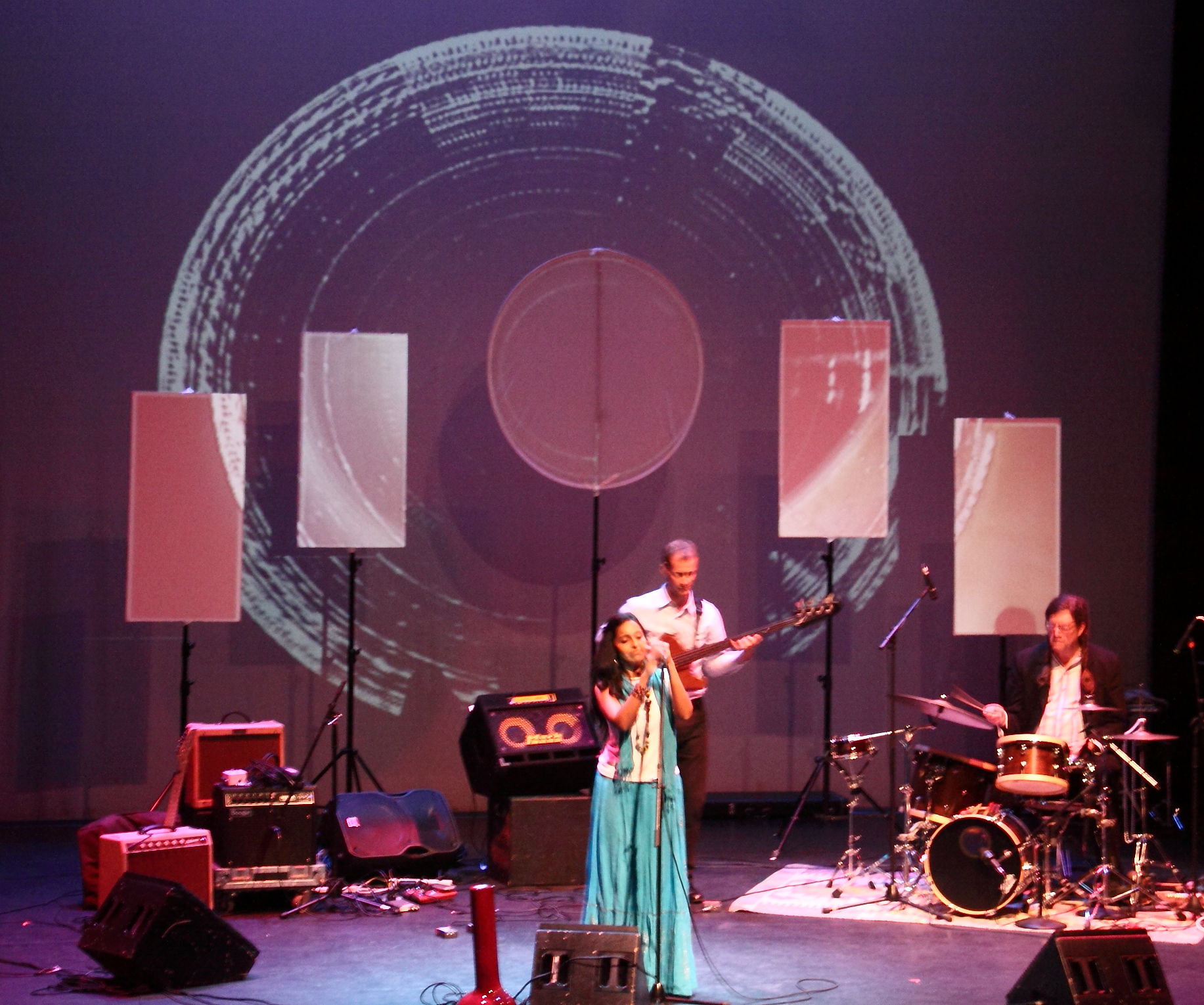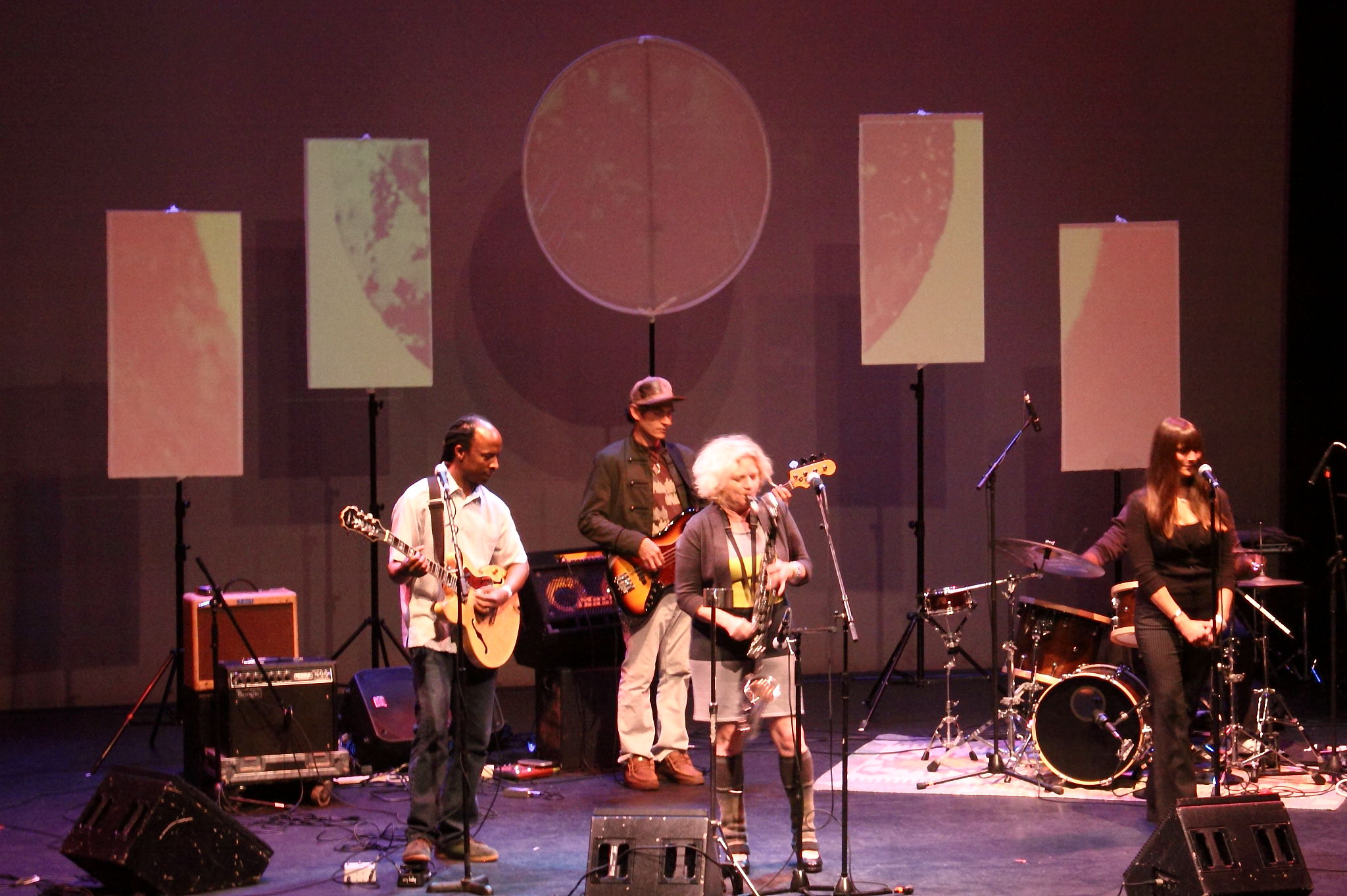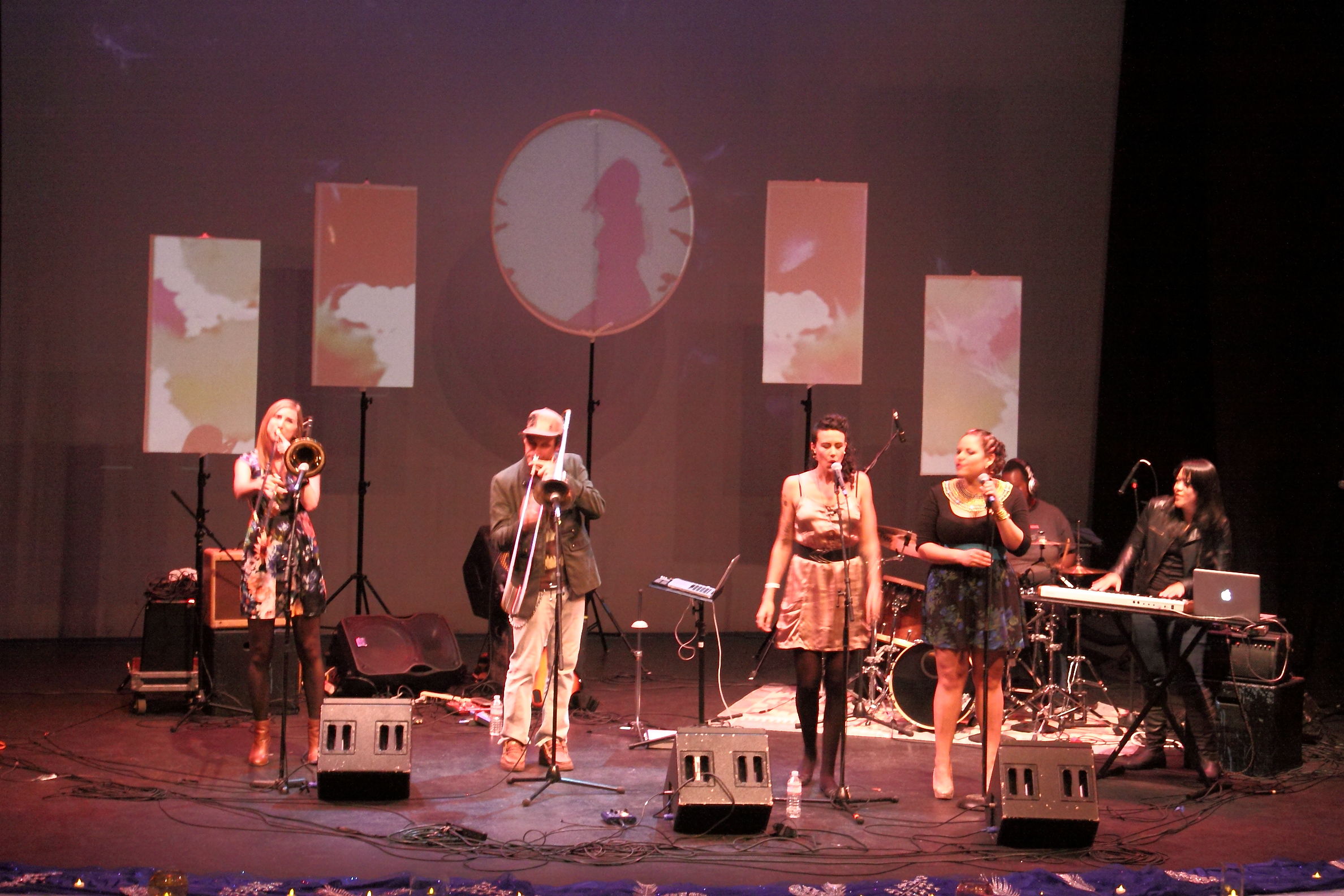
The Three Black Counter Tenors, An Historic First


The original incarnation of three classical singers with the same range performing as an act was that of the late Luciano Pavarotti, Placido Domingo and Jose Carreras.  I seem to remember a similar act with three Irish tenors that followed on their model.  Well what we have here is a far more unusual and very historically significant collection of three counter tenors, that voice range of male falsettos roughly corresponding to mezzo-soprano in range.  This is certainly one of the least common type of vocal artist but what makes this a unique historical event is that all three are African-Americans (to use the currently politically correct term).  They’re not performing as an act, though.  They are all starring in a single opera which makes this event even more compelling.

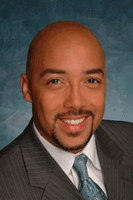
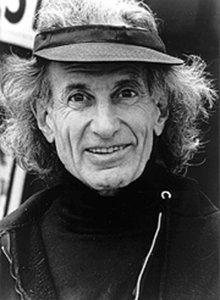
Darryl Taylor

Darryl Taylor

This will happen in the context of performances of Henry Purcell’s 1689 opera, “Dido and Aeneas” in Los Angeles.  I include this in this new music blog because it is certainly a new occurrence and it fits well with my ongoing survey which has looked at black composers since the 1964 Civil Rights Act.  Of course this event puts the focus on black performers, an area which I have not attempted to explore.  But is is nice to see this happening in the 50th anniversary year of that landmark legislation.

I only came upon this information when a highly valued friend based in Oakland, Bill Doggett, who is acting as a consultant to the L.A. Opera alerted me to this historic first.  He recently curated a well received exhibition in the Grand Foyer at the San Francisco Opera at the performances of Porgy and Bess.  Bill is a concert producer, strategic marketer, consultant, arts advocate and lecturer whose work promotes black classical artists.  It was he that suggested that this event would fit with the themes developed in my previous blogs.  I did share with Mr. Doggett my experience seeing Mary Zimmerman’s beautiful production of Philip Glass’ Akhenaten in Chicago which featured a black counter tenor named Geoffrey Scott whose name, sadly, seems to have disappeared from the web except for that production.  What was curious about that is that I vividly recall the audience’s reaction when he first came on stage.  It is perhaps more historically accurate to cast a black man as an Egyptian Pharaoh but the audience seemed shocked by his appearance and I didn’t feel that it was just because of his vocal range.

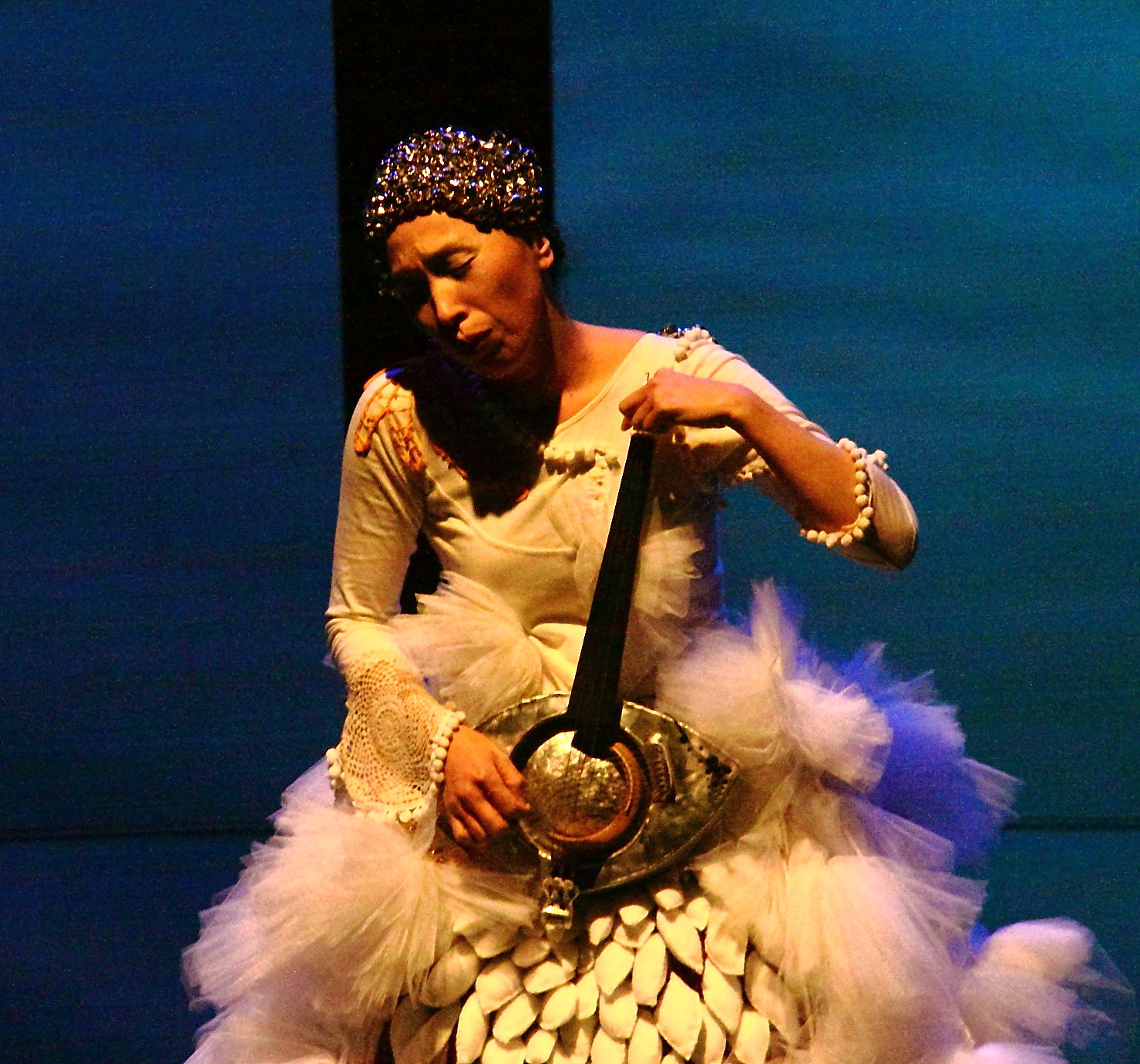
John Holiday

John Holiday

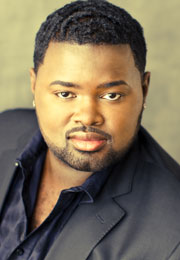
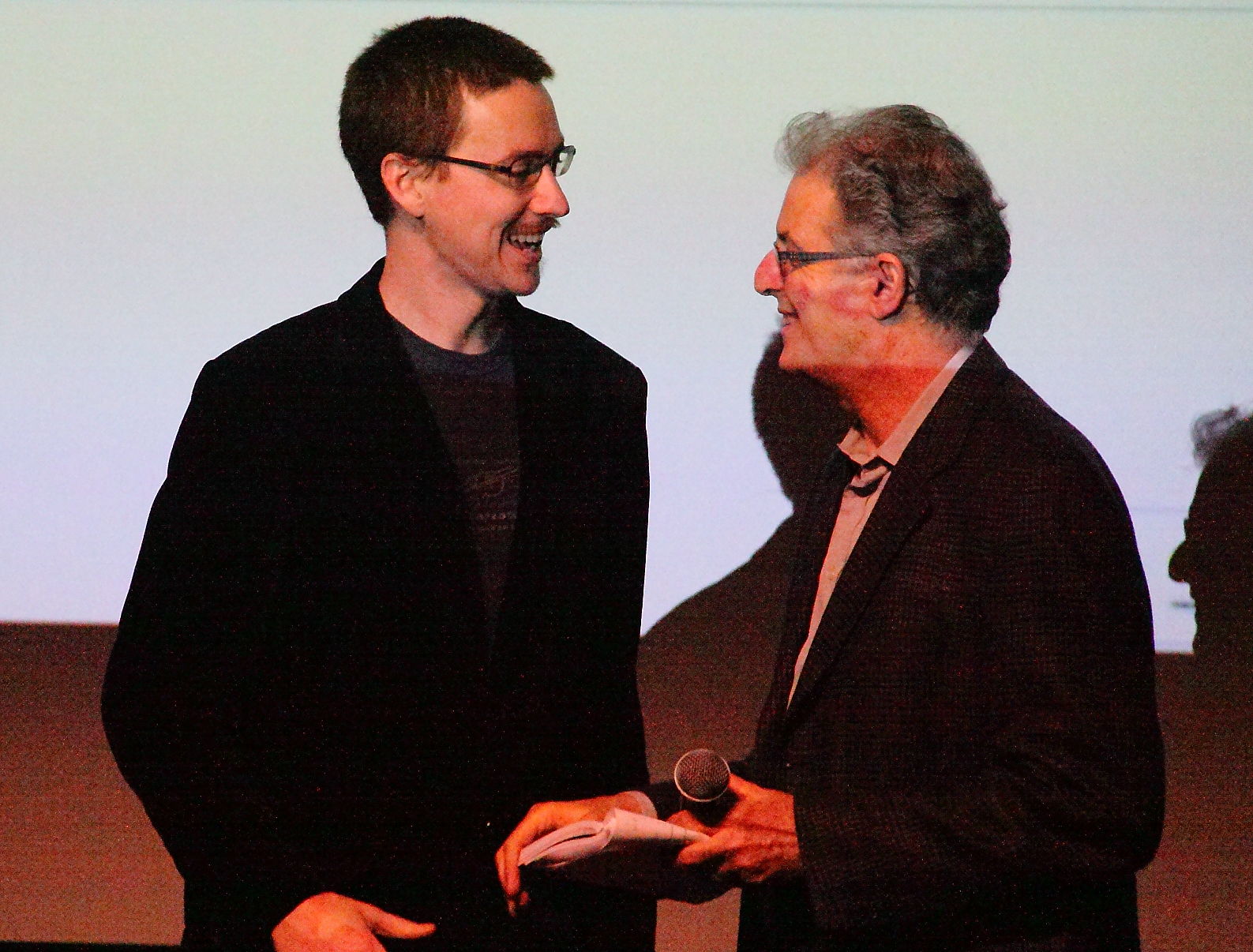
The three singers in this new production include John Holiday, Darryl Taylor and G. Thomas Allen all of whom are making their début performances with L.A. Opera.  Holiday, who will sing the role of the sorceress was the third place winner in this year’s Operalia, a competition founded by  Placido Domingo for singers aged 18-32.  Taylor and Allen will sing the roles of the witches in a production which, as far as I can tell will be the first time three black counter tenors will be appearing on an opera stage  in  the history of the art form.  Taylor is a voice teacher on faculty at the University of Michigan at Ann Arbor  and Allen appears to be a rising star whose art we will see at an early point in his career.

Correction: Darryl Taylor is now Associate Professor of voice at Claire Trevor School of the Arts  University of California,Irvine.

G. Thomas Allen

G. Thomas Allen

This performance will be a double bill with the other half of the program being a production of Bartok’s Bluebeard’s Castle.  The productions will run from October 25th to November 15th.  Below I am sharing the press release of this historic event.  One hopes that this historic first will shed a more sympathetic light in these embattled times where, in spite of such wonderful historic performances, we endure a correspondingly negative series of news events like those in Ferguson, MO, New York and so many other places where the value of black lives seems to be at a very low ebb.3CountertenormediaNEW.doggett

Tawawa House in Modesto? A New Staging of Zenobia Perry’s Opera.


Modesto California is not a common destination for new music productions but I learned of an upcoming performance of Tawawa House by Zenobia Powell Perry (1908-2004).  It was written in 1984 and premiered in 1987 at Central State University in Wilberforce, Ohio (actually the geographic setting of this opera) where she was part of the music faculty from 1955-1982.

I only learned of this performance due to my Facebook contact with Bill Doggett, a bay area business developer and marketing consultant who focuses on music by people of color.  The production is staged by Townsend Opera at the Gallo Center for the Arts in Modesto, CA.  It was the world première of a revised libretto and orchestration by Perry scholar Jeannie Gayle Poole.

After a mostly pleasant two-hour drive I arrived for my first visit to the central valley town.  I  located the beautiful arts complex and proceeded from a warm sunny spring day into one of several theaters housed in the same building, an arts multiplex, if you will.  The theater was about 2/3 full, a good sign.  It is a large and well-designed theater with great site lines, comfortable seats and a large fully equipped stage with a nicely nested orchestra pit.

The program book listed other productions that Townsend has done and it is an impressive list.  While they program popular standard repertory like La Boheme and Aida (no small feat) I did note that they have also done less frequently performed works such as Menotti’s Amahl and the Night Visitors and Offenbach;s Christopher Columbus.  Under the direction of Matthew Buckman since 2008 this is their first world premiere and perhaps their most adventurous production.

The staging (Heike Hambly), costumes (Tara Roe), lighting (Erik Vose), choreography (Erikka Reenstierna) and scenic design (Jean-Francois Revon) were excellent and well suited to what is essentially a chamber opera with spoken dialogue.  The singers were simply amazing both in their vocal artistry and their acting and dancing abilities.  The cast appeared quite comfortable with each other and clearly enjoyed what they were doing.  The orchestra was most ably led by conductor Ryan Murray.  This was a loving, beautiful production with amazing singers who appeared to put their hearts and souls along with their sizable talents to this opera.

The spectacular vocal cast included baritone Lawrence Craig, tenor Anthony P. McGlaun, baritone V. Savoy McIlwain, soprano Leslie Sandefur, baritone Barry Robinson and soprano Shawnette Sulker along with supporting singers and chorus.  These artists alone justified the price of a seat for this performance.

Dramatically staged scene from the second act.

Dramatically staged scene from the second act.

Tawawa House is based on a real place which existed in Ohio and served both as a luxury hotel for white visitors with purported healing waters as well as a major stop on the underground railroad with socially progressive whites assisting in the rescue of slaves from their forced servitude even before the emancipation proclamation.  The story begins before the civil war and ends just after.  It is a story nearly lost to history and one that deserves to be told.

The joyful multiple weddings scene as one happy couple "jumps the broom" in a traditional practice of the era.

The joyful multiple weddings scene as one happy couple “jumps the broom” in a traditional practice of the era.

As an opera it is cast in a conservative musical style relying on spirituals and popular songs of the era with some quotation of both genres.  It consists of choral sections, a few arias and some ensemble singing.  Like many operas this one suffers from a weak libretto at times which nonetheless serves to support the overall structure of the musical work.  This is a gentle retelling of a tale from a sordid and shameful time in our collective history.

The orchestration ranged from a theater orchestra style to some Hollywood-like film score that one might hear in motion pictures from the 1940s.  I don’t know how this edition differed from the original 1987 performance or why the decision was made to revise it.

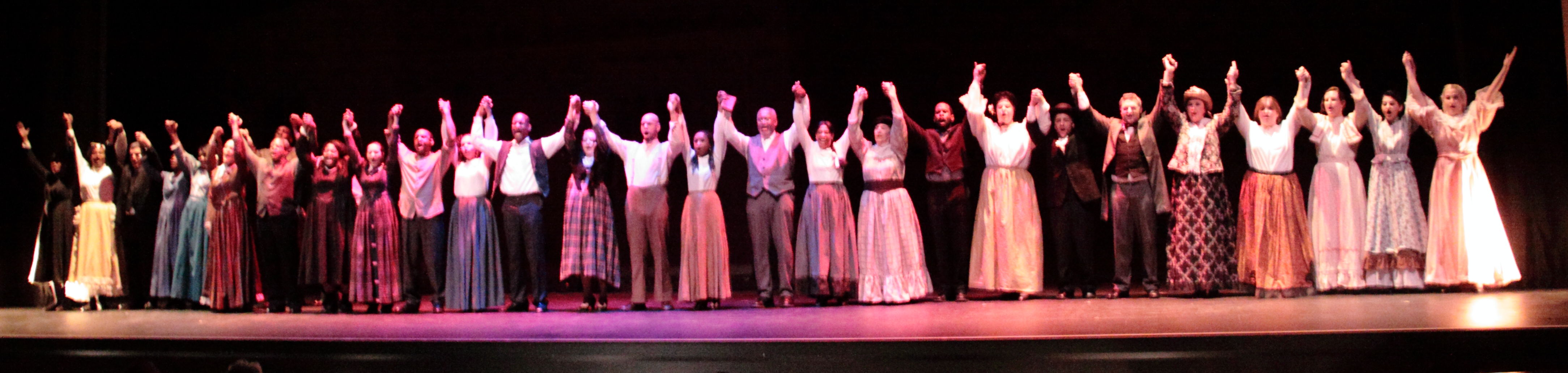
The cast taking their first bow to the appreciative audience.

The cast taking their first bow to the appreciative audience.

It is difficult to say where this work will take its place in musical history but it certainly deserves to be revived.  I hope that the success of this production will encourage adventurous opera companies such as Townsend to seek out other neglected works in that deserve revival and, in many cases, first performances.

Despite some minor weaknesses the performance was very professionally executed,  full of joy and clearly pleased the audience.  After all theater goers are accustomed to the sometimes silly plots common to a lot of operas and musicals but they are seeking entertainment by talented performers and that is definitely what they got.  This was a wonderful production which now puts Townsend opera on my radar.  Looking forward  to more from this company.  Congratulations on a great show!


Enhanced by Zemanta

Tom Johnson and Samuel Vriezen, Great New Recording


A few of months ago received my copy of the newly minted CD by pianist/composer Samuel Vriezen.  This is one of those crowd-sourced projects on Indiegogo .  The disc consists of a new recording of a sort of minimalist classic and a new works by the pianist, Within Fourths/Within Fifths (2006) which is, essentially his artistic response to this piece.  The piece is dedicated to Johnson.

download

This is only the second recording of the Tom Johnson work committed to disc. That by itself is an achievement. The first was recorded by the composer and released on XI records in 1999.  That recording clocks in at about one hour.  By contrast Mr. Vriezen’s recording takes only about 30 minutes to play the piece.  Johnson, who is also known as the former music critic for the Village Voice is one of the few composers who actually embraces the term “minimalist”, in fact he was there witnessing the very birth of that style during his tenure at the Village Voice (1972-1982).

The Chord Catalog (1985) consists of, in order, all the possible chords in a single octave that are possible with two notes, three notes, four notes, etc. up to 13 notes with the doubling of the octave.  That’s a total of 8178 chords. This sounds like a potentially bland academic exercise like many minimalist or process music concepts.  No tempo is specified in the score.  It is an important piece which may not appeal to all audiences but will likely entertain anyone whose listening interests lie in the realm of minimalism, process music and conceptual art.

TheChordCatalogue-page-001

According to Kurt Gottschalk in his article for I Care If You Listen Johnson is a fan of Vriezen’s interpretation and, in fact, is one of the many contributors to the project.  Vriezen has been performing the piece for about 10 years now in public concerts and he posted a video of a performance of Chord Catalog with commentary by Tom Johnson and himself.  There are also scenes of Johnson with Vriezen as he performs a portion of Within Fourths/Within Fifths.

Vriezen’s piece by contrast lasts about 45 minutes and, though using similar methods, produces a different sound world.  He correctly describes the piece as lyrical and it is a wonderful piece on its own, more wonderful in context with its predecessor.  This disc is an artistic dialogue, a call and response between to kindred spirits of different generations.

Samuel Vriezen is a Dutch pianist, composer and writer born in 1973.  His web site lists his compositions and writings and there are downloadable mp3 files and scores.  There is also a Vriezen page on Ubuweb which contains mp3 files and pdf files of several of his pieces and includes useful program notes.  He also produced Johnson’s CD Symmetries (1980) featuring Vriezen and fellow pianist Dante Oei on Karnatic records.

This is the solo début recording by a composer and pianist with keen instincts and talents that leave this reviewer in excited anticipation of what he  will do next.  I am also proud to have sponsored this wonderful recording.

Enhanced by Zemanta

Alvin Curran’s Fake Book at the Berkeley Arts Museum


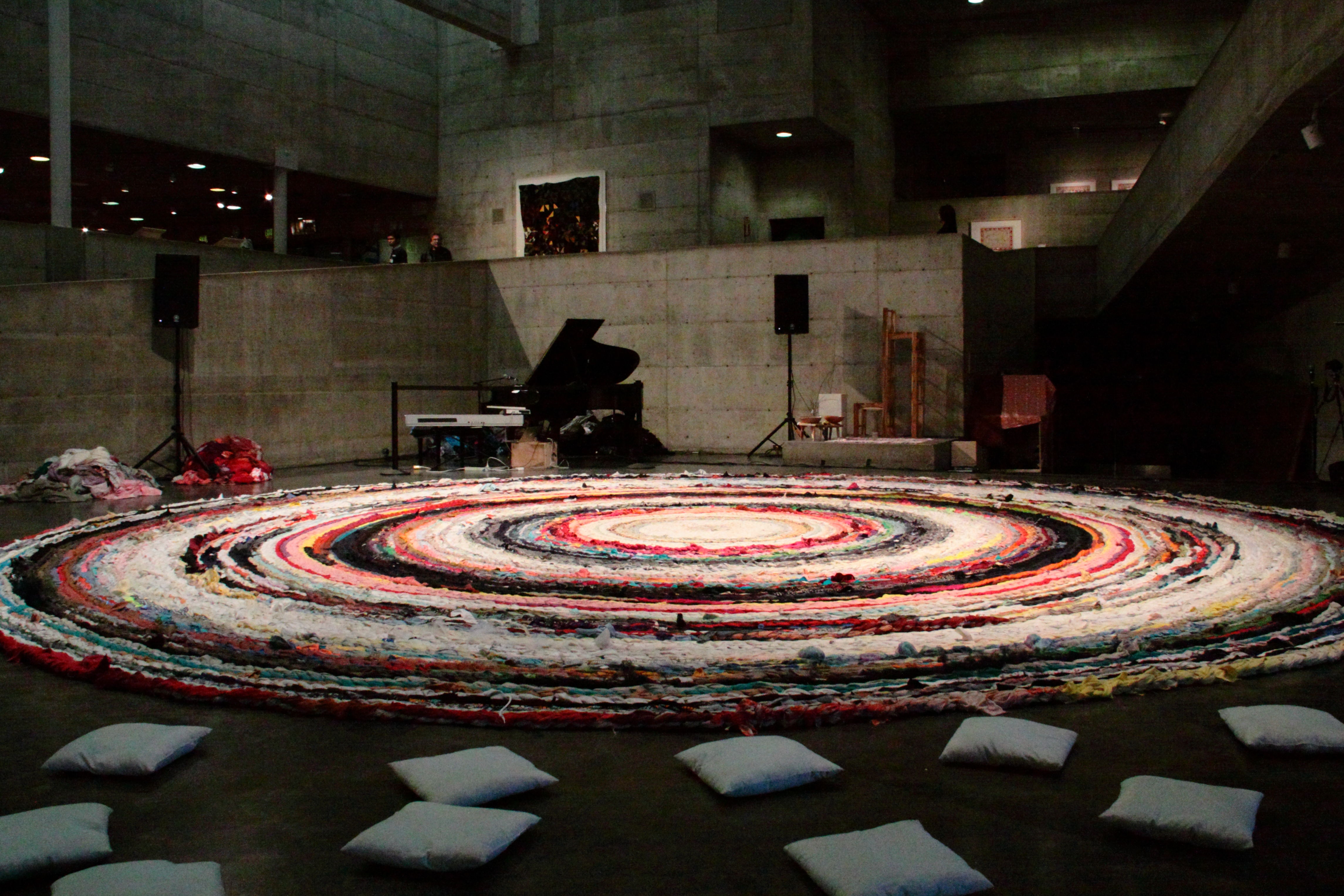
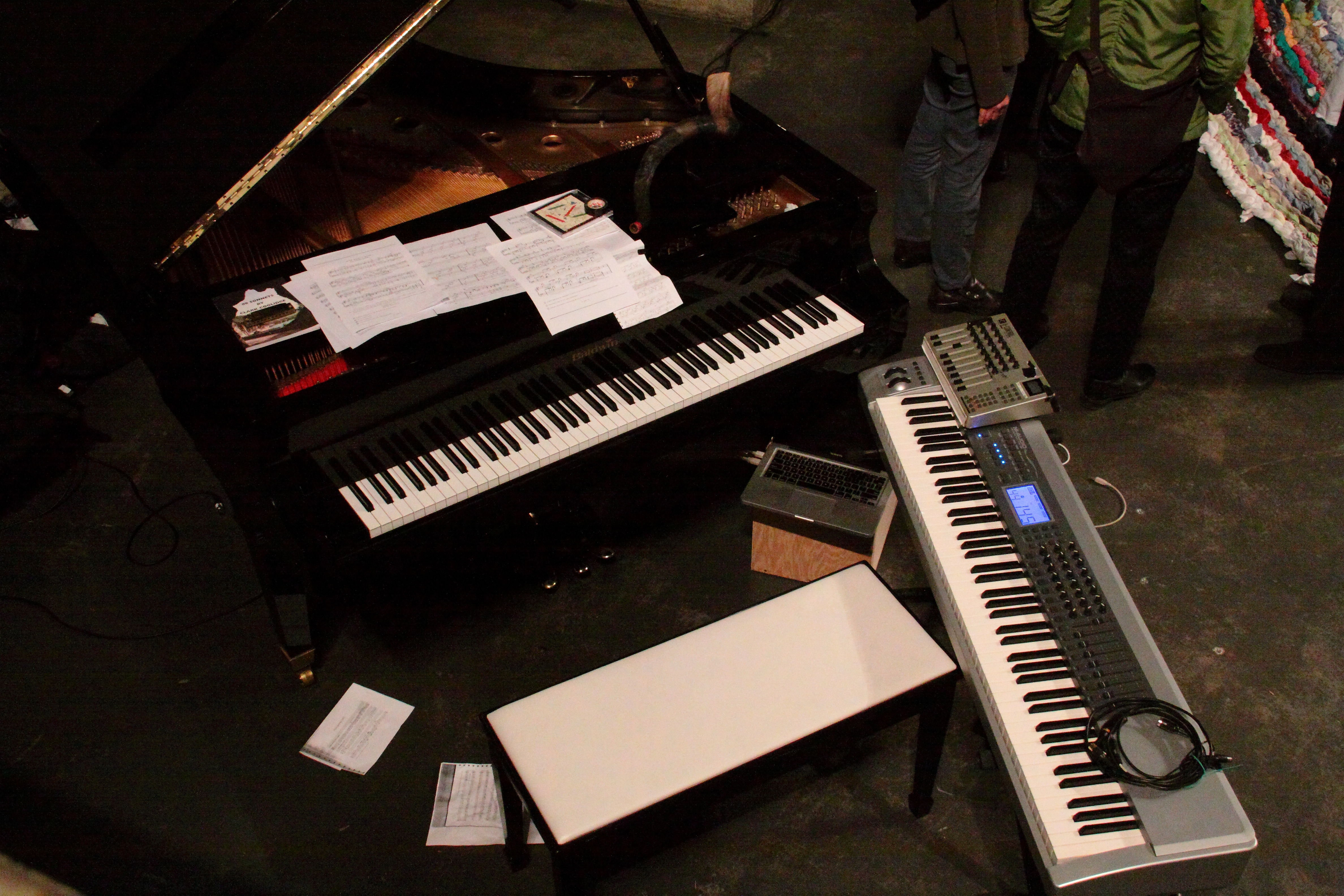
Staging set up for the Alvin Curran solo performance at the Berkeley Arts Museum

Staging set up for the Alvin Curran solo performance at the Berkeley Arts Museum

On a cool Friday evening in Berkeley April 11th I proceeded to the Berkeley Arts Museum which sits across the street from the University.  It is a beautiful modern architectural creation with a large and resonant space where there was a large and colorful rug, a series of pillows and behind that a set of conventional chairs for the audience.  Many chose to sit on the rug close to the performer.

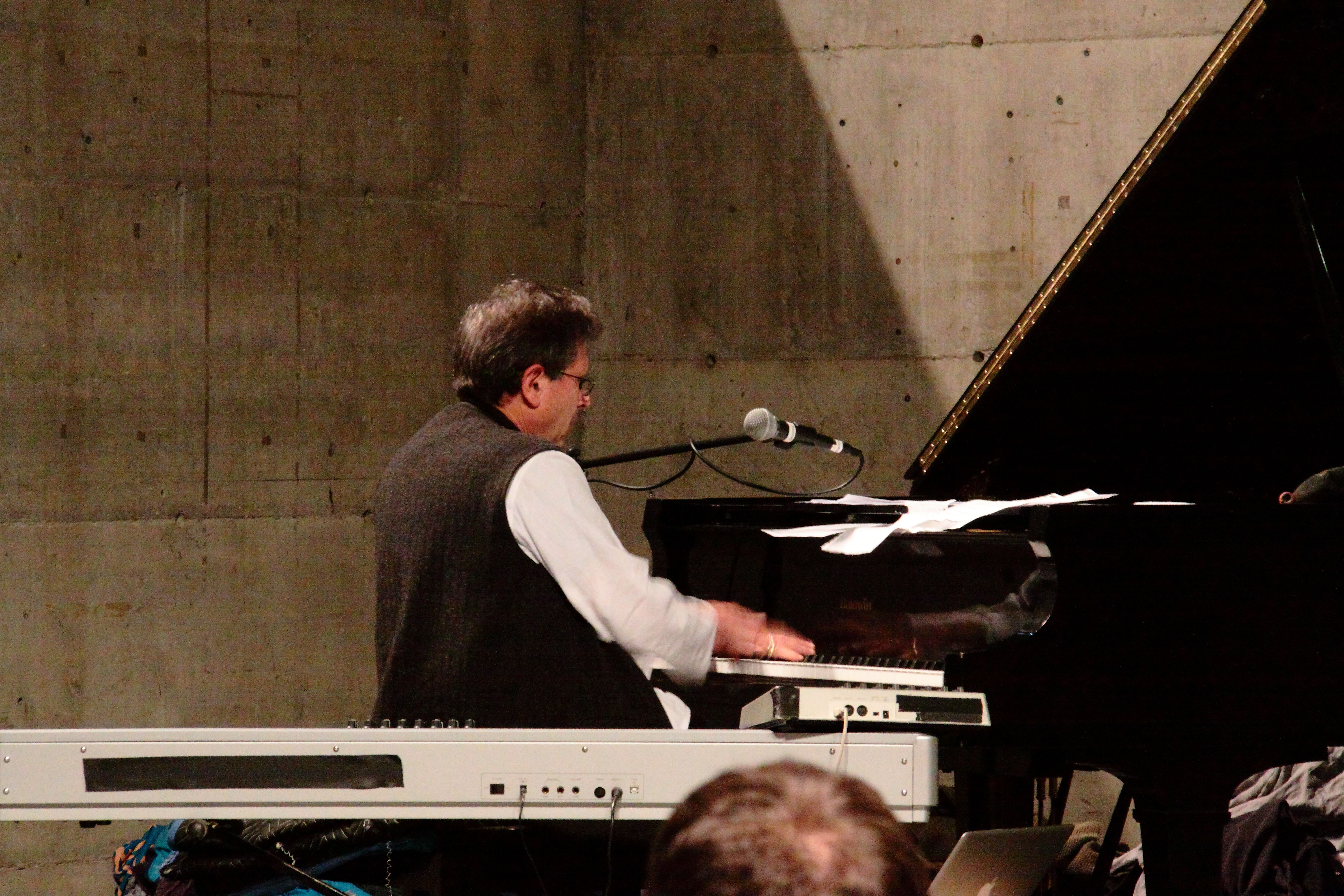
The set up consisted of a piano on loan from the Piedmont Piano Company, an electronic keyboard on loan from Paul Dresher along with Mr. Curran’s computer and and amplifier driving two speakers on either side of the keyboards.  The open space is just off the entry way of the museum and tends to have a fair amount of traffic and ambient noise of the people on the various levels.

Curran, now 75, has been a prominent figure on the contemporary music scene internationally since about 1964 when he was partnered with fellow expatriates Frederic Rzewski, Allan Bryant, Richard Teitlebaum and Carol Plantamura among others in the ground breaking Musica  Elletronica Viva.  They created events and happenings using live electronics in the days before such things were easily accessible.  He has continued to explore the leading edge of musical creativity throughout his long and ongoing career.

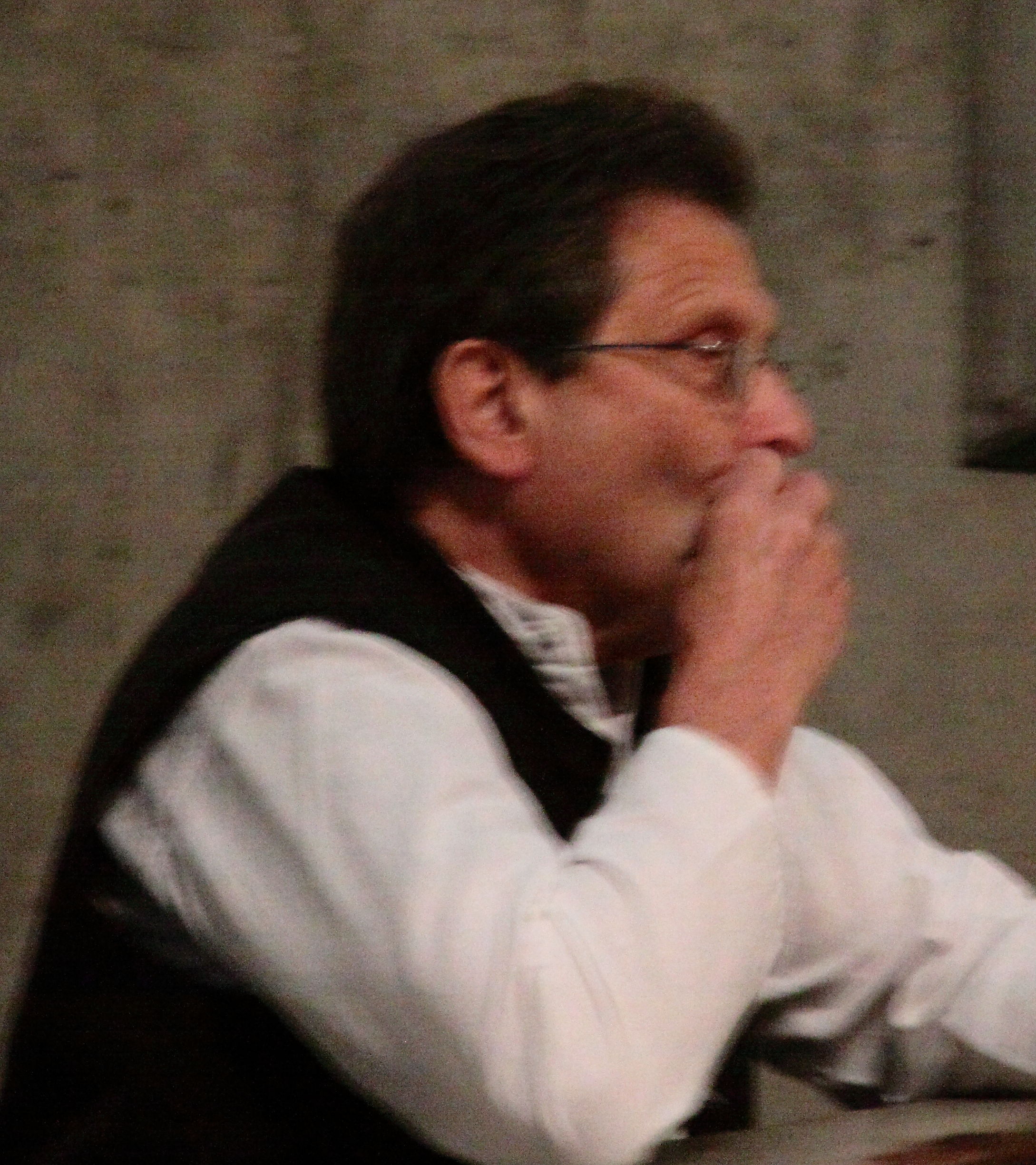
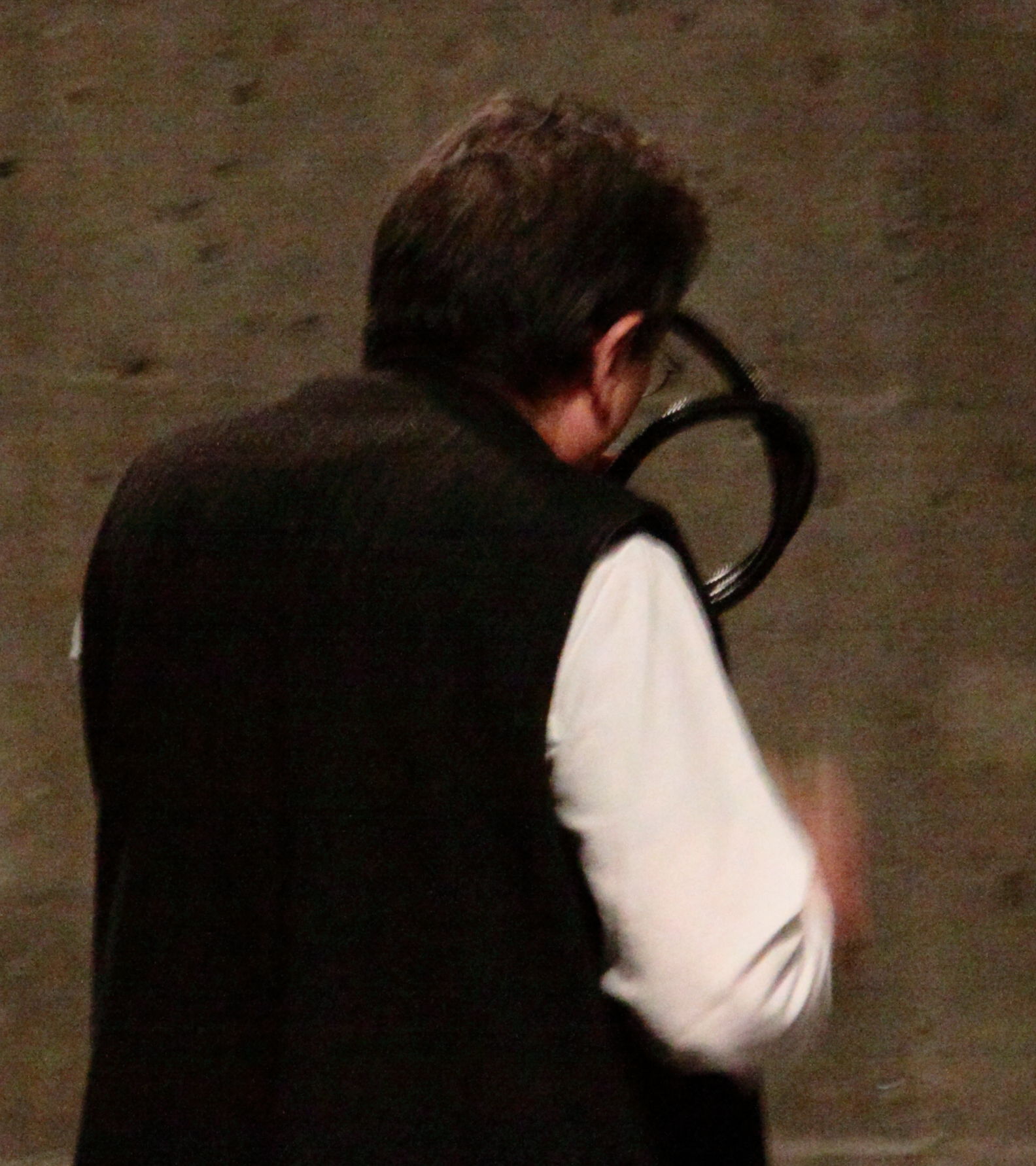
Curran playing a harmonica at the opening of the concert.

Curran playing a harmonica at the opening of the concert.

The concert began with Curran circumnavigating the audience in clockwise fashion beginning stage right and going around the audience making a full circle and returning to the front of the audience stage center.  he began by playing two simple chords on the instrument repeating them several times.  He then switched to another woodwind type instrument playing some unusual sounds.  When he took his place in front of the keyboards he set those instruments down.

Curran completing his circumnavigation which opened the performance.

Curran completing his circumnavigation which opened the performance.

He alternated between playing the piano and the electronic keyboard sometimes playing both.  He began with some simple sounding piano music and then turned to the electronic keyboard and began playing some of the samples on it.  They ranged from speech to electronic sounds.

At first the ambient noise of the crowd echoed gently in the museum along with the music.  Gradually as the music became more complex and louder the audience seemed entranced, taken on the ritualistic journey that comprises Curran’s work, Fake Book, a reference to books of musical lead sheets that musicians have used over the years to quickly and easily access a variety of materials for live performances.

The louder music then suddenly changed back to a softer dynamic and the reduction in the ambient noise of the audience and casual museum goers had noticeably decreased and one sense an increased attention and focus on the music.  All seemed to be drawn in to the variety of sounds and styles which Curran refers to as his “common practice”, a practice in which the composer uses any and all sounds, instruments and styles strategically to evoke the things the composer wishes to express.

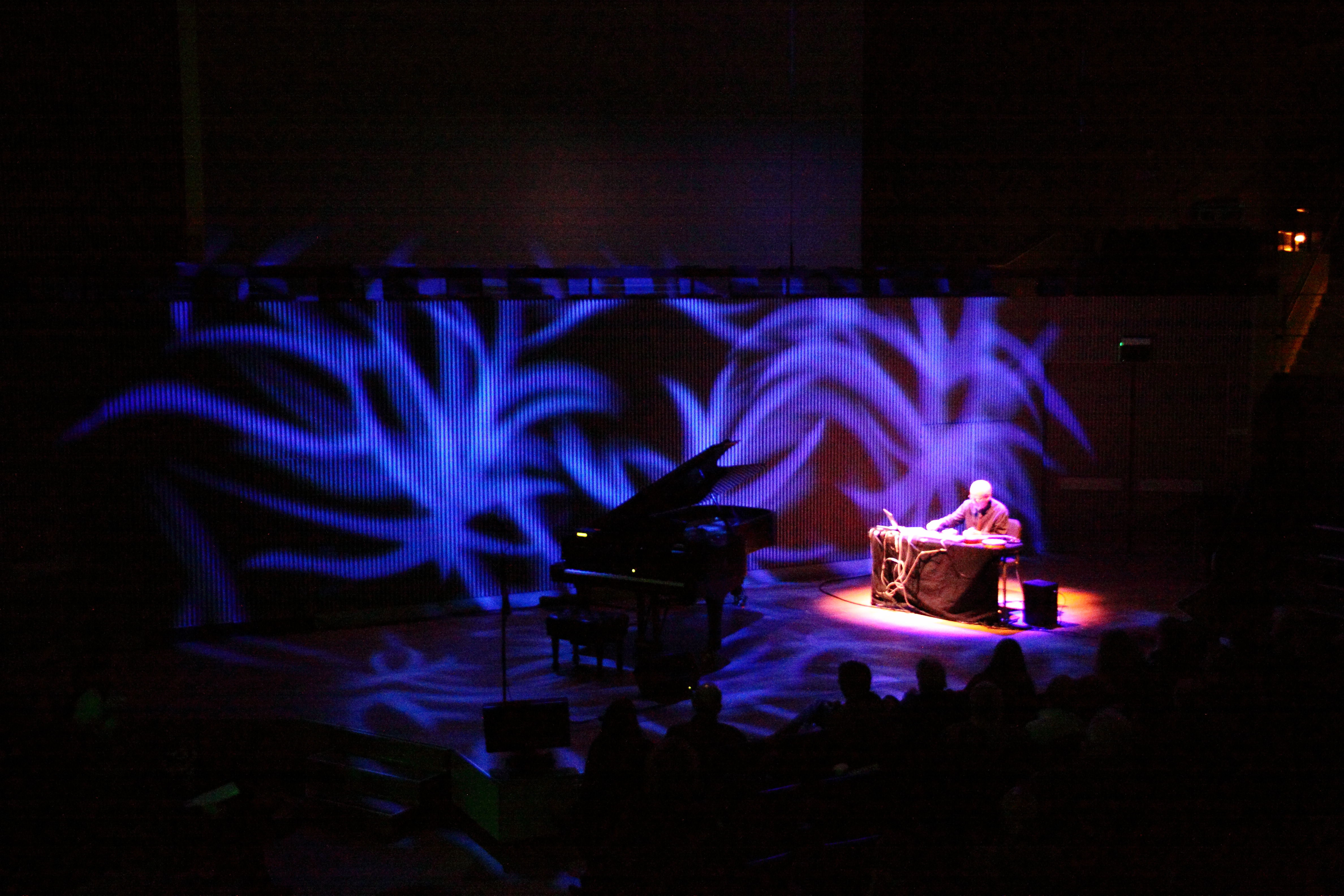
Alvin Curran at the keyboards performing his Fake Book.

Alvin Curran at the keyboards performing his Fake Book.

Curran played for just over an hour without pause an encyclopedic diversity of styles and ideas evoking the musical past in classical sounds, jazz sounds, modernist sounds.  The electronic keyboard samples played voices, radio snippets, electronic sounds and electronic manipulations of these sounds.

Curran effectively involved us all in a ritual performance respectfully evoking the past and blending it all into our experience of the moment.  From the beginning as he walked clockwise around the audience and through the complex collage of musical and sonic ideas he created a genuine ritual, a sacred performance if you will.  His music this night was an homage to the past and a celebration of the present.

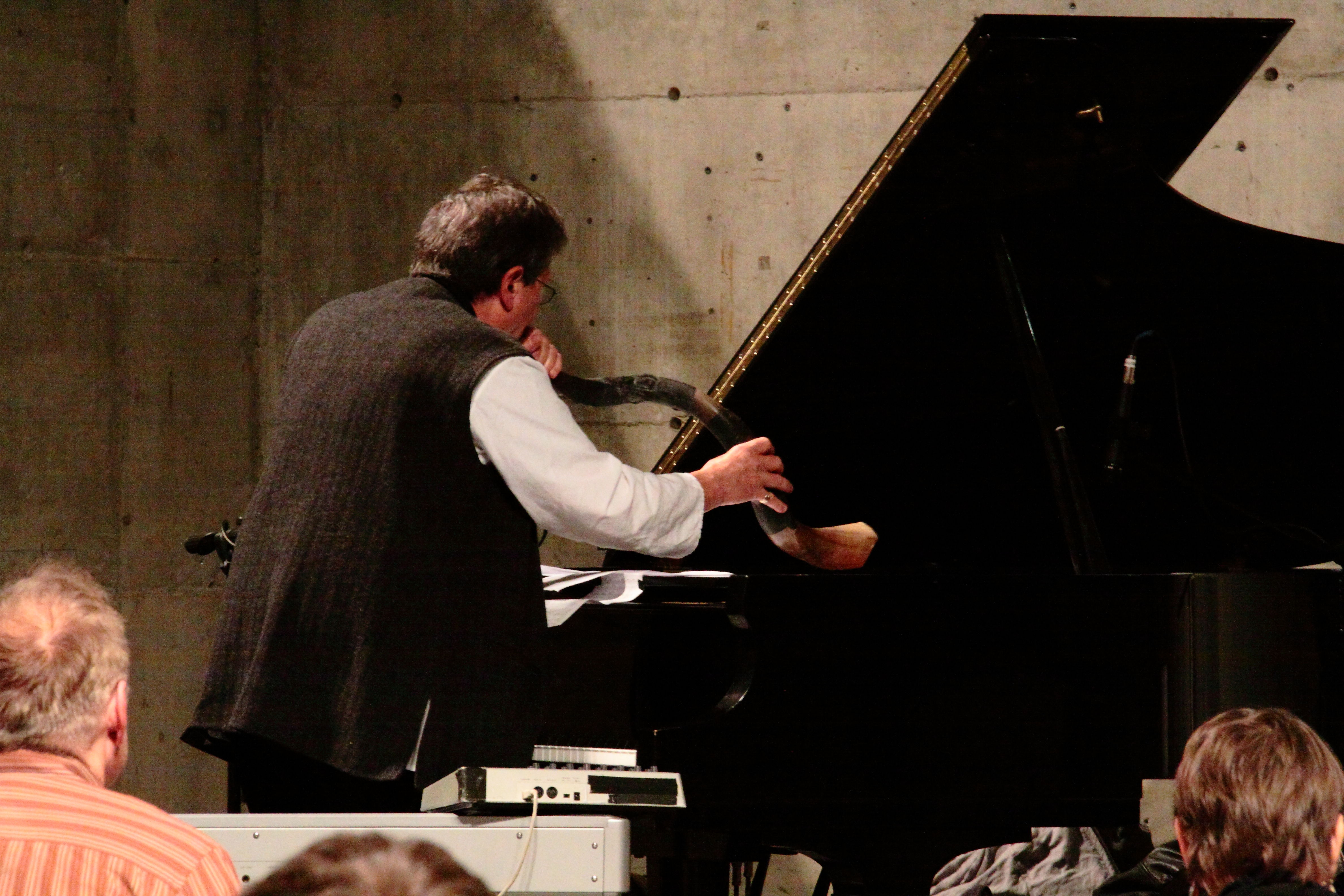
Curran blowing the ancient shofar (ram's horn) over the undamped piano strings.

Curran blowing the ancient shofar (ram’s horn) over the undamped piano strings.

He signaled the end of the performance as he blew the ancient shofar, an instrument fashioned from a ram’s horn, over the undamped piano strings creating a beautiful sympathetic resonance.

The audience responded with warm applause and appreciation.  Curran, who told me that he began work on this music while he was in residence at nearby Mills College, is clearly embraced and appreciated by the local audience.  He continues his tour and will return to his adopted  home in Rome, Italy but this evening he was clearly one of our own.

Overhead view of the keyboard set  up for the April 11th performance.

Overhead view of the keyboard set up for the April 11th performance.

Enhanced by Zemanta

Notes From the Underground, A major new recording of Anthony Davis’ orchestral music


Album cover

Album cover

In March, 2014 the Boston Modern Orchestra Project released Notes From the Underground, a major retrospective recording of the composer’s work for large ensembles.  The recording includes Notes from the Underground (1988) a two movement work for orchestra, You Have the Right to Remain Silent (2007) a concerto for clarinet and contra-alto clarinet and Kurzweil processor and a new recording of the piano concerto Wayang No. 5 (1984) with the composer as soloist.  The Boston Modern Orchestra Project is conducted by Gil Rose.

There are liner notes by the composer and also by the great musician/composer/historian George Lewis (and a frequent musical collaborator with Davis).  The notes are relatively brief but contain a wealth of information and provide useful insights into both the musical processes and the sociopolitical forces that drive Davis’ music.  Davis describes his compositional processes and Lewis, a frequent musical collaborator,  places the music in historic and sociopolitical contexts.

Only the Wayang No. 5 has had a previous recording.  It was one of the two works included on the Gramavision release which included the equally engaging Violin Concerto “Maps” (1988) written for and performed by violinist Shem Guibbory.  The concerto reflects Davis’ interest in jazz as well as his study of gamelan music from whence comes the title “Wayang”. Davis has written a series of compositions for various combinations of instruments titled sequentially Wayang No. 1, No. 2, etc.  The term refers to the shadow puppet theater of  Bali which are accompanied by a gamelan orchestra, an ensemble largely of tuned gongs and other percussion instruments.  Davis studied gamelan music and wrote six compositions (so far) titled Wayang of which the fifth is the piano concerto on this recording.

Wayang No. V is the earliest composition on the disc and consists of four movements.  Opening-Dance begins with an improvisatory section with the pianist playing over unresolved harmonies in the orchestra which then leads to the main section of the movement which is characterized by ostinati in the orchestra as well as on the piano.  There is a seamless transition to the second movement Undine, a slow movement with an impressionistic feel.  March also begins without pause from the previous movement.  It is a scherzo like piece where the polyrhythmic structures are quite clear.   The finale, Keçak, a reference to the monkey chant in the ritual enactment of a scene from the Ramayana where the monkey-like Vanara help Prince Rama fight the evil King Ravana.  It begins with a long solo piano introduction followed  by a sort of dialog between the piano and several percussion instruments.  Davis demonstrates his virtuosity here in writing that is indebted as much to gamelan as it is to jazz and modernism from Schoenberg to Bartok, Stravinsky, Hans Werner Henze and Thelonius Monk.

This is a concerto that is more concerned more with expression than empty virtuosity though the piano part could hardly be called easy.  I am amazed that there have been no pianists who have added this wonderful piece to their repertory.  It is a very entertaining piece of music making.

The title track is the orchestral composition, Notes from the Underground (1988).  It is a two movement work dedicated to the writer Ralph Ellison (1914-1994), best known for his National Book Award winning novel The Invisible Man (1952).   The title evokes Dostoevsky’s existential 1864 novel as well as Ellison’s collection of essays, Shadow and Act (1964). The composer describes it as a “riff” on Duke Ellington’s Diminuendo and Crescendo in Blue (1937).  It is, to this listener, a grand set of orchestral variations.

Ralph Ellison

Ralph Ellison (Photo credit: Wikipedia)

The first movement, Shadow, is described by the composer as one that introduces fragments which will be heard in the second movement.  It features a prominent solo for the percussionist.  The second movement, Act is the longer of the two and is described as being written in ten steps with an elaborate polyrhythmic structures described in more detail in the accompanying notes. The writing here probably comes as close to minimalist or process music as anything the composer has done.  It is not minimalism per se  but it is perhaps proto-minimalist techniques whose roots are at least partly in jazz as musicologist Robert Fink suggests.   It produces a ritualistic and meditative feel to this richly orchestrated, reverent and mysterious sounding piece.   It is a fitting tribute to a great American man of letters as well as to the great composer Duke Ellington.

The concerto, You Have the Right to Remain Silent (2007) is the most recent as well as the most overtly political piece on the album and it is a gem.  It is written for clarinet doubling alto clarinet and a Kurzweil synthesizer/sampler and orchestra.  Longtime collaborator, the wonderful J. D. Parran  plays the clarinets winding his way through a balanced hybrid of styles including bebop, modern classical and free jazz styles comprising rhythmic complexity and multiphonics.  One could hardly imagine a soloist better suited for this music.  Earl Howard plays the Kurzweil which intones sampled speech of words from the Miranda Rights which are supposed to be presented at the time of an arrest.  Here they are presented strategically in poetic dialogue with the music controlled by the keyboard player.

Here again the individual movements have their own titles poetically referencing the issues which the composer attempts to invoke in this piece. He says in his notes, “I tried to approach ‘silence’ as, rather than John Cage’s apolitical world of ‘white privilege’, a much more dangerous place.”  The first, Interrogation, is intended to evoke the clarinet as being interrogated by the orchestra.  The second, Loss  features an improvised duet between the Kurzweil and the clarinet.  It ends with an homage to Charles Mingus, a major influence on Davis.  The third, Incarceration includes more text from the Miranda and the Kurzweil processes both the words and the clarinet solo.   And finally, Dance of the Other, intending to evoke the fantasy and the feeling of otherness and presumably alienation.

It is a concerto in the classical sense of a dialogue between soloist and orchestra and it seamlessly blends various classical and jazz harmonies and techniques which challenge the expertise of the soloist.  All the while it clearly presents a political context which meditates on the inhumanities and inequalities inherent in our “correctional” system and in our society as a whole.  As political music it lies within a grand tradition taking a place beside earlier masterpieces of that genre like Henze’s Essay on Pigs (1968) and Rzewski’s Coming Together (1971).  And as a concerto it is a challenge to the soloist and a delight to the listener.

This is a wonderful disc, well recorded and performed.  It presents some amazing and substantial music by one of the living treasures of American composers.  Anthony Davis has had a long and influential presence on the American music scene in his jazz performances as well as his chamber and orchestral music.  His operas like X: The Life and Times of Malcolm X (1986), Amistad(1997 ) and the more recent Wakonda’s Dream (2007) have been performed to critical acclaim. Hopefully this recording will introduce people to this composer’s works and remind those already familiar with the power and depth of Davis’ music.  Bravo to the Boston Modern Orchestra Project for bringing this music to the listening public.  I hope the major orchestras and theaters and recording companies are paying attention so we can hear more from this still too little known composer.

Enhanced by Zemanta

New Carriers of the Flame of the Leading Edges of New Music


English: Shiraz Art Festival: David Tudor (lef...

With Paul Hillier in Malmö fall 2005

Kronos Quartet with Paul Hillier in Malmö fall 2005 (Photo credit: Wikipedia)

Looking back at the history of music since 1945 one can clearly see the musicians who took on the newly developing repertoire with all its difficulties both in performance and in selling it to an audience.  These are the performers who introduced these new pieces to unsuspecting audiences and lovingly nurtured them to the place they now hold in the canon of musical masterpieces.


I’m speaking here of people like David Tudor, champion of the New York School (Cage, Feldman, Brown and Wolff) as well as a composer in his own right.  I’m speaking of ensembles like the Kronos Quartet and the Arditti Quartet, champions of innovators in music for string quartet.  I’m also speaking of conductors including Serge Koussevitzky, Leopold Stokowski, Leonard Bernstein and a host of others who daringly programmed new music and even sometimes endeared their audiences in so doing.

Arditti String Quartet

Cover of Arditti String Quartet

Date of photo not recorded.

Date of photo not recorded. (Photo credit: Wikipedia)

These are the people who brought that fascinating repertoire to my ears and those of many over the years  They are the people who also taught me why this music needs to be heard, whose enthusiasm communicated the depth in the scores they lovingly rehearsed and performed.


These musicians are part of a tradition, that of championing new music.  They widen and deepen the repertory by their selection, interpretation and performances of music that is new or not yet well-known.  They are the high priests and priestesses of the religion of sonic culture.  And as they fade into history they leave a vacuum which must be filled.


English: Portrait of Serge Koussevitzky (Russi...

 Portrait of Serge Koussevitzky from the Library of Congress’s George Grantham Bain Collection (Photo credit: Wikipedia)

My intention here is to identify some of the musicians I have discovered who seem to be taking up residence in that vacuum.  I am starting a series of articles in which I intend to share what I believe to be important cultural finds both in the musicianship and the emerging repertory.


As always I am open to any and all suggestions for inclusion here.  I would like to know who is going to introduce me to my next favorite musical discovery.


English: Leonard Bernstein

 Leonard Bernstein (Photo credit: Wikipedia)

My first article, currently in preparation, will be on the French pianist Nicolas Horvath.  His significant presence in social media makes him almost hard to miss and relatively easy to research.  Please stay tuned.


Enhanced by Zemanta

Composers of Northern California, Other Minds 19


OM 19, the final bow.  Left to right: Charles Amirkhanian, Charles Celeste Hutchins, Joseph Byrd, Wendy Reid, Myra Melford, Roscoe Mitchell, John Schott, Mark Applebaum, John Bischoff, Don Buchla

OM 19, the final bow. Left to right: Charles Amirkhanian, Charles Celeste Hutchins, Joseph Byrd, Wendy Reid, Myra Melford, Roscoe Mitchell, John Schott, Mark Applebaum, John Bischoff, Don Buchla

This past Friday and Saturday the San Francisco Jazz Center hosted the 19th annual Other Minds Festival concerts.  This is the first year not to feature an international roster.  Instead the focus was on composers from northern California.  (Strictly speaking these composers’ creative years and present residence is northern California.)  It was not a shift in policy but a focus on a less generally well known group of artists who have not enjoyed the exposure of east coast composers but have produced a formidable body of work that deserves at least a fair assessment.  In fact these concerts presented a fascinating roster of composers from essentially three generations.

The first generation represented was one which came of age in the fabled 1960s and included electronic music pioneer Don Buchla, AACM founding member Roscoe Mitchell and proto-minimalist Joseph Byrd.  The second was represented by Wendy Reid, Myra Melford and John Bischoff.  And the youngest generation by Mark Applebaum and Charles Celeste Hutchins.

The program opened on Friday night with a sort of pantomime work by Stanford associate professor of music Mark Applebaum.  The piece, called Aphasia (2010) consists of an electronic score to which the composer, seated in a chair, responds with a variety of carefully choreographed gestures.  The result was both strange and humorous.  The audience was both amused and appreciative.

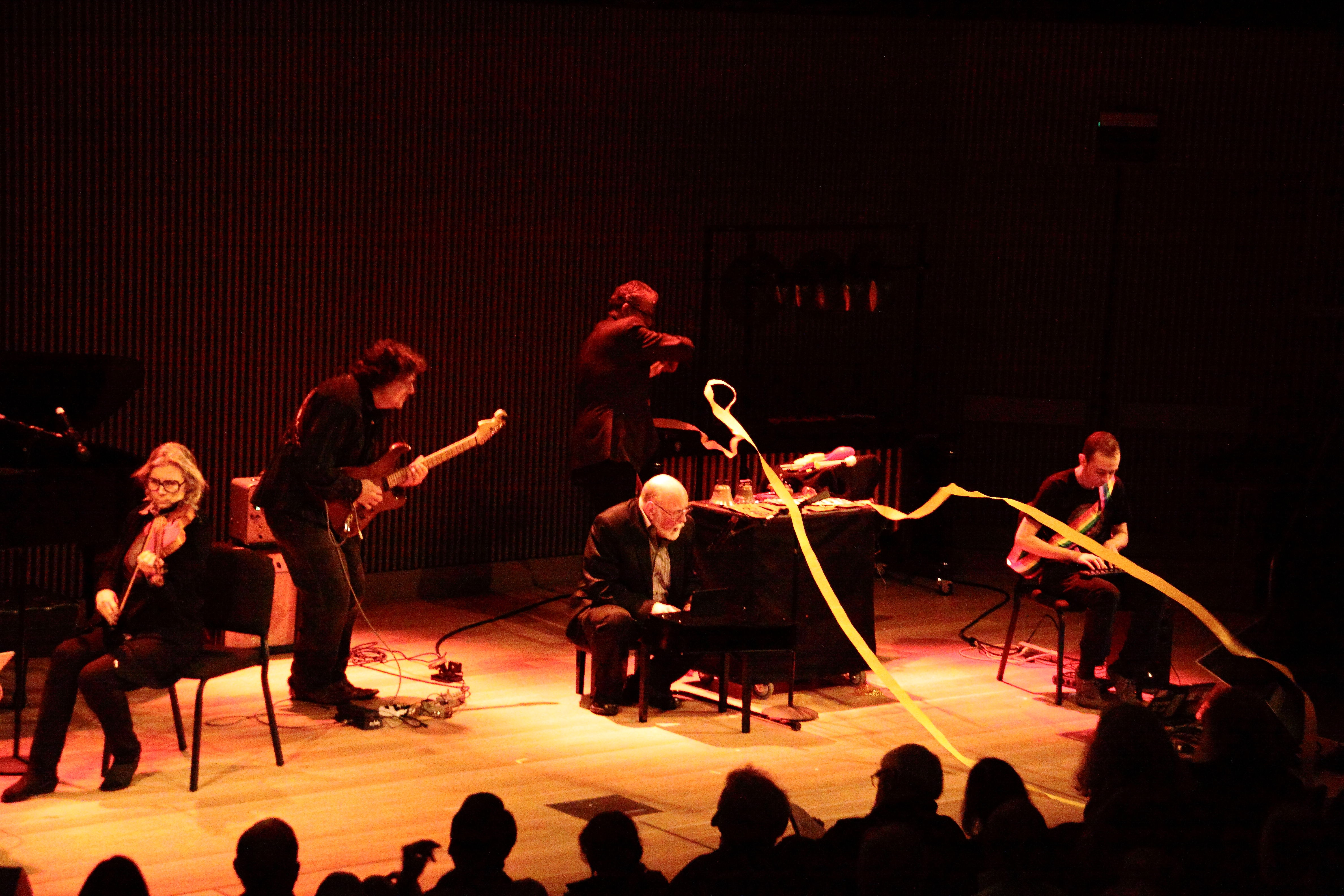
Applebaum's Metaphysics of Notation (2008) performed by the Other Minds Ensemble.  Left to right: Myra Melford, John Bischoff, Wendy Reid, John Schott, Joseph Byrd, Charles Amirkhanian and Charles Celeste Hutchins

Applebaum’s Metaphysics of Notation (2008) performed by the Other Minds Ensemble. Left to right: Myra Melford, John Bischoff, Wendy Reid, John Schott, Joseph Byrd, Charles Amirkhanian and Charles Celeste Hutchins

Applebaum’s graphic score Metaphysics of Notation (2008) was projected overhead while the ensemble played their interpretations of that score.  The ensemble, dubbed the Other Minds Ensemble, consisted of most of the composers who participated in the festival including Mr. Amirkhanian displaying his facility with  a percussion battery among other things.  (Presumably Roscoe Mitchell, who was reportedly not feeling well, would have joined the ensemble as well.)  Mr. Applebaum was conspicuously absent perhaps so as to not unduly influence the proceedings.

Ribbons strewn across the stage, a part of the Other Minds Ensemble's interpretation of the Metaphysics of Notation

Ribbons strewn across the stage, a part of the Other Minds Ensemble’s interpretation of the Metaphysics of Notation

The piece was full of minimal musical gestures, humorous events like ribbons strewn across the stage and the popping of little party favors that emitted streamers.  The ensemble appeared to have a great deal of fun with this essentially indeterminate score which they are instructed to interpret in their own individual  ways.  It was a rare opportunity to see and hear Mr. Amirkhanian (who is a percussionist by training) as well as an opportunity for the other composer/performers to demonstrate their skills and their apparent affinity for this type of musical performance.  Again the audience was both amused and appreciative.

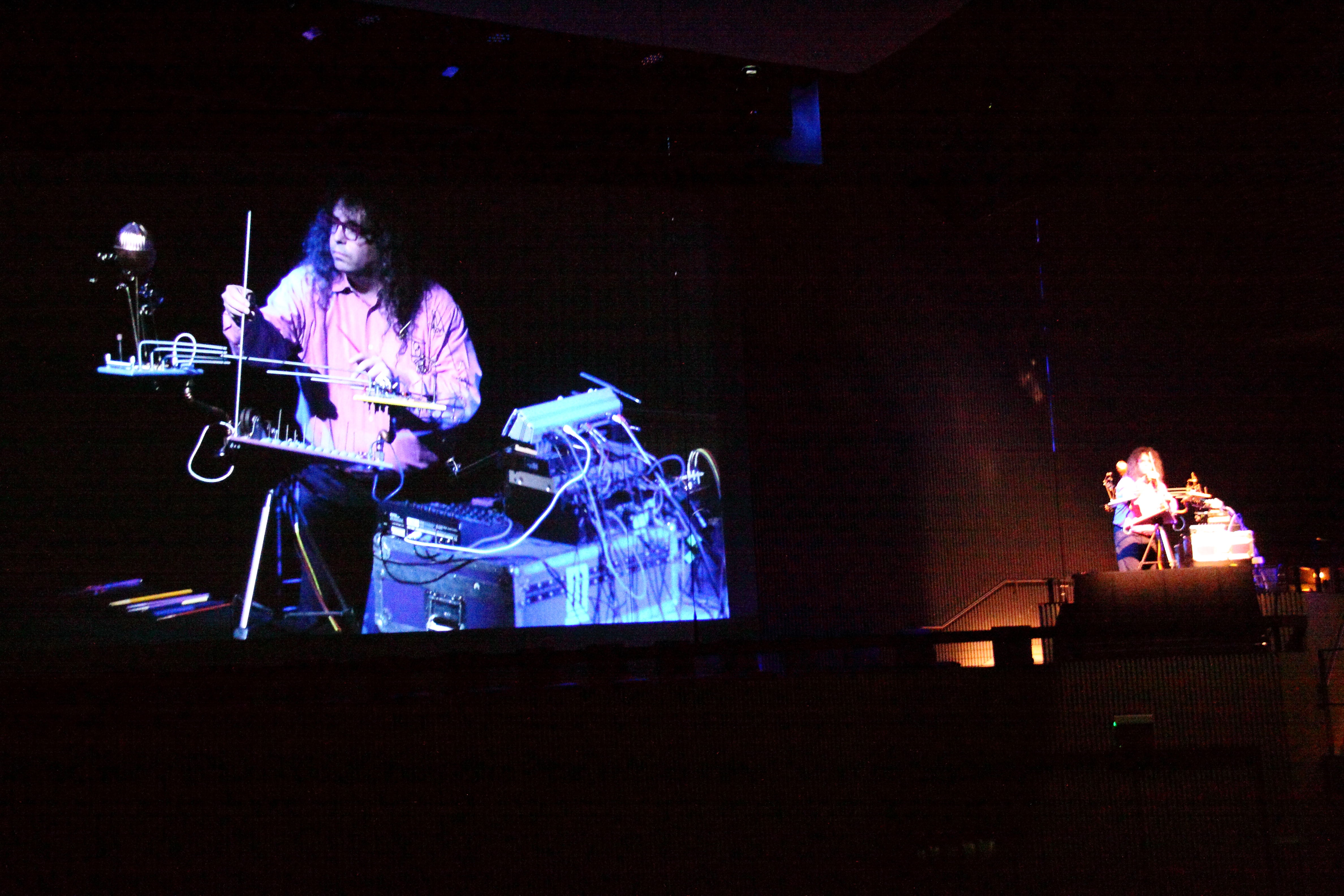
Mark Applebaum performing on his invented instrument.

Mark Applebaum performing on his invented instrument.

Projection of Applebaum performing with view of the composer/performer stage right as well.

Projection of Applebaum performing with view of the composer/performer stage right as well.

The third piece by Applebaum featured the composer with his invented instrument and electronics playing on a balcony stage right with a projection of himself on the big screen.  He produced a wide variety of sounds from his fanciful computer controlled contraption that seemed to please the audience.  This is the kind of unusual genre-breaking events which tend to characterize an Other Minds concert.

The second composer of the night was the elusive Joseph Byrd who is perhaps best known for his cult classic album The American Metaphysical Circus by Joe Byrd and the Field Hippies from 1969.  A previous band, The United States of America released a self-titled album which received critical acclaim in 1968.  Both are apparently out of print but available through Amazon.

Joe Byrd studied music with Barney Childs and worked with La Monte Young, cellist Charlotte Moorman, Yoko Ono and Jackson Mac Low.  Byrd went on to produce a great deal of music by others and also wrote music for films and television but his own compositions have only come to light again recently with the release of a New World CD released in 2013 which presents his work from 1960-63.  Mr. Amirkhanian said that it was this disc that got him interested in inviting Byrd to Other Minds (Byrd also taught at the College of the Redwoods in Eureka, California.).

This is the sort of musical archeology for which Other Minds has become known.  Amirkhanian is known for his ability to find and bring to performance and recordings music which has been unjustly neglected.  Hopefully this appearance will be followed by more releases of Byrd’s other music as well.

Byrd was represented here by performances of Water Music (1963) for percussionist and tape with Alan Zimmerman (who was one of the producers of the New World album) played the spare percussion part which integrated well with the analog electronic tape.

Alan Zimmerman performing Joe Byrd's Water Music.

Alan Zimmerman performing Joe Byrd’s Water Music.

A second piece, Animals (1961) was performed by the brilliant and eclectic bay area pianist Sarah Cahill with Alan Zimmerman and Robert Lopez on percussion and the fiercely talented Del Sol String Quartet (Kate Stenberg and Richard Shinozaki, violins, Charlton Lee, viola and Kathryn Bates Williams, cello).  This was another piece with soft, mostly gentle musical gestures involving a prepared piano and predominantly percussive use of the string players.  It was interesting to contemplate how this long unheard music must have sounded in 1961 but it was clear that it communicated well with the audience on this night.

Animals (1961)

Animals (1961)

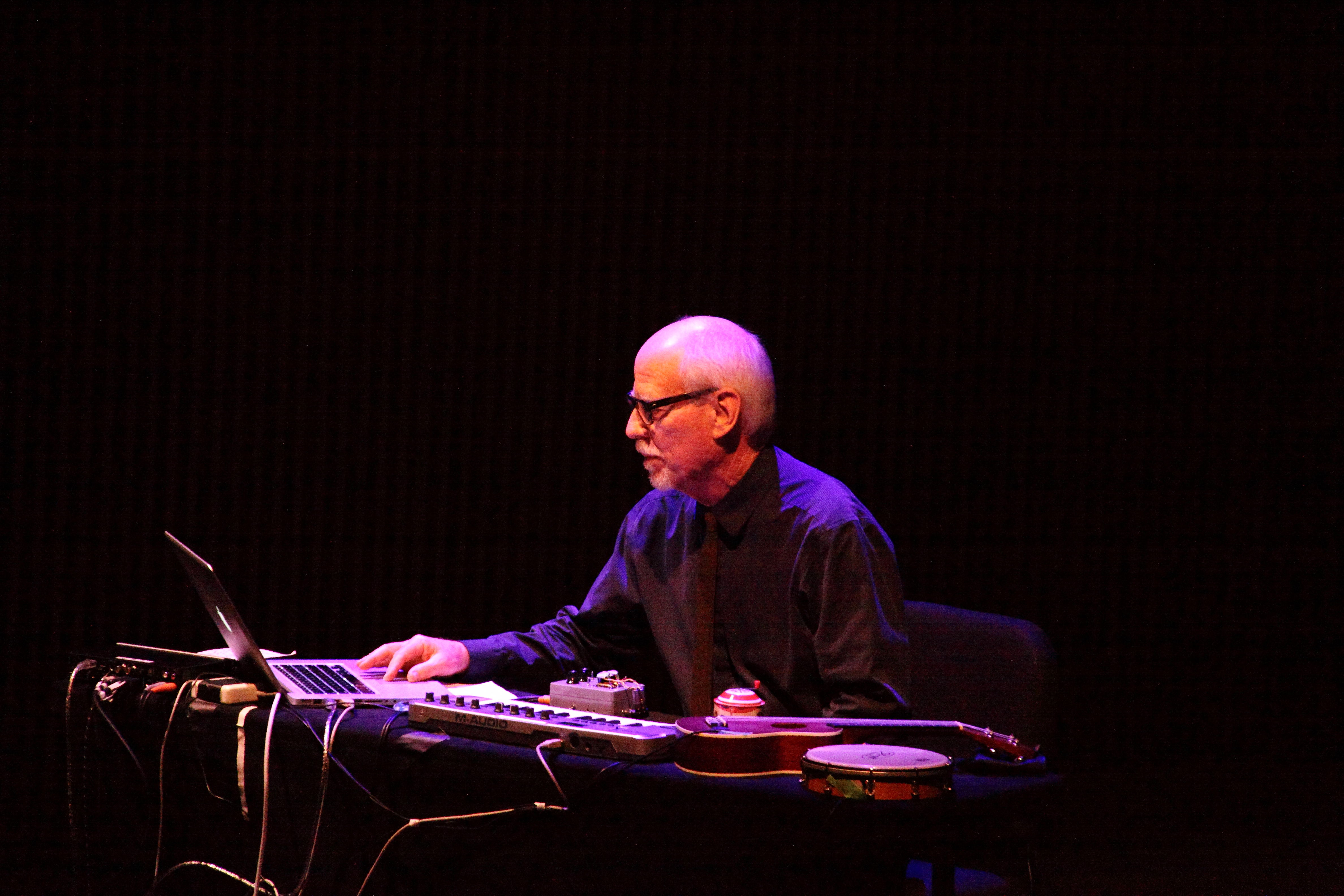
John Bischoff performing his work Audio Combine (2009)

John Bischoff performing his work Audio Combine (2009)

Following intermission we heard two pieces by Mills composer/performer John Bischoff.  The first was Audio Combine (2009) which featured Bischoff on this laptop producing a variety of digitally manipulated sounds.  It was followed by Surface Effect (2011) with creative lighting effects/animations that nicely complemented the laptop controlled analog circuitry.  Bischoff’s music is generally gentle and clear.  It belies the complexity of its genesis in state of the art computer composition and performance for which he is so well known.

John Bischoff performing Surace Effect (2011)

John Bischoff performing Surace Effect (2011)

All this led to the final performance of the evening by Don Buchla whose modular synthesizers were developed in the early 1960s with input from Ramon Sender, Morton Subotnick, Pauline Oliveros and Terry Riley at the legendary San Francisco Tape Music Center (which later became the Mills Center for Contemporary Music).  Buchla also designed the sound system for Ken Kesey’s bus “Furthur” which featured in the Electric Kool-Aid Acid Test.

Don Buchla on the Buchla Bos and Nannick Buchla on the piano with film projection performing Drop by Drop (2012) in its American premiere.

Don Buchla on the Buchla Bos and Nannick Buchla on the piano with film projection performing Drop by Drop (2012) in its American premiere.

The conclusion of Friday’s program consisted of the American premiere of a Drop by drop by Don Buchla for Buchla 200e, electronically controlled “piano bar”  (another Buchla invention) and film projection.  The film was made in collaboration with bay area film maker Sylvia Matheus.  The sequence of images began with a dripping faucet and proceeded to a waterfall and then to emerging pictures of birds all the while accompanied by the various sounds from the synthesizer and the piano.

OM190028

Nannick and Donald Buchla receiving warm applause from the audience.

The Saturday night performances began with Charles Celeste Hutchins and his laptop improvising system.  Hutchins, a San Jose native, describes his system as related to Iannis Xenakis’ UPIC system and utilizes a live graphic interface which the computer uses to trigger sound events.

Charles Celeste Hutchins at his laptop performing Cloud Drawings (2006-9)

Charles Celeste Hutchins at his laptop performing Cloud Drawings (2006-9)

The drawings were projected onto the overhead screen.  There seemed to be a somewhat indirect correlation between the drawings and the resultant sounds and much of the tension of this performance derived from wondering what sounds would result when the cursor reached that particular drawing object.  The audience is basically watching the score as it is being written, a rather unique experience and the Other Minds audience clearly appreciated the uniqueness.

The projected graphic score for Cloud Drawings.

The projected graphic score for Cloud Drawings.

The Actual Trio: John Schott, guitar, Dan Seamans, bass, John Hanes, drums.

The Actual Trio: John Schott, guitar, Dan Seamans, bass, John Hanes, drums.

John Schott and his Actual Trio then took the stage to perform his own brand of jazz which seemed to be a combination of free jazz, Larry Coryell and perhaps even Jerry Garcia.  But these descriptions are merely fleeting impressions and are not intended to detract from some really solid and inspired music making.  After the conclusion of the set this listener half expected an encore.

But the program moved on toWendy Reid’s performance as we watched the stage being set up with music stands, some electronic equipment and a parrot in a cage.

Tree Piece #55 "lulu variations" with Tom Dambly, trumpet, Wendy Reid, violin and electronics and Lulu Reid on vocals.

Tree Piece #55 “lulu variations” with Tom Dambly, trumpet, Wendy Reid, violin and electronics and Lulu Reid on vocals.

Reid’s Tree Pieces are an ongoing set of compositions incorporating nature sounds with live performance.  This is not unlike some of Pauline Oliveros’ work in that it involves careful listening by the musicians who react within defined parameters to these sounds.

Lulu the parrot appeared nervous and did a lot of preening but did appear to respond at times.  The musicians responded with spare notes on violin and muted trumpet.  It was a whimsical experience which stood in stark contrast to the more declarative music of the previous trio but at least some of  the audience, apparently prepared for such contrasts, was appreciative.

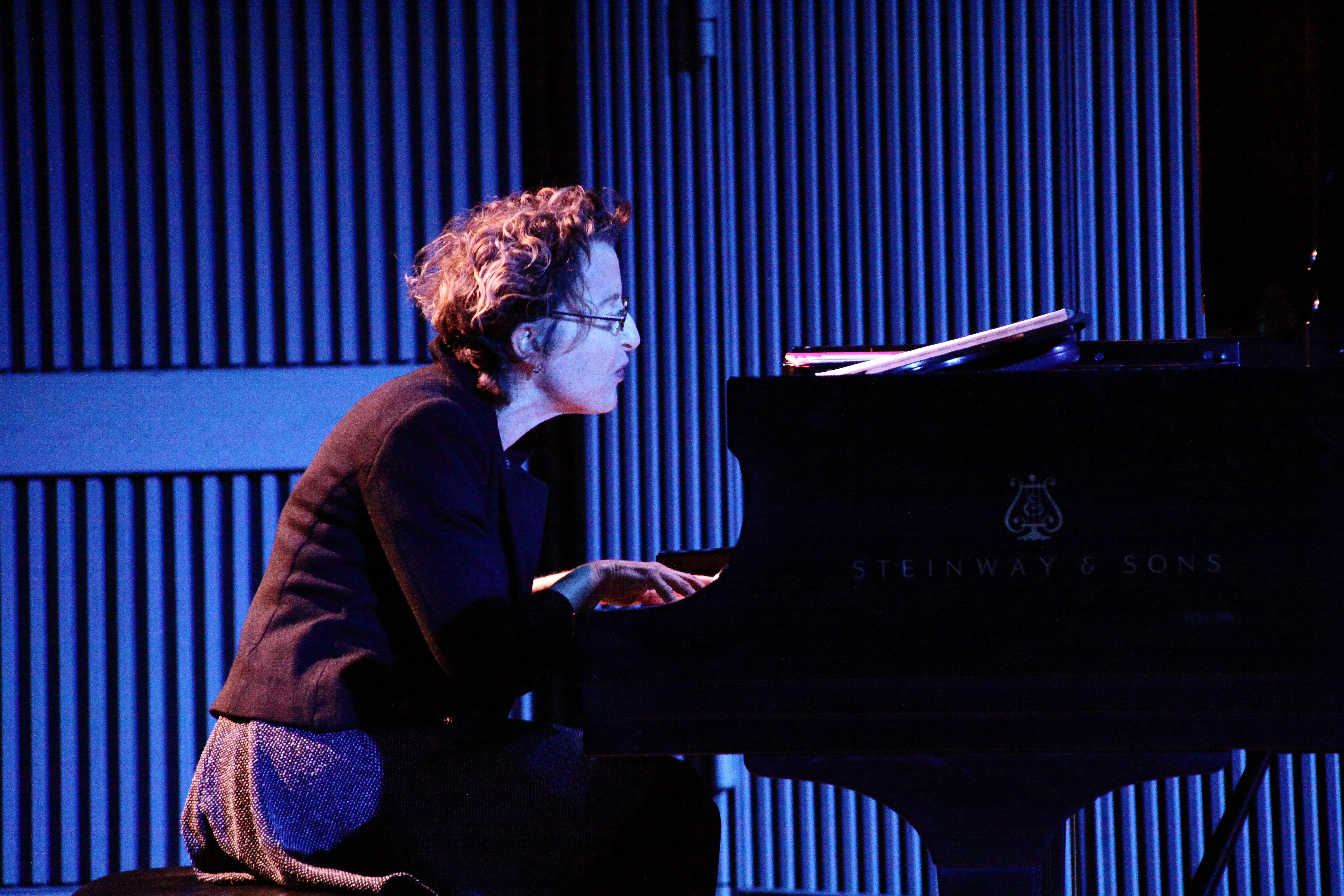
Myra Melford performing selections from Life Carries Me This Way (2013)

Myra Melford performing selections from Life Carries Me This Way (2013)

The diminutive figure of Myra Melford took command of the piano and the hearts of the audience in her rendition of several pieces from her recent CD.  She played sometimes forcefully with thunderous forearm cluster chords and sometimes with extreme delicacy but always with rapt attention to her music.  Her set received a spontaneous standing ovation from a clearly roused audience.  She is a powerful but unpretentious musician who clearly communicates well with her audience.

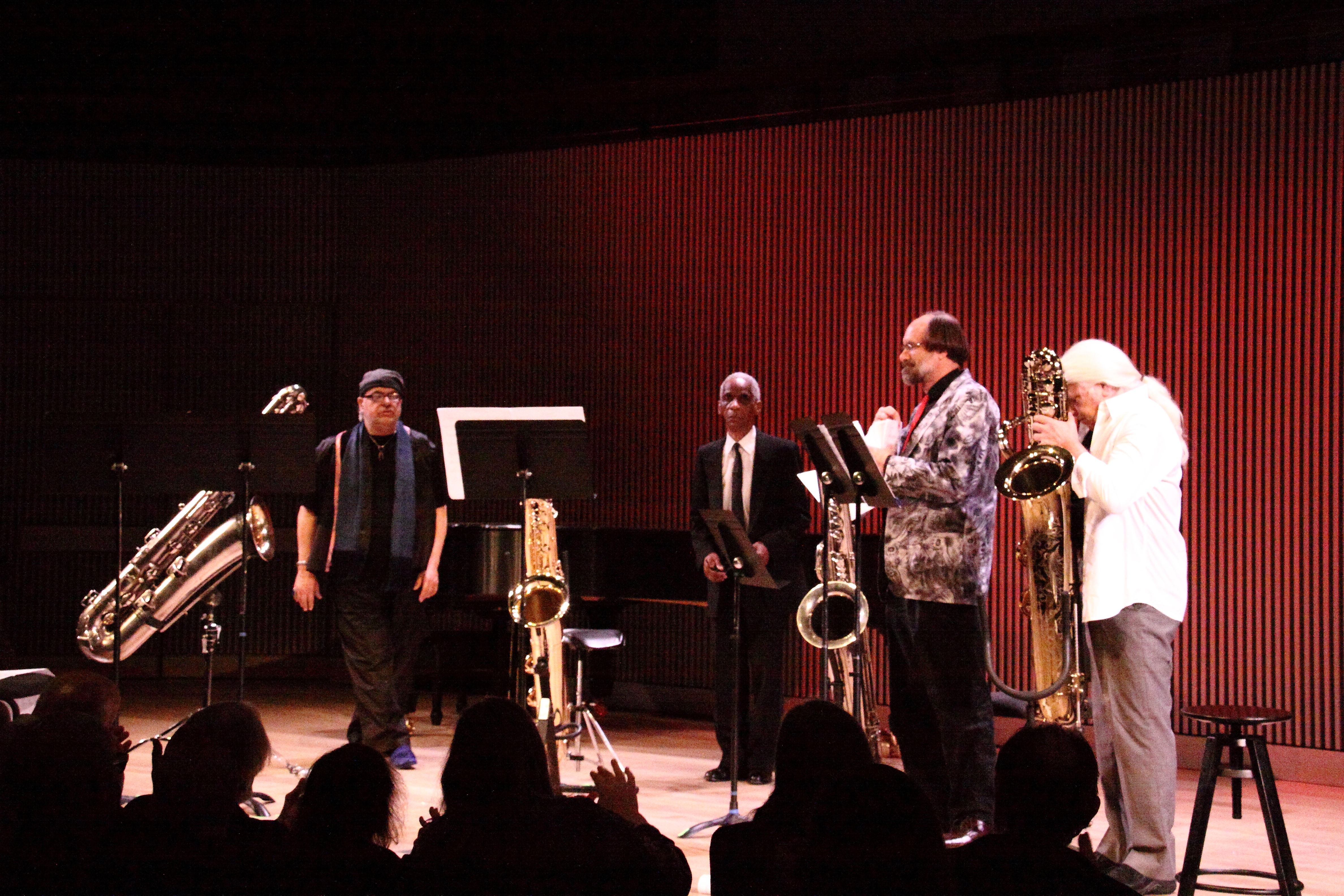
Roscoe Mitchell, Vinny Golia, Scott Robinson and J.D. Parran  following their performance of Noonah (2013)

Roscoe Mitchell, Vinny Golia, Scott Robinson and J.D. Parran following their performance of Noonah (2013)

The finale of OM 19 was the world premiere of an Other Minds commission, the version for four bass saxophones of Roscoe Mitchell’s Noonah (pronounced no nay ah).  It is the latest incarnation of a piece of music that Mitchell describes as having taken on a life of its own.  It exists now in several different versions from chamber groups to orchestra.

The piece is vintage Roscoe Mitchell, a combination of free jazz and sometimes inscrutable compositional techniques which clearly enthralled the very focused performers.  What the piece seemed to lack in immediate emotional impact it made up in mysterious invention which was brought out grandly by the very experienced and committed players.

Mitchell, who was not able to attend on the previous night, appeared rather tired but played with a focus and enthusiasm that matched his fellow musicians.  Like all of Mitchell’s music there is a depth and complexity that is not always immediately evident but does come with repeated listenings and performances.

Thus concluded another very successful edition of Other Minds.  Now we look forward to the gala 20th anniversary coming up in March, 2015.


Enhanced by Zemanta

Alvin Curran at 75, Experimentalism with an Ethnic and Social Conscience


English: The American composer Alvin Curran pl...

English: The American composer Alvin Curran playing the shofar in his composition “Shofar 3,” for shofar and live electronics (2007). Photo taken at a concert of Curran’s music in Warner Concert Hall, Oberlin Conservatory of Music, Oberlin College, Oberlin, Ohio, United States. (Photo credit: Wikipedia

Alvin Curran (1938- ) is an American composer currently living and teaching in Rome whose career began as an expatriate artist working with the cutting edge improv electronics group Musica Elletronica Viva (MEV) in 1966. He turns 75 on December 13, 2013.

Curran was born in Providence, Rhode Island.  His father was a musician in a dance band and he learned to play piano and trombone early on.  He was exposed to big band music, jazz, traditional Jewish music and western classical music during his formative years.  Following his father’s example he also played in dance bands during boat crossings of the Atlantic.  He earned a B.A. in music from Brown University in 1960 where he studied composition with Ron Nelson.  He went on to complete his M.M. at Yale in 1963 were he studied with Elliott Carter and Mel Powell.

A 1964 Ford Foundation grant allowed him to go study in Darmstadt where he met the likes of Stravinsky, Xenakis, Berio, Yuji Takahashi, Andriessen, Remo Remotti, and above all Frederic Rzewski.  He joined with Rzewski,  Richard Teitelbaum and Allan Bryant, all fellow expatriate American musician/composers, with whom he formed the legendary ‘Musica Elettronica Viva‘ or MEV.  This was in early 1966 where their use of largely home made electronics in their improvisational ensemble live performances preceded the days of easily obtainable and operated electronic musical instruments. That wouldn’t begin to happen until about 1964 when Don Buchla, in collaboration with Ramon Sender, Morton Subotnick and the San Franciso Tape Music Center created the first modular instrument, the “music easel” later known as the ‘Buchla Box’ and Robert Moog on the east coast developed the “Moog” synthesizer.  Curran crossed paths with many of these people during his tenure teaching (1999-2006) at Mills College in Oakland where the San Francisco Tape Music Center had been integrated into the Mills Center for Contemporary Music.

Curran says that during all his years in Rome he met and interacted with many in the Italian avantgarde and new music circles like Franco Donatoni and Guiseppe Chiari.  He was mentored by the reclusive (think Thomas Pynchon) Giacinto Scelsi who held regular salons at his villa.  It was in these days that Curran developed his individual style further.  He lived and taught in Rome from 1966 to 1999 and was very active on the European scene.  After his teaching stint at Mills College Curran returned again to Rome.

Buchla 100 series modular synthesizer at NYU

Buchla 100 series modular synthesizer at NYU (Photo credit: Wikipedia)

In addition to electronics he uses acoustic instruments ranging from conventional instruments such as piano, strings, woodwinds, voices, etc. to the ancient shofar and environmental sounds including site-specific sound installations, multi-media works and film scores.  His works include the massive set of piano pieces ‘Inner Cities’ (1993-2010) which lasts about 6 hours in a complete performance, the early multi-media Songs and Views from the Magnetic Garden (1973), Maritime Rites (1984) written to be played by musicians in boats in various harbors incorporating, of course, the ambience of the given harbor’s acoustic properties.  Maritime Rites has been performed in its various incarnations in Central Park in New York as well as Philadelphia, Berlin and Sydney.

In a wonderful interview from 2003 with the ever vigilant composer/journalist Frank Oteri (published online at New Music Box) he was asked about the political and ethnic/religious content of his music.  Curran replied that he did not set out to express these things as aspects of himself, that the pieces  just happened due to an inspiration at the time.  He says that he is composing all the time and his influences are as wide ranging as his teachers and his milieu.  His style varies widely in part due to his many influences but also because a given style seems to work for the piece.  It sounds as though music is channeled through him.

Unfortunately, as with most expatriate composers, his music is generally less well known in his native country but there are quite a few recordings including some recent releases of some out of print recordings.  In addition there are quite a few videos on YouTube including pianist Kurt Jordan’s live performance of Inner Cities 1-13 from 2009 at Azusa Pacific University which is more than the previously complete recording by Daan Vandewalle who recorded 1-11 (as of 2010 there are 14 parts according  to Curran’s official web site).   As is frequently the case with much contemporary music YouTube provides a great resource, especially for the casual and/or cash-strapped listener.  It is a really good way to get familiar with this man’s diverse and fascinating music.

Not infrequently his music takes on sociopolitical issues as well as inspiration from the composer’s Jewish heritage.  His Schtetl Variations (1987), dedicated to Morton Feldman is an improvisatory meditation on these poor villages of eastern Europe and Russia (think of Fiddler on the Roof) which became the settings for the notorious anti-semitic pogroms. A later piano piece called 11 Schtetl Settings (1988) continues his exploration of this part of his ancestry.  Animal Behavior (1992) for sampler keyboard and optional percussion is a pretty transparent indictment of 1990s American politics.  And the list goes on.

His “Nineteen Eighty Five: Piece for Peace” (1985) involved three ensembles performing at 3 different radio stations in Venice, Amsterdam and Frankfurt (which was simulcast by all three countries) is a a sort of precursor to what is perhaps his most integrated and powerful political composition, his ‘Crystal Psalms’ of 1988.  Here the historical, sociopolitical, ethnic and even geographical are joined to the avant garde in a stunning sonic commemoration and condemnation of the fascism and genocide that characterized the horrors of the second world war.

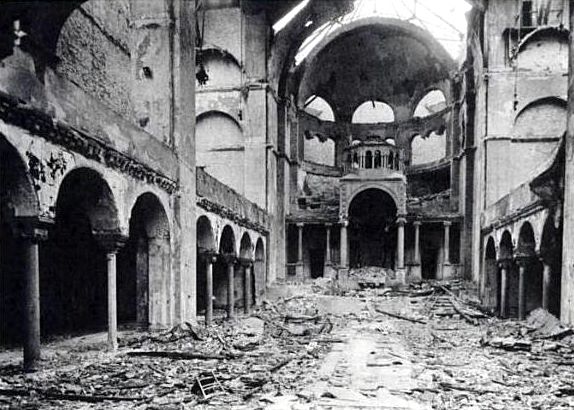
Interior of a Berlin Synagogue after Kristallnacht

Interior of a Berlin Synagogue after Kristallnacht

Seventy Five years ago this November (9th and 10th) Jewish shops and synagogues were vandalized and looted over those two nights throughout much of Nazi Germany and Austria in a most extreme incarnation of the “pogroms” that became known as “Kristallnacht” or the “Night of Broken Glass“.  It was one of the first major and overt expressions of Hitler’s genocidal plans then still being formulated. Unfortunately this event continues to be imitated by like-minded hateful individuals and groups worldwide. So the sociopolitical context of this musical work written for the 50th anniversary of that event sadly has an ongoing relevance for our contemporary world even 25 years after its creation.

At its most basic level this piece is a sort of concerto for six instrumental ensembles playing in radio stations in six different countries live mixed by the composer and broadcast throughout Northern Europe on October 20th of 1988. There is no text as such but the sounds of people praying and the apparently random Hebrew letters and German numbers are scattered throughout the piece along with environmental and found sounds on the tape Curran prepared which plays throughout the performance as a sort of political pedal point.

English: "Hebrew alphabet" in Hebrew...

English: “Hebrew alphabet” in Hebrew, modern serif typeface. (Photo credit: Wikipedia)

The liner notes of the recording describe the piece as “radio concert for six choruses; six sextets each including a quartet (violas, cellos, bass clarinets, bass flutes, trombones, tenor sax/tuba) plus accordion and percussion; tape.”  All were individually conducted with the conductors coordinated by a click track and mixed live by the composer. The recording on New World records is the document of that broadcast.

The effect is that of a collage connected by the electronic nervous system, the radio stations, which link the various performances.  The program is largely implicit here and listening to this piece evokes images that can vary from one listener to the next as any great piece of art provokes different experiences. The sound images here are not pretty and the work is very emotionally intense. Those images are guided by the tone of the music and fueled by the cryptic words and sounds mixed in with the live performances.  It is, in effect, his Mitzvah to the memories of the fallen.  You will not come away unmoved.

Kristallnacht occurred in November of 1938, a month before Curran was born but  the impact of that action continues to resound from that generation to this.  As a politically aware artist he was compelled to respond and he did so in a most emphatic, creative and powerful manner.  Perhaps it is the inherited duty of one generation to exorcise the demons and the atrocities of the previous ones.  Curran has certainly contributed most memorably to such an effort with this work.

Thank you, Mr. Curran, for your prolific and varied contributions to music and your efforts through your art to exorcise the demons of our collective past.  I wish you a happy 75th birthday and wishes for many more creative years to come.

Secret Rose Blooms: Rhys Chatham at the Craneway Pavilion


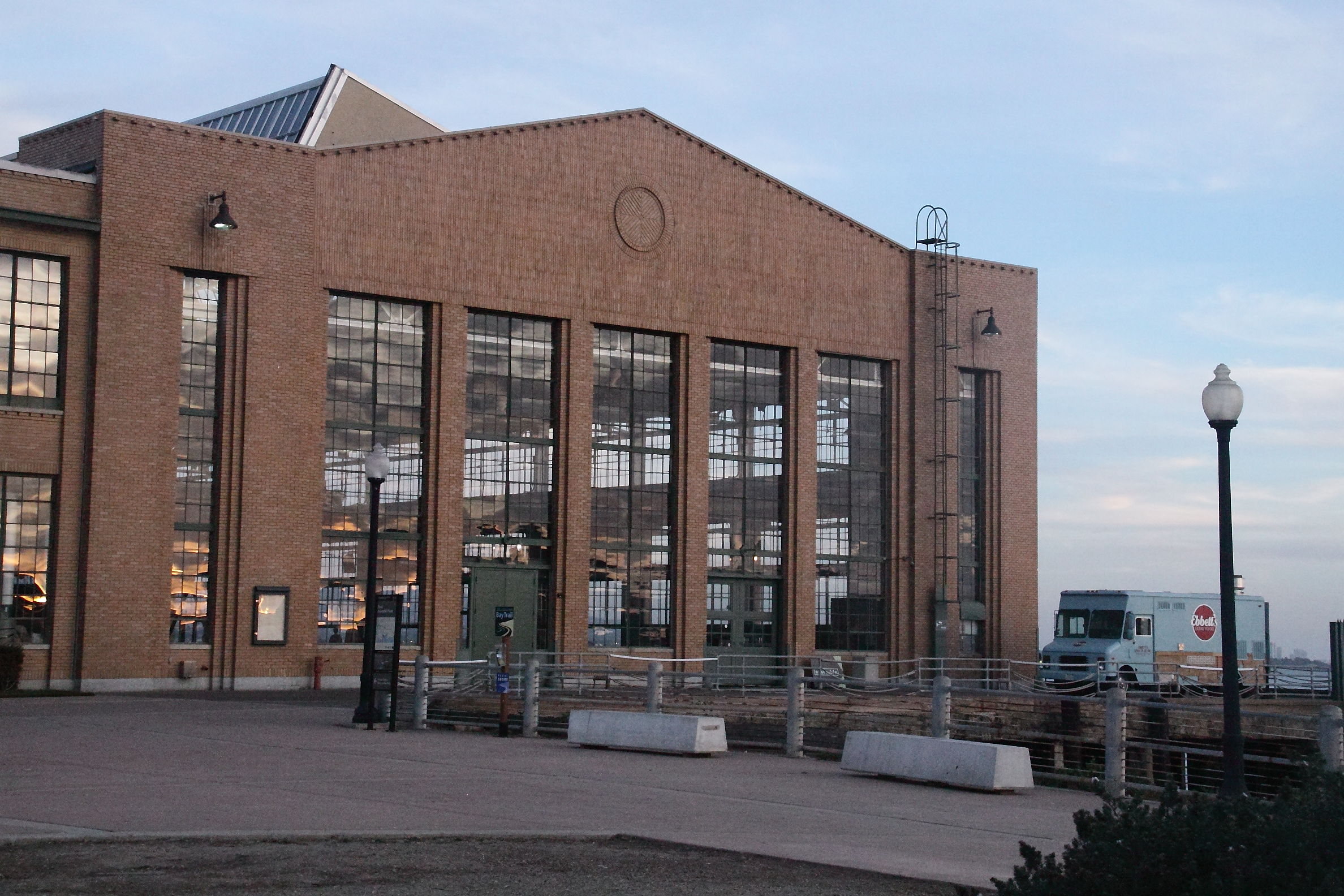
Craneway Pavilion

Craneway Pavilion

On Sunday November 17th I attended one of the most unusual concerts in my experience.  The performance of Rhys Chatham‘s ‘A Secret Rose’ at the beautiful Craneway Pavilion in Richmond was produced by Other Minds and the eclectic bay area new music bloodhound Charles Amirkhanian.

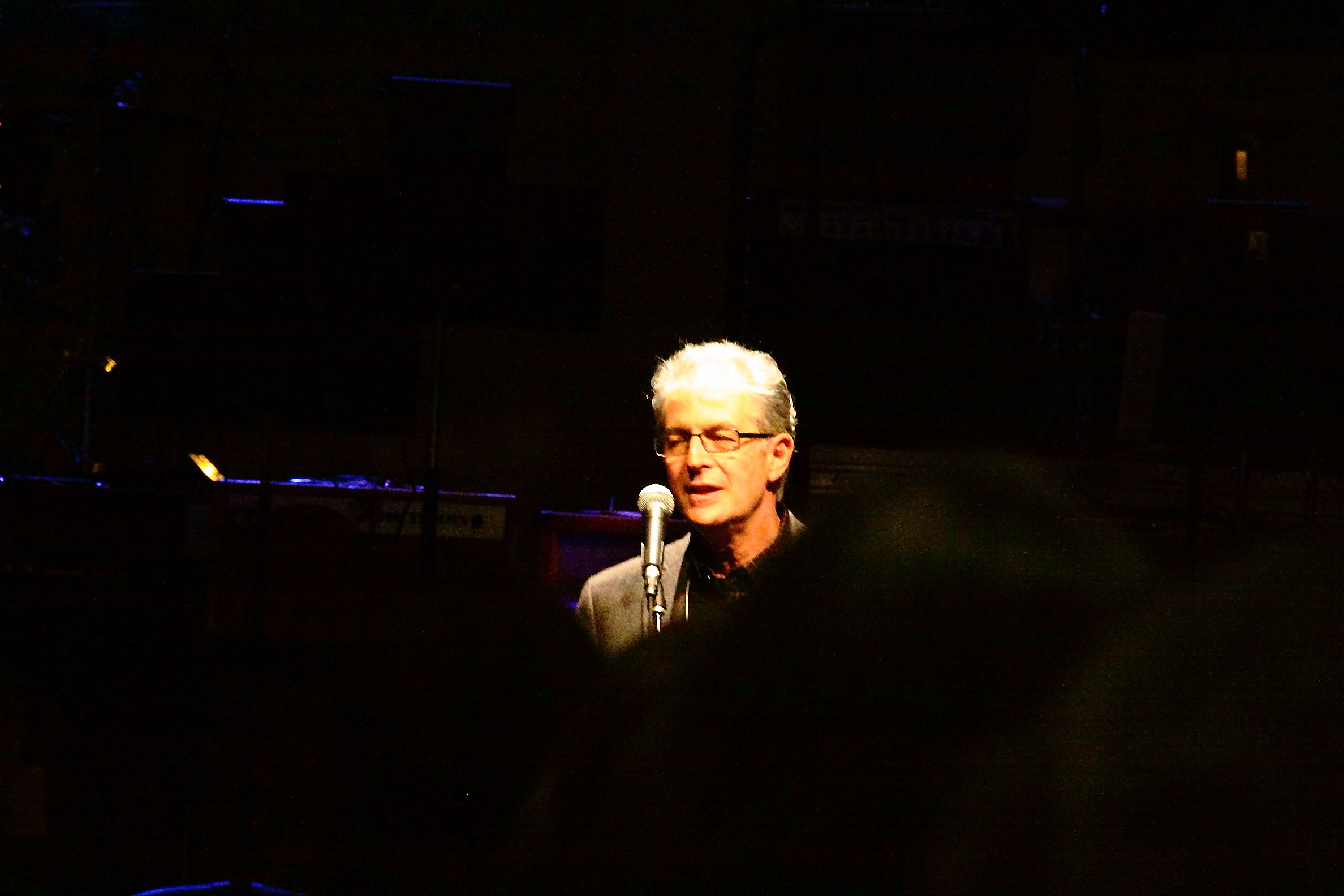
Charles Amirkhanian speaking briefly to introduce the performance.

Charles Amirkhanian speaking briefly to introduce the performance.

Rhys Chatham is an American musician and composer who has spent much of his career in living in France.  He was a part of the New York post-punk downtown music scene in the 70s working with musicians like Glenn Branca, La Monte Young and Charlemagne Palestine.OMChathfinal0131

English: Rhys Chatham at Islington Mill, Salford

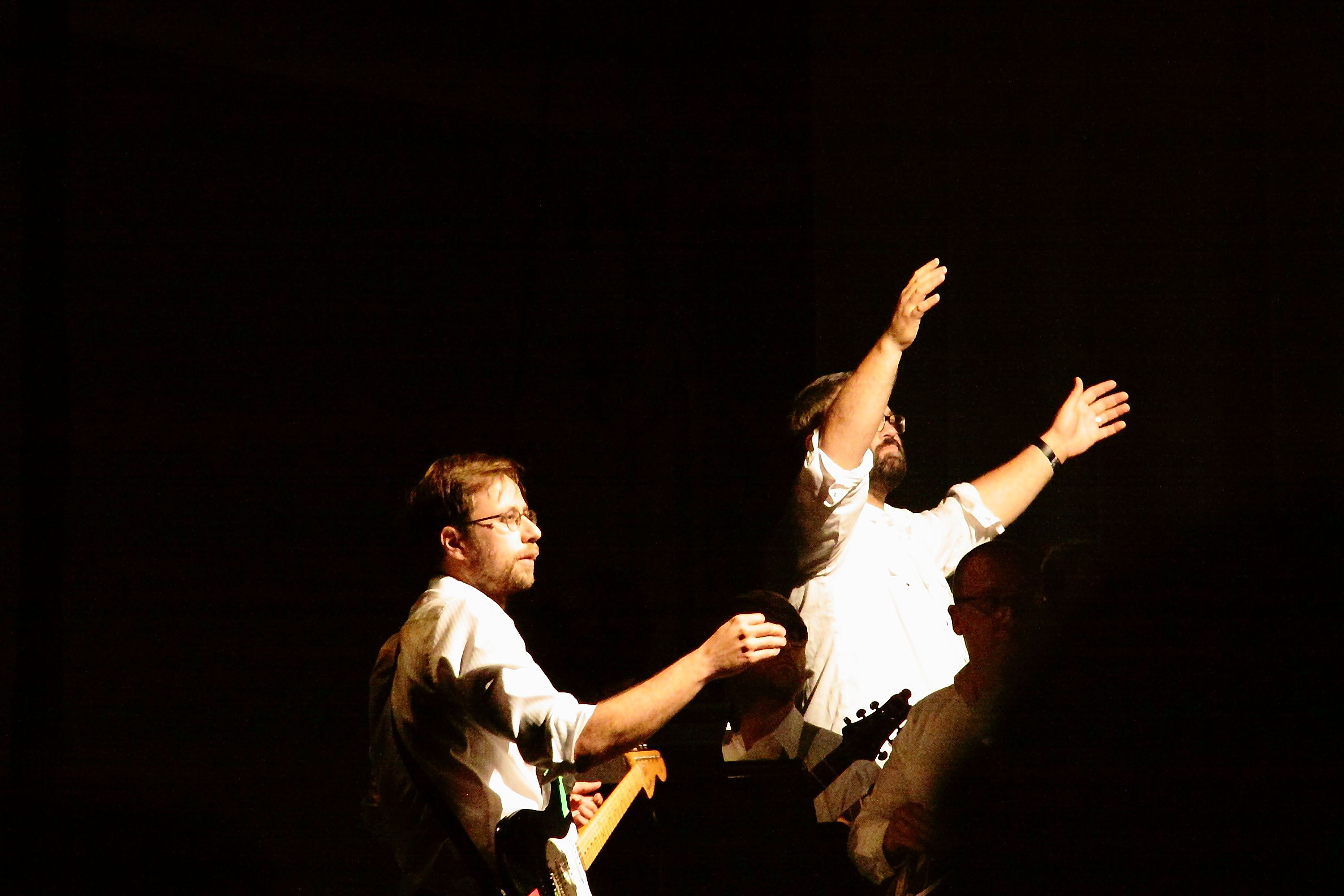
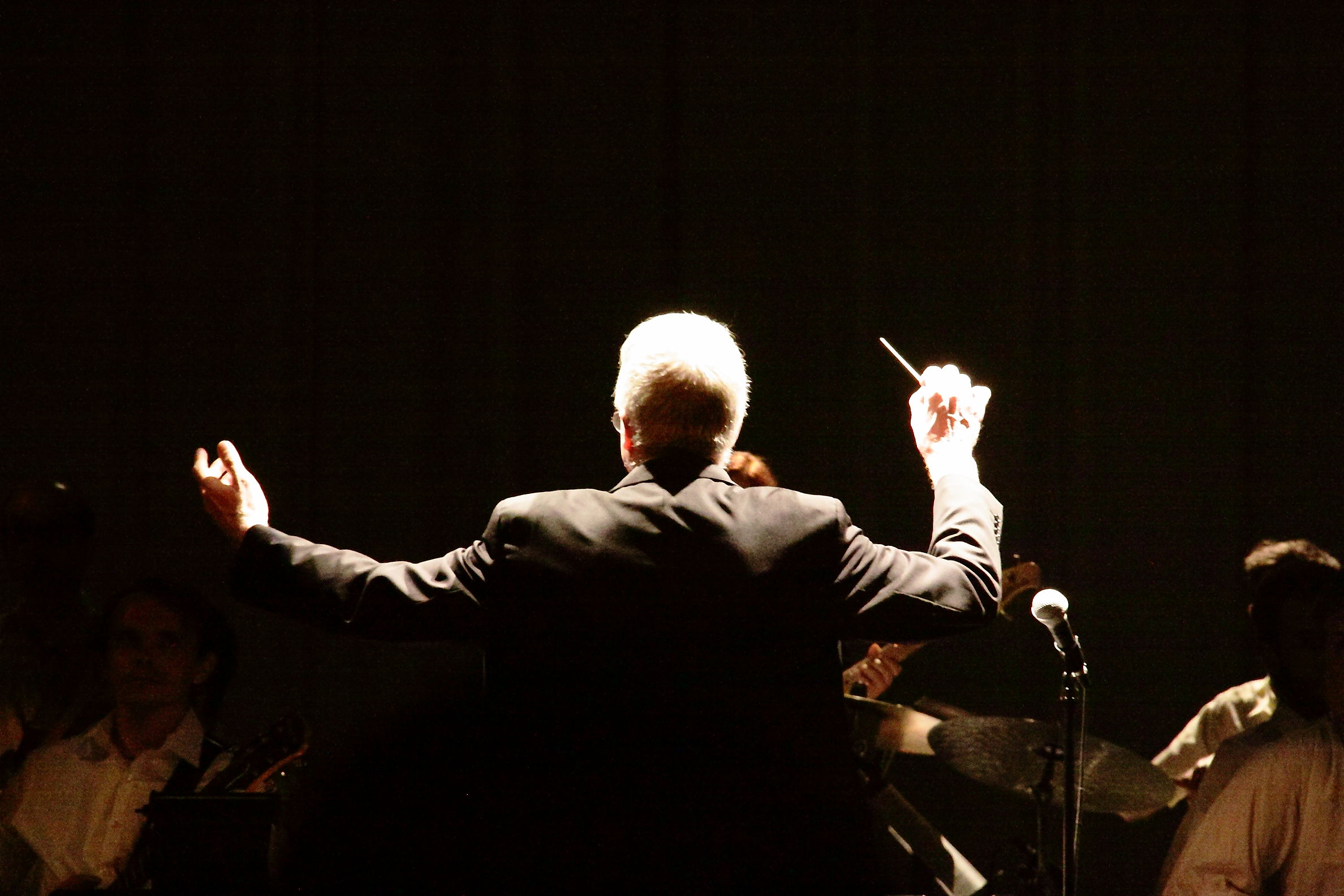
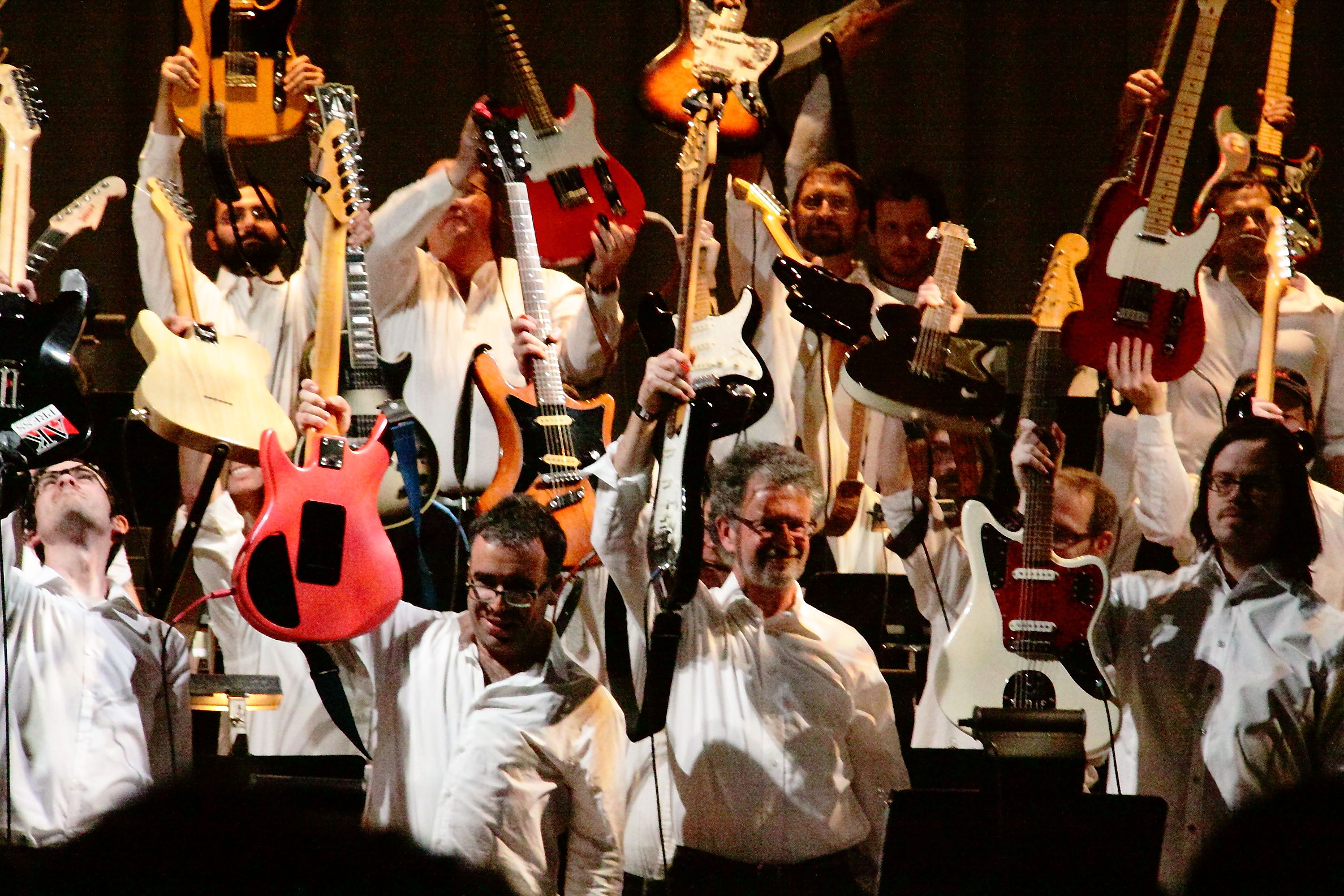
Sunday’s concert was the west coast première of this piece which is scored for 100 electric guitars, bass guitar and drum kit.  It is sufficiently complex as to require at least 3 conductors in addition to the principal conductor (Chatham).  In this respect it brings to mind the work of Charles Ives and Henry Brant.  But this music resembles neither of these composers, at least not precisely so.  Beginning with his work with drones and harmonics Chatham has developed compositional techniques and honed them to a point of mastery.  The multi-movement work was microtonal, polymetric, aleatory/improvisatory, dissonant, melodic and enthralling.  Did I mention that it was loud?  No?  Well loudness may be the most obvious aspect of this music but that loudness is organic to the music.  The volume paired with the very live acoustics of the cavernous performance space elicited a wide range of harmonics which, through Chatham’s skillful techniques evoked a variety of timbres.  (Complementary ear plugs were provided.  I took a pair but did not use them.)  I heard guitars, certainly and drums and bass.  But at times it sounded like there were brass instruments and even vocals.  (I swear I heard words being sung.)

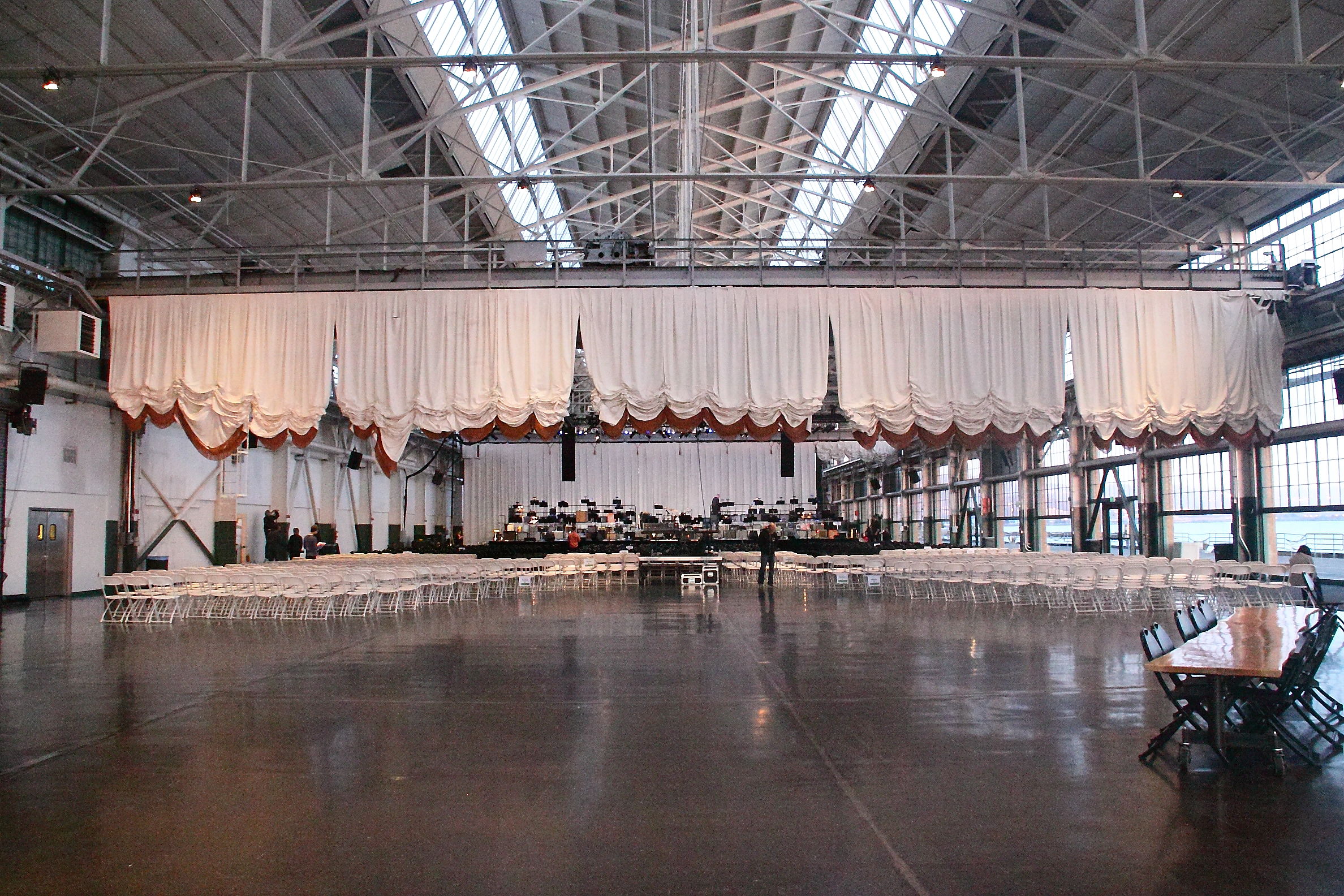
Craneway Pavilion is a 45,000 square foot former Ford assembly plant that was remodeled for use as a performance space and conference center.  Its size and waterfront location remind me of Chicago’s ‘Navy Pier’ on  the lakefront.  Craneway is on San Franciso Bay and faces south with a view of the bay bridge eastern span as well as views of San Francisco.  The appearance is that of a large loft space with metal beams and a general industrial appearance.  Its floor, walls and ceiling are surfaces that are highly reflective of sound and therefore ideal for this performance.  As promised in the promotional materials the full moon rose in the east over the bay before the performance began.

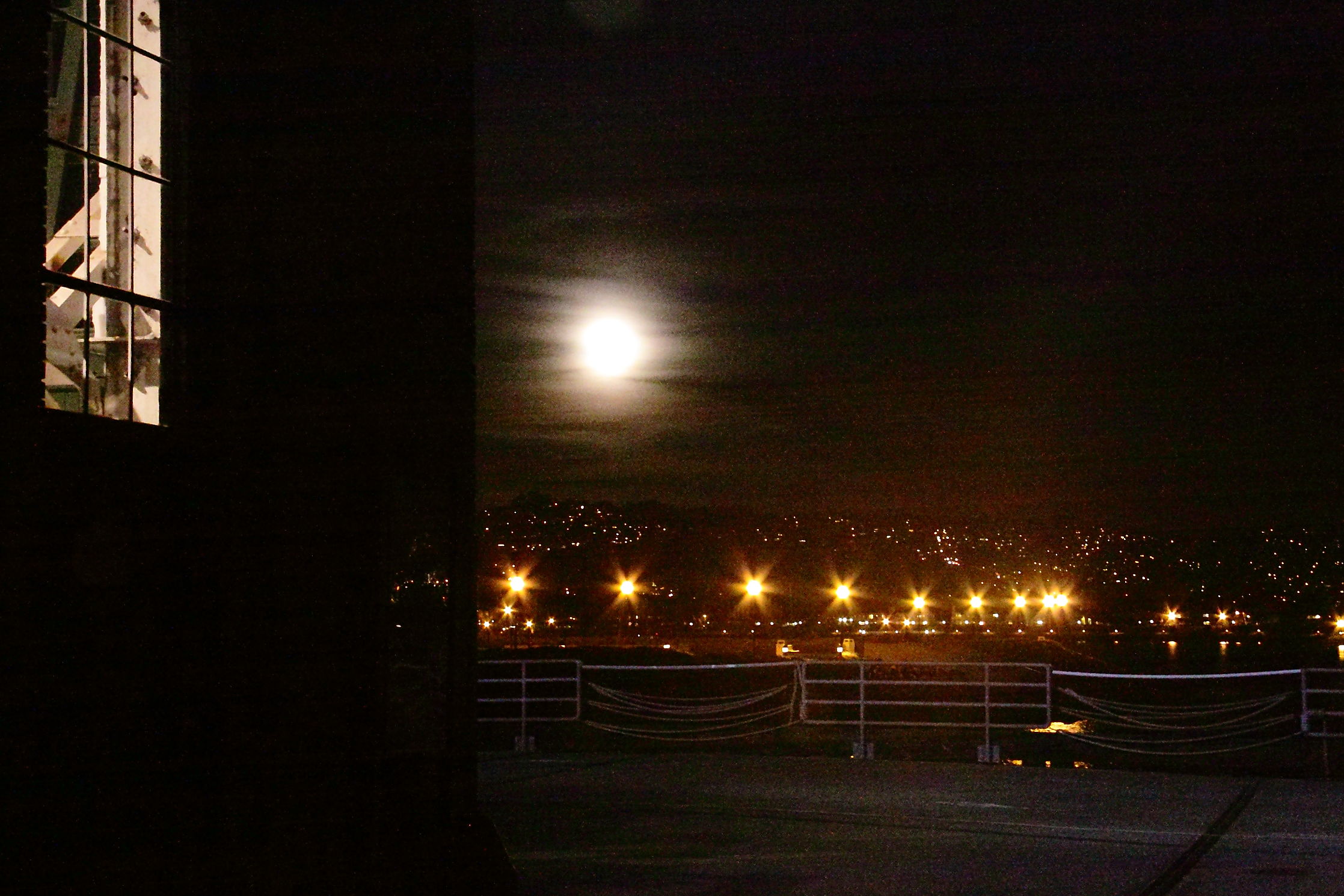
Full Moon rising over the bay just before the performance.

Full Moon rising over the bay just before the performance.

Looking toward the seating and the stage in the performance space at Craneway Pavilion.

Looking toward the seating and the stage in the performance space at Craneway Pavilion.

Chatham’s music was not about complexity for the sake of complexity.  His compositional strategies required the complex goings on we heard on Sunday.  The room itself became a sounding chamber itself amplifying, canceling and propagating the swirling harmonics that resulted from specialized tunings in addition to the other techniques mentioned.OMChathfinal0101

OMChathfinal0100

The multiple movements ranged from drone-like structures to more rhythmically complex sections and even melody.  Yes, melody. Chatham writes catchy melodies and motives that sound like they’ve been taken from one rock album or another.  Sonic gestures evoked impressions of Ozzie Osbourne, Eric Clapton, and many others depending on your personal listening experiences.  This music was ritual as much as expository.  His techniques were not limited to rock music but extended to free jazz and classical techniques as well.  Taken as a whole the piece was a multi-movement symphony, each movement sustaining its own argument in service of the whole.  For the finale Chatham set aside his conductor’s baton and picked up his guitar, not for a solo as one might expect in an ordinary concert, but to participate in the ecstasy of performance.

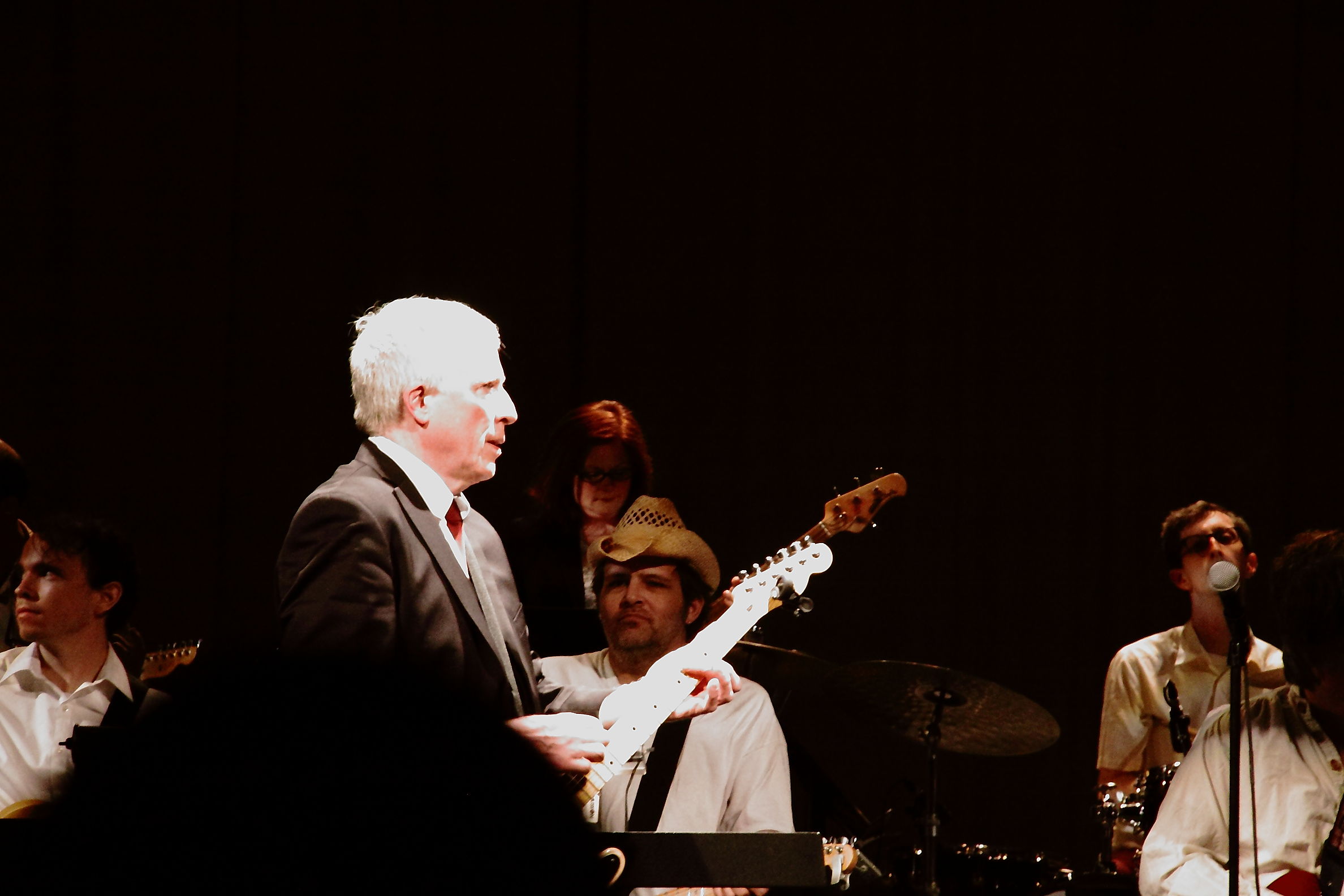
Chatham conducting.

Chatham conducting.

It is tempting, if a bit cliché, to suggest that this ritual music stirred the ghosts of the past.  While standing in the ticket line one gentleman said to me, “I walked out of a Jimi Hendrix concert in 1967 because it was too loud”.  Almost immediately someone else said, “I was at that concert…”.  Perhaps the Grateful Dead, Jefferson Airplane and Pretty Things were stirred from their slumbers.  They were certainly evoked.  I don’t know if the aforementioned gentleman ultimately stayed for the performance but I suspect he probably did, maybe in honor of Jimi.

Chatham playing guitar in the finale of 'A Secret Rose'

Chatham playing guitar in the finale of ‘A Secret Rose’

The crowd was several hundred strong ranging in age from about 5 to 85.  Most appeared to be enjoying this loud and driving rhythmic composition.  Some rocked or nodded to the beat.  Some sat entranced and/or perplexed but attentive.  At the end there was a standing ovation and, from Mr. Chatham, a welcome encore featuring seriously de-tuned guitars.

The encore piece was also captivating and inventive though certainly not as long.   Chatham’s music is not easy to categorize or describe.  Even having heard a fair amount of his music on recordings over the years I could not have anticipated what I heard at this concert.  I now understand how some music cannot be adequately represented even by our best recording technology.

I’m not sure of the significance of the title but it does bring to mind William Butler Yeats’ book, ‘The Secret Rose’.  Its stories steeped in Irish mythology are introduced by an opening poem which reads in part:


Far of, most secret, and inviolate

Rose,

Enfold me in my hour of hours; where

those

Who sought thee at the Holy Sepulchre,

Or in the wine-vat, dwell beyond the stir

And tumult of defeated dreams; and deep

Among pale eyelids heavy with the sleep

Men have named beauty.

OMChathfinal0140

OMChathfinal0138OMChathfinal0141

Classical Protest Music: Hans Werner Henze “Essay on Pigs” (Versuch über Schweine)


German composer Hans Werner Henze (1926-2012) left Germany in 1953 because of his dissatisfaction with German intolerance of both his leftist politics and his homosexuality. He settled in Italy where he lived with his partner and had a long, prolific career composing music for orchestra, chamber ensembles, theater, soloists and film. Much of his music was an expression of his politics.

The “Versuch über Schweine”or in English, “Essay on Pigs” of 1968 is scored for woodwinds, brass, strings, percussion, “beat organ” and electric guitar with vocal soloist. It was created at one of the composers most overtly political periods which included the Sixth Symphony (1969), El Cimarrón (1969-70) and Das Floss Der Medusa (1968). Indeed there was much political conflict in the world at this time.   The musicians have a challenging instrumental score to interpret but this is no ordinary vocal part as it calls for the extended vocal techniques of the singer for whom it was written. Henze was reportedly very impressed with having heard the Rolling Stones and this encounter appears to have influenced his musical sound as well.

As near as I can determine the work was performed only once on February 14, 1969 with Roy Hart and the English Chamber Orchestra conducted by the composer and subsequently recorded with those forces. The vocalist in the Deutsche Gramophone recording is Roy Hart as well and he appears to be an early practitioner of what we now call ‘extended vocal techniques’. He precedes the likes of Cathy Berberian, Diamanda Galas, Julius Eastman, Joan La Barbara and Meredith Monk. Monk’s students like Robert Een, Andrea Goodman and Anthony De Mare (among others) also carry on the tradition but I know of no one who has attempted this piece since Hart.

English: Photo of Gaston Salvatore

English: Photo of Gaston Salvatore (Photo credit: Wikipedia)

Essay on Pigs is a setting of poetry by Chilean poet Gaston Salvatore (1941-  ) who collaborated with Henze on several works. The music reflects the angry and sometimes hysterical tone of the poetry making this anything but easy listening.

I recall a musicologist, Dr. Richard Norton, who had corresponded with Henze, playing this piece in its entirety (some 20+ minutes) during one of his classes (at the University of Illinois Chicago in the mid-seventies). I always felt that was a sort of revolutionary act to do that. From what I recall I think I was probably the only person in the class who was already familiar with the work. The reaction of confusion or stunned silence from my fellow students was what one would expect from anyone who had not heard the piece before.

I have been unable to find any critical reviews or reports of audience reactions to performances but this is a piece that has the potential to clear a room or provoke anger.  It must have been quite a show. The piece certainly deserves a revival and I think it is a very significant piece of political music whose expressionism reflects well the issues of the times.  The problem is finding a vocalist to navigate this highly unique and unusual piece..  Any takers?

Enhanced by Zemanta

Not Another Minimalist! (NAM): New and Lesser Known Minimalists


Philip Glass portrait

Philip Glass portrait (Photo credit: DailyM = Differentieel + JeeeM)

I have been a fan of so-called minimalist or pattern music for quite a number of years.  Since my first encounter with this type of music in the late 1970s I have listened with interest and been fascinated to hear how each composer expressed their own voice within that general rubric.  Though many have eschewed the label ‘minimal’ and argued over the alternate label ‘pattern music’ there are recognizable characteristics which continue to bind, however loosely,   Perhaps that is just another way of saying that I “know it when I hear it” but I think readers tend to get the general idea and I am open to discussion on what music I should include or exclude from these categories.

Kyle Gann

Kyle Gann (Photo credit: Wikipedia)

Anyway the point of this rambling little  post is to introduce a recurring series of posts about my personal discoveries in said genre.  You can be assured that I have scoured high and low but lay no claim to being either definitive or comprehensive.  What will follow will be an ongoing series of posts identifying the music of one composer or group whose music sounds minimalist or pattern based at least to my ears and which I find pleasing and/or significant in some way.  I will head each post with the identifying acronym NAM (Not Another Minimalist!).

Michael Nyman in Sant Cugat del Vallès

Michael Nyman in Sant Cugat del Vallès (Photo credit: Wikipedia)

The most useful books for me on this subject for me are those by Kyle Gann, Tom Johnson, Michael Nyman, Wim Mertens and Robert Fink.  I am listing these as my primary influences and do not mean to discount important works by other writers on the subject.  Gann’s ‘American Music in the Twentieth Century'(1997) and the collection of articles, ‘Music Downtown'(2006) remain among the most lucid descriptions and analyses of minimalist music.  He also maintains a blog with pretty regular posts at (http://www.artsjournal.com/postclassic/).  Gann’s work might not have been possible without the work of fellow composer and journalist Tom Johnson whose collection of reviews, ‘The Voice of New Music’ (1991) is one of the most important collections of reviews of the burgeoning ‘downtown music’ scene in New York in the 70s and 80s where purveyors of this genre first displayed their wares .  Both ‘Music Downtown’ and ‘The Voice of New Music’ are collections of reviews of concerts and events written for the Village Voice.

UCLA professor and music critic Robert Fink on...

UCLA professor and music critic Robert Fink on the “Different Strokes” panel at the 2009 Pop Conference, Experience Music Project, Seattle, Washington. (Photo credit: Wikipedia)

Michael Nyman’s book, ‘Experimental Music: Cage and Beyond'(1974) is among the earliest to describe this music and its context.  Wim Merten’s ‘American Minimal Music'(1988) is a great analysis of the essential canon.  Unfortunately these have been difficult to find lately and hopefully some reissues including digital formats may be forthcoming.

Robert Fink is a musicologist at UCLA.  His book, ‘Repeating Ourselves’ provides one of the most wide-ranging and comprehensive analyses of the concept of minimalism and pattern music.  He works across all music genres and cultural practices to identify a sort of minimalist ethic and has done much to shape my thinking in this area.

There are certainly many other fine books on the subject and that itself may need to be the subject of a future post.

I don’t like all music in this category (or any category for that matter) but it is the one which feels kind of like a personal discovery to me and a genre that continues to interest me.   And I can report that there is a good deal of music  outside the classic canon of minimalism that is definitely worth the effort to find.  And there are pieces of music written before the 1960s which appear in hindsight to have been sorts of precursors to this style.

This will be an occasional series of posts and I have decided to gather them under the somewhat facetious acronym of NAM (Not Another Minimalist) for the sake of easy reference should any reader actually find these posts useful.  My intent is both to share my discoveries and to generate debate and comment about this type of music.  I want to explore and share artistically interesting developments that lie outside the Reich/Glass/Riley/Young canon of minimalism.  As always I welcome discussion and feedback.

Henry Brant?…never heard of him: A Centennial Sketch


Aerial photo: Santa Barbara, California

Aerial photo: Santa Barbara, California (Photo credit: Wikipedia)

I was sitting in the Sojourner Cafe, my favorite little restaurant/hangout just off downtown in Santa Barbara, California.  I was having one of many conversations with the great and interesting staff and patrons when I mentioned the name of Henry Brant, saying he lived in Santa Barbara.  “I never heard of him” came the response from Chris, a musician when not serving at the restaurant.  No one else showed any signs of recognition either.  I proceeded to tell him about the Pulitzer Prize winning composer.  It was then that flicker of recognition came across his face.  He told me that the frail figure using his walker was a familiar sight in the neighborhood, his eyes widened with interest as I told him about this major American musician.

Henry Brant

Henry Brant (1913-2008) was born in Montreal, Quebec, Canada to American parents.  His father was a professional musician. Henry played violin, flute, tin whistle, piano, organ, and percussion at a professional level and was fluent with the playing techniques for all of the standard orchestral instruments.   Henry went on to study at McGill University and later in New York at a school later named Julliard.  He was the youngest composer mentioned in Henry Cowell’s anthology, “American Composers on American Music” to which Brant contributed an article on what he called “oblique harmony”.

Brant, who had an early connection and affinity with the American experimental music tradition, would go on to develop “spatial music” in which musicians were scattered around the performance space as an essential part of the composition and performance.  He began writing music in the sort of post modern style of the time as in his Symphony No. 1 (1945 rev. 1950) and pithy little jazz inflected pieces like Whoopee In D (1938, Rev. 1984), Jazz Toccata On A Bach Theme (Toccata On “Wachet Auf”) (1940) and Double-Crank Hand Organ Music (1933, Rev. 1984).

He would write for unusual combinations of instruments such as Angels And Devils (1931), a concerto for flute and orchestra of flutes, Ghosts and Gargoyles (2002) also for flute and flute orchestra or Orbits (1979) for 80 trombones, organ and sopranino voice.  His first spatial composition, Rural Antiphonies (1953) predates Stockhausen’s famed experimental opus, Gruppen (1955-7).  In all he composed over 100 “spatial” works along with chamber music such as Homeless People (1997) for piano and string quartet.  His composition Ice Field (2001) commissioned by Other Minds and performed in Michael Tilson Thomas‘ “American Mavericks” series won him the 2002 Pulitzer Prize for music.

Brant had worked as an orchestrator and conductor in Hollywood assisting with scores by Alex North and with the likes of Virgil Thomson, Aaron Copland, George Antheil, Douglas Moore and Gordon Parks.  His extensive knowledge of orchestration led him to write his textbook (published posthumously) ‘Textures and Timbres’.  And one of his last musical works was the orchestration of Charles Ives‘ massive and complex Second Piano Sonata which Brant titled the “Concord Symphony”.  This major opus has been performed several times and recorded twice.  A series of recordings on the Innova label have begun to release new recordings, many of them first recordings, of Brant’s huge catalog of compositions.

Brant was a member of the American Academy of Arts and Letters and the recipient several prizes and honorary degrees.  He was and continues to be a great force in music as well as a connection the American experimental traditions of Ives, Cowell and their contemporaries.  There is much to do in researching and documenting the work of this now past master who would have been 100 years old on September 15th.  His archive of over 300 scores is now in the venerable archives of the Paul Sacher Institute in Basel, Switzerland.   But I am left with the image of the frail figure walking the streets of Santa Barbara no doubt followed by more of his industrious efforts when he got back home to his studio.  Happy Birthday, Henry!

Guitar Gods Go Classical? Give them a ‘Secret Rose’


Cover of "Crimson Grail"

Cover of Crimson Grail

The implicitly condescending appellation “Guitar God” has been perhaps somewhat jealously applied to virtuosic guitarists in various popular rock bands. Whether your taste runs to Eric Clapton, Jimmy Page, Jimi Hendrix or Eddie Van Halen you cannot discount the technical skill of these and so many other rock/pop guitar players.

Rock and pop artists have distanced themselves from the classical music circles who initially disdained and even condemned their work. But that did not and does not mean that they eschew classical music. Many were initially schooled in classical performance technique and/or were provided a favorable view of some classical masterpieces.

Ian Anderson’s group ‘Jethro Tull’ utilized a movement from a Bach Lute Suite (taking a few rhythmic liberties) in their piece, ‘Bouree’. Roger McGuinn of ‘The Byrds’ acknowledged channeling Bach when he created the now instantly recognizable intro to their version of Bob Dylan’sMr. Tambourine Man‘. Rick Wakeman, keyboardist of the band ‘Yes’ as well as a solo artist peppers his work with snippets of classical melodies no doubt learned in his piano lessons that served him so well. Keith Emerson of ‘Emerson, Lake and Palmer‘ went as far as to write a piano concerto.

From the classical side of the aisle there have been composers who wanted to utilize some of the techniques and ideas of rock and pop within the context of their classical training. Stanley Silverman wrote an opera titled, ‘Elephant Steps’ which was championed by the ever eclectic Michael Tilson Thomas. (This piece deserves at least a second hearing and I hope that Columbia will some day release it as a CD.)

Leonard Bernstein, no stranger to popular musical theater, embraced rock and blues including such ensembles alongside the orchestra in major works such as his ‘Mass’. Similar, though less successful collaborations occurred when symphony orchestras were added to the production of albums by the likes of ‘Deep Purple and, more notably, ‘The Moody Blues’.

Many such collaborations have been and occasionally continue to be attempted but the end result most often appears to keep the division between classical and ‘pop’ rather separate. That is not necessarily a bad thing either. Philip Glass‘ work appears to have been pretty heavily informed by rock music. He played piano in a couple of tracks on one of the New York punk rock band, ‘Polyrock’. The driving rhythms of rock are endemic to much of Glass’ music. Steve Reich’s work as a jazz drummer seems to be evidenced in his intricate use of rhythm patterns in his music.

So while ‘pop’ musicians incorporated some of their classical training and influences and ‘classical’ musicians acknowledged and collaborated with their pop counterparts the classical aspects remained for better or worse more decorative than organic. Jazz became an organic part of many classical works starting in the 1920s. And, as mentioned before, rock influences have certainly found an organic role in the music of Philip Glass and, more recently in the music of Michael Daugherty.

Along came Glenn Branca, Rhys Chatham, Jeffery Lohn and their various collaborators. These musicians with strong roots in rock music began to explore what has become, in this writer’s opinion, the epitome of the organic implementation of classical music into the ‘pop’ medium. Using primarily guitars (in ever-increasing numbers) as well as drum kits and the usual accoutrements of rock bands these musicians began writing music that is definitely not pop or rock (neither does it actually resemble classical at times).

English: A self-portrait photograph by and of ...

English: A self-portrait photograph by and of Rhys Chatham. (Photo credit: Wikipedia)

Branca who had worked with Jeffrey Lohn began writing his Symphonies in the 1970s. They now number 12 or 13. Working with multiples of guitars, modified keyboard instruments, alternate tunings and basking in the glory of loud he has created an arguably classical set of works grown out of clearly rock/pop beginnings.

Rhys Chatham, a trumpet player initially, worked with Branca and Lohn for a while and began to develop his own classical path within the rock ethic. Beginning with Guitar Trio (1977).   And continuing into increasingly massive multiple guitar works he has created another distinct set of works that are clearly not rock or pop. He does not use the classical form titles like ‘symphony’ favored by Branca but these pieces like, ‘An Angel Moves Too Fast to See’ and ‘Crimson Grail‘ feature large numbers of guitarists which by necessity must be locally sourced. Even without classical form or titles these are clearly not pop or rock pieces. And perhaps they can’t be called classical either but they are certainly of symphonic proportion.

Both Branca’s and Chatham’s works have been recorded and I highly recommend the recordings. But these musics cannot be fully captured by current recording technology. The acoustics of the space in which they’re performed and the volume levels which elicit their own effects are best experienced live because of the volume levels and also because of the overtones which are elicited by the instruments in the performing space and more audible because of the overall volume and the characteristics of the listening space.

Such a rare opportunity awaits Bay Area audiences this November when Rhys Chatham comes to town under auspices of ‘Other Minds’ and the delightfully insightful and eclectic producer Charles Amirkhanian. They have engaged the architecturally and sonically fascinating space of the Crane Pavilion in Richmond (a few miles north of Berkeley and Oakland) with sweeping views if San Francisco Bay and enlisted many locally sourced musicians to produce the west coast premiere of Chatham’s “A Secret Rose” (2011) for 100 guitarists.

Official Other Minds logo

Official Other Minds logo (Photo credit: Wikipedia)

Tickets can be purchased through the Other Minds website (www.otherminds.org).

This is a rare opportunity to hear a uniquely different music in a visually stunning and acoustically interesting space.  Hope to see you there.


Music 109, Alvin Lucier’s personal view of the post 50s avant garde


20130604-083336.jpg

This little volume is an endearing record of an undergraduate course, a music appreciation course designed for students with an interest in the music of the avant-garde of the 1960s, 70s and 80s taught by a man who was an integral part of that era as a composer, performer and teacher. The class, which he taught at Wesleyan University was reportedly very popular continues to be offered today. And this book is required reading for fans of new and experimental music.

In just over 200 pages Professor Lucier takes the virtual class of readers through a very personal journey of the music, experiments and performances of some of the highlights of some of the major works and composers of this time period. And he manages to navigate all this wildly experimental music in a way that is understandable to a general audience (remember that this is an undergraduate course for non music majors).

What makes this book so special and unique is its personal nature (Lucier was a composer, performer, organizer and interpreter of much of the music) and the particular networks to which he connects. Few historians save for Kyle Gann pay significant attention to the techniques which arose from the orbit of Ann Arbor, Michigan and composers like Robert Ashley, Gordon Mumma and Lucier himself among many others. But this group is indeed an orbit and not a universe unto itself. David Tudor, for example, crossed paths with these composers as well as, more famously, with John Cage and the New York School.

This delightfully readable volume narrates Lucier’s vast experience with and love for a variety of experimental trends. Lucier writes of his own works and places them within the contexts of fellow innovators including the above mentioned artists as well as diverse voices such as Pauline Oliveros, Philip Glass, Steve Reich, LaMonte Young, Roger Reynolds, Gordon Mumma, Robert Ashley, Earle Brown, Morton Feldman, John Cage, Christian Wolff, David Tudor, Karlheinz Stockhausen and many others. This personal inside view makes for entertaining and compelling reading which provides a historical context as well as insights to the “method behind the madness” of a diverse and innovative time in music history.

Except for Kyle Gann’s fine volume on Robert Ashley this is the only book length treatment (known to this reviewer) of artists connected with the ONCE festival and the Sonic Arts Union. Lucier’s place in music history is connected across east coast academia as well as far less academically connected groups like these. This book connects some of those dots placing an important perspective on this era.

Earlier this year I had the pleasure of speaking with Paula Matthusen, a composer who now teaches at Wesleyan. In fact she has inherited this delightful and inexplicably popular course. She told me that not only does the course continue to be popular, many of the students come in with some level of experience of this music and a desire to know more. How cool is that?

Matthusen shares many of her teacher (Lucier’s) concepts in her own work but she is clearly the next generation in experimental music reminding us that art of the era documented is receding into the past yet we hardly know it. And how can we appreciate the latest work without some understanding of how we got there? Lucier’s book provides a great introduction and hopefully will encourage more attention to this important and fascinating time in American music history.

Music Apps for the Educated Consumer


Image representing iPad as depicted in CrunchBase

Image via CrunchBase

While I sometimes write music I spend far more time listening to and writing, or at least thinking, about music. And my performing chops need not even be discussed. But my compelling interest in music has been aided by my continuing efforts to improve my ability to read music.

I recall as a teenager the geeky thrill I got out of receiving an omnibus volume of orchestral scores which included Berlioz’ ‘Symphonie Fantastique’, Dvorak’s 9th and Rachmaninoff’s 2nd among others. The scores were compactly produced so as to fit a lot of music on not a lot of pages but they were readable. I spent hours learning to follow along as best I could learning along the way many of the subtleties of the music and enhancing my appreciation.

Now the digital age has at least a couple of apps for that. I recently downloaded the ‘Open Goldberg Variations‘ and the Beethoven Ninth apps from, of course, the Apple store to my iPad.

Open Goldberg Variations on iPad

Open Goldberg Variations on iPad (Photo credit: musescore)

The ‘Open Goldberg Variations’ is a free app that includes a complete performance of Bach’s ‘Goldberg Variations‘ on the piano by Kimiko Ishizaka as well as a complete score with a cursor that handily shows you your place in the score as it is played.  This is a useful learning tool on many levels.

It is a creative commons zero license which is basically public domain and is available for free.  You can download an mp3 file or a wave file and you can download the iPad app which contains the recording and a score which is executed on the open access Muse Score composition program.

I have also downloaded the Muse Score program (available at musescore.org) and find it to be an extremely flexible and constantly developing platform that provides many compositional and analytical tools for a budding composer or a professional one included nested tuplets, harmonic analysis, provision for alternate tuning systems and a host of user created options as well.  I intend to write more about this as I negotiate the learning curve.

Another iPad app which I recently downloaded is called, “Beethoven’s Ninth Symphony“.  It features 4 different recordings of the symphony (Ferenc Friscay and the Berlin Philharmonic from 1958, Herbert von Karajan and Berlin Philharmonic from 1962, Leonard Bernstein and the Vienna Philharmonic from 1963 and John Eliot Gardiner with the Orchestre Revolutionnaire et Romantique from 1992).  With each recording you can follow the score in contemporary notation fonts, the original manuscript in reproduction or a graphical representation of the orchestra highlighting which instruments are playing at a given time.  In addition you can view what they call a “curated score” in which only the score parts for  the instruments which are playing are shown.

Page 12 (right) of Ludwig van Beethoven's orig...

Page 12 (right) of Ludwig van Beethoven’s original Ninth Symphony manuscript. (Photo credit: Wikipedia)

There are indicators of the key in which the orchestra is playing to aid in understanding harmonic modulations as well as a running commentary on what is happening in the music in a sort of poetic description written by David Owen Norris.  The app, which retails for $13.99 USD seems to me to be a bargain for the interested listener or the student.

Learning to read music has greatly enhanced my ability to appreciate music and I think these apps are delightful and easy to use learning tools.  I look forward to more of these in the future.

I wonder too if we will begin to see audience members following scores on their iPads in concerts.  Interesting development.  Perhaps this will motivate composers to do some creative interactive things with iPad apps in the concert forum.


Political Classical Music in the Twentieth and Twenty First Centuries


My earliest listening adventures in new music, the ones that shaped my present interests, included the early Odyssey vinyl which contained Steve Reich’s tape piece of 1966, “Come Out”, Frederic Rzewski’s 1974 recording which contained Attica (1972) and Coming Together (1972) and the RCA budget disc of new music which contained Penderecki’s harrowing Threnody for the Victims of Hiroshima (1960). In addition to satisfying my fascination with new sounds they were also pointedly political in their messages.

In late 2008 or very early in 2009 I read of a recital to be held at Mills College premiering some of the pieces in a set of piano pieces commissioned by Sarah Cahill called, “A Sweeter Music”, a title taken from a speech by Martin Luther King. I was already familiar with Cahill’s fine pianism and her support of new music. Pieces had been commissioned from Meredith Monk, Frederic Rzewski, Terry Riley, Yoko Ono, Bernice Johnson Reagon, Pauline Oliveros, Peter Garland, Kyle Gann, Paul Dresher, Carl Stone, Ingram Marshall, Jerome Kitzke, Phil Kline, Mamoru Fujieda, Larry Polansky, Michael Byron, The Residents, and Preben Antonsen. I think this was a significant set of commissions and I am happy to read on Cahill’s website that a recording will be forthcoming from Other Minds records.

The recital was a very informal affair in a small concert room at Mills. Many of the pieces were in stages of rehearsal and none of them had the later added multi-screen video projections which were created by Cahill’s husband, the fine videographer and filmmaker, John Sanborn. The audience was small and only a few pieces were actually played but Cahill discussed the project plans and afforded the opportunity for the audience to examine the actual scores.

Needless to say I enjoyed the evening. I spoke with Ms. Cahill and asked if she knew of any books on the subject of political classical music. She concentrated seriously for a moment, searching her knowledge of the literature and replied, “No, I don’t know of any, you should write one.”

That idea has continued to intrigue me so I have decided to begin a series of blog posts on what I do know about contemporary classical music written with the intention of stating a political or social issue. It didn’t take much thought or research to know that this would be a big topic.

At some point I will need to construct a sort of taxonomy of the types of political music to more widely define the area. Fo)r now, though, I decided to limit my research to music written after 1950 by non-pop composers (much has been written about folk/pop political music) which was written with the intention of stating and/or influencing a political or social issue.

I found a great article by Kyle Gann (he always seems to know about music I like, including his own) which appeared in 2003. It is a fine starting point for these efforts.

I will begin by trying to construct a list of such music and, in addition to the pieces listed above, I would suggest  Rzewski’s magnum opus The People United Will Never Be Defeated (1975), Salvatore Martirano’s L’s GA (1968), Karel Husa’s Music for Prague 1968, Luigi Nono’s Intolleranza (1960), Hans Werner Henze’s Essay on Pigs (1968), George Crumb’s Black Angels (1970).

I am open to suggestions in the construction of this list and welcome comments as I attempt this project.

Other Minds 18, three nights on the leading edge


The stage at Kanbar Hall stands ready to receive performers on opening night of OM 18

The stage at Kanbar Hall stands ready to receive performers on opening night of OM 18

OM 18 has been my fifth experience at the Other Minds festival.  The most amazing thing about Other Minds is their ability to find new music by casting a wide net in the search for new, unusual and always interesting music.  As I said in my preview blog for these concerts this year’s selection of composers was largely unfamiliar to me.  Now I am no expert but my own listening interests casts a pretty wide net.  Well this year I had the pleasure of being introduced to many of these composers and performers with no introduction save for the little research I did just before writing the preview blog (part of my motivation for doing the preview blog was to learn something about what I was soon to hear).
Gáman

Danish folk trio Gáman

The first night of the series consisted of what is generally classified as “folk” or “traditional” music.  Not surprisingly these terms fail to describe what the audience heard on Thursday night.

First up was the Danish folk trio ‘Gáman’ consisting of violin, accordion and recorder.  This is not a typical folk trio but rather one which uses the creative forces of three virtuosic musicians arranging traditional musics for this unusual ensemble.  On recorder was Bolette Roed who played various sizes of recorders from sopranino to bass recorder.  Andreas Borregaard played accordion.  And Rune Tonsgaard Sørensen was on violin.

The first piece, ‘Brestiskvædi’ was their rendering of this traditional song from the Faroe Islands (a group of islands which is under the general administration of Denmark but which has its own identity and a significant degree of independence).  It struck my ears as similar in sound to the music of Scotland and Ireland, lilting beautiful melodies with a curiously nostalgic quality.

Next was a piece by Faroese composer Sunleif Rasmussen.  It was the U.S. premiere of his ‘Accvire’ from 2008, a name derived from the two first letters of the instruments for which it was written (as we learned in the always interesting pre-concert panel).  It was commissioned by this ensemble.  The work reflected the composer’s facility with instrumentation and retained some suggestion of folk roots as well.  It employed a rich harmonic language within a tonal framework in what sounded almost like a post-minimalist piece.  The trio met the challenges of the music and delivered a lucid reading of this music which seemed to satisfy both the musicians and the audience.

The trio followed this with three more folk arrangements, two more from the Faroe Islands and one from Denmark.  Like the first piece they played these had a similar ambience of calm nostalgia.

The Danish folk piece set the stage for the next work, a world premiere by one of Denmark’s best known living composers, Pelle Gudmunsen-Holmgreen.  The piece ‘Together or Not’ from 2013 is an Other Minds commission.  The composer, who was not present, wrote to Other Minds director Charles Amirkhanian saying, “the title is the program note”.  While the statement was rather cryptic the music was not.  This was less overtly tonal than the Rasmussen work and was filled with extended instrumental techniques and good humor.  Again the instrumentalists demonstrated a comfortable facility with the technical challenges of the music and delivered a fine reading of this entertaining piece.

The nicely framed program continued with two traditional drum songs from Greenland (the violinist, holding his instrument rather like a guitar produced a sort of modified pizzicato technique which played the drum part).  These haunting melodies seemed to evoke the desolate landscape of their origin.

The program ended with a Swedish polka and, in response to a very appreciative audience, an encore of another spirited polka.  These were upbeat dance music that all but got the audience up and dancing.  The audience seemed uplifted by their positive energy.
Sachdev

G.S. Sachdev (left) and Swapan Chaudhuri.

The second half of the first night’s concert consisted of two traditional Hindustani Ragas.  These pieces are structured in aspects of the the music but allow for a great deal of repetition and improvisation in which the musicians bring the music to life.  Hindustani music is deeply rooted in culture and spirituality.  The ragas are associated with yogic chakras, moods and time of day.  Their performance is intended to enhance the audience esthetically and spiritually.

G.S. Sachdev is a bansuri player.  The bansuri is a wooden flute common in this type of music (though Sachdev’s level of mastery is hardly common).  He was accompanied by the familiar tanpura drone produced by digital drone boxes instead of the actual instruments which produce the familiar drone sound that underlies Hindustani music performances.  Swapan Chaudhuri played tabla.  It is difficult to see the tabla as an “accompanying” instrument as much as it is a complementary instruments especially when played by a master such as he.  Chaudhuri is the head of the percussion department at the Ali Akbar Khan school in San Rafael in the north bay.  Sachdev has also taught there.  Both men have ties to the bay area.

The musicians performed Raga Shyam Kalyaan followed by Raga Bahar.  Originally I had thought of trying to describe these ragas in their technical aspects but my knowledge of Hindustani music cannot do justice to such an analysis.  Rather I will focus on the performances.

Raga Shyam Kalyaan was first and received an extended reading.  How long?  Well I’m not sure but this music does create a sort of suspended sense of timelessness when performed well.  Indeed that was the effect on this listener.  The whole performance of both ragas could not have exceeded one hour  but the performances by these master musicians achieved the height of their art in producing riveting performances of this beautiful music.  Sachdev’s mastery certainly has virtuosity but his genius lies in being able to infuse his performance with spirituality from within himself and to impart that spiritual resonance to his audience.  He was ably aided in that endeavor by Chaudhuri who, clearly a master of his instrument and connected with Sachdev, channeled his connection with the infinite.

The audience responded with great warmth and appreciation concluding the first day of the festival.

D. Lee OM18

Composer, performer, designer, shaman Dohee Lee performing her work, ‘ARA’.

Friday night began with the world premiere of the music theater performance piece, ‘ARA’ by Korean-American artist Dohee Lee.  Continuing with the spiritual tone set by yesterday’s Raga performances Lee introduced her multi-disciplinary art derived from her study of Korean music, dance and shamanism as well as costume design and music performance.

She was aided in her efforts by the unique instrument designed for her by sculptor and multi-disciplinary artist Colin Ernst.  The Eye Harp (seen in the above photo) is an instrument that is played by bowing and plucking strings and is connected to electronics as well.

The art of lighting designer David Robertson, whose work subtly enhanced all the performances, was clearly in evidence here.  This was  a feast for the eyes, ears and souls.  Dohee Lee’s creative costume design was integrated with the visually striking Eye Harp instrument.  And the music with sound design processing her instrument nicely complimented her vocalizations.  All were lit so as to enhance the visual design and create a unified whole of this performance.
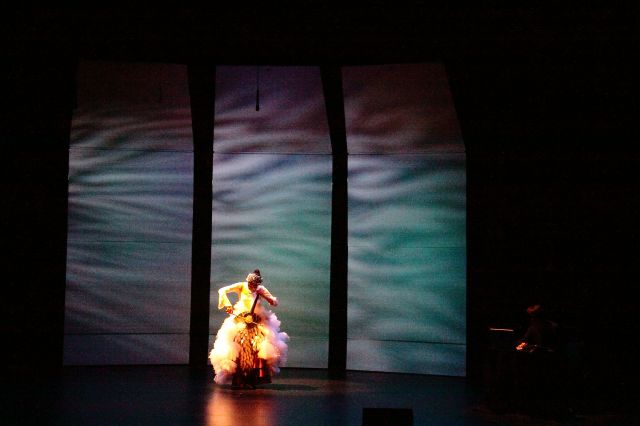
Dohee Lee on the carefully lit stage off Kanbar Hall.

Dohee Lee on the carefully lit stage off Kanbar Hall.

Her performance began slowly with Lee in her beautiful costume took on the role of a modern shaman conjuring glossolalia in shamanic trance along with choreographed movement and accompanied by her Eye Harp and electronic sounds through the theater’s great sound system.   Like the raga performances of the previous night I wasn’t aware of how long this timeless performance lasted (the program said it was 10 minutes) .  But I wished it would have gone on longer.  Even with photographs the experience here is difficult to articulate.  The sound enveloped the audience who viewed the carefully lit stage in the otherwise darkened hall as the sounds communicated a connection with the sacred.

I am still trying to digest what I saw and heard on this Friday night.  I don’t know how most of the audience experienced this piece but they seemed to have connected with it and responded with grateful applause.  She seemed to connect as both artist and shaman.
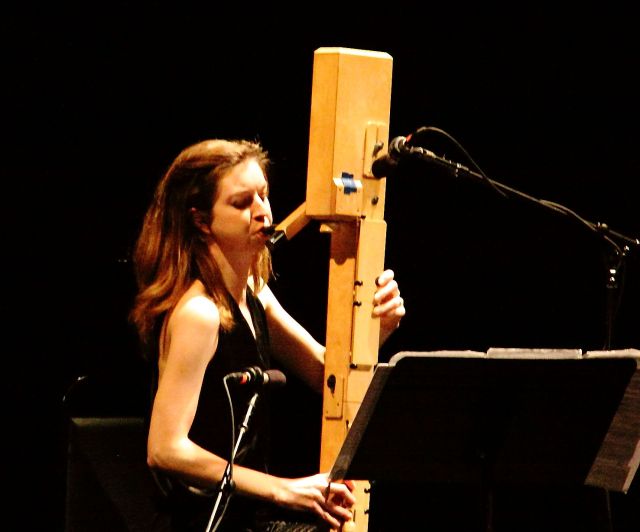
Anna Petrini performing with her Paetzold contrabass recorder.

Anna Petrini performing with her Paetzold contrabass recorder.

Following Dohee Lee were three pieces for an instrument called the Paetzold contrabass recorder (two before intermission and one after).  Paetzold is the manufacturer who specializes in the manufacture of recorders, forerunner of the modern flute.  The square contrabass recorder is a modern design of this woodwind instrument.  However, knowing the sound of the recorder in music of Bach and his contemporaries, gives the listener no useful clues as to what to expect from the unusual looking instrument pictured above.

Anna Petrini is a Swedish recorder virtuoso who specializes in baroque and modern music written for the recorder.  At this performance she played her contrabass instrument augmented variously by modifications, additions of microphones, little speakers and electronic processing.  These pieces were perhaps the most avant-garde and the most abstract music in this festival.

Anna Petrini performing on the stage of Kanbar Hall at the Other Minds festival.

Anna Petrini performing on the stage of Kanbar Hall at the Other Minds festival.

The creative stage lighting provided a useful visual counterpoint to the music.  The first piece, ‘Split Rudder’ (2011) by fellow Swede Malin Bang was here given it’s U.S. premiere.  This piece is concerned with the sounds made inside the instrument captured by small microphones inserted into the instrument.  The resulting sounds were unlike any recorder sound that this listener has heard.  The piece created percussive sounds and wind sounds.

The next piece, ‘Seascape’ (1994) by the late Italian composer Fausto Rominelli (1963-2004) used amplification but no electronic processing.  These abstract works were received well by the audience.

‘SinewOod’ (2008) by Mattias Petersson involved introducing sound into the body of the  instrument as well as miking it internally and setting up electronic processing with which the performer interacts.  Like the two pieces that preceded it this was a complex exercise in the interaction between music and technology which is to my ears more opaque and requires repeated listenings to fully appreciate.
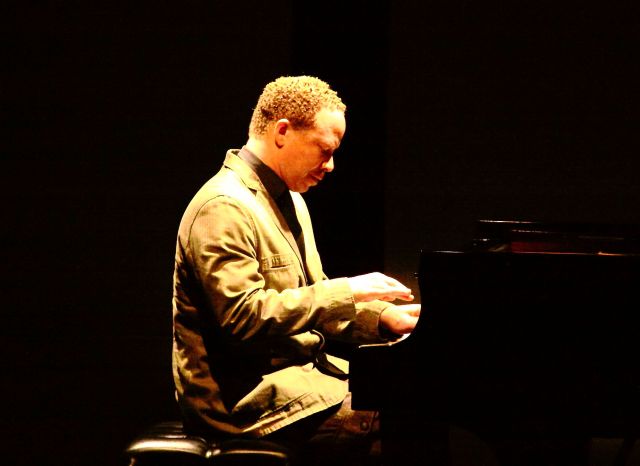
Taborn

Craig Taborn performing on the stage of Kanbar Hall at the 2013

The second concert was brought to its conclusion by the young jazz pianist and ECM recording artist Craig Taborn.  Detroit born, Taborn came under the influence of Roscoe Mitchell (of AACM fame) and began developing his unique style.  Here the term jazz does little to describe what the audience was about to hear.

Taborn sat at the keyboard with a look of intense concentration and began slowly playing rather sparse and disconnected sounding notes.  Gradually his playing became more complex.  I listened searching for a context to help me understand what he was doing.  Am I hearing influences of Cecil Taylor?  Thelonius Monk?  Keith Jarrett maybe?

Well comparisons have their limits.  As Taborn played on his music became more complex and incredibly virtuosic.  He demonstrated a highly acute sense of dynamics and used this to add to his style of playing.  I was unprepared for the density and power of this music. Despite the complexity it never became muddy.  All the lines were distinct and clear.  And despite his powerful and sustained hammering at that keyboard the piano sustained no damage.  But the audience clearly picked up on the raw energy of the performance.

This is very difficult music to describe except to say that it had power and presence and the performer is a creative virtuoso whose work I intend to follow.
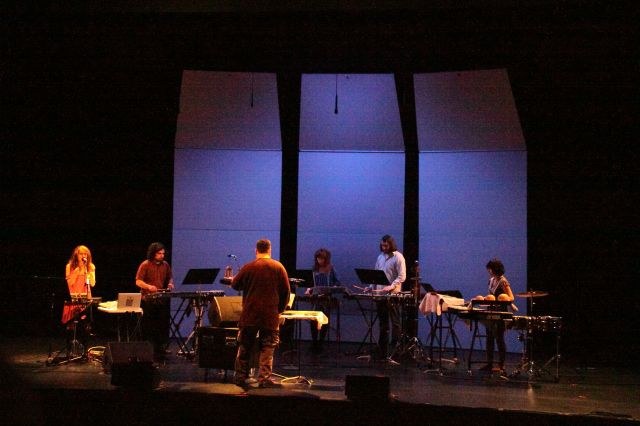
Amy X Neuberg along with the William Winant percussion group playing Aaron Gervais.

Amy X Neuberg along with the William Winant percussion group playing Aaron Gervais.

The final concert on Saturday began with the world premiere of another Other Minds commissioned work, ‘Work Around the World’ (2012) for live voice with looping electronics and percussion ensemble.  This, we learned in the pre-concert panel is another iteration in a series of language based works, this one featuring the word ‘work’ in 12 different languages.

Amy X Neuberg singing at the premiere of Aaron Gervais' 'Work Around the World'.

Amy X Neuberg singing at the premiere of Aaron Gervais’ ‘Work Around the World’.

Language is an essential part of the work of local vocal/techno diva Amy X Neuberg’s compositions and performance work.  With her live looping electronics she was one instrument, if you will, in the orchestra of this rhythmically complex work.  William Winant presided over the complexity leading all successfully in the performance which the musicians appeared to enjoy.  The audience was also apparently pleased with the great musicianship and the novelty of the work.  Its complexities would no doubt reveal more on repeated listenings but the piece definitely spoke to the audience which seemed to have absorbed some of the incredible energy of the performance.
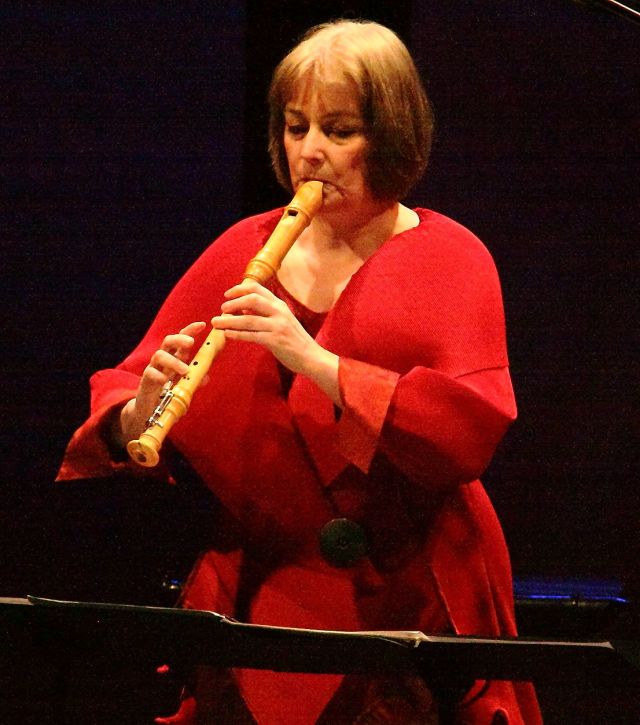
Michala Petri performing Sunleif Rasmussen's 'Vogelstimmung'.

Michala Petri performing Sunleif Rasmussen’s ‘Vogelstimmung’.

Back to the recorder again but this time to the more familiar instrument if not to more familiar repertoire.  Recorder virtuoso Michala Petri whose work was first made known to the record buying public some years ago is familiar to most (this writer as well) for her fine performances of the baroque repertoire.

Tonight she shared her passion for contemporary music.  First she played Sunleif Rasmussen’s ‘Vogelstimmung’ (2011) which he wrote for her.  It was the U.S. premiere of this solo recorder piece.  Vogelstimmung is inspired by pictures of birds and is a technically challenging piece that Petri performed with confidence.  At 17 minutes it was virtually a solo concerto.

And then back to electronics, this time with Paula Matthusen who now teaches at Wesleyan holding the position once held by the now emeritus professor Alvin Lucier.  Her piece for recorder and electronics, ‘sparrows in supermarkets’ (2011) was performed by Ms. Petri with Ms. Matthusen on live electronic processing.  This was a multi-channel work with speakers surrounding the audience immersing all in a complex but not unfriendly soundfield.
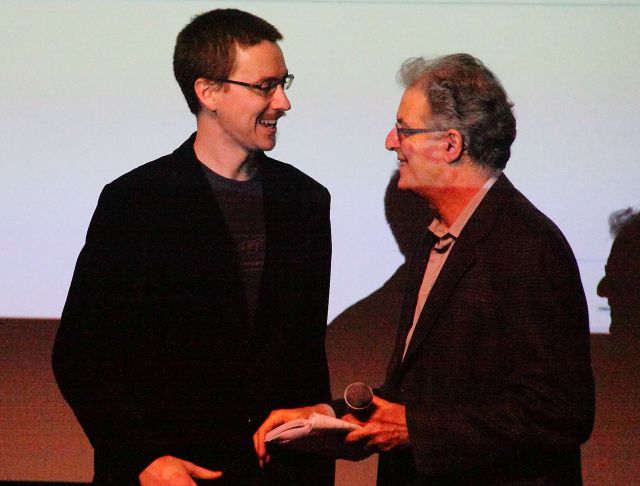
Michael Straus (left) with Charles Amirkhanian

Michael Straus (left) with Charles Amirkhanian


Some technical difficulties plagued the beginning of the first piece after intermission so the always resourceful emcee, Other Minds executive director Charles Amirkhanian took the opportunity to introduce the new Operations Director Michael Straus.  Straus replaces Adam Fong who has gone on to head a new music center elsewhere in San Francisco.

Mr. Amirkhanian also spoke of big plans in the works for the 20th Other Minds concert scheduled for 2015 which will reportedly bring back some of the previous composers in celebration of 20 years of this cutting edge festival.  No doubt Mr. Straus has his work cut out for him in the coming months.


Ström, part of the video projection

Ström, part of the video projection

With the difficulties sufficiently resolved it was time to see and hear Mattias Petersson’s ‘Ström’ (2011) for live electronics and interactive video in its U.S. premiere.  Petersson collaborated with video artist Frederik Olofsson to produce this work in which the video responds to the 5 channels of electronics which are manipulated live by the composer and the five lines on the video respond to the sounds made.  The hall was darkened so that just about all the audience could see was the large projected video screen whilst surrounded by the electronic sounds.

The work started at first with silence, then a few scratching sounds, clicks and pops.  By the end the sound was loud and driving and all-encompassing.  It ended rather abruptly.  The audience which was no doubt skeptical at the beginning warmed to the piece and gave an appreciative round of applause.

Paula Matthusen performing her work, '...and believing in...'

Paula Matthusen performing her work, ‘…and believing in…’

Next up, again in a darkened hall was a piece for solo performer and electronics.  Composer Paula Matthusen came out on stage and assumed the posture in the above photograph all the while holding a stethoscope to her heart.  The details of this work were not given in the program but this appears to be related to the work of Alvin Lucier and his biofeedback work on the 1970s.  Again the sounds surrounded the audience as the lonely crouching figure remained apparently motionless on stage providing a curious visual to accompany the again complex but not unfriendly sounds.  Again the audience was appreciative of this rather meditative piece.
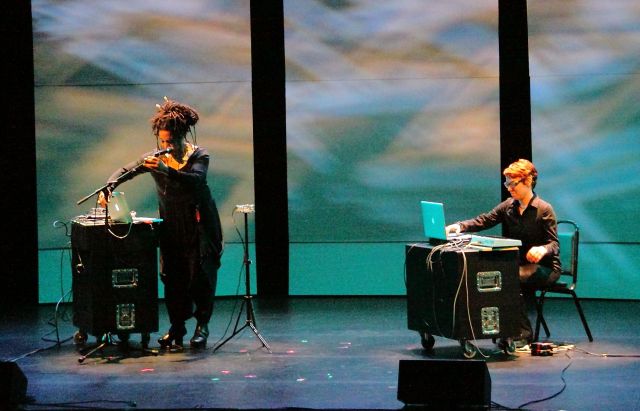
Pamela Z (left) improvising with Paula Matthusen

Pamela Z (left) improvising with Paula Matthusen

Following that Ms. Mathussen joined another bay area singer and electronics diva, Pamela Z for a joint improvisation.  Ms. Z, using her proximity triggered devices and a computer looped her voice creating familiar sounds for those who know her work while the diminutive academic sat at her desk stage right manipulating her electronics.  It was an interesting collaboration which the musicians seemed to enjoy and which the audience also clearly appreciated.

Pamela Z performing Meredith Monk's 'Scared Song'

Pamela Z performing Meredith Monk’s ‘Scared Song’

For the finale Pamela Z performed her 2009 arrangement of Meredith Monk’s ‘Scared Song’ 1986) which appeared on a crowd sourced CD curated by another Other Minds alum, DJ Spooky.  Z effectively imitated Monks complex vocalizations and multi-tracked her voice as accompaniment providing a fitting tribute to yet another vocal diva and Other Minds alumnus.  The audience showed their appreciation with long and sustained applause.
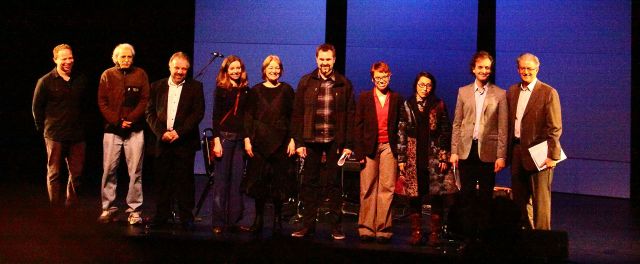
All the composers of Other Minds 18

All the composers of Other Minds 18

Black Classical Part Five


Looking at the previous four installments in this, my personal tribute to Black History Month, I decided that I needed to write one more (for now) in this series. So here I will present some of the resources I have found useful in learning about this music. While I have some knowledge in this area I could not have written these posts without these sources and I will continue to look to them to help me discover more musical gems. I hope that these essays have sparked some interest and I hope that any such interest will have ways to grow further.

The most useful general search terms formed the titles of these posts: black classical (or “African-American classical” which then limits your search to U.S. or the Americas). The term, “classical” is problematic but did serve to differentiate my searches from blues, ragtime, traditional jazz, soul, rhythm and blues, pop, rap and related genres that are more stereotypically associated with black people in music.

My focus was on composers and conductors leaving out a vast category of black classical musicians. A useful overview can be found at: http://www.wqxr.org/#!/articles/black-history-month/2013/jan/31/timeline-history-black-classical-musicians/. This little timeline provides a perspective on the slow acceptance of black musicians in the elite ranks of producers and ensembles that define the classical music experience.

africlassical.com is a good general site that lists many black musicians and its far more up to date companion site http://africlassical.blogspot.com/ has postings of great interest on an almost daily basis has been both essential and revelatory at times (I bookmarked this blog).

Center for Black Music Research is a rich resource and also publishes an academic journal on the subject as well as many other useful and interesting publications. They also maintain a large research library of books, journals and recordings. And they cover all forms of music. An excellent resource.

But the starting point for my personal interest in this subject is the landmark set of recordings which I encountered in the mid to late 1970s. Columbia records release of nine albums entitled ‘Music by Black Composers’ is perhaps the best starting point due to the wonderful scholarship and musicianship in this set. Conductor Paul Freeman along with musicologist Dominique-Rene de Lerma collaborated on this set. They produced a fine overview of neglected black composers from the 18th century to the mid-20th century in an intelligent selection of music and excellent performances by American orchestras. I was pleased to find that the reissue of these albums as a 9 vinyl disc boxed set remains available for only $35 plus postage from here. I jumped at the opportunity to acquire this great reissue funded by the Ford Foundation and my order was sent to me in less than a week.

Chicago-based Cedille Records has some great releases and even more great black classical is available at Albany Records.  Search for the work of Paul Freeman on both labels.

The ultimate goal for me in all this would be to have black classical musicians and composers equally represented on recordings, in performances and in programming. But until that happens (I’m not holding my breath here) the recordings and resources thus far cited (and many that were not) will have to suffice. While I continue to enjoy discovering this music as a “best kept secret” or a limited boutique-type item I would much prefer that the art of these black musicians become common knowledge, not a political issue of which Marian Anderson‘s concert at the Lincoln Memorial has become emblematic.

20130221-135527.jpg

Let me end by referring my readers to my favorite fiction book about black musicians: Richard Powers‘ 2003 masterpiece ‘The Time of Our Singing‘. Powers, who is also trained as a musician, demonstrates amazing insight to music as well as civil rights issues in this sweeping epic of the twentieth century. The chapter entitled, Easter, 1939 (too long to quote here) brings the Marian Anderson concert to life in powerful prose. Read it, preferably out loud to a friend, because it will give you a history lesson and perhaps put you in touch with the emotional power and significance of that event.

Happy Black History Month to all. And happy listening.

20130222-084931.jpg


Black Classical Part Three


20130214-170052.jpg

For my third installment I have chosen to highlight that series of recordings by conductor Paul Freeman of music by black composers which I mentioned in a previous blog.

In 1974 Columbia Records issued 9 LPs (originally it was to be 12) over the next few years in a series called, ‘Music by Black Composers’. The music was chosen largely by Paul Freeman who also wrote the liner notes and conducted the performances. He was assisted by musicologist Dominique-Rene de Lerma who contributed his knowledge of pre 20th century black music and also edited some of the pieces for performance.

This set of records was featured by my local radio station (WFMT in Chicago) at the time of its release and opened my listening mind to to this cornucopia of fascinating classical concert music by black composers. The series was so titled in part because it included music from many countries and also because it was released before the term ‘African American’ became Le mot juste (but that is another story).

The series was apparently recorded and released 1974-78 and re-released in 1986 as a set under the Columbia Special Products label. Historically it was an important set of releases much like the series curated by David Behrman called ‘Music of Our Time’ which featured some truly cutting edge music by composers writing in the sixties and seventies. To be sure the black composer series was not cutting edge modernism like that series but gains its cutting edge from collecting in one set music from the 18th to the mid-20th century by a set of composers who, other than having been trained in the discipline of music performance and composition, held in common only a skin color darker than ‘white’.

Billboard announced the plan to issue these records in 1973 saying that they were the fruit of a collaboration between the Irwin-Sweeney Miller Foundation of Columbus, Indiana and, with the encouragement of Dominique-Rene de Lerma, the school of music at Indiana University in Bloomington. Citing “campus politics” professor de Lerma reported that Indiana had lost interest so he phoned Paul Freeman (conductor with the Detroit Symphony at the time) and advised him to contact the ‘Afro-American Music Opportunities Association’ whose support then helped launch this series. The original plan was to release four albums per year for at least three years but a great beginning soon slowed and the 9th album (pictured above) was the final release in the series.

Coming twenty some years after the voting rights act of 1965 it retained the some cachet of the civil rights movement and likely was produced at that time in the hopes that this might help sell the albums to consumers. I don’t know who ultimately bought these albums or what their total sales were but I know that some visionary producers at WFMT piqued my interest and that I bought many of these records and listened with interest when they were scheduled to play (I religiously perused the monthly program guide).

The original releases went out of print in a few years. There was a CD set (currently out of print) compiled by the Columbia University (Chicago) Center for Research in Black Music funded by the Ford Foundation that released a selection of the Detroit Symphony performances (now a pricey collector’s item) from that set as well as a reissue of the complete set on vinyl records with the original cover art and program notes which remains, I am happy to report, available by mail from the College Music Society in Missoula, Montana www.music.org.

The contents are:
Columbia M-32781 (1973); volume 1
Saint-Georges: Symphony concertante, op. 13 (ed. by Barry S. Brook; Miriam Fried, Jaime Laredo, violins; London Symphony Orchestra)
—–: Symphony no. 1 (ed. by D. de Lerma; London Symphony Orchestra)
—–: Scena from Ernestine (ed. by D. de Lerma; Faye Robinson, soprano; London Symphony Orchestra)
—–: String quartet no. 1 (ed. by D. de Lerma; Julliard Quartet)

Columbia M-32782 (1973); volume 2
William Grant Still: Afro-American symphony.
—-: 2 arias from Highway 1, U.S.A. (London Symphony Orchestra; William Brown, tenor)
Samuel Coleridge-Taylor: Danse nègre.
—–: “Onaway, awake, beloved” from Hiawatha’s wedding feast (William Brown, tenor; London Symphony Orchestra)

Columbia M-32783 (1974); volume 3
Ulysses Kay: Markings (London Symphony Orchestra)
George Walker: Trombone concerto (Denis Wick, trombone; London Symphony Orchestra)

Columbia M-32784 (1974); volume 4
Roque Cordero: Violin concerto (Sanford Allen, violin; Detroit Symphony Orchestra)
—–: Eight miniatures (Detroit Symphony Orchestra)

Columbia M-33421 (1975); volume 5
José Maurício Nunes-Garcia: Requiem Mass, M. 185 (ed. by D. de Lerma; Doralene Davis, soprano; Betty Allen, mezzo-soprano; William Brown, tenor; Matti Tuloisela, bass-baritone; Helsinki Philharmonic Orchestra; Morgan State University Choir [Nathan Carter, director])

Columbia M-33432 (1975); volume 6
José White: Violin concerto (ed. by Paul Glass and Kermit Moore; Aaron Rosand, violin; London Symphony Orchestra)
David Baker: Cello sonata (Janós Starker, cello; Alain Planès, piano)

Columbia M-33433 (1975); volume 7
William Grant Still: Sahdji (London Symphony Orchestra; Morgan State University Choir [Nathan Carter, director])
Fela Sowande: African suite (3 excerpts; London Symphony Orchestra)
George Walker: Lyric for strings (London Symphony Orchestra)

Columbia M-33434 (1975); volume 8
Olly Wilson: Akwan (Richard Bunger, piano; Baltimore Symphony Orchestra; Richard Bunger, piano)
Thomas Jefferson Anderson: Squares (Baltimore Symphony Orchestra)
Talib Rasul Hakim: Visions of Ishwara (Baltimore Symphony Orchestra)

Columbia M-34556 (1978); volume 9
George Walker: Piano concerto (Natalie Hinderas, piano; Detroit Symphony Orchestra)
Hale Smith: Ritual and incantations (Detroit Symphony Orchestra)
Adolphus Hailstork: Celebration! (Detroit Symphony Orchestra)

Later Freeman began a series on Chicago-based Cedille records that released three further volumes of black composers’ music with his wonderful Chicago Sinfonietta as well as several CDs dedicated entirely to single black composers (more about those and more in another post).

Perhaps an innovative label such as Naxos might some day bring these Columbia recordings back into circulation in their entirety in the CD format. Meanwhile I am pretty happy with my LPs with their copious notes and full-sized beautiful graphics. If you haven’t heard this set I would encourage you to avail yourself of some of this beautiful music.

Far Famed Tim Rayborn Takes on the Vikings


Close your eyes and listen intently in the darkened hall.  From the back of the hall comes first a growling gutteral sound in an unfamiliar language.  This is followed by beats on a drum and the sound of a rattle.

Slowly the primitive creature comes up the center aisle growling, chanting, reciting and playing his drum and rattle moving slowly towards the stage and into view in the light.

He is seated on the stage and continues his chanting, speaking and playing.

He is playing unfamiliar instruments and telling unfamiliar stories.

There is both precision and passion in his playing and reciting.

Tim Rayborn is a resident of Berkeley, a multi-instrumentalist, singer and performer, familiar to local audiences in both his solo performances and with his group Canconiér.  His area of focus is authentic performance of music and poetry of the middle ages and before.

But how does one determine the authenticity especially as one goes further back in time and finds fewer records and accounts of how these performances sounded?  In the pre-concert lecture Mr. Rayborn spoke of this project, ‘The Far Famed Ones-Music and Poetry of the Vikings’.  He told the audience that there are no scores of this music and, like the languages in which the poetry was written, we have only the barest clues as to how these things must have sounded some 1000 years ago.

The clues, he explained, come from archaeology, linguistics and a few extant bare threads of oral tradition…there are pieces, an immense puzzle that some scholars say can’t or shouldn’t be solved.  But Rayborn asserts that these puzzles, if not able to be completely solved, are worth time to approximate the answers.

In a very real way this music, this performance is entirely new comprised of minimal facts, educated scholarship, conjecture.  No one can ever know what this body of work sounded like without travelling back in time to hear it.  Failing that we have the laborious work of Rayborn and his fellow scholars attempting to piece together an approximation of this work, not unlike the re-creation of dinosaurs in Jurassic Park (albeit without the attendant dangers)…a few pieces of evidence held together with educated guesses producing something new, an opportunity to hear these reconstructions of music and ritual as it may have existed those thousand years ago.

viking01 (18)

The stories and poetry, like the music are very different from what we think of when we use those terms today.  The performance of these poems integrating music were a medium of entertainment and communication in a pre-literate society.  They varied greatly from one performance to the next dependent on the performers choices.  Even the musical instruments varied in style and construction.

In a sense, all performance is an approximation.  Any musical score or performance text require interpretation and vary from one performance to the next dependent on the artists’ choices.  But choices are more limited in work whose performance practices and directions for performance are more completely communicated and understood.

With this work Tim Rayborn reaches further back than almost anyone has into the darkness of the dark ages to attempt to illuminate some portion of these traditions that would later evolve into poetry, prose and musical compositions.  The Viking Age lasted from the 790s to the Norman Conquest of 1066.  And while history knows this era for its battles and plunders it was not devoid of culture.

Rayborn is an affable, genial man who is first a serious scholar and a performer second.  He speaks with great precision leaving as little ambiguity as possible as one finds with serious academics.  His joy and enthusiasm, love for this work combine with that scholarship to make his performances a riveting experience.

He described this performance (January 27th, 2013) at the little church hall in Albany as a ‘work-in-progress’ evolving over time, being tweaked with each new performance to reflect the scholarship and the instincts of the experienced performer.  Rayborn is part scholar, part musician and part actor.  He is as serious, precise and joyous in each of these endeavors.

Following the opening comments there was a brief intermission which led into the performance without interruption (as the performer requested) of all the pieces on the program.

What followed was an integrated program of performance, poetry, song and music making of perhaps one hour’s duration.  There was drama and humor in this entertaining mix.  The audience sat respectful and engaged to the end when Rayborn stepped out of character to acknowledge the conclusion.  And the far-famed ones came just a little bit closer.

The audience stood applauding loudly this ‘new’ old music dredged from the darkness of the ages like relics recovered from a peat bog, and restored as best as anyone can to most closely resemble what they originally were.  What was once thought lost to time has now been restored.

Undercover Performance Practices in the Bay Area


The practice of “covers” in pop music is part of the long tradition in music of making arrangements, variations, homages, etc. in response to a given composition.  To be sure the majority of these efforts are, though well-meaning, mediocre or worse.  But on the whole they can be quite fascinating and even revelatory.  Ravel’s masterful orchestration of Mussorgsky’s ‘Pictures at an Exhibition’ is so well done that few people are even aware that the original is a piano solo work.  The orchestration so enhances the original as to immortalize it and upstage the original version.  Similarly The Byrds’ cover of Bob Dylan’s ‘Mr. Tambourine Man’ has become the most recognized version of that song.

‘Undercover Presents’ is a concert organization which has been producing a very unusual set of concerts.  Taking an album by a given artist and recruiting a different band/musician to cover each of the songs and then presenting  both a studio recording and a live concert of the results.  So far they have done  Velvet Underground and Nico, Pixies’ Doolittle, Nick Drake’s Pink Moon, Black Sabbath’s Paranoid and, most recently, Joni Mitchell’s Blue.  The musicians are all from the San Francisco Bay Area and that comprises a huge trove of talented and innovative artists.  Their albums are available on bandcamp.com

I saw the production of Blue this past September and I will be there again this coming Monday having recruited some additional friends, “You gotta come see this!”

1Killbossa

The first band, ‘Killbossa’ is inspired by the Brazilian art/music/political movement of the late 1960s known as ‘tropicalismo’ and is a combination of a variety of different musical styles including bossa nova, psychedelic rock, avant-garde and Brazilian popular music.  They covered the first song on the album, ‘All I Want’.

Next up Bharathi Palivela, a singer with traditional Hindustani vocal training teamed up with San Francisco bassist and teacher Daniel Fabricant covering ‘My Old Man’.

Georgia native, now San Francisco based bluegrass singer with her banjo and band put their spin on ‘Little Green’.

‘Carey’ was given a reading by clarinetist, vocalist Beth Custer with her strongly jazz inflected ensemble.

Kitka is an all female a capella group specializing in eastern european style folk singing.   Their a capella cover of ‘Blue’ was alone worth the price of admission.

Amy X Neuberg is an Oakland based singer, performer and tech wizard.  With her voice and electronics she created a unique version of ‘California’.

7mafia

Jazz/funk/hip-hop/R and B Jazz Mafia with  Aima the Dreamer and Erica Dee did a raucous version of ‘This Flight Tonight’.

Cajun/blues/southern fiddler and singer with her band did a country blues version of ‘River’.

The Seshen is an electro-pop ensemble that, like the other musicians in this show, is hard to categorize.  They did an ecstatic cover of ‘A Case of You’.

Katy Stephan and her group Classical Revolution ended the evening with ‘The Last Time I Saw Richard’.

All the musicians barely crowded on to the stage to acknowledge the standing ovation from the very appreciative crowd.

Whether you know the original Joni Mitchell album or not you can’t fail to find something exciting, eye-opening and enjoyable in these performances.  The range of creativity and talent is staggering.  The bands played with a subtle but effective visual display that unified their efforts and added another aspect to both the music and the performance.  I’m sure Joni would be pleased.

Did I say that the ticket price includes a free download of the studio album?  Well it does and it serves as a great reminder of a truly unique bay area experience.  Maybe I’ll see you there.


A Fitting 100th Birthday Celebration for Conlon Nancarrow


Nancarrow birthday cake.

Happy 100th Birthday to Conlon Nancarrow

October 27th, 2012 would have been the 100th birthday of composer Conlon Nancarrow.  While still not a household name his work has become better known through recordings and live performances over the last 30 years or so.  He spent the majority of his creative life working in relative obscurity in Mexico City. While known by some of his contemporaries his music first became widely known through a 1969 Columbia Records release, part of that label’s ‘Music of Our Time’ series curated by David Behrman.

The evening’s celebration of his 100th birthday I’m sure would have made him proud.  Curated by bay area new music advocates Other Minds and hosted by the Piedmont Piano Company in downtown Oakland was a sort of preview of the next weekend’s three day event.

In the beautiful space of that showroom the audience was treated to hors d’ouerves, wine before the concert.  The event opened with a portion of a film by Jim Greeson, a documentary about the life and music of Nancarrow that painted him as another (if the most radical) of the musicians who were born in Texarkana, Arkansas which claims Scott Joplin as one of it’s famous sons.  This was followed by pianola virtuoso Rex Lawson who played a few of Nancarrow’s early studies.

The pianola is not the same thing as a player piano, as Lawson informed the audience.  It is a device which fits over the keyboard of a traditional piano and depresses the keys based on the instructions of a paper roll inserted as one would in a player piano.  However the pianola allows the performer to vary dynamics and phrasing and actually perform the music.  And Lawson demonstrated this beautifully.

pianola

Pianola showing the place where the paper roll is inserted.

At the intermission birthday candles were lit and Lawson was accorded the honor of blowing them out in the late composer’s honor.  Nancarrow died in 1997 having lived to see a tremendous resurgence in interest in his music and an acknowledgement of his contribution to music.  His complex rhythm studies for player piano number just over 50.  And though he wrote some chamber and orchestral music as well, these are the pieces on which rest his fame as an innovator.

Rex Lawson blowing out the candles on Nancarrow's birthday cake.

Rex Lawson blowing out the candles on Nancarrow’s birthday cake.

Just prior to the intermission we were treated to the multi-talented artist an composer Trimpin‘s computer controlled pianola.  Attached to two pianos were devices for pressing the keys which were in turn controlled by a computer program.

Piano with Trimpin’s computer controlled pianola attached to the keyboard

Piano number two with Trimpin's computer controlled pianola attached to the keyboard

Piano number two with Trimpin’s computer controlled pianola attached to the keyboard

They played the massively complex Study No. 40b and did so very effectively.  The audience left their seats to stand around the two upright pianos which behind the seating area.  The sound cannot be described in words and the audience, some perhaps mystified, were very appreciative.  Trimpin later spoke of this work reconstructing one of Nancarrow’s abandoned project, a percussion orchestra controlled by a piano roll.  It was abandoned when Nancarrow realized that the technology could not perform the music accurately, something which is now possible with Trimpin’s research.  The results of that research, Trimpin: Nancarrow Percussion Orchestra / MATRIX 244 will be installed in the Pacific Film Archive and be available to the public from November 2nd to December 23rd.

Trimpin holding a prototype for Nancarrow's aborted percussion orchestra experiment's

Trimpin holding a prototype for Nancarrow’s aborted percussion orchestra experiment’s

After the candles were out the audience, led by Charles Amirkhanian, sang happy birthday which prompted Lawson to spontaneously run to one of the pianos to accompany the traditional song.  Charles Amirkhanian, composer, radio host and impresario produced the first complete recording of Nancarrow’s player piano studies (and the only recording made on Nancarrow’s player pianos in his Mexico City studio) in 1980 which brought the composer to a much wider audience and got him invited to the 1982 New Music America festival and later helped him get a Mac Arthur genius grant.  A chance find in a record store in Paris inspired Hungarian composer Gyorgy Ligeti to write his masterful piano etudes after hearing these recordings.

Charles Amirkhanian with Rex Lawson

Charles Amirkhanian holding the microphone while Rex Lawson sings along with one of his piano rolls.

Trimpin scanned all of Nancarrow’s piano rolls into a computer and made it possible for the music to be studied more widely as well as preserving it on a hard drive.  He went from the piano rolls which are essentially a digital medium the equivalent of punch cards for historians and those of us old enough to remember to digital storage on a magnetic drive.

As I noted at the beginning this was a most appropriate tribute occurring on Nancarrow’s actual birthday and featuring people like Amirkhanian, Lawson and Trimpin who were inspired by Nancarrow’s work and have done so much to bring it to light and to preserve it for posterity.

Following the intermission we were again treated to Rex Lawson who provided a perspective on the importance of player pianos and pianolas in early 20th Century culture.  He illustrated the function of the pianolist explaining as he said, “Why I need to be here at all…” by playing a Rachmaninoff polka first without any nuance executed by the pianolist and then with him demonstrating how the pianolist puts life into the piece, a world of difference.  He spoke of composers who actually wrote for the pianola.  It is different from writing for a pianist because the pianola is not limited to the size of one’s hand or the number of fingers one has.  It afforded composers a technology to write a more orchestral fabric.

He demonstrated with pieces by Sir Arnold Bax, an early 20th century British composer and by Stravisnksy (a marvelous arrangement of the scene from Petroushka when the puppet first comes to life).  He also spoke of now forgotten composers who had the career of being arrangers for the pianola.  While many homes had pianos and many could play the piano, the pianola allowed them to play larger and more difficult works beyond the skills of the average pianist and, frequently, beyond the skills of any human being.

The evening ended with another demonstration of Trimpin’s computer driven pianola this time playing one of Nancarrow’s early boogie woogie pieces.  And then there was time to speak with the artists and audience members who showed enthusiasm and interest.

Tonight’s event, we were told, was organized by Other Mind’s development director Cynthia Mei and she made a plea for funding this and next weekend’s events through Kickstarter (http://www.kickstarter.com/projects/otherminds/nancarrow-at-100-a-centennial-celebration?ref=card) where the rewards for participating in the funding range from mention in the program booklet to CDs, t-shirts and downloadable recordings of the performances.  This writer is a proud part of the kickstarter campaign and would like to encourage others as well.  We are honoring a true genius in American music and preserving his influence and legacy for future generations.  I think Mr. Nancarrow would have heartily approved.

Annie Lewandowski, Luciano Chessa, Theresa Wong in Berkeley


Lewandowski piano

A view of the inside of the piano showing Lewandowski’s alterations.

It is easy to miss the nondescript storefront on University Avenue where this performance took place. And the promotion of this concert appeared to be mostly through Facebook and the Bay Area improvisers web site which resulted in a small but appreciative audience interested in hearing the work of Annie Lewandowski, now a music lecturer at Cornell. She is a graduate of Mills College. She has a varied resume ranging from classical piano to progressive rock bands and she presented tonight her work with extended piano techniques much like those of John Cage but with some distinctly personal twists extending Cage’s methods further. Ms. Lewandowski was hosted by Theresa Wong (also a Mills graduate), bay area composer, cellist and singer who organized the event and Luciano Chessa, San Francisco Conservatory professor, composer, musicologist, historian and performer and producer who played a couple of different roles in this evening.

performance of La Barbara's 'Hear What I Feel'

Luciano Chessa performing Joan La Barbara’s ‘Hear What I Feel’

The first performance was introduced by Ms. Wong who informed us that Luciano Chessa had been kept in isolation for the last hour while the preparations were done for his performance. The piece being performed was Joan LaBarbara’s ‘Hear What I Feel’ from 1974. It consists of a table upon which there are several plates each containing some object or substance. The performer, who is blindfolded, is seated at the table and the performance consists of the performers reactions to the substances and/or objects he examines with his hands alone. It is performance art that would be perfectly at home with other Dada and Fluxus-like scores.

Wong led Chessa carefully from the back of the performance space to the table containing six plates. After seating him she positioned the microphone carefully in front of him. Chessa spent several minutes with each object examining three predominantly with his left hand and three with his right. All the while during his tactile adventure he vocalized a variety of sounds evoking (presumably) his emotional response to each object or creating an audio analog for them.

As with all such scores the result leaves a wide range of possibilities to the performer. And this performance was suitably humorous and engaging. Following his examination of the last of the objects Chessa removed the blindfold and reacted to each of the objects (without vocalizing) as he examined them visually. There was an effective combination of (mockingly?) serious concentration and idiosyncratic responses that left the audience genially amused and entertained.

Lewandowski piano

Annie Lewandowski playing in the piano, on the keyboard and singing.

Wong cello

Theresa Wong playing her carefully altered and electronically enhanced cello and singing.

This was followed by a duet between Lewandowski and Wong. Both performers utilized various ways of altering the sounds of their instruments by adding objects to the strings or by exciting the strings with objects. Wong also made use of a foot pedal controlling some electronics. Lewandowski’s piano was miked and amplified somewhat.

The improvisation was started by Lewandowski with some percussive like sounds elicited at the keyboard. Wong responded sparely at first and the two seemed to trade ideas which became richer as the performance went on. Again the serious concentration was present as the performers carefully heard and responded to each others’ music making. While satisfying it was a sort of introduction or first taste of what was to come in the second half.

A brief intermission saw the performers mingling with audience members, many of whom were acquaintances and other musicians.

Annie Lewandoski, Luciano Chessa and Theresa Wong in a trio improvisation

Annie Lewandoski, Luciano Chessa and Theresa Wong in a trio improvisation

What concluded this unusual program was a trio for all three performers. Lewandowski with her prepared piano, Wong with her altered cello, Chessa with his signature Vietnamese Dan Bau and guitar. All three also sang. The performance started sparely as each introduced suggestions or themes for the improvisation and reacted to them.

Lewandowski gave a much fuller exposition of the possibilities of her instrument playing the keyboard, inside and all around the piano as well as singing. Wong also seemed to use a wider amount of sound possibilities in her playing. Chessa played the traditional Vietnamese folk instrument in all but traditional ways using devices to excite the strings and focusing on tuning and even some percussive possibilities. At one point he left the table where he was performing to pick up an acoustic guitar. After picking a few notes he walked to the back of the stage area and ascended a stair case leading to a sort of balcony that surrounded the performance space. It was at this point that he began softly singing what sounded like an Italian folk tune as he played the guitar in a most traditional manner. This gave a collage effect to the performance juxtaposing the most traditional kind of music making with the extended and experimental sounds.

Chessa remained on the balcony for a bit, then descended the staircase again and returned to the more unusual playing methods at first on the guitar and then back at the table on the Dan Bau. Following this Lewandowski began vocalizing a melody with sparse accompaniment that would have been perfectly at home in a scene from ‘Eraserhead’ at times. She was echoed by Wong’s extended vocal techniques at first and then Lewandowski and Wong began singing a more traditional sounding melody with beautiful harmonizations interpolating this singing at different points while still traversing their freely improvised instrumental playing supported by Chessa on the Dan Bau.

This made for a rather tranquil mood as they ended the second half of the concert. The audience was appreciative. And this writer was pleased to have found a gem of a concert experience by young, serious (but good-humored) and accomplished musicians in the eclectic world of the east bay.

Cançonièr at the Berkeley Festival Fringe


Full moon presides over exsanguinous tales.

Last night, local early music ensemble Cançonièr performed in what was their last appearance until next year.  In the somewhat noisy parish hall of St. Mark’s Episcopal Church this four member ensemble played a slightly condensed version of a program they have been touring for the last year or so.  It was a program called ‘Black Dragon’ with music from the first half of the 15th century, the time of the reign of Count Vlad Dracula, the historical antecedent of the vampire character.

Cançonièr is a four member ensemble co-directed by Tim Rayborn and Annette Bauer.  The other two regulars are Shira Kammen and Phoebe Jevtovic.  All are amazing instrumentalists and scholars in their own right and all play in other ensembles and groupings.

Tim Rayborn is a medieval scholar , multi-instrumentalist, singer and performer.  Annette Bauer is a recorder virtuoso, multi-instrumentalist and singer.  Shira Kammen plays vielle (antecedent of the violin/viola), medieval harp and sings.  And Phoebe Jevtovic is a singer who also does double duty by playing a small bell set in some of the pieces.

Annette Bauer demonstrates her virtuosity on the recorder.

Tim Rayborn

Tim Rayborn providing context and performing.

The group goes beyond their scholarship (which is excellent) and puts their performances in context.  They provide translations of the words they sing (frequently in dead or antiquated languages) and they connect with their audience with a pleasant sense of humor as well as drama.

Shira Kammen playing the vielle.

They clearly enjoy playing together and seem very connected, deriving great pleasure from making music.  And they produce a beautiful sound with their intricately crafted replicas of the instruments of the time.

Phoebe Jevtovic sings accompanied by Tim Rayborn on the lute.

One complaint.  The location of this church at Bancroft and Ellsworth makes for a bit of urban distraction provided by sirens and traffic.  And there were apparently other activities going on in the church complex which could be occasionally heard.  But the musicians and audience handled the distractions in a good-natured manner consistent with the rest of their performances.

They began and ended their intermissionless program with a narrative drama with music partly sung, partly spoken or intoned but performed with characteristic flair by Tim Rayborn accompanied by himself on frame drum and the ensemble.  This was a jaunty upbeat sounding piece at the outset that gives way to the narrative talking/singing about the infamous subject of this performance here called Dracula of Wallachia.  The language here sounded like an old German dialect and after the brief but harrowing telling of the story in speech and song (the speech gratefully rendered in English) the jaunty music of the beginning returns to conclude the piece.  One can imagine this being performed in a tavern or inn by a troubadour or group of musicians for the guests.

Rayborn then spoke to the audience providing more context by explaining that tonight’s music is from the time of the Count’s reign but that it is not known if he indeed had musicians in his court.  And for those who do not know the story of ‘Vlad the impaler’, as he was known, this is pretty grisly stuff.  Reality programming from the dark ages if you will.

There followed two more composed songs, a folk song, a traditional Romanian dance,  a heart-rending Moldavian chant passionately sung by Jevtovic and a traditional Bulgarian dance.

I have not bothered to mention the composers’ names (which were listed in the printed program) because they are very little know and would likely clutter this little narrative.  My apologies to the composers and the scholars if I have offended in my omissions.

Left to right: Shira Kammen, Annette Bauer and Phoebe Jevtovic demonstrating their vocal collaboration.

But the next piece was by a composer familiar to anyone who has taken a course in western music history, Guillame Dufay (1397-1474).  The work of this composer, who provided a lot of sacred music for the church as well as secular pieces, was so successful that his work and his name have survived the ravages of history.  The ‘Lamentio Sanctae Matris Ecclesiae Constantinopolitanae’ required the vocal skills of all four in the group as well as instrumental accompaniment.  And they did so beautifully singing, we were told, in two different languages as the piece is originally written.

There followed an Italian dance, a Byzantine secular court piece called a “kratima” (spell check is practically useless here), a medieval Russian pilgrim  song and an Ottoman Turkish piece followed by a very spirited reprise of the first piece.

The ensemble clearly enjoys their music making.

All in all a very satisfying evening and a clearly appreciative audience sent this writer out into the Berkeley night not with nightmarish images but with the tunes of this joyful performance ringing in his head (medieval earworms?).  And I popped one of their CDs in my car stereo for the ride home.  I could easily hear this again.