An overflow crowd packed the lovely auditorium at Berkeley’s David Brower Center this past January 19th. Octogenarians (and younger folks as well) populated both stage and audience in a show of appreciation for a man whose work as music director of KPFA (1969- 1992) and subsequently as an arts promoter and curator of new music in California’s Bay Area continues to enhance the artistic reputation of the Bay Area.
A rare and exciting aspect of this evening were the rare opportunities to hear Charles’ music, including representative sound poetry classics and a recent major opus capped off by a world premiere of a new work.
The hands of the artist. Photo by Allan J. Cronin
The genuine affection, appreciation, and respect was palpable as the honored guest demonstrated his skill at hosting when a couple of technical glitches slowed (but did not stop) the amiable birthday celebration. The audience waited calmly and quietly.
Both the guest of honor and the host (Liam Herb) used a well honed, self effacing humor used most skillfully to entertain the sympathetic audience while the technical difficulties were surmounted in real time.
Panel discussion featuring (left to right) Susan Stone, Anthony Gnazzo, Paul Dresher, Charles Amirkhanian, Sarah Cahill, and Liam Herb (Photo by Allan J. Cronin, Creative Commons license)
Herb, a composer and performer, introduced himself in the midst of the technical resolutions, graciously announcing that, as producer, he accepts responsibility for the glitches. Charles maintained his familiar master of ceremonies crowd pleasing good humor as Herb worked goodnauturedly (if that’s a word) with the rest of the crew to resolve the issues and get on with the show.
The formal opening remarks were given by Other Minds’ associate director, Blaine Todd. And the evening began in force.
Blaine Todd (photo by Allan J. Cronin, Creative Commons license)
The program glided past the initial hiccup to present a film about our guest of honor. The bevy of fans and bona fide new music professionals sat with rapt attention as the film, featuring the familiar faces of several “Bang on a Can” artists.
The late great Robert Black interviewed by Amirkhanian in the streaming premiere of Audible Autopsy. (Photo of film appearance by Allan J. Cronin)
Excerpts from the 2015 Other Minds 20 documentary featured Julia Wolfe, David Lang, and Peter Gordon (now, it seems elder statesmen (and women) in their own right.
Production manager Liam Herb then served as moderator for a conversation or live interview (with Amirkhanian) for the next segment. This was followed by some videos with music by the guest of honor:
Real Time/T.V. Time Video with Amirkhanian’s “Muchrooms”
The film, presented in its entirety was accompanied by “Muchrooms”, from the CD recording of that standalone work.
Next was Amirkhanian’s and Carol Law’s classic collaboration: History of Collage (1981). This is a major work and a great collaboration with his partner in life and arts. I’m pleased to add my own shot from the performance at the Other Minds 23 experience, my favorite OM festival(so far).
History of Collage (1981) photo by Allan J. Cronin taken at the Other Minds 23 wonderful live performance of this work (Photo by Allan J. Cronin is Creative Commons license 2015)
We also heard and saw Audience (1978) with photography by Law and music/poetry by Amirkhanian followed by Chairs with photography by James Petrillo and music/poetry by Amirkhanian (excerpts from Seat Belt, Seat Belt (1973).
There followed a panel discussion led by Carol Law with Betsy Davids discussing David’s’ work and her connections via her work as a book artist. These two embody the experimental visual arts that characterize the skills of these fellow artists both onstage and off tonight. In fact, interactive collaboration and both respect and friendship were everywhere to be seen in this warm and pleasantly nostalgic evening.
Carol Law speaking with Betsy Davids (Photo by Allan J. Cronin, Creative Commons license)
This was followed by a recording of a major opus, Ratchet Attach It (2021) recently played at one of the (still ongoing) Other Minds Festival. This work is a major opus by Mr. Amirkhanian, one I’m pleased to say I heard live at the Chinese Theater in San Francisco a few years ago. Scored for a huge percussion ensemble, with audio recordings, and a conductor who moves between the podium and a space among the performers playing with the ensemble. It is perhaps one of his most integrated and evolved compositions. Stunning to hear it live. Glad to hear the (always too short) excerpts.
In fact Mr. Amirkhanian, a fixture in the arts of the Bay Area, continues to influence musical taste and present new and interesting music as he has for well over 50 years. His work as Executive Director of Other Minds includes the fabulous OM Records as well as the annual Other Minds Festival and a continual flow of carefully curated concert events by luminaries (or soon to be luminaries) throughout the Bay Area and beyond. There is also the huge archive of thousands of hours of interviews and concerts that are available in streaming audio and video via the Other Minds website.
Many of the artists featured in the Other Minds concert series continue to work, innovate, and expand musical concepts. An Other Minds commission, Henry Brant’s Organ Concerto, Ice Field, earned him a Pulitzer Prize. Many have gone on to greater achievements in their respective careers. Of course not every composer started their musical careers at Other Minds concerts. Many mid or late career musicians have joyfully been represented over the years. Its one of those festivals that innovative musicians seek to participate.
Such achievements reflect on Amirkhanian’s leadership and curatorial acumen, but more importantly his relationships with his fellow artists. Charles has earned a reputation for his support and his collaborative nature. Arguably, everyone in the house (and the overflow in the lobby) all have a degree of connection to Charles and his guests. It is why we’re all here tonight.
Charles Amirkhanian and Joseph Bohigian performing with Liam Herb’s electronics (Photo by Allan J. Cronin, Creative Commons license)
Following a brief intermission we were treated to a world premiere of a new work by our guest of honor, Noose Ratchet (2025) for two percussionists and electronics. Amirkhanian performing and/or promoting his own music is a relatively rare event and this alone was certainly worth the trip.
The work is arguably a trio for two percussionists playing ratchets, a curious instrument whose sound, if not entirely ubiquitous, is familiar. And the two play interactively with the electronics (the third member of the trio). Extended techniques and other duties get assigned (when in doubt it’s responsibility of the percussion section, right)?
There followed a lively and friendly panel discussion amongst frequent and past collaborators Susan Stone, Anthony Gnazzo, Paul Dresher, Sarah Cahill, and Liam Herb. This truly felt like a gathering of friends.
This listener hears the influence, or at least some common elements of Morton Feldman, La Monte Young, and a too little known David Toub. What are those common elements? The long, frequently slow development of Feldman and Toub along with long held tones of La Monte Young.
Emilie Cecilia Lebel (photo from composer’s website)
What we have here are two solo piano pieces by Canadian composer Emilie Cecilia Lebel (1983- ). After reviewing her nicely organized website I came to the conclusion that this composer works in drones, long held tones, and long form works that not infrequently bleed into sound installation and ambient musics categories. She writes for piano and other instruments including works that are suitable for traditional concert stages as well as works that function in a more ambient mode like gallery installations or site specific sound design.
These two works are best heard in an environment that allows the listener to focus on the slow development of ideas that both these works share. That environment can be a recital hall or, as in this listener’s case, a CD player attached to some good headphones, reclining with eyes closed. Despite said slow development, these pieces compelled this listener to stay put and really enjoy the way this music unfolds as the initially perceived sparseness gives way to allow the structure and logic to emerge.
Despite the perceived similarities to the sound world of other composers as mentioned above, these pieces have a unique and developed voice. In a sense they are the next generation containing the musical DNA of their predecessors.
One of the things I had to look up was the “e bow drone”. This little electromagnetic device is more commonly found in jazz and fusion, perhaps rock bands as well. Primarily used with electric guitars and basses, this device excites a targeted string on a given instrument to produce long held tones. Exactly how it is used by the performers is doubtless indicated in the score but, suffice it to say that it works well here. These held tone fades from foreground to background and back again as the music relates always to the anchor of the drone.
Both pieces utilize this drone apparently as both a structural and sonic tool. By that I mean that the music unfolds partly via its relationship to the drone tone. Within that framework the pianist plays a variety of chords, arpeggios and near melodic lines that produce cadences which delineate the structure. And here I’m only relating this listener’s experience. I do not have the knowledge to attempt a more sophisticated analysis but I guess the point is that such analysis, while doubtless interesting, is not essential to the appreciation of this music and I respectfully leave this to those with more sophisticated training than I.
The two works presented are here performed by the artists who commissioned them. Technical concerns aside, these works are satisfying to the listener able to focus on the flow of the music. These are well developed, engaging pieces that conceivably could be successful as a concert performance or an ambient sound installation.
This release is another valuable feather in the cap of the Vancouver based Redshift Records. This label celebrates Canadian Composers new and old (mostly new). Interested listeners would do well also to check out Riparian Acoustics, a marketing organization with some fascinating curatorial radar. (N.B. This reviewer has published at least two other Redshift productions reviews here and here).
This is a composer I’m delighted to have made it onto my personal radar. She deserves to be a person of interest for successful artistic transgressions, so to speak. Enjoy!
Terry Riley with a t-shirt displaying the entire score of “In C” (photo from Facebook, copyright unknown)
November 4th, 2024 marks the 60th anniversary of the premiere of Terry Riley’s seminal masterpiece, “In C”. After having completed a variety of respectable compositional efforts, Terry Riley (1935- ) was jolted by the Muse to write this defining work that charted a path very different from that of the western classical mold of the composer’s formal education. It premiered in the very unconventional venue of a house in San Francisco, not in an auditorium designed for concerts. And it’s one of those pieces that now marks the transition from almost purely experimental writing to a style later dubbed “minimalism” (though many composers whose music is subsumed under this title eschew it in varying degrees). And whether you call it minimalism, trance music, drone, etc., the style would come to dominate a huge portion of concert works and recordings.
The score consists of 53 short musical phrases with no specified instrumentation and with no conductor’s score, just parts with a seemingly simple set of instructions. One page is what one might expect of a sketch of a larger work to be, not a complete score but, that’s it, One page with the instruction for the musician to repeat each cell or phrase ad libitum and then move on to the next. It was ostensibly the suggestion of composer/performer Steve Reich to have a pianist play eighth note repetitions of the top two highest octaves on the keyboard. In addition to this “click track” like strategy, the playing of those high “C”s also serves to anchor the tonality much as continuo does in that quasi improvisational baroque practice.
There is simply no finer account and analysis of this music than that of Robert Carl’s “In C”. Robert Carl (1954- ) is a teacher, composer, performer, and musicologist. I do not presume to have as extensive an analysis as he does but I’m interested here in providing a celebratory perspective from where I sit (and have been seated).
This music (as does all art) stands in a context with concurrent and recent events surrounding its conception and performance. Temporally it stands along with other notable compositions from 1964: Witold Lutoslawski- String Quartet, John Coltrane (admittedly one of Riley’s influences)- the albums, “Bessie’s Blues” and “Lonnie’s Lament”, Igor Stravinsky- Elegy for JFK and Variations in Memoriam Aldous Huxley (both men died on November 23rd, 1963), Roger Sessions- Symphony No. 5 and his opera, “Montezuma”, Milton Babbitt- Philomel, Karlheinz Stockhausen- Mixtur, Ben Johnston- Sonata for Microtonal Piano, Luciano Berio- Folksongs (written and premiered at Mills College, the later home of the Tape Music Center where Berio was teaching then), Olivier Messiaen- Et Expecto Ressurectionem Mortuorum, Iannis Xenakis- Eonta, and La Monte Young- (the first iteration of his masterpiece), The Well Tuned Piano.
My little list here is just a sampling of the western classical and jazz works that graced the natal year of “In C”. Admittedly, it is a cornucopia of some more experimental, some less so music that lie in this historical orbit. But, among the works in this list, it is the work of John Coltrane and La Monte Young that shares musical DNA with Riley’s aesthetic in this music. The other works contemporary mentioned represent a sort of “Garden of Forking Paths“ to a panoply of styles very different from the work at hand.
At a time when the style of American pop music had just recently met The Beatles, this work was a sort of coalescence of experiments done by La Monte Young, Steve Reich, and others. “In C” seems to have come out fully formed in its way. It was seemingly influenced by pop, jazz, and blues (whose use of repetition is endemic). 60 years later it is performed frequently and there exists at least 40 or so recordings of the work.
When I began writing this article I realized that Robert Carl’s book on this work fully covers the history and provides a definitive analysis to which I cannot contribute anything additionally useful. I then considered eliciting commentary from musicians and listeners about this music but found little interest because that has been well covered by several previous anniversary essays. So I decided to share a discography and photos of some the recordings I could find that have given me further insights into this touchstone work.
This discography is not comprehensive but my intent here is to celebrate this anniversary with the cover artwork that adorns the ever increasing documenting of this landmark of western art music. I will present what I believe is a representative selection of some 40+ versions.
Your humble author was 8 at the time of this work’s premiere. And my first hearing of ‘In C’ was in 1976 when my local radio station, the great WFMT in Chicago, aired a program curated by Raymond Wilding-White, a composer and professor of music at De Paul University. His task was to present representative works of American music, one for each day of the nation’s bicentennial year. ‘in C’ was one of them.
Since then I have heard many interpretations of this work. The original performance was at 321 Divisadero Street in San Francisco, California on November 4th, 1964. The original performers were: Terry Riley, Steve Reich, Jon Gibson, Pauline Oliveros, Stuart Dempster, Morton Subotnick, Warner Jepson, Tony Martin, William Maginnis, and Ramon Sender (who celebrated his 90th birthday this past week). This venue was the second and last home of the San Francisco Tape Music Center before it relocated and was renamed The Mills College Center for Contemporary Music in 1966 in Oakland.
Here, with brief commentaries, are my favorites. There are at least 38 versions according to the Wikipedia article. Here are my personal favorites in chronological order of release date:
The original Columbia Records release (1968)
If you only have one recording this is probably the one you want. Recorded in 1968, this brought the work effectively to a wide audience via international distribution. The instrumentation (some overdubbed) includes: saxophone, oboe, bassoon, trumpet, clarinet, flute, viola, trombone, vibraphone, marimbaphone.
Riley with the Chinese Film Orchestra (1989)
This important recording was made in China around the time of the Tiananmen Square uprising and the tapes were in effect smuggled out of the country in the aftermath of that incident. It stands as a fascinating document of eastern musicians encountering and interpreting this masterpiece.
The 25th anniversary release on New Albion (1990)
Don’t you just love anniversaries? By the time of this release (1989), this work had been disseminated into wide geographic regions and cultures. This version includes many of the musicians who premiered the work and this “traditional” reading is a loving homage to Riley’s work.
The Bang on a Can release (1998)
The Bang on a Can All Stars are among the finest ambassadors of new music. They have earned the right to put their stamp on any new work they choose and subsequently bring it anew to another generation of listeners.
Prog Rock does homage to Terry Riley (2001)
If you want to hear the wide range of musicians who have chosen to pay homage to this work this is a fine place to start.
The Africa Express release (2015)
Another fine example of the way this work can sound from a Central African perspective. This performance from Mali is absolutely electrifying.
Another fine culturally tinged version (2017)
This album is a personal favorite from the Brooklyn based collective featuring instruments from Hindustani traditions and others alongside western instruments. You can read my enthusiastic review here.
There are probably at least 50 recordings of this work. Some are private, maybe even bootleg versions. Clearly this work continues to become more and more essential and influential piece of music. It is not unlike a musical version of the Iconic monolith from the movie 2001: A Space Odyssey. The anomalous structure was of alien origin and was purported to accelerate the evolution of species who encounter it.
Riley’s work is most .definitely of terrestrial origin (well, San Francisco anyway) but, clearly this work continues to intrigue musicians worldwide and has arguably influenced the development of music itself.
Santa Barbara conductor Nir Kabaretti (photo copyright David Bazemore)
It was the day before Passover and all through the lovely acoustics of the Granada Theater, nostalgia was afoot. It came in the form of a Mozart Overture, a Mahler Symphony, and some new music for clarinet, the klezmer clarinet of David Krakauer. (N.B. Klezmer is a style of playing common to the Ashkenazi Jewish communities of Eastern Europe and Russia).
Maestro Kabaretti’s thoughtfully crafted program featured the integration on non-western vernacular (folk) musics into the western classical idiom. The incorporation of an age’s popular music into the newly written concert music of that era is a time honored tradition in music history.
Today’s concert would feature Wolfgang Amadeus Mozart’s imitation of the exotic music (to Viennese audiences) of Turkish Janissary music in the overture to his opera, “The Abduction from the Seraglio”. The plot consists of a story that involves a Turkish Pasha who has kidnapped the lover of the leading man. (Spoiler: He rescues her).
There was a personal nostalgia in that the first opera recording I bought was the budget LP of the Josef Krips conducted performance of that opera. The overture quotes some of the music of the opera and sets the exotic locale with the imitation of Turkish music.
The relative exoticism of Turkish music was imitated by Mozart in his 5th Violin Concerto, subtitled “Turkish”, as well. Listeners may recall the imitation of Turkish martial music in the finale of Beethoven’s 9th Symphony (just after the cherub stands before God). Mozart’s inclusion of piccolo, triangle, big drum, and cymbals (rarely seen in classical era orchestras) typify the European imitation of this ethnic music.
Mozart’s overture works well as a standalone piece and Kabaretti’s Santa Barbarans stimulated at least this listener’s sense of nostalgia in a beautifully crafted reading of this music. From the familiar opening notes this overture this listener was transported to nostalgic reverie and simultaneously enthralled by the energetic reading of the work. It was a delightful balance of both nostalgia and an opportunity to somehow hear this work anew.
Clarinetist David Krakauer (c)Linus Lintner Fotografie
What followed that delightful overture brought featured performer David Krakauer to the stage for a performance of a new (2018) concerto for klezmer clarinet. But before that, we were treated to what Krakauer described as “an arrangement” of a classic klezmer wedding tune. The affably chatty Krakauer is apparently possessed of a genuine humility here because this was virtually a mini concerto for clarinet and string orchestra whose style had some resemblance to the Mahler Symphony programmed post intermission.
Krakauer is a seriously accomplished musician, composer, musicologist, and teacher. His technical and interpretive skills are of Olympian dimension and his ability to relate to fellow musicians and the audience were a joy to behold. Readers of this blog might recall an earlier review of yet another klezmer concerto also championed by Krakauer. You can read that blog entry here.
The youngest music by the youngest composer on the program was next. Wlad Marhulets (1986- ) is a Polish born and educated composer. His name had been unfamiliar to me but a quick look at his website and a few listens on YouTube revealed this man to be a marvelously skilled and creative composer. Put this man’s name on your listener’s radar.
Doubtless our soloist had some input on the performance of this concerto but Marhulets appears to have an in depth understanding of klezmer performance along with a solid grounding in western classical music and a marvelously nuanced skill at orchestration. This is a substantial concerto and a great addition to the repertory.
Like the Mahler Symphony which would follow in the second half of the concert, Mr. Marhulets demonstrated a range of compositional skills. He can evoke humor, terror, nostalgia, joy. He handles a large orchestra augmented by an electric bass guitar and a drum kit. And he has a subtle but effective sense of orchestral color. The soloist, who has a lot to do, winds in and out of passages that pit his clarinet variously against the full orchestra and in duet pairings, sometimes fleetingly, that suggest images of pub, dance hall, and street concerts. All of these the natural milieu of Klezmer music.
The concerto began loudly, raucously, and assertively. The soloist navigated the complex rhythms and subtle balances of texture as only a master musician can do. Kabaretti and his fine orchestra were clearly up to the significant challenges of this music and clearly enjoyed their labors.
The loud, declarative, opening gave way to a lovely and lyrical slow movement followed by a long and engaging cadenza, sometimes punctuated briefly at times by the orchestra. It then led into a really fun (though hardly trite) finale.
Following a richly deserved standing ovation, Krakauer and the orchestra gifted the audience with an encore. Echoes of klezmer in the many moods evoked by this afternoon’s music making left this listener reflecting on the chaos in our world here, in this beautiful hall, in this beautiful city, on the eve of Passover. I fancy that there is a gentle activism here, one in which the sharing of the beauty of a culture’s esteemed artists (composers and performers) acts as a proud display of some of the best that that culture has to offer. The quality of the music and the music making can’t fix the world’s problems but they can give us hope and joy. Great art elevates the soul. At least that’s what this reviewer felt.
The intermission was needed to replenish listeners’ emotional reserves for the second half. No doubt the musicians needed to recharge as well.
The Mahler First Symphony (1888) triggers more personal nostalgia for two reasons. One, my first Mahler purchase was the Bruno Walter reading of this and the ninth symphony. Second, I will forever associate that first movement depicting dawn in its opening. Astute listeners may recognize television and film composer Alexander Courage’s appropriation of this music in his now iconic theme for the original Star Trek series (which debuted in 1964 when your humble reviewer was 9 years old). I would encounter Mahler some years later.
It is difficult over 100 years after the symphony’s premiere to understand how radical this music seemed to players and listeners. Its Budapest premiere has been described as a disaster mediated by uncooperative musicians in the orchestra and an unsympathetic audience. After his death in 1911, Mahler’s compositional star rose to new heights when the late, great Leonard Bernstein championed his work during his long and fruitful career, even reintroducing Mahler’s music to the Vienna of its beginnings. This is the Vienna where Maestro Kabaretti was trained. And he gets this music deeply.
To be fair, this piece presents many challenges for players and conductors but, when it is well done, it thrills audiences. Maestro Kabaretti and his Santa Barbarans delivered as fine a performance of this symphony that this reviewer has heard. It was positively thrilling and, unlike the musicians who played in the disastrous premiere, the Santa Barbara Symphony clearly enjoyed their hard work and respected their leader.
This was a thrilling and invigorating concert experience. The hometown orchestra put in a world class performance and our esteemed soloist was matched in his expertise by their skills. The nearly full house was most obviously pleased as was this reviewer.
Utter the name “Israel” and probably only a handful of people will think, “classical music”. As a lifelong new music fan I’ve made many wonderful discoveries by looking at work done by composers in countries that aren’t part of the typical America, Germany, Italy, France, Russia nexus. Throw in the Nordic countries, Canada, and Australia more recently and you have perhaps 90% of what is marketed (even if not efficiently distributed) as new classical music. Israel, at 75, remains a young country but its participation with world class classical composers and musicians is among their proudest contributions to the world at large and those contributions are both extensive and interesting.
Neuma 177
This fine release gives only the briefest taste with a curious selection of pieces that will likely lead listeners to the “more where that came from” path to discover a huge trove of music that really needs to be heard. The only problem with this release is that it’s not a 20 or 30 CD box set of representative western classical music from a comparatively new country in a very old artistic/cultural hotbed.
This fine Neuma release is actually a very nice taste whetting collection of three generations of Israeli composers. I wish I could call it “representative” but that would be a tall order. It is an intelligent selection that will hopefully inspire further exploration of Israel’s classical music artistic legacy. Israel is, in many ways, a country of challenges and this release is, similarly, an extension of this country’s challenges to the canon of western art music in its way and a gentle nudge to curious listeners.
Professor Robert Fleisher (photo: Darsha Primich, courtesy Navona Records)
This project began with a 1986 Israel residency by American composer/musicologist (now Professor Emeritus at NIU) Robert Fleisher. The culmination of this residency resulted in his marvelous book, “Twenty Israeli Composers” (1997) and all but one track on this disc from an earlier concert at NIU in 1987. which was fortunately recorded rather nicely. You can download the book for free by clicking on the title above. Fleisher wrote the very useful liner notes which are also available as a free download. Those two sources can help guide the avid listener to a wider range of music from Israel’s first 75 years.
Track list
German refugee Paul Frankenburger (1897-1984), better known as Paul Ben-Haim is doubtless the one name in this collection that listeners may have heard. He emigrated to the (then British Mandate of Palestine) in 1933 just ahead of the onslaught of the Third Reich in Germany. He Hebraicized his name when he became an Israeli citizen at that country’s inception in 1948. Truly, he was there at the beginning.
His pupils Tvi Avni, Eliahu Inbal, Henri Lazarof, Ami Maayani, Ben-Zion Orgad, and Shulamit Ran (to name just a few) all went on to make significant impacts on the musical world. Some made their careers in Israel, others established the Israeli artistic diaspora but that is another story.
The disc opens with one of Ben-Haim’s finest and best known compositions, his 1943 protominimal “Toccata” for piano. This brief piece is a virtuoso showpiece that this listener found immediately appealing having heard it played as an encore after a concerto performance. Here, a wonderful rendition by Liora Ziv-Li makes a strong case for this piece to be heard more often. This first release of this live performance is, happily, not the only recording of the work. Ben-Haim whose style is of a post romantic/nationalistic style somewhat like an Israeli Aaron Copland, creative and nationalist with just a dash of liturgical. His work is fairly well represented on recordings and on YouTube but he is far less known outside his adopted country where his pedagogy also sowed further seeds.
This second track is one of two (with Tsippi Fleischer’s “The Gown of Night”) that did not appear on the 1987 concert referenced in the intro. Bashrav (2004) by Betty Olivero (the first Israeli born composer represented on this recording) was recorded in Tel Aviv in 2020. The inclusion of this work can stand as a challenge to get listeners to hear one of the finest living composers from Israel. Olivero (1954- ) is very well known in Israel but less so elsewhere despite the fact that some major American orchestras have embraced her work. She is a lyrical and substantive composer whose work is quite appealing. Bashrav is an instrumental chamber orchestra piece based on a Turkish/Iranian musical form from which the work’s title is drawn. It was commissioned and first performed by the San Francisco Contemporary Chamber Players. This is the first commercial recording.
Now we come to another name changer. Tzvi Avni (1927- ) was born Hermann Jakob Steinke in Saarbrucken, Germany. He, like Ben-Haim (with whom he later studied) fled Germany (in 1935) for the safety of the British Mandate of Palestine and took a name reflecting his adopted national alliance. Avni is probably the second best known Israeli composer outside of Israel. His somewhat Stravinskian (to this listener’s ears) neoclassicism is another voice seriously in need of a wider hearing. His brief Capriccio (1955/1975) for piano has had several recordings and performances and the release of this live recording provides an opportunity to hear the work as well as the opportunity to hear another artist’s interpretation of the work. Avni had the foresight to tap into the emerging world of electronic and computer music and added a stint at the justly famed Columbia Princeton Electronic Music Studio to his musical training. Sadly, though he may have name recognition, his representation in recordings is nothing short of abysmal.
Ami Maayani (1936-2019) is, in this writer’s opinion, the third best known composer of those represented here outside of Israel. He was the founder of several fine Israeli music ensembles including the Israel Youth Orchestra. Like Avni, he chose to supplement his traditional music studies at the fledgling Columbia Princeton Electronic Music Center. He also counts Paul Ben-Haim among his teachers. His musical style derives from Arabic traditional music (one of the few folk musics routinely incorporating the microtonal quarter tone) as well as Ashkenazi and Sephardic folk music. In addition to training in music, he studied architecture and has written several books.
While he has written more experimental work, the majority of his available music sounds basically tonal with folk and sometimes electronic elements. Maayani was a prolific composer who, like his “best known” colleagues, suffers from a distribution problem. His architectural work is represented in several portions of Israel’s infrastructure. His three volume study in Hebrew of Richard Wagner challenged Israel’s (understandable) dislike of Wagner’s music. And now time is nigh for a fair reckoning of Maayani’s own music. This is not the first recording of his Arabesque No. 2 (1973) scored for flute and harp. His sister Ruth Maayani (1948-1921), herself an accomplished musician plays the harp in this 1987 performance. His orchestral work, “Qumran” (1970) was the first Israeli composition to be performed in Germany after World War II (even that took nearly thirty years to achieve).
Now we come to another refugee from early to mid century European fascism. Abel Ehrlich (1915-2003) was born in east Prussia and took a more circuitous route to Israel, arriving in the Palestine Mandate in 1939. Unlike some of his predecessors he made no changes to his name. He did study at the Eretz-Israel Conservatory in Jerusalem and went on to write music and teach at Israel Conservatory, the Rubin Academy of Music, Jerusalem; the Rubin Academy of Music, Tel Aviv; Bar-Ilan University and Oranim Academic College. He was of an age that didn’t create a web page but even Wikipedia has very little to say about him except that he was recognized during his lifetime with various prizes and I was able to find this laudatory 2004 concert review in Ha’aretz which reports a count of some 3500 compositions (sic)! It also makes mention of one of his best known compositions, his 1953 “Bashrav” for solo violin. This is a piece based on the Arabic musical form for which it is named. Astute listeners/readers will recognize the name from the earlier Betty Olivero work with which it shares both its name and structure. Would that a performance could have been included here but listeners can easily find several recordings of that other Bashrav on YouTube.
Abel is represented on this recording by two works, both from 1986 and both world premiere recordings from the 1987 concert that forms the core of this album. Track five documents a piano work called, “The Death of Dan Pagis”. It is a sort of lament for Pagis (1930-1986) some of whose poetry Abel set musically but was sadly never heard by the poet. Track eight gives us a hearing of Ehrlich’s “The Dream About Strange Terrors” for two flutes. Both are brief but effective works and, like much of the music here (and a lot of art) seem to be a form of sublimation, a Freudian derived term which refers to an adaptive psychological mechanism, a transformation of pain, anxiety, anger, etc. into something positive. The otherwise informative liner notes say little about these two works but given the composer’s history, both works would seem to fall into that category. Both are in a sort of mid century post romantic style that challenge the performers but speak pretty directly, in a musical sense, to the listener.
Track six introduces us to another native born Israeli composer, Tsippi Fleischer (1948- ). This one is a graphic score which is realized electronically. “The Gown of Night” (1988) is a setting of a poem. It is performed in the original Arabic. The English translation is below.
THE GOWN OF NIGHT Muhammad Ghana’im
The gown of night Envelops the desert Engulfing tent and well From the boundaries of night The howling of jackals descends To raise the dawn Engulfing tent and well Then came the dawn …
A portion of the graphic score is reproduced in both physical and digital formats of the album. It is one of the pieces that has actually been released before but those releases on small limited distribution independent labels has likely remained obscure to all but the most tenacious listeners and collectors. It is a fine example of purely electronic music and was composed using recordings of Bedouin children reciting the poem.
I was astounded and oh so pleased to learn that all of Fleischer’s recorded output (including liner notes) is available for free downloads via her website the link for which can be accessed by clicking on the composer’s name in this review. Well, brava Maestra Fleischer for striking a blow against obscurity.
Arie Shapira (1915-2013) is another substantial and prolific composer with no personal website, no government generated website, no publisher generated website, and a way too brief Wikipedia page. In fact Professor Fleisher’s book remains the “go to” resource for this man’s work. A quick look on the discogs site, not surprisingly, list only two CD releases.
He is represented in this collection by “Off Piano” (1984) written for the Michal Tal who performs it here. The 1984 premiere was broadcast by Israeli media. This all too brief work immediately suggested the pianistic fireworks of Frederic Rzewski.
Tracks nine, ten, and eleven comprise the second largest offering by time of all the composers on this album. The “Three Romances” (1986) for piano by Ari Ben-Shabetai (1954- )The works, premiered in 1986 and were written for Liora Ziv-Li whose 1987 performance are on the present disc. Ostensibly an homage to Robert Schumann’s similarly titled work are a modernist and highly virtuosic set of pieces.
Lastly we have by far the longest offering of music of all the represented composers with Oded Zehavi’s “Wire” (1986) for chamber orchestra and soprano (Zehavi plays the piano part in the ensemble). Born in 1961, he is by far the youngest composer this collection. Wire is a setting of a poem in Hebrew by Chaya Shenhav, English text given below.
In those awful shadowless minutes before sunset when greenish lights rise from the valley When the trees on the slopes glow with a sudden great light but beingless, perhaps, And the children slowly climb the path, their faces shining with a strange brightness . . . Call out to them quickly, “speak,” “shout,” like the partridges screaming in the valley scream, You see, you know, don’t you? that they are moving away
This release is a testament to Professor Fleisher’s musicological efforts that help raise awareness that Israel has some truly world class composers of new classical music. It is also a fine place for listeners to begin their explorations of this repertoire.
Roger Reynolds (1934- ) turns 90 next year. This prolific American artist’s work is being collected and preserved by the Library of Congress. The present recording is the most recent release documenting Reynolds’ music, now numbering about 30 CDs and DVDs. And this is but a fraction of his musical works.
I first encountered Reynolds’ music when I heard a broadcast of the first commercial recording of his music. The disc, released in 1969 on Nonesuch records documented performances of Frederic Myrow’s “Songs from the Japanese” (1964) paired with Reynolds’ “Quick are the Mouths of the Earth” (1965), a work that actually uses the text of the title to derive the music. I recall that the sound of this music sent chills up my spine and sent me to a record store to purchase a copy. This first encounter was a visceral experience, one of many I would encounter as I heard his subsequent music, and that of his contemporaries.
Reynolds has been a prolific composer, writer, and reader. His father was an architect, Roger would go on initially to study engineering and then also encountered some of the new interest in experimental music at the ONCE Festival in Ann Arbor, Michigan in the early 60s. His studies in music and literature continued to be wide ranging and the fine liner notes by Thomas May in “For a Reason” are extremely useful in grasping the range of inspirations that inform Reynolds’ music. This is one of those gorgeous new music releases that will likely become one of those odd but much sought after collectibles. The booklet jdesign by Karen Reynolds, Stacie Birky Greene, and producer Philip Blackburn is by itself, worth the price of this release.
While listeners can certainly appreciate Reynolds’ work without those details, they add a dimension of understanding and provide contexts as well. In some ways, Reynolds is unclassifiable but this writer finds him to be the consummate experimentalist and modernist, two aspects that appear to have been in his work from the very beginning. His work is rarely easy listening but, even if you don’t get it on first hearing, his compositions tend to reveal weight and substance with repeated listenings.
That said, Reynolds’ music produces sounds that might be heard as romantic, expressionist, and even classical at times. Much of his work, as is the case with most of this 2 CD set, is electroacoustic. It is not heavily dissonant or overly complex to the listener’s ear but his music presents unique challenges to performers. And, as mentioned, this beautifully designed set includes a decent set of liner notes to help navigate this voyage.
Three of the four works here are “electroacoustic”, meaning that some form of electronics interacts with the performer. The one work that does not fit that category pretty much needs it’s own category. Pieces for speaking pianist are getting more common in the last 20 years or so but pieces for speaking percussionist are far less common. Frederic Rzewski’s “To the Earth” for speaking percussionist playing on clay flower pots comes to mind. Of course John Cage also wrote in this genre but Reynolds’ essay is the longest, most complex work this listener has encountered for solo percussionist with speaking duties.
The first track is “Dream Mirror” (2010), the first of Reynolds’ “Sharespace” series of compositions in which an instrumental performer interacts in the shared performance space with a computer musician in a duet. This first sharespace work is for guitar and computer musician. It features the fine Mexican guitarist, Pablo Gomez Cano. The fact that Cano is not a familiar name is likely that his work has focused on challenging new music such as this. Dream Mirror is a big work, at over 20 minutes in performance, but it has a chamber music quality consistent with the composer’s focus on the interaction of this duet in their shared performance space.
The second track introduces listeners to the fourth in the Sharespace series, this time, for violin. “Shifting/Drifting” (2015) was written for Irvine Arditti, one of the finest working musicians of our time supporting new music via his solo efforts and his work with his esteemed “Arditti Quartet”. Like the preceding track, this big duet takes some 20+ minutes in performance.
On to CD 2 for the third offering, “Here and There” (2018), both the longest work and the most recent. This one is for solo percussionist with a substantial speaking part designed to be spoken by the percussionist (in this case, Steven Schick, one of Reynolds’ fellow faculty at UCSD). Solo percussion works are relatively uncommon, though readers will want to familiarize themselves with volume one of Mr. Schick’s ongoing series of the solo percussion repertoire Hard Rain.
This will likely become a showpiece but, at the time of this writing only Schick and the ubiquitous William Winant come to mind as being both willing and able to perform this work right now. And it is apparently a beast of a challenge for the performer but remarkably engaging for the listener. The texts, from Samuel Beckett, are referenced in the liner notes. Not surprisingly, Schick delivers a stunning performance, setting a bar for successive performers and performances. The texts are non-narrative and have a more musical than didactic or dramatic function.
Last but not least is the earliest work on the album, “Sketchbook”(1985), originally written for Joan LaBarbara but never performed. Here, singer, Liz Pearse effectively took a page from Irvine Arditti (whose doctoral studies resulted in research that culminated in John Cage being able to finish his partially completed solo violin work, “Freeman Etudes”). Pearse, also pursuing doctoral studies came upon this work and collaborated with Reynolds in creating a performance. His texts here come from Milan Kundera. The work, while dramatic and challenging, is not a species of opera or monodrama but, like the preceding works, a piece that, like Reynolds, thrives on collaboration. In addition to requiring some pianistic skills, the singer collaborates with interactive computer electronics.
These four works, despite their differences, clearly fit Reynolds’ interest in literature, collaboration, and in various technical aspects described in the well documented liner notes. Those notes provide technical detail and insights beyond the scope of your humble reviewer’s skills but what I can tell you is that this release is a marvelously engaging experience revealing fascinating aspects of this composer’s work.
The experience of listening and reading and the visual experience of the graphics was an immersive one and a delightful use of my time. Heads up to all my fellow new music aficionados. This is truly spectacular.
Professor Yeh has been assistant principal clarinet with the Chicago Symphony since 1977 when he was just 19. As a former Chicagoan I can recall that Yeh’s hiring seems to have marked a change in the more traditional image of an orchestral musician. In addition to being an inspiration to aspiring musicians of Asian heritage his media presence also drew interest from both listeners of Asian Heritage but also young listeners (I turned 21 when he was hired and was pleased to find an artist who communicated to me and my age group).
In addition to his duties with the CSO, he has actively supported music and music making in his adopted home town. It is his support for local composers that he showcases here. This disc features music by Alexander Tcherepnin (1899-1977), Stacy Garrop (1969- ), Leo Sowerby (1895-1968), Shulamit Ran (1949- ), Teresa Reilly (1976- ), and Robert Muczinski (1929-2010).
Alexander Tcherepnin, whose father Nikolai was a student of Rimsky-Korsakov, and whose sons, Serge and Ivan, along with grandsons Sergei and Stephan are all highly accomplished composers comprise a multigenerational artistic dynasty of sorts. Russian born Alexander taught in Chicago thus qualifying him for inclusion in Cedille recordings’ mission to promote artists with a “second city” connection. He is well represented in recordings but is less present in the concert hall these days. His brief Sonata in one movement for clarinet and piano (1939) takes the first track on this fine chamber music release. It is a deservedly popular recital piece with a style that sounds a bit like Shostakovich, one of his contemporaries.
Stacy Garrop is a favorite of this reviewer. Her work has been reviewed elsewhere in this blog. She is a freelance composer of immense talent and skill. Her work is featured on at least 12 Cedille albums as well as other labels. Phoenix Rising (2016-18) was originally for alto saxophone (subsequent versions were made for flute and for violin) is presented here in a world premiere transcription for clarinet. As with all her music, Garrop shows herself to be a master of color and texture. She uses both traditional and extended techniques to achieve her compositional visions. These can be challenging for performers but the end result is always worth the effort. Garrop derives inspiration, as she frequently does, from world mythology. Here, of course, the familiar Phoenix bird that lives some 500 years and rises again from the ashes of its funeral pyre.
Leo Sowerby, long associated with Chicago as an organist, composer, and teacher, is represented here by his 1944 clarinet sonata (here in its world premiere recording). Written in the year which saw him win the Pulitzer Prize for music (for Canticle of the Sun), this sonata takes on near symphonic dimensions in its four movements. Sowerby is generally well represented on recordings (8 discs on Cedille alone). His lyrical writing is expressive and accessible and it is perhaps just a matter of time before someone orchestrates this work to present it as a concerto. At just a bit under 30 minutes, it is the largest work on this release.
Shulamit Ran, Israeli/American composer and pianist, student of the great Ralph Shapey, 1991 Pulitzer Prize winner (for her 1989-90 Symphony), Andrew MacLeish Distinguished Service Professor Emerita at the University of Chicago is represented on this recording by her Spirit for solo clarinet (2017). The work is dedicated to the composer’s friend, clarinetist Laura Flax (1952-2017). This is its world premiere recording. Ran’s music has gotten some recordings but her large and substantial orchestral works like the Symphony and a fine Concerto for Orchestra remain unavailable on recordings (even more egregious is the general lack of representation of her mentor, Ralph Shapey’s music). This solo clarinet work is a testament to her compositional talents. Here’s hoping we get to hear more.
Teresa Reilly is a clarinetist, composer, and life partner of Mr. Yeh. The Forgiveness Train (2020) is described as, in part, a response to the COVID epidemic (Yeh notes that much of this album is similarly inspired). The three movement work is essentially a sonata with a loosely poetical program. It is a lyrical work with nods to minimalism and jazz. This is the world premiere recording.
The disc concludes with the four movement Time Pieces for clarinet and piano (1983). This work (the second longest on the disc) is, like the Sowerby piece, substantially a concerto that waits an orchestrator for the piano part. Robert Muczinski, Chicago born composer studied under Alexander Tcherepnin whose music opens this release. The Opus 43 work was commissioned and premiered by former CSO principal clarinet Mitchell Lurie with Muczinski at the piano.
Mr. Yeh is, as always, a joy to hear. He is most ably supported by pianist Patrick Godon on piano (tracks 1, 4-7, and 12-15) and, of course by (more properly with) Teresa Reilly (tracks 9-11). This release, from the Art Institute depicted in (Chicago artist) Steve Shanabruch’s distinctive cover art to the composers represented, is pure Chicago in the best ways.
This is the third volume in the Catalyst Quartet’s wonderful and insightful survey of neglected works by black composers. The first focused on music by the black English composer Samuel Taylor Coleridge (1875-1912), the second on music of late nineteenth to mid-twentieth century American composer Florence Price (1887-1953). The present disc focuses on the works of three men whose musical careers were entirely in the twentieth century: William Grant Still (1895-1978), George Walker (1922-2018), and Coleridge-Taylor Perkinson (1932-2004).
William Grant Still is roughly contemporary with Aaron Copland (1900-1990). Copland has often been called the “Dean of American Composers” and Still has been called the “Dean of Afro-American Composers”. Such honorifics, while well intended, do nothing to describe the true depth and significance of either of these composers.
Similarly their best known works, Copland’s “Appalachian Spring” (1944), and Still’s “Afro-American Symphony” (1930) are fine pieces of music but cannot represent the whole of their respective authors’ outputs. Both produced quite a bit of music and went through stylistic changes as their artistic sensibilities evolved. Copland’s oeuvre is pretty well documented, allowing listeners to grasp its entirety while Still’s work has not enjoyed the same distinction. That is changing, slowly, and that is reason to celebrate.
The Catalyst Quartet (Karla Donehew Perez, violin; Abi Fayette, violin; Paul Laraia, viola; and Karlos Rodriguez, cello) from their website
Still is represented here by his “Lyric Quartette” (published in 1960 but likely written 1939-1945). These three movements for string quartet are intended to represent a plantation, the mountains of Peru, and a pioneer settlement, respectively. This appears to be the first commercial recording of the work, a set of vignettes (Still never wrote a string quartet as such) seemingly published as an afterthought after looking back over his files. That’s not to denigrate the music. It is finely crafted and reflects a composer closer to the folk eclecticism of his contemporaries William L. Dawson (1899-1980) whose use of folk idioms resembles that of Aaron Copland (1900-1990) and Virgil Thomson (1896-1989), two white contemporaries (rather than his later more post romantic style). These composers’ use of folk idioms and the comforting tonal harmonies, very much in vogue when the music was first written, sound rather old fashioned in their year of the Lyric Quartette’s publication. Nonetheless, it is a vital work in understanding Still and his development as a composer. This would make for a great encore or second selection following a Haydn or Mozart Quartet.
George Walker was a sought after concert pianist and he forever holds the distinction of being the first Black American to be awarded the Pulitzer Prize in music (for his 1996 “Lilacs” for voice and orchestra). I learned from one of my personal favorite Chicago broadcasters that he, Bruce Duffie (WNIB host 1975-2001) played Walker’s “Lyric for Strings” (1946, orch. 1990) as the final sign off music at the closing of the beloved independent station (reportedly very satisfying to that terminal audience). The link provided is to a transcript of his subsequent conversation he had with Walker in 2001, worth your time to read.
So what does all this have to do with this release? Well, that, “Lyric for strings” is actually Walker’s orchestration for string orchestra of the second movement, “molto adagio“ of his three movement String Quartet No.1 (1946) “Lyric”. Samuel Barber garnered a great audience with his “Adagio for Strings” from the molto adagio of his String Quartet (1935-36).
The outer movements (1 and 3) of Walker’s quartet (carefully conceived and thoughtfully developed at length) frame the beautiful adagio with a passionate elaborately developed allegro and a high energy, virtuosic finale (much as in the Barber work). The quartet’s title, derived from the slow movement which was originally titled “lament” is dedicated to Walker’s grandmother, a former slave. A very different perspective of America, for sure, but a truly spectacular example of string quartet writing.
I wrote my review in chronological order to clarify my narrative but the actual track order is:
Allegro vivace Lyric Quartet William Grant Still (1895-1978)
The Sentimental One
The Quiet One
The Jovial One String Quartet No. 1 “Lyric” George Walker (1922-2018)
Allegro
Molto adagio
Allegro con fuoco
So String Quartet No. 1 “Calvary” (1956) by Coleridge-Taylor Perkinson is leaving the most recent for last. This work, shares with the other two it’s having been written fairly early in the composer’s career (he was about 24 when he wrote this piece, Still was in his 40s and Walker about 24 when they wrote their respective quartets). So Catalyst adheres to these important but early utterances from these three important artists. And for clarity the name permutations we encounter here comprise: Samuel Taylor Coleridge (1772-1834) is the English poet, Samuel Coleridge-Taylor (1875-1912) is the black English composer honorifically named after that poet, and Coleridge Taylor Perkinson (1932-2004) the black American composer honorifically named in honor of said English composer.
This is another outstanding but neglected American composer who happens to be black. This fine string quartet is defined by its serious tone and elaborate development in a passionate romantic tonal idiom. Of course the composer shares his prominent jazz (Perkins was nothing if not eclectic) influences in rhythms and harmonic structure. Based loosely on the hymn, “Calvary” from which it takes its name, it was actually premiered in Carnegie Hall as part of a memorial for composer and baritone Harry T. Burleigh (1866-1949). The opening allegro is a searching and unsettling matter followed by a calming slow movement characterized by an incessant pizzicato repeating figure. The finale, a touch more hopeful sounds almost improvisatory at times much in the manner of some jazz forms. Truly another outstanding example of good string quartet writing. This is powerful music!
These recordings are both beautifully done and, arguably, definitive in their interpretation of these delightful and essential additions to the quartet literature. The Catalyst does a fine and honorable job in their ongoing mission to reclaim forgotten gems such as these for present and future listeners. Thank you for that. Please keep working on this body of work lest it be lost to history.
I had previously reviewed an Innova release by this fine Italian pianist whose compelling musical choices and interpretive skills make him one of the bright lights on the current musical scene. And his European perspective (and affinity for) American composers provide an extremely valuable perspective for both listeners and performers.
It comes as no surprise that that Innova album was produced during Philip Blackburn’s tenure and this release is another illuminating journey guided by Arciuli’s finely tuned curatorial and interpretive skills. The journey here focuses on the late post-minimalist William Duckworth (1943-2012).
The first 12 tracks comprise book I (of two) of Duckworth’s genre defining work, “The Time Curve Preludes” (1977-8). These have been recorded three times, first in 1983 by Neely Bruce (who premiered them in 1979 at Wesleyan). Bruce Brubaker recorded Book I in 2009 and R. Andrew Lee recorded the entire set in 2011.
In addition to Arciuli’s take on this composition (I expect a future release will contain Arciuli’s interpretation of Book II) we get a previously unrecorded set of songs for voice and piano, “Simple Songs About Sex and War” (1983-4) to texts by Hayden Carruth. Here Arciuli is joined by Costanza Savarese, a classical guitarist and vocalist, an artist new to this writer. Here she displays her vocal prowess in these pithy little songs reminiscent in some ways of Barber’s “Hermit Songs”.
Track list
Duckworth deserves more exposure and Arciuli’s work is always revelatory. So what Duckworth will be paired with the Book II recording? Delighted listeners want to know.
This release appears to be as much about the musician as it is about the music. Ives’ second piano sonata has had numerous recordings since John Kirkpatrick’s landmark recording of 1948. It is a gargantuan work that requires formidable technical skills simply to play it and interpretive skills at a very high level. Here is a recording by an artist who certainly possesses the skill sets required.
Philip Bush
Pianist Philip Bush has spent over twenty years playing, teaching and recording. He is well known in new music circles as a versatile and committed artist very familiar with Charles Ives’ music. Doubtless many have heard his work but his name is far better known among his peers than his listeners. Why? Well despite at least 24 releases his role as accompanist or ensemble member leaves his name recognition to his fellow artists and to fans who read credit listings on those recordings. This writer is reminded of another artist of a previous generation whose skills were unquestioned but his name less known. I’m talking about the wonderful Gerald Moore whose work as an accompanist graced many recordings of the 50s, 60s, and 70s where he worked alongside many different instrumentalists and singers. Moore’s charming album, “The Unashamed Accompanist” (1955) is a good humored tour of the hard work of the accompanist, the unsung hero. I don’t mean to suggest that Mr. Bush is an exact match for this analogy, but this album certainly puts him more in that soloist spotlight than any other he has done.
Despite many recordings of this masterpiece, ostensibly a landmark of American modernist composition, this work has yet to achieve the prominence it deserves in the recital hall. Bush’s performance along with his very clever inclusion of lesser known Ives contemporary, Marion Bauer’s Six Preludes for Piano, Op. 15 (1922) helps to provide context for the listener. Bauer was later the first American to study with Nadia Boulanger whose pedagogy would shape the careers of many of the great composers of the 20th century in many countries. The preludes are apparently included here as representing American music played more commonly in recitals of that time.
Kyle Gann’s perspectives on the Concord
For a thorough summary and perspective on the Concord Sonata I have found Kyle Gann’s recent book on the subject to be illuminating. Ives himself felt the need to “explain himself” when he wrote a little book to be published concurrently with the sonata. Ives’ title for his book “Essays Before a Sonata” provide the inspiration for Gann’s subtitle (Essays After a Sonata). Ives’ near constant revisions add to the difficulties in even determining a final version of the score itself. The composer’s revisions and the partial recordings he did of the work add to the performer’s burden in the performance of the work. There’s even optional parts for flute (included in Bush’s recording played by Jennifer Parker-Harley) and for viola (not in Bush’s recording).
Track listing.
The Bauer preludes are far more conservative musically than the Ives of course but one could argue that nearly everything contemporary with the Concord Sonata sounds conservative by contrast. Bauer’s Op, 15 are relatively early works in her output. She lived and worked another 33 years after these little works which were apparently influenced by French Impressionism. There is no indication that Bauer and Ives ever met or discussed music but her work was the new music more commonly heard than that of the roughly concurrent work of Ives. The use of the stereopticon style slide on the album cover, a current technology of the time, also serves to provide a charming nostalgic reference to an era about to experience many rapid changes historically, technically, and conceptually in which the Concord becomes an American work analogous to The Rite of Spring (1913) as a signpost of the beginning of another era.
Despite the complexities, Bush’s reading of the Concord and the Bauer preludes are eminently listenable. That clarity is ultimately the value of this release. This recording is a wonderful opportunity to hear the artistry of a dedicated artist and academic. It helps make a case for the Concord to be recognized as an important work whose complexities are made clearer with each interpretation. Bravo, Professor Bush!
On the back of the CD case, in the right upper hand corner, like a warning on the back of a medicine bottle, an entreaty:
“Binaural Recording: Please use headphones.”
Even those of you who think they know this masterpiece of experimental electronics by David Tudor (1926-1996) will find here a unique and important collaboration in this production initiated by Pauline Oliveros, then director of the Center for Music Experiment (CME) at UCSD. She invited a group called CIE (Composers Inside Electronics). And the resulting product of that collaboration documented here advances the understanding of this music and will henceforth be an influence on all future performances.
Unfortunately for this writer’s timing, the wealth of information gathered in the course of researching this review, the sheer volume of possibilities in performance and the wider scope of historical and technical elements embraced by this work required a deeper reading and contemplation on my part. In short, it has taken some time for this reviewer to get a grasp of how to express the significance of the deeply substantive work at hand. I simply didn’t know enough about the history of electronic music and the work of this seminal musician.
So now, after some serious study, this is my perspective on this landmark composition and, in particular, the deeper significance of this performance. In short, there will likely be many more performances of this work but this one will always be a standout. Not the ultimate version perhaps, but one of the most memorable.
David Tudor ca. 1950
David Tudor was a pianist who championed contemporary piano music and then began a career as a composer. But he was no ordinary composer. Taking inspiration from the composers whose work he championed, Tudor developed musical ideas with structures that contain indeterminate elements within a larger structure. Such is the case with Rainforest which was first developed in 1968 against a cultural backdrop of the height of the psychedelic sixties and the political “days of rage”, a time of artistic innovation like Allen Kaprow’s “happenings” which expanded the concepts of what constituted art, a time of wild experimentation. His work crossed paths with the San Francisco Tape Music Center (which later became the Mills College New Music Center). Tudor traversed some of the same territory as Donald Buchla, Pauline Oliveros, Maggie Payne, Morton Subotnick, Ramon Sender, as well as many others.
The first iteration of Tudor’s innovative and experimental “Rainforest” was in 1968. It is a testament to Tudor’s creativity to have created a structure that contains the indeterminate sonic events called for in the score (not a formal score but a set of performance instructions) in such a way that the piece evolves with each iteration, each performance. That, rather than the varying sonic content, is the heart of this major work of contemporary sonic art.
First, this is a binaural recording, meaning that it was recorded with a technology intended to deliver the sound directly to headphones of the listener hopefully producing an experience much as would have been experienced by sitting in the audience. Earlier versions of this technology involved, basically, microphones embedded in the ear canals of an anthropomorphic head which is placed in front of the performance as a listener would sit in their seat. However, the present recording recording involved another generation of this technology which is particularly well suited to this music. Here the microphones are worn in the ears of the recordist(s) as they meander through the space in which the piece is being performed. The result is the listener being able to (almost literally) get inside the head of the person wandering within the space and listening to the sounds created, sometimes at a distance, sometimes more closely.
Despite the entreaty that the listener wear headphones when listening to this recording (you really should try that at least once), one can play this recording as one would any other musical recording. It can also be appreciated by playing it on speakers in any space as a sort of sound installation. This piece challenges conventional concepts of music and its audience.
The late, great British science fiction writer Arthur C. Clarke once asserted that “any sufficiently advanced technology is indistinguishable from magic (to those who don’t know the technology)”. A similar assertion can be said to be true of music. New music is a large and diverse repertoire that is difficult to navigate without some sort of guide to put those new sounds in context. And Charles Amirkhanian has, via his years as music director of KPFA and his stewardship as Executive and Artistic Director of Other Minds (among the many hats he wears) has provided such guidance for interested listeners to new music since at least 1969.
In an unanticipated gesture of magnanimity there was, at the will call table, not the usual “items for sale”, rather there was a lovely free tote bag and a large selection of OM CDs there for the taking. Suffice it to say, I and many others went home heavier than we had arrived.
Charles Amirkhanian raising a toast at his 75th birthday celebration ( in which Kyle Gann was host and discussant)
He and his hard working team (Blaine Todd, Associate Director; Mark Abramson, Creative Director; Liam Herb, Production Director; Adrienne Cardwell, Archivist; Andrew Weathers, Recordings Director; Jenny Maxwell, Business Manager; and Joseph Bohigian, Program Associate) have provided guides for adventurous listeners that have included interviews with musicians and composers, a record label dedicated to new music, and live lectures and performances of creative new music from all over the world. The annual Other Minds Festival (the 26th was presented earlier this year) has brought in a cornucopia of stellar performers with a knack for finding stars at the outset of their careers. Other Minds at 30 is truly one of the great joys of San Francisco and it’s environs.
This evening was one of the lecture recital variety. Kyle Gann, composer, writer, critic, musicologist, OM alum, and vice president of the Charles Ives Society was brought in to provide the lecture portion of the evening. In addition, this event was held at a major temple of new music in the Bay Area, Mills College (actually Amirkhanian’s alma mater). The beautiful Littlefield Concert Hall itself displays the striking work of California architect, Julia Morgan. Artistic spirits past and present were undoubtedly here this night in the history of this place as well as those artistic spirits present in the audience.
Blaine Todd officiated the preliminaries by introducing tonight’s stars.
The program began with a brief discussion among Mr. Amirkhanian, Professor Gann, and maestro Hamelin. Then Gann took his place at the lectern and Hamelin took a seat at the piano where he had graciously agreed to perform musical excerpts to illustrate Gann’s lecture. Actually Gann has written a definitive and very readable book on the work destined for performance on this night. “Essays After a Sonata” (2017), the title a gentle pun in homage to composer Charles Ives who (in an unprecedented move) wrote a little book titled “Essays Before a Sonata” as a means of introducing his landmark Second Piano Sonata.
Professor Gann providing a context.
In addition to his wonderful book, Gann has had a long interest in the literature of the so called “Transcendentalists” who are the subject (or at least subtext) of this music. He even went as far as to suggest specific literary references implied in the music. The Second Sonata “Concord, Mass., 1840-60, (written 1904 to 1915 with several subsequent revisions) is in four movements titled, “Emerson”, “Hawthorne”, “The Alcotts”, and “Thoreau”. Gann provided a few concise illustrations in a rather brief talk that provided just enough context to assuage the uninitiated (if there were any in the audience, lol). Hamelin coordinated most amicably and then there was a short intermission.
Marc-Andre Hamelin (http://www.marcandrehamelin.com) was born in Montreal and is now based in Boston. His discography consists of over 80 albums. My own introduction to his artistry was his first release in 1988 of William Bolcom’s Pulitzer Prize winning, Twelve New Etudes (1977-1986) and Stefan Wolpe’s “Battle Piece” (1943-47). His web site is worth your time and gives an idea of the sheer scope and acumen of his repertory choices. In fact his most recent releases include more from William Bolcom and a disc of his own compositions. In fact he gives fine performances of music from Mozart and Haydn to the present. Hamelin has performed the Concord Sonata numerous times and has recorded it twice. He performed this gargantuan work entirely from memory.
Maestro Hamelin taking a moment to savor his fine performance and return his focus to the standing ovation that greeted him.
Hamelin gave an extremely focused and convincing performance, an exercise of both intellectual and physical stamina. The audience, due to their reverence for Ives, Hamelin, and the spirits present in the hall, sat in rapt attention with nary a squirm nor a cough (well, maybe one cough) to interrupt the flow of this landmark work of American modernism. Such was Hamelin’s thrall. The piece goes through a wide dynamic range and the soft pianissimo resonances could be heard as clearly as the Beethoven-esque heroic fortes. Hamelin took two curtain calls to a standing ovation of a very appreciative audience. Gann quipped at one point that he uses Hamelin’s Hyperion recording of the Sonata in his classes. It was easy to see why.
I can recall with delight the first time I heard a banjo in a classical piece. It was the 1936 score to the Pare Lorentz film, “The Plow That Broke the Plains” by Virgil Thomson. In one of the movements of the suite extracted from the film score Thomson writes a set of variations on an American folk song, a practice he shared with his contemporary, Aaron Copland. The sound of the banjo was both jarring and charming and marked, for this listener, the first time hearing this vernacular instrument in a classical context. Then there was John McEuen, then of the “Nitty Gritty Dirt Band” including his transcription of the (familiar to young pianists) Sonatina by Muzio Clementi on one of their folk/rock/country albums.
So the release of these 24 Preludes for Banjo by Adam Larrabee, expertly played by John Bullard seems a natural next step. Bullard has previously released an album of Bach played on the banjo and seems intent on expanding the classical repertoire for his instrument. Here, rather than having transcriptions of music originally written for other instruments, we have music written directly for the banjo. Larrabee, an accomplished banjo player echoes Bach’s Well Tempered Clavier in this set of 12 preludes (with 12 more yet to be recorded to complete the set of 24).
Composer Adam Larrabee strikes a pretty amazing balance writing brief pieces in each of 12 keys, alternating major and minor keys for contrast and incorporating, as Bach did, baroque dance forms. He connects to the twentieth and twenty first century by using some post baroque dance forms such as waltz, barcarolle, and mazurka. He even manages to further blur the lines of genre by penning an homage to rocker Rick Ocasek.
Rather than being intimidated or overwhelmed writing music which will inevitably invite comparisons with Bach, Chopin, Shostakovich, etc. Larrabee never overplays his hand and sticks to short, simple forms devoid of unnecessary complexity. These are pretty much etudes on how to write for banjo and they provide a tasteful, entertaining set of examples that can serve as a great starting point for future compositions and future composers interesting in writing for this unusual folk instrument. I can’t wait for volume two.
The banjo, best known in both black and white vernacular or folk music, traces its origins to west Africa and come to this country as a biproduct of the transatlantic slave trade which began in 1619. Similar instruments can be found in other countries whose participation in the slave trade brought people who subsequently constructed these instruments for their personal use.
Now the utility of Bullard’s instrument is being consciously expanded and welcomed more fully into a place in a genre to which it had not originally been intended. It works.
This EP released by UK label Fatcat Records managed to traverse the World Wide Web to my sympathetic ears last week. This is my first experience reviewing a release solely on the SoundCloud platform. No EPK, sparse liner notes, never heard of the artist or label. I have no idea why I decided to check this one out but I’m glad I did.
These five tracks which can be described as new music, ambient, drone, perhaps even the edges of spectral. The tracks reminded this listener of the late, great, and still under appreciated New York based artist Elodie Lauten. Shahabi, described as a Swedish-Iranian pianist and composer joins with her friend, cellist Linnea Olsson to create some very compelling post minimalist/ambient/drone new music that compels attention in a manner similar to Lauten’s early independent releases on her Cat Collectors label (what is it with this cat theme?
Here are the liner notes:
A wonderfully immersive suite of five stunning new tracks, ‘Shifts’ expands upon Swedish-Iranian pianist / composer Shida Shahabi’s debut album and confirms her as a genuine new force in contemporary piano music.
Without radically departing from the ‘Homes’ blueprint, this time around her pallette is expanded, with the opening three tracks seeing the prominent addition of cello, intertwining with piano to provide a powerfully emotive sweep and drone. These parts were provided by Linnea Olsson, who Shida calls “an old musician friend of mine and without a doubt the best cellist I know in Sweden.”
Recorded by Shida and Elias Krantz, the record was mixed by Hampus Norén and mastered at Calyx by Francesco Donadello (Jóhann Jóhannsson, Modeselektor & Thom Yorke, A winged Victory for the Sullen, Dustin O’Halloran, Lubomyr Melnyk, Hauchka, etc).
In an attempt to get ahead of the inundation of my review requests I’m presenting this curiosity briefly and will leave curious listeners to do their own research into the origins, training, etc of this composer/performer. I will, however, keep an ear/eye out for this composer, these artists, and this delightfully odd little label. You should too. Brava, Ms. Shahabi. Keep up the good work. Continue reading →
This is a big work written expressly for these musicians and commissioned by conductor Jonathan Haas. It is titled percussion “symphony” which suggests a grand undertaking. It is the only work on the disc.
The composer, Tomas Kozumplik is an American composer unfamiliar to this writer and most likely to most listeners. Kozumplik is a percussionist and composer based in Brooklyn. He is perhaps best known as a film composer but his interests and his collaborations reveal him to be embracing a wide variety of musical interests.His website is definitely worth your time as it describes this artist’s range.
This work is neither noisy modernism nor “lite classical”. It is almost neo-romantic at times as it lives up to the grand promise of its title. It is a great example of how to write for percussion. Indeed the genesis of this work lies partly in the collaborative. Kozumplik worked closely with the musicians to mold this work into its final form. Multiple listens reveal more of the structure and unity of this work. It is not, strictly speaking, difficult music but it is also not simple either.
Indeed, as the titles suggest this piece has a sort of external program, “Child of the Earth” and the subtitle, “Un nino busca a Dios” (which my limited Spanish means, “A child looks to God”) are referred to in greater detail in each track. It’s not clear how these ideas are integrated musically it does couch this work in a sociopolitical genre. The music certainly works well by itself but astute listeners will want to be aware of the meaning these ideas have had for the composer’s and, doubtless, the performers whose intimate investment here is ultimately the joy in this release.
The selection of repertoire suggests that this release is targeted Stan audience which enjoys contemporary solo cello music. No pairing with earlier established warhorses such as Brahms Cello Sonatas, and no electronics either. Just a highly skilled musician and her incredible technique navigating these relatively recent examples of this genre from two acknowledged living masters, Esa-Pekka Salonen and Kaija Saariaho. It is a daring and unusual program for cellist Wilhelmina Smith but it works as a dazzling display of her skills.
Salonen is, of course, one of the best known composer conductors working today. This reviewer’s only other exposure to Salonen’s work thus far has been the gorgeous Cello Concerto reviewed here. No question that this is a name worthy of your attention.
And if you enjoy new music you will be familiar with Kaija Saariaho (1952- ). Since she first burst on the scene in the early 1980s she has produced one success after another in pretty much all genres. Like Salonen she is Finnish by birth but has taken her rightful place as an internationally renowned composer.
The performances are virtuosic and deeply felt. The complex range of sounds evoked are rich and stunning. Highly recommended.
The choice of repertoire, performers, and the quality of their recordings make any BIS records release worthy of attention. This two disc set is a fine example. Three major choral/orchestral works which celebrate the justly proud Finnish culture are given very fine performances in this live recording from 2016.
The earliest work, Jean Sibelius’ Kullervo Op. 7 (1892) is one of the less recognized masterpieces by Finland’s best known composer. Based on the Finnish national epic, The Kalevala, this massive symphony has acquired a bit of its own mythology. Though several recordings of this work now exist the world world premiere recording by the late Paavo Berglund (1929-2012) from the early 1970s brought this neglected masterpiece to a larger listening audience. The intelligent liner notes by Andrew Barnett (and Olli Kortekangas) document and dispel the myths that Sibelius suppressed all or portions of this work which was premiered in 1892 yet had to wait until after the composer’s death in 1957 to receive its first twentieth century performance.
In fact it seems more likely that the large forces required along with programmers’ preference for the composer’s later masterpieces were responsible for the unfortunate neglect of the present work. It was the more romantically inclined myth of mysterious oppression that greeted Berglund’s triumphant premiere recording and this reviewer recalls being both charmed and intrigued by it. Whatever the story the music is now a recognized early triumph by its creator and it is given a gorgeous reading by Finnish conductor Osmo Vänskä, (principal conductor of the Minnesota Orchestra which plays powerfully and definitively.
So why a second disc? Well, Maestro Vänskä saw fit to commission a new work by contemporary Finnish composer Olli Kortekangas to serve as a companion piece to Kullervo and, then include a version with chorus of Sibelius’ best known work, Finlandia. Together these three works would very satisfyingly fill an entire concert program.
Olli Kortekangas (1955- ) chose poetry by Finnish-American poet Sheila Packa and composed a 7 movement work (three are interludes for orchestra alone) in celebration of the 150th anniversary of modern Finnish migration to the United States. The work, Migration (2014), is similar in orchestration with its use of male chorus and two soloists backed by a large orchestra. The composer’s style is a sort of 21st century romantic style with tasteful modern touches.
The focus of this fine new work is an affirmation of Finnish culture and its impact on the United States. It seems both fitting and satisfying then that this program conclude with the landmark work of Finnish pride and nationalism, Sibelius’ best known work, Finlandia (1899). But rather than just another reading of this classic of the concert hall Vänskä chooses to do a version with chorus. This was not the composer’s original intent but this version fits remarkably well in the context of this album.
This is a very enjoyable album, well conceived and executed in every way. Soloists Lilli Paasikivi and Tommi Hakala sing their roles with skill and passion as does the YL Male Voice Choir. The applause track at the end of the Finlandia performance echoed the emotional experience of this reviewer and will likely do so for anyone who chooses to avail themselves of this fine example of recording art.
Let me start by saying that the only thing wrong with this album is that it is only one CD. Alberto Ginastera (1916-1983) is without doubt one of the finest composers of the twentieth century. Stylistically he holds much in common with composers like his contemporaries Aaron Copland (with whom he studied), Carlos Chavez, Leonard Bernstein and others who incorporated the spirit if not always the literal music of his homeland’s folk culture into his music. In additional to these nationalist works he wrote a substantial amount of traditional concert music which touched on the edges of modernistic trends.
He wrote three operas, two ballets. two piano concertos, two cello concertos, a harp concerto, three string quartets, a bevy of piano music and sundry other items. It is simply not possible to contain a fair representation of his work on a single CD. Despite that this disc is not a bad retrospective. It is lovingly played and recorded and if it does not represent the whole of Ginastera’s oeuvre it is a nice sampling.
The disc begins with the wonderful Harp Concerto Op. 25 (1956, rev. 1968). Though originally commissioned by Edna Phillips (principal harp of the Philadelphia Orchestra) she had retired before she could perform it and it was premiered in 1965 by the amazing Spanish harpist Nicanor Zabaleta. This three movement work is certainly one of the composer’s finest works and is beautifully played by Yolanda Kondonassis with the Oberlin Orchestra under Raphael Jiménez. This piece is one of the finest modern harp concertos and is representative of the composer’s international style with perhaps just a taste of modernism.
Next up is the single movement Pampeana Op. 16 (1947) with the great Gil Shaham on violin and his sister Orli Shaham on piano. This is a sort of window on Ginastera’s earliest nationalist style full of melody and virtuosity.
The next work is the Sonata for Guitar Op. 47 (1976) played by Grammy winning virtuoso Jason Vieaux. I had not heard this work and my first hearing was indeed a revelation. This is a major work for guitar and a wonderful sonata in the classical form. I gave these four tracks a few listens in an attempt to digest some of their beauty and complexity and I will doubtless give them many more listens. This is a major piece that belongs in the repertory.
And, finally, we move to the earliest utterance here with the Danzas Argentinas Op. 2 (1937) in an exciting and dedicated performance from Orli Shaham.
The sound is wonderful and there are a geekily satisfying set of liner notes which include a useful analysis by James O’Leary, Frederick B. Selch Assistant Professor of Musicology, Oberlin Conservatory of Music. All in all a beautiful production and a great introduction to Ginastera’s work but please, don’t stop here. Make sure you get to hear his other work and perhaps the wonderful folks at Oberlin will consider a volume two?

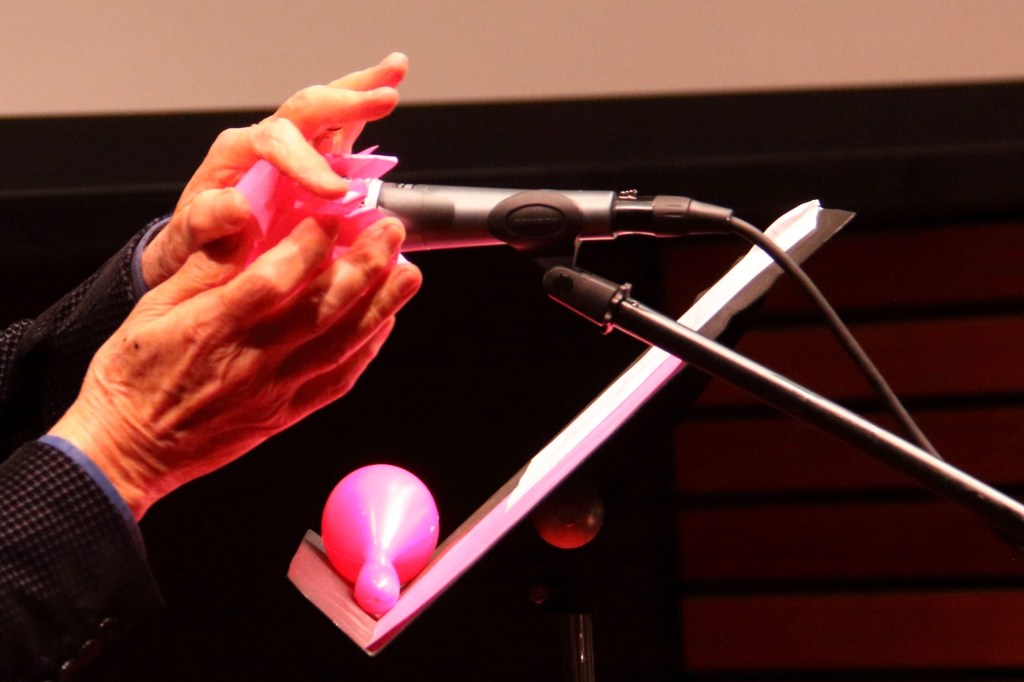




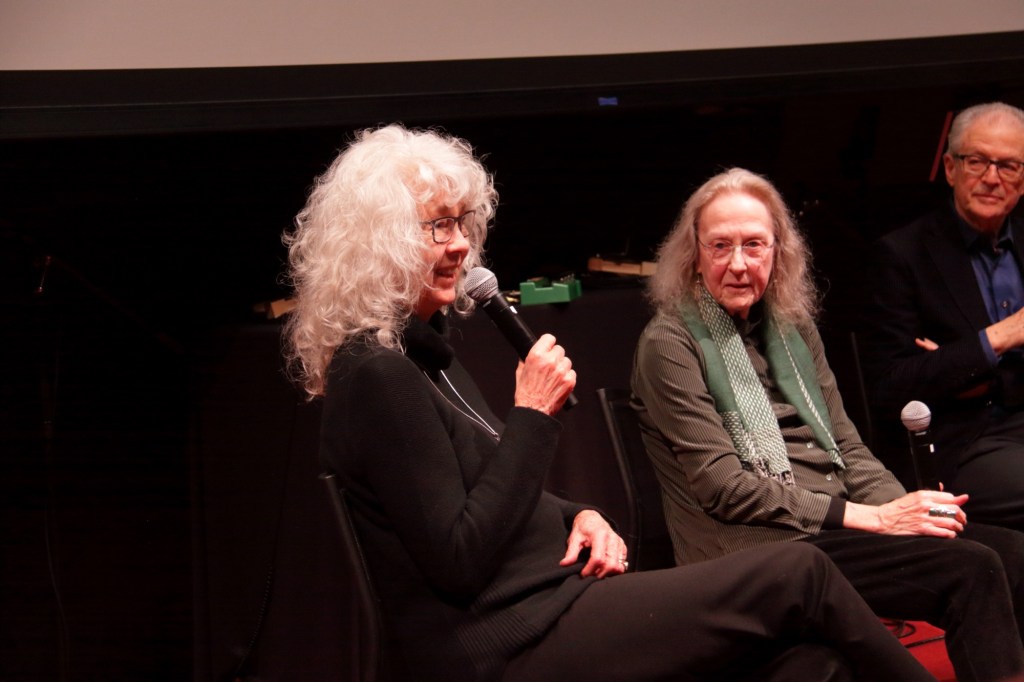


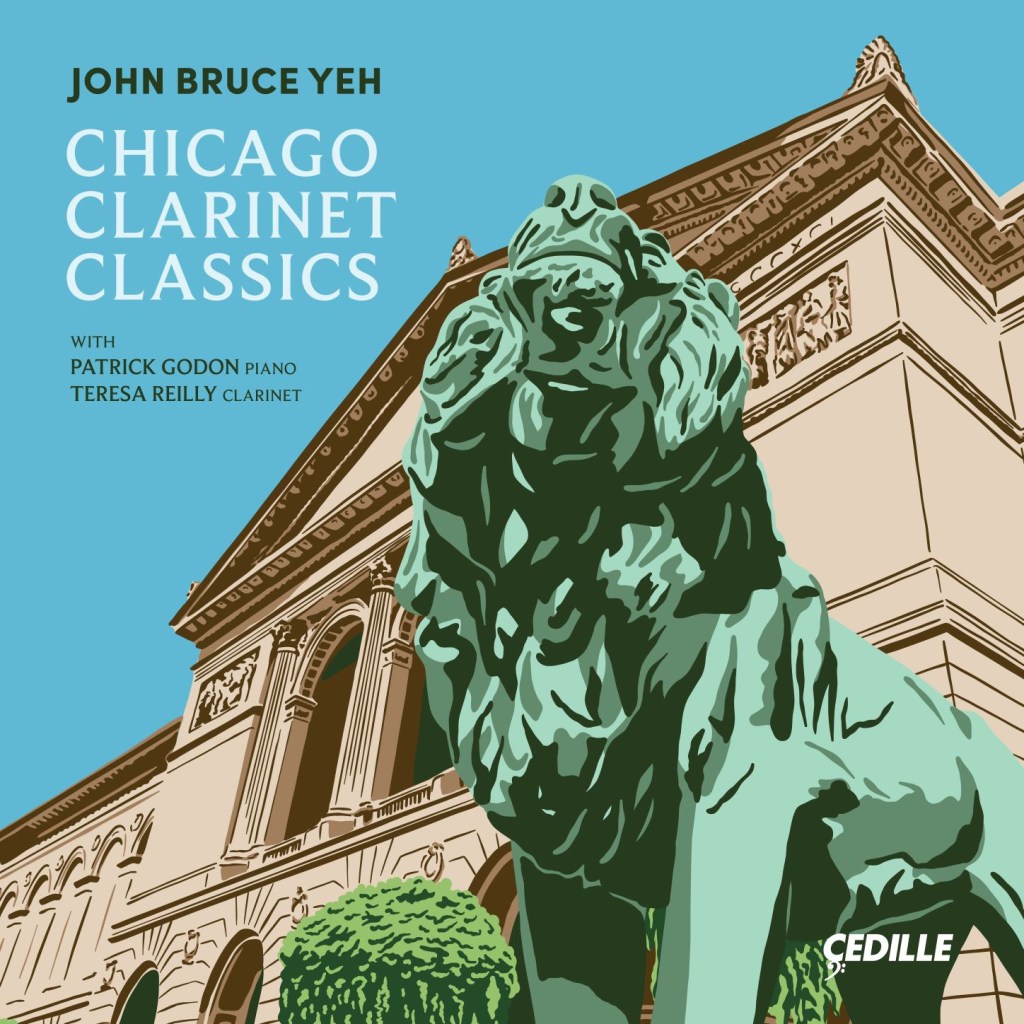

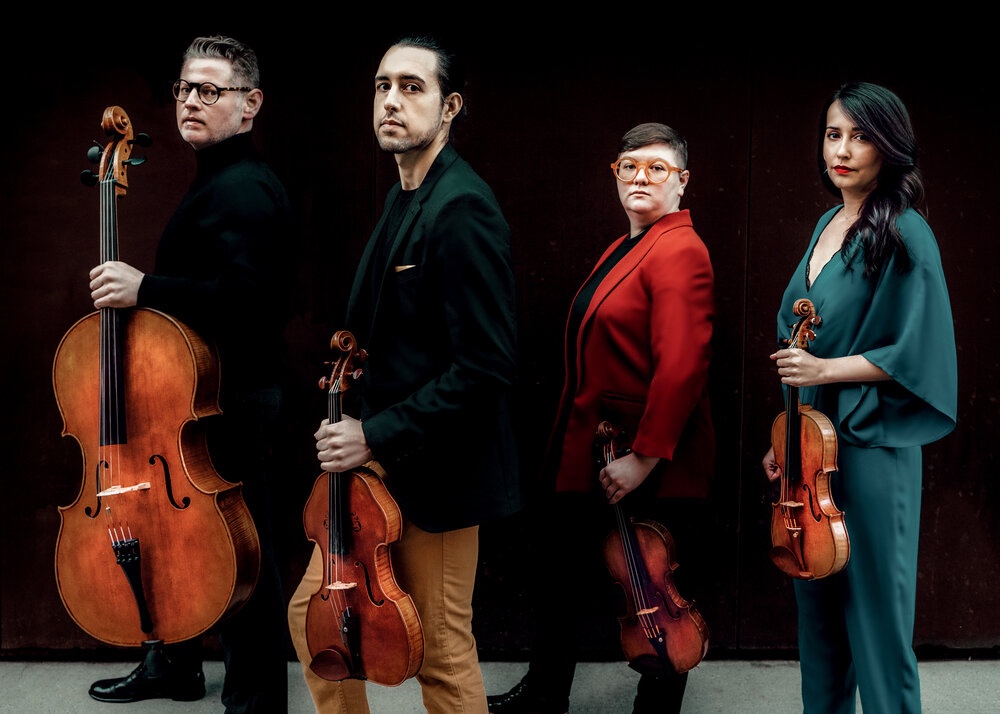


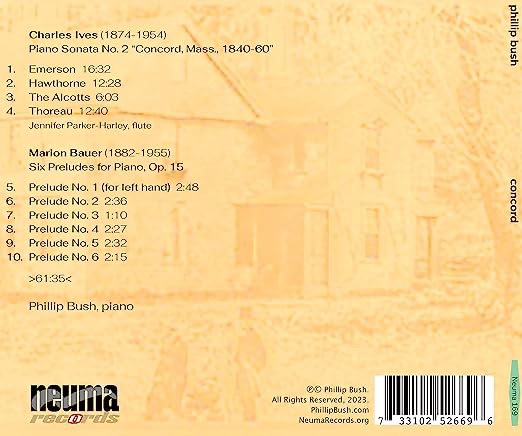


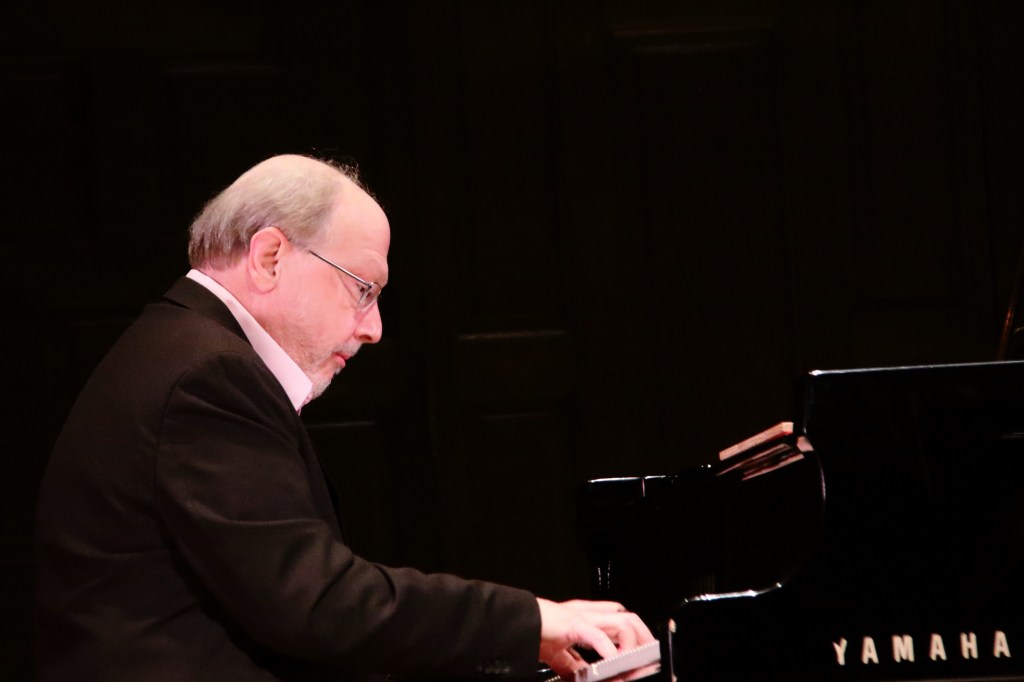
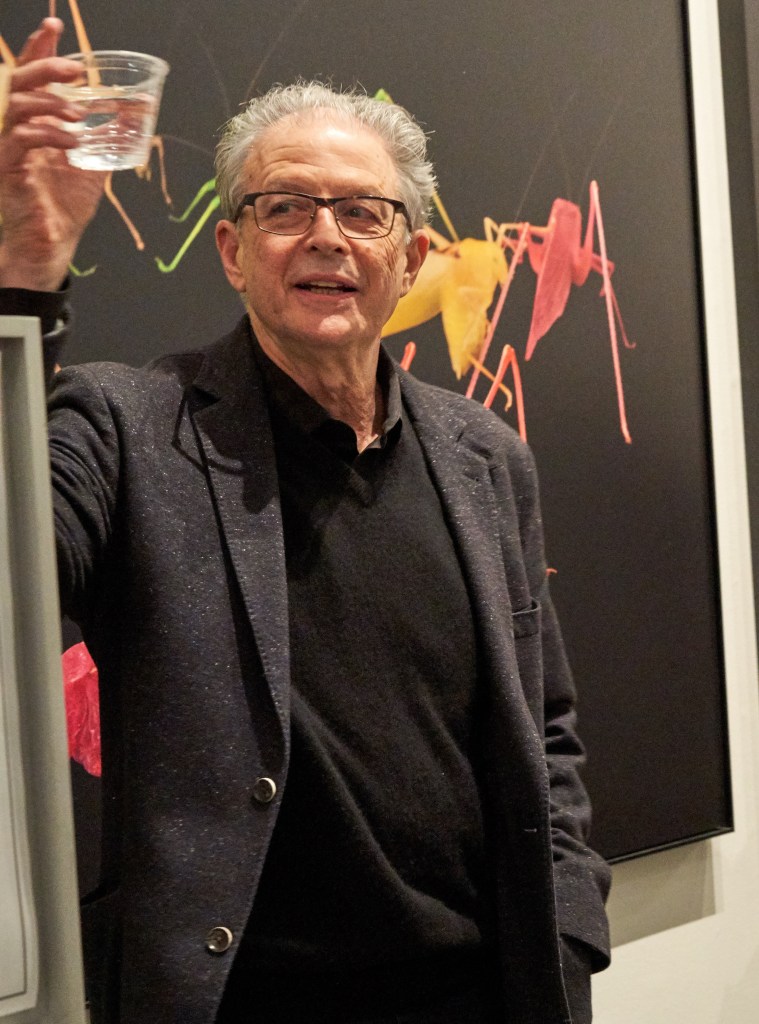
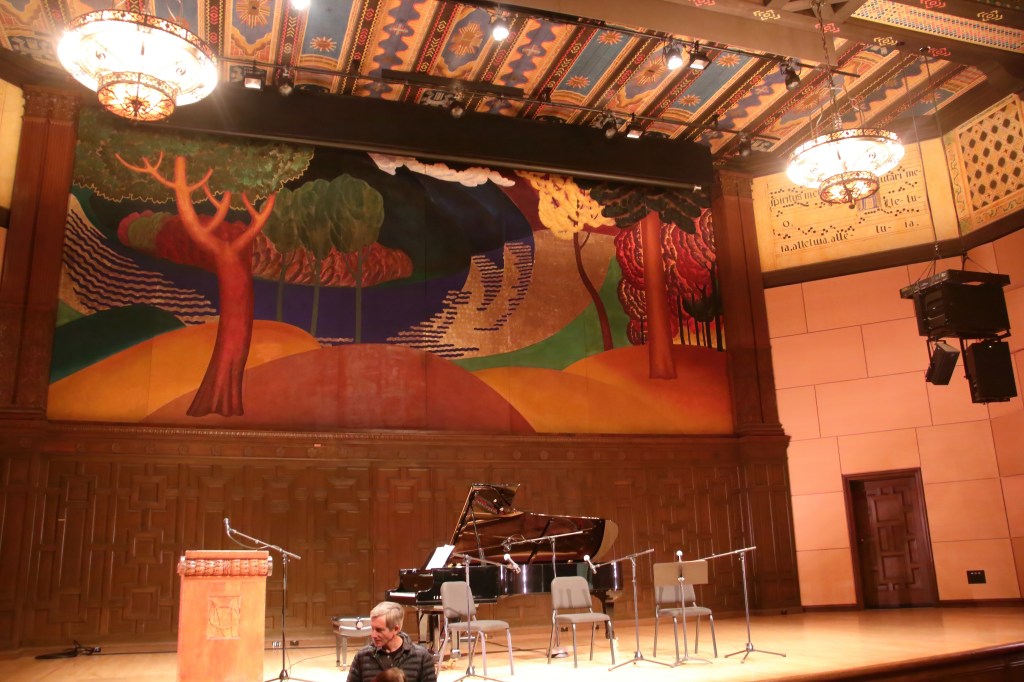
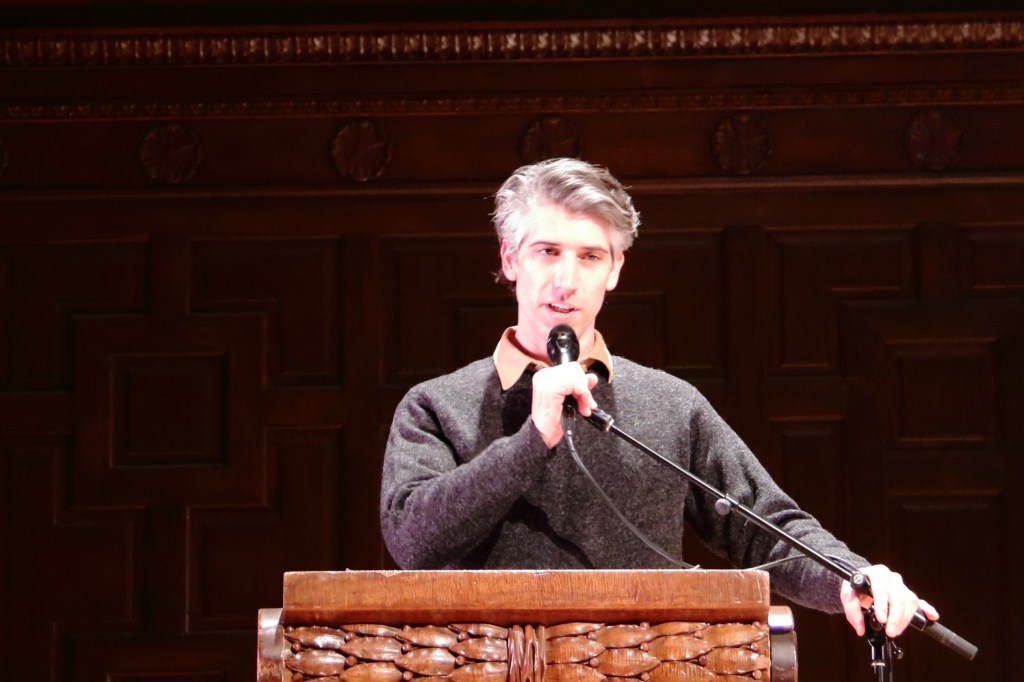
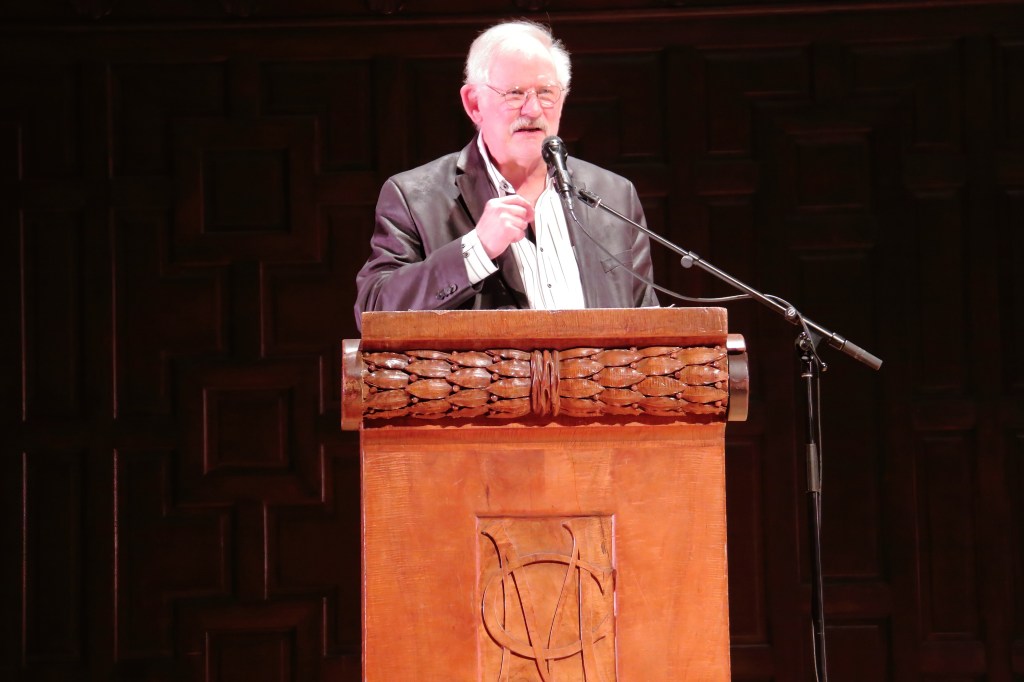


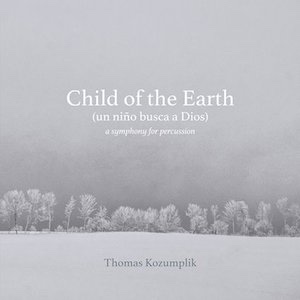


 New Music Buff