I am grateful for this music review aggregator Feedspot. They have declared my blog New Music Buff to be among the top 35 new music blogs. I made number 20 this year.
Here is their review:
20. New Music Buff » Experimental Music
Blog https://newmusicbuff.com/category/experimenta.. Indulge perspectives from an informed new music fan. Enjoy nuanced takes and some amusing anecdotes from artists of Experimental Music. New Music Buff envisages the musical interest and preferences of a long-time listener with a fervent interest in all music new and old.
I am grateful to have achieved this ranking but I am also delighted to be able to see the perceived context of my peers in this area. New Music Buff is a solo effort now going into its 14th year of publication. And that description does a fine job of characterizing my work. I’m grateful to get to see my competitors (though competition is hardly the point).
With the relative demise of print magazines that carried reviews of new releases, listeners now tend to rely upon the blogosphere to find new music to suit their interests. The problem is that the meanings of words like “new music”, “experimental”, “avant garde”, etc. can steer the reader to a great deal of music and not necessarily music that satisfies their thirsts. So this blog aggregator attempts to collect sites and provide brief descriptions that help hungry listeners find items to satisfy their tastes.
One of the very useful aspects of this aggregator is also to provide bloggers a context by defining a purported peer group which I can tell you, has enlightened this blogger/listener. This site is designed in part to provide mailing lists and contacts for musicians, promoters, and publishers. There are various useful products but listeners can find low or no cost items here that can really help searchers find their way.
After agonizing about writing a “best of” blog and publishing it before January 1, I decided to take a pause and enjoy the holidays. So here I look back on my 2023 in the rear view mirror but with memories still pretty fresh.
Regular readers of this blog likely already know of my oft shared opinion of the superfluous nature of “best of” lists and of my acquiescence in producing such on an annual basis. I certainly don’t think of this as a meaningless exercise and I think the process has grown on me. It is a chance to achieve a perspective which would be missed by simply plowing on ahead with the usual flow of reviews and articles. But drawing down that 12 month perspective is an opportunity to evaluate those months, to see where we’ve been and to hopefully get a smidgen of insight into where I/we are likely headed.
My Facebook friends will recognize the representative meme at the head of this article which is one of the more cloying aspects of “AI”, whatever that is. So indulge me for a moment to look at this seemingly new intrusion into the reality we thought we knew. So, what is “AI” and what will it do to us? Ultimately I’m not the one to answer that question but I’d like to throw some ideas to add to the speculation.
First, the choices a composer makes, like the choices of a painter, a writer, etc. are the stuff of the mystery of creation itself. Why “A major”, or why that tuning, or scale, or rhythm, or orchestration, etc? So along comes the notion of removing, or at least distancing, the artist from their creative product. That notion started not with famed proponent John Cage but rather with Johannes Chrysostymous Wolfgang Amadeus Mozart in his K. 516f musical dice game. Voila! Algorithmic composition (actually fairly common practice in the classical era). An early manifestation of “AI”? Perhaps.
Lejaren Hiller (1924-1994) was the first composer to employ electronic data processing in a musical work in his Fourth String Quartet subtitled “Iliac Suite” in 1957. There followed similar experiments with various iterations of electronic creations at music centers worldwide including The University of Illinois at Champaign, Columbia-Princeton, Stanford, The University of California Berkeley and San Diego, The San Francisco Tape Music Center (later subsumed into the Mills College Center for Contemporary Music, IRCAM in Paris, Israel Electronic Music Studio, and counterparts in the Nordic countries, Germany, Belgium, etc. Proto “AI”?
While historically interesting I raise this issue to say that, as far as I can tell, “AI” has not made this writer’s greatest hits list but it is interesting and maybe even useful. With that, my concern for the subject officially goes to the back burner for a later time.
2023 has been a year of great personal changes for the writer of this blog. A job change, a geographical relocation, and many things unrelated to this blog characterized a busy year for New Music Buff. So here in a sort of holiday tradition I present my “Best of 2023” from my little listener’s corner of the world. For the sake of simplicity I present a more or less chronological exposition of my sonic adventures. (N.B. Not one portion of this article made use of “AI”).
I begin with not with my 20 most read posts, a practice that characterized previous iterations of this annual exercise. Instead I am providing my top 20 favorite releases that were reviewed in 2023. Please note a couple of caveats. First, I receive a lot of review requests, more than I can even listen to, much less give a reasonably intelligent review. Albums that I’ve not reviewed should not be assumed to be bad or insignificant and my reviews are personal observations. I really only review albums that interest me anyway. Second, this article is only one reviewer’s opinion and not intended to be definitive or to supersede anyone else’s opinions. Third, this is not the end of my attention to music that was released in 2023. Some releases require more time to give a fair listen and a respectful review. There are more to come in 2024.
First a few stats: 2023 saw the publication of some 45 blog posts on New Music Buff, earning me 9693 views for the year. I rarely get comments on my posts (though I welcome and invite comments both positive and negative). Not bad, I think, for the overall less appreciated musical styles that fuel my desire to write about.
Now, in chronological order (of publication) are my personal favorites as a listener:
Neuma 158
Binaural Beats in the Tudor Rainforeststarted my new year with a bang. Reviewing this disc required me to take a closer look at the astounding work of David Tudor and his unique contributions to new music. This important release is a recording of a work which, by its own concept cannot receive a “definitive” performance. But this recording comes mighty close, involving “binaural” recording utilizing a mobile set of binaural microphones which are worn by the recordist. In addition this recording involved a collaboration with Pauline Oliveros and a group called, “Composers Inside Electronics”. The recording was done during Oliveros’ tenure at UCSD. Rainforest IV is so called because it is the fourth iteration of the instructions that form the original concepts of Tudor’s composition, “Rainforest”. It is an immersive sonic experience heard on headphones but actually not bad even heard on stereo speakers. A rich and wonderful release.
Starkland S-236
From a 1960s electroacoustic to a budding 21st Century composer Kotoka Suzuki released on the reliably interesting and even visionary Starkland label. Next Gen Electroacoustic: Kotoka Suzukiwill introduce the listener to this rising star who doubtless will produce more of her compelling compositions.
Sony 194399434826
Igor Levit is a fine concert pianist whose albums are effectively redefining the way we, as listeners, perceive the western classical oeuvre. Igor Levit: Defining Tristandoes for the various musical pieces inspired by the Tristan legend what Levit did for the concept of the great keyboard variations in which he selected Beethoven’s “Diabelli Variations” and Frederic Rzewski’s “El Pueblo Unido Variations” to join his recording of the Bach “Goldberg Variations” in a 3 disc package placing these three large sets of variations as emblematic of the genre in three different centuries (18th, 19th, and 20th). Levit, by his recorded output, is providing a valuable perspective which may influence repertory choices for years to come.
Levit’s traversal of the Tristan legend here ranges from the second recording of Hans Werner Henze’s too seldom heard “Tristan Preludes” back to works by Wagner (of course) and Liszt. He even slips in his wonderful solo piano transcription of the Adagio of Mahler’s unfinished 10th Symphony into the mix. This is a very compelling Tristan anthology by a deservedly still rising star.
Cantaloupe
This Cantaloupe release by Bang on a Can composer and master clarinetist Evan Ziporyn is both masterful and great fun. Evan Ziporyn: Bang on a Popconsists of transcriptions of “pop” songs for multiple clarinets all played by Ziporyn via his very effective multi-track recordings. The album is very personal and pretty much cliche free with these engaging and insightful transcriptions. It is an homage to the songwriters as well as a showcase for Ziporyn both as composer and as performer.
Microfest MF 23
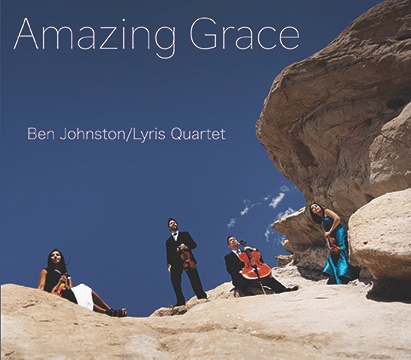
The Young Person’s Guide to Ben Johnston is an ideal way to introduce listeners to the wonderful world of the late Ben Johnston’s music. Johnston, a student and colleague of Harry Partch shows his compositional skills utilizing non-traditional western tunings in these representative works. Johnston here does for some quasi pop tunes what Evan Ziporyn did with his clarinetist perspective for the tunes on Pop Matters. But Johnston’s pretty, accessible work belies fascinating complexities that don’t actually sound complex to the listener. This disc contains Johnston’s last completed work, “Ashokan Farewell” (which Johnston took to be a public domain folk tune but is in fact a piece written by Jay Ungar). It is paired with the 4th String Quartet (a set of ingenious variations on “Amazing Grace”) from 1982 and the 9th String Quartet of 1997. Profound, lovely to listen to, and a great homage.
DVD OM 4001
This DVD is a major addition to the discography of Charles Amirkhanian’s sound poetry as fine sampling of one aspect of Carol Law’s (Amirkhanian’s life partner) complementary visual art. These collaborations are also important contributions to the visual and performative aspect of these collaborative works. Amirkhanian has been a fine curator and promoter of the work of others but he has rather seldom stepped into the spotlight himself. This quirky genre got some fabulous exposure at the 7 day Other Minds 23 festival in 2018 in which Amirkhanian’s work was presented in the (surprisingly varied) context of sound poetry of the amazing international collection of artists who were hosted at those events. This DVD should be in the collection of anyone interested in new music sound poetry and performance art. It is both entertaining and mind bending featuring a juxtaposition of images and sound reviewed in greater detail in the post “Dyadic Dreams”. But words cannot do justice to these works. You really have to see them.
Cedille CDR 90000 210
Readers of this blog know my fondness for the Chicago based label Cedille and their promotion of Chicago based musicians. This disc stands out in this group’s embrace of non-traditional composers alongside more traditional works. The inclusion of works by DJ composer Jlin and the academy based genre defying duo Flutronics alongside composers like Danny Elfman and Philip Glass demonstrate the wide ranging repertoire of Third Coast Percussion. Much more information can be found in Perspectives: Spectacular World Premiere Recordings from Third Coast Percussionon my blog. This one reimagines the percussion ensemble.
Neuma 176
This disc is a good example of why listeners and collectors should pay attention to the Neuma record label. Philip Blackburn, who had been the very successful curator of Innova records, took over the defunct Neuma label which was founded with the intention of promoting largely electroacoustic music though not exclusively.
Agnese Toniutti‘s New Music Visionis actually a review of two discs by this rising star, a dedicated new music pianist that needs to be on your radar. The other Neuma disc contains Toniutti’s traversal of John Cage’s reluctant masterpiece, “Sonatas and Interludes for prepared piano”.
The disc pictured here is Toniutti’s vision beyond the Cage work. This one focuses on mostly living composers Lucia Dlugoszewski, Tan Dun, Philip Corner, and Toniutti’s herself. Basically, if Toniutti plays it, you should probably at least give a listen.
2023 saw the completion of Bay Area pianist Sarah Cahill’s epic survey of piano music by female composers. Cahill is another (predominantly) new music focused pianist about whom I would also assert that, if she plays it, you should probably give at least one listen.
The End of the Beginning: Sarah Cahill’s “The Future is Female” Trilogy Completedwill tell you all you need to know about this trilogy which encompasses about 300 years of music history and sheds light on some fascinating and substantial music written by women. Most of the works on this trilogy of albums are, in fact, world premieres but, fear not, even the pieces which are not premieres are likely not in your collection. This is a brilliant selection of music that effectively throws down the gauntlet to challenge other artists to explore this repertory. This trilogy is a true landmark and a joy to the ears.
This third volume in the wonderful Catalyst Quartet’s survey of another unjustly neglected group of composers focuses on the music of three black Americans of the twentieth century. Catalyzing Blackness, Volume Three: The Catalyst Quartet plays 20th Century music by Black Americans was nominated (but didn’t win) for a Grammy Award and, happily, I’m told that more volumes are in preparation. Again, this music is a pleasant revelation that does for black composers what Sarah Cahill has done for women composers (N.B. The first volume by the Catalyst Quartet focused on the black female composer Florence Price). And here’s hoping that Coleridge Taylor Perkinson, George Walker and William Grant Still will become household names in the concert hall.
Microfest MF 21
Son of Partch, Carrying on a Traditionis a really wonderful disc which, though I reviewed it in exceedingly positive terms, provoked a strongly negative reaction from the artist. The reaction apparently also provoked enough interest to have made this review one of my most read of 2023.
But, aside from the unfortunate negative reaction, I still maintain that this is a fine release worthy of attention from anyone who likes new music, microtonality, and the music of Harry Partch. Cris Forster is a composer, theoretician, and instrument builder clearly descended from the Partch tradition. His work deserves attention and this disc is a very satisfying experience.
Islandia IMR 011
Steven Schick is a master percussionist and conductor. This release is the first volume of his personal choices of solo percussion repertoire. Solo Percussion Manifesto Volume I: Steven Schick’s “A Hard Rain” is a manifesto of sorts and does for solo percussion music what Sarah Cahill has done for women composers and the Catalyst Quartet is doing for black composers. There are not many recordings of solo percussion music and Maestro Schick essentially presents his favorite works in definitive performances on a label produced by Bang on a Can cellist Maya Beiser. The second volume is in my review queue and, if this first volume is any indication, it will be a landmark survey.
Cedille
Rising Star Seth Parker Woods’ “Difficult Grace” is a Classic in the Making. Here’sanother Grammy nominee that did not win but, this second album by this fine American new music cellist is a winner in my book (er, blog). This is actually the audio of what was developed as a staged performance but the music speaks for itself. Keep an eye/ear out for this rising star who, even now, is storming the new music cello scene in invigorating ways.
Neuma 128
A Reason to Listen: Roger Reynolds’ Latest, “For a Reason”,new recordings on Neuma Records. Here we see Neuma following its original electroacoustic mission with this remarkable set in celebration of Roger Reynolds’s 90th year. This is a lavish 2 CD box set with a beautiful booklet and lucid liner notes. It is a worthy production which showcases recent works by this prolific and important American composer.
Readers of this blog likely are aware of my interest in music that is suppressed and/or neglected so this disc grabbed my attention immediately. Israel does a great job of funding the arts and this can be seen in the proliferation of truly fine performers nurtured by that funding. Less well known are the composers who have flourished in the art healthy politics of this country. Some 50 years of history are represented here. This is but a sampling, albeit finely curated, of several generations of composers displaying a plurality of styles with substantial results. This entertaining disc will whet the appetites of intelligent and curious listeners and, hopefully, bring about more recognition of the world class composers who deserve an audience.
Being asked to review this retrospective of the work of this virtually uncategorizable dancer, singer, composer, dramatist is the telling of my personal experience of growing up nurtured by this artist. Monk is not, of course the only artist whose presence has nurtured me and so many friends but her work is a case where I learned how to tune my curious radar to find more of the music that touched me deeply.
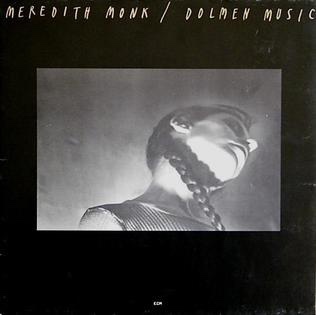
I first discovered her work when I purchased her album, “Key” (1971), self released and marketed via the late lamented New Music Distribution Center in New York. That album, later released on the Lovely Music label along with two releases on the great German avant garde label Wergo (Our Lady of Late, 1973 and Songs from the Hill/Tablet, 1979), constitute the minimalist, SOHO loft music which characterizes her style even now. But with her first ECM release she clearly hit her stride. Those early albums are definitely worth hearing but her mature style blossomed on ECM. It was, in retrospect, a sort of quantum leap, if you will.
LP album cover of “Key”“Our Lady of Late”“Songs from The Hill”
In that first album one can find Dick Higgins among the singers and Colin Walcott producing and playing percussion (as well as singing). Walcott, along with the yet to be known Julius Eastman would later participate in the Dolmen Music release. Monk, who studied dance at Sarah Lawrence College along with fellow student Alwyn Nikolais established “The House”, her flexible performing group in 1968 at a time which saw a great deal of artistic energy in and around Manhattan’s SOHO district where she encountered musicians like Philip Glass, Steve Reich, and performers sympathetic to new innovations and ideas. She also taught and continues to teach her characteristic extended vocal techniques. Monk, along with John Cage, Philip Glass, and Robert Ashley was featured in Peter Greenaway’s “Four American Composers (1983).
The release of her first ECM disc, “Dolmen Music” (1981) can now be seen as a sort of watershed event. It was followed by “Turtle Dreams” (1983) a work which was prominently featured at New Music America 1982 in Chicago along with Robert Ashley’s “Perfect Lives”. Monk’s appearance on ECM occurred at about the same time as Steve Reich’s masterful “Music for 18 Musicians”. Monk found her mature voice more or less at the same time that Steve Reich and Philip Glass had found theirs. And anyone following new music in those years will recall the flow of new musical ideas that established many now acknowledged masters as legitimate artists.
While the major masterpiece, “Dolmen Music” dominates the album, Monk’s quirky mix of humor and pathos in pieces like “Gotham Lullaby” and “Biography” remain signature pieces in her oeuvre. And Turtle Dreams was made into a performance film for public television by visual artist Ping Chong in 1983, now available on YouTube.
She followed with “Do You Be” (1987) and “Book of Days” (1990) which also exists in at least two film versions and the CD itself which has been described as a “film for the ears”.
Following “Facing North” (1992) Monk released her only opera (though she refers to much of her works as “operas” this is the only one that comes close to the more generic concept of western music operas) to date, “Atlas” (1993) which was commissioned and subsequently performed at the Houston Opera. This represented another phase in her artistic development as she utilized her structured improvisation techniques along with her now familiar extended vocal techniques with an expanded set of performers both vocal and instrumental. Atlas is arguably similarly creative (and transgressive) as Philip Glass’ 1976 “Einstein on the Beach”. Both were developed in an unconventional manner and uses a similar harmonic language with really none of the standard conventions of western music in opera. Would that we can some day see a filming of this work.
I was privileged to see Monk in person for the first time when she performed excerpts from “Volcano Songs” (1997) in Chicago. Those images involving, among other things, light sensitive areas where Monk lay down and left a ghostly shadow upon arising. In addition to her engaging minimalist inflected music, Monk is a master at creating compelling images.
“Mercy” (2002) was followed by “Impermanence” (2008) which I was thrilled to see at Stanford. “Songs of Ascension” (2011) was another landmark in this piece conceived and performed in conjunction with installation artist Ann Hamilton in her tower in Northern California. Attendees to this event were brought in by bus due to the lack of actual parking facilities in that tower. I wish I could have experienced this but hopefully a cohesive video release will be forthcoming. Excerpts are available for viewing on YouTube and on Monk’s website.
“Piano Songs” (2014) by the wonderful new music championing pianists Bruce Brubaker and Ursula Oppens filled an inexcusable gap in the documentation of Monk’s piano music. And following her receiving the National Medal for the Arts in 2015 she released “On Behalf of Nature”(2016).
Monk is a well documented artist largely due to her productive affiliation with Manfred Eicher and ECM and, while gaps remain these recordings represent a major artistic accomplishment and an enduring legacy for new music, for women composers, for western art music. This lovely box set is truly a joy to behold.
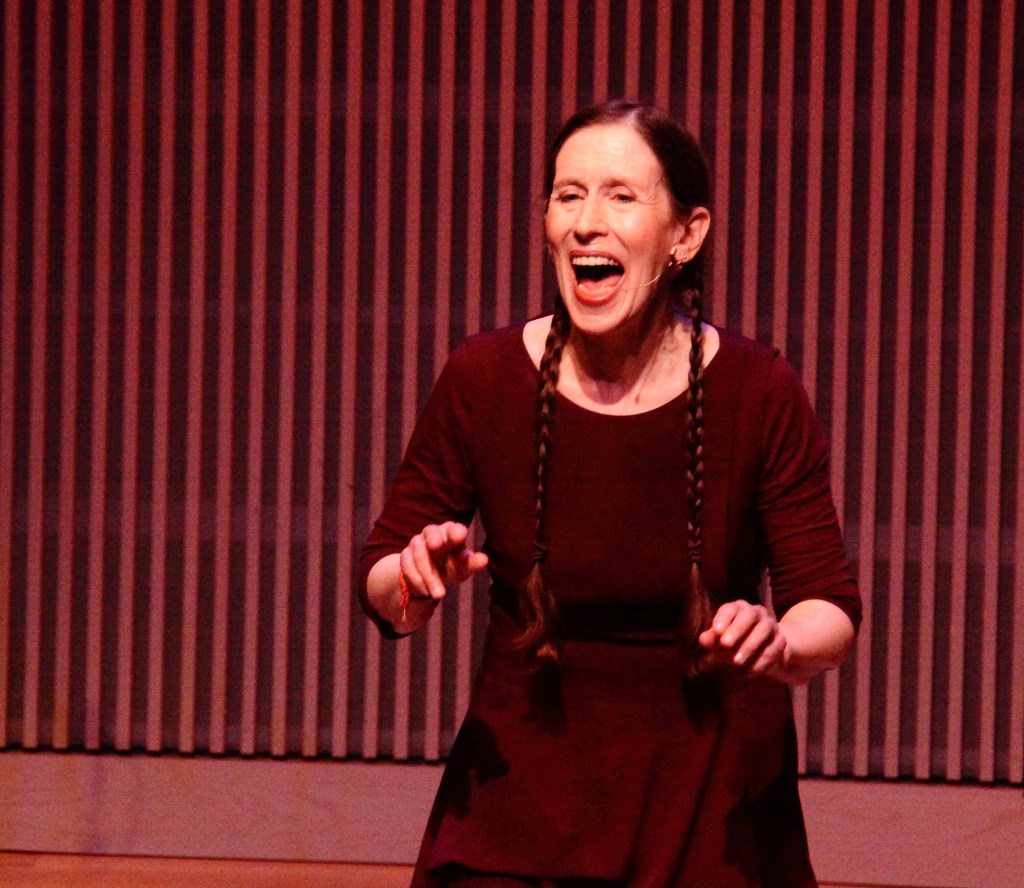
Meredith Monk performing an encore at the final concert of OM 21 (2016) in San Francisco
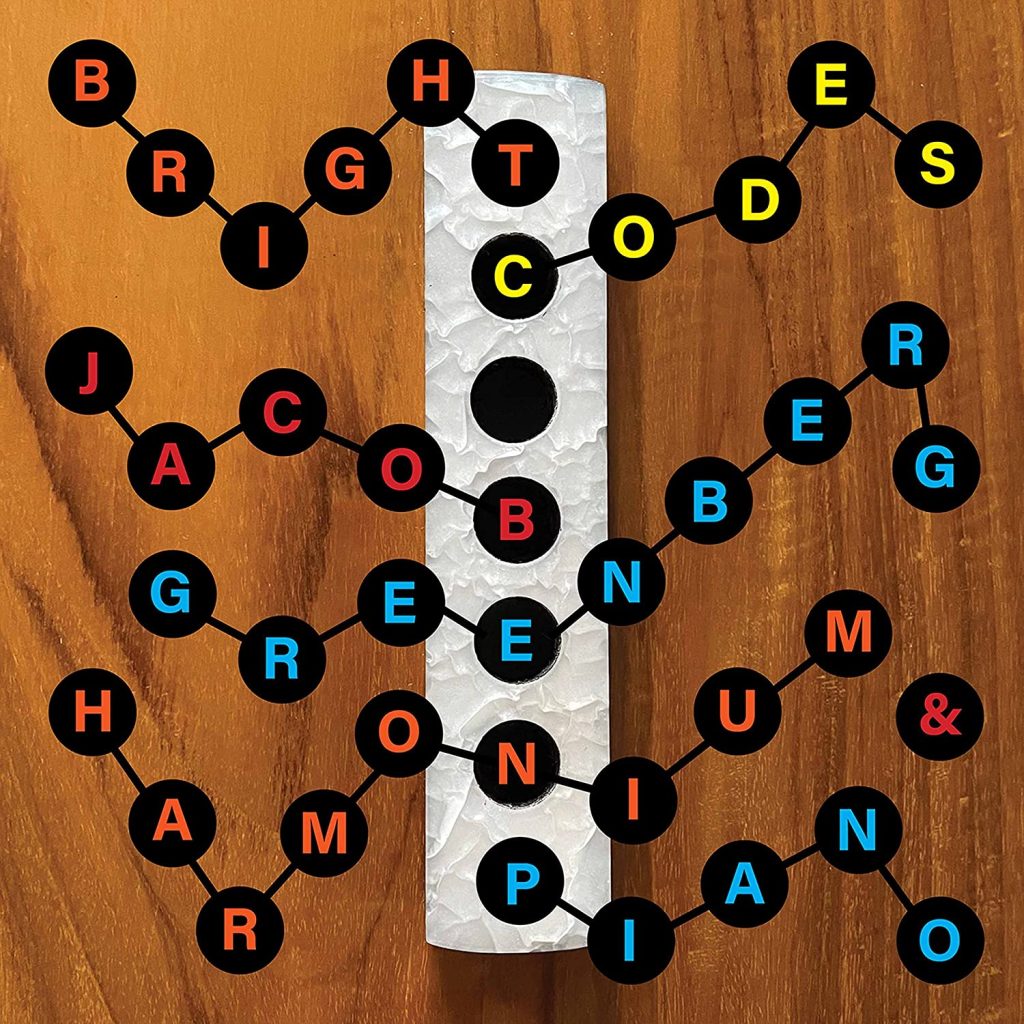
Jacob Greenberg will be a name familiar to many primarily for his essential role as the keyboard artist in ICE, one of those fine New York based new music ensembles that can play just about anything. At one time composers were forming their own ensembles to play the strange and difficult music they were writing (Steve Reich, Philip Glass, Michael Nyman, Steve Martland to name a few). Now ensembles like ICE are ready made, able to provide a flexible instrumentation and, with each musician, a stunning level of technical competence and a true affinity for the music of now.
Mr. Greenberg here is one of those multitasking, technically refined artists whose curatorial ear makes him an artist you need to have on your radar. In an earlier blog post I reviewed his solo (mostly) piano release Hanging Gardens in which he created an insightful contextualization by the choices of repertoire he made for the album. In response to this review he sent me a copy of this, the latest of his solo piano (mostly) projects.
The context of this album is of compositions all commissioned by Greenberg and written for him over the span of 2013-2019. It is a marvelously diverse collection which speaks to the wide scope of his interests and skills as well as the range of personal relationships he cultivates with other musicians.
The disc begins with music by probably the best known composer on this release, Japanese composer Dai Fujikura (1977- ). White Rainbow (2016) is a sort of tone poem for harmonium evoking the visual atmospheric phenomenon of a “fogbow” or “white rainbow”. It has an impressionistic feel much like Debussy. This is followed by the more experimental “Bright Codes” (2015-2018) for piano, four pieces which can be played in any order, but with the caveat that they be played without pause.
The next 5 tracks are dedicated to the 2018 “Funf Worte” (Five Words) by Amy Williams, five miniatures, each exploring a single German word. The piece is for harmonium and voice and the voice is the wonderful new music soprano, Tony Arnold. This is followed by a much larger piece for solo piano, “Cineshape 4” (2016) developed after the structure of the film “Run, Lola, Run” (1998). this virtuosic piece starts three times, each time developing differently analogously to said film.
“The Memory of Now” (2021) by IONE. This is a work for harmonium and voice. This time the voice is of the composer IONE, poet, dramatist, musician, playwright, and life partner of the late, great Pauline Oliveros. The piece has improvisational, indeterminate elements which require the performer(s) to listen to internal and external sounds.
The album ends with two large and powerful pieces by Nathan Davis. “Ghostlight” (2013) and “Seedling” (2019). Ghostlight is for “lightly prepared piano” and evokes the ambiance of those small single lights that shines on a darkened stage when the theater is closed. The preparations hep produce the ghostly microtones and gong-like sounds.
Seedling for harmonium and electronics brings us back to the sounds again of a harmonium. This is the only track which has appeared before and it was on the wonderful ICE release on Starkland Records (On the Nature of Thingness).
This sampling of some of the latest in contemporary composition reflects the use of extended instrumental and vocal techniques. It also makes use of experimental compositional techniques that demand deep involvement of the musicians in the execution of the music in ways that diverge from the conventional classical music paradigm. And it is the expansion of old paradigms that are ultimately what makes Greenberg and his ICE colleagues so compelling.
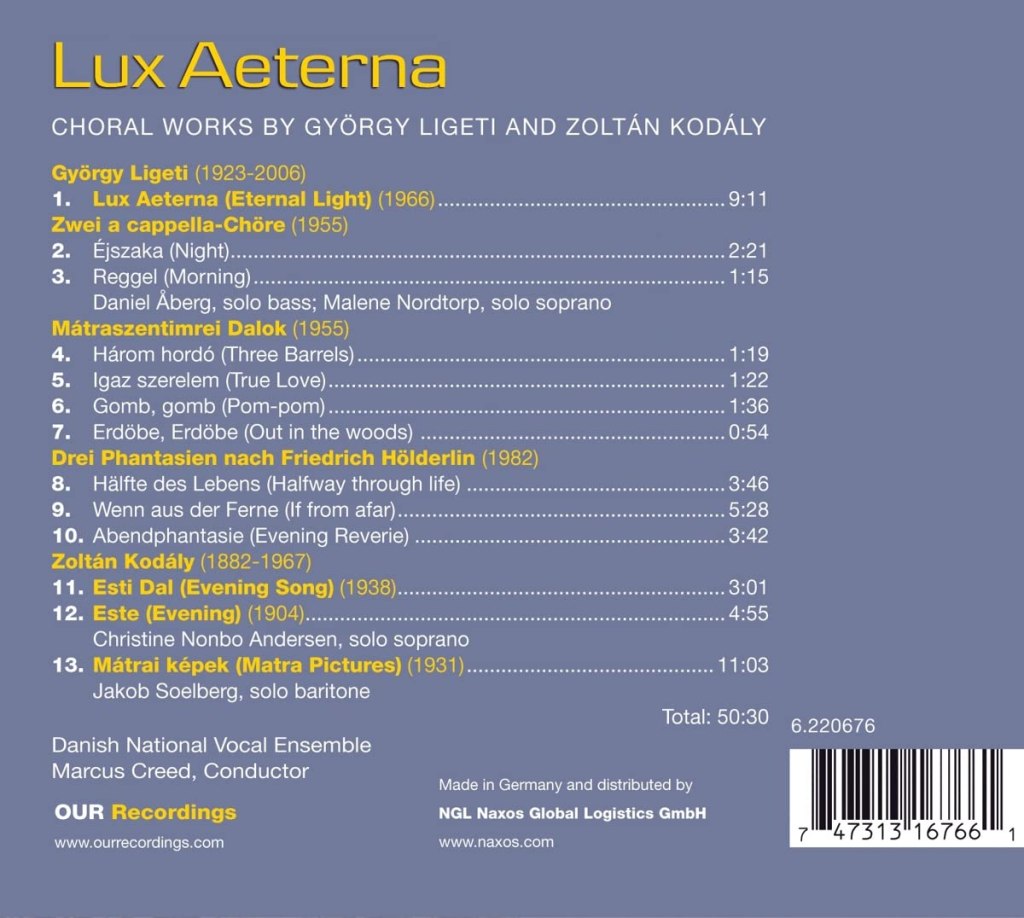
I thought I knew this music. After falling in love with György Ligeti’s (1923-2006) work having heard it so aptly used in Stanley Kubrick’s, “2001: A Space Odyssey” I eagerly purchased both of the complete works surveys on Sony and Telefunken but these fresh, insightful performances by the Danish National Vocal Ensemble under conductor Marcus Creed have made me fall in love again. And, while I have some familiarity with Zoltán Kodály’s (1882-1967) music (he is underappreciated) I did not know his unaccompanied choral works. So this encounter was an absolute revelation.
This release succeeds on several levels. First, it is one of the always reliably fine productions from Lars Hannibal’s OUR Recordings. So, from the physical design to and the the choices of repertoire and performers as well as the sound of the recording, this is a thoroughly enjoyable experience for the listener.
But what brings this release from competent to outstanding is the interpretive skillset of conductor Marcus Creed and the disciplined Danish National Vocal Ensemble. These are fresh, insightful readings that shed new light on these masterful composers and their work. Looking at Creed’s extensive discography it is clear that he commands a wide range of repertoire with a penchant for the twentieth century and beyond. His reading of Ernst Krenek’s massive 12 tone contrapuntal a capella masterpiece from 1941-2, “Lamentatio Jeremiae Prophetae” Op. 93 remains perhaps this challenging work’s finest interpretation in the 1995 Harmonia Mundi recording and a personal favorite of this reviewer. So it should come as no surprise that he is able to breathe new life into these works.
The opening work is probably the most familiar here. Ligeti’s “Lux Aeterna” (1966) was first thrust into the spotlight via its (unpermitted at the time) inclusion is the Kubrick film. This is mid-career Ligeti and one of the most effective uses of his “micropolyphony” and cluster chord harmonies. It is first heard in the Clavius Moonbase scene fairly early in the film. It accompanies the otherwise silent animation of a sort of space shuttle bus as it glides along the lunar surface. Along with the Kyrie of Ligeti’s 1965 Requiem and his orchestral “Atmospheres” (1961) work beautifully in telling the story in this film with its well known paucity of dialogue.
This opening track grabbed my attention immediately. The text, which appears in the traditional Catholic Mass and Requiem Mass is a communion hymn with the following words:
May light eternal shine upon them, O Lord, with Thy Saints for evermore: for Thou art gracious. Eternal rest give to them, O Lord, and let perpetual light shine upon them: With Thy Saints for evermore, for Thou art gracious.
But the experience of this music is positively otherworldly. Its wall of sound ambiance belies a rather complex construction which has become a landmark in the development of compositional practice. And it is vitally that this music, now nearly synonymous with the film, be heard as originally intended. It exists in both worlds now and this reading helps reaffirm it as the masterpiece it is.
The next six tracks are by Ligeti but this is the Ligeti still composing under the powerful spell of Bela Bartok. All date from 1955 but are a quantum leap back from the sound world of the first track. The two brief a capella choruses (the second includes solos for bass and soprano voices) are settings of words by Hungarian poet Sándor Weöres (1913-1989). These settings are ostensibly influenced by the composer’s early encounter with modern music in Vienna (Ligeti ultimately relocated from the artistically and socially oppressive Hungary to Austria). The second of these choruses had to wait until 1968 for a performance which provides some notion of how oppressive the Hungarian regime had been.
Those brief choruses are followed by four folksong settings which take the listener back into the sound world of Bartok and Kodaly with their respective folksong transcriptions. These are very enjoyable travels into Ligeti’s excellent but markedly more conservative beginnings.
Next is another Ligeti work but one from his later years demonstrating that he never stopped evolving as a composer. The “Three Fantasies after Friederich Holderlin” (1982) are themselves a quantum leap stylistically from the 1966 Lux Aeterna. These are also more complex settings and, suffice it to say, they are a powerful experience. What was micropolyphony in the earlier work is replaced by a more traditional style of polyphonic writing but one that could not exist were it not for those earlier efforts.
And then we come further back again to early and mid-career Kodaly in three a capella works, “Evening Song” (1938), “Evening” (1904), and “Matra Pictures” (1931). I say at the beginning of this review that I believe Kodaly’s music to be underappreciated. Indeed but I find myself with no excuse given the easy availability of so much music on You Tube and other online sources. And this is why the inclusion of this fascinating selection of the composer’s significant cache of a capella choral music is so very welcome.
Like, I suppose, many listeners I mostly know Kodaly’s work via his Peacock Variations and excerpts from his opera, “Hary Janos”. Of course I had also been aware of Kodaly’s pedagogy and his methods for learning music (and I was aware even before I saw it in “Close Encounters).
But my encounter with these fine choral works revealed to me the depth of the composer’s skills. This is marvelously written music by a composer intimately familiar with this medium and it has already sent me to exploring more of this composer’s work in all genres. It is not difficult to see Kodaly’s work as a logical predecessor to that of Ligeti. he same skill and invention the same ability to convincingly set text to music. This is a terrific release, highly recommended to lovers of choral music in general and, of course, of these two composers.
This is not a Philip Glass album. This is also not a tortured Magritte metaphor. It is a Maya Beiser album. Yes, she is playing her transcriptions of several of Philip Glass’ pieces: (Piano) Etude No. 5, Etude No. 2, Mad Rush, Music in Similar Motion, and four movements from Glass’ score to the third of Godfrey Reggio’s trilogy (Koyaanisqatsi, Powaaqatsi, Naqoyqatsi): Naqoyqatsi, Massman, New World, and Old World.
It was after my second hearing of the disc that it occurred to me that Beiser’s transcriptions for cello with electronic looping and layering are in fact her own recompositions of these works in her own image, so to speak. Think Stravinsky’s Tchaikovsky transcriptions in “The Fairy’s Kiss” or Henze’s reworking of Telemann in his Telemanniana (other examples abound). Of course Beiser is working on a smaller scale but she is recomposing these works from a very personal perspective much as those composers did. I had been expecting to not like this album but once heard…
Beiser, a founding and long time member of the Bang on a Can All Stars, cut an elegant figure even when she was at the back of that venerable performing ensemble (got to be good looking cuz she’s so hard to see?). She has always been a highly skilled and accomplished cellist and a thoughtful, intelligent musician. That is true of all the members of the All Stars who started as highly skilled musicians with an interest in new music. Beiser is certainly also a member of the “glam classical” musicians following in the traditions of performers like Nigel Kennedy, Yuja Wang and, well… back at least to Liberace and perhaps Chopin and Liszt. The appellation, “glam classical” is descriptive rather than pejorative in intent. The reality is that all the aforementioned artists remained fine musicians throughout their careers. An imposing physical presence, after all, does not necessarily detract from the music. Quite the opposite sometimes.
Amazon lists this release as Beiser’s 14th album and she comes out strong on all fronts. Her playing, her interpretive skills, and her arrangements make for a very strong, complex, but listenable album. The first two etudes will be familiar to most listeners and are perhaps the most methodical with clear structures though very different from the piano originals. “Mad Rush” (also originally a piano piece) and “Music in Similar Motion” (originally for the Philip Glass Ensemble) both come off as driving ritual symphonic pieces, thrilling new readings of the original compositions (Music in Similar Motion a personal favorite for this writer and this version really rocks). The last four excerpts from Naqoyqatsi are the most lyrical and easy listening works, but again Beiser creates the music in her own personal context, glamorous but authentic and with a warmth that lasts long after the last tones fade. Fabulous album!
I think this is the fourth disc of the music of William Susman which has come across my desk. Let me say it is a delight to hear this man’s music and experience the range of his artistry. All releases of his music thus far have been on belarca records, a label founded by Susman to promote The Octet Ensemble and other artists who share an interest in the work of Susman and many of his contemporaries.
The disc which is the subject of this review contains selections from soundtracks to three films: When Medicine Got it Wrong (2008), a film by Katie Cadigan and Laura Murray; Balancing Acts: A Jewish Theater in the Soviet Union (2008), a film by Sam Bell, Kate Stilley, and William Susman; Native New Yorker (2005), a film by Steve Bilich. But this is just one of three discs of film music thus far by Mr. Susman.
Soundtrack to the 2007 film
Soundtrack to the 2004 film
I mention these not just to create a list of Susman’s film music but also to point out that all of these scores have engaged the amazing talents of the longtime cellist of the Kronos Quartet, Joan Jeanrenaud, herself a composer and producer. Susman appears to be fond of collaborations with other artists.
The 2004 “Oil on Ice” won the 2004 Pare Lorentz award from the International Documentary Association. It was Pare Lorentz’s collaboration with American composer Virgil Thomson that produced two of his finest film scores, The Plow That Broke the Plains (1936) and The River (1938). Thomson’s subsequent music for Robert J. Flaherty’s feature length drama, Louisiana Story (1948) earned him the only Pulitzer Prize ever awarded for a film score. Suffice it to say that film scores are a rather neglected genre, at least among non-pop composers. That is another reason to pay attention to these releases, as in “get these before they disappear”. But also because film music by concert hall composers shows a side of their work that may not be evident in concert works. It is a marriage of sound and image, a collaborative effort. Thomson’s film music was written entirely for socially conscious films of the WPA era. Susman’s work seems to be following a similar trajectory some generations later.
Now back to the disc under consideration.
back cover
Joan Jeanrenaud provides her multitracked performances on two of the three films. As always, her artistry is welcome. Her work is evident in the first two film soundtracks. Mr. Susman, an accomplished pianist, plays piano and other keyboards on all three films. Note must also be made of another collaborator, accordion player and vocalist, Mira Stroika (a former student of Susman’s) who plays and sings on the 2008 Balancing Acts film. Among the three this appears to be the one closest to the composer’s heart, he is also one of the film’s producers. Susman plays piano and other keyboards in the final track, an uninterrupted soundtrack (some 13 minutes) to 2005’s Native New Yorker.
Susman manages to create a nuanced variety of music within his predominantly post-minimalist, sometimes neo-romantic style. It exists as subtext in the film context but stands on its own as a purely sonic experience. Fans of film music, and certainly of Susman’s oeuvre, will want to explore all of these.












 New Music Buff