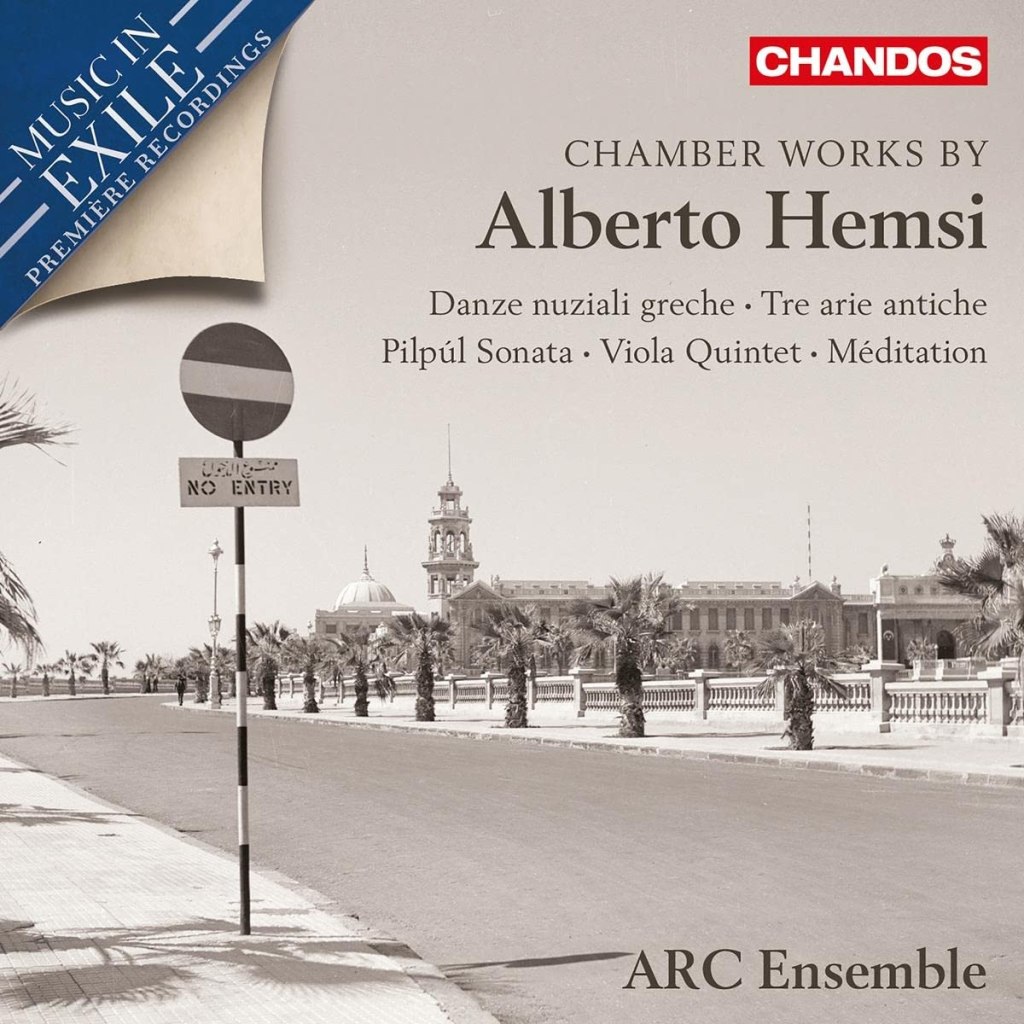
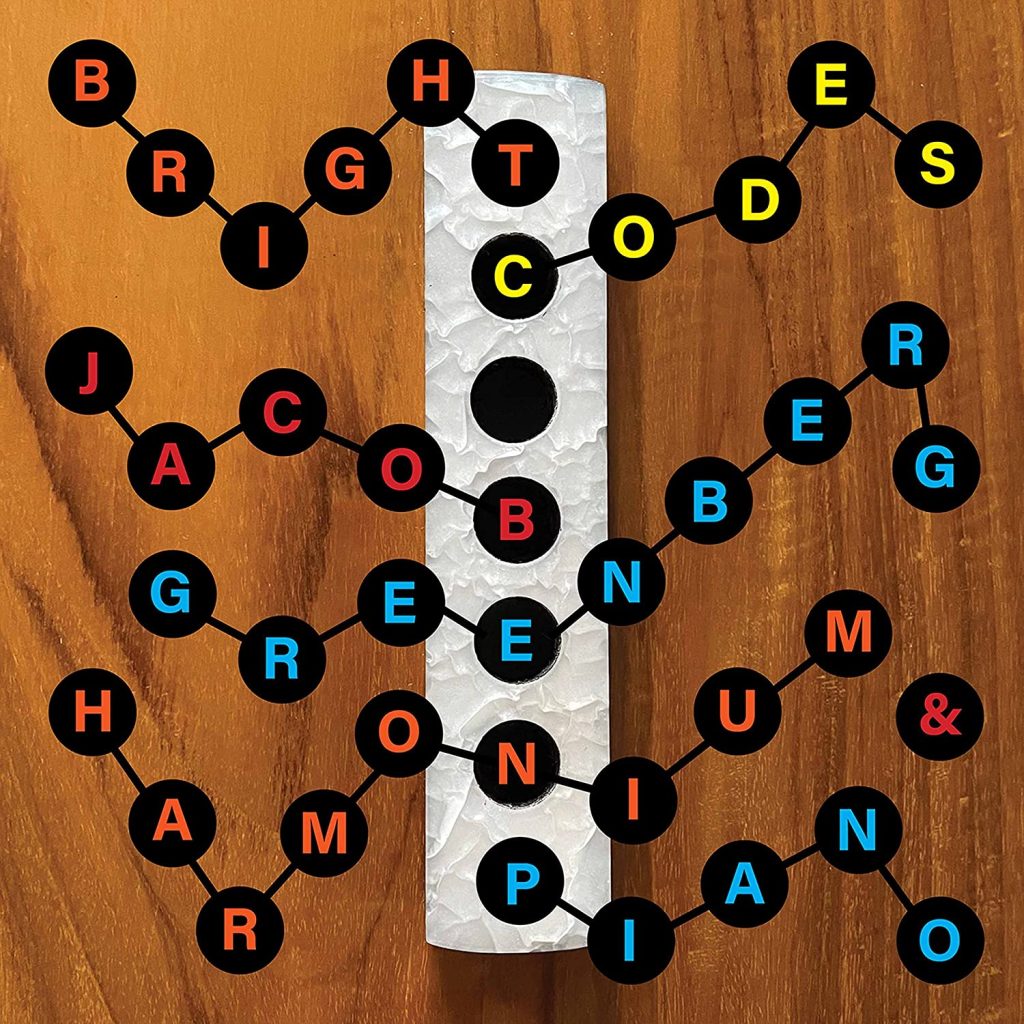
“Music in Exile” is but one of many projects that are attempting to find, perform, and in many cases publish music neglected for many reasons, mostly political. Alberto Hemsi (1898-1975) is not a familiar name to this reviewer and will likely not be familiar to the average listener. But such are the hazards of resurrecting neglected music. This release in the 6th in the Music in Exile series and, like it’s predecessors, it is a loving adventure of discovery.
The ARC (artists of the royal conservatory) Ensemble here bring to a CD player near you an (apparently representative selection) of the extant works of this composer and ethnomusicologist. Hemsi spent 17 years collecting and publishing harmonizations of Sephardic Melodie’s he collected throughout the countries of the former Ottoman Empire.
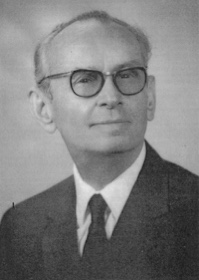
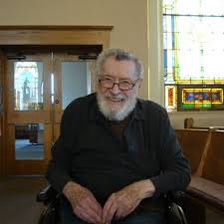
Alberto Hemsi (photo from University of Michigan website fair use)
The composer’s widow donated his manuscripts to the European Institute of Jewish Music in 2004 where The Hemsi Collection has become a significant part of one the largest collections of Judeo-Spanish music. Spain, in 1492, famously funded Christopher Columbus’ expedition of discovery and, infamously in that same year, officially exiled all of the Jews in Spain. Now some 500 years later the work of Hemsi is helping to preserve some of that culture.
Of course, like Bartok, Kodaly, Copland, and sundry like minded composers who incorporated similar song collecting ventures into the late romantic nationalist traditions in the late 19th and early to mid 20th century classical compositions. But this disc is actually more about Hemsi’s own compositions.
Track listing
The two works that comprise the first six tracks of this recording, the “Danzi Nuziali Greche” Op. 37 bis (1957) for cello and piano, and the “Tre Arie Antiche” Op. 30 (ca. 1945) for string quartet are fine examples of Hemsi’s direct incorporation of his collected folk musics into these charming chamber works.
But, for this listener, the pre 1945 works provide a compelling insight to this fine composer’s works that are not explicitly expositions of folk songs. Don’t get me wrong. All of these works are receiving world premiere recordings in this release, making them valuable additions to the history of music. But this listener was pleasantly drawn to Hemsi’s contributions to the western classical canon.
The three movement Violin and Piano Sonata Op. 27 (1942) is the longest work here and demonstrates the composer’s facility with larger compositional architectures. The same can be said of the “Quintet for Viola and String Quartet Op. 28 (ca. 1943). This very substantial music, composed in the shadow of the Second World War reveal a hopeful and talented composer producing music that would not see public performance in his lifetime.
The album concludes with the Meditation Op. 16 (ca. 1930). It Carrie’s the subtitle “in Armenian Style”. Hemsi’s folk song documentation also included Armenian Melodie’s, music of yet another culture of exile. It is doubtless influenced by some sense of the reality of the Armenian genocide which was vehemently denied until the 21st century.
We have yet another album of suppressed, oppressed, neglected music to add to an important and growing collection of music that arguably began with that of the Nazi declared “Entartete Musik” where music and composers were vilified viciously and directly. But this collection reminds listeners that the neglect and marginalization of art neither began or ended with “The Third Reich” and that there remains a great deal of research to be done and much joy to be derived from bringing such music to light as this disc does admirably.
Kudos to Chandos records and the fine Canadians of the ARC Ensemble for the joyful presentations of music that needs no longer languish in obscurity.
Every solo artist, regardless of what instrument they play seeks to define themselves. Generally that means setting limits. Some set limits by specializing in an era (baroque, classical, etc.). Some specialize in working with electronics, some with jazz, some with experimental music, some with standard recital repertoire, etc. Seth Parker Woods (1984- ) seems almost unaware of such limits. He plays what he chooses. And, oh, what choices. From standard classics to the leading edge of musical creativity woods is poised at the beginning of a very promising career.
Seth Parker Woods (photo from his faculty page at USC Thornton School of Music)
This album is in fact the musical portions of what was produced as a staged presentation with Woods playing, singing, talking. No doubt something is lost without the staging but Woods’ asserts himself with great clarity on the sonic aspect alone. Think of this as a sort of cast album, though it is more than just a souvenir. It is Woods’ second album and it has this writer enthralled at where he may go next. You will be too.
Parker’s first solo release “asinglewordisnotenough” available on bandcamp reveals his dedication to new and recent music.
I feel privileged to have known this artist via digital media and to have watched with increasing interest his development as a true rising star in the new music world. I only recently acquired his first album via bandcamp. It was released “across the pond” when he was completing his Ph.D. at the University of Huddersfield.
Born in Houston, his father, a jazz and gospel singer, Woods was exposed to a great deal of music. He rehearsed in a home studio and somehow came to a fascination and deep appreciation for a wide variety of repertory.
His affiliations continue to be wide ranging from Peter Gabriel to George Lewis. He has appeared on many recordings but this is only the second disc dedicated entirely to Woods as performer and the first such solo efforts on a US label. Woods is apparently able and willing to tackle music of all eras and genres including the wildly experimental, like his “Ice Cello” homage to Charlotte Moorman and the theatrical, which brings to the the album at hand.
Track listing.
Four of the seven works presented are world premieres. And, despite this being a sort of “cast album” which lacks the visuals, this is a major release that presents a characteristic variety of musical choices and is a fine calling card for the artist. This is one classy production.
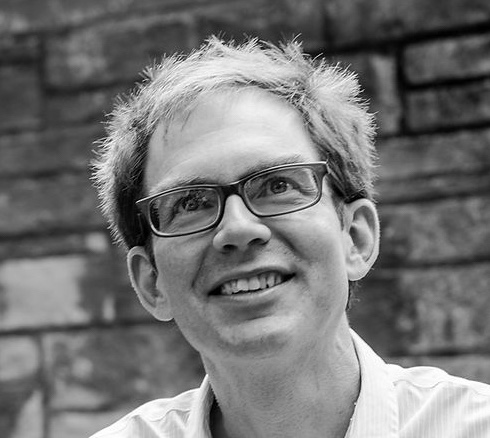
Frederic Gifford (photo from composer’s website)
He begins with the title track, “Difficult Grace” by Chicago based composer Frederic Gifford (1972- ). It is a setting of poetry by Dudley Randall subjected to some Cageian mesostic like manipulation. This first track tells us we are dealing with modern music and sort of sets the tone of this project. This is a complex work in concept (lucidly described in the composer’s notes) and involves projections of the texts onto the performer as well as electronics which, by careful use of both the sounds and the spoken text (spoken by the cellist) which then contributes to the musical structure. Photographs in the booklet show some of the striking visual design for this project.
Coleridge Taylor Perkinson (photo from Wikipedia)
Woods follows with what is to this listener a stunningly beautiful piece, “Calvary Ostinato” (1973) by the late, sadly neglected Coleridge Taylor Perkinson (1932-2004), a black American composer (actually represented admirably in a fine earlier Cedille release CDR 90000 087). The Ostinato is one movement from Perkinson’s “Lamentations: Black/Folk Song Suite For Solo Cello” (1973). Woods’ performance is available on YouTube. It’s truly enthralling. One gets the feeling that Woods really gets inside the music he performs and that deep feel for the music is delightfully obvious in this track, the second oldest work on the disc and one that is for the solo cello sans electronics or vocals but using a dazzling variety of extended instrumental techniques, none involving a bow.
Monty Adkins (photo from electro cd website)
Then we hear Monty Adkins’ (y. 1972- ) “Winter Tendrils” (2019) written for cellist who, in addition to playing his instrument, is asked to use his voice and work with electronics, albeit in a different manner than the title track. Adkins worked closely with Woods on the creation of this work. The work essentially an impressionistic piece with clever use of counterpoint to depict fresh fallen snow on the branches of a tree.
Nathalie Joachim (1983- ), a Haitian-American vocalist, flautist, and composer, is represented by two works. The first, “The Race 1915” (2019), a work that contributes to the Chicago centered Cedille label by its use of historical quotations from The Defender, a major and influential black newspaper in Chicago. Woods is again asked to use his vocal skills in this work which celebrates efforts to undo social inequalities.
The multitalented Joachim lends her vocal skills to Woods’ performance in Joachim’s second piece on the album, “Dam Men Yo” (2017). The title is Haitian Creole for “they are my ladies”. It is a sort of black feminist peaen celebrating the strength of the women with whom the composer was raised in her native Haiti. (NB: Haiti is the site of the only successful slave revolt in history, a fact that continues to be reflected in their turbulent politics).
Alvin Singleton (photo from Schott website)
In between those two pieces we get to hear perhaps the best known composer in this mix, Alvin Singleton (1940- ). Singleton is represented by “Argoru II” (1970) for solo cello (the Argoru series is a set of pieces for solo instruments akin to Luciano Berio’s “Sequenza” series). The title is from the Twi language (spoken in Ghana) and translates as “to play”. It is a virtuosic piece employing extended instrumental techniques which Woods accomplishes with almost supernatural ease. He does honor to this living elder statesman of American music.
Ted Hearne (photo by Jen Rosenstein from composer’s website)
And here we are back in Chicago now with Maestro Woods’ performance of a work by Chicago born composer Ted Hearne (1982- ), a name which did make it to this writer’s musical radar but one whose work I have just begun to explore. But this is a fine example of one of the reasons for my admiration for Woods’ scope of musical interest. I think he is one of those artists to whom I will turn to look for good new music. His instincts for repertory choices are amazing.
This is perhaps the most unusual entry on this disc as well as one that, if any controversy is forthcoming, it will likely originate with this set of songs to poetry by Keri Alabi. A casual listen to some of Hearne’s music on YouTube suggests a sort of post minimalist ethic but this last work is not discernibly minimal. Like the music that preceded it, this cycle is overtly about politics and equality.
Hearne’s little 6 movement song cycle is a combination of poetry, electronics, cello (of course), and the voice of said cellist. Hearne’s expletive title, “free fucked”, is apparently very much in line with the composer’s assertive and playfully humorous style.
We return in these tracks to the avant garde and complex with which the album opened. Again we have a multitasking role for the cellist demanding his vocal participation and working in a distinctly electroacoustic genre. Hearne lends his voice to the final track of this unusual work.
While political themes and references abound in this release it is as much about black politics and civil rights as well as feminist, gender, and global equality issues. But ultimately this recording is a landmark in the career of this fine young musician who works fearlessly with a variety of composers, poets, designers, political activists, progressive ideas, and new music in general.
Cedille is one of my top favorite new music record labels and has been since they first started in 1987. Their releases (not limited to new music) are consistently well recorded and produced but producer James Ginsburg really pulls out all the stops on this one. From concept to recording, from lucid liner notes to gorgeous package design this has all the marks of a classic and collectible release. I mean, the music is great, but the whole package is something you’ll want to own. That’s right, I’m calling for “collector’s item” status here. Now is the time to get your copy.
Being asked to review this retrospective of the work of this virtually uncategorizable dancer, singer, composer, dramatist is the telling of my personal experience of growing up nurtured by this artist. Monk is not, of course the only artist whose presence has nurtured me and so many friends but her work is a case where I learned how to tune my curious radar to find more of the music that touched me deeply.
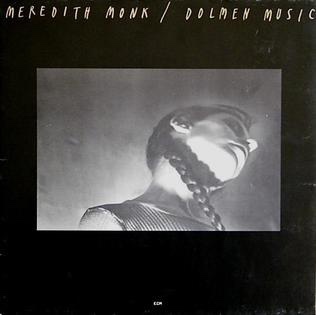
I first discovered her work when I purchased her album, “Key” (1971), self released and marketed via the late lamented New Music Distribution Center in New York. That album, later released on the Lovely Music label along with two releases on the great German avant garde label Wergo (Our Lady of Late, 1973 and Songs from the Hill/Tablet, 1979), constitute the minimalist, SOHO loft music which characterizes her style even now. But with her first ECM release she clearly hit her stride. Those early albums are definitely worth hearing but her mature style blossomed on ECM. It was, in retrospect, a sort of quantum leap, if you will.
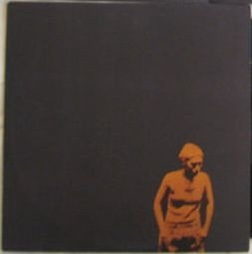
LP album cover of “Key”“Our Lady of Late”“Songs from The Hill”
In that first album one can find Dick Higgins among the singers and Colin Walcott producing and playing percussion (as well as singing). Walcott, along with the yet to be known Julius Eastman would later participate in the Dolmen Music release. Monk, who studied dance at Sarah Lawrence College along with fellow student Alwyn Nikolais established “The House”, her flexible performing group in 1968 at a time which saw a great deal of artistic energy in and around Manhattan’s SOHO district where she encountered musicians like Philip Glass, Steve Reich, and performers sympathetic to new innovations and ideas. She also taught and continues to teach her characteristic extended vocal techniques. Monk, along with John Cage, Philip Glass, and Robert Ashley was featured in Peter Greenaway’s “Four American Composers (1983).
The release of her first ECM disc, “Dolmen Music” (1981) can now be seen as a sort of watershed event. It was followed by “Turtle Dreams” (1983) a work which was prominently featured at New Music America 1982 in Chicago along with Robert Ashley’s “Perfect Lives”. Monk’s appearance on ECM occurred at about the same time as Steve Reich’s masterful “Music for 18 Musicians”. Monk found her mature voice more or less at the same time that Steve Reich and Philip Glass had found theirs. And anyone following new music in those years will recall the flow of new musical ideas that established many now acknowledged masters as legitimate artists.
While the major masterpiece, “Dolmen Music” dominates the album, Monk’s quirky mix of humor and pathos in pieces like “Gotham Lullaby” and “Biography” remain signature pieces in her oeuvre. And Turtle Dreams was made into a performance film for public television by visual artist Ping Chong in 1983, now available on YouTube.
She followed with “Do You Be” (1987) and “Book of Days” (1990) which also exists in at least two film versions and the CD itself which has been described as a “film for the ears”.
Following “Facing North” (1992) Monk released her only opera (though she refers to much of her works as “operas” this is the only one that comes close to the more generic concept of western music operas) to date, “Atlas” (1993) which was commissioned and subsequently performed at the Houston Opera. This represented another phase in her artistic development as she utilized her structured improvisation techniques along with her now familiar extended vocal techniques with an expanded set of performers both vocal and instrumental. Atlas is arguably similarly creative (and transgressive) as Philip Glass’ 1976 “Einstein on the Beach”. Both were developed in an unconventional manner and uses a similar harmonic language with really none of the standard conventions of western music in opera. Would that we can some day see a filming of this work.
I was privileged to see Monk in person for the first time when she performed excerpts from “Volcano Songs” (1997) in Chicago. Those images involving, among other things, light sensitive areas where Monk lay down and left a ghostly shadow upon arising. In addition to her engaging minimalist inflected music, Monk is a master at creating compelling images.
“Mercy” (2002) was followed by “Impermanence” (2008) which I was thrilled to see at Stanford. “Songs of Ascension” (2011) was another landmark in this piece conceived and performed in conjunction with installation artist Ann Hamilton in her tower in Northern California. Attendees to this event were brought in by bus due to the lack of actual parking facilities in that tower. I wish I could have experienced this but hopefully a cohesive video release will be forthcoming. Excerpts are available for viewing on YouTube and on Monk’s website.
“Piano Songs” (2014) by the wonderful new music championing pianists Bruce Brubaker and Ursula Oppens filled an inexcusable gap in the documentation of Monk’s piano music. And following her receiving the National Medal for the Arts in 2015 she released “On Behalf of Nature”(2016).
Monk is a well documented artist largely due to her productive affiliation with Manfred Eicher and ECM and, while gaps remain these recordings represent a major artistic accomplishment and an enduring legacy for new music, for women composers, for western art music. This lovely box set is truly a joy to behold.
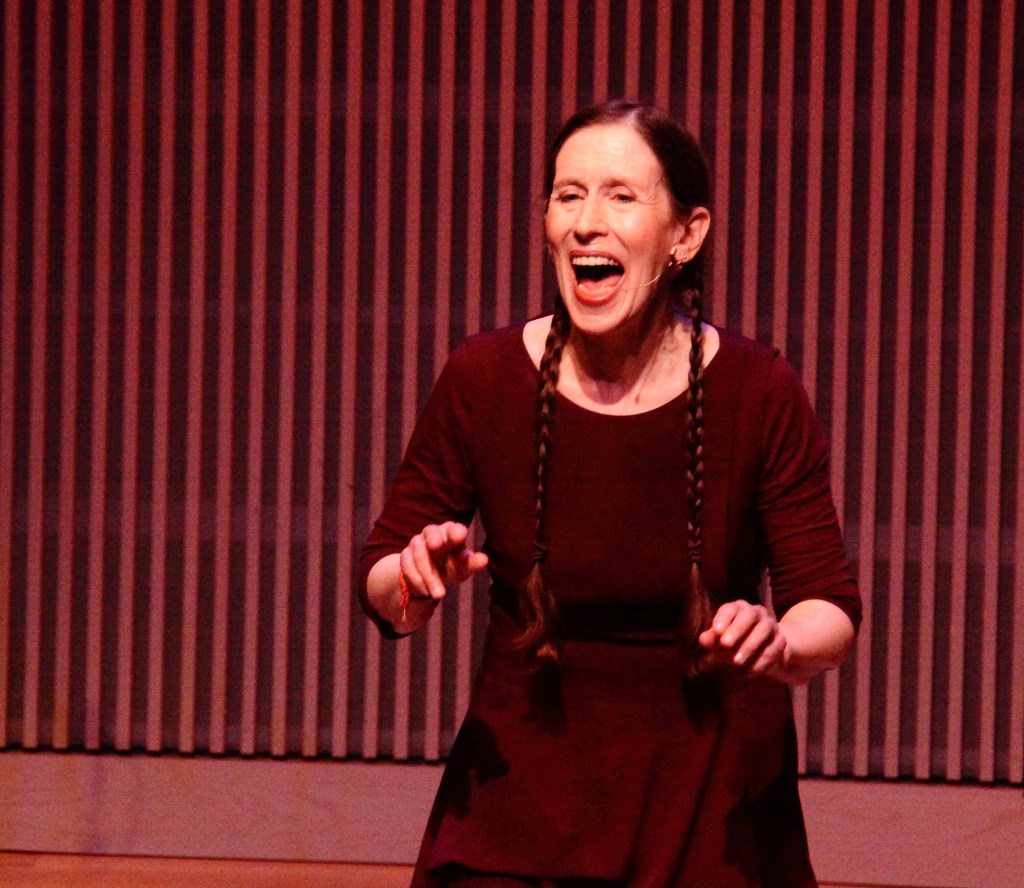
Meredith Monk performing an encore at the final concert of OM 21 (2016) in San Francisco
Steven Schick is a multi-talented and skilled musician. A quick look at his website demonstrates the sheer scope of his musical career. He is probably best known as a master percussionist having played with the San Diego Symphony and a host of others internationally. He is also a fine conductor and composer. His website is a must visit to grasp the scope of this man’s work.
Steven Schick (photo from composer’s website)
Now, solo percussionists are somewhat of a rarity even in the 21st century. Percussion is ostensibly the “junk drawer” of the orchestra by which I mean it becomes the home to pretty much anything that doesn’t fit into the categories of keyboards, strings, woodwinds, and brass instruments. Anyone who has studied any theoretical taxonomy knows that you have to have a “junk drawer” (so to speak) to place things that don’t fit elsewhere at least until you can find a useful category in which to place them. The point here is that a solo percussionist has a huge amount of instruments from which to choose and subsequently master (some of which might also fit other categories like piano, harp, etc. but also things like taxi horns, for example, which Gershwin used in his tone poem, “An American in Paris”). Add to that the artists who regularly add instruments to this group and the task of mastering these becomes even more daunting.
Percussion, aside from tympani and the occasional military drum is largely absent from western music. That began to change with the work of Henry Cowell, John Cage, and Lou Harrison in the early 20th century. As interest grew, so did repertoire.
Despite attending many contemporary music concerts I cannot recall any by a single percussionist. Percussion ensembles began to appear in the early 20th century including Paul Price (1921-1986), Donald Knaack, and Les Percussions de Strasbourg. After 1962 or so the number of percussion ensembles increased along with a rapidly growing repertoire.
With this release Steven Schick begins what appears to be the first of a multi-volume survey of works for solo percussion under the collective title of “Weather Systems”. This first volume is subtitled, “A Hard Rain”, a two disc set that is both manifesto and innovation. It is released by Bang on a Can cellist Maya Beiser’s Islandia Records, not to be confused with the pop music Island Records.
Schick’s book on percussion published in 2006 is a sort of precursor to this CD release.
Here, Schick appears to be doing two related things. First, he is establishing a repertoire for the solo percussionist. And, second, he is presenting his own insights and ideas to both define and expand that repertoire. Having already released definitive recordings of percussion music by Xenakis and Stockhausen, among others, he is apparently ready to blaze a trail that will increase the possibility of hearing a solo percussion concert and establishing a canon of music for those concerts.
There are 7 works (3 by German composers, 4 by American composers) on these two discs largely focused on mid 20th century works and presented (mostly) in chronological order:
1. John Cage (1912-1992) 27’10.554” for a percussionist (1956) arguably one of the must difficult of the pieces here. It is more like a set of tasks than a conventional score and may be the first great solo percussion piece.
2. Karlheinz Stockhausen (1928-2007) Zyklus (1959) experimenting differently from Cage but producing a similarly difficult and masterful work.
3. Morton Feldman (1926-1987) “The King of Denmark” (1964) the second name in the self defined “New York School” of composers, this is about soft sounds and, like the Cage work, unconventionally scored.
4. Charles Wourinen (1938-2020) “Jannissary Music” (1966) a lifelong devotee of post Schoebergian 12 tone music manages to be relevant. And this one of his earliest masterpieces.
5. Helmet Lachenmann (1935- ) “Intérieur I” (1966), this is among the earliest acknowledged works by this prolific German composer.
6. William Hibbard (1939-1989) “Parson’s Piece” (1968), an early work by an artist who died in mid career.
7. Kurt Schwitters (1887-1948) “Ursonate” (1922-1932). This realization of Schwitters’ spoken vocal score is a modern revisioning of this unusual dada-like work. Many recorded versions exist (including one by Schwitters) demonstrating a surprising diversity of interpretation, sometimes with visual components. This is actually pretty frequently performed but this is the first version explicitly designed with a percussionist in mind. It is here that Schick is at his most transgressional and creative. In addition to his percussion Schick includes his voice in the mix and teams with Sharokh Shadegari on electronics and voice. This is the only non-solo work on this set and it is a radically effective take on Schwitters’ strange opus.
All are engaging and all will thrill percussionists who work in new music as well as new music enthusiasts. It remains to be seen if solo percussion performances begin to proliferate but, after all, this is only volume one.
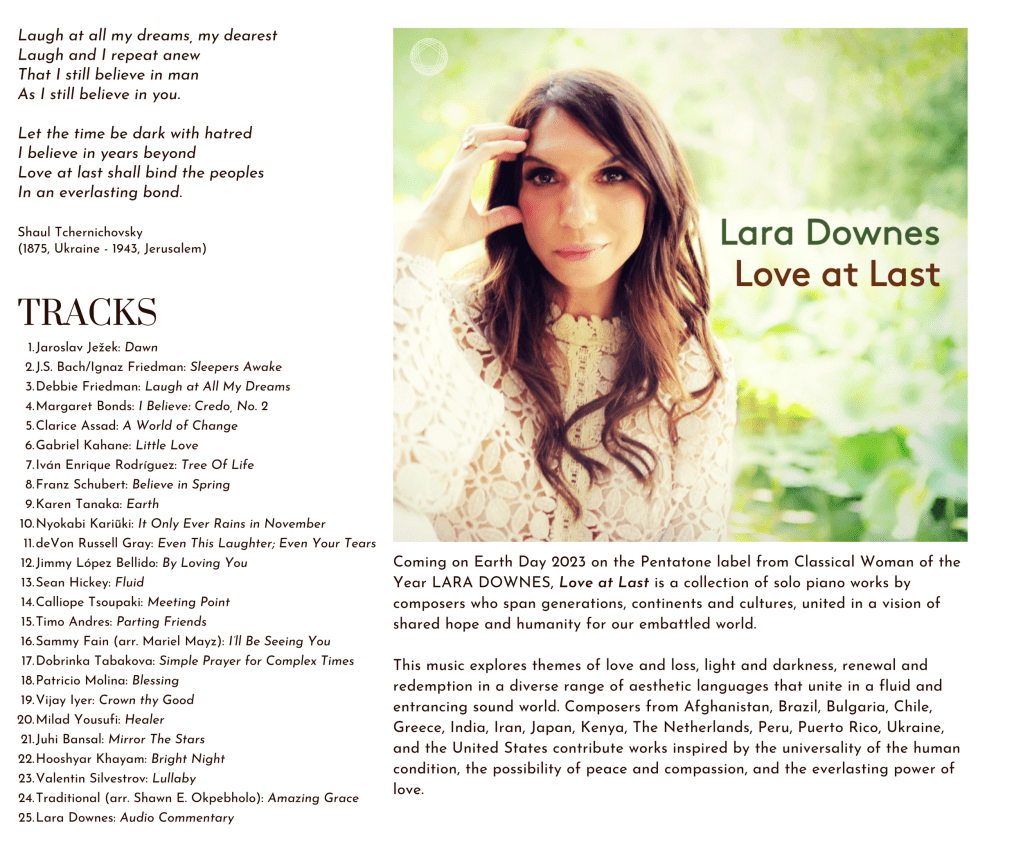
Though I have enjoyed Downes’ albums since I first heard “America Again” (2016) I found myself approaching this new release with some trepidation. 24 tracks by multiple composers, most of their names unfamiliar to me left me with few clues as to the character of this album. So I decided to take Lara on a trip with me. I had a few hours of errands to do which required a bit of driving, a fine opportunity to hear this music while strapped into the driver’s seat. This sort of passive listening would give me a first impression and I wouldn’t be tempted to any distractions (other than driving).
After the first two or three tracks I found myself inextricably drawn into Downes’ obviously very personal choices. As with all her albums (this one is her tenth by my count), she shares a diverse cornucopia of music featuring music from Bach to young contemporary composers (women and men) and styles from classical to jazz, gospel, blues, and pop. On all tracks she has ample opportunity to exert her interpretive skills and her virtuosity. These are a quirky but ultimately eye opening (or ear opening?) pieces that draw the listener in. Her choice in repertoire has always been both creative and, some might say, “transgressive” because of her lack of respect for boundaries like “classical”, “jazz”, “pop”, “folk”, “male composers”, “female composers”, etc. whereby Benny Golson stands beside Aaron Copland or Rhiannon Giddens and Judy Collins alongside Bernstein, etc. But I prefer to think of her work as “inclusive”. Music is best appreciated not by racial, political, or gender issues but on its own merits. Here she sets her sights on the elusive concept of “love”, another concept that does best when it transgresses boundaries and embraces inclusion.
Downes’ keyboard mastery and her ability to clearly articulate the inner details of this music succeeded very well in engaging this listener from the very start. After about 12 tracks I had to stop, pull over, and look at the track listings. This far ranging but ultimately cohesive selection sounding at times like a fin de siecle drawing room recital of unabashedly romantic music. Of course many of these pieces are of more recent vintage but Downes succeeds in making her choices sound inevitably related to each other. There is much to explore here and the pieces seem to fit together like a sonic jigsaw puzzle into a cohesive whole while retaining their individual detail and beauty, indeed “love at last.”
Rather than attempting to delve into the individual composers here I am choosing to review this in the context of its presentation. It is a characteristic of Ms. Downes’ releases to identify some sort of context, sometimes fairly specific, sometimes cleverly vague in which to present a carefully chosen portion of her repertoire. Here Ms. Downes gives a loving and personal gift to her fans.
Of course I will look into all the composers and music presented here over time but, for now I just want to listen and savor these gifts. You will too.
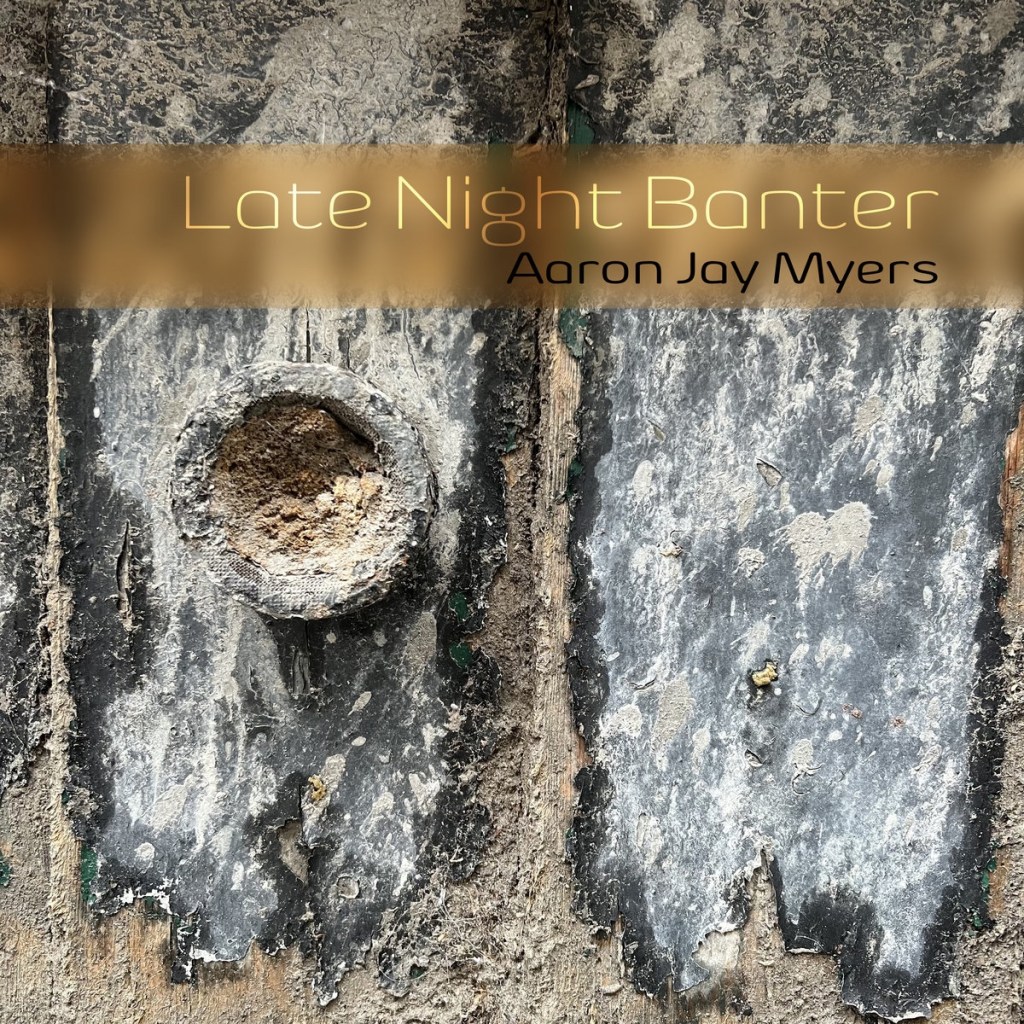
Aaron Jay Myers’ third album grabbed my attention immediately and didn’t let go til the album ended. Working un-self consciously in a stunning plurality of styles (this guy clearly paid attention to his 20th century music history classes) he has produced some mighty substantial works. His ability to integrate a wide variety of techniques and styles into his artistic persona is simply astounding. His references to other composers’ works, rather than sounding derivative, evoke nostalgic homage, at least in this listeners ears. Indeed there seem to be more references per square inch than in a Thomas Pynchon novel. And the fact that he shares this writer’s passion for Star Trek, Deep Space Nine only endeared him more to me (more on that later).
His very listenable music seemingly embraces the whole of the twentieth century stylistically and his very judicious use of extended techniques for pretty much all instruments including voice demonstrate a firm understanding of where those techniques best serve his artistic vision. Fortunately he has managed to find performers who both meet his technical demands and have a real grasp of his musical vision. This Neuma release is truly something special.
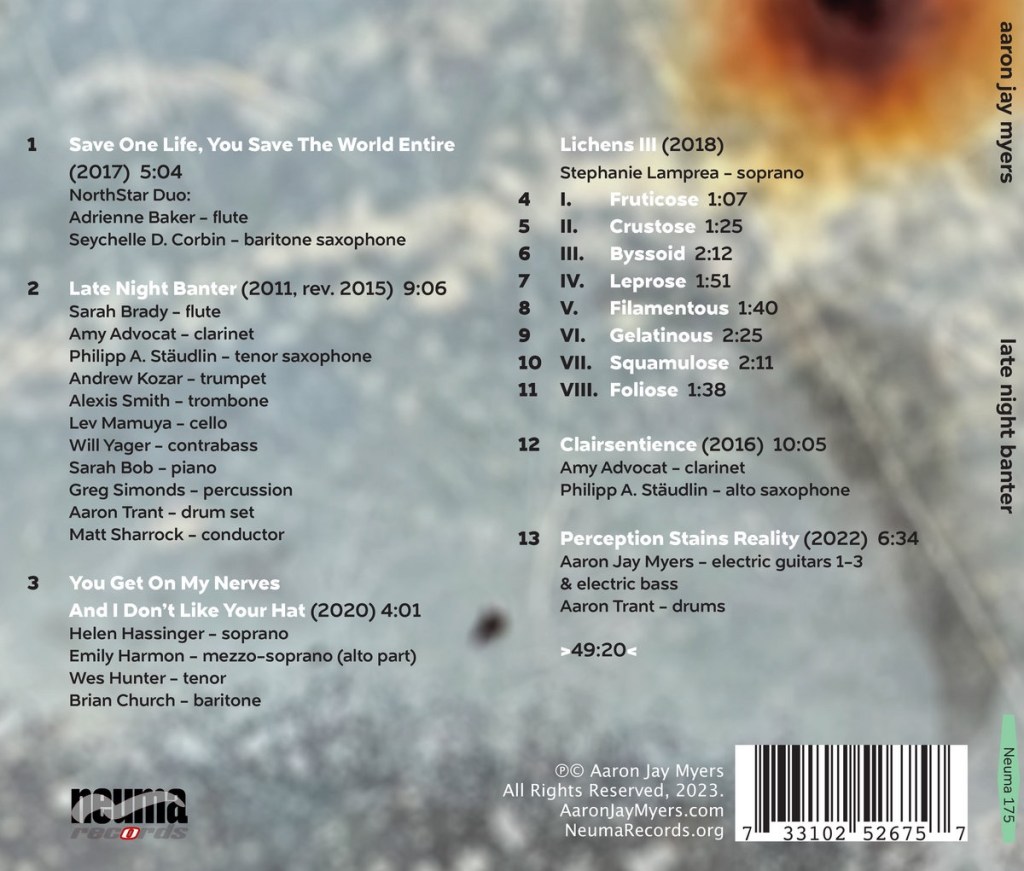
There are six works divided among the thirteen tracks. These chamber works were written between 2011 and 2021. None require more than ten minutes or so of your time and left this listener satisfied with the music and optimistic for the future of classical music in general.
“Save One Life, You Save the World Entire” (2017) for the unusual combination of flute and baritone saxophone opens this album with a surprisingly engaging work. It sounds like a challenge for the musicians who handle those challenges seamlessly and engage the listener in this rather brief essay.
When I listen to “Late Night Banter” (2011 rev. 2015) now, I do so in bare feet (it knocks my socks off). This piece for ten musicians with a conductor is a finely crafted piece that grabbed this listener’s attention by that craftsmanship but also by what seem to be a plethora of sonic references to 20th century music. The style of Stravinsky, an homage to Luciano Berio, etc. These brief references evoked emotional responses which led me to recall similar emotions I had attached to the apparent (at least to me) object of said reference. Even minimalist references occur matter of factly. Such efforts can sound derivative or at least imitative but not so in this piece. Rather it had the quality of a tour of the twentieth century in respectful jogs of memory. But even if you don’t get the references, this is a substantial and entertaining work. The evanescence of those references had me questioning whether they were actually there or just my mental figment. (I guess I’ll just have to listen again). Either way I was thrillingly engaged.
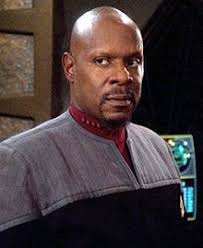
Avery Brooks as Captain Benjamin Sisko, commander of Deep Space Nine
“You Get On My Nerves, And I Don’t Like Your Hat” (2020) is the Deep Space Nine reference mentioned at the beginning of this review. If you haven’t seen this series I highly recommend it. And so, apparently, does Aaron Michael Myers. This work for vocal quartet (SATB) takes its title from a witty utterance by Captain Sisko (my fave Star Trek Captain). Of course you don’t have to know Star Trek lore to appreciate this work, but it helps. It is a challenging work for four unaccompanied soloists which reflects the composer’s sense of humor as well as his connection to pop culture.
Aaron Jay Myers
“Lichens III” (2018) is scored for soprano voice but the singer also does the work of a percussionist. In addition to the vocal challenges the singer is asked to perform on “body percussion”, the various sounds one can make by percussing (pounding) on one’s body. It is more commonly an idiom of folk and blues but soloist Stephanie Lamprea handles both the singing and the percussing as though it is her everyday practice accomplished with ease.
Clairsentience (2016) is another wind instrument duo, this time for clarinet and alto saxophone, a similarly unusual choice of instruments. This one is about twice the duration of that first piece and every bit as engaging as well as challenging.
The last track is a marvel of multitasking. Other than Aaron Trant (who does a fine job) on drums, all of the parts (three electric guitars, and bass) are handled by the composer. “Perception Stains Reality” (2002) is a tour de force consistent with the other works on this disc. Here he shows his rock/pop sensibilities, clearly as essential a part of his artistic endeavors as his “classical” training.
Myers is one to put on your hot list. He is certainly on mine. If you can hear a performance of his work, whether live or recorded, you would do well to check it out.
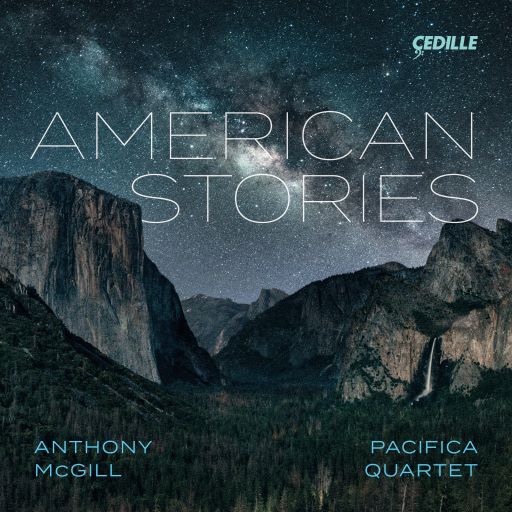
Anthony McGill’s star rises rapidly higher with the release of this new album. His previous Cedille release was music for woodwind soloists and orchestra and featured Anthony’s brother, flautist Demarre McGill as well. And this one is a real gem that introduces listeners to four composers whose work defines to significant degree the current state of American music. From the very well known work of Richard Danielpour to three less familiar names listeners will want to know better, this is one fine chamber music recording.
I was first introduced to the clarinet and string quartet genre via the 1957 RCA recording of Mozart’s A major Clarinet Quartet played by Benny Goodman with the Boston String Quartet (paired with Mozart’s Clarinet Concerto and this disc was my first hearing of both works). I later heard the Brahms Clarinet Quintet (McGill recorded both of these on a 2014 Cedille release) and other essays in this genre but the Mozart and Brahms are forever my reference point as I imagine they are for most listeners.
Anthony McGill (photo copyright 2014 by Chris Lee)
All of these works are essentially clarinet quintets though only one bears that specific title. All but one work are recorded premieres but all are fulfilling listening experiences beautifully performed by Mr. McGill and the fabulous Pacifica Quartet . This album is almost as much an homage to the clarinet quintet genre as it is to the people and historical events that provided inspiration for the music. This is music with messages for all who want to hear them.
Pacifica Quartet (photo from their website)
All four works here are inspired by “American Stories”, as Maestro McGill says in his introductory notes, “Through music we connect with our stories.” The music here is about pain, struggle, memorial, and hope. It is more elegy than lamentation and, ultimately more music than history. But, as music, it succeeds very well and one hopes that these works will help preserve the histories described. This is beautiful and lyrical music with immediate appeal and substance that demands repeated hearings.
Richard Danielpour
Richard Danielpour’s “Four Angels” (2020) is in one movement divided into four sections, each lamenting the death of four little girls (Addie May Collins, Carol Denise McNair, Cynthia Wesley, Carole Rosamond Robertson) who were killed in the bombing of the 16th Street Baptist Church in 1963 by Ku Klux Klan members. Danielpour says in his notes, “This music also stands as a small testament to the choice for a better path, one consisting of the compassion and understanding that we must have for one another.”, a statement that could be applied to all the works herein.
James Lee III (photo from composer’s website)
James Lee III is represented by his four movement “Clarinet Quintet”(2019) here in its premiere recording. This rising star states in his liner notes that this quintet is inspired by his reading of the experiences of Native Americans. It is also, via quotation in the first movement, homage to Black American composers who preceded him. The scherzo movement is named “Awashoha”, a Choctaw word meaning, “play here”. The metaphors he attaches to his classical forms are gentle impressionistic clues to his compositional processes. It is a deeply felt work and listeners are advised to explore his well organized website.
Ben Shirley (Photo from composer’s website)
Ben Shirley’s “High Sierra Sonata” (2019) is in three movements and, according to the composer, is somewhat autobiographical, inspired by his fall into addiction and subsequent recovery. He specifically references his experience as a volunteer for an athletic event in the Eastern Sierra Mountains in eastern California where the unpredictable changes in weather provided him with a metaphor for life’s unpredictable nature, both in his life and others.
Valerie Coleman (Photo by Matthew Murphy from the composer’s website)
The recording concludes with “Shotgun Houses” (2000) by Valerie Coleman. This work, the only one on this release that is not a premiere recording, is an homage to fellow Louisville resident Muhammad Ali and references the architectural style known as “shotgun houses” known to both Ali and Coleman when they resided there. She states that the opening movement is a general homage to southern black culture, the second an homage to Ali’s mother, and the third a celebration of Ali’s triumph in the 1960 Olympics which essentially launched his fame.
Professor Yeh has been assistant principal clarinet with the Chicago Symphony since 1977 when he was just 19. As a former Chicagoan I can recall that Yeh’s hiring seems to have marked a change in the more traditional image of an orchestral musician. In addition to being an inspiration to aspiring musicians of Asian heritage his media presence also drew interest from both listeners of Asian Heritage but also young listeners (I turned 21 when he was hired and was pleased to find an artist who communicated to me and my age group).
In addition to his duties with the CSO, he has actively supported music and music making in his adopted home town. It is his support for local composers that he showcases here. This disc features music by Alexander Tcherepnin (1899-1977), Stacy Garrop (1969- ), Leo Sowerby (1895-1968), Shulamit Ran (1949- ), Teresa Reilly (1976- ), and Robert Muczinski (1929-2010).
Alexander Tcherepnin, whose father Nikolai was a student of Rimsky-Korsakov, and whose sons, Serge and Ivan, along with grandsons Sergei and Stephan are all highly accomplished composers comprise a multigenerational artistic dynasty of sorts. Russian born Alexander taught in Chicago thus qualifying him for inclusion in Cedille recordings’ mission to promote artists with a “second city” connection. He is well represented in recordings but is less present in the concert hall these days. His brief Sonata in one movement for clarinet and piano (1939) takes the first track on this fine chamber music release. It is a deservedly popular recital piece with a style that sounds a bit like Shostakovich, one of his contemporaries.
Stacy Garrop is a favorite of this reviewer. Her work has been reviewed elsewhere in this blog. She is a freelance composer of immense talent and skill. Her work is featured on at least 12 Cedille albums as well as other labels. Phoenix Rising (2016-18) was originally for alto saxophone (subsequent versions were made for flute and for violin) is presented here in a world premiere transcription for clarinet. As with all her music, Garrop shows herself to be a master of color and texture. She uses both traditional and extended techniques to achieve her compositional visions. These can be challenging for performers but the end result is always worth the effort. Garrop derives inspiration, as she frequently does, from world mythology. Here, of course, the familiar Phoenix bird that lives some 500 years and rises again from the ashes of its funeral pyre.
Leo Sowerby, long associated with Chicago as an organist, composer, and teacher, is represented here by his 1944 clarinet sonata (here in its world premiere recording). Written in the year which saw him win the Pulitzer Prize for music (for Canticle of the Sun), this sonata takes on near symphonic dimensions in its four movements. Sowerby is generally well represented on recordings (8 discs on Cedille alone). His lyrical writing is expressive and accessible and it is perhaps just a matter of time before someone orchestrates this work to present it as a concerto. At just a bit under 30 minutes, it is the largest work on this release.
Shulamit Ran, Israeli/American composer and pianist, student of the great Ralph Shapey, 1991 Pulitzer Prize winner (for her 1989-90 Symphony), Andrew MacLeish Distinguished Service Professor Emerita at the University of Chicago is represented on this recording by her Spirit for solo clarinet (2017). The work is dedicated to the composer’s friend, clarinetist Laura Flax (1952-2017). This is its world premiere recording. Ran’s music has gotten some recordings but her large and substantial orchestral works like the Symphony and a fine Concerto for Orchestra remain unavailable on recordings (even more egregious is the general lack of representation of her mentor, Ralph Shapey’s music). This solo clarinet work is a testament to her compositional talents. Here’s hoping we get to hear more.
Teresa Reilly is a clarinetist, composer, and life partner of Mr. Yeh. The Forgiveness Train (2020) is described as, in part, a response to the COVID epidemic (Yeh notes that much of this album is similarly inspired). The three movement work is essentially a sonata with a loosely poetical program. It is a lyrical work with nods to minimalism and jazz. This is the world premiere recording.
The disc concludes with the four movement Time Pieces for clarinet and piano (1983). This work (the second longest on the disc) is, like the Sowerby piece, substantially a concerto that waits an orchestrator for the piano part. Robert Muczinski, Chicago born composer studied under Alexander Tcherepnin whose music opens this release. The Opus 43 work was commissioned and premiered by former CSO principal clarinet Mitchell Lurie with Muczinski at the piano.
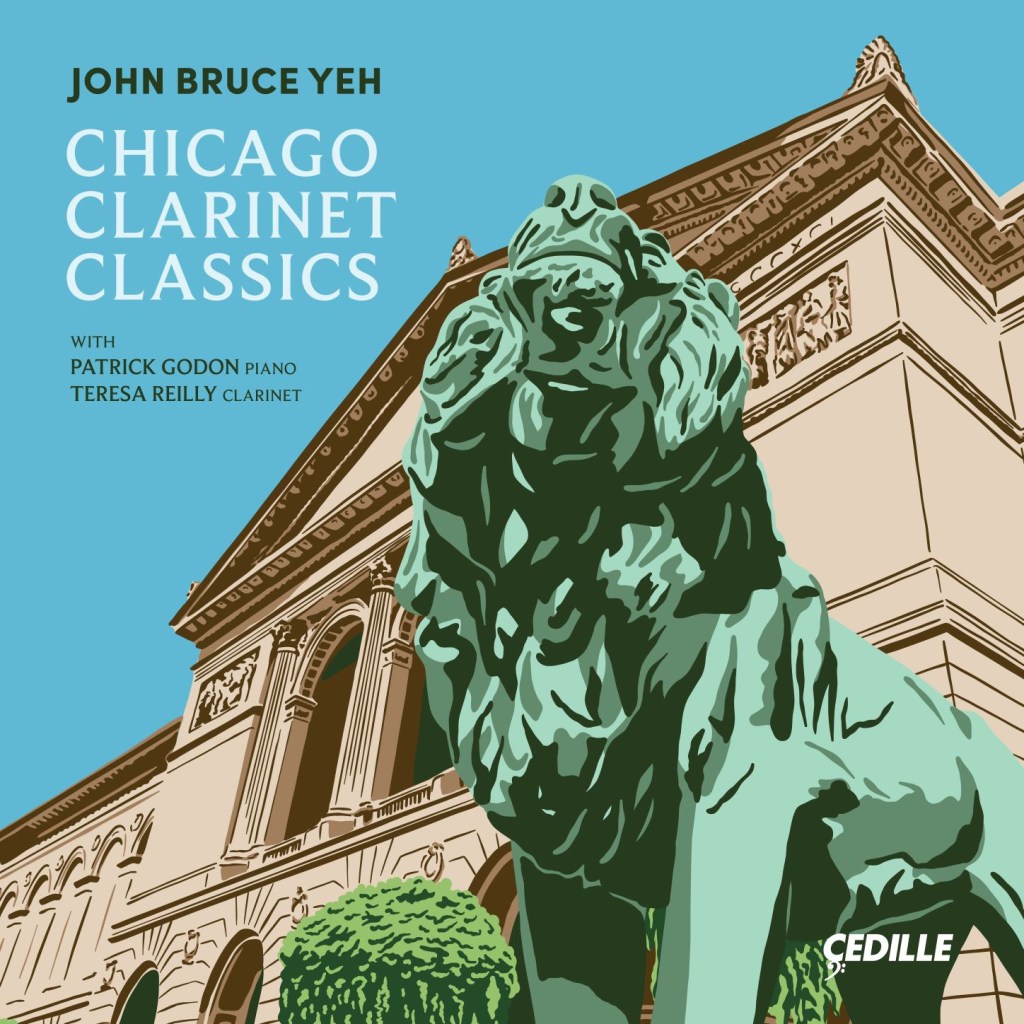
Mr. Yeh is, as always, a joy to hear. He is most ably supported by pianist Patrick Godon on piano (tracks 1, 4-7, and 12-15) and, of course by (more properly with) Teresa Reilly (tracks 9-11). This release, from the Art Institute depicted in (Chicago artist) Steve Shanabruch’s distinctive cover art to the composers represented, is pure Chicago in the best ways.
NB, I have made corrections on errors very publicly posted on the composer’s website. The changes are factual corrections and copyright citations. My blog is intended to provide the perspective of an avid listener and to promote music which I believe deserves attention and I believe I have done that. I’m always happy to correct errors of fact but I retain the right to my opinion. To be clear, I like the album very much.
I hope that my flippant title for this review does not offend. But an artist who creates new acoustic instruments of unusual tunings which he plays and for which he has written music sounds a lot like spiritual progeny to Harry Partch. Partch had no children and even if he did it is unlikely they would have followed in his footsteps. Strictly speaking, Cris Forster may be more like “nephew of Partch” given that he is following his own distinct trajectory and is doing so in a very different time. But he embodies the ethic and has made it his life’s work to compose in non-standard tunings and to create instruments capable of playing those tunes accurately and effectively. Forster is, in a metaphorical sense, a sort of spiritual progeny, one that would have made daddy proud.
The instruments are themselves works of art. This is Chrysalis II. Chrysalis I is on the album cover. Photos from CD booklet.
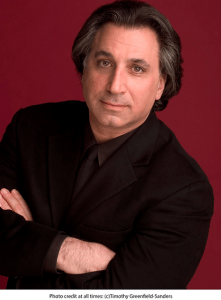
Cris Forster (1948- ) was born in Brazil, became a US citizen in 1966, and earned a degree in history from UC Santa Cruz in 1970. After graduating in 1974 from Lone Mountain College (now the University of San Francisco) with a degree in piano performance, he began building his own instruments in 1975 and, in 1976 (two years after Partch died), he began a four year stint as curator, archivist, and performer for the Harry Partch Foundation. While there he maintained the original Partch instruments, created what I’m calling “Post Partch” instruments, and subsequently performing both Partch’s music and his own compositions. In 2000 he published “Musical Mathematics”, a comprehensive accounting of his researches.
Harmonic/Melodic Canon, another beautiful “post Partch” instrument.
Forster also wrote this nearly 1000 page tome to describe his work, available on Amazon. It is arguably a continuation of Harry Partch’s defining book, “Genesis of a New Music”. I guess that makes this a “post Partch” book.
It is fairly easy to write about Forster, his book, his CD. But it is extremely difficult to communicate meaningfully about the sound of his music and how these beautiful but odd looking instruments are played. To that end I will provide a few YouTube links so that readers can experience the music itself: “A child said What is the grass” (1986); “Blue Nights” (2013). These are from Forster’s YouTube channel where you can see/hear more. Don’t worry about the unusual tuning. After a few listens (at least for this listener) one begins to hear it as the beautiful music that it is, a worthy successor to the Partch legacy.
There are eleven tracks featuring selections from two large works, Song of Myself: Intoned Poems of Walt Whitman (1977) written for Chrysalis I, Harmonic/Melodic Canon, and Voice; and Ellis Island/Angel Island (1978-2023) for a larger ensemble but without voice consisting of four groups of instruments: Stringed instruments: Chrysalis I, Chrysalis II, Harmonic/Melodic Canon, Bass Canon, and Just Keys; percussion instruments: Diamond Marimba I, Diamond Marimba II, and Bass Marimba; friction instrument: Glassdance; and wind instruments: Simple Flutes. And the informative liner notes are by Heidi Forster who also plays in the ensemble.
1.Song of Myself: Intoned Poems of Walt Whitman Song of Myself (Excerpts): No. 2, “A Child Said What Is the Grass?” Cris Forster: voice, Chrysalis I
2. Ellis Island/Angel Island (Excerpts): X. Blue Nights David Boyden, Heidi Forster, Isabelle Jotterand, Benjamin Koscielak playing Glassdance, Just Keys, Bass Canon, and Bass Marimba
3. Ellis Island/Angel Island (Excerpts): IX. Dream Time Jacob Richards playing Diamond Marimba II
4. Song of Myself (Excerpts): No. 10, “The Past and Present Wilt – I Have Fill’d Them, Emptied Them” Voice and Harmonic/Melodic Canon played by David Boyden
5. Song of Myself (Excerpts): No. 11, “The Spotted Hawk Swoops by and Accuses Me, He Complains of My Gab and My Loitering Voice and Harmonic/Melodic Canon played by David Boyden
6. Ellis Island/Angel Island (Excerpts): “I. Good-Bye” Just Keys played by Isabelle Jotterand
7. Ellis Island/Angel Island (Excerpts): “II. Farewell” Just Keys played by Isabelle Jotterand
8. Ellis Island/Angel Island (Excerpts): “III. Far Away” Just Keys played by Cris Forster
9. Ellis Island/Angel Island (Excerpts): “VII. Lullaby” Glassdance played by Heidi Forster
10. Ellis Island/Angel Island (Excerpts): XI. Wild Flower Cris Forster and Benjamin Koscielak playing Diamond Marimba II and Bass Marimba
11. Ellis Island/Angel Island (Excerpts):“IV. The Harbor” Heidi Forster, Benjamin Koscielak, and Jacob Richards playing Glassdance, Bass Marimba, and Diamond Marimba II
The tuning sounds unusual at first but it grows on the listener. Happily there are plans to release the rest of the Whitman settings. Meanwhile we have this lovely release produced by John Schneider and Heidi Forster (with Cris Foster doing the recording and Scott Fraser the mastering) to listen to while we wait.
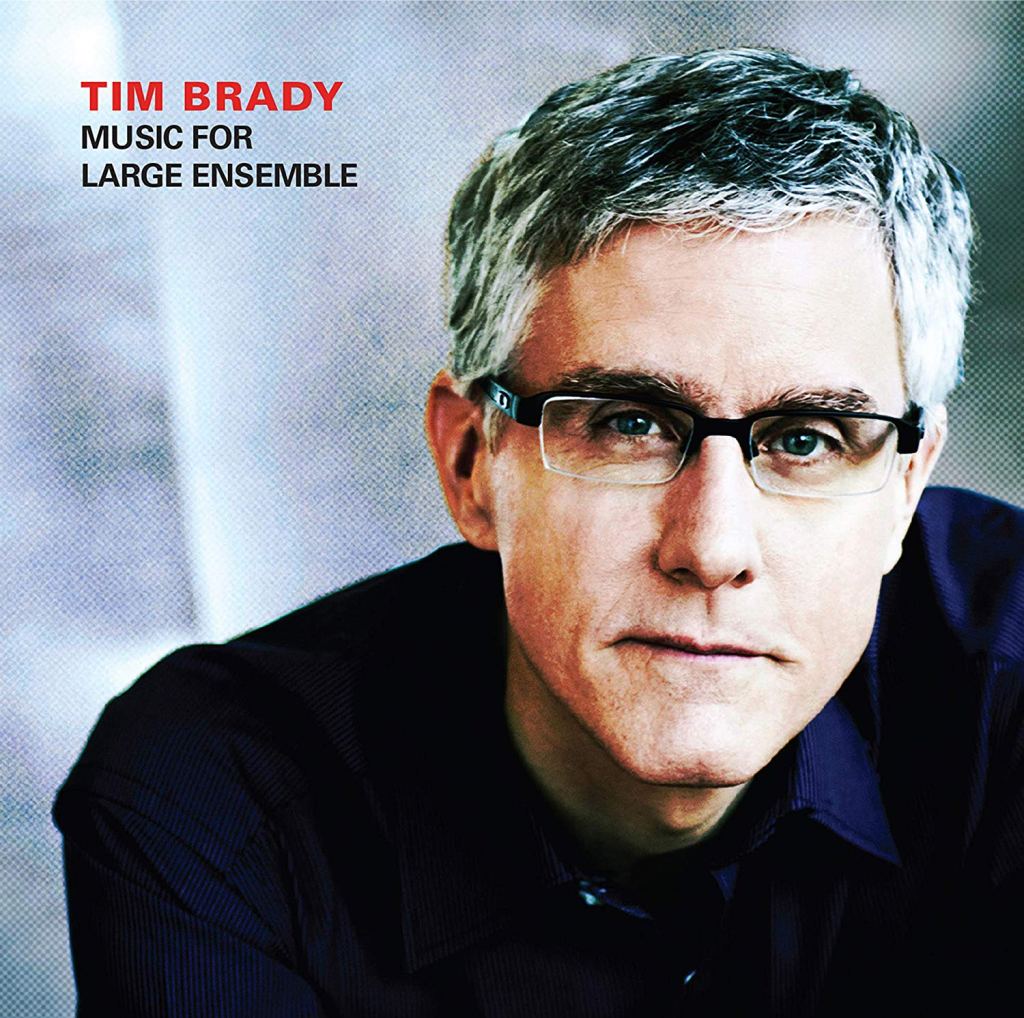
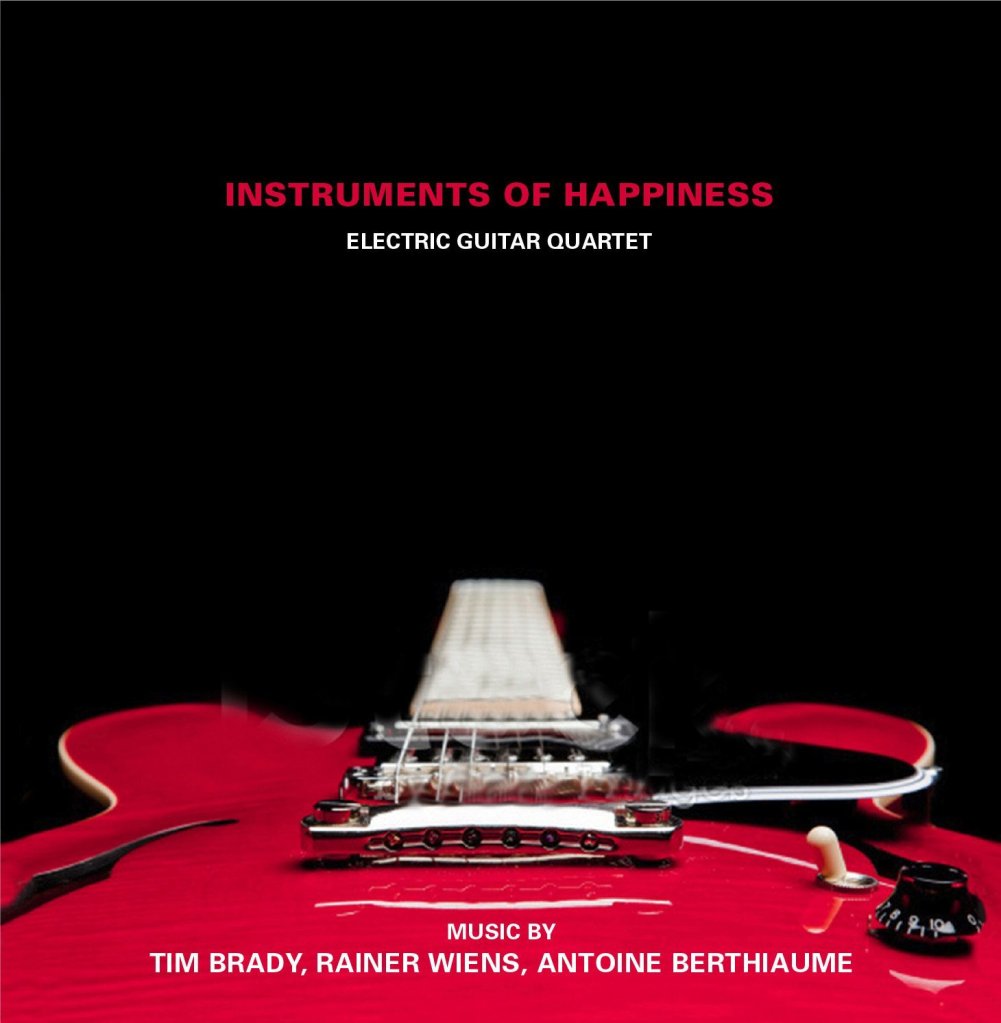
This is Tim Brady’s fourth Starkland release, a distinction shared by only two other composers, the late Tod Dockstader and (the delightfully very much living) Guy Klucevsek. And given the impressive track record of the Starkland label’s ability to find and promote innovative composers and performers who later achieve much wider recognition, this is an event that demands serious attention.
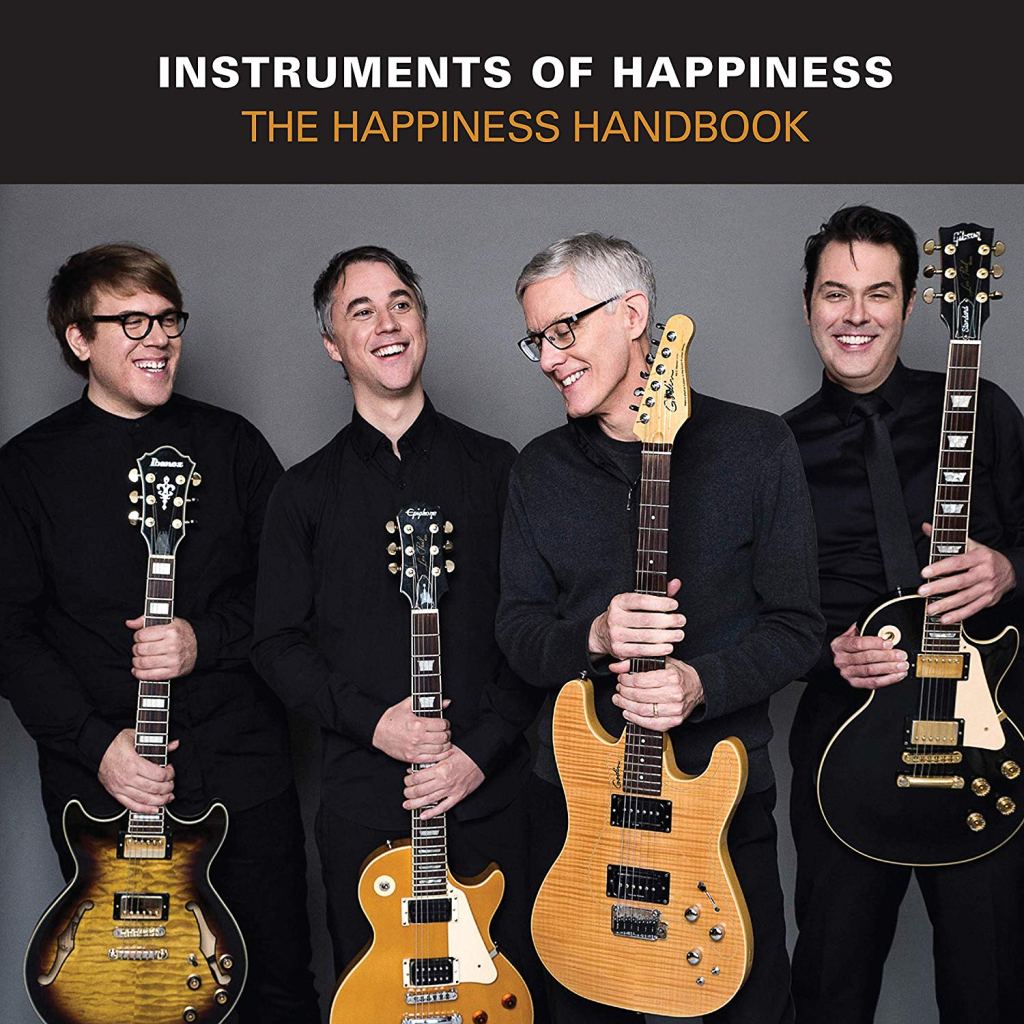
ST-232, released in 2019 contained works by Brady along with several associates from his “Instruments of Happiness” ensemble (and others) and is essentially a Brady album which features his “Instruments of Happiness” guitar quartet playing works by various Canadian composers.STS-230, also a 2019 release contained Brady’s Concerto for Electric Guitar and Chamber Ensemble along with Brady’s “Eight Songs for: Symphony No. 7”STS-224, a 2016 release, the recording premiere of this live performance guitar quartet, contained, along with a couple of shorter works by fellow Canadians, two versions of Brady’s Symphony 5.0, one for ensemble and a second version for solo guitar with electronics (arguably Brady’s first solo guitar symphony but the original version is for this guitar quartet).
With a catalog presently numbering some 39 plus CDs and a CV that boasts 4 operas and a massive catalog of compositions for ensembles ranging from solo to large orchestra, this proudly Canadian composer has mounted (metaphorically, of course) an invasion from the United State’s northern border of his distinctive artistic vision prompting this reviewer to suggest a comparison to the pop “invasion” of the Beatles in the early 60s.
Track listing
My admittedly tongue in cheek Beatles comparison is not meant to eclipse the incredible artistry of this obviously very industrious artist. My previous reviews compared his work to electric guitar giants like Rhys Chatham and the late Glenn Branca. But this only serves to illuminate a fraction of this man’s work. I invite listeners to peruse his well organized website to get a perspective.
But let me get back to this release. It is undoubtedly a bold move to use the term “symphony” to describe a work for a solo artist. Charles Valentine Alkan (1813-1888) wrote a symphony for solo piano (opus 39 nos. 4-10 from 1857) Kaikhosru Shapurji Sorabji (1892-1988) referred to his third piano sonata (1922) as a symphony and later wrote six more symphonies for solo piano between 1938 and 1976. And more recently the late Glenn Branca (1948-2018) wrote several works for various configurations of guitars he called symphonies. But this is the first symphony written expressly for solo guitar as far as I can determine.
“Symphony in 18 Parts for solo electric guitar (2021) – 50 minutes For solo electric guitar, FX pedals and looper, in 18 movements” as it is listed on the composer’s website is (if I counted correctly) his 8th Symphony. Brady apparently numbers his symphonies in order of composition without reference to instrumentation. While several of his symphonies involve one or more electric guitars, this is the first solo guitar work to which he gives the weighty title of “Symphony” (unless, as noted above, you count the solo version of Symphony No. 5).
The term “symphony” carries with it connotations, at least, of grandeur, painstaking structure, and serious music making. And this work is very serious and meticulously constructed. It is, of course, reflective of a mid career composer who has written a great deal and has learned from that experience. It has as much a right to be called a “symphony” as any similarly large and painstakingly written piece of music.
First, let me say that, other than a tendency to use one (or a lot more than one) electric guitar in his music, Brady’s music has relatively little in common with Glenn Branca and Rhys Chatham. In fact, Brady seems to have more in common with Steve Reich and Elliott Sharp. But while Chatham and Branca emerged from a music scene dominated by punk in all its iterations, Brady seems more connected to the Beatles and Les Paul.
The work is divided into 18 sections, each running a modest 1.5 to just under 5 minutes. It is a structure similar in this listeners mind to American composer Alan Hovhaness (1911-2008), whose Symphony No. 9 (1949-50) “St. Vartan”, a similarly epic masterpiece in no fewer than 24 short movements. It is the interrelatedness of those movements that make them a part of the whole symphony. And so it is with Brady’s Symphony. David Lang (Pulitzer Prize Winner and founding Bang on a Can” member) says essentially this in his segment of the liner notes that come with the recording. Tim Brady acknowledges much the same in his segment of the liner notes.
The cover art by fellow adventuring guitarist and composer Elliott Sharp is functionally an homage to Brady and his work. The recording by Tim Brady and Morris Apelbaum, mastered by Brady, Apelbaum, and John Klepko is lucid (and great on headphones especially when Brady pans the sounds across the stereo field).
The 18 movements all have titles which are metaphorically related to the music therein. David Lang aptly describes these varied and intense movements as sort of biographical statements about what the composer can do with his instrument. Each movement has both form and development much as one would expect of a symphonic movement.
On the one hand, this symphony is not easy listening. On the other hand it is likely catnip to electric guitarists as well as to new music enthusiasts including your humble reviewer. Brady’s Canadian invasion, far from a takeover, is simply a musician sharing his substantial art from across the northern border and presenting his latest efforts. Like the Beatles, Brady deserves to be welcomed. This prolific composer/performer/teacher/innovator has interesting things to say.
At first I attempted to write something about each of the 18 movements but I don’t think that would have added anything useful for prospective listeners. This piece taken as a whole most aptly deserves the descriptor “tour de force” as each movement seems to have its own character deriving from the composer’s use of various (apparently deeply studied and judiciously chosen) techniques and ideas which sometimes threaten to overwhelm the listener, sometimes with sheer volume, sometimes with dazzling virtuosity, sometimes with softness, sometimes with silence, and always with interesting ideas.
In some ways this is a collections of ideas and techniques the composer has amassed over some 50 + years of playing. Each movement seems to be a more or less self contained exposition of playing techniques and the composers own approach to harmony and invention. That sounds potentially very dull but this is not a collection of etudes didactically accounting for and crystallizing his ideas. It is the organic appropriation of personal achievements in developing his compositional style. And it is an homage to electric guitarists that preceded him. Not a textbook as much as perhaps a signpost defining his present stage of development even as he moves forward with other projects.
I suppose one could challenge the notion of calling this a work for solo guitar given the effects pedals, looping systems, etc. but the use of electronics and looping techniques as a compositional aid or method is so ubiquitous that point is moot. Call it what you like but just listen. Let the music flow over your ears. At the very least this is a defining milestone in Brady’s long and productive career. It’s hard to to imagine what he might do next but I’m sure he’ll think of something.
This is the third volume in the Catalyst Quartet’s wonderful and insightful survey of neglected works by black composers. The first focused on music by the black English composer Samuel Taylor Coleridge (1875-1912), the second on music of late nineteenth to mid-twentieth century American composer Florence Price (1887-1953). The present disc focuses on the works of three men whose musical careers were entirely in the twentieth century: William Grant Still (1895-1978), George Walker (1922-2018), and Coleridge-Taylor Perkinson (1932-2004).
William Grant Still is roughly contemporary with Aaron Copland (1900-1990). Copland has often been called the “Dean of American Composers” and Still has been called the “Dean of Afro-American Composers”. Such honorifics, while well intended, do nothing to describe the true depth and significance of either of these composers.
Similarly their best known works, Copland’s “Appalachian Spring” (1944), and Still’s “Afro-American Symphony” (1930) are fine pieces of music but cannot represent the whole of their respective authors’ outputs. Both produced quite a bit of music and went through stylistic changes as their artistic sensibilities evolved. Copland’s oeuvre is pretty well documented, allowing listeners to grasp its entirety while Still’s work has not enjoyed the same distinction. That is changing, slowly, and that is reason to celebrate.
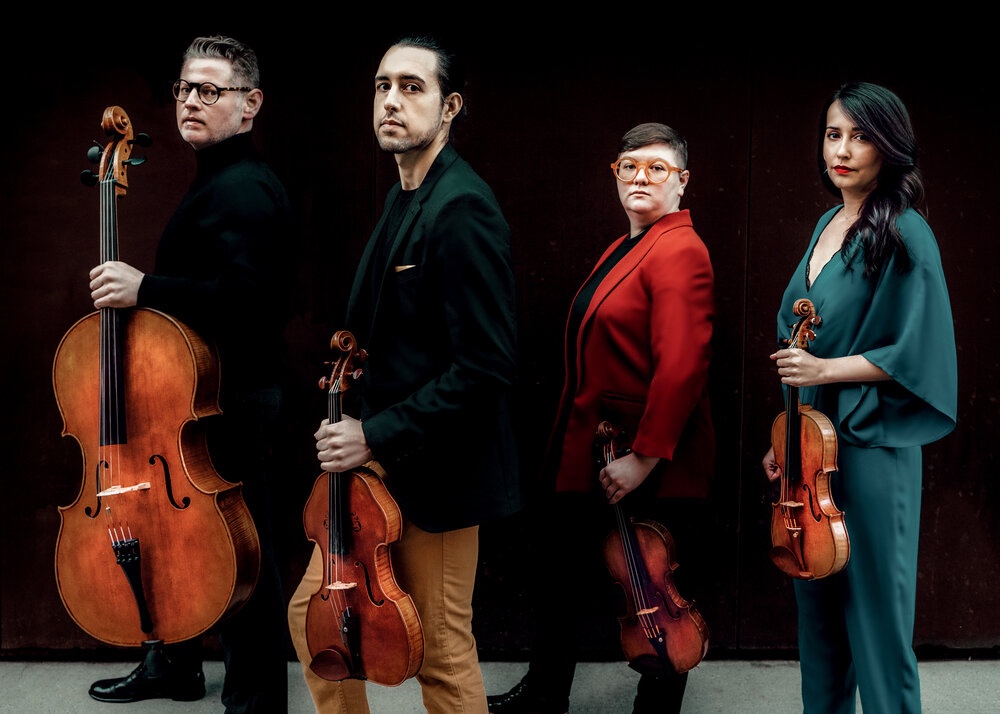
The Catalyst Quartet (Karla Donehew Perez, violin; Abi Fayette, violin; Paul Laraia, viola; and Karlos Rodriguez, cello) from their website
Still is represented here by his “Lyric Quartette” (published in 1960 but likely written 1939-1945). These three movements for string quartet are intended to represent a plantation, the mountains of Peru, and a pioneer settlement, respectively. This appears to be the first commercial recording of the work, a set of vignettes (Still never wrote a string quartet as such) seemingly published as an afterthought after looking back over his files. That’s not to denigrate the music. It is finely crafted and reflects a composer closer to the folk eclecticism of his contemporaries William L. Dawson (1899-1980) whose use of folk idioms resembles that of Aaron Copland (1900-1990) and Virgil Thomson (1896-1989), two white contemporaries (rather than his later more post romantic style). These composers’ use of folk idioms and the comforting tonal harmonies, very much in vogue when the music was first written, sound rather old fashioned in their year of the Lyric Quartette’s publication. Nonetheless, it is a vital work in understanding Still and his development as a composer. This would make for a great encore or second selection following a Haydn or Mozart Quartet.
George Walker was a sought after concert pianist and he forever holds the distinction of being the first Black American to be awarded the Pulitzer Prize in music (for his 1996 “Lilacs” for voice and orchestra). I learned from one of my personal favorite Chicago broadcasters that he, Bruce Duffie (WNIB host 1975-2001) played Walker’s “Lyric for Strings” (1946, orch. 1990) as the final sign off music at the closing of the beloved independent station (reportedly very satisfying to that terminal audience). The link provided is to a transcript of his subsequent conversation he had with Walker in 2001, worth your time to read.
So what does all this have to do with this release? Well, that, “Lyric for strings” is actually Walker’s orchestration for string orchestra of the second movement, “molto adagio“ of his three movement String Quartet No.1 (1946) “Lyric”. Samuel Barber garnered a great audience with his “Adagio for Strings” from the molto adagio of his String Quartet (1935-36).
The outer movements (1 and 3) of Walker’s quartet (carefully conceived and thoughtfully developed at length) frame the beautiful adagio with a passionate elaborately developed allegro and a high energy, virtuosic finale (much as in the Barber work). The quartet’s title, derived from the slow movement which was originally titled “lament” is dedicated to Walker’s grandmother, a former slave. A very different perspective of America, for sure, but a truly spectacular example of string quartet writing.
I wrote my review in chronological order to clarify my narrative but the actual track order is:
Allegro vivace Lyric Quartet William Grant Still (1895-1978)
The Sentimental One
The Quiet One
The Jovial One String Quartet No. 1 “Lyric” George Walker (1922-2018)
Allegro
Molto adagio
Allegro con fuoco
So String Quartet No. 1 “Calvary” (1956) by Coleridge-Taylor Perkinson is leaving the most recent for last. This work, shares with the other two it’s having been written fairly early in the composer’s career (he was about 24 when he wrote this piece, Still was in his 40s and Walker about 24 when they wrote their respective quartets). So Catalyst adheres to these important but early utterances from these three important artists. And for clarity the name permutations we encounter here comprise: Samuel Taylor Coleridge (1772-1834) is the English poet, Samuel Coleridge-Taylor (1875-1912) is the black English composer honorifically named after that poet, and Coleridge Taylor Perkinson (1932-2004) the black American composer honorifically named in honor of said English composer.
This is another outstanding but neglected American composer who happens to be black. This fine string quartet is defined by its serious tone and elaborate development in a passionate romantic tonal idiom. Of course the composer shares his prominent jazz (Perkins was nothing if not eclectic) influences in rhythms and harmonic structure. Based loosely on the hymn, “Calvary” from which it takes its name, it was actually premiered in Carnegie Hall as part of a memorial for composer and baritone Harry T. Burleigh (1866-1949). The opening allegro is a searching and unsettling matter followed by a calming slow movement characterized by an incessant pizzicato repeating figure. The finale, a touch more hopeful sounds almost improvisatory at times much in the manner of some jazz forms. Truly another outstanding example of good string quartet writing. This is powerful music!
These recordings are both beautifully done and, arguably, definitive in their interpretation of these delightful and essential additions to the quartet literature. The Catalyst does a fine and honorable job in their ongoing mission to reclaim forgotten gems such as these for present and future listeners. Thank you for that. Please keep working on this body of work lest it be lost to history.
This release completes Sarah Cahill’s monumental survey of piano music written by women which saw its first two CD volumes last year.last year. This, the third volume titled “At Play”, follows the first two as seen below. This trilogy is not, of course, the last word, the end on the subject of piano works by women. There can be no last word but these selections are a reflection of Cahill’s perspective as a performer but also a producer/programmer whose scholarship and advocacy are well known and respected worldwide. These releases speak to women, certainly. But they also speak to audiences in general, producers, and fellow musicians. They comprise a careful sampling of some three hundred years of music which effectively demonstrates that “there’s gold in them thar hills” (after all Cahill is a Californian). Here’s hoping that this survey will help start a metaphorical gold rush to unearth the gold that can be found in this neglected music.
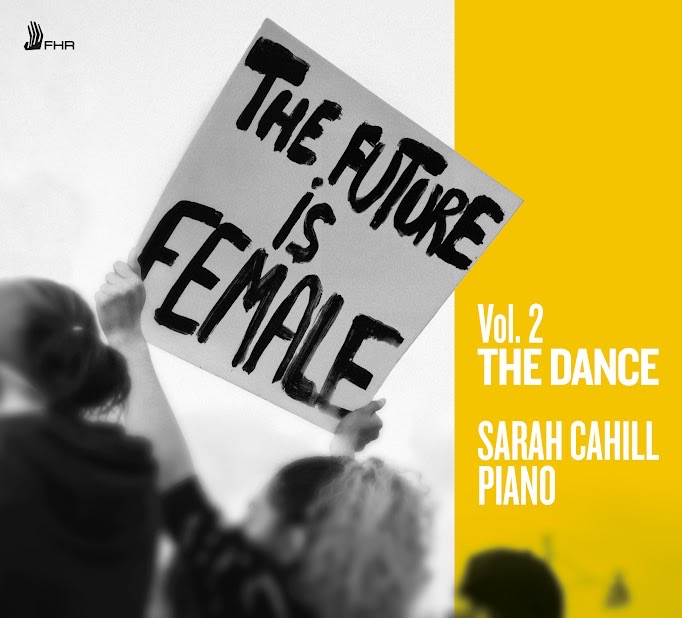
The first two volumes (both previously reviewed in this blog).
Other Minds OM 1022-2
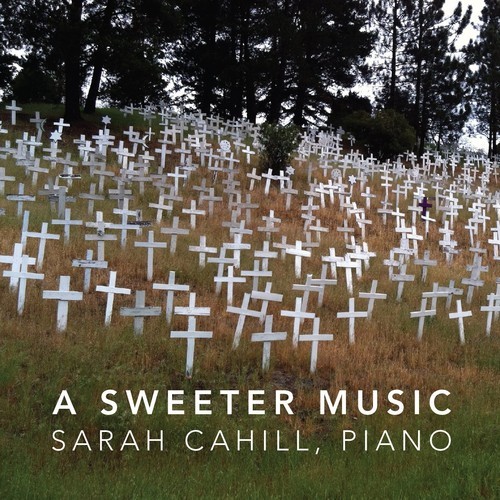
I recall my fascination with Cahill’s earlier commissioning project which resulted in her CD “A Sweeter Music” (2013). I recall attending a very preliminary recital at Mills College where she did brief run through of some of the compositions and spoke about the project. She later toured the music (sometimes with John Sanborn’s wonderful accompanying visuals, sometimes without). Little did Cahill know that she hit upon a genre of classical music dear to this listener’s heart, that of politically inflected classical music. As a result, my interest in her artistry and choices of repertoire escalated tremendously (I heard two of her Bay Area recitals of this music and reviewed the recording in the early incarnation of this very blog). So another project, this time supporting female composers, with even greater dimension than that earlier project has similarly grabbed my attention in this landmark collection of music by women composers which has largely been neglected by mainstream artists, producers, and programmers.
This trilogy of recordings hardly solves the egregious neglect of this music but it does contribute rather authoritatively to the canon (there is one now) of music by non-male composers. Cahill is not the first artist to do this, and there are multiple ongoing projects exploring the work of female composers, but this project deserves top billing as it casts a mighty wide net with its three volumes covering about 300 years (of neglect). These recordings of some 30 pieces are but a fraction of music by women composers in this pianist’s repertoire. But, more than simply righting wrongs, this is about celebrating a legacy of artists getting their due recognition. (The “bad idea” Biblical metaphor of hiding a lamp beneath a basket comes to mind). Just look, er, listen at/to what’s been under that basket!
Cahill playing at the Chapel of the Chimes Solstice Concerts in 2013, a major annual Bay Area event created and managed by her. (Photo by Allan Cronin Creative Commons License)
This now completed trilogy doubtless will not mark the end of Cahill’s advocacy but it will stand as a major manifesto of sorts and will hopefully bring more performers and producers to be open to performing and recording them. Simply hearing these recordings exposes the listener to music of stunning substance selected by an artist whose curatorial radar is finely tuned and whose choices will speak definitively to listeners (and likely fellow performing artists) for years to come. (N.B. Listeners would do well to check out Cahill’s YouTube channel where one can find a gold mine of music which reflects the scope of her performances and advocacy, not just for women composers, but for an amazing range of artists.)
This third volume is entitled, “At Play”. Like the previously released volumes, this collection gets a collective title that vaguely hints at the character of the music herein. The sequencing of the music is, like the previous two volumes, pretty much chronological. The essential program notes by Ms. Cahill (in all three volumes) provide just enough background to provide useful contexts for the listener. And you have to love the “Cahill and friends” photo galleries (on each volume) reflecting the deeply personal nature of this undertaking. That may sound hyperbolic but just listen to this music and feel the love, the passion, the connections, the sincerity, and the incisive playing. (Should I throw in a “Pied Piper” metaphor?) Listen and you’ll likely get hooked.
Track listings
There are 16 tracks comprising nine works by nine female composers over nearly three centuries. Four of the nine works receive here receive their first (or first commercial) recordings. As noted earlier, the track sequence is chronological. (N.B. That makes 30 + works over the 3 CDs), a little less than half of the total commissions.
We begin with the last of 9 sonatas by Hélène de Montgeroult (1764-1836). Her lifespan covers the classical to the early romantic eras in western musical history but recordings of her music didn’t begin to appear until about 2006 when Jérôme Dorival published a biography of her. Listeners will likely find this music similar to that of Mozart, Haydn, and early Beethoven but with a level of virtuosic writing that anticipates Chopin and Liszt. This three movement sonata was published in 1811. This is apparently the second recording of this work as another new music champion, Nicolas Horvath, released a recording of all nine of these in 2021, further testament that time has come for this composer (and perhaps women composers in general).
Next is the Thème varié, Op. 98 (1895) by Cécile CHAMINADE (1857–1944). This late romantic composer is probably the only name with which most listeners may be acquainted. A recording of her Concertino for flute and orchestra (1902) continues to receive attention by classical broadcasters but most of her work remains very little known. Cahill makes a strong case for this music with her interpretation of this virtuosic early romantic styled work. She is far better known in her native France. It is time we see what the French have been hiding.
Grażyna BACEWICZ (1909–1969), represented here by her Scherzo (1934), has gotten recognition in her native Poland but has only fairly recently become known internationally. This early work, less modernist than her later work, has apparently been recorded before but is new to this reviewer’s ears. Bacewicz was a prolific composer and this fine piece, a virtuosic showpiece, is likely to encourage listeners to further explore her extensive catalog which includes Symphonies, Concertos for violin, viola, cello, and for piano, 7 string quartets, symphonies, operas, songs, and much more.
Now Cahill brings us into present time, featuring living composers, beginning with the music of Chinese-American composer Chen YI (b. 1953). Guessing (1989) is a small piano piece which incorporates a Chinese folk song in a set of variations.
This is the first commercial recording of this music. To be honest, I am not familiar with much of this composer’s work (nor most of them here) save for Oliveros and Wong) but this piece as with all the selections here are sufficiently intriguing to prompt listeners to explore further. That is the point of an anthology such as this, to spark curiosity, suggest another path for the journey. Mission accomplished.
Franghiz ALI-ZADEH (b. 1947), born in Azerbaijan, incorporates elements from her ethnic heritage into modern classical idioms. Music for Piano (1989/1997) utilizes Cagean-like preparations, in this case a glass beaded necklace laid across the strings. The resulting sound, evoking Alan Hovhaness and/or Henry Cowell at times, is intended to evoke that of the traditional Azerbaijani string instrument called “tar” (not a reference to the recent film). The composers use of different scales also seems to derive from folk models. The piece is in several sections delineated by dynamics and by register in which is, I believe, an ingenious use of register used to control when to allow for those prepared strings to sound. The piece is by a composer with a wide expressive pallete and the ability to use those methods judiciously toward her unique creative ends.
Next, in the briefest entry at just over 4 minutes, we get one piece from a set of commissions (all by women composers) Cahill made to honor the 100th birthday of American composer Ruth Crawford (1901-1953). Pauline OLIVEROS (1932–2016) submitted this work (her first notated composition since the 60s) which uses her own unique approach to indeterminate composition in Quintuplets Play Pen: Homage to Ruth Crawford (2001), here in its world premiere recording. Oliveros, who exerted a profound influence on a generation of composers, performers, and listeners via her work in electronic music and improvisation, but most powerfully via her “Deep Listening” concepts which effectively define the role of the listener as being a part of the compositional process.
A clearly happy Pauline Oliveros acknowledges the warm applause of the Other Minds 20 audience after her performance at the SF Jazz Center in 2015. Her gentle spirit and powerful intellect preside over this trilogy and continue to influence all who knew her and her work. She would have loved these recordings. (Photo by Allan Cronin Creative Commons license)
I’m claiming fair use in publishing this lovely photo ad for an expensive perfume inspired by the same poem. Kinda Freudian, no?
Hannah KENDALL (b. 1984) is a black British composer whose three movement “On the Chequer’d Field Array’d” (2013) is based on the 1763 poem Caissa by Sir William Jones and depicts the three sections of a game of chess. The lengthy Elizabethan styled poem can easily be read as protofeminist given that the female chess piece heroically wins. Read it if you don’t believe me. And there are musical metaphors as well. It is these: mindplay, middlegame, and coda into which the work is divided. The music, like the poem is an intimate perspective which invites the reader (or hearer of the music) to create their own meanings here.
Aida SHIRAZI (b. 1987), an Iranian born composer, takes the performer inside the piano. Her blandly titled, “Albumblatt” (2017) belies her deep understanding of the piano and its possibilities. This is arguably the most avant garde (or modernist if you prefer) composition of the trilogy. Cahill’s choices reflect her eclectic approach to music programming.
In addition to a chronological approach, this trilogy is stylistically diverse. This music borrows from forbears such as John Cage and Morton Feldman as well as Henry Cowell. This meditative music only reveals itself fully to the focused listener. This is like an etude comprised of sounds you rarely hear (intentionally) from a piano. Played much of the time inside the piano but also at the keyboard more conventionally, the piece also demands close attention to dynamics (down to silence). Here is where the recordist’s art shines through. The subtleties of dynamics and the ability to capture the variety of harmonics evoked. Of course said performer had to accomplish rather large postural changes and do so silently if the performance adheres to the score, lol. And both are accomplished here in what sounds like a single take. This is a pretty great listen.
Regina HARRIS BAIOCCHI (b. 1956), a native Chicagoan poet and composer is given the last word with her, “Piano Poems” (2020). Last but not least by any means is a testament to Cahill’s singular but relevant choices as well as her advocacy of young composers as their stars begin to rise. This artist is new on my radar but one that will remain there. As both poet and composer, this young artist, commissioned by Cahill with a request that the music be about poetry, specifically by fellow (adopted) Chicagoans Gwendoline Brooks (one of this formerly Chicagoan reviewer’s personal faves) and Richard Wright.
The response was these 4 meditations on Brooks, Wright, and on the composer’s own poetical musings. The language here seemingly derives, appropriately, from 30s to 40s jazz of Ellington and Basie and a seemingly latter day version of that in the last two pieces describing the composer’s own literary utterances. Both virtuosic and apparently written by a composer very familiar with the instrument, a fitting and hopeful glimpse to the future.
Each of these discs contains at least one piece that reflects a deeper than average commitment by the performer. Cahill’s collaborative wok (with Dr. John DesMarteau) in the Agi Jambor sonata in volume I, her advocacy of Teresa Wong premiering the first performance of (She dances Naked…),the justly celebrated bay area artist’s selection on volume II. And her reaching out to Regina HARRIS BAIOCCHI for a commission (in volume III) all reflect another valued aspect of this performer.
The recording by Matt Carr is very listener friendly demonstrating serious skills at times in dealing with the many sonic challenges. This album and its two predecessors belong in any serious collector’s library. If the future is indeed female, then this is a fine soundtrack. Listeners, performers, Brava!!
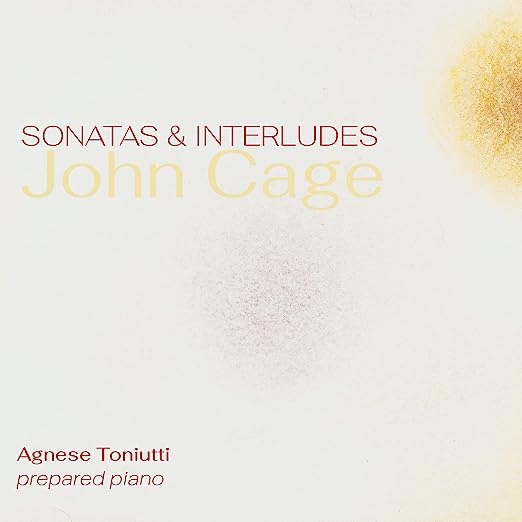
This is the most recent recording by Italian pianist Agnese Toniutti. (her third release by my research). It is also the most recent recording of John Cage’s masterful Sonatas and Interludes (1946-8) for prepared piano, a defining work for that unusual instrument. It has been recorded at least 30 times but is rather rarely heard in live performance.
John Cage is perhaps best known for his challenges to the philosophy and the very definition of music itself epitomized in his infamous silent piece titled 4’33” premiered in 1952. The composer eschewed the notion of a “masterpiece” but irony loving “fate” would hand him that title at least for this set of pieces.
Toniutti, a graduate of The Conservatory of Venice, seems to be as much a researcher and activist as she is a widely skilled pianist. While doubtless schooled in the commonly played repertoire for her instrument, she favors new music and music undeservedly neglected in her performances and recordings as well as the commissioning of new works and finding yet unplayed that strike her fancy.
The Sonatas and Interludes, now some 80 years old doesn’t really qualify as “new music” per se nor can it really be called neglected having been recorded 30+ times. In the context of this release this cycle of pieces seems to function much as a new recording of the Goldberg Variations or the late Beethoven Sonatas might function to introduce the skills of a musician whose trajectory was aimed at the conventional recital hall circuit. Toniutti clearly has other plans.
I won’t attempt to compare this most recent interpretation to the other available recordings. I believe this recording does much to validate the music as an essential work in the western canon of art music and to display the estimable understanding and widely skilled competence of the performer whose work is and will continue to embrace new music and advocate for that music to earn an esteemed place in the minds and hearts of listeners and other performers.
This is a very enjoyable recording whether it is to be a collector’s only recording of this music or one that stands most favorably in comparison to previous recordings. If this is to be your first recording of this work or if you simply want to hear another interpretation, you will not be disappointed. This is a wonderful performance.
Pianist Agnese Toniutti previously released a very forward looking recording on Neuma Records. The 2021 release pictured below is a collection of much more recent music. I listened numerous times and didn’t feel I “got it” well enough to say something reasonably intelligent (if not insightful) until this second release. And while I may not fully understand these “subtle matters” I now have a better context.
Neuma 138
This collection which I had yet to review represents Toniutti’s understanding and appreciation as well as her apparent mission to expand the experimental repertoire for piano. Here is a fascinating set of composers, each with a unique view of her instrument. Just listen, trust this artist. You’ll be glad you did.
Track listing
Keep your eyes and ears open for Agnese Toniutti, an advocate for and a master of the avant garde. And to Ms. Toniutti, I greet you at the beginning of a great career.
There were no percussion ensembles in Western music until the early twentieth century, at least not anything close to the size and instrumental diversity we see now, but since then there have been a variety of percussion ensembles which have popped up. some touring, some recording, but all investigating the possibilities of this collection of pitched and unpitched instruments. Notable examples from this writer’s memory include the Paul Price Percussion Ensemble, the Donald Knaack Percussion Ensemble, Amadinda, and the Canadian group, “Nexus”. Each of these ensembles (the list is not comprehensive) has put their own stamp on the flexibly nebulous group subsumed under the title, “Percussion Ensemble”.
All of these groups have chosen which instruments to include in their group, which to exclude, and they have done their own curation of music to expand their respective repertoires and the percussion group repertoire as a whole. And the present recording presents yet another Third Coast Percussion CD on Cedille Records for this busy Chicago based group. The relationship between this energetic ensemble and the equally energetic Cedille Records has been a mutually beneficial one artistically. this release is the fifth release for that label. They have at least nine other albums as a group and have collaborated on many more recordings.
As noted on the album this disc contains all world premiere recordings that reflect varying degrees of collaboration. One of the unifying threads of this CD is the variety of compositional approaches. The Elfman piece being perhaps the most traditionally notated and structured. The others involve different compositional methods which are not exactly traditional in classical music. It is the exploration of such non-traditional methods and the expansion of the definition of composition that is a characteristic of this always interesting classically trained group of musicians.
Let me just start by saying WOW!!!
The first work on the album is by Danny Elfman (1953- ) is best known for his work in movies and television as the composer of “The Simpsons” theme and similarly energetic scores for Tim Burton’s films among others. His roots were in his work with the unusual pop band “Oingo Boingo” whose manic style is still present in much of Elfman’s work. And this is not his first appearance in this new music blog either. His Violin Concerto was reviewed here. He manages to succeed in pop, film, and the concert hall, a feat that few can match.
Elfman’s rather blandly named, Percussion Quartet (2019) is appropriately described in the liner notes as the most conventional work here in terms of how it was written. It is fully notated in in traditional notation and consists of four movements ranging in length from about 4 minutes to about 6 and a half. The work resembles traditional sonata forms with Elfman’s energetic and sometimes quirky melodies that successfully draw the listener through the composer’s journey. That bland title is almost ironic as it belies the really entertaining qualities of this piece. Third Coast’s realization is definitive as one would hope for a world premiere recording.
The second composition is a transcription by Third Coast of a popular Philip Glass piano work, “Metamorphosis No. 1.” But this is a transcription influenced by another transcription, that of the Brazilian group, “Uakti”. So this can be said to be tantamount to a collaboration with another performing ensemble. Clocking in at nearly ten minutes this track is a familiar interlude that cleanses the aural pallet for what is to come.
Photo by Cary Huws
And what does come next is a collaboratively composed seven movement work entitled, “Perspective”. This more poetic title is the source of the album’s title. This work by Jlin (Jerrilynn Patton 1987- ) was originally written by first recording multiple tracks or layers and then working with the musicians of Third Coast to transcribe these ideas into traditional notation and into a form playable by the quartet of percussionists. This, of course, resembles the methodology that brought forth the wonderful Devonte Hynes album (also on Cedille) reviewed here.
The music is arguably entirely composed by Jlin with the orchestration creatively realized by Third Coast Percussion (doubtless in direct discussion with Jlin). What results is a dizzying and energetic set of movements whose styles derive in part from minimalism and from the rhythmic complexities of African drumming and contemporary dance music. Jlin, who hails from Gary, Indiana, works from a perspective of a DJ spinning dance music. But this is hardly your typical DJ. This is a fascinating musical mind who just happened to have started with DJ equipment.
Flutronix (photo from their website)
Another example of Third Coast Percussion’s creative collaborations has resulted in “Rubix”, a three movement work written (mostly) by Flutronix, a genre busting duo. Flutronix is Nathalie Joachim and Allison Loggins-Hull, both classically trained flautists who aren’t afraid to cross dated boundaries to create music that speaks their minds.
This is some high energy music which reflects a variety of styles but always demands much from all players involved. The duo, whose rendition of Steve Reich’s “Vermont Counterpoint” demonstrates their virtuosity and interpretive rigor. Rubix is essentially a chamber work for flutes and percussion but their defiance of categories seems to be as much a critical element of their music as is their virtuosity. Bottom line is that this is engaging, creative work that leaves the listener wanting more even as they may be unsure what they just heard. Kudos, all!
Make no mistake. This release, a long time in coming, is an essential document of the work of two Bay Area artists whose contributions (frequently behind the scenes) receives some richly deserved attention.
The dyad here consists of Carol Law and Charles Amirkhanian, partners in both life and art, collaborators in sound and image now release this collection of their collaborative works from 1973 to 1985 entitled, “Hypothetical Moments: Collaborative Works (1975-1985)”. This lovingly produced DVD brings together a series of performance art pieces demonstrating an intimate set of collaborations between these two Bay Area artists. Law is a photographer and visual artist whose art works have been displayed internationally in several galleries. Her designs can also be found in some of the striking wearable art she made as promotional/souvenir collectible items sold at concerts and online from the OM store. Amirkhanian is a composer and sound artist as well as a broadcaster and producer who has curated concerts and produced radio programs promoting new and innovative music in the bay area (and beyond) since about 1969.
Carol Law and Charles Amirkhanian acknowledging audience applause at OM 23 in 2018 (Photo by Allan Cronin, Creative Commons License)
Their respective artistic outputs include both individual and collaborative works but, until now, the only chance to experience their collaborative efforts has been in the rare occasions in which these works were performed live. The booklet accompanying this DVD gives a partial list of live performances the most recent of which was in 2018 when OM 23 “The Wages of Syntax” presented a 6 day series of concerts which was an international survey of linguistic sonic arts. Visual analogues and deconstructions of vocal sounds as practiced by artists inspired by language and the expansion of the very definition of art, music, and performance.
Dominic Murcott, peripatetic conductor/drummer about to lead a major new opus by Charles Amirkhanian. (Photo by Allan Cronin, Creative Commons license)
My tardiness in completing this review afforded me a unanticipated perspective on Amirkhanian’s art. The performance of his new composition, “Ratchet Attach It” (2021) at OM 26, pictured here integrates his roots as a percussionist with his penchant for spoken word and sound sampling.
Charles Amirkhanian performing in front of images by Carol Law at OM 23 in 2018 (Photo by Allan Cronin, Creative Commons License)
The collaborations here have roots going back at least to the early twentieth century with the experimental visual innovations of Vassily Kandinsky, Picasso, Miro, and the photographic experiments of Man Ray, etc. Their sonic antecedents include the work of Gertrude Stein, James Joyce, Antonin Artaud, Luigi Russolo, and a panoply of sound artists that Law and Amirkhanian visited in the late 1960s.
In addition to these early experiments one must understand that these creative meldings of sonic and visual art were flourishing in the Bay Area, most obviously in San Francisco where Allan Kaprow’s “happenings”, Bill Graham’s rock concert productions, and similar sound/light shows dominated the fare at performance venues like the Fillmore and similar spaces where innovation in pop/rock music mixed with innovation in visual light shows combined with bands performing for audiences immersing them in mind manifesting artistic assaults that drew crowds frequently also experimenting with not yet illegal psychedelic drugs (the word “psychedelic” is a neologism which means “mind manifesting”). The emblematic event here was the so called “Trips Festival“, a three day event held in 1966 at the Longshoreman’s Hall. I have elsewhere referred to Mr. Amirkhanian as the “Bill Graham of new music”, a comparison which still seems valid.
speaking is speaking (by Bay Area poet Richard Brautigan)
We repeat what we speak and then we are speaking again and that speaking is speaking. Tokyo June sometime, 1976
Well, drugs are not the issue here but mind expansion is. What is documented here is the multimedia collaboration of two essential Bay Area artists who, via their individual and collective efforts effectively expanded the possibilities of both visual and sonic media. These are innovative on many levels. Amirkhanian’s unique take on sound poetry (his anthology “10 + 2: 12 American Text Sound Pieces”) is an essential survey of that genre released on vinyl (now available on OM records ). And Law’s photographs, design, deconstruction and collage methods are integrated into her own unique style of visual art. The performances on this DVD constitute another uniquely San Francisco Bay Area chapter in multimedia, collaborative performance art now made available to a larger audience.
Other Minds (OM 1006-2)
This defining anthology of Law and Amirkhanian’s explorations of sound poetry (first released on vinyl in 1975 on the now defunct 1750 Arch Records) has defined the genre for many (this writer included). Aram Saroyan, Clark Coolidge and Beth Anderson would later appear live at Other Minds 23 in 2018 which outdid the aforementioned “Trips Festival” in a week long festival of sound poetry from an international roster of poets and sound artists.
Now keep in mind that the original presentations of these works from the early 80s utilized the technology of its era, analog recording, magnetic tape, and slide projectors (remember those?). So this 21st century rendition takes this work into contemporary technology and makes available for the first time since their premieres the original marriage of sound and image as intended by the artists. Without getting into McLuhan-esque analyses of the differences and subsequent meanings of the original media versus those on this DVD one need only celebrate the fact that listeners/viewers can now see these works with their originally intended melding of sound and image.
There are 12 tracks:
History of Collage (1981) (original audio release on Mental Radio CRI, 1985)
Audience (1978)
Tremolo Bank (1982)
Dog of Stravinsky (1982) (original audio release on Mental Radio CRI, 1985)
Maroa (1981) (original audio release on Mental Radio CRI, 1985)
Hypothetical Moments (in the intellectual life of southern California) (1981) (original audio release on Mental Radio CRI, 1985)
Awe (1973)
Andas (1982)
Dreams Freud Dreamed (1979)
Too True (1982)
The first nine tracks are the digital adaptation of sound and image accomplished by Dave Taylor. These are the pieces originally performed live in an era using equipment as distant from current technology as MP 3 files are now from magnetic tape. The last three bonus tracks are actual live performance videos (restored by Jim Petrillo) of three 1985 performances which give some of the flavor of the original experience of these works.
Several of these pieces have been released as audio only tracks on Amirkhanian’s CD releases (as noted) and, while they certainly work as audio only experiences, the images add a welcome dimension. The equally striking design by OM resident design master Mark Abramson add a deserving touch of class to the videos and the accompanying booklet which features informative texts on the works as well as a nostalgic collection of photographs featuring the dyadic duo.
I am honored to have a quote reprinted there from my blog review of OM 23 where I and a sizable audience were treated to a fabulous week long live experience of sound poetry featuring this duo’s work alongside that of exhilarating selections of other similar minds’ work. Of course nothing can take the place of the live experience but this production comes close.
This is a must have collectible document for anyone interested in sound poetry and Bay Area artists.
“Whereof one cannot speak, thereof one must remain silent.”- Ludwig Wittgenstein (1921)
This album is satisfying on several levels. It is a return to the label that contained the composer’s his first big release, the three disc set on DG which contained “Drumming” (1971), “Six Pianos”, and “Music for Mallet Instruments, Voices, and Organ” (both from 1973). Of course it was the ECM release of “Music for 18 Musicians” (1974-6) that became his signature work incorporating the experimentation heard in the music in that DG box set into the composer’s now familiar mature compositional language. The present release, also available on vinyl, seemingly reflects the post experimental composer’s grappling with the oh, so classical form of the string quartet. It’s a truly fine release and an homage to the composer.
DG 2740 106
Like many of his peers, Reich eschewed many of the conventions of western art music. His work at the San Francisco Tape Music Center helped him discover “phasing” and use of the speaking voice as a compositional element. His study with master drummers in Ghana taught him about quasi improvisational large ensembles and his subsequent study of Hebrew cantillation further refined his understanding of speech and song in his compositional contexts.
As he is quoted in the accompanying booklet, Reich never thought of attempting to use the string quartet form in his work. But along came the delightfully forward looking and genre breaking Kronos Quartet. That collaboration brought forth his landmark, “Different Trains” (1988). And the rest is, as they say, history. “Triple Quartet” for string quartet and tape (but no voices) came in 1998 and his WTC 9/11 (2010) which used sampled voices much as he did in Different Trains.
To be fair, Reich never appears to have intended to engage with the classical form of the string quartet (or any other classical forms for that matter). He uses the convenient availability of musicians sympathetic and sufficiently skilled to perform his compositions. The fact that they happen to be in string quartets is incidental. Much as the inclusion of a singer (as Schoenberg did) bent the quartet to fit his compositional goals, many have subsequently done similar alterations and additions to that classical ensemble. The difference is that Schoenberg adding a soprano, Kirchner (among others) adding electronics, etc. did so but clearly defined their works as “string quartets”. Reich did not do this but this disengagement with classical forms (string quartet, concerto, symphony, etc.) does not detract from the absolute quality of his music.
It would be unfair and would miss the point to try to judge these works via comparison and contrast with Haydn, Beethoven, Bartok, etc. In fact these works are not a part of that canon. Ultimately they stand on their own as part of Reich’s unique vision as a composer and, as such, they succeed very well.
WTC 9/11 and Different Trains are political statements with specific spoken word samples entered into a musical counterpoint. They succeed very well as protest and memorial for the respective events they frame. Triple Quartet, however, is absolute music concerned solely with Reich’s largely contrapuntal techniques of shifting repeated patterns. All three works succeed very well in their ability to engage audiences. All three are finely wrought compositions by by a major composer true to his maverick, experimental beginnings, true to the artist’s personal vision.
The Mivos Quartet does a fine job of navigating these technically difficult works and produce a fitting homage to a wonderful composer and make a strong case for the deeply substantial nature of this music. This is a great release. Highly recommended.
I had previously reviewed an Innova release by this fine Italian pianist whose compelling musical choices and interpretive skills make him one of the bright lights on the current musical scene. And his European perspective (and affinity for) American composers provide an extremely valuable perspective for both listeners and performers.
It comes as no surprise that that Innova album was produced during Philip Blackburn’s tenure and this release is another illuminating journey guided by Arciuli’s finely tuned curatorial and interpretive skills. The journey here focuses on the late post-minimalist William Duckworth (1943-2012).
The first 12 tracks comprise book I (of two) of Duckworth’s genre defining work, “The Time Curve Preludes” (1977-8). These have been recorded three times, first in 1983 by Neely Bruce (who premiered them in 1979 at Wesleyan). Bruce Brubaker recorded Book I in 2009 and R. Andrew Lee recorded the entire set in 2011.
In addition to Arciuli’s take on this composition (I expect a future release will contain Arciuli’s interpretation of Book II) we get a previously unrecorded set of songs for voice and piano, “Simple Songs About Sex and War” (1983-4) to texts by Hayden Carruth. Here Arciuli is joined by Costanza Savarese, a classical guitarist and vocalist, an artist new to this writer. Here she displays her vocal prowess in these pithy little songs reminiscent in some ways of Barber’s “Hermit Songs”.
Track list
Duckworth deserves more exposure and Arciuli’s work is always revelatory. So what Duckworth will be paired with the Book II recording? Delighted listeners want to know.
I’m guessing that my title has its origins in the Benjamin Britten piece, “The Young Person’s Guide to the Orchestra”. That phrasing has been used by the likes of Phill Niblock and King Crimson to title retrospective compilation discs. While the disc under consideration here is not, strictly speaking, a retrospective it is a fine representation of the chamber music of the late great Ben Johnston (1926-2019).
Johnston, a former associate of Harry Partch (Johnston played in Partch’s ensemble) was a composer in his own right. His ten string quartets are a landmark of the genre. Two of those quartets are featured here played by the Lyris Quartet (Nos. 4 and 9) along with what is apparently his last composition, “Ashokan Farewell” (1999) scored for an octet in which the Lyris is augmented with flute, clarinet, bassoon, and double bass.
Like so many composers before him, Johnston was fond of incorporating folk tunes into his compositions. The composer’s fourth quartet (included here) from 1973, which incorporates “Amazing Grace”, is likely his best known work. Despite its incredible complexity (nicely summarized in Kyle Gann’s lucid liner notes) this set of variations keeps that familiar tune near the surface and effectively make for music that is friendly to the audience, easy on the ears. It’s single movement clocks in at just under 12 minutes, the piece ends long before listeners have time to worry about that complexity.
Not all of the quartets incorporate familiar tunes but they explore various aspects of just intonation tunings. The ninth quartet (1987) is about twice the length of the fourth and is set in the familiar four movements that characterize the majority of the classical string quartet literature. The use of the classical format along with Johnston’s masterful writing also make this slightly odd sounding work just familiar enough that few listeners will find unpleasant. In fact the work is a joy to experience though very difficult to play.
Listeners may want to seek out Mr. Gann’s very readable work on microtonal tuning systems, “The Arithmetic of Listening” available. Your humble reviewer is working through this text and finding it useful in understanding microtonality.
The final work (both the last on the disc and the last in the composer’s ouevre) is a delightful set of variations on a tune called “Ashokan Farewell”, a pretty folk like melody that pervades the Ken Burns Civil War documentary. I say “folk like” because the time was written by Jay Ungar and Molly Mason. Johnston mistakenly believed it to be a folk song in the public domain and, seeing its possibilities for his compositional aspirations, simply used it. Like the fourth quartet it is a set of variations in a single movement of similar length. This is the world premiere recording.
Musicians include Alyssa Park, violin; Shalini Vijayan, violin; Luke Maurer, viola; Timothy Loo, cello; Sara Andon, flute; James Sullivan, clarinet; Scott Worthington, double bass.
In researching this review I discovered that the tune actually has lyrics (also under copyright) and they are presented below:
The sun is sinking low in the sky above Ashokan The pines and the willows know soon we will part There’s a whisper in the wind of promises unspoken And a love that will always remain in my heart
My thoughts will return to the sound of your laughter The magic of moving as one And a time we’ll remember long ever after The moonlight and music and dancing are done
Will we climb the hills once more? Will we walk the woods together? Will I feel you holding me close once again? Will every song we’ve sung stay with us forever? Will you dance in my dreams or my arms until then?
Under the moon the mountains lie sleeping Over the lake the stars shine They wonder if you and I will be keeping The magic and music, or leave them behind.
Ben Johnston
Those lyrics make for a fond farewell to a true musical genius who gave us both magic and music. Grab this lovely disc and honor his memory.
Let me start with a positive image from a brief photography trip which I managed this year. It was one of the highlights of what has been a difficult year for many of us. Weather, politics, COVID, itinerant employment issues, financial, and personal difficulties were an encumbrance but now stand in relief to the many positive aspects of 2022.
First, let me say that nothing musical fell into the category of “worst of” so fear not, what follows is essentially my “best of” from 2022. In my head I blame the aforementioned encumbrances for delays and sheer lack of production on my part. Whether that is the ultimate truth does not matter really so here, for better or worse, is my celebration of the positive experiences enumerated in this music blog in 2022.
This is one of the albums that stoked my interest.
My first post for the year struck a sad note. It was my personal tribute to a composer, A Belated Fan Letter: Homage to George Crumb described George Crumb, who had been one of my “gateway drugs”, so to speak, which helped put me on the exciting roads of new music upon with I continue to travel with great joy. Recordings of his complete works are still being released on the visionary Bridge Records.
Hannah Collins debut on Sono Luminus was a compelling offering from this rising star.
Carolyn Shaw’s striking and much performed “In Manus Tuas” (on solo viola as well as solo cello) was originally written for Collins. Her selections on this album, including that Shaw work, suggest to this writer/listener that she has both vision and an encyclopedic knowledge of music, especially that written for her instrument. She will be among the major shapers of this repertoire via her vision as well as her interpretive talents. And Sono Luminus’ superb sonics certainly helps make this a great release.
The first volume of Sarah Cahill’s landmark trilogy of piano music by women composers.
I have followed the work of Sarah Cahill since her first solo CD (music of Ravel). Like Collins, she has been an artist who, by her intelligent selection of repertoire, serves as a guide to listeners (and musicians) as well. She has championed many composers as a pianist and as a broadcaster on her weekly KALW broadcasts. Her curation of concerts throughout the Bay Area, such as her solstice concerts at Oakland’s Chapel of the Chimes, have showcased a large variety of creative performers.
As she focuses her lens on women composers (neglected is implied) she embraces a stunning range of styles from the baroque era to the present and it seems as though she can play anything she chooses well. She is also collaborative with an amazing ability to discern the substance in the works she chooses to play. And she has discovered (or rescued?) much music from obscurity via scholarship and intelligent collaboration. Can’t wait for the next release. She is consistently interesting and relevant.
This release on Lars Hannibal’s OUR records was a brilliant new recording of some of Ligeti’s music and introduced me to Kodaly’s solo choral works.
This album was sent to me by a friend. I knew the Ligeti pieces but heard them with new ears in this release and I was amazed by the Kodaly works too. Marcus Creed may not be as well known in the U.S. as he is across the pond but he should be.
Another debut album by a cellist.
This album was kindly sent to me for review by John Schneider of Microfest records. Read the review. Listen to this album. And watch for more from Chris Votek, another rising star in 2022.
Dan Lippel’s virtual manifesto displaying his vision and skill as he furthers the mission of the guitarist in all their guises.
Dan Lippel is one of the founders of the fabulous new music label, New Focus Recordings. Here he is acoustic, electric, conventional, and experimental but always interesting. Keep his name on your radar.
Languishing no longer.
This is a gorgeously designed, very collectible art object. It is a beautiful hard cover, full color book which also contains a CD of a recording (from acetate masters) which had languished in the archives of the Eastman/Rochester Music School where Harry Partch gave this lucid lecture/performance in 1942. Mr. Schneider, who sent me the Votek release as well, fronts an ensemble called PARTCH which, in addition to performing Harry Partch ‘s work, is recording Partch’s complete works for David and Becky Starobin’s Bridge label. This one is both eye and ear candy to my ears.
Rescuing those acetate masters from obscurity is a major find that rises in significance (in the musical sense) almost to the level of the archeological discovery of Tut’s Tomb. Schneider is a musician, a composer, a radio broadcaster, and an archivist and now a sonic archeologist I suppose. He also sports a collection of authentic copies of Partch’s curious instruments which were built to play the microtonal scales required. Partch is a major American composer whose work is now gaining its rightful place among the best of American classical music.
Seminal work by an American post minimalist composer.
I first discovered Mr. Susman’s work when I was asked to review a performance of another composer’s work. I heard one of his works played by the remarkable San Jose Chamber Orchestra on that same concert. Here we have another multi volume release of these lovely and significant piano works. The remarkable pianist (mentioned often in these pages) has contracted to record all 4 books of this sort of “Well Tempered Clavier” type gesture which effectively provides much insight to this composer. Nicolas Horvath, known for marathon concerts performing (and subsequently recording) all of Philip Glass’ piano music, among others. (We’re talking 15 hours or so. There is also a 35 hour live rendition of Erik Satie’s “Vexations” on you tube.) Who better to record these? The remaining three volumes are due some time this year. Who better to take on this post minimalist set of pieces? Can’t wait for the next volume.
Kondonassis’ new music manifesto for the Harp (and the earth).
Yolanda Kondonassis is about as household a name that you can find among harpists. These five minute (more or less) pieces are a significant addition to the solo harp repertoire. They are forward looking works for her instrument. Very interesting work, excellently performed.
New piano music written for Jacob Greenberg
I remain in awe at the curatorial and historically aware work of this truly fine pianist. Greenberg helped me grasp the historical context of the Second Viennese School in a new way with his earlier release “Book of the Hanging Gardens”. In that release he played all the Debussy Preludes along with Schoenberg’s pre twelve tone song cycle, Webern’s Variations, and the Berg Sonata which helped this listener to better grasp the historical context of this music. This small collection of works written for him reflects a collaborative and visionary ethic akin to that of Sarah Cahill’s. Keep an ear out for this guy.
Lou Harrison’s brief Solo Violin Sonata
I have received some good natured teasing about the fact that this, one of my longer reviews, is of a 15 minute piece of music. But this act of musical archeology by the bay area’s Kate Stenberg (who is a regular collaborator with Sarah Cahill BTW) has made the first recording of this little work. It’s Webernian duration belies a style very much in character with this beloved composer’s other work. My review was as much about the music and the recording as it was about the dedication of Stenberg to new music. This release is from Other Minds, another shining example of advocacy of new music and collaboration among composers and performers. Get it. Listen to it. And don’t miss a chance to hear Stenberg live performances or to hear anything Harrison has written.
Music between the wars
The Chicago based Cedille label is one of my favorite classical music labels. Producer James Ginsburg has a golden ear and Cedille is the finest Chicago based classical label since the justly fabled Mercury records. All their releases deserve attention but this two disc set of little known works for String Trio written between the world wars is a feast of substantive, if slightly conservative, voices. This one is a great listen and, trust me, none of this music is in your collection.
Other Minds Executive and Artistic Director of Other Minds Charles Amirkhanian applauds a rare performance of his own music at OM 26.
While circumstances conspired to limit my attendance to only one of the three days of OM 26, I would be loathe to leave this world class music festival off my “best of” list. My first published blog of 2023 was of the 30th anniversary celebration which showcased Marc-Andre Hamelin’s stunning reading of Charles Ives’ massive Concord Sonata. Anything OM does deserves your attention but the roughly annual festival continues to present composers and performers from around the world. Not to be missed.
Volume two of three
Another exciting release of Cahill’s visionary series. Like the previous volume (and the aforementioned Cedille release) the consumer will suffer no unnecessary duplications if the music herein. Fascinating and expertly done. This set (the third volume due this year) is a testament to Cahill’s encyclopedic knowledge of piano music as well as her collaborative nature and, of course, her skills as a pianist.
A new voice in electroacoustic composition Kataro Suzuki.
I’m cheating a bit here since I wasn’t able to complete my review until 2023 but this Starkland disc was released in 2022 and definitely earns its place in my “best of” list. This rising star is another one to watch. Starkland, run by the dynamic Tom Steenland is one of those labels that reliably finds interesting and substantive new music. This one is no exception. It goes a long way to alleviating my skepticism of the electroacoustic genre.
DVD OM 4001
And, in order to be fair I must cheat equitably. Charles Amirkhanian kindly sent me this exciting and excellent DVD of his collaboration with his partner in life and in artistic crimes, Carol Law. My more extensive review will appear shortly but this was a major release in 2022. Amirkhanian spends far less time promoting and performing his own unique compositions so this is an especially welcome release.
Neuma
Last but not least of my best of 2022 is this wonderful Neuma release which, when I began my research to write a cogent and informed review, left me stunned at how little I actually knew about composer David Tudor and the astounding dimensions of this unusual piece that evolves with every performance. After gathering a whole ton of data I finally decided that I could not write a comprehensive review without more research so I settled on a tasteful (I hope) summary with the expectation that I will write a larger piece on Tudor and his work. The review will be out very shortly. This is an amazing and significant release.
Happy 2023 to all my readers and thanks to those who kept reading my blog during more fallow times. I have many blogs currently in preparation that I look forward to sharing in the months to come. Peace, health, and music to all.
This is not, strictly speaking, an autobiography. It is perhaps more in the style of a memoir. It traces the career and life of a woman whose voice drove much of the avant garde from the 1950’s to the 1980’s. It is told with a sober tone as the artist looks back on the highs and lows of life and career well spent. She tactfully shares just enough of her personal life and relationships to provide a context for her tales.
Anyone with an interest in new music during those years had to encounter Beardslee’s carefully cultivated soprano voice. Along with names like Phyllis Bryn-Julson, Cathy Berberian, and Jan De Gaetani, hers was a very familiar and welcome voice which led listeners (including this writer) reliably and frequently definitively through the plurality of styles that comprise the 20th Century. Of course she was trained in and also sang the so called “classics” meaning Mozart, Beethoven, Schubert, Schumann etc. but she will likely be best known for her extraordinary service to new music.
Beardslee’s lengthy and sometimes rambling tome is a very personal look at a long and productive career. She recounts teachers, other singers, composers, conductors, accompanists, and husbands over the span of a rich and interesting career. The rambling quality of her prose serves only to cast an even more personal light on these accounts of her life and artistry. Never is there a dull moment and this book will delight singers, composers, historians, and just plain listeners.
In the end this was a very satisfying read and the intelligent decision to include a discography as well as a list of Ms. Beardslee’s world and US premieres makes this book a useful document for further research into her career and the music which drove it.
This disc was this reviewer’s first hearing of music by the Chinese American composer Du Yun and OMG, as they say. Just WOW on so many levels. The ten tracks contain music written between 1999 and 2015.
It is truly a tour de force on many levels. No surprise that this artist has received so many accolades. This sampling of her work by the always interesting International Contemporary Ensemble released by the increasingly vital New Focus recordings (on their TUNDRA imprint). There are no fewer than ten works on ten tracks.
This has been one of those “How could I have missed this…” experiences. There is a wealth of music here ranging in style from free jazz to modernism (think Darmstadt perhaps) to world music and they blend well the style of this major Chinese-American composer.
She is the recipient of numerous prizes (including a Pulitzer for her opera Angel’s Bone in 2017). She is the regular recipient of commissions from the Fromm Foundation, the Rockefeller Foundation, Opera America, and the Asian Cultural Council among others. She is also a Guggenheim fellow.
The poetic, sometimes cryptic titles of her works and the liner notes are brief but succinct. The serious listener will want to know more about the composer and her wide ranging talents. She writes for every genre and ensemble from opera to solo work and from intensely personal music to clever collaborations.
Add to this the fact that the performers are from the wonderful International Contemporary Ensemble (also known as “ICE”). Anything they do is worth the adventurous listener’s attention and this album supports that contention most successfully. The irony of that acronym is hard to miss in the composer’s grant from the Carnegie Foundation’s “Great Immigrants” program. Perhaps that can rescue the association of said acronym to art rather than regressive politics.
As usual with New Focus (the parent label of this TUNDRA release) the recording is lucid and does justice to the music. The cover design alone is a striking portrait of the composer (another reason to lament the 12 x 12 format of LPs as a size standard).
It took this listener several listens to begin to grasp this music. It is varied and sometimes complex but it is always compelling and seems to have depth and substance. If you don’t know this composer this is a fine place to start and if you already know her work you will want to add this fine recording to your collection.
Conjuring the spirits of the 1950s/ 60s avant-garde and a few musical references composer Mathew Rosenblum (1954- ) enlists the klezmer spirit of none other than David Krakauer and master conductor Gil Rose with his wonderful Boston Modern Orchestra Project to bring life to this klezmer clarinet concerto.
The concerto, titled, “Lament/Witches Sabbath” (2017) is a tour de force for the soloist and certainly a challenge for the large orchestra. Using elements of klezmer style along with musical references such as Berlioz in suggesting the evil sabbath revels the composer creates an unusual but fascinating canvas. Nothing evil here, just some truly exciting musicianship. In addition we hear various noisy avant-garde effects and even voice overs reminiscent of Robert Ashley. Ultimately it is also a species of classical which has a sociopolitical view and this is both memory and homage to the composer’s past, lamenting the suffering and pondering the evil that fueled it.
Krakauer’s facility with his instrument is simply astonishing. He has the klezmer thing down but he also brings with him a great virtuosity as a classical clarinetist and a working knowledge of free jazz. It’s not clear how much creativity this soloist was allowed within the constraints of the piece but the bottom line is that it works very well. Gil Rose’ expertise in handling all this potential chaos is impressive as always and he delivers ultimately a very enjoyable performance despite those noisy avant-garde moments. Indeed it is Rose’ ability to select repertoire with which he can grasp and from which he can conjure a compelling performance. It is Rosenblum’s family biography taking him from the pogroms of the Ukraine to the United States.
The second track (of 4) is a solo for percussion. Again the avant-garde remains interesting and both performance and recording communicate well with the listener. Northern Flicker (2013) is no filler, it is an interesting, if rather brief, work. Lisa Pegher is the busy soloist.
Falling (2013) is a complex work involving pre-recorded audio as well as a chamber group in a song cycle based on the James Dickey poem of the same name. It is a retelling of an incident in which an airline stewardess who died when she was sucked out of a defective emergency exit in the plane and fell to her death. The cycle recounts an imagined look into her psyche as she fell to her death. It is an affecting, if unusual, presentation but Rosenblum’s judicious use of modern elements while still using recognizable melodies and more traditional techniques make for a listenable, if harrowing, experience.
Here the Pittsburgh New Music Ensemble consisting of Lindsey Goodman, flute; Eric Jacobs, clarinet; Nathalie Shaw, violin; Norbert Lewandowski, cello; Ian Rosenbaum, percussion; and Oscar Micaelsson, piano/keyboard join with soprano Lindsey Kesselman with conductor Kevin Noe to produce this rewarding work.
Finally we get another large work, this time for multi-tracked string quartet with percussion titled Last Round (2015) which is also biographical in that the composer is attempting to evoke a time in the 1980s when he frequented an establishment with fellow composers. The composer, in his entertaining and informative liner notes recounts his time with fellow composer Lee Hyla and friends and seeks to evoke elements of the downtown scene of that era. This is a rather large work with its own complexities but one which speaks easily to an audience, even one not experienced in the time and place the composer attempts to evoke.
This is a marvelous recording of a music by a composer unfamiliar to this writer (until now) whose work deserves your attention.
The Julliard Quartet is a hallowed name in classical music. This release reflecting its current generation of musicians is consistent with their practice of playing established classics alongside the modern. These are interesting choices of string quartets from the 18th, 20th, and 21st centuries.
Many will likely speculate on the motivations for these choices but it is a typical set of choices for a Juilliard Quartet recital, an intelligent mix of standard repertoire, not the “usual suspects” or most popular but musically solid pieces. And, of course, there is their all important embrace of the modern.
The Beethoven and the Barton are lovely choices intelligently played but the real draw, at least for this reviewer is the Davidovsky. Mario Davidovsky (1934- ) is a major American composer who deserves more performances and documentation of his work. Fortunately Bridge Records has taken on this task.
He is best known for his “Synchronisms” series pairing electronics with various acoustic instruments. This won him a Pulitzer Prize. But his music sans electronics is just as substantial and this 2016 String Quartet, his sixth, provides ample evidence of that substance.
Near as I can tell this is only the second recording of any of his quartets but it is sufficiently intriguing to whet the appetite for the other 5.
As a recital disc this one is thoroughly enjoyable and it’s inclusion of the Davidovsky is gloriously consistent with the overall image of the hallowed name of the Juilliard Quartet.
The selection of repertoire suggests that this release is targeted Stan audience which enjoys contemporary solo cello music. No pairing with earlier established warhorses such as Brahms Cello Sonatas, and no electronics either. Just a highly skilled musician and her incredible technique navigating these relatively recent examples of this genre from two acknowledged living masters, Esa-Pekka Salonen and Kaija Saariaho. It is a daring and unusual program for cellist Wilhelmina Smith but it works as a dazzling display of her skills.
Salonen is, of course, one of the best known composer conductors working today. This reviewer’s only other exposure to Salonen’s work thus far has been the gorgeous Cello Concerto reviewed here. No question that this is a name worthy of your attention.
And if you enjoy new music you will be familiar with Kaija Saariaho (1952- ). Since she first burst on the scene in the early 1980s she has produced one success after another in pretty much all genres. Like Salonen she is Finnish by birth but has taken her rightful place as an internationally renowned composer.
The performances are virtuosic and deeply felt. The complex range of sounds evoked are rich and stunning. Highly recommended.
The arrestingly beautiful portrait that graces the cover of this album should be enough of a cover to judge this release favorably. Just the presence of these two women suggests that you’re in for some serious music making. Add to that the fact that this is one of those impeccable Cedille releases and you know that you, the listener, will not be disappointed. Here is another offering for Women’s History Month (even though the disc was released in November, 2018).
Kaija Saariaho (1952- ) is possibly the hottest composer to come out of Finland since Sibelius. Her career has steadily grown and she has written for chamber ensemble, stage, and orchestra. It is somehow satisfying to have this little portrait of her work. (This reviewer’s first encounter with the composer was in 1987 when the Kronos Quartet premiered her Nymphea for string quartet and electronics.) Five works are selected here and, if you don’t know this composer’s work, think Debussy, Takemitsu, and their ilk. No electronics on this disc though. Her work is a unique expression and pretty much listener friendly whether or not she uses electronics.
There are four chamber music pieces and a nice new performance of her masterful violin concerto, “Graal Théâtre”. Saariaho is so prolific such that one can only do a sort of “snapshot” selection of her work on a single CD. A decent retrospective would likely require several more discs.
Jennifer Koh is without doubt one of the finest violinists working today, especially in contemporary music. She even broke ground in one of the coolest blind castings in contemporary performance playing Einstein in Glass’ opera, “Einstein on the Beach”. For those who are unfamiliar the role of Einstein requires a violinist wearing a wig who plays some mighty difficult violin music at different points during the opera. This writer heard her in performance of this role at the revival in Berkeley a few years ago and it is a mark of Koh’s expertise that she made the role her own. Her range (which includes more conventional repertoire like Mozart, Tchaikovsky, etc.) is simply astounding and her technical ability puts her in competition for an ever growing list of commissions and other works she has added to her repertoire.
On this CD we get to hear Koh in the intimate settings of chamber music where the skills of listening to others is so critical as the individual voices weave their parts though the texture. While Saariaho is basically a well trained modernist romanticism and perhaps impressionism still remain a part of her palette. Joining Koh in the chamber pieces are: Nicholas Hodges, piano; Hsin Yun Huang, viola; Wilhelmina Smith, cello; Anssi Karttunen, cello;
Of course the big showpiece here is the violin concerto from 1994. This large scale work is actually as lucid and detailed as her chamber music, albeit with a larger range of sounds. It is a masterful composition and this appears to be the second recording it has received though apparently the first recording of the version with reduced orchestra played by the Curtis 20/21 Ensemble conducted by Conner Gray Covington (another reason to want this album). I wasn’t able to locate the other recording with Gidon Kremer but it is a good sign when you have more than one top soloist recording your work. Brava Ms. Koh and Ms. Saariaho! This is a collaboration blessed by the Gods. Saariaho x Koh = bliss.