When Bassist Robert Black (1956-2023) succumbed to colon cancer this past June, the music world lost one of its finest advocates, performers, and teachers. This posthumous release of composer John Luther Adams’ (1953- ) works for solo and multiple bassists receive definitively beautiful renditions here in this satisfying release in which Maestro Black plays all parts (two works are for solo double bass and one work is for 5 double basses). It strikes this listener as a fitting eulogy for Robert Black and his fine performance legacy.
Robert Alan Black (1956-2023)
First, let me say that the Cold Blue label has defined its own take on post minimalist experimentation, it’s one of those labels that I recommend you just buy anything they choose to release. So this chamber music by John Luther Adams fits most comfortably within the little niche that Cold Blue defines (sort of). In fact this is Adams’ 9th CD on this label. And Robert Black is perhaps the ideal musician to plumb the sonic depths of this “other John Adams”. This listener can’t imagine these works having been done better. These performances are definitive, an example of interpretation with which all subsequent performers will have to contend.
The opening work, “Those High Places” (2007) is a work in three movements, originally for solo violin, played here for the first time on a double bass. Black pretty much reimagines Adams’ piece for his instrument. This is not mere transcription. This version is virtually a new work in the soloist’s sensitive and insightful hands.
Those three movements serve, as do the last three tracks on this album, as bookends, nicely framing the centerpiece, “Darkness and Scattered Light” (2023). Unlike those bookends, this work is in one large movement and is scored for 5 double basses. This multitrack recording is an essential and very effectively produced effort that does as much justice to the composer’s intent as does the effort of the performer.
The last three tracks are, in their compositional processes, intimately linked to that first three tracks. Both rely on special tunings to produce the intended effects.
This release is also a fine example of the artistic style that characterizes the look that accompanies the sounds within. The photography, the overall design, visually pleasing, creating a metaphor for the sound of the recording, and paying respectful homage to composer and performer. This just fires on all cylinders for me. This is Cold Blue at their best.
There are, by my count, at least 8 discs on this fine audiophile label dedicated to music by composers from Iceland. That country’s musical prowess deserves to be better known as does their world class orchestra. I’m reviewing these back to back releases together because they are both Iceland Symphony recordings presenting new music by (mostly) Icelandic composers. And they have a secret connection.
This first disc is a nice mix of music by five different composers in works that really give the orchestra an opportunity to shine. Under the direction of composer/conductor Daniel Bjarnason we are availed of the sound of now, or at least Bjarnason’s “now”.
Track list
This disc, which seems to have a “outer space”theme in large part, opens with a large orchestral work from the most deservedly best known Icelandic classical composer, Anna Thorvaldsdottir. “Catamorphosis” is a 20+ minute work for full orchestra and then some. Her style initially reminded this listener of the sound mass of music like Ligeti and Penderecki. But her harmonic language is more lush and romantic. She has an astounding skill in writing for large orchestra, producing at times the modern equivalent of Impressionism. Her use of motives suggest she has digested ideas from minimalist/pattern composers. And at the end of the day (or the review), one realizes that she has developed her own voice.
The subtle colors of this work are well defined by the orchestra under Bjarnason’s truly expert guidance but also via the sonics that the Sono Luminus engineers are able to capture. This sounds like a difficult work to perform but Bjarnason manages to create a definitive performance and Sono Luminus’ sonics are, as always first rate.
Catamorphosis (2022) is typical of Thorvaldsdottir’s writing for large orchestra reflecting her skills as an orchestrator as well as her imagination, her ability to create a wide palette of subtle sound forms that suggest a sort of post impressionist style. The poetic and metaphorical titles tell little about the musical content (or structure for that matter). But her ability to create cohesive and compelling compositions such as this provide an experience that will likely evoke images for the listener, a sort of movie for the mind. So feel free to conjure your own images in this 7 part (played without pause) work and/or listen and watch a recent Elephilharmonie performance on YouTube here.
Missy Mazzoli’s comparatively brief “Symphony for Orbiting Spheres” (2014 rev 2016) taps into a vein of inspiration seemingly related to the cosmic images of Thorvaldsdottir. Mazzoli incorporates an electronic keyboard and harmonicas, among several less common instruments used in symphony orchestras, to create her own sonic cosmic fantasy. Please click the link on her name above to learn more about this rising star from her nicely designed website.
Daniel Bjarnason demonstrates his own formidable compositional chops with “From Space I Saw Earth” (2019). And this track also provides a link of sorts to the other album reviewed in this blog entry. This work, written on commission for the 100th anniversary of the LA Philarmonic, is a work that requires three conductors. The premiere was led by Zubin Mehta, Gustavo Dudamel, and Esa-Pekka Salonen, all of whom have significant connections to the orchestra (Mehta as conductor Emeritus, Dudamel as present chief conductor, and Salonen as conductor laureate). That was the premiere but this recording is conducted by Bjarnason along with Kornilios Michalaidis, and the then incoming chief conductor of the Iceland Symphony, Eva Ollikainen. Therein lies the “secret connection” to which I referred earlier.
María Huld Markan Sigfúsdóttir (1980- ) is a violinist and composer. Her orchestral work, “Clockworking” is a sort of post minimalist work with a gently driving Ostinato in the percussion. It reminds this reviewer variously of Birtwistle’s “Chronometer”, Ligeti’s “Poeme Symphonique”, to name a few but it is not derivative of these in any way. It is a very listenable and enjoyable orchestral work.
Bára Gísladóttir (1989- ) is a composer, vocalist, and double bass player based in Copenhagen.This, the briefest work on the album is at times the quietest and at others the loudest work here. I would add that it is also the most avant garde. Relying on a battery of percussion and what appears to be some extended instrumental techniques the composer creates a world that to this reviewer’s ears sound a bit like Gyorgy Ligeti’s work “Atmospheres” (1968). That’s not meant to say it’s derivative, just that it could conceivably be used for that famous psychedelic sequence from Stanley Kubrick’s masterful “2001, A Space Odyssey” where my own young ears first heard the Ligeti work.
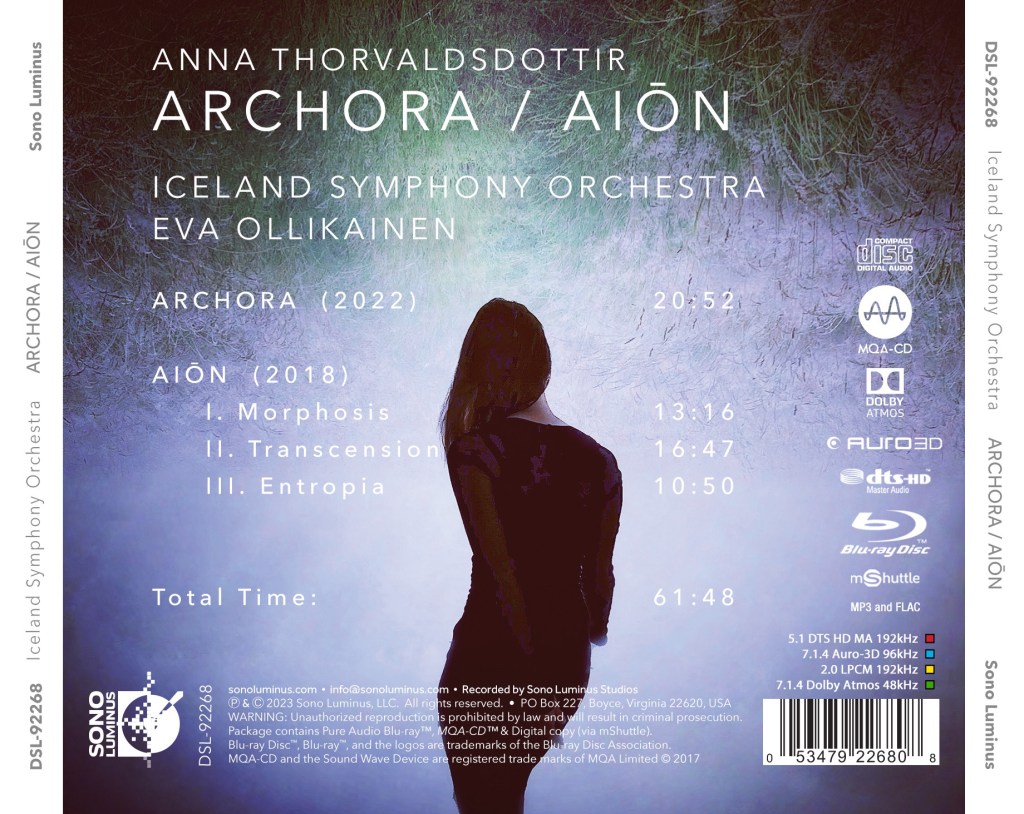
DSL- 92268
As fabulous as that first disc is, this release, dedicated entirely to the work of Anna Thorvaldsdottir, is a worthy endeavor. In addition to that we are treated to the sublime and insightful artistry of the first female principal conductor of the Iceland Symphony, Eva Ollikainen who leads the Iceland Symphony on this disc.
Like the above release, the Iceland Symphony Orchestra demonstrates their world class artistry. This is not easy music to play but, under Ollikainen, as they have under her predecessor, they are able to articulate the intricately orchestrated sounds by this really astounding composer.
Just two works here. “Archora” (2022) and “Aion” (2018). Both are works of grand concept and could easily be called symphonies but the composer seems fond of metaphoric poetic titles. Regardless of the names given these works they demonstrate the composer’s grand sonic visions and her mastery of the orchestra, a mastery grasped very clearly by the Iceland Symphony’s new artistic director and conductor, Eva Ollikainen (1982- ). She holds the distinction of being the first woman to hold the post to which she was appointed in 2019.
Track list
There are only two works presented but both are stunning examples of some of the finest new music being produced today. Yes, it’s great to see women having a greater presence (both as composers and conductors) but, truly, Thorvaldsdottir is “the bomb”, so to speak. Her creativity, her mastery of the orchestra are simply a revelatory as well as entertaining listening experience.
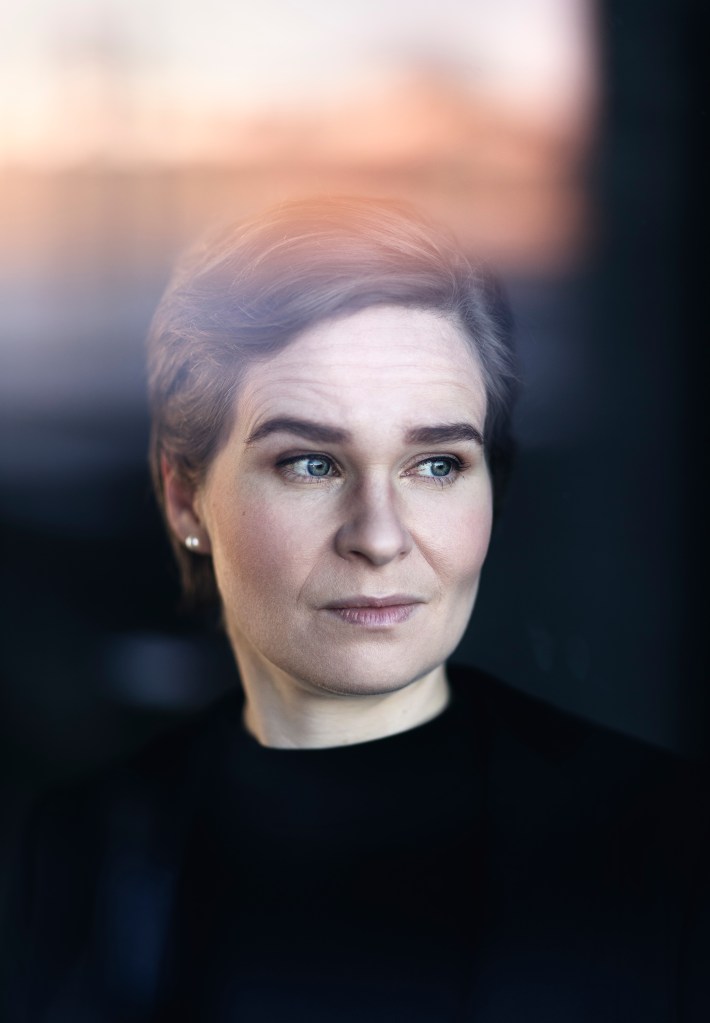
Eva Ollikainen
This release is also a landmark which showcases the formidable talent of the Icelandic Symphony’s new conductor. In addition to breaking gender barriers she is quite simply a rising star and one of the finest interpreters of new music today.
“Archora” (2022) is the most recent work here and it’s another of Thorvaldsdottir’s sprawling cinematic tone poems. No specific story here but the composer’s mastery of orchestral color will doubtless evoke images and feelings in the listener. Thorvaldsdottir is creating a sort of sonic (as opposed to literal) mythology. Her reference points seem to be largely in Greek and Roman mythology but also in Nordic and Northern European myths. Eva Ollikainen conducted the world premiere at the 2022 BBC Proms. You can hear that performance on YouTube here. But the Sono Luminus recording captures more of the subtle sound colors of this engaging work.
The composer’s three movement, “Aion” (2018) concludes this recording. Aion is a Greek God of time. The composer is concerned with various aspects of time in her work. This large three movement work is virtually a symphony with an augmented orchestra, extended instrumental techniques, and an optional choreographic accompaniment. (Tell me that’s not cinematic). There is an example of the optional choreography here.
This recording is also a fine introduction to conductor Eva Ollikainen who clearly has a grasp of this music. Various examples of her interpretive genius can be found on YouTube ranging from Beethoven to new contemporary masters.
These are two truly fine discs both musically and for sheer sonic detail. They’re available in streaming and hard copy CD as well as Blue Ray Audio. These are a fabulous listening experience. Enjoy!
I’m guessing that my title has its origins in the Benjamin Britten piece, “The Young Person’s Guide to the Orchestra”. That phrasing has been used by the likes of Phill Niblock and King Crimson to title retrospective compilation discs. While the disc under consideration here is not, strictly speaking, a retrospective it is a fine representation of the chamber music of the late great Ben Johnston (1926-2019).
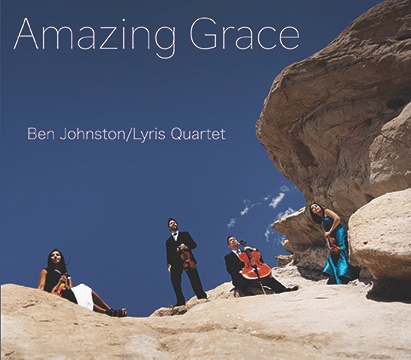
Johnston, a former associate of Harry Partch (Johnston played in Partch’s ensemble) was a composer in his own right. His ten string quartets are a landmark of the genre. Two of those quartets are featured here played by the Lyris Quartet (Nos. 4 and 9) along with what is apparently his last composition, “Ashokan Farewell” (1999) scored for an octet in which the Lyris is augmented with flute, clarinet, bassoon, and double bass.
Like so many composers before him, Johnston was fond of incorporating folk tunes into his compositions. The composer’s fourth quartet (included here) from 1973, which incorporates “Amazing Grace”, is likely his best known work. Despite its incredible complexity (nicely summarized in Kyle Gann’s lucid liner notes) this set of variations keeps that familiar tune near the surface and effectively make for music that is friendly to the audience, easy on the ears. It’s single movement clocks in at just under 12 minutes, the piece ends long before listeners have time to worry about that complexity.
Not all of the quartets incorporate familiar tunes but they explore various aspects of just intonation tunings. The ninth quartet (1987) is about twice the length of the fourth and is set in the familiar four movements that characterize the majority of the classical string quartet literature. The use of the classical format along with Johnston’s masterful writing also make this slightly odd sounding work just familiar enough that few listeners will find unpleasant. In fact the work is a joy to experience though very difficult to play.
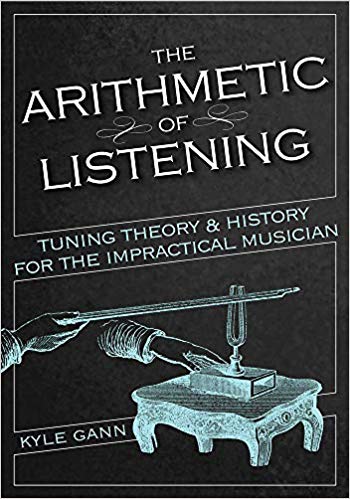
Listeners may want to seek out Mr. Gann’s very readable work on microtonal tuning systems, “The Arithmetic of Listening” available. Your humble reviewer is working through this text and finding it useful in understanding microtonality.
The final work (both the last on the disc and the last in the composer’s ouevre) is a delightful set of variations on a tune called “Ashokan Farewell”, a pretty folk like melody that pervades the Ken Burns Civil War documentary. I say “folk like” because the time was written by Jay Ungar and Molly Mason. Johnston mistakenly believed it to be a folk song in the public domain and, seeing its possibilities for his compositional aspirations, simply used it. Like the fourth quartet it is a set of variations in a single movement of similar length. This is the world premiere recording.
Musicians include Alyssa Park, violin; Shalini Vijayan, violin; Luke Maurer, viola; Timothy Loo, cello; Sara Andon, flute; James Sullivan, clarinet; Scott Worthington, double bass.
In researching this review I discovered that the tune actually has lyrics (also under copyright) and they are presented below:
The sun is sinking low in the sky above Ashokan The pines and the willows know soon we will part There’s a whisper in the wind of promises unspoken And a love that will always remain in my heart
My thoughts will return to the sound of your laughter The magic of moving as one And a time we’ll remember long ever after The moonlight and music and dancing are done
Will we climb the hills once more? Will we walk the woods together? Will I feel you holding me close once again? Will every song we’ve sung stay with us forever? Will you dance in my dreams or my arms until then?
Under the moon the mountains lie sleeping Over the lake the stars shine They wonder if you and I will be keeping The magic and music, or leave them behind.
Ben Johnston
Those lyrics make for a fond farewell to a true musical genius who gave us both magic and music. Grab this lovely disc and honor his memory.
I have attended nearly every OM annual concert series since 2012. But pesky adult responsibilities intervened for the last few years. Having had to miss OM 25 due to my out of town work I resolved to make it to OM 26 now that I am back in California. However circumstances conspired such that I was only able to make one night of this essential new music festival.
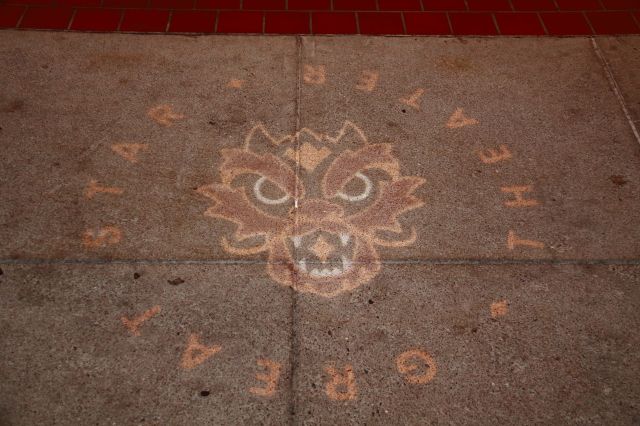
Sidewalk Projection in Front of Theater
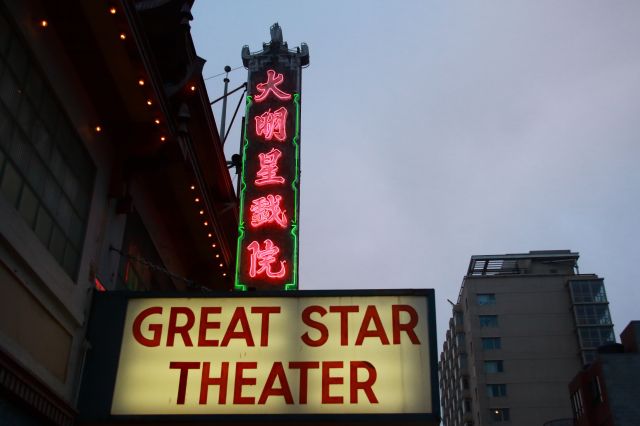
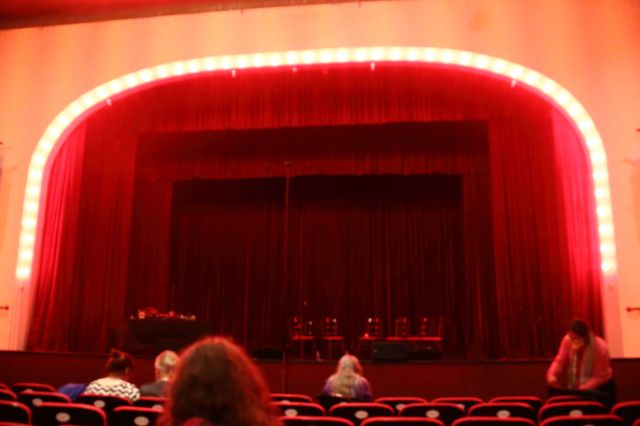
I do plan to listen to the archived audio and video streams which Other Minds now provides. but nothing can truly take the place of live performances. And, in addition to providing some wonderful sonic ear candy, there is the spectacle of the performances themselves. On top of that, these performances have showcased many wonderful performance spaces such as the The Jewish Community Center, The SF Jazz Center to name a few of them. OM 26 was held at the historic Great Star Theater in San Francisco’s Chinatown neighborhood, a venue known for presenting traditional Chinese Opera (in fact Chinese Opera continues to be on the bill for this charming little performance space).
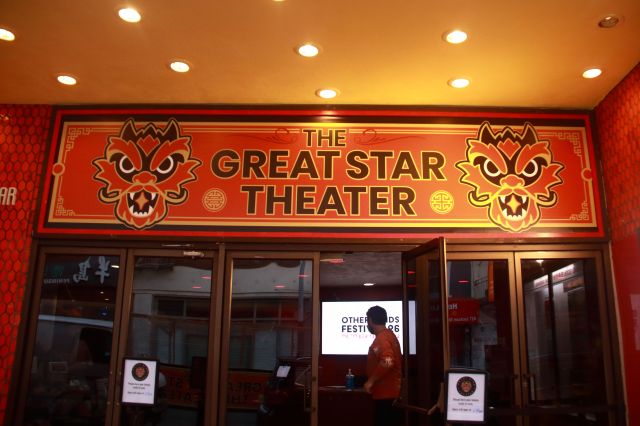
Lobby entrance.
A heavy fog enveloped the northern end of the city as I approached the venue but the sun greeted me when I reached my destination. According to their website this theater is “Located in San Francisco’s renowned Chinatown, the historic Great Star Theater is a one-of-a-kind venue. Built in 1925, this traditional proscenium stage live theater was originally home to Cantonese Opera and Hong Kong kung-fu movies. Recently under new management and newly renovated and revitalized, it now features a variety of theatrical, musical, circus, and motion pictures for a new generation.”
View of stage
The 438 seat theater was more than adequate to accommodate the small but fervent crowd of Other Minds fans. There were seats to be had but the small audience was a highly appreciative one willing to open themselves to the adventure of new music curated by Charles Amirkhanian who has presided over the new music scene of the Bay Area ever since his tenure as classical music director of radio station KPFA which began in 1969. The Fresno native studied at Mills College, earning an MFA in 1980. While his tenure at KPFA ended in 1992, his involvement in new music productions continued. During that time he recorded interviews with nearly every area composer and musician as well as a panoply of international artists. His gentle, friendly manner along with his mellifluous resonant baritone voice (one that looms large in his sound poetry) has served him well in radio and in his large catalog of interviews. He founded Other Minds in 1992 with television producer (now president emeritus of Other Minds) Jim Newman.
What I Missed
In this 26th incarnation of this iconic series of new music concerts the following were presented on the first concert:
Missing this fabulous first night was a painful experience. Theresa Wong is a fine musician/performer from the Bay Area. Her name, of course, occurs elsewhere in the pages of this blog, She is not to be missed as composer, as cellist, as performer.
Mari Kimura, no stranger to Other Minds fans, is one whose work I do not know. But it is by introduction of stunningly intelligent and skilled artists such as this one that the OM fan can safely put on their collective and individual radar, sure that their/our attention is not misspent.
Pulitzer Prize Winner Raven Chacon is one of those fine artists about whom Other Minds (aka Mr. Amirkhanian) can say “I told you so,” If you studied your emails you will find a link to an OM interview with maestro Chacon. He is a Native American (Navajo Nation) musician whose experiments caught the eye/ear of OM and resulted in an appearance and interview. How wonderful for him to return in his post Pulitzer appearance.
Guillermo Galindo is a respected Bay Area musician, sound designer, conceptual artist, and teacher. He is one you want to keep your ear/eye on. His unique instincts visually and sonically are a good bet in his performances. Paired with Chacon? How can you go wrong?
Third Night
DOMINIC MURCOTT
The Harmonic Canon
KUI DONG
Scattered Ladder
LARS PETTER HAGEN 10 Svendsen Romances, Seven Studies in Sadness, Diabelli Cadenza, Coda
And the grand finale, always the one you go to if you can’t make them all, the third night:
Dominic Murcott (who appears as percussionist/conductor on evening two) is one who, by a glimpse of his online CV, immediately was placed on high listening/reading priority in my links list. It will forever be a “one that got away” story for this absent fan. The bell and the backstory are alone worth the price of the ticket,
Lars Petter Hagen is a new name to this writer, a warning shot across my bow from OM. The Sternberg/Cahill duo here performing this composer’s work are also a guarantee of fine performance,
Kui Dong is another esteemed Bay Area artist whose work has long had a productive affiliation with OM. Any new work or recording of her work is a cause for attention. Her work for the Prism Percussion Duo was doubtless a substantive experience.
There is a link provided for each of the artists for the reader’s convenience. Please do click those links and explore further. I know I certainly will,
What I Did See and Hear
The panel style interviews before each concert are an opportunity to learn from the participants and to enjoy the interview style of Mr. Amirkhanian.
The concert began with the stylings of Hanna Hartman, a Berlin based Swedish composer who favors old and lower tech electronics. In this digital age with access to incredibly complex synthesizers and other sound technology, Hartman (at least here) worked with a Buchla 200 synthesizer and a selection of recorded and live sounds which were processed and created what sounded to my ears like a live performance of a tape composition. Quite a feat.
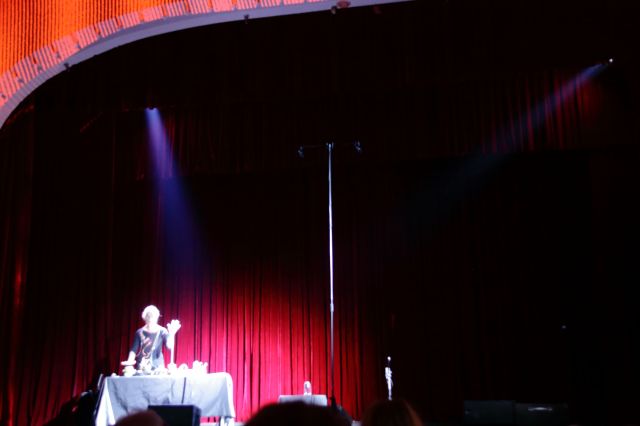
Hanna Hartman
Standing at a table stage left covered with electronic and non-electronic devices she looked like the host of a cooking show live mixing sounds into a logical flow which were projected in stereo to the audience.
The performance had her draped in multicolored tubes which she used to blow into and create sounds in miked containers of water. She stood actuating materials on her table that might have come from an erector construction set and/or a “Mouse Trap” game (familiar to listeners of a certain age) and which resulted in a veritable barrage of sound which moved from one speaker to another but created an immersive and room dominating flow of sounds.
Hanna Hartman in performance.
It might best be called a sound collage. It seemed to be guided by a program or sequence much as any musical composition. The sounds, sometimes apocalyptic, sometimes more drone like and serene, were engaging. And the curious image of her working with these various materials sometimes seemed indirectly connected to the sounds heard. It was as if the chef’s culinary efforts had taken on a sonic life of their own.
Though baffling at times the audience and this writer were very appreciative as the music revealed its internal logic. We had been introduced to yet another interesting artist by the Other Minds experience.
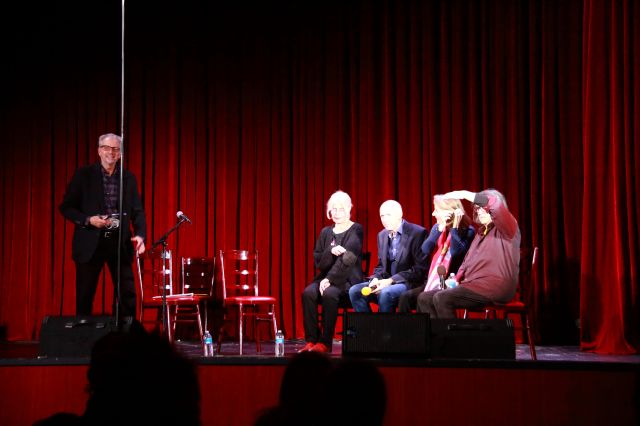
Joëlle Léandre (left) and Lauren Newton (right).
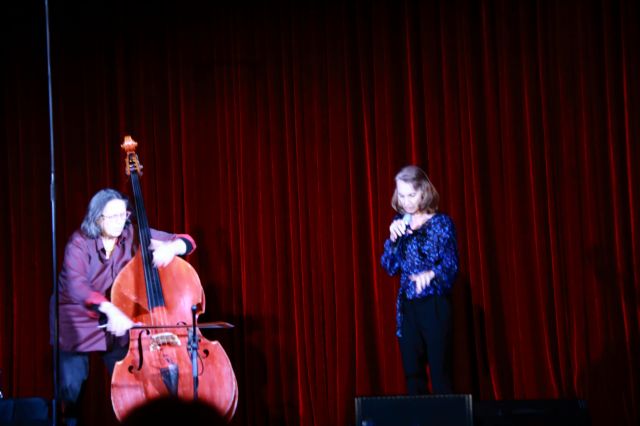
Then after just a bit of stage arranging Joëlle Léandre and Lauren Newton took the stage for a set of improvisations on double bass and voice. Going from the retro electronics and electroacoustic to good old live analog sound was a contrast.
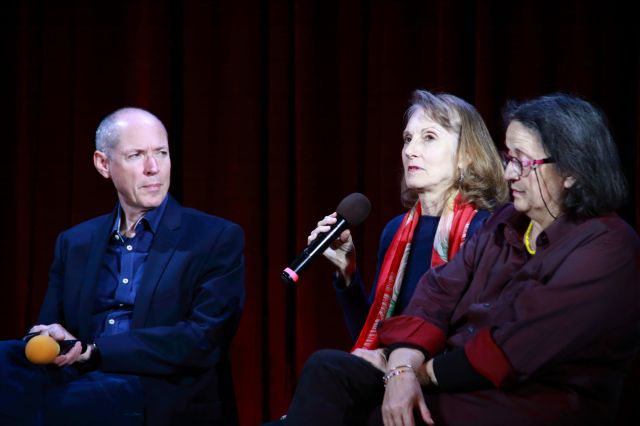
Lauren Newton speaking in the live stage interview with conductor/composer Dominic Murcott looking on and Joelle Leandre on the right,
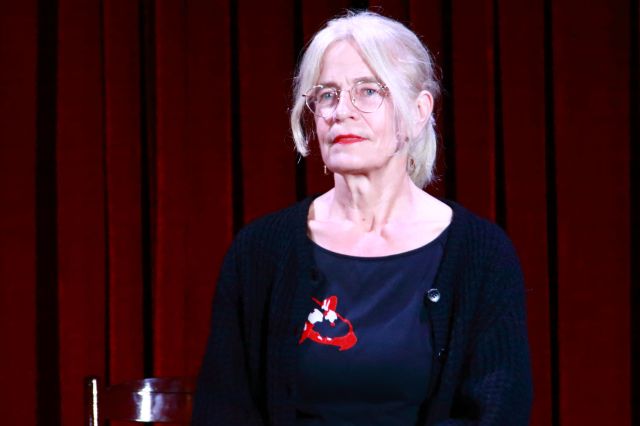
These two brought an intense energy to the stage in a sort of cosmic cabaret. Newton is a classically trained singer who now performs (at least on this night) a sort of glossolalia of non linguistic sounds in league with co-improviser Léandre.
Joëlle Léandre is a double bass player with skills sufficient to have had her included in the late conductor/composer Pierre Boulez’ “Ensemble Intercontemporaine”. Boulez was a very demanding and exacting man. Léandre was also influenced by hearing the work of the AACM (American Association of Creative Musicians), a Chicago based group which introduced African musical ideas into modern western performances.
Call it “free jazz”, “new classical”, or whatever you choose. These new sounds and performance styles launched the double bass player to another world and another career as an improvising musician.
Well, these two women brought a wild shared creative energy to the stage. In a set of (if I counted correctly) five separate improvisations they traded with Léandre beginning, then Newton beginning, and clearly demonstrated a comfortable relationship between themselves as performers. The set went from moments of angst to moments of gentle humor to virtually indescribable moments which all shared an intimate connection between the performers as well as the audience.
Léandre compelled a variety of sounds ranging from standard bowed string sounds to ethereal harmonics, percussive sounds, and even her own vocalizations. Newton’s instrument (her voice) seemed to channel a mysterious range of sounds from whispers to glossolalia, to almost words. She and Léandre seemed possessed by dance like movements and hand gestures resembling those of raga singers all of which were a part of a truly engaging performance.
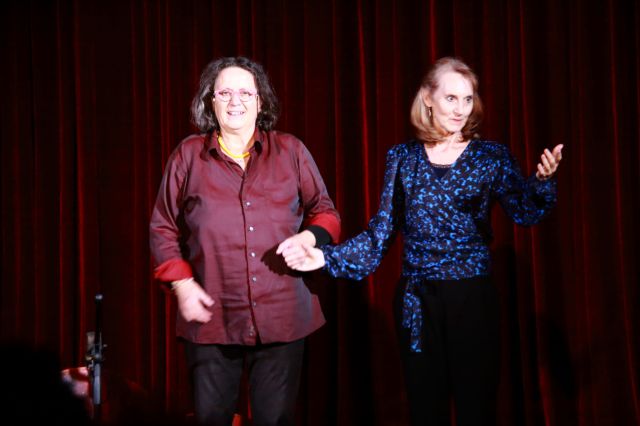
Joelle Léandre and Lauren Newton acknowledging a clearly very happy audience response to their performance.
After that intense experience the audience was allowed a brief intermission to recover and be able to focus on the final performance of the evening. From the electric to the acoustic we moved, perhaps inevitably, to the electroacoustic.
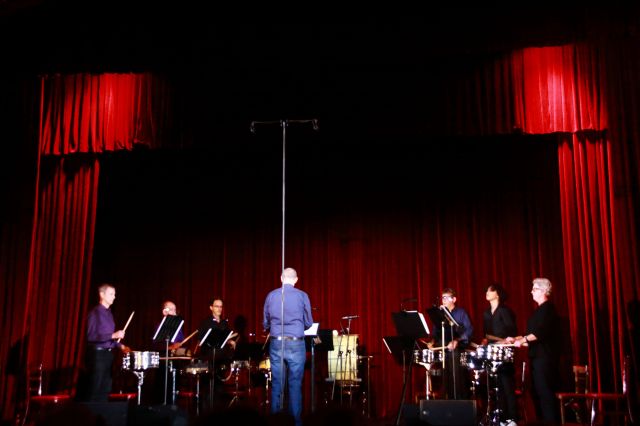
Dominic Murcott, peripatetic conductor/drummer about to lead this major opus by Charles Amirkhanian.
Yes, THAT Charles Amirkhanian, the voice of OM. In addition to his leadership work with the various aspects of OM, he is a much respected composer/sound artist, His astute advocacy of the up and coming voices presented via OM are an enduring legacy. Here is an exciting local premiere performance of a major opus.
Amirkhanian noted his earliest compositional inspirations to have been a result of his experience with being a drummer in the high school marching band. So that kind of gives you a clue as to this unusual orchestration.
Add to that his unique take on sound poetry, his skills with tape manipulation, sound samples, etc. and this multi movement work takes on an epic proportion. I reprint the liner notes below but my personal experience is as follows:
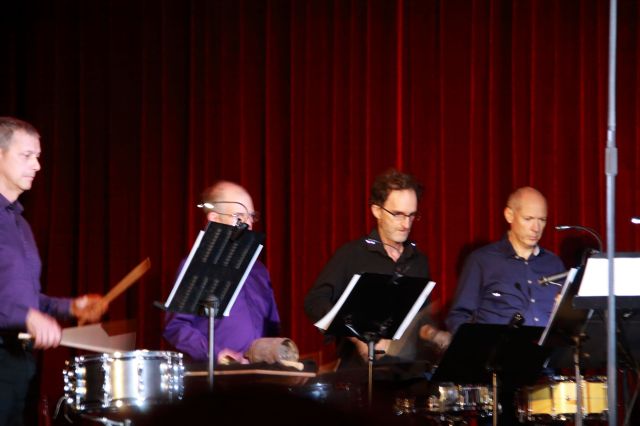
Drummers to the left,
“Ratchet Attach It” (2021)by Charles Amirkhanian is a large multi movement work for eight percussionists and sound samples. It is a piece which succeeds on many levels. The composer’s background (and clearly cherished) experience as a percussionist is the most obvious driving force and framework but the inclusion of his sound art, use of language as both sound and syntax interpolated between and sometimes with the live musicians performance. The electronic interpolations are, whether intended or not, a sort of nod to Edgar Varese’ “Deserts”. Their function within the composition however, are quite different.
There is a characteristic humor which runs through much of Amirkhanian’s work. His gentle defiance of drum cadence structures and doubtless other performance conventions in this work become transformed via caricature, a sort of personal nod to fellow percussionists. They are punctuated with a variety of audio intrusions between and sometimes within movements. These intrusions are autobiographical and nostalgic as they refer or connote respectful homages of fellow artists as noted in the very useful program notes. These are not actually intrusions as much as connecting audio cadences as a sort of mortar for the deconstructing drum cadences that dominate the music’s structure. It takes on a character of ringing changes in bell ringing but that is deconstructed as well,
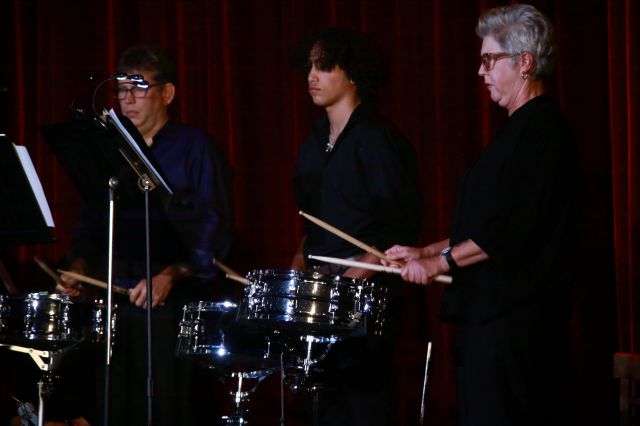
Drummers to the right,
There are a panoply of examples of the concept of humor in music at work here but as I am not a musicologist I will restrict my examples to the most obvious. In what may also be gentle parody, the conductor, Mr, Murcott, traveled between podium and fellow drummer leading the orchestra as did Mozart and Beethoven, with their instrument close by. Other players did their share of marching around in a visual ballet as they carried various bells that they played before returning to their assigned snare stations. A large bass drum asserted itself from back center in the ensemble, This was a disciplined performance making a strong case for the music. Quite a spectacle and maybe an “audicle” (sound spectacle) as well.
Replete with multiple references to personal and historical events as well as quasi minimalist manipulations of drum cadences in a live action electroacoustic visual and sonic event. It is a remarkably seamless mix of electric and acoustic, a major achievement. Dead serious but with great joy and humor.
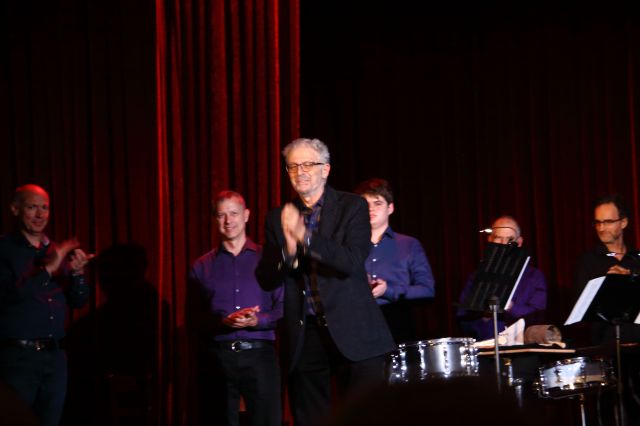
Composer Charles Amirkhanian acknowledging the very appreciative applause.
The composer’s notes here add much to the appreciation of this complex work:
I – The U.S. Army Postal Unit at Blandford, Dorset, 1944 When it became apparent during World War II that Hitler’s Germany would take a route through Blandford to attack England, the bar- racks from WWI were re-activated and popu- lated, in large measure, by U.S. Army personnel starting in 1943. The following year, my 29-year- old father Ben, the commander of a unit of men assigned to sort the mail sent from the U.S. to England and Continental Europe, arrived to be- gin work in Dorset. On the weekends, the com- mander had the privilege of driving some of his men around for sightseeing, from Stonehenge, to Piccadilly Square, to Edinburgh. Ben’s enthu- siasm for the people of England, the landscape and its history, is evident in his many letters home to my mother who was about to give birth to me in January 1945.
II – In Praise of the Venerable Piano Roll
The wonders of music made available to many non-performers in the early 20th Century by the invention of the player piano brought an unimag- inable thrill of excitement to so many. Before the days of high-fidelity sound recording, hearing the acoustic sounds of an actual piano, playing note-perfect renditions of classical and popular repertoire in one’s own home, was a profound-
ly mesmerizing experience. Snare drummers everywhere will welcome the chance to honor this signal achievement with a roll of their own. My thanks to Dominic Murcott for suggesting that the percussion repertoire lacked a single piece comprised solely of the sounds of drum rolls.
III – Ticklish Licorice
This movement comprises a quick-time perfor- mance of the novelty piece Flying Moments, by Leo Livens (1896-1990), accompanied by crystalline bell sounds from the percussionists. Livens, in his day, was a renowned British composer of light music. Here the player piano is useful in brightening up the music with a high-speed rendition of this playful music, performed in a studio recording by Rex Lawson with his usu- al nuance and panaache on the Bösendorfer Imperial Grand at Dulwich College in 1994—John Whiting, sound engineer.
IV – Chatteratchet
The sound up close of a concert orchestral ratch- et can be hair-raising. Also, full of bird-chirping- like overtones. I learned this early on by accident while sitting in the enclosed cab of my Volkswa- gen bug and turning the handle of this ear-split- ting instrument. I decided to compose a solo for amplified ratchet, followed by duos, an octet, and other combinations over the years. The act of playing this mechanical instrument somehow relates, for me, to the mechanism of the player piano, with its constant rotating of the paper roll on which music has been encoded. The ratchet came to mind in relation to Spitalfields and the history there of tailoring. My only visit to the neighborhood came some years ago when I visited the offices of my friend Timothy Everest, bespoke tailor. In this quartet for four amplified ratchets, much of the work is devoted to the practice of turning the instrument’s handle con- tinuously, but at the slowest possible speed. The counterpoint between the instruments literally is out of the control of the players due to the nature of the spokes and their response to the turning crank, resulting in an interesting irregularity.
V – Hopper Popper
Numerous different ethnicities produced piano rolls of their own folk and popular music, includ- ing my people, the Armenians. Here is a roll of the love song “Haperpan” (a woman’s name), with its irregular phrase structure, augmented by our percussionists with wire brushes on the snare drum heads. The rhythmic irregularities in the cutting of the roll are especially interesting, if subtle.
VI – Exculpatorium
An excuplatorium (a word I coined) would be a large, highly reverberant room where elder- ly snare drummers (and The Blue Man Group) must go to be absolved of their youthful sins of exhibitionism. As my first original compositions were relatively sedate marching band drum ca- dences, unlike some later more flamboyant and theatrical Fluxus-inspired pieces, I return to my pedestrian roots in this movement.
VII – To the Riled Wrecks
In 1896, the American composer Edward MacDowell (1860-1908) and his wife Marian purchased a lovely rural farm in Peterborough, New Hampshire. MacDowell immediately set about writing a series of short piano pieces he titled Woodland Sketches, Op. 51. One of these, “To a Wild Rose,” heard here, was a favorite of my piano teacher mother Eleanor’s. I’d often request it from her as music to go to sleep to when I was seven and just beginning myself
to study piano. Rex Lawson here performs an 88-note roll of the music on a pianola adjust- ed to a setting for rolls that contain only 65 notes across the width of the roll, with crushing results.
VIII – Dominictrix
This solo for snare drum was composed for my invaluable collaborator in the composition and world premiere of Ratchet Attach It, Dominic Murcott. I incorporate some of his favorite licks— thus, Dominic tricks.
IX – Bum of the Flightlebee
This backwards rendition of the Rimsky-Kor- sakov favorite The Flight of the Bumblebee is played by Rex Lawson by reversing the physical roll on the spindle. This piece is the only one I’ve
discovered that is both interesting and recogniz- able in any of the four possible performances of the paper roll—forward, backward, and each of those with treble to bass reversed.
X – Pedestrian
The most memorable drum cadence ever, in my experience, was written for and played at the funeral of the American President John Fitzgerald Kennedy on November 25, 1963. Its somber use of strictly regular rhythm capped by a dotted figure still haunts me, long after I heard it at the age of eighteen during the day-long event televised nationally from Washington, D.C. Using an additive process of extending the roll figure, and doubling it with the grating sounds of ratchets, resulted in this variation on a most memorable walking tune.
XI – Tyrannus Rex
Three piano rolls played by Rex Lawson com- prise the core of this concluding movement: The Tarantella from Rachmaninoff’s Suite No. 2 for Two Pianos in an arrangement made by the composer, Percy Grainger’s roll of his own Molly on the Shore, and a roll of the popular song from 1933, “Stormy Weather,” by Harold Arlen with lyrics by Ted Koehler, on an 88-note roll played while shifting back and forth between 65- and 88-note settings on the pianola. Percussion em- bellishments orchestrated by Dominic Murcott lend an added spatial dimension.
Performers included:
MEMBERS OF THE OTHER MINDS ENSEMBLE
JEREMY STEINKOLER, DIRECTOR
DOMINIC MURCOTT, CONDUCTOR
ANDREW GRIFFIN ANDREW LEWIS CLAY MELISH ROWAN NYKAMP ERIKA OBA BRIAN RICE DAWN RICHARDSON KEITH TERRY
They played their hearts out. And I’m sure glad I didn’t miss this epic night,
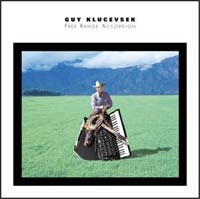
I don’t recall when I first heard Guy Klucevsek but I think it was the early 90s. I grew up hearing a great deal of accordions in polka bands at weddings throughout my childhood. This instrument had, pretty much since its beginnings in the early 19th century, been associated primarily with folk bands and not at all with classical music. I don’t think one can find an accordion used in a classical orchestra before Tchaikovsky’s 1822 Second Orchestral Suite and only sparingly after that. So when I discovered this New York musician via his releases on the Starkland label, Transylvanian Software (1999) and Free Range Accordion (2000) and the CRI disc Manhattan Cascade (1992). I was curious to see what this musician would do with this traditionally “low brow” folk instrument.
Free Range Accordion Starkland ST-209
Transylvanian Software Starkland ST-207
I had come to trust the Starkland label (which began in 1991) as one whose releases were usually very much to my taste and I was not disappointed to hear Klucevsek’s playing of pieces written by him and other composers for this instrument. Unlike Pauline Oliveros who did much to expand the very nature of the instrument itself, Klucevsek retained, and sometimes parodied, the humble folk/pop origins and reputation of the instrument while still pursuing its possibilities in the New York downtown experimental music scene where he worked with people like Laurie Anderson, Bang On a Can, Brave Combo, Anthony Braxton, Anthony Coleman, Dave Douglas, Bill Frisell, Rahim al Haj, Robin Holcomb, Kepa Junkera, the Kronos Quartet, Natalie Merchant, Present Music, Relâche, Zeitgeist, and John Zorn among many others. Klucevsek expanded the role of the accordion in his own way.
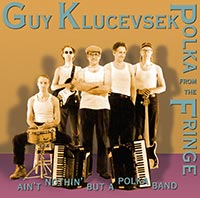
Klucevsek later put together a commissioning project called, “Polka from the Fringe” (1992), a project which echoes the 1981 “Waltz Project” by Robert Moran and presages another accordionist William Schimmel’s “The Tango Project” of 2006. All of these commissioning projects utilized dance forms common in the 20th century as a “stepping off” place for a new musical piece. And it was Starkland which rescued the fascinating two disc release of Polka from the Fringe (2013) from over two decades languishing in “out of print” status. These projects are significant in that they invite composers to get out of their comfort zone and demonstrate their take on the given dance form. Like Klucevsek’s earlier releases this Polka collection is a veritable Who’s Who of working composers of the era much as the Variations (1819) project of Anton Diabelli collected some 51 composers’ works based on Diabelli’s waltz-like theme (Beethoven’s gargantuan set of variations was published as volume 1 and the other 50 variations in volume 2 which included composers like Schubert and Liszt).
Polka from the Fringe Starkland ST-218
So here comes Starkland to the rescue again in this (languished for some 25 years after only having been available for two years) very personal recording which displays Klucevsek’s substantial compositional chops as well as his knowledge and use of extended instrumental techniques for his instrument. It presents pieces written for a dance performances and shows a very different side of Klucevsek, one which shows more of his substance as a composer alongside his virtuosic skills on his instrument. In this digital only release there is an option to include (for a mere $3.00 more on the Bandcamp site) a series of 13 videos featuring Guy Klucevsek talking about the music on this album and his various musical interests. A gorgeous 10 page booklet providing further detail including the original liner notes with updates is included in all purchases. The album will also be available on Spotify, You Tube, and other streaming services but the videos are only available on Bandcamp.
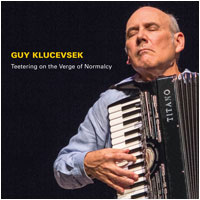
Teetering on the Verge of Normalcy Starkland ST-225
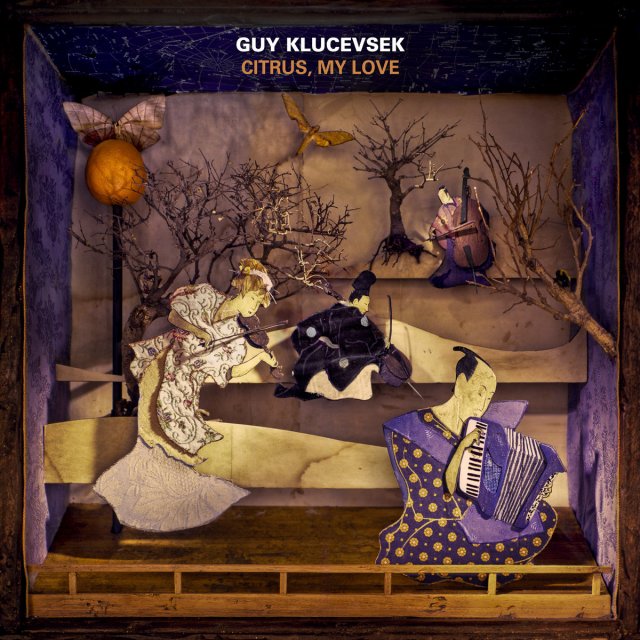
Listeners may find this new release has some in common with Starkland’s previous Klucevsek release from Starkland, “Teetering on the Verge of Normalcy” (2016) which features some similar compositional diversity in a disc entirely of Klucevsek’s works. The line from Citrus, My Love to Teetering on the Edge of Normalcy seems to be a logical succession in Klucevsek’s compositional development. In addition to his accordion studies Klucevsek studied composition in Pittsburgh but it was the influence of Morton Subotnick with whom he studied in his independent post graduate work at the California Institute of the Arts that exposed this east coast artist to some of the splendors of the west coast encountering artists like Terry Riley and Pauline Oliveros. Indeed Klucevsek can be said to be “bi-coastal” in his compositional endeavors. And though this is a “tongue in cheek” characterization it does speak to the roots of Klucevsek’s diversity in style.
There are 12 tracks on “Citrus, My Love” representing 3 separate works: the three movement, “Passage North” (1990), the single movement, “Patience and Thyme” (1991), and the eponymous, “Citrus, My Love” (1990) in 8 movements. The production of this album is by none other than Bobby Previte, another valued east coast musician and colleague. The notes have been updated under the guidance of Tom Steenland with input from Klucevsek who, understandably, expresses great joy in having this album available again.
The first three tracks are dedicated to a single work, “Passage North” (1990) written for accordion and string trio consisting of Mary Rowell, violin/viola, Erik Friedlander, cello, and Jonathan Storck, double bass. They are dubbed “The Bantam Orchestra”. This Copland-esque work was commissioned by Angela Caponigro Dance Ensemble. The second movement is for string trio alone and is dedicated to the memory of Aaron Copland who died in 1990.
Patience and Thyme (1991) according to the composer “is a love note to my wife, Jan.” He composed the work while in residence at the Yellow Springs Institute in Pennsylvania, which coincided with his 22nd wedding anniversary. It is scored for piano and string trio, no accordion. Compositionally it seems at home between the larger pieces.
Citrus, My Love was commissioned by Stuart Pimsler for the dance of the same name. It is in 8 scenes and is scored for Klucevsek’s accordion accompanied by his personally chosen Bantam Orchestra. Klucevsek describes the music on this album as representing his transition from hard core minimalism to a more melody driven style and this is the missing link, the “hole” to which I referred in the Beatles metaphor in the title of this review.
For those who already appreciate Klucevsek’s work this album is a must have. To those who have not gotten to know this unique talent this is a good place to start.
For those seeking to get more deeply into Klucevsek’s work (a worthwhile endeavor) and to provide a perspective on the range of this artist’s work I’m appending a discography (shamelessly lifted and updated from the Free Reed Journal) :
SOLOIST/LEADER
Scenes from a Mirage (Review) Who Stole the Polka? (out-of-print) Flying Vegetables of the Apocalypse (Experimental Intermedia) Polka Dots & Laser Beams (out-of-print) Manhattan Cascade (CRI) Transylvanian Softwear (Starkland) Citrus, My Love (Starkland) Stolen Memories (Tzadik) Altered Landscapes (out-of-print) Accordance with Alan Bern (Winter & Winter) Free Range Accordion (Starkland) The Heart of the Andes (Winter & Winter) Tales from the Cryptic with Phillip Johnston (Winter & Winter) Notefalls with Alan Bern (Winter & Winter) Song of Remembrance (Tzadik) Dancing On the Volcano (Tzadik) The Multiple Personality Reunion Tour (Innova) Polka From The Fringe (Starkland) Teetering On the Verge of Normalcy (Starkland)
COMPILATIONS
Great Jewish Music: Burt Bacharach, Who Gets the Guy?, This Guy’s in Love With You (Tzadik) Planet Squeezebox, The Grass, It Is Blue, Ellipsis Arts Legends of Accordion, Awakening (Rhino) The Composer-Performer, Samba D Hiccup (CRI) Koroshi No Blues, Sukiyaki Etoufee, Maki Gami Koechi (Toshiba EMI) Norwegian Wood, Monk’s Intermezzo, Aki Takahashi (Toshiba EMI) Music by Lukas Foss, Curriculum Vitae (CRI) Here and Now, Oscillation No. 2, Relache (Callisto) A Haymish Groove, Transylvanian Softwear (Extraplatte) A Confederacy of Dances, Vol. I. Sylvan Steps (Einstein) A Classic Guide to No Man’s Land, Samba D Hiccup (No Man’s Land)
WITH JOHN ZORN
The Big Gundown (Nonesuch Icon) Cobra (Hat Art) Lost in the Stars: The Music of Kurt Weill, Der Kleine Leutnant Des Lieben Gottes (A&M)
WITH RELACHE
On Edge (Mode) Open Boundaries, Parterre (Minnesota Composers Forum McKnight Recording) Pauline Oliveros: The Well and The Gentle (Hat Art)
WITH OTHERS
Laurie Anderson: Bright Red (Warner Bros) Anthony Braxton: Four Ensemble Compositions, 1992(Black Saint) Mary Ellen Childs: Kilter (XI) Anthony Coleman: Disco by Night (Avante) Nicolas Collins: It Was a Dark and Stormy Night (Trace Elements) Fast Forward: Same Same (XI) Bill Frisell: Have A Little Faith (Elektra Musician) David Garland: Control Songs (Review) Robin Holcomb: Rockabye (Elektra Musician) Guy Klucevsek/Pauline Oliveros: Sounding/Way, private cassette release (out-of-print) Orchestra of Our Time: Virgil Thomson, Four Saints in Three Acts (Nonesuch) Bobby Previte: Claude’s Late Morning (Gramavision)
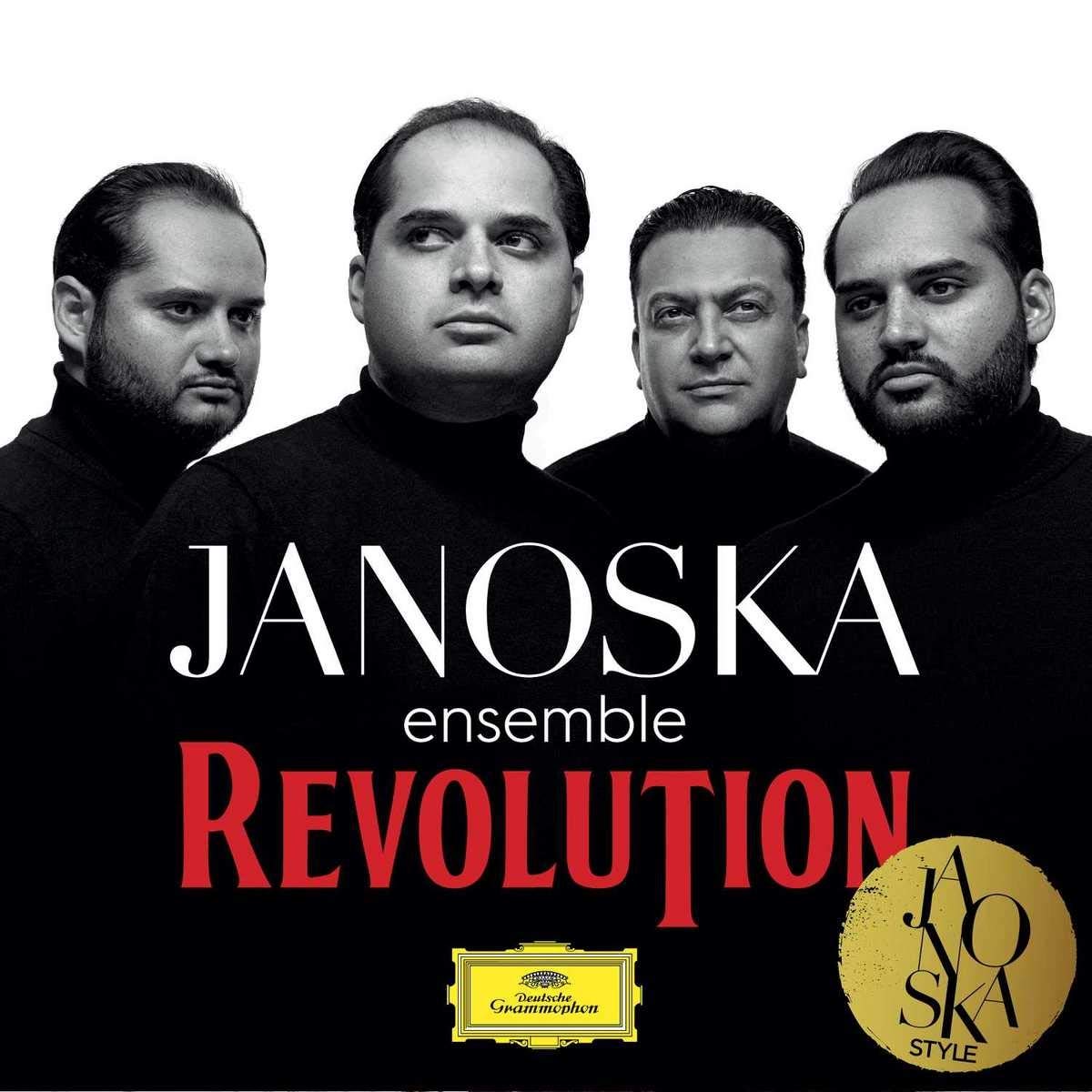
Not your typical Deutsche Grammaphon release, this disc is of a genre in which classical musicians toy with pop music arrangements (in this case two violins, piano, and bass) as well as a few showpieces. Such novelties when done carelessly (evidence the plethora of string quartet arrangements of rock music) it can be tedious but with clever arrangements and energetic musicians they can be marvelously entertaining. This disc is in the latter category.
This traverses some of the territory of the late great Yehudi Menuhin and his collaborations with the likes of Stephane Grappelli among others. This spirit of exploring the fun side of classical music (so to say) is very much present here. The virtuosity of the selections by Fritz Kreisler and Henryk Wieniawski are contrasted with virtuosity of variations written and arranged by the Janoskas. Add a cello and I’d love to hear these guys do the Schubert Trout Quintet. They rock in their way.
Here are the track names:
The Marriage of Figaro (Mozart)
Yesterday (Lennon and McCartney)
Praeludium and Allegro in the style of G. Pugnani (Kreisler)
Hello Prince! (Roman Janoska)
Air (Bach)
Len’s Dance (Frantisek Janowska)
Melodie (Tchaikovsky)
Night and Day (Porter)
Penny Lane (Lennon and McCartney)
Variations on an Original Theme (Wieniawski)
Let it Be (Lennon and McCartney)
The ensemble consists of Ondrej Janoska, violin; Roman Janoska, violin; Frantisek Janoska, piano; and Julius Darvas, double bass. Nothing truly “revolutionary” here except for the title but fun and entertainment certainly are.
I first encountered the composer William Susman (1960- ) when one of his works appeared on a program which included a solo cello and electronics piece by Vivian Fung. This solo electroacoustic piece, the work I was initially asked to review, was nestled in the middle of an interesting program by the San Jose Chamber Orchestra. I chose to review the entire concert which was a fascinating selection of new music. William Susman’s “In a State of Patterns” (2018) struck me immediately as interesting post-minimalist work.
Mr. Susman read my review and rather promptly sent me this 2014 CD on his Belarca label. It contains four of his works from 1992-2010 and is a fine sampling of his work. All works are here performed by the Octet Ensemble which includes: Alan Ferber, trombone; Mike Gurfield, trumpet; Melissa Hughes, vocals; Elaine Kwon, piano; Eleonore Oppenheim, double bass; Demetrius Spaneas, saxophone; Greg Zuber, drums and percussion; and William Susman, electric piano.
There are four pieces on 12 tracks. The disc begins with Camille (2010), a very listenable post-minimal chamber work. It is followed by a melancholy song cycle, Scatter My Ashes (2009) on poems by the composer’s sister Sue Susman.
The third piece is a wonderful piano concerto. There are not a lot of convincing concertos in the minimalist genre but this one is a candidate for being a poster child. It is for piano with chamber ensemble. Here the composer goes not for the finger busting virtuosity that seems to be the current vogue but rather he evokes a latter day Mozart with more technically modest but highly entertaining music that communicates directly. Curiously (is this a carry over from the Steve Reich and/or The Philip Glass Ensemble?) he uses a wordless vocal (Hughes) as a part of the instrumental texture. Elaine Kwon handles the featured keyboard part. It works very well.
He ends with an arrangement for OCTET of Moving in to an Empty Space (1992, arr 2010), another setting of his sister’s lovely poetry. Again he evokes the somber but it is more in the nature of exorcising the demons of sadness much like the mission of the poet.
Collectif9 based in Montreal bills themselves, aptly, as a “string band”. This is their second album and I haven’t heard the first but this one is a hoot!
Drawing on the age old practice of transcribing music for chamber groups which used to be common in taverns and such back in the 18th and 19th centuries they create delightful riffs on the music they chose. Here they chose Gustav Mahler. If the appellation of my title, “Mahler Lite” seems pejorative fear not. This album is sheer delight.
There are 8 tracks drawing variously from the first, second, and fifth symphonies as well as Das Lied and the Wayfarer Songs. The last track is a fantasy by Philip Hersant on themes of Mahler. Nine musicians, all on bowed string instruments, do a marvelous job of evoking a big sound out of their ensemble.
Transcription is a true art and this is a shining example. Anyone familiar with Mahler’s work will find a comforting familiarity in these pieces. What struck this listener was their ability to evoke the orchestral instruments with some clever extended techniques. Tympani, trumpets, trombones, tympani, etc. are all slyly and successfully implied in their playing.
While the liner notes don’t go into much technical detail they are all the average listener will need. The charming thing here is the reproduction of the painting (apparently common in nurseries in Austria) which inspired the third movement of his first symphony. If you don’t know the painting it depicts a bunch of animals carrying a dead hunter which, perhaps, they have killed. And it is printed on the fold out liner notes. Mahler uses Brother John (in a minor key) as a starting place for a set of variations with the intent of evoking this image.
The design by Kanelloscob.com deserves mention. It deserves a closer look. They manage to integrate a group photo, a track list, credits, commentary, and a large reproduction of that nursery art. And they do it all with paper, no plastic to crack and become unusable. It’s low key but a really beautiful production.
Collectif9 is John Corban, Yubin Kim, Robert Margaryam, and Elizabeth Skinner on violins; Xavier Lepage-Brault and Jennifer Thiessen on violas; Jérémie Cloutier and Andrea Stewart on celli; and Thibault Bertin-Maghit on double bass (who actually did these wonderful transcriptions).
Of course the music is the main point and that is the best reason to buy this disc. Who knows? Maybe we’ll start seeing/hearing chamber groups like this in our coffee shops. Wouldn’t that be cool?
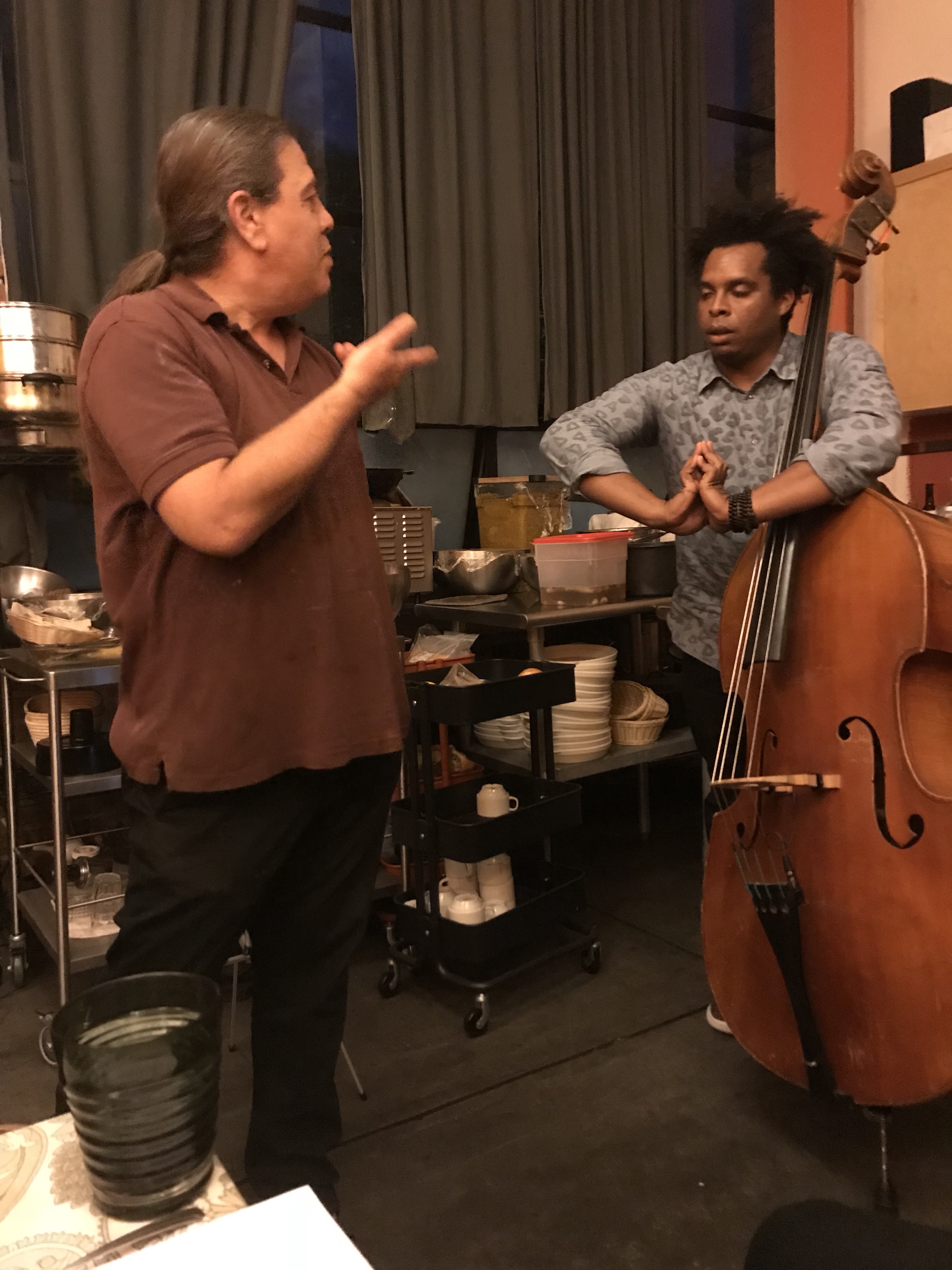
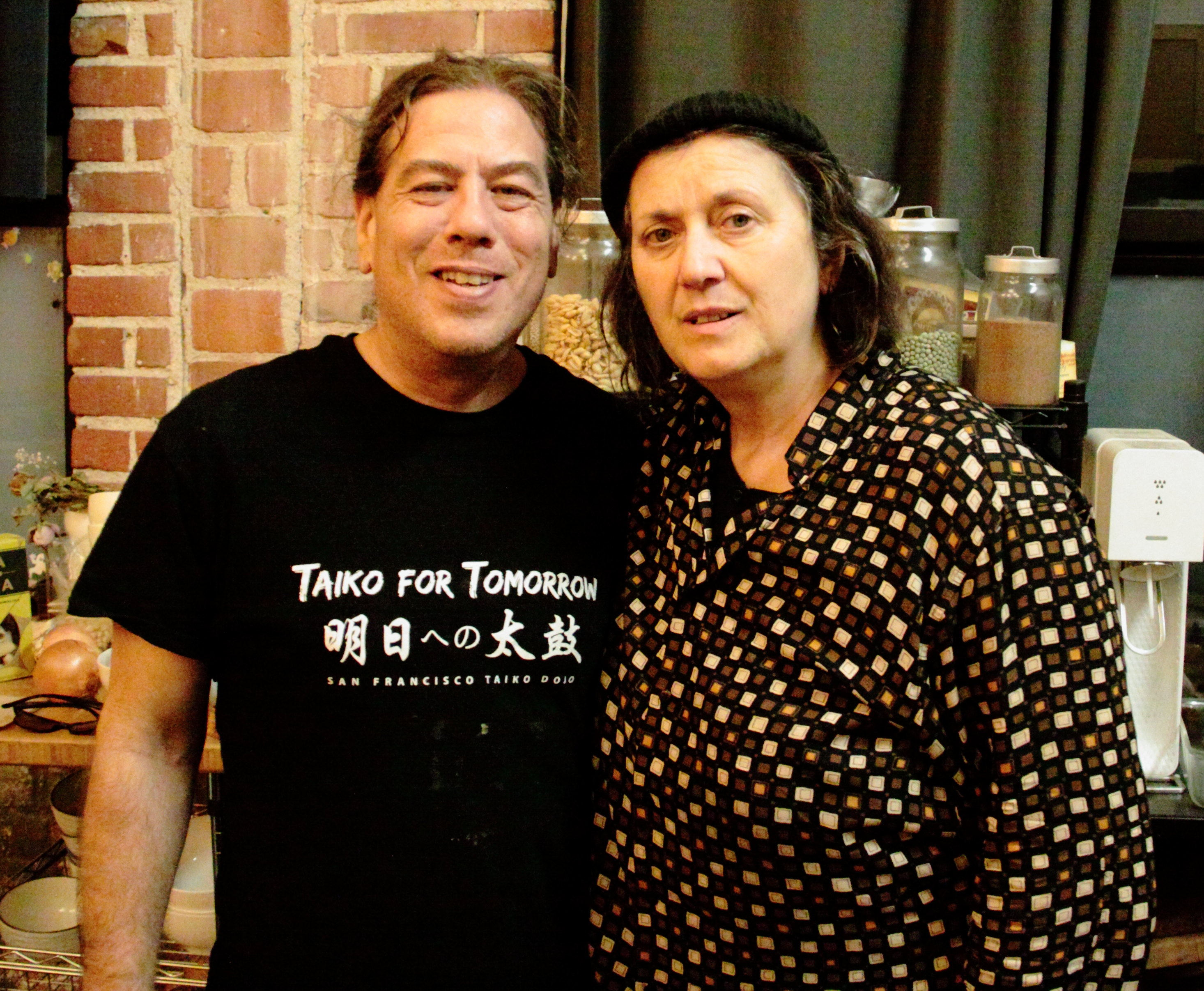
Chef and host Philip Gelb (left) introduces Rashaan Carter
Friday August 17th was one of the last of Mr. Gelb’s famed Masumoto peach dinners incorporating the incredible peak of the harvest peaches into his magical vegan creations. It is ostensibly among the last of his famed dinner concert series which has now run about 13 years. Whether the series is ending remains to be seen but the opportunity to partake of Gelb’s culinary art should never be missed and this night we had the opportunity to hear a fine young musician as well.
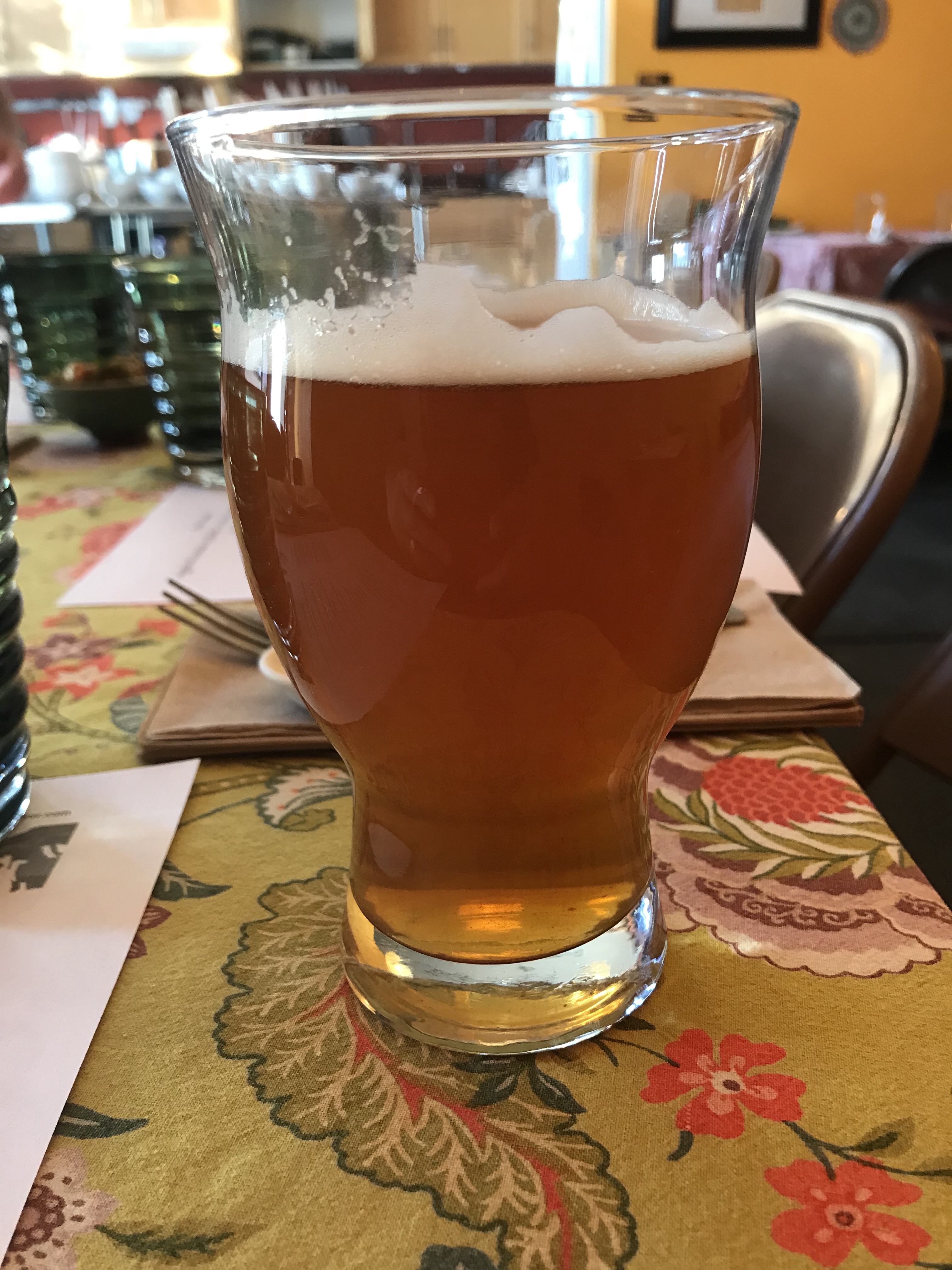
Phil started me with this tasty IPA, perhaps the only item that was not peach related.
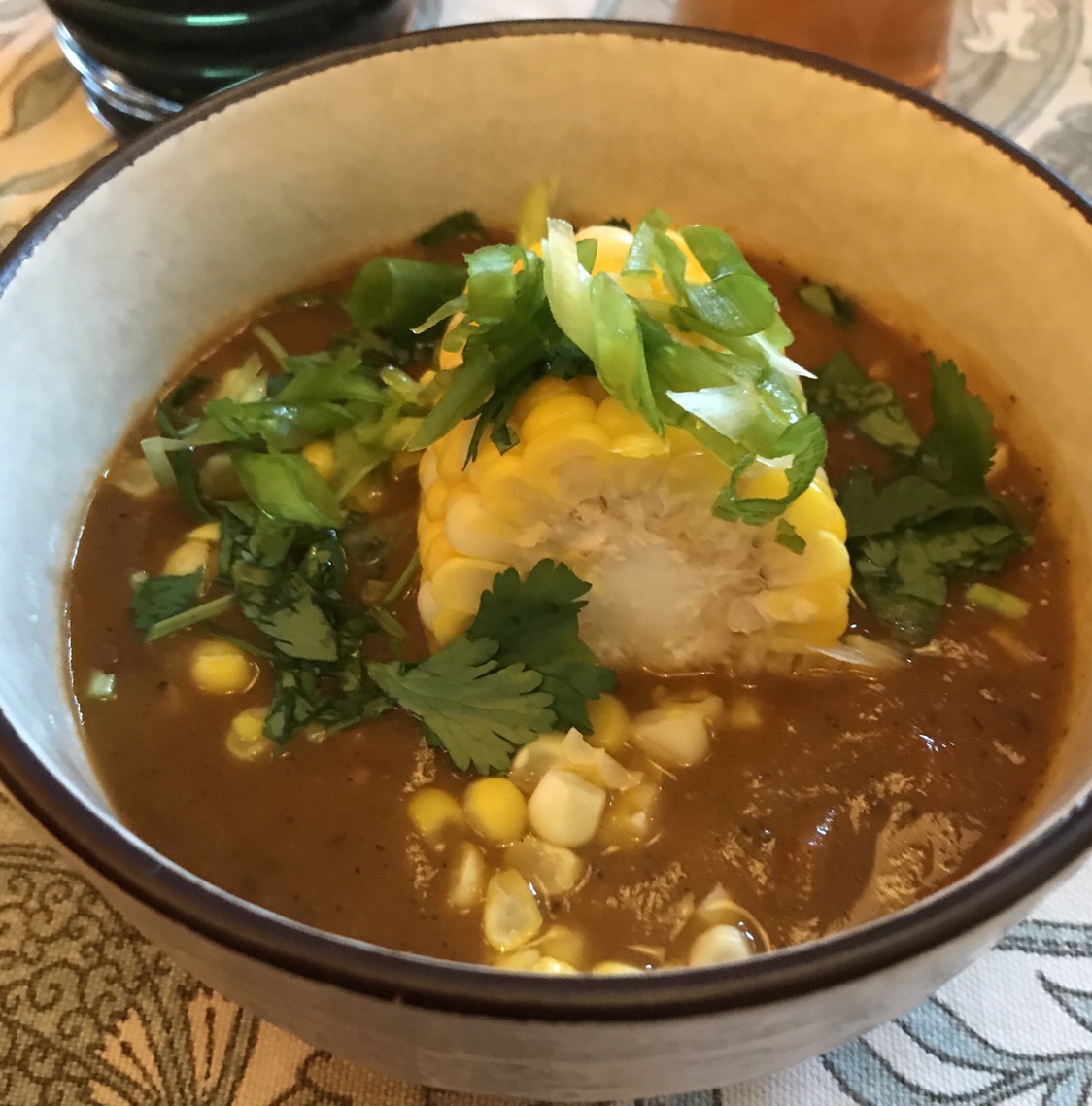
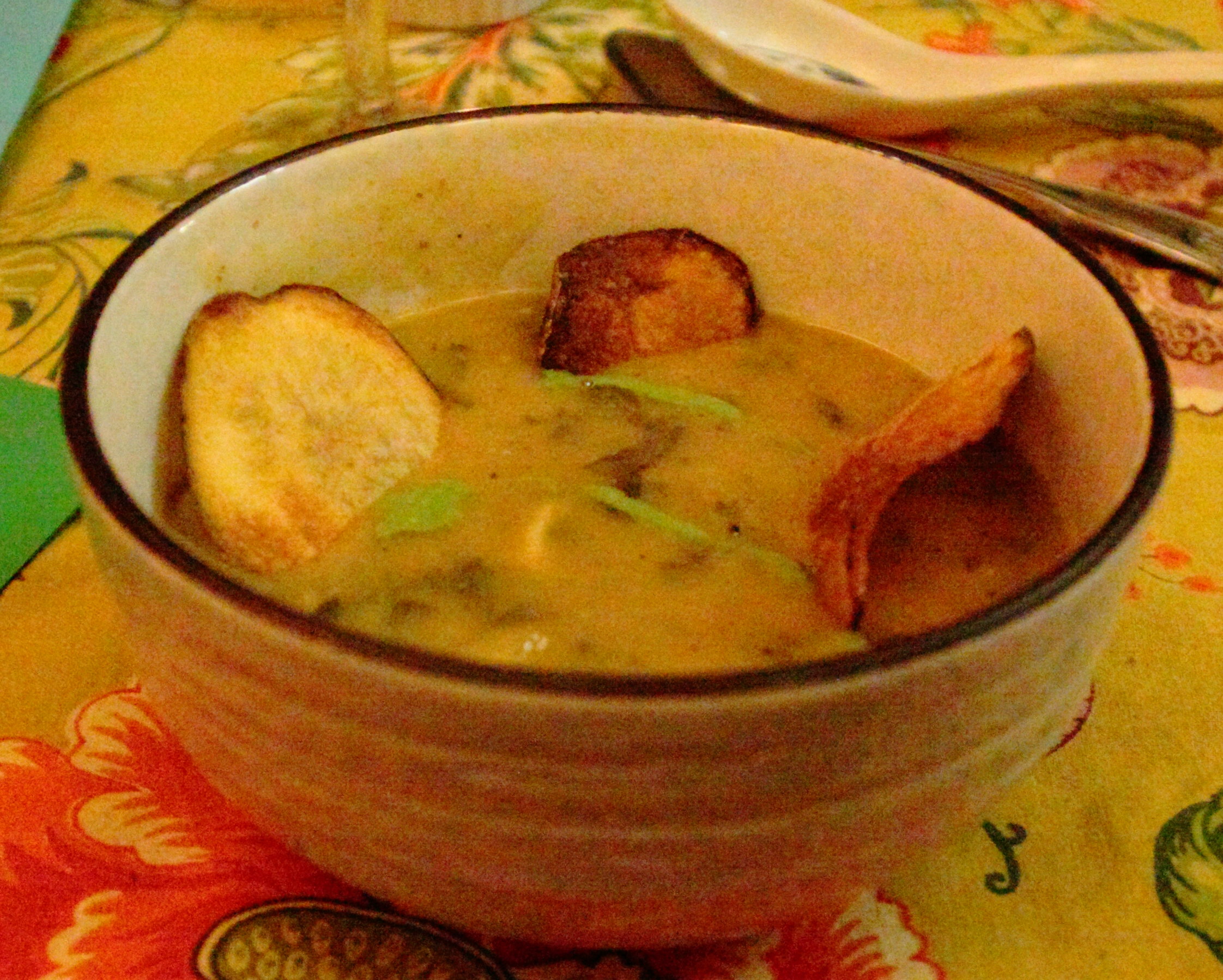
Dinner for about twenty happy diners began with this delicious corn soup. Gelb has an eye for artistic presentation.
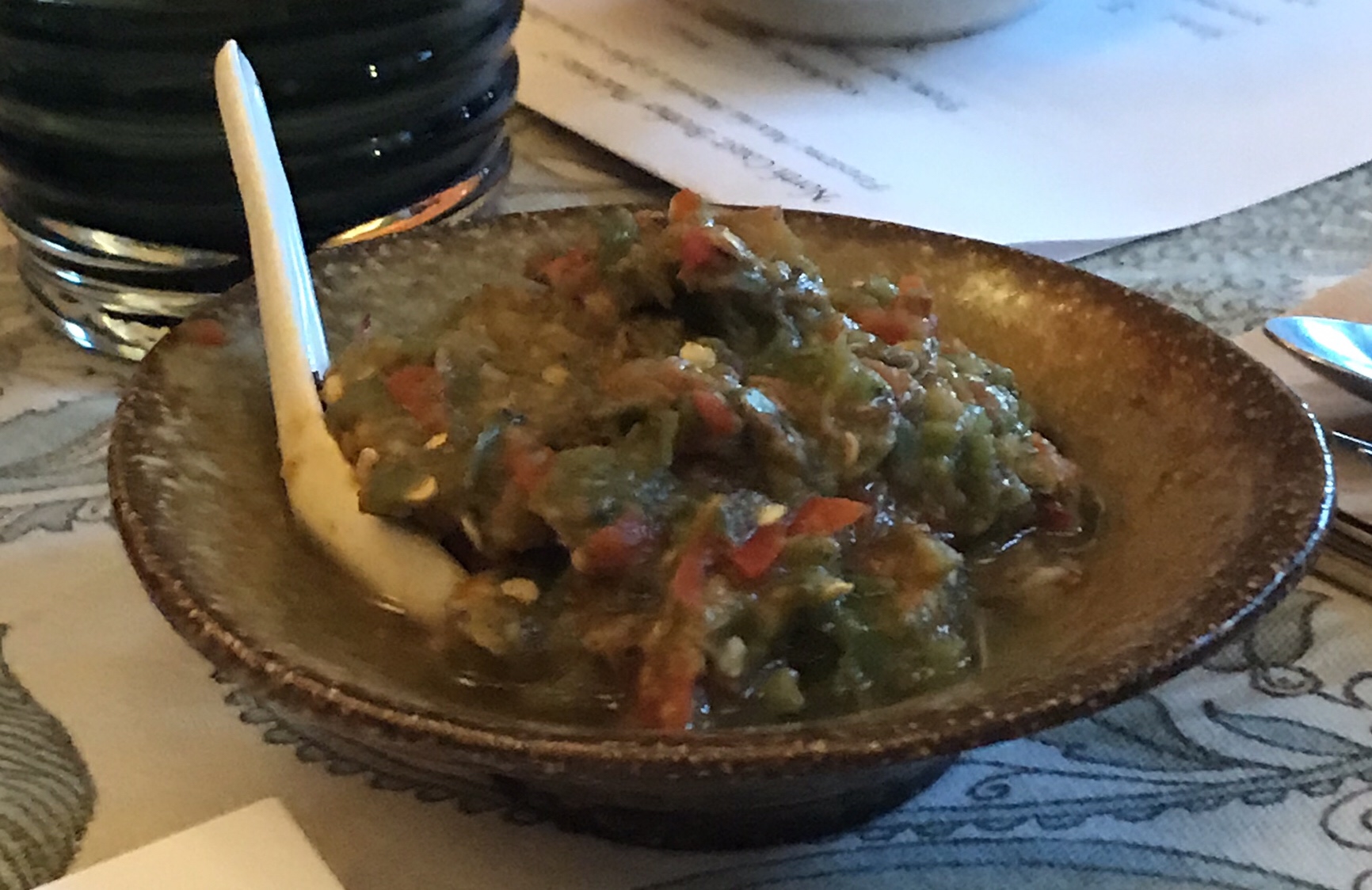
A little peach based salsa added a bit of fire for those of us who enjoy spicy things.
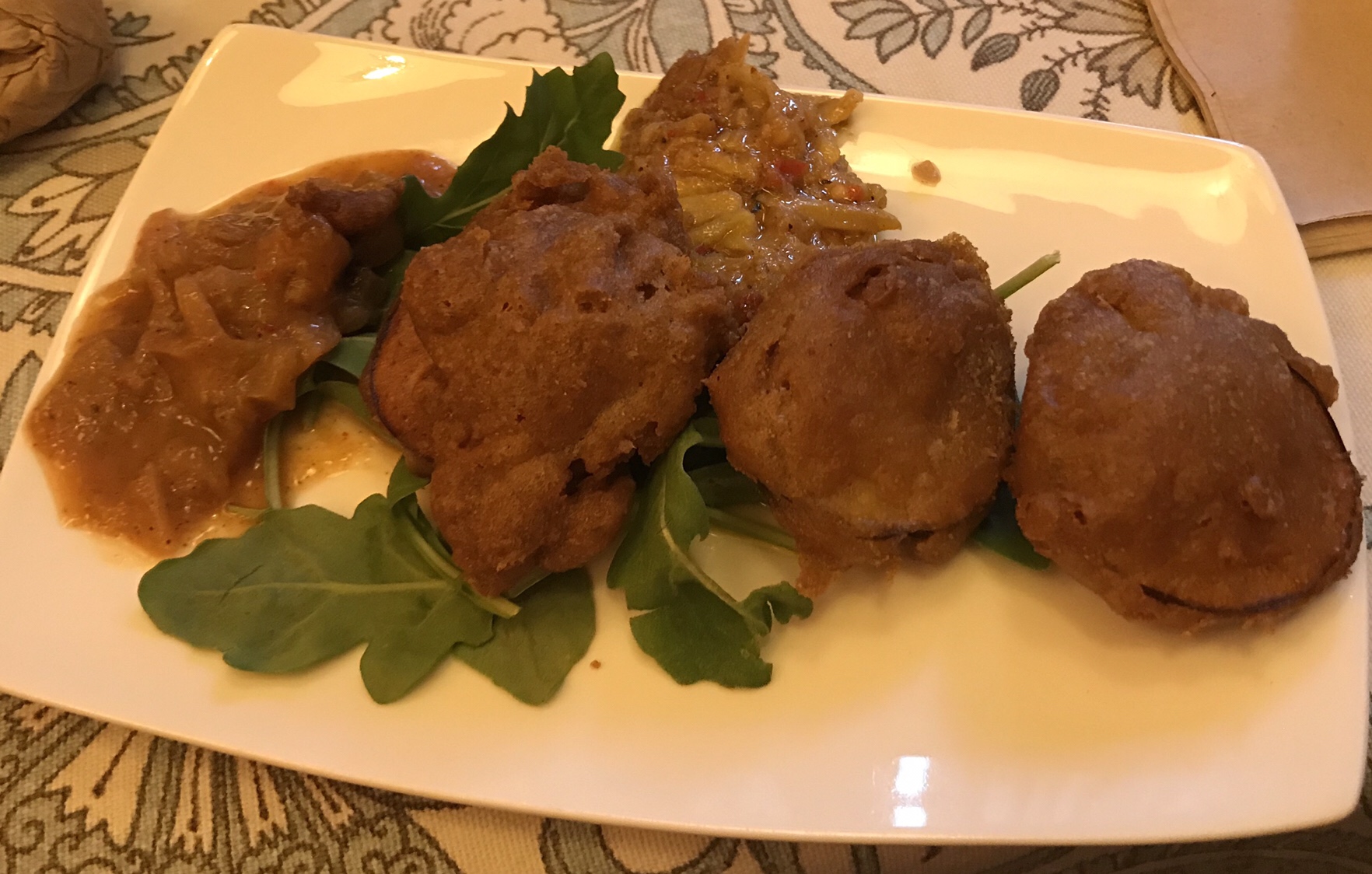
And on to the Baiganee (eggplant fritters) with peach kuchela and peach chutney.
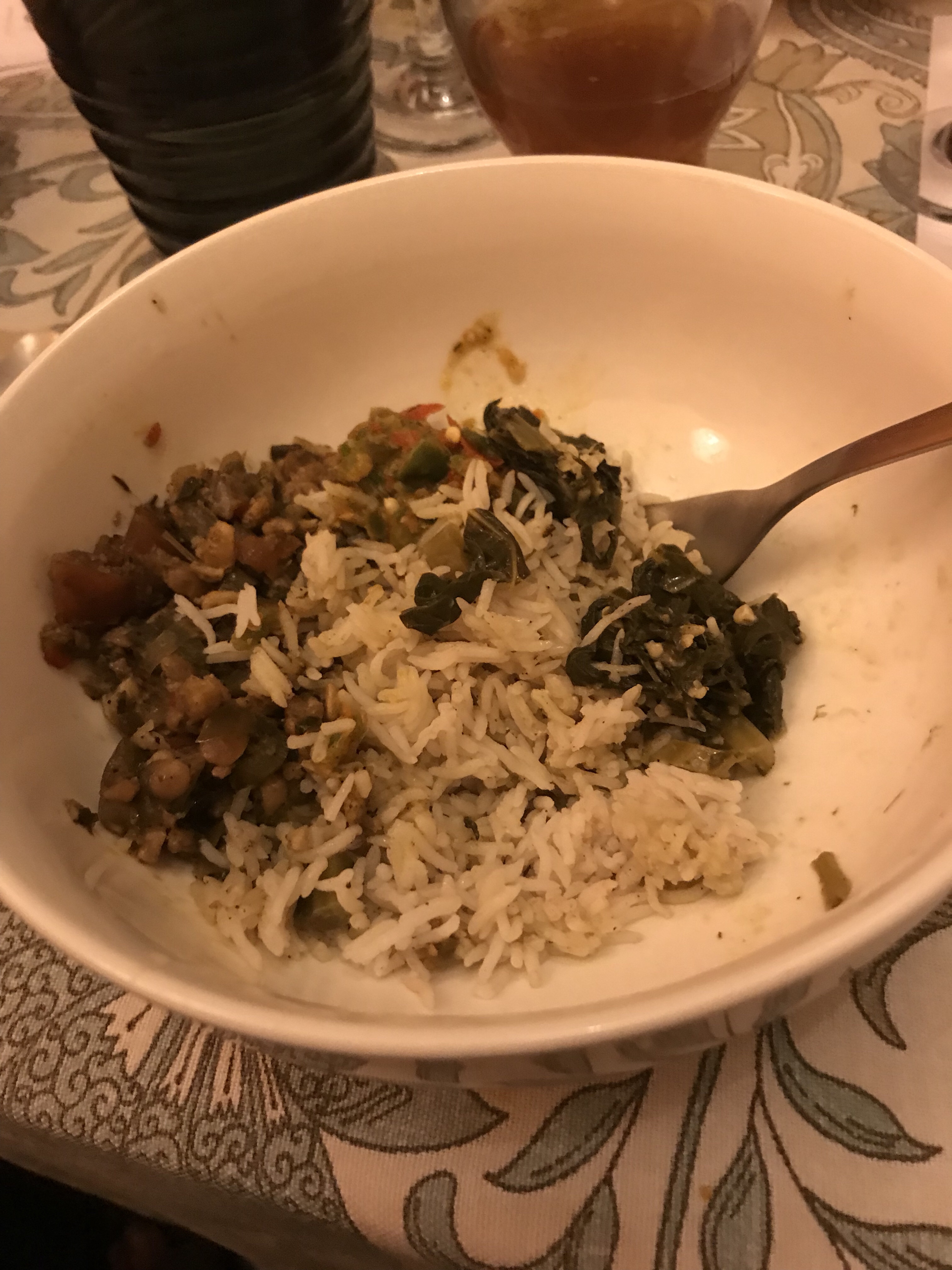
The main course was Jerk Stewed Tempeh, Rice, and Peas Calaloo. Unfortunately my eating got a bit ahead of my picture taking but you get the idea.
Peaches are, as I said earlier, from the Masumoto family farm near Fresno where three generations have been producing some of the finest fruit in the state. The tempeh is also locally sourced from Rhizocali Tempeh of Oakland. It doesn’t get better than this.
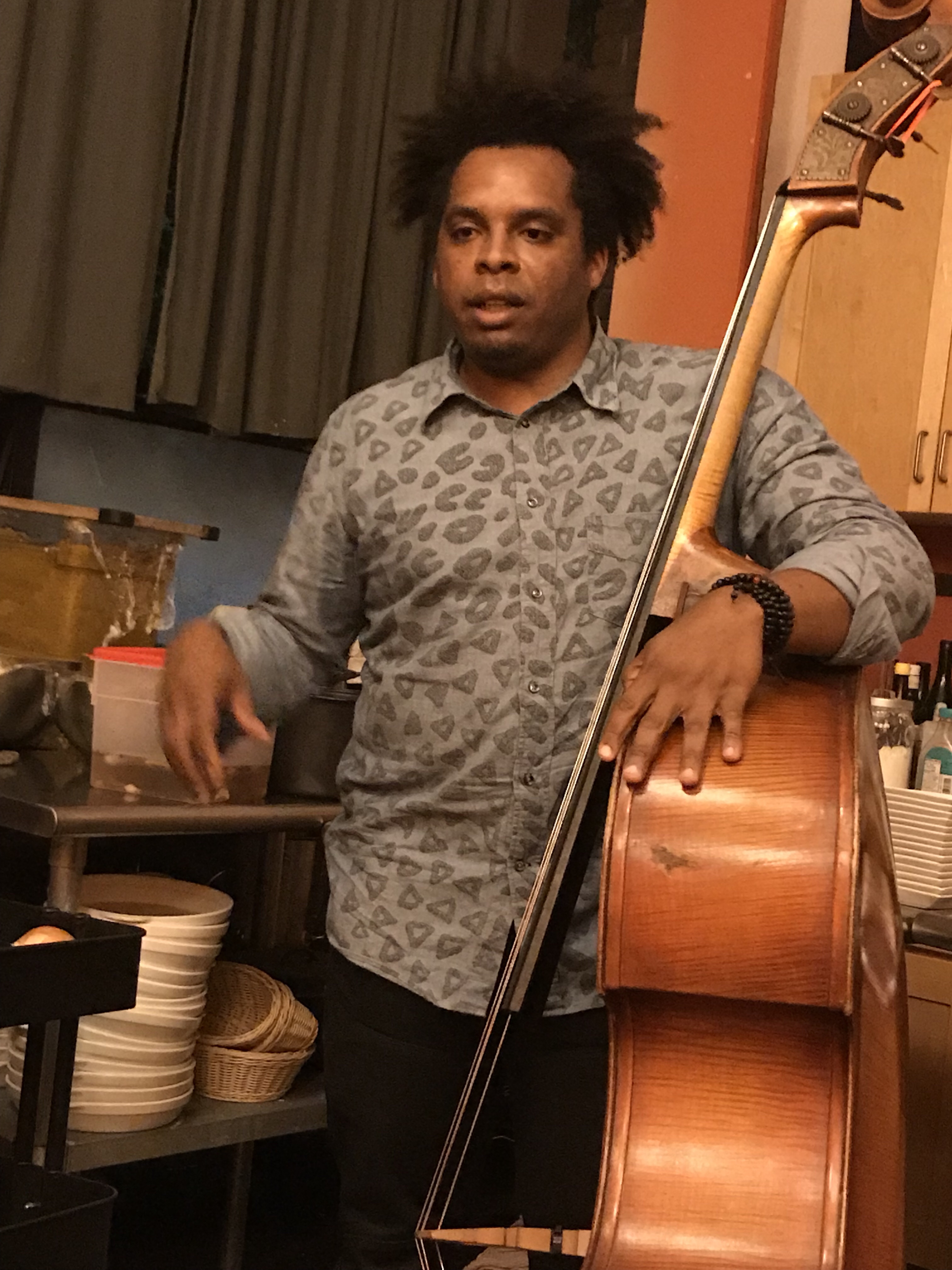
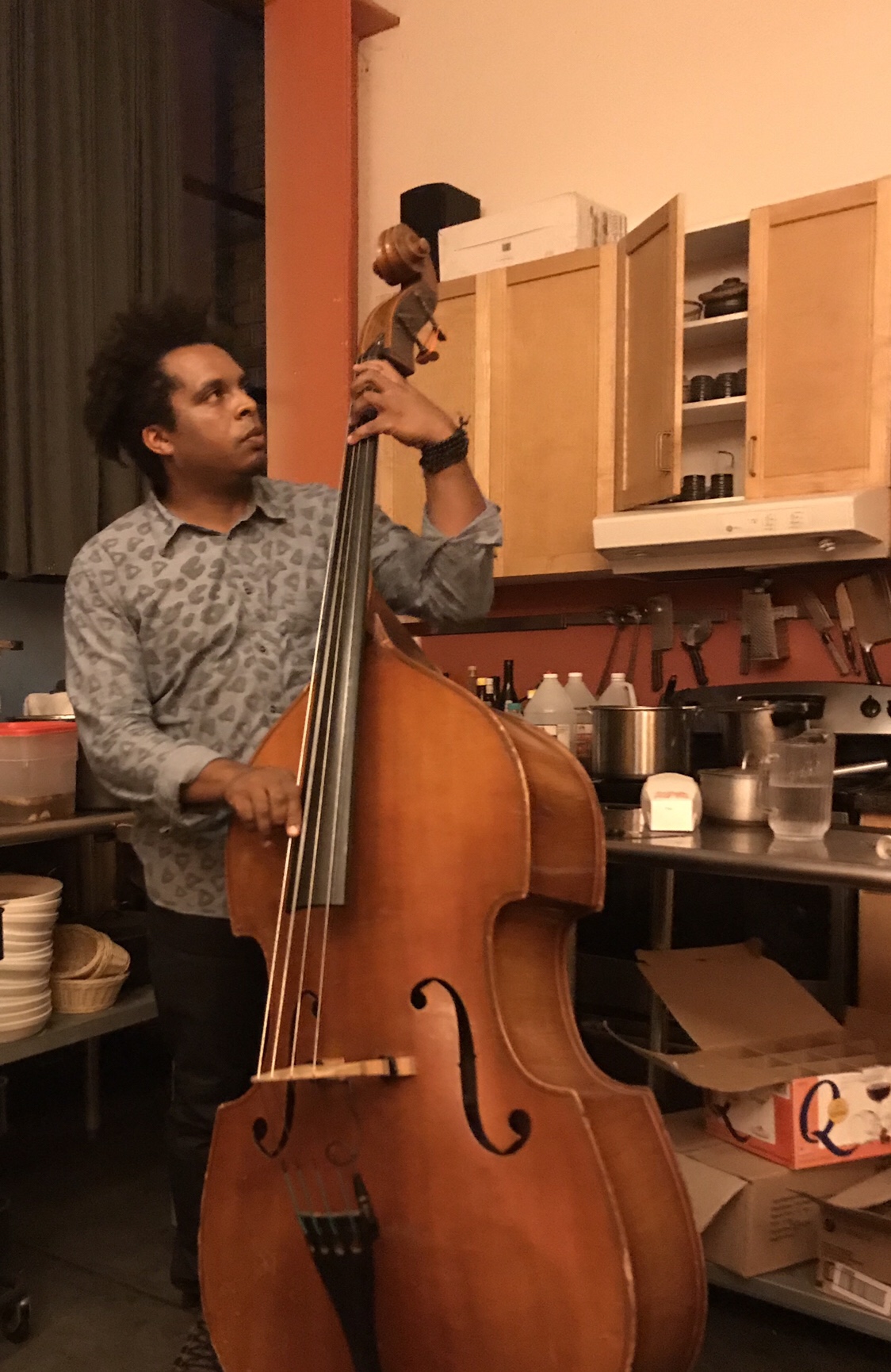
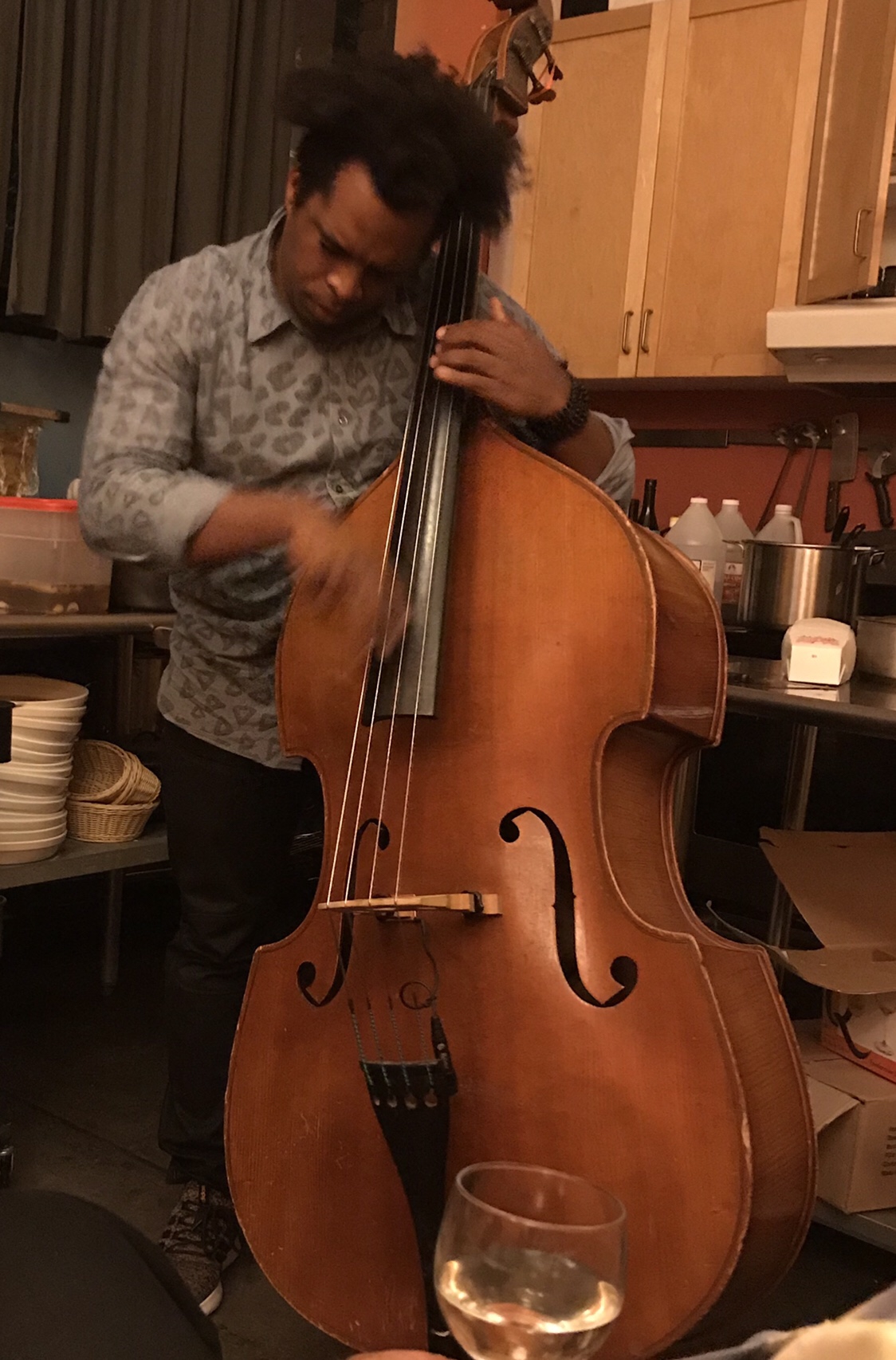
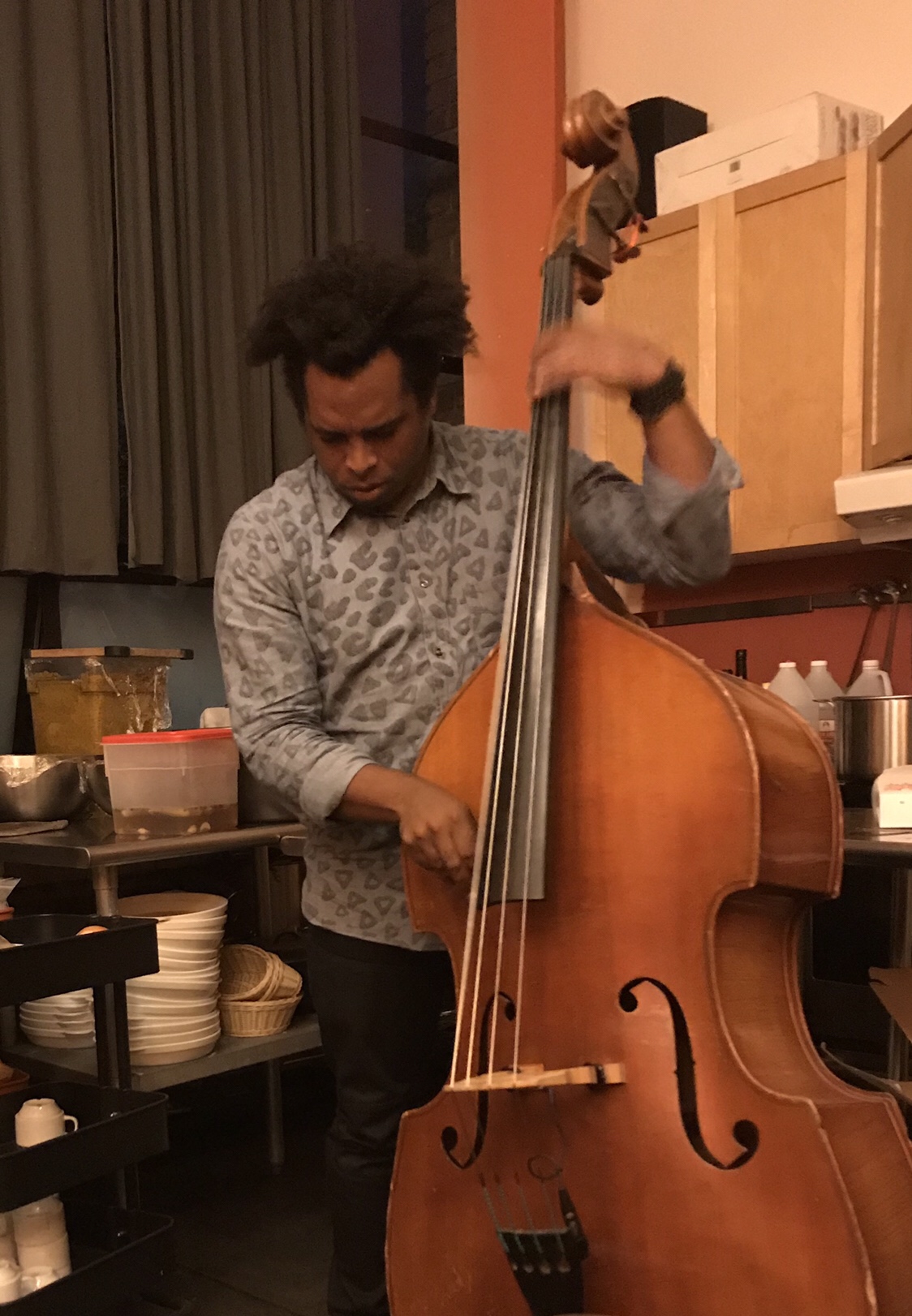
The tradition here puts the musician on stage just before dessert. Rashaan Carter is an American musician from Washington D.C. who now resides in New York. He was passing through the bay area and Philip Gelb extended an invitation which he graciously accepted.
He began with an improvisation which he had initially done for a dance piece depicting the lynching of a black American woman Laura Nelson and her son in Oklahoma in 1911. Now this could really bring down the mood of the evening but for the fact that Carter spoke of and subsequently played this piece with such passion that all one could really feel is the tragedy of the act and the heroic expression of what is essentially protest music dedicated to her memory.
Rashaan has no small bit of the Blarney. His running commentary during the performance was as entertaining as that of a stand up comic as he engaged most thoughtfully with the evening’s clearly appreciative audience.
He graced us with what he said was originally intended to be a performance of a Charlie Haden piece but decided he wanted to do his own piece as a sort of homage. Indeed he captured Haden’s spirit oh so well in another virtuosic and passionate performance.
He ended with another sort of tribute, this time to Henry Threadgill. Again his gift of gab provided just the right segue into the next piece and his familiarity with Threadgill was immediately apparent. His facility with the acoustic bass produced nearly vocal sounding lines in a performance that did honor to Threadgill and left the evening’s audience very pleased.
We concluded with Blueberry polenta cake with peach ice cream and blueberry raspberry sauce, all vegan, all absolutely delicious.
And we will all keep an ear out for Rashaan Carter from this point on. Bravo!
On Sunday February 15th I had the pleasure of attending one of my favorite underground restaurant/performance venues in West Oakland. In a nondescript neighborhood of light industry, warehouses and loft spaces Philip Gelb has been running “In the Mood for Food” (a take of the title of one of his favorite films, “In the Mood for Love”) his occasional dinner/concert series since 2005.
Philip is an amazing vegan chef as well as a shakuhachi player/teacher whose cuisine is known to a fortunate group of people which includes this writer. Combining incredibly creative dishes sometimes at the behest of a given artist (Amy X Neuberg requested a “purple” theme and got it when she appeared ) with his wide network of artist friends, many of whom he has performed with. Phil has been doing these occasional events with a maximum audience of about 20 people (including the featured performer) at a rate of at least once every month or two.
Potato Sorrel Soup
First let me say that I am not a vegan but if vegan fare always tasted this good I could easily make the transition (OK, I would have a hard time giving up pizza) to vegan fare. Phil’s fresh locally shopped ingredients are transformed by his gustatory alchemy into a variety of delectable dishes in a wide range of cuisines. His network in gourmet vegan food practitioners is rivaled only by his musical network. Japanese is one of his specialties but I have personally partaken of various middle eastern and Caribbean cuisines with equal satisfaction.
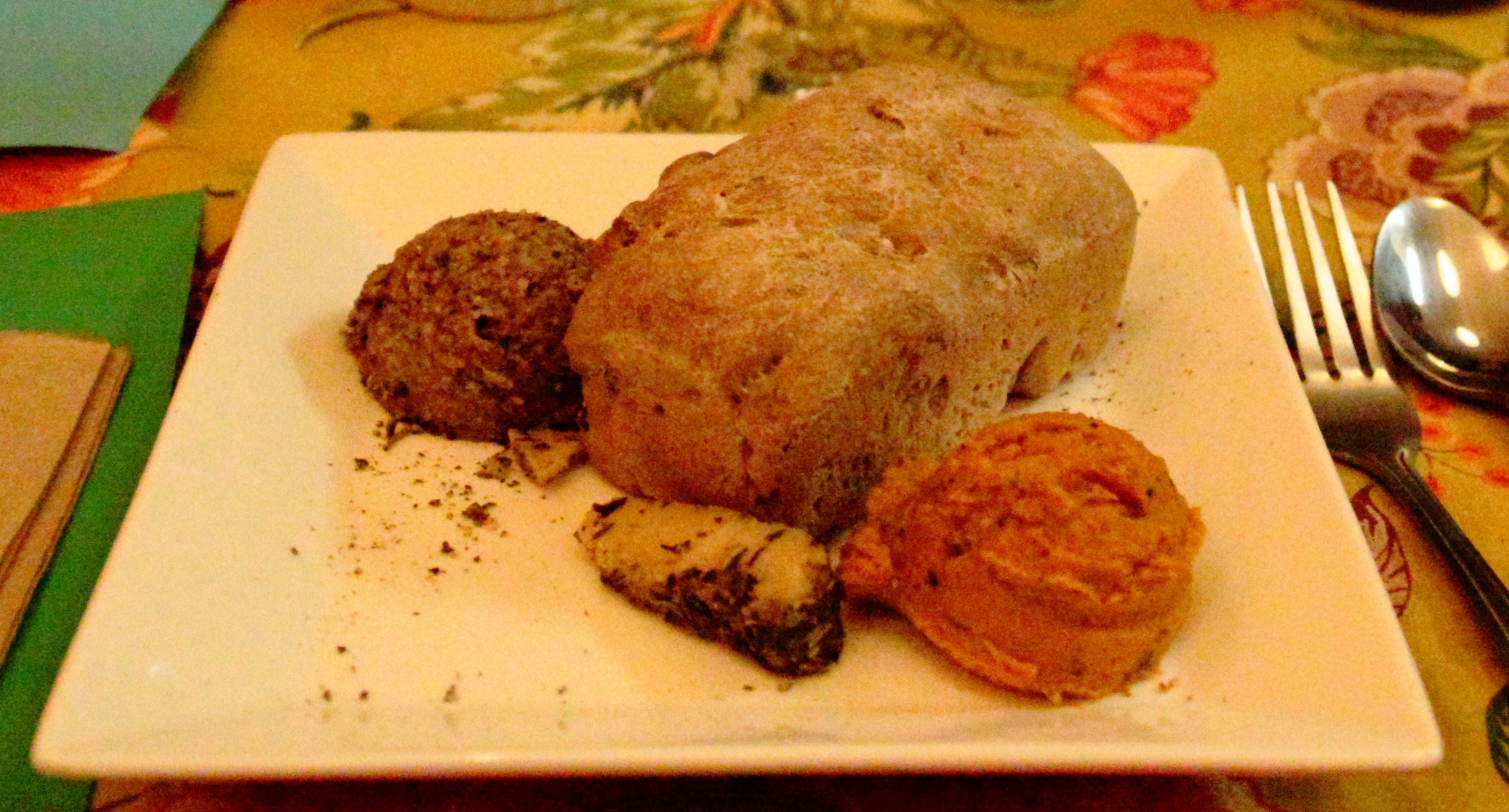
Mushroom Pate, Carrot Walnut Pate and Rosemary Bread, didn’t get a picture of the fresh salad greens.
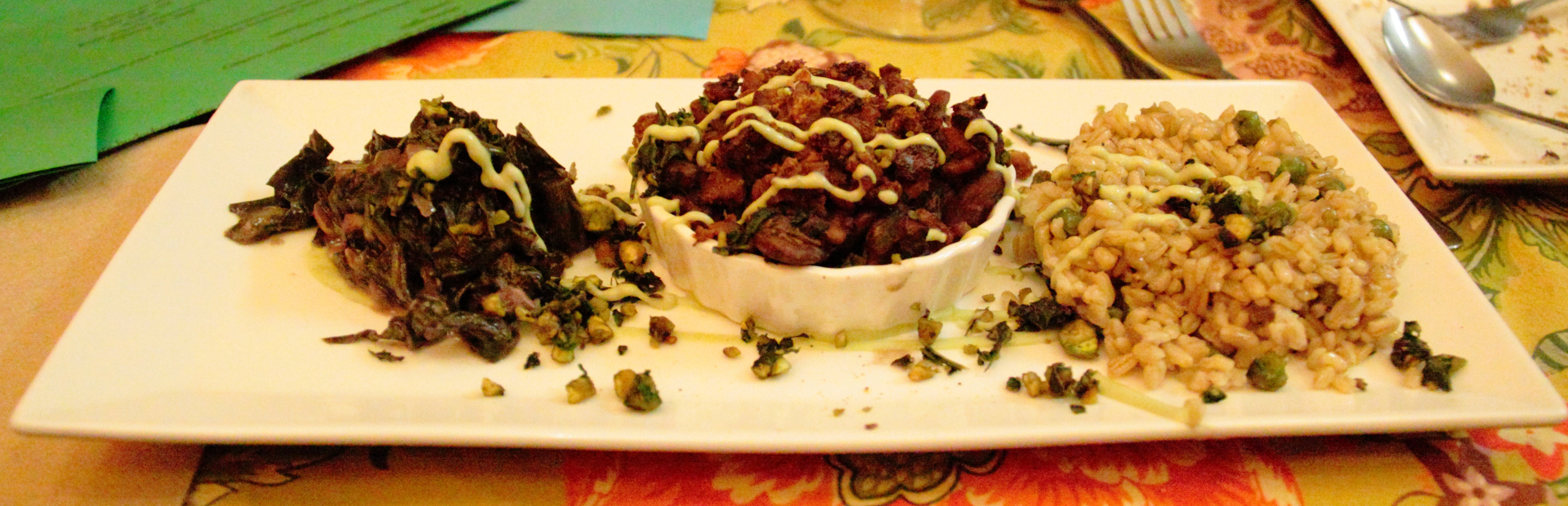
This night’s selection featured a creamy Potato Sorrel Soup followed by a salad plate consisting of rich Mushroom Pate, Carrot Walnut Pate, a freshly baked Homemade Rosemary Bread with Salad Greens and a tart Citrus Dressing. The main course consisted of Cassoulet, Oat Pilaf and Herbed Collards, all very tasty and very filling.
The main course of Cassoulet, Oat Pilaf and Herbed Collards. It tastes even better than it looks in Phil’s characteristically beautiful presentations, trust me.
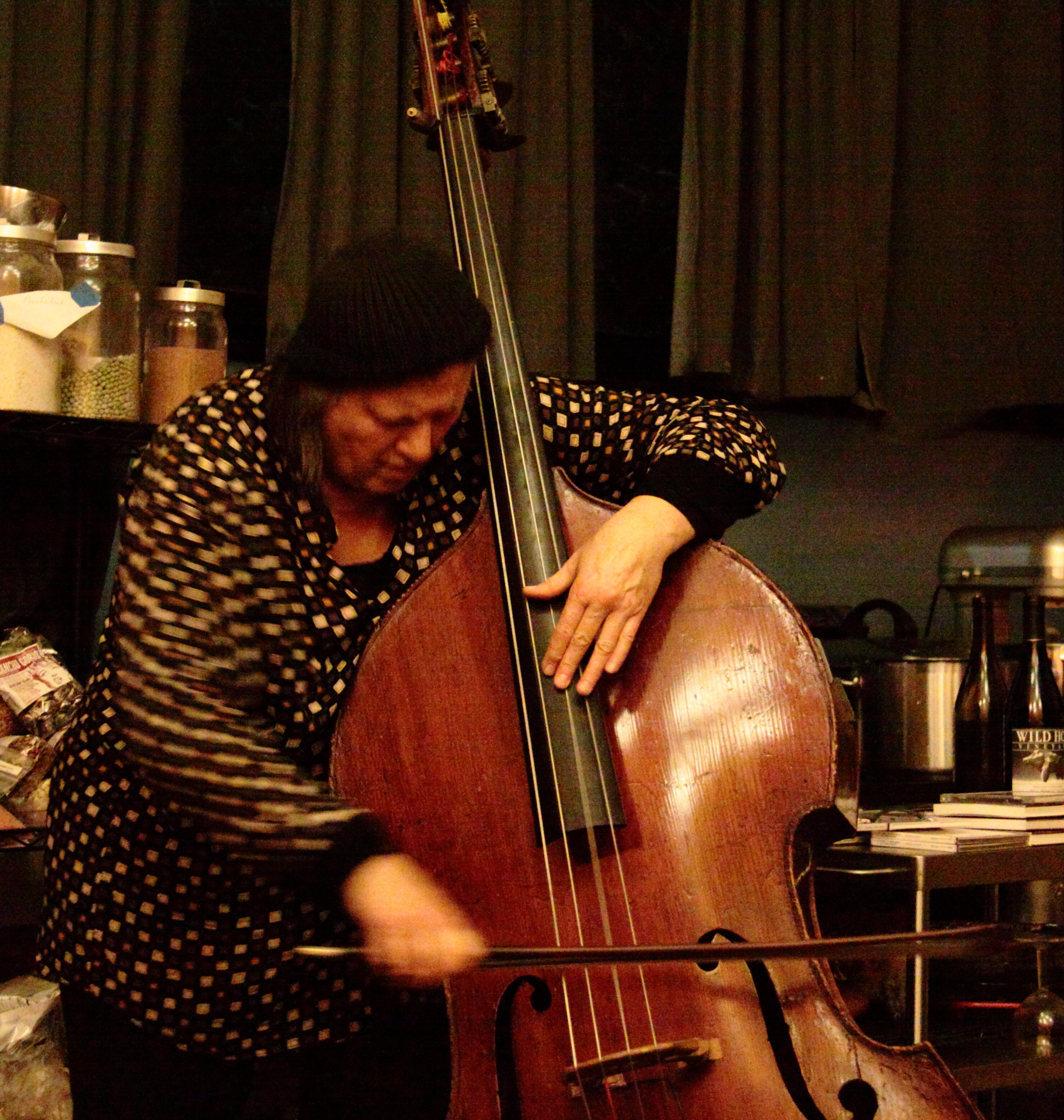
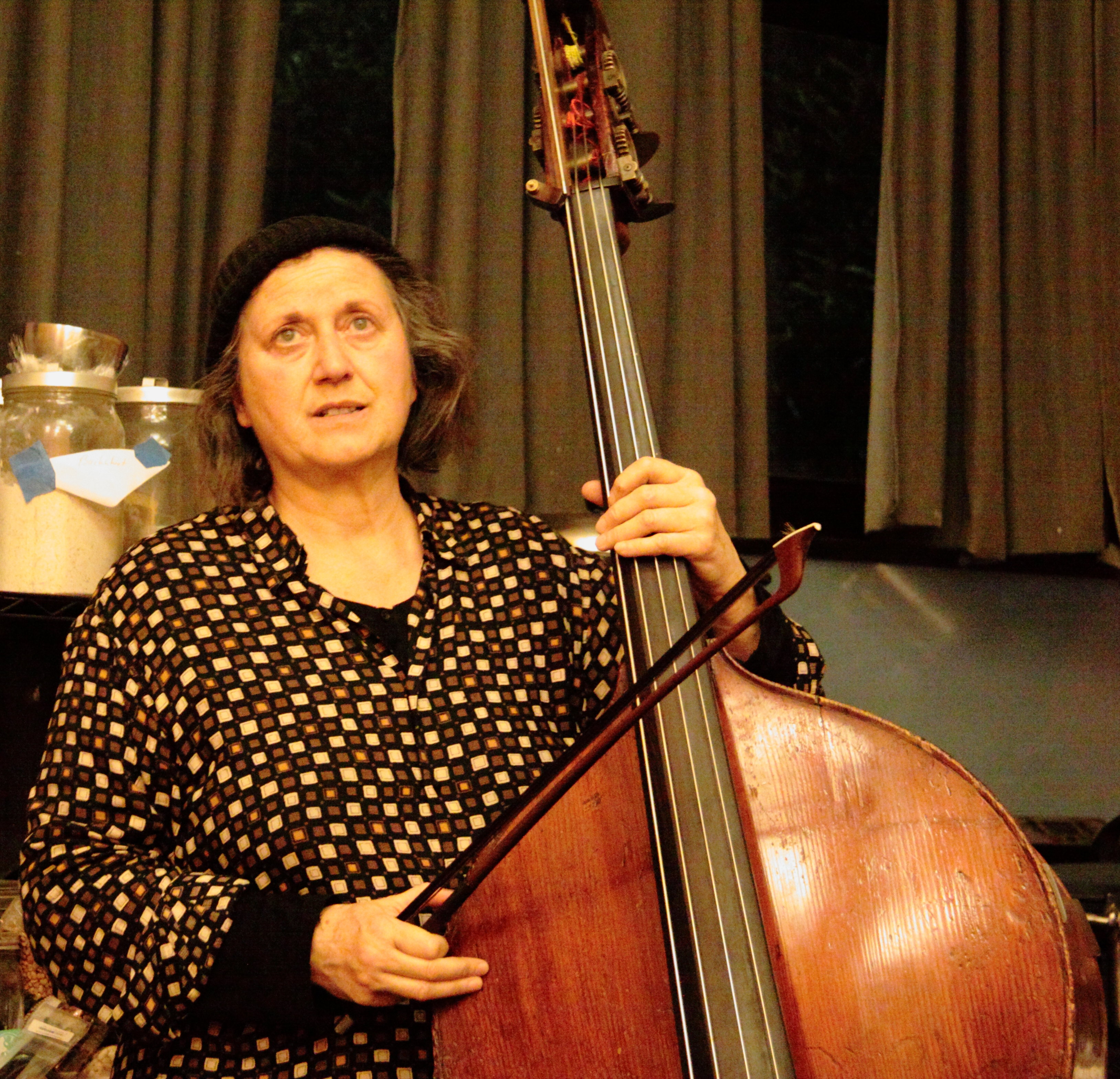
A feast such as this could not easily be upstaged but, in the little break before the dessert course, we were treated to a wonderful performance by Joëlle Léandre, the French Double Bass virtuoso, singer and composer whose work traverses a wide range of musical genre from John Cage to free jazz and categories that defy easy classification. She has amassed a discography of over 100 albums to date and has performed with artists including Pierre Boulez, John Cage, Giacinto Scelsi, Derek Bailey, Barre Phillips (who appeared at this series a couple of years ago), Anthony Braxton, George Lewis, India Cooke (also one of Phil’s previous guest artists), Evan Parker, Irene Schweizer, Steve Lacy, Maggie Nicols, Fred Frith, Carlos Zingaro, John Zorn, Susie Ibarra, J.D. Parran, Kevin Norton, Sylvie Courvoisier and Pauline Oliveros (another recently appearing artist at this series). Oh, and she has also performed and recorded with Mr. Gelb.
Leandre is a friendly and engaging person both in her playing and in conversation and we all had opportunities to speak with her and experience her charming personality as she related various observations and anecdotes. These dinner/concerts are a uniquely intimate experience which you cannot get in the average concert setting.
Leandre embraced and nearly danced with her instrument.
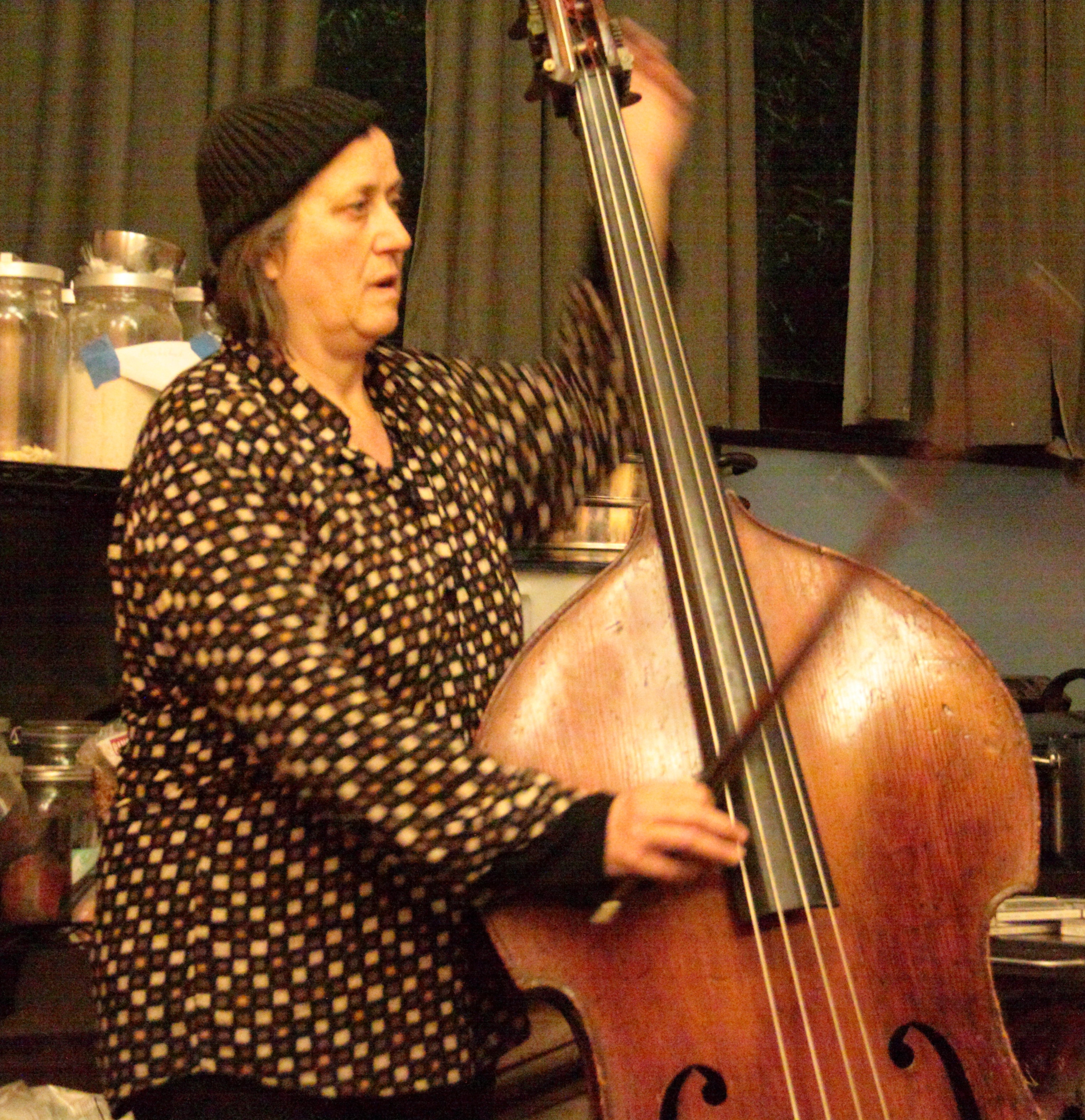
Ms. Léandre treated us with three separate improvisations in which she demonstrated her facility with a wide range of double bass techniques including various bowing techniques, pizzicati, percussive techniques and wordless vocals that mixed seamlessly with her very intense and passionate performances. Unfortunately it is nearly impossible to really describe with any accuracy the music we experienced this night. But suffice it to say that it was played in a manner that communicated very effectively with the very appreciative audience. I asked her if she always plays with such passion and she rather matter of factly simply said, “yes”.
Her command of a wide variety of playing techniques blended together with her voice in an almost orchestral sound tapestry driven by Joelle’s passionate playing.
I was so taken with the performances that I failed to get a photo of the delicious dessert course which consisted of a Waffle Sundae comprised of a very fresh chocolate-buckwheat waffle covered with chocolate pistachio ice cream, maple walnuts and chocolate port sauce. An amazing vegan sweet treat enjoyed by all.
The clearly happy audience lingered to talk with each other, with Phil and sous chef Cori as well as with Ms. Leandre who had a great selection of recent CDs and a couple of books available for purchase which she graciously signed. Overall this was an extremely satisfying evening, certainly for this blogger and clearly for the other guests but also for our wonderful performer who left to get some sleep before her scheduled performances tomorrow at the Berkeley Arts Festival.
The performer pauses looking wistfully as the muse descends upon her.








 New Music Buff