Longleash: Incorporating the Modern


longleash

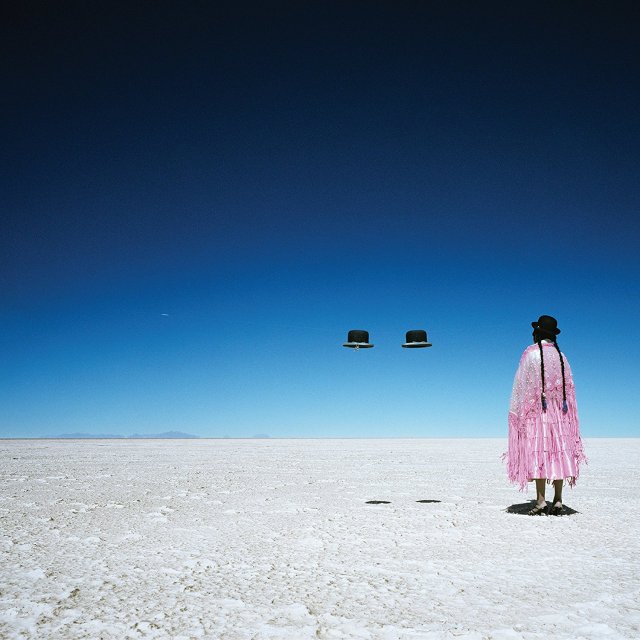
The strikingly beautiful cover art reminiscent of Magritte is eye catching and make this reviewer nostalgic for the days of the 12×12 format of LP covers.  (Album Artwork: Pink Lady (2015), Scarlett Hooft Graafland, Album Design: Laura Grey).  It is, perhaps by virtue of its nod to modernism, a metaphor for the content of this album as well as being its title.

Longleash is apparently the oh so clever operations name of a CIA project whose goal was to help proliferate American modern art in the cold war era.  These days I guess that would be “weaponizing” art.  And this modern piano trio has (curiously) elected this for their stage name.

Well the content of this album is nowhere near your traditional piano trio and may even seem subversive to some listeners.  Longleash are modernist throughout.  Pala Garcia, violin; John Popham, cello; and Renate Rohlfing, piano self-identify as a group with “traditional instrumentation and a progressive identity.”  Indeed they have chosen a rather young and pretty much unknown group of composers: Francesco Filidei (1973- ) is the oldest of the group followed by Clara Iannotta (1983- ), Juan De Dios Magdaleno (1984- ), Christopher Trapani, and Yukiko Watanabe.

Despite the varied backgrounds these composers seem to share a particular segment of a modern aesthetic.  They seem fond of judicious use of extended instrumental techniques and quasi-minimalist cells but their styles are quite listenable.  They seem to have aspects of pointillism, the occasional terseness of Webern, some rhythmic intricacies and the occasional nod to a melody.  In short they seem schooled in the variety of techniques which rose largely out of the twentieth century but seem beholden to none of them seeking instead to judiciously use their skills to create their own unique sound worlds.

There are five works on eight tracks and none of them can be easily described except to say the the combination of listening with the aid of the liner notes can be helpful.  That is not to say the works cannot stand on their own.  That is a useful experience in itself.

I suppose it might be best to say that these works will likely evoke a variety of reactions from various listeners.  This is the sort of album, at least for this listener, that benefits from a direct concentrated listen without distraction but it is also worth experiencing as background music, letting the experience creep in where it might while you do other things.  And then a read through the liner notes to try to divine the composers’ intents.

I’m not being facetious here.  I think this is a very intriguing album but one which is difficult to characterize in words and one which is beyond this writer’s expertise in terms of any useful analysis.  Also the newness of these voices does not allow one to place these works even within the contextual canon of each individual composer’s work.  We have free floating modernism which, as was thought in the cold war days, may invade one’s intellect in subversive ways.

The review immediately preceding this one, Soft Aberration, features this piano trio on it’s first track.  Now Scott Wollschleger is very closely associated with the Manhattan School of Music.  What is curious here is that Longleash has managed to find the present disparate group of emerging composers with no directly discernible connections to the Manhattan School but with a clear affinity for the same sound world.  It is the luck of the draw that these reviews have appeared in this sequence but the similarities are striking.  So if you like the spare sounds of the New York School (John Cage, Morton Feldman, Earle Brown, Christian Wolff) and their successors in people like Scott Wollschleger, Reiko Futing, and Nils Vigeland (who, along with Pala Garcia provides the useful liner notes) then this will be your cup of tea.  But even if you don’t know these folks you are still in for a fascinating journey of cutting edge ideas by emerging composers.  And even if it is not “weaponized art” subverting your mind to western ideology you can be assured that it is genuine and uplifting work done by some wonderful performers of composers you will likely hear from again very soon.


Scott Wollschleger’s Soft Aberration


wollschlegersoft

New Focus FCR182

The cover and the booklet that come with this CD contain art that is a remarkably fitting metaphor for the music contained herein.  The almost monochromatic images with sometimes barely visible lines defining a space which requires serious concentration to discern effectively at times is very much like the music we hear on the disc.

Scott Wollschleger (1980- ) is an American composer who studied with Nils Vigeland at the Manhattan School of Music.  His work has been compared to that of Morton Feldman and, more generally, to the other members of the so-called New York School.  Vigeland has been active throughout his career performing and recording definitive versions of some of the best of Morton Feldman, John Cage, Earle Brown, and Christian Wolff.  It would appear that these voices and stylistic leanings are very much favored at the Manhattan School of Music.  A previous disc reviewed here with music by head of the composition department Reiko Futing, evokes a similar sound world.

This disc of chamber music contains five works on eight tracks ranging from 1’43” to 14’27” and all require almost as much concentration on the part of the listener as the extended techniques and performance requirements demand of the performers.  The dynamic range is from (generous) silences to forte.

The first track is by the seriously entertaining and odd piano trio called Longleash.  They demonstrate their expertise and concentration as well as their love for this musical genre in their performance of Brontal Symmetry (2015).  Unlike the other pieces here, Brontal Symmetry makes use of ostinati and there is a consistent sound field punctuated with silences.  It is an unusual but ultimately engaging piece.  Longleash consists of Pala Garcia, violin; John Popham, cello; and Renate Rohlfing, piano.

It is followed by the titular and sparse Soft Aberration (2013) for viola and piano played by Anne Lanzilotti, viola and Karl Larson, piano.  Though approximately the same length as the opening work the silences nearly suspend the perception of time and create a sense of sounds suspended in space in a sort of sculptural way.

Bring Something Incomprehensible into this World (2015) is for trumpet and soprano.  The three parts of this work are spread across the disc (tracks 3, 5, and 8) creating an even more spare sense.  It is interesting to play the three movements manually without the interruption of the intended track sequence to get a sense of the piece.  Again we have silences predominating with extended techniques demanded of the performers.  Andy Kozar plays trumpet and the soprano is Corrine Byrne.  The first movement at 6’39” is the longest followed by the second at 3’25” and the last at 1’43”.

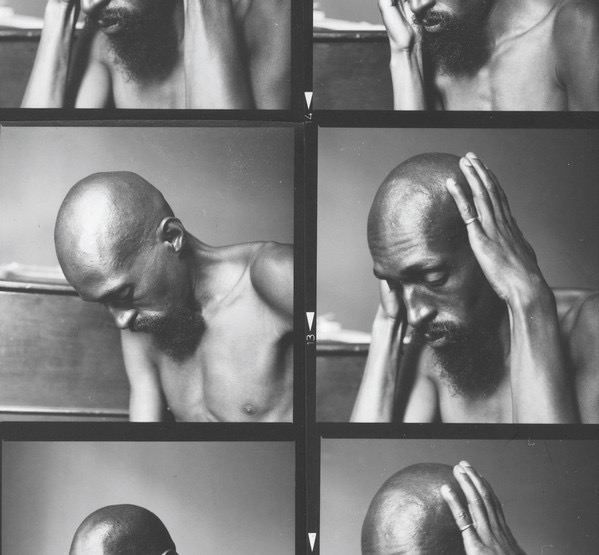
America (2013) is a solo cello piece here played by John Popham (of Longleash).  It is a pointillistic mix of silence and extended instrumental techniques which makes reference to an art work by Glenn Ligon.

White Wall (2013) is for string quartet and is played by the Mivos Quartet consisting of Olivia De Prato, violin; Josh Modney, violin; Victor Lowrie, viola; and Mariel Roberts, cello.  This is an amalgam of unfolding processes which seem to be indiosyncratic to the composer.  It is very intimate music in that sense.  The piece is in two substantial movements.

The album concludes with the brief last part of Bring Something Incomprehensible Into This World.  Suffice it to say that there are attempts here to tie in philosophical as well as visual metaphors.  Wollschleger is apparently enamored of the writings of Deleuze, Nietzsche, and Brecht.  Her lies another tie in to the New York School with their love of visual metaphors and philosophy.  This is not an easy listen but it is a serious effort deserving of some attention.  The listener can decide whether the artists have indeed brought something comprehensible into this world…or not.


Coming Out Electric: Trevor Babb’s Warmth


Steve Reich’s masterful Electric Counterpoint (1987) opens this disc.  That work originally written for Pat Metheny  and has become pretty much a classic as well as a fine way to demonstrate a musician’s facility with multi-tracked guitar music.

Trevor Babb is a doctoral student at Yale and this appears to be his first album.  And what an album it is.  The choice of the opening work serves to demonstrate Babb’s ability to interpret, in his own individual manner, a work that has been recorded many times.  It remains a classic and very listenable work which belies the difficulties inherent in its performance.  Babb seems to take a bit more of a legato approach than previous interpretations but is definitely highly effective and this is a wonderful recording of the work.

It also serves to set the tone for the rest of this truly fine solo guitar and electronics debut album.  Electric Counterpoint is the first of 6 total works represented on this disc.  The remaining five selections fit the rubric of this collection in the overall sense but are definitely unique and challenging in their ways.

Paul Kerekes is not a familiar name to this writer and perhaps a new name to many.  His inclusion here introduces many to this composer and places him in the context of this interesting collection.  This young composer is apparently well known in the New York scene and seems to travel in the circles that include some of the most interesting artists currently working.  Trail is a very different piece than the Reich but demonstrates the range of the solo guitar and electronics genre.  This is a gentler, more meditative piece overall and one which piques interest in hearing more.

David Lang is a well known and very welcome name in new music and is here represented by Warmth, a classic Langian post-minimalist work which delights the listener while challenging the performer.

Septet by the late great James Tenney is one of those masterful compositions that is respected as a masterpiece but not often programmed.  This is due at least in part to it’s critical use of alternate tuning.  The effects intended by the composer can only be heard if the performer can play accurately the tuning involved.  It is a wonderful and listener friendly experience typical of the finest of Tenney’s grasp of how to use such tunings in the compositional process.  Babb executes this piece lovingly and this performance will likely help to nudge this work to a more frequent experience in the concert hall.

Babb introduces himself as a composer in Grimace, an impressionistic exercise in which he attempts to imitate both the style of Ligeti and evoke the image of a mask seen in an art exhibit.  Long tones and extended techniques predominate in this meditative drone-like work that demonstrates fine technique in both composition and instrumental facility.

The album concludes with Slope 2 by the emerging bass player and composer Carl Testa.   Again Babb introduces a new voice for the listener to explore.  This extended composition, more drone than pattern based, is one that deserves multiple hearings to discern its substance and to demonstrate its position in the larger rubric of this collection.

Babb produces a great debut here and makes a strong case for the genre of electric guitar with supporting electronics as being a viable format for a live concert.  He also seems to be defining that genre much the way that many solo artists are doing these days.  He seems to be constructing a repertoire establishing the classics (Reich, Tenney) and promoting the viability of works that he feels deserve a place in that repertoire.

This is a really delightful album and that extends, at least in this writer’s eye, to the cover design as well.  Again I will bemoan the loss of the 12  inch square format of LPs which could have made more prominent this lovely design by Colin Meyer and Trevor Babb.  Perhaps a 12 inch vinyl release may happen.  But until then the listener can settle most comfortably in the warmth of this truly fine release even in the smaller CD format or even as a digital download.


Emanuele Arciuli, Defining a Genre: Walk in Beauty


walk in beauty

Innova 255

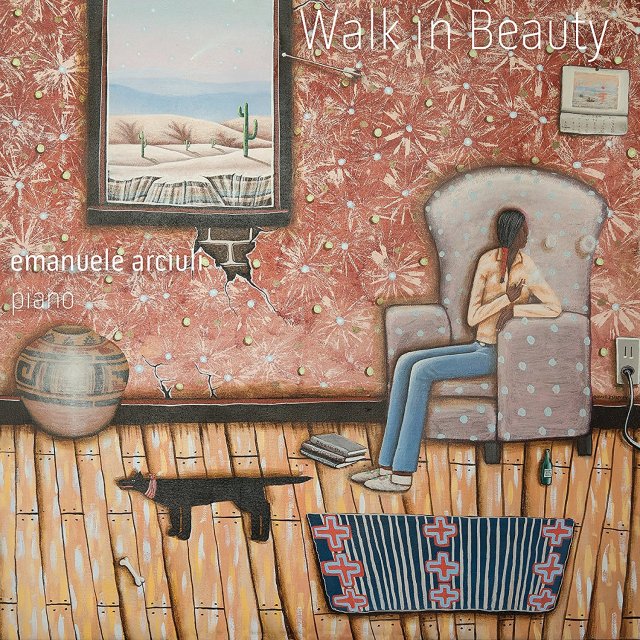
This 2 CD set virtually defines a genre.  Following in the traditions of such notable compilations as Robert Helps’ “New Music for the Piano”, Alan Feinberg’s wonderful series of discs on Argo records among many others we see Arciuli displaying his grasp of music in the tradition of the gentle musical anthropology found in the music and scholarship of Peter Garland.  The album’s title comes from Garland’s lovely multiple movement Walk in Beauty (1992) released on New World records in the 1990s.  The present collection is both nostalgic and forward looking reminding us of great past efforts and introducing us to new work.  It is a look at a loosely defined style of mostly late 20th century American piano music through the lens of a non-American artist.

Garland’s interest in Native American myths and music inform his post minimalist ethic and the additional pieces chosen for this two disc set reflect similar artistic sensibilities.  Emanuele Arciuli is an Italian pianist whose interests range from the Second Viennese School to the unique compositions of Thelonius Monk.  He also has a strong interest in classical music from Native American traditions which puts him very much in sync with Garland’s work as well.  Here he has chosen music which he clearly understands and which appear to have deep meaning for him.

There are 28 tracks on 2 discs representing 13 composers.  Five of these composers are explicitly affiliated with their respective Native American traditions and the remaining eight composers take their inspiration at least in part from the rich music and/or mythology of those cultures.  The bottom line here is that these are carefully and lovingly chosen works which open a window on one fine musician’s perception of a certain Western/Native American/New American style which, at worst, holds up a mirror and, whether we like it or not, it tells us something about who we are and from whence we came.

Connor Chee‘s “Navajo Vocable No. 9” opens the album and sets the tone.  This is one of a series of piano pieces by this fascinating composer/pianist whose star is deservedly rising.  His work celebrates Navajo culture and is informed as well by his training in traditional western art music.

This is followed by Peter Garland‘s “Walk in Beauty”.  This piece is representative of Garland’s post-minimalist, impressionistic style.  It was previously recorded so wonderfully by Aki Takahashi on the eponymously titled New World Records album from the early 1990s.

Garland’s music is fairly well documented but deserves a wider audience. (Curiously he does not have a dedicated web site.)  His scholarship and promotion of new music also serve to place him very highly among this countries finest artists and scholars.  In addition to his compositional output he is known for his Soundings Press publications and his papers are now held by the University of Texas at Austin.

Kyle Gann is, similarly, a scholar and a prolific composer.  He has for many years demonstrated a keen interest in Native American myths in his diverse and creative output.  Gann is here represented by his “Earth Preserving Chant”.

Michael Daugherty is known for his incorporation of pop culture in his work and has been recognized with no fewer than three Grammy Awards.  His work is rooted in pop Americana and “Buffalo Dance” is his homage to Native Americana.  And if his homage seems a bit P.T. Barnum at times, that too is Americana.

John Luther Adams, a recent Pulitzer Prize winner for his orchestral work, Become Ocean, is a prolific composer who derives much of his inspiration from the mythology of Alaskan natives.  Adams spent many of his creative years in Alaska working with ecological projects as well as musical ones.  “Tukiliit” is representative of this work and pays homage to Native American/First Nation peoples.

Raven Chacon is an emerging composer who has produced a great deal of work though little appears to be available on recordings.  “Nilchi Shada’ji Nalaghali” (Winds that turn on the side from the Sun) is an electroacoustic work serves as a little sample of this artist’s work and its inclusion in this fine collection alone suggests that the remainder of his work deserves to be explored.

Martin Bresnick is an honored member of the American Institute of Arts and Letters and his work is fortunately well known.  The present piece, “Ishii’s Song” is a reference to an American Indian, the last of his tribe who lived out his life under the protection and scrutiny of anthropologist Alfred Kroeber at the University of California Berkeley.  His spirit still seems to linger in the Bay Area and this piece is a sort of homage to him.

This set contains two works by Louis W. Ballard (1931-2007) who was a Native American composer that composed classical concert music.  His work is steeped in Native American mythology and deserves to be better known.  Leave it to a non-American to point out this deficit.  Arciuli makes a strong case for listeners and for other musicians to embrace this neglected artist.  Disc Two track 2 contains the “Osage Variation” and Disc two tracks 13-16 contain his “Four American Indian Piano Preludes”.

Jennifer Higdon is a star already very much risen on the musical scene and she is here represented by a substantial piano piece called “Secret and Glass Gardens”.  Higdon, also a recipient of the Pulitzer Prize, is one of those composers who manages to be friendly and accessible as well as modern.  Arciuli seems to perceive similarities in her vision that make this work fit in convincingly in this collection.  Hers is seemingly a similar romanticism and nostalgia and Arciuli has convinced at least this listener of the kinship of this piece in the vision of this collection.

Arciuli introduces another composer unknown to this reviewer, Peter Gilbert.  This young composer with an impressive resume is the co-director of the composition program at the University of New Mexico.  The offering here is his set of four “Intermezzi” for piano.

The inclusion of Carl Ruggles‘ “Evocations-Four Chants for Piano” seem at first to be a strange choice but following the Gilbert Intermezzi one gets the impression that the Americana that is Ruggles is a part of the provenance of this collection.  Ruggles coarse and famously racist attitudes hardly fit with the generally romantic vision of this collection but Americana as perceived by a non-American need not edit the unsavory from the overall picture.  The music is what this is about and these are indeed masterful little essays and a part of the American grain.

Another new name is given a brief appearance in the “Testament of Atom” by Brent Michael Davids.   This young composer’s clever website lists a plethora of works whose titles resemble many of the pieces on these discs.  Again we must trust the artist that his inclusion of this work is representative of his vision of this version of Americana.

For his concluding track Arciuli does a wonderful thing by including the work of Talib Rasul Hakim (1940-1988), another too little known American composer.  Born Stephen Alexander Chambers, he changed his name in 1973 when he converted to Sufism, a spiritual sect of Islam.  The music, “Sound Gone”, is a fitting finale to this beautiful, challenging, and ultimately inclusive collection of Americana.  Bravo, Mr. Arciuli and thank you for the gift of showing us some of the best of how we Americans look to you.


Femenine, a Lost Julius Eastman Recording, a Major Treasure


This is an epic minimalist masterpiece that has the same sort of almost full orchestral impact that one hears in works like Reich’s ‘Music for 18 Musicians’, Riley’s ‘InC’, and perhaps Glass’ ‘Music with Changing Parts’ or ‘Music in 12 Parts’.  The point is that it is entrancing and engaging music that deserves to be heard.

Julius Eastman (1940-1990) was an American singer, performer and composer whose work was little known until after his untimely death.  It was the efforts of composer Mary Jane Leach who performed a labor of love essentially saving Eastman’s work from obscurity when she called upon her fellow musicians and artists to help her gather all the extant recordings and scores many of which were lost after Eastman was evicted from his apartment not long before he died.  Her Julius Eastman page is a valuable reference and her work has inspired further research and performances of Eastman’s music.

Leach’s substantive initial efforts resulted in the release of the 3 CD set, Unjust Malaise which made available all of the then known serviceable recordings of this composer’s music.  Since then this recording became available and it may be the finest that Eastman did.

This is a live recording of a performance from 1974 which is quite lucid and listenable.  It starts slowly but quickly finds its rhythm and pace and provides an uninterrupted 70 minutes of consonant, even romantic sounds.  It’s relation to femininity or any gender issues is not clear, perhaps not even the point.  This piece also seems to have had a companion (called masculine) which is sadly now lost.

Anyone interested and entertained by the minimalist works already cited will find this work very inviting.  Hopefully the release of this recording will encourage a revival of this work and it will be performed again soon.  We as consumers are blessed to have this major work by this major composer available for listening and study.  Eastman deserves recognition as a composer and this disc certainly is a strong support for that.

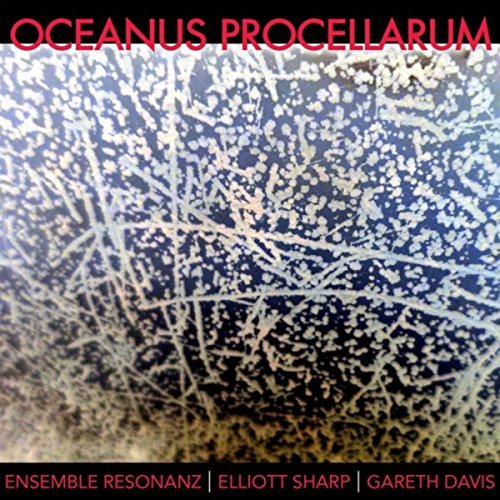
Oceanus Procellarum: Gareth Davis and Elliot Sharp


oceanus

I recall excitedly taking a class in college in the late 70s which dealt with post 1950 composition.  The professor emphasized that the reigning characteristic of this music is “pluralism”, that is to say that anything goes and one gets less useful information from labels like, “classical”, “baroque”, “romantic”, “post-romantic”, “post-modern”, etc.  There is no question that this maxim remains very true and we now are seeing composers well-versed in virtually every technique known to the world of composition.

This album is a fine example of such pluralism.  Seeing names such as Elliott Sharp and Gareth Davis one might expect something of the “free jazz” genre and that would not necessarily be an inaccurate description.  But it would fail to capture the wonderful writing for Ensemble Resonanz by the eclectic (yes, pluralistic too) Elliott Sharp.  As a composer Sharp draws on late twentieth century modern/post-modern compositional techniques along with a fair amount of his own creative innovations gleaned from his own experimentation and, no doubt, from his exposure to the wildly creative milieu of the Downtown New York scene of the 80s and 90s.

The result is like listening to shades of Penderecki and Xenakis as they wrote in the late 1950s though the 70s.  This is far more homage than derivation however and the achievement here is how well the soloists on guitar and bass clarinet fit into the work as a whole.  They fit remarkably well.

This could easily be called “Symphony for Ensemble with Obligatto Guitar and Bass Clarinet” or even Concerto if you like.  The point is that Sharp is an engaging composer whose works are very substantial.  From his beginnings on the New York Downtown scene with its mix of jazz, experimental and classical he has continued to explore and grow as a composer and that is what ultimately makes this release so compelling.

The musicianship here from Ensemble Resonanz, Sharp and Davis is of the first order and there is a certain sense of a tight fit such that, whatever may be improvised here sounds as though it were carefully written into this large orchestral fabric.  This is a powerful piece of music and repeated listenings will doubtless reveal more and more depth.  This is a very engaging piece.

Sharp is clearly evolving and growing as a composer and still hasn’t lost his marvelous collaborative and improvisatorial abilities.  This is a major work and a lovely recording.


Nordic Affect: Raindamage, Wonderful Music from Iceland


Sono Luminus SLE-70008

Definitely an unusual beginning to this sonorous album of chamber music from the happy, creative place called Iceland.  Some of these tracks are electroacoustic combining some sort of electronic sound producing and/or manipulating components along with the live musical performance.

Nothing familiar here but a lot worth listening to.  This is a collection of recent chamber music from what is apparently some of the finest composers working in Iceland today. And as a Sono Luminus product it is a sound object of the highest order.  It is a beautifully recorded set of pieces that goes a long way to demonstrate the high quality and creativity of both the compositional and performance to be found in this distant corner of the world.

There are six works represented here.  Three are exclusively electronic, one for acoustic instruments with electronics and two are for acoustic instruments alone.  All seem to share the eclecticism of modern composers and, to this writer’s ear, a rather distinct style which seems to come out of the Nordic regions these days.

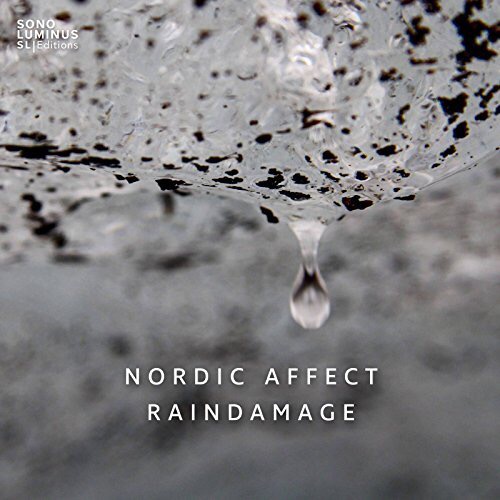
Iceland has a long and proud musical history and has amassed a large creative classical repertoire in (at least) the 20th and 21st centuries.  Perhaps one can hear the “sounds of the north” in these works or perhaps that is simply the analogous associations of this listener’s mind but there does seem to be some affinity between the lovely cover photograph of melting ice and some of the sounds herein.

At any rate this is fascinating music beautifully performed by Nordic Affect, a more or less fixed ensemble of violin, viola, cello, and harpsichord with occasional electronic supplementation.  Performers include Halla Steinun Stefásdóttir, Violin; Guòrún Hrund Haróardóttir, Viola; Hanna Loftsdóttir, Cello; Guòrún Óskarsdóttir, Harpsichord with Nava Dunkelman on drum in the last track.

The composers Úlfur Hansson, Valgeir Sigurðsson, and Hlynur Aðils Vilmarsson are completely unknown to this writer though it is noted that Hansson studied at Mills College in California, itself quite a hotbed of new music innovation.  No matter, though, these are some amazing composers doing cutting edge work and deserve your attention.

All in all this is one fine disc of chamber music.


Dane Rousay’s Blip


cover

Dane Rousay is a San Antonio based percussionist and this is the first of several planned releases.  This is a solo effort largely with drum kit and perhaps a couple of enhancements or additional percussive hardware.  There are 8 rather brief tracks on this album, all of an experimental nature and all very well recorded.

One small disclaimer:  I generally don’t review download only releases but Mr. Rousay was persistent and kind in his requests for a review.  Another aspect is that there appears to be an increase in this purely digital release format and to ignore that in favor of a demand for a physical product would likely be missing an opportunity to hear some good work.

Despite the brevity there is much for the ear.  The percussion seems to be closely miked and that is apparently the point here.  Each track is like a mini-etude or experiment which will presumably be used as material for other work.  Whether this is jazz, free jazz, new music, classical, etc. is actually beside the point.  The point appears to be the sound itself.

There are no liner notes and little in the way of explanation to be found even on the composer’s web site.  (That’s not necessarily a negative thing either.)  It is not clear if this music is improvised or composed or if there is any predetermined structure and there appears to be no intended connection between each of the tracks.  Most of the work is mallets or sticks of some sort hitting the targeted percussive surface though he does make use of extended techniques such as rubbing the mallets across the surface creating rich harmonics in the manner of the spectralists.

After multiple listens this reviewer is left with the impression of having visited the artist’s studio for a rather personal tour of some of his working ideas.  If you are a percussionist or a fan of percussion music this album will doubtless interest you.  It is not easy listening but it does appear to be a very personal exploration of this artist’s techniques and ideas.

I am looking forward to more from this interesting and seemingly uncompromising artist.


Exploding Debussy, Kathleen Supové


New Focus FCR 170

Increasingly it seems that new music performers take on a persona which includes a unique selection of repertoire and frequently a distinctive physical presence.  Kathleen Supové is a fine example.  Her distinctive physical appearance and attire becomes a metaphor for her very personal and intelligent choice of repertoire which sets her apart from her peers.  In addition to unquestioned virtuosity and beautiful interpretive skills her persona takes on an adjectival quality which prompts this reviewer to ponder the “Supovian” experience.


I may live to regret that neologism but the present album is offered as exhibit one (of about 20 albums) attesting to the distinctive choices of music that characterize her work.  This two disc album, The Debussy Effect, is a very modern homage (even sometimes with apologies) to the impressionist master.  Twelve tracks on the two discs feature seven contemporary composers.  Only three tracks are for solo piano.  The rest involve electronic enhancements and or “soundtracks”.

Initially I had hoped to be able to say something useful (if not particularly insightful) to prospective listeners/buyers of this album about each of the pieces here but after several listens I can only reliably say that the material makes for a great and entertaining listening experience.  It harbors complexities that cannot be fairly recounted in such a brief review.  (And this reviewer has a limited knowledge of Debussy as well.)

Here are works by some of the finest of the New York “downtown” music traditions that reflect some amazing and very deep appreciations that will likely change the way you hear Debussy.

Here is the track list:

Disc One

1.  Storefront Diva: a dreamscape by Joan La Barbara

2.  Dr. Gradus vs. Rev. Powell by Matt Marks

3.  Layerings 3 by Eric Kenneth Malcolm Clark

4.  What Remains of a Rembrandt by Randall Woolf

Disc Two

1-4.  Shattered Apparitions of the Western Wind by Annie Gosfield

5-7.  Cakewalking (Sorry Claude) by Daniel Felsenfeld

8. La plus que plus que lente by Jacob Cooper

All are engineered by the wonderful Sheldon Steiger for the New Focus recordings label.

So the take away here is as follows:  If you are a Debussy fan you will want to hear this album.  If you are a Kathleen Supové fan you will want to hear this album.  It is the second reason the seems the most salient here.  I expect to be listening to this many more times.  Enjoy.


Other Minds 22, Resounding Sacred Tributes from Music to Wheaties


OM22052120170026

Nicole Paiement led a touching performance of Lou Harrison’s La Koro Sutro

Nominally this was a celebration of the life and music of Lou Silver Harrison (1917-2003) but this last concert of Other Minds 22nd year celebrated so much more.

OM22052120170011

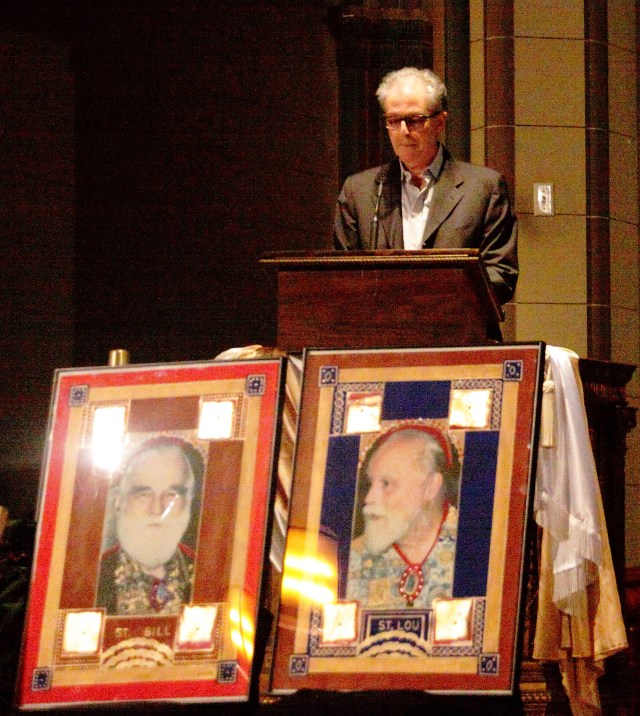
Curator and Other Minds Executive and artistic director introduces the night’s festivities with these artistic icons titled St. Lou and St. Bill (Lou Harrison and his partner, instrument builder Bill Colvig). The portraits were sold by silent auction.

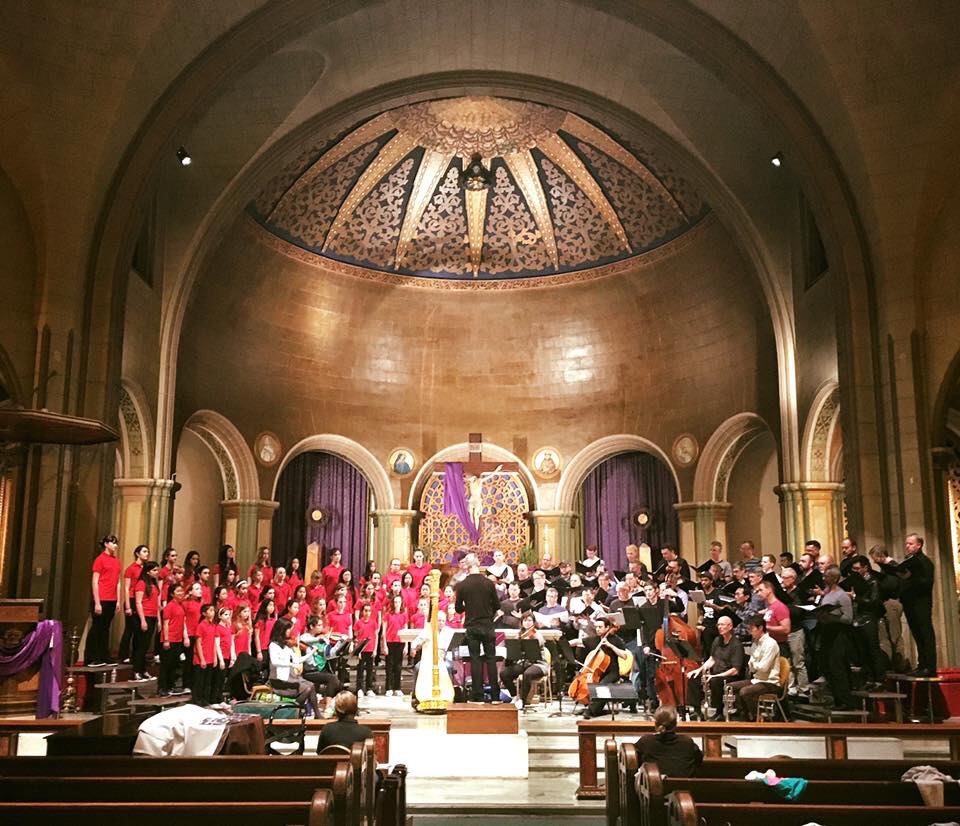
One can’t celebrate the life and music of Lou Harrison without acknowledging his life partner of 30 years, Bill Colvig (1917-2000).  Colvig was the man who designed and built the American Gamelan percussion instruments used in tonight’s performance.  These repurposed industrial materials were inspired by the Indonesian Gamelan which Lou Harrison encountered at the 1939 world’s fair which took place on Treasure Island just a few miles away.  Amirkhanian added another fascinating historical footnote when he informed the audience that Harrison had come to this very church to learn to sing Gregorian Chant some time in the 1930s.

A further and very intimate context was revealed when Amirkhanian took an informal poll of the audience asking who had met and/or worked with Lou Harrison.  By his count he estimated that about 40% of the audience had encountered “St. Lou” (this writer met the magnanimous gentleman in Chicago in the early 1990s).  Indeed many of the musicians had encountered and/or studied with Harrison and the passion reflected in their performances and the audiences response clearly shows why he (and Bill) were elevated tonight to secular sainthood.

The wonderful acoustics of the Basilica easily accommodated Harrison’s dislike of electrical amplification.  Even the solo and small ensemble music was heard as it was intended.

OM22052120170008

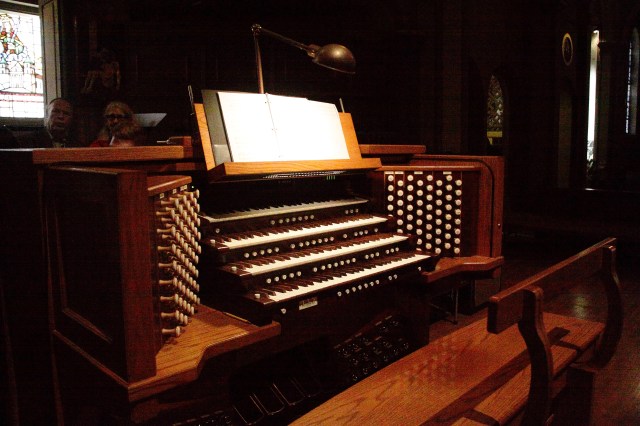
The organ console at the Basilica.

The well attended concert began with an early rather uncharacteristic piece called Praises for Michael the Archangel (1946-7).  It reflected the influence of Arnold Schoenberg, one of Harrison’s teachers (Henry Cowell and K.T.H. Notoprojo were also among his teachers).  Harrison also famously worked with Charles Ives whose Third Symphony he premiered.  He also worked with John Cage and collaborated on at least one composition with him (Double Music).  The angular and dissonant sounds were lovingly interpreted by Jerome Lenk, organist and chorus master at the Basilica.

OM22052120170013

Organist Jerome Lenk acknowledges the audience applause and allows himself just a touch of a satisfied smile for a well wrought performance.

Next was a solo harp piece Threnody for Oliver Daniel (1990).  (Oliver Daniel (1911-1990) was a composer, musicologist, and founder of Composer’s Recording Incorporated.  He was a friend of Harrison’s and a great promoter of new music).

OM22052120170001

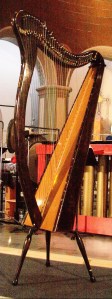
The Threnody was performed on this smaller troubador harp in Ptolemy’s soft diatonic tuning.

Meredith Clark played with focused concentration and gave a very moving performance of this brief and beautiful composition.  Harrison was fond of paying homage to his friends through music.

Clark was then joined by cellist Emil Miland for a performance of Suite for Cello and Harp (1948).  Composed just a year after the angular organ piece which opened the program this gentle suite is entirely tonal and very lyrical in its five movements using music repurposed from earlier works.  Clark here used a full sized concert harp.

The artistic connection between these performers clearly added to the intensity of the performance.  Despite the varied sources of the music the suite has a certain unity that, like Bach and indeed many composers, justifies the re-use of material in the creation of a new piece.

This was followed by another organ piece from Mr. Lenk.  This Pedal Sonata (1989) is played solely by the musician’s very busy feet on the pedals alone (no hands on the keyboard).  Listening to the piece it was easy to believe that more than just two agile feet were involved in this challenging and virtuosic composition.  It appeared to be quite a workout but one accomplished with great ease by the performer.

OM22052120170016

Emil Miland and Meredith Clark smiling in response the the applause following their performance.

Following an extended intermission (owing to a dearth of restroom facilities) there was an awards ceremony.  Charles Amirkhanian was awarded the 2017 Champion of New Music Award (tonight’s conductor Nicole Paiement was also a previous awardee).  Presentation of the award was done by American Composer’s Forum President and CEO John Neuchterlein and Forum member, composer Vivian Fung.

Amirkhanian took the time to pay tribute to his mother (who also would have been 100 this year) his father (who passed away in December at the age of 101) and his charming wife of 49 years, Carol Law, who continues her work as a photographer and her participation in Other Minds and related projects.  He also gave thanks to the staff of Other Minds and his former associates at KPFA where Charles served as music director for over 20 years.

OM22052120170019

American Composer’s Forum President John Neuchterlein looks on as composer Vivian Fung presents the prestigious 2017 Champion of New Music Award to a very pleased Charles Amirkhanian.

OM22052120170020

In a touching and humorous move Mr. Neuchterlein advised the audience that Mr. Amirkhanian would be given yet another award tied to Minnesota which is the home of General Mills (yes, the cereal people).  Amirkhanian (who himself has quite a gentle sense of humor) was surprised and charmed to receive a box of Wheaties emblazoned with his image from whence he can now reign in the rarefied group of breakfast champions in addition to his other roles.

OM22052120170022

The breakfast of new music champions.

The second half of the concert began with the co-composed Suite for Violin and American Gamelan (1974).  Co-composer Richard Dee was in the audience for the performance of this work written two years after La Koro Sutro (1972) and incorporating the same gamelan instrument created for that piece.  The substantial violin solo was handled with assurance and expressivity by Shalini Vijayan, herself a major new music advocate.

OM22052120170025

Composer Richard Dee waving thanks for the performance of Suite for Violin and American Gamelan.

At about 30 minutes in performance the multiple movements all but comprised a concerto with challenging roles for both the percussion orchestra led by the amazing William Winant and his percussion ensemble and the soloist.  All were masterfully coordinated by conductor Nicole Paiement.

OM22052120170024

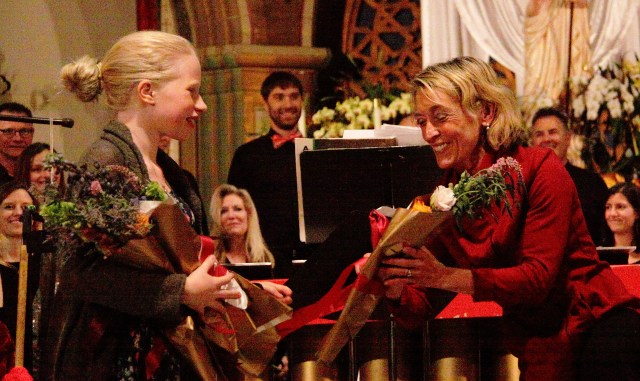
Shalini Vijayan smiles from behind her bouquet acknowledging the thunderous applause following her performance.

In a previous promo blog I had noted that the location of this concert is a designated pilgrimage site, one where the faithful journey as part of a spiritual quest.  Well, having been sidelined by a foot injury for the last 3 1/2 months this amounted to a musico-spiritual pilgrimage for this writer who has not been able to be out to hear music for some time.  The last piece on the concert in particular was a powerful motivation for this personal pilgrimage and I was not disappointed.

The American Gamelan was played by the William Winant percussion group consisting of master percussionist Winant along with Ed Garcia, Jon Meyers, Sean Josey, Henry Wilson, and Sarong Kim.

They were joined by the Resound Choir (Luçik Aprahämian, Music Director), Sacred and Profane (Rebecca Seeman, Music Director), and the Mission Dolores Choir (Jerome Lenk, Music Director).

Meredith Clark joined on concert harp and Mr. Lenk on the small ensemble organ.  All were conducted with both discipline and panache by Nicole Paiement.

This multiple movement work is a setting of the Buddhist Heart Sutra and is done in an Esperanto translation by fellow Esperantist Bruce Kennedy and, though written for the world Esperanto Convention in Portland, Oregon, it was premiered at the University of San Francisco in 1972.  This was the fourth performance in the Bay Area, a fact that reveals the love that this area has had and still has for its beloved citizen Lou Harrison.

OM22052120170029

Warm smiles proliferated as the bouquets were distributed amid a standing ovation from a very appreciative audience.

In fact this concert can be seen as a affirmation of so many things.  Harrison was a composer, teacher, dancer, calligrapher, Esperantist, conductor, musician, musicologist and early gay rights advocate.  It is a testament to Lou that he has been given a most spectacular birthday celebration which gave credence and appreciation to all aspects of this west coast genius and all his extended family.  It happened 50 years after the fabled Summer of Love and apparently the love continues in its way.

OM22052120170028

A clearly very happy conductor Nicole Paiement’s smile echoes both her feeling and that of the attendees, a wonderful night.

Edgy Saxophone, Ryan Muncy’s “ism”


Tundra

This one wins the prize for the most charming and unusual presentation of a review copy that this writer has ever seen.  I received this rather plain looking slip case and contained therein was a little data card glued to a saxophone reed.  Fortunately I have just enough tech skills to find the little data card slot on my laptop and was able to then burn a CDr.

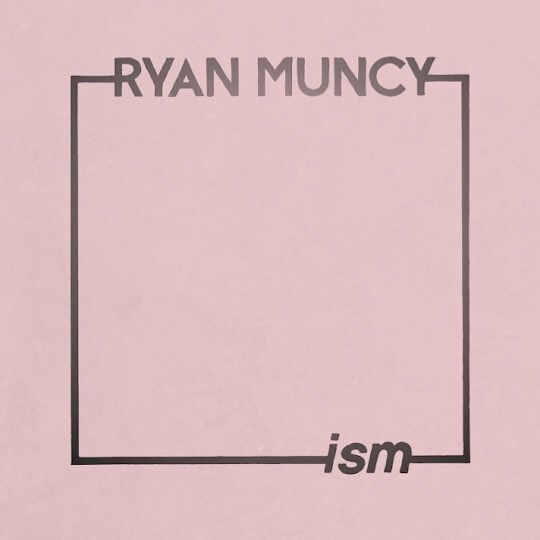
It was well worth the effort.  Ryan Muncy is a saxophone player with the increasingly venerable ICE.  (That is the International Contemporary Ensemble and not the less venerable immigration and customs enforcement by the way.)  He here takes the opportunity to demonstrate his considerable fluency on his instrument.  The deceptively simple cover belies some serious complexity in this release.

Beginning with James Tenney’s too seldom heard Saxony (1978) Muncy decisively lets the listener know that this is a hard core saxophone album with music that demands a level of skills and interpretive ability within the reach of only the finest musicians. Tenney’s piece is a multitracked composition concerned with acoustic phenomena produced by different tunings as do many of his works.  This piece is a species of minimalism, drone, even meditative music.  It’s slow unfolding demands and then rewards patience as it envelops the listener in lovely, trippy sound masses.  At over 20 minutes it is the biggest piece here and alone justifies purchasing this album.

What follows are 5 more tracks of similarly extreme experimental music with various extended techniques albeit on a much smaller scale.  Each is like a little study focusing on one or more extended techniques.  All but one are recent compositions by composers yet unknown to this reviewer.  The last piece is by the late great Lee Hyla (1952-2014) and is from 1979, making it contemporary with the opening Tenney piece.  Muncy demonstrates his facility with tuning, multiphonics and other creative techniques demanded by these composers.

Here is the track list:

James Tenney-Saxony (1978)

Erin Gee-Mouthpiece XXIV (2015)

David Reminick- Gray Faces (2011)

Morgan Krauss- masked by likeness (2014)

Evan Johnson- Largo caligrafico (2012)

Lee Hyla- Pre-Amnesia (1979)

Each of these pieces is seemingly a self contained universe and repeated listenings reveal more than simple experimentalism.

This is a disc for serious saxophone aficianados with an appreciation for free jazz and cutting edge instrumental techniques.  Truly a wonderful release.

Captain Kirk and the Buddha Speak Esperanto: Other Minds 22 Commemmorates Lou Silver Harrison at 100


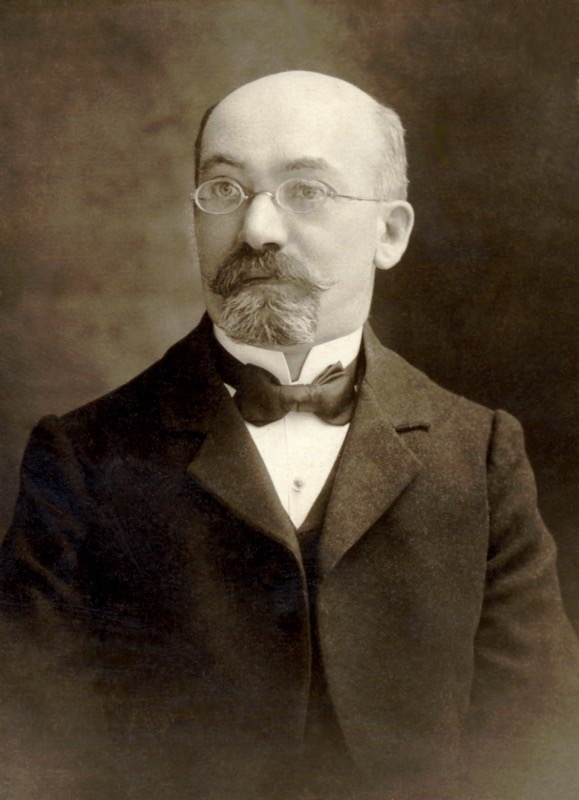
Esperanto is a constructed language brought into being in an 1887 book by a Polish-Jewish doctor by the name of L. L. Zamenhof (1861-1917).  This constructed language was intended in part as an intellectual exercise which might contribute to greater international discourse and perhaps understanding.  He outlined his intentions as follows:

  1. “To render the study of the language so easy as to make its acquisition mere play to the learner.”
  2. “To enable the learner to make direct use of his knowledge with persons of any nationality, whether the language be universally accepted or not; in other words, the language is to be directly a means of international communication.”
  3. “To find some means of overcoming the natural indifference of mankind, and disposing them, in the quickest manner possible, and en masse, to learn and use the proposed language as a living one, and not only in last extremities, and with the key at hand.

Esperanto did gain a great deal of popularity and there are still adherents today (an estimated 2 million people worldwide).  Lou Harrison was one of the users of this language (users are known as “Esperantists”).

L. L. Zamenhof (1859-1917)

In 1966 a horror film, “Incubus”, written and directed by Leslie Stevens (of Outer Limits fame) was released starring the just pre-Star Trek William Shatner.  Once thought lost, this film was restored from a copy found in a French film library.  It was only the second (and apparently last) feature film done entirely in Esperanto (the first being the 1964 French production, “Angoroj” or Agonies).  It was thought that the use of Esperanto would add a mysterious dimension to the production though detractors challenged the actors’ ability to properly pronounce the dialogue.  A link to a Shatner scene is here.  https://www.youtube.com/watch?v=accFmyaOj7o

And if you want to sit through the entire film (definitely a cult film experience) you can find it here: https://www.youtube.com/watch?v=LHUfHj2lTaM

Curiously 1917, the year of Dr. Zamenhof’s death, is also the birth year of Lou Harrison, the principal subject of this essay.  This patriarch of 20th century modernism was a composer, conductor, musicologist, performer, teacher, dancer, calligrapher, and Esperantist.  He used Esperanto to title many of his works and set some Esperanto texts to music.

Lou Silver Harrison

And the Buddha Becomes an Esperantist

In his masterful big composition, La Koro Sutro (1972) translated portions of the text of the Buddhist Heart Sutra (into Esperanto) are set for mixed chorus and American Gamelan.  Gamelan is an Indonesian mostly percussion orchestra which Harrison studied extensively following the example of pioneering Canadian ethnomusicologist and composer Colin McPhee (1900-1964).

Gamelan was first introduced to western audiences at the 1889 Paris World’s Fair where composers such as Claude Debussy and Erik Satie heard the instruments and later incorporated some of those sounds in their music.  (That Gamelan now resides in Chicago’s Field Museum of Natural History.) Harrison’s life partner Bill Colvig, an instrument maker, constructed a percussion ensemble which they called the American Gamelan to differentiate it from the traditional Indonesian ensemble.  The American Gamelan, consisting of five percussion instruments (augmented with organ, harp, and chorus) was first used in the cantata La Koro Sutro.

Harriso (left) with Bill Colvig

This composition is very much a synthesis of the composer’s musical and philosophical ideas.  Harrison was an avowed pacifist and the Heart Sutra is a key Buddhist scripture which supports introspection and non-violence.  Here he uses his expertise as an esperantist, his knowledge of Indonesian as well as western classical music to create one of his largest and finest works.

Lou Harrison with Charles Amirkhanian (curator of this concert series) in 1966

It is a testament to Harrison’s influence that this is the fourth performance of La Koro Sutro in the Bay Area.  It was written for an Esperanto conference in Seattle in 1972 with a translation by fellow esperantist Bruce Kennedy and was premiered that same year at Lone Mountain College  in San Francisco (now part of the University of San Francisco).  Additional performances (available on You Tube) were staged in Berkeley in 1973 and again in 2012.  This is truly an American masterpiece as well as a prayer for our times.

The performances will take place in the Mission San Francisco de Asís Basilica, better known as Mission Dolores.  The mission was founded in 1776 and the still active small adobe church next to the Basilica, built in 1791, is the oldest surviving building in San Francisco.  The much larger Basilica next to the adobe church (and the actual location of said concert) was dedicated in 1918.

Interior of the historic Mission Dolores Basilica

For the record, a Basilica is a reference to both architectural and spiritual aspects of any church so designated.  In the Catholic Church a Basilica is a pilgrimage site, a place to which the faithful travel in a spiritual quest.  I don’t believe it is too much of a stretch to view this event as a musico-spiritual pilgrimage open to all ears and minds, and hearts.  You won’t come out speaking Esperanto but you will never forget what you’ve heard.
The program will include:


Threnody for Oliver Daniel for harp (1990) 

Suite for Cello & Harp (1948)

Meredith Clark, harp

Emil Miland, cello

Pedal Sonata for Organ (1987/1989) Praises for Michael the Archangel (1946-47)

Jerome Lenk, organ

Suite for Violin & American Gamelan (1974, composed with Richard Dee) 

Shalini Vijayan, violin

William Winant Percussion Group

La Koro Sutro (The Heart Sutra, 1972)

For large mixed chorus, organ, harp, and American Gamelan

The Mission Dolores Choir, Resound, Jerome Lenk, organ, Meredith Clark, harp, and the William Winant Percussion Group conducted by Nicole Paiement.
Saturday, May 20, 2017- 7:30 p.m. 

Mission Dolores Basilica

3321 16th St.

San Francisco, CA
The very affordable tickets ($12-$20) are available at:

http://om22concerttwo.brownpapertickets.com/

Revido tie. (See you there.)
 

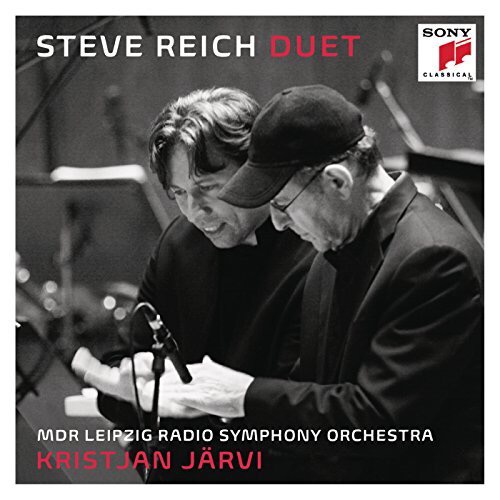
Kristjan Järvi Celebrates Steve Reich’s 80th


Kristjan Järvi (1972- ) is the youngest son of justly famed conductor Neeme Järvi.  He is also a frequent collaborator with the talented and ubiquitous Gene Pritsker among others.  This double CD represents a portion of his concerts in celebration of Reich’s 80th birthday.  There are apparently recordings available on the streaming service Medici TV of several other Reich works including the Three Movements for Orchestra (1983) and Desert Music (1986).  All these stemmed from a residency (2013-2014) that Reich enjoyed with the MDR Leipzig Radio Symphony and Chorus.

This 80th birthday tribute gives us yet another opportunity to hear another generation (other than Reich’s) interpreting this music.  For years only Reich and his ensemble had access to his scores but this is not the case with his orchestral and choral works.  Some may still consider Reich to be a difficult or experimental composer and this has limited the programming (and no doubt the commissioning) of music for such larger ensembles.  It is delightful to hear how other musicians respond to and interpret Reich’s music.  

In fact Reich’s music for larger ensembles is definitely worth hearing and hearing in different interpretations.  This set gives us the world premieres of beefed up orchestrations of You Are and Daniel Variations.  This writer looks forward to the orchestral version of Tehillim (1981) as well.  

This handsome two disc set includes the early Clapping Music (1971), Duet (1993), The Four Sections (1987), You Are Variations (2004),  and Daniel Variations (2006).  It is not a greatest hits compilation.  Rather it is a personal survey by a wonderful young musician.  Kristian Järvi is a conductor, composer and new music raconteur who is at the beginnings of a very promising career.  This album is a love song if you will.  Järvi clearly understands and loves this music and the opportunity to record these works, especially perhaps the intimate Clapping Music with the participation of the composer.

The Four Sections is tantamount to being a concerto for orchestra and is among this reviewer’s favorites among Reich’s works.  It has received too few performances and to date only two recordings.  This is the first live recording and gives insight into the amazing competence of both conductor and orchestra.  The 1993 Duet for Two Violins and String Orchestra is Reich’s homage to a musician of a generation preceding his, the wonderful violinist, conductor, and pedagogue, Yehudi Menuhin on his 80th birthday.  Soloists Andreas Hartmann and Waltraut Wachter handle this all too brief piece with skill and insight.  

The second disc contains studio recordings of the large orchestra versions of two very personal works.  These recordings alone are adequate reason to purchase this set.  Reich has gained much from tapping his Jewish heritage (musical, linguistic, and literary) in service of his art.  Both of these pieces feature texts from a variety of sources including the Bible, Hasidic aphorisms, the writings of Ludwig Wittgenstein among others.  In both works the texts determine to some degree the rhythmic choices of the music. 

You Are Variations is a four movement orchestral/choral work which sets a different aphorism in each movement.  It is among the composer’s more personal works and includes quotations from Wittgenstein (the subject of Reich’s undergraduate studies) along with Biblical and Talmudic texts in a beautiful existential meditation.

Daniel Variations is a powerful overtly political work written in response to the tragic murder of journalist Daniel Pearl who was beheaded by extremists in Pakistan in 2002. It is a deeply felt and very pained work which expresses the tragedy and creatively makes a link with the Book of Daniel as well as Pearl’s own words.  Reich is no stranger to political protest on his music and this is among his finest in that genre.

If you don’t know Reich’s music this is not a bad place to start.  If you are already a fan (as I’ve been for years) you will want this set to round out your collection.  

February 18th, Mark Your Calendars: Other Minds 22, A Must Hear


OMDI1Harrison

Lou Harrison (1917-2003)

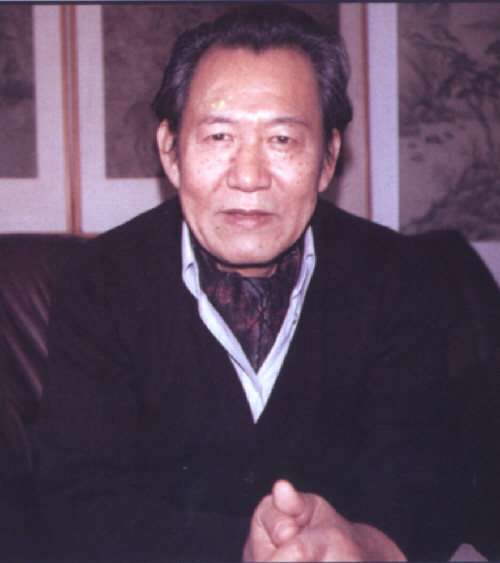
The American composer Lou Harrison (1917-2003) and Korean composer Isang Yun (1917-1995) turn 100 this year and Other Minds 22 has a wonderful celebration that is not to be missed.  On February 18th at 7:30 PM in the beautiful, historic Mission Dolores Basilica in San Francisco’s famed Mission District.  This is actually only the first of two concerts which will comprise the Other Minds season 22 which is subtitled, “Pacific Rim Centennials”.  It is curated by Charles Amirkhanian, the reliable arbiter of modern musical tastes in the Bay Area and beyond.  (The second concert, scheduled for May 20, will be an all Lou Harrison concert closer to the composer’s May 14th birthday.)

yun_isang

Yun Isang (1917-1995)

Harrison is well known to new music aficionados, especially on the west coast for his compositions as well as his scholarship and teaching.  His extensive catalog contains symphonies, concertos, sonatas and other such traditional classical forms as well as some of the finest of what we now call “world music” featuring instruments from non-western cultures including the Indonesian gamelan.  He is also the man responsible for the preparation and premiere of Charles Ives’ Third Symphony in 1946 which was subsequently awarded a Pulitzer Prize.

Yun is perhaps less of a household name but is known for his many finely crafted compositions in the modern western classical tradition and, later, incorporating instruments and techniques from his native Korea.  He was infamously kidnapped by South Korean intelligence officers in 1967 and taken from his Berlin home to South Korea where he was held and tortured due to allegations (later proven fabricated) of collaboration with North Korea.  Over two hundred composers and other artists signed a petition for his release.  After several years he was returned to his adopted home in Berlin in 1969 where he continued to compose prolifically and teach until his death in 1995.

dennis-russell-davies

                              Dennis Russell Davies (from the American Composers Orchestra site)

This celebratory and memorial concert will feature world renowned artists including Grammy Award winning conductor and pianist Dennis Russell Davies who knew and collaborated with both Harrison and Isang.  Other artists will include pianist Maki Namekawa, violinist Yumi Hwang-Williams, percussionist William Winant (with his percussion group), and the Other Minds Ensemble.

The program is slated to consist of:

Sonata No. 3 for Piano

(1938, Lou Harrison)

Dennis Russell Davies

Kontraste I for Solo Violin

(1987, Isang Yun)

Yumi Hwang-Williams

Gasa, for Violin & Piano

(1963, Isang Yun)

Yumi Hwang-Williams, Dennis Russell Davies

Grand Duo for Violin and Piano (excerpts)

(1988, Lou Harrison)

IIII. Air
II. Stampede

Yumi Hwang-Williams, Dennis Russell Davies

Intermission

Canticle No. 3

(1941, Lou Harrison)

William Winant Percussion Group
Joanna Martin, ocarina
Brian Baumbusch, guitar
Dan Kennedy, Loren Mach, Ben Paysen, William Winant, Nick Woodbury, percussion
Dennis Russell Davies, conductor

Interludium A

(1982, Isang Yun)

Maki Namekawa, piano

Suite for Violin, Piano & Small Orchestra

(1951, Lou Harrison)

I. Overture
II. Elegy
III. First Gamelan
IIII. Aria
V. Second Gamelan
VI. Chorale

Yumi Hwang-Williams, violin
Maki Namekawa, piano
The Other Minds Ensemble:
Joanna Martin and Janet Woodhans, flute
Kyle Bruckman, oboe
Meredith Clark, harp
Evelyn Davis, celesta
Andrew Jamieson, tack piano
Emil Miland and Crystal Pascucci, cello
Scott Padden, bass
William Winant, percussion
Dennis Russell Davies, conductor

Other Minds is also co-sponsoring (with the Berkeley Art Museum/Pacific Film Archive) a screening of the 2015 German television produced film, Isang Yun: In Between North and South Korea on February 19th (4:15PM) at the Pacific Film Archive in Berkeley.  Dennis Russell Davies and composer Charles Boone will also be present to discuss the film.

If you do know these composers you probably already have your tickets but if you don’t know them you owe it to yourself to check out these performances.


Of Mourning and Unity, 2016


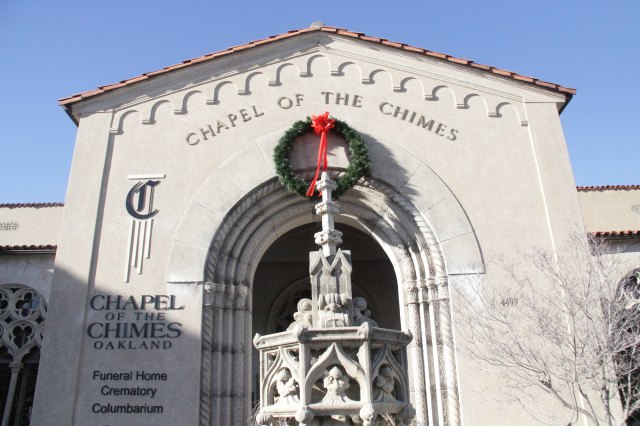
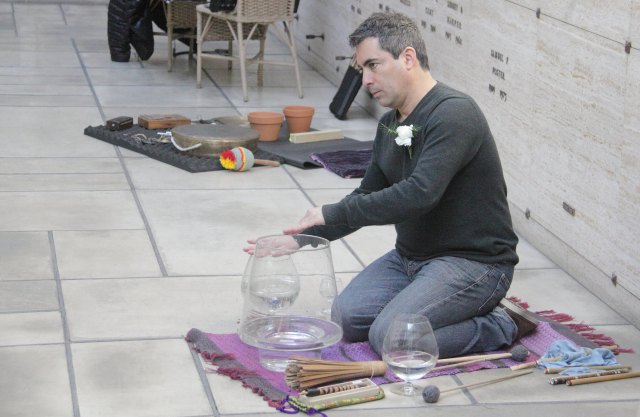
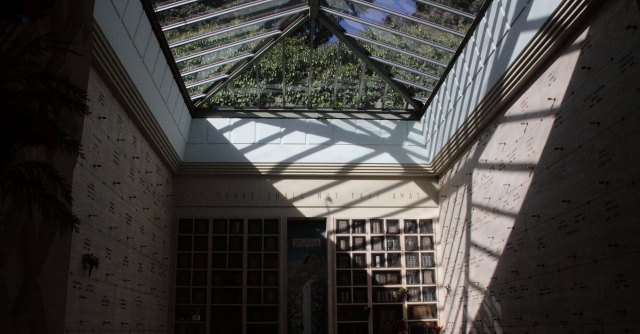
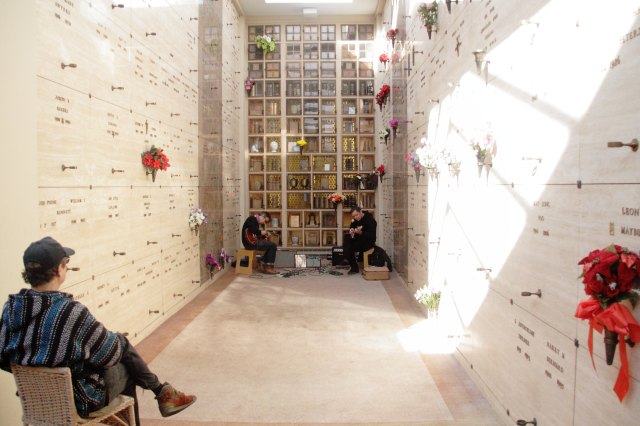
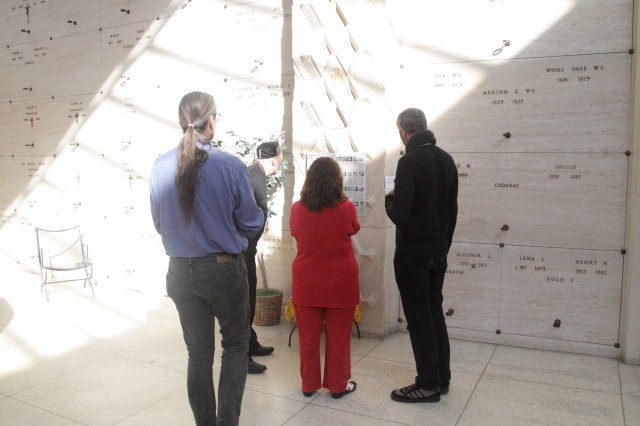
oliverosolstice20160075Every year on June 21st, the Summer Solstice, there is a rather unique concert event in which musicians from the Bay Area and beyond gather in celebratory splendor in the sacred space of the Chapel of the Chimes in Oakland.  The chapel is a columbarium  (a resting place for cremated remains) and a mausoleum.  The space is in part the work of famed California architect Julia Morgan.

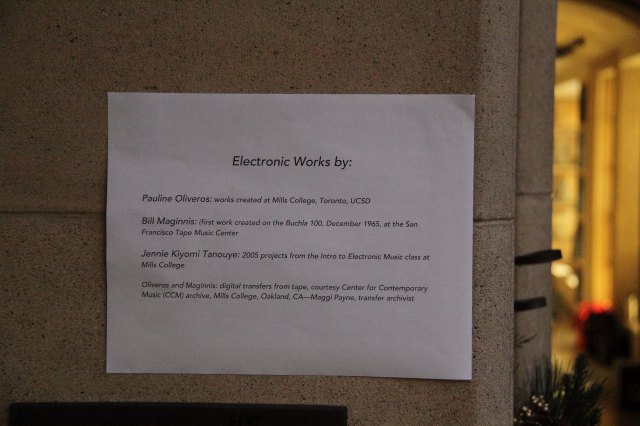
On December 19th Sarah Cahill with New Music Bay Area secured permission to use this space for four hours from 11AM to 3PM.  She invited many musicians who had been involved in one way or another with Pauline Oliveros whose death preceded by a week or two the tragic “Ghost Ship Fire” as it’s become known.  The idea was to pay homage to both this wonderful theorist, composer, performer and teacher and also to pay homage and to mourn the losses of some 36 young artists who will now never realize their ambitions.

What follows here is a simple photo essay of my personal impressions of this event.  The slant of the winter light added a dimension to those beautiful spaces as a large roster of musicians played pieces by and about Pauline Oliveros.  It was a lovely and reverent experience.

oliverosolstice20160003

oliverosolstice20160005

The angle of the winter light adds its dimension.

oliverosolstice20160012

oliverosolstice20160010

oliverosolstice20160019

oliverosolstice20160014

oliverosolstice20160011

oliverosolstice20160021

oliverosolstice20160022

oliverosolstice20160024

oliverosolstice20160025

oliverosolstice20160040

oliverosolstice20160026

oliverosolstice20160044

oliverosolstice20160037

oliverosolstice20160066

oliverosolstice20160063

oliverosolstice20160043

oliverosolstice20160062

oliverosolstice20160035

OM202022

Christopher Bailey: Glimmering Webs, New Piano Music


glimwebs

I admit to some trepidation when I received this 2 disc set of piano music by an unfamiliar composer.  Even in the best of circumstances the “double album” concept can be a trying thing even to fans of a given artist.  I think I recall some similar trepidation confronting the newly released Elton John Yellow Brick Road double album.  I invoke some pop sensibility here in part for humor but also because that sensibility is one of the many threads that imbue this rather massive collection of pieces.

bailey2

Christopher Bailey

Christopher Bailey is a freelance composer who holds degrees from Eastman (BA, 1995) and Columbia University (MA, 1997 and PhD, 2002).  This is the eighth disc to contain his music though only the second to be dedicated entirely to his works (and his first double album).

The first disc is a journey of styles ranging from electroacoustic music (like the opening track which resembles the work of Mario Davidovsky at times) to several whose inspiration seems to venture closer to that of Pierre Boulez and ends with a lengthy sort of post minimalist piece appropriately titled, Meditation.  The composer says in his liner notes that this piece is his homage to “ambient music” and in particular, Harold Budd. The second track is a piece which is a sort of deconstruction of a Hall and Oates song, the pop sensibility to which I referred earlier.  And, yes, there is some nod to microtonalism as well.  Can you say eclectic?

The second disc contains the large Piano Sonata and a host of smaller works in various styles ranging from neo-classical to microtonal.

In the rambling liner notes the composer provides useful clues as to the genesis and intent of some of his ideas.  One need not read the notes to appreciate the music but the clarity that they provide was useful to this listener. More notes would have been appreciated though.  The composer’s and the pianists’ web sites are certainly useful but I doubt that the average listener will spend that much time researching these things and is then left with gaps in information and consequently in understanding.

The composition dates here range from 1994 to 2013 and embrace a wide swath of styles all with a strongly virtuosic aspect.  The second disc starts with the brief Prelude-Fantasy on the So-Called Armageddon Chord (2011).  The title is almost longer than the piece and, while it’s a fine work, the placement at the beginning of the disc preceding the major opus of his four movement Piano Sonata (1994/1996/2006) is a bit confusing.

I don’t mean to quibble with such things as track order and such but I was left with a sense of difficulty focusing.  Here is a large collection of music which ranges through pretty much the entire gamut of the last 200 years of music and it is presented en masse.  I think some re-ordering might have been helpful but that is one of the difficulties with multiple disc issues.  I listened numerous times to these discs and find the sheer volume and diversity a bit overwhelming.  It is as though this is too much for a single release.

Bailey says that the sonata is an homage to Stravinsky and those neo-classical elements are certainly clear but this listener hears some ghosts of Charles Ives and the polystylism of Alfred Schnittke as well.  The Sonata seems to be the highlight here.   It is wonderfully complex, kaleidoscopic, loaded with quotation, even grandiose at times, but eminently listenable and it is a highly entertaining piece also because of it’s virtuosity which is ably handled by the performer.

There are apparently three pianists on this recording, Jacob Rhodebeck, Shiau-Uen Ding and Augustus Arnone.  The problem is that it is not clear from the labeling or the notes who plays what.  This is actually a fascinating and engaging collection, well played, but I was surprised to be unable to attribute the various virtuosities to the deserving performers.

The recording, mastered by Silas Brown, is as good as it gets.  Overall quite a collection but one that left me with many questions as well.  Perhaps that was, at least partly, the intent but it is my hope that these ambiguities will not distract the listener and that more releases will be forthcoming.  This is very interesting music deserving of serious attention.


The Musical Mother of Us All: Pauline Oliveros, a Personal Appreciation


oliverosione

Pauline Oliveros at one of Philip Gelb’s dinner concerts in Oakland.  I published this photo on Pauline’s Wikipedia page.

I woke at about 3PM on the day after Thanksgiving (having worked the previous night shift) and I checked my e-mail and then, on Facebook I learned of the passing of theorist, composer, musician, teacher and all round wonderful human being Pauline Oliveros (1932-2016). She had died peacefully in her sleep on Thanksgiving Day.  Going over the copious posts and comments I was saddened at her passing but oddly comforted by the fact that these posts honoring her are effectively eclipsing the ones on the obnoxious political issues as well as demonstrating the incredible reach of her influence.  Thankfully, Pauline will not have to endure the regressive politics which now dominate our country and, indeed, the world.

I first encountered Pauline’s work, as many did, through the Columbia Odyssey LP curated by none other than David Behrman in his Music of Our Time series.  There are several composers on the disc including Steve Reich (Come Out), Richard Maxfield (Night Music), and Pauline Oliveros (I of IV).  Over the years I collected and listened to most of her recordings Discogs lists 55 recordings but no doubt there are many more and likely a plethora of unreleased material which will grace our ears for years to come.  Like her older contemporary John Cage it is difficult to identify a “masterpiece” and, also like Cage, she didn’t aspire to such notions because she aspired to learn and subsequently teach the art of listening. Her Deep Listening Institute is based in Kingston, New York.


dempster9

Stuart Dempster at another of Philip Gelb’s dinner concerts. Stuart is one of the members of Oliveros’ Deep Listening Band

I was pleased to be able to see one of the incarnations of the Deep Listening Band in Chicago at the Harold Washington Library.  This concert occurred on the night of the famed “Chicago Flood” (1992) in which a construction mishap diverted thousands of gallons of water from the Chicago River into the disused coal delivery railway tunnels which connect most of the downtown buildings.  I brought along a postcard from her album The Well and the Gentle hoping to get her autograph.  It was my first face to face meeting with this icon of new music.  She graciously took the card into her hand and immediately exclaimed with a smile, “Oh, this is from the Well”.  She quipped that next time they would hold their concert in one of the “deep tunnels” which are a part of the Chicago’s massive flood control rainfall overflow system.  I still treasure that autograph and the memory of my first meeting with Pauline.

oliverosione3

Ione (l) doing verbal improvisation while Pauline improvises in parallel on her digital accordion at a memorable dinner concert curated by Philip Gelb.

I can hardly tell you my level of excitement when vegan chef and musician Philip Gelb announced that Pauline with her partner Ione would be appearing at his next dinner concert.  The opportunity for a close encounter with this master was certainly heaven sent. (Pauline later wrote the lovely introduction to Philip’s first vegan cookbook.)

garden20151047

Philip Gelb performing at the June 21, 2015 Garden of Memory Concert at Oakland’s Chapel of the Chimes. This vegan chef and cookbook author plays and teaches shakuhachi and curates a wonderful dinner/concert series at his loft in West Oakland.  Philip also appears on several albums with Pauline and others.

Indeed, as I sat across from Pauline no doubt babbling some starstruck nonsense, I encountered in both her and her partner Ione two warm and unpretentious people.  While I knew I was in the presence of genius I was given to feel very welcome as they both engaged me and the other guests in lively conversation at this spectacular vegan meal.  In the pause just before dessert they gave a wonderful performance with Ione speaking improvised and passionate poetic utterances while Oliveros played her quirky improvisations in parallel on her digital accordion.

OM202021

Pauline Oliveros, Miya Masaoka and Frode Haltli performing Oliveros’ Twins Peeking at Koto (2014) at Other Minds 20 in 2015

I later got to see Pauline as a returning guest composer/performer at Other Minds 20, a series lovingly and painstakingly curated by composer, broadcaster and new music impresario Charles Amirkhanian.  I believe this was her last major bay area appearance.

OM202022

A clearly happy Pauline Oliveros acknowledges the warm applause of the Other Minds 20 audience after her performance at the SF Jazz Center in 2015.

Every year at the Garden of Memory summer solstice concert the open membership Cornelius Cardew Choir performs Oliveros’ Heart Sutra every year.  The verbal score describes how one enters the singing circle and intones basically the note of their choice with one hand over their heart and the other on the back of another singer.  I screwed up my courage to participate in this ritual a few years ago and it is now an essential part of the beginning of my summer.  Pauline has taught me much and no doubt will continue to teach me through her writings and recordings.  For that I am eternally grateful.


Discovering and Preserving a Legacy: Tod Dockstader: From the Archives


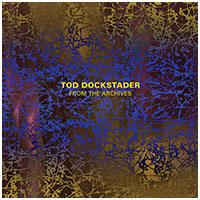
dockarch

Starkland ST-226

I’m gonna go out on a limb here and suggest that this disc is a major and important release.  The history of music includes a fair amount of instances in which a second look at a particular composer who had been neglected yields a rediscovery which places said composer to their proper place in history.  Such was the case with Mendelssohn famously rediscovering Bach and Sir Thomas Beecham championing the works of Hector Berlioz. Conductor Robert Craft brought the work of Anton Webern to a larger audience with his recording of the complete works back in the 1950s and, more recently, Michael Tilson Thomas did a similar favor for the work of Carl Ruggles.  Of course not every musico-archaeological effort yields great results but the present release would appear to be auspiciously positioned to bring delight to listeners as well as place its composer in a more appropriately prominent place in the history books.  Now we are treated to a previously unknown cache of musical treasures from such a master, the digital equivalent of discovering Tut’s tomb.  It is an amazing disc on many levels.

This recording is nearly as much the accomplishment of Starkland Records’ producer Tom Steenland as it is of the composer Tod Dockstader (1932-2015).  Starkland’s  first two releases were CD reissues of the composer’s four Owl Records albums from the mid-1960s. It was the musicological acumen of Steenland whose love for those albums that helped provide motivation for him to found Starkland Records and promote this important electronic composer to proper historical recognition.  Dockstader was, in turn, inspired by the very positive response to those reissues to end his thirty year hiatus and return to composing.  He subsequently released the three volumes of Aerial (2005-6) on Sub Rosa and two collaborations with David Lee Myers (whose thumbprint is to be found on the present recording as well), Pond (2004) and Bijou (2005).

As if all that weren’t quite enough a new chapter dawned shortly after Dockstader died in 2015.  He left behind his archive of tapes and record releases and something more.  Justin Brierly, a radio host, was a fan of Dockstader’s music and wanted to interview him for his show.  He contacted Tom Steenland who was able to put him in touch and he was able to visit and interview the composer on several occasions.  The composer’s daughter, Tina Dockstader Kinard, gave Brierly the computer tower containing work files which had been saved on that hard drive over the years. There were thousands of files in various stages of completion, some just sample files, some duplicates, but many complete or nearly complete compositions that had not been heard since they were created.  Brierly sorted through these and sent some 50 files to Tom Steenland who carefully selected 15 tracks for the present release.

Tod Dockstader was a composer with a day job, that is he worked as a film and sound editor and took advantage of his access to what would have been prohibitively expensive equipment at the time to create his own brand of electronic music.  Sadly Vladimir Ussachevsky denied him access to the Columbia-Princeton Studios back in 1961.

Stylistically he holds much in common with his antecedents Edgar Varese, Pierre Henry, Louis and Bebe Barron, Pierre Schaeffer as well as contemporaries such as Morton Subotnick and Andrew Rudin. His albums from the 1960s of course utilized the tape splicing techniques and analog equipment of the time.  Some of the music from his Eight Electronic Pieces (1961) album was selected (as were some of Andrew Rudin’s electronic compositions) for inclusion in the soundtrack for Frederico Fellini’s Satyricon (1969).

When he returned to composing in the late 1990s studios were digitally driven and computers ruled. He reportedly had little difficulty learning and using computers for his later works. Despite the change from analog to digital media however Dockstader’s style remained extremely consistent, a clear and unique voice in the musical landscape.

Prior to this release it had been thought that his last word musically was the three volume Aerial series of 2005-6.  Now Starkland presents this lovingly selected cache of the composer’s most recent works.  He had effectively stopped composing in 2008 wrestling with the ravages of dementia but did listen and comment at times with Brierly during his visits on some of these files and, fittingly, enjoyed the fruits of his own labors to the very end of his life in 2015.  There’s no doubt more of a story to be told there for sure and here’s hoping that we may soon see a comprehensive biographical and musical assessment of his work.

For the wonderful liner notes Steenland recruited Geeta Dayal,  a San Francisco based writer whose writings on music can be accessed from her website and are well worth your time to investigate.  She comes with quite a pedigree as a writer on the subject of electronic music both old and new.  Her liner notes are both authoritative and good reading.  She would be my vote for a Dockstader biographer.

The exact intentions of the compositional process cannot be determined (Dockstader left no notes about these files) but it seems clear that these are all late period pieces.  They are all dated between 2005 and 2008.  The titles of these pieces were made based in part on the computer file names for the pieces which had not gotten their final naming by the composer.  One can only imagine the labor of love involved in Brierly’s and Steenland’s distillation of these final 15 tracks but the end result is a very satisfying collection consistent in quality to previous releases and a worthy representation of his last works (though this reviewer is given to hopeful wonder that a volume II might emerge in the near future).  At any rate Dockstader’s legacy is now secure and no doubt there will be much research done on his work made easier now by the dedicated sleuthing of these producers.

The first track, Super Choral (2007) contains some collaboration with David Lee Myers as mentioned earlier and it is used with his permission.  I won’t try to describe the rest of these pieces except to say that they seem to be a worthwhile contribution to the art of electronic music, are excellently crafted and eminently listenable.

The liner notes with their studio porn images of Dockstader’s beloved Ampex machines are tastefully mixed with images of the composer and his family.  The mastering was done by the wonderful Silas Brown and is about as good as it gets.  I can’t imagine a more fitting tribute to the composer’s legacy than this and I can’t imagine this not being nominated for a Grammy.  Bravo gentlemen!

Release is scheduled for November 18th.  You can pre-order both the download and the physical disc on Amazon.


Oh, No! Not Another Minimalist! Lubomyr Melnyk, Fastest Fingers in the West, Makes Major Label Debut


I first encountered the music of this undeservedly obscure but unique composer/pianist in the late 1980s with the purchase of a double vinyl album of his “Lund-St. Petri Symphony” a work for solo piano which is stylistically one of the tributaries of minimalism.  Melnyk was born in Germany of Ukrainian descent and now lives and works in Canada.  I began this article for inclusion in my series about minimalist composers (the designation of “minimalist” is imposed by the author and is not necessarily the identity embraced by the artist).  In addition to providing a sketch of the artist I am pleased to be able to review this major label release.

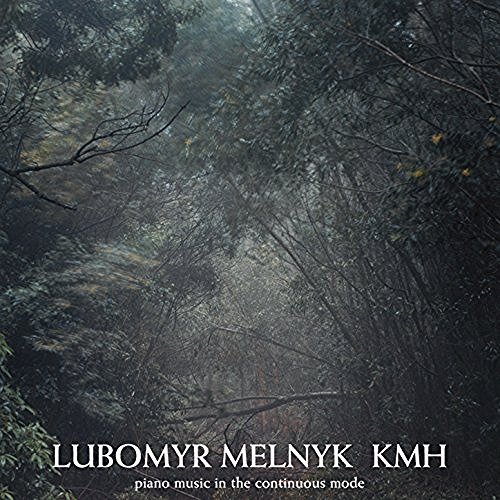
melnyk

Sony

Ilirion marks this composer/pianist’s big label debut and this is a fitting recognition for this long established composer, pianist and teacher.  Lubomyr Melnyk (1948- ) has been performing since the 1970s and has released over 20 albums.  His web site is in need of updating and here’s hoping that this release will help provide the impetus for that and for the greater distribution of this artist’s work.

Below is the description of Melnyk’s music from his web site:

Melnyk’s Continuous Music is based on the principle of a continuous® and unbroken line of sound from the piano — this is created by generating a constant flow of rapid (at times EXTREMELY rapid) notes, usually with the pedal sustained non-stop. The notes can be either in the form of patterns or as broken chords that are spread over the keyboard. To accomplish this requires a special technique, one that usually takes years to master — this technique is the very basis of the meditative and metaphysical® aspects within the music and the art of the piano.
Moreover, in his earlier works, Melnyk devoted much attention to the overtones which the piano generates, but in his more recent works, Melnyk has become more and more involved with the melodic potential of this music.
Melnyk’s earlier music was generally classified as Minimalism®, although Melnyk strongly refutes that term, preferring to call his music MAXIMALism®, since the player has to generate so many, many notes to create these Fourth Dimensions of Sound®.
Because his piano music is so difficult and requires a dedicated re-learning® of the instrument, no other pianists in the world (so far) have tackled his larger works — and so, his recordings are truly collector’s items (both as LP-s and CD-s).
He has however recorded extensively for the CBC in Canada, as well as various European stations. He has performed and given lecture-recitals across Canada and in Europe. 

I’m not sure how useful this explanation will be to listeners but I think it’s important to acknowledge that the composer has attempted to establish a system explaining his work. However one does not need to be deeply familiar with the underlying theory to appreciate the music.  One does not need to understand Schoenberg’s twelve tone theories or Anthony Braxton’s far out ideas to appreciate their music.  One doesn’t even need to understand the basics of western classical harmony to appreciate Mozart, for that matter but such knowledge can contribute to appreciation.  I certainly lay no claim to understanding this man’s music and I am not aware of any musicologists or critics who have written anything analyzing Melnyk’s work but I find his music compelling and worth wider attention.

Rather than attempting a comprehensive review of Melnyk’s output (and risking muddying the field) I am simply going to recommend a couple of discs which I have found particularly interesting and may help put this latest release in useful perspective.  The disc which is intended to provide a sort of exposition of his work is KMH.

kmh

The other disc, and the one which I have admired most, is the Lund St. Petri Symphony.  I bought it as a two disc vinyl album and it does not appear to be easily available now but it is well worth seeking (and maybe Sony will consider re-releasing it).

lund

The present release on Sony contains 5 tracks:

Beyond Romance is the first and longest track on the disc (16:12) and is certainly representative of his work.  The composer’s brief notes describe this work only as a grand romantic piece.  It perhaps has echoes of Liszt but certainly with at least an echo of minimalism.

Solitude No. 1 is a much briefer piece (7:36) and is a live improvisation by the composer recorded in the Netherlands.

Sunset (3:49) is the briefest on the disc and is an impressionistic description of its title.

Cloud No. 81 (16:02) is a far more extended impressionistic essay with more harmonic variety than the other tracks.

The title piece, Ilirion (14:12) is another extended essay more akin to the first track.

These discs range from interesting to enthralling for this reviewer and the limited descriptions contained in this release do little to guide the listener.  So I guess I can only say, “Please listen”.

Tracks 1, 3, and 4 were recorded at Clearlight Studios in Winnipeg, Canada.  Track 2 is a live recording from Tilburg, Netherlands and the last track is described as being an archive recording from also from Tilburg.  All were recorded between 2012 and 2015.

The rather sparse liner notes are by one Charles Bettle who is described as a “long time friend and admirer” of Melnyk’s work.  The even sparser notes on the music are by the composer.  The beautiful photography is by Alexandra Kawka.

It is difficult to say why this artist remains as marginally known but, as I have asserted before, artists from Canada get strangely little notice here and Mr. Melnyk does not appear to be a very good publicist.  I hope that this endorsement by Sony results in more releases and, more importantly, in more good studio recordings of his work.  It is unique and highly recommended to aficionados of piano music and minimalism.

Memories and Memorials: Guy Klucevsek’s “Teetering on the Verge of Normalcy”


klucevsek

Starkland ST-225

As someone who grew up attending Polish weddings and hearing more than his share of polka music I was fascinated at the unusual role of the accordion as I began to get interested in new music. People like Pauline Oliveros and Guy Klucevsek completely upended my notions of what this instrument is and what it can do.  The accordion came into being in the early 19th century and was primarily associated with folk and popular musics until the early 20th century.  It has been used by composers as diverse as Tchaikovsky and Paul Hindemith but the developments since the 1960s have taken this folk instrument into realms not even dreamed of by its creators.

guyklu

Guy Klucevsek with some of his accordions

Guy Klucevsek  (1947- ) brought the accordion to the burgeoning New York “downtown” new music scene in the 1970s.  He began his accordion studies in 1955, holds a B.A. in theory and composition from Indiana University of Pennsylvania and an M.A. (also in theory and composition) from the University of Pittsburgh.  He also did post graduate work at the California Institute of the Arts.  His composition teachers have included Morton Subotnick, Gerald Shapiro and Robert Bernat.  He draws creatively on his instrument’s past even as he blazes new trails expanding its possibilities.  The accordion will never be the same.

Klucevsek has worked with most all of the major innovators in new music over the years including Laurie Anderson, Bang on a Can, Brave Combo, Anthony Braxton, Dave Douglas, Bill Frisell, Rahim al Haj, Robin Holcomb, Kepa Junkera, the Kronos Quartet, Natalie Merchant, Present Music, Relâche, Zeitgeist, and John Zorn (who also recorded him on his wonderful Tzadik label).  He has released over 20 albums and maintains an active touring schedule.  He recently completed a residency (April, 2016) at Sausalito’s Headlands Center for the Arts.

transoft

Starkland ST-225

freerange

Starkland ST-209

Starkland has released no fewer than three previous albums by this unusual artist (all of which found their way into my personal collection over the years) including a re-release of his Polka from the Fringe recordings from the early 1990s. This landmark set of new music commissions from some 28 composers helped to redefine the polka (as well as the accordion) in much the same way as Michael Sahl’s 1981 Tango and Robert Moran’s 1976 Waltz projects did for those dance genres.

polkfringe

Starkland ST-218

The present recording, Teetering on the Edge of Normalcy (scheduled for release on September 30, 2016), continues this composer/performer’s saga.  His familiar humor and his unique experimentalism remain present but there is also a bittersweet aspect in that most of these compositions are homages and many of the dedicatees have passed from this world.  Klucevsek himself will turn 70 in February of 2017 and it is fitting that he has chosen to release this compilation honoring his colleagues.

On first hearing, many of Klucevsek’s compositions sound simple and straightforward but the complexities lie just beneath the surface.  What sounds like a simple accordion tune is written in complex meters and sometimes maniacal speed.  To be sure there are conservative elements melodically and harmonically but these belie the subversive nature of Klucevsek’s work which put this formerly lowly folk instrument in the forefront with the best of the “downtown” scene described by critics such as Tom Johnson and Kyle Gann.  You might mistake yourself as hearing a traditional music only to find that you had in fact wandered into the universe next door.

Many favorite collaborators have been recruited for this recording.  Most tracks feature the composer with other musicians.  Four tracks feature solo accordion, two are for solo piano and the rest are little chamber groupings from duets to small combos with drum kit.

The first three tracks are duets with the fine violinist Todd Reynolds.  Klucevsek’s playful titles are more evocative than indicative and suggest a framework with which to appreciate the music.  There follows two solo piano tracks ably handled by Alan Bern. Bern (who has collaborated on several albums) and Klucevsek follow on the next track with a duet between them.

Song of Remembrance is one of the more extended pieces on the album featuring the beautiful voice of Kamala Sankaram along with Todd Reynolds and Peggy Kampmeier on piano.  No accordion on this evocative song which had this listener wanting to hear more of Sankaram’s beautiful voice.

The brief but affecting post minimalist Shimmer (In Memory of William Duckworth) for solo accordion is then followed by the longer but equally touching Bob Flath Waltzes with the Angels.  William Duckworth (1943-2012) is generally seen as the inventor of the post-minimalist ethic (with his 1977-8 Time Curve Preludes) and he was, by all reports, a wonderful teacher, writer and composer.  Bob Flath (1928-2014) was philanthropist and supporter of new music who apparently worked closely with Klucevsek.

Tracks 10-12 feature small combos with drum kit.  The first two include (in addition to Klucevsek) Michael Lowenstern on mellifluous bass clarinet with Peter Donovan on bass and Barbara Merjan on drums.  Lowenstern who almost threatens to play klezmer tunes at times sits out on the last of these tracks.   Little Big Top is in memory of film composer Nino Rota and Three Quarter Moon in memory of German theater composer Kurt Weill. These pieces would not be out of place in that bar in Star Wars with their pithy humor that swings. They also evoke a sort of nostalgia for the downtown music scene of the 70s and 80s and the likes of Peter Gordon and even the Lounge Lizards.

The impressionistic Ice Flowers for solo accordion, inspired by ice crystals outside the composer’s window during a particularly harsh winter, is then followed by four more wonderful duets with Todd Reynolds (The Asphalt Orchid is in memory of composer Astor Piazolla) and then the brief, touching For Lars, Again (in memory of Lars Hollmer) to bring this collection to a very satisfying end.  Hollmer (1948-2008) was a Swedish accordionist and composer who died of cancer.

As somber as all of this may sound the recording is actually a pretty upbeat experience with some definitely danceable tracks and some beautiful impressionistic ones.  Like Klucevsek’s previous albums this is a fairly eclectic mix of ideas imbued as much with humor and clever invention as with sorrow and nostalgia.  This is not a retrospective, though that would be another good idea for a release, but it is a nice collection of pieces not previously heard which hold a special significance for the artists involved.  Happily I think we can expect even more from this unique artist in the future.

klucevsek

Guy Klucevsek, looking back but also forward.

The informative gatefold notes by the great Bay Area pianist/producer/radio host Sarah Cahill also suggest the affinity of this east coast boy for the aesthetic of the west coast where he is gratefully embraced and which is never far from his heart (after all he did study at the California Institute of the Arts and has worked with various Bay Area artists). Booklet notes are by the composer and give some personal clues as to the meaning of some of the works herein.  Recordings are by John Kilgore, George Wellington and Bryce Goggin.  Mastering is by the wonderful Silas Brown.  All of this, of course, overseen by Thomas Steenland, executive producer at Starkland.

Fans of new music, Guy Klucevsek, accordions, great sound…you will want this disc.


The Piano is Calling Me: Nicolas Horvath’s New Music Pilgrimages


Nicolas Horvath Lyon

Nicolas Horvath at the piano in Lyon

I first heard of this young Monacan pianist and composer when a composer friend, David Toub, told me that he was going to program one of this piano pieces.  That piece along with quite a few other performances are available on Nicolas Horvath’s You Tube video channel here.

Horvath developed a strong interest in contemporary music from Gerard Frémy among others and has been programming a great deal of new music ranging from the more familiar such as Philip Glass to a host of others including quite a few pieces written for or premiered by him as well as his own transcriptions and reconstructions.  He is known for his concerts in non-traditional venues with very non-traditional lengths of performance as well as traditional concerts.

His current projects include Night of Minimalism in which he performs continuously for 10-15 hours with a wide variety of minimalist and post-minimalist pieces and Glass Worlds in which he performs the complete solo piano works of Philip Glass (approximately 15 hours) along with pieces by an international list of composers written in tribute to Glass.  He is also an electroacoustic composer (he counts Francois Bayle among his teachers) and a visual artist all with a passion for contemporary works.
inside my own exhibit

The artist standing in one of his installations.

We had corresponded via e-mail over the last year or so and when I suggested the idea of interviewing him he responded by arranging time after a (traditional length) concert he gave in Minsk, Belarus on December 1, 2014.  I prepared for what I anticipated would be a one hour interview after which I imagined he would probably need to get to sleep.  But when I attempted to wrap up our conversation (at a couple of points) he immediately asked, “Don’t you have any more questions?”.  What followed resulted in approximately three and an half hours of delightful and wide-ranging conversation about this man and his art which he ended with the comment, “I must go, the piano is calling me.”  It appears that his seemingly boundless energy extends well beyond the stage.  The following January (2015) he gave the world premiere performance of all of Philip Glass’ 20 Etudes in none other than Carnegie Hall.

Nicolas Horvath (c) Jean Thierry Boisseau

Horvath with spent score pages as he traverses one of his extended performance ventures. (copyright Jean Therry Boisseau)

Since that time we have continued our correspondence and this affable, patient young artist continues on various projects and no sign of his interest or energy waning.  He recently sent me various photos of him in various settings pursuing his varied artistic interests for this article.
SONY DSC

Composer as well as performer in an electroacoustic performance without piano.

Horvath was born in Monaco in 1977.  He studied piano at the Académie de Musique Rainier III de Monaco and the École  Normale de Musique de Paris.  At 16, Lawrence Foster took notice of him in a concert and, securing a three year scholarship for him from the Princess Grace Foundation, was able to invite him to the Aspen Music Festival. After his studies in the École Normale de Musique in Paris, he worked for three years with
Bruno-Léonardo Gelber, Gérard Frémy who instilled in him a sensitivity to music of our time as well as Eric Heidsieck, Gabriel Tacchino, Nelson Delle-Vigne, Philippe Entremont and Oxana Yablonskaya. Leslie Howard got to know him and invited him to perform before the Liszt Society in the United Kingdom. He has been playing professionally for 7 years and puts his own characteristic style into his productions and performances.

In a move reminiscent of Terry Riley’s all night solo improv fests Horvath has performed several lengthy programs.  He has performed Erik Satie’s proto-minimalist Vexations (1893) in performances that ranged widely in length. One notable performance at the Palais de Tokyo lasted 35 hours, the longest solo piano performance on record as far as I can determine.  Previously this piece has been performed by tag teams of pianists (the first in 1967 in New York was curated by John Cage) to perform the 840 repetitions of the piece whose tempo or recommended duration is not specified.  Horvath, taking on a musicological mantle is preparing his own edition of this unique work.  He has published an 24 hour version on his You Tube channel here.

Given his intense schedule and vast repertoire he has been remarkably responsive and has an irrepressibly strong appetite for new music.  He tells me that he had worked on a project in which he planned to play all the piano music of the French composer Jean Catoire (1923-2005),  some 35 hours of material (in a single program, of course). Unfortunately that composer’s relative obscurity seems to have resulted  in insufficient support for the project which is, for now, on hold.  Here’s hoping that this can be realized sometime soon.

Horvath’s fascination with authenticity, completeness and performances of unconventional lengths uninterrupted by applause where audiences are invited to lay on the floor with blankets and sleeping bags and approach the piano seems unusual but he has been getting enthusiastic audiences and has enjoyed overflow crowds.  Like Terry Riley and perhaps even some of Keith Jarrett’s solo concerts there is a ritual feel to these marathon performances.  Regrettably I have not yet been able to attend one but I would love to partake in what must be a powerful shared experience.  He invites people to come to the piano and to watch, look at the score.  It is unlike the conventional recital and therein lies some of its charm.  At least one of his videos features a small sign which reads, “Don’t feed the pianist” and attests to his warmth and wonderful sense of humor.

His passion has parallels in his spirituality and he has pursued sacred pilgrimages which require a great deal of time and energy but without doubt fill a very deep and sincere need. More details and photos are available on his blog.  And, as with music, he is very open to discussing this very personal aspect of his life.
SONY DSC

The artist braving the elements on one of his pilgrimages.

There are conventional two hour with intermission style recitals in more conventional concert venues that he has played and Horvath also enjoys playing with an orchestra.  His performances of both of Philip Glass’ piano concertos can be viewed on You Tube and you can see the intensity of his execution.  This came through in the course of our interview as well when Mr. Horvath would speak of the music and then verbally imitate the rhythms (no doubt endlessly practiced) which drive his enthusiasm.  The music seems to be deeply integrated into his very being.

His first solo commercial recording was released in 2012.  It consists of Franz Liszt’s ‘Christus’, an oratorio composed in 1862-66 for narrator, soloists, chorus and orchestra.  Horvath plays a piano reduction done by the composer.  This is the first known recording of this unique and virtuosic set of piano works.  It is certainly an unusual choice for a debut recording but it is consistent with his very personal tastes.  (He lists Scriabin and Chopin as among his favorite composers.).   He is in the process of recording all of Philip Glass’ piano music for Grand Piano records distributed by Naxos.  At the time of this writing four well-received volumes have been released.  He is also planning to record all of Satie’s piano music and he has just recently released his rendition of Cornelius Cardew’s indeterminate masterpiece, Treatise.

I have seldom encountered a musician with such intensity and drive.  He is also one of the most skilled in using the internet to promote himself and his projects.  And though this is no doubt a man with a considerable ego he is in fact very unpretentious and very genuinely turned on, driven by the music itself.  Don’t get me wrong, he is concerned with developing his image and career but he seems happy to be doing the work he has been doing and he is, like any really good musician, self-critical and a perfectionist.

A quick look at his YouTube channel here reveals some of the range of his interests which include the standard repertoire along with interest in contemporary works.  Just released is a creative video with Horvath playing Glass’ Morning Passages while he apparently experiences a reverie involving a beautiful woman which could have been on MTV at its height.  Perhaps he is even channeling Oscar Levant who embraced roles in films along with his pianistic talents.  His website is a good resource for updates on his various projects and performances.

c _______ ______

Focused concentration at the keyboard.

As of the time of this writing his discography includes:
horvathchristus

Hortus Records 100 (2012)

A very unusual choice for a debut recording.  Nonetheless this is a distinctive recording which reflects the virtuosity as well as the careful scholarship which continues to characterize his work.  He managed to locate a couple of previously lost pieces in this set of composer transcriptions.  One also can’t miss the spiritual dimension here, as close to his heart as music and an equally important aspect of his personality.

glassw1

Grand Piano GP 677 (2015)

This first disc in the series manages to provide the listener with truly inspired interpretations of Glass’ keyboard oeuvre and gives us a world premiere recording of How Now as well.
glassw2

Grand Piano GP 690 (2015)

The complete Piano Etudes by the man who premiered the set at Carnegie Hall.  These etudes were also recorded by the wonderful Maki Namekawa and the opportunity to hear these really different takes is positively revelatory.
glassw3

Grand Piano GP 691 (2016)

The third disc in the traversal of Glass’ piano music (original and transcribed) also offers world premieres.  Horvath’s inclusion of Glass’ early Sonatina No. 2 reflects his work under the tutelage of Darius Milhaud and provides insight into the composer’s early development before he developed his more familiar mature style.

glassw4

Grand Piano GP 692 (2016)

Haven’t yet heard this disc but I have in queued for ordering in the next few weeks.
acedia

Demerara Records (2016)

Haven’t heard this one yet either but, again, it’s in my Amazon shopping cart.


horvathcardewtreat

Horvath’s interpretation of this important work by Cornelius Cardew

Cornelius Cardew (1936-1981) was sort of England’s John Cage, a major voice in 20th Century experimental music.  Scholarship has yet to do justice to the late composer’s work but this disc is an important contribution toward that end..

Horvath’s career is characterized by innovation and passion combined with astute scholarship and a keen sense of what is new and interesting in music  while clearly being schooled in the classic repertoire.  The piano calls him as do his other passions and I highly recommend paying attention as he answers those calls.  He is truly an artist to watch.
N.B.  Mr. Horvath generously read and approved an advance draft of this article shortly after arriving in the United States for concerts at Steinway Hall in Rockville with a Chopin program and a recital at The Spectrum in New York City which will include two pieces written for him by Michael Vincent Waller along with some Chopin pieces.

New Cello Music: Michael Nicolas’ Transitions


nicolastrans

Michael Nicolas is the new cellist of Brooklyn Rider as well as member of the International Contemporary Ensemble and numerous other affiliations.  This French Canadian/Taiwanese young man now residing in New York is definitely an emerging artist to watch and his debut album does much to demonstrate why he deserves serious attention.

This selection of mid/late twentieth and twenty first century cello pieces comprises an intelligent survey of this repertoire introducing new music and providing a younger performer’s take on some classics of solo cello with electronics as well some more recent works.  As he says in his liner notes this survey is concerned with the dichotomy between the solo instrument and the attendant electronics in various guises (even the quasi-Max Headroom cover art seems to reflect this).  Erin Baiano did the photography and Caleb Nei did the graphic design.  If I have a criticism of this fine album it is perhaps that the liner notes provide less detail than this listener prefers so I have tried to provide a few details here.

Beginning with Mario Davidovsky‘s classic Synchronisms No. 3 (1964) for cello and electronic sounds (one of twelve such works for solo instrument with electronics) and continuing with Steve Reich‘s Cello Counterpoint (2003) Nicolas begins his survey with two relatively well-known pieces in this genre and he certainly does them justice.  These pieces serve as Nicolas’ sort of homage to the past which he follows with some very current compositions.

He introduces some pieces unfamiliar to this writer.  David Fulmer‘s Speak of the Spring (2015) is a piece for solo cello with electronics.  Fulmer is a composer/performer apparently worth watching from a quick read of his web site.  As I was unable to determine the date of composition I contacted the composer who graciously responded despite his busy travel schedule: “The work was written last year, in 2015 specifically for Michael Nicolas and this particular project (cello and electronics). Michael had asked me for a piece for his recording project, and having known him (we went to school together) for many years, and admiring his playing so much, I was very interested in writing this piece for him. As for perspective…as a string player, I always enjoy writing string works. I’m interested in the beautiful timbres that the strings have. Tuning is also an important concept for me; at the end of the work, the cello electronics (pre-recorded cello) is scordatura.All of the prerecorded lines are recorded by Michael. I see this as a work written for Michael, played by Michael, and many versions of Michael.”

Next are two pieces by Annie Gosfield for cello and sampler.  Four Roses (1997) and “…and a Five Spot” (2015, commissioned by Nicolas as a companion to the former).  Both pieces are basically lyrical with spectral effects, microtonal passages, extended techniques and the samples of course.  The first piece is more assertive and direct while the second seems more introspective.  Both appear to be typical of Gosfield’s fully developed style.

Next up is a piece by the Icelandic composer Anna Thorvaldsdottir whose album length “In the Light of Air” performed by ICE was reviewed here.  Her piece on this disc for solo cello and electronics Transitions (2015) has a similarly ethereal character but one gets the impression that her approachable style belies complexities that underlie her work.

The last piece is flexura (2015) by Jaime E. Oliver La Rosa, a Peruvian born composer now working in New York.  This piece functions almost like a bookend with the Davidovsky piece that opens this disc (Davidovsky also comes from South America having been born in Argentina).  La Rosa holds a PhD. in computer music from the University of California San Diego and is developing open source software (and hardware) for live performance.  His MANO controller can be seen in the video on his website.  This last piece inhabits a similar sound world to that of the Davidovsky.  It is thorny and modern sounding and works as a showcase for the cellist.  Strictly speaking I suppose this piece is more of a duet in that there are two musicians required to perform it.

As always the impeccable production by Sono Luminus makes for a wonderful listening experience and this is quite an impressive debut for this interesting young musician. Kudos to producer Dan Mercurio recording technician David Angell  and executive producer Collin J. Rae.

Perhaps I am premature in saying this but this release has the earmarks of a being classic survey of the current status of this genre.  One of the joys of such a project is to hear new interpretations of established works and to hear an intelligent selection of new pieces.  Definitely want to hear more from Mr. Nicolas as well as from the composers represented.


Rhys Chatham’s Pythagorean Dream


pythdream

Foom FM007CD

Rhys Chatham is responsible for one of my most read posts, the fabulous Secret Rose performance reviewed here and here.  An album released around the same time is reviewed here.  These reviews reflect the music most people think of when they hear Chatham’s name: alternate tunings, large groups of multiple guitars, sometimes groups of brass and woodwinds (Chatham plays trumpet and flutes as well) in a sort of wall of sound.

For this release Chatham has chosen to go solo, sort of.  In Pythagorean Dream he uses digital delay in a real time performance allowing him to achieve a similar sound world while maintaining control over the performance in the manner of a solo performer.

Regardless of the instrumentation Chatham has always been interesting and that has not changed in this release.  He uses Pythagorean tuning (hence the title) in this work which is split over three tracks for a total of about 55 minutes of impressionistic musings in the key of Pythagoras, so to speak.

The first track has some trumpet sounds softly at the beginning but focuses on the electric guitar building his choirs of instrumental sounds using his effects pedal.  This is the familiar Chatham multiple guitar sound.  The second track presents his musings with flute, alto flute and bass flute with a guitar cadenza.  Here he reminds this listener at times of the work of LaMonte Young with sustained tones and then plays some jazz like riffs over these before the final cadenza with the guitar.  The third track, according to the liner notes, is the whole of the brass intro to the piece and is presented as a “bonus track” and is entitled Whitechapel Brass Variations. This track, unlike the previous two, is a live (as opposed to studio) performance and is a good opportunity to hear Chatham’s skill with trumpet.  It is a fearless performance.  He manages to pursue his experiments without sounding experimental.

The overall effect of this piece, with drones, hints of free jazz and memories of minimalism is mesmerizing and appears to be the next logical step in his development as a composer and performer.  A few years ago Tony Conrad released an album inspired by the same tuning system and called that album, “Slapping Pythagoras”.  Chatham, by contrast, seems more concerned with soothing him.

The brief but informative liner notes are by the composer and the recording is lucid with Chatham doing the engineering and the mastering.  This album is a must for all Rhys Chatham fans and a nice intro to his current work for those who have not heard this important composer’s work..

Paula Matthusen’s Pieces for People


matthusen

This is the first disc devoted entirely to the music of Paula Matthusen who as of July is a newly minted associate professor at Wesleyan University where she walks at least partly in the footsteps of emeritus professor Alvin Lucier whose course Music 109 she inherited from him.  I had the pleasure of meeting Ms. Matthusen at Other Minds 18 where she was one of the featured composers.  In our all too brief conversation she was affable and unpretentious but certainly passionate about music.

Paula Matthusen

Paula Matthusen performing her work, ‘…and believing in…’ at Other Minds in 2013


She holds a B.M. from the University of Wisconsin and an M.A. and PhD. from New York University.  She announced her recent promotion to associate professor on Facebook as is, I suppose, customary for people of her generation.  It is on Facebook that I contacted her to request a review copy of this CD to which she quickly and graciously agreed.
This CD contains 9 tracks representing 8 works.  They range from solo to small ensemble works, some with electronics as well.  Her musical ideas seem to have much in common with her emeritus colleague Alvin Lucier but her sound world is her own despite some similarities in techniques, especially her attention to sonic spaces and her use of electronics to amplify sonic micro-events which might even include her heartbeat.


sparrows in supermarkets (2011) for recorder looks at the sound of birds in the acoustic space of a supermarket and their melodic repetition.  It is for recorder (Terri Hron) and electronics

limerance (2008) is another solo work, this time for banjo (James Moore) with electronics.  She says she is working with the concept of reciprocation here but that seems rather a subjective construct.  Like the previous piece this is a contemplative and spare work with some spectral sounds as well.

the days are nouns (2013) is for soprano and percussion ensemble and electronics.  Here she is concerned with resonances within the vibrators of the instruments as well as the acoustics of the room.  It is a dreamy, impressionistic setting of a poem by Naomi Shihab Nye whose poem supplies the title but the text is fragments of a Norwegian table prayer.  A very subtle and effective work.

AEG (2011) is represented by two movements (of four?) all of which were written for the Estonian ballet.  It is similarly concerned with resonances and words at times.  Of course it would be interesting to hear those other movements but perhaps another time.

of architecture and accumulation (2012) is the first of two purely acoustic compositions on this disc.  This one is for organ solo (Will Smith) and explores long tones within the acoustic space.  It is a very satisfying work even if one doesn’t go into the underlying complexities.

corpo/Cage (2009) is  the longest and largest work here and is the second purely acoustic piece on this recording.  It has echoes of Stravinsky at and it is an enticing example of Matthusen’s writing for orchestra.  This reviewer certainly looks forward to hearing more of this composer’s works for larger ensembles.  Very effective writing.

in absentia (2008) is the earliest work here.  It is written for violin, piano, glasses and miniature electronics (not quite sure what that means).  Like many of the works on this disc the concern or focus seems to be on small events and sounds.  This is a rather contemplative piece that nicely rounds out the recording.

Matthusen resembles Lucier in some of her techniques and focus on small sounds otherwise missed and she certainly owes a debt to people like Pauline Oliveros.  But in truth she sounds like no one as much as Paula Matthusen.  The composer presents a strong and intelligent voice and one wishes for more from this interesting artist.  Thank you for the opportunity to review this.

Pounding on History: Joseph Bertolozzi Literally Plays the Eiffel Tower


delatour

I recall a video from the 90s featuring percussionist David van Tieghem manically going down a street in Manhattan playing pretty much every object in his reach (fire plugs, phone booths, etc.) and that serves to create my mindset for the understanding the present recording.  Now this recording is more site specific and all music is site specific in the sense that each performance is unique by virtue of the acoustics, the time/day of the performance, the audience, etc. but this recording is pretty unique.  I mean, this band can’t travel.

Following in the spirit of R. Murray Schaefer’s huge environmental concepts, Pauline Oliveros’s deep listening ideas and even inspiration from David van Tieghem and perhaps the wild energy of Han Benink as well this is album is actually a sort of sequel to a previous effort, 2009’s Bridge Music (written for/on the Franklin Delano Roosevelt Bridge).  I have not heard the former album but the compositional techniques appear to have been similar in both the former and present album.  He explores the sounds he can make with various mallets and samples them into a computer for later use.

bridgemus

What prevents this Tower Music from becoming ordinary is the extraordinary inventiveness of his Bertolozzi‘s compositions.  This is not just a catalog of “where I’ve banged the tower” but rather a loving sound portrait derived from the sonic possibilities of a major architectural landmark making creative use of the famed tower’s utterances unleashed by the composer/performer’s experiments.  Having found and extracted a huge catalog of tuned and untuned sounds from months of experimentation and recording the composer has assembled a very interesting set of pieces that hold the attention well.

There are ten tracks in total, the last being an audio tour of the Eiffel Tower (without pounding).  The musical tracks run from 49 seconds to about 11 minutes and all are given fanciful titles sometimes related to the area being played.

In addition to being a set of compositions it is also a sort of sonic portrait unique as DNA to the structure from which it has been extracted and upon which it is played.  One can envision an ongoing project of more such sonic portraits.  It works on both these levels. There are plans for live performances in the works at the time of this recording’s publication..

Leave it to Innova in their ongoing search for the mavericks.  They have found one here. This appears to be a labor of love from it’s conception to it’s recording and presentation here including the package design and liner notes.  And now who knows what other structures are laying about with sonic possibilities yet to be heard?