Elon Musk’s rockets could be said to rise more slowly in contrast to this fabulous young artist’s career. His local debut occurred some 50 miles south of that Vandenburg Space X launch pad.
Born to Chinese parents in the waning years of the 20th century in Montreal, this intensely focused man was in command of the stage (and the piano) from the very beginning at the beautiful Hahn Hall of the Music Academy of the West this past May 16th. He continues the launch of one promising career.
Liu’s command of the stage is a combination of dignity, focus, and confidence in his (admirable) skill set that suggests that he can handle anything that he chooses to play. His intensity and focus (along with some challenging tempi) will likely trigger memories of fellow countryman, Glenn Gould. And, while maestro Liu’s skills are his own, he embodies the dignity of grand virtuosi of old who communicate by their artistry, connecting wordlessly but clearly and decisively with their audience.
The selection of music also defined an astute and individual curatorial choice. Yes, this 2021 winner of the Warsaw Chopin competition included Chopin on his program. But he also chose a Haydn Piano Sonata (a too little explored segment of the repertory), classical (Haydn, rather than Mozart), baroque with (Jean Phillips Rameau, rather than Bach, (romantic (Chopin, of course), and 20th century (Prokofiev and Kapustin).
The hall was about 2/3 full by my estimate but the audience seemed quite attentive and appropriately respectful. That’s a good start but adding a soloist such as this cemented a bond with these sympathetic listeners with an auspicious debut by this (just barely pre-millennial) musician.
He became one with that gorgeous Steinway as he introduced the piano sonata Hob XVI:32 by Franz Josef Haydn (1732 to1809). This little gem seemed to echo both the keyboard works of Domenico Scarlatti and the much younger Wolfgang Amadeus Mozart (1756-1791). Haydn wrote some 50? Keyboard sonatas (compared to Mozart’s 17) but Haydn’s are curiously less frequently programmed than those of Mozart.
He continued with another piano sonata, Chopin’s second piano sonata Op.35 (the one with the oft quoted “funeral march”). Liu’s virtuosity and meticulous performance made it clear as to why he won that 2021 Chopin competition in Warsaw.
This writer was not familiar with most of the music on the program. Save for that “Funeral March” and the Rameau “La Poule” the works on this recital were Liu’s intelligent choices of works that have not been frequent visitors to the concert hall. But the works , very personal choices that showcase this artist’s strengths, range, and passions.
The first half of the program concluded Nikolai Kapustin’s (1932-2020) Variations Op. 41. From 1984. The work owes a great deal to the influence of jazz and Liu’s makes a compelling case that this work deserves to be heard with more frequency. The late composer was quite prolific (including 20 Piano Sonatas and a catalog that includes a catalog of some 161 opuses). A standing ovation with multiple curtain calls preceded the brief intermission.
Maestro Liu returned to the stage and delighted the audience with a selection of Jean Phillipe Rameau (1683-1764) from his Pièces de clavecin en concerts (1741), a major set of baroque keyboard works. Rameau was a contemporary of Bach but his work is not commonly featured in recitals. Liu effectively made a case that this work get more hearings.
After the well received performance of the Rameau pieces Liu brought us back to the twentieth century with a performance of Sergei Prokofiev’s (1891-1953) 7th Piano Sonata (1942), the middle work of the composer’s trilogy of the so called “War” Sonatas. It is an outstanding work into which Liu infused his virtuosity, interpretive skill, and sheer energy.
Another 3 curtain calls prompted Mr. Liu to grace us with some lovely encores including a hauntingly beautiful rendition of Johann Sebastian Bach’s prelude in E minor (triggering this listener to think again of Glenn Gould’s unique take on Bach). Liu then followed with a real crowd pleaser, the so called “minute waltz” by Chopin. I didn’t clock his performance but it was as full of the same life and energy as in the preceding works on this fine evening.
This was truly an exciting evening and I advise listeners to seek out anything this artist does. He does not disappoint.
Santa Barbara conductor Nir Kabaretti (photo copyright David Bazemore)
It was the day before Passover and all through the lovely acoustics of the Granada Theater, nostalgia was afoot. It came in the form of a Mozart Overture, a Mahler Symphony, and some new music for clarinet, the klezmer clarinet of David Krakauer. (N.B. Klezmer is a style of playing common to the Ashkenazi Jewish communities of Eastern Europe and Russia).
Maestro Kabaretti’s thoughtfully crafted program featured the integration on non-western vernacular (folk) musics into the western classical idiom. The incorporation of an age’s popular music into the newly written concert music of that era is a time honored tradition in music history.
Today’s concert would feature Wolfgang Amadeus Mozart’s imitation of the exotic music (to Viennese audiences) of Turkish Janissary music in the overture to his opera, “The Abduction from the Seraglio”. The plot consists of a story that involves a Turkish Pasha who has kidnapped the lover of the leading man. (Spoiler: He rescues her).
There was a personal nostalgia in that the first opera recording I bought was the budget LP of the Josef Krips conducted performance of that opera. The overture quotes some of the music of the opera and sets the exotic locale with the imitation of Turkish music.
The relative exoticism of Turkish music was imitated by Mozart in his 5th Violin Concerto, subtitled “Turkish”, as well. Listeners may recall the imitation of Turkish martial music in the finale of Beethoven’s 9th Symphony (just after the cherub stands before God). Mozart’s inclusion of piccolo, triangle, big drum, and cymbals (rarely seen in classical era orchestras) typify the European imitation of this ethnic music.
Mozart’s overture works well as a standalone piece and Kabaretti’s Santa Barbarans stimulated at least this listener’s sense of nostalgia in a beautifully crafted reading of this music. From the familiar opening notes this overture this listener was transported to nostalgic reverie and simultaneously enthralled by the energetic reading of the work. It was a delightful balance of both nostalgia and an opportunity to somehow hear this work anew.
Clarinetist David Krakauer (c)Linus Lintner Fotografie
What followed that delightful overture brought featured performer David Krakauer to the stage for a performance of a new (2018) concerto for klezmer clarinet. But before that, we were treated to what Krakauer described as “an arrangement” of a classic klezmer wedding tune. The affably chatty Krakauer is apparently possessed of a genuine humility here because this was virtually a mini concerto for clarinet and string orchestra whose style had some resemblance to the Mahler Symphony programmed post intermission.
Krakauer is a seriously accomplished musician, composer, musicologist, and teacher. His technical and interpretive skills are of Olympian dimension and his ability to relate to fellow musicians and the audience were a joy to behold. Readers of this blog might recall an earlier review of yet another klezmer concerto also championed by Krakauer. You can read that blog entry here.
The youngest music by the youngest composer on the program was next. Wlad Marhulets (1986- ) is a Polish born and educated composer. His name had been unfamiliar to me but a quick look at his website and a few listens on YouTube revealed this man to be a marvelously skilled and creative composer. Put this man’s name on your listener’s radar.
Doubtless our soloist had some input on the performance of this concerto but Marhulets appears to have an in depth understanding of klezmer performance along with a solid grounding in western classical music and a marvelously nuanced skill at orchestration. This is a substantial concerto and a great addition to the repertory.
Like the Mahler Symphony which would follow in the second half of the concert, Mr. Marhulets demonstrated a range of compositional skills. He can evoke humor, terror, nostalgia, joy. He handles a large orchestra augmented by an electric bass guitar and a drum kit. And he has a subtle but effective sense of orchestral color. The soloist, who has a lot to do, winds in and out of passages that pit his clarinet variously against the full orchestra and in duet pairings, sometimes fleetingly, that suggest images of pub, dance hall, and street concerts. All of these the natural milieu of Klezmer music.
The concerto began loudly, raucously, and assertively. The soloist navigated the complex rhythms and subtle balances of texture as only a master musician can do. Kabaretti and his fine orchestra were clearly up to the significant challenges of this music and clearly enjoyed their labors.
The loud, declarative, opening gave way to a lovely and lyrical slow movement followed by a long and engaging cadenza, sometimes punctuated briefly at times by the orchestra. It then led into a really fun (though hardly trite) finale.
Following a richly deserved standing ovation, Krakauer and the orchestra gifted the audience with an encore. Echoes of klezmer in the many moods evoked by this afternoon’s music making left this listener reflecting on the chaos in our world here, in this beautiful hall, in this beautiful city, on the eve of Passover. I fancy that there is a gentle activism here, one in which the sharing of the beauty of a culture’s esteemed artists (composers and performers) acts as a proud display of some of the best that that culture has to offer. The quality of the music and the music making can’t fix the world’s problems but they can give us hope and joy. Great art elevates the soul. At least that’s what this reviewer felt.
The intermission was needed to replenish listeners’ emotional reserves for the second half. No doubt the musicians needed to recharge as well.
The Mahler First Symphony (1888) triggers more personal nostalgia for two reasons. One, my first Mahler purchase was the Bruno Walter reading of this and the ninth symphony. Second, I will forever associate that first movement depicting dawn in its opening. Astute listeners may recognize television and film composer Alexander Courage’s appropriation of this music in his now iconic theme for the original Star Trek series (which debuted in 1964 when your humble reviewer was 9 years old). I would encounter Mahler some years later.
It is difficult over 100 years after the symphony’s premiere to understand how radical this music seemed to players and listeners. Its Budapest premiere has been described as a disaster mediated by uncooperative musicians in the orchestra and an unsympathetic audience. After his death in 1911, Mahler’s compositional star rose to new heights when the late, great Leonard Bernstein championed his work during his long and fruitful career, even reintroducing Mahler’s music to the Vienna of its beginnings. This is the Vienna where Maestro Kabaretti was trained. And he gets this music deeply.
To be fair, this piece presents many challenges for players and conductors but, when it is well done, it thrills audiences. Maestro Kabaretti and his Santa Barbarans delivered as fine a performance of this symphony that this reviewer has heard. It was positively thrilling and, unlike the musicians who played in the disastrous premiere, the Santa Barbara Symphony clearly enjoyed their hard work and respected their leader.
This was a thrilling and invigorating concert experience. The hometown orchestra put in a world class performance and our esteemed soloist was matched in his expertise by their skills. The nearly full house was most obviously pleased as was this reviewer.
This is John Pitts‘ second incursion into adapting non-western music for the conventional piano. In doing so he follows a long tradition of fascination with non-western musics by western composers. Listeners will likely be familiar with Beethoven or Mozart who imitated Turkish music to add an exotic dimension to their compositions (Beethoven with his Turkish March sequence in the finale of the 9th Symphony; Mozart imitating Turkish music to add the exotic sound to enhance the geographic setting of his opera, The Abduction from the Seraglio). This fascination gained traction over the years as the great romantics such as Rimsky-Korsakov, Stravinsky, Debussy (whose encounter with gamelan music at the Paris World Fair was formative), and their successors took on similarly exotic interests in their music.
Serious study of non-western music with attention to tunings and rhythms is virtually unknown in the western canon before the twentieth century. Colin McPhee, the Canadian-American composer did his landmark study of Balinese Gamelan music in the 1920s and 1930s (some of which is influenced Benjamin Britten’s ballet, The Prince of the Pagodas) which was the first of a series of such explorations done subsequently by the likes of Lou Harrison, Terry Riley, La Monte Young, Alan Hovhaness, David Fanshawe, and others of Balinese, Javanese, Chinese, Japanese, Korean, and other cultures. Unlike their forebears, this new generation studied tunings, instrument construction, rhythmic construction, performance practice, compositional methods, etc. instead of basically just fitting the music to the mold of the western paradigm.
The present volume is, as mentioned, the second such effort by British composer/musicologist John Pitts. His first effort detailed suggestions for playing Hindustani Ragas (raags in the British spelling) and was reviewed here on this blog. In that study, as in this one, Pitts takes the fixed tuning of the piano that is familiar to western ears as a given, without getting into the complex issues of tuning (that is a subject unto itself). Neither Hindustani Ragas nor Javanese composition can be played on pianos tuned to the current western standard of twelve tone equal temperament but there are riches to be had in understanding compositional techniques other than tuning and harmony. Pitts uses the piano as a starting point from which to learn about music of other cultures. This appears to have grown out of his own efforts as a western trained musician trying to learn what techniques can be incorporated into the creative processes of western music. Many of the author’s compositions appear to be in part the product of lessons learned from his study of various musical systems including gamelan (Javanese and Balinese), Hindustani raga, and balafon music from Burkina Faso.
For the present volume Pitts consulted with western gamelan masters including Jody Diamond and other members of the international gamelan community. He did his homework well and one of the strengths of this book is in its remarkably lucid exposition of javanese music in a way that is understandable by anyone with a reasonable grasp of western music theory. Here is where the use of the piano serves as a springboard from which one might grasp this musical system in part via the differences in the two. It is this pedagogical aspect to which I refer in my parody in the title of this article. As one with a largely self driven learning of music this volume presents an opportunity to expand my knowledge of gamelan music. It is a friendly approach which makes me no longer “afraid to ask” or afraid to learn.
In the space of approximately 50 pages the author provides a marvelous distillation of the essentials of gamelan music including terminology, descriptions of the various traditional instruments commonly used, and, most crucially, descriptions of some of the processes of composition, melody, and performance practice. There seems to be more data here than one would reasonably expect to fit in those pages. It is a concise reference which many listeners and musicians will want to keep close at hand. These pages alone are worth the price of the book.
What follows is about seventy pages of transcriptions by the author of a traditional javanese composition playable by one or more pianists. Don’t get me wrong, this doesn’t simplify the learning of these processes. Rather it clarifies the material so that these concepts are learnable by motivated individuals. The transcriptions are the musical description, if you will, of the processes outlined in the preceding chapters. These are basically teaching etudes in lucidly engraved western notation. Even if the reader lacks sufficient skill at the keyboard (as is the case with your humble reviewer) to actually play these works, the illustration of the concepts described verbally can be understood more completely when one sees them in western notation.
As a listener to a wide variety of music I personally find it useful to be able to learn about music which had previously been just a bit out of reach due to my perception of its impenetrable nature and the lack of easily accessible guides such as this. While it has taken me a while to grasp some of the concepts so as to be able to write a reasonably coherent review of the book I’m gaining insights that are aiding my understanding of gamelan music. The book requires some work to understand largely due to the unusual nature of this music but grasping more as I continue to read and re-read, I find it both compelling and rewarding.
Mr. Pitts concludes with a comprehensive and insightful description of his justification of using the ubiquitous piano as his starting point. He compares it briefly with the common nineteenth century practice of imitating various asian musics with western instruments as noted at the beginning of this review and goes on to enumerate other benefits to be had by using the piano as a learning tool in the study of this music. The book concludes with a very useful bibliography and links to internet resources for those who want to go further in gamelan studies. Far from the dreaded “cultural appropriation”, Pitts’ work is more of a respectful anthropological exploration which acknowledges the value of this music and looks to learn from it. That is celebration and it is invaluable.
Microtones and alternate tuning systems are increasingly one of the most significant streams in new classical music as well as in the revisioning of old classical music to capture the sound of the music in its original milieu, which is not current performance practice. In the liner notes John Schneider says that hearing Bach in 12 tone equal temperament (current performance practice) is analogous to “exhibiting Rembrandt paintings with wax paper taped over them.”
That image conjures for me a childhood memory of my mother bringing home some of the promotional gimmicks by one of the Chicago based supermarkets. It involved prints of famous paintings with a wax textured surface to imitate the look of oil paint on canvas. It’s a tortured metaphor for the present recording but it speaks of “cheesy imitation”. The present recording is one of an increasing number of recordings done with the scholarship of the very complex area of tuning, the surprisingly varied types of scales devised to solve harmonic complexities that occur due to the physics of sound itself. And by so doing, placing earlier efforts as “cheesy” by contrast.
In fact, Schneider (who kindly sent this disc to me), is one of the scholars at the forefront of recreating the musical scales as they existed at the time of the compositions so to get a clearer idea of how it must have sounded at the time. Toward that end one can now obtain guitars capable of being tuned to the subtleties of the scales. Another such disc was reviewed here. In fact guitarist Dan Lippel, in that recording played one of Mr. Schneider’s guitars.
I am working to learn more about the fascinating field of alternate tuning systems to better understand the various tunings in the flow of new music that comes to my desk. But listeners need not concern themselves with these details. The curious fact for this listener is that, on first hearing, the subtle differences in tunings were not immediately obvious (Well Tempered Kirnberger III on this recording). A better trained musical ear would doubtless hear these differences much sooner than I had but I have noticed that I have begun to hear these subtleties having been listening to this disc and some of the similar efforts on the aforementioned Lippel recordings and other titles on Mr. Schneider’s fine Microfest label. It seems like a sort of learning curve in which my brain learns to process these sounds and to hear them as more natural rather than altered.
I apologize for all this chatter but this album is not just about Bach, it is about hearing Bach as he heard it, freed from the shackles of the dominant western paradigms of how to tune a scale. It is a revelation but a gentle one whose radiance is clearer in the light of the retuning of the scale, removing the “wax paper” of the familiar western tuning to reveal a clarity not heard since the composer’s time. It is analogous to the 2018 restoration of the Rose Window (1210) in Chartres Cathedral bringing light in ways not seen in a very long time.
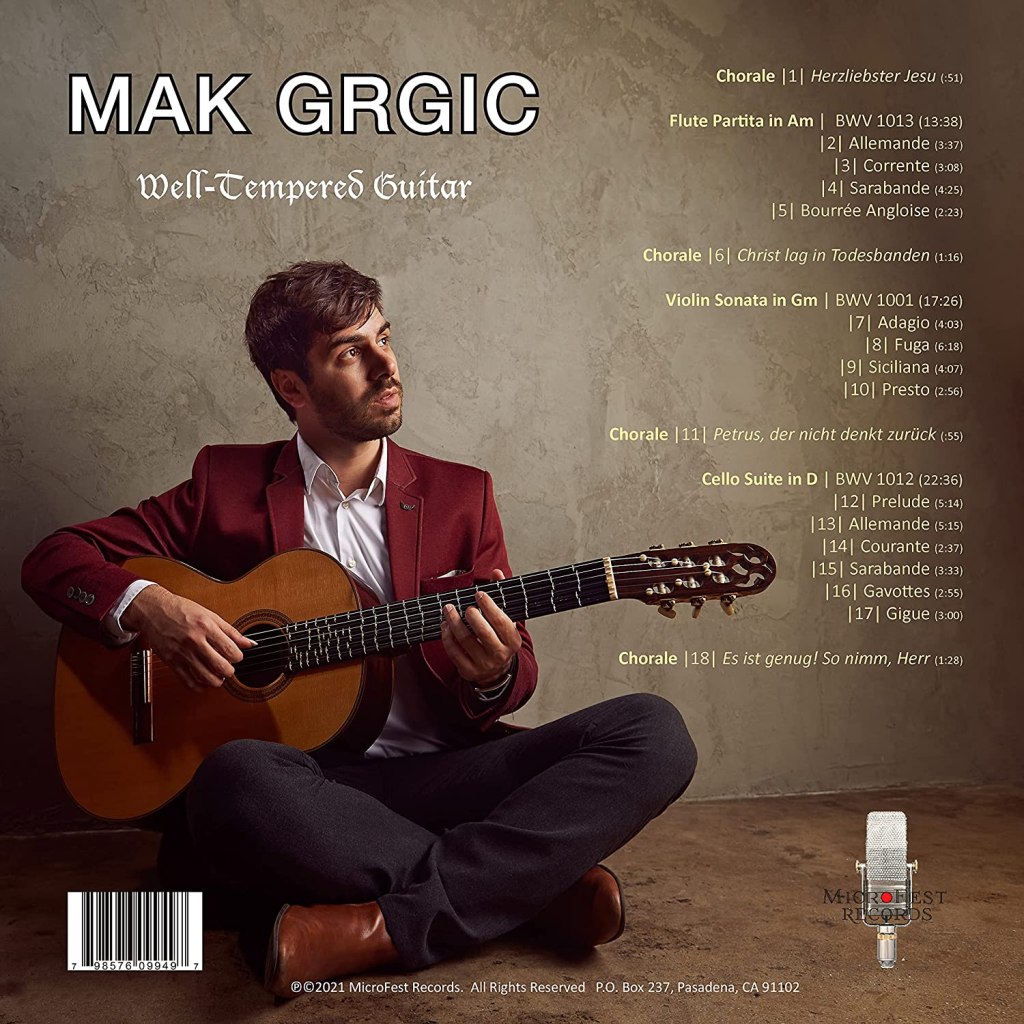
The fine Slovenian guitarist, Mak Grgic is a new name to this writer but one I hope to hear from again. In his selection of repertoire as well as his distinctive playing he makes a compelling and loving case for this music. His well organized web site details his work as musician, teacher, musicologist, composer, and international performer. This release is (by discogs) his seventh appearance on CD and his second recording for Microfest Records.
These are apparently Grgic’s transcriptions, not the “usual suspects” one might expect from a new Bach recording with the exception of the Cello Suite in D. This is apparently a very personal selection of music chosen with curational care. I’ve included a photo of the back cover to show the unique selections.
The Rose Window depicts the revelation and the final judgement of mankind. The present audio document is a gentle revelation but doubtless not the final word on Bach. But the scholarship is fascinating and the sound simply gorgeous. The wax paper has been removed.
Strictly speaking all women composers are neglected. Despite significant efforts in recent years there remain significant disparities in the representation of women composers in the concert and recital halls. Realistically it will take years just to catch up on those composers whose music has languished in unfair obscurity. Now in this International Women’s Month we are seeing the release of a great deal of music by various artists attempting to correct this neglect each with their own lens. Here we have the first installment of three planned CDs by the Berkeley based pianist, Sarah Cahill. This volume, titled “In Nature” is to be followed by one called “At Play” in November, 2022 and “The Dance” in March, 2023.
Photo by Christine Alicino from Cahill’s web site
Cahill is as much curator as artist, a skill evident in her weekly radio program “Revolutions Per Minute” on Bay Area radio station KALW and any number of creative concerts and musical projects in the San Francisco area. She is an internationally acclaimed recitalist and soloist and her You Tube Channel is one I frequently visit just to see what she’s up to. It is where I first heard many of the women composers featured on the present CD and a place where one can get a sense of her unique choices of repertory that characterize her career. Her husband, acclaimed videographer and video artist John Sanborn does the camera work and I must say that these videos were a welcome respite during the COVID lockdown and an opportunity to experience her musicianship up close and personal (only a page turner at a recital gets a better seat).
The first release in this series contains music spanning some 250+ years. The first selection is by Anna Bon (1739/40-ca.1767) which puts her in the late baroque/early classical era. This is the 5th (of 6) in her Opus 2 sonatas for keyboard. This is the first recording on a piano of this entertaining work by this Venetian composer who died in her 20s. Listeners will discern echoes of Mozart (1756-1791) and Haydn (1732-1809) for whom she sang in the choir at Prince Esterhazy’s, Haydn’s celebrated patron and employer. But the sound of the mature J.S. Bach (1685-1750) certainly dominates this very accomplished sonata. This writer hears it almost as a not too distant relative of the Goldberg Variations.
Next we come to 1846 with the music of Fanny Mendelssohn-Hensel (1805-1847), sister of Felix Mendelssohn (1809-1847). Though Fanny composed some 450 pieces in her short life most remained unknown and some were falsely attributed to her more famous younger brother, Felix. In fact he published some of her work under his name (in his Opus 8 and 9 collections) as women rarely got published at the time and Felix recognized his older sister’s talent.
Cahill has chosen numbers one and three of Fanny’s Opus 8 “Four Lieder for Piano” (a form which her younger brother would later embrace in his “Songs Without Words”). These accomplished early romantic works will leave the listener wanting more of this woman’s music which remains still largely unrecorded. They are a testament to her inventiveness as a composer as well as her virtuosity as a pianist and one hopes for a reassessment of her work.
The next selection comes from a Venezuelan composer, soprano, pianist Teresa Carreño (1853-1917). Sometimes referred to as the “Valkyrie of the Piano”, she had a 54 year career championing the work of luminaries such as Edward MacDowell and Edvard Grieg. Her 1848 etude-meditation, “A Dream at Sea” is a romantic virtuosic work that sounds like a challenge to play but a joy for the listener. This deserves to be in the recitalist’s repertory.
The next unknown gem in this fine collection comes from the pen of Leokadiya Aleksandrovna Kashperova (1872-1940) who was one of Igor Stravinsky’s piano teachers. In a sad echo of present day events Kashperova’s works, though published, were suppressed from performance due to her Bolshevik in exile husband whose politics were, to say the least, unpopular. Cahill here plays her Murmur of the Wheat from the piano suite, “In the Midst of Nature” (1910). Cahill handles the finger busting, Lisztian virtuosity with seeming ease and makes a case both for the further exploration of this woman’s music and the inclusion of it in the performing repertoire. This recording is the commercial recording premiere of the work.
We move now from one of Stravinsky’s piano teachers to one of John Cage’s. American composer, pianist, educator Fannie Charles Dillon (1881-1947) studied composition with Rubin Goldmark (one of Aaron Copland’s teachers) and piano with the great virtuoso Leopold Godowsky.
Years before Olivier Messiaen took up the practice, Dillon, was known for the inclusion of birdsong in her works. One of her 8 Descriptive Pieces, “Birds at Dawn Op. 20 No. 2” (1917) was performed and recorded by early 20th century virtuoso Josef Hoffman. Cahill comments in her fine liner notes, “Dillon’s score is remarkable in its specific notation of bird songs: the Chickadee, Wren-tit, Thrush, Canyon Wren, Vireo, and Warbling Vireo…”. It is indeed a sonic painting of the birds at dawn.
The Czech composer, conductor, pianist Vítězslava Kaprálová (1915-1940) was the daughter of composer, pianist Václav Kaprál (1889-1947). She composed some 50 works in her short life and died at the age of 25 in Montpelier, France two days after France surrendered to the Nazis. Her four “April Preludes Op. 13” were written for the Moravian-American pianist Rudolf Firkušný and are her best known piano works. Cahill has chosen the first and third for this recording. The music is notable for its exploration of extended harmonic language and made this listener curious about her other compositions.
This next work is a classic Cahill achievement. As a pianist known for working with living composers as well as being a producer who knows good music when she hears it this is a bit of musical archeology that brings to life in this world premiere recording a work from 1949 by Hungarian pianist Agi Jambor (1909-1997). Jambor studied with the legendary Edwin Fischer and had a career as a pianist and teacher very tragically interrupted by the events of World War II. She came to the United States in 1947 where her husband passed away two years later. She taught at Bryn Mawr College and was granted Emeritus status in 1974.
Her three movement Piano Sonata “To the Victims of Auschwitz” was brought into a legible and performable score with the assistance of Dr. John DesMarteau who befriended Jambor late in her life and to whom the piece is dedicated. And it was in consultation with Dr. DesMarteau, Cahill writes, that she was assisted in the interpretation of this music. According to Cahill’s liner notes this work attempts to represent sonically some of Jambor’s war time memories. It is a substantial work, a lost and lonely artifact of history given a definitive performance and recording.
The amazing composer Eve Beglarian (1958- ), the only of these composers known to this reviewer prior to receiving this album, provides the next offering, “Fireside” (2001). It is in fact a Cahill commission for a project commemorating the centennial of another neglected female composer, Ruth Crawford (Seeger) (1901-1953). Beglarian takes a poem written by the 13 year old Ruth Crawford hopefully describing her fantasy of what she would be in future years and, utilizing some chords from one of Crawford’s piano pieces, constructs a powerful meditation on the subject at hand. As it turned out Crawford wound up giving up her composing career to work with musicologist Charles Seeger, not exactly tragic, but hardly what her 13 year old self had imagined. Beglarian writes that “Fireside is dedicated to women composers of the future, who will undoubtedly be making devils bargains of their own.”, a cynicism which is hard to deny.
This piece, in its world premiere commercial recording, is one of a genre unique to the 20th and 21st centuries, that of the speaking pianist. This puts in in a category shared by works like Frederic Rzewski’s classic “De Profundis” (1994) and Kyle Gann’s “War is Just a Racket” (2008), a Cahill commission for yet another of her fascinating themed projects and recorded on her CD, “A Sweeter Music” released in 2013.
The penultimate track on this journey is provided by Belfast born (now in London) Irish composer Deirdre Gribbin (1967- ). “Unseen” (2017), in its commercial recording premiere, is described by the composer as a sort of meditation on the innocent victims of violence she has seen in her now home city of London whose presence is frequently unseen by many and, in the composer’s words, “reflects my desire to embrace an awareness more fully of my immediate surroundings in all their beauty and cruel pain”.
Mary D. Watkins (1939- ) is an American pianist and composer, a graduate of Howard University who has penned three operas as we as music for orchestra, chamber ensembles, jazz ensembles, and solo piano. She is a fine pianist, an advocate for Black
At first glance I was struck by Shane Keaney’s dark, drab art work of this album’s cover. It echoes the photographic work of Declan Haun and his contemporaries who documented the harrowing events of the 1960s Civil Rights Movement. But after reading the harrowing stories behind this music I find it entirely apt. There is certainly beauty here but also pain and sadness. The monochrome portraits that make up the inside of this gatefold album charmingly includes Sarah Cahill’s face alongside portraits of the composers within, a reflection of the pianist’s solidarity with them. And the other photos in the booklet by Cahill’s daughter Miranda Sanborn add to the sense of connectedness that seems to characterize her projects. This is a wonderful start to a promising project.
This Lou Harrison (1917-2003) concerto is one of his lesser known works largely due to the unusual instrumentation and the labors needed to tune the piano to the gamelan orchestra. A quick search revealed previous recordings, one by its dedicatee, Belle Bulwinkle with the Bay Area New Gamelan (BANG) recorded at Mills College (and overseen by Jody Diamond) from 1992 (now out of print) and one by pianist Adrienne Varner with Gamelan Pacifica (artists who participated with Harrison during his residency at the Cornish College of the Arts in Seattle) on New World records from 2012.
As a dedicated Harrison fan, I can’t imagine why this work is not better known. It is, in fact, Harrison’s second piano concerto, the first being his 1985 concerto for piano and orchestra. This first concerto has received two recordings by Keith Jarrett (the concerto’s dedicatee) and, more recently by Joanna MacGregor. This concerto also requires tuning the piano but to a just intonation scale, not to the orchestra as in the second concerto. All these recordings were made with significant collaboration with the composer. And here now is a chance to hear this second concerto in a new and defining recording by the next generation of musicians, all of whom have had significant and long term relationships with Mr. Harrison.
The details and complexities of tuning and notation are beyond the scope of this review and, indeed, beyond the expertise of this writer. But suffice it to say that though the performers must run quite a gauntlet of complexity, the listener will likely find this music very accessible. I have included a link here to a PDF of the original score for those who want that sort of detail but this is simply beautiful music when well executed as it is here in this performance.
This new recording of the Concerto for Piano and Gamelan was performed and recorded at the Cleveland Museum of Art in 2017, part of the celebration of Harrison’s centennial. It was one of many such celebrations worldwide of a true American master.
Copy of the title page of the score which also shows the composer’s skillful calligraphy.
This 1986-7 work is from a very productive period in Harrison’s life and demonstrates his deep understanding of writing music for Javanese Gamelan which he studied for many years in Indonesia and later with Jody Diamond. His mixing of western classical music with that of other cultures is one of his claims to fame as is his interest and application of non-traditional tunings and scales. This concerto is one of many pieces he wrote for gamelan and western instruments during the aforementioned residency at the Cornish School in Seattle, Washington.
One of the most striking things about Lou Harrison for this writer has been his connectedness. He was collaborative and very inclusive. He touched many lives via his composition, his teaching, and his general openness to others. Harrison was born in 1917 in Portland, Oregon and this recording is a document of one of the many centennial celebrations of his music which occurred world wide. At one of those events, Other Minds 22, held at the beautiful Mission Dolores Basilica in San Francisco (a church where Harrison went to learn to sing Gregorian Chants as a young man) the master of ceremonies, Charles Amirkhanian took an informal poll of the large audience. He simply asked how many people there had met Lou Harrison. Indeed about 2/3 of the audience raised their hands (this writer included).
Harrison was very connected and his influence continues, a fact very much in evidence in this release. This is one of those discs I would buy just for the performers. Sarah Cahill, Jody Diamond, and Evan Ziporyn are all highly accomplished performers, all with deep connections to Mr. Harrison. Cahill, a very fine pianist with an encyclopedic knowledge and real feeling for modern repertoire, can always be counted upon to provide definitive, exciting interpretations of music which deserves to be heard. Her facility with west coast composers as well as her collaborative relationship with many of them makes her an ideal choice to play scores by the likes of Terry Riley, Dane Rudhyar, Henry Cowell, John Adams, Frederic Rzewski, Pauline Oliveros, Ingram Marshall, and Lou Harrison to name just a few.
Cahill writes in the wonderful liner notes:
“One of the great pleasures of studying Harrison’s music involves his community, as his friends and colleagues have continued his legacy and performance practice. For the Concerto for Piano with Javanese Gamelan, I consulted Belle Bulwinkle, to whom the concerto is dedicated, and met with musicians with the most intimate knowledge of Harrison’s music, including Robert Hughes and William Winant. Best of all was performing the piece with Jody Diamond, who worked so closely with Harrison on his gamelan compositions and was so essential to the premiere in 1987, and with Evan Ziporyn, who has championed Harrison’s music for decades. Our work together culminated in performing and recording at the Cleveland Museum of Art, which brings together its extraordinary collections of Eastern and Western art “for the benefit of all the people forever.” It’s hard to imagine a better home for Lou Harrison’s concerto.”
The Pasadena, CA born Jody Diamond is a composer/performer and scholar who has worked with Gamelan for many years. She was one of the founding members of Gamelan Son of Lion, an American Gamelan ensemble which continues to play traditional music and collaborations with western contemporary composers. She studied gamelan in Indonesia on a Fulbright Fellowship. Diamond writes in the liner notes regarding her relationship with Harrison:
“Jody, you better go help Lou, because he won’t know what all the instruments are supposed to do.” This instruction from my teacher, the eminent K. P. H. Notoprojo, followed his 1976 invitation to Lou Harrison to compose for a Javanese gamelan. This was the beginning of my relationship with Lou, one that would continue until his death in 2003. During that time, I was Harrison’s gamelan teacher, orchestrator, music director, publisher, and friend. Lou and his life partner, Bill Colvig, were the witnesses at my wedding and “honorary Grandpas” to my daughter.
Evan Ziporyn, born in Chicago, Illinois, is the only Midwesterner in the group but his connections and musical proclivities make him a very comfortable fit with Diamond and Cahill. He is a composer, clarinet and saxophone player and, wait for it, a gamelan player. He studied gamelan in Indonesia with the same person who introduced Colin McPhee (1900-1964) to gamelan. McPhee is known for having been the first westerner to do an ethnomusicological study of gamelan. Ziporyn is the founder and director of MIT’s Gamelan Galak Tika which counts Jody Diamond as a former member.
The concerto is cast in three movements much as in the classical style. The first movement is entitled “Bull’s Belle” and is the longest of the three movements. The piano takes the lead and the gamelan enters at first almost unnoticed as its gentle tinkling notes seem as if they come from the piano. This is not the classical call and response between soloist and orchestra best displayed in the classical era (think Mozart) but rather an integration much closer in ways to a baroque concerto grosso where the solo instrument is not as clearly differentiated from the other instruments (think Bach). The piano writing is generally rather muscular and Brahmsian but the sound will remind listeners of the music of Alan Hovhaness and even echoes of Keith Jarrett’s solo improvisatory efforts.
The second movement is without a title. The gamelan opens with its gentle chime like percussions and the piano enters almost surreptitiously mirroring the entrances which occurred in the first movement. Like a classical concerto this is a slower movement with a more lyrical and overall less virtuosic feel.
The third and final movement is entitled, “Belle’s Bull”, begins with the gamelan entering first and then the piano. This movement has a lighter feel overall than the grand first movement and even introduces some minimalist repetition passages.
All told this is a performance against which all subsequent performances should be measured. It is a fitting tribute to Lou Harrison, his instrument builder and life partner Bill Colvig as well as a landmark in the performing careers of Cahill, Diamond, and Ziporyn.
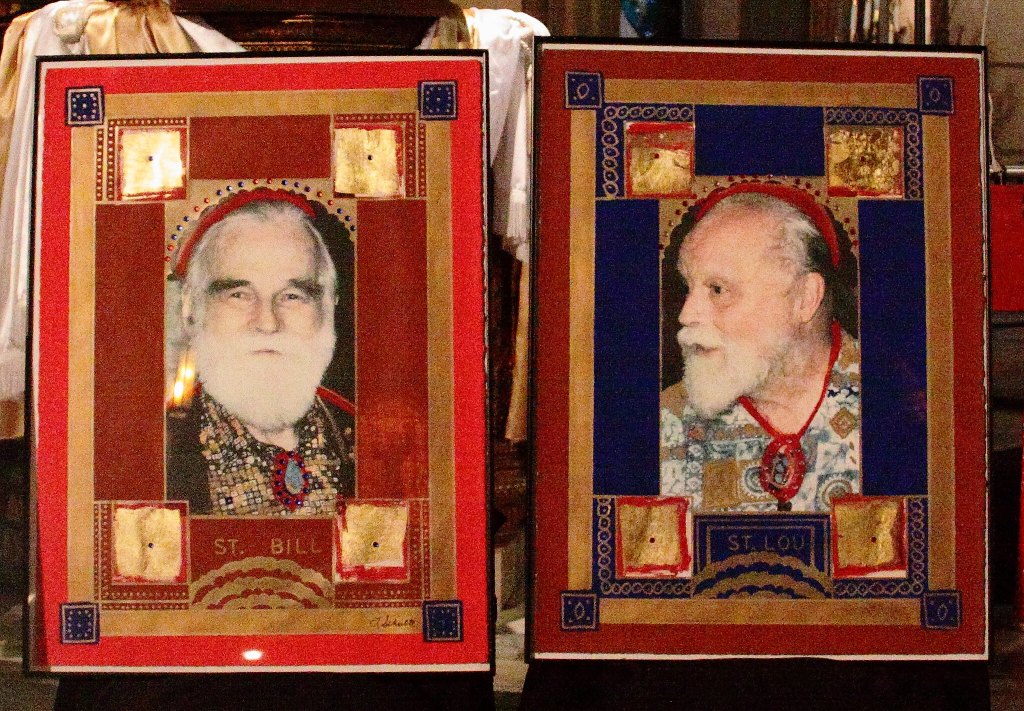
Portraits of William Colvig (l) and Lou Harrison (r) displayed at the Lou Harrison centennial celebration at Mission Dolores Basilica in San Francisco in 2017.
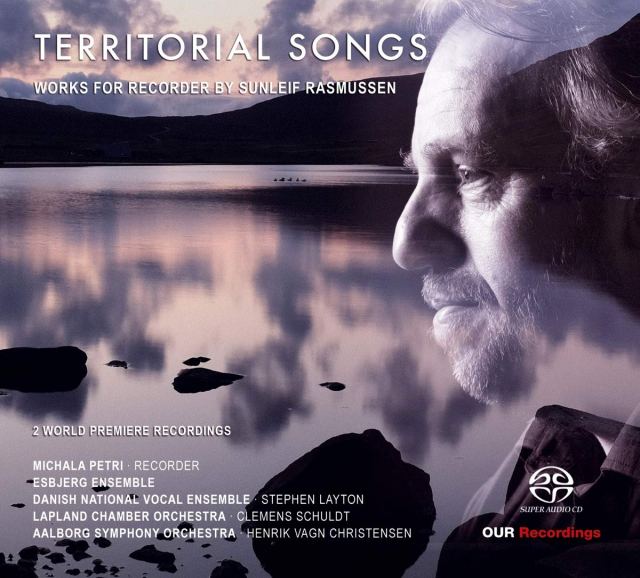
Sunleif Rasmussen is the best known composer from the Faroe Islands which are about mid way between Iceland and Denmark. He turned 60 on March 19th. He is certainly lauded in his homeland but his works have demonstrated him to be an artist whose reputation can hardly be contained by a single country. His works favorably compare with the finest composers from all of the Nordic countries (Iceland, Faroe Islands, Sweden, Norway, Denmark, and Finland). His work is known, as it should be, internationally.
This most recent release on the Danish label OUR Recordings contains music written between 2009 and 2014. All of these works are collaborations with the wonderful recorder player Michala Petri, a Danish artist whose name is as easily recognized as predecessors like David Munrow and Frans Brüggen. She is arguably the first lady of the recorder and the instruments most prominent advocate having first taken up the instrument at the age of three. and gone on to play over 4000 concerts.
The recorder is featured in several different contexts from solo to collaborations with choral, chamber, and orchestral groups. These contexts serve to demonstrate Petri’s facility as a performer as well as Rasmussen’s range of compositional vision.
The album opens with Flow (2012) for recorder and string trio. Here Petri is joined by the Esbjerg Ensemble String Trio with Bogdan Bozovic, violin; Michele Camile, viola; and Pau Codina Masferrer, cello. The piece was conceived as a companion piece to Mozart’s Flute Quartet K.285 (for flute and string trio). This work, in three movements utilizes a variety of extended techniques on the recorder and Petri’s collaboration was essential to provide the composer with information of the possibilities of such techniques with her instrument. The string writing is also laden with harmonics and techniques that were virtually unknown in Mozart’s time. To be clear, this “companion” piece is more homage than imitation but there are phrases which are clearly neoclassical nods to the Austrian master.
“I” (2011) is for the unusual grouping of recorder with chamber choir (with alto and tenor soloists) in a setting of a poem by Danish poet Inger Christensen whose text is a response to Wallace Stevens’ “Thirteen Ways of Looking at a Blackbird”(1917). Christensen’s poem is a personal (and dare I say feminist) response to Stevens’ classic work. Lyrical writing in the composer’s essentially tonal idiom belie the intricate structures of this brief setting. It is clearly a challenge for all but the Danish National Vocal Ensemble under their director Stephen Layton, along with Petri, deliver a truly excellent performance.
Next up is a piece for solo recorder, “Sorrow and Joy Fantasy” (2011), essentially a set of variations on a theme. It is based on a folk melody which was applied to the Thomas Kingo (1634-1703) sacred poem/hymn, Sorrow and Joy. There are twelve variations each with increasing demands on the soloist. It is a stunning vehicle for Petri’s lyricism and virtuosity.
Next is “Winter Echoes” (2014), an homage to the late Danish master Axel Borup-Jørgensen whose work has been championed by OUR records. This piece, scored for recorder and 13 solo strings. Petri is accompanied by the Lapland Chamber Orchestra under Clemens Schuldt. It sounds like a concerto in all but name. The piece requires Petri to play bass, tenor, alto, soprano and sopranino recorders as the piece progresses from low to high, dark to light. Extended instrumental techniques are present for the recorder soloist and the the string players.
The final piece, and the one from which this album derives its title, is “Territorial Songs” (2009). This concerto for recorder and orchestra finds Petri accompanied by the Aaborg Symphony Orchestra under Henrik Vagn Christensen. It is cast in five movements. The composer states that he was inspired by bird song in composing this piece, an inspiration shared by Olivier Messiaen most famously but also by composers who have written for the recorder. Again we have music that is lyrical, basically tonal, and virtuosic for both soloist and orchestra. Rasmussen’s facility with orchestral color make for an exciting listening experience and, as always, Petri meets the considerable demands with grace and seeming ease.
The recording, as seems to be the case with all The OUR Recordings that have met these ears, is bright and clear. The liner notes include a statement from the composer and a very welcome and useful set of liner notes by my friend and colleague Joshua Cheek who alerted me to this release. He provides insight and detail that enhance one’s appreciation of the music. The photography and design are both beautiful and distinctive. Lars Hannibal deserves high marks for his work as producer. It is a fine 60th birthday gift to Maestro Rasmussen and a major release for Ms. Petri. If you don’t know Rasmussen’s work (or Petri’s for that matter) this is a fine introduction that will have the listener craving more.
Michala Petri and Sunleif Rasmussen at Other Minds in San Francisco, 2013
This is not, strictly speaking, an autobiography. It is perhaps more in the style of a memoir. It traces the career and life of a woman whose voice drove much of the avant garde from the 1950’s to the 1980’s. It is told with a sober tone as the artist looks back on the highs and lows of life and career well spent. She tactfully shares just enough of her personal life and relationships to provide a context for her tales.
Anyone with an interest in new music during those years had to encounter Beardslee’s carefully cultivated soprano voice. Along with names like Phyllis Bryn-Julson, Cathy Berberian, and Jan De Gaetani, hers was a very familiar and welcome voice which led listeners (including this writer) reliably and frequently definitively through the plurality of styles that comprise the 20th Century. Of course she was trained in and also sang the so called “classics” meaning Mozart, Beethoven, Schubert, Schumann etc. but she will likely be best known for her extraordinary service to new music.
Beardslee’s lengthy and sometimes rambling tome is a very personal look at a long and productive career. She recounts teachers, other singers, composers, conductors, accompanists, and husbands over the span of a rich and interesting career. The rambling quality of her prose serves only to cast an even more personal light on these accounts of her life and artistry. Never is there a dull moment and this book will delight singers, composers, historians, and just plain listeners.
In the end this was a very satisfying read and the intelligent decision to include a discography as well as a list of Ms. Beardslee’s world and US premieres makes this book a useful document for further research into her career and the music which drove it.
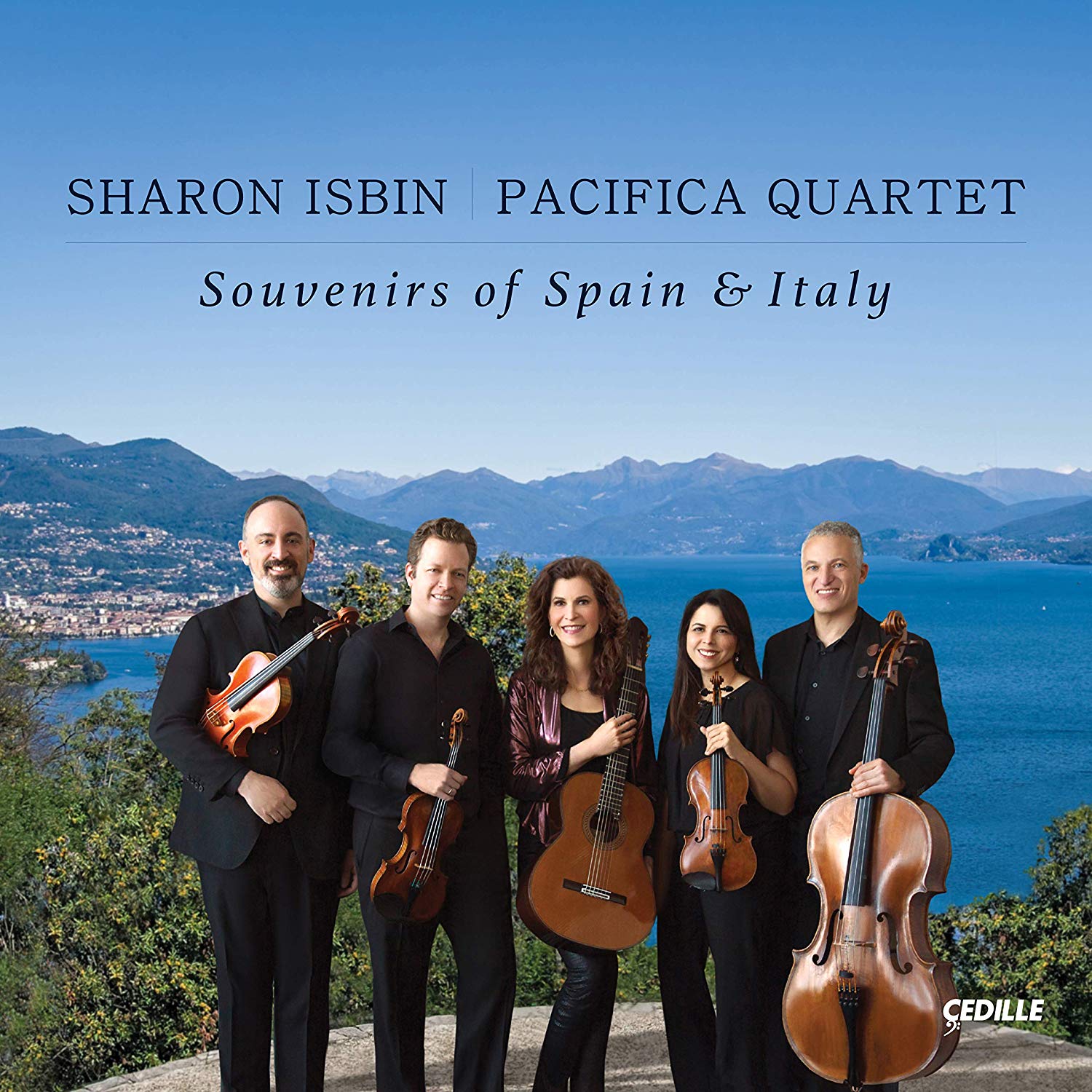
I was delighted to have had the opportunity to speak with guitarist Sharon Isbin (1956-) about this fine album. She appeared to be in the midst of a queue of interviewers set up by her press corps but she came across as a confident, relaxed, and skilled interviewee and a gracious person with a palpable passion for music. Listening to this latest release and having a more than passing interest in this fine musician it is a joy to see her getting recognition.
Originally from the Midwest, Isbin actually began her studies in Italy where her nuclear scientist father was working as a consultant. Her studies in Varese, Italy began at age 9 with Aldo Minella. She also counts among her teachers Andre Segovia, Alirio Diaz, and Oscar Ghiglia among her many teachers.
Most curiously she spent time studying Bach with none other than pianist Rosalyn Tureck during the time she was working on her landmark recording of the Bach Lute Suites. Isbin stated, “I don’t play piano and Tureck doesn’t play guitar but I wanted her insights into the preparation of this music.” Apparently this collaborative scholarship resulted in the publication (by G. Schirmer) of two of these suites originally written for lute.
As an academic, Isbin is all about research, fact checking, and collaboration and this clearly pays off as listeners will be delighted to find. But she is also the founder of the Guitar Department at the venerable Julliard School, a department which this year celebrates 30 years hosting students from 20 countries and, this year, establishing a DMA in guitar performance. Her first graduate, Australian guitarist Alberta Khoury, is the first recipient of this degree.
Asked about being THE musician to start the guitar department at Julliard she related that Segovia had proposed the idea some years ago and was rejected but that she was actually asked to start the department. An example, perhaps, of the student transcending the teacher.
Isbin plays a great deal of guitar music but, unlike many in her field, she has shown interest and devotion to music of our time as well. In fact she estimates having at least 80 scores and arrangements either commissioned by her or dedicated to her. It was with her recording “American Landscapes” featuring concerti commissioned from Lukas Foss, John Corigliano, and Tan Dun that first brought this artist to this reviewer’s attention. She is the recipient of three Grammys (and this album may very well earn her a fourth).
Regarding the present release, Isbin spoke of the process of preparation involved with this music. The Pacifica Quartet had been in residence at the University of Chicago and this was the connection (Cedille is a Chicago based, Chicago friendly label) that allowed her collaboration to appear of this fine record label.
She also spoke of the serendipitous discovery of finding that the composer’s granddaughter, Diana Castelnuovo-Tedesco, actually lived near her in New York. They began discussions and Isbin was able to view and work directly with the manuscript of the Quintet which opens the disc. Asked about the fact that this very quintet had been recorded about a year ago by Jason Vieaux, Isbin replied that it was pure coincidence but that this piece was considered by the composer to be his finest work of chamber music.
The Italian composer, Mario Castelnuovo-Tedesco (1895-1968) was born in Italy but was forced to flee the Nazis and was able, with the sponsorship of Jascha Heifetz (then a recently minted citizen himself), to come to the United States in 1939 just before the outbreak of WWII. In fact, his family suffered a similar indignity in 1492 when they were forced from their native Spain when the Alhambra Edict forced the expulsion of Jews from the country. The composer’s curious hyphenated name, according to Isbin, resulted when a dying friend who had no progeny asked that the composer somehow incorporate his name. This is both sweetly romantic and evocative of the sensitivities of the man himself.
The Guitar Quintet Op. 143 (1950) is a grand romantic and virtuosic work that deserves to be heard. It is difficult to imagine an audience not being thrilled by this music. It is cast in four movements like a classical work (allegro, andante, scherzo, finale). From the beginning the listener is carried along by beautiful melodies and clever collaborations between the strings and the guitar. Isbin related that superscriptions on the score saying, “Souvenir of Spain” gave the idea for the title of this album.
This is followed by one of the most recognizable guitar concertos, the Concerto in D Major for guitar and strings by Antonio Vivaldi written about 1730. The original is written for lute and Isbin uses an edition for guitar by Emilio Pujol with gorgeous ornamentation consistent with late baroque practice added by the present performer. This performance is with guitar, violin, viola, and cello (no second violin) but manages to make a big sound. This work is a personal favorite and, unlike the other works on the album, extremely well known and loved by this reviewer. My baseline favorite recording of this piece will probably always be Julian Bream’s performance on this RCA recording but Isbin’s scholarship provides a fascinating perspective on this work. So basically I now have two favorite recordings.
Next up is the only piece on the album where the Pacifica Quartet plays without guitar. Joaquin Turina (1882-1949) is more or less a contemporary of Castelnuovo-Tedesco. Offered here is Oración del Torero Op. 34 (1925). Curiously this work was written originally for four lutes or string quartet. Only the quartet version seems to get much play though the lute version might be interesting as well. This work, which translates into English as “Bullfighter’s Prayer” is essentially a miniature tone poem whose drama takes on almost cinematic dimensions in its just over 7 minutes. The Pacifica Quartet does a potent job of delivering an engaging performance. The Pacifica consists of Simin Ganatra, first violin; Austin Hartman, second violin; Mark Holloway, viola; and Brandon Vamos, cello. They are based at Indiana University.
Last and certainly not least is another major Quintet by an Italian composer, Luigi Boccherini (1743-1805). His dates make him a contemporary of Mozart and Haydn, though he was born in Italy, many of his productive years were spent in Spain where he enjoyed royal patronage. He was a prolific composer who has experienced a significant interest in the 20th century.
He wrote no less than 9 Quintets for guitar and string quartet and this one, in D Major G. 448 dates from about 1798 and is the best known of his works for this combination. It has the rather unusual attribute of having a percussionist (one Eduardo Leandro) improvise on castanets and tambourine in the last movement, fandango.
The work is cast in three movements (pastorale, allegro, grave assai-fandango) and will remind the listener of Haydn, Mozart, and/or early Beethoven. The music is both familiar and very entertaining. The castanets do not appear to be included in the original score and one can find recordings without them but they really rock that last movement.
This is another triumph for Ms. Isbin and a feather in the caps of the Pacifica Quartet. It is sonically spectacular album as well having employed the producer/engineer team of Judith Sherman and Bill Maylone. They achieve a lucid and warm sound field with an appropriately dry resonance that makes for an intimate listening experience which reveals the details the musicians coax from the score. Get this one, you’ll play it often.
This recording grabbed my attention in wonderful ways from the very beginning and didn’t cease to amaze me until it ended. Huang Ruo (1976- ) is one of the most striking new voices this reviewer has heard in some time. This Chinese born American composer draws on his ancestral culture, modern culture and synthesizes it with contemporary compositional techniques in new and interesting ways. He provokes the same sort of excitement in this reviewer that first contact with the music of Bright Sheng and Ge Gan Ru did when they first came into earshot some years ago.
Huang Ruo (1976- )
(Perhaps it is due to the rising star nature of this artist but there seems to be relatively little reliable info on him. His website is apparently not yet complete and even his Theodore Presser page fails to even give dates for his scores. I’m hoping these glitches get resolved soon because I think this is a composer who deserves serious attention.)
The very first track, Four Fragments (2006?) in the version for cello solo (apparently there is a version for violin solo but it is not clear which came first) is a powerful and virtuosic piece loaded with various pizzicati, glissandi and other effects that perhaps only a score could really tell you with certainty. What is interesting is the really organic nature of these effects, that is to say that they serve the composition and aren’t simply “golly gee what a virtuoso” type fireworks. The amazing Canadian Korean cellist Soo Bae handles this work beautifully and seemingly with relative ease. This is the second longest (by about ten seconds) of the pieces on this disc and the music, the performance snagged me immediately. What a powerful piece!
After that I was prepared for perhaps a let down, something more “ordinary”. But, no, the next track, the title track, Red Rain (200?) for piano played by the wonderful Emanuele Arciuli is another distinctive statement which seems to mine the riches of the composer’s native culture and place it anew in a contemporary and relevant modern context. At 10:50 it is a substantial piano work. Like the cello piece it seems to use some unconventional idioms for the instrument and by that I mean it sounds nothing like Mozart, Beethoven, Debussy or even Boulez or Stockhausen. It seems infused with an eastern musical flavor no doubt gained from techniques native to non-western traditions.
In another assault to any expectations I might have had the three movements of Shifting Shades have the pianist using a whistle such as your gym coach likely used with the pea inside to create a tremolo. Here the pianist whistles (and plays some sort of flute, maybe a recorder or shakuhachi? at one point; he also apparently plays directly on the piano strings at times) whilst playing the rapid tremolos and the drones that seem to characterize Huang’s keyboard writing. Stephen Buck is the hard working pianist here.
Buck comes back again for the Tree Without Wind for piano (this time played a bit more conventionally). This is the longest piece on the disc at 13:57 and rewards the listener’s attention. It seems to probe mythological depths and was suggested by a Chan Buddhist narrative by Hui Neng. Tremolos, clusters, drones and melodic fragments take on a symphonic grandeur at times. There is a wide range of dynamics and tempi as the pianist recounts in sounds the meaning of movement and silence.
Three Pieces for Piano gives names to the short movements. Prelude: Diffluent, Postlude: Left… and, Interlude: Points and Lines all contain the same techniques as the other piano pieces here (though without any additional instruments this time). These sound like they might be earlier works and perhaps studies investigating different techniques though they seem fully fleshed out and complete in themselves. The three movements are varied and the last one is apparently the composer’s only dalliance with twelve tone techniques and is by far the most conventional sounding work here though Huang’s distinctive fingerprint is present. Once again we hear Stephen Buck navigating the score.
In the last track we get to hear the composer himself at the piano with Arash Amini (a member of the American Modern Ensemble) on cello in Wind Blows… Like the previous tracks and as indicated in the fine notes by Stephen Buck this piece utilizes specialized effects to produce a unique sonic image. The piano part is referred to as a “drone” and it is indeed static at least in relation to the part for cello. Unlike the preceding pieces there seems to be less concern about evoking images and more concern for just the sound itself which is described aptly as “meditative”. In fact it is powerfully lyrical, even “Brahmsian” if I can be forgiven for that comparison.
The brief biography in the overall fascinating liner notes describe the composer as having been influenced by a wide variety of musical styles ranging from traditional Chinese folk musics to Chinese Opera, various western classical traditions including modernists such as Lutoslawski and various “pop” traditions as well. He studied at the Shanghai Conservatory and he appears to have achieved a fascinating synthesis in what seems to be his mature style. He is a composer, conductor and vocalist. His music is unique and beautiful as a Taoist painting but grounded in traditions that embrace perhaps the entire world as filtered through his creative mind. Bravo Innova for bringing this music to light in this fine and interesting CD.
Definitely keep and eye and ear out for this guy. He has many things to say and interesting ways to say them.









 New Music Buff