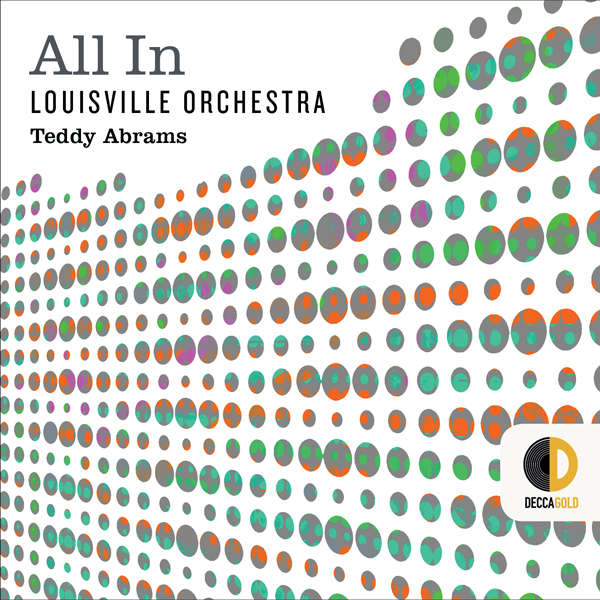
Louisville Orchestra Reboot on CD: All In


Abrams-Louisville-All-In_coverweb

The Louisville Orchestra was established in 1937 and its history has been wonderfully told in a 2010 documentary entitled, Music Makes a City.  Since their founding they released about 150 LPs containing new and interesting music not available anywhere else.  Many of those recordings have become available on the Albany CD label but the orchestra hasn’t released a new recording in about 30 years.

abrams

Teddy Abrams

Along comes new music director, composer, clarinetist Teddy Abrams and now we are graced with a new recording on the Decca Gold label.  Now for a reboot this release is somewhat conservative in it’s musical choices but that’s not to say it isn’t interesing.  This recording, released also in commemoration of the orchestra’s 80th season, reflects a sincere effort to draw younger audiences to the concert hall.

This auspicious release contains as its opening Abrams’ Unified Field, a finely crafted four movement work that channels the late Aaron Copland and his ilk.  It’s style is inflected with elements of jazz and other so called “vernacular” music but it incorporates those styles in much the way that Copland and his contmporaries incorporated folk song as well as jazz/pop rhythms. It is virtually a symphony in its dimensions and is highly entertaining while remaining seriously classical and very finely crafted.  The year of it’s composition is not specified in the notes this writer received but best guess is that it is of recent vintage in this talented composer’s oeuvre.

This is followed, curiously, by three torch songs, one by the able soloist Storm Large, one by Cole Porter, and one by Teddy Abrams.  The stylistic unity of these three songs is striking and Storm Large (who is known for her work with Pink Martini) is a convincing chanteuse.

These are followed by another American masterpiece, the Clarinet Concerto (1948) by Aaron Copland.  Originally written (and subsequently recorded by) Benny Goodman, the concerto is definitely in the repertoire but receives far too few hearings in concert.  This writer had not heard the concerto in many years and was struck both by its quality and by the convincing performance recorded here.  Abrams takes the solo role and the orchestra is conducted with assurance by one Jason Seber.

Abrams’ reading is as convincing and authentic as any and this is a delightful way to close this wonderful recording.  Here’s hoping that this release will be the restart of Louisvilled great recorded legacy and that Abrams tenure as conductor will breath new life into an orchestra which has become a venerable part of America’s cultural history.


Crazy Nigger, Gay Guerrilla, Precious Artist: Julius Eastman Examined


eastman

This essential collection celebrates the life and work of a composer and performer whose unique presence was nearly eroded to nothing but for the work of composer (and co-editor of this volume) Mary Jane Leach who spearheaded an effort to rescue as many scores and recordings as possible after Eastman’s death in 1990 at the age of 49.  The first evidence of this modern archaeological effort came with the release of Unjust Malaise (2005), three CDs which featured some of the recordings that were gathered in that early effort.  In addition it should be noted that Leach continues to maintain a resource page with the most up to date information on Eastman scholarship efforts.

Now, along with Renée Levine Packer (whose wonderful history of the Buffalo New Music Days, “This Life of Sounds” (2010) is not to be missed) we have a lovingly edited collection of essays which comprise a sort of biography as well as an appreciation of this very important American composer.

One look at the acknowledgements reveals the wide scope of individuals with whom Eastman came into contact and whose contributions became so essential to this volume.  The wonderful introductory essay is so very appropriately written by George E. Lewis whose figure itself continues to loom knowledgeably over late twentieth and early twenty first century music.  He takes a characteristically unflinching look at the cultural, historical and socioeconomic factors that contextualize Eastman’s work as well as his untimely demise.  Eastman’s frequent use of politically incorrect titles that challenge a smooth vocal delivery in the most seasoned of broadcasters is here made to seem quite understandable (if not comfortably palatable) within the complex forces that defined Eastman’s milieu.  Lewis embraces Eastman’s talents and makes the prospect of further study of his work tantalizing.  He provides a truly authoritative context which can serve all future work in this area.

There are nine chapters, a chronology and a select bibliography along with photographs and score examples.  The essays that comprise each chapter focus from the macro-view of Packer’s biographical sketch and Leach’s timeline to micro-analyses of some of Eastman’s works and some additional personal perspectives.  One of the most endearing qualities of this volume is the fact that many of the contributors knew and/or worked with Eastman at one time or another.  It is clear that all the contributors were deeply affected by their encounters with Eastman himself and/or with his music and all are rather uniquely suited to be in this volume.

One suspects that Packer’s biographical sketch which opens this volume will henceforth serve as a basic model for all future biographical research.  Whether one finds agreements or not the material is presented in as complete and organized a fashion as can be imagined.  It paints the picture of a prodigy who, for whatever reason, fell into disarray.  Whether there was drug use or symptoms of mental illness will be the debate which will, of course, never be satisfactorily resolved.  What shines through though are tantalizing moments and a plethora of relationships, however brief sometimes, that contribute to all we will ever really know of the enigma of the life of this precious artist.

Some of what follows has the quality of memoir and some leans more toward academic analysis.  All of these essays, timelines, bibliographies, etc. tie this book together as the first most comprehensive effort at trying to understand the man, his music, his milieu, his unusual personality.

These accounts will always be crucial in any future analysis of the enigmatic talent of Julius Eastman.  Though many will attempt to affix labels to his personality variously attributing his quirks to mental or physical illness no one will ever know him the way the people in this book did, as a precious artist whose work was rescued (as much as it could be) from obscurity by his family (both biological and artistic).  He was and is loved in perhaps the only way that he would allow, through his work and his deeds.

This book is a fascinating read which serves to put the artist back into his proper place as the genius he was.  Much remains to be written, performed, analyzed and recorded but this book will always serve as the reference point for what is to come.

The Heresy and the Ecstasy: Brooklyn Raga Massive Does “In C”


brminc

This is heresy.  It is not, strictly speaking, faithful to the 1964 score and it is a sort of cultural appropriation which is actually the very basis of Brooklyn Raga Massive, a sort of latter day “Oregon” (to those who recall that band) which takes on all sorts of music and filters it through the unique lens of this flexibly populated group of musicians whose backgrounds range primarily from Hindustani and Carnatic traditions (though hardly in the most classical sense) but also from western classical and jazz.  Their “heresy” comes from their choices.  The root of heresy is the Greek word, “hairesis” which means choice.  There is a lovely selection of their musical heresies on their You Tube Channel.

No this is not purely heresy and it is certainly not blasphemy.  Quite the opposite actually.  And I would prefer to think of this effort as cultural integration.  The choices made here instead lead to some mighty ecstatic music making which pays honor to Terry Riley who turned 80 in 2015 and provides a unique perspective on this classic work.

“In C” (1964) is without doubt Riley’s best known work by far and the one which pretty much defined what would later become known for better or worse as “minimalism”.  It is an open score meaning that no instruments are specified for performance making this music heretical in nature as well.  In addition there is no conductor’s score as such.  Rather there are 53 melodic cells numbered 1 to 53 and the ensemble is held together by the expression of an 8th note pulse played by at least one of the musicians involved.  The defining reference on the intricacies of this work is composer/musicologist Robert Carl’s masterful book entitled simply, “In C”.  He describes the wide variety of potential choices which can be made in performance and the different results which can be achieved.

There are a great deal of recordings available of this work from the first (released 1968)  on Columbia’s “Music of Our Time” series curated by the insightful David Behrman to versions involving a wide variety of instrumental combinations of varying sizes.  The first “world music” version this writer has heard is the version for mostly percussion instruments by Africa Express titled, “In C Mali” (released in 2014).

Not surprisingly BRM, as they are known, have chosen a largely Hindustani/Carnatic take on this music.  The unprepared listener might easily mistake this for a traditional Indian music recording with the introduction which incorporates a raga scale and adheres to the traditional slow free rhythm improvisation of the introductory “alap” section common to such traditional or classical performances.

The familiar sound of these (largely) South Asian instruments with their rich harmonics sets the tone gently.  This writer has at best a perfunctory working knowledge of these complex and beautiful musical traditions but one must surmise that the choice of Raga Bihag may have some intended meaning.  Indeed such music is by definition integrated into the larger cosmology of Hinduism, the Vedas, the Gita, the Sanskrit language, and, no doubt other references.  This is not discussed in the brief liner notes but is worthy perhaps as a future interview question.

It appears that many of the musical decisions were made by sitarist Neel Murgai though it becomes clear as the performance develops that individual soloists are allowed wonderful improvisational freedoms at various points.  The recording is intelligently divided to let the listener know which set of melodic cells is being expressed at a given time.

The alap gives way to the sound of the tablas which initiate the pulse mentioned earlier.  The structure of this piece produces a range of musical experiences from a sort of didactic beginning to the swirling psychedelic waves of sound which stereotypically define much of the music born in the mid 1960s in this country.  In fact Terry Riley’s deep study of South Asian musics (most famously under vocalist Pandit Pran Nath) did not occur until later in his career.  Nonetheless there seems to have always been some affinity between Riley’s vision and the sort of music whose popularity was driven in the United States most famously by the efforts such as Pandit Ravi Shankar and Ustad Alla Rakha in the 1970s.

What follows is a riot of musical ecstasy involving some inspired improvisational riffs and some stunning vocalizations as well giving us a fascinating take on this music which was written well before these musicians came into the world.  We have a later generation paying homage to the beloved American composer and to the beautiful traditions of their own eclectic ethnic heritage.

The set concludes in this live and lively recording with a traditional fast paced Jhalla, the traditional ending to classical Indian musical performances. This will likely become known as the “Indian” recording of “In C” but it is so much more than that.  It is an homage.  It is a look back from the view of at least a couple of generations of artists.  And it is heresy in the best sense of that word, choices made judiciously to achieve higher artistic goals.  Not all art is heresy and not all heresy is art but the heresies perpetrated here definitely deserve our ears.

The heretics are: Neel Murgai, Sitar and Vocal; Arun Ramamurthy, Violin; Andrew Shantz, Vocal; Josh Geisler, Bansuri; Sameer Gupta, Tabla; Roshni Samlal, Tabla; Eric Fraser, Bansuri; Timothy Hill, vocal; Trina Basu, Violin; Ken Shoji, Violin; Kane Mathis, Oud; Adam Malouf, Cello; Michael Gam, Bass; Lauren Crump, Cajon; David Ellenbogen, Guitar; Max ZT, Hammered Dulcimer; Vin Scialla, Riq and Frame Drum; Aaron Shragge, Dragon Mouth Trumpet.

Namaste, folks.


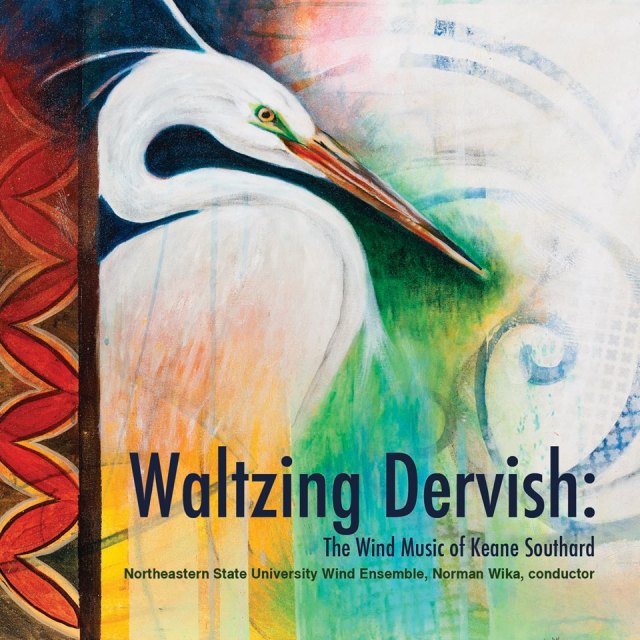
Visions of a Dreamer: Keane Southard’s Waltzing Dervish


dervish

Keane Southard (1987- ) is a composer and pianist whose work is influenced by a variety of styles including standard classical and pop and folk influences.  This major debut disc is a fine sampling of his work though it is important to realize that his work is for diverse ensembles of pretty much every description and the present sampling is of music for wind ensemble.

Just like every specialized grouping, be it string quartet, string orchestra, wind quintet, solo piano, full orchestra, etc., one encounters composers with varying degrees of facility in each configuration.  Southard seems very much at home with the wind ensemble/band and its possibilities.  A quick look through his extensive works list at his site suggests a hugely prolific musician with a wide variety of skill sets in a variety of musical configurations.  Wind ensemble is clearly one of his strengths and the Northeastern State University Wind Ensemble of Oklahoma under conductor Norman Wika are up to the challenges.  Southard playfully refers to this grouping as a “wind powered” ensemble using it as a metaphor for ecologically sustainable power systems.

There are nine tracks of which three are transcriptions of other composers’ work and the remaining six are by Southard.  His metaphors are as eclectic as his musical choices but fear not, his choices are friendly ones.  The first track, Waltzing Dervish sets the tone as an original and substantial composition of some ten minutes duration in which he takes on the waltz and its various meanings both public and personal to create an original band composition concerned as much with ecological metaphor as with a striving for multicultural diversity in an optimistic and thoughtful exploration of what can easily be a tired dance form.

The second piece is an arrangement of a piece by Francisco Mignone (1897-1986), one of the composers whose music he encountered during his 2013 Fulbright Fellowship in Brazil.  The piece is scored for optional choir (not used in this recording) and band, an arrangement Southard made with the intention of sharing this music as a highly viable selection for concert band.  It is indeed a joyous affair and one could easily imagine this being adopted as a staple in the rarefied realm of concert band music.

Do You Know How Many You Are? is the composer’s 2013 band arrangement of a 2010 choral piece which he describes as having basically come to him in a dream.

Claude Debussy’s Menuet (ca. 1890) was originally a piano piece which Southard envisioned in this orchestrated form during the course of his studies of orchestration.  That sort of inspiration is not uncommon for a composer but the result is not always as ideal as the composer imagined.  Fortunately this orchestration works quite well and again would proudly fit in a given band’s repertoire as an audience pleasing piece.

The next piece, originally an orchestral piece from 2013 is presented in the composer’s own arrangement for band.  No Interior Do Rio De Janeiro (2013/15) is another of the inspirations from the composer’s 2013 Fulbright Fellowship and was inspired by his work with “Orquestrando a Vida”, a Brazilian music project inspired by Venezuela’s famed “El Sistema”.  The band version was written on a commission from the present NSU Wind Ensemble.  Here is perhaps a departure from the dance theme of the first three tracks.  It seems to be a thesis or musical diary entry reflecting his personal take on the experience of working with this project though the spirit of the dance remains throughout.

Carousel (2008/2010) is the arrangement for band of the third movement of a mini-symphony (perhaps a scherzo?) for orchestra.  Curiously he describes his inspiration as coming from the sound of the calliope, a sort of steam driven organ common in circuses of the late 19th and early 20th centuries.

Cortège et Litanie (1922) by French composer and organist Marcel Dupré (1886-1971) is a bit of a departure.  Neither a dance nor derived from Brazilian sources this piece was originally written for organ.  The organ (like the calliope in the previous piece) is arguably a wind instrument and this transcription retains some of the ambiance of that grand instrument.  It is among Dupré’s better known pieces and seems a natural for band.

Uma Pasacalha Brasiliera (2015) is a commission from a the Arrowhead Union High School Wind Ensemble and conductor Jacob T. Polancich.  The composer describes various influences in the circuitous path the the completion of this work but it is basically a sort of homage to the baroque form of the pasacaglia (variations over a repeating bass line) as well as to some of the great folk song influenced composers such as Percy Grainger.  Brazilian influences dominate much of the composer’s work from this period and they combine with the aforementioned baroque and folk influences to form a wonderfully creative take on that form of baroque counterpoint.

Finally the big finale is presented in another transcription, this time of a concerto for piano and organ from 2008.  Of course the organ again lends it’s sound easily to a band transcription and we have this Concertino for Piano and Wind Band (2008 rev. 2015) which allows us to hear the considerable keyboard skills of the composer.  This is the most substantial work on the disc and provides a satisfying finale to this portrait of a prolific and optimistic young composer at the very successful beginnings of what this writer (optimistically) hopes will be a long and productive career.


Nadudim: Ethnic Memories from the Fifth House Ensemble


This is a really pretty album.  It is apparently one of the passions of Cedille to release folk musics from middle eastern and Mediterranean sources.  What distinguishes this release is its thoughtful, tasteful arrangements.  This writer is tempted to compare it to Berio’s Folksongs or Copland’s Old American Songs to capture the ideas behind the creative arrangements done by the four composers involved.  I don’t think this is quite the same undertaking as those works but this album is a serious musical effort by some marvelously talented musicians and is recorded with the lucidity one comes to expect from this unique Chicago based label.

Nedudim is the Hebrew word for wanderings and this is a great title for this album which takes the listener on a journey through the middle east and its musical riches. This is the second album that the Fifth House Ensemble, here joined by Baladino, has released on Cedille and it will leave the listener wanting more.

Various traditional instruments are mixed with classical instruments and gorgeous vocals in this song cycle.  It is a journey which reveals the diverse energies to be found in these local song traditions.  They are entertaining and even infectious in their joy.


American Muse, American Master: Steven Stucky on BMOP


BMOP 1050

Steven Stucky (1949-2016) was sadly taken from the world too soon.  But we can rejoice in this wonderful new disc of (mostly) first recordings of some of his wonderful orchestral music and songs.  Boston Modern Orchestra Project adds another entry to their growing discography of must hear American music with this beautiful recording.

Three works are featured, Rhapsodies (2008), American Muse (1999), and Concerto for Orchestra (No. 1, 1987).  Only one, American Muse has been recorded (on Albany Records) before and all are worthy selections from the composer’s ample catalog.

Rhapsodies, the most recent work, is also the shortest at just over 8 minutes.  It was commissioned by the New York Philharmonic and the BBC Symphony and is for large orchestra and sounds as though it could serve as a movement in another Concerto for Orchestra.  Stucky, who was an expert on the music of Witold Lutosławski (1913-1994), was a master orchestrator as was Lutosławski though Stucky’s style is distinctly different reflecting a sort of friendly romantic modernism with serious virtuosity.  This little gem gives the orchestra and, no doubt, the conductor, a run for their money in this virtuosic and highly entertaining little sonic gem.  It was premiered in 2008 under Lorin Maazel.

The Los Angeles Philharmonic commission, American Muse was written with the fine baritone Sanford Sylvan in mind.  It is a four song cycle setting poems by John Berryman, e.e. cummings, A.R. Ammons, and Walt Whitman and was premiered in 1999 under Esa-Pekka Salonen.  Sylvan is a very fine interpreter of American music and first won this reviewer’s heart with his rendition of John Adams’ The Wound Dresser (also a Whitman setting).  One should never miss an opportunity to hear Sylvan’s work.

Again we are treated to Stucky’s acute and subtle sense of orchestration which works with the poetry unobtrusively paralleling the words with the musical accompaniment and seemingly creating its own poetry in sound. Sylvan is in fine voice and seems to be enjoying his performance, a very satisfying experience.

The inclusion of Stucky’s first Concerto for Orchestra which was commissioned by the Philadelphia Orchestra and premiered in 1988 (under Ricardo Muti) will satisfy fans of this composer’s work as it provides an opportunity to hear “the one that got away” so to speak.  It was the runner up for the Pulitzer Prize which he would later win for his Second Concerto for Orchestra (2003) in 2005.

In it’s three movements Stucky is clearly the master of his realm and creates a wonderful listening experience.  His sense of drama and emotion are stunning and serve to underscore the dimension of what the world has lost in his passing.  But it is time to leave sorrow aside and let the music speak and thus provide the composer with a dimension of immortality.

As usual the performance and recording are impeccable and Gil Rose continues to record wonderful music that deserves more frequent hearings and does honor to the memory of a cherished artist.  Now can a recording of Stucky’s 2012 Symphony be far behind?  Let’s hope so.

Words Fail and Music Succeeds: Violinist Yevgeny Kutik


Marquis 774718147721

Politics requires words and indeed fails at times but music very much succeeds in this fine recording.  This charming collection organized loosely around songs without words is the third album by this emerging artist.

The music is largely 20th to 21st century (if you count the date of the transcriptions) but the sound and mood of the album ranges from the romanticism of Mendelssohn and Tchaikovsky, the post-romantic Mahler, to the neo-classicism of Prokofiev and a dash of modernism from Messiaen, Gandolfi, Andres, and Auerbach.  No words, no politics, just some really beautiful music.

There are 14 tracks of which the Mendelssohn and the Mahler will be the most familiar to listeners.  What is interesting here is a certain unity in these seemingly disparate works which range over nearly 200 years of compositional invention.  In fact this recital program strongly resembles in spirit the justly popular programs of Jascha Heifetz and his acolytes.  That is to say that this is at heart a romantic recital program sure to please any aficionado of the violin and piano genre.

Two of the tracks, those by Michael Gandolfi and Lera Auerbach are for solo violin.  The unaccompanied violin repertoire best represented by J.S. Bach’s Sonatas and Partitas is a relatively small one and one fraught with difficulties for composers as well as performers.  Fear not though, these pieces are well wrought and represent significant contributions to the solo violin literature.

The Gandolfi (1956- ) Arioso doloroso/Ecstatico (2016) was commissioned by Mr. Kutik and this is the world premiere recording.  The composer utilizes a basically romantic sounding style with clear references to Bach at moments to create a very satisfying piece imbued with depth but eminently listenable.  Gandolfi’s eclectic oeuvre is by itself worthy of further exploration.

Lera Auerbach’s (1973- ) T’Filah (2015) is a reverent (though not excessively somber) prayer written in memory of the victims of the Nazi holocaust.  Auerbach shares some Russian roots with the soloist and this brief composition will leave most listeners wanting to hear more from this fine and prolific composer.

Timo Andrés (1985- ) plays the piano on the eponymous track Words fail (2015), the second of the two works commissioned by Kutik and premiered on this disc.  He is a skilled composer using a wide variety of compositional and instrumental techniques (which he mentions in his liner notes) to create a sort of modern song without words that fits so well in this program.  Andrés is certainly among the rising stars both as composer and performer.

One should definitely pay attention to the fine work of Kutik’s accompanist John Novacek whose precision and interpretive skill so well compliment the soloist.  The art of the accompanist shines very clearly here.

Overall a great recital disc from a soloist from whom we will doubtless continue to hear great things.

The Musical Mother of Us All: Pauline Oliveros, a Personal Appreciation


oliverosione

Pauline Oliveros at one of Philip Gelb’s dinner concerts in Oakland.  I published this photo on Pauline’s Wikipedia page.

I woke at about 3PM on the day after Thanksgiving (having worked the previous night shift) and I checked my e-mail and then, on Facebook I learned of the passing of theorist, composer, musician, teacher and all round wonderful human being Pauline Oliveros (1932-2016). She had died peacefully in her sleep on Thanksgiving Day.  Going over the copious posts and comments I was saddened at her passing but oddly comforted by the fact that these posts honoring her are effectively eclipsing the ones on the obnoxious political issues as well as demonstrating the incredible reach of her influence.  Thankfully, Pauline will not have to endure the regressive politics which now dominate our country and, indeed, the world.

I first encountered Pauline’s work, as many did, through the Columbia Odyssey LP curated by none other than David Behrman in his Music of Our Time series.  There are several composers on the disc including Steve Reich (Come Out), Richard Maxfield (Night Music), and Pauline Oliveros (I of IV).  Over the years I collected and listened to most of her recordings Discogs lists 55 recordings but no doubt there are many more and likely a plethora of unreleased material which will grace our ears for years to come.  Like her older contemporary John Cage it is difficult to identify a “masterpiece” and, also like Cage, she didn’t aspire to such notions because she aspired to learn and subsequently teach the art of listening. Her Deep Listening Institute is based in Kingston, New York.


dempster9

Stuart Dempster at another of Philip Gelb’s dinner concerts. Stuart is one of the members of Oliveros’ Deep Listening Band

I was pleased to be able to see one of the incarnations of the Deep Listening Band in Chicago at the Harold Washington Library.  This concert occurred on the night of the famed “Chicago Flood” (1992) in which a construction mishap diverted thousands of gallons of water from the Chicago River into the disused coal delivery railway tunnels which connect most of the downtown buildings.  I brought along a postcard from her album The Well and the Gentle hoping to get her autograph.  It was my first face to face meeting with this icon of new music.  She graciously took the card into her hand and immediately exclaimed with a smile, “Oh, this is from the Well”.  She quipped that next time they would hold their concert in one of the “deep tunnels” which are a part of the Chicago’s massive flood control rainfall overflow system.  I still treasure that autograph and the memory of my first meeting with Pauline.

oliverosione3

Ione (l) doing verbal improvisation while Pauline improvises in parallel on her digital accordion at a memorable dinner concert curated by Philip Gelb.

I can hardly tell you my level of excitement when vegan chef and musician Philip Gelb announced that Pauline with her partner Ione would be appearing at his next dinner concert.  The opportunity for a close encounter with this master was certainly heaven sent. (Pauline later wrote the lovely introduction to Philip’s first vegan cookbook.)

garden20151047

Philip Gelb performing at the June 21, 2015 Garden of Memory Concert at Oakland’s Chapel of the Chimes. This vegan chef and cookbook author plays and teaches shakuhachi and curates a wonderful dinner/concert series at his loft in West Oakland.  Philip also appears on several albums with Pauline and others.

Indeed, as I sat across from Pauline no doubt babbling some starstruck nonsense, I encountered in both her and her partner Ione two warm and unpretentious people.  While I knew I was in the presence of genius I was given to feel very welcome as they both engaged me and the other guests in lively conversation at this spectacular vegan meal.  In the pause just before dessert they gave a wonderful performance with Ione speaking improvised and passionate poetic utterances while Oliveros played her quirky improvisations in parallel on her digital accordion.

OM202021

Pauline Oliveros, Miya Masaoka and Frode Haltli performing Oliveros’ Twins Peeking at Koto (2014) at Other Minds 20 in 2015

I later got to see Pauline as a returning guest composer/performer at Other Minds 20, a series lovingly and painstakingly curated by composer, broadcaster and new music impresario Charles Amirkhanian.  I believe this was her last major bay area appearance.

OM202022

A clearly happy Pauline Oliveros acknowledges the warm applause of the Other Minds 20 audience after her performance at the SF Jazz Center in 2015.

Every year at the Garden of Memory summer solstice concert the open membership Cornelius Cardew Choir performs Oliveros’ Heart Sutra every year.  The verbal score describes how one enters the singing circle and intones basically the note of their choice with one hand over their heart and the other on the back of another singer.  I screwed up my courage to participate in this ritual a few years ago and it is now an essential part of the beginning of my summer.  Pauline has taught me much and no doubt will continue to teach me through her writings and recordings.  For that I am eternally grateful.


The Anniversary That (almost) Everyone Missed: Bill Doggett (1916-1996), Wizard of the Hammond Organ


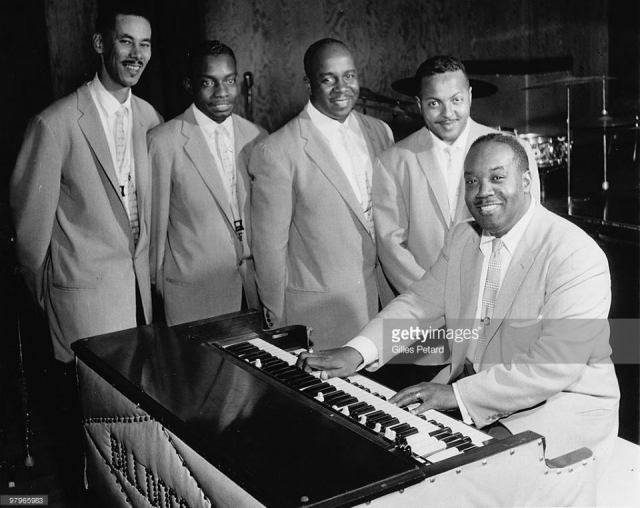
doggettcombo1956

Bill Doggett with his combo (getty images)

William Ballard Doggett, better known as Bill Doggett was born in Philadelphia in 1916 and was introduced to music by his church pianist mother.  He played in a combo while still in high school and went on to work with a plethora of stars in rock, jazz, rhythm and blues amassing a string of hits but, sadly, seems to have barely been noticed on this the 100th anniversary of his birth.  Where is NPR at a time like this?

Well, all is not lost.  Fortunately his nephew and namesake Bill Doggett is doing justice to the memory of this important American musician.  This younger Doggett is an archivist, lecturer, curator, strategic marketer, photographer, filmmaker, and arts advocate (his website is well worth your time).  I am hardly as well prepared to provide more than an overview of this musician’s work but I feel obliged to do my small part in recognizing this man’s work.

doggettposter

Promotional poster for the September 28, 2016 centennial celebration curated by nephew and namesake, Bill Doggett.

Doggett’s list of chart singles:

  • “Be-Baba-Leba” (vocal by Helen Humes) (Philo/Aladdin 106) 1945 (#3 R&B)
  • “Moon Dust” 1953 (#18 R&B)
  • “Early Bird” 1953 (#21 R&B)
  • “No More In Life” 1953 (#20 R&B)
  • “High Heels” 1954 (#15 R&B)
  • “Honky Tonk, Part 1″/”Honky Tonk, Part 2” (King 4950) 1956 (#1(14) R&B/#2(3) Pop)
  • “Slow Walk” (King 5000) 1956 (#4 R&B/#19 Pop)
  • “Ram-Bunk-Shush” (King 5020) 1957 (#4 R&B)
  • “Soft” 1957 (#11 R&B)
  • “Leaps And Bounds, Part 1″/”Leaps And Bounds, Part 2” (King 5101) 1958 (#13 R&B)
  • “Blip Blop” 1958 (#11 R&B)
  • “Hold It!” (King 5149) 1958 (#3 R&B)
  • “Rainbow Riot, Part 1″/”Rainbow Riot, Part 2” (King 5159) 1959 (#15 R&B)
  • “Monster Party” (King 5176) 1959 (#27 R&B)
  • “Yocky Dock, Part 1″/”Yocky Dock, Part 2” (King 5256) 1959 (#30 R&B)
  • “Honky Tonk, Part 2” 1961 (#21 R&B)


  • doggetthonky

    Doggett’s best known work.

While his last chart hit was 1961 his collaborations with  Lucky MillinderFrank FairfaxJimmy Mundythe Ink SpotsLouis JordanJohnny Otis, Wynonie Harris, Ella Fitzgerald, Louis Armstrong, Count Basie,  Lionel HamptonRed Holloway, Clifford Scott, Percy France, David “Bubba” Brooks, Clifford Davis, and Floyd “Candy” Johnson; guitarists Floyd Smith, Billy Butler, Sam Lackey and Pete Mayes; and singers Edwin Starr, Toni Williams and Betty Saint-Clair attest to the scope of his work.  Doggett continued to play and arrange until his death from a heart attack in New York in 1996 at the age of 80.

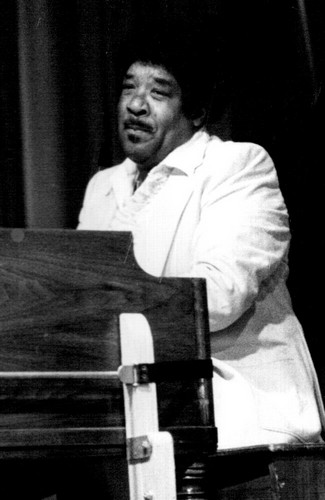
bill_doggett

Bill Doggett photographed in France in 1980 by Lionel Decoster (from Wikipedia article)

The Hammond Organ is known for being the workhorse of modern classical as well as rock, rhythm and blues and jazz.  It was Bill Doggett who became one of the early masters of this (then new) electronic instrument.  While he was also a highly competent pianist, it was with the Hammond Organ that he had his greatest success. There is little doubt that his playing has influenced subsequent musicians who took on this instrument.

Here’s hoping that astute musicians and producers will take on the task of recognizing the work of the late great Bill Doggett.  Toward that end here, from Wikipedia, is a discography of his work:

10 inch LPs

  • Bill Doggett: His Organ And Combo, Volume 1 King 295-82 (1954)
  • Bill Doggett: His Organ And Combo, Volume 2 King 295-83 (1954)
  • All Time Christmas Favorites King 295-89 (1954)
  • Sentimentally Yours King 295-102 (1955)

12 inch LPs (on King Records)

  • Moon Dust King 395-502 (1956)
  • Hot Doggett King 395-514 (1956)
  • As You Desire Me King 395-523 (1956)
  • Everybody Dance The Honky Tonk King 395-531 (1956)
  • Dame Dreaming With Bill Doggett King 395-532 (1957)
  • A Salute To Ellington King 533 (1957)
  • The Doggett Beat For Dancing Feet King 557 (1957)
  • Candle Glow King 563 (1958)
  • Swingin’ Easy King 582 (1958)
  • Dance Awhile With Doggett King 585 (1958)
  • 12 Songs Of Christmas [reissue of King 295-89 plus 6 additional tracks] King 600 (1958)
  • Hold It! King 609 (1959)
  • High And Wide King 633 (1959)
  • Big City Dance Party King 641 (1959)
  • Bill Doggett On Tour [this is NOT a live album] King 667 (1959)
  • For Reminiscent Lovers, Romantic Songs By Bill Doggett King 706 (1960)
  • Back With More Bill Doggett King 723 (1960)
  • The Many Moods Of Bill Doggett King 778 (1962)
  • Bill Doggett Plays American Songs, Bossa Nova Style King 830 (1963)
  • Impressions King 868 (1963)
  • The Best Of Bill Doggett [compilation] King 908 (1964)
  • Bonanza Of 24 Songs [compilation] King 959 (1966)
  • Take Your Shot King 1041 (1969)
  • Honky Tonk Popcorn King 1078 (1970)
  • The Nearness Of You King 1097 (1970)
  • Ram-Bunk-Shush [compilation] King 1101 (1970)
  • Sentimental Mood [compilation] King 1104 (1970)
  • Soft [compilation] King 1108 (1970)
  • 14 Original Greatest Hits [compilation; reissued as ‘All His Hits’] King-Starday 5009 (1977)
  • Charles Brown: PLEASE COME HOME FOR CHRISTMAS [this vocal album includes 4 instrumental tracks by Bill Doggett] King-Starday 5019 (1978)

12 inch LPs (on other labels)

  • 3,046 People Danced ‘Til 4 A.M. To Bill Doggett [this is a live album] Warner Bros. WS-1404 (1961)
  • The Band With The Beat! Warner Bros. WS-1421 (1961)
  • Bill Doggett Swings Warner Bros. WS-1452 (1962)
  • Rhythm Is My Business (Ella Fitzgerald with Bill Doggett) Verve V6-4056 (1962)
  • Oops! The Swinging Sounds Of Bill Doggett Columbia CL-1814/CS-8614 (1962)
  • Prelude To The Blues Columbia CL-1942/CS-8742 (1962)
  • Finger-Tips Columbia CL-2082/CS-8882 (1963)
  • Wow! ABC-Paramount S-507 (1964)
  • Honky Tonk A-La-Mod! Roulette SR-25330 (1966)
  • The Right Choice After Hours/Ichiban 4112 (1991) Note: this is Bill’s last recorded album of original material; also released on CD.

OK all you producers, have at it.


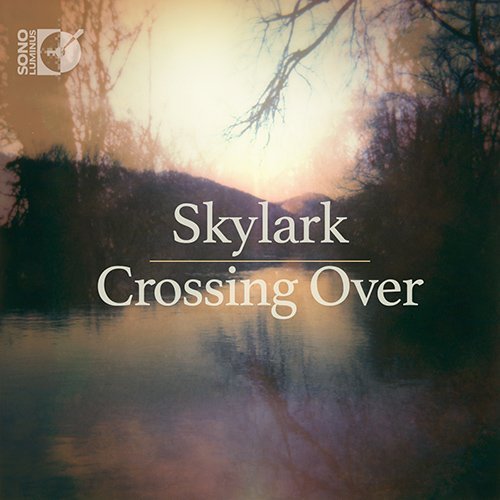
Skylark: Crossing Over, bringing the chamber choir to the mainstream


skylark

Sono Luminus continues their dedication to high quality performances and recordings of a wide variety of music from the 20th and 21st centuries.  In this lovely  disc we are treated to a great deal of interesting and very listenable a capella choral music from the mid-twentieth century to the present.

It is this reviewer’s perception that a capella choral music is somewhat of an outlier in the classical music field and is generally not as well known as solo instrumental, orchestral, chamber music and such. (Band music is a similarly neglected area which is not frequently explored by many composers and not as familiar to audiences.)   It is not an area very familiar to me but this recording appears to be one that can expand this niche considerably by virtue of the sheer beauty of these recordings.

There are eight pieces by seven composers of varying levels of familiarity.  The most familiar names here are those of the late John Tavener (1944-2013) and William Schuman (1910-1992).  (Schuman was also no stranger to writing for band music.)  Some listeners may have heard of Jon Leifs (1899-1968), an Icelandic composer who should definitely be better known.  (Curiously the only comprehensive information available in English on this composer is in Wikipedia.)

The remaining composers, Daniel Elder (1986- ), Nicolai Kedrov (1871-1940), Robert Vuichard (1985- ) and (fellow Icelander) Anna Thorvaldsdottir (1977- ).  Thorvaldsdottir may be familiar to listeners via her earlier Sono Luminus release (reviewed here) as well as numerous other releases which definitely mark her as a rising star.

The disc opens with Elegy (2013) by Daniel Elder.  It is the only piece which features soloists and is a touching piece which demonstrates the composer’s skill with this specialized genre.

Butterfly Dreams (2002) by John Tavener is a series of eight choral meditations based on Chuang Tse known for his “…Am I a man dreaming he is a butterfly or a butterfly dreaming he is a man?”.  Tavener’s work has pushed the solo choral genre more to the mainstream than nearly any composer of the last 50 years and this piece is a good example of how he has managed to do this.  Tavener’s inspiration comes in part from the choral styles of eastern rite church music, a rich and sonorous sound.

Otche Nash by Nicolai Kedrov is apparently a classic in sacred music circles.  In Latin this would be Pater Noster and in English, Our Father.  This is a beautiful setting of the classic Christian Prayer.

Requiem (1947) by Jon Leifs is based on Icelandic folk poetry.  It was written in response to his grief at the loss of his daughter who drowned at the age of 18.  While not exactly representative of Leifs’ modern style it is a good example of the power of his invention in this heartfelt homage.  This is perhaps the composer’s best known work.

Heliocentric Meditation by Robert Vuichard is another example of the deep knowledge of the specialized techniques available to composers in this genre.  Vuichard appears to be a niche choral composer and one who has considerable skill.  There is a rather modernist feel to this powerful meditation.

William Schuman’s Carols of Death (1958) is a sort of modern classic which has been recorded many times.  There are three movements, each on a separate track.  It is curious how well these pieces fit in style with the rest of the disc given the date of composition.

Beyond the Veil (2005) is a setting by Anna Thorvaldsdottir of an old Icelandic psalm.  It is a prayer which is, in part, a meditation on death.  The composer has a mystical/impressionistic style that suits this music particularly well.

Funeral Ikos (1981) by John Tavener is definitely a modern classic.  This piece pretty much marks the beginning of the change from his early modernist style to the sort of “holy minimalist” (if you will) style that followed his conversion to and immersion in eastern rite sacred music.

Skylark is a chamber choir (five voices to each part, SATB) and this is their second album.  They were formed in 2011 and are under the direction of Matthew Guard.

This review is basically about the music but I have to say that this is also one of the most beautiful booklets I have seen.  It is short on info about the music but the photography and graphic design by Collin J. Rae and Caleb Nei deserve special recognition as well.  Each page features a photograph and texts of these pieces are tastefully printed across the photos.  This really enhances the experience and seems to be in harmony with the overall production.

Dan Mercurio, producer, has definitely made something special here and one hopes that this will help promote this compositional and performance niche to a more common experience and will encourage composers to write for a capella choir as well.  Daniel Shores is the recording and mastering engineer.  I am unable to assess the DVD audio and can only imagine how it must sound.  The CD itself is amazing to hear.

For an album ostensibly about death there is great joy and beauty to be found here.  Highly recommended, and not just to fans of choral music.


Gene Pritsker and Some of His Collaborators, a Heady Mix


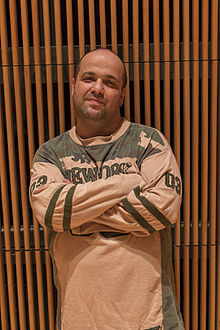
Gene_Pritsker

Gene Pritsker

We have here three very different CDs all of which feature composer/performer Gene Pritsker along with a variety of his colleagues and collaborators.  Each of these CDs is a unique production and reflects a marvelously creative group of composers and performers.

I first came to know of Pritsker’s work when he sent me a copy of his wonderful chamber opera, Manhattan in Charcoal and when I began to learn of the scope of his work through his numerous You Tube videos and his website I found myself rather overwhelmed and wholly intrigued.  In fact I can’t shake a comment which Leonard Bernstein once made about Igor Stravinsky to the effect that he was able to switch between different styles at different times with seeming ease and certainly skill (It was a comment made on a vinyl disc in which Bernstein spoke of Stravinsky in general on one cut and described the imagery of Petroushka on another.).  Pritsker’s Russian origins certainly play a part in reminding me of this association but it is the sheer extent and variety of his compositional visions and techniques that drive me to be reminded of this.  His virtuosity on the guitar also puts me in the mind of Frank Zappa at times too.  And he seems to be doing it pretty much all at once too, utilizing a wide palette of styles selectively with care and subtlety.  Pritsker switches between some very classical sounds to rock, jazz, rap, etc. as though the distinctions don’t exist or matter.  In the end they don’t matter really.  All is music I suppose and he seems be able to use them all pretty well and these discs are a nice sampling of some of this interesting musician’s various guises and interests.

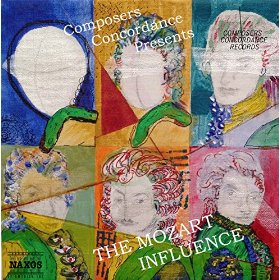
mozart inf

ComCon0030

Fortunately I am not attempting a comprehensive cataloging of all that but rather reviewing a nice little selection of some current releases which Mr. Pritsker was kind enough to entrust to my critical ear.  First up here will be a Mozart tribute of sorts. Regular readers may recall another entertaining Mozart-based recording by John Clark (here). Indeed Mr. Clark makes an appearance here both as composer and performer.  This curious little disc consists of short, clever glosses on Mozart by Gene Pritsker, Patrick Grant, John Clark, Milica Paranosic, Dan Cooper and David Taylor.  Pritsker in particular seems to have a penchant for reworking music by other composers.  His Bach-based works also deserve attention as well.  But that is another matter.

There are 13 tracks and all have a somewhat improvisational character.  Of course variation forms are ubiquitous and varied throughout music history and these are, if not strictly speaking, “variations”, then something close which is why I have chosen the term glosses.  But all are entertaining and reflect a sort of new music take on Mozart who appears to have some meaning for each of the composers (Mozart is my desert island composer by the way).  I am sure that Mozart himself would have been amused and honored.  These are most certainly homage at the very least.

The CompCord Ensemble consists of Charles Coleman, voice; Chanda Rule, voice; Milica Paranosic, voice/gusle; Patrick Grant, voice/harpsichord; Lynn Bechtold, violin; Dan Barrett, cello; John Clark, horn; David Taylor, bass trombone; Gene Pritsker, guitar; Dan Cooper, bass; Javier Diaz, percussion/voice; Gernot Bernroider, drums; Franz Hackl, trumpet.

There are no liner notes here and perhaps that is for the best.  I have no doubt that there are a great deal of personal stories here as to how these pieces came about and what they mean to the respective musicians but they do stand on their own as entertainment and to my ear sound like they could even work as a film soundtrack (most likely a non-American film). This is entertaining material, perhaps a bit “inside” with its references but not difficult or obscure.   I will leave it to some future musical archaeologist to elucidate those details. The listener need only sit back and be entertained.

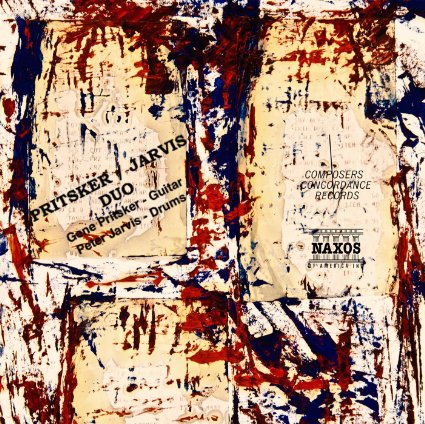
pritssker jarvis

ComCon0032


Now to the second disc.  This is quite different in character being a duo between a guitarist (Gene Pritsker) and a drummer (Peter Jarvis).  Such scant scoring tells one nothing about what is to come.  Each of the six tracks is by a different composer (Peter Jarvis, Gene Pritsker, David Saperstein, Joseph Pehrson, Jessica Wells and Daniel Palkowski).  As with the previous disc there are no liner notes so one is left with nothing but the sound.

This appears to be much more of an improvisational nature than the previous recording considered above.  The style here ranges from free jazz to rock and perhaps some contemporary musical styles as well.  Each track is a succinct statement and none of the tracks seem to go longer than necessary.  The musicianship is superb so if you are fond of the sound of guitars and drums played creatively and well you will enjoy this disc.  These musicians extract a great deal of varied sounds from their instruments.

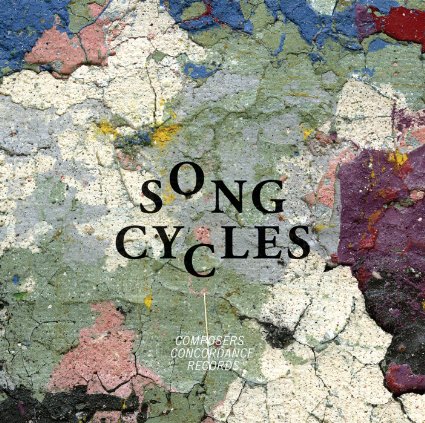
song cycles

ComCon0029


Finally we have this disc of song cycles.  Now the only song cycles I know at all well are those of Franz Schubert but that is, I think, an adequate place to begin to understand what is going on here (still flying without liner notes).

Eight composers and eight poets are featured in six song cycles. The first and last cycles (tracks 1-3 and 16-19) are the only ones which include instruments in addition to the voice and piano.  Only one song here (Inside on track 15) features poetry by the composer.  The rest, like Schubert utilized existing poetry.

Most of these composers are unknown to me which is both the joy and the bane of reviewing such discs.  All of these fall roughly into the classical art song tradition even with their occasional blues inflections (as in the Pritsker songs) or extended instrumental techniques.  David Gutay, Zach Seely, Patrick Hardish, Luis Andrei Cobo, Eleanor Cory are all new names to me and it Mr. Pritsker is to be commended for his efforts to promote others’ music.  The two composers here who are familiar are Mr. Pritsker and, another reason for commendation, Lester Trimble (1923-1986), a man embraced by Leonard Bernstein and cut from similar sonic cloth as both Bernstein and Copland.  This recording of Trimble’s Canterbury Tales is a welcome addition to the discography of mid to late twentieth century masters who deserve at least another listen.

The poets include: Tony Roberts, Jacob Miller, Dorrie Weiss, Jennifer Michael Hecht, Emily Dickinson, Richard Wilbur, Eleanor Cory and Geoffrey Chaucer.

Performers include Elizabeth Cherry, soprano; Thomas Carlo Bo, piano; Katie Cox, flute; Charles Coleman, voice; Derin Oge, piano; Patricia Songego, soprano; Taka Kigawa, piano; Lynn Norris, soprano; Amir Khorsrowpour, piano; Eleanor Taylor, soprano; Christopher Oldfather, piano; Circadia Ensemble consisting of: Melissa Fogarty, soprano; Kaoru Hinata, flute; Christopher Cullen, clarinet; Jenifer Griesbach, harpsichord (in the Trimble cycle).

The performances are uniformly excellent albeit a collection of separate recordings all mastered, as were the previous two discs by Sheldon Steiger.  If you love art song this is a treasure trove of current compositions but with a healthy respect for the past.


Other Minds 21, the Dawn of a New Chapter and the Raising of the Dead


BHM160008

Charles Amirkhanian with the composers of OM 21

Much needed rain pummeled the city by the bay on all three days of OM 21 dampening, perhaps, some attendance but not the enthusiasm of the audience or the performers.  In most ways this concert was a continuation of the celebration begun last year commemorating 20 years of this festival.  Returning this year were Gavin Bryars (OM7) and Meredith Monk (OM1).

Until last year no composer had appeared more than once at this series.  For those unfamiliar with OM it is worth noting that the process has been for the 8-10 selected composers spend a week at the Djerassi Arts Center in Woodside, California sharing and discussing their work before coming to San Francisco for performances of their work.

As it turns out this year’s concert series will be the last to follow that format.  Apparently OM has become the victim of gentrification and has had to move out of its Valencia Street offices and will now opt for various concerts throughout the year as they have done but without the big three-day annual festival and the residency at Djerassi.

The archives of OM are now going to be housed at the University of California Santa Cruz where they will reside along with the Grateful Dead archives.  I do believe that Mr. Amirkhanian lived near Phil Lesh of the Grateful Dead when he lived in San Francisco some years ago so it seems fitting that these two archives will peacefully coexist in that space (also coming to UCSC will be OM 21 composer Larry Polansky though not in an archive).

This is certainly a change but this is a festival which has endured various changes in time and venue led throughout by the steady hand of the Bill Graham of contemporary music concerts, Charles Amirkhanian (both men have had a huge impact on music in the bay area as well as elsewhere and it is worth noting that the Contemporary Jewish Museum will have a tribute to Graham this year).

Actually Other Minds traces its provenance to the Telluride, Colorado Composer to Composer festival (also led by Amirkhanian) and later morphed into OM with the leadership of president (now emeritus) Jim Newman back in the early 1990s.  There is a short excellent film describing OM’s history on Vimeo here.

It is the end of a chapter but, as Amirkhanian explained, there are many exciting concerts coming up which will keep Other Minds in the earshot of the astute contemporary music aficionados on the west coast.  Next year, for example, will include several very exciting concerts celebrating the 100th birthday anniversary of beloved bay area composer Lou Harrison.

My apologies for the delay in posting which was due to both the richness of the experience and the exigencies of my day job and other responsibilities.  I hope that readers will find this post to have been worth the wait.

BHM160009

Nordic Voices

Starting our rainy day were the extremely talented singers known as Nordic Voices.  Lasse Thoresen‘s Solbøn ( Sun Prayer) (2012) and Himmelske Fader (Heavenly Father) (2012) both required keen listening and required the use of extended vocal techniques such as multiphonics.  The singing appeared effortless and even fun for the ensemble but that speaks more to their expertise and preparedness than any ease in terms of the score.

It is always difficult to judge a composer’s work by only a small selection from their output  but Thoresen’s virtuosity and subtle use of vocal effects suggests a highly developed artist and it would seem worth one’s time to explore more of this gentleman’s oeuvre.

BHM160010

Lasse Thoresen takes the stage to acknowledge the applause.

Next was an unusual, humorous/dramatic work by Cecile Ore called Dead Pope on Trial (2015/16) with a libretto by Bibbi Moslet.   This Other Minds commission was given its world premiere at this concert.  The work is based on the story of a medieval pope who was taken from his grave no fewer than six times for various perceived offenses.  It is a mix of irony and humor in a sort of madrigal context.  The work was in English and had the nature of a conversation between the singers.  No doubt a challenging piece, it was sung very well and the composer seemed as pleased with the performance as much as the audience.

BHM160011

Cecile Ore smiling as she acknowledges the applause for the wonderful premiere performance of her new work, Dead Pope on Trial.

As if in a demonstration of sheer stamina in addition to virtuosity Nordic Voices took the stage again, this time for some Madrigals (2002/2016) by returning artist Gavin Bryars.  Bryars is no stranger to Other Minds or to madrigals and such older musical forms from the renaissance and before.  He has extensively explored vocal writing and medieval harmonies in many previous works.  Though categorized as being a “minimalist”, Bryars actually has produced a huge range of music in all forms including opera, chamber and orchestral music.

His madrigals have been written for the Hilliard Ensemble and each book is distinguished by the madrigals having been written on a specific day of the week.  The first book on Mondays, etc.  They are settings of Petrach’s sonnets and are sung in the original Italian of his day.  On this night we were treated to four madrigals from Book Two and the premiere of a madrigal from Book Four.  That madrigal was dedicated to Benjamin Amirkhanian, the father of Charles Amirkhanian who celebrates his 101st birthday this summer.

I had the opportunity to meet and speak briefly with the affable Mr. Bryars.  His generous spirit pervaded our conversation and he spoke very highly of both his visits to Other Minds.  If you don’t know this man’s music you are doing yourself a great disservice.

BHM160016

A very pleased Gavin Bryars deflects the applause and adulation to the amazing Nordic Voices for their astounding performance of five of his madrigals.

The singers of Nordic Voices sustained a high level of virtuosity as well as sheer stamina as they sang for nearly two hours in the opening pieces of this concert series.  No time was lost setting the stage for the performance of the next piece, another premiere, Algebra of Need (2016) for electronic sampling and string quartet by Bang on a Can member Phil Kline.

BHM160045

FLUX Quartet playing at SF Jazz, 2016

The Flux Quartet was featured in the next two (and last) works on this long program.  Algebra of Need is Kline’s meditation on the words and the cadences of the iconic writing and voice of the late William S. Burroughs (gone 19 years as of this writing).  The familiar voice seemed to go in and out of clearly audible, at times mixed more closely with the string writing in this intense homage.
BHM160014

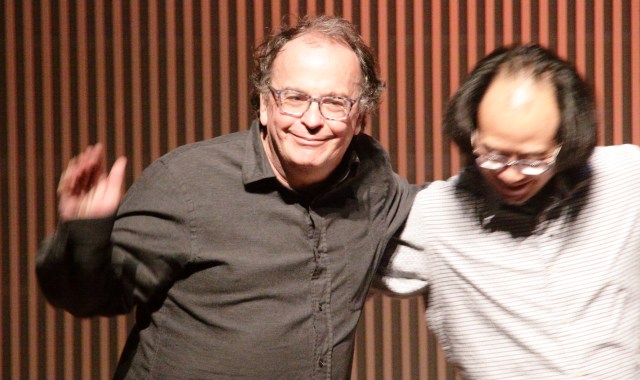
A satisfied looking Phil Kline leans in to embrace the first violin of the Flux Quartet after their premiere of his Algebra of Need.

The Bang on a Can collective was also represented tonight by Michael Gordon.  The Sad Park (2008) for string quartet and electronics put a most decidedly disturbing conclusion on the evening.  This piece, which samples the voices of children (one of them Gordon’s) as they spoke of their experience of the 9/11 Twin Towers attacks.

The effect was, as no doubt intended, harrowing leaving a pretty strange and unsettling feeling as we walked away from the concert into the still rainy night.

BHM160017

Michael Gordon embraces the FLUX Quartet’s first violin after a stunning performance of The Sad Park.

The rain continued on Saturday but the crowd was noticeably larger for the second night which opened with the usual panel discussion.

BHM160030

left to right: Meredith Monk, John Oswald, Nicole Lizee, Eliot Simpson, Larry Polansky, Oliver Lake and Charles Amirkhanian in a panel discussion prior to the concert

This evening began with a performance by the wonderful bay area violinist Kate Stenberg of a piece which was a sort of antidote to the somber, The Sad Park from the previous night.  Again the composer was Michael Gordon and the piece was Light is Calling (2004), a collaboration with filmmaker Bill Morrison.  Though hardly a happy piece Light is Calling is perhaps elegiac and the composer seems to achieve some of his stated intent to find some healing in the wake of a disaster to which he was all too close.
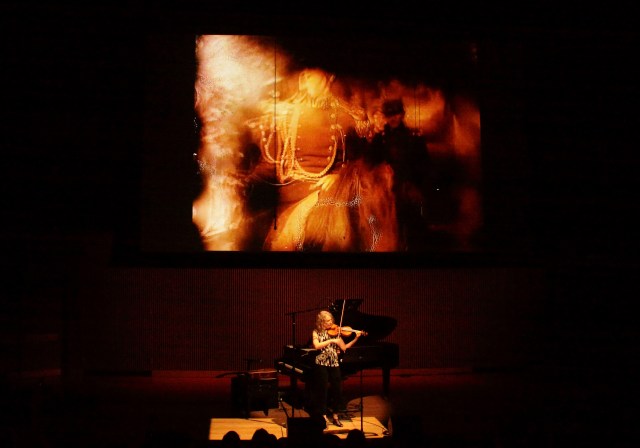
BHM160031

Kate Stenberg plays violin beneath the projection of a Bill Morrison film in Michael Gordon’s, Light is Calling
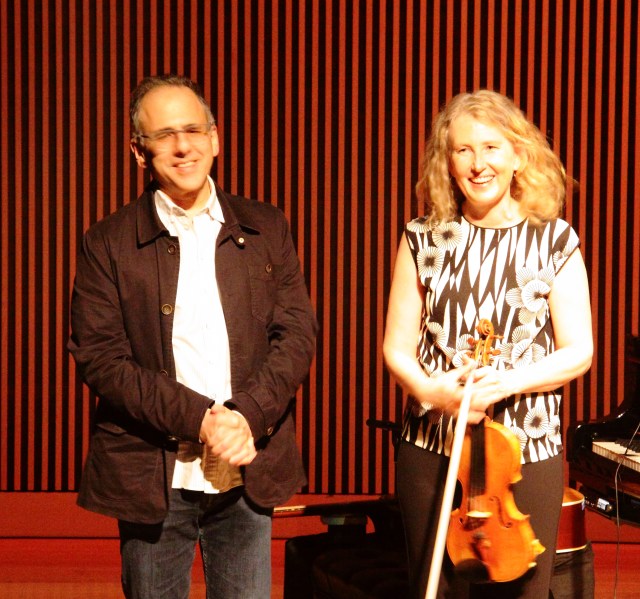
BHM160032

Michael Gordon and Kate Stenberg accepting the applause of an appreciative audience.

Next up was John Oswald, a Canadian composer whose career took off in infamy when his Plunderphonic CD, released to radio stations in the early 1980s, became the subject of legal battles over the meaning of copyright law in light of digital sampling.  Fortunately Oswald won the right to publish his work and his Plundrphonics concepts now underlie much of his compositional process.  Until this night I had not heard any but his Plunderphonic CDs so the introduction to his live music was a revelation.
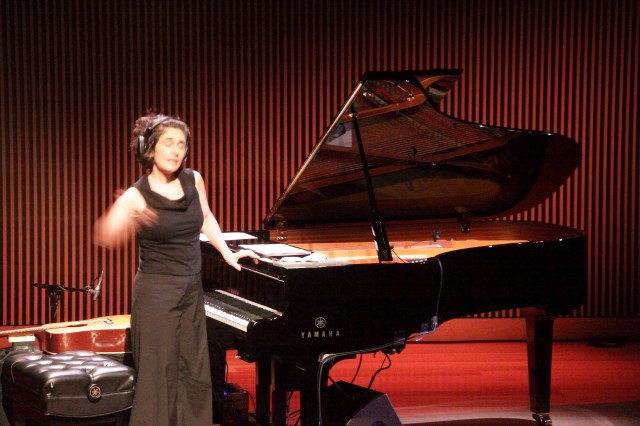
BHM160033

Pianist and (at least here) multi-instrumentalist Eve Egoyan performing with a Yamaha Disklavier and other instruments.

The first piece she did was called Homonymy (1998/2015) was originally written for chamber orchestra and was then transcribed for Egoyan and her prepared disklavier et al.  It is a piece based on linguistic elements and with a visual component as well.

BHM160034

Eve Egoyan performing Homonymy with overhead projections.

Nicole Lizee’s David Lynch Etudes (2015) was the next piece  and also made use of the projection screen.  The subtitle of the piece indicates it is for “disklavier and glitch”.  Well life imitated art as some sort of glitch prevented the projection from functioning at first but this was rather quickly resolved and we were treated to excerpts of scenes from several David Lynch films with the piano playing some of the rhythms of the dialog in an exchange that puts this writer in the mind of music like Scott Johnson’s “John Somebody” and Steve Reich’s incorporation of speech rhythms in works like, “The Cave”.

Nicole Lizee is a Canadian composer and was the youngest composer on this year’s program.
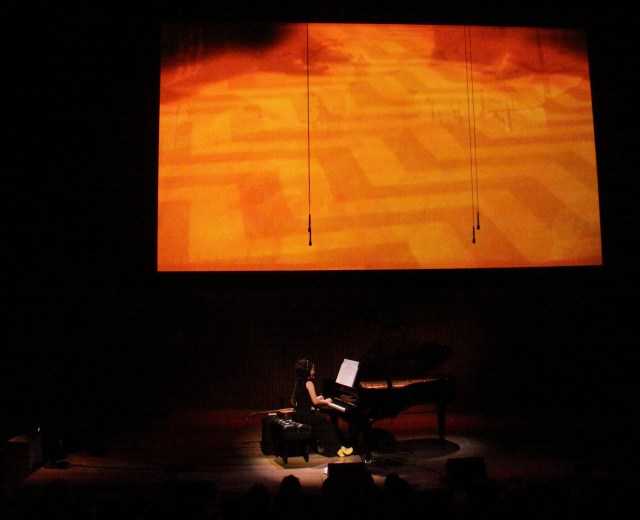
BHM160035

Eve Egoyan playing Nicole Lizee’s David Lynch Etudes with projected scenes/glitches from Lynch’s films.

The work is one of a series of pieces inspired by films and was executed with apparent ease by pianist Eve Egoyan who played the disklavier (both the keyboard and directly on the strings), a guitar and perhaps other gadgets .  The piece kept her quite busy and the associations I described above sound nothing like this work actually.  These etudes were a unique, typically Other Minds sort of experience, one that expands the definition of musical composition.

BHM160036

Nicole Lizee (l) with Eve Egoyan absorbing the audience’s appreciation of the David Lynch Etudes.

Two more John Oswald compositions graced the program next.  Palimpia (2016) is a six movement piece for disklavier with pianist playing as well.  Oswald says it is actually his first composition for piano.

BHM160046

John Oswald embracing pianist Egoyan and enjoying the audience applause for his work.

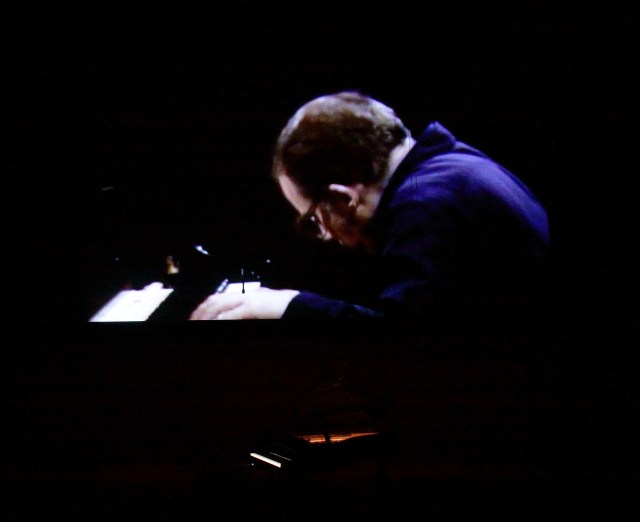
Well I did say there were two more Oswald pieces but this last one was a masterful plunder by this truly unusual composer.  Here Oswald conjured the playing as well as the image of the late great Glenn Gould who was seen actually playing Invaria (1999) with the disklavier performing along with the film of Gould performing this music.  It was, for this writer, a spellbinding experience.  He has raised the dead in the name of music.  Wow!  It was an amazing and heartfelt homage to a fellow great Canadian musician.
BHM160038

Glenn Gould playing John Oswald

Larry Polansky (1954- ) is well known as a teacher and as a composer but one is hard pressed to find much in the conventional discography of his work.  The few discs out of his amazing electronic music (and one disc of piano variations) represent only a small fraction of his output and represent only one genre of music which he has mastered.  However the astute listener needs to be advised to look online to look, listen and hear some of the bounty of his creative output.  Check out the following sites: Frog Peak Music (Polansky’s publishing site which includes music and scores by a great many interesting composer in addition to himself and Dartmouth Page (which contains link to various recordings, writings, computer software, etc.

BHM160039

Giacomo Fiore (left) and Larry Polansky playing Polansky’s ii-v-i (1997)

As an amateur musician who has enough trouble simply tuning a guitar it made my knees weak to watch these musicians effortlessly retune as they played.   Polansky’s experimentation with alternate tunings is an essential part of many of his compositions.

BHM160040

Fiore and Polansky changing their tunings mid-phrase in a stunning demonstration of virtuosity with pitch changes.

The program then moved from the electric to the acoustic realm with Polansky’s folk song arrangements.  Eliot Simpson, the pedagogical progeny of the great David Tanenbaum (who played these concerts last year at OM 20), played the just intonation National Steel Guitar and sang.

Let me say just two things here.  First, these are not arrangements like Copland’s Old American Songs and second, I will never hear these folk songs quite the same way again.  Polansky’s interest in folk music and Hebrew cantillation along with alternate tunings produces what the ears hear as perhaps a different focus.  In these pieces he did not stray too far from the original (as he does in his Cantillation Studies) but one is left with distinctly different ways of hearing and thinking about this music and the listener is left richer for that.  It is a journey worth taking and Simpson played with both passion and command.

Eliot Simpson playing a selection of Larry Plansky's Songs and Toods

Eliot Simpson playing a selection of Larry Plansky’s Songs and Toods

Polansky returned to the stage for a performance of his 34 Chords (Christian Wolff in Hanover and Royalton) (1995). Again we were treated to the virtuosic use of alternate tunings performed live (and again with live re-tunings) by the composer.

Oliver Lake delivering a blistering free jazz improvisation.

Oliver Lake delivering a blistering free jazz improvisation.

Continuing with the solo performer theme we were privileged to hear the virtuosic jams of Oliver Lake (1942- ) whose long career is legendary in the jazz world.  The “mostly improvised” (according to the composer) Stick was played on two different saxophones in what appeared to be as intense an experience for the performer as it was for the audience.

Oliver Lake takes a final bow at the end of the second concert of OM 21

Oliver Lake takes a final bow at the end of the second concert of OM 21

The emotional workout was received warmly by the audience.

Charles Amirkhanian introduces Meredith Monk on the final day of OM 21

Charles Amirkhanian introduces Meredith Monk on the final day of OM 21

There was no panel discussion on the third day of OM 21.  This matinée was dedicated entirely to the work of Meredith Monk (1942) who, fittingly was one of the featured artists in the first Other Minds gathering in 1993.  Now a recipient of the National Medal of the Arts this beloved artist returns to OM 21.  Though the rain continued the house appeared to be full.
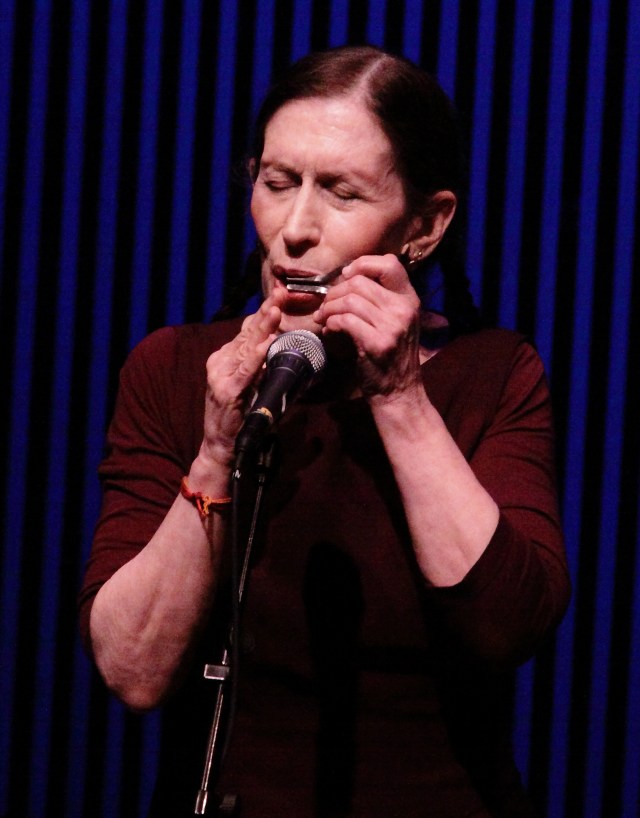
Meredith Monk playing a Jaw Harp in one of her early solo songs.

Meredith Monk playing a Jaw Harp and singing in one of her early solo songs.

Monk played a selection of material from various periods in her career in a mostly chronological survey which she called The Soul’s Messenger.  She began with selections from her solo songs and proceeded to her voice and piano music, then to her work with multiple voices and instruments.
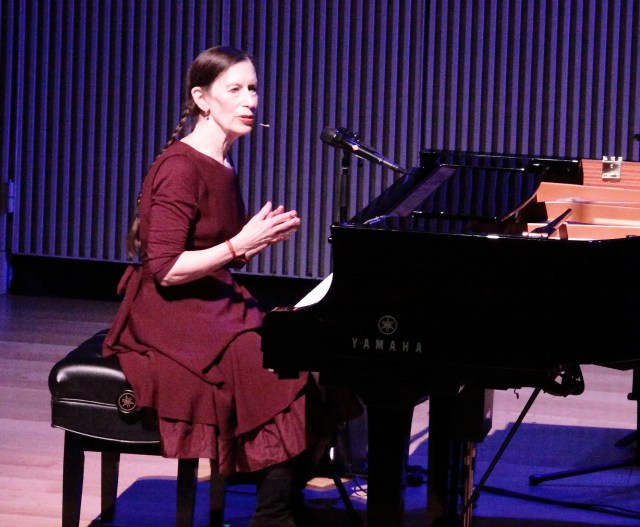
Meredith Monk performing her signature Gotham Lullaby

Meredith Monk performing her signature Gotham Lullaby

Most of the audience seemed to have a comfortable familiarity with the individual works she offered on this night which effectively gave a picture of her career.  Monk was in good voice and appeared to enjoy her performance.
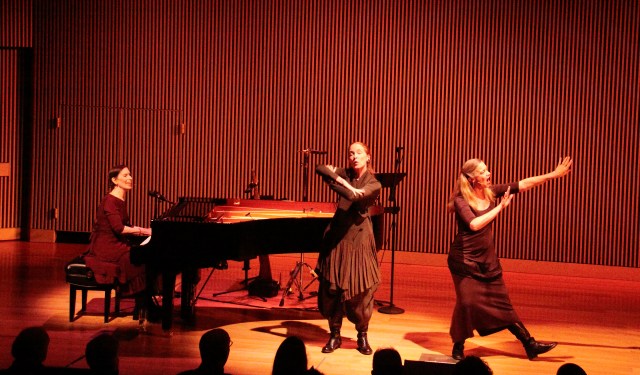
Long time collaborator Katie Geissinger and Allson Sniffin joined in the next selection

Long time collaborator Katie Geissinger and Allson Sniffin joined in the next selection

The stage was set to allow for the dance/movement that is an essential part of Monk’s works.  She originally trained as a dancer.
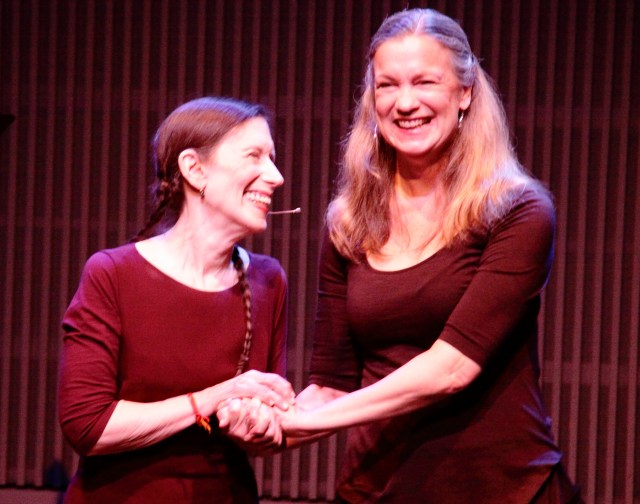
Monk and long time collaborator Katie Geissinger reacting to the appreciative audience

Monk and long time collaborator Katie Geissinger reacting to the appreciative audience

In addition to the grand piano the stage was set with two electronic keyboards, an essential sound in many of Monk’s works.
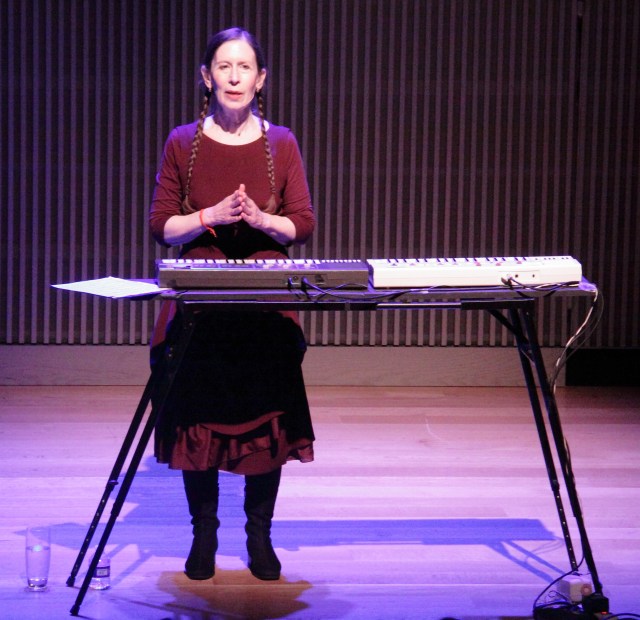
Monk at one of the electronic keyboards

Monk at one of the electronic keyboards

Woodwind player Bodhan Hilash joined the ensemble for the last set of pieces.
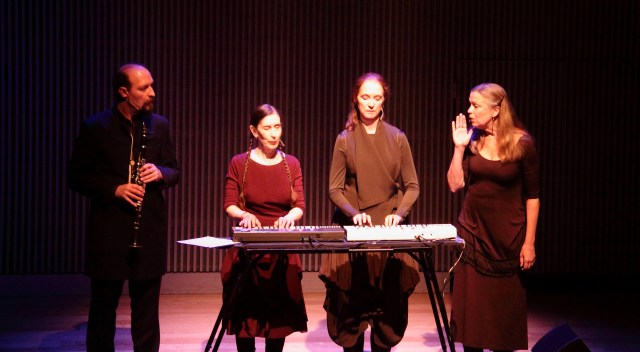
From left: Bodhan Hilash, Meredith Monk, Allison Sniffin and Katie Geissinger

From left: Bodhan Hilash, Meredith Monk, Allison Sniffin and Katie Geissinger

The audience gave a standing ovation at the end resulting in 3 curtain calls.
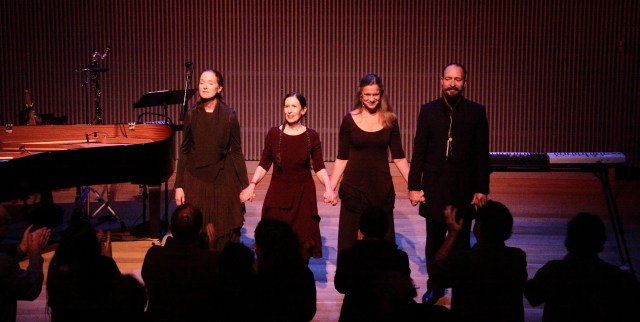
Left to right Allison Sniffin, Meredith Monk, Katie Geissinger and Bodhan Hilash receiving a standing ovation.

Left to right Allison Sniffin, Meredith Monk, Katie Geissinger and Bodhan Hilash receiving a standing ovation.

And the properly prepared artist came back for an encore of her song Details.
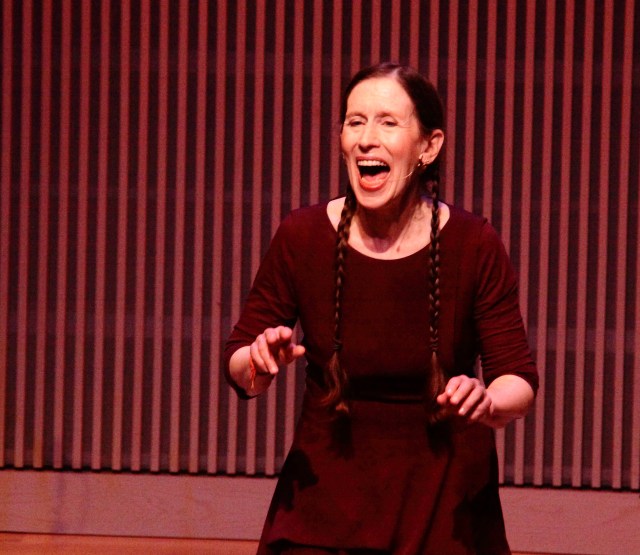
Meredith Monk performing an encore at the final concert of OM 21

Meredith Monk performing an encore at the final concert of OM 21


It was a fitting finale to a great OM 21, fitting to have this artist who appeared on the first iteration of Other Minds returning now crowned with a National Medal of the Arts and clearly beloved by the audience.  Her music like her lovely smile fade to the edge of memory like that of the Cheshire Cat on a truly triumphant finale.

And, despite some format changes, who knows what treasures continue to lie in store?  I will be watching/listening and so, apparently will many others.  Keep an eye on www.otherminds.org .  I know I will.
 

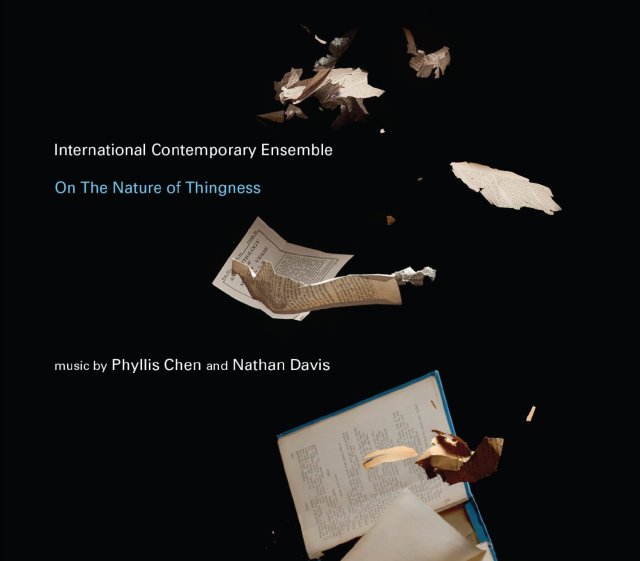
ICE Debuts on Starkland: Music by Phyllis Chen and Nathan Davis


71suob4pdtL._SL1500_

Starkland is one of those labels whose releases seem to be so carefully chosen that one is pretty much guaranteed a great listening experience even if that experience might challenge the ears sometimes.  If one were to purchase their complete catalog (as I pretty much have over the years) one would have a really impressive and wide-ranging selection of new music.

I recently reviewed a very fine ICE (International Contemporary Ensemble) recording of music by Anna Thorvaldsdottir here. The present disc is the first appearance on Starkland of this ensemble whose performance skills and repertoire choices show the same depth of understanding as the producers of the label upon which they now appear.

ICE was founded in Chicago in 2001 by executive director and flautist extraordinaire Claire Chase.  The discography on their website now numbers 21 albums including the present release.  The group features some 30+ artists and musicians including a live sound engineer (like the Philip Glass Ensemble) and a lighting designer.  Do yourself a favor and check out the ICE Vimeo page to get some ideas about why having a lighting designer is a good idea.  Their performances are visually as well as musically compelling.  And who knows, perhaps there is a Starkland DVD release in their future.

About half their albums feature music by members of ICE and that is the case with this release.  One always has to wonder at the process that is involved in choosing repertoire to perform and/or record but there is no doubt that this group seems to have good instincts in regards to such decisions as evidenced by the already wild popularity of this disc on WQXR and the positive initial reviews so far.

chen_phyllis_toypiano3Resized

Phyllis Chen‘s biographical data is a bit sparse on both the ICE website and her own so I am going to assume that this talented young keyboard player likely began playing at an early age.  Like fellow pioneers Margaret Leng Tan and Jeanne Kirstein before her she has embraced toy pianos and, by extension I suppose, music boxes, and electronics into her performing arsenal.  In addition to being a composer she is one of the regular members of ICE.

NathanDavis_Obraz9

Nathan Davis is a regular percussionist with ICE as well as a composer.  His works range from opera to chamber and solo pieces for various instruments as well as electronics.

The tracks on this release pretty much alternate between these two featured composers.

The first track is Ghostlight (2013) by Nathan Davis, a sort of ragged moto perpetuo for “gently”prepared piano.  This is a good example of how these musicians (pianist Jacob Greenberg in this instance) have really fully integrated what were once exotic extended techniques into a comprehensive catalog of timbral options which are used to expand the palette of creative expression.  This is not a second rate John Cage clone but rather another generation’s incorporation of timbral exploration into their integral canon of sonic options.  This is an exciting and well-written tour de force deftly executed.

The next two tracks take us into the different but complimentary sound world of Phyllis Chen.  Hush (2011) for two pianos, toy pianos, bowls (presumably of the Tibetan singing variety) and music boxes is a playful gamelan-like piece played by the composer along with pianist Cory Smythe.

Chimers (2011) is a similarly playful work requiring the assistance of clarinetist Joshua Rubin, violinist Erik Carlson and Eric Lamb (on tuning forks) along with Chen and Smythe once again.  Again we hear these unusual instruments and timbres not as outliers in the musical soundscape but rather simply as artistic elements that are part of the composer’s vision.

Track number 4 features a work for bassoon and live processing.  Davis’ On Speaking a Hundred Names (2010) is played by Rebekah Heller and again the (to this listener) usually uncomfortable fit of acoustic and electronic are achieved very smoothly.  Music like this gives me hope that some day I will be able to drop the inevitable negative connotations I have associated with the term “electroacoustic”.  This is very convincing music and not just in the “golly gee, see what they’re doing” sense either.  The experimentation here (including the multiphonics) appears to have preceded the composition giving us an integrated and satisfying listening experience.

Chen comes back on track 5 with another successful integration of acoustic and electronic in her, Beneath a Trace of Vapor (2011).  Eric Lamb handles the flute here playing with (or against) the composer’s prepared tape.  This electroacoustic trend continues in the following track (also by Chen) called Mobius (201-) in which Chen, Smythe and Lamb are credited with playing “music boxes and electronics”.  Once again the integration of electric and acoustic speaks of a high level of music making.

The final four tracks are the big work here and the work that lends its name to this disc, On the Nature of Thingness (2011) by Nathan Davis.  Apparently taking its title from Lucretius’ On the Nature of Things (ca. 1B.C.) the work earlier also inspired Henry Brant in his spatial composition, On the Nature of Things (1956), but the work in this disc does not seem to make any direct reference to that Roman classic poem except perhaps metaphorically.

tony_8305

Soprano Tony Arnold

The work here is an exploration of language, sound and expression.  This most eclectic and ponderous of the selections is a wonderful opportunity to hear the considerable skills of resident vocalist Tony Arnold who sense of pitch and articulation are incredibly well-suited to this work.  Her performance leaves nothing to be desired and is likely as authoritative as it gets.  The work seems to require a great deal of concentration and coordination on the parts of all involved and ICE takes the opportunity to demonstrate their well-honed skills as they clearly listen to each other and go all out in terms of achieving the subtlety of expression required in this demanding and complex work.

As usual the Starkland recording is clear and detailed without the sense of claustrophobia that such detail can take on and the liner notes are useful without extraneous detail.  This is an ensemble to watch/listen for both for the performers and for the music they choose to program.  You won’t be disappointed.


all spring, Music of Emily Doolittle


doolittle

Emily Doolittle (1972- ) was born in Halifax, Nova Scotia.  She earned a B. Mus. from Dalhousie University in 1995 having studied with Dennis Farrell and Steve Tittle.  She went on to earn an M. Mus. in 1999 from Indiana University where she studied with Don Freund.  She completed her Ph.D. at Princeton in 2007 studying with Barbara White, Steve Mackey and Paul Lansky.  In addition she studied with Louis Andriessen from 1997-1999.

Doolittle now lives in Glasgow, UK having just left a faculty position at the Cornish school in Seattle, WA.  where she taught since 2008.  A quick look at her CV reveals a very busy composer and academic with an extensive list of compositions, performances, research, teaching etc. such that this reviewer is amazed to find that the present release is the first CD dedicated exclusively to her music.

I was pleased to be able to get a perspective from the composer that helped me understand the context of this disc in terms of the rest of her work.  She wrote:

“As I was making choices of what to include on this CD, I realized that my music divides itself into several (sometimes overlapping) categories. Over the next few years, I’m hoping to be able to record two or three more CDs. The one that I sent you is the one for fairly standard-ish chamber ensembles, with pieces that would sit fairly comfortably with chamber music of any era. At the moment I’m applying for funding to record a CD of pieces for one or two instruments/voices — these pieces also have a fairly similar musical language to the pieces on “all spring”. After that, I’d like to record a CD of my bird and animal song influenced music, which tends to be more experimental (in terms of sounds used and structure), and often involves some improvisation. And then I have a number of pieces that are harder to figure out how to present to a larger audience — site-specific pieces, pieces for amateurs or children, etc. So I guess I see this CD as both the culmination of one project, and the beginning of a larger project. And I think that getting this sort of overview of my compositions to date will help give me ideas about the directions I’m most interested in going in in the next few years. (I’m at a bit of a transitional time — I just left a full-time teaching position at Cornish College of the Arts in Seattle to move to Glasgow. I’m hoping to find part time teaching here, but mostly I want to devote a lot more time to composing than I’ve been able to in the last few years.)”

I was also unaware that there was such a thing as “zoo-musicology” or the study of things musical generated by the members of the animal kingdom.  Who knew?  I was familiar with Olivier Messiaen’s transcriptions and use of bird song but until now I was not aware that work was still being done in this area.  Alas, that will have to be the subject of another review as this disc, while later analysis might reveal zoomusicological influences, is ostensibly more in the category of absolute music or perhaps metaphorical music.  What is quite clear is the picture of an artist with wide-ranging interests who is working to shape her oeuvre and her research interests into a more unified effort which promises potentially fascinating results yet to be heard.

The CD is a very pleasant listening experience.  Nothing here sounds experimental, rather these works are beautifully composed and lovingly played by the Seattle Chamber Players (and friends).  All were composed from 2000 to 2014 and share a sort of romantic and nostalgic flavor and demonstrate the delicate nuances of this composer’s palette.

The first two works, “Four Pieces About Water” (2000) in four short movements and the single movement “falling still” (2000/2009) are purely instrumental as is the fourth piece on the disc “col”(2002/2014).  (Please note that all spellings are as they appear on the disc.)

Tracks 6-10 comprise the album’s title piece, “all spring”(2004) features the poetry of Canadian poet Rae Crossman and the final and longest piece, “Why the parrot repeats human words” (2005) features a text by the composer in which she tells her version of a Thai folk tale (think perhaps of a Canadian Peter and the Wolf maybe).  Both these works feature the beautiful spoken and singing voice of Maria Mannisto.

The ample and lucid notes are by the composer.  The recording was engineered by Doug Haire at the Jack Straw Cultural Center in Seattle and mastering was by John D. S. Adams at Stonehouse Sound in Mahone Bay, Nova Scotia for this Composer’s Concordance label release.

Certainly this writer will be looking forward to hearing more from this fascinating artist as she reveals more of her work on recordings and goes on to who knows what new and interesting areas in this (now) post-Boulez world.  Brava!


The Ensemble Formerly Known as Zeitgeist (?), Music by Scott Miller


Scott Miller- Tipping Point (New Focus fcr 161)

Scott Miller- Tipping Point (New Focus fcr 161)

ADDENDUM:  Mr. Miller kindly supplied the correct composition dates for the pieces in this album and they have been placed in the text.  Also I was pleased to receive a link to their discography:(http://www.zeitgeistnewmusic.org/discography.html)  I hope that is a recent addition and not my oversight (apologies if it’s an oversight).


I was particularly pleased to receive this disc for review as I am a long time fan of the Minnesota based Zeitgeist ensemble.  This varied ensemble has been a vital part of the new music scene in Minnesota since about 1977 (I still have some of their vinyl LPs).  Happily they are in the process of making these out of print items available again on CDs via their website.

Curiously there is very little on the ensemble’s web site or on the internet in general on the history of this group prior to about the year 2000  A Google search yields few references to this group and Discogs does not have much listed in their discography of Zeitgeist.  Their Wikipedia page is also in serious need of updating. The Innova records site is perhaps the most useful in identifying the albums released by this group in its various configurations and solo or other collaborations by its members (though the re-release of the older discs are not distributed there).  I realize that this group began in the pre-internet era but perhaps it is time to clarify this and present a comprehensive history and discography of this significant new music ensemble.

Scott Miller

Scott Miller

The present disc is a collection of recent works by Scott Miller, a Minnesota based composer and teacher whose association with Zeitgeist goes back to 1993.  He is currently the president of SEAMUS (Society for Electro Acoustic Music in the United States) and professor of music at St. Cloud State University.  You can find his work on youtube and Sound Cloud.

Now let me say here that it is my observation that electroacoustic music, while not an uncommon genre, seems to be a specialized one which, like Zeitgeist, is not consistently well-promoted.  At least that is my explanation (excuse perhaps) for my limited knowledge of Mr. Miller’s music up to this point.

The CD is a collection of six tracks with vocals by soprano Carrie Henneman Shaw on tracks  2, 4 and 6.  Each track is a separate work and they are listed in the proper order on the back of the CD case but are discussed out of order in the notes for some reason.

But now I must stop my whining and criticisms (and thinly veiled references to Prince) and turn to the actual music. This is really wonderful music, well-performed and well worth your attention.  And if the term “electroacoustic” puts you off don’t worry.  What we have here is an artist who has managed to integrate a variety of techniques into an effective musical language that transcends mere experimentalism to yield some really good music.

The first piece, the one from which the album receives its title, is Tipping Point (2010) and was originally included on the SEAMUS CD Volume 20 (EAAM-2011).  This is a remixed and remastered version of that recording from 2010.  This writer hears echoes and homages to (or influences by, you decide which) Terry Riley, Steve Reich as well as perhaps Morton Subotnick and even the thornier sound of Mario Davidovsky at times.  To my ears this is an integration of many ideas which work effectively together.

The second track, Forth and Back (2003) is the longest track and is a setting of the poem by Catalan poet Felip Costaglioli.  The setting is atmospheric, appropriate to the lovely texts and the vocal writing is simply beautiful.  Carrie Henneman Shaw delivers this work with the success of interpretation that one would expect of a musician who understands the composer’s intent.  Not an explicitly virtuosic piece it nonetheless challenges the performer with sotto voce passages that I imagine are quite a balancing act for a singer.  This is a beautiful piece and the fact of its electroacoustic aspects take on far less important place than the effectiveness of the setting.

Next up is Pure Pleasure (2008) is a percussion piece.  The composer goes into some detail in the notes as to the genesis of this piece and that is interesting but so is the act of listening to it.  This is one of the more obviously experimental works here.

Twilight (2008-13) is actually a portion of a larger work, a collaboration between Miller, Pat O’Keeffe and video artist Rosemary Williams called, The Cosmic Engine.  This is a multi-media chamber opera which premiered in 2008 and this section was revised in 2013.  The text is by Walt Whitman.  Again, Shaw does a lovely job with the lyrical vocal lines.

Funhouse (2003) is a marvelous use of electroacoustic methods.  It is a piece with rather complex origins as explained in the notes but, consistent with its title, this is a fun piece to hear and, I imagine, to play.  Along with the percussion piece it represents the more overtly experimental work of this artist.

The final track, Consortia (2013), as  with Twilight, is an outgrowth or by product of work on the multimedia opera, The Cosmic Engine.  Here the composer enlists computer processing to create a sort of live polyphony with live mixing of tracks of pre-recorded and live improvisational structures based on some renaissance tunes and techniques.  I will leave it to the listener to read through the technical details but the result is a pretty entertaining piece of music.

Zeitgeist does a wonderful job here playing with passion and dedication.  I can only hope that we hear more from both Zeitgeist and Mr. Miller.

The recording done at Wild Sound Recording Studio in Minneapolis (Mark Zimmerman, master engineer on tracks 1 and three; Steve Kaul, master engineer on tracks 2 and 4-6) is lucid and warm.  The art and design by Raul Keller makes for an attractive product.  This release from New Focus Recordings belongs in the collection of any new music fan and certainly every Zeitgeist fan.