New Carriers of the Flame of the Leading Edges of New Music


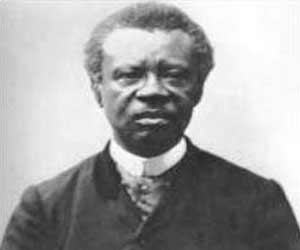
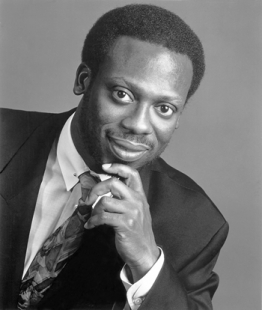
English: Shiraz Art Festival: David Tudor (lef...

With Paul Hillier in Malmö fall 2005

Kronos Quartet with Paul Hillier in Malmö fall 2005 (Photo credit: Wikipedia)

Looking back at the history of music since 1945 one can clearly see the musicians who took on the newly developing repertoire with all its difficulties both in performance and in selling it to an audience.  These are the performers who introduced these new pieces to unsuspecting audiences and lovingly nurtured them to the place they now hold in the canon of musical masterpieces.


I’m speaking here of people like David Tudor, champion of the New York School (Cage, Feldman, Brown and Wolff) as well as a composer in his own right.  I’m speaking of ensembles like the Kronos Quartet and the Arditti Quartet, champions of innovators in music for string quartet.  I’m also speaking of conductors including Serge Koussevitzky, Leopold Stokowski, Leonard Bernstein and a host of others who daringly programmed new music and even sometimes endeared their audiences in so doing.

Arditti String Quartet

Cover of Arditti String Quartet

Date of photo not recorded.

Date of photo not recorded. (Photo credit: Wikipedia)

These are the people who brought that fascinating repertoire to my ears and those of many over the years  They are the people who also taught me why this music needs to be heard, whose enthusiasm communicated the depth in the scores they lovingly rehearsed and performed.


These musicians are part of a tradition, that of championing new music.  They widen and deepen the repertory by their selection, interpretation and performances of music that is new or not yet well-known.  They are the high priests and priestesses of the religion of sonic culture.  And as they fade into history they leave a vacuum which must be filled.


English: Portrait of Serge Koussevitzky (Russi...

 Portrait of Serge Koussevitzky from the Library of Congress’s George Grantham Bain Collection (Photo credit: Wikipedia)

My intention here is to identify some of the musicians I have discovered who seem to be taking up residence in that vacuum.  I am starting a series of articles in which I intend to share what I believe to be important cultural finds both in the musicianship and the emerging repertory.


As always I am open to any and all suggestions for inclusion here.  I would like to know who is going to introduce me to my next favorite musical discovery.


English: Leonard Bernstein

 Leonard Bernstein (Photo credit: Wikipedia)

My first article, currently in preparation, will be on the French pianist Nicolas Horvath.  His significant presence in social media makes him almost hard to miss and relatively easy to research.  Please stay tuned.


Enhanced by Zemanta

Black Composers Since 1964: Primous Fountain


Primjous Fountain (1949- )

Primjous Fountain (1949- )

I first encountered the work of this composer in 1982 in a broadcast concert of the Milwaukee Symphony that featured his Symphony No. 1. He was billed then as, “Primous Fountain III”.  I listened and, as was my obsessive practice, I recorded the work on a cassette tape so that I could listen again and not have the experience fade into obscurity.  I have listened many times to this wonderful piece and now in the age of social media one can find more of his music on his web page and his Facebook page.

Fountain was born in Chicago in 1949 where he attended Wendell Phillips High School and after graduation completed an orchestral piece Manifestation (1967) which was performed by the Chicago Symphony.  He has also had performances by the Boston Symphony and the New England Conservatory under Gunther Schuller.  I was fortunate recently to make the acquaintance of Mr. Bill Doggett who is a lecturer and marketing representative for black composers who is in touch with Mr. Fountain.  He informs me that Mr. Fountain is alive and well and living in his native Chicago.

Fountain with Hans Werner Henze

Fountain with Hans Werner Henze

Though largely self-taught he later studied with Hans Werner Henze and Gunther Schuller and these experiences seem to have been absorbed into the composer’s palette. In a 1972 interview with Charles Amirkhanian, conductor Harold Farberman and composer Charles Shere the then 20 something Fountain seems to react with disinterest to the apparently sincere  but rather uncomfortable efforts to address racial issues in music.  He speaks as though he feels his music to be so natural a part of his life that he reports his amazing abilities are simply normal to him. He seems unconcerned with the political aspects of being a “black composer”.   His instinct for complex things like orchestration are like walking or breathing, second nature.  His identity is in his music.

Fountain with Gunther Schuller

Fountain with Gunther Schuller

After hearing his youthful work Manifestation none other than Quincy Jones commissioned Fountain’s Symphony No. 2.  There is a performance by the Lugansk Symphony Orchestra of the Ukraine under the baton of Miran Vaupotic available for listening on the composer’s web site as well as on You Tube which now sports a performance of the first two movements of his fourth symphony along with the second movement of his Cello Concerto and selections from other orchestral works.

His idiom might be called conservative in that it incorporates a standard orchestra and uses well-known forms such as Symphony and Concerto but his skill at writing is the point much as it is with other composers trained in schools like Julliard, Curtis, Berklee and the New England Conservatory.

His work sounds at times like a latter day Stravinsky with jagged rhythms and rich orchestration.  There is a passionate post-romantic intensity to the pieces I have heard.  I definitely want to hear more.

Fortunately there is now a YouTube channel dedicated to this composer’s work.  There are, however, no commercial recordings of this man’s music that I was able to find.  Here we see a prodigy who was embraced by many in the world of serious music and whose star appeared to have been rising.

But for all the love and attention that prodigies sometimes get it hardly guarantees exposure beyond their youth.  Fountain is not well-known but that has nothing to do with the quality of his music from what I have been able to hear.  And as sincere as the performances are in the MP3 and YouTube selections they are hardly the pinnacle of musical interpretation.  His music is complex and challenging to performers and I have no doubt that a major symphony orchestra with an insightful conductor could better demonstrate the power of his music.

One hopes that the body of music of this American composer will find an audience in his native country some day but limitations of arts funding and the plight of the black minority composer suggest that this will not be an easy path.  I hope that some enterprising young musicology student might take on the cataloging and analysis of his work to help this process.  Any takers?

Maybe the people at Naxos records or one of the many fine and creative independent labels who have recorded so much neglected music might take on the task of bringing some of this music to classical audiences.  It would be a loss to allow it to languish under-appreciated and largely unheard.  We truly don’t know what we’re missing and I think that is a terrible shame.

Enhanced by Zemanta

Oh, No! Not Another Minimalist! John McGuire


When I posted my introductory article to the “Not Another Minimalist!” series I got the suggestion on Facebook from composer/writer Walter Zimmerman that I do a piece on John McGuire.  Many will remember Zimmerman for his important book of interviews called Desert Plants (1976) in which he interviewed a series of 23 American composers in the early to mid-1970s.  His choices virtually defined an era much like Robert Ashley’s Music with Roots in the Ether would later do.  He is also a fine composer in his own right and will be featured in a future essay on this blog.  I am honored to receive a challenge from him and I also thought it was a fine selection of a minimalist-type composer whose work deserves wider dissemination so I am using McGuire as my first article in the series.

Unfortunately there is precious little to be found on this American composer.  In Zimmerman’s book he gets only one page so I am essentially updating his earlier efforts.  However, even 38 years later, McGuire does not appear to have a web page and I have been able to find reference to only a few recordings of his music.

mcguire1r

Cover image from one of McGuire’s recordings.

John McGuire (1942- ) studied with Robert Gross at Occidental College in Los Angeles, where he earned his BA in 1964, with Ingolf Dahl at the University of Southern California in Los Angeles and with Seymour Shifrin at the University of California, Berkeley, where he earned his MA in 1970. He also studied composition privately with Karl Kohn, composition and orchestration with Krzysztof Penderecki at the Folkwang Universität der Künste in Essen from 1966–68 and composition with Karlheinz Stockhausen at the Ferienkurse in Darmstadt in 1967–68. He then studied computer composition with Gottfried Michael Koenig at the Instituut voor Sonologie of the Universiteit Utrecht in 1970–71 and electronic music with Hans Ulrich Humpert at the Hochschule für Musik und Tanz in Cologne from 1975–77.

I came to know the work of John McGuire when I found a remaindered copy of a Largo CD containing his 48 variations for two pianos in the great though now sadly gone Rose Records  store in Chicago in the 1980s.  It was a gamble as I had never even heard of this composer but the album somehow spoke to me from the CD bin.

Variations for 2 pianos CD

Variations for 2 pianos CD

My gamble paid off because I had found in that piece a new take  on minimalism and pattern music.  It seemed to be closer to classical variation form than to strict process-oriented patterns but clearly there were rhythmic cells being subjected to development.  It clocks in at about 48 minutes and is a tour de force.

As it turns out McGuire makes use of minimalism as only one of his compositional techniques and has a distinctly different take on it which appears to be informed by the various techniques gleaned from his teachers.  After finding and bonding with this CD I began to look for more of this man’s music.

The intelligent vigilance of Richard Friedman and the Other Minds organization broadcast McGuire’s 1974 Frieze for 4 pianos and his 1985 Cadence Music for 21 Instruments in a RadiOM program dedicated to the composer’s music. Both recordings were broadcast from a 2 CD release on the RZ label.   Again the unmistakable sound of minimalism in a very unique approach.

The east coast equivalent of RadiOM is WNYC’s New Sounds hosted by John Schaefer.  The program of November 12, 2013 included McGuire’s Pulse Music III from 1978.  This is a great example at the composer’s facility with electronics.  This piece realized on tape was apparently originally for a multiple speaker installation  but is mesmerizing even in the stereo presentation which was broadcast.  Another inspired new music show, Kalvos and Damian did a program on the genesis of this music which remains available as streaming content.

McGuire spent 25 years living and working in Germany returning to the United States in 1998.  He then worked for Carl Fischer music as an editor and was a visiting adjunct professor at Columbia from 2000-2002.

I’m not sure I’ve been able to do much more than Walter Zimmerman did in his book but it is my hope that this article may spark interest in musicians, producers and broadcasters to keep this fascinating composer in mind for future projects and performances.

Enhanced by Zemanta

Composers of Northern California, Other Minds 19


OM 19, the final bow.  Left to right: Charles Amirkhanian, Charles Celeste Hutchins, Joseph Byrd, Wendy Reid, Myra Melford, Roscoe Mitchell, John Schott, Mark Applebaum, John Bischoff, Don Buchla

OM 19, the final bow. Left to right: Charles Amirkhanian, Charles Celeste Hutchins, Joseph Byrd, Wendy Reid, Myra Melford, Roscoe Mitchell, John Schott, Mark Applebaum, John Bischoff, Don Buchla

This past Friday and Saturday the San Francisco Jazz Center hosted the 19th annual Other Minds Festival concerts.  This is the first year not to feature an international roster.  Instead the focus was on composers from northern California.  (Strictly speaking these composers’ creative years and present residence is northern California.)  It was not a shift in policy but a focus on a less generally well known group of artists who have not enjoyed the exposure of east coast composers but have produced a formidable body of work that deserves at least a fair assessment.  In fact these concerts presented a fascinating roster of composers from essentially three generations.

The first generation represented was one which came of age in the fabled 1960s and included electronic music pioneer Don Buchla, AACM founding member Roscoe Mitchell and proto-minimalist Joseph Byrd.  The second was represented by Wendy Reid, Myra Melford and John Bischoff.  And the youngest generation by Mark Applebaum and Charles Celeste Hutchins.

The program opened on Friday night with a sort of pantomime work by Stanford associate professor of music Mark Applebaum.  The piece, called Aphasia (2010) consists of an electronic score to which the composer, seated in a chair, responds with a variety of carefully choreographed gestures.  The result was both strange and humorous.  The audience was both amused and appreciative.

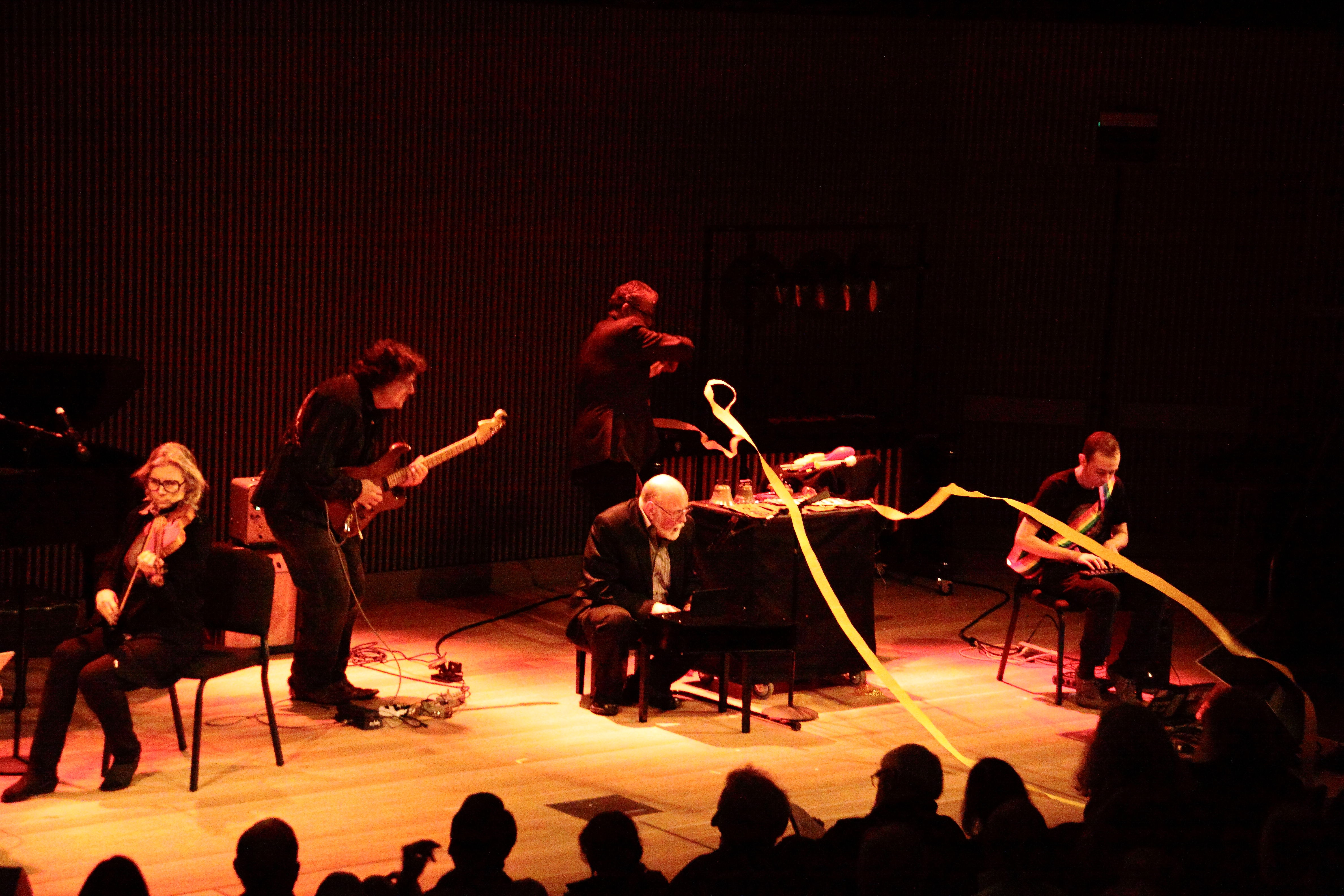
Applebaum's Metaphysics of Notation (2008) performed by the Other Minds Ensemble.  Left to right: Myra Melford, John Bischoff, Wendy Reid, John Schott, Joseph Byrd, Charles Amirkhanian and Charles Celeste Hutchins

Applebaum’s Metaphysics of Notation (2008) performed by the Other Minds Ensemble. Left to right: Myra Melford, John Bischoff, Wendy Reid, John Schott, Joseph Byrd, Charles Amirkhanian and Charles Celeste Hutchins

Applebaum’s graphic score Metaphysics of Notation (2008) was projected overhead while the ensemble played their interpretations of that score.  The ensemble, dubbed the Other Minds Ensemble, consisted of most of the composers who participated in the festival including Mr. Amirkhanian displaying his facility with  a percussion battery among other things.  (Presumably Roscoe Mitchell, who was reportedly not feeling well, would have joined the ensemble as well.)  Mr. Applebaum was conspicuously absent perhaps so as to not unduly influence the proceedings.

Ribbons strewn across the stage, a part of the Other Minds Ensemble's interpretation of the Metaphysics of Notation

Ribbons strewn across the stage, a part of the Other Minds Ensemble’s interpretation of the Metaphysics of Notation

The piece was full of minimal musical gestures, humorous events like ribbons strewn across the stage and the popping of little party favors that emitted streamers.  The ensemble appeared to have a great deal of fun with this essentially indeterminate score which they are instructed to interpret in their own individual  ways.  It was a rare opportunity to see and hear Mr. Amirkhanian (who is a percussionist by training) as well as an opportunity for the other composer/performers to demonstrate their skills and their apparent affinity for this type of musical performance.  Again the audience was both amused and appreciative.

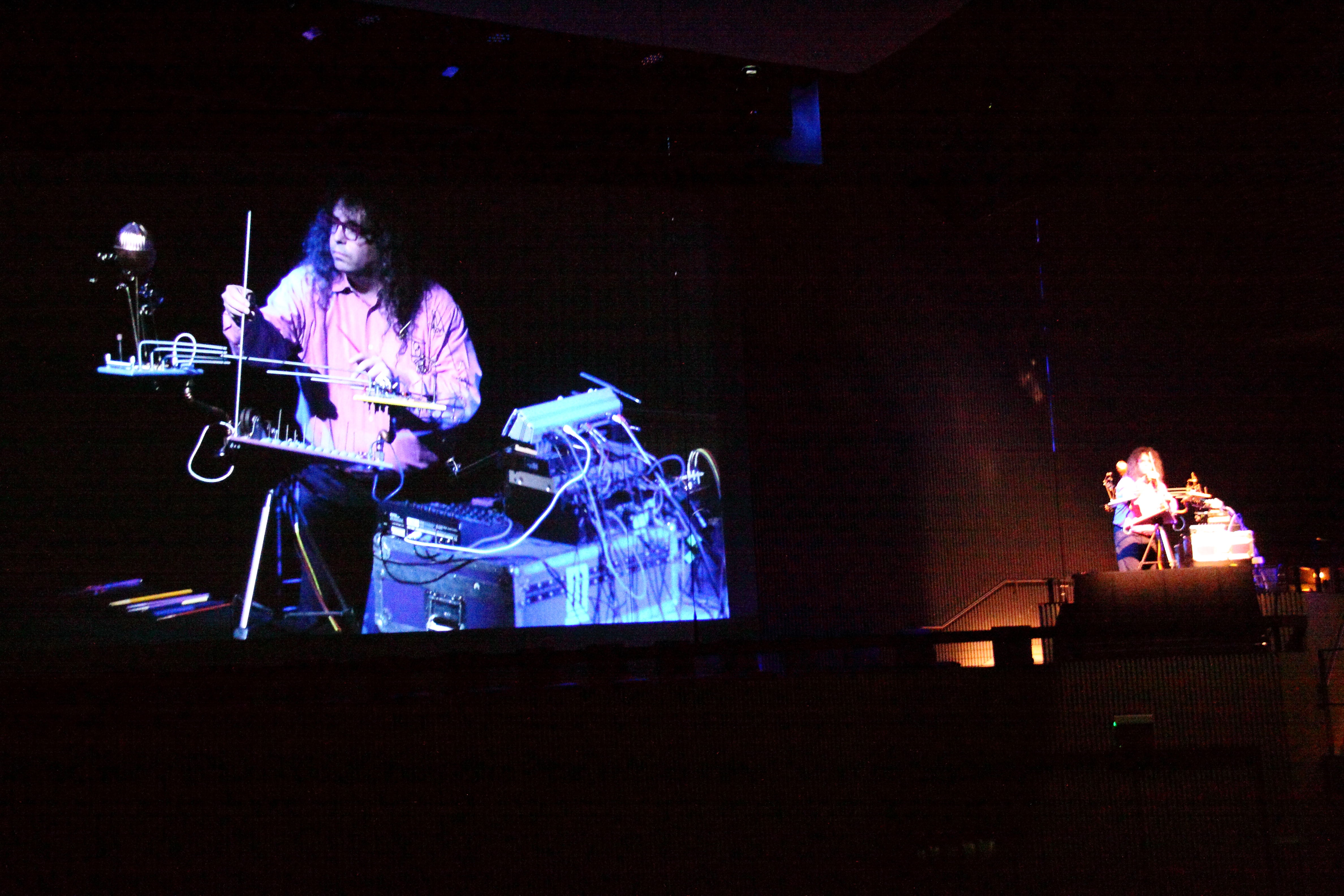
Mark Applebaum performing on his invented instrument.

Mark Applebaum performing on his invented instrument.

Projection of Applebaum performing with view of the composer/performer stage right as well.

Projection of Applebaum performing with view of the composer/performer stage right as well.

The third piece by Applebaum featured the composer with his invented instrument and electronics playing on a balcony stage right with a projection of himself on the big screen.  He produced a wide variety of sounds from his fanciful computer controlled contraption that seemed to please the audience.  This is the kind of unusual genre-breaking events which tend to characterize an Other Minds concert.

The second composer of the night was the elusive Joseph Byrd who is perhaps best known for his cult classic album The American Metaphysical Circus by Joe Byrd and the Field Hippies from 1969.  A previous band, The United States of America released a self-titled album which received critical acclaim in 1968.  Both are apparently out of print but available through Amazon.

Joe Byrd studied music with Barney Childs and worked with La Monte Young, cellist Charlotte Moorman, Yoko Ono and Jackson Mac Low.  Byrd went on to produce a great deal of music by others and also wrote music for films and television but his own compositions have only come to light again recently with the release of a New World CD released in 2013 which presents his work from 1960-63.  Mr. Amirkhanian said that it was this disc that got him interested in inviting Byrd to Other Minds (Byrd also taught at the College of the Redwoods in Eureka, California.).

This is the sort of musical archeology for which Other Minds has become known.  Amirkhanian is known for his ability to find and bring to performance and recordings music which has been unjustly neglected.  Hopefully this appearance will be followed by more releases of Byrd’s other music as well.

Byrd was represented here by performances of Water Music (1963) for percussionist and tape with Alan Zimmerman (who was one of the producers of the New World album) played the spare percussion part which integrated well with the analog electronic tape.

Alan Zimmerman performing Joe Byrd's Water Music.

Alan Zimmerman performing Joe Byrd’s Water Music.

A second piece, Animals (1961) was performed by the brilliant and eclectic bay area pianist Sarah Cahill with Alan Zimmerman and Robert Lopez on percussion and the fiercely talented Del Sol String Quartet (Kate Stenberg and Richard Shinozaki, violins, Charlton Lee, viola and Kathryn Bates Williams, cello).  This was another piece with soft, mostly gentle musical gestures involving a prepared piano and predominantly percussive use of the string players.  It was interesting to contemplate how this long unheard music must have sounded in 1961 but it was clear that it communicated well with the audience on this night.

Animals (1961)

Animals (1961)

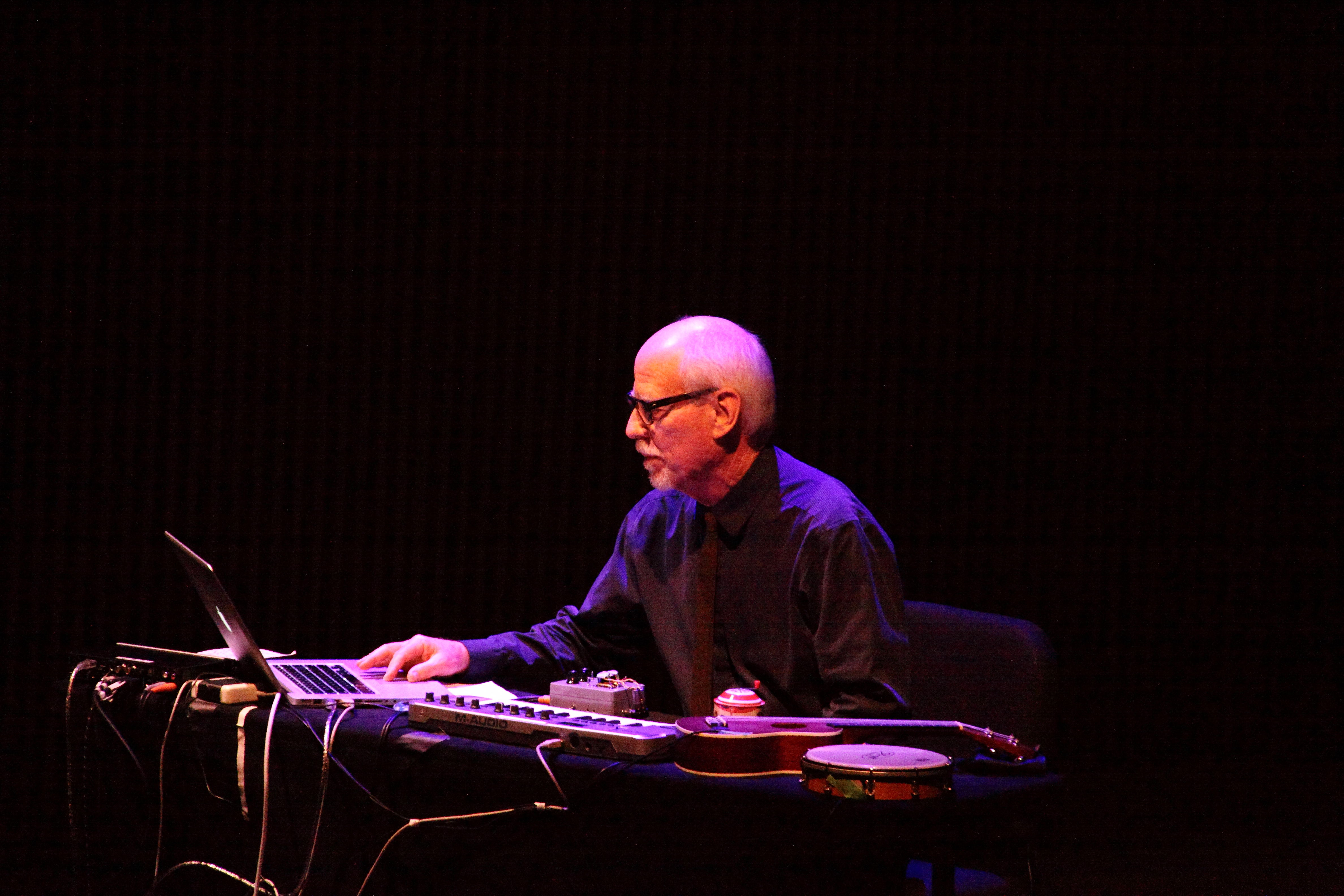
John Bischoff performing his work Audio Combine (2009)

John Bischoff performing his work Audio Combine (2009)

Following intermission we heard two pieces by Mills composer/performer John Bischoff.  The first was Audio Combine (2009) which featured Bischoff on this laptop producing a variety of digitally manipulated sounds.  It was followed by Surface Effect (2011) with creative lighting effects/animations that nicely complemented the laptop controlled analog circuitry.  Bischoff’s music is generally gentle and clear.  It belies the complexity of its genesis in state of the art computer composition and performance for which he is so well known.

John Bischoff performing Surace Effect (2011)

John Bischoff performing Surace Effect (2011)

All this led to the final performance of the evening by Don Buchla whose modular synthesizers were developed in the early 1960s with input from Ramon Sender, Morton Subotnick, Pauline Oliveros and Terry Riley at the legendary San Francisco Tape Music Center (which later became the Mills Center for Contemporary Music).  Buchla also designed the sound system for Ken Kesey’s bus “Furthur” which featured in the Electric Kool-Aid Acid Test.

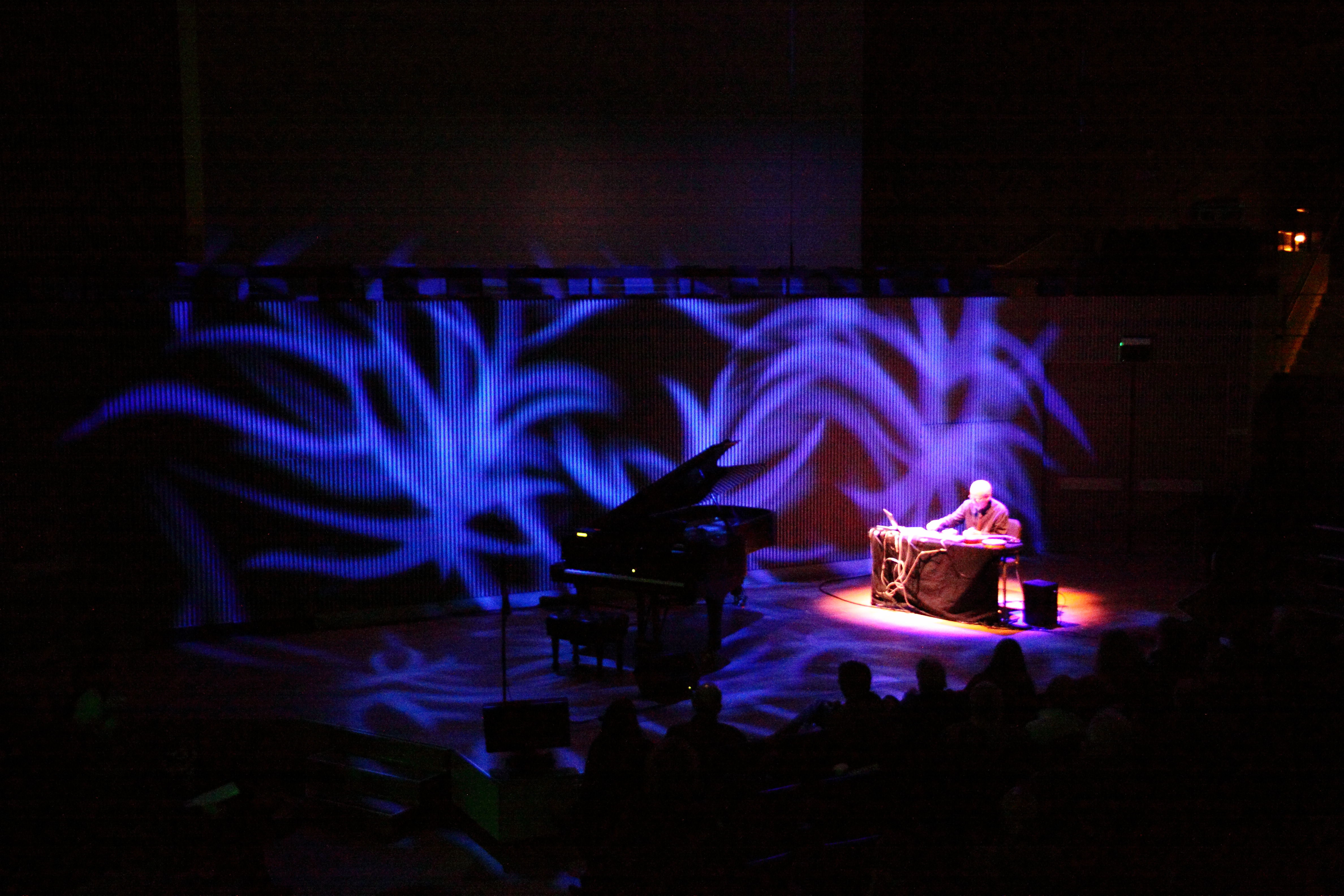
Don Buchla on the Buchla Bos and Nannick Buchla on the piano with film projection performing Drop by Drop (2012) in its American premiere.

Don Buchla on the Buchla Bos and Nannick Buchla on the piano with film projection performing Drop by Drop (2012) in its American premiere.

The conclusion of Friday’s program consisted of the American premiere of a Drop by drop by Don Buchla for Buchla 200e, electronically controlled “piano bar”  (another Buchla invention) and film projection.  The film was made in collaboration with bay area film maker Sylvia Matheus.  The sequence of images began with a dripping faucet and proceeded to a waterfall and then to emerging pictures of birds all the while accompanied by the various sounds from the synthesizer and the piano.

OM190028

Nannick and Donald Buchla receiving warm applause from the audience.

The Saturday night performances began with Charles Celeste Hutchins and his laptop improvising system.  Hutchins, a San Jose native, describes his system as related to Iannis Xenakis’ UPIC system and utilizes a live graphic interface which the computer uses to trigger sound events.

Charles Celeste Hutchins at his laptop performing Cloud Drawings (2006-9)

Charles Celeste Hutchins at his laptop performing Cloud Drawings (2006-9)

The drawings were projected onto the overhead screen.  There seemed to be a somewhat indirect correlation between the drawings and the resultant sounds and much of the tension of this performance derived from wondering what sounds would result when the cursor reached that particular drawing object.  The audience is basically watching the score as it is being written, a rather unique experience and the Other Minds audience clearly appreciated the uniqueness.

The projected graphic score for Cloud Drawings.

The projected graphic score for Cloud Drawings.

The Actual Trio: John Schott, guitar, Dan Seamans, bass, John Hanes, drums.

The Actual Trio: John Schott, guitar, Dan Seamans, bass, John Hanes, drums.

John Schott and his Actual Trio then took the stage to perform his own brand of jazz which seemed to be a combination of free jazz, Larry Coryell and perhaps even Jerry Garcia.  But these descriptions are merely fleeting impressions and are not intended to detract from some really solid and inspired music making.  After the conclusion of the set this listener half expected an encore.

But the program moved on toWendy Reid’s performance as we watched the stage being set up with music stands, some electronic equipment and a parrot in a cage.

Tree Piece #55 "lulu variations" with Tom Dambly, trumpet, Wendy Reid, violin and electronics and Lulu Reid on vocals.

Tree Piece #55 “lulu variations” with Tom Dambly, trumpet, Wendy Reid, violin and electronics and Lulu Reid on vocals.

Reid’s Tree Pieces are an ongoing set of compositions incorporating nature sounds with live performance.  This is not unlike some of Pauline Oliveros’ work in that it involves careful listening by the musicians who react within defined parameters to these sounds.

Lulu the parrot appeared nervous and did a lot of preening but did appear to respond at times.  The musicians responded with spare notes on violin and muted trumpet.  It was a whimsical experience which stood in stark contrast to the more declarative music of the previous trio but at least some of  the audience, apparently prepared for such contrasts, was appreciative.

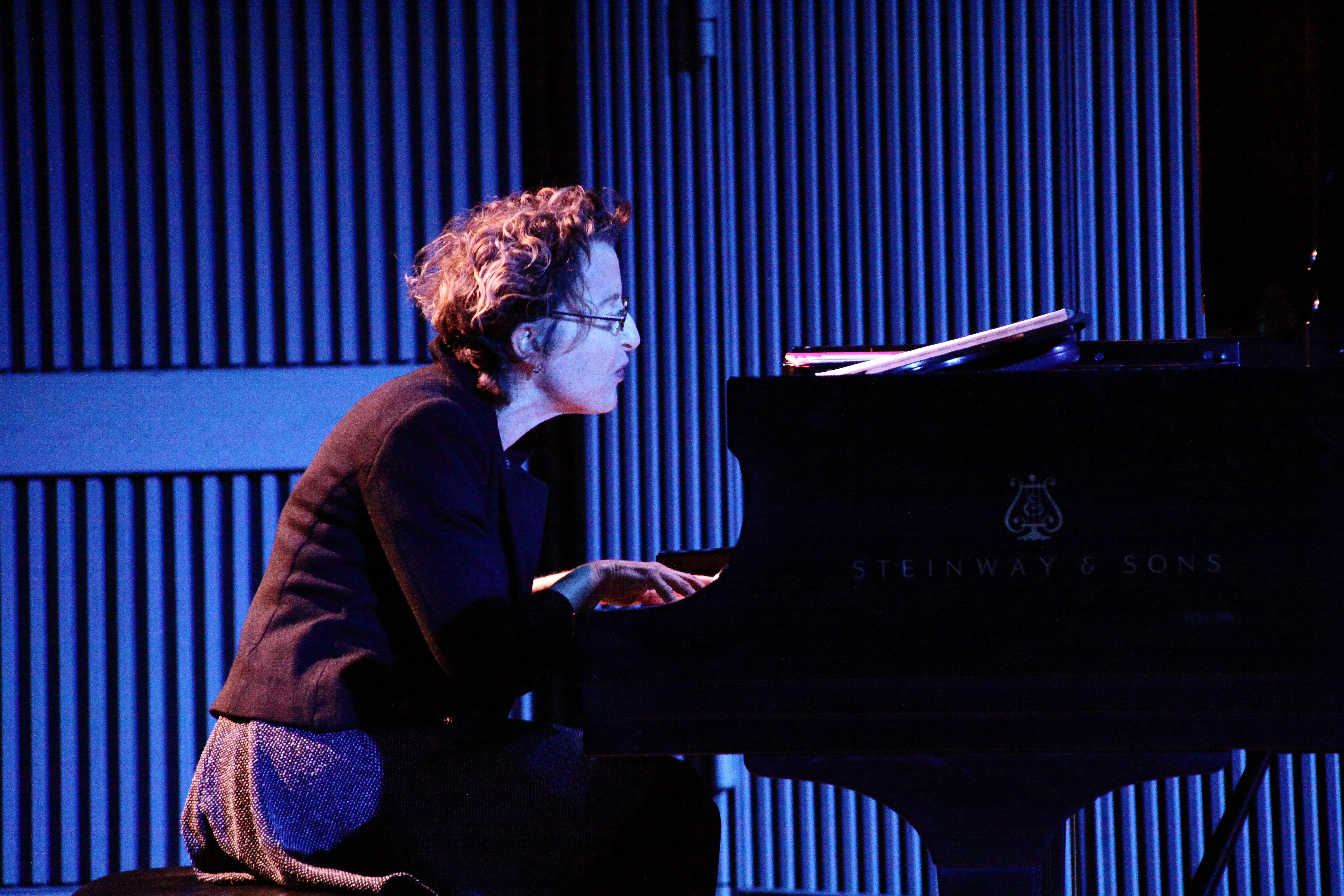
Myra Melford performing selections from Life Carries Me This Way (2013)

Myra Melford performing selections from Life Carries Me This Way (2013)

The diminutive figure of Myra Melford took command of the piano and the hearts of the audience in her rendition of several pieces from her recent CD.  She played sometimes forcefully with thunderous forearm cluster chords and sometimes with extreme delicacy but always with rapt attention to her music.  Her set received a spontaneous standing ovation from a clearly roused audience.  She is a powerful but unpretentious musician who clearly communicates well with her audience.

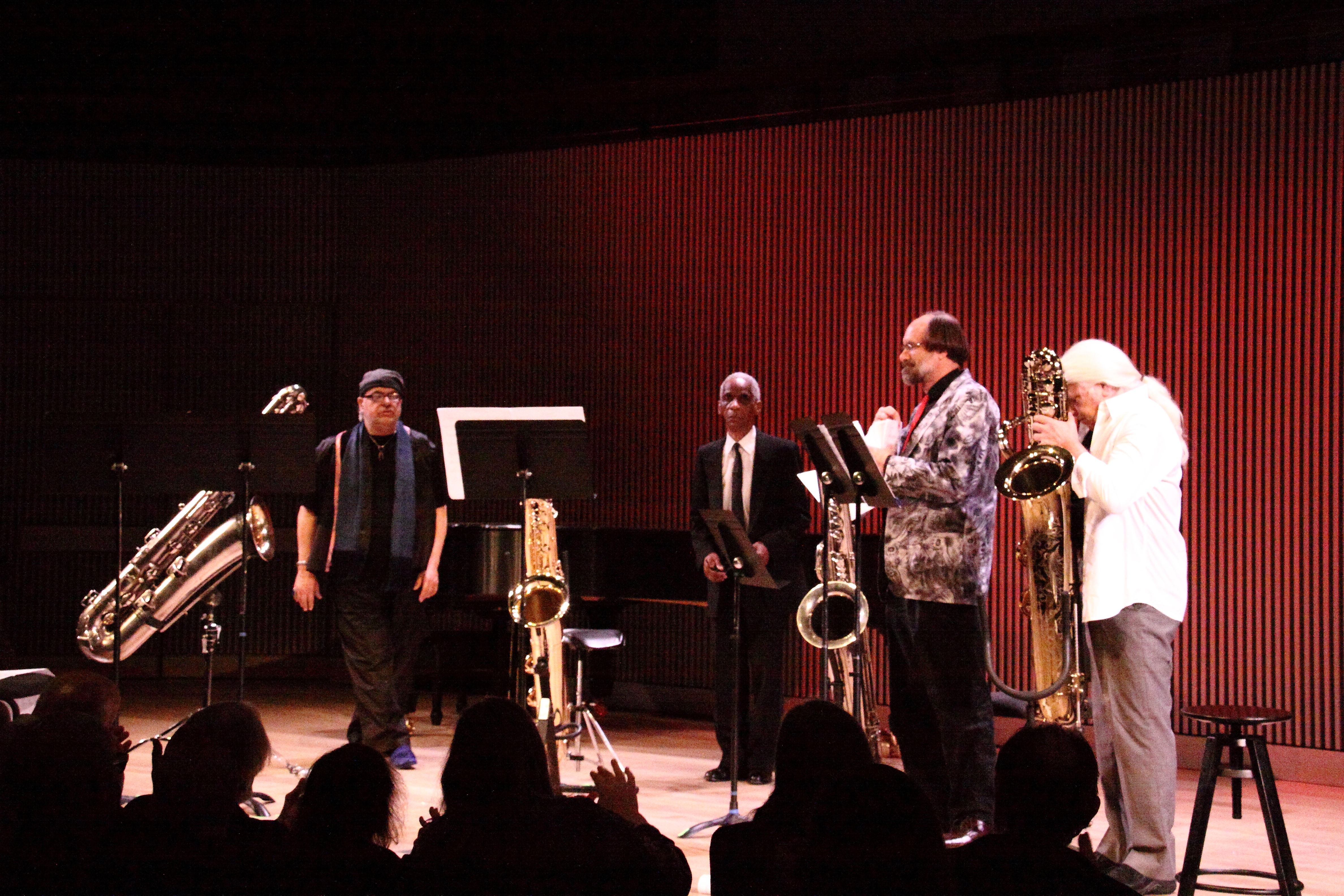
Roscoe Mitchell, Vinny Golia, Scott Robinson and J.D. Parran  following their performance of Noonah (2013)

Roscoe Mitchell, Vinny Golia, Scott Robinson and J.D. Parran following their performance of Noonah (2013)

The finale of OM 19 was the world premiere of an Other Minds commission, the version for four bass saxophones of Roscoe Mitchell’s Noonah (pronounced no nay ah).  It is the latest incarnation of a piece of music that Mitchell describes as having taken on a life of its own.  It exists now in several different versions from chamber groups to orchestra.

The piece is vintage Roscoe Mitchell, a combination of free jazz and sometimes inscrutable compositional techniques which clearly enthralled the very focused performers.  What the piece seemed to lack in immediate emotional impact it made up in mysterious invention which was brought out grandly by the very experienced and committed players.

Mitchell, who was not able to attend on the previous night, appeared rather tired but played with a focus and enthusiasm that matched his fellow musicians.  Like all of Mitchell’s music there is a depth and complexity that is not always immediately evident but does come with repeated listenings and performances.

Thus concluded another very successful edition of Other Minds.  Now we look forward to the gala 20th anniversary coming up in March, 2015.


Enhanced by Zemanta

Black Composers since 1964: Dreams Deferred?


For Black History Month this year I have posed a question: How has the 1964 Civil Rights Act impacted black composers? I assumed, even as I posed the question, that there had been relatively little progress but I have been able to document an increase in recordings of music by black composers.  However what I am finding and expect will continue to find is far less than the dream envisioned by the likes of Dr. Martin Luther King, Jr., Malcolm X and others who are of that generation. I have received some responses, two of which I have published here, which are carefully diplomatic though not without a note of skepticism.  I have received other responses which are far less optimistic which I have agreed not to publish.  And I will continue to write on this subject even after this American 28 day annual celebration of Black History Month. I did receive the following less optimistic reply from a concert promoter named Bill Doggett.  He is the nephew of the late keyboard player whose name he shares.  The musician Bill Doggett played with various jazz and rhythm and blues groups.  The concert promoter who carries on a commitment to black music agreed to write a response to my question and asked that I publish it. Here on the last day of Black History Month is Mr. Doggett’s commentary:

As we mark the end of Black History Month 2014, The 50th Anniversary of the 1964 Civil Rights Act and the critical new “My Brother’s Keeper”Initiative http://www.whitehouse.gov/my-brothers-keeper launched by the first African-American President, Barack Obama, the impact of these events on and for current and future contemporary African-American composers has promise
 
However, the promise is still a mixed one…
 
That is to say, while there was a major flowering and great showcase of programming and recording of music by contemporary black composers during the late 1960s-70s, i.e. Primous Fountain, George Walker, Adolphus Hailstork et al,   eager and invited programming of new music by black composers in symphony subscription concerts, much of that came to a screeching halt with the social conservatism that arrived during the administrations of President George H Walker Bush and with George Bush.
Adolphus Hailstork (1941- )

Adolphus Hailstork (1941- )

Primjous Fountain (1949- )

Primous Fountain (1949- )

The social political pulse of the country changed……from the heightened sense of social responsibility and accountability of the era of LBJ’s  “The Great Society”     If you will, there was a cultural “backlash” to the perception of “African-American” as synonymous with “welfare mother”, “food stamps”,”housing projects run amok”…and  “drugs”.  The social political tempo of the country was mirrored and linked to the iconic  Nancy Reagan motto “Just Say No” Anti Drug campaign.
Symphony orchestras stopped aggressively inviting and programming new music by Black Composers-except during February, Black History Month.
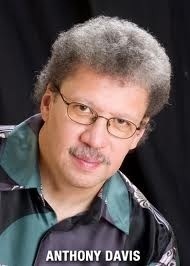
Yet, there were silver linings and sunshine in the dark clouds:  Anthony Davis’ 1986 landmark opera: X, The Life and Times of Malcolm X premiered at the recently closed New York City Opera,1995 Olly Wilson’s Shango Memory for Orchestra, commissioned for the 150th Anniversary of The New York Philharmonic,1997, Amistad: The Story of The Slave Ship Rebellion premiered at Lyric Opera of Chicago, the emergence of a new important generation of composers in the late 1990s including Jonathan Bailey Holland, James Lee III, Trevor Weston and Anthony R. Green.

Anthony Davis (1951- )

Anthony Davis (1951- )

The challenge in 2014 for Black Composers is one that was on full view at the recent Sphinx Con think tank conference in Detroit sponsored by Aaron Dworkin’s Sphinx Music  www.sphinxmusic.org
Anthony R. Green (1984- )

Anthony R. Green (1984- )

 Artistic administrators and the major symphony orchestras consist of  predominantly upper to upper middle class white male and female musicians who are not interested in notable change that embraces a deep commitment to diversity in the classical performing arts.   
As Dworkin as passionately stated, Black Musicians only make up at maximum 2% of the composition of America’s orchestras.  Institutionally, American orchestras and their administrations are comfortable in this ivory tower status.     The entrenched practice of holding auditions with screens actually makes it nearly impossible to advance the goal of making Symphony Orchestras more ethnically diverse.
Jonathan Bailey Holland (1974- )

Jonathan Bailey Holland (1974- )

This applies even more so to the world of The Black Composer. Black Composers’ music is in 2014 rarely programmed on subscription concerts, excepting special events: like  “A Black History Month Concert”
Worse, at Sphinx Con, one white male presenter declared quite openly and declaratively…. that because white men are in charge of most of the leading artistic organizations, that white male privilege…..reigned and Black and Latinos seeking more rapid diversity….needed to get over it 
 Worse still, the suggestion followed that  White Male dominated artistic organizations should be PROUD OF their “incremental change” of 1% or 2% improvements ….
THAT is not a recipe for creative collaboration with American orchestras that the established and emerging contemporary Black Composer need to embrace.
In this light, thank goodness for the progressive vision and work of Conductor, Leonard Slatkin and The Detroit Symphony for inviting a conversation about nurturing and developing Diversity in Classical Music.   On March 9/10 2014, there is a showcase of music by contemporary African-American composers and a related Symposium.      A similar new energy has found its way to The Atlanta Symphony Orchestra with the hiring of African-American conductor, Joseph Young as Assistant Conductor and Music Director of The Atlanta Youth Orchestra.
Indeed, promise….is on the horizon.     Let us collectively ensure that we are called
to celebrate the truth of the old Negro Spiritual “This Little Light of Mine…Im gonna let it shine…”
Written by Bill Doggett, strategic marketer and rep for Black Composers at Bill Doggett Productions
I have articles currently in preparation on Anthony Davis, Primous Fountain, Jonathan Bailey Holland and Anthony R. Green among others.  If you don’t know these composers you should give a listen to their work.  I continue to welcome comments both on my question and on the composers and their music.

Coming Up, Other Minds 19 at the SF Jazz Center


Official Other Minds logo

Official Other Minds logo (Photo credit: Wikipedia)

On February 28 and March 1 the SF Jazz Center will host Other Minds for the first time.  OM 19 is the latest incarnation of this annual festival which presents an amazing range of new music.

The Other Minds Festival, brainchild of filmmaker/producer Jim Newman and musician, composer and broadcaster Charles Amirkhanian, was first heard in 1993 and, except for the years 1994, 1998 and  2007, has been an annual event in San Francisco  gathering mostly new but  always innovative composers to share their inspirations and innovations with each other and with bay area audiences.  Being curious about those apparent gaps in this festival I sent a query to the Other Minds office and received a prompt reply from none other than Charles Amirkhanian.  He stated as follows:

Executive Director Charles Amirkhanian in his ...

Executive Director Charles Amirkhanian in his office with ASCAP award in background (Photo credit: Wikipedia)

“Hi Allan,
Here’s the story:
After our first festival in November 1993, we needed time to raise more funds to produce OM 2 and get back on the Yerba Buena Center’s schedule. So we postponed until March 1995, the next available spot in the Djerassi schedule. Our timing for the festival is determined by when we have access to empty rooms at DRAP, so we need to be there either in Feb/March or November.
In 1997, once again, we needed time to raise more funds and simply postponed to the next available Djerassi time. Same for OM 13.
In each case, the delay was about eight months (for a November event) or four months (for a March event), giving us a festival in succeeding concert seasons, but not “annual” events. (A concert season is Fall ’07 through Spring ’08, for example.)
Thus the mysterious gaps.
Charles”

This internationally known festival is not just a series of concerts.  The diverse selection of composers gathers first for an artistic residency at the Djerassi Resident Artist Program (DRAP in Mr. Amirkhanian’s note), a pastoral setting nestled between the Pacific coastline and the hills west of Palo Alto, where the invited composers live, work and share ideas for a week prior to the public concerts. The Djerassi Foundation for the Arts was founded by biochemist Carl Djerassi whose daughter, an artist, committed suicide in 1978.  The area is a sculpture park and the facility operates all year round with residencies for artists of all media.  Charles Amirkhanian is one of the former directors of this venerable artist colony and is now the executive and artistic director of Other Minds. The selection process for OM artists is based on the incredible range of interests of the Other Minds Operating Board and in consultation with their advisory board which are very open to suggestions from the general public.  Just e-mail them.  They actually read all their e-mails and respond. This along with New Music America, the ONCE festival, the Telluride Festival (also one of Amirkhanian’s efforts) are among the important music festivals which have yet to receive adequate treatment and exposition of their histories. This year’s OM 19 (which also looks forward with eager anticipation to a very promising gala OM 20) includes Mark Applebaum, John Bischoff, Donald Buchla, Joseph Byrd, Charles Celeste Hutchins, Myra Melford, Roscoe Mitchell, Wendy Reid and John Schott.  For the first time in the history of the festival all the composers will be from northern California.  The dates for the festival, which moves this year to the new SF Jazz Center, are Friday February 28 and Saturday March 1. One might think that limiting the selection of composers would be limiting in the variety of artistic efforts to be had but one would be quite wrong.  In fact it would not be difficult to argue that music by musicians from northern California have been unjustly neglected in favor of the more dominant musical cultures of New York City, Chicago and Los Angeles.  A quick look at the roster for OM 19 reveals a great deal of variety:

Mark Applebaum at TEDx Stanford

Mark Applebaum at TEDx Stanford (Photo credit: Tamer Shabani Photography)

The Chicago born Mark Applebaum is currently associate professor of composition and theory at Stanford University.  He counts Brian Ferneyhough, Joji Yuasa, Rand Steiger, Roger Reynolds and Philip Rhodes among his teachers.  He also performs as a jazz pianist. He appears to be the first composer at these concerts to have given a TED talk.  In this talk he speaks of being “bored with music”, at least with traditional music and how he used that boredom to break through to another level of creativity creating new instruments and elaborate scores.  He is an engaging speaker and his presentation will no doubt be fascinating.

John Bischoff (1949- )

John Bischoff (1949- )

John Bischoff studied at the California Institute of the Arts and Mills College.  His teachers include Robert Moran, James Tenney and Robert Ashley.  He is currently visiting professor and composer at Mills College. He is one of the pioneers of live computer performance and he is a frequent performer at the Garden of Memory concerts held annually on the summer solstice at Oakland’s beautiful Chapel of the Chimes. Mills College with its Center for Contemporary Music can be said to be the primary life blood of northern California composers.  Bischoff is part of a long line of composers who  have guided musical pedagogy in the Bay Area and have included Chris Brown, Luciano Berio, Darius Milhaud, Lou Harrison, Steve Reich, Terry Riley, Pauline Oliveros, Morton Subotnick, Ramon Sender, John Cage, Chris Brown, Maryann Amacher, Maggie Payne, Larry Polansky, Robert Ashley, and many others. Bischoff has released 16 albums and numerous publications.  He founded the League of Automatic Composers, the first computer network band and continues to be a driving force in the computer music scene. Don_Buchla_and_200e

Donald Buchla is one of the elder statesmen of new music in California.  His collaboration with Ramon Sender and Morton Subotnick produced one of the first modular synthesizers in 1963.  He continues to develop synthesizers with his Buchla and Associates corporation (founded in Berkeley in 1962) . He studied physics, physiology and music.  His importance in the field of electronic music and music synthesis cannot be underestimated.  His electronics have driven many classical, rock and jazz music.  He and his corporation continue to make new electronic instruments such as the marimba lumina and the piano bar and has made available again some of the classic analog electronics which first made his name familiar to musicians worldwide. I was able to find very little about his musical compositions but it is worth noting that his electronics will power the performances of several of the artists in this concert series in addition to his own.

Joe Byrd in 1968

Joe Byrd in 1968

Kentucky born Joseph Byrd is an electronic musician, composer and producer.  His album, “The American Metaphysical Circus” (1969) is legendary and considered a cult album which has been reissued on CD and can also be heard on You Tube.  His band, Joe Byrd and the Field Hippies never performed live but this work of 60s psychedelia has established itself as a landmark recording and a cult classic.  He also did an album of synthesized Christmas Carols in 1975. Byrd has also been a producer with estimable credits such as producer and arranger of Ry Cooder’s amazing ‘Jazz’ album from 1978.

I can’t imagine how his latest work sounds but I am looking forward to it.

Charles Céleste Hutchins at SOUNDkitchen

Charles Céleste Hutchins at SOUNDkitchen (Photo credit: hellocatfood)

Charles Celeste Hutchins is, as far as I can tell, the first instance in which an Other Minds operating board member has been featured as a composer in this series.  The advisory board consists largely of composers who have already been featured on OM concerts.  Until this booking I was not aware of this man’s work.

Hutchins worked in the dot com business for a time and is now working on his musical interests.  His work involves the digital music program called Supercollider which he uses to manipulate sounds.  Discogs lists an MP3 compilation of some of his work in this area.

Melford in Helsinki, 1993

Melford in Helsinki, 1993

Myra Melford is an internationally known jazz pianist and composer with some 17 albums and some 20 years of playing.  Melford is originally from Illinois.

She has played with AACM musicians like Leroy Jenkins, Joseph Jarman and other musicians including Marty Ehrlich, Henry Threadgill, Mark Dresser, OM alumni Han Benink and Tyshawn Sorey.  Currently she teaches at the University of California Berkeley.

saxophonist Roscoe Mitchell at the Pomigliano ...

saxophonist Roscoe Mitchell at the Pomigliano Jazz Festival (Photo credit: Wikipedia)

Roscoe Mitchell is one of the founding members of the venerable AACM (American Association of Creative Musicians) which redefined both jazz and contemporary classical music from its founding in 1965 to the present.  Other notable members include Anthony Braxton, Lester Bowie, Malachi Favors, George Lewis and Lester Bowie among others.  Mitchell is currently professor of music at Mills College where he holds the Darius Milhaud chair.  He has collaborated with Frederic Rzewski, George Lewis, Anthony Braxton, Joseph Jarman, Malachi Favors, Muhal Richard Abrams, Albert Ayler, Henry Threadgill, Thomas Buckner and many others.

Mitchell is one of the acknowledged living masters of American music and he plays and teaches widely.  In 2012 her performed at the “All Tomorrow’s Parties” festival in Minehead, England.  Any performance by this musician is an event.

Wendy Reid is a new name for me.  She is a composer who works with nature sounds.  I did buy her CD entitled “Tree Music” which features 5 of her Tree Pieces with various combinations of violin, percussion, piano, mandolin, oboe and Don Buchla on “thunder” interacting with nature sounds.  For her OM performance she will be sharing the stage with a parrot.  Yes, it does sound like a Monty Python sketch, but this promises to be interesting if not revelatory.  Her work is clearly concerned with the sounds of nature and is at least distantly related to the work of Pauline Oliveros whose album ‘Troglodyte’s Delight’ involves musicians responding to the sounds of water in a limestone cave.

John Schott is another name with which I am not familiar.  But lack of familiarity spells adventure in this series of concerts.  A quick internet search reveals that he is a Berkeley based composer, guitar player and banjo player.  His web site is a blog which reveals his interest in a wide range of musical styles and literary interests.  He lists 8 CDs which feature his work.  He also lists his “compositions in the classical grain”.  It’s anyone’s guess as to what he will present at Other Minds but if the preceding artists are any indication it will be unique and interesting.

All in all this promises to be a very exciting event with the ‘revelatory’ music which Other Minds uses as a tag line in their publicity materials. I won’t miss it and neither should you.

Enhanced by Zemanta

Final Culmination of a Long Collaboration: Alcatraz/Eberbach by Ingram Marshall and Jim Bengston


Starkland's Alcatraz DVD

Starkland’s Alcatraz DVD

The music of Ingram Marshall (1942- ) first came to my ears via the New Albion recording of the Gradual Requiem (1994) written in memory of his father.  The spare sounds in this abstract electroacoustic piece remind one of the music of Harold Budd or the ambient music of Brian Eno.  Like them Marshall has developed a unique and significant voice drawing from methods including minimalist repetition, drones and static harmonies.  He also incorporates electronic music techniques and the techniques of the modern recording studio as well as non-western tunings and instruments.  But even given all the comparisons and qualifiers it is difficult to describe his voice because it is a unique style that, once heard, will leave it’s stamp of individuality much as the distinction between the above-named artists or, for that matter between a Mozart vs. Haydn style.  Very difficult to describe in words alone.

Ingram Marshall in his Hamden, CT studio.

Ingram Marshall in his Hamden, CT studio. (Photo credit: Wikipedia)

Now a visiting professor of composition at Yale School of Music, Marshall has had a successful career as a professor, composer and performer.  He has written for a variety of instruments including electronic sounds, piano, guitar and voices as well as for chamber and orchestral groups.  He has released 8 (now 9 with the present DVD) albums.

Jim Bengston (1942- ), born in Evanston, IL developed an interest in photography while in the army.  His work will be familiar to music fans through his work on many albums including the characteristically beautiful photographs seen on albums from  ECM.  His work has been exhibited at MoMA, Art Institute of Chicago, Walker Art Center, National Museum of Art, Architecture and Design in Oslo, Lillehammer Art Museum and many others.

JimBengston in studio 2009 crop1107

Jim Bengston in his studio 2009

Starkland pioneered a wonderful DVD audio release in 2000 (which includes Marshall’s ‘Sighs and Murmurs’) called Immersion which contained works commissioned for the new Dolby 5.1 system, the first disc of it’s kind and still a landmark production.  Now comes this DVD from the always interesting Starkland records of two collaborative works between these fine artists making full use of the medium.

Like that earlier disc, this is a venture into another type of art object.  The disc contains musical tracks and a series of photographs leisurely timed with the flow of the music.  But this is not a commercial DVD experience of a film nor is it a traditional slide show.  It is not didactic and only incidentally linear.  It is not just a piece of music for listening either.  The experience that I come away with is more of a hybrid experience of something like a living electrovisualacoustic sculpture (sorry for the improvised neologism).

Alcatraz is a 1991 piece realized on tape as is the companion piece.  It is a sonic reworking by the producers into Dolby 5.1 surround sound.   Here it is paired with photography lovingly displayed on the video format by Jim Bengston.  There is a second work on the disc which is a fitting companion piece called Eberbach (1985) after the abandoned monastery Kloster Eberbach in Germany.  Both works are video sequences of images by the photographer accompanied by Marshall’s hypnotic, impressionistic and elegiac  music.

The audio version of Alcatraz was originally released on a New Albion disc in 1991 and Eberbach (the first two of the “Three Penitential Visions”) was released on a Nonesuch disc in 1985.  According to the liner notes the two artists, who first met at Lake Forest College in Illinois, had been discussing a collaboration such as this for many years and a quick look at the copyright info confirms the dates of the photography to 1984 and 1985 for Alcatraz and Eberbach respectively.  They reportedly exchanged photos and cassette recordings for some time  and the quality of their collaboration is apparent.  And now this formerly languishing collaboration is now completed as it was intended with the release of this DVD.

The first work, Alcatraz consists of environmental sounds as well as electronic music and recorded acoustic instruments.  Marshall creates a glowing ambient texture attempting to reflect the history of the famous prison island in the San Francisco Bay.  The piece is in 7 sections nicely divided into tracks.  Each section reflects different aspects of the prison and the location.

The first section is a minimalistic piano piece which has added ambiance apparently from some added electronic manipulation adding a slight echoing which reflects the open empty reflectively resonant chambers of the stone confinements of the old prison structures.  It is followed by some musique concréte incorporating sounds of the prison environment like the ominous slamming of a metal cell door and its echo.  These sounds are manipulated with minimalist techniques of repetition creating a disturbingly oppressive memory of a sound which cannot ever have had a happy connotation for anyone.  And, of course, throughout the stark, at times almost colorless photographs flow in a gentle rhythm from one to another with a few instances of “jump cuts” or quicker transitions.  One gets the sense almost of the visual and sonic events having been co-composed into this hybrid art form.

English: Monastery Eberbach, Germany

English: Monastery Eberbach, Germany (Photo credit: Wikipedia)

Eberbach is based on impressions by the artists of Kloster Eberbach, the first Cistercian Monastery which was established in 1136 by Saint Bernard of Clairvaux.  It is no longer in use as a monastery but is actively used as a concert space, wine tasting space (there is a large vineyard and winery on the property which is run by the state) and has been used for scenes in films such as ‘The Name of the Rose’.  It is in fact an acknowledged architectural heritage site as it preserves fine examples of architecture from Romanesque, Gothic and Baroque periods.

Eberbach was conceived and works as a companion to the first piece in several ways.  The same attention is paid to the use of environmental sounds as well as use of conventional instruments to evoke the scenes depicted in Bengston’s photographs.  Both the prison and the monastery are about isolation from the larger society, monks in their cells, prisoners in theirs.

The press room of Kloster Eberbach, a Cisterci...

The press room of Kloster Eberbach, a Cistercian monastery in Germany (Photo credit: Wikipedia)

This disc works on many levels.  You can enjoy it as a focused experience sitting in front of the television listening to the music as the pictures flow by.  But you can also experience it as it was played in an installation type setting with the pictures and the music as this sort of ambient living sculpture object.  One can, of course, also experience the pictures or the music alone.  This is a very pleasant and enjoyable disc which is a satisfying culmination of these long gestating projects.

The original recordings were mastered by Bob Shumaker and the current surround sound mix was done by the equally talented Tom Lazarus.  Photo to digital transfers were done by Lavasir Nordrum Design.  Executive producer Thomas Steenland did the design of the package and the DVD menus.

Enhanced by Zemanta

Black Composers Since the 1964 Civil Rights Act


In this, the 50th anniversary year of the landmark 1964 Civil Rights act I have decided to do a survey of black composers who have come of age in the aftermath.  The push for equal rights in the way people are treated, given access to voting, education, business and financial opportunities was the spirit of that legislation.  Though many speak of a “post-racial” America it is clear from any fair analysis that we have a long way to go.

President Lyndon B. Johnson meets with Civil R...

President Lyndon B. Johnson meets with Civil Rights leaders Martin Luther King, Jr., Whitney Young, James Farmer (Photo credit: Wikipedia)

I am beginning a series of articles in honor of Black History Month and in honor of this legislation which attempts to address this inequality. Each article will feature a composer or composers whose work I personally find interesting and worth promoting and which was written or premiered in or after 1964.  I will not necessarily limit myself to Americans both because that would be unnecessarily constricting and inconsistent with the spirit of Black History Month and because non-American black composers suffer similar obscurity and may have even benefited from the 1964 legislation.

Civil Rights Act of 1964

Civil Rights Act of 1964 (Photo credit: Wikipedia)

Whether the legislation has improved the opportunities for black composers is, of course, open to debate but the quality of these artists stand alone on their own merits.  They may have had opportunities not available to their predecessors and this may be a positive result of this legislation.  But the fact that awareness of their work is limited and promoted in relatively obscure contexts such as this blog suggests that true equality in the area of recognition of artistic merit remains elusive (though the availability of recordings of the music of black composers has certainly increased) .  Curiously the United States has chosen the shortest month of the year to celebrate Black History whereas England, who abolished slavery before the U.S., celebrates it in October.  Yes, it’s only 3 days, but the irony is hard to miss.

The pioneering work of musicologist Dominique-Rene de Lerma has done a great service in promoting the work of black composers internationally.  He was involved in the production of the landmark series for Columbia Records along with the great (now retired) conductor Paul Freeman recording a variety of music from black composers world-wide. I had discussed this set in a blog last year and it is worth mentioning that the complete set of recordings has been reissued on 9 vinyl discs as a result of a Ford Foundation grant and remains available through the College Music Society in Missoula, Montana for $35.  This beautifully produced box set deserves an honored place in any record collection.

This pioneering set has inspired similar series by Albany Records and Cedille Records which have made recordings available of some very attractive music of black composers which deserves a wider audience.  It is largely these sets and the writing of Professor de Lerma which serve as the source for the series I am doing on this blog.

The internet site africalssical blog is also a very useful resource which is updated frequently and reports the work of black musicians working in the so-called classical world.  It is difficult and perhaps superfluous to try to separate jazz and classical so I will include composers without concern for specific genre categories except, perhaps, pop composers whose work is well-represented in the mainstream.

Pioneering black musicians like Natalie Hinderas, Martina Arroyo, Marian Anderson, Dean Dixon, William Grant Still and their like paved the way for their successors such as Kathleen Battle, Jessye Norman, Paul Freeman, George Walker and others whose stars became visible to the casual onlooker.  Of course there are fine black classical artists whose talents remain too little known.  How many people know Awadagin Pratt, Mark Doss, Michael Morgan and other active black musical artists?  It takes much more work for listeners to find and appreciate their talents.

It takes even more work to find black composers, especially if they are not also performers.  Most people, even most musicians, would have difficulty naming a single black classical composer.

I contacted several prominent black musicians to pose the question of how the Civil Rights Act of 1964 has impacted black classical composers.  To date I am pleased to say that I have received two gracious replies.  The first is from Michael Morgan who currently serves as conductor of the Oakland East Bay Symphony, the Sacramento Philharmonic and the Festival Opera in Walnut Creek.  He has numerous recordings to his credit as well.  Maestro Morgan replied as follows:

Michael Morgan (1957- )

Michael Morgan (1957- )

“I don’t believe the 64 Civil Rights Act has impacted black composers directly, however, the national conversation it inspired did cause performing arts groups (and their philanthropic supporters) to look for new ways to expand their audiences into communities not traditionally as well represented in concert halls. Orchestras are still making efforts (some more sincere than others) to connect with various minority communities. Unfortunately, rather than sprinkle such efforts throughout their seasons, some have opted for the annual Martin Luther King or Black History Month (or Cinco de Mayo, or Chinese New Year, etc. etc.) concert resulting in less sustained contact than might otherwise be possible. Such concerts have, however, been something of a boon for black composers, performers and conductors who find themselves at least included on orchestra programs on those annual occasions.

There may have been a more direct impact on the integration of some concert halls in particularly segregated cities, but the performing arts have historically been somewhat ahead of society in general in terms of promoting fully integrated events, at least in communities where there was significant acceptance of such integration.”

Morgan’s practical approach to programming is evident here and the point is well-taken that consistent programming of minority composers would result in a more sustained impact than simply having focused efforts during given months or weeks.  In fact this notion has convinced me that my blogs on the subject might be more effective if I were to spread them throughout the year, something which I will now incorporate.  My previous blog post on black classical conductors which included Maestro Morgan has been one of my most frequently viewed posts and I will expand on that subject in the months to come.

Adolphus Hailstork

Adolphus Hailstork

The second reply was from eminent composer Adolphus Hailstork who was the subject of my first blog post for black history month from last year.  He replied very thoughtfully as follows:

“Fifty Years After the 1964 Civil Rights Act

Having grown up in New York State and not experienced “legalized” segregation as practiced in the South, I had enjoyed as a youth, all the rights and privileges of American citizenship due me. There were no “colored” this and “white” that signs or classrooms, or lunch counters, etc. So the Civil Rights Act of 1964 did not have a direct effect on my life at that time.

(I much later came to appreciate the value of the changes in the south when I came to live there as a working adult.)

Actually, it was the assassination of Dr. King that opened doors to my beginning my doctorate degree that same year when I got out of the army (1968).

Also, that tragic event influenced the unfolding of my career, because it led to an interest in the music of African-American classical composers for the honoring of Dr. King’s birthday celebration in January and, by extension, the heightened interest in such music during the February Black History Month observance.

I believe the history of African-Americans is tragic, heroic, triumphant, and, of course, filled with awesomely dramatic stories. It is an honor to attempt in some small way to pay tribute through music to our story.”

Clearly Dr. Hailstork notes the difference between his experiences in the north where he was born and was able to see the profound contrast he experienced working in the south at Old Dominion University in Virginia particularly during the early civil rights struggles and their aftermath.  The emotional impact of the assassination of Dr. Martin Luther King in the same year he concluded his military service  is noted as a formative issue as well.

One can easily hear the deep emotional impact of which he speaks in works like his second symphony from 1999 which reflects his feelings after having visited the slave markets of West Africa and his American Guernica (1983) which is about the Birmingham 16th Baptist Church bombing which killed 4 little girls in 1963.  Other works such as his Epitaph for a Man Who Dreamed, In Memoriam Martin Luther King, Jr. (1979) also reflect the impact of these events on him personally and reflect what he describes as his feeling of honor in being able to pay tribute to these tragedies describing them aptly as “our story”.

I think it is important to begin to see the tragic and triumphant events of the civil rights era as our American story and not just as the story of black Americans.  Indeed these events are part of our collective history as human beings and as Americans.  These are stories that need telling and re-telling as a part of the healing process and the exorcising of the evil deeds of our collective past.

Enhanced by Zemanta

MLK, the Classical Playlist


President Lyndon B. Johnson meets with Martin ...

President Lyndon B. Johnson meets with Martin Luther King, Jr. (Photo credit: Wikipedia)

There is no doubt that rhythm and blues is the soundtrack of the Civil Rights Movement but in this, the 50th anniversary of the 1964 Civil Rights Act, I am issuing a programming challenge to the classical music world.  Hey there all you classical music stations, both internet based and broadcast.   Hey there Spotify and Pandora.  Have you explored the music written for and about the Civil Rights era?  Well, here’s your chance.

I begin my programming day with Joseph Schwantner’s “New Morning for the World” (“Daybreak of Freedom”), written in 1982.  Comparisons to Copland’s “Lincoln Portrait” are made due to the similarity in character and the use of a narrator.  The other work on this  Oregon Symphony CD under the late great James De Preist is  a work by an older composer Nicolas Flagello.  The cantata, “The Passion of Martin Luther King” from 1968, was composed in the shadow of the assassination of Dr. King and first performed in 1969.  Both works deserve more hearings for their musical accomplishments as well as for the subject of their dedications.

Description unavailable

Description unavailable (Photo credit: pennstatenews)

Moving on to the next segment I will move on to Adolphus Hailstork‘s 1978 “Epitaph for a Man Who Dreamed”  followed by William Grant 1930 Symphony No. 1 “Afro-American”.  Still is rightfully known as Dean of Afro-American composers.  A contemporary of Aaron Copland, his accomplishments established without a doubt the place in classical music for black composers.  Hailstork acknowledges his debt to the older master.  He is the next generation of black musicians contributing to the repertoire.  I will conclude this segment with Hailstork’s Symphony No. 2 which contains his impressions upon visiting the slave market areas of western Africa, places where began the shameful history of black slavery.

And on we go now to Luciano Berio’s 1968 “O King”, a chamber piece later incorporated into his masterwork, “Sinfonia” of the same year.  I program the version from Sinfonia, it’s my favorite rendering.  The vocal parts of this piece are solely comprised of the name “Martin Luther King”.  Also from 1968 there is Michael Colgrass’ “The Earth’s a Baked Apple” which is subtitled, “A Musical Celebration in Honor of Dr. Martin Luther King, Jr.” (psst, I have a bootleg of it).

We move on to afternoon programming featuring Anthony Davis’ opera, “X”, based on the life of Malcolm X.  This is  a work that deserves a new production.  Following this I will move on to Duke Ellington‘s 1943 “Black, Brown and Beige” Suite and then his “Three Black Kings” titled in French with rhyming wordplay as “Les Trois Roi Noir”.

Album cover

Album cover

The program would be incomplete without programming the wonderful Other Minds CD of Sarah Cahill’s album “A Sweeter Music” featuring a diverse collection of compositions written for her on commission by Terry Riley, Meredith Monk, Frederic Rzewski, Kyle Gann, Carl Stone, Phil Kline, Yoko Ono and The Residents.  The title is taken from Dr. King’s Nobel Prized lecture in which he refers to peace as “a sweeter music”.

Dizzy Gillespie

Cover of Dizzy Gillespie

I will end my fantasy program with Dizzy Gillespie’s “Brother K’ and Hale Smith’s “In Memoriam Dr. Martin Luther King, Jr.”  But fear not I leave you with a useful reference I have recently discovered.  “A Catalog of Music Written in Honor of Martin Luther King, Jr.” edited by Anthony McDonald.

Stay tuned for more on these subjects coming up during February for Black History Month.  Peace, Dr. King.

A mural painted on the side of the African Ame...

A mural painted on the side of the African American Museum depicts the Hough riots, the civil rights movement and a family looking towards a bright new future for the city and the community. (Photo credit: Wikipedia)


Enhanced by Zemanta

Rhys Chatham: Harmonie du Soir


Rhys Chatham performing in Richmond, CA 2013

Rhys Chatham performing in Richmond, CA 2013

Chatham’s new CD “Harmonie du Soir” on Northern Spy records was thoughtfully made available for sale at the ‘Secret Rose’ performance this past November. Of course I had to buy it but after that concert I found I needed time to digest the performance before I dare move on to listening to another of his deceptively simple sounding compositions. The CD consists of three compositions, Harmonie du Soir (2012), The Dream of Rhonabwy (2012) and a bonus track Drastic Classicism Revisited (1986/2012).  All the pieces represent aspects of the artist’s output which will be familiar to fans of his work.

rhys_chatham_-_harmonie_du_soir_2

The first track Harmonie du Soir (after the poem of the same name by Charles Baudelaire) was premiered and subsequently recorded in France in 2012.  In his liner notes Chatham points out that he uses tunings like those used previously in An Angel Moves Too Fast to See (1986) and Crimson Grail (2007).  It reminds this listener of Die Dönnergetter (1986).  It employs the same configuration of 6 electric guitars, electric bass and drum kit.  It is not, however, a reworking of the 1986 piece but rather a new piece which developed from similar methods.  Harmonie clocks in at 22’26”, similar in length.  The comparison ends there.  The difference between Dönnergetter and Harmonie is more like the difference between a Beethoven middle string quartet and a late string quartet.  Same ensemble, similar gestures but an overall very different impact. Like all of Chatham’s guitar pieces this is best heard at a substantial volume level if you want to appreciate the harmonics which result from the tuning system he uses.  This is post-punk after all and the wall of sound is frequently an essential part of the piece.  It begins with a minimalist type repeating of a 2 note pattern punctuated after a few repeats by the drum kit and on to some droning harmonies aching for a melody in an insistent rhythm.  This moves on to a faster section which takes on not the dance-like character like he does in Die Dönnergetter, rather it is a sort of deconstruction.  It is consists of guitar tremolos and rolls on the drum kit and moves into a new somewhat pointillistic  guitar figure accompanied by a throbbing bass line and a steady rhythm on the drum kit.  This  is followed by a return to the music which opened the piece.  Clearly this is a composer whose work continues to develop and show variety.

The second piece is another with precedents in the composer’s previous compositional efforts.  This is essentially a piece for a wind and brass orchestra with percussion.  No strings, no guitars or bass.  It marks a return for Chatham to writing for and playing trumpet.  The piece was written for a 70 piece brass band called Harmonie de Pontarlier, named for the town of their origin. It is 20’26” in length and Rhys plays trumpet along with the band.  One is reminded of pieces like his Waterloo No. 2 (1981) which appeared on his CD “Die Dönnergetter”.  The composer takes his approach to writing for band but here expands into symphonic proportions.  According to the liner notes this was written as a soundtrack to a film.   After multiple listenings I came to hear this as though it were an homage to grand romantic symphonists like Bruckner or Mahler.  This is a briefer symphony than those ancestors would have written but the spirit is there if dressed in more contemporary guise.  The music relies on sustained tones and intervals which, like Chatham’s guitar pieces, produce cascades of harmonics, a mesmerizing experience.

The last piece is listed as being a “bonus track”.  It is Drastic Classicism Revisited and is a sort of reworking of Chatham’s earlier work Drastic Classicism from 1981.  It was originally written for a dance choreographed by Karole Armitage and was performed by the musician live on stage with the dancers.  Post-punk for modern dance.  At 9’36” it is the shortest track but well worth its inclusion on this beautifully produced disc. I can’t wait to hear more from the Northern Spy  (http://northernspyrecords.com/artist/rhys-chatham/) catalog.  All in all a great listening experience by this wonderful expatriate American composer.  I highly recommend it.

Enhanced by Zemanta

Belated Happy New Year and My Personal Best


Having taken a bit of a hiatus in blogging I am now preparing to get back to work on several projects languishing in the digital storage of WordPress and the recesses of my own mind.

2014 is the 50th anniversary of the enactment of the 1964 Civil Rights Act as well as the 50th anniversary of the “war on poverty”.  As I read further I’m sure I will find many more such milestones and, in the spirit of this blog, will explore connections to music and musicians.

Among the issues pressing for my attention in the beginning of this year are Black History Month, the upcoming Other Minds 19 and some overdue reviews of recent recordings.  I haven’t looked further into 2014 as yet.

I have actively avoided creating one of those “best of” lists that are ubiquitous at the end of every year.  I do read those lists but have no desire to compete at this point by creating yet another.  I have, however, taken a look back at the most viewed blog posts published in this blog.

Aside from my Home Page, About Page and Archives the top ten posts for the past year have been:

1. Secret Rose Blooms: Rhys Chatham at the Craneway Pavilion (actually my all time most viewed post)

2. Other Minds 18, three nights on the leading edge

3. Black Classical Conductors (Black Classical Part Two)

4. Far Famed Tim Rayborn Takes on the Vikings

5. Alvin Curran at 75, Experimentalism with an Ethnic and Social Conscience

6. Political Classical Music in the Twentieth and Twenty First Centuries

7. Annie Lewandowski, Luciano Chessa and Theresa Wong in Berkeley

8. A Fitting 100th Birthday Celebration for Conlon Nancarrow

9. Undercover Performance Practices in the Bay Area

10. The Feeling of the Idea of Robert Ashley: Kyle Gann‘s Appreciation of the Composer

You can certainly expect me to address some of the subject matter in these most read posts.  Revisiting the site of the crime is a time-honored tradition.  I responded with “shock and awe” at the amount of hits that the Chatham article evoked (418 hits in one day, my top score).  My follow-up gallery of some of those 100 guitars did become my 11th top viewed of the past year.

But as intoxicating as that boost of views was  I will not be able to resist focusing on that which finds its way into my attention for whatever reason.  I am grateful for the support and encouragement I have received from Adam Fong, Charles Amirkhanian, Steve Layton, David Toub, Tom Steenland, Tim Rayborn, Philip Gelb and all of my readers.  I apologize in advance if I have left someone out of this impromptu list but hope that my gratitude is understood among you as well.


Enhanced by Zemanta

Music by Gerhard Schedl, a New Recording by the Walden Chamber Players


Suicide, the artificial ending to a life is an inscrutable act, especially so when it takes the life of a talented individual.  So it is with Austrian composer Gerhard Schedl whose life was ended by his own hand in 2001.  I had never heard of this man and his work and I always welcome the opportunity to hear music new to my ears and such an opportunity presented itself recently.

By good fortune and the kindness of cellist and current artistic director Ashima Scripp I received a copy of the Walden Chamber Players latest CD: ‘A Voice Gone Silent too Soon: The Music of Gerhard Schedl.  The disc contains 4 chamber works for various combinations of strings, piano and clarinet.schedl

As it happens I had not been familiar with this ensemble before either so a word about them would seem to be appropriate.  Founded in 1997 this flexible sized ensemble consists of eleven musicians including strings, piano, harp and woodwinds.  The musicians are all highly accomplished and most are on faculty at area Universities.  Their choice of repertoire distinguishes them as they seem to choose new and/or lesser known music that the musicians feel deserve a hearing and hopefully a wider audience.  Their fascinating catalog at the time of this writing consists of 6 discs and includes music by Beethoven, Debussy, Vaughn Williams, Francaix, Gubaidulina and Reger to name a few.

When they choose Beethoven they choose the seldom played string trios and their other choices seem to involve late romantic and early 20th Century composers with a focus on pieces that are little known and rarely played.  From what I have heard they bring a real passion to their performances.  In addition they have a variety of educational and outreach programs that serve to increase interest in chamber music and support new artists in playing this repertoire.

Now to the disc at hand.  At first I did what I usually do after a quick read of the liner notes.  I put the CD in my car stereo to begin some relatively casual listening so I can begin to form some initial impressions.  However this is music of wide dynamic range and some of the most beautiful moments are the quieter ones so I found that it is best heard in a quiet environment and preferably with headphones.  Most of the gestures in this music are the familiar sounds of chamber music.  The music is sometimes melodic, sometimes pointillistic, sometimes impressionistic, sometimes expressionistic.  Schedl seems to be a sort of modern post-romantic who is well-schooled in what a chamber ensemble can do and is apparently influenced by the expressionism of Schoenberg and the Second Viennese School as well as by Mahler, Debussy and perhaps Messiaen.  This being said his music does not actually resemble any of these influences too strongly.  The music is rarely dissonant but there are grand fortissimo gestures as well as glissandi and what sounds like some playing inside the piano and some extended techniques which my ears could not identify with certainty.  But this is not what I would call “experimental music”.  Indeed the music sounds very well planned with an ear for subtleties that the ensemble lovingly interprets.  It sounds like this music is as enjoyable to play as it is to hear.  Though virtuosic it is also expressive if agonized at times and the recording is fantastic.

The first piece, String Trio (1991) for violin, viola and cello is in three movements.  I did not find the tempi descriptions particularly useful as a listener since this composer’s music seems to sustain a variety of tempi and expression within each movement.  Inevitably comparisons to Schoenberg, Webern and perhaps Ernst Krenek will come to mind and it is difficult to predict this piece to stand with those models but it definitely bears additional hearings and would be welcome on any good chamber music program.

The next piece, “A Due”, a Duo for Violin and Cello (2000) is from the last year of the composer’s life.  It is in four movements and is the most angst ridden of the pieces on the disc.  This combination of instruments is relatively rare.  I personally know only the Ravel duo which resembles this piece though that is largely due to the instrumentation, not the style.  This is a concentrated and deeply felt piece which seems to reflect some painful emotions.  Here I am reminded more of Webern and perhaps Wolfgang Rihm with their spare textures and emphatic fortissimi amidst the quieter moments.   As with all the pieces on this disc the execution reflects the intense concentration and dedication of the musicians.

The five movement, “A Tre” for clarinet, violin and piano of 1984 is the earliest composition here.  It comes as a welcome relief emotionally from the previous “A Due”.  This is by far the most whimsical of the pieces featured on this album.  It has an almost orchestral feel to it at times.  Multiple techniques (and, no doubt, careful execution) result in textures that are sometimes rather expansive.  Shades of Messiaen appear to be present sometimes.  They contrast with the more chamber music like gestures familiar from the previous works.

The disc concludes with the 1996-7 “A Cinque” for clarinet, violin, viola, cello and piano.  It is a very serious post-romantic, even neo-classical take on the quintet format.  The piece consists of three movements.  The first two are serious but not terribly dark and showcase the ensemble well.  The last, an adagio, has a sadness mixed with nostalgia that reminds this listener of Mahler. There are none of the abrupt dynamic changes heard in the previous works on this CD, only a soft and gentle ending.

If you enjoy well-performed and recorded chamber music and are interested in exploring something besides the old war horses of the standard repertoire then this disc is for you.  Multiple listenings reveal more detail about the pieces and make this writer curious about this man’s work for larger ensembles as well.

Thank you Walden Chamber Players for a wonderful CD.  I look forward to hearing more from this fine and adventurous ensemble.

Alvin Curran at 75, Experimentalism with an Ethnic and Social Conscience


English: The American composer Alvin Curran pl...

English: The American composer Alvin Curran playing the shofar in his composition “Shofar 3,” for shofar and live electronics (2007). Photo taken at a concert of Curran’s music in Warner Concert Hall, Oberlin Conservatory of Music, Oberlin College, Oberlin, Ohio, United States. (Photo credit: Wikipedia

Alvin Curran (1938- ) is an American composer currently living and teaching in Rome whose career began as an expatriate artist working with the cutting edge improv electronics group Musica Elletronica Viva (MEV) in 1966. He turns 75 on December 13, 2013.

Curran was born in Providence, Rhode Island.  His father was a musician in a dance band and he learned to play piano and trombone early on.  He was exposed to big band music, jazz, traditional Jewish music and western classical music during his formative years.  Following his father’s example he also played in dance bands during boat crossings of the Atlantic.  He earned a B.A. in music from Brown University in 1960 where he studied composition with Ron Nelson.  He went on to complete his M.M. at Yale in 1963 were he studied with Elliott Carter and Mel Powell.

A 1964 Ford Foundation grant allowed him to go study in Darmstadt where he met the likes of Stravinsky, Xenakis, Berio, Yuji Takahashi, Andriessen, Remo Remotti, and above all Frederic Rzewski.  He joined with Rzewski,  Richard Teitelbaum and Allan Bryant, all fellow expatriate American musician/composers, with whom he formed the legendary ‘Musica Elettronica Viva‘ or MEV.  This was in early 1966 where their use of largely home made electronics in their improvisational ensemble live performances preceded the days of easily obtainable and operated electronic musical instruments. That wouldn’t begin to happen until about 1964 when Don Buchla, in collaboration with Ramon Sender, Morton Subotnick and the San Franciso Tape Music Center created the first modular instrument, the “music easel” later known as the ‘Buchla Box’ and Robert Moog on the east coast developed the “Moog” synthesizer.  Curran crossed paths with many of these people during his tenure teaching (1999-2006) at Mills College in Oakland where the San Francisco Tape Music Center had been integrated into the Mills Center for Contemporary Music.

Curran says that during all his years in Rome he met and interacted with many in the Italian avantgarde and new music circles like Franco Donatoni and Guiseppe Chiari.  He was mentored by the reclusive (think Thomas Pynchon) Giacinto Scelsi who held regular salons at his villa.  It was in these days that Curran developed his individual style further.  He lived and taught in Rome from 1966 to 1999 and was very active on the European scene.  After his teaching stint at Mills College Curran returned again to Rome.

Buchla 100 series modular synthesizer at NYU

Buchla 100 series modular synthesizer at NYU (Photo credit: Wikipedia)

In addition to electronics he uses acoustic instruments ranging from conventional instruments such as piano, strings, woodwinds, voices, etc. to the ancient shofar and environmental sounds including site-specific sound installations, multi-media works and film scores.  His works include the massive set of piano pieces ‘Inner Cities’ (1993-2010) which lasts about 6 hours in a complete performance, the early multi-media Songs and Views from the Magnetic Garden (1973), Maritime Rites (1984) written to be played by musicians in boats in various harbors incorporating, of course, the ambience of the given harbor’s acoustic properties.  Maritime Rites has been performed in its various incarnations in Central Park in New York as well as Philadelphia, Berlin and Sydney.

In a wonderful interview from 2003 with the ever vigilant composer/journalist Frank Oteri (published online at New Music Box) he was asked about the political and ethnic/religious content of his music.  Curran replied that he did not set out to express these things as aspects of himself, that the pieces  just happened due to an inspiration at the time.  He says that he is composing all the time and his influences are as wide ranging as his teachers and his milieu.  His style varies widely in part due to his many influences but also because a given style seems to work for the piece.  It sounds as though music is channeled through him.

Unfortunately, as with most expatriate composers, his music is generally less well known in his native country but there are quite a few recordings including some recent releases of some out of print recordings.  In addition there are quite a few videos on YouTube including pianist Kurt Jordan’s live performance of Inner Cities 1-13 from 2009 at Azusa Pacific University which is more than the previously complete recording by Daan Vandewalle who recorded 1-11 (as of 2010 there are 14 parts according  to Curran’s official web site).   As is frequently the case with much contemporary music YouTube provides a great resource, especially for the casual and/or cash-strapped listener.  It is a really good way to get familiar with this man’s diverse and fascinating music.

Not infrequently his music takes on sociopolitical issues as well as inspiration from the composer’s Jewish heritage.  His Schtetl Variations (1987), dedicated to Morton Feldman is an improvisatory meditation on these poor villages of eastern Europe and Russia (think of Fiddler on the Roof) which became the settings for the notorious anti-semitic pogroms. A later piano piece called 11 Schtetl Settings (1988) continues his exploration of this part of his ancestry.  Animal Behavior (1992) for sampler keyboard and optional percussion is a pretty transparent indictment of 1990s American politics.  And the list goes on.

His “Nineteen Eighty Five: Piece for Peace” (1985) involved three ensembles performing at 3 different radio stations in Venice, Amsterdam and Frankfurt (which was simulcast by all three countries) is a a sort of precursor to what is perhaps his most integrated and powerful political composition, his ‘Crystal Psalms’ of 1988.  Here the historical, sociopolitical, ethnic and even geographical are joined to the avant garde in a stunning sonic commemoration and condemnation of the fascism and genocide that characterized the horrors of the second world war.

Interior of a Berlin Synagogue after Kristallnacht

Interior of a Berlin Synagogue after Kristallnacht

Seventy Five years ago this November (9th and 10th) Jewish shops and synagogues were vandalized and looted over those two nights throughout much of Nazi Germany and Austria in a most extreme incarnation of the “pogroms” that became known as “Kristallnacht” or the “Night of Broken Glass“.  It was one of the first major and overt expressions of Hitler’s genocidal plans then still being formulated. Unfortunately this event continues to be imitated by like-minded hateful individuals and groups worldwide. So the sociopolitical context of this musical work written for the 50th anniversary of that event sadly has an ongoing relevance for our contemporary world even 25 years after its creation.

At its most basic level this piece is a sort of concerto for six instrumental ensembles playing in radio stations in six different countries live mixed by the composer and broadcast throughout Northern Europe on October 20th of 1988. There is no text as such but the sounds of people praying and the apparently random Hebrew letters and German numbers are scattered throughout the piece along with environmental and found sounds on the tape Curran prepared which plays throughout the performance as a sort of political pedal point.

English: "Hebrew alphabet" in Hebrew...

English: “Hebrew alphabet” in Hebrew, modern serif typeface. (Photo credit: Wikipedia)

The liner notes of the recording describe the piece as “radio concert for six choruses; six sextets each including a quartet (violas, cellos, bass clarinets, bass flutes, trombones, tenor sax/tuba) plus accordion and percussion; tape.”  All were individually conducted with the conductors coordinated by a click track and mixed live by the composer. The recording on New World records is the document of that broadcast.

The effect is that of a collage connected by the electronic nervous system, the radio stations, which link the various performances.  The program is largely implicit here and listening to this piece evokes images that can vary from one listener to the next as any great piece of art provokes different experiences. The sound images here are not pretty and the work is very emotionally intense. Those images are guided by the tone of the music and fueled by the cryptic words and sounds mixed in with the live performances.  It is, in effect, his Mitzvah to the memories of the fallen.  You will not come away unmoved.

Kristallnacht occurred in November of 1938, a month before Curran was born but  the impact of that action continues to resound from that generation to this.  As a politically aware artist he was compelled to respond and he did so in a most emphatic, creative and powerful manner.  Perhaps it is the inherited duty of one generation to exorcise the demons and the atrocities of the previous ones.  Curran has certainly contributed most memorably to such an effort with this work.

Thank you, Mr. Curran, for your prolific and varied contributions to music and your efforts through your art to exorcise the demons of our collective past.  I wish you a happy 75th birthday and wishes for many more creative years to come.

The Petals of the Secret Rose


Even before I saw the impressive response to my last post I had decided to do an addendum for the main purpose of showing some pictures that didn’t make the cut in the original article.  No, really, I did.

I arrived at the Craneway Pavilion in Richmond, CA at about 4:30PM.  The performance wasn’t til 7PM so that gave me some time to survey the scene.

OMChathfinal0003OMChathfinal0002

It was open so I went inside.

Looking toward the seating and the stage in the performance space at Craneway Pavilion.

Looking toward the seating and the stage in the performance space at Craneway Pavilion.

OMChathfinal0018There was an opportunity to check backstage.

Lo and behold, the petals of the Secret Rose:

OMChathfinal0014

OMChathfinal0015

OMChathfinal0016

OMChathfinal0017

OMChathfinal0019

OMChathfinal0021

OMChathfinal0022

OMChathfinal0023

OMChathfinal0025

OMChathfinal0026

OMChathfinal0027

OMChathfinal0028

OMChathfinal0029

OMChathfinal0030

OMChathfinal0031

OMChathfinal0032

OMChathfinal0033

OMChathfinal0034

OMChathfinal0035

OMChathfinal0037

OMChathfinal0038

OMChathfinal0040

OMChathfinal0045

OMChathfinal0049

OMChathfinal0044

OMChathfinal0074

As the sun set it was time to find my seat.

OMChathfinal0077

OMChathfinal0071

Secret Rose Blooms: Rhys Chatham at the Craneway Pavilion


Craneway Pavilion

Craneway Pavilion

On Sunday November 17th I attended one of the most unusual concerts in my experience.  The performance of Rhys Chatham‘s ‘A Secret Rose’ at the beautiful Craneway Pavilion in Richmond was produced by Other Minds and the eclectic bay area new music bloodhound Charles Amirkhanian.

Charles Amirkhanian speaking briefly to introduce the performance.

Charles Amirkhanian speaking briefly to introduce the performance.

Rhys Chatham is an American musician and composer who has spent much of his career in living in France.  He was a part of the New York post-punk downtown music scene in the 70s working with musicians like Glenn Branca, La Monte Young and Charlemagne Palestine.OMChathfinal0131

English: Rhys Chatham at Islington Mill, Salford

Sunday’s concert was the west coast première of this piece which is scored for 100 electric guitars, bass guitar and drum kit.  It is sufficiently complex as to require at least 3 conductors in addition to the principal conductor (Chatham).  In this respect it brings to mind the work of Charles Ives and Henry Brant.  But this music resembles neither of these composers, at least not precisely so.  Beginning with his work with drones and harmonics Chatham has developed compositional techniques and honed them to a point of mastery.  The multi-movement work was microtonal, polymetric, aleatory/improvisatory, dissonant, melodic and enthralling.  Did I mention that it was loud?  No?  Well loudness may be the most obvious aspect of this music but that loudness is organic to the music.  The volume paired with the very live acoustics of the cavernous performance space elicited a wide range of harmonics which, through Chatham’s skillful techniques evoked a variety of timbres.  (Complementary ear plugs were provided.  I took a pair but did not use them.)  I heard guitars, certainly and drums and bass.  But at times it sounded like there were brass instruments and even vocals.  (I swear I heard words being sung.)

Craneway Pavilion is a 45,000 square foot former Ford assembly plant that was remodeled for use as a performance space and conference center.  Its size and waterfront location remind me of Chicago’s ‘Navy Pier’ on  the lakefront.  Craneway is on San Franciso Bay and faces south with a view of the bay bridge eastern span as well as views of San Francisco.  The appearance is that of a large loft space with metal beams and a general industrial appearance.  Its floor, walls and ceiling are surfaces that are highly reflective of sound and therefore ideal for this performance.  As promised in the promotional materials the full moon rose in the east over the bay before the performance began.

Full Moon rising over the bay just before the performance.

Full Moon rising over the bay just before the performance.

Looking toward the seating and the stage in the performance space at Craneway Pavilion.

Looking toward the seating and the stage in the performance space at Craneway Pavilion.

Chatham’s music was not about complexity for the sake of complexity.  His compositional strategies required the complex goings on we heard on Sunday.  The room itself became a sounding chamber itself amplifying, canceling and propagating the swirling harmonics that resulted from specialized tunings in addition to the other techniques mentioned.OMChathfinal0101

OMChathfinal0100

The multiple movements ranged from drone-like structures to more rhythmically complex sections and even melody.  Yes, melody. Chatham writes catchy melodies and motives that sound like they’ve been taken from one rock album or another.  Sonic gestures evoked impressions of Ozzie Osbourne, Eric Clapton, and many others depending on your personal listening experiences.  This music was ritual as much as expository.  His techniques were not limited to rock music but extended to free jazz and classical techniques as well.  Taken as a whole the piece was a multi-movement symphony, each movement sustaining its own argument in service of the whole.  For the finale Chatham set aside his conductor’s baton and picked up his guitar, not for a solo as one might expect in an ordinary concert, but to participate in the ecstasy of performance.

Chatham conducting.

Chatham conducting.

It is tempting, if a bit cliché, to suggest that this ritual music stirred the ghosts of the past.  While standing in the ticket line one gentleman said to me, “I walked out of a Jimi Hendrix concert in 1967 because it was too loud”.  Almost immediately someone else said, “I was at that concert…”.  Perhaps the Grateful Dead, Jefferson Airplane and Pretty Things were stirred from their slumbers.  They were certainly evoked.  I don’t know if the aforementioned gentleman ultimately stayed for the performance but I suspect he probably did, maybe in honor of Jimi.

Chatham playing guitar in the finale of 'A Secret Rose'

Chatham playing guitar in the finale of ‘A Secret Rose’

The crowd was several hundred strong ranging in age from about 5 to 85.  Most appeared to be enjoying this loud and driving rhythmic composition.  Some rocked or nodded to the beat.  Some sat entranced and/or perplexed but attentive.  At the end there was a standing ovation and, from Mr. Chatham, a welcome encore featuring seriously de-tuned guitars.

The encore piece was also captivating and inventive though certainly not as long.   Chatham’s music is not easy to categorize or describe.  Even having heard a fair amount of his music on recordings over the years I could not have anticipated what I heard at this concert.  I now understand how some music cannot be adequately represented even by our best recording technology.

I’m not sure of the significance of the title but it does bring to mind William Butler Yeats’ book, ‘The Secret Rose’.  Its stories steeped in Irish mythology are introduced by an opening poem which reads in part:


Far of, most secret, and inviolate

Rose,

Enfold me in my hour of hours; where

those

Who sought thee at the Holy Sepulchre,

Or in the wine-vat, dwell beyond the stir

And tumult of defeated dreams; and deep

Among pale eyelids heavy with the sleep

Men have named beauty.

OMChathfinal0140

OMChathfinal0138OMChathfinal0141

Classical Protest Music: Hans Werner Henze “Essay on Pigs” (Versuch über Schweine)


German composer Hans Werner Henze (1926-2012) left Germany in 1953 because of his dissatisfaction with German intolerance of both his leftist politics and his homosexuality. He settled in Italy where he lived with his partner and had a long, prolific career composing music for orchestra, chamber ensembles, theater, soloists and film. Much of his music was an expression of his politics.

The “Versuch über Schweine”or in English, “Essay on Pigs” of 1968 is scored for woodwinds, brass, strings, percussion, “beat organ” and electric guitar with vocal soloist. It was created at one of the composers most overtly political periods which included the Sixth Symphony (1969), El Cimarrón (1969-70) and Das Floss Der Medusa (1968). Indeed there was much political conflict in the world at this time.   The musicians have a challenging instrumental score to interpret but this is no ordinary vocal part as it calls for the extended vocal techniques of the singer for whom it was written. Henze was reportedly very impressed with having heard the Rolling Stones and this encounter appears to have influenced his musical sound as well.

As near as I can determine the work was performed only once on February 14, 1969 with Roy Hart and the English Chamber Orchestra conducted by the composer and subsequently recorded with those forces. The vocalist in the Deutsche Gramophone recording is Roy Hart as well and he appears to be an early practitioner of what we now call ‘extended vocal techniques’. He precedes the likes of Cathy Berberian, Diamanda Galas, Julius Eastman, Joan La Barbara and Meredith Monk. Monk’s students like Robert Een, Andrea Goodman and Anthony De Mare (among others) also carry on the tradition but I know of no one who has attempted this piece since Hart.

English: Photo of Gaston Salvatore

English: Photo of Gaston Salvatore (Photo credit: Wikipedia)

Essay on Pigs is a setting of poetry by Chilean poet Gaston Salvatore (1941-  ) who collaborated with Henze on several works. The music reflects the angry and sometimes hysterical tone of the poetry making this anything but easy listening.

I recall a musicologist, Dr. Richard Norton, who had corresponded with Henze, playing this piece in its entirety (some 20+ minutes) during one of his classes (at the University of Illinois Chicago in the mid-seventies). I always felt that was a sort of revolutionary act to do that. From what I recall I think I was probably the only person in the class who was already familiar with the work. The reaction of confusion or stunned silence from my fellow students was what one would expect from anyone who had not heard the piece before.

I have been unable to find any critical reviews or reports of audience reactions to performances but this is a piece that has the potential to clear a room or provoke anger.  It must have been quite a show. The piece certainly deserves a revival and I think it is a very significant piece of political music whose expressionism reflects well the issues of the times.  The problem is finding a vocalist to navigate this highly unique and unusual piece..  Any takers?

Enhanced by Zemanta

Not Another Minimalist! (NAM): New and Lesser Known Minimalists


Philip Glass portrait

Philip Glass portrait (Photo credit: DailyM = Differentieel + JeeeM)

I have been a fan of so-called minimalist or pattern music for quite a number of years.  Since my first encounter with this type of music in the late 1970s I have listened with interest and been fascinated to hear how each composer expressed their own voice within that general rubric.  Though many have eschewed the label ‘minimal’ and argued over the alternate label ‘pattern music’ there are recognizable characteristics which continue to bind, however loosely,   Perhaps that is just another way of saying that I “know it when I hear it” but I think readers tend to get the general idea and I am open to discussion on what music I should include or exclude from these categories.

Kyle Gann

Kyle Gann (Photo credit: Wikipedia)

Anyway the point of this rambling little  post is to introduce a recurring series of posts about my personal discoveries in said genre.  You can be assured that I have scoured high and low but lay no claim to being either definitive or comprehensive.  What will follow will be an ongoing series of posts identifying the music of one composer or group whose music sounds minimalist or pattern based at least to my ears and which I find pleasing and/or significant in some way.  I will head each post with the identifying acronym NAM (Not Another Minimalist!).

Michael Nyman in Sant Cugat del Vallès

Michael Nyman in Sant Cugat del Vallès (Photo credit: Wikipedia)

The most useful books for me on this subject for me are those by Kyle Gann, Tom Johnson, Michael Nyman, Wim Mertens and Robert Fink.  I am listing these as my primary influences and do not mean to discount important works by other writers on the subject.  Gann’s ‘American Music in the Twentieth Century'(1997) and the collection of articles, ‘Music Downtown'(2006) remain among the most lucid descriptions and analyses of minimalist music.  He also maintains a blog with pretty regular posts at (http://www.artsjournal.com/postclassic/).  Gann’s work might not have been possible without the work of fellow composer and journalist Tom Johnson whose collection of reviews, ‘The Voice of New Music’ (1991) is one of the most important collections of reviews of the burgeoning ‘downtown music’ scene in New York in the 70s and 80s where purveyors of this genre first displayed their wares .  Both ‘Music Downtown’ and ‘The Voice of New Music’ are collections of reviews of concerts and events written for the Village Voice.

UCLA professor and music critic Robert Fink on...

UCLA professor and music critic Robert Fink on the “Different Strokes” panel at the 2009 Pop Conference, Experience Music Project, Seattle, Washington. (Photo credit: Wikipedia)

Michael Nyman’s book, ‘Experimental Music: Cage and Beyond'(1974) is among the earliest to describe this music and its context.  Wim Merten’s ‘American Minimal Music'(1988) is a great analysis of the essential canon.  Unfortunately these have been difficult to find lately and hopefully some reissues including digital formats may be forthcoming.

Robert Fink is a musicologist at UCLA.  His book, ‘Repeating Ourselves’ provides one of the most wide-ranging and comprehensive analyses of the concept of minimalism and pattern music.  He works across all music genres and cultural practices to identify a sort of minimalist ethic and has done much to shape my thinking in this area.

There are certainly many other fine books on the subject and that itself may need to be the subject of a future post.

I don’t like all music in this category (or any category for that matter) but it is the one which feels kind of like a personal discovery to me and a genre that continues to interest me.   And I can report that there is a good deal of music  outside the classic canon of minimalism that is definitely worth the effort to find.  And there are pieces of music written before the 1960s which appear in hindsight to have been sorts of precursors to this style.

This will be an occasional series of posts and I have decided to gather them under the somewhat facetious acronym of NAM (Not Another Minimalist) for the sake of easy reference should any reader actually find these posts useful.  My intent is both to share my discoveries and to generate debate and comment about this type of music.  I want to explore and share artistically interesting developments that lie outside the Reich/Glass/Riley/Young canon of minimalism.  As always I welcome discussion and feedback.

In the Mood for Food, a unique underground dinner/concert series returns to the east bay


The door is open to the underground restaurant.

The door is open to the underground restaurant.

This past Monday October 7th there was a gathering of twelve people at a small loft space in West Oakland.  This is not a neighborhood known for about anything but light industry and cheaper rents.  But there are gems to be found in nasty old Oakland, CA and this is one of them.  It was the return of an irregular (approximately monthly) series of dinners and dinner concerts hosted by local vegan caterer and chef extraordinaire (and shakuhachi teacher as well) Philip Gelb.  These concerts, according to Mr. Gelb, were inspired by the Creative Music Studio which flourished in Woodstock, New York from 1971 to 1984 which featured many of the brightest and most innovative musicians in jazz, free improvisation and experimental music.  But the inclusion of such high quality creative cooking is unique here.

View through a glass, lightly.

View through a glass, lightly.

It has been many months since he last hosted one of these at his loft space.  Phil has chosen to combine his substantial cooking talents with his interest and connections with the music community to create this unique blend of freshly shopped and created vegan dishes with local and visiting musical talent.  This series, dubbed “In The Mood for Food”, is named after one of his favorite films, “In the Mood for Love” by Wong Kar-Wai.  The series has occurred more or less monthly for the last 8 years. To date I have enjoyed the creative and varied multi-course meals (which are frequently themed to the season or to the performer’s preferences) and have enjoyed both dinner conversation and performances by Pauline Oliveros, Terry Riley, Stuart Dempster, Gyan Riley, Tim Rayborn, Michael Manring, Barre Phillips, Mark Dresser, Amy X Neuberg and Pamela Z to name just a few.

The meals are always multi-course, locally created, sourced and shopped meticulously by Phil himself.  He serves only farm fresh ingredients, never canned or packaged and the recipes are his personal creations.  Food is served by the chef and one or two assistants depending on the size of the audience (maximum capacity is about 20 people).  Cost ranges from $40 to $60 per person, about what you would pay at a good area restaurant.  The musicians are either people with whom Phil has collaborated or found by word of mouth from other musicians and friends.  He has had many musicians call him to ask if they can play at his venue.  Why would that be?  There is no significant publicity or profit to be had here.  The answer, I believe, is the intimacy which is a combination of the loving creation of both food and music, both raised to an art form by their execution as well as their content.

There is reportedly a cook book in the works which, in addition to many carefully tested vegan recipes, will tell some of the history of this series.  Phil is occasionally soliciting recipe testers via Facebook.  He is also known for his hands on cooking classes.

As it happened, Monday’s event did not include music but it did include some familiar faces who I frequently encounter at these dinners as well as an overall interesting collection of guests who make for great conversation and frequently share their BYOB offerings.  In fact the bartender from the great San Francisco vegan restaurant, ‘Millenium’, asked to attend and to prepare some delicious cocktails specially designed by him and incorporating some of the food ingredients to enhance the experience.  Two of the guests were the operators of a local new tempeh making business called Rhizocali and their superior product was featured in the night’s food offerings.

Unfortunately I forgot to get a picture of the wonderful dessert course which consisted of pumpkin waffles, spiced pumpkin sorbet and maple tea poached pears.  Characteristically the attentive chef went around offering more scoops of the refreshing pumpkin sorbet which no one appeared to refuse as they engaged each other in pleasant conversations.  It is good to have this series back again and, well, let’s just say no one walked away unsatisfied.

Appetizer- Fresh rice noodles wrapped with apple smoked tofu and miso glazed, grilled pumpkin hijiki salad

Appetizer- Fresh rice noodles wrapped with apple smoked tofu and miso glazed, grilled pumpkin hijiki salad

First course- Kim chi soup with rice cakes, homemade kim chi in a seaweed/pumpkin broth and a little side dish of Pumpkin tempura brushed with gochujang

First course- Kim chi soup with rice cakes, homemade kim chi in a seaweed/pumpkin broth and a little side dish of Pumpkin tempura brushed with gochujang

Entree- Dumpling pumpkin stuffed with Thai red curry with Rhizocali Tempeh, gai fan, snap peas and Thai eggplant; jade pearl rice, green mango salad and lotus root pickles

Happy diners chatting after a fantastic dinner.

Happy diners chatting after a fantastic dinner.

Peace through “A Sweeter Music”


President Lyndon B. Johnson signs the 1964 Civ...

President Lyndon B. Johnson signs the 1964 Civil Rights Act as Martin Luther King, Jr., and others, look on. (Photo credit: Wikipedia)

Album cover

Album cover

It is fitting that this CD, this music has been released in the 50th anniversary year of the March on Washington and just prior to the 50th anniversary of the Civil Rights Act of 1964.  The series of 18 pieces in this major commissioning project by the wonderful bay area pianist, producer and new music advocate Sarah Cahill called “A Sweeter Music”, its title taken from a phrase in Martin Luther King, Jr.’s 1964 Nobel Prize lecture.  Though only 8 composers are represented on this recording this is a fine document of some truly wonderful and heartfelt music.  And Cahill’s introductory note indicates that there are plans to record the other ten pieces as well.

The project was planned to include video projections by Cahill’s husband, the skillful video artist John Sanborn.  The first formal performance took place on the Berkeley campus and the video projections across three screens added a dramatic perspective on the various pieces.  I was present at the first performance in Berkeley and later at a small multi-purpose hall in Point Reyes in the north bay.  At the smaller venue the projections were limited to a single screen but the images still added to the impact.  At the time of this writing Sanborn has posted some of these videos on You Tube ( http://www.youtube.com/user/sanborn707?feature=watch).

Still from one of Sanborn's videos.

Still from one of Sanborn’s videos.

Each of the recitals contained a selection of the pieces commissioned.  Sarah Cahill kindly provided the complete list which includes: Be Kind to One Another by Terry Riley, Peace Dances by Frederic Rzewski, There is a Field by Jerome Kitzke, Dar al-Harb by Preben Antonsen, The Olive Branch Speaks by Mamoru Fujieda, The Long Winter by Phil Kiline, Two, Entwined by Paul Dresher, War is Just a Racket by Kyle Gann, B’midbar by Larry Polansky, drum no fife by The Residents, Devotion to Peace by Michael Byron, Sonamu by Carl Stone, After the Wars by Peter Garland, A New Indigo Peace by Pauline Oliveros, Movement (Deep in My Heart) by Ingram Marshall, Study War No More by Bernice Johnson Reagon, toning by Yoko Ono and excerpts from Steppe Music by Meredith Monk.

The pieces represented on this recording are a diverse set including those by Frederic Rzewski, Terry Riley, Meredith Monk, Yoko Ono, The Residents, Phil Kline, Kyle Gann, and Carl Stone.  Missing from this disc, and planned for a future release, are the pieces by Jerome Kitzke, Larry Polansky, Pauline Oliveros, Preben Antonsen,  Sanborn’s images definitely enhanced the experience of the music and this writer hopes that some day this music might be released in a DVD format with those images but the pieces here stand easily on their own merits.

The disc opens with Terry Riley’s ‘Be Kind to One Another (rag)’ (2008-10).  Riley takes his title from a statement made by Alice Walker which followed the 9/11 attack on the World Trade Center.  Rather than express an anti-war stance Riley harkens to the days of his youth when he played barrel house piano music while he studied composition.  This is a jaunty and entertaining but substantial piece which expresses the wish for kindness.  It is a challenging work to play but not to hear.

‘Steppe Music’ (1997) is apparently a reworking of a 30 minute piano piece (the piece at hand lasts about 8 minutes) commissioned by Sarah Cahill for another masterful pianist, Nurit Tilles.  Meredith Monk is of course best known for her extended vocal techniques and dance/theater pieces.  Little of her piano music has been recorded and one hopes that there will be more to come.  This is a less literal contribution which, the composer says, is about “color, texture, resonance, and gesture…”.  Like her performance pieces this is music about images which evoke emotion and it is unlike any of Monk’s recorded piano music.

The seven ‘Peace Dances’ (2007/8) were written by a composer/pianist well-known for his political statements in music as well as for his virtuosic music.  Frederic Rzewski is probably best known for his massive set of variations on the protest song ‘El Pueblo Unido Jamas Sera Vencido‘ (The People United Will Never Be Defeated) commissioned in 1976 for Ursula Oppens.  His catalog contains a great deal of music with explicit and implicit political references.  Rzewski’s music sounds deceptively simple but is in fact very challenging to play.  These are part of a much larger set of compositions called “Nanosonatas”.  The dances here contain a variety of musical and political references that will entertain and frustrate musicologists for years to come but present the listener with some welcome additions to the repertoire.  Cahill plays them effortlessly and repeated listenings reveal more of the rich textures.  Rzewski’s inspiration, like that which inspired this series, is rooted in the same struggles as represented by Martin Luther King, Pete Seeger, gospel music and contemporary folk music.  The last of these dances was a birthday present for the 100th birthday of Elliott Carter.

Kyle Gann’s ‘War Is Just a Racket’ (2008) is written for speaking pianist.  He takes Christian Wolff’s ‘Accompaniments’, which was written for Frederic Rzewski in 1972 requiring the pianist to sing and speak as well as play.  It reminds this writer of Rzewski’s own ‘De Profundis’ of 1992 for speaking pianist using a text by Oscar Wilde.  Gann takes as his text a very interesting text by one General Smedley Butler who gave this speech in 1933.  Like Rzewski, Gann is no stranger to politics in his music.  This addition to the “speaking pianist” repertoire is spoken with feeling by Cahill as she pounds out the angry chords and melodies.  This is perhaps the most literal of the pieces on the disc and probably the least friendly to a conservative audience.

Sonamu (2010) was written by Carl Stone for piano and electronics.  It’s not the electronics your grandmother listened to either.  Stone uses a computer to perform “spectral convolution”, a process, the composer explains, which isolates various aspects of the sounds to “…shape and enclose the pitch and harmonies of separate voices…”.   The intention stated by Stone is to evoke ghosts and memories of the aftermath of war.  This most complex and abstract piece reminds me of the ghost electronics compositions by Morton Subotnick.  This piece requires repeated listenings and would no doubt be enhanced by Sanborn’s images.

Composer Phil Kline describes a process of using various musical fragments edited together to evoke images of living in a land under siege.  Kline was an eyewitness to the World Trade Center disaster and his personal experiences contained metaphorically in ‘The Long Winter’ (2009) have a memorial-like quality.  In the liner notes he describes his fantasy images leading to the realization that he (and we) do live in a land (or perhaps a world?) under siege.  The piece is in two sections ‘Crash’ and ‘Embers’.

Yoko Ono’s ‘Toning’ (2008) purports to be an effort to heal both performer and audience through sound.  As with much of her work this piece has an anti-art quality like the work she produced for the Fluxus performances.  This is perhaps the technically simplest of the pieces on this recording.  I think that reactions will vary to this music much the way that they vary to Ono’s oeuvre.  Those familiar with her work will see the threads that connect and others may simply dismiss her work entirely.

The enigmatic San Francisco based group “The Residents” aspire to anonymity as individuals in the hope that their audiences will focus on their art.  This is clearly one of their performance art pieces and is fairly explicit in its anti-war stance.  It consists of recorded voices and sounds in addition to the live piano performance and demonstrates the eclectic range involved in these commissions.

This CD was recorded at the recital hall at the University of California at Santa Cruz by Tom Lazarus.  It was released as another of the fine recordings of contemporary music on the Other Minds label with Charles Amirkhanian of ‘Other Minds’ as executive producer.  It is a major addition to the recordings of this political classical genre and a significant contribution to the solo piano repertoire as well as a snapshot of an eclectic range of contemporary music of the moment.  Highly recommended.
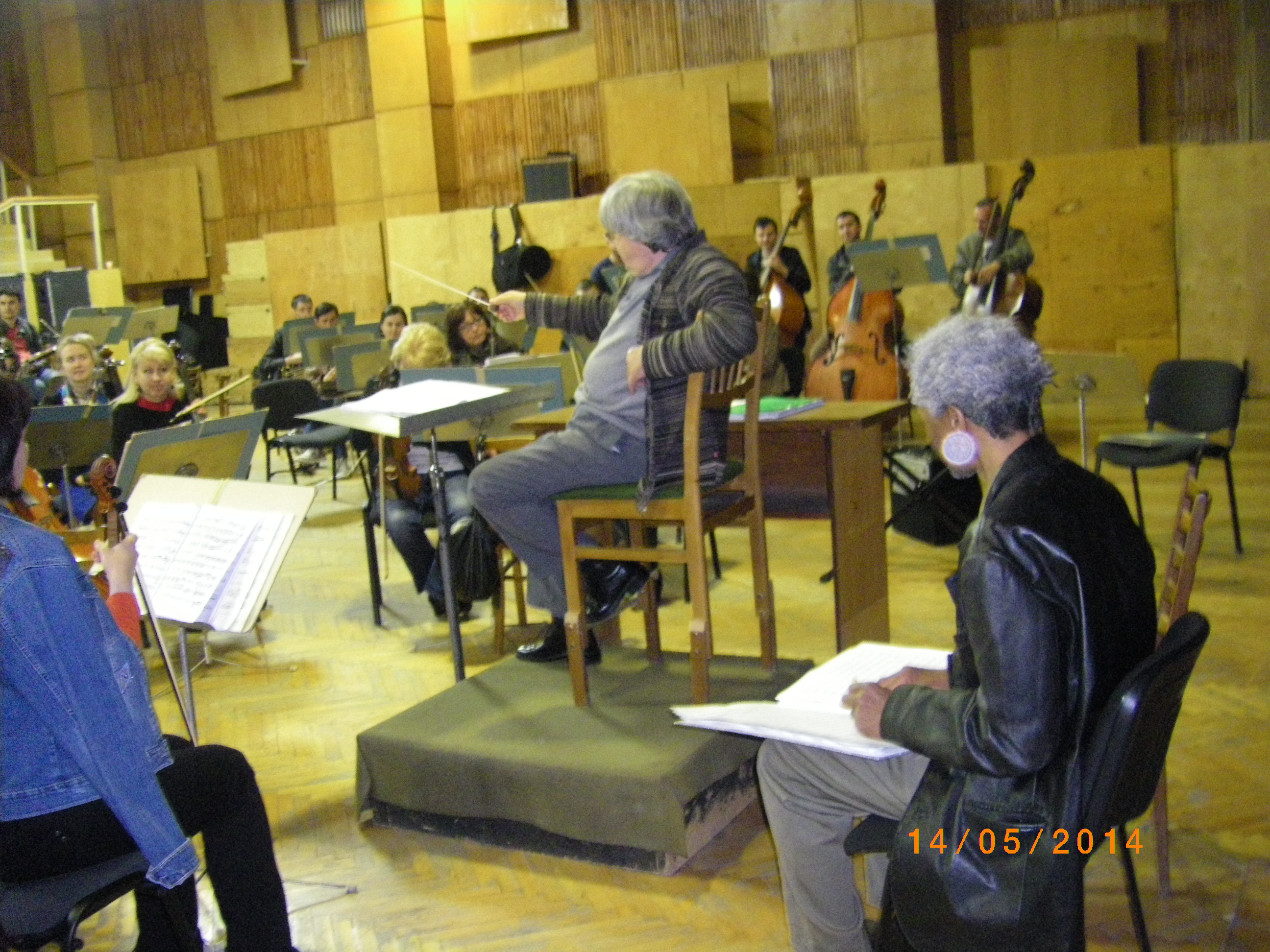
Henry Brant?…never heard of him: A Centennial Sketch


Aerial photo: Santa Barbara, California

Aerial photo: Santa Barbara, California (Photo credit: Wikipedia)

I was sitting in the Sojourner Cafe, my favorite little restaurant/hangout just off downtown in Santa Barbara, California.  I was having one of many conversations with the great and interesting staff and patrons when I mentioned the name of Henry Brant, saying he lived in Santa Barbara.  “I never heard of him” came the response from Chris, a musician when not serving at the restaurant.  No one else showed any signs of recognition either.  I proceeded to tell him about the Pulitzer Prize winning composer.  It was then that flicker of recognition came across his face.  He told me that the frail figure using his walker was a familiar sight in the neighborhood, his eyes widened with interest as I told him about this major American musician.

Henry Brant

Henry Brant (1913-2008) was born in Montreal, Quebec, Canada to American parents.  His father was a professional musician. Henry played violin, flute, tin whistle, piano, organ, and percussion at a professional level and was fluent with the playing techniques for all of the standard orchestral instruments.   Henry went on to study at McGill University and later in New York at a school later named Julliard.  He was the youngest composer mentioned in Henry Cowell’s anthology, “American Composers on American Music” to which Brant contributed an article on what he called “oblique harmony”.

Brant, who had an early connection and affinity with the American experimental music tradition, would go on to develop “spatial music” in which musicians were scattered around the performance space as an essential part of the composition and performance.  He began writing music in the sort of post modern style of the time as in his Symphony No. 1 (1945 rev. 1950) and pithy little jazz inflected pieces like Whoopee In D (1938, Rev. 1984), Jazz Toccata On A Bach Theme (Toccata On “Wachet Auf”) (1940) and Double-Crank Hand Organ Music (1933, Rev. 1984).

He would write for unusual combinations of instruments such as Angels And Devils (1931), a concerto for flute and orchestra of flutes, Ghosts and Gargoyles (2002) also for flute and flute orchestra or Orbits (1979) for 80 trombones, organ and sopranino voice.  His first spatial composition, Rural Antiphonies (1953) predates Stockhausen’s famed experimental opus, Gruppen (1955-7).  In all he composed over 100 “spatial” works along with chamber music such as Homeless People (1997) for piano and string quartet.  His composition Ice Field (2001) commissioned by Other Minds and performed in Michael Tilson Thomas‘ “American Mavericks” series won him the 2002 Pulitzer Prize for music.

Brant had worked as an orchestrator and conductor in Hollywood assisting with scores by Alex North and with the likes of Virgil Thomson, Aaron Copland, George Antheil, Douglas Moore and Gordon Parks.  His extensive knowledge of orchestration led him to write his textbook (published posthumously) ‘Textures and Timbres’.  And one of his last musical works was the orchestration of Charles Ives‘ massive and complex Second Piano Sonata which Brant titled the “Concord Symphony”.  This major opus has been performed several times and recorded twice.  A series of recordings on the Innova label have begun to release new recordings, many of them first recordings, of Brant’s huge catalog of compositions.

Brant was a member of the American Academy of Arts and Letters and the recipient several prizes and honorary degrees.  He was and continues to be a great force in music as well as a connection the American experimental traditions of Ives, Cowell and their contemporaries.  There is much to do in researching and documenting the work of this now past master who would have been 100 years old on September 15th.  His archive of over 300 scores is now in the venerable archives of the Paul Sacher Institute in Basel, Switzerland.   But I am left with the image of the frail figure walking the streets of Santa Barbara no doubt followed by more of his industrious efforts when he got back home to his studio.  Happy Birthday, Henry!

The Feeling of the Idea of Robert Ashley: Kyle Gann’s Appreciation of the Composer


Kyle Gann Kyle Gann (Photo credit: Wikipedia)

I first encountered the work of Robert Ashley in the early 1980s when I purchased the Lovely Music vinyl LP titled ‘Private Parts: (the record)’. It contained two tracks, one on each side, called, respectively, ‘The Park’ and, ‘The Back Yard’ (which happen to be the first and last acts of ‘Perfect Lives’). I took to the music rather quickly listening to its various layers of musical sounds and Mr. Ashley’s unique voice intoning the equally unique and unusual texts.

That record earned a special place in my mental favorites library (iTunes had yet to be invented) and spurred me on to the purchase of more of Ashley’s music. But other than the liner notes (which I read closely and repeatedly) there was surprisingly little information on this mysterious and wonderful composer whose music and words so captured my sensibilities.  The publication of this volume, ‘Robert Ashley’ (one of a great series of books on contemporary composers from the University of Illinois Press) fills this long standing void in the realms of music scholarship and biography.

I encountered the author’s work at about the same time as I did Ashley’s.  He was writing fascinating and accessible reviews in the local (Chicago) free newspaper, ‘The Reader’. He would later be selected as classical music reporter for New York’s ‘Village Voice’. Kyle Gann, composer, critic, musicologist and new music raconteur contributes a most essential work to help fill that void. His biographical sketch, analysis, bibliographic and discographic references serve also as a much needed exegesis of Robert Ashley’s work.

As it happens, the author was involved in the premiere of ‘Perfect Lives’ when he was a student at Northwestern University in Illinois in 1979. He developed and maintained a close connection with the composer and his music.

Photo by Joanne Savio, 2006 Photo by Joanne Savio, 2006

Robert Ashley (1930- ) is an American composer born in Ann Arbor, Michigan. His experience growing up in the American Midwest informed his vision, speech and temperament affecting his compositional style. He spent the formative years of his youth in Ann Arbor.  He studied at the University of Michigan with Ross Lee Finney and at the Manhattan School of Music earning, respectively, undergraduate and graduate degrees in music.  Ashley declined an offer to pursue a doctorate in speech pathology (one of his many interests) to pursue music.  He organized and participated in the ONCE Festival of contemporary music in Ann Arbor from 1961 to 1969.  In 1972, he accepted an appointment at Mills College as director of the Center for Contemporary Music succeeding Pauline Oliveros, Lowell Cross and Anthony Gnazzo. In 1978 he left for New York which would become his new creative home base.

Ashley and his collaborators have performed internationally and a great deal of his music has been recorded.  His collaborators include Alvin Lucier, Gordon Mumma and David Behrman (who along with Ashley formed the performing group Sonic Arts Union), Roger Reynolds, “Blue Gene Tyrrany”(aka Robert Sheff), Pauline Oliveros, filmmaker George Manupelli and many more.  There were recent performances in New York and Miami of his early operas and a big new opera ‘Quicksand’is reportedly in progress and due to be premiered some time after this book was issued.
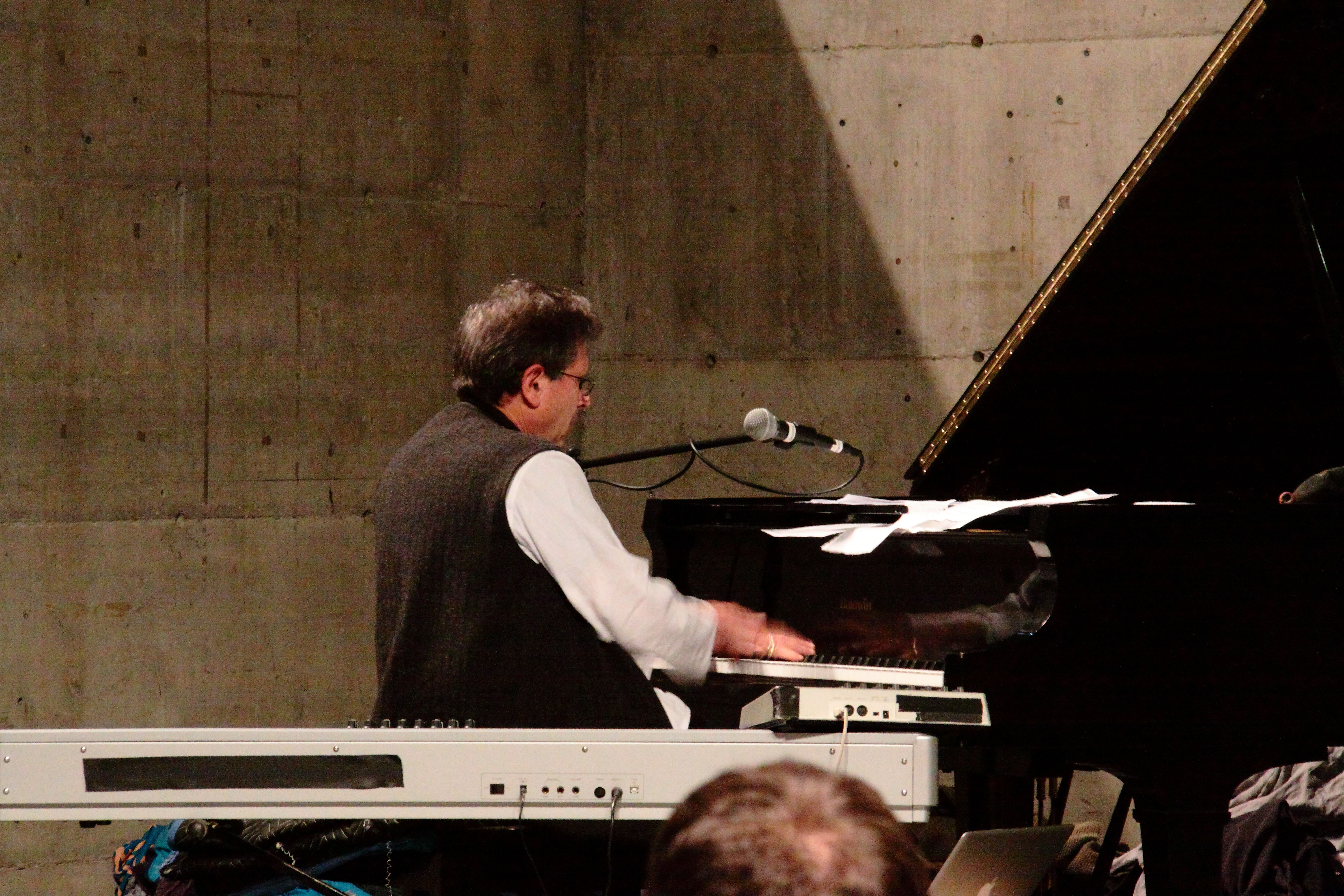
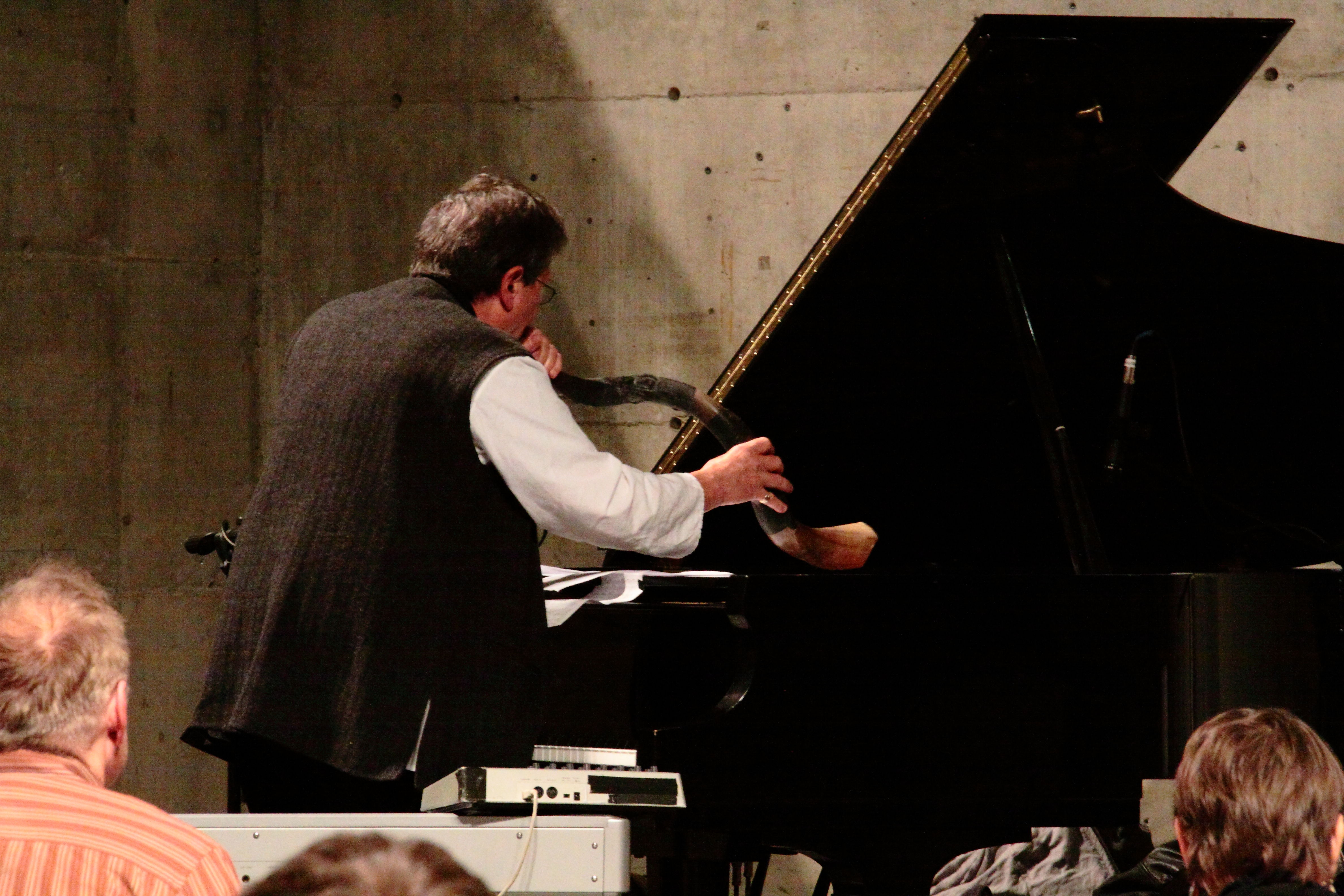
Gann acknowledges the limitations of his analyses saying quite correctly that Ashley’s work will require more time as well as access to the composer’s sound archive and consideration of his unrecorded works. He never pretends that this is more than a relatively brief treatment of a very large subject. Many works are not analyzed and little attention is given to either the ONCE Festival or the Sonic Arts Union.  His collaborations and influences get little space.  And George Manupelli’s films for which Ashley composed soundtracks deserve a book to themselves.  Nevertheless there is an awful lot accomplished in under 200 pages.

Gann discusses some of Ashley’s early works, his involvement in the too little known ‘ONCE festival‘ and his very important time teaching at Mills College where he became director of their Contemporary Music Center. But the real substance of this book comes in Gann’s analysis of Ashley’s operas which most certainly form the core of his creative output. It is the music that gets the closest attention here.   The author’s detailed analyses of the rhythmic schemes and harmonic structures that underlie the (mostly spoken or chanted) texts reveal the complexities of these deceptively simple sounding and seemingly impenetrable works and provide a means of appreciating and even understanding these unusual pieces that hardly fit any conventional definition of opera.

Gann also discusses some of the literary and intellectual ideas that permeate Ashley’s work.  The ideas come from a variety of sources including speech, speech pathology, geography, television, film, history, culture, the Tibetan Book of the Dead, writings of the Italian mystic and martyr Giordano Bruno and the writings of scholar Frances Yates in ‘The Art of Memory’ and ‘Giordano Bruno and the Hermetic Tradition‘ among many others.

Beginning with the earliest ‘Music With Roots in the Aether’ and then continuing with the most familiar ‘Perfect Lives’ the reader is treated to loving and insightful descriptions of the series of works which comprise his trilogy: ‘Atalanta’, ‘Perfect Lives’ and ‘Now Eleanor’s Idea’.  He proceeds to subsequent opera projects and “spin off” works.  At one point Ashley told Gann that he had figured out the structure for his “next 72 operas”.  This writer is eager for more on the man, his works and his wide artistic circle.

The electronic version of this book (unlike that of Gann’s ‘No Such Thing as Silence’) contains all the images in the hard copies and is formatted, for the most part, very skillfully.

If you already know and love the work of Robert Ashley this volume will deepen your appreciation and if you don’t know this man’s work this is the book which will tell you why you should.
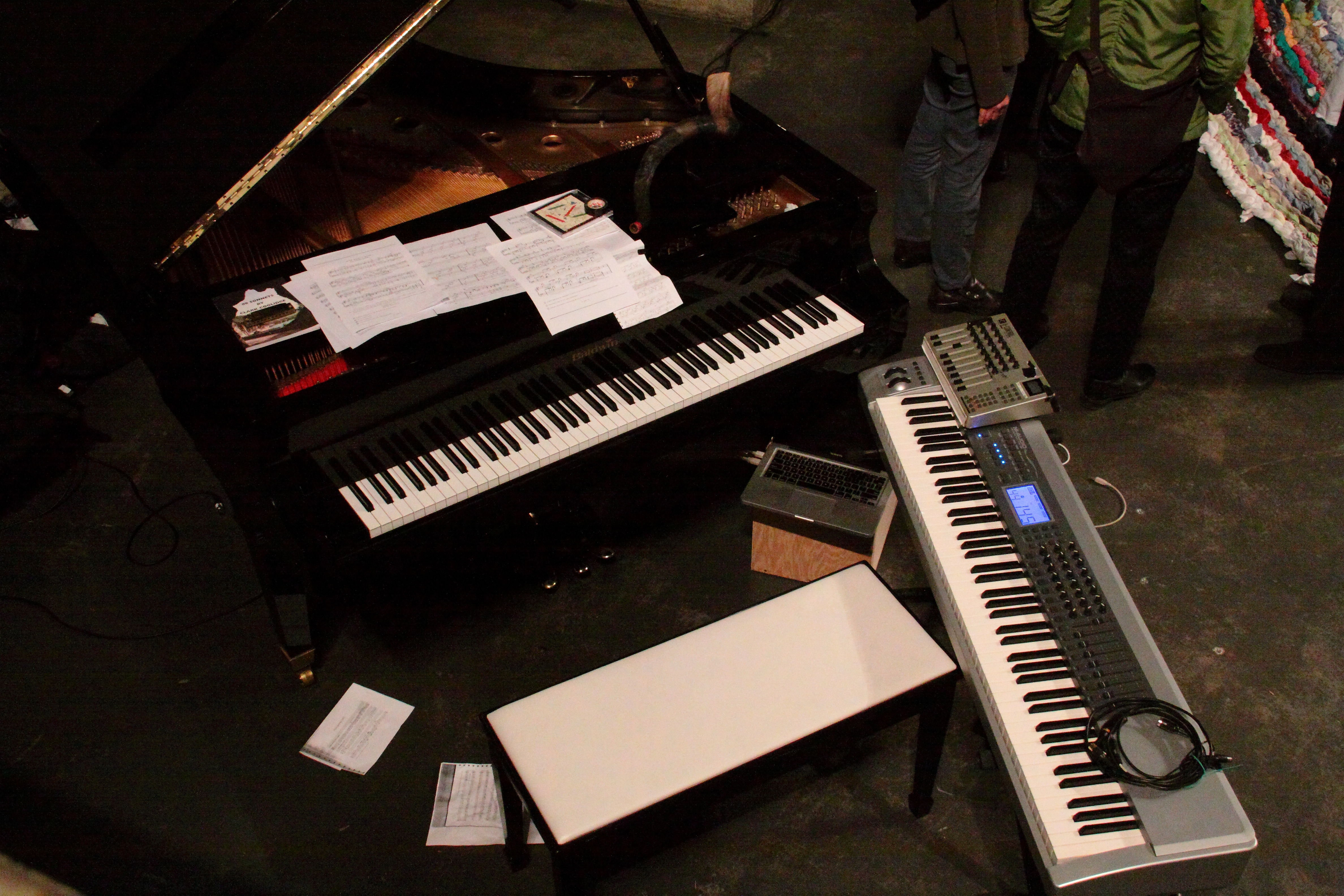
Guitar Gods Go Classical? Give them a ‘Secret Rose’


Cover of "Crimson Grail"

Cover of Crimson Grail

The implicitly condescending appellation “Guitar God” has been perhaps somewhat jealously applied to virtuosic guitarists in various popular rock bands. Whether your taste runs to Eric Clapton, Jimmy Page, Jimi Hendrix or Eddie Van Halen you cannot discount the technical skill of these and so many other rock/pop guitar players.

Rock and pop artists have distanced themselves from the classical music circles who initially disdained and even condemned their work. But that did not and does not mean that they eschew classical music. Many were initially schooled in classical performance technique and/or were provided a favorable view of some classical masterpieces.

Ian Anderson’s group ‘Jethro Tull’ utilized a movement from a Bach Lute Suite (taking a few rhythmic liberties) in their piece, ‘Bouree’. Roger McGuinn of ‘The Byrds’ acknowledged channeling Bach when he created the now instantly recognizable intro to their version of Bob Dylan’sMr. Tambourine Man‘. Rick Wakeman, keyboardist of the band ‘Yes’ as well as a solo artist peppers his work with snippets of classical melodies no doubt learned in his piano lessons that served him so well. Keith Emerson of ‘Emerson, Lake and Palmer‘ went as far as to write a piano concerto.

From the classical side of the aisle there have been composers who wanted to utilize some of the techniques and ideas of rock and pop within the context of their classical training. Stanley Silverman wrote an opera titled, ‘Elephant Steps’ which was championed by the ever eclectic Michael Tilson Thomas. (This piece deserves at least a second hearing and I hope that Columbia will some day release it as a CD.)

Leonard Bernstein, no stranger to popular musical theater, embraced rock and blues including such ensembles alongside the orchestra in major works such as his ‘Mass’. Similar, though less successful collaborations occurred when symphony orchestras were added to the production of albums by the likes of ‘Deep Purple and, more notably, ‘The Moody Blues’.

Many such collaborations have been and occasionally continue to be attempted but the end result most often appears to keep the division between classical and ‘pop’ rather separate. That is not necessarily a bad thing either. Philip Glass‘ work appears to have been pretty heavily informed by rock music. He played piano in a couple of tracks on one of the New York punk rock band, ‘Polyrock’. The driving rhythms of rock are endemic to much of Glass’ music. Steve Reich’s work as a jazz drummer seems to be evidenced in his intricate use of rhythm patterns in his music.

So while ‘pop’ musicians incorporated some of their classical training and influences and ‘classical’ musicians acknowledged and collaborated with their pop counterparts the classical aspects remained for better or worse more decorative than organic. Jazz became an organic part of many classical works starting in the 1920s. And, as mentioned before, rock influences have certainly found an organic role in the music of Philip Glass and, more recently in the music of Michael Daugherty.

Along came Glenn Branca, Rhys Chatham, Jeffery Lohn and their various collaborators. These musicians with strong roots in rock music began to explore what has become, in this writer’s opinion, the epitome of the organic implementation of classical music into the ‘pop’ medium. Using primarily guitars (in ever-increasing numbers) as well as drum kits and the usual accoutrements of rock bands these musicians began writing music that is definitely not pop or rock (neither does it actually resemble classical at times).

English: A self-portrait photograph by and of ...

English: A self-portrait photograph by and of Rhys Chatham. (Photo credit: Wikipedia)

Branca who had worked with Jeffrey Lohn began writing his Symphonies in the 1970s. They now number 12 or 13. Working with multiples of guitars, modified keyboard instruments, alternate tunings and basking in the glory of loud he has created an arguably classical set of works grown out of clearly rock/pop beginnings.

Rhys Chatham, a trumpet player initially, worked with Branca and Lohn for a while and began to develop his own classical path within the rock ethic. Beginning with Guitar Trio (1977).   And continuing into increasingly massive multiple guitar works he has created another distinct set of works that are clearly not rock or pop. He does not use the classical form titles like ‘symphony’ favored by Branca but these pieces like, ‘An Angel Moves Too Fast to See’ and ‘Crimson Grail‘ feature large numbers of guitarists which by necessity must be locally sourced. Even without classical form or titles these are clearly not pop or rock pieces. And perhaps they can’t be called classical either but they are certainly of symphonic proportion.

Both Branca’s and Chatham’s works have been recorded and I highly recommend the recordings. But these musics cannot be fully captured by current recording technology. The acoustics of the space in which they’re performed and the volume levels which elicit their own effects are best experienced live because of the volume levels and also because of the overtones which are elicited by the instruments in the performing space and more audible because of the overall volume and the characteristics of the listening space.

Such a rare opportunity awaits Bay Area audiences this November when Rhys Chatham comes to town under auspices of ‘Other Minds’ and the delightfully insightful and eclectic producer Charles Amirkhanian. They have engaged the architecturally and sonically fascinating space of the Crane Pavilion in Richmond (a few miles north of Berkeley and Oakland) with sweeping views if San Francisco Bay and enlisted many locally sourced musicians to produce the west coast premiere of Chatham’s “A Secret Rose” (2011) for 100 guitarists.

Official Other Minds logo

Official Other Minds logo (Photo credit: Wikipedia)

Tickets can be purchased through the Other Minds website (www.otherminds.org).

This is a rare opportunity to hear a uniquely different music in a visually stunning and acoustically interesting space.  Hope to see you there.


Can Videos Promote New and Difficult Music?


Español: Logo Vectorial de YouTube

I write music as a hobby, to learn about music and to express some ideas. I have recently discovered  You Tube to be a useful forum to find new and interesting music. I decided to post two pieces (among others) on to share and to get reactions. In the ensuing two years I have had and listens (respectively), a few favoritings and a few comments. I am fine with this.
soundcloud
I also subscribe to a few channels which feature the sort of new music of which I am a fan. These channels offer videos (of varying, frequently mediocre images or even just one still image for the entire length of the piece) with a soundtrack of a wide variety of contemporary music, much of it not generally or easily available. In most cases I have found the images superfluous or even unrelated to the music at hand but, no matter, I just wanted to hear the music.

Then, in a little “aha” moment, I wondered if I could get more “hits”, more people listening to some of my music by posting videos. So I took a little time to figure out the video making program on my computer and put together two videos using a series of still images gathered on the Internet. I did try to choose images with some relevance to the music (but the videos are admittedly mediocre) and I posted these brief videos on my newly created YouTube channel one year ago.

Well, guess what, in the space of one month I got more hits than I received in a year on Soundcloud. Now this is not to denigrate Soundcloud or to promote YouTube. This is quite simply a limited experiment, maybe a pilot study if you will.

One year later the gap closed on with the first piece having more listenings on Soundcloud than You Tube and the other widening the gap with more views on You Tube .

I’m not sure how to interpret the results but I offer here a few speculations for discussion:

First, YouTube is clearly a more popular medium. It has been around longer and gets a lot of traffic. It is also set up with topics by which you can reference your music (piano music, classical music, etc.). This gives the search engine ways to index your video by things in addition to title and author which, as far as I can determine, is not the case with Soundcloud. Soundcloud allows you to tag your sounds but I am not as certain that their search engine handles them in the same way.

Second I have to wonder if the medium of the Internet either lends itself or has been developed in such a way that users are more easily drawn to the audiovisual rather than just the audio. Even unrelated or pedantic images stir more interest than watching the progress bar on Soundcloud for certain. But one could also say that the images distract from the music.

Third, I wonder if people are now actually being socialized to expect the audiovisual experience and to have a shorter or no attention span for audio alone. I wonder if this could be a factor in the attraction of audiences to concerts which don’t have as strong a visual component.
Certainly heavily produced rock and pop concerts have set expectations for their audiences. But even the experience of listening to jazz or blues in smaller venues has visual components in seeing the stage presence of the musicians and the reaction of the audience. And stage lighting generally seems to have a different character than that of a formal concert hall or chamber venue.

Of course I am talking here specifically about music which already seems to have a limited audience and one which has rightly come to expect some serious challenges in the listening experience (think Xenakis, Nancarrow, Reich, Rihm, Boulez, etc). I have many times seen the puzzled faces of musicians and composers to whom I have spoken when I share my familiarity with their work and my ongoing interest in it. They seem almost to be asking themselves what must be wrong with this essentially non-musician that drives him to subject himself to concert experiences that would bore and/or frighten and confuse many audience members. It is safely assumed by performers of new classical and free jazz that their audience will likely have limited familiarity and have difficulty grasping their compositional ideas. And in my experience many concert goers are curious (or brave) but have very little knowledge to support their understanding and appreciation of what they hear. Some purists might say that one should simply give in to the experience but I think that is naïve.

Now this is not to say I feel any hostility or condescension. Quite the opposite. Once the composers and performers figure out that I am simply a curious and interested consumer they are invariably extremely appreciative. (The most frequent question I get is something like, “How do you know this?”). I think it is a safe assumption that the average audience member is not steeped in the esoteric or obscure realms in which these musicians usually work and that finding such information requires more than average effort. I am appreciated as an outlier and that’s fine with me. The problem I have is that, at some level I can’t imagine why someone would not be fascinated by the likes of Cecil Taylor, Milton Babbitt, Steve Reich, The Art Ensemble of Chicago, etc. I just find new music compelling and find myself driven to learn about it and experience it.

But I digress. My main point has to do with the level of interest gained by audiovisual vs. audio alone in presenting music on the Internet. And I can draw no definitive conclusions from such meager data but I did find a difference. I think that pretty much anything that gets people listening is probably a good thing. I am a star on neither Soundcloud nor YouTube but I
now suspect that I can find a larger audience with videos than with audio alone. Perhaps if I had some silly animal videos to which I could append my music I could achieve the digital dream of “going viral”. Or maybe not. But at least you will have listened once.

20130604-093127.jpg

Music 109, Alvin Lucier’s personal view of the post 50s avant garde


20130604-083336.jpg

This little volume is an endearing record of an undergraduate course, a music appreciation course designed for students with an interest in the music of the avant-garde of the 1960s, 70s and 80s taught by a man who was an integral part of that era as a composer, performer and teacher. The class, which he taught at Wesleyan University was reportedly very popular continues to be offered today. And this book is required reading for fans of new and experimental music.

In just over 200 pages Professor Lucier takes the virtual class of readers through a very personal journey of the music, experiments and performances of some of the highlights of some of the major works and composers of this time period. And he manages to navigate all this wildly experimental music in a way that is understandable to a general audience (remember that this is an undergraduate course for non music majors).

What makes this book so special and unique is its personal nature (Lucier was a composer, performer, organizer and interpreter of much of the music) and the particular networks to which he connects. Few historians save for Kyle Gann pay significant attention to the techniques which arose from the orbit of Ann Arbor, Michigan and composers like Robert Ashley, Gordon Mumma and Lucier himself among many others. But this group is indeed an orbit and not a universe unto itself. David Tudor, for example, crossed paths with these composers as well as, more famously, with John Cage and the New York School.

This delightfully readable volume narrates Lucier’s vast experience with and love for a variety of experimental trends. Lucier writes of his own works and places them within the contexts of fellow innovators including the above mentioned artists as well as diverse voices such as Pauline Oliveros, Philip Glass, Steve Reich, LaMonte Young, Roger Reynolds, Gordon Mumma, Robert Ashley, Earle Brown, Morton Feldman, John Cage, Christian Wolff, David Tudor, Karlheinz Stockhausen and many others. This personal inside view makes for entertaining and compelling reading which provides a historical context as well as insights to the “method behind the madness” of a diverse and innovative time in music history.

Except for Kyle Gann’s fine volume on Robert Ashley this is the only book length treatment (known to this reviewer) of artists connected with the ONCE festival and the Sonic Arts Union. Lucier’s place in music history is connected across east coast academia as well as far less academically connected groups like these. This book connects some of those dots placing an important perspective on this era.

Earlier this year I had the pleasure of speaking with Paula Matthusen, a composer who now teaches at Wesleyan. In fact she has inherited this delightful and inexplicably popular course. She told me that not only does the course continue to be popular, many of the students come in with some level of experience of this music and a desire to know more. How cool is that?

Matthusen shares many of her teacher (Lucier’s) concepts in her own work but she is clearly the next generation in experimental music reminding us that art of the era documented is receding into the past yet we hardly know it. And how can we appreciate the latest work without some understanding of how we got there? Lucier’s book provides a great introduction and hopefully will encourage more attention to this important and fascinating time in American music history.

Music Apps for the Educated Consumer


Image representing iPad as depicted in CrunchBase

Image via CrunchBase

While I sometimes write music I spend far more time listening to and writing, or at least thinking, about music. And my performing chops need not even be discussed. But my compelling interest in music has been aided by my continuing efforts to improve my ability to read music.

I recall as a teenager the geeky thrill I got out of receiving an omnibus volume of orchestral scores which included Berlioz’ ‘Symphonie Fantastique’, Dvorak’s 9th and Rachmaninoff’s 2nd among others. The scores were compactly produced so as to fit a lot of music on not a lot of pages but they were readable. I spent hours learning to follow along as best I could learning along the way many of the subtleties of the music and enhancing my appreciation.

Now the digital age has at least a couple of apps for that. I recently downloaded the ‘Open Goldberg Variations‘ and the Beethoven Ninth apps from, of course, the Apple store to my iPad.

Open Goldberg Variations on iPad

Open Goldberg Variations on iPad (Photo credit: musescore)

The ‘Open Goldberg Variations’ is a free app that includes a complete performance of Bach’s ‘Goldberg Variations‘ on the piano by Kimiko Ishizaka as well as a complete score with a cursor that handily shows you your place in the score as it is played.  This is a useful learning tool on many levels.

It is a creative commons zero license which is basically public domain and is available for free.  You can download an mp3 file or a wave file and you can download the iPad app which contains the recording and a score which is executed on the open access Muse Score composition program.

I have also downloaded the Muse Score program (available at musescore.org) and find it to be an extremely flexible and constantly developing platform that provides many compositional and analytical tools for a budding composer or a professional one included nested tuplets, harmonic analysis, provision for alternate tuning systems and a host of user created options as well.  I intend to write more about this as I negotiate the learning curve.

Another iPad app which I recently downloaded is called, “Beethoven’s Ninth Symphony“.  It features 4 different recordings of the symphony (Ferenc Friscay and the Berlin Philharmonic from 1958, Herbert von Karajan and Berlin Philharmonic from 1962, Leonard Bernstein and the Vienna Philharmonic from 1963 and John Eliot Gardiner with the Orchestre Revolutionnaire et Romantique from 1992).  With each recording you can follow the score in contemporary notation fonts, the original manuscript in reproduction or a graphical representation of the orchestra highlighting which instruments are playing at a given time.  In addition you can view what they call a “curated score” in which only the score parts for  the instruments which are playing are shown.

Page 12 (right) of Ludwig van Beethoven's orig...

Page 12 (right) of Ludwig van Beethoven’s original Ninth Symphony manuscript. (Photo credit: Wikipedia)

There are indicators of the key in which the orchestra is playing to aid in understanding harmonic modulations as well as a running commentary on what is happening in the music in a sort of poetic description written by David Owen Norris.  The app, which retails for $13.99 USD seems to me to be a bargain for the interested listener or the student.

Learning to read music has greatly enhanced my ability to appreciate music and I think these apps are delightful and easy to use learning tools.  I look forward to more of these in the future.

I wonder too if we will begin to see audience members following scores on their iPads in concerts.  Interesting development.  Perhaps this will motivate composers to do some creative interactive things with iPad apps in the concert forum.