Certitude and Joy, the World of Wold


MinMax 019

MinMax 019

This is one of those operas whose title evokes irony right at the start.  Like Ruggero Leoncavallo‘s “Cavalleria Rusticana” (Rustic Chivalry) and Virgil Thomson‘s “Four Saints in Three Acts” the title Certitude and Joy hardly seems to evoke the right emotions in this harrowing story taken right from the headlines of a case in 2005 in which a mother kills her children and dumps their bodies in San Francisco Bay.  This is contrasted with the biblical story of Abraham and Isaac in which God tells Abraham to slay his son.  Of course God stopped Abraham in the bible story but that was not the case with the more recent story.

English: portrait of composer Erling Wold, pai...

English: portrait of composer Erling Wold, painted by Lynne Rutter. oil on panel, 2002 (Photo credit: Wikipedia)

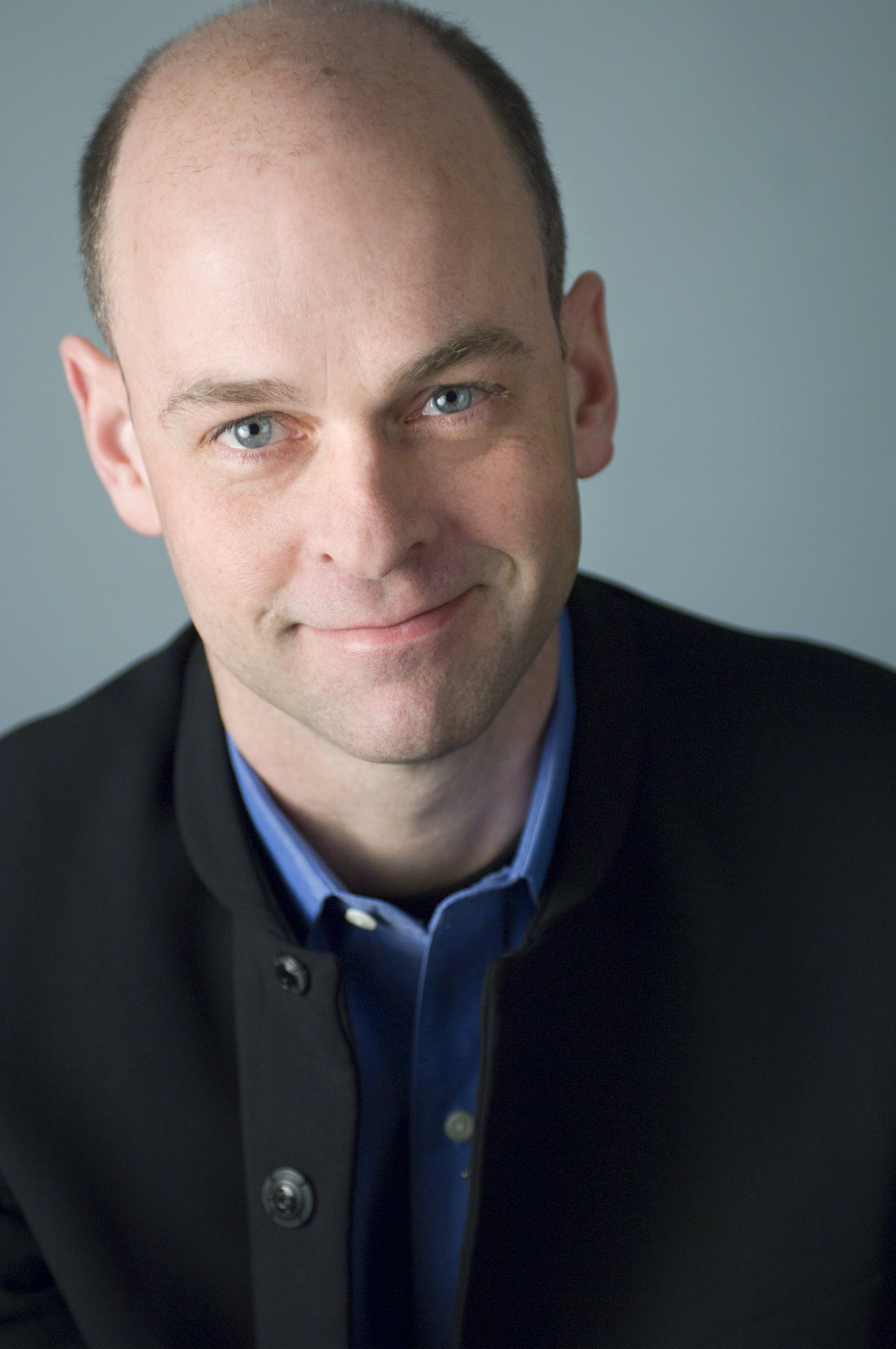
Erling Wold (1958- ) is a composer of whom I had been only distantly aware.  He is a California native and has studied with Andrew Imbrie, Gerard Grisey and John Chowning.  That right there gives you a clue to this man’s compositional range and skills.  He completed a Ph.D. from the University of California Berkeley in 1987 and has worked for Yamaha creating new synthesizer programs in addition to pursuing his musical interests.

The San Francisco Bay Area has such a rich and varied musical culture that it is not all that surprising to me that I hadn’t come to know this fascinating composer.  And it’s taken me a while to absorb enough about Mr. Wold to feel that I could write something intelligent about this CD.

The composer’s web site (click here) contains a plethora of scores and sound recordings of this prolific and interesting composer.  And there are numerous offerings on You Tube and there is a blog linked on his web site in which he discusses a variety of topics not the least of which is his own music.  It seems that he has created several operas including one based on William S. Burroughs’ early but long suppressed novel, Queer.  His chamber operas, A Little Girl Contemplates Taking the Veil and his opera on Pontius Pilate illustrate his interest in both religious and political themes.

I won’t even try to get into his orchestral, chamber and solo piano works.  That is the job of a future blog which I can assure you will happen.  But the main point of this blog is to look at this most recent offering of his chamber opera Certitude and Joy.

As best as I can describe in words, Wold’s accompaniment figures remind me of Philip Glass or John Adams at times but he is not a simple derivative  of these composers.  His vocal lines, almost all sung as opposed to spoken, are more like recitatives than arias and  suggest a more ensemble feel as opposed to the grand opera style of arias, duets, etc.

Aldous Huxley, Famous Last Words

Aldous Huxley, Famous Last Words (Photo credit: Wikipedia)

His libretto, ripped from the headlines so to speak, is a combination of philosophical musings, imagined dialogue and commentary from texts as diverse as Aldous Huxley’s writings on psychedelics and the more pedestrian musings of newspaper columns.  I think there is some affinity for Robert Ashley’s mysterious texts but again nothing derivative.  The work is perhaps political as social commentary but not as social protest.

What is important is that this work, thinly scored (though hardly thin in sound) for two pianos and a cast of singers, speaks directly and affectingly to the audience.  He manages to tell this tale in a fairly straightforward manner with occasional digressions for philosophical commentary.  But he never loses control of the narrative which flows on drawing you in to this sad story and leaves you with the questions he raises, albeit rhetorically, about the nature of religious revelation, mental  illness and the current state of our society and our world.  This is a tall order but Wold manages to fill it with just the right amount of drama and music that leaves the listener (and viewer if you see it live in person or on You Tube) seemingly with exactly the emotions I think the composer wrestled with in writing it.

Like the aforementioned Four Saints and Cavalleria, Certitude and Joy is a listener friendly opera with messages that are disturbing and go to the core of what it means to be human.  The performances by the fine duo piano team of Keisuke Nakagoshi and Eva-Maria Zimmerman (ZOFO) and singers Laura Bohn, Talya Patrick, Jo Vincent Parks, Kerry Mehling, Tranvis Santell Rowland with Bob Ernst, speaker and a cameo by the composer (I’ll leave that for listeners to find).  The beautiful recording on Paul Dresher’s MinMax label is distributed by Starkland and is available on Amazon and other outlets.  A worthwhile experience for all lovers of contemporary opera and drama.

A Glorious Other Minds 20th Anniversary


The 20th Other Minds festival completed its three concert run on March 6, 7 and 8 of 2015.  This was the first time in which composers who had appeared before came for a second time.  Ten composers were featured and a total of some 25 or so works were performed.  It also marked the first time that a full symphony orchestra was featured.

Ruth Asawa San Francisco School of the Arts Orchestra just fitting on the stage at SF Jazz

Ruth Asawa San Francisco School of the Arts Orchestra just fitting on the stage at SF Jazz

The first night opened with the wonderful guitarist David Tanenbaum performing music by the late Peter Sculthorpe who was to have attended this festival.  Sculthorpe sadly passed away in August of 2014.  Tanenbaum played his “From Kakadu” (1993) a suite for guitar in four movements.  This was moving and quite virtuosic music which was performed with passion and ease.

Lou Harrison (1917-2003)

Lou Harrison (1917-2003)

Tanenbaum followed Sculthorpe’s piece with the last composition by the beloved Lou Harrison called Scenes fromNek Chand (2001-2) played on a National Steel Guitar in just intonation.  As with the Sculthorpe, Tanenbaum displayed his well-known facility in interpretation of new music and left the appreciative audience wanting more.

David Tanenbaum holding his National Steel Guitar as he acknowledges the warm applause

David Tanenbaum holding his National Steel Guitar as he acknowledges the warm applause

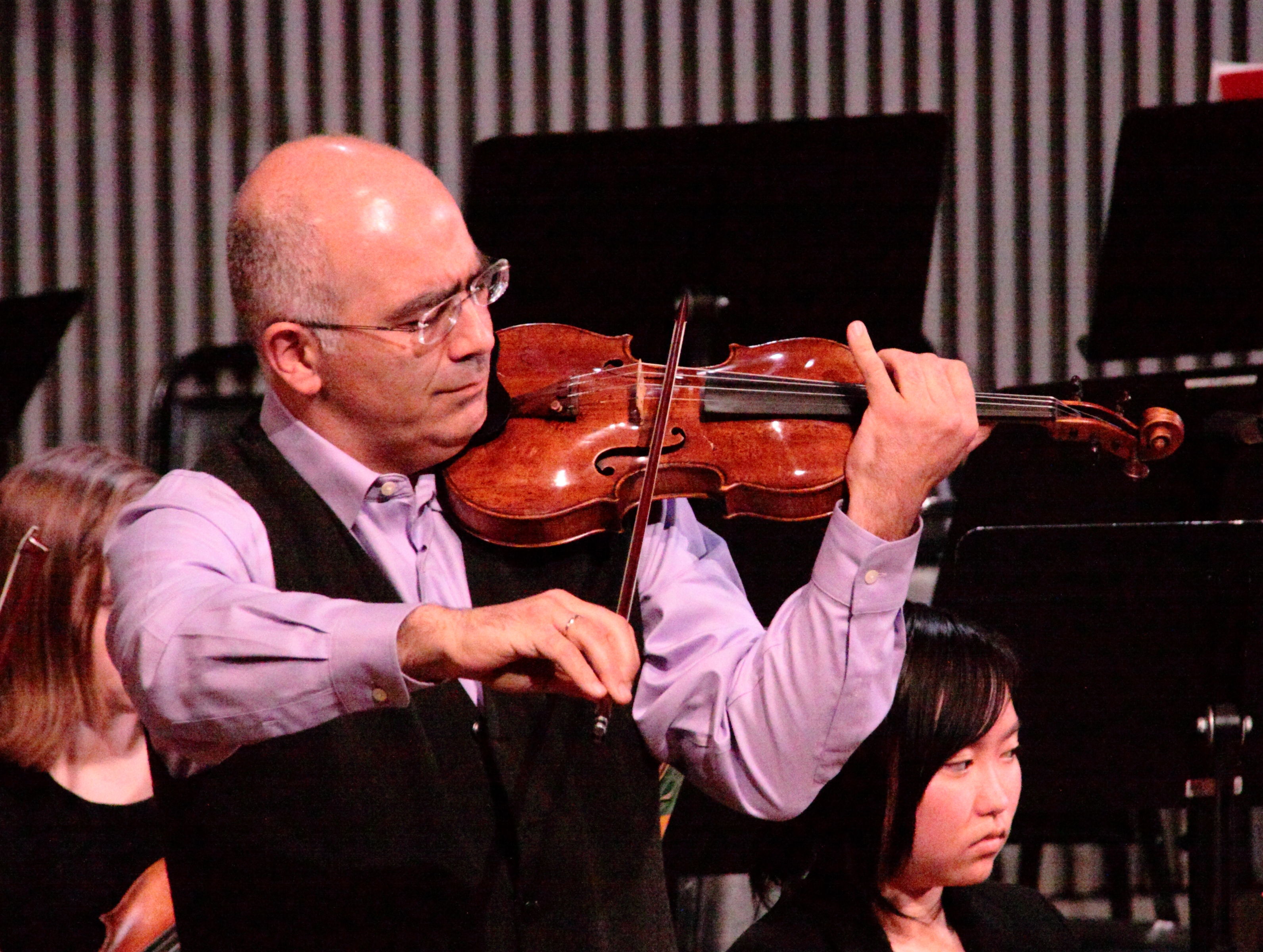
Next up was a too rare opportunity to hear a composition by Other Minds Artistic Director Charles Amirkhanian.  Bay area violinist Kate Stenberg took the stage to perform the solo violin part with prerecorded tape.  The piece called Rippling the Lamp (2007) is a musical depiction of a visual the composer saw involving the reflection of a lamp in water.  But regardless of the genesis this was a powerful and engaging piece even on a purely musical level.  Stenberg executed her part flawlessly in what was an almost romantic piece at times.

Kate Stenberg playing Amirkhanian's Rippling the Lamp.

Kate Stenberg playing Amirkhanian’s Rippling the Lamp.

Charles Amirkhanian warmly embraces Kate Stenberg following her performance of his piece.

Charles Amirkhanian warmly embraces Kate Stenberg following her performance of his piece.

And the first half concluded with a performance by the Del Sol Quartet of the world premiere of Miya Masaoka‘s Second String Quartet “Tilt” (2014-5).  This was a complex piece requiring a great deal of knowledge of special performance techniques that would be a challenge for any string quartet.  This complex work was difficult to grasp in only one hearing but it was a joy to see how easily these musicians handled the work.

The Del Sol Quartet performing Miya Masaoka's Second String Quartet

The Del Sol Quartet performing Miya Masaoka’s Second String Quartet

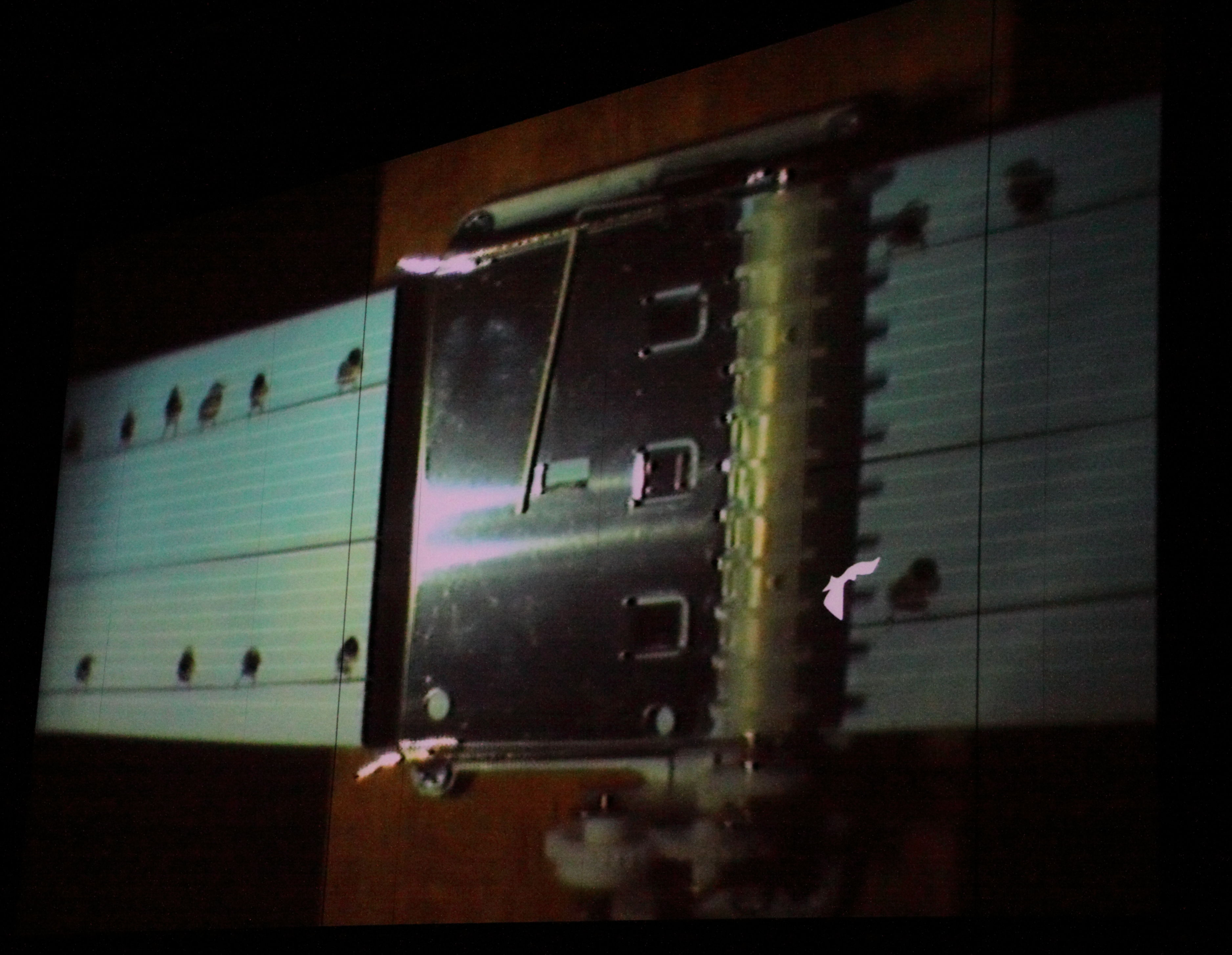
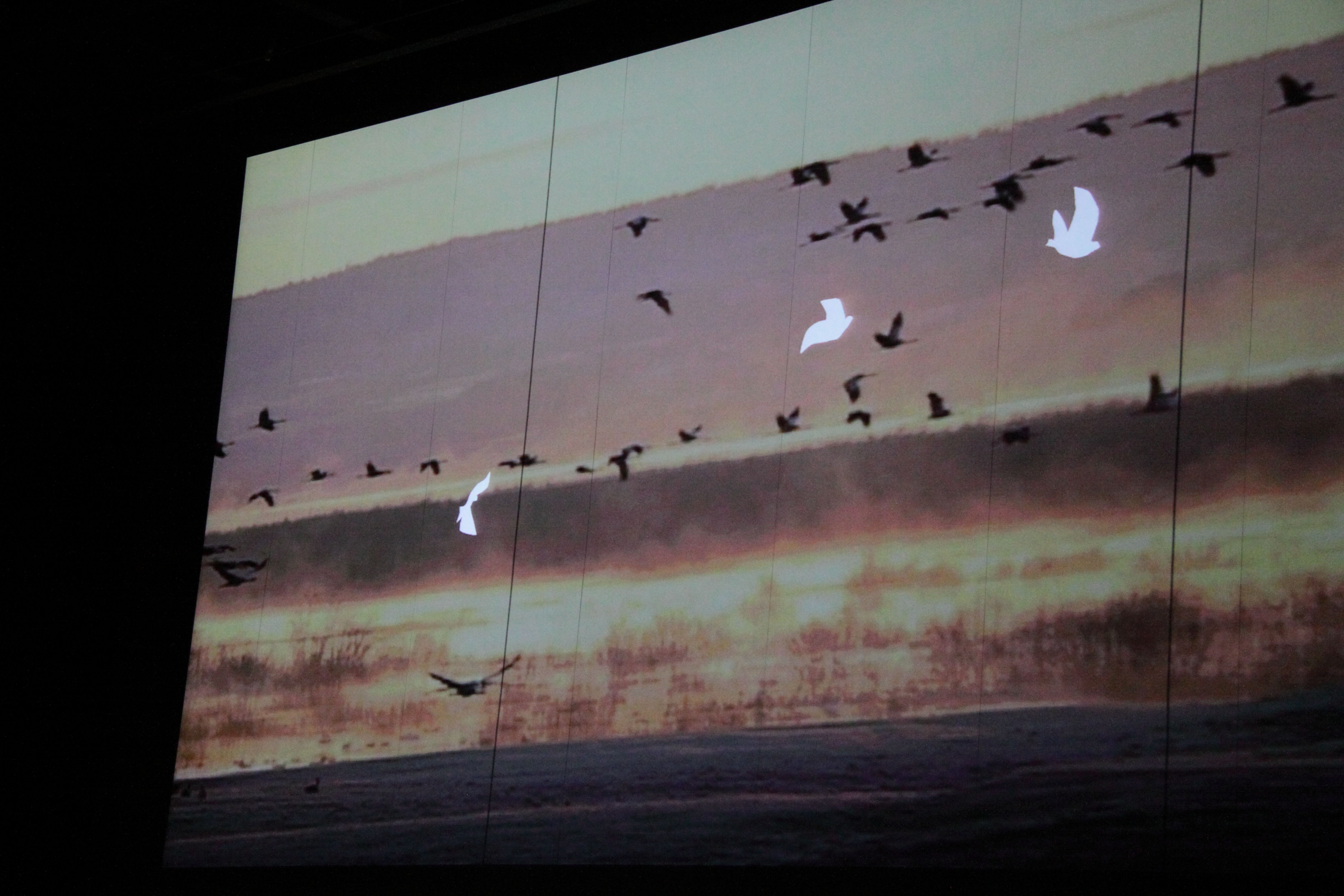
Following intermission we came to know what the origami birds were all about.  These along with video projections and a great deal of electronics came together to give utterance to Maja S.K. Ratkje’s Birds and Traces II (2015), another world premiere.  This was by far one of the most complex pieces involving a great deal of media as well as performers Kathy Hinde and accordionist Frode Haltli.  In addition to electronics and voice the musicians used bird whistles, computer controlled slide whistles and animated sculpture along with the projected videos.  This was more of the character of one of Allan Kaprow‘s “happenings” from the 1960s.  Truly a maverick piece in a concert series that prides itself on such.  The audience was clearly entertained.

Maja S.K. Ratkje, voice and electronics

Maja S.K. Ratkje, voice and electronics

OM200018 OM200019

Three scenes from the video

Three scenes from the video

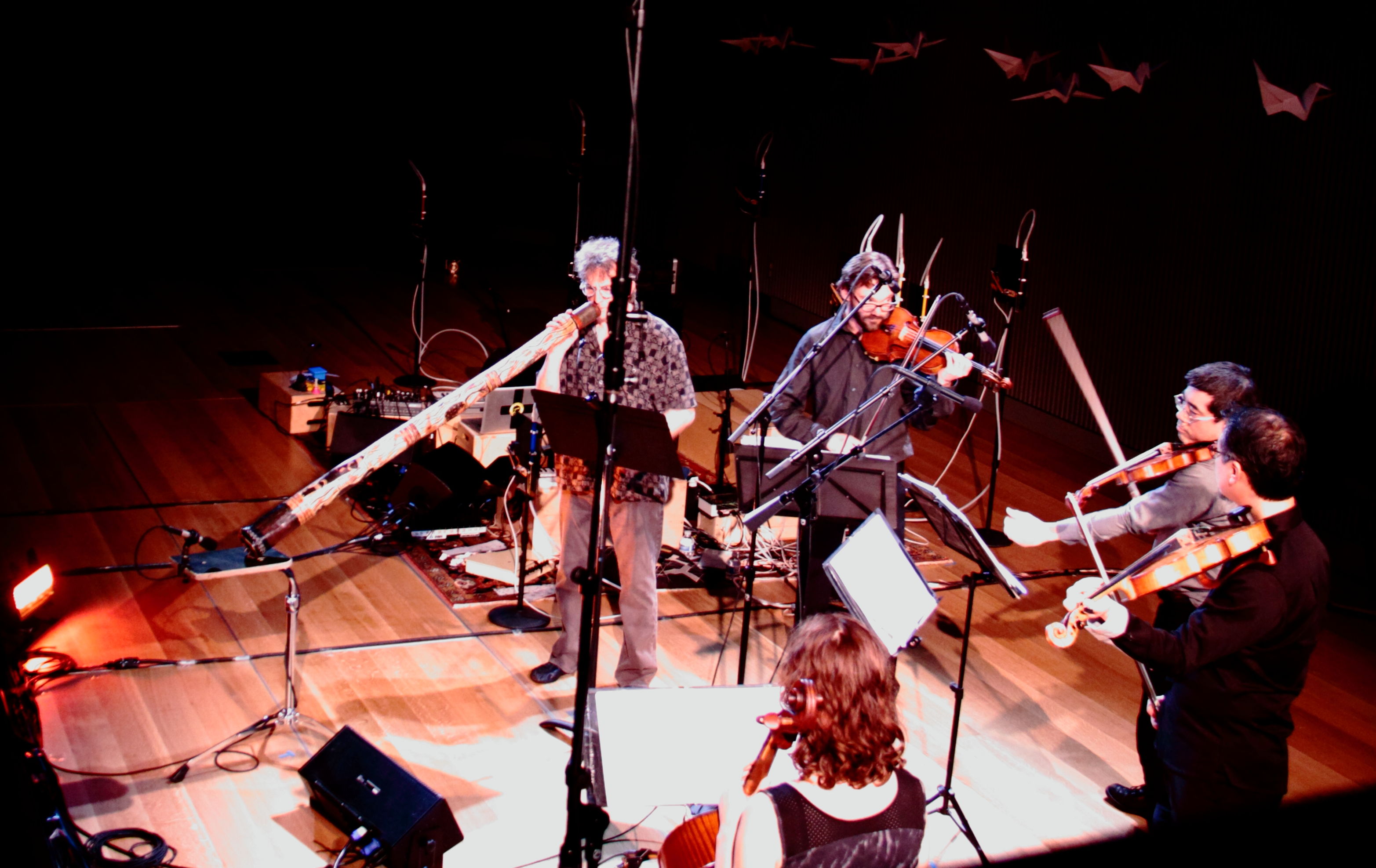
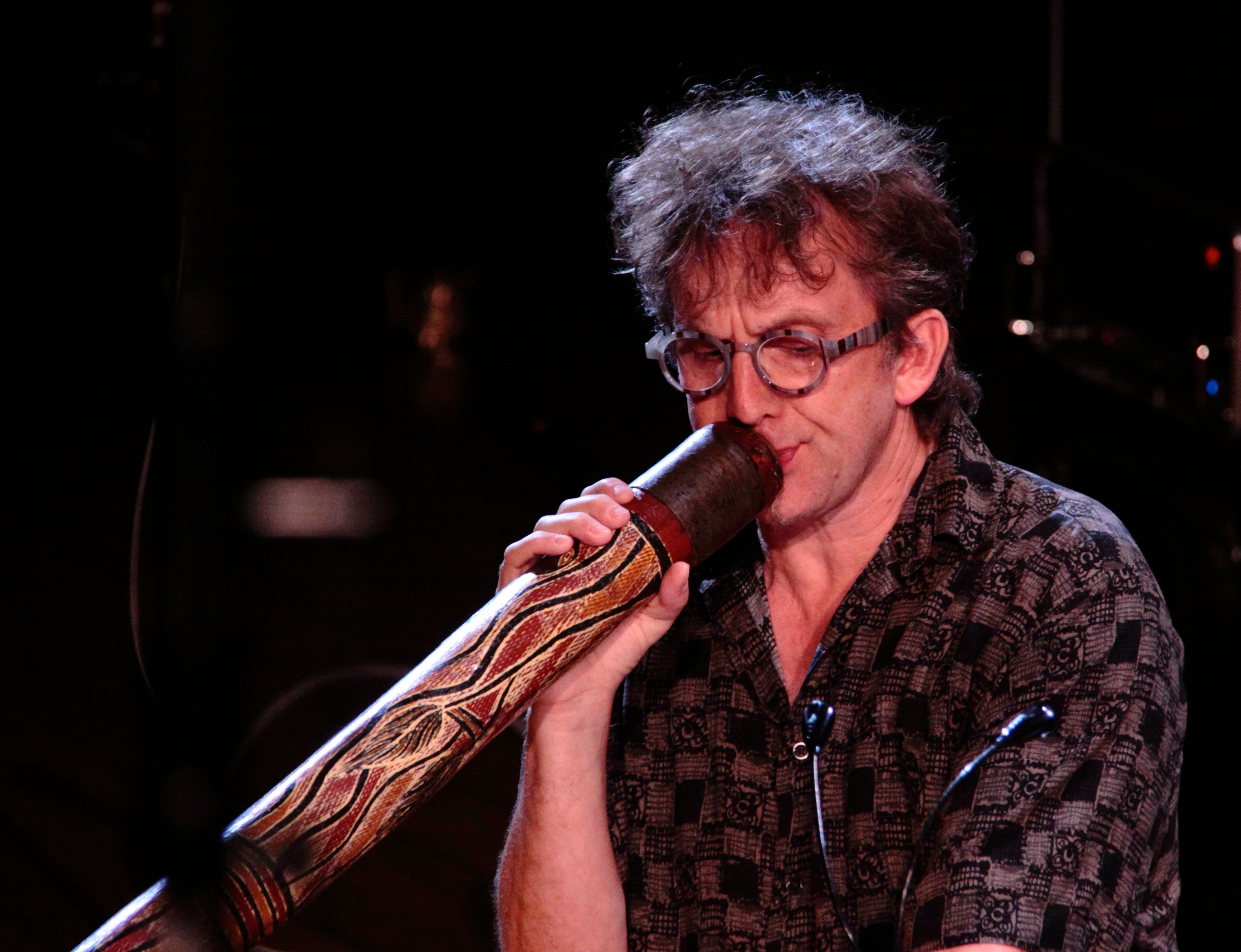
The first night concluded with a performance of Peter Sculthorpe’s String Quartet No. 14 “Quamby”(1998) which includes a didjeridu.  Stephen Kent, who played the didjeridu, spoke a warm dedication in memory of the late composer.  The Del Sol Quartet along with Kent gave a deeply emotional reading of this beautiful work (I went a bought a copy of their recording of all of the composer’s string quartets with didjeridu right after this performance).  I had heard that uniquely Australian instrument before but had no idea how expressive it could be.  The audience was clearly moved and this was a fitting deeply felt tribute to the composer.

OM200023

The Del Sol String Quartet with Stephen Kent on didjeridu

The Del Sol String Quartet with Stephen Kent on didjeridu

I took the opportunity to speak to a few people after this performance and it confirmed for me that this performance affected and moved us all in what I think is the highest achievement of a composer and a performer, that of communicating emotionally with a audience.  We all seemed to share the sadness of Mr. Sculthorpe’s passing but also the joy of his having been with us to make this music which lives on.

Peter Sculthorpe (1929-2014)

Peter Sculthorpe (1929-2014)

Those animated origami sculptures remained (though no longer animated) just above the stage for the remaining two nights and certainly added a bit of unusual flair which distinguished the look of this year’s series.  It is also worth mentioning that the stage management and creative lighting add to the professional and polished look for this series and those commonly unsung heroes deserve credit for their fine work.

Let me also mention that this year’s program booklet surveying the whole of the Other Minds series was chock full of beautiful by resident photographer extraordinaire John Fago.


The second concert opened with what was, for this writer, worth the price of admission, that of Charles Amirkhanian performing his sound poetry live with multi-track tape.  His roles as sort of the Bill Graham of the avant-garde and his previous work as music director at KPFA could satisfy a life’s work just by themselves but he is also an accomplished composer and one of the most interesting and innovative sound poets/artists of the late 20th and early 21st centuries.  So this live performance would have brought me to the theater were it the only thing on the program.

Charles Amirkhanian performing his sound poetry live with tape.

Charles Amirkhanian performing his sound poetry live with tape.

The pieces performed, Dumbek Bookache (1986), Ka Himeni Hehena (The Raving Mad Hymn, 1997) and Marathon (1997) all demonstrate the composer’s love of language and sound and, as Mr. Amirkhanian advised, his background as a percussionist.  This is music that seems to fit somewhere between poetry and music and, prior to hearing his work, I didn’t even know that there was a such a space.  His mellifluous voice, no doubt seasoned by years of hosting radio, executed the complex rhythms in sync with the tape flawlessly, just as the composer intended.

There is a humor and playfulness that is engaging as he deconstructs and reconstructs words and sounds (Amirkhanian is possessed of a great sense of humor).  The first and last pieces were plays on English language words and sounds.  The middle piece utilizes Hawaiian native language as its material.  All reflect the composer’s deep understanding and love of the sounds of languages and are intricately constructed musical compositions that deserve to be heard more frequently.  And recorded too.

Wallen performing her birthday song with the captive host of the evening looking on amused.

Wallen performing her birthday song with the captive host of the evening looking on amused.

Next we met Errollyn Wallen who performed 7 songs from her Errollyn Wallen Songbook but before she did that she surprised Mr. Amirkhanian with a newly composed song for his 70th birthday and for Other Minds 20th.  He sat, captive but appreciative as she rolled out the surreptitiously rehearsed dittie in which she called him “Charlesey” in a clearly affectionate tribute.

Errollyn Wallen at the piano with the Del Sol String Quartet.

Errollyn Wallen at the piano with the Del Sol String Quartet.

Wallen, in her set, sang first at the piano, then standing at a stage mic accompanied by the ever versatile Del Sol Quartet.  She sings a difficult to describe type of song that owes as much to jazz and pop and it does to classical and seems to have as much fun with language in song and Amirkhanian has with spoken words.  Wallen is a skilled and virtuosic performer and, as I found later when I chatted with her in the lobby during intermission, a delightful conversationalist.  Her performance left the audience wanting more but it was time for intermission and, after a grateful bow, she exited the stage.

This is the first time that this writer had heard her work and I can tell you that its friendly melodies and rhythms combined with her facility with lyrics make for a really compelling experience.

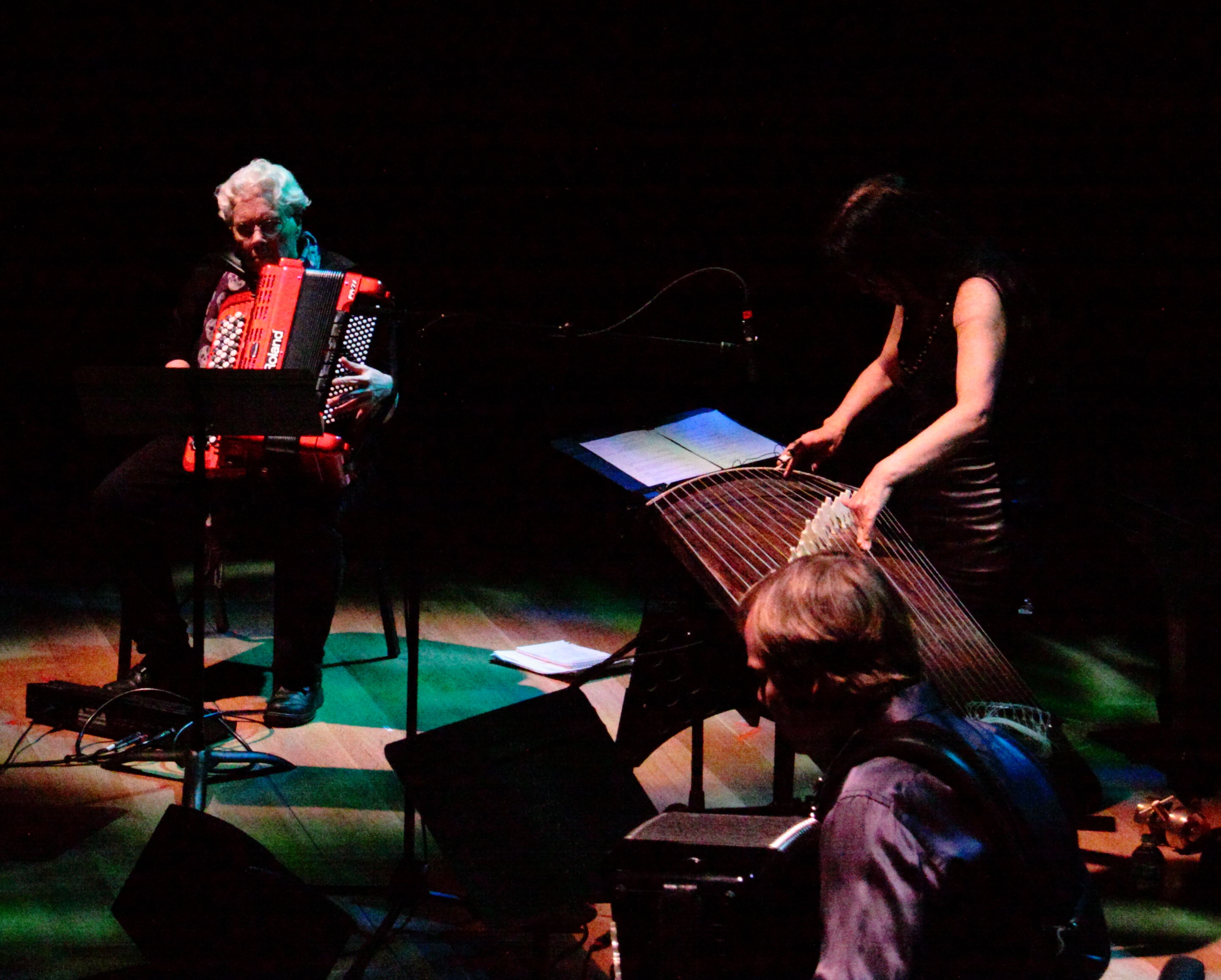
Pauline Oliveros, Miya Masaoka and Frode Haltli performing Oliveros' Twins Peeking at Koto (2014)

Pauline Oliveros, Miya Masaoka and Frode Haltli performing Oliveros’ Twins Peeking at Koto (2014)

After intermission we were treated to another world premiere from the great Pauline Oliveros.  Pauline, a beloved teacher and performer in the bay area, is based now in Kingston, New York but, as she acknowledges, she maintains ties with the bay area through performances, teaching, composing and now apparently through leaving her archive to Mills College where she was one of the founders of the Mills Tape Music Center (now the Mills Center for Contemporary Music).  Mr. Amirkhanian referred to her as the “Dean of American Composers”, a title once given to Aaron Copland, but equally suitable for this major composer/theorist/teacher/performer whose very presence adds to the auspicious nature of this series of concerts.

Her score is a written set of instructions for a sort of controlled improvisation that is common in her output.  Pauline’s warm personality and sense of humor are a part of this work which references the San Francisco landmark Twin Peaks and punningly refers to twin accordions as they peek at the koto which was played by Miya Masaoka.  Frode Haltli, who had performed yesterday did double duty as the second accordion in this work which requires, as does most of Oliveros’ work, close listening by performers as they execute the instructions creating the piece.  The most important lesson Oliveros has taught is the active nature of listening and that includes the performers as well as the audience because listening is itself a creative act.  And all who participated in active listening as the performers clearly did came to experience her wonderful view of the world of sound.

OM202024 OM202026 OM202027

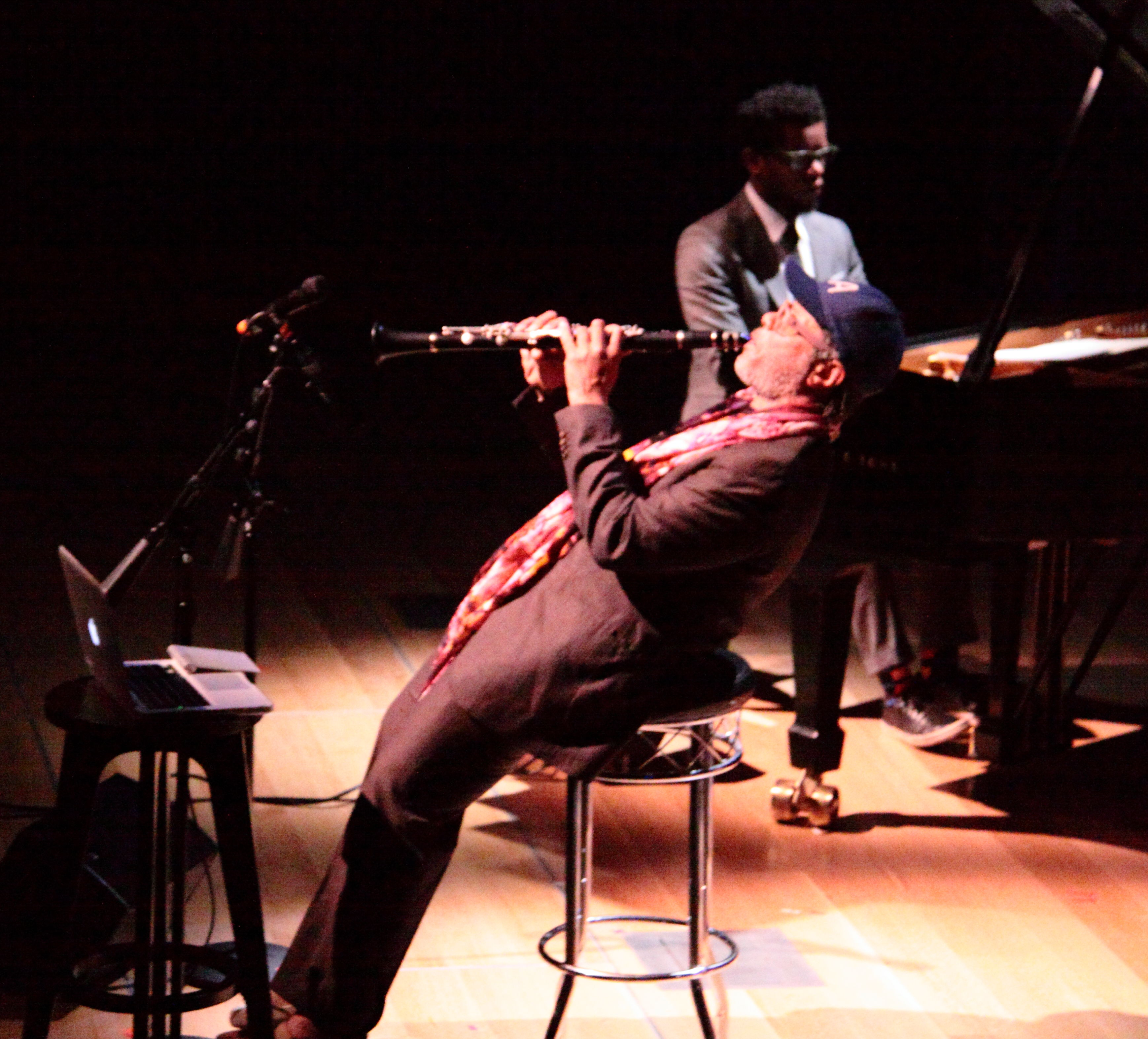
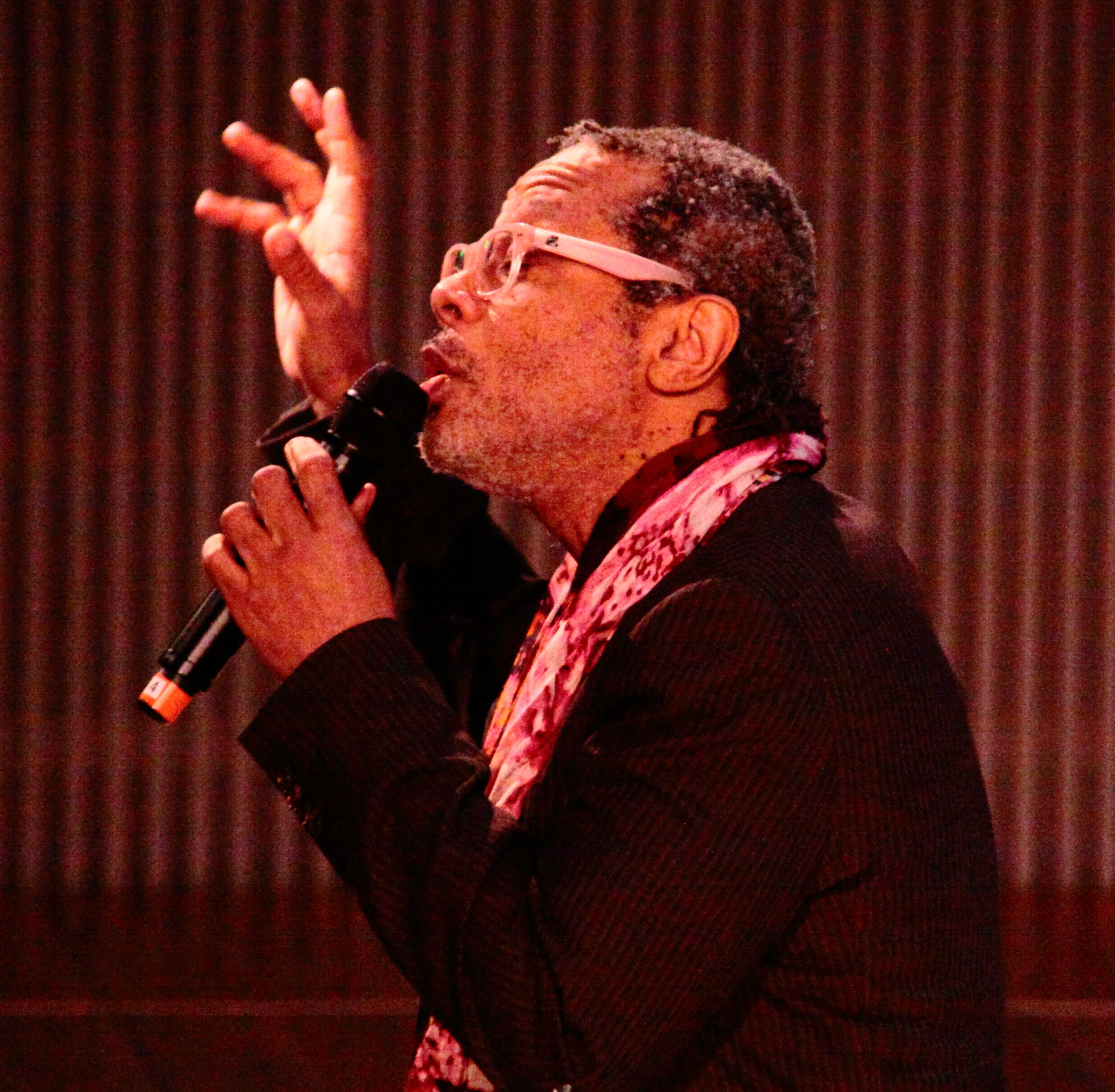
Four views of Don Byron and his quartet.

Four views of Don Byron and his quartet.

Don Byron, backed by veterans double bassist Cameron Brown and drummer John Betsch along with a young and interesting Cuban pianist, Aruán Ortiz.  In addition to some amazing work on clarinet (playing sometimes inside the piano) the peripatetic Byron crooned a cover of a blues song in his unique vocal style announcing the disclaimer  that it was a “cover and this was supposed to be all new music but what the hell”.  Byron’s good humor, stage presence and eclecticism was supported well by his quartet who were given some nice opportunities to show off their chops.  A very satisfying set leaving the audience and this writer once again aching for more.

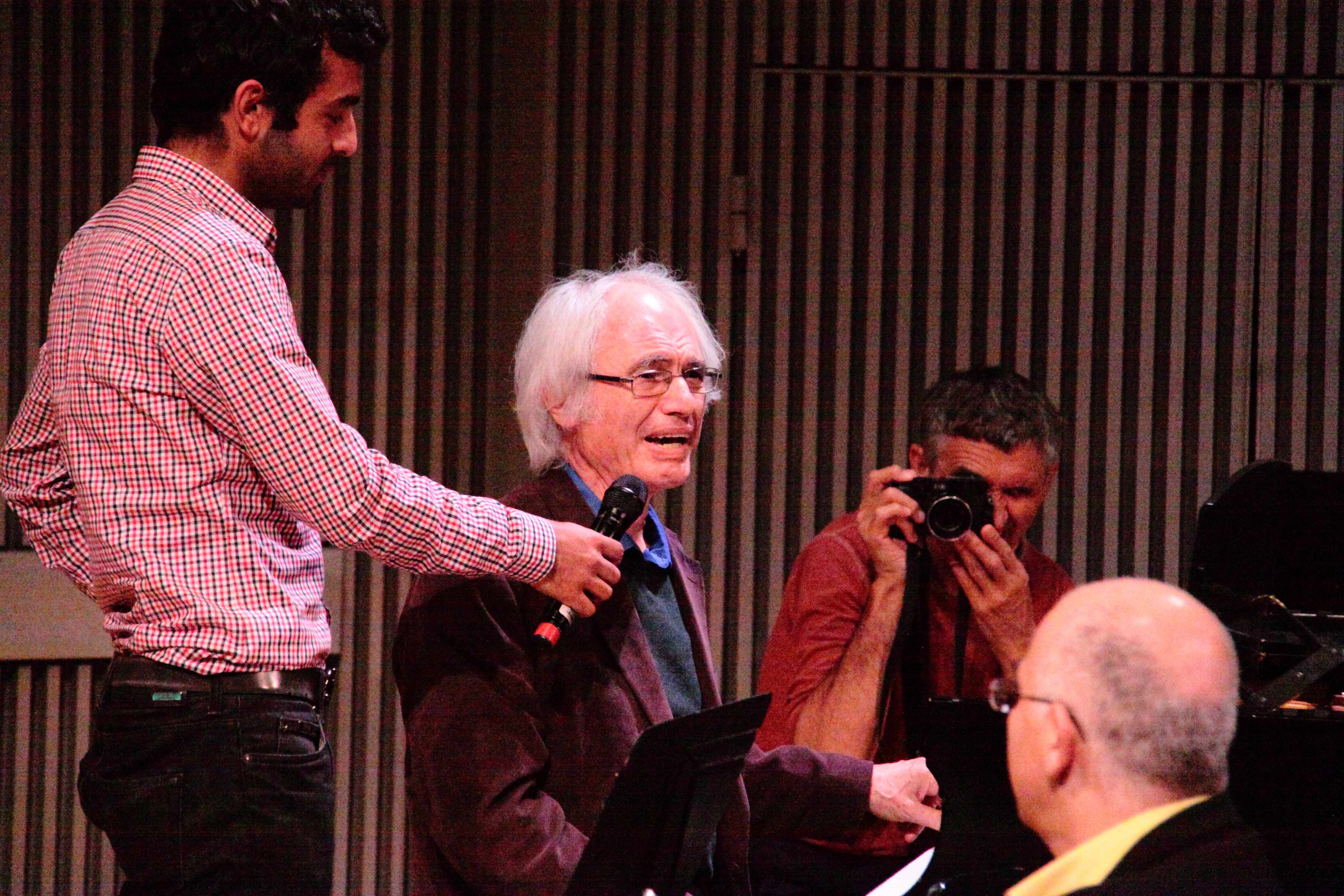
Tigran Mansurian singing an Armenian tune and accompanying himself at the piano.

Tigran Mansurian singing an Armenian tune and accompanying himself at the piano.

The last concert of OM 20 took place uncharacteristically in a matinee performance at 4PM.  This concert, also uncharacteristically, was given a political theme.  Sunday’s concert was dedicated in memory of the victims of the Armenian genocide which took place 100 years ago at the hands of the Ottoman Turks, a fact recognized by most countries but not, unfortunately, by the Turkish government.

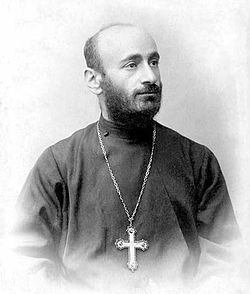
This last concert occurred on what would have been the 104th birthday of famed Armenian-American composer Alan Hovhaness and this was acknowledged as well.  In the pre-concert discussion we learned that Mr. Mansurian had met Mr. Hovhaness and very much liked his music.  Then, in what I learned was a spontaneous decision, Charles Amirkhanian asked Mr. Mansurian to play some music by Komitas, an Armenian composer who collected Armenian folk songs and wrote music based on those distinctive tunes.  Komitas stopped composing after the 1915 genocide as he saw these atrocities and had much of his research destroyed.  Tigran Mansurian seemed almost to jump at the opportunity and he immediately went to the piano and gave a very focused rendition of one of his favorite tunes.

Charles Amirkhanian giving the background for his tape composition Miatsoom.

Charles Amirkhanian giving the background for his tape composition Miatsoom.

Opening Sunday afternoon’s concert was another opportunity to hear one Mr. Amirkhanian’s major musical creations.  This one, Miatsoom (1994-7), a word meaning, appropriately for this year’s festival, Reunion was, he said, about the only trip he ever took to Armenia accompanied by his father (born in 1915) to visit relatives in that country.  The piece is a sonic travelogue about that trip.  It features the voice of the composer’s father Benjamin and various sounds and voices from that visit.  Clearly this trip and this piece are very personal and cherished  things close to the composer’s heart.  Bringing the sounds of Armenia and its people into the concert space seemed like a wonderful way to set the tone for this concert as both celebration and memorial.  And isn’t the key to a memorial the act of memory, of remembering?

SOTA orchestral string with piano to accompany soprano Hasmik Papian in Mansurian's Canti Paralleli.

SOTA orchestral string with piano to accompany soprano Hasmik Papian in Mansurian’s Canti Paralleli.

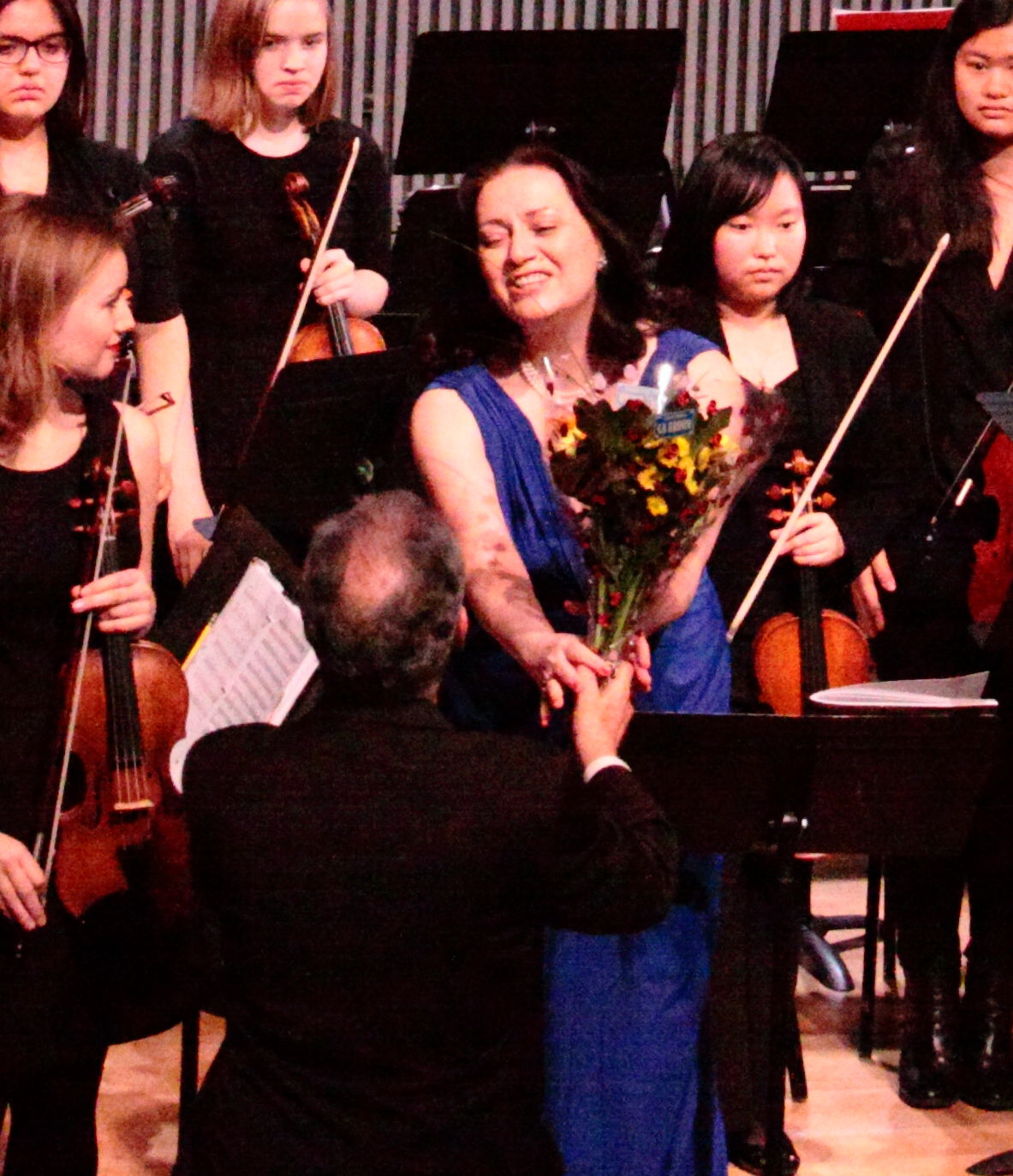
The Canti Paralleli (2007-8) by Tigran Mansurian were written in memory of his late wife who by coincidence had also been one of the soprano soloist’s teachers.  These settings of Armenian poetry were lovingly delivered by Ms. Papian.  Her beautiful voice filled the hall with what seemed to be an air of sadness.  The SOTA orchestra with a pretty accomplished young pianist rendered these somber tunes poignantly in this U.S. premiere.

OM203021

The triumphant soloist and conductor accept the gratitude of the audience, the producers and the composer.

The triumphant soloist and conductor accept the gratitude of the audience, the producers and the composer.

Following intermission we were treated to an even more recent work by Mr. Mansurian, the 2011 Romance for Violin and Strings, also in a U.S. premiere.  The violin was played with both passion and virtuosity by the Armenian-American violinist Movses Pogossian.  The orchestra seemed to rally behind him nicely accompanying him in what was a beautiful, almost romantic piece that would no doubt please any concert audience.

OM203026

Movses Pogossian with the SOTA orchestra conducted by Bradley Hogarth.

Movses Pogossian with the SOTA orchestra conducted by Bradley Hogarth.

I haven’t yet mentioned our young conductor for this evening.  Bradley Hogarth is a trumpet player and an accomplished conductor who leads this wonderful youth orchestra.  Their ability to fit on stage in the final work requiring some 60 musicians was in doubt but fit they did.  And their performance of Michael Nyman’s Second Symphony (2014), another U.S. premiere was nothing short of amazing.


Mr. Nyman, who was unfortunately unable to attend due to illness, began writing symphonies in 2014 and has of the time of this writing written no fewer than 11 such works.  This second symphony was written for a youth orchestra in Mexico where it received its world premiere.  The four movement work traverses familiar territory with Nyman’s characteristic driving rhythms.  It is hard to imagine that he actually had a youth orchestra in mind because this work for strings, woodwinds, brass, piano, percussion and harp was anything but simple or easy to play.  Nonetheless the orchestra under Hogarth’s direction discharged their duties in an electrifying performance that brought the audience to its feet with appreciation.

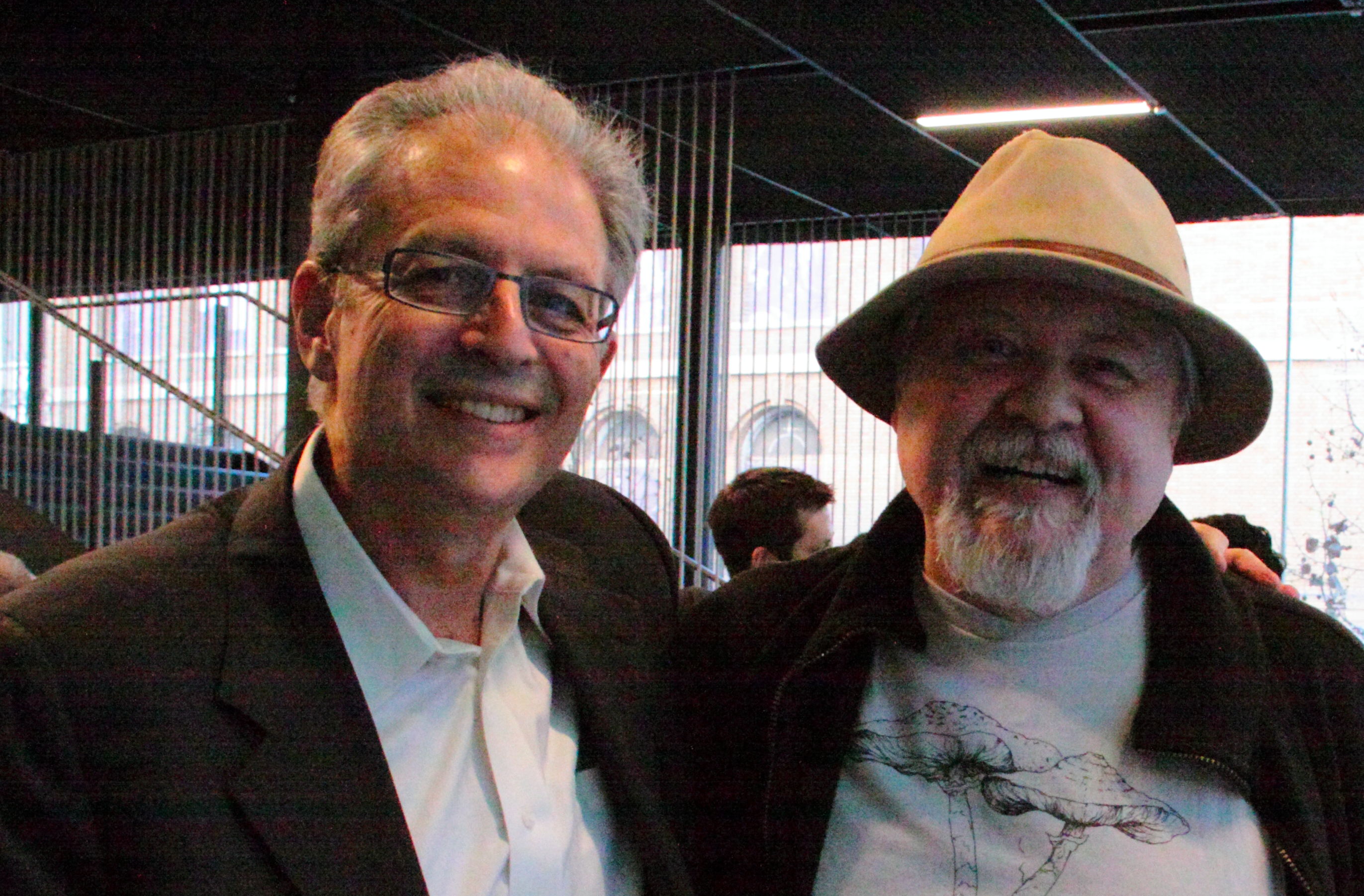
All in all a very successful and satisfying set of concerts, a successful 20th anniversary.  Time to look forward to OM 21.  It would be hard to top this but I am sure that Other Minds will give its all to do so.  Thanks to all who composed, performed, supported and attended.  And, yes, that’s me sporting the OM 20 t-shirt with Mr. Amirkhanian.  See you next year if not sooner.

New music buff gets a photo-op with Charles Amirkhanian.

New music buff gets a photo-op with Charles Amirkhanian.

Philip Gelb’s Gourmet Vegan with Joelle Leandre in the East Bay


The door is open to the underground restaurant.

The door is open to the underground restaurant.

On Sunday February 15th I had the pleasure of attending one of my favorite underground restaurant/performance venues in West Oakland.  In a nondescript neighborhood of light industry, warehouses and loft spaces Philip Gelb has been running “In the Mood for Food” (a take of the title of one of his favorite films, “In the Mood for Love”) his occasional dinner/concert series since 2005.

Philip Gelb with Joelle Leandre

Philip Gelb with Joelle Leandre

Philip is an amazing vegan chef as well as a shakuhachi player/teacher whose cuisine is known to a fortunate group of people which includes this writer.  Combining incredibly creative dishes sometimes at the behest of a given artist (Amy X Neuberg requested a “purple” theme and got it when she appeared ) with his wide network of artist friends, many of whom he has performed with.  Phil has been doing these occasional events with a maximum audience of about 20 people (including the featured performer) at a rate of at least once every month or two.

Potato Sorrel Soup

Potato Sorrel Soup

First let me say that I am not a vegan but if vegan fare always tasted this good I could easily make the transition (OK, I would have a hard time giving up pizza) to vegan fare.  Phil’s fresh locally shopped ingredients are transformed by his gustatory alchemy into a variety of delectable dishes in a wide range of cuisines.  His network in gourmet vegan food practitioners is rivaled only by his musical network.  Japanese is one of his specialties but I have personally partaken of various middle eastern and Caribbean cuisines with equal satisfaction.

Mushroom Pate, Carrot Walnut Pate and Rosemary Bread, didn't get a picture of the fresh salad greens.

Mushroom Pate, Carrot Walnut Pate and Rosemary Bread, didn’t get a picture of the fresh salad greens.

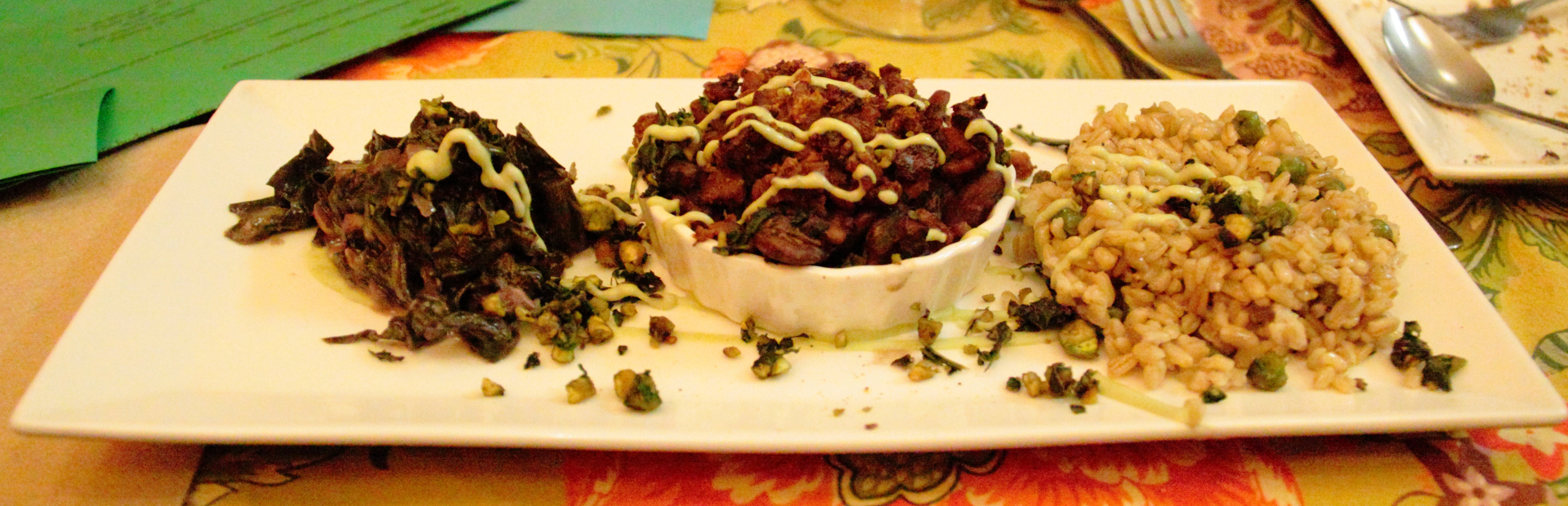
This night’s selection featured a creamy Potato Sorrel Soup followed by a salad plate consisting of rich Mushroom Pate, Carrot Walnut Pate, a freshly baked Homemade Rosemary Bread with Salad Greens and a tart Citrus Dressing. The main course consisted of Cassoulet, Oat Pilaf and Herbed Collards, all very tasty and very filling.

The main course of Cassoulet, Oat Pilaf and Herbed Collards.  It tastes even better than it looks in Phil's characteristically beautiful presentations, trust me.

The main course of Cassoulet, Oat Pilaf and Herbed Collards. It tastes even better than it looks in Phil’s characteristically beautiful presentations, trust me.

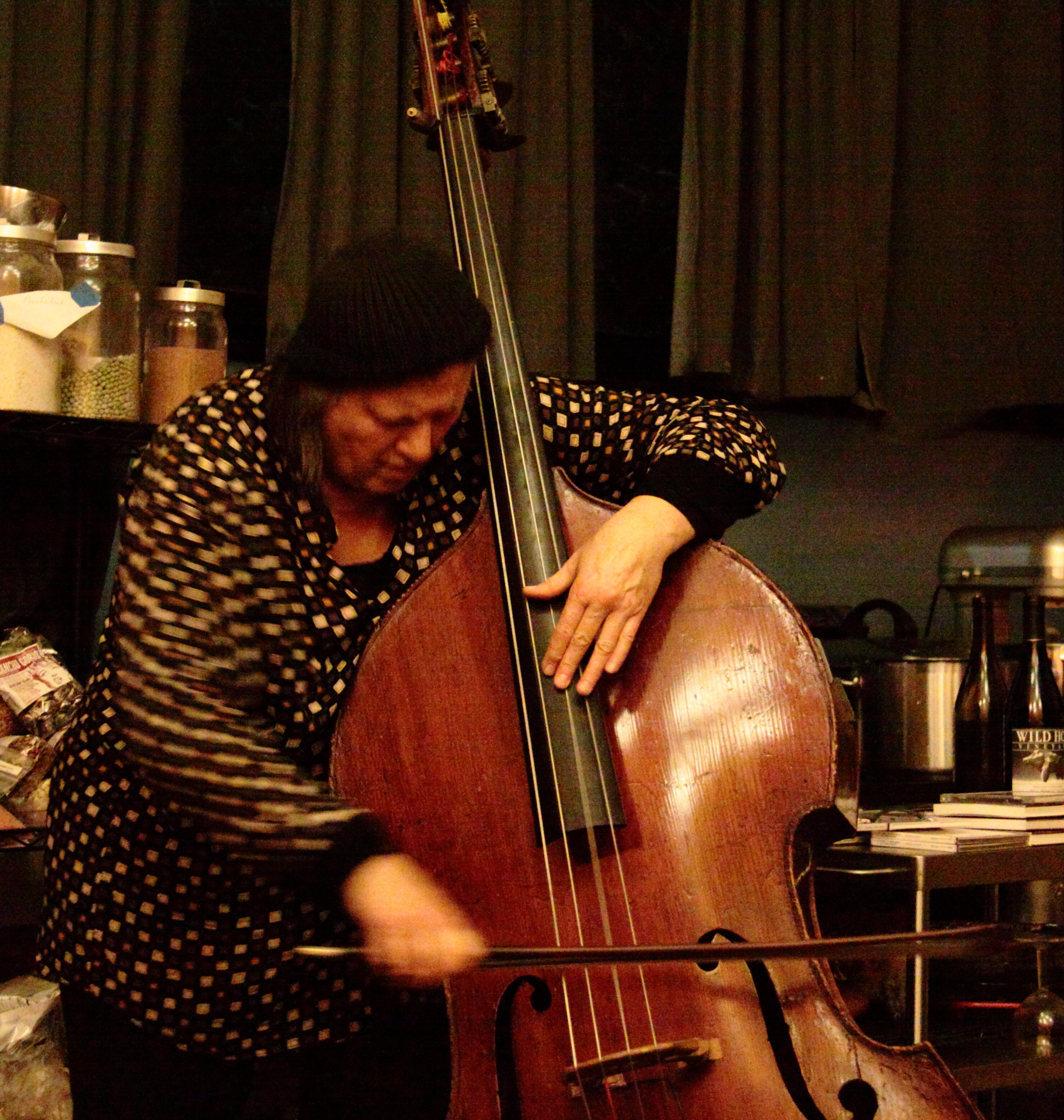
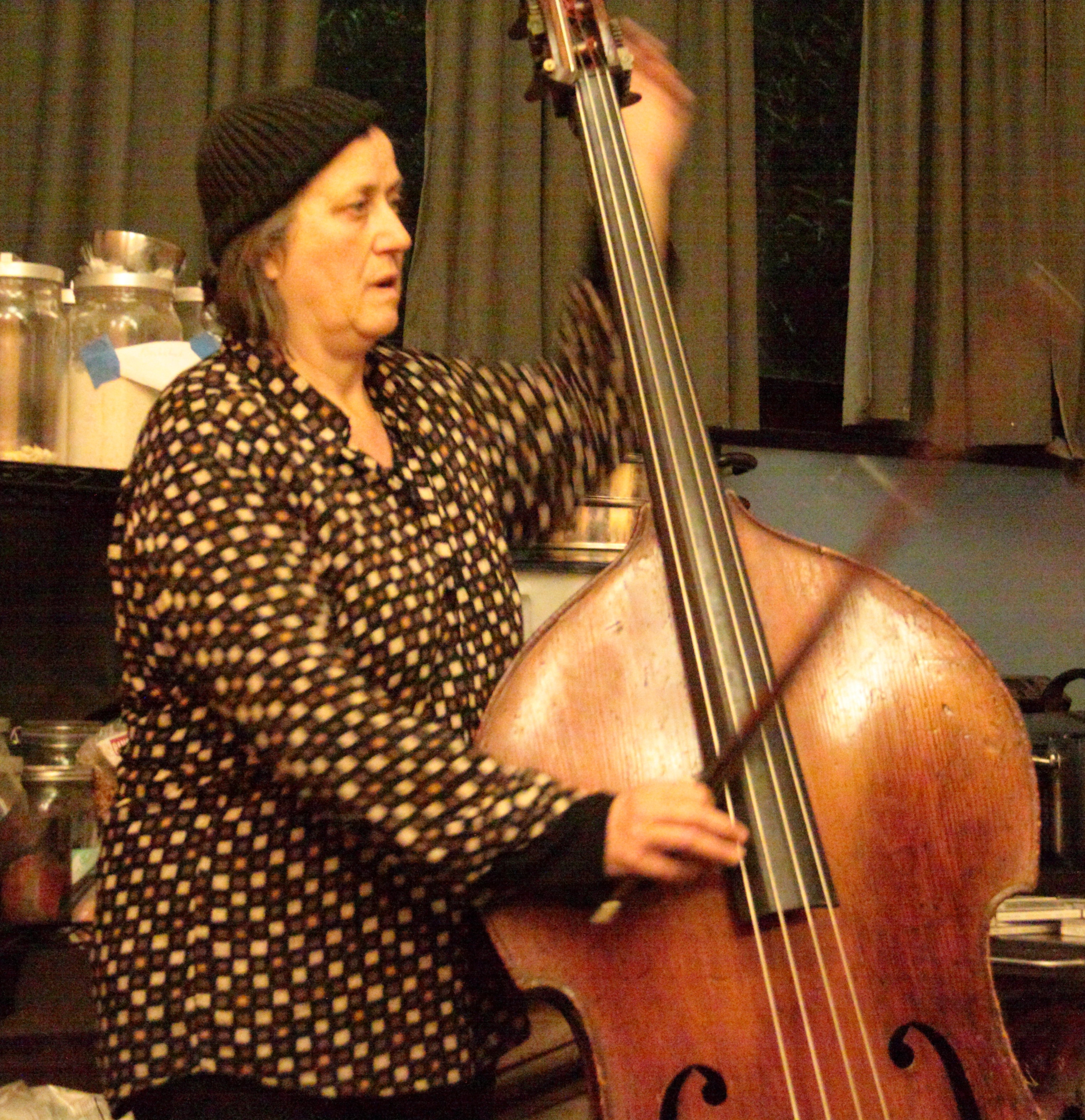
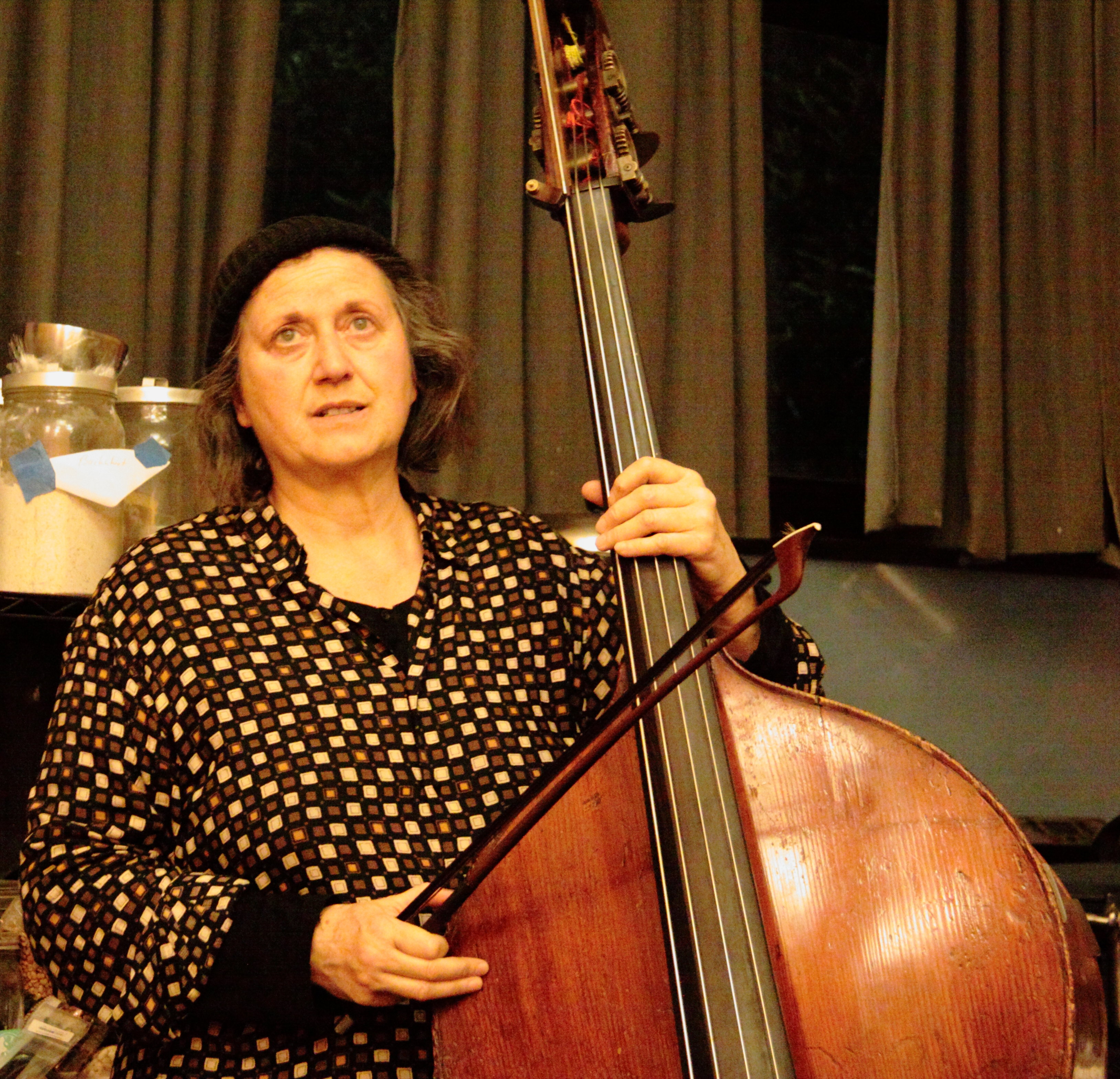
A feast such as this could not easily be upstaged but, in the little break before the dessert course, we were treated to a wonderful performance by Joëlle Léandre, the French Double Bass virtuoso, singer and composer whose work traverses a wide range of musical genre from John Cage to free jazz and categories that defy easy classification.  She has amassed a discography of over 100 albums to date and has performed with artists including Pierre Boulez, John Cage, Giacinto Scelsi, Derek Bailey, Barre Phillips (who appeared at this series a couple of years ago), Anthony Braxton, George Lewis, India Cooke (also one of Phil’s previous guest artists), Evan Parker, Irene Schweizer, Steve Lacy, Maggie Nicols, Fred Frith, Carlos Zingaro, John Zorn, Susie Ibarra, J.D. Parran, Kevin Norton, Sylvie Courvoisier and Pauline Oliveros (another recently appearing artist at this series).  Oh, and she has also performed and recorded with Mr. Gelb.

Leandre is a friendly and engaging person both in her playing and in conversation and we all had opportunities to speak with her and experience her charming personality as she related various observations and anecdotes.  These dinner/concerts are a uniquely intimate experience which you cannot get in the average concert setting.

Leandre embraced and nearly danced with her instrument.

Leandre embraced and nearly danced with her instrument.

Ms. Léandre treated us with three separate improvisations in which she demonstrated her facility with a wide range of double bass techniques including various bowing techniques, pizzicati, percussive techniques and wordless vocals that mixed seamlessly with her very intense and passionate performances.  Unfortunately it is nearly impossible to really describe with any accuracy the music we experienced this night.  But suffice it to say that it was played in a manner that communicated very effectively with the very appreciative audience.  I asked her if she always plays with such passion and she rather matter of factly simply said, “yes”.

Her command of a wide variety of playing techniques blended together with her voice in an almost orchestral sound  tapestry driven by Joelle's passionate playing.

Her command of a wide variety of playing techniques blended together with her voice in an almost orchestral sound tapestry driven by Joelle’s passionate playing.

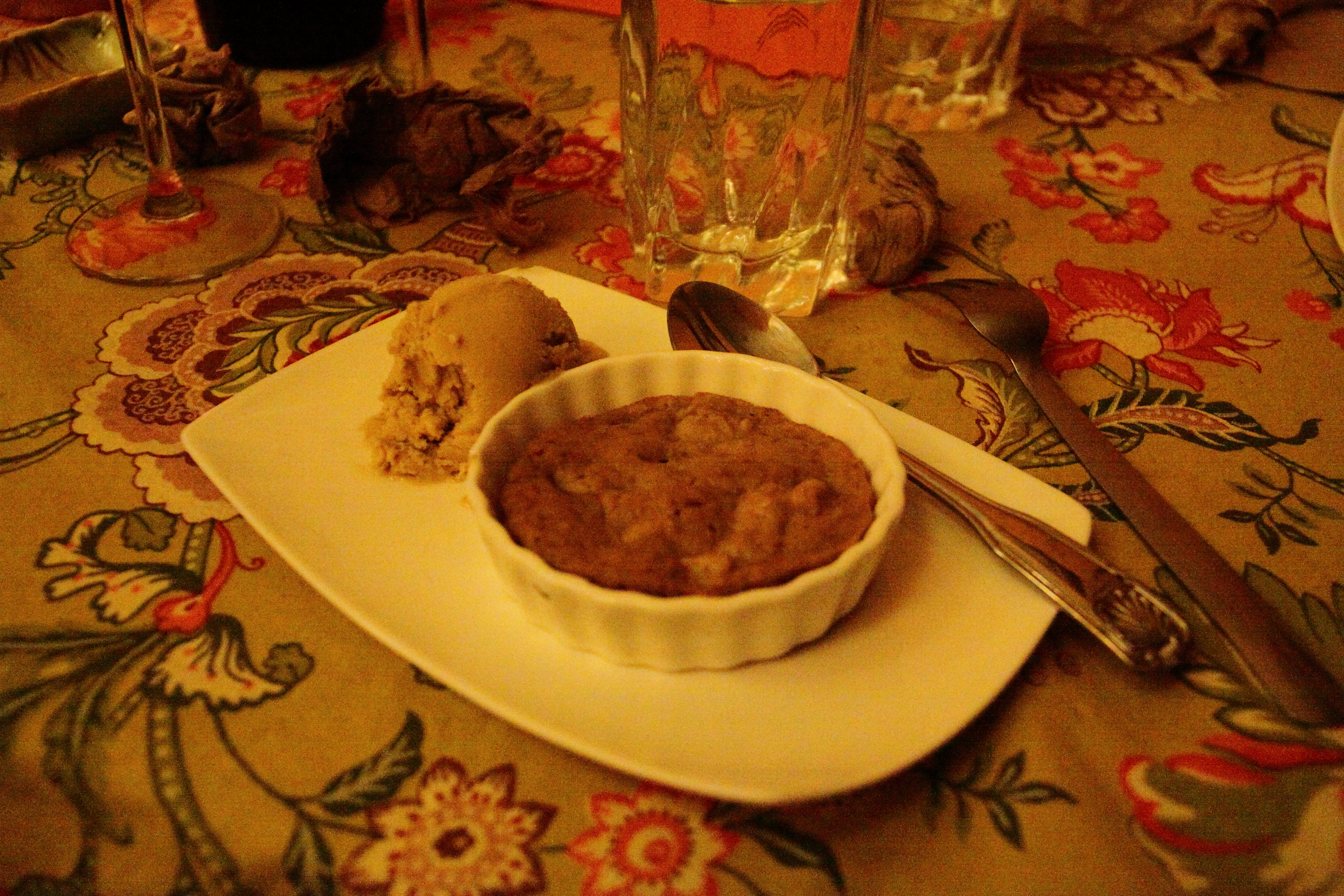
I was so taken with the performances that I failed to get a photo of the delicious dessert course which consisted of a Waffle Sundae comprised of a very fresh chocolate-buckwheat waffle covered with chocolate pistachio ice cream, maple walnuts and chocolate port sauce.  An amazing vegan sweet treat enjoyed by all.

The clearly happy audience lingered to talk with each other, with Phil and sous chef Cori as well as with Ms. Leandre who had a great selection of recent CDs and a couple of books available for purchase which she graciously signed.  Overall this was an extremely satisfying evening, certainly for this blogger and clearly for the other guests but also for our wonderful performer who left to get some sleep before her scheduled performances tomorrow at the Berkeley Arts Festival.

The performer pauses looking wistfully as the muse descends upon her.

The performer pauses looking wistfully as the muse descends upon her.


Irving Fine’s Complete Orchestral Music, a vital addition to his discography


BMOP 1041

BMOP 1041

Irving Gifford Fine (1914-1962) was an American composer.  Born in Boston, Massachusetts, Fine studied with Walter Piston at Harvard earning Bachelor’s and Master’s degrees.  He studied  conducting with Serge Koussevitsky and composition with Nadia Boulanger.  At the time of his death at age 47 he completed only a handful of works for orchestra, chorus and various chamber ensemble and solo works.  But what he lacked in quantity did not lack in quality.  The Irving Fine Society maintains a very useful web page which can be found here.

Fine is sometimes identified with a sort of loose knit group of composers called the Boston School which included Fine along with Arthur Berger, Lukas Foss, Alexei Haieff, Harold Shapero and Claudio Spies.  He taught at Brandeis University which now has an endowed chair named in his honor.  Eric Chasalow currently holds  this position.

fine

Curiously his music, which has a generally very friendly neoclassical feel to it, even when he dabbles in twelve tone writing, has received relatively few performances and even fewer recordings.  The Boston Modern Orchestra Project under the inspired guidance of Gil Rose has stepped in to fill a bit of that void in this very welcome and vital addition to Fine’s discography.

This recording of Fine’s complete orchestral music spans his entire musical career with his Symphony being his last completed work from 1962, the year of his death.  Also included are the 1947 Toccata Concertante, Notturno for Strings and Harp (1951), Serious Song (1955) for string orchestra, Blue Towers (1959), Diversions for Orchestra (1960) and Symphony (1962).

All have been recorded before but the Symphony was a release of a live performance by Erich Leinsdorf and the Boston Symphony from 1962 so this is the first studio recording.  The Notturno for Strings and Harp and the Serious Song have received a couple of recordings.  And interested listeners would be advised to locate a recording of Fine’s String Quartet (1952) and Fantasia for String Trio (1957) which I believe to be sort of hidden masterpieces.  Any string quartets out there willing to take on these neglected works?

As usual the BMOP under Gil Rose turn in fantastic performances.  Blue Cathedral and Diversions are among the composer’s lighter fare but deserve at least occasional attention.  But the Toccata, Serious Song and Notturno should be a part of the repertoire with regular performances.  They are masterful and pretty audience friendly.

The big treat here is the Symphony.  As far as I can tell it has not been programmed, much less, recorded, since the Boston Symphony did it under Leinsdorf.  What a shame that this work hasn’t been heard for so long and how wonderful it is to have this great new recording of an American masterpiece.  Cast in three movements (Intrada, Capriccio and Ode) this 20 minute work is one of the composer’s finest pieces and leaves the listener wondering what other works he might have crafted had he lived longer.

Blackness, Race and Music, What I Have Learned So Far


Two years ago, when I was just at the start of my blogging adventures, I decided it would be a good idea to do a few articles in honor of Black History Month. I am not black and I have no expertise in the area of black music but, in keeping with the personal perspective of this blog, I decided that my interest in these subjects is sufficient reason to express some opinions and ideas.  I chose Carl van Vechten’s portrait of William Grant Still, considered by many to the first major black composer to receive recognition in the 20th Century as my symbol for this article.  Much of his music remains unknown and little performed though there have been some significant recordings released in the last few years.

I called that first set of articles “Black Classical”. Curiously my brief article on black conductors has been one of my most read pieces (947  views as of the time I write these words).   So I continued to write on this subject in the following year. For my second set of articles I took the opportunity to look at the 50 year anniversary of the Civil Rights Act of 1964, by all measures a landmark piece of legislation. I asked a question, in part rhetorical because I had a basic idea of the answers I expected, but also to elicit opinions and to discuss issues of race and music.

I sent queries to a random set of composers and conductors and received a few very gracious replies. Comments ranged from carefully worded egalitarian musings on how black music and music by other racial minorities should be integrated and heard throughout the concert seasons to seemingly careful statements suggesting that this might not even be the right question or that it shouldn’t be asked. Not all comments were published but I am grateful to all who replied. And I have been able to continue this discussion in the various groups on Facebook.

I learned in a (yet to be published) interview with Anthony Davis some fascinating perspectives. Professor Davis did not address my question as I originally asked but he provided some valuable food for thought. It is worth noting that Davis is a composer whose politics are frequently very much in evidence in his music. In a discussion of the current state of music he commented regarding John Cage‘s apolitical stance by saying that, “John Cage’s silence is the silence of white privilege.” One could argue that taking an apolitical stance may have contributed to Cage’s ability to get grants and commissions.  Politically charged music generally does not fare as well.

In general I found more or less what I expected. The Civil Rights Act of 1964 has had little, if any, benefit for black musicians and composers. And given the ongoing killing of unarmed black men by police one must wonder if we have been going backwards as a society. But I don’t want to do a grand social critique here. That is a subject for another blog and is a bit outside of my scope at least for now.

I found some musicians who did not want to address racial and discriminatory issues. It seems the issue is too “hot” and that one could face consequences for even asking the question. And some did not feel sufficiently well-versed in Civil Rights history to make a truly informed assessment of this issues.  Perhaps it is a form of white privilege that allows me to ask such a question. We shall see if any reactions result in verbal attacks or (not likely I think) in a reduction in my readership.

What I have learned is that black classical musicians (who are not in short supply) occupy very few prominent positions in academia, in the public sphere of conductors and performers and in the representation in recorded performances of what is a rich but virtually untapped repertoire.  The inequality remains with perhaps some progress but not enough to pronounce the issues here as resolved to a truly significant degree.  But there is a vibrant community of black musicians who are working as did their predecessors to contribute to our collective culture and the discussions are both lively and stimulating.

In 2014 there was a performance by the Cincinnati Symphony of an Oratorio, “The Ordering of Moses” (1937) by R. Nathaniel Dett. The premiere performance of the piece (a beautiful and listener friendly piece of music) was broadcast live. But that broadcast was truncated, leaving out the finale when white listeners complained about music by a black composer getting so much airtime. Happily the entire piece was broadcast uninterrupted and made available in streaming format. However there is no commercial recording of this grand biblical choral work.

I was pleased to be able to review the fully staged performance in May, 2014 of Zenobia Powell Perry‘s opera Tawawa House (1984) in the unlikely venue of Modesto, California by Townsend Opera.  It was a heartfelt and beautiful production and was reviewed here.

Another interesting event in 2014 was the first appearance of three black counter tenors in a performance of a Purcell Opera in Los Angeles.  My blog on this subject can be found here.  I was pleased to make the acquaintance of Mr. Bill Doggett who has been very helpful in keeping me up on the latest developments with black musicians and composers and was the person who alerted me to this historic event.

Coming up in March at the Other Minds festival there will be performances by Errollyn Wallen and Don Byron.

I have been able to dialog with various black musicians on Facebook most notably through the groups Black Composers, The National Association of Negro Composers and Opera Noir.  Composer, performer and conductor Anthony R. Green is posting the name of a black composer every day for the month of February with examples of their work.

Some recent films have done much to tell the very unpretty history of black people in the United States including: 12 Years a Slave (2013), after Solomon Northrup‘s harrowing memoir,  Fruitvale Station (2013), a retelling of the execution style shooting of Oscar Grant at the hands of police in Oakland, California, Selma (2014), a dramatization of the 1965 march in support of voting rights (musical direction by Jason Moran).  And this trend, happily, seems to be on the rise providing artistic historical narratives to aid in the processing of the complex, shameful and painful histories depicted.  The lack of recognition by the motion picture industry supports my arguments for the poor representation and acknowledgement of black artists in general.

I have to mention that the wonderful set of recordings by Paul Freeman originally released on Columbia records remains available as a boxed set of 9 vinyl records with notes from the College Music Society now being offered at only $17.50 (that is not a typo either) via mail order.  I’m going to buy a couple of extra copies to give away as gifts.  It’s a really nice set.

Perhaps the most useful thing I learned is the egalitarian approach by conductor Michael Morgan who stated his desire that music by ethnic groups be integrated into programming on a regular basis rather than being highlighted in a given month.  (I am pleased to report that maestro Morgan will be receiving an award for his service to new music from the American Composers Forum.)  I am now using that approach with this blog in which I will continue to highlight the work of musicians and other artists whose work I find interesting and worth promoting.  So please stay tuned.


Other Minds 20 and Why You Shouldn’t Miss It


Official Other Minds Logo

Official Other Minds Logo

The three days of concerts scheduled for March 6, 7 and 8 of this year at the beautiful SF Jazz Center will mark the 20th anniversary of Other Minds opening the ears and minds of bay area new music audiences.  Previously composers could only appear once at this festival (thought performers frequently return) but the anniversary celebration is marked by the return of several alumni.  In fact the entire program consists of composer alums.

Other Minds is an annual festival of new and unusual music curated by bay area composer, producer, broadcaster Charles Amirkhanian and his crew at Other Minds.  Along with co-founder, now president emeritus Jim Newman and a varied and sometimes changing crew of talented and dedicated archivists, fund-raisers and coordinators this festival was born in 1993.

OLYMPUS DIGITAL CAMERA

Every year (though the actual month has changed for various reasons related to venue availability and funding) an international group of composers is brought together first at the Djerassi Arts Center just west of Palo Alto where they share their work and ideas with each other for a week in preparation for the performances of their work to come at the concert series.  This residency is a sort of private retreat open only to the composers and the staff of the center.  And given the range of musical styles it must be a fascinating thing to witness as composers largely unfamiliar with each others’ work gather to share and wonder at each others’ strange and innovative ideas.  Who knows what seeds may have been sown?

Sadly, Dr. Carl Djerassi who founded the center passed away on January 30, 2015.  His arts advocacy will live on through his beloved Djerassi Arts Center and this OM 20 will be a testament to that legacy.

What makes this festival so significant is the fine tuned and prescient nature of the selected composers.  Just a quick look at the list of composers and performers who have participated in the past looks almost like a who’s who of new music as practiced in the late 20th and early 21st centuries.  One of their commissions, Henry Brant’s (1913-2008)  won a Pulitzer Prize (Ice Field, 2001, Pulitzer Prize, 2002).  And it is programming with a uniquely west coast ethic, whatever that means.  I just know these programs are a different take on new music than that of the east coast.  Not a value judgement there, just a celebration of a different, equally important, point of view.


WHY YOU SHOULDN’T MISS OM 20

First you will find a generous (though hardly complete) selection of music by Charles Amirkhanian (1945- ) who has been at the helm of this festival from the beginning and was for 23 years the music director of KPFA radio where his programming and interviews with composers and performers of new music spanned a wide and eclectic gamut of styles and techniques.  Perhaps most significant has been his support of northern California composers whose work would otherwise have been poorly represented.  Amirkhanian’s keen ear has introduced a great deal of new and interesting music to bay area audiences and beyond.

Executive Director Charles Amirkhanian in his ...

Executive Director Charles Amirkhanian in his office with ASCAP award in background (Photo credit: Wikipedia)

In addition to his abilities as producer and interviewer Charles is also a noted composer.  Trained as a percussionist, he has written quite a bit of music which deserves recognition for its innovation.  His best known works are those with tape recording, sound poetry and the uses of language.   His music will be featured in several performances and will be a welcome and tantalizing complement to the overall diverse tone that characterizes OM programming.

Amirkhanian’s oeuvre will be represented by “Rippling the Lamp” (2007) for violin and tape, three short pieces for voice and tape, “Dumbek Bookache IV” (1988), “Ka Himeni” (1997), “Marathon” (1997) and, on the third concert, “Miatsoom” (1994-97), a piece based on sounds (vocal, ambient and musical) recorded during the only trip Charles and his father made to Armenia in 1994.  This approximately half hour work is typical of his ability to create a fascinating and meaningful sound collage.  Miatsoom is Armenian for reunion, indeed the apparent theme of OM 20.

In an uncharacteristically political expression this year’s festival is in commemoration of the 100th anniversary of the Armenian genocide.  Amirkhanian is the descendant (both he and his father Benjamin were born here) of Armenian immigrants and grew up in Fresno, California.  The genocide of 1915 (also the year of Benjamin’s birth) was in fact only the most infamous and fatal of the ongoing abuses by the Ottoman Turk government in response to Armenians seeking equal rights (a familiar social issue both then and still today).  Charles has been tactfully apolitical in his programming but his music at times has paid respectful homage to his ancestry and their struggles. It seems right to pay respect to one’s ancestors and perhaps acknowledge that we still have much to do and learn in our imperfect world.

Tigran Mansurian

Tigran Mansurian

Appropriately the esteemed Armenian composer Tigran Mansurian (1939-  ) has been welcomed back and will be represented by two major works.  Romance for Violin and Strings (2011) and Canti Paralleli (2007-8) for soprano and string orchestra are both scheduled for the third concert of the festival.  I was unable to find any details about these pieces but Mansurian’s work certainly deserves to be better known and these performances are a welcome opportunity to hear this major compositional voice.

Lou Harrison

Lou Harrison (Photo credit: Wikipedia)

Homage will be paid to two past masters who are no longer with us, American  composer Lou Harrison (1917-2003) and Australian composer Peter Sculthorpe (1929-2014).  Harrison was a beloved bay area figure whose work with gamelan and other world musics led him to experimentation with alternate tuning systems.  Harrison will be represented by his “Scenes from Nek Chand” (2001-2) played on a National Steel Guitar tuned in just intonation by the wonderful guitarist David Tannenbaum who will also play Sculthorpe’s “From Kakadu” (1993) for conventionally tuned classical guitar.  Sculthorpe, born in Tasmania, was one of Australia’s best known composers who essayed widely in chamber, choral and orchestral music. His 14th string quartet (with didgeridoo played by Stephen Kent) “Quamby” (1998), played by the amazing Del Sol Quartet (who recorded all 18 of the composer’s string quartets) is scheduled to conclude the first concert.

Peter Sculthorpe

Peter Sculthorpe


Pauline Oliveros

Pauline Oliveros

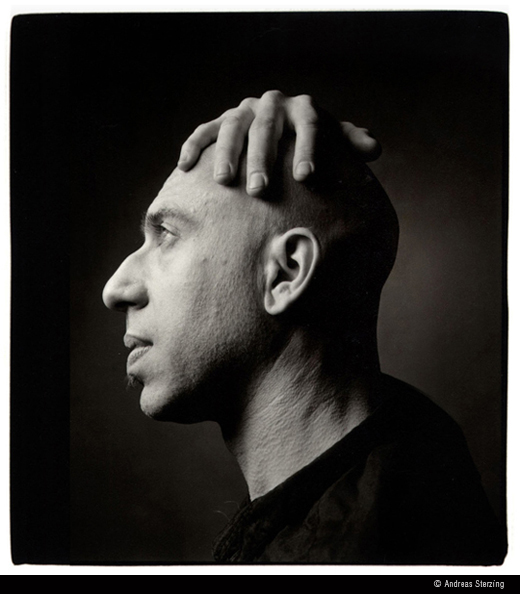
Pauline Oliveros (1932- ) is one of the grand ladies of new music.  Her theoretical work in defining music and the act of listening as partners in the creative process and her subsequent compositions including ground breaking work with early electronics with the San Francisco Tape Music Center and later at Mills College characterize her wide range of interests and her insights.  Her principal instrument, strangely enough, is an accordion and she will be performing as well.  OM has commissioned a new work from her, “Twins Peeking at a Koto” (2015, world premiere) for two accordions and koto.  to be presented at the second concert.  Playing the koto will be Miya Masaoka (1958-  ) whose second string quartet will receive its world première on the first night by the  Del Sol Quartet.  Masaoka, Japanese/American native of Washington D.C., is a New York based composer whose work brings her to the west coast frequently where she is a founding member of the Bay Area experimental improv trio Maybe Monday.  Her work involves improvisation and frequently uses unusual sound sources like bees and even cockroaches (not to worry, no insects are slated to perform) and creates site specific multi-disciplinary works in collaboration with musicians and dancers.

Miya Masaoka

Miya Masaoka

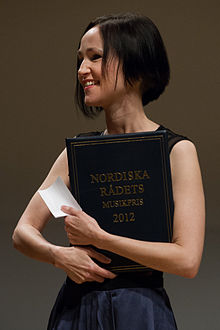
Errolyn Wallen (1958-  ) can be said to embody the OM ethic.  Born in Belize, Wallen  left the Dance Theater of Harlem to study composition in England and says of her work, “We don’t break down barriers in music…we don’t see any.”  Her Percussion Concerto (1994)  was the first work by a black woman to have been performed at the London Proms Concerts.   Her “London’s Burning and other songs” will be played on the second night by the SOTA string quartet and Wallen voice and piano.

Errollyn Wallen

Errollyn Wallen

Don Byron (1958- ) similarly states that he strives for “a sound beyond genre”.  Steeped in classical, jazz and folk musics, Byron’s quartet (Don Byron, clarinet; Aruán Ortiz, piano; Cameron Brown, bass; John Betsch, drums) is featured at the conclusion of the second night of the festival.

Don Byron

Don Byron

Maja S.K. Ratkje (1973- ) from Norway whose work is perhaps related to Mr. Amirkhanian’s  in her exploration of the possibilities of the human voice.  Her “Traces 2” (2014-5) will receive its U.S. premiere on the first night’s concert.

Maja Ratkje

Maja Ratkje

The third concert will be unusual for two reasons.  First it will take place beginning at 3PM and, second it will feature a full orchestra.  This night will conclude with U.S. premiere of the Second Symphony (2014) by Michael Nyman (1945- ) .  Nyman is perhaps best known for his numerous wonderful film scores but is also highly accomplished in his work in the concert hall.  In the past three years Nyman has turned for the first time to the Symphony form and has completed to date no fewer than 11  symphonies.  Quite a feat.

Michael Nyman in Sant Cugat del Vallès

Michael Nyman in Sant Cugat del Vallès (Photo credit: Wikipedia)

Tickets still available as low as $15/night.  Quite a festival!


Meredith Monk and Eric Salzman, a Labor of Love


Labor Records LAB 7094

Labor Records LAB 7094

New music aficionados in the 1970s had access to quite a bit of new and unusual music on the Nonesuch label under the watchful eye of Theresa Sterne.  In fact, Salzman was among the wonderful producers along with people like Joshua Rifkin who put that label at the forefront of contemporary music releases.

Two most unusual dramatic pieces, The Nude Paper Sermon (1969) and Civilization and Its Discontents (1977) caught my ear (yes, I have them on vinyl).  I was looking to see if these had ever been reissued (they have) and ran across this disc containing music by Eric Salzman (who was involved in both of the aforementioned discs) and by Meredith Monk.

Eric Salzman

Eric Salzman

Eric Salzman (1933- ) is a composer, scholar, broadcaster, producer and theorist.  He studied at Columbia University(BA 1954) with Jack Beeson, Lionel Trilling, Otto Luening and Vladimir Ussachevsky.  His graduate work at Princeton University (MFA 1956) was with Milton Babbitt, Roger Sessions, Earl Kim, Edward T. Cone, Arthur Mendel, Oliver Strunk and Nino Pirotta.  A 1956-8 Fulbright fellowship allowed him to work with Goffredo Petrassi and at Darmstätdter Ferienkurse with Karlheinz Stockhausen, Bruno Maderna and Luigi Nono.

He has written for various news media and wrote for the wonderful Stereo Review magazine from 1966.  His academic credits and publications are also highly regarded.  He was the music director at WBAI, a Pacifica Radio Station during the 60s and 70s.  In short he is a living treasure of American music.


His music, unfortunately, is less well-known I think than his writings but what little I have been able to hear of his work (you can hear excerpts of various pieces on his web site) has piqued my interest to seek out more.  He is uncompromisingly innovative and experimental which may put off the casual listener but has wonderful revelations to those who lend their ear.  This disc on Labor Records (who have also issued the aforementioned dramatic works) contains a new aural drama or radio drama if you prefer.

Now I doubt that anyone who actually seeks out a recording by the likes of Salzman and Monk will be put off by innovative and experimental ideas but these works are quite listener friendly and represent mature work by both artists.  This very welcome recording gives listeners an opportunity to hear the vibrant mature work of two clearly still vital living masters.

Salzman’s “Jukebox in the Tavern of Love” (2008) was written on commission from the Western Wind Vocal Ensemble and was performed in Brooklyn’s “Bargemusic” in 2009.  The libretto is by Valeria Vasileski and the action takes place in a New York bar during a power outage.  The cast of characters reminds this writer of any number of, “a man walks into a bar…” jokes.  We meet a nun, a Rabbi, a Broadway Dame, a poet, and a Con Ed worker all culled from the composer and librettists perceptions of the individuals that make up Western Wind.  And these characters comment on the subject of love in this re-visioning of the madrigal opera genre.


Meredith Monk

Meredith Monk

Meredith Monk (1942- ) is a dancer, composer, vocalist, choreographer, filmmaker and new music innovator in extended vocal techniques.  She is among the best known of the composers who comprised the loosely defined “downtown” new music scene in New York in the 1970s.  She graduated Sarah Lawrence College in 1964 having studied with Beverly Schmidt Blossom.  She is best known for her numerous recordings on Manfred Eicher’s ECM label.

Basket Rondo (2007), also written for the Western Wind Vocal Ensemble, is vintage Monk.  The eight movements take the listener through a series of extended vocal sound worlds.  Monk’s work is always more evocative than literal and this work could suggest whatever the listener perceives or could simply be appreciated as musical expression. Her creative vision that underlies this piece involves a pre-industrial society singing a sort of work song.  Monk’s ability to export her extended vocal techniques through her workshops made it possible for her to write in her idiomatic style for singers not otherwise familiar with these techniques.

The piece is cast in eight movements  suggesting the “rondo” I suppose.  And I’m guessing the baskets represent the fruits of their labors.  But the important thing is that Monk’s re-visioning of medieval history in these dream like dance/vocal dramas succeeds in creating mesmerizing aural theater regardless of what plays in your head when you hear it.

The Grammy nominated Western Wind Vocal Ensemble (much of whose work is with Medieval and Renaissance music) has a well-deserved reputation as being among the finest small vocal ensembles working today.  This disc allows them to demonstrate their ability to move easily into the contemporary music world.  Their performances here are superb and a very welcome addition to the discography of these two composers.  I cannot think of anyone who could have written this music other than the present composers.  Here are two works by composers whose idiosyncratic methods have produced music that identifies them much as a thumb print identifies a check writer (or a criminal, for that matter, I suppose).  That is a mark of true mastery. And it would be a crime to miss hearing these works.


Finding Angels, Energetic Eclecticism from Howard Hersh


Angels and Watermarks

Angels and Watermarks

Howard Hersh (1940- ) studied music and earned Bachelor’s and Master’s degrees at Stanford University.  He is a California native and he succeeded Charles Amirkhanian as music director at KPFA.  His Pony Concerto (2005), Braided River Nights (2004) and Sonata for Violin and Percussion with String Bass obligato (2000) were released on Albany Records in 2007 and his Dancing at the Pink House (2006) is available as a free download on Bandcamp.

I had not been familiar with Mr. Hersh’s music when I agreed to review this disc but I found that liked it immediately and it made my  list of favorite releases for 2014. The  featured piece here is the Concerto for Piano and Ten Instruments (2008) and it is a tour de force.  Hersh writes in a tonal idiom that sounds to this reviewer’s ears like a mix of Conlon Nancarrow and Francis Poulenc.  This concerto is virtuosic in the extreme but not the empty virtuosity of the romantic composer pianists (Anton Rubinstein bores me to tears).  This work in three movements sounds very difficult to play but manages to remain playful and entertaining, never taking itself too seriously.  Pianist Brenda Tom does a fantastic job (she must have fingers of steel) and is very ably supported by the small ensemble conducted by Barbara Day Turner.  Rapid attacks, scales and arpeggios keep the soloist very busy and the ensemble clearly listens and collaborates in what is an electrifying performance.

The other pieces on the disc are a sort of strange contrast to the concerto.  First is a suite for harpsichord, Angels and Watermarks (2004) was composed during Hersh’s residency at the Djerassi Arts Center.  The piece is in five movements and is a significant contribution to the contemporary literature for that instrument.  Cast in the manner of a baroque suite, each movement plays on familiar forms.  The first movement is a ponderous prelude which is followed by a playful moto perpetuo, a gentle lullaby, then a spectacular jazz inflected toccata and finally a sort of non-literal recapitulation of the prelude.  Again we are treated to the dynamic keyboard work of Brenda Tom who executes each movement flawlessly and with great expressiveness.

The final work on the disc is Dream (2012)  which the composer (who wrote the liner notes) says is his exploration of how to incorporate tonal harmony in his work.  It is a soft, slow meandering piece in which he manages to make his explorations into a beautiful and restful work.  Brenda Tom is the dedicatee of both this and the harpsichord suite and she demonstrates her ability to work with soft expressive textures.

All in all a great CD which will delight any new music fan.  It is available from CD Baby and Amazon.  Highly recommended.
Game of the Antichrist, a spectacular new music drama by Robert Moran


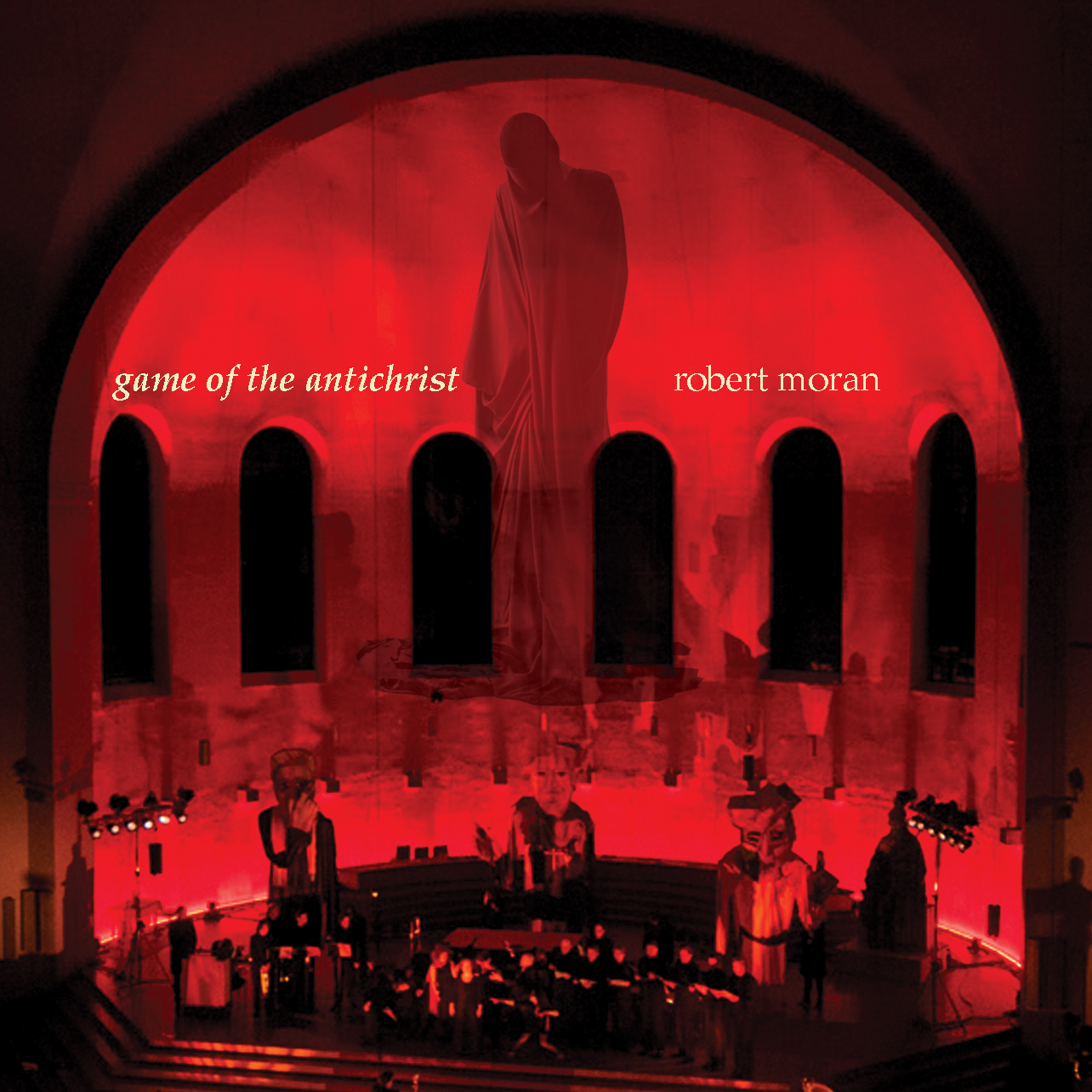
Cover of Game of the Antichrist

Game of the Antichrist (Innova 251)

Despite the title, this is neither a Stephen King adaptation or that of a given miniseries.  This is an actual medieval mystery play which was performed to disseminate religious ideas during that period.  The medieval passion plays are better known but eclectic composer Robert Moran managed to find an actual drama and added to it his unique blend of experimentalism, minimalism, jazz and lyrical melodies to create this visually and musically striking (there is a Video here) setting of this forgotten little play.

Moran (1937- ) studied in Vienna with Hans Erich Apostel, a student of both Berg and Schoenberg.  He earned a master’s degree from Mills College having studied with Darius Milhaud and Luciano Berio.  He has produced everything from electronic music, to happenings involving whole cities and has written in musical styles derived from chance operations to minimalism and is not afraid to write beautiful melodies.  His collaboration with Philip Glass in The Juniper Tree (1985) is a fine example of his facility with vocal writing and music drama.

This drama is performed in a cathedral space and Moran takes advantage of the resonant space by the inclusion of Alphorns, harp and organ whose tones are transformed in part by that space.  Musical styles vary suited to the unfolding drama and work well with the staging of the piece.

Moran, who professes a love of opera since about the age of 9 or 10 has a great sense of the dramatic and for beautiful vocal writing.  He says he listens to operas all the time.  His 2011 Trinity Requiem was written for similar forces and performed in a similarly resonant space also to great effect.  And his sense of eclecticism allows him to select from a wide variety of musical styles and effects.

The end result is, for this reviewer, a very successful integration of the composer’s various skills and influences.  It would be hard to imagine a better setting of this piece.  He starts with an anonymous text from Quirinus Monastery Cloister Tegernsee in Bavaria ca. 1150 and, with Alexander Hermann, creates a realization for performance.  The piece is scored for children’s chorus, vocal ensemble, soprano, mezzo-soprano, counter-tenor, oboe, english horn, Alp horn, Bar piano and organ.  In addition there are two other defined ensembles consisting of harp (representing the Heathen and his Babylonian followers), guitar, recorders and synthesizer (representing the Synagogue and Jerusalem), trumpets, horn, trombone, bass trombone, tuba and percussion (representing the Church and its Devotees).

There are roles for dancers and, in the performance depicted on the CD cover, choreography by Jarkko Lehmus and Bettina Hermann design by George Veit and menacing puppets created by Fabian Vogel.  Unfortunately there are no current plans to release a DVD of this work but settling for the music alone is hardly a terrible sacrifice.  Moran brings his eclectic musical range, knowledge of opera and music theater combined with careful selection of dramatic text to create a piece that can work as aural theater as well.

The disc concludes with another piece, Within a Day (2014), of aural theater which, in this case, has no specified stage actions.  It is a collaboration with the Thingamajigs Performance Group, Edward Shocker’s improvisational ensemble.  It is an example of Moran’s ability to write less determined music as well as his ability to collaborate with other creative artists.  The piece premiered at San Francisco’s Center for New Music in January, 2014 and subsequently recorded in Lisser Hall at Mills College in May, 2014.  It is a collective improvisation based on what appears to be an indeterminate score by the composer.

This is a clearly different music with more abstract aims and it contrasts strangely with the music drama but this is a good example of Moran’s facility with the art of composition as well as collaboration (Can you get more collaborative as a composer than an indeterminate score?).  This more ambient sort of music is a little sonic theater for the mind based loosely on Moran’s interest in Tibetan texts invoking the gods and goddesses through their chants.

This disc made one of my best of 2014 and I highly recommend it for listeners interested in music drama and sound theater.

My 2014, a Summation and (sort of) “Best of…” List


The stage at Kanbar Hall stands ready to receive performers on opening night of OM 18

The stage at Kanbar Hall stands ready to receive performers on opening night of OM 18

As New Music Buff heads on into its fourth year in the online realm I find that I have a steadily increasing readership averaging 18 hits per day with an international reach of about 88 countries. I say readers, not followers because the stats provided have no way to track returning visitors but you know who you are.  And I thank WordPress for their entertaining summary published earlier here.


Last year I provided a list of my greatest hits (i.e. my most read articles in 2013) so here is a list of 2014’s top ten:

Black Classical Conductors (Black Classical Part Two)
This is a 2013 article which continues to be popular. I did an addendum called: Black Conductors, A Belated Addendum  and received a note from Tania Leon who remarked quite correctly that she is indeed a black American conductor.  Clearly I will need to expand this survey once again.

Maybe Music Remains Forever
This review of the excellent newly released Martin Bresnick CD went the equivalent of viral for my blog and I was pleased to have discovered the work of this wonderful American composer.

Primous Fountain World Tour Begins in Moldova
This relatively little known living black American composer was a child prodigy whose second symphony was commissioned by Quincy Jones had his sixth symphony premiered in Moldova in 2014.

Tawawa House in Modesto?
I was granted a comp ticket to see this really great performance of a little known 20th century opera by a black female American composer, Zenobia Powell Perry.  It was a great experience, a passionate, entertaining performance and put Modesto on the musical map for me.

Other Minds 18, Three Nights on the Leading Edge
Curiously this review was read more than the one about the 2014 Other Minds 19. More to come about the upcoming Other Minds 20.  For anyone who doesn’t know this is my favorite new music festival.

Far Famed Tim Rayborn Takes on the Vikings
This article about a 2013 performance by this very talented multi-instrumentalist, singer and scholar/historian continues to be popular. I’m hoping to catch another of his performances in 2015.

Black Composers Since the 1964 Civil Rights Act: Primous Fountain
I started in 2013 writing an occasional series of articles for Black History Month. I had no idea how popular this would become. The theme for the 2014 series is given in the title and you can rest assured that I will continue the series in 2015.

Tom Johnson and Samuel Vriezen, Great New Recording
A review of a crowd sourced recording project and one of my favorites of 2014.

Black Composers Since the 1964 Civil Rights Act
This is the introductory article for the 2014 series. Many thanks for the comments and support on this article and its successors.  I plan to give my summation of the various responses on this received both on and off the books.

Abraham Lincoln and the Avant Garde
This is one of an ongoing series of articles on political expression in music. It was after I friended Dorothy Martirano on Facebook and mentioned this piece that the article got a few new readers. Perhaps I should have mentioned the composer in my title.  Kudos to the late great Salvatore Martirano, gone too soon and too little known even now some twenty years after his passing.


SOME OF MY FAVORITES FROM 2014

Now regarding my personal favorite recordings of 2014 I have to insert a disclaimer to the effect that I make no claim whatsoever to this list being comprehensive or representing anything more than a few of my personal favorite recordings encountered in this past year. My apologies in advance to those I missed. I hope to catch up some day. So, in no particular order:

Mysterienspiel 2012

Game of the Antichrist by Robert Moran (Innova 251)
I promise a more comprehensive review soon but this is a great CD by a too little known American composer.  Mr. Moran recommended the disc to me after I wrote to him praising his wonderful “Trinity Requiem”.  I plan a more comprehensive article soon.  Meanwhile here is a link to a performance on Vimeo.

AZ spread

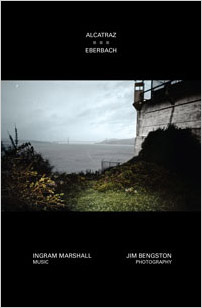
Alcatraz/Eberbach by Ingram Marshall and Jim Bengston  (Starkland S-2019)

This DVD is essentially the completion of a collaboration of photographer Jim Bengston and composer Ingram Marshall.  As such it is the most complete artistic statement superseding the audio only release (still worth having by the way) from some years ago.


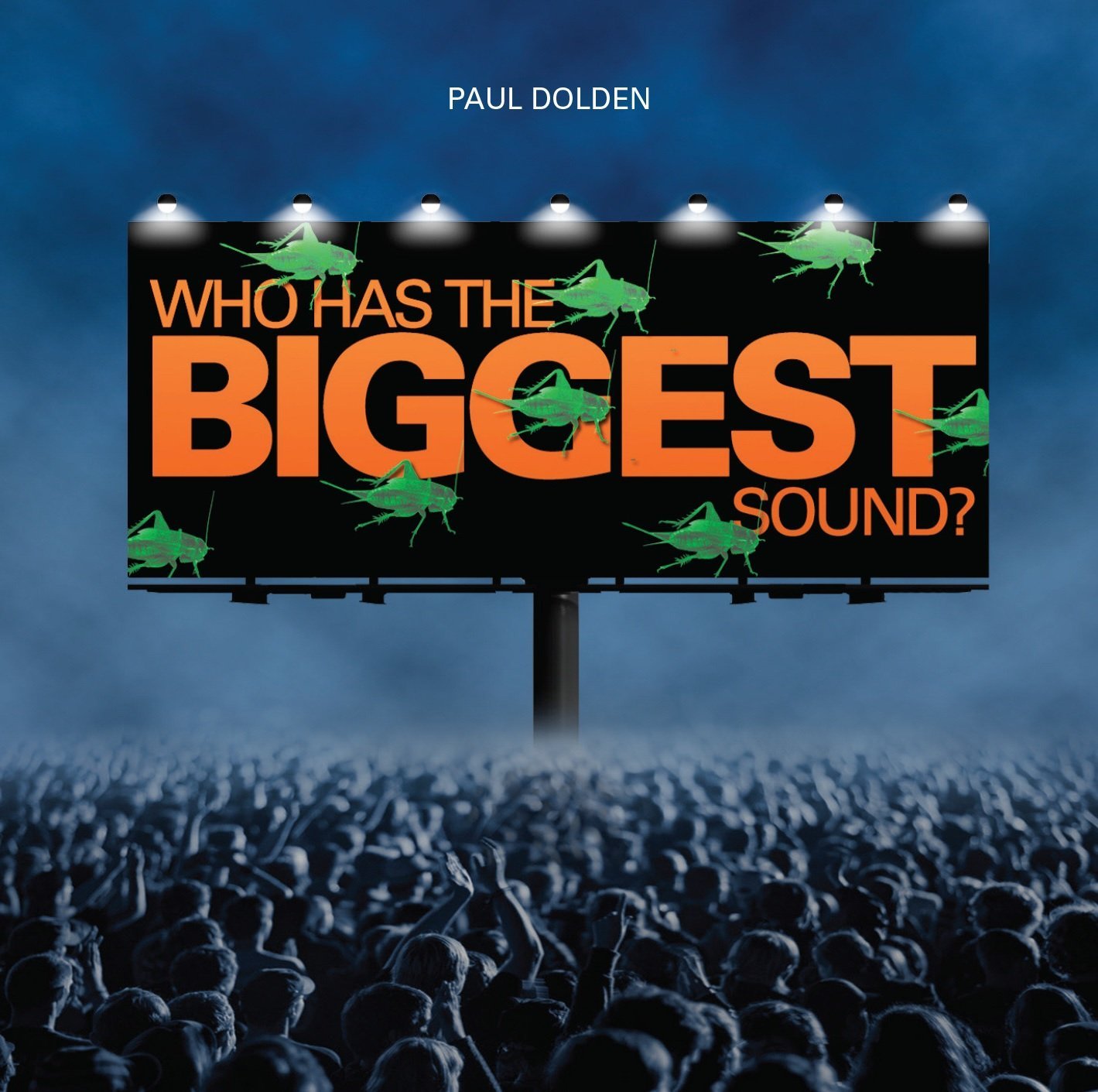
Who Has the Biggest Sound? by Paul Dolden. (Starkland ST-220)
A difficult to categorize recording that brings two major works by this (previously unknown to me) Canadian composer to the listening audience. I reviewed this disc here.  I am still working on absorbing its subtleties.

221CoverB

Prayers Remain Forever by Martin Bresnick (Starkland ST-221)
In addition to providing me with quite a few readers the opportunity to review this recording introduced me to the work of this too little known living American composer.  My review garnered quite an amazing amount of readers as well as an appreciative response from Mr. Bresnick himself.  And now I find myself buying his other recordings.  Really great music.


Album cover

Album cover

Notes from the Underground by Anthony Davis. (BMOP sound 1036)

I have been a fan on Anthony Davis and his music for some years now and I was pleased to be able to review this disc.   I  was later able to obtain an interview with Professor Davis which will be forthcoming later this year.

download

Tom Johnson/Samuel Vriezen Chord Catalog/Within Fourths, Within Fifths. (Edition Vandelweiser)

I eagerly reviewed this crowd sourced CD in which I was proud to be one of the contributors to its production.  It is only the second recording of Johnson’s landmark of minimalism and an opportunity to hear the work of the fine composer/performer Samuel Vriezen.

basketmonk

Basket Rondo/Jukebox in the Tavern of Love by Meredith Monk/Eric Salzman. (Labor LAB 7094)

This Labor Records release would have escaped my attention were it not for my having run across it while researching another new music article.  New music aficionados might remember Eric Salzman for earlier works such as “Civilization and It’s Discontents” and his involvement with Nonesuch records or one of his many other significant involvements in the new music scene over the last 40 years or so.  This disc is the première recording of Meredith Monk’s “Basket Rondo”, one of her best realized new works as well as the première of a great new sound/music drama by Salzman.  A more thorough review is in the works.

howardhersh2

Something by Howard Hersh ( Snow Leopard Music 888295062350)

Mr. Hersh kindly sent me this CD for review which will be forthcoming but it easily makes it to my favorites list for 2014.

webreaknonclass

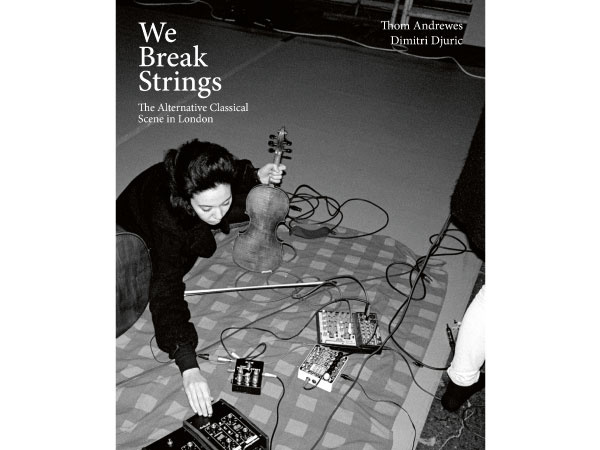
I also have to mention another crowd sourced project, “We Break Strings” by Thom Andrews and Dimitri Djuric, a book about the “alternative classical scene in London”.  The book which includes a CD sampler languishes in my “to be read” stack but my initial perusal left me with the impression of a beautifully conceived and executed volume which has much to offer the musically curious.  More about this book in a future blog.


2014 in review


The WordPress.com stats helper monkeys prepared a 2014 annual report for this blog.

Here’s an excerpt:

A New York City subway train holds 1,200 people. This blog was viewed about 6,400 times in 2014. If it were a NYC subway train, it would take about 5 trips to carry that many people.

Click here to see the complete report.

A Piece of the Action, or How Other Minds Brought Out My Inner Trekkie


20130218-134428.jpg

I have been a fan of Other Minds for many years.  While I lived in Chicago I read the reports on the concert series with great interest and was fascinated with the choices of composers since they tended to mirror my own interests in new music as well as introduce me to tantalizing new artists.  I am not a professional musician but I have a long-standing passion for new music and attended many concerts of new music while I lived in Chicago reading liner notes and music history texts eager for more of the exhilarating experience of great new music as it was happening and wanting to know what was just around the corner.

I recall vividly New Music America 1982 which was held in Chicago and was hosted by Charles Amirkhanian, the executive and artistic director of Other Minds.  He spoke with authority and seemed to know just about every musician whose work I admired and countless whose work I hadn’t yet heard.  He conversed knowledgeably with the likes of John Cage, Robert Ashley, Glenn Branca, Meredith Monk, Tom Johnson, Robert Moran and the list goes on.

10+2 Anthology 10+2 Anthology

Early on I had purchased and listened with delight to the masterful spoken word anthology: 10+2: 12 American Text Sound Pieces [OM-1006-2] containing a couple of Amirkhanian’s compositions  alongside other contemporary masters of that genre in the original vinyl release and listened with great interest to the landmark recordings of Conlon Nancarrow’s Player Piano Studies [OM-1012-15-2] both discs largely the work of Mr. Amirkhanian who managed to get these recordings made in Mexico City on Nancarrow’s own player pianos.  So I have been familiar with him as both composer and producer.  He had been for many years the broadcast broker of contemporary music at KPFA in Berkeley where he served as music director from 1969 to 1992.

Charles Amirkhanian with Rex Lawson Charles Amirkhanian holding the microphone while Rex Lawson sings along with one of his piano rolls.

When I moved to the bay area in late 2008 one of my first priorities was to attend my first Other Minds concerts.  I saw the OM 14 concerts and was not disappointed.  But my recollection was that it was at OM 15 that I checked the little box on one of the audience surveys saying that I would be willing to volunteer for the organization.  I did not know what to expect but shortly after OM 15 I was contacted by the OM office and asked to provide a résumé.  Well I have worked my entire career as a psychiatric nurse so I added to that résumé that I had what I termed “extensive knowledge” (not to mention a near obsession) of new music.  I got a call back and wound up spending 4 hour shifts approximately weekly over much of the following two years doing various tasks but mostly scanning photos and other materials for use in their web page and archives.

Dohee Lee at OM 18 Dohee Lee at OM 18

My first direct interaction at the office was with Adrienne Cardwell, a pleasant, hard-working young woman who I would later learn was (and remains) the longest  tenured employee other than Mr. Amirkhanian and his co-founder (now President Emeritus) Jim Newman.  Adrienne is in charge of the massive archival goings on and would direct my tasks over the next 2 years.

I worked in the same room as Adam Fong, the associate director at the time (now director of the Center for New Music and a composer/musician in his own right).  I also had the pleasure of working with fund-raisers Emma Moon and later Cynthia Mei who are also highly accomplished musicians and arts advocates.  I had  the pleasure of meeting the Other Minds librarian Steven Upjohn and the hard-working OM radio host Richard Friedman as well as the opportunity to meet interns and even some very interesting scholars and musicians who visited the office while I was there.  In short it was a great volunteer experience which garnered me more than I originally bargained for.

Adam Fong performing at “Something Else” The F... Adam Fong performing at “Something Else” The Fluxus Semicentenary he produced in September, 2011 (Photo credit: Wikipedia)

In the course of those two years I had many conversations with the OM staff particularly with Adam and later Mr. Amirkhanian about music and programming as I went through scanning, filing and doing whatever tasks were needed at the times I was there.  I recall making some references to some relatively obscure composers which resulted in Charles asking me (somewhat rhetorically), “How do you know that?”.   I just replied that I read a lot but later gave some thought about the nature of my relationship with this fine organization as well as the nature of my interest in new music.

Ruggles_cover_1024x1024

In the ensuing two years I would have some fascinating experiences meeting some of my heroes in new music and dabbling in the inner workings of Other Minds.  My enthusiasm was responded to by the staff at OM by allowing me to work on some of their other projects.  I greatly enjoyed the opportunity to participate and I was thanked most wonderfully once from the stage of one of the OM concerts by Charles Amirkhanian and at least a few more times by having special thanks acknowledged in various concert programs and, most notably for me, in the liner notes of their CD release of the complete music of Carl Ruggles (OM-1020-21-2).  I knew and loved those recordings when they were released on vinyl and was ecstatic to participate in the work on the CD release.  It was great on vinyl and it’s even better on CD.

OK, here is where Star Trek comes in:

75px-Star_Trek_TOS_logo_(1)

After some reflection I came up with what I think is an apt metaphor that fairly accurately describes my experience of my relationship with Other Minds.  Some may recall (you can fact check this if you aren’t old enough to have seen the original broadcast) an episode of the original Star Trek series which was titled, “A Piece of the Action”.  The plot involved Captain Kirk and his crew beaming down to a planet where the inhabitants were living out the equivalent of prohibition era gangsters’ lives.  At one  point this little boy (that would be me in this metaphor) offers some information which would allow Kirk and his crew to get over on the bad guys but only at a price.  The price, he says, is, “a piece of the action”.   The resolution of the plot involves the Enterprise crew successfully resolving the conflict and the little boy being able to experience just a taste of the perceived glamour of the experience of the Enterprise crew (dressed as depression era gangsters to fit in), as Captain Kirk says to him in his best cool gangster voice, “There ya go, kid.  A piece of the action.”

Star_Trek_William_Shatner

I came away from my volunteer experience even more impressed and pleased with this organization and I continue to support them in any way I can.  My thanks to Captain Kirk and his crew for bringing out my inner Trekkie and for availing me of more than just one piece of the action.  You guys run a truly great ship.  Live long and prosper.

I look forward to the upcoming 20th Other Minds concerts.  More on that in blogs to come.


Maybe Music Remains Forever, A New Martin Bresnick Disc


221CoverB

This latest release from Starkland adds significantly to the discography of the Yale based composer Martin Bresnick.   Born in 1946 in the Bronx, New York, he studied at  the University of Hartford (B.A., 1967), Stanford (M.A., 1968; DMA, 1972) where he studied with electronic music pioneer John Chowning and Györgi Ligeti.  He also studied with Gottfried von Einem in Vienna (1969-70).   He has taught at the San Francisco Conservatory of Music, Stanford University  and Yale where he is now a professor of composition.  Bresnick is a member of the American Academy of Arts and Letters and has been the recipient of numerous prizes and awards.  His wife is the wonderful new music pianist Lisa Moore whose work with Bang on a Can as well as her solo efforts have made many valuable additions to new music recordings.

Bresnick_Martin

Composer Martin Bresnick

I had heard of Bresnick but had not yet sampled his music so the opportunity to review this disc prompted me to follow-up on my long-planned intent to investigate the work of this American composer.  Not wanting to judge him just from this disc alone, I obtained  for comparison the CRI recording which contains his second and third string quartets and a couple of other chamber pieces for strings which range from 1973 to 1994 in their composition dates.  As I listened to both that disc and the one which is the subject of this review I found myself increasingly intrigued with this unique musical voice.

As it turns out the unsuspecting consumer may have already been exposed to this man’s work in one of several film scores including two of the Cadillac Desert  series, The Day After Trinity and an Academy Award nominated short from 1975, Arthur and Lillie.  The most recent film score listed on his site was for The Botany of Desire, after Michael Pollan’s best-selling book on human interactions with food.   I must confess that I don’t really recall the music from these films but I will be listening closely next time I screen them.

The CRI disc consists of Bresnick’s earlier works for strings.  It is an enjoyable if more an academic musical experience.  But the present disc, Prayers Remain Forever consists of more recent compositions ranging from the 2010 Going Home to the 2012 Ishi‘s Song.  These are much freer compositions concerned more with expression than form.  David Lang, who wrote the liner notes on the inside of the gatefold, describes them as being “deeper and more personal.”

A look at Bresnick’s starting places for these pieces gives a clue as to their nature.  The composer, writing in the booklet that comes with the disc, cites Kafka, Goya, Ishi (the last of the Yahi-Yani Indian tribe), mortality, religion and his own emotional response to having visited his ancestral home in Belarus.  All in all a somber, elegiac set of pieces that deal with deeply personal emotions and memories.

Tracks 1, 3, 5 and 6 were recorded at the Morse Recital Hall, Sprague Hall at Yale University by Eugene Kimball.  Tracks 2 and 4 were recorded at Firehouse 12 in New Haven, CT by Nick Lloyd who also mastered this disc.

The first piece on the disc, Going Home-Vysoke, My Jerusalem (2010) is scored for oboe, violin, viola and cello.  It was inspired by the composer’s experiences having visited the ancestral home of his family.  He speaks of remembering the stories he heard from his grandparents of the “alte heym” (Yiddish for old home) and the suffering they endured, the murder of his great grandparents, the destruction of the town.  Bresnick, who is himself a trained oboe player, weaves a beautiful, though painful, picture here.  This could conceivably be a film score to the images that are in the composer’s memories.  It is, for this writer the most poignant and personal of the pieces on this recording.  It is beautifully played by an ensemble who call themselves “Double Entendre” with Christa Robinson, oboe; Caleb Burhans, violin; John Pickford, viola and Brian Snow, cello.

Ishi (ca. 1860-1916)

Ishi (ca. 1860-1916)

The second track, Ishi’s Song, was inspired by an actual recording of Ishi, thought to have been the last of his tribe of Yahi-Yani Indians of Northern California.  Ishi lived out his life at the University of California at Berkeley under the care of anthropologist Alfred Kroeber and remains a beloved figure to many especially in the San Francisco  bay area .  Ishi recorded a song he that he had been taught and it is this song that forms the basis (or cantus firmus according to the composer) of this piece for singing pianist.  Lisa Moore is no stranger to the repertoire for speaking or singing pianist having recorded Frederic Rzewski’s masterful De Profundis (1992).  Her talents are put to good use here in this virtuosic set of variations on the haunting tune.

Kafka at the age of five

Kafka at the age of five (Photo credit: Wikipedia)

Josephine, the Singer (2011) is perhaps the most unusual piece here.  It is inspired by the Kafka story of the same name which is about a mouse that can sing.  This piece is a significant contribution to the solo violin repertoire.  It is an expressive piece in a single movement which is played with an easy sense of virtuosity and expression by violinist Sarita Kwok.

Strange Devotion (2010) is a lyrical piano piece sensitively played by Lisa Moore.  Bresnick’s inspiration, according to his notes in the accompanying booklet, state that he is here depicting a one scene from Goya’s horrific set of etchings, Disasters of War in which a donkey pulls a cart holding a coffin as people kneel by the roadside while it passes.  The “strange devotion” to which he refers is the devotion to religion.  The mood here is not one of cynicism it is more like a lament.

A Message from the Emperor (2010) is another piece based on Kafka.  This piece is scored for two speaking percussionists who play marimba, vibraphone and small tuned drums.  This little narrative follows in the same basic tradition as the speaking pianist piece.  The musicians speak sometimes separately, sometimes together coordinating their substantial duties on their instruments as well.  The story tells of an important message that, as is characteristic in Kafka’s absurdist world, can never actually be communicated.  It’s not clear if this (or, for that matter, the other tracks on this disc)  is intended as political protest music but the analogies are certainly there if the listener chooses to apply them..

yehuda_amichai2

Yehuda Amichai (1924-2000)

The last work here is inspired by “Gods Come and Go, Prayers Remain Forever”, a poem by famed Israeli poet Yehuda Amichai (1924-2000).  One  line of the poem, “Tombstones crumble” provides the inspiration for the appropriately somber cover art while  the music at hand, Prayers Remain Forever (2011) chooses perhaps a more optimistic line from the poem.  Again we have a deeply felt emotional expression here expertly interpreted by TwoSense  (Lisa Moore, piano and Ashley Bathgate, cello).


Gods Come and Go, Prayers Remain Forever

I saw in the street on a summer evening
I saw a woman writing words
On a paper spread on a locked wooden door,
She folded it and slipped it between the door and the doorpost
And went off.

I didn’t see her face or the face of the man
Who will read the writing and not the words.

On my desk lies a rock with the inscription “Amen,”
Piece of a tombstone, remnant of a Jewish graveyard
Ruined a thousand years ago in the city of my birth.

One word, “Amen” carved deep in the stone,
Hard and final, Amen to all that was and will not return,
Soft Amen: chanting like a prayer,
Amen, Amen, may it be His will.

Tombstones crumble, words come and go, words are forgotten,
The lips that uttered them turn to dust,
Tongues die like people, other tongues come to life,
Gods in the sky change, gods come and go,
Prayers remain forever.

(found on http://jpbaird.com/2013/11/)

Perhaps these non-literal musical expressions here can be said to be poetic and, like the prayers of Amichai’s poem may even last forever.  At least that seems to be the optimistic point Bresnick seems to make here.  This is a beautiful recording with talented and dedicated musicians that will continue to make it to my playlists.  And I am now compelled to seek out more by this wonderful composer.

The Three Black Counter Tenors, An Historic First


The original incarnation of three classical singers with the same range performing as an act was that of the late Luciano Pavarotti, Placido Domingo and Jose Carreras.  I seem to remember a similar act with three Irish tenors that followed on their model.  Well what we have here is a far more unusual and very historically significant collection of three counter tenors, that voice range of male falsettos roughly corresponding to mezzo-soprano in range.  This is certainly one of the least common type of vocal artist but what makes this a unique historical event is that all three are African-Americans (to use the currently politically correct term).  They’re not performing as an act, though.  They are all starring in a single opera which makes this event even more compelling.

Darryl Taylor

Darryl Taylor

This will happen in the context of performances of Henry Purcell’s 1689 opera, “Dido and Aeneas” in Los Angeles.  I include this in this new music blog because it is certainly a new occurrence and it fits well with my ongoing survey which has looked at black composers since the 1964 Civil Rights Act.  Of course this event puts the focus on black performers, an area which I have not attempted to explore.  But is is nice to see this happening in the 50th anniversary year of that landmark legislation.

I only came upon this information when a highly valued friend based in Oakland, Bill Doggett, who is acting as a consultant to the L.A. Opera alerted me to this historic first.  He recently curated a well received exhibition in the Grand Foyer at the San Francisco Opera at the performances of Porgy and Bess.  Bill is a concert producer, strategic marketer, consultant, arts advocate and lecturer whose work promotes black classical artists.  It was he that suggested that this event would fit with the themes developed in my previous blogs.  I did share with Mr. Doggett my experience seeing Mary Zimmerman’s beautiful production of Philip Glass’ Akhenaten in Chicago which featured a black counter tenor named Geoffrey Scott whose name, sadly, seems to have disappeared from the web except for that production.  What was curious about that is that I vividly recall the audience’s reaction when he first came on stage.  It is perhaps more historically accurate to cast a black man as an Egyptian Pharaoh but the audience seemed shocked by his appearance and I didn’t feel that it was just because of his vocal range.

John Holiday

John Holiday

The three singers in this new production include John Holiday, Darryl Taylor and G. Thomas Allen all of whom are making their début performances with L.A. Opera.  Holiday, who will sing the role of the sorceress was the third place winner in this year’s Operalia, a competition founded by  Placido Domingo for singers aged 18-32.  Taylor and Allen will sing the roles of the witches in a production which, as far as I can tell will be the first time three black counter tenors will be appearing on an opera stage  in  the history of the art form.  Taylor is a voice teacher on faculty at the University of Michigan at Ann Arbor  and Allen appears to be a rising star whose art we will see at an early point in his career.

Correction: Darryl Taylor is now Associate Professor of voice at Claire Trevor School of the Arts  University of California,Irvine.

G. Thomas Allen

G. Thomas Allen

This performance will be a double bill with the other half of the program being a production of Bartok’s Bluebeard’s Castle.  The productions will run from October 25th to November 15th.  Below I am sharing the press release of this historic event.  One hopes that this historic first will shed a more sympathetic light in these embattled times where, in spite of such wonderful historic performances, we endure a correspondingly negative series of news events like those in Ferguson, MO, New York and so many other places where the value of black lives seems to be at a very low ebb.3CountertenormediaNEW.doggett

CD Review-Hegarty, Steinbeck and Robles: Time/Space, an atypical jazz trio


HegartySteinbeck-TimeSpace

An old school twelve tone composer, an AACM composer and Julliard composer walked into a bar.  They sat down to play an out came, well, this album. And the bar I am imagining is perhaps a sort of post beat, post bop version of the bar from Star Wars.  I guess I am awash with metaphors here.

Imagine, if you can, a melding of musical styles.  Take a little Milton Babbitt, a little Anthony Davis, a touch of Wadada Leo Smith and perhaps a bit of Oscar Peterson (there is a little bit of a traditional lounge jazz touch here).  I have struggled to characterize this music and struggled perhaps even more to envision its ideal audience but that is not a criticism and is not intended to say anything negative about this album.

To be fair one of the main reasons I think I am struggling to describe this release is that it is a download only release which fortunately is accompanied by some nice cover art by Anna Hegarty and some liner notes which are essentially a  quote from some reviews but contain very useful information about the musicians and their history.  I guess I would feel differently if this had been a physical instead of digital release but perhaps I am just being nostalgic.  Oh, and keep in mind this is a free download.

The varied backgrounds of these musicians have resulted in a blending of styles creating a unique and enjoyable listening experience.  You can listen to this relatively short pieces as chamber music of a new classical variety but I think that would be missing the point.  This is basically an album of lounge jazz written and performed by some really good musicians who play well together.  Calling it “avant-garde” serves only to add a layer of fear and confusion to what should be a pleasant or at least innocuous experience.   That is why I called these guys an “atypical” jazz trio in the title of this review.

The musicians include James Hegarty on piano, Paul Steinbeck, electric bass and Shane Del Robles on drums.  According to the liner notes these musicians  have a pretty varied experience including free jazz,  AACM jazz, rock and various other projects.  They come together here very well.

In 12 short pieces (a metaphor for serialism?) this album manages to be lyrical and understated.  A few tracks use some studio effect of playing the tape backwards but most of what you hear is just acoustic instruments playing short numbers whose titles may mean more to the musicians than to the music itself but that is consistent with the type of music they are playing.  The music and the musicianship are good and sincere.

I would love to hear these guys play live in a smoky bar while sipping single malt scotch and hobnobbing with some kindred artistic spirits but I’ll have to settle for hearing it on my CD player (you have to hear this on a decent sound system).  I might even try to slip this in to some background music at a party just to see if anyone would notice it as different from whatever other background music might be played.  Very nice album and you can’t beat the price.

My Unexplained Absence Here Explained


20130604-093127.jpg

I thought it would be prudent to let my readers know what has been happening with me.
I haven’t posted anything here since July.
Happily I’ve found that I am still getting hits on my blog.

Well the fact is that I have been rather sidelined by a minor but rather debilitating back injury which has hampered many things in my life recently. But I am happy to report that I am on the mend and will very soon be resuming my posts here on a more regular basis.

Thank you to all who have read and commented in the last month or so. I hope you will find my future posts at least as compelling as the ones which preceded this brief hiatus.

Passing Frames, a new CD by Joel Helander, Happy, Gentle Experiments


Let me first acknowledge that I am running behind on my reviews but one of the reasons I have been slow about this one is that I have had great difficulty trying to characterize this music in a meaningful way for readers of this blog.  And by that I don’t mean to imply that this music makes for a difficult listening experience, it doesn’t.

Passing Frames (2014)

Passing Frames (2014)

Passing Frames is the second CD by composer/pianist Joel Helander whose previous release, Flood (2012) is a solo piano effort.  These two CDs published on Bandcamp earned Mr. Helander mention in Forbes magazine in an article about the self-marketing that is available to musicians who are trying to establish themselves in the music business.

Joel Helander

Joel Helander

Helander is a student in theory and composition at Clark University where this very project is featured on their website.  I conducted a sort of interview with Mr. Helander via e-mail exchanges and learned that he has been playing piano for about 10 years including classical training and a more recent interest in jazz performance. He said that this project began as a sort of follow-up or perhaps a natural progression to his previous release.  His earlier album has much in common with this one in terms of atmosphere. Passing Frames is a set of ensemble pieces with the assistance of friends and classmates all drawn from the Worcester area.

His brother Karl Helander, a singer and song writer in his own right, who studied studio drumming at the University of Miami plays drums and percussion.  String and wind players were enlisted from the Worcester Chamber Music Society, fellow Clark students and other friends. He cites Mike Tierney (guitar, engineer, co-producer) as being essential to the creation of the overall sound of the album as well as being an effective instrumentalist in selected tracks.  All in all it sounds like this was a very close creative collaboration which was rewarding for all involved.

When I first received the CD in the mail I was immediately struck by the lovely cover art and overall design which led me to comment to Mr. Helander of the nostalgia for the larger cover art one used to get with vinyl LPs.  He commented that he had looked into this possibility but found it economically prohibitive.  The photo and overall design was by the same artist, Paul Puiia, who had designed his previous release. There are 11 tracks on this CD all with poetic titles that tell you little about the music itself but no doubt have some meaning for the composer and perhaps his collaborators.  That is not intended as a criticism, rather it is a reflection of music that is less concerned with form than expression.  Not program music but little poetic statements.  And given that Mr. Helander aspires to writing film music this sort of focus seems quite appropriate.

On my first few listens to this disc I was reminded in ways of Ludovico Einaudi, The Penguin Cafe Orchestra and perhaps some of the chamber music of Peter Schickele.  Mr. Helander said he was comfortable with those comparisons.  I did ask him to list some of the music he listens to and he provided me with a pretty eclectic list including:

-Debussy’s String Quartet
-Chopin’s Nocturnes
-Beethoven’s “Archduke”
-Satie’s “Gymnopedies”
-Bill Evans’ “Portrait in Jazz”
Randy Newman‘s “Sail Away”
-Rufus Wainwright’s “Want”
-Nina Simone’s “Little Girl Blue”
-Jon Brion’s “Eternal Sunshine of the Spotless Mind Soundtrack”
Van Dyke Parks‘ “Song Cycle”
-John Coltrane’s “Blue Train”
-The Bad Plus’ “Never Stop”
-Fleet Foxes’ “Helplessness Blues”
-Tom Waits’ “Orphans: Bawlers”
-Neil Young’s “After the Gold Rush”
Belle and Sebastien‘s “The Life Pursuit,”
-Chet Baker’s “Chet Baker Sings,”
Chilly Gonzales “Solo Piano I and II”
Brad Mehldau‘s “Highway Rider”
-Simon and Garfunkel’s “Bookends.”
This is an interesting and varied list.  I didn’t include this list to give prospective listeners and idea of what the music sounds like but I think it does reveal something about the aspirations and inspirations of the composer’s intent.
I had given some thought to trying to describe each of the tracks on the disc and give my analysis and impressions but finally decided to leave my readers with more general impressions.  Each of the tracks is a self-contained musical statement though three of the tracks are identified as being parts of a suite.  As I said, the poetic titles may have meaning for the composer and may invoke ideas in the listener as well but in the end I perceived the entire disc as a sort of unified whole in that the disc appears to be a musical statement which stands as a reflection of the composer’s ideas at the time of this release much as his first disc does.
Further listenings suggested a sort of sophisticated melancholy lounge music born both of the composer’s aesthetic and those of his collaborators (the production and recording certainly add to this effect).  There appears to be more of a classical influence with a jazz ambiance added.  This is an interesting disc which manages to be both gently experimental as well as eminently listenable.  It is a snapshot of this young man’s best efforts at composition and each can be listened to as a potential sound track to a yet to be made film sequence or simply as a pleasant musical statement on it’s own.
With the perspective of the first disc in mind one can see a progression and integration of nascent ideas evolving as the composer works to develop a more integrated and clear statement of his ideas.  He achieves exactly what he intended I think.  That being said I will be interested to see what he does next as I enjoy the work he has done so far.  If you are interested in new music this disc is worth a listen.  If you are just looking for something different to add to your listening selections you would not be disappointed either.

The Biggest Sound, Paul Dolden’s Eclectic Musical Visions


This new Starkland release (due out on July 29th) is actually the second time that Paul Dolden‘s music has appeared on the label.  The groundbreaking Dolby 5.1 surround audio DVD with images,  Immersion (2001) contains his Twilight’s Dance (2000).

Paul Dolden is a multi-instrumentalist born in Ottawa, Ontario, Canada in 1956.  He has worked as a musician since age 16 playing violin, cello and electric guitar. His work has been described as post-modern, the new complexity, electroacoustic and ambient but none of these descriptors can give you a clue as to how his music actually sounds.  In addition to his instruments he makes extensive use of recording technology and sampling techniques.  But Dolden is not a tinkerer with a laptop and Garage Band software.  His music appears to stem from a variety of influences and ideas which embrace acoustic instruments, tape techniques, digital editing, alternate tunings, rock, classical, jazz and perhaps other influences as well. His album L’ivresse de la Vitesse (1994) was listed in Wire Magazines list of “100 Records That Set the World on Fire”.

L'ivresse


This was indeed his breakout release.  Two previous albums are essentially retrospectives of his work.  ‘Threshold of Deafening Silence’ (1990) contains works from 1983-1989.  And ‘Seuil de Silences’ (2003) contains works from 1986 to 1996.

Seuil de Silences (2003)

Seuil de Silences (2003)

Threshold of Deafening Silence (1990)

Threshold of Deafening Silence (1990)


He followed L’Ivresse with ‘Delires de Plaisirs’ (2005).  Both his biographical sketch on electrocd.com and his Wikipedia page were both created by Jean-François Denis, the Montreal based producer of the empreintes DIGITALes label which released most of Dolden’s recordings along with a treasure trove of music by mostly Canadian electroacoustic composers.  There is a great deal more to Canada than hockey.  There is a rich musical culture which inscrutably is very little known in the United States.  This new release would be welcome if only for its making some of the best of that culture better known.

Delires de Plaisirs (2005)

Delires de Plaisirs (2005)

Dolden has written over 30 commissioned works for various ensembles from chamber groups to symphony orchestras.  His works have been played by the Espirit Orchestra (Canada), Phoenix Orchestra (Switzerland), the Stockholm Saxophone Quartet and the Bang on a Can All Stars.  He has been most favorably profiled in The Village Voice and Wire Magazine.

So this Starkland release is the fifth CD devoted entirely to Dolden’s work.  His work appears in several collections, most notably the sadly out of print  Sombient Trilogy (1995) which places Dolden’s work in context with many of his peers including Maggi Payne, Dennis Smalley, Stuart Dempster, Elliott Sharp, Ellen Fullman, Maryanne Amacher and Francis Dhomont among many others.  Perhaps the San Francisco based Asphodel records will re-release this set or it could even wind up on one of those treasure troves of the avant-garde like Ubuweb or the Internet Archive.  It is worth seeking out.

Dolden’s work is pretty consistently electroacoustic, meaning it contains live musicians along with tape or electronics.  And while this is still true on the disc at hand ‘Who Has the Biggest Sound?’ would be difficult to stage in a live setting.  Its dense complexities would require very large forces.  The specter of Glenn Gould and his ultimate reliance on studio recordings rather than the unpredictable nature of live performance looms here.

The album is very competently composed, produced, mixed and mastered by Paul Dolden.  The recording is consistent with the high sonic standards by which Starkland is known.  Executive producer Tom Steenland contributes the appropriately enigmatic cover art.  Starkland’s genius here is in promoting this amazing artist.

Back cover

Back cover

This disc contains two very different works, each in several sections. ‘ Who Has the Biggest Sound?’ (2005-2008) is the major work here.  Dolden’s intricate methods are put to very effective use in this sort of virtual electronic oratorio describing the search for the sonic Holy Grail with mysterious poetic titles to each of the 15 different sections.  In my notes taken during multiple listenings (this is not a piece I think most listeners will fully grasp the first time through, I certainly did not) I struggled to describe this music.

In it I heard some of the collage-like elements of John Cage’s Roaratorio and Alvin Curran’s Animal Behavior.  Certainly there are elements of free jazz and the sort of channel changing style of music by the likes of Carl Stalling and John Zorn.  I flashed back to the overwhelming complexity of a live electronic performance I once heard by Salvatore Martirano and felt nostalgic for the sounds of Robert Ashley’s similarly electroacoustic operas.

Repeated listenings revealed more depth and coherence.  Dolden reportedly spent hundreds of hours in the studio mixing this magnum opus so I didn’t feel badly that it initially eluded my intellectual grasp.

The second work ‘The Un-Tempered Orchestra’ (2010) is described in the liner notes as owing a debt to Harry Partch and while that’s certainly true I would suggest that it owes a debt to other masters of microtones such as  Ben Johnston, Alois Haba, Ivan Wyschnegradsky and perhaps even La Monte Young, Tony Conrad, James Tenney and John Schneider among many others.  It is cast in six sections which, curiously, do not have the poetic titles accorded to the sections of the previous work and which are generally ubiquitous in Dolden’s output.

That being said, Un-Tempered Orchestra in its six brief sections shares much of the same sound world as the former work.  It is more intimate in style and is similarly difficult to anchor in any specific tradition.  It is in part an homage to Bach whose Well-Tempered Clavier celebrated the introduction of equal temperament tuning which would become the standard tuning system for the next 200+ years.  This is a deconstruction, if you will, of that system and explores some of the endless possibilities of alternate tunings.

This is a fascinating and intriguing release which will spend many more hours in my CD player.  It is a great new addition to the quirky but ever interesting catalog of Starkland Records and a welcome example of a composer at his peak.  It is available though the Starkland Records website as well as through Amazon.  Highly recommended.
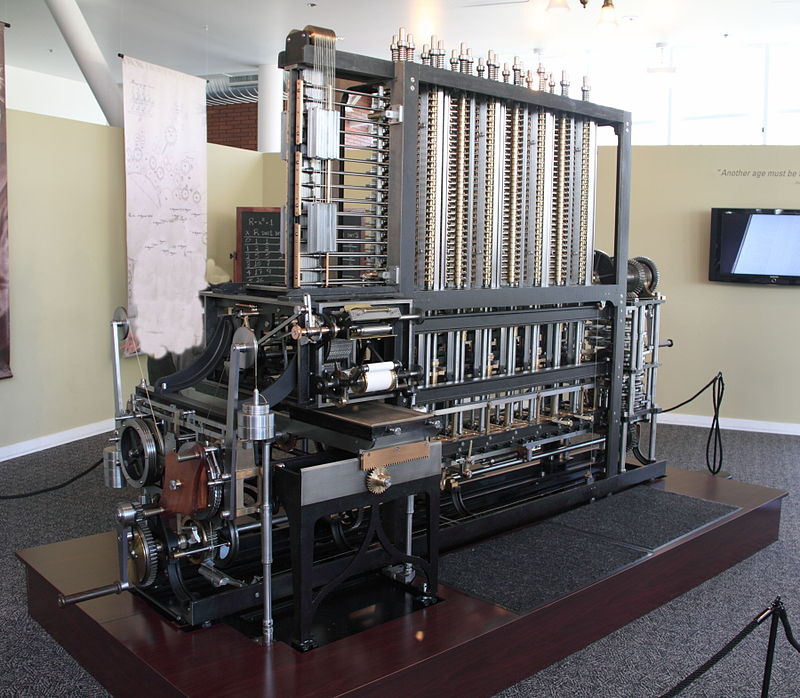


Black Conductors, a belated addendum


Due to the popularity of my earlier black conductors article I was feeling the need to expand this piece a bit.  Again this is by no means comprehensive and I welcome comments, additions and corrections.


The original article was just an occasional piece, far from comprehensive so I have decided to add a few names.  First the black conductors who are no longer with us:


Charles-Richard Lambert (d. 1862)- Born in New York (no date given), settled in New Orleans and was a music teacher and conductor for the Philharmonic Society (the first non-theater orchestra in New Orleans).  He died in Port-au-Prince, Haiti.

Edmond Dédé (1827-1903) Born in New Orléans, he moved to Europe to study music and settled in France where he had a career as a conductor and composer.

Edmond Dede

Edmond Dede

William Grant Still photographed by Carl van Vechten

William Grant Still photographed by Carl van Vechten


William Grant Still  (1895-1978)- In addition to being a major American composer and the first black composer to have a symphony played by a major symphony orchestra to have an opera premiered by a major company (Troubled Island, written in 1939 was premiered by the New York City Opera in 1949), the first black composer to have an opera broadcast on television (Bayou Legend, 1941, not performed until 1974 and broadcast 1976 by the Mississippi Educational Television Authority) he was also the first black conductor to conduct a major American orchestra in the deep south  (New Orleans Philharmonic, 1955)

Calvin E. Simmons

Calvin E. Simmons


Calvin E. Simmons (1950-1982) The first black conductor to be appointed conductor of a major American orchestra (Philadelphia Orchestra).  He died in a canoeing accident near Lake George in New York.  The Calvin Simmons theater at the Henry J. Kaiser Convention Center in Oakland, CA is named in his honor.


And now to those who remain on the earthly plane:


-Thomas Jefferson Anderson (1928- ) Better known perhaps as a composer is an educator he is also an accomplished conductor, educator and orchestrator.  He is well-known for his orchestration of Scott Joplin’s opera Treemonisha (unfortunately this has yet to be recorded).


-Leslie B. Dunner (1956- )Born in New York City, he attended the Eastman School of Music, Queen’s College and received a Master’s Degree in 1979 from the University of Cincinnati Conservatory of Music.  He was the first American (of any color apparently) to win the Arturo Toscanini International Conducting Competition in 1986.  Currently a conductor for the Joffrey Ballet in Chicago, Mr. Dunner has conducted the Chicago Symphony, the Grant Park Orchestra, the New York Philharmonic, Detroit Symphony, L A Philharmonic and many others world-wide.


Leslie B. Dunner

Leslie B. Dunner


William Eddins

William Eddins (Photo credit: Wikipedia)


William Eddins (1964- ) Both a pianist and a conductor, Eddins was a founding member of the New World Symphony in Miami, FL and is currently the principal conductor of the Edmonton Symphony Orchestra since 2005.  He regularly performs music by 20th and 21st Century composers and host a podcast called Classical Connections.


-Robert Keith McFerrin, Jr. (1950- ) Better known as “Bobby McFerrin” is a ten time Grammy award winner.  He is also a popular guest conductor with orchestras such as the San Francisco Symphony, the Chicago Symphony, New York Philharmonic, Detroit Symphony, Israel Philharmonic and many others.

Bobby Mc Ferrin in 2011

Bobby Mc Ferrin in 2011


As I said this is hardly comprehensive but these omissions have bothered me more each time I see that the original post has been read again.  Hopefully this will assuage my guilt and provide useful information.


…of the Adder’s Bite, a new CD release


Back cover of "...of the Adder's Bite"

Back cover of “…of the Adder’s Bite”

A copy of this fine newly released CD was kindly sent  to me for review a few months ago.  First of all I must say that my delay in writing this review is due in large part to my difficulty in attempting to categorize my experience of the music.  This is a very individual statement by a young musician from Greece, Panagiotis Pagonis (1989- )  who goes by the name, ‘Abstractive Noise‘ and whose work seems to be inspired by drone, minimalism, ambient, rock and perhaps classical sources as well as experimental literary narrative.

This is a self-produced concept album created in the composer’s own studio and it can only be properly appreciated over several close listenings. I would categorize this release as “experimental” though not wanting to scare anyone away because this disc makes for a comfortable listening experience, not the cacophonous assault that is sometimes encountered with the term “experimental”.

That said, the music develops slowly and requires some patience to appreciate the logic of its unfolding processes.  The experimental literary narrative which is appended in the liner notes may be useful to some listeners but I did not connect with the mythological romantic fantasy nature of the narrative except that it provides some clue as to the passionate nature of the composer/performer and his inspiration.  But don’t take my lack of connection as a negative critique.  It is merely the personal experience of a fifty something reviewer listening to the product of an emerging young composer.

As you can see in the above photograph of the back cover and the photograph below of the unfolded package the cover art is quite beautiful and does seem to reflect some of the nature of the music within.  It has a dark quality imbued with mystery and perhaps longing.  It is a hybrid of musical styles which flows quite naturally from the composer’s pen (or perhaps more properly, from the composer’s various electronic processing programs which are, for many, replacing the traditional pen and paper).

unfolded view of 'Abstracive Noise's' album

unfolded view of ‘Abstractive Noise’s’ album


I am listening to it now as I write this belated review and finding that the music continues to take on deeper dimensions with repeated listens. It can actually work as well in a close listening as one would ideally do with a classical composition or in the background setting a mood.  It is very well recorded with obvious careful thought put into the mastering which definitely adds to the quality of the listening experience.  It is available through the composer’s web site as well as through Bandcamp.

It’s not the sort of CD I would put on my car stereo but it works very well in my living room as an accompaniment to writing or just sitting.

I know very little of this young artist’s background or future plans but I look forward to more from this musician.

Enhanced by Zemanta

Primous Fountain World Music Tour Begins in Moldova


Primous Fountain arrives in Moldova to oversee the performances of his music.

Primous Fountain arrives in Moldova to oversee the performances of his music.

There has been quite a bit of interest in my earlier post on this composer.  Since then I have had the pleasure of exchanging quite a few e-mails with Mr. Fountain in which he has generously shared more details about himself and his work.  It turns out that he had been preparing for a tour of concerts of his music the first of which will occur in Chisinau, Moldova on May 19th.

Mr. Fountain has now completed 6 symphonies in addition to other orchestral and chamber works.  His first orchestral work, Manifestation (1969) was premiered by the Chicago Symphony when the composer was just 19.  He is a graduate of Wendell Phillips High School in Chicago and studied at De Paul University and the New England Conservatory with Gunther Schuller.  His Second Symphony was commissioned by Quincy Jones and it was a performance of this work that caught the interest of Gheorghes Mustea, a composer, conductor and cultural icon in Moldova who later agreed to this all Primous Fountain concert.

Maestro Gheorghes Mustea with his Orchestra of Teleradio Moldova Corporation.

Maestro Gheorghes Mustea with his Orchestra of Teleradio Moldova Corporation.

The 6th Symphony received its world première at this concert along with movements 7 and 8 of his composition, String Orchestra and an arrangement for trumpet and strings of a portion of his 2nd Symphony.  The concert will be recorded on video for later broadcast.  It was broadcast live on Radio Moldova and streamed on the internet.

Primous Fountain in the Radio Moldova Studio for his interview.

Primous Fountain with Maestro Gheorghes Mustea in the Radio Moldova Studio for his interview.

This was apparently the first time this orchestra had done a world première by a living American composer and I spoke with the very helpful orchestra manager Vasile Oleinic who told me that the conductor and musicians are very excited about this opportunity.  Mr. Oleinic has been sending me the photographs which illustrate this post.

This is the first of a planned series of concerts to be announced at a later date in what is billed as the Primous Fountain World Music Tour.  Mr. Fountain kindly sent me a copy of a promotional flyer which you can access here: PrimousFountainTour

This is the first article in what I hope to be a series devoted to Mr. Fountain’s concert series.  Stay tuned.
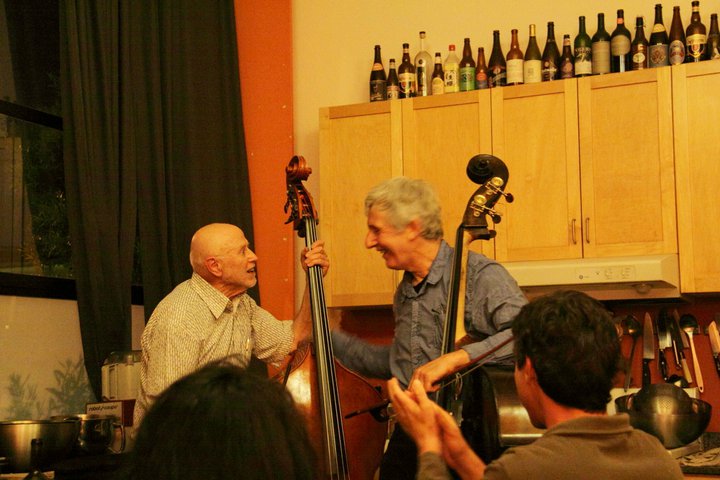
Primous Fountain working with the conductor at rehearsal.

Primous Fountain working with the conductor at rehearsal.


Enhanced by Zemanta

Tawawa House in Modesto? A New Staging of Zenobia Perry’s Opera.


Modesto California is not a common destination for new music productions but I learned of an upcoming performance of Tawawa House by Zenobia Powell Perry (1908-2004).  It was written in 1984 and premiered in 1987 at Central State University in Wilberforce, Ohio (actually the geographic setting of this opera) where she was part of the music faculty from 1955-1982.

I only learned of this performance due to my Facebook contact with Bill Doggett, a bay area business developer and marketing consultant who focuses on music by people of color.  The production is staged by Townsend Opera at the Gallo Center for the Arts in Modesto, CA.  It was the world première of a revised libretto and orchestration by Perry scholar Jeannie Gayle Poole.

After a mostly pleasant two-hour drive I arrived for my first visit to the central valley town.  I  located the beautiful arts complex and proceeded from a warm sunny spring day into one of several theaters housed in the same building, an arts multiplex, if you will.  The theater was about 2/3 full, a good sign.  It is a large and well-designed theater with great site lines, comfortable seats and a large fully equipped stage with a nicely nested orchestra pit.

The program book listed other productions that Townsend has done and it is an impressive list.  While they program popular standard repertory like La Boheme and Aida (no small feat) I did note that they have also done less frequently performed works such as Menotti’s Amahl and the Night Visitors and Offenbach;s Christopher Columbus.  Under the direction of Matthew Buckman since 2008 this is their first world premiere and perhaps their most adventurous production.

The staging (Heike Hambly), costumes (Tara Roe), lighting (Erik Vose), choreography (Erikka Reenstierna) and scenic design (Jean-Francois Revon) were excellent and well suited to what is essentially a chamber opera with spoken dialogue.  The singers were simply amazing both in their vocal artistry and their acting and dancing abilities.  The cast appeared quite comfortable with each other and clearly enjoyed what they were doing.  The orchestra was most ably led by conductor Ryan Murray.  This was a loving, beautiful production with amazing singers who appeared to put their hearts and souls along with their sizable talents to this opera.

The spectacular vocal cast included baritone Lawrence Craig, tenor Anthony P. McGlaun, baritone V. Savoy McIlwain, soprano Leslie Sandefur, baritone Barry Robinson and soprano Shawnette Sulker along with supporting singers and chorus.  These artists alone justified the price of a seat for this performance.

Dramatically staged scene from the second act.

Dramatically staged scene from the second act.

Tawawa House is based on a real place which existed in Ohio and served both as a luxury hotel for white visitors with purported healing waters as well as a major stop on the underground railroad with socially progressive whites assisting in the rescue of slaves from their forced servitude even before the emancipation proclamation.  The story begins before the civil war and ends just after.  It is a story nearly lost to history and one that deserves to be told.
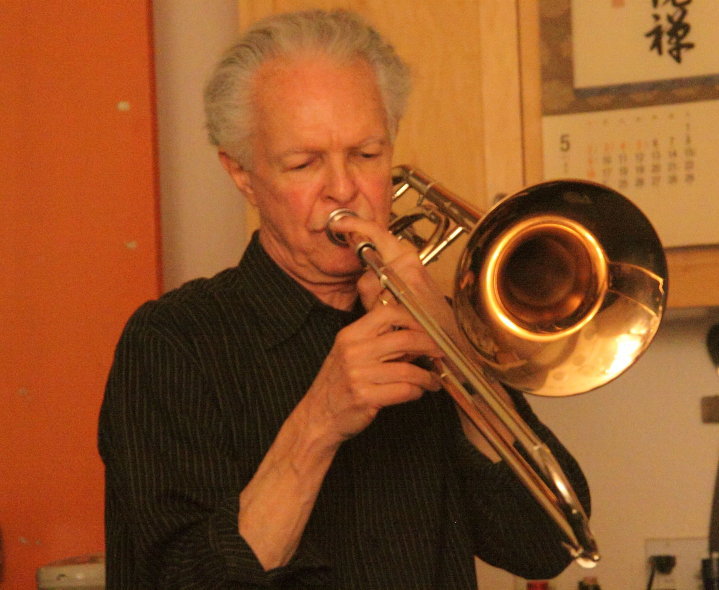
The joyful multiple weddings scene as one happy couple "jumps the broom" in a traditional practice of the era.

The joyful multiple weddings scene as one happy couple “jumps the broom” in a traditional practice of the era.

As an opera it is cast in a conservative musical style relying on spirituals and popular songs of the era with some quotation of both genres.  It consists of choral sections, a few arias and some ensemble singing.  Like many operas this one suffers from a weak libretto at times which nonetheless serves to support the overall structure of the musical work.  This is a gentle retelling of a tale from a sordid and shameful time in our collective history.

The orchestration ranged from a theater orchestra style to some Hollywood-like film score that one might hear in motion pictures from the 1940s.  I don’t know how this edition differed from the original 1987 performance or why the decision was made to revise it.

The cast taking their first bow to the appreciative audience.

The cast taking their first bow to the appreciative audience.

It is difficult to say where this work will take its place in musical history but it certainly deserves to be revived.  I hope that the success of this production will encourage adventurous opera companies such as Townsend to seek out other neglected works in that deserve revival and, in many cases, first performances.

Despite some minor weaknesses the performance was very professionally executed,  full of joy and clearly pleased the audience.  After all theater goers are accustomed to the sometimes silly plots common to a lot of operas and musicals but they are seeking entertainment by talented performers and that is definitely what they got.  This was a wonderful production which now puts Townsend opera on my radar.  Looking forward  to more from this company.  Congratulations on a great show!


Enhanced by Zemanta

Tom Johnson and Samuel Vriezen, Great New Recording


A few of months ago received my copy of the newly minted CD by pianist/composer Samuel Vriezen.  This is one of those crowd-sourced projects on Indiegogo .  The disc consists of a new recording of a sort of minimalist classic and a new works by the pianist, Within Fourths/Within Fifths (2006) which is, essentially his artistic response to this piece.  The piece is dedicated to Johnson.

download

This is only the second recording of the Tom Johnson work committed to disc. That by itself is an achievement. The first was recorded by the composer and released on XI records in 1999.  That recording clocks in at about one hour.  By contrast Mr. Vriezen’s recording takes only about 30 minutes to play the piece.  Johnson, who is also known as the former music critic for the Village Voice is one of the few composers who actually embraces the term “minimalist”, in fact he was there witnessing the very birth of that style during his tenure at the Village Voice (1972-1982).

The Chord Catalog (1985) consists of, in order, all the possible chords in a single octave that are possible with two notes, three notes, four notes, etc. up to 13 notes with the doubling of the octave.  That’s a total of 8178 chords. This sounds like a potentially bland academic exercise like many minimalist or process music concepts.  No tempo is specified in the score.  It is an important piece which may not appeal to all audiences but will likely entertain anyone whose listening interests lie in the realm of minimalism, process music and conceptual art.

TheChordCatalogue-page-001

According to Kurt Gottschalk in his article for I Care If You Listen Johnson is a fan of Vriezen’s interpretation and, in fact, is one of the many contributors to the project.  Vriezen has been performing the piece for about 10 years now in public concerts and he posted a video of a performance of Chord Catalog with commentary by Tom Johnson and himself.  There are also scenes of Johnson with Vriezen as he performs a portion of Within Fourths/Within Fifths.

Vriezen’s piece by contrast lasts about 45 minutes and, though using similar methods, produces a different sound world.  He correctly describes the piece as lyrical and it is a wonderful piece on its own, more wonderful in context with its predecessor.  This disc is an artistic dialogue, a call and response between to kindred spirits of different generations.

Samuel Vriezen is a Dutch pianist, composer and writer born in 1973.  His web site lists his compositions and writings and there are downloadable mp3 files and scores.  There is also a Vriezen page on Ubuweb which contains mp3 files and pdf files of several of his pieces and includes useful program notes.  He also produced Johnson’s CD Symmetries (1980) featuring Vriezen and fellow pianist Dante Oei on Karnatic records.

This is the solo début recording by a composer and pianist with keen instincts and talents that leave this reviewer in excited anticipation of what he  will do next.  I am also proud to have sponsored this wonderful recording.

Enhanced by Zemanta

Alvin Curran’s Fake Book at the Berkeley Arts Museum


Staging set up for the Alvin Curran solo performance at the Berkeley Arts Museum

Staging set up for the Alvin Curran solo performance at the Berkeley Arts Museum

On a cool Friday evening in Berkeley April 11th I proceeded to the Berkeley Arts Museum which sits across the street from the University.  It is a beautiful modern architectural creation with a large and resonant space where there was a large and colorful rug, a series of pillows and behind that a set of conventional chairs for the audience.  Many chose to sit on the rug close to the performer.

The set up consisted of a piano on loan from the Piedmont Piano Company, an electronic keyboard on loan from Paul Dresher along with Mr. Curran’s computer and and amplifier driving two speakers on either side of the keyboards.  The open space is just off the entry way of the museum and tends to have a fair amount of traffic and ambient noise of the people on the various levels.

Curran, now 75, has been a prominent figure on the contemporary music scene internationally since about 1964 when he was partnered with fellow expatriates Frederic Rzewski, Allan Bryant, Richard Teitlebaum and Carol Plantamura among others in the ground breaking Musica  Elletronica Viva.  They created events and happenings using live electronics in the days before such things were easily accessible.  He has continued to explore the leading edge of musical creativity throughout his long and ongoing career.

Curran playing a harmonica at the opening of the concert.

Curran playing a harmonica at the opening of the concert.

The concert began with Curran circumnavigating the audience in clockwise fashion beginning stage right and going around the audience making a full circle and returning to the front of the audience stage center.  he began by playing two simple chords on the instrument repeating them several times.  He then switched to another woodwind type instrument playing some unusual sounds.  When he took his place in front of the keyboards he set those instruments down.

Curran completing his circumnavigation which opened the performance.

Curran completing his circumnavigation which opened the performance.

He alternated between playing the piano and the electronic keyboard sometimes playing both.  He began with some simple sounding piano music and then turned to the electronic keyboard and began playing some of the samples on it.  They ranged from speech to electronic sounds.

At first the ambient noise of the crowd echoed gently in the museum along with the music.  Gradually as the music became more complex and louder the audience seemed entranced, taken on the ritualistic journey that comprises Curran’s work, Fake Book, a reference to books of musical lead sheets that musicians have used over the years to quickly and easily access a variety of materials for live performances.

The louder music then suddenly changed back to a softer dynamic and the reduction in the ambient noise of the audience and casual museum goers had noticeably decreased and one sense an increased attention and focus on the music.  All seemed to be drawn in to the variety of sounds and styles which Curran refers to as his “common practice”, a practice in which the composer uses any and all sounds, instruments and styles strategically to evoke the things the composer wishes to express.

Alvin Curran at the keyboards performing his Fake Book.

Alvin Curran at the keyboards performing his Fake Book.

Curran played for just over an hour without pause an encyclopedic diversity of styles and ideas evoking the musical past in classical sounds, jazz sounds, modernist sounds.  The electronic keyboard samples played voices, radio snippets, electronic sounds and electronic manipulations of these sounds.

Curran effectively involved us all in a ritual performance respectfully evoking the past and blending it all into our experience of the moment.  From the beginning as he walked clockwise around the audience and through the complex collage of musical and sonic ideas he created a genuine ritual, a sacred performance if you will.  His music this night was an homage to the past and a celebration of the present.

Curran blowing the ancient shofar (ram's horn) over the undamped piano strings.

Curran blowing the ancient shofar (ram’s horn) over the undamped piano strings.

He signaled the end of the performance as he blew the ancient shofar, an instrument fashioned from a ram’s horn, over the undamped piano strings creating a beautiful sympathetic resonance.

The audience responded with warm applause and appreciation.  Curran, who told me that he began work on this music while he was in residence at nearby Mills College, is clearly embraced and appreciated by the local audience.  He continues his tour and will return to his adopted  home in Rome, Italy but this evening he was clearly one of our own.

Overhead view of the keyboard set  up for the April 11th performance.

Overhead view of the keyboard set up for the April 11th performance.

Enhanced by Zemanta

Notes From the Underground, A major new recording of Anthony Davis’ orchestral music


Album cover

Album cover

In March, 2014 the Boston Modern Orchestra Project released Notes From the Underground, a major retrospective recording of the composer’s work for large ensembles.  The recording includes Notes from the Underground (1988) a two movement work for orchestra, You Have the Right to Remain Silent (2007) a concerto for clarinet and contra-alto clarinet and Kurzweil processor and a new recording of the piano concerto Wayang No. 5 (1984) with the composer as soloist.  The Boston Modern Orchestra Project is conducted by Gil Rose.

There are liner notes by the composer and also by the great musician/composer/historian George Lewis (and a frequent musical collaborator with Davis).  The notes are relatively brief but contain a wealth of information and provide useful insights into both the musical processes and the sociopolitical forces that drive Davis’ music.  Davis describes his compositional processes and Lewis, a frequent musical collaborator,  places the music in historic and sociopolitical contexts.

Only the Wayang No. 5 has had a previous recording.  It was one of the two works included on the Gramavision release which included the equally engaging Violin Concerto “Maps” (1988) written for and performed by violinist Shem Guibbory.  The concerto reflects Davis’ interest in jazz as well as his study of gamelan music from whence comes the title “Wayang”. Davis has written a series of compositions for various combinations of instruments titled sequentially Wayang No. 1, No. 2, etc.  The term refers to the shadow puppet theater of  Bali which are accompanied by a gamelan orchestra, an ensemble largely of tuned gongs and other percussion instruments.  Davis studied gamelan music and wrote six compositions (so far) titled Wayang of which the fifth is the piano concerto on this recording.

Wayang No. V is the earliest composition on the disc and consists of four movements.  Opening-Dance begins with an improvisatory section with the pianist playing over unresolved harmonies in the orchestra which then leads to the main section of the movement which is characterized by ostinati in the orchestra as well as on the piano.  There is a seamless transition to the second movement Undine, a slow movement with an impressionistic feel.  March also begins without pause from the previous movement.  It is a scherzo like piece where the polyrhythmic structures are quite clear.   The finale, Keçak, a reference to the monkey chant in the ritual enactment of a scene from the Ramayana where the monkey-like Vanara help Prince Rama fight the evil King Ravana.  It begins with a long solo piano introduction followed  by a sort of dialog between the piano and several percussion instruments.  Davis demonstrates his virtuosity here in writing that is indebted as much to gamelan as it is to jazz and modernism from Schoenberg to Bartok, Stravinsky, Hans Werner Henze and Thelonius Monk.

This is a concerto that is more concerned more with expression than empty virtuosity though the piano part could hardly be called easy.  I am amazed that there have been no pianists who have added this wonderful piece to their repertory.  It is a very entertaining piece of music making.

The title track is the orchestral composition, Notes from the Underground (1988).  It is a two movement work dedicated to the writer Ralph Ellison (1914-1994), best known for his National Book Award winning novel The Invisible Man (1952).   The title evokes Dostoevsky’s existential 1864 novel as well as Ellison’s collection of essays, Shadow and Act (1964). The composer describes it as a “riff” on Duke Ellington’s Diminuendo and Crescendo in Blue (1937).  It is, to this listener, a grand set of orchestral variations.

Ralph Ellison

Ralph Ellison (Photo credit: Wikipedia)

The first movement, Shadow, is described by the composer as one that introduces fragments which will be heard in the second movement.  It features a prominent solo for the percussionist.  The second movement, Act is the longer of the two and is described as being written in ten steps with an elaborate polyrhythmic structures described in more detail in the accompanying notes. The writing here probably comes as close to minimalist or process music as anything the composer has done.  It is not minimalism per se  but it is perhaps proto-minimalist techniques whose roots are at least partly in jazz as musicologist Robert Fink suggests.   It produces a ritualistic and meditative feel to this richly orchestrated, reverent and mysterious sounding piece.   It is a fitting tribute to a great American man of letters as well as to the great composer Duke Ellington.

The concerto, You Have the Right to Remain Silent (2007) is the most recent as well as the most overtly political piece on the album and it is a gem.  It is written for clarinet doubling alto clarinet and a Kurzweil synthesizer/sampler and orchestra.  Longtime collaborator, the wonderful J. D. Parran  plays the clarinets winding his way through a balanced hybrid of styles including bebop, modern classical and free jazz styles comprising rhythmic complexity and multiphonics.  One could hardly imagine a soloist better suited for this music.  Earl Howard plays the Kurzweil which intones sampled speech of words from the Miranda Rights which are supposed to be presented at the time of an arrest.  Here they are presented strategically in poetic dialogue with the music controlled by the keyboard player.

Here again the individual movements have their own titles poetically referencing the issues which the composer attempts to invoke in this piece. He says in his notes, “I tried to approach ‘silence’ as, rather than John Cage’s apolitical world of ‘white privilege’, a much more dangerous place.”  The first, Interrogation, is intended to evoke the clarinet as being interrogated by the orchestra.  The second, Loss  features an improvised duet between the Kurzweil and the clarinet.  It ends with an homage to Charles Mingus, a major influence on Davis.  The third, Incarceration includes more text from the Miranda and the Kurzweil processes both the words and the clarinet solo.   And finally, Dance of the Other, intending to evoke the fantasy and the feeling of otherness and presumably alienation.

It is a concerto in the classical sense of a dialogue between soloist and orchestra and it seamlessly blends various classical and jazz harmonies and techniques which challenge the expertise of the soloist.  All the while it clearly presents a political context which meditates on the inhumanities and inequalities inherent in our “correctional” system and in our society as a whole.  As political music it lies within a grand tradition taking a place beside earlier masterpieces of that genre like Henze’s Essay on Pigs (1968) and Rzewski’s Coming Together (1971).  And as a concerto it is a challenge to the soloist and a delight to the listener.

This is a wonderful disc, well recorded and performed.  It presents some amazing and substantial music by one of the living treasures of American composers.  Anthony Davis has had a long and influential presence on the American music scene in his jazz performances as well as his chamber and orchestral music.  His operas like X: The Life and Times of Malcolm X (1986), Amistad(1997 ) and the more recent Wakonda’s Dream (2007) have been performed to critical acclaim. Hopefully this recording will introduce people to this composer’s works and remind those already familiar with the power and depth of Davis’ music.  Bravo to the Boston Modern Orchestra Project for bringing this music to the listening public.  I hope the major orchestras and theaters and recording companies are paying attention so we can hear more from this still too little known composer.

Enhanced by Zemanta