Bob and Blue, A Musical Pilgrimage


Littlefield Hall (photo copyright by author)

…tell the old story for our modern times. Find the beginning.

-Homer, The Odyssey (Emily Wilson translation)

When I first got the email notice of this concert, I was, to say the least, intrigued. A two piano concert at Littlefield Concert Hall on the campus of Mills College featuring two composer/performers who figured prominently in that Temple of new music and in my personal listening life. Alas, I live some 350 miles from that location. But further intrigue came from the featured artists: Sarah Cahill and Joseph Kubera, two of the finest working new music pianists anywhere and both worked with the evening’s composers. This was just too compelling and I decided that I would regret missing this if I failed to go hear it.

So it was, I planned my little odyssey, leaving at about 9AM from Santa Barbara on a nice lightly trafficked trip, more a pilgrimage than an odyssey. A pilgrimage, frequently defined as a personal spiritual journey ostensibly in search of insight or enlightenment is how I’ve come to identify my listener’s adventure to the secular temple of Mills College featuring music of former Mills faculty Robert Ashley (1930-2014) and Robert Sheff (1945-2020), better known by his stage name, “Blue Gene Tyrrany”.

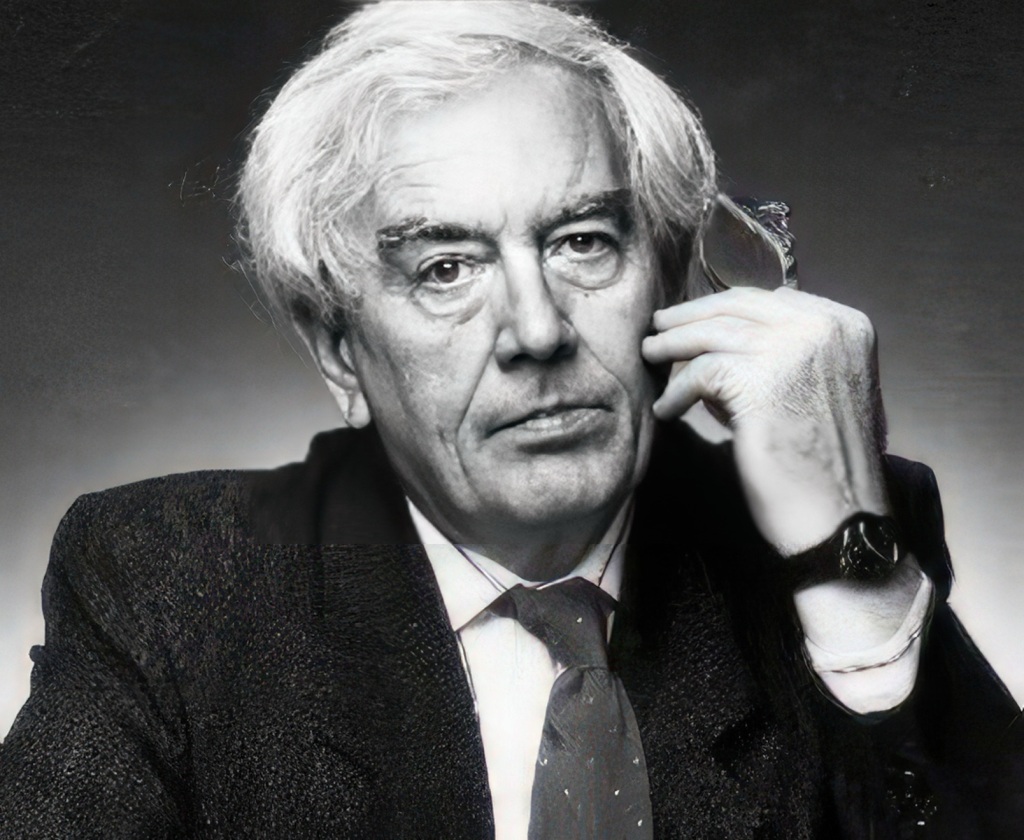
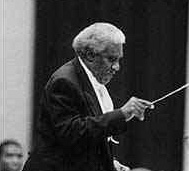
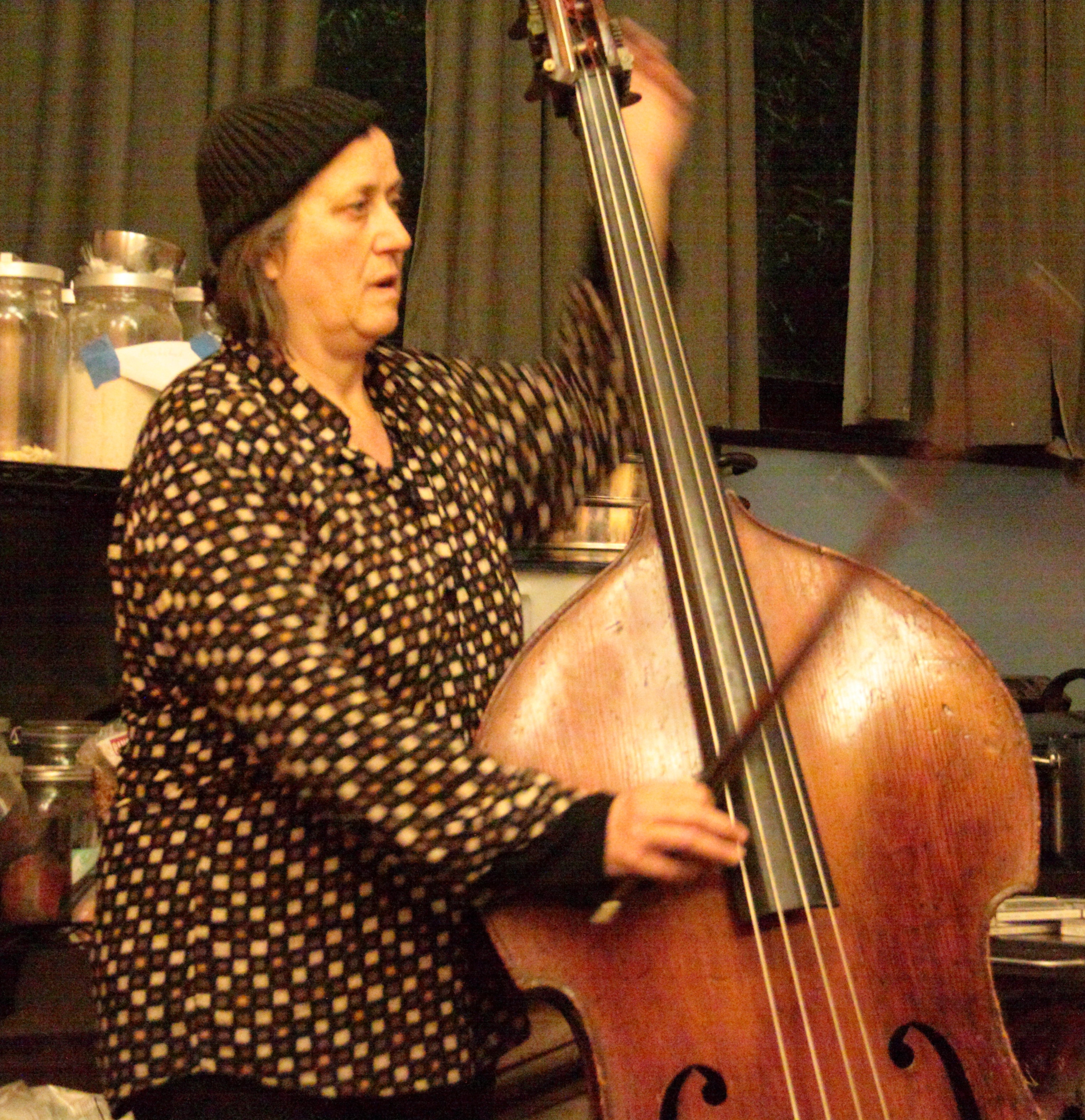
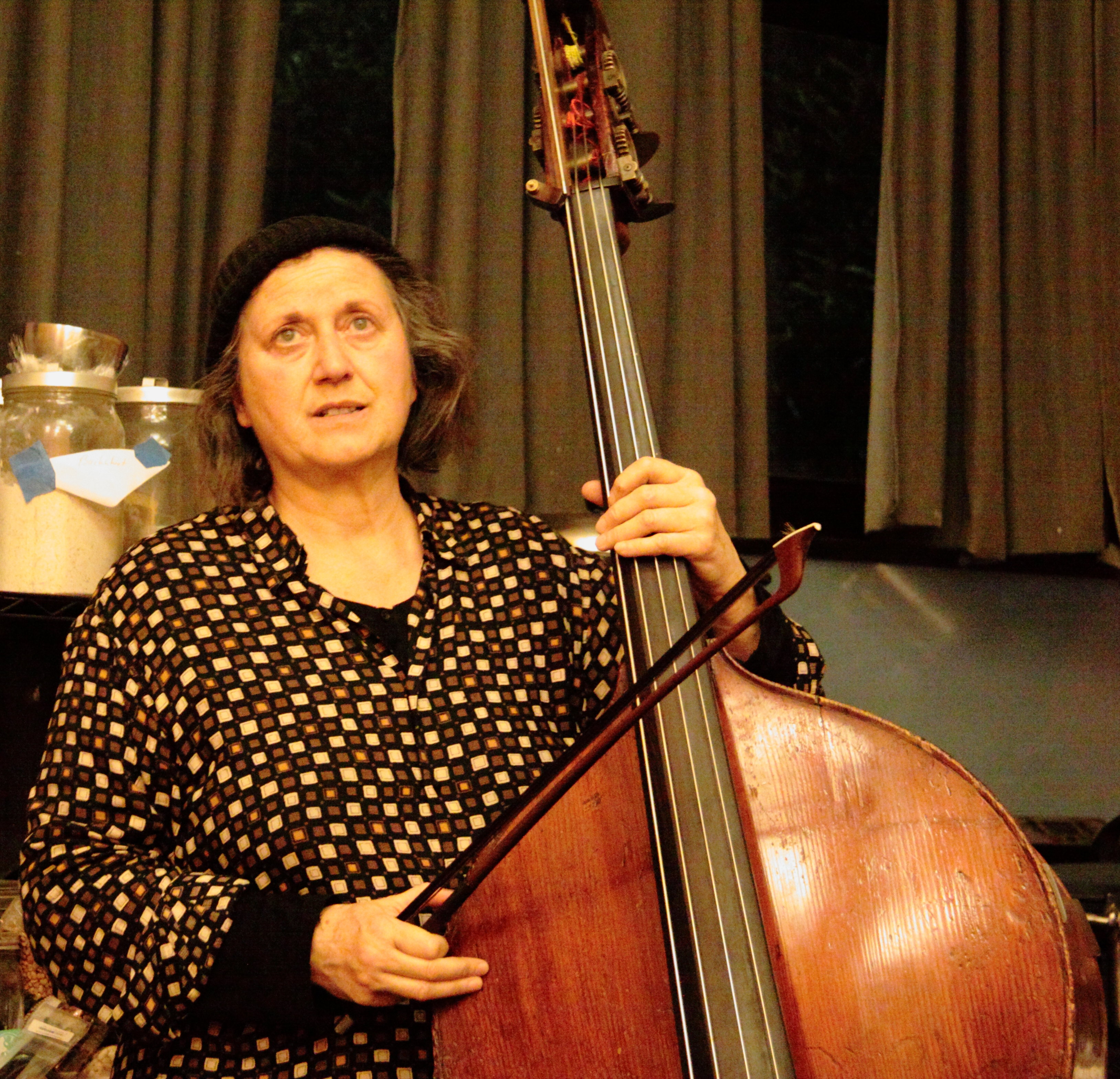
Robert Ashley (copyright unknown)
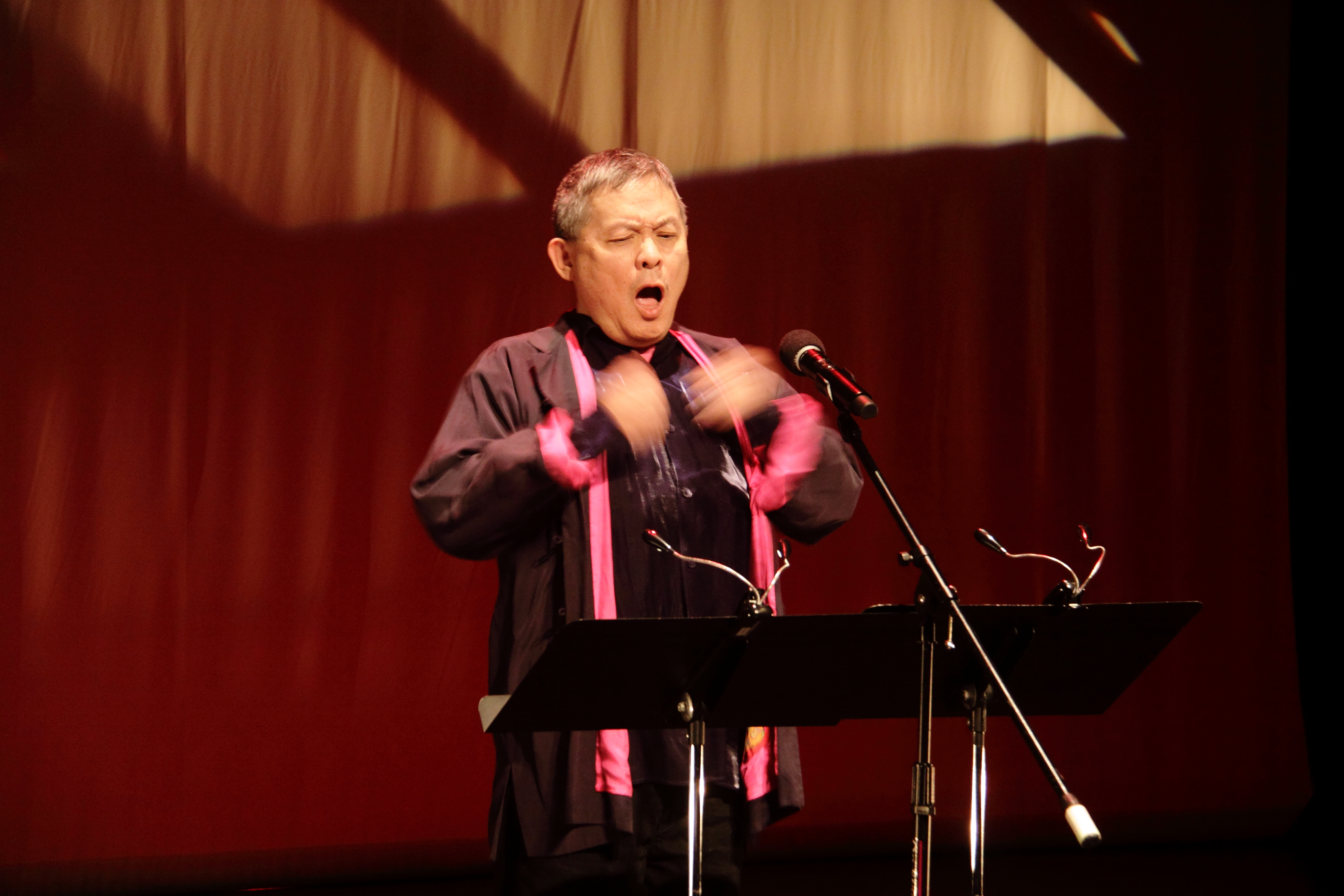
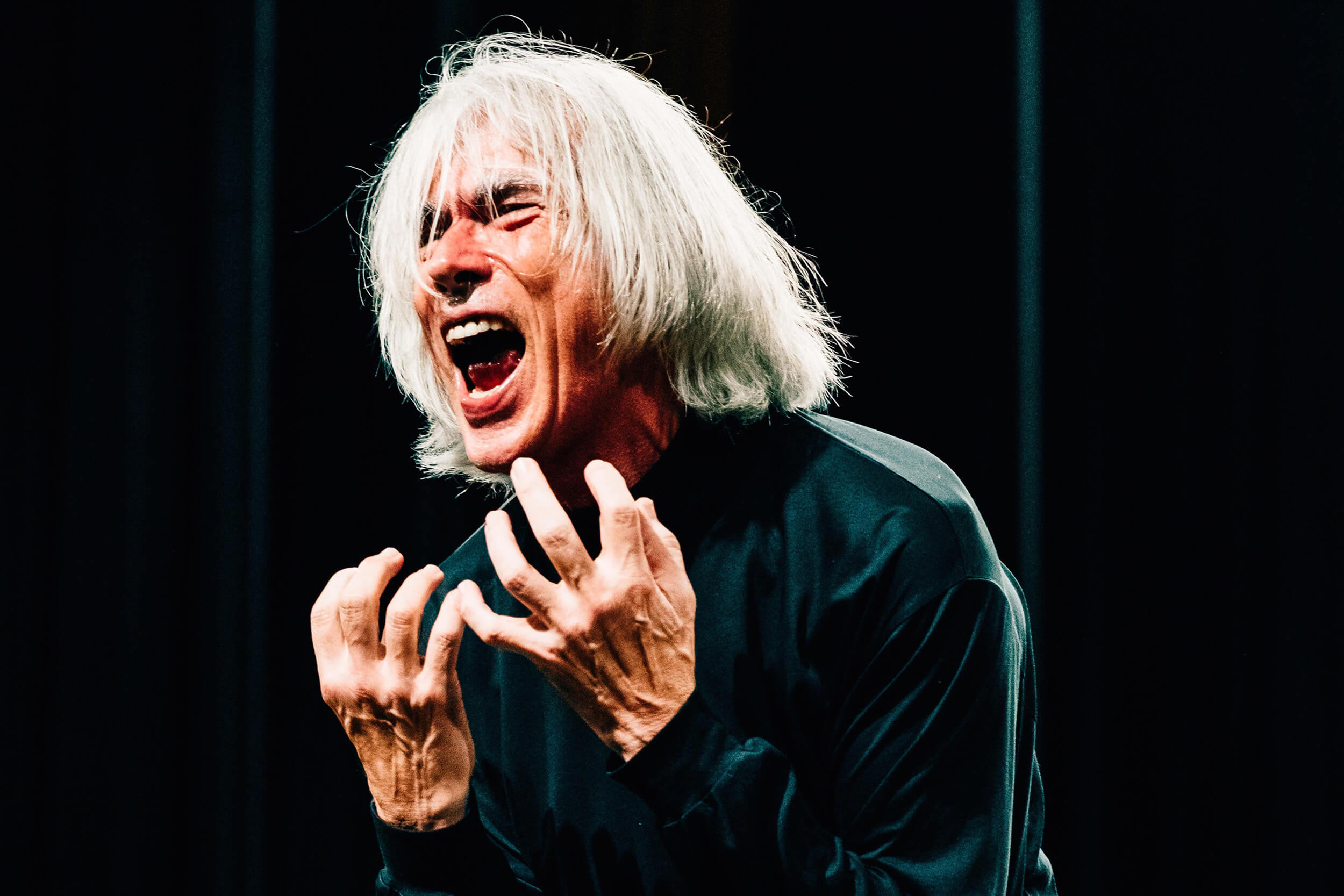
“Bob and Blue” (copyright by Other Minds)

The two featured composers had a strong connection to the Bay Area, mostly via their work at Mills College. This intelligent but modest production left little room to print program notes so the performers spoke of the music at various points during the concert and the excellent liner notes were made available by a QR code in the program book.

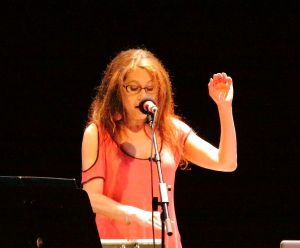
Sarah Cahill, pianist, radio host, producer, tireless advocate for new music (photo copyright by Other Minds)
Joseph Kubera, pianist, member of the SEM ensemble, Downtown Music, and countless collaborations promoting new music with many fine recordings to his name. (Photo copyright by Other Minds)

Our two performers are no strangers to each other or the composers on the program, having collaborated on numerous performances and recordings. The well rehearsed duo turned in riveting performances of this largely unknown repertoire which made a strong case that it be better known. Their playing and choice of repertoire compelled this listener’s attention such that I forgot to take all but a few performance shots. See those program notes for further biographical info on these two fine musical celebrants.

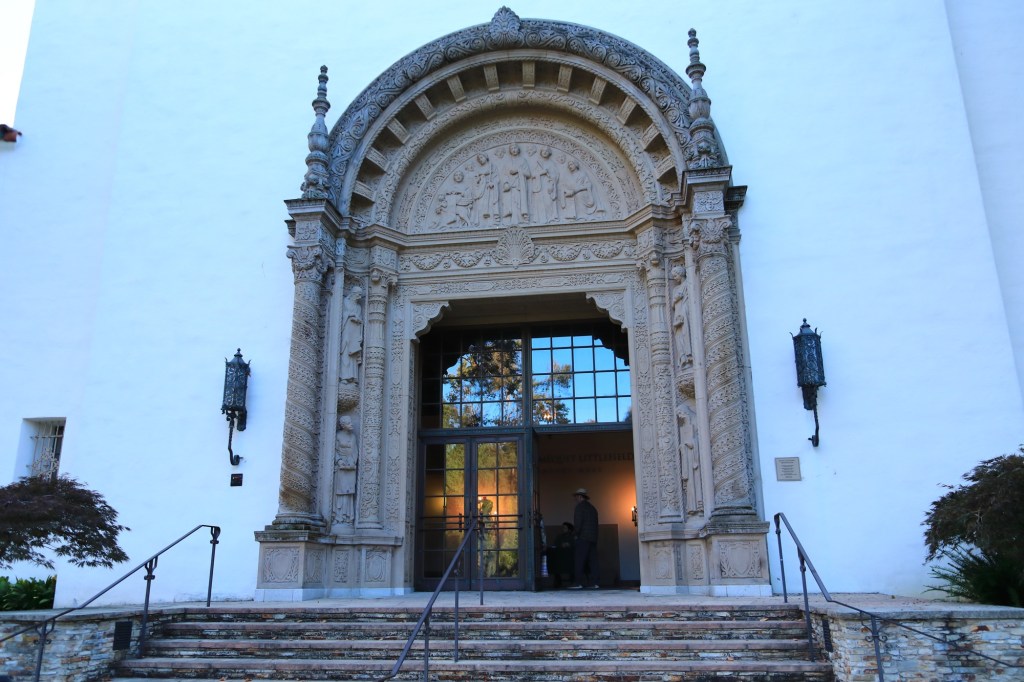
Entrance to Littlefield Concert Hall (copyright by author)

Mills College has long been a temple, a Mecca for new music in the Bay Area of California. Its roster of faculty and students comprises some of the finest post 1945 composers and performers. Darius Milhaud (1892-1974) and Luciano Berio (1925-2003) and students as diverse as Terry Riley (1935- ), Steve Reich (1936- ), and Dave Brubeck (1920-2012) to name but a few. Many artistic spirits musical and otherwise, exert their presence here. It’s a perfect destination for a pilgrimage.

A bust of frequent Mills visitor Lou Silver Harrison (1917-2003) in the lobby, a persistent benevolent spirit. (photo copright by author)

The concert was organized by Charles Amirkhanian and his Other Minds organization, another guiding light in the San Francisco/Oakland new music scene. Pianists Sarah Cahill and Joseph Kubera were to be the celebrants in the concert ritual paying homage to “Bob and Blue” as well as to the oracular Mills College.

Scene from the lobby (photo copyright by author)

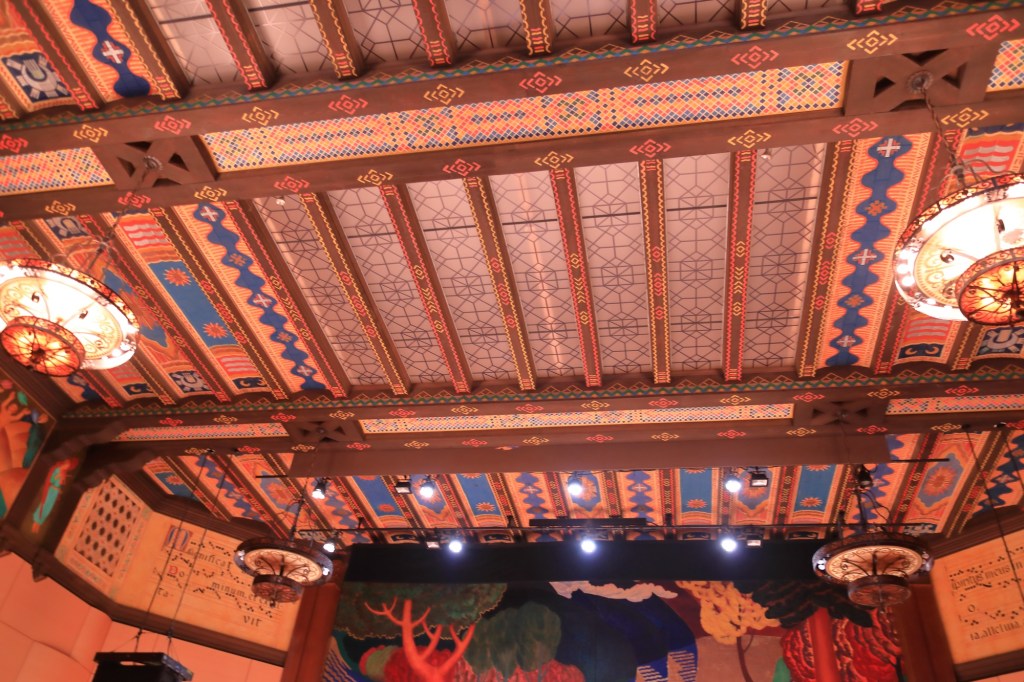
Let me tell you about this concert hall. It is the work of legendary California architect Julia Morgan (1872-1957) who famously also worked on Hearst Castle. This is one of her several architectural gems on campus. Her spirit was also witness to this celebration by virtue of her fine architecture.

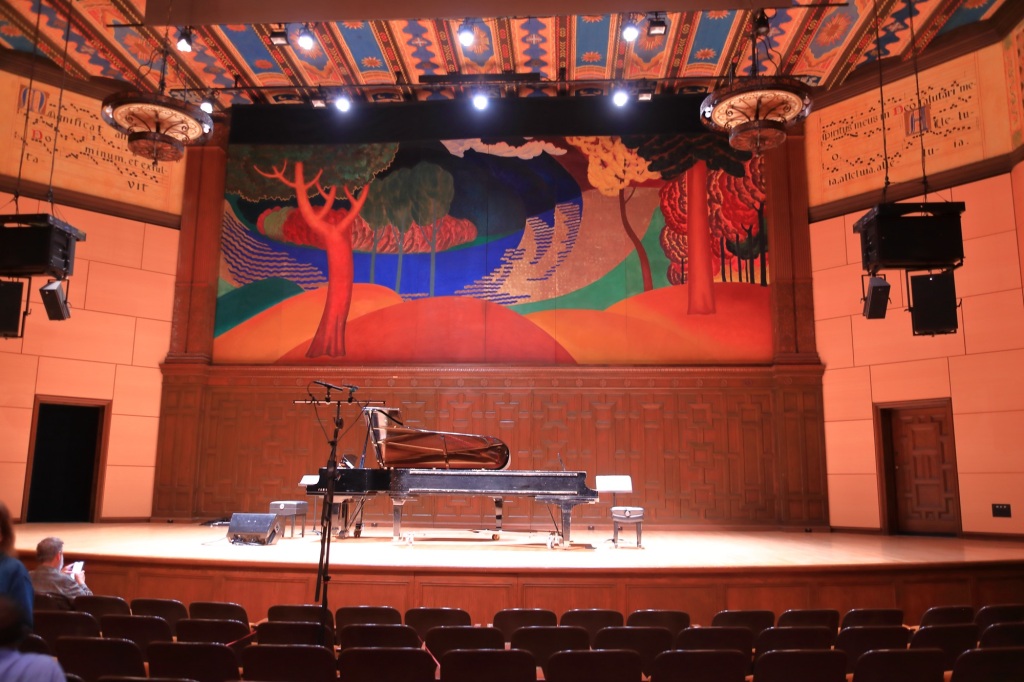
Stage at Littlefield Hall showing the ornate, colorful detailed designs (photo copyright by the author)
Look at that ceiling and those chandeliers (photo copyright by the author)

Two pianos, a new Steinway stage left and a slightly worn Baldwin stage right were placed such that the pianists seated at their respective keyboards could see each other. The Steinway with its lid open to reflect the sound to the audience and that well worn Baldwin with no lid at all (for reasons to be revealed later). The sonics of the hall and tuning of those pianos were excellent.

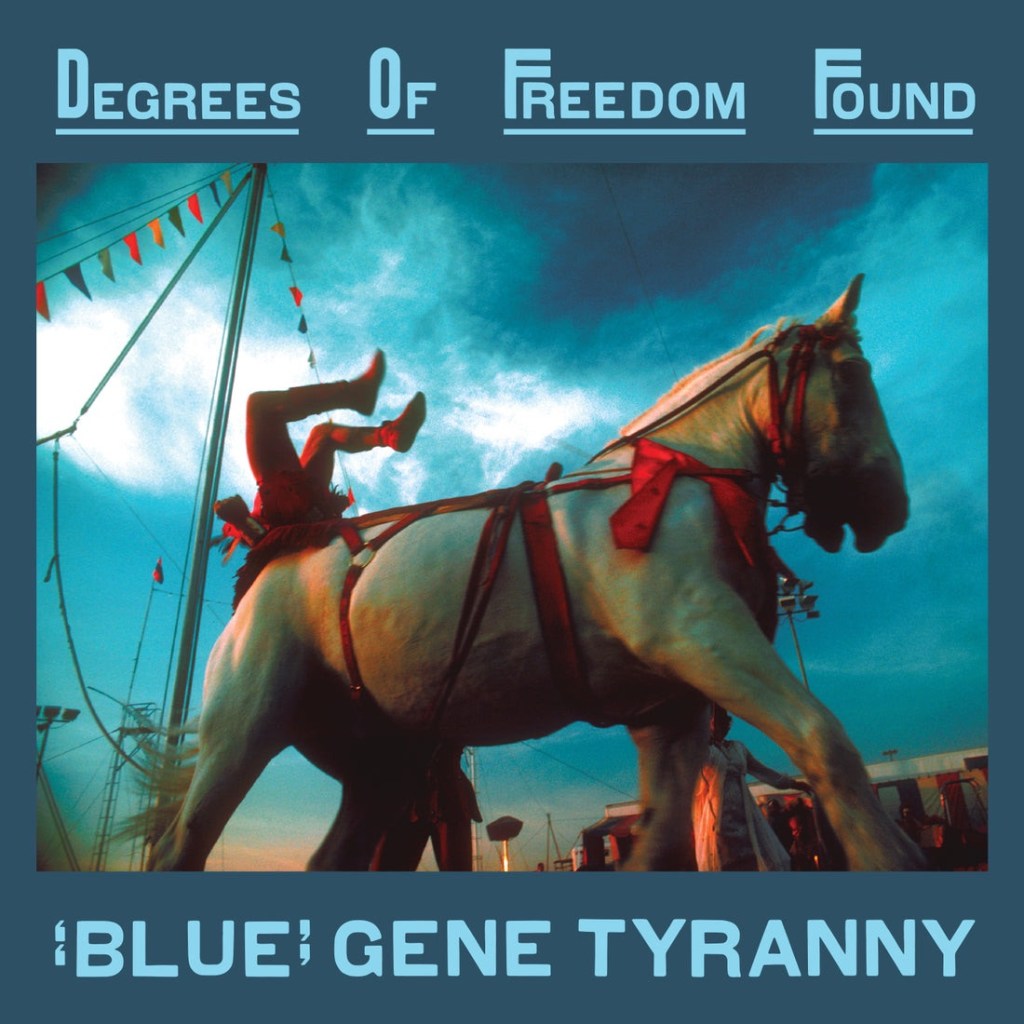
Unseen Worlds’ wonderful survey of Blue’s ensemble works.

The concert opened with Blue Gene Tyrrany’s peaen to old Route 66 in his “Decertified Highway of Dreams” (1999) for two pianos. It was clear from this first selection, that our performers were well rehearsed and in sync despite rhythmic complexities inherent in this quite beautiful work. It is cinematic and sweetly nostalgic, a fine example of “Blue”’s genius. The performance was riveting and worthy as the first performance ritual of the evening.

This was followed by a real rarity, a performance of Robert Ashley’s Piano Sonata (1959, 1979, 1985). In fact, it appears to have been the first complete performance of the two piano version of this impressive serially structured piece. Previous recordings are available, one with the composer performing the first movement at the ONCE Festival from 1966, the other by Blue Gene Tyrrany on his album, “Just for the Record”. This writer also found some useful analysis by musicologist Kyle Gann on his website. Gann worked with Ashley and later published a fine survey of Ashley’s music that is well worth your time. The result was a convincing, almost romantic sounding performance of this foundational work in Ashley’s oeuvre.

This was followed by a solo rendition by Joe Kubera of Tyrrany’s “The Drifter” (1994), which was written for Mr. Kubera. He spoke briefly about the structure of this work (which he also recorded on his recent “Horizons” album). This piece has a meandering quality created by the intricate evolving structure. Kubera’s performance was hypnotic and a fine tribute.

The second half began with Ms. Cahill solo at that stage left Steinway playing first Tyranny’s “Nocturne With and Without Memory” (1989), one of his better known works. Then she played his “Spirit” (1996/2002), a piece that is a sort of homage to the experimental composer/performer Henry Cowell (1897-1965). It was rather unusual in that it involved harmonics over which the pianist plays. The title is an homage to Cowell’s famous piano piece, “The Banshee”, a malevolent spirit in Irish mythology. Both were vintage Blue Gene pieces.

Two pianists, one piano.

Then Kubera returned, taking a seat at the blemished Baldwin with Cahill standing at that same piano, at a 90 degree angle to Kubera. Here, in these two obscure Ashley pieces, Viva’s Boy (1991), and “Details” (2b, 1962), Cahill played like a chef at a chef’s table, playing the strings inside the piano while Kubera manned the keyboard. These true rarities getting perhaps their first performance, were certainly a highlight of the concert.

It was Blue Gene Tyrrany’s spirit that was the final ritual celebration on this magical night with both pianists at their respective pianos to give a heartfelt reading of his, “A Letter From Home” (2002). This brought this learned, well rehearsed, beautifully collaborative evening’s ritual to a satisfying close.

The modest, self selected audience, applauded warmly and gave an extended, much deserved ovation and seemed as enthralled as this listener whose musico-spiritual pilgrimage found an ecstatic height. I drove home that same night, blessedly lifted, if only briefly, from the chaos of the world by this wonderful artistic ritual. They will now take this great program to New York.

Charles in Charge, Composer/Producer/Impresario Charles Amirkhanian at 80


Charles Amirkhanian (photo by Carol Law, all rights reserved)

An overflow crowd packed the lovely auditorium at Berkeley’s David Brower Center this past January 19th. Octogenarians (and younger folks as well) populated both stage and audience in a show of appreciation for a man whose work as music director of KPFA (1969- 1992) and subsequently as an arts promoter and curator of new music in California’s Bay Area continues to enhance the artistic reputation of the Bay Area.

A rare and exciting aspect of this evening were the rare opportunities to hear Charles’ music, including representative sound poetry classics and a recent major opus capped off by a world premiere of a new work.

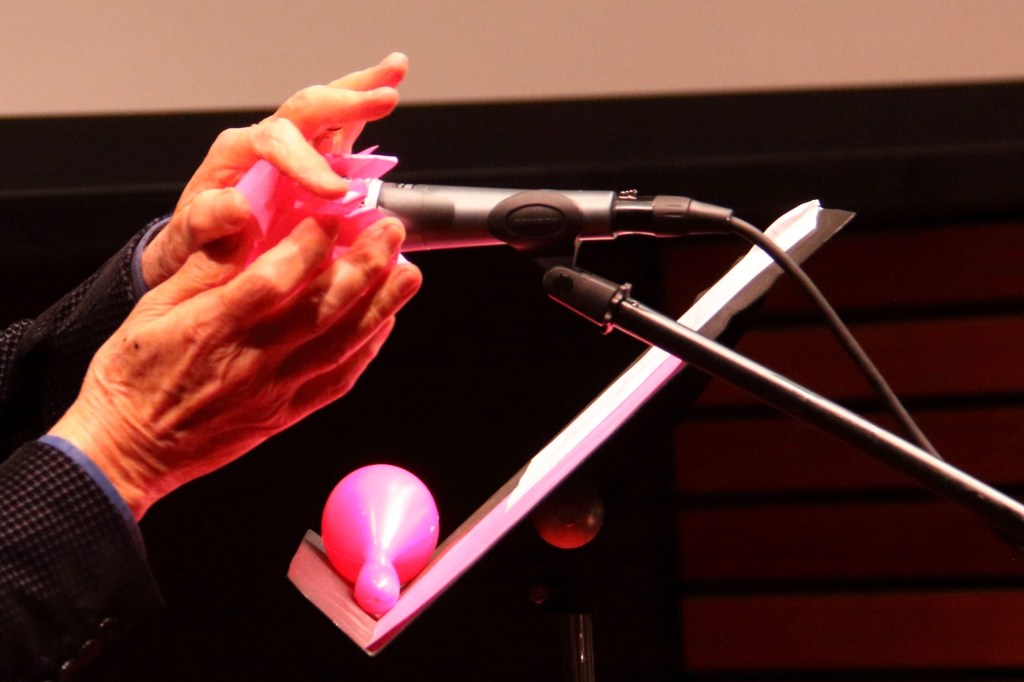
The hands of the artist. Photo by Allan J. Cronin

The genuine affection, appreciation, and respect was palpable as the honored guest demonstrated his skill at hosting when a couple of technical glitches slowed (but did not stop) the amiable birthday celebration. The audience waited calmly and quietly.

Both the guest of honor and the host (Liam Herb) used a well honed, self effacing humor used most skillfully to entertain the sympathetic audience while the technical difficulties were surmounted in real time.

Panel discussion featuring (left to right) Susan Stone, Anthony Gnazzo, Paul Dresher, Charles Amirkhanian, Sarah Cahill, and Liam Herb (Photo by Allan J. Cronin, Creative Commons license)

Herb, a composer and performer, introduced himself in the midst of the technical resolutions, graciously announcing that, as producer, he accepts responsibility for the glitches. Charles maintained his familiar master of ceremonies crowd pleasing good humor as Herb worked goodnauturedly (if that’s a word) with the rest of the crew to resolve the issues and get on with the show.

The formal opening remarks were given by Other Minds’ associate director, Blaine Todd. And the evening began in force.

Blaine Todd (photo by Allan J. Cronin, Creative Commons license)

The program glided past the initial hiccup to present a film about our guest of honor. The bevy of fans and bona fide new music professionals sat with rapt attention as the film, featuring the familiar faces of several “Bang on a Can” artists.

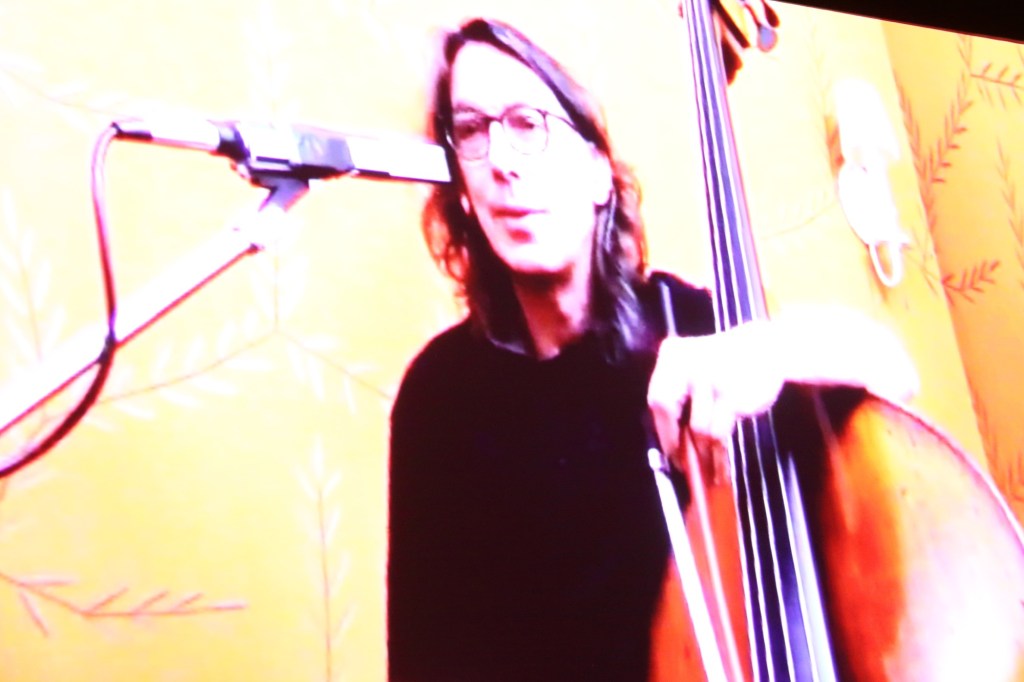
The late great Robert Black interviewed by Amirkhanian in the streaming premiere of Audible Autopsy. (Photo of film appearance by Allan J. Cronin)

Excerpts from the 2015 Other Minds 20 documentary featured Julia Wolfe, David Lang, and Peter Gordon (now, it seems elder statesmen (and women) in their own right.

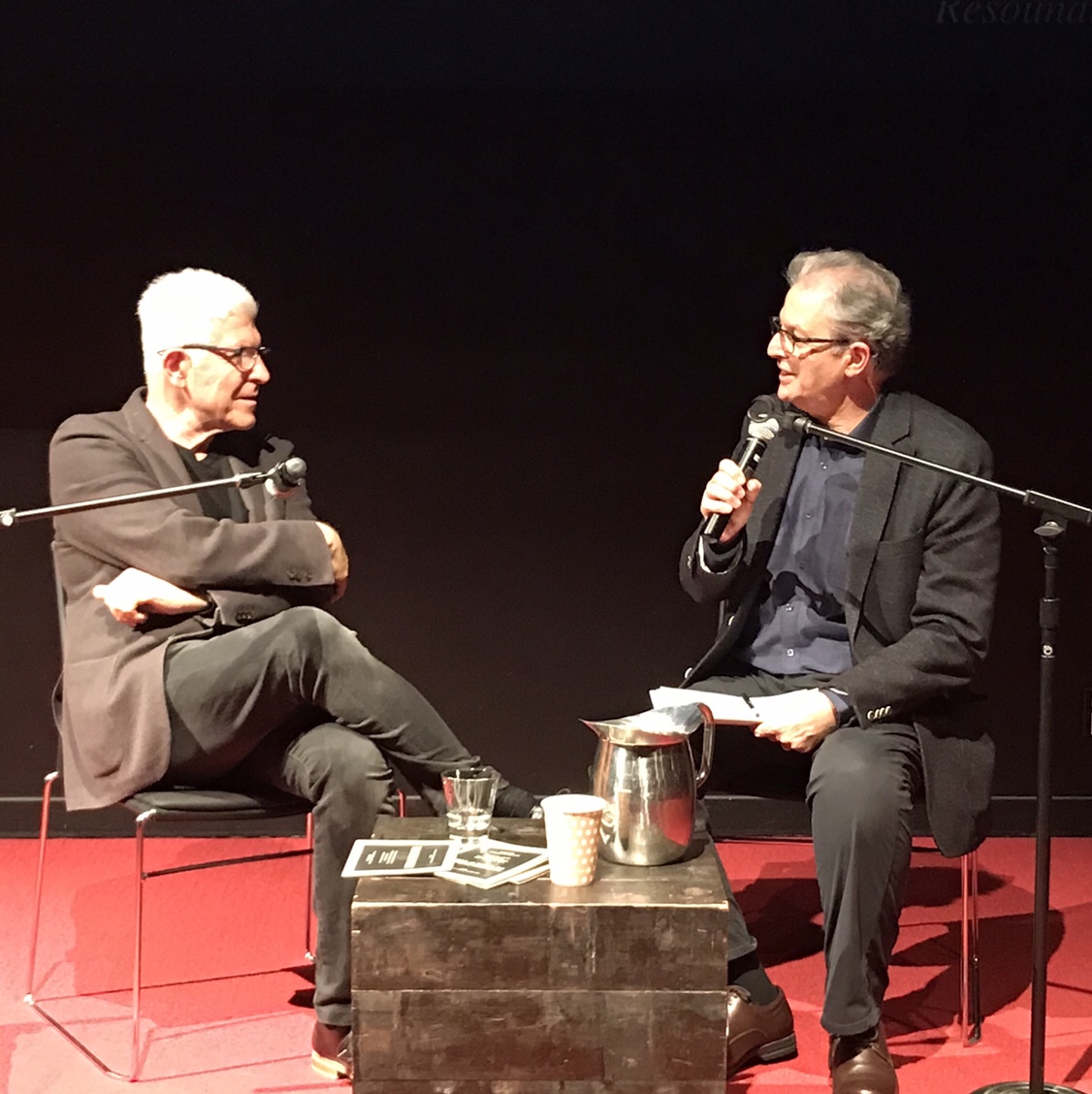
Production manager Liam Herb then served as moderator for a conversation or live interview (with Amirkhanian) for the next segment. This was followed by some videos with music by the guest of honor:

Real Time/T.V. Time Video with Amirkhanian’s “Muchrooms”

The film, presented in its entirety was accompanied by “Muchrooms”, from the CD recording of that standalone work.

Next was Amirkhanian’s and Carol Law’s classic collaboration: History of Collage (1981). This is a major work and a great collaboration with his partner in life and arts. I’m pleased to add my own shot from the performance at the Other Minds 23 experience, my favorite OM festival(so far).

History of Collage (1981) photo by Allan J. Cronin taken at the Other Minds 23 wonderful live performance of this work (Photo by Allan J. Cronin is Creative Commons license 2015)

We also heard and saw Audience (1978) with photography by Law and music/poetry by Amirkhanian followed by Chairs with photography by James Petrillo and music/poetry by Amirkhanian (excerpts from Seat Belt, Seat Belt (1973).

There followed a panel discussion led by Carol Law with Betsy Davids discussing David’s’ work and her connections via her work as a book artist. These two embody the experimental visual arts that characterize the skills of these fellow artists both onstage and off tonight. In fact, interactive collaboration and both respect and friendship were everywhere to be seen in this warm and pleasantly nostalgic evening.

Carol Law speaking with Betsy Davids (Photo by Allan J. Cronin, Creative Commons license)

This was followed by a recording of a major opus, Ratchet Attach It (2021) recently played at one of the (still ongoing) Other Minds Festival. This work is a major opus by Mr. Amirkhanian, one I’m pleased to say I heard live at the Chinese Theater in San Francisco a few years ago. Scored for a huge percussion ensemble, with audio recordings, and a conductor who moves between the podium and a space among the performers playing with the ensemble. It is perhaps one of his most integrated and evolved compositions. Stunning to hear it live. Glad to hear the (always too short) excerpts.

In fact Mr. Amirkhanian, a fixture in the arts of the Bay Area, continues to influence musical taste and present new and interesting music as he has for well over 50 years. His work as Executive Director of Other Minds includes the fabulous OM Records as well as the annual Other Minds Festival and a continual flow of carefully curated concert events by luminaries (or soon to be luminaries) throughout the Bay Area and beyond. There is also the huge archive of thousands of hours of interviews and concerts that are available in streaming audio and video via the Other Minds website.

Many of the artists featured in the Other Minds concert series continue to work, innovate, and expand musical concepts. An Other Minds commission, Henry Brant’s Organ Concerto, Ice Field, earned him a Pulitzer Prize. Many have gone on to greater achievements in their respective careers. Of course not every composer started their musical careers at Other Minds concerts. Many mid or late career musicians have joyfully been represented over the years. Its one of those festivals that innovative musicians seek to participate.

Such achievements reflect on Amirkhanian’s leadership and curatorial acumen, but more importantly his relationships with his fellow artists. Charles has earned a reputation for his support and his collaborative nature. Arguably, everyone in the house (and the overflow in the lobby) all have a degree of connection to Charles and his guests. It is why we’re all here tonight.

Charles Amirkhanian and Joseph Bohigian performing with Liam Herb’s electronics (Photo by Allan J. Cronin, Creative Commons license)

Following a brief intermission we were treated to a world premiere of a new work by our guest of honor, Noose Ratchet (2025) for two percussionists and electronics. Amirkhanian performing and/or promoting his own music is a relatively rare event and this alone was certainly worth the trip.

The work is arguably a trio for two percussionists playing ratchets, a curious instrument whose sound, if not entirely ubiquitous, is familiar. And the two play interactively with the electronics (the third member of the trio). Extended techniques and other duties get assigned (when in doubt it’s responsibility of the percussion section, right)?

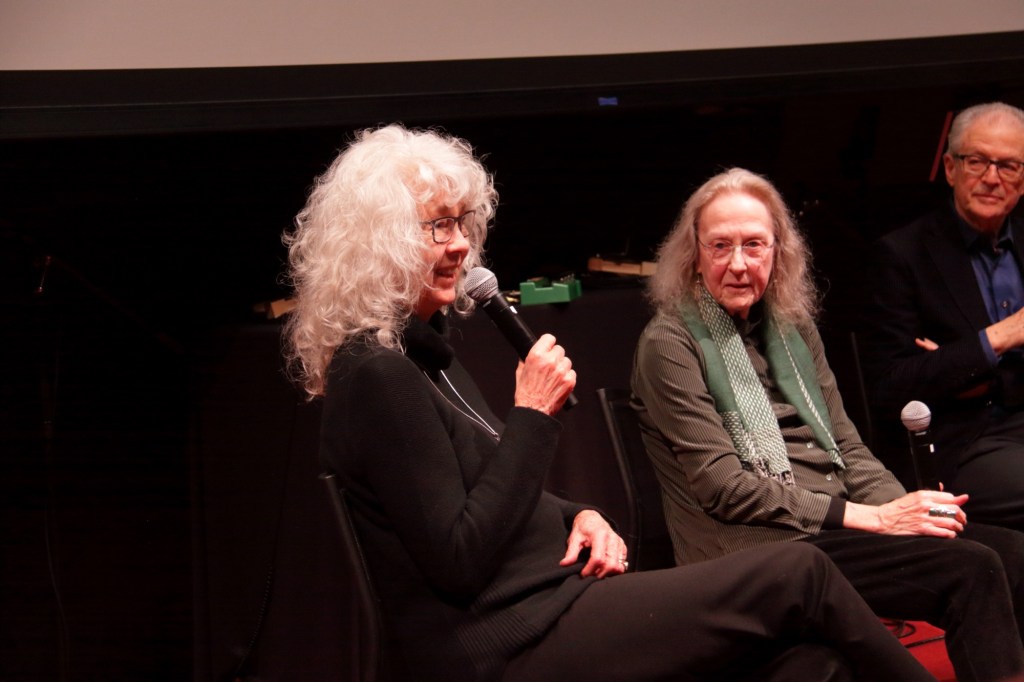
There followed a lively and friendly panel discussion amongst frequent and past collaborators Susan Stone, Anthony Gnazzo, Paul Dresher, Sarah Cahill, and Liam Herb. This truly felt like a gathering of friends.

Happy Birthday, Charles.

The Elegant Icelandic Pianist and the Woman with Blurry Hands: Òlafsson and Wang Duo Pianos in Santa Barbara


Vinkingur Òlafsson
Yuja Wang

Program 
Berio:Wasserklavier
Schubert: Fantasia in F minor for Four Hands
Cage:Experiences No. 1
Nancarrow (arr. Thomas Adès): Study No. 6
John Adams:Hallelujah Junction
Arvo Pärt:Hymn to a Great City
Rachmaninoff:Symphonic Dances

From the very beginning this concert defied convention in so many ways. The Granada Theater hosted a sold out crowd for these two distinctly different rock stars. The two pianos were arranged so that the artists were sitting next to each other, Wang was seated slightly upstage and stage right while Òlafsson was stage left and a bit downstage (the conventional staging for two piano concerts has the pianists facing each other and equally center stage). Also noted was Wang using the iPad score reader whilst Òlafsson had a page turner for the hard copy paper score.

On the surface these two artists have distinctly different personas. Both are possessed of a high level of technical skill along with interpretive abilities that communicate with their audiences. But the juxtaposition of these two pianists is a pairing that had this listener wonder if they could occupy the same space. Òlafsson the contemplative man in the dapper blue suit and the introspective facade contrasted just a bit with Wang’s more extroverted showmanship. And Wang’s fashionable but characteristically flashy outfit (which was even “flashier” after intermission).

The concert began with a brief and generally lesser known piece by the great Italian composer, Luciano Berio (1925-2003), his Wasserklavier (1965). This short, contemplative work functioned as an appetizer as the duo segued directly to Franz Schubert’s (1797-1828) gorgeous Fantasy in F minor (1828). This work originally written for one piano, four hands, was played here on two pianos. The work, written in the year of Schubert’s death is of symphonic dimension. The duo played rather uptempo but delivered a very convincing performance.

After acknowledging applause they gave us a sort of brief palate cleanser, John Cage’s (1918-1997) Experiences No. 1 (1945-8), a work for two pianos. The soft and sparse texture segued to Thomas Adès arrangement of Conlon Nancarrow’s Player Piano Study No. 6 (ca. 1962). This study, one of about 50 studies, sounds gentle and bluesy but belies the actual rhythmic complexities which characterize all the studies. This team handled the complexities most deftly.

This was followed by another work of symphonic dimension, that of John Adams’ (1960- ) Hallelujah Junction (1996). It was this writer’s first hearing of the work and it was a charming and engaging post minimalist work that challenged the virtuosity of the artists and gave ample evidence of how well they performed together. The rousing ovation then took us to intermission.

(Photo by David Bazemore, all rights reserved)

The second half included Wang in a more revealing outfit more characteristic of much of the publicity photos I’ve lately seen of her. But most important is the artist’s virtuosity and interpretive power. She is a force of nature. Òlafsson is just a gentler expression that managed to link most successfully with his upstage partner on this night.

They began with Arvo Pärt’s (1955- ) Hymn to a Great City (1984-2004). This ca. 3 minute work (the city of greatness is not named) was a soft meditative work, perhaps echoing the Berio work which opened the concert.

It led without pause into Rachmaninoff’s (1873-1943) Symphonic Dances (1940) I had only been familiar with the lovely version for large orchestra (apparently written concurrently with the orchestral version) so it took a bit to grasp the intricacies that suggest that this music was written for two skilled pianists. Òlafsson and Wang traded moments to shine in this truly symphonic work but it worked very successfully with these two artists in their respective driver’s seats.

A standing ovation brought the two back to the stage where they sat next to each other for a rendition of Schubert’s bouncy Marche Militaire. A second encore two dances, by Dvorák and Brahms, eased into a calmer Brahms’ familiar Waltz in A-flat Major capped off a truly fine concert, not a union of opposites but rather a collaboration of genius.

New Music Buff’s Best of 2023


Attack of the Music Memes

After agonizing about writing a “best of” blog and publishing it before January 1, I decided to take a pause and enjoy the holidays. So here I look back on my 2023 in the rear view mirror but with memories still pretty fresh.

Regular readers of this blog likely already know of my oft shared opinion of the superfluous nature of “best of” lists and of my acquiescence in producing such on an annual basis. I certainly don’t think of this as a meaningless exercise and I think the process has grown on me. It is a chance to achieve a perspective which would be missed by simply plowing on ahead with the usual flow of reviews and articles. But drawing down that 12 month perspective is an opportunity to evaluate those months, to see where we’ve been and to hopefully get a smidgen of insight into where I/we are likely headed.

My Facebook friends will recognize the representative meme at the head of this article which is one of the more cloying aspects of “AI”, whatever that is. So indulge me for a moment to look at this seemingly new intrusion into the reality we thought we knew. So, what is “AI” and what will it do to us? Ultimately I’m not the one to answer that question but I’d like to throw some ideas to add to the speculation.

First, the choices a composer makes, like the choices of a painter, a writer, etc. are the stuff of the mystery of creation itself. Why “A major”, or why that tuning, or scale, or rhythm, or orchestration, etc? So along comes the notion of removing, or at least distancing, the artist from their creative product. That notion started not with famed proponent John Cage but rather with Johannes Chrysostymous Wolfgang Amadeus Mozart in his K. 516f musical dice game. Voila! Algorithmic composition (actually fairly common practice in the classical era). An early manifestation of “AI”? Perhaps.

Lejaren Hiller (1924-1994) was the first composer to employ electronic data processing in a musical work in his Fourth String Quartet subtitled “Iliac Suite” in 1957. There followed similar experiments with various iterations of electronic creations at music centers worldwide including The University of Illinois at Champaign, Columbia-Princeton, Stanford, The University of California Berkeley and San Diego, The San Francisco Tape Music Center (later subsumed into the Mills College Center for Contemporary Music, IRCAM in Paris, Israel Electronic Music Studio, and counterparts in the Nordic countries, Germany, Belgium, etc. Proto “AI”?

While historically interesting I raise this issue to say that, as far as I can tell, “AI” has not made this writer’s greatest hits list but it is interesting and maybe even useful. With that, my concern for the subject officially goes to the back burner for a later time.

2023 has been a year of great personal changes for the writer of this blog. A job change, a geographical relocation, and many things unrelated to this blog characterized a busy year for New Music Buff. So here in a sort of holiday tradition I present my “Best of 2023” from my little listener’s corner of the world. For the sake of simplicity I present a more or less chronological exposition of my sonic adventures. (N.B. Not one portion of this article made use of “AI”).

I begin with not with my 20 most read posts, a practice that characterized previous iterations of this annual exercise. Instead I am providing my top 20 favorite releases that were reviewed in 2023. Please note a couple of caveats. First, I receive a lot of review requests, more than I can even listen to, much less give a reasonably intelligent review. Albums that I’ve not reviewed should not be assumed to be bad or insignificant and my reviews are personal observations. I really only review albums that interest me anyway. Second, this article is only one reviewer’s opinion and not intended to be definitive or to supersede anyone else’s opinions. Third, this is not the end of my attention to music that was released in 2023. Some releases require more time to give a fair listen and a respectful review. There are more to come in 2024.

First a few stats: 2023 saw the publication of some 45 blog posts on New Music Buff, earning me 9693 views for the year. I rarely get comments on my posts (though I welcome and invite comments both positive and negative). Not bad, I think, for the overall less appreciated musical styles that fuel my desire to write about.

Now, in chronological order (of publication) are my personal favorites as a listener:

Neuma 158

Binaural Beats in the Tudor Rainforest started my new year with a bang. Reviewing this disc required me to take a closer look at the astounding work of David Tudor and his unique contributions to new music. This important release is a recording of a work which, by its own concept cannot receive a “definitive” performance. But this recording comes mighty close, involving “binaural” recording utilizing a mobile set of binaural microphones which are worn by the recordist. In addition this recording involved a collaboration with Pauline Oliveros and a group called, “Composers Inside Electronics”. The recording was done during Oliveros’ tenure at UCSD. Rainforest IV is so called because it is the fourth iteration of the instructions that form the original concepts of Tudor’s composition, “Rainforest”. It is an immersive sonic experience heard on headphones but actually not bad even heard on stereo speakers. A rich and wonderful release.

Starkland S-236

From a 1960s electroacoustic to a budding 21st Century composer Kotoka Suzuki released on the reliably interesting and even visionary Starkland label. Next Gen Electroacoustic: Kotoka Suzuki will introduce the listener to this rising star who doubtless will produce more of her compelling compositions.

Sony 194399434826

Igor Levit is a fine concert pianist whose albums are effectively redefining the way we, as listeners, perceive the western classical oeuvre. Igor Levit: Defining Tristan does for the various musical pieces inspired by the Tristan legend what Levit did for the concept of the great keyboard variations in which he selected Beethoven’s “Diabelli Variations” and Frederic Rzewski’s “El Pueblo Unido Variations” to join his recording of the Bach “Goldberg Variations” in a 3 disc package placing these three large sets of variations as emblematic of the genre in three different centuries (18th, 19th, and 20th). Levit, by his recorded output, is providing a valuable perspective which may influence repertory choices for years to come.

Levit’s traversal of the Tristan legend here ranges from the second recording of Hans Werner Henze’s too seldom heard “Tristan Preludes” back to works by Wagner (of course) and Liszt. He even slips in his wonderful solo piano transcription of the Adagio of Mahler’s unfinished 10th Symphony into the mix. This is a very compelling Tristan anthology by a deservedly still rising star.

Cantaloupe

This Cantaloupe release by Bang on a Can composer and master clarinetist Evan Ziporyn is both masterful and great fun. Evan Ziporyn: Bang on a Pop consists of transcriptions of “pop” songs for multiple clarinets all played by Ziporyn via his very effective multi-track recordings. The album is very personal and pretty much cliche free with these engaging and insightful transcriptions. It is an homage to the songwriters as well as a showcase for Ziporyn both as composer and as performer.

Microfest MF 23

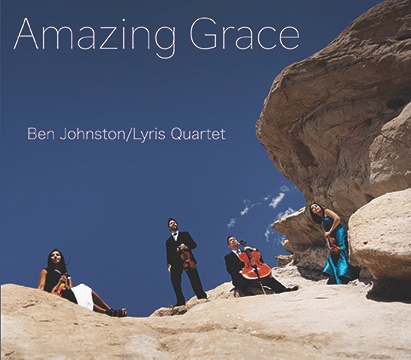
The Young Person’s Guide to Ben Johnston is an ideal way to introduce listeners to the wonderful world of the late Ben Johnston’s music. Johnston, a student and colleague of Harry Partch shows his compositional skills utilizing non-traditional western tunings in these representative works. Johnston here does for some quasi pop tunes what Evan Ziporyn did with his clarinetist perspective for the tunes on Pop Matters. But Johnston’s pretty, accessible work belies fascinating complexities that don’t actually sound complex to the listener. This disc contains Johnston’s last completed work, “Ashokan Farewell” (which Johnston took to be a public domain folk tune but is in fact a piece written by Jay Ungar). It is paired with the 4th String Quartet (a set of ingenious variations on “Amazing Grace”) from 1982 and the 9th String Quartet of 1997. Profound, lovely to listen to, and a great homage.

DVD OM 4001

This DVD is a major addition to the discography of Charles Amirkhanian’s sound poetry as fine sampling of one aspect of Carol Law’s (Amirkhanian’s life partner) complementary visual art. These collaborations are also important contributions to the visual and performative aspect of these collaborative works. Amirkhanian has been a fine curator and promoter of the work of others but he has rather seldom stepped into the spotlight himself. This quirky genre got some fabulous exposure at the 7 day Other Minds 23 festival in 2018 in which Amirkhanian’s work was presented in the (surprisingly varied) context of sound poetry of the amazing international collection of artists who were hosted at those events. This DVD should be in the collection of anyone interested in new music sound poetry and performance art. It is both entertaining and mind bending featuring a juxtaposition of images and sound reviewed in greater detail in the post “Dyadic Dreams”. But words cannot do justice to these works. You really have to see them.

Cedille CDR 90000 210

Readers of this blog know my fondness for the Chicago based label Cedille and their promotion of Chicago based musicians. This disc stands out in this group’s embrace of non-traditional composers alongside more traditional works. The inclusion of works by DJ composer Jlin and the academy based genre defying duo Flutronics alongside composers like Danny Elfman and Philip Glass demonstrate the wide ranging repertoire of Third Coast Percussion. Much more information can be found in Perspectives: Spectacular World Premiere Recordings from Third Coast Percussion on my blog. This one reimagines the percussion ensemble.

Neuma 176

This disc is a good example of why listeners and collectors should pay attention to the Neuma record label. Philip Blackburn, who had been the very successful curator of Innova records, took over the defunct Neuma label which was founded with the intention of promoting largely electroacoustic music though not exclusively.

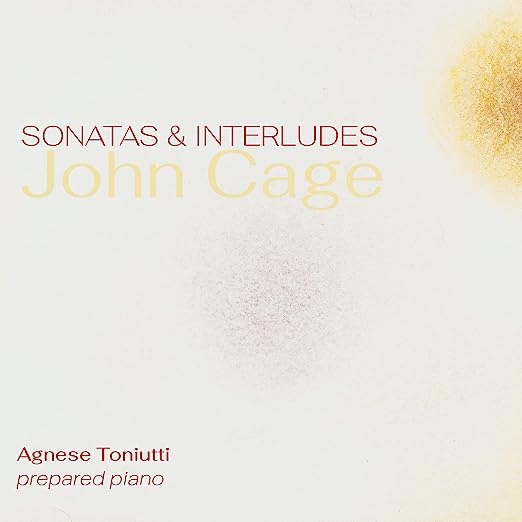
Agnese Toniutti‘s New Music Vision is actually a review of two discs by this rising star, a dedicated new music pianist that needs to be on your radar. The other Neuma disc contains Toniutti’s traversal of John Cage’s reluctant masterpiece, “Sonatas and Interludes for prepared piano”.

The disc pictured here is Toniutti’s vision beyond the Cage work. This one focuses on mostly living composers Lucia Dlugoszewski, Tan Dun, Philip Corner, and Toniutti’s herself. Basically, if Toniutti plays it, you should probably at least give a listen.

2023 saw the completion of Bay Area pianist Sarah Cahill’s epic survey of piano music by female composers. Cahill is another (predominantly) new music focused pianist about whom I would also assert that, if she plays it, you should probably give at least one listen.

The End of the Beginning: Sarah Cahill’s “The Future is Female” Trilogy Completed will tell you all you need to know about this trilogy which encompasses about 300 years of music history and sheds light on some fascinating and substantial music written by women. Most of the works on this trilogy of albums are, in fact, world premieres but, fear not, even the pieces which are not premieres are likely not in your collection. This is a brilliant selection of music that effectively throws down the gauntlet to challenge other artists to explore this repertory. This trilogy is a true landmark and a joy to the ears.

This third volume in the wonderful Catalyst Quartet’s survey of another unjustly neglected group of composers focuses on the music of three black Americans of the twentieth century. Catalyzing Blackness, Volume Three: The Catalyst Quartet plays 20th Century music by Black Americans was nominated (but didn’t win) for a Grammy Award and, happily, I’m told that more volumes are in preparation. Again, this music is a pleasant revelation that does for black composers what Sarah Cahill has done for women composers (N.B. The first volume by the Catalyst Quartet focused on the black female composer Florence Price). And here’s hoping that Coleridge Taylor Perkinson, George Walker and William Grant Still will become household names in the concert hall.

Microfest MF 21

Son of Partch, Carrying on a Tradition is a really wonderful disc which, though I reviewed it in exceedingly positive terms, provoked a strongly negative reaction from the artist. The reaction apparently also provoked enough interest to have made this review one of my most read of 2023.

But, aside from the unfortunate negative reaction, I still maintain that this is a fine release worthy of attention from anyone who likes new music, microtonality, and the music of Harry Partch. Cris Forster is a composer, theoretician, and instrument builder clearly descended from the Partch tradition. His work deserves attention and this disc is a very satisfying experience.

Islandia IMR 011

Steven Schick is a master percussionist and conductor. This release is the first volume of his personal choices of solo percussion repertoire. Solo Percussion Manifesto Volume I: Steven Schick’s “A Hard Rain” is a manifesto of sorts and does for solo percussion music what Sarah Cahill has done for women composers and the Catalyst Quartet is doing for black composers. There are not many recordings of solo percussion music and Maestro Schick essentially presents his favorite works in definitive performances on a label produced by Bang on a Can cellist Maya Beiser. The second volume is in my review queue and, if this first volume is any indication, it will be a landmark survey.

Cedille

Rising Star Seth Parker Woods’ “Difficult Grace” is a Classic in the Making. Here’s another Grammy nominee that did not win but, this second album by this fine American new music cellist is a winner in my book (er, blog). This is actually the audio of what was developed as a staged performance but the music speaks for itself. Keep an eye/ear out for this rising star who, even now, is storming the new music cello scene in invigorating ways.

Neuma 128

A Reason to Listen: Roger Reynolds’ Latest, “For a Reason”,new recordings on Neuma Records. Here we see Neuma following its original electroacoustic mission with this remarkable set in celebration of Roger Reynolds’s 90th year. This is a lavish 2 CD box set with a beautiful booklet and lucid liner notes. It is a worthy production which showcases recent works by this prolific and important American composer.

Readers of this blog likely are aware of my interest in music that is suppressed and/or neglected so this disc grabbed my attention immediately. Israel does a great job of funding the arts and this can be seen in the proliferation of truly fine performers nurtured by that funding. Less well known are the composers who have flourished in the art healthy politics of this country. Some 50 years of history are represented here. This is but a sampling, albeit finely curated, of several generations of composers displaying a plurality of styles with substantial results. This entertaining disc will whet the appetites of intelligent and curious listeners and, hopefully, bring about more recognition of the world class composers who deserve an audience.

So, finally, went my 2023.

When in Rome…an Alvin Curran Retrospective Installation in Rome


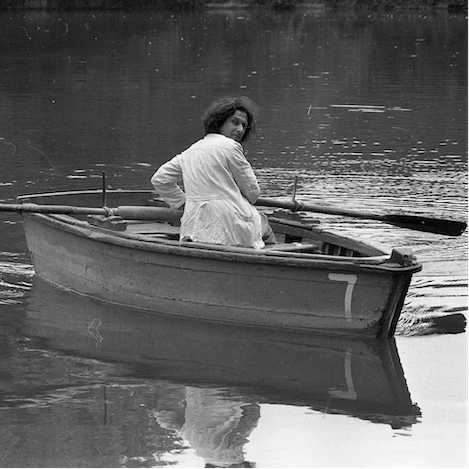
Alvin Curran, Rome, 1980. Adriano Mordenti

Just had to post this for all my readers and friends but especially those living near or able to get to Rome. Curran’s wife, Dr. Susan Levenstein, graciously sent this announcement to me. She is an American physician (and webmaster).Her very entertaining memoir, “Dottoresa” is her accounting of moving her practice to Italy.

Alvin Curran, (1938- ) is the co-founder of the seminal live electric music performance group, “Musica Elletronica Viva” along with his late colleagues Frederic Rzewski (1938-2021) and Richard Teitelbaum (1939-2020). The group formed in 1966 and later included kindred spirits including George Lewis and Garrett List among others. The group did its final tour in 2016.

Click on Curran’s name to look at his fascinating and well organized website which gives a fairly comprehensive accounting of the incredible range of musical styles and a very large bevy of collaborators.

Curran discussing some of his work with interviewer Charles Amirkhanian in Berkeley in 2016 (photo by Allan J. Cronin)

Curran, who taught at the venerable Mills College in Oakland, California is an always welcome visitor in the Bay Area. While he has made his home in Italy for many years now, he is truly an artistic citizen of the world. The warm and affable composer exudes an infectious enthusiasm which doubtless is why he has so many collaborators. His aesthetic which he documented in an article called, “The New Common Practice” in 1994 documents his all inclusive style, one that is very difficult to convey. His works include music for piano, chamber ensembles, orchestra, and even things most folk never thought of as musical.

He is a giant in late twentieth and early twenty first century music and this retrospective is most welcome.

“HEAR ALVIN HERE

ALVIN CURRAN

…a retrospective

part of the #CHAMBERMUSIC series

The show consists in a listening room where a new sound work plays continuously—a mixtape comprising fragments from many different compositions, improvisations, and installations. It leads the audience on an autobiographical listening journey, freely mixing styles, periods, and languages, from free improvisation to Fluxus to Artificial Intelligence, from compositions for shiphorns to works for hundreds of musicians, from Sargentini’s L’Attico and the Beat 72 to MAXXI and the Tate, from Angelo Mai and The American Pavilion of Expo 58 to No Mans Land and the Théâtre de Chaillot.

The Museum of Contemporary Art of Rome (MACRO), Via Nizza, 138

inauguration September 20, 2023, from 6 pm to 9 pm

running until March 17, 2024

***************

Curran in performance at the Pacific Film Archive in Berkeley in 2014.

A Reason to Listen: Roger Reynolds’ Latest, “For a Reason”,new recordings on Neuma Records


Neuma 128

Roger Reynolds (1934- ) turns 90 next year. This prolific American artist’s work is being collected and preserved by the Library of Congress. The present recording is the most recent release documenting Reynolds’ music, now numbering about 30 CDs and DVDs. And this is but a fraction of his musical works.

I first encountered Reynolds’ music when I heard a broadcast of the first commercial recording of his music. The disc, released in 1969 on Nonesuch records documented performances of Frederic Myrow’s “Songs from the Japanese” (1964) paired with Reynolds’ “Quick are the Mouths of the Earth” (1965), a work that actually uses the text of the title to derive the music. I recall that the sound of this music sent chills up my spine and sent me to a record store to purchase a copy. This first encounter was a visceral experience, one of many I would encounter as I heard his subsequent music, and that of his contemporaries.

Reynolds has been a prolific composer, writer, and reader. His father was an architect, Roger would go on initially to study engineering and then also encountered some of the new interest in experimental music at the ONCE Festival in Ann Arbor, Michigan in the early 60s. His studies in music and literature continued to be wide ranging and the fine liner notes by Thomas May in “For a Reason” are extremely useful in grasping the range of inspirations that inform Reynolds’ music. This is one of those gorgeous new music releases that will likely become one of those odd but much sought after collectibles. The booklet jdesign by Karen Reynolds, Stacie Birky Greene, and producer Philip Blackburn is by itself, worth the price of this release.

While listeners can certainly appreciate Reynolds’ work without those details, they add a dimension of understanding and provide contexts as well. In some ways, Reynolds is unclassifiable but this writer finds him to be the consummate experimentalist and modernist, two aspects that appear to have been in his work from the very beginning. His work is rarely easy listening but, even if you don’t get it on first hearing, his compositions tend to reveal weight and substance with repeated listenings.

That said, Reynolds’ music produces sounds that might be heard as romantic, expressionist, and even classical at times. Much of his work, as is the case with most of this 2 CD set, is electroacoustic. It is not heavily dissonant or overly complex to the listener’s ear but his music presents unique challenges to performers. And, as mentioned, this beautifully designed set includes a decent set of liner notes to help navigate this voyage.

Three of the four works here are “electroacoustic”, meaning that some form of electronics interacts with the performer. The one work that does not fit that category pretty much needs it’s own category. Pieces for speaking pianist are getting more common in the last 20 years or so but pieces for speaking percussionist are far less common. Frederic Rzewski’s “To the Earth” for speaking percussionist playing on clay flower pots comes to mind. Of course John Cage also wrote in this genre but Reynolds’ essay is the longest, most complex work this listener has encountered for solo percussionist with speaking duties.

The first track is “Dream Mirror” (2010), the first of Reynolds’ “Sharespace” series of compositions in which an instrumental performer interacts in the shared performance space with a computer musician in a duet. This first sharespace work is for guitar and computer musician. It features the fine Mexican guitarist, Pablo Gomez Cano. The fact that Cano is not a familiar name is likely that his work has focused on challenging new music such as this. Dream Mirror is a big work, at over 20 minutes in performance, but it has a chamber music quality consistent with the composer’s focus on the interaction of this duet in their shared performance space.

The second track introduces listeners to the fourth in the Sharespace series, this time, for violin. “Shifting/Drifting” (2015) was written for Irvine Arditti, one of the finest working musicians of our time supporting new music via his solo efforts and his work with his esteemed “Arditti Quartet”. Like the preceding track, this big duet takes some 20+ minutes in performance.

On to CD 2 for the third offering, “Here and There” (2018), both the longest work and the most recent. This one is for solo percussionist with a substantial speaking part designed to be spoken by the percussionist (in this case, Steven Schick, one of Reynolds’ fellow faculty at UCSD). Solo percussion works are relatively uncommon, though readers will want to familiarize themselves with volume one of Mr. Schick’s ongoing series of the solo percussion repertoire Hard Rain.

This will likely become a showpiece but, at the time of this writing only Schick and the ubiquitous William Winant come to mind as being both willing and able to perform this work right now. And it is apparently a beast of a challenge for the performer but remarkably engaging for the listener. The texts, from Samuel Beckett, are referenced in the liner notes. Not surprisingly, Schick delivers a stunning performance, setting a bar for successive performers and performances. The texts are non-narrative and have a more musical than didactic or dramatic function.

Last but not least is the earliest work on the album, “Sketchbook”(1985), originally written for Joan LaBarbara but never performed. Here, singer, Liz Pearse effectively took a page from Irvine Arditti (whose doctoral studies resulted in research that culminated in John Cage being able to finish his partially completed solo violin work, “Freeman Etudes”). Pearse, also pursuing doctoral studies came upon this work and collaborated with Reynolds in creating a performance. His texts here come from Milan Kundera. The work, while dramatic and challenging, is not a species of opera or monodrama but, like the preceding works, a piece that, like Reynolds, thrives on collaboration. In addition to requiring some pianistic skills, the singer collaborates with interactive computer electronics.

These four works, despite their differences, clearly fit Reynolds’ interest in literature, collaboration, and in various technical aspects described in the well documented liner notes. Those notes provide technical detail and insights beyond the scope of your humble reviewer’s skills but what I can tell you is that this release is a marvelously engaging experience revealing fascinating aspects of this composer’s work.

The experience of listening and reading and the visual experience of the graphics was an immersive one and a delightful use of my time. Heads up to all my fellow new music aficionados. This is truly spectacular.

Rising Star Seth Parker Woods’ “Difficult Grace” is a Classic in the Making


Cedille CDR 90000 019

Every solo artist, regardless of what instrument they play seeks to define themselves. Generally that means setting limits. Some set limits by specializing in an era (baroque, classical, etc.). Some specialize in working with electronics, some with jazz, some with experimental music, some with standard recital repertoire, etc. Seth Parker Woods (1984- ) seems almost unaware of such limits. He plays what he chooses. And, oh, what choices. From standard classics to the leading edge of musical creativity woods is poised at the beginning of a very promising career.

Seth Parker Woods (photo from his faculty page at USC Thornton School of Music)

This album is in fact the musical portions of what was produced as a staged presentation with Woods playing, singing, talking. No doubt something is lost without the staging but Woods’ asserts himself with great clarity on the sonic aspect alone. Think of this as a sort of cast album, though it is more than just a souvenir. It is Woods’ second album and it has this writer enthralled at where he may go next. You will be too.

Parker’s first solo release “asinglewordisnotenough” available on bandcamp reveals his dedication to new and recent music.

I feel privileged to have known this artist via digital media and to have watched with increasing interest his development as a true rising star in the new music world. I only recently acquired his first album via bandcamp. It was released “across the pond” when he was completing his Ph.D. at the University of Huddersfield.

Born in Houston, his father, a jazz and gospel singer, Woods was exposed to a great deal of music. He rehearsed in a home studio and somehow came to a fascination and deep appreciation for a wide variety of repertory.

His affiliations continue to be wide ranging from Peter Gabriel to George Lewis. He has appeared on many recordings but this is only the second disc dedicated entirely to Woods as performer and the first such solo efforts on a US label. Woods is apparently able and willing to tackle music of all eras and genres including the wildly experimental, like his “Ice Cello” homage to Charlotte Moorman and the theatrical, which brings to the the album at hand.

Track listing.

Four of the seven works presented are world premieres. And, despite this being a sort of “cast album” which lacks the visuals, this is a major release that presents a characteristic variety of musical choices and is a fine calling card for the artist. This is one classy production.

Frederic Gifford (photo from composer’s website)

He begins with the title track, “Difficult Grace” by Chicago based composer Frederic Gifford (1972- ). It is a setting of poetry by Dudley Randall subjected to some Cageian mesostic like manipulation. This first track tells us we are dealing with modern music and sort of sets the tone of this project. This is a complex work in concept (lucidly described in the composer’s notes) and involves projections of the texts onto the performer as well as electronics which, by careful use of both the sounds and the spoken text (spoken by the cellist) which then contributes to the musical structure. Photographs in the booklet show some of the striking visual design for this project.

Coleridge Taylor Perkinson (photo from Wikipedia)

Woods follows with what is to this listener a stunningly beautiful piece, “Calvary Ostinato” (1973) by the late, sadly neglected Coleridge Taylor Perkinson (1932-2004), a black American composer (actually represented admirably in a fine earlier Cedille release CDR 90000 087). The Ostinato is one movement from Perkinson’s “Lamentations: Black/Folk Song Suite For Solo Cello” (1973). Woods’ performance is available on YouTube. It’s truly enthralling. One gets the feeling that Woods really gets inside the music he performs and that deep feel for the music is delightfully obvious in this track, the second oldest work on the disc and one that is for the solo cello sans electronics or vocals but using a dazzling variety of extended instrumental techniques, none involving a bow.

Monty Adkins (photo from electro cd website)

Then we hear Monty Adkins’ (y. 1972- ) “Winter Tendrils” (2019) written for cellist who, in addition to playing his instrument, is asked to use his voice and work with electronics, albeit in a different manner than the title track. Adkins worked closely with Woods on the creation of this work. The work essentially an impressionistic piece with clever use of counterpoint to depict fresh fallen snow on the branches of a tree.

Nathalie Joachim (photo from Elysian Magazine)

Nathalie Joachim (1983- ), a Haitian-American vocalist, flautist, and composer, is represented by two works. The first, “The Race 1915” (2019), a work that contributes to the Chicago centered Cedille label by its use of historical quotations from The Defender, a major and influential black newspaper in Chicago. Woods is again asked to use his vocal skills in this work which celebrates efforts to undo social inequalities.

The multitalented Joachim lends her vocal skills to Woods’ performance in Joachim’s second piece on the album, “Dam Men Yo” (2017). The title is Haitian Creole for “they are my ladies”. It is a sort of black feminist peaen celebrating the strength of the women with whom the composer was raised in her native Haiti. (NB: Haiti is the site of the only successful slave revolt in history, a fact that continues to be reflected in their turbulent politics).

Alvin Singleton (photo from Schott website)

In between those two pieces we get to hear perhaps the best known composer in this mix, Alvin Singleton (1940- ). Singleton is represented by “Argoru II” (1970) for solo cello (the Argoru series is a set of pieces for solo instruments akin to Luciano Berio’s “Sequenza” series). The title is from the Twi language (spoken in Ghana) and translates as “to play”. It is a virtuosic piece employing extended instrumental techniques which Woods accomplishes with almost supernatural ease. He does honor to this living elder statesman of American music.

Ted Hearne (photo by Jen Rosenstein from composer’s website)

And here we are back in Chicago now with Maestro Woods’ performance of a work by Chicago born composer Ted Hearne (1982- ), a name which did make it to this writer’s musical radar but one whose work I have just begun to explore. But this is a fine example of one of the reasons for my admiration for Woods’ scope of musical interest. I think he is one of those artists to whom I will turn to look for good new music. His instincts for repertory choices are amazing.

This is perhaps the most unusual entry on this disc as well as one that, if any controversy is forthcoming, it will likely originate with this set of songs to poetry by Keri Alabi. A casual listen to some of Hearne’s music on YouTube suggests a sort of post minimalist ethic but this last work is not discernibly minimal. Like the music that preceded it, this cycle is overtly about politics and equality.

Hearne’s little 6 movement song cycle is a combination of poetry, electronics, cello (of course), and the voice of said cellist. Hearne’s expletive title, “free fucked”, is apparently very much in line with the composer’s assertive and playfully humorous style.

We return in these tracks to the avant garde and complex with which the album opened. Again we have a multitasking role for the cellist demanding his vocal participation and working in a distinctly electroacoustic genre. Hearne lends his voice to the final track of this unusual work.

While political themes and references abound in this release it is as much about black politics and civil rights as well as feminist, gender, and global equality issues. But ultimately this recording is a landmark in the career of this fine young musician who works fearlessly with a variety of composers, poets, designers, political activists, progressive ideas, and new music in general.

Cedille is one of my top favorite new music record labels and has been since they first started in 1987. Their releases (not limited to new music) are consistently well recorded and produced but producer James Ginsburg really pulls out all the stops on this one. From concept to recording, from lucid liner notes to gorgeous package design this has all the marks of a classic and collectible release. I mean, the music is great, but the whole package is something you’ll want to own. That’s right, I’m calling for “collector’s item” status here. Now is the time to get your copy.

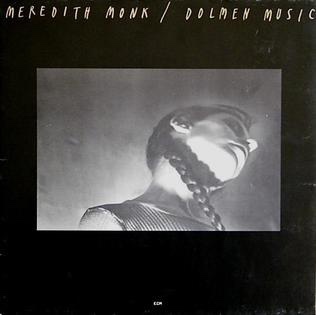
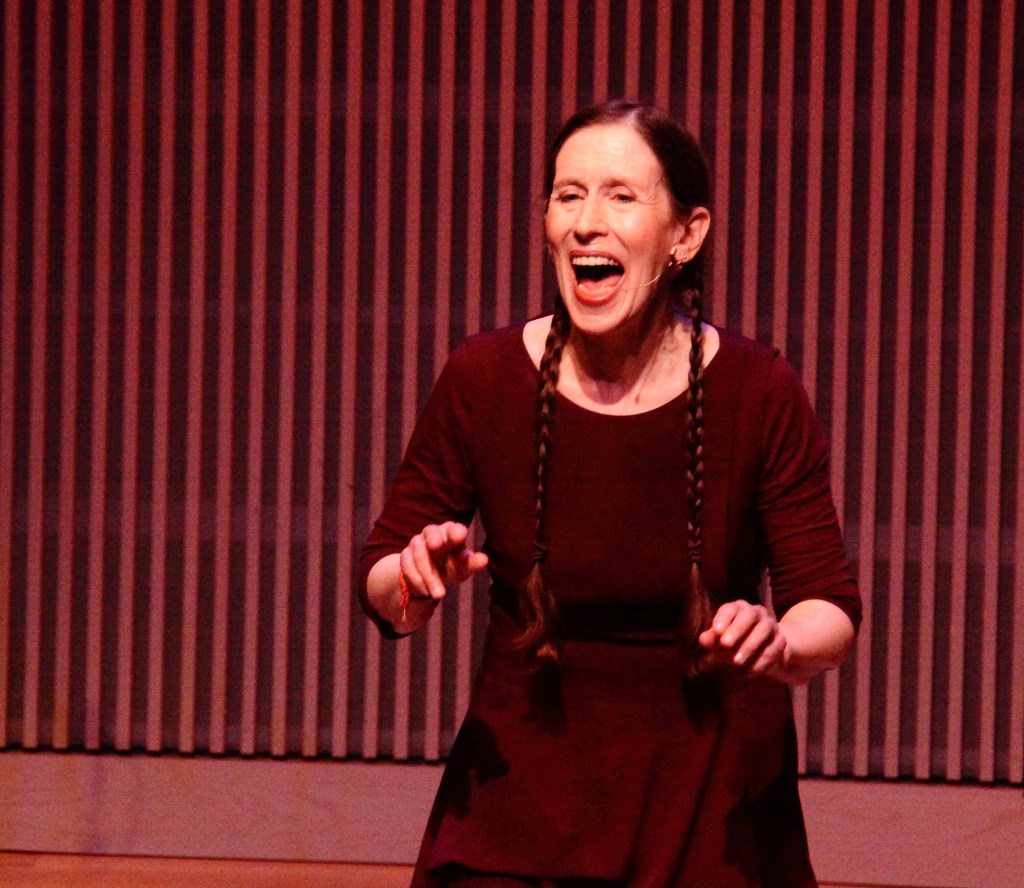
To Dance and Sing, Meredith Monk on ECM


Meredith Monk on ECM

Being asked to review this retrospective of the work of this virtually uncategorizable dancer, singer, composer, dramatist is the telling of my personal experience of growing up nurtured by this artist. Monk is not, of course the only artist whose presence has nurtured me and so many friends but her work is a case where I learned how to tune my curious radar to find more of the music that touched me deeply.

I first discovered her work when I purchased her album, “Key” (1971), self released and marketed via the late lamented New Music Distribution Center in New York. That album, later released on the Lovely Music label along with two releases on the great German avant garde label Wergo (Our Lady of Late, 1973 and Songs from the Hill/Tablet, 1979), constitute the minimalist, SOHO loft music which characterizes her style even now. But with her first ECM release she clearly hit her stride. Those early albums are definitely worth hearing but her mature style blossomed on ECM. It was, in retrospect, a sort of quantum leap, if you will.

LP album cover of “Key”
“Our Lady of Late”
“Songs from The Hill”

In that first album one can find Dick Higgins among the singers and Colin Walcott producing and playing percussion (as well as singing). Walcott, along with the yet to be known Julius Eastman would later participate in the Dolmen Music release. Monk, who studied dance at Sarah Lawrence College along with fellow student Alwyn Nikolais established “The House”, her flexible performing group in 1968 at a time which saw a great deal of artistic energy in and around Manhattan’s SOHO district where she encountered musicians like Philip Glass, Steve Reich, and performers sympathetic to new innovations and ideas. She also taught and continues to teach her characteristic extended vocal techniques. Monk, along with John Cage, Philip Glass, and Robert Ashley was featured in Peter Greenaway’s “Four American Composers (1983).

The release of her first ECM disc, “Dolmen Music” (1981) can now be seen as a sort of watershed event. It was followed by “Turtle Dreams” (1983) a work which was prominently featured at New Music America 1982 in Chicago along with Robert Ashley’s “Perfect Lives”. Monk’s appearance on ECM occurred at about the same time as Steve Reich’s masterful “Music for 18 Musicians”. Monk found her mature voice more or less at the same time that Steve Reich and Philip Glass had found theirs. And anyone following new music in those years will recall the flow of new musical ideas that established many now acknowledged masters as legitimate artists.

While the major masterpiece, “Dolmen Music” dominates the album, Monk’s quirky mix of humor and pathos in pieces like “Gotham Lullaby” and “Biography” remain signature pieces in her oeuvre. And Turtle Dreams was made into a performance film for public television by visual artist Ping Chong in 1983, now available on YouTube.

She followed with “Do You Be” (1987) and “Book of Days” (1990) which also exists in at least two film versions and the CD itself which has been described as a “film for the ears”.

Following “Facing North” (1992) Monk released her only opera (though she refers to much of her works as “operas” this is the only one that comes close to the more generic concept of western music operas) to date, “Atlas” (1993) which was commissioned and subsequently performed at the Houston Opera. This represented another phase in her artistic development as she utilized her structured improvisation techniques along with her now familiar extended vocal techniques with an expanded set of performers both vocal and instrumental. Atlas is arguably similarly creative (and transgressive) as Philip Glass’ 1976 “Einstein on the Beach”. Both were developed in an unconventional manner and uses a similar harmonic language with really none of the standard conventions of western music in opera. Would that we can some day see a filming of this work.

I was privileged to see Monk in person for the first time when she performed excerpts from “Volcano Songs” (1997) in Chicago. Those images involving, among other things, light sensitive areas where Monk lay down and left a ghostly shadow upon arising. In addition to her engaging minimalist inflected music, Monk is a master at creating compelling images.

“Mercy” (2002) was followed by “Impermanence” (2008) which I was thrilled to see at Stanford. “Songs of Ascension” (2011) was another landmark in this piece conceived and performed in conjunction with installation artist Ann Hamilton in her tower in Northern California. Attendees to this event were brought in by bus due to the lack of actual parking facilities in that tower. I wish I could have experienced this but hopefully a cohesive video release will be forthcoming. Excerpts are available for viewing on YouTube and on Monk’s website.

“Piano Songs” (2014) by the wonderful new music championing pianists Bruce Brubaker and Ursula Oppens filled an inexcusable gap in the documentation of Monk’s piano music. And following her receiving the National Medal for the Arts in 2015 she released “On Behalf of Nature”(2016).

Monk is a well documented artist largely due to her productive affiliation with Manfred Eicher and ECM and, while gaps remain these recordings represent a major artistic accomplishment and an enduring legacy for new music, for women composers, for western art music. This lovely box set is truly a joy to behold.

Meredith Monk performing an encore at the final concert of OM 21 (2016) in San Francisco

Solo Percussion Manifesto Volume I: Steven Schick’s “A Hard Rain”


Islandia IMR 011

Steven Schick is a multi-talented and skilled musician. A quick look at his website demonstrates the sheer scope of his musical career. He is probably best known as a master percussionist having played with the San Diego Symphony and a host of others internationally. He is also a fine conductor and composer. His website is a must visit to grasp the scope of this man’s work.

Steven Schick (photo from composer’s website)

Now, solo percussionists are somewhat of a rarity even in the 21st century. Percussion is ostensibly the “junk drawer” of the orchestra by which I mean it becomes the home to pretty much anything that doesn’t fit into the categories of keyboards, strings, woodwinds, and brass instruments. Anyone who has studied any theoretical taxonomy knows that you have to have a “junk drawer” (so to speak) to place things that don’t fit elsewhere at least until you can find a useful category in which to place them. The point here is that a solo percussionist has a huge amount of instruments from which to choose and subsequently master (some of which might also fit other categories like piano, harp, etc. but also things like taxi horns, for example, which Gershwin used in his tone poem, “An American in Paris”). Add to that the artists who regularly add instruments to this group and the task of mastering these becomes even more daunting.

Percussion, aside from tympani and the occasional military drum is largely absent from western music. That began to change with the work of Henry Cowell, John Cage, and Lou Harrison in the early 20th century. As interest grew, so did repertoire.

Despite attending many contemporary music concerts I cannot recall any by a single percussionist. Percussion ensembles began to appear in the early 20th century including Paul Price (1921-1986), Donald Knaack, and Les Percussions de Strasbourg. After 1962 or so the number of percussion ensembles increased along with a rapidly growing repertoire.

With this release Steven Schick begins what appears to be the first of a multi-volume survey of works for solo percussion under the collective title of “Weather Systems”. This first volume is subtitled, “A Hard Rain”, a two disc set that is both manifesto and innovation. It is released by Bang on a Can cellist Maya Beiser’s Islandia Records, not to be confused with the pop music Island Records.

Schick’s book on percussion published in 2006 is a sort of precursor to this CD release.

Here, Schick appears to be doing two related things. First, he is establishing a repertoire for the solo percussionist. And, second, he is presenting his own insights and ideas to both define and expand that repertoire. Having already released definitive recordings of percussion music by Xenakis and Stockhausen, among others, he is apparently ready to blaze a trail that will increase the possibility of hearing a solo percussion concert and establishing a canon of music for those concerts.

There are 7 works (3 by German composers, 4 by American composers) on these two discs largely focused on mid 20th century works and presented (mostly) in chronological order:

1. John Cage (1912-1992) 27’10.554” for a percussionist (1956) arguably one of the must difficult of the pieces here. It is more like a set of tasks than a conventional score and may be the first great solo percussion piece.

2. Karlheinz Stockhausen (1928-2007) Zyklus (1959) experimenting differently from Cage but producing a similarly difficult and masterful work.

3. Morton Feldman (1926-1987) “The King of Denmark” (1964) the second name in the self defined “New York School” of composers, this is about soft sounds and, like the Cage work, unconventionally scored.

4. Charles Wourinen (1938-2020) “Jannissary Music” (1966) a lifelong devotee of post Schoebergian 12 tone music manages to be relevant. And this one of his earliest masterpieces.

5. Helmet Lachenmann (1935- ) “Intérieur I” (1966), this is among the earliest acknowledged works by this prolific German composer.

6. William Hibbard (1939-1989) “Parson’s Piece” (1968), an early work by an artist who died in mid career.

7. Kurt Schwitters (1887-1948) “Ursonate” (1922-1932). This realization of Schwitters’ spoken vocal score is a modern revisioning of this unusual dada-like work. Many recorded versions exist (including one by Schwitters) demonstrating a surprising diversity of interpretation, sometimes with visual components. This is actually pretty frequently performed but this is the first version explicitly designed with a percussionist in mind. It is here that Schick is at his most transgressional and creative. In addition to his percussion Schick includes his voice in the mix and teams with Sharokh Shadegari on electronics and voice. This is the only non-solo work on this set and it is a radically effective take on Schwitters’ strange opus.

All are engaging and all will thrill percussionists who work in new music as well as new music enthusiasts. It remains to be seen if solo percussion performances begin to proliferate but, after all, this is only volume one.

Agnese Toniutti‘s New Music Vision


Neuma 172

This is the most recent recording by Italian pianist Agnese Toniutti. (her third release by my research). It is also the most recent recording of John Cage’s masterful Sonatas and Interludes (1946-8) for prepared piano, a defining work for that unusual instrument. It has been recorded at least 30 times but is rather rarely heard in live performance.

John Cage is perhaps best known for his challenges to the philosophy and the very definition of music itself epitomized in his infamous silent piece titled 4’33” premiered in 1952. The composer eschewed the notion of a “masterpiece” but irony loving “fate” would hand him that title at least for this set of pieces.

Toniutti, a graduate of The Conservatory of Venice, seems to be as much a researcher and activist as she is a widely skilled pianist. While doubtless schooled in the commonly played repertoire for her instrument, she favors new music and music undeservedly neglected in her performances and recordings as well as the commissioning of new works and finding yet unplayed that strike her fancy.

The Sonatas and Interludes, now some 80 years old doesn’t really qualify as “new music” per se nor can it really be called neglected having been recorded 30+ times. In the context of this release this cycle of pieces seems to function much as a new recording of the Goldberg Variations or the late Beethoven Sonatas might function to introduce the skills of a musician whose trajectory was aimed at the conventional recital hall circuit. Toniutti clearly has other plans.

I won’t attempt to compare this most recent interpretation to the other available recordings. I believe this recording does much to validate the music as an essential work in the western canon of art music and to display the estimable understanding and widely skilled competence of the performer whose work is and will continue to embrace new music and advocate for that music to earn an esteemed place in the minds and hearts of listeners and other performers.

This is a very enjoyable recording whether it is to be a collector’s only recording of this music or one that stands most favorably in comparison to previous recordings. If this is to be your first recording of this work or if you simply want to hear another interpretation, you will not be disappointed. This is a wonderful performance.

Pianist Agnese Toniutti previously released a very forward looking recording on Neuma Records. The 2021 release pictured below is a collection of much more recent music. I listened numerous times and didn’t feel I “got it” well enough to say something reasonably intelligent (if not insightful) until this second release. And while I may not fully understand these “subtle matters” I now have a better context.

Neuma 138

This collection which I had yet to review represents Toniutti’s understanding and appreciation as well as her apparent mission to expand the experimental repertoire for piano. Here is a fascinating set of composers, each with a unique view of her instrument. Just listen, trust this artist. You’ll be glad you did.

Track listing

Keep your eyes and ears open for Agnese Toniutti, an advocate for and a master of the avant garde. And to Ms. Toniutti, I greet you at the beginning of a great career.

The Aznavoorian Duo Plays New and Recent Chamber Music from Armenia


Cedille CDR 90000 209

Listeners of a certain age and those versed in recent classical music history will recall another fine pair of Armenian American musicians (also sisters) whose performances and recordings introduced many to the work of Armenian American composer Alan Hovhaness (1911-2001) as well as John Cage, Aram Khachaturian, and others. I am speaking of pianist Maro Ajemian (1921-1978) and her sister, violinist Anahid Ajemian (1924-2016). And these fine musicians (pianist Marta Aznavoorian and cellist Ani Aznavoorian) carry on some generations later along a similar path, honoring their heritage and promoting its art.

The disc under consideration is this beautiful sampling of Armenian composers of the past 100 years (or so) beginning with Komitas Vartabed (1869-1935), a monk, composer, historian, and ethnomusicologist. Armenian music enters modernism and the twentieth century via Komitas. This is followed by music of four Soviet era composers and three contemporary era composers.

The liner notes are by local historian and producer Gary Peter Rejebian and the Aznavoorian sisters. In this ,their debut album, they speak of their connectedness to Armenian culture personally and musically. In fact Ani’s cello was made in Chicago by her father Peter Aznavoorian. This album is an auspicious debut and an homage to this rich culture.

They begin with five pieces by Soghomon Soghomonian (1869-1935), better known as Komitas Vartabed, the name bestowed upon him after his ordination as a priest in 1894. These are lyrical and beautiful folksong arrangements that grasp the listener immediately. These five pieces ranging in duration from about 1 1/2 minutes to about 4 minutes. These five pieces, four for cello and piano are punctuated by a sad lament for solo piano played as the third track. Komitas, after witnessing 1915 the Armenian genocide, composed no more and, in fact, spent his remaining years in a sanitarium until he died in 1935.

The next two pieces are by one of the best known Armenian composers of the twentieth century, Aram Khachaturian. Though long subsumed into the Soviet straightjacket his individual voice produced many substantial works and his work has done much to preserve and rejuvenate his Armenian culture. These two pieces are not among his best known work but demonstrate his ability to write in smaller forms and, at least in these brief pieces, display his personal style and his love for his native culture.

These are followed by three pieces of another Soviet era composer whose voice is less well known in the United States, Arno Babajanian. Elegy (among the composer’s last works, written in homage after the passing of Aram Khachaturian) is one of two tracks for solo piano on the album and it is followed by Babajanian’s “Aria and Dance” for Cello and Piano. Certainly this is a composer whose works deserve a proper hearing and evaluation. These pieces suggest a composer with a strong voice, another to come out from the Stalinist/Soviet oversight to be heard now with new ears.

Avet Terterian is another Soviet era name whose work is virtually unknown in the west, another whose work deserves at least a second listen. His large three movement sonata for cello and piano (1956) is a major work both in duration and in content. The style is a friendly mid-twentieth century post romantic one that very well may become a regular repertoire item after hearing the powerful and convincing performance documented here.

With the next track we hear the first of the “recent” works on this recording, Serj Kradjian’s transcription of a traditional song, “Sari Siroun Yar”.

The all too brief experience of this small work by another major Soviet era composer, Alexander Arutiunian, this charming Impromptu (1948, one of his earliest compositions) is a beautiful piece but it is a mere appetizer to lead a listener to hear more from this composer who has produced work in pretty much all genres big and small. Arutiunian’s work deserves some new attention. Best known for his 1950 Trumpet Concerto, his output was large and he composed in large and small forms that demand the attention of post Soviet ears.

Back to the 21 st century with this next track, Vache Sharafyan’s Petrified Dance (2017). Sharafyan was a student of Terterian and this work was adapted from a film score.

The Aznavoorians end with the world premiere recording of “Mount Ararat”, a paean to the Holy Mountain that dominates the landscape in the Armenian capitol city of Yerevan. It is the mountain upon which Noah’s Ark was said to have come to rest after the flood. Like Mount Fuji to the Japanese, Mount Everest to the Tibetans, and “Tahoma”, (better known now as Mount Rainier) to the Puyallup and other Native American tribes of the Pacific Northwest, Mount Ararat is considered a holy mountain.

Peter Boyer‘s “Mount Ararat” (2021) was written for the Aznavoorian Duo. Boyer is the only non-Armenian represented here but his composition embraces the spirit of Armenian music and this is a dramatic and heartfelt love song both to the holy mountain and these musicians whose performance provides an ecstatic and virtuosic finale to this fine disc.

First Complete Recording of William Susman’s “Quiet Rhythms” Book I by Nicolas Horvath


Collection 1001 Notes

Who? What?

William Susman (1960- ) may not be a household name but, since my first encounter (purely by chance) with this man’s work I have heard, enjoyed, and reviewed several fascinating CDs of chamber music and film music which demonstrate a significant musical voice with some mighty substantial compositions. I don’t know how Mr. Susman feels about being called a “minimalist” but that is the most useful way I can convey with words his musical style. That much used word is a sort of catch all for what is in fact a plethora of compositional styles based in some basic, though hardly rigid, set of practices like static harmonies and repetition.

There are, as of this writing, four books of Quiet Rhythms (2010, 2010, 2012, 2013), each book contains 22 pieces further divided into 11 “Prologues” followed by 11 “Actions”. While I have only the vaguest idea of what processes the composer uses in these works (Book I at least) sounds to these ears like music which should share company with the likes of Terry Riley’s “Two Keyboard Studies” (1965), William Duckworth’s “Time Curve Preludes” (1977-78), Jeroen van Veen’s “Minimal Preludes” (four books1999-2013), Philip Glass’ “Etudes” (two volumes1994-2012). Spiritually they share a kinship with antecedents such as Bartok’s “Mikrokosmos” (six volumes1926-1939), and, ultimately I suppose, Bach’s “Well Tempered Clavier” (1722-1742). Yes, these are a diverse set of works for comparison, but to my ears they seem to share attempts to codify and/or experiment with their respective materials. They are the composers’ working out of their ideas.

And, in a delightful coincidence the pianist chosen to interpret these works is none other than Nicolas Horvath, a name that has graced these pages numerous times since our first online meeting in about 2014. Horvath has become a sort of pied piper for minimalist composers. He has performed solo recitals lasting up to 35 hours including Philip Glass’ complete piano music, a solo rendition of Erik Satie’s “Vexations” (1893-94), whose 840 repetitions were first performed by a tag team of pianists helmed by John Cage (of course) in 1963. He has also recently recorded all the piano music of little known French minimalist composer Jean Catoire (1923-2005) and numerous other projects including his own original compositions and sound/art installations.

Horvath was born to play this music and Mr. Susman kindly informed me that he will indeed record the remaining three books. This musician’s curatorial radar is as unique as it is accurate. That is, he knows good music when he sees/hears it and he searches far and wide. He delivers loving and authoritative performances here. It is, after all, his métier.

Susman’s etudes are experimental only in the sense of a composer exploring his inspiration, transcribing the dictation of his muses. The title “Quiet Rhythms” is quite apt as these are really kind of soothing in their harmony and meandering developments. And, more importantly, they have the weight of substance.

Three of these have been recorded before and I’m pleased to say that the remaining 8 compositions are equal in quality to the ones I’d already heard. Each numbered piece is actually two pieces, a prologue of 90-120 seconds followed by a more complex sounding work using similar methods. At first I had wanted to write about each of the pieces but I found myself enraptured by the music and insufficiently skilled in musicology to do a respectable analysis of these works.

So I’ve chosen to simply say that these are fascinating and engaging pieces whose structure is very much secondary to the quality of the musical content. These are truly post minimal works with a much wider harmonic palette than its minimalist predecessors. The sound is quite rich and the pieces engage the listener transporting them to a powerful emotional experience. The music echoes Steve Reich, Philip Glass, Terry Riley but they also are destined to share a place in the repertoire alongside similar works by William Duckworth, Jeroen van Veen, and Simeon ten Holt.

Horvath is truly in his element here and his performances are hypnotically engaging. I can’t imagine these works being done better but, that said, they are attractive concert pieces for adventuresome pianists to program. Above all these are listener friendly despite the feel that they are almost a sort of textbook or manifesto by the composer which describes in music his vision of minimalism/post-minimalism.

If you’re a fan of minimal/post-minimal music this is a must have. but beware and remember to budget for the forthcoming 3 discs. You will want them all.

Available on Bandcamp and other streaming sites..

Robert Moran Brings the Buddha to Bayreuth


Neuma 136

As I write this I am seeing images of the 20th anniversary commemoration of the twin towers attack and can’t help being reminded of another of Robert Moran’s works designed for resonant spaces like cathedrals. His “Trinity Requiem” (2011), written for the 10th anniversary of this tragic event, was written for the space in which it was subsequently performed, Trinity Cathedral in New York. Its setting of Psalm 23 lingers in my head as I write. The present work was written for and performed within the Kollegienkirche in Salzburg, Austria.

These two very different works serve to demonstrate the range of Moran’s creative palette and his ability to use disparate techniques to achieve remarkably personal and effective results. In the Trinity Requiem we hear a composer using fairly conventional tonal harmonies but with the unusual orchestration of children’s chorus, organ, cellos, and harps. His compositional methods, his harmonies are friendly and familiar, sweet and poignant without being saccharine.

By contrast, in Buddha Goes to Bayreuth” (2011/14), the composer uses a chamber orchestra, chamber choir, and the distinctive sound of a countertenor. And the orchestral writing involves the use of chance operations of the Chinese classic text, I Ching. As he tells it in his liner notes, the composer had been introduced to the I Ching by his friend John Cage. What is most interesting is how Moran is able to use a Cagean technique to produce his desired result and come out sounding nothing at all like Cage. It is a mark of Moran’s skills that he is able to draw on a wide variety of compositional techniques and a thorough knowledge of the subtleties of orchestration to create a sound which achieves his compositional goals.

The second part of this work, as you can see from the track listing, is nearly twice the length of the first. The second part was composed in 2011 and the first part to fulfill the request for an evening length performance piece.

Stylistically this work has more in common with Moran’s earlier mystery play, “Game of the Antichrist” than it does with the Requiem, though both are designed to take advantage of the resonant spaces of the cathedrals in which they were performed. This work relies more on the randomized chords in which Moran utilizes aleatoric structures in a way that are uniquely his. He did something similar in one of the pieces on another album reviewed here, “Points of Departure“.

This Dada-like dramatic work is but one side of Moran’s stylistic output. His sonic toolbox ranges from aleatoric and graphic scores to unabashed romanticism, from Cagean chance operations to scary minimalism (as in the yet unreleased “Spin Again” from 1982) and post-romantic singable melodies as in “Towers of the Moon” and his collaboration with Philip Glass in “The Juniper Tree”. In the end he is one of America’s finest composers whose music deserves more hearings and rewards listeners for the effort.

Producer Philip Blackburn clearly has an affinity for Moran’s work and he deserves thanks for making much of the composer’s work available in fine recordings. The entire spectrum as described above is available on recordings right now on both the Innova and Neuma labels. Get them while you can.

Catherine’s Oboe: Catherine Lee’s New Solo Album, “Remote Together”


Redshift Records

I make reference to “Gabriel’s Oboe” (from the Morricone score to The Mission) in a slightly ironic way to introduce an album in which the artist, Dr. Catherine Lee is on a Mission of a different sort from that of Gabriel in the film. Lee’s mission is the liberation and expansion of the role of her chosen instrument(s).

While many instruments fit comfortably into a solo role such as keyboard instruments, violins, and cellos this is not the case with the oboe and it’s double reed relatives the oboe d’amore and the english horn (Lee is a master of all of these). Indeed many instruments which have populated orchestras and chamber groups for ages have seldom if ever stood on their own. In a phenomenon which I term, “refugees from the orchestra” there have been many instances in which artists have taken their instruments out of the context of those ensembles and began to establish a performing tradition and commission a repertoire suitable for such a venture. In fact there are two west coast musicians who are renowned for their work in liberating their respective instruments from orchestras and into their own domains: Bertram Turetzky (professor emeritus at UC San Diego literally wrote the book on expanded techniques for double bass) and Stuart Dempster (trombonist extraordinaire who also “wrote the book” on the modern trombone). Dr. Lee is poised to make a similar mark on the musical world.

Lee’s previous album reviewed here, “Social Sounds” (2013) focused on music by Canadian composers. The present album (released May, 2021) parallels the tenor of these crazy pandemic times in both title and content. Recorded mostly in 2019 it arguably has some prescience the way good art tends to achieve. Here she includes composers whose milieu includes northern California and the Pacific Northwest in addition to Canada. The six compositions represented here touch on many mythological and actual beings from whom the artists derive their inspiration. Dr. Lee was apparently pleased with my review of her first solo disc graciously sent me a copy of this new effort.

Hurricane Ridge

Now for the last 18 months I have been on a travel contract living and working near Tacoma, Washington. My tenure in my “day job” has run pretty much concurrently with the rise of the pandemic and its attendant restrictions. As a result I had not explored this beautiful area of the world until recently. I decided to remedy this by taking a car trip to explore a bit of the Olympic Peninsula, the westernmost portion of the lower 48 states, and I took this CD along to provide a soundtrack for my trip. This journey of two days took me around and through parts of the Olympic National Park and through various tribal lands where native peoples have lived for thousands of years. Throughout the drive I let the disc play repeatedly and found it curiously satisfying as a soundtrack for the images I saw through my windshield (I did not bring music along on my hikes). Metaphorically Lee accompanied me on this journey.

Mount Baker, WA

This disc also appears to derive inspiration from several musical mythologies and persons which are also associated with the regions which span from the San Francisco Bay Area north into the Oregon, Washington, and Canada. John Cage, Pauline Oliveros (Lee holds a certification in Oliveros’ “Deep Listening” techniques), Harry Partch, Lou Harrison, Henry Cowell, spectralists (Wyschnedgradsky, Haba, Radulescu, etc.), Morton Feldman, Raymond Murray Schaeffer, Henry Brant and professor Lee who shares one of her own compositions much as she did on the first disc. There are six tracks containing six compositions which, though of different character, share a connection via the historical and mythological dimensions that comprise their roots. This is more about drones than rhythmic complexity and about images more than linear narratives.

The recording begins with the only actual solo composition, Jordan Nobles‘ “Nocturne” (2013). This is in fact a realization of a composition for a “spatialized” chamber group in which the instruments play “self paced melodies”. This track is a somber Cagean etude realized from this material for solo oboe. Spatial dynamics are the realm of both Raymond Murray Schaeffer as well as Henry Brant.

The second track is by the only composer on this recording with whom I have some familiarity, Dana Reason, a pianist and sound artist with roots in (the now mythological) Mills College and who is also certified in Oliveros’ “Deep Listening”. It is Pauline Oliveros whose spirit presides in this work. Her “Chanson de Fleurs: Eleanor of Aquitaine” (2017) is a sort of sonic narrative for oboe and soundscape evoking the mythology of the medieval French Queen. This is music that skirts the boundaries between didacticism and program music. It evokes images of the archetype of the eternal feminine. It is a lush and evocative work that brought images to this listener’s mind.

Taylor Brook‘s “Alluvium” (2017) is for oboe d’amore, a slightly lower pitched version of the modern oboe which was popular in the baroque era. It includes an electronic accompaniment and plays on the tuning problems common to these woodwind instruments. The recorded tape is the foil against which the soloist plays and deals with the tuning issues which in turn results in spectral harmonies which are rich and beautiful.

Julian Snow‘s “Red Eyes, Green Lion’s Teeth, Golden Heads” (2017) is also for oboe d’amore and recorded sounds. Here is a piece which ostensibly evokes the sprites and devas of “the flies and dandelions” of the composer’s back yard. Snow seems to channel the world music explorations of Henry Cowell and Lou Harrison in spirit.

Matt Carlson‘s “Chiasmus” (2018) for English Horn and Synthesizer attempts to metaphorically use the literary device of Chiasmus (a type of repetition for emphasis like “all for one and one for all”). This piece is, at 14:20, the longest piece on the disc. It consists of several short movements utilizing a minimalist dearth of materials to create variation structures. It is virtually a concerto whose virtuosic demands are interpretive rather than technical. It is a highly engaging piece that gave this listener joy in both passive and active listening. He seems to channel musical deities like Morton Feldman and Alan Hovhaness, a lovely experience.

The final conjuring on this disc is by Catherine Lee who presents “Silkys” (2020) a meditation for oboe and environmental sounds, a collaboration with sound artist Juniana Lanning. This is a meditation on the life of the domestic silk moth, again a soundscape rather than a narrative. Dr. Lee’s fascination with the natural world is also reflected in the cover art which is the artist’s own photomicrograph of the exoskeleton of a bombyx mori.

This is a subtle but widely embracing collection of music seems to be a logical next installment in Professor Lee’s mission to lead her tribe of double reeds to a new vision appropriate to the new century. Brava! Long live Catherine’s Oboe.

Perpetulum, a Double Album from Third Coast Percussion is a Triumph


perpetulum

Orange Mountain Music OMM 0132

Third Coast Percussion is one of Chicago’s finest musical exports along with groups like Eighth Blackbird and doubtless others with whom I have less familiarity.  Their deservedly Grammy winning album of music by Steve Reich was reviewed here.  All percussion ensembles are somewhat the rage these days judging by the amount of such albums that come my way.  Percussion instruments are common in eastern cultures but only really made its way into western ensembles in a big way in the last 100 years or so largely due to composers like John Cage and Lou Harrison studying music of other cultures and writing new music for both existing and newly invented percussion instruments.

Percussion is like the junk drawer of the orchestra in that any instrument which does not fit into the categories of strings, winds, or brass is handled by the percussionist.  The taxi horns in Gershwin’s American in Paris are a good example.  However what we have here is an ensemble entirely comprised of percussion instruments with some seriously virtuosic players here performing music written for them.

This two CD set from Orange Mountain Music contains five works by five composers.  The first CD is dedicated to the largest work on this release, “Aliens with Extraordinary Abilities” by ensemble member David Skidmore.  It is, at about 35 minutes, the longest piece in this collection and is virtually a symphony for percussion and electronics.  It is in seven movements, each with a cryptic title no doubt related to the musical content.  It is an engaging work of some complexity with fascinating writing for percussion instruments. Multiple close listens will reward you with details not immediately apparent and reveal some of the structure of this large work.

The second CD begins with a shorter work by ensemble member Peter Martin called “Bend”.  It has the characteristics of an orchestral work using largely pitched percussion.  It presents themes, develops them, and has a detectable harmonic structure.  It is a showpiece for the musicians but it does communicate with the listener.

Next up is Philip Glass in his first all percussion work, “Perpetulum” (2018) has four movements and clocks in at about 25 minutes.  This is music by a seasoned composer, not the experimental music of his earlier years (which hooked this listener) but rather a recognizable and comfortably familiar style with some really nice writing for percussion.  Glass has frequently used percussion of various sorts in his works but this is the first thing he has written entirely for percussion ensemble.  It is an audience pleaser and a challenge to the musicians.

This is followed by a work by another member of the group Robert Dillon.  “Ordering-Instincts” (2018) is cast in one movement it is a relatively brief (7min approx) piece which successfully challenges the players and entertains the audience.  It also seems to provide a nice segue to the final cut.

The disc concludes with a major percussion work by British minimalist Gavin Bryars.  “The Other Side of the River” (2018) is a commission by Third Coast Percussion and is a valuable addition to Bryars gentle, pensive oeuvre.  For this listener this piece is the highlight of this collection.  Bryars is at his best in his meditative mood.  Sinking of the Titanic and Farewell to Philosophy come to mind as similarly relaxing and thoughtful.  This is a big piece and well worth the journey of listening.

bryarsOM

Bryars at the Other Minds Festival in San Francisco, 2016 (Creative Commons license by Allan J. Cronin)

This CD set is a massive undertaking and a fine production illustrating the range of compositional interests of Third Coast Percussion as well as their own compositional chops.  It is also a great sounding recording.  Very well done.


Other Minds 23: Whereof One Cannot Speak…


“Fragment #3”
speaking is speakingWe repeat
what we speak
and then we are
speaking again and that
speaking is speaking.

TokyoJune sometime, 1976                                                                         Richard Brautigan (1935-1984)
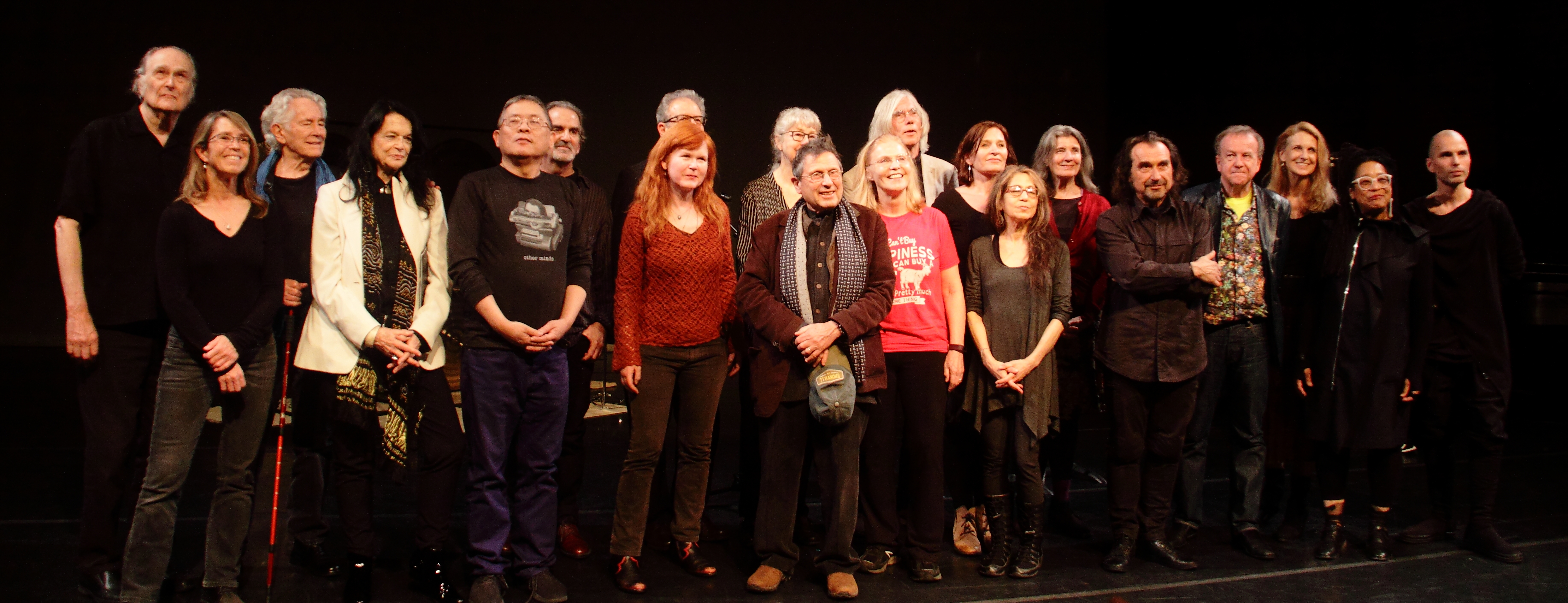
OM230007

(Left to right: Clark Coolidge, Karen Stackpole, Michael McClure, Anne Waldman, Randall Wong, Aram Saroyan, Sarah Cahill, Charles Amirkhanian, Carol Law, Alvin Curran, Beth Anderson, Jaap Blonk, Tone Åse, Amy X Neuberg, Sheila Davies Sumner, Enzo Minarelli, Ottar Ormstad, Susan Stone, Pamela Z, Taras Mashtalir)

The last statement in Ludwig Wittgenstein’s 1921 Tractatus Logico-Philosophicus (Whereof one cannot speak, thereof one must remain silent) is well known among philosophy students and has taken on the quality of an aphorism or truism.  But the six days of this most recent Other Minds Festival was functionally an effective refutation of this concept.  And the controversy over the awarding of the most recent Pulitzer Prize in music to a rap/hip-hop artist (a species of sound poetry?) which was announced on April 16th, 2 days after the end of this festival of sound poetry seems to reflect the prescience and presence of mind of the Other Minds organization.  Apparently words are “in” even if Wittgenstein and the critics of the Pulitzer Foundation say otherwise.

The Wages of Syntax

Other Minds 23 (April 9-14, 2018) in many ways began with the release in 1975, of one of the first (and still arguably the finest and still in print) anthologies of a strange, somewhat nebulous species of what can loosely be termed “sound poetry”.  That anthology was called “10+2: 12 American Text Sound Pieces” curated by the man behind this week’s vast expansion on that anthology, Charles Amirkhanian.
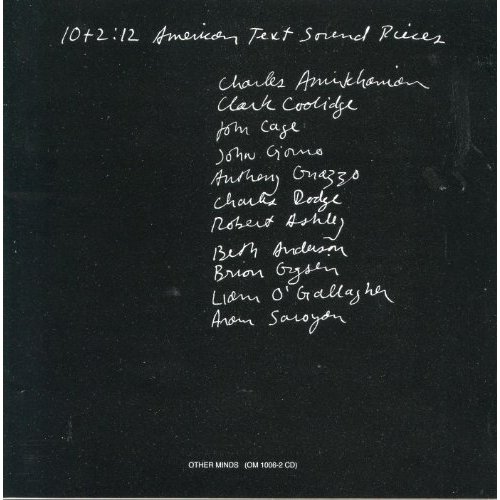
american text sound

Amirkhanian and his wife, artist and photographer Carol Law took a long strange trip in the early 1970s.  No, they did not follow the Grateful Dead.  Rather they sought a little known group of artists who walked a line seemingly between poetry and music.  From the Nordic countries to northern Europe, France and Italy they encountered artists who used the voice (though not necessarily language per se) to produce a sonic art form which nearly defies categorization.

1280px-Amirkhanian

Amirkhanian  in his office

Charles Amirkhanian is himself a composer and percussionist in addition to being a producer and promoter of contemporary music.  As a composer, as it was with his long radio career, his voice has been his main instrument.  His resonant, articulate baritone voice has served him well these years and this festival provided a rare opportunity to see/hear Amirkhanian perform his own work live.

This unprecedented 6 day festival marks the longest in the series of the Other Minds annual music festivals.  As relatively obscure as this art form may seem to the casual observer this series managed to provide historical context, current practices, and a tantalizing look/listen at the future of what is in fact a vast body of work.  The ability of Other Minds to find hidden treasures of sonic art continues to amaze.

Day one,subtitled, “The Wages of Syntax”, was the gala opening featuring some of the leading artists in the field.  After the obligatory intros the Italian master Enzo Minarelli presented the world premiere of his tribute to Stephane Mallarmé, “Ptyx”.

OM230013

The piece, comprised of phonemes rather than syntactical sounds, was an apt introduction to the weird and wonderful world of sound poetry.  Minarelli was passionate and expressive, a beautiful performance.  Only later in this series would we come to know the depth of scholarship, preparation, and experience that informed this and all his performances.  More on that a bit later.

Next up was one of the elder statesmen of San Francisco poets, the wonderful Michael McClure.  At 85 he sported a walking stick (no not really a cane) needed due to a recent fall.  He also required assistance of one of the stage managers to help him to the little chair and desk set up for him.  But none of that mattered once he opened his little bookmarked book of poetry and began to read “Marilyn Monroe Thou Hast Passed the Dark Barrier” and some of his Ghost Tantras from 1962.  His voice was strong, his delivery both certain and witty.  His combinations of words and non-syntactical sounds were delivered with the same joy, humor, and pathos which appears to have inspired them in the first place.  The audience responded very warmly to his ecstatic delivery.

OM230015

After a bit of stage preparation we were treated to one of the most prominent members of the next generation of American poets that followed Mr. McClure (can I be forgiven for saying beat poets?), Anne Waldman.  She was accompanied (as her texts required) by percussionist Karen Stackpole.  Waldman presented from her “New and Selected Poems”, “Pieces of an Hour (for John Cage)”, excerpts from “Voices Daughter of a Heart Yet to Be Born”, and excerpts from “Trickster Feminism”.  Her characteristically forceful and peripatetic performance carried her between the microphone and Stackpole’s percussion instruments and back again.  It was a charged and sincere performance which clearly charmed (some might say stunned) the audience.

Waldman’s ties to the world of sound poetry go back to her New York roots and her involvement in the St. Mark’s Poetry Project and the Dial-a Poem Poets whose recordings have included her work and that of John Cage, Charles Amirkhanian, Clark Coolidge, and Michael McClure among others.  Small world.
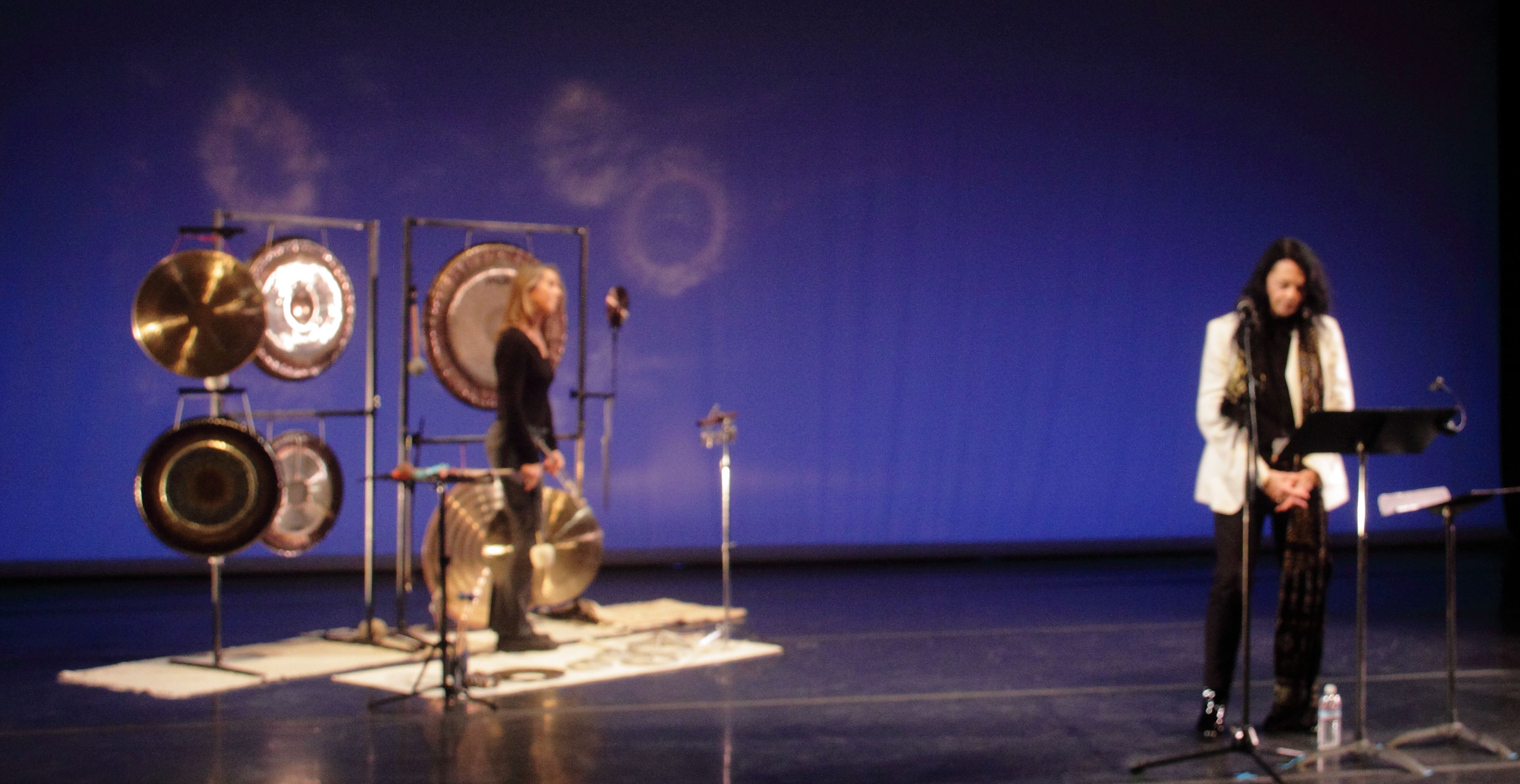
OM230021

Next up was the venerable Aram Saroyan.  I suppose Saroyan (yes, the son of Pulitzer Prize winner William Saroyan) can be said to be part of the same post beat generation artists as Waldman.  Perhaps best known for his “minimalist poetry” he is also an accomplished biographer (Genesis Angels deserves to be better known IMHO) and literary innovator.  It was Saroyan’s poem “Crickets” (1965) which ended the first side of that anthology mentioned at the beginning of this article.  It was in an infinite loop in the end groove of side one of the LP playing the one word which comprises the poem, “crickets”.  And it was this little gem that he performed on this night….with a twist.  After a few repetitions he invited the audience (many apparently still trying to figure out what was going on) to join…which we did…,at first hesitantly, in unison…and then, in a touch of group inspiration, just like real crickets, not all in unison.  It was a strange sort of call and response that charmed the audience and brought a smile to the poet as well.  And that only brought us to intermission.
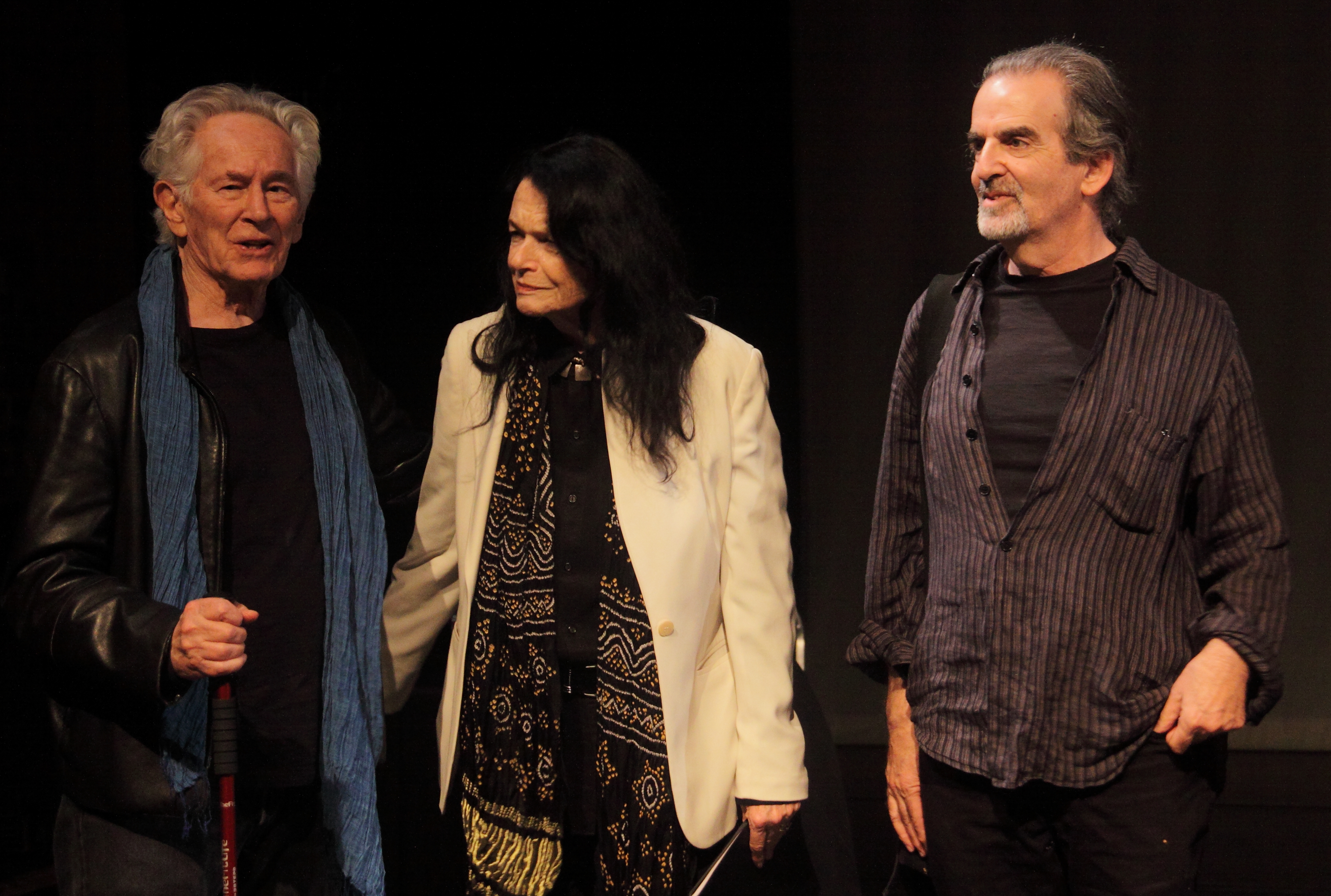
OM230004

Michael McClure, Anne Waldman, and Aram Saroyan

The second half introduced the first of the international stars, Jaap Blonk, the Dutch sound poet and performance artist.  He began with one of his own works, Obbele Boep ‘m Pam (a bebop sound poem).  It was a sound poetry homage to that 1950s species of jazz which inspired the beats, Bebop.  It was a sequence of sounds and words in a made up (by the performer) language intended to imitate the sound of his native Dutch language.

His second performance was of a sound poem from 1916 by the man who coined the term, “phonetic poem”, Hugo Ball (1886-1927).  This poem, based on phonemes common to the Swiss and German languages, was called, “Seepferdchen und Flugfische” (in English “Seahorses and Flying Fish”).  Blonk’s delivery of this turn of the century classic was the first of what would be several such revivals of revered early material of this nascent artistic genre.

OM230026

Jaap Blonk

Blonk was followed by the grand finale which returned us to the local roots with poet Clark Coolidge and the ever innovative Alvin Curran.  We learned that the two went to high school together and this was a strange and wonderful reunion with Coolidge reading his manic stream of consciousness poetry accompanied (sort of) by Curran’s musical ministering at both a grand piano and a sampling keyboard in a world premiere collaboration.

Though Curran now lives in Rome (and has for many years) he will always be welcome in the Bay Area where he lived, taught, and performed for many years.  Curran is no stranger to Other Minds either having performed at Other Minds 7 in 2001 and, more recently, at the Nature of Music series.  He is a musician, not a poet but his eclecticism has allowed him to collaborate successfully with a wide variety of artists in a long and varied career which continues to command attention.

The nature of the interactions which characterized this world premiere performance of “Just Out of Nowhere” were not obvious though it is a fair assumption that a degree of improvisation was used and, no doubt, some of the successful confluences on this night were first encountered in rehearsals.  Coolidge’s stream of consciousness rhythmic ramblings were ever present but never overwhelming.  In response, Curran moved back and forth between the grand piano and the sampling keyboard working with serious concentration to provide his musical support for the words.

It was an intense performance as inscrutably mind expanding as all that went before.  Curran signaled the end (as has become his performance custom) by blowing the sacred shofar over the undampened piano strings which resonated in kind and faded to silence which, in turn, was held for a moment by the audience as they disengaged from their attention to offer warm and appreciative applause.  It was a striking collaboration and a reunion of two beloved artists.

OM230033

The audience seemed to feel the pure emotion of this performance and the two performers embraced warmly before acknowledging the accolades of the charmed audience.

OM230035

Sadly this writer had to miss the second night of the festival which consisted of a lecture by Enzo Minarelli on the history of sound poetry followed in the evening by a workshop on how to do sound poetry run by Jaap Blonk.  Both were apparently well received and it is my understanding that they will soon be available for streaming on the Other Minds web site.  Definitely gonna check that out.

The second night was given the subtitle, “No Poets Don’t Own Words”.  Even for those who were fortunate enough to have attended this extended Tuesday program it is worth noting that there is a wealth of resources easily available to the interested listener.  The Other Minds website has links to a wealth of archives which include interviews and performances by a variety of artists.  In fact (and this was a creative touch) you get a free CD entitled, “What is sound poetry?”, an archived KPFA radio program when you buy one of the unique t-shirts (designed by none other than Carol Law) from the Other Minds Web Store.  Get this stuff while you can folks.

Also worthy of note (this writer has lost many hours browsing here) is Ubuweb, an online archive of music, texts, films, and sound poetry.  The fact is that these six evenings ultimately could only serve as an introduction to the unusual and entertaining genre.  And those whose appetites have been whetted by this series will want to hear more.

The History Channel
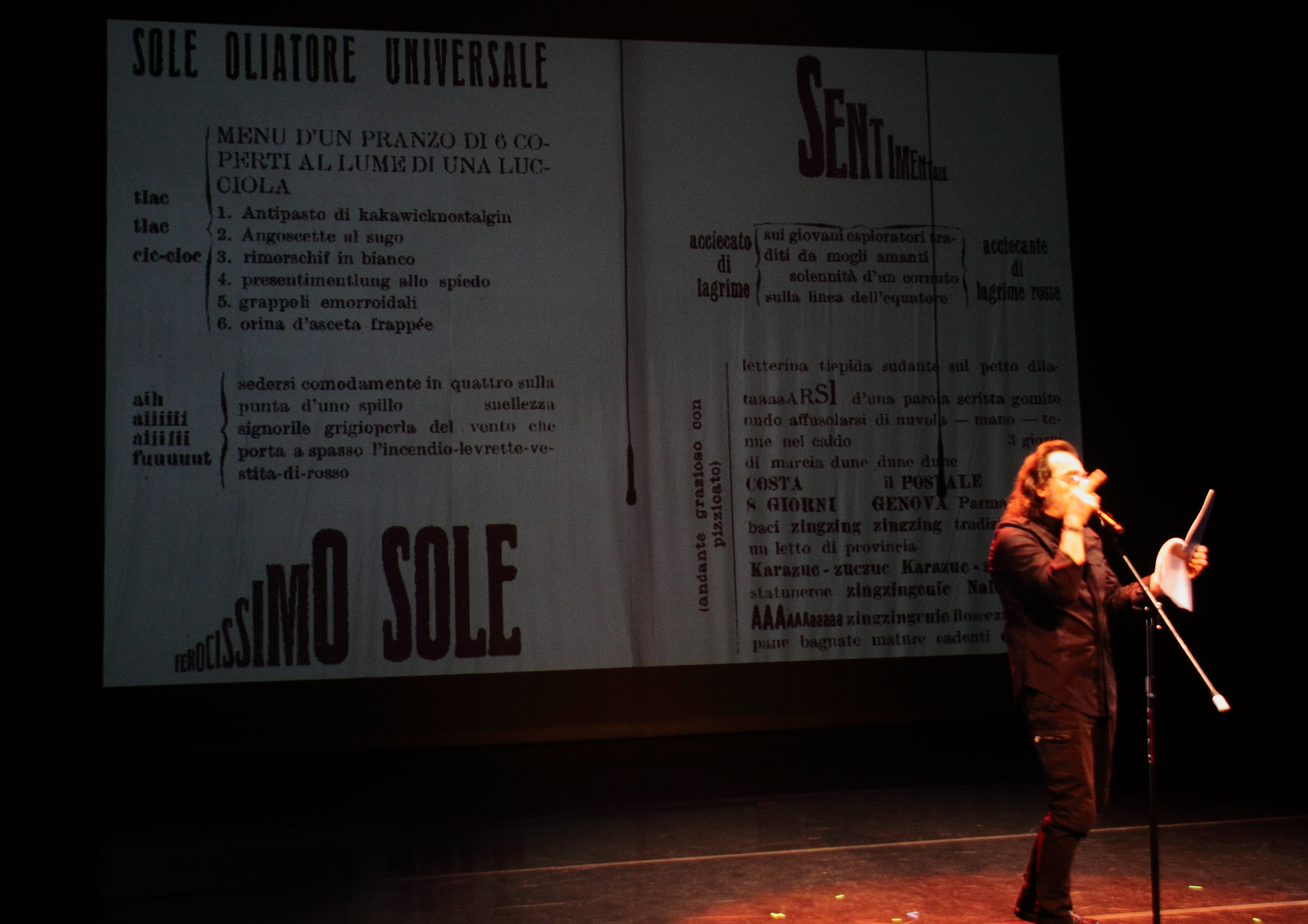
OM230039

Day 3, April 11th.  The subtitle for this night’s performance was, appropriately, The History Channel.  It was an opportunity to display some of the origins and early foundational masterworks of sound poetry.  Enzo Minarelli displayed his academic skills and interests as he interpreted several classic “scores” (which were projected on the back wall) as the performer brought them to life in what appears to have been as authentic a performance as could be had with this material from the early twentieth century.

Minarelli did readings of: “Dune (parole in libertå)” (1914) and “Zang Tumb Tuuum: Adrianopoli, 1912” (1914) by Filippo Tommaso Marinetti; Fortunato Depero’s “Subway” (1939), “Verbalizzazione astratta di signora” (1927), and “Graticieli” (Skyscrapers, 1929).  He finished with one more by Marinetti, “Savoia” (1917).  In addition to the passion of Minarelli’s performance the look of the score, essentially artistically printed pages of words and phonemes, and the choices made by the performer to interpret those scores itself provided its own sense of drama.  The lighting and projection were simple and effective, supporting the live performance.
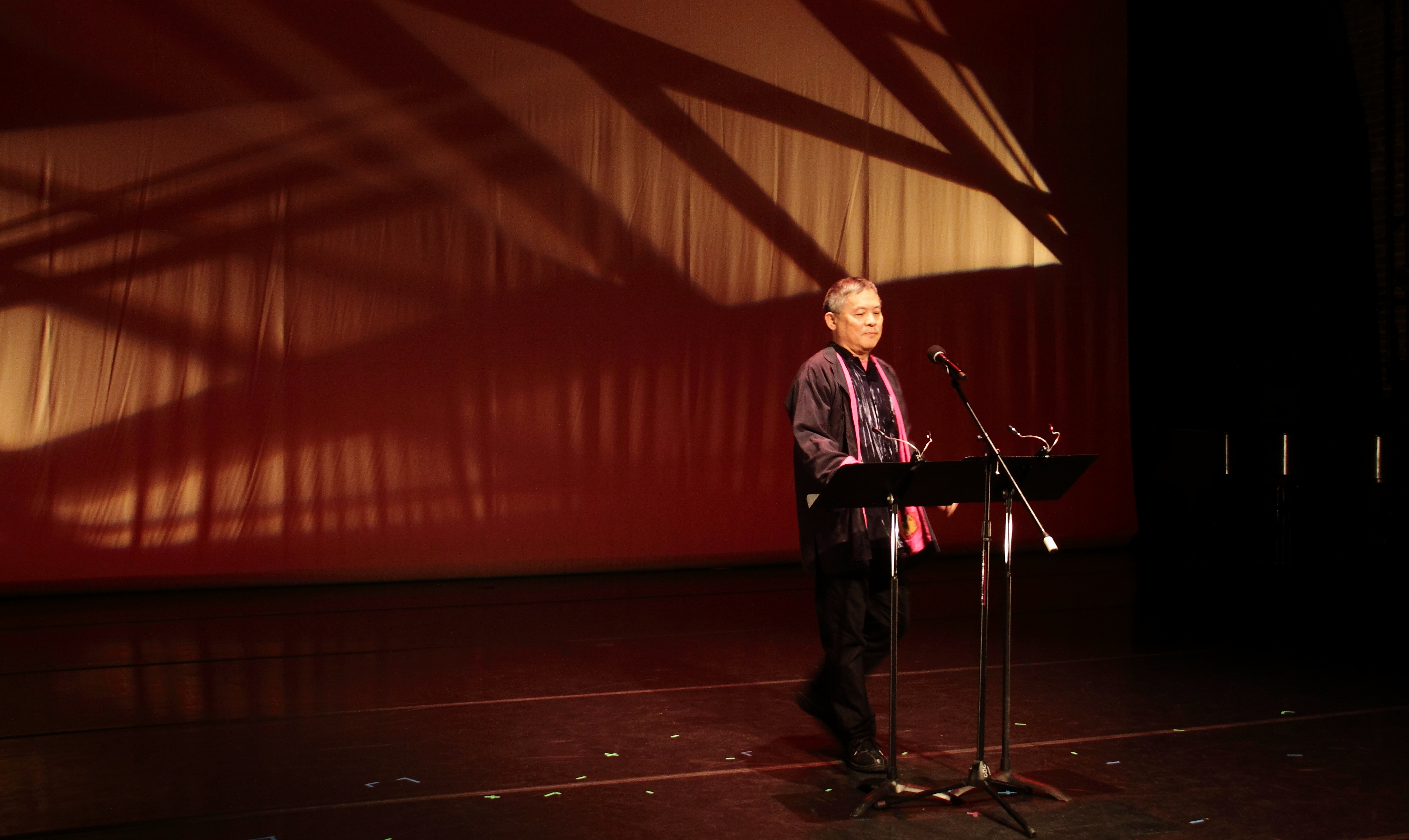
OM230042

No major stage changes were needed for the next performer, just a little music stand with a microphone and small lights to illuminate the score.  Randall Wong, currently administrative director at Other Minds is an accomplished singer.  He is in fact a male soprano who specializes in baroque vocal scores including opera.  No stranger to new music, Wong has also demonstrated his formidable vocal skills singing with the Meredith Monk Ensemble among others.  It was those extended vocal skills that were called upon this night.

One could hardly have found a more appropriate casting to perform this next item on the program, “Stripsody” (1966) by the deservedly celebrated new music soprano Cathy Berberian.  Similarly to Wong, Berberian’s career took her from baroque opera to a plethora of modern music (Berberian was married for a time to Italian modernist composer Luciano Berio who wrote many a score for her).  What is lesser known is that Berberian wrote some music designed and inspired by her own vocal skills.

OM230045

Stripsody is difficult to describe.

OM230043

It is, in fact, a combination of sounds, specialized vocal utterances, and visual theater and is a sort of homage to comic strips (hence the title).  Utilizing onomatopoetic sounds, imitations of real world sounds and the sheer range of Berberian’s vocal instrument the performer becomes a sort of live comic character.  This piece is demanding but highly entertaining and contains humor and a variety of references.  Never did the audience lose track of the virtuosity involved or the intensity of the performer’s stage presence.  Wong’s performance was at once accurate, virtuosic, and a touching evocation of the memory of Ms. Berberian.

OM230044

It was an immersive experience for both performer and audience witnessing the sounds, the gestures, the facial expressions, the sheer concentration required to convey both the humor and joy of this work.  Wong demonstrated serious stamina and seemed to have enjoyed himself.

OM230047

Now what is history without a bit of archaeology added in?  Charles Amirkhanian introduced writer Lawrence Weschler who is (bear with me now) the grandson of the composer Ernst Toch.  Toch is responsible for writing what is perhaps the best known example of the genre represented by OM 23 this year.

In 1930 he wrote a three part composition entitled, “Gesprochene Musik” (Spoken Music).  Two of the three parts of this composition had long been thought lost.  However choreographer Christopher Caines apparently did a reconstruction for his dance piece, Spoken Music (2006).  Tonight’s performance was the American premiere of substantially what Toch had originally intended way back in 1930.

OM230049

The last of the three pieces, “Geographical Fugue” is by far the best known of Toch’s spoken music (indeed the probably the best known of all his music despite a truly substantial catalog and a Pulitzer Prize, no less).  In addition to the Gesprochene Musik there was a performance of a much later work by Toch which parodies chatter at cocktail parties, “Valse”(1962).

All of these were performed by The Other Minds Ensemble which consists of Kevin Baum, tenor; Randall Wong, tenor (yes, he can handle both soprano and tenor); Joel Chapman, baritone; Sidney Chen, bass, Amy X Neuberg, and Pamela Z.

Fast forward now to 2014  when grandson, executor, and writer Lawrence Weschler came up, on a whim, with a medical text to fit to the original Geographical Fugue.  Tonight we were treated to the world premiere performance of Medical Fugue with the same ensemble.  Weschler’s facility with language allowed him to choose the phonetics which worked as effectively as Toch did in his original. No doubt grandaddy would have been proud.
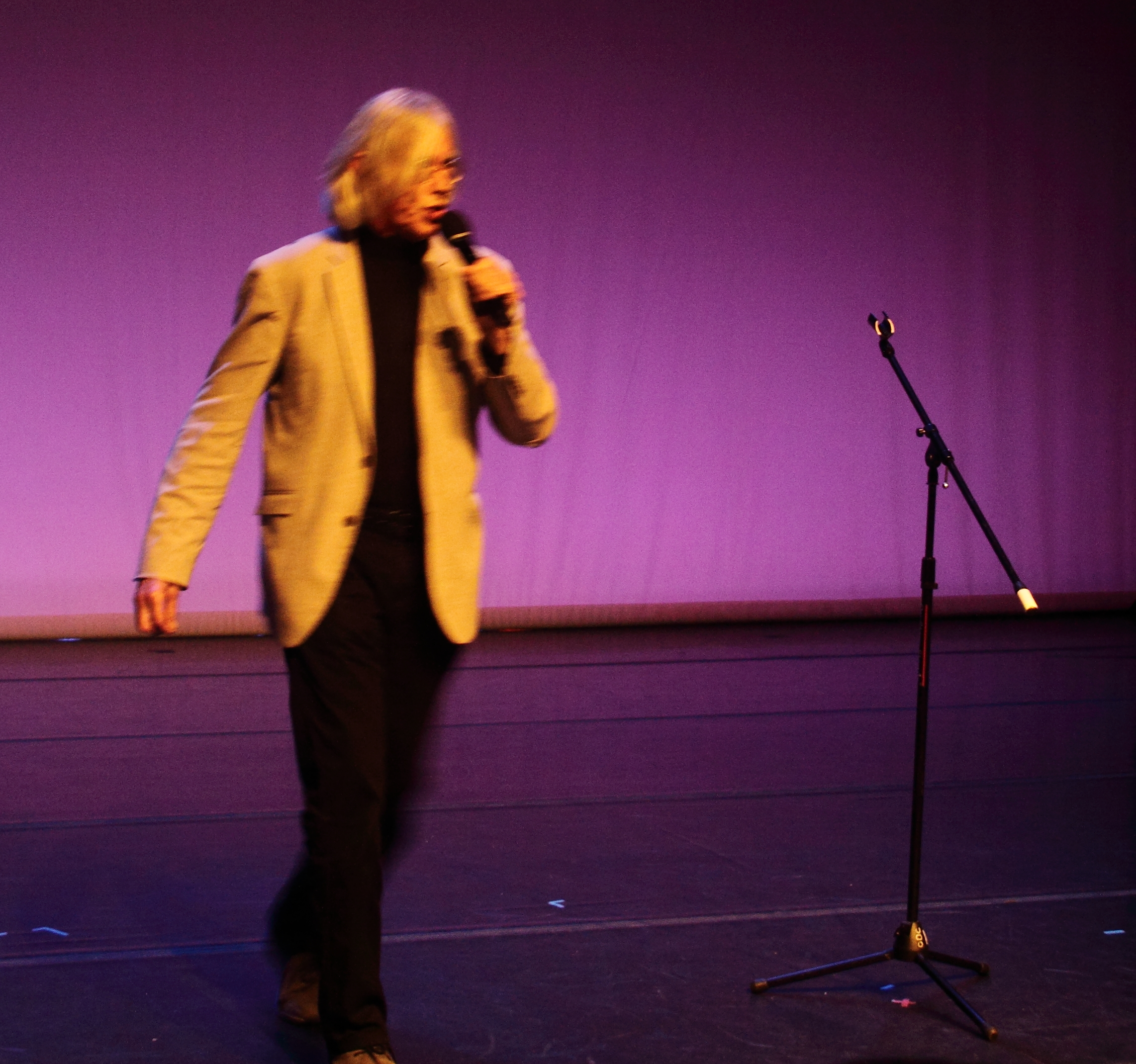
OM230054

Following intermission Jaap Blonk again took the stage, this time doing a historical performance for which he has become quite well known.  Tonight he performed (from memory, no less) “Ursonate” (1932) by Kurt Schwitters.  This large and complex work in several sections (or movements) utilizes vocal sounds fit together in the manner of classical sonata form in music.  Blonk has been performing this work for many years now and he obviously both knows and loves this piece.  His sincere, kinetic performance brought the audience back to the time frame of those years between the wars most effectively.

Two pieces on tape were next: “La Poinçonneuse, Passe Partot No. 2” (1970) by Bernard Heidsieck (1928-2014) and “If I told him (a completed portrait of Pablo Picasso) (1934) by Gertrude Stein (1874-1946).  Both were presented with the theater darkened and a simple card projected on the back wall of the name of the work and the composer.

The Heidsieck piece is a poignant and bittersweet scenario alleged to be at least partly autobiographical.  The Stein was a poetic portrait of her friend, Pablo Picasso.  It was in Stein’s own unique take on language and left one wondering why Stein’s work is not even better known than it is.

OM230057

And for the finale the Other Minds Ensemble was joined by a frequent guest artist, the justly renowned pianist Sarah Cahill in a seldom performed work by American Composer (and Gertrude Stein collaborator) Virgil Thomson (1896-1989).  “Capital Capitals” (1917-1927) utilizes a Stein text.  Thomson and Stein enjoyed several successful collaborations (including two operas) with Thomson setting Stein’s words to music.

The text, designed with musical analogies in mind, was presented uncensored with a disclaimer in the program.  The text, a bit dated, would not be considered politically correct by today’s standards.  It is a celebration of the ancient capitals of Provence (Aix, Arles, Avignon, and Les Baux).  The music was written ten years after the text and shows the same collaborative affinity demonstrated in the operas.

The ensemble appeared to have a great deal of fun with the punning language and the music such a good fit. The audience clearly agreed.

Scandalnavians

Day 4:  One of the things that has characterized Other Minds concerts over the years is the attempt to include the world outside of the United States.  This year the international artists mostly come from that same territory which Mr. Amirkhanian and Ms. Law traversed on their journey in the early 1970s.  Jaap Blonk, who had already performed in from the Netherlands, Enzo Minarelli, from Italy.  We would on this night also be introduced to Sten Hanson (1936-2013), Ottar Ormstad , Taras Mashtalir , Lily Greenham, Åke Hodell, Sten Sandell, and Tone Åse.

The evening opened with tape presentations of two pieces by Sten Hanson (1936-2013).  Che (1968) and How Are You (1989).  The first was a deconstruction of words of Che Guevara and the second a phonemic deconstruction and electronic manipulation of the three words of the title.

OM230064

Then, in a significantly darkened hall, we were introduced to the work of Ottaras, a duo consisting of Russian composer Taras Mashtalir and Norwegian poet/artist Ottar Ormstad.  Standing stage left of the projection screen which covered almost the entire back wall Mashtalir worked on his laptop (producing some heavy rumbling that shook the walls and was felt in the listener’s body).  This writer’s first impression was that of some sort of IDM (Intelligent Dance Music) or ambient rave soundtrack.  It accompanied some striking (mostly) black and white images which took center stage on the screen at the back wall.  Slowly, at first imperceptibly, Ormstad wove some vocal sounds into the fabric.  It was the U.S. premiere of a 2018 work entitled, “Concrete”.  It was in four sections (or movements if you will) each separately titled, “Long Rong Song”, “Navn Nome Name”, “Kakaoase”, and “Sol”.
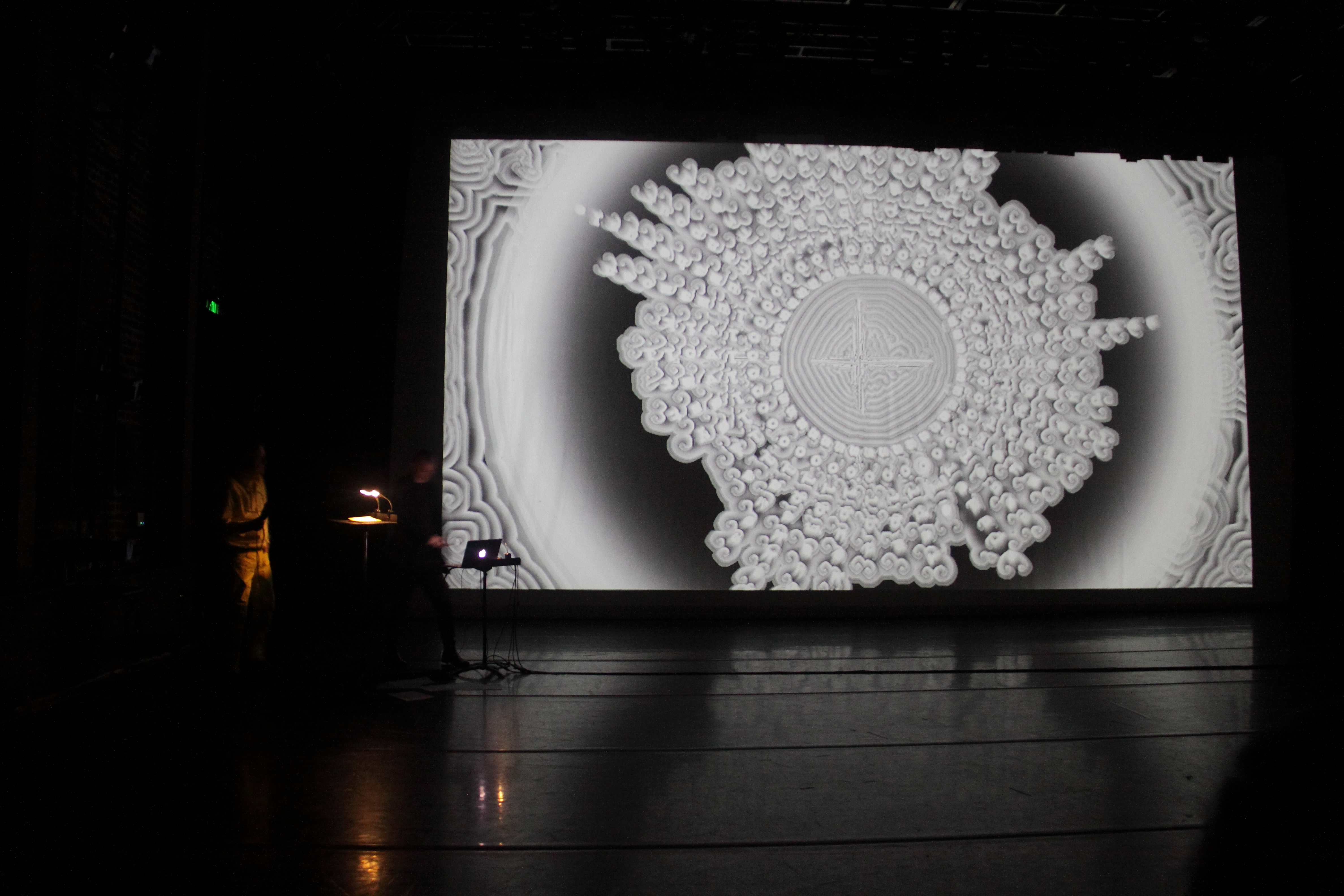
OM230065

The strange swirling images, sometimes with words or parts of words moved across the back screen while the two performers, barely visible, worked with their instruments (computer and voice) to create a soundtrack for the images.  Much like the non-syntactic use of sounds and language, the musical accompaniment was comprised of rather minimalistic utterances orchestrated in a wide range of frequencies with frequent heavy bass sound which provided a tactile component. All in all a rather mystical experience, exactly the cutting edge one looks for when attending an Other Minds production.
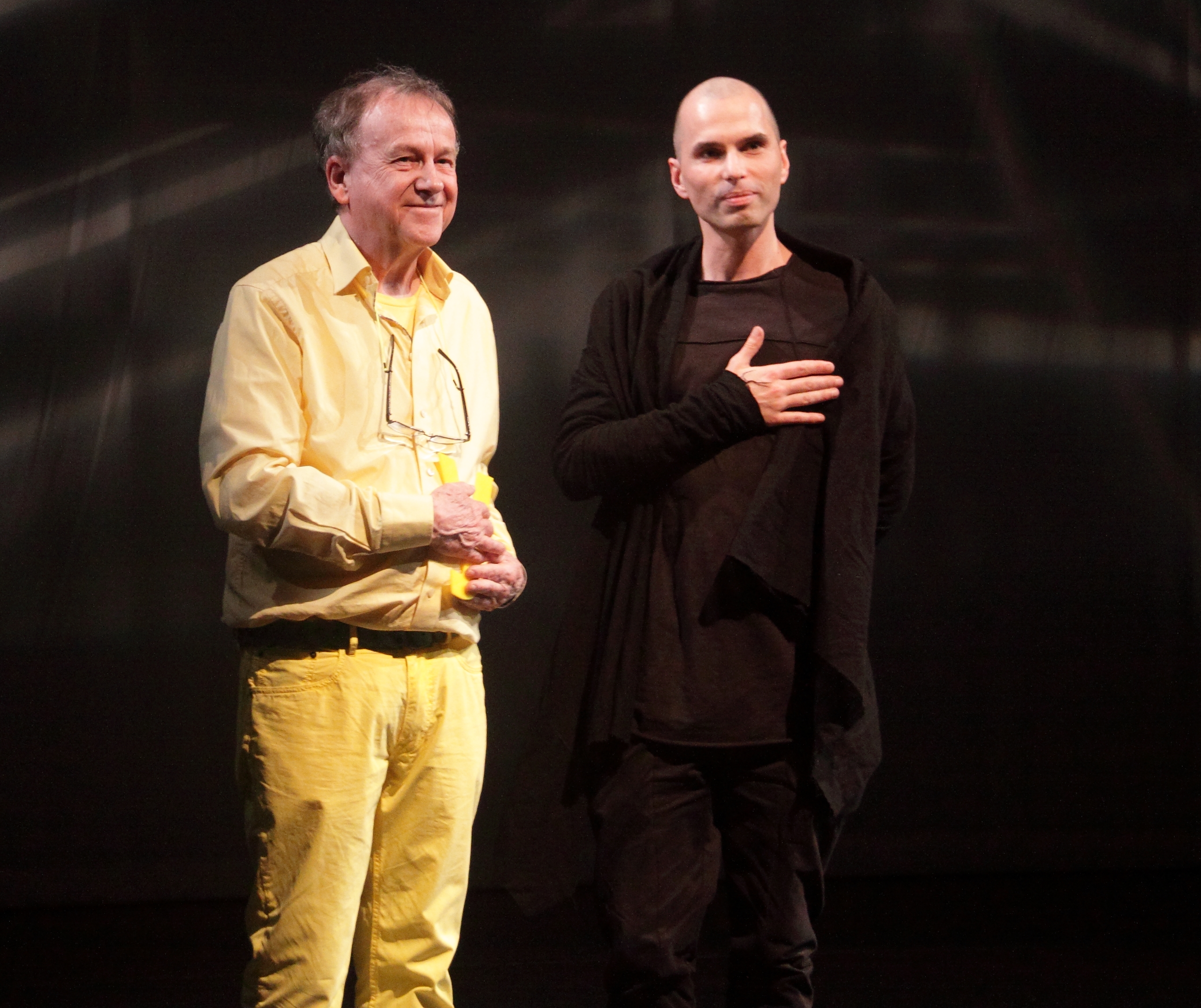
OM230067

The performers seemed touched, perhaps even a bit surprised by the very warm response from the audience who seemed to connect rather easily to this unusual and very sensual experience.

The first half of this night’s concert concluded with the presentation of two more tape pieces, Lily Greenham’s “Outsider” (1973) and Åke Hodell’s “Mr. Smith Goes to Rhodesia” (1970).  As in previous tape presentations a static photograph with titles was projected on the back wall in the darkened theater.

The Greenham piece is a solo monodrama in which the speaker (Greenham) is accompanied by an electronic chorus of her own voice.  Hodell’s piece is clearly a protest piece about racial oppression by Ian Smith (Rhodesian Prime Minister 1964-1979) in Rhodesia (now Zimbabwe and Zambia).  It is like the Greenham piece in that it utilizes a chorus but here the chorus is actual children gathered by the artist to speak/echo the lines of the narrative which contrasts the colonial narrative with both Hodell and the children periodically intoning, “Mr. Smith is a murderer.”  The contrast was chilling and the pause for intermission a welcome respite.
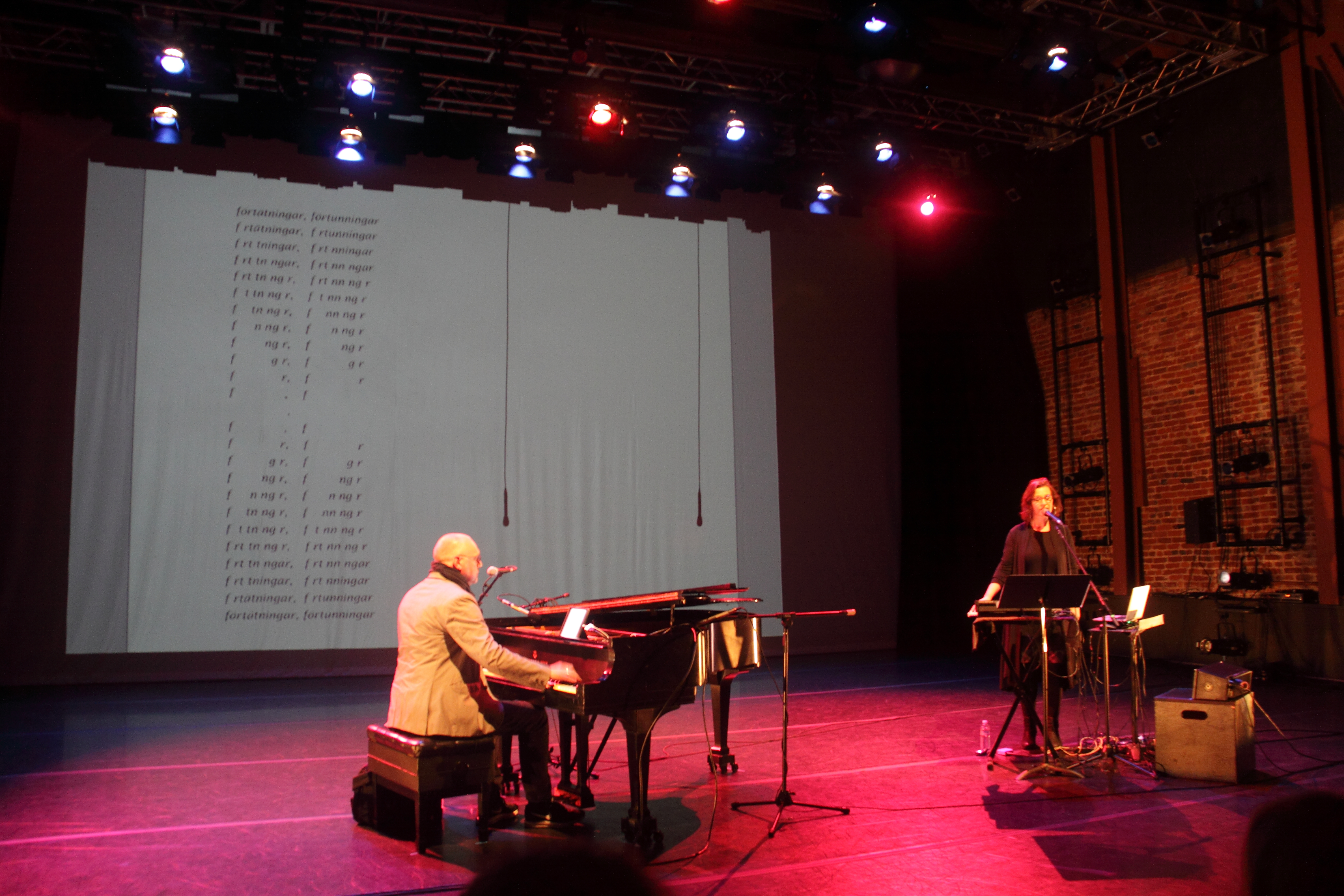
OM230071

The second half of the program began with a solo performance by Tone Åse, another world premiere.  She performed her work, Ka? (2018) for voice and electronics.  In this piece she works with the sounds of questions, hesitations, and the sound of dubiousness deconstructing words, phrases, sounds and manipulating them vocally and electronically in a piece whose low volume and sparse sounds certainly evoked the intended emotions.

After a brief acknowledgement of the appreciative applause the next performer, Sten Sandell sat down at the keyboard stage left and began the performance of Voices Inside the Language (2018), another world premiere.  Again this experience had a similar sparse, almost minimalist approach.  It was a collaboration that echoed the first night’s Coolidge and Curran performance and presented an entirely different sound world.

OM230073

Almost before the audience realized the collaboration was over Åse discreetly left the stage leaving Sandell to perform his work, “vertikalakustik: med horisontell prosodi” (2017).  Here was a near complete deconstruction of language using simply phonemes, individual sounds.  With voice, piano, and projections on the back screen, Sandell delivered his necessarily minimalistic piece.

Both Sandell and Åse briefly acknowledged the applause bringing to an end this most satisfying international segment of the festival.

Good Luck with/for/on/in/at Friday the 13th

Described as an antidote for triskaidekaphobia (fear of the number 13), this evening’s program featured primarily California based artists including Amy X Neuberg, Mark Applebaum, Charles Amirkhanian, Carol Law, and (the one non-Californian) Enzo Minarelli.

The most famous victim of triskaidekaphobia was the Austrian/American composer Arnold Schoenberg (1874-1951).  Curiously for the sake of the present subject matter, Schoenberg invented sprechstimme (speech song), a sort of half sung/half spoken style of performance for many of his vocal scores.  His unfinished opera, Moses und Aron (1932) uses it and ends the second (and last completed) act with Moses singing/speaking the following words: “O Wort, du Wort, das mir fehlt!” (in English: “O word, thou word, that I lack!”)  Indeed the theme in the composer’s libretto is centered in part around Moses’ inability to articulate his ideas.  (Aaron was the man of words, Moses the charismatic leader)  Here, tonight, we were presented with artists who have grappled similarly (as all artists do) with the issue of expression and their unique solutions to the problem.  (By the way the spelling, “Aron” is not a German spelling, it is Schoenberg’s truncation of the name so that the title would not have 13 letters.)  The poor man probably wouldn’t have survived this night.
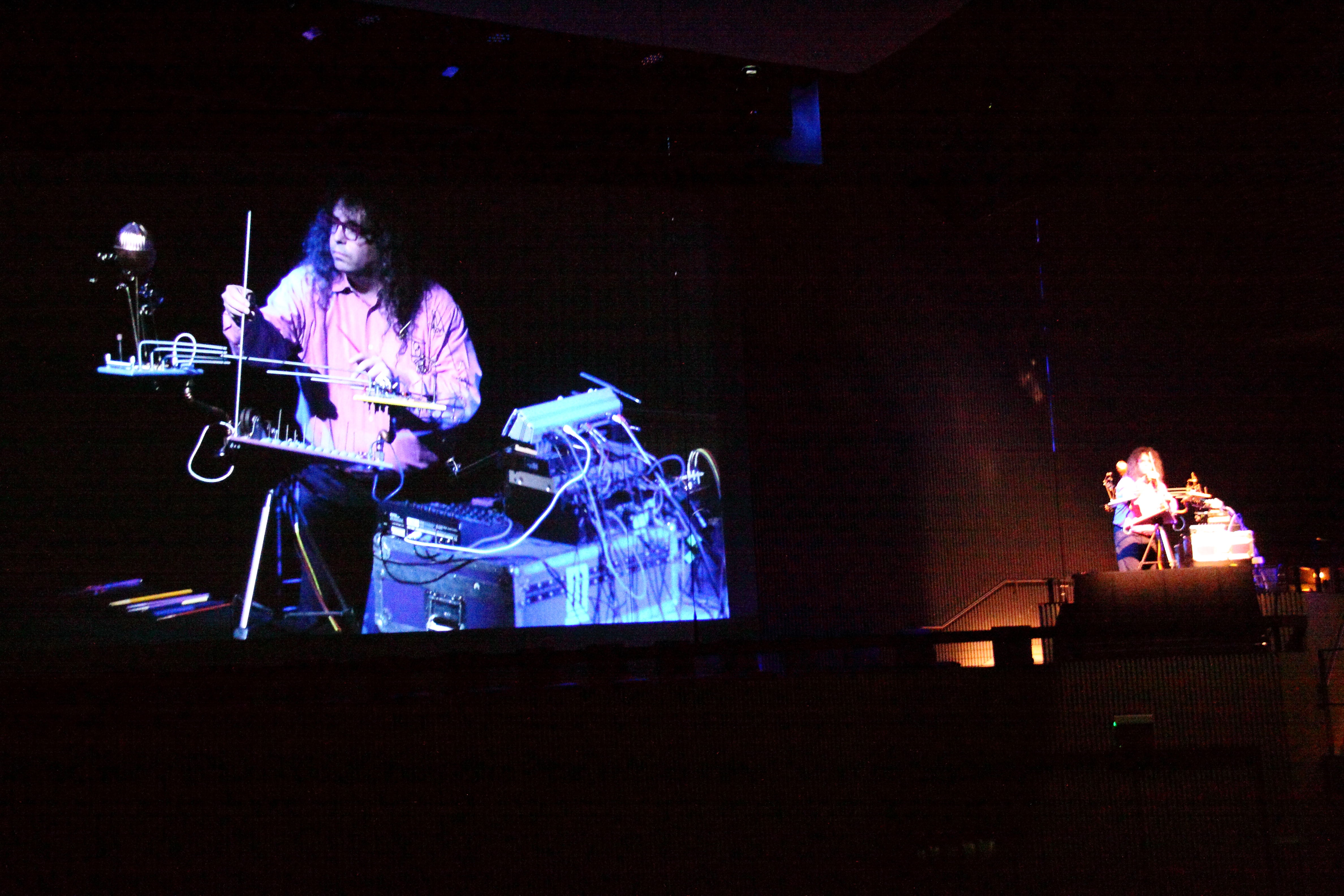
OM190013

Projection of Applebaum performing with view of the composer/performer stage right as well.

The night opened to a darkened stage with the projection of one of those info/program note cards on the back wall.  The presentation was of a tape piece by Stanford professor (and Other Minds alumnus) Mark Applebaum.  Since the darkened stage and the all too brief bow taken by the composer exceeded the limits of this writer’s photographic skills I offer the above photo of Mr. Applebaum from previous Other Minds program.

The piece at hand on this Friday the 13th was, “Three Unlikely Corporate Sponsorships” (2016) which had it’s premiere at Stanford.  The three sections were entitled, “Nestlé”, “General Motors”, and “Haliburton”.  The mocking and humorous content was such that there was no doubt that the three named corporations were not involved in the creation and funding of this work.  Like some of his predecessors this week Applebaum is prone to political commentary in his music whose sound appeared to take place in a stereo sound field with some antiphonal effects.  Words were used, deconstructed, used again and never once were they used in a complementary fashion.  This is, in its way, a protest piece.

As I said, Applebaum came out only briefly (with a smile on his face) to acknowledge the very amused and appreciative audience.  One senses that protest against corporate greed is hardly an unpopular theme with this self selected audience which greeted this work with obvious satisfaction.

OM230078

Amy X Neuberg is a well known performer in the Bay Area and is also an alumnus of Other Minds.  Neuberg studied both linguistics and voice (at Oberlin College), and electronic music (at Mills College).  She has a strong well-honed soprano voice and has developed her own unique mix of language and music in compositions that defy easy categorization.

Neuberg graced us with “My Go”, “Christmas Truce: a journal of landlord/tenant situations”, yet another world premiere for this series, “Say it like you mean”, “That’s a great question (A Jerry Hunt Song Drape)”, and, one of her classics, “Life Stepped In”.

Neuberg’s work is a striking and unique combination of linguistic wizardry, cabaret style song writing, probably some rock and pop sensibilities, and the indefinably unique way in which she integrates voice and electronics with a touch of drama at times.  Her work is permeated with humor but also with social critique.  As is always the case (at least in this writer’s experience) her performance was greeted with warmth and appreciation.

OM230080

Following intermission we were again treated to the substantial performing skills of Enzo Minarelli who graced us with a generous selection of his own works including, “La grandeur di Ghengis Khan” (The grandeur of Ghengis Khan) comprised of eight vocal tracks and three noise tracks, “Il supere scopo di vita” (Knowledge as the purpose of life) “I nomi delle città come inno nazionale per Sinclair Lewis” (The names of the cities as national anthem to Sinclair Lewis) another multi-track work, and Excerpts from Fama: “Ciò chevoglio dire” (Fame: What I Want to Say): “Affermasi senza chiedere” (To succeed without asking), “Che teme il dolore (use la medicine della religion)” (Those who fear pain fuse the medicine of religion), “Alla ricerca del suono farmacopeo” (Seeking the pharmaceutical sound) and “Poema”.

In addition to their described meanings and verbal content these works were about the beauty of the Italian language and the beauty of the sound of the performer’s voice as well as the accompanying performance.  Minarelli is apparently a performer of high energy.  He performed on five of the six days and attended the last night as well seemingly all in a weeks work.
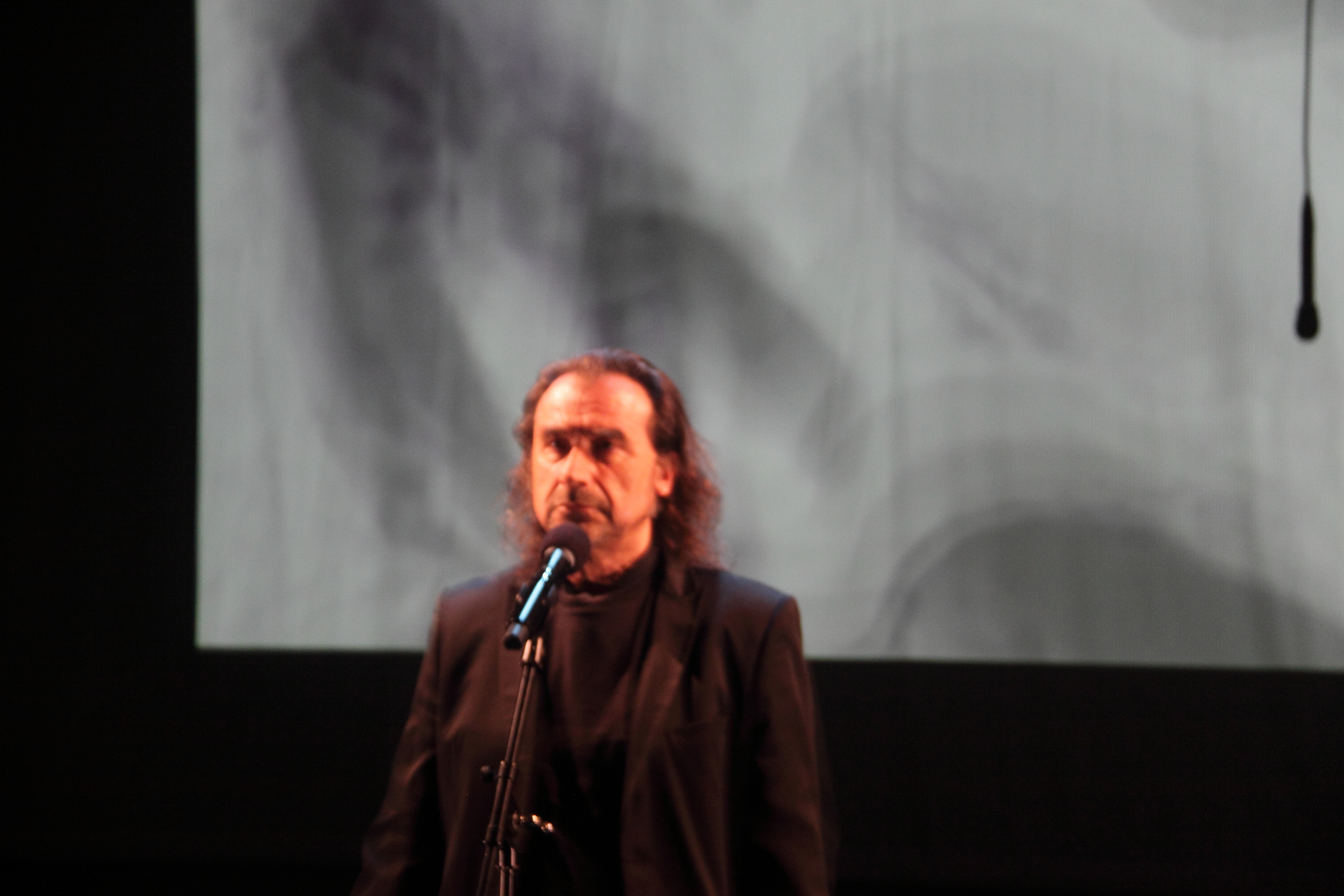
OM230086

Once again the fairly minimalist lighting strategies were remarkably effective.  Projections on the back wall along with Minarelli’s strong stage presence made for a striking performance of these works.

OM230091

Minarelli was like a poet from a cabaret in some lost Fellini film fraught with intelligence, drama, passion, and humor.
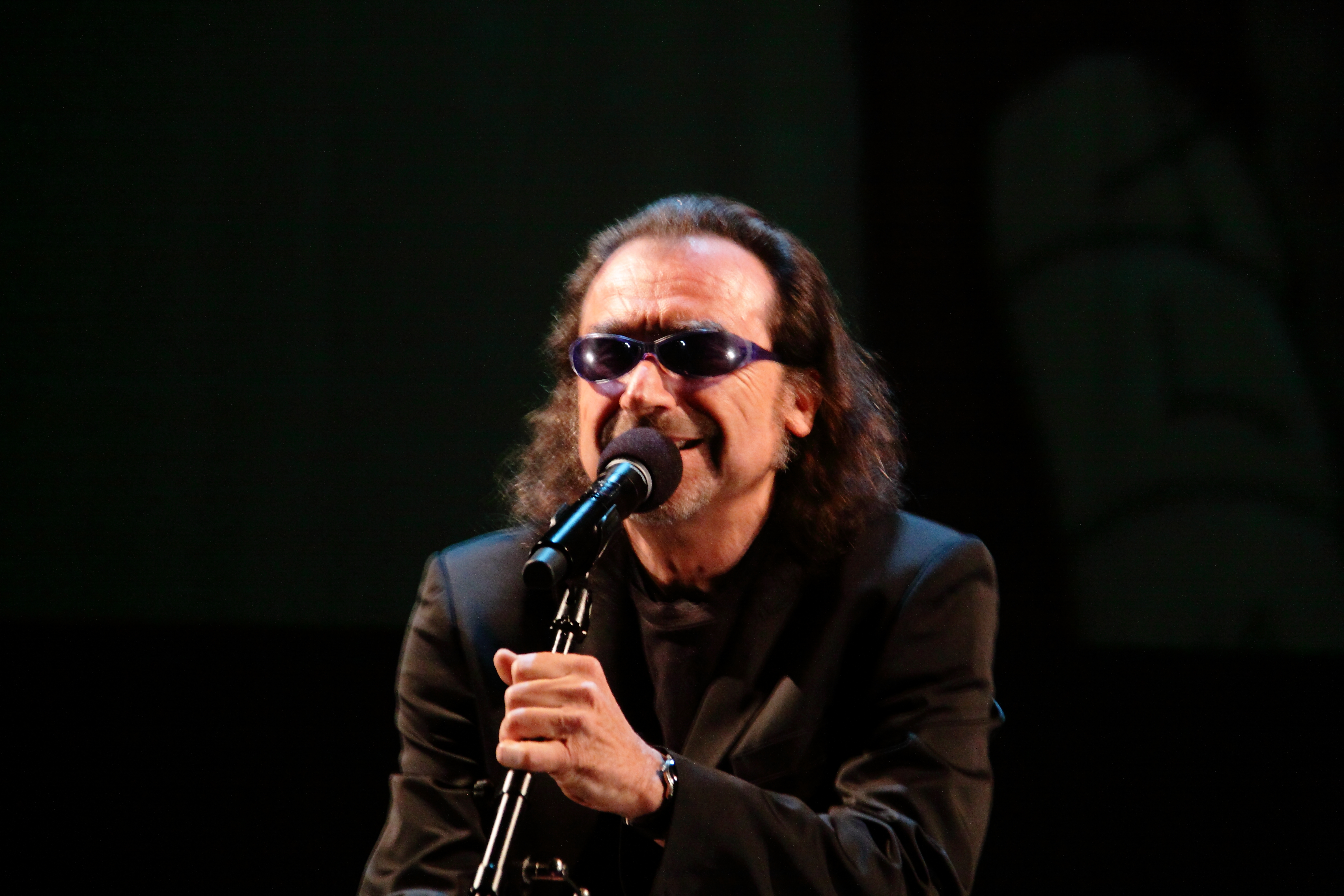
OM230092

Any of the above led the audience in some degree to the notion that what had just transpired would be a tough act to follow.  Certainly this was true for Mr. Minarelli but, rather than a denouement or even a cooling down there was a shift of gears, a transition if you will, to yet another universe of creativity.

We were next presented with a fairly rare experience.  We got to hear Other Minds’ executive and artistic director perform some of his own dalliances with languages and vocal utterances.  Charles Amirkhanian, no longer wearing his jacket but rather a long white shirt, came on stage with this wife and partner, in both life and artistic crimes, Carol Law.  Together they shared some of the inspirations of their (obviously still in progress) long strange trip.

OM230097

In addition to being a photographer, Carol Law is a collage artist and has also been involved in the design of a few of pieces of Other Minds collectibles such as the t-shirts created for this year and several from previous years.  What is a bit lesser known are her collaborative efforts with Charles Amirkhanian.  The above image, for example, demonstrates the striking, slightly disturbing images that characterize the first work on tonight’s program, “History of Collage” (1981).  Carol’s images were accompanied by a live recitation by Charles of a text which is actually about collage but is manipulated by a cut up technique.  Here we saw images and heard the spoken text.  For the next two collaborations Amirkhanian took his microphone and did his recitation in front of the projection screen creating effects not unlike the light shows and projections one might have seen in one of Bill Graham’s productions at the Fillmore Theater some 50 years ago.  That is not to say that the intent or effect was nostalgic or historical, just that it seems to exist in a parallel universe.  The long white shirt thus became a part of the projection screen with Amirkhanian moving dynamically along with the speaking of the disjointed texts.

OM230100

The visual imagery was both striking and unique and held this writer, if not the entire audience, in thrall to a powerful sensual onslaught.

Hypothetical Moments (in the intellectual life of Southern California) (1981) is another of these cut up texts, this time an intercutting of Edith Wharton’s, “Glimpses of the Moon” and what Amirkhanian describes as “the gruff drugged-out reportage of a Yankee baseball game”, Ted Berrigan and Harris Schiff’s, “Yo-Yo’s with Money” (Amirkhanian is an avowed baseball fan).  These were spoken over an improvisation done on an out of tune harpsichord modified by an Eventide Harmonizer.

OM230101

The pair stepped on stage together to acknowledge the very appreciative applause.  Indeed this was a rare and precious experience seeing them perform together and, though they did not eclipse the previous artists, they clearly established their parallel universe in the shared multiverse of sound poetry.  These are wonderful performance pieces.
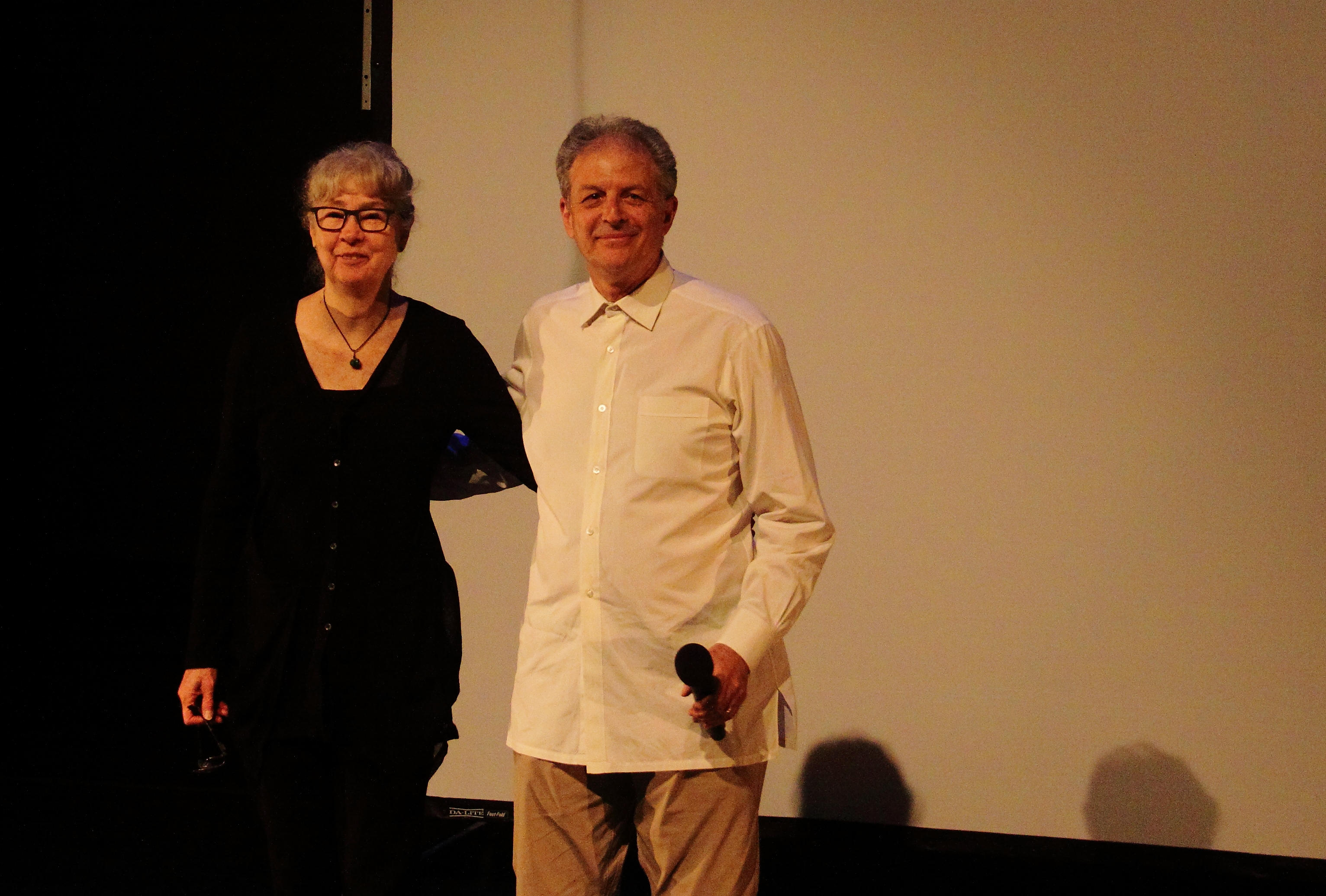
OM230104

So…how do you follow that?  Well, apparently with some solo Amirkhanian.  As noted previously, Charles has been writing and performing his brand of vocal gymnastics since at least 1969.  Two of his works, “Just” (1972), and “Heavy Aspirations” (1973) were included on that anthology mentioned at the beginning of this review.

OM230113

Amirkhanian has taken the stage at least twice before at Other Minds performing his own text sound works.  Tonight he presented, “Maroa” (1981), a sort of homage to a street in his home town of Fresno, “Ka Himeni Hehena” (The Raving Mad Hymn, 1997), a  celebration/deconstruction of the Hawaiian language, “Marathon” (1997), a two voice poem which is like a nostalgic parody of the fundraising which Charles did so many times for KPFA, and, one of this best known works, the gently humorous “Dutiful Ducks” (1977) which involves rhythmic speaking and deconstruction of words on tape to which he reads live and (mostly) in sync.  As with most of what we all heard on these days, live performance IS the point.

INK Conclusion

OM230118

Day 6 featured beloved Bay Area diva (and Other Minds alumnus) Pamela Z.  While one might note that, like Amy X Neuberg, she has a powerful, trained soprano voice and relies on electronics, her results are an entirely different animal.  Some of Z’s specialized proximity controlled electronics are artistic creations themselves and play a part in the theatrical component of her performances.
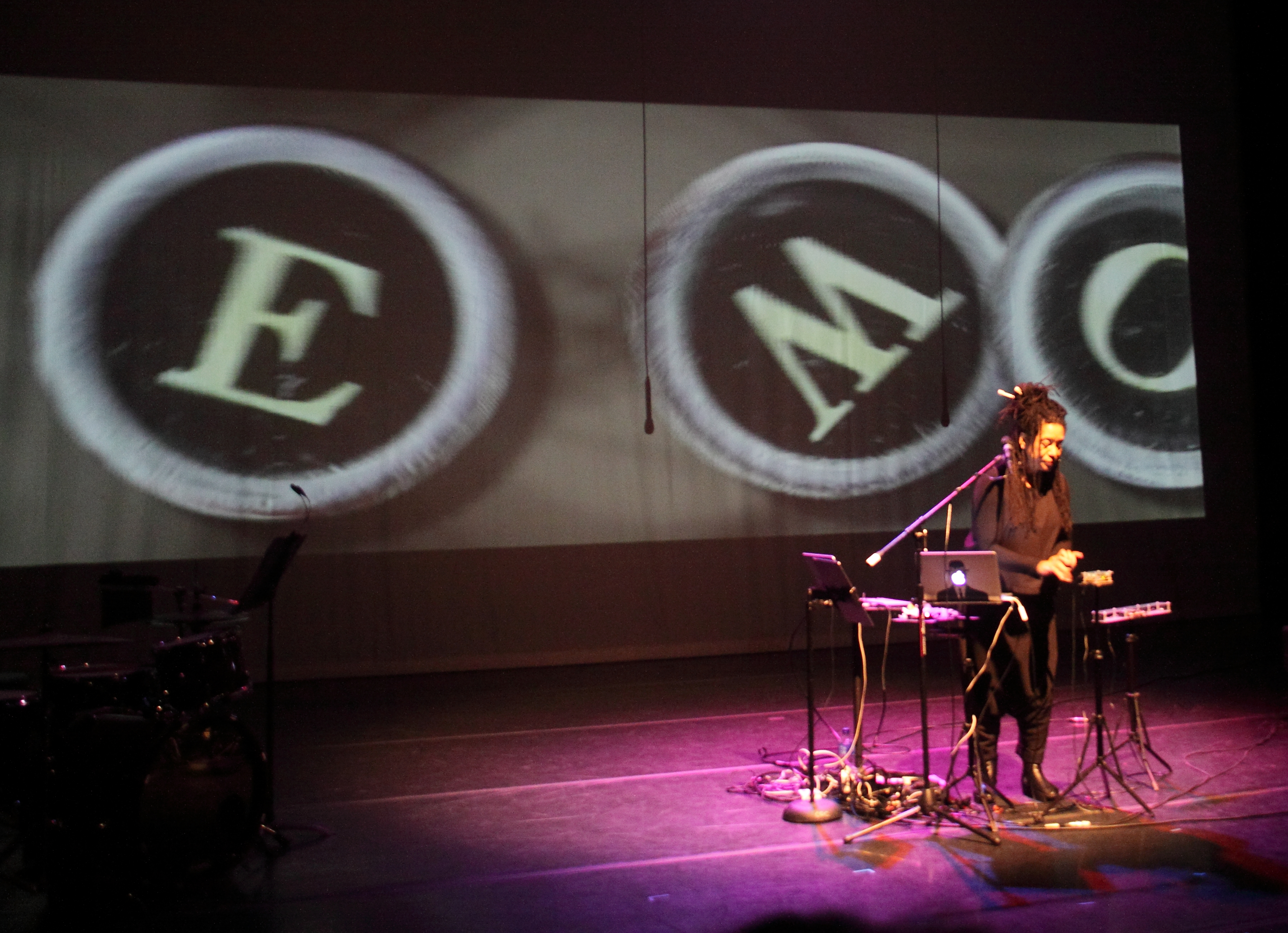
OM230121

Pamela Z’s performances were enhanced tonight with video and slides such as this projection which supported her performance of Typewriter/Declaratives.

Like Neuberg, Pamela Z does a sort of cabaret style performance.  On this night she graced us with, “Quatre Couches/Flare Stains” (2015), “Typewriter/Declaratives” (2015), “33 Arches” (from a larger work called, Span, 2015), “Pop Titles: You” (1986) and the SF premiere of “Other Rooms” (2018).

OM230123

Z’s skills at writing for chamber ensemble were displayed in 33 Arches, a section of a larger work called Span.

Most commonly seen as a soloist with electronics, it was a wonderful opportunity to hear a portion of one of her recent works which involved writing for more conventional instruments in addition to her voice and electronics.  This was done also in conjunction with video.

OM230124

Pamela concluded with a performance of one of her classic works, “Pop Titles ‘You'” (1986) enhanced by the back wall projection of the text source for the work, a page of the now defunct Phonolog report which was commonly found in record stores “back in the day” as they say.  Z worked for a time at Tower Records.

Like Amy X Neuberg, Pamela Z was treated to a warm round of appreciation from this adoring home town Bay Area audience.
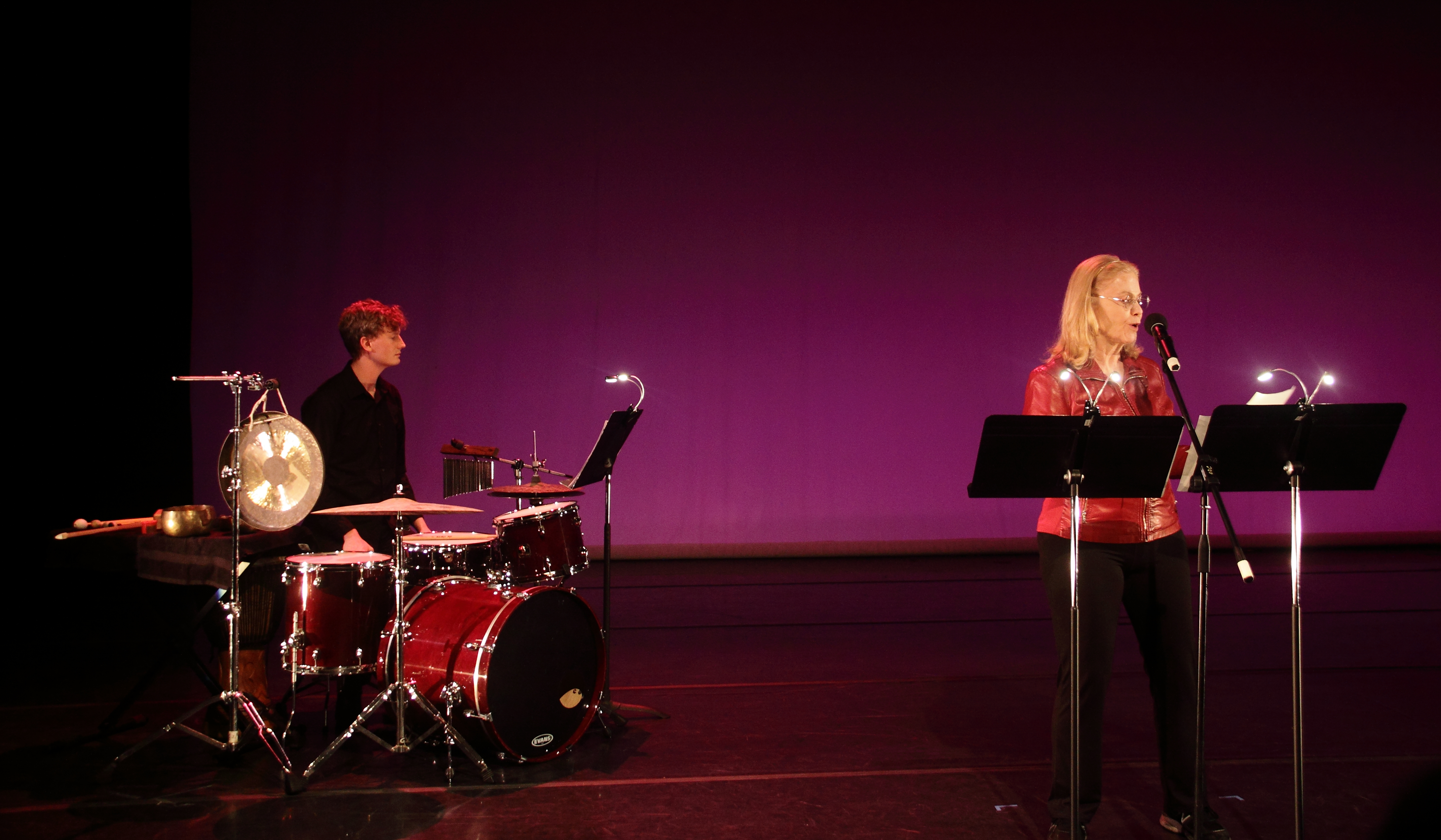
OM230128

Next came another of the artists who appeared on the 10+2 anthology, Beth Anderson-Harold.  She was accompanied by Other Minds intern and percussionist, Michael Jones.  Beth Anderson, originally from Kentucky, exudes a sort of midwest wholesomeness that belies a complex and assertive artist.  She is now based in New York but has strong roots in the Bay Area having worked with Charles Shere, John Cage, Terry Riley, Robert Ashley, and Larry Austin.

Her performances of “If I Were a Poet” (1975), I Can’t Stand It” (1976), “Crackers and Checkers” (1977), “Country Time” (1981), “Killdeer and Chicory” (2005), “Ocean, Motion, Mildew, Mind” (1979), and “Yes Sir Ree” (1978) were delivered with a powerful energy and enthusiasm.  She seemed almost surprised at the warm reception her performance received.  It was yet another example of the incredible variety that this genre of music embodies.

OM230131

Anderson’s delivery was powerful, ecstatic, and assertive.

OM230133

This sixth day of the varieties of sound poetry was brought to a conclusion first with three tape works by fellow KPFA (1990-2005) radio producer Susan Stone.  The works presented were, “Couch” (from House with a View, 1989), “Ruby” (from House with a View, 1993), and “Loose Tongues” (1990).  All are basically Stone’s personal take on radio theater which she describes as, “Cinema in the Head”.  Stone took an all too brief bow to acknowledge the applause.
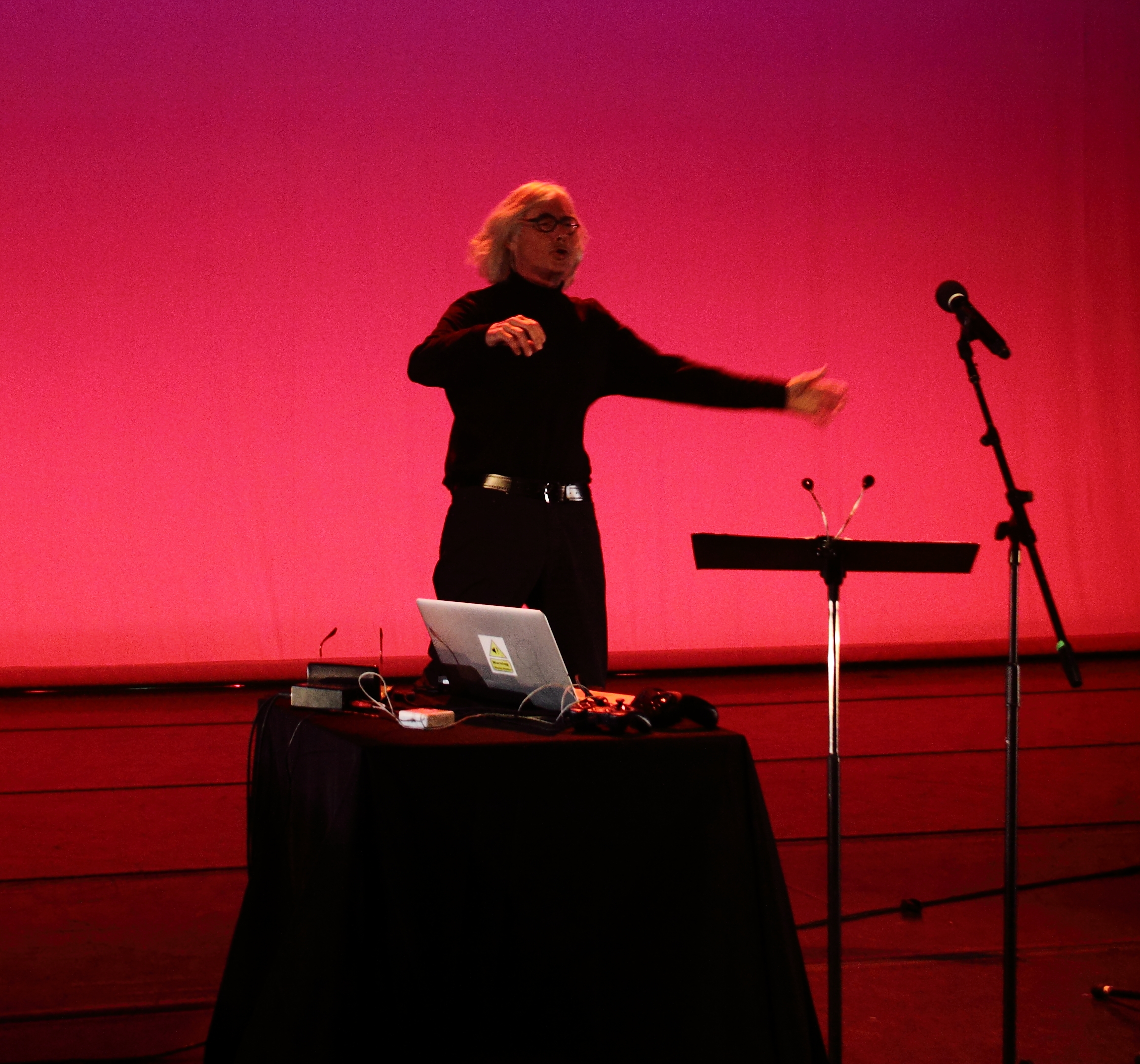
OM230135

Though the audience’s attention seemed not yet to have flagged we were given an infusion of energy from the seemingly always energetic Jaap Blonk.  He presented six of his works to conclude the evening, “Dr. Voxoid’s Next Move”, “Onderland” (Underland, excerpts), “Rhotic (Phonetic Study #1, about the R), “Muzikaret (Music Made of Rubber)”, “Cheek-a-Synth (Solo for Cheek Synthesizer)”, and “Hommage à A.A. (for Antonin Artaud).

OM230137

Blonk’s seemingly boundless energy took him around the stage at times.

Blonk did a lovely thing to cap off this mind bending week (almost) of performances.  He engaged the audience in a call and response improvisation.  As these things generally go he began with fairly simple sounds and progressed to longer and more complex sound groupings which challenged the audiences attention and repetition skills, a task they/we performed with great joy and amusement.

OM230142

Blonk leading the call and response performance with the audience which concluded the series.

Twenty performers, four of whom had appeared on that wonderful anthology, kept the ODC Theater packed to near capacity on all six nights.  That alone is a feat.  What cannot be satisfactorily communicated in a mere article is the energy and focus of both the performers and the enraptured audience whose attention never seemed to flag as they/we were lead down unfamiliar paths to little heard universes of ideas and sounds.

This expanded festival also included one of the most spectacular program books this writer has ever seen from Other Minds.  Mark Abramson did the eye popping graphic design which featured no fewer than four different covers and very useful texts and photographs documenting the works performed and their history.  The t-shirts were another of Carol Law’s successful designs.  These may be highly collectible and, as of this writing, are still available through the Other Minds website.

In an promotional article entitled, “Other Minds 23: In the Beginning was the Word” I obviously used a biblical quotation (John 1: 1 for those interested).  In fact the only religious thing going on here was the spiritual magic of astoundingly talented performers, and a mighty unusual gathering of Other Minds in terms of the enthusiastic audience.  But I would be remiss if I did not take note of the fact that this fabulous marathon was done in six days.  I’m guessing we all rested on the seventh.

In the Beginning Was the Word: Other Minds 23


OM202006

Charles Amirkhanian performing one of his spoken word compositions at Other Minds 20 in 2015

Other Minds has been the the darling of composer/producer Charles Amirkhanian since its founding in 1993.  Along with television producer and arts patron Jim Newman he has presided over the 25 years of this renowned festival which has consistently brought the finest new music composers and performers to San Francisco.

There is little doubt that this year’s festival has to be very close to Amirkhanian’s heart.  Words have been central to his career at least since 1969 when he began his work as a producer at KPFA.  In the 23 years he spent there he presented countless hours of musical programming and interviews.  He crossed paths with most of the major stars in contemporary classical music and many stars whose genre may not be captured by the classical label.  A look at his programming choices and interviews from his time there defined new music for the Bay Area and beyond.  After his tenure at KPFA ended in 1992 he continued exploring cutting edge music and musicians bringing them to San Francisco for live performances.

His work as producer and curator has tended to overshadow his work as a composer, sound poet, and spoken word artist.  This year’s OM festival is dedicated to speech, sound poetry, and the spoken word.  It is about both the history and the present state of the art.  In many ways Amirkhanian’s 1975 release “10 + 2: 12 American Text Sound Pieces” on 1750 Arch Records (now on an OM CD 1006-2) can be seen as sort of the starting point for this festival.  This masterful anthology includes works by Charles Amirkhanian (1945- ), Clark Coolidge (1939- ), John Cage (1912-1992), John Giorno (1936- ), Anthony Gnazzo (1936- ), Charles Dodge (1942- ), Robert Ashley (1930-2014), Beth Anderson (1950- ), Brion Gysin (1916-1986), Liam O’Gallagher (1917-2007), and Aram Saroyan (1943- ).


“Word! Thou word that I cannot speak!

At the end of the second (and last completed) act of Arnold Schoenberg’s powerful opera “Moses und Aron” (1932) Moses sings, or actually half speaks and half sings this text lamenting his expressive deficits.  Speech song or, in German, sprechgesang is an invention by Schoenberg in which the singers are asked to find a point between speech and music.  Perhaps this is a good example of some of the artistic thinking going on at about the time when speech music/sound poetry began to take shape.

bio_schwitters_kurt

Kurt Schwitters (1887-1948)

Some of the history of sound poetry is featured in this unprecedented 6 day festival (April 9-14).  Some of the earliest practitioners of this unusual genre include the German artist Kurt Schwitters whose composition Ursonate (1922-32) will be performed in its entirety, a rare event by itself.

Another early gem will be the Spoken Music (1930) by German-American composer Ernst Toch.  This three movement suite has been known for its last movement, the Geographical Fugue.  The other two movements, once thought lost, were discovered in sketches in 2006 and reconstructed by Christopher Caines.  The now complete version will be presented I believe on day 3.

Composer-Ernst-Toch-810

Ernst Toch (1887-1964)


It is beyond the scope of this blog post to tell the history of text sound so I will refer readers to the Other Minds website for further details.  Or you could come to the festival too I suppose.

With due respect given to the past the festival will move on to the present.  San Francisco Beat Poet Michael McClure (1932- ) will make an appearance as will post beat colleagues Anne Waldman (1945- ), Clark Coolidge (yeah the guy from that cool anthology), Aram Saroyan (another guy from the classic text sound disc).

curran20160010

Alvin Curran in conversation last year in Berkeley.

Other Minds alumnus Alvin Curran (1938- ) will be premiering his collaboration with Clark Coolidge entitled, Came Through in the Call Hold.  Curran’s eclectic sensibilities will doubtless result in an interesting composition.  This event alone, at least for this writer, is worth the price of admission.  And this is just the first day!

Other events include workshops, discussions of the history of the art, and even some curious variations on a theme.  Apparently the writer Lawrence Weschler is the grandson of Ernst Toch and has written a variation on the Geographical Fugue called, The Medical Fugue which will be premiered at this festival.

The increasingly ubiquitous pianist Sarah Cahill will be present to perform Virgil Thomson’s unusual but entertaining setting of a Gertrude Stein (a one time Oakland resident) text called Capital, Capitals.  She will accompany the men of the Other Minds Ensemble.  Jaap Blonk will be tasked with performing Schwitters’ Ursonate and, along with Enzo Miranelli will also perform other historical works including some by a couple of Italian Futurists.

Other Minds Administrative Director Randall Wong will end the evening by undertaking a performance of the late great Cathy Berberian’s Stripsody.  That promises to be a wild evening I think.

blonk_75_2500crop

Jaap Blonk (1953- )

Northern Europe, including the Netherlands and the Scandinavian countries will literally have their day.  As it turns out they are doing a great deal of creative work in this increasingly diverse genre of speech music.  Other Minds is at its best in introducing the new and the innovative from wherever Charles’ radar has tracked it down.  Indeed Mr. Amirkhanian and his wife, artist/photographer Carol Law traveled throughout these regions in the early 70s talking with and learning from these diverse artists.  (Amirkhanian’s work, Just was recorded in a Scandinavian studio during one of those trips).

As usual homage will be paid to the past with some recorded classics by Sten Hanson, Åke Hodell, and Lily Greenham.  Some new voices will be introduced including Tone Åse and Sten Sandell.  The Norwegian/Russian-American duo OTTARAS (consisting of visual poet Ottar Ormstad and composer Taras Mashtalir will also perform.   One can fully expect a mind expanding experience which will redefine the possibilities of the art form.

Auspiciously or perhaps dangerously Friday the 13th has been reserved for Bay Area talents.  First up will be the man of the hour, Charles Amirkhanian.  Hearing him do his work live is an uncommon but entirely enjoyable experience.  If that alone weren’t enough we will get to hear the even rarer public collaboration between him and his life partner Carol Law whose photography and collage work deserves wider recognition and will happily get that here.

Amy X Neuberg

Amy X Neuberg.

Trained in both linguistics and music, Amy X Neuberg will be on hand to perform her indescribable electronic cabaret including the world premiere of “Say it like you mean” and other genre bending work.  She is another valued Other Minds alumnus having given numerous performances at the festivals.

Stanford professor Mark Applebaum, another alumnus will present “Three Unlikely Corporate Sponsors” which premiered at Stanford in 2016.  Enzo Miranelli will conclude the evening with his theatrical combination of movement and text in “Fame: What I Want to Say”.

20130218-132303.jpg

Pamela Z

The festival concludes on Saturday April 14th with Jaap Blonk followed by the wonderful San Francisco based Pamela Z who, like Neuberg uses electronics, but creates her own unique sound world.  She too is an alumnus of Other Minds.

Another composer from that great anthology, Beth Anderson, will make an appearance to perform “If I Were a Poet”, “I Can’t Stand It”, and “Ocean Mildew Minds”.

The finale will feature Susan Stone and Sheila Davies Sumner performing excerpts from two works, “House with a View” and “Loose Tongues” both dealing with the lives of working class southern women.

This will be both a feast and a marathon but it promises to be one of the finest Other Minds productions maybe ever.  Come to be entertained, come to be challenged, come to expand your mind.  You’ll never be the same.  See you there.

More Than the Ears Can Hear: Bill Fontana in Conversation


img_0200

Despite being possessed of a rabid and eclectic interest in all music I had not been aware of Bill Fontana until I found this presentation sponsored by Other Minds and curated by Charles Amirkhanian (whose radar seems to capture just about everything).  This entry into the Nature of Music series last night featured this artist who extends the very meaning of composition and the very reach of our ability to hear.

This series is hosted by the David Brower Center in Berkeley, CA.  The center is a state of the art environmentally friendly building which serves, appropriately, as a center for ecological awareness and hosts various organizations within its walls (including the Berkeley office of Other Minds) whose missions serve various environmental concerns.  The Nature of Music series attempts to address ecological concerns and indeed the featured artists have all demonstrated connections to the environment in various creative ways.

Bill Fontana (1947- ) is a San Francisco resident but his art takes him all over the world.  He presented audio and video excerpts from his installation works in Kyoto, Lisbon, San Francisco, London, and Iceland.  The basic concepts behind his work seem to be the extension of hearing and, to some degree, of seeing.  He uses multiple microphones and transducers to extract sound from objects such as bridges, bells (when not ringing), musical instruments (not playing), etc.  His multi-layered video experiments are at least partly analogous to this.

The first presentation was perhaps the most striking.  Fontana showed a video of an old Zen Temple bell which was just hanging there in a still video recording.  He had attached a sonic transducer to pick up the subtle vibrations of the bell as it reacted to the ambient sounds around it, something it had been doing for its entire existence (though no one knew until this).  He quipped that the monk whose job it was to care for said bell was somewhat anxious about what Fontana was doing.  When the monk heard the sound that this “silent” bell made he was astonished.  What one learns is that there are sounds made which our ears do not hear.

img_0199

Another “not ringing” bell in a New York tower revealed its reactions to its environment sonically and in a still video overlooking Manhattan from the high atop the lonely tower.

One installation involved 8 microphones arranged around San Francisco Bay which transmitted the sounds they captured to an installation of 8 loudspeakers located at Fort Mason.  The effect was of having ears that could hear all of these sounds which were so geographically distant that one pair of ears could not hear them in this way.  This 1982 installation is scheduled to have the recordings of those captured sounds from the original presentation played continuously in a permanent installation at Fort Mason.

Other installations included a bridge and a river in Lisbon and some hydrothermal installations in a couple of places.  What these all had in common was this extension of hearing (and vision) and how this increases one’s awareness of the environment both sonically and visually.  The artist acknowledged a passion for environmentalism and took the time to answer the questions of a medium sized but very engaged audience.

There are things in his work that echo the work of John Cage, Annea Lockwood (who appeared on a previous Nature of Music program), Pauline Oliveros, and any number of drone/noise composers.  But his vision is clearly a unique one and it was revelatory to have been able to hear/see this little exposition.  Fontana is truly a phenomenon whose roots fit comfortably on the west coast but whose vision is global.

It is well worth your time to peruse Fontana’s web site which is full of videos and sound files depicting his unique visions from various locations all over the world.  Fontana seemed a warm and unpretentious figure led all these years and still going with a child-like sense of wonder and a spectacular imagination.  All in all a mind-blowing and entertaining evening.

Longleash: Incorporating the Modern


longleash

The strikingly beautiful cover art reminiscent of Magritte is eye catching and make this reviewer nostalgic for the days of the 12×12 format of LP covers.  (Album Artwork: Pink Lady (2015), Scarlett Hooft Graafland, Album Design: Laura Grey).  It is, perhaps by virtue of its nod to modernism, a metaphor for the content of this album as well as being its title.

Longleash is apparently the oh so clever operations name of a CIA project whose goal was to help proliferate American modern art in the cold war era.  These days I guess that would be “weaponizing” art.  And this modern piano trio has (curiously) elected this for their stage name.

Well the content of this album is nowhere near your traditional piano trio and may even seem subversive to some listeners.  Longleash are modernist throughout.  Pala Garcia, violin; John Popham, cello; and Renate Rohlfing, piano self-identify as a group with “traditional instrumentation and a progressive identity.”  Indeed they have chosen a rather young and pretty much unknown group of composers: Francesco Filidei (1973- ) is the oldest of the group followed by Clara Iannotta (1983- ), Juan De Dios Magdaleno (1984- ), Christopher Trapani, and Yukiko Watanabe.

Despite the varied backgrounds these composers seem to share a particular segment of a modern aesthetic.  They seem fond of judicious use of extended instrumental techniques and quasi-minimalist cells but their styles are quite listenable.  They seem to have aspects of pointillism, the occasional terseness of Webern, some rhythmic intricacies and the occasional nod to a melody.  In short they seem schooled in the variety of techniques which rose largely out of the twentieth century but seem beholden to none of them seeking instead to judiciously use their skills to create their own unique sound worlds.

There are five works on eight tracks and none of them can be easily described except to say the the combination of listening with the aid of the liner notes can be helpful.  That is not to say the works cannot stand on their own.  That is a useful experience in itself.

I suppose it might be best to say that these works will likely evoke a variety of reactions from various listeners.  This is the sort of album, at least for this listener, that benefits from a direct concentrated listen without distraction but it is also worth experiencing as background music, letting the experience creep in where it might while you do other things.  And then a read through the liner notes to try to divine the composers’ intents.

I’m not being facetious here.  I think this is a very intriguing album but one which is difficult to characterize in words and one which is beyond this writer’s expertise in terms of any useful analysis.  Also the newness of these voices does not allow one to place these works even within the contextual canon of each individual composer’s work.  We have free floating modernism which, as was thought in the cold war days, may invade one’s intellect in subversive ways.

The review immediately preceding this one, Soft Aberration, features this piano trio on it’s first track.  Now Scott Wollschleger is very closely associated with the Manhattan School of Music.  What is curious here is that Longleash has managed to find the present disparate group of emerging composers with no directly discernible connections to the Manhattan School but with a clear affinity for the same sound world.  It is the luck of the draw that these reviews have appeared in this sequence but the similarities are striking.  So if you like the spare sounds of the New York School (John Cage, Morton Feldman, Earle Brown, Christian Wolff) and their successors in people like Scott Wollschleger, Reiko Futing, and Nils Vigeland (who, along with Pala Garcia provides the useful liner notes) then this will be your cup of tea.  But even if you don’t know these folks you are still in for a fascinating journey of cutting edge ideas by emerging composers.  And even if it is not “weaponized art” subverting your mind to western ideology you can be assured that it is genuine and uplifting work done by some wonderful performers of composers you will likely hear from again very soon.


Scott Wollschleger’s Soft Aberration


wollschlegersoft

New Focus FCR182

The cover and the booklet that come with this CD contain art that is a remarkably fitting metaphor for the music contained herein.  The almost monochromatic images with sometimes barely visible lines defining a space which requires serious concentration to discern effectively at times is very much like the music we hear on the disc.

Scott Wollschleger (1980- ) is an American composer who studied with Nils Vigeland at the Manhattan School of Music.  His work has been compared to that of Morton Feldman and, more generally, to the other members of the so-called New York School.  Vigeland has been active throughout his career performing and recording definitive versions of some of the best of Morton Feldman, John Cage, Earle Brown, and Christian Wolff.  It would appear that these voices and stylistic leanings are very much favored at the Manhattan School of Music.  A previous disc reviewed here with music by head of the composition department Reiko Futing, evokes a similar sound world.

This disc of chamber music contains five works on eight tracks ranging from 1’43” to 14’27” and all require almost as much concentration on the part of the listener as the extended techniques and performance requirements demand of the performers.  The dynamic range is from (generous) silences to forte.

The first track is by the seriously entertaining and odd piano trio called Longleash.  They demonstrate their expertise and concentration as well as their love for this musical genre in their performance of Brontal Symmetry (2015).  Unlike the other pieces here, Brontal Symmetry makes use of ostinati and there is a consistent sound field punctuated with silences.  It is an unusual but ultimately engaging piece.  Longleash consists of Pala Garcia, violin; John Popham, cello; and Renate Rohlfing, piano.

It is followed by the titular and sparse Soft Aberration (2013) for viola and piano played by Anne Lanzilotti, viola and Karl Larson, piano.  Though approximately the same length as the opening work the silences nearly suspend the perception of time and create a sense of sounds suspended in space in a sort of sculptural way.

Bring Something Incomprehensible into this World (2015) is for trumpet and soprano.  The three parts of this work are spread across the disc (tracks 3, 5, and 8) creating an even more spare sense.  It is interesting to play the three movements manually without the interruption of the intended track sequence to get a sense of the piece.  Again we have silences predominating with extended techniques demanded of the performers.  Andy Kozar plays trumpet and the soprano is Corrine Byrne.  The first movement at 6’39” is the longest followed by the second at 3’25” and the last at 1’43”.

America (2013) is a solo cello piece here played by John Popham (of Longleash).  It is a pointillistic mix of silence and extended instrumental techniques which makes reference to an art work by Glenn Ligon.

White Wall (2013) is for string quartet and is played by the Mivos Quartet consisting of Olivia De Prato, violin; Josh Modney, violin; Victor Lowrie, viola; and Mariel Roberts, cello.  This is an amalgam of unfolding processes which seem to be indiosyncratic to the composer.  It is very intimate music in that sense.  The piece is in two substantial movements.

The album concludes with the brief last part of Bring Something Incomprehensible Into This World.  Suffice it to say that there are attempts here to tie in philosophical as well as visual metaphors.  Wollschleger is apparently enamored of the writings of Deleuze, Nietzsche, and Brecht.  Her lies another tie in to the New York School with their love of visual metaphors and philosophy.  This is not an easy listen but it is a serious effort deserving of some attention.  The listener can decide whether the artists have indeed brought something comprehensible into this world…or not.


The Piano is Calling Me: Nicolas Horvath’s New Music Pilgrimages


Nicolas Horvath Lyon

Nicolas Horvath at the piano in Lyon

I first heard of this young Monacan pianist and composer when a composer friend, David Toub, told me that he was going to program one of this piano pieces.  That piece along with quite a few other performances are available on Nicolas Horvath’s You Tube video channel here.

Horvath developed a strong interest in contemporary music from Gerard Frémy among others and has been programming a great deal of new music ranging from the more familiar such as Philip Glass to a host of others including quite a few pieces written for or premiered by him as well as his own transcriptions and reconstructions.  He is known for his concerts in non-traditional venues with very non-traditional lengths of performance as well as traditional concerts.

His current projects include Night of Minimalism in which he performs continuously for 10-15 hours with a wide variety of minimalist and post-minimalist pieces and Glass Worlds in which he performs the complete solo piano works of Philip Glass (approximately 15 hours) along with pieces by an international list of composers written in tribute to Glass.  He is also an electroacoustic composer (he counts Francois Bayle among his teachers) and a visual artist all with a passion for contemporary works.

inside my own exhibit

The artist standing in one of his installations.

We had corresponded via e-mail over the last year or so and when I suggested the idea of interviewing him he responded by arranging time after a (traditional length) concert he gave in Minsk, Belarus on December 1, 2014.  I prepared for what I anticipated would be a one hour interview after which I imagined he would probably need to get to sleep.  But when I attempted to wrap up our conversation (at a couple of points) he immediately asked, “Don’t you have any more questions?”.  What followed resulted in approximately three and an half hours of delightful and wide-ranging conversation about this man and his art which he ended with the comment, “I must go, the piano is calling me.”  It appears that his seemingly boundless energy extends well beyond the stage.  The following January (2015) he gave the world premiere performance of all of Philip Glass’ 20 Etudes in none other than Carnegie Hall.

Nicolas Horvath (c) Jean Thierry Boisseau

Horvath with spent score pages as he traverses one of his extended performance ventures. (copyright Jean Therry Boisseau)

Since that time we have continued our correspondence and this affable, patient young artist continues on various projects and no sign of his interest or energy waning.  He recently sent me various photos of him in various settings pursuing his varied artistic interests for this article.

SONY DSC

Composer as well as performer in an electroacoustic performance without piano.

Horvath was born in Monaco in 1977.  He studied piano at the Académie de Musique Rainier III de Monaco and the École  Normale de Musique de Paris.  At 16, Lawrence Foster took notice of him in a concert and, securing a three year scholarship for him from the Princess Grace Foundation, was able to invite him to the Aspen Music Festival. After his studies in the École Normale de Musique in Paris, he worked for three years with
Bruno-Léonardo Gelber, Gérard Frémy who instilled in him a sensitivity to music of our time as well as Eric Heidsieck, Gabriel Tacchino, Nelson Delle-Vigne, Philippe Entremont and Oxana Yablonskaya. Leslie Howard got to know him and invited him to perform before the Liszt Society in the United Kingdom. He has been playing professionally for 7 years and puts his own characteristic style into his productions and performances.

In a move reminiscent of Terry Riley’s all night solo improv fests Horvath has performed several lengthy programs.  He has performed Erik Satie’s proto-minimalist Vexations (1893) in performances that ranged widely in length. One notable performance at the Palais de Tokyo lasted 35 hours, the longest solo piano performance on record as far as I can determine.  Previously this piece has been performed by tag teams of pianists (the first in 1967 in New York was curated by John Cage) to perform the 840 repetitions of the piece whose tempo or recommended duration is not specified.  Horvath, taking on a musicological mantle is preparing his own edition of this unique work.  He has published an 24 hour version on his You Tube channel here.

Given his intense schedule and vast repertoire he has been remarkably responsive and has an irrepressibly strong appetite for new music.  He tells me that he had worked on a project in which he planned to play all the piano music of the French composer Jean Catoire (1923-2005),  some 35 hours of material (in a single program, of course). Unfortunately that composer’s relative obscurity seems to have resulted  in insufficient support for the project which is, for now, on hold.  Here’s hoping that this can be realized sometime soon.

Horvath’s fascination with authenticity, completeness and performances of unconventional lengths uninterrupted by applause where audiences are invited to lay on the floor with blankets and sleeping bags and approach the piano seems unusual but he has been getting enthusiastic audiences and has enjoyed overflow crowds.  Like Terry Riley and perhaps even some of Keith Jarrett’s solo concerts there is a ritual feel to these marathon performances.  Regrettably I have not yet been able to attend one but I would love to partake in what must be a powerful shared experience.  He invites people to come to the piano and to watch, look at the score.  It is unlike the conventional recital and therein lies some of its charm.  At least one of his videos features a small sign which reads, “Don’t feed the pianist” and attests to his warmth and wonderful sense of humor.

His passion has parallels in his spirituality and he has pursued sacred pilgrimages which require a great deal of time and energy but without doubt fill a very deep and sincere need. More details and photos are available on his blog.  And, as with music, he is very open to discussing this very personal aspect of his life.

SONY DSC

The artist braving the elements on one of his pilgrimages.

There are conventional two hour with intermission style recitals in more conventional concert venues that he has played and Horvath also enjoys playing with an orchestra.  His performances of both of Philip Glass’ piano concertos can be viewed on You Tube and you can see the intensity of his execution.  This came through in the course of our interview as well when Mr. Horvath would speak of the music and then verbally imitate the rhythms (no doubt endlessly practiced) which drive his enthusiasm.  The music seems to be deeply integrated into his very being.

His first solo commercial recording was released in 2012.  It consists of Franz Liszt’s ‘Christus’, an oratorio composed in 1862-66 for narrator, soloists, chorus and orchestra.  Horvath plays a piano reduction done by the composer.  This is the first known recording of this unique and virtuosic set of piano works.  It is certainly an unusual choice for a debut recording but it is consistent with his very personal tastes.  (He lists Scriabin and Chopin as among his favorite composers.).   He is in the process of recording all of Philip Glass’ piano music for Grand Piano records distributed by Naxos.  At the time of this writing four well-received volumes have been released.  He is also planning to record all of Satie’s piano music and he has just recently released his rendition of Cornelius Cardew’s indeterminate masterpiece, Treatise.

I have seldom encountered a musician with such intensity and drive.  He is also one of the most skilled in using the internet to promote himself and his projects.  And though this is no doubt a man with a considerable ego he is in fact very unpretentious and very genuinely turned on, driven by the music itself.  Don’t get me wrong, he is concerned with developing his image and career but he seems happy to be doing the work he has been doing and he is, like any really good musician, self-critical and a perfectionist.

A quick look at his YouTube channel here reveals some of the range of his interests which include the standard repertoire along with interest in contemporary works.  Just released is a creative video with Horvath playing Glass’ Morning Passages while he apparently experiences a reverie involving a beautiful woman which could have been on MTV at its height.  Perhaps he is even channeling Oscar Levant who embraced roles in films along with his pianistic talents.  His website is a good resource for updates on his various projects and performances.

c _______ ______

Focused concentration at the keyboard.

As of the time of this writing his discography includes:

horvathchristus

Hortus Records 100 (2012)

A very unusual choice for a debut recording.  Nonetheless this is a distinctive recording which reflects the virtuosity as well as the careful scholarship which continues to characterize his work.  He managed to locate a couple of previously lost pieces in this set of composer transcriptions.  One also can’t miss the spiritual dimension here, as close to his heart as music and an equally important aspect of his personality.

glassw1

Grand Piano GP 677 (2015)

This first disc in the series manages to provide the listener with truly inspired interpretations of Glass’ keyboard oeuvre and gives us a world premiere recording of How Now as well.

glassw2

Grand Piano GP 690 (2015)

The complete Piano Etudes by the man who premiered the set at Carnegie Hall.  These etudes were also recorded by the wonderful Maki Namekawa and the opportunity to hear these really different takes is positively revelatory.

glassw3

Grand Piano GP 691 (2016)

The third disc in the traversal of Glass’ piano music (original and transcribed) also offers world premieres.  Horvath’s inclusion of Glass’ early Sonatina No. 2 reflects his work under the tutelage of Darius Milhaud and provides insight into the composer’s early development before he developed his more familiar mature style.

glassw4

Grand Piano GP 692 (2016)

Haven’t yet heard this disc but I have in queued for ordering in the next few weeks.

acedia

Demerara Records (2016)

Haven’t heard this one yet either but, again, it’s in my Amazon shopping cart.


horvathcardewtreat

Horvath’s interpretation of this important work by Cornelius Cardew

Cornelius Cardew (1936-1981) was sort of England’s John Cage, a major voice in 20th Century experimental music.  Scholarship has yet to do justice to the late composer’s work but this disc is an important contribution toward that end..

Horvath’s career is characterized by innovation and passion combined with astute scholarship and a keen sense of what is new and interesting in music  while clearly being schooled in the classic repertoire.  The piano calls him as do his other passions and I highly recommend paying attention as he answers those calls.  He is truly an artist to watch.
N.B.  Mr. Horvath generously read and approved an advance draft of this article shortly after arriving in the United States for concerts at Steinway Hall in Rockville with a Chopin program and a recital at The Spectrum in New York City which will include two pieces written for him by Michael Vincent Waller along with some Chopin pieces.

Between the Lines, New Percussion Music by Neil Thornock


Between the Lines

Between the Lines

Other than the information on this CD and the composer’s faculty page (here) information seems limited on this composer,.  He earned a BM, Organ Performance, Brigham Young University, 2001, an MM, Music Composition, Brigham Young University, 2003 and a DM, Music Composition, Indiana University Jacobs School of Music, 2006.  Currently he is associate professor of music at BYU where he teaches theory and composition as well as electronic music.

Thornock is that rare breed of percussionist (or is it keyboardist?), a carriloneur  and he takes the opportunity to display those skills on this all percussion release, apparently the first recording of this composer’s music.

It is very difficult to assess a composer based solely on their percussion music and sometimes that genre can take on the insider feel of, say, band music or some more rarefied and sequestered niche of music.  As popular as percussion music has become in the 20-21st century it seems sometimes to be an orphan genre.  This is also, no doubt, due to the all-inclusive nature of the term “percussion” which leaves a huge list of potential instruments to consider.  So an album of tympani music or bongo music or marimba music (conceivably even piano and harp can be included under the percussion rubric).might all be spoken of generically as percussion music.  This recording uses a wide variety of instruments.

Having said that this disc appears to show a composer with a wide palette and knowledge of the medium and it is an opportunity to hear carillon music which is itself a relatively rare experience in recordings.  His writing is accessible and, no doubt, well-tailored to the skills of the musicians.

There is nothing familiar here.  All are new works written, presumably, in the last few years.  It would be interesting to hear more of this composer’s output in the areas of chamber, orchestral and electronic music.  But this little tease will have to do for now.

Matthew Coley, the percussionist, seems to be the real star here.   He plays on all tracks and seems to be a highly skilled player.  His website was the most useful to this reviewer as well.  Along with him are the Iowa Percussion Group, the Iowa State University Percussion Ensemble and, as mentioned earlier, the composer on carillon on tracks 7-10 with Gerard Norris conducting.

This New Focus recording FCR 156 is beautifully recorded and I think that is no simple task given the variety of instruments involved.

ICE Debuts on Starkland: Music by Phyllis Chen and Nathan Davis


71suob4pdtL._SL1500_

Starkland is one of those labels whose releases seem to be so carefully chosen that one is pretty much guaranteed a great listening experience even if that experience might challenge the ears sometimes.  If one were to purchase their complete catalog (as I pretty much have over the years) one would have a really impressive and wide-ranging selection of new music.

I recently reviewed a very fine ICE (International Contemporary Ensemble) recording of music by Anna Thorvaldsdottir here. The present disc is the first appearance on Starkland of this ensemble whose performance skills and repertoire choices show the same depth of understanding as the producers of the label upon which they now appear.

ICE was founded in Chicago in 2001 by executive director and flautist extraordinaire Claire Chase.  The discography on their website now numbers 21 albums including the present release.  The group features some 30+ artists and musicians including a live sound engineer (like the Philip Glass Ensemble) and a lighting designer.  Do yourself a favor and check out the ICE Vimeo page to get some ideas about why having a lighting designer is a good idea.  Their performances are visually as well as musically compelling.  And who knows, perhaps there is a Starkland DVD release in their future.

About half their albums feature music by members of ICE and that is the case with this release.  One always has to wonder at the process that is involved in choosing repertoire to perform and/or record but there is no doubt that this group seems to have good instincts in regards to such decisions as evidenced by the already wild popularity of this disc on WQXR and the positive initial reviews so far.

chen_phyllis_toypiano3Resized

Phyllis Chen‘s biographical data is a bit sparse on both the ICE website and her own so I am going to assume that this talented young keyboard player likely began playing at an early age.  Like fellow pioneers Margaret Leng Tan and Jeanne Kirstein before her she has embraced toy pianos and, by extension I suppose, music boxes, and electronics into her performing arsenal.  In addition to being a composer she is one of the regular members of ICE.

NathanDavis_Obraz9

Nathan Davis is a regular percussionist with ICE as well as a composer.  His works range from opera to chamber and solo pieces for various instruments as well as electronics.

The tracks on this release pretty much alternate between these two featured composers.

The first track is Ghostlight (2013) by Nathan Davis, a sort of ragged moto perpetuo for “gently”prepared piano.  This is a good example of how these musicians (pianist Jacob Greenberg in this instance) have really fully integrated what were once exotic extended techniques into a comprehensive catalog of timbral options which are used to expand the palette of creative expression.  This is not a second rate John Cage clone but rather another generation’s incorporation of timbral exploration into their integral canon of sonic options.  This is an exciting and well-written tour de force deftly executed.

The next two tracks take us into the different but complimentary sound world of Phyllis Chen.  Hush (2011) for two pianos, toy pianos, bowls (presumably of the Tibetan singing variety) and music boxes is a playful gamelan-like piece played by the composer along with pianist Cory Smythe.

Chimers (2011) is a similarly playful work requiring the assistance of clarinetist Joshua Rubin, violinist Erik Carlson and Eric Lamb (on tuning forks) along with Chen and Smythe once again.  Again we hear these unusual instruments and timbres not as outliers in the musical soundscape but rather simply as artistic elements that are part of the composer’s vision.

Track number 4 features a work for bassoon and live processing.  Davis’ On Speaking a Hundred Names (2010) is played by Rebekah Heller and again the (to this listener) usually uncomfortable fit of acoustic and electronic are achieved very smoothly.  Music like this gives me hope that some day I will be able to drop the inevitable negative connotations I have associated with the term “electroacoustic”.  This is very convincing music and not just in the “golly gee, see what they’re doing” sense either.  The experimentation here (including the multiphonics) appears to have preceded the composition giving us an integrated and satisfying listening experience.

Chen comes back on track 5 with another successful integration of acoustic and electronic in her, Beneath a Trace of Vapor (2011).  Eric Lamb handles the flute here playing with (or against) the composer’s prepared tape.  This electroacoustic trend continues in the following track (also by Chen) called Mobius (201-) in which Chen, Smythe and Lamb are credited with playing “music boxes and electronics”.  Once again the integration of electric and acoustic speaks of a high level of music making.

The final four tracks are the big work here and the work that lends its name to this disc, On the Nature of Thingness (2011) by Nathan Davis.  Apparently taking its title from Lucretius’ On the Nature of Things (ca. 1B.C.) the work earlier also inspired Henry Brant in his spatial composition, On the Nature of Things (1956), but the work in this disc does not seem to make any direct reference to that Roman classic poem except perhaps metaphorically.

tony_8305

Soprano Tony Arnold

The work here is an exploration of language, sound and expression.  This most eclectic and ponderous of the selections is a wonderful opportunity to hear the considerable skills of resident vocalist Tony Arnold who sense of pitch and articulation are incredibly well-suited to this work.  Her performance leaves nothing to be desired and is likely as authoritative as it gets.  The work seems to require a great deal of concentration and coordination on the parts of all involved and ICE takes the opportunity to demonstrate their well-honed skills as they clearly listen to each other and go all out in terms of achieving the subtlety of expression required in this demanding and complex work.

As usual the Starkland recording is clear and detailed without the sense of claustrophobia that such detail can take on and the liner notes are useful without extraneous detail.  This is an ensemble to watch/listen for both for the performers and for the music they choose to program.  You won’t be disappointed.


Philip Gelb’s Gourmet Vegan with Joelle Leandre in the East Bay


The door is open to the underground restaurant.

The door is open to the underground restaurant.

On Sunday February 15th I had the pleasure of attending one of my favorite underground restaurant/performance venues in West Oakland.  In a nondescript neighborhood of light industry, warehouses and loft spaces Philip Gelb has been running “In the Mood for Food” (a take of the title of one of his favorite films, “In the Mood for Love”) his occasional dinner/concert series since 2005.

Philip Gelb with Joelle Leandre

Philip Gelb with Joelle Leandre

Philip is an amazing vegan chef as well as a shakuhachi player/teacher whose cuisine is known to a fortunate group of people which includes this writer.  Combining incredibly creative dishes sometimes at the behest of a given artist (Amy X Neuberg requested a “purple” theme and got it when she appeared ) with his wide network of artist friends, many of whom he has performed with.  Phil has been doing these occasional events with a maximum audience of about 20 people (including the featured performer) at a rate of at least once every month or two.

Potato Sorrel Soup

Potato Sorrel Soup

First let me say that I am not a vegan but if vegan fare always tasted this good I could easily make the transition (OK, I would have a hard time giving up pizza) to vegan fare.  Phil’s fresh locally shopped ingredients are transformed by his gustatory alchemy into a variety of delectable dishes in a wide range of cuisines.  His network in gourmet vegan food practitioners is rivaled only by his musical network.  Japanese is one of his specialties but I have personally partaken of various middle eastern and Caribbean cuisines with equal satisfaction.

Mushroom Pate, Carrot Walnut Pate and Rosemary Bread, didn't get a picture of the fresh salad greens.

Mushroom Pate, Carrot Walnut Pate and Rosemary Bread, didn’t get a picture of the fresh salad greens.

This night’s selection featured a creamy Potato Sorrel Soup followed by a salad plate consisting of rich Mushroom Pate, Carrot Walnut Pate, a freshly baked Homemade Rosemary Bread with Salad Greens and a tart Citrus Dressing. The main course consisted of Cassoulet, Oat Pilaf and Herbed Collards, all very tasty and very filling.

The main course of Cassoulet, Oat Pilaf and Herbed Collards.  It tastes even better than it looks in Phil's characteristically beautiful presentations, trust me.

The main course of Cassoulet, Oat Pilaf and Herbed Collards. It tastes even better than it looks in Phil’s characteristically beautiful presentations, trust me.

A feast such as this could not easily be upstaged but, in the little break before the dessert course, we were treated to a wonderful performance by Joëlle Léandre, the French Double Bass virtuoso, singer and composer whose work traverses a wide range of musical genre from John Cage to free jazz and categories that defy easy classification.  She has amassed a discography of over 100 albums to date and has performed with artists including Pierre Boulez, John Cage, Giacinto Scelsi, Derek Bailey, Barre Phillips (who appeared at this series a couple of years ago), Anthony Braxton, George Lewis, India Cooke (also one of Phil’s previous guest artists), Evan Parker, Irene Schweizer, Steve Lacy, Maggie Nicols, Fred Frith, Carlos Zingaro, John Zorn, Susie Ibarra, J.D. Parran, Kevin Norton, Sylvie Courvoisier and Pauline Oliveros (another recently appearing artist at this series).  Oh, and she has also performed and recorded with Mr. Gelb.

Leandre is a friendly and engaging person both in her playing and in conversation and we all had opportunities to speak with her and experience her charming personality as she related various observations and anecdotes.  These dinner/concerts are a uniquely intimate experience which you cannot get in the average concert setting.

Leandre embraced and nearly danced with her instrument.

Leandre embraced and nearly danced with her instrument.

Ms. Léandre treated us with three separate improvisations in which she demonstrated her facility with a wide range of double bass techniques including various bowing techniques, pizzicati, percussive techniques and wordless vocals that mixed seamlessly with her very intense and passionate performances.  Unfortunately it is nearly impossible to really describe with any accuracy the music we experienced this night.  But suffice it to say that it was played in a manner that communicated very effectively with the very appreciative audience.  I asked her if she always plays with such passion and she rather matter of factly simply said, “yes”.

Her command of a wide variety of playing techniques blended together with her voice in an almost orchestral sound  tapestry driven by Joelle's passionate playing.

Her command of a wide variety of playing techniques blended together with her voice in an almost orchestral sound tapestry driven by Joelle’s passionate playing.

I was so taken with the performances that I failed to get a photo of the delicious dessert course which consisted of a Waffle Sundae comprised of a very fresh chocolate-buckwheat waffle covered with chocolate pistachio ice cream, maple walnuts and chocolate port sauce.  An amazing vegan sweet treat enjoyed by all.

The clearly happy audience lingered to talk with each other, with Phil and sous chef Cori as well as with Ms. Leandre who had a great selection of recent CDs and a couple of books available for purchase which she graciously signed.  Overall this was an extremely satisfying evening, certainly for this blogger and clearly for the other guests but also for our wonderful performer who left to get some sleep before her scheduled performances tomorrow at the Berkeley Arts Festival.

The performer pauses looking wistfully as the muse descends upon her.

The performer pauses looking wistfully as the muse descends upon her.


A Piece of the Action, or How Other Minds Brought Out My Inner Trekkie


20130218-134428.jpg

I have been a fan of Other Minds for many years.  While I lived in Chicago I read the reports on the concert series with great interest and was fascinated with the choices of composers since they tended to mirror my own interests in new music as well as introduce me to tantalizing new artists.  I am not a professional musician but I have a long-standing passion for new music and attended many concerts of new music while I lived in Chicago reading liner notes and music history texts eager for more of the exhilarating experience of great new music as it was happening and wanting to know what was just around the corner.

I recall vividly New Music America 1982 which was held in Chicago and was hosted by Charles Amirkhanian, the executive and artistic director of Other Minds.  He spoke with authority and seemed to know just about every musician whose work I admired and countless whose work I hadn’t yet heard.  He conversed knowledgeably with the likes of John Cage, Robert Ashley, Glenn Branca, Meredith Monk, Tom Johnson, Robert Moran and the list goes on.

10+2 Anthology 10+2 Anthology

Early on I had purchased and listened with delight to the masterful spoken word anthology: 10+2: 12 American Text Sound Pieces [OM-1006-2] containing a couple of Amirkhanian’s compositions  alongside other contemporary masters of that genre in the original vinyl release and listened with great interest to the landmark recordings of Conlon Nancarrow’s Player Piano Studies [OM-1012-15-2] both discs largely the work of Mr. Amirkhanian who managed to get these recordings made in Mexico City on Nancarrow’s own player pianos.  So I have been familiar with him as both composer and producer.  He had been for many years the broadcast broker of contemporary music at KPFA in Berkeley where he served as music director from 1969 to 1992.

Charles Amirkhanian with Rex Lawson Charles Amirkhanian holding the microphone while Rex Lawson sings along with one of his piano rolls.

When I moved to the bay area in late 2008 one of my first priorities was to attend my first Other Minds concerts.  I saw the OM 14 concerts and was not disappointed.  But my recollection was that it was at OM 15 that I checked the little box on one of the audience surveys saying that I would be willing to volunteer for the organization.  I did not know what to expect but shortly after OM 15 I was contacted by the OM office and asked to provide a résumé.  Well I have worked my entire career as a psychiatric nurse so I added to that résumé that I had what I termed “extensive knowledge” (not to mention a near obsession) of new music.  I got a call back and wound up spending 4 hour shifts approximately weekly over much of the following two years doing various tasks but mostly scanning photos and other materials for use in their web page and archives.

Dohee Lee at OM 18 Dohee Lee at OM 18

My first direct interaction at the office was with Adrienne Cardwell, a pleasant, hard-working young woman who I would later learn was (and remains) the longest  tenured employee other than Mr. Amirkhanian and his co-founder (now President Emeritus) Jim Newman.  Adrienne is in charge of the massive archival goings on and would direct my tasks over the next 2 years.

I worked in the same room as Adam Fong, the associate director at the time (now director of the Center for New Music and a composer/musician in his own right).  I also had the pleasure of working with fund-raisers Emma Moon and later Cynthia Mei who are also highly accomplished musicians and arts advocates.  I had  the pleasure of meeting the Other Minds librarian Steven Upjohn and the hard-working OM radio host Richard Friedman as well as the opportunity to meet interns and even some very interesting scholars and musicians who visited the office while I was there.  In short it was a great volunteer experience which garnered me more than I originally bargained for.

Adam Fong performing at “Something Else” The F... Adam Fong performing at “Something Else” The Fluxus Semicentenary he produced in September, 2011 (Photo credit: Wikipedia)

In the course of those two years I had many conversations with the OM staff particularly with Adam and later Mr. Amirkhanian about music and programming as I went through scanning, filing and doing whatever tasks were needed at the times I was there.  I recall making some references to some relatively obscure composers which resulted in Charles asking me (somewhat rhetorically), “How do you know that?”.   I just replied that I read a lot but later gave some thought about the nature of my relationship with this fine organization as well as the nature of my interest in new music.

Ruggles_cover_1024x1024

In the ensuing two years I would have some fascinating experiences meeting some of my heroes in new music and dabbling in the inner workings of Other Minds.  My enthusiasm was responded to by the staff at OM by allowing me to work on some of their other projects.  I greatly enjoyed the opportunity to participate and I was thanked most wonderfully once from the stage of one of the OM concerts by Charles Amirkhanian and at least a few more times by having special thanks acknowledged in various concert programs and, most notably for me, in the liner notes of their CD release of the complete music of Carl Ruggles (OM-1020-21-2).  I knew and loved those recordings when they were released on vinyl and was ecstatic to participate in the work on the CD release.  It was great on vinyl and it’s even better on CD.

OK, here is where Star Trek comes in:

75px-Star_Trek_TOS_logo_(1)

After some reflection I came up with what I think is an apt metaphor that fairly accurately describes my experience of my relationship with Other Minds.  Some may recall (you can fact check this if you aren’t old enough to have seen the original broadcast) an episode of the original Star Trek series which was titled, “A Piece of the Action”.  The plot involved Captain Kirk and his crew beaming down to a planet where the inhabitants were living out the equivalent of prohibition era gangsters’ lives.  At one  point this little boy (that would be me in this metaphor) offers some information which would allow Kirk and his crew to get over on the bad guys but only at a price.  The price, he says, is, “a piece of the action”.   The resolution of the plot involves the Enterprise crew successfully resolving the conflict and the little boy being able to experience just a taste of the perceived glamour of the experience of the Enterprise crew (dressed as depression era gangsters to fit in), as Captain Kirk says to him in his best cool gangster voice, “There ya go, kid.  A piece of the action.”

Star_Trek_William_Shatner

I came away from my volunteer experience even more impressed and pleased with this organization and I continue to support them in any way I can.  My thanks to Captain Kirk and his crew for bringing out my inner Trekkie and for availing me of more than just one piece of the action.  You guys run a truly great ship.  Live long and prosper.

I look forward to the upcoming 20th Other Minds concerts.  More on that in blogs to come.