Both Homage and Nostalgia for Sergeant Pepper at the UC Theater


Sgt Pepper20170002

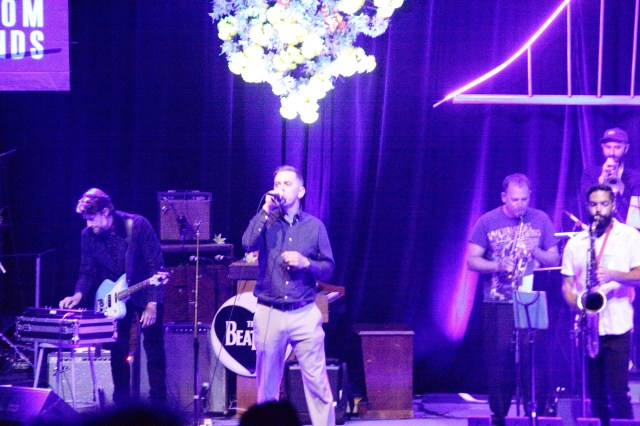
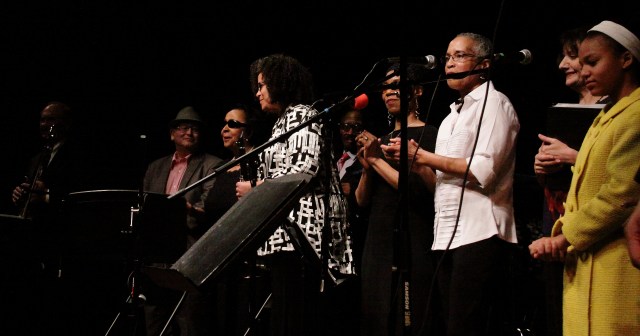
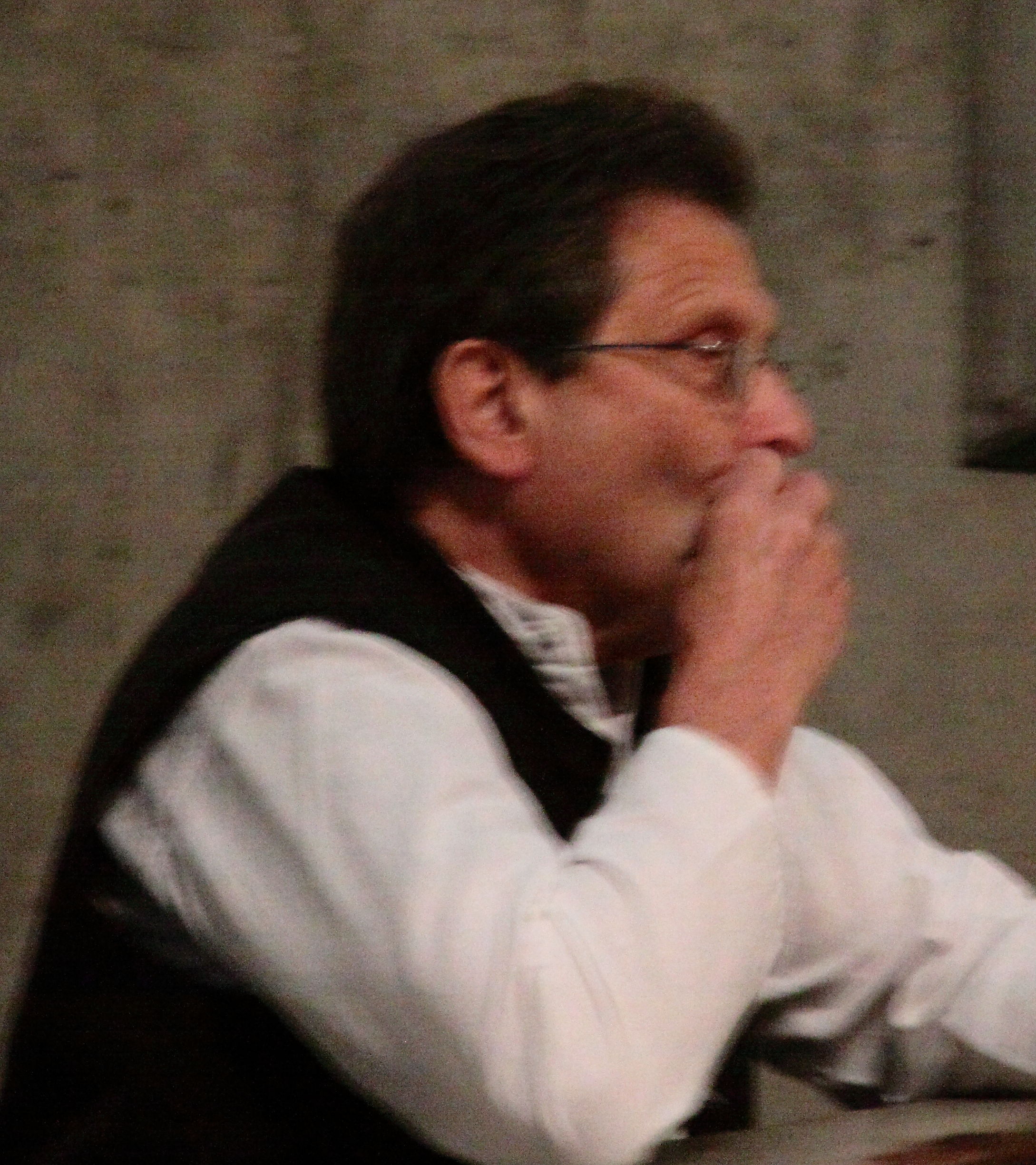
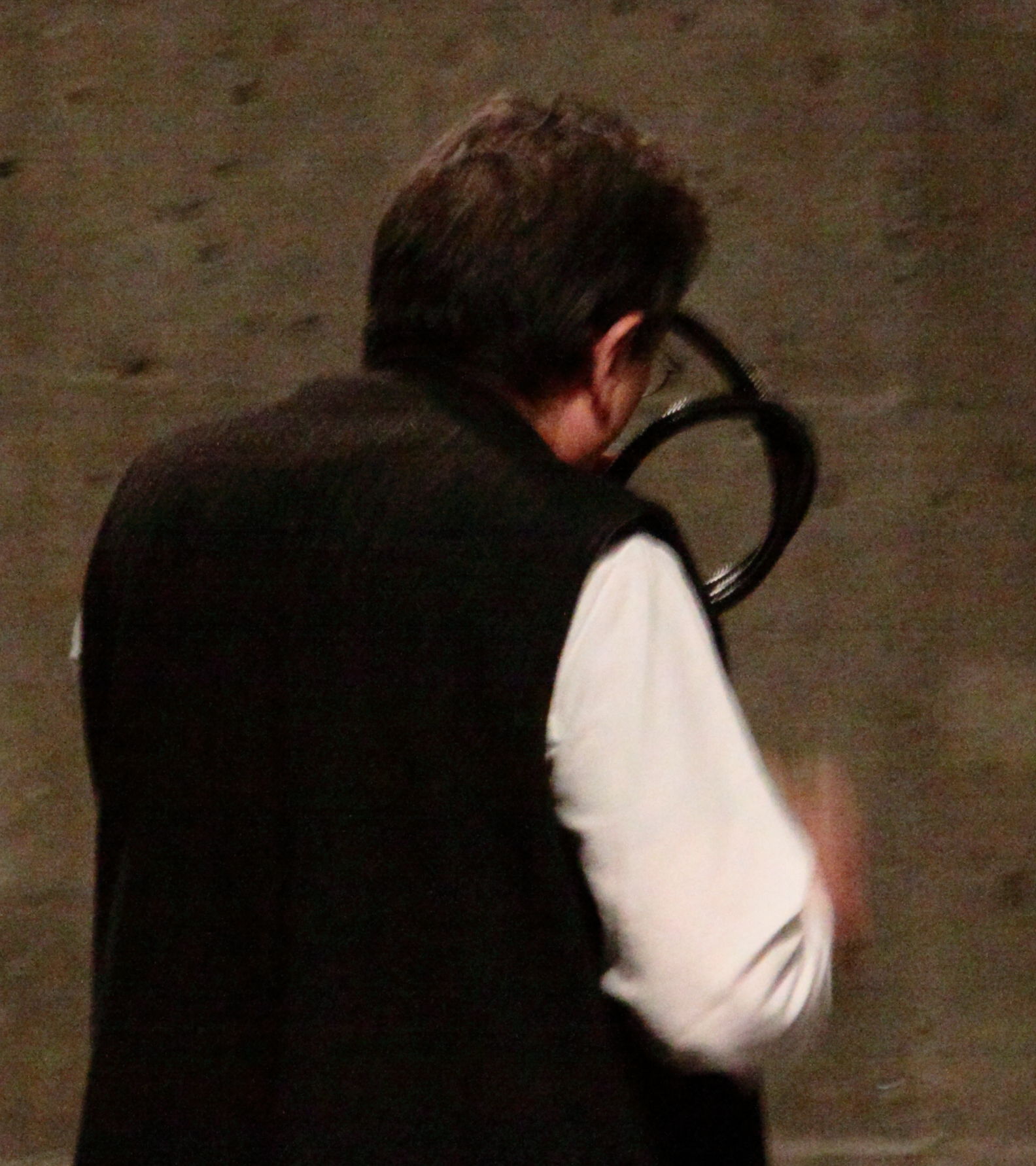
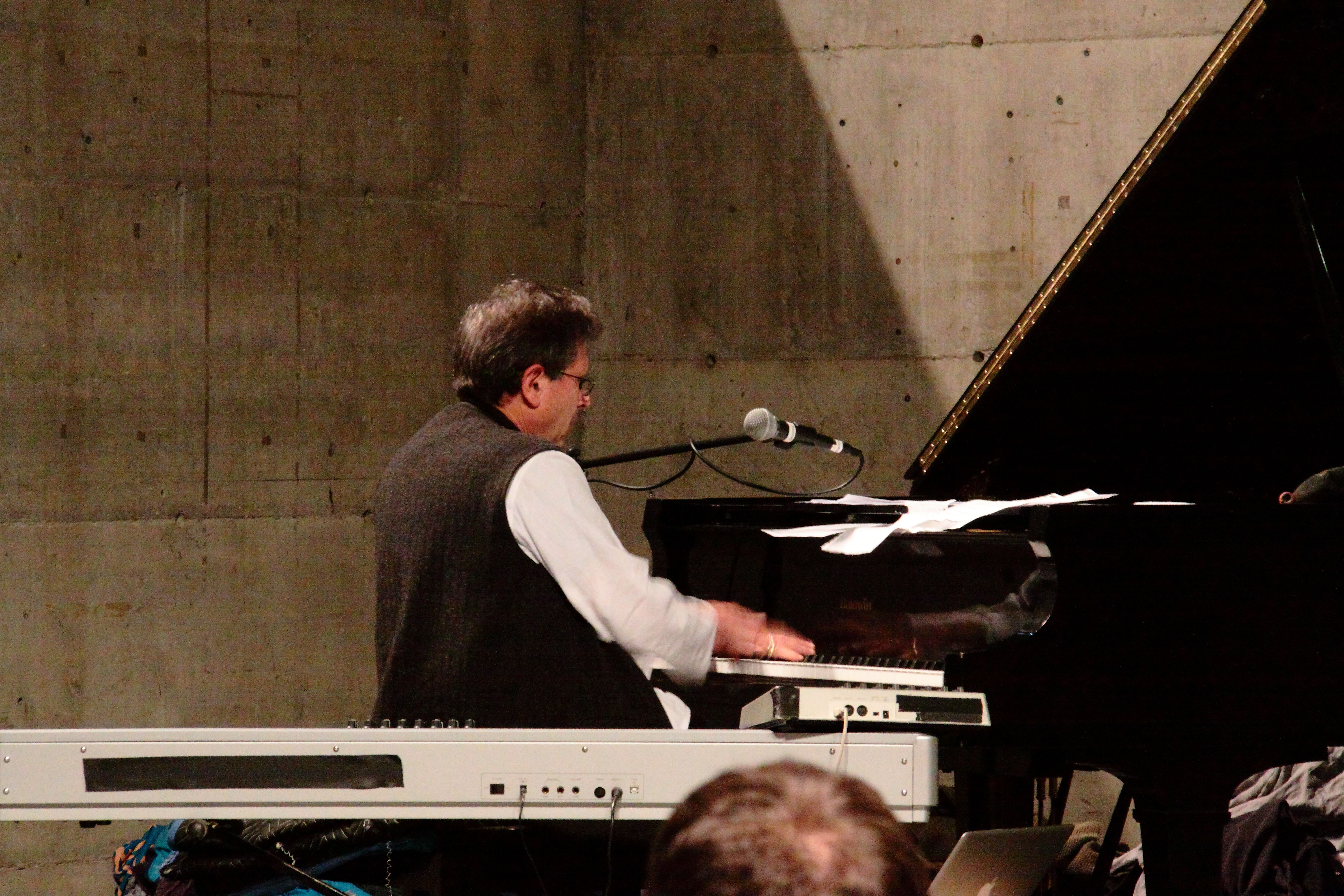
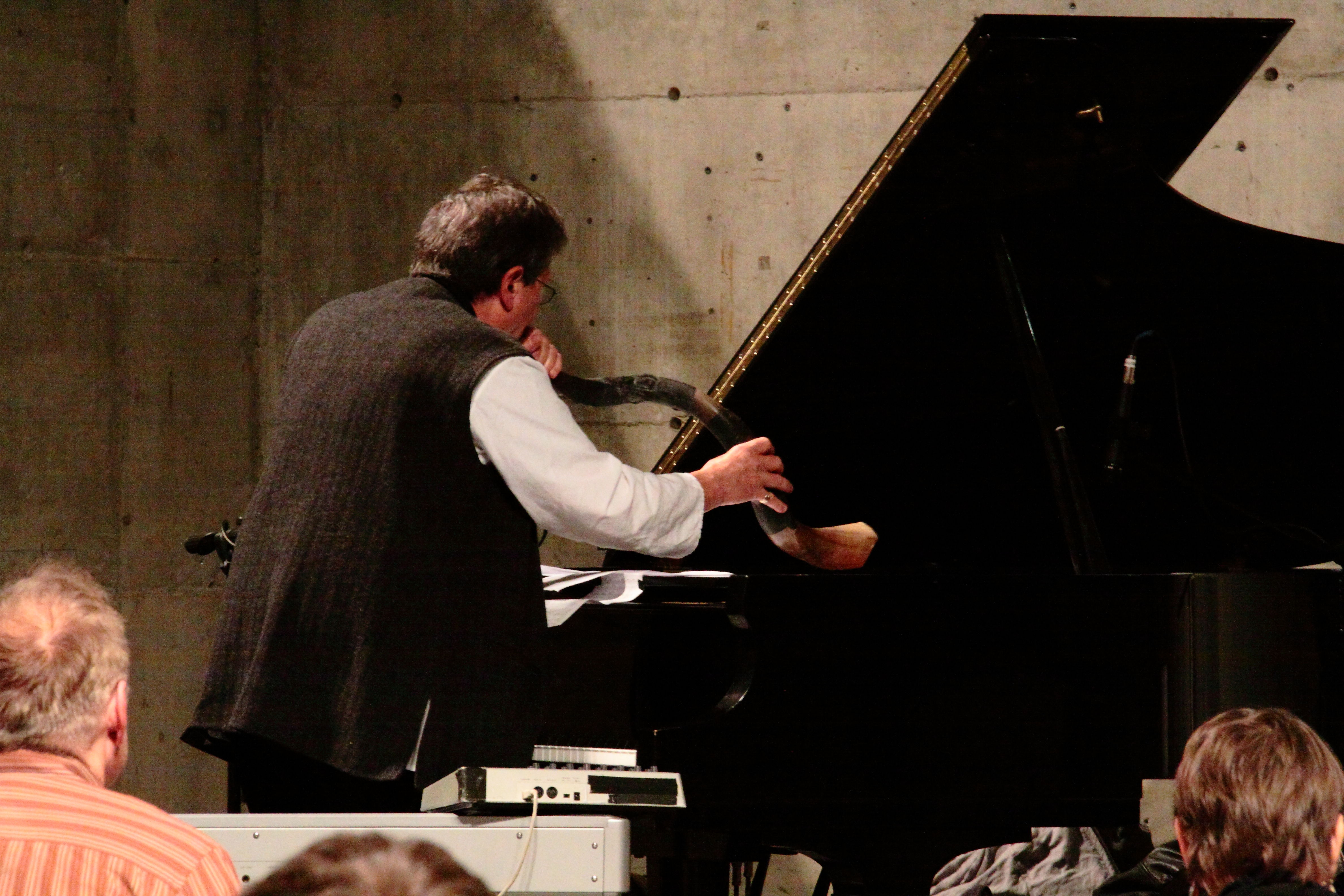
Creative, practical staging and lighting was a unifying factor in this triumph from Undercover Presents.

There was a full house at the UC Theater on this Saturday, June 3rd in Berkeley.  It was the only performance of this homage to the Beatles’ Sergeant Pepper album which was released 50 years ago (actually June 2, 1967).  Most of the performers were not even a twinkle in their parents’ eyes when this landmark of music came on the scene.  The “Summer of Love” was happening in the Bay Area and this album was unquestionably an influence then.  Tonight’s show demonstrated how that influence continues.

The audience was a mix of aging hippies (and non-hippies) and younger hipsters (is it OK to use that term and have no negative connotation?).  Some, no doubt, came for a bit of nostalgia remembering where they were when they first heard the original.  Some came to hear the creativity of local artists meeting such a challenge.

It would have been easy to simply do average covers of the songs and cater only to the nostalgia but Lyz Luke’s Undercover Presents, as usual, aimed higher than that (and hit their mark).  They, under the direction of guest producer Joe Bagale, curated a show of creative interpretations of each of the 13 tracks utilizing some of the finest of the massive talents that call the Bay Area home.  The end result was a true homage from another generation of marvelously diverse artists who put their stamp on the iconic songs without losing any respect for the power of the originals.

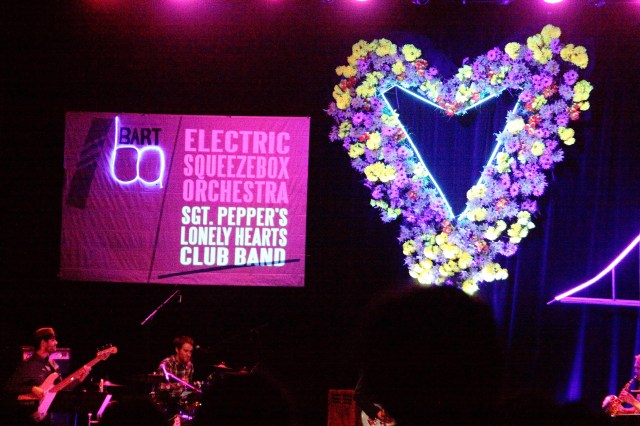
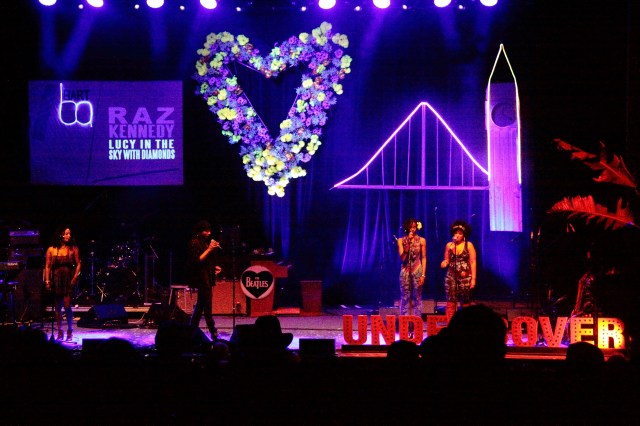
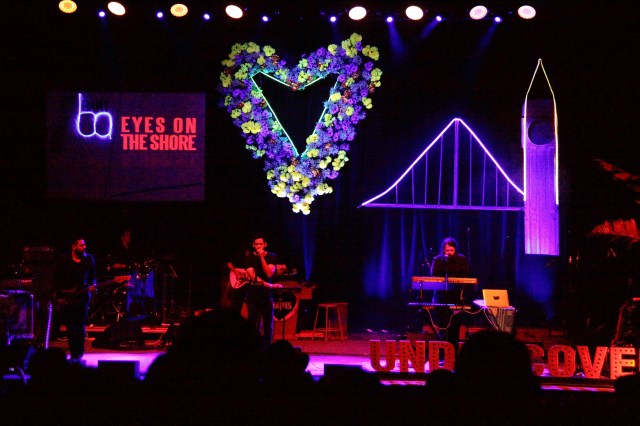
Simple but effective stage design by Bridget Stagnitto was reminiscent of the iconic album cover with creative lighting and functional information integrated into the tableau.  Ryan John and Brendan Dreaper were lead sound engineers.
Sgt Pepper20170008

As is customary for these shows the bands played the tracks in their original order beginning with the Electric Squeezebox Orchestra’s instrumental cover of the opening track.  Principal trombone Rob Ewing’s arrangement captured the essence of that opening and effectively set the stage for what was to follow.

(Correction:  Per Joe Bagale the opening number was arranged by soprano saxophone player Michael Zilber.)

Sgt Pepper20170009

Sgt Pepper20170010

Vocalist Dublin sang a bluesy solo version of “With a Little Help From My Friends”, those friends being the Jazz Mafia Accomplices

Guitarist Jon Monahan takes responsibility for this arrangement which veered just a bit off of nostalgia to deliver a very effective solo vocal version (the original you may recall had that call and answer thing going on) of this, one of the best known tracks on the album.  Though it was not obvious, perhaps there was some homage intended to the late Joe Cocker who first saw the bluesy potential here when he presented his justly famed version at Woodstock in 1969.
Sgt Pepper20170014

Raz Kennedy made effective use of backup singers in his soulful take on “Lucy in the Sky with Diamonds”.  He shared arranging credit with Nick Milo.  The spirit of the Supremes, Gladys Knight (and of course the Pips), and maybe a touch of James Brown seemed to be present in the house and this arrangement got a great review from the audience.  What a voice!
Sgt Pepper20170016

Eyes on the Shore shared arranging credits in their digital synth inflected take on Getting Better.  They went further afield with the material than some and may have briefly lost the pure nostalgia seekers but the arrangement clearly succeeded in pleasing the crowd. One would expect that psychedelia be transformed by the digital world, right?  And so it was.

Sgt Pepper20170018


The Avant Jazz Funk duo of Scott Amendola on percussion and Will Blades on Hammond Organ (how’s that for nostalgia?) and Clavinet turned in a very intense and rich improvisational battle in their purely instrumental version of “Fixing a Hole”.  Sometimes the melody was there and sometimes it was transformed in a musically psychedelic way that went quite a distance from the original.  But the use of the Hammond Organ and Clavinet themselves provided reassurance that they wouldn’t go too far.  The performances were blazingly intense and the whole house felt it.

Sgt Pepper20170022

We again were treated to soul with backup singers as Nino Moschella transformed the innocent ballad of adolescent alienation, “She’s Leaving Home”, into a more darkly hued version that seemed to reflect an understanding of the loss of that innocence that we all must face eventually.  Nothing somber here but clearly a different understanding consistent with the overall mission of having another generation’s way of remembering this material.
Sgt Pepper20170025


South Asian music and philosophy are inextricably linked to the psychedelic sounds of the mid to late 1960s and nowhere is this more obvious than with the Beatles whose study of Transcendental Meditation with their guru Maharishi Mahesh Yogi (born Mahesh Prasad Varma 1918-2008) while George Harrison studied sitar with Pandit Ravi Shankar (1920-2012).

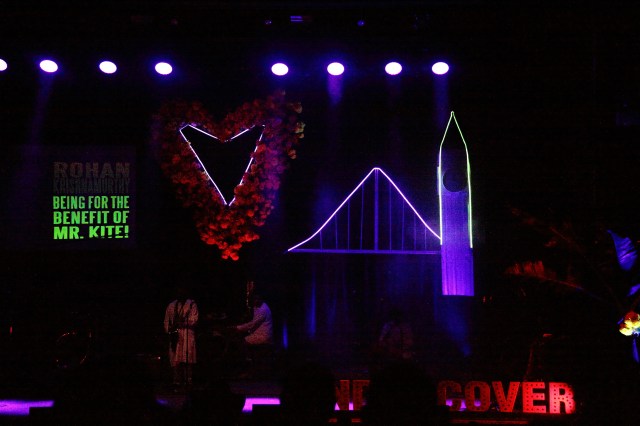
Rohan Krishnamurthy (Mridangam, Hadjira frame drum), Prasant Radakrishnan (saxophone), and Colin Hogan (keyboard) share credits for their creative instrumental arrangement of “For Mr. Kite”.  Eschewing lyrics (which are etched in most of the audience’s minds anyway) they performed a stunningly unique rendition of this familiar song. Interestingly these musicians trace their influences to the southern Indian Carnatic tradition (somewhat different from the Hindustani traditions which influenced the Beatles) adding yet another layer of richness to the evening’s goings on.

Sgt Pepper20170029

Colin Hogan indicts himself yet again in his arrangement of “Within You Without You”, that spacey Hindustani inflected song.  The Hogan Brothers (Steve Hogan, bass; Colin Hogan, accordion; Julian Hogan, drums; Moorea Dickason, vocals; Charlie Gurke, baritone sax) turned in a marvelous world fusion rendition of the tune (lyrics and all) to a hugely appreciative response.
Sgt Pepper20170035

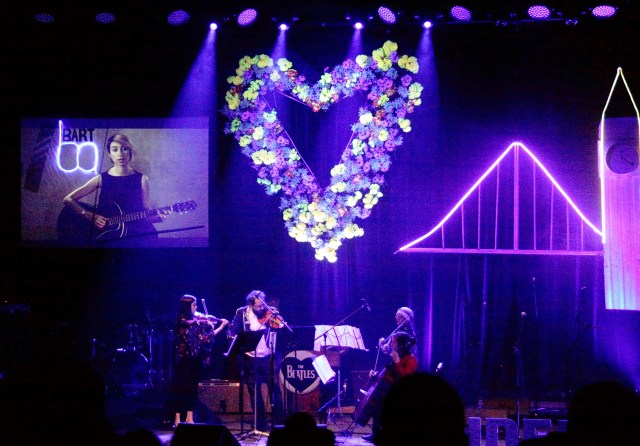
Iranian born Sahba Minikia, steeped in both Iranian and western classical traditions provided a touching arrangement of the classic, “When I’m Sixty Four”.  Featuring Mina Momeni on guitar and vocals (on video) accompanied by the Awesöme Orchestra in a song whose premise looks to the future as far as this evening looked into the past to ponder the endurance of romance.

In retrospect it is almost surprising that the marvelous diversity didn’t generate a presidential tweet of dissatisfaction.  Indeed a woman singing would produce more than a tweet of dissatisfaction in Tehran, birthplace of photographer and singer Momemi who also teaches visual arts in Canada.
Sgt Pepper20170040


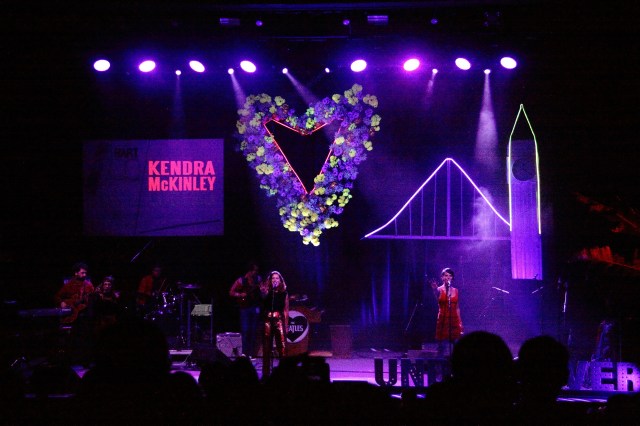
Vocalist Kendra McKinley practically turned “Lovely Rita” into a feminist anthem with some retro pop group choreography and background vocals to boot.  The visuals and the energy of the performance practically had the whole house dancing.

Sgt Pepper20170045

Soltrón added Latin percussion and energetic dance to the already electrified atmosphere with their arrangement of the raucous “Good Morning”.  Kendra McKinley could be seen and heard tying in her energy from the previous performance as backup singer here.

Sgt Pepper20170047

Lyz Luke stepped in to introduce the penultimate Sgt Pepper Reprise.

Sgt Pepper20170048

The dancing energy was carried on by the colorful and energetic dancers of Non-Stop Bhangra.  They accompanied Rohan Krishnamurthy and Otis McDonald in Joe Bagale’s rocking arrangement (replete with lyrics) of the reprise of the opening.  It was like a live action version of the studio executed original performance with a stage filled with ecstatic musicians and dancers.

Sgt Pepper20170052

Joe Bagale in his Sgt Pepper duds sings the lyrics hoping we’d enjoyed the show.

Sgt Pepper20170060

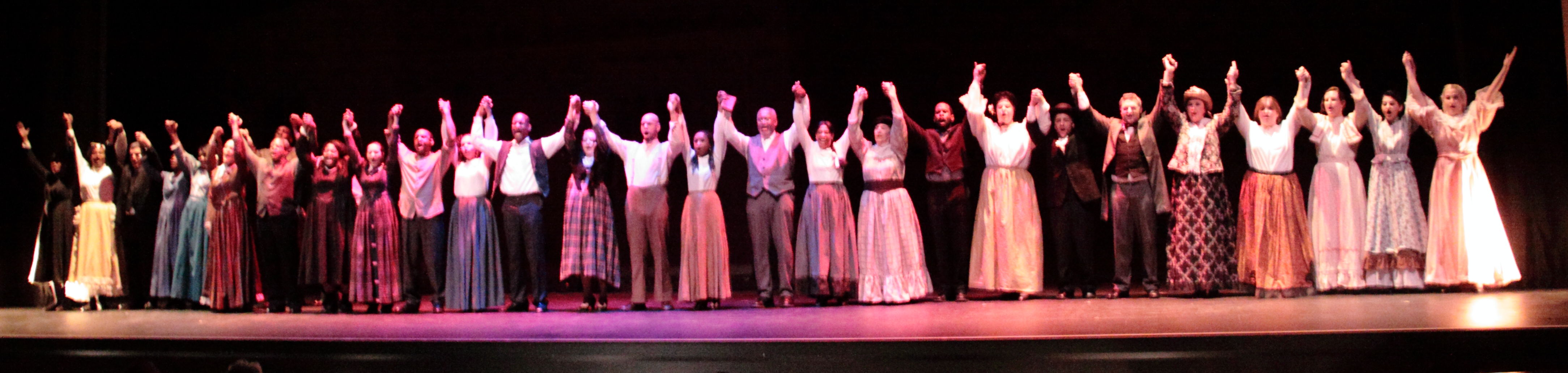
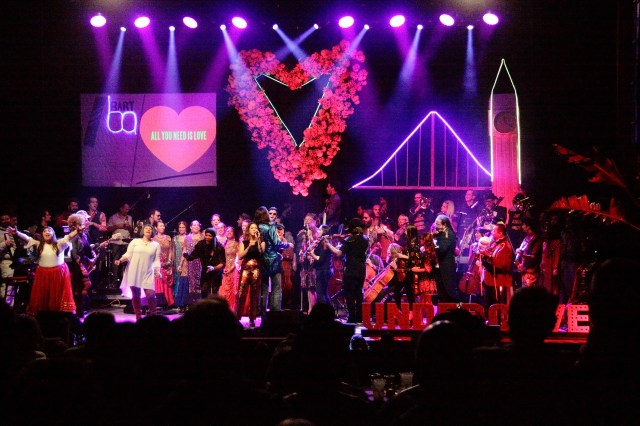
The apocalyptic, “A Day in the Life” concluded the mission of homage and nostalgia in a bigger than life tableau of talent and diversity that connected the “there and then” to the “here and now”.  The famous extended last chord crashed in a peak of energetic music making to bring the performances to a close.

Sgt Pepper20170062

The visuals were strongly reminiscent of the iconic album cover.
Sgt Pepper20170065

There was no need to encourage the audience to sing along to the encore of “All You Need is Love”.  Fifty years hence we still need it and if we still don’t have it everywhere at least we had it here this night.

 

Other Minds 22, Resounding Sacred Tributes from Music to Wheaties


OM22052120170026

Nicole Paiement led a touching performance of Lou Harrison’s La Koro Sutro

Nominally this was a celebration of the life and music of Lou Silver Harrison (1917-2003) but this last concert of Other Minds 22nd year celebrated so much more.

OM22052120170011

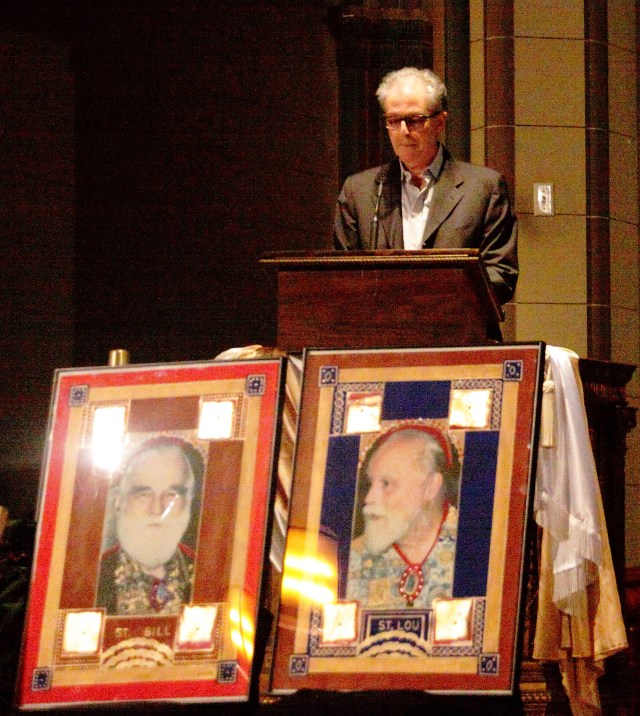
Curator and Other Minds Executive and artistic director introduces the night’s festivities with these artistic icons titled St. Lou and St. Bill (Lou Harrison and his partner, instrument builder Bill Colvig). The portraits were sold by silent auction.

One can’t celebrate the life and music of Lou Harrison without acknowledging his life partner of 30 years, Bill Colvig (1917-2000).  Colvig was the man who designed and built the American Gamelan percussion instruments used in tonight’s performance.  These repurposed industrial materials were inspired by the Indonesian Gamelan which Lou Harrison encountered at the 1939 world’s fair which took place on Treasure Island just a few miles away.  Amirkhanian added another fascinating historical footnote when he informed the audience that Harrison had come to this very church to learn to sing Gregorian Chant some time in the 1930s.

A further and very intimate context was revealed when Amirkhanian took an informal poll of the audience asking who had met and/or worked with Lou Harrison.  By his count he estimated that about 40% of the audience had encountered “St. Lou” (this writer met the magnanimous gentleman in Chicago in the early 1990s).  Indeed many of the musicians had encountered and/or studied with Harrison and the passion reflected in their performances and the audiences response clearly shows why he (and Bill) were elevated tonight to secular sainthood.

The wonderful acoustics of the Basilica easily accommodated Harrison’s dislike of electrical amplification.  Even the solo and small ensemble music was heard as it was intended.

OM22052120170008

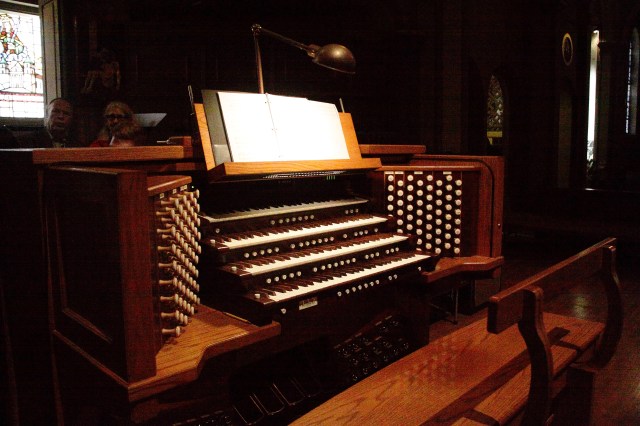
The organ console at the Basilica.

The well attended concert began with an early rather uncharacteristic piece called Praises for Michael the Archangel (1946-7).  It reflected the influence of Arnold Schoenberg, one of Harrison’s teachers (Henry Cowell and K.T.H. Notoprojo were also among his teachers).  Harrison also famously worked with Charles Ives whose Third Symphony he premiered.  He also worked with John Cage and collaborated on at least one composition with him (Double Music).  The angular and dissonant sounds were lovingly interpreted by Jerome Lenk, organist and chorus master at the Basilica.

OM22052120170013

Organist Jerome Lenk acknowledges the audience applause and allows himself just a touch of a satisfied smile for a well wrought performance.

Next was a solo harp piece Threnody for Oliver Daniel (1990).  (Oliver Daniel (1911-1990) was a composer, musicologist, and founder of Composer’s Recording Incorporated.  He was a friend of Harrison’s and a great promoter of new music).

OM22052120170001

The Threnody was performed on this smaller troubador harp in Ptolemy’s soft diatonic tuning.

Meredith Clark played with focused concentration and gave a very moving performance of this brief and beautiful composition.  Harrison was fond of paying homage to his friends through music.

Clark was then joined by cellist Emil Miland for a performance of Suite for Cello and Harp (1948).  Composed just a year after the angular organ piece which opened the program this gentle suite is entirely tonal and very lyrical in its five movements using music repurposed from earlier works.  Clark here used a full sized concert harp.

The artistic connection between these performers clearly added to the intensity of the performance.  Despite the varied sources of the music the suite has a certain unity that, like Bach and indeed many composers, justifies the re-use of material in the creation of a new piece.

This was followed by another organ piece from Mr. Lenk.  This Pedal Sonata (1989) is played solely by the musician’s very busy feet on the pedals alone (no hands on the keyboard).  Listening to the piece it was easy to believe that more than just two agile feet were involved in this challenging and virtuosic composition.  It appeared to be quite a workout but one accomplished with great ease by the performer.

OM22052120170016

Emil Miland and Meredith Clark smiling in response the the applause following their performance.

Following an extended intermission (owing to a dearth of restroom facilities) there was an awards ceremony.  Charles Amirkhanian was awarded the 2017 Champion of New Music Award (tonight’s conductor Nicole Paiement was also a previous awardee).  Presentation of the award was done by American Composer’s Forum President and CEO John Neuchterlein and Forum member, composer Vivian Fung.

Amirkhanian took the time to pay tribute to his mother (who also would have been 100 this year) his father (who passed away in December at the age of 101) and his charming wife of 49 years, Carol Law, who continues her work as a photographer and her participation in Other Minds and related projects.  He also gave thanks to the staff of Other Minds and his former associates at KPFA where Charles served as music director for over 20 years.

OM22052120170019

American Composer’s Forum President John Neuchterlein looks on as composer Vivian Fung presents the prestigious 2017 Champion of New Music Award to a very pleased Charles Amirkhanian.

OM22052120170020

In a touching and humorous move Mr. Neuchterlein advised the audience that Mr. Amirkhanian would be given yet another award tied to Minnesota which is the home of General Mills (yes, the cereal people).  Amirkhanian (who himself has quite a gentle sense of humor) was surprised and charmed to receive a box of Wheaties emblazoned with his image from whence he can now reign in the rarefied group of breakfast champions in addition to his other roles.

OM22052120170022

The breakfast of new music champions.

The second half of the concert began with the co-composed Suite for Violin and American Gamelan (1974).  Co-composer Richard Dee was in the audience for the performance of this work written two years after La Koro Sutro (1972) and incorporating the same gamelan instrument created for that piece.  The substantial violin solo was handled with assurance and expressivity by Shalini Vijayan, herself a major new music advocate.

OM22052120170025

Composer Richard Dee waving thanks for the performance of Suite for Violin and American Gamelan.

At about 30 minutes in performance the multiple movements all but comprised a concerto with challenging roles for both the percussion orchestra led by the amazing William Winant and his percussion ensemble and the soloist.  All were masterfully coordinated by conductor Nicole Paiement.

OM22052120170024

Shalini Vijayan smiles from behind her bouquet acknowledging the thunderous applause following her performance.

In a previous promo blog I had noted that the location of this concert is a designated pilgrimage site, one where the faithful journey as part of a spiritual quest.  Well, having been sidelined by a foot injury for the last 3 1/2 months this amounted to a musico-spiritual pilgrimage for this writer who has not been able to be out to hear music for some time.  The last piece on the concert in particular was a powerful motivation for this personal pilgrimage and I was not disappointed.

The American Gamelan was played by the William Winant percussion group consisting of master percussionist Winant along with Ed Garcia, Jon Meyers, Sean Josey, Henry Wilson, and Sarong Kim.

They were joined by the Resound Choir (Luçik Aprahämian, Music Director), Sacred and Profane (Rebecca Seeman, Music Director), and the Mission Dolores Choir (Jerome Lenk, Music Director).

Meredith Clark joined on concert harp and Mr. Lenk on the small ensemble organ.  All were conducted with both discipline and panache by Nicole Paiement.

This multiple movement work is a setting of the Buddhist Heart Sutra and is done in an Esperanto translation by fellow Esperantist Bruce Kennedy and, though written for the world Esperanto Convention in Portland, Oregon, it was premiered at the University of San Francisco in 1972.  This was the fourth performance in the Bay Area, a fact that reveals the love that this area has had and still has for its beloved citizen Lou Harrison.

OM22052120170029

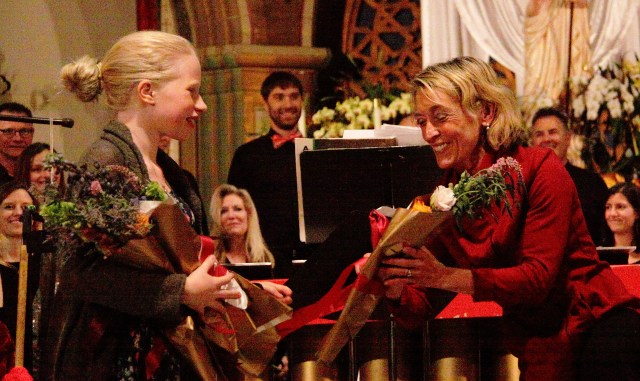
Warm smiles proliferated as the bouquets were distributed amid a standing ovation from a very appreciative audience.

In fact this concert can be seen as a affirmation of so many things.  Harrison was a composer, teacher, dancer, calligrapher, Esperantist, conductor, musician, musicologist and early gay rights advocate.  It is a testament to Lou that he has been given a most spectacular birthday celebration which gave credence and appreciation to all aspects of this west coast genius and all his extended family.  It happened 50 years after the fabled Summer of Love and apparently the love continues in its way.

OM22052120170028

A clearly very happy conductor Nicole Paiement’s smile echoes both her feeling and that of the attendees, a wonderful night.
Grand Celebrations of Finnish Culture


BIS- 9048 SACD

The choice of repertoire, performers, and the quality of their recordings make any BIS records release worthy of attention.  This two disc set is a fine example.  Three major choral/orchestral works which celebrate the justly proud Finnish culture are given very fine performances in this live recording from 2016.

The earliest work, Jean Sibelius’ Kullervo Op. 7 (1892) is one of the less recognized masterpieces by Finland’s best known composer.  Based on the Finnish national epic, The Kalevala, this massive symphony has acquired a bit of its own mythology.  Though several recordings of this work now exist the world world premiere recording by the late Paavo Berglund (1929-2012) from the early 1970s brought this neglected masterpiece to a larger listening audience.  The intelligent liner notes by Andrew Barnett (and Olli Kortekangas) document and dispel the myths that Sibelius suppressed all or portions of this work which was premiered in 1892 yet had to wait until after the composer’s death in 1957 to receive its first twentieth century performance.  

In fact it seems more likely that the large forces required along with programmers’ preference for the composer’s later masterpieces were responsible for the unfortunate neglect of the present work.  It was the more romantically inclined myth of mysterious oppression that greeted Berglund’s triumphant premiere recording and this reviewer recalls being both charmed and intrigued by it.  Whatever the story the music is now a recognized early triumph by its creator and it is given a gorgeous reading by Finnish conductor Osmo Vänskä, (principal conductor of the Minnesota Orchestra which plays powerfully and definitively.

So why a second disc?  Well, Maestro Vänskä saw fit to commission a new work by contemporary Finnish composer Olli Kortekangas to serve as a companion piece to Kullervo and, then include a version with chorus of Sibelius’ best known work, Finlandia.  Together these three works would very satisfyingly fill an entire concert program.

Olli Kortekangas (1955- ) chose poetry by Finnish-American poet Sheila Packa and composed a 7 movement work (three are interludes for orchestra alone) in celebration of the 150th anniversary of modern Finnish migration to the United States.  The work, Migration (2014), is similar in orchestration with its use of male chorus and two soloists backed by a large orchestra.  The composer’s style is a sort of 21st century romantic style with tasteful modern touches.  

The focus of this fine new work is an affirmation of Finnish culture and its impact on the United States.  It seems both fitting and satisfying then that this program conclude with the landmark work of Finnish pride and nationalism, Sibelius’ best known work, Finlandia (1899).  But rather than just another reading of this classic of the concert hall  Vänskä chooses to do a version with chorus.  This was not the composer’s original intent but this version fits remarkably well in the context of this album.  

This is a very enjoyable album, well conceived and executed in every way.  Soloists Lilli Paasikivi and Tommi Hakala sing their roles with skill and passion as does the YL Male Voice Choir.  The applause track at the end of the Finlandia performance echoed the emotional experience of this reviewer and will likely do so for anyone who chooses to avail themselves of this fine example of recording art.

Words Fail and Music Succeeds: Violinist Yevgeny Kutik


Marquis 774718147721

Politics requires words and indeed fails at times but music very much succeeds in this fine recording.  This charming collection organized loosely around songs without words is the third album by this emerging artist.

The music is largely 20th to 21st century (if you count the date of the transcriptions) but the sound and mood of the album ranges from the romanticism of Mendelssohn and Tchaikovsky, the post-romantic Mahler, to the neo-classicism of Prokofiev and a dash of modernism from Messiaen, Gandolfi, Andres, and Auerbach.  No words, no politics, just some really beautiful music.

There are 14 tracks of which the Mendelssohn and the Mahler will be the most familiar to listeners.  What is interesting here is a certain unity in these seemingly disparate works which range over nearly 200 years of compositional invention.  In fact this recital program strongly resembles in spirit the justly popular programs of Jascha Heifetz and his acolytes.  That is to say that this is at heart a romantic recital program sure to please any aficionado of the violin and piano genre.

Two of the tracks, those by Michael Gandolfi and Lera Auerbach are for solo violin.  The unaccompanied violin repertoire best represented by J.S. Bach’s Sonatas and Partitas is a relatively small one and one fraught with difficulties for composers as well as performers.  Fear not though, these pieces are well wrought and represent significant contributions to the solo violin literature.

The Gandolfi (1956- ) Arioso doloroso/Ecstatico (2016) was commissioned by Mr. Kutik and this is the world premiere recording.  The composer utilizes a basically romantic sounding style with clear references to Bach at moments to create a very satisfying piece imbued with depth but eminently listenable.  Gandolfi’s eclectic oeuvre is by itself worthy of further exploration.

Lera Auerbach’s (1973- ) T’Filah (2015) is a reverent (though not excessively somber) prayer written in memory of the victims of the Nazi holocaust.  Auerbach shares some Russian roots with the soloist and this brief composition will leave most listeners wanting to hear more from this fine and prolific composer.

Timo Andrés (1985- ) plays the piano on the eponymous track Words fail (2015), the second of the two works commissioned by Kutik and premiered on this disc.  He is a skilled composer using a wide variety of compositional and instrumental techniques (which he mentions in his liner notes) to create a sort of modern song without words that fits so well in this program.  Andrés is certainly among the rising stars both as composer and performer.

One should definitely pay attention to the fine work of Kutik’s accompanist John Novacek whose precision and interpretive skill so well compliment the soloist.  The art of the accompanist shines very clearly here.

Overall a great recital disc from a soloist from whom we will doubtless continue to hear great things.

When Politics and the Arts Clash, OM 22


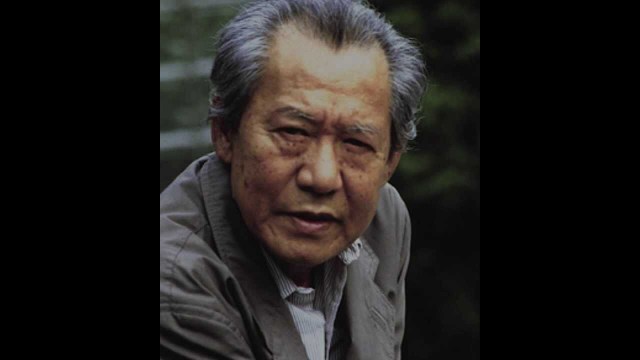
Isang Yun (1917-1995)


The relationship between politics and music is complex and varied.  There are many instances of clashes between these two disciplines from the politics of state and church sponsored music to its repression by those same institutions.

After centuries of Catholic church sponsored music a decision was made in 1903 to repress the performance of anything but Gregorian chant and any instruments except for the ubiquitous organ.  The reasons for this decree have been discussed but the end result was less work for musicians.

More recently the Nazi “degenerate art” concepts and the later proscriptions on “formalist music” in Soviet Russia similarly put artists and musicians out of work.  In fact many were jailed or killed.  Shostakovich and Prokofiev were high profile musicians who endured bans on performances of their music based ostensibly on claims that it brought (or potentially brought) harm to the state’s political visions.

Even more recently the blacklist created by Joseph McCarthy and his acolytes perpetrated a similar assault on actors, directors and writers like Dalton Trumbo (recently dramatized in the excellent film Trumbo with Bryan Cranston leading the fine cast).  This sad chapter of history did not completely end until the 1970s and only recently have efforts succeeded in restoring suppressed screen credits to these films.  Many lives were destroyed or irreparably harmed.  One hopes, of course, that such travesties will not be repeated but the recent efforts to eliminate the NEA suggest that such struggles remain with us.

On February 18th Other Minds will present a centennial celebration of two composers’ births.  Lou Harrison certainly expressed some political themes in some of his music but did not incur state sponsored political wrath.  Unfortunately this was not the case with the other honoree of Other Minds’ 22nd season.

In 1967 Korean composer Isang Yun was kidnapped by South Korean intelligence officers and taken to South Korea to face accusations of collaboration with the communist government of North Korea.  He was held for two years and was subjected to interrogation and torture based on information later acknowledged to have been fabricated.  Even so South Korea declined to allow the ailing composer’s request to visit his hometown in 1994.  He died the following year in his adoptive home in Berlin, Germany.

A petition signed by over 200 artists including composers Karlheinz Stockhausen, Hans Werner Henze, Gyorgy Ligeti and conductors Otto Klemperer and Joseph Keilberth among the many was sent to the South Korean government in protest.  A fine recent article by K. J. Noh, Republic of Terror, Republic of Torture puts the incident in larger political context. It is a lesson sadly relevant even now in our politically turbulent times.

The concert will feature works from various points in his career, both before and after the aforementioned incident.  It is a fine opportunity to hear the work of this too little known 20th century master.  Conductor and pianist Dennis Russell Davies knew and worked with both Harrison and Isang.  It is so fitting that he will participate along with his wife, justly famed new music pianist Maki Namekawa, in this tribute to the the late composer.  This can’t right the wrongs but what better way to honor a composer than by performing his music?

The performance is at 7:30 PM at the historic Mission Dolores Basilica at 3321 16th Street
San Francisco, CA 94114.  Tickets available (only $20) at Brown Paper Tickets.

February 18th, Mark Your Calendars: Other Minds 22, A Must Hear


OMDI1Harrison

Lou Harrison (1917-2003)

The American composer Lou Harrison (1917-2003) and Korean composer Isang Yun (1917-1995) turn 100 this year and Other Minds 22 has a wonderful celebration that is not to be missed.  On February 18th at 7:30 PM in the beautiful, historic Mission Dolores Basilica in San Francisco’s famed Mission District.  This is actually only the first of two concerts which will comprise the Other Minds season 22 which is subtitled, “Pacific Rim Centennials”.  It is curated by Charles Amirkhanian, the reliable arbiter of modern musical tastes in the Bay Area and beyond.  (The second concert, scheduled for May 20, will be an all Lou Harrison concert closer to the composer’s May 14th birthday.)

yun_isang

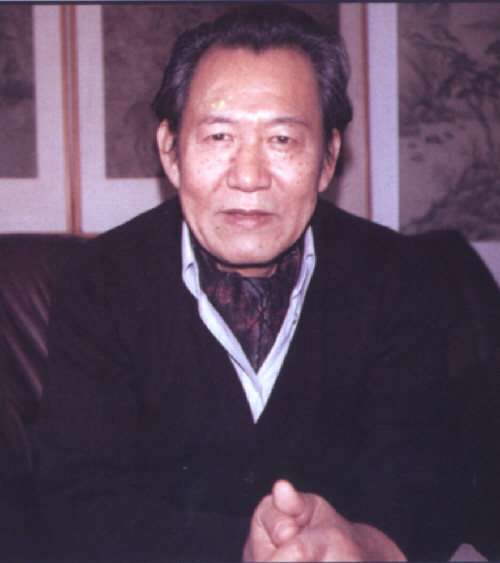
Yun Isang (1917-1995)

Harrison is well known to new music aficionados, especially on the west coast for his compositions as well as his scholarship and teaching.  His extensive catalog contains symphonies, concertos, sonatas and other such traditional classical forms as well as some of the finest of what we now call “world music” featuring instruments from non-western cultures including the Indonesian gamelan.  He is also the man responsible for the preparation and premiere of Charles Ives’ Third Symphony in 1946 which was subsequently awarded a Pulitzer Prize.

Yun is perhaps less of a household name but is known for his many finely crafted compositions in the modern western classical tradition and, later, incorporating instruments and techniques from his native Korea.  He was infamously kidnapped by South Korean intelligence officers in 1967 and taken from his Berlin home to South Korea where he was held and tortured due to allegations (later proven fabricated) of collaboration with North Korea.  Over two hundred composers and other artists signed a petition for his release.  After several years he was returned to his adopted home in Berlin in 1969 where he continued to compose prolifically and teach until his death in 1995.

dennis-russell-davies

                              Dennis Russell Davies (from the American Composers Orchestra site)

This celebratory and memorial concert will feature world renowned artists including Grammy Award winning conductor and pianist Dennis Russell Davies who knew and collaborated with both Harrison and Isang.  Other artists will include pianist Maki Namekawa, violinist Yumi Hwang-Williams, percussionist William Winant (with his percussion group), and the Other Minds Ensemble.

The program is slated to consist of:

Sonata No. 3 for Piano

(1938, Lou Harrison)

Dennis Russell Davies

Kontraste I for Solo Violin

(1987, Isang Yun)

Yumi Hwang-Williams

Gasa, for Violin & Piano

(1963, Isang Yun)

Yumi Hwang-Williams, Dennis Russell Davies

Grand Duo for Violin and Piano (excerpts)

(1988, Lou Harrison)

IIII. Air
II. Stampede

Yumi Hwang-Williams, Dennis Russell Davies

Intermission

Canticle No. 3

(1941, Lou Harrison)

William Winant Percussion Group
Joanna Martin, ocarina
Brian Baumbusch, guitar
Dan Kennedy, Loren Mach, Ben Paysen, William Winant, Nick Woodbury, percussion
Dennis Russell Davies, conductor

Interludium A

(1982, Isang Yun)

Maki Namekawa, piano

Suite for Violin, Piano & Small Orchestra

(1951, Lou Harrison)

I. Overture
II. Elegy
III. First Gamelan
IIII. Aria
V. Second Gamelan
VI. Chorale

Yumi Hwang-Williams, violin
Maki Namekawa, piano
The Other Minds Ensemble:
Joanna Martin and Janet Woodhans, flute
Kyle Bruckman, oboe
Meredith Clark, harp
Evelyn Davis, celesta
Andrew Jamieson, tack piano
Emil Miland and Crystal Pascucci, cello
Scott Padden, bass
William Winant, percussion
Dennis Russell Davies, conductor

Other Minds is also co-sponsoring (with the Berkeley Art Museum/Pacific Film Archive) a screening of the 2015 German television produced film, Isang Yun: In Between North and South Korea on February 19th (4:15PM) at the Pacific Film Archive in Berkeley.  Dennis Russell Davies and composer Charles Boone will also be present to discuss the film.

If you do know these composers you probably already have your tickets but if you don’t know them you owe it to yourself to check out these performances.


E-Do: Yeominrok, Wonderful Korean Musical Fusion


yeominrok

Pony Canyon PCSD 01023

Call it world music, call it jazz, call it fusion but whatever the description this is an innovative and fascinating musical journey.  Using traditional Korean instruments as well as the usual keyboards, vocals, and drums this group of young musicians crafts a very interesting and beautiful tapestry of sound.

I have long had an interest in and some appreciation of traditional Korean musics and instruments but my knowledge is rather limited.  I am inclined to compare this group to Oregon, the iconic jazz/new age experimental band of the 1970s but unlike Oregon’s more widely cast net we see young musicians embracing their ancient Korean musical heritage as they seek to express themselves and invoke the wisdom of their ancestors.  This album was sent to me as a gift from a friend but I quickly fell in love with it and I had to write a review.

It seems to me that Korea has, more than many countries, been damaged and stunted by the antics that became known as World War II and the Korean War.  As a result this rich and ancient culture was nearly erased in favor of geographic division and political expediency.  It is heartening to find young artists such as these seeking to communicate with if not actually recover some of this rich past.

This band is named after a revered 15th century Korean king and they make liberal use of traditional Korean instruments alongside their drums, keyboards, and vocals.  The album succeeds to some degree in achieving a synthesis (as opposed to a sappy watering down) of traditional music and something like jazz with some rock and pop sensibility.  These are sincere and perceptive artists and if they have not fully succeeded then they have made a significant step toward reviving some of their justly valued history and culture.

In addition to its musical values this is a gorgeously produced album (visually and sonically) and I am sorry to see that only the digital download is available on Amazon.

There are six tracks on the disc and all feature traditional Korean instruments alongside the band’s keyboards, drums and vocals.  There are few vocals but no words as far as I can tell and any program is implied at best.  This is strictly about the music.

The first track, Bird of Oblivion, unfolds like an Indian raga with a meditative slow beginning giving way to a faster section.  It is the most extended work on the disc at 13:51 and it certainly serves to bdraw the listener in.  The remaining tracks range from pop-inflected jazz (track 3) to a little bit of rock .  Throughout the traditional Korean instruments make their presence known but not overwhelmingly.  This album is a pretty successful synthesis of old and new.

E Do consists of:

Kyung-hwa Ryu: chulhyungeum, yanggeum, janggu, kkwaenggwari

Chung Lim: drums, jungju, gong

Min-soo Cho: junggu, Korean drum, Korean fan, percussion

Jung-chul Seo: electronic bass, contrabass

Young-Sup Lee: daegeum, taepyeongso, danso, ocarina

Seung-hwan Yang: keyboards

Tae-young Kim: vocals

Young-goo Lee: daegum

Seek this one out.  And don’t forget to pick up some traditional Korean music as well.  It is well worth your time and, after all, a nod to the fine efforts of this wonderful group.


Discovering and Preserving a Legacy: Tod Dockstader: From the Archives


dockarch

Starkland ST-226

I’m gonna go out on a limb here and suggest that this disc is a major and important release.  The history of music includes a fair amount of instances in which a second look at a particular composer who had been neglected yields a rediscovery which places said composer to their proper place in history.  Such was the case with Mendelssohn famously rediscovering Bach and Sir Thomas Beecham championing the works of Hector Berlioz. Conductor Robert Craft brought the work of Anton Webern to a larger audience with his recording of the complete works back in the 1950s and, more recently, Michael Tilson Thomas did a similar favor for the work of Carl Ruggles.  Of course not every musico-archaeological effort yields great results but the present release would appear to be auspiciously positioned to bring delight to listeners as well as place its composer in a more appropriately prominent place in the history books.  Now we are treated to a previously unknown cache of musical treasures from such a master, the digital equivalent of discovering Tut’s tomb.  It is an amazing disc on many levels.

This recording is nearly as much the accomplishment of Starkland Records’ producer Tom Steenland as it is of the composer Tod Dockstader (1932-2015).  Starkland’s  first two releases were CD reissues of the composer’s four Owl Records albums from the mid-1960s. It was the musicological acumen of Steenland whose love for those albums that helped provide motivation for him to found Starkland Records and promote this important electronic composer to proper historical recognition.  Dockstader was, in turn, inspired by the very positive response to those reissues to end his thirty year hiatus and return to composing.  He subsequently released the three volumes of Aerial (2005-6) on Sub Rosa and two collaborations with David Lee Myers (whose thumbprint is to be found on the present recording as well), Pond (2004) and Bijou (2005).

As if all that weren’t quite enough a new chapter dawned shortly after Dockstader died in 2015.  He left behind his archive of tapes and record releases and something more.  Justin Brierly, a radio host, was a fan of Dockstader’s music and wanted to interview him for his show.  He contacted Tom Steenland who was able to put him in touch and he was able to visit and interview the composer on several occasions.  The composer’s daughter, Tina Dockstader Kinard, gave Brierly the computer tower containing work files which had been saved on that hard drive over the years. There were thousands of files in various stages of completion, some just sample files, some duplicates, but many complete or nearly complete compositions that had not been heard since they were created.  Brierly sorted through these and sent some 50 files to Tom Steenland who carefully selected 15 tracks for the present release.

Tod Dockstader was a composer with a day job, that is he worked as a film and sound editor and took advantage of his access to what would have been prohibitively expensive equipment at the time to create his own brand of electronic music.  Sadly Vladimir Ussachevsky denied him access to the Columbia-Princeton Studios back in 1961.

Stylistically he holds much in common with his antecedents Edgar Varese, Pierre Henry, Louis and Bebe Barron, Pierre Schaeffer as well as contemporaries such as Morton Subotnick and Andrew Rudin. His albums from the 1960s of course utilized the tape splicing techniques and analog equipment of the time.  Some of the music from his Eight Electronic Pieces (1961) album was selected (as were some of Andrew Rudin’s electronic compositions) for inclusion in the soundtrack for Frederico Fellini’s Satyricon (1969).

When he returned to composing in the late 1990s studios were digitally driven and computers ruled. He reportedly had little difficulty learning and using computers for his later works. Despite the change from analog to digital media however Dockstader’s style remained extremely consistent, a clear and unique voice in the musical landscape.

Prior to this release it had been thought that his last word musically was the three volume Aerial series of 2005-6.  Now Starkland presents this lovingly selected cache of the composer’s most recent works.  He had effectively stopped composing in 2008 wrestling with the ravages of dementia but did listen and comment at times with Brierly during his visits on some of these files and, fittingly, enjoyed the fruits of his own labors to the very end of his life in 2015.  There’s no doubt more of a story to be told there for sure and here’s hoping that we may soon see a comprehensive biographical and musical assessment of his work.

For the wonderful liner notes Steenland recruited Geeta Dayal,  a San Francisco based writer whose writings on music can be accessed from her website and are well worth your time to investigate.  She comes with quite a pedigree as a writer on the subject of electronic music both old and new.  Her liner notes are both authoritative and good reading.  She would be my vote for a Dockstader biographer.

The exact intentions of the compositional process cannot be determined (Dockstader left no notes about these files) but it seems clear that these are all late period pieces.  They are all dated between 2005 and 2008.  The titles of these pieces were made based in part on the computer file names for the pieces which had not gotten their final naming by the composer.  One can only imagine the labor of love involved in Brierly’s and Steenland’s distillation of these final 15 tracks but the end result is a very satisfying collection consistent in quality to previous releases and a worthy representation of his last works (though this reviewer is given to hopeful wonder that a volume II might emerge in the near future).  At any rate Dockstader’s legacy is now secure and no doubt there will be much research done on his work made easier now by the dedicated sleuthing of these producers.

The first track, Super Choral (2007) contains some collaboration with David Lee Myers as mentioned earlier and it is used with his permission.  I won’t try to describe the rest of these pieces except to say that they seem to be a worthwhile contribution to the art of electronic music, are excellently crafted and eminently listenable.

The liner notes with their studio porn images of Dockstader’s beloved Ampex machines are tastefully mixed with images of the composer and his family.  The mastering was done by the wonderful Silas Brown and is about as good as it gets.  I can’t imagine a more fitting tribute to the composer’s legacy than this and I can’t imagine this not being nominated for a Grammy.  Bravo gentlemen!

Release is scheduled for November 18th.  You can pre-order both the download and the physical disc on Amazon.


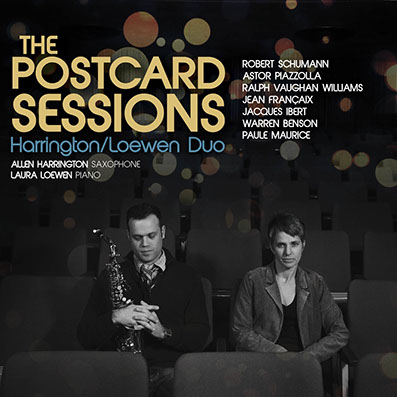
The Postcard Sessions, Saxophone and Piano


harrington loewen cover

Ravello RR 7934


It has always seemed to me that the saxophone has had a difficult time integrating into the mainstream of classical performance.  Since its invention by Adolphe Sax in the mid 19th century this family of instruments has amassed a somewhat limited solo repertoire and has only really made it as an orchestral instrument in the twentieth century.  The subsequent adoption of these instruments at the forefront of jazz and pop has forever changed the perception of this hybrid woodwind/reed/brass instrument which, for those who segregate musical genres, complicates matters even more.

It is the twentieth century that this album represents and it is the classical voice, not jazz or pop which speaks here.  This intelligently chosen set of pieces is like a little tour of the saxophone and piano literature representing some of the best of the early to mid twentieth century repertoire.  If that makes it a niche market then so be it, it is a lovely niche.

Now Robert Schumann (1810-1856), whose work opens this disc, is hardly a twentieth century composer but these transcriptions by Frederick Hemke (long time saxophonist of the Chicago Symphony and a highly respected teacher) are definitely contemporary and work well for saxophone and piano.  Drei Romanzen Op. 94  (1849) are originally for oboe and piano.

Tracks 4 and 11 contain pieces by Astor Piazolla (1921-1992), the Argentinian composer best known for his work with the tango forms.  Here we have two film music excerpts in apparent transcriptions.

There are four other sets of pieces on this recording by Ralph Vaughn Williams (1872-1958), Jean Francaix (1912-1987), Jacques Ibert (1890-1962) and Paule Maurice (1910-1967). The Vaughn Williams Folk Song Suite is originally for cello and piano and is vintage Vaughn Williams at his English folk song best.  The Ibert and the Francaix are suites of the sort of nervous, jazz inflected music that characterized an era between the wars.  Paule Maurice is a new name to this listener and the artists are to be commended for their part in saving her work from obscurity.

The Aeolian Song by Warren Benson (1924-2008) is probably one of the best known (and deservedly so) pieces on this disc.  This is actually the slow movement of a concertino for saxophone and orchestra but has become a sort of recital classic in its incarnation for saxophone and piano.

The Harrington/Loewen Duo are based in Canada and that may be their only flaw.  The curious but annoying lack of attention to the musicians who are our neighbors to the north is certainly mitigated to some degree by this release.  It is a lovely recital and the musicians are both committed and creative.  One hopes for another volume of recital pieces to follow this delightful release.

Black Notes Matter: Lara Downes’ America Again


laradownes

Sono Luminus DSL-92207

The lovely cover photo for this album by San Francisco born pianist Lara Downes is reminiscent of any number of socially conscious folk/rock stars of the 60s and 70s. It would seem that this is no accident.  This delightful album of short pieces by a wide variety of American composers takes its title from the Langston Hughes (1902-1967) poem, Let America Be America Again (1935).  By so doing the pianist places this interesting selection of short piano pieces firmly in the context of black racial politics and the artistic expression of black America as well as those influenced by this vital vein of American culture (both musical and literary).  It is a graceful and deeply felt effort and I hope that the metaphor of the title of my review is not too tortured a one to reflect that.

This is also a very personal album.  Downes seems to share some deeply felt connections with her materials.  This artist, born to a white mother and a black father, invokes a careful selection of short piano pieces steeped sometimes in jazz and blues but also the political directness (and optimism) which was characteristic of the inter-war years that brought forth the Hughes poem.  There is both sadness and celebration in these virtuosic and technically demanding little gems (most apparently recorded for the first time or at least the first time in a while).  The pianist’s comments on each individual piece are also critical to the understanding of this disc as she shares the impact and meaning that the music has had for her.

There are 21 tracks by 19 composers in all and the selections themselves are quite a feat. They range from the 19th to the 21st centuries and are composed by both men and women of a variety of racial and ethnic backgrounds.  All seem to share the sort of  populist charm befitting the idealized America yearned for in the poem which is to say that they represent a kind of idealized or hopeful nationalism.  Downes is well acquainted with a large variety of American music and recognizes no distinction between classical and so-called “vernacular” traditions.

In fact none of these things are atypical for this artist.  Her previous albums Exiles Cafe (2013) featured music by composers exiled from their homelands, A Billie Holiday Songbook (2015) celebrated the life of this iconic black artist and her American Ballads (2001) demonstrated her deep mastery and affection for populist (but not jingoistic) nationalism.  Her tastefully issue oriented albums define a very individual path and the present album appears to be a very logical and well executed next entry into her discography.

This disc shares a similar heritage to that of Alan Feinberg’s four discs on Argo/Decca entitled, The American Innovator, The American Virtuoso, The American Romantic and Fascinating Rhythm: American Syncopation.  Another notable antecedent is Natalie Hinderas’ groundbreaking two disc set of music by African-American composers.

And now on to the music:

Morton Gould (1913-1996) was a Pulitzer Prize winning composer and conductor with a style informed by his study of jazz and blues in a vein similar to that of Bernstein and Copland.  He is represented here by American Caprice (1940).

Lou Harrison (1917-2003)  was a composer, conductor and teacher.  He was a modernist and an innovator in the promotion of non-western musical cultures.  His New York Waltzes (1944-1994) are three brief essays in that dance form.

The traditional folk song Shenandoah (apparently in the pianist’s transcription) is next.   This tune will be familiar to most listeners as a popular selection by choral groups and the melody is a common metaphor for things American.

Amy Marcy Cheney Beach (1867-1944) was one of the first successful female American composers.  Her “From Blackbird Hills” Op. 83 (1922) is representative of her late romantic style and her incorporation of Native American (Omaha) elements in her music.

Samuel Coleridge-Taylor (1875-1912) is a English composer with Creole roots, a black composer, known as the “African Mahler” in his day.  Deep River (1905) is his setting of this spiritual which also was one of Marian Anderson’s signature pieces.

Dan Visconti (1982- ) was commissioned by the International Beethoven Festival to write his Lonesome Roads Nocturne (2013) for Lara Downes.  It receives its world premiere recording in this collection.

Swiss-American composer and teacher Ernest Bloch (1880-1959) is certainly deserving of more attention.  His At Sea (1922) is used here to represent the sea voyages of the many immigrants (willing and unwilling) whose journey defined in part who they were.

George Gershwin (1898-1937) mastered both the vernacular tradition (as one of the finest song writers of the 20th Century) and the classical tradition in his too few compositions written in his sadly abbreviated life.  His opera Porgy and Bess (1935) is contemporary with the Langston Hughes poem mentioned earlier.  Downes most arrestingly chooses the arrangement of “I loves you, Porgy” by the classically trained iconic singer, musician and civil rights activist Nina Simone (1933-2003).  Quoting from Downes’ notes (Nina Simone expresses what she knew) “…about being a woman, being black and about being strong and powerless all at the same time.”  Indeed one of the most potent lines of the Hughes poem reads, “America was never America to me.”

Angelica Negrón (1981- ) was born in Puerto Rico and  now lives and works in New York. Her Sueno Recurrente (Recurring Dream, 2002) is a lovely little nocturne which is here given its world premiere.

Leonard Bernstein (1918-1990) held credentials as composer, conductor, teacher and ardent civil rights supporter.  His Anniversary for Stephen Sondheim (1988) is one of a series of Anniversary piano pieces he wrote.  Bernstein did much to help modern audiences (including this reviewer) comprehend the vital musicality of jazz and blues. Like Downes, he drew little distinction between popular and classical and celebrated all the music he believed was good.

David Sanford (1963- ) is a trombonist, teacher and composer who works in both classical and jazz idioms.  His work Promise (2009) was written for Downes and this is the world premiere recording.

Howard Hanson (1896-1981) was a conductor, teacher and Pulitzer Prize winning composer (though not at all an advocate of ragtime, jazz or blues).  His brief but lovely piano piece Slumber Song (1915) is a nice discovery and one hopes that it will be taken up by more pianists.

Scott Joplin (1867/68-1917) was discovered largely due to the scholarship and recordings of musicologist Joshua Rifkin (who incidentally did some arrangements for folkie Judy Collins) whose three volumes of piano rags on Nonesuch records introduced this wonderful black composer’s work to a wider audience once again.  Marvin Hamlisch famously incorporated Joplin’s music into his score for the motion picture The Sting (1973).  Downes chooses the Gladiolus Rag (1907) to represent this composer.

Irving Berlin (born Israel Isidore Baline 1888-1989) is another of the greatest song composers this country has produced.  In another characteristically clever choice Downes chooses the arrangement of this hugely optimistic song, “Blue Skies”(1926) by the great jazz pianist Art Tatum (1909-1956).

Florence Price (1887-1953) was a black female composer (the first to have one of her orchestral works programmed by a major symphony orchestra) whose work is only recently getting some much needed exposure.  Her Fantasy Negre (1929) is based on a spiritual, “Sinner, Please Don’t Let This Harvest Pass”.  Price was involved in the New Negro Arts Movement of the Harlem Renaissance and was professionally connected with Langston Hughes among others.

Aaron Copland (1900-1990) is perhaps the most iconic American composer.  Dubbed the “Dean of American Composers” his earliest work has strong jazz influences and his later work created the American romantic/nationalist sound incorporating folk songs and rhythms.  For this recording the artist chose the first of the composer’s Four Piano Blues (1926) which also appeared on her 2001 album of American Ballads.

Edward Kennedy “Duke” Ellington (1899-1974) was a composer and band leader whose sound virtually defined the Harlem Renaissance during his tenure at the famed Cotton Club.  Melancholia (1959) is the piece chosen here, again a nice little discovery.

Roy Harris (1898-1979) was, like Copland, a populist but the Oklahoma born composer studied Native American music as well as American folk songs.  His American Ballads (1946) was included on Downes’ American Ballads album.  Here she includes an unpublished work from a projected (but never finished) American Ballads Volume II.  This piece is a setting of the spiritual, “Lil Boy Named David”.

The album concludes with one of the ultimate hopeful dreamer songs, Harold Arlen’s (1905-1986) Over the Rainbow (1939) from his score for The Wizard of Oz (1939).  The adolescent yearning of Dorothy for something better than her dust bowl farm life touched a chord in many over the years and it is a fitting conclusion to this beautiful and hopeful collection.

As mentioned earlier the insightful liner notes by Lara Downes complement this production and tactfully position its politics.  She shares a personal journey that is as American as the proverbial apple pie.  The album is dedicated to the artist’s ancestors in recognition of their struggles as well as to her children in hopes that dreams for a better future can become their reality.

This beautiful sound of this album is the result of work of Producer Dan Merceruio and Executive Producer Collin J. Rae along with Daniel Shores and David Angell.  The lovely photography is by Rik Keller and as with the previous release Skylark: Crossing Over (reviewed here) the graphic design by Caleb Nei deserves special mention for its ability to truly complement this disc.

It is scheduled for release on October 28, 2016.


A shamanic effort to raise consciousness and further socially progressive ideas.

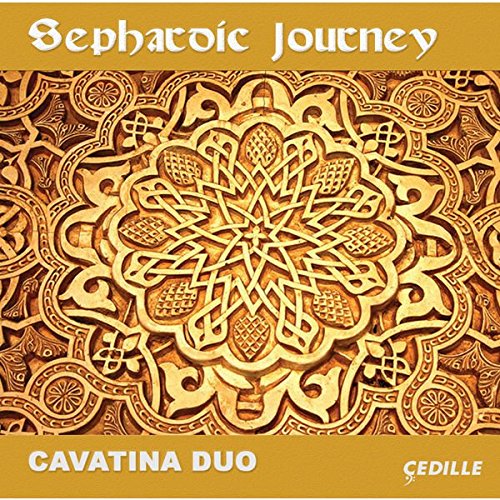
In Celebration of a Lost Culture: Sephardic Journey by the Cavatina Duo


cavaduo

Cedille CDR 9000 163

This tasty little disc of world premieres commissioned through grants to Cedille Records in Chicago consists of new works which celebrate the culture of the Sephardim, the Jews of southwestern Europe, primarily Spain.  It both memorializes and resurrects the rich music of this all but lost culture.  In the last few years we have seen a growing interest in this culture through settings of texts in the original Ladino language as well as in the melodies which sprang from their folk traditions.

The Cavatina Duo consists of Eugenia Moliner, flute and Denis Agabagic, guitar.  Moliner is originally from Spain and Agabagic is originally from Yugoslavia (now Bosnia-Herzegovina) and they are husband and wife.  Both have a strong interest in the folk musics of their respective cultures and in exploring other folk music cultures.  Their previous album for Cedille, The Balkan Project, similarly demonstrates their affection and scholarship for the cultures of that region of the world.

Five composers were commissioned for this project: Alan Thomas (1967- ), Joseph V. Williams II (1979- ), Carlos Rafael Rivera (1970- ), David Leisner (1953- ) and Clarice Assad (1978- ).  This is one of those wonderful crowd funded efforts through Kickstarter.

Thomas’ contribution adds a cello (played by David Cunliffe) to the mix for this Trio Sephardi in three movements each of which is based on a traditional Sephardic song.  The piece makes good use of the vocal qualities of the songs quoted and the lyrics seem to exist as a subtext even though they are not sung here.

Isabel by Joseph V. Williams is a sort of homage to Isabel de los Olives y López, a Sephardic woman who lived during the time of the Spanish Inquisition.  She outwardly converted to Catholicism but lived secretly as a Jew.  One can hardly miss the sad irony of this tale of religious intolerance from the 15th century and its relevance for today.  This piece is based on a resistance song which masquerades as a love song, again a metaphor for our times.  It is scored for flute and guitar.

We move again into the realm of the trio, this time with violin (played by Desiree Ruhstrat), for this piece by Carlos Rafael Rivera called, “Plegaria y Canto”.  This is the most extensive single movement amongst all the works on the disc and is a deeply affecting and dramatic piece for which the composer’s notes provide insights.

The last two pieces utilize the forces of the Avalon Quartet for whom this is their second appearance on the Cedille label.  Their first disc, Illuminations, was released last year. They are currently in residence at Northwestern University and Cedille does a great job of promoting the work of talented Chicago area musicians.

Love and Dreams of the Exile is David Leisner‘s poignant contribution.  Its three movements tell an aching tale of love, pain and, ultimately, transcendence.

Clarice Assad is a Brazilian composer too little known in the U.S.  She is indeed related to the famed Assad family of musicians and she clearly has as abundant a talent.  Her Sephardic Suite concludes this program with this three movement essay on love and relationships.

Bill Maylone is the engineer with editing by Jean Velonis and the executive producer is James Ginsburg.  Photography of the Alhambra Palace by Maureen Jameson graces the cover.  Design is by Nancy Bieshcke.

This is music of an oppressed culture and it is tempting to look upon the creative impetus which oppression sometimes seems to provide but the message here is one of sadness and nostalgia but also of hope.  It is perhaps a tribute to the ultimate triumph over said oppression even if it took 500 years.  There is some comfort and healing to be had from the celebration of this lost culture and that is the triumph of this disc.


The Anniversary That (almost) Everyone Missed: Bill Doggett (1916-1996), Wizard of the Hammond Organ


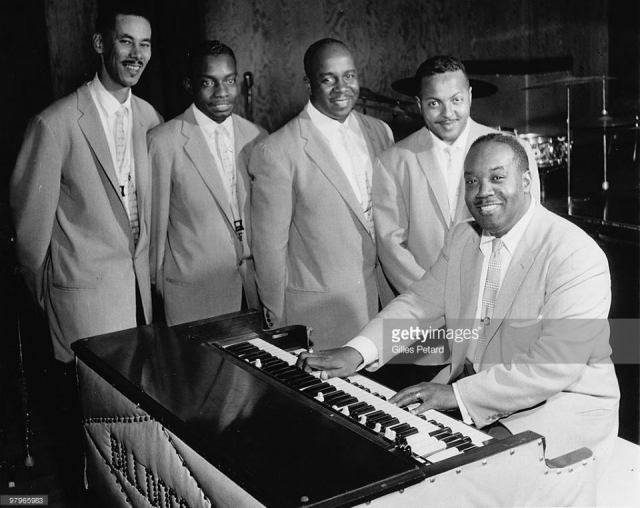
doggettcombo1956

Bill Doggett with his combo (getty images)

William Ballard Doggett, better known as Bill Doggett was born in Philadelphia in 1916 and was introduced to music by his church pianist mother.  He played in a combo while still in high school and went on to work with a plethora of stars in rock, jazz, rhythm and blues amassing a string of hits but, sadly, seems to have barely been noticed on this the 100th anniversary of his birth.  Where is NPR at a time like this?

Well, all is not lost.  Fortunately his nephew and namesake Bill Doggett is doing justice to the memory of this important American musician.  This younger Doggett is an archivist, lecturer, curator, strategic marketer, photographer, filmmaker, and arts advocate (his website is well worth your time).  I am hardly as well prepared to provide more than an overview of this musician’s work but I feel obliged to do my small part in recognizing this man’s work.

doggettposter

Promotional poster for the September 28, 2016 centennial celebration curated by nephew and namesake, Bill Doggett.

Doggett’s list of chart singles:

  • “Be-Baba-Leba” (vocal by Helen Humes) (Philo/Aladdin 106) 1945 (#3 R&B)
  • “Moon Dust” 1953 (#18 R&B)
  • “Early Bird” 1953 (#21 R&B)
  • “No More In Life” 1953 (#20 R&B)
  • “High Heels” 1954 (#15 R&B)
  • “Honky Tonk, Part 1″/”Honky Tonk, Part 2” (King 4950) 1956 (#1(14) R&B/#2(3) Pop)
  • “Slow Walk” (King 5000) 1956 (#4 R&B/#19 Pop)
  • “Ram-Bunk-Shush” (King 5020) 1957 (#4 R&B)
  • “Soft” 1957 (#11 R&B)
  • “Leaps And Bounds, Part 1″/”Leaps And Bounds, Part 2” (King 5101) 1958 (#13 R&B)
  • “Blip Blop” 1958 (#11 R&B)
  • “Hold It!” (King 5149) 1958 (#3 R&B)
  • “Rainbow Riot, Part 1″/”Rainbow Riot, Part 2” (King 5159) 1959 (#15 R&B)
  • “Monster Party” (King 5176) 1959 (#27 R&B)
  • “Yocky Dock, Part 1″/”Yocky Dock, Part 2” (King 5256) 1959 (#30 R&B)
  • “Honky Tonk, Part 2” 1961 (#21 R&B)


  • doggetthonky

    Doggett’s best known work.

While his last chart hit was 1961 his collaborations with  Lucky MillinderFrank FairfaxJimmy Mundythe Ink SpotsLouis JordanJohnny Otis, Wynonie Harris, Ella Fitzgerald, Louis Armstrong, Count Basie,  Lionel HamptonRed Holloway, Clifford Scott, Percy France, David “Bubba” Brooks, Clifford Davis, and Floyd “Candy” Johnson; guitarists Floyd Smith, Billy Butler, Sam Lackey and Pete Mayes; and singers Edwin Starr, Toni Williams and Betty Saint-Clair attest to the scope of his work.  Doggett continued to play and arrange until his death from a heart attack in New York in 1996 at the age of 80.

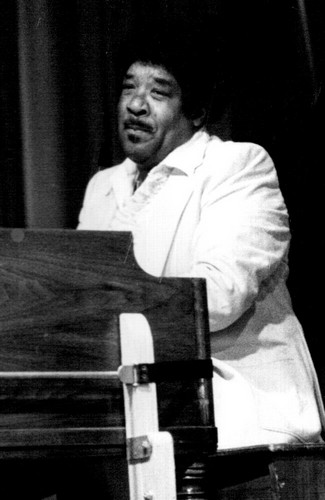
bill_doggett

Bill Doggett photographed in France in 1980 by Lionel Decoster (from Wikipedia article)

The Hammond Organ is known for being the workhorse of modern classical as well as rock, rhythm and blues and jazz.  It was Bill Doggett who became one of the early masters of this (then new) electronic instrument.  While he was also a highly competent pianist, it was with the Hammond Organ that he had his greatest success. There is little doubt that his playing has influenced subsequent musicians who took on this instrument.

Here’s hoping that astute musicians and producers will take on the task of recognizing the work of the late great Bill Doggett.  Toward that end here, from Wikipedia, is a discography of his work:

10 inch LPs

  • Bill Doggett: His Organ And Combo, Volume 1 King 295-82 (1954)
  • Bill Doggett: His Organ And Combo, Volume 2 King 295-83 (1954)
  • All Time Christmas Favorites King 295-89 (1954)
  • Sentimentally Yours King 295-102 (1955)

12 inch LPs (on King Records)

  • Moon Dust King 395-502 (1956)
  • Hot Doggett King 395-514 (1956)
  • As You Desire Me King 395-523 (1956)
  • Everybody Dance The Honky Tonk King 395-531 (1956)
  • Dame Dreaming With Bill Doggett King 395-532 (1957)
  • A Salute To Ellington King 533 (1957)
  • The Doggett Beat For Dancing Feet King 557 (1957)
  • Candle Glow King 563 (1958)
  • Swingin’ Easy King 582 (1958)
  • Dance Awhile With Doggett King 585 (1958)
  • 12 Songs Of Christmas [reissue of King 295-89 plus 6 additional tracks] King 600 (1958)
  • Hold It! King 609 (1959)
  • High And Wide King 633 (1959)
  • Big City Dance Party King 641 (1959)
  • Bill Doggett On Tour [this is NOT a live album] King 667 (1959)
  • For Reminiscent Lovers, Romantic Songs By Bill Doggett King 706 (1960)
  • Back With More Bill Doggett King 723 (1960)
  • The Many Moods Of Bill Doggett King 778 (1962)
  • Bill Doggett Plays American Songs, Bossa Nova Style King 830 (1963)
  • Impressions King 868 (1963)
  • The Best Of Bill Doggett [compilation] King 908 (1964)
  • Bonanza Of 24 Songs [compilation] King 959 (1966)
  • Take Your Shot King 1041 (1969)
  • Honky Tonk Popcorn King 1078 (1970)
  • The Nearness Of You King 1097 (1970)
  • Ram-Bunk-Shush [compilation] King 1101 (1970)
  • Sentimental Mood [compilation] King 1104 (1970)
  • Soft [compilation] King 1108 (1970)
  • 14 Original Greatest Hits [compilation; reissued as ‘All His Hits’] King-Starday 5009 (1977)
  • Charles Brown: PLEASE COME HOME FOR CHRISTMAS [this vocal album includes 4 instrumental tracks by Bill Doggett] King-Starday 5019 (1978)

12 inch LPs (on other labels)

  • 3,046 People Danced ‘Til 4 A.M. To Bill Doggett [this is a live album] Warner Bros. WS-1404 (1961)
  • The Band With The Beat! Warner Bros. WS-1421 (1961)
  • Bill Doggett Swings Warner Bros. WS-1452 (1962)
  • Rhythm Is My Business (Ella Fitzgerald with Bill Doggett) Verve V6-4056 (1962)
  • Oops! The Swinging Sounds Of Bill Doggett Columbia CL-1814/CS-8614 (1962)
  • Prelude To The Blues Columbia CL-1942/CS-8742 (1962)
  • Finger-Tips Columbia CL-2082/CS-8882 (1963)
  • Wow! ABC-Paramount S-507 (1964)
  • Honky Tonk A-La-Mod! Roulette SR-25330 (1966)
  • The Right Choice After Hours/Ichiban 4112 (1991) Note: this is Bill’s last recorded album of original material; also released on CD.

OK all you producers, have at it.


Zenobia Powell Perry, a Lost Thread


zenobia

Cambria CD-1235

These artists and this composer have graced these pages twice previously.  First in the wonderful production of Perry’s opera, Tawawa House and some of the musicians appeared in an article on Valerie Capers.  The present disc and the two previously mentioned articles are all indebted to a significant degree to the work of musicologist and composer Jeannie Gayle Pool.  It was she who kindly sent me this disc for review and her scholarship which brought forth the production of the opera (Perry was the subject of her doctoral thesis).

Zenobia Powell Perry (1908-2004) was an American composer. pianist and teacher who counts R. Nathaniel Dett and Darius Milhaud among her teachers.  Her sound is not far from that of Aaron Copland in her use of basically tonal harmonies and folk elements.  She is, in a sense, a lost populist and quite a gem.

This 25 track disc fills a major gap in the discography of American music in general and music of black Americans in particular.  Perry has roots in African and Native American (Creek) ancestry and Pool’s work may very well have rescued her from total obscurity.  The lost thread of which I refer in my title is to suggest that there is more populist and jazz influenced American music that needs to be brought to light.

Listening to this disc is pure entertainment.  These are undiscovered gems lovingly rendered with love and authority by Josephine Gandolfi, Deanne Tucker and (civil rights advocate and retired judge) La Doris Hazzard Cordell.  The entire project seems to be a labor of love and one can only hope that it will not be the last installment in the recorded canon of Perry’s work.

These 25 tracks are all brief pieces.  They range from the 1935 Childhood Capers to the 1985 suite from Tawawa House arranged for piano four hands by Josephine Gandolfi.  The entertainment here ranges from light pieces like the Childhood Capers to some more deeply thoughtful pieces with jazz inflected harmonies.  Some are quite demanding technically, a tribute to Perry’s skills as a pianist.

The Homage to William Levi Dawson on his 90th Birthday, Times Seven, Soliloquy, Nocturne, A Jazz Trifle and Rhapsody seems to be rather substantive works and pique the curiosity as to what else lies undiscovered.  The suite form Tawawa House is great but it will have to hold that place until the full opera can be recorded.  It is worth hearing, especially as one of the few operas dealing with slavery.

The very fine recording done a Bosendorfer piano at Stanford University by engineer Mark Dalrymple.  The production by Pool and Gandolfi leave this writer wanting to hear more.  Kudos!

Gene Pritsker and Some of His Collaborators, a Heady Mix


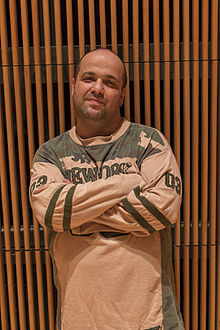
Gene_Pritsker

Gene Pritsker

We have here three very different CDs all of which feature composer/performer Gene Pritsker along with a variety of his colleagues and collaborators.  Each of these CDs is a unique production and reflects a marvelously creative group of composers and performers.

I first came to know of Pritsker’s work when he sent me a copy of his wonderful chamber opera, Manhattan in Charcoal and when I began to learn of the scope of his work through his numerous You Tube videos and his website I found myself rather overwhelmed and wholly intrigued.  In fact I can’t shake a comment which Leonard Bernstein once made about Igor Stravinsky to the effect that he was able to switch between different styles at different times with seeming ease and certainly skill (It was a comment made on a vinyl disc in which Bernstein spoke of Stravinsky in general on one cut and described the imagery of Petroushka on another.).  Pritsker’s Russian origins certainly play a part in reminding me of this association but it is the sheer extent and variety of his compositional visions and techniques that drive me to be reminded of this.  His virtuosity on the guitar also puts me in the mind of Frank Zappa at times too.  And he seems to be doing it pretty much all at once too, utilizing a wide palette of styles selectively with care and subtlety.  Pritsker switches between some very classical sounds to rock, jazz, rap, etc. as though the distinctions don’t exist or matter.  In the end they don’t matter really.  All is music I suppose and he seems be able to use them all pretty well and these discs are a nice sampling of some of this interesting musician’s various guises and interests.

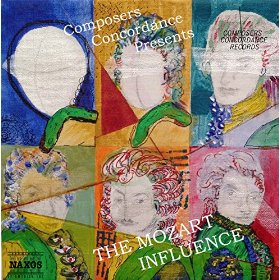
mozart inf

ComCon0030

Fortunately I am not attempting a comprehensive cataloging of all that but rather reviewing a nice little selection of some current releases which Mr. Pritsker was kind enough to entrust to my critical ear.  First up here will be a Mozart tribute of sorts. Regular readers may recall another entertaining Mozart-based recording by John Clark (here). Indeed Mr. Clark makes an appearance here both as composer and performer.  This curious little disc consists of short, clever glosses on Mozart by Gene Pritsker, Patrick Grant, John Clark, Milica Paranosic, Dan Cooper and David Taylor.  Pritsker in particular seems to have a penchant for reworking music by other composers.  His Bach-based works also deserve attention as well.  But that is another matter.

There are 13 tracks and all have a somewhat improvisational character.  Of course variation forms are ubiquitous and varied throughout music history and these are, if not strictly speaking, “variations”, then something close which is why I have chosen the term glosses.  But all are entertaining and reflect a sort of new music take on Mozart who appears to have some meaning for each of the composers (Mozart is my desert island composer by the way).  I am sure that Mozart himself would have been amused and honored.  These are most certainly homage at the very least.

The CompCord Ensemble consists of Charles Coleman, voice; Chanda Rule, voice; Milica Paranosic, voice/gusle; Patrick Grant, voice/harpsichord; Lynn Bechtold, violin; Dan Barrett, cello; John Clark, horn; David Taylor, bass trombone; Gene Pritsker, guitar; Dan Cooper, bass; Javier Diaz, percussion/voice; Gernot Bernroider, drums; Franz Hackl, trumpet.

There are no liner notes here and perhaps that is for the best.  I have no doubt that there are a great deal of personal stories here as to how these pieces came about and what they mean to the respective musicians but they do stand on their own as entertainment and to my ear sound like they could even work as a film soundtrack (most likely a non-American film). This is entertaining material, perhaps a bit “inside” with its references but not difficult or obscure.   I will leave it to some future musical archaeologist to elucidate those details. The listener need only sit back and be entertained.

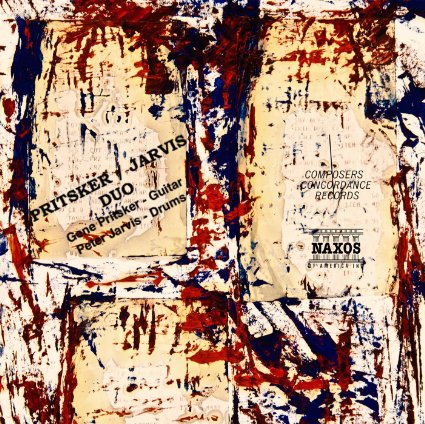
pritssker jarvis

ComCon0032


Now to the second disc.  This is quite different in character being a duo between a guitarist (Gene Pritsker) and a drummer (Peter Jarvis).  Such scant scoring tells one nothing about what is to come.  Each of the six tracks is by a different composer (Peter Jarvis, Gene Pritsker, David Saperstein, Joseph Pehrson, Jessica Wells and Daniel Palkowski).  As with the previous disc there are no liner notes so one is left with nothing but the sound.

This appears to be much more of an improvisational nature than the previous recording considered above.  The style here ranges from free jazz to rock and perhaps some contemporary musical styles as well.  Each track is a succinct statement and none of the tracks seem to go longer than necessary.  The musicianship is superb so if you are fond of the sound of guitars and drums played creatively and well you will enjoy this disc.  These musicians extract a great deal of varied sounds from their instruments.

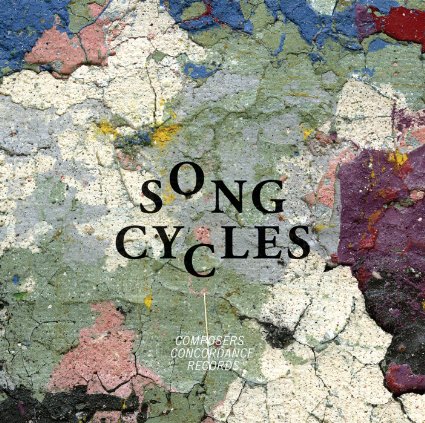
song cycles

ComCon0029


Finally we have this disc of song cycles.  Now the only song cycles I know at all well are those of Franz Schubert but that is, I think, an adequate place to begin to understand what is going on here (still flying without liner notes).

Eight composers and eight poets are featured in six song cycles. The first and last cycles (tracks 1-3 and 16-19) are the only ones which include instruments in addition to the voice and piano.  Only one song here (Inside on track 15) features poetry by the composer.  The rest, like Schubert utilized existing poetry.

Most of these composers are unknown to me which is both the joy and the bane of reviewing such discs.  All of these fall roughly into the classical art song tradition even with their occasional blues inflections (as in the Pritsker songs) or extended instrumental techniques.  David Gutay, Zach Seely, Patrick Hardish, Luis Andrei Cobo, Eleanor Cory are all new names to me and it Mr. Pritsker is to be commended for his efforts to promote others’ music.  The two composers here who are familiar are Mr. Pritsker and, another reason for commendation, Lester Trimble (1923-1986), a man embraced by Leonard Bernstein and cut from similar sonic cloth as both Bernstein and Copland.  This recording of Trimble’s Canterbury Tales is a welcome addition to the discography of mid to late twentieth century masters who deserve at least another listen.

The poets include: Tony Roberts, Jacob Miller, Dorrie Weiss, Jennifer Michael Hecht, Emily Dickinson, Richard Wilbur, Eleanor Cory and Geoffrey Chaucer.

Performers include Elizabeth Cherry, soprano; Thomas Carlo Bo, piano; Katie Cox, flute; Charles Coleman, voice; Derin Oge, piano; Patricia Songego, soprano; Taka Kigawa, piano; Lynn Norris, soprano; Amir Khorsrowpour, piano; Eleanor Taylor, soprano; Christopher Oldfather, piano; Circadia Ensemble consisting of: Melissa Fogarty, soprano; Kaoru Hinata, flute; Christopher Cullen, clarinet; Jenifer Griesbach, harpsichord (in the Trimble cycle).

The performances are uniformly excellent albeit a collection of separate recordings all mastered, as were the previous two discs by Sheldon Steiger.  If you love art song this is a treasure trove of current compositions but with a healthy respect for the past.


Classical Protest Music: Frederic Rzewski- The People United Will Never Be Defeated


In an earlier post (Political Classical Music in the Twentieth and Twenty First Centuries, posted on March 20, 2013) I discussed a project in which I would identify what I have deemed significant works in this genre.  I have decided to narrow the topic to those works which are inspired by or are intended to express dissatisfaction with given sociopolitical issues.  This will then leave out works which are friendly to the political situation such as Aaron Copland‘s ‘Lincoln Portrait’ and ‘Fanfare for the Common Man’. These are both great pieces of music but their presentation is more celebratory than critical.

Dag in de Branding 11 - Frederic Rzewski

Dag in de Branding 11 – Frederic Rzewski (Photo credit: Haags Uitburo)

So without further discussion (a proposed taxonomy of classical political music will be discussed in a future blog post) I wish to present another blog in that series.  The work up for discussion is the large set of piano variations composed in 1976 for the pianist Ursula Oppens.  Rzewski is well known for his virtuosity and for his support of and definitive performances of new music.  He is also known for quite a bit of music with political themes.  Some of those other works  will likely be the subjects of future posts in this series.

Logo de la banda Category:Quilapayún

Logo de la banda Category:Quilapayún (Photo credit: Wikipedia)

Rzewski took as his starting point a popular song by Sergio Ortega (1938-2003), a Chilean composer and pianist.  He wrote the song in 1973 with lyrics written by members of the musical group Quilapayún who subsequently recorded it.  Quilapayún recorded no less than 26 studio albums from 1966-2009 along with several live albums.  They are a part of the Nueva Canción Chilena which sought political change through new songs defining those changes.  The Nueva Canción movement became a subset of Latin American and Iberian folk-inspired protest music which saw groups form worldwide producing songs which became part of the soundtrack of political protests in those various countries.

English: The Inti-Illimani logo Español: Logo ...

English: The Inti-Illimani logo Español: Logo Inti-Illimani (Photo credit: Wikipedia)

After the 1973 coup which deposed and likely assassinated Salvador Allende the song was popularized also by another Chilean group, Inti-Illimani.  Both groups along with many political dissidents sought and found asylum in other countries.  Inti-Illimani found refuge in Italy, Ortega and Quilapayún settled in France.

This major opus was written on commission for Ursula Oppens who asked for a companion to the Beethoven Diabelli Variations, certainly a tall order.  Rzewski wrote the piece in 1975 no doubt inspired at least in part by the 1973 coup which deposed Salvador Allende and installed the dictator Augusto Pinochet.  The piece consists of 36 variations grouped in 6 sets of 6 variations each.  In a nod to Bach’s Goldberg Variations the final variation is a restatement of the theme.  In addition to the main theme there are quotations from an Italian socialist song, “Bandiera Rossa” and “Solidarity Song” with words by Bertold Brecht and music by Rzewski’s former teacher, Hanns Eisler.

Oppens premiered the piece on February 7, 1976 at the Bicentennial Piano Series at the John F. Kennedy Center for the performing arts in Washington, D.C.  She made a grammy nominated recording of the work in 1979 and the piece has enjoyed numerous subsequent performances and recordings.

The piece is structured symmetrically in six sets of six variations each.  It also allows for a bit of improvisation.  But this is an eminently listeninable piece which seems rightfully to be gaining its place in the repertoire.  This is evidenced most recently in Sony’s decision to include this set of variations along with those of Bach (Goldberg Variations) and Beethoven (Diabelli Variations) in a boxed set which I reviewed here.

Rzewski himself has recorded the piece four times (1977, 1990, 1999 and 2007).  The last recording is a video of the performance. Having seen Rzewski perform this piece live in 1989 I can tell you that his performance is a pleasure to behold.

Several other pianists have released recordings (not counting several good ones on You Tube) including Marc-Andre Hamelin, Stephen Drury, Kai Schumacher,  I look forward to other recordings hoping to hear interpretations from Sarah Cahill, Bruce Brubaker, Lisa Moore, R. Andrew Lee and Nicolas Horvath to name a few.

Whether this work had any impact on the atrocities of the repressive Pinochet regime is certainly doubtful but the fact that this piece has essentially entered the repertoire for virtuoso pianists and stands as a monumental achievement in the variation form will pretty much guarantee that the atrocities and their perpetrators will be recalled and hopefully reviled at each and every performance.

Enhanced by Zemanta

A Grand Early Start to Black History Month


BHM160006

The United States (unlike England who use the 31 day month October) has chosen the shortest month of the year to celebrate Black History  but I have managed to get 30 days to celebrate this year by starting a day early in this leap year.  Basically I cheated, deal with it.

This is the year of the last term of our first black president and, while that is a historically significant fact, so are the facts of the police killings that demands the development of interventions like “Black Lives Matter” to remind society of a fact that should be obvious but clearly is not, that we have a serious human rights crisis here.  However, rather than getting into yet another acknowledgement of our racist society, I am interested in sharing a wonderful positive experience that I hope will provide as much inspiration to my readers as it did to the fortunate folks who attended this night’s festivities.

Friend and colleague Bill Doggett kindly made arrangements for me to attend this annual fundraising event at the Eastside College Preparatory School and sponnsored by the African American Composer Initiative  and the San Francisco Friends of Chamber Music.  The featured guest was composer/pianist Valerie Capers (1935- ) a Julliard trained pianist and composer. She was joined by a wealth of highly skilled musicians in a fascinating program of music and arrangements by Capers, John Robinson and several others.

The well attended evening began with a couple of vocal numbers done by the Eastside Preparatory School Choir followed by the playing of the beginning of a documentary film about Ms. Capers (Dr. Valerie Capers: Dream Big, 2015).  In the excerpt she talks about her life, losing her sight and the importance of music to her.  She is a delightfully positive, optimistic and energetic person and, as we saw later, a powerful and inspiring musician. This became even more evident when we were treated to the live interview conducted from the stage by LaDoris Cordelle, herself an accomplished pianist and singer as well as a respected lawyer, judge and activist.

BHM160002

LaDoris Cordelle (left) interviewing Valerie Capers

Participating this evening were the Eastside Preparatory School Choir conducted by David Chaidez, soprano Yolanda Rhodes, vocalists/pianists LaDoris Cordell and Deanne Tucker, pianist Josephine Gandolfi, violinist Susan C. Brown, cellist Victoria Ehrlich, and clarinetist Carol Somersille along with guest artists Valerie Capers, John Robinson (bass, composer), Jim Kassis (percussion), Rufus Olivier (bassoon), Stephanie McNab (flute), John Monroe (trombone), John Worley (trumpet) and Lauren Sibley (narrator in “Ruby”).  I must say that the musicians this evening were truly spectacular and seemed to work even harder in their homage to guest of honor Valerie Capers.

The musical program properly began with the performance of John Robinson’s Fanfare for an Uncommon Woman (2015).  The work whose title echoes Aaron Copland’s populist Fanfare for the Common Man (1941) and was written in honor of Ms. Capers.  This was followed by several of Capers’ Portraits in Jazz (1976) compositions and her take (not at all like Vivaldi’s) on the four seasons in her, Song of the Seasons (1987).

BHM160005

Valerie Capers with John Robinson acknowledging the grateful applause.

The first half of the program concluded with Capers’ Winter Love, her gloss on Wagner and her arrangement of Duke Ellington’s “Don’t Mean a Thing if it Ain’t Got that Swing”.

The second half began with Bird Alone, an Abbey Lincoln song arranged by Capers.  This was followed by another composition from Mr. Robinson, “Tarantella with a Twist of Lime” (2015), a catchy somewhat humorous piece, and then “Doodlin'” by Horace Silver.

Next up was a work in a genre of great interest to this reviewer, that of a political classical piece written to express political ideas.  Ruby (2013) with text and music by Valerie Capers is a work for narrator, vocalists and ensemble that tells the story of Ruby Bridges who, in 1960, became the first black child admitted to the the all white William Frantz Elementary School in New Orleans, Louisiana.  She had to be accompanied by Federal Marshals under orders from then President Eisenhower.  Bridges was the only black student and was taught by the only teacher willing to teach a black student, Barbara Henry who remained Bridges teacher for the entire year and there were no other students in that classroom though some white families did eventually send their children back to the school where they were taught in their accustomed segregated fashion (ironic here too because New Orleans had had the beginnings of an integrated school system prior to the civil war). Bridges and her family suffered many indignities as a result of her participation in this landmark event, a critical step in the Civil Rights Movement. This was a powerful and touching piece performed with reverence, sympathy driven by the hindsight of the accomplishment itself as well as the frustration and sadness that even some 50 years later the struggle still continues.

BHM160007

The Grand Finale

The evening concluded with a group performance of Capers’ arrangement of the iconic spiritual, “Eyes on the Prize” whose strains provided some of the soundtrack of the civil rights struggles of the 1960s.  It is a hymn which still offers much inspiration.  It was a joyful and optimistic evening much like the times 50 years ago whose struggles now rest on the shoulders of yet another generation hoping, praying, working and performing amidst adversities that seem to never end.  But even a progress measured in inches is still progress.

The reception which followed was catered by apprentices from a group called, “Worth Our Weight” (based in Santa Rosa) which teaches culinary and catering skills to minority students.  Various tasty little sandwiches, meatballs and pastries tended to our palates while we took advantage of the opportunity to meet the performers.

I took the opportunity to meet and talk briefly with Capers whose energy was unabated belying her 80 years as she greeted a wealth of appreciative audience members.  I commented to her that I thought her vocal writing sounded a bit like Mahler  Capers paused oh so briefly before stating with her characteristically good humor and a knowing smile, “I think that’s  compliment.” Indeed it was.


The Big Piano Variations, a great new recording of Bach, Beethoven and Rzewski


71Dr+79MpxL._SL1200_

Let me start by saying that I specifically requested the opportunity to review this October, 2015 release because I was pleased and fascinated to see this representation of three major masterworks of the large variation form included in a single collection.  To my knowledge this is the first time that these three works have been represented in a single release.

Variation form is one of the staples of the composer’s arsenal of techniques for well over 400 years now but the form is most commonly used as one technique in one  of several movements of a larger work. Consequently these types of variations generally last a few minutes.  A favorite example is the variations movement from Schubert’s “Trout” Quintet, a set of variations on his song, “Die Forelle” (trout in English) which subsequently lends the title to the entire work for piano quintet. This variation movement runs about 7 minutes or so in performance.  The Goldberg Variations (1741) can run up to 2 hours if one includes all the repeats but generally performances take about an hour.

So, along comes Johann Sebastian Bach who is commissioned by one Count Herman Karl von Keyserling (1697-1764) to compose some music for harpsichord (the predominant keyboard instrument of the day) to be performed by his personal musician Johann Gottlieb Goldberg (1727-1756) to aid the count’s insomnia.  The original intent apparently was to have the player perform one or two of said variations as a sleep-inducing remedy upon the Count’s request.  The work, using a brief Sarabande from the Bach’s own Anna Magdalena Notebook collection of pieces, has since taken the performer’s name as the Goldberg Variations.

It is not clear when the practice of performing the work in it’s entirety began but there is little doubt that Glenn Gould’s 1955 recording for Columbia Records (now Sony Classical) placed this piece firmly in the repertoire and in the minds and hearts of musicians and the listening public.  The variations had been recorded before by Rudolf Serkin, Wanda Landowska, Claudio Arrau, Ralph Kirkpatrick, Gustav Leonhardt and Roslyn Tureck but Gould’s quirky interpretation apparently defined a moment.

In 1819 the publisher Anton Diabelli composed a waltz and sent it out to many composers of the time asking them to write a variation on his piece with the promise that the collection would then be published.  This was not an uncommon practice at the time and it is certainly a workable business plan.

Indeed Diabelli did publish a compendium of these 50 plus variations by many composers of the day (including Franz Schubert and the 11 year old Franz Liszt) as Vaterländischer Künstlerverein (the link will take you to the downloadable score of the non-Beethoven variations on the waltz) but these are largely now forgotten.  Beethoven apparently balked at the idea or simply saw a larger potential in Diabelli’s brief waltz because he chose to write not one but 33 variations on the theme which subsequently became Volume II of Diabelli’s project.

Unlike the Goldberg Variations the Diabelli Variations (1823) were intended as a concert piece to be performed in its entirety.  Like most of Beethoven’s music this piece found a place in the repertoire and remains a staple for many pianists.  It is not clear if Beethoven was familiar with Bach’s work but the gesture is certainly similar in creating a large cohesive set of variations.

In 1975 the fabulous pianist Ursula Oppens commissioned Frederic Rzewski to write a set of variations that could be a companion piece to the Diabelli Variations.  Rzewski composed the music and Oppens premiered it in 1976.  Her subsequent recording from 1979 was nominated for a Grammy Award.

Frederic Rzewski (1938- ) is a composer/performer as were Bach and Beethoven.  He is a highly virtuosic pianist and a prolific composer whose influence extends widely from his involvement in the European avant garde including his own innovative use of early electronics in his ensemble Musica Elletronica Viva with Alvin Curran, Richard Teitelbaum, Allan Bryant, Carol Plantamura and John Phetteplace.

Rzewski’s variations are based on a revolutionary song by Sergio Ortega called, “El Pueblo Unido Jamás Será Vencido” (The People United Will Never Be Defeated), a song popular during the Chilean revolution that deposed Salvador Allende.  Unlike Bach and Beethoven, Rzewski’s music frequently takes on political associations, usually pretty explicitly as seen in this piece.

There are  36 Variations (6 groups of 6) and, like the preceding pieces are a reflection of much of the performance practice of their respective times.  Various “extended techniques” include slamming the lid of the keyboard, whistling and others are carefully integrated into this very cohesive mostly tonal work.

This piece seems to be gaining ground as familiar repertoire in the concert hall and, whether by accident or design, the inclusion of this piece along with the other two by Sony (who, you will recall released the establishing version of the Goldberg Variations) in effect is a major acknowledgement of this piece as perhaps the foremost representation of the large variation form in the 20th century much as the Goldberg and Diabelli Variations represent the 18th and 19th.  Bravo, Sony!

The interest here too is the emergence of a new artist, the Russian pianist Igor Levit (1987- ). This is his third release on Sony Classical, the previous two being the 2 disc set of the Beethoven late piano sonatas and the 2 disc set of the Bach Partitas for keyboard.

I won’t go into the nuances of interpretation that distinguish Levit from other performers of these variations except to say that he has to my ears a lighter touch, more Chopin in spirit than Liszt perhaps.  His performances leave no doubt as to his virtuosity and interpretive abilities but, of course, there are always discussions of individual preferences for one or another pianist in such repertoire.  What is undeniable is his ability to grasp the larger picture and to perform these large masterpieces in such a way as to convince the listener of the integrity of each work and to hold the interest of the listener throughout the performances.  There is, in the end, no definitive recording of any music really but these are certainly candidates in the debate.

In short this is a fine set of discs, beautifully recorded, which would please anyone interested in classical music and piano music in general.  Over time one might want to hear other interpretations but these recordings are extremely satisfying and represent  their composers as well as any I’ve heard.

Blackness, Race and Music, What I Have Learned So Far


Two years ago, when I was just at the start of my blogging adventures, I decided it would be a good idea to do a few articles in honor of Black History Month. I am not black and I have no expertise in the area of black music but, in keeping with the personal perspective of this blog, I decided that my interest in these subjects is sufficient reason to express some opinions and ideas.  I chose Carl van Vechten’s portrait of William Grant Still, considered by many to the first major black composer to receive recognition in the 20th Century as my symbol for this article.  Much of his music remains unknown and little performed though there have been some significant recordings released in the last few years.

I called that first set of articles “Black Classical”. Curiously my brief article on black conductors has been one of my most read pieces (947  views as of the time I write these words).   So I continued to write on this subject in the following year. For my second set of articles I took the opportunity to look at the 50 year anniversary of the Civil Rights Act of 1964, by all measures a landmark piece of legislation. I asked a question, in part rhetorical because I had a basic idea of the answers I expected, but also to elicit opinions and to discuss issues of race and music.

I sent queries to a random set of composers and conductors and received a few very gracious replies. Comments ranged from carefully worded egalitarian musings on how black music and music by other racial minorities should be integrated and heard throughout the concert seasons to seemingly careful statements suggesting that this might not even be the right question or that it shouldn’t be asked. Not all comments were published but I am grateful to all who replied. And I have been able to continue this discussion in the various groups on Facebook.

I learned in a (yet to be published) interview with Anthony Davis some fascinating perspectives. Professor Davis did not address my question as I originally asked but he provided some valuable food for thought. It is worth noting that Davis is a composer whose politics are frequently very much in evidence in his music. In a discussion of the current state of music he commented regarding John Cage‘s apolitical stance by saying that, “John Cage’s silence is the silence of white privilege.” One could argue that taking an apolitical stance may have contributed to Cage’s ability to get grants and commissions.  Politically charged music generally does not fare as well.

In general I found more or less what I expected. The Civil Rights Act of 1964 has had little, if any, benefit for black musicians and composers. And given the ongoing killing of unarmed black men by police one must wonder if we have been going backwards as a society. But I don’t want to do a grand social critique here. That is a subject for another blog and is a bit outside of my scope at least for now.

I found some musicians who did not want to address racial and discriminatory issues. It seems the issue is too “hot” and that one could face consequences for even asking the question. And some did not feel sufficiently well-versed in Civil Rights history to make a truly informed assessment of this issues.  Perhaps it is a form of white privilege that allows me to ask such a question. We shall see if any reactions result in verbal attacks or (not likely I think) in a reduction in my readership.

What I have learned is that black classical musicians (who are not in short supply) occupy very few prominent positions in academia, in the public sphere of conductors and performers and in the representation in recorded performances of what is a rich but virtually untapped repertoire.  The inequality remains with perhaps some progress but not enough to pronounce the issues here as resolved to a truly significant degree.  But there is a vibrant community of black musicians who are working as did their predecessors to contribute to our collective culture and the discussions are both lively and stimulating.

In 2014 there was a performance by the Cincinnati Symphony of an Oratorio, “The Ordering of Moses” (1937) by R. Nathaniel Dett. The premiere performance of the piece (a beautiful and listener friendly piece of music) was broadcast live. But that broadcast was truncated, leaving out the finale when white listeners complained about music by a black composer getting so much airtime. Happily the entire piece was broadcast uninterrupted and made available in streaming format. However there is no commercial recording of this grand biblical choral work.

I was pleased to be able to review the fully staged performance in May, 2014 of Zenobia Powell Perry‘s opera Tawawa House (1984) in the unlikely venue of Modesto, California by Townsend Opera.  It was a heartfelt and beautiful production and was reviewed here.

Another interesting event in 2014 was the first appearance of three black counter tenors in a performance of a Purcell Opera in Los Angeles.  My blog on this subject can be found here.  I was pleased to make the acquaintance of Mr. Bill Doggett who has been very helpful in keeping me up on the latest developments with black musicians and composers and was the person who alerted me to this historic event.

Coming up in March at the Other Minds festival there will be performances by Errollyn Wallen and Don Byron.

I have been able to dialog with various black musicians on Facebook most notably through the groups Black Composers, The National Association of Negro Composers and Opera Noir.  Composer, performer and conductor Anthony R. Green is posting the name of a black composer every day for the month of February with examples of their work.

Some recent films have done much to tell the very unpretty history of black people in the United States including: 12 Years a Slave (2013), after Solomon Northrup‘s harrowing memoir,  Fruitvale Station (2013), a retelling of the execution style shooting of Oscar Grant at the hands of police in Oakland, California, Selma (2014), a dramatization of the 1965 march in support of voting rights (musical direction by Jason Moran).  And this trend, happily, seems to be on the rise providing artistic historical narratives to aid in the processing of the complex, shameful and painful histories depicted.  The lack of recognition by the motion picture industry supports my arguments for the poor representation and acknowledgement of black artists in general.

I have to mention that the wonderful set of recordings by Paul Freeman originally released on Columbia records remains available as a boxed set of 9 vinyl records with notes from the College Music Society now being offered at only $17.50 (that is not a typo either) via mail order.  I’m going to buy a couple of extra copies to give away as gifts.  It’s a really nice set.

Perhaps the most useful thing I learned is the egalitarian approach by conductor Michael Morgan who stated his desire that music by ethnic groups be integrated into programming on a regular basis rather than being highlighted in a given month.  (I am pleased to report that maestro Morgan will be receiving an award for his service to new music from the American Composers Forum.)  I am now using that approach with this blog in which I will continue to highlight the work of musicians and other artists whose work I find interesting and worth promoting.  So please stay tuned.


Game of the Antichrist, a spectacular new music drama by Robert Moran


Cover of Game of the Antichrist

Game of the Antichrist (Innova 251)

Despite the title, this is neither a Stephen King adaptation or that of a given miniseries.  This is an actual medieval mystery play which was performed to disseminate religious ideas during that period.  The medieval passion plays are better known but eclectic composer Robert Moran managed to find an actual drama and added to it his unique blend of experimentalism, minimalism, jazz and lyrical melodies to create this visually and musically striking (there is a Video here) setting of this forgotten little play.

Moran (1937- ) studied in Vienna with Hans Erich Apostel, a student of both Berg and Schoenberg.  He earned a master’s degree from Mills College having studied with Darius Milhaud and Luciano Berio.  He has produced everything from electronic music, to happenings involving whole cities and has written in musical styles derived from chance operations to minimalism and is not afraid to write beautiful melodies.  His collaboration with Philip Glass in The Juniper Tree (1985) is a fine example of his facility with vocal writing and music drama.

This drama is performed in a cathedral space and Moran takes advantage of the resonant space by the inclusion of Alphorns, harp and organ whose tones are transformed in part by that space.  Musical styles vary suited to the unfolding drama and work well with the staging of the piece.

Moran, who professes a love of opera since about the age of 9 or 10 has a great sense of the dramatic and for beautiful vocal writing.  He says he listens to operas all the time.  His 2011 Trinity Requiem was written for similar forces and performed in a similarly resonant space also to great effect.  And his sense of eclecticism allows him to select from a wide variety of musical styles and effects.

The end result is, for this reviewer, a very successful integration of the composer’s various skills and influences.  It would be hard to imagine a better setting of this piece.  He starts with an anonymous text from Quirinus Monastery Cloister Tegernsee in Bavaria ca. 1150 and, with Alexander Hermann, creates a realization for performance.  The piece is scored for children’s chorus, vocal ensemble, soprano, mezzo-soprano, counter-tenor, oboe, english horn, Alp horn, Bar piano and organ.  In addition there are two other defined ensembles consisting of harp (representing the Heathen and his Babylonian followers), guitar, recorders and synthesizer (representing the Synagogue and Jerusalem), trumpets, horn, trombone, bass trombone, tuba and percussion (representing the Church and its Devotees).

There are roles for dancers and, in the performance depicted on the CD cover, choreography by Jarkko Lehmus and Bettina Hermann design by George Veit and menacing puppets created by Fabian Vogel.  Unfortunately there are no current plans to release a DVD of this work but settling for the music alone is hardly a terrible sacrifice.  Moran brings his eclectic musical range, knowledge of opera and music theater combined with careful selection of dramatic text to create a piece that can work as aural theater as well.

The disc concludes with another piece, Within a Day (2014), of aural theater which, in this case, has no specified stage actions.  It is a collaboration with the Thingamajigs Performance Group, Edward Shocker’s improvisational ensemble.  It is an example of Moran’s ability to write less determined music as well as his ability to collaborate with other creative artists.  The piece premiered at San Francisco’s Center for New Music in January, 2014 and subsequently recorded in Lisser Hall at Mills College in May, 2014.  It is a collective improvisation based on what appears to be an indeterminate score by the composer.

This is a clearly different music with more abstract aims and it contrasts strangely with the music drama but this is a good example of Moran’s facility with the art of composition as well as collaboration (Can you get more collaborative as a composer than an indeterminate score?).  This more ambient sort of music is a little sonic theater for the mind based loosely on Moran’s interest in Tibetan texts invoking the gods and goddesses through their chants.

This disc made one of my best of 2014 and I highly recommend it for listeners interested in music drama and sound theater.

The Three Black Counter Tenors, An Historic First


The original incarnation of three classical singers with the same range performing as an act was that of the late Luciano Pavarotti, Placido Domingo and Jose Carreras.  I seem to remember a similar act with three Irish tenors that followed on their model.  Well what we have here is a far more unusual and very historically significant collection of three counter tenors, that voice range of male falsettos roughly corresponding to mezzo-soprano in range.  This is certainly one of the least common type of vocal artist but what makes this a unique historical event is that all three are African-Americans (to use the currently politically correct term).  They’re not performing as an act, though.  They are all starring in a single opera which makes this event even more compelling.

Darryl Taylor

Darryl Taylor

This will happen in the context of performances of Henry Purcell’s 1689 opera, “Dido and Aeneas” in Los Angeles.  I include this in this new music blog because it is certainly a new occurrence and it fits well with my ongoing survey which has looked at black composers since the 1964 Civil Rights Act.  Of course this event puts the focus on black performers, an area which I have not attempted to explore.  But is is nice to see this happening in the 50th anniversary year of that landmark legislation.

I only came upon this information when a highly valued friend based in Oakland, Bill Doggett, who is acting as a consultant to the L.A. Opera alerted me to this historic first.  He recently curated a well received exhibition in the Grand Foyer at the San Francisco Opera at the performances of Porgy and Bess.  Bill is a concert producer, strategic marketer, consultant, arts advocate and lecturer whose work promotes black classical artists.  It was he that suggested that this event would fit with the themes developed in my previous blogs.  I did share with Mr. Doggett my experience seeing Mary Zimmerman’s beautiful production of Philip Glass’ Akhenaten in Chicago which featured a black counter tenor named Geoffrey Scott whose name, sadly, seems to have disappeared from the web except for that production.  What was curious about that is that I vividly recall the audience’s reaction when he first came on stage.  It is perhaps more historically accurate to cast a black man as an Egyptian Pharaoh but the audience seemed shocked by his appearance and I didn’t feel that it was just because of his vocal range.

John Holiday

John Holiday

The three singers in this new production include John Holiday, Darryl Taylor and G. Thomas Allen all of whom are making their début performances with L.A. Opera.  Holiday, who will sing the role of the sorceress was the third place winner in this year’s Operalia, a competition founded by  Placido Domingo for singers aged 18-32.  Taylor and Allen will sing the roles of the witches in a production which, as far as I can tell will be the first time three black counter tenors will be appearing on an opera stage  in  the history of the art form.  Taylor is a voice teacher on faculty at the University of Michigan at Ann Arbor  and Allen appears to be a rising star whose art we will see at an early point in his career.

Correction: Darryl Taylor is now Associate Professor of voice at Claire Trevor School of the Arts  University of California,Irvine.

G. Thomas Allen

G. Thomas Allen

This performance will be a double bill with the other half of the program being a production of Bartok’s Bluebeard’s Castle.  The productions will run from October 25th to November 15th.  Below I am sharing the press release of this historic event.  One hopes that this historic first will shed a more sympathetic light in these embattled times where, in spite of such wonderful historic performances, we endure a correspondingly negative series of news events like those in Ferguson, MO, New York and so many other places where the value of black lives seems to be at a very low ebb.3CountertenormediaNEW.doggett

Black Conductors, a belated addendum


Due to the popularity of my earlier black conductors article I was feeling the need to expand this piece a bit.  Again this is by no means comprehensive and I welcome comments, additions and corrections.


The original article was just an occasional piece, far from comprehensive so I have decided to add a few names.  First the black conductors who are no longer with us:


Charles-Richard Lambert (d. 1862)- Born in New York (no date given), settled in New Orleans and was a music teacher and conductor for the Philharmonic Society (the first non-theater orchestra in New Orleans).  He died in Port-au-Prince, Haiti.

Edmond Dédé (1827-1903) Born in New Orléans, he moved to Europe to study music and settled in France where he had a career as a conductor and composer.

Edmond Dede

Edmond Dede

William Grant Still photographed by Carl van Vechten

William Grant Still photographed by Carl van Vechten


William Grant Still  (1895-1978)- In addition to being a major American composer and the first black composer to have a symphony played by a major symphony orchestra to have an opera premiered by a major company (Troubled Island, written in 1939 was premiered by the New York City Opera in 1949), the first black composer to have an opera broadcast on television (Bayou Legend, 1941, not performed until 1974 and broadcast 1976 by the Mississippi Educational Television Authority) he was also the first black conductor to conduct a major American orchestra in the deep south  (New Orleans Philharmonic, 1955)

Calvin E. Simmons

Calvin E. Simmons


Calvin E. Simmons (1950-1982) The first black conductor to be appointed conductor of a major American orchestra (Philadelphia Orchestra).  He died in a canoeing accident near Lake George in New York.  The Calvin Simmons theater at the Henry J. Kaiser Convention Center in Oakland, CA is named in his honor.


And now to those who remain on the earthly plane:


-Thomas Jefferson Anderson (1928- ) Better known perhaps as a composer is an educator he is also an accomplished conductor, educator and orchestrator.  He is well-known for his orchestration of Scott Joplin’s opera Treemonisha (unfortunately this has yet to be recorded).


-Leslie B. Dunner (1956- )Born in New York City, he attended the Eastman School of Music, Queen’s College and received a Master’s Degree in 1979 from the University of Cincinnati Conservatory of Music.  He was the first American (of any color apparently) to win the Arturo Toscanini International Conducting Competition in 1986.  Currently a conductor for the Joffrey Ballet in Chicago, Mr. Dunner has conducted the Chicago Symphony, the Grant Park Orchestra, the New York Philharmonic, Detroit Symphony, L A Philharmonic and many others world-wide.


Leslie B. Dunner

Leslie B. Dunner


William Eddins

William Eddins (Photo credit: Wikipedia)


William Eddins (1964- ) Both a pianist and a conductor, Eddins was a founding member of the New World Symphony in Miami, FL and is currently the principal conductor of the Edmonton Symphony Orchestra since 2005.  He regularly performs music by 20th and 21st Century composers and host a podcast called Classical Connections.


-Robert Keith McFerrin, Jr. (1950- ) Better known as “Bobby McFerrin” is a ten time Grammy award winner.  He is also a popular guest conductor with orchestras such as the San Francisco Symphony, the Chicago Symphony, New York Philharmonic, Detroit Symphony, Israel Philharmonic and many others.

Bobby Mc Ferrin in 2011

Bobby Mc Ferrin in 2011


As I said this is hardly comprehensive but these omissions have bothered me more each time I see that the original post has been read again.  Hopefully this will assuage my guilt and provide useful information.


Tawawa House in Modesto? A New Staging of Zenobia Perry’s Opera.


Modesto California is not a common destination for new music productions but I learned of an upcoming performance of Tawawa House by Zenobia Powell Perry (1908-2004).  It was written in 1984 and premiered in 1987 at Central State University in Wilberforce, Ohio (actually the geographic setting of this opera) where she was part of the music faculty from 1955-1982.

I only learned of this performance due to my Facebook contact with Bill Doggett, a bay area business developer and marketing consultant who focuses on music by people of color.  The production is staged by Townsend Opera at the Gallo Center for the Arts in Modesto, CA.  It was the world première of a revised libretto and orchestration by Perry scholar Jeannie Gayle Poole.

After a mostly pleasant two-hour drive I arrived for my first visit to the central valley town.  I  located the beautiful arts complex and proceeded from a warm sunny spring day into one of several theaters housed in the same building, an arts multiplex, if you will.  The theater was about 2/3 full, a good sign.  It is a large and well-designed theater with great site lines, comfortable seats and a large fully equipped stage with a nicely nested orchestra pit.

The program book listed other productions that Townsend has done and it is an impressive list.  While they program popular standard repertory like La Boheme and Aida (no small feat) I did note that they have also done less frequently performed works such as Menotti’s Amahl and the Night Visitors and Offenbach;s Christopher Columbus.  Under the direction of Matthew Buckman since 2008 this is their first world premiere and perhaps their most adventurous production.

The staging (Heike Hambly), costumes (Tara Roe), lighting (Erik Vose), choreography (Erikka Reenstierna) and scenic design (Jean-Francois Revon) were excellent and well suited to what is essentially a chamber opera with spoken dialogue.  The singers were simply amazing both in their vocal artistry and their acting and dancing abilities.  The cast appeared quite comfortable with each other and clearly enjoyed what they were doing.  The orchestra was most ably led by conductor Ryan Murray.  This was a loving, beautiful production with amazing singers who appeared to put their hearts and souls along with their sizable talents to this opera.

The spectacular vocal cast included baritone Lawrence Craig, tenor Anthony P. McGlaun, baritone V. Savoy McIlwain, soprano Leslie Sandefur, baritone Barry Robinson and soprano Shawnette Sulker along with supporting singers and chorus.  These artists alone justified the price of a seat for this performance.

Dramatically staged scene from the second act.

Dramatically staged scene from the second act.

Tawawa House is based on a real place which existed in Ohio and served both as a luxury hotel for white visitors with purported healing waters as well as a major stop on the underground railroad with socially progressive whites assisting in the rescue of slaves from their forced servitude even before the emancipation proclamation.  The story begins before the civil war and ends just after.  It is a story nearly lost to history and one that deserves to be told.

The joyful multiple weddings scene as one happy couple "jumps the broom" in a traditional practice of the era.

The joyful multiple weddings scene as one happy couple “jumps the broom” in a traditional practice of the era.

As an opera it is cast in a conservative musical style relying on spirituals and popular songs of the era with some quotation of both genres.  It consists of choral sections, a few arias and some ensemble singing.  Like many operas this one suffers from a weak libretto at times which nonetheless serves to support the overall structure of the musical work.  This is a gentle retelling of a tale from a sordid and shameful time in our collective history.

The orchestration ranged from a theater orchestra style to some Hollywood-like film score that one might hear in motion pictures from the 1940s.  I don’t know how this edition differed from the original 1987 performance or why the decision was made to revise it.

The cast taking their first bow to the appreciative audience.

The cast taking their first bow to the appreciative audience.

It is difficult to say where this work will take its place in musical history but it certainly deserves to be revived.  I hope that the success of this production will encourage adventurous opera companies such as Townsend to seek out other neglected works in that deserve revival and, in many cases, first performances.

Despite some minor weaknesses the performance was very professionally executed,  full of joy and clearly pleased the audience.  After all theater goers are accustomed to the sometimes silly plots common to a lot of operas and musicals but they are seeking entertainment by talented performers and that is definitely what they got.  This was a wonderful production which now puts Townsend opera on my radar.  Looking forward  to more from this company.  Congratulations on a great show!


Enhanced by Zemanta

Alvin Curran’s Fake Book at the Berkeley Arts Museum


Staging set up for the Alvin Curran solo performance at the Berkeley Arts Museum

Staging set up for the Alvin Curran solo performance at the Berkeley Arts Museum

On a cool Friday evening in Berkeley April 11th I proceeded to the Berkeley Arts Museum which sits across the street from the University.  It is a beautiful modern architectural creation with a large and resonant space where there was a large and colorful rug, a series of pillows and behind that a set of conventional chairs for the audience.  Many chose to sit on the rug close to the performer.

The set up consisted of a piano on loan from the Piedmont Piano Company, an electronic keyboard on loan from Paul Dresher along with Mr. Curran’s computer and and amplifier driving two speakers on either side of the keyboards.  The open space is just off the entry way of the museum and tends to have a fair amount of traffic and ambient noise of the people on the various levels.

Curran, now 75, has been a prominent figure on the contemporary music scene internationally since about 1964 when he was partnered with fellow expatriates Frederic Rzewski, Allan Bryant, Richard Teitlebaum and Carol Plantamura among others in the ground breaking Musica  Elletronica Viva.  They created events and happenings using live electronics in the days before such things were easily accessible.  He has continued to explore the leading edge of musical creativity throughout his long and ongoing career.

Curran playing a harmonica at the opening of the concert.

Curran playing a harmonica at the opening of the concert.

The concert began with Curran circumnavigating the audience in clockwise fashion beginning stage right and going around the audience making a full circle and returning to the front of the audience stage center.  he began by playing two simple chords on the instrument repeating them several times.  He then switched to another woodwind type instrument playing some unusual sounds.  When he took his place in front of the keyboards he set those instruments down.

Curran completing his circumnavigation which opened the performance.

Curran completing his circumnavigation which opened the performance.

He alternated between playing the piano and the electronic keyboard sometimes playing both.  He began with some simple sounding piano music and then turned to the electronic keyboard and began playing some of the samples on it.  They ranged from speech to electronic sounds.

At first the ambient noise of the crowd echoed gently in the museum along with the music.  Gradually as the music became more complex and louder the audience seemed entranced, taken on the ritualistic journey that comprises Curran’s work, Fake Book, a reference to books of musical lead sheets that musicians have used over the years to quickly and easily access a variety of materials for live performances.

The louder music then suddenly changed back to a softer dynamic and the reduction in the ambient noise of the audience and casual museum goers had noticeably decreased and one sense an increased attention and focus on the music.  All seemed to be drawn in to the variety of sounds and styles which Curran refers to as his “common practice”, a practice in which the composer uses any and all sounds, instruments and styles strategically to evoke the things the composer wishes to express.

Alvin Curran at the keyboards performing his Fake Book.

Alvin Curran at the keyboards performing his Fake Book.

Curran played for just over an hour without pause an encyclopedic diversity of styles and ideas evoking the musical past in classical sounds, jazz sounds, modernist sounds.  The electronic keyboard samples played voices, radio snippets, electronic sounds and electronic manipulations of these sounds.

Curran effectively involved us all in a ritual performance respectfully evoking the past and blending it all into our experience of the moment.  From the beginning as he walked clockwise around the audience and through the complex collage of musical and sonic ideas he created a genuine ritual, a sacred performance if you will.  His music this night was an homage to the past and a celebration of the present.

Curran blowing the ancient shofar (ram's horn) over the undamped piano strings.

Curran blowing the ancient shofar (ram’s horn) over the undamped piano strings.

He signaled the end of the performance as he blew the ancient shofar, an instrument fashioned from a ram’s horn, over the undamped piano strings creating a beautiful sympathetic resonance.

The audience responded with warm applause and appreciation.  Curran, who told me that he began work on this music while he was in residence at nearby Mills College, is clearly embraced and appreciated by the local audience.  He continues his tour and will return to his adopted  home in Rome, Italy but this evening he was clearly one of our own.

Overhead view of the keyboard set  up for the April 11th performance.

Overhead view of the keyboard set up for the April 11th performance.

Enhanced by Zemanta

Notes From the Underground, A major new recording of Anthony Davis’ orchestral music


Album cover

Album cover

In March, 2014 the Boston Modern Orchestra Project released Notes From the Underground, a major retrospective recording of the composer’s work for large ensembles.  The recording includes Notes from the Underground (1988) a two movement work for orchestra, You Have the Right to Remain Silent (2007) a concerto for clarinet and contra-alto clarinet and Kurzweil processor and a new recording of the piano concerto Wayang No. 5 (1984) with the composer as soloist.  The Boston Modern Orchestra Project is conducted by Gil Rose.

There are liner notes by the composer and also by the great musician/composer/historian George Lewis (and a frequent musical collaborator with Davis).  The notes are relatively brief but contain a wealth of information and provide useful insights into both the musical processes and the sociopolitical forces that drive Davis’ music.  Davis describes his compositional processes and Lewis, a frequent musical collaborator,  places the music in historic and sociopolitical contexts.

Only the Wayang No. 5 has had a previous recording.  It was one of the two works included on the Gramavision release which included the equally engaging Violin Concerto “Maps” (1988) written for and performed by violinist Shem Guibbory.  The concerto reflects Davis’ interest in jazz as well as his study of gamelan music from whence comes the title “Wayang”. Davis has written a series of compositions for various combinations of instruments titled sequentially Wayang No. 1, No. 2, etc.  The term refers to the shadow puppet theater of  Bali which are accompanied by a gamelan orchestra, an ensemble largely of tuned gongs and other percussion instruments.  Davis studied gamelan music and wrote six compositions (so far) titled Wayang of which the fifth is the piano concerto on this recording.

Wayang No. V is the earliest composition on the disc and consists of four movements.  Opening-Dance begins with an improvisatory section with the pianist playing over unresolved harmonies in the orchestra which then leads to the main section of the movement which is characterized by ostinati in the orchestra as well as on the piano.  There is a seamless transition to the second movement Undine, a slow movement with an impressionistic feel.  March also begins without pause from the previous movement.  It is a scherzo like piece where the polyrhythmic structures are quite clear.   The finale, Keçak, a reference to the monkey chant in the ritual enactment of a scene from the Ramayana where the monkey-like Vanara help Prince Rama fight the evil King Ravana.  It begins with a long solo piano introduction followed  by a sort of dialog between the piano and several percussion instruments.  Davis demonstrates his virtuosity here in writing that is indebted as much to gamelan as it is to jazz and modernism from Schoenberg to Bartok, Stravinsky, Hans Werner Henze and Thelonius Monk.

This is a concerto that is more concerned more with expression than empty virtuosity though the piano part could hardly be called easy.  I am amazed that there have been no pianists who have added this wonderful piece to their repertory.  It is a very entertaining piece of music making.

The title track is the orchestral composition, Notes from the Underground (1988).  It is a two movement work dedicated to the writer Ralph Ellison (1914-1994), best known for his National Book Award winning novel The Invisible Man (1952).   The title evokes Dostoevsky’s existential 1864 novel as well as Ellison’s collection of essays, Shadow and Act (1964). The composer describes it as a “riff” on Duke Ellington’s Diminuendo and Crescendo in Blue (1937).  It is, to this listener, a grand set of orchestral variations.

Ralph Ellison

Ralph Ellison (Photo credit: Wikipedia)

The first movement, Shadow, is described by the composer as one that introduces fragments which will be heard in the second movement.  It features a prominent solo for the percussionist.  The second movement, Act is the longer of the two and is described as being written in ten steps with an elaborate polyrhythmic structures described in more detail in the accompanying notes. The writing here probably comes as close to minimalist or process music as anything the composer has done.  It is not minimalism per se  but it is perhaps proto-minimalist techniques whose roots are at least partly in jazz as musicologist Robert Fink suggests.   It produces a ritualistic and meditative feel to this richly orchestrated, reverent and mysterious sounding piece.   It is a fitting tribute to a great American man of letters as well as to the great composer Duke Ellington.

The concerto, You Have the Right to Remain Silent (2007) is the most recent as well as the most overtly political piece on the album and it is a gem.  It is written for clarinet doubling alto clarinet and a Kurzweil synthesizer/sampler and orchestra.  Longtime collaborator, the wonderful J. D. Parran  plays the clarinets winding his way through a balanced hybrid of styles including bebop, modern classical and free jazz styles comprising rhythmic complexity and multiphonics.  One could hardly imagine a soloist better suited for this music.  Earl Howard plays the Kurzweil which intones sampled speech of words from the Miranda Rights which are supposed to be presented at the time of an arrest.  Here they are presented strategically in poetic dialogue with the music controlled by the keyboard player.

Here again the individual movements have their own titles poetically referencing the issues which the composer attempts to invoke in this piece. He says in his notes, “I tried to approach ‘silence’ as, rather than John Cage’s apolitical world of ‘white privilege’, a much more dangerous place.”  The first, Interrogation, is intended to evoke the clarinet as being interrogated by the orchestra.  The second, Loss  features an improvised duet between the Kurzweil and the clarinet.  It ends with an homage to Charles Mingus, a major influence on Davis.  The third, Incarceration includes more text from the Miranda and the Kurzweil processes both the words and the clarinet solo.   And finally, Dance of the Other, intending to evoke the fantasy and the feeling of otherness and presumably alienation.

It is a concerto in the classical sense of a dialogue between soloist and orchestra and it seamlessly blends various classical and jazz harmonies and techniques which challenge the expertise of the soloist.  All the while it clearly presents a political context which meditates on the inhumanities and inequalities inherent in our “correctional” system and in our society as a whole.  As political music it lies within a grand tradition taking a place beside earlier masterpieces of that genre like Henze’s Essay on Pigs (1968) and Rzewski’s Coming Together (1971).  And as a concerto it is a challenge to the soloist and a delight to the listener.

This is a wonderful disc, well recorded and performed.  It presents some amazing and substantial music by one of the living treasures of American composers.  Anthony Davis has had a long and influential presence on the American music scene in his jazz performances as well as his chamber and orchestral music.  His operas like X: The Life and Times of Malcolm X (1986), Amistad(1997 ) and the more recent Wakonda’s Dream (2007) have been performed to critical acclaim. Hopefully this recording will introduce people to this composer’s works and remind those already familiar with the power and depth of Davis’ music.  Bravo to the Boston Modern Orchestra Project for bringing this music to the listening public.  I hope the major orchestras and theaters and recording companies are paying attention so we can hear more from this still too little known composer.

Enhanced by Zemanta

New Carriers of the Flame of the Leading Edges of New Music


English: Shiraz Art Festival: David Tudor (lef...

With Paul Hillier in Malmö fall 2005

Kronos Quartet with Paul Hillier in Malmö fall 2005 (Photo credit: Wikipedia)

Looking back at the history of music since 1945 one can clearly see the musicians who took on the newly developing repertoire with all its difficulties both in performance and in selling it to an audience.  These are the performers who introduced these new pieces to unsuspecting audiences and lovingly nurtured them to the place they now hold in the canon of musical masterpieces.


I’m speaking here of people like David Tudor, champion of the New York School (Cage, Feldman, Brown and Wolff) as well as a composer in his own right.  I’m speaking of ensembles like the Kronos Quartet and the Arditti Quartet, champions of innovators in music for string quartet.  I’m also speaking of conductors including Serge Koussevitzky, Leopold Stokowski, Leonard Bernstein and a host of others who daringly programmed new music and even sometimes endeared their audiences in so doing.
Arditti String Quartet

Cover of Arditti String Quartet

Date of photo not recorded.

Date of photo not recorded. (Photo credit: Wikipedia)

These are the people who brought that fascinating repertoire to my ears and those of many over the years  They are the people who also taught me why this music needs to be heard, whose enthusiasm communicated the depth in the scores they lovingly rehearsed and performed.


These musicians are part of a tradition, that of championing new music.  They widen and deepen the repertory by their selection, interpretation and performances of music that is new or not yet well-known.  They are the high priests and priestesses of the religion of sonic culture.  And as they fade into history they leave a vacuum which must be filled.


English: Portrait of Serge Koussevitzky (Russi...

 Portrait of Serge Koussevitzky from the Library of Congress’s George Grantham Bain Collection (Photo credit: Wikipedia)

My intention here is to identify some of the musicians I have discovered who seem to be taking up residence in that vacuum.  I am starting a series of articles in which I intend to share what I believe to be important cultural finds both in the musicianship and the emerging repertory.


As always I am open to any and all suggestions for inclusion here.  I would like to know who is going to introduce me to my next favorite musical discovery.


English: Leonard Bernstein

 Leonard Bernstein (Photo credit: Wikipedia)

My first article, currently in preparation, will be on the French pianist Nicolas Horvath.  His significant presence in social media makes him almost hard to miss and relatively easy to research.  Please stay tuned.


Enhanced by Zemanta