Unheard Piano Trios, Chicago’s Lincoln Trio Finds Neglected Wonders


Cedille 90000 165

The Lincoln Trio is a Chicago based piano trio (founded in 2003) consisting of Desiree Rushtrat, violin; David Cunliffe, cello; and Marta Aznavoorian, piano. Their choice of repertoire is particularly wide ranging and includes basically the entire history of the piano trio including contemporary works.  

The present (already Grammy nominated for chamber music performance) offering, titled “Trios from the Homelands” gives us readings of piano trios by Rebecca Clarke (1886-1979), Arno Babajanian (1921-1983), and Frank Martin (1890-1974).  All are described as being outsiders whose work is little known outside of their native lands of, respectively, England, Armenia, and Switzerland.  

In many ways this recording is representative of the strengths of the Cedille imprint.  Attention to fine local musicians, a unique ear for truly interesting repertoire from a variety of time periods (largely 20th century), and high quality recording.  Whether or not these selections become incorporated into the common performing repertoire for piano trios is secondary to the fact that these selections are eminently listenable and entertaining.  They may very well find a place in many listeners’ playlists.

The first selection by Rebecca Clarke was premiered in 1922 (the oldest piece here) with none other than Dame Myra Hess at the keyboard.  Clarke’s music is hampered by gender prejudice but not by depth or talent.  This is a substantial work which is highly entertaining and contains material that continues to reveal wonders with repeated listenings.  There are three movements and the style is basically tonal, perhaps post romantic.  

Next is the trio by Arno Babajanian.  Most listeners (this reviewer included) have little exposure to Armenian classical composers outside of the Armenian derived works by the fine American composer Alan Hovhaness and perhaps some exposure to the truly wonderful work of Tigran Mansurian, the living ambassador and dean of Armenian composers.  On hearing this substantial Chamber work from 1952 listeners are alerted to the fact that there is much quality music that has seldom been heard outside of a country whose best known attribute at the present moment may rest largely on the 2015 centennial commemoration of the Armenian genocide perpetrated at the hands of the Turks.  

The last piece is by the most familiar composer, Frank Martin.  Though not exactly a household name his oeuvre is the best documented in recordings even if his presence in the performing repertoire is still somewhat limited.  Martin is best known for some of his orchestral and choral music.  This “Trio sur des melodies populaires irlandaises” (1925) is described as a significant early example of the composer’s chamber music and the only work for piano trio.

As with the first two trios this is a substantial work whose three movements provide both technical challenges and very effective musical development.  This is not simply a pastiche of Irish tunes.  It is a very accomplished use of so called “popular” melodies to fashion major piece of chamber music.  

This disc is another fine entry into the Lincoln Trio’s recordings of lesser known repertoire that deserves at least a second hearing if not a promotion to more common live performances.  Their previous releases have included music by Joaquin Turina and a disc of music by women composers.  It would seem they are an ensemble that bears watching/listening.

David Rakowski: Stolen Moments, Fabulous New Orchestral Music


rakowski

BMOP 1048

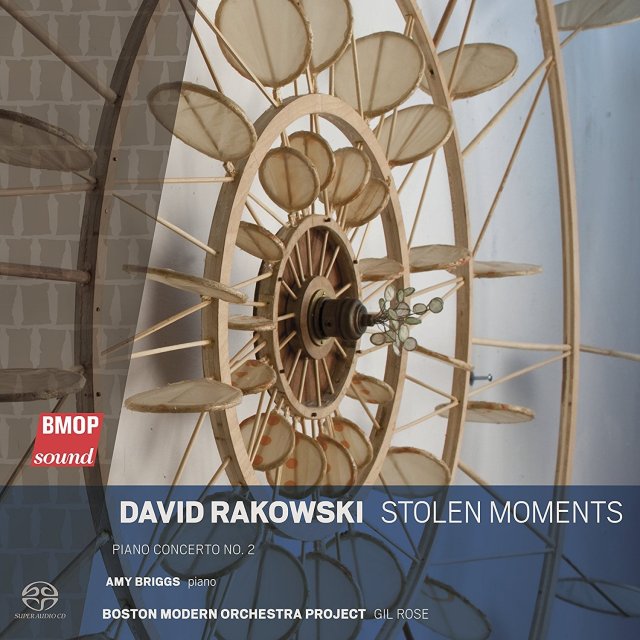
The spirit of jazz and, in particular, that of Duke Ellington and perhaps George Gershwin seem ever present in this recent release from the Boston Modern Orchestra Project.  David Rakowski (1958- ) is a new voice to these ears but clearly a highly developed one well schooled in writing for large orchestra and for piano solo within that context as well.

Two works are presented here, the four movement Stolen Moments (2008/2010) and Piano Concerto No.2 (2011).  Both are large, colorful works in a basically tonal/romantic context but with clear modernist influence.  Nothing experimental here, just sumptuous orchestral writing and a challenging and interesting work for piano and orchestra.  It was only from reading the useful liner notes that I learned Rakowski had been a student of Milton Babbitt (1916-2011), a composer famous for his hard nosed complexity.  In fact Rakowski actually quotes from Babbitt and this music is a tribute to the education received from this man (keep in mind that Babbitt also taught harmony to Stephen Sondheim).

It is as difficult to grasp that Rakowski was taught by Babbitt as it is to believe that, by his own assertion, he knows very little about jazz.  The first work seems to channel the spirits of Duke Ellington and George Gershwin more than Babbitt for sure.  This four movement orchestral suite, in it’s many moods, is melodic, jazzy and engaging in a way that can’t fail to entertain.

briggs

Amy Briggs (image from the artist’s web site)

Amy Briggs has long been a collaborator with Rakowski and is an artist who has successfully made her career exclusively playing contemporary music.  This second of Rakowski’s concertos for this instrument was written for her and she plays it magnificently.  She clearly has a feel for the jazz rhythms and handles the virtuosic writing as though it were second nature.

The concerto ventures into a variety of moods and provides ample opportunities for many BMOP soloists to have their moments.  It is basically a classical three movement structure with multiple subdivisions within each movement.  These large movements come in at nearly 15 minutes each and are practically works unto themselves though they clearly adhere to the same basic vision.  The second movement is dedicated in memory of Rakowski’s teacher Milton Babbitt.  I’m sure he would have approved.

This is in fact the second time that Gil Rose and his massively talented musicians have chosen to survey some of Rakowski’s music.  That alone should be enough to clue listeners in to a potentially good listen.  Rose has been amassing a catalog of music by modern composers whose work deserves attention and, while this is an example of some pretty recent music, Rose and BMOP have done a fine job of giving attention to composers who have been unjustly neglected as well.   They seem to have a fine ear for quality music and this reviewer will listen to anything they choose to record.

As usual with BMOP, the recording is bright and lucid allowing the listener to hear the fantastic details in these big and intricate but entertaining works.  The production is by Gil Rose himself with recording and post-production by Joel Gordon.  Another great volume in the growing BMOP canon.

The Postcard Sessions, Saxophone and Piano


harrington loewen cover

Ravello RR 7934


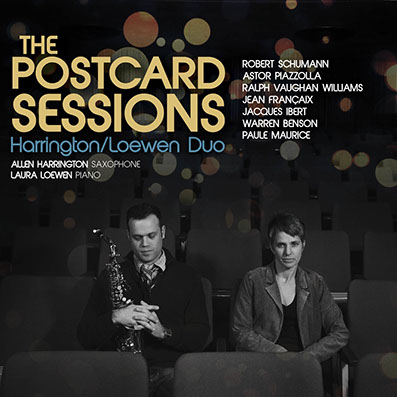
It has always seemed to me that the saxophone has had a difficult time integrating into the mainstream of classical performance.  Since its invention by Adolphe Sax in the mid 19th century this family of instruments has amassed a somewhat limited solo repertoire and has only really made it as an orchestral instrument in the twentieth century.  The subsequent adoption of these instruments at the forefront of jazz and pop has forever changed the perception of this hybrid woodwind/reed/brass instrument which, for those who segregate musical genres, complicates matters even more.

It is the twentieth century that this album represents and it is the classical voice, not jazz or pop which speaks here.  This intelligently chosen set of pieces is like a little tour of the saxophone and piano literature representing some of the best of the early to mid twentieth century repertoire.  If that makes it a niche market then so be it, it is a lovely niche.

Now Robert Schumann (1810-1856), whose work opens this disc, is hardly a twentieth century composer but these transcriptions by Frederick Hemke (long time saxophonist of the Chicago Symphony and a highly respected teacher) are definitely contemporary and work well for saxophone and piano.  Drei Romanzen Op. 94  (1849) are originally for oboe and piano.

Tracks 4 and 11 contain pieces by Astor Piazolla (1921-1992), the Argentinian composer best known for his work with the tango forms.  Here we have two film music excerpts in apparent transcriptions.

There are four other sets of pieces on this recording by Ralph Vaughn Williams (1872-1958), Jean Francaix (1912-1987), Jacques Ibert (1890-1962) and Paule Maurice (1910-1967). The Vaughn Williams Folk Song Suite is originally for cello and piano and is vintage Vaughn Williams at his English folk song best.  The Ibert and the Francaix are suites of the sort of nervous, jazz inflected music that characterized an era between the wars.  Paule Maurice is a new name to this listener and the artists are to be commended for their part in saving her work from obscurity.

The Aeolian Song by Warren Benson (1924-2008) is probably one of the best known (and deservedly so) pieces on this disc.  This is actually the slow movement of a concertino for saxophone and orchestra but has become a sort of recital classic in its incarnation for saxophone and piano.

The Harrington/Loewen Duo are based in Canada and that may be their only flaw.  The curious but annoying lack of attention to the musicians who are our neighbors to the north is certainly mitigated to some degree by this release.  It is a lovely recital and the musicians are both committed and creative.  One hopes for another volume of recital pieces to follow this delightful release.

Lara Downes Making Magic at Noon in San Francisco


cordell0007

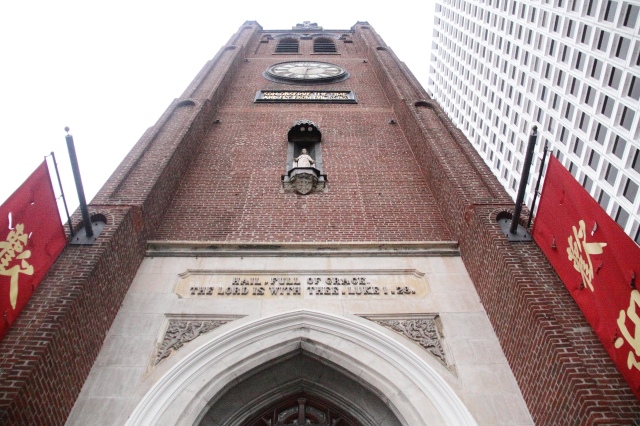
Old St. Mary’s Cathedral in San Francisco

A much needed light rain fell as I ventured out to hear Lara Downes play at the noontime concert series at Old St. Mary’s Cathedral in San Francisco’s Chinatown neighborhood.  I had just recently reviewed this artist’s new CD release (here) and I jumped at the opportunity to hear her live.

The trip from my home in Alameda to this venue, a distance of some 15 miles took me almost two hours.  Construction rules right now.  In the course of the concert Ms. Downes commented that it took her 45 minutes to get there from her hotel in San Francisco (no doubt less than 2 miles).

Being familiar with this trip I managed to arrive at about 12:15PM.  When I arrived I was a bit surprised to find a service in progress so I sat quietly observing this beautiful little church.  Though raised Catholic I haven’t ventured into a church in some years.  The experience did place a sort of spiritual context on my concert experience.

cordell0002

Priest saying mass at Old St. Mary’s Cathedral

The service ended a little after 12:30 and, after some of the congregants left I moved closer to the front.  Technicians moved the piano in place and Ms. Downes was introduced.

cordell0004

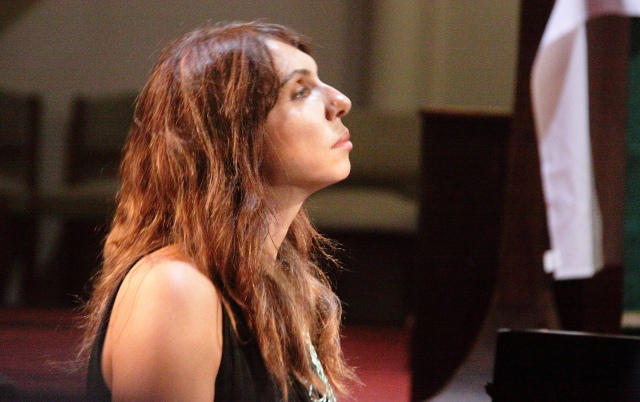
Downes intensely focused as she plays Schumann’s Fantasy Pieces

She chose to open with Robert Schumann’s (1810-1856) Op. 12 Fantasy Pieces Nos. 1, 2, 3 and 5 (1837).  I have but a passing knowledge of Schumann’s music.  It is highly virtuosic romanticism. Beautiful melodies, classical harmonies with just a dash of dissonance and a very high level of technical difficulty which characterizes these pieces.  Downes played them with confidence and ease seemingly casting a spell as she did.  She played the set without interruption and received much deserved applause from the somewhat sparse audience of perhaps 50 or so people.

She followed with a selection from her upcoming release America Again, Samuel Coleridge-Taylor’s (1875-1912) setting of the spiritual Deep River Op. 59 No. 10 (1905), one of a set of 24 so-called “Negro Melodies”. Coleridge-Taylor was a black British composer of the late 19th century sometimes referred to as the “African Mahler”.  This setting, very much in the same spirit as the Schumann was pretty much what one might have expected had Schumann encountered black spirituals.  This selection added again to the spiritual dimension.  Deep River is a majestic and celebratory piece which, like the Schumann, was well received.

Downes deviated from the printed program to play another selection from that forthcoming album, Morton Gould’s (1913-1996) American Caprice.  This short piece was a delightful foray into jazz reminding us of Gould’s connections with his contemporaries like Aaron Copland and George Gershwin.  Gould is a composer whose work deserves more attention and this listener is grateful to the artist for bringing this little masterpiece back into the light.

cordell0006

Downes making Rhapsody in Blue sound anew.

In some ways this functioned like a precursor to the next piece on the program, Gershwin’s (1898-1937) Rhapsody in Blue (1924) in the composer’s arrangement for solo piano. Downes, whose speaking was as comfortable and natural as her playing, asked the audience to try to hear this oh so familiar piece with new ears.  Indeed her fluid and dynamic playing put her own stamp on this popular gem and demonstrated again her seasoned virtuosity.  She played the work with passion but also with ease and confidence.

The ample applause and standing ovation brought her back for a wonderful encore.  It was Gershwin again for sure but this time in an amazing arrangement by Nina Simone (1933-2003) whose spirit seemed to be channeled by Downes.  “I loves you Porgy” from Porgy and Bess is featured on her new CD and it brought the afternoon to a very pleasing close.

I took the opportunity to meet and thank Ms. Downes who was, in turn, gracious and pleasant.  I went back out to the ordinary world charmed and invigorated and that is what I had hoped for.


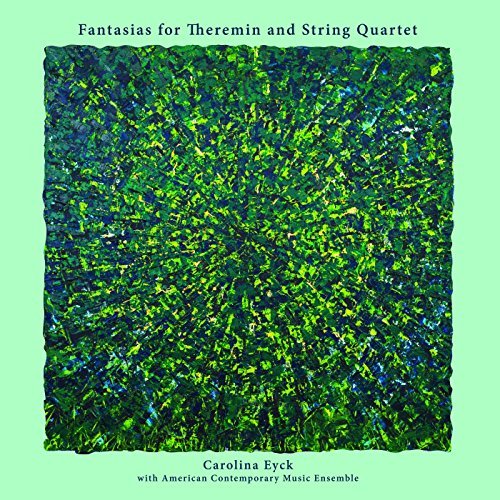
Not Your Momma’s Theremin: Carolina Eyck’s Fantasias for Theremin and String Quartet


eyck-fantasias

Butterscotch BSR-015 featuring cover art by Carolina Eyck

The Theremin, named after its inventor Leon Theremin (1896-1993), is an early electronic instrument which is controlled by the positioning of the performer’s hands in relation to two antennae.  One controls volume, the other pitch.  That’s it, a simple instrument but one which has had a tremendous impact on music and on the subsequent development of more sophisticated electronic instruments.  Perhaps it is best known for the brilliantly chilling effect created by Bernard Hermann’s use of it in his score for The Day the Earth Stood Still (1951).  Its subsequent appearance in the Beach Boys’ Good Vibrations (1966) was a testament to the instrument’s durability.

lydia_termen

Lydia Kavina with Leon Theremin

clara-rockmores-lost-theremin-album

Clara Rockmore on her Bridge Records album

While several people, most notably Clara Rockmore (1911-1998) and Lydia Kavina (1967- ), have performed as soloists with the instrument it seems to have remained a niche phenomenon as a solo instrument.  This release by Carolina Eyck (1987- ) appears to begin a new era (or at least wider niche). Eyck is a gifted composer as well as a virtuoso and she uses a modified instrument, apparently with midi controlling capabilities (she uses an instrument made by Robert Moog of Moog Synthesizer fame). Many composers have also written new works for her Including Kalevi Aho whose Concerto for Theremin and Orchestra has been recorded by its dedicatee.  Lydia Kavina was a protege of Leon Theremin as well as Eyck’s first teacher thus creating an unbroken musical lineage.  This youngest practitioner now leads the way to the next generation of performance and composition for this 1919 invention.

lydia_concert07

Recent photo of Lydia Kavina at a concert

The present release Fantasias for Theremin and String Quartet (2016) is Eyck’s ninth album in eight years.  I have not heard the previous eight albums but after hearing this one I do plan to seek them out.  The works presented here showcase both virtuosity and compositional invention of a high level.  I have enjoyed this album immensely.

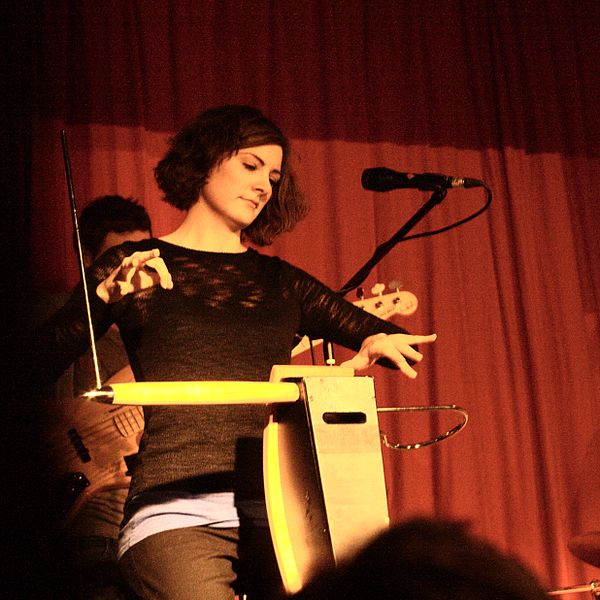
600px-carolina_eyck_playing_the_theremin

Carolina Eyck in performance (from Wikipedia)

The six works on this disc have a post-minimal/impressionistic quality and do much to showcase the vocal like qualities of the instrument as well as the extended capabilities of Eyck’s customized personal choice of instrument.  She is accompanied here by the string quartet of the American Contemporary Music Ensemble (ACME) consisting of Caroline Shaw and Ben Russell, violins; Caleb Burhans, viola; and Clarice Jensen, cello.  They play beautifully together.

There is an “essay” by recording engineer Allen Farmelo which goes more into the conceptual context of the recording than the music.  Much is made of this disc being conceived for (vinyl) LP though it has not been issued as such as far as I can tell.  (Correction:  It has been brought to my attention that this recording is available on vinyl) The recording is lucid and listener friendly and the “LP” concept might explain why this disc is shorter than the average CD.  It is, despite its brevity, a lovely production and well worth your time.  Eyck, who also created the beautiful cover art, is an interesting artist at the beginnings of what looks like a great career as both composer and performer.


Black Notes Matter: Lara Downes’ America Again


laradownes

Sono Luminus DSL-92207

The lovely cover photo for this album by San Francisco born pianist Lara Downes is reminiscent of any number of socially conscious folk/rock stars of the 60s and 70s. It would seem that this is no accident.  This delightful album of short pieces by a wide variety of American composers takes its title from the Langston Hughes (1902-1967) poem, Let America Be America Again (1935).  By so doing the pianist places this interesting selection of short piano pieces firmly in the context of black racial politics and the artistic expression of black America as well as those influenced by this vital vein of American culture (both musical and literary).  It is a graceful and deeply felt effort and I hope that the metaphor of the title of my review is not too tortured a one to reflect that.

This is also a very personal album.  Downes seems to share some deeply felt connections with her materials.  This artist, born to a white mother and a black father, invokes a careful selection of short piano pieces steeped sometimes in jazz and blues but also the political directness (and optimism) which was characteristic of the inter-war years that brought forth the Hughes poem.  There is both sadness and celebration in these virtuosic and technically demanding little gems (most apparently recorded for the first time or at least the first time in a while).  The pianist’s comments on each individual piece are also critical to the understanding of this disc as she shares the impact and meaning that the music has had for her.

There are 21 tracks by 19 composers in all and the selections themselves are quite a feat. They range from the 19th to the 21st centuries and are composed by both men and women of a variety of racial and ethnic backgrounds.  All seem to share the sort of  populist charm befitting the idealized America yearned for in the poem which is to say that they represent a kind of idealized or hopeful nationalism.  Downes is well acquainted with a large variety of American music and recognizes no distinction between classical and so-called “vernacular” traditions.

In fact none of these things are atypical for this artist.  Her previous albums Exiles Cafe (2013) featured music by composers exiled from their homelands, A Billie Holiday Songbook (2015) celebrated the life of this iconic black artist and her American Ballads (2001) demonstrated her deep mastery and affection for populist (but not jingoistic) nationalism.  Her tastefully issue oriented albums define a very individual path and the present album appears to be a very logical and well executed next entry into her discography.

This disc shares a similar heritage to that of Alan Feinberg’s four discs on Argo/Decca entitled, The American Innovator, The American Virtuoso, The American Romantic and Fascinating Rhythm: American Syncopation.  Another notable antecedent is Natalie Hinderas’ groundbreaking two disc set of music by African-American composers.

And now on to the music:

Morton Gould (1913-1996) was a Pulitzer Prize winning composer and conductor with a style informed by his study of jazz and blues in a vein similar to that of Bernstein and Copland.  He is represented here by American Caprice (1940).

Lou Harrison (1917-2003)  was a composer, conductor and teacher.  He was a modernist and an innovator in the promotion of non-western musical cultures.  His New York Waltzes (1944-1994) are three brief essays in that dance form.

The traditional folk song Shenandoah (apparently in the pianist’s transcription) is next.   This tune will be familiar to most listeners as a popular selection by choral groups and the melody is a common metaphor for things American.

Amy Marcy Cheney Beach (1867-1944) was one of the first successful female American composers.  Her “From Blackbird Hills” Op. 83 (1922) is representative of her late romantic style and her incorporation of Native American (Omaha) elements in her music.

Samuel Coleridge-Taylor (1875-1912) is a English composer with Creole roots, a black composer, known as the “African Mahler” in his day.  Deep River (1905) is his setting of this spiritual which also was one of Marian Anderson’s signature pieces.

Dan Visconti (1982- ) was commissioned by the International Beethoven Festival to write his Lonesome Roads Nocturne (2013) for Lara Downes.  It receives its world premiere recording in this collection.

Swiss-American composer and teacher Ernest Bloch (1880-1959) is certainly deserving of more attention.  His At Sea (1922) is used here to represent the sea voyages of the many immigrants (willing and unwilling) whose journey defined in part who they were.

George Gershwin (1898-1937) mastered both the vernacular tradition (as one of the finest song writers of the 20th Century) and the classical tradition in his too few compositions written in his sadly abbreviated life.  His opera Porgy and Bess (1935) is contemporary with the Langston Hughes poem mentioned earlier.  Downes most arrestingly chooses the arrangement of “I loves you, Porgy” by the classically trained iconic singer, musician and civil rights activist Nina Simone (1933-2003).  Quoting from Downes’ notes (Nina Simone expresses what she knew) “…about being a woman, being black and about being strong and powerless all at the same time.”  Indeed one of the most potent lines of the Hughes poem reads, “America was never America to me.”

Angelica Negrón (1981- ) was born in Puerto Rico and  now lives and works in New York. Her Sueno Recurrente (Recurring Dream, 2002) is a lovely little nocturne which is here given its world premiere.

Leonard Bernstein (1918-1990) held credentials as composer, conductor, teacher and ardent civil rights supporter.  His Anniversary for Stephen Sondheim (1988) is one of a series of Anniversary piano pieces he wrote.  Bernstein did much to help modern audiences (including this reviewer) comprehend the vital musicality of jazz and blues. Like Downes, he drew little distinction between popular and classical and celebrated all the music he believed was good.

David Sanford (1963- ) is a trombonist, teacher and composer who works in both classical and jazz idioms.  His work Promise (2009) was written for Downes and this is the world premiere recording.

Howard Hanson (1896-1981) was a conductor, teacher and Pulitzer Prize winning composer (though not at all an advocate of ragtime, jazz or blues).  His brief but lovely piano piece Slumber Song (1915) is a nice discovery and one hopes that it will be taken up by more pianists.

Scott Joplin (1867/68-1917) was discovered largely due to the scholarship and recordings of musicologist Joshua Rifkin (who incidentally did some arrangements for folkie Judy Collins) whose three volumes of piano rags on Nonesuch records introduced this wonderful black composer’s work to a wider audience once again.  Marvin Hamlisch famously incorporated Joplin’s music into his score for the motion picture The Sting (1973).  Downes chooses the Gladiolus Rag (1907) to represent this composer.

Irving Berlin (born Israel Isidore Baline 1888-1989) is another of the greatest song composers this country has produced.  In another characteristically clever choice Downes chooses the arrangement of this hugely optimistic song, “Blue Skies”(1926) by the great jazz pianist Art Tatum (1909-1956).

Florence Price (1887-1953) was a black female composer (the first to have one of her orchestral works programmed by a major symphony orchestra) whose work is only recently getting some much needed exposure.  Her Fantasy Negre (1929) is based on a spiritual, “Sinner, Please Don’t Let This Harvest Pass”.  Price was involved in the New Negro Arts Movement of the Harlem Renaissance and was professionally connected with Langston Hughes among others.

Aaron Copland (1900-1990) is perhaps the most iconic American composer.  Dubbed the “Dean of American Composers” his earliest work has strong jazz influences and his later work created the American romantic/nationalist sound incorporating folk songs and rhythms.  For this recording the artist chose the first of the composer’s Four Piano Blues (1926) which also appeared on her 2001 album of American Ballads.

Edward Kennedy “Duke” Ellington (1899-1974) was a composer and band leader whose sound virtually defined the Harlem Renaissance during his tenure at the famed Cotton Club.  Melancholia (1959) is the piece chosen here, again a nice little discovery.

Roy Harris (1898-1979) was, like Copland, a populist but the Oklahoma born composer studied Native American music as well as American folk songs.  His American Ballads (1946) was included on Downes’ American Ballads album.  Here she includes an unpublished work from a projected (but never finished) American Ballads Volume II.  This piece is a setting of the spiritual, “Lil Boy Named David”.

The album concludes with one of the ultimate hopeful dreamer songs, Harold Arlen’s (1905-1986) Over the Rainbow (1939) from his score for The Wizard of Oz (1939).  The adolescent yearning of Dorothy for something better than her dust bowl farm life touched a chord in many over the years and it is a fitting conclusion to this beautiful and hopeful collection.

As mentioned earlier the insightful liner notes by Lara Downes complement this production and tactfully position its politics.  She shares a personal journey that is as American as the proverbial apple pie.  The album is dedicated to the artist’s ancestors in recognition of their struggles as well as to her children in hopes that dreams for a better future can become their reality.

This beautiful sound of this album is the result of work of Producer Dan Merceruio and Executive Producer Collin J. Rae along with Daniel Shores and David Angell.  The lovely photography is by Rik Keller and as with the previous release Skylark: Crossing Over (reviewed here) the graphic design by Caleb Nei deserves special mention for its ability to truly complement this disc.

It is scheduled for release on October 28, 2016.


A shamanic effort to raise consciousness and further socially progressive ideas.

The Anniversary That (almost) Everyone Missed: Bill Doggett (1916-1996), Wizard of the Hammond Organ


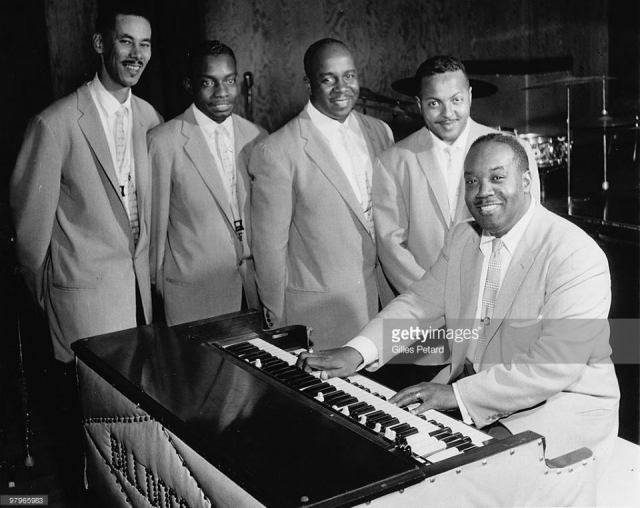
doggettcombo1956

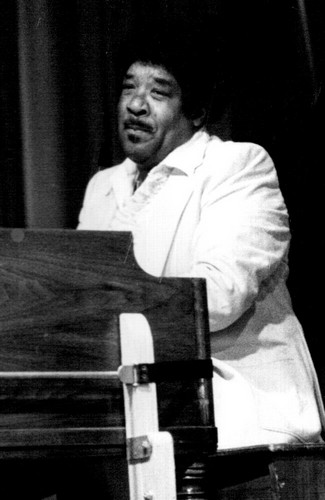
Bill Doggett with his combo (getty images)

William Ballard Doggett, better known as Bill Doggett was born in Philadelphia in 1916 and was introduced to music by his church pianist mother.  He played in a combo while still in high school and went on to work with a plethora of stars in rock, jazz, rhythm and blues amassing a string of hits but, sadly, seems to have barely been noticed on this the 100th anniversary of his birth.  Where is NPR at a time like this?

Well, all is not lost.  Fortunately his nephew and namesake Bill Doggett is doing justice to the memory of this important American musician.  This younger Doggett is an archivist, lecturer, curator, strategic marketer, photographer, filmmaker, and arts advocate (his website is well worth your time).  I am hardly as well prepared to provide more than an overview of this musician’s work but I feel obliged to do my small part in recognizing this man’s work.

doggettposter

Promotional poster for the September 28, 2016 centennial celebration curated by nephew and namesake, Bill Doggett.

Doggett’s list of chart singles:

  • “Be-Baba-Leba” (vocal by Helen Humes) (Philo/Aladdin 106) 1945 (#3 R&B)
  • “Moon Dust” 1953 (#18 R&B)
  • “Early Bird” 1953 (#21 R&B)
  • “No More In Life” 1953 (#20 R&B)
  • “High Heels” 1954 (#15 R&B)
  • “Honky Tonk, Part 1″/”Honky Tonk, Part 2” (King 4950) 1956 (#1(14) R&B/#2(3) Pop)
  • “Slow Walk” (King 5000) 1956 (#4 R&B/#19 Pop)
  • “Ram-Bunk-Shush” (King 5020) 1957 (#4 R&B)
  • “Soft” 1957 (#11 R&B)
  • “Leaps And Bounds, Part 1″/”Leaps And Bounds, Part 2” (King 5101) 1958 (#13 R&B)
  • “Blip Blop” 1958 (#11 R&B)
  • “Hold It!” (King 5149) 1958 (#3 R&B)
  • “Rainbow Riot, Part 1″/”Rainbow Riot, Part 2” (King 5159) 1959 (#15 R&B)
  • “Monster Party” (King 5176) 1959 (#27 R&B)
  • “Yocky Dock, Part 1″/”Yocky Dock, Part 2” (King 5256) 1959 (#30 R&B)
  • “Honky Tonk, Part 2” 1961 (#21 R&B)


  • doggetthonky

    Doggett’s best known work.

While his last chart hit was 1961 his collaborations with  Lucky MillinderFrank FairfaxJimmy Mundythe Ink SpotsLouis JordanJohnny Otis, Wynonie Harris, Ella Fitzgerald, Louis Armstrong, Count Basie,  Lionel HamptonRed Holloway, Clifford Scott, Percy France, David “Bubba” Brooks, Clifford Davis, and Floyd “Candy” Johnson; guitarists Floyd Smith, Billy Butler, Sam Lackey and Pete Mayes; and singers Edwin Starr, Toni Williams and Betty Saint-Clair attest to the scope of his work.  Doggett continued to play and arrange until his death from a heart attack in New York in 1996 at the age of 80.

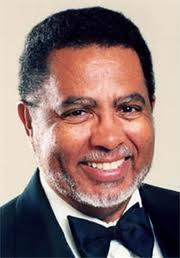
bill_doggett

Bill Doggett photographed in France in 1980 by Lionel Decoster (from Wikipedia article)

The Hammond Organ is known for being the workhorse of modern classical as well as rock, rhythm and blues and jazz.  It was Bill Doggett who became one of the early masters of this (then new) electronic instrument.  While he was also a highly competent pianist, it was with the Hammond Organ that he had his greatest success. There is little doubt that his playing has influenced subsequent musicians who took on this instrument.

Here’s hoping that astute musicians and producers will take on the task of recognizing the work of the late great Bill Doggett.  Toward that end here, from Wikipedia, is a discography of his work:

10 inch LPs

  • Bill Doggett: His Organ And Combo, Volume 1 King 295-82 (1954)
  • Bill Doggett: His Organ And Combo, Volume 2 King 295-83 (1954)
  • All Time Christmas Favorites King 295-89 (1954)
  • Sentimentally Yours King 295-102 (1955)

12 inch LPs (on King Records)

  • Moon Dust King 395-502 (1956)
  • Hot Doggett King 395-514 (1956)
  • As You Desire Me King 395-523 (1956)
  • Everybody Dance The Honky Tonk King 395-531 (1956)
  • Dame Dreaming With Bill Doggett King 395-532 (1957)
  • A Salute To Ellington King 533 (1957)
  • The Doggett Beat For Dancing Feet King 557 (1957)
  • Candle Glow King 563 (1958)
  • Swingin’ Easy King 582 (1958)
  • Dance Awhile With Doggett King 585 (1958)
  • 12 Songs Of Christmas [reissue of King 295-89 plus 6 additional tracks] King 600 (1958)
  • Hold It! King 609 (1959)
  • High And Wide King 633 (1959)
  • Big City Dance Party King 641 (1959)
  • Bill Doggett On Tour [this is NOT a live album] King 667 (1959)
  • For Reminiscent Lovers, Romantic Songs By Bill Doggett King 706 (1960)
  • Back With More Bill Doggett King 723 (1960)
  • The Many Moods Of Bill Doggett King 778 (1962)
  • Bill Doggett Plays American Songs, Bossa Nova Style King 830 (1963)
  • Impressions King 868 (1963)
  • The Best Of Bill Doggett [compilation] King 908 (1964)
  • Bonanza Of 24 Songs [compilation] King 959 (1966)
  • Take Your Shot King 1041 (1969)
  • Honky Tonk Popcorn King 1078 (1970)
  • The Nearness Of You King 1097 (1970)
  • Ram-Bunk-Shush [compilation] King 1101 (1970)
  • Sentimental Mood [compilation] King 1104 (1970)
  • Soft [compilation] King 1108 (1970)
  • 14 Original Greatest Hits [compilation; reissued as ‘All His Hits’] King-Starday 5009 (1977)
  • Charles Brown: PLEASE COME HOME FOR CHRISTMAS [this vocal album includes 4 instrumental tracks by Bill Doggett] King-Starday 5019 (1978)

12 inch LPs (on other labels)

  • 3,046 People Danced ‘Til 4 A.M. To Bill Doggett [this is a live album] Warner Bros. WS-1404 (1961)
  • The Band With The Beat! Warner Bros. WS-1421 (1961)
  • Bill Doggett Swings Warner Bros. WS-1452 (1962)
  • Rhythm Is My Business (Ella Fitzgerald with Bill Doggett) Verve V6-4056 (1962)
  • Oops! The Swinging Sounds Of Bill Doggett Columbia CL-1814/CS-8614 (1962)
  • Prelude To The Blues Columbia CL-1942/CS-8742 (1962)
  • Finger-Tips Columbia CL-2082/CS-8882 (1963)
  • Wow! ABC-Paramount S-507 (1964)
  • Honky Tonk A-La-Mod! Roulette SR-25330 (1966)
  • The Right Choice After Hours/Ichiban 4112 (1991) Note: this is Bill’s last recorded album of original material; also released on CD.

OK all you producers, have at it.


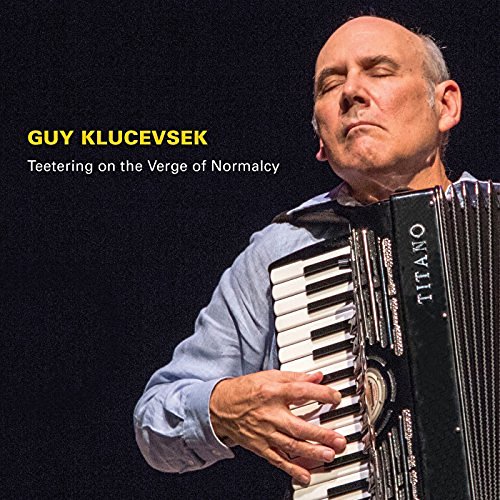
Memories and Memorials: Guy Klucevsek’s “Teetering on the Verge of Normalcy”


klucevsek

Starkland ST-225

As someone who grew up attending Polish weddings and hearing more than his share of polka music I was fascinated at the unusual role of the accordion as I began to get interested in new music. People like Pauline Oliveros and Guy Klucevsek completely upended my notions of what this instrument is and what it can do.  The accordion came into being in the early 19th century and was primarily associated with folk and popular musics until the early 20th century.  It has been used by composers as diverse as Tchaikovsky and Paul Hindemith but the developments since the 1960s have taken this folk instrument into realms not even dreamed of by its creators.

guyklu

Guy Klucevsek with some of his accordions

Guy Klucevsek  (1947- ) brought the accordion to the burgeoning New York “downtown” new music scene in the 1970s.  He began his accordion studies in 1955, holds a B.A. in theory and composition from Indiana University of Pennsylvania and an M.A. (also in theory and composition) from the University of Pittsburgh.  He also did post graduate work at the California Institute of the Arts.  His composition teachers have included Morton Subotnick, Gerald Shapiro and Robert Bernat.  He draws creatively on his instrument’s past even as he blazes new trails expanding its possibilities.  The accordion will never be the same.

Klucevsek has worked with most all of the major innovators in new music over the years including Laurie Anderson, Bang on a Can, Brave Combo, Anthony Braxton, Dave Douglas, Bill Frisell, Rahim al Haj, Robin Holcomb, Kepa Junkera, the Kronos Quartet, Natalie Merchant, Present Music, Relâche, Zeitgeist, and John Zorn (who also recorded him on his wonderful Tzadik label).  He has released over 20 albums and maintains an active touring schedule.  He recently completed a residency (April, 2016) at Sausalito’s Headlands Center for the Arts.

transoft

Starkland ST-225

freerange

Starkland ST-209

Starkland has released no fewer than three previous albums by this unusual artist (all of which found their way into my personal collection over the years) including a re-release of his Polka from the Fringe recordings from the early 1990s. This landmark set of new music commissions from some 28 composers helped to redefine the polka (as well as the accordion) in much the same way as Michael Sahl’s 1981 Tango and Robert Moran’s 1976 Waltz projects did for those dance genres.

polkfringe

Starkland ST-218

The present recording, Teetering on the Edge of Normalcy (scheduled for release on September 30, 2016), continues this composer/performer’s saga.  His familiar humor and his unique experimentalism remain present but there is also a bittersweet aspect in that most of these compositions are homages and many of the dedicatees have passed from this world.  Klucevsek himself will turn 70 in February of 2017 and it is fitting that he has chosen to release this compilation honoring his colleagues.

On first hearing, many of Klucevsek’s compositions sound simple and straightforward but the complexities lie just beneath the surface.  What sounds like a simple accordion tune is written in complex meters and sometimes maniacal speed.  To be sure there are conservative elements melodically and harmonically but these belie the subversive nature of Klucevsek’s work which put this formerly lowly folk instrument in the forefront with the best of the “downtown” scene described by critics such as Tom Johnson and Kyle Gann.  You might mistake yourself as hearing a traditional music only to find that you had in fact wandered into the universe next door.

Many favorite collaborators have been recruited for this recording.  Most tracks feature the composer with other musicians.  Four tracks feature solo accordion, two are for solo piano and the rest are little chamber groupings from duets to small combos with drum kit.

The first three tracks are duets with the fine violinist Todd Reynolds.  Klucevsek’s playful titles are more evocative than indicative and suggest a framework with which to appreciate the music.  There follows two solo piano tracks ably handled by Alan Bern. Bern (who has collaborated on several albums) and Klucevsek follow on the next track with a duet between them.

Song of Remembrance is one of the more extended pieces on the album featuring the beautiful voice of Kamala Sankaram along with Todd Reynolds and Peggy Kampmeier on piano.  No accordion on this evocative song which had this listener wanting to hear more of Sankaram’s beautiful voice.

The brief but affecting post minimalist Shimmer (In Memory of William Duckworth) for solo accordion is then followed by the longer but equally touching Bob Flath Waltzes with the Angels.  William Duckworth (1943-2012) is generally seen as the inventor of the post-minimalist ethic (with his 1977-8 Time Curve Preludes) and he was, by all reports, a wonderful teacher, writer and composer.  Bob Flath (1928-2014) was philanthropist and supporter of new music who apparently worked closely with Klucevsek.

Tracks 10-12 feature small combos with drum kit.  The first two include (in addition to Klucevsek) Michael Lowenstern on mellifluous bass clarinet with Peter Donovan on bass and Barbara Merjan on drums.  Lowenstern who almost threatens to play klezmer tunes at times sits out on the last of these tracks.   Little Big Top is in memory of film composer Nino Rota and Three Quarter Moon in memory of German theater composer Kurt Weill. These pieces would not be out of place in that bar in Star Wars with their pithy humor that swings. They also evoke a sort of nostalgia for the downtown music scene of the 70s and 80s and the likes of Peter Gordon and even the Lounge Lizards.

The impressionistic Ice Flowers for solo accordion, inspired by ice crystals outside the composer’s window during a particularly harsh winter, is then followed by four more wonderful duets with Todd Reynolds (The Asphalt Orchid is in memory of composer Astor Piazolla) and then the brief, touching For Lars, Again (in memory of Lars Hollmer) to bring this collection to a very satisfying end.  Hollmer (1948-2008) was a Swedish accordionist and composer who died of cancer.

As somber as all of this may sound the recording is actually a pretty upbeat experience with some definitely danceable tracks and some beautiful impressionistic ones.  Like Klucevsek’s previous albums this is a fairly eclectic mix of ideas imbued as much with humor and clever invention as with sorrow and nostalgia.  This is not a retrospective, though that would be another good idea for a release, but it is a nice collection of pieces not previously heard which hold a special significance for the artists involved.  Happily I think we can expect even more from this unique artist in the future.

klucevsek

Guy Klucevsek, looking back but also forward.

The informative gatefold notes by the great Bay Area pianist/producer/radio host Sarah Cahill also suggest the affinity of this east coast boy for the aesthetic of the west coast where he is gratefully embraced and which is never far from his heart (after all he did study at the California Institute of the Arts and has worked with various Bay Area artists). Booklet notes are by the composer and give some personal clues as to the meaning of some of the works herein.  Recordings are by John Kilgore, George Wellington and Bryce Goggin.  Mastering is by the wonderful Silas Brown.  All of this, of course, overseen by Thomas Steenland, executive producer at Starkland.

Fans of new music, Guy Klucevsek, accordions, great sound…you will want this disc.


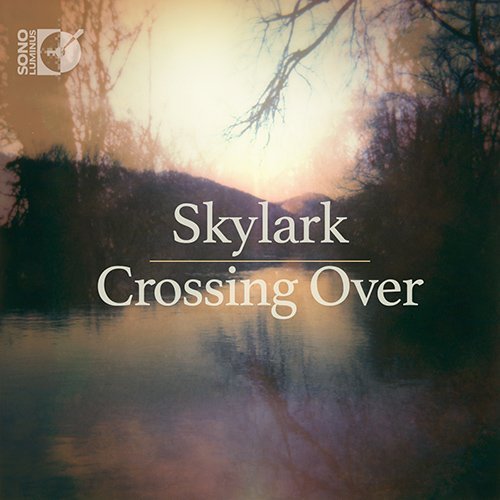
Skylark: Crossing Over, bringing the chamber choir to the mainstream


skylark

Sono Luminus continues their dedication to high quality performances and recordings of a wide variety of music from the 20th and 21st centuries.  In this lovely  disc we are treated to a great deal of interesting and very listenable a capella choral music from the mid-twentieth century to the present.

It is this reviewer’s perception that a capella choral music is somewhat of an outlier in the classical music field and is generally not as well known as solo instrumental, orchestral, chamber music and such. (Band music is a similarly neglected area which is not frequently explored by many composers and not as familiar to audiences.)   It is not an area very familiar to me but this recording appears to be one that can expand this niche considerably by virtue of the sheer beauty of these recordings.

There are eight pieces by seven composers of varying levels of familiarity.  The most familiar names here are those of the late John Tavener (1944-2013) and William Schuman (1910-1992).  (Schuman was also no stranger to writing for band music.)  Some listeners may have heard of Jon Leifs (1899-1968), an Icelandic composer who should definitely be better known.  (Curiously the only comprehensive information available in English on this composer is in Wikipedia.)

The remaining composers, Daniel Elder (1986- ), Nicolai Kedrov (1871-1940), Robert Vuichard (1985- ) and (fellow Icelander) Anna Thorvaldsdottir (1977- ).  Thorvaldsdottir may be familiar to listeners via her earlier Sono Luminus release (reviewed here) as well as numerous other releases which definitely mark her as a rising star.

The disc opens with Elegy (2013) by Daniel Elder.  It is the only piece which features soloists and is a touching piece which demonstrates the composer’s skill with this specialized genre.

Butterfly Dreams (2002) by John Tavener is a series of eight choral meditations based on Chuang Tse known for his “…Am I a man dreaming he is a butterfly or a butterfly dreaming he is a man?”.  Tavener’s work has pushed the solo choral genre more to the mainstream than nearly any composer of the last 50 years and this piece is a good example of how he has managed to do this.  Tavener’s inspiration comes in part from the choral styles of eastern rite church music, a rich and sonorous sound.

Otche Nash by Nicolai Kedrov is apparently a classic in sacred music circles.  In Latin this would be Pater Noster and in English, Our Father.  This is a beautiful setting of the classic Christian Prayer.

Requiem (1947) by Jon Leifs is based on Icelandic folk poetry.  It was written in response to his grief at the loss of his daughter who drowned at the age of 18.  While not exactly representative of Leifs’ modern style it is a good example of the power of his invention in this heartfelt homage.  This is perhaps the composer’s best known work.

Heliocentric Meditation by Robert Vuichard is another example of the deep knowledge of the specialized techniques available to composers in this genre.  Vuichard appears to be a niche choral composer and one who has considerable skill.  There is a rather modernist feel to this powerful meditation.

William Schuman’s Carols of Death (1958) is a sort of modern classic which has been recorded many times.  There are three movements, each on a separate track.  It is curious how well these pieces fit in style with the rest of the disc given the date of composition.

Beyond the Veil (2005) is a setting by Anna Thorvaldsdottir of an old Icelandic psalm.  It is a prayer which is, in part, a meditation on death.  The composer has a mystical/impressionistic style that suits this music particularly well.

Funeral Ikos (1981) by John Tavener is definitely a modern classic.  This piece pretty much marks the beginning of the change from his early modernist style to the sort of “holy minimalist” (if you will) style that followed his conversion to and immersion in eastern rite sacred music.

Skylark is a chamber choir (five voices to each part, SATB) and this is their second album.  They were formed in 2011 and are under the direction of Matthew Guard.

This review is basically about the music but I have to say that this is also one of the most beautiful booklets I have seen.  It is short on info about the music but the photography and graphic design by Collin J. Rae and Caleb Nei deserve special recognition as well.  Each page features a photograph and texts of these pieces are tastefully printed across the photos.  This really enhances the experience and seems to be in harmony with the overall production.

Dan Mercurio, producer, has definitely made something special here and one hopes that this will help promote this compositional and performance niche to a more common experience and will encourage composers to write for a capella choir as well.  Daniel Shores is the recording and mastering engineer.  I am unable to assess the DVD audio and can only imagine how it must sound.  The CD itself is amazing to hear.

For an album ostensibly about death there is great joy and beauty to be found here.  Highly recommended, and not just to fans of choral music.


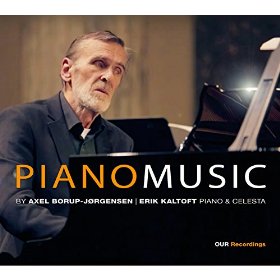
Piano Music by Axel Borup-Jørgensen, a Lost Master?


axelpiano

I had reviewed another disc of this composer’s music on this label here and I must admit that it took me quite a while to meaningfully grasp the music of this too little known Danish composer (1924-2012).  It should be no secret that the Danes have had and continue to have a rich musical culture and have produced quite a number of world class composers and this man is no exception.  However his style, apparently gleaned from his association with the modernists of Darmstadt, can be a tough nut to crack.

As with the aforementioned disc one might require multiple listenings before coming to realize that this man has a unique style and one that bears some serious attention.  This disc of piano music (and one piece for celesta) fills a gap in his recorded repertoire and is an excellent opportunity to see how he works in the genre of keyboard music.

These ten tracks contain works written from 1949 to 1988 so they cover a significant portion of his career and illustrate the development of his style.  Pianist Erik Kaltoft, a longtime associate of the composer, demonstrates interpretive skill as well as virtuosity and dedication in this fascinating survey.

The first (and longest 11:29) piece is Thalatta! Thalatta! (1987-88) and is given the opus number of 127.  The exclamation of the title translates as, “The Sea! The Sea!” and is said to have been spoken by the Greek armies upon reaching the Black Sea during one of their campaigns.  It is an impressionistic piece about the many moods of the sea.  His harmonies are like a modern update of Debussy, a bit more dissonant but providing a similarly soft focused feel.

Continuing with the maritime theme are the 6 miniatures called Marine Sketches (1949) opus 4b.  It is one of the earliest compositions in this collection (along with the Miniature Suite opus 3b, also 1949, on track 8).  Each of the pieces lasts around one minute and there are no track breaks to separate them.  The composer seems to expect that they will always be performed together and with a total time of 6:53, why not?  In contrast to the first piece these contain more melodic contours with less overall dissonance but clearly the same compositional fingerprint.

The four Winter Pieces opus 30b (1959) contain more energetic rhythms but with strategic silences punctuating the overall flow.  They end with a brief epilogue.

From winter we move to another season with the Summer Intermezzi opus 65 (1971) comes back to the sound world of the first track.  Here he experiments with different techniques to expand the language of the keyboard and incorporates the strategic silences of the piece on the former track.

Track 5 contains the earliest piece in this collection, Pasacaglia opus 2b (1948) which seems to suggest some influence of Scriabin.  It is a classic set of variations over the initial bass line and has a rather romantic feel.

Raindrop Interludes opus 144 (1994) is an impressionistic suite with the more dissonant style of his other later pieces.  It is the most recently composed of the recorded selections.

Epigrams opus 78 (1976) at 9:15, is the second longest piece here.  This is one of the most abstract pieces on the disc and demands concentration from both the performer and the listener to perceive delicate statements made with a wide dynamic range.

The Miniaturesuite opus 3b concentrates a praeludium, fantasia, interludium, sarabande and a repeat of praeludium in a brief 2:49.  It is more melodic and less dissonant in keeping with the composer’s earlier style.

Praeludier opus 30a (1958-9) are seven pithy and brief preludes.

The last track contains Phantasiestùck opus 115 (1985) written for celesta.  This instrument, forever doomed to familiarity by its use  in Tchaikovsky’s Nutcracker, has a limited repertoire and this gentle abstract piece is a welcome addition.  It is consistent with the composer’s late style using dissonance and silences in an almost meditative and strangely nostalgic piece.

The extensive and useful liner notes are by Trine Boje Mortensen and are printed in both Danish and English (translation by John Irons).  The fine recording and mastering are by Preben Iwan in the fine acoustics of the Royal Danish Academy of Music.  Grateful assistance and input from the composer’s daughter Elisabet Selin.

One needs to be cautioned never to take lightly anything produced from this creative country and this album is proof of that.  Kudos to OUR recordings for bringing this music to the listening public.


Zenobia Powell Perry, a Lost Thread


zenobia

Cambria CD-1235

These artists and this composer have graced these pages twice previously.  First in the wonderful production of Perry’s opera, Tawawa House and some of the musicians appeared in an article on Valerie Capers.  The present disc and the two previously mentioned articles are all indebted to a significant degree to the work of musicologist and composer Jeannie Gayle Pool.  It was she who kindly sent me this disc for review and her scholarship which brought forth the production of the opera (Perry was the subject of her doctoral thesis).

Zenobia Powell Perry (1908-2004) was an American composer. pianist and teacher who counts R. Nathaniel Dett and Darius Milhaud among her teachers.  Her sound is not far from that of Aaron Copland in her use of basically tonal harmonies and folk elements.  She is, in a sense, a lost populist and quite a gem.

This 25 track disc fills a major gap in the discography of American music in general and music of black Americans in particular.  Perry has roots in African and Native American (Creek) ancestry and Pool’s work may very well have rescued her from total obscurity.  The lost thread of which I refer in my title is to suggest that there is more populist and jazz influenced American music that needs to be brought to light.

Listening to this disc is pure entertainment.  These are undiscovered gems lovingly rendered with love and authority by Josephine Gandolfi, Deanne Tucker and (civil rights advocate and retired judge) La Doris Hazzard Cordell.  The entire project seems to be a labor of love and one can only hope that it will not be the last installment in the recorded canon of Perry’s work.

These 25 tracks are all brief pieces.  They range from the 1935 Childhood Capers to the 1985 suite from Tawawa House arranged for piano four hands by Josephine Gandolfi.  The entertainment here ranges from light pieces like the Childhood Capers to some more deeply thoughtful pieces with jazz inflected harmonies.  Some are quite demanding technically, a tribute to Perry’s skills as a pianist.

The Homage to William Levi Dawson on his 90th Birthday, Times Seven, Soliloquy, Nocturne, A Jazz Trifle and Rhapsody seems to be rather substantive works and pique the curiosity as to what else lies undiscovered.  The suite form Tawawa House is great but it will have to hold that place until the full opera can be recorded.  It is worth hearing, especially as one of the few operas dealing with slavery.

The very fine recording done a Bosendorfer piano at Stanford University by engineer Mark Dalrymple.  The production by Pool and Gandolfi leave this writer wanting to hear more.  Kudos!

Filling Vital Gaps in the Recorded Repertoire: The Walden Chamber Players Do America


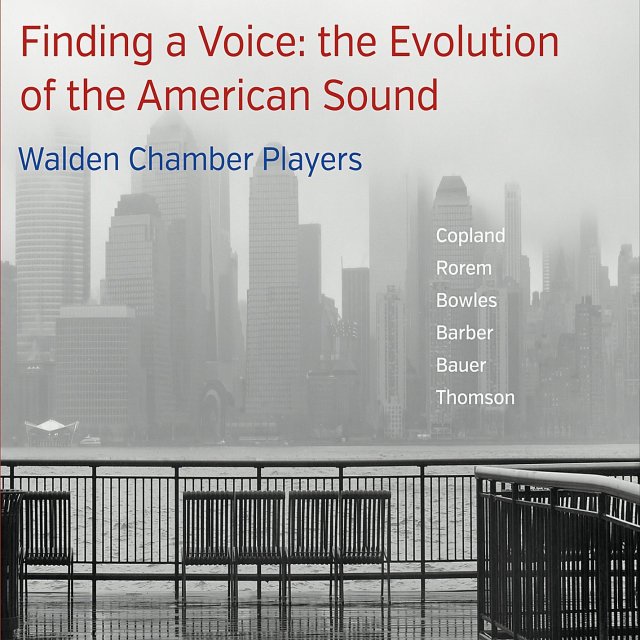
walden ch pl evolution

The only name that might not be familiar to fans of early to mid-twentieth century American music feature in this recording is that of Marion Bauer (1882-1955).  The rest of these composers are clearly established in both recordings and the performing repertoire.  One of the great things about this recording is that the collector runs practically no risk of duplication.  While the Rorem, Barber and Bowles have been recorded before I am not aware of any currently available recordings of the Thomson, Copland and Bauer pieces.

I don’t know how profoundly significant all these works are, only time (and more performances/recordings) will tell.  But these are attractive pieces that fill historical gaps and that is apparently the goal of this clever ensemble.  Even if these are not first order masterpieces they do speak to the historical evolution of the American sound in the twentieth century.

Marion Bauer is herself in need of a reassessment.  This woman, 20 years older than Aaron Copland was essential in the establishment of the foundational institutions of American music.  Few of her works have been recorded and even fewer given good or great recordings.  So this 1944 Trio Sonata No. 1 recording is a very good start.  This, like the other works on the album do not stray far from basic romantic tonality but were the “modern” idiom for the works of their day.  The sound of mid-century neo-romanticism is clearly in evidence in this lovely and lyrical three movement sonata.

Virgil Thomson (1896-1989) is now better known for his excellent music criticism but he was also one of the finest examples of the American neo-romantic tradition (and the only composer to win a Pulitzer Prize for a film score) and his work is sadly under-appreciated. The five brief movements are infused with the composer’s folk and hymn references like much of his work.  I do not think this lovely little Serenade for Flute and Violin (1941) has been recorded before and, hearing it now, I can’t imagine why not.

Aaron Copland (1900-1990) is represented here by two late works from 1971 and 1973, both entitled Threnody.  The first is dedicated to Igor Stravinsky (1882-1971) and the second to Copland’s friend Beatrice Cunningham.

As far as I know this is the first recording of these two works.  They are short and intense pieces whose apparent simplicity most likely belies some complexity but these are very approachable works.  It is a great service to have them available for listening.

Samuel Barber (1910-1981) is probably the foremost representative of American romanticism.  The brief Canzone for Flute and Piano (1961) was originally written for a friend.  The melody made its way into Barber’s Piano Concerto Op. 38 (1962) and has been given the opus number 38a.

Ned Rorem (1923- ), composer and diarist is also a strong contender for the romantic crown in American music.  He is the youngest of the composers represented on this recording (though this reviewer would like to make the case to perhaps include David Del Tredici 1937- for inclusion in this survey of mid-century American romantics).  Best known for his songs, Rorem’s orchestral and chamber music have only recently begun to get the attention they deserve.

His Trio for Flute, Cello and Piano (1960) is very strong example of the quality of his chamber music.  The four movement trio has been recorded before but this performance is about as fine and definitive as one could imagine.

Paul Bowles (1910-1999) is far better known for his literary endeavors and is connected to the beat writers.  His novel, The Sheltering Sky (1949) secured his literary fame.  Bowles spent much less time on composition after 1956 but his music has (though painfully slowly) been going through some reckoning in recent years.  And so it should.  This contemporary of Aaron Copland  has written a fair amount of music, much of that in the form of incidental music for various plays.  This Sonata for Flute and Piano (1932) has been recorded before but it is good to see it made available in a competent recent version.

Ned Rorem, the only composer here still living, gets the final word in The Unquestioned Answer (2002).  It is essentially a reflection on Charles Ives’ The Unanswered Question (1908, rev. 1930-5) and provides a fitting conclusion to this wonderful survey.

I very favorably reviewed a previous release by the Walden Chamber Players (Marianne Gedigian, flute; Curtis Macomber, violin; Tatiana Dimitraes, violin; Christof Huebner, viola; Ashima Scripp, cello and Jonathan Bass, piano).  And they continue their intelligent and very personal survey of chamber music.

This is a very satisfying album which achieves its goal of displaying music which clearly contributes to the collective voice of American music as it developed in the early to mid- twentieth century.  This intelligent selection of music, well-performed, fills gaps in the recorded repertoire and, one hope, will encourage others to bring more of this work to recordings and performances.


A Really Great Brass and Organ Album, Chicago Gargoyle Brass and Organ Ensemble


gargoylebrass

MSR Classics MS 1598

At first this disc seemed to be one of those “audiophile spectacular” niche market items designed to show off one’s stereo system.  I expected a well-recorded album with wide dynamic range and a clarity that would stun the listener but these types of albums frequently have well-recorded but uninteresting music or, worse, cloying showpieces that don’t bear repeated listening.

The first listen dissuaded me from that notion immediately because this is interesting and well-played music.  Except for three clever transcriptions of late 19th/early 20 century pieces all the music is from 2005-2013 (as are the transcriptions for that matter).

The music is, on the whole of a somewhat conservative nature but that is not a negative thing.  All of the music is pleasantly engaging and/or downright exciting.

The first four (of a total of 15) tracks present the music of Carlisle Sharpe (1965- ).  The first work Flourishes (2005/10) is a festive fanfare which was revised for this ensemble. The next three tracks contain the Prelude, Elegy and Scherzo (2012) is a commission by the present artists.

Next we move on to one of the arrangements by Craig Garner (1959- ).  This is, I think, a difficult arrangement to play but is handled with such ease by these players that one could be fooled into thinking it was easy.  The arrangement of the popular drinking song from Verdi’s La Traviata (1853) is a lucid and detailed transcription.  It is the clarify of the recording that makes this obvious as we are able to hear the various challenging lines that allow pretty much everyone in the ensemble to demonstrate their facility.

William Whyte (1983- ) is the next featured composer with a satisfying little suite called Dwarf Planets (2012).  It is in five brief movements.  The piece was also commissioned by and dedicated to Chicago Gargoyle Brass and artistic director Rodney Holmes.

Earthscape (2011) by David Marlatt is cast in a similar vein and, with the previous five tracks these are effectively musical appendices to Holst.  Marlatt, a Canadian composer has written this lyrical piece for the Gargoyle Brass.

Tracks 12 and 13 are another great transcription of a type of work which conductor Sir Thomas Beecham was fond of calling “bon-bons”, an appellation that was a proto-pop concert concept describing short, popular encore pieces.  It is the Polka and Fugue from “Schwanda the Bagpiper” by Jaromir Weinberger (1896-1967), a Czech composer whose reputation lies pretty much entirely on this work.   Originally for orchestra, this engaging work is very effectively arranged for this ensemble.

Tracks 14 and 15 comprise another transcription, this time of two movements from Camille Saint-Saens’ (1835-1921) 3rd Symphony (1886).  This is another truly great piece of music that always plays well with audiences.  The original is for a large orchestra and an organ.  The transcription is remarkably faithful to the score and it’s hard not to get hooked on that finale.  The entire symphony is actually based on the “Dies Irae” chant from the Requiem Mass though this is not a somber piece at all.

The last track is Velvet Blue (2012) by Peter Meechan (1983- ), a British born Canadian composer.  Originally written for a “rock” organ (the Hammond variety) and here played on a traditional pipe organ this is one of the most unusual pieces here.  It’s blues/jazz inflections harken back to big band sounds of the 1930s.

Brass instruments and organs are not instruments known for their agility.  Combine that with the resonant recording space of the churches involved and you have some serious engineering challenges.  Hudson Fair at Hudsonic has met these challenges and succeeded in capturing these performances in lucid detail with a true audiophile recording.  The dynamic range is wide and the the recording is about as clear as I have ever heard done  in this setting.

The musicians Lev Garbar, trumpet; Andrew Hunter, trumpet and flugelhorn; Amy Krueger, horn; Kathryn Swope, horn; John Grodrian, trombone; Graham Middleton, trombone; Ryan Miller, trombone; Andrew Vandevender, tuba; Paul Ramsler, tuba; Joshua Wort, tuba; Michael Schraft, tympani and drum set; Jared Stellmacher, organ; Mark Sudeth, piano; and Steven Squires, conductor all play with precision, lyricism and feeling.

One more piece of what I call “audio porn” is nicely included, the statistics on the two beautiful organs played at the two churches where these recordings were made.  Nice touch. Great fun album.


BMOP Opening Concert Commemorates Armenian Genocide


BMOP20_logo

ADDENDUM:  Unfortunately the pianist Nareh Arghamanyan will not be able to perform.  BMOP informs me that they are substituting a piece by the wonder.ful Israeli composer Betty Olivero called Neharot Neharot (2006-7) for two string orchestras, accordion, percussion, tape and viola.  It will feature none other than violist extraordinaire Kim Kashkashian.  

The Boston Modern Orchestra Project begins it 20th season on Sunday October 18th with a concert in honor of the 1915 Armenian genocide with a celebration of that country’s artistic heritage.  Titled Resilient Voices 1915-2015, the concert will feature works by Komitas (1869-1935), Alan Hovhaness (1911-2000), Dmitri Shostakovich (1906-1975) and Tigran Mansurian (1939- ).

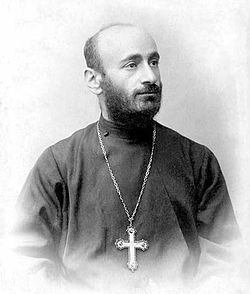
Komitas_1902

Komitas, born Soghomon Soghomonian, is generally regarded as the foundational composer for Armenian classical music in the 20th and 21st centuries.  Like Bartok and Kodaly, he collected and transcribed folk music from his country.  He is considered an early founder of the practice of ethnomusicology collecting Armenian and Kurdish folk music.  He was ordained a priest in the Armenian rite church and took the name Komitas.  The impact of the genocide affected him deeply and he spent the last 20 years of his life in a psychiatric facility where he died in 1935.

Alan Hovhaness

Alan Hovhaness

American composer Alan Hovhaness also embraced a musicological approach to his composition by including Armenian folk songs and that of other musical cultures he had explored including Korean and South Asian. He also acknowledges a debt to Komitas (Hovhaness released a recording on his own Poseidon label of him performing Komitas’ complete piano music).

Hovhaness remains less well-represented than he deserves in the concert hall so this performance of Khrimian Hairig (1944, rev 1948) is a welcome one.  The piece is in three continuous movements titled, “Chalice of Holiness”, “Wings of Compassion” and “Triumph of Faith”.  It is scored for string orchestra with solo trumpet.  The solo here will be played by prominent new music trumpeter Terry Everson (whose talents are to be required in the next piece on the program).  Hairig was a prominent Armenian cleric and mystic of the 19th century.

This work is early in Hovhaness’ prolific output and is characteristic of his Armenian period utilizing Armenian folk melodies and writing on Armenian themes.  He would later gain wider fame when Leopold Stokowski premiered his 2nd Symphony “Mysterious Mountain” in 1955 on NBC television.  Hovhaness died in 2001 leaving over 400 compositions of which 67 are symphonies.

Arghamanyan_Nareh

Nareh Arghamanyan

The Armenian connection to the next piece is apparently the BMOP début of the young Armenian pianist, Nareh Arghamanyan (1989- ) in the First Piano Concerto Op. 35 (1933) of Dmitri Shostakovich.  This unusual piece is scored for piano, string orchestra and trumpet (I told you Everson would be back).  It is one of those neo-baroque experiments and quotes from well-known classical pieces.  It is quite challenge for a pianist and the début of this rising artist will doubtless be one of the highlights of the concert.

The title of the concert is Resilient Voices 1915-2015 and is given in commemoration of the Armenian Genocide (1915-1923) but more so in celebration of the voices and the talents that have endured.  Controversy remains evidenced by the fact that Azerbaijan and Turkey continue to deny the genocide but the estimated death toll was 1.5 million and this is the event for which the term “genocide” was first used.

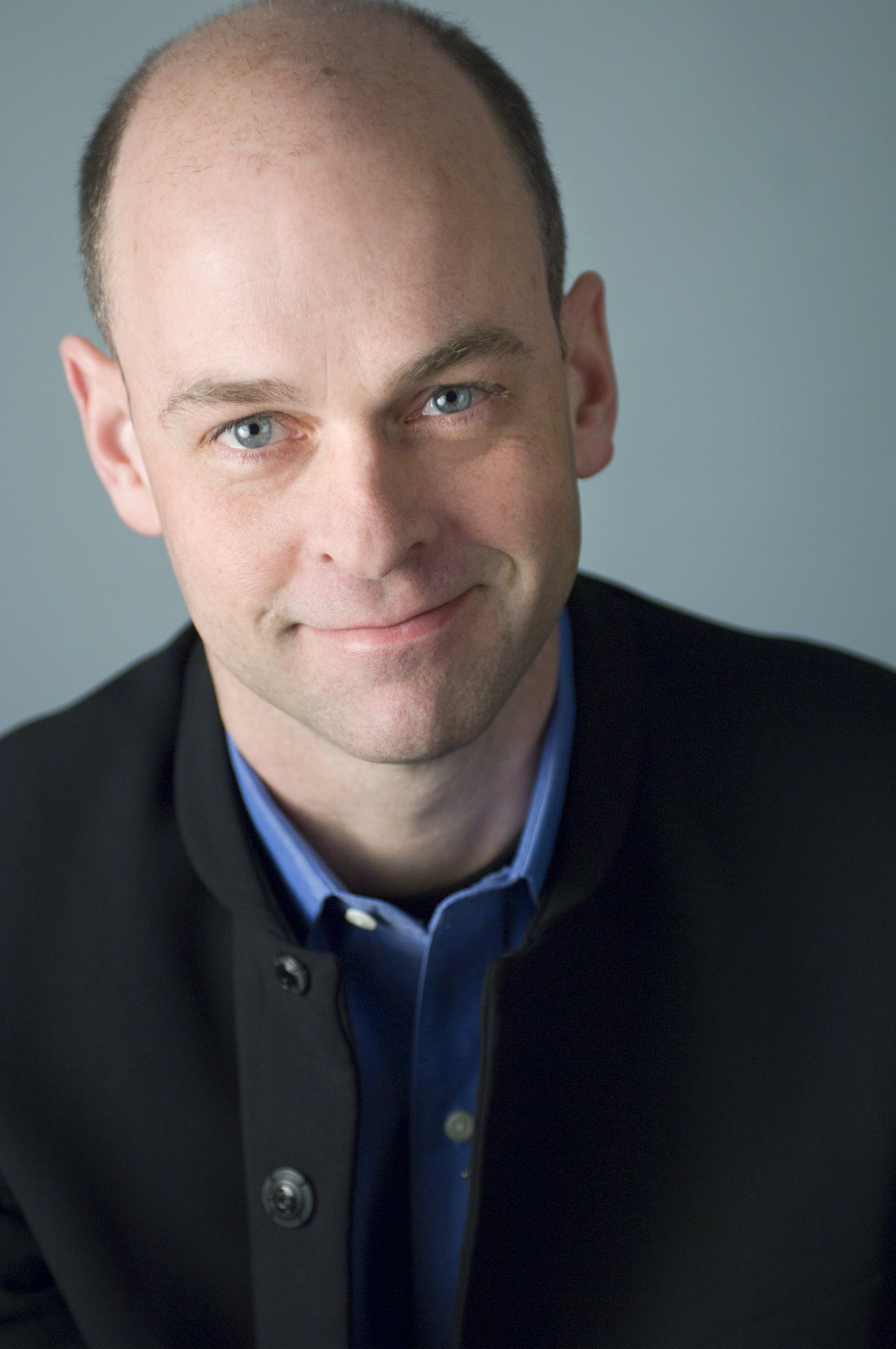
Artistic Director and Conductor Gil Rose

Artistic Director and Conductor Gil Rose

It is the genius of Gil Rose, conductor and artistic director whose creative vision in a couple of releases  I recently reviewed ( Anthony Davis and Irving Fine) that first alerted me to the work of this fine ensemble (a little late, I know).  But I discovered a great orchestra with some of the most innovative programming with attention to new and recent music.  I was graciously offered a seat at this concert but it will have to be one of my regrets.  This sounds like a fantastic program.

Tigran Mansurian

Tigran Mansurian

How very appropriate then to have the BMOP premiere of the Requiem (2009) by Tigran Mansurian (1930- ) by far Armenia’s best known living composer.  The Requiem was written in memory of the holocaust and is scored for large orchestra, chorus and soprano and baritone soloists (not announced when last I checked yesterday).  Gil Rose conducts the Harvard-Radcliffe Collegium Musicum with the Boston University Marsh Chapel Choir.  This is indeed a species of political music and BMOP is to be applauded for this as a contribution to the recognition of human rights. through music.

Tigran Mansurian at the piano at Other Minds in San Francisco.

Tigran Mansurian at the piano at Other Minds in San Francisco.

Mansurian previously appeared at the Other Minds 20th Anniversary concert (also dedicated to the holocaust) in March of 2015 in San Francisco.  At that concert I captured a moment from the pre-concert discussion in which Mansurian agreed to sing a traditional Armenian song accompanying himself at the piano, a very personal moment from a composer whose art is deeply felt.

Please, BMOP, record this.  Thanks in advance!!!

Irving Fine’s Complete Orchestral Music, a vital addition to his discography


BMOP 1041

BMOP 1041

Irving Gifford Fine (1914-1962) was an American composer.  Born in Boston, Massachusetts, Fine studied with Walter Piston at Harvard earning Bachelor’s and Master’s degrees.  He studied  conducting with Serge Koussevitsky and composition with Nadia Boulanger.  At the time of his death at age 47 he completed only a handful of works for orchestra, chorus and various chamber ensemble and solo works.  But what he lacked in quantity did not lack in quality.  The Irving Fine Society maintains a very useful web page which can be found here.

Fine is sometimes identified with a sort of loose knit group of composers called the Boston School which included Fine along with Arthur Berger, Lukas Foss, Alexei Haieff, Harold Shapero and Claudio Spies.  He taught at Brandeis University which now has an endowed chair named in his honor.  Eric Chasalow currently holds  this position.

fine

Curiously his music, which has a generally very friendly neoclassical feel to it, even when he dabbles in twelve tone writing, has received relatively few performances and even fewer recordings.  The Boston Modern Orchestra Project under the inspired guidance of Gil Rose has stepped in to fill a bit of that void in this very welcome and vital addition to Fine’s discography.

This recording of Fine’s complete orchestral music spans his entire musical career with his Symphony being his last completed work from 1962, the year of his death.  Also included are the 1947 Toccata Concertante, Notturno for Strings and Harp (1951), Serious Song (1955) for string orchestra, Blue Towers (1959), Diversions for Orchestra (1960) and Symphony (1962).

All have been recorded before but the Symphony was a release of a live performance by Erich Leinsdorf and the Boston Symphony from 1962 so this is the first studio recording.  The Notturno for Strings and Harp and the Serious Song have received a couple of recordings.  And interested listeners would be advised to locate a recording of Fine’s String Quartet (1952) and Fantasia for String Trio (1957) which I believe to be sort of hidden masterpieces.  Any string quartets out there willing to take on these neglected works?

As usual the BMOP under Gil Rose turn in fantastic performances.  Blue Cathedral and Diversions are among the composer’s lighter fare but deserve at least occasional attention.  But the Toccata, Serious Song and Notturno should be a part of the repertoire with regular performances.  They are masterful and pretty audience friendly.

The big treat here is the Symphony.  As far as I can tell it has not been programmed, much less, recorded, since the Boston Symphony did it under Leinsdorf.  What a shame that this work hasn’t been heard for so long and how wonderful it is to have this great new recording of an American masterpiece.  Cast in three movements (Intrada, Capriccio and Ode) this 20 minute work is one of the composer’s finest pieces and leaves the listener wondering what other works he might have crafted had he lived longer.

Blackness, Race and Music, What I Have Learned So Far


Two years ago, when I was just at the start of my blogging adventures, I decided it would be a good idea to do a few articles in honor of Black History Month. I am not black and I have no expertise in the area of black music but, in keeping with the personal perspective of this blog, I decided that my interest in these subjects is sufficient reason to express some opinions and ideas.  I chose Carl van Vechten’s portrait of William Grant Still, considered by many to the first major black composer to receive recognition in the 20th Century as my symbol for this article.  Much of his music remains unknown and little performed though there have been some significant recordings released in the last few years.

I called that first set of articles “Black Classical”. Curiously my brief article on black conductors has been one of my most read pieces (947  views as of the time I write these words).   So I continued to write on this subject in the following year. For my second set of articles I took the opportunity to look at the 50 year anniversary of the Civil Rights Act of 1964, by all measures a landmark piece of legislation. I asked a question, in part rhetorical because I had a basic idea of the answers I expected, but also to elicit opinions and to discuss issues of race and music.

I sent queries to a random set of composers and conductors and received a few very gracious replies. Comments ranged from carefully worded egalitarian musings on how black music and music by other racial minorities should be integrated and heard throughout the concert seasons to seemingly careful statements suggesting that this might not even be the right question or that it shouldn’t be asked. Not all comments were published but I am grateful to all who replied. And I have been able to continue this discussion in the various groups on Facebook.

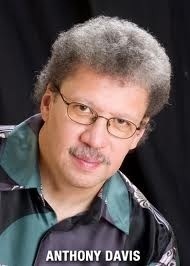
I learned in a (yet to be published) interview with Anthony Davis some fascinating perspectives. Professor Davis did not address my question as I originally asked but he provided some valuable food for thought. It is worth noting that Davis is a composer whose politics are frequently very much in evidence in his music. In a discussion of the current state of music he commented regarding John Cage‘s apolitical stance by saying that, “John Cage’s silence is the silence of white privilege.” One could argue that taking an apolitical stance may have contributed to Cage’s ability to get grants and commissions.  Politically charged music generally does not fare as well.

In general I found more or less what I expected. The Civil Rights Act of 1964 has had little, if any, benefit for black musicians and composers. And given the ongoing killing of unarmed black men by police one must wonder if we have been going backwards as a society. But I don’t want to do a grand social critique here. That is a subject for another blog and is a bit outside of my scope at least for now.

I found some musicians who did not want to address racial and discriminatory issues. It seems the issue is too “hot” and that one could face consequences for even asking the question. And some did not feel sufficiently well-versed in Civil Rights history to make a truly informed assessment of this issues.  Perhaps it is a form of white privilege that allows me to ask such a question. We shall see if any reactions result in verbal attacks or (not likely I think) in a reduction in my readership.

What I have learned is that black classical musicians (who are not in short supply) occupy very few prominent positions in academia, in the public sphere of conductors and performers and in the representation in recorded performances of what is a rich but virtually untapped repertoire.  The inequality remains with perhaps some progress but not enough to pronounce the issues here as resolved to a truly significant degree.  But there is a vibrant community of black musicians who are working as did their predecessors to contribute to our collective culture and the discussions are both lively and stimulating.

In 2014 there was a performance by the Cincinnati Symphony of an Oratorio, “The Ordering of Moses” (1937) by R. Nathaniel Dett. The premiere performance of the piece (a beautiful and listener friendly piece of music) was broadcast live. But that broadcast was truncated, leaving out the finale when white listeners complained about music by a black composer getting so much airtime. Happily the entire piece was broadcast uninterrupted and made available in streaming format. However there is no commercial recording of this grand biblical choral work.

I was pleased to be able to review the fully staged performance in May, 2014 of Zenobia Powell Perry‘s opera Tawawa House (1984) in the unlikely venue of Modesto, California by Townsend Opera.  It was a heartfelt and beautiful production and was reviewed here.

Another interesting event in 2014 was the first appearance of three black counter tenors in a performance of a Purcell Opera in Los Angeles.  My blog on this subject can be found here.  I was pleased to make the acquaintance of Mr. Bill Doggett who has been very helpful in keeping me up on the latest developments with black musicians and composers and was the person who alerted me to this historic event.

Coming up in March at the Other Minds festival there will be performances by Errollyn Wallen and Don Byron.

I have been able to dialog with various black musicians on Facebook most notably through the groups Black Composers, The National Association of Negro Composers and Opera Noir.  Composer, performer and conductor Anthony R. Green is posting the name of a black composer every day for the month of February with examples of their work.

Some recent films have done much to tell the very unpretty history of black people in the United States including: 12 Years a Slave (2013), after Solomon Northrup‘s harrowing memoir,  Fruitvale Station (2013), a retelling of the execution style shooting of Oscar Grant at the hands of police in Oakland, California, Selma (2014), a dramatization of the 1965 march in support of voting rights (musical direction by Jason Moran).  And this trend, happily, seems to be on the rise providing artistic historical narratives to aid in the processing of the complex, shameful and painful histories depicted.  The lack of recognition by the motion picture industry supports my arguments for the poor representation and acknowledgement of black artists in general.

I have to mention that the wonderful set of recordings by Paul Freeman originally released on Columbia records remains available as a boxed set of 9 vinyl records with notes from the College Music Society now being offered at only $17.50 (that is not a typo either) via mail order.  I’m going to buy a couple of extra copies to give away as gifts.  It’s a really nice set.

Perhaps the most useful thing I learned is the egalitarian approach by conductor Michael Morgan who stated his desire that music by ethnic groups be integrated into programming on a regular basis rather than being highlighted in a given month.  (I am pleased to report that maestro Morgan will be receiving an award for his service to new music from the American Composers Forum.)  I am now using that approach with this blog in which I will continue to highlight the work of musicians and other artists whose work I find interesting and worth promoting.  So please stay tuned.


Black Composers Since the 1964 Civil Rights Act


In this, the 50th anniversary year of the landmark 1964 Civil Rights act I have decided to do a survey of black composers who have come of age in the aftermath.  The push for equal rights in the way people are treated, given access to voting, education, business and financial opportunities was the spirit of that legislation.  Though many speak of a “post-racial” America it is clear from any fair analysis that we have a long way to go.

President Lyndon B. Johnson meets with Civil R...

President Lyndon B. Johnson meets with Civil Rights leaders Martin Luther King, Jr., Whitney Young, James Farmer (Photo credit: Wikipedia)

I am beginning a series of articles in honor of Black History Month and in honor of this legislation which attempts to address this inequality. Each article will feature a composer or composers whose work I personally find interesting and worth promoting and which was written or premiered in or after 1964.  I will not necessarily limit myself to Americans both because that would be unnecessarily constricting and inconsistent with the spirit of Black History Month and because non-American black composers suffer similar obscurity and may have even benefited from the 1964 legislation.

Civil Rights Act of 1964

Civil Rights Act of 1964 (Photo credit: Wikipedia)

Whether the legislation has improved the opportunities for black composers is, of course, open to debate but the quality of these artists stand alone on their own merits.  They may have had opportunities not available to their predecessors and this may be a positive result of this legislation.  But the fact that awareness of their work is limited and promoted in relatively obscure contexts such as this blog suggests that true equality in the area of recognition of artistic merit remains elusive (though the availability of recordings of the music of black composers has certainly increased) .  Curiously the United States has chosen the shortest month of the year to celebrate Black History whereas England, who abolished slavery before the U.S., celebrates it in October.  Yes, it’s only 3 days, but the irony is hard to miss.

The pioneering work of musicologist Dominique-Rene de Lerma has done a great service in promoting the work of black composers internationally.  He was involved in the production of the landmark series for Columbia Records along with the great (now retired) conductor Paul Freeman recording a variety of music from black composers world-wide. I had discussed this set in a blog last year and it is worth mentioning that the complete set of recordings has been reissued on 9 vinyl discs as a result of a Ford Foundation grant and remains available through the College Music Society in Missoula, Montana for $35.  This beautifully produced box set deserves an honored place in any record collection.

This pioneering set has inspired similar series by Albany Records and Cedille Records which have made recordings available of some very attractive music of black composers which deserves a wider audience.  It is largely these sets and the writing of Professor de Lerma which serve as the source for the series I am doing on this blog.

The internet site africalssical blog is also a very useful resource which is updated frequently and reports the work of black musicians working in the so-called classical world.  It is difficult and perhaps superfluous to try to separate jazz and classical so I will include composers without concern for specific genre categories except, perhaps, pop composers whose work is well-represented in the mainstream.

Pioneering black musicians like Natalie Hinderas, Martina Arroyo, Marian Anderson, Dean Dixon, William Grant Still and their like paved the way for their successors such as Kathleen Battle, Jessye Norman, Paul Freeman, George Walker and others whose stars became visible to the casual onlooker.  Of course there are fine black classical artists whose talents remain too little known.  How many people know Awadagin Pratt, Mark Doss, Michael Morgan and other active black musical artists?  It takes much more work for listeners to find and appreciate their talents.

It takes even more work to find black composers, especially if they are not also performers.  Most people, even most musicians, would have difficulty naming a single black classical composer.

I contacted several prominent black musicians to pose the question of how the Civil Rights Act of 1964 has impacted black classical composers.  To date I am pleased to say that I have received two gracious replies.  The first is from Michael Morgan who currently serves as conductor of the Oakland East Bay Symphony, the Sacramento Philharmonic and the Festival Opera in Walnut Creek.  He has numerous recordings to his credit as well.  Maestro Morgan replied as follows:

Michael Morgan (1957- )

Michael Morgan (1957- )

“I don’t believe the 64 Civil Rights Act has impacted black composers directly, however, the national conversation it inspired did cause performing arts groups (and their philanthropic supporters) to look for new ways to expand their audiences into communities not traditionally as well represented in concert halls. Orchestras are still making efforts (some more sincere than others) to connect with various minority communities. Unfortunately, rather than sprinkle such efforts throughout their seasons, some have opted for the annual Martin Luther King or Black History Month (or Cinco de Mayo, or Chinese New Year, etc. etc.) concert resulting in less sustained contact than might otherwise be possible. Such concerts have, however, been something of a boon for black composers, performers and conductors who find themselves at least included on orchestra programs on those annual occasions.

There may have been a more direct impact on the integration of some concert halls in particularly segregated cities, but the performing arts have historically been somewhat ahead of society in general in terms of promoting fully integrated events, at least in communities where there was significant acceptance of such integration.”

Morgan’s practical approach to programming is evident here and the point is well-taken that consistent programming of minority composers would result in a more sustained impact than simply having focused efforts during given months or weeks.  In fact this notion has convinced me that my blogs on the subject might be more effective if I were to spread them throughout the year, something which I will now incorporate.  My previous blog post on black classical conductors which included Maestro Morgan has been one of my most frequently viewed posts and I will expand on that subject in the months to come.

Adolphus Hailstork

Adolphus Hailstork

The second reply was from eminent composer Adolphus Hailstork who was the subject of my first blog post for black history month from last year.  He replied very thoughtfully as follows:

“Fifty Years After the 1964 Civil Rights Act

Having grown up in New York State and not experienced “legalized” segregation as practiced in the South, I had enjoyed as a youth, all the rights and privileges of American citizenship due me. There were no “colored” this and “white” that signs or classrooms, or lunch counters, etc. So the Civil Rights Act of 1964 did not have a direct effect on my life at that time.

(I much later came to appreciate the value of the changes in the south when I came to live there as a working adult.)

Actually, it was the assassination of Dr. King that opened doors to my beginning my doctorate degree that same year when I got out of the army (1968).

Also, that tragic event influenced the unfolding of my career, because it led to an interest in the music of African-American classical composers for the honoring of Dr. King’s birthday celebration in January and, by extension, the heightened interest in such music during the February Black History Month observance.

I believe the history of African-Americans is tragic, heroic, triumphant, and, of course, filled with awesomely dramatic stories. It is an honor to attempt in some small way to pay tribute through music to our story.”

Clearly Dr. Hailstork notes the difference between his experiences in the north where he was born and was able to see the profound contrast he experienced working in the south at Old Dominion University in Virginia particularly during the early civil rights struggles and their aftermath.  The emotional impact of the assassination of Dr. Martin Luther King in the same year he concluded his military service  is noted as a formative issue as well.

One can easily hear the deep emotional impact of which he speaks in works like his second symphony from 1999 which reflects his feelings after having visited the slave markets of West Africa and his American Guernica (1983) which is about the Birmingham 16th Baptist Church bombing which killed 4 little girls in 1963.  Other works such as his Epitaph for a Man Who Dreamed, In Memoriam Martin Luther King, Jr. (1979) also reflect the impact of these events on him personally and reflect what he describes as his feeling of honor in being able to pay tribute to these tragedies describing them aptly as “our story”.

I think it is important to begin to see the tragic and triumphant events of the civil rights era as our American story and not just as the story of black Americans.  Indeed these events are part of our collective history as human beings and as Americans.  These are stories that need telling and re-telling as a part of the healing process and the exorcising of the evil deeds of our collective past.

Enhanced by Zemanta

MLK, the Classical Playlist


President Lyndon B. Johnson meets with Martin ...

President Lyndon B. Johnson meets with Martin Luther King, Jr. (Photo credit: Wikipedia)

There is no doubt that rhythm and blues is the soundtrack of the Civil Rights Movement but in this, the 50th anniversary of the 1964 Civil Rights Act, I am issuing a programming challenge to the classical music world.  Hey there all you classical music stations, both internet based and broadcast.   Hey there Spotify and Pandora.  Have you explored the music written for and about the Civil Rights era?  Well, here’s your chance.

I begin my programming day with Joseph Schwantner’s “New Morning for the World” (“Daybreak of Freedom”), written in 1982.  Comparisons to Copland’s “Lincoln Portrait” are made due to the similarity in character and the use of a narrator.  The other work on this  Oregon Symphony CD under the late great James De Preist is  a work by an older composer Nicolas Flagello.  The cantata, “The Passion of Martin Luther King” from 1968, was composed in the shadow of the assassination of Dr. King and first performed in 1969.  Both works deserve more hearings for their musical accomplishments as well as for the subject of their dedications.

Description unavailable

Description unavailable (Photo credit: pennstatenews)

Moving on to the next segment I will move on to Adolphus Hailstork‘s 1978 “Epitaph for a Man Who Dreamed”  followed by William Grant 1930 Symphony No. 1 “Afro-American”.  Still is rightfully known as Dean of Afro-American composers.  A contemporary of Aaron Copland, his accomplishments established without a doubt the place in classical music for black composers.  Hailstork acknowledges his debt to the older master.  He is the next generation of black musicians contributing to the repertoire.  I will conclude this segment with Hailstork’s Symphony No. 2 which contains his impressions upon visiting the slave market areas of western Africa, places where began the shameful history of black slavery.

And on we go now to Luciano Berio’s 1968 “O King”, a chamber piece later incorporated into his masterwork, “Sinfonia” of the same year.  I program the version from Sinfonia, it’s my favorite rendering.  The vocal parts of this piece are solely comprised of the name “Martin Luther King”.  Also from 1968 there is Michael Colgrass’ “The Earth’s a Baked Apple” which is subtitled, “A Musical Celebration in Honor of Dr. Martin Luther King, Jr.” (psst, I have a bootleg of it).

We move on to afternoon programming featuring Anthony Davis’ opera, “X”, based on the life of Malcolm X.  This is  a work that deserves a new production.  Following this I will move on to Duke Ellington‘s 1943 “Black, Brown and Beige” Suite and then his “Three Black Kings” titled in French with rhyming wordplay as “Les Trois Roi Noir”.

Album cover

Album cover

The program would be incomplete without programming the wonderful Other Minds CD of Sarah Cahill’s album “A Sweeter Music” featuring a diverse collection of compositions written for her on commission by Terry Riley, Meredith Monk, Frederic Rzewski, Kyle Gann, Carl Stone, Phil Kline, Yoko Ono and The Residents.  The title is taken from Dr. King’s Nobel Prized lecture in which he refers to peace as “a sweeter music”.

Dizzy Gillespie

Cover of Dizzy Gillespie

I will end my fantasy program with Dizzy Gillespie’s “Brother K’ and Hale Smith’s “In Memoriam Dr. Martin Luther King, Jr.”  But fear not I leave you with a useful reference I have recently discovered.  “A Catalog of Music Written in Honor of Martin Luther King, Jr.” edited by Anthony McDonald.

Stay tuned for more on these subjects coming up during February for Black History Month.  Peace, Dr. King.

A mural painted on the side of the African Ame...

A mural painted on the side of the African American Museum depicts the Hough riots, the civil rights movement and a family looking towards a bright new future for the city and the community. (Photo credit: Wikipedia)


Enhanced by Zemanta

Music by Gerhard Schedl, a New Recording by the Walden Chamber Players


Suicide, the artificial ending to a life is an inscrutable act, especially so when it takes the life of a talented individual.  So it is with Austrian composer Gerhard Schedl whose life was ended by his own hand in 2001.  I had never heard of this man and his work and I always welcome the opportunity to hear music new to my ears and such an opportunity presented itself recently.

By good fortune and the kindness of cellist and current artistic director Ashima Scripp I received a copy of the Walden Chamber Players latest CD: ‘A Voice Gone Silent too Soon: The Music of Gerhard Schedl.  The disc contains 4 chamber works for various combinations of strings, piano and clarinet.schedl

As it happens I had not been familiar with this ensemble before either so a word about them would seem to be appropriate.  Founded in 1997 this flexible sized ensemble consists of eleven musicians including strings, piano, harp and woodwinds.  The musicians are all highly accomplished and most are on faculty at area Universities.  Their choice of repertoire distinguishes them as they seem to choose new and/or lesser known music that the musicians feel deserve a hearing and hopefully a wider audience.  Their fascinating catalog at the time of this writing consists of 6 discs and includes music by Beethoven, Debussy, Vaughn Williams, Francaix, Gubaidulina and Reger to name a few.

When they choose Beethoven they choose the seldom played string trios and their other choices seem to involve late romantic and early 20th Century composers with a focus on pieces that are little known and rarely played.  From what I have heard they bring a real passion to their performances.  In addition they have a variety of educational and outreach programs that serve to increase interest in chamber music and support new artists in playing this repertoire.

Now to the disc at hand.  At first I did what I usually do after a quick read of the liner notes.  I put the CD in my car stereo to begin some relatively casual listening so I can begin to form some initial impressions.  However this is music of wide dynamic range and some of the most beautiful moments are the quieter ones so I found that it is best heard in a quiet environment and preferably with headphones.  Most of the gestures in this music are the familiar sounds of chamber music.  The music is sometimes melodic, sometimes pointillistic, sometimes impressionistic, sometimes expressionistic.  Schedl seems to be a sort of modern post-romantic who is well-schooled in what a chamber ensemble can do and is apparently influenced by the expressionism of Schoenberg and the Second Viennese School as well as by Mahler, Debussy and perhaps Messiaen.  This being said his music does not actually resemble any of these influences too strongly.  The music is rarely dissonant but there are grand fortissimo gestures as well as glissandi and what sounds like some playing inside the piano and some extended techniques which my ears could not identify with certainty.  But this is not what I would call “experimental music”.  Indeed the music sounds very well planned with an ear for subtleties that the ensemble lovingly interprets.  It sounds like this music is as enjoyable to play as it is to hear.  Though virtuosic it is also expressive if agonized at times and the recording is fantastic.

The first piece, String Trio (1991) for violin, viola and cello is in three movements.  I did not find the tempi descriptions particularly useful as a listener since this composer’s music seems to sustain a variety of tempi and expression within each movement.  Inevitably comparisons to Schoenberg, Webern and perhaps Ernst Krenek will come to mind and it is difficult to predict this piece to stand with those models but it definitely bears additional hearings and would be welcome on any good chamber music program.

The next piece, “A Due”, a Duo for Violin and Cello (2000) is from the last year of the composer’s life.  It is in four movements and is the most angst ridden of the pieces on the disc.  This combination of instruments is relatively rare.  I personally know only the Ravel duo which resembles this piece though that is largely due to the instrumentation, not the style.  This is a concentrated and deeply felt piece which seems to reflect some painful emotions.  Here I am reminded more of Webern and perhaps Wolfgang Rihm with their spare textures and emphatic fortissimi amidst the quieter moments.   As with all the pieces on this disc the execution reflects the intense concentration and dedication of the musicians.

The five movement, “A Tre” for clarinet, violin and piano of 1984 is the earliest composition here.  It comes as a welcome relief emotionally from the previous “A Due”.  This is by far the most whimsical of the pieces featured on this album.  It has an almost orchestral feel to it at times.  Multiple techniques (and, no doubt, careful execution) result in textures that are sometimes rather expansive.  Shades of Messiaen appear to be present sometimes.  They contrast with the more chamber music like gestures familiar from the previous works.

The disc concludes with the 1996-7 “A Cinque” for clarinet, violin, viola, cello and piano.  It is a very serious post-romantic, even neo-classical take on the quintet format.  The piece consists of three movements.  The first two are serious but not terribly dark and showcase the ensemble well.  The last, an adagio, has a sadness mixed with nostalgia that reminds this listener of Mahler. There are none of the abrupt dynamic changes heard in the previous works on this CD, only a soft and gentle ending.

If you enjoy well-performed and recorded chamber music and are interested in exploring something besides the old war horses of the standard repertoire then this disc is for you.  Multiple listenings reveal more detail about the pieces and make this writer curious about this man’s work for larger ensembles as well.

Thank you Walden Chamber Players for a wonderful CD.  I look forward to hearing more from this fine and adventurous ensemble.

Right of Spring, Left of Spring but Not Necessarily in Spring


Disruptions, dissatisfactions and even stronger reactions are not actually that uncommon in classical concerts. But some of these disruptions have taken on a sort of mythical dimension while others remain lesser known. The significance of these disruptions is usually based on failure of expectation or fulfillment of a foregone conclusion. Either the audience is unpleasantly surprised by the music or they come with preconceived notions of the inherent difficulty and/or insignificance of modern music. I think that these events signal a revolution not so much in music as in hearing. Audiences’ horizons are being expanded and many rebel against being taken out of their comfort zones. It is much like the paradigm shifts in science delineated by Thomas Kuhn in ‘The Structure of Scientific Revolutions’. Indeed some of these concerts seem to signal aesthetic revolutions.

English: Kiss to the Earth. 2nd variant. Scene...

English: Kiss to the Earth. 2nd variant. Scenery sketch. 1912 (from a reproduction) For Diaghilev’s production, Théâtre des Champs-Élysées, Paris, 1913 (Photo credit: Wikipedia)

May 29th, 2013 will mark the 100th anniversary of the first performance of Igor Stravinsky’s ‘The Rite of Spring’ at the then newly constructed Champs-ÉlyséesTheatre in Paris. The performance was a dance concert with the Ballets Russe with the mercurial Vaclav Nijinsky and with choreography by Serge Dhiagalev and sets by Nicholas Roerich with Pierre Monteux conducting the orchestra. The audience reaction disrupting the performance and the composer subsequently sneaking out the back way is the stuff of legend now (if not strictly truth). The public and the news media love anniversaries so it is no surprise that a great deal of writing, lectures and concerts fill this, the year of that anniversary.

The score went through several revisions (1921, 1926, 1929 and 1943). It is the 1929 score that is the one most performances now follow. Curiously the 1943 revision of the Sacrificial Dance has never been performed as far as I can determine. The Paul Sacher Foundation is making the 1913 version of the score available for the first time in celebration of the centennial.

The first work on that concert was a performance of Les Sylphides, a ballet consisting of piano music by Frederic Chopin orchestrated by Alexander Glazounov. For this concert orchestrations were commissioned from Anatoly Liadov, Nicholas Tcherepnin, Sergey Taneyev and Igor Stravinsky. It was followed by the Hector Berlioz 1841 orchestration of Carl Maria von Weber’s piano piece,’Invitation to the Dance’ (1819). This certainly satisfied mainstream expectations but provided a stark contrast for the next work which was the now infamous Rite of Spring. In the tradition of well-trained professional performers the musicians and dancers continued in spite of the disruptions and even concluded with another tamer work, the ‘Polovetsian Dances’ from Alexander Borodin’s Opera ‘Prince Igor’ (1887).

Musikverein - Dumbastrasse - Innere Stadt -Vienna-

Musikverein – Dumbastrasse – Innere Stadt -Vienna- (Photo credit: Million Seven)

Almost two months before on March 31, 1913 there was a concert in the Musikverein in Vienna by the RSO Wien (Vienna Radio Symphony) under the direction of Arnold Schoenberg. Alex Ross brought this incident to my attention in his blog. The music on the concert was Anton Webern’s ‘Six Orchestral Pieces’ (1909-13), Alexander Zemlinsky’s ‘Four Songs on Poems by Maurice Maeterlinck’ (1913), Arnold Schoenberg’s ‘First Chamber Symphony in E major Opus 9’ (1906, played in version with an augmented string ensemble of 1913), two (out of five) of Alban Berg’s ‘Altenberg Lieder Opus 4’ of 1912 (“Sahst du nach dem Gewitterregen den Wald”, op. 4/2 and “Über die Grenzen des All”, op. 4/3) and the last programmed (but not played due to the police shutting the concert down) first of Gustav Mahler’s ‘Kindertotenlieder’ (1904).

Photo of Arnold Schoenberg in Los Angeles, bel...

Photo of Arnold Schoenberg in Los Angeles, believed to be taken in 1948. (Photo credit: Wikipedia)

Even before this there was the unwelcome reception of musicians and audiences to Claude Debussy’s 1902 opera ‘Pelleas and Mellisande’. Both the musical language and the frank treatment of sex in the libretto contributed to the initial hostile reception. Of course the work is now acknowledged as a masterpiece.

The 1926 première of George Antheil’s ‘Ballet Mecanique’ (1924) in Paris was promoted as radical new music seemingly to create another controversy like that of the Rite of Spring some 13 years before in the very same theater. As near as I can determine there was only one other work on the program (Symphony en fa) and it is not clear whether or not it was the first or last piece on the program (though I suspect it was last). The audience was clearly divided and perplexed by the music and likely also by the technical failures that occurred in this complex work whose demands on mechanically operated instruments wouldn’t actually be executable as the composer intended until the year 1999 . The première in Carnegie Hall New York in 1927, again a concert entirely of Antheil’s works also created controversy and supposedly the controversy continued outside the concert hall with some minor rioting in the street. This concert was duplicated by conductor/historian Maurice Peress and recorded on CD. That concert began with the 1925 Jazz Symphony (played by the W.C. Handy orchestra) followed by the 1923 Sonata for Violin, Piano and Drum and then the String Quartet of 1925. The second half of the concert contained the Ballet Mecanique. While both the Paris and New York premieres were significant and somewhat controversial they did not quite have the impact of the Rite of Spring.

English: Shiraz Art Festival: David Tudor (lef...

English: Shiraz Art Festival: David Tudor (left) and John Cage performing at the 1971 festival.(Photo courtesy Cunningham Dance Foundation archive) (Photo credit: Wikipedia)

On August 29th, 1952 pianist David Tudor performed one of the most controversial musical pieces of all time. In Woodstock, New York audiences sat (mostly perplexed) as Tudor opened and closed the lid of the piano and marked time with a stopwatch. It was the première of 4’33” by John Cage in the aptly named “Maverick” concert hall. Kyle Gann writes in his book, ‘No Such Thing as Silence’ (written in commemoration of the 50th anniversary of the première) that, like the Schoenberg concert, the program consisted of other contemporary pieces. Morton Feldman’s ‘Extensions 3’ (1952) began the program followed by one of the pieces from Christian Wolff’s ‘For Prepared Piano’ (1951) and then the very complex Piano Sonata no. 1 (1946) by Pierre Boulez.

Cage’s was the penultimate work which was followed by Henry Cowell’s ‘Banshee’ (1925). The concert was followed by a question and answer session. There was no riot in the cool intellectual atmosphere of this concert venue but Gann states that one artist exclaimed at one point, “Good people of Woodstock, let’s run these people out of town.”

John Cage would have a much more unpleasant experience at the hands of the New York Philharmonic with the première of his ‘Atlas Eclipticalis’ (1962). On February 9, 1964 under the baton of Leonard Bernstein this piece was performed as part of a series of contemporary pieces played by the orchestra that year. Concert programmers sandwiched the work between performances of Vivaldi’s ‘Four Seasons’ and the Tchaikovsky 6th Symphony.

Benjamin Piekut, in his excellent book, “Experimentalism Otherwise”, investigated the circumstances surrounding this concert attempting to separate history from legend by interviewing some of the musicians who participated. He reports that there were technical problems with contact microphones, mixing consoles and amplification. But there was also rebellion by the musicians some of whom destroyed the contact microphones and/or declined to play the notes provided. These technical issues which occurred seem similar to the Antheil concert in that technology was behind the composer’s intentions but the willful destruction and misuse of the technology by the musicians themselves suggests an added level of hostility which of course did not help the audience’s reaction which was anything but favorable.

A 1971 concert by the Boston Symphony under Michael Tilson Thomas included a work for 4 organs and maracas by Steve Reich. The piece, titled simply ‘Four Organs’ (1970) is a study in ‘augmentation’ the lengthening of notes and musical phrases, stretching time as it were. The maracas simply play steady 8th notes creating a pulse that the musicians can count. They wind up having to count up to 120 beats at times and concentration is paramount in a successful performance of this music.

The first recording of Four Organs

The first recording of Four Organs

The piece had been premiered at the Guggenheim Museum in 1970 and was reportedly pretty well received. The context of a new music concert in a non-traditional venue no doubt contributed to the more favorable response because the audience was expecting a challenge. Reich was skeptical about the presentation of this music in a more traditional venue and indeed he was correct in assuming that it would receive a different response.

The theme of the concert was ‘multiples’. The first piece on the program was the Sinfonia for two orchestras by Johann Christian Bach (one of the sons of J.S. Bach). It was followed by Mozart’s Notturno for four orchestras and the Bartok Music for Strings, Percussion and Celesta of 1936. Again the newest and most controversial piece would hold the penultimate position followed by Franz Liszt’s Hexameron Variations for six pianos.

English: Michael Tilson Thomas

English: Michael Tilson Thomas (Photo credit: Wikipedia)

Michael Tilson Thomas, who was at one of the farfisa organs (along with the composer, Ayrton Pinto and Newton Wayland), reports that there were wide differences in the reactions to the music, a great deal of noisy reactions both pro and con. Thomas appeared to like the music (and likely the reaction to it) well enough to program the piece again in 1973 in New York’s Carnegie Hall to an even more hostile response which, according to Thomas, included a woman who came to the stage and banged her head against it saying, “Stop, please, I surrender”. Clearly the issue here in not one of technology but definitely one of failure to meet expectations of many listeners. It was a very different sound especially in the context of the concert hall and programmed with far more conservative music preceding and following it.

These are just a few of the most prominent such responses in the twentieth century. One is left to wonder when and where such a strong reaction might occur again. It is one of the joys, I believe, of going to concerts. The audience response is a valuable part of the experience.

Black Classical Part Five


Looking at the previous four installments in this, my personal tribute to Black History Month, I decided that I needed to write one more (for now) in this series. So here I will present some of the resources I have found useful in learning about this music. While I have some knowledge in this area I could not have written these posts without these sources and I will continue to look to them to help me discover more musical gems. I hope that these essays have sparked some interest and I hope that any such interest will have ways to grow further.

The most useful general search terms formed the titles of these posts: black classical (or “African-American classical” which then limits your search to U.S. or the Americas). The term, “classical” is problematic but did serve to differentiate my searches from blues, ragtime, traditional jazz, soul, rhythm and blues, pop, rap and related genres that are more stereotypically associated with black people in music.

My focus was on composers and conductors leaving out a vast category of black classical musicians. A useful overview can be found at: http://www.wqxr.org/#!/articles/black-history-month/2013/jan/31/timeline-history-black-classical-musicians/. This little timeline provides a perspective on the slow acceptance of black musicians in the elite ranks of producers and ensembles that define the classical music experience.

africlassical.com is a good general site that lists many black musicians and its far more up to date companion site http://africlassical.blogspot.com/ has postings of great interest on an almost daily basis has been both essential and revelatory at times (I bookmarked this blog).

Center for Black Music Research is a rich resource and also publishes an academic journal on the subject as well as many other useful and interesting publications. They also maintain a large research library of books, journals and recordings. And they cover all forms of music. An excellent resource.

But the starting point for my personal interest in this subject is the landmark set of recordings which I encountered in the mid to late 1970s. Columbia records release of nine albums entitled ‘Music by Black Composers’ is perhaps the best starting point due to the wonderful scholarship and musicianship in this set. Conductor Paul Freeman along with musicologist Dominique-Rene de Lerma collaborated on this set. They produced a fine overview of neglected black composers from the 18th century to the mid-20th century in an intelligent selection of music and excellent performances by American orchestras. I was pleased to find that the reissue of these albums as a 9 vinyl disc boxed set remains available for only $35 plus postage from here. I jumped at the opportunity to acquire this great reissue funded by the Ford Foundation and my order was sent to me in less than a week.

Chicago-based Cedille Records has some great releases and even more great black classical is available at Albany Records.  Search for the work of Paul Freeman on both labels.

The ultimate goal for me in all this would be to have black classical musicians and composers equally represented on recordings, in performances and in programming. But until that happens (I’m not holding my breath here) the recordings and resources thus far cited (and many that were not) will have to suffice. While I continue to enjoy discovering this music as a “best kept secret” or a limited boutique-type item I would much prefer that the art of these black musicians become common knowledge, not a political issue of which Marian Anderson‘s concert at the Lincoln Memorial has become emblematic.

20130221-135527.jpg

Let me end by referring my readers to my favorite fiction book about black musicians: Richard Powers‘ 2003 masterpiece ‘The Time of Our Singing‘. Powers, who is also trained as a musician, demonstrates amazing insight to music as well as civil rights issues in this sweeping epic of the twentieth century. The chapter entitled, Easter, 1939 (too long to quote here) brings the Marian Anderson concert to life in powerful prose. Read it, preferably out loud to a friend, because it will give you a history lesson and perhaps put you in touch with the emotional power and significance of that event.

Happy Black History Month to all. And happy listening.

20130222-084931.jpg


Black Classical Part Four


As promised in a previous blog I am here continuing a little personal survey of recordings of music by black classical composers in honor of Black History Month. I suppose it is worth adding that I pursue these recordings because they present interesting and exciting repertoire that has not gotten the circulation it deserves. Sadly this is most likely the result of the failure of producers, performers audiences and investors to look at the value of the art itself, looking instead through the lens of racial prejudice. I hope that readers of these blogs will avail themselves of this music, these performers, these recordings and maybe come to realize that those old prejudices serve only to limit one’s world view and prevent a rewarding artistic experience. Art, like people, must come to be valued by its own merits, not limited on the basis of skin color. MLK definitely phrased that more elegantly.

20130218-185316.jpg

And further proof of such valuable art can be found in a series of recordings on the Chicago-based label Cedille. In fact their website cedillerecords.org contains a link to the six albums of music by black composers they have thus far issued.

Building on the work he had begun with the Black Composers series for Columbia in the 1970s conductor Paul Freeman released three CDs in the Cedille series called ‘African Heritage Symphonic Series’. With the orchestra he founded Freeman presents music by Samuel Coleridge-Taylor, Fela Sowande, William Grant Still, Ulysses Kay, George Walker, Roque Cordero, Adolphus Hailstork, Hale Smith, David Abel’s, David Baker, William Banfield and Coleridge-Taylor Perkinson. Freeman released a CD dedicated exclusively to the music of Coleridge-Taylor Perkinson as well.

Violinist Rachel Barton-Pine released a disc of violin concertos by 18th and19th century black composers on Cedille and there is a disc of choral music which includes music by black composers.

Let’s turn now to the Albany www.albanyrecords.com label where you can find more of the artistry of Paul Freeman in 18 albums where he presents neglected music of the 20th century by a wide variety of composers black and white. Most of it is by American composers and much of that in styles related to the mid-century styles of the likes of William Schuman, Aaron Copland and their students. While these discs include music by many of the previously mentioned black composers there are no duplications of works or performances. I have heard but a few of these discs but what I have heard is enough to convince me to plan to purchase the others. Freeman, in addition to bringing the music of black composers to the listening audience has done a fine job of documenting many whose work has been little heard until now.

20130218-183122.jpg

Another composer who fits more or less into the context of the conventions of the western concert traditions whose work has informed my listening is that of Anthony Davis (1951- ). While he has played with musicians from more experimental traditions the influence of the western concert traditions is more easily heard.

His study of jazz as well as western classical and eastern gamelan are all evident in his work (though not necessarily all at the same time). The New York City Opera produced his, ‘X, the Life and Times of Malcolm X’ in 1986 and the Lyric Opera of Chicago produced ‘Amistad’ in 1997. He has written concertos for piano and for violin as well as music for orchestra and smaller ensembles. At the time of this writing he is professor of music at the University of California San Diego.

So far the music we have discussed has been of the sort more commonly heard in concert halls these days. Freeman’s efforts have seemingly jump-started the recording industry to pay some attention to the music of black and other neglected composers. Certainly there is much more gold to be mined there. But we have yet to address the contemporary scene, the new and creative artists who are bringing innovative ideas and sounds and advancing the musical arts for subsequent generations. Following on the innovations of great jazz artists such as Charlie Parker, John Coltrane and Ornette Coleman (among many) there was increasing focus on techniques being used by contemporary “classical” composers

20130218-190530.jpg

To these ends there is no better place to start than with the AACM, the American Association of Creative Musicians. Founded in Chicago in 1965 this collective has strived to bring various elements of black culture in an incredibly eclectic and experimental milieu which has had and continues to have an influence on music, musicians and audiences. This collective was finally given a proper overview in George Lewis’ book, ‘A Power Stronger Than Itself’. Lewis, a trombonist, composer and currently professor of music at Columbia University in New York was a member of the AACM.

The AACM was not the only such collective but it was one of the most visible, at least to me. And it continues to develop and evolve bringing the complex and innovative musical ideas evolving from the black roots of jazz to a level of recognition and respect formerly accorded pretty much exclusively to European academic models. The AACM, dubbed “Great Black Music” also strives to retain the identity of black music by black peoples of the world looking to non-western models that predate European colonialism marrying them to the best of European models as absorbed by the diaspora. Many of their members now hold academic positions including Roscoe Mitchell, Anthony Braxton, Wadada Leo Smith and Nicole Mitchell.

20130218-190751.jpg

Perhaps the best known ensemble to come out of the AACM is the flexibly-membered Art Ensemble of Chicago. Their album ‘Third Decade’ released in 1984 is representative of their work and also marks a sort of end to one creative era for this flexibly-membered group. Most listeners will hear this as progressive jazz and it certainly has those elements. But repeated listenings reveal many layers to this work. And this is but one of a large catalog of albums as diverse as they are numerous (about 50 albums and still counting). More on their work at their website www.artensembleofchicago.com.

20130218-190928.jpg

Another prominent figure that was a member of AACM is Anthony Braxton, saxophonist, composer, chess master who dislikes the term ‘jazz’ in reference to his music. He is currently professor of music at Wesleyan University. And indeed his music which ranges from solo saxophone work to small ensemble and orchestral music and opera are difficult to classify. His experimentalism is related to but not derivative of the work of John Cage. It would be impossible to represent his musical output in a single album but the solo saxophone ‘For Alto’ (1968) and ‘Creative Orchestra Music’ (1976) are good places to start in his discography of well over 100 albums. His website tricentricfoundatio.org offers many of his recordings for sale and even offers free downloads of bootleg recordings.

20130218-185224.jpg

<a

For the sake of brevity I will discuss only one more artist in this blog entry, Julius Eastman (1940-1990). He was a composer, vocalist, pianist and dancer. As a vocalist he sang and recorded the music of Meredith Monk, Peter Gordon, Morton Feldman, Arthur Russell and Peter Maxwell-Davies. He was very much a part of the avant garde downtown scene in New York of the 1970s.

At the time of his sad death from a heart attack at the age of 49 there were but a few recordings of his work (collected in a nice 3 CD set on the New World label). And many of his scores were lost when he was unceremoniously evicted from his apartment. The composer Mary Jane Leach is attempting to collect and preserve his legacy and has made many of his extant scores on her website http://www.mjleach.com/eastman.htm.

Without a doubt there are many more black classical and avant-garde artists I have yet to discover. I welcome suggestions and I hope that the preceding ideas will stimulate and encourage others to explore these artists and works.

Black Classical Part Three


20130214-170052.jpg

For my third installment I have chosen to highlight that series of recordings by conductor Paul Freeman of music by black composers which I mentioned in a previous blog.

In 1974 Columbia Records issued 9 LPs (originally it was to be 12) over the next few years in a series called, ‘Music by Black Composers’. The music was chosen largely by Paul Freeman who also wrote the liner notes and conducted the performances. He was assisted by musicologist Dominique-Rene de Lerma who contributed his knowledge of pre 20th century black music and also edited some of the pieces for performance.

This set of records was featured by my local radio station (WFMT in Chicago) at the time of its release and opened my listening mind to to this cornucopia of fascinating classical concert music by black composers. The series was so titled in part because it included music from many countries and also because it was released before the term ‘African American’ became Le mot juste (but that is another story).

The series was apparently recorded and released 1974-78 and re-released in 1986 as a set under the Columbia Special Products label. Historically it was an important set of releases much like the series curated by David Behrman called ‘Music of Our Time’ which featured some truly cutting edge music by composers writing in the sixties and seventies. To be sure the black composer series was not cutting edge modernism like that series but gains its cutting edge from collecting in one set music from the 18th to the mid-20th century by a set of composers who, other than having been trained in the discipline of music performance and composition, held in common only a skin color darker than ‘white’.

Billboard announced the plan to issue these records in 1973 saying that they were the fruit of a collaboration between the Irwin-Sweeney Miller Foundation of Columbus, Indiana and, with the encouragement of Dominique-Rene de Lerma, the school of music at Indiana University in Bloomington. Citing “campus politics” professor de Lerma reported that Indiana had lost interest so he phoned Paul Freeman (conductor with the Detroit Symphony at the time) and advised him to contact the ‘Afro-American Music Opportunities Association’ whose support then helped launch this series. The original plan was to release four albums per year for at least three years but a great beginning soon slowed and the 9th album (pictured above) was the final release in the series.

Coming twenty some years after the voting rights act of 1965 it retained the some cachet of the civil rights movement and likely was produced at that time in the hopes that this might help sell the albums to consumers. I don’t know who ultimately bought these albums or what their total sales were but I know that some visionary producers at WFMT piqued my interest and that I bought many of these records and listened with interest when they were scheduled to play (I religiously perused the monthly program guide).

The original releases went out of print in a few years. There was a CD set (currently out of print) compiled by the Columbia University (Chicago) Center for Research in Black Music funded by the Ford Foundation that released a selection of the Detroit Symphony performances (now a pricey collector’s item) from that set as well as a reissue of the complete set on vinyl records with the original cover art and program notes which remains, I am happy to report, available by mail from the College Music Society in Missoula, Montana www.music.org.

The contents are:
Columbia M-32781 (1973); volume 1
Saint-Georges: Symphony concertante, op. 13 (ed. by Barry S. Brook; Miriam Fried, Jaime Laredo, violins; London Symphony Orchestra)
—–: Symphony no. 1 (ed. by D. de Lerma; London Symphony Orchestra)
—–: Scena from Ernestine (ed. by D. de Lerma; Faye Robinson, soprano; London Symphony Orchestra)
—–: String quartet no. 1 (ed. by D. de Lerma; Julliard Quartet)

Columbia M-32782 (1973); volume 2
William Grant Still: Afro-American symphony.
—-: 2 arias from Highway 1, U.S.A. (London Symphony Orchestra; William Brown, tenor)
Samuel Coleridge-Taylor: Danse nègre.
—–: “Onaway, awake, beloved” from Hiawatha’s wedding feast (William Brown, tenor; London Symphony Orchestra)

Columbia M-32783 (1974); volume 3
Ulysses Kay: Markings (London Symphony Orchestra)
George Walker: Trombone concerto (Denis Wick, trombone; London Symphony Orchestra)

Columbia M-32784 (1974); volume 4
Roque Cordero: Violin concerto (Sanford Allen, violin; Detroit Symphony Orchestra)
—–: Eight miniatures (Detroit Symphony Orchestra)

Columbia M-33421 (1975); volume 5
José Maurício Nunes-Garcia: Requiem Mass, M. 185 (ed. by D. de Lerma; Doralene Davis, soprano; Betty Allen, mezzo-soprano; William Brown, tenor; Matti Tuloisela, bass-baritone; Helsinki Philharmonic Orchestra; Morgan State University Choir [Nathan Carter, director])

Columbia M-33432 (1975); volume 6
José White: Violin concerto (ed. by Paul Glass and Kermit Moore; Aaron Rosand, violin; London Symphony Orchestra)
David Baker: Cello sonata (Janós Starker, cello; Alain Planès, piano)

Columbia M-33433 (1975); volume 7
William Grant Still: Sahdji (London Symphony Orchestra; Morgan State University Choir [Nathan Carter, director])
Fela Sowande: African suite (3 excerpts; London Symphony Orchestra)
George Walker: Lyric for strings (London Symphony Orchestra)

Columbia M-33434 (1975); volume 8
Olly Wilson: Akwan (Richard Bunger, piano; Baltimore Symphony Orchestra; Richard Bunger, piano)
Thomas Jefferson Anderson: Squares (Baltimore Symphony Orchestra)
Talib Rasul Hakim: Visions of Ishwara (Baltimore Symphony Orchestra)

Columbia M-34556 (1978); volume 9
George Walker: Piano concerto (Natalie Hinderas, piano; Detroit Symphony Orchestra)
Hale Smith: Ritual and incantations (Detroit Symphony Orchestra)
Adolphus Hailstork: Celebration! (Detroit Symphony Orchestra)

Later Freeman began a series on Chicago-based Cedille records that released three further volumes of black composers’ music with his wonderful Chicago Sinfonietta as well as several CDs dedicated entirely to single black composers (more about those and more in another post).

Perhaps an innovative label such as Naxos might some day bring these Columbia recordings back into circulation in their entirety in the CD format. Meanwhile I am pretty happy with my LPs with their copious notes and full-sized beautiful graphics. If you haven’t heard this set I would encourage you to avail yourself of some of this beautiful music.

Black Classical Conductors (Black Classical Part Two)


James Anderson De Preist(1936-2013)

James Anderson De Preist
(1936-2013)

The recent passing of conductor James DePreist is a great loss to the world of classical music. I first encountered this man’s work when I bought a New World CD containing music by Milton Babbitt (Relata I), David Diamond (Symphony No. 5) and Vincent Persichetti (Night Dances). All performances are by the Julliard Orchestra under three different conductors of music by three different composers of about the same generation of east coast American Composers. De Priest conducts the Night Dances piece. He had studied under Persichetti at the Philadelphia Conservatory.

De Preist had a fondness and a feel for contemporary music. Among his fifty some recordings (no reliable discography is available online just yet) he recorded music by Paul Creston, George Walker, Gunther Schuller, Ellen Taaffe Zwilich, Easley Blackwood, Aulis Sallinen, Giya Kancheli, Alfred Schnittke, William Walton, Nicholas Flagello and Joseph Schwantner among other more familiar names as well.

He was the nephew of Marian Anderson and cared for her in his home in Portland, Oregon until her death in 1993. De Preist was the conductor of the Oregon Symphony and served as it’s music director from 1980 until 1993. He conducted nearly all of the world’s major orchestras and was awarded the National Medal of Arts in 2005.

His passing this February, Black History Month in the United States, got me thinking about the legacy of black classical conductors. There have been a few luminaries that also deserve attention and I will attempt a short survey a few of those whose art has touched my own life.

Paul Freeman

Paul Freeman

Paul Freeman (1936- ), now retired, was the founder and music director of the Chicago Sinfonietta, an alternative orchestra to the Chicago Symphony which played a distinctly different program from them introducing a great deal of new music by young composers along with an unusual selection of older music and some classical warhorses. His 9 LP survey recorded 1974 to 1979 and released by Columbia Records in 1986 of music by black composers is a landmark set of recordings surveying music by black composers from various countries with some emphasis on American Composers. He followed this in 2003 with 3 CDs of music by black composers on Chicago based Cedille records and has continued to give exposure to these unjustly neglected artists. Along with his promotion of black composers Freeman has recorded a great deal of 20th century music by other unjustly neglected masters such as Leo Sowerby, Meyer Kupferman, Bohuslav Martinu, Tibor Serly, Robert Lombardo, William Neil, Richard Felciano to name a few. He recorded a delightful complete set of Mozart Piano Concertos with frequent collaborator, pianist Derek Han (the set was incorporated into the Complete Works of Mozart released on the Brilliant Classics label).

Michael Morgan (1957- )

Michael Morgan (1957- )

Michael Morgan who I recall as having been the assistant conductor of the Chicago Symphony from 1986 to 1990 under both George Solti and Daniel Barenboim. I had the pleasure of hearing him conduct the Chicago Symphony’s fine training ensemble, The Civic Orchestra, on several occasions.

Currently he is the music director of the Oakland East Bay Symphony, a post he has held since 1990. In that time he has done much to strengthen the orchestras standing artistically and financially and he has forged alliances with the Oakland Youth Orchestra and the Oakland Symphony Chorus.

Unfortunately Morgan has made few recordings but his choice of repertoire and championing of new music continues to endear him to critics and to bay area audiences.

Thomas Wilkins (1956- )

Thomas Wilkins (1956- )

In 2011 Thomas Wilkins became the first black conductor appointed to the Boston Symphony (a city historically resistant to integration in the 1960s). He is the conductor of that city’s youth orchestra.

He was appointed music director of the Omaha Symphony in 2005 and has held appointments with the Richmond Symphony, the Detroit Symphony and the Florida Orchestra.

Henry Lewis (1932-1996)

Henry Lewis (1932-1996)

California born Henry Lewis was the first black musician to join a major symphony orchestra when, at the age of 16, he joined the double bass section of the Los Angeles Philharmonic. He became the first African-American to lead a major symphony orchestra when Zubin Mehta appointed him assistant conductor of that same Los Angeles Philharmonic in 1961, a post he held until 1965. He is credited with founding the Los Angeles Chamber Orchestra as well

Lewis is probably better known in the media for having been married to soprano Marilyn Horne from 1960-1979.

Carl Van Vechten's portrait of Marilyn Horne with her husband Henry Lewis in 1961

Carl Van Vechten’s 1961 portrait of Marilyn Horne with her husband Henry Lewis.

Horne credits Lewis with her early development as a singer.

Charles Dean Dixon (1915-1976)

Charles Dean Dixon
(1915-1976)

Dean Dixon, as he was known, was born in Harlem and studied at Julliard and Columbia University. He formed his own orchestra when racial bias prevented him from working in most settings and in 1941 gave a concert at the request of Eleanor Roosevelt who in 1939 famously arranged for Marian Anderson to sing on the steps of the Lincoln Memorial after she had been prevented by racial bias (and the Daughters of the American Revolution) from singing in any concert venue in Washington D.C.

While he did guest conduct the NBC Symphony, the New York Philharmonic, the Philadephia Orchestra and the Boston Symphony he left the United States in 1949 to further his career in overseas. He conducted the Israel Philharmonic Orchestra during 1950-51, was principal conductor of the Gothenberg Symphony from 1953-60 (by popular demand), the HR Sinfonieorchester in Frankfurt from 1961-74, the Sydney Symphony Orchestra from 1964-67.

Dixon returned to the United States and had various guest conducting engagements with major orchestras. And he conducted the Mexico City Orchestra during the 1968 Olympics. His legacy includes quite a few recordings made in the 1950s, some of standard repertoire, but some of American music like that of Randall Thompson, Leo Sowerby and fellow black American William Grant Still among many others. These were some of the first recordings I ever heard of much of that repertoire.

He, like those who followed him, did a great deal to promote the music of Americans and of the 20th Century in general. And his recordings are an important part of his legacy that remains largely untapped (though Naxos historical has reissued some on CD, bless their hearts). The racial bias he encountered is our American legacy. Dixon once defined three phases of his career by the way he was described. First he was the “black American conductor”. Then he was the “American conductor” and, finally he simply, “the conductor Dean Dixon.”

The Future Was Noise


Luciano Chessa’s book, ‘Luigi Russolo, Futurist: Noise, Visual Arts and the Occult is as of this writing the only book available about the Italian futurist composer other than the composer’s writings themselves.   I purchased this book with a sense of excitement having read about Russolo (1885-1947) in various references in books on 20th century music and being puzzled as to why this subject had not been dealt with in any real detail.

Well that is now no longer the case.  Chessa’s book, published in March of this year fills this scholarly musicological gap quite well.  The book provides a comprehensive picture of the cultural milieu of the Italian Futurist movement embracing visual as well as musical arts as it developed in the early twentieth century prior to, during and after the first world war and into the second.

The cultural milieu was heavily steeped in the Theosophy movement, an exploration of various ecstatic and esoteric spiritual practices which flourished as the practice of Spiritualism was waning in popularity.  Both practices shared an interest in the after life but Theosophy was perhaps more comprehensive as adherents explored various eastern religions and practices in search of answers about consciousness before, during and after life itself as well as the interactions between the material and the spiritual.  Both Spiritualism and Theosophy along with the immediate thought content philosophical theories of Henri Bergson (1859-1941) informed the futurists as they, along with the rest of society began to explore the impact and implications of the industrial revolution and discoveries like electric light, recording machines, x-rays and radio.

Having only a slight acquaintance with Theosophy and practically no acquaintance with Italian visual arts in the early twentieth century required a bit of time for me to absorb.  But there is no question that these are essential to understanding the genesis and practice of the ‘art of noises’ as Russolo named it in his 1913 manifesto.

Chessa recounts an era in which this philosophy along with fascism were the formative underpinnings of the futurist movement at the dawn of the twentieth century.  In only 230 pages of text (and 64 pages of notes and references)  he provides a wealth of information most of which was new to this writer and will likely be unfamiliar to the average reader as well.  This book opens virtually a whole new world begging to be researched and understood both for the arts the produced in that era as well as its influence on later developments in both art and music.

The futurists attempted to create new art forms that would more directly express or represent ‘thought forms’ as described by the theosophists and the world of the spirits.  The industrial age, mechanization, new media like recordings and radio transmission, x-rays all held a mystique which resulted in the questioning of philosophy and religion as well as politics much as the atomic bomb and, later, computers would shake beliefs and ideas in the latter half of the twentieth century.

Prior to the publication of this book Chessa had recreated the lost ‘Intonarumori’ which were destroyed and/or lost during the second world war.  Only one sound recording exists of this music and even the scores have been lost but Chessa has essentially resurrected the noise machines, performed with them and has had music written for them as well.  This is music which in 1914 and 1921 that provoked riots comparable to the 1913 performance of Stravinsky’s ‘Rite of Spring’ and presaged the work with noise by the likes of George Antheil and later John Cage.

There is no explaining the neglect of this area of art and music history but there is joy in this wonderful book which is both an intriguing tale and a fine reference work for further research.  One wonders if Chessa might now embark on further explorations of this era and perhaps even a biography of Russolo but the essential ground work has been laid here for many researches to come on this fascinating era.

The book is available in hard cover, paperback and kindle editions.  This reviewer downloaded the kindle edition which has been produced with the same care as the print editions.