Jennie Oh Brown and Friends: Music for Flutes by Joseph Schwantner


jennieoh

Innova 919

At first an all flute album featuring a contemporary composer would seem to be a risky idea at best but this disc of some of Joseph Schwantner‘s flute compositions works very well.  Pulitzer Prize winning Schwantner is no stranger to the concert or recording scene and deservedly so.  He writes a modern, though not terribly experimental, style which works well in the concert hall and on disc.  He won the Pulitzer for his wonderful 1978 Aftertones of Infinity and wrote a substantial guitar concerto championed by Sharon Isbin among many other works.

Jenny Oh Brown is an unfamiliar name to this reviewer but I suspect that will not be the case for long.  This is one talented and charismatic artist and she has recruited some marvelous fellow musicians for this album.  This is not the complete flute music of Mr. Schwantner but it is certainly a very nice representative sampling.

The album starts with Black Anemones (1980), a piece which is pretty much part of the standard flute and piano repertoire now.  The performance of this lyrical post-romantic essay clearly demonstrates why this piece has become popular.  It requires a great deal of skill and virtuosity for both the flautist and the pianist and both musicians handle their roles expertly.

The next three tracks are the separate movements of a piece,, again for flute and piano, called, Looking Back (2009).  The first movement, called Scurry About is a frenetic and virtuosic little romp which gives both musicians ample opportunities to demonstrate their chops.  The second movement, Remembering, is a sort of nostalgic solo flute cadenza and the finale, titled Just Follow brings the work to a satisfying conclusion.

The highlight for this listener, though, is the three movement quartet for flutes, Silver Halo (2007).  No piano here but every member of the flute family pretty much and each gets what sounds like a very satisfying role.

In addition to Jennie the album features Jeffrey Panko on piano, Karin Ursin, flute and piccolo; Janice McDonald, flute and alto flute; and Susan Saylor, flute and bass flute.  This Innova release is a must for fanciers of the flute and of Mr. Schwantner’s music.


The Piano is Calling Me: Nicolas Horvath’s New Music Pilgrimages


Nicolas Horvath Lyon

Nicolas Horvath at the piano in Lyon

I first heard of this young Monacan pianist and composer when a composer friend, David Toub, told me that he was going to program one of this piano pieces.  That piece along with quite a few other performances are available on Nicolas Horvath’s You Tube video channel here.

Horvath developed a strong interest in contemporary music from Gerard Frémy among others and has been programming a great deal of new music ranging from the more familiar such as Philip Glass to a host of others including quite a few pieces written for or premiered by him as well as his own transcriptions and reconstructions.  He is known for his concerts in non-traditional venues with very non-traditional lengths of performance as well as traditional concerts.

His current projects include Night of Minimalism in which he performs continuously for 10-15 hours with a wide variety of minimalist and post-minimalist pieces and Glass Worlds in which he performs the complete solo piano works of Philip Glass (approximately 15 hours) along with pieces by an international list of composers written in tribute to Glass.  He is also an electroacoustic composer (he counts Francois Bayle among his teachers) and a visual artist all with a passion for contemporary works.

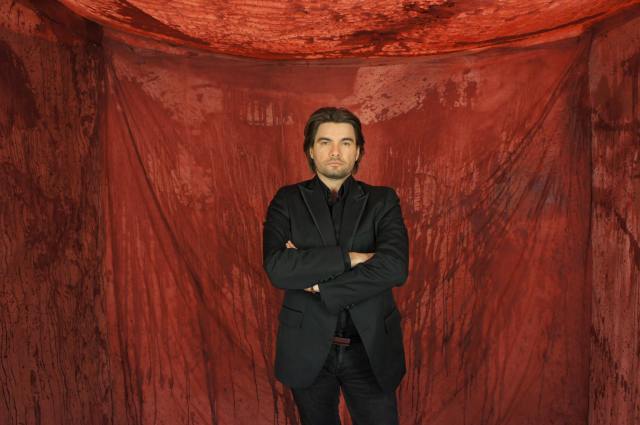
inside my own exhibit

The artist standing in one of his installations.

We had corresponded via e-mail over the last year or so and when I suggested the idea of interviewing him he responded by arranging time after a (traditional length) concert he gave in Minsk, Belarus on December 1, 2014.  I prepared for what I anticipated would be a one hour interview after which I imagined he would probably need to get to sleep.  But when I attempted to wrap up our conversation (at a couple of points) he immediately asked, “Don’t you have any more questions?”.  What followed resulted in approximately three and an half hours of delightful and wide-ranging conversation about this man and his art which he ended with the comment, “I must go, the piano is calling me.”  It appears that his seemingly boundless energy extends well beyond the stage.  The following January (2015) he gave the world premiere performance of all of Philip Glass’ 20 Etudes in none other than Carnegie Hall.

Nicolas Horvath (c) Jean Thierry Boisseau

Horvath with spent score pages as he traverses one of his extended performance ventures. (copyright Jean Therry Boisseau)

Since that time we have continued our correspondence and this affable, patient young artist continues on various projects and no sign of his interest or energy waning.  He recently sent me various photos of him in various settings pursuing his varied artistic interests for this article.

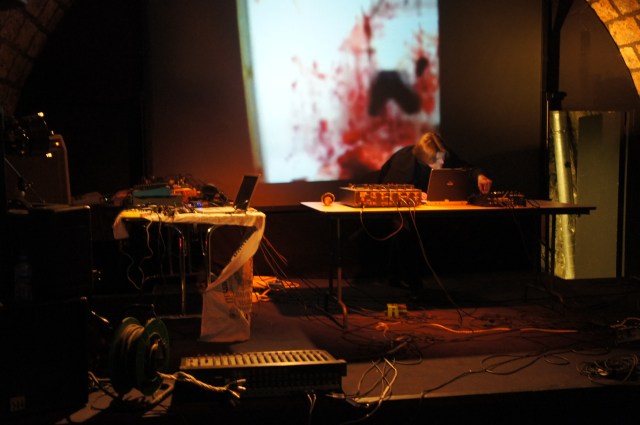
SONY DSC

Composer as well as performer in an electroacoustic performance without piano.

Horvath was born in Monaco in 1977.  He studied piano at the Académie de Musique Rainier III de Monaco and the École  Normale de Musique de Paris.  At 16, Lawrence Foster took notice of him in a concert and, securing a three year scholarship for him from the Princess Grace Foundation, was able to invite him to the Aspen Music Festival. After his studies in the École Normale de Musique in Paris, he worked for three years with
Bruno-Léonardo Gelber, Gérard Frémy who instilled in him a sensitivity to music of our time as well as Eric Heidsieck, Gabriel Tacchino, Nelson Delle-Vigne, Philippe Entremont and Oxana Yablonskaya. Leslie Howard got to know him and invited him to perform before the Liszt Society in the United Kingdom. He has been playing professionally for 7 years and puts his own characteristic style into his productions and performances.

In a move reminiscent of Terry Riley’s all night solo improv fests Horvath has performed several lengthy programs.  He has performed Erik Satie’s proto-minimalist Vexations (1893) in performances that ranged widely in length. One notable performance at the Palais de Tokyo lasted 35 hours, the longest solo piano performance on record as far as I can determine.  Previously this piece has been performed by tag teams of pianists (the first in 1967 in New York was curated by John Cage) to perform the 840 repetitions of the piece whose tempo or recommended duration is not specified.  Horvath, taking on a musicological mantle is preparing his own edition of this unique work.  He has published an 24 hour version on his You Tube channel here.

Given his intense schedule and vast repertoire he has been remarkably responsive and has an irrepressibly strong appetite for new music.  He tells me that he had worked on a project in which he planned to play all the piano music of the French composer Jean Catoire (1923-2005),  some 35 hours of material (in a single program, of course). Unfortunately that composer’s relative obscurity seems to have resulted  in insufficient support for the project which is, for now, on hold.  Here’s hoping that this can be realized sometime soon.

Horvath’s fascination with authenticity, completeness and performances of unconventional lengths uninterrupted by applause where audiences are invited to lay on the floor with blankets and sleeping bags and approach the piano seems unusual but he has been getting enthusiastic audiences and has enjoyed overflow crowds.  Like Terry Riley and perhaps even some of Keith Jarrett’s solo concerts there is a ritual feel to these marathon performances.  Regrettably I have not yet been able to attend one but I would love to partake in what must be a powerful shared experience.  He invites people to come to the piano and to watch, look at the score.  It is unlike the conventional recital and therein lies some of its charm.  At least one of his videos features a small sign which reads, “Don’t feed the pianist” and attests to his warmth and wonderful sense of humor.

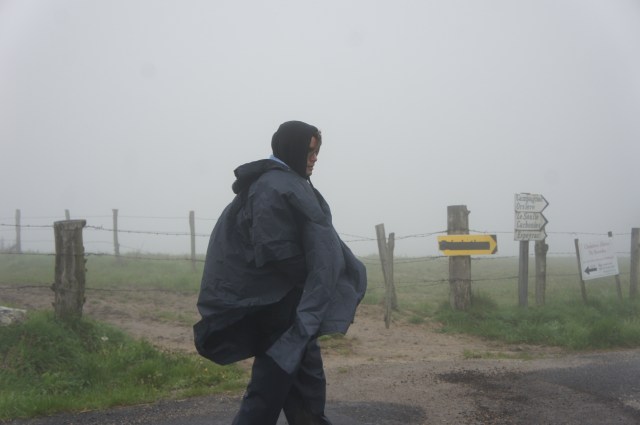
His passion has parallels in his spirituality and he has pursued sacred pilgrimages which require a great deal of time and energy but without doubt fill a very deep and sincere need. More details and photos are available on his blog.  And, as with music, he is very open to discussing this very personal aspect of his life.

SONY DSC

The artist braving the elements on one of his pilgrimages.

There are conventional two hour with intermission style recitals in more conventional concert venues that he has played and Horvath also enjoys playing with an orchestra.  His performances of both of Philip Glass’ piano concertos can be viewed on You Tube and you can see the intensity of his execution.  This came through in the course of our interview as well when Mr. Horvath would speak of the music and then verbally imitate the rhythms (no doubt endlessly practiced) which drive his enthusiasm.  The music seems to be deeply integrated into his very being.

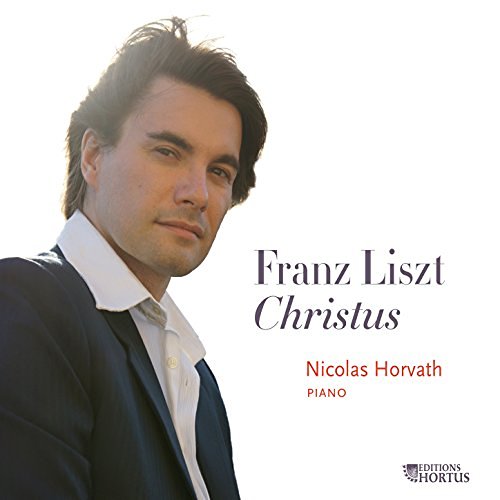
His first solo commercial recording was released in 2012.  It consists of Franz Liszt’s ‘Christus’, an oratorio composed in 1862-66 for narrator, soloists, chorus and orchestra.  Horvath plays a piano reduction done by the composer.  This is the first known recording of this unique and virtuosic set of piano works.  It is certainly an unusual choice for a debut recording but it is consistent with his very personal tastes.  (He lists Scriabin and Chopin as among his favorite composers.).   He is in the process of recording all of Philip Glass’ piano music for Grand Piano records distributed by Naxos.  At the time of this writing four well-received volumes have been released.  He is also planning to record all of Satie’s piano music and he has just recently released his rendition of Cornelius Cardew’s indeterminate masterpiece, Treatise.

I have seldom encountered a musician with such intensity and drive.  He is also one of the most skilled in using the internet to promote himself and his projects.  And though this is no doubt a man with a considerable ego he is in fact very unpretentious and very genuinely turned on, driven by the music itself.  Don’t get me wrong, he is concerned with developing his image and career but he seems happy to be doing the work he has been doing and he is, like any really good musician, self-critical and a perfectionist.

A quick look at his YouTube channel here reveals some of the range of his interests which include the standard repertoire along with interest in contemporary works.  Just released is a creative video with Horvath playing Glass’ Morning Passages while he apparently experiences a reverie involving a beautiful woman which could have been on MTV at its height.  Perhaps he is even channeling Oscar Levant who embraced roles in films along with his pianistic talents.  His website is a good resource for updates on his various projects and performances.

c _______ ______

Focused concentration at the keyboard.

As of the time of this writing his discography includes:

horvathchristus

Hortus Records 100 (2012)

A very unusual choice for a debut recording.  Nonetheless this is a distinctive recording which reflects the virtuosity as well as the careful scholarship which continues to characterize his work.  He managed to locate a couple of previously lost pieces in this set of composer transcriptions.  One also can’t miss the spiritual dimension here, as close to his heart as music and an equally important aspect of his personality.

glassw1

Grand Piano GP 677 (2015)

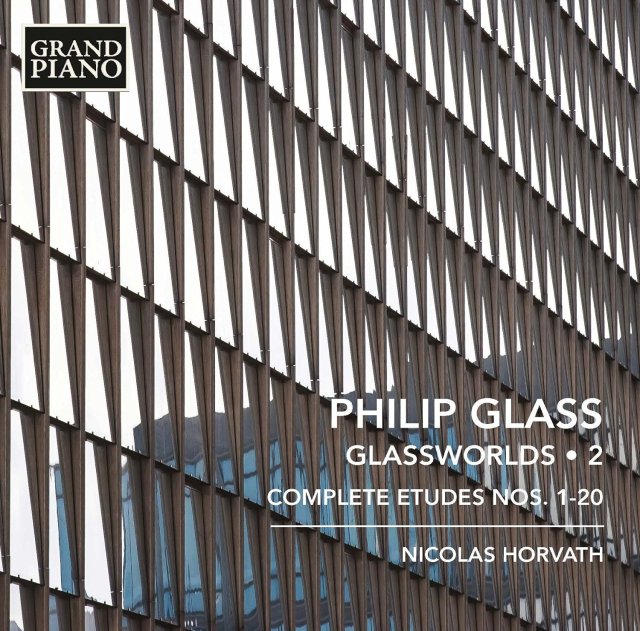
This first disc in the series manages to provide the listener with truly inspired interpretations of Glass’ keyboard oeuvre and gives us a world premiere recording of How Now as well.

glassw2

Grand Piano GP 690 (2015)

The complete Piano Etudes by the man who premiered the set at Carnegie Hall.  These etudes were also recorded by the wonderful Maki Namekawa and the opportunity to hear these really different takes is positively revelatory.

glassw3

Grand Piano GP 691 (2016)

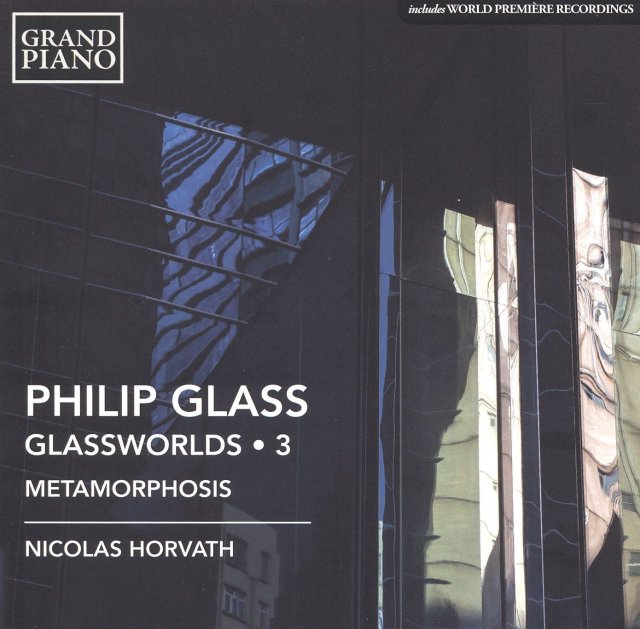
The third disc in the traversal of Glass’ piano music (original and transcribed) also offers world premieres.  Horvath’s inclusion of Glass’ early Sonatina No. 2 reflects his work under the tutelage of Darius Milhaud and provides insight into the composer’s early development before he developed his more familiar mature style.

glassw4

Grand Piano GP 692 (2016)

Haven’t yet heard this disc but I have in queued for ordering in the next few weeks.

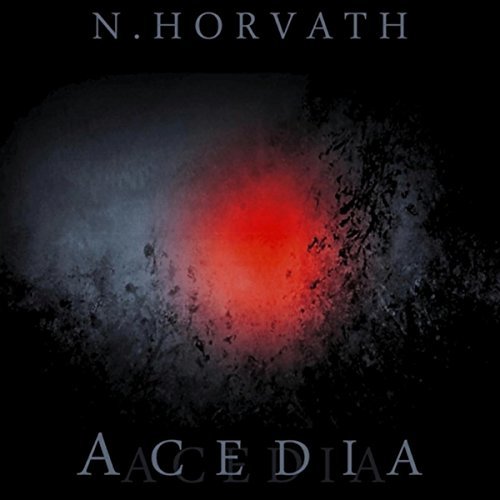
acedia

Demerara Records (2016)

Haven’t heard this one yet either but, again, it’s in my Amazon shopping cart.


horvathcardewtreat

Horvath’s interpretation of this important work by Cornelius Cardew

Cornelius Cardew (1936-1981) was sort of England’s John Cage, a major voice in 20th Century experimental music.  Scholarship has yet to do justice to the late composer’s work but this disc is an important contribution toward that end..

Horvath’s career is characterized by innovation and passion combined with astute scholarship and a keen sense of what is new and interesting in music  while clearly being schooled in the classic repertoire.  The piano calls him as do his other passions and I highly recommend paying attention as he answers those calls.  He is truly an artist to watch.
N.B.  Mr. Horvath generously read and approved an advance draft of this article shortly after arriving in the United States for concerts at Steinway Hall in Rockville with a Chopin program and a recital at The Spectrum in New York City which will include two pieces written for him by Michael Vincent Waller along with some Chopin pieces.

Piano Music by Axel Borup-Jørgensen, a Lost Master?


axelpiano

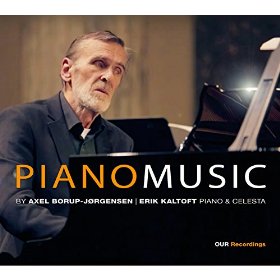
I had reviewed another disc of this composer’s music on this label here and I must admit that it took me quite a while to meaningfully grasp the music of this too little known Danish composer (1924-2012).  It should be no secret that the Danes have had and continue to have a rich musical culture and have produced quite a number of world class composers and this man is no exception.  However his style, apparently gleaned from his association with the modernists of Darmstadt, can be a tough nut to crack.

As with the aforementioned disc one might require multiple listenings before coming to realize that this man has a unique style and one that bears some serious attention.  This disc of piano music (and one piece for celesta) fills a gap in his recorded repertoire and is an excellent opportunity to see how he works in the genre of keyboard music.

These ten tracks contain works written from 1949 to 1988 so they cover a significant portion of his career and illustrate the development of his style.  Pianist Erik Kaltoft, a longtime associate of the composer, demonstrates interpretive skill as well as virtuosity and dedication in this fascinating survey.

The first (and longest 11:29) piece is Thalatta! Thalatta! (1987-88) and is given the opus number of 127.  The exclamation of the title translates as, “The Sea! The Sea!” and is said to have been spoken by the Greek armies upon reaching the Black Sea during one of their campaigns.  It is an impressionistic piece about the many moods of the sea.  His harmonies are like a modern update of Debussy, a bit more dissonant but providing a similarly soft focused feel.

Continuing with the maritime theme are the 6 miniatures called Marine Sketches (1949) opus 4b.  It is one of the earliest compositions in this collection (along with the Miniature Suite opus 3b, also 1949, on track 8).  Each of the pieces lasts around one minute and there are no track breaks to separate them.  The composer seems to expect that they will always be performed together and with a total time of 6:53, why not?  In contrast to the first piece these contain more melodic contours with less overall dissonance but clearly the same compositional fingerprint.

The four Winter Pieces opus 30b (1959) contain more energetic rhythms but with strategic silences punctuating the overall flow.  They end with a brief epilogue.

From winter we move to another season with the Summer Intermezzi opus 65 (1971) comes back to the sound world of the first track.  Here he experiments with different techniques to expand the language of the keyboard and incorporates the strategic silences of the piece on the former track.

Track 5 contains the earliest piece in this collection, Pasacaglia opus 2b (1948) which seems to suggest some influence of Scriabin.  It is a classic set of variations over the initial bass line and has a rather romantic feel.

Raindrop Interludes opus 144 (1994) is an impressionistic suite with the more dissonant style of his other later pieces.  It is the most recently composed of the recorded selections.

Epigrams opus 78 (1976) at 9:15, is the second longest piece here.  This is one of the most abstract pieces on the disc and demands concentration from both the performer and the listener to perceive delicate statements made with a wide dynamic range.

The Miniaturesuite opus 3b concentrates a praeludium, fantasia, interludium, sarabande and a repeat of praeludium in a brief 2:49.  It is more melodic and less dissonant in keeping with the composer’s earlier style.

Praeludier opus 30a (1958-9) are seven pithy and brief preludes.

The last track contains Phantasiestùck opus 115 (1985) written for celesta.  This instrument, forever doomed to familiarity by its use  in Tchaikovsky’s Nutcracker, has a limited repertoire and this gentle abstract piece is a welcome addition.  It is consistent with the composer’s late style using dissonance and silences in an almost meditative and strangely nostalgic piece.

The extensive and useful liner notes are by Trine Boje Mortensen and are printed in both Danish and English (translation by John Irons).  The fine recording and mastering are by Preben Iwan in the fine acoustics of the Royal Danish Academy of Music.  Grateful assistance and input from the composer’s daughter Elisabet Selin.

One needs to be cautioned never to take lightly anything produced from this creative country and this album is proof of that.  Kudos to OUR recordings for bringing this music to the listening public.


New Cello Music: Michael Nicolas’ Transitions


nicolastrans

Michael Nicolas is the new cellist of Brooklyn Rider as well as member of the International Contemporary Ensemble and numerous other affiliations.  This French Canadian/Taiwanese young man now residing in New York is definitely an emerging artist to watch and his debut album does much to demonstrate why he deserves serious attention.

This selection of mid/late twentieth and twenty first century cello pieces comprises an intelligent survey of this repertoire introducing new music and providing a younger performer’s take on some classics of solo cello with electronics as well some more recent works.  As he says in his liner notes this survey is concerned with the dichotomy between the solo instrument and the attendant electronics in various guises (even the quasi-Max Headroom cover art seems to reflect this).  Erin Baiano did the photography and Caleb Nei did the graphic design.  If I have a criticism of this fine album it is perhaps that the liner notes provide less detail than this listener prefers so I have tried to provide a few details here.

Beginning with Mario Davidovsky‘s classic Synchronisms No. 3 (1964) for cello and electronic sounds (one of twelve such works for solo instrument with electronics) and continuing with Steve Reich‘s Cello Counterpoint (2003) Nicolas begins his survey with two relatively well-known pieces in this genre and he certainly does them justice.  These pieces serve as Nicolas’ sort of homage to the past which he follows with some very current compositions.

He introduces some pieces unfamiliar to this writer.  David Fulmer‘s Speak of the Spring (2015) is a piece for solo cello with electronics.  Fulmer is a composer/performer apparently worth watching from a quick read of his web site.  As I was unable to determine the date of composition I contacted the composer who graciously responded despite his busy travel schedule: “The work was written last year, in 2015 specifically for Michael Nicolas and this particular project (cello and electronics). Michael had asked me for a piece for his recording project, and having known him (we went to school together) for many years, and admiring his playing so much, I was very interested in writing this piece for him. As for perspective…as a string player, I always enjoy writing string works. I’m interested in the beautiful timbres that the strings have. Tuning is also an important concept for me; at the end of the work, the cello electronics (pre-recorded cello) is scordatura.All of the prerecorded lines are recorded by Michael. I see this as a work written for Michael, played by Michael, and many versions of Michael.”

Next are two pieces by Annie Gosfield for cello and sampler.  Four Roses (1997) and “…and a Five Spot” (2015, commissioned by Nicolas as a companion to the former).  Both pieces are basically lyrical with spectral effects, microtonal passages, extended techniques and the samples of course.  The first piece is more assertive and direct while the second seems more introspective.  Both appear to be typical of Gosfield’s fully developed style.

Next up is a piece by the Icelandic composer Anna Thorvaldsdottir whose album length “In the Light of Air” performed by ICE was reviewed here.  Her piece on this disc for solo cello and electronics Transitions (2015) has a similarly ethereal character but one gets the impression that her approachable style belies complexities that underlie her work.

The last piece is flexura (2015) by Jaime E. Oliver La Rosa, a Peruvian born composer now working in New York.  This piece functions almost like a bookend with the Davidovsky piece that opens this disc (Davidovsky also comes from South America having been born in Argentina).  La Rosa holds a PhD. in computer music from the University of California San Diego and is developing open source software (and hardware) for live performance.  His MANO controller can be seen in the video on his website.  This last piece inhabits a similar sound world to that of the Davidovsky.  It is thorny and modern sounding and works as a showcase for the cellist.  Strictly speaking I suppose this piece is more of a duet in that there are two musicians required to perform it.

As always the impeccable production by Sono Luminus makes for a wonderful listening experience and this is quite an impressive debut for this interesting young musician. Kudos to producer Dan Mercurio recording technician David Angell  and executive producer Collin J. Rae.

Perhaps I am premature in saying this but this release has the earmarks of a being classic survey of the current status of this genre.  One of the joys of such a project is to hear new interpretations of established works and to hear an intelligent selection of new pieces.  Definitely want to hear more from Mr. Nicolas as well as from the composers represented.


Pictures at a Post-Minimalist Exhibition: Eighth Blackbird’s Hand Eye


handeye

Eighth Blackbird is Chicago’s more than adequate answer to New York’s Bang on a Can and this album is solid proof of that.  The liner notes tell us that this is “a collection inspired by a collection” and these 9 tracks are sonic impressions by the individual composers of an art exhibit.  The end result is very much like the romantic/impressionistic Mussourgsky gem updated to the post-minimalist era.

It is well worth your time to check out the artwork which inspired this music (here) and this writer imagines that this piece could really work well as a film score, a DVD perhaps of these images.  The music invokes various minimalist and post-minimalist composers and styles.  It is almost a sonic tour of post-minimalism.  And apparently there are plans for a multimedia tour of this piece as well.  Sounds like a wonderful idea.

This album is the work of a composer’s collective called Sleeping Giant and consists of Timo Andres, Andrew Norman, Robert Honstein, Christopher Cerrone, Ted Hearne and Jacob Cooper.  Each has chosen a selection of art to which they wrote a piece of music providing their musical impressions.  The result is a remarkably coherent set of pieces which, while each different, seem to flow into a unity.

Casual listeners may be familiar with the names of Timo Andres or Andrew Norman but all these composers are basically new to these ears and it appears to be a talented lot that deserves some serious attention as they may very well be THE ones to watch/listen to in the coming years. They utilize a variety of techniques in their compositions but there is never a feeling of this being experimental or tentative.  These are fully fleshed out works by master composers.

The music is appealing immediately upon first listen.  One hears the influences of Terry Riley here, John Adams there, David Lang, etc.  In short these pieces are informed by the preceding generations of minimalists much as they also address their debt and do honor to their mentors.  It has some of the character of Lang’s “Child” in that this is essentially a suite of pieces of post-minimalist chamber music (though this music has an almost symphonic quality at times).

The recording is superb and up to the high standards of Cedille releases and the musicianship, as always, is superb.  The liner notes by Sleeping Giant along with Tim Munro are lucid and the album design by Karl Jensen is eye-poppingly psychedelic.  This project was funded by the Maxine and Stuart Frankel Foundation for the Great Lakes Chamber Music Festival, Carnegie Hall, the Andrew W. Mellon and the Texas Performing Arts at the University of Texas at Austin.


Spektral Quartet, Serious Business


spektral

OK, bear with me here for just a moment.  The proliferation of string quartets (and by that I mean the grouping of musicians as a performing entity) has been positively dizzying over the last 30 years.  For those who grew up with the standard Julliard Quartet, Guarneri Quartet, etc. there were just a few outstanding names in this genre.  However since the advent of the new quartets like Kronos and then Turtle Island, Arditti,etc. the field has expanded rather prolifically. Couple this with a boom in string quartet writing notably Elliot Sharp, John Zorn, Wolfgang Rihm. Elliot Carter, Peter Maxwell-Davies, Ben Johnston among many others and I was filled with some trepidation upon receiving this disc for review.  I mean, how many things can you do with a string quartet?

Apparently there is a great deal more to be explored in this genre.  I am happy to say that these folks are up to the task as are the composers whose work they present.  Serious Business is some seriously interesting music performed with serious skill by this new quartet, the Spektral Quartet.  They are the string quartet in residence at the University of Chicago, itself a venerable place for new music.

We start here with a piece by Sky Macklay called Many Many Cadences (2014) a piece that seems to come from a similar place to that of the work of Conlon Nancarrow with intricate rhythms within a somewhat conservative tonal idiom.  The title is suggestive of Gertrude Stein (Many, Many Women).  It was commissioned for the Spektral Quartet by the Walden School.  The piece is immediately engaging and ultimately satisfying.

The second piece, The Ancestral Mousetrap (2014) by David Reminick features a less common use of a string quartet in that there is a vocal component. This is not the vocalist component pioneered by Schoenberg in his second quartet.  These vocalizations are performed by the quartet.  This is no simple feat either because the vocal writing is itself a challenge in its rhythmic complexity.  The piece resembles a little opera and indeed the text by poet Russell Edson is here called a libretto.  This piece was commissioned by the Spektral Quartet.

The third piece here is an unusual choice (and the only one not commissioned for the Spektral Quartet) which is explored in the liner notes .  Haydn’s Quartet Op. 33 No. 2, subtitled “The Joke” is one of the relatively few examples of attempts at program music (vs absolute music) to be found in the classical era.  First, no one will buy this disc just for the Haydn. Second, many collectors will already have this Haydn piece in their collection.  But with that said this is a lovely performance of one of the emblematic pieces of music that created the need for the performing ensemble known as the string quartet and it is a lovely performance as well.  I will leave it to other listeners to read the program notes and get into the rationale about its inclusion here.

The final piece, Hack (2015) by Chris Fisher-Lochead is perhaps the most unusual of the lot in that the composer uses vocal inflections by a collection of comedians (yes, comedians) as the source for his rhythmic and melodic contours and creates 22 separate pieces about 16 comedians (some get more than one piece).  This piece requires more concentration by the listener but, like any well-written piece, it reveals more of itself with repeated listenings.  The Barlow Endowment at Brigham Young University commissioned this piece for the Spektral Quartet.

The Spektral Quartet is Clara Lyon, violin; Austin Wulliman, violin; Doyle Armbrust, viola; Russell Rollen, cello.  The recording, as with every Sono Luminus release I’ve heard is glorious and lucid.

Paula Matthusen’s Pieces for People


matthusen

This is the first disc devoted entirely to the music of Paula Matthusen who as of July is a newly minted associate professor at Wesleyan University where she walks at least partly in the footsteps of emeritus professor Alvin Lucier whose course Music 109 she inherited from him.  I had the pleasure of meeting Ms. Matthusen at Other Minds 18 where she was one of the featured composers.  In our all too brief conversation she was affable and unpretentious but certainly passionate about music.

Paula Matthusen

Paula Matthusen performing her work, ‘…and believing in…’ at Other Minds in 2013


She holds a B.M. from the University of Wisconsin and an M.A. and PhD. from New York University.  She announced her recent promotion to associate professor on Facebook as is, I suppose, customary for people of her generation.  It is on Facebook that I contacted her to request a review copy of this CD to which she quickly and graciously agreed.

This CD contains 9 tracks representing 8 works.  They range from solo to small ensemble works, some with electronics as well.  Her musical ideas seem to have much in common with her emeritus colleague Alvin Lucier but her sound world is her own despite some similarities in techniques, especially her attention to sonic spaces and her use of electronics to amplify sonic micro-events which might even include her heartbeat.


sparrows in supermarkets (2011) for recorder looks at the sound of birds in the acoustic space of a supermarket and their melodic repetition.  It is for recorder (Terri Hron) and electronics

limerance (2008) is another solo work, this time for banjo (James Moore) with electronics.  She says she is working with the concept of reciprocation here but that seems rather a subjective construct.  Like the previous piece this is a contemplative and spare work with some spectral sounds as well.

the days are nouns (2013) is for soprano and percussion ensemble and electronics.  Here she is concerned with resonances within the vibrators of the instruments as well as the acoustics of the room.  It is a dreamy, impressionistic setting of a poem by Naomi Shihab Nye whose poem supplies the title but the text is fragments of a Norwegian table prayer.  A very subtle and effective work.

AEG (2011) is represented by two movements (of four?) all of which were written for the Estonian ballet.  It is similarly concerned with resonances and words at times.  Of course it would be interesting to hear those other movements but perhaps another time.

of architecture and accumulation (2012) is the first of two purely acoustic compositions on this disc.  This one is for organ solo (Will Smith) and explores long tones within the acoustic space.  It is a very satisfying work even if one doesn’t go into the underlying complexities.

corpo/Cage (2009) is  the longest and largest work here and is the second purely acoustic piece on this recording.  It has echoes of Stravinsky at and it is an enticing example of Matthusen’s writing for orchestra.  This reviewer certainly looks forward to hearing more of this composer’s works for larger ensembles.  Very effective writing.

in absentia (2008) is the earliest work here.  It is written for violin, piano, glasses and miniature electronics (not quite sure what that means).  Like many of the works on this disc the concern or focus seems to be on small events and sounds.  This is a rather contemplative piece that nicely rounds out the recording.

Matthusen resembles Lucier in some of her techniques and focus on small sounds otherwise missed and she certainly owes a debt to people like Pauline Oliveros.  But in truth she sounds like no one as much as Paula Matthusen.  The composer presents a strong and intelligent voice and one wishes for more from this interesting artist.  Thank you for the opportunity to review this.

Warning: Gentle Music, Marti Epstein’s Hypnagogia


epstein

When Marti Epstein kindly sent this disc to me for review she “warned” me that it was gentle music.  In her liner notes she elaborates that her Midwestern roots will always inform her work.  As fellow Midwesterner (I hail originally from Chicago) I have an idea what she means.  There is a certain gentle affability which seems to characterize folks from the Midwest and no doubt this affects artist expression as well.

epsteinm

Marti Epstein

This disc contains four such gentle compositions ranging from Grand Island (1986) to A Little Celestial Tenderness (2013).  As such it is a cross-section of Epstein’s work though it is hard to say, of course, if it is an accurate picture or overview.

The first piece Hothouse (2000) is a piece for two pianos which works on a couple of levels. It is quite listenable as a concert piece and seems to be a very effective way of using short phrases replaced by silences as a valid compositional technique.  Loosely interlocking phrases are replaced by silences gradually which lull the listener to the conclusion.

The second track is Grand Island (1986) which is the composer’s depiction of a drive to the city of Grand Island in Nebraska.  This piece for piano, two harps and two percussionists is complex enough to require a conductor (Jeffrey Means) but the complexity does not make for difficult listening.  Rather this is an impressionistic audio narrative of the composer’s experience driving through the Midwest as a child.  It has a very similar character to the first piece with silence being very important to the texture which fades to silence as the journey ends and perhaps the restless child has fallen asleep.

A Little Celestial Tenderness (2013), the most recent on the disc, comes in at under two minutes and evokes Copland-like harmonies in a “tiny” piece written in honor of the 10th anniversary of the Ludovico Ensemble who perform the music on this disc (the composer plays one of the pianos on Hothouse).  The unusual instrumentation here is flute, clarinet and cimbalom.

Hypnagogia (2009) is the most experimental music here and is very much the star of this release.  It exists only in parts with no unified score and asks the performers to perform as if they were alone.  It is an attempt to depict the state of mind between waking and sleeping.  This piece is more concerned with sound than silence and the mobile-like appearances of the sounds does create a dream-like texture which, as warned, is also very gentle but not without a touch of anxiety at times.  It is perhaps the most substantial (over 45 minutes), striking and successful piece on the disc and brings it to very satisfying conclusion.

The recording has a warmth and presence and the musicians seem well-suited to the tasks at hand.  This writer will be pleased to hear more from these artists in the future.


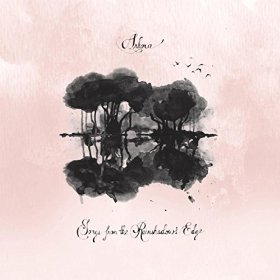
Songs from the Rainshadow’s Edge by Benton Roark


rainshadow


This marvelous little song cycle has, unfortunately, languished for a bit in my “to do” bin and now I want to tell you that it is a fine production in every way.  I don’t know Benton Roark and his website is a bit light on biographical details but what is clear is that Mr. Roark is  possessed of a lyrical gift which this song-cycle demonstrates.  This is an artist who bears watching/listening.

roark

Benton Roark

He is the co-artistic director of Arkora Music who perform the work featuring the composer’s own poetry and selections from various texts read by narrators.  This sounds like a formula for a noisy avant-garde piece but that is not what we have here.  This is an intelligent clearly contemporary work that is simply beautiful and played with great sensitivity by the musicians.  The music is tonal, bluesy at times but always engaging and evocative.

Kathleen Allan, soprano; Amelia Lukas, flutes; Brendon Randall-Myers, electric guitar; Jonathan Allen, percussion; Anne Lanzlotti, viola; Samuel Suggs, double bass; Mary Berry and Maya Levy, narrators comprise the ensemble and all are strong performers.  Alan’s clear beautiful tone carries the spirit of this work and these performers are clearly listening to each other.

Definitely worth your time and repeated listenings reveal more in this wonderful piece.  You can get the album via the Arkora site linked above as well as Bandcamp.  It is on the Redshift label.


Tim Brady: The Canadian Connection


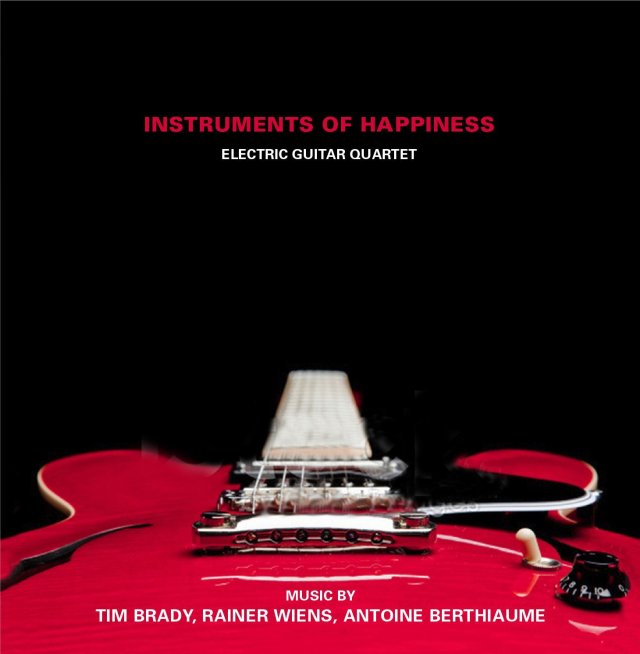
tbradyhappiness

Starkland is one of the few American labels that regularly pays attention to Canadian composers.  I previously reviewed their Paul Dolden release here.  This challenge to the curious apartheid we seem to maintain with Canadian culture is most welcome of course and one can obtain a great deal of Canadian music via Canadian labels but retail distribution of their non-pop music is limited to mail order and Internet sales (and I don’t mean Amazon either).  I strongly recommend perusing the web site of the Canadian Music Center for a truly stunning selection of this too little known recorded repertoire.  I should note that most of Brady’s releases are readily available from actuellecd.com.  You can find several of those other symphonies here as well as many other pieces and collaborative releases.  After hearing this disc I couldn’t resist hearing more  by this artist whose work has been known only faintly to me thus far.  That order is now being shipped.

Now to the disc at hand.  The  use of electric guitars as a primary instrument conjures immediate comparisons to Glenn Branca and Rhys Chatham as well as to rock and blues but this music is quite different from all of these.  This is one aspect of  the work of a composer whose work includes writing for orchestra, chamber and solo instruments as well.  Brady, largely set taught in music until he attended college (Concordia University 1975-78; New England Conservatory 1978-80) is an interesting composer and performer with a widely varied palette.  Brady’s Wikipedia page is surprisingly informative as well.  You can find that here.

Tim Brady (1956- ) is an artist of many talents and this recording represents his most recent work, a symphony.  It is his fifth essay so titled and his choice of instrumentation for each (of his now 6 symphonies) is unique.  In this case he has chosen to score for four guitars (his Symphony No. 4 is for full orchestra) and also presents a separate solo version backed by electronics.  It is subtitled, “The Same River Twice” (2013) and I struggled a bit initially getting wrapped up in trying to discern the differences between the two versions but realized that is rather beside the point in a way.  What makes this music interesting is the way in which it differs from the likes of Branca and Chatham.  Brady clearly comes from a different perspective.  The myriad ways in which creative musicians find to integrate cross genre elements fascinates me as a listener.  He is 8 years younger than Branca, 4 younger than Chatham but his perspective of the inherently “pop” inflection of the electric guitar differs greatly.  He is writing another vital and welcome chapter in this loosely defined group of guitar based experimental musics of the last 40 years and his work deserves attention.

He seems to have more in common (broadly speaking) with Pat Metheny than Fred Frith and his discography reflects encounters with several ECM artists.  I’m not sure who influences who here but this is a pleasant and intelligent exploration sometimes virtuosic, sometimes drone-like but a consistently engaging piece.

As I said there are two versions of this symphony on the disc.  Along with those are two shorter tracks by Antoine Berthiaume and Rainer Wiens.  Fungi by Berthiaume is another example of the integration of pop motives into a broader quasi-improvisational context and is most successful.  The disc is rounded out with a sort of little summation “remix” by Wiens entitled “What is time?” which reportedly uses breath as a rhythmic determinant.

The playing is competent and intuitive, not flashy or self-consciously experimental.  Rather this is the work of a seasoned composer who uses his materials well .

Recording and mastering, all expertly done, were done in Canada by the artists who also did the useful liner notes (Allan Kozinn writes the gatefold notes).  The cover art and the production of the CD belong to Starkland and it is a very nice production.

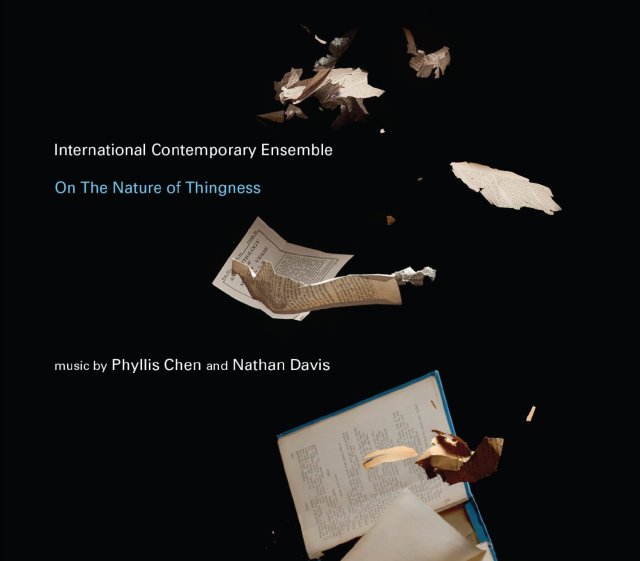
ICE Debuts on Starkland: Music by Phyllis Chen and Nathan Davis


71suob4pdtL._SL1500_

Starkland is one of those labels whose releases seem to be so carefully chosen that one is pretty much guaranteed a great listening experience even if that experience might challenge the ears sometimes.  If one were to purchase their complete catalog (as I pretty much have over the years) one would have a really impressive and wide-ranging selection of new music.

I recently reviewed a very fine ICE (International Contemporary Ensemble) recording of music by Anna Thorvaldsdottir here. The present disc is the first appearance on Starkland of this ensemble whose performance skills and repertoire choices show the same depth of understanding as the producers of the label upon which they now appear.

ICE was founded in Chicago in 2001 by executive director and flautist extraordinaire Claire Chase.  The discography on their website now numbers 21 albums including the present release.  The group features some 30+ artists and musicians including a live sound engineer (like the Philip Glass Ensemble) and a lighting designer.  Do yourself a favor and check out the ICE Vimeo page to get some ideas about why having a lighting designer is a good idea.  Their performances are visually as well as musically compelling.  And who knows, perhaps there is a Starkland DVD release in their future.

About half their albums feature music by members of ICE and that is the case with this release.  One always has to wonder at the process that is involved in choosing repertoire to perform and/or record but there is no doubt that this group seems to have good instincts in regards to such decisions as evidenced by the already wild popularity of this disc on WQXR and the positive initial reviews so far.

chen_phyllis_toypiano3Resized

Phyllis Chen‘s biographical data is a bit sparse on both the ICE website and her own so I am going to assume that this talented young keyboard player likely began playing at an early age.  Like fellow pioneers Margaret Leng Tan and Jeanne Kirstein before her she has embraced toy pianos and, by extension I suppose, music boxes, and electronics into her performing arsenal.  In addition to being a composer she is one of the regular members of ICE.

NathanDavis_Obraz9

Nathan Davis is a regular percussionist with ICE as well as a composer.  His works range from opera to chamber and solo pieces for various instruments as well as electronics.

The tracks on this release pretty much alternate between these two featured composers.

The first track is Ghostlight (2013) by Nathan Davis, a sort of ragged moto perpetuo for “gently”prepared piano.  This is a good example of how these musicians (pianist Jacob Greenberg in this instance) have really fully integrated what were once exotic extended techniques into a comprehensive catalog of timbral options which are used to expand the palette of creative expression.  This is not a second rate John Cage clone but rather another generation’s incorporation of timbral exploration into their integral canon of sonic options.  This is an exciting and well-written tour de force deftly executed.

The next two tracks take us into the different but complimentary sound world of Phyllis Chen.  Hush (2011) for two pianos, toy pianos, bowls (presumably of the Tibetan singing variety) and music boxes is a playful gamelan-like piece played by the composer along with pianist Cory Smythe.

Chimers (2011) is a similarly playful work requiring the assistance of clarinetist Joshua Rubin, violinist Erik Carlson and Eric Lamb (on tuning forks) along with Chen and Smythe once again.  Again we hear these unusual instruments and timbres not as outliers in the musical soundscape but rather simply as artistic elements that are part of the composer’s vision.

Track number 4 features a work for bassoon and live processing.  Davis’ On Speaking a Hundred Names (2010) is played by Rebekah Heller and again the (to this listener) usually uncomfortable fit of acoustic and electronic are achieved very smoothly.  Music like this gives me hope that some day I will be able to drop the inevitable negative connotations I have associated with the term “electroacoustic”.  This is very convincing music and not just in the “golly gee, see what they’re doing” sense either.  The experimentation here (including the multiphonics) appears to have preceded the composition giving us an integrated and satisfying listening experience.

Chen comes back on track 5 with another successful integration of acoustic and electronic in her, Beneath a Trace of Vapor (2011).  Eric Lamb handles the flute here playing with (or against) the composer’s prepared tape.  This electroacoustic trend continues in the following track (also by Chen) called Mobius (201-) in which Chen, Smythe and Lamb are credited with playing “music boxes and electronics”.  Once again the integration of electric and acoustic speaks of a high level of music making.

The final four tracks are the big work here and the work that lends its name to this disc, On the Nature of Thingness (2011) by Nathan Davis.  Apparently taking its title from Lucretius’ On the Nature of Things (ca. 1B.C.) the work earlier also inspired Henry Brant in his spatial composition, On the Nature of Things (1956), but the work in this disc does not seem to make any direct reference to that Roman classic poem except perhaps metaphorically.

tony_8305

Soprano Tony Arnold

The work here is an exploration of language, sound and expression.  This most eclectic and ponderous of the selections is a wonderful opportunity to hear the considerable skills of resident vocalist Tony Arnold who sense of pitch and articulation are incredibly well-suited to this work.  Her performance leaves nothing to be desired and is likely as authoritative as it gets.  The work seems to require a great deal of concentration and coordination on the parts of all involved and ICE takes the opportunity to demonstrate their well-honed skills as they clearly listen to each other and go all out in terms of achieving the subtlety of expression required in this demanding and complex work.

As usual the Starkland recording is clear and detailed without the sense of claustrophobia that such detail can take on and the liner notes are useful without extraneous detail.  This is an ensemble to watch/listen for both for the performers and for the music they choose to program.  You won’t be disappointed.


A Grand Early Start to Black History Month


BHM160006

The United States (unlike England who use the 31 day month October) has chosen the shortest month of the year to celebrate Black History  but I have managed to get 30 days to celebrate this year by starting a day early in this leap year.  Basically I cheated, deal with it.

This is the year of the last term of our first black president and, while that is a historically significant fact, so are the facts of the police killings that demands the development of interventions like “Black Lives Matter” to remind society of a fact that should be obvious but clearly is not, that we have a serious human rights crisis here.  However, rather than getting into yet another acknowledgement of our racist society, I am interested in sharing a wonderful positive experience that I hope will provide as much inspiration to my readers as it did to the fortunate folks who attended this night’s festivities.

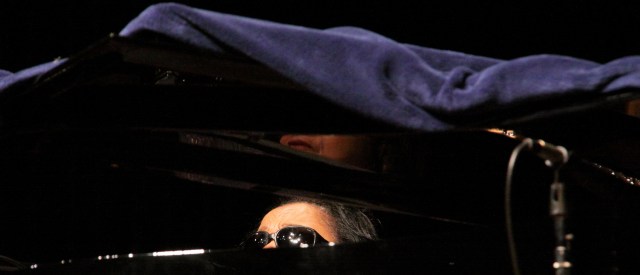
Friend and colleague Bill Doggett kindly made arrangements for me to attend this annual fundraising event at the Eastside College Preparatory School and sponnsored by the African American Composer Initiative  and the San Francisco Friends of Chamber Music.  The featured guest was composer/pianist Valerie Capers (1935- ) a Julliard trained pianist and composer. She was joined by a wealth of highly skilled musicians in a fascinating program of music and arrangements by Capers, John Robinson and several others.

The well attended evening began with a couple of vocal numbers done by the Eastside Preparatory School Choir followed by the playing of the beginning of a documentary film about Ms. Capers (Dr. Valerie Capers: Dream Big, 2015).  In the excerpt she talks about her life, losing her sight and the importance of music to her.  She is a delightfully positive, optimistic and energetic person and, as we saw later, a powerful and inspiring musician. This became even more evident when we were treated to the live interview conducted from the stage by LaDoris Cordelle, herself an accomplished pianist and singer as well as a respected lawyer, judge and activist.

BHM160002

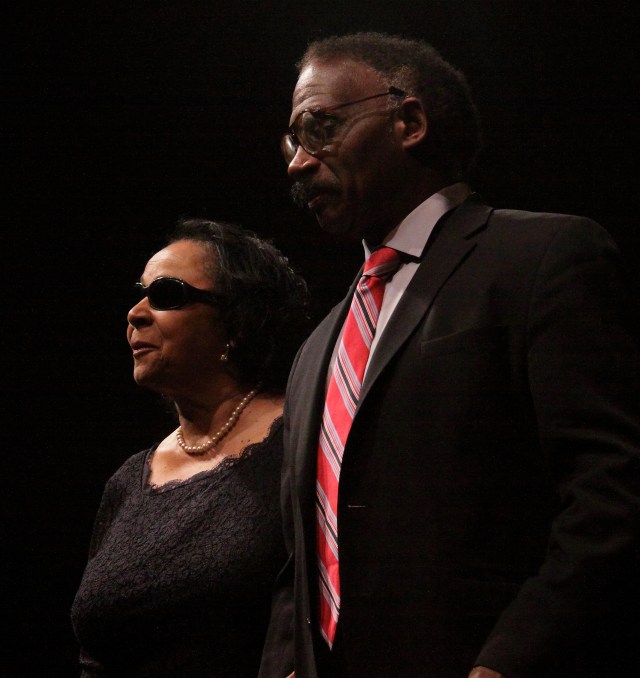
LaDoris Cordelle (left) interviewing Valerie Capers

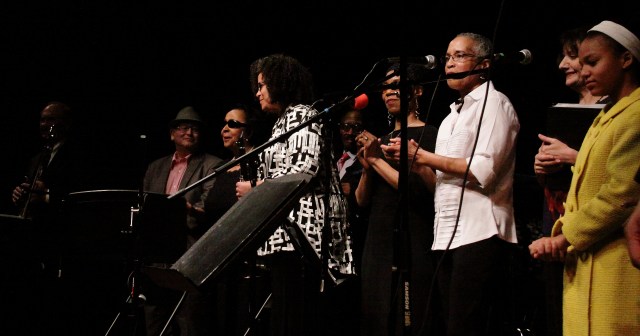
Participating this evening were the Eastside Preparatory School Choir conducted by David Chaidez, soprano Yolanda Rhodes, vocalists/pianists LaDoris Cordell and Deanne Tucker, pianist Josephine Gandolfi, violinist Susan C. Brown, cellist Victoria Ehrlich, and clarinetist Carol Somersille along with guest artists Valerie Capers, John Robinson (bass, composer), Jim Kassis (percussion), Rufus Olivier (bassoon), Stephanie McNab (flute), John Monroe (trombone), John Worley (trumpet) and Lauren Sibley (narrator in “Ruby”).  I must say that the musicians this evening were truly spectacular and seemed to work even harder in their homage to guest of honor Valerie Capers.

The musical program properly began with the performance of John Robinson’s Fanfare for an Uncommon Woman (2015).  The work whose title echoes Aaron Copland’s populist Fanfare for the Common Man (1941) and was written in honor of Ms. Capers.  This was followed by several of Capers’ Portraits in Jazz (1976) compositions and her take (not at all like Vivaldi’s) on the four seasons in her, Song of the Seasons (1987).

BHM160005

Valerie Capers with John Robinson acknowledging the grateful applause.

The first half of the program concluded with Capers’ Winter Love, her gloss on Wagner and her arrangement of Duke Ellington’s “Don’t Mean a Thing if it Ain’t Got that Swing”.

The second half began with Bird Alone, an Abbey Lincoln song arranged by Capers.  This was followed by another composition from Mr. Robinson, “Tarantella with a Twist of Lime” (2015), a catchy somewhat humorous piece, and then “Doodlin'” by Horace Silver.

Next up was a work in a genre of great interest to this reviewer, that of a political classical piece written to express political ideas.  Ruby (2013) with text and music by Valerie Capers is a work for narrator, vocalists and ensemble that tells the story of Ruby Bridges who, in 1960, became the first black child admitted to the the all white William Frantz Elementary School in New Orleans, Louisiana.  She had to be accompanied by Federal Marshals under orders from then President Eisenhower.  Bridges was the only black student and was taught by the only teacher willing to teach a black student, Barbara Henry who remained Bridges teacher for the entire year and there were no other students in that classroom though some white families did eventually send their children back to the school where they were taught in their accustomed segregated fashion (ironic here too because New Orleans had had the beginnings of an integrated school system prior to the civil war). Bridges and her family suffered many indignities as a result of her participation in this landmark event, a critical step in the Civil Rights Movement. This was a powerful and touching piece performed with reverence, sympathy driven by the hindsight of the accomplishment itself as well as the frustration and sadness that even some 50 years later the struggle still continues.

BHM160007

The Grand Finale

The evening concluded with a group performance of Capers’ arrangement of the iconic spiritual, “Eyes on the Prize” whose strains provided some of the soundtrack of the civil rights struggles of the 1960s.  It is a hymn which still offers much inspiration.  It was a joyful and optimistic evening much like the times 50 years ago whose struggles now rest on the shoulders of yet another generation hoping, praying, working and performing amidst adversities that seem to never end.  But even a progress measured in inches is still progress.

The reception which followed was catered by apprentices from a group called, “Worth Our Weight” (based in Santa Rosa) which teaches culinary and catering skills to minority students.  Various tasty little sandwiches, meatballs and pastries tended to our palates while we took advantage of the opportunity to meet the performers.

I took the opportunity to meet and talk briefly with Capers whose energy was unabated belying her 80 years as she greeted a wealth of appreciative audience members.  I commented to her that I thought her vocal writing sounded a bit like Mahler  Capers paused oh so briefly before stating with her characteristically good humor and a knowing smile, “I think that’s  compliment.” Indeed it was.


Spirituals Re-Imagined


411Wkh4lXuL._SS280
I managed to squeeze a delightful brunch meeting with my busy friend and colleague Bill Doggett on New Years Day.  It was there at a favorite Oakland cafe that we discussed many topics and Bill gave me a copy of this beautiful CD by a young black composer whose work is entirely new to me.

Okpebholo

Shawn Opkebholo (1981- )

Shawn Okpebholo (1981-  ) was born in Lexington, Kentucky.  He earned his B.A. in music at Asbury College and his M.M. and D.M.A. degrees at the  Unniversity of Cincinatti.  Doctor. Okpebholo is currently on faculty at Wheaton College  in Illinois.

The present disc is Opkebholo’s first CD dedicated entirely to his own compositions and is the composer’s “reimagining” of spirituals.  Drawing on the folk tradition of spirituals, worksongs, etc. as well as classical art song traditions he fashions his personal take on these much loved melodies.

I do feel compelled to mention the beauty of the photography and album design.  Greg Halvorsen Schreck took the pictures and Jeremy Botts did the overall design.  Powerful stuff.

In a slight deviation from the classic voice and piano arrangements the composer chose to score this little cycle for baritone, mezzo-soprano, viola and flue along with piano.  For this writer this was an interesting and suitably entertaining choice.

jnai

J’nai Bridges

Willnewheadshot

Will Liverman

The singers Will Liverman, baritone and J’nai Bridges, mezzo-soprano are marvelous and sensuous voices and discharge their duties most beautifully.  The pianist Paul Tuntland Sànchez is also a composer and very accomplished soloist.

Sanchez_Photo

Paul Tuntland Sanchez


The violist is Dorthy White Opkebholo and is the composer’s wife.  She is an accomplished musician in her own right.

The flute is played by Caen Thomason-Redus.

This is a beautiful recording of these loving arrangements of spirituals which can occupy that place in the literature populated by the likes of Aaron Copland’s Old American Songs.  A must for art song and folk song fans and a great opportunity to hear some fine musicians at the beginnings of what is hoped to be long and successful careers.

all spring, Music of Emily Doolittle


doolittle

Emily Doolittle (1972- ) was born in Halifax, Nova Scotia.  She earned a B. Mus. from Dalhousie University in 1995 having studied with Dennis Farrell and Steve Tittle.  She went on to earn an M. Mus. in 1999 from Indiana University where she studied with Don Freund.  She completed her Ph.D. at Princeton in 2007 studying with Barbara White, Steve Mackey and Paul Lansky.  In addition she studied with Louis Andriessen from 1997-1999.

Doolittle now lives in Glasgow, UK having just left a faculty position at the Cornish school in Seattle, WA.  where she taught since 2008.  A quick look at her CV reveals a very busy composer and academic with an extensive list of compositions, performances, research, teaching etc. such that this reviewer is amazed to find that the present release is the first CD dedicated exclusively to her music.

I was pleased to be able to get a perspective from the composer that helped me understand the context of this disc in terms of the rest of her work.  She wrote:

“As I was making choices of what to include on this CD, I realized that my music divides itself into several (sometimes overlapping) categories. Over the next few years, I’m hoping to be able to record two or three more CDs. The one that I sent you is the one for fairly standard-ish chamber ensembles, with pieces that would sit fairly comfortably with chamber music of any era. At the moment I’m applying for funding to record a CD of pieces for one or two instruments/voices — these pieces also have a fairly similar musical language to the pieces on “all spring”. After that, I’d like to record a CD of my bird and animal song influenced music, which tends to be more experimental (in terms of sounds used and structure), and often involves some improvisation. And then I have a number of pieces that are harder to figure out how to present to a larger audience — site-specific pieces, pieces for amateurs or children, etc. So I guess I see this CD as both the culmination of one project, and the beginning of a larger project. And I think that getting this sort of overview of my compositions to date will help give me ideas about the directions I’m most interested in going in in the next few years. (I’m at a bit of a transitional time — I just left a full-time teaching position at Cornish College of the Arts in Seattle to move to Glasgow. I’m hoping to find part time teaching here, but mostly I want to devote a lot more time to composing than I’ve been able to in the last few years.)”

I was also unaware that there was such a thing as “zoo-musicology” or the study of things musical generated by the members of the animal kingdom.  Who knew?  I was familiar with Olivier Messiaen’s transcriptions and use of bird song but until now I was not aware that work was still being done in this area.  Alas, that will have to be the subject of another review as this disc, while later analysis might reveal zoomusicological influences, is ostensibly more in the category of absolute music or perhaps metaphorical music.  What is quite clear is the picture of an artist with wide-ranging interests who is working to shape her oeuvre and her research interests into a more unified effort which promises potentially fascinating results yet to be heard.

The CD is a very pleasant listening experience.  Nothing here sounds experimental, rather these works are beautifully composed and lovingly played by the Seattle Chamber Players (and friends).  All were composed from 2000 to 2014 and share a sort of romantic and nostalgic flavor and demonstrate the delicate nuances of this composer’s palette.

The first two works, “Four Pieces About Water” (2000) in four short movements and the single movement “falling still” (2000/2009) are purely instrumental as is the fourth piece on the disc “col”(2002/2014).  (Please note that all spellings are as they appear on the disc.)

Tracks 6-10 comprise the album’s title piece, “all spring”(2004) features the poetry of Canadian poet Rae Crossman and the final and longest piece, “Why the parrot repeats human words” (2005) features a text by the composer in which she tells her version of a Thai folk tale (think perhaps of a Canadian Peter and the Wolf maybe).  Both these works feature the beautiful spoken and singing voice of Maria Mannisto.

The ample and lucid notes are by the composer.  The recording was engineered by Doug Haire at the Jack Straw Cultural Center in Seattle and mastering was by John D. S. Adams at Stonehouse Sound in Mahone Bay, Nova Scotia for this Composer’s Concordance label release.

Certainly this writer will be looking forward to hearing more from this fascinating artist as she reveals more of her work on recordings and goes on to who knows what new and interesting areas in this (now) post-Boulez world.  Brava!


Alvin Curran at 75, Experimentalism with an Ethnic and Social Conscience


English: The American composer Alvin Curran pl...

English: The American composer Alvin Curran playing the shofar in his composition “Shofar 3,” for shofar and live electronics (2007). Photo taken at a concert of Curran’s music in Warner Concert Hall, Oberlin Conservatory of Music, Oberlin College, Oberlin, Ohio, United States. (Photo credit: Wikipedia

Alvin Curran (1938- ) is an American composer currently living and teaching in Rome whose career began as an expatriate artist working with the cutting edge improv electronics group Musica Elletronica Viva (MEV) in 1966. He turns 75 on December 13, 2013.

Curran was born in Providence, Rhode Island.  His father was a musician in a dance band and he learned to play piano and trombone early on.  He was exposed to big band music, jazz, traditional Jewish music and western classical music during his formative years.  Following his father’s example he also played in dance bands during boat crossings of the Atlantic.  He earned a B.A. in music from Brown University in 1960 where he studied composition with Ron Nelson.  He went on to complete his M.M. at Yale in 1963 were he studied with Elliott Carter and Mel Powell.

A 1964 Ford Foundation grant allowed him to go study in Darmstadt where he met the likes of Stravinsky, Xenakis, Berio, Yuji Takahashi, Andriessen, Remo Remotti, and above all Frederic Rzewski.  He joined with Rzewski,  Richard Teitelbaum and Allan Bryant, all fellow expatriate American musician/composers, with whom he formed the legendary ‘Musica Elettronica Viva‘ or MEV.  This was in early 1966 where their use of largely home made electronics in their improvisational ensemble live performances preceded the days of easily obtainable and operated electronic musical instruments. That wouldn’t begin to happen until about 1964 when Don Buchla, in collaboration with Ramon Sender, Morton Subotnick and the San Franciso Tape Music Center created the first modular instrument, the “music easel” later known as the ‘Buchla Box’ and Robert Moog on the east coast developed the “Moog” synthesizer.  Curran crossed paths with many of these people during his tenure teaching (1999-2006) at Mills College in Oakland where the San Francisco Tape Music Center had been integrated into the Mills Center for Contemporary Music.

Curran says that during all his years in Rome he met and interacted with many in the Italian avantgarde and new music circles like Franco Donatoni and Guiseppe Chiari.  He was mentored by the reclusive (think Thomas Pynchon) Giacinto Scelsi who held regular salons at his villa.  It was in these days that Curran developed his individual style further.  He lived and taught in Rome from 1966 to 1999 and was very active on the European scene.  After his teaching stint at Mills College Curran returned again to Rome.

Buchla 100 series modular synthesizer at NYU

Buchla 100 series modular synthesizer at NYU (Photo credit: Wikipedia)

In addition to electronics he uses acoustic instruments ranging from conventional instruments such as piano, strings, woodwinds, voices, etc. to the ancient shofar and environmental sounds including site-specific sound installations, multi-media works and film scores.  His works include the massive set of piano pieces ‘Inner Cities’ (1993-2010) which lasts about 6 hours in a complete performance, the early multi-media Songs and Views from the Magnetic Garden (1973), Maritime Rites (1984) written to be played by musicians in boats in various harbors incorporating, of course, the ambience of the given harbor’s acoustic properties.  Maritime Rites has been performed in its various incarnations in Central Park in New York as well as Philadelphia, Berlin and Sydney.

In a wonderful interview from 2003 with the ever vigilant composer/journalist Frank Oteri (published online at New Music Box) he was asked about the political and ethnic/religious content of his music.  Curran replied that he did not set out to express these things as aspects of himself, that the pieces  just happened due to an inspiration at the time.  He says that he is composing all the time and his influences are as wide ranging as his teachers and his milieu.  His style varies widely in part due to his many influences but also because a given style seems to work for the piece.  It sounds as though music is channeled through him.

Unfortunately, as with most expatriate composers, his music is generally less well known in his native country but there are quite a few recordings including some recent releases of some out of print recordings.  In addition there are quite a few videos on YouTube including pianist Kurt Jordan’s live performance of Inner Cities 1-13 from 2009 at Azusa Pacific University which is more than the previously complete recording by Daan Vandewalle who recorded 1-11 (as of 2010 there are 14 parts according  to Curran’s official web site).   As is frequently the case with much contemporary music YouTube provides a great resource, especially for the casual and/or cash-strapped listener.  It is a really good way to get familiar with this man’s diverse and fascinating music.

Not infrequently his music takes on sociopolitical issues as well as inspiration from the composer’s Jewish heritage.  His Schtetl Variations (1987), dedicated to Morton Feldman is an improvisatory meditation on these poor villages of eastern Europe and Russia (think of Fiddler on the Roof) which became the settings for the notorious anti-semitic pogroms. A later piano piece called 11 Schtetl Settings (1988) continues his exploration of this part of his ancestry.  Animal Behavior (1992) for sampler keyboard and optional percussion is a pretty transparent indictment of 1990s American politics.  And the list goes on.

His “Nineteen Eighty Five: Piece for Peace” (1985) involved three ensembles performing at 3 different radio stations in Venice, Amsterdam and Frankfurt (which was simulcast by all three countries) is a a sort of precursor to what is perhaps his most integrated and powerful political composition, his ‘Crystal Psalms’ of 1988.  Here the historical, sociopolitical, ethnic and even geographical are joined to the avant garde in a stunning sonic commemoration and condemnation of the fascism and genocide that characterized the horrors of the second world war.

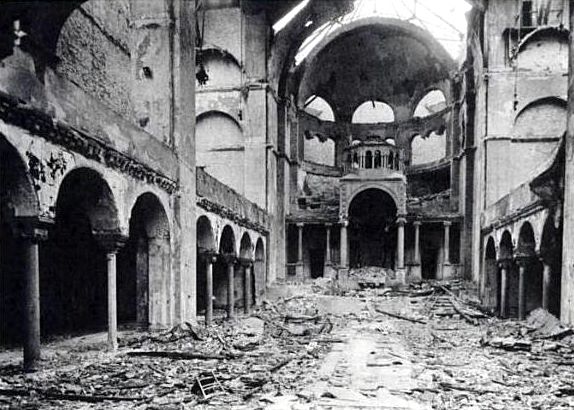
Interior of a Berlin Synagogue after Kristallnacht

Interior of a Berlin Synagogue after Kristallnacht

Seventy Five years ago this November (9th and 10th) Jewish shops and synagogues were vandalized and looted over those two nights throughout much of Nazi Germany and Austria in a most extreme incarnation of the “pogroms” that became known as “Kristallnacht” or the “Night of Broken Glass“.  It was one of the first major and overt expressions of Hitler’s genocidal plans then still being formulated. Unfortunately this event continues to be imitated by like-minded hateful individuals and groups worldwide. So the sociopolitical context of this musical work written for the 50th anniversary of that event sadly has an ongoing relevance for our contemporary world even 25 years after its creation.

At its most basic level this piece is a sort of concerto for six instrumental ensembles playing in radio stations in six different countries live mixed by the composer and broadcast throughout Northern Europe on October 20th of 1988. There is no text as such but the sounds of people praying and the apparently random Hebrew letters and German numbers are scattered throughout the piece along with environmental and found sounds on the tape Curran prepared which plays throughout the performance as a sort of political pedal point.

English: "Hebrew alphabet" in Hebrew...

English: “Hebrew alphabet” in Hebrew, modern serif typeface. (Photo credit: Wikipedia)

The liner notes of the recording describe the piece as “radio concert for six choruses; six sextets each including a quartet (violas, cellos, bass clarinets, bass flutes, trombones, tenor sax/tuba) plus accordion and percussion; tape.”  All were individually conducted with the conductors coordinated by a click track and mixed live by the composer. The recording on New World records is the document of that broadcast.

The effect is that of a collage connected by the electronic nervous system, the radio stations, which link the various performances.  The program is largely implicit here and listening to this piece evokes images that can vary from one listener to the next as any great piece of art provokes different experiences. The sound images here are not pretty and the work is very emotionally intense. Those images are guided by the tone of the music and fueled by the cryptic words and sounds mixed in with the live performances.  It is, in effect, his Mitzvah to the memories of the fallen.  You will not come away unmoved.

Kristallnacht occurred in November of 1938, a month before Curran was born but  the impact of that action continues to resound from that generation to this.  As a politically aware artist he was compelled to respond and he did so in a most emphatic, creative and powerful manner.  Perhaps it is the inherited duty of one generation to exorcise the demons and the atrocities of the previous ones.  Curran has certainly contributed most memorably to such an effort with this work.

Thank you, Mr. Curran, for your prolific and varied contributions to music and your efforts through your art to exorcise the demons of our collective past.  I wish you a happy 75th birthday and wishes for many more creative years to come.

Not Another Minimalist! (NAM): New and Lesser Known Minimalists


Philip Glass portrait

Philip Glass portrait (Photo credit: DailyM = Differentieel + JeeeM)

I have been a fan of so-called minimalist or pattern music for quite a number of years.  Since my first encounter with this type of music in the late 1970s I have listened with interest and been fascinated to hear how each composer expressed their own voice within that general rubric.  Though many have eschewed the label ‘minimal’ and argued over the alternate label ‘pattern music’ there are recognizable characteristics which continue to bind, however loosely,   Perhaps that is just another way of saying that I “know it when I hear it” but I think readers tend to get the general idea and I am open to discussion on what music I should include or exclude from these categories.

Kyle Gann

Kyle Gann (Photo credit: Wikipedia)

Anyway the point of this rambling little  post is to introduce a recurring series of posts about my personal discoveries in said genre.  You can be assured that I have scoured high and low but lay no claim to being either definitive or comprehensive.  What will follow will be an ongoing series of posts identifying the music of one composer or group whose music sounds minimalist or pattern based at least to my ears and which I find pleasing and/or significant in some way.  I will head each post with the identifying acronym NAM (Not Another Minimalist!).

Michael Nyman in Sant Cugat del Vallès

Michael Nyman in Sant Cugat del Vallès (Photo credit: Wikipedia)

The most useful books for me on this subject for me are those by Kyle Gann, Tom Johnson, Michael Nyman, Wim Mertens and Robert Fink.  I am listing these as my primary influences and do not mean to discount important works by other writers on the subject.  Gann’s ‘American Music in the Twentieth Century'(1997) and the collection of articles, ‘Music Downtown'(2006) remain among the most lucid descriptions and analyses of minimalist music.  He also maintains a blog with pretty regular posts at (http://www.artsjournal.com/postclassic/).  Gann’s work might not have been possible without the work of fellow composer and journalist Tom Johnson whose collection of reviews, ‘The Voice of New Music’ (1991) is one of the most important collections of reviews of the burgeoning ‘downtown music’ scene in New York in the 70s and 80s where purveyors of this genre first displayed their wares .  Both ‘Music Downtown’ and ‘The Voice of New Music’ are collections of reviews of concerts and events written for the Village Voice.

UCLA professor and music critic Robert Fink on...

UCLA professor and music critic Robert Fink on the “Different Strokes” panel at the 2009 Pop Conference, Experience Music Project, Seattle, Washington. (Photo credit: Wikipedia)

Michael Nyman’s book, ‘Experimental Music: Cage and Beyond'(1974) is among the earliest to describe this music and its context.  Wim Merten’s ‘American Minimal Music'(1988) is a great analysis of the essential canon.  Unfortunately these have been difficult to find lately and hopefully some reissues including digital formats may be forthcoming.

Robert Fink is a musicologist at UCLA.  His book, ‘Repeating Ourselves’ provides one of the most wide-ranging and comprehensive analyses of the concept of minimalism and pattern music.  He works across all music genres and cultural practices to identify a sort of minimalist ethic and has done much to shape my thinking in this area.

There are certainly many other fine books on the subject and that itself may need to be the subject of a future post.

I don’t like all music in this category (or any category for that matter) but it is the one which feels kind of like a personal discovery to me and a genre that continues to interest me.   And I can report that there is a good deal of music  outside the classic canon of minimalism that is definitely worth the effort to find.  And there are pieces of music written before the 1960s which appear in hindsight to have been sorts of precursors to this style.

This will be an occasional series of posts and I have decided to gather them under the somewhat facetious acronym of NAM (Not Another Minimalist) for the sake of easy reference should any reader actually find these posts useful.  My intent is both to share my discoveries and to generate debate and comment about this type of music.  I want to explore and share artistically interesting developments that lie outside the Reich/Glass/Riley/Young canon of minimalism.  As always I welcome discussion and feedback.

In the Mood for Food, a unique underground dinner/concert series returns to the east bay


The door is open to the underground restaurant.

The door is open to the underground restaurant.

This past Monday October 7th there was a gathering of twelve people at a small loft space in West Oakland.  This is not a neighborhood known for about anything but light industry and cheaper rents.  But there are gems to be found in nasty old Oakland, CA and this is one of them.  It was the return of an irregular (approximately monthly) series of dinners and dinner concerts hosted by local vegan caterer and chef extraordinaire (and shakuhachi teacher as well) Philip Gelb.  These concerts, according to Mr. Gelb, were inspired by the Creative Music Studio which flourished in Woodstock, New York from 1971 to 1984 which featured many of the brightest and most innovative musicians in jazz, free improvisation and experimental music.  But the inclusion of such high quality creative cooking is unique here.

View through a glass, lightly.

View through a glass, lightly.

It has been many months since he last hosted one of these at his loft space.  Phil has chosen to combine his substantial cooking talents with his interest and connections with the music community to create this unique blend of freshly shopped and created vegan dishes with local and visiting musical talent.  This series, dubbed “In The Mood for Food”, is named after one of his favorite films, “In the Mood for Love” by Wong Kar-Wai.  The series has occurred more or less monthly for the last 8 years. To date I have enjoyed the creative and varied multi-course meals (which are frequently themed to the season or to the performer’s preferences) and have enjoyed both dinner conversation and performances by Pauline Oliveros, Terry Riley, Stuart Dempster, Gyan Riley, Tim Rayborn, Michael Manring, Barre Phillips, Mark Dresser, Amy X Neuberg and Pamela Z to name just a few.

The meals are always multi-course, locally created, sourced and shopped meticulously by Phil himself.  He serves only farm fresh ingredients, never canned or packaged and the recipes are his personal creations.  Food is served by the chef and one or two assistants depending on the size of the audience (maximum capacity is about 20 people).  Cost ranges from $40 to $60 per person, about what you would pay at a good area restaurant.  The musicians are either people with whom Phil has collaborated or found by word of mouth from other musicians and friends.  He has had many musicians call him to ask if they can play at his venue.  Why would that be?  There is no significant publicity or profit to be had here.  The answer, I believe, is the intimacy which is a combination of the loving creation of both food and music, both raised to an art form by their execution as well as their content.

There is reportedly a cook book in the works which, in addition to many carefully tested vegan recipes, will tell some of the history of this series.  Phil is occasionally soliciting recipe testers via Facebook.  He is also known for his hands on cooking classes.

As it happened, Monday’s event did not include music but it did include some familiar faces who I frequently encounter at these dinners as well as an overall interesting collection of guests who make for great conversation and frequently share their BYOB offerings.  In fact the bartender from the great San Francisco vegan restaurant, ‘Millenium’, asked to attend and to prepare some delicious cocktails specially designed by him and incorporating some of the food ingredients to enhance the experience.  Two of the guests were the operators of a local new tempeh making business called Rhizocali and their superior product was featured in the night’s food offerings.

Unfortunately I forgot to get a picture of the wonderful dessert course which consisted of pumpkin waffles, spiced pumpkin sorbet and maple tea poached pears.  Characteristically the attentive chef went around offering more scoops of the refreshing pumpkin sorbet which no one appeared to refuse as they engaged each other in pleasant conversations.  It is good to have this series back again and, well, let’s just say no one walked away unsatisfied.

Appetizer- Fresh rice noodles wrapped with apple smoked tofu and miso glazed, grilled pumpkin hijiki salad

Appetizer- Fresh rice noodles wrapped with apple smoked tofu and miso glazed, grilled pumpkin hijiki salad

First course- Kim chi soup with rice cakes, homemade kim chi in a seaweed/pumpkin broth and a little side dish of Pumpkin tempura brushed with gochujang

First course- Kim chi soup with rice cakes, homemade kim chi in a seaweed/pumpkin broth and a little side dish of Pumpkin tempura brushed with gochujang

Entree- Dumpling pumpkin stuffed with Thai red curry with Rhizocali Tempeh, gai fan, snap peas and Thai eggplant; jade pearl rice, green mango salad and lotus root pickles

Happy diners chatting after a fantastic dinner.

Happy diners chatting after a fantastic dinner.

Other Minds 18, three nights on the leading edge


The stage at Kanbar Hall stands ready to receive performers on opening night of OM 18

The stage at Kanbar Hall stands ready to receive performers on opening night of OM 18

OM 18 has been my fifth experience at the Other Minds festival.  The most amazing thing about Other Minds is their ability to find new music by casting a wide net in the search for new, unusual and always interesting music.  As I said in my preview blog for these concerts this year’s selection of composers was largely unfamiliar to me.  Now I am no expert but my own listening interests casts a pretty wide net.  Well this year I had the pleasure of being introduced to many of these composers and performers with no introduction save for the little research I did just before writing the preview blog (part of my motivation for doing the preview blog was to learn something about what I was soon to hear).
Gáman

Danish folk trio Gáman

The first night of the series consisted of what is generally classified as “folk” or “traditional” music.  Not surprisingly these terms fail to describe what the audience heard on Thursday night.

First up was the Danish folk trio ‘Gáman’ consisting of violin, accordion and recorder.  This is not a typical folk trio but rather one which uses the creative forces of three virtuosic musicians arranging traditional musics for this unusual ensemble.  On recorder was Bolette Roed who played various sizes of recorders from sopranino to bass recorder.  Andreas Borregaard played accordion.  And Rune Tonsgaard Sørensen was on violin.

The first piece, ‘Brestiskvædi’ was their rendering of this traditional song from the Faroe Islands (a group of islands which is under the general administration of Denmark but which has its own identity and a significant degree of independence).  It struck my ears as similar in sound to the music of Scotland and Ireland, lilting beautiful melodies with a curiously nostalgic quality.

Next was a piece by Faroese composer Sunleif Rasmussen.  It was the U.S. premiere of his ‘Accvire’ from 2008, a name derived from the two first letters of the instruments for which it was written (as we learned in the always interesting pre-concert panel).  It was commissioned by this ensemble.  The work reflected the composer’s facility with instrumentation and retained some suggestion of folk roots as well.  It employed a rich harmonic language within a tonal framework in what sounded almost like a post-minimalist piece.  The trio met the challenges of the music and delivered a lucid reading of this music which seemed to satisfy both the musicians and the audience.

The trio followed this with three more folk arrangements, two more from the Faroe Islands and one from Denmark.  Like the first piece they played these had a similar ambience of calm nostalgia.

The Danish folk piece set the stage for the next work, a world premiere by one of Denmark’s best known living composers, Pelle Gudmunsen-Holmgreen.  The piece ‘Together or Not’ from 2013 is an Other Minds commission.  The composer, who was not present, wrote to Other Minds director Charles Amirkhanian saying, “the title is the program note”.  While the statement was rather cryptic the music was not.  This was less overtly tonal than the Rasmussen work and was filled with extended instrumental techniques and good humor.  Again the instrumentalists demonstrated a comfortable facility with the technical challenges of the music and delivered a fine reading of this entertaining piece.

The nicely framed program continued with two traditional drum songs from Greenland (the violinist, holding his instrument rather like a guitar produced a sort of modified pizzicato technique which played the drum part).  These haunting melodies seemed to evoke the desolate landscape of their origin.

The program ended with a Swedish polka and, in response to a very appreciative audience, an encore of another spirited polka.  These were upbeat dance music that all but got the audience up and dancing.  The audience seemed uplifted by their positive energy.
Sachdev

G.S. Sachdev (left) and Swapan Chaudhuri.

The second half of the first night’s concert consisted of two traditional Hindustani Ragas.  These pieces are structured in aspects of the the music but allow for a great deal of repetition and improvisation in which the musicians bring the music to life.  Hindustani music is deeply rooted in culture and spirituality.  The ragas are associated with yogic chakras, moods and time of day.  Their performance is intended to enhance the audience esthetically and spiritually.

G.S. Sachdev is a bansuri player.  The bansuri is a wooden flute common in this type of music (though Sachdev’s level of mastery is hardly common).  He was accompanied by the familiar tanpura drone produced by digital drone boxes instead of the actual instruments which produce the familiar drone sound that underlies Hindustani music performances.  Swapan Chaudhuri played tabla.  It is difficult to see the tabla as an “accompanying” instrument as much as it is a complementary instruments especially when played by a master such as he.  Chaudhuri is the head of the percussion department at the Ali Akbar Khan school in San Rafael in the north bay.  Sachdev has also taught there.  Both men have ties to the bay area.

The musicians performed Raga Shyam Kalyaan followed by Raga Bahar.  Originally I had thought of trying to describe these ragas in their technical aspects but my knowledge of Hindustani music cannot do justice to such an analysis.  Rather I will focus on the performances.

Raga Shyam Kalyaan was first and received an extended reading.  How long?  Well I’m not sure but this music does create a sort of suspended sense of timelessness when performed well.  Indeed that was the effect on this listener.  The whole performance of both ragas could not have exceeded one hour  but the performances by these master musicians achieved the height of their art in producing riveting performances of this beautiful music.  Sachdev’s mastery certainly has virtuosity but his genius lies in being able to infuse his performance with spirituality from within himself and to impart that spiritual resonance to his audience.  He was ably aided in that endeavor by Chaudhuri who, clearly a master of his instrument and connected with Sachdev, channeled his connection with the infinite.

The audience responded with great warmth and appreciation concluding the first day of the festival.

D. Lee OM18

Composer, performer, designer, shaman Dohee Lee performing her work, ‘ARA’.

Friday night began with the world premiere of the music theater performance piece, ‘ARA’ by Korean-American artist Dohee Lee.  Continuing with the spiritual tone set by yesterday’s Raga performances Lee introduced her multi-disciplinary art derived from her study of Korean music, dance and shamanism as well as costume design and music performance.

She was aided in her efforts by the unique instrument designed for her by sculptor and multi-disciplinary artist Colin Ernst.  The Eye Harp (seen in the above photo) is an instrument that is played by bowing and plucking strings and is connected to electronics as well.

The art of lighting designer David Robertson, whose work subtly enhanced all the performances, was clearly in evidence here.  This was  a feast for the eyes, ears and souls.  Dohee Lee’s creative costume design was integrated with the visually striking Eye Harp instrument.  And the music with sound design processing her instrument nicely complimented her vocalizations.  All were lit so as to enhance the visual design and create a unified whole of this performance.
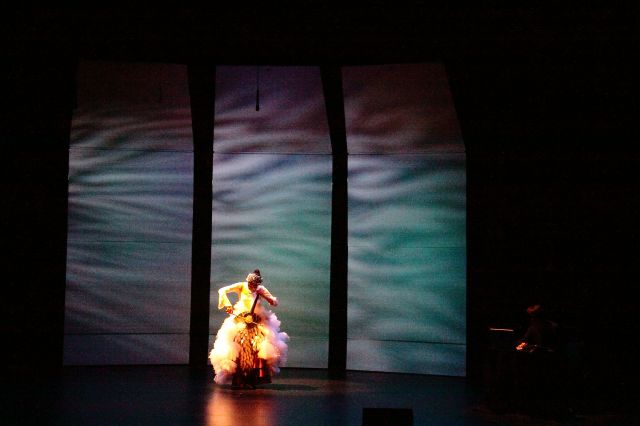
Dohee Lee on the carefully lit stage off Kanbar Hall.

Dohee Lee on the carefully lit stage off Kanbar Hall.

Her performance began slowly with Lee in her beautiful costume took on the role of a modern shaman conjuring glossolalia in shamanic trance along with choreographed movement and accompanied by her Eye Harp and electronic sounds through the theater’s great sound system.   Like the raga performances of the previous night I wasn’t aware of how long this timeless performance lasted (the program said it was 10 minutes) .  But I wished it would have gone on longer.  Even with photographs the experience here is difficult to articulate.  The sound enveloped the audience who viewed the carefully lit stage in the otherwise darkened hall as the sounds communicated a connection with the sacred.

I am still trying to digest what I saw and heard on this Friday night.  I don’t know how most of the audience experienced this piece but they seemed to have connected with it and responded with grateful applause.  She seemed to connect as both artist and shaman.
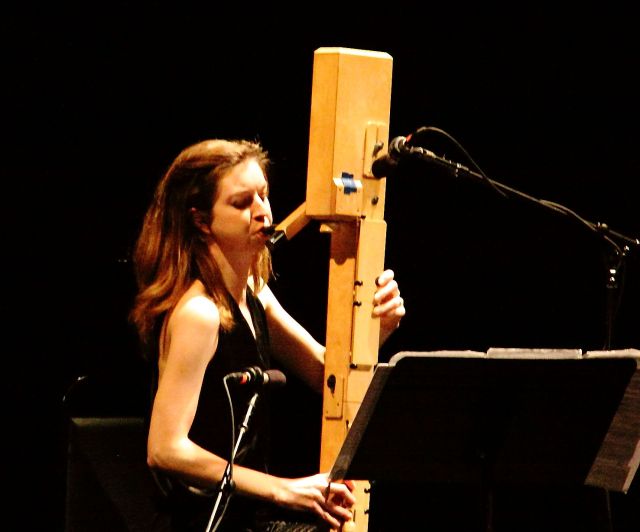
Anna Petrini performing with her Paetzold contrabass recorder.

Anna Petrini performing with her Paetzold contrabass recorder.

Following Dohee Lee were three pieces for an instrument called the Paetzold contrabass recorder (two before intermission and one after).  Paetzold is the manufacturer who specializes in the manufacture of recorders, forerunner of the modern flute.  The square contrabass recorder is a modern design of this woodwind instrument.  However, knowing the sound of the recorder in music of Bach and his contemporaries, gives the listener no useful clues as to what to expect from the unusual looking instrument pictured above.

Anna Petrini is a Swedish recorder virtuoso who specializes in baroque and modern music written for the recorder.  At this performance she played her contrabass instrument augmented variously by modifications, additions of microphones, little speakers and electronic processing.  These pieces were perhaps the most avant-garde and the most abstract music in this festival.

Anna Petrini performing on the stage of Kanbar Hall at the Other Minds festival.

Anna Petrini performing on the stage of Kanbar Hall at the Other Minds festival.

The creative stage lighting provided a useful visual counterpoint to the music.  The first piece, ‘Split Rudder’ (2011) by fellow Swede Malin Bang was here given it’s U.S. premiere.  This piece is concerned with the sounds made inside the instrument captured by small microphones inserted into the instrument.  The resulting sounds were unlike any recorder sound that this listener has heard.  The piece created percussive sounds and wind sounds.

The next piece, ‘Seascape’ (1994) by the late Italian composer Fausto Rominelli (1963-2004) used amplification but no electronic processing.  These abstract works were received well by the audience.

‘SinewOod’ (2008) by Mattias Petersson involved introducing sound into the body of the  instrument as well as miking it internally and setting up electronic processing with which the performer interacts.  Like the two pieces that preceded it this was a complex exercise in the interaction between music and technology which is to my ears more opaque and requires repeated listenings to fully appreciate.
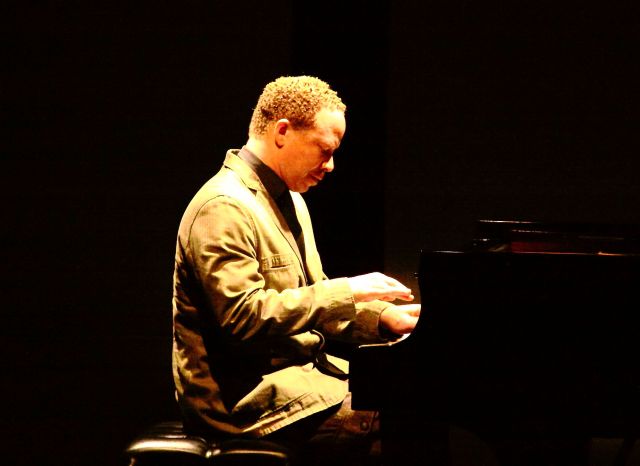
Taborn

Craig Taborn performing on the stage of Kanbar Hall at the 2013

The second concert was brought to its conclusion by the young jazz pianist and ECM recording artist Craig Taborn.  Detroit born, Taborn came under the influence of Roscoe Mitchell (of AACM fame) and began developing his unique style.  Here the term jazz does little to describe what the audience was about to hear.

Taborn sat at the keyboard with a look of intense concentration and began slowly playing rather sparse and disconnected sounding notes.  Gradually his playing became more complex.  I listened searching for a context to help me understand what he was doing.  Am I hearing influences of Cecil Taylor?  Thelonius Monk?  Keith Jarrett maybe?

Well comparisons have their limits.  As Taborn played on his music became more complex and incredibly virtuosic.  He demonstrated a highly acute sense of dynamics and used this to add to his style of playing.  I was unprepared for the density and power of this music. Despite the complexity it never became muddy.  All the lines were distinct and clear.  And despite his powerful and sustained hammering at that keyboard the piano sustained no damage.  But the audience clearly picked up on the raw energy of the performance.

This is very difficult music to describe except to say that it had power and presence and the performer is a creative virtuoso whose work I intend to follow.
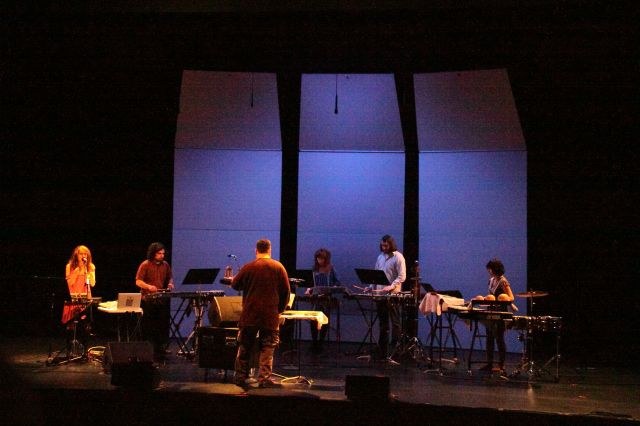
Amy X Neuberg along with the William Winant percussion group playing Aaron Gervais.

Amy X Neuberg along with the William Winant percussion group playing Aaron Gervais.

The final concert on Saturday began with the world premiere of another Other Minds commissioned work, ‘Work Around the World’ (2012) for live voice with looping electronics and percussion ensemble.  This, we learned in the pre-concert panel is another iteration in a series of language based works, this one featuring the word ‘work’ in 12 different languages.

Amy X Neuberg singing at the premiere of Aaron Gervais' 'Work Around the World'.

Amy X Neuberg singing at the premiere of Aaron Gervais’ ‘Work Around the World’.

Language is an essential part of the work of local vocal/techno diva Amy X Neuberg’s compositions and performance work.  With her live looping electronics she was one instrument, if you will, in the orchestra of this rhythmically complex work.  William Winant presided over the complexity leading all successfully in the performance which the musicians appeared to enjoy.  The audience was also apparently pleased with the great musicianship and the novelty of the work.  Its complexities would no doubt reveal more on repeated listenings but the piece definitely spoke to the audience which seemed to have absorbed some of the incredible energy of the performance.
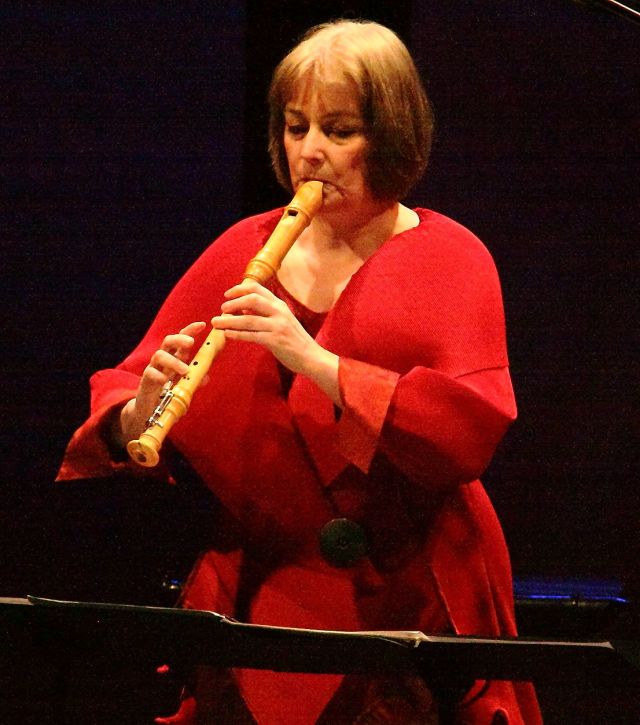
Michala Petri performing Sunleif Rasmussen's 'Vogelstimmung'.

Michala Petri performing Sunleif Rasmussen’s ‘Vogelstimmung’.

Back to the recorder again but this time to the more familiar instrument if not to more familiar repertoire.  Recorder virtuoso Michala Petri whose work was first made known to the record buying public some years ago is familiar to most (this writer as well) for her fine performances of the baroque repertoire.

Tonight she shared her passion for contemporary music.  First she played Sunleif Rasmussen’s ‘Vogelstimmung’ (2011) which he wrote for her.  It was the U.S. premiere of this solo recorder piece.  Vogelstimmung is inspired by pictures of birds and is a technically challenging piece that Petri performed with confidence.  At 17 minutes it was virtually a solo concerto.

And then back to electronics, this time with Paula Matthusen who now teaches at Wesleyan holding the position once held by the now emeritus professor Alvin Lucier.  Her piece for recorder and electronics, ‘sparrows in supermarkets’ (2011) was performed by Ms. Petri with Ms. Matthusen on live electronic processing.  This was a multi-channel work with speakers surrounding the audience immersing all in a complex but not unfriendly soundfield.
Michael Straus (left) with Charles Amirkhanian

Michael Straus (left) with Charles Amirkhanian


Some technical difficulties plagued the beginning of the first piece after intermission so the always resourceful emcee, Other Minds executive director Charles Amirkhanian took the opportunity to introduce the new Operations Director Michael Straus.  Straus replaces Adam Fong who has gone on to head a new music center elsewhere in San Francisco.

Mr. Amirkhanian also spoke of big plans in the works for the 20th Other Minds concert scheduled for 2015 which will reportedly bring back some of the previous composers in celebration of 20 years of this cutting edge festival.  No doubt Mr. Straus has his work cut out for him in the coming months.


Ström, part of the video projection

Ström, part of the video projection

With the difficulties sufficiently resolved it was time to see and hear Mattias Petersson’s ‘Ström’ (2011) for live electronics and interactive video in its U.S. premiere.  Petersson collaborated with video artist Frederik Olofsson to produce this work in which the video responds to the 5 channels of electronics which are manipulated live by the composer and the five lines on the video respond to the sounds made.  The hall was darkened so that just about all the audience could see was the large projected video screen whilst surrounded by the electronic sounds.

The work started at first with silence, then a few scratching sounds, clicks and pops.  By the end the sound was loud and driving and all-encompassing.  It ended rather abruptly.  The audience which was no doubt skeptical at the beginning warmed to the piece and gave an appreciative round of applause.

Paula Matthusen performing her work, '...and believing in...'

Paula Matthusen performing her work, ‘…and believing in…’

Next up, again in a darkened hall was a piece for solo performer and electronics.  Composer Paula Matthusen came out on stage and assumed the posture in the above photograph all the while holding a stethoscope to her heart.  The details of this work were not given in the program but this appears to be related to the work of Alvin Lucier and his biofeedback work on the 1970s.  Again the sounds surrounded the audience as the lonely crouching figure remained apparently motionless on stage providing a curious visual to accompany the again complex but not unfriendly sounds.  Again the audience was appreciative of this rather meditative piece.
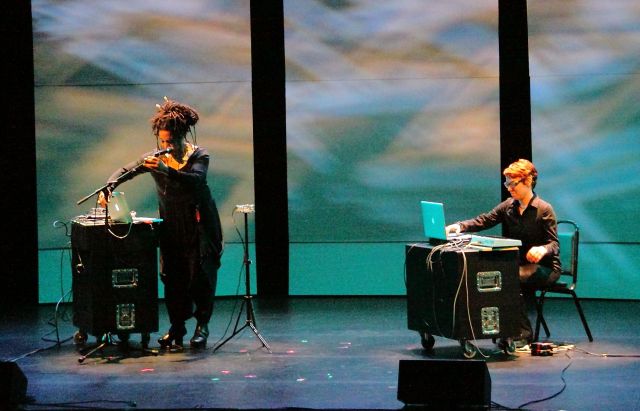
Pamela Z (left) improvising with Paula Matthusen

Pamela Z (left) improvising with Paula Matthusen

Following that Ms. Mathussen joined another bay area singer and electronics diva, Pamela Z for a joint improvisation.  Ms. Z, using her proximity triggered devices and a computer looped her voice creating familiar sounds for those who know her work while the diminutive academic sat at her desk stage right manipulating her electronics.  It was an interesting collaboration which the musicians seemed to enjoy and which the audience also clearly appreciated.

Pamela Z performing Meredith Monk's 'Scared Song'

Pamela Z performing Meredith Monk’s ‘Scared Song’

For the finale Pamela Z performed her 2009 arrangement of Meredith Monk’s ‘Scared Song’ 1986) which appeared on a crowd sourced CD curated by another Other Minds alum, DJ Spooky.  Z effectively imitated Monks complex vocalizations and multi-tracked her voice as accompaniment providing a fitting tribute to yet another vocal diva and Other Minds alumnus.  The audience showed their appreciation with long and sustained applause.
All the composers of Other Minds 18

All the composers of Other Minds 18

Black Classical Part Five


Looking at the previous four installments in this, my personal tribute to Black History Month, I decided that I needed to write one more (for now) in this series. So here I will present some of the resources I have found useful in learning about this music. While I have some knowledge in this area I could not have written these posts without these sources and I will continue to look to them to help me discover more musical gems. I hope that these essays have sparked some interest and I hope that any such interest will have ways to grow further.

The most useful general search terms formed the titles of these posts: black classical (or “African-American classical” which then limits your search to U.S. or the Americas). The term, “classical” is problematic but did serve to differentiate my searches from blues, ragtime, traditional jazz, soul, rhythm and blues, pop, rap and related genres that are more stereotypically associated with black people in music.

My focus was on composers and conductors leaving out a vast category of black classical musicians. A useful overview can be found at: http://www.wqxr.org/#!/articles/black-history-month/2013/jan/31/timeline-history-black-classical-musicians/. This little timeline provides a perspective on the slow acceptance of black musicians in the elite ranks of producers and ensembles that define the classical music experience.

africlassical.com is a good general site that lists many black musicians and its far more up to date companion site http://africlassical.blogspot.com/ has postings of great interest on an almost daily basis has been both essential and revelatory at times (I bookmarked this blog).

Center for Black Music Research is a rich resource and also publishes an academic journal on the subject as well as many other useful and interesting publications. They also maintain a large research library of books, journals and recordings. And they cover all forms of music. An excellent resource.

But the starting point for my personal interest in this subject is the landmark set of recordings which I encountered in the mid to late 1970s. Columbia records release of nine albums entitled ‘Music by Black Composers’ is perhaps the best starting point due to the wonderful scholarship and musicianship in this set. Conductor Paul Freeman along with musicologist Dominique-Rene de Lerma collaborated on this set. They produced a fine overview of neglected black composers from the 18th century to the mid-20th century in an intelligent selection of music and excellent performances by American orchestras. I was pleased to find that the reissue of these albums as a 9 vinyl disc boxed set remains available for only $35 plus postage from here. I jumped at the opportunity to acquire this great reissue funded by the Ford Foundation and my order was sent to me in less than a week.

Chicago-based Cedille Records has some great releases and even more great black classical is available at Albany Records.  Search for the work of Paul Freeman on both labels.

The ultimate goal for me in all this would be to have black classical musicians and composers equally represented on recordings, in performances and in programming. But until that happens (I’m not holding my breath here) the recordings and resources thus far cited (and many that were not) will have to suffice. While I continue to enjoy discovering this music as a “best kept secret” or a limited boutique-type item I would much prefer that the art of these black musicians become common knowledge, not a political issue of which Marian Anderson‘s concert at the Lincoln Memorial has become emblematic.

20130221-135527.jpg

Let me end by referring my readers to my favorite fiction book about black musicians: Richard Powers‘ 2003 masterpiece ‘The Time of Our Singing‘. Powers, who is also trained as a musician, demonstrates amazing insight to music as well as civil rights issues in this sweeping epic of the twentieth century. The chapter entitled, Easter, 1939 (too long to quote here) brings the Marian Anderson concert to life in powerful prose. Read it, preferably out loud to a friend, because it will give you a history lesson and perhaps put you in touch with the emotional power and significance of that event.

Happy Black History Month to all. And happy listening.

20130222-084931.jpg


Black Classical Part Four


As promised in a previous blog I am here continuing a little personal survey of recordings of music by black classical composers in honor of Black History Month. I suppose it is worth adding that I pursue these recordings because they present interesting and exciting repertoire that has not gotten the circulation it deserves. Sadly this is most likely the result of the failure of producers, performers audiences and investors to look at the value of the art itself, looking instead through the lens of racial prejudice. I hope that readers of these blogs will avail themselves of this music, these performers, these recordings and maybe come to realize that those old prejudices serve only to limit one’s world view and prevent a rewarding artistic experience. Art, like people, must come to be valued by its own merits, not limited on the basis of skin color. MLK definitely phrased that more elegantly.

20130218-185316.jpg

And further proof of such valuable art can be found in a series of recordings on the Chicago-based label Cedille. In fact their website cedillerecords.org contains a link to the six albums of music by black composers they have thus far issued.

Building on the work he had begun with the Black Composers series for Columbia in the 1970s conductor Paul Freeman released three CDs in the Cedille series called ‘African Heritage Symphonic Series’. With the orchestra he founded Freeman presents music by Samuel Coleridge-Taylor, Fela Sowande, William Grant Still, Ulysses Kay, George Walker, Roque Cordero, Adolphus Hailstork, Hale Smith, David Abel’s, David Baker, William Banfield and Coleridge-Taylor Perkinson. Freeman released a CD dedicated exclusively to the music of Coleridge-Taylor Perkinson as well.

Violinist Rachel Barton-Pine released a disc of violin concertos by 18th and19th century black composers on Cedille and there is a disc of choral music which includes music by black composers.

Let’s turn now to the Albany www.albanyrecords.com label where you can find more of the artistry of Paul Freeman in 18 albums where he presents neglected music of the 20th century by a wide variety of composers black and white. Most of it is by American composers and much of that in styles related to the mid-century styles of the likes of William Schuman, Aaron Copland and their students. While these discs include music by many of the previously mentioned black composers there are no duplications of works or performances. I have heard but a few of these discs but what I have heard is enough to convince me to plan to purchase the others. Freeman, in addition to bringing the music of black composers to the listening audience has done a fine job of documenting many whose work has been little heard until now.

20130218-183122.jpg

Another composer who fits more or less into the context of the conventions of the western concert traditions whose work has informed my listening is that of Anthony Davis (1951- ). While he has played with musicians from more experimental traditions the influence of the western concert traditions is more easily heard.

His study of jazz as well as western classical and eastern gamelan are all evident in his work (though not necessarily all at the same time). The New York City Opera produced his, ‘X, the Life and Times of Malcolm X’ in 1986 and the Lyric Opera of Chicago produced ‘Amistad’ in 1997. He has written concertos for piano and for violin as well as music for orchestra and smaller ensembles. At the time of this writing he is professor of music at the University of California San Diego.

So far the music we have discussed has been of the sort more commonly heard in concert halls these days. Freeman’s efforts have seemingly jump-started the recording industry to pay some attention to the music of black and other neglected composers. Certainly there is much more gold to be mined there. But we have yet to address the contemporary scene, the new and creative artists who are bringing innovative ideas and sounds and advancing the musical arts for subsequent generations. Following on the innovations of great jazz artists such as Charlie Parker, John Coltrane and Ornette Coleman (among many) there was increasing focus on techniques being used by contemporary “classical” composers

20130218-190530.jpg

To these ends there is no better place to start than with the AACM, the American Association of Creative Musicians. Founded in Chicago in 1965 this collective has strived to bring various elements of black culture in an incredibly eclectic and experimental milieu which has had and continues to have an influence on music, musicians and audiences. This collective was finally given a proper overview in George Lewis’ book, ‘A Power Stronger Than Itself’. Lewis, a trombonist, composer and currently professor of music at Columbia University in New York was a member of the AACM.

The AACM was not the only such collective but it was one of the most visible, at least to me. And it continues to develop and evolve bringing the complex and innovative musical ideas evolving from the black roots of jazz to a level of recognition and respect formerly accorded pretty much exclusively to European academic models. The AACM, dubbed “Great Black Music” also strives to retain the identity of black music by black peoples of the world looking to non-western models that predate European colonialism marrying them to the best of European models as absorbed by the diaspora. Many of their members now hold academic positions including Roscoe Mitchell, Anthony Braxton, Wadada Leo Smith and Nicole Mitchell.

20130218-190751.jpg

Perhaps the best known ensemble to come out of the AACM is the flexibly-membered Art Ensemble of Chicago. Their album ‘Third Decade’ released in 1984 is representative of their work and also marks a sort of end to one creative era for this flexibly-membered group. Most listeners will hear this as progressive jazz and it certainly has those elements. But repeated listenings reveal many layers to this work. And this is but one of a large catalog of albums as diverse as they are numerous (about 50 albums and still counting). More on their work at their website www.artensembleofchicago.com.

20130218-190928.jpg

Another prominent figure that was a member of AACM is Anthony Braxton, saxophonist, composer, chess master who dislikes the term ‘jazz’ in reference to his music. He is currently professor of music at Wesleyan University. And indeed his music which ranges from solo saxophone work to small ensemble and orchestral music and opera are difficult to classify. His experimentalism is related to but not derivative of the work of John Cage. It would be impossible to represent his musical output in a single album but the solo saxophone ‘For Alto’ (1968) and ‘Creative Orchestra Music’ (1976) are good places to start in his discography of well over 100 albums. His website tricentricfoundatio.org offers many of his recordings for sale and even offers free downloads of bootleg recordings.

20130218-185224.jpg

<a

For the sake of brevity I will discuss only one more artist in this blog entry, Julius Eastman (1940-1990). He was a composer, vocalist, pianist and dancer. As a vocalist he sang and recorded the music of Meredith Monk, Peter Gordon, Morton Feldman, Arthur Russell and Peter Maxwell-Davies. He was very much a part of the avant garde downtown scene in New York of the 1970s.

At the time of his sad death from a heart attack at the age of 49 there were but a few recordings of his work (collected in a nice 3 CD set on the New World label). And many of his scores were lost when he was unceremoniously evicted from his apartment. The composer Mary Jane Leach is attempting to collect and preserve his legacy and has made many of his extant scores on her website http://www.mjleach.com/eastman.htm.

Without a doubt there are many more black classical and avant-garde artists I have yet to discover. I welcome suggestions and I hope that the preceding ideas will stimulate and encourage others to explore these artists and works.

Black Classical Part Three


20130214-170052.jpg

For my third installment I have chosen to highlight that series of recordings by conductor Paul Freeman of music by black composers which I mentioned in a previous blog.

In 1974 Columbia Records issued 9 LPs (originally it was to be 12) over the next few years in a series called, ‘Music by Black Composers’. The music was chosen largely by Paul Freeman who also wrote the liner notes and conducted the performances. He was assisted by musicologist Dominique-Rene de Lerma who contributed his knowledge of pre 20th century black music and also edited some of the pieces for performance.

This set of records was featured by my local radio station (WFMT in Chicago) at the time of its release and opened my listening mind to to this cornucopia of fascinating classical concert music by black composers. The series was so titled in part because it included music from many countries and also because it was released before the term ‘African American’ became Le mot juste (but that is another story).

The series was apparently recorded and released 1974-78 and re-released in 1986 as a set under the Columbia Special Products label. Historically it was an important set of releases much like the series curated by David Behrman called ‘Music of Our Time’ which featured some truly cutting edge music by composers writing in the sixties and seventies. To be sure the black composer series was not cutting edge modernism like that series but gains its cutting edge from collecting in one set music from the 18th to the mid-20th century by a set of composers who, other than having been trained in the discipline of music performance and composition, held in common only a skin color darker than ‘white’.

Billboard announced the plan to issue these records in 1973 saying that they were the fruit of a collaboration between the Irwin-Sweeney Miller Foundation of Columbus, Indiana and, with the encouragement of Dominique-Rene de Lerma, the school of music at Indiana University in Bloomington. Citing “campus politics” professor de Lerma reported that Indiana had lost interest so he phoned Paul Freeman (conductor with the Detroit Symphony at the time) and advised him to contact the ‘Afro-American Music Opportunities Association’ whose support then helped launch this series. The original plan was to release four albums per year for at least three years but a great beginning soon slowed and the 9th album (pictured above) was the final release in the series.

Coming twenty some years after the voting rights act of 1965 it retained the some cachet of the civil rights movement and likely was produced at that time in the hopes that this might help sell the albums to consumers. I don’t know who ultimately bought these albums or what their total sales were but I know that some visionary producers at WFMT piqued my interest and that I bought many of these records and listened with interest when they were scheduled to play (I religiously perused the monthly program guide).

The original releases went out of print in a few years. There was a CD set (currently out of print) compiled by the Columbia University (Chicago) Center for Research in Black Music funded by the Ford Foundation that released a selection of the Detroit Symphony performances (now a pricey collector’s item) from that set as well as a reissue of the complete set on vinyl records with the original cover art and program notes which remains, I am happy to report, available by mail from the College Music Society in Missoula, Montana www.music.org.

The contents are:
Columbia M-32781 (1973); volume 1
Saint-Georges: Symphony concertante, op. 13 (ed. by Barry S. Brook; Miriam Fried, Jaime Laredo, violins; London Symphony Orchestra)
—–: Symphony no. 1 (ed. by D. de Lerma; London Symphony Orchestra)
—–: Scena from Ernestine (ed. by D. de Lerma; Faye Robinson, soprano; London Symphony Orchestra)
—–: String quartet no. 1 (ed. by D. de Lerma; Julliard Quartet)

Columbia M-32782 (1973); volume 2
William Grant Still: Afro-American symphony.
—-: 2 arias from Highway 1, U.S.A. (London Symphony Orchestra; William Brown, tenor)
Samuel Coleridge-Taylor: Danse nègre.
—–: “Onaway, awake, beloved” from Hiawatha’s wedding feast (William Brown, tenor; London Symphony Orchestra)

Columbia M-32783 (1974); volume 3
Ulysses Kay: Markings (London Symphony Orchestra)
George Walker: Trombone concerto (Denis Wick, trombone; London Symphony Orchestra)

Columbia M-32784 (1974); volume 4
Roque Cordero: Violin concerto (Sanford Allen, violin; Detroit Symphony Orchestra)
—–: Eight miniatures (Detroit Symphony Orchestra)

Columbia M-33421 (1975); volume 5
José Maurício Nunes-Garcia: Requiem Mass, M. 185 (ed. by D. de Lerma; Doralene Davis, soprano; Betty Allen, mezzo-soprano; William Brown, tenor; Matti Tuloisela, bass-baritone; Helsinki Philharmonic Orchestra; Morgan State University Choir [Nathan Carter, director])

Columbia M-33432 (1975); volume 6
José White: Violin concerto (ed. by Paul Glass and Kermit Moore; Aaron Rosand, violin; London Symphony Orchestra)
David Baker: Cello sonata (Janós Starker, cello; Alain Planès, piano)

Columbia M-33433 (1975); volume 7
William Grant Still: Sahdji (London Symphony Orchestra; Morgan State University Choir [Nathan Carter, director])
Fela Sowande: African suite (3 excerpts; London Symphony Orchestra)
George Walker: Lyric for strings (London Symphony Orchestra)

Columbia M-33434 (1975); volume 8
Olly Wilson: Akwan (Richard Bunger, piano; Baltimore Symphony Orchestra; Richard Bunger, piano)
Thomas Jefferson Anderson: Squares (Baltimore Symphony Orchestra)
Talib Rasul Hakim: Visions of Ishwara (Baltimore Symphony Orchestra)

Columbia M-34556 (1978); volume 9
George Walker: Piano concerto (Natalie Hinderas, piano; Detroit Symphony Orchestra)
Hale Smith: Ritual and incantations (Detroit Symphony Orchestra)
Adolphus Hailstork: Celebration! (Detroit Symphony Orchestra)

Later Freeman began a series on Chicago-based Cedille records that released three further volumes of black composers’ music with his wonderful Chicago Sinfonietta as well as several CDs dedicated entirely to single black composers (more about those and more in another post).

Perhaps an innovative label such as Naxos might some day bring these Columbia recordings back into circulation in their entirety in the CD format. Meanwhile I am pretty happy with my LPs with their copious notes and full-sized beautiful graphics. If you haven’t heard this set I would encourage you to avail yourself of some of this beautiful music.

Black Classical Part One


Adolphus Hailstork

Adolphus Hailstork

In honor of Black History Month I want to bring attention in this blog to black music that is not a part of popular culture. I want to highlight some of the black classical composers whose work I find most satisfying and accomplished.

I will begin with the music of Adophus Hailstork. I had been aware of some of this man’s work for some years but it was when I purchased the Naxos recording of his 2nd and 3rd Symphonies that I came to appreciate the power of his work.

Hailstork was born in 1941. He studied piano, organ, voice and violin. He is another of a long line of composers who studied with Nadia Boulanger in Paris. As one would expect, some of his music is concerned with significant events of the civil rights struggles of the 1960s and 70s. ‘American Guernica’ of 1983 is his response to the 1963 bombing of the 16th Street Baptist Church which killed four little girls. Similarly his 1979 composition, ‘Epitaph for a Man Who Dreamed’ is an homage to Dr. Martin Luther King, Jr. who was felled by an assassin’s bullet in 1968.

I purchased the Naxos disc to become more familiar with this man’s music. The first work on the disc is the 3rd Symphony of the late 1990s struck me as a highly entertaining and accomplished work that deserves a place in the symphonic repertoire. It is a joyous and inventive work which, to my ears, echoed the likes of orchestral masters such as William Schuman and Vincent Persichetti as well a hint of minimalist repetitive structures. It is a lavish neo-romantic work with a depth and complexity that demands several hearings but one which has an immediate appeal. The somber 2nd Symphony is imbued with the composer’s reactions to having visited the historical slave market areas of West Africa which, I imagine, must be not unlike visiting the death camps of the former Nazi Germany.

As time and finances permit I intend to pursue more of this American composer’s works. There is precious little reference material to be found on the Internet regarding this prolific masterful composer (as is the case with all the black classical composers i have so far encountered) though, thankfully, there are more recordings.

Paul Freeman

Paul Freeman

Africlassical.com and its related blog provide some information on about 50 composers and musicians. The now retired daring black conductor Paul Freeman recorded a significant series of music by black composers issued on 9 LPs for Columbia records in the 1970s. He recorded another 3CDs of music by black composers on Chicago-based Cedille records. He founded the Chicago Sinfonietta (billed as the world’s most diverse orchestra) and was its principal conductor for 24 years and continues in its mission of diversity presenting unusual concert repertoire.

More about some of the composers on those Columbia LPs and Cedille CDs as well as others to come in future blogs during this month.

RIP Elliott Carter


ElliottCarter (1908-2012)

Yesterday the music world lost one of it’s longest lived citizens.  Elliott Carter died aged 103.

Many obituaries and appreciations are being written at this moment for this man whose creative career spanned some 80+ years and includes two Pulitzer Prizes and numerous other awards as well as influence on a great deal of students.  Admittedly he is hardly easy listening and a book length conversation with Carter written by one Allen Edwards was appropriately titled, “Flawed Words and Stubborn Sounds”.    Outside of musicians and the limited audience of fans of new classical music such as myself are likely to be familiar with this man.  And a moments reflection told me that I cannot make him more familiar by citing any one of his musical works.

But his lack of familiarity is a product of his style and vision, not a commentary on his value as an artist.  That said I know of only a handful of friends and acquaintances who would be willing to sit through any performances of his music.  Like his contemporary Milton Babbitt (1916-2011) he pursued his own vision and succeeded very well in establishing himself as a major, if underappreciated, composer.

Carter whose early interest in music was encouraged by Charles Ives was present at the American premiere of Stravinsky’s ‘Rite of Spring’.  Along with a great deal of 20th century composers he studied with the venerable Nadia Boulanger in Paris of the 1930s.  Boulanger’s circle included the likes of Picasso, Gertrude Stein, Igor Stravinsky and numerous others of that fascinating period.

Curiously there is yet to be a comprehensive biography of this man and I look forward to reading one when it becomes available.  Anybody know of anyone working on this?

Born into a wealthy family Carter had little reason to be concerned about things financial.  Carter focused on the composing of music.  He was not a performer.  His style initially owed a great deal to Stravinsky and had a neo-romantic sound not unlike that of fellow Boulanger student Aaron Copland and Samuel Barber.

In the 1950s his style began to take on what would become his mature style.  It was characterized by methods related to Schoenberg’s twelve tone system and an idiosyncratic approach to tempo which he called “metric modulation”.  His style was challenging for both performers and listeners but this did not prevent him from twice winning the Pulitzer Prize (for the 2nd String Quartet in 1960 and the 3rd String Quartet in 1973).  His work has been embraced by many of the major performers and orchestras of our time and he was a fixture among the musical cognoscenti of New England.  He was appointed to the American Institute of Arts and Letters in 1981.

His 5 String Quartets (1951, 1959, 1971, 1984, 1995) are likely the most significant development in that genre since Bartok.  Those along with his Variations for Orchestra (1954-55), Concerto for Orchestra (1969), Piano Concerto (1964), Symphony of Three Orchestras (1976), Violin Concerto (1989), Piano Sonata (1945-6), Symphonia (1993-96) and Double Concerto (1959-61) all make my shortlist of his best work.

And there are a great deal more pieces with which I am less familiar which Carter wrote in his remarkably prolific later years.  He added about 54 new works to his catalog from age 90 until his death just short of his 104th birthday.  No doubt many of these will also claim a regular place in the repertoire.

Sometimes characterized as one of the “three C’s” of American music (Copland, Cage, Carter) he influenced many composers, performers and, in my case, listeners.  Though difficult at times I find his work ultimately rewarding.  His passing is truly the end of an era and his legacy is rich.

RIP Hans Werner Henze


I just learned last night that the great German composer Hans Werner Henze died on Saturday October 27th at the age of 86.  I have been fascinated by this man and his music since the mid 1970s.  While generally classified as a sort of neo-romantic these days I recall the man and the music of controversy.

Henze was, for me, one of the great political composers and stands with the likes of Luigi Nono, Hans Eisler.  His compositions like ‘Essay on Pigs’, ‘The Raft of the Frigate Medusa’, ‘El Cimmaron’, and the 6th Symphony stand out as some of the finest political commentary achieved in classical music.  The premiere of The Raft of the Frigate Medusa had to be cancelled due to political protests which broke out in the concert hall and among the musicians themselves.

Though he may be better known for his wonderful operas and film scores (which I like as well) I will always remember when DGG suddenly dropped Henze from their catalog in the 1970s due to how politically hot he was.  I recall his interview in Stereo Review, I believe, where he discussed his homosexuality and denigrated his German homeland for their discriminatory practices.  Henze had moved to Italy where he spent many productive years.

Much of his music has, for me, a sort of “in your face” quality that reminds me of the expressionism of Schoenberg and the sound world of Varese.  Pieces like the Essay on Pigs will still not fail to offend, repel and fascinate listeners because of it’s dissonant style and unusual extended vocal techniques as well as the political content of the text.  One of my favorite Henze pieces will always be the noisy and very dissonant 6th Symphony which he composed during a stay in Cuba.  And while his style mellowed somewhat after that his compositional approaches were frequently pushing the envelope using tape, spoken voices and dissonances that worked well in the context of his work.

The sweeping grandiose orchestral works include ballets, 10 symphonies, various concerti.  His operas are rather frequently performed.  And his chamber music, including 5 string quartets, deserve more attention.  It is clear as to why he is considered a sort of neo-romantic and I don’t think that that is at odds with his political convictions.  Henze seems to me to have been an idealist, supporting progressive and radical political ideas as a part of his grand and all embracing  style.  Harsh sounds did not need to be excluded from his sonic pallete.  He seems to have embraced a wide variety of techniques and sustained a long and productive career.  Perhaps he was the ideal post-modern romantic.

RIP, Hans.  We go on listening.  Thank you for the sounds.

henze


The Complete Works of Carl Ruggles (reissue)


At long last the 1980 CBS recording of The Complete Music of Carl Ruggles (1876-1971) has been reissued by Other Minds records (OM 1021/2-2).  I have owned the vinyl two disc set for many years having come across a review of it in a list of suggested recordings of American classical music in, of all places, The Whole Earth Catalog.  And it is definitely a vital part of any serious collection of American classical music.  Ruggles was one of a group collectively labeled, “The American Five”, a title intended to compare the group with the French “Le Six”, the “Russian Five” or the often cited “Three B’s” (Bach, Beethoven, Brahms).  The American group consists of Charles Ives, Henry Cowell, Wallingford Riegger, Carl Ruggles and John J. Becker who strove to define an American sound not beholden to the European models which had dominated the previous century.  Ruggles’ students included James Tenney and Merton Brown.

This album is a recording of Ruggles’ complete published works.  A recent recording of newly unearthed ephemera was recently released but the present record is everything that Ruggles acknowledged and approved.  It is a meager output for a man who lived to the age of 95 similar to the output of the equally important Edgard Varese whose complete works also fit on two vinyl records and the music is just as finely crafted.  The music here is likely not as familiar even to those who know the work of Ives and Cowell.  But make no mistake this is powerful and unique music that deserves more than just a casual listen.

It is thanks to the efforts of Michael Tilson Thomas, who first heard his teacher Ingolf Dahl conduct Ruggles’ three movement symphony, ‘Men and Mountains’ that inspired him to add Ruggles’ work to his repertoire.  But the connections do not stop there.  Thomas and producer Syrl Silberman of WGBH went to visit Ruggles in a rest home and introduced themselves by putting headphones on the composer and playing an air check of Thomas’ performance of Ruggles’ best known work, ‘Sun Treader’.  Thomas’  wonderful essay about that auspicious encounter is included in Wayne Smith’s beautifully designed booklet.  Also included are the original liner notes with Thomas’ essay, notes and analysis by pianist and Ives scholar John Kirkpatrick and an additional essay by Lou Harrison reprinted as well.  There is also an introduction written by Other Minds Associate Director Adam Fong, himself a student of James Tenney, which puts Ruggles in a wider historical perspective.

Executive producers Charles Amirkhanian and Adam Fong acquired permission from Sony Music to digitize the original master tapes working with a grant from the Aaron Copland Fund to bring this essential recording into the digital age.  And the performances by the acclaimed new music advocate Buffalo Philharmonic Orchestra (MTT was then its musical director), a brass ensemble led by Gerard Schwarz and none other than John Kirkpatrick on piano in the Four Evocations.  Michael Tilson Thomas accompanies soprano Judith Blegen in the little song, ‘Toys’ from 1919 which Ruggles wrote for his son.  Speculum Musicae accompany mezzo-soprano Beverly Morgan in ‘Vox Clamans in Deserto’ from 1923.  Trumpeter/conductor Gerard Schwarz leads a brass ensemble in the original 1921 version of ‘Angels’ for six trumpets as well as its 1940 revision for trumpets and trombones.  Even American choral music experts the Gregg Smith Singers come in to perform Ruggles’ last completed composition, ‘Exaltation’ from 1958, composed in memory of his late wife Charlotte.

The Buffalo Philharmonic with its long history of performing contemporary music under Lukas Foss and Michael Tilson Thomas does a wonderful job of handling the six orchestral works.  Best known of these is the tone poem ‘Sun Treader’ which Thomas had recorded earlier with the Boston Symphony in about 1970.  ‘Men’ from 1921, the three movement symphony ‘Men and Mountains’ from 1924, the orchestral version of the four ‘Evocations’ and the 1947 ‘Organum’ also receive very effective readings.  Michael Tilson Thomas is the conductor for all and he clearly knows and loves this music.

The sound is great and the performances are truly definitive coming from artists with varying levels of connection to the composer and  all clearly with a passion for this music.

In fact I can find only a handful of other recordings of Ruggles’ music.  Most are out of print and/or dated in sonic reproduction.  A notable exception is New World Records’, ‘The Uncovered Ruggles’, posthumous reconstructions done by John Kirkpatrick and performed and produced by Kirkpatrick student Donald Berman actually makes a nice companion to the release at hand here for the Ruggles fanatic. (I know they’re out there.)  And there are digital downloads of some out of print recordings as well.

So, as in their previous releases, OM records continues its traversal of sometimes difficult but always relevant music.  So order your copy today through Other Minds, Naxos Distribution or through Amazon.com.  You might be challenged but you won’t be disappointed.  This is a great recording.