Unheard Piano Trios, Chicago’s Lincoln Trio Finds Neglected Wonders


Cedille 90000 165

The Lincoln Trio is a Chicago based piano trio (founded in 2003) consisting of Desiree Rushtrat, violin; David Cunliffe, cello; and Marta Aznavoorian, piano. Their choice of repertoire is particularly wide ranging and includes basically the entire history of the piano trio including contemporary works.  

The present (already Grammy nominated for chamber music performance) offering, titled “Trios from the Homelands” gives us readings of piano trios by Rebecca Clarke (1886-1979), Arno Babajanian (1921-1983), and Frank Martin (1890-1974).  All are described as being outsiders whose work is little known outside of their native lands of, respectively, England, Armenia, and Switzerland.  

In many ways this recording is representative of the strengths of the Cedille imprint.  Attention to fine local musicians, a unique ear for truly interesting repertoire from a variety of time periods (largely 20th century), and high quality recording.  Whether or not these selections become incorporated into the common performing repertoire for piano trios is secondary to the fact that these selections are eminently listenable and entertaining.  They may very well find a place in many listeners’ playlists.

The first selection by Rebecca Clarke was premiered in 1922 (the oldest piece here) with none other than Dame Myra Hess at the keyboard.  Clarke’s music is hampered by gender prejudice but not by depth or talent.  This is a substantial work which is highly entertaining and contains material that continues to reveal wonders with repeated listenings.  There are three movements and the style is basically tonal, perhaps post romantic.  

Next is the trio by Arno Babajanian.  Most listeners (this reviewer included) have little exposure to Armenian classical composers outside of the Armenian derived works by the fine American composer Alan Hovhaness and perhaps some exposure to the truly wonderful work of Tigran Mansurian, the living ambassador and dean of Armenian composers.  On hearing this substantial Chamber work from 1952 listeners are alerted to the fact that there is much quality music that has seldom been heard outside of a country whose best known attribute at the present moment may rest largely on the 2015 centennial commemoration of the Armenian genocide perpetrated at the hands of the Turks.  

The last piece is by the most familiar composer, Frank Martin.  Though not exactly a household name his oeuvre is the best documented in recordings even if his presence in the performing repertoire is still somewhat limited.  Martin is best known for some of his orchestral and choral music.  This “Trio sur des melodies populaires irlandaises” (1925) is described as a significant early example of the composer’s chamber music and the only work for piano trio.

As with the first two trios this is a substantial work whose three movements provide both technical challenges and very effective musical development.  This is not simply a pastiche of Irish tunes.  It is a very accomplished use of so called “popular” melodies to fashion major piece of chamber music.  

This disc is another fine entry into the Lincoln Trio’s recordings of lesser known repertoire that deserves at least a second hearing if not a promotion to more common live performances.  Their previous releases have included music by Joaquin Turina and a disc of music by women composers.  It would seem they are an ensemble that bears watching/listening.

Lavinia Meijer, New Superstar of the Harp Takes on Philip Glass


This is the ninth CD and the fourth Sony release by harpist Lavinia Meijer (1983- ).  This South Korean born artist was raised and educated in the Netherlands by her adoptive parents.  Her musical talent has earned her Cum Laude Bachelor’s and Master’s degrees in music and she has successfully pursued a career as both a soloist and an orchestral musician.  She appears to have a thorough grounding in both classical and contemporary harp repertoire and a passion for music.

In this double CD she presents her own transcriptions of ten of Philip Glass’ piano etudes and a second disc of music inspired in part by Glass’ style.  The Herculean tasks of transcribing and learning these etudes elicited collaboration with the affable composer and any Glass fan will want to hear her take on these pieces.

Meijer has chosen ten (of the now twenty) piano etudes for this album.  Now the harp is very close to the piano in many ways.  I believe it has basically the same pitch range and it does rely on strings and a sounding board.  However the playing of the instrument and the range of possibilities playable by two trained hands differs quite a bit.  There are problems on transcribing piano music for the harp.  It is not clear that all twenty can ever be successfully transcribed and played on Meijer’s instrument but this reviewer is truly grateful to hear the ten she has done and holds hope for the future that the remaining ten may find their way to a future release.  Her interpretation of these works help to provide the listener with insight to their complexities both technically and in their interpretation.  

The sassy neo-punk haircut on the album cover conjures comparisons in this reviewer’s mind of the hipness in both dress and presentation that characterized the wonderful Kronos Quartet, especially in their early days.   Indeed she does seem to be following a similar trajectory and Sony no doubt has hopes that she will establish a similar marketing niche doing for her instrument what the Kronos did (and continues to do) for the string quartet.  It certainly appears to be a safe bet.

One need only look to the second of the two discs to find Meijer championing some recent works written in contemporary styles that owe something to Glass’ compositional style.  The disc which includes Meijer’s take on portions of Glass’ Koyaanisqatsi score along with compositions by five other composers is definitely a lighter even more pop-inflected experience at times.  That is not to say that this disc is lesser in any way but that it does seem to be reaching perhaps for a younger audience less versed in the classical harp repertoire.  Classical music needs to embrace other genres as the very concept of genre becomes more divisive than useful.  Another Strategy reminiscent of the Kronos.  

Whether or not this album manages to attract a wider audience to the charms of her instrument it does serve to showcase the range of this artist’s technical skills and the delightfully broad reach of her repertoire.  This rapidly rising star seems poised to be writing a bright new chapter in the life of the concert harp, a truly exciting prospect.

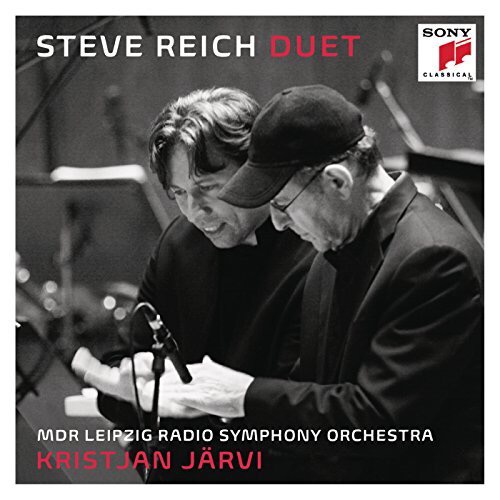
Kristjan Järvi Celebrates Steve Reich’s 80th


Kristjan Järvi (1972- ) is the youngest son of justly famed conductor Neeme Järvi.  He is also a frequent collaborator with the talented and ubiquitous Gene Pritsker among others.  This double CD represents a portion of his concerts in celebration of Reich’s 80th birthday.  There are apparently recordings available on the streaming service Medici TV of several other Reich works including the Three Movements for Orchestra (1983) and Desert Music (1986).  All these stemmed from a residency (2013-2014) that Reich enjoyed with the MDR Leipzig Radio Symphony and Chorus.

This 80th birthday tribute gives us yet another opportunity to hear another generation (other than Reich’s) interpreting this music.  For years only Reich and his ensemble had access to his scores but this is not the case with his orchestral and choral works.  Some may still consider Reich to be a difficult or experimental composer and this has limited the programming (and no doubt the commissioning) of music for such larger ensembles.  It is delightful to hear how other musicians respond to and interpret Reich’s music.  

In fact Reich’s music for larger ensembles is definitely worth hearing and hearing in different interpretations.  This set gives us the world premieres of beefed up orchestrations of You Are and Daniel Variations.  This writer looks forward to the orchestral version of Tehillim (1981) as well.  

This handsome two disc set includes the early Clapping Music (1971), Duet (1993), The Four Sections (1987), You Are Variations (2004),  and Daniel Variations (2006).  It is not a greatest hits compilation.  Rather it is a personal survey by a wonderful young musician.  Kristian Järvi is a conductor, composer and new music raconteur who is at the beginnings of a very promising career.  This album is a love song if you will.  Järvi clearly understands and loves this music and the opportunity to record these works, especially perhaps the intimate Clapping Music with the participation of the composer.

The Four Sections is tantamount to being a concerto for orchestra and is among this reviewer’s favorites among Reich’s works.  It has received too few performances and to date only two recordings.  This is the first live recording and gives insight into the amazing competence of both conductor and orchestra.  The 1993 Duet for Two Violins and String Orchestra is Reich’s homage to a musician of a generation preceding his, the wonderful violinist, conductor, and pedagogue, Yehudi Menuhin on his 80th birthday.  Soloists Andreas Hartmann and Waltraut Wachter handle this all too brief piece with skill and insight.  

The second disc contains studio recordings of the large orchestra versions of two very personal works.  These recordings alone are adequate reason to purchase this set.  Reich has gained much from tapping his Jewish heritage (musical, linguistic, and literary) in service of his art.  Both of these pieces feature texts from a variety of sources including the Bible, Hasidic aphorisms, the writings of Ludwig Wittgenstein among others.  In both works the texts determine to some degree the rhythmic choices of the music. 

You Are Variations is a four movement orchestral/choral work which sets a different aphorism in each movement.  It is among the composer’s more personal works and includes quotations from Wittgenstein (the subject of Reich’s undergraduate studies) along with Biblical and Talmudic texts in a beautiful existential meditation.

Daniel Variations is a powerful overtly political work written in response to the tragic murder of journalist Daniel Pearl who was beheaded by extremists in Pakistan in 2002. It is a deeply felt and very pained work which expresses the tragedy and creatively makes a link with the Book of Daniel as well as Pearl’s own words.  Reich is no stranger to political protest on his music and this is among his finest in that genre.

If you don’t know Reich’s music this is not a bad place to start.  If you are already a fan (as I’ve been for years) you will want this set to round out your collection.  

Oakland Raga Mini With Tempeh


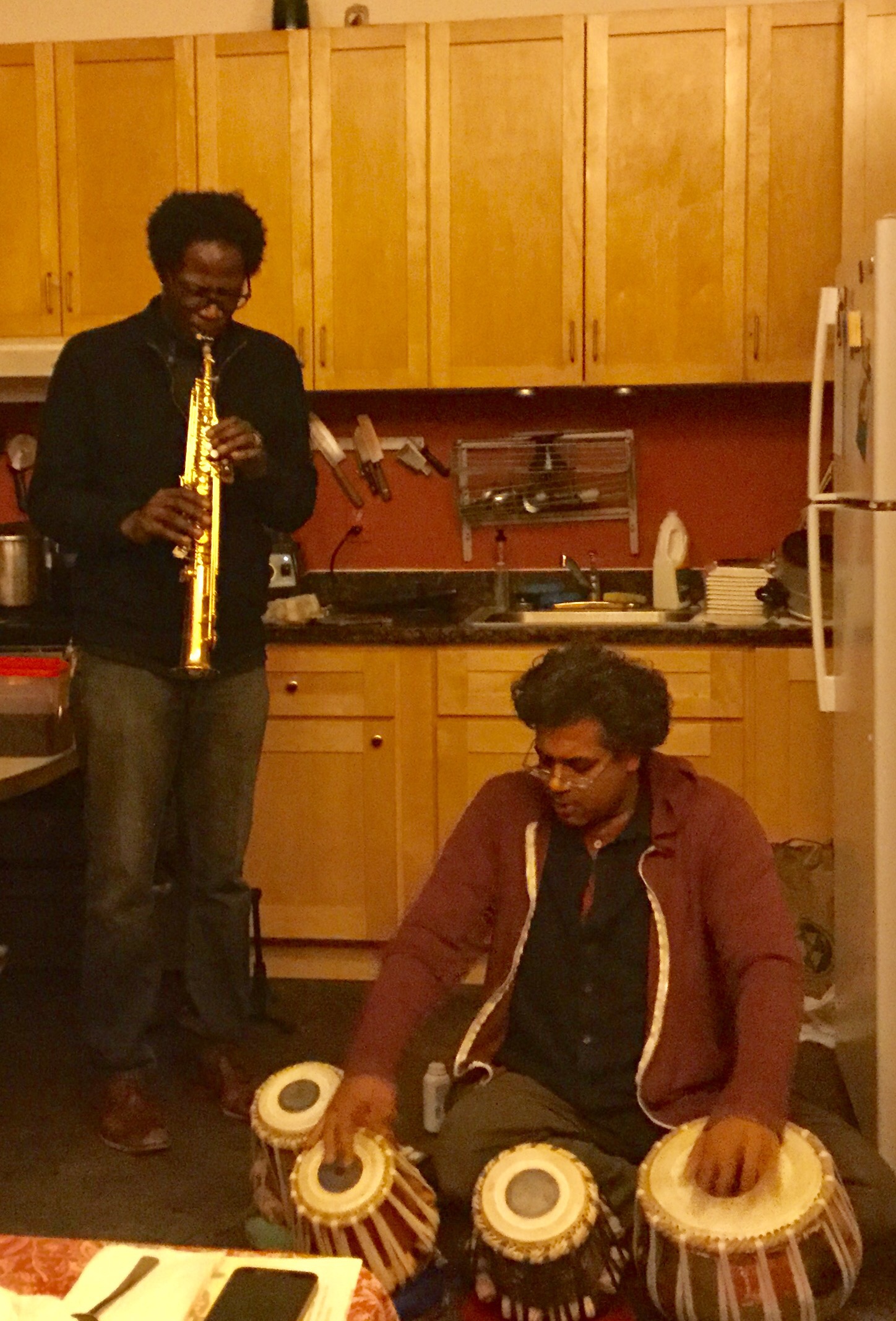
David Boyce, saxophones and Sameer Gupta, tablas at Sound and Savor

Vegan chef and shakuhachi player Philip Gelb’s dinner/concerts have been one of the great joys of the east bay for over ten years now.  Regular readers of this blog will be familiar with my enthusiasm for this series.  Once again Gelb has woven magic in his impeccably creative vegan cuisine and his ability to attract astoundingly talented musicians.


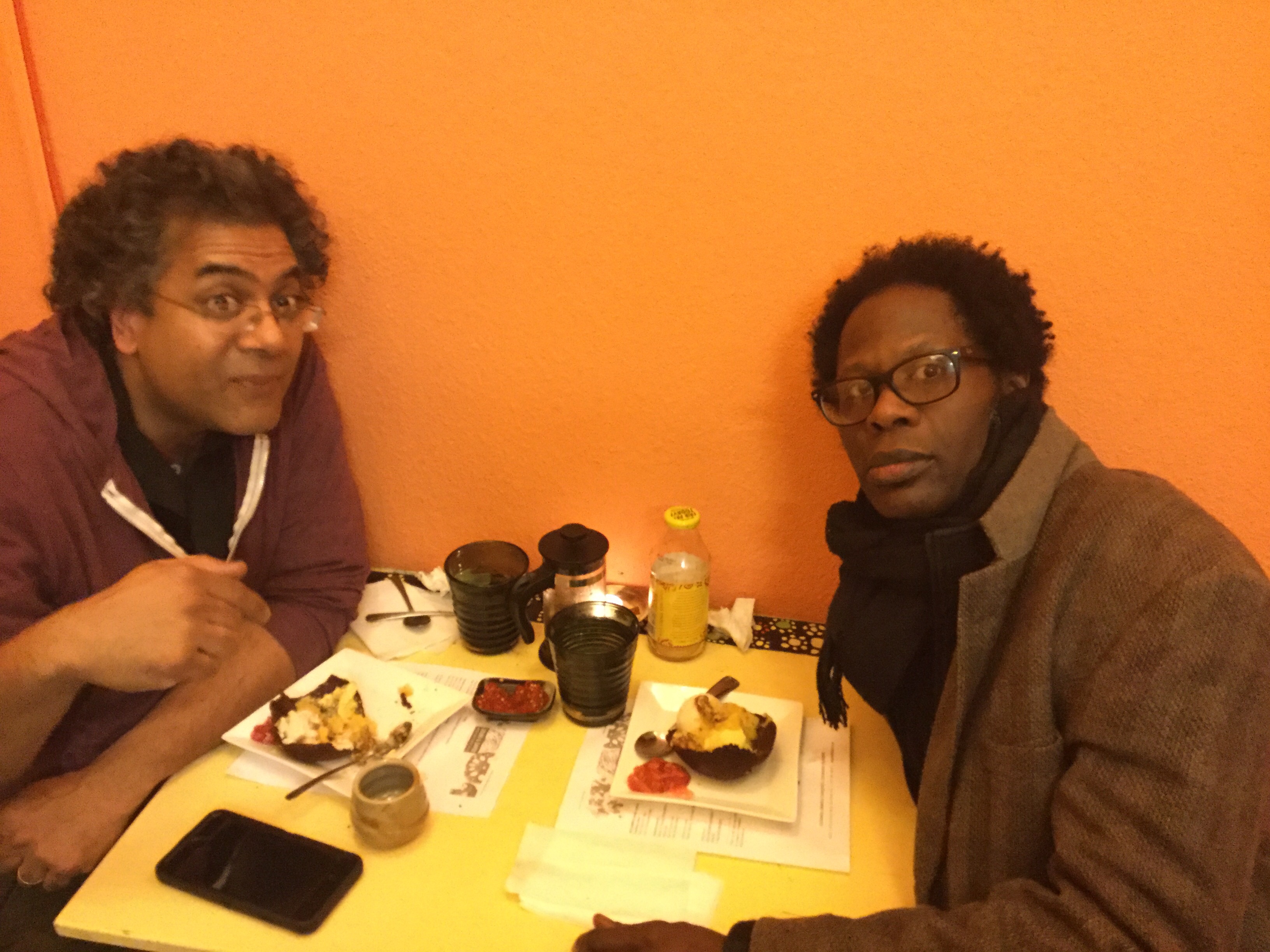
I had to steal this photo from Phil’s Facebook page because I got so caught up in the fine conversation and food that I forgot to take pictures of any of the five courses except for the dessert.


Four wonderful food courses preceded the musical segment of this evening beginning with a hearty soup followed by some deliciously roasted brussel sprouts and the main course of vegan mac and cheese with deep fried tempeh.

Here is the menu:

“Cheesy” broccoli chowder (practically a meal in itself).

Roasted brussel sprouts with scallion ginger oil.  

Southern Fried Tempeh, Macaroni and “cheese” with stewed greens, black eyed peas, Cajun roasted cauliflower, pickled daikon with Meyer lemon and mango chutney (pictured above but must be tasted to be believed, excellent!)

Chocolate waffle bowls withsoursop coconut ice cream, mango ice cream, blood orange marmalade, pineapple sauce and maple walnuts (all vegan and sinfully delicious)
As is customary in these events the musicians played just before dessert was served.  A word about these musicians.  Sameer Gupta , now heading up the wonderfully creative fusion ensemble Brooklyn Raga Massive hails from San Francisco.  David Boyce is originally from New York but is now based in the Bay Area, has appeared on numerous recordings and his band, The Supplicants, can be heard in the Bay Area.  Both are seasoned and extremely creative musicians.

Gupta began first by tuning his four drums (instead of the customary two found in most Hindustani music) and created bell like sounds as well as a rhythmic pulse before Boyce entered with his mellifluous sax.  The music, clearly informed by melodic jazz and by traditional Hindustani elements took off in a high energy duet and became a unique and wonderful music which clearly energized the audience.  The two had played together before though not in this particular configuration.  

Here is a short video sample:


Three improvs were performed, one each with Boyce on soprano sax, tenor sax and bass clarinet.  This unusual duo pairing sounded remarkably comfortable.  They have performed together before and one could sense it in how well they meshed their individual styles.

The audience was understandably enthusiastic and appreciative after each performance.  The combination of these fine musicians, clearly enthused about their music, and the intimate setting of this West Oakland loft made for a powerful experience, among the best this writer has heard in this venue.

Also worthy of mention was the amicable atmosphere with friendly interesting fellow diners, a common experience in this series.  

Gupta and Boyce enjoying the vegan ice cream dessert after their performance.

Missed this one?  There is another dinner concert featuring Mitch Butler on trombone and Howard Wiley on saxophone on Wednesday March 15th.  Menu not yet announced.  I hope you can make it.  

Tickets are at:  https://eventium.io/events/393278541021381/mitch-butler-howard-wiley-dinner-concert-march-15-2017

Of Mourning and Unity, 2016


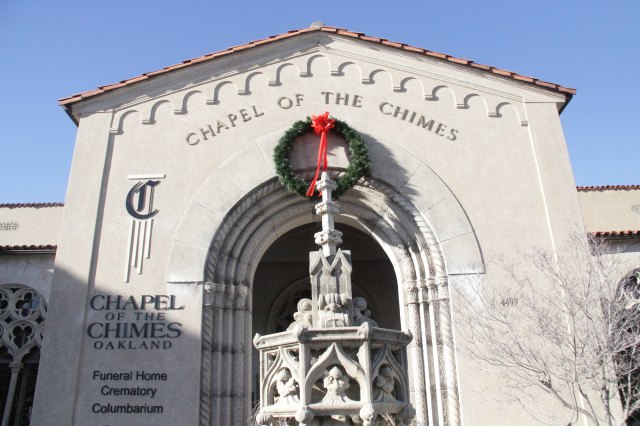
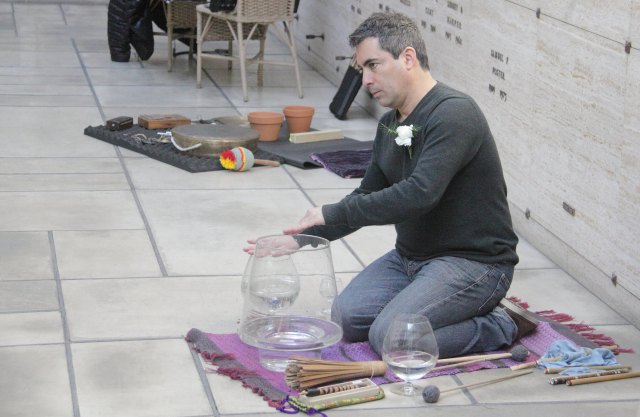
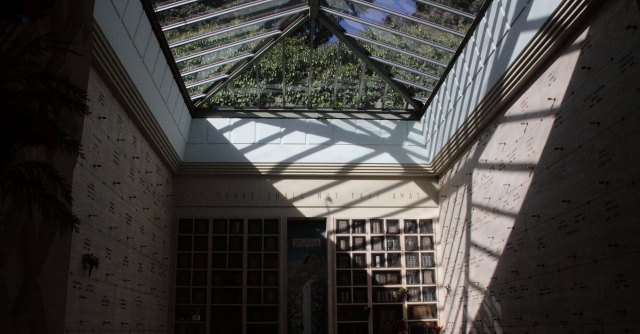
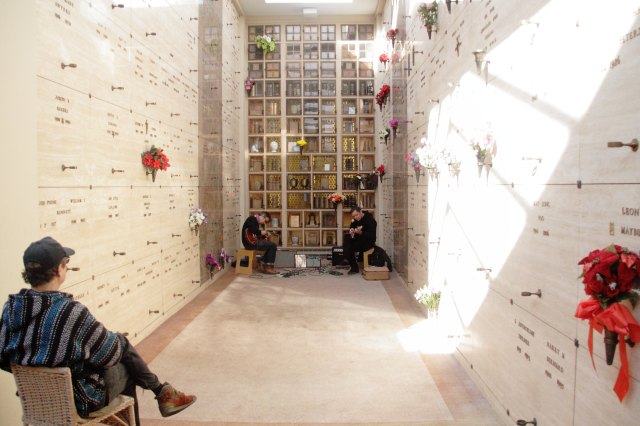
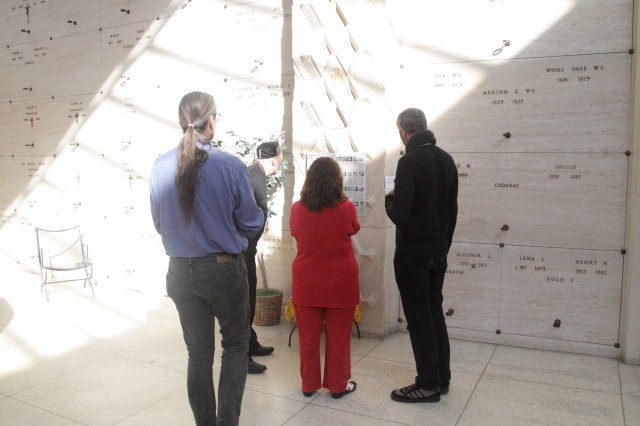
oliverosolstice20160075Every year on June 21st, the Summer Solstice, there is a rather unique concert event in which musicians from the Bay Area and beyond gather in celebratory splendor in the sacred space of the Chapel of the Chimes in Oakland.  The chapel is a columbarium  (a resting place for cremated remains) and a mausoleum.  The space is in part the work of famed California architect Julia Morgan.

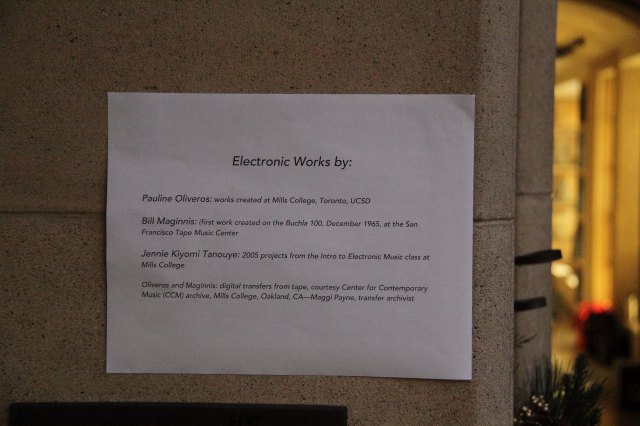
On December 19th Sarah Cahill with New Music Bay Area secured permission to use this space for four hours from 11AM to 3PM.  She invited many musicians who had been involved in one way or another with Pauline Oliveros whose death preceded by a week or two the tragic “Ghost Ship Fire” as it’s become known.  The idea was to pay homage to both this wonderful theorist, composer, performer and teacher and also to pay homage and to mourn the losses of some 36 young artists who will now never realize their ambitions.

What follows here is a simple photo essay of my personal impressions of this event.  The slant of the winter light added a dimension to those beautiful spaces as a large roster of musicians played pieces by and about Pauline Oliveros.  It was a lovely and reverent experience.

oliverosolstice20160003

oliverosolstice20160005

The angle of the winter light adds its dimension.

oliverosolstice20160012

oliverosolstice20160010

oliverosolstice20160019

oliverosolstice20160014

oliverosolstice20160011

oliverosolstice20160021

oliverosolstice20160022

oliverosolstice20160024

oliverosolstice20160025

oliverosolstice20160040

oliverosolstice20160026

oliverosolstice20160044

oliverosolstice20160037

oliverosolstice20160066

oliverosolstice20160063

oliverosolstice20160043

oliverosolstice20160062

oliverosolstice20160035

OM202022

Ken Thomson’s Restless: a Feast of New Chamber Music


restless-cover-2000x2000

Ken Thomson is one of the rapidly rising stars of the New York music scene and beyond. His involvement with his group Slow/Fast which includes Ken Thomson, Russ Johnson, Nir Felder, Adam Armstrong and Fred Kennedy as well as Bang on a Can and others in the new music/new jazz community demonstrates his level of drive.  Thomson is a saxophone player and a composer.

The present album showcases his talents as a composer and are different than what I had expected from a musician with roots in free jazz and with saxophone as his principal instrument.  This is a set of two suites in the classical manner, a collection of movements. They do not appear to have any direct influence from jazz but rather they are quite clearly in a classical new music vein.

The first, Restless (2014) is a four movement piece for cello and piano.  It could have been called a sonata for all its complexity and development.  It is a lyrical and very listenable piece which is restless at times (though I think the title actually suggests multiple meanings) and loaded with fascinating musical ideas.  The writing for both the cello and the piano are apparently technically challenging but both are handled very well by Ashley Bathgate (cello) and Karl Larson (piano).  This disc is worth the price if only for the fantastic musicianship of these performers.

ashleybathgate-karllarson_photo1_photographer_gabrielgomez

Ashley Bathgate (cellist) and Karl Larson (pianist) (Photo by Gabriel Gomez, all rights reserved)

The three movement suite, Me vs. (2012) is a pianistic tour de force that makes great use of various pianistic effects involving judicious use of the sustain pedal and the creation of after image type effects which allow the harmonics to vibrate on strings not struck by the keys.  Again the nod to a basic three movement classical piano sonata with a complex first movement followed by a lyrical slow movement and a spritely virtuosic finale which resembles a moto perpetuo.

More about the internal dialogue that went on in the composer’s head is available in his commentary but this music doesn’t really require much explanation.  It is pretty clear and very effective music.  This is simply a wonderful recording of some fascinating new music.

Alberto Ginastera at 100


ginastera

Oberlin Conservatory OC 16-04

Let me start by saying that the only thing wrong with this album is that it is only one CD. Alberto Ginastera (1916-1983) is without doubt one of the finest composers of the twentieth century.  Stylistically he holds much in common with composers like his contemporaries Aaron Copland (with whom he studied), Carlos Chavez, Leonard Bernstein and others who incorporated the spirit if not always the literal music of his homeland’s folk culture into his music.  In additional to these nationalist works he wrote a substantial amount of traditional concert music which touched on the edges of modernistic trends.

He wrote three operas, two ballets. two piano concertos, two cello concertos, a harp concerto, three string quartets, a bevy of piano music and sundry other items.  It is simply not possible to contain a fair representation of his work on a single CD.  Despite that this disc is not a bad retrospective.  It is lovingly played and recorded and if it does not represent the whole of Ginastera’s oeuvre it is a nice sampling.

The disc begins with the wonderful Harp Concerto Op. 25 (1956, rev. 1968).  Though originally commissioned by Edna Phillips (principal harp of the Philadelphia Orchestra) she had retired before she could perform it and it was premiered in 1965 by the amazing Spanish harpist Nicanor Zabaleta.  This three movement work is certainly one of the composer’s finest works and is beautifully played by Yolanda Kondonassis with the Oberlin Orchestra under Raphael Jiménez.  This piece is one of the finest modern harp concertos and is representative of the composer’s international style with perhaps just a taste of modernism.

Next up is the single movement Pampeana Op. 16 (1947) with the great Gil Shaham on violin and his sister Orli Shaham on piano.  This is a sort of window on Ginastera’s earliest nationalist style full of melody and virtuosity.

The next work is the Sonata for Guitar Op. 47 (1976) played by Grammy winning virtuoso Jason Vieaux.  I had not heard this work and my first hearing was indeed a revelation.  This is a major work for guitar and a wonderful sonata in the classical form.  I gave these four tracks a few listens in an attempt to digest some of their beauty and complexity and I will doubtless give them many more listens.  This is a major piece that belongs in the repertory.

And, finally, we move to the earliest utterance here with the Danzas Argentinas Op. 2 (1937) in an exciting and dedicated performance from Orli Shaham.

The sound is wonderful and there are a geekily satisfying set of liner notes which include a useful analysis by James O’Leary, Frederick B. Selch Assistant Professor of Musicology, Oberlin Conservatory of Music.  All in all a beautiful production and a great introduction to Ginastera’s work but please, don’t stop here.  Make sure you get to hear his other work and perhaps the wonderful folks at Oberlin will consider a volume two?

The Musical Mother of Us All: Pauline Oliveros, a Personal Appreciation


oliverosione

Pauline Oliveros at one of Philip Gelb’s dinner concerts in Oakland.  I published this photo on Pauline’s Wikipedia page.

I woke at about 3PM on the day after Thanksgiving (having worked the previous night shift) and I checked my e-mail and then, on Facebook I learned of the passing of theorist, composer, musician, teacher and all round wonderful human being Pauline Oliveros (1932-2016). She had died peacefully in her sleep on Thanksgiving Day.  Going over the copious posts and comments I was saddened at her passing but oddly comforted by the fact that these posts honoring her are effectively eclipsing the ones on the obnoxious political issues as well as demonstrating the incredible reach of her influence.  Thankfully, Pauline will not have to endure the regressive politics which now dominate our country and, indeed, the world.

I first encountered Pauline’s work, as many did, through the Columbia Odyssey LP curated by none other than David Behrman in his Music of Our Time series.  There are several composers on the disc including Steve Reich (Come Out), Richard Maxfield (Night Music), and Pauline Oliveros (I of IV).  Over the years I collected and listened to most of her recordings Discogs lists 55 recordings but no doubt there are many more and likely a plethora of unreleased material which will grace our ears for years to come.  Like her older contemporary John Cage it is difficult to identify a “masterpiece” and, also like Cage, she didn’t aspire to such notions because she aspired to learn and subsequently teach the art of listening. Her Deep Listening Institute is based in Kingston, New York.


dempster9

Stuart Dempster at another of Philip Gelb’s dinner concerts. Stuart is one of the members of Oliveros’ Deep Listening Band

I was pleased to be able to see one of the incarnations of the Deep Listening Band in Chicago at the Harold Washington Library.  This concert occurred on the night of the famed “Chicago Flood” (1992) in which a construction mishap diverted thousands of gallons of water from the Chicago River into the disused coal delivery railway tunnels which connect most of the downtown buildings.  I brought along a postcard from her album The Well and the Gentle hoping to get her autograph.  It was my first face to face meeting with this icon of new music.  She graciously took the card into her hand and immediately exclaimed with a smile, “Oh, this is from the Well”.  She quipped that next time they would hold their concert in one of the “deep tunnels” which are a part of the Chicago’s massive flood control rainfall overflow system.  I still treasure that autograph and the memory of my first meeting with Pauline.

oliverosione3

Ione (l) doing verbal improvisation while Pauline improvises in parallel on her digital accordion at a memorable dinner concert curated by Philip Gelb.

I can hardly tell you my level of excitement when vegan chef and musician Philip Gelb announced that Pauline with her partner Ione would be appearing at his next dinner concert.  The opportunity for a close encounter with this master was certainly heaven sent. (Pauline later wrote the lovely introduction to Philip’s first vegan cookbook.)

garden20151047

Philip Gelb performing at the June 21, 2015 Garden of Memory Concert at Oakland’s Chapel of the Chimes. This vegan chef and cookbook author plays and teaches shakuhachi and curates a wonderful dinner/concert series at his loft in West Oakland.  Philip also appears on several albums with Pauline and others.

Indeed, as I sat across from Pauline no doubt babbling some starstruck nonsense, I encountered in both her and her partner Ione two warm and unpretentious people.  While I knew I was in the presence of genius I was given to feel very welcome as they both engaged me and the other guests in lively conversation at this spectacular vegan meal.  In the pause just before dessert they gave a wonderful performance with Ione speaking improvised and passionate poetic utterances while Oliveros played her quirky improvisations in parallel on her digital accordion.

OM202021

Pauline Oliveros, Miya Masaoka and Frode Haltli performing Oliveros’ Twins Peeking at Koto (2014) at Other Minds 20 in 2015

I later got to see Pauline as a returning guest composer/performer at Other Minds 20, a series lovingly and painstakingly curated by composer, broadcaster and new music impresario Charles Amirkhanian.  I believe this was her last major bay area appearance.

OM202022

A clearly happy Pauline Oliveros acknowledges the warm applause of the Other Minds 20 audience after her performance at the SF Jazz Center in 2015.

Every year at the Garden of Memory summer solstice concert the open membership Cornelius Cardew Choir performs Oliveros’ Heart Sutra every year.  The verbal score describes how one enters the singing circle and intones basically the note of their choice with one hand over their heart and the other on the back of another singer.  I screwed up my courage to participate in this ritual a few years ago and it is now an essential part of the beginning of my summer.  Pauline has taught me much and no doubt will continue to teach me through her writings and recordings.  For that I am eternally grateful.


Couloir, a Wonderful New Cello and Harp Duo


couloir

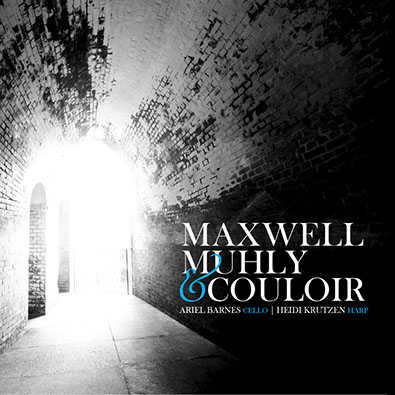
This is an beautiful album.  The main attraction is the world premiere recording of Serere (2012) by James B. Maxwell in two versions separated by a shorter piece by Nico Muhly.  Ravello Records brings us a wonderful Canadian duo, Couloir consisting of Ariel Barnes on cello and Heidi Krutzen on harp.

Maxwell, a Canadian composer, is new to this writer but the present work suggests that there is good reason to pay attention to this artist.  I’m not sure of the wisdom of two versions of the same piece on one disc but it does allow for close comparison.  It is basically an intimate and episodic piece of chamber music which is filled out with some electroacoustic material in the second version.  I don’t mean to sound dismissive because this is an engaging and enjoyable listen and a piece which seems to contain a certain depth and wisdom which suggests a well crafted work.  Both versions are clearly challenging from a technical aspect but all seems to be integrated in service of the music and not simply empty effects.  The second version of course has a fuller sound due to the augmentation of the electronics.  Both versions benefit from multiple listens and I certainly don’t intend to set this disc aside for a bit.

This is actually my first encounter with Nico Muhly’s work.  I have certainly heard of him but I am not familiar with any of his other work so I have nothing against which to compare the present piece except in the context of this disc.  Given that, this briefer piece, Clear Music (2003) is also finely wrought and engaging.  Maryliz Smith plays celeste on this track.  It functions basically as an interlude here but it does help clear the palate (so to speak) without taking the listener too far out of the musical context.

The recording from 2012 in Vancouver, British Columbia is clear and pleasant and the performances are simply wonderful.


The Postcard Sessions, Saxophone and Piano


harrington loewen cover

Ravello RR 7934


It has always seemed to me that the saxophone has had a difficult time integrating into the mainstream of classical performance.  Since its invention by Adolphe Sax in the mid 19th century this family of instruments has amassed a somewhat limited solo repertoire and has only really made it as an orchestral instrument in the twentieth century.  The subsequent adoption of these instruments at the forefront of jazz and pop has forever changed the perception of this hybrid woodwind/reed/brass instrument which, for those who segregate musical genres, complicates matters even more.

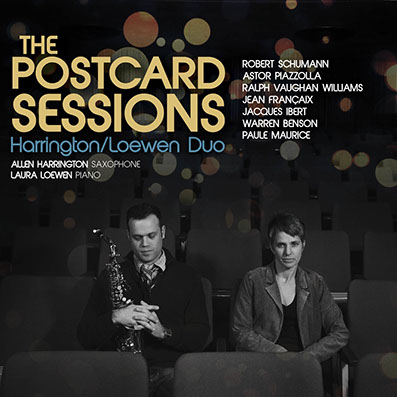
It is the twentieth century that this album represents and it is the classical voice, not jazz or pop which speaks here.  This intelligently chosen set of pieces is like a little tour of the saxophone and piano literature representing some of the best of the early to mid twentieth century repertoire.  If that makes it a niche market then so be it, it is a lovely niche.

Now Robert Schumann (1810-1856), whose work opens this disc, is hardly a twentieth century composer but these transcriptions by Frederick Hemke (long time saxophonist of the Chicago Symphony and a highly respected teacher) are definitely contemporary and work well for saxophone and piano.  Drei Romanzen Op. 94  (1849) are originally for oboe and piano.

Tracks 4 and 11 contain pieces by Astor Piazolla (1921-1992), the Argentinian composer best known for his work with the tango forms.  Here we have two film music excerpts in apparent transcriptions.

There are four other sets of pieces on this recording by Ralph Vaughn Williams (1872-1958), Jean Francaix (1912-1987), Jacques Ibert (1890-1962) and Paule Maurice (1910-1967). The Vaughn Williams Folk Song Suite is originally for cello and piano and is vintage Vaughn Williams at his English folk song best.  The Ibert and the Francaix are suites of the sort of nervous, jazz inflected music that characterized an era between the wars.  Paule Maurice is a new name to this listener and the artists are to be commended for their part in saving her work from obscurity.

The Aeolian Song by Warren Benson (1924-2008) is probably one of the best known (and deservedly so) pieces on this disc.  This is actually the slow movement of a concertino for saxophone and orchestra but has become a sort of recital classic in its incarnation for saxophone and piano.

The Harrington/Loewen Duo are based in Canada and that may be their only flaw.  The curious but annoying lack of attention to the musicians who are our neighbors to the north is certainly mitigated to some degree by this release.  It is a lovely recital and the musicians are both committed and creative.  One hopes for another volume of recital pieces to follow this delightful release.

Black Notes Matter: Lara Downes’ America Again


laradownes

Sono Luminus DSL-92207

The lovely cover photo for this album by San Francisco born pianist Lara Downes is reminiscent of any number of socially conscious folk/rock stars of the 60s and 70s. It would seem that this is no accident.  This delightful album of short pieces by a wide variety of American composers takes its title from the Langston Hughes (1902-1967) poem, Let America Be America Again (1935).  By so doing the pianist places this interesting selection of short piano pieces firmly in the context of black racial politics and the artistic expression of black America as well as those influenced by this vital vein of American culture (both musical and literary).  It is a graceful and deeply felt effort and I hope that the metaphor of the title of my review is not too tortured a one to reflect that.

This is also a very personal album.  Downes seems to share some deeply felt connections with her materials.  This artist, born to a white mother and a black father, invokes a careful selection of short piano pieces steeped sometimes in jazz and blues but also the political directness (and optimism) which was characteristic of the inter-war years that brought forth the Hughes poem.  There is both sadness and celebration in these virtuosic and technically demanding little gems (most apparently recorded for the first time or at least the first time in a while).  The pianist’s comments on each individual piece are also critical to the understanding of this disc as she shares the impact and meaning that the music has had for her.

There are 21 tracks by 19 composers in all and the selections themselves are quite a feat. They range from the 19th to the 21st centuries and are composed by both men and women of a variety of racial and ethnic backgrounds.  All seem to share the sort of  populist charm befitting the idealized America yearned for in the poem which is to say that they represent a kind of idealized or hopeful nationalism.  Downes is well acquainted with a large variety of American music and recognizes no distinction between classical and so-called “vernacular” traditions.

In fact none of these things are atypical for this artist.  Her previous albums Exiles Cafe (2013) featured music by composers exiled from their homelands, A Billie Holiday Songbook (2015) celebrated the life of this iconic black artist and her American Ballads (2001) demonstrated her deep mastery and affection for populist (but not jingoistic) nationalism.  Her tastefully issue oriented albums define a very individual path and the present album appears to be a very logical and well executed next entry into her discography.

This disc shares a similar heritage to that of Alan Feinberg’s four discs on Argo/Decca entitled, The American Innovator, The American Virtuoso, The American Romantic and Fascinating Rhythm: American Syncopation.  Another notable antecedent is Natalie Hinderas’ groundbreaking two disc set of music by African-American composers.

And now on to the music:

Morton Gould (1913-1996) was a Pulitzer Prize winning composer and conductor with a style informed by his study of jazz and blues in a vein similar to that of Bernstein and Copland.  He is represented here by American Caprice (1940).

Lou Harrison (1917-2003)  was a composer, conductor and teacher.  He was a modernist and an innovator in the promotion of non-western musical cultures.  His New York Waltzes (1944-1994) are three brief essays in that dance form.

The traditional folk song Shenandoah (apparently in the pianist’s transcription) is next.   This tune will be familiar to most listeners as a popular selection by choral groups and the melody is a common metaphor for things American.

Amy Marcy Cheney Beach (1867-1944) was one of the first successful female American composers.  Her “From Blackbird Hills” Op. 83 (1922) is representative of her late romantic style and her incorporation of Native American (Omaha) elements in her music.

Samuel Coleridge-Taylor (1875-1912) is a English composer with Creole roots, a black composer, known as the “African Mahler” in his day.  Deep River (1905) is his setting of this spiritual which also was one of Marian Anderson’s signature pieces.

Dan Visconti (1982- ) was commissioned by the International Beethoven Festival to write his Lonesome Roads Nocturne (2013) for Lara Downes.  It receives its world premiere recording in this collection.

Swiss-American composer and teacher Ernest Bloch (1880-1959) is certainly deserving of more attention.  His At Sea (1922) is used here to represent the sea voyages of the many immigrants (willing and unwilling) whose journey defined in part who they were.

George Gershwin (1898-1937) mastered both the vernacular tradition (as one of the finest song writers of the 20th Century) and the classical tradition in his too few compositions written in his sadly abbreviated life.  His opera Porgy and Bess (1935) is contemporary with the Langston Hughes poem mentioned earlier.  Downes most arrestingly chooses the arrangement of “I loves you, Porgy” by the classically trained iconic singer, musician and civil rights activist Nina Simone (1933-2003).  Quoting from Downes’ notes (Nina Simone expresses what she knew) “…about being a woman, being black and about being strong and powerless all at the same time.”  Indeed one of the most potent lines of the Hughes poem reads, “America was never America to me.”

Angelica Negrón (1981- ) was born in Puerto Rico and  now lives and works in New York. Her Sueno Recurrente (Recurring Dream, 2002) is a lovely little nocturne which is here given its world premiere.

Leonard Bernstein (1918-1990) held credentials as composer, conductor, teacher and ardent civil rights supporter.  His Anniversary for Stephen Sondheim (1988) is one of a series of Anniversary piano pieces he wrote.  Bernstein did much to help modern audiences (including this reviewer) comprehend the vital musicality of jazz and blues. Like Downes, he drew little distinction between popular and classical and celebrated all the music he believed was good.

David Sanford (1963- ) is a trombonist, teacher and composer who works in both classical and jazz idioms.  His work Promise (2009) was written for Downes and this is the world premiere recording.

Howard Hanson (1896-1981) was a conductor, teacher and Pulitzer Prize winning composer (though not at all an advocate of ragtime, jazz or blues).  His brief but lovely piano piece Slumber Song (1915) is a nice discovery and one hopes that it will be taken up by more pianists.

Scott Joplin (1867/68-1917) was discovered largely due to the scholarship and recordings of musicologist Joshua Rifkin (who incidentally did some arrangements for folkie Judy Collins) whose three volumes of piano rags on Nonesuch records introduced this wonderful black composer’s work to a wider audience once again.  Marvin Hamlisch famously incorporated Joplin’s music into his score for the motion picture The Sting (1973).  Downes chooses the Gladiolus Rag (1907) to represent this composer.

Irving Berlin (born Israel Isidore Baline 1888-1989) is another of the greatest song composers this country has produced.  In another characteristically clever choice Downes chooses the arrangement of this hugely optimistic song, “Blue Skies”(1926) by the great jazz pianist Art Tatum (1909-1956).

Florence Price (1887-1953) was a black female composer (the first to have one of her orchestral works programmed by a major symphony orchestra) whose work is only recently getting some much needed exposure.  Her Fantasy Negre (1929) is based on a spiritual, “Sinner, Please Don’t Let This Harvest Pass”.  Price was involved in the New Negro Arts Movement of the Harlem Renaissance and was professionally connected with Langston Hughes among others.

Aaron Copland (1900-1990) is perhaps the most iconic American composer.  Dubbed the “Dean of American Composers” his earliest work has strong jazz influences and his later work created the American romantic/nationalist sound incorporating folk songs and rhythms.  For this recording the artist chose the first of the composer’s Four Piano Blues (1926) which also appeared on her 2001 album of American Ballads.

Edward Kennedy “Duke” Ellington (1899-1974) was a composer and band leader whose sound virtually defined the Harlem Renaissance during his tenure at the famed Cotton Club.  Melancholia (1959) is the piece chosen here, again a nice little discovery.

Roy Harris (1898-1979) was, like Copland, a populist but the Oklahoma born composer studied Native American music as well as American folk songs.  His American Ballads (1946) was included on Downes’ American Ballads album.  Here she includes an unpublished work from a projected (but never finished) American Ballads Volume II.  This piece is a setting of the spiritual, “Lil Boy Named David”.

The album concludes with one of the ultimate hopeful dreamer songs, Harold Arlen’s (1905-1986) Over the Rainbow (1939) from his score for The Wizard of Oz (1939).  The adolescent yearning of Dorothy for something better than her dust bowl farm life touched a chord in many over the years and it is a fitting conclusion to this beautiful and hopeful collection.

As mentioned earlier the insightful liner notes by Lara Downes complement this production and tactfully position its politics.  She shares a personal journey that is as American as the proverbial apple pie.  The album is dedicated to the artist’s ancestors in recognition of their struggles as well as to her children in hopes that dreams for a better future can become their reality.

This beautiful sound of this album is the result of work of Producer Dan Merceruio and Executive Producer Collin J. Rae along with Daniel Shores and David Angell.  The lovely photography is by Rik Keller and as with the previous release Skylark: Crossing Over (reviewed here) the graphic design by Caleb Nei deserves special mention for its ability to truly complement this disc.

It is scheduled for release on October 28, 2016.


A shamanic effort to raise consciousness and further socially progressive ideas.

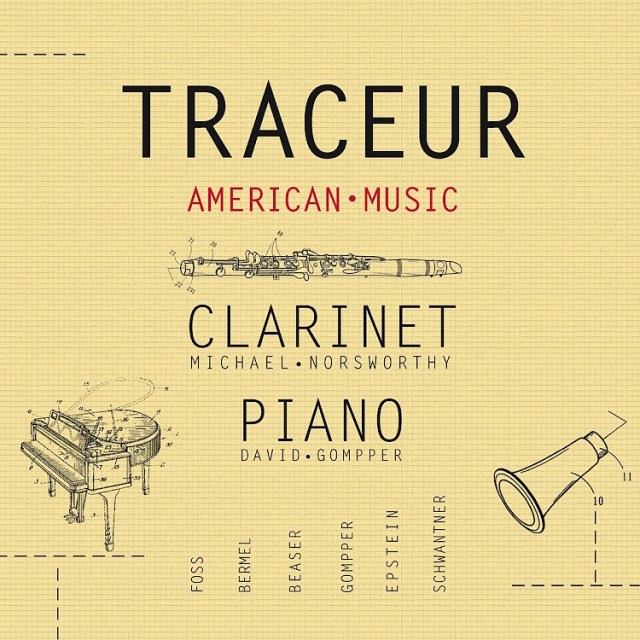
Traceur, American Music for Clarinet and Piano


traceur

New Focus Recordings FCR-172

This is a nice little program of pieces for clarinet and piano by 20-21st century composers. It might even be a representation of the state of the art for this genre.  All of these pieces are basically tonal and would work well in a recital.

Michael Norsworthy, professor of clarinet at Boston Conservatory at Berklee has an impressive set of credentials in the interpretation and performance and teaching of new music.  This performing academic has quite a list of recordings to his credit.

David Gompper is a composer and pianist with a similarly extensive set of credentials in support of new music (his own and others’).

The disc opens with a six movement suite of short pieces by Robert Beaser (1954- ) called, Souvenirs (2001-2).  Beaser is one of the finest composers of his generation and his tonal style was a hallmark of his work from the very beginnings.  These short, personal sketches are a delightful example of his work.  These pieces were originally written for piccolo and piano and are here presented in the composer’s transcription for clarinet and piano.

The next piece, Black Anemones (1980) is originally for flute and piano and is a sort of modern classic (here is a recent review of the flute and piano version).  The Pulitzer Prize winning Joseph Schwantner (1943- ) is also among the finest composers working today. This transcription for clarinet by Mr. Norsworthy will most certainly guarantee further performances.  This is truly lovely music inspired by poetry of Agueda Pizarro.

Three American Pieces (1944-5) by Lukas Foss (1922-2009) are another sort of classic set of pieces.  These are early compositions in a neo-classical/nationalist style characteristic of this period of Foss’ compositional style.  It is great to have a new recording of these entertaining pieces.  Foss is due for a reckoning I think.

Marti Epstein (1959- ), also a professor at Berklee was represented in an earlier review of a disc (here) dedicated entirely to her gentle music imbued with memories of her upbringing in the great plains of the Midwest.  Nebraska Impromptu (2013) is characteristic of this composer’s gentle but substantial music.  Her website also contains a very interesting occasional blog that is worth your time.

Derek Bermel (1967- ) is here represented by schiZm (1993-4).  Originally for oboe and piano the composer also made this transcription for clarinet and piano.  Bermel describes some of the fascinating techniques that underlie the structure of this two movement piece but the result of those techniques is a very interesting piece of music.

Last but definitely not least is the title track Traceur (2014-5) by composer/pianist David Gompper (1954-).  It is the longest and most complex of the pieces presented and requires the most involvement on the part of the musicians as well as the listener.  I don’t mean to imply that this is difficult music because it isn’t.  It is substantial music whose charms demand close listening, an effort for which one will be rewarded.

This lucid recording was produced by Norsworthy and Gompper (with the assistance of Robert Beaser in the recording of his work).  It was recorded in 2015 with editing and mastering by Patrick Keating.  Very nice disc.  Highly recommended.


Oh, No! Not Another Minimalist! Lubomyr Melnyk, Fastest Fingers in the West, Makes Major Label Debut


I first encountered the music of this undeservedly obscure but unique composer/pianist in the late 1980s with the purchase of a double vinyl album of his “Lund-St. Petri Symphony” a work for solo piano which is stylistically one of the tributaries of minimalism.  Melnyk was born in Germany of Ukrainian descent and now lives and works in Canada.  I began this article for inclusion in my series about minimalist composers (the designation of “minimalist” is imposed by the author and is not necessarily the identity embraced by the artist).  In addition to providing a sketch of the artist I am pleased to be able to review this major label release.

melnyk

Sony

Ilirion marks this composer/pianist’s big label debut and this is a fitting recognition for this long established composer, pianist and teacher.  Lubomyr Melnyk (1948- ) has been performing since the 1970s and has released over 20 albums.  His web site is in need of updating and here’s hoping that this release will help provide the impetus for that and for the greater distribution of this artist’s work.

Below is the description of Melnyk’s music from his web site:

Melnyk’s Continuous Music is based on the principle of a continuous® and unbroken line of sound from the piano — this is created by generating a constant flow of rapid (at times EXTREMELY rapid) notes, usually with the pedal sustained non-stop. The notes can be either in the form of patterns or as broken chords that are spread over the keyboard. To accomplish this requires a special technique, one that usually takes years to master — this technique is the very basis of the meditative and metaphysical® aspects within the music and the art of the piano.
Moreover, in his earlier works, Melnyk devoted much attention to the overtones which the piano generates, but in his more recent works, Melnyk has become more and more involved with the melodic potential of this music.
Melnyk’s earlier music was generally classified as Minimalism®, although Melnyk strongly refutes that term, preferring to call his music MAXIMALism®, since the player has to generate so many, many notes to create these Fourth Dimensions of Sound®.
Because his piano music is so difficult and requires a dedicated re-learning® of the instrument, no other pianists in the world (so far) have tackled his larger works — and so, his recordings are truly collector’s items (both as LP-s and CD-s).
He has however recorded extensively for the CBC in Canada, as well as various European stations. He has performed and given lecture-recitals across Canada and in Europe. 

I’m not sure how useful this explanation will be to listeners but I think it’s important to acknowledge that the composer has attempted to establish a system explaining his work. However one does not need to be deeply familiar with the underlying theory to appreciate the music.  One does not need to understand Schoenberg’s twelve tone theories or Anthony Braxton’s far out ideas to appreciate their music.  One doesn’t even need to understand the basics of western classical harmony to appreciate Mozart, for that matter but such knowledge can contribute to appreciation.  I certainly lay no claim to understanding this man’s music and I am not aware of any musicologists or critics who have written anything analyzing Melnyk’s work but I find his music compelling and worth wider attention.

Rather than attempting a comprehensive review of Melnyk’s output (and risking muddying the field) I am simply going to recommend a couple of discs which I have found particularly interesting and may help put this latest release in useful perspective.  The disc which is intended to provide a sort of exposition of his work is KMH.

kmh

The other disc, and the one which I have admired most, is the Lund St. Petri Symphony.  I bought it as a two disc vinyl album and it does not appear to be easily available now but it is well worth seeking (and maybe Sony will consider re-releasing it).

lund

The present release on Sony contains 5 tracks:

Beyond Romance is the first and longest track on the disc (16:12) and is certainly representative of his work.  The composer’s brief notes describe this work only as a grand romantic piece.  It perhaps has echoes of Liszt but certainly with at least an echo of minimalism.

Solitude No. 1 is a much briefer piece (7:36) and is a live improvisation by the composer recorded in the Netherlands.

Sunset (3:49) is the briefest on the disc and is an impressionistic description of its title.

Cloud No. 81 (16:02) is a far more extended impressionistic essay with more harmonic variety than the other tracks.

The title piece, Ilirion (14:12) is another extended essay more akin to the first track.

These discs range from interesting to enthralling for this reviewer and the limited descriptions contained in this release do little to guide the listener.  So I guess I can only say, “Please listen”.

Tracks 1, 3, and 4 were recorded at Clearlight Studios in Winnipeg, Canada.  Track 2 is a live recording from Tilburg, Netherlands and the last track is described as being an archive recording from also from Tilburg.  All were recorded between 2012 and 2015.

The rather sparse liner notes are by one Charles Bettle who is described as a “long time friend and admirer” of Melnyk’s work.  The even sparser notes on the music are by the composer.  The beautiful photography is by Alexandra Kawka.

It is difficult to say why this artist remains as marginally known but, as I have asserted before, artists from Canada get strangely little notice here and Mr. Melnyk does not appear to be a very good publicist.  I hope that this endorsement by Sony results in more releases and, more importantly, in more good studio recordings of his work.  It is unique and highly recommended to aficionados of piano music and minimalism.

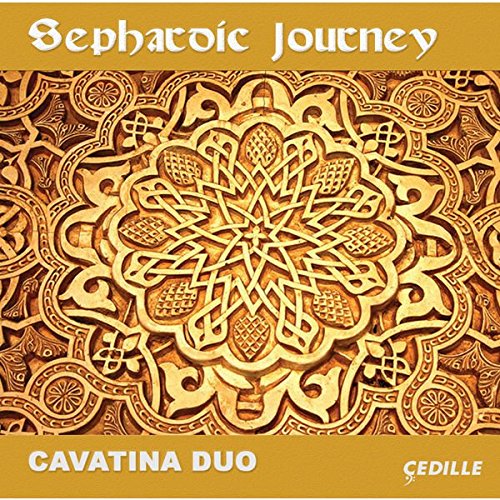
In Celebration of a Lost Culture: Sephardic Journey by the Cavatina Duo


cavaduo

Cedille CDR 9000 163

This tasty little disc of world premieres commissioned through grants to Cedille Records in Chicago consists of new works which celebrate the culture of the Sephardim, the Jews of southwestern Europe, primarily Spain.  It both memorializes and resurrects the rich music of this all but lost culture.  In the last few years we have seen a growing interest in this culture through settings of texts in the original Ladino language as well as in the melodies which sprang from their folk traditions.

The Cavatina Duo consists of Eugenia Moliner, flute and Denis Agabagic, guitar.  Moliner is originally from Spain and Agabagic is originally from Yugoslavia (now Bosnia-Herzegovina) and they are husband and wife.  Both have a strong interest in the folk musics of their respective cultures and in exploring other folk music cultures.  Their previous album for Cedille, The Balkan Project, similarly demonstrates their affection and scholarship for the cultures of that region of the world.

Five composers were commissioned for this project: Alan Thomas (1967- ), Joseph V. Williams II (1979- ), Carlos Rafael Rivera (1970- ), David Leisner (1953- ) and Clarice Assad (1978- ).  This is one of those wonderful crowd funded efforts through Kickstarter.

Thomas’ contribution adds a cello (played by David Cunliffe) to the mix for this Trio Sephardi in three movements each of which is based on a traditional Sephardic song.  The piece makes good use of the vocal qualities of the songs quoted and the lyrics seem to exist as a subtext even though they are not sung here.

Isabel by Joseph V. Williams is a sort of homage to Isabel de los Olives y López, a Sephardic woman who lived during the time of the Spanish Inquisition.  She outwardly converted to Catholicism but lived secretly as a Jew.  One can hardly miss the sad irony of this tale of religious intolerance from the 15th century and its relevance for today.  This piece is based on a resistance song which masquerades as a love song, again a metaphor for our times.  It is scored for flute and guitar.

We move again into the realm of the trio, this time with violin (played by Desiree Ruhstrat), for this piece by Carlos Rafael Rivera called, “Plegaria y Canto”.  This is the most extensive single movement amongst all the works on the disc and is a deeply affecting and dramatic piece for which the composer’s notes provide insights.

The last two pieces utilize the forces of the Avalon Quartet for whom this is their second appearance on the Cedille label.  Their first disc, Illuminations, was released last year. They are currently in residence at Northwestern University and Cedille does a great job of promoting the work of talented Chicago area musicians.

Love and Dreams of the Exile is David Leisner‘s poignant contribution.  Its three movements tell an aching tale of love, pain and, ultimately, transcendence.

Clarice Assad is a Brazilian composer too little known in the U.S.  She is indeed related to the famed Assad family of musicians and she clearly has as abundant a talent.  Her Sephardic Suite concludes this program with this three movement essay on love and relationships.

Bill Maylone is the engineer with editing by Jean Velonis and the executive producer is James Ginsburg.  Photography of the Alhambra Palace by Maureen Jameson graces the cover.  Design is by Nancy Bieshcke.

This is music of an oppressed culture and it is tempting to look upon the creative impetus which oppression sometimes seems to provide but the message here is one of sadness and nostalgia but also of hope.  It is perhaps a tribute to the ultimate triumph over said oppression even if it took 500 years.  There is some comfort and healing to be had from the celebration of this lost culture and that is the triumph of this disc.


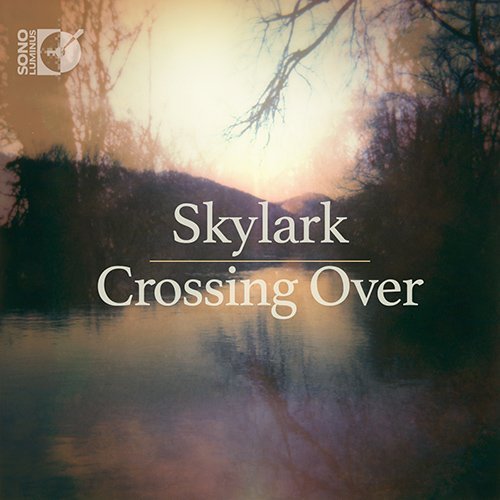
Skylark: Crossing Over, bringing the chamber choir to the mainstream


skylark

Sono Luminus continues their dedication to high quality performances and recordings of a wide variety of music from the 20th and 21st centuries.  In this lovely  disc we are treated to a great deal of interesting and very listenable a capella choral music from the mid-twentieth century to the present.

It is this reviewer’s perception that a capella choral music is somewhat of an outlier in the classical music field and is generally not as well known as solo instrumental, orchestral, chamber music and such. (Band music is a similarly neglected area which is not frequently explored by many composers and not as familiar to audiences.)   It is not an area very familiar to me but this recording appears to be one that can expand this niche considerably by virtue of the sheer beauty of these recordings.

There are eight pieces by seven composers of varying levels of familiarity.  The most familiar names here are those of the late John Tavener (1944-2013) and William Schuman (1910-1992).  (Schuman was also no stranger to writing for band music.)  Some listeners may have heard of Jon Leifs (1899-1968), an Icelandic composer who should definitely be better known.  (Curiously the only comprehensive information available in English on this composer is in Wikipedia.)

The remaining composers, Daniel Elder (1986- ), Nicolai Kedrov (1871-1940), Robert Vuichard (1985- ) and (fellow Icelander) Anna Thorvaldsdottir (1977- ).  Thorvaldsdottir may be familiar to listeners via her earlier Sono Luminus release (reviewed here) as well as numerous other releases which definitely mark her as a rising star.

The disc opens with Elegy (2013) by Daniel Elder.  It is the only piece which features soloists and is a touching piece which demonstrates the composer’s skill with this specialized genre.

Butterfly Dreams (2002) by John Tavener is a series of eight choral meditations based on Chuang Tse known for his “…Am I a man dreaming he is a butterfly or a butterfly dreaming he is a man?”.  Tavener’s work has pushed the solo choral genre more to the mainstream than nearly any composer of the last 50 years and this piece is a good example of how he has managed to do this.  Tavener’s inspiration comes in part from the choral styles of eastern rite church music, a rich and sonorous sound.

Otche Nash by Nicolai Kedrov is apparently a classic in sacred music circles.  In Latin this would be Pater Noster and in English, Our Father.  This is a beautiful setting of the classic Christian Prayer.

Requiem (1947) by Jon Leifs is based on Icelandic folk poetry.  It was written in response to his grief at the loss of his daughter who drowned at the age of 18.  While not exactly representative of Leifs’ modern style it is a good example of the power of his invention in this heartfelt homage.  This is perhaps the composer’s best known work.

Heliocentric Meditation by Robert Vuichard is another example of the deep knowledge of the specialized techniques available to composers in this genre.  Vuichard appears to be a niche choral composer and one who has considerable skill.  There is a rather modernist feel to this powerful meditation.

William Schuman’s Carols of Death (1958) is a sort of modern classic which has been recorded many times.  There are three movements, each on a separate track.  It is curious how well these pieces fit in style with the rest of the disc given the date of composition.

Beyond the Veil (2005) is a setting by Anna Thorvaldsdottir of an old Icelandic psalm.  It is a prayer which is, in part, a meditation on death.  The composer has a mystical/impressionistic style that suits this music particularly well.

Funeral Ikos (1981) by John Tavener is definitely a modern classic.  This piece pretty much marks the beginning of the change from his early modernist style to the sort of “holy minimalist” (if you will) style that followed his conversion to and immersion in eastern rite sacred music.

Skylark is a chamber choir (five voices to each part, SATB) and this is their second album.  They were formed in 2011 and are under the direction of Matthew Guard.

This review is basically about the music but I have to say that this is also one of the most beautiful booklets I have seen.  It is short on info about the music but the photography and graphic design by Collin J. Rae and Caleb Nei deserve special recognition as well.  Each page features a photograph and texts of these pieces are tastefully printed across the photos.  This really enhances the experience and seems to be in harmony with the overall production.

Dan Mercurio, producer, has definitely made something special here and one hopes that this will help promote this compositional and performance niche to a more common experience and will encourage composers to write for a capella choir as well.  Daniel Shores is the recording and mastering engineer.  I am unable to assess the DVD audio and can only imagine how it must sound.  The CD itself is amazing to hear.

For an album ostensibly about death there is great joy and beauty to be found here.  Highly recommended, and not just to fans of choral music.


Reiko Füting: names Erased


names erased

Reiko Füting (1970- ) is the chair of the music department at the Manhattan School of music.  The present album is actually my introduction to this man and his work.  It consists of a series of 15 works written between 2000 and 2014.

These works tend to emphasize brevity especially the solo vocal pieces (tracks 2, 4, 6, 8,  and 10).  These, originally for baritone and piano are here rendered very effectively as solo vocal pieces.  They are used as a sort of punctuation in this recording of mostly brief pieces which remind this listener of Webern at times.  They are in fact the movements of a collection called, “…gesammeltes Schweigen”  (2004/2011, translated as Collected Silence).  It is worth the trouble to listen to these in order as a complete set.

The first track here is also the longest piece on the album at 15:43.  Kaddish: The Art of Losing (2014) for cello and piano is an elegiac piece inspired by several people and seems to be about both loss and remembrance.  The writing in this powerful and affecting piece is of an almost symphonic quality in which both instruments are completely interdependent as they share notes and phrases.  The cello is called upon to use a variety of extended techniques and the piano part is so fully integrated as to make this seem like a single instrument rather than solo with accompaniment.  It has a nostalgic quality and is a stunning start to this collection of highly original compositions.

tanz, tanz (dance, dance) (2010) is a sort of Bachian exegesis of the Chaconne from the D minor violin partita.  This sort of homage is not uncommon especially in the 20th/21st century and this is a fascinating example of this genre.  The writing is similar to what was heard in the cello writing in the first track.  This piece is challenging and highly demanding of the performer.  It is a delicate though complex piece but those complexities do not make for difficult listening.

leaving without/palimpsest (2006) for clarinet and piano begins with a piano introduction after which the clarinet enters in almost pointillistic fashion as it becomes integrated to the structure initiated by the piano.  Again the composer is fond of delicate sounds and a very close relationship between the musicians.

names erased (Prelude, 2012) is for solo cello and is, similar to the solo violin piece “tanz, tanz”, a Bach homage.  The performer executes the composer’s signature delicate textures which utilize quotes from various sources including the composer himself.  And again the complexities and extended techniques challenge the performer far more than the listener in this lovely piece.

Track 9 contains two pieces: “ist-Mensch-geworden” (was-made-man, 2014) for flute and piano and “land-haus-berg” (land-house-mountain, 2008) for piano.  Both pieces involve quotation from other music in this composer’s compact and unique style. Here he includes references to Morton Feldman, J.S. Bach, Alban Berg, Gyorgy Ligeti, Schumann, Debussy, Nils Vigeland, Beat Furrer, Jo Kondo and Tristan Murail.

light, asleep (2002/2010) for violin and piano apparently began its life as a piece based on quotation but, as the liner notes say, lost those actual quotes in the process of revision.

finden-suchen (to find-to search, 2003/2011) for alto flute, cello and piano is a lyrical piece with the same interdependent writing that seems to be characteristic of this composer’s style.

…und ich bin Dein Spiegel (…and I am Your Reflection, 2000/2012) is a setting of fragments by a medieval mystic Mechthild von Magdeburg for mezzo soprano and string quartet.  This is deeply introspective music.

All of Fùting’s compositions have a very personal quality with deeply embedded references.  His aesthetic seems to be derived from his roots in the German Democratic Republic having been born into that unique nation state both separate from the West German state and still deeply connected to it.  He is of a generation distant from the historical events that gave birth to that artificially separate German nation but, no doubt, affected by its atmosphere.

The musicians on this recording include David Broome, piano; Miranda Cuckson, violin; Nani Füting (the composer’s wife), mezzo soprano; Luna Cholong Kang, flutes; Eric Lamb, flutes; Joshua Rubin, clarinet; John Popham, cello; Yegor Shevtsov, piano; Jing Yang, piano; and the Mivos Quartet.  All are dedicated and thoughtful performances executed effortlessly.

The recording is the composer’s production engineered by Ryan Streber.  This is a very original set of compositions which benefit from multiple hearings.


Stacy Garrop, A New Master of the Orchestra


garrop

Cedille has tended to be very supportive of local artists (they are based in Chicago) and this is a fine example of them hitting a bulls eye.  Stacy Garrop boasts about 20 CDs which include her music and she has, as of 2016, began her career as a freelance composer.  She had taught composition at Chicago’s Roosevelt University from 2000-2016.

Her name is a new one to this reviewer but one which will remain on my radar.  This stunning disc contains three major works by her, the five movement Mythology Symphony (2007-2014), the three movement Thunderwalker (1999) which was her doctoral dissertation and Shadow (2001).

A quick look at Garrop’s intelligently designed website shows her to be a very prolific composer with works for almost every imaginable ensemble.  Scores and recordings can be ordered from the site.  Garrop earned degrees in music composition at the University of Michigan-Ann Arbor (B.M.), University of Chicago (M.A.), and Indiana University-Bloomington (D.M.).

garrop

The composer at the piano (from the composer’s website)

Another of the nice features of this disc is the opportunity to hear the fine musicianship of the Chicago College of Performing Arts Symphony (and their chamber symphony) of Roosevelt University.  Conductors Alondra De La Parra and Markand Thakar are also new to this reviewer but I am glad to be able to acquaint myself with their skills in this recording. Listeners would do well to note these fine artists and to thank Cedille for supporting them. This is a fine example of producer James Ginsburg’s ability to recognize and promote local talent.

alondra_dlp3

Alondra De La Parra (from the conductor’s website)


Markand Thakar photos (c) dennis drenner 2012
www.dennisdrenner.com

Markand Thakar photos (c) dennis drenner 2012

The centerpiece here is, of course, the Mythology Symphony.  Its five movements were composed over several years and the symphony was first performed in its entirety in 2015. One is immediately struck by the directness of the composer’s invention and the elaborate but lucid orchestration.  This work would likely please any concert audience and its color and sense of narrative suggest almost cinematic aspirations.  Indeed Ms. Garrop could undoubtedly write for the screen with her wide ranging palette.

The second work, Thunderwalker, as mentioned above, is Garrop’s doctoral dissertation and the listener will doubtless perceive the fact that her style and skillful handling of the orchestra appear to already have been fully formed in this, her earliest orchestral composition.  The work, which does not have a specific program as does the symphony, still demonstrates the composer’s fascination with the mythological dimension as she weaves classical forms of fugue, pasacaglia and scherzo to describe her imagined image of the Thunderwalker.

Shadow (2001) is described in the notes as a reflection of the composer’s experience at the Yaddo artist colony.  Again her fascination with images to drive the music are present and her style remains remarkably consistent with the other two works on the disc.

The recording was engineered by Bill Maylone at the Benito Juarez Community Academy Performing Arts Center in Chicago.  Graphic design is by Nancy Bieschke with the lovely Medusa cover art by Thalia Took.  The very informative liner notes are by the composer.


Jennie Oh Brown and Friends: Music for Flutes by Joseph Schwantner


jennieoh

Innova 919

At first an all flute album featuring a contemporary composer would seem to be a risky idea at best but this disc of some of Joseph Schwantner‘s flute compositions works very well.  Pulitzer Prize winning Schwantner is no stranger to the concert or recording scene and deservedly so.  He writes a modern, though not terribly experimental, style which works well in the concert hall and on disc.  He won the Pulitzer for his wonderful 1978 Aftertones of Infinity and wrote a substantial guitar concerto championed by Sharon Isbin among many other works.

Jenny Oh Brown is an unfamiliar name to this reviewer but I suspect that will not be the case for long.  This is one talented and charismatic artist and she has recruited some marvelous fellow musicians for this album.  This is not the complete flute music of Mr. Schwantner but it is certainly a very nice representative sampling.

The album starts with Black Anemones (1980), a piece which is pretty much part of the standard flute and piano repertoire now.  The performance of this lyrical post-romantic essay clearly demonstrates why this piece has become popular.  It requires a great deal of skill and virtuosity for both the flautist and the pianist and both musicians handle their roles expertly.

The next three tracks are the separate movements of a piece,, again for flute and piano, called, Looking Back (2009).  The first movement, called Scurry About is a frenetic and virtuosic little romp which gives both musicians ample opportunities to demonstrate their chops.  The second movement, Remembering, is a sort of nostalgic solo flute cadenza and the finale, titled Just Follow brings the work to a satisfying conclusion.

The highlight for this listener, though, is the three movement quartet for flutes, Silver Halo (2007).  No piano here but every member of the flute family pretty much and each gets what sounds like a very satisfying role.

In addition to Jennie the album features Jeffrey Panko on piano, Karin Ursin, flute and piccolo; Janice McDonald, flute and alto flute; and Susan Saylor, flute and bass flute.  This Innova release is a must for fanciers of the flute and of Mr. Schwantner’s music.


The Piano is Calling Me: Nicolas Horvath’s New Music Pilgrimages


Nicolas Horvath Lyon

Nicolas Horvath at the piano in Lyon

I first heard of this young Monacan pianist and composer when a composer friend, David Toub, told me that he was going to program one of this piano pieces.  That piece along with quite a few other performances are available on Nicolas Horvath’s You Tube video channel here.

Horvath developed a strong interest in contemporary music from Gerard Frémy among others and has been programming a great deal of new music ranging from the more familiar such as Philip Glass to a host of others including quite a few pieces written for or premiered by him as well as his own transcriptions and reconstructions.  He is known for his concerts in non-traditional venues with very non-traditional lengths of performance as well as traditional concerts.

His current projects include Night of Minimalism in which he performs continuously for 10-15 hours with a wide variety of minimalist and post-minimalist pieces and Glass Worlds in which he performs the complete solo piano works of Philip Glass (approximately 15 hours) along with pieces by an international list of composers written in tribute to Glass.  He is also an electroacoustic composer (he counts Francois Bayle among his teachers) and a visual artist all with a passion for contemporary works.
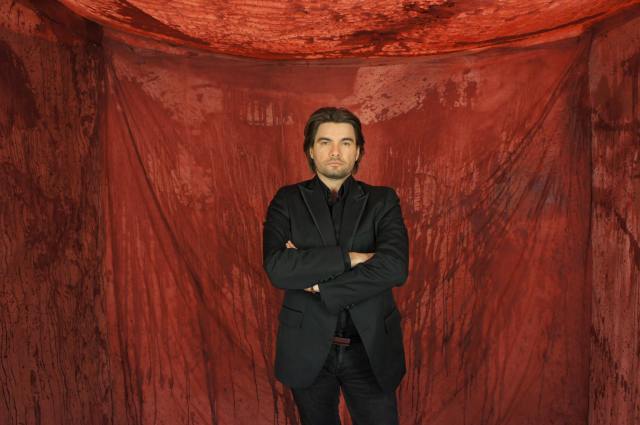
inside my own exhibit

The artist standing in one of his installations.

We had corresponded via e-mail over the last year or so and when I suggested the idea of interviewing him he responded by arranging time after a (traditional length) concert he gave in Minsk, Belarus on December 1, 2014.  I prepared for what I anticipated would be a one hour interview after which I imagined he would probably need to get to sleep.  But when I attempted to wrap up our conversation (at a couple of points) he immediately asked, “Don’t you have any more questions?”.  What followed resulted in approximately three and an half hours of delightful and wide-ranging conversation about this man and his art which he ended with the comment, “I must go, the piano is calling me.”  It appears that his seemingly boundless energy extends well beyond the stage.  The following January (2015) he gave the world premiere performance of all of Philip Glass’ 20 Etudes in none other than Carnegie Hall.

Nicolas Horvath (c) Jean Thierry Boisseau

Horvath with spent score pages as he traverses one of his extended performance ventures. (copyright Jean Therry Boisseau)

Since that time we have continued our correspondence and this affable, patient young artist continues on various projects and no sign of his interest or energy waning.  He recently sent me various photos of him in various settings pursuing his varied artistic interests for this article.
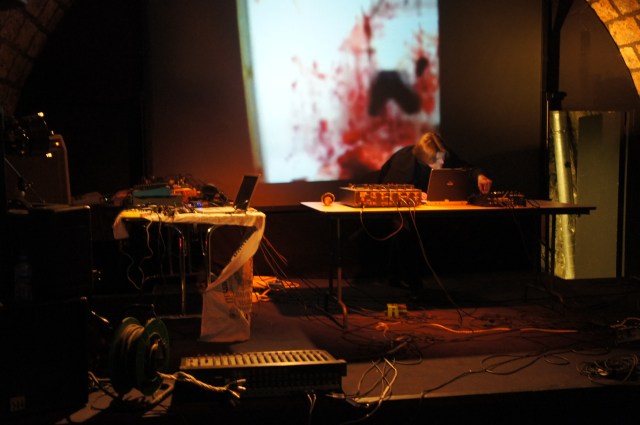
SONY DSC

Composer as well as performer in an electroacoustic performance without piano.

Horvath was born in Monaco in 1977.  He studied piano at the Académie de Musique Rainier III de Monaco and the École  Normale de Musique de Paris.  At 16, Lawrence Foster took notice of him in a concert and, securing a three year scholarship for him from the Princess Grace Foundation, was able to invite him to the Aspen Music Festival. After his studies in the École Normale de Musique in Paris, he worked for three years with
Bruno-Léonardo Gelber, Gérard Frémy who instilled in him a sensitivity to music of our time as well as Eric Heidsieck, Gabriel Tacchino, Nelson Delle-Vigne, Philippe Entremont and Oxana Yablonskaya. Leslie Howard got to know him and invited him to perform before the Liszt Society in the United Kingdom. He has been playing professionally for 7 years and puts his own characteristic style into his productions and performances.

In a move reminiscent of Terry Riley’s all night solo improv fests Horvath has performed several lengthy programs.  He has performed Erik Satie’s proto-minimalist Vexations (1893) in performances that ranged widely in length. One notable performance at the Palais de Tokyo lasted 35 hours, the longest solo piano performance on record as far as I can determine.  Previously this piece has been performed by tag teams of pianists (the first in 1967 in New York was curated by John Cage) to perform the 840 repetitions of the piece whose tempo or recommended duration is not specified.  Horvath, taking on a musicological mantle is preparing his own edition of this unique work.  He has published an 24 hour version on his You Tube channel here.

Given his intense schedule and vast repertoire he has been remarkably responsive and has an irrepressibly strong appetite for new music.  He tells me that he had worked on a project in which he planned to play all the piano music of the French composer Jean Catoire (1923-2005),  some 35 hours of material (in a single program, of course). Unfortunately that composer’s relative obscurity seems to have resulted  in insufficient support for the project which is, for now, on hold.  Here’s hoping that this can be realized sometime soon.

Horvath’s fascination with authenticity, completeness and performances of unconventional lengths uninterrupted by applause where audiences are invited to lay on the floor with blankets and sleeping bags and approach the piano seems unusual but he has been getting enthusiastic audiences and has enjoyed overflow crowds.  Like Terry Riley and perhaps even some of Keith Jarrett’s solo concerts there is a ritual feel to these marathon performances.  Regrettably I have not yet been able to attend one but I would love to partake in what must be a powerful shared experience.  He invites people to come to the piano and to watch, look at the score.  It is unlike the conventional recital and therein lies some of its charm.  At least one of his videos features a small sign which reads, “Don’t feed the pianist” and attests to his warmth and wonderful sense of humor.

His passion has parallels in his spirituality and he has pursued sacred pilgrimages which require a great deal of time and energy but without doubt fill a very deep and sincere need. More details and photos are available on his blog.  And, as with music, he is very open to discussing this very personal aspect of his life.
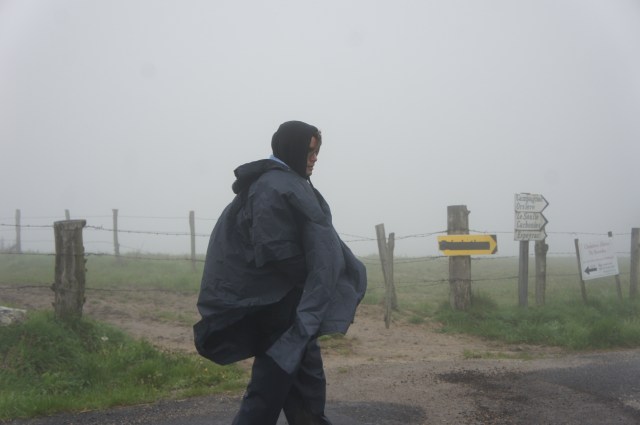
SONY DSC

The artist braving the elements on one of his pilgrimages.

There are conventional two hour with intermission style recitals in more conventional concert venues that he has played and Horvath also enjoys playing with an orchestra.  His performances of both of Philip Glass’ piano concertos can be viewed on You Tube and you can see the intensity of his execution.  This came through in the course of our interview as well when Mr. Horvath would speak of the music and then verbally imitate the rhythms (no doubt endlessly practiced) which drive his enthusiasm.  The music seems to be deeply integrated into his very being.

His first solo commercial recording was released in 2012.  It consists of Franz Liszt’s ‘Christus’, an oratorio composed in 1862-66 for narrator, soloists, chorus and orchestra.  Horvath plays a piano reduction done by the composer.  This is the first known recording of this unique and virtuosic set of piano works.  It is certainly an unusual choice for a debut recording but it is consistent with his very personal tastes.  (He lists Scriabin and Chopin as among his favorite composers.).   He is in the process of recording all of Philip Glass’ piano music for Grand Piano records distributed by Naxos.  At the time of this writing four well-received volumes have been released.  He is also planning to record all of Satie’s piano music and he has just recently released his rendition of Cornelius Cardew’s indeterminate masterpiece, Treatise.

I have seldom encountered a musician with such intensity and drive.  He is also one of the most skilled in using the internet to promote himself and his projects.  And though this is no doubt a man with a considerable ego he is in fact very unpretentious and very genuinely turned on, driven by the music itself.  Don’t get me wrong, he is concerned with developing his image and career but he seems happy to be doing the work he has been doing and he is, like any really good musician, self-critical and a perfectionist.

A quick look at his YouTube channel here reveals some of the range of his interests which include the standard repertoire along with interest in contemporary works.  Just released is a creative video with Horvath playing Glass’ Morning Passages while he apparently experiences a reverie involving a beautiful woman which could have been on MTV at its height.  Perhaps he is even channeling Oscar Levant who embraced roles in films along with his pianistic talents.  His website is a good resource for updates on his various projects and performances.

c _______ ______

Focused concentration at the keyboard.

As of the time of this writing his discography includes:
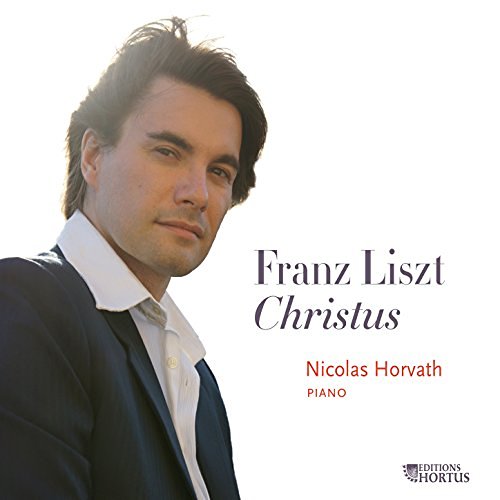
horvathchristus

Hortus Records 100 (2012)

A very unusual choice for a debut recording.  Nonetheless this is a distinctive recording which reflects the virtuosity as well as the careful scholarship which continues to characterize his work.  He managed to locate a couple of previously lost pieces in this set of composer transcriptions.  One also can’t miss the spiritual dimension here, as close to his heart as music and an equally important aspect of his personality.

glassw1

Grand Piano GP 677 (2015)

This first disc in the series manages to provide the listener with truly inspired interpretations of Glass’ keyboard oeuvre and gives us a world premiere recording of How Now as well.
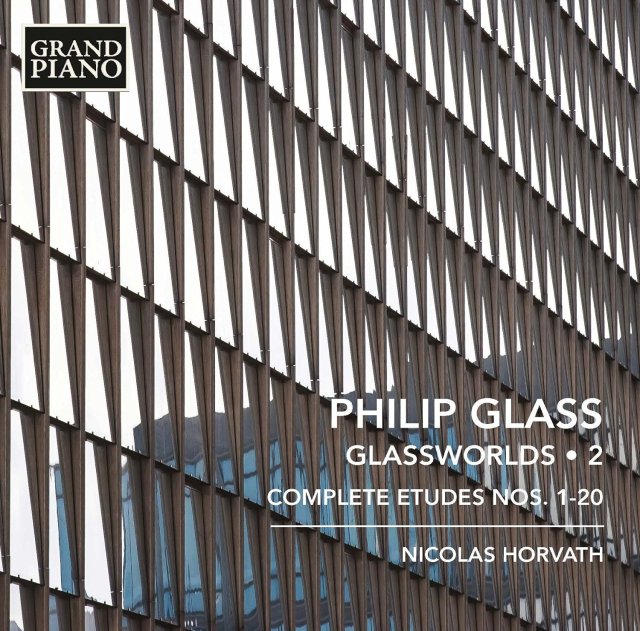
glassw2

Grand Piano GP 690 (2015)

The complete Piano Etudes by the man who premiered the set at Carnegie Hall.  These etudes were also recorded by the wonderful Maki Namekawa and the opportunity to hear these really different takes is positively revelatory.
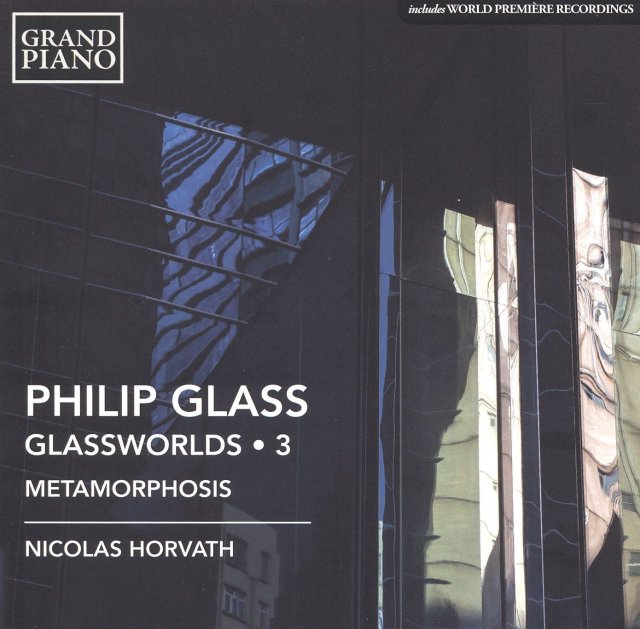
glassw3

Grand Piano GP 691 (2016)

The third disc in the traversal of Glass’ piano music (original and transcribed) also offers world premieres.  Horvath’s inclusion of Glass’ early Sonatina No. 2 reflects his work under the tutelage of Darius Milhaud and provides insight into the composer’s early development before he developed his more familiar mature style.

glassw4

Grand Piano GP 692 (2016)

Haven’t yet heard this disc but I have in queued for ordering in the next few weeks.
acedia

Demerara Records (2016)

Haven’t heard this one yet either but, again, it’s in my Amazon shopping cart.


horvathcardewtreat

Horvath’s interpretation of this important work by Cornelius Cardew

Cornelius Cardew (1936-1981) was sort of England’s John Cage, a major voice in 20th Century experimental music.  Scholarship has yet to do justice to the late composer’s work but this disc is an important contribution toward that end..

Horvath’s career is characterized by innovation and passion combined with astute scholarship and a keen sense of what is new and interesting in music  while clearly being schooled in the classic repertoire.  The piano calls him as do his other passions and I highly recommend paying attention as he answers those calls.  He is truly an artist to watch.
N.B.  Mr. Horvath generously read and approved an advance draft of this article shortly after arriving in the United States for concerts at Steinway Hall in Rockville with a Chopin program and a recital at The Spectrum in New York City which will include two pieces written for him by Michael Vincent Waller along with some Chopin pieces.

Piano Music by Axel Borup-Jørgensen, a Lost Master?


axelpiano

I had reviewed another disc of this composer’s music on this label here and I must admit that it took me quite a while to meaningfully grasp the music of this too little known Danish composer (1924-2012).  It should be no secret that the Danes have had and continue to have a rich musical culture and have produced quite a number of world class composers and this man is no exception.  However his style, apparently gleaned from his association with the modernists of Darmstadt, can be a tough nut to crack.
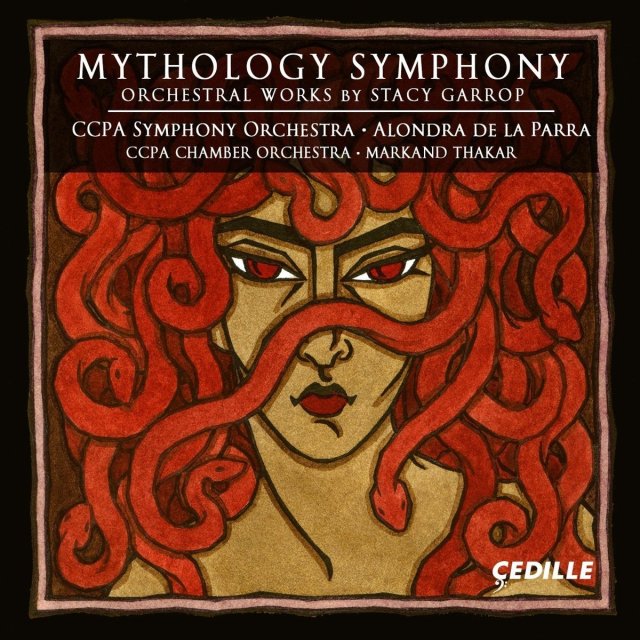
As with the aforementioned disc one might require multiple listenings before coming to realize that this man has a unique style and one that bears some serious attention.  This disc of piano music (and one piece for celesta) fills a gap in his recorded repertoire and is an excellent opportunity to see how he works in the genre of keyboard music.

These ten tracks contain works written from 1949 to 1988 so they cover a significant portion of his career and illustrate the development of his style.  Pianist Erik Kaltoft, a longtime associate of the composer, demonstrates interpretive skill as well as virtuosity and dedication in this fascinating survey.

The first (and longest 11:29) piece is Thalatta! Thalatta! (1987-88) and is given the opus number of 127.  The exclamation of the title translates as, “The Sea! The Sea!” and is said to have been spoken by the Greek armies upon reaching the Black Sea during one of their campaigns.  It is an impressionistic piece about the many moods of the sea.  His harmonies are like a modern update of Debussy, a bit more dissonant but providing a similarly soft focused feel.

Continuing with the maritime theme are the 6 miniatures called Marine Sketches (1949) opus 4b.  It is one of the earliest compositions in this collection (along with the Miniature Suite opus 3b, also 1949, on track 8).  Each of the pieces lasts around one minute and there are no track breaks to separate them.  The composer seems to expect that they will always be performed together and with a total time of 6:53, why not?  In contrast to the first piece these contain more melodic contours with less overall dissonance but clearly the same compositional fingerprint.

The four Winter Pieces opus 30b (1959) contain more energetic rhythms but with strategic silences punctuating the overall flow.  They end with a brief epilogue.

From winter we move to another season with the Summer Intermezzi opus 65 (1971) comes back to the sound world of the first track.  Here he experiments with different techniques to expand the language of the keyboard and incorporates the strategic silences of the piece on the former track.

Track 5 contains the earliest piece in this collection, Pasacaglia opus 2b (1948) which seems to suggest some influence of Scriabin.  It is a classic set of variations over the initial bass line and has a rather romantic feel.

Raindrop Interludes opus 144 (1994) is an impressionistic suite with the more dissonant style of his other later pieces.  It is the most recently composed of the recorded selections.

Epigrams opus 78 (1976) at 9:15, is the second longest piece here.  This is one of the most abstract pieces on the disc and demands concentration from both the performer and the listener to perceive delicate statements made with a wide dynamic range.

The Miniaturesuite opus 3b concentrates a praeludium, fantasia, interludium, sarabande and a repeat of praeludium in a brief 2:49.  It is more melodic and less dissonant in keeping with the composer’s earlier style.

Praeludier opus 30a (1958-9) are seven pithy and brief preludes.

The last track contains Phantasiestùck opus 115 (1985) written for celesta.  This instrument, forever doomed to familiarity by its use  in Tchaikovsky’s Nutcracker, has a limited repertoire and this gentle abstract piece is a welcome addition.  It is consistent with the composer’s late style using dissonance and silences in an almost meditative and strangely nostalgic piece.

The extensive and useful liner notes are by Trine Boje Mortensen and are printed in both Danish and English (translation by John Irons).  The fine recording and mastering are by Preben Iwan in the fine acoustics of the Royal Danish Academy of Music.  Grateful assistance and input from the composer’s daughter Elisabet Selin.

One needs to be cautioned never to take lightly anything produced from this creative country and this album is proof of that.  Kudos to OUR recordings for bringing this music to the listening public.


Spektral Quartet, Serious Business


spektral

OK, bear with me here for just a moment.  The proliferation of string quartets (and by that I mean the grouping of musicians as a performing entity) has been positively dizzying over the last 30 years.  For those who grew up with the standard Julliard Quartet, Guarneri Quartet, etc. there were just a few outstanding names in this genre.  However since the advent of the new quartets like Kronos and then Turtle Island, Arditti,etc. the field has expanded rather prolifically. Couple this with a boom in string quartet writing notably Elliot Sharp, John Zorn, Wolfgang Rihm. Elliot Carter, Peter Maxwell-Davies, Ben Johnston among many others and I was filled with some trepidation upon receiving this disc for review.  I mean, how many things can you do with a string quartet?

Apparently there is a great deal more to be explored in this genre.  I am happy to say that these folks are up to the task as are the composers whose work they present.  Serious Business is some seriously interesting music performed with serious skill by this new quartet, the Spektral Quartet.  They are the string quartet in residence at the University of Chicago, itself a venerable place for new music.

We start here with a piece by Sky Macklay called Many Many Cadences (2014) a piece that seems to come from a similar place to that of the work of Conlon Nancarrow with intricate rhythms within a somewhat conservative tonal idiom.  The title is suggestive of Gertrude Stein (Many, Many Women).  It was commissioned for the Spektral Quartet by the Walden School.  The piece is immediately engaging and ultimately satisfying.

The second piece, The Ancestral Mousetrap (2014) by David Reminick features a less common use of a string quartet in that there is a vocal component. This is not the vocalist component pioneered by Schoenberg in his second quartet.  These vocalizations are performed by the quartet.  This is no simple feat either because the vocal writing is itself a challenge in its rhythmic complexity.  The piece resembles a little opera and indeed the text by poet Russell Edson is here called a libretto.  This piece was commissioned by the Spektral Quartet.

The third piece here is an unusual choice (and the only one not commissioned for the Spektral Quartet) which is explored in the liner notes .  Haydn’s Quartet Op. 33 No. 2, subtitled “The Joke” is one of the relatively few examples of attempts at program music (vs absolute music) to be found in the classical era.  First, no one will buy this disc just for the Haydn. Second, many collectors will already have this Haydn piece in their collection.  But with that said this is a lovely performance of one of the emblematic pieces of music that created the need for the performing ensemble known as the string quartet and it is a lovely performance as well.  I will leave it to other listeners to read the program notes and get into the rationale about its inclusion here.

The final piece, Hack (2015) by Chris Fisher-Lochead is perhaps the most unusual of the lot in that the composer uses vocal inflections by a collection of comedians (yes, comedians) as the source for his rhythmic and melodic contours and creates 22 separate pieces about 16 comedians (some get more than one piece).  This piece requires more concentration by the listener but, like any well-written piece, it reveals more of itself with repeated listenings.  The Barlow Endowment at Brigham Young University commissioned this piece for the Spektral Quartet.

The Spektral Quartet is Clara Lyon, violin; Austin Wulliman, violin; Doyle Armbrust, viola; Russell Rollen, cello.  The recording, as with every Sono Luminus release I’ve heard is glorious and lucid.

Paula Matthusen’s Pieces for People


matthusen

This is the first disc devoted entirely to the music of Paula Matthusen who as of July is a newly minted associate professor at Wesleyan University where she walks at least partly in the footsteps of emeritus professor Alvin Lucier whose course Music 109 she inherited from him.  I had the pleasure of meeting Ms. Matthusen at Other Minds 18 where she was one of the featured composers.  In our all too brief conversation she was affable and unpretentious but certainly passionate about music.

Paula Matthusen

Paula Matthusen performing her work, ‘…and believing in…’ at Other Minds in 2013


She holds a B.M. from the University of Wisconsin and an M.A. and PhD. from New York University.  She announced her recent promotion to associate professor on Facebook as is, I suppose, customary for people of her generation.  It is on Facebook that I contacted her to request a review copy of this CD to which she quickly and graciously agreed.

This CD contains 9 tracks representing 8 works.  They range from solo to small ensemble works, some with electronics as well.  Her musical ideas seem to have much in common with her emeritus colleague Alvin Lucier but her sound world is her own despite some similarities in techniques, especially her attention to sonic spaces and her use of electronics to amplify sonic micro-events which might even include her heartbeat.


sparrows in supermarkets (2011) for recorder looks at the sound of birds in the acoustic space of a supermarket and their melodic repetition.  It is for recorder (Terri Hron) and electronics

limerance (2008) is another solo work, this time for banjo (James Moore) with electronics.  She says she is working with the concept of reciprocation here but that seems rather a subjective construct.  Like the previous piece this is a contemplative and spare work with some spectral sounds as well.

the days are nouns (2013) is for soprano and percussion ensemble and electronics.  Here she is concerned with resonances within the vibrators of the instruments as well as the acoustics of the room.  It is a dreamy, impressionistic setting of a poem by Naomi Shihab Nye whose poem supplies the title but the text is fragments of a Norwegian table prayer.  A very subtle and effective work.

AEG (2011) is represented by two movements (of four?) all of which were written for the Estonian ballet.  It is similarly concerned with resonances and words at times.  Of course it would be interesting to hear those other movements but perhaps another time.

of architecture and accumulation (2012) is the first of two purely acoustic compositions on this disc.  This one is for organ solo (Will Smith) and explores long tones within the acoustic space.  It is a very satisfying work even if one doesn’t go into the underlying complexities.

corpo/Cage (2009) is  the longest and largest work here and is the second purely acoustic piece on this recording.  It has echoes of Stravinsky at and it is an enticing example of Matthusen’s writing for orchestra.  This reviewer certainly looks forward to hearing more of this composer’s works for larger ensembles.  Very effective writing.

in absentia (2008) is the earliest work here.  It is written for violin, piano, glasses and miniature electronics (not quite sure what that means).  Like many of the works on this disc the concern or focus seems to be on small events and sounds.  This is a rather contemplative piece that nicely rounds out the recording.

Matthusen resembles Lucier in some of her techniques and focus on small sounds otherwise missed and she certainly owes a debt to people like Pauline Oliveros.  But in truth she sounds like no one as much as Paula Matthusen.  The composer presents a strong and intelligent voice and one wishes for more from this interesting artist.  Thank you for the opportunity to review this.

Warning: Gentle Music, Marti Epstein’s Hypnagogia


epstein

When Marti Epstein kindly sent this disc to me for review she “warned” me that it was gentle music.  In her liner notes she elaborates that her Midwestern roots will always inform her work.  As fellow Midwesterner (I hail originally from Chicago) I have an idea what she means.  There is a certain gentle affability which seems to characterize folks from the Midwest and no doubt this affects artist expression as well.

epsteinm

Marti Epstein

This disc contains four such gentle compositions ranging from Grand Island (1986) to A Little Celestial Tenderness (2013).  As such it is a cross-section of Epstein’s work though it is hard to say, of course, if it is an accurate picture or overview.

The first piece Hothouse (2000) is a piece for two pianos which works on a couple of levels. It is quite listenable as a concert piece and seems to be a very effective way of using short phrases replaced by silences as a valid compositional technique.  Loosely interlocking phrases are replaced by silences gradually which lull the listener to the conclusion.

The second track is Grand Island (1986) which is the composer’s depiction of a drive to the city of Grand Island in Nebraska.  This piece for piano, two harps and two percussionists is complex enough to require a conductor (Jeffrey Means) but the complexity does not make for difficult listening.  Rather this is an impressionistic audio narrative of the composer’s experience driving through the Midwest as a child.  It has a very similar character to the first piece with silence being very important to the texture which fades to silence as the journey ends and perhaps the restless child has fallen asleep.

A Little Celestial Tenderness (2013), the most recent on the disc, comes in at under two minutes and evokes Copland-like harmonies in a “tiny” piece written in honor of the 10th anniversary of the Ludovico Ensemble who perform the music on this disc (the composer plays one of the pianos on Hothouse).  The unusual instrumentation here is flute, clarinet and cimbalom.

Hypnagogia (2009) is the most experimental music here and is very much the star of this release.  It exists only in parts with no unified score and asks the performers to perform as if they were alone.  It is an attempt to depict the state of mind between waking and sleeping.  This piece is more concerned with sound than silence and the mobile-like appearances of the sounds does create a dream-like texture which, as warned, is also very gentle but not without a touch of anxiety at times.  It is perhaps the most substantial (over 45 minutes), striking and successful piece on the disc and brings it to very satisfying conclusion.

The recording has a warmth and presence and the musicians seem well-suited to the tasks at hand.  This writer will be pleased to hear more from these artists in the future.


New and Newer Music for Flute and Piano


nataraja

New Focus FCR154

This is a curious collection of flute and piano music.  It is framed by two pieces from the late great Jonathan Harvey (1939-2012), one by Elliott Carter and a collection of world premiere recordings by composers far less familiar and markedly different in style.

The premieres are all by living composers (Josh Levine, Christopher Dietz, C.R. Kasprzsyk and Sam Pluta).  Now these are all fine compositions but their style is so very different from the Harvey and Carter pieces that it is almost jarring to the listener.  This living set of composers is represented by a far more conservative compositional ethic (please don’t read that as a negative) than the older, more modernist pieces which frame their efforts here.

Of course only time will tell the eventual place of these works in the annals of musical history but the fact here is that we have two towering works by Harvey, a tasty bit of one of Carter’s lesser known works and essentially unheard works from a gaggle of newcomers. The listener just has to be prepared to switch gears.

The performances are beautiful and loving throughout.  The Harvey pieces truly stand out as the masterpieces they are as does the Carter.  Curiously Carter (1908-2012) has been somewhat maligned since his passing for reasons that defy logic but I am glad that this late Carter piece was included.

This is a lovely recording and performance.  The juxtaposition of the modernist pieces framing the neo-romantic pieces by the younger composers is striking but stick with it. The pleasures of this recording are in the loving and committed performances as well as the recording itself which is quite lucid.

Conor Nelson on flute and Thomas Rosenkranz, piano are new names to me but I will keep them in mind having heard what they have done here.  The ear who made this recording so listenable was Ryan Miller, the recording engineer.

Songs from the Rainshadow’s Edge by Benton Roark


rainshadow


This marvelous little song cycle has, unfortunately, languished for a bit in my “to do” bin and now I want to tell you that it is a fine production in every way.  I don’t know Benton Roark and his website is a bit light on biographical details but what is clear is that Mr. Roark is  possessed of a lyrical gift which this song-cycle demonstrates.  This is an artist who bears watching/listening.

roark

Benton Roark

He is the co-artistic director of Arkora Music who perform the work featuring the composer’s own poetry and selections from various texts read by narrators.  This sounds like a formula for a noisy avant-garde piece but that is not what we have here.  This is an intelligent clearly contemporary work that is simply beautiful and played with great sensitivity by the musicians.  The music is tonal, bluesy at times but always engaging and evocative.

Kathleen Allan, soprano; Amelia Lukas, flutes; Brendon Randall-Myers, electric guitar; Jonathan Allen, percussion; Anne Lanzlotti, viola; Samuel Suggs, double bass; Mary Berry and Maya Levy, narrators comprise the ensemble and all are strong performers.  Alan’s clear beautiful tone carries the spirit of this work and these performers are clearly listening to each other.

Definitely worth your time and repeated listenings reveal more in this wonderful piece.  You can get the album via the Arkora site linked above as well as Bandcamp.  It is on the Redshift label.