Other Minds 23: Whereof One Cannot Speak…


“Fragment #3”
speaking is speakingWe repeat
what we speak
and then we are
speaking again and that
speaking is speaking.

TokyoJune sometime, 1976                                                                         Richard Brautigan (1935-1984)
OM230007

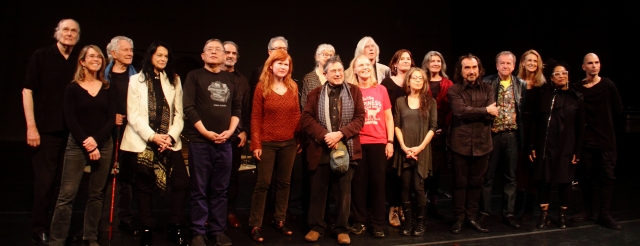
(Left to right: Clark Coolidge, Karen Stackpole, Michael McClure, Anne Waldman, Randall Wong, Aram Saroyan, Sarah Cahill, Charles Amirkhanian, Carol Law, Alvin Curran, Beth Anderson, Jaap Blonk, Tone Åse, Amy X Neuberg, Sheila Davies Sumner, Enzo Minarelli, Ottar Ormstad, Susan Stone, Pamela Z, Taras Mashtalir)

The last statement in Ludwig Wittgenstein’s 1921 Tractatus Logico-Philosophicus (Whereof one cannot speak, thereof one must remain silent) is well known among philosophy students and has taken on the quality of an aphorism or truism.  But the six days of this most recent Other Minds Festival was functionally an effective refutation of this concept.  And the controversy over the awarding of the most recent Pulitzer Prize in music to a rap/hip-hop artist (a species of sound poetry?) which was announced on April 16th, 2 days after the end of this festival of sound poetry seems to reflect the prescience and presence of mind of the Other Minds organization.  Apparently words are “in” even if Wittgenstein and the critics of the Pulitzer Foundation say otherwise.

The Wages of Syntax

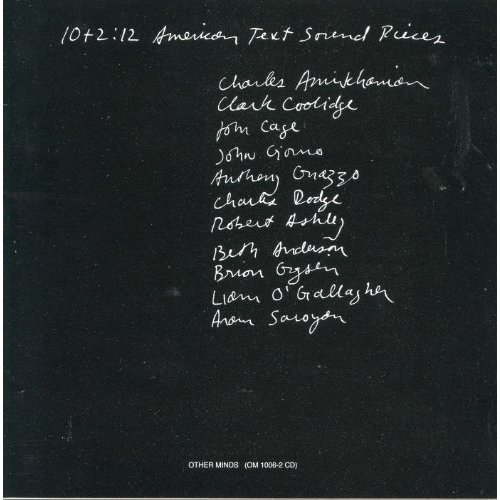
Other Minds 23 (April 9-14, 2018) in many ways began with the release in 1975, of one of the first (and still arguably the finest and still in print) anthologies of a strange, somewhat nebulous species of what can loosely be termed “sound poetry”.  That anthology was called “10+2: 12 American Text Sound Pieces” curated by the man behind this week’s vast expansion on that anthology, Charles Amirkhanian.
american text sound

Amirkhanian and his wife, artist and photographer Carol Law took a long strange trip in the early 1970s.  No, they did not follow the Grateful Dead.  Rather they sought a little known group of artists who walked a line seemingly between poetry and music.  From the Nordic countries to northern Europe, France and Italy they encountered artists who used the voice (though not necessarily language per se) to produce a sonic art form which nearly defies categorization.
1280px-Amirkhanian

Amirkhanian  in his office

Charles Amirkhanian is himself a composer and percussionist in addition to being a producer and promoter of contemporary music.  As a composer, as it was with his long radio career, his voice has been his main instrument.  His resonant, articulate baritone voice has served him well these years and this festival provided a rare opportunity to see/hear Amirkhanian perform his own work live.

This unprecedented 6 day festival marks the longest in the series of the Other Minds annual music festivals.  As relatively obscure as this art form may seem to the casual observer this series managed to provide historical context, current practices, and a tantalizing look/listen at the future of what is in fact a vast body of work.  The ability of Other Minds to find hidden treasures of sonic art continues to amaze.

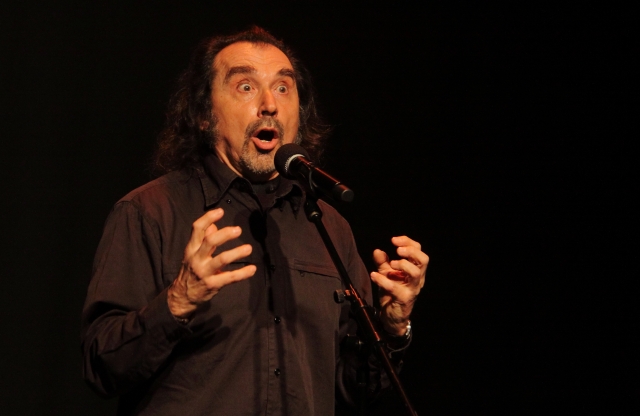
Day one,subtitled, “The Wages of Syntax”, was the gala opening featuring some of the leading artists in the field.  After the obligatory intros the Italian master Enzo Minarelli presented the world premiere of his tribute to Stephane Mallarmé, “Ptyx”.
OM230013

The piece, comprised of phonemes rather than syntactical sounds, was an apt introduction to the weird and wonderful world of sound poetry.  Minarelli was passionate and expressive, a beautiful performance.  Only later in this series would we come to know the depth of scholarship, preparation, and experience that informed this and all his performances.  More on that a bit later.

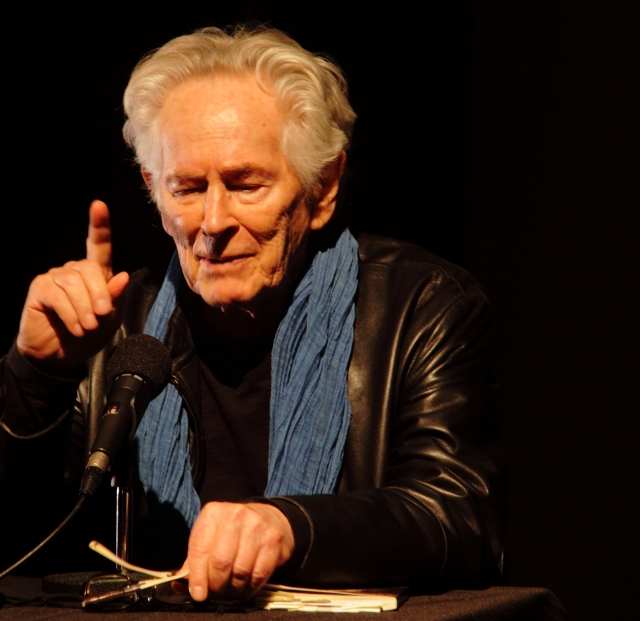
Next up was one of the elder statesmen of San Francisco poets, the wonderful Michael McClure.  At 85 he sported a walking stick (no not really a cane) needed due to a recent fall.  He also required assistance of one of the stage managers to help him to the little chair and desk set up for him.  But none of that mattered once he opened his little bookmarked book of poetry and began to read “Marilyn Monroe Thou Hast Passed the Dark Barrier” and some of his Ghost Tantras from 1962.  His voice was strong, his delivery both certain and witty.  His combinations of words and non-syntactical sounds were delivered with the same joy, humor, and pathos which appears to have inspired them in the first place.  The audience responded very warmly to his ecstatic delivery.
OM230015

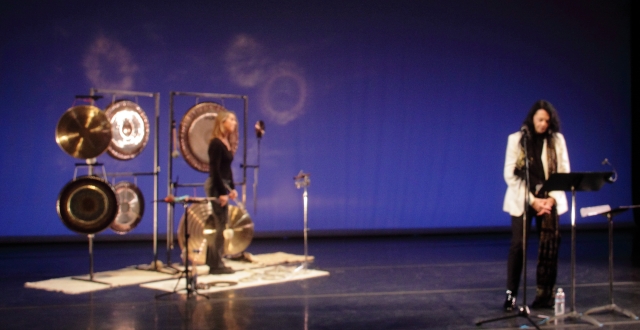
After a bit of stage preparation we were treated to one of the most prominent members of the next generation of American poets that followed Mr. McClure (can I be forgiven for saying beat poets?), Anne Waldman.  She was accompanied (as her texts required) by percussionist Karen Stackpole.  Waldman presented from her “New and Selected Poems”, “Pieces of an Hour (for John Cage)”, excerpts from “Voices Daughter of a Heart Yet to Be Born”, and excerpts from “Trickster Feminism”.  Her characteristically forceful and peripatetic performance carried her between the microphone and Stackpole’s percussion instruments and back again.  It was a charged and sincere performance which clearly charmed (some might say stunned) the audience.

Waldman’s ties to the world of sound poetry go back to her New York roots and her involvement in the St. Mark’s Poetry Project and the Dial-a Poem Poets whose recordings have included her work and that of John Cage, Charles Amirkhanian, Clark Coolidge, and Michael McClure among others.  Small world.
OM230021

Next up was the venerable Aram Saroyan.  I suppose Saroyan (yes, the son of Pulitzer Prize winner William Saroyan) can be said to be part of the same post beat generation artists as Waldman.  Perhaps best known for his “minimalist poetry” he is also an accomplished biographer (Genesis Angels deserves to be better known IMHO) and literary innovator.  It was Saroyan’s poem “Crickets” (1965) which ended the first side of that anthology mentioned at the beginning of this article.  It was in an infinite loop in the end groove of side one of the LP playing the one word which comprises the poem, “crickets”.  And it was this little gem that he performed on this night….with a twist.  After a few repetitions he invited the audience (many apparently still trying to figure out what was going on) to join…which we did…,at first hesitantly, in unison…and then, in a touch of group inspiration, just like real crickets, not all in unison.  It was a strange sort of call and response that charmed the audience and brought a smile to the poet as well.  And that only brought us to intermission.
OM230004

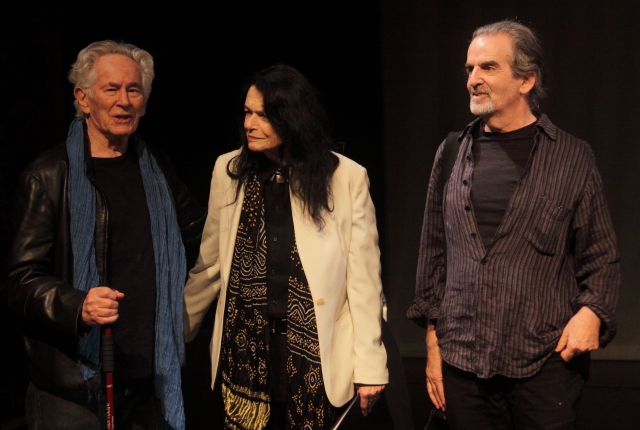
Michael McClure, Anne Waldman, and Aram Saroyan

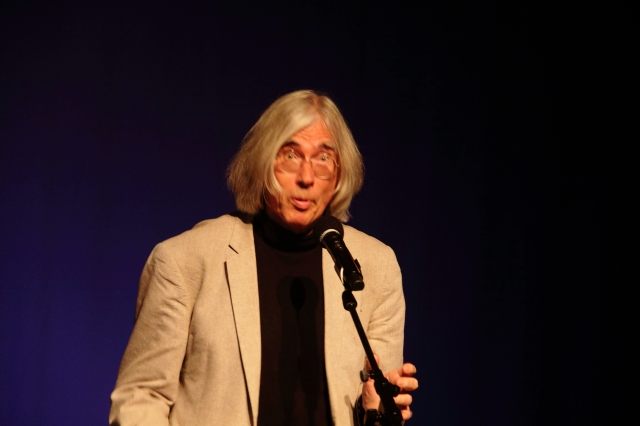
The second half introduced the first of the international stars, Jaap Blonk, the Dutch sound poet and performance artist.  He began with one of his own works, Obbele Boep ‘m Pam (a bebop sound poem).  It was a sound poetry homage to that 1950s species of jazz which inspired the beats, Bebop.  It was a sequence of sounds and words in a made up (by the performer) language intended to imitate the sound of his native Dutch language.

His second performance was of a sound poem from 1916 by the man who coined the term, “phonetic poem”, Hugo Ball (1886-1927).  This poem, based on phonemes common to the Swiss and German languages, was called, “Seepferdchen und Flugfische” (in English “Seahorses and Flying Fish”).  Blonk’s delivery of this turn of the century classic was the first of what would be several such revivals of revered early material of this nascent artistic genre.
OM230026

Jaap Blonk

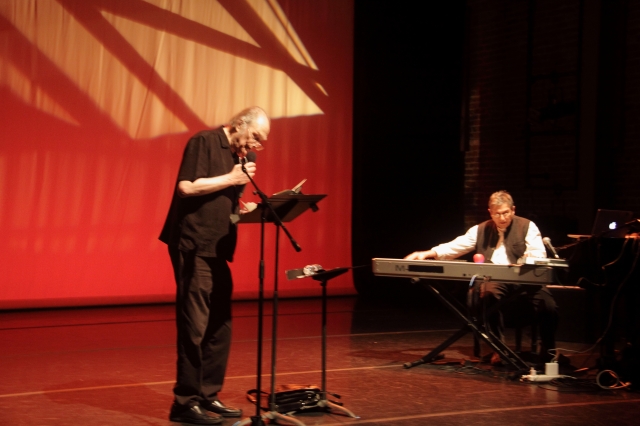
Blonk was followed by the grand finale which returned us to the local roots with poet Clark Coolidge and the ever innovative Alvin Curran.  We learned that the two went to high school together and this was a strange and wonderful reunion with Coolidge reading his manic stream of consciousness poetry accompanied (sort of) by Curran’s musical ministering at both a grand piano and a sampling keyboard in a world premiere collaboration.

Though Curran now lives in Rome (and has for many years) he will always be welcome in the Bay Area where he lived, taught, and performed for many years.  Curran is no stranger to Other Minds either having performed at Other Minds 7 in 2001 and, more recently, at the Nature of Music series.  He is a musician, not a poet but his eclecticism has allowed him to collaborate successfully with a wide variety of artists in a long and varied career which continues to command attention.

The nature of the interactions which characterized this world premiere performance of “Just Out of Nowhere” were not obvious though it is a fair assumption that a degree of improvisation was used and, no doubt, some of the successful confluences on this night were first encountered in rehearsals.  Coolidge’s stream of consciousness rhythmic ramblings were ever present but never overwhelming.  In response, Curran moved back and forth between the grand piano and the sampling keyboard working with serious concentration to provide his musical support for the words.

It was an intense performance as inscrutably mind expanding as all that went before.  Curran signaled the end (as has become his performance custom) by blowing the sacred shofar over the undampened piano strings which resonated in kind and faded to silence which, in turn, was held for a moment by the audience as they disengaged from their attention to offer warm and appreciative applause.  It was a striking collaboration and a reunion of two beloved artists.
OM230033

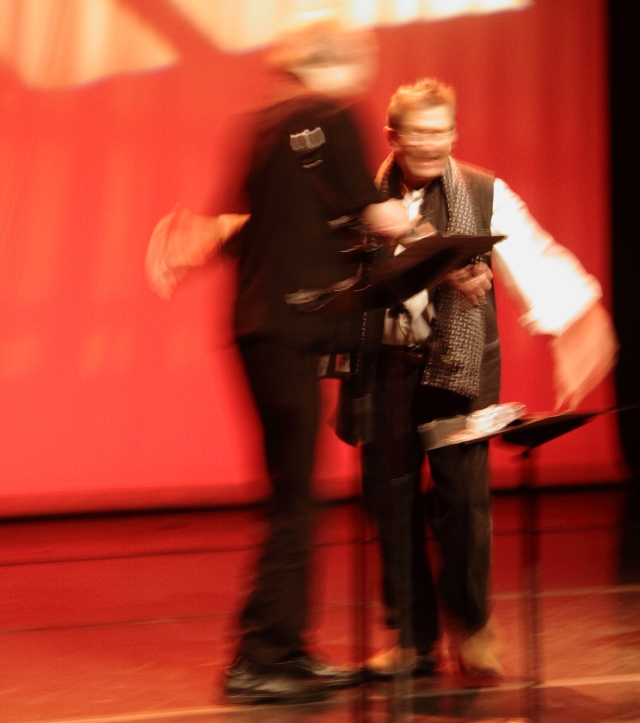
The audience seemed to feel the pure emotion of this performance and the two performers embraced warmly before acknowledging the accolades of the charmed audience.
OM230035

Sadly this writer had to miss the second night of the festival which consisted of a lecture by Enzo Minarelli on the history of sound poetry followed in the evening by a workshop on how to do sound poetry run by Jaap Blonk.  Both were apparently well received and it is my understanding that they will soon be available for streaming on the Other Minds web site.  Definitely gonna check that out.

The second night was given the subtitle, “No Poets Don’t Own Words”.  Even for those who were fortunate enough to have attended this extended Tuesday program it is worth noting that there is a wealth of resources easily available to the interested listener.  The Other Minds website has links to a wealth of archives which include interviews and performances by a variety of artists.  In fact (and this was a creative touch) you get a free CD entitled, “What is sound poetry?”, an archived KPFA radio program when you buy one of the unique t-shirts (designed by none other than Carol Law) from the Other Minds Web Store.  Get this stuff while you can folks.

Also worthy of note (this writer has lost many hours browsing here) is Ubuweb, an online archive of music, texts, films, and sound poetry.  The fact is that these six evenings ultimately could only serve as an introduction to the unusual and entertaining genre.  And those whose appetites have been whetted by this series will want to hear more.

The History Channel
OM230039

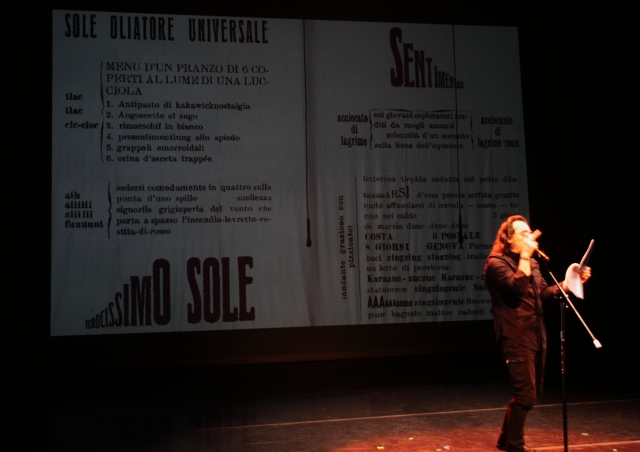
Day 3, April 11th.  The subtitle for this night’s performance was, appropriately, The History Channel.  It was an opportunity to display some of the origins and early foundational masterworks of sound poetry.  Enzo Minarelli displayed his academic skills and interests as he interpreted several classic “scores” (which were projected on the back wall) as the performer brought them to life in what appears to have been as authentic a performance as could be had with this material from the early twentieth century.

Minarelli did readings of: “Dune (parole in libertå)” (1914) and “Zang Tumb Tuuum: Adrianopoli, 1912” (1914) by Filippo Tommaso Marinetti; Fortunato Depero’s “Subway” (1939), “Verbalizzazione astratta di signora” (1927), and “Graticieli” (Skyscrapers, 1929).  He finished with one more by Marinetti, “Savoia” (1917).  In addition to the passion of Minarelli’s performance the look of the score, essentially artistically printed pages of words and phonemes, and the choices made by the performer to interpret those scores itself provided its own sense of drama.  The lighting and projection were simple and effective, supporting the live performance.
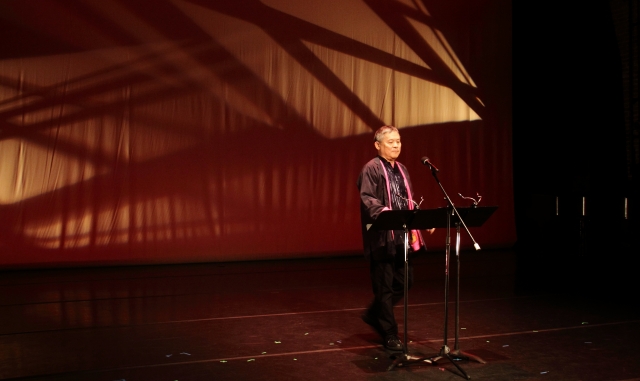
OM230042

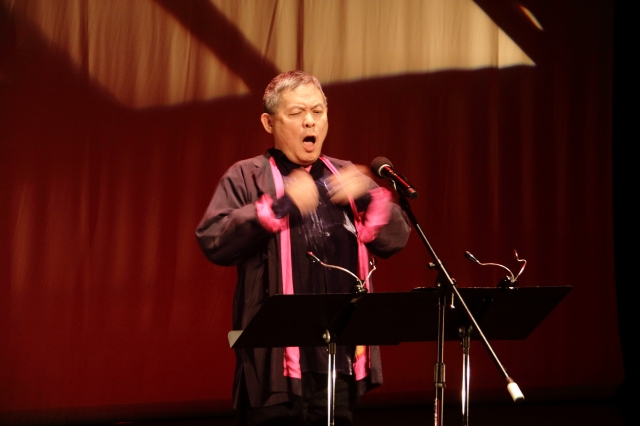
No major stage changes were needed for the next performer, just a little music stand with a microphone and small lights to illuminate the score.  Randall Wong, currently administrative director at Other Minds is an accomplished singer.  He is in fact a male soprano who specializes in baroque vocal scores including opera.  No stranger to new music, Wong has also demonstrated his formidable vocal skills singing with the Meredith Monk Ensemble among others.  It was those extended vocal skills that were called upon this night.

One could hardly have found a more appropriate casting to perform this next item on the program, “Stripsody” (1966) by the deservedly celebrated new music soprano Cathy Berberian.  Similarly to Wong, Berberian’s career took her from baroque opera to a plethora of modern music (Berberian was married for a time to Italian modernist composer Luciano Berio who wrote many a score for her).  What is lesser known is that Berberian wrote some music designed and inspired by her own vocal skills.
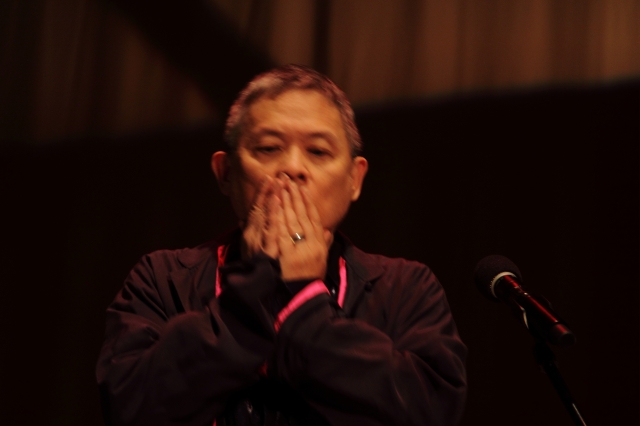
OM230045

Stripsody is difficult to describe.

OM230043

It is, in fact, a combination of sounds, specialized vocal utterances, and visual theater and is a sort of homage to comic strips (hence the title).  Utilizing onomatopoetic sounds, imitations of real world sounds and the sheer range of Berberian’s vocal instrument the performer becomes a sort of live comic character.  This piece is demanding but highly entertaining and contains humor and a variety of references.  Never did the audience lose track of the virtuosity involved or the intensity of the performer’s stage presence.  Wong’s performance was at once accurate, virtuosic, and a touching evocation of the memory of Ms. Berberian.
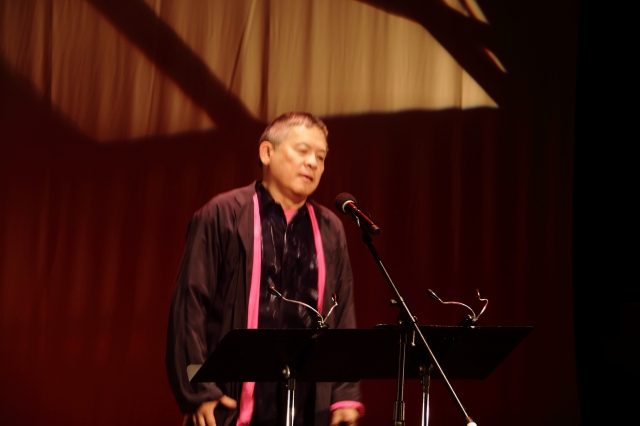
OM230044

It was an immersive experience for both performer and audience witnessing the sounds, the gestures, the facial expressions, the sheer concentration required to convey both the humor and joy of this work.  Wong demonstrated serious stamina and seemed to have enjoyed himself.
OM230047

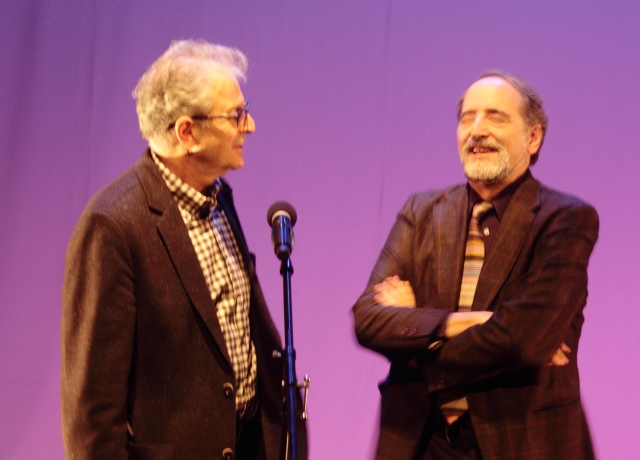
Now what is history without a bit of archaeology added in?  Charles Amirkhanian introduced writer Lawrence Weschler who is (bear with me now) the grandson of the composer Ernst Toch.  Toch is responsible for writing what is perhaps the best known example of the genre represented by OM 23 this year.

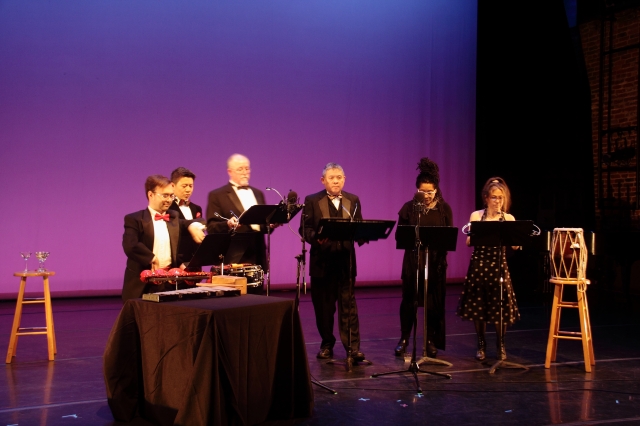
In 1930 he wrote a three part composition entitled, “Gesprochene Musik” (Spoken Music).  Two of the three parts of this composition had long been thought lost.  However choreographer Christopher Caines apparently did a reconstruction for his dance piece, Spoken Music (2006).  Tonight’s performance was the American premiere of substantially what Toch had originally intended way back in 1930.
OM230049

The last of the three pieces, “Geographical Fugue” is by far the best known of Toch’s spoken music (indeed the probably the best known of all his music despite a truly substantial catalog and a Pulitzer Prize, no less).  In addition to the Gesprochene Musik there was a performance of a much later work by Toch which parodies chatter at cocktail parties, “Valse”(1962).

All of these were performed by The Other Minds Ensemble which consists of Kevin Baum, tenor; Randall Wong, tenor (yes, he can handle both soprano and tenor); Joel Chapman, baritone; Sidney Chen, bass, Amy X Neuberg, and Pamela Z.

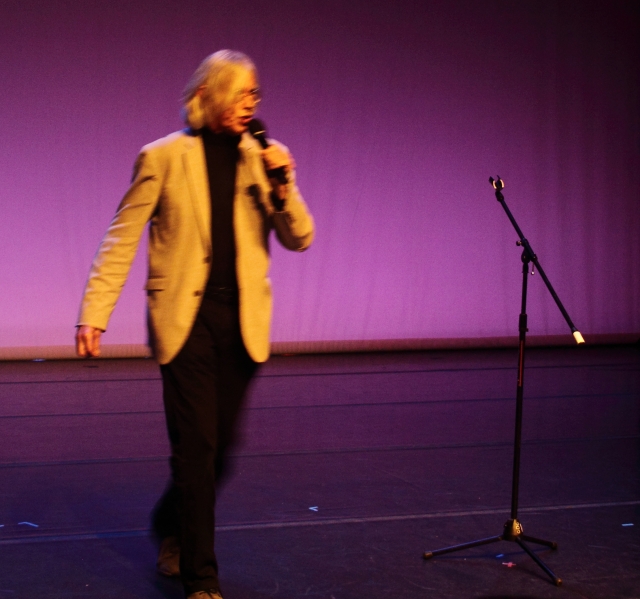
Fast forward now to 2014  when grandson, executor, and writer Lawrence Weschler came up, on a whim, with a medical text to fit to the original Geographical Fugue.  Tonight we were treated to the world premiere performance of Medical Fugue with the same ensemble.  Weschler’s facility with language allowed him to choose the phonetics which worked as effectively as Toch did in his original. No doubt grandaddy would have been proud.
OM230054

Following intermission Jaap Blonk again took the stage, this time doing a historical performance for which he has become quite well known.  Tonight he performed (from memory, no less) “Ursonate” (1932) by Kurt Schwitters.  This large and complex work in several sections (or movements) utilizes vocal sounds fit together in the manner of classical sonata form in music.  Blonk has been performing this work for many years now and he obviously both knows and loves this piece.  His sincere, kinetic performance brought the audience back to the time frame of those years between the wars most effectively.

Two pieces on tape were next: “La Poinçonneuse, Passe Partot No. 2” (1970) by Bernard Heidsieck (1928-2014) and “If I told him (a completed portrait of Pablo Picasso) (1934) by Gertrude Stein (1874-1946).  Both were presented with the theater darkened and a simple card projected on the back wall of the name of the work and the composer.

The Heidsieck piece is a poignant and bittersweet scenario alleged to be at least partly autobiographical.  The Stein was a poetic portrait of her friend, Pablo Picasso.  It was in Stein’s own unique take on language and left one wondering why Stein’s work is not even better known than it is.
OM230057

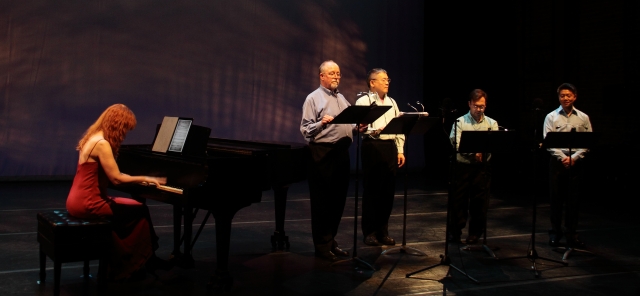
And for the finale the Other Minds Ensemble was joined by a frequent guest artist, the justly renowned pianist Sarah Cahill in a seldom performed work by American Composer (and Gertrude Stein collaborator) Virgil Thomson (1896-1989).  “Capital Capitals” (1917-1927) utilizes a Stein text.  Thomson and Stein enjoyed several successful collaborations (including two operas) with Thomson setting Stein’s words to music.

The text, designed with musical analogies in mind, was presented uncensored with a disclaimer in the program.  The text, a bit dated, would not be considered politically correct by today’s standards.  It is a celebration of the ancient capitals of Provence (Aix, Arles, Avignon, and Les Baux).  The music was written ten years after the text and shows the same collaborative affinity demonstrated in the operas.

The ensemble appeared to have a great deal of fun with the punning language and the music such a good fit. The audience clearly agreed.

Scandalnavians

Day 4:  One of the things that has characterized Other Minds concerts over the years is the attempt to include the world outside of the United States.  This year the international artists mostly come from that same territory which Mr. Amirkhanian and Ms. Law traversed on their journey in the early 1970s.  Jaap Blonk, who had already performed in from the Netherlands, Enzo Minarelli, from Italy.  We would on this night also be introduced to Sten Hanson (1936-2013), Ottar Ormstad , Taras Mashtalir , Lily Greenham, Åke Hodell, Sten Sandell, and Tone Åse.

The evening opened with tape presentations of two pieces by Sten Hanson (1936-2013).  Che (1968) and How Are You (1989).  The first was a deconstruction of words of Che Guevara and the second a phonemic deconstruction and electronic manipulation of the three words of the title.
OM230064

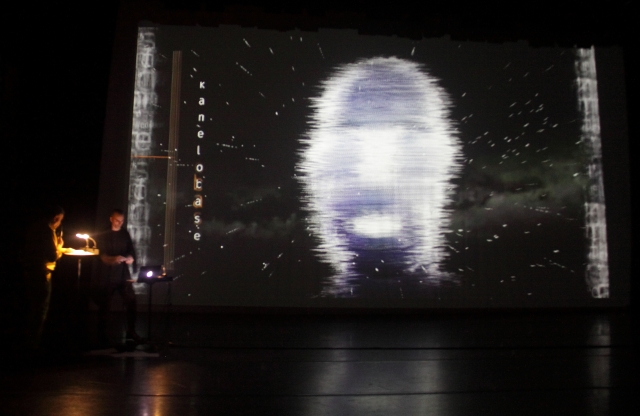
Then, in a significantly darkened hall, we were introduced to the work of Ottaras, a duo consisting of Russian composer Taras Mashtalir and Norwegian poet/artist Ottar Ormstad.  Standing stage left of the projection screen which covered almost the entire back wall Mashtalir worked on his laptop (producing some heavy rumbling that shook the walls and was felt in the listener’s body).  This writer’s first impression was that of some sort of IDM (Intelligent Dance Music) or ambient rave soundtrack.  It accompanied some striking (mostly) black and white images which took center stage on the screen at the back wall.  Slowly, at first imperceptibly, Ormstad wove some vocal sounds into the fabric.  It was the U.S. premiere of a 2018 work entitled, “Concrete”.  It was in four sections (or movements if you will) each separately titled, “Long Rong Song”, “Navn Nome Name”, “Kakaoase”, and “Sol”.
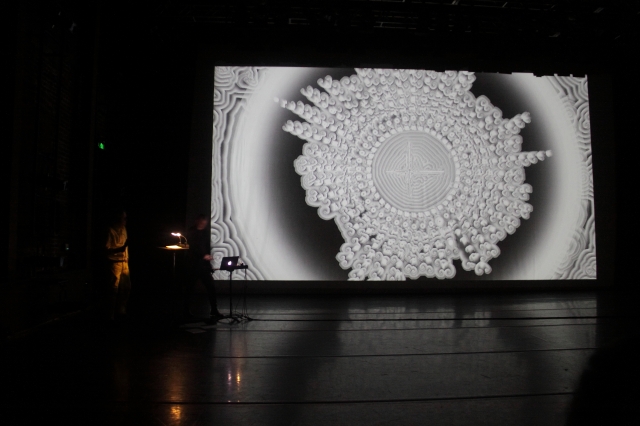
OM230065

The strange swirling images, sometimes with words or parts of words moved across the back screen while the two performers, barely visible, worked with their instruments (computer and voice) to create a soundtrack for the images.  Much like the non-syntactic use of sounds and language, the musical accompaniment was comprised of rather minimalistic utterances orchestrated in a wide range of frequencies with frequent heavy bass sound which provided a tactile component. All in all a rather mystical experience, exactly the cutting edge one looks for when attending an Other Minds production.
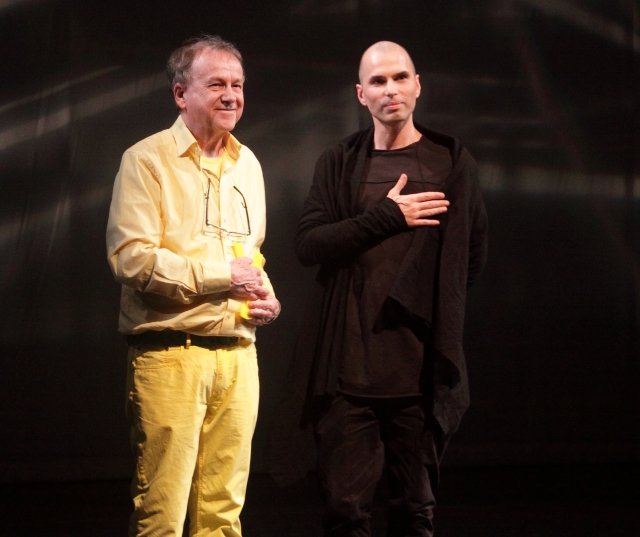
OM230067

The performers seemed touched, perhaps even a bit surprised by the very warm response from the audience who seemed to connect rather easily to this unusual and very sensual experience.

The first half of this night’s concert concluded with the presentation of two more tape pieces, Lily Greenham’s “Outsider” (1973) and Åke Hodell’s “Mr. Smith Goes to Rhodesia” (1970).  As in previous tape presentations a static photograph with titles was projected on the back wall in the darkened theater.

The Greenham piece is a solo monodrama in which the speaker (Greenham) is accompanied by an electronic chorus of her own voice.  Hodell’s piece is clearly a protest piece about racial oppression by Ian Smith (Rhodesian Prime Minister 1964-1979) in Rhodesia (now Zimbabwe and Zambia).  It is like the Greenham piece in that it utilizes a chorus but here the chorus is actual children gathered by the artist to speak/echo the lines of the narrative which contrasts the colonial narrative with both Hodell and the children periodically intoning, “Mr. Smith is a murderer.”  The contrast was chilling and the pause for intermission a welcome respite.
OM230071

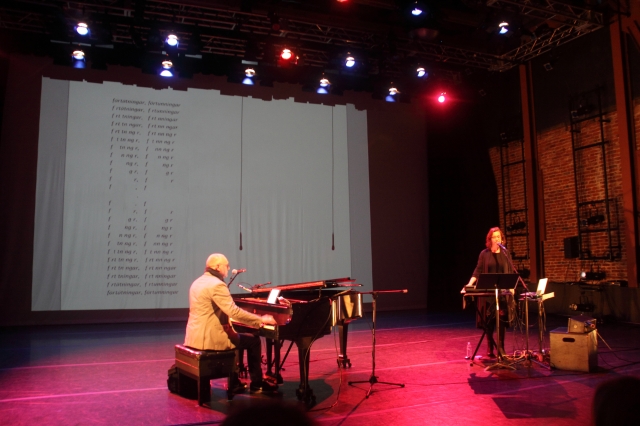
The second half of the program began with a solo performance by Tone Åse, another world premiere.  She performed her work, Ka? (2018) for voice and electronics.  In this piece she works with the sounds of questions, hesitations, and the sound of dubiousness deconstructing words, phrases, sounds and manipulating them vocally and electronically in a piece whose low volume and sparse sounds certainly evoked the intended emotions.

After a brief acknowledgement of the appreciative applause the next performer, Sten Sandell sat down at the keyboard stage left and began the performance of Voices Inside the Language (2018), another world premiere.  Again this experience had a similar sparse, almost minimalist approach.  It was a collaboration that echoed the first night’s Coolidge and Curran performance and presented an entirely different sound world.
OM230073

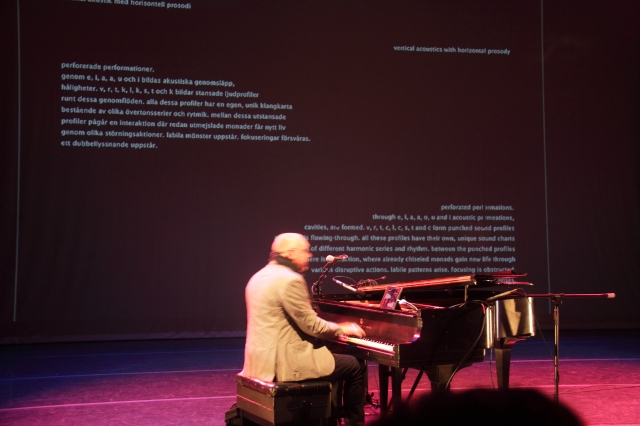
Almost before the audience realized the collaboration was over Åse discreetly left the stage leaving Sandell to perform his work, “vertikalakustik: med horisontell prosodi” (2017).  Here was a near complete deconstruction of language using simply phonemes, individual sounds.  With voice, piano, and projections on the back screen, Sandell delivered his necessarily minimalistic piece.

Both Sandell and Åse briefly acknowledged the applause bringing to an end this most satisfying international segment of the festival.

Good Luck with/for/on/in/at Friday the 13th

Described as an antidote for triskaidekaphobia (fear of the number 13), this evening’s program featured primarily California based artists including Amy X Neuberg, Mark Applebaum, Charles Amirkhanian, Carol Law, and (the one non-Californian) Enzo Minarelli.

The most famous victim of triskaidekaphobia was the Austrian/American composer Arnold Schoenberg (1874-1951).  Curiously for the sake of the present subject matter, Schoenberg invented sprechstimme (speech song), a sort of half sung/half spoken style of performance for many of his vocal scores.  His unfinished opera, Moses und Aron (1932) uses it and ends the second (and last completed) act with Moses singing/speaking the following words: “O Wort, du Wort, das mir fehlt!” (in English: “O word, thou word, that I lack!”)  Indeed the theme in the composer’s libretto is centered in part around Moses’ inability to articulate his ideas.  (Aaron was the man of words, Moses the charismatic leader)  Here, tonight, we were presented with artists who have grappled similarly (as all artists do) with the issue of expression and their unique solutions to the problem.  (By the way the spelling, “Aron” is not a German spelling, it is Schoenberg’s truncation of the name so that the title would not have 13 letters.)  The poor man probably wouldn’t have survived this night.
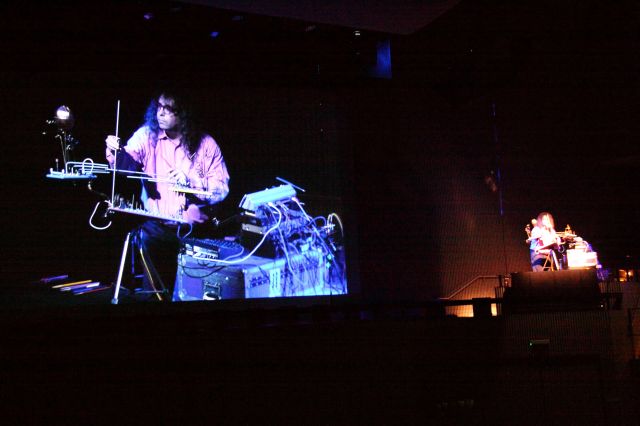
OM190013

Projection of Applebaum performing with view of the composer/performer stage right as well.

The night opened to a darkened stage with the projection of one of those info/program note cards on the back wall.  The presentation was of a tape piece by Stanford professor (and Other Minds alumnus) Mark Applebaum.  Since the darkened stage and the all too brief bow taken by the composer exceeded the limits of this writer’s photographic skills I offer the above photo of Mr. Applebaum from previous Other Minds program.

The piece at hand on this Friday the 13th was, “Three Unlikely Corporate Sponsorships” (2016) which had it’s premiere at Stanford.  The three sections were entitled, “Nestlé”, “General Motors”, and “Haliburton”.  The mocking and humorous content was such that there was no doubt that the three named corporations were not involved in the creation and funding of this work.  Like some of his predecessors this week Applebaum is prone to political commentary in his music whose sound appeared to take place in a stereo sound field with some antiphonal effects.  Words were used, deconstructed, used again and never once were they used in a complementary fashion.  This is, in its way, a protest piece.

As I said, Applebaum came out only briefly (with a smile on his face) to acknowledge the very amused and appreciative audience.  One senses that protest against corporate greed is hardly an unpopular theme with this self selected audience which greeted this work with obvious satisfaction.
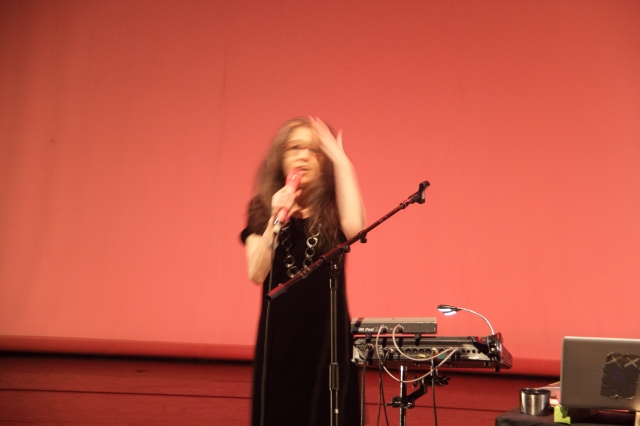
OM230078

Amy X Neuberg is a well known performer in the Bay Area and is also an alumnus of Other Minds.  Neuberg studied both linguistics and voice (at Oberlin College), and electronic music (at Mills College).  She has a strong well-honed soprano voice and has developed her own unique mix of language and music in compositions that defy easy categorization.

Neuberg graced us with “My Go”, “Christmas Truce: a journal of landlord/tenant situations”, yet another world premiere for this series, “Say it like you mean”, “That’s a great question (A Jerry Hunt Song Drape)”, and, one of her classics, “Life Stepped In”.

Neuberg’s work is a striking and unique combination of linguistic wizardry, cabaret style song writing, probably some rock and pop sensibilities, and the indefinably unique way in which she integrates voice and electronics with a touch of drama at times.  Her work is permeated with humor but also with social critique.  As is always the case (at least in this writer’s experience) her performance was greeted with warmth and appreciation.
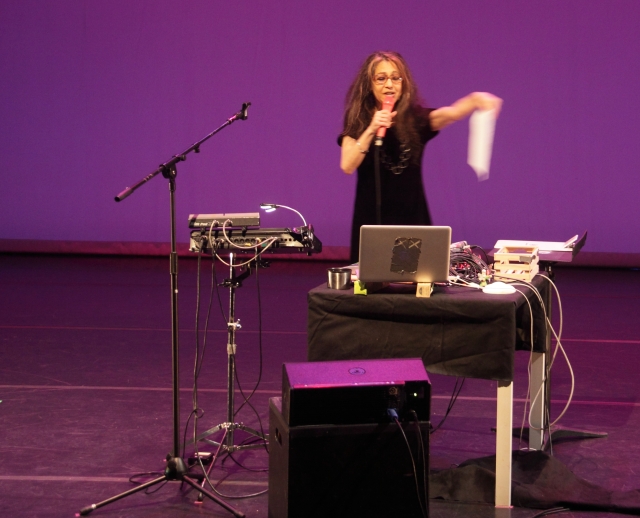
OM230080

Following intermission we were again treated to the substantial performing skills of Enzo Minarelli who graced us with a generous selection of his own works including, “La grandeur di Ghengis Khan” (The grandeur of Ghengis Khan) comprised of eight vocal tracks and three noise tracks, “Il supere scopo di vita” (Knowledge as the purpose of life) “I nomi delle città come inno nazionale per Sinclair Lewis” (The names of the cities as national anthem to Sinclair Lewis) another multi-track work, and Excerpts from Fama: “Ciò chevoglio dire” (Fame: What I Want to Say): “Affermasi senza chiedere” (To succeed without asking), “Che teme il dolore (use la medicine della religion)” (Those who fear pain fuse the medicine of religion), “Alla ricerca del suono farmacopeo” (Seeking the pharmaceutical sound) and “Poema”.

In addition to their described meanings and verbal content these works were about the beauty of the Italian language and the beauty of the sound of the performer’s voice as well as the accompanying performance.  Minarelli is apparently a performer of high energy.  He performed on five of the six days and attended the last night as well seemingly all in a weeks work.
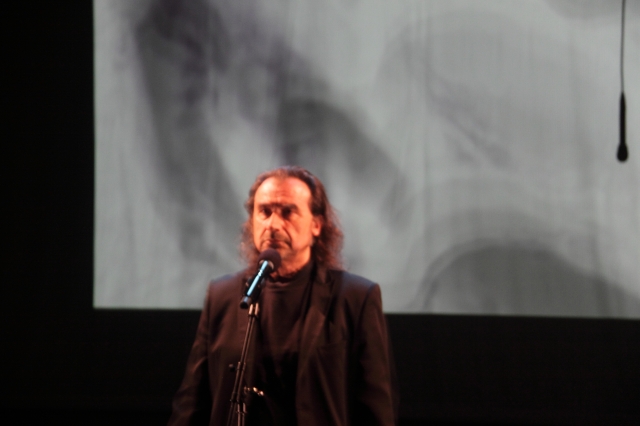
OM230086

Once again the fairly minimalist lighting strategies were remarkably effective.  Projections on the back wall along with Minarelli’s strong stage presence made for a striking performance of these works.
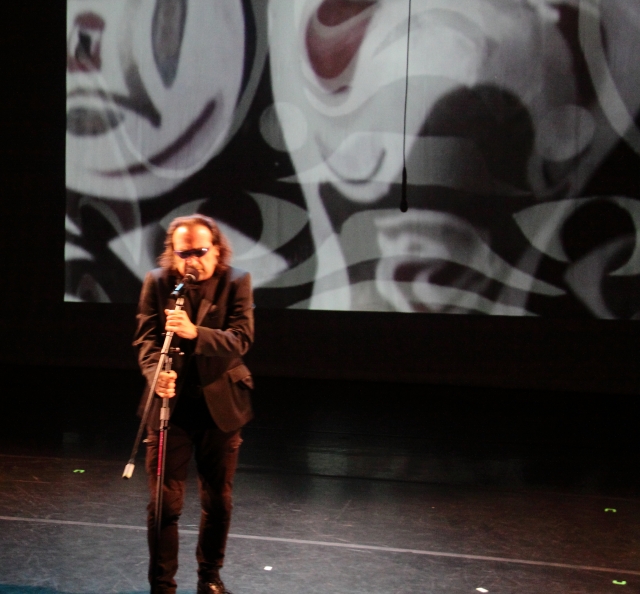
OM230091

Minarelli was like a poet from a cabaret in some lost Fellini film fraught with intelligence, drama, passion, and humor.
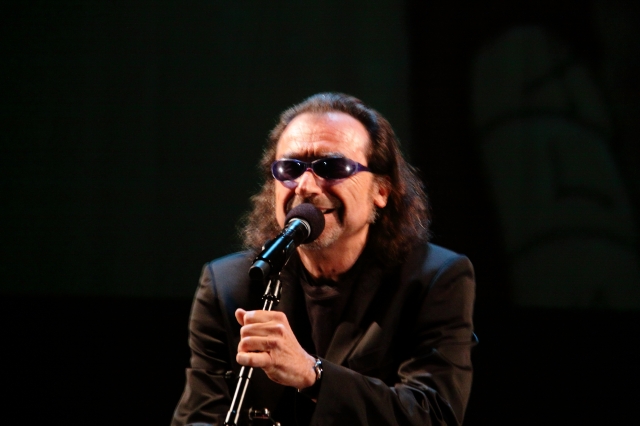
OM230092

Any of the above led the audience in some degree to the notion that what had just transpired would be a tough act to follow.  Certainly this was true for Mr. Minarelli but, rather than a denouement or even a cooling down there was a shift of gears, a transition if you will, to yet another universe of creativity.

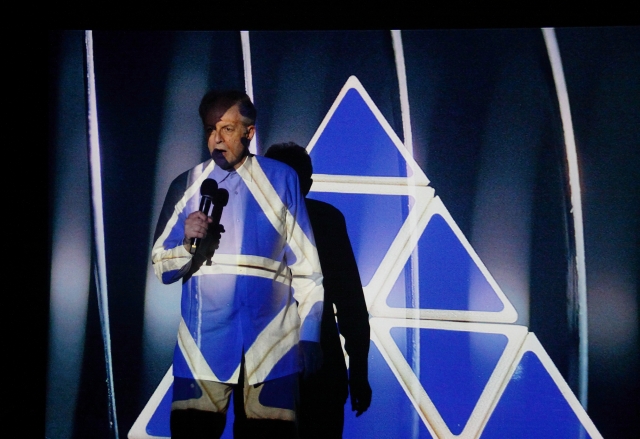
We were next presented with a fairly rare experience.  We got to hear Other Minds’ executive and artistic director perform some of his own dalliances with languages and vocal utterances.  Charles Amirkhanian, no longer wearing his jacket but rather a long white shirt, came on stage with this wife and partner, in both life and artistic crimes, Carol Law.  Together they shared some of the inspirations of their (obviously still in progress) long strange trip.
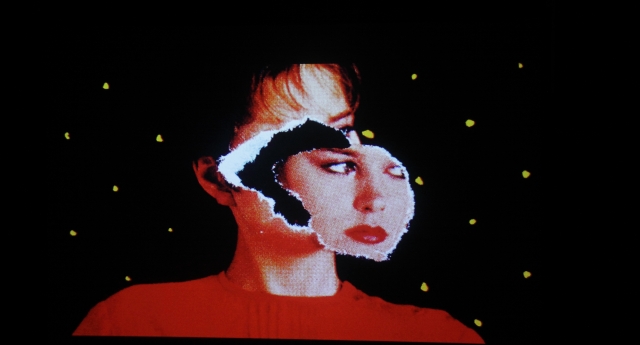
OM230097

In addition to being a photographer, Carol Law is a collage artist and has also been involved in the design of a few of pieces of Other Minds collectibles such as the t-shirts created for this year and several from previous years.  What is a bit lesser known are her collaborative efforts with Charles Amirkhanian.  The above image, for example, demonstrates the striking, slightly disturbing images that characterize the first work on tonight’s program, “History of Collage” (1981).  Carol’s images were accompanied by a live recitation by Charles of a text which is actually about collage but is manipulated by a cut up technique.  Here we saw images and heard the spoken text.  For the next two collaborations Amirkhanian took his microphone and did his recitation in front of the projection screen creating effects not unlike the light shows and projections one might have seen in one of Bill Graham’s productions at the Fillmore Theater some 50 years ago.  That is not to say that the intent or effect was nostalgic or historical, just that it seems to exist in a parallel universe.  The long white shirt thus became a part of the projection screen with Amirkhanian moving dynamically along with the speaking of the disjointed texts.
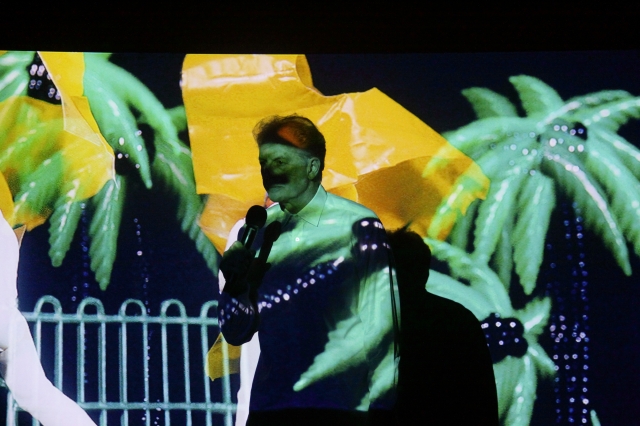
OM230100

The visual imagery was both striking and unique and held this writer, if not the entire audience, in thrall to a powerful sensual onslaught.

Hypothetical Moments (in the intellectual life of Southern California) (1981) is another of these cut up texts, this time an intercutting of Edith Wharton’s, “Glimpses of the Moon” and what Amirkhanian describes as “the gruff drugged-out reportage of a Yankee baseball game”, Ted Berrigan and Harris Schiff’s, “Yo-Yo’s with Money” (Amirkhanian is an avowed baseball fan).  These were spoken over an improvisation done on an out of tune harpsichord modified by an Eventide Harmonizer.
OM230101

The pair stepped on stage together to acknowledge the very appreciative applause.  Indeed this was a rare and precious experience seeing them perform together and, though they did not eclipse the previous artists, they clearly established their parallel universe in the shared multiverse of sound poetry.  These are wonderful performance pieces.

OM230104

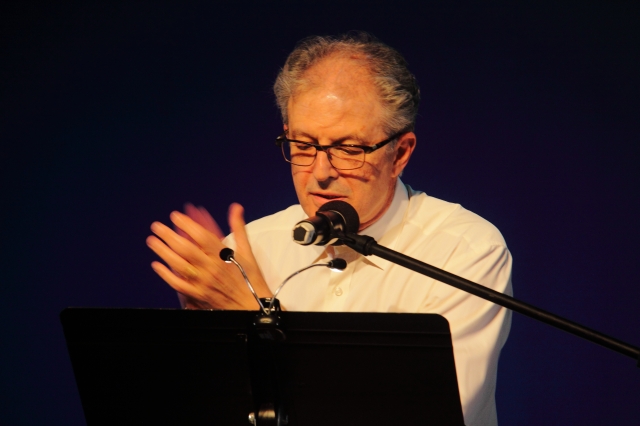
So…how do you follow that?  Well, apparently with some solo Amirkhanian.  As noted previously, Charles has been writing and performing his brand of vocal gymnastics since at least 1969.  Two of his works, “Just” (1972), and “Heavy Aspirations” (1973) were included on that anthology mentioned at the beginning of this review.
OM230113

Amirkhanian has taken the stage at least twice before at Other Minds performing his own text sound works.  Tonight he presented, “Maroa” (1981), a sort of homage to a street in his home town of Fresno, “Ka Himeni Hehena” (The Raving Mad Hymn, 1997), a  celebration/deconstruction of the Hawaiian language, “Marathon” (1997), a two voice poem which is like a nostalgic parody of the fundraising which Charles did so many times for KPFA, and, one of this best known works, the gently humorous “Dutiful Ducks” (1977) which involves rhythmic speaking and deconstruction of words on tape to which he reads live and (mostly) in sync.  As with most of what we all heard on these days, live performance IS the point.

INK Conclusion
OM230118

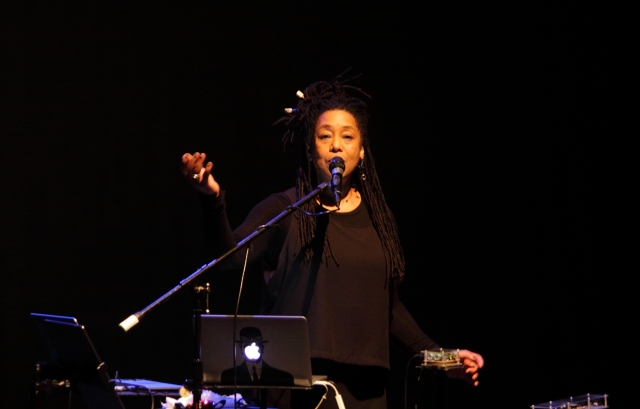
Day 6 featured beloved Bay Area diva (and Other Minds alumnus) Pamela Z.  While one might note that, like Amy X Neuberg, she has a powerful, trained soprano voice and relies on electronics, her results are an entirely different animal.  Some of Z’s specialized proximity controlled electronics are artistic creations themselves and play a part in the theatrical component of her performances.
OM230121

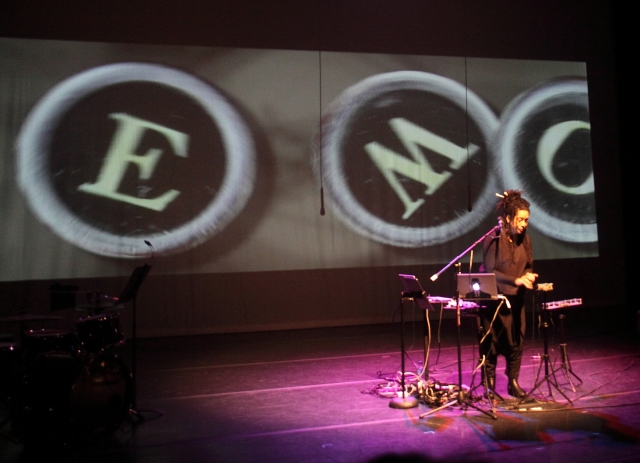
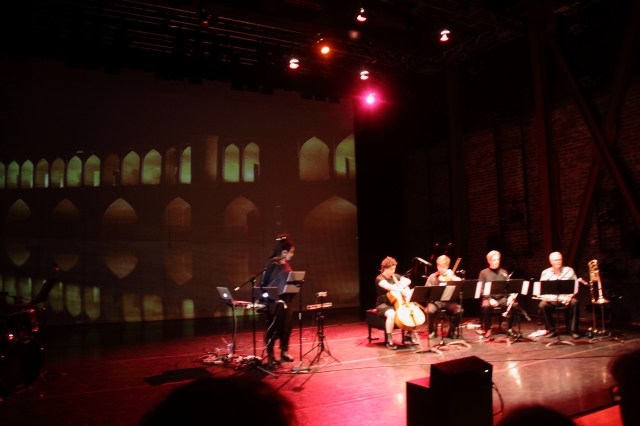
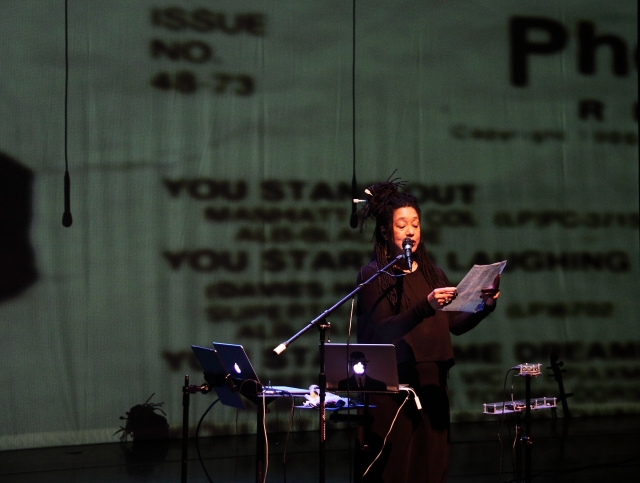
Pamela Z’s performances were enhanced tonight with video and slides such as this projection which supported her performance of Typewriter/Declaratives.

Like Neuberg, Pamela Z does a sort of cabaret style performance.  On this night she graced us with, “Quatre Couches/Flare Stains” (2015), “Typewriter/Declaratives” (2015), “33 Arches” (from a larger work called, Span, 2015), “Pop Titles: You” (1986) and the SF premiere of “Other Rooms” (2018).
OM230123

Z’s skills at writing for chamber ensemble were displayed in 33 Arches, a section of a larger work called Span.

Most commonly seen as a soloist with electronics, it was a wonderful opportunity to hear a portion of one of her recent works which involved writing for more conventional instruments in addition to her voice and electronics.  This was done also in conjunction with video.
OM230124

Pamela concluded with a performance of one of her classic works, “Pop Titles ‘You'” (1986) enhanced by the back wall projection of the text source for the work, a page of the now defunct Phonolog report which was commonly found in record stores “back in the day” as they say.  Z worked for a time at Tower Records.

Like Amy X Neuberg, Pamela Z was treated to a warm round of appreciation from this adoring home town Bay Area audience.
OM230128

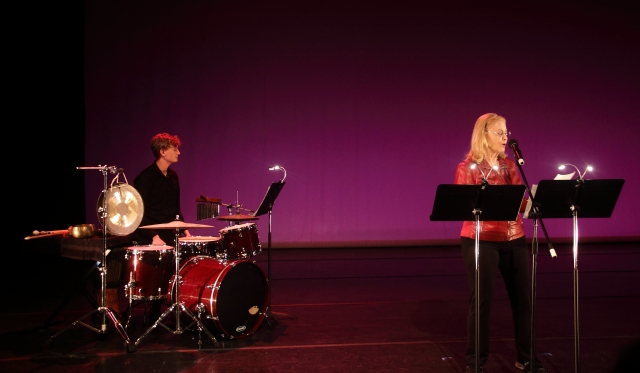
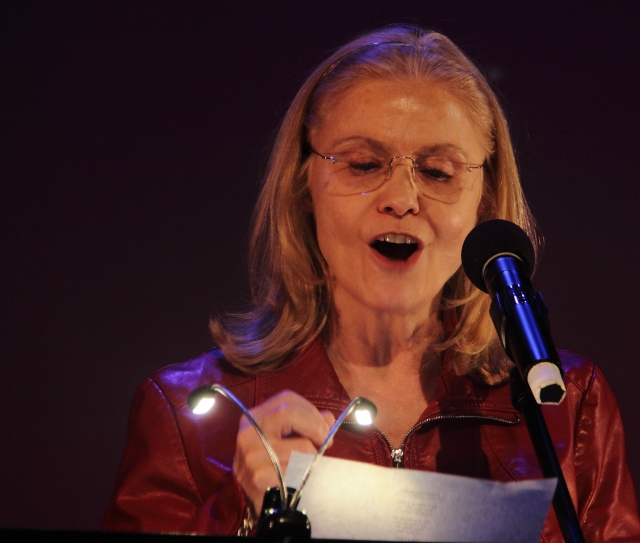
Next came another of the artists who appeared on the 10+2 anthology, Beth Anderson-Harold.  She was accompanied by Other Minds intern and percussionist, Michael Jones.  Beth Anderson, originally from Kentucky, exudes a sort of midwest wholesomeness that belies a complex and assertive artist.  She is now based in New York but has strong roots in the Bay Area having worked with Charles Shere, John Cage, Terry Riley, Robert Ashley, and Larry Austin.

Her performances of “If I Were a Poet” (1975), I Can’t Stand It” (1976), “Crackers and Checkers” (1977), “Country Time” (1981), “Killdeer and Chicory” (2005), “Ocean, Motion, Mildew, Mind” (1979), and “Yes Sir Ree” (1978) were delivered with a powerful energy and enthusiasm.  She seemed almost surprised at the warm reception her performance received.  It was yet another example of the incredible variety that this genre of music embodies.
OM230131

Anderson’s delivery was powerful, ecstatic, and assertive.
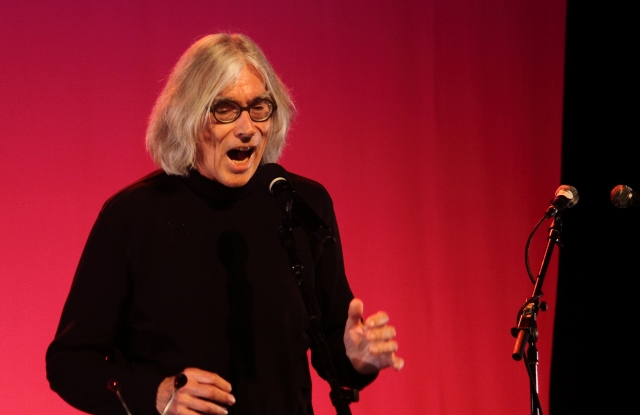
OM230133

This sixth day of the varieties of sound poetry was brought to a conclusion first with three tape works by fellow KPFA (1990-2005) radio producer Susan Stone.  The works presented were, “Couch” (from House with a View, 1989), “Ruby” (from House with a View, 1993), and “Loose Tongues” (1990).  All are basically Stone’s personal take on radio theater which she describes as, “Cinema in the Head”.  Stone took an all too brief bow to acknowledge the applause.
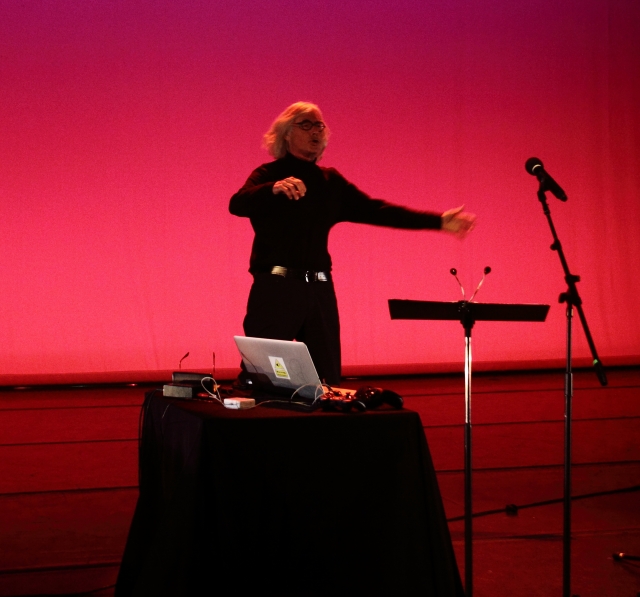
OM230135

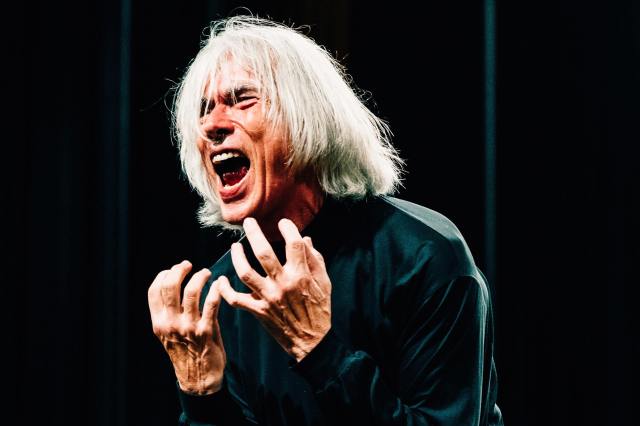
Though the audience’s attention seemed not yet to have flagged we were given an infusion of energy from the seemingly always energetic Jaap Blonk.  He presented six of his works to conclude the evening, “Dr. Voxoid’s Next Move”, “Onderland” (Underland, excerpts), “Rhotic (Phonetic Study #1, about the R), “Muzikaret (Music Made of Rubber)”, “Cheek-a-Synth (Solo for Cheek Synthesizer)”, and “Hommage à A.A. (for Antonin Artaud).
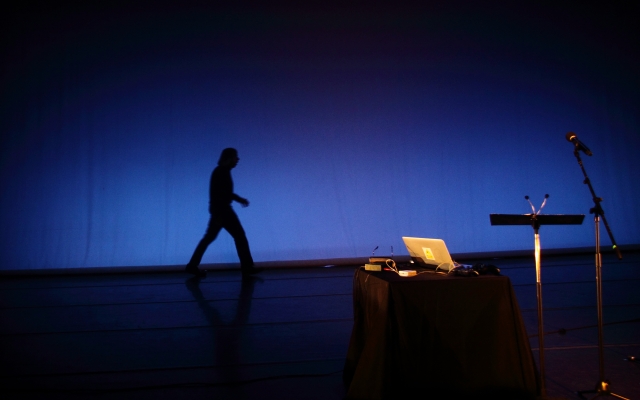
OM230137

Blonk’s seemingly boundless energy took him around the stage at times.

Blonk did a lovely thing to cap off this mind bending week (almost) of performances.  He engaged the audience in a call and response improvisation.  As these things generally go he began with fairly simple sounds and progressed to longer and more complex sound groupings which challenged the audiences attention and repetition skills, a task they/we performed with great joy and amusement.
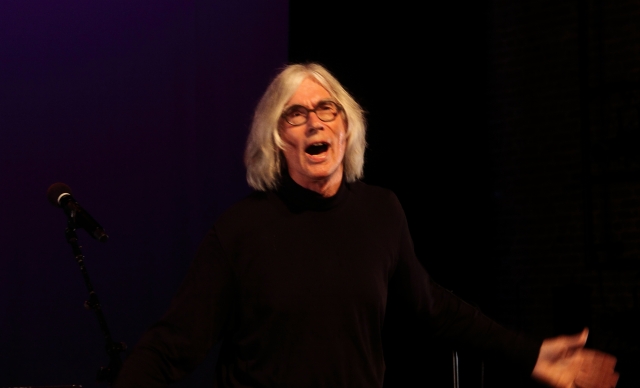
OM230142

Blonk leading the call and response performance with the audience which concluded the series.

Twenty performers, four of whom had appeared on that wonderful anthology, kept the ODC Theater packed to near capacity on all six nights.  That alone is a feat.  What cannot be satisfactorily communicated in a mere article is the energy and focus of both the performers and the enraptured audience whose attention never seemed to flag as they/we were lead down unfamiliar paths to little heard universes of ideas and sounds.

This expanded festival also included one of the most spectacular program books this writer has ever seen from Other Minds.  Mark Abramson did the eye popping graphic design which featured no fewer than four different covers and very useful texts and photographs documenting the works performed and their history.  The t-shirts were another of Carol Law’s successful designs.  These may be highly collectible and, as of this writing, are still available through the Other Minds website.

In an promotional article entitled, “Other Minds 23: In the Beginning was the Word” I obviously used a biblical quotation (John 1: 1 for those interested).  In fact the only religious thing going on here was the spiritual magic of astoundingly talented performers, and a mighty unusual gathering of Other Minds in terms of the enthusiastic audience.  But I would be remiss if I did not take note of the fact that this fabulous marathon was done in six days.  I’m guessing we all rested on the seventh.

Missa Charles Darwin: The Chicken or the Egg?


darwin

This is one unusual disc, not specifically due to the musical content actually but rather its back story.  Gregory W. Brown is a composer with a significant body of work to his credit.  He also happens to be the younger brother of author Dan Brown.  Yes, THAT Dan Brown, of DaVinci Code fame.

Now, at first glance, one notices that the CD states, “as featured in the Novel ORIGIN by Dan Brown.”  This reviewer’s initial assumption was that this music was written subsequent to the novel as a sort of “tie in”.  Well the fact is that the music preceded the 2017 book by some six years and was heard by the author who then incorporated it (initially unbeknownst to the composer) into a chapter of his novel, ORIGIN.

So what we have here is a sort of “tie in” but, more importantly an inspiration in part for the work which now incorporates it.  This reviewer has only read a brief summary of the elder Brown’s novel, enough to understand that one of the themes in the complex web of the story includes characters who are against organized religion.  This Missa Charles Darwin (2011), structured in the classical (or should I say, ecclesiastical) manner but incorporates texts from Charles Darwin’s writings into the conventional Latin texts.

Like his brother Dan, Gregory feels free to incorporate things heretical.  The fight between the Holy Roman Catholic Church and supporters of Darwin’s theories is well known and indeed ongoing.  By incorporating Darwin’s words amongst the ecclesiastical proclamations and adorations of the mass texts Brown creates a sort of philosophical critique to both provoke thought and entertain.

His choice to utilize a vocal quartet and his harmonic choices gives this work the ambiance of medieval and renaissance mass settings.  The younger of the Brown brothers utilizes a mix of past, distant past and present to create a sort of philosophical fiction not entirely unlike the techniques in Dan Brown’s novels.  The music is very listenable and never trivial.  It simultaneously transports the listener to the mystical feeling of an unnamed Cathedral in the 14th or 15th Century as well as to the 19th/early 20th Century science v. religion squabbles that plague us still.

Comment must be made about the beautiful presentation of this recording.  It is a box containing the CD and cards containing both art work and texts.  Included is a nice a photo of the two brothers.

Not having yet read the novel it is difficult to say with certainty what impact the music ultimately has on the experience but, like soundtracks that enhance the experience of a given film, this finely crafted music can only add to the experience.  Of course both novel and music will be able to stand alone on their individual merits.

This writer is given to wonder if further collaborations between these two may happen and the next Robert Langdon story might be heard in an opera house.  Go for it guys!


Indian Raags for Piano made easy


raags easy

Last year I reviewed Mr. Pitts’ How to Play Indian Sitar Raags on a Piano.  It was an enthusiastic review and the book continues to have a valued place on my piano as it opens a whole world of ideas.   Now the author has done a kind and useful service by issuing this simplified version of that work.

In fact this simplified version is more in line with the rather unpracticed keyboard skills of your humble reviewer.  The author chooses 6 raags or ragas which provide a good starting point for similarly humble musicians to begin this approach to Hindustani music.

Hindustani music became pretty much ubiquitous, or at least familiarly cliché in western musical culture largely due to the efforts of Indian musicians such as Ravi Shankar and Alla Rakha.  In fact it is an endlessly fascinating musical system whose logic has much to offer both musicians and composers.

In the past one had to learn traditional Indian instruments to gain much familiarity with these ancient musical systems but Pitts’ book offers an alternative to musicians whose familiarity is limited to the western keyboard.  Purists may denigrate this approach but even if it does not perfectly represent all aspects of Hindustani musical theory at least it provides a manageable entry point for amateur musicians and professionals alike.

Having struggled somewhat with the previous book I was particularly delighted to have these simplified examples which fall nearer to my skills level.  Even if I don’t wind up incorporating this into performance or compositional efforts I have no doubt that the exposure to the actual practice of this music will leave a valuable bit of programming in my neural circuits that will enhance my musical thinking and ability to appreciate other musics.

As with the first book, this too is highly recommended.  Kudos Mr. Pitts!

In the Beginning Was the Word: Other Minds 23


OM202006

Charles Amirkhanian performing one of his spoken word compositions at Other Minds 20 in 2015

Other Minds has been the the darling of composer/producer Charles Amirkhanian since its founding in 1993.  Along with television producer and arts patron Jim Newman he has presided over the 25 years of this renowned festival which has consistently brought the finest new music composers and performers to San Francisco.

There is little doubt that this year’s festival has to be very close to Amirkhanian’s heart.  Words have been central to his career at least since 1969 when he began his work as a producer at KPFA.  In the 23 years he spent there he presented countless hours of musical programming and interviews.  He crossed paths with most of the major stars in contemporary classical music and many stars whose genre may not be captured by the classical label.  A look at his programming choices and interviews from his time there defined new music for the Bay Area and beyond.  After his tenure at KPFA ended in 1992 he continued exploring cutting edge music and musicians bringing them to San Francisco for live performances.

His work as producer and curator has tended to overshadow his work as a composer, sound poet, and spoken word artist.  This year’s OM festival is dedicated to speech, sound poetry, and the spoken word.  It is about both the history and the present state of the art.  In many ways Amirkhanian’s 1975 release “10 + 2: 12 American Text Sound Pieces” on 1750 Arch Records (now on an OM CD 1006-2) can be seen as sort of the starting point for this festival.  This masterful anthology includes works by Charles Amirkhanian (1945- ), Clark Coolidge (1939- ), John Cage (1912-1992), John Giorno (1936- ), Anthony Gnazzo (1936- ), Charles Dodge (1942- ), Robert Ashley (1930-2014), Beth Anderson (1950- ), Brion Gysin (1916-1986), Liam O’Gallagher (1917-2007), and Aram Saroyan (1943- ).


“Word! Thou word that I cannot speak!

At the end of the second (and last completed) act of Arnold Schoenberg’s powerful opera “Moses und Aron” (1932) Moses sings, or actually half speaks and half sings this text lamenting his expressive deficits.  Speech song or, in German, sprechgesang is an invention by Schoenberg in which the singers are asked to find a point between speech and music.  Perhaps this is a good example of some of the artistic thinking going on at about the time when speech music/sound poetry began to take shape.

bio_schwitters_kurt

Kurt Schwitters (1887-1948)

Some of the history of sound poetry is featured in this unprecedented 6 day festival (April 9-14).  Some of the earliest practitioners of this unusual genre include the German artist Kurt Schwitters whose composition Ursonate (1922-32) will be performed in its entirety, a rare event by itself.

Another early gem will be the Spoken Music (1930) by German-American composer Ernst Toch.  This three movement suite has been known for its last movement, the Geographical Fugue.  The other two movements, once thought lost, were discovered in sketches in 2006 and reconstructed by Christopher Caines.  The now complete version will be presented I believe on day 3.

Composer-Ernst-Toch-810

Ernst Toch (1887-1964)


It is beyond the scope of this blog post to tell the history of text sound so I will refer readers to the Other Minds website for further details.  Or you could come to the festival too I suppose.

With due respect given to the past the festival will move on to the present.  San Francisco Beat Poet Michael McClure (1932- ) will make an appearance as will post beat colleagues Anne Waldman (1945- ), Clark Coolidge (yeah the guy from that cool anthology), Aram Saroyan (another guy from the classic text sound disc).

curran20160010

Alvin Curran in conversation last year in Berkeley.

Other Minds alumnus Alvin Curran (1938- ) will be premiering his collaboration with Clark Coolidge entitled, Came Through in the Call Hold.  Curran’s eclectic sensibilities will doubtless result in an interesting composition.  This event alone, at least for this writer, is worth the price of admission.  And this is just the first day!

Other events include workshops, discussions of the history of the art, and even some curious variations on a theme.  Apparently the writer Lawrence Weschler is the grandson of Ernst Toch and has written a variation on the Geographical Fugue called, The Medical Fugue which will be premiered at this festival.

The increasingly ubiquitous pianist Sarah Cahill will be present to perform Virgil Thomson’s unusual but entertaining setting of a Gertrude Stein (a one time Oakland resident) text called Capital, Capitals.  She will accompany the men of the Other Minds Ensemble.  Jaap Blonk will be tasked with performing Schwitters’ Ursonate and, along with Enzo Miranelli will also perform other historical works including some by a couple of Italian Futurists.

Other Minds Administrative Director Randall Wong will end the evening by undertaking a performance of the late great Cathy Berberian’s Stripsody.  That promises to be a wild evening I think.

blonk_75_2500crop

Jaap Blonk (1953- )

Northern Europe, including the Netherlands and the Scandinavian countries will literally have their day.  As it turns out they are doing a great deal of creative work in this increasingly diverse genre of speech music.  Other Minds is at its best in introducing the new and the innovative from wherever Charles’ radar has tracked it down.  Indeed Mr. Amirkhanian and his wife, artist/photographer Carol Law traveled throughout these regions in the early 70s talking with and learning from these diverse artists.  (Amirkhanian’s work, Just was recorded in a Scandinavian studio during one of those trips).

As usual homage will be paid to the past with some recorded classics by Sten Hanson, Åke Hodell, and Lily Greenham.  Some new voices will be introduced including Tone Åse and Sten Sandell.  The Norwegian/Russian-American duo OTTARAS (consisting of visual poet Ottar Ormstad and composer Taras Mashtalir will also perform.   One can fully expect a mind expanding experience which will redefine the possibilities of the art form.

Auspiciously or perhaps dangerously Friday the 13th has been reserved for Bay Area talents.  First up will be the man of the hour, Charles Amirkhanian.  Hearing him do his work live is an uncommon but entirely enjoyable experience.  If that alone weren’t enough we will get to hear the even rarer public collaboration between him and his life partner Carol Law whose photography and collage work deserves wider recognition and will happily get that here.

Amy X Neuberg

Amy X Neuberg.

Trained in both linguistics and music, Amy X Neuberg will be on hand to perform her indescribable electronic cabaret including the world premiere of “Say it like you mean” and other genre bending work.  She is another valued Other Minds alumnus having given numerous performances at the festivals.

Stanford professor Mark Applebaum, another alumnus will present “Three Unlikely Corporate Sponsors” which premiered at Stanford in 2016.  Enzo Miranelli will conclude the evening with his theatrical combination of movement and text in “Fame: What I Want to Say”.

20130218-132303.jpg

Pamela Z

The festival concludes on Saturday April 14th with Jaap Blonk followed by the wonderful San Francisco based Pamela Z who, like Neuberg uses electronics, but creates her own unique sound world.  She too is an alumnus of Other Minds.

Another composer from that great anthology, Beth Anderson, will make an appearance to perform “If I Were a Poet”, “I Can’t Stand It”, and “Ocean Mildew Minds”.

The finale will feature Susan Stone and Sheila Davies Sumner performing excerpts from two works, “House with a View” and “Loose Tongues” both dealing with the lives of working class southern women.

This will be both a feast and a marathon but it promises to be one of the finest Other Minds productions maybe ever.  Come to be entertained, come to be challenged, come to expand your mind.  You’ll never be the same.  See you there.

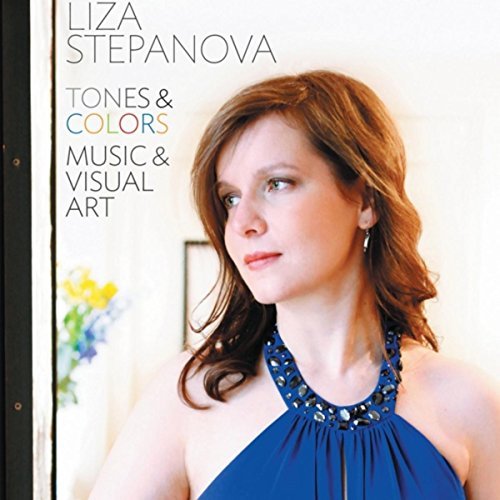
300 Years of Virtuosity, Liza Stepanova’s Tones and Colors


stepanova

Concert Artist Guild CAG 120

This is the solo piano debut of this talented and incredibly virtuosic artist.  This hard working pianist can be heard on a previous CD (After a Dream) with the Lysander Piano Trio.  Her web site can provide a good idea of the range of solo, chamber, and orchestral music in her repertory.

This CD is a good example of creating a brand, a practice which seems to be the current rage especially among artists who specialize in new music.  I have previously commented on the brands of pianists like Sarah Cahill, Kathleen Supové, Nicolas Horvath, and Stephane Ginsburgh to name a few.  All are amazing musicians but each seems to have been able to carve out an identifiable niche which sets them apart from each other and defines their various artistic missions.  Granted these are soft definitions in that they do not preclude them from playing anything they choose but it gives audiences a sort of general idea of what to expect when they do a program.

Liza Stepanova appears to have chose virtuosity as her signature.  She plays what sounds like fingerbreakingly difficult music with both ease and expressiveness.  Here she chooses to basically survey virtuosity from J. S. Bach to György  Ligeti.  In addition she has chosen to pair each composition with an analogous piece of visual art.

The pairing of music and visual art is as old as dirt and has always seemed to have an inherent validity.  Tone poems like Mussorgsky’s Pictures at an Exhibition or Debussy’s Clair de Lune are familiar examples of music as a visual analog.  But music sometimes suggests pictures even if it was not the stated intent of the composer too.  Stepanova covers the visual territory from the representative to the abstract in this entertaining collection.

Perhaps the most interesting aspect of this recording is the pianist’s choice of music.  She does go with the familiar at times such as Debussy’s Goldfish but the majority of this disc contains music that is seldom heard by lesser known composers such as Maurice Ohana (1913-1992), Joaquin Turina (1882-1949), Fanny Hensel (1805-1847), and Lionel Feininger (1871-1956).  There are better known names such as Enrique Granados (1867–1916), Bohuslav Martinú and Leopold Godowsky (1870-1938).  And the most familiar names such as J. S. Bach (1885-1750), Franz Liszt (1811-1886). Claude Debussy (1862-1918), George Crumb (1929- ), and György Ligeti (1923-2006).

There are 13 tracks grouped into 4 visual art themes (A Spanish Room, Nature and Impressionism, Conversations Across Time, and Wagner, Infinity, and an Encore).  The only problem I have here is the photos of the art (which thankfully are included in the little booklet) are necessarily small and really don’t give the consumer the full intended effect.  One would do well to obtain some art books or some larger prints of these to gain the intended effect.

I won’t go into detail about each individual piece.  Suffice it to say that they are all technically challenging and intelligently chosen pieces.  This is a very entertaining program from this emerging artist.

This reviewer is given to speculation as to Stepanova’s next release.  Perhaps Sorabji with some Dada works?  Whatever it is will doubtless be as interesting and entertaining as this disc.  Brava, Ms. Stepanova!


The @realAlvin Curran at the Armory


curranfake0005

Alvin Curran performing from his “Fake Book” at the Pacific Film Archive in Berkeley in 2014

Alvin Curran (1938- ) is  one of the finest of that maverick band of composers who came of age in the 1960s as expatriates in Italy.  Along with musicians like Frederic Rzewski, Carol Plantamura, Richard Teitelbaum, and Allan Bryant among others they formed the world’s first live electronic improvisation ensemble, “Music Elletronica Viva” in 1966.  In this time electronic synthesizers were not generally available and most of their equipment was hand made.  All the musicians have since all gone their own very creative ways but in many ways this ensemble has been their touchstone which continues to underlie their work.

Curran told this writer that it was around this time that he began working on a huge series of compositions of (at least initially) an improvisational nature which he collected under the general title of “Fake Book”.  Musicians will be familiar with the term which is roughly analogous to a cheat sheet enabling musicians easy access to many chord progressions, songs, and other pieces at their fingertips to please a wide range of tastes in their audiences.

curranfake0012

Curran’s Fake Book is a huge collection of scores, digital samples (no doubt he began with analog samples) and sketches.  He recently published a hefty selection of this material available on Amazon and is well worth both your time and your money for the insight it provides to this unusual composer.  The composer’s web site is an extremely useful reference but nothing can match hearing and seeing this spirited, kinetic shaman of a performer.  His creativity and sheer joy of music making is infectious and the music he makes is akin to reading diary excerpts, a musical analogy of sorts to the likes of Anais Nin, the famed mega-diarist of a previous generation.

Curran is, at 80, an energetic and endlessly creative musician, a humanist with deep convictions and quite simply an experience not to be missed.  Here is the announcement of this concert which, though this writer is unable to attend, is not to be missed.

Alvin Curran
performs
“The Alvin Curran Fakebook”
on shofar, piano, keyboard, and electronics
at the Veterans Room
Thompson Arts Center at Park Avenue Armory
643 Park Avenue (66th-67th St.)
Wednesday March 14, 2018, at 7.00 pm & 9.00 pm
or call the box office (212) 933-5812 Mon-Fri, 10.00 am-6.00 pm

Lara Downes’ Bernstein Tribute


lenny

Lara Downes is one of the finest pianists working today.  Her virtuosity and interpretive skills are well established.  She is well versed in the standard repertoire of classical piano music but has chosen to blaze her own unique path in her recorded legacy.  Here she pays homage in her own unique manner with help from some interesting fellow musicians.

The album consists of 29 tracks none of which lasts more than 4 minutes.  Many are by Bernstein including a generous selection of his Anniversaries, each dedicated to a particular person. Some were written in celebration, some in memoriam. Time marches on and we now celebrate the 100th anniversary of Lenny’s birth. So, of course, all these tracks are in memoriam now. In addition to the all too seldom heard Anniversaries there are a few song transcriptions and a nice selection of Anniversary like pieces contributed for this album by a delightful selection of composers including John Corigliano, Lukas Foss, Michael Abels, Ned Rorem, Ricky Ian Gordon, Eleanor Sandresky, Shulamit Ran, Stephen Schwartz, Marc Blitzstein, Theo Bleckmann, and Craig Urquhart.

This album is (thankfully) not a greatest hits collection but rather, as it’s subtitle says, an intimate tribute by people who were affected by Bernstein in one way or another. Bernstein cut a wide swath of influence embracing new music, mastering the established western classical canon, and embracing jazz, blues, and musical theater much like Ms. Downes actually.

Most of the album is solo piano where Downes casts a loving and magical spell. A few judiciously chosen tracks feature banjo virtuoso Rhiannon Giddens, baritone Thomas Hampton, and two musicians unknown to this writer, Javier Morales-Martinez and Kevin “K.D.” Olusola.

My first listen to this album was an uninterrupted one while driving South from San Francisco. The impression was one of Bernstein’s multiple voices being present seamlessly in every track. Only later reading the liner notes did I become aware that some tracks were written by others.

This is an intimate celebration in honor of a musician who touched so many lives.  Many of the artists on this recording knew Bernstein to some degree but the point here is that Bernstein’s art is so pervasive that few can say they have not been touched by it to some degree.  This listener was brought to nostalgic tears a few times.

In keeping with Downes’ eclectic style this is an unusual selection of pieces, most by Bernstein but all imbued with his spirit, a combination of classical sensibilities with a real feel for jazz, blues and the American musical theater.  This disc contains most, if not all of Bernstein’s “Anniversaries”, short piano pieces written variously in honor of or in memory of many of his friends.  Other pieces are by contemporaries of Bernstein and some were written for this recording.  Add to that a few interludes such as Thomas Hampson coming in to sing, “A Simple Song” from Bernstein’s “Mass”, K.D. Olusola riffing on the familiar “Something’s Coming” which opens the disc, Javier Morales-Martinez spicing up “Cool” from “West Side Story” with his clarinet and Rhiannon Giddens sounding so pretty on the track of that title.

This is a love fest and it, appropriately, covers generations much as Lenny affected so many generations whether through his wonderful work as a conductor or his classic musicals and operas that are indeed the American grain incarnate.  And Lenny was also a teacher to children and to adults.  From the Young Peoples Concerts to the Harvard Norton Lectures he thought deeply and taught and stimulated ideas.  Generations have been forever changed by him.

The bulk of this recording depends on Lara Downes amazing virtuosity bringing these brief little poems to life most convincingly and almost magically.  She clearly has a real feel for this music.  This is mostly not the familiar Bernstein that everyone knows.  It is a portrait such as listeners familiar with Downes’ work will recognize, eclectic, intelligent, sometimes nostalgic, a little obscure, frequently virtuosic, and ultimately satisfying.  The disc lists the performers as, “Lara Downes and friends” and that is the feeling of not just the performers but also of the composers whose heartfelt contributions fit so well in this eclectic mix.

This disc represents Downes’ debut on Sony and the only thing this writer can say to that is, “What took them so long?”  Brava!  And cheers to Lenny on his 100th.

The Alchemy of Diversity at Sound and Savor


bialys

Freshly baked bialys right out of the oven opened the brunch.

This is another in the continuing account of my encounters with Philip Gelb’s underground vegan salon now called Sound and Savor.  For some twelve years now he has hosted a series of dinners, brunches, and cooking classes.  Many of the multi-course meals also feature some of the finest musicians, many from San Francisco and the east bay.

Today’s brunch started with fresh brewed coffee with a dollop of ginger (vegan) ice cream along with fresh baked bialys with cashew cream, pickled red onions, and “carrot lox”.  So we began with a vegan Jewish theme.  Needless to say these were delicious and the coffee helped waken anyone not ready for this 11AM start.

img_0204

The next course was a similarly delicious borscht (beet soup) with beet pakoras.  And clearly Phil has introduced this traditionally Indian dish which worked remarkably well with that soup.  Again all were hot out of the pot/fryer clearly in our view.

As Phil performed his culinary alchemy in the kitchen we were most attentively served by his assistant for this meal, Letitia, a smiling joy of a woman who seems to have the knowledge and genuine caring of customer service in her blood.  She was equally attentive to all in the crowd of about twenty diners with the usual mix of familiar faces and few new ones.  Indeed the beautifully presented courses came at just the right pace.

img_0205

The main course in this brunch was a Potato-Onion Tortilla, blood orange salad.  And once again the diversity of cultures mixed to truly savory results as the friendly conversations flowed.  At this point even the hungriest would hope for a pause and that’s exactly what happened.

img_0210

With a judicious touch of rearranging Phil prepared a performance space for the three musicians who graced us on this beautiful sunny Oakland day.  Jay Ghandi, bansuri (Indian Flute), Sameer Gupta, tablas (a staple of Hindustani music), and David Boyce, saxophone and bass clarinet (need I say a staple of jazz?).  The alchemy of the food would now find an analogy in this jam session.  Boyce and Gupta had played here about a year ago and Ghandi is a frequent collaborator with both musicians.  All three had played yesterday in San Jose and were scheduled to play in San Francisco at the Red Poppy Art House.  They are touring to promote their recent release A Circle Has No Beginning.  These are just three of the musicians who participated in this crowd sourced disc which is itself worth your attention.

The energy was immediately palpable as seen in this excerpt from one of three pieces they played.

This last excerpt demonstrates the ease of communication between these musicians who blend diverse backgrounds of jazz and Hindustani musics seamlessly into something new and wonderful.  The audience was energized to a level beyond what coffee could do and broke into appreciative applause after each piece.

The brunch ended with a dessert of (again fresh baked) Citrus Semolina Cake and more of that delicious coffee and ice cream.  And, of course, more conversation.

These events have become a regular part of this writer’s recreational time and a real reason to celebrate living in the diverse and creative east bay.  Phil’s judicious blend of cultures in his culinary experiments provide a parallel to his curation of some of the finest musicians with the only purpose in both case to entertain and enlighten.  He achieved both is a big way this day.  Thanks to all who participated.

Marin: An Unknown Danish Master Gets His Due Marvellously


marin

I have made no secret of my passion for the music which has been coming out of the Scandinavian portion of our planet.  My knowledge of these musical traditions is mostly limited to the twentieth century up to the present but what a horn of plenty there is to be had.  There are so many composers that it is forgivable if one of them fails to get worldwide attention and acclaim during their lifetime.  Or is it?

Well if sins of omission that have been committed all can now be forgiven and the memory of Axel Borup-Jørgenson (1924-2012) is likely guaranteed to remain solidly in the history of music of the twentieth century.  The Danes take their music very seriously it seems (check out the You Tube Channel for the Danish National Symphony Orchestra if you don’t believe me) and producer Lars Hannibal and his crew have labored tirelessly to bring this formerly obscure master most deservingly to light in this DVD/CD combo pack featuring some of his finest works.

This truly major release contains a DVD with a gorgeous animated feature synced to the late composer’s swan song big orchestral piece, Marin op. 60 (1963-70) a really beautifully produced documentary (“Axel”) on the composer featuring some of his fellow composers including, Finn Savery, Pelle Gudmunsen-Holmgreen, Bent Sørensen, Sunleif Rasmussen, Per Nørgard, Gert Mortensen, Ib Nørholm, Michala Petri, and producer Lars Hannibal along with family and other musicians and producers.

The animated feature looks like one of the finer entries one might find on Vimeo.  The animation was done by Lùckow Film and works well with the music.  The biographical feature does a spectacular job of placing the composer in context with his Nordic contemporaries and with contemporary music in general.  The people interviewed give about as definitive a description of the man’s work as can be done in a film biography and the intervening or connecting scenes bespeak a high level concept of cinematography that makes this film both compelling and a delight for the eyes as well as the mind.  The concept of the composer’s use of silence as a compositional tool seems to be reflected in these transitional scenes.

The CD consists of seven carefully selected pieces on seven tracks.  The disc opens with the big orchestra piece which was heard behind the animation on the DVD, Marin Op. 60 (1963-70) followed by Music for Percussion and Viola Op. 18 (1955-56), For Cembalo and Orgel Op. 133 (1989), Nachtstuck Op. 181 (1987) (played here by the composer’s daughter, Elisabeth Selin), Winter Pieces Op. 30b (1959) for piano, Pergolato Op. 182 (2011) for treble recorder, and Coast of Sirens Op. 100 (1980-85) for flute, clarinet, violin, cello, guitar, piano, percussion, and multivoice tape.  This is truly a balanced portrait with examples of orchestral, solo instrument, keyboard, chamber and electroacoustic works from 1959-2011, a more than fair sampling of the composer’s output both by genre and by time.

The music seems to move between post-romantic tonality and expressionistic experiments such as one hears in the music of Gyorgy Ligeti.  The music is evocative and very listenable especially if one avails one’s self of the introductory film.  It certainly seemed to tune this reviewer’s ears properly.  It is helped as well by some very fine recordings that capture the subtlety of the composer’s work.

Lars Hannibal is clearly the guiding hand in this project but his genius (he is a fine guitarist as well as a producer) is his ability to engage all these fine musicians, artists, producers, and family in what is one of the most loving portraits this writer has ever seen.  Now that is the way to blast someone out of obscurity forever.

And this is but one entry in a larger project to record the composer’s complete output.  Two previous releases were reviewed on this blog and, presumably there are more to come.  But in the meantime there is much to savor here and one hopes that this will introduce this music into the general repertoire.  I’m sure Axel would be pleased to be placed as he is now among the masters of Danish composers.


The Heresy and the Ecstasy: Brooklyn Raga Massive Does “In C”


brminc

This is heresy.  It is not, strictly speaking, faithful to the 1964 score and it is a sort of cultural appropriation which is actually the very basis of Brooklyn Raga Massive, a sort of latter day “Oregon” (to those who recall that band) which takes on all sorts of music and filters it through the unique lens of this flexibly populated group of musicians whose backgrounds range primarily from Hindustani and Carnatic traditions (though hardly in the most classical sense) but also from western classical and jazz.  Their “heresy” comes from their choices.  The root of heresy is the Greek word, “hairesis” which means choice.  There is a lovely selection of their musical heresies on their You Tube Channel.

No this is not purely heresy and it is certainly not blasphemy.  Quite the opposite actually.  And I would prefer to think of this effort as cultural integration.  The choices made here instead lead to some mighty ecstatic music making which pays honor to Terry Riley who turned 80 in 2015 and provides a unique perspective on this classic work.

“In C” (1964) is without doubt Riley’s best known work by far and the one which pretty much defined what would later become known for better or worse as “minimalism”.  It is an open score meaning that no instruments are specified for performance making this music heretical in nature as well.  In addition there is no conductor’s score as such.  Rather there are 53 melodic cells numbered 1 to 53 and the ensemble is held together by the expression of an 8th note pulse played by at least one of the musicians involved.  The defining reference on the intricacies of this work is composer/musicologist Robert Carl’s masterful book entitled simply, “In C”.  He describes the wide variety of potential choices which can be made in performance and the different results which can be achieved.

There are a great deal of recordings available of this work from the first (released 1968)  on Columbia’s “Music of Our Time” series curated by the insightful David Behrman to versions involving a wide variety of instrumental combinations of varying sizes.  The first “world music” version this writer has heard is the version for mostly percussion instruments by Africa Express titled, “In C Mali” (released in 2014).

Not surprisingly BRM, as they are known, have chosen a largely Hindustani/Carnatic take on this music.  The unprepared listener might easily mistake this for a traditional Indian music recording with the introduction which incorporates a raga scale and adheres to the traditional slow free rhythm improvisation of the introductory “alap” section common to such traditional or classical performances.

The familiar sound of these (largely) South Asian instruments with their rich harmonics sets the tone gently.  This writer has at best a perfunctory working knowledge of these complex and beautiful musical traditions but one must surmise that the choice of Raga Bihag may have some intended meaning.  Indeed such music is by definition integrated into the larger cosmology of Hinduism, the Vedas, the Gita, the Sanskrit language, and, no doubt other references.  This is not discussed in the brief liner notes but is worthy perhaps as a future interview question.

It appears that many of the musical decisions were made by sitarist Neel Murgai though it becomes clear as the performance develops that individual soloists are allowed wonderful improvisational freedoms at various points.  The recording is intelligently divided to let the listener know which set of melodic cells is being expressed at a given time.

The alap gives way to the sound of the tablas which initiate the pulse mentioned earlier.  The structure of this piece produces a range of musical experiences from a sort of didactic beginning to the swirling psychedelic waves of sound which stereotypically define much of the music born in the mid 1960s in this country.  In fact Terry Riley’s deep study of South Asian musics (most famously under vocalist Pandit Pran Nath) did not occur until later in his career.  Nonetheless there seems to have always been some affinity between Riley’s vision and the sort of music whose popularity was driven in the United States most famously by the efforts such as Pandit Ravi Shankar and Ustad Alla Rakha in the 1970s.

What follows is a riot of musical ecstasy involving some inspired improvisational riffs and some stunning vocalizations as well giving us a fascinating take on this music which was written well before these musicians came into the world.  We have a later generation paying homage to the beloved American composer and to the beautiful traditions of their own eclectic ethnic heritage.

The set concludes in this live and lively recording with a traditional fast paced Jhalla, the traditional ending to classical Indian musical performances. This will likely become known as the “Indian” recording of “In C” but it is so much more than that.  It is an homage.  It is a look back from the view of at least a couple of generations of artists.  And it is heresy in the best sense of that word, choices made judiciously to achieve higher artistic goals.  Not all art is heresy and not all heresy is art but the heresies perpetrated here definitely deserve our ears.

The heretics are: Neel Murgai, Sitar and Vocal; Arun Ramamurthy, Violin; Andrew Shantz, Vocal; Josh Geisler, Bansuri; Sameer Gupta, Tabla; Roshni Samlal, Tabla; Eric Fraser, Bansuri; Timothy Hill, vocal; Trina Basu, Violin; Ken Shoji, Violin; Kane Mathis, Oud; Adam Malouf, Cello; Michael Gam, Bass; Lauren Crump, Cajon; David Ellenbogen, Guitar; Max ZT, Hammered Dulcimer; Vin Scialla, Riq and Frame Drum; Aaron Shragge, Dragon Mouth Trumpet.

Namaste, folks.


Sarah Cahill et al: By and for Terry Riley


Sarah Cahill - Eighty Trips Around the Sun- Music by and for Terry Riley - cover.png

Had to save this one for Christmas.  If ever there was an album that conjures more of the positive intents of the Christmas season this one gets my vote.  Imagine celebrating a living acknowledged master artist in a milieu of his actual and artistically extended family.  That may seem an extreme notion to some but this writer is utterly charmed and thrilled to hear this “one of a kind” collection.  Other interpretations will, of course, be valid but none will ever match this one.  It’s like the Carter family of the avant-garde (and I mean that unambiguously with great respect).

Any release by Bay Area pianist Sarah Cahill is reason enough alone to perk up one’s ears but this massive four disc collection of all new recordings in honor of Terry Riley’s 80th birthday (Terry was born in 1935) is a major release of (almost) all of Riley’s music for piano, piano four hands and two pianos.  In addition two of the discs are dedicated to pieces commissioned in honor of Riley.  This set belongs in the collection of anyone interested in mid to late twentieth century music and especially fans of minimalism and the curiously west coast iterations of modernism.

As a listener I have always treated every Terry Riley release as a major event as well and this collection does about as fine a job as one can imagine in paying homage to one of the brightest artistic lights of the Bay Area.  Riley came to prominence (at least historically speaking) with his open score piece, In C (1964).  It is among the earliest examples of the style which, for better or worse, became known as “minimalism”.  Since then he has continued to produce music in pretty much all genres, chamber music, orchestral music, solo music, concerti, etc.

Riley’s style, however, continued to evolve and his later works show diverse influences from his days playing barrel house piano, his interest in progressive jazz, and his studies of Hindustani and Carnatic musics (under the tutelage of Pandit Pran Nath).  Like pretty much every composer of that first wave of “minimalists” Riley has evolved a much deeper and individualized style but, even with the diversity of influences as mentioned, he remains uniquely Terry Riley.

Throughout his career as composer and performer Terry has been a teacher and an advocate of new music.  His enthusiasm and talent has affected all who know him and, I dare say, all who have experienced his work.

This collection ranges over his entire career from the early “Two Pieces” (1958/9) to later solo and four hand compositions on the first two discs.  It is worth noting that Be Kind to One Another (2008/14) was one of the commissions in Sarah Cahill’s wonderful series of anti-war pieces, “A Sweeter Music”.  It then goes on to the homages which, of course, can also be said to be influenced by Riley’s work.

This is not simply a collection of Riley’s piano music.  What we have here is a lively celebration of most of Riley’s music for piano, two pianos and piano four hands from the full spectrum of his career (as the liner notes say a couple of large compositions were not included, most likely a matter of space) along with a touching set of homages by composers related musically and aesthetically to Mr. Riley.  They range from contemporaries to students, artistic descendants to actual family.  It is a multi-generational tribute and a loving artifact that celebrates this artist on a very personal level.

Regina Myers supplies the other two hands in the disc of four hand piano pieces by Riley.  She credits another Bay Area composer/teacher/conductor, the Mills College based Steed Cowart for recommending her for this crucial role.  Such touches add to the sense of this being a Bay Area family project on so many levels.

The interrelationships that comprise this lovely production make it stand distinctly apart from the (no less significant or lovely) homages to fellow minimalists Philip Glass and Steve Reich.  This is a much more personal album which reflects Riley as composer, teacher, inspiration, father, icon and friend.  Anyone who has met Terry or experienced him in performance has experienced a certain warmth like that of a wise and gentle guru.

After the two discs of Riley’s music we are treated to music inspired by another generation of artists and, last, by long time colleague, the late great Pauline Oliveros (1932-2016), another wise and gentle guru who died just about a year before the release of this album.  She and Terry worked together (along with Morton Subotnick, Ramon Sender, Steve Reich, William Maginnis, and Tony Martin) as founders of the San Francisco Tape Music Center which would become the Mills College Center for Contemporary Music (still operating today).  The producers wisely dedicated an entire disc to one of Oliveros’ last compositions, this loving tribute to her friend and colleague. It is now, sadly, a tribute to her memory as well.   Samuel Adams shares the performing duties along with Ms. Cahill on this extended homage.

There is little doubt that the other composers whose music graces this tribute will continue on their unique paths to continued success always acknowledging their connections to Mr. Riley.  Danny Clay is among the less familiar (to this reviewer) names here but his Circle Songs seem to fit quite well to open the first tribute disc.  Gyan Riley is, of course, one of Terry’s children and a fine guitarist and composer  in his own right.  Anyone who has had the pleasure of seeing Gyan and Terry play together cannot miss the close bond personally and musically of these two.  They are a joy to behold.  The affectionate Poppy Infinite is a reference to the elder Riley’s Poppy Nogood’s Phantom Band which was the “B side” of his classic Rainbow in Curved Air.  Samuel Adams is the son of Pulitzer Prize winner John Adams whose early work China Gates was written for and championed by his fellow classmate at the San Francisco Conservatory, Sarah Cahill.  The younger Adams’ contribution here is called Shade Studies.

The eclectic Christine Southworth also seems to embody the (perhaps loosely defined) West Coast style.  Her interests in electronics and world music describe this superficially but her sound is a welcome one here as well.  Keeril Makan earned his PhD. in music at Berkeley which doubtless has left a stamp on his style.  His composition “Before C” makes reference to what is doubtless Terry Riley’s best known work, the oft performed, “In C”.  Elena Ruehr is a composer whose connection is not as clear as some of the others here but her work, “In C too” demonstrates her understanding of and her respect for Riley’s work.  Last on this disc of tributes is Dylan Mattingly.  He is a Berkeley native and can frequently be seen/heard performing in various venues in the Bay Area.  His contribution YEAR demonstrates both his individual style and his connection to the West Coast Style mentioned earlier.

The liner notes by Sarah Cahill are part of the tribute and a good description of the various influences behind the man of the hour, Terry Riley.  Credit is properly given to the artistic influences that inspired Mr. Riley and a brief description of what must have been an intimidating but loving project.  It is likely that there are even more connections involved in this undertaking but that must be left to future musicological and historical research.

The Kronos Quartet has long ago championed Riley’s work for that medium and new versions of his classic, “In C” continue to come on the scene.  One can only hope that the energy embodied here will inspire recordings of some of Riley’s lesser known work with orchestra which richly deserves hearings.  But regardless there is much to celebrate here and best holiday wishes go out to Mr. Riley and his talented progeny.  Happy listening, all.


LA Percussion in High Definition


Having been a bit overwhelmed with a LOT of percussion recordings lately I placed this Los Angeles Percussion Quartet recording a bit further back in my review queue.  My apologies but I did it because I really wanted to give this recording my full attention and then to have something useful to say.

So I listened.  I put this on in my car when making a trip long enough to allow me to hear one of the two discs without interruption.  And I chose a relatively non-distracting drive in which I could actually pay attention to the music without incurring some danger on the road.

Of course the first thing that strikes the listener here is the lucidity of the recording.  Sono Luminus is showing off their signal processing prowess as well as their sensitivity with things like microphone placement and all the things that only great engineers know.

Let me make one thing very clear.  I am not a fan of sonic spectacle for its own sake.  I recall one incarnation of vinyl/analog fetish releases which a friend drooled over but whose content bored me to death.  Fortunately Sono Luminus seems to be steering clear of that sand trap.

This two disc set (well, three if you count the Blu-Ray Audio disc) collects music by largely little known composers (at least to these ears).  But fear not, this is not music that sounds like someone knocked over the stainless steel pot rack at Sur le Table.  Quite the opposite.  This is some intelligent music which compels the listener to stick with each piece and follow its development.  This is apparently the fourth album by LAPQ, the previous three also being Sono Luminus productions.

The first disc begins with the first of two Icelandic composers both of whom were represented on a previously reviewed discDaniel Bjarnason is a conductor and composer and his Qui Tollis, a work of wide dynamic range and a variety of moods from more assertive to more contemplative.  The second work is by the current darling of Icelandic classical music.  I am speaking, of course, of the very talented Anna Thorvaldsdottir.  Her work, Aura, is more consistently contemplative in nature and, like all her work, the listener is rewarded for paying close attention as she weaves magical impressionistic tapestries.

Memory Palace by Brooklyn based Christopher Cerrone piqued serious interest in this listener.  This man would seem to be a composer whose work deserves watching/listening.  This five movement suite for percussion indeed makes for compelling listening as he moves through a variety of moods and isn’t afraid of frank melodic invention during the journey.  This does not strike this reviewer as run of the mill percussion music (not that the preceding two works did either).  Rather this work suggests a distinctive compositional voice worthy of further attention.  Mr. Cerrone’s collection of awards including a Rome Prize and a runner up for a Pulitzer Prize suggests that he will be heard from again soon.

Fear-Release by Ellen Reid is a shorter though no less rewarding journey down yet another compositional path for percussion.  At just short of nine minutes this is a compact movement which relies on a fairly wide dynamic range and strategic use of silences and is a fitting close to the first disc.

The brief, rather poetic, liner notes draw a parallel between the multiplicity of languages found in the Los Angeles area and the multiplicity of musical languages found on this recording.  Indeed these are distinctive voices that extract a wide variety of sound from this percussion quartet.  This reviewer is somehow strongly reminded of Nexus, the Canadian percussion group which dominated the 1990s for a bit.  The similarity is in their enthusiasm and in their musical skills.  LAPQ is a distinct ensemble in its way and is a group that is not shy to be innovative.

I have to say, though, that I could have used a great deal more info and commentary on these compositions.  As one would benefit from multilingual dictionaries in Los Angeles the listener could gain much from learning more about the structure and intentions behind these fascinating compositions.  And, unless I have failed to find them (I looked closely) the liner notes carry lovely photos but fail to name the musicians whose sound was so lovingly preserved.  They are: Matt Cook, Justin DeHart, Nick Terry, and Justin Hills.

The concluding work coming in at almost 40 minutes is divided into tracks but is in fact one large movement.  It is probably the most contemplative work here though it has some pretty assertive moments.  I Hold the Lion’s Paw by Andrew McIntosh is a great show piece for demonstrating the range of these musicians.  Though continuous this piece delves through a variety of moods and uses apparently a wide variety of instruments as well.

Fans of percussion will love this disc as will fans of audio porn (there is something erotic about technology for the ears).  This is not easy listening and though seeking innovation makes no moves toward populism.  This is serious music making.


Areon Flutes: Thriiive


areon

Innova 955


Multiple similars seems to be a meme in contemporary music.  The notion of using an ensemble of the same or similar instruments is most frequently encountered in teaching situations where music departments have enough students to form trombone ensembles, cello ensembles, etc.  But such combinations had been far less common in the concert hall until fairly recently.

Henry Brant was certainly an outlier when he wrote his Concerto for Flute and Flute Orchestra (1931) but the notion of a large ensemble of similar instruments developed further in the 20th century.  Brazilian composer Heitor Villa-Lobos in his Bachianas Brasilieras Nos. 1 (1930) and 5 (1938) used a cello octet.

It wasn’t until much later in the 20th century that one would encounter Steve Reich’s Counterpoint works beginning with Vermont Counterpoint (1982) for flute solo and multi-tracked flutes, New York Counterpoint (1985) for solo clarinet and multi-tracked clarinets, Electric Counterpoint (1987) for guitar and multi-tracked guitars, and Cello Counterpoint (2003).

Mary Jane Leach, an American composer based in New York also writes for multiples in such works as 4BC (1984) for 4 bass clarinets, Tricky Pan (1999) for solo countertenor and 8 countertenors on tape, Bach’s Set (2007) for solo cello and 8 celli on tape, and Dowland’s Tears (2011) for 10 flutes.

The present disc is another incarnation of the ensemble of similars which is as different in sound as each of the above described sets of music for similar instruments.  Here we have an ensemble of flutes with music written by Elainie Lillios, Cornelius Boots, and Mike Sempert.

Areon Flutes consists of Jill Heinke Moen, Kassey Plaha, and Sasha Launer.  This performing, teaching, commissioning ensemble has been in existence since 2004 and is based in the San Francisco Bay Area.  According to their website: Since 2004, Areon Flutes’ mission has been to make flute chamber music an equal voice in the chamber music world.

This is their third album and their first for Innova Records.  This is a 2016 release so I must acknowledge a bit of a delay in getting this review out but I blame the beauty and complexity of both their mission and the works here represented for a part of that delay.

There are three compositions: Elainie Lillios’ two movement Summer Sketches, Cornelius Boots’ three movement Cthonic Suite, and Mike Sempert’s Uncanny Valley.

This is a stunning disc which redefines the ensemble of similars and helps to carve out a lasting place for the flute ensemble in the classical world.  But even terms like “classical world” might be limiting as a way to describe this album.  It is innovative but not really experimental.  It is beautiful without being simple and it is virtuosic without being pure and empty showmanship.  This is a substantial set of challenging works played with virtuosity and interpretive skill that will leave the listener stunned and unable to write a review (oops, sorry about the excuses again).

But seriously this is entertaining and substantial music making by a wonderful ensemble that serious listeners will want to keep on their radar.

Longleash: Incorporating the Modern


longleash

The strikingly beautiful cover art reminiscent of Magritte is eye catching and make this reviewer nostalgic for the days of the 12×12 format of LP covers.  (Album Artwork: Pink Lady (2015), Scarlett Hooft Graafland, Album Design: Laura Grey).  It is, perhaps by virtue of its nod to modernism, a metaphor for the content of this album as well as being its title.

Longleash is apparently the oh so clever operations name of a CIA project whose goal was to help proliferate American modern art in the cold war era.  These days I guess that would be “weaponizing” art.  And this modern piano trio has (curiously) elected this for their stage name.

Well the content of this album is nowhere near your traditional piano trio and may even seem subversive to some listeners.  Longleash are modernist throughout.  Pala Garcia, violin; John Popham, cello; and Renate Rohlfing, piano self-identify as a group with “traditional instrumentation and a progressive identity.”  Indeed they have chosen a rather young and pretty much unknown group of composers: Francesco Filidei (1973- ) is the oldest of the group followed by Clara Iannotta (1983- ), Juan De Dios Magdaleno (1984- ), Christopher Trapani, and Yukiko Watanabe.

Despite the varied backgrounds these composers seem to share a particular segment of a modern aesthetic.  They seem fond of judicious use of extended instrumental techniques and quasi-minimalist cells but their styles are quite listenable.  They seem to have aspects of pointillism, the occasional terseness of Webern, some rhythmic intricacies and the occasional nod to a melody.  In short they seem schooled in the variety of techniques which rose largely out of the twentieth century but seem beholden to none of them seeking instead to judiciously use their skills to create their own unique sound worlds.

There are five works on eight tracks and none of them can be easily described except to say the the combination of listening with the aid of the liner notes can be helpful.  That is not to say the works cannot stand on their own.  That is a useful experience in itself.

I suppose it might be best to say that these works will likely evoke a variety of reactions from various listeners.  This is the sort of album, at least for this listener, that benefits from a direct concentrated listen without distraction but it is also worth experiencing as background music, letting the experience creep in where it might while you do other things.  And then a read through the liner notes to try to divine the composers’ intents.

I’m not being facetious here.  I think this is a very intriguing album but one which is difficult to characterize in words and one which is beyond this writer’s expertise in terms of any useful analysis.  Also the newness of these voices does not allow one to place these works even within the contextual canon of each individual composer’s work.  We have free floating modernism which, as was thought in the cold war days, may invade one’s intellect in subversive ways.

The review immediately preceding this one, Soft Aberration, features this piano trio on it’s first track.  Now Scott Wollschleger is very closely associated with the Manhattan School of Music.  What is curious here is that Longleash has managed to find the present disparate group of emerging composers with no directly discernible connections to the Manhattan School but with a clear affinity for the same sound world.  It is the luck of the draw that these reviews have appeared in this sequence but the similarities are striking.  So if you like the spare sounds of the New York School (John Cage, Morton Feldman, Earle Brown, Christian Wolff) and their successors in people like Scott Wollschleger, Reiko Futing, and Nils Vigeland (who, along with Pala Garcia provides the useful liner notes) then this will be your cup of tea.  But even if you don’t know these folks you are still in for a fascinating journey of cutting edge ideas by emerging composers.  And even if it is not “weaponized art” subverting your mind to western ideology you can be assured that it is genuine and uplifting work done by some wonderful performers of composers you will likely hear from again very soon.


Michael Vincent Waller: Trajectories (further explorations of a gentle radicalism)


trajectories

Waller’s first release dedicated entirely to his work was the 2 CD The South Shore release on Phill Niblock’s XI label last year.  Two disc sets are a risky venture, especially for relatively new artists.  But Niblock has always chosen to take the interesting path regardless of risk.  Well that risk seems all the less risky now that we see the release of yet another full album (albeit one CD) of more of Waller’s increasingly popular compositions.

This time he is championed by the post-minimalist master pianist R. Andrew Lee and rising star Cellist Seth Parker Woods.  The other risk taker here is the producer and engineer Sean McCann whose experimental label Recital is exploring some exciting territory.  Now one might take issue with an argument for the increasing popularity of this composer given that his albums are being released self-styled “experimental” labels but two releases in two years is hardly a case for obscurity.

In fact Waller’s work seems to be attracting a great many musicians who sense that he is evoking a genre with ties to various well worn traditions but also one which is developing its own lasting voice.  Waller’s background includes studies with La Monte Young, Bunita Marcus, and Elizabeth Hoffman.  His works tend to use modes, a style heard more commonly in the work of composers like Lou Harrison (and before that perhaps the 14th century).  At first listen one hears a basically tonal sound but gradually one is drawn into the more subtle aspects of Waller’s art and therein lies the beauty of his work.

There are six works here spread over 17 tracks and all are from 2015-2016.  With only a couple of exceptions Waller makes his statements in 1-5 minute movements much like Lou Harrison.  His penchant for using modes occasionally suggests the music of Alan Hovhaness but Waller is seemingly an unabashed romantic at times too.

The first work “by itself” is one of the longer pieces here at 5’51” and is pretty much representative of the tone of the entire album.  That’s not to say that the album is not varied in content, it is.

The second work in the 8 movement, “Visages” which, appropriately conjures a more impressionistic notion.  This is not Debussy, rather it is maybe post-impressionistic.  It is strongly reminiscent of the best of Lou Harrison’s work with short varied movements but embraces a far more romantic and virtuosic reach.

Lines for cello and piano give the listener the opportunity to hear the fine cellist Seth Parker Woods in this lyrical and beautiful work.  Woods really makes these almost vocal lines sing and begs the question as to when we might hear some vocal music from Mr. Waller.  This is the most extended piece on this collection at 9’19” in a single movement but one wishes for it to go on much longer.  It also prompts one to want to hear more from Mr. Woods.

The three movement Breathing Trajectories is perhaps the most post-minimal of the works here.  It is also among the most complex harmonically but the point here seems to be the sound rather than the method per se.  It is a three movement meditation on some minimalist-like ideas.

Dreaming Cadenza is one of the more overtly virtuosic works here though it’s mood is not unlike the rest of the pieces here.  It is an opportunity for the soloist to demonstrate his skill and Lee does that admirably.

Last but not least, as they say, is the ironically titled, “Laziness”.  Its three movements have enough development to suggest calling this work a “sonata” but such choices are left to the composer (as they should be).

Two other salient factors come to light here.  One is the rather attractive and intelligently designed slipcase (by label owner Sean McCann) with some lovely photographs by none other than Phill Niblock and room enough for adequate liner notes (thank you).

The other factor, one for which I intentionally truncated by own commentary on the music, is that the liner notes are by none other than “Blue” Gene Tyranny aka Buddy, the world’s greatest piano player from Robert Ashley’s Perfect Lives, aka Robert Sheff.  This legendary pianist and composer provides a really insightful set of liner notes and adds so much to the understanding and appreciation of the musical content.

This is a beautiful album brought to life with an auspicious and talented set of people.  That alone is reason enough to buy this album but the best reason is that the listener may follow this next step in the trajectories of the composer Michael Vincent Waller.

Howard Hersh’s Chamber Music: Dancing at the Pink House


hersh pink

This latest release by Howard Hersh reveals more of his range as a composer.  His previous release focused on one large concerted work for piano and chamber orchestra as well as some virtuosic writing for piano and for harpsichord.  This disc (worth a listen if only for the return engagement of the pianism of Brenda Tom) focuses on some smaller chamber ensembles and a look at the composer’s more impressionistic moods.

This writer is left with the notion that each piece seems to be an intimate telling of a story.  Though the stories are not explicit, each piece has a distinct narrative character.  Mary Rowell handles the multi-track violin parts on Madam’s Tavern (2014).  The piece has an almost symphonic character evoking a variety of styles and meandering most pleasantly through a musical narrative whose details are not as important as the fact that the piece engages very successfully on a purely musical level.  It is written for solo violin with a chorus of some 15 tracks of violin accompanying.

Loop (2006) is a sort of cyclic quasi-minimalist work featuring Jonah Kim on cello, Brenda Tom (gently) on piano, and Patricia Niemi on vibraphone.  It is a dream-like, perhaps even impressionistic piece whose structure and compositional techniques serve the end goal of being a charming aural object.

I Love You Billy Danger (2012) was written for pianist Brenda Tom.  Here she demonstrates her virtuosity and her dramatic and dynamic range in a piece which, though related to Liszt according to the liner notes, seems to evoke the rather Lisztian master Frederic Rzewski as well.  Tom is at her fines with this challenging work and she conveys the narrative well.

Night (2013) seems related to the earlier Loop by virtue of being a percussion piece but also by its gentle evocation of a shimmering musical narrative punctuated with a clarinet part that alternately hides within the percussive sounds and comes wailing out  in jazzy/bluesy moments.  This writer was left with the notion of Gershwin haunting the score (but maybe that is because this review is being written in the Halloween season).  José González Granero is on clarinet, Patricia Niemi on marimba, and Nick Matthiessen on percussion.

Dancing at the Pink House (2006) is a musical narrative for clarinet and piano that Hersh has featured as a teaser on his website.  It was written for Patricia Shands, clarinet and is accompanied by James Winn on piano.  Shands is the owner of said Pink House and she seems to be having a lot of fun with this playful but substantial piece.  Both of these musicians appeared on Hersh’s 2007 CD release, Pony Concerto (Albany Records).

Dancing at the Pink House is a valuable addition to Hersh’s discography and reveals more of his range as a composer.  This is a highly entertaining recording and leaves the listener wanting more.

Visions of a Dreamer: Keane Southard’s Waltzing Dervish


dervish

Keane Southard (1987- ) is a composer and pianist whose work is influenced by a variety of styles including standard classical and pop and folk influences.  This major debut disc is a fine sampling of his work though it is important to realize that his work is for diverse ensembles of pretty much every description and the present sampling is of music for wind ensemble.

Just like every specialized grouping, be it string quartet, string orchestra, wind quintet, solo piano, full orchestra, etc., one encounters composers with varying degrees of facility in each configuration.  Southard seems very much at home with the wind ensemble/band and its possibilities.  A quick look through his extensive works list at his site suggests a hugely prolific musician with a wide variety of skill sets in a variety of musical configurations.  Wind ensemble is clearly one of his strengths and the Northeastern State University Wind Ensemble of Oklahoma under conductor Norman Wika are up to the challenges.  Southard playfully refers to this grouping as a “wind powered” ensemble using it as a metaphor for ecologically sustainable power systems.

There are nine tracks of which three are transcriptions of other composers’ work and the remaining six are by Southard.  His metaphors are as eclectic as his musical choices but fear not, his choices are friendly ones.  The first track, Waltzing Dervish sets the tone as an original and substantial composition of some ten minutes duration in which he takes on the waltz and its various meanings both public and personal to create an original band composition concerned as much with ecological metaphor as with a striving for multicultural diversity in an optimistic and thoughtful exploration of what can easily be a tired dance form.

The second piece is an arrangement of a piece by Francisco Mignone (1897-1986), one of the composers whose music he encountered during his 2013 Fulbright Fellowship in Brazil.  The piece is scored for optional choir (not used in this recording) and band, an arrangement Southard made with the intention of sharing this music as a highly viable selection for concert band.  It is indeed a joyous affair and one could easily imagine this being adopted as a staple in the rarefied realm of concert band music.

Do You Know How Many You Are? is the composer’s 2013 band arrangement of a 2010 choral piece which he describes as having basically come to him in a dream.

Claude Debussy’s Menuet (ca. 1890) was originally a piano piece which Southard envisioned in this orchestrated form during the course of his studies of orchestration.  That sort of inspiration is not uncommon for a composer but the result is not always as ideal as the composer imagined.  Fortunately this orchestration works quite well and again would proudly fit in a given band’s repertoire as an audience pleasing piece.

The next piece, originally an orchestral piece from 2013 is presented in the composer’s own arrangement for band.  No Interior Do Rio De Janeiro (2013/15) is another of the inspirations from the composer’s 2013 Fulbright Fellowship and was inspired by his work with “Orquestrando a Vida”, a Brazilian music project inspired by Venezuela’s famed “El Sistema”.  The band version was written on a commission from the present NSU Wind Ensemble.  Here is perhaps a departure from the dance theme of the first three tracks.  It seems to be a thesis or musical diary entry reflecting his personal take on the experience of working with this project though the spirit of the dance remains throughout.

Carousel (2008/2010) is the arrangement for band of the third movement of a mini-symphony (perhaps a scherzo?) for orchestra.  Curiously he describes his inspiration as coming from the sound of the calliope, a sort of steam driven organ common in circuses of the late 19th and early 20th centuries.

Cortège et Litanie (1922) by French composer and organist Marcel Dupré (1886-1971) is a bit of a departure.  Neither a dance nor derived from Brazilian sources this piece was originally written for organ.  The organ (like the calliope in the previous piece) is arguably a wind instrument and this transcription retains some of the ambiance of that grand instrument.  It is among Dupré’s better known pieces and seems a natural for band.

Uma Pasacalha Brasiliera (2015) is a commission from a the Arrowhead Union High School Wind Ensemble and conductor Jacob T. Polancich.  The composer describes various influences in the circuitous path the the completion of this work but it is basically a sort of homage to the baroque form of the pasacaglia (variations over a repeating bass line) as well as to some of the great folk song influenced composers such as Percy Grainger.  Brazilian influences dominate much of the composer’s work from this period and they combine with the aforementioned baroque and folk influences to form a wonderfully creative take on that form of baroque counterpoint.

Finally the big finale is presented in another transcription, this time of a concerto for piano and organ from 2008.  Of course the organ again lends it’s sound easily to a band transcription and we have this Concertino for Piano and Wind Band (2008 rev. 2015) which allows us to hear the considerable keyboard skills of the composer.  This is the most substantial work on the disc and provides a satisfying finale to this portrait of a prolific and optimistic young composer at the very successful beginnings of what this writer (optimistically) hopes will be a long and productive career.


Dark Queen Mantra, Celebrating Terry Riley at 80


Terry Riley (1935- ) turned 80 on June 24, 2015 and happily we are still celebrating this treasure of American music.  His iconic work “In C” (1964) is one of the defining works of the minimalist movement and Riley’s trippy album, “Rainbow in Curved Air” (1969) has also endured well.  But these works typify his early style and his work has evolved though his primary influences continue to be jazz and Hindustani music for the most part to a very personal style.

His discography boasts at least 30 albums and his compositions range from various chamber music pieces, solo and duo piano music, orchestral music, concertos and even music drama.  His influence on musicians is wide ranging and even includes that familiar intro to Baba O’Riley by the The Who (the title is actually an homage to Meher Baba and Terry Riley and that intro derives from Riley’s first Keyboard Study).  In recent years he has achieved much deserved success in collaboration with his son Gyan Riley who is a composer in his own right and an extraordinary guitarist.  Their collaborations have been a true highlight in both musicians’ careers.

This disc is a production from the truly wonderful Sono Luminus label whose recordings continue to set a high bar for production and excellence in sound as well as in intelligent programming.

Three works are presented here.  The first is Dark Queen Mantra (2015) for electric guitar and string quartet.  It is obviously the centerpiece and it is a fine work commissioned in honor of Riley’s 80th and written for the forces who perform it here. The amazing and versatile Del Sol Quartet and Gyan Riley seem a natural pairing.  These California based musicians seem to pour the whole of their artistic hearts and souls into this performance and Gyan Riley, a fine musician in his own right, always seems to be at his very best in his collaborations with his dad.  (Indeed anyone who had the pleasure of seeing their live sets can testify as to their beautiful musical intimacy.)

So it is we have a definitive recording of yet another fine piece from this beloved composer.  The choice to follow it with Mas Lugares (2003) by the late Stefano Scodanibbio (1956-2012) is an inspired and very appropriate choice (Riley was fond of this composer and helped promote his work).  Scodanibbio collaborated with Riley and recorded two albums with him (Lazy Afternoon Among the Crocodiles, 1997 and Diamond Fiddle Language, 2005).  This work for string quartet is dedicated to Luciano Berio and is a sort of deconstruction via the lens of the composer’s vision of madrigals by the early baroque master Claudio Monteverdi.  It is truly a joy to hear more of this composer’s music and this serves as a loving homage by the Del Sol and, by association, with Riley.

The concluding music is again by Terry Riley and it comes from the rich period of his collaboration with another set of fine California based musicians, the Kronos Quartet. They Wheel and the Mythic Birds Waltz (1983) first appeared on a Gramavision disc and this is a welcome reprise.  It is via his writing for the Kronos that Riley produced most of his string quartet writing and it is a fine repository for his compositional talents.

For its sound and its compositional and performance content this is one of the finest discs to come across this reviewer’s desk and it is a beautiful homage to Riley (father and son), the Del Sol Quartet, the Kronos Quartet and to the late Stefano Scodanibbio.  This is a gorgeous and deeply satisfying album.  Kudos to all.

Nadudim: Ethnic Memories from the Fifth House Ensemble


This is a really pretty album.  It is apparently one of the passions of Cedille to release folk musics from middle eastern and Mediterranean sources.  What distinguishes this release is its thoughtful, tasteful arrangements.  This writer is tempted to compare it to Berio’s Folksongs or Copland’s Old American Songs to capture the ideas behind the creative arrangements done by the four composers involved.  I don’t think this is quite the same undertaking as those works but this album is a serious musical effort by some marvelously talented musicians and is recorded with the lucidity one comes to expect from this unique Chicago based label.

Nedudim is the Hebrew word for wanderings and this is a great title for this album which takes the listener on a journey through the middle east and its musical riches. This is the second album that the Fifth House Ensemble, here joined by Baladino, has released on Cedille and it will leave the listener wanting more.

Various traditional instruments are mixed with classical instruments and gorgeous vocals in this song cycle.  It is a journey which reveals the diverse energies to be found in these local song traditions.  They are entertaining and even infectious in their joy.


Nordic Affect: Raindamage, Wonderful Music from Iceland


Sono Luminus SLE-70008

Definitely an unusual beginning to this sonorous album of chamber music from the happy, creative place called Iceland.  Some of these tracks are electroacoustic combining some sort of electronic sound producing and/or manipulating components along with the live musical performance.

Nothing familiar here but a lot worth listening to.  This is a collection of recent chamber music from what is apparently some of the finest composers working in Iceland today. And as a Sono Luminus product it is a sound object of the highest order.  It is a beautifully recorded set of pieces that goes a long way to demonstrate the high quality and creativity of both the compositional and performance to be found in this distant corner of the world.

There are six works represented here.  Three are exclusively electronic, one for acoustic instruments with electronics and two are for acoustic instruments alone.  All seem to share the eclecticism of modern composers and, to this writer’s ear, a rather distinct style which seems to come out of the Nordic regions these days.

Iceland has a long and proud musical history and has amassed a large creative classical repertoire in (at least) the 20th and 21st centuries.  Perhaps one can hear the “sounds of the north” in these works or perhaps that is simply the analogous associations of this listener’s mind but there does seem to be some affinity between the lovely cover photograph of melting ice and some of the sounds herein.

At any rate this is fascinating music beautifully performed by Nordic Affect, a more or less fixed ensemble of violin, viola, cello, and harpsichord with occasional electronic supplementation.  Performers include Halla Steinun Stefásdóttir, Violin; Guòrún Hrund Haróardóttir, Viola; Hanna Loftsdóttir, Cello; Guòrún Óskarsdóttir, Harpsichord with Nava Dunkelman on drum in the last track.

The composers Úlfur Hansson, Valgeir Sigurðsson, and Hlynur Aðils Vilmarsson are completely unknown to this writer though it is noted that Hansson studied at Mills College in California, itself quite a hotbed of new music innovation.  No matter, though, these are some amazing composers doing cutting edge work and deserve your attention.

All in all this is one fine disc of chamber music.


A Brassy 75th Birthday Celebration for John Corigliano


Cedille CDR 90000 169

John Corigliano (1938- ) is one of America’s finest composers.  He is to classical music in New York what Woody Allen is to the movies.  Corigliano is musical royalty.  His father was concertmaster under Leonard Bernstein among others (in fact he apparently worked as assistant to the producer on several of the Young Peoples’ Concerts).  His own accomplishments musically are many including a the very first Grawemeyer Award for his first symphony and a Pulitzer Prize for his second.  One could hardly find another musician as deserving of being honored.

From the very New Yorker style cover art this album affirms this composer’s iconic status.  But the artists here are good Chicago Brass players.  As a native born Chicagoan I have become accustomed to assuming that one can find some of the world’s finest brass players there and this album lays testament to that.  Gaudete Brass is an ensemble that definitely deserves your attention.

This is a fine tribute album featuring mostly world premieres but also some nice transcriptions.  This is effective though not overwhelmingly modern music for brass.  It is intended as and functions very well as entertainment and, from the sound of it, is also fun to play.

The original works are welcome as are the transcriptions of Corigliano’s Gazebo Dances. by the long time Chicago musician/conductor Cliff Colnot.  (One transcription is by the composer).  There are a total of three Corigliano pieces here and 13 by others.  One can only imagine the joy the composer will feel on hearing these tributes and the joy that any number of brass players will experience hearing this fine album.  As usual the Cedille recording is lucid giving a clear sound image of some truly fine musicianship.

The pieces here are good middle of the road compositions which pose challenges on the players but manage to be entertaining and nothing here sounds like an academic exercise.  Rather this disc is about celebration exactly as it purports.  Very enjoyable disc.

Dane Rousay’s Blip


cover

Dane Rousay is a San Antonio based percussionist and this is the first of several planned releases.  This is a solo effort largely with drum kit and perhaps a couple of enhancements or additional percussive hardware.  There are 8 rather brief tracks on this album, all of an experimental nature and all very well recorded.

One small disclaimer:  I generally don’t review download only releases but Mr. Rousay was persistent and kind in his requests for a review.  Another aspect is that there appears to be an increase in this purely digital release format and to ignore that in favor of a demand for a physical product would likely be missing an opportunity to hear some good work.

Despite the brevity there is much for the ear.  The percussion seems to be closely miked and that is apparently the point here.  Each track is like a mini-etude or experiment which will presumably be used as material for other work.  Whether this is jazz, free jazz, new music, classical, etc. is actually beside the point.  The point appears to be the sound itself.

There are no liner notes and little in the way of explanation to be found even on the composer’s web site.  (That’s not necessarily a negative thing either.)  It is not clear if this music is improvised or composed or if there is any predetermined structure and there appears to be no intended connection between each of the tracks.  Most of the work is mallets or sticks of some sort hitting the targeted percussive surface though he does make use of extended techniques such as rubbing the mallets across the surface creating rich harmonics in the manner of the spectralists.

After multiple listens this reviewer is left with the impression of having visited the artist’s studio for a rather personal tour of some of his working ideas.  If you are a percussionist or a fan of percussion music this album will doubtless interest you.  It is not easy listening but it does appear to be a very personal exploration of this artist’s techniques and ideas.

I am looking forward to more from this interesting and seemingly uncompromising artist.


Eclipse of the Son: Mischa Zupko


zupko

Mischa Zupko (1971- ) is a composer, a pianist, and a professor of music at Chicago’s De Paul University.  He is the son of avant garde composer Ramon Zupko (1932- ).  Mischa’s work featured on this Cedille release suggests that the proverbial apple has fallen quite a distance from the family musical tree.  That is neither bad nor good but it is striking.

The elder Zupko’s work, despite its significance, is too little known.  A few recordings exist on the old CRI recordings label and this writer recalls being impressed by them. According to the Chicago Reader article he really didn’t want his son to go into the music business but apparently what is in the blood is in the blood.  A curious note too is that one can find articles on both these composers on Wikipedia but not the English/American one, rather curiously both are to be found on the Dutch Wikipedia site.

The present disc is apparently the first dedicated entirely to this emerging composer’s work (now numbering some 50 pieces).  It is a disc of chamber music and from the first the listener is immediately aware that the younger Zupko is possessed of a sort of retro romantic bent.  Think of the great virtuoso composer/pianists of the 19th century like Franz Liszt and Anton Rubinstein.  He does gratefully acknowledge his father as inspiration but clearly follows a different path.

This music is about passion and virtuosity.  The composer defines this clearly in his liner notes.  The performers Mischa Zupko on piano, Wendy Warner on cello, and Sang Mee Lee on violin demonstrate both passion and virtuosity on this lucid recording.  They play very well together and they all have ample opportunities to show off their respective skills.

There are seven works on ten tracks dating from 2005 to 2015.  The first five tracks consist of “Rising” (violin and piano, 2009), “Fallen” (cello and piano, 2010), “From Twilight” (solo violin, 2015), “Eclipse” (violin and cello, 2014), and, “Nebula” (solo cello, 2015).

There then follows the four movement”Shades of Grey” (2005) for violin and piano.  This is the earliest work on the disc but stylistically it is consistent with the rest of the disc. Zupko certainly develops as a composer but his style seems pretty firmly established.

The last track seems to be the big feature here.  “Love Obsession” (cello, piano, 6 pre-recorded cello tracks; 2013) is perhaps the most adventurous and grand of the works on this recording.  As with the other works on the disc the composer cites various literary influences and inspirations consistent with the apparently romantic ethic which seems to drive his creativity.  And as with the other tracks we hear a tonal romantic idiom filled with passion.

My title for this review is not intended to suggest that the younger Zupko has surpassed his father in any way except perhaps in that his work has, whether by accident, timing, design, or whatever, gotten more attention.  This is not a case of Johann Strauss Jr. and Sr. in jealous competition, this is simply another generation responding to it’s muse and that is worth celebrating.


Duo Stephanie and Saar: Bach Art of Fugue


duo bach

New Focus Recordings FCR 181

One of Bach’s last works (It is dated 1748) was thought for many years to have been a sort of academic thesis which was not meant for performance.  Even though it has received performances it is problematic in many ways for performers and listeners. it has spawned many different approaches to this score which specifies no instrumentation, no ordering to the separate movements, and leaves it’s last fugue tantalizingly incomplete.

There have been many orchestrations for ensembles ranging from various chamber groupings to full orchestra.  It has been done on harpsichord, organ and piano, organ, string quartet, brass ensemble, saxophone quartet to name a few.  In fact all of these approaches would seem perfectly appropriate and authentic within the context of baroque performance practice.  Undoubtedly we can expect more of this pluralistic approach to come to terms with Bach’s final utterance.

Sometimes the most salient characteristic of a recording of this work is about a new orchestration or some new scholarship, including yet another effort to complete the fugue which Bach left incomplete in the manuscript.  In this two disc recording the motivation seems to be simple clarity.  Duo Stephanie and Saar (pianists Stephanie Ho and Saar Ahuvia) perform the pieces on piano 4 hands, two pianos and solo piano as befits their artistic vision.  They order the pieces by playing the first 12 fugues (or contrapuncti, as Bach refers to them) followed by alternately performing the four canons in between the remaining fugues and ending with the Canon in Augmentation to create a sense of an arch of unity with increasing complexity followed by the comparatively simple postlude of the final canon.  As with many of the recordings Stephanie and Saar choose to leave the last fugue incomplete as Bach left it which is slightly jarring, leaving the sensation of having missed a step in the descent of a staircase but the final canon then does serve to bring the listener down gently.

Not until the minimalist movement would we see such a long focus on a single key (D minor), a potential deal breaker for a lesser composer.  However the lucidity of these performances and recordings allows the listener to focus on the beautiful intricacy of counterpoint that represents one of the pinnacles of western musical art.  Actually I have found that this recording works as well with focused listening as it does as background music where its energy sneaks in to your consciousness in a different but no less exhilarating way.  This is doubtless due to the quality of interpretation.

Nothing flashy here, no overblown musicological perspectives, just strong playing by artists who clearly know and love this music.  The Art of Fugue is not the easiest of Bach’s works to appreciate.  Indeed it took this listener many years and multiple different recordings to finally grasp the depth of the work.  And while it may not have been intended for performance per se this recording does a good job of finding the unity in these contrapuntal etudes which are effectively a summing up of the techniques of the high baroque era.  Stephanie and Saar take us on a wonderful journey, one you will want to take many times.

Michala Petri Goes Brazilian


OUR Recordings 6.220618

Since her debut in 1969 at the tender age of 11 Danish born recorder virtuoso Michala Petri has been one of the finest masters of the recorder.  This ancient instrument, a forerunner of the flute, has existed since the Middle Ages and has amassed a huge repertoire and Petri seems to have demonstrated mastery over all of it and has been an advocate and promoter of new music for her instrument as well.  She has inspired composers to write new works for her and she continues to entertain audiences and has assembled an ever growing discography of startling range and diversity.  Nearly single handed she has managed to honor past repertoire and firmly ensconce this instrument in the 21st century.

In this release, produced by Lars Hannibal (himself a fine guitarist and frequent Petri collaborator) Petri takes on the music of Brazil and, despite the fact that recorders have seldom found their way into the music of this geographic region, she delivers a convincing and hugely entertaining program on this disc.  Along with Marilyn Mazur on percussion and Daniel Murray on guitar the listener is given an entertaining cross section of Brazilian music ranging from the more classically oriented work of Heitor Villa-Lobos (1887-1959) and Ernesto Nazareth (1863-1934) to the smooth jazz/pop sounds of Antonio Carlos Jobim (1925-1994) and Egberto Gismonti (1947- ).  In between are included works by the album’s guitarist Daniel Murray (1981- ) and a few names unfamiliar to this reviewer including Paulo Porto Alegre (1953- ), Paulo Bellinati (1950- ), Hermeto Pascoal (1936- ), and Antonio Ribero (1971- ).

There is a remarkable unity in this Danish production which stems from a meeting between producer Lars Hannibal and Daniel Murray in Vienna in 2014.  Hannibal’s ear found a kindred spirit whose musicality is a good match for that of Petri.  And like a good chef he added the delicate and necessary spice of the tastefully understated (but extraordinary) percussionist Marilyn Mazur to create a unique trio that sounds as though they’ve played together for years.  Here’s hoping that they’ve secretly recorded enough material for a second album.

All the tracks appear to be transcriptions though the transcriber is not named (I’m guessing they’re collaborative).  What’s nice is that there is nothing artificial or uncomfortable about these arrangements.  The overall impression left is that of a skilled ensemble and listeners encountering the original forms of these works might well assume those to be the transcriptions.  So convincing are these performances.

One last thing.  The sound.  This super audio CD release was engineered by Mikkel Nymand and Preben Iwan and the sound is fabulous.  I don’t have a machine that can read the super audio tracks on this hybrid disc but what I can hear is a lucid recording which embraces the subtleties of this unique ensemble.  Enjoy!