Longleash: Incorporating the Modern


longleash

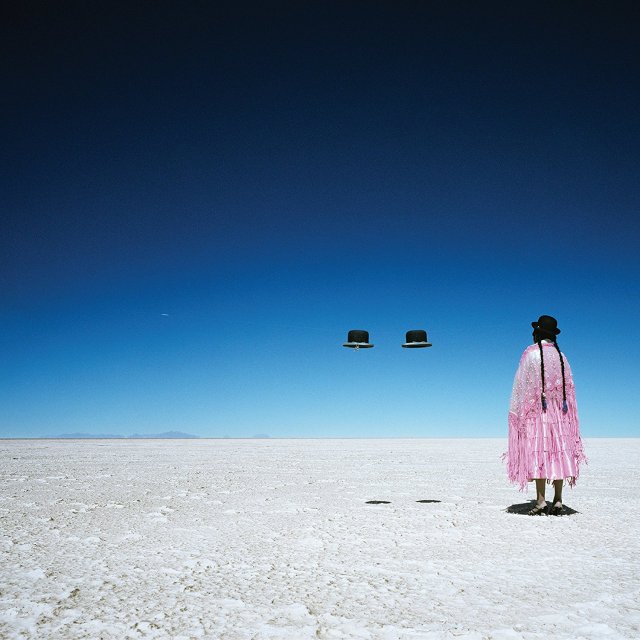
The strikingly beautiful cover art reminiscent of Magritte is eye catching and make this reviewer nostalgic for the days of the 12×12 format of LP covers.  (Album Artwork: Pink Lady (2015), Scarlett Hooft Graafland, Album Design: Laura Grey).  It is, perhaps by virtue of its nod to modernism, a metaphor for the content of this album as well as being its title.

Longleash is apparently the oh so clever operations name of a CIA project whose goal was to help proliferate American modern art in the cold war era.  These days I guess that would be “weaponizing” art.  And this modern piano trio has (curiously) elected this for their stage name.

Well the content of this album is nowhere near your traditional piano trio and may even seem subversive to some listeners.  Longleash are modernist throughout.  Pala Garcia, violin; John Popham, cello; and Renate Rohlfing, piano self-identify as a group with “traditional instrumentation and a progressive identity.”  Indeed they have chosen a rather young and pretty much unknown group of composers: Francesco Filidei (1973- ) is the oldest of the group followed by Clara Iannotta (1983- ), Juan De Dios Magdaleno (1984- ), Christopher Trapani, and Yukiko Watanabe.

Despite the varied backgrounds these composers seem to share a particular segment of a modern aesthetic.  They seem fond of judicious use of extended instrumental techniques and quasi-minimalist cells but their styles are quite listenable.  They seem to have aspects of pointillism, the occasional terseness of Webern, some rhythmic intricacies and the occasional nod to a melody.  In short they seem schooled in the variety of techniques which rose largely out of the twentieth century but seem beholden to none of them seeking instead to judiciously use their skills to create their own unique sound worlds.

There are five works on eight tracks and none of them can be easily described except to say the the combination of listening with the aid of the liner notes can be helpful.  That is not to say the works cannot stand on their own.  That is a useful experience in itself.

I suppose it might be best to say that these works will likely evoke a variety of reactions from various listeners.  This is the sort of album, at least for this listener, that benefits from a direct concentrated listen without distraction but it is also worth experiencing as background music, letting the experience creep in where it might while you do other things.  And then a read through the liner notes to try to divine the composers’ intents.

I’m not being facetious here.  I think this is a very intriguing album but one which is difficult to characterize in words and one which is beyond this writer’s expertise in terms of any useful analysis.  Also the newness of these voices does not allow one to place these works even within the contextual canon of each individual composer’s work.  We have free floating modernism which, as was thought in the cold war days, may invade one’s intellect in subversive ways.

The review immediately preceding this one, Soft Aberration, features this piano trio on it’s first track.  Now Scott Wollschleger is very closely associated with the Manhattan School of Music.  What is curious here is that Longleash has managed to find the present disparate group of emerging composers with no directly discernible connections to the Manhattan School but with a clear affinity for the same sound world.  It is the luck of the draw that these reviews have appeared in this sequence but the similarities are striking.  So if you like the spare sounds of the New York School (John Cage, Morton Feldman, Earle Brown, Christian Wolff) and their successors in people like Scott Wollschleger, Reiko Futing, and Nils Vigeland (who, along with Pala Garcia provides the useful liner notes) then this will be your cup of tea.  But even if you don’t know these folks you are still in for a fascinating journey of cutting edge ideas by emerging composers.  And even if it is not “weaponized art” subverting your mind to western ideology you can be assured that it is genuine and uplifting work done by some wonderful performers of composers you will likely hear from again very soon.


Scott Wollschleger’s Soft Aberration


wollschlegersoft

New Focus FCR182

The cover and the booklet that come with this CD contain art that is a remarkably fitting metaphor for the music contained herein.  The almost monochromatic images with sometimes barely visible lines defining a space which requires serious concentration to discern effectively at times is very much like the music we hear on the disc.

Scott Wollschleger (1980- ) is an American composer who studied with Nils Vigeland at the Manhattan School of Music.  His work has been compared to that of Morton Feldman and, more generally, to the other members of the so-called New York School.  Vigeland has been active throughout his career performing and recording definitive versions of some of the best of Morton Feldman, John Cage, Earle Brown, and Christian Wolff.  It would appear that these voices and stylistic leanings are very much favored at the Manhattan School of Music.  A previous disc reviewed here with music by head of the composition department Reiko Futing, evokes a similar sound world.

This disc of chamber music contains five works on eight tracks ranging from 1’43” to 14’27” and all require almost as much concentration on the part of the listener as the extended techniques and performance requirements demand of the performers.  The dynamic range is from (generous) silences to forte.

The first track is by the seriously entertaining and odd piano trio called Longleash.  They demonstrate their expertise and concentration as well as their love for this musical genre in their performance of Brontal Symmetry (2015).  Unlike the other pieces here, Brontal Symmetry makes use of ostinati and there is a consistent sound field punctuated with silences.  It is an unusual but ultimately engaging piece.  Longleash consists of Pala Garcia, violin; John Popham, cello; and Renate Rohlfing, piano.

It is followed by the titular and sparse Soft Aberration (2013) for viola and piano played by Anne Lanzilotti, viola and Karl Larson, piano.  Though approximately the same length as the opening work the silences nearly suspend the perception of time and create a sense of sounds suspended in space in a sort of sculptural way.

Bring Something Incomprehensible into this World (2015) is for trumpet and soprano.  The three parts of this work are spread across the disc (tracks 3, 5, and 8) creating an even more spare sense.  It is interesting to play the three movements manually without the interruption of the intended track sequence to get a sense of the piece.  Again we have silences predominating with extended techniques demanded of the performers.  Andy Kozar plays trumpet and the soprano is Corrine Byrne.  The first movement at 6’39” is the longest followed by the second at 3’25” and the last at 1’43”.

America (2013) is a solo cello piece here played by John Popham (of Longleash).  It is a pointillistic mix of silence and extended instrumental techniques which makes reference to an art work by Glenn Ligon.

White Wall (2013) is for string quartet and is played by the Mivos Quartet consisting of Olivia De Prato, violin; Josh Modney, violin; Victor Lowrie, viola; and Mariel Roberts, cello.  This is an amalgam of unfolding processes which seem to be indiosyncratic to the composer.  It is very intimate music in that sense.  The piece is in two substantial movements.

The album concludes with the brief last part of Bring Something Incomprehensible Into This World.  Suffice it to say that there are attempts here to tie in philosophical as well as visual metaphors.  Wollschleger is apparently enamored of the writings of Deleuze, Nietzsche, and Brecht.  Her lies another tie in to the New York School with their love of visual metaphors and philosophy.  This is not an easy listen but it is a serious effort deserving of some attention.  The listener can decide whether the artists have indeed brought something comprehensible into this world…or not.


Michael Vincent Waller: Trajectories (further explorations of a gentle radicalism)


trajectories

Waller’s first release dedicated entirely to his work was the 2 CD The South Shore release on Phill Niblock’s XI label last year.  Two disc sets are a risky venture, especially for relatively new artists.  But Niblock has always chosen to take the interesting path regardless of risk.  Well that risk seems all the less risky now that we see the release of yet another full album (albeit one CD) of more of Waller’s increasingly popular compositions.

This time he is championed by the post-minimalist master pianist R. Andrew Lee and rising star Cellist Seth Parker Woods.  The other risk taker here is the producer and engineer Sean McCann whose experimental label Recital is exploring some exciting territory.  Now one might take issue with an argument for the increasing popularity of this composer given that his albums are being released self-styled “experimental” labels but two releases in two years is hardly a case for obscurity.

In fact Waller’s work seems to be attracting a great many musicians who sense that he is evoking a genre with ties to various well worn traditions but also one which is developing its own lasting voice.  Waller’s background includes studies with La Monte Young, Bunita Marcus, and Elizabeth Hoffman.  His works tend to use modes, a style heard more commonly in the work of composers like Lou Harrison (and before that perhaps the 14th century).  At first listen one hears a basically tonal sound but gradually one is drawn into the more subtle aspects of Waller’s art and therein lies the beauty of his work.

There are six works here spread over 17 tracks and all are from 2015-2016.  With only a couple of exceptions Waller makes his statements in 1-5 minute movements much like Lou Harrison.  His penchant for using modes occasionally suggests the music of Alan Hovhaness but Waller is seemingly an unabashed romantic at times too.

The first work “by itself” is one of the longer pieces here at 5’51” and is pretty much representative of the tone of the entire album.  That’s not to say that the album is not varied in content, it is.

The second work in the 8 movement, “Visages” which, appropriately conjures a more impressionistic notion.  This is not Debussy, rather it is maybe post-impressionistic.  It is strongly reminiscent of the best of Lou Harrison’s work with short varied movements but embraces a far more romantic and virtuosic reach.

Lines for cello and piano give the listener the opportunity to hear the fine cellist Seth Parker Woods in this lyrical and beautiful work.  Woods really makes these almost vocal lines sing and begs the question as to when we might hear some vocal music from Mr. Waller.  This is the most extended piece on this collection at 9’19” in a single movement but one wishes for it to go on much longer.  It also prompts one to want to hear more from Mr. Woods.

The three movement Breathing Trajectories is perhaps the most post-minimal of the works here.  It is also among the most complex harmonically but the point here seems to be the sound rather than the method per se.  It is a three movement meditation on some minimalist-like ideas.

Dreaming Cadenza is one of the more overtly virtuosic works here though it’s mood is not unlike the rest of the pieces here.  It is an opportunity for the soloist to demonstrate his skill and Lee does that admirably.

Last but not least, as they say, is the ironically titled, “Laziness”.  Its three movements have enough development to suggest calling this work a “sonata” but such choices are left to the composer (as they should be).

Two other salient factors come to light here.  One is the rather attractive and intelligently designed slipcase (by label owner Sean McCann) with some lovely photographs by none other than Phill Niblock and room enough for adequate liner notes (thank you).

The other factor, one for which I intentionally truncated by own commentary on the music, is that the liner notes are by none other than “Blue” Gene Tyranny aka Buddy, the world’s greatest piano player from Robert Ashley’s Perfect Lives, aka Robert Sheff.  This legendary pianist and composer provides a really insightful set of liner notes and adds so much to the understanding and appreciation of the musical content.

This is a beautiful album brought to life with an auspicious and talented set of people.  That alone is reason enough to buy this album but the best reason is that the listener may follow this next step in the trajectories of the composer Michael Vincent Waller.

Coming Out Electric: Trevor Babb’s Warmth


Steve Reich’s masterful Electric Counterpoint (1987) opens this disc.  That work originally written for Pat Metheny  and has become pretty much a classic as well as a fine way to demonstrate a musician’s facility with multi-tracked guitar music.

Trevor Babb is a doctoral student at Yale and this appears to be his first album.  And what an album it is.  The choice of the opening work serves to demonstrate Babb’s ability to interpret, in his own individual manner, a work that has been recorded many times.  It remains a classic and very listenable work which belies the difficulties inherent in its performance.  Babb seems to take a bit more of a legato approach than previous interpretations but is definitely highly effective and this is a wonderful recording of the work.

It also serves to set the tone for the rest of this truly fine solo guitar and electronics debut album.  Electric Counterpoint is the first of 6 total works represented on this disc.  The remaining five selections fit the rubric of this collection in the overall sense but are definitely unique and challenging in their ways.

Paul Kerekes is not a familiar name to this writer and perhaps a new name to many.  His inclusion here introduces many to this composer and places him in the context of this interesting collection.  This young composer is apparently well known in the New York scene and seems to travel in the circles that include some of the most interesting artists currently working.  Trail is a very different piece than the Reich but demonstrates the range of the solo guitar and electronics genre.  This is a gentler, more meditative piece overall and one which piques interest in hearing more.

David Lang is a well known and very welcome name in new music and is here represented by Warmth, a classic Langian post-minimalist work which delights the listener while challenging the performer.

Septet by the late great James Tenney is one of those masterful compositions that is respected as a masterpiece but not often programmed.  This is due at least in part to it’s critical use of alternate tuning.  The effects intended by the composer can only be heard if the performer can play accurately the tuning involved.  It is a wonderful and listener friendly experience typical of the finest of Tenney’s grasp of how to use such tunings in the compositional process.  Babb executes this piece lovingly and this performance will likely help to nudge this work to a more frequent experience in the concert hall.

Babb introduces himself as a composer in Grimace, an impressionistic exercise in which he attempts to imitate both the style of Ligeti and evoke the image of a mask seen in an art exhibit.  Long tones and extended techniques predominate in this meditative drone-like work that demonstrates fine technique in both composition and instrumental facility.

The album concludes with Slope 2 by the emerging bass player and composer Carl Testa.   Again Babb introduces a new voice for the listener to explore.  This extended composition, more drone than pattern based, is one that deserves multiple hearings to discern its substance and to demonstrate its position in the larger rubric of this collection.

Babb produces a great debut here and makes a strong case for the genre of electric guitar with supporting electronics as being a viable format for a live concert.  He also seems to be defining that genre much the way that many solo artists are doing these days.  He seems to be constructing a repertoire establishing the classics (Reich, Tenney) and promoting the viability of works that he feels deserve a place in that repertoire.

This is a really delightful album and that extends, at least in this writer’s eye, to the cover design as well.  Again I will bemoan the loss of the 12  inch square format of LPs which could have made more prominent this lovely design by Colin Meyer and Trevor Babb.  Perhaps a 12 inch vinyl release may happen.  But until then the listener can settle most comfortably in the warmth of this truly fine release even in the smaller CD format or even as a digital download.


Emanuele Arciuli, Defining a Genre: Walk in Beauty


walk in beauty

Innova 255

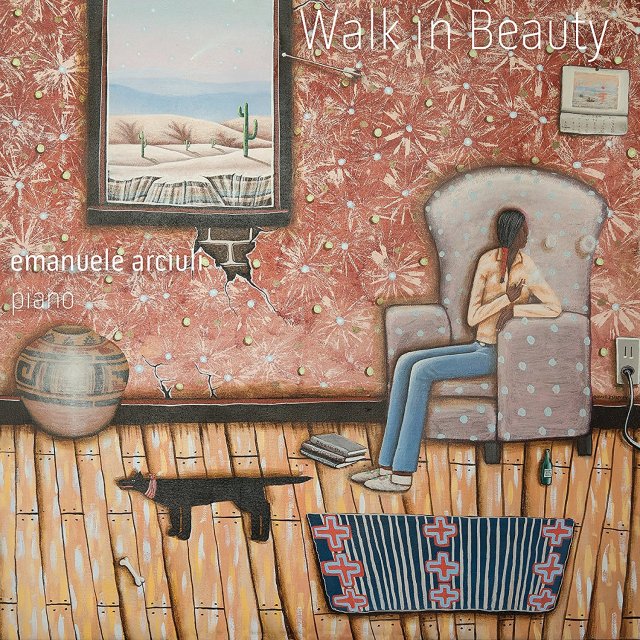
This 2 CD set virtually defines a genre.  Following in the traditions of such notable compilations as Robert Helps’ “New Music for the Piano”, Alan Feinberg’s wonderful series of discs on Argo records among many others we see Arciuli displaying his grasp of music in the tradition of the gentle musical anthropology found in the music and scholarship of Peter Garland.  The album’s title comes from Garland’s lovely multiple movement Walk in Beauty (1992) released on New World records in the 1990s.  The present collection is both nostalgic and forward looking reminding us of great past efforts and introducing us to new work.  It is a look at a loosely defined style of mostly late 20th century American piano music through the lens of a non-American artist.

Garland’s interest in Native American myths and music inform his post minimalist ethic and the additional pieces chosen for this two disc set reflect similar artistic sensibilities.  Emanuele Arciuli is an Italian pianist whose interests range from the Second Viennese School to the unique compositions of Thelonius Monk.  He also has a strong interest in classical music from Native American traditions which puts him very much in sync with Garland’s work as well.  Here he has chosen music which he clearly understands and which appear to have deep meaning for him.

There are 28 tracks on 2 discs representing 13 composers.  Five of these composers are explicitly affiliated with their respective Native American traditions and the remaining eight composers take their inspiration at least in part from the rich music and/or mythology of those cultures.  The bottom line here is that these are carefully and lovingly chosen works which open a window on one fine musician’s perception of a certain Western/Native American/New American style which, at worst, holds up a mirror and, whether we like it or not, it tells us something about who we are and from whence we came.

Connor Chee‘s “Navajo Vocable No. 9” opens the album and sets the tone.  This is one of a series of piano pieces by this fascinating composer/pianist whose star is deservedly rising.  His work celebrates Navajo culture and is informed as well by his training in traditional western art music.

This is followed by Peter Garland‘s “Walk in Beauty”.  This piece is representative of Garland’s post-minimalist, impressionistic style.  It was previously recorded so wonderfully by Aki Takahashi on the eponymously titled New World Records album from the early 1990s.

Garland’s music is fairly well documented but deserves a wider audience. (Curiously he does not have a dedicated web site.)  His scholarship and promotion of new music also serve to place him very highly among this countries finest artists and scholars.  In addition to his compositional output he is known for his Soundings Press publications and his papers are now held by the University of Texas at Austin.

Kyle Gann is, similarly, a scholar and a prolific composer.  He has for many years demonstrated a keen interest in Native American myths in his diverse and creative output.  Gann is here represented by his “Earth Preserving Chant”.

Michael Daugherty is known for his incorporation of pop culture in his work and has been recognized with no fewer than three Grammy Awards.  His work is rooted in pop Americana and “Buffalo Dance” is his homage to Native Americana.  And if his homage seems a bit P.T. Barnum at times, that too is Americana.

John Luther Adams, a recent Pulitzer Prize winner for his orchestral work, Become Ocean, is a prolific composer who derives much of his inspiration from the mythology of Alaskan natives.  Adams spent many of his creative years in Alaska working with ecological projects as well as musical ones.  “Tukiliit” is representative of this work and pays homage to Native American/First Nation peoples.

Raven Chacon is an emerging composer who has produced a great deal of work though little appears to be available on recordings.  “Nilchi Shada’ji Nalaghali” (Winds that turn on the side from the Sun) is an electroacoustic work serves as a little sample of this artist’s work and its inclusion in this fine collection alone suggests that the remainder of his work deserves to be explored.

Martin Bresnick is an honored member of the American Institute of Arts and Letters and his work is fortunately well known.  The present piece, “Ishii’s Song” is a reference to an American Indian, the last of his tribe who lived out his life under the protection and scrutiny of anthropologist Alfred Kroeber at the University of California Berkeley.  His spirit still seems to linger in the Bay Area and this piece is a sort of homage to him.

This set contains two works by Louis W. Ballard (1931-2007) who was a Native American composer that composed classical concert music.  His work is steeped in Native American mythology and deserves to be better known.  Leave it to a non-American to point out this deficit.  Arciuli makes a strong case for listeners and for other musicians to embrace this neglected artist.  Disc Two track 2 contains the “Osage Variation” and Disc two tracks 13-16 contain his “Four American Indian Piano Preludes”.

Jennifer Higdon is a star already very much risen on the musical scene and she is here represented by a substantial piano piece called “Secret and Glass Gardens”.  Higdon, also a recipient of the Pulitzer Prize, is one of those composers who manages to be friendly and accessible as well as modern.  Arciuli seems to perceive similarities in her vision that make this work fit in convincingly in this collection.  Hers is seemingly a similar romanticism and nostalgia and Arciuli has convinced at least this listener of the kinship of this piece in the vision of this collection.

Arciuli introduces another composer unknown to this reviewer, Peter Gilbert.  This young composer with an impressive resume is the co-director of the composition program at the University of New Mexico.  The offering here is his set of four “Intermezzi” for piano.

The inclusion of Carl Ruggles‘ “Evocations-Four Chants for Piano” seem at first to be a strange choice but following the Gilbert Intermezzi one gets the impression that the Americana that is Ruggles is a part of the provenance of this collection.  Ruggles coarse and famously racist attitudes hardly fit with the generally romantic vision of this collection but Americana as perceived by a non-American need not edit the unsavory from the overall picture.  The music is what this is about and these are indeed masterful little essays and a part of the American grain.

Another new name is given a brief appearance in the “Testament of Atom” by Brent Michael Davids.   This young composer’s clever website lists a plethora of works whose titles resemble many of the pieces on these discs.  Again we must trust the artist that his inclusion of this work is representative of his vision of this version of Americana.

For his concluding track Arciuli does a wonderful thing by including the work of Talib Rasul Hakim (1940-1988), another too little known American composer.  Born Stephen Alexander Chambers, he changed his name in 1973 when he converted to Sufism, a spiritual sect of Islam.  The music, “Sound Gone”, is a fitting finale to this beautiful, challenging, and ultimately inclusive collection of Americana.  Bravo, Mr. Arciuli and thank you for the gift of showing us some of the best of how we Americans look to you.


Howard Hersh’s Chamber Music: Dancing at the Pink House


hersh pink

This latest release by Howard Hersh reveals more of his range as a composer.  His previous release focused on one large concerted work for piano and chamber orchestra as well as some virtuosic writing for piano and for harpsichord.  This disc (worth a listen if only for the return engagement of the pianism of Brenda Tom) focuses on some smaller chamber ensembles and a look at the composer’s more impressionistic moods.

This writer is left with the notion that each piece seems to be an intimate telling of a story.  Though the stories are not explicit, each piece has a distinct narrative character.  Mary Rowell handles the multi-track violin parts on Madam’s Tavern (2014).  The piece has an almost symphonic character evoking a variety of styles and meandering most pleasantly through a musical narrative whose details are not as important as the fact that the piece engages very successfully on a purely musical level.  It is written for solo violin with a chorus of some 15 tracks of violin accompanying.

Loop (2006) is a sort of cyclic quasi-minimalist work featuring Jonah Kim on cello, Brenda Tom (gently) on piano, and Patricia Niemi on vibraphone.  It is a dream-like, perhaps even impressionistic piece whose structure and compositional techniques serve the end goal of being a charming aural object.

I Love You Billy Danger (2012) was written for pianist Brenda Tom.  Here she demonstrates her virtuosity and her dramatic and dynamic range in a piece which, though related to Liszt according to the liner notes, seems to evoke the rather Lisztian master Frederic Rzewski as well.  Tom is at her fines with this challenging work and she conveys the narrative well.

Night (2013) seems related to the earlier Loop by virtue of being a percussion piece but also by its gentle evocation of a shimmering musical narrative punctuated with a clarinet part that alternately hides within the percussive sounds and comes wailing out  in jazzy/bluesy moments.  This writer was left with the notion of Gershwin haunting the score (but maybe that is because this review is being written in the Halloween season).  José González Granero is on clarinet, Patricia Niemi on marimba, and Nick Matthiessen on percussion.

Dancing at the Pink House (2006) is a musical narrative for clarinet and piano that Hersh has featured as a teaser on his website.  It was written for Patricia Shands, clarinet and is accompanied by James Winn on piano.  Shands is the owner of said Pink House and she seems to be having a lot of fun with this playful but substantial piece.  Both of these musicians appeared on Hersh’s 2007 CD release, Pony Concerto (Albany Records).

Dancing at the Pink House is a valuable addition to Hersh’s discography and reveals more of his range as a composer.  This is a highly entertaining recording and leaves the listener wanting more.

Visions of a Dreamer: Keane Southard’s Waltzing Dervish


dervish

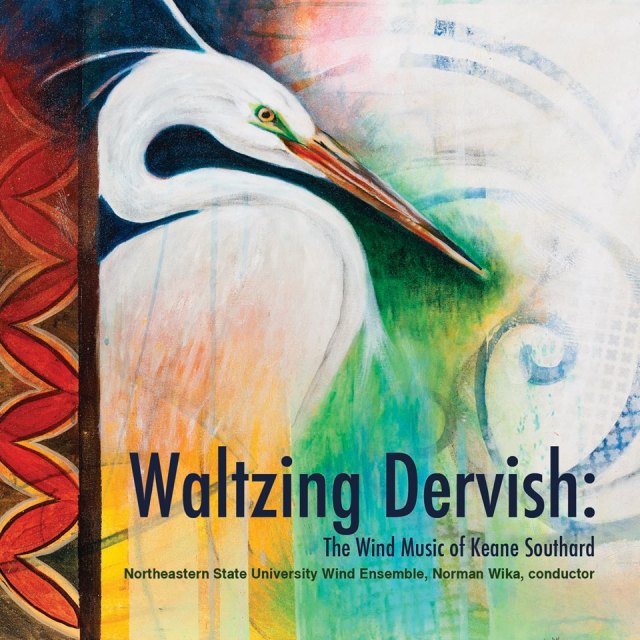
Keane Southard (1987- ) is a composer and pianist whose work is influenced by a variety of styles including standard classical and pop and folk influences.  This major debut disc is a fine sampling of his work though it is important to realize that his work is for diverse ensembles of pretty much every description and the present sampling is of music for wind ensemble.

Just like every specialized grouping, be it string quartet, string orchestra, wind quintet, solo piano, full orchestra, etc., one encounters composers with varying degrees of facility in each configuration.  Southard seems very much at home with the wind ensemble/band and its possibilities.  A quick look through his extensive works list at his site suggests a hugely prolific musician with a wide variety of skill sets in a variety of musical configurations.  Wind ensemble is clearly one of his strengths and the Northeastern State University Wind Ensemble of Oklahoma under conductor Norman Wika are up to the challenges.  Southard playfully refers to this grouping as a “wind powered” ensemble using it as a metaphor for ecologically sustainable power systems.

There are nine tracks of which three are transcriptions of other composers’ work and the remaining six are by Southard.  His metaphors are as eclectic as his musical choices but fear not, his choices are friendly ones.  The first track, Waltzing Dervish sets the tone as an original and substantial composition of some ten minutes duration in which he takes on the waltz and its various meanings both public and personal to create an original band composition concerned as much with ecological metaphor as with a striving for multicultural diversity in an optimistic and thoughtful exploration of what can easily be a tired dance form.

The second piece is an arrangement of a piece by Francisco Mignone (1897-1986), one of the composers whose music he encountered during his 2013 Fulbright Fellowship in Brazil.  The piece is scored for optional choir (not used in this recording) and band, an arrangement Southard made with the intention of sharing this music as a highly viable selection for concert band.  It is indeed a joyous affair and one could easily imagine this being adopted as a staple in the rarefied realm of concert band music.

Do You Know How Many You Are? is the composer’s 2013 band arrangement of a 2010 choral piece which he describes as having basically come to him in a dream.

Claude Debussy’s Menuet (ca. 1890) was originally a piano piece which Southard envisioned in this orchestrated form during the course of his studies of orchestration.  That sort of inspiration is not uncommon for a composer but the result is not always as ideal as the composer imagined.  Fortunately this orchestration works quite well and again would proudly fit in a given band’s repertoire as an audience pleasing piece.

The next piece, originally an orchestral piece from 2013 is presented in the composer’s own arrangement for band.  No Interior Do Rio De Janeiro (2013/15) is another of the inspirations from the composer’s 2013 Fulbright Fellowship and was inspired by his work with “Orquestrando a Vida”, a Brazilian music project inspired by Venezuela’s famed “El Sistema”.  The band version was written on a commission from the present NSU Wind Ensemble.  Here is perhaps a departure from the dance theme of the first three tracks.  It seems to be a thesis or musical diary entry reflecting his personal take on the experience of working with this project though the spirit of the dance remains throughout.

Carousel (2008/2010) is the arrangement for band of the third movement of a mini-symphony (perhaps a scherzo?) for orchestra.  Curiously he describes his inspiration as coming from the sound of the calliope, a sort of steam driven organ common in circuses of the late 19th and early 20th centuries.

Cortège et Litanie (1922) by French composer and organist Marcel Dupré (1886-1971) is a bit of a departure.  Neither a dance nor derived from Brazilian sources this piece was originally written for organ.  The organ (like the calliope in the previous piece) is arguably a wind instrument and this transcription retains some of the ambiance of that grand instrument.  It is among Dupré’s better known pieces and seems a natural for band.

Uma Pasacalha Brasiliera (2015) is a commission from a the Arrowhead Union High School Wind Ensemble and conductor Jacob T. Polancich.  The composer describes various influences in the circuitous path the the completion of this work but it is basically a sort of homage to the baroque form of the pasacaglia (variations over a repeating bass line) as well as to some of the great folk song influenced composers such as Percy Grainger.  Brazilian influences dominate much of the composer’s work from this period and they combine with the aforementioned baroque and folk influences to form a wonderfully creative take on that form of baroque counterpoint.

Finally the big finale is presented in another transcription, this time of a concerto for piano and organ from 2008.  Of course the organ again lends it’s sound easily to a band transcription and we have this Concertino for Piano and Wind Band (2008 rev. 2015) which allows us to hear the considerable keyboard skills of the composer.  This is the most substantial work on the disc and provides a satisfying finale to this portrait of a prolific and optimistic young composer at the very successful beginnings of what this writer (optimistically) hopes will be a long and productive career.


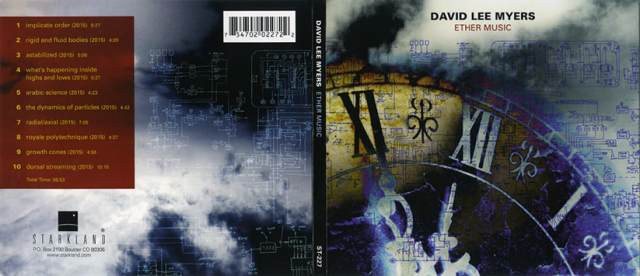
David Lee Myers’ Ether Music: A Nearly Lost Thread of Electronic Music


ethermusic-large_orig

Starkland 227

There is a certain nostalgia here both in the sound of this album and its provenance.  David Lee Myers (1949- ) is perhaps best known for his work under the rubric of Arcane Device from 1987-1993.  Under that name one finds 23 albums on the discogs web site.

Myers has collaborated with people like Asmus Tietchens (1947- ), a German electronic composer (with a hefty discography), Kim Cascone  (1955- ), an American electronic composer and producer, Marco Oppedisano (1971- ), an American guitarist and composer, Ellen Band, an American electronic composer, and Tod Dockstader (1932-2015), among others.  His output has been in the electronic music genre, i.e. no live components and he works in a style which he calls, “feedback music”.  Like Dockstader, Myers has worked outside of the academy and has relied upon home made electronics and techniques he has developed over the years to produce a rather unique musical style.

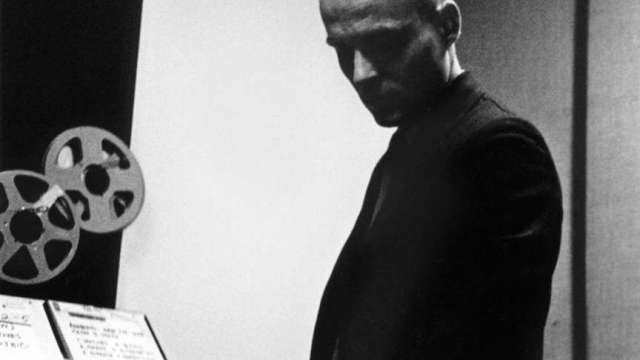
tod-dockstader-01

Tod Dockstader with tapes and score notes.

More so than the other mentioned collaborators Myers’ work with Dockstader is the “thread” to which the title of this review refers.  The release of the long out of print early work of Tod Dockstader was effectively the genesis of Starkland Records.  With the release of Quatermass (1992) and Apocalypse (1993) Dockstader was forced out of obscurity and motivated to begin composing and releasing recordings again.  Those Starkland releases were of some long out of print LPs from the early 1960s and Dockstader, who had been working in the music industry but no longer releasing his compositions was inspired to bring that aspect of his work again to the public.  Two of those efforts included the collaboration of David Lee Myers, Pond (2004) and Bijou (2005).  (After Dockstader’s death Starkland surprised the musical world by releasing heretofore unknown gems from the composer’s archive in From the Archives (2016).)

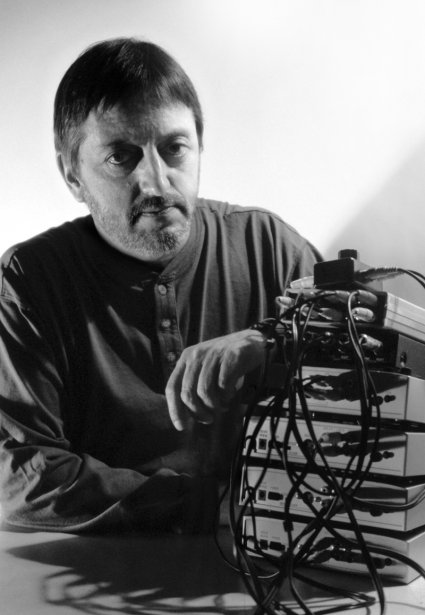
myers

David Lee Myers with some of his electronics.

It is both beyond the scope of this review and beyond this reviewer’s expertise to comment meaningfully about the compositional processes by which Myers achieves his ends but, thankfully, the liner notes by Dan Visconti provide significant insight in this area.  One can assume that his innovations in electronics as well as the devices themselves will become a treasured part of the history of electronic music along with the recordings themselves.

There are ten tracks here all written in 2015, and all utilizing Myers’ “feedback music” techniques.  The CD booklet includes both some of Myers’ beautiful circuit sketches as well as photos of some of his self made electronic processing equipment.  (This actually seems to echo the similar production of the booklet from that “From the Archives” disc of Dockstader’s work.)  Also worth noting is that the mastering is done by Silas Brown whose expertise contributed so significantly to the success of that last Dockstader disc.

The listener is free to dwell on the technical notes and ponder how these sounds and processings come together to produce the final product or simply let the experience flow over you.  There are doubtless many riches to be found in the pursuit of the technical and the analytic.   But the most important thing is that you listen, just listen.  This reviewer’s first hearing of this disc was on a long, leisurely late night drive which allowed an uninterrupted experience of the entire disc.  It was only later that I chose to take in the liner notes and booklet.  And while these enhanced the experience the tracks are sufficiently substantive in themselves to carry the listener into Myers’ unique technological vision which is unlike any other save perhaps for that of the aforementioned thread to Dockstader.

Though related by this thread, Myers’ vision is truly like none other in the field of electronic classical music.  If anything this seems to be a nearly lost thread, one of the self-sufficient tinkerer and explorer who shares his discoveries with anyone who dares to listen.  So, listen, I dare you.  You won’t be disappointed.

Release date scheduled for November 10, 2017.


Jason Vieaux and  Julien Labro, Chamber Music with Afro-Cuban Roots


Arica ACD-71309

This album seems to have been characterized as fusion/crossover perhaps for marketing purposes but it is in fact a fine compilation of too little heard works by Afro-Cuban/Latin American/South American composers of the mid to late 20th century.  Start with the rapidly rising star of guitarist Jason Vieaux whose earlier recording of the stunning Ginastera guitar sonata seems to place him in the position as a specialist in Latin American music.  Then add Julien Labro, a specialist in the bandoneón, an instrument best known for its ubiquity in tango music. Combine them with good audio engineering and an intelligent production and you have this album.

If there is a sense of “fusion” here it is due to the creative efforts of the composers involved.  In fact this is pretty much in the same tradition of Bartok, Kodaly, Copland, Thomson and others who mined folk and ethnic musics very successfully to infuse their “classical” compositions with new life.

Leo Brouwer (1939- ), Radamés Gnattali (1906-1988), and Astor Piazzolla (1921-1992) are all composers deserving of serious attention but are little known in North America and the reasons are clearly not musical talent.  All three composers are featured here in works arranged by Julien Labro who plays bandoneón, accordion and accordina on this recording.  He is joined by Jason Vieaux on guitar, and Jamey Haddad on percussion.

In addition we are treated to a composition by Pat Metheny and a curious arrangement of “Everybody Wants to Rule the World” by Roland Orzabal, Ian Stanley, and Chris Hughes to round out a diverse and engaging program.

One hopes that this will kindle further interest in these too little known composers but, until then, we have a marvelously entertaining recording that will likely please Latinists, guitar lovers, bandoneón lovers, and the like.

This is a fine and crisply recorded CD with some truly fine musicians.  Call it fusion if that helps you want to listen but please listen when you get a chance.  You won’t regret it.


Dark Queen Mantra, Celebrating Terry Riley at 80


Terry Riley (1935- ) turned 80 on June 24, 2015 and happily we are still celebrating this treasure of American music.  His iconic work “In C” (1964) is one of the defining works of the minimalist movement and Riley’s trippy album, “Rainbow in Curved Air” (1969) has also endured well.  But these works typify his early style and his work has evolved though his primary influences continue to be jazz and Hindustani music for the most part to a very personal style.

His discography boasts at least 30 albums and his compositions range from various chamber music pieces, solo and duo piano music, orchestral music, concertos and even music drama.  His influence on musicians is wide ranging and even includes that familiar intro to Baba O’Riley by the The Who (the title is actually an homage to Meher Baba and Terry Riley and that intro derives from Riley’s first Keyboard Study).  In recent years he has achieved much deserved success in collaboration with his son Gyan Riley who is a composer in his own right and an extraordinary guitarist.  Their collaborations have been a true highlight in both musicians’ careers.

This disc is a production from the truly wonderful Sono Luminus label whose recordings continue to set a high bar for production and excellence in sound as well as in intelligent programming.

Three works are presented here.  The first is Dark Queen Mantra (2015) for electric guitar and string quartet.  It is obviously the centerpiece and it is a fine work commissioned in honor of Riley’s 80th and written for the forces who perform it here. The amazing and versatile Del Sol Quartet and Gyan Riley seem a natural pairing.  These California based musicians seem to pour the whole of their artistic hearts and souls into this performance and Gyan Riley, a fine musician in his own right, always seems to be at his very best in his collaborations with his dad.  (Indeed anyone who had the pleasure of seeing their live sets can testify as to their beautiful musical intimacy.)

So it is we have a definitive recording of yet another fine piece from this beloved composer.  The choice to follow it with Mas Lugares (2003) by the late Stefano Scodanibbio (1956-2012) is an inspired and very appropriate choice (Riley was fond of this composer and helped promote his work).  Scodanibbio collaborated with Riley and recorded two albums with him (Lazy Afternoon Among the Crocodiles, 1997 and Diamond Fiddle Language, 2005).  This work for string quartet is dedicated to Luciano Berio and is a sort of deconstruction via the lens of the composer’s vision of madrigals by the early baroque master Claudio Monteverdi.  It is truly a joy to hear more of this composer’s music and this serves as a loving homage by the Del Sol and, by association, with Riley.

The concluding music is again by Terry Riley and it comes from the rich period of his collaboration with another set of fine California based musicians, the Kronos Quartet. They Wheel and the Mythic Birds Waltz (1983) first appeared on a Gramavision disc and this is a welcome reprise.  It is via his writing for the Kronos that Riley produced most of his string quartet writing and it is a fine repository for his compositional talents.

For its sound and its compositional and performance content this is one of the finest discs to come across this reviewer’s desk and it is a beautiful homage to Riley (father and son), the Del Sol Quartet, the Kronos Quartet and to the late Stefano Scodanibbio.  This is a gorgeous and deeply satisfying album.  Kudos to all.

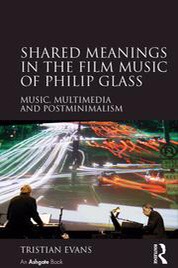
Shared Meanings in the Film Music of Philip Glass by Tristian Evans


This book took me a while to absorb.  It is the first book length treatment that this writer has seen on the subject of Philip Glass’ film music.  Some have suggested that his film music may wind up constituting his most enduring legacy and one need only listen casually to any number of film scores to hear his influence.

This is basically an academic treatise which is what one can reasonably expect from the Routledge imprint.  However the author seems to have taken care to transcend the adequate but sometimes dull prose which suffices for publication reasons but whose weight challenges the attention of all but the most stalwart of academic readers.  This book is quite readable and deserves to be read.

Admittedly it is risky to tread on the “meaning” of music but Evans here makes a case that places him in the company of Leonard B. Meyer’s book, Emotion and Meaning in Music.  Though it is clearly not an attempt to extend Meyer’s work, Evans is in good company as he seeks to examine the emotional content of Glass’ work that underlies his success as a film composer.  Film music, after all, tends to underscore the emotional content of cinematic images to some degree and those mechanisms can and should be examined.  The alternative would be to simply dismiss it as “magic” I suppose.

The cover which  depicts one of those wonderful live performances of Koyaanisqatsi triggers memories of this writer’s first viewing of this intimate and effective scoring of Godfrey Reggio’s non-narrative, no dialogue sequence of images.  Never had I seen/heard a more mesmerizing collaboration since the (stylistically very different) Carl Stallings cartoon scores which exist forever in the near subconscious recall of anyone who was exposed to his work in their childhood.

For many film music means the classic Erich Korngold, Alex North, Alfred Newman, etc. and their more recent successors like Elmer Bernstein, John Williams, etc.  But film music continues to evolve and, though this evolution will not likely supplant these classic styles, there is room for innovation and change.

Glass’ work in Koyaanisqatsi relied on the hypnotic minimalist patterns which amplified the character of the images.  Who knew then that his style could translate to more mainstream films?  But that is exactly what he has done and it is exactly why such a book needed to be written and Evans has accomplished a great deal here.

This is an intriguing and insightful book which opens potential for research in Glass’ music as well as film music in general.  While not the easiest of reads this book covers a lot of territory and is generously referenced.  Clearly there is much work to be done here and Evans has given a wonderful and pretty comprehensive start.  Highly recommended.


Femenine, a Lost Julius Eastman Recording, a Major Treasure


This is an epic minimalist masterpiece that has the same sort of almost full orchestral impact that one hears in works like Reich’s ‘Music for 18 Musicians’, Riley’s ‘InC’, and perhaps Glass’ ‘Music with Changing Parts’ or ‘Music in 12 Parts’.  The point is that it is entrancing and engaging music that deserves to be heard.

Julius Eastman (1940-1990) was an American singer, performer and composer whose work was little known until after his untimely death.  It was the efforts of composer Mary Jane Leach who performed a labor of love essentially saving Eastman’s work from obscurity when she called upon her fellow musicians and artists to help her gather all the extant recordings and scores many of which were lost after Eastman was evicted from his apartment not long before he died.  Her Julius Eastman page is a valuable reference and her work has inspired further research and performances of Eastman’s music.

Leach’s substantive initial efforts resulted in the release of the 3 CD set, Unjust Malaise which made available all of the then known serviceable recordings of this composer’s music.  Since then this recording became available and it may be the finest that Eastman did.

This is a live recording of a performance from 1974 which is quite lucid and listenable.  It starts slowly but quickly finds its rhythm and pace and provides an uninterrupted 70 minutes of consonant, even romantic sounds.  It’s relation to femininity or any gender issues is not clear, perhaps not even the point.  This piece also seems to have had a companion (called masculine) which is sadly now lost.

Anyone interested and entertained by the minimalist works already cited will find this work very inviting.  Hopefully the release of this recording will encourage a revival of this work and it will be performed again soon.  We as consumers are blessed to have this major work by this major composer available for listening and study.  Eastman deserves recognition as a composer and this disc certainly is a strong support for that.

Nadudim: Ethnic Memories from the Fifth House Ensemble


This is a really pretty album.  It is apparently one of the passions of Cedille to release folk musics from middle eastern and Mediterranean sources.  What distinguishes this release is its thoughtful, tasteful arrangements.  This writer is tempted to compare it to Berio’s Folksongs or Copland’s Old American Songs to capture the ideas behind the creative arrangements done by the four composers involved.  I don’t think this is quite the same undertaking as those works but this album is a serious musical effort by some marvelously talented musicians and is recorded with the lucidity one comes to expect from this unique Chicago based label.

Nedudim is the Hebrew word for wanderings and this is a great title for this album which takes the listener on a journey through the middle east and its musical riches. This is the second album that the Fifth House Ensemble, here joined by Baladino, has released on Cedille and it will leave the listener wanting more.

Various traditional instruments are mixed with classical instruments and gorgeous vocals in this song cycle.  It is a journey which reveals the diverse energies to be found in these local song traditions.  They are entertaining and even infectious in their joy.


Recurrence: New Icelandic Orchestral Music


“Well I’ve never been to Iceland, but I really like the music.”  Please excuse the Hoyt Axton paraphrase but this music brings joy to this listener’s heart.

Wow!  Even as a writer with an avowed fondness for music from the Nordic regions I am pleased to say that I am just stunned at this recording.  This is all new music written in the last few years by Icelandic composers and performed by the Iceland Symphony which seems well prepared to handle these large works.

These seven tracks document five works by living composers and, I dare say, rising stars in the classical orchestral realm as well.  Only one of these composers is likely to ring a bell in all but a few listeners and that is Anna Thorvaldsdottir, probably the best known musician from Iceland since Björk.  And it is worth noting that three of the five works are by female composers.

There is a consistency in the large orchestral sounds from these composers that provide a unity for the listener and a challenge for the recording engineers.  In fact this is ideal to show off the sonic facility of the Sono Luminus label and the skills of producer Dan Merceruio and recording engineer Daniel Shores.  This is the sort of album that stereo salons use to show off the range of their amps and speakers.  It is indeed thrilling to hear and the better your sound system, the more exciting this will be.  Those blessed with Blue Ray Audio capability will doubtless get the best sound of all.  Both standard CD and Blue Ray Audio discs are included in this package.

In order of appearance the composers are: Thurídur Jónsdóttir (1967- ), Hlynur Vilmarsson, María Huld Markan Sigfúsdóttir (1980- ), Daniel Bjarnason (1979- ), and Anna Thorvaldsdottir (1977- ).  Bjarnason is also the very capable conductor of the Iceland Symphony in this recording.

The music, Flow and Fusion, bd, Aequora, Emergence (three movements), and Dreaming are not given composition dates but are presumably recent compositions by these young artists.  There are liner notes which are useful to the listener but the main point here seems to be the glorious sound.  One hears influence and/or homage to some of the great sonic experimenters of the late 1950s and 60s like Penderecki, Xenakis, Lutoslawski and probably some Icelandic composers whose works have yet to be heard outside of Iceland.

The album has the notation below the title of “ISO Project 1” so here’s hoping that there will be at least a second volume and that we be given the opportunity to hear more from the rich musical landscape of Iceland.  Bravo!  Brava!  Keep it coming.


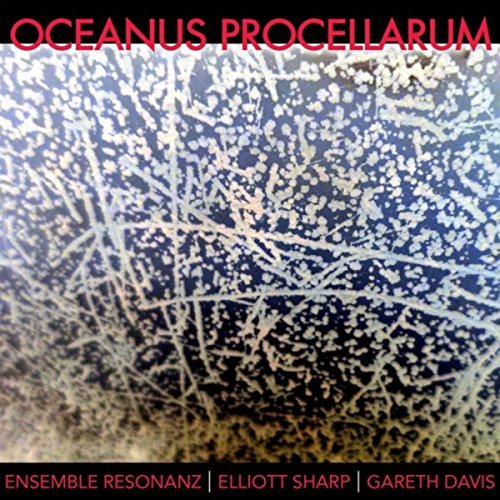
Oceanus Procellarum: Gareth Davis and Elliot Sharp


oceanus

I recall excitedly taking a class in college in the late 70s which dealt with post 1950 composition.  The professor emphasized that the reigning characteristic of this music is “pluralism”, that is to say that anything goes and one gets less useful information from labels like, “classical”, “baroque”, “romantic”, “post-romantic”, “post-modern”, etc.  There is no question that this maxim remains very true and we now are seeing composers well-versed in virtually every technique known to the world of composition.

This album is a fine example of such pluralism.  Seeing names such as Elliott Sharp and Gareth Davis one might expect something of the “free jazz” genre and that would not necessarily be an inaccurate description.  But it would fail to capture the wonderful writing for Ensemble Resonanz by the eclectic (yes, pluralistic too) Elliott Sharp.  As a composer Sharp draws on late twentieth century modern/post-modern compositional techniques along with a fair amount of his own creative innovations gleaned from his own experimentation and, no doubt, from his exposure to the wildly creative milieu of the Downtown New York scene of the 80s and 90s.

The result is like listening to shades of Penderecki and Xenakis as they wrote in the late 1950s though the 70s.  This is far more homage than derivation however and the achievement here is how well the soloists on guitar and bass clarinet fit into the work as a whole.  They fit remarkably well.

This could easily be called “Symphony for Ensemble with Obligatto Guitar and Bass Clarinet” or even Concerto if you like.  The point is that Sharp is an engaging composer whose works are very substantial.  From his beginnings on the New York Downtown scene with its mix of jazz, experimental and classical he has continued to explore and grow as a composer and that is what ultimately makes this release so compelling.

The musicianship here from Ensemble Resonanz, Sharp and Davis is of the first order and there is a certain sense of a tight fit such that, whatever may be improvised here sounds as though it were carefully written into this large orchestral fabric.  This is a powerful piece of music and repeated listenings will doubtless reveal more and more depth.  This is a very engaging piece.

Sharp is clearly evolving and growing as a composer and still hasn’t lost his marvelous collaborative and improvisatorial abilities.  This is a major work and a lovely recording.


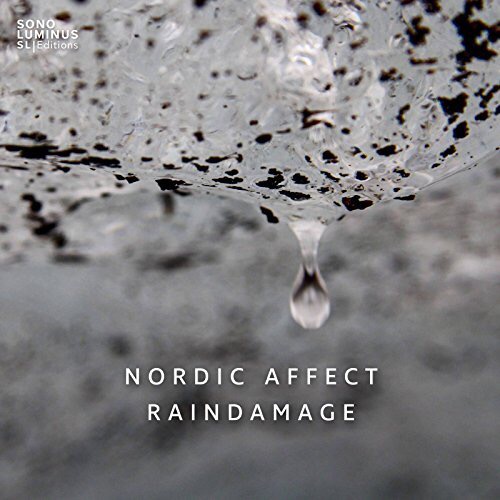
Nordic Affect: Raindamage, Wonderful Music from Iceland


Sono Luminus SLE-70008

Definitely an unusual beginning to this sonorous album of chamber music from the happy, creative place called Iceland.  Some of these tracks are electroacoustic combining some sort of electronic sound producing and/or manipulating components along with the live musical performance.

Nothing familiar here but a lot worth listening to.  This is a collection of recent chamber music from what is apparently some of the finest composers working in Iceland today. And as a Sono Luminus product it is a sound object of the highest order.  It is a beautifully recorded set of pieces that goes a long way to demonstrate the high quality and creativity of both the compositional and performance to be found in this distant corner of the world.

There are six works represented here.  Three are exclusively electronic, one for acoustic instruments with electronics and two are for acoustic instruments alone.  All seem to share the eclecticism of modern composers and, to this writer’s ear, a rather distinct style which seems to come out of the Nordic regions these days.

Iceland has a long and proud musical history and has amassed a large creative classical repertoire in (at least) the 20th and 21st centuries.  Perhaps one can hear the “sounds of the north” in these works or perhaps that is simply the analogous associations of this listener’s mind but there does seem to be some affinity between the lovely cover photograph of melting ice and some of the sounds herein.

At any rate this is fascinating music beautifully performed by Nordic Affect, a more or less fixed ensemble of violin, viola, cello, and harpsichord with occasional electronic supplementation.  Performers include Halla Steinun Stefásdóttir, Violin; Guòrún Hrund Haróardóttir, Viola; Hanna Loftsdóttir, Cello; Guòrún Óskarsdóttir, Harpsichord with Nava Dunkelman on drum in the last track.

The composers Úlfur Hansson, Valgeir Sigurðsson, and Hlynur Aðils Vilmarsson are completely unknown to this writer though it is noted that Hansson studied at Mills College in California, itself quite a hotbed of new music innovation.  No matter, though, these are some amazing composers doing cutting edge work and deserve your attention.

All in all this is one fine disc of chamber music.


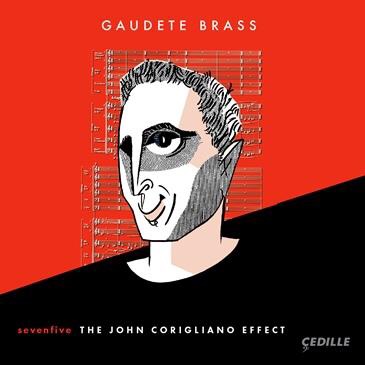
A Brassy 75th Birthday Celebration for John Corigliano


Cedille CDR 90000 169

John Corigliano (1938- ) is one of America’s finest composers.  He is to classical music in New York what Woody Allen is to the movies.  Corigliano is musical royalty.  His father was concertmaster under Leonard Bernstein among others (in fact he apparently worked as assistant to the producer on several of the Young Peoples’ Concerts).  His own accomplishments musically are many including a the very first Grawemeyer Award for his first symphony and a Pulitzer Prize for his second.  One could hardly find another musician as deserving of being honored.

From the very New Yorker style cover art this album affirms this composer’s iconic status.  But the artists here are good Chicago Brass players.  As a native born Chicagoan I have become accustomed to assuming that one can find some of the world’s finest brass players there and this album lays testament to that.  Gaudete Brass is an ensemble that definitely deserves your attention.

This is a fine tribute album featuring mostly world premieres but also some nice transcriptions.  This is effective though not overwhelmingly modern music for brass.  It is intended as and functions very well as entertainment and, from the sound of it, is also fun to play.

The original works are welcome as are the transcriptions of Corigliano’s Gazebo Dances. by the long time Chicago musician/conductor Cliff Colnot.  (One transcription is by the composer).  There are a total of three Corigliano pieces here and 13 by others.  One can only imagine the joy the composer will feel on hearing these tributes and the joy that any number of brass players will experience hearing this fine album.  As usual the Cedille recording is lucid giving a clear sound image of some truly fine musicianship.

The pieces here are good middle of the road compositions which pose challenges on the players but manage to be entertaining and nothing here sounds like an academic exercise.  Rather this disc is about celebration exactly as it purports.  Very enjoyable disc.

Dane Rousay’s Blip


cover

Dane Rousay is a San Antonio based percussionist and this is the first of several planned releases.  This is a solo effort largely with drum kit and perhaps a couple of enhancements or additional percussive hardware.  There are 8 rather brief tracks on this album, all of an experimental nature and all very well recorded.

One small disclaimer:  I generally don’t review download only releases but Mr. Rousay was persistent and kind in his requests for a review.  Another aspect is that there appears to be an increase in this purely digital release format and to ignore that in favor of a demand for a physical product would likely be missing an opportunity to hear some good work.

Despite the brevity there is much for the ear.  The percussion seems to be closely miked and that is apparently the point here.  Each track is like a mini-etude or experiment which will presumably be used as material for other work.  Whether this is jazz, free jazz, new music, classical, etc. is actually beside the point.  The point appears to be the sound itself.

There are no liner notes and little in the way of explanation to be found even on the composer’s web site.  (That’s not necessarily a negative thing either.)  It is not clear if this music is improvised or composed or if there is any predetermined structure and there appears to be no intended connection between each of the tracks.  Most of the work is mallets or sticks of some sort hitting the targeted percussive surface though he does make use of extended techniques such as rubbing the mallets across the surface creating rich harmonics in the manner of the spectralists.

After multiple listens this reviewer is left with the impression of having visited the artist’s studio for a rather personal tour of some of his working ideas.  If you are a percussionist or a fan of percussion music this album will doubtless interest you.  It is not easy listening but it does appear to be a very personal exploration of this artist’s techniques and ideas.

I am looking forward to more from this interesting and seemingly uncompromising artist.


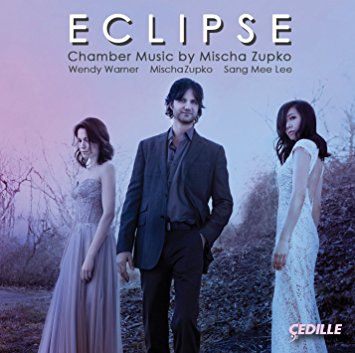
Eclipse of the Son: Mischa Zupko


zupko

Mischa Zupko (1971- ) is a composer, a pianist, and a professor of music at Chicago’s De Paul University.  He is the son of avant garde composer Ramon Zupko (1932- ).  Mischa’s work featured on this Cedille release suggests that the proverbial apple has fallen quite a distance from the family musical tree.  That is neither bad nor good but it is striking.

The elder Zupko’s work, despite its significance, is too little known.  A few recordings exist on the old CRI recordings label and this writer recalls being impressed by them. According to the Chicago Reader article he really didn’t want his son to go into the music business but apparently what is in the blood is in the blood.  A curious note too is that one can find articles on both these composers on Wikipedia but not the English/American one, rather curiously both are to be found on the Dutch Wikipedia site.

The present disc is apparently the first dedicated entirely to this emerging composer’s work (now numbering some 50 pieces).  It is a disc of chamber music and from the first the listener is immediately aware that the younger Zupko is possessed of a sort of retro romantic bent.  Think of the great virtuoso composer/pianists of the 19th century like Franz Liszt and Anton Rubinstein.  He does gratefully acknowledge his father as inspiration but clearly follows a different path.

This music is about passion and virtuosity.  The composer defines this clearly in his liner notes.  The performers Mischa Zupko on piano, Wendy Warner on cello, and Sang Mee Lee on violin demonstrate both passion and virtuosity on this lucid recording.  They play very well together and they all have ample opportunities to show off their respective skills.

There are seven works on ten tracks dating from 2005 to 2015.  The first five tracks consist of “Rising” (violin and piano, 2009), “Fallen” (cello and piano, 2010), “From Twilight” (solo violin, 2015), “Eclipse” (violin and cello, 2014), and, “Nebula” (solo cello, 2015).

There then follows the four movement”Shades of Grey” (2005) for violin and piano.  This is the earliest work on the disc but stylistically it is consistent with the rest of the disc. Zupko certainly develops as a composer but his style seems pretty firmly established.

The last track seems to be the big feature here.  “Love Obsession” (cello, piano, 6 pre-recorded cello tracks; 2013) is perhaps the most adventurous and grand of the works on this recording.  As with the other works on the disc the composer cites various literary influences and inspirations consistent with the apparently romantic ethic which seems to drive his creativity.  And as with the other tracks we hear a tonal romantic idiom filled with passion.

My title for this review is not intended to suggest that the younger Zupko has surpassed his father in any way except perhaps in that his work has, whether by accident, timing, design, or whatever, gotten more attention.  This is not a case of Johann Strauss Jr. and Sr. in jealous competition, this is simply another generation responding to it’s muse and that is worth celebrating.


New Orchestral Music from Rain Worthington


Rain Worthington herself kindly sent this CD to me for review.  There seems to be very little biographical information online about this very interesting composer.  Her current  credentials available on her website are impressive but there is little to be found on her training and influences. (Time to talk to the webmaster I suppose)  This appears to be the first disc dedicated solely to her music and it is an great one.

There are seven tracks representing seven orchestral pieces dating from 2001 to 2012. Like the album title, all are given poetic titles which make no reference to musical structure.  No doubt there are stories behind each of these but there is no information  in the liner notes as to the inspirations or intended meanings of this music.

This reviewer is fond of detailed liner notes but their absence is hardly a hindrance to the appreciation of these little tone poems for various sized orchestras.  There is a remarkable consistency of style here suggesting that this composer has a clearly established voice.  Clearly Worthington is a master of orchestration as she wields complex orchestral pallets where dissonance as well as orchestration contribute to the color in a basically tonal framework.

The music here is about motive and gesture rather than melody per se.  Perhaps that is a “minimalist” method but the impression to this listener suggests influences as diverse as Claude Debussy, Jacob Druckman, Daniel Asia, Toru Takemitsu, and Anton Bruckner. This is beautiful though not “pretty” music with complex emotional content that leans in somber, wistful, sometimes haunting, and even nostalgic directions much as an impressionist painting.

The lovely cover photograph, a time exposure of a night scene with a blurring of stars over a lake, works as a metaphor for the album’s content.

Three orchestras (none of them American) under three different conductors are employed in this very satisfying release.  Multiple listenings will definitely contribute new layers of understanding for the listener.  This listener found that initial impressions of seemingly simple, pretty romantic/impressionistic leanings give way to things deeper and perhaps even disturbing.

One of the conductors, Robert Ian Winstin (1959-2010) was an American composer and conductor (whose compositional efforts deserve some serious review) is at the helm of the Czech Philharmonic Orchestra on two tracks.  Petr Vronsky leads the Moravian Philharmonic Orchestra on four tracks and Ovidiu Marinescu leads the Russian Philharmonic on one track.  It is amazing how well these orchestras handle the challenges here.  These are some excellent musicians.

Kudos to producer Bob Lord for his bold choice in releasing this disc.  Hopefully we will soon be seeing more of this composer’s work in the near future.  My thanks to Ms. Worthington for sending this my way.


Exploding Debussy, Kathleen Supové


New Focus FCR 170

Increasingly it seems that new music performers take on a persona which includes a unique selection of repertoire and frequently a distinctive physical presence.  Kathleen Supové is a fine example.  Her distinctive physical appearance and attire becomes a metaphor for her very personal and intelligent choice of repertoire which sets her apart from her peers.  In addition to unquestioned virtuosity and beautiful interpretive skills her persona takes on an adjectival quality which prompts this reviewer to ponder the “Supovian” experience.


I may live to regret that neologism but the present album is offered as exhibit one (of about 20 albums) attesting to the distinctive choices of music that characterize her work.  This two disc album, The Debussy Effect, is a very modern homage (even sometimes with apologies) to the impressionist master.  Twelve tracks on the two discs feature seven contemporary composers.  Only three tracks are for solo piano.  The rest involve electronic enhancements and or “soundtracks”.

Initially I had hoped to be able to say something useful (if not particularly insightful) to prospective listeners/buyers of this album about each of the pieces here but after several listens I can only reliably say that the material makes for a great and entertaining listening experience.  It harbors complexities that cannot be fairly recounted in such a brief review.  (And this reviewer has a limited knowledge of Debussy as well.)

Here are works by some of the finest of the New York “downtown” music traditions that reflect some amazing and very deep appreciations that will likely change the way you hear Debussy.

Here is the track list:

Disc One

1.  Storefront Diva: a dreamscape by Joan La Barbara

2.  Dr. Gradus vs. Rev. Powell by Matt Marks

3.  Layerings 3 by Eric Kenneth Malcolm Clark

4.  What Remains of a Rembrandt by Randall Woolf

Disc Two

1-4.  Shattered Apparitions of the Western Wind by Annie Gosfield

5-7.  Cakewalking (Sorry Claude) by Daniel Felsenfeld

8. La plus que plus que lente by Jacob Cooper

All are engineered by the wonderful Sheldon Steiger for the New Focus recordings label.

So the take away here is as follows:  If you are a Debussy fan you will want to hear this album.  If you are a Kathleen Supové fan you will want to hear this album.  It is the second reason the seems the most salient here.  I expect to be listening to this many more times.  Enjoy.


Both Homage and Nostalgia for Sergeant Pepper at the UC Theater


Sgt Pepper20170002

Creative, practical staging and lighting was a unifying factor in this triumph from Undercover Presents.

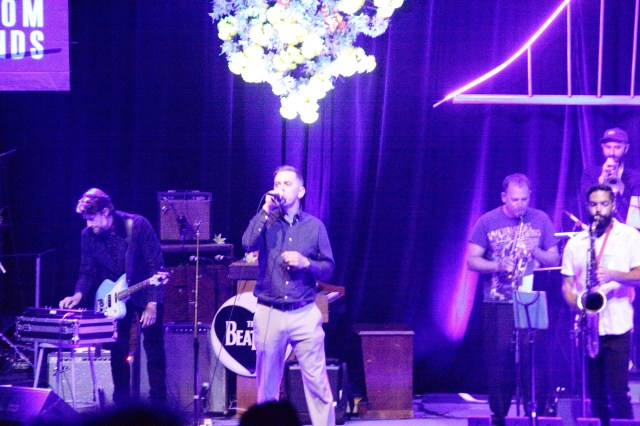
There was a full house at the UC Theater on this Saturday, June 3rd in Berkeley.  It was the only performance of this homage to the Beatles’ Sergeant Pepper album which was released 50 years ago (actually June 2, 1967).  Most of the performers were not even a twinkle in their parents’ eyes when this landmark of music came on the scene.  The “Summer of Love” was happening in the Bay Area and this album was unquestionably an influence then.  Tonight’s show demonstrated how that influence continues.

The audience was a mix of aging hippies (and non-hippies) and younger hipsters (is it OK to use that term and have no negative connotation?).  Some, no doubt, came for a bit of nostalgia remembering where they were when they first heard the original.  Some came to hear the creativity of local artists meeting such a challenge.

It would have been easy to simply do average covers of the songs and cater only to the nostalgia but Lyz Luke’s Undercover Presents, as usual, aimed higher than that (and hit their mark).  They, under the direction of guest producer Joe Bagale, curated a show of creative interpretations of each of the 13 tracks utilizing some of the finest of the massive talents that call the Bay Area home.  The end result was a true homage from another generation of marvelously diverse artists who put their stamp on the iconic songs without losing any respect for the power of the originals.

Simple but effective stage design by Bridget Stagnitto was reminiscent of the iconic album cover with creative lighting and functional information integrated into the tableau.  Ryan John and Brendan Dreaper were lead sound engineers.
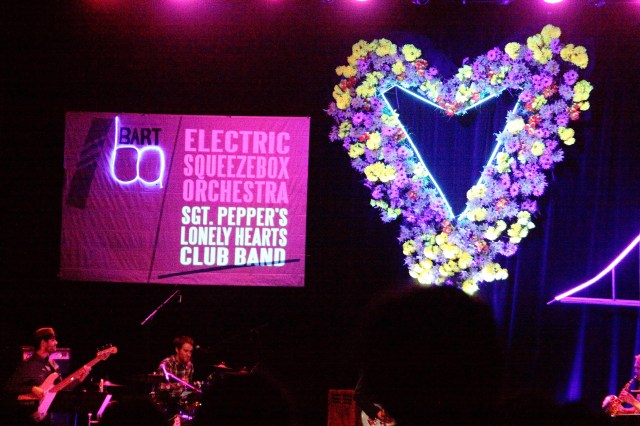
Sgt Pepper20170008

As is customary for these shows the bands played the tracks in their original order beginning with the Electric Squeezebox Orchestra’s instrumental cover of the opening track.  Principal trombone Rob Ewing’s arrangement captured the essence of that opening and effectively set the stage for what was to follow.

(Correction:  Per Joe Bagale the opening number was arranged by soprano saxophone player Michael Zilber.)

Sgt Pepper20170009

Sgt Pepper20170010

Vocalist Dublin sang a bluesy solo version of “With a Little Help From My Friends”, those friends being the Jazz Mafia Accomplices

Guitarist Jon Monahan takes responsibility for this arrangement which veered just a bit off of nostalgia to deliver a very effective solo vocal version (the original you may recall had that call and answer thing going on) of this, one of the best known tracks on the album.  Though it was not obvious, perhaps there was some homage intended to the late Joe Cocker who first saw the bluesy potential here when he presented his justly famed version at Woodstock in 1969.

Sgt Pepper20170014

Raz Kennedy made effective use of backup singers in his soulful take on “Lucy in the Sky with Diamonds”.  He shared arranging credit with Nick Milo.  The spirit of the Supremes, Gladys Knight (and of course the Pips), and maybe a touch of James Brown seemed to be present in the house and this arrangement got a great review from the audience.  What a voice!
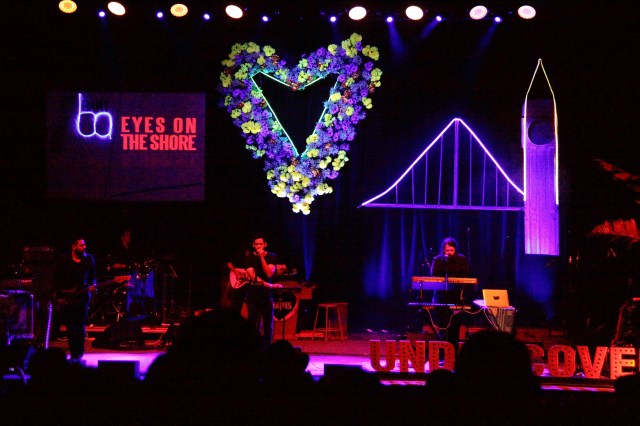
Sgt Pepper20170016

Eyes on the Shore shared arranging credits in their digital synth inflected take on Getting Better.  They went further afield with the material than some and may have briefly lost the pure nostalgia seekers but the arrangement clearly succeeded in pleasing the crowd. One would expect that psychedelia be transformed by the digital world, right?  And so it was.

Sgt Pepper20170018


The Avant Jazz Funk duo of Scott Amendola on percussion and Will Blades on Hammond Organ (how’s that for nostalgia?) and Clavinet turned in a very intense and rich improvisational battle in their purely instrumental version of “Fixing a Hole”.  Sometimes the melody was there and sometimes it was transformed in a musically psychedelic way that went quite a distance from the original.  But the use of the Hammond Organ and Clavinet themselves provided reassurance that they wouldn’t go too far.  The performances were blazingly intense and the whole house felt it.

Sgt Pepper20170022

We again were treated to soul with backup singers as Nino Moschella transformed the innocent ballad of adolescent alienation, “She’s Leaving Home”, into a more darkly hued version that seemed to reflect an understanding of the loss of that innocence that we all must face eventually.  Nothing somber here but clearly a different understanding consistent with the overall mission of having another generation’s way of remembering this material.
Sgt Pepper20170025


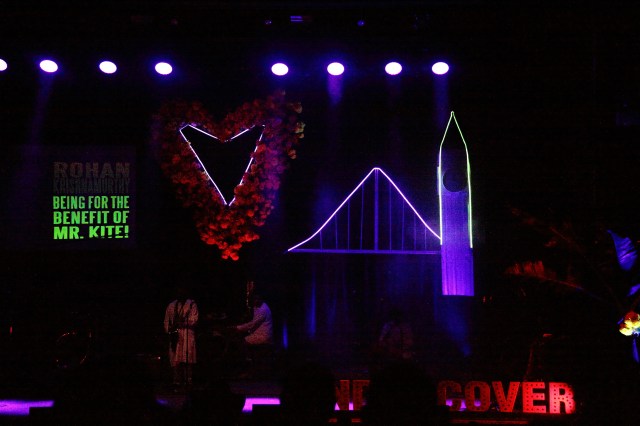
South Asian music and philosophy are inextricably linked to the psychedelic sounds of the mid to late 1960s and nowhere is this more obvious than with the Beatles whose study of Transcendental Meditation with their guru Maharishi Mahesh Yogi (born Mahesh Prasad Varma 1918-2008) while George Harrison studied sitar with Pandit Ravi Shankar (1920-2012).

Rohan Krishnamurthy (Mridangam, Hadjira frame drum), Prasant Radakrishnan (saxophone), and Colin Hogan (keyboard) share credits for their creative instrumental arrangement of “For Mr. Kite”.  Eschewing lyrics (which are etched in most of the audience’s minds anyway) they performed a stunningly unique rendition of this familiar song. Interestingly these musicians trace their influences to the southern Indian Carnatic tradition (somewhat different from the Hindustani traditions which influenced the Beatles) adding yet another layer of richness to the evening’s goings on.

Sgt Pepper20170029

Colin Hogan indicts himself yet again in his arrangement of “Within You Without You”, that spacey Hindustani inflected song.  The Hogan Brothers (Steve Hogan, bass; Colin Hogan, accordion; Julian Hogan, drums; Moorea Dickason, vocals; Charlie Gurke, baritone sax) turned in a marvelous world fusion rendition of the tune (lyrics and all) to a hugely appreciative response.
Sgt Pepper20170035

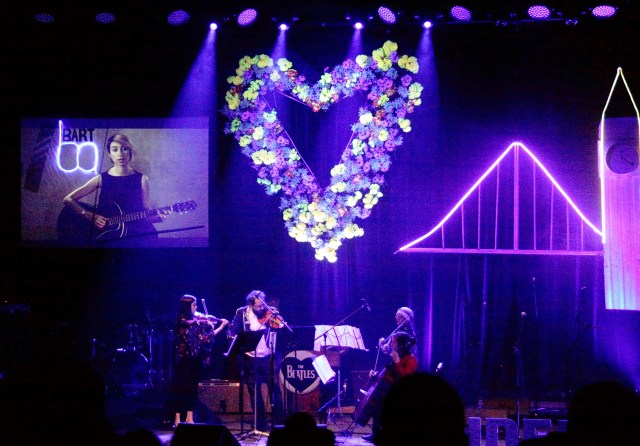
Iranian born Sahba Minikia, steeped in both Iranian and western classical traditions provided a touching arrangement of the classic, “When I’m Sixty Four”.  Featuring Mina Momeni on guitar and vocals (on video) accompanied by the Awesöme Orchestra in a song whose premise looks to the future as far as this evening looked into the past to ponder the endurance of romance.

In retrospect it is almost surprising that the marvelous diversity didn’t generate a presidential tweet of dissatisfaction.  Indeed a woman singing would produce more than a tweet of dissatisfaction in Tehran, birthplace of photographer and singer Momemi who also teaches visual arts in Canada.
Sgt Pepper20170040


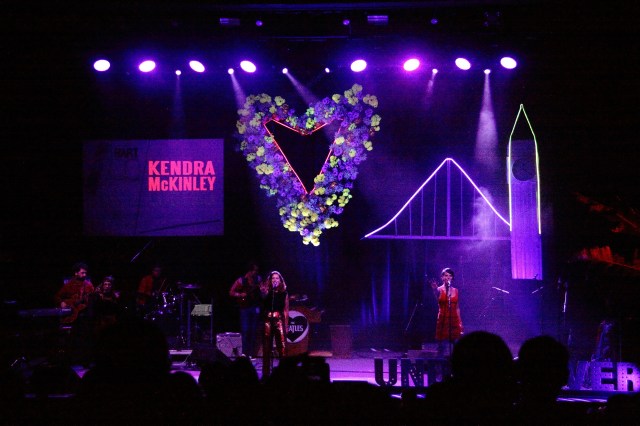
Vocalist Kendra McKinley practically turned “Lovely Rita” into a feminist anthem with some retro pop group choreography and background vocals to boot.  The visuals and the energy of the performance practically had the whole house dancing.

Sgt Pepper20170045

Soltrón added Latin percussion and energetic dance to the already electrified atmosphere with their arrangement of the raucous “Good Morning”.  Kendra McKinley could be seen and heard tying in her energy from the previous performance as backup singer here.

Sgt Pepper20170047

Lyz Luke stepped in to introduce the penultimate Sgt Pepper Reprise.

Sgt Pepper20170048

The dancing energy was carried on by the colorful and energetic dancers of Non-Stop Bhangra.  They accompanied Rohan Krishnamurthy and Otis McDonald in Joe Bagale’s rocking arrangement (replete with lyrics) of the reprise of the opening.  It was like a live action version of the studio executed original performance with a stage filled with ecstatic musicians and dancers.

Sgt Pepper20170052

Joe Bagale in his Sgt Pepper duds sings the lyrics hoping we’d enjoyed the show.

Sgt Pepper20170060

The apocalyptic, “A Day in the Life” concluded the mission of homage and nostalgia in a bigger than life tableau of talent and diversity that connected the “there and then” to the “here and now”.  The famous extended last chord crashed in a peak of energetic music making to bring the performances to a close.

Sgt Pepper20170062

The visuals were strongly reminiscent of the iconic album cover.
Sgt Pepper20170065

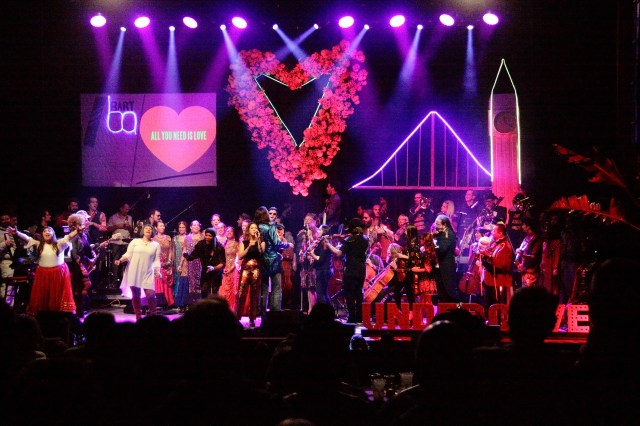
There was no need to encourage the audience to sing along to the encore of “All You Need is Love”.  Fifty years hence we still need it and if we still don’t have it everywhere at least we had it here this night.

 

American Muse, American Master: Steven Stucky on BMOP


BMOP 1050

Steven Stucky (1949-2016) was sadly taken from the world too soon.  But we can rejoice in this wonderful new disc of (mostly) first recordings of some of his wonderful orchestral music and songs.  Boston Modern Orchestra Project adds another entry to their growing discography of must hear American music with this beautiful recording.

Three works are featured, Rhapsodies (2008), American Muse (1999), and Concerto for Orchestra (No. 1, 1987).  Only one, American Muse has been recorded (on Albany Records) before and all are worthy selections from the composer’s ample catalog.

Rhapsodies, the most recent work, is also the shortest at just over 8 minutes.  It was commissioned by the New York Philharmonic and the BBC Symphony and is for large orchestra and sounds as though it could serve as a movement in another Concerto for Orchestra.  Stucky, who was an expert on the music of Witold Lutosławski (1913-1994), was a master orchestrator as was Lutosławski though Stucky’s style is distinctly different reflecting a sort of friendly romantic modernism with serious virtuosity.  This little gem gives the orchestra and, no doubt, the conductor, a run for their money in this virtuosic and highly entertaining little sonic gem.  It was premiered in 2008 under Lorin Maazel.

The Los Angeles Philharmonic commission, American Muse was written with the fine baritone Sanford Sylvan in mind.  It is a four song cycle setting poems by John Berryman, e.e. cummings, A.R. Ammons, and Walt Whitman and was premiered in 1999 under Esa-Pekka Salonen.  Sylvan is a very fine interpreter of American music and first won this reviewer’s heart with his rendition of John Adams’ The Wound Dresser (also a Whitman setting).  One should never miss an opportunity to hear Sylvan’s work.

Again we are treated to Stucky’s acute and subtle sense of orchestration which works with the poetry unobtrusively paralleling the words with the musical accompaniment and seemingly creating its own poetry in sound. Sylvan is in fine voice and seems to be enjoying his performance, a very satisfying experience.

The inclusion of Stucky’s first Concerto for Orchestra which was commissioned by the Philadelphia Orchestra and premiered in 1988 (under Ricardo Muti) will satisfy fans of this composer’s work as it provides an opportunity to hear “the one that got away” so to speak.  It was the runner up for the Pulitzer Prize which he would later win for his Second Concerto for Orchestra (2003) in 2005.

In it’s three movements Stucky is clearly the master of his realm and creates a wonderful listening experience.  His sense of drama and emotion are stunning and serve to underscore the dimension of what the world has lost in his passing.  But it is time to leave sorrow aside and let the music speak and thus provide the composer with a dimension of immortality.

As usual the performance and recording are impeccable and Gil Rose continues to record wonderful music that deserves more frequent hearings and does honor to the memory of a cherished artist.  Now can a recording of Stucky’s 2012 Symphony be far behind?  Let’s hope so.

When Politics and the Arts Clash, OM 22


Isang Yun (1917-1995)


The relationship between politics and music is complex and varied.  There are many instances of clashes between these two disciplines from the politics of state and church sponsored music to its repression by those same institutions.

After centuries of Catholic church sponsored music a decision was made in 1903 to repress the performance of anything but Gregorian chant and any instruments except for the ubiquitous organ.  The reasons for this decree have been discussed but the end result was less work for musicians.

More recently the Nazi “degenerate art” concepts and the later proscriptions on “formalist music” in Soviet Russia similarly put artists and musicians out of work.  In fact many were jailed or killed.  Shostakovich and Prokofiev were high profile musicians who endured bans on performances of their music based ostensibly on claims that it brought (or potentially brought) harm to the state’s political visions.

Even more recently the blacklist created by Joseph McCarthy and his acolytes perpetrated a similar assault on actors, directors and writers like Dalton Trumbo (recently dramatized in the excellent film Trumbo with Bryan Cranston leading the fine cast).  This sad chapter of history did not completely end until the 1970s and only recently have efforts succeeded in restoring suppressed screen credits to these films.  Many lives were destroyed or irreparably harmed.  One hopes, of course, that such travesties will not be repeated but the recent efforts to eliminate the NEA suggest that such struggles remain with us.

On February 18th Other Minds will present a centennial celebration of two composers’ births.  Lou Harrison certainly expressed some political themes in some of his music but did not incur state sponsored political wrath.  Unfortunately this was not the case with the other honoree of Other Minds’ 22nd season.

In 1967 Korean composer Isang Yun was kidnapped by South Korean intelligence officers and taken to South Korea to face accusations of collaboration with the communist government of North Korea.  He was held for two years and was subjected to interrogation and torture based on information later acknowledged to have been fabricated.  Even so South Korea declined to allow the ailing composer’s request to visit his hometown in 1994.  He died the following year in his adoptive home in Berlin, Germany.

A petition signed by over 200 artists including composers Karlheinz Stockhausen, Hans Werner Henze, Gyorgy Ligeti and conductors Otto Klemperer and Joseph Keilberth among the many was sent to the South Korean government in protest.  A fine recent article by K. J. Noh, Republic of Terror, Republic of Torture puts the incident in larger political context. It is a lesson sadly relevant even now in our politically turbulent times.

The concert will feature works from various points in his career, both before and after the aforementioned incident.  It is a fine opportunity to hear the work of this too little known 20th century master.  Conductor and pianist Dennis Russell Davies knew and worked with both Harrison and Isang.  It is so fitting that he will participate along with his wife, justly famed new music pianist Maki Namekawa, in this tribute to the the late composer.  This can’t right the wrongs but what better way to honor a composer than by performing his music?

The performance is at 7:30 PM at the historic Mission Dolores Basilica at 3321 16th Street
San Francisco, CA 94114.  Tickets available (only $20) at Brown Paper Tickets.

February 18th, Mark Your Calendars: Other Minds 22, A Must Hear


OMDI1Harrison

Lou Harrison (1917-2003)

The American composer Lou Harrison (1917-2003) and Korean composer Isang Yun (1917-1995) turn 100 this year and Other Minds 22 has a wonderful celebration that is not to be missed.  On February 18th at 7:30 PM in the beautiful, historic Mission Dolores Basilica in San Francisco’s famed Mission District.  This is actually only the first of two concerts which will comprise the Other Minds season 22 which is subtitled, “Pacific Rim Centennials”.  It is curated by Charles Amirkhanian, the reliable arbiter of modern musical tastes in the Bay Area and beyond.  (The second concert, scheduled for May 20, will be an all Lou Harrison concert closer to the composer’s May 14th birthday.)

yun_isang

Yun Isang (1917-1995)

Harrison is well known to new music aficionados, especially on the west coast for his compositions as well as his scholarship and teaching.  His extensive catalog contains symphonies, concertos, sonatas and other such traditional classical forms as well as some of the finest of what we now call “world music” featuring instruments from non-western cultures including the Indonesian gamelan.  He is also the man responsible for the preparation and premiere of Charles Ives’ Third Symphony in 1946 which was subsequently awarded a Pulitzer Prize.

Yun is perhaps less of a household name but is known for his many finely crafted compositions in the modern western classical tradition and, later, incorporating instruments and techniques from his native Korea.  He was infamously kidnapped by South Korean intelligence officers in 1967 and taken from his Berlin home to South Korea where he was held and tortured due to allegations (later proven fabricated) of collaboration with North Korea.  Over two hundred composers and other artists signed a petition for his release.  After several years he was returned to his adopted home in Berlin in 1969 where he continued to compose prolifically and teach until his death in 1995.

dennis-russell-davies

                              Dennis Russell Davies (from the American Composers Orchestra site)

This celebratory and memorial concert will feature world renowned artists including Grammy Award winning conductor and pianist Dennis Russell Davies who knew and collaborated with both Harrison and Isang.  Other artists will include pianist Maki Namekawa, violinist Yumi Hwang-Williams, percussionist William Winant (with his percussion group), and the Other Minds Ensemble.

The program is slated to consist of:

Sonata No. 3 for Piano

(1938, Lou Harrison)

Dennis Russell Davies

Kontraste I for Solo Violin

(1987, Isang Yun)

Yumi Hwang-Williams

Gasa, for Violin & Piano

(1963, Isang Yun)

Yumi Hwang-Williams, Dennis Russell Davies

Grand Duo for Violin and Piano (excerpts)

(1988, Lou Harrison)

IIII. Air
II. Stampede

Yumi Hwang-Williams, Dennis Russell Davies

Intermission

Canticle No. 3

(1941, Lou Harrison)

William Winant Percussion Group
Joanna Martin, ocarina
Brian Baumbusch, guitar
Dan Kennedy, Loren Mach, Ben Paysen, William Winant, Nick Woodbury, percussion
Dennis Russell Davies, conductor

Interludium A

(1982, Isang Yun)

Maki Namekawa, piano

Suite for Violin, Piano & Small Orchestra

(1951, Lou Harrison)

I. Overture
II. Elegy
III. First Gamelan
IIII. Aria
V. Second Gamelan
VI. Chorale

Yumi Hwang-Williams, violin
Maki Namekawa, piano
The Other Minds Ensemble:
Joanna Martin and Janet Woodhans, flute
Kyle Bruckman, oboe
Meredith Clark, harp
Evelyn Davis, celesta
Andrew Jamieson, tack piano
Emil Miland and Crystal Pascucci, cello
Scott Padden, bass
William Winant, percussion
Dennis Russell Davies, conductor

Other Minds is also co-sponsoring (with the Berkeley Art Museum/Pacific Film Archive) a screening of the 2015 German television produced film, Isang Yun: In Between North and South Korea on February 19th (4:15PM) at the Pacific Film Archive in Berkeley.  Dennis Russell Davies and composer Charles Boone will also be present to discuss the film.

If you do know these composers you probably already have your tickets but if you don’t know them you owe it to yourself to check out these performances.