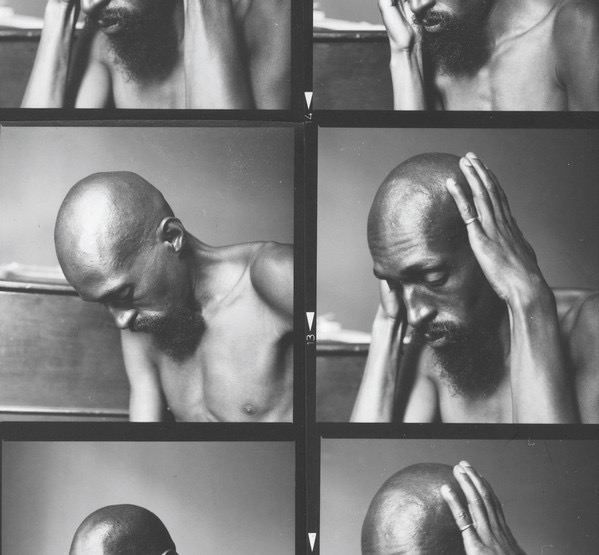
Femenine, a Lost Julius Eastman Recording, a Major Treasure


This is an epic minimalist masterpiece that has the same sort of almost full orchestral impact that one hears in works like Reich’s ‘Music for 18 Musicians’, Riley’s ‘InC’, and perhaps Glass’ ‘Music with Changing Parts’ or ‘Music in 12 Parts’.  The point is that it is entrancing and engaging music that deserves to be heard.

Julius Eastman (1940-1990) was an American singer, performer and composer whose work was little known until after his untimely death.  It was the efforts of composer Mary Jane Leach who performed a labor of love essentially saving Eastman’s work from obscurity when she called upon her fellow musicians and artists to help her gather all the extant recordings and scores many of which were lost after Eastman was evicted from his apartment not long before he died.  Her Julius Eastman page is a valuable reference and her work has inspired further research and performances of Eastman’s music.

Leach’s substantive initial efforts resulted in the release of the 3 CD set, Unjust Malaise which made available all of the then known serviceable recordings of this composer’s music.  Since then this recording became available and it may be the finest that Eastman did.

This is a live recording of a performance from 1974 which is quite lucid and listenable.  It starts slowly but quickly finds its rhythm and pace and provides an uninterrupted 70 minutes of consonant, even romantic sounds.  It’s relation to femininity or any gender issues is not clear, perhaps not even the point.  This piece also seems to have had a companion (called masculine) which is sadly now lost.

Anyone interested and entertained by the minimalist works already cited will find this work very inviting.  Hopefully the release of this recording will encourage a revival of this work and it will be performed again soon.  We as consumers are blessed to have this major work by this major composer available for listening and study.  Eastman deserves recognition as a composer and this disc certainly is a strong support for that.

Duo Stephanie and Saar: Bach Art of Fugue


duo bach

New Focus Recordings FCR 181

One of Bach’s last works (It is dated 1748) was thought for many years to have been a sort of academic thesis which was not meant for performance.  Even though it has received performances it is problematic in many ways for performers and listeners. it has spawned many different approaches to this score which specifies no instrumentation, no ordering to the separate movements, and leaves it’s last fugue tantalizingly incomplete.

There have been many orchestrations for ensembles ranging from various chamber groupings to full orchestra.  It has been done on harpsichord, organ and piano, organ, string quartet, brass ensemble, saxophone quartet to name a few.  In fact all of these approaches would seem perfectly appropriate and authentic within the context of baroque performance practice.  Undoubtedly we can expect more of this pluralistic approach to come to terms with Bach’s final utterance.

Sometimes the most salient characteristic of a recording of this work is about a new orchestration or some new scholarship, including yet another effort to complete the fugue which Bach left incomplete in the manuscript.  In this two disc recording the motivation seems to be simple clarity.  Duo Stephanie and Saar (pianists Stephanie Ho and Saar Ahuvia) perform the pieces on piano 4 hands, two pianos and solo piano as befits their artistic vision.  They order the pieces by playing the first 12 fugues (or contrapuncti, as Bach refers to them) followed by alternately performing the four canons in between the remaining fugues and ending with the Canon in Augmentation to create a sense of an arch of unity with increasing complexity followed by the comparatively simple postlude of the final canon.  As with many of the recordings Stephanie and Saar choose to leave the last fugue incomplete as Bach left it which is slightly jarring, leaving the sensation of having missed a step in the descent of a staircase but the final canon then does serve to bring the listener down gently.

Not until the minimalist movement would we see such a long focus on a single key (D minor), a potential deal breaker for a lesser composer.  However the lucidity of these performances and recordings allows the listener to focus on the beautiful intricacy of counterpoint that represents one of the pinnacles of western musical art.  Actually I have found that this recording works as well with focused listening as it does as background music where its energy sneaks in to your consciousness in a different but no less exhilarating way.  This is doubtless due to the quality of interpretation.

Nothing flashy here, no overblown musicological perspectives, just strong playing by artists who clearly know and love this music.  The Art of Fugue is not the easiest of Bach’s works to appreciate.  Indeed it took this listener many years and multiple different recordings to finally grasp the depth of the work.  And while it may not have been intended for performance per se this recording does a good job of finding the unity in these contrapuntal etudes which are effectively a summing up of the techniques of the high baroque era.  Stephanie and Saar take us on a wonderful journey, one you will want to take many times.

Exploding Debussy, Kathleen Supové


New Focus FCR 170

Increasingly it seems that new music performers take on a persona which includes a unique selection of repertoire and frequently a distinctive physical presence.  Kathleen Supové is a fine example.  Her distinctive physical appearance and attire becomes a metaphor for her very personal and intelligent choice of repertoire which sets her apart from her peers.  In addition to unquestioned virtuosity and beautiful interpretive skills her persona takes on an adjectival quality which prompts this reviewer to ponder the “Supovian” experience.


I may live to regret that neologism but the present album is offered as exhibit one (of about 20 albums) attesting to the distinctive choices of music that characterize her work.  This two disc album, The Debussy Effect, is a very modern homage (even sometimes with apologies) to the impressionist master.  Twelve tracks on the two discs feature seven contemporary composers.  Only three tracks are for solo piano.  The rest involve electronic enhancements and or “soundtracks”.

Initially I had hoped to be able to say something useful (if not particularly insightful) to prospective listeners/buyers of this album about each of the pieces here but after several listens I can only reliably say that the material makes for a great and entertaining listening experience.  It harbors complexities that cannot be fairly recounted in such a brief review.  (And this reviewer has a limited knowledge of Debussy as well.)

Here are works by some of the finest of the New York “downtown” music traditions that reflect some amazing and very deep appreciations that will likely change the way you hear Debussy.

Here is the track list:

Disc One

1.  Storefront Diva: a dreamscape by Joan La Barbara

2.  Dr. Gradus vs. Rev. Powell by Matt Marks

3.  Layerings 3 by Eric Kenneth Malcolm Clark

4.  What Remains of a Rembrandt by Randall Woolf

Disc Two

1-4.  Shattered Apparitions of the Western Wind by Annie Gosfield

5-7.  Cakewalking (Sorry Claude) by Daniel Felsenfeld

8. La plus que plus que lente by Jacob Cooper

All are engineered by the wonderful Sheldon Steiger for the New Focus recordings label.

So the take away here is as follows:  If you are a Debussy fan you will want to hear this album.  If you are a Kathleen Supové fan you will want to hear this album.  It is the second reason the seems the most salient here.  I expect to be listening to this many more times.  Enjoy.


Both Homage and Nostalgia for Sergeant Pepper at the UC Theater


Sgt Pepper20170002

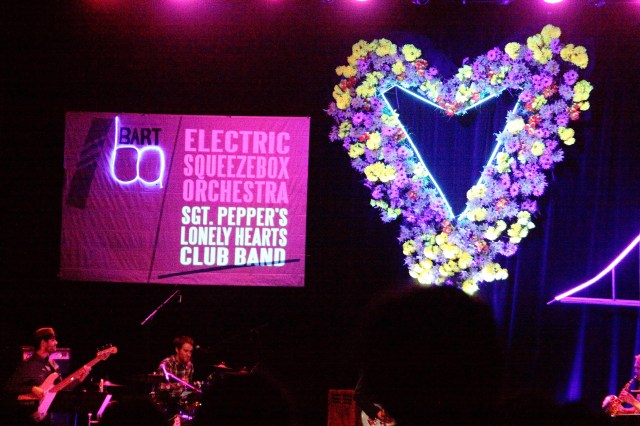
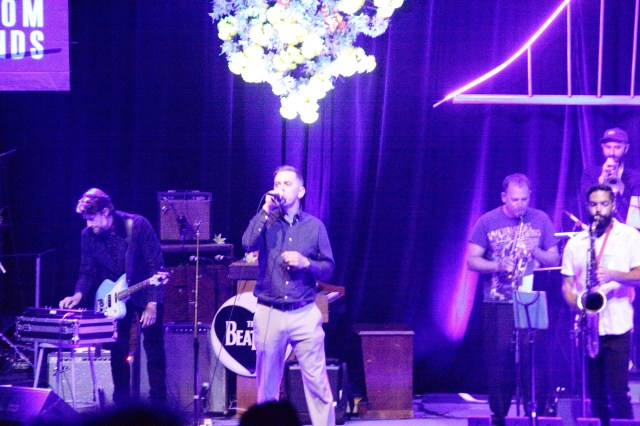
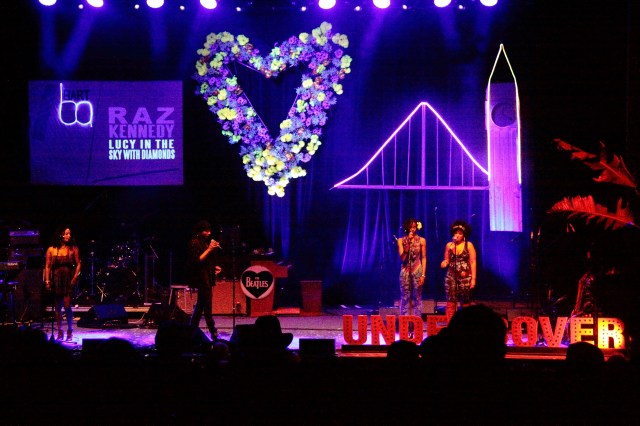
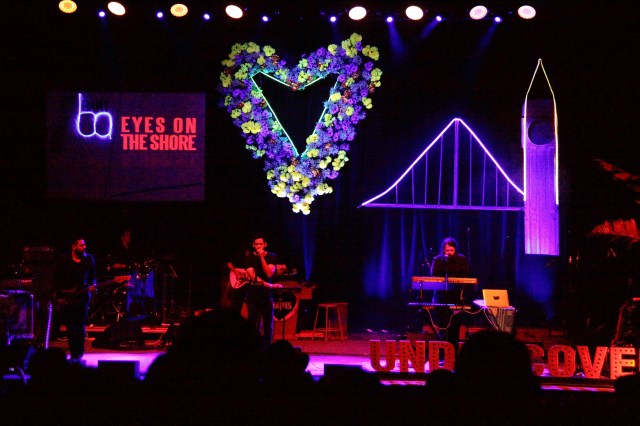
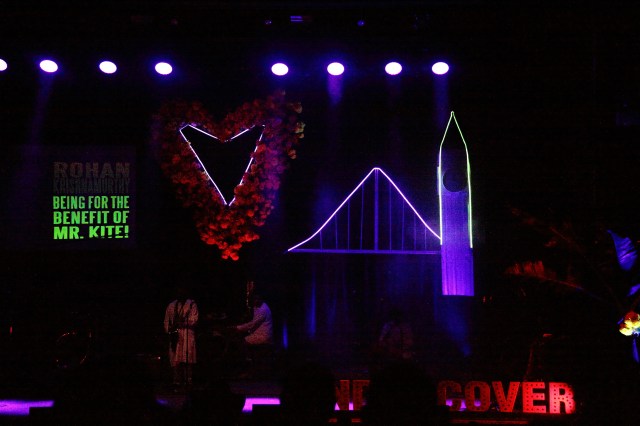
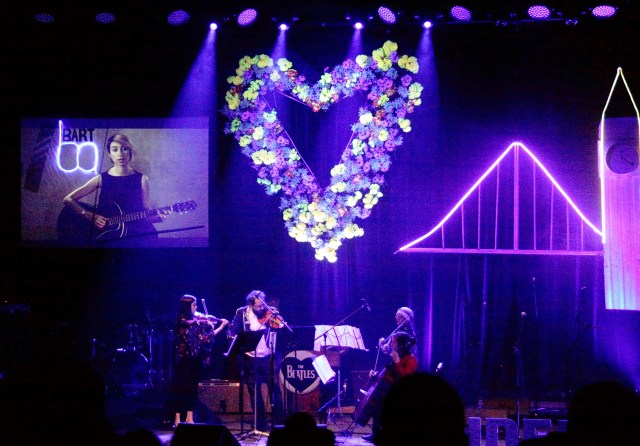
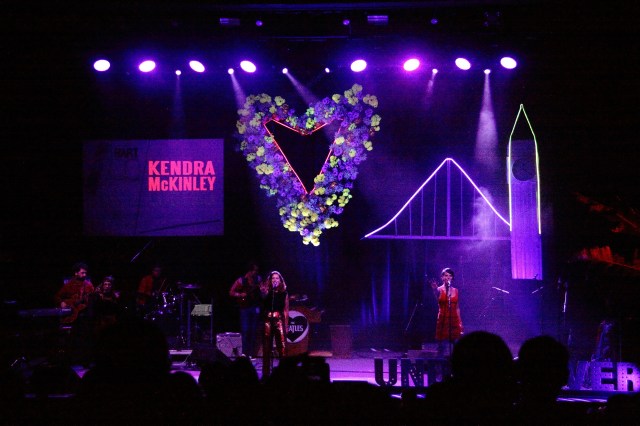
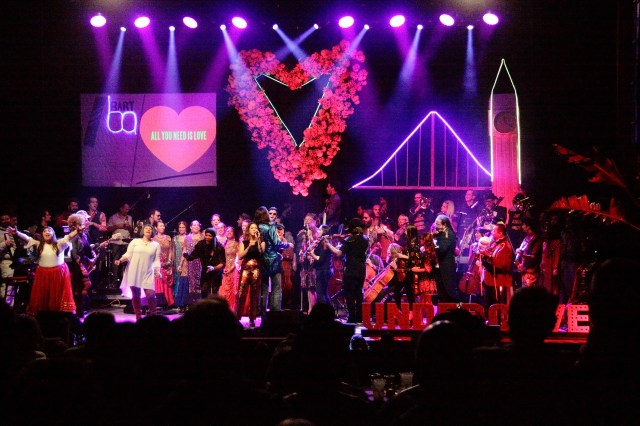
Creative, practical staging and lighting was a unifying factor in this triumph from Undercover Presents.

There was a full house at the UC Theater on this Saturday, June 3rd in Berkeley.  It was the only performance of this homage to the Beatles’ Sergeant Pepper album which was released 50 years ago (actually June 2, 1967).  Most of the performers were not even a twinkle in their parents’ eyes when this landmark of music came on the scene.  The “Summer of Love” was happening in the Bay Area and this album was unquestionably an influence then.  Tonight’s show demonstrated how that influence continues.

The audience was a mix of aging hippies (and non-hippies) and younger hipsters (is it OK to use that term and have no negative connotation?).  Some, no doubt, came for a bit of nostalgia remembering where they were when they first heard the original.  Some came to hear the creativity of local artists meeting such a challenge.

It would have been easy to simply do average covers of the songs and cater only to the nostalgia but Lyz Luke’s Undercover Presents, as usual, aimed higher than that (and hit their mark).  They, under the direction of guest producer Joe Bagale, curated a show of creative interpretations of each of the 13 tracks utilizing some of the finest of the massive talents that call the Bay Area home.  The end result was a true homage from another generation of marvelously diverse artists who put their stamp on the iconic songs without losing any respect for the power of the originals.

Simple but effective stage design by Bridget Stagnitto was reminiscent of the iconic album cover with creative lighting and functional information integrated into the tableau.  Ryan John and Brendan Dreaper were lead sound engineers.

Sgt Pepper20170008

As is customary for these shows the bands played the tracks in their original order beginning with the Electric Squeezebox Orchestra’s instrumental cover of the opening track.  Principal trombone Rob Ewing’s arrangement captured the essence of that opening and effectively set the stage for what was to follow.

(Correction:  Per Joe Bagale the opening number was arranged by soprano saxophone player Michael Zilber.)

Sgt Pepper20170009

Sgt Pepper20170010

Vocalist Dublin sang a bluesy solo version of “With a Little Help From My Friends”, those friends being the Jazz Mafia Accomplices

Guitarist Jon Monahan takes responsibility for this arrangement which veered just a bit off of nostalgia to deliver a very effective solo vocal version (the original you may recall had that call and answer thing going on) of this, one of the best known tracks on the album.  Though it was not obvious, perhaps there was some homage intended to the late Joe Cocker who first saw the bluesy potential here when he presented his justly famed version at Woodstock in 1969.

Sgt Pepper20170014

Raz Kennedy made effective use of backup singers in his soulful take on “Lucy in the Sky with Diamonds”.  He shared arranging credit with Nick Milo.  The spirit of the Supremes, Gladys Knight (and of course the Pips), and maybe a touch of James Brown seemed to be present in the house and this arrangement got a great review from the audience.  What a voice!

Sgt Pepper20170016

Eyes on the Shore shared arranging credits in their digital synth inflected take on Getting Better.  They went further afield with the material than some and may have briefly lost the pure nostalgia seekers but the arrangement clearly succeeded in pleasing the crowd. One would expect that psychedelia be transformed by the digital world, right?  And so it was.

Sgt Pepper20170018


The Avant Jazz Funk duo of Scott Amendola on percussion and Will Blades on Hammond Organ (how’s that for nostalgia?) and Clavinet turned in a very intense and rich improvisational battle in their purely instrumental version of “Fixing a Hole”.  Sometimes the melody was there and sometimes it was transformed in a musically psychedelic way that went quite a distance from the original.  But the use of the Hammond Organ and Clavinet themselves provided reassurance that they wouldn’t go too far.  The performances were blazingly intense and the whole house felt it.

Sgt Pepper20170022

We again were treated to soul with backup singers as Nino Moschella transformed the innocent ballad of adolescent alienation, “She’s Leaving Home”, into a more darkly hued version that seemed to reflect an understanding of the loss of that innocence that we all must face eventually.  Nothing somber here but clearly a different understanding consistent with the overall mission of having another generation’s way of remembering this material.

Sgt Pepper20170025


South Asian music and philosophy are inextricably linked to the psychedelic sounds of the mid to late 1960s and nowhere is this more obvious than with the Beatles whose study of Transcendental Meditation with their guru Maharishi Mahesh Yogi (born Mahesh Prasad Varma 1918-2008) while George Harrison studied sitar with Pandit Ravi Shankar (1920-2012).

Rohan Krishnamurthy (Mridangam, Hadjira frame drum), Prasant Radakrishnan (saxophone), and Colin Hogan (keyboard) share credits for their creative instrumental arrangement of “For Mr. Kite”.  Eschewing lyrics (which are etched in most of the audience’s minds anyway) they performed a stunningly unique rendition of this familiar song. Interestingly these musicians trace their influences to the southern Indian Carnatic tradition (somewhat different from the Hindustani traditions which influenced the Beatles) adding yet another layer of richness to the evening’s goings on.

Sgt Pepper20170029

Colin Hogan indicts himself yet again in his arrangement of “Within You Without You”, that spacey Hindustani inflected song.  The Hogan Brothers (Steve Hogan, bass; Colin Hogan, accordion; Julian Hogan, drums; Moorea Dickason, vocals; Charlie Gurke, baritone sax) turned in a marvelous world fusion rendition of the tune (lyrics and all) to a hugely appreciative response.

Sgt Pepper20170035

Iranian born Sahba Minikia, steeped in both Iranian and western classical traditions provided a touching arrangement of the classic, “When I’m Sixty Four”.  Featuring Mina Momeni on guitar and vocals (on video) accompanied by the Awesöme Orchestra in a song whose premise looks to the future as far as this evening looked into the past to ponder the endurance of romance.

In retrospect it is almost surprising that the marvelous diversity didn’t generate a presidential tweet of dissatisfaction.  Indeed a woman singing would produce more than a tweet of dissatisfaction in Tehran, birthplace of photographer and singer Momemi who also teaches visual arts in Canada.

Sgt Pepper20170040


Vocalist Kendra McKinley practically turned “Lovely Rita” into a feminist anthem with some retro pop group choreography and background vocals to boot.  The visuals and the energy of the performance practically had the whole house dancing.

Sgt Pepper20170045

Soltrón added Latin percussion and energetic dance to the already electrified atmosphere with their arrangement of the raucous “Good Morning”.  Kendra McKinley could be seen and heard tying in her energy from the previous performance as backup singer here.

Sgt Pepper20170047

Lyz Luke stepped in to introduce the penultimate Sgt Pepper Reprise.

Sgt Pepper20170048

The dancing energy was carried on by the colorful and energetic dancers of Non-Stop Bhangra.  They accompanied Rohan Krishnamurthy and Otis McDonald in Joe Bagale’s rocking arrangement (replete with lyrics) of the reprise of the opening.  It was like a live action version of the studio executed original performance with a stage filled with ecstatic musicians and dancers.

Sgt Pepper20170052

Joe Bagale in his Sgt Pepper duds sings the lyrics hoping we’d enjoyed the show.

Sgt Pepper20170060

The apocalyptic, “A Day in the Life” concluded the mission of homage and nostalgia in a bigger than life tableau of talent and diversity that connected the “there and then” to the “here and now”.  The famous extended last chord crashed in a peak of energetic music making to bring the performances to a close.

Sgt Pepper20170062

The visuals were strongly reminiscent of the iconic album cover.

Sgt Pepper20170065

There was no need to encourage the audience to sing along to the encore of “All You Need is Love”.  Fifty years hence we still need it and if we still don’t have it everywhere at least we had it here this night.


Grand Celebrations of Finnish Culture


BIS- 9048 SACD

The choice of repertoire, performers, and the quality of their recordings make any BIS records release worthy of attention.  This two disc set is a fine example.  Three major choral/orchestral works which celebrate the justly proud Finnish culture are given very fine performances in this live recording from 2016.

The earliest work, Jean Sibelius’ Kullervo Op. 7 (1892) is one of the less recognized masterpieces by Finland’s best known composer.  Based on the Finnish national epic, The Kalevala, this massive symphony has acquired a bit of its own mythology.  Though several recordings of this work now exist the world world premiere recording by the late Paavo Berglund (1929-2012) from the early 1970s brought this neglected masterpiece to a larger listening audience.  The intelligent liner notes by Andrew Barnett (and Olli Kortekangas) document and dispel the myths that Sibelius suppressed all or portions of this work which was premiered in 1892 yet had to wait until after the composer’s death in 1957 to receive its first twentieth century performance.  

In fact it seems more likely that the large forces required along with programmers’ preference for the composer’s later masterpieces were responsible for the unfortunate neglect of the present work.  It was the more romantically inclined myth of mysterious oppression that greeted Berglund’s triumphant premiere recording and this reviewer recalls being both charmed and intrigued by it.  Whatever the story the music is now a recognized early triumph by its creator and it is given a gorgeous reading by Finnish conductor Osmo Vänskä, (principal conductor of the Minnesota Orchestra which plays powerfully and definitively.

So why a second disc?  Well, Maestro Vänskä saw fit to commission a new work by contemporary Finnish composer Olli Kortekangas to serve as a companion piece to Kullervo and, then include a version with chorus of Sibelius’ best known work, Finlandia.  Together these three works would very satisfyingly fill an entire concert program.

Olli Kortekangas (1955- ) chose poetry by Finnish-American poet Sheila Packa and composed a 7 movement work (three are interludes for orchestra alone) in celebration of the 150th anniversary of modern Finnish migration to the United States.  The work, Migration (2014), is similar in orchestration with its use of male chorus and two soloists backed by a large orchestra.  The composer’s style is a sort of 21st century romantic style with tasteful modern touches.  

The focus of this fine new work is an affirmation of Finnish culture and its impact on the United States.  It seems both fitting and satisfying then that this program conclude with the landmark work of Finnish pride and nationalism, Sibelius’ best known work, Finlandia (1899).  But rather than just another reading of this classic of the concert hall  Vänskä chooses to do a version with chorus.  This was not the composer’s original intent but this version fits remarkably well in the context of this album.  

This is a very enjoyable album, well conceived and executed in every way.  Soloists Lilli Paasikivi and Tommi Hakala sing their roles with skill and passion as does the YL Male Voice Choir.  The applause track at the end of the Finlandia performance echoed the emotional experience of this reviewer and will likely do so for anyone who chooses to avail themselves of this fine example of recording art.

February 18th, Mark Your Calendars: Other Minds 22, A Must Hear


OMDI1Harrison

Lou Harrison (1917-2003)

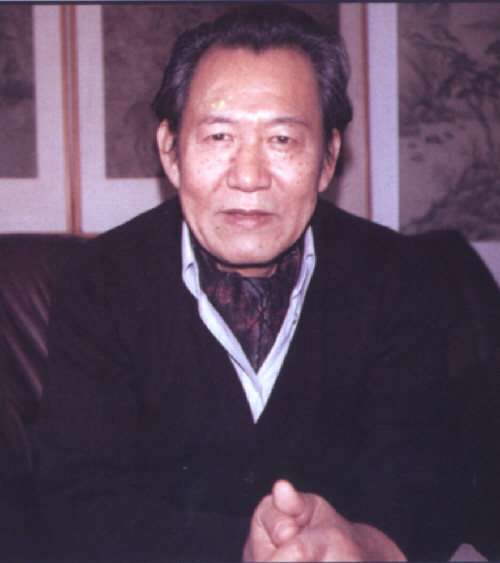
The American composer Lou Harrison (1917-2003) and Korean composer Isang Yun (1917-1995) turn 100 this year and Other Minds 22 has a wonderful celebration that is not to be missed.  On February 18th at 7:30 PM in the beautiful, historic Mission Dolores Basilica in San Francisco’s famed Mission District.  This is actually only the first of two concerts which will comprise the Other Minds season 22 which is subtitled, “Pacific Rim Centennials”.  It is curated by Charles Amirkhanian, the reliable arbiter of modern musical tastes in the Bay Area and beyond.  (The second concert, scheduled for May 20, will be an all Lou Harrison concert closer to the composer’s May 14th birthday.)

yun_isang

Yun Isang (1917-1995)

Harrison is well known to new music aficionados, especially on the west coast for his compositions as well as his scholarship and teaching.  His extensive catalog contains symphonies, concertos, sonatas and other such traditional classical forms as well as some of the finest of what we now call “world music” featuring instruments from non-western cultures including the Indonesian gamelan.  He is also the man responsible for the preparation and premiere of Charles Ives’ Third Symphony in 1946 which was subsequently awarded a Pulitzer Prize.

Yun is perhaps less of a household name but is known for his many finely crafted compositions in the modern western classical tradition and, later, incorporating instruments and techniques from his native Korea.  He was infamously kidnapped by South Korean intelligence officers in 1967 and taken from his Berlin home to South Korea where he was held and tortured due to allegations (later proven fabricated) of collaboration with North Korea.  Over two hundred composers and other artists signed a petition for his release.  After several years he was returned to his adopted home in Berlin in 1969 where he continued to compose prolifically and teach until his death in 1995.

dennis-russell-davies

                              Dennis Russell Davies (from the American Composers Orchestra site)

This celebratory and memorial concert will feature world renowned artists including Grammy Award winning conductor and pianist Dennis Russell Davies who knew and collaborated with both Harrison and Isang.  Other artists will include pianist Maki Namekawa, violinist Yumi Hwang-Williams, percussionist William Winant (with his percussion group), and the Other Minds Ensemble.

The program is slated to consist of:

Sonata No. 3 for Piano

(1938, Lou Harrison)

Dennis Russell Davies

Kontraste I for Solo Violin

(1987, Isang Yun)

Yumi Hwang-Williams

Gasa, for Violin & Piano

(1963, Isang Yun)

Yumi Hwang-Williams, Dennis Russell Davies

Grand Duo for Violin and Piano (excerpts)

(1988, Lou Harrison)

IIII. Air
II. Stampede

Yumi Hwang-Williams, Dennis Russell Davies

Intermission

Canticle No. 3

(1941, Lou Harrison)

William Winant Percussion Group
Joanna Martin, ocarina
Brian Baumbusch, guitar
Dan Kennedy, Loren Mach, Ben Paysen, William Winant, Nick Woodbury, percussion
Dennis Russell Davies, conductor

Interludium A

(1982, Isang Yun)

Maki Namekawa, piano

Suite for Violin, Piano & Small Orchestra

(1951, Lou Harrison)

I. Overture
II. Elegy
III. First Gamelan
IIII. Aria
V. Second Gamelan
VI. Chorale

Yumi Hwang-Williams, violin
Maki Namekawa, piano
The Other Minds Ensemble:
Joanna Martin and Janet Woodhans, flute
Kyle Bruckman, oboe
Meredith Clark, harp
Evelyn Davis, celesta
Andrew Jamieson, tack piano
Emil Miland and Crystal Pascucci, cello
Scott Padden, bass
William Winant, percussion
Dennis Russell Davies, conductor

Other Minds is also co-sponsoring (with the Berkeley Art Museum/Pacific Film Archive) a screening of the 2015 German television produced film, Isang Yun: In Between North and South Korea on February 19th (4:15PM) at the Pacific Film Archive in Berkeley.  Dennis Russell Davies and composer Charles Boone will also be present to discuss the film.

If you do know these composers you probably already have your tickets but if you don’t know them you owe it to yourself to check out these performances.


E-Do: Yeominrok, Wonderful Korean Musical Fusion


yeominrok

Pony Canyon PCSD 01023

Call it world music, call it jazz, call it fusion but whatever the description this is an innovative and fascinating musical journey.  Using traditional Korean instruments as well as the usual keyboards, vocals, and drums this group of young musicians crafts a very interesting and beautiful tapestry of sound.

I have long had an interest in and some appreciation of traditional Korean musics and instruments but my knowledge is rather limited.  I am inclined to compare this group to Oregon, the iconic jazz/new age experimental band of the 1970s but unlike Oregon’s more widely cast net we see young musicians embracing their ancient Korean musical heritage as they seek to express themselves and invoke the wisdom of their ancestors.  This album was sent to me as a gift from a friend but I quickly fell in love with it and I had to write a review.

It seems to me that Korea has, more than many countries, been damaged and stunted by the antics that became known as World War II and the Korean War.  As a result this rich and ancient culture was nearly erased in favor of geographic division and political expediency.  It is heartening to find young artists such as these seeking to communicate with if not actually recover some of this rich past.

This band is named after a revered 15th century Korean king and they make liberal use of traditional Korean instruments alongside their drums, keyboards, and vocals.  The album succeeds to some degree in achieving a synthesis (as opposed to a sappy watering down) of traditional music and something like jazz with some rock and pop sensibility.  These are sincere and perceptive artists and if they have not fully succeeded then they have made a significant step toward reviving some of their justly valued history and culture.

In addition to its musical values this is a gorgeously produced album (visually and sonically) and I am sorry to see that only the digital download is available on Amazon.

There are six tracks on the disc and all feature traditional Korean instruments alongside the band’s keyboards, drums and vocals.  There are few vocals but no words as far as I can tell and any program is implied at best.  This is strictly about the music.

The first track, Bird of Oblivion, unfolds like an Indian raga with a meditative slow beginning giving way to a faster section.  It is the most extended work on the disc at 13:51 and it certainly serves to bdraw the listener in.  The remaining tracks range from pop-inflected jazz (track 3) to a little bit of rock .  Throughout the traditional Korean instruments make their presence known but not overwhelmingly.  This album is a pretty successful synthesis of old and new.

E Do consists of:

Kyung-hwa Ryu: chulhyungeum, yanggeum, janggu, kkwaenggwari

Chung Lim: drums, jungju, gong

Min-soo Cho: junggu, Korean drum, Korean fan, percussion

Jung-chul Seo: electronic bass, contrabass

Young-Sup Lee: daegeum, taepyeongso, danso, ocarina

Seung-hwan Yang: keyboards

Tae-young Kim: vocals

Young-goo Lee: daegum

Seek this one out.  And don’t forget to pick up some traditional Korean music as well.  It is well worth your time and, after all, a nod to the fine efforts of this wonderful group.


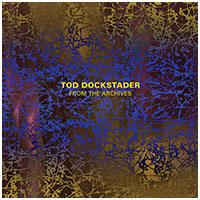
Discovering and Preserving a Legacy: Tod Dockstader: From the Archives


dockarch

Starkland ST-226

I’m gonna go out on a limb here and suggest that this disc is a major and important release.  The history of music includes a fair amount of instances in which a second look at a particular composer who had been neglected yields a rediscovery which places said composer to their proper place in history.  Such was the case with Mendelssohn famously rediscovering Bach and Sir Thomas Beecham championing the works of Hector Berlioz. Conductor Robert Craft brought the work of Anton Webern to a larger audience with his recording of the complete works back in the 1950s and, more recently, Michael Tilson Thomas did a similar favor for the work of Carl Ruggles.  Of course not every musico-archaeological effort yields great results but the present release would appear to be auspiciously positioned to bring delight to listeners as well as place its composer in a more appropriately prominent place in the history books.  Now we are treated to a previously unknown cache of musical treasures from such a master, the digital equivalent of discovering Tut’s tomb.  It is an amazing disc on many levels.

This recording is nearly as much the accomplishment of Starkland Records’ producer Tom Steenland as it is of the composer Tod Dockstader (1932-2015).  Starkland’s  first two releases were CD reissues of the composer’s four Owl Records albums from the mid-1960s. It was the musicological acumen of Steenland whose love for those albums that helped provide motivation for him to found Starkland Records and promote this important electronic composer to proper historical recognition.  Dockstader was, in turn, inspired by the very positive response to those reissues to end his thirty year hiatus and return to composing.  He subsequently released the three volumes of Aerial (2005-6) on Sub Rosa and two collaborations with David Lee Myers (whose thumbprint is to be found on the present recording as well), Pond (2004) and Bijou (2005).

As if all that weren’t quite enough a new chapter dawned shortly after Dockstader died in 2015.  He left behind his archive of tapes and record releases and something more.  Justin Brierly, a radio host, was a fan of Dockstader’s music and wanted to interview him for his show.  He contacted Tom Steenland who was able to put him in touch and he was able to visit and interview the composer on several occasions.  The composer’s daughter, Tina Dockstader Kinard, gave Brierly the computer tower containing work files which had been saved on that hard drive over the years. There were thousands of files in various stages of completion, some just sample files, some duplicates, but many complete or nearly complete compositions that had not been heard since they were created.  Brierly sorted through these and sent some 50 files to Tom Steenland who carefully selected 15 tracks for the present release.

Tod Dockstader was a composer with a day job, that is he worked as a film and sound editor and took advantage of his access to what would have been prohibitively expensive equipment at the time to create his own brand of electronic music.  Sadly Vladimir Ussachevsky denied him access to the Columbia-Princeton Studios back in 1961.

Stylistically he holds much in common with his antecedents Edgar Varese, Pierre Henry, Louis and Bebe Barron, Pierre Schaeffer as well as contemporaries such as Morton Subotnick and Andrew Rudin. His albums from the 1960s of course utilized the tape splicing techniques and analog equipment of the time.  Some of the music from his Eight Electronic Pieces (1961) album was selected (as were some of Andrew Rudin’s electronic compositions) for inclusion in the soundtrack for Frederico Fellini’s Satyricon (1969).

When he returned to composing in the late 1990s studios were digitally driven and computers ruled. He reportedly had little difficulty learning and using computers for his later works. Despite the change from analog to digital media however Dockstader’s style remained extremely consistent, a clear and unique voice in the musical landscape.

Prior to this release it had been thought that his last word musically was the three volume Aerial series of 2005-6.  Now Starkland presents this lovingly selected cache of the composer’s most recent works.  He had effectively stopped composing in 2008 wrestling with the ravages of dementia but did listen and comment at times with Brierly during his visits on some of these files and, fittingly, enjoyed the fruits of his own labors to the very end of his life in 2015.  There’s no doubt more of a story to be told there for sure and here’s hoping that we may soon see a comprehensive biographical and musical assessment of his work.

For the wonderful liner notes Steenland recruited Geeta Dayal,  a San Francisco based writer whose writings on music can be accessed from her website and are well worth your time to investigate.  She comes with quite a pedigree as a writer on the subject of electronic music both old and new.  Her liner notes are both authoritative and good reading.  She would be my vote for a Dockstader biographer.

The exact intentions of the compositional process cannot be determined (Dockstader left no notes about these files) but it seems clear that these are all late period pieces.  They are all dated between 2005 and 2008.  The titles of these pieces were made based in part on the computer file names for the pieces which had not gotten their final naming by the composer.  One can only imagine the labor of love involved in Brierly’s and Steenland’s distillation of these final 15 tracks but the end result is a very satisfying collection consistent in quality to previous releases and a worthy representation of his last works (though this reviewer is given to hopeful wonder that a volume II might emerge in the near future).  At any rate Dockstader’s legacy is now secure and no doubt there will be much research done on his work made easier now by the dedicated sleuthing of these producers.

The first track, Super Choral (2007) contains some collaboration with David Lee Myers as mentioned earlier and it is used with his permission.  I won’t try to describe the rest of these pieces except to say that they seem to be a worthwhile contribution to the art of electronic music, are excellently crafted and eminently listenable.

The liner notes with their studio porn images of Dockstader’s beloved Ampex machines are tastefully mixed with images of the composer and his family.  The mastering was done by the wonderful Silas Brown and is about as good as it gets.  I can’t imagine a more fitting tribute to the composer’s legacy than this and I can’t imagine this not being nominated for a Grammy.  Bravo gentlemen!

Release is scheduled for November 18th.  You can pre-order both the download and the physical disc on Amazon.


Black Notes Matter: Lara Downes’ America Again


laradownes

Sono Luminus DSL-92207

The lovely cover photo for this album by San Francisco born pianist Lara Downes is reminiscent of any number of socially conscious folk/rock stars of the 60s and 70s. It would seem that this is no accident.  This delightful album of short pieces by a wide variety of American composers takes its title from the Langston Hughes (1902-1967) poem, Let America Be America Again (1935).  By so doing the pianist places this interesting selection of short piano pieces firmly in the context of black racial politics and the artistic expression of black America as well as those influenced by this vital vein of American culture (both musical and literary).  It is a graceful and deeply felt effort and I hope that the metaphor of the title of my review is not too tortured a one to reflect that.

This is also a very personal album.  Downes seems to share some deeply felt connections with her materials.  This artist, born to a white mother and a black father, invokes a careful selection of short piano pieces steeped sometimes in jazz and blues but also the political directness (and optimism) which was characteristic of the inter-war years that brought forth the Hughes poem.  There is both sadness and celebration in these virtuosic and technically demanding little gems (most apparently recorded for the first time or at least the first time in a while).  The pianist’s comments on each individual piece are also critical to the understanding of this disc as she shares the impact and meaning that the music has had for her.

There are 21 tracks by 19 composers in all and the selections themselves are quite a feat. They range from the 19th to the 21st centuries and are composed by both men and women of a variety of racial and ethnic backgrounds.  All seem to share the sort of  populist charm befitting the idealized America yearned for in the poem which is to say that they represent a kind of idealized or hopeful nationalism.  Downes is well acquainted with a large variety of American music and recognizes no distinction between classical and so-called “vernacular” traditions.

In fact none of these things are atypical for this artist.  Her previous albums Exiles Cafe (2013) featured music by composers exiled from their homelands, A Billie Holiday Songbook (2015) celebrated the life of this iconic black artist and her American Ballads (2001) demonstrated her deep mastery and affection for populist (but not jingoistic) nationalism.  Her tastefully issue oriented albums define a very individual path and the present album appears to be a very logical and well executed next entry into her discography.

This disc shares a similar heritage to that of Alan Feinberg’s four discs on Argo/Decca entitled, The American Innovator, The American Virtuoso, The American Romantic and Fascinating Rhythm: American Syncopation.  Another notable antecedent is Natalie Hinderas’ groundbreaking two disc set of music by African-American composers.

And now on to the music:

Morton Gould (1913-1996) was a Pulitzer Prize winning composer and conductor with a style informed by his study of jazz and blues in a vein similar to that of Bernstein and Copland.  He is represented here by American Caprice (1940).

Lou Harrison (1917-2003)  was a composer, conductor and teacher.  He was a modernist and an innovator in the promotion of non-western musical cultures.  His New York Waltzes (1944-1994) are three brief essays in that dance form.

The traditional folk song Shenandoah (apparently in the pianist’s transcription) is next.   This tune will be familiar to most listeners as a popular selection by choral groups and the melody is a common metaphor for things American.

Amy Marcy Cheney Beach (1867-1944) was one of the first successful female American composers.  Her “From Blackbird Hills” Op. 83 (1922) is representative of her late romantic style and her incorporation of Native American (Omaha) elements in her music.

Samuel Coleridge-Taylor (1875-1912) is a English composer with Creole roots, a black composer, known as the “African Mahler” in his day.  Deep River (1905) is his setting of this spiritual which also was one of Marian Anderson’s signature pieces.

Dan Visconti (1982- ) was commissioned by the International Beethoven Festival to write his Lonesome Roads Nocturne (2013) for Lara Downes.  It receives its world premiere recording in this collection.

Swiss-American composer and teacher Ernest Bloch (1880-1959) is certainly deserving of more attention.  His At Sea (1922) is used here to represent the sea voyages of the many immigrants (willing and unwilling) whose journey defined in part who they were.

George Gershwin (1898-1937) mastered both the vernacular tradition (as one of the finest song writers of the 20th Century) and the classical tradition in his too few compositions written in his sadly abbreviated life.  His opera Porgy and Bess (1935) is contemporary with the Langston Hughes poem mentioned earlier.  Downes most arrestingly chooses the arrangement of “I loves you, Porgy” by the classically trained iconic singer, musician and civil rights activist Nina Simone (1933-2003).  Quoting from Downes’ notes (Nina Simone expresses what she knew) “…about being a woman, being black and about being strong and powerless all at the same time.”  Indeed one of the most potent lines of the Hughes poem reads, “America was never America to me.”

Angelica Negrón (1981- ) was born in Puerto Rico and  now lives and works in New York. Her Sueno Recurrente (Recurring Dream, 2002) is a lovely little nocturne which is here given its world premiere.

Leonard Bernstein (1918-1990) held credentials as composer, conductor, teacher and ardent civil rights supporter.  His Anniversary for Stephen Sondheim (1988) is one of a series of Anniversary piano pieces he wrote.  Bernstein did much to help modern audiences (including this reviewer) comprehend the vital musicality of jazz and blues. Like Downes, he drew little distinction between popular and classical and celebrated all the music he believed was good.

David Sanford (1963- ) is a trombonist, teacher and composer who works in both classical and jazz idioms.  His work Promise (2009) was written for Downes and this is the world premiere recording.

Howard Hanson (1896-1981) was a conductor, teacher and Pulitzer Prize winning composer (though not at all an advocate of ragtime, jazz or blues).  His brief but lovely piano piece Slumber Song (1915) is a nice discovery and one hopes that it will be taken up by more pianists.

Scott Joplin (1867/68-1917) was discovered largely due to the scholarship and recordings of musicologist Joshua Rifkin (who incidentally did some arrangements for folkie Judy Collins) whose three volumes of piano rags on Nonesuch records introduced this wonderful black composer’s work to a wider audience once again.  Marvin Hamlisch famously incorporated Joplin’s music into his score for the motion picture The Sting (1973).  Downes chooses the Gladiolus Rag (1907) to represent this composer.

Irving Berlin (born Israel Isidore Baline 1888-1989) is another of the greatest song composers this country has produced.  In another characteristically clever choice Downes chooses the arrangement of this hugely optimistic song, “Blue Skies”(1926) by the great jazz pianist Art Tatum (1909-1956).

Florence Price (1887-1953) was a black female composer (the first to have one of her orchestral works programmed by a major symphony orchestra) whose work is only recently getting some much needed exposure.  Her Fantasy Negre (1929) is based on a spiritual, “Sinner, Please Don’t Let This Harvest Pass”.  Price was involved in the New Negro Arts Movement of the Harlem Renaissance and was professionally connected with Langston Hughes among others.

Aaron Copland (1900-1990) is perhaps the most iconic American composer.  Dubbed the “Dean of American Composers” his earliest work has strong jazz influences and his later work created the American romantic/nationalist sound incorporating folk songs and rhythms.  For this recording the artist chose the first of the composer’s Four Piano Blues (1926) which also appeared on her 2001 album of American Ballads.

Edward Kennedy “Duke” Ellington (1899-1974) was a composer and band leader whose sound virtually defined the Harlem Renaissance during his tenure at the famed Cotton Club.  Melancholia (1959) is the piece chosen here, again a nice little discovery.

Roy Harris (1898-1979) was, like Copland, a populist but the Oklahoma born composer studied Native American music as well as American folk songs.  His American Ballads (1946) was included on Downes’ American Ballads album.  Here she includes an unpublished work from a projected (but never finished) American Ballads Volume II.  This piece is a setting of the spiritual, “Lil Boy Named David”.

The album concludes with one of the ultimate hopeful dreamer songs, Harold Arlen’s (1905-1986) Over the Rainbow (1939) from his score for The Wizard of Oz (1939).  The adolescent yearning of Dorothy for something better than her dust bowl farm life touched a chord in many over the years and it is a fitting conclusion to this beautiful and hopeful collection.

As mentioned earlier the insightful liner notes by Lara Downes complement this production and tactfully position its politics.  She shares a personal journey that is as American as the proverbial apple pie.  The album is dedicated to the artist’s ancestors in recognition of their struggles as well as to her children in hopes that dreams for a better future can become their reality.

This beautiful sound of this album is the result of work of Producer Dan Merceruio and Executive Producer Collin J. Rae along with Daniel Shores and David Angell.  The lovely photography is by Rik Keller and as with the previous release Skylark: Crossing Over (reviewed here) the graphic design by Caleb Nei deserves special mention for its ability to truly complement this disc.

It is scheduled for release on October 28, 2016.


A shamanic effort to raise consciousness and further socially progressive ideas.

In Celebration of a Lost Culture: Sephardic Journey by the Cavatina Duo


cavaduo

Cedille CDR 9000 163

This tasty little disc of world premieres commissioned through grants to Cedille Records in Chicago consists of new works which celebrate the culture of the Sephardim, the Jews of southwestern Europe, primarily Spain.  It both memorializes and resurrects the rich music of this all but lost culture.  In the last few years we have seen a growing interest in this culture through settings of texts in the original Ladino language as well as in the melodies which sprang from their folk traditions.

The Cavatina Duo consists of Eugenia Moliner, flute and Denis Agabagic, guitar.  Moliner is originally from Spain and Agabagic is originally from Yugoslavia (now Bosnia-Herzegovina) and they are husband and wife.  Both have a strong interest in the folk musics of their respective cultures and in exploring other folk music cultures.  Their previous album for Cedille, The Balkan Project, similarly demonstrates their affection and scholarship for the cultures of that region of the world.

Five composers were commissioned for this project: Alan Thomas (1967- ), Joseph V. Williams II (1979- ), Carlos Rafael Rivera (1970- ), David Leisner (1953- ) and Clarice Assad (1978- ).  This is one of those wonderful crowd funded efforts through Kickstarter.

Thomas’ contribution adds a cello (played by David Cunliffe) to the mix for this Trio Sephardi in three movements each of which is based on a traditional Sephardic song.  The piece makes good use of the vocal qualities of the songs quoted and the lyrics seem to exist as a subtext even though they are not sung here.

Isabel by Joseph V. Williams is a sort of homage to Isabel de los Olives y López, a Sephardic woman who lived during the time of the Spanish Inquisition.  She outwardly converted to Catholicism but lived secretly as a Jew.  One can hardly miss the sad irony of this tale of religious intolerance from the 15th century and its relevance for today.  This piece is based on a resistance song which masquerades as a love song, again a metaphor for our times.  It is scored for flute and guitar.

We move again into the realm of the trio, this time with violin (played by Desiree Ruhstrat), for this piece by Carlos Rafael Rivera called, “Plegaria y Canto”.  This is the most extensive single movement amongst all the works on the disc and is a deeply affecting and dramatic piece for which the composer’s notes provide insights.

The last two pieces utilize the forces of the Avalon Quartet for whom this is their second appearance on the Cedille label.  Their first disc, Illuminations, was released last year. They are currently in residence at Northwestern University and Cedille does a great job of promoting the work of talented Chicago area musicians.

Love and Dreams of the Exile is David Leisner‘s poignant contribution.  Its three movements tell an aching tale of love, pain and, ultimately, transcendence.

Clarice Assad is a Brazilian composer too little known in the U.S.  She is indeed related to the famed Assad family of musicians and she clearly has as abundant a talent.  Her Sephardic Suite concludes this program with this three movement essay on love and relationships.

Bill Maylone is the engineer with editing by Jean Velonis and the executive producer is James Ginsburg.  Photography of the Alhambra Palace by Maureen Jameson graces the cover.  Design is by Nancy Bieshcke.

This is music of an oppressed culture and it is tempting to look upon the creative impetus which oppression sometimes seems to provide but the message here is one of sadness and nostalgia but also of hope.  It is perhaps a tribute to the ultimate triumph over said oppression even if it took 500 years.  There is some comfort and healing to be had from the celebration of this lost culture and that is the triumph of this disc.


The Anniversary That (almost) Everyone Missed: Bill Doggett (1916-1996), Wizard of the Hammond Organ


doggettcombo1956

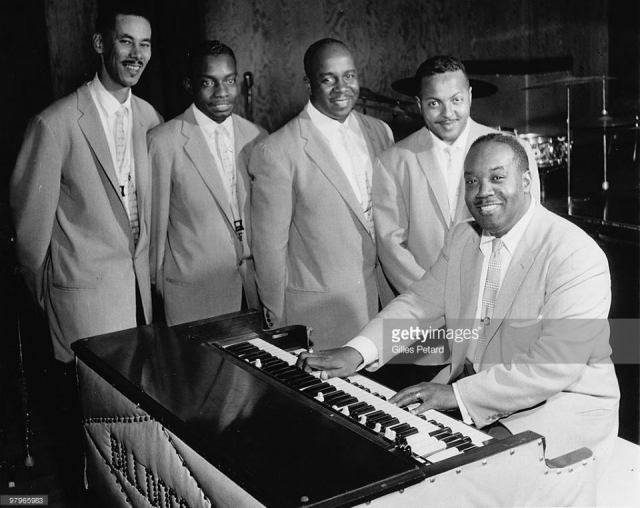
Bill Doggett with his combo (getty images)

William Ballard Doggett, better known as Bill Doggett was born in Philadelphia in 1916 and was introduced to music by his church pianist mother.  He played in a combo while still in high school and went on to work with a plethora of stars in rock, jazz, rhythm and blues amassing a string of hits but, sadly, seems to have barely been noticed on this the 100th anniversary of his birth.  Where is NPR at a time like this?

Well, all is not lost.  Fortunately his nephew and namesake Bill Doggett is doing justice to the memory of this important American musician.  This younger Doggett is an archivist, lecturer, curator, strategic marketer, photographer, filmmaker, and arts advocate (his website is well worth your time).  I am hardly as well prepared to provide more than an overview of this musician’s work but I feel obliged to do my small part in recognizing this man’s work.

doggettposter

Promotional poster for the September 28, 2016 centennial celebration curated by nephew and namesake, Bill Doggett.

Doggett’s list of chart singles:

  • “Be-Baba-Leba” (vocal by Helen Humes) (Philo/Aladdin 106) 1945 (#3 R&B)
  • “Moon Dust” 1953 (#18 R&B)
  • “Early Bird” 1953 (#21 R&B)
  • “No More In Life” 1953 (#20 R&B)
  • “High Heels” 1954 (#15 R&B)
  • “Honky Tonk, Part 1″/”Honky Tonk, Part 2” (King 4950) 1956 (#1(14) R&B/#2(3) Pop)
  • “Slow Walk” (King 5000) 1956 (#4 R&B/#19 Pop)
  • “Ram-Bunk-Shush” (King 5020) 1957 (#4 R&B)
  • “Soft” 1957 (#11 R&B)
  • “Leaps And Bounds, Part 1″/”Leaps And Bounds, Part 2” (King 5101) 1958 (#13 R&B)
  • “Blip Blop” 1958 (#11 R&B)
  • “Hold It!” (King 5149) 1958 (#3 R&B)
  • “Rainbow Riot, Part 1″/”Rainbow Riot, Part 2” (King 5159) 1959 (#15 R&B)
  • “Monster Party” (King 5176) 1959 (#27 R&B)
  • “Yocky Dock, Part 1″/”Yocky Dock, Part 2” (King 5256) 1959 (#30 R&B)
  • “Honky Tonk, Part 2” 1961 (#21 R&B)


  • doggetthonky

    Doggett’s best known work.

While his last chart hit was 1961 his collaborations with  Lucky MillinderFrank FairfaxJimmy Mundythe Ink SpotsLouis JordanJohnny Otis, Wynonie Harris, Ella Fitzgerald, Louis Armstrong, Count Basie,  Lionel HamptonRed Holloway, Clifford Scott, Percy France, David “Bubba” Brooks, Clifford Davis, and Floyd “Candy” Johnson; guitarists Floyd Smith, Billy Butler, Sam Lackey and Pete Mayes; and singers Edwin Starr, Toni Williams and Betty Saint-Clair attest to the scope of his work.  Doggett continued to play and arrange until his death from a heart attack in New York in 1996 at the age of 80.

bill_doggett

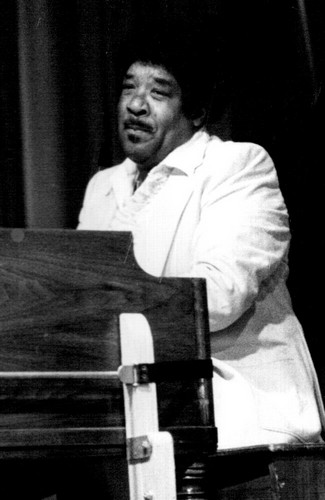
Bill Doggett photographed in France in 1980 by Lionel Decoster (from Wikipedia article)

The Hammond Organ is known for being the workhorse of modern classical as well as rock, rhythm and blues and jazz.  It was Bill Doggett who became one of the early masters of this (then new) electronic instrument.  While he was also a highly competent pianist, it was with the Hammond Organ that he had his greatest success. There is little doubt that his playing has influenced subsequent musicians who took on this instrument.

Here’s hoping that astute musicians and producers will take on the task of recognizing the work of the late great Bill Doggett.  Toward that end here, from Wikipedia, is a discography of his work:

10 inch LPs

  • Bill Doggett: His Organ And Combo, Volume 1 King 295-82 (1954)
  • Bill Doggett: His Organ And Combo, Volume 2 King 295-83 (1954)
  • All Time Christmas Favorites King 295-89 (1954)
  • Sentimentally Yours King 295-102 (1955)

12 inch LPs (on King Records)

  • Moon Dust King 395-502 (1956)
  • Hot Doggett King 395-514 (1956)
  • As You Desire Me King 395-523 (1956)
  • Everybody Dance The Honky Tonk King 395-531 (1956)
  • Dame Dreaming With Bill Doggett King 395-532 (1957)
  • A Salute To Ellington King 533 (1957)
  • The Doggett Beat For Dancing Feet King 557 (1957)
  • Candle Glow King 563 (1958)
  • Swingin’ Easy King 582 (1958)
  • Dance Awhile With Doggett King 585 (1958)
  • 12 Songs Of Christmas [reissue of King 295-89 plus 6 additional tracks] King 600 (1958)
  • Hold It! King 609 (1959)
  • High And Wide King 633 (1959)
  • Big City Dance Party King 641 (1959)
  • Bill Doggett On Tour [this is NOT a live album] King 667 (1959)
  • For Reminiscent Lovers, Romantic Songs By Bill Doggett King 706 (1960)
  • Back With More Bill Doggett King 723 (1960)
  • The Many Moods Of Bill Doggett King 778 (1962)
  • Bill Doggett Plays American Songs, Bossa Nova Style King 830 (1963)
  • Impressions King 868 (1963)
  • The Best Of Bill Doggett [compilation] King 908 (1964)
  • Bonanza Of 24 Songs [compilation] King 959 (1966)
  • Take Your Shot King 1041 (1969)
  • Honky Tonk Popcorn King 1078 (1970)
  • The Nearness Of You King 1097 (1970)
  • Ram-Bunk-Shush [compilation] King 1101 (1970)
  • Sentimental Mood [compilation] King 1104 (1970)
  • Soft [compilation] King 1108 (1970)
  • 14 Original Greatest Hits [compilation; reissued as ‘All His Hits’] King-Starday 5009 (1977)
  • Charles Brown: PLEASE COME HOME FOR CHRISTMAS [this vocal album includes 4 instrumental tracks by Bill Doggett] King-Starday 5019 (1978)

12 inch LPs (on other labels)

  • 3,046 People Danced ‘Til 4 A.M. To Bill Doggett [this is a live album] Warner Bros. WS-1404 (1961)
  • The Band With The Beat! Warner Bros. WS-1421 (1961)
  • Bill Doggett Swings Warner Bros. WS-1452 (1962)
  • Rhythm Is My Business (Ella Fitzgerald with Bill Doggett) Verve V6-4056 (1962)
  • Oops! The Swinging Sounds Of Bill Doggett Columbia CL-1814/CS-8614 (1962)
  • Prelude To The Blues Columbia CL-1942/CS-8742 (1962)
  • Finger-Tips Columbia CL-2082/CS-8882 (1963)
  • Wow! ABC-Paramount S-507 (1964)
  • Honky Tonk A-La-Mod! Roulette SR-25330 (1966)
  • The Right Choice After Hours/Ichiban 4112 (1991) Note: this is Bill’s last recorded album of original material; also released on CD.

OK all you producers, have at it.


The Piano is Calling Me: Nicolas Horvath’s New Music Pilgrimages


Nicolas Horvath Lyon

Nicolas Horvath at the piano in Lyon

I first heard of this young Monacan pianist and composer when a composer friend, David Toub, told me that he was going to program one of this piano pieces.  That piece along with quite a few other performances are available on Nicolas Horvath’s You Tube video channel here.

Horvath developed a strong interest in contemporary music from Gerard Frémy among others and has been programming a great deal of new music ranging from the more familiar such as Philip Glass to a host of others including quite a few pieces written for or premiered by him as well as his own transcriptions and reconstructions.  He is known for his concerts in non-traditional venues with very non-traditional lengths of performance as well as traditional concerts.

His current projects include Night of Minimalism in which he performs continuously for 10-15 hours with a wide variety of minimalist and post-minimalist pieces and Glass Worlds in which he performs the complete solo piano works of Philip Glass (approximately 15 hours) along with pieces by an international list of composers written in tribute to Glass.  He is also an electroacoustic composer (he counts Francois Bayle among his teachers) and a visual artist all with a passion for contemporary works.

inside my own exhibit

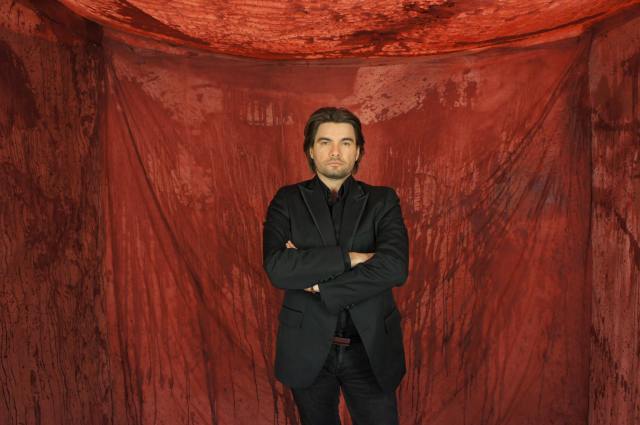
The artist standing in one of his installations.

We had corresponded via e-mail over the last year or so and when I suggested the idea of interviewing him he responded by arranging time after a (traditional length) concert he gave in Minsk, Belarus on December 1, 2014.  I prepared for what I anticipated would be a one hour interview after which I imagined he would probably need to get to sleep.  But when I attempted to wrap up our conversation (at a couple of points) he immediately asked, “Don’t you have any more questions?”.  What followed resulted in approximately three and an half hours of delightful and wide-ranging conversation about this man and his art which he ended with the comment, “I must go, the piano is calling me.”  It appears that his seemingly boundless energy extends well beyond the stage.  The following January (2015) he gave the world premiere performance of all of Philip Glass’ 20 Etudes in none other than Carnegie Hall.

Nicolas Horvath (c) Jean Thierry Boisseau

Horvath with spent score pages as he traverses one of his extended performance ventures. (copyright Jean Therry Boisseau)

Since that time we have continued our correspondence and this affable, patient young artist continues on various projects and no sign of his interest or energy waning.  He recently sent me various photos of him in various settings pursuing his varied artistic interests for this article.

SONY DSC

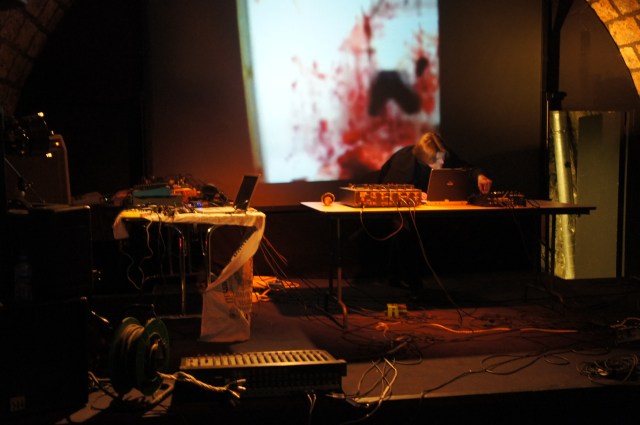
Composer as well as performer in an electroacoustic performance without piano.

Horvath was born in Monaco in 1977.  He studied piano at the Académie de Musique Rainier III de Monaco and the École  Normale de Musique de Paris.  At 16, Lawrence Foster took notice of him in a concert and, securing a three year scholarship for him from the Princess Grace Foundation, was able to invite him to the Aspen Music Festival. After his studies in the École Normale de Musique in Paris, he worked for three years with
Bruno-Léonardo Gelber, Gérard Frémy who instilled in him a sensitivity to music of our time as well as Eric Heidsieck, Gabriel Tacchino, Nelson Delle-Vigne, Philippe Entremont and Oxana Yablonskaya. Leslie Howard got to know him and invited him to perform before the Liszt Society in the United Kingdom. He has been playing professionally for 7 years and puts his own characteristic style into his productions and performances.

In a move reminiscent of Terry Riley’s all night solo improv fests Horvath has performed several lengthy programs.  He has performed Erik Satie’s proto-minimalist Vexations (1893) in performances that ranged widely in length. One notable performance at the Palais de Tokyo lasted 35 hours, the longest solo piano performance on record as far as I can determine.  Previously this piece has been performed by tag teams of pianists (the first in 1967 in New York was curated by John Cage) to perform the 840 repetitions of the piece whose tempo or recommended duration is not specified.  Horvath, taking on a musicological mantle is preparing his own edition of this unique work.  He has published an 24 hour version on his You Tube channel here.

Given his intense schedule and vast repertoire he has been remarkably responsive and has an irrepressibly strong appetite for new music.  He tells me that he had worked on a project in which he planned to play all the piano music of the French composer Jean Catoire (1923-2005),  some 35 hours of material (in a single program, of course). Unfortunately that composer’s relative obscurity seems to have resulted  in insufficient support for the project which is, for now, on hold.  Here’s hoping that this can be realized sometime soon.

Horvath’s fascination with authenticity, completeness and performances of unconventional lengths uninterrupted by applause where audiences are invited to lay on the floor with blankets and sleeping bags and approach the piano seems unusual but he has been getting enthusiastic audiences and has enjoyed overflow crowds.  Like Terry Riley and perhaps even some of Keith Jarrett’s solo concerts there is a ritual feel to these marathon performances.  Regrettably I have not yet been able to attend one but I would love to partake in what must be a powerful shared experience.  He invites people to come to the piano and to watch, look at the score.  It is unlike the conventional recital and therein lies some of its charm.  At least one of his videos features a small sign which reads, “Don’t feed the pianist” and attests to his warmth and wonderful sense of humor.

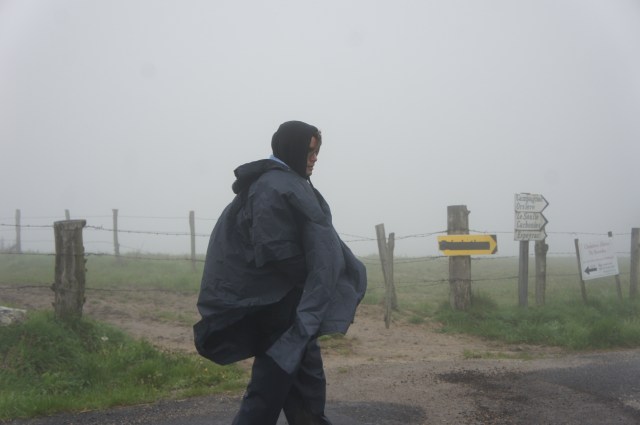
His passion has parallels in his spirituality and he has pursued sacred pilgrimages which require a great deal of time and energy but without doubt fill a very deep and sincere need. More details and photos are available on his blog.  And, as with music, he is very open to discussing this very personal aspect of his life.

SONY DSC

The artist braving the elements on one of his pilgrimages.

There are conventional two hour with intermission style recitals in more conventional concert venues that he has played and Horvath also enjoys playing with an orchestra.  His performances of both of Philip Glass’ piano concertos can be viewed on You Tube and you can see the intensity of his execution.  This came through in the course of our interview as well when Mr. Horvath would speak of the music and then verbally imitate the rhythms (no doubt endlessly practiced) which drive his enthusiasm.  The music seems to be deeply integrated into his very being.

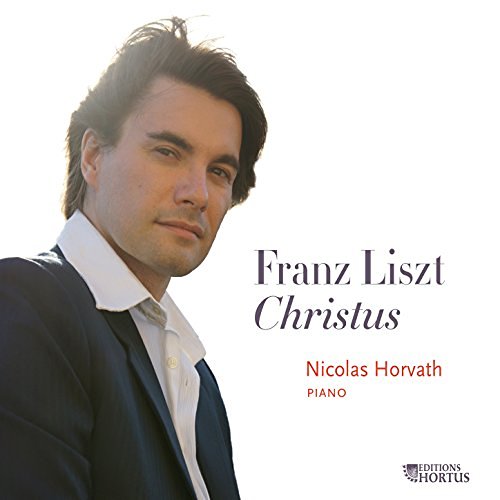
His first solo commercial recording was released in 2012.  It consists of Franz Liszt’s ‘Christus’, an oratorio composed in 1862-66 for narrator, soloists, chorus and orchestra.  Horvath plays a piano reduction done by the composer.  This is the first known recording of this unique and virtuosic set of piano works.  It is certainly an unusual choice for a debut recording but it is consistent with his very personal tastes.  (He lists Scriabin and Chopin as among his favorite composers.).   He is in the process of recording all of Philip Glass’ piano music for Grand Piano records distributed by Naxos.  At the time of this writing four well-received volumes have been released.  He is also planning to record all of Satie’s piano music and he has just recently released his rendition of Cornelius Cardew’s indeterminate masterpiece, Treatise.

I have seldom encountered a musician with such intensity and drive.  He is also one of the most skilled in using the internet to promote himself and his projects.  And though this is no doubt a man with a considerable ego he is in fact very unpretentious and very genuinely turned on, driven by the music itself.  Don’t get me wrong, he is concerned with developing his image and career but he seems happy to be doing the work he has been doing and he is, like any really good musician, self-critical and a perfectionist.

A quick look at his YouTube channel here reveals some of the range of his interests which include the standard repertoire along with interest in contemporary works.  Just released is a creative video with Horvath playing Glass’ Morning Passages while he apparently experiences a reverie involving a beautiful woman which could have been on MTV at its height.  Perhaps he is even channeling Oscar Levant who embraced roles in films along with his pianistic talents.  His website is a good resource for updates on his various projects and performances.

c _______ ______

Focused concentration at the keyboard.

As of the time of this writing his discography includes:

horvathchristus

Hortus Records 100 (2012)

A very unusual choice for a debut recording.  Nonetheless this is a distinctive recording which reflects the virtuosity as well as the careful scholarship which continues to characterize his work.  He managed to locate a couple of previously lost pieces in this set of composer transcriptions.  One also can’t miss the spiritual dimension here, as close to his heart as music and an equally important aspect of his personality.

glassw1

Grand Piano GP 677 (2015)

This first disc in the series manages to provide the listener with truly inspired interpretations of Glass’ keyboard oeuvre and gives us a world premiere recording of How Now as well.

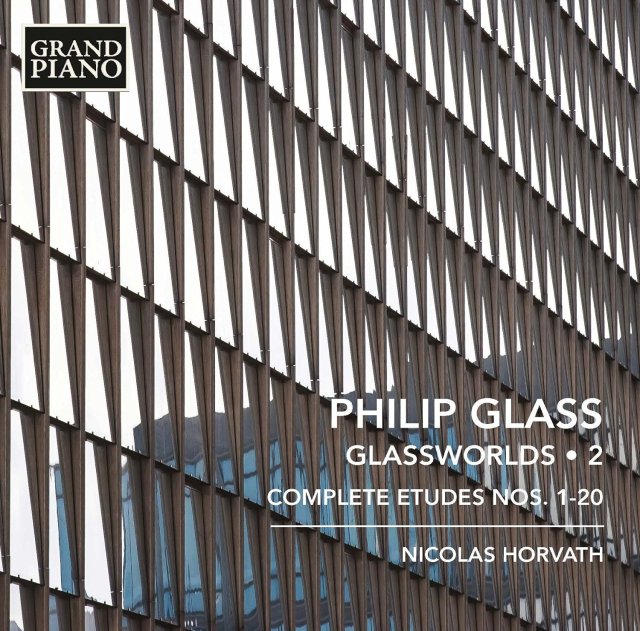
glassw2

Grand Piano GP 690 (2015)

The complete Piano Etudes by the man who premiered the set at Carnegie Hall.  These etudes were also recorded by the wonderful Maki Namekawa and the opportunity to hear these really different takes is positively revelatory.

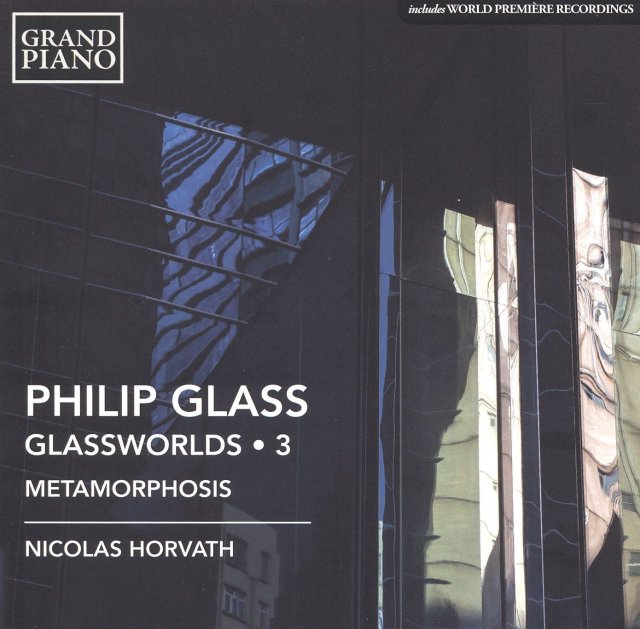
glassw3

Grand Piano GP 691 (2016)

The third disc in the traversal of Glass’ piano music (original and transcribed) also offers world premieres.  Horvath’s inclusion of Glass’ early Sonatina No. 2 reflects his work under the tutelage of Darius Milhaud and provides insight into the composer’s early development before he developed his more familiar mature style.

glassw4

Grand Piano GP 692 (2016)

Haven’t yet heard this disc but I have in queued for ordering in the next few weeks.

acedia

Demerara Records (2016)

Haven’t heard this one yet either but, again, it’s in my Amazon shopping cart.


horvathcardewtreat

Horvath’s interpretation of this important work by Cornelius Cardew

Cornelius Cardew (1936-1981) was sort of England’s John Cage, a major voice in 20th Century experimental music.  Scholarship has yet to do justice to the late composer’s work but this disc is an important contribution toward that end..

Horvath’s career is characterized by innovation and passion combined with astute scholarship and a keen sense of what is new and interesting in music  while clearly being schooled in the classic repertoire.  The piano calls him as do his other passions and I highly recommend paying attention as he answers those calls.  He is truly an artist to watch.
N.B.  Mr. Horvath generously read and approved an advance draft of this article shortly after arriving in the United States for concerts at Steinway Hall in Rockville with a Chopin program and a recital at The Spectrum in New York City which will include two pieces written for him by Michael Vincent Waller along with some Chopin pieces.

Zenobia Powell Perry, a Lost Thread


zenobia

Cambria CD-1235

These artists and this composer have graced these pages twice previously.  First in the wonderful production of Perry’s opera, Tawawa House and some of the musicians appeared in an article on Valerie Capers.  The present disc and the two previously mentioned articles are all indebted to a significant degree to the work of musicologist and composer Jeannie Gayle Pool.  It was she who kindly sent me this disc for review and her scholarship which brought forth the production of the opera (Perry was the subject of her doctoral thesis).

Zenobia Powell Perry (1908-2004) was an American composer. pianist and teacher who counts R. Nathaniel Dett and Darius Milhaud among her teachers.  Her sound is not far from that of Aaron Copland in her use of basically tonal harmonies and folk elements.  She is, in a sense, a lost populist and quite a gem.

This 25 track disc fills a major gap in the discography of American music in general and music of black Americans in particular.  Perry has roots in African and Native American (Creek) ancestry and Pool’s work may very well have rescued her from total obscurity.  The lost thread of which I refer in my title is to suggest that there is more populist and jazz influenced American music that needs to be brought to light.

Listening to this disc is pure entertainment.  These are undiscovered gems lovingly rendered with love and authority by Josephine Gandolfi, Deanne Tucker and (civil rights advocate and retired judge) La Doris Hazzard Cordell.  The entire project seems to be a labor of love and one can only hope that it will not be the last installment in the recorded canon of Perry’s work.

These 25 tracks are all brief pieces.  They range from the 1935 Childhood Capers to the 1985 suite from Tawawa House arranged for piano four hands by Josephine Gandolfi.  The entertainment here ranges from light pieces like the Childhood Capers to some more deeply thoughtful pieces with jazz inflected harmonies.  Some are quite demanding technically, a tribute to Perry’s skills as a pianist.

The Homage to William Levi Dawson on his 90th Birthday, Times Seven, Soliloquy, Nocturne, A Jazz Trifle and Rhapsody seems to be rather substantive works and pique the curiosity as to what else lies undiscovered.  The suite form Tawawa House is great but it will have to hold that place until the full opera can be recorded.  It is worth hearing, especially as one of the few operas dealing with slavery.

The very fine recording done a Bosendorfer piano at Stanford University by engineer Mark Dalrymple.  The production by Pool and Gandolfi leave this writer wanting to hear more.  Kudos!

Next Gen Steve Reich: Two Great New Recordings


One of the hurdles on the way to long-term historical recognition is finding the next generation of interpreters for whom the music itself is not new but whose interpretation is needed anew in light of the music’s place in the canon of performed and recorded music. So Mr. Reich has now arrived in two fantastic new recordings.


The first CD here is the Cedille (Cedille 90000 161) label debut by Third Coast Percussion, a young Chicago based group.  The label itself is reason enough to pay attention with their intelligently selected and well-recorded releases.  But even so this one stands out for a couple of reasons.

As  Reich reaches his 80th birthday (as are many composers whose work informed my listening life since the 70s) we are seeing the next generation (or so)  of performers, musicians for whom this music is not new.  (Third Coast Percussion is Sean Connors, Robert Dillon, Peter Martin and David Skidmore. They were founded in Chicago in 2005.). As these dedicated musicians traverse this repertoire they see it from a different perspective and they acknowledge this in the accompanying notes by Robert Dillon.  No doubt they are familiar with the music and have heard some if not all previous recordings. This music is no longer new and novel the way it was to those who first heard it.  And that is what we have here, a new take on music already familiar giving us the perspective of another generation.

The second reason to get this recording is the sheer beauty of the sound.  It is a masterpiece of recorded sound which does justice to the work of these fine musicians as well as the music.  The album was recorded at the University of Notre Dame’s DeBartolo Performing Arts Center (where Third Coast is in residency).  Dan Nichols was the engineer assisted by Matt Ponio.  It was mastered by Jessie Lewis and Kyle Pyke.
The CD opens with the recent Mallett Quartet (2009) which has been recorded only once before.  The piece is in three sections fast-slow-fast split over the first three tracks.  It is one of Reich’s finest compositions showing him as a still vital artist and it will no doubt receive many more performances but it would be hard to imagine a better recording.

The second selection is, for this writer, one of Reich’s more unusual pieces.  The Sextet (1984) is scored for two keyboards (pianos doubling synthesizers used for long held tones) and percussion.  David Friend and Oliver Hagen lend their formidable keyboard skills to this work and help it to swing.

I must admit that this performance has resulted in me giving this work some serious close listening again and I am liking it better.  Some of these movements seem like precursors to some of the writing in Reich’s wonderful The Four Sections (1987), another work that deserves more attention.

The brief but lovely Nagoya Marimbas (1994) is pretty much an accepted staple of the classical marimba repertoire and has also been transcribed and performed on guitars as well.  As with the preceding the performance is faithful and lively.

For the final track a decision was made to go back to early in Reich’s output with Music for Pieces of Wood (1973).  As with much of his early work we see his experimental side focusing as much as possible on a single process.  It uses the same rhythmic pattern as the 1972 Clapping Music but uses additive rather than phasing techniques (I believe), a great example of the roots of minimalism.  The group does some toying with the choice of percussion but, as in the preceding tracks, manage to create a performance worthy of the best interpreters in their generation.  Happy Birthday Mr. Reich!!


This second CD (New Focus fcr 165) is another aspect of crafting a legitimate new interpretation of a given piece of music.  Guitarist Daniel Lippel goes back to some of the roots of Reich’s mature style, Ghanaian drumming.  Reich seems to have achieved his personal artistic synthesis after his encounter and study with the master drummers of Ghana.  It is here that he was finally able to synthesize the gifts received from his study of jazz (Reich was/is a jazz drummer) and his tape music experiments into the larger forms for which he is now known through these studies with West African musicians.  And it is here that Lippel goes, with an assist from musicologist Martin Scherzinger, to create his (re)vision of this classic Reich composition.

Electric Counterpoint (1987) was written for and first recorded by the still wonderful jazz guitarist Pat Metheny.  His recording is certainly definitive but, as with all music performance, hardly the last word.  Several artists have presented their versions (David Tanenbaum’s acoustic guitar version deserves more attention by the way).  It is a very appealing and interesting piece cast in a classic fast-slow-fast format that presents formidable challenges for the musician but not for the listener.

It is difficult (and certainly beyond the scope of this review) to say specifically what Mr. Lippel has done differently but there is clearly a difference (further notes can be found here).  I am loathe to find adjectives to describe this recording except to say that it is well worth your time to hear it.  It provides a different way of hearing much as Glenn Gould has done for Bach.  Just sit back and enjoy.

Filling Vital Gaps in the Recorded Repertoire: The Walden Chamber Players Do America


walden ch pl evolution

The only name that might not be familiar to fans of early to mid-twentieth century American music feature in this recording is that of Marion Bauer (1882-1955).  The rest of these composers are clearly established in both recordings and the performing repertoire.  One of the great things about this recording is that the collector runs practically no risk of duplication.  While the Rorem, Barber and Bowles have been recorded before I am not aware of any currently available recordings of the Thomson, Copland and Bauer pieces.

I don’t know how profoundly significant all these works are, only time (and more performances/recordings) will tell.  But these are attractive pieces that fill historical gaps and that is apparently the goal of this clever ensemble.  Even if these are not first order masterpieces they do speak to the historical evolution of the American sound in the twentieth century.

Marion Bauer is herself in need of a reassessment.  This woman, 20 years older than Aaron Copland was essential in the establishment of the foundational institutions of American music.  Few of her works have been recorded and even fewer given good or great recordings.  So this 1944 Trio Sonata No. 1 recording is a very good start.  This, like the other works on the album do not stray far from basic romantic tonality but were the “modern” idiom for the works of their day.  The sound of mid-century neo-romanticism is clearly in evidence in this lovely and lyrical three movement sonata.

Virgil Thomson (1896-1989) is now better known for his excellent music criticism but he was also one of the finest examples of the American neo-romantic tradition (and the only composer to win a Pulitzer Prize for a film score) and his work is sadly under-appreciated. The five brief movements are infused with the composer’s folk and hymn references like much of his work.  I do not think this lovely little Serenade for Flute and Violin (1941) has been recorded before and, hearing it now, I can’t imagine why not.

Aaron Copland (1900-1990) is represented here by two late works from 1971 and 1973, both entitled Threnody.  The first is dedicated to Igor Stravinsky (1882-1971) and the second to Copland’s friend Beatrice Cunningham.

As far as I know this is the first recording of these two works.  They are short and intense pieces whose apparent simplicity most likely belies some complexity but these are very approachable works.  It is a great service to have them available for listening.

Samuel Barber (1910-1981) is probably the foremost representative of American romanticism.  The brief Canzone for Flute and Piano (1961) was originally written for a friend.  The melody made its way into Barber’s Piano Concerto Op. 38 (1962) and has been given the opus number 38a.

Ned Rorem (1923- ), composer and diarist is also a strong contender for the romantic crown in American music.  He is the youngest of the composers represented on this recording (though this reviewer would like to make the case to perhaps include David Del Tredici 1937- for inclusion in this survey of mid-century American romantics).  Best known for his songs, Rorem’s orchestral and chamber music have only recently begun to get the attention they deserve.

His Trio for Flute, Cello and Piano (1960) is very strong example of the quality of his chamber music.  The four movement trio has been recorded before but this performance is about as fine and definitive as one could imagine.

Paul Bowles (1910-1999) is far better known for his literary endeavors and is connected to the beat writers.  His novel, The Sheltering Sky (1949) secured his literary fame.  Bowles spent much less time on composition after 1956 but his music has (though painfully slowly) been going through some reckoning in recent years.  And so it should.  This contemporary of Aaron Copland  has written a fair amount of music, much of that in the form of incidental music for various plays.  This Sonata for Flute and Piano (1932) has been recorded before but it is good to see it made available in a competent recent version.

Ned Rorem, the only composer here still living, gets the final word in The Unquestioned Answer (2002).  It is essentially a reflection on Charles Ives’ The Unanswered Question (1908, rev. 1930-5) and provides a fitting conclusion to this wonderful survey.

I very favorably reviewed a previous release by the Walden Chamber Players (Marianne Gedigian, flute; Curtis Macomber, violin; Tatiana Dimitraes, violin; Christof Huebner, viola; Ashima Scripp, cello and Jonathan Bass, piano).  And they continue their intelligent and very personal survey of chamber music.

This is a very satisfying album which achieves its goal of displaying music which clearly contributes to the collective voice of American music as it developed in the early to mid- twentieth century.  This intelligent selection of music, well-performed, fills gaps in the recorded repertoire and, one hope, will encourage others to bring more of this work to recordings and performances.


Spirituals Re-Imagined


411Wkh4lXuL._SS280
I managed to squeeze a delightful brunch meeting with my busy friend and colleague Bill Doggett on New Years Day.  It was there at a favorite Oakland cafe that we discussed many topics and Bill gave me a copy of this beautiful CD by a young black composer whose work is entirely new to me.

Okpebholo

Shawn Opkebholo (1981- )

Shawn Okpebholo (1981-  ) was born in Lexington, Kentucky.  He earned his B.A. in music at Asbury College and his M.M. and D.M.A. degrees at the  Unniversity of Cincinatti.  Doctor. Okpebholo is currently on faculty at Wheaton College  in Illinois.

The present disc is Opkebholo’s first CD dedicated entirely to his own compositions and is the composer’s “reimagining” of spirituals.  Drawing on the folk tradition of spirituals, worksongs, etc. as well as classical art song traditions he fashions his personal take on these much loved melodies.

I do feel compelled to mention the beauty of the photography and album design.  Greg Halvorsen Schreck took the pictures and Jeremy Botts did the overall design.  Powerful stuff.

In a slight deviation from the classic voice and piano arrangements the composer chose to score this little cycle for baritone, mezzo-soprano, viola and flue along with piano.  For this writer this was an interesting and suitably entertaining choice.

jnai

J’nai Bridges

Willnewheadshot

Will Liverman

The singers Will Liverman, baritone and J’nai Bridges, mezzo-soprano are marvelous and sensuous voices and discharge their duties most beautifully.  The pianist Paul Tuntland Sànchez is also a composer and very accomplished soloist.

Sanchez_Photo

Paul Tuntland Sanchez


The violist is Dorthy White Opkebholo and is the composer’s wife.  She is an accomplished musician in her own right.

The flute is played by Caen Thomason-Redus.

This is a beautiful recording of these loving arrangements of spirituals which can occupy that place in the literature populated by the likes of Aaron Copland’s Old American Songs.  A must for art song and folk song fans and a great opportunity to hear some fine musicians at the beginnings of what is hoped to be long and successful careers.

all spring, Music of Emily Doolittle


doolittle

Emily Doolittle (1972- ) was born in Halifax, Nova Scotia.  She earned a B. Mus. from Dalhousie University in 1995 having studied with Dennis Farrell and Steve Tittle.  She went on to earn an M. Mus. in 1999 from Indiana University where she studied with Don Freund.  She completed her Ph.D. at Princeton in 2007 studying with Barbara White, Steve Mackey and Paul Lansky.  In addition she studied with Louis Andriessen from 1997-1999.

Doolittle now lives in Glasgow, UK having just left a faculty position at the Cornish school in Seattle, WA.  where she taught since 2008.  A quick look at her CV reveals a very busy composer and academic with an extensive list of compositions, performances, research, teaching etc. such that this reviewer is amazed to find that the present release is the first CD dedicated exclusively to her music.

I was pleased to be able to get a perspective from the composer that helped me understand the context of this disc in terms of the rest of her work.  She wrote:

“As I was making choices of what to include on this CD, I realized that my music divides itself into several (sometimes overlapping) categories. Over the next few years, I’m hoping to be able to record two or three more CDs. The one that I sent you is the one for fairly standard-ish chamber ensembles, with pieces that would sit fairly comfortably with chamber music of any era. At the moment I’m applying for funding to record a CD of pieces for one or two instruments/voices — these pieces also have a fairly similar musical language to the pieces on “all spring”. After that, I’d like to record a CD of my bird and animal song influenced music, which tends to be more experimental (in terms of sounds used and structure), and often involves some improvisation. And then I have a number of pieces that are harder to figure out how to present to a larger audience — site-specific pieces, pieces for amateurs or children, etc. So I guess I see this CD as both the culmination of one project, and the beginning of a larger project. And I think that getting this sort of overview of my compositions to date will help give me ideas about the directions I’m most interested in going in in the next few years. (I’m at a bit of a transitional time — I just left a full-time teaching position at Cornish College of the Arts in Seattle to move to Glasgow. I’m hoping to find part time teaching here, but mostly I want to devote a lot more time to composing than I’ve been able to in the last few years.)”

I was also unaware that there was such a thing as “zoo-musicology” or the study of things musical generated by the members of the animal kingdom.  Who knew?  I was familiar with Olivier Messiaen’s transcriptions and use of bird song but until now I was not aware that work was still being done in this area.  Alas, that will have to be the subject of another review as this disc, while later analysis might reveal zoomusicological influences, is ostensibly more in the category of absolute music or perhaps metaphorical music.  What is quite clear is the picture of an artist with wide-ranging interests who is working to shape her oeuvre and her research interests into a more unified effort which promises potentially fascinating results yet to be heard.

The CD is a very pleasant listening experience.  Nothing here sounds experimental, rather these works are beautifully composed and lovingly played by the Seattle Chamber Players (and friends).  All were composed from 2000 to 2014 and share a sort of romantic and nostalgic flavor and demonstrate the delicate nuances of this composer’s palette.

The first two works, “Four Pieces About Water” (2000) in four short movements and the single movement “falling still” (2000/2009) are purely instrumental as is the fourth piece on the disc “col”(2002/2014).  (Please note that all spellings are as they appear on the disc.)

Tracks 6-10 comprise the album’s title piece, “all spring”(2004) features the poetry of Canadian poet Rae Crossman and the final and longest piece, “Why the parrot repeats human words” (2005) features a text by the composer in which she tells her version of a Thai folk tale (think perhaps of a Canadian Peter and the Wolf maybe).  Both these works feature the beautiful spoken and singing voice of Maria Mannisto.

The ample and lucid notes are by the composer.  The recording was engineered by Doug Haire at the Jack Straw Cultural Center in Seattle and mastering was by John D. S. Adams at Stonehouse Sound in Mahone Bay, Nova Scotia for this Composer’s Concordance label release.

Certainly this writer will be looking forward to hearing more from this fascinating artist as she reveals more of her work on recordings and goes on to who knows what new and interesting areas in this (now) post-Boulez world.  Brava!


BMOP Opening Concert Commemorates Armenian Genocide


BMOP20_logo

ADDENDUM:  Unfortunately the pianist Nareh Arghamanyan will not be able to perform.  BMOP informs me that they are substituting a piece by the wonder.ful Israeli composer Betty Olivero called Neharot Neharot (2006-7) for two string orchestras, accordion, percussion, tape and viola.  It will feature none other than violist extraordinaire Kim Kashkashian.  

The Boston Modern Orchestra Project begins it 20th season on Sunday October 18th with a concert in honor of the 1915 Armenian genocide with a celebration of that country’s artistic heritage.  Titled Resilient Voices 1915-2015, the concert will feature works by Komitas (1869-1935), Alan Hovhaness (1911-2000), Dmitri Shostakovich (1906-1975) and Tigran Mansurian (1939- ).

Komitas_1902

Komitas, born Soghomon Soghomonian, is generally regarded as the foundational composer for Armenian classical music in the 20th and 21st centuries.  Like Bartok and Kodaly, he collected and transcribed folk music from his country.  He is considered an early founder of the practice of ethnomusicology collecting Armenian and Kurdish folk music.  He was ordained a priest in the Armenian rite church and took the name Komitas.  The impact of the genocide affected him deeply and he spent the last 20 years of his life in a psychiatric facility where he died in 1935.

Alan Hovhaness

Alan Hovhaness

American composer Alan Hovhaness also embraced a musicological approach to his composition by including Armenian folk songs and that of other musical cultures he had explored including Korean and South Asian. He also acknowledges a debt to Komitas (Hovhaness released a recording on his own Poseidon label of him performing Komitas’ complete piano music).

Hovhaness remains less well-represented than he deserves in the concert hall so this performance of Khrimian Hairig (1944, rev 1948) is a welcome one.  The piece is in three continuous movements titled, “Chalice of Holiness”, “Wings of Compassion” and “Triumph of Faith”.  It is scored for string orchestra with solo trumpet.  The solo here will be played by prominent new music trumpeter Terry Everson (whose talents are to be required in the next piece on the program).  Hairig was a prominent Armenian cleric and mystic of the 19th century.

This work is early in Hovhaness’ prolific output and is characteristic of his Armenian period utilizing Armenian folk melodies and writing on Armenian themes.  He would later gain wider fame when Leopold Stokowski premiered his 2nd Symphony “Mysterious Mountain” in 1955 on NBC television.  Hovhaness died in 2001 leaving over 400 compositions of which 67 are symphonies.

Arghamanyan_Nareh

Nareh Arghamanyan

The Armenian connection to the next piece is apparently the BMOP début of the young Armenian pianist, Nareh Arghamanyan (1989- ) in the First Piano Concerto Op. 35 (1933) of Dmitri Shostakovich.  This unusual piece is scored for piano, string orchestra and trumpet (I told you Everson would be back).  It is one of those neo-baroque experiments and quotes from well-known classical pieces.  It is quite challenge for a pianist and the début of this rising artist will doubtless be one of the highlights of the concert.

The title of the concert is Resilient Voices 1915-2015 and is given in commemoration of the Armenian Genocide (1915-1923) but more so in celebration of the voices and the talents that have endured.  Controversy remains evidenced by the fact that Azerbaijan and Turkey continue to deny the genocide but the estimated death toll was 1.5 million and this is the event for which the term “genocide” was first used.

Artistic Director and Conductor Gil Rose

Artistic Director and Conductor Gil Rose

It is the genius of Gil Rose, conductor and artistic director whose creative vision in a couple of releases  I recently reviewed ( Anthony Davis and Irving Fine) that first alerted me to the work of this fine ensemble (a little late, I know).  But I discovered a great orchestra with some of the most innovative programming with attention to new and recent music.  I was graciously offered a seat at this concert but it will have to be one of my regrets.  This sounds like a fantastic program.

Tigran Mansurian

Tigran Mansurian

How very appropriate then to have the BMOP premiere of the Requiem (2009) by Tigran Mansurian (1930- ) by far Armenia’s best known living composer.  The Requiem was written in memory of the holocaust and is scored for large orchestra, chorus and soprano and baritone soloists (not announced when last I checked yesterday).  Gil Rose conducts the Harvard-Radcliffe Collegium Musicum with the Boston University Marsh Chapel Choir.  This is indeed a species of political music and BMOP is to be applauded for this as a contribution to the recognition of human rights. through music.

Tigran Mansurian at the piano at Other Minds in San Francisco.

Tigran Mansurian at the piano at Other Minds in San Francisco.

Mansurian previously appeared at the Other Minds 20th Anniversary concert (also dedicated to the holocaust) in March of 2015 in San Francisco.  At that concert I captured a moment from the pre-concert discussion in which Mansurian agreed to sing a traditional Armenian song accompanying himself at the piano, a very personal moment from a composer whose art is deeply felt.

Please, BMOP, record this.  Thanks in advance!!!

Percussion Extravaganza: Music of Axel Borup-Jorgenson


Axel Borup-Jørgensen (1924-2012)

Axel Borup-Jørgensen (1924-2012)


While I listen to a great deal of music I realize that I have a far less than comprehensive view of the percussion genre. And this is a composer about whom I knew nothing at all until I received this disc for review. Axel Borup-Jørgensen (1924-2012) was a highly respected and decorated Danish composer. This makes him a contemporary of two Danish composers whose work I do know, Per Nørgård (1932- ) and Ib Nørholm (1931- )

A bit of research reveals that there is a soundcloud page with a great selection of his works here. He is reportedly best known for his orchestral work Nordisk Pastorale Op. 51 (1965).

He is described as a modernist but not in the redefining the nature of music modernism of Cage and his peers nor is it simply academic modernism heaping unending honors to and variations on Schoenberg’s methods. This composer’s modernism is creative but not particularly difficult listening.

The Percussion Universe of Axel Borup-Jorgensen (OUR recordings 6.220608)

The Percussion Universe of Axel Borup-Jorgensen
(OUR recordings 6.220608)

But now we come to the disc at hand, a selection of his work for various groupings of percussion, sometimes with additional solo instruments such as viola, recorder and, in one track, a brass quintet. This is an excellent recording which, one customer review noted, would be a good audiophile test disc. The performances are dedicated and virtuosic. Violist Tim Frederiksen and recorder virtuoso Michaela Petri lend their substantial talents to this recording as does the Brass Quintet of the Danish National Radio Symphony Orchestra.

Now to the music itself. I must confess that this music, unfolding slowly, using a wide range of percussion instruments was not easy to grasp but requires a bit of concentration. I think this disc will be more interesting as I learn some of this man’s other compositions and place them in context.   I think this recording will be of great interest to percussionists as well as devotees of this composer.  And three of the five works featured  on this recording are world premieres.

All this is held together by veteran percussionist and conductor Gert Mortensen.  The album was recorded at the Concert Hall of the Royal Danish Academy of Music.  It was produced, mixed and mastered by Preben Iwan with thankfully informative liner notes by Jens Brincker and Henrik Friis were translated by John Irons.

The Danes have a rich musical history which this disc celebrates and the documentation of this lesser known composer’s work is a welcome addition to the catalog.

Axel Borup-Jørgensen at his work desk.

Axel Borup-Jørgensen at his work desk.


End of an Era and a Summation: In the Mood for Food Dinner/Concert Series


Philip Gelb performing at the June 21, 2015 Garden of Memory Concert at Oakland's Chapel of the Chimes.

Philip Gelb performing at the June 21, 2015 Garden of Memory Concert at Oakland’s Chapel of the Chimes.

For a variety of reasons I have not been able to spend any time with this blog for the last month or two but recent events tell me that I must find the time to get back online and publish.  My apologies to all who are awaiting reviews and such.  They will now be forthcoming.

This past Saturday night June 27, 2015 is among the last of this East Bay series which has been with us for the last 10 years.  Philip Gelb, vegan chef extraordinaire, shakuhachi player and teacher has announced that he will be relocating to New York in the next few months.

I personally discovered this series shortly after I moved to the bay area.  In a nondescript West Oakland neighborhood in a modest loft live/work space I found a vegan dinner which also featured a performance by Bay Area composer/performer Pamela Z.  One concert/dinner and I was hooked.   The opportunity to meet and hear many wonderful musicians and enjoy the amazing culinary magic was just too much to resist.  I have been a regular attendee at many of these concerts and they all are valued memories.
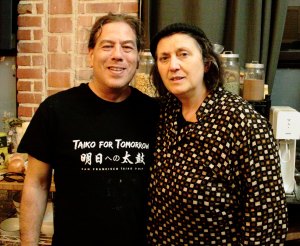
Philip Gelb with Joelle Leandre at one of his dinner/concerts.

Philip Gelb with Joelle Leandre at one of his dinner/concerts.

Phil, who studied music, ethnomusicology and shakuhachi has been a familiar performer in the Bay Area.  In addition to performing and teaching the Japanese bamboo flute, Phil has run a vegan catering business and began this series some ten years ago modeled on a creative music series founded in part by the late Sam Rivers.  As a musician Phil has gotten to know many talented and creative musicians who performed on his series.  Phil is a friendly, unpretentious man with great talents which he successfully combined here.

phil1011

Phil and sous chef Cori preparing the evening’s feast.

The 20 seats were sold out for the annual Masumoto Peach dinner.  At the peak of the harvest each year Phil has put together multiple course dinners featuring locally grown organic peaches from the now four generation Masumoto family orchard near Fresno .  In fact a recent film (information on the Masumoto page linked above) has been made about them called, “Changing Seasons” and one of the filmmakers was in attendance.  There was a short discussion with Q and A at one point.

Happy diners anticipating the next course.

Happy diners anticipating the next course.

No music this night but wonderful food and friendly conversations filled the evening.  The meal began with, of course, a taste of the actual peaches.

sous chef Cori serving the peach halves that began the dinner.

sous chef Cori serving the peach halves that began the dinner.

The next course, a peach tomato gazpacho.

phil1014

Followed by a grilled peach salad with cashew cheese balls, arugula radicchio,, pickled red onions, and a cherry balsamic dressing.

phil1016

Oh, yes, a nice Chimay to quench the thirst.

phil1015

And then tempeh char siu wontons (from the local Rhizocali Tempeh), flat tofu noodles, a really great hot peach mustard and peach sweet and sour sauce.
phil1018

The main course: peach grilled seitan, peach barbecue sauce, roasted corn and peppers, and some crunchy fried okra.

phil1020

And, for dessert, peach rosewater cake with peach walnut sorbet.  As is his custom Phil went around offering more of that sorbet which most folks, present writer  included, availed themselves.

phil1021

This was a thoroughly enjoyable evening.

But, as I said, this tradition is coming to an end.  Not to fear, however.  Phil is in the process of writing a cookbook sharing the secrets of his culinary mastery and the book will also document some of the many musicians whose talents graced many an evening here.

La Donna Smith and India Cooke playing an improvised duet.
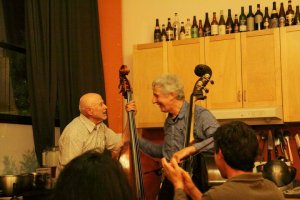
La Donna Smith and India Cooke playing an improvised duet.

Bassists Mark Dresser and Barre Phillips play together for the first time at In the Mood for Food.
Bassists Mark Dresser and Barre Phillips play together for the first time at In the Mood for Food.

The amazing Stuart Dempster at Phil's loft a few years ago.

The amazing Stuart Dempster at Phil’s loft a few years ago.

Gyan Riley, Terry Riley and Loren Rush attending the dinner/concert which featured Stuart Dempster.

Gyan Riley, Terry Riley and Loren Rush attending the dinner/concert which featured Stuart Dempster.

Pauline Oliveros and her partner Ione performing at a recent dinner.

Pauline Oliveros and her partner Ione performing at a recent dinner.

So this little sampling of photos provides some idea of the scope and significance of this series.  Happily it is being documented in a book for which an Indiegogo campaign is presently in process.  You can donate and receive any or many of a variety of perks ranging from a copy of the book for $40 and perks including an invitation to celebratory dinners planned in both New York and Oakland.  My copy and my dinner invite are reserved.

There are 34 days left in the campaign at the time of this writing and the project is now at 106% of its funding goal.  This is a piece of Bay Area music and culinary history that will please music enthusiasts and those who appreciate creative vegan cuisine.

Here is a list of musicians taken from the campaign site to give you an idea of the scope of the series:

Tim Berne – alto saxophone (Brooklyn)

Shay Black – voice, guitar (Berkeley via Ireland)

Cornelius Boots shakuhachi/bass clarinet

Monique Buzzarte – trombone, electronics (NYC)

Chris Caswell (2) – harp (Berkeley)

Stuart Dempster – trombone (Seattle)

Robert Dick (flute) NYC

Mark Dresser (2) – bass (Los Angeles)

Mark Dresser/Jen Shyu duet – bass, voice/dance

Sinan Erdemsel – oud (Istanbul)

Sinan Erdemsel/ Sami Shumay duet – oud, violin

Gianni Gebbia – saxophones (Palermo, Italy)

Vinny Golia- winds (Los Angeles)

Lori Goldston – cello (Seattle)

Frank Gratkowski (2) – clarinets, alto sax (Berlin)

Daniel Hoffman/Jeanette Lewicki duet violin, voice/accordion (Berkeley, Tel Aviv)

Shoko Hikage – koto (Japan-San Francisco)

Yang Jing – pipa (Beijing)

Kaoru Kakizakai (4) – shakuhachi (Tokyo)

Marco Lienhard shakuhachi (Zurich-NYC)

Mari Kimura – violin, electronics (Tokyo-NYC)

Yoshio Kurahashi (5) – shakuhachi (Kyoto)

Joelle Leandre – contrabass (Paris)

Oliver Lake – alto sax (NYC)

Riley Lee (2) shakuhachi (Australia)

Jie Ma – pipa (China, LA)

Thollem Mcdonas Jon Raskin duet piano/sax (wanderer/Berkeley)

Roscoe Mitchell – alto, soprano saxophones (Oakland)

David Murray – tenor sax (Paris)

Michael Manring (5) – electric bass (Oakland)

Hafez Modirzadeh – winds (San Jose)

John Kaizan Neptune – shakuhachi (Japan)

Rich O’Donnell – percussion (St. Louis)

Pauline Oliveros (2) – accordion (NY)

Tim Perkis/John Bischoff duet computers (Berkeley)

Barre Phillips solo and duet with Mark Dresser – contrabass (France)

Alcvin Ramos shakuhachi (Vancouver)

Tim Rayborn/Annette duet oud, strings, recorders (Berkeley/Germany)

Jon Raskin/Liz Albee duet sax/trumpet (Berkeley/Berlin)

Jane Rigler – flute (Colorado)

Gyan Riley (5) – guitar (NYC)

Terry Riley (2) – voice, harmonium (universe)

Diana Rowan (2) – harp (Berkeley/Ireland)

Bon Singer/Shira Kammen duet (voice, violin) (Berkeley)

LaDonna Smith/India Cooke duet (2) violin, viola (Birmingham, AL, Oakland)

Lily Storm/Diana Rowan – voice, harp (Oakland/Ireland)

Lily Storm/Dan Cantrell (2) – voice/accordion (Oakland)

Howard Wiley – tenor Saxophone solo and duet with Faye Carol voice

Theresa Wong/ Ellen Fullman duet

Amy X (3) – voice, electronics (Oakland)

Pamela Z – voice, electronics (San Francisco)
Meredith Monk and Eric Salzman, a Labor of Love


Labor Records LAB 7094

Labor Records LAB 7094

New music aficionados in the 1970s had access to quite a bit of new and unusual music on the Nonesuch label under the watchful eye of Theresa Sterne.  In fact, Salzman was among the wonderful producers along with people like Joshua Rifkin who put that label at the forefront of contemporary music releases.

Two most unusual dramatic pieces, The Nude Paper Sermon (1969) and Civilization and Its Discontents (1977) caught my ear (yes, I have them on vinyl).  I was looking to see if these had ever been reissued (they have) and ran across this disc containing music by Eric Salzman (who was involved in both of the aforementioned discs) and by Meredith Monk.

Eric Salzman

Eric Salzman

Eric Salzman (1933- ) is a composer, scholar, broadcaster, producer and theorist.  He studied at Columbia University(BA 1954) with Jack Beeson, Lionel Trilling, Otto Luening and Vladimir Ussachevsky.  His graduate work at Princeton University (MFA 1956) was with Milton Babbitt, Roger Sessions, Earl Kim, Edward T. Cone, Arthur Mendel, Oliver Strunk and Nino Pirotta.  A 1956-8 Fulbright fellowship allowed him to work with Goffredo Petrassi and at Darmstätdter Ferienkurse with Karlheinz Stockhausen, Bruno Maderna and Luigi Nono.

He has written for various news media and wrote for the wonderful Stereo Review magazine from 1966.  His academic credits and publications are also highly regarded.  He was the music director at WBAI, a Pacifica Radio Station during the 60s and 70s.  In short he is a living treasure of American music.


His music, unfortunately, is less well-known I think than his writings but what little I have been able to hear of his work (you can hear excerpts of various pieces on his web site) has piqued my interest to seek out more.  He is uncompromisingly innovative and experimental which may put off the casual listener but has wonderful revelations to those who lend their ear.  This disc on Labor Records (who have also issued the aforementioned dramatic works) contains a new aural drama or radio drama if you prefer.

Now I doubt that anyone who actually seeks out a recording by the likes of Salzman and Monk will be put off by innovative and experimental ideas but these works are quite listener friendly and represent mature work by both artists.  This very welcome recording gives listeners an opportunity to hear the vibrant mature work of two clearly still vital living masters.

Salzman’s “Jukebox in the Tavern of Love” (2008) was written on commission from the Western Wind Vocal Ensemble and was performed in Brooklyn’s “Bargemusic” in 2009.  The libretto is by Valeria Vasileski and the action takes place in a New York bar during a power outage.  The cast of characters reminds this writer of any number of, “a man walks into a bar…” jokes.  We meet a nun, a Rabbi, a Broadway Dame, a poet, and a Con Ed worker all culled from the composer and librettists perceptions of the individuals that make up Western Wind.  And these characters comment on the subject of love in this re-visioning of the madrigal opera genre.


Meredith Monk

Meredith Monk

Meredith Monk (1942- ) is a dancer, composer, vocalist, choreographer, filmmaker and new music innovator in extended vocal techniques.  She is among the best known of the composers who comprised the loosely defined “downtown” new music scene in New York in the 1970s.  She graduated Sarah Lawrence College in 1964 having studied with Beverly Schmidt Blossom.  She is best known for her numerous recordings on Manfred Eicher’s ECM label.

Basket Rondo (2007), also written for the Western Wind Vocal Ensemble, is vintage Monk.  The eight movements take the listener through a series of extended vocal sound worlds.  Monk’s work is always more evocative than literal and this work could suggest whatever the listener perceives or could simply be appreciated as musical expression. Her creative vision that underlies this piece involves a pre-industrial society singing a sort of work song.  Monk’s ability to export her extended vocal techniques through her workshops made it possible for her to write in her idiomatic style for singers not otherwise familiar with these techniques.

The piece is cast in eight movements  suggesting the “rondo” I suppose.  And I’m guessing the baskets represent the fruits of their labors.  But the important thing is that Monk’s re-visioning of medieval history in these dream like dance/vocal dramas succeeds in creating mesmerizing aural theater regardless of what plays in your head when you hear it.

The Grammy nominated Western Wind Vocal Ensemble (much of whose work is with Medieval and Renaissance music) has a well-deserved reputation as being among the finest small vocal ensembles working today.  This disc allows them to demonstrate their ability to move easily into the contemporary music world.  Their performances here are superb and a very welcome addition to the discography of these two composers.  I cannot think of anyone who could have written this music other than the present composers.  Here are two works by composers whose idiosyncratic methods have produced music that identifies them much as a thumb print identifies a check writer (or a criminal, for that matter, I suppose).  That is a mark of true mastery. And it would be a crime to miss hearing these works.


My 2014, a Summation and (sort of) “Best of…” List


The stage at Kanbar Hall stands ready to receive performers on opening night of OM 18

The stage at Kanbar Hall stands ready to receive performers on opening night of OM 18

As New Music Buff heads on into its fourth year in the online realm I find that I have a steadily increasing readership averaging 18 hits per day with an international reach of about 88 countries. I say readers, not followers because the stats provided have no way to track returning visitors but you know who you are.  And I thank WordPress for their entertaining summary published earlier here.


Last year I provided a list of my greatest hits (i.e. my most read articles in 2013) so here is a list of 2014’s top ten:

Black Classical Conductors (Black Classical Part Two)
This is a 2013 article which continues to be popular. I did an addendum called: Black Conductors, A Belated Addendum  and received a note from Tania Leon who remarked quite correctly that she is indeed a black American conductor.  Clearly I will need to expand this survey once again.

Maybe Music Remains Forever
This review of the excellent newly released Martin Bresnick CD went the equivalent of viral for my blog and I was pleased to have discovered the work of this wonderful American composer.

Primous Fountain World Tour Begins in Moldova
This relatively little known living black American composer was a child prodigy whose second symphony was commissioned by Quincy Jones had his sixth symphony premiered in Moldova in 2014.

Tawawa House in Modesto?
I was granted a comp ticket to see this really great performance of a little known 20th century opera by a black female American composer, Zenobia Powell Perry.  It was a great experience, a passionate, entertaining performance and put Modesto on the musical map for me.

Other Minds 18, Three Nights on the Leading Edge
Curiously this review was read more than the one about the 2014 Other Minds 19. More to come about the upcoming Other Minds 20.  For anyone who doesn’t know this is my favorite new music festival.

Far Famed Tim Rayborn Takes on the Vikings
This article about a 2013 performance by this very talented multi-instrumentalist, singer and scholar/historian continues to be popular. I’m hoping to catch another of his performances in 2015.

Black Composers Since the 1964 Civil Rights Act: Primous Fountain
I started in 2013 writing an occasional series of articles for Black History Month. I had no idea how popular this would become. The theme for the 2014 series is given in the title and you can rest assured that I will continue the series in 2015.

Tom Johnson and Samuel Vriezen, Great New Recording
A review of a crowd sourced recording project and one of my favorites of 2014.

Black Composers Since the 1964 Civil Rights Act
This is the introductory article for the 2014 series. Many thanks for the comments and support on this article and its successors.  I plan to give my summation of the various responses on this received both on and off the books.

Abraham Lincoln and the Avant Garde
This is one of an ongoing series of articles on political expression in music. It was after I friended Dorothy Martirano on Facebook and mentioned this piece that the article got a few new readers. Perhaps I should have mentioned the composer in my title.  Kudos to the late great Salvatore Martirano, gone too soon and too little known even now some twenty years after his passing.


SOME OF MY FAVORITES FROM 2014

Now regarding my personal favorite recordings of 2014 I have to insert a disclaimer to the effect that I make no claim whatsoever to this list being comprehensive or representing anything more than a few of my personal favorite recordings encountered in this past year. My apologies in advance to those I missed. I hope to catch up some day. So, in no particular order:

Mysterienspiel 2012

Game of the Antichrist by Robert Moran (Innova 251)
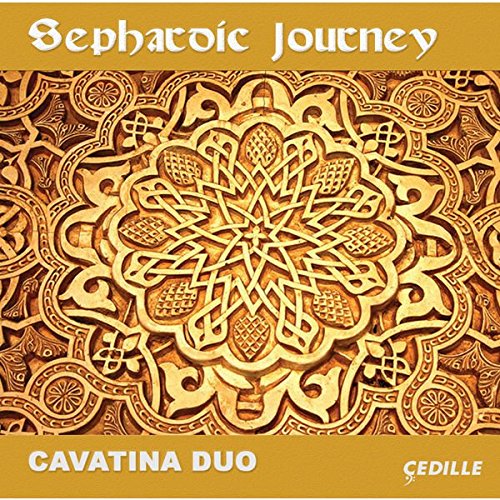
I promise a more comprehensive review soon but this is a great CD by a too little known American composer.  Mr. Moran recommended the disc to me after I wrote to him praising his wonderful “Trinity Requiem”.  I plan a more comprehensive article soon.  Meanwhile here is a link to a performance on Vimeo.

AZ spread

Alcatraz/Eberbach by Ingram Marshall and Jim Bengston  (Starkland S-2019)

This DVD is essentially the completion of a collaboration of photographer Jim Bengston and composer Ingram Marshall.  As such it is the most complete artistic statement superseding the audio only release (still worth having by the way) from some years ago.


Who Has the Biggest Sound? by Paul Dolden. (Starkland ST-220)
A difficult to categorize recording that brings two major works by this (previously unknown to me) Canadian composer to the listening audience. I reviewed this disc here.  I am still working on absorbing its subtleties.

221CoverB

Prayers Remain Forever by Martin Bresnick (Starkland ST-221)
In addition to providing me with quite a few readers the opportunity to review this recording introduced me to the work of this too little known living American composer.  My review garnered quite an amazing amount of readers as well as an appreciative response from Mr. Bresnick himself.  And now I find myself buying his other recordings.  Really great music.


Album cover

Album cover

Notes from the Underground by Anthony Davis. (BMOP sound 1036)

I have been a fan on Anthony Davis and his music for some years now and I was pleased to be able to review this disc.   I  was later able to obtain an interview with Professor Davis which will be forthcoming later this year.

download

Tom Johnson/Samuel Vriezen Chord Catalog/Within Fourths, Within Fifths. (Edition Vandelweiser)

I eagerly reviewed this crowd sourced CD in which I was proud to be one of the contributors to its production.  It is only the second recording of Johnson’s landmark of minimalism and an opportunity to hear the work of the fine composer/performer Samuel Vriezen.

basketmonk

Basket Rondo/Jukebox in the Tavern of Love by Meredith Monk/Eric Salzman. (Labor LAB 7094)

This Labor Records release would have escaped my attention were it not for my having run across it while researching another new music article.  New music aficionados might remember Eric Salzman for earlier works such as “Civilization and It’s Discontents” and his involvement with Nonesuch records or one of his many other significant involvements in the new music scene over the last 40 years or so.  This disc is the première recording of Meredith Monk’s “Basket Rondo”, one of her best realized new works as well as the première of a great new sound/music drama by Salzman.  A more thorough review is in the works.

howardhersh2

Something by Howard Hersh ( Snow Leopard Music 888295062350)

Mr. Hersh kindly sent me this CD for review which will be forthcoming but it easily makes it to my favorites list for 2014.

webreaknonclass

I also have to mention another crowd sourced project, “We Break Strings” by Thom Andrews and Dimitri Djuric, a book about the “alternative classical scene in London”.  The book which includes a CD sampler languishes in my “to be read” stack but my initial perusal left me with the impression of a beautifully conceived and executed volume which has much to offer the musically curious.  More about this book in a future blog.


Black Conductors, a belated addendum


Due to the popularity of my earlier black conductors article I was feeling the need to expand this piece a bit.  Again this is by no means comprehensive and I welcome comments, additions and corrections.


The original article was just an occasional piece, far from comprehensive so I have decided to add a few names.  First the black conductors who are no longer with us:


Charles-Richard Lambert (d. 1862)- Born in New York (no date given), settled in New Orleans and was a music teacher and conductor for the Philharmonic Society (the first non-theater orchestra in New Orleans).  He died in Port-au-Prince, Haiti.

Edmond Dédé (1827-1903) Born in New Orléans, he moved to Europe to study music and settled in France where he had a career as a conductor and composer.

Edmond Dede

Edmond Dede

William Grant Still photographed by Carl van Vechten

William Grant Still photographed by Carl van Vechten


William Grant Still  (1895-1978)- In addition to being a major American composer and the first black composer to have a symphony played by a major symphony orchestra to have an opera premiered by a major company (Troubled Island, written in 1939 was premiered by the New York City Opera in 1949), the first black composer to have an opera broadcast on television (Bayou Legend, 1941, not performed until 1974 and broadcast 1976 by the Mississippi Educational Television Authority) he was also the first black conductor to conduct a major American orchestra in the deep south  (New Orleans Philharmonic, 1955)

Calvin E. Simmons

Calvin E. Simmons


Calvin E. Simmons (1950-1982) The first black conductor to be appointed conductor of a major American orchestra (Philadelphia Orchestra).  He died in a canoeing accident near Lake George in New York.  The Calvin Simmons theater at the Henry J. Kaiser Convention Center in Oakland, CA is named in his honor.


And now to those who remain on the earthly plane:


-Thomas Jefferson Anderson (1928- ) Better known perhaps as a composer is an educator he is also an accomplished conductor, educator and orchestrator.  He is well-known for his orchestration of Scott Joplin’s opera Treemonisha (unfortunately this has yet to be recorded).


-Leslie B. Dunner (1956- )Born in New York City, he attended the Eastman School of Music, Queen’s College and received a Master’s Degree in 1979 from the University of Cincinnati Conservatory of Music.  He was the first American (of any color apparently) to win the Arturo Toscanini International Conducting Competition in 1986.  Currently a conductor for the Joffrey Ballet in Chicago, Mr. Dunner has conducted the Chicago Symphony, the Grant Park Orchestra, the New York Philharmonic, Detroit Symphony, L A Philharmonic and many others world-wide.


Leslie B. Dunner

Leslie B. Dunner


William Eddins

William Eddins (Photo credit: Wikipedia)


William Eddins (1964- ) Both a pianist and a conductor, Eddins was a founding member of the New World Symphony in Miami, FL and is currently the principal conductor of the Edmonton Symphony Orchestra since 2005.  He regularly performs music by 20th and 21st Century composers and host a podcast called Classical Connections.


-Robert Keith McFerrin, Jr. (1950- ) Better known as “Bobby McFerrin” is a ten time Grammy award winner.  He is also a popular guest conductor with orchestras such as the San Francisco Symphony, the Chicago Symphony, New York Philharmonic, Detroit Symphony, Israel Philharmonic and many others.

Bobby Mc Ferrin in 2011

Bobby Mc Ferrin in 2011


As I said this is hardly comprehensive but these omissions have bothered me more each time I see that the original post has been read again.  Hopefully this will assuage my guilt and provide useful information.


Tawawa House in Modesto? A New Staging of Zenobia Perry’s Opera.


Modesto California is not a common destination for new music productions but I learned of an upcoming performance of Tawawa House by Zenobia Powell Perry (1908-2004).  It was written in 1984 and premiered in 1987 at Central State University in Wilberforce, Ohio (actually the geographic setting of this opera) where she was part of the music faculty from 1955-1982.

I only learned of this performance due to my Facebook contact with Bill Doggett, a bay area business developer and marketing consultant who focuses on music by people of color.  The production is staged by Townsend Opera at the Gallo Center for the Arts in Modesto, CA.  It was the world première of a revised libretto and orchestration by Perry scholar Jeannie Gayle Poole.

After a mostly pleasant two-hour drive I arrived for my first visit to the central valley town.  I  located the beautiful arts complex and proceeded from a warm sunny spring day into one of several theaters housed in the same building, an arts multiplex, if you will.  The theater was about 2/3 full, a good sign.  It is a large and well-designed theater with great site lines, comfortable seats and a large fully equipped stage with a nicely nested orchestra pit.

The program book listed other productions that Townsend has done and it is an impressive list.  While they program popular standard repertory like La Boheme and Aida (no small feat) I did note that they have also done less frequently performed works such as Menotti’s Amahl and the Night Visitors and Offenbach;s Christopher Columbus.  Under the direction of Matthew Buckman since 2008 this is their first world premiere and perhaps their most adventurous production.

The staging (Heike Hambly), costumes (Tara Roe), lighting (Erik Vose), choreography (Erikka Reenstierna) and scenic design (Jean-Francois Revon) were excellent and well suited to what is essentially a chamber opera with spoken dialogue.  The singers were simply amazing both in their vocal artistry and their acting and dancing abilities.  The cast appeared quite comfortable with each other and clearly enjoyed what they were doing.  The orchestra was most ably led by conductor Ryan Murray.  This was a loving, beautiful production with amazing singers who appeared to put their hearts and souls along with their sizable talents to this opera.

The spectacular vocal cast included baritone Lawrence Craig, tenor Anthony P. McGlaun, baritone V. Savoy McIlwain, soprano Leslie Sandefur, baritone Barry Robinson and soprano Shawnette Sulker along with supporting singers and chorus.  These artists alone justified the price of a seat for this performance.

Dramatically staged scene from the second act.

Dramatically staged scene from the second act.

Tawawa House is based on a real place which existed in Ohio and served both as a luxury hotel for white visitors with purported healing waters as well as a major stop on the underground railroad with socially progressive whites assisting in the rescue of slaves from their forced servitude even before the emancipation proclamation.  The story begins before the civil war and ends just after.  It is a story nearly lost to history and one that deserves to be told.

The joyful multiple weddings scene as one happy couple "jumps the broom" in a traditional practice of the era.

The joyful multiple weddings scene as one happy couple “jumps the broom” in a traditional practice of the era.

As an opera it is cast in a conservative musical style relying on spirituals and popular songs of the era with some quotation of both genres.  It consists of choral sections, a few arias and some ensemble singing.  Like many operas this one suffers from a weak libretto at times which nonetheless serves to support the overall structure of the musical work.  This is a gentle retelling of a tale from a sordid and shameful time in our collective history.

The orchestration ranged from a theater orchestra style to some Hollywood-like film score that one might hear in motion pictures from the 1940s.  I don’t know how this edition differed from the original 1987 performance or why the decision was made to revise it.

The cast taking their first bow to the appreciative audience.

The cast taking their first bow to the appreciative audience.

It is difficult to say where this work will take its place in musical history but it certainly deserves to be revived.  I hope that the success of this production will encourage adventurous opera companies such as Townsend to seek out other neglected works in that deserve revival and, in many cases, first performances.

Despite some minor weaknesses the performance was very professionally executed,  full of joy and clearly pleased the audience.  After all theater goers are accustomed to the sometimes silly plots common to a lot of operas and musicals but they are seeking entertainment by talented performers and that is definitely what they got.  This was a wonderful production which now puts Townsend opera on my radar.  Looking forward  to more from this company.  Congratulations on a great show!


Enhanced by Zemanta

Tom Johnson and Samuel Vriezen, Great New Recording


A few of months ago received my copy of the newly minted CD by pianist/composer Samuel Vriezen.  This is one of those crowd-sourced projects on Indiegogo .  The disc consists of a new recording of a sort of minimalist classic and a new works by the pianist, Within Fourths/Within Fifths (2006) which is, essentially his artistic response to this piece.  The piece is dedicated to Johnson.

download

This is only the second recording of the Tom Johnson work committed to disc. That by itself is an achievement. The first was recorded by the composer and released on XI records in 1999.  That recording clocks in at about one hour.  By contrast Mr. Vriezen’s recording takes only about 30 minutes to play the piece.  Johnson, who is also known as the former music critic for the Village Voice is one of the few composers who actually embraces the term “minimalist”, in fact he was there witnessing the very birth of that style during his tenure at the Village Voice (1972-1982).

The Chord Catalog (1985) consists of, in order, all the possible chords in a single octave that are possible with two notes, three notes, four notes, etc. up to 13 notes with the doubling of the octave.  That’s a total of 8178 chords. This sounds like a potentially bland academic exercise like many minimalist or process music concepts.  No tempo is specified in the score.  It is an important piece which may not appeal to all audiences but will likely entertain anyone whose listening interests lie in the realm of minimalism, process music and conceptual art.

TheChordCatalogue-page-001

According to Kurt Gottschalk in his article for I Care If You Listen Johnson is a fan of Vriezen’s interpretation and, in fact, is one of the many contributors to the project.  Vriezen has been performing the piece for about 10 years now in public concerts and he posted a video of a performance of Chord Catalog with commentary by Tom Johnson and himself.  There are also scenes of Johnson with Vriezen as he performs a portion of Within Fourths/Within Fifths.

Vriezen’s piece by contrast lasts about 45 minutes and, though using similar methods, produces a different sound world.  He correctly describes the piece as lyrical and it is a wonderful piece on its own, more wonderful in context with its predecessor.  This disc is an artistic dialogue, a call and response between to kindred spirits of different generations.

Samuel Vriezen is a Dutch pianist, composer and writer born in 1973.  His web site lists his compositions and writings and there are downloadable mp3 files and scores.  There is also a Vriezen page on Ubuweb which contains mp3 files and pdf files of several of his pieces and includes useful program notes.  He also produced Johnson’s CD Symmetries (1980) featuring Vriezen and fellow pianist Dante Oei on Karnatic records.

This is the solo début recording by a composer and pianist with keen instincts and talents that leave this reviewer in excited anticipation of what he  will do next.  I am also proud to have sponsored this wonderful recording.

Enhanced by Zemanta