New Music Buff’s Best of 2023


Attack of the Music Memes

After agonizing about writing a “best of” blog and publishing it before January 1, I decided to take a pause and enjoy the holidays. So here I look back on my 2023 in the rear view mirror but with memories still pretty fresh.

Regular readers of this blog likely already know of my oft shared opinion of the superfluous nature of “best of” lists and of my acquiescence in producing such on an annual basis. I certainly don’t think of this as a meaningless exercise and I think the process has grown on me. It is a chance to achieve a perspective which would be missed by simply plowing on ahead with the usual flow of reviews and articles. But drawing down that 12 month perspective is an opportunity to evaluate those months, to see where we’ve been and to hopefully get a smidgen of insight into where I/we are likely headed.

My Facebook friends will recognize the representative meme at the head of this article which is one of the more cloying aspects of “AI”, whatever that is. So indulge me for a moment to look at this seemingly new intrusion into the reality we thought we knew. So, what is “AI” and what will it do to us? Ultimately I’m not the one to answer that question but I’d like to throw some ideas to add to the speculation.

First, the choices a composer makes, like the choices of a painter, a writer, etc. are the stuff of the mystery of creation itself. Why “A major”, or why that tuning, or scale, or rhythm, or orchestration, etc? So along comes the notion of removing, or at least distancing, the artist from their creative product. That notion started not with famed proponent John Cage but rather with Johannes Chrysostymous Wolfgang Amadeus Mozart in his K. 516f musical dice game. Voila! Algorithmic composition (actually fairly common practice in the classical era). An early manifestation of “AI”? Perhaps.

Lejaren Hiller (1924-1994) was the first composer to employ electronic data processing in a musical work in his Fourth String Quartet subtitled “Iliac Suite” in 1957. There followed similar experiments with various iterations of electronic creations at music centers worldwide including The University of Illinois at Champaign, Columbia-Princeton, Stanford, The University of California Berkeley and San Diego, The San Francisco Tape Music Center (later subsumed into the Mills College Center for Contemporary Music, IRCAM in Paris, Israel Electronic Music Studio, and counterparts in the Nordic countries, Germany, Belgium, etc. Proto “AI”?

While historically interesting I raise this issue to say that, as far as I can tell, “AI” has not made this writer’s greatest hits list but it is interesting and maybe even useful. With that, my concern for the subject officially goes to the back burner for a later time.

2023 has been a year of great personal changes for the writer of this blog. A job change, a geographical relocation, and many things unrelated to this blog characterized a busy year for New Music Buff. So here in a sort of holiday tradition I present my “Best of 2023” from my little listener’s corner of the world. For the sake of simplicity I present a more or less chronological exposition of my sonic adventures. (N.B. Not one portion of this article made use of “AI”).

I begin with not with my 20 most read posts, a practice that characterized previous iterations of this annual exercise. Instead I am providing my top 20 favorite releases that were reviewed in 2023. Please note a couple of caveats. First, I receive a lot of review requests, more than I can even listen to, much less give a reasonably intelligent review. Albums that I’ve not reviewed should not be assumed to be bad or insignificant and my reviews are personal observations. I really only review albums that interest me anyway. Second, this article is only one reviewer’s opinion and not intended to be definitive or to supersede anyone else’s opinions. Third, this is not the end of my attention to music that was released in 2023. Some releases require more time to give a fair listen and a respectful review. There are more to come in 2024.

First a few stats: 2023 saw the publication of some 45 blog posts on New Music Buff, earning me 9693 views for the year. I rarely get comments on my posts (though I welcome and invite comments both positive and negative). Not bad, I think, for the overall less appreciated musical styles that fuel my desire to write about.

Now, in chronological order (of publication) are my personal favorites as a listener:

Neuma 158

Binaural Beats in the Tudor Rainforest started my new year with a bang. Reviewing this disc required me to take a closer look at the astounding work of David Tudor and his unique contributions to new music. This important release is a recording of a work which, by its own concept cannot receive a “definitive” performance. But this recording comes mighty close, involving “binaural” recording utilizing a mobile set of binaural microphones which are worn by the recordist. In addition this recording involved a collaboration with Pauline Oliveros and a group called, “Composers Inside Electronics”. The recording was done during Oliveros’ tenure at UCSD. Rainforest IV is so called because it is the fourth iteration of the instructions that form the original concepts of Tudor’s composition, “Rainforest”. It is an immersive sonic experience heard on headphones but actually not bad even heard on stereo speakers. A rich and wonderful release.

Starkland S-236

From a 1960s electroacoustic to a budding 21st Century composer Kotoka Suzuki released on the reliably interesting and even visionary Starkland label. Next Gen Electroacoustic: Kotoka Suzuki will introduce the listener to this rising star who doubtless will produce more of her compelling compositions.

Sony 194399434826

Igor Levit is a fine concert pianist whose albums are effectively redefining the way we, as listeners, perceive the western classical oeuvre. Igor Levit: Defining Tristan does for the various musical pieces inspired by the Tristan legend what Levit did for the concept of the great keyboard variations in which he selected Beethoven’s “Diabelli Variations” and Frederic Rzewski’s “El Pueblo Unido Variations” to join his recording of the Bach “Goldberg Variations” in a 3 disc package placing these three large sets of variations as emblematic of the genre in three different centuries (18th, 19th, and 20th). Levit, by his recorded output, is providing a valuable perspective which may influence repertory choices for years to come.

Levit’s traversal of the Tristan legend here ranges from the second recording of Hans Werner Henze’s too seldom heard “Tristan Preludes” back to works by Wagner (of course) and Liszt. He even slips in his wonderful solo piano transcription of the Adagio of Mahler’s unfinished 10th Symphony into the mix. This is a very compelling Tristan anthology by a deservedly still rising star.

Cantaloupe

This Cantaloupe release by Bang on a Can composer and master clarinetist Evan Ziporyn is both masterful and great fun. Evan Ziporyn: Bang on a Pop consists of transcriptions of “pop” songs for multiple clarinets all played by Ziporyn via his very effective multi-track recordings. The album is very personal and pretty much cliche free with these engaging and insightful transcriptions. It is an homage to the songwriters as well as a showcase for Ziporyn both as composer and as performer.
Microfest MF 23

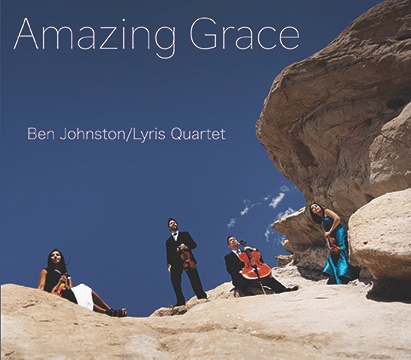
The Young Person’s Guide to Ben Johnston is an ideal way to introduce listeners to the wonderful world of the late Ben Johnston’s music. Johnston, a student and colleague of Harry Partch shows his compositional skills utilizing non-traditional western tunings in these representative works. Johnston here does for some quasi pop tunes what Evan Ziporyn did with his clarinetist perspective for the tunes on Pop Matters. But Johnston’s pretty, accessible work belies fascinating complexities that don’t actually sound complex to the listener. This disc contains Johnston’s last completed work, “Ashokan Farewell” (which Johnston took to be a public domain folk tune but is in fact a piece written by Jay Ungar). It is paired with the 4th String Quartet (a set of ingenious variations on “Amazing Grace”) from 1982 and the 9th String Quartet of 1997. Profound, lovely to listen to, and a great homage.

DVD OM 4001

This DVD is a major addition to the discography of Charles Amirkhanian’s sound poetry as fine sampling of one aspect of Carol Law’s (Amirkhanian’s life partner) complementary visual art. These collaborations are also important contributions to the visual and performative aspect of these collaborative works. Amirkhanian has been a fine curator and promoter of the work of others but he has rather seldom stepped into the spotlight himself. This quirky genre got some fabulous exposure at the 7 day Other Minds 23 festival in 2018 in which Amirkhanian’s work was presented in the (surprisingly varied) context of sound poetry of the amazing international collection of artists who were hosted at those events. This DVD should be in the collection of anyone interested in new music sound poetry and performance art. It is both entertaining and mind bending featuring a juxtaposition of images and sound reviewed in greater detail in the post “Dyadic Dreams”. But words cannot do justice to these works. You really have to see them.

Cedille CDR 90000 210

Readers of this blog know my fondness for the Chicago based label Cedille and their promotion of Chicago based musicians. This disc stands out in this group’s embrace of non-traditional composers alongside more traditional works. The inclusion of works by DJ composer Jlin and the academy based genre defying duo Flutronics alongside composers like Danny Elfman and Philip Glass demonstrate the wide ranging repertoire of Third Coast Percussion. Much more information can be found in Perspectives: Spectacular World Premiere Recordings from Third Coast Percussion on my blog. This one reimagines the percussion ensemble.

Neuma 176

This disc is a good example of why listeners and collectors should pay attention to the Neuma record label. Philip Blackburn, who had been the very successful curator of Innova records, took over the defunct Neuma label which was founded with the intention of promoting largely electroacoustic music though not exclusively.

Agnese Toniutti‘s New Music Vision is actually a review of two discs by this rising star, a dedicated new music pianist that needs to be on your radar. The other Neuma disc contains Toniutti’s traversal of John Cage’s reluctant masterpiece, “Sonatas and Interludes for prepared piano”.

The disc pictured here is Toniutti’s vision beyond the Cage work. This one focuses on mostly living composers Lucia Dlugoszewski, Tan Dun, Philip Corner, and Toniutti’s herself. Basically, if Toniutti plays it, you should probably at least give a listen.

2023 saw the completion of Bay Area pianist Sarah Cahill’s epic survey of piano music by female composers. Cahill is another (predominantly) new music focused pianist about whom I would also assert that, if she plays it, you should probably give at least one listen.

The End of the Beginning: Sarah Cahill’s “The Future is Female” Trilogy Completed will tell you all you need to know about this trilogy which encompasses about 300 years of music history and sheds light on some fascinating and substantial music written by women. Most of the works on this trilogy of albums are, in fact, world premieres but, fear not, even the pieces which are not premieres are likely not in your collection. This is a brilliant selection of music that effectively throws down the gauntlet to challenge other artists to explore this repertory. This trilogy is a true landmark and a joy to the ears.

This third volume in the wonderful Catalyst Quartet’s survey of another unjustly neglected group of composers focuses on the music of three black Americans of the twentieth century. Catalyzing Blackness, Volume Three: The Catalyst Quartet plays 20th Century music by Black Americans was nominated (but didn’t win) for a Grammy Award and, happily, I’m told that more volumes are in preparation. Again, this music is a pleasant revelation that does for black composers what Sarah Cahill has done for women composers (N.B. The first volume by the Catalyst Quartet focused on the black female composer Florence Price). And here’s hoping that Coleridge Taylor Perkinson, George Walker and William Grant Still will become household names in the concert hall.

Microfest MF 21

Son of Partch, Carrying on a Tradition is a really wonderful disc which, though I reviewed it in exceedingly positive terms, provoked a strongly negative reaction from the artist. The reaction apparently also provoked enough interest to have made this review one of my most read of 2023.

But, aside from the unfortunate negative reaction, I still maintain that this is a fine release worthy of attention from anyone who likes new music, microtonality, and the music of Harry Partch. Cris Forster is a composer, theoretician, and instrument builder clearly descended from the Partch tradition. His work deserves attention and this disc is a very satisfying experience.

Islandia IMR 011

Steven Schick is a master percussionist and conductor. This release is the first volume of his personal choices of solo percussion repertoire. Solo Percussion Manifesto Volume I: Steven Schick’s “A Hard Rain” is a manifesto of sorts and does for solo percussion music what Sarah Cahill has done for women composers and the Catalyst Quartet is doing for black composers. There are not many recordings of solo percussion music and Maestro Schick essentially presents his favorite works in definitive performances on a label produced by Bang on a Can cellist Maya Beiser. The second volume is in my review queue and, if this first volume is any indication, it will be a landmark survey.

Cedille

Rising Star Seth Parker Woods’ “Difficult Grace” is a Classic in the Making. Here’s another Grammy nominee that did not win but, this second album by this fine American new music cellist is a winner in my book (er, blog). This is actually the audio of what was developed as a staged performance but the music speaks for itself. Keep an eye/ear out for this rising star who, even now, is storming the new music cello scene in invigorating ways.

Neuma 128

A Reason to Listen: Roger Reynolds’ Latest, “For a Reason”,new recordings on Neuma Records. Here we see Neuma following its original electroacoustic mission with this remarkable set in celebration of Roger Reynolds’s 90th year. This is a lavish 2 CD box set with a beautiful booklet and lucid liner notes. It is a worthy production which showcases recent works by this prolific and important American composer.

Readers of this blog likely are aware of my interest in music that is suppressed and/or neglected so this disc grabbed my attention immediately. Israel does a great job of funding the arts and this can be seen in the proliferation of truly fine performers nurtured by that funding. Less well known are the composers who have flourished in the art healthy politics of this country. Some 50 years of history are represented here. This is but a sampling, albeit finely curated, of several generations of composers displaying a plurality of styles with substantial results. This entertaining disc will whet the appetites of intelligent and curious listeners and, hopefully, bring about more recognition of the world class composers who deserve an audience.

So, finally, went my 2023.

Rising Star Seth Parker Woods’ “Difficult Grace” is a Classic in the Making


Cedille CDR 90000 019

Every solo artist, regardless of what instrument they play seeks to define themselves. Generally that means setting limits. Some set limits by specializing in an era (baroque, classical, etc.). Some specialize in working with electronics, some with jazz, some with experimental music, some with standard recital repertoire, etc. Seth Parker Woods (1984- ) seems almost unaware of such limits. He plays what he chooses. And, oh, what choices. From standard classics to the leading edge of musical creativity woods is poised at the beginning of a very promising career.

Seth Parker Woods (photo from his faculty page at USC Thornton School of Music)

This album is in fact the musical portions of what was produced as a staged presentation with Woods playing, singing, talking. No doubt something is lost without the staging but Woods’ asserts himself with great clarity on the sonic aspect alone. Think of this as a sort of cast album, though it is more than just a souvenir. It is Woods’ second album and it has this writer enthralled at where he may go next. You will be too.

Parker’s first solo release “asinglewordisnotenough” available on bandcamp reveals his dedication to new and recent music.

I feel privileged to have known this artist via digital media and to have watched with increasing interest his development as a true rising star in the new music world. I only recently acquired his first album via bandcamp. It was released “across the pond” when he was completing his Ph.D. at the University of Huddersfield.

Born in Houston, his father, a jazz and gospel singer, Woods was exposed to a great deal of music. He rehearsed in a home studio and somehow came to a fascination and deep appreciation for a wide variety of repertory.

His affiliations continue to be wide ranging from Peter Gabriel to George Lewis. He has appeared on many recordings but this is only the second disc dedicated entirely to Woods as performer and the first such solo efforts on a US label. Woods is apparently able and willing to tackle music of all eras and genres including the wildly experimental, like his “Ice Cello” homage to Charlotte Moorman and the theatrical, which brings to the the album at hand.

Track listing.

Four of the seven works presented are world premieres. And, despite this being a sort of “cast album” which lacks the visuals, this is a major release that presents a characteristic variety of musical choices and is a fine calling card for the artist. This is one classy production.

Frederic Gifford (photo from composer’s website)

He begins with the title track, “Difficult Grace” by Chicago based composer Frederic Gifford (1972- ). It is a setting of poetry by Dudley Randall subjected to some Cageian mesostic like manipulation. This first track tells us we are dealing with modern music and sort of sets the tone of this project. This is a complex work in concept (lucidly described in the composer’s notes) and involves projections of the texts onto the performer as well as electronics which, by careful use of both the sounds and the spoken text (spoken by the cellist) which then contributes to the musical structure. Photographs in the booklet show some of the striking visual design for this project.

Coleridge Taylor Perkinson (photo from Wikipedia)

Woods follows with what is to this listener a stunningly beautiful piece, “Calvary Ostinato” (1973) by the late, sadly neglected Coleridge Taylor Perkinson (1932-2004), a black American composer (actually represented admirably in a fine earlier Cedille release CDR 90000 087). The Ostinato is one movement from Perkinson’s “Lamentations: Black/Folk Song Suite For Solo Cello” (1973). Woods’ performance is available on YouTube. It’s truly enthralling. One gets the feeling that Woods really gets inside the music he performs and that deep feel for the music is delightfully obvious in this track, the second oldest work on the disc and one that is for the solo cello sans electronics or vocals but using a dazzling variety of extended instrumental techniques, none involving a bow.

Monty Adkins (photo from electro cd website)

Then we hear Monty Adkins’ (y. 1972- ) “Winter Tendrils” (2019) written for cellist who, in addition to playing his instrument, is asked to use his voice and work with electronics, albeit in a different manner than the title track. Adkins worked closely with Woods on the creation of this work. The work essentially an impressionistic piece with clever use of counterpoint to depict fresh fallen snow on the branches of a tree.

Nathalie Joachim (photo from Elysian Magazine)

Nathalie Joachim (1983- ), a Haitian-American vocalist, flautist, and composer, is represented by two works. The first, “The Race 1915” (2019), a work that contributes to the Chicago centered Cedille label by its use of historical quotations from The Defender, a major and influential black newspaper in Chicago. Woods is again asked to use his vocal skills in this work which celebrates efforts to undo social inequalities.

The multitalented Joachim lends her vocal skills to Woods’ performance in Joachim’s second piece on the album, “Dam Men Yo” (2017). The title is Haitian Creole for “they are my ladies”. It is a sort of black feminist peaen celebrating the strength of the women with whom the composer was raised in her native Haiti. (NB: Haiti is the site of the only successful slave revolt in history, a fact that continues to be reflected in their turbulent politics).

Alvin Singleton (photo from Schott website)

In between those two pieces we get to hear perhaps the best known composer in this mix, Alvin Singleton (1940- ). Singleton is represented by “Argoru II” (1970) for solo cello (the Argoru series is a set of pieces for solo instruments akin to Luciano Berio’s “Sequenza” series). The title is from the Twi language (spoken in Ghana) and translates as “to play”. It is a virtuosic piece employing extended instrumental techniques which Woods accomplishes with almost supernatural ease. He does honor to this living elder statesman of American music.

Ted Hearne (photo by Jen Rosenstein from composer’s website)

And here we are back in Chicago now with Maestro Woods’ performance of a work by Chicago born composer Ted Hearne (1982- ), a name which did make it to this writer’s musical radar but one whose work I have just begun to explore. But this is a fine example of one of the reasons for my admiration for Woods’ scope of musical interest. I think he is one of those artists to whom I will turn to look for good new music. His instincts for repertory choices are amazing.

This is perhaps the most unusual entry on this disc as well as one that, if any controversy is forthcoming, it will likely originate with this set of songs to poetry by Keri Alabi. A casual listen to some of Hearne’s music on YouTube suggests a sort of post minimalist ethic but this last work is not discernibly minimal. Like the music that preceded it, this cycle is overtly about politics and equality.

Hearne’s little 6 movement song cycle is a combination of poetry, electronics, cello (of course), and the voice of said cellist. Hearne’s expletive title, “free fucked”, is apparently very much in line with the composer’s assertive and playfully humorous style.

We return in these tracks to the avant garde and complex with which the album opened. Again we have a multitasking role for the cellist demanding his vocal participation and working in a distinctly electroacoustic genre. Hearne lends his voice to the final track of this unusual work.

While political themes and references abound in this release it is as much about black politics and civil rights as well as feminist, gender, and global equality issues. But ultimately this recording is a landmark in the career of this fine young musician who works fearlessly with a variety of composers, poets, designers, political activists, progressive ideas, and new music in general.

Cedille is one of my top favorite new music record labels and has been since they first started in 1987. Their releases (not limited to new music) are consistently well recorded and produced but producer James Ginsburg really pulls out all the stops on this one. From concept to recording, from lucid liner notes to gorgeous package design this has all the marks of a classic and collectible release. I mean, the music is great, but the whole package is something you’ll want to own. That’s right, I’m calling for “collector’s item” status here. Now is the time to get your copy.

To Dance and Sing, Meredith Monk on ECM


Meredith Monk on ECM

Being asked to review this retrospective of the work of this virtually uncategorizable dancer, singer, composer, dramatist is the telling of my personal experience of growing up nurtured by this artist. Monk is not, of course the only artist whose presence has nurtured me and so many friends but her work is a case where I learned how to tune my curious radar to find more of the music that touched me deeply.

I first discovered her work when I purchased her album, “Key” (1971), self released and marketed via the late lamented New Music Distribution Center in New York. That album, later released on the Lovely Music label along with two releases on the great German avant garde label Wergo (Our Lady of Late, 1973 and Songs from the Hill/Tablet, 1979), constitute the minimalist, SOHO loft music which characterizes her style even now. But with her first ECM release she clearly hit her stride. Those early albums are definitely worth hearing but her mature style blossomed on ECM. It was, in retrospect, a sort of quantum leap, if you will.

LP album cover of “Key”
“Our Lady of Late”
“Songs from The Hill”

In that first album one can find Dick Higgins among the singers and Colin Walcott producing and playing percussion (as well as singing). Walcott, along with the yet to be known Julius Eastman would later participate in the Dolmen Music release. Monk, who studied dance at Sarah Lawrence College along with fellow student Alwyn Nikolais established “The House”, her flexible performing group in 1968 at a time which saw a great deal of artistic energy in and around Manhattan’s SOHO district where she encountered musicians like Philip Glass, Steve Reich, and performers sympathetic to new innovations and ideas. She also taught and continues to teach her characteristic extended vocal techniques. Monk, along with John Cage, Philip Glass, and Robert Ashley was featured in Peter Greenaway’s “Four American Composers (1983).

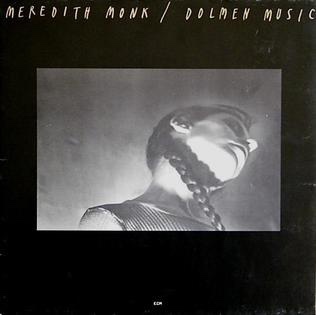
The release of her first ECM disc, “Dolmen Music” (1981) can now be seen as a sort of watershed event. It was followed by “Turtle Dreams” (1983) a work which was prominently featured at New Music America 1982 in Chicago along with Robert Ashley’s “Perfect Lives”. Monk’s appearance on ECM occurred at about the same time as Steve Reich’s masterful “Music for 18 Musicians”. Monk found her mature voice more or less at the same time that Steve Reich and Philip Glass had found theirs. And anyone following new music in those years will recall the flow of new musical ideas that established many now acknowledged masters as legitimate artists.

While the major masterpiece, “Dolmen Music” dominates the album, Monk’s quirky mix of humor and pathos in pieces like “Gotham Lullaby” and “Biography” remain signature pieces in her oeuvre. And Turtle Dreams was made into a performance film for public television by visual artist Ping Chong in 1983, now available on YouTube.

She followed with “Do You Be” (1987) and “Book of Days” (1990) which also exists in at least two film versions and the CD itself which has been described as a “film for the ears”.

Following “Facing North” (1992) Monk released her only opera (though she refers to much of her works as “operas” this is the only one that comes close to the more generic concept of western music operas) to date, “Atlas” (1993) which was commissioned and subsequently performed at the Houston Opera. This represented another phase in her artistic development as she utilized her structured improvisation techniques along with her now familiar extended vocal techniques with an expanded set of performers both vocal and instrumental. Atlas is arguably similarly creative (and transgressive) as Philip Glass’ 1976 “Einstein on the Beach”. Both were developed in an unconventional manner and uses a similar harmonic language with really none of the standard conventions of western music in opera. Would that we can some day see a filming of this work.

I was privileged to see Monk in person for the first time when she performed excerpts from “Volcano Songs” (1997) in Chicago. Those images involving, among other things, light sensitive areas where Monk lay down and left a ghostly shadow upon arising. In addition to her engaging minimalist inflected music, Monk is a master at creating compelling images.

“Mercy” (2002) was followed by “Impermanence” (2008) which I was thrilled to see at Stanford. “Songs of Ascension” (2011) was another landmark in this piece conceived and performed in conjunction with installation artist Ann Hamilton in her tower in Northern California. Attendees to this event were brought in by bus due to the lack of actual parking facilities in that tower. I wish I could have experienced this but hopefully a cohesive video release will be forthcoming. Excerpts are available for viewing on YouTube and on Monk’s website.

“Piano Songs” (2014) by the wonderful new music championing pianists Bruce Brubaker and Ursula Oppens filled an inexcusable gap in the documentation of Monk’s piano music. And following her receiving the National Medal for the Arts in 2015 she released “On Behalf of Nature”(2016).

Monk is a well documented artist largely due to her productive affiliation with Manfred Eicher and ECM and, while gaps remain these recordings represent a major artistic accomplishment and an enduring legacy for new music, for women composers, for western art music. This lovely box set is truly a joy to behold.

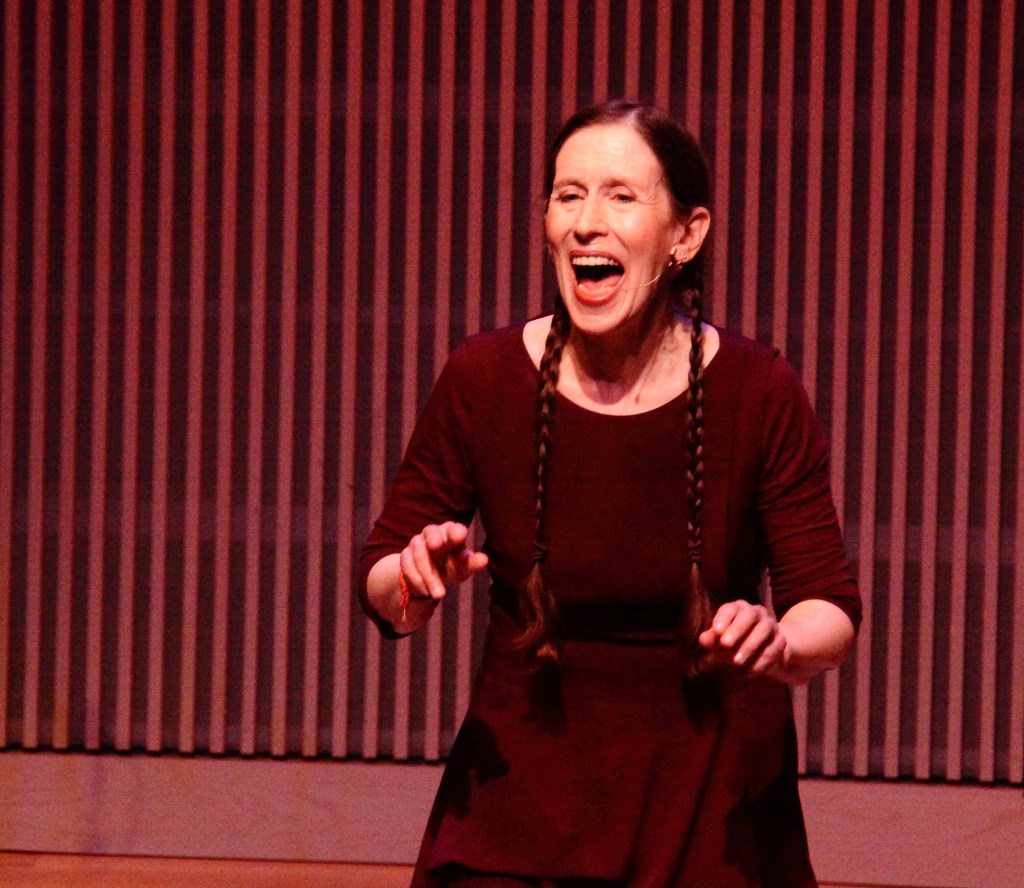
Meredith Monk performing an encore at the final concert of OM 21 (2016) in San Francisco

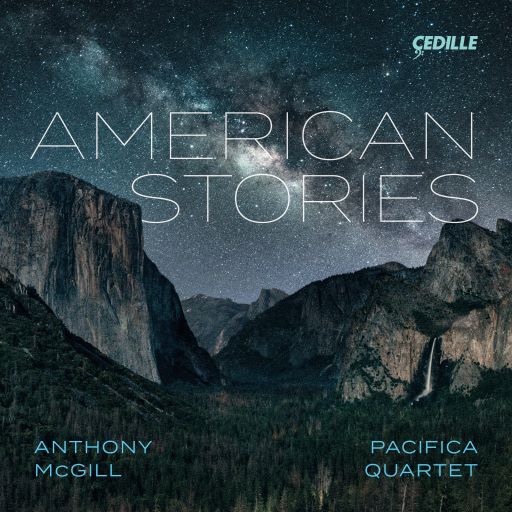
Anthony McGill and the Pacifica Quartet: Telling American Stories with music


Cedille CDR 9000216

Anthony McGill’s star rises rapidly higher with the release of this new album. His previous Cedille release was music for woodwind soloists and orchestra and featured Anthony’s brother, flautist Demarre McGill as well. And this one is a real gem that introduces listeners to four composers whose work defines to significant degree the current state of American music. From the very well known work of Richard Danielpour to three less familiar names listeners will want to know better, this is one fine chamber music recording.

I was first introduced to the clarinet and string quartet genre via the 1957 RCA recording of Mozart’s A major Clarinet Quartet played by Benny Goodman with the Boston String Quartet (paired with Mozart’s Clarinet Concerto and this disc was my first hearing of both works). I later heard the Brahms Clarinet Quintet (McGill recorded both of these on a 2014 Cedille release) and other essays in this genre but the Mozart and Brahms are forever my reference point as I imagine they are for most listeners.

Anthony McGill (photo copyright 2014 by Chris Lee)

All of these works are essentially clarinet quintets though only one bears that specific title. All but one work are recorded premieres but all are fulfilling listening experiences beautifully performed by Mr. McGill and the fabulous Pacifica Quartet . This album is almost as much an homage to the clarinet quintet genre as it is to the people and historical events that provided inspiration for the music. This is music with messages for all who want to hear them.

Pacifica Quartet (photo from their website)

All four works here are inspired by “American Stories”, as Maestro McGill says in his introductory notes, “Through music we connect with our stories.” The music here is about pain, struggle, memorial, and hope. It is more elegy than lamentation and, ultimately more music than history. But, as music, it succeeds very well and one hopes that these works will help preserve the histories described. This is beautiful and lyrical music with immediate appeal and substance that demands repeated hearings.

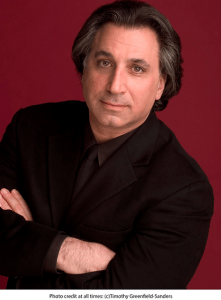
Richard Danielpour

Richard Danielpour’s “Four Angels” (2020) is in one movement divided into four sections, each lamenting the death of four little girls (Addie May Collins, Carol Denise McNair, Cynthia Wesley, Carole Rosamond Robertson) who were killed in the bombing of the 16th Street Baptist Church in 1963 by Ku Klux Klan members. Danielpour says in his notes, “This music also stands as a small testament to the choice for a better path, one consisting of the compassion and understanding that we must have for one another.”, a statement that could be applied to all the works herein.

James Lee III (photo from composer’s website)

James Lee III is represented by his four movement “Clarinet Quintet”(2019) here in its premiere recording. This rising star states in his liner notes that this quintet is inspired by his reading of the experiences of Native Americans. It is also, via quotation in the first movement, homage to Black American composers who preceded him. The scherzo movement is named “Awashoha”, a Choctaw word meaning, “play here”. The metaphors he attaches to his classical forms are gentle impressionistic clues to his compositional processes. It is a deeply felt work and listeners are advised to explore his well organized website.

Ben Shirley (Photo from composer’s website)

Ben Shirley’s “High Sierra Sonata” (2019) is in three movements and, according to the composer, is somewhat autobiographical, inspired by his fall into addiction and subsequent recovery. He specifically references his experience as a volunteer for an athletic event in the Eastern Sierra Mountains in eastern California where the unpredictable changes in weather provided him with a metaphor for life’s unpredictable nature, both in his life and others.

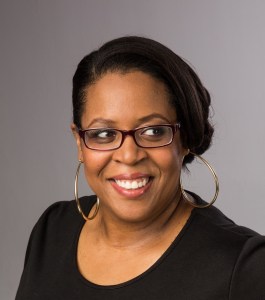
Valerie Coleman (Photo by Matthew Murphy from the composer’s website)

The recording concludes with “Shotgun Houses” (2000) by Valerie Coleman. This work, the only one on this release that is not a premiere recording, is an homage to fellow Louisville resident Muhammad Ali and references the architectural style known as “shotgun houses” known to both Ali and Coleman when they resided there. She states that the opening movement is a general homage to southern black culture, the second an homage to Ali’s mother, and the third a celebration of Ali’s triumph in the 1960 Olympics which essentially launched his fame.

Catalyzing Blackness, Volume Three: The Catalyst Quartet plays 20th Century music by Black Americans


This is the third volume in the Catalyst Quartet’s wonderful and insightful survey of neglected works by black composers. The first focused on music by the black English composer Samuel Taylor Coleridge (1875-1912), the second on music of late nineteenth to mid-twentieth century American composer Florence Price (1887-1953). The present disc focuses on the works of three men whose musical careers were entirely in the twentieth century: William Grant Still (1895-1978), George Walker (1922-2018), and Coleridge-Taylor Perkinson (1932-2004).

William Grant Still is roughly contemporary with Aaron Copland (1900-1990). Copland has often been called the “Dean of American Composers” and Still has been called the “Dean of Afro-American Composers”. Such honorifics, while well intended, do nothing to describe the true depth and significance of either of these composers.

Similarly their best known works, Copland’s “Appalachian Spring” (1944), and Still’s “Afro-American Symphony” (1930) are fine pieces of music but cannot represent the whole of their respective authors’ outputs. Both produced quite a bit of music and went through stylistic changes as their artistic sensibilities evolved. Copland’s oeuvre is pretty well documented, allowing listeners to grasp its entirety while Still’s work has not enjoyed the same distinction. That is changing, slowly, and that is reason to celebrate.

The Catalyst Quartet (Karla Donehew Perez, violin; Abi Fayette, violin; Paul Laraia, viola; and Karlos Rodriguez, cello) from their website

Still is represented here by his “Lyric Quartette” (published in 1960 but likely written 1939-1945). These three movements for string quartet are intended to represent a plantation, the mountains of Peru, and a pioneer settlement, respectively. This appears to be the first commercial recording of the work, a set of vignettes (Still never wrote a string quartet as such) seemingly published as an afterthought after looking back over his files. That’s not to denigrate the music. It is finely crafted and reflects a composer closer to the folk eclecticism of his contemporaries William L. Dawson (1899-1980) whose use of folk idioms resembles that of Aaron Copland (1900-1990) and Virgil Thomson (1896-1989), two white contemporaries (rather than his later more post romantic style). These composers’ use of folk idioms and the comforting tonal harmonies, very much in vogue when the music was first written, sound rather old fashioned in their year of the Lyric Quartette’s publication. Nonetheless, it is a vital work in understanding Still and his development as a composer. This would make for a great encore or second selection following a Haydn or Mozart Quartet.

George Walker was a sought after concert pianist and he forever holds the distinction of being the first Black American to be awarded the Pulitzer Prize in music (for his 1996 “Lilacs” for voice and orchestra). I learned from one of my personal favorite Chicago broadcasters that he, Bruce Duffie (WNIB host 1975-2001) played Walker’s “Lyric for Strings” (1946, orch. 1990) as the final sign off music at the closing of the beloved independent station (reportedly very satisfying to that terminal audience). The link provided is to a transcript of his subsequent conversation he had with Walker in 2001, worth your time to read.

So what does all this have to do with this release? Well, that, “Lyric for strings” is actually Walker’s orchestration for string orchestra of the second movement, “molto adagio“ of his three movement String Quartet No.1 (1946) “Lyric”. Samuel Barber garnered a great audience with his “Adagio for Strings” from the molto adagio of his String Quartet (1935-36).

The outer movements (1 and 3) of Walker’s quartet (carefully conceived and thoughtfully developed at length) frame the beautiful adagio with a passionate elaborately developed allegro and a high energy, virtuosic finale (much as in the Barber work). The quartet’s title, derived from the slow movement which was originally titled “lament” is dedicated to Walker’s grandmother, a former slave. A very different perspective of America, for sure, but a truly spectacular example of string quartet writing.

I wrote my review in chronological order to clarify my narrative but the actual track order is:

String Quartet No. 1 “Calvary” Coleridge-Taylor Perkinson (1932-2004)

  1. Allegro
  2. Adagio
  3. Allegro vivace
    Lyric Quartet William Grant Still (1895-1978)
  4. The Sentimental One
  5. The Quiet One
  6. The Jovial One
    String Quartet No. 1 “Lyric” George Walker (1922-2018)
  7. Allegro
  8. Molto adagio
  9. Allegro con fuoco

So String Quartet No. 1 “Calvary” (1956) by Coleridge-Taylor Perkinson is leaving the most recent for last. This work, shares with the other two it’s having been written fairly early in the composer’s career (he was about 24 when he wrote this piece, Still was in his 40s and Walker about 24 when they wrote their respective quartets). So Catalyst adheres to these important but early utterances from these three important artists. And for clarity the name permutations we encounter here comprise: Samuel Taylor Coleridge (1772-1834) is the English poet, Samuel Coleridge-Taylor (1875-1912) is the black English composer honorifically named after that poet, and Coleridge Taylor Perkinson (1932-2004) the black American composer honorifically named in honor of said English composer.

This is another outstanding but neglected American composer who happens to be black. This fine string quartet is defined by its serious tone and elaborate development in a passionate romantic tonal idiom. Of course the composer shares his prominent jazz (Perkins was nothing if not eclectic) influences in rhythms and harmonic structure. Based loosely on the hymn, “Calvary” from which it takes its name, it was actually premiered in Carnegie Hall as part of a memorial for composer and baritone Harry T. Burleigh (1866-1949). The opening allegro is a searching and unsettling matter followed by a calming slow movement characterized by an incessant pizzicato repeating figure. The finale, a touch more hopeful sounds almost improvisatory at times much in the manner of some jazz forms. Truly another outstanding example of good string quartet writing. This is powerful music!

These recordings are both beautifully done and, arguably, definitive in their interpretation of these delightful and essential additions to the quartet literature. The Catalyst does a fine and honorable job in their ongoing mission to reclaim forgotten gems such as these for present and future listeners. Thank you for that. Please keep working on this body of work lest it be lost to history.

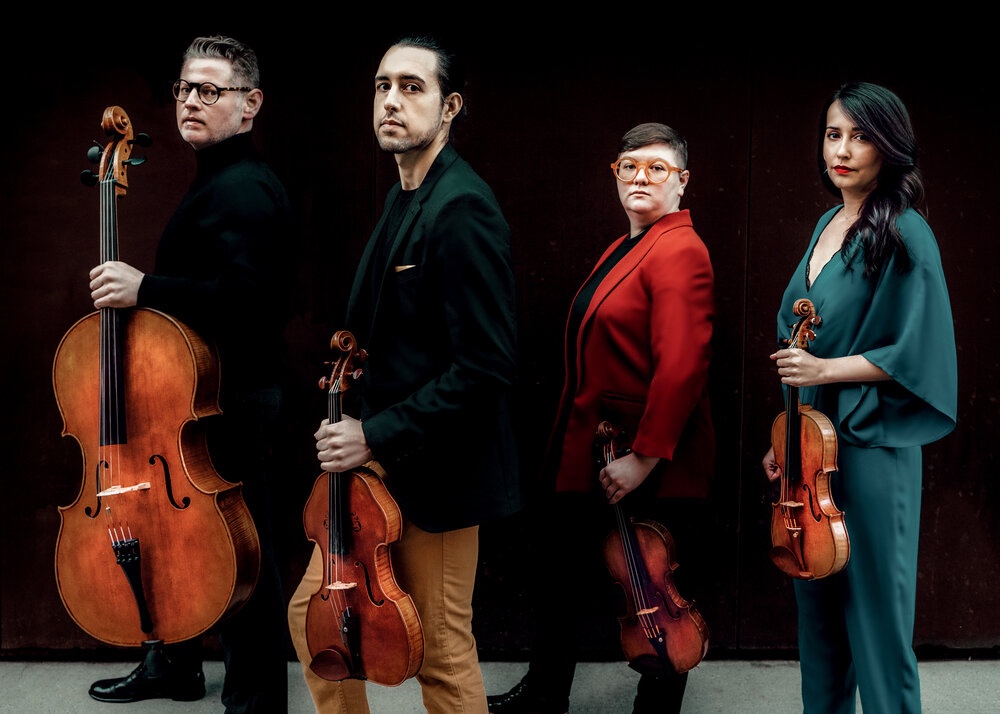
The Lincoln Trio Plays Contemporary Piano Trios from Chicago


Cedille CDR 90000 211

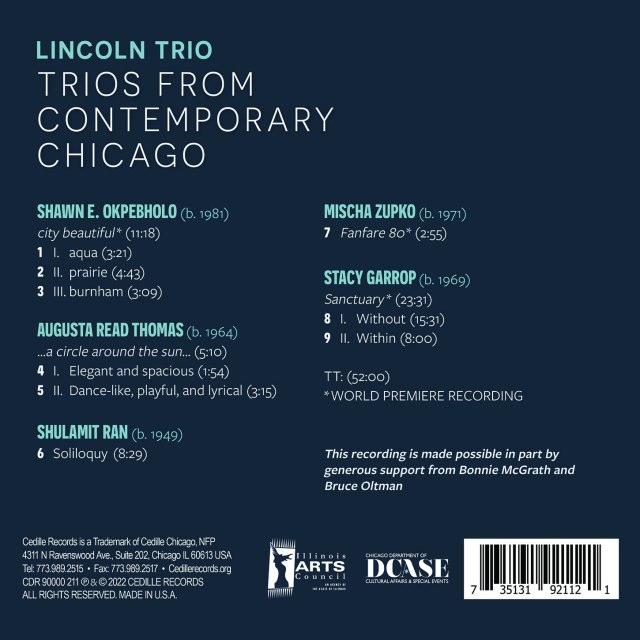
This is another entry in an ongoing series of music for piano trio by the tried and true Lincoln Trio. In this fine release they play a delightful collection of five works (three are world premiere recordings) by living composers. This is their eighth Cedille release by my count. It is the second recording of piano trios from Chicago based composers, a follow up to their previous survey of early to mid-twentieth century piano trios, Trios from the City of Big Shoulders.

back cover

The five works presented here are but a sampling of the available repertoire from Chicago based composers. That said it is a fine sampling of the current state of the art and one would do well to explore more of the music of all these composers.

The first selection is the three movement, “city beautiful” (2021) by the American composer of Nigerian/American Heritage, Shawn E. Okpebholo (1981- ), a world premiere recording. The title is taken from that of the 19th century initiative that helped build the now familiar skyline which had been ravaged by the 1871 Chicago Fire.

Okpebholo is no stranger to this blog. His fine album of spiritual arrangements Steal Away (2016), and his contributions to Will Liverman’s album, “Dreams of a New Day” (2021) revealed his interest in and expertise with spirituals and art song. “city beautiful” by contrast is essentially three tone poems inspired by Chicago architecture, perhaps one of the city’s finest distinctions. The three movements, aqua, prairie, and burnham are effectively homages to architects Jeanne Gang (whose Aqua Tower is a most recent major addition to the famous skyline), Frank Lloyd Wright (whose Robie House is a classic example of the “prairie school” design), and Daniel Burnham (whose 19th century designs define the famously beautiful lakefront and the iconic Union Station).

Opkebholo’s idiom is basically tonal and could be characterized as post romantic. But regardless of how you categorize it the music is eminently listener friendly and a fine vehicle for the estimable Lincoln Trio. This is the work of a rapidly emerging composer with both substance and style. Keep his name on your radar. I expect to hear much more from this talented and prolific composer who currently holds a professorship at Wheaton College in that western suburb of Chicago.

Next is a two movement work by Augusta Read Thomas (1964- ) entitled, “…a circle around the sun” (2021). This work was a commission by the Children’s Memorial Foundation for the Amelia Piano Trio in honor of George D. Kennedy. Thomas has long been a fixture in Chicago’s music life where she was a composer in residence with the Chicago Symphony from 1997-2006. She is currently professor of music at the University of Chicago and a former professor at Northwestern University. Her work also tends toward the tonal idiom and this rather brief two movement work is a fine example of her writing for chamber ensemble.

“Soliloquy” (2003) by the truly fine, if still too little known, Shulamit Ran (1949- ), an Israeli born American composer. She was a student of the esteemed Ralph Shapey (1921-2002) to whom she dedicated her Pulitzer Prize winning Symphony (1990). The composer states in her liner notes that the origins of this work come from her opera “Dybbuk”. It is a pleasant piece perhaps less complex and more lyrical in sound than some of her larger works. Ran was professor of music at the University of Chicago from 1973 to her retirement in 2015.

Mischa Zupko (1971- ) contributes the briefest work to this collection. Clocking in at just under three minutes, “Fanfare 80” (2010) was written in celebration of the 80th anniversary of the Music Institute of Chicago. The brevity here belies the complexities within this ear catching piece.

The album concludes with a substantial two movement work (just over 23 minutes), “Sanctuary” by Stacy Garrop (1969- ) is the work of another prolific composer whose work is, happily, getting much deserved recognition. The 2016 recording of her wonderful orchestral work was reviewed in these pages. Garrop’s work is invariably kinetic and deeply felt with a dramatic flair. Garrop was on the composition faculty of Roosevelt University in Chicago from 2000 to 2016 and is now a freelance composer.

The usual audiophile production (Bill Maylone, engineer) which characterizes Cedille releases is evident here. This is a fine sampling of music which is roughly representative of the musical riches producer James Ginsburg has mined from the “city beautiful”.

BMOP: Music of American Composer Gail Kubik


BMOP/sound 1085

Gail Thompson Kubik (1914-1984) was born in Oklahoma, educated at the Eastman School of Music, Chicago’s American Conservatory (where he studied with Leo Sowerby), and Harvard (where he studied with Walter Piston). He is also among the long list of composers who studied with Nadia Boulanger.

Gail Kubik

Kubik joined NBC radio in 1940 and was music director for the Office of War Information where he composed and conducted music for their Motion Picture Bureau. He taught at Monmouth College, Columbia Teacher’s College (now Columbia University), and Scripps College.

To this writer’s ears his style is similar to that of Aaron Copland (14 years his senior) and contemporaries who included jazz influences in a mid-century post romantic tonal fabric. The pieces recorded here are roughly contemporary with Stravinsky’s neoclassical era and similar gestures can be heard in them. Carl Stalling’s music is also a likely influence.

Doubtless Kubik’s film work for the war department helped contribute to his success in a basically populist style which served him well. And also like Copland, he wrote for the concert hall producing 3 Symphonies, Violin Concertos for Jascha Heifetz and Ruggiero Ricci along with other orchestral works, chamber music, and two operas.

The present recording is focused on his post war concert music. Four works are presented here, from his Dr. Seuss collaboration of 1950 for narrator, orchestra, and percussion, “Gerald Mc Boing Boing” (possibly the only example from this era in which the music preceded the cartoon film), his two Divertimenti for diverse chamber groups (1958 and 1959), to his best known work, the Symphony Concertante for Piano, Trumpet, and Viola which won him the Pulitzer Prize for Music in 1952. (Without doing any research I would venture to say that this is a unique combination of solo instruments). Soloists Vivian Choi (piano), Terry Everson (trumpet), and Jing Peng (viola) handle the challenging solo parts with confidence and skill. This new realization alone is a reason to purchase this disc.

Like Copland and other film composers Kubik repurposed some of his film music as a source for his concert music. Without getting too much into the musicological analysis, the composer himself has related that the Symphony Concertante was repurposing of the music he wrote for the low budget noir film, “C-Man” (1949) which starred Dean Jagger and John Carradine, among others.

The two divertimenti for diverse chamber ensembles are like baroque suites consisting of brief pithy movements. They are analogous to works like Copland’s too seldom heard Music for the Theater (1925) with jazzy rhythms and harmonies throughout. Their unusual groupings of instruments likely limit the occasions on which they might be performed live so these recordings are very welcome.

The “Gerald Mc Boing Boing” cartoon took on a life of its own following its concert presentation, spawning a series of shorts furthering the myth of the title character. And during the research for this review I was fascinated to learn that the famed film sound designer, Walter Murch, once revealed that he was sometimes known by the nickname of that character due to an analogous childhood affectation. In addition, many actors voiced the narrator in the the many recordings that have been made of the purely audio recording as heard here. The demands of the narration are similar to those of the soloists in the concertante work. Narrator Frank Kelley delivers a performance that makes this very much his own, using it as a springboard to which he applies his skills as a voice actor. He really seems to enjoy himself here.

Much of Kubik’s music has been recorded before but not for some time, so this release by masterful curator and conductor Gil Rose and his incredibly talented ensemble, the Boston Modern Orchestra Project is a very welcome revival of this very talented and technically skilled composer. The four works on this recording may be a reasonable sampling of some of Kubik’s best work but it would be hard to say that it is a complete portrait without hearing some of the composer’s other large concert works. Mr. Rose and his musicians have shown a tendency to release more than one disc of one of these nearly forgotten composers so listeners charmed by these may anticipate more such gems in, the future, that is, if other ensembles don’t beat them to the punch. Either way this is a very welcome installment in BMOP’s ongoing survey of music that simply deserves to be heard because it’s good.

A Belated Fan Letter: Homage to George Crumb


Dear Mr. Crumb,

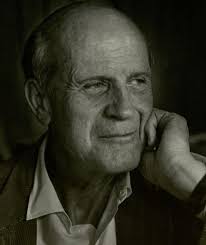
When I learned that you had shuffled off your mortal coil putting an end to a unique and lengthy creative career I was given pause, not because you were the best or my favorite composer (though much of your music is forever a part of my internal soundtrack), but rather because of the timing of when your work entered my life. We never met, I never corresponded with you, and I am not a professional musician/musicologist. I am simply a consumer, audience member who was 14 years old when he first purchased the (thankfully budget priced) recording of Ancient Voices of Children.

The 1971 premiere recording

At a tender time in my life working on the adolescent task of forming an identity I was not enamored of rock and roll, the music of most of my peers. I was a devoted fan of classical music and it was the intelligent programming of Chicago’s WFMT which, as my daily companion, taught me much about classical music old and new. It would be at least four or five years, when I was in college, that I would find others who shared my interests so my incessant listening with liner notes in hand was a solitary experience. But rather than being what one might imagine as a sad and lonely pursuit, I found it thrilling and somehow validating. It felt like a personal discovery and those bold avant-garde sounds combined with the chilling poetry of Lorca resonated deeply with my nascent personality. It was the first modern music to engage me at a time when I had yet to develop an understanding of Schoenberg, yet to encounter Mahler, or have much appreciation for music written before 1900.

Makrokosmos I with score excerpt on cover

It is difficult all these years later to fully recall the thrill of finding this 1974 release in the record bins at Chicago’s iconic Rose Records, a place that became intimately a part of my sense of self with wooden bins in rows that sprawled to a vanishing point. Three floors of browsing ecstasy for my solitary but increasingly confident self. Finding another recording by that composer who touched me so deeply, and one with a portion of the beautiful calligraphy which I learned characterized your work was overwhelmingly compelling. Of course I had to buy it immediately.

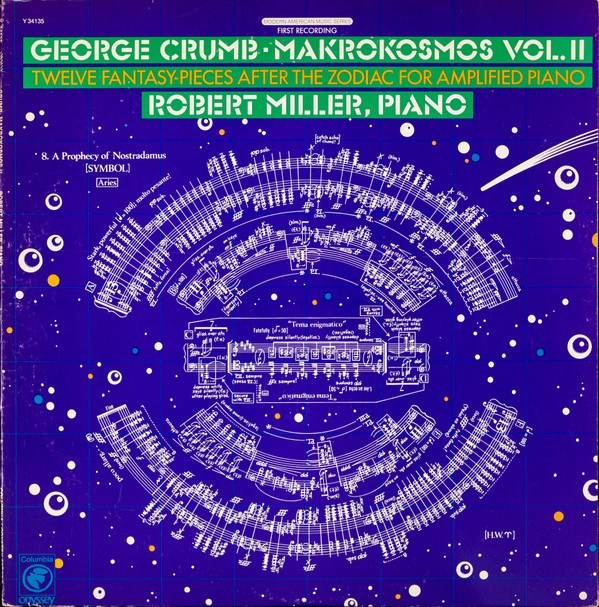
Much as I did with that first disc, I listened intensely and repeatedly, again with liner notes close at hand, and that bolstered with what I had learned since studying that first disc. It is a nod to Bartok’s Mikrokosmos, a presumptuous thing to do but the substance of this music is arguably comparable. In addition each of the 12 pieces was named for one of the Zodiac signs, and, a nod to Edward Elgar (who appended initials of friends to each of the “Enigma” variations). I took delight in reading that these pieces were similarly dedicated by appending initials of various people, and that The Phantom Gondolier of Scorpio was the work’s composer and that of Spring-Fire Aries was the performer, David R. Burge. I recall a certain delight when my junior scholar self decoded Crucifixus Capricorn as being fellow composer Ross Lee Finney. I realize now that I don’t know the other references but again I was hooked on the whole concept.

Voice of the Whale on the premiere recording on Columbia Records, 1974

When I heard Vox Balanae (Voice of the Whale) broadcast on WFMT I had already encountered Alan Hovhaness’ use of actual recordings of whale sounds in his orchestral work, “And God Created Great Whales” (1970) and I was stunned at the use of extended instrumental techniques to successfully evoke whale sounds and seagull sounds. It was also my first introduction to your sense of theater, lighting the stage with a blue light, and having the performers wear masks (in addition to asking the musicians to do some unusual things with their instruments and also to use their voices). I’ve since wondered how many musicians rebelled, or at least grumbled, under the weight of those stage directions and then, as now, I am grateful for musicians who aren’t afraid to break boundaries.

Now, this release was on the full priced Columbia label which was out of my budgetary reach. But along comes Rose records with their always delightful “cutout bins” where I would later find this gem at a budget friendly price. It was also a time when a major label took calculated risks releasing truly innovative, experimental music. Indeed Columbia would later introduce me to Terry Riley, Steve Reich, Luciano Berio, Harry Partch, and Conlon Nancarrow and, my gateway drug, Wendy Carlos with Switched on Bach.

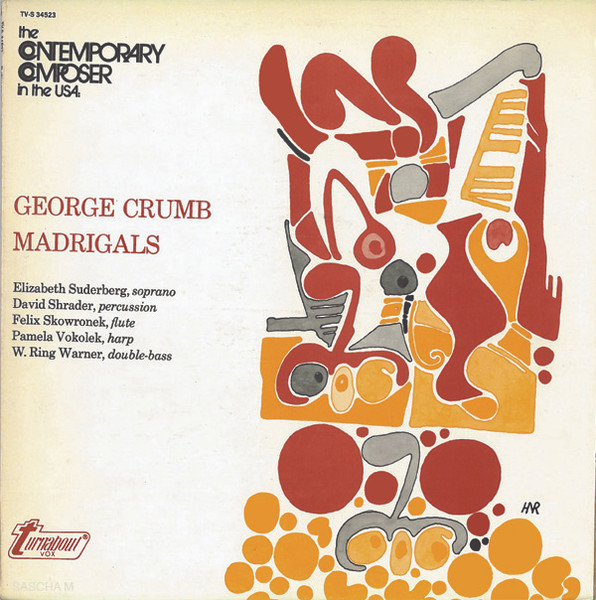
Lorca Madrigals 1965-69

I was hitting my stride and using what I had been learning from liner notes and the intelligent broadcast chatter of my beloved WFMT hosts. No surprise then that, when I found this budget album with the names of both George Crumb and Frederico Garcia Lorca, I knew that I was in my milieu. And this album would occupy me nearly as obsessively as the previous ones.

Makrokosmos III

The sheer beauty and distinctive design of the Nonesuch new music releases were my metaphorical dog whistle, so Makrokosmos III practically jumped into my arms at one of my Rose Records junkets. (I was and still am a bit of a completist, that is, if I buy a piece numbered “2”, I would have to find the one marked “1”, and so on). So I was somewhat upset that I had somehow missed Makrokosmos II or, heavens forbid, that no one had bothered to record it. But I easily put that obsession to the side as I became entranced by this new installment of the celestially inspired Makrokosmos series in this larger ensemble work (NB. I did not dabble in any drugs until well into my college days probably 4-5 years distant so I’m reasonably sure that the profundities I experienced were related to the power of the music, though doubtless with some adolescent hormonal effects). For whatever reason this album engulfed me most blissfully.

Robert Miller’s premiere recording of Makrokosmos II

Deus ex machina, I visited Rose records, prowling for more music that resonated with me when I found Robert Miller’s reading of the second Makrokosmos (on Columbia’s budget label, Odyssey) which, with the first Makrokosmos, comprised 24 pieces. I would some years later learn that the Zodiac pieces were in fact an analogy (or homage) to J. S. Bach whose two volumes of preludes and fugues, “The Well Tempered Clavier”, represented all 24 keys of the Western well-tempered scale and are a sort of urtext or manifesto, and which remain towering masterpieces. Now I’m not trying to suggest that Crumb’s work is of similarly immortal status. In fact the comparison is almost of an “apples/oranges” sort. But on the level of innovation in composition that Crumb’s work represents here does suggest strongly to this listener that the this set may do for extended techniques what Bach did for harmony and keyboard playing. (Crumb’s Five Pieces for Piano of 1962, which I did not hear til many years later and it is clear are sort of the “etudes” or “experiments”, if you will that later expanded into larger forms). They are clearly a truly innovative rethinking of what piano music and piano playing can be. They are also a logical successor to John Cage and Marcel Duchamp’s “prepared piano” innovations of a decade or so earlier.

In the decades of the 80s and 90s, I and my concert goin’ pals would make pilgrimages to live performances of Philip Glass, Terry Riley, Steve Reich, AACM, Keith Jarrett, the Arditti Quartet. Chicago Symphony, Civic Orchestra, Contemporary Chamber Players, and, of course, the Kronos Quartet (who I learned were formed shortly after founder and first violin, David Harrington heard Mr. Crumb’s 1970 political/musical masterpiece), “Black Angels”. It was the Kronos, whose beautifully staged and definitively played reading I can still recall (not eidetically complete but I do recall the stage lit from above, one light over each of four music stands with their instruments hung on cables over those desks (which they took down to play after they entered the stage).

After the house lights dimmed, there was a pause which served almost as punctuation, an indicator of a silence which helped get the audience into the mystical space which is deeply embedded in the music by structure, by analogy, by sheer sound, and by the theater. The musicians played standing at their desks (cellist Joan Jenrenaud was afforded a chair, thankfully). References to apocalyptic themes, alchemical symbolism, numerology, extended instrumental techniques, subtexts, epigrams, and striking optics all joined to create a performance that continues to evoke emotional memories. This music, written in protest of the Viet Nam War, also found its way into the score of the hit horror film, “The Exorcist”. Oh, yes, the “Night of the Electric Insects” played by the Electric String Quartet” added no small amount of uneasiness to the film and the music reinforces those emotions curiously well even on its own. The (now ubiquitous) use of amplification gives an “in your face” aspect to the performance of this music. It illuminates what would be barely perceptible extended technique effects and seems to push the music right up to your face and into your ears. Not your typical chamber music experience.

To be fair, while I have continued to follow your music, Mr. Crumb, I have not done so with the same passion as in those early days but I treasure listening to the Pulitzer Prize winning Echoes of Time and the River, Star Child, the early Solo Cello Sonata, and I’m incredibly pleased that David Starobin’s Bridge Records had been collaborating on a complete works edition (still in progress). But my sort of “first love” encounter with your music has been a significant part of making me who I now am and has given me great pleasures to sustain me since those early encounters. I want to thank you for your service to the arts and to let you know that your work has touched me deeply and is forever a part of me, it lives on. Rest in peace, a fan.

My End of the Year Personal Best Choices and Other Blather That May Interest My Readers


Were it not for the wishes of some of my valued readers I would not produce such a list. It has no more validity other than, “These are my personal choices”. But there is some joy to be had in contemplating these past 12 months as I have lived them on this blog. So here goes.

My home base is in California, about 90 miles north of Los Angeles though I sometimes travel for work

First I have to tell everyone that March, 2022 will mark the 10th anniversary of this blog, a venture which has been a rich and exciting one. Future blogs will soon include, in addition to album/concert reviews, some articles on subjects which I hope will be of interest to the select group of people who read this material and who share my interest in this music (which I know can be anywhere from difficult to repulsive to many ears). But I have deduced that my readers are my community, a community of kindred spirits freed from the boundaries of geography, a number rather larger than I had imagined was possible and one that I’ve come to cherish. Bravo to all of you out there.

Since February of 2021 I have worked periodically in Washington State, not in a cabin in Mt. Rainier National Park but in Tacoma, just south of Seattle.

COVID 19 has reduced the number of live performances worldwide and I have not attended a live performance since early 2020. But, happily, musicians have continued to produce some amazing work, some of which gets sent to me, and a portion of that gets to be subjected to the analytic scrutiny of my blog.

My lack of attention to any music should never be construed as deprecatory, rather it is simply a matter of limited time to listen. So if I have provided a modicum of understanding or even just alerted someone to something new I am pleased and if ever I have offended, I apologize. All this is my personal celebration of art which has enhanced my spirit and which I want to share with others. Look what Ive found!!!

So, to the task at hand (the “best of” part):

The formula I’ve developed to generate this “favorites retrospective” has been to utilize WordPress’ useful statistics and look at the top viewed posts. From these most visited (and presumably most read) articles I produce a list of ten or so of my greatest hits from there. Please note that there are posts which have had and continue to have a fairly large readership from previous years and they’re not necessarily the ones I might have expected but the stats demand their inclusion here.

Following that I then toss in a few which are my personal faves (please read them) to produce what I hope is a reasonably cogent and readable list. Following my own description of my guiding principles I endeavor to present the perspective of person whose day job and energies are spent in decidedly non-musical efforts but whose interest and passion for new music drives this blog where I share those interests.

As a largely self taught writer (and sometime composer) I qualify my opinions as being those of an educated listener whose allegiances are to what I perceive as pleasing and artistically ideal based on my personal perception of the composer’s/performer’s intent. I am not a voting member for the Grammys and I receive no compensation for favorable reviews. I have the hope/belief that my blogs will ultimately garner a few more listens or performances of art that I hope brings my readers at least some of the joy I feel.

New Music Buff’s Best of 2021

As of this writing I have published 37 blog posts in 2021. COVID, job and personal stressors have resulted in my failing to post at all in December, 2020, January, June, and July of 2021. And only one post in February, 2021. Surprisingly I have managed to get just over 9300 views so far this year (a little more views than last year actually) and it is my plan to publish 4-5 blogs per month going forward into my tenth year.

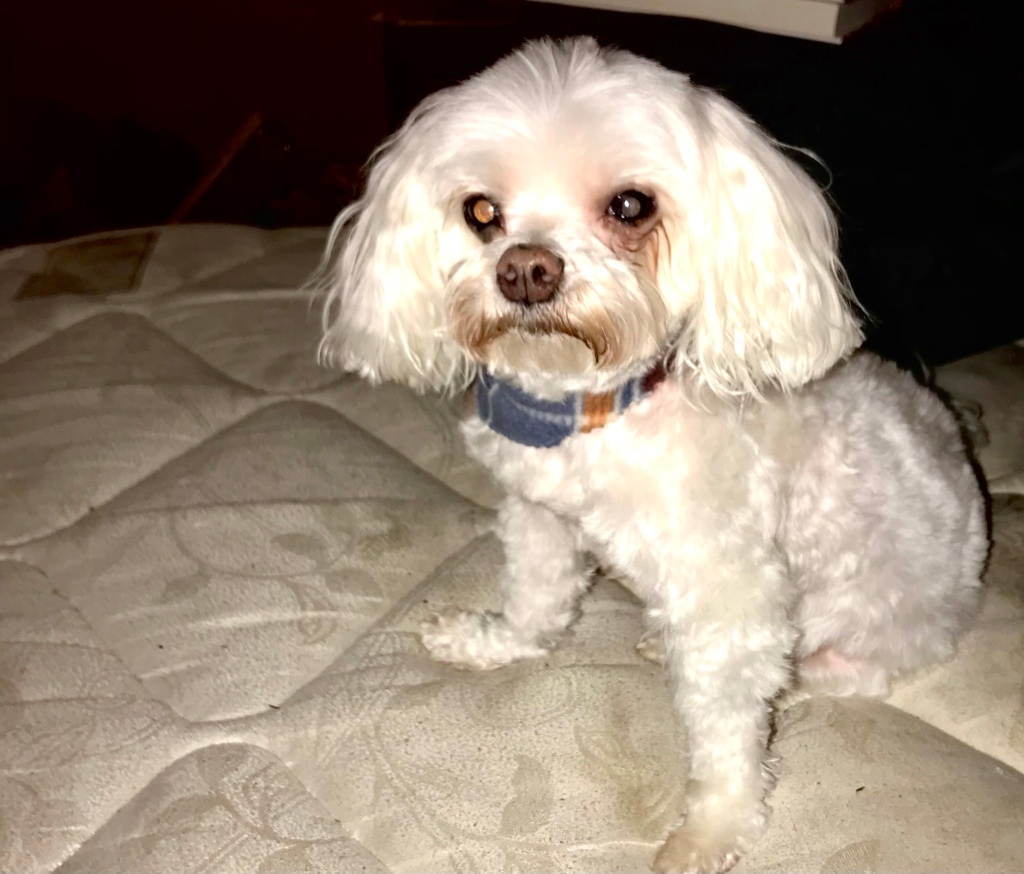
Me with my listening buddy, Clyde

Not surprisingly, most of my readers are from the United States but I’m pleased to say that I’ve had hits from 192 countries at last count. Thanks to all my readers, apologies to the many countries who didn’t make the cut this year (you’re all welcome to try again in 2022). So, following the United States here are the subsequent top 25 countries who have viewed the blog:

Canada, United Kingdom, Germany, China, France, Netherlands, Spain, Australia, Ireland, India, Italy, Turkey, Nigeria, Japan, Brazil, South Korea, Denmark, Belgium, Sweden, Finland, Russia, Poland, Philippines, Ghana, Norway.

Top Ten Most Read of 2021

The following are the most seen articles of 2021. Some of these are articles whose popularity surprise me as they were written some time ago and are not necessarily, in my opinion, my best work. But readership is readership and I am grateful for that.

Top article, Linda Twine, a Musician You Should Know. Twine is a musician and composer who has worked for some years in New York theater. I chose to profile her and I guess she is well liked because this article from 2018 is one of my top performers. Kudos, Ms. Twine.

Next up is, The Three Black Countertenors, an article suggested by my friend Bill Doggett whose website is a must visit for anyone interested in black classical musicians. This one, from 2014, continues to find readers. It is about the first time three black countertenors appeared on the same stage. Countertenors are themselves a vocal minority when considered in the company of sopranos, baritones, tenors, contraltos, and basses. Being black adds another level of minority in the world of operatic voices so this was indeed historic.

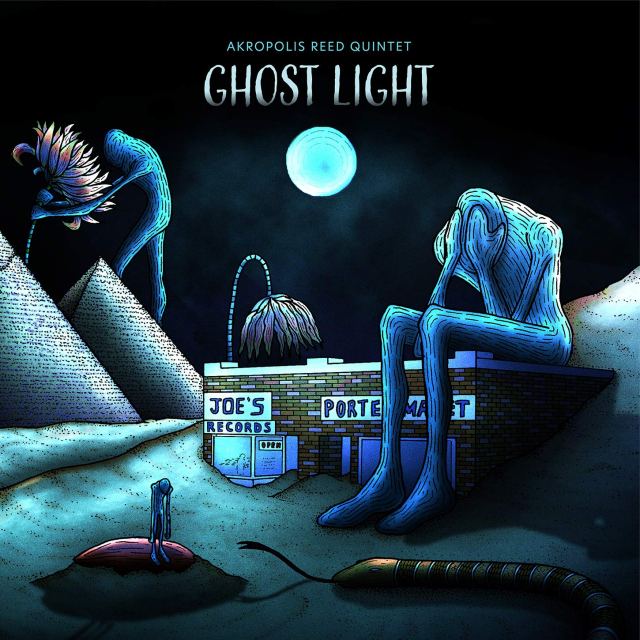
Art and the Reclamation of History is the first of the articles written this year to make the top ten most read. It is about a fabulous album and I hope more people read about it. This Detroit based reed quintet is doing something truly innovative. You really need to hear this.

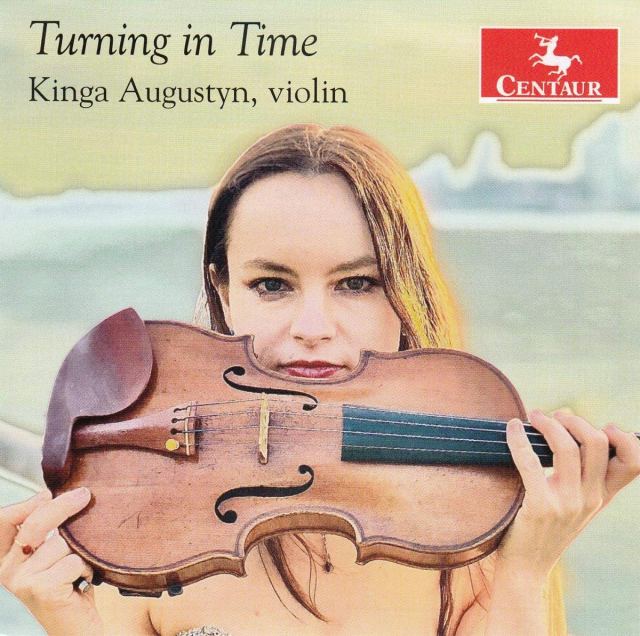
Centaur CRC 3836

Number four is another from this past year, Kinga Augustyn Tackles the Moderns. This album, kindly sent to me by the artist is worth your time if you like modern music. This young Polish/American violinist has both technique and vision. She is definitely an artist to watch.

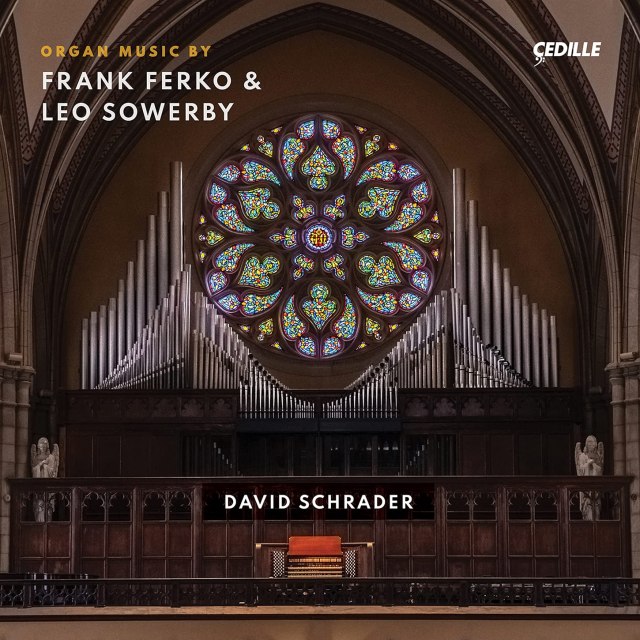
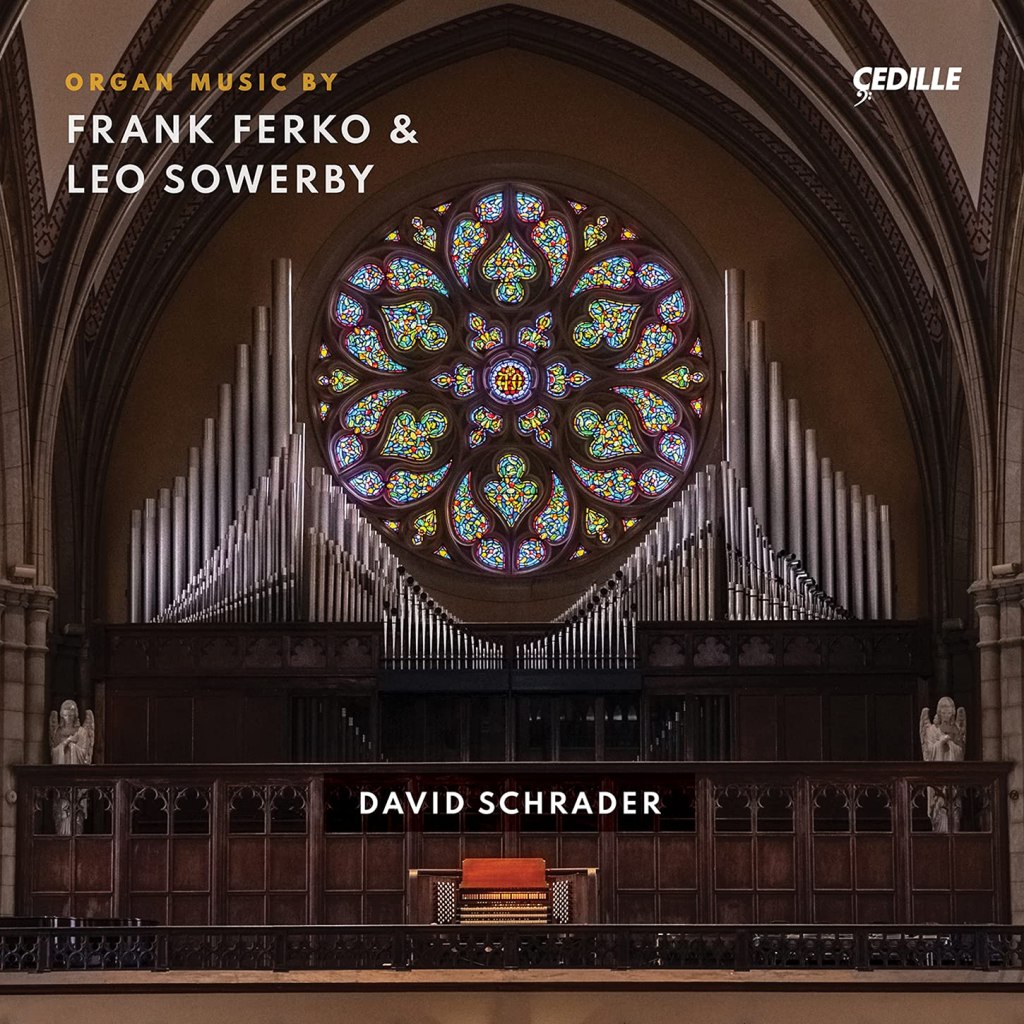
Number five is a truly fabulous album from Cedille records, David Schrader Plays Sowerby and Ferko. This double CD just fires on all cylinders, a fine artist, excellent recording, interesting and engaging repertoire, amazing photography, excellent liner notes, and love for all things Chicago. This one is a major classic release.

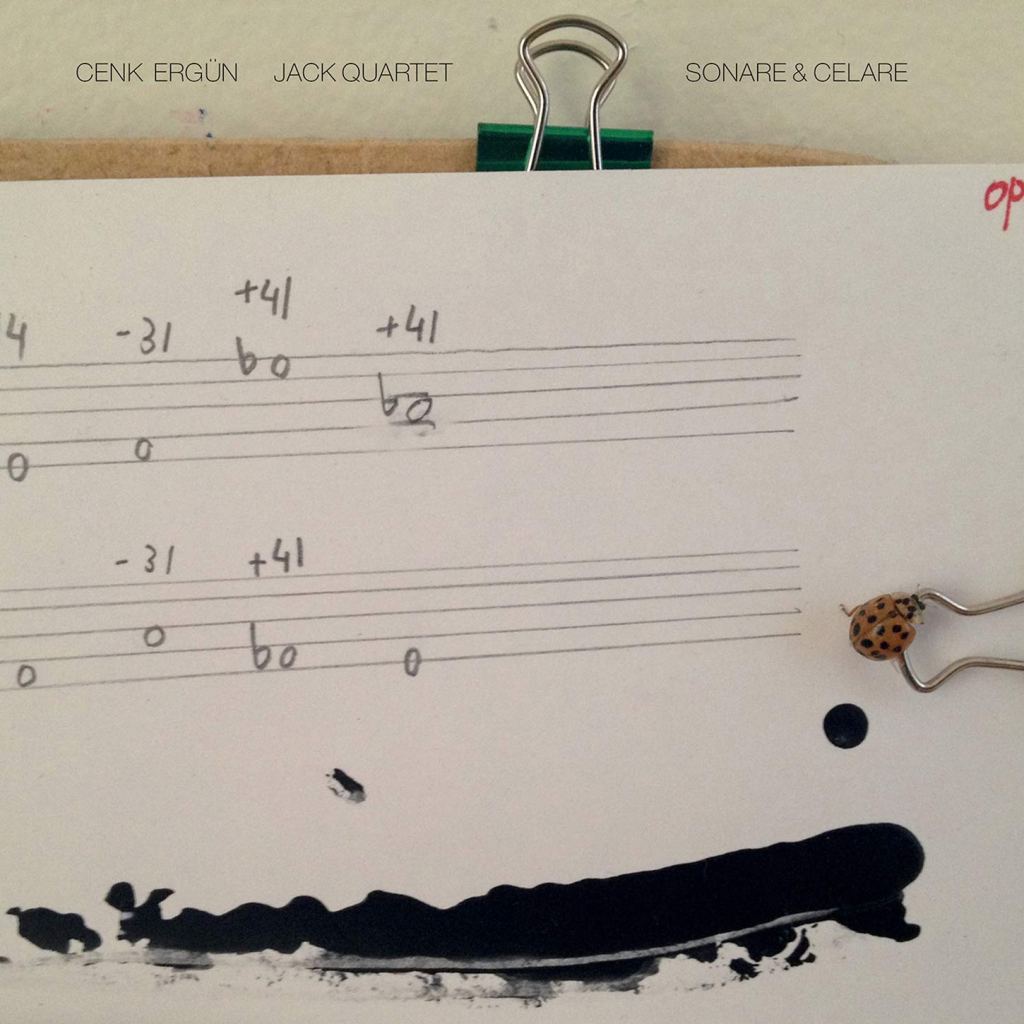
The Jack Quartet Plays Cenk Ergun was a pleasant surprise to this blogger. The Jack Quartet has chosen wisely in deciding to release this recording of new string quartet music by this young Turkish composer of serious substance. I’m glad that many folks read it.

Number seven on this years hit list among my readers is another album sent directly to me by the artist, one whose work I had reviewed before.

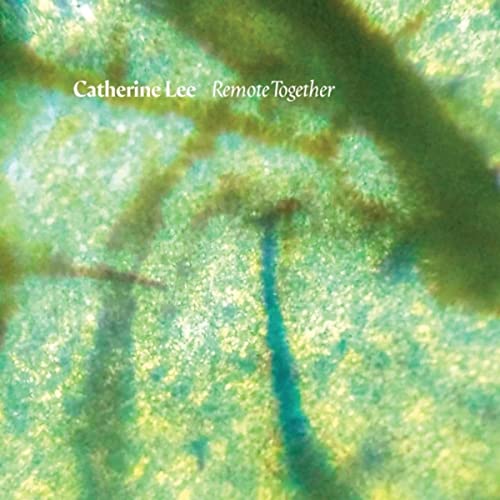
Catherine’s Oboe: Catherine Lee’s New Solo Album, “Alone Together” is among the best of the COVID lockdown inspired releases that flooded the market this year. It is also one of the finest examples of the emerging latest generation of “west coast” composers. Dr. Lee is a master of the oboe and related instruments and she has been nurtured on the artistic ideas/styles that seem to be endemic among composers on the west coast of the United States. She deserves to be heard.

Number Eight is an article from 2014, Classical Protest Music: Hans Werner Henze’s “Essay on Pigs” (Versuch uber Schweine). This 1968 noisy modernist setting of leftist political poetry combines incredible extended vocal techniques with the dissonant modernism of Hans Werner Henze’s work of that era. Also of note is that his use of a Hammond Organ and electric bass guitar was allegedly inspired by his having heard the Rolling Stones. It’s a classic but warn anyone within earshot lest they be terrified.

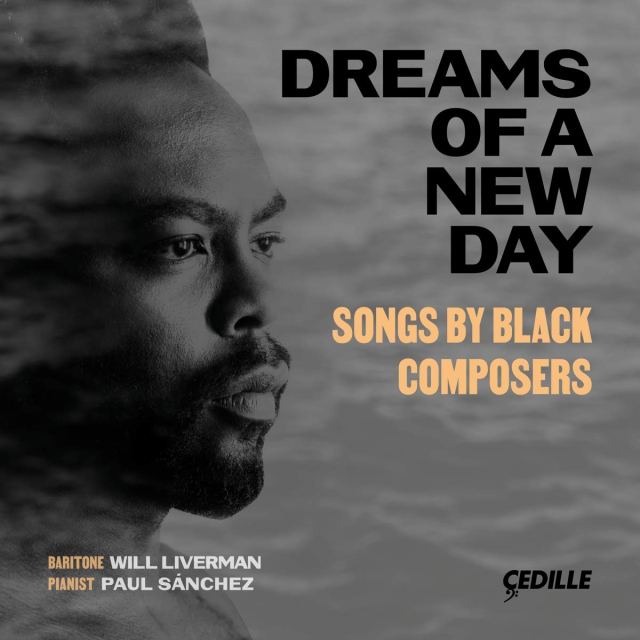
“Dreams of a New Day”, a Landmark Recording Project from Cedille is a virtual manifesto/survey of art song by black composers. Liverman is an amazing singer and the recording by my favorite Chicago record company is pure beauty. This 2021 release ranks ninth among my most read blogs from the past 12 months.

As it happens there is a three way tie for the number ten spot:

Black Composers Since 1964: Primous Fountain is one of a short series of articles I wrote in 2014. I used the date 1964, 50 years prior to the date of the blog post, because it was the year of the passing of the (still controversial) voting rights act. As a result of this and a few related articles I have found myself on occasion categorized as a sort of de facto expert on black music and musicians. I am no expert there but I have personally discovered a lot of really amazing music by black composers which is way too little known and deserves an audience.

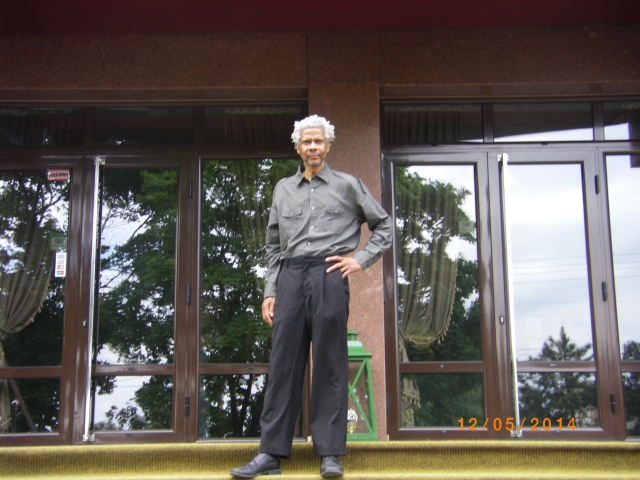
Primous Fountain arrives in Moldova to oversee the performances of his music.

I am pleased to tell you that this too little known composer (and fellow Chicagoan) is being recognized by no less than Michael Tilson Thomas who will conduct an entire program of his works in Miami next year. If my blog has helped in any way then I am pleased but the real honors go, of course, to Mr. Fountain and Mr. Thomas (who first conducted this composer’s music many years ago). Stay tuned.

My “comeback blog”, The Loneliness of the Long Distance Blogger was written to sort of reintroduce myself to the blogosphere and provide some background (excuses?) for my absence. I guess it was a decent read.

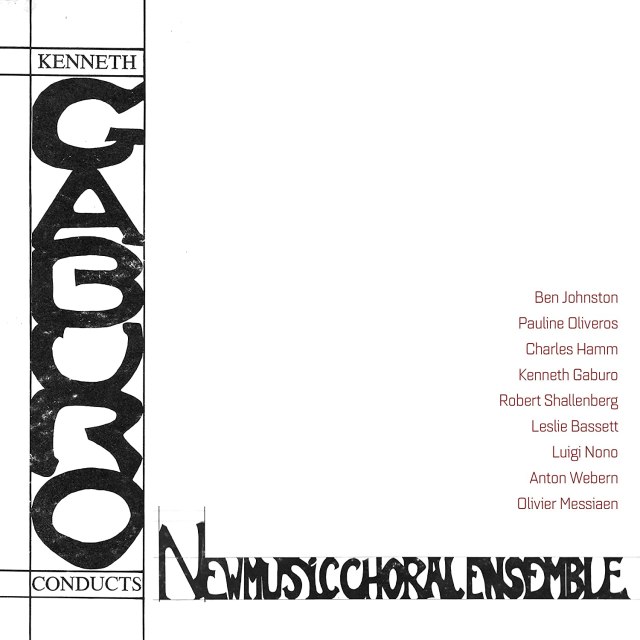
And the third contender for my tenth most read of 2021 is, Kenneth Gaburo, the Avant-Garde in the Summer of Love. This is among the first volley of releases on the revived Neuma label with Philip Blackburn at the helm. Blackburn’s instincts guided Innova records to release many wonderful recordings of music rarely on the radar of larger record companies and this first volley was a harbinger of even more wonderful releases to come. Just do a Neuma search and see what I mean.

The Ones That Didn’t Make the Top Ten

I would be negligent and boringly formulaic to simply report on these top ten. This is not a democratic blog after all, lol. So here are my choices for the ones that many of my dear readers may have missed and should definitely check out. It is anything but objective. They are, in no particular order:

Solo Artist Pamela Z releases “a secret code”. This is another Neuma release, one of a truly original and interesting artist who pretty much defies categories but the territory she explores will amaze you.

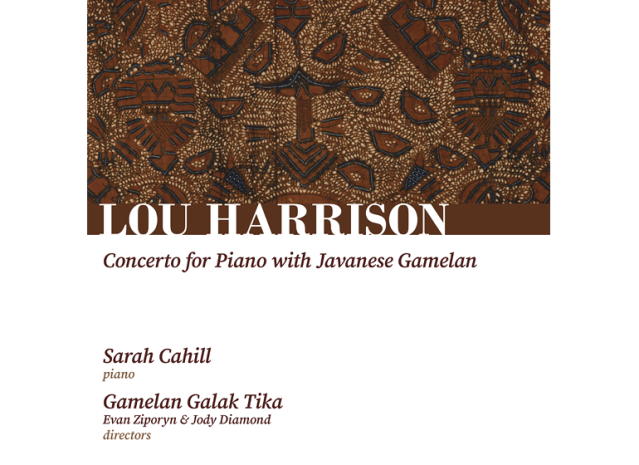
Lou Harrison: Concerto for Piano with Javanese Gamelan, a very special performance of an underappreciated masterpiece is just unabashedly excellent. It is a recording of a 2017 performance (in honor of the composer’s 100th birthday anniversary) in Cleveland by performers who have had a close relationship with this major American composer. I love the music. I love the performers. It’s a digital only release but you can get a download of the album and the fine liner notes from Bandcamp.

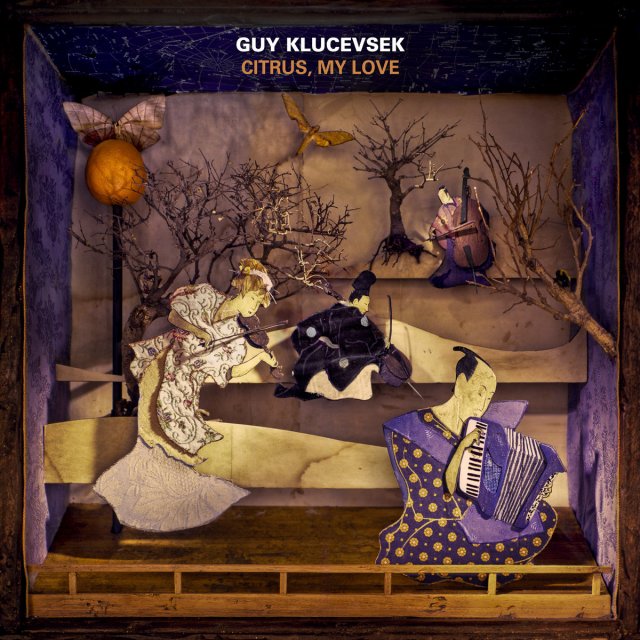
Fixing a Hole to Keep the Music Playing: Starkland brings back Guy Klucevsek’s “Citrus, My Love” is also a digital only release, also available on Bandcamp of an album long out of print but essential to the oeuvre of Guy Klucevsek. Like Philip Blackburn, Tom Steenland (who heads Starkland records) is a musical visionary who has released some of my personal favorite albums. If Tom (or Philip) likes it I will at least give it a listen.

Dennis Weijers: Skill and Nostalgia in an Auspicious Debut Album is a sort of personal discovery for me. This reworking of Philip Glass’ “Glassworks” and Steve Reich’s “Variations for Winds, Strings, and Keyboards” scored for solo accordion and electronics pretty much knocked me over as soon as I heard it. Read the blog to see why but you have to hear this. This is NOT your granddaddy’s accordion.

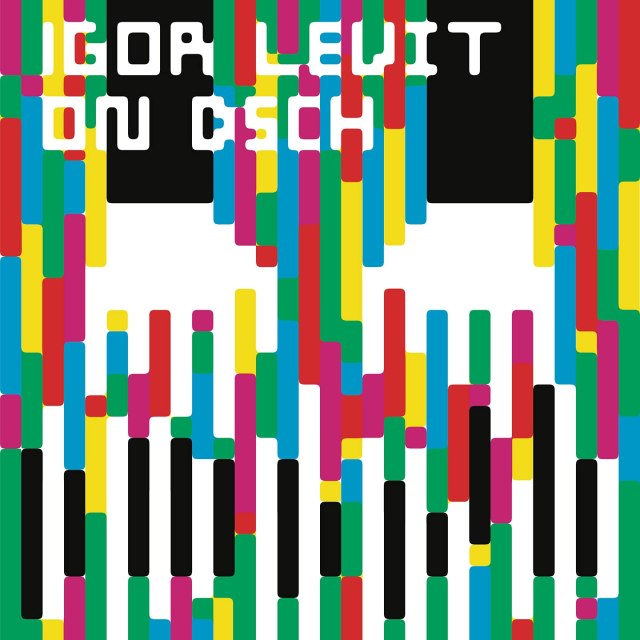
Vision, Virtuosity, and Interpretive Skill: Igor Levit’s “On DSCH” is an album I just can’t stop listening to. I raved about his earlier set of piano variations by Bach, Beethoven, and the late Frederic Rzewski and I look forward to this man’s musical vision as he expands the concert repertoire with works you probably haven’t heard or at least haven’t heard much. You owe it to yourself to watch this artist.

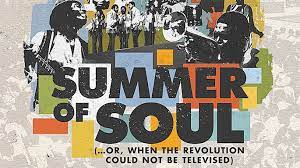
Black Artists Matter: The Resurrection of the Harlem Arts Festival, 1969 is one of the relatively few times when I write about so called “pop” music. It is wholly unconscionable that these filmed performances from 1969 (many of which predated Woodstock) languished for 50 years in the filmmaker’s basement and were nearly lost. One of the recurring themes in this blog is the lament over unjustly neglected music and this is a glaring example. I was delighted to see that the filmmaker Questlove received an award at the Sundance Festival for his work on this essential documentary of American music.

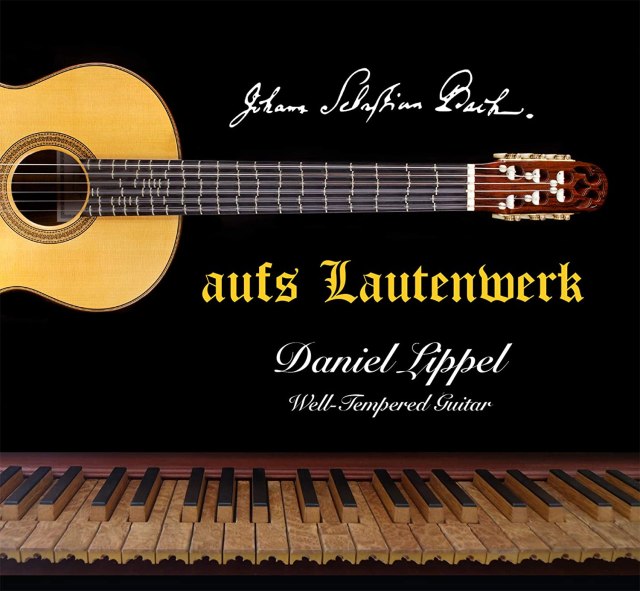
Less “flashy” but sublimely beautiful is Modern Tuning Scholarship, Authentic Bach Performance: Daniel Lippel’s “Aufs Lautenwerk”. This is a masterpiece of scholarship and a gorgeous recording on a specially made Well-Tempered Guitar played with serious passion and interpretive genius by a man who is essential to the productions of New Focus recordings as well as being a fine musician himself. Read the review or the liner notes for details but just listen. This is another one that I can’t stop listening to.

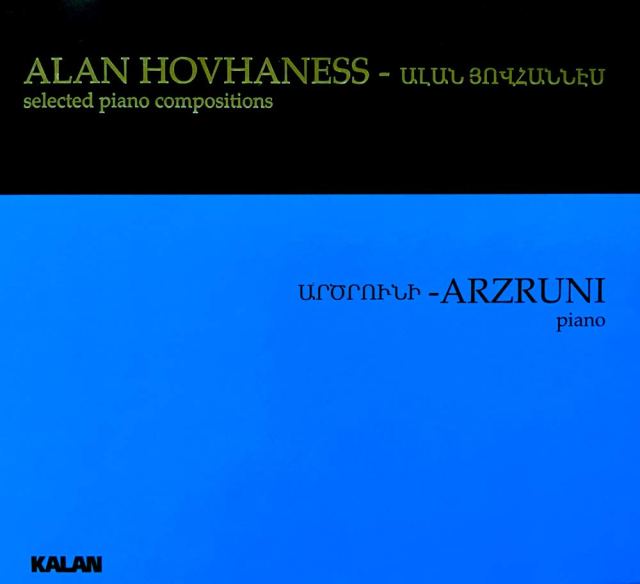
Unheard Hovhaness, this Sahan Arzruni album really rocked my geeky world. Arzruni, a frequent collaborator with Hovhaness turns in definitive performances of these previously unheard gems from the late American composer. A gorgeous physical production and a lucid recording make this another disc that lives on my “frequently played” shelf.

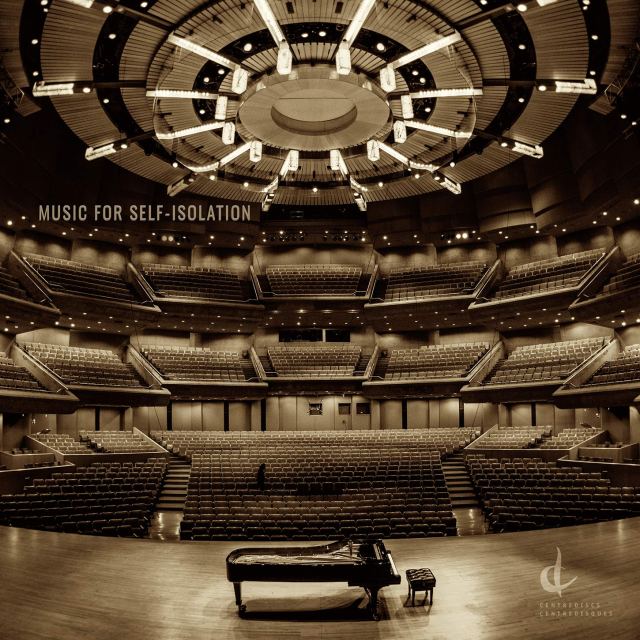
Only the Lonely, Frank Horvat’s “Music for Self Isolation” is yet another release from this emerging Canadian composer. This is one of my favorite COVID Isolation albums, a unique response to this pandemic from an eminently listenable and endlessly creative composer.

OUR 6.220674

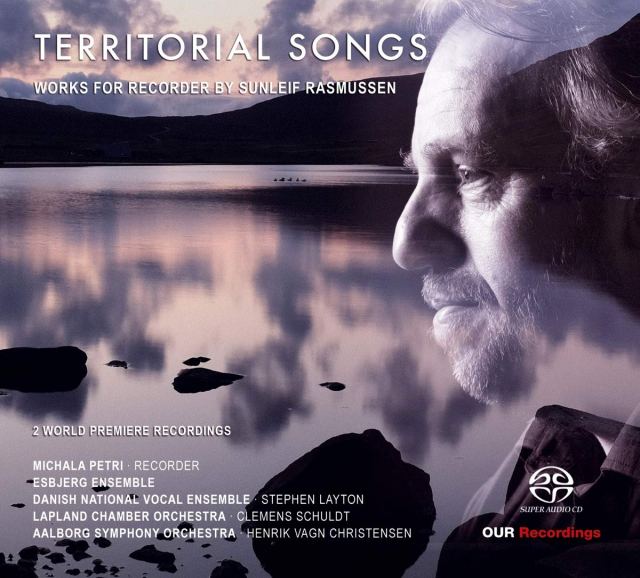
New Music from Faroese Master Sunleif Rasmussen with soloist Michala Petri is an album of world premieres by this master composer from the Faroe Islands. It is also a tribute to the enduring artistry of Michala Petri. I had the honor and pleasure of meeting both of these artists some years ago in San Francisco and anything they do will demand my attention, they’re that good.

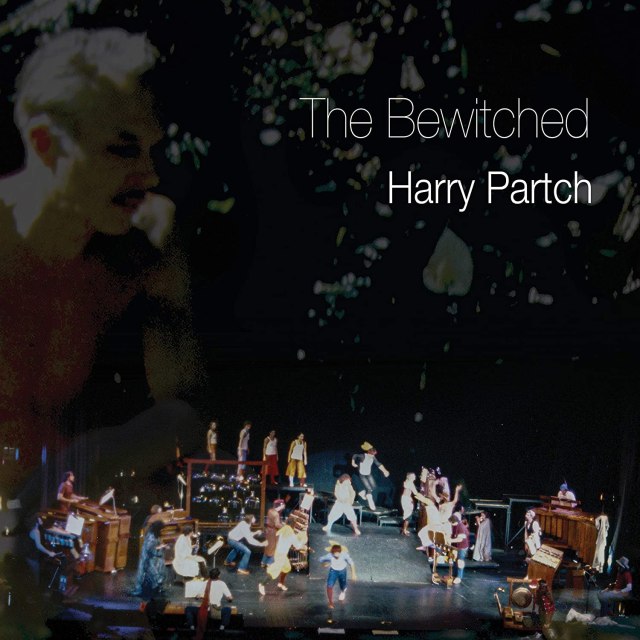
The Bewitched in Berlin, Kenneth Gaburo does Harry Partch for your head (phones). This is another “save” by Philip Blackburn. This performance in Berlin of Harry Partch’s “The Bewitched” is a binaural recording of a very fine performance directed by Kenneth Gaburo. If you’re a Partch fan this is a must have.

Neuma 123

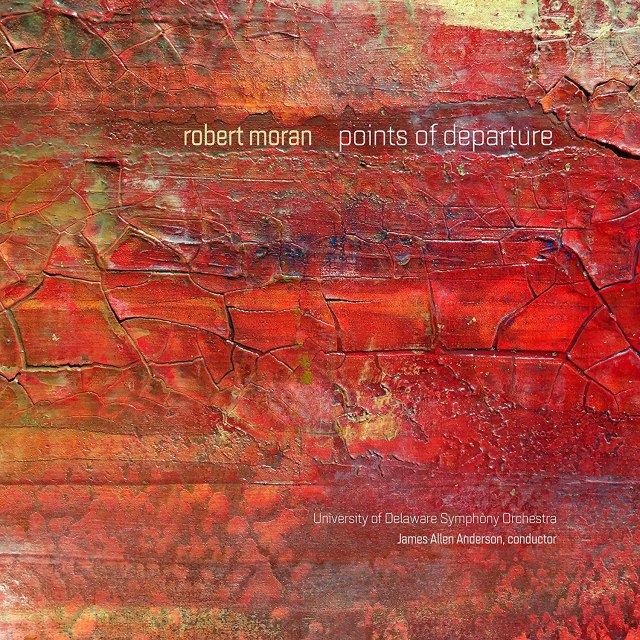
Last but not least, as they say, Robert Moran: Points of Departure is another triumph of Philip Blackburn’s curation on Neuma records. I have personally been a fan of Moran’s music since I first heard his work at the Chicago iteration of New Music America in 1982. Blackburn’s service to this composer’s work can be likened to similar service done by David Starobin at Bridge Records (who have embarked on complete works projects with several contemporary composers) and Tom Steenland’s work with Guy Klucevsek and Tod Dockstader at Starkland records. Blackburn had previously released the out of print Argo recordings of Moran’s work and now, at Neuma has released this and a few other new recordings of this major American composer’s work.

My apologies to the albums I’ve reviewed which didn’t make it to this year’s end blog but I have to draw a line somewhere. Peace, health, and music. And thank you for reading.

Solo Artist Pamela Z releases “a secret code”


Neuma 143

Pamela Z first came to this writer’s attention when the fine Starkland label under the very insightful guidance of Tom Steenland released a cutting edge, surround sound 5.1 DVD release in 2000 which featured her along with other similarly interesting musicians in a forward looking recording.

Starkland ST-213

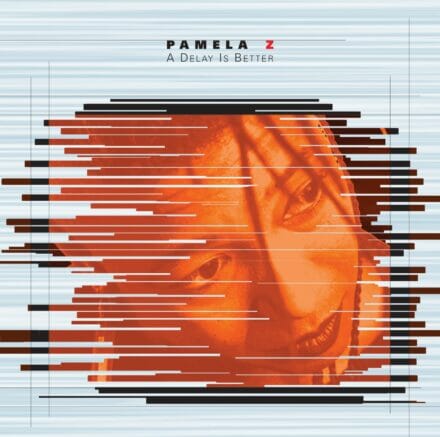
The first CD dedicated entirely to Ms. Z’s work was also a Starkland release (A Delay is Better, 2004) was quickly added to my music collection when I was still a Chicago resident. Since moving to California in 2005 I have had the pleasure of seeing Pamela’s work live on numerous occasions (something which I highly recommend). She is a fascinating performer to watch as well as hear. These releases are the only ones dedicated entirely to her work currently available to the general public though her crowd funded DVD, Baggage Allowance may be obtainable through her web site. Much of her presence on recorded media is as a collaborator so this new disc of largely new work is a truly welcome addition to her catalog and an opportunity to see a unique talent.

Pamela Z performing at Other Minds 23 in 2018

Her visual presence and gestures are an important part of her work but it is the hearing part with which we are concerned here. Philip Blackburn at Neuma records has chosen to release a new disc consisting of performances of more recent compositions. Z maintains a busy schedule of composing and performing world wide and her quirky creativity has not failed her. Let me say that I use the word “quirky” just to indicate that her work is unique, a technological expansion of the tired “one man band” cliché in which she uses a variety of compositional electronics (some made exclusively for her) to facilitate her uniquely recognizable style. It is difficult to describe her work in a way that can easily be understood without actually having heard her work. Suffice it to say that, generally speaking, she works with live recording and subsequent looping of those sounds. She is able to turn loops on and off as the piece progresses. Her texts come from a variety of sources, including found texts. And the presentation of these texts are sometimes sung and sometimes spoken.

She has had great success as a collaborator with spoken word narration, singing (she also has a beautifully trained soprano voice), and performing with other musicians. These collaborations are listed on her web site and are worth your time to explore.

The photo of the back cover of this new album serves both to provide a listing of the tracks but also to display one of the wearable electronic devices mad for her which she uses (to pleasantly theatrical effect) in performance. From her web site: “She uses MAX MSP and Isadora software on a MacBook Pro along with custom MIDI controllers that allow her to manipulate sound and image with physical gestures.”

Z is a vocalist, an operatically trained singer and voice over artist who has pioneered the use of complex delay and looping systems to produce her work. She is apparently enamored of language (she has studied English, French, Italian, and Japanese). Her combination of spoken and sung passages combined with the looping/delay technology, and, increasingly, writing for other instrumentalists is the basic medium(s) with which she works.

In my mind she shares conceptual space with artists like Amy X Neuberg, Meredith Monk, and Diamanda Galas, at least that is the way I have them filed in my collection. In fact, each of these performers has their own distinct style and aesthetic, each a separate origin story. What they have in common in this listener’s mind is the fact that they are women, the fact that their voice is their primary instrument, and the fact that each uses that voice, sometimes with some augmentation, to achieve their compositional and performance goals. (I nurture a personal fantasy of some day hearing one or all of these women doing their cover of a piece like Rzewski’s “Coming Together” or some similar speaking pianist type work but that’s a topic for another blog).

The ten tracks on this release represent Ms. Z’s more recent work. Taken as a whole this album has an almost existential/apocalyptic character at times. There are 10 tracks ranging from about 4 to 10 minutes each and they span the years from 2003 to 2018 with one track from 1995. The overall feel of this is rather darker in tone than the Starkland disc but it also reflects her further artistic development and that alone is worth the purchase price. The album is recorded, edited, and mixed by the artist who also supplies the brief but clear and useful liner notes.

The first track, Quatre Couches/Flare Stains is a studio mix of two pieces (Quatre Couche from 2015 and Flare Stains from 2010), two works she has combined in her live performances. So this is mix is a 2021 artistic mashup reflecting what she has gleaned from her live performances and incorporating that learning into a new compositional experience.

Unknown Person (2010) is an excerpt from the aforementioned “Baggage Allowance” (2010) which uses found texts collected during the composition process as lyrics and is a work with many metaphorical dimensions that touch on existential ideas that touch us all.

Other Rooms (2018) is constructed around vocal samples of an interview with playwright Paul David Young.

A piece of π (2012) utilizes the first 200 digits which express the value of that mathematical constant. Z recounts further details of her process in the liner notes.

Site Four (2017) is a section of music which was composed for a dance work.

He Says Yes (2018) is an excerpt from music for a theater piece.

Typewriter (1995) is the outlier here. It is one of Z’s live performance staples which utilizes the beautifully designed MIDI controllers which she wears and which control the electronics as she moves her body through the performance space. Even without the visuals, one can get an idea of this seminal work and how it influenced her later developments.

The disc ends with a trilogy of works, The Timepiece Triptych, which consists of Declaratives in the First Person (2005), Syrinx (2003), and De-Spangled (2003). This trilogy is a virtual compendium of the techniques which Z has thus far developed. Using sampling, linguistics, spoken voice, singing voice, and her signature electronics this artist presents work which functions on many levels. It is entertaining, it is thought provoking, it is funny, it is sad, it is personal, it is self referential, it refers to us all. Denotation, connotation, musical/electronic alchemy, language (both spoken and sung) all come together to create art which is engaging and, watch out, sometimes subversive.

Though I earlier made reference to my filing preferences for this and (what I consider) similar artists there is, in the end no one quite like Pamela. She is the Alpha and the Omega, the A and, of course, the Z.

Fantasy: Ursula Oppens (et al) Play the World Premieres of Five Major Works by Laura Kaminsky


Cedille CDR 90000 202

Laura Kaminsky (1956- ) is a native New Yorker and has plied her trade there for some time. So how does she wind up on a label so intimately dedicated to Chicago music and musicians? Well, the answer is simple, Ursula Oppens. Oppens (a member of the American Academy of Arts and Sciences) is also a New Yorker but her 14 year tenure as Distinguished Professor of Music at Northwestern University (1994-2008) certainly qualifies her as a valued Chicago artist. Realistically she is a highly accomplished and world renowned musician with an admirable history of supporting new music through her many definitive performances and recordings. With the exception of Fantasy, all the music here was commissioned by and/or written for Ursula Oppens, (Reckoning written for Oppens and Lowenthal destined for this recording).

This very welcome disc features three major works: Piano Quintet (2018), Fantasy (2010), and Piano Concerto (2011). as well as Reckoning: Five Miniatures for America (2019), a set of miniatures for piano four hands. As noted on the back cover, all are world premiere recordings. And these are very fine, actually definitive recordings. The Quintet, Fantasy, and Reckoning were all recorded at Brooklyn College, the concerto at Arizona State University. All were produced by the wonderful Judith Sherman and mastering was done by the equally wonderful Bill Maylone.

While Kaminsky works in a largely tonal post-modern idiom, this is not populist music, rather it is music by an accomplished composer who works well within such a medium. Her work is compelling and intriguing as well as entertaining.

Let’s start with the Piano Quintet. This medium is strongly associated with the romantic era. Piano Quintets by the likes of Franz Schubert, Robert Schumann, and Johannes Brahms largely define the genre and there are many lesser known examples which were produced well into the early 20th century. The genre seems to be enjoying a re-emergence and even modernists like Elliott Carter and Iannis Xenakis have penned masterworks in this form.

Kaminsky’s Piano Quintet is very much in the classical/romantic style. It is cast in three movements some of which reflect the variety of influences in her compositional palette. Her compositional skills allow her to evoke pretty much whatever emotion she chooses. Her style shows influences and echoes from classical forms, jazz, pop, minimalism all integrated into a largely tonal/post romantic style which easily engages listeners and manages to be highly expressive. The three movements are generally modeled on classical forms but Kaminsky manages to personalize her wide stylistic gestures and create a work that is celebratory rather than derivative. That said this piece is quite a ride for the listener as well as a significant addition to the repertory.

The Fantasy is a large and challenging work which ventures through a variety of styles and moods. This is a big work whose pianism reminds this writer of Rzewski and his rather Lisztian virtuosity. It might as easily be called, “rhapsody” for its rapid transitions of mood and style. Oppens manages to give form to this complex piece that does not appear to be easily interpreted by any but the best musicians.

The five miniatures that comprise Reckoning are brief but powerful statements written for Oppens and her sometime collaborator, Jerome Lowenthal, another highly skilled artist whose collaboration on a previous Cedille release, the Rzewski “People United” variations. These two are a good match of technical skills as well as interpretive ability.

The concerto is the big work here. Cedille saves the best for last notwithstanding the preceding masterful compositions. Here in a large orchestral piece with piano, Kaminsky demonstrates even more clearly her facility with instrumental colors which she uses to great effect in this grand concerto.

It is a piano concerto very much in the tradition of the classical soloist/orchestra which features the pianistic skills of the soloist. The orchestral “accompaniment”, if one can even call it by that name, derives more from the grand romantic tradition utilizing a large orchestra to which is given the role of coordinating with the pianist. But here the orchestra is given technical challenges nearly equal to the solo piano part. This is as grand as a Brahms concerto with the orchestra given a great deal to do and for the listener to enjoy. In addition to the nearly athletic, fingerbusting piano part, there are delightful passages in the orchestral playing that sort of sneak up on and charm the listener.

Kaminsky’s Piano Concerto was reportedly inspired by visual images of sunlit rivers in New York City and St. Petersburg, Russia. Oppens gave the world premiere with the St. Petersburg Chamber Philharmonic led by its artistic director Jeffery Meyer. On this world-premiere recording, Meyer, who is also director of orchestras at Arizona State University, conducts the ASU Symphony Orchestra and, like Oppens, meets a very challenging task with both grace and insight.

Kaminsky is a solid, disciplined composer who produces music of substance which intelligently engages audiences. This is a fine introduction to her work or a fine addition to an already established collection of her music. Her music was unknown to this writer’s ears before hearing this album and now leaves me wanting to explore more of the work of this fine American composer.

David Schrader Plays Sowerby and Ferko


Cedille

From the gorgeous photography of the cover, to the choices of the musical selections, their interpretation, and recording this is a love song to two fine Chicago composers, Frank Ferko and the late great Leo Sowerby. Here are two full discs of eminently listenable and fulfilling organ music by two of the best composers to write for that instrument in the 20th and 21st centuries.

Organs, at least the types of organs you’ll hear in this recording, are unique instruments built specifically for the site (usually a church) in which they will be used. As such they are a part of the architecture and are themselves works of art. If you’re a fan of organ music you have to have this disc. It is sonically beautiful and full details and specifications of each of the instruments recorded here are provided in the excellent liner notes and the Chicago born David Schrader is a truly fine organist (as well as harpsichord and fortepiano player). He has no less than 26 releases on this label alone, all worthy of a place in any serious collector’s library. One of the great added values of this release is its attention to providing the technical specs of the instruments involved (every one of these instruments is a unique construction) and those with an interest in such details will be thrilled with the liner notes which do justice to listeners who crave such details (this listener included of course).

Cedille Records has already done much to bring Sowerby’s music to listeners in several previous releases but this is the first recording they’ve released of his organ music. Frank Ferko, a well known working composer in Chicago (and points beyond), was also previously represented on this label by the release in 2000 of his fine Stabat Mater.

The first disc (of two) is dedicated to the music of Frank Ferko (1950- ) and all of these are world premiere recordings. While Ferko is a church musician this music is not typical liturgical fare. His work echoes the traditions of the great romantic church organist/composers like Marcel Dupre, Olivier Messiaen, Cesar Franck, Charles Marie Widor, Louis Vierne, etc.

All of the music on these discs is for organ alone and titles like “Mass for Dedication” fall into the category of “organ masses” (generally a French tradition) in which music is used liturgically but does not accompany choral settings of the texts generally associated with the sections of the mass in what is known as “alternatim practice” where the organ plays during moments that would normally contain sung texts. It is almost like incidental or film score music which is intended to create a mood for the ritual on stage or on screen.

Ferko, trained as an organist and studied composition and music history. He has worked as a church musician in various Chicago area churches and his compositions have gotten worldwide acclaim and performances. His Stabat Mater (1999) was released on CD by Cedille and his “Hildegard Organ Cycle” (1995) based on the music of Hildegard von Bingen (ca. 1098-1107) are major works worth your time.

The works on this recording are a wonderfully representative selection of Ferko’s compositional achievements and will doubtless want the appreciative listener wanting more. He clearly understands how to write for the organ. His basically tonal style is very listener friendly but clearly a style that represents the composer’s vision.

Leo Sowerby (1895-1968) was a Chicago composer, church musician and teacher. This disc presents a nicely chosen selection of Sowerby’s solo organ compositions. This is another in a series of releases presenting the too little known compositions of a man who was pretty well known during his lifetime, especially in Chicago where he taught for years at the American Conservatory of Music and served as organist at St. James Episcopal Church. Cedille has presented the world premiere recording of Sowerby’s Pulitzer Prize winning cantata, “The Canticle of the Sun” (1944), the composer’s second (of five) symphonies, and some of his orchestral tone poems. Cedille takes its mission seriously as it methodically documents the work of Chicago composers and musicians.

Unlike the Ferko disc, the selection of Sowerby’s compositions is decidedly non-liturgical and reflects his skills as a composer for the concert hall (of course the church becomes the concert hall here). In fact it was Sowerby’s Violin Concerto of 1913, premiered by the Chicago Symphony that brought the composer early recognition in his career.

The selection of Sowerby pieces, with the exception of a couple of tracks only available in online versions of this album, are a fair assessment of his organ works and a very good introduction to the composer’s style and compositional skills. The Organ Symphony in G Major from 1930, which occupies the last three tracks on the disc, is without doubt one of Sowerby’s most enduring masterworks. It has received numerous recordings of which this is the finest this reviewer has heard. The first four tracks are shorter but no less substantial works showing Sowerby’s mastery of this medium and his ability to engage his listeners in convincing and compelling essays which will have the listener returning again and again.

This double disc set has the feel of a landmark recording and, though many of Sowerby’s organ compositions have been recorded, many are out of print and/or difficult to find and this is one very satisfying collection. It is definitively performed, beautifully recorded, and satisfyingly documented. This one is a classic release!

“Dreams of a New Day”, a Landmark Recording Project from Cedille


Cedille CDR 90000 200

I have always made my admiration clear regarding Chicago based Cedille Records. They release quality recordings of unusual but intelligent choices of repertoire. This recording continues that formula but here achieves what is likely to be seen as a landmark anthology (or at least sampling) of Art Song by Black Composers. It speaks on many levels, as poetry, as music, as a collaboration between an incredible baritone, an amazing pianist, in a beautifully recorded and produced album. I was left throughout with the feeling that this is a loving collaboration. It is an integrated collaboration between many people who worked well together. It is a beautiful document and a timely one.

Baritone Will Liverman, the young rising star baritone who is slated to perform at The Met in the world premiere of Terence Blanchard’s “Fire Shut Up in My Bones” scheduled for fall of 2021 is clearly at the heart of this production. His intelligent choice of repertoire is both pleasing and revelatory. (the poetry of the song texts are published in one of two booklets that come with this CD). And Liverman’s voice is an admirable instrument that he wields with power and nuance. His commission of fellow rising musical star, composer Shawn Okpebholo whose “Two Black Churches” receives its world premiere recording. The pianist who manages to navigate significant demands with confidence and artistry, is Paul Sanchez, an excellent pianist, composer, and a fine collaborator.

The beautifully packaged CD (you gotta buy the CD) consists of 19 tracks representing 8 composers. The recording is billed as “Songs by Black Composers” but one can hardly miss the justly sad or angry tone of the texts and this was recorded July 22-24 of 2020 at the height of the COVID-19 pandemic and amidst social unrest over the epidemic of modern day lynchings. (2020 was also the year that Anthony Davis won the Pulitzer Prize for his protest opera, “The Central Park Five”) The moving rendition (“put together”, as Liverman quips in the liner notes) of Richard Farina’s 1964 song is played and sung by Liverman connecting this release with the tradition of protest music of another era. The struggle continues.

Before discussing the music I must supply a disclaimer of sorts. My working knowledge of art song in general is fairly limited and my knowledge of black art songs even more so. I know none of this music and have only in the last year or so came to know of the work of Shawn Okpebholo. I had read about the historical significance of Henry “Harry” Thacker Burleigh and Margaret Bonds but have heard little of their music.

In about 61 minutes listeners are given a survey, a sampling of art song by black composers ranging from Burleigh (who studied with Antonin Dvorak) to Okpebholo whose compositional talents continue to get much deserved recognition. It is a learned sampling of a huge repertory that deserves attention.

The opening song is I Dream a World (2017) by Damien Sneed (1979- ). This setting of the Langston Hughes (1901-1967) poem strikes a somber but cautiously optimistic note. It is followed by “Five Songs of Laurence Hope” (1915) by Henry “Harry” Thacker Burleigh (1866-1949). The name Laurence Hope is the pseudonym of Adela Florence Nicolson (1865-1904), a British poet who spent much of her life in British India where she developed an interest in the culture of the land. Fascination with the literature and culture of India was strongly in evidence in the early twentieth century. These five songs are reminiscent of Debussy and the impressionists and is but a small sampling of Burleigh’s art song output.

Harrison Leslie Adams’ (1932- ) setting of his own lyrics in “Amazing Grace” is yet another iteration of the abolitionist song. Margaret Allison Bonds (1913-1972) is represented by her “Three Dream Portraits” (1959), a song cycle on Langston Hughes poems. Bonds’ style put this listener in the mind of Copland’s Dickinson Songs though notably darker. This cycle is contemporary with the height of the Civil Rights Movement.

Next is “Riding to Town” (1943) by Thomas Kerr (1915-1988) who chose to reach back to the late nineteenth/early twentieth century poet Paul Laurence Dunbar (1872-1906) for his text. Dunbar was for the 19th century what Langston Hughes would be for the early to mid twentieth century.

“Two Black Churches” (2017) is the work commissioned by Liverman for this recording. It is a setting of two poems and one of the musical highlights here. The first, “Ballad of Birmingham” to a text by Dudley Randall (1914-2000) is a contemporary reaction to the 1963 bombing of the 16th Street Baptist Church in Birmingham which killed four little girls. The second song, “The Rain” to a text by the Poet laureate of Charleston, poet and musician Marcus Amaker (1976- ). It is about the Charleston Church shooting of 2015 at Emmanuel African Methodist Episcopal in which a lone gunman killed nine people. Okpebholo is modernist but accessible and these settings are among the most devastating and powerful statements on this recording.

“Mortal Storm” Op. 29 (1969) is a song cycle by one Robert Owens (1925-2017). It is a powerful cycle set to Langston Hughes poems. Owens left the United States in 1968-9 in response to the racial violence and moved to Europe where he had studied music under the GI Bill from 1946-1957. Owens died in Munich having never returned to the land of his birth. This work deserves to be better known and thanks is due to Liverman and his associates for bringing this sad masterpiece to contemporary listeners.

The album concludes with Mr. Liverman’s arrangement of “Birmingham Sunday”, a 1964 song by writer and composer Richard Farina (1937-1966). Liverman plays and sings on this final track which is an homage to a previous generation of song writers and protestors as well as a reminder that that generation’s work in Civil Rights is hardly complete. The song was notably used by Spike Lee in his elegiac film, “Four Little Girls” (1997).

The lucid and detailed program notes by Dr. Louise Toppin are a welcome addition to this production and help to provide a context. The design by Bark Design ties this little gem together. This one has Grammy and “collector’s item” written all over it.

Rachel Barton Pine: Black and Blue


Cedille CDR 9000 182


Rachel Barton Pine is one of the brightest lights of the solo violin in Chicago and worldwide. Her partnership with Cedille records (also a venerable Chicago based institution) has been both fruitful and revelatory.

In addition to the standard virtuoso repertoire such as Brahms and Beethoven this soloist has demonstrated a passion and a genuine interpretive feel for music by black composers. Were we living in a less racially charged time this focus would be of minor interest. But the fact remains that music by black composers, regardless of the composer’s national origin or the quality of the music, have been seriously neglected.

Indeed this soloist has become a sort of shepherd of the lost and neglected. Her recorded catalog is testament to her achievements in a really wide range of repertoire from the Bach solo violin music to neglected concertos and occasional pieces ranging from the 17th century to the present.

The present disc was an October, 2018 release I am reviewing for Black History Month. And it is a gem. No fewer than 11 composers, 5 of whom are still living. It is both an acknowledgement of some of the classics produced by black composers over the last 100 years and an introduction to new and emerging voices.

The recently deceased David N. Baker (1931-2016) is represented here in the first track, Blues (Deliver My Soul ) and provides a context immediately. The word “blues” is used to refer to the uniquely black musical form which consists of a poetic form in which the first line is repeated. The vocal styles that are the blues are probably the most recognizable aspect of this musical form. But one can’t miss the persistent subtext of the neglect of such fine music as yet another insult to widen the racial divide.

In fact many of these pieces are not, strictly speaking, blues. But that is not the main point here. Pine, along with her quite able accompanist Matthew Hagle, present a beautiful and wide ranging selection which presents some wonderful music and, for those with a conscience, illustrate what can be lost when listening choices are hampered by prejudice.

The Baker piece helps to create a context. It is followed by Coleridge-TaylorPerkinson’s (1932-2004) Blue/s Forms for solo violin. This man’s career alone is worth a book at least. His eclectic and learned musical style found him writing music for movies, television, and the concert hall. He was also versed in jazz and blues and even played drums with Max Roach for a while. These solo violin songs are a beautiful example of the composer’s melodic gifts. One can easily imagine these pieces programmed alongside the Bach solo music.

William Grant Still (1895-1978), truly the dean of black American composers, is next. His Suite for Violin and Piano is happily performed with some frequency and deserves to be recognized as one of the masterpieces by this really still too little known composer. The piece is in three movements, each a representation in music of a painting.

Noel Da Costa (1929-2002) is a new name to this writer. He hails originally from Nigeria but made his career in New York City. His “Set of Dance Tunes for Solo Violin” makes a nice companion to the Perkinson pieces. This is one of the world premieres on the disc. Here’s hoping we get to hear more of this man’s work.

Clarence Cameron White (1880-1960) is another unfamiliar name. His Levee Dance is next. He was one of the lesser known of the group of early twentieth century black composers which included R. Nathaniel Dett, Dorothy Rudd Moore, Florence Price, and Samuel Coleridge-Taylor.

By far the best known name here is Edward Kennedy “Duke” Ellington (1899-1974). One out of eleven here has “household name” status. He is represented by Wendell Logan’s arrangement of, “In a Sentimental Mood”. This is the premiere of this arrangement.

Now to the living black composers. This is a forward looking recording which pays homage to the past but also acknowledges a living tradition. Dolores White (1932- ). Her “Blues Dialogues for Solo Violin” add admirably to the solo violin repertoire.

Belize born Errollyn Warren is next with her brief, “Boogie Woogie”. Warren is a composer with a wide range and, while this is a fun piece, she has composed a wealth of music for various sized ensembles including orchestra. She was the first black composer to be represented at the famed Proms concerts. Wallen was a featured composer at Other Minds in San Francisco.

A slightly longer piece by Billy Childs (1957- ), “Incident a Larpenteur Avenue” gives the listener a taste of the work of this prolific composer. This is a world premiere which was written for the soloist. Childs won a Grammy for his jazz album, “Rebirth” in 2018.

Daniel Bernard Roumain is of Haitian roots and works in New York City where he works with turntables and digital sampling to augment his classical compositions. His work, “Filter for Unaccompanied Violin” is given its world premiere recording here.

Charles S. Brown (1940- ) concludes this amazing recital with, “A Song Without Words”.

This is a rich and rewarding recital which will take the interested listener into wonderful new territories. Listen, read about these composers, enjoy their artistry. This is just a beginning.

Harold Meltzer: Wonderful New Chamber Music on Bridge


meltzersongs
Bridge 9513

This is the second Harold Meltzer (1966- ) disc to come across my desk in the last two months or so.  This time he is heard on the venerable Bridge label which produces a great deal of quality recordings of new and recent music.  This one contains four works spread over 15 tracks and, like his previous CD, includes some vocal music alongside two chamber music pieces without voice.

Meltzer seems to be one of a generation of composers who have absorbed many of the vast styles and methods which flowered in the twentieth century.  He is not easy to categorize except as a composer.  There are in his music gestures and ideas that span neo-romanticism, minimalism, etc. but he has a distinctive and very affecting style.

Meltzer’s ability to write for the human voice and these songs put this reviewer in the mind of composers like Ned Rorem.  I’m not saying he exactly sounds like Rorem, just that he is as effective in his writing.  Stylistically there is at times an almost impressionist feel in these songs and, while the piano accompaniment is wonderful, they almost beg to be orchestrated.

There are two song cycles on this disc, the first setting poems of Ted Hughes (Bride of the Island, 2016) and the second setting poems by Ohio poet James Wright (Beautiful Ohio, 2010).  Tenor Paul Appleby had his work cut out for him and he delivers wonderful performances with a voice that is well suited to lieder but clearly with operatic ability as well.  Pianist Natalya Katyukova handles the intricate accompaniments with deceptive ease in these cycles.

There are two chamber works on this disc.  The first is Aqua (2011-12) which is inspired by the architecture of the so-called Aqua building in Chicago by architect Jeanne Gang.  In a city known for its fine architecture this 2007 building manages to stand out in its uniqueness.  Need I say that his piece suggests impressionism.  It’s string writing is complex with a vast mixture of effects that, under the interpretive skill of the Avalon String Quartet, suggest movement in much the way the building itself does.  This is genius, the ability to mix all these string techniques into a coherent whole.  It is a basically tonal work and it is seriously engaging but listener friendly in the end.  

The second chamber work is a piece written for the 50th anniversary of the death of legendary violinist Fritz Kreisler.  As it happens the Library of Congress, who commissioned the piece, owns Kreisler’s Guarneri violin and it is they who commissioned this work.  Miranda Cuckson does the honors on violin ably accompanied by the trustworthy Blair McMillen.  To be sure some of Kreisler’s style is used here but this work, “Kreisleriana” (2012) comes across as more than an homage, more a work informed by Kreisler.  It’s a really entertaining piece too.

Thanks in particular to Bridge Records for releasing this.  Bridge is one of those labels whose every release deserves at least a bit of attention.  This time I think they’ve found a fascinating voice in Meltzer’s works.  Now how about some orchestral work?

Captain Kirk and the Buddha Speak Esperanto: Other Minds 22 Commemmorates Lou Silver Harrison at 100


Esperanto is a constructed language brought into being in an 1887 book by a Polish-Jewish doctor by the name of L. L. Zamenhof (1861-1917).  This constructed language was intended in part as an intellectual exercise which might contribute to greater international discourse and perhaps understanding.  He outlined his intentions as follows:

  1. “To render the study of the language so easy as to make its acquisition mere play to the learner.”
  2. “To enable the learner to make direct use of his knowledge with persons of any nationality, whether the language be universally accepted or not; in other words, the language is to be directly a means of international communication.”
  3. “To find some means of overcoming the natural indifference of mankind, and disposing them, in the quickest manner possible, and en masse, to learn and use the proposed language as a living one, and not only in last extremities, and with the key at hand.

Esperanto did gain a great deal of popularity and there are still adherents today (an estimated 2 million people worldwide).  Lou Harrison was one of the users of this language (users are known as “Esperantists”).

L. L. Zamenhof (1859-1917)

In 1966 a horror film, “Incubus”, written and directed by Leslie Stevens (of Outer Limits fame) was released starring the just pre-Star Trek William Shatner.  Once thought lost, this film was restored from a copy found in a French film library.  It was only the second (and apparently last) feature film done entirely in Esperanto (the first being the 1964 French production, “Angoroj” or Agonies).  It was thought that the use of Esperanto would add a mysterious dimension to the production though detractors challenged the actors’ ability to properly pronounce the dialogue.  A link to a Shatner scene is here.  https://www.youtube.com/watch?v=accFmyaOj7o

And if you want to sit through the entire film (definitely a cult film experience) you can find it here: https://www.youtube.com/watch?v=LHUfHj2lTaM

Curiously 1917, the year of Dr. Zamenhof’s death, is also the birth year of Lou Harrison, the principal subject of this essay.  This patriarch of 20th century modernism was a composer, conductor, musicologist, performer, teacher, dancer, calligrapher, and Esperantist.  He used Esperanto to title many of his works and set some Esperanto texts to music.

Lou Silver Harrison


And the Buddha Becomes an Esperantist

In his masterful big composition, La Koro Sutro (1972) translated portions of the text of the Buddhist Heart Sutra (into Esperanto) are set for mixed chorus and American Gamelan.  Gamelan is an Indonesian mostly percussion orchestra which Harrison studied extensively following the example of pioneering Canadian ethnomusicologist and composer Colin McPhee (1900-1964).

Gamelan was first introduced to western audiences at the 1889 Paris World’s Fair where composers such as Claude Debussy and Erik Satie heard the instruments and later incorporated some of those sounds in their music.  (That Gamelan now resides in Chicago’s Field Museum of Natural History.) Harrison’s life partner Bill Colvig, an instrument maker, constructed a percussion ensemble which they called the American Gamelan to differentiate it from the traditional Indonesian ensemble.  The American Gamelan, consisting of five percussion instruments (augmented with organ, harp, and chorus) was first used in the cantata La Koro Sutro.

Harriso (left) with Bill Colvig


This composition is very much a synthesis of the composer’s musical and philosophical ideas.  Harrison was an avowed pacifist and the Heart Sutra is a key Buddhist scripture which supports introspection and non-violence.  Here he uses his expertise as an esperantist, his knowledge of Indonesian as well as western classical music to create one of his largest and finest works.

Lou Harrison with Charles Amirkhanian (curator of this concert series) in 1966


It is a testament to Harrison’s influence that this is the fourth performance of La Koro Sutro in the Bay Area.  It was written for an Esperanto conference in Seattle in 1972 with a translation by fellow esperantist Bruce Kennedy and was premiered that same year at Lone Mountain College  in San Francisco (now part of the University of San Francisco).  Additional performances (available on You Tube) were staged in Berkeley in 1973 and again in 2012.  This is truly an American masterpiece as well as a prayer for our times.

The performances will take place in the Mission San Francisco de Asís Basilica, better known as Mission Dolores.  The mission was founded in 1776 and the still active small adobe church next to the Basilica, built in 1791, is the oldest surviving building in San Francisco.  The much larger Basilica next to the adobe church (and the actual location of said concert) was dedicated in 1918.

Interior of the historic Mission Dolores Basilica


For the record, a Basilica is a reference to both architectural and spiritual aspects of any church so designated.  In the Catholic Church a Basilica is a pilgrimage site, a place to which the faithful travel in a spiritual quest.  I don’t believe it is too much of a stretch to view this event as a musico-spiritual pilgrimage open to all ears and minds, and hearts.  You won’t come out speaking Esperanto but you will never forget what you’ve heard.
The program will include:


Threnody for Oliver Daniel for harp (1990) 

Suite for Cello & Harp (1948)

Meredith Clark, harp

Emil Miland, cello

Pedal Sonata for Organ (1987/1989) Praises for Michael the Archangel (1946-47)

Jerome Lenk, organ

Suite for Violin & American Gamelan (1974, composed with Richard Dee) 

Shalini Vijayan, violin

William Winant Percussion Group

La Koro Sutro (The Heart Sutra, 1972)

For large mixed chorus, organ, harp, and American Gamelan

The Mission Dolores Choir, Resound, Jerome Lenk, organ, Meredith Clark, harp, and the William Winant Percussion Group conducted by Nicole Paiement.
Saturday, May 20, 2017- 7:30 p.m. 

Mission Dolores Basilica

3321 16th St.

San Francisco, CA
The very affordable tickets ($12-$20) are available at:

http://om22concerttwo.brownpapertickets.com/

Revido tie. (See you there.)
 

In Celebration of a Lost Culture: Sephardic Journey by the Cavatina Duo


cavaduo

Cedille CDR 9000 163

This tasty little disc of world premieres commissioned through grants to Cedille Records in Chicago consists of new works which celebrate the culture of the Sephardim, the Jews of southwestern Europe, primarily Spain.  It both memorializes and resurrects the rich music of this all but lost culture.  In the last few years we have seen a growing interest in this culture through settings of texts in the original Ladino language as well as in the melodies which sprang from their folk traditions.

The Cavatina Duo consists of Eugenia Moliner, flute and Denis Agabagic, guitar.  Moliner is originally from Spain and Agabagic is originally from Yugoslavia (now Bosnia-Herzegovina) and they are husband and wife.  Both have a strong interest in the folk musics of their respective cultures and in exploring other folk music cultures.  Their previous album for Cedille, The Balkan Project, similarly demonstrates their affection and scholarship for the cultures of that region of the world.

Five composers were commissioned for this project: Alan Thomas (1967- ), Joseph V. Williams II (1979- ), Carlos Rafael Rivera (1970- ), David Leisner (1953- ) and Clarice Assad (1978- ).  This is one of those wonderful crowd funded efforts through Kickstarter.

Thomas’ contribution adds a cello (played by David Cunliffe) to the mix for this Trio Sephardi in three movements each of which is based on a traditional Sephardic song.  The piece makes good use of the vocal qualities of the songs quoted and the lyrics seem to exist as a subtext even though they are not sung here.

Isabel by Joseph V. Williams is a sort of homage to Isabel de los Olives y López, a Sephardic woman who lived during the time of the Spanish Inquisition.  She outwardly converted to Catholicism but lived secretly as a Jew.  One can hardly miss the sad irony of this tale of religious intolerance from the 15th century and its relevance for today.  This piece is based on a resistance song which masquerades as a love song, again a metaphor for our times.  It is scored for flute and guitar.

We move again into the realm of the trio, this time with violin (played by Desiree Ruhstrat), for this piece by Carlos Rafael Rivera called, “Plegaria y Canto”.  This is the most extensive single movement amongst all the works on the disc and is a deeply affecting and dramatic piece for which the composer’s notes provide insights.

The last two pieces utilize the forces of the Avalon Quartet for whom this is their second appearance on the Cedille label.  Their first disc, Illuminations, was released last year. They are currently in residence at Northwestern University and Cedille does a great job of promoting the work of talented Chicago area musicians.

Love and Dreams of the Exile is David Leisner‘s poignant contribution.  Its three movements tell an aching tale of love, pain and, ultimately, transcendence.

Clarice Assad is a Brazilian composer too little known in the U.S.  She is indeed related to the famed Assad family of musicians and she clearly has as abundant a talent.  Her Sephardic Suite concludes this program with this three movement essay on love and relationships.

Bill Maylone is the engineer with editing by Jean Velonis and the executive producer is James Ginsburg.  Photography of the Alhambra Palace by Maureen Jameson graces the cover.  Design is by Nancy Bieshcke.

This is music of an oppressed culture and it is tempting to look upon the creative impetus which oppression sometimes seems to provide but the message here is one of sadness and nostalgia but also of hope.  It is perhaps a tribute to the ultimate triumph over said oppression even if it took 500 years.  There is some comfort and healing to be had from the celebration of this lost culture and that is the triumph of this disc.


Primous Fountain World Music Tour Begins in Moldova


Primous Fountain arrives in Moldova to oversee the performances of his music.

Primous Fountain arrives in Moldova to oversee the performances of his music.

There has been quite a bit of interest in my earlier post on this composer.  Since then I have had the pleasure of exchanging quite a few e-mails with Mr. Fountain in which he has generously shared more details about himself and his work.  It turns out that he had been preparing for a tour of concerts of his music the first of which will occur in Chisinau, Moldova on May 19th.

Mr. Fountain has now completed 6 symphonies in addition to other orchestral and chamber works.  His first orchestral work, Manifestation (1969) was premiered by the Chicago Symphony when the composer was just 19.  He is a graduate of Wendell Phillips High School in Chicago and studied at De Paul University and the New England Conservatory with Gunther Schuller.  His Second Symphony was commissioned by Quincy Jones and it was a performance of this work that caught the interest of Gheorghes Mustea, a composer, conductor and cultural icon in Moldova who later agreed to this all Primous Fountain concert.

Maestro Gheorghes Mustea with his Orchestra of Teleradio Moldova Corporation.

Maestro Gheorghes Mustea with his Orchestra of Teleradio Moldova Corporation.

The 6th Symphony received its world première at this concert along with movements 7 and 8 of his composition, String Orchestra and an arrangement for trumpet and strings of a portion of his 2nd Symphony.  The concert will be recorded on video for later broadcast.  It was broadcast live on Radio Moldova and streamed on the internet.

Primous Fountain in the Radio Moldova Studio for his interview.

Primous Fountain with Maestro Gheorghes Mustea in the Radio Moldova Studio for his interview.

This was apparently the first time this orchestra had done a world première by a living American composer and I spoke with the very helpful orchestra manager Vasile Oleinic who told me that the conductor and musicians are very excited about this opportunity.  Mr. Oleinic has been sending me the photographs which illustrate this post.

This is the first of a planned series of concerts to be announced at a later date in what is billed as the Primous Fountain World Music Tour.  Mr. Fountain kindly sent me a copy of a promotional flyer which you can access here: PrimousFountainTour

This is the first article in what I hope to be a series devoted to Mr. Fountain’s concert series.  Stay tuned.

Primous Fountain working with the conductor at rehearsal.

Primous Fountain working with the conductor at rehearsal.


Enhanced by Zemanta

Black Composers Since 1964: Primous Fountain


Primjous Fountain (1949- )

Primjous Fountain (1949- )

I first encountered the work of this composer in 1982 in a broadcast concert of the Milwaukee Symphony that featured his Symphony No. 1. He was billed then as, “Primous Fountain III”.  I listened and, as was my obsessive practice, I recorded the work on a cassette tape so that I could listen again and not have the experience fade into obscurity.  I have listened many times to this wonderful piece and now in the age of social media one can find more of his music on his web page and his Facebook page.

Fountain was born in Chicago in 1949 where he attended Wendell Phillips High School and after graduation completed an orchestral piece Manifestation (1967) which was performed by the Chicago Symphony.  He has also had performances by the Boston Symphony and the New England Conservatory under Gunther Schuller.  I was fortunate recently to make the acquaintance of Mr. Bill Doggett who is a lecturer and marketing representative for black composers who is in touch with Mr. Fountain.  He informs me that Mr. Fountain is alive and well and living in his native Chicago.

Fountain with Hans Werner Henze

Fountain with Hans Werner Henze

Though largely self-taught he later studied with Hans Werner Henze and Gunther Schuller and these experiences seem to have been absorbed into the composer’s palette. In a 1972 interview with Charles Amirkhanian, conductor Harold Farberman and composer Charles Shere the then 20 something Fountain seems to react with disinterest to the apparently sincere  but rather uncomfortable efforts to address racial issues in music.  He speaks as though he feels his music to be so natural a part of his life that he reports his amazing abilities are simply normal to him. He seems unconcerned with the political aspects of being a “black composer”.   His instinct for complex things like orchestration are like walking or breathing, second nature.  His identity is in his music.

Fountain with Gunther Schuller

Fountain with Gunther Schuller

After hearing his youthful work Manifestation none other than Quincy Jones commissioned Fountain’s Symphony No. 2.  There is a performance by the Lugansk Symphony Orchestra of the Ukraine under the baton of Miran Vaupotic available for listening on the composer’s web site as well as on You Tube which now sports a performance of the first two movements of his fourth symphony along with the second movement of his Cello Concerto and selections from other orchestral works.

His idiom might be called conservative in that it incorporates a standard orchestra and uses well-known forms such as Symphony and Concerto but his skill at writing is the point much as it is with other composers trained in schools like Julliard, Curtis, Berklee and the New England Conservatory.

His work sounds at times like a latter day Stravinsky with jagged rhythms and rich orchestration.  There is a passionate post-romantic intensity to the pieces I have heard.  I definitely want to hear more.

Fortunately there is now a YouTube channel dedicated to this composer’s work.  There are, however, no commercial recordings of this man’s music that I was able to find.  Here we see a prodigy who was embraced by many in the world of serious music and whose star appeared to have been rising.

But for all the love and attention that prodigies sometimes get it hardly guarantees exposure beyond their youth.  Fountain is not well-known but that has nothing to do with the quality of his music from what I have been able to hear.  And as sincere as the performances are in the MP3 and YouTube selections they are hardly the pinnacle of musical interpretation.  His music is complex and challenging to performers and I have no doubt that a major symphony orchestra with an insightful conductor could better demonstrate the power of his music.

One hopes that the body of music of this American composer will find an audience in his native country some day but limitations of arts funding and the plight of the black minority composer suggest that this will not be an easy path.  I hope that some enterprising young musicology student might take on the cataloging and analysis of his work to help this process.  Any takers?

Maybe the people at Naxos records or one of the many fine and creative independent labels who have recorded so much neglected music might take on the task of bringing some of this music to classical audiences.  It would be a loss to allow it to languish under-appreciated and largely unheard.  We truly don’t know what we’re missing and I think that is a terrible shame.

Enhanced by Zemanta

Black Classical Part One


Adolphus Hailstork

Adolphus Hailstork

In honor of Black History Month I want to bring attention in this blog to black music that is not a part of popular culture. I want to highlight some of the black classical composers whose work I find most satisfying and accomplished.

I will begin with the music of Adophus Hailstork. I had been aware of some of this man’s work for some years but it was when I purchased the Naxos recording of his 2nd and 3rd Symphonies that I came to appreciate the power of his work.

Hailstork was born in 1941. He studied piano, organ, voice and violin. He is another of a long line of composers who studied with Nadia Boulanger in Paris. As one would expect, some of his music is concerned with significant events of the civil rights struggles of the 1960s and 70s. ‘American Guernica’ of 1983 is his response to the 1963 bombing of the 16th Street Baptist Church which killed four little girls. Similarly his 1979 composition, ‘Epitaph for a Man Who Dreamed’ is an homage to Dr. Martin Luther King, Jr. who was felled by an assassin’s bullet in 1968.

I purchased the Naxos disc to become more familiar with this man’s music. The first work on the disc is the 3rd Symphony of the late 1990s struck me as a highly entertaining and accomplished work that deserves a place in the symphonic repertoire. It is a joyous and inventive work which, to my ears, echoed the likes of orchestral masters such as William Schuman and Vincent Persichetti as well a hint of minimalist repetitive structures. It is a lavish neo-romantic work with a depth and complexity that demands several hearings but one which has an immediate appeal. The somber 2nd Symphony is imbued with the composer’s reactions to having visited the historical slave market areas of West Africa which, I imagine, must be not unlike visiting the death camps of the former Nazi Germany.

As time and finances permit I intend to pursue more of this American composer’s works. There is precious little reference material to be found on the Internet regarding this prolific masterful composer (as is the case with all the black classical composers i have so far encountered) though, thankfully, there are more recordings.

Paul Freeman

Paul Freeman

Africlassical.com and its related blog provide some information on about 50 composers and musicians. The now retired daring black conductor Paul Freeman recorded a significant series of music by black composers issued on 9 LPs for Columbia records in the 1970s. He recorded another 3CDs of music by black composers on Chicago-based Cedille records. He founded the Chicago Sinfonietta (billed as the world’s most diverse orchestra) and was its principal conductor for 24 years and continues in its mission of diversity presenting unusual concert repertoire.

More about some of the composers on those Columbia LPs and Cedille CDs as well as others to come in future blogs during this month.