Black Notes Matter: Lara Downes’ America Again


laradownes

Sono Luminus DSL-92207

The lovely cover photo for this album by San Francisco born pianist Lara Downes is reminiscent of any number of socially conscious folk/rock stars of the 60s and 70s. It would seem that this is no accident.  This delightful album of short pieces by a wide variety of American composers takes its title from the Langston Hughes (1902-1967) poem, Let America Be America Again (1935).  By so doing the pianist places this interesting selection of short piano pieces firmly in the context of black racial politics and the artistic expression of black America as well as those influenced by this vital vein of American culture (both musical and literary).  It is a graceful and deeply felt effort and I hope that the metaphor of the title of my review is not too tortured a one to reflect that.

This is also a very personal album.  Downes seems to share some deeply felt connections with her materials.  This artist, born to a white mother and a black father, invokes a careful selection of short piano pieces steeped sometimes in jazz and blues but also the political directness (and optimism) which was characteristic of the inter-war years that brought forth the Hughes poem.  There is both sadness and celebration in these virtuosic and technically demanding little gems (most apparently recorded for the first time or at least the first time in a while).  The pianist’s comments on each individual piece are also critical to the understanding of this disc as she shares the impact and meaning that the music has had for her.

There are 21 tracks by 19 composers in all and the selections themselves are quite a feat. They range from the 19th to the 21st centuries and are composed by both men and women of a variety of racial and ethnic backgrounds.  All seem to share the sort of  populist charm befitting the idealized America yearned for in the poem which is to say that they represent a kind of idealized or hopeful nationalism.  Downes is well acquainted with a large variety of American music and recognizes no distinction between classical and so-called “vernacular” traditions.

In fact none of these things are atypical for this artist.  Her previous albums Exiles Cafe (2013) featured music by composers exiled from their homelands, A Billie Holiday Songbook (2015) celebrated the life of this iconic black artist and her American Ballads (2001) demonstrated her deep mastery and affection for populist (but not jingoistic) nationalism.  Her tastefully issue oriented albums define a very individual path and the present album appears to be a very logical and well executed next entry into her discography.

This disc shares a similar heritage to that of Alan Feinberg’s four discs on Argo/Decca entitled, The American Innovator, The American Virtuoso, The American Romantic and Fascinating Rhythm: American Syncopation.  Another notable antecedent is Natalie Hinderas’ groundbreaking two disc set of music by African-American composers.

And now on to the music:

Morton Gould (1913-1996) was a Pulitzer Prize winning composer and conductor with a style informed by his study of jazz and blues in a vein similar to that of Bernstein and Copland.  He is represented here by American Caprice (1940).

Lou Harrison (1917-2003)  was a composer, conductor and teacher.  He was a modernist and an innovator in the promotion of non-western musical cultures.  His New York Waltzes (1944-1994) are three brief essays in that dance form.

The traditional folk song Shenandoah (apparently in the pianist’s transcription) is next.   This tune will be familiar to most listeners as a popular selection by choral groups and the melody is a common metaphor for things American.

Amy Marcy Cheney Beach (1867-1944) was one of the first successful female American composers.  Her “From Blackbird Hills” Op. 83 (1922) is representative of her late romantic style and her incorporation of Native American (Omaha) elements in her music.

Samuel Coleridge-Taylor (1875-1912) is a English composer with Creole roots, a black composer, known as the “African Mahler” in his day.  Deep River (1905) is his setting of this spiritual which also was one of Marian Anderson’s signature pieces.

Dan Visconti (1982- ) was commissioned by the International Beethoven Festival to write his Lonesome Roads Nocturne (2013) for Lara Downes.  It receives its world premiere recording in this collection.

Swiss-American composer and teacher Ernest Bloch (1880-1959) is certainly deserving of more attention.  His At Sea (1922) is used here to represent the sea voyages of the many immigrants (willing and unwilling) whose journey defined in part who they were.

George Gershwin (1898-1937) mastered both the vernacular tradition (as one of the finest song writers of the 20th Century) and the classical tradition in his too few compositions written in his sadly abbreviated life.  His opera Porgy and Bess (1935) is contemporary with the Langston Hughes poem mentioned earlier.  Downes most arrestingly chooses the arrangement of “I loves you, Porgy” by the classically trained iconic singer, musician and civil rights activist Nina Simone (1933-2003).  Quoting from Downes’ notes (Nina Simone expresses what she knew) “…about being a woman, being black and about being strong and powerless all at the same time.”  Indeed one of the most potent lines of the Hughes poem reads, “America was never America to me.”

Angelica Negrón (1981- ) was born in Puerto Rico and  now lives and works in New York. Her Sueno Recurrente (Recurring Dream, 2002) is a lovely little nocturne which is here given its world premiere.

Leonard Bernstein (1918-1990) held credentials as composer, conductor, teacher and ardent civil rights supporter.  His Anniversary for Stephen Sondheim (1988) is one of a series of Anniversary piano pieces he wrote.  Bernstein did much to help modern audiences (including this reviewer) comprehend the vital musicality of jazz and blues. Like Downes, he drew little distinction between popular and classical and celebrated all the music he believed was good.

David Sanford (1963- ) is a trombonist, teacher and composer who works in both classical and jazz idioms.  His work Promise (2009) was written for Downes and this is the world premiere recording.

Howard Hanson (1896-1981) was a conductor, teacher and Pulitzer Prize winning composer (though not at all an advocate of ragtime, jazz or blues).  His brief but lovely piano piece Slumber Song (1915) is a nice discovery and one hopes that it will be taken up by more pianists.

Scott Joplin (1867/68-1917) was discovered largely due to the scholarship and recordings of musicologist Joshua Rifkin (who incidentally did some arrangements for folkie Judy Collins) whose three volumes of piano rags on Nonesuch records introduced this wonderful black composer’s work to a wider audience once again.  Marvin Hamlisch famously incorporated Joplin’s music into his score for the motion picture The Sting (1973).  Downes chooses the Gladiolus Rag (1907) to represent this composer.

Irving Berlin (born Israel Isidore Baline 1888-1989) is another of the greatest song composers this country has produced.  In another characteristically clever choice Downes chooses the arrangement of this hugely optimistic song, “Blue Skies”(1926) by the great jazz pianist Art Tatum (1909-1956).

Florence Price (1887-1953) was a black female composer (the first to have one of her orchestral works programmed by a major symphony orchestra) whose work is only recently getting some much needed exposure.  Her Fantasy Negre (1929) is based on a spiritual, “Sinner, Please Don’t Let This Harvest Pass”.  Price was involved in the New Negro Arts Movement of the Harlem Renaissance and was professionally connected with Langston Hughes among others.

Aaron Copland (1900-1990) is perhaps the most iconic American composer.  Dubbed the “Dean of American Composers” his earliest work has strong jazz influences and his later work created the American romantic/nationalist sound incorporating folk songs and rhythms.  For this recording the artist chose the first of the composer’s Four Piano Blues (1926) which also appeared on her 2001 album of American Ballads.

Edward Kennedy “Duke” Ellington (1899-1974) was a composer and band leader whose sound virtually defined the Harlem Renaissance during his tenure at the famed Cotton Club.  Melancholia (1959) is the piece chosen here, again a nice little discovery.

Roy Harris (1898-1979) was, like Copland, a populist but the Oklahoma born composer studied Native American music as well as American folk songs.  His American Ballads (1946) was included on Downes’ American Ballads album.  Here she includes an unpublished work from a projected (but never finished) American Ballads Volume II.  This piece is a setting of the spiritual, “Lil Boy Named David”.

The album concludes with one of the ultimate hopeful dreamer songs, Harold Arlen’s (1905-1986) Over the Rainbow (1939) from his score for The Wizard of Oz (1939).  The adolescent yearning of Dorothy for something better than her dust bowl farm life touched a chord in many over the years and it is a fitting conclusion to this beautiful and hopeful collection.

As mentioned earlier the insightful liner notes by Lara Downes complement this production and tactfully position its politics.  She shares a personal journey that is as American as the proverbial apple pie.  The album is dedicated to the artist’s ancestors in recognition of their struggles as well as to her children in hopes that dreams for a better future can become their reality.

This beautiful sound of this album is the result of work of Producer Dan Merceruio and Executive Producer Collin J. Rae along with Daniel Shores and David Angell.  The lovely photography is by Rik Keller and as with the previous release Skylark: Crossing Over (reviewed here) the graphic design by Caleb Nei deserves special mention for its ability to truly complement this disc.

It is scheduled for release on October 28, 2016.


A shamanic effort to raise consciousness and further socially progressive ideas.

Oh, No! Not Another Minimalist! Lubomyr Melnyk, Fastest Fingers in the West, Makes Major Label Debut


I first encountered the music of this undeservedly obscure but unique composer/pianist in the late 1980s with the purchase of a double vinyl album of his “Lund-St. Petri Symphony” a work for solo piano which is stylistically one of the tributaries of minimalism.  Melnyk was born in Germany of Ukrainian descent and now lives and works in Canada.  I began this article for inclusion in my series about minimalist composers (the designation of “minimalist” is imposed by the author and is not necessarily the identity embraced by the artist).  In addition to providing a sketch of the artist I am pleased to be able to review this major label release.

melnyk

Sony

Ilirion marks this composer/pianist’s big label debut and this is a fitting recognition for this long established composer, pianist and teacher.  Lubomyr Melnyk (1948- ) has been performing since the 1970s and has released over 20 albums.  His web site is in need of updating and here’s hoping that this release will help provide the impetus for that and for the greater distribution of this artist’s work.

Below is the description of Melnyk’s music from his web site:

Melnyk’s Continuous Music is based on the principle of a continuous® and unbroken line of sound from the piano — this is created by generating a constant flow of rapid (at times EXTREMELY rapid) notes, usually with the pedal sustained non-stop. The notes can be either in the form of patterns or as broken chords that are spread over the keyboard. To accomplish this requires a special technique, one that usually takes years to master — this technique is the very basis of the meditative and metaphysical® aspects within the music and the art of the piano.
Moreover, in his earlier works, Melnyk devoted much attention to the overtones which the piano generates, but in his more recent works, Melnyk has become more and more involved with the melodic potential of this music.
Melnyk’s earlier music was generally classified as Minimalism®, although Melnyk strongly refutes that term, preferring to call his music MAXIMALism®, since the player has to generate so many, many notes to create these Fourth Dimensions of Sound®.
Because his piano music is so difficult and requires a dedicated re-learning® of the instrument, no other pianists in the world (so far) have tackled his larger works — and so, his recordings are truly collector’s items (both as LP-s and CD-s).
He has however recorded extensively for the CBC in Canada, as well as various European stations. He has performed and given lecture-recitals across Canada and in Europe. 

I’m not sure how useful this explanation will be to listeners but I think it’s important to acknowledge that the composer has attempted to establish a system explaining his work. However one does not need to be deeply familiar with the underlying theory to appreciate the music.  One does not need to understand Schoenberg’s twelve tone theories or Anthony Braxton’s far out ideas to appreciate their music.  One doesn’t even need to understand the basics of western classical harmony to appreciate Mozart, for that matter but such knowledge can contribute to appreciation.  I certainly lay no claim to understanding this man’s music and I am not aware of any musicologists or critics who have written anything analyzing Melnyk’s work but I find his music compelling and worth wider attention.

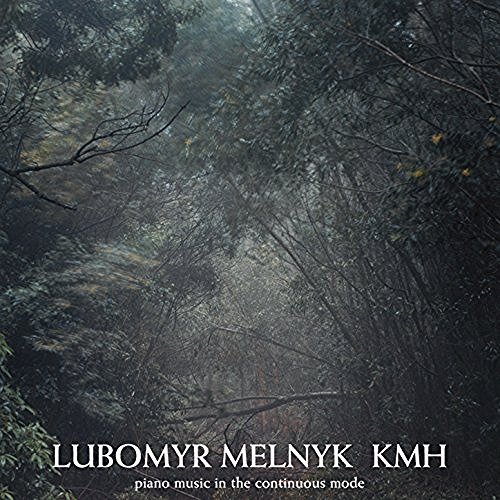
Rather than attempting a comprehensive review of Melnyk’s output (and risking muddying the field) I am simply going to recommend a couple of discs which I have found particularly interesting and may help put this latest release in useful perspective.  The disc which is intended to provide a sort of exposition of his work is KMH.

kmh

The other disc, and the one which I have admired most, is the Lund St. Petri Symphony.  I bought it as a two disc vinyl album and it does not appear to be easily available now but it is well worth seeking (and maybe Sony will consider re-releasing it).

lund

The present release on Sony contains 5 tracks:

Beyond Romance is the first and longest track on the disc (16:12) and is certainly representative of his work.  The composer’s brief notes describe this work only as a grand romantic piece.  It perhaps has echoes of Liszt but certainly with at least an echo of minimalism.

Solitude No. 1 is a much briefer piece (7:36) and is a live improvisation by the composer recorded in the Netherlands.

Sunset (3:49) is the briefest on the disc and is an impressionistic description of its title.

Cloud No. 81 (16:02) is a far more extended impressionistic essay with more harmonic variety than the other tracks.

The title piece, Ilirion (14:12) is another extended essay more akin to the first track.

These discs range from interesting to enthralling for this reviewer and the limited descriptions contained in this release do little to guide the listener.  So I guess I can only say, “Please listen”.

Tracks 1, 3, and 4 were recorded at Clearlight Studios in Winnipeg, Canada.  Track 2 is a live recording from Tilburg, Netherlands and the last track is described as being an archive recording from also from Tilburg.  All were recorded between 2012 and 2015.

The rather sparse liner notes are by one Charles Bettle who is described as a “long time friend and admirer” of Melnyk’s work.  The even sparser notes on the music are by the composer.  The beautiful photography is by Alexandra Kawka.

It is difficult to say why this artist remains as marginally known but, as I have asserted before, artists from Canada get strangely little notice here and Mr. Melnyk does not appear to be a very good publicist.  I hope that this endorsement by Sony results in more releases and, more importantly, in more good studio recordings of his work.  It is unique and highly recommended to aficionados of piano music and minimalism.

Memories and Memorials: Guy Klucevsek’s “Teetering on the Verge of Normalcy”


klucevsek

Starkland ST-225

As someone who grew up attending Polish weddings and hearing more than his share of polka music I was fascinated at the unusual role of the accordion as I began to get interested in new music. People like Pauline Oliveros and Guy Klucevsek completely upended my notions of what this instrument is and what it can do.  The accordion came into being in the early 19th century and was primarily associated with folk and popular musics until the early 20th century.  It has been used by composers as diverse as Tchaikovsky and Paul Hindemith but the developments since the 1960s have taken this folk instrument into realms not even dreamed of by its creators.

guyklu

Guy Klucevsek with some of his accordions

Guy Klucevsek  (1947- ) brought the accordion to the burgeoning New York “downtown” new music scene in the 1970s.  He began his accordion studies in 1955, holds a B.A. in theory and composition from Indiana University of Pennsylvania and an M.A. (also in theory and composition) from the University of Pittsburgh.  He also did post graduate work at the California Institute of the Arts.  His composition teachers have included Morton Subotnick, Gerald Shapiro and Robert Bernat.  He draws creatively on his instrument’s past even as he blazes new trails expanding its possibilities.  The accordion will never be the same.

Klucevsek has worked with most all of the major innovators in new music over the years including Laurie Anderson, Bang on a Can, Brave Combo, Anthony Braxton, Dave Douglas, Bill Frisell, Rahim al Haj, Robin Holcomb, Kepa Junkera, the Kronos Quartet, Natalie Merchant, Present Music, Relâche, Zeitgeist, and John Zorn (who also recorded him on his wonderful Tzadik label).  He has released over 20 albums and maintains an active touring schedule.  He recently completed a residency (April, 2016) at Sausalito’s Headlands Center for the Arts.

transoft

Starkland ST-225

freerange

Starkland ST-209

Starkland has released no fewer than three previous albums by this unusual artist (all of which found their way into my personal collection over the years) including a re-release of his Polka from the Fringe recordings from the early 1990s. This landmark set of new music commissions from some 28 composers helped to redefine the polka (as well as the accordion) in much the same way as Michael Sahl’s 1981 Tango and Robert Moran’s 1976 Waltz projects did for those dance genres.

polkfringe

Starkland ST-218

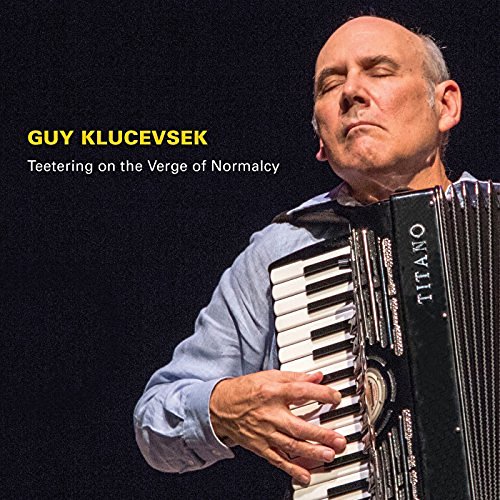
The present recording, Teetering on the Edge of Normalcy (scheduled for release on September 30, 2016), continues this composer/performer’s saga.  His familiar humor and his unique experimentalism remain present but there is also a bittersweet aspect in that most of these compositions are homages and many of the dedicatees have passed from this world.  Klucevsek himself will turn 70 in February of 2017 and it is fitting that he has chosen to release this compilation honoring his colleagues.

On first hearing, many of Klucevsek’s compositions sound simple and straightforward but the complexities lie just beneath the surface.  What sounds like a simple accordion tune is written in complex meters and sometimes maniacal speed.  To be sure there are conservative elements melodically and harmonically but these belie the subversive nature of Klucevsek’s work which put this formerly lowly folk instrument in the forefront with the best of the “downtown” scene described by critics such as Tom Johnson and Kyle Gann.  You might mistake yourself as hearing a traditional music only to find that you had in fact wandered into the universe next door.

Many favorite collaborators have been recruited for this recording.  Most tracks feature the composer with other musicians.  Four tracks feature solo accordion, two are for solo piano and the rest are little chamber groupings from duets to small combos with drum kit.

The first three tracks are duets with the fine violinist Todd Reynolds.  Klucevsek’s playful titles are more evocative than indicative and suggest a framework with which to appreciate the music.  There follows two solo piano tracks ably handled by Alan Bern. Bern (who has collaborated on several albums) and Klucevsek follow on the next track with a duet between them.

Song of Remembrance is one of the more extended pieces on the album featuring the beautiful voice of Kamala Sankaram along with Todd Reynolds and Peggy Kampmeier on piano.  No accordion on this evocative song which had this listener wanting to hear more of Sankaram’s beautiful voice.

The brief but affecting post minimalist Shimmer (In Memory of William Duckworth) for solo accordion is then followed by the longer but equally touching Bob Flath Waltzes with the Angels.  William Duckworth (1943-2012) is generally seen as the inventor of the post-minimalist ethic (with his 1977-8 Time Curve Preludes) and he was, by all reports, a wonderful teacher, writer and composer.  Bob Flath (1928-2014) was philanthropist and supporter of new music who apparently worked closely with Klucevsek.

Tracks 10-12 feature small combos with drum kit.  The first two include (in addition to Klucevsek) Michael Lowenstern on mellifluous bass clarinet with Peter Donovan on bass and Barbara Merjan on drums.  Lowenstern who almost threatens to play klezmer tunes at times sits out on the last of these tracks.   Little Big Top is in memory of film composer Nino Rota and Three Quarter Moon in memory of German theater composer Kurt Weill. These pieces would not be out of place in that bar in Star Wars with their pithy humor that swings. They also evoke a sort of nostalgia for the downtown music scene of the 70s and 80s and the likes of Peter Gordon and even the Lounge Lizards.

The impressionistic Ice Flowers for solo accordion, inspired by ice crystals outside the composer’s window during a particularly harsh winter, is then followed by four more wonderful duets with Todd Reynolds (The Asphalt Orchid is in memory of composer Astor Piazolla) and then the brief, touching For Lars, Again (in memory of Lars Hollmer) to bring this collection to a very satisfying end.  Hollmer (1948-2008) was a Swedish accordionist and composer who died of cancer.

As somber as all of this may sound the recording is actually a pretty upbeat experience with some definitely danceable tracks and some beautiful impressionistic ones.  Like Klucevsek’s previous albums this is a fairly eclectic mix of ideas imbued as much with humor and clever invention as with sorrow and nostalgia.  This is not a retrospective, though that would be another good idea for a release, but it is a nice collection of pieces not previously heard which hold a special significance for the artists involved.  Happily I think we can expect even more from this unique artist in the future.

klucevsek

Guy Klucevsek, looking back but also forward.

The informative gatefold notes by the great Bay Area pianist/producer/radio host Sarah Cahill also suggest the affinity of this east coast boy for the aesthetic of the west coast where he is gratefully embraced and which is never far from his heart (after all he did study at the California Institute of the Arts and has worked with various Bay Area artists). Booklet notes are by the composer and give some personal clues as to the meaning of some of the works herein.  Recordings are by John Kilgore, George Wellington and Bryce Goggin.  Mastering is by the wonderful Silas Brown.  All of this, of course, overseen by Thomas Steenland, executive producer at Starkland.

Fans of new music, Guy Klucevsek, accordions, great sound…you will want this disc.


Stacy Garrop, A New Master of the Orchestra


garrop

Cedille has tended to be very supportive of local artists (they are based in Chicago) and this is a fine example of them hitting a bulls eye.  Stacy Garrop boasts about 20 CDs which include her music and she has, as of 2016, began her career as a freelance composer.  She had taught composition at Chicago’s Roosevelt University from 2000-2016.

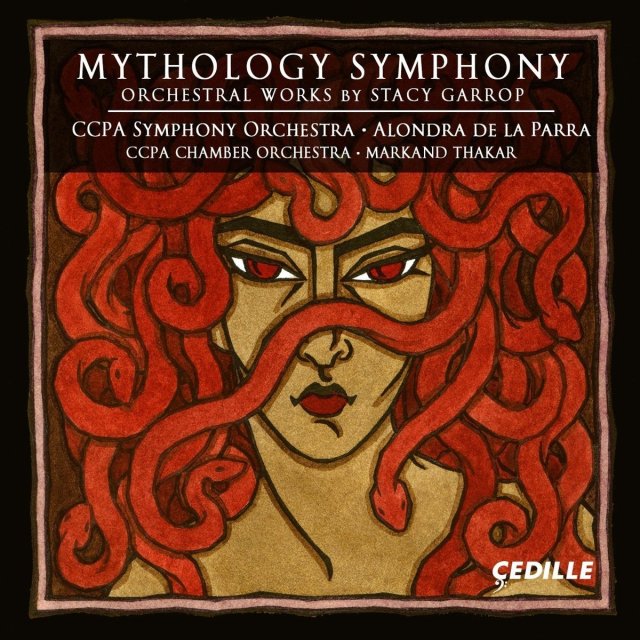
Her name is a new one to this reviewer but one which will remain on my radar.  This stunning disc contains three major works by her, the five movement Mythology Symphony (2007-2014), the three movement Thunderwalker (1999) which was her doctoral dissertation and Shadow (2001).

A quick look at Garrop’s intelligently designed website shows her to be a very prolific composer with works for almost every imaginable ensemble.  Scores and recordings can be ordered from the site.  Garrop earned degrees in music composition at the University of Michigan-Ann Arbor (B.M.), University of Chicago (M.A.), and Indiana University-Bloomington (D.M.).

garrop

The composer at the piano (from the composer’s website)

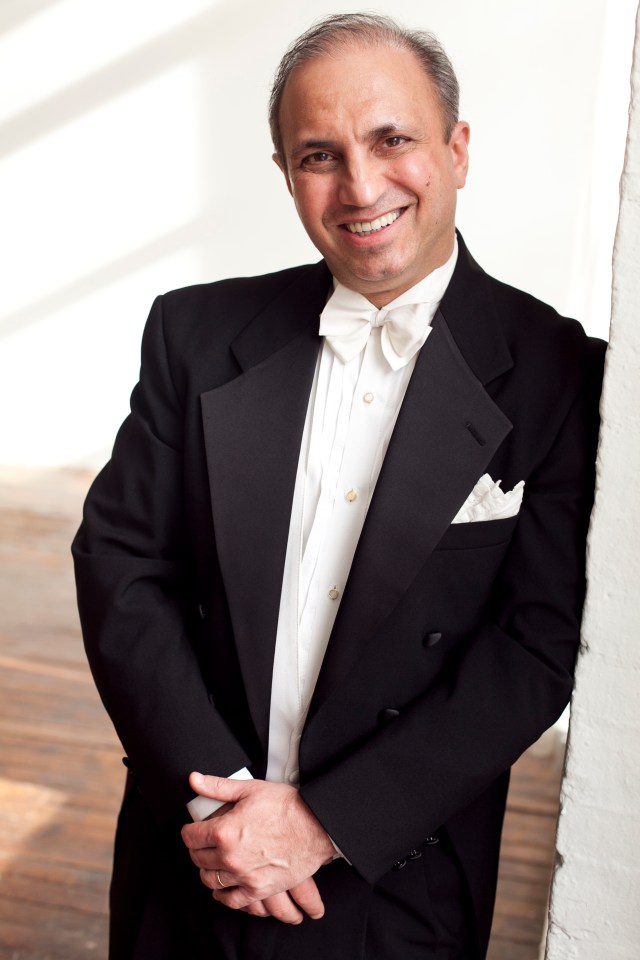
Another of the nice features of this disc is the opportunity to hear the fine musicianship of the Chicago College of Performing Arts Symphony (and their chamber symphony) of Roosevelt University.  Conductors Alondra De La Parra and Markand Thakar are also new to this reviewer but I am glad to be able to acquaint myself with their skills in this recording. Listeners would do well to note these fine artists and to thank Cedille for supporting them. This is a fine example of producer James Ginsburg’s ability to recognize and promote local talent.

alondra_dlp3

Alondra De La Parra (from the conductor’s website)


Markand Thakar photos (c) dennis drenner 2012
www.dennisdrenner.com

Markand Thakar photos (c) dennis drenner 2012

The centerpiece here is, of course, the Mythology Symphony.  Its five movements were composed over several years and the symphony was first performed in its entirety in 2015. One is immediately struck by the directness of the composer’s invention and the elaborate but lucid orchestration.  This work would likely please any concert audience and its color and sense of narrative suggest almost cinematic aspirations.  Indeed Ms. Garrop could undoubtedly write for the screen with her wide ranging palette.

The second work, Thunderwalker, as mentioned above, is Garrop’s doctoral dissertation and the listener will doubtless perceive the fact that her style and skillful handling of the orchestra appear to already have been fully formed in this, her earliest orchestral composition.  The work, which does not have a specific program as does the symphony, still demonstrates the composer’s fascination with the mythological dimension as she weaves classical forms of fugue, pasacaglia and scherzo to describe her imagined image of the Thunderwalker.

Shadow (2001) is described in the notes as a reflection of the composer’s experience at the Yaddo artist colony.  Again her fascination with images to drive the music are present and her style remains remarkably consistent with the other two works on the disc.

The recording was engineered by Bill Maylone at the Benito Juarez Community Academy Performing Arts Center in Chicago.  Graphic design is by Nancy Bieschke with the lovely Medusa cover art by Thalia Took.  The very informative liner notes are by the composer.


Jennie Oh Brown and Friends: Music for Flutes by Joseph Schwantner


jennieoh

Innova 919

At first an all flute album featuring a contemporary composer would seem to be a risky idea at best but this disc of some of Joseph Schwantner‘s flute compositions works very well.  Pulitzer Prize winning Schwantner is no stranger to the concert or recording scene and deservedly so.  He writes a modern, though not terribly experimental, style which works well in the concert hall and on disc.  He won the Pulitzer for his wonderful 1978 Aftertones of Infinity and wrote a substantial guitar concerto championed by Sharon Isbin among many other works.

Jenny Oh Brown is an unfamiliar name to this reviewer but I suspect that will not be the case for long.  This is one talented and charismatic artist and she has recruited some marvelous fellow musicians for this album.  This is not the complete flute music of Mr. Schwantner but it is certainly a very nice representative sampling.

The album starts with Black Anemones (1980), a piece which is pretty much part of the standard flute and piano repertoire now.  The performance of this lyrical post-romantic essay clearly demonstrates why this piece has become popular.  It requires a great deal of skill and virtuosity for both the flautist and the pianist and both musicians handle their roles expertly.

The next three tracks are the separate movements of a piece,, again for flute and piano, called, Looking Back (2009).  The first movement, called Scurry About is a frenetic and virtuosic little romp which gives both musicians ample opportunities to demonstrate their chops.  The second movement, Remembering, is a sort of nostalgic solo flute cadenza and the finale, titled Just Follow brings the work to a satisfying conclusion.

The highlight for this listener, though, is the three movement quartet for flutes, Silver Halo (2007).  No piano here but every member of the flute family pretty much and each gets what sounds like a very satisfying role.

In addition to Jennie the album features Jeffrey Panko on piano, Karin Ursin, flute and piccolo; Janice McDonald, flute and alto flute; and Susan Saylor, flute and bass flute.  This Innova release is a must for fanciers of the flute and of Mr. Schwantner’s music.


The Piano is Calling Me: Nicolas Horvath’s New Music Pilgrimages


Nicolas Horvath Lyon

Nicolas Horvath at the piano in Lyon

I first heard of this young Monacan pianist and composer when a composer friend, David Toub, told me that he was going to program one of this piano pieces.  That piece along with quite a few other performances are available on Nicolas Horvath’s You Tube video channel here.

Horvath developed a strong interest in contemporary music from Gerard Frémy among others and has been programming a great deal of new music ranging from the more familiar such as Philip Glass to a host of others including quite a few pieces written for or premiered by him as well as his own transcriptions and reconstructions.  He is known for his concerts in non-traditional venues with very non-traditional lengths of performance as well as traditional concerts.

His current projects include Night of Minimalism in which he performs continuously for 10-15 hours with a wide variety of minimalist and post-minimalist pieces and Glass Worlds in which he performs the complete solo piano works of Philip Glass (approximately 15 hours) along with pieces by an international list of composers written in tribute to Glass.  He is also an electroacoustic composer (he counts Francois Bayle among his teachers) and a visual artist all with a passion for contemporary works.

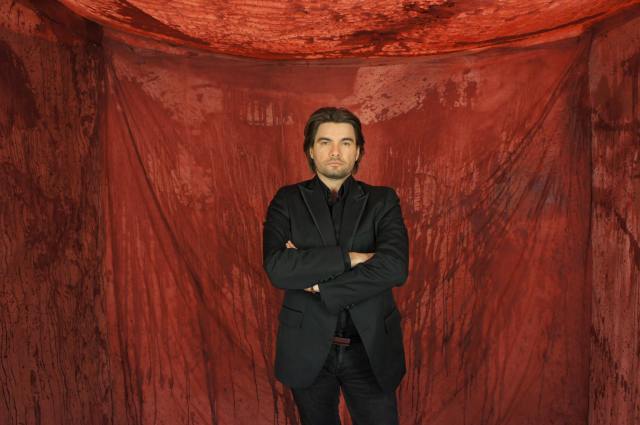
inside my own exhibit

The artist standing in one of his installations.

We had corresponded via e-mail over the last year or so and when I suggested the idea of interviewing him he responded by arranging time after a (traditional length) concert he gave in Minsk, Belarus on December 1, 2014.  I prepared for what I anticipated would be a one hour interview after which I imagined he would probably need to get to sleep.  But when I attempted to wrap up our conversation (at a couple of points) he immediately asked, “Don’t you have any more questions?”.  What followed resulted in approximately three and an half hours of delightful and wide-ranging conversation about this man and his art which he ended with the comment, “I must go, the piano is calling me.”  It appears that his seemingly boundless energy extends well beyond the stage.  The following January (2015) he gave the world premiere performance of all of Philip Glass’ 20 Etudes in none other than Carnegie Hall.

Nicolas Horvath (c) Jean Thierry Boisseau

Horvath with spent score pages as he traverses one of his extended performance ventures. (copyright Jean Therry Boisseau)

Since that time we have continued our correspondence and this affable, patient young artist continues on various projects and no sign of his interest or energy waning.  He recently sent me various photos of him in various settings pursuing his varied artistic interests for this article.

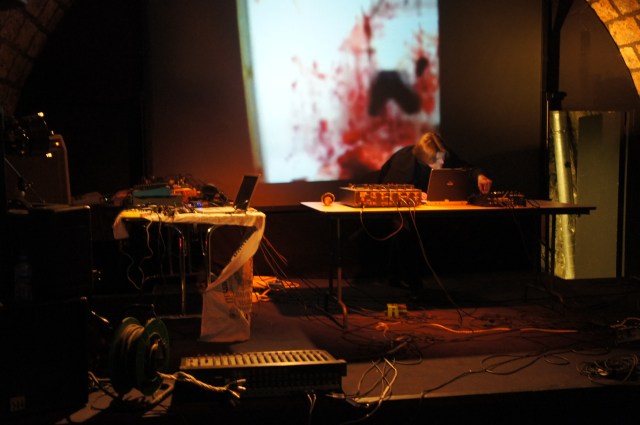
SONY DSC

Composer as well as performer in an electroacoustic performance without piano.

Horvath was born in Monaco in 1977.  He studied piano at the Académie de Musique Rainier III de Monaco and the École  Normale de Musique de Paris.  At 16, Lawrence Foster took notice of him in a concert and, securing a three year scholarship for him from the Princess Grace Foundation, was able to invite him to the Aspen Music Festival. After his studies in the École Normale de Musique in Paris, he worked for three years with
Bruno-Léonardo Gelber, Gérard Frémy who instilled in him a sensitivity to music of our time as well as Eric Heidsieck, Gabriel Tacchino, Nelson Delle-Vigne, Philippe Entremont and Oxana Yablonskaya. Leslie Howard got to know him and invited him to perform before the Liszt Society in the United Kingdom. He has been playing professionally for 7 years and puts his own characteristic style into his productions and performances.

In a move reminiscent of Terry Riley’s all night solo improv fests Horvath has performed several lengthy programs.  He has performed Erik Satie’s proto-minimalist Vexations (1893) in performances that ranged widely in length. One notable performance at the Palais de Tokyo lasted 35 hours, the longest solo piano performance on record as far as I can determine.  Previously this piece has been performed by tag teams of pianists (the first in 1967 in New York was curated by John Cage) to perform the 840 repetitions of the piece whose tempo or recommended duration is not specified.  Horvath, taking on a musicological mantle is preparing his own edition of this unique work.  He has published an 24 hour version on his You Tube channel here.

Given his intense schedule and vast repertoire he has been remarkably responsive and has an irrepressibly strong appetite for new music.  He tells me that he had worked on a project in which he planned to play all the piano music of the French composer Jean Catoire (1923-2005),  some 35 hours of material (in a single program, of course). Unfortunately that composer’s relative obscurity seems to have resulted  in insufficient support for the project which is, for now, on hold.  Here’s hoping that this can be realized sometime soon.

Horvath’s fascination with authenticity, completeness and performances of unconventional lengths uninterrupted by applause where audiences are invited to lay on the floor with blankets and sleeping bags and approach the piano seems unusual but he has been getting enthusiastic audiences and has enjoyed overflow crowds.  Like Terry Riley and perhaps even some of Keith Jarrett’s solo concerts there is a ritual feel to these marathon performances.  Regrettably I have not yet been able to attend one but I would love to partake in what must be a powerful shared experience.  He invites people to come to the piano and to watch, look at the score.  It is unlike the conventional recital and therein lies some of its charm.  At least one of his videos features a small sign which reads, “Don’t feed the pianist” and attests to his warmth and wonderful sense of humor.

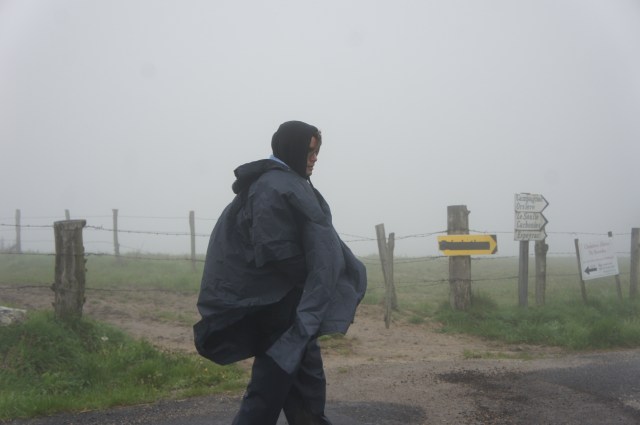
His passion has parallels in his spirituality and he has pursued sacred pilgrimages which require a great deal of time and energy but without doubt fill a very deep and sincere need. More details and photos are available on his blog.  And, as with music, he is very open to discussing this very personal aspect of his life.

SONY DSC

The artist braving the elements on one of his pilgrimages.

There are conventional two hour with intermission style recitals in more conventional concert venues that he has played and Horvath also enjoys playing with an orchestra.  His performances of both of Philip Glass’ piano concertos can be viewed on You Tube and you can see the intensity of his execution.  This came through in the course of our interview as well when Mr. Horvath would speak of the music and then verbally imitate the rhythms (no doubt endlessly practiced) which drive his enthusiasm.  The music seems to be deeply integrated into his very being.

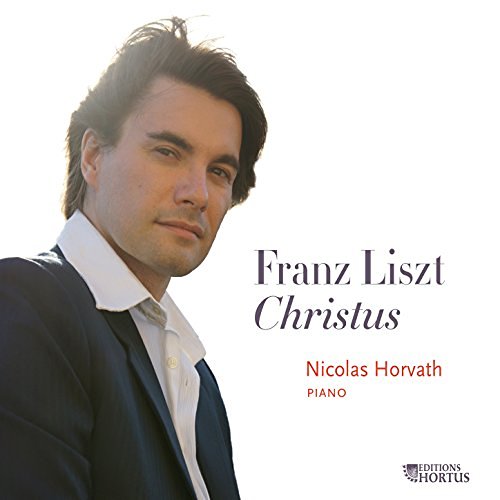
His first solo commercial recording was released in 2012.  It consists of Franz Liszt’s ‘Christus’, an oratorio composed in 1862-66 for narrator, soloists, chorus and orchestra.  Horvath plays a piano reduction done by the composer.  This is the first known recording of this unique and virtuosic set of piano works.  It is certainly an unusual choice for a debut recording but it is consistent with his very personal tastes.  (He lists Scriabin and Chopin as among his favorite composers.).   He is in the process of recording all of Philip Glass’ piano music for Grand Piano records distributed by Naxos.  At the time of this writing four well-received volumes have been released.  He is also planning to record all of Satie’s piano music and he has just recently released his rendition of Cornelius Cardew’s indeterminate masterpiece, Treatise.

I have seldom encountered a musician with such intensity and drive.  He is also one of the most skilled in using the internet to promote himself and his projects.  And though this is no doubt a man with a considerable ego he is in fact very unpretentious and very genuinely turned on, driven by the music itself.  Don’t get me wrong, he is concerned with developing his image and career but he seems happy to be doing the work he has been doing and he is, like any really good musician, self-critical and a perfectionist.

A quick look at his YouTube channel here reveals some of the range of his interests which include the standard repertoire along with interest in contemporary works.  Just released is a creative video with Horvath playing Glass’ Morning Passages while he apparently experiences a reverie involving a beautiful woman which could have been on MTV at its height.  Perhaps he is even channeling Oscar Levant who embraced roles in films along with his pianistic talents.  His website is a good resource for updates on his various projects and performances.

c _______ ______

Focused concentration at the keyboard.

As of the time of this writing his discography includes:

horvathchristus

Hortus Records 100 (2012)

A very unusual choice for a debut recording.  Nonetheless this is a distinctive recording which reflects the virtuosity as well as the careful scholarship which continues to characterize his work.  He managed to locate a couple of previously lost pieces in this set of composer transcriptions.  One also can’t miss the spiritual dimension here, as close to his heart as music and an equally important aspect of his personality.

glassw1

Grand Piano GP 677 (2015)

This first disc in the series manages to provide the listener with truly inspired interpretations of Glass’ keyboard oeuvre and gives us a world premiere recording of How Now as well.

glassw2

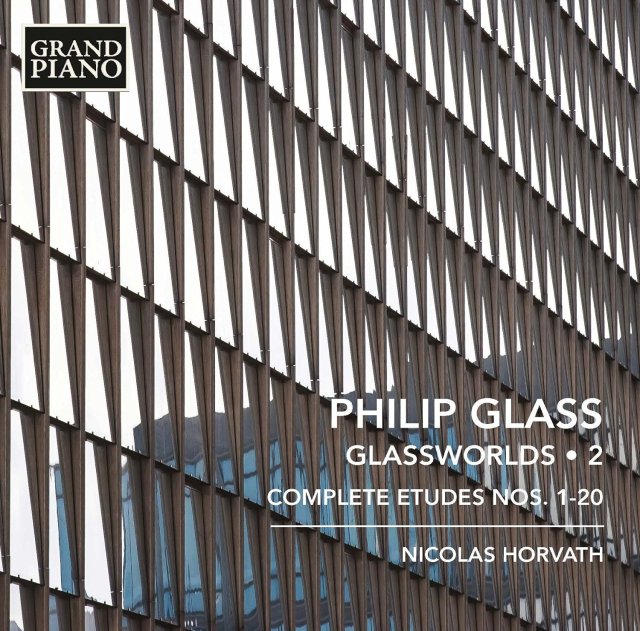
Grand Piano GP 690 (2015)

The complete Piano Etudes by the man who premiered the set at Carnegie Hall.  These etudes were also recorded by the wonderful Maki Namekawa and the opportunity to hear these really different takes is positively revelatory.

glassw3

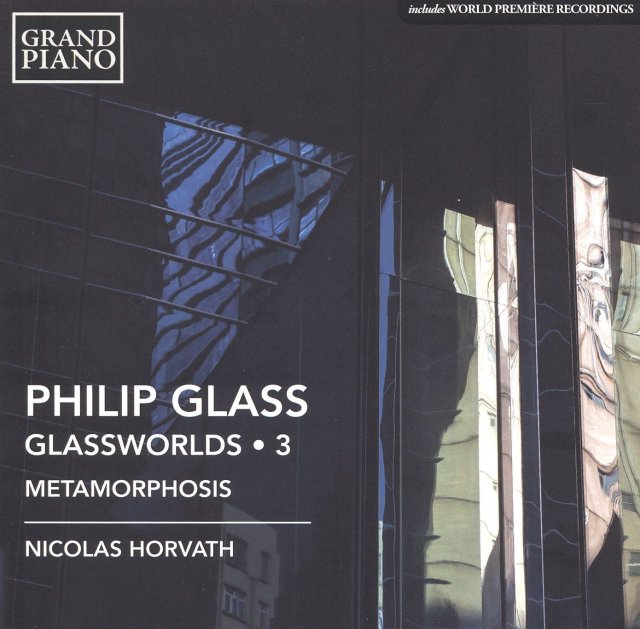
Grand Piano GP 691 (2016)

The third disc in the traversal of Glass’ piano music (original and transcribed) also offers world premieres.  Horvath’s inclusion of Glass’ early Sonatina No. 2 reflects his work under the tutelage of Darius Milhaud and provides insight into the composer’s early development before he developed his more familiar mature style.

glassw4

Grand Piano GP 692 (2016)

Haven’t yet heard this disc but I have in queued for ordering in the next few weeks.

acedia

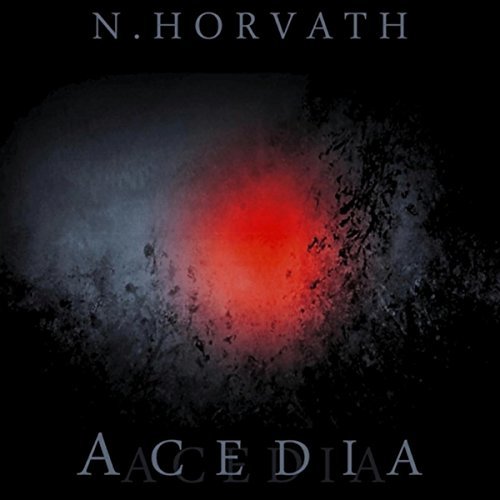
Demerara Records (2016)

Haven’t heard this one yet either but, again, it’s in my Amazon shopping cart.


horvathcardewtreat

Horvath’s interpretation of this important work by Cornelius Cardew

Cornelius Cardew (1936-1981) was sort of England’s John Cage, a major voice in 20th Century experimental music.  Scholarship has yet to do justice to the late composer’s work but this disc is an important contribution toward that end..

Horvath’s career is characterized by innovation and passion combined with astute scholarship and a keen sense of what is new and interesting in music  while clearly being schooled in the classic repertoire.  The piano calls him as do his other passions and I highly recommend paying attention as he answers those calls.  He is truly an artist to watch.
N.B.  Mr. Horvath generously read and approved an advance draft of this article shortly after arriving in the United States for concerts at Steinway Hall in Rockville with a Chopin program and a recital at The Spectrum in New York City which will include two pieces written for him by Michael Vincent Waller along with some Chopin pieces.

New Cello Music: Michael Nicolas’ Transitions


nicolastrans

Michael Nicolas is the new cellist of Brooklyn Rider as well as member of the International Contemporary Ensemble and numerous other affiliations.  This French Canadian/Taiwanese young man now residing in New York is definitely an emerging artist to watch and his debut album does much to demonstrate why he deserves serious attention.

This selection of mid/late twentieth and twenty first century cello pieces comprises an intelligent survey of this repertoire introducing new music and providing a younger performer’s take on some classics of solo cello with electronics as well some more recent works.  As he says in his liner notes this survey is concerned with the dichotomy between the solo instrument and the attendant electronics in various guises (even the quasi-Max Headroom cover art seems to reflect this).  Erin Baiano did the photography and Caleb Nei did the graphic design.  If I have a criticism of this fine album it is perhaps that the liner notes provide less detail than this listener prefers so I have tried to provide a few details here.

Beginning with Mario Davidovsky‘s classic Synchronisms No. 3 (1964) for cello and electronic sounds (one of twelve such works for solo instrument with electronics) and continuing with Steve Reich‘s Cello Counterpoint (2003) Nicolas begins his survey with two relatively well-known pieces in this genre and he certainly does them justice.  These pieces serve as Nicolas’ sort of homage to the past which he follows with some very current compositions.

He introduces some pieces unfamiliar to this writer.  David Fulmer‘s Speak of the Spring (2015) is a piece for solo cello with electronics.  Fulmer is a composer/performer apparently worth watching from a quick read of his web site.  As I was unable to determine the date of composition I contacted the composer who graciously responded despite his busy travel schedule: “The work was written last year, in 2015 specifically for Michael Nicolas and this particular project (cello and electronics). Michael had asked me for a piece for his recording project, and having known him (we went to school together) for many years, and admiring his playing so much, I was very interested in writing this piece for him. As for perspective…as a string player, I always enjoy writing string works. I’m interested in the beautiful timbres that the strings have. Tuning is also an important concept for me; at the end of the work, the cello electronics (pre-recorded cello) is scordatura.All of the prerecorded lines are recorded by Michael. I see this as a work written for Michael, played by Michael, and many versions of Michael.”

Next are two pieces by Annie Gosfield for cello and sampler.  Four Roses (1997) and “…and a Five Spot” (2015, commissioned by Nicolas as a companion to the former).  Both pieces are basically lyrical with spectral effects, microtonal passages, extended techniques and the samples of course.  The first piece is more assertive and direct while the second seems more introspective.  Both appear to be typical of Gosfield’s fully developed style.

Next up is a piece by the Icelandic composer Anna Thorvaldsdottir whose album length “In the Light of Air” performed by ICE was reviewed here.  Her piece on this disc for solo cello and electronics Transitions (2015) has a similarly ethereal character but one gets the impression that her approachable style belies complexities that underlie her work.

The last piece is flexura (2015) by Jaime E. Oliver La Rosa, a Peruvian born composer now working in New York.  This piece functions almost like a bookend with the Davidovsky piece that opens this disc (Davidovsky also comes from South America having been born in Argentina).  La Rosa holds a PhD. in computer music from the University of California San Diego and is developing open source software (and hardware) for live performance.  His MANO controller can be seen in the video on his website.  This last piece inhabits a similar sound world to that of the Davidovsky.  It is thorny and modern sounding and works as a showcase for the cellist.  Strictly speaking I suppose this piece is more of a duet in that there are two musicians required to perform it.

As always the impeccable production by Sono Luminus makes for a wonderful listening experience and this is quite an impressive debut for this interesting young musician. Kudos to producer Dan Mercurio recording technician David Angell  and executive producer Collin J. Rae.

Perhaps I am premature in saying this but this release has the earmarks of a being classic survey of the current status of this genre.  One of the joys of such a project is to hear new interpretations of established works and to hear an intelligent selection of new pieces.  Definitely want to hear more from Mr. Nicolas as well as from the composers represented.


Rhys Chatham’s Pythagorean Dream


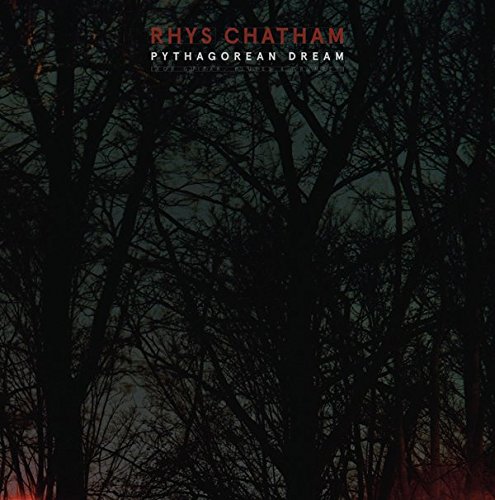
pythdream

Foom FM007CD

Rhys Chatham is responsible for one of my most read posts, the fabulous Secret Rose performance reviewed here and here.  An album released around the same time is reviewed here.  These reviews reflect the music most people think of when they hear Chatham’s name: alternate tunings, large groups of multiple guitars, sometimes groups of brass and woodwinds (Chatham plays trumpet and flutes as well) in a sort of wall of sound.

For this release Chatham has chosen to go solo, sort of.  In Pythagorean Dream he uses digital delay in a real time performance allowing him to achieve a similar sound world while maintaining control over the performance in the manner of a solo performer.

Regardless of the instrumentation Chatham has always been interesting and that has not changed in this release.  He uses Pythagorean tuning (hence the title) in this work which is split over three tracks for a total of about 55 minutes of impressionistic musings in the key of Pythagoras, so to speak.

The first track has some trumpet sounds softly at the beginning but focuses on the electric guitar building his choirs of instrumental sounds using his effects pedal.  This is the familiar Chatham multiple guitar sound.  The second track presents his musings with flute, alto flute and bass flute with a guitar cadenza.  Here he reminds this listener at times of the work of LaMonte Young with sustained tones and then plays some jazz like riffs over these before the final cadenza with the guitar.  The third track, according to the liner notes, is the whole of the brass intro to the piece and is presented as a “bonus track” and is entitled Whitechapel Brass Variations. This track, unlike the previous two, is a live (as opposed to studio) performance and is a good opportunity to hear Chatham’s skill with trumpet.  It is a fearless performance.  He manages to pursue his experiments without sounding experimental.

The overall effect of this piece, with drones, hints of free jazz and memories of minimalism is mesmerizing and appears to be the next logical step in his development as a composer and performer.  A few years ago Tony Conrad released an album inspired by the same tuning system and called that album, “Slapping Pythagoras”.  Chatham, by contrast, seems more concerned with soothing him.

The brief but informative liner notes are by the composer and the recording is lucid with Chatham doing the engineering and the mastering.  This album is a must for all Rhys Chatham fans and a nice intro to his current work for those who have not heard this important composer’s work..

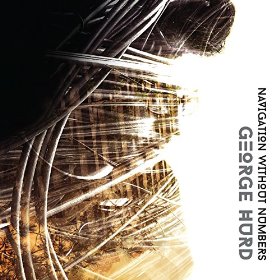
Navigation Without Numbers: George Hurd and his ensemble


george hurd

The San Francisco Bay Area is a rich and varied musical scene with a plethora of talented and creative musicians.  Given that I am not surprised and perhaps just a touch chagrined to not have heard of George Hurd.  After a bit of research I learned that this is his debut album so I guess I feel better.

George_01-681x1024

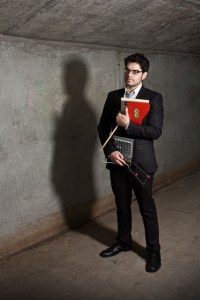
George Hurd (promotional photo)

For an emerging composer he is well represented by his web page referenced above and another for the George Hurd Ensemble.  Like Philip Glass, Steve Reich and many others he is taking the composer/performer route which is certainly a better guarantee of getting one’s music performed and performed well.

Hurd is also a promoter of an interesting gaggle of other musicians and musical organizations as well and while this is his debut recording Hurd has a significant history of success and a composer, performer and arts administrator.

Now to the album at hand.  Navigation Without Numbers consists of 11 tracks of chamber music with electronics, electroacoustic music.  Each is an individual piece but they seem to create a unity and this listener’s experience was that of a soundtrack to a film yet to be made.  Indeed Hurd has written a few film scores as well.

The musicians are: Solenn Suguillon, violin; Jacob Hansen-Joseph, viola (and stomping); Erin Wang, cello; Ari Gorman, double bass; Elyse Weakley, piano; Annie Phillips, bass clarinet; Adam Murray, violin; Andrew  McGuire, vibes; Anton Estaniel, cello; Theresa Au-Stephen, violin; Jason Hallowed, viola; Anna Steinhoff, cello; Alana Grelyak, piano; Stephanie Wallace, harp; Katie Weigman, vibes; George Hurd, electronics with Anna Singer and Joseph Voves, stomping and clapping.  There is also an appearance by well known bay area violinist Carla Kihlstedt appearing on the fourth track.

There are no liner notes here so one is left only to one’s ear and heart to extract meaning and significance from these compositions.  To this writer’s ear it seems to be a combination of gypsy influence and jazz at times in a tonal context with an almost dance like feel at times.  This is not background music but it can be enjoyed with varying degrees of attention.  By that I mean that the music is assertive enough to be useless as Muzak which requires little attention and perhaps even none and that it benefits from closer attention and multiple hearings.  The overall experience is perhaps that of a good chamber group entertaining a knowledgeable clientele at a hip coffee shop.  Not your run of the mill classical, not exactly jazz but a very pleasant album.


Pictures at a Post-Minimalist Exhibition: Eighth Blackbird’s Hand Eye


handeye

Eighth Blackbird is Chicago’s more than adequate answer to New York’s Bang on a Can and this album is solid proof of that.  The liner notes tell us that this is “a collection inspired by a collection” and these 9 tracks are sonic impressions by the individual composers of an art exhibit.  The end result is very much like the romantic/impressionistic Mussourgsky gem updated to the post-minimalist era.

It is well worth your time to check out the artwork which inspired this music (here) and this writer imagines that this piece could really work well as a film score, a DVD perhaps of these images.  The music invokes various minimalist and post-minimalist composers and styles.  It is almost a sonic tour of post-minimalism.  And apparently there are plans for a multimedia tour of this piece as well.  Sounds like a wonderful idea.

This album is the work of a composer’s collective called Sleeping Giant and consists of Timo Andres, Andrew Norman, Robert Honstein, Christopher Cerrone, Ted Hearne and Jacob Cooper.  Each has chosen a selection of art to which they wrote a piece of music providing their musical impressions.  The result is a remarkably coherent set of pieces which, while each different, seem to flow into a unity.

Casual listeners may be familiar with the names of Timo Andres or Andrew Norman but all these composers are basically new to these ears and it appears to be a talented lot that deserves some serious attention as they may very well be THE ones to watch/listen to in the coming years. They utilize a variety of techniques in their compositions but there is never a feeling of this being experimental or tentative.  These are fully fleshed out works by master composers.

The music is appealing immediately upon first listen.  One hears the influences of Terry Riley here, John Adams there, David Lang, etc.  In short these pieces are informed by the preceding generations of minimalists much as they also address their debt and do honor to their mentors.  It has some of the character of Lang’s “Child” in that this is essentially a suite of pieces of post-minimalist chamber music (though this music has an almost symphonic quality at times).

The recording is superb and up to the high standards of Cedille releases and the musicianship, as always, is superb.  The liner notes by Sleeping Giant along with Tim Munro are lucid and the album design by Karl Jensen is eye-poppingly psychedelic.  This project was funded by the Maxine and Stuart Frankel Foundation for the Great Lakes Chamber Music Festival, Carnegie Hall, the Andrew W. Mellon and the Texas Performing Arts at the University of Texas at Austin.


Poems to Sing at Night, New Piano Music by Brian Buch


buch

This is the second album by composer/pianist Brian Buch.  He holds a B.M. in composition with emphasis in piano performance from Indiana University and a Doctorate from Boston University.

He studied composition with a variety of notable teachers including Don Freund, P.Q. Phan, Sven-David Sandstrøm, Nancy van de Vate, Sam Headrick and Richard Cornell.  He lists his mentor as Alla Cohen, a name unfamiliar to this writer but no doubt a significant teacher and composer.

This album was released in 2015 and contains tracks comprising 5 compositions with multiple movements.  These represent a small portion of his output which apparently includes music for various ensembles including vocal, orchestral and chamber music.  All the pieces on the present album were written between 2014 and 2015.

These seem to be very personal pieces and the poetic titles reflect a sort of post-romantic style reminiscent of Bartok and Scriabin and perhaps even Debussy. This music benefits from multiple hearings and his performances are engaging and, no doubt, definitive. His muscular and assertive playing matches the poetic intensity of the music.

Poems to Sing at Night 1 and 2 both have poems which are to be recited before each performance though that is not done on the recording for some reason.  Both pieces are in four distinct movements while all the others are in three movements.

One hears jazz and classical influences here and the medium is basically tonal.He is not afraid of dissonance and unusual harmonies but the listener need not fear either because the music is always listenable.

John Weston recorded and engineered this album which was recorded in April, 2015 at the Futura Studios in Roslindale, MA.  The sound is warm and lucid.

In some ways this album seems to hearken back to the romantic composer/performer of the 19th century with its very personal style and poetic rather than classical forms.  This young man (b. 1984) has established and is developing a very personal style which bears watching/listening.  Very enjoyable album.


Spektral Quartet, Serious Business


spektral

OK, bear with me here for just a moment.  The proliferation of string quartets (and by that I mean the grouping of musicians as a performing entity) has been positively dizzying over the last 30 years.  For those who grew up with the standard Julliard Quartet, Guarneri Quartet, etc. there were just a few outstanding names in this genre.  However since the advent of the new quartets like Kronos and then Turtle Island, Arditti,etc. the field has expanded rather prolifically. Couple this with a boom in string quartet writing notably Elliot Sharp, John Zorn, Wolfgang Rihm. Elliot Carter, Peter Maxwell-Davies, Ben Johnston among many others and I was filled with some trepidation upon receiving this disc for review.  I mean, how many things can you do with a string quartet?

Apparently there is a great deal more to be explored in this genre.  I am happy to say that these folks are up to the task as are the composers whose work they present.  Serious Business is some seriously interesting music performed with serious skill by this new quartet, the Spektral Quartet.  They are the string quartet in residence at the University of Chicago, itself a venerable place for new music.

We start here with a piece by Sky Macklay called Many Many Cadences (2014) a piece that seems to come from a similar place to that of the work of Conlon Nancarrow with intricate rhythms within a somewhat conservative tonal idiom.  The title is suggestive of Gertrude Stein (Many, Many Women).  It was commissioned for the Spektral Quartet by the Walden School.  The piece is immediately engaging and ultimately satisfying.

The second piece, The Ancestral Mousetrap (2014) by David Reminick features a less common use of a string quartet in that there is a vocal component. This is not the vocalist component pioneered by Schoenberg in his second quartet.  These vocalizations are performed by the quartet.  This is no simple feat either because the vocal writing is itself a challenge in its rhythmic complexity.  The piece resembles a little opera and indeed the text by poet Russell Edson is here called a libretto.  This piece was commissioned by the Spektral Quartet.

The third piece here is an unusual choice (and the only one not commissioned for the Spektral Quartet) which is explored in the liner notes .  Haydn’s Quartet Op. 33 No. 2, subtitled “The Joke” is one of the relatively few examples of attempts at program music (vs absolute music) to be found in the classical era.  First, no one will buy this disc just for the Haydn. Second, many collectors will already have this Haydn piece in their collection.  But with that said this is a lovely performance of one of the emblematic pieces of music that created the need for the performing ensemble known as the string quartet and it is a lovely performance as well.  I will leave it to other listeners to read the program notes and get into the rationale about its inclusion here.

The final piece, Hack (2015) by Chris Fisher-Lochead is perhaps the most unusual of the lot in that the composer uses vocal inflections by a collection of comedians (yes, comedians) as the source for his rhythmic and melodic contours and creates 22 separate pieces about 16 comedians (some get more than one piece).  This piece requires more concentration by the listener but, like any well-written piece, it reveals more of itself with repeated listenings.  The Barlow Endowment at Brigham Young University commissioned this piece for the Spektral Quartet.

The Spektral Quartet is Clara Lyon, violin; Austin Wulliman, violin; Doyle Armbrust, viola; Russell Rollen, cello.  The recording, as with every Sono Luminus release I’ve heard is glorious and lucid.

Paula Matthusen’s Pieces for People


matthusen

This is the first disc devoted entirely to the music of Paula Matthusen who as of July is a newly minted associate professor at Wesleyan University where she walks at least partly in the footsteps of emeritus professor Alvin Lucier whose course Music 109 she inherited from him.  I had the pleasure of meeting Ms. Matthusen at Other Minds 18 where she was one of the featured composers.  In our all too brief conversation she was affable and unpretentious but certainly passionate about music.

Paula Matthusen

Paula Matthusen performing her work, ‘…and believing in…’ at Other Minds in 2013


She holds a B.M. from the University of Wisconsin and an M.A. and PhD. from New York University.  She announced her recent promotion to associate professor on Facebook as is, I suppose, customary for people of her generation.  It is on Facebook that I contacted her to request a review copy of this CD to which she quickly and graciously agreed.

This CD contains 9 tracks representing 8 works.  They range from solo to small ensemble works, some with electronics as well.  Her musical ideas seem to have much in common with her emeritus colleague Alvin Lucier but her sound world is her own despite some similarities in techniques, especially her attention to sonic spaces and her use of electronics to amplify sonic micro-events which might even include her heartbeat.


sparrows in supermarkets (2011) for recorder looks at the sound of birds in the acoustic space of a supermarket and their melodic repetition.  It is for recorder (Terri Hron) and electronics

limerance (2008) is another solo work, this time for banjo (James Moore) with electronics.  She says she is working with the concept of reciprocation here but that seems rather a subjective construct.  Like the previous piece this is a contemplative and spare work with some spectral sounds as well.

the days are nouns (2013) is for soprano and percussion ensemble and electronics.  Here she is concerned with resonances within the vibrators of the instruments as well as the acoustics of the room.  It is a dreamy, impressionistic setting of a poem by Naomi Shihab Nye whose poem supplies the title but the text is fragments of a Norwegian table prayer.  A very subtle and effective work.

AEG (2011) is represented by two movements (of four?) all of which were written for the Estonian ballet.  It is similarly concerned with resonances and words at times.  Of course it would be interesting to hear those other movements but perhaps another time.

of architecture and accumulation (2012) is the first of two purely acoustic compositions on this disc.  This one is for organ solo (Will Smith) and explores long tones within the acoustic space.  It is a very satisfying work even if one doesn’t go into the underlying complexities.

corpo/Cage (2009) is  the longest and largest work here and is the second purely acoustic piece on this recording.  It has echoes of Stravinsky at and it is an enticing example of Matthusen’s writing for orchestra.  This reviewer certainly looks forward to hearing more of this composer’s works for larger ensembles.  Very effective writing.

in absentia (2008) is the earliest work here.  It is written for violin, piano, glasses and miniature electronics (not quite sure what that means).  Like many of the works on this disc the concern or focus seems to be on small events and sounds.  This is a rather contemplative piece that nicely rounds out the recording.

Matthusen resembles Lucier in some of her techniques and focus on small sounds otherwise missed and she certainly owes a debt to people like Pauline Oliveros.  But in truth she sounds like no one as much as Paula Matthusen.  The composer presents a strong and intelligent voice and one wishes for more from this interesting artist.  Thank you for the opportunity to review this.

Pounding on History: Joseph Bertolozzi Literally Plays the Eiffel Tower


delatour

I recall a video from the 90s featuring percussionist David van Tieghem manically going down a street in Manhattan playing pretty much every object in his reach (fire plugs, phone booths, etc.) and that serves to create my mindset for the understanding the present recording.  Now this recording is more site specific and all music is site specific in the sense that each performance is unique by virtue of the acoustics, the time/day of the performance, the audience, etc. but this recording is pretty unique.  I mean, this band can’t travel.

Following in the spirit of R. Murray Schaefer’s huge environmental concepts, Pauline Oliveros’s deep listening ideas and even inspiration from David van Tieghem and perhaps the wild energy of Han Benink as well this is album is actually a sort of sequel to a previous effort, 2009’s Bridge Music (written for/on the Franklin Delano Roosevelt Bridge).  I have not heard the former album but the compositional techniques appear to have been similar in both the former and present album.  He explores the sounds he can make with various mallets and samples them into a computer for later use.

bridgemus

What prevents this Tower Music from becoming ordinary is the extraordinary inventiveness of his Bertolozzi‘s compositions.  This is not just a catalog of “where I’ve banged the tower” but rather a loving sound portrait derived from the sonic possibilities of a major architectural landmark making creative use of the famed tower’s utterances unleashed by the composer/performer’s experiments.  Having found and extracted a huge catalog of tuned and untuned sounds from months of experimentation and recording the composer has assembled a very interesting set of pieces that hold the attention well.

There are ten tracks in total, the last being an audio tour of the Eiffel Tower (without pounding).  The musical tracks run from 49 seconds to about 11 minutes and all are given fanciful titles sometimes related to the area being played.

In addition to being a set of compositions it is also a sort of sonic portrait unique as DNA to the structure from which it has been extracted and upon which it is played.  One can envision an ongoing project of more such sonic portraits.  It works on both these levels. There are plans for live performances in the works at the time of this recording’s publication..

Leave it to Innova in their ongoing search for the mavericks.  They have found one here. This appears to be a labor of love from it’s conception to it’s recording and presentation here including the package design and liner notes.  And now who knows what other structures are laying about with sonic possibilities yet to be heard?

Warning: Gentle Music, Marti Epstein’s Hypnagogia


epstein

When Marti Epstein kindly sent this disc to me for review she “warned” me that it was gentle music.  In her liner notes she elaborates that her Midwestern roots will always inform her work.  As fellow Midwesterner (I hail originally from Chicago) I have an idea what she means.  There is a certain gentle affability which seems to characterize folks from the Midwest and no doubt this affects artist expression as well.

epsteinm

Marti Epstein

This disc contains four such gentle compositions ranging from Grand Island (1986) to A Little Celestial Tenderness (2013).  As such it is a cross-section of Epstein’s work though it is hard to say, of course, if it is an accurate picture or overview.

The first piece Hothouse (2000) is a piece for two pianos which works on a couple of levels. It is quite listenable as a concert piece and seems to be a very effective way of using short phrases replaced by silences as a valid compositional technique.  Loosely interlocking phrases are replaced by silences gradually which lull the listener to the conclusion.

The second track is Grand Island (1986) which is the composer’s depiction of a drive to the city of Grand Island in Nebraska.  This piece for piano, two harps and two percussionists is complex enough to require a conductor (Jeffrey Means) but the complexity does not make for difficult listening.  Rather this is an impressionistic audio narrative of the composer’s experience driving through the Midwest as a child.  It has a very similar character to the first piece with silence being very important to the texture which fades to silence as the journey ends and perhaps the restless child has fallen asleep.

A Little Celestial Tenderness (2013), the most recent on the disc, comes in at under two minutes and evokes Copland-like harmonies in a “tiny” piece written in honor of the 10th anniversary of the Ludovico Ensemble who perform the music on this disc (the composer plays one of the pianos on Hothouse).  The unusual instrumentation here is flute, clarinet and cimbalom.

Hypnagogia (2009) is the most experimental music here and is very much the star of this release.  It exists only in parts with no unified score and asks the performers to perform as if they were alone.  It is an attempt to depict the state of mind between waking and sleeping.  This piece is more concerned with sound than silence and the mobile-like appearances of the sounds does create a dream-like texture which, as warned, is also very gentle but not without a touch of anxiety at times.  It is perhaps the most substantial (over 45 minutes), striking and successful piece on the disc and brings it to very satisfying conclusion.

The recording has a warmth and presence and the musicians seem well-suited to the tasks at hand.  This writer will be pleased to hear more from these artists in the future.


New and Newer Music for Flute and Piano


nataraja

New Focus FCR154

This is a curious collection of flute and piano music.  It is framed by two pieces from the late great Jonathan Harvey (1939-2012), one by Elliott Carter and a collection of world premiere recordings by composers far less familiar and markedly different in style.

The premieres are all by living composers (Josh Levine, Christopher Dietz, C.R. Kasprzsyk and Sam Pluta).  Now these are all fine compositions but their style is so very different from the Harvey and Carter pieces that it is almost jarring to the listener.  This living set of composers is represented by a far more conservative compositional ethic (please don’t read that as a negative) than the older, more modernist pieces which frame their efforts here.

Of course only time will tell the eventual place of these works in the annals of musical history but the fact here is that we have two towering works by Harvey, a tasty bit of one of Carter’s lesser known works and essentially unheard works from a gaggle of newcomers. The listener just has to be prepared to switch gears.

The performances are beautiful and loving throughout.  The Harvey pieces truly stand out as the masterpieces they are as does the Carter.  Curiously Carter (1908-2012) has been somewhat maligned since his passing for reasons that defy logic but I am glad that this late Carter piece was included.

This is a lovely recording and performance.  The juxtaposition of the modernist pieces framing the neo-romantic pieces by the younger composers is striking but stick with it. The pleasures of this recording are in the loving and committed performances as well as the recording itself which is quite lucid.

Conor Nelson on flute and Thomas Rosenkranz, piano are new names to me but I will keep them in mind having heard what they have done here.  The ear who made this recording so listenable was Ryan Miller, the recording engineer.

Sound and Savor, a Phoenix Rises from Hallowed Ashes


soundsav5160009

Chef and host Philip Gelb (right) presides as Mark Dresser (left) and Ben Goldberg (center) prepare to play at Sound and Savor

Last year I wrote an article (here) which lamented the demise of a bay area series which I have attended pretty regularly for the last several years.  Well the series is back and it has been renamed and reconstituted.  The West Oakland venue is the same and the ever creative chef has created another incarnation of one of my favorite reasons to be in the East Bay.  I greet the debut of Sound and Savor.

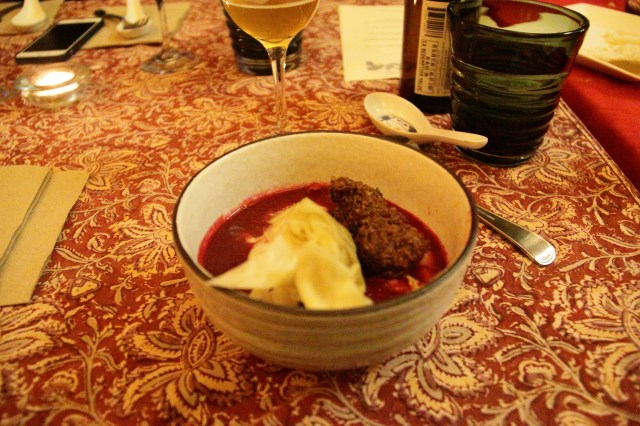
Another absolutely delicious multi-course vegan meal punctuated with a concert by some of the best musicians working today made for an experience that convinces this writer (and eater and listener) that Philip has taken his efforts to a new level.

soundsav5160001The beautiful as well as tasty culinary creations combined with some creative BYOB are as easy on the eyes as they are stimulating to the pallet.

soundsav5160002

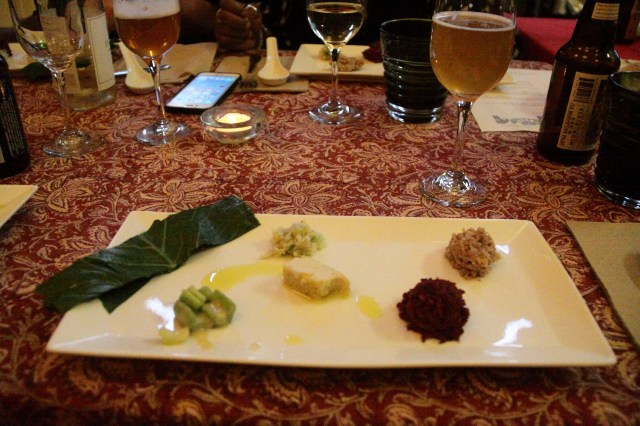
This meal, a revisioning of Passover featured Phil’s take on traditional Passover fare.

soundsav5160003

These seemingly small portions combine to produce a very filling gustatory experience in which the break between the last course and dessert pausing for the musical interlude is a necessary part of the experience.

soundsav5160004

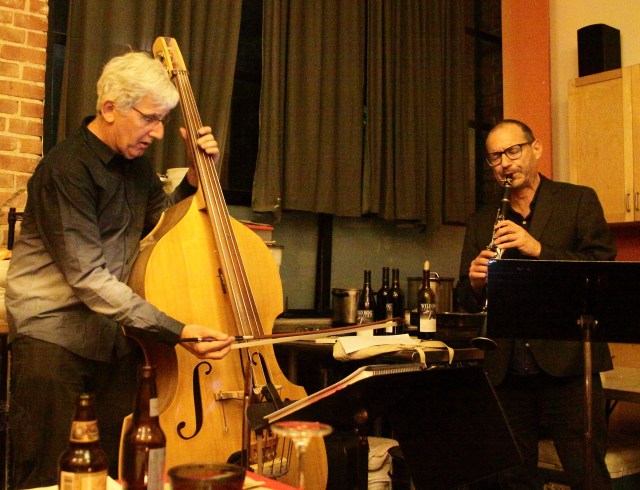
And with this main course, featuring the delicious locally made Rhizocali Tempeh we paused to hear the guests for the evening.  Mark Dresser, sporting his beautiful new custom built double bass and Ben Goldberg.  These two musicians know each other but this is their first ever collaboration.  That is the kind of musical magic which accompanies the food on these events.

soundsav5160005

Dresser and Goldberg kicked out some serious jams and also participated in some discussion of Passover and its meaning for them, a very personal touch.

soundsav5160006

They played several pieces and did so with a passion and understanding that suggested they had been playing together for years.  I spoke with these genial men after their performance and only then did I learn they had never played together.

soundsav5160008

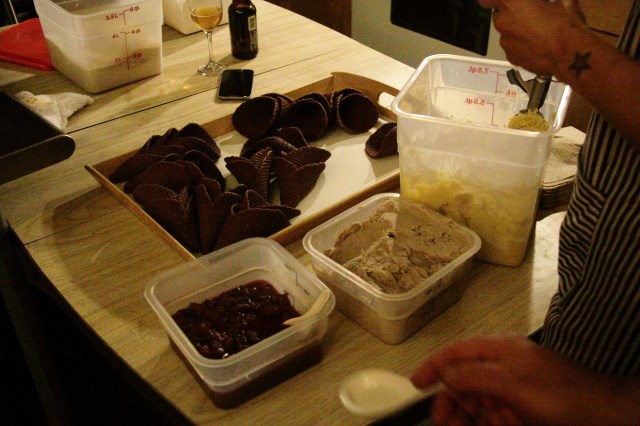
Hand made waffle cones and vegan ice cream capped a spectacular evening.  Thank you, Phil.  Looking forward to more.

Gene Pritsker and Some of His Collaborators, a Heady Mix


Gene_Pritsker

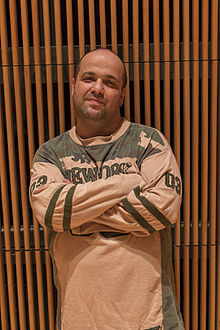
Gene Pritsker

We have here three very different CDs all of which feature composer/performer Gene Pritsker along with a variety of his colleagues and collaborators.  Each of these CDs is a unique production and reflects a marvelously creative group of composers and performers.

I first came to know of Pritsker’s work when he sent me a copy of his wonderful chamber opera, Manhattan in Charcoal and when I began to learn of the scope of his work through his numerous You Tube videos and his website I found myself rather overwhelmed and wholly intrigued.  In fact I can’t shake a comment which Leonard Bernstein once made about Igor Stravinsky to the effect that he was able to switch between different styles at different times with seeming ease and certainly skill (It was a comment made on a vinyl disc in which Bernstein spoke of Stravinsky in general on one cut and described the imagery of Petroushka on another.).  Pritsker’s Russian origins certainly play a part in reminding me of this association but it is the sheer extent and variety of his compositional visions and techniques that drive me to be reminded of this.  His virtuosity on the guitar also puts me in the mind of Frank Zappa at times too.  And he seems to be doing it pretty much all at once too, utilizing a wide palette of styles selectively with care and subtlety.  Pritsker switches between some very classical sounds to rock, jazz, rap, etc. as though the distinctions don’t exist or matter.  In the end they don’t matter really.  All is music I suppose and he seems be able to use them all pretty well and these discs are a nice sampling of some of this interesting musician’s various guises and interests.

mozart inf

ComCon0030

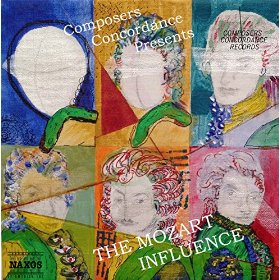
Fortunately I am not attempting a comprehensive cataloging of all that but rather reviewing a nice little selection of some current releases which Mr. Pritsker was kind enough to entrust to my critical ear.  First up here will be a Mozart tribute of sorts. Regular readers may recall another entertaining Mozart-based recording by John Clark (here). Indeed Mr. Clark makes an appearance here both as composer and performer.  This curious little disc consists of short, clever glosses on Mozart by Gene Pritsker, Patrick Grant, John Clark, Milica Paranosic, Dan Cooper and David Taylor.  Pritsker in particular seems to have a penchant for reworking music by other composers.  His Bach-based works also deserve attention as well.  But that is another matter.

There are 13 tracks and all have a somewhat improvisational character.  Of course variation forms are ubiquitous and varied throughout music history and these are, if not strictly speaking, “variations”, then something close which is why I have chosen the term glosses.  But all are entertaining and reflect a sort of new music take on Mozart who appears to have some meaning for each of the composers (Mozart is my desert island composer by the way).  I am sure that Mozart himself would have been amused and honored.  These are most certainly homage at the very least.

The CompCord Ensemble consists of Charles Coleman, voice; Chanda Rule, voice; Milica Paranosic, voice/gusle; Patrick Grant, voice/harpsichord; Lynn Bechtold, violin; Dan Barrett, cello; John Clark, horn; David Taylor, bass trombone; Gene Pritsker, guitar; Dan Cooper, bass; Javier Diaz, percussion/voice; Gernot Bernroider, drums; Franz Hackl, trumpet.

There are no liner notes here and perhaps that is for the best.  I have no doubt that there are a great deal of personal stories here as to how these pieces came about and what they mean to the respective musicians but they do stand on their own as entertainment and to my ear sound like they could even work as a film soundtrack (most likely a non-American film). This is entertaining material, perhaps a bit “inside” with its references but not difficult or obscure.   I will leave it to some future musical archaeologist to elucidate those details. The listener need only sit back and be entertained.

pritssker jarvis

ComCon0032


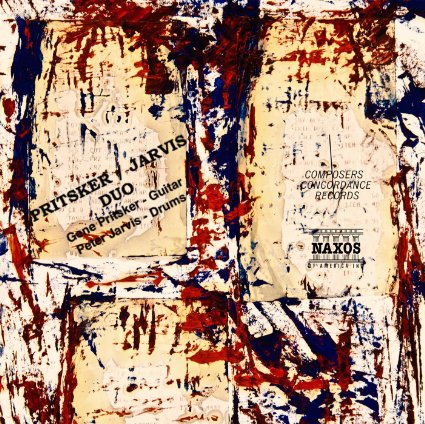
Now to the second disc.  This is quite different in character being a duo between a guitarist (Gene Pritsker) and a drummer (Peter Jarvis).  Such scant scoring tells one nothing about what is to come.  Each of the six tracks is by a different composer (Peter Jarvis, Gene Pritsker, David Saperstein, Joseph Pehrson, Jessica Wells and Daniel Palkowski).  As with the previous disc there are no liner notes so one is left with nothing but the sound.

This appears to be much more of an improvisational nature than the previous recording considered above.  The style here ranges from free jazz to rock and perhaps some contemporary musical styles as well.  Each track is a succinct statement and none of the tracks seem to go longer than necessary.  The musicianship is superb so if you are fond of the sound of guitars and drums played creatively and well you will enjoy this disc.  These musicians extract a great deal of varied sounds from their instruments.

song cycles

ComCon0029


Finally we have this disc of song cycles.  Now the only song cycles I know at all well are those of Franz Schubert but that is, I think, an adequate place to begin to understand what is going on here (still flying without liner notes).

Eight composers and eight poets are featured in six song cycles. The first and last cycles (tracks 1-3 and 16-19) are the only ones which include instruments in addition to the voice and piano.  Only one song here (Inside on track 15) features poetry by the composer.  The rest, like Schubert utilized existing poetry.

Most of these composers are unknown to me which is both the joy and the bane of reviewing such discs.  All of these fall roughly into the classical art song tradition even with their occasional blues inflections (as in the Pritsker songs) or extended instrumental techniques.  David Gutay, Zach Seely, Patrick Hardish, Luis Andrei Cobo, Eleanor Cory are all new names to me and it Mr. Pritsker is to be commended for his efforts to promote others’ music.  The two composers here who are familiar are Mr. Pritsker and, another reason for commendation, Lester Trimble (1923-1986), a man embraced by Leonard Bernstein and cut from similar sonic cloth as both Bernstein and Copland.  This recording of Trimble’s Canterbury Tales is a welcome addition to the discography of mid to late twentieth century masters who deserve at least another listen.

The poets include: Tony Roberts, Jacob Miller, Dorrie Weiss, Jennifer Michael Hecht, Emily Dickinson, Richard Wilbur, Eleanor Cory and Geoffrey Chaucer.

Performers include Elizabeth Cherry, soprano; Thomas Carlo Bo, piano; Katie Cox, flute; Charles Coleman, voice; Derin Oge, piano; Patricia Songego, soprano; Taka Kigawa, piano; Lynn Norris, soprano; Amir Khorsrowpour, piano; Eleanor Taylor, soprano; Christopher Oldfather, piano; Circadia Ensemble consisting of: Melissa Fogarty, soprano; Kaoru Hinata, flute; Christopher Cullen, clarinet; Jenifer Griesbach, harpsichord (in the Trimble cycle).

The performances are uniformly excellent albeit a collection of separate recordings all mastered, as were the previous two discs by Sheldon Steiger.  If you love art song this is a treasure trove of current compositions but with a healthy respect for the past.


Songs from the Rainshadow’s Edge by Benton Roark


rainshadow


This marvelous little song cycle has, unfortunately, languished for a bit in my “to do” bin and now I want to tell you that it is a fine production in every way.  I don’t know Benton Roark and his website is a bit light on biographical details but what is clear is that Mr. Roark is  possessed of a lyrical gift which this song-cycle demonstrates.  This is an artist who bears watching/listening.

roark

Benton Roark

He is the co-artistic director of Arkora Music who perform the work featuring the composer’s own poetry and selections from various texts read by narrators.  This sounds like a formula for a noisy avant-garde piece but that is not what we have here.  This is an intelligent clearly contemporary work that is simply beautiful and played with great sensitivity by the musicians.  The music is tonal, bluesy at times but always engaging and evocative.

Kathleen Allan, soprano; Amelia Lukas, flutes; Brendon Randall-Myers, electric guitar; Jonathan Allen, percussion; Anne Lanzlotti, viola; Samuel Suggs, double bass; Mary Berry and Maya Levy, narrators comprise the ensemble and all are strong performers.  Alan’s clear beautiful tone carries the spirit of this work and these performers are clearly listening to each other.

Definitely worth your time and repeated listenings reveal more in this wonderful piece.  You can get the album via the Arkora site linked above as well as Bandcamp.  It is on the Redshift label.


Tim Brady: The Canadian Connection


tbradyhappiness

Starkland is one of the few American labels that regularly pays attention to Canadian composers.  I previously reviewed their Paul Dolden release here.  This challenge to the curious apartheid we seem to maintain with Canadian culture is most welcome of course and one can obtain a great deal of Canadian music via Canadian labels but retail distribution of their non-pop music is limited to mail order and Internet sales (and I don’t mean Amazon either).  I strongly recommend perusing the web site of the Canadian Music Center for a truly stunning selection of this too little known recorded repertoire.  I should note that most of Brady’s releases are readily available from actuellecd.com.  You can find several of those other symphonies here as well as many other pieces and collaborative releases.  After hearing this disc I couldn’t resist hearing more  by this artist whose work has been known only faintly to me thus far.  That order is now being shipped.

Now to the disc at hand.  The  use of electric guitars as a primary instrument conjures immediate comparisons to Glenn Branca and Rhys Chatham as well as to rock and blues but this music is quite different from all of these.  This is one aspect of  the work of a composer whose work includes writing for orchestra, chamber and solo instruments as well.  Brady, largely set taught in music until he attended college (Concordia University 1975-78; New England Conservatory 1978-80) is an interesting composer and performer with a widely varied palette.  Brady’s Wikipedia page is surprisingly informative as well.  You can find that here.

Tim Brady (1956- ) is an artist of many talents and this recording represents his most recent work, a symphony.  It is his fifth essay so titled and his choice of instrumentation for each (of his now 6 symphonies) is unique.  In this case he has chosen to score for four guitars (his Symphony No. 4 is for full orchestra) and also presents a separate solo version backed by electronics.  It is subtitled, “The Same River Twice” (2013) and I struggled a bit initially getting wrapped up in trying to discern the differences between the two versions but realized that is rather beside the point in a way.  What makes this music interesting is the way in which it differs from the likes of Branca and Chatham.  Brady clearly comes from a different perspective.  The myriad ways in which creative musicians find to integrate cross genre elements fascinates me as a listener.  He is 8 years younger than Branca, 4 younger than Chatham but his perspective of the inherently “pop” inflection of the electric guitar differs greatly.  He is writing another vital and welcome chapter in this loosely defined group of guitar based experimental musics of the last 40 years and his work deserves attention.

He seems to have more in common (broadly speaking) with Pat Metheny than Fred Frith and his discography reflects encounters with several ECM artists.  I’m not sure who influences who here but this is a pleasant and intelligent exploration sometimes virtuosic, sometimes drone-like but a consistently engaging piece.

As I said there are two versions of this symphony on the disc.  Along with those are two shorter tracks by Antoine Berthiaume and Rainer Wiens.  Fungi by Berthiaume is another example of the integration of pop motives into a broader quasi-improvisational context and is most successful.  The disc is rounded out with a sort of little summation “remix” by Wiens entitled “What is time?” which reportedly uses breath as a rhythmic determinant.

The playing is competent and intuitive, not flashy or self-consciously experimental.  Rather this is the work of a seasoned composer who uses his materials well .

Recording and mastering, all expertly done, were done in Canada by the artists who also did the useful liner notes (Allan Kozinn writes the gatefold notes).  The cover art and the production of the CD belong to Starkland and it is a very nice production.

Next Gen Steve Reich: Two Great New Recordings


One of the hurdles on the way to long-term historical recognition is finding the next generation of interpreters for whom the music itself is not new but whose interpretation is needed anew in light of the music’s place in the canon of performed and recorded music. So Mr. Reich has now arrived in two fantastic new recordings.


The first CD here is the Cedille (Cedille 90000 161) label debut by Third Coast Percussion, a young Chicago based group.  The label itself is reason enough to pay attention with their intelligently selected and well-recorded releases.  But even so this one stands out for a couple of reasons.

As  Reich reaches his 80th birthday (as are many composers whose work informed my listening life since the 70s) we are seeing the next generation (or so)  of performers, musicians for whom this music is not new.  (Third Coast Percussion is Sean Connors, Robert Dillon, Peter Martin and David Skidmore. They were founded in Chicago in 2005.). As these dedicated musicians traverse this repertoire they see it from a different perspective and they acknowledge this in the accompanying notes by Robert Dillon.  No doubt they are familiar with the music and have heard some if not all previous recordings. This music is no longer new and novel the way it was to those who first heard it.  And that is what we have here, a new take on music already familiar giving us the perspective of another generation.

The second reason to get this recording is the sheer beauty of the sound.  It is a masterpiece of recorded sound which does justice to the work of these fine musicians as well as the music.  The album was recorded at the University of Notre Dame’s DeBartolo Performing Arts Center (where Third Coast is in residency).  Dan Nichols was the engineer assisted by Matt Ponio.  It was mastered by Jessie Lewis and Kyle Pyke.
The CD opens with the recent Mallett Quartet (2009) which has been recorded only once before.  The piece is in three sections fast-slow-fast split over the first three tracks.  It is one of Reich’s finest compositions showing him as a still vital artist and it will no doubt receive many more performances but it would be hard to imagine a better recording.

The second selection is, for this writer, one of Reich’s more unusual pieces.  The Sextet (1984) is scored for two keyboards (pianos doubling synthesizers used for long held tones) and percussion.  David Friend and Oliver Hagen lend their formidable keyboard skills to this work and help it to swing.

I must admit that this performance has resulted in me giving this work some serious close listening again and I am liking it better.  Some of these movements seem like precursors to some of the writing in Reich’s wonderful The Four Sections (1987), another work that deserves more attention.

The brief but lovely Nagoya Marimbas (1994) is pretty much an accepted staple of the classical marimba repertoire and has also been transcribed and performed on guitars as well.  As with the preceding the performance is faithful and lively.

For the final track a decision was made to go back to early in Reich’s output with Music for Pieces of Wood (1973).  As with much of his early work we see his experimental side focusing as much as possible on a single process.  It uses the same rhythmic pattern as the 1972 Clapping Music but uses additive rather than phasing techniques (I believe), a great example of the roots of minimalism.  The group does some toying with the choice of percussion but, as in the preceding tracks, manage to create a performance worthy of the best interpreters in their generation.  Happy Birthday Mr. Reich!!


This second CD (New Focus fcr 165) is another aspect of crafting a legitimate new interpretation of a given piece of music.  Guitarist Daniel Lippel goes back to some of the roots of Reich’s mature style, Ghanaian drumming.  Reich seems to have achieved his personal artistic synthesis after his encounter and study with the master drummers of Ghana.  It is here that he was finally able to synthesize the gifts received from his study of jazz (Reich was/is a jazz drummer) and his tape music experiments into the larger forms for which he is now known through these studies with West African musicians.  And it is here that Lippel goes, with an assist from musicologist Martin Scherzinger, to create his (re)vision of this classic Reich composition.

Electric Counterpoint (1987) was written for and first recorded by the still wonderful jazz guitarist Pat Metheny.  His recording is certainly definitive but, as with all music performance, hardly the last word.  Several artists have presented their versions (David Tanenbaum’s acoustic guitar version deserves more attention by the way).  It is a very appealing and interesting piece cast in a classic fast-slow-fast format that presents formidable challenges for the musician but not for the listener.

It is difficult (and certainly beyond the scope of this review) to say specifically what Mr. Lippel has done differently but there is clearly a difference (further notes can be found here).  I am loathe to find adjectives to describe this recording except to say that it is well worth your time to hear it.  It provides a different way of hearing much as Glenn Gould has done for Bach.  Just sit back and enjoy.

Getting the Oboe (et al) to Stand on Its Own, Catherine Lee


    Connections can be fascinating and not long after publishing my review of Emily Doolittle’s  release here I received, in addition to a stunning number of readers for that article, a CD by one of her fellow musicians featuring another of Doolittle’s interesting works alongside four other works for solo oboe (or English Horn or Oboe d’amore).  Though certainly kind and timely I did not relish the idea of being subjected to even this short CD single of a soloist with no accompanying musicians playing a series of unknown soliloquies.  My concern was that of having to endure the sincere efforts of a musician who is convinced of her instruments’ solo potentials and who labors to prove this to all but hardly gets past technical achievement like a recording I once heard of the Bach Cello Suites played on a Double Bass, interesting as a technical achievement but…

My fears were clearly unfounded as I listened to each track.  Patience turned to excitement and I think I’ve now heard a sort of new breed of instrumental specialist.  Lee plays oboe as well as the closely related English Horn and the very little known Oboe d’amore with expertise.  But she is not a specialist in the “period ensemble” genre per se. Rather her focus is on the potentialities of her instruments as vehicles for new music, improvisation and solo performances.  There seems to be little threat of a forthcoming rendition of the Telemann Flute Fantasies played on one or all of those.  Instead we have a gifted musician who seems poised to shepherd these instruments into new adventures in the 21st century.

The album consists of 5 tracks, all less than nine minutes in duration but each is a fully realized composition lovingly interpreted by this performer.  I am only familiar with one of the composers here, Emily Doolittle whose Social Sounds from Whales at Night (2007) is the only track which features any accompaniment.  It is a good example of Doolittle’s potentially groundbreaking work with animal sounds.  The other tracks manage to rise above the level of mere effects-ridden etudes to the level of compositions that define their own sound world and subjugate that world to artistic expression.  Very interesting listening.

From the first track it is clear that this is a musician with a deep understanding of the expressive possibilities of her instruments in both traditional and extended techniques as well as a clear sense of how to find music of substance.  Her playing sounds effortless suggesting that she puts a great deal of time into honing her virtuosity but she clearly moves beyond the technical to master the expressive range.
I would certainly be willing to hear just about anything Ms. Lee chooses to play including the relatively obscure repertoire for the oboe d’amore but I have my fingers crossed that we may get to hear her tackling concertos by Morton Feldman, Vincent Persichetti, Witold Lutoslawski and Hans Werner Henze, big projects that are nice to hope for but we do see that her ear for the smaller projects is clearly golden.

A Really Great Brass and Organ Album, Chicago Gargoyle Brass and Organ Ensemble


gargoylebrass

MSR Classics MS 1598

At first this disc seemed to be one of those “audiophile spectacular” niche market items designed to show off one’s stereo system.  I expected a well-recorded album with wide dynamic range and a clarity that would stun the listener but these types of albums frequently have well-recorded but uninteresting music or, worse, cloying showpieces that don’t bear repeated listening.

The first listen dissuaded me from that notion immediately because this is interesting and well-played music.  Except for three clever transcriptions of late 19th/early 20 century pieces all the music is from 2005-2013 (as are the transcriptions for that matter).

The music is, on the whole of a somewhat conservative nature but that is not a negative thing.  All of the music is pleasantly engaging and/or downright exciting.

The first four (of a total of 15) tracks present the music of Carlisle Sharpe (1965- ).  The first work Flourishes (2005/10) is a festive fanfare which was revised for this ensemble. The next three tracks contain the Prelude, Elegy and Scherzo (2012) is a commission by the present artists.

Next we move on to one of the arrangements by Craig Garner (1959- ).  This is, I think, a difficult arrangement to play but is handled with such ease by these players that one could be fooled into thinking it was easy.  The arrangement of the popular drinking song from Verdi’s La Traviata (1853) is a lucid and detailed transcription.  It is the clarify of the recording that makes this obvious as we are able to hear the various challenging lines that allow pretty much everyone in the ensemble to demonstrate their facility.

William Whyte (1983- ) is the next featured composer with a satisfying little suite called Dwarf Planets (2012).  It is in five brief movements.  The piece was also commissioned by and dedicated to Chicago Gargoyle Brass and artistic director Rodney Holmes.

Earthscape (2011) by David Marlatt is cast in a similar vein and, with the previous five tracks these are effectively musical appendices to Holst.  Marlatt, a Canadian composer has written this lyrical piece for the Gargoyle Brass.

Tracks 12 and 13 are another great transcription of a type of work which conductor Sir Thomas Beecham was fond of calling “bon-bons”, an appellation that was a proto-pop concert concept describing short, popular encore pieces.  It is the Polka and Fugue from “Schwanda the Bagpiper” by Jaromir Weinberger (1896-1967), a Czech composer whose reputation lies pretty much entirely on this work.   Originally for orchestra, this engaging work is very effectively arranged for this ensemble.

Tracks 14 and 15 comprise another transcription, this time of two movements from Camille Saint-Saens’ (1835-1921) 3rd Symphony (1886).  This is another truly great piece of music that always plays well with audiences.  The original is for a large orchestra and an organ.  The transcription is remarkably faithful to the score and it’s hard not to get hooked on that finale.  The entire symphony is actually based on the “Dies Irae” chant from the Requiem Mass though this is not a somber piece at all.

The last track is Velvet Blue (2012) by Peter Meechan (1983- ), a British born Canadian composer.  Originally written for a “rock” organ (the Hammond variety) and here played on a traditional pipe organ this is one of the most unusual pieces here.  It’s blues/jazz inflections harken back to big band sounds of the 1930s.

Brass instruments and organs are not instruments known for their agility.  Combine that with the resonant recording space of the churches involved and you have some serious engineering challenges.  Hudson Fair at Hudsonic has met these challenges and succeeded in capturing these performances in lucid detail with a true audiophile recording.  The dynamic range is wide and the the recording is about as clear as I have ever heard done  in this setting.

The musicians Lev Garbar, trumpet; Andrew Hunter, trumpet and flugelhorn; Amy Krueger, horn; Kathryn Swope, horn; John Grodrian, trombone; Graham Middleton, trombone; Ryan Miller, trombone; Andrew Vandevender, tuba; Paul Ramsler, tuba; Joshua Wort, tuba; Michael Schraft, tympani and drum set; Jared Stellmacher, organ; Mark Sudeth, piano; and Steven Squires, conductor all play with precision, lyricism and feeling.

One more piece of what I call “audio porn” is nicely included, the statistics on the two beautiful organs played at the two churches where these recordings were made.  Nice touch. Great fun album.


Between the Lines, New Percussion Music by Neil Thornock


Between the Lines

Between the Lines

Other than the information on this CD and the composer’s faculty page (here) information seems limited on this composer,.  He earned a BM, Organ Performance, Brigham Young University, 2001, an MM, Music Composition, Brigham Young University, 2003 and a DM, Music Composition, Indiana University Jacobs School of Music, 2006.  Currently he is associate professor of music at BYU where he teaches theory and composition as well as electronic music.

Thornock is that rare breed of percussionist (or is it keyboardist?), a carriloneur  and he takes the opportunity to display those skills on this all percussion release, apparently the first recording of this composer’s music.

It is very difficult to assess a composer based solely on their percussion music and sometimes that genre can take on the insider feel of, say, band music or some more rarefied and sequestered niche of music.  As popular as percussion music has become in the 20-21st century it seems sometimes to be an orphan genre.  This is also, no doubt, due to the all-inclusive nature of the term “percussion” which leaves a huge list of potential instruments to consider.  So an album of tympani music or bongo music or marimba music (conceivably even piano and harp can be included under the percussion rubric).might all be spoken of generically as percussion music.  This recording uses a wide variety of instruments.

Having said that this disc appears to show a composer with a wide palette and knowledge of the medium and it is an opportunity to hear carillon music which is itself a relatively rare experience in recordings.  His writing is accessible and, no doubt, well-tailored to the skills of the musicians.

There is nothing familiar here.  All are new works written, presumably, in the last few years.  It would be interesting to hear more of this composer’s output in the areas of chamber, orchestral and electronic music.  But this little tease will have to do for now.

Matthew Coley, the percussionist, seems to be the real star here.   He plays on all tracks and seems to be a highly skilled player.  His website was the most useful to this reviewer as well.  Along with him are the Iowa Percussion Group, the Iowa State University Percussion Ensemble and, as mentioned earlier, the composer on carillon on tracks 7-10 with Gerard Norris conducting.

This New Focus recording FCR 156 is beautifully recorded and I think that is no simple task given the variety of instruments involved.

Other Minds 21, the Dawn of a New Chapter and the Raising of the Dead


BHM160008

Charles Amirkhanian with the composers of OM 21

Much needed rain pummeled the city by the bay on all three days of OM 21 dampening, perhaps, some attendance but not the enthusiasm of the audience or the performers.  In most ways this concert was a continuation of the celebration begun last year commemorating 20 years of this festival.  Returning this year were Gavin Bryars (OM7) and Meredith Monk (OM1).

Until last year no composer had appeared more than once at this series.  For those unfamiliar with OM it is worth noting that the process has been for the 8-10 selected composers spend a week at the Djerassi Arts Center in Woodside, California sharing and discussing their work before coming to San Francisco for performances of their work.

As it turns out this year’s concert series will be the last to follow that format.  Apparently OM has become the victim of gentrification and has had to move out of its Valencia Street offices and will now opt for various concerts throughout the year as they have done but without the big three-day annual festival and the residency at Djerassi.

The archives of OM are now going to be housed at the University of California Santa Cruz where they will reside along with the Grateful Dead archives.  I do believe that Mr. Amirkhanian lived near Phil Lesh of the Grateful Dead when he lived in San Francisco some years ago so it seems fitting that these two archives will peacefully coexist in that space (also coming to UCSC will be OM 21 composer Larry Polansky though not in an archive).

This is certainly a change but this is a festival which has endured various changes in time and venue led throughout by the steady hand of the Bill Graham of contemporary music concerts, Charles Amirkhanian (both men have had a huge impact on music in the bay area as well as elsewhere and it is worth noting that the Contemporary Jewish Museum will have a tribute to Graham this year).

Actually Other Minds traces its provenance to the Telluride, Colorado Composer to Composer festival (also led by Amirkhanian) and later morphed into OM with the leadership of president (now emeritus) Jim Newman back in the early 1990s.  There is a short excellent film describing OM’s history on Vimeo here.

It is the end of a chapter but, as Amirkhanian explained, there are many exciting concerts coming up which will keep Other Minds in the earshot of the astute contemporary music aficionados on the west coast.  Next year, for example, will include several very exciting concerts celebrating the 100th birthday anniversary of beloved bay area composer Lou Harrison.

My apologies for the delay in posting which was due to both the richness of the experience and the exigencies of my day job and other responsibilities.  I hope that readers will find this post to have been worth the wait.

BHM160009

Nordic Voices

Starting our rainy day were the extremely talented singers known as Nordic Voices.  Lasse Thoresen‘s Solbøn ( Sun Prayer) (2012) and Himmelske Fader (Heavenly Father) (2012) both required keen listening and required the use of extended vocal techniques such as multiphonics.  The singing appeared effortless and even fun for the ensemble but that speaks more to their expertise and preparedness than any ease in terms of the score.

It is always difficult to judge a composer’s work by only a small selection from their output  but Thoresen’s virtuosity and subtle use of vocal effects suggests a highly developed artist and it would seem worth one’s time to explore more of this gentleman’s oeuvre.

BHM160010

Lasse Thoresen takes the stage to acknowledge the applause.

Next was an unusual, humorous/dramatic work by Cecile Ore called Dead Pope on Trial (2015/16) with a libretto by Bibbi Moslet.   This Other Minds commission was given its world premiere at this concert.  The work is based on the story of a medieval pope who was taken from his grave no fewer than six times for various perceived offenses.  It is a mix of irony and humor in a sort of madrigal context.  The work was in English and had the nature of a conversation between the singers.  No doubt a challenging piece, it was sung very well and the composer seemed as pleased with the performance as much as the audience.

BHM160011

Cecile Ore smiling as she acknowledges the applause for the wonderful premiere performance of her new work, Dead Pope on Trial.

As if in a demonstration of sheer stamina in addition to virtuosity Nordic Voices took the stage again, this time for some Madrigals (2002/2016) by returning artist Gavin Bryars.  Bryars is no stranger to Other Minds or to madrigals and such older musical forms from the renaissance and before.  He has extensively explored vocal writing and medieval harmonies in many previous works.  Though categorized as being a “minimalist”, Bryars actually has produced a huge range of music in all forms including opera, chamber and orchestral music.

His madrigals have been written for the Hilliard Ensemble and each book is distinguished by the madrigals having been written on a specific day of the week.  The first book on Mondays, etc.  They are settings of Petrach’s sonnets and are sung in the original Italian of his day.  On this night we were treated to four madrigals from Book Two and the premiere of a madrigal from Book Four.  That madrigal was dedicated to Benjamin Amirkhanian, the father of Charles Amirkhanian who celebrates his 101st birthday this summer.

I had the opportunity to meet and speak briefly with the affable Mr. Bryars.  His generous spirit pervaded our conversation and he spoke very highly of both his visits to Other Minds.  If you don’t know this man’s music you are doing yourself a great disservice.

BHM160016

A very pleased Gavin Bryars deflects the applause and adulation to the amazing Nordic Voices for their astounding performance of five of his madrigals.

The singers of Nordic Voices sustained a high level of virtuosity as well as sheer stamina as they sang for nearly two hours in the opening pieces of this concert series.  No time was lost setting the stage for the performance of the next piece, another premiere, Algebra of Need (2016) for electronic sampling and string quartet by Bang on a Can member Phil Kline.

BHM160045

FLUX Quartet playing at SF Jazz, 2016

The Flux Quartet was featured in the next two (and last) works on this long program.  Algebra of Need is Kline’s meditation on the words and the cadences of the iconic writing and voice of the late William S. Burroughs (gone 19 years as of this writing).  The familiar voice seemed to go in and out of clearly audible, at times mixed more closely with the string writing in this intense homage.

BHM160014

A satisfied looking Phil Kline leans in to embrace the first violin of the Flux Quartet after their premiere of his Algebra of Need.

The Bang on a Can collective was also represented tonight by Michael Gordon.  The Sad Park (2008) for string quartet and electronics put a most decidedly disturbing conclusion on the evening.  This piece, which samples the voices of children (one of them Gordon’s) as they spoke of their experience of the 9/11 Twin Towers attacks.

The effect was, as no doubt intended, harrowing leaving a pretty strange and unsettling feeling as we walked away from the concert into the still rainy night.

BHM160017

Michael Gordon embraces the FLUX Quartet’s first violin after a stunning performance of The Sad Park.

The rain continued on Saturday but the crowd was noticeably larger for the second night which opened with the usual panel discussion.

BHM160030

left to right: Meredith Monk, John Oswald, Nicole Lizee, Eliot Simpson, Larry Polansky, Oliver Lake and Charles Amirkhanian in a panel discussion prior to the concert

This evening began with a performance by the wonderful bay area violinist Kate Stenberg of a piece which was a sort of antidote to the somber, The Sad Park from the previous night.  Again the composer was Michael Gordon and the piece was Light is Calling (2004), a collaboration with filmmaker Bill Morrison.  Though hardly a happy piece Light is Calling is perhaps elegiac and the composer seems to achieve some of his stated intent to find some healing in the wake of a disaster to which he was all too close.

BHM160031

Kate Stenberg plays violin beneath the projection of a Bill Morrison film in Michael Gordon’s, Light is Calling

BHM160032

Michael Gordon and Kate Stenberg accepting the applause of an appreciative audience.

Next up was John Oswald, a Canadian composer whose career took off in infamy when his Plunderphonic CD, released to radio stations in the early 1980s, became the subject of legal battles over the meaning of copyright law in light of digital sampling.  Fortunately Oswald won the right to publish his work and his Plundrphonics concepts now underlie much of his compositional process.  Until this night I had not heard any but his Plunderphonic CDs so the introduction to his live music was a revelation.

BHM160033

Pianist and (at least here) multi-instrumentalist Eve Egoyan performing with a Yamaha Disklavier and other instruments.

The first piece she did was called Homonymy (1998/2015) was originally written for chamber orchestra and was then transcribed for Egoyan and her prepared disklavier et al.  It is a piece based on linguistic elements and with a visual component as well.

BHM160034

Eve Egoyan performing Homonymy with overhead projections.

Nicole Lizee’s David Lynch Etudes (2015) was the next piece  and also made use of the projection screen.  The subtitle of the piece indicates it is for “disklavier and glitch”.  Well life imitated art as some sort of glitch prevented the projection from functioning at first but this was rather quickly resolved and we were treated to excerpts of scenes from several David Lynch films with the piano playing some of the rhythms of the dialog in an exchange that puts this writer in the mind of music like Scott Johnson’s “John Somebody” and Steve Reich’s incorporation of speech rhythms in works like, “The Cave”.

Nicole Lizee is a Canadian composer and was the youngest composer on this year’s program.

BHM160035

Eve Egoyan playing Nicole Lizee’s David Lynch Etudes with projected scenes/glitches from Lynch’s films.

The work is one of a series of pieces inspired by films and was executed with apparent ease by pianist Eve Egoyan who played the disklavier (both the keyboard and directly on the strings), a guitar and perhaps other gadgets .  The piece kept her quite busy and the associations I described above sound nothing like this work actually.  These etudes were a unique, typically Other Minds sort of experience, one that expands the definition of musical composition.

BHM160036

Nicole Lizee (l) with Eve Egoyan absorbing the audience’s appreciation of the David Lynch Etudes.

Two more John Oswald compositions graced the program next.  Palimpia (2016) is a six movement piece for disklavier with pianist playing as well.  Oswald says it is actually his first composition for piano.

BHM160046

John Oswald embracing pianist Egoyan and enjoying the audience applause for his work.

Well I did say there were two more Oswald pieces but this last one was a masterful plunder by this truly unusual composer.  Here Oswald conjured the playing as well as the image of the late great Glenn Gould who was seen actually playing Invaria (1999) with the disklavier performing along with the film of Gould performing this music.  It was, for this writer, a spellbinding experience.  He has raised the dead in the name of music.  Wow!  It was an amazing and heartfelt homage to a fellow great Canadian musician.

BHM160038

Glenn Gould playing John Oswald

Larry Polansky (1954- ) is well known as a teacher and as a composer but one is hard pressed to find much in the conventional discography of his work.  The few discs out of his amazing electronic music (and one disc of piano variations) represent only a small fraction of his output and represent only one genre of music which he has mastered.  However the astute listener needs to be advised to look online to look, listen and hear some of the bounty of his creative output.  Check out the following sites: Frog Peak Music (Polansky’s publishing site which includes music and scores by a great many interesting composer in addition to himself and Dartmouth Page (which contains link to various recordings, writings, computer software, etc.

BHM160039

Giacomo Fiore (left) and Larry Polansky playing Polansky’s ii-v-i (1997)

As an amateur musician who has enough trouble simply tuning a guitar it made my knees weak to watch these musicians effortlessly retune as they played.   Polansky’s experimentation with alternate tunings is an essential part of many of his compositions.

BHM160040

Fiore and Polansky changing their tunings mid-phrase in a stunning demonstration of virtuosity with pitch changes.

The program then moved from the electric to the acoustic realm with Polansky’s folk song arrangements.  Eliot Simpson, the pedagogical progeny of the great David Tanenbaum (who played these concerts last year at OM 20), played the just intonation National Steel Guitar and sang.

Let me say just two things here.  First, these are not arrangements like Copland’s Old American Songs and second, I will never hear these folk songs quite the same way again.  Polansky’s interest in folk music and Hebrew cantillation along with alternate tunings produces what the ears hear as perhaps a different focus.  In these pieces he did not stray too far from the original (as he does in his Cantillation Studies) but one is left with distinctly different ways of hearing and thinking about this music and the listener is left richer for that.  It is a journey worth taking and Simpson played with both passion and command.

Eliot Simpson playing a selection of Larry Plansky's Songs and Toods

Eliot Simpson playing a selection of Larry Plansky’s Songs and Toods

Polansky returned to the stage for a performance of his 34 Chords (Christian Wolff in Hanover and Royalton) (1995). Again we were treated to the virtuosic use of alternate tunings performed live (and again with live re-tunings) by the composer.

Oliver Lake delivering a blistering free jazz improvisation.

Oliver Lake delivering a blistering free jazz improvisation.

Continuing with the solo performer theme we were privileged to hear the virtuosic jams of Oliver Lake (1942- ) whose long career is legendary in the jazz world.  The “mostly improvised” (according to the composer) Stick was played on two different saxophones in what appeared to be as intense an experience for the performer as it was for the audience.

Oliver Lake takes a final bow at the end of the second concert of OM 21

Oliver Lake takes a final bow at the end of the second concert of OM 21

The emotional workout was received warmly by the audience.

Charles Amirkhanian introduces Meredith Monk on the final day of OM 21

Charles Amirkhanian introduces Meredith Monk on the final day of OM 21

There was no panel discussion on the third day of OM 21.  This matinée was dedicated entirely to the work of Meredith Monk (1942) who, fittingly was one of the featured artists in the first Other Minds gathering in 1993.  Now a recipient of the National Medal of the Arts this beloved artist returns to OM 21.  Though the rain continued the house appeared to be full.

Meredith Monk playing a Jaw Harp in one of her early solo songs.

Meredith Monk playing a Jaw Harp and singing in one of her early solo songs.

Monk played a selection of material from various periods in her career in a mostly chronological survey which she called The Soul’s Messenger.  She began with selections from her solo songs and proceeded to her voice and piano music, then to her work with multiple voices and instruments.

Meredith Monk performing her signature Gotham Lullaby

Meredith Monk performing her signature Gotham Lullaby

Most of the audience seemed to have a comfortable familiarity with the individual works she offered on this night which effectively gave a picture of her career.  Monk was in good voice and appeared to enjoy her performance.

Long time collaborator Katie Geissinger and Allson Sniffin joined in the next selection

Long time collaborator Katie Geissinger and Allson Sniffin joined in the next selection

The stage was set to allow for the dance/movement that is an essential part of Monk’s works.  She originally trained as a dancer.

Monk and long time collaborator Katie Geissinger reacting to the appreciative audience

Monk and long time collaborator Katie Geissinger reacting to the appreciative audience

In addition to the grand piano the stage was set with two electronic keyboards, an essential sound in many of Monk’s works.

Monk at one of the electronic keyboards

Monk at one of the electronic keyboards

Woodwind player Bodhan Hilash joined the ensemble for the last set of pieces.

From left: Bodhan Hilash, Meredith Monk, Allison Sniffin and Katie Geissinger

From left: Bodhan Hilash, Meredith Monk, Allison Sniffin and Katie Geissinger

The audience gave a standing ovation at the end resulting in 3 curtain calls.

Left to right Allison Sniffin, Meredith Monk, Katie Geissinger and Bodhan Hilash receiving a standing ovation.

Left to right Allison Sniffin, Meredith Monk, Katie Geissinger and Bodhan Hilash receiving a standing ovation.

And the properly prepared artist came back for an encore of her song Details.

Meredith Monk performing an encore at the final concert of OM 21

Meredith Monk performing an encore at the final concert of OM 21


It was a fitting finale to a great OM 21, fitting to have this artist who appeared on the first iteration of Other Minds returning now crowned with a National Medal of the Arts and clearly beloved by the audience.  Her music like her lovely smile fade to the edge of memory like that of the Cheshire Cat on a truly triumphant finale.

And, despite some format changes, who knows what treasures continue to lie in store?  I will be watching/listening and so, apparently will many others.  Keep an eye on www.otherminds.org .  I know I will.