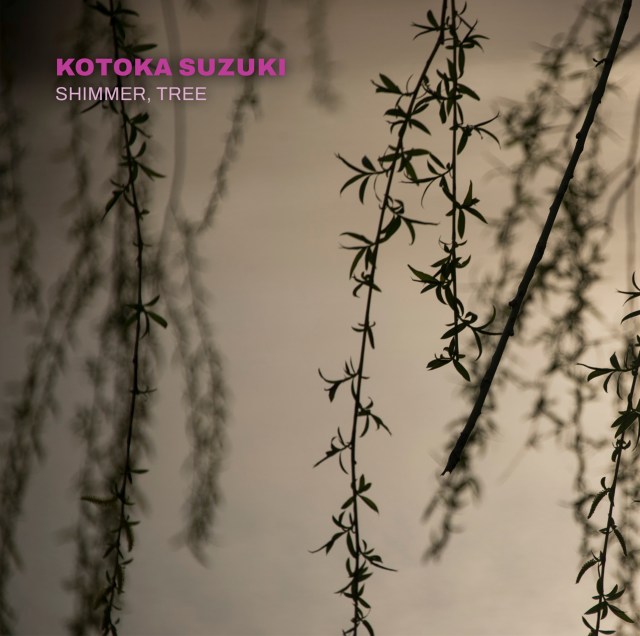
Every Starkland release is an event and this one is no different. This is a composer new to this writer and likely new to most of the new music community. But fear not of the unknown. Advance praise from the likes of John Chowning (one of the reigning bright lights of electronic music) of Stanford certainly add a heady air of anticipation as we are now privileged to hear what is definitely leading edge and the future of electroacoustic composition. And Starkland releases always feature carefully chosen repertoire which is not infrequently a harbinger of success for the chosen artist. This young Japanese composer reveals a distinctive voice that heralds her as a rising star in the field of what is called by some “electroacoustic” music.
The only problem for listeners or reviewers is the fact that this is a new composer. And though she is clearly a rising star we know very little about her and her work so a bit of background is necessary.
Suzuki was born in Japan. She studied at the estimable Jacobs School of Music at Indiana University where she earned a B.A. in music. She followed this with a D.M.A.. from Stanford University where she was mentored by the late great Jonathan Harvey (1939-2012). Another stellar antecedent and influence, John Chowning, the composer and sound engineer whose work has virtually defined electronic music synthesis as we now know it. He provides appreciative and insightful liner notes on this former student.
I do feel the need to express a disclaimer here regarding the musical genre known as “electroacoustic”. This has been, for me personally, an entertainment minefield. Attempts to join electronics with acoustic instruments go back at least to Edgar Variese (1883-1965) who used electronic interpolations (produced on magnetic tape) between the orchestral sections of his work Deserts (1950-54). This parallel construction strategy (electronic segments performed/played separate from acoustic instrument sections) seems to have had an echo in the so called “Third Stream” music promoted by Gunther Schuller. Third Stream compositions sometimes similarly segregated the jazz combo with the orchestral sections of a given work. This strategy, now seldom used, was innovative in its time but sounds very dated in this new millennium, There are, however, shining examples of more successful integration of electronic and acoustic media such as Mario Davidovsky’s (1937-2019) ten “Synchronisms”and some of Milton Babbit’s (1916-2011) works. There are others of course but that discussion is beyond the scope of this review.
Suffice it to say that many attempts at combining electronics with acoustic instruments have failed to tickle this listener’s fancy and made me skeptical of this genre though that is changing the more I listen (so its not clear if my perceptions are due to better composition techniques or my learning curve). But be not afraid.
This album, no doubt due to the many successful antecedents of works by the likes of Mr. Harvey and Mr. Chowning, is successful enough in its construction as to suggest it may be a landmark in the evolution of said genre. It certainly works for this listener and explains my title for this review. In fact this album is a new statement, tantamount to a manifesto on “electroacoustic” music. In addition to clearly having mastered the electronics (including judicious use of technology), Suzuki also writes for acoustic instruments from her native Japan. She even uses paper instruments. And in music that deals with elegy, evanescence, and impermanence her choices are most apt.
Kataro Suzuki
This is the first disc devoted entirely to Suzuki’s work and no label, save for Starkland, Innova, and the newly revived Neuma can be said to be more notable in their attention to electronic and electroacoustic work. Works do appear on other labels of course but Starkland Innova, and Neuma seem to have a more efficient curatorial radar with this genre. I certainly feel confident that we will hear much more from this hard working, emerging artist.
There is a theme of darkness, homage, mystery, and sadness that pervades this album. It is about night, darkness, loss, and cherished memories. But darkness does not here translate to sadness, rather it seems to be about what follows sadness and honoring those memories.
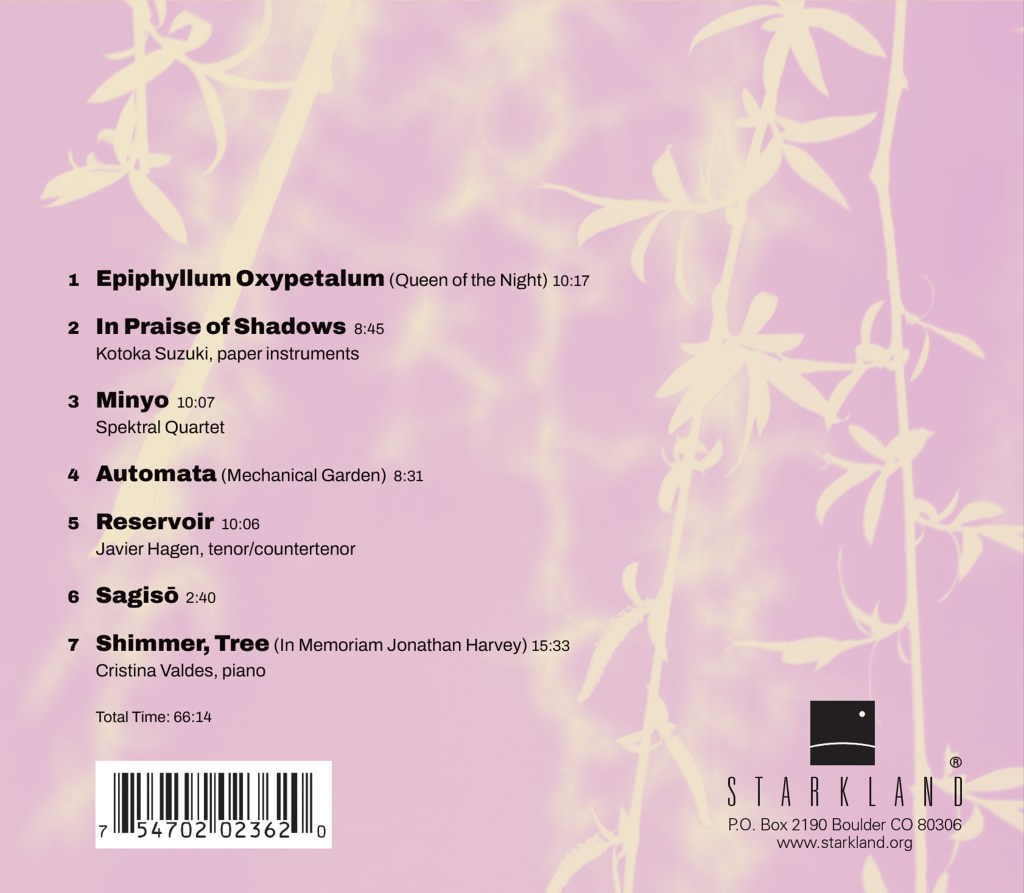
There are 7 compositions represented on 7 tracks:
Epiphyllum Oxypetalum (Queen of the Night) (2009) takes its title from the Latin taxonomic name of the above pictured Dutchman’s Pipe or, more elegantly, Queen of the Night cactus. It is a nocturnal blooming species, a perfect choice for this non-narrative tone poem about the composer’s dreams. These aural images stand in for the visuals that only the dreamer can fully recall but can hopefully elicit in the listener.
Inspired by a 1933 essay, “In Praise of Shadows” (2015), is a eulogy about evanescence. It is simultaneously about the visual importance of shadow in eastern visual art and the relative loss or obscuring of those images as they are impacted by modern technology. We lose the shadows when we light them but lose their impact as they succumb to it. In a marvelously clever parallel metaphor the composer makes use of paper instruments as a part of the sonic fabric. Their impermanence is also their value here.
Minyo (1997), the earliest composition here incorporates Japanese folk songs commonly sung by workers and incorporates some of the acoustic instruments which commonly accompany these songs. Here the use of electronics is fairly subtle, sometimes imitative augment the acoustic string quartet. Doubtless the songs used would be more familiar to native Japanese but this hardly detracts from the beauty of this work, an homage of sorts to the Melodie’s and instruments of the composer’s native land.
Automata (Mechanical Garden) is an homage to the late Folkmar Hein, former director of the Electronic Music Studio at TU Berlin. The piece uses mechanical sounds of increasing complexity, mechanical devices evolving in complexity to become automatic, perhaps a mechanical analogue of a golem not (at least not yet) out of control as the golem of legend.
Reservoir (2013) is a 24 channel work for voice and electronics. It was inspired by an anonymous post on a “suicide blog” (I didn’t know such things existed). The text of the anonymous poster, the replies, and presumably the poster have all disappeared. This, perhaps the most complex and ambitious piece featured here, is a remarkably powerful work and, appropriately, the texts are provided in English.
Sagisō or White Egret Flower
Sagisō (2012) is a miniature representing this fringed orchid species native to Japan. It is said by some to represent a White Egret in flight.
White Egret (photo by Allan J. Cronin)
Shimmer, Tree (In Memoriam Jonathan Harvey) (2014) is a two movement work in honor of one of Suzuki’s cherished mentors who died in 2012. It is a sort of mini concerto for piano and electronics. This is the longest and, to this listener’s ears, the most forward looking and substantial work on the disc. Harvey would have been proud.
The Spektral Quartet (in Minyo), tenor/countertenor Javier Hagen (in Reservoir), and pianist Cristina Valdes discharge their duties admirably. The album is mixed and produced by the composer and mastered by the inimitable Silas Brown.
This listener looks forward with eager anticipation to more from this fine composer.
DISCLAIMER: Though I received this album well before it’s 2022 release date, I was unable to complete my review in a timely manner. I did, however, include this release in my “best of” for 2022.
Let me start with a positive image from a brief photography trip which I managed this year. It was one of the highlights of what has been a difficult year for many of us. Weather, politics, COVID, itinerant employment issues, financial, and personal difficulties were an encumbrance but now stand in relief to the many positive aspects of 2022.
First, let me say that nothing musical fell into the category of “worst of” so fear not, what follows is essentially my “best of” from 2022. In my head I blame the aforementioned encumbrances for delays and sheer lack of production on my part. Whether that is the ultimate truth does not matter really so here, for better or worse, is my celebration of the positive experiences enumerated in this music blog in 2022.
This is one of the albums that stoked my interest.
My first post for the year struck a sad note. It was my personal tribute to a composer, A Belated Fan Letter: Homage to George Crumb described George Crumb, who had been one of my “gateway drugs”, so to speak, which helped put me on the exciting roads of new music upon with I continue to travel with great joy. Recordings of his complete works are still being released on the visionary Bridge Records.
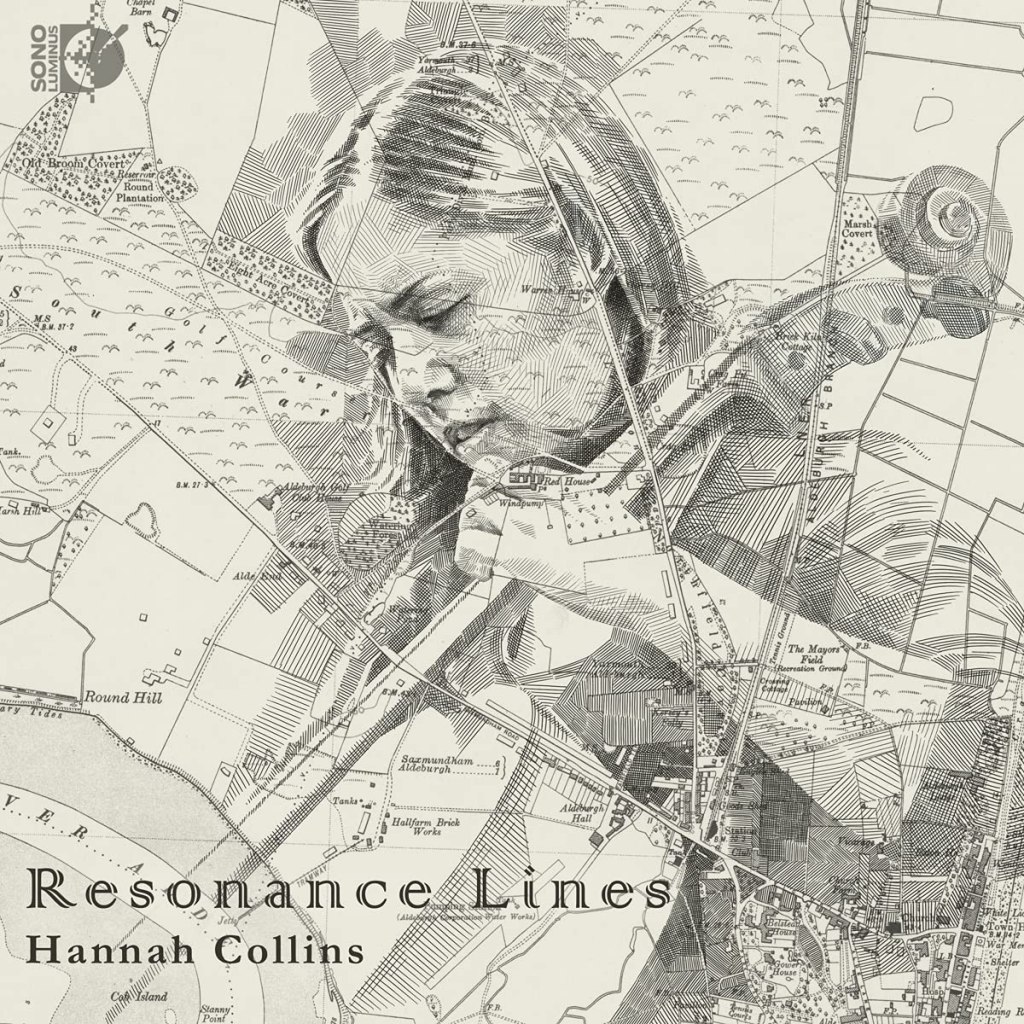
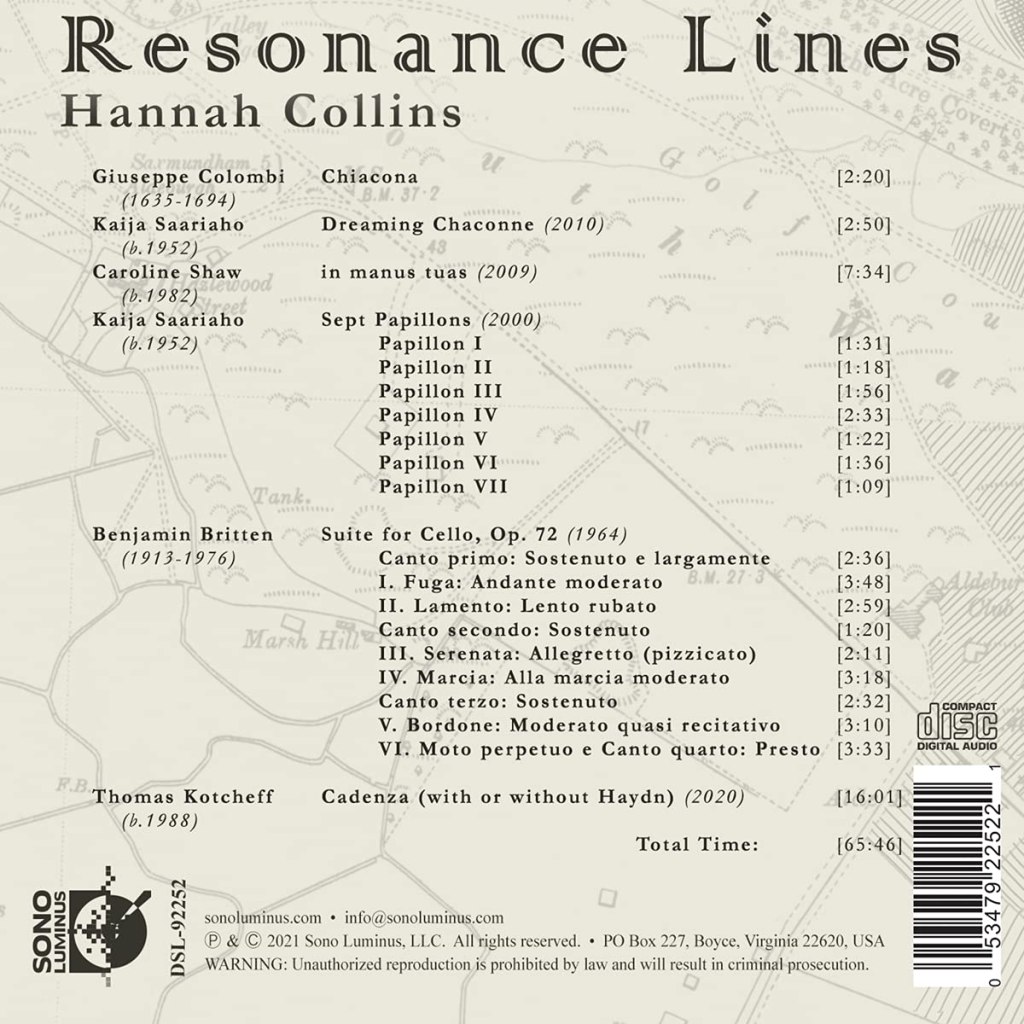
Hannah Collins debut on Sono Luminus was a compelling offering from this rising star.
Carolyn Shaw’s striking and much performed “In Manus Tuas” (on solo viola as well as solo cello) was originally written for Collins. Her selections on this album, including that Shaw work, suggest to this writer/listener that she has both vision and an encyclopedic knowledge of music, especially that written for her instrument. She will be among the major shapers of this repertoire via her vision as well as her interpretive talents. And Sono Luminus’ superb sonics certainly helps make this a great release.
The first volume of Sarah Cahill’s landmark trilogy of piano music by women composers.
I have followed the work of Sarah Cahill since her first solo CD (music of Ravel). Like Collins, she has been an artist who, by her intelligent selection of repertoire, serves as a guide to listeners (and musicians) as well. She has championed many composers as a pianist and as a broadcaster on her weekly KALW broadcasts. Her curation of concerts throughout the Bay Area, such as her solstice concerts at Oakland’s Chapel of the Chimes, have showcased a large variety of creative performers.
As she focuses her lens on women composers (neglected is implied) she embraces a stunning range of styles from the baroque era to the present and it seems as though she can play anything she chooses well. She is also collaborative with an amazing ability to discern the substance in the works she chooses to play. And she has discovered (or rescued?) much music from obscurity via scholarship and intelligent collaboration. Can’t wait for the next release. She is consistently interesting and relevant.
This release on Lars Hannibal’s OUR records was a brilliant new recording of some of Ligeti’s music and introduced me to Kodaly’s solo choral works.
This album was sent to me by a friend. I knew the Ligeti pieces but heard them with new ears in this release and I was amazed by the Kodaly works too. Marcus Creed may not be as well known in the U.S. as he is across the pond but he should be.
Another debut album by a cellist.
This album was kindly sent to me for review by John Schneider of Microfest records. Read the review. Listen to this album. And watch for more from Chris Votek, another rising star in 2022.
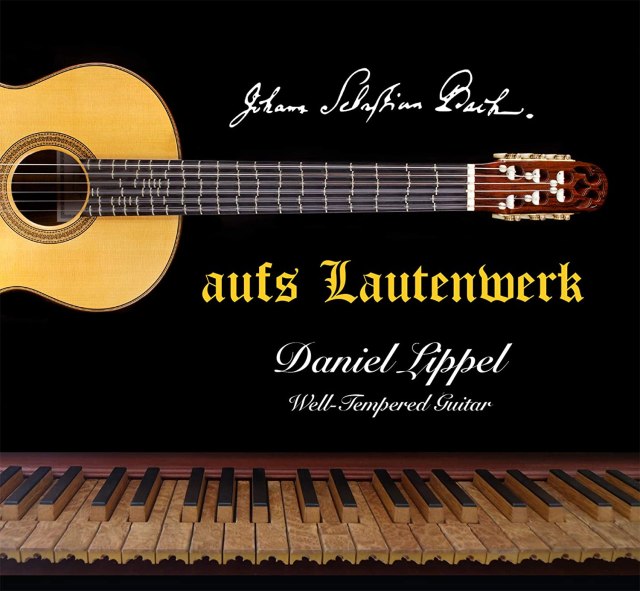
Dan Lippel’s virtual manifesto displaying his vision and skill as he furthers the mission of the guitarist in all their guises.
Dan Lippel is one of the founders of the fabulous new music label, New Focus Recordings. Here he is acoustic, electric, conventional, and experimental but always interesting. Keep his name on your radar.
Languishing no longer.
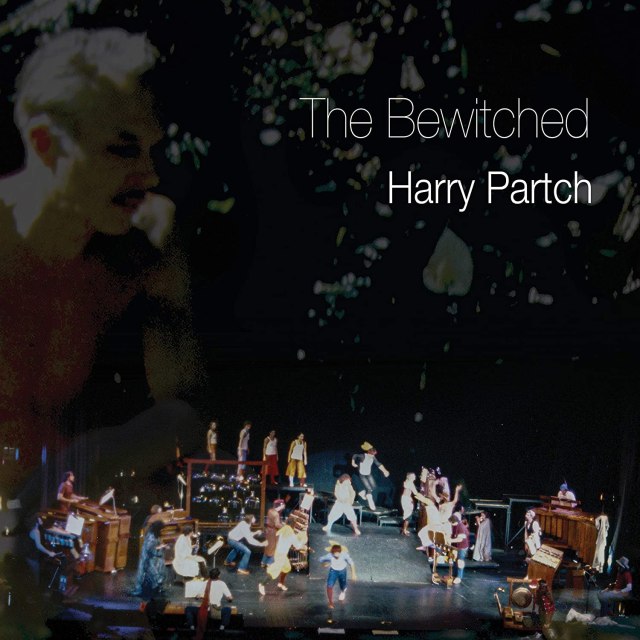
This is a gorgeously designed, very collectible art object. It is a beautiful hard cover, full color book which also contains a CD of a recording (from acetate masters) which had languished in the archives of the Eastman/Rochester Music School where Harry Partch gave this lucid lecture/performance in 1942. Mr. Schneider, who sent me the Votek release as well, fronts an ensemble called PARTCH which, in addition to performing Harry Partch ‘s work, is recording Partch’s complete works for David and Becky Starobin’s Bridge label. This one is both eye and ear candy to my ears.
Rescuing those acetate masters from obscurity is a major find that rises in significance (in the musical sense) almost to the level of the archeological discovery of Tut’s Tomb. Schneider is a musician, a composer, a radio broadcaster, and an archivist and now a sonic archeologist I suppose. He also sports a collection of authentic copies of Partch’s curious instruments which were built to play the microtonal scales required. Partch is a major American composer whose work is now gaining its rightful place among the best of American classical music.
Seminal work by an American post minimalist composer.
I first discovered Mr. Susman’s work when I was asked to review a performance of another composer’s work. I heard one of his works played by the remarkable San Jose Chamber Orchestra on that same concert. Here we have another multi volume release of these lovely and significant piano works. The remarkable pianist (mentioned often in these pages) has contracted to record all 4 books of this sort of “Well Tempered Clavier” type gesture which effectively provides much insight to this composer. Nicolas Horvath, known for marathon concerts performing (and subsequently recording) all of Philip Glass’ piano music, among others. (We’re talking 15 hours or so. There is also a 35 hour live rendition of Erik Satie’s “Vexations” on you tube.) Who better to record these? The remaining three volumes are due some time this year. Who better to take on this post minimalist set of pieces? Can’t wait for the next volume.
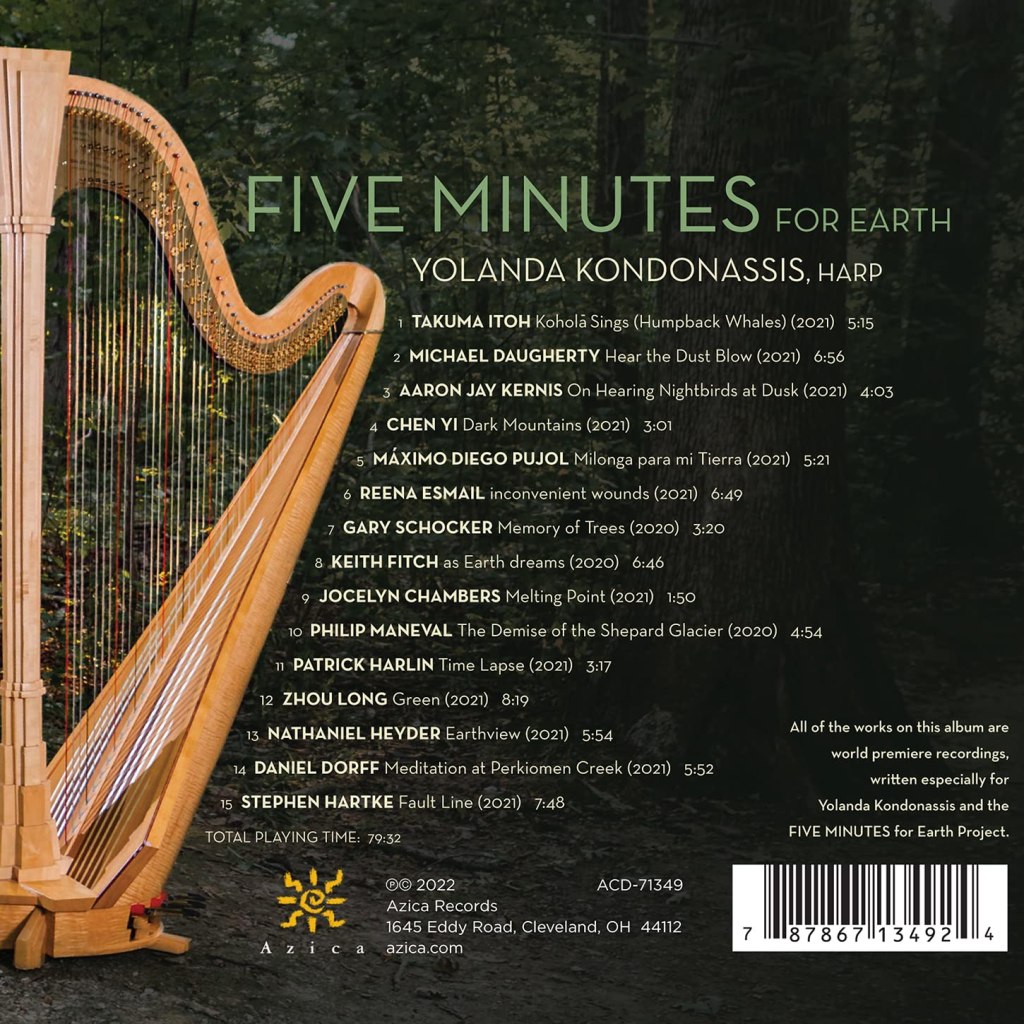
Kondonassis’ new music manifesto for the Harp (and the earth).
Yolanda Kondonassis is about as household a name that you can find among harpists. These five minute (more or less) pieces are a significant addition to the solo harp repertoire. They are forward looking works for her instrument. Very interesting work, excellently performed.
New piano music written for Jacob Greenberg
I remain in awe at the curatorial and historically aware work of this truly fine pianist. Greenberg helped me grasp the historical context of the Second Viennese School in a new way with his earlier release “Book of the Hanging Gardens”. In that release he played all the Debussy Preludes along with Schoenberg’s pre twelve tone song cycle, Webern’s Variations, and the Berg Sonata which helped this listener to better grasp the historical context of this music. This small collection of works written for him reflects a collaborative and visionary ethic akin to that of Sarah Cahill’s. Keep an ear out for this guy.
Lou Harrison’s brief Solo Violin Sonata
I have received some good natured teasing about the fact that this, one of my longer reviews, is of a 15 minute piece of music. But this act of musical archeology by the bay area’s Kate Stenberg (who is a regular collaborator with Sarah Cahill BTW) has made the first recording of this little work. It’s Webernian duration belies a style very much in character with this beloved composer’s other work. My review was as much about the music and the recording as it was about the dedication of Stenberg to new music. This release is from Other Minds, another shining example of advocacy of new music and collaboration among composers and performers. Get it. Listen to it. And don’t miss a chance to hear Stenberg live performances or to hear anything Harrison has written.
Music between the wars
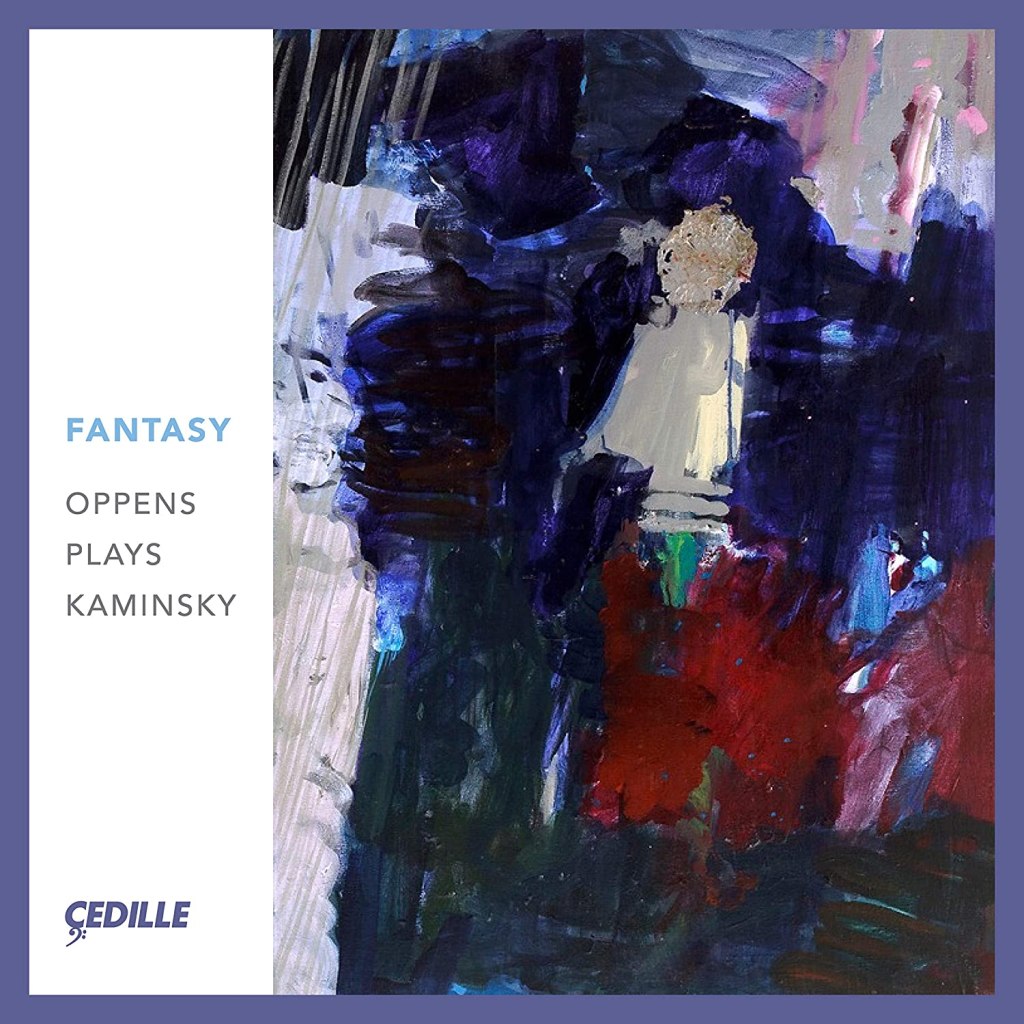
The Chicago based Cedille label is one of my favorite classical music labels. Producer James Ginsburg has a golden ear and Cedille is the finest Chicago based classical label since the justly fabled Mercury records. All their releases deserve attention but this two disc set of little known works for String Trio written between the world wars is a feast of substantive, if slightly conservative, voices. This one is a great listen and, trust me, none of this music is in your collection.
Other Minds Executive and Artistic Director of Other Minds Charles Amirkhanian applauds a rare performance of his own music at OM 26.
While circumstances conspired to limit my attendance to only one of the three days of OM 26, I would be loathe to leave this world class music festival off my “best of” list. My first published blog of 2023 was of the 30th anniversary celebration which showcased Marc-Andre Hamelin’s stunning reading of Charles Ives’ massive Concord Sonata. Anything OM does deserves your attention but the roughly annual festival continues to present composers and performers from around the world. Not to be missed.
Volume two of three
Another exciting release of Cahill’s visionary series. Like the previous volume (and the aforementioned Cedille release) the consumer will suffer no unnecessary duplications if the music herein. Fascinating and expertly done. This set (the third volume due this year) is a testament to Cahill’s encyclopedic knowledge of piano music as well as her collaborative nature and, of course, her skills as a pianist.
A new voice in electroacoustic composition Kataro Suzuki.
I’m cheating a bit here since I wasn’t able to complete my review until 2023 but this Starkland disc was released in 2022 and definitely earns its place in my “best of” list. This rising star is another one to watch. Starkland, run by the dynamic Tom Steenland is one of those labels that reliably finds interesting and substantive new music. This one is no exception. It goes a long way to alleviating my skepticism of the electroacoustic genre.
DVD OM 4001
And, in order to be fair I must cheat equitably. Charles Amirkhanian kindly sent me this exciting and excellent DVD of his collaboration with his partner in life and in artistic crimes, Carol Law. My more extensive review will appear shortly but this was a major release in 2022. Amirkhanian spends far less time promoting and performing his own unique compositions so this is an especially welcome release.
Neuma
Last but not least of my best of 2022 is this wonderful Neuma release which, when I began my research to write a cogent and informed review, left me stunned at how little I actually knew about composer David Tudor and the astounding dimensions of this unusual piece that evolves with every performance. After gathering a whole ton of data I finally decided that I could not write a comprehensive review without more research so I settled on a tasteful (I hope) summary with the expectation that I will write a larger piece on Tudor and his work. The review will be out very shortly. This is an amazing and significant release.
Happy 2023 to all my readers and thanks to those who kept reading my blog during more fallow times. I have many blogs currently in preparation that I look forward to sharing in the months to come. Peace, health, and music to all.
The late, great British science fiction writer Arthur C. Clarke once asserted that “any sufficiently advanced technology is indistinguishable from magic (to those who don’t know the technology)”. A similar assertion can be said to be true of music. New music is a large and diverse repertoire that is difficult to navigate without some sort of guide to put those new sounds in context. And Charles Amirkhanian has, via his years as music director of KPFA and his stewardship as Executive and Artistic Director of Other Minds (among the many hats he wears) has provided such guidance for interested listeners to new music since at least 1969.
In an unanticipated gesture of magnanimity there was, at the will call table, not the usual “items for sale”, rather there was a lovely free tote bag and a large selection of OM CDs there for the taking. Suffice it to say, I and many others went home heavier than we had arrived.
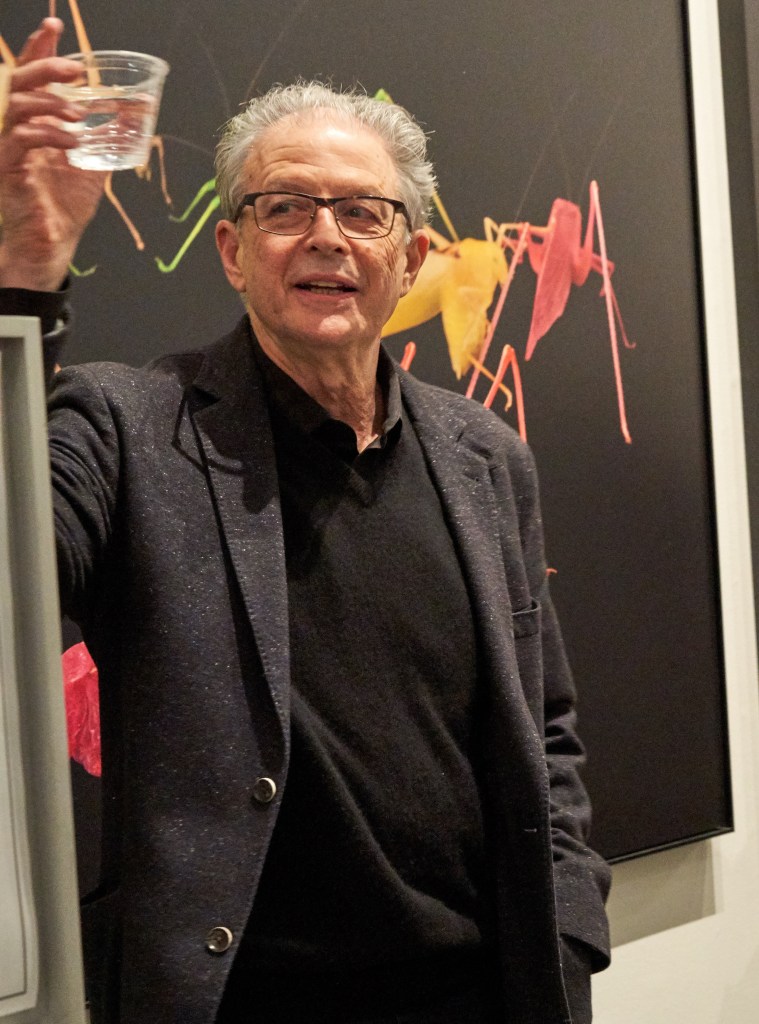
Charles Amirkhanian raising a toast at his 75th birthday celebration ( in which Kyle Gann was host and discussant)
He and his hard working team (Blaine Todd, Associate Director; Mark Abramson, Creative Director; Liam Herb, Production Director; Adrienne Cardwell, Archivist; Andrew Weathers, Recordings Director; Jenny Maxwell, Business Manager; and Joseph Bohigian, Program Associate) have provided guides for adventurous listeners that have included interviews with musicians and composers, a record label dedicated to new music, and live lectures and performances of creative new music from all over the world. The annual Other Minds Festival (the 26th was presented earlier this year) has brought in a cornucopia of stellar performers with a knack for finding stars at the outset of their careers. Other Minds at 30 is truly one of the great joys of San Francisco and it’s environs.
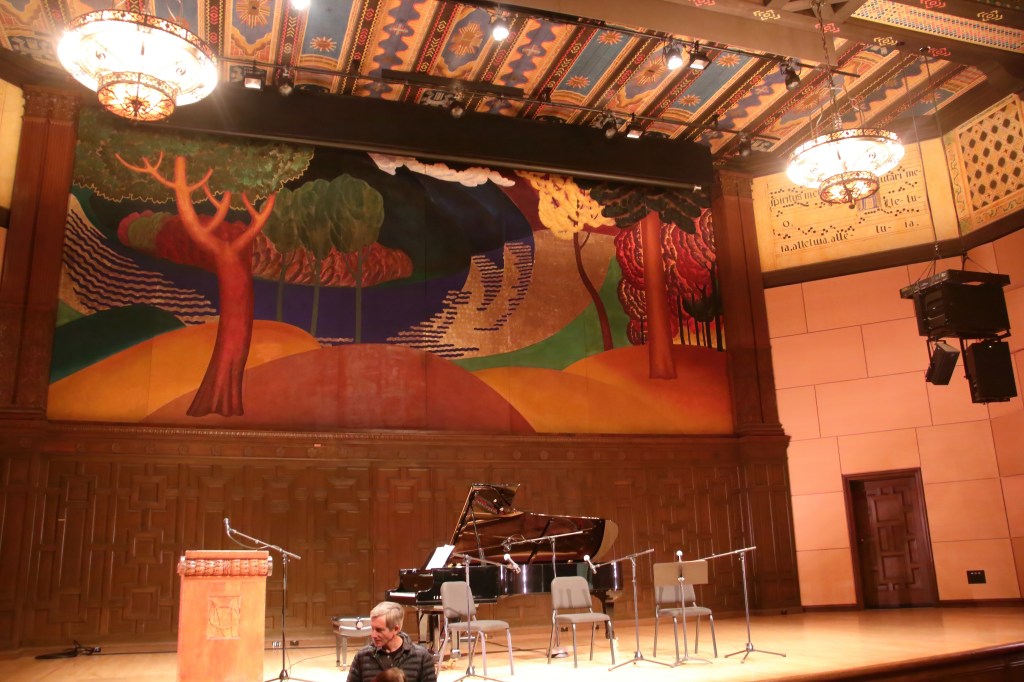
This evening was one of the lecture recital variety. Kyle Gann, composer, writer, critic, musicologist, OM alum, and vice president of the Charles Ives Society was brought in to provide the lecture portion of the evening. In addition, this event was held at a major temple of new music in the Bay Area, Mills College (actually Amirkhanian’s alma mater). The beautiful Littlefield Concert Hall itself displays the striking work of California architect, Julia Morgan. Artistic spirits past and present were undoubtedly here this night in the history of this place as well as those artistic spirits present in the audience.
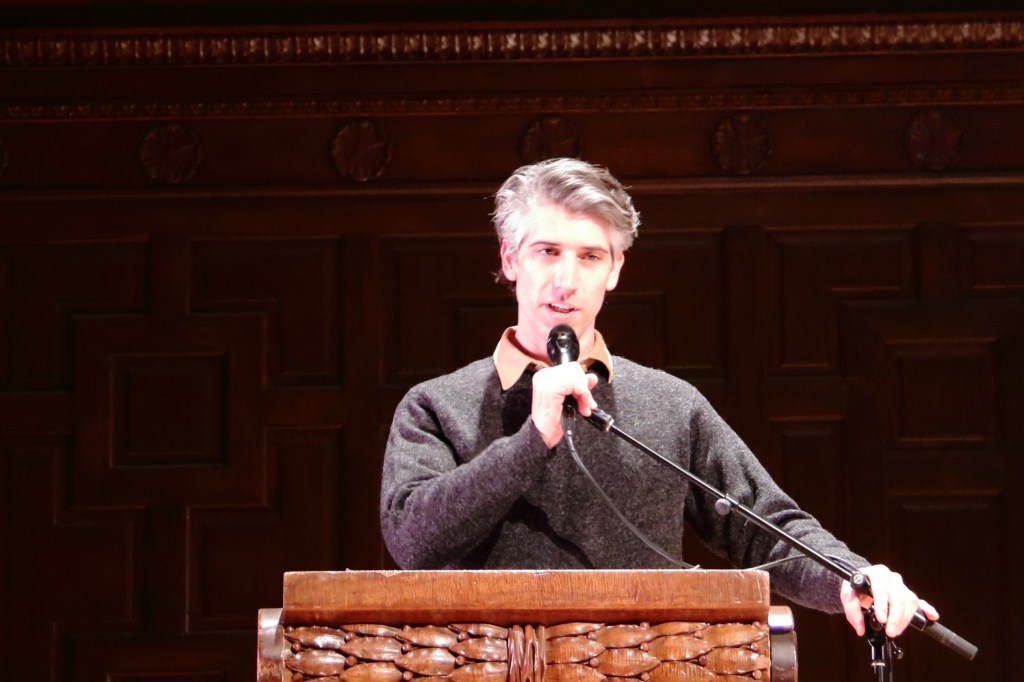
Blaine Todd officiated the preliminaries by introducing tonight’s stars.
The program began with a brief discussion among Mr. Amirkhanian, Professor Gann, and maestro Hamelin. Then Gann took his place at the lectern and Hamelin took a seat at the piano where he had graciously agreed to perform musical excerpts to illustrate Gann’s lecture. Actually Gann has written a definitive and very readable book on the work destined for performance on this night. “Essays After a Sonata” (2017), the title a gentle pun in homage to composer Charles Ives who (in an unprecedented move) wrote a little book titled “Essays Before a Sonata” as a means of introducing his landmark Second Piano Sonata.
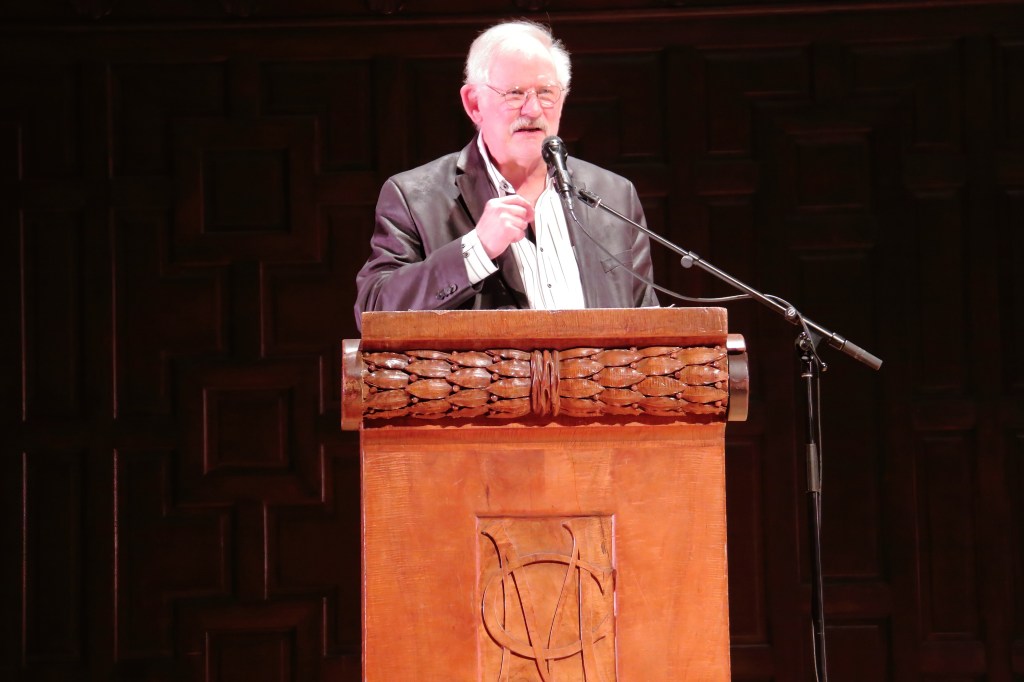
Professor Gann providing a context.
In addition to his wonderful book, Gann has had a long interest in the literature of the so called “Transcendentalists” who are the subject (or at least subtext) of this music. He even went as far as to suggest specific literary references implied in the music. The Second Sonata “Concord, Mass., 1840-60, (written 1904 to 1915 with several subsequent revisions) is in four movements titled, “Emerson”, “Hawthorne”, “The Alcotts”, and “Thoreau”. Gann provided a few concise illustrations in a rather brief talk that provided just enough context to assuage the uninitiated (if there were any in the audience, lol). Hamelin coordinated most amicably and then there was a short intermission.
Marc-Andre Hamelin (http://www.marcandrehamelin.com) was born in Montreal and is now based in Boston. His discography consists of over 80 albums. My own introduction to his artistry was his first release in 1988 of William Bolcom’s Pulitzer Prize winning, Twelve New Etudes (1977-1986) and Stefan Wolpe’s “Battle Piece” (1943-47). His web site is worth your time and gives an idea of the sheer scope and acumen of his repertory choices. In fact his most recent releases include more from William Bolcom and a disc of his own compositions. In fact he gives fine performances of music from Mozart and Haydn to the present. Hamelin has performed the Concord Sonata numerous times and has recorded it twice. He performed this gargantuan work entirely from memory.
Maestro Hamelin taking a moment to savor his fine performance and return his focus to the standing ovation that greeted him.
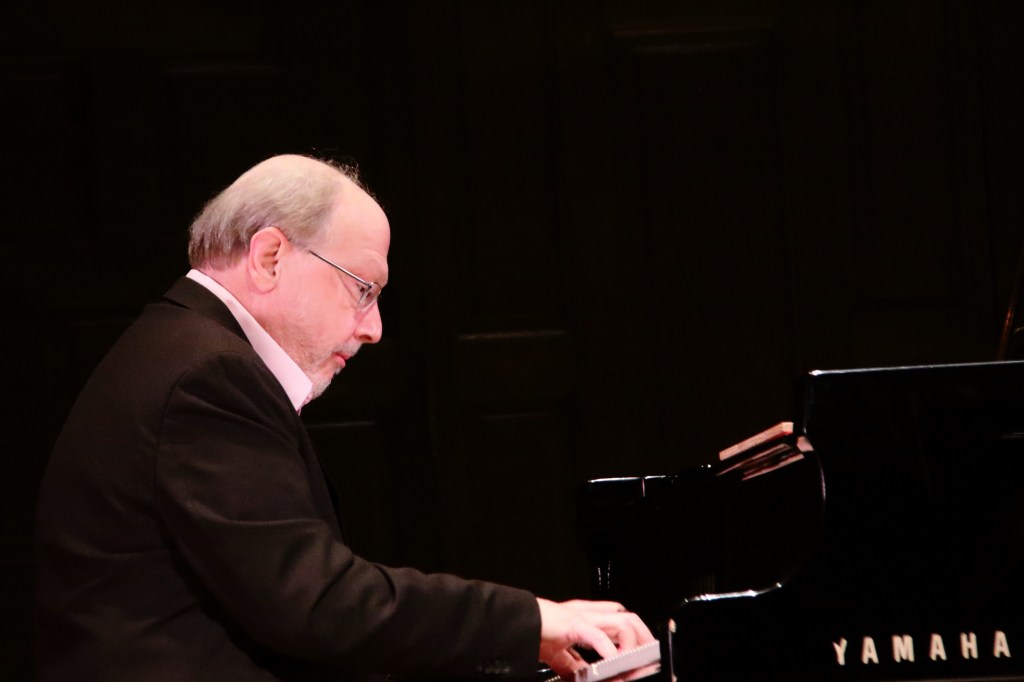
Hamelin gave an extremely focused and convincing performance, an exercise of both intellectual and physical stamina. The audience, due to their reverence for Ives, Hamelin, and the spirits present in the hall, sat in rapt attention with nary a squirm nor a cough (well, maybe one cough) to interrupt the flow of this landmark work of American modernism. Such was Hamelin’s thrall. The piece goes through a wide dynamic range and the soft pianissimo resonances could be heard as clearly as the Beethoven-esque heroic fortes. Hamelin took two curtain calls to a standing ovation of a very appreciative audience. Gann quipped at one point that he uses Hamelin’s Hyperion recording of the Sonata in his classes. It was easy to see why.
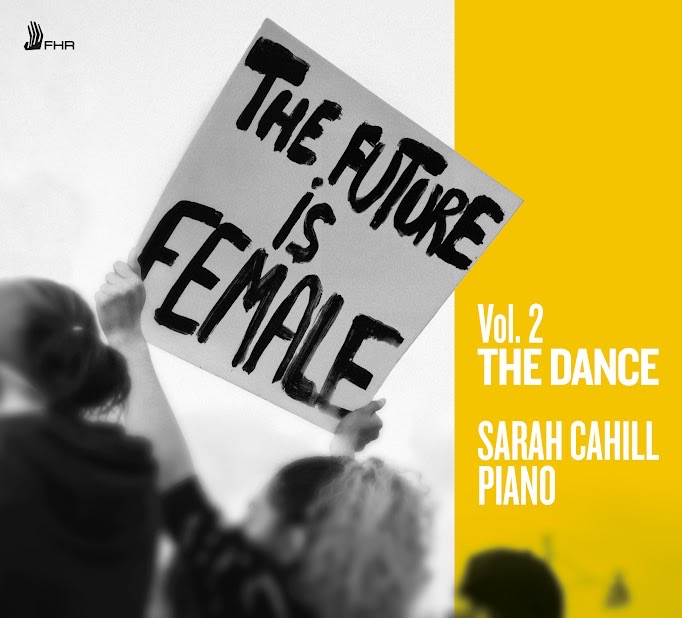
The fanciful subtitle of this release, “The Dance” is a follow up to the first volume titled, “In Nature” (a third volume titled, “At Play” is due out in March, 2023). These vague titles are fanciful and more connotative than specific. They seem to reflect the nature of the project and the nature of Sarah Cahill‘s style of conceptualizing what must be an overwhelming undertaking, Beginning with the simple concept of female composers (the term “neglected” would be redundant here) Cahill has produced a sweeping survey ranging from the baroque era (the earliest piece so far in this anthology is from 1687) to the present and her survey seems to know few geographical boundaries in this representative survey of keyboard music. Of course we are talking about basically the paradigm of western classical music but non-western influences are of course included via the composers’ individual talents. Many of these works were presented in Cahill’s fine YouTube series which can give listeners further clues to the pianist’s varied interests.
The cover art (which I had described as “drab” in the first review) now seems to aptly reflect the struggle for equality and now nicely represents this project in an iconic way with the same monochrome cover photo on each of the three volumes and a primary color panel with the disc title. Green for Volume I, Yellow for Volume II (I’m guessing “red” for Vol III?). This survey is shaping up to be an influential as well as hugely entertaining anthology.
What struck this listener is Cahill’s facility with both technique and interpretation of a mighty diverse set of pieces. Known primarily for her work with music written after 1950, she demonstrates in these recordings an impressive command of baroque, classical, romantic, and modern idioms. I have never heard her play Bach but I wouldn’t miss an opportunity to hear her do the Goldberg Variations.
This was particularly striking in her reading of the keyboard suite that opens this release. This is apparently not the first recording of Elisabeth JACQUET DE LA GUERRE‘s (1665-1729) Suite no. 1 in d minor (the complete suites for harpsichord were recorded by harpsichordist Carol Cerasi in 1998) but Cahill seems to channel the spirits of the pioneering efforts of Wanda Landowska and Rosalyn Tureck whose abilities to play harpsichord music effectively on the modern piano helped set the standard for this practice in the twentieth century and beyond. This late French baroque suite is a thoroughly engaging way to draw the listener in. With echoes of Bach and Couperin this virtually unknown composer is seriously engaging and substantive. This recording includes five (of nine) movements of the suite. One hopes to hear more of this woman’s music and Cahill is very much up to the task of providing a definitive performance.
With the next track we hear the music of Clara SCHUMANN (1819-1896), better known as the wife of Robert Schumann (1810-1856). Clara was in fact a highly accomplished virtuoso and composer whose works are only now getting the recognition they deserve. The piece chosen here is her Variations on a Theme of Robert Schumann Op. 20. These seven variations were a gift for her husband on his 43rd birthday in 1853. Sadly it was to be the last birthday he would celebrate with his family. Robert Schumann was infamously institutionalized in 1854 and died in 1856. The work has all the splendor of high romanticism with the virtuosity associated with the great composer/pianists (Brahms, Schumann, Liszt, Rubinstein, et al). And, as with the previous piece, Cahill seems very at home in her reading of this wonderful set of variations.
Germaine TAILLEFERE (1892-1983) is next up with her three movement partita of 1957. The title “Partita” suggests a connection with the baroque suite which opens this collection. The connection is one of form, not harmony or melody. The three movements here are “Perpetuum Mobile”, “Notturno”, and “Allegramente”. Taillefere, who is perhaps best known for her lively Harp Concertino of 1927, was the only female member of France’s celebrated “Les Six” (the other members were, Louis Durey, Georges Auric, Arthur Honneger, Darius Milhaud, and Francis Poulenc). This largely neoclassical group of composers developed their styles in the shadow of Debussy and Ravel. Cahill’s first album was a fine reading of Ravel’s piano music and she is very much in her element with this delightful three movement work which echoes Ravel to some degree,
Zenobia POWELL PERRY (1908-2004) is the first composer in this collection to be born in the twentieth century. She was a black composer/conductor/pianist and teacher. Her work appeared before in this blog in coverage of her opera “Tarawa House” which was given a revival in Modesto, CA in 2014. Her “Rhapsody” (1960) is in a sort of Neo-romantic style with some challenging virtuosity required. This is a fine introduction to her work which deserves serious reassessment and more performances. Musicologist Jeannie Gayle Pool continues to publish, preserve, and advocate for this neglected American artist. Pool maintains the website for this composer and is a useful, informative site,
Madeleine DRING (1923-1977), a British composer/pianist, a new name to this writer, is characterized by her use of popular and jazz idioms. Cahill here plays two (of five) movements of her “Color Suite” (1963). This whets the listener’s appetite for more of this interesting composer whose work was well known during her career but whose star has dimmed since her passing. Dring is one of many women composers of that era whose work, though influential, has not been incorporated into the repertory of contemporary classical musicians.
Betsy JOLAS (1926- ), a French born American composer whose career has included work as a composer, pianist, and teacher. No stranger to the Bay Area, Jolas taught at UC Berkeley and Mills College as well as Harvard and Yale. The listener accessible nature of her music belies the innovation and complexities it contains. Though she has been recognized throughout her career her work is due for a new reckoning. Her brief “Tango Si” (1984) is entertaining and sufficiently compelling to spark interest in her work going forward.
Elena KATS-CHERNIN (1957- ) hails from Uzbekistan and migrated to Australia where she studied at the New South Wales Conservatorium and subsequently with Helmut Lachenmann in Germany. Kats-Chernin has been a prolific composer and is now perhaps mid-career and, happily, pretty well known. “Peggy’s Rag” (1996) is one of a set of several rags written between 1995 and 1999. This work is dedicated to Australian composer Peggy Glanville-Hicks (1912-1990), another artist, another female composer deserving of a revival.
Meredith MONK (1942- ) has long been one of this reviewer’s favorite “downtown” composers whose initial musical ventures were first heard in her New York SOHO loft. She, along with other rising stars, including Philip Glass, Steve Reich, Phill Klein, Rhys Chatham, etc., are now the historically recognized mavericks who’s creative ideas formed in contrast to the power elite of the “uptown” composers heard commonly at Lincoln Center.
Monk was initially trained as a dancer and that has been evident in most of her output. But she is perhaps best known for her exploration of extended vocal techniques (which she also teaches). It is fitting that her “St. Petersburg Waltz” (1997) is included in this dance themed installment of music by women composers. Despite being an “east coast” composer initially, Monk has achieved international recognition and has a particularly large following in the Bay Area. No surprise then that our pianist guide in this journey has a long standing familiarity with Monk’s work. Cahill demonstrates her grasp of Monk’s minimalist inflected style most admirably and, as in the preceding tracks, leaves the listener wanting more.
Gabriela ORTIZ (1964) is a Mexican composer. Born in Mexico, trained in England, and now teaching in Mexico. Her light shines brightly even in the glare of the heavily politicized immigration issues that dominate the media and is another in a long line of world class composers from that underrated country. Ortiz, in addition to her academic appointments, has produced a large number of works in multiple formats from piano and chamber music, to orchestral, dance, and opera. Her work draws in part on the folk music traditions she absorbed in her childhood and she has amassed a significant number of international commissions and recordings.
Ortiz is also an accomplished pianist and the work chosen here is “Preludio y Estudio No. 3″(2011), one of four two part compositions. Cahill’s brief but useful notes provide the listener with her personal insights to the underlying complexities that drive this music. The incorporation of folk and non-classical elements has been embraced by composers for hundreds of years and Ortiz succeeds in incorporating such elements into her personal style,. As with all of these works, Cahill produces interpretations that, if not absolutely definitive (there are always detractors) stand as a challenge to subsequent interpreters, a necessary element in such a grand project.
This volume ends with the most recently composed work by the youngest composer of the lot, Theresa WONG (1976- ). Wong, a graduate of Mills College, is cherished performer in the Bay Area and beyond, As both composer and performer she has maintained an active schedule and has produced a great deal of music documented in a large and growing discography. Her collaborations have included many of the established Bay Area artistic royalty (including Ms. Cahill, of course).
“She Dances Naked Under the Palm Trees” (2019) is a composition for which the backstory (provided in Cahill’s notes) is particularly useful for the listener. It is the incorporation of extramusical ideas and musical. quotation that drive the drama here to some extent.. The music certainly stands on its own but the addition of the technical insights will send the listener back for repeated hearings and the music will guide the listener to seek more of the work of this wonderful artist whose star continues to rise.
The last disc in this landmark anthology (due next year) will ultimately contain only a portion of the approximately 70 pieces which Cahill has chosen. Like her previous anthology (of politically influenced music) “A Sweeter Music” released in 2013, the limitations of time and money prevent a more complete vision of said anthologist but there is more than enough to provoke further interest by listeners and artists and isn’t that the point?
I have attended nearly every OM annual concert series since 2012. But pesky adult responsibilities intervened for the last few years. Having had to miss OM 25 due to my out of town work I resolved to make it to OM 26 now that I am back in California. However circumstances conspired such that I was only able to make one night of this essential new music festival.
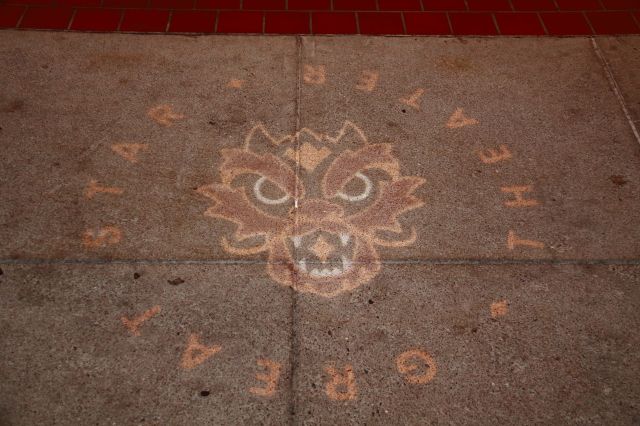
Sidewalk Projection in Front of Theater
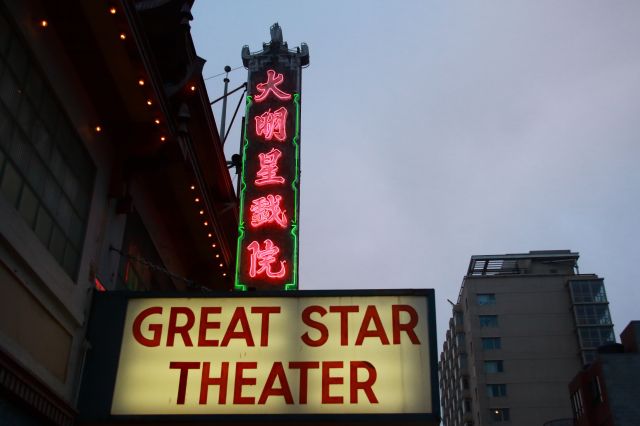
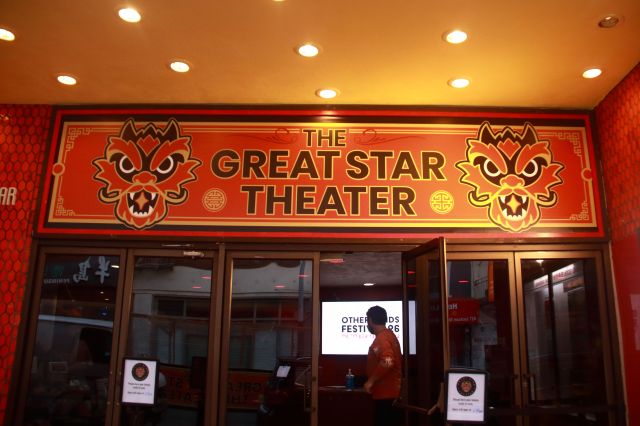
I do plan to listen to the archived audio and video streams which Other Minds now provides. but nothing can truly take the place of live performances. And, in addition to providing some wonderful sonic ear candy, there is the spectacle of the performances themselves. On top of that, these performances have showcased many wonderful performance spaces such as the The Jewish Community Center, The SF Jazz Center to name a few of them. OM 26 was held at the historic Great Star Theater in San Francisco’s Chinatown neighborhood, a venue known for presenting traditional Chinese Opera (in fact Chinese Opera continues to be on the bill for this charming little performance space).
Lobby entrance.
A heavy fog enveloped the northern end of the city as I approached the venue but the sun greeted me when I reached my destination. According to their website this theater is “Located in San Francisco’s renowned Chinatown, the historic Great Star Theater is a one-of-a-kind venue. Built in 1925, this traditional proscenium stage live theater was originally home to Cantonese Opera and Hong Kong kung-fu movies. Recently under new management and newly renovated and revitalized, it now features a variety of theatrical, musical, circus, and motion pictures for a new generation.”
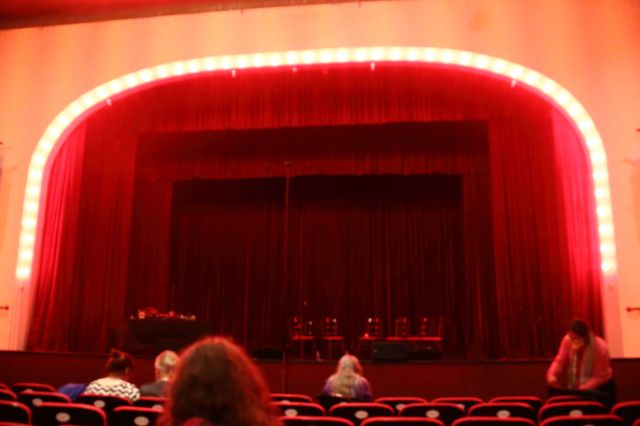
View of stage
The 438 seat theater was more than adequate to accommodate the small but fervent crowd of Other Minds fans. There were seats to be had but the small audience was a highly appreciative one willing to open themselves to the adventure of new music curated by Charles Amirkhanian who has presided over the new music scene of the Bay Area ever since his tenure as classical music director of radio station KPFA which began in 1969. The Fresno native studied at Mills College, earning an MFA in 1980. While his tenure at KPFA ended in 1992, his involvement in new music productions continued. During that time he recorded interviews with nearly every area composer and musician as well as a panoply of international artists. His gentle, friendly manner along with his mellifluous resonant baritone voice (one that looms large in his sound poetry) has served him well in radio and in his large catalog of interviews. He founded Other Minds in 1992 with television producer (now president emeritus of Other Minds) Jim Newman.
What I Missed
In this 26th incarnation of this iconic series of new music concerts the following were presented on the first concert:
Missing this fabulous first night was a painful experience. Theresa Wong is a fine musician/performer from the Bay Area. Her name, of course, occurs elsewhere in the pages of this blog, She is not to be missed as composer, as cellist, as performer.
Mari Kimura, no stranger to Other Minds fans, is one whose work I do not know. But it is by introduction of stunningly intelligent and skilled artists such as this one that the OM fan can safely put on their collective and individual radar, sure that their/our attention is not misspent.
Pulitzer Prize Winner Raven Chacon is one of those fine artists about whom Other Minds (aka Mr. Amirkhanian) can say “I told you so,” If you studied your emails you will find a link to an OM interview with maestro Chacon. He is a Native American (Navajo Nation) musician whose experiments caught the eye/ear of OM and resulted in an appearance and interview. How wonderful for him to return in his post Pulitzer appearance.
Guillermo Galindo is a respected Bay Area musician, sound designer, conceptual artist, and teacher. He is one you want to keep your ear/eye on. His unique instincts visually and sonically are a good bet in his performances. Paired with Chacon? How can you go wrong?
Third Night
DOMINIC MURCOTT
The Harmonic Canon
KUI DONG
Scattered Ladder
LARS PETTER HAGEN 10 Svendsen Romances, Seven Studies in Sadness, Diabelli Cadenza, Coda
And the grand finale, always the one you go to if you can’t make them all, the third night:
Dominic Murcott (who appears as percussionist/conductor on evening two) is one who, by a glimpse of his online CV, immediately was placed on high listening/reading priority in my links list. It will forever be a “one that got away” story for this absent fan. The bell and the backstory are alone worth the price of the ticket,
Lars Petter Hagen is a new name to this writer, a warning shot across my bow from OM. The Sternberg/Cahill duo here performing this composer’s work are also a guarantee of fine performance,
Kui Dong is another esteemed Bay Area artist whose work has long had a productive affiliation with OM. Any new work or recording of her work is a cause for attention. Her work for the Prism Percussion Duo was doubtless a substantive experience.
There is a link provided for each of the artists for the reader’s convenience. Please do click those links and explore further. I know I certainly will,
What I Did See and Hear
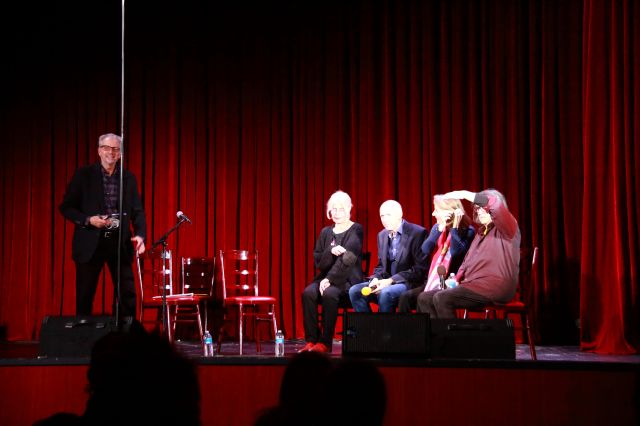
The panel style interviews before each concert are an opportunity to learn from the participants and to enjoy the interview style of Mr. Amirkhanian.
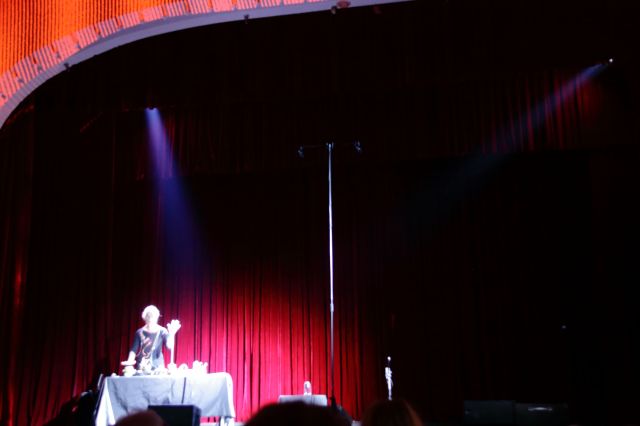
The concert began with the stylings of Hanna Hartman, a Berlin based Swedish composer who favors old and lower tech electronics. In this digital age with access to incredibly complex synthesizers and other sound technology, Hartman (at least here) worked with a Buchla 200 synthesizer and a selection of recorded and live sounds which were processed and created what sounded to my ears like a live performance of a tape composition. Quite a feat.
Hanna Hartman
Standing at a table stage left covered with electronic and non-electronic devices she looked like the host of a cooking show live mixing sounds into a logical flow which were projected in stereo to the audience.
The performance had her draped in multicolored tubes which she used to blow into and create sounds in miked containers of water. She stood actuating materials on her table that might have come from an erector construction set and/or a “Mouse Trap” game (familiar to listeners of a certain age) and which resulted in a veritable barrage of sound which moved from one speaker to another but created an immersive and room dominating flow of sounds.
Hanna Hartman in performance.
It might best be called a sound collage. It seemed to be guided by a program or sequence much as any musical composition. The sounds, sometimes apocalyptic, sometimes more drone like and serene, were engaging. And the curious image of her working with these various materials sometimes seemed indirectly connected to the sounds heard. It was as if the chef’s culinary efforts had taken on a sonic life of their own.
Though baffling at times the audience and this writer were very appreciative as the music revealed its internal logic. We had been introduced to yet another interesting artist by the Other Minds experience.
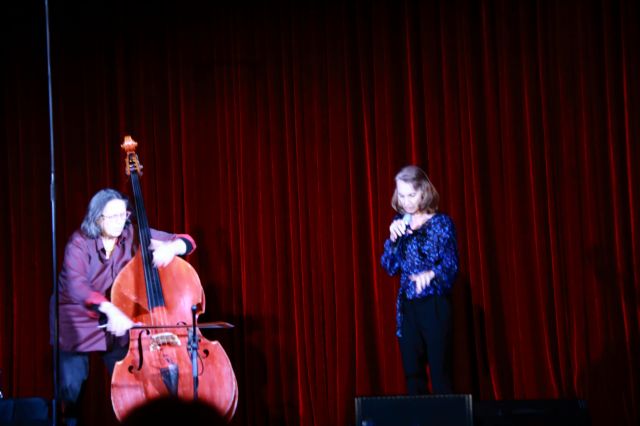
Joëlle Léandre (left) and Lauren Newton (right).
Then after just a bit of stage arranging Joëlle Léandre and Lauren Newton took the stage for a set of improvisations on double bass and voice. Going from the retro electronics and electroacoustic to good old live analog sound was a contrast.
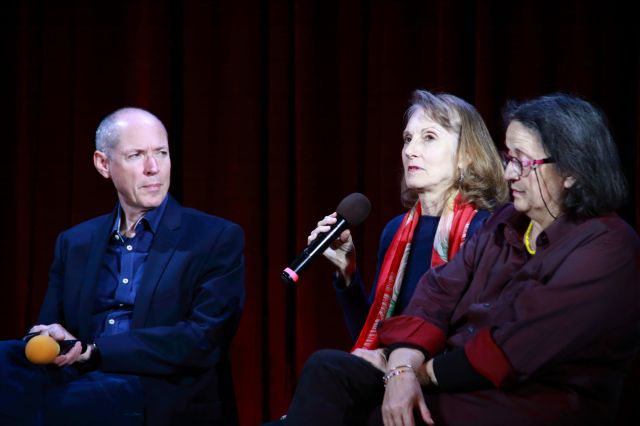
Lauren Newton speaking in the live stage interview with conductor/composer Dominic Murcott looking on and Joelle Leandre on the right,
These two brought an intense energy to the stage in a sort of cosmic cabaret. Newton is a classically trained singer who now performs (at least on this night) a sort of glossolalia of non linguistic sounds in league with co-improviser Léandre.
Joëlle Léandre is a double bass player with skills sufficient to have had her included in the late conductor/composer Pierre Boulez’ “Ensemble Intercontemporaine”. Boulez was a very demanding and exacting man. Léandre was also influenced by hearing the work of the AACM (American Association of Creative Musicians), a Chicago based group which introduced African musical ideas into modern western performances.
Call it “free jazz”, “new classical”, or whatever you choose. These new sounds and performance styles launched the double bass player to another world and another career as an improvising musician.
Well, these two women brought a wild shared creative energy to the stage. In a set of (if I counted correctly) five separate improvisations they traded with Léandre beginning, then Newton beginning, and clearly demonstrated a comfortable relationship between themselves as performers. The set went from moments of angst to moments of gentle humor to virtually indescribable moments which all shared an intimate connection between the performers as well as the audience.
Léandre compelled a variety of sounds ranging from standard bowed string sounds to ethereal harmonics, percussive sounds, and even her own vocalizations. Newton’s instrument (her voice) seemed to channel a mysterious range of sounds from whispers to glossolalia, to almost words. She and Léandre seemed possessed by dance like movements and hand gestures resembling those of raga singers all of which were a part of a truly engaging performance.
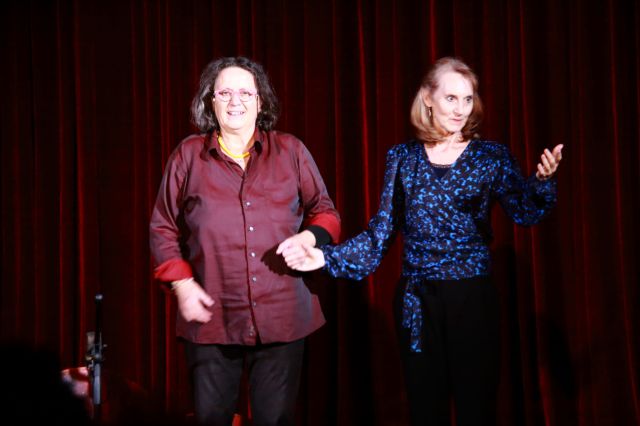
Joelle Léandre and Lauren Newton acknowledging a clearly very happy audience response to their performance.
After that intense experience the audience was allowed a brief intermission to recover and be able to focus on the final performance of the evening. From the electric to the acoustic we moved, perhaps inevitably, to the electroacoustic.
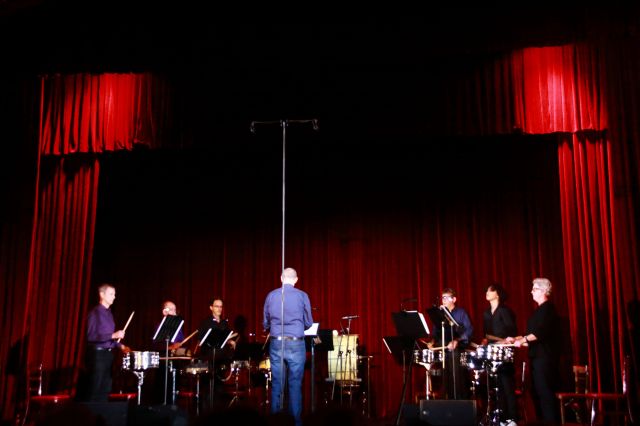
Dominic Murcott, peripatetic conductor/drummer about to lead this major opus by Charles Amirkhanian.
Yes, THAT Charles Amirkhanian, the voice of OM. In addition to his leadership work with the various aspects of OM, he is a much respected composer/sound artist, His astute advocacy of the up and coming voices presented via OM are an enduring legacy. Here is an exciting local premiere performance of a major opus.
Amirkhanian noted his earliest compositional inspirations to have been a result of his experience with being a drummer in the high school marching band. So that kind of gives you a clue as to this unusual orchestration.
Add to that his unique take on sound poetry, his skills with tape manipulation, sound samples, etc. and this multi movement work takes on an epic proportion. I reprint the liner notes below but my personal experience is as follows:
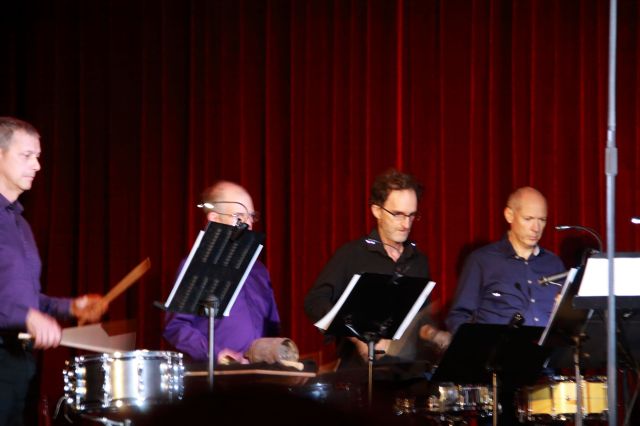
Drummers to the left,
“Ratchet Attach It” (2021)by Charles Amirkhanian is a large multi movement work for eight percussionists and sound samples. It is a piece which succeeds on many levels. The composer’s background (and clearly cherished) experience as a percussionist is the most obvious driving force and framework but the inclusion of his sound art, use of language as both sound and syntax interpolated between and sometimes with the live musicians performance. The electronic interpolations are, whether intended or not, a sort of nod to Edgar Varese’ “Deserts”. Their function within the composition however, are quite different.
There is a characteristic humor which runs through much of Amirkhanian’s work. His gentle defiance of drum cadence structures and doubtless other performance conventions in this work become transformed via caricature, a sort of personal nod to fellow percussionists. They are punctuated with a variety of audio intrusions between and sometimes within movements. These intrusions are autobiographical and nostalgic as they refer or connote respectful homages of fellow artists as noted in the very useful program notes. These are not actually intrusions as much as connecting audio cadences as a sort of mortar for the deconstructing drum cadences that dominate the music’s structure. It takes on a character of ringing changes in bell ringing but that is deconstructed as well,
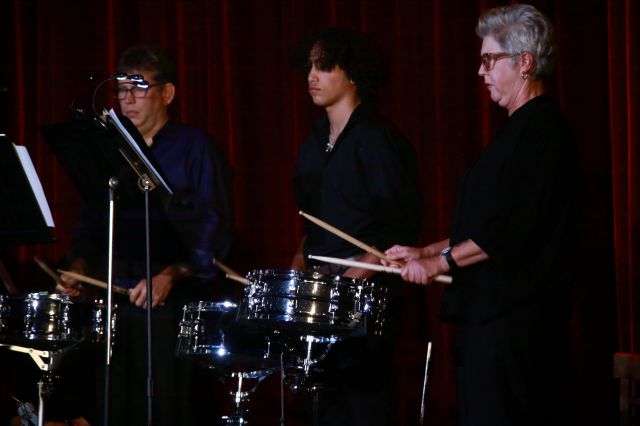
Drummers to the right,
There are a panoply of examples of the concept of humor in music at work here but as I am not a musicologist I will restrict my examples to the most obvious. In what may also be gentle parody, the conductor, Mr, Murcott, traveled between podium and fellow drummer leading the orchestra as did Mozart and Beethoven, with their instrument close by. Other players did their share of marching around in a visual ballet as they carried various bells that they played before returning to their assigned snare stations. A large bass drum asserted itself from back center in the ensemble, This was a disciplined performance making a strong case for the music. Quite a spectacle and maybe an “audicle” (sound spectacle) as well.
Replete with multiple references to personal and historical events as well as quasi minimalist manipulations of drum cadences in a live action electroacoustic visual and sonic event. It is a remarkably seamless mix of electric and acoustic, a major achievement. Dead serious but with great joy and humor.
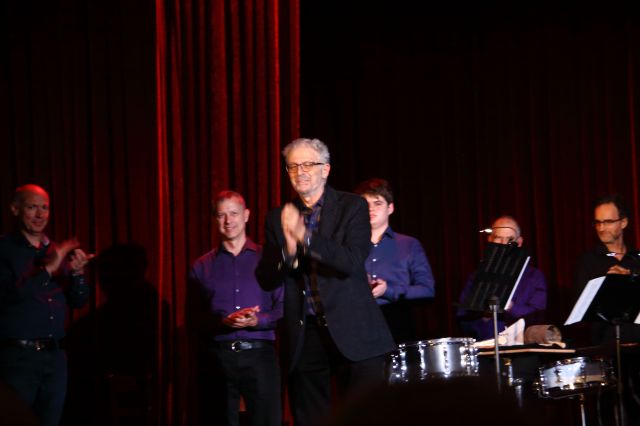
Composer Charles Amirkhanian acknowledging the very appreciative applause.
The composer’s notes here add much to the appreciation of this complex work:
I – The U.S. Army Postal Unit at Blandford, Dorset, 1944 When it became apparent during World War II that Hitler’s Germany would take a route through Blandford to attack England, the bar- racks from WWI were re-activated and popu- lated, in large measure, by U.S. Army personnel starting in 1943. The following year, my 29-year- old father Ben, the commander of a unit of men assigned to sort the mail sent from the U.S. to England and Continental Europe, arrived to be- gin work in Dorset. On the weekends, the com- mander had the privilege of driving some of his men around for sightseeing, from Stonehenge, to Piccadilly Square, to Edinburgh. Ben’s enthu- siasm for the people of England, the landscape and its history, is evident in his many letters home to my mother who was about to give birth to me in January 1945.
II – In Praise of the Venerable Piano Roll
The wonders of music made available to many non-performers in the early 20th Century by the invention of the player piano brought an unimag- inable thrill of excitement to so many. Before the days of high-fidelity sound recording, hearing the acoustic sounds of an actual piano, playing note-perfect renditions of classical and popular repertoire in one’s own home, was a profound-
ly mesmerizing experience. Snare drummers everywhere will welcome the chance to honor this signal achievement with a roll of their own. My thanks to Dominic Murcott for suggesting that the percussion repertoire lacked a single piece comprised solely of the sounds of drum rolls.
III – Ticklish Licorice
This movement comprises a quick-time perfor- mance of the novelty piece Flying Moments, by Leo Livens (1896-1990), accompanied by crystalline bell sounds from the percussionists. Livens, in his day, was a renowned British composer of light music. Here the player piano is useful in brightening up the music with a high-speed rendition of this playful music, performed in a studio recording by Rex Lawson with his usu- al nuance and panaache on the Bösendorfer Imperial Grand at Dulwich College in 1994—John Whiting, sound engineer.
IV – Chatteratchet
The sound up close of a concert orchestral ratch- et can be hair-raising. Also, full of bird-chirping- like overtones. I learned this early on by accident while sitting in the enclosed cab of my Volkswa- gen bug and turning the handle of this ear-split- ting instrument. I decided to compose a solo for amplified ratchet, followed by duos, an octet, and other combinations over the years. The act of playing this mechanical instrument somehow relates, for me, to the mechanism of the player piano, with its constant rotating of the paper roll on which music has been encoded. The ratchet came to mind in relation to Spitalfields and the history there of tailoring. My only visit to the neighborhood came some years ago when I visited the offices of my friend Timothy Everest, bespoke tailor. In this quartet for four amplified ratchets, much of the work is devoted to the practice of turning the instrument’s handle con- tinuously, but at the slowest possible speed. The counterpoint between the instruments literally is out of the control of the players due to the nature of the spokes and their response to the turning crank, resulting in an interesting irregularity.
V – Hopper Popper
Numerous different ethnicities produced piano rolls of their own folk and popular music, includ- ing my people, the Armenians. Here is a roll of the love song “Haperpan” (a woman’s name), with its irregular phrase structure, augmented by our percussionists with wire brushes on the snare drum heads. The rhythmic irregularities in the cutting of the roll are especially interesting, if subtle.
VI – Exculpatorium
An excuplatorium (a word I coined) would be a large, highly reverberant room where elder- ly snare drummers (and The Blue Man Group) must go to be absolved of their youthful sins of exhibitionism. As my first original compositions were relatively sedate marching band drum ca- dences, unlike some later more flamboyant and theatrical Fluxus-inspired pieces, I return to my pedestrian roots in this movement.
VII – To the Riled Wrecks
In 1896, the American composer Edward MacDowell (1860-1908) and his wife Marian purchased a lovely rural farm in Peterborough, New Hampshire. MacDowell immediately set about writing a series of short piano pieces he titled Woodland Sketches, Op. 51. One of these, “To a Wild Rose,” heard here, was a favorite of my piano teacher mother Eleanor’s. I’d often request it from her as music to go to sleep to when I was seven and just beginning myself
to study piano. Rex Lawson here performs an 88-note roll of the music on a pianola adjust- ed to a setting for rolls that contain only 65 notes across the width of the roll, with crushing results.
VIII – Dominictrix
This solo for snare drum was composed for my invaluable collaborator in the composition and world premiere of Ratchet Attach It, Dominic Murcott. I incorporate some of his favorite licks— thus, Dominic tricks.
IX – Bum of the Flightlebee
This backwards rendition of the Rimsky-Kor- sakov favorite The Flight of the Bumblebee is played by Rex Lawson by reversing the physical roll on the spindle. This piece is the only one I’ve
discovered that is both interesting and recogniz- able in any of the four possible performances of the paper roll—forward, backward, and each of those with treble to bass reversed.
X – Pedestrian
The most memorable drum cadence ever, in my experience, was written for and played at the funeral of the American President John Fitzgerald Kennedy on November 25, 1963. Its somber use of strictly regular rhythm capped by a dotted figure still haunts me, long after I heard it at the age of eighteen during the day-long event televised nationally from Washington, D.C. Using an additive process of extending the roll figure, and doubling it with the grating sounds of ratchets, resulted in this variation on a most memorable walking tune.
XI – Tyrannus Rex
Three piano rolls played by Rex Lawson com- prise the core of this concluding movement: The Tarantella from Rachmaninoff’s Suite No. 2 for Two Pianos in an arrangement made by the composer, Percy Grainger’s roll of his own Molly on the Shore, and a roll of the popular song from 1933, “Stormy Weather,” by Harold Arlen with lyrics by Ted Koehler, on an 88-note roll played while shifting back and forth between 65- and 88-note settings on the pianola. Percussion em- bellishments orchestrated by Dominic Murcott lend an added spatial dimension.
Performers included:
MEMBERS OF THE OTHER MINDS ENSEMBLE
JEREMY STEINKOLER, DIRECTOR
DOMINIC MURCOTT, CONDUCTOR
ANDREW GRIFFIN ANDREW LEWIS CLAY MELISH ROWAN NYKAMP ERIKA OBA BRIAN RICE DAWN RICHARDSON KEITH TERRY
They played their hearts out. And I’m sure glad I didn’t miss this epic night,
William Robin is a musicologist whose credentials (nicely enumerated on his web site) are more than adequate to the task at hand. This is a socioeconomic and political perspective on the seminal Bang on a Can organization. At its core, Bang on a Can is the foundational work of three people now recognized as major American composers: Julia Wolfe, David Lang, and Michael Gordon, all of whom met as students at Yale University.
Julia Wolfe, image from composer’s web site
This is the (much needed) first book on the history of the collaboration of these composers and how their work helped transform and move ahead the new music scene. First in New York, then nationally, and now internationally these individuals experimented and embraced innovative ideas while navigating the labyrinth of of social, political and economic hurdles involved in the production and promotion of non-pop new music. Therein lies the “agony” referenced in my title. This essential background information makes for some slow going reading but also serves to demonstrate how daunting their task has been.
David Lang, image from composer’s web site
The book documents the early efforts both to define their concepts and to learn the politics of the new music economy. But, painful as they are, these efforts are ultimately instructive for anyone involved in the production of new music. This reader comes away with a new found respect for those who wrangle with the varied and complex elements behind the production of concerts in general, and new music in particular. It is “how the sausage is made” so to speak. And it is a useful perspective for the average listener to better understand the incredible complexity of new music production and promotion.
Michael Gordon, image from the composer’s web site
The book is divided into 7 chapters and an epilogue which focuses not just on the trials and tribulations of the gestation of Bang on a Can but also its context among several other new music initiatives that preceded BOC. Meet the Composer, New Music America, and the New York Philharmonic’s New Horizons Festival loomed large in their time and the “downtown” loft scene which nurtured the likes of Philip Glass, Meredith Monk, Rhys Chatham, etc. contributed to the promotion of new music during their respective eras.
Robin identifies the innovative efforts by BOC in their use of marathon open air concerts to showcase their innovative programming which effectively blurred the lines of genres like jazz, free jazz, classical, pop, rock, etc. But their challenges were essentially the some, the politics of concert production, funding, advertising, etc. They characterized their efforts in contrast to the economically dominant Lincoln Center. The evolution of BOC from its beginnings through the establishment of the Bang on a Can All Stars touring ensemble, the establishment of a record label (Cantaloupe) and their later performances at Lincoln Center, the stodgy institution against which they railed dubbing their music as “downtown” as an alternative to the “uptown” mainstream. There is the beginnings of a history of new music in recordings that remains to be written but the point here is context and the socioeconomic and political motivations involved.
Author William Robin does his work well in this academic tome which is richly annotated and referenced with a bibliography to take the interested reader to a wealth of information on new music and its production. And while this is more about “how the sausage is made” so to speak, it is a necessary exposition which provides both history and context, something to think about the next time you buy a ticket to hear new music. Admittedly its not a pretty picture but it certainly illuminates the side of new music virtually unknown to the average listener.
While this reader had hoped for more information on the music performed (which deserves a book unto itself) this book takes its place alongside Tom Johnson”s “The Voice of New Music”, Kyle Gann’s “Downtown Music”, Renee Levine Packer’s wonderful history of the Buffalo New Music scene, “This Life of Sounds”, Benjamin Piekut’s “Experimentalism Otherwise”, George Lewis’ “A Power Stronger than Itself”, Luciano Chessa’s “Luigi Russolo, Futurist”, and David Bernstein’s “The San Francisco Tape Music Center” (to name a few) as an essential history of new music.
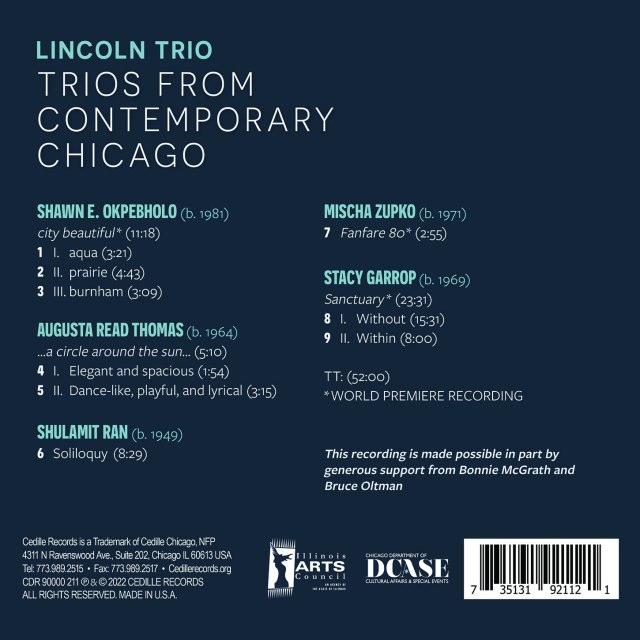
This is another entry in an ongoing series of music for piano trio by the tried and true Lincoln Trio. In this fine release they play a delightful collection of five works (three are world premiere recordings) by living composers. This is their eighth Cedille release by my count. It is the second recording of piano trios from Chicago based composers, a follow up to their previous survey of early to mid-twentieth century piano trios, Trios from the City of Big Shoulders.
The five works presented here are but a sampling of the available repertoire from Chicago based composers. That said it is a fine sampling of the current state of the art and one would do well to explore more of the music of all these composers.
The first selection is the three movement, “city beautiful” (2021) by the American composer of Nigerian/American Heritage, Shawn E. Okpebholo (1981- ), a world premiere recording. The title is taken from that of the 19th century initiative that helped build the now familiar skyline which had been ravaged by the 1871 Chicago Fire.
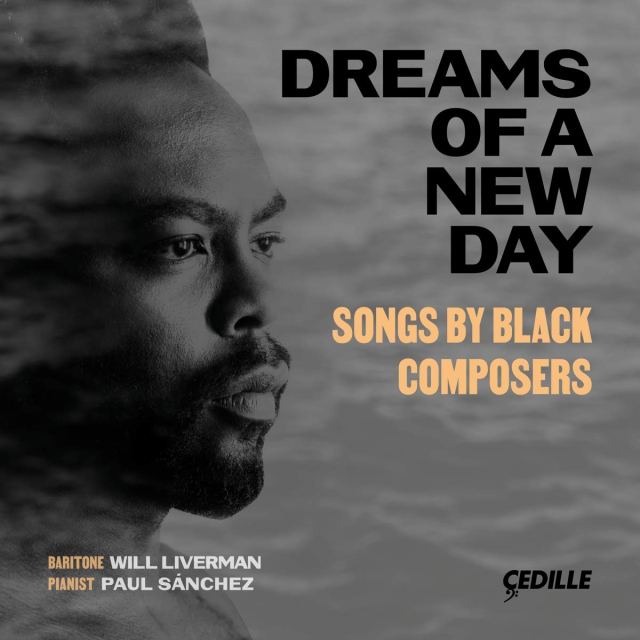
Okpebholo is no stranger to this blog. His fine album of spiritual arrangements Steal Away (2016), and his contributions to Will Liverman’s album, “Dreams of a New Day” (2021) revealed his interest in and expertise with spirituals and art song. “city beautiful” by contrast is essentially three tone poems inspired by Chicago architecture, perhaps one of the city’s finest distinctions. The three movements, aqua, prairie, and burnham are effectively homages to architects Jeanne Gang (whose Aqua Tower is a most recent major addition to the famous skyline), Frank Lloyd Wright (whose Robie House is a classic example of the “prairie school” design), and Daniel Burnham (whose 19th century designs define the famously beautiful lakefront and the iconic Union Station).
Opkebholo’s idiom is basically tonal and could be characterized as post romantic. But regardless of how you categorize it the music is eminently listener friendly and a fine vehicle for the estimable Lincoln Trio. This is the work of a rapidly emerging composer with both substance and style. Keep his name on your radar. I expect to hear much more from this talented and prolific composer who currently holds a professorship at Wheaton College in that western suburb of Chicago.
Next is a two movement work by Augusta Read Thomas (1964- ) entitled, “…a circle around the sun” (2021). This work was a commission by the Children’s Memorial Foundation for the Amelia Piano Trio in honor of George D. Kennedy. Thomas has long been a fixture in Chicago’s music life where she was a composer in residence with the Chicago Symphony from 1997-2006. She is currently professor of music at the University of Chicago and a former professor at Northwestern University. Her work also tends toward the tonal idiom and this rather brief two movement work is a fine example of her writing for chamber ensemble.
“Soliloquy” (2003) by the truly fine, if still too little known, Shulamit Ran (1949- ), an Israeli born American composer. She was a student of the esteemed Ralph Shapey (1921-2002) to whom she dedicated her Pulitzer Prize winning Symphony (1990). The composer states in her liner notes that the origins of this work come from her opera “Dybbuk”. It is a pleasant piece perhaps less complex and more lyrical in sound than some of her larger works. Ran was professor of music at the University of Chicago from 1973 to her retirement in 2015.
Mischa Zupko (1971- ) contributes the briefest work to this collection. Clocking in at just under three minutes, “Fanfare 80” (2010) was written in celebration of the 80th anniversary of the Music Institute of Chicago. The brevity here belies the complexities within this ear catching piece.
The album concludes with a substantial two movement work (just over 23 minutes), “Sanctuary” by Stacy Garrop (1969- ) is the work of another prolific composer whose work is, happily, getting much deserved recognition. The 2016 recording of her wonderful orchestral work was reviewed in these pages. Garrop’s work is invariably kinetic and deeply felt with a dramatic flair. Garrop was on the composition faculty of Roosevelt University in Chicago from 2000 to 2016 and is now a freelance composer.
The usual audiophile production (Bill Maylone, engineer) which characterizes Cedille releases is evident here. This is a fine sampling of music which is roughly representative of the musical riches producer James Ginsburg has mined from the “city beautiful”.
Who? and Who? American composer Alvin Curran (1938- ) returns to his roots…well, some of his roots, in this streaming composition, a tribute to German dramaturge Achim Freyer (1934- ). Curran’s composition, a tribute to the dramatist/costume designer/stage director, is presented in streaming format via Deutschlandradio. and is available at the following link:
I mention the link to allow my readers to access the program stream so as to be able to hear the work (obviously) but also because Maestro Curran has been at the forefront of adopting social media as both a medium for access and distribution for his compositions but also as a part of the the work (at least in the Mc Luhan-esque sense, “the medium is the message”). More details on Curran’s work can be found on his excellent website.
His Kristallnacht memorial work, “Crystal Psalms”, used multiple radio stations with performers in each location throughout northern Europe which Curran mixed live for the broadcast, the final mix released on CD format is a classic of the genre and a powerful sociopolitical statement. The point is that Curran continues to be at the forefront of integrating current technology in his art. His distinctly personal use of synthesizers, sampling keyboards, and other electronics continues to characterize his creative process.
Alvin Curran in San Franciscoin 2016
Achim Freyer became known to me when I saw Michael Blackwood‘s film, “A Composer’s Notes…” (1985) which documented two simultaneous staging of Philip Glass’ opera “Akhnaten” by the geographically distant opera companies who co-commissioned the work. The Houston Opera production was designed by David Freeman, and the Stuttgart production by Achim Freyer. Freeman cast the work in a realistic historical tableau in ancient Egypt whereas Freyer’s designs evoked a sort of hallucinatory, dreamlike, mythical set of images. Both are beautiful and quite viable productions but they are very different visions. It is that very different vision that characterizes Freyer’s work and gets him the accolades that drive the commissioning of Curran’s tribute. This musical tribute now is added to the metaphorical mantle where Freyer’s accolades reside. You can also download an audio MP3 here.
When you listen to the streaming version or the conveniently downloadable MP3 you will be greeted by about 5 minutes of German language narration followed by approximately 35 minutes of Curran’s sound collage work incorporating the composer’s unique approach to the inclusion of digital sampling technologies along with his extensive knowledge of electronic sound production and manipulation.
Like any great work of art this work will have varying impacts and leave a variety of impressions. Beginning with the playful title it is doubtless full of referential quotes that probably rival Elgar’s “Enigma Variations” (1899) or the panoply of quotations in Luciano Berio’s “Sinfonia” (1968-9). Don’t get me wrong, this streamed work is very different than either of these predecessors. Rather it appears to be a sonic portrait using concrete sounds alongside musical sounds to create an impressionistic tableau of Herr Freyer. The composition is reflective of Curran’s “New Common Practice” concept in which the composer is free to use whatever sounds and techniques he or she chooses to complete a musical piece.
Even a cursory look at Alvin Curran’s oeuvre reveals the incredible diversity of his compositional sound sources. From conversations, to creaking doors, footsteps, musical snippets, and the sound of the ethnic/mythic shofar (the ram’s horn has become a signature sound for the composer). They are all mixed carefully (this sounds like a carefully crafted collage) to create a non-linear narrative or sonic poem in tribute to an artist and a mutually beneficial friendship between Curran and Freyer. Please forgive my admittedly clumsy appropriation of Friedrich Schiller (in turn via Beethoven) when I say, in my limited German, a phrase which can be said to characterize both the composer’s work and that of its subject Achim Freyer: The final embrace, the feeling at the end of Beethoven’s 9th symphony as the chorus sings: “Diese Kunst umfasst die ganze Welt” (This Art embraces the entire World).
This is John Pitts‘ second incursion into adapting non-western music for the conventional piano. In doing so he follows a long tradition of fascination with non-western musics by western composers. Listeners will likely be familiar with Beethoven or Mozart who imitated Turkish music to add an exotic dimension to their compositions (Beethoven with his Turkish March sequence in the finale of the 9th Symphony; Mozart imitating Turkish music to add the exotic sound to enhance the geographic setting of his opera, The Abduction from the Seraglio). This fascination gained traction over the years as the great romantics such as Rimsky-Korsakov, Stravinsky, Debussy (whose encounter with gamelan music at the Paris World Fair was formative), and their successors took on similarly exotic interests in their music.
Serious study of non-western music with attention to tunings and rhythms is virtually unknown in the western canon before the twentieth century. Colin McPhee, the Canadian-American composer did his landmark study of Balinese Gamelan music in the 1920s and 1930s (some of which is influenced Benjamin Britten’s ballet, The Prince of the Pagodas) which was the first of a series of such explorations done subsequently by the likes of Lou Harrison, Terry Riley, La Monte Young, Alan Hovhaness, David Fanshawe, and others of Balinese, Javanese, Chinese, Japanese, Korean, and other cultures. Unlike their forebears, this new generation studied tunings, instrument construction, rhythmic construction, performance practice, compositional methods, etc. instead of basically just fitting the music to the mold of the western paradigm.
The present volume is, as mentioned, the second such effort by British composer/musicologist John Pitts. His first effort detailed suggestions for playing Hindustani Ragas (raags in the British spelling) and was reviewed here on this blog. In that study, as in this one, Pitts takes the fixed tuning of the piano that is familiar to western ears as a given, without getting into the complex issues of tuning (that is a subject unto itself). Neither Hindustani Ragas nor Javanese composition can be played on pianos tuned to the current western standard of twelve tone equal temperament but there are riches to be had in understanding compositional techniques other than tuning and harmony. Pitts uses the piano as a starting point from which to learn about music of other cultures. This appears to have grown out of his own efforts as a western trained musician trying to learn what techniques can be incorporated into the creative processes of western music. Many of the author’s compositions appear to be in part the product of lessons learned from his study of various musical systems including gamelan (Javanese and Balinese), Hindustani raga, and balafon music from Burkina Faso.
For the present volume Pitts consulted with western gamelan masters including Jody Diamond and other members of the international gamelan community. He did his homework well and one of the strengths of this book is in its remarkably lucid exposition of javanese music in a way that is understandable by anyone with a reasonable grasp of western music theory. Here is where the use of the piano serves as a springboard from which one might grasp this musical system in part via the differences in the two. It is this pedagogical aspect to which I refer in my parody in the title of this article. As one with a largely self driven learning of music this volume presents an opportunity to expand my knowledge of gamelan music. It is a friendly approach which makes me no longer “afraid to ask” or afraid to learn.
In the space of approximately 50 pages the author provides a marvelous distillation of the essentials of gamelan music including terminology, descriptions of the various traditional instruments commonly used, and, most crucially, descriptions of some of the processes of composition, melody, and performance practice. There seems to be more data here than one would reasonably expect to fit in those pages. It is a concise reference which many listeners and musicians will want to keep close at hand. These pages alone are worth the price of the book.
What follows is about seventy pages of transcriptions by the author of a traditional javanese composition playable by one or more pianists. Don’t get me wrong, this doesn’t simplify the learning of these processes. Rather it clarifies the material so that these concepts are learnable by motivated individuals. The transcriptions are the musical description, if you will, of the processes outlined in the preceding chapters. These are basically teaching etudes in lucidly engraved western notation. Even if the reader lacks sufficient skill at the keyboard (as is the case with your humble reviewer) to actually play these works, the illustration of the concepts described verbally can be understood more completely when one sees them in western notation.
As a listener to a wide variety of music I personally find it useful to be able to learn about music which had previously been just a bit out of reach due to my perception of its impenetrable nature and the lack of easily accessible guides such as this. While it has taken me a while to grasp some of the concepts so as to be able to write a reasonably coherent review of the book I’m gaining insights that are aiding my understanding of gamelan music. The book requires some work to understand largely due to the unusual nature of this music but grasping more as I continue to read and re-read, I find it both compelling and rewarding.
Mr. Pitts concludes with a comprehensive and insightful description of his justification of using the ubiquitous piano as his starting point. He compares it briefly with the common nineteenth century practice of imitating various asian musics with western instruments as noted at the beginning of this review and goes on to enumerate other benefits to be had by using the piano as a learning tool in the study of this music. The book concludes with a very useful bibliography and links to internet resources for those who want to go further in gamelan studies. Far from the dreaded “cultural appropriation”, Pitts’ work is more of a respectful anthropological exploration which acknowledges the value of this music and looks to learn from it. That is celebration and it is invaluable.
Jacob Greenberg will be a name familiar to many primarily for his essential role as the keyboard artist in ICE, one of those fine New York based new music ensembles that can play just about anything. At one time composers were forming their own ensembles to play the strange and difficult music they were writing (Steve Reich, Philip Glass, Michael Nyman, Steve Martland to name a few). Now ensembles like ICE are ready made, able to provide a flexible instrumentation and, with each musician, a stunning level of technical competence and a true affinity for the music of now.
Mr. Greenberg here is one of those multitasking, technically refined artists whose curatorial ear makes him an artist you need to have on your radar. In an earlier blog post I reviewed his solo (mostly) piano release Hanging Gardens in which he created an insightful contextualization by the choices of repertoire he made for the album. In response to this review he sent me a copy of this, the latest of his solo piano (mostly) projects.
The context of this album is of compositions all commissioned by Greenberg and written for him over the span of 2013-2019. It is a marvelously diverse collection which speaks to the wide scope of his interests and skills as well as the range of personal relationships he cultivates with other musicians.
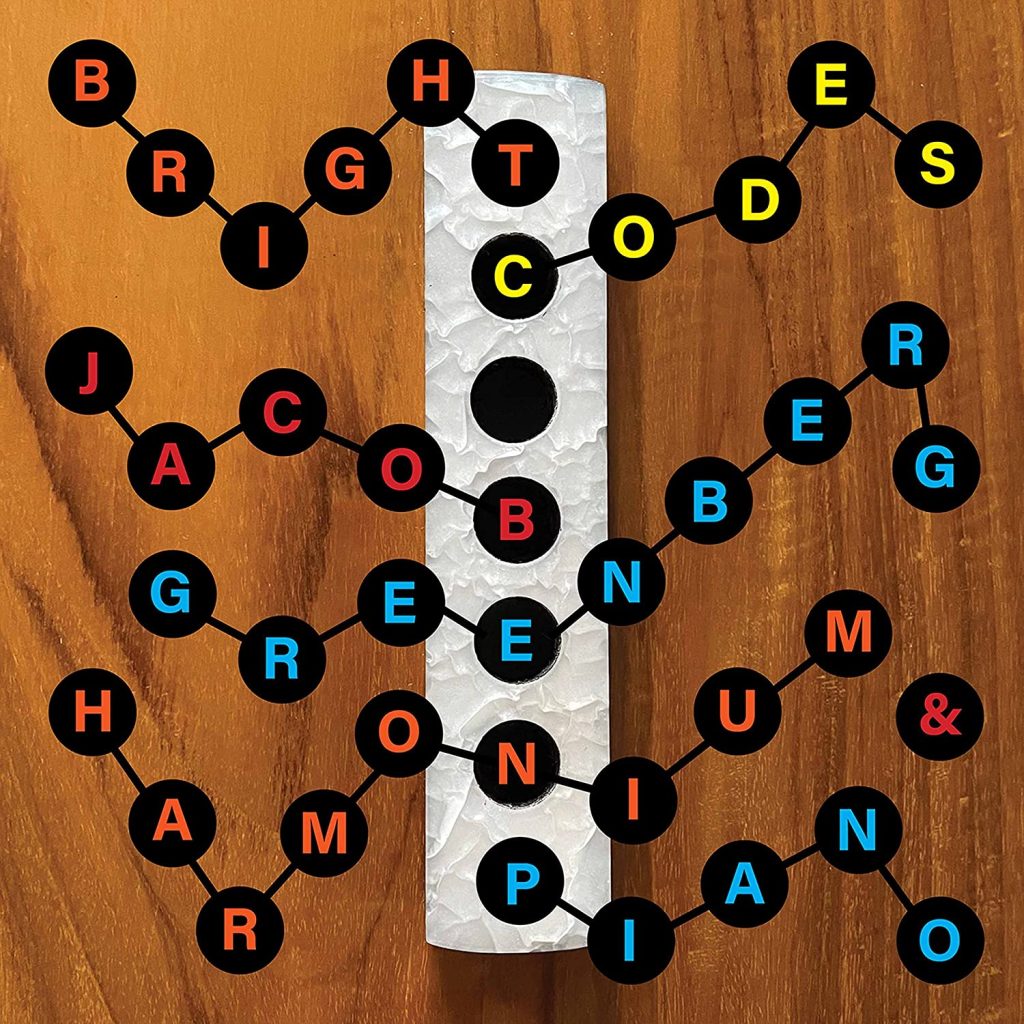
The disc begins with music by probably the best known composer on this release, Japanese composer Dai Fujikura (1977- ). White Rainbow (2016) is a sort of tone poem for harmonium evoking the visual atmospheric phenomenon of a “fogbow” or “white rainbow”. It has an impressionistic feel much like Debussy. This is followed by the more experimental “Bright Codes” (2015-2018) for piano, four pieces which can be played in any order, but with the caveat that they be played without pause.
The next 5 tracks are dedicated to the 2018 “Funf Worte” (Five Words) by Amy Williams, five miniatures, each exploring a single German word. The piece is for harmonium and voice and the voice is the wonderful new music soprano, Tony Arnold. This is followed by a much larger piece for solo piano, “Cineshape 4” (2016) developed after the structure of the film “Run, Lola, Run” (1998). this virtuosic piece starts three times, each time developing differently analogously to said film.
“The Memory of Now” (2021) by IONE. This is a work for harmonium and voice. This time the voice is of the composer IONE, poet, dramatist, musician, playwright, and life partner of the late, great Pauline Oliveros. The piece has improvisational, indeterminate elements which require the performer(s) to listen to internal and external sounds.
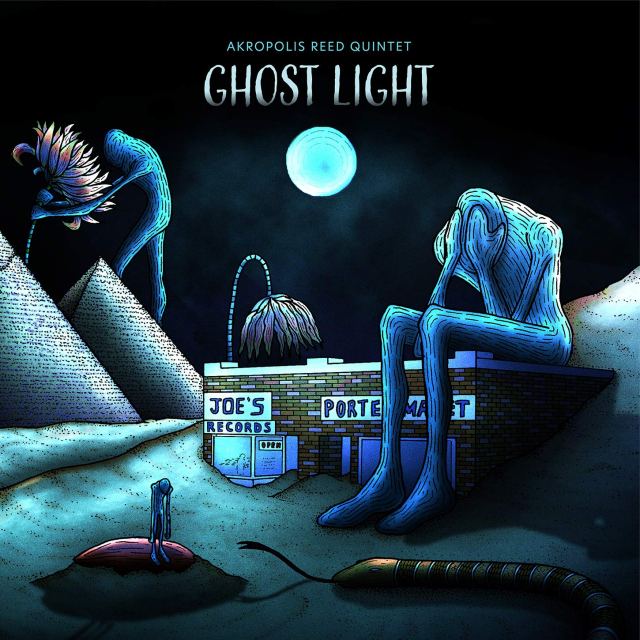
The album ends with two large and powerful pieces by Nathan Davis. “Ghostlight” (2013) and “Seedling” (2019). Ghostlight is for “lightly prepared piano” and evokes the ambiance of those small single lights that shines on a darkened stage when the theater is closed. The preparations hep produce the ghostly microtones and gong-like sounds.
Seedling for harmonium and electronics brings us back to the sounds again of a harmonium. This is the only track which has appeared before and it was on the wonderful ICE release on Starkland Records (On the Nature of Thingness).
This sampling of some of the latest in contemporary composition reflects the use of extended instrumental and vocal techniques. It also makes use of experimental compositional techniques that demand deep involvement of the musicians in the execution of the music in ways that diverge from the conventional classical music paradigm. And it is the expansion of old paradigms that are ultimately what makes Greenberg and his ICE colleagues so compelling.
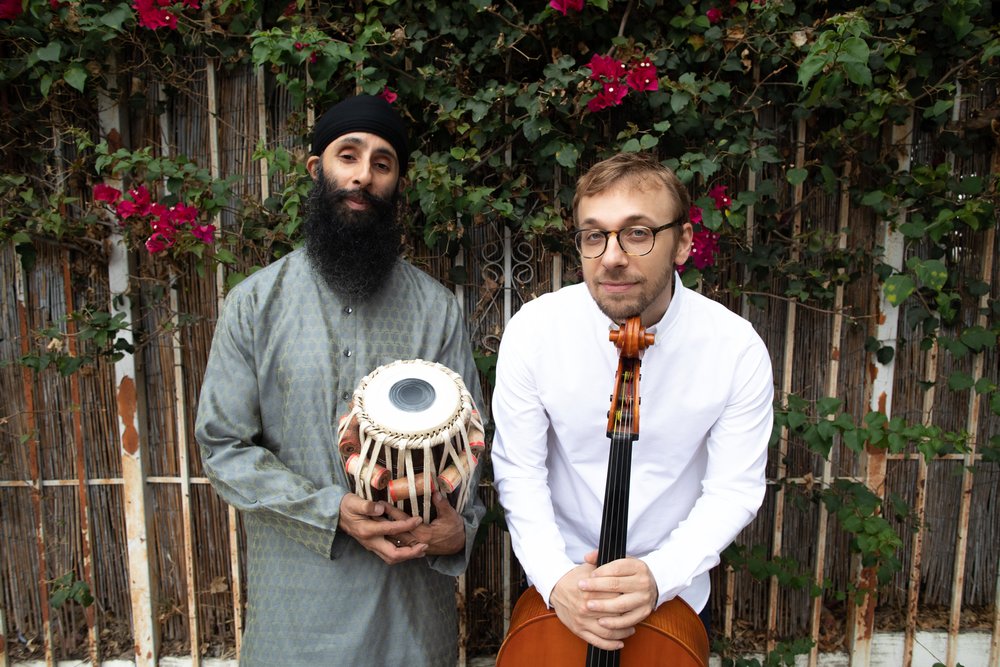
Listeners of a certain age and those versed in recent classical music history will recall another fine pair of Armenian American musicians (also sisters) whose performances and recordings introduced many to the work of Armenian American composer Alan Hovhaness (1911-2001) as well as John Cage, Aram Khachaturian, and others. I am speaking of pianist Maro Ajemian (1921-1978) and her sister, violinist Anahid Ajemian (1924-2016). And these fine musicians (pianist Marta Aznavoorian and cellist Ani Aznavoorian) carry on some generations later along a similar path, honoring their heritage and promoting its art.
The disc under consideration is this beautiful sampling of Armenian composers of the past 100 years (or so) beginning with Komitas Vartabed (1869-1935), a monk, composer, historian, and ethnomusicologist. Armenian music enters modernism and the twentieth century via Komitas. This is followed by music of four Soviet era composers and three contemporary era composers.
The liner notes are by local historian and producer Gary Peter Rejebian and the Aznavoorian sisters. In this ,their debut album, they speak of their connectedness to Armenian culture personally and musically. In fact Ani’s cello was made in Chicago by her father Peter Aznavoorian. This album is an auspicious debut and an homage to this rich culture.
They begin with five pieces by Soghomon Soghomonian (1869-1935), better known as Komitas Vartabed, the name bestowed upon him after his ordination as a priest in 1894. These are lyrical and beautiful folksong arrangements that grasp the listener immediately. These five pieces ranging in duration from about 1 1/2 minutes to about 4 minutes. These five pieces, four for cello and piano are punctuated by a sad lament for solo piano played as the third track. Komitas, after witnessing 1915 the Armenian genocide, composed no more and, in fact, spent his remaining years in a sanitarium until he died in 1935.
The next two pieces are by one of the best known Armenian composers of the twentieth century, Aram Khachaturian. Though long subsumed into the Soviet straightjacket his individual voice produced many substantial works and his work has done much to preserve and rejuvenate his Armenian culture. These two pieces are not among his best known work but demonstrate his ability to write in smaller forms and, at least in these brief pieces, display his personal style and his love for his native culture.
These are followed by three pieces of another Soviet era composer whose voice is less well known in the United States, Arno Babajanian. Elegy (among the composer’s last works, written in homage after the passing of Aram Khachaturian) is one of two tracks for solo piano on the album and it is followed by Babajanian’s “Aria and Dance” for Cello and Piano. Certainly this is a composer whose works deserve a proper hearing and evaluation. These pieces suggest a composer with a strong voice, another to come out from the Stalinist/Soviet oversight to be heard now with new ears.
Avet Terterian is another Soviet era name whose work is virtually unknown in the west, another whose work deserves at least a second listen. His large three movement sonata for cello and piano (1956) is a major work both in duration and in content. The style is a friendly mid-twentieth century post romantic one that very well may become a regular repertoire item after hearing the powerful and convincing performance documented here.
With the next track we hear the first of the “recent” works on this recording, Serj Kradjian’s transcription of a traditional song, “Sari Siroun Yar”.
The all too brief experience of this small work by another major Soviet era composer, Alexander Arutiunian, this charming Impromptu (1948, one of his earliest compositions) is a beautiful piece but it is a mere appetizer to lead a listener to hear more from this composer who has produced work in pretty much all genres big and small. Arutiunian’s work deserves some new attention. Best known for his 1950 Trumpet Concerto, his output was large and he composed in large and small forms that demand the attention of post Soviet ears.
Back to the 21 st century with this next track, Vache Sharafyan’s Petrified Dance (2017). Sharafyan was a student of Terterian and this work was adapted from a film score.
The Aznavoorians end with the world premiere recording of “Mount Ararat”, a paean to the Holy Mountain that dominates the landscape in the Armenian capitol city of Yerevan. It is the mountain upon which Noah’s Ark was said to have come to rest after the flood. Like Mount Fuji to the Japanese, Mount Everest to the Tibetans, and “Tahoma”, (better known now as Mount Rainier) to the Puyallup and other Native American tribes of the Pacific Northwest, Mount Ararat is considered a holy mountain.
Peter Boyer‘s “Mount Ararat” (2021) was written for the Aznavoorian Duo. Boyer is the only non-Armenian represented here but his composition embraces the spirit of Armenian music and this is a dramatic and heartfelt love song both to the holy mountain and these musicians whose performance provides an ecstatic and virtuosic finale to this fine disc.
Yolanda Kondonassis‘ name is practically synonymous with her instrument, the classical concert harp. Her discography (via discogs) numbers over 50 albums, most of which demonstrate her interest and dedication to music of our time. She has played both as soloist and as orchestral musician with many major orchestras and has had many works written for her. If you collect new music recordings you probably have one or more of her recordings (I certainly do).
So this album continues her ongoing legacy promoting new music for her instrument. But it also demonstrates her interest in ecology with these 15 compositions written for her, at her instigation, on the theme of Earth in many of its guises as chosen by the composer. The project begun in 2020 features compositions written over the last two years in response to her request.
The project, by her description, has grown beyond its original plans and has included videos, live performances of these works, publication of these pieces as well as a collection of works for younger musicians. Each time one of these pieces is reported as having been performed a donation is made via the Kondonassis’ charity organization Earth at Heart to various ecological organizations.
These 15 composers are a delightfully diverse group, some well known, some rising stars. All reportedly responded quickly with 15 similarly diverse compositions (2-8 minutes in duration) inspired by the theme of the commission, all with the composers’ unique perspectives on the subject. This writer hopes that more composers will participate in this worthy project which promotes ecology, the harp, and expands the repertoire for her instrument. No electronics, no other instruments. Just the lone harp in all its glory.
This beautiful and thoughtful production includes useful liner notes (which enhance the listener’s perspective on the music) from Ms. Kondonassis and brief biographies of each of the composers (with more notes available on her website). Technical analysis of this music is beyond this writers expertise so let me just say that each of these works are compelling additions to the solo harp repertory and are concise, carefully conceived pieces that benefit from repeated hearings. You might be challenged but you won’t be bored. Here’s hoping that this disc gets many hearings and furthers the artist’s goals for the instrument and the planet upon which she plays it. Brava!
William Susman (1960- ) may not be a household name but, since my first encounter (purely by chance) with this man’s work I have heard, enjoyed, and reviewed several fascinating CDs of chamber music and film music which demonstrate a significant musical voice with some mighty substantial compositions. I don’t know how Mr. Susman feels about being called a “minimalist” but that is the most useful way I can convey with words his musical style. That much used word is a sort of catch all for what is in fact a plethora of compositional styles based in some basic, though hardly rigid, set of practices like static harmonies and repetition.
There are, as of this writing, four books of Quiet Rhythms (2010, 2010, 2012, 2013), each book contains 22 pieces further divided into 11 “Prologues” followed by 11 “Actions”. While I have only the vaguest idea of what processes the composer uses in these works (Book I at least) sounds to these ears like music which should share company with the likes of Terry Riley’s “Two Keyboard Studies” (1965), William Duckworth’s “Time Curve Preludes” (1977-78), Jeroen van Veen’s “Minimal Preludes” (four books1999-2013), Philip Glass’ “Etudes” (two volumes1994-2012). Spiritually they share a kinship with antecedents such as Bartok’s “Mikrokosmos” (six volumes1926-1939), and, ultimately I suppose, Bach’s “Well Tempered Clavier” (1722-1742). Yes, these are a diverse set of works for comparison, but to my ears they seem to share attempts to codify and/or experiment with their respective materials. They are the composers’ working out of their ideas.
And, in a delightful coincidence the pianist chosen to interpret these works is none other than Nicolas Horvath, a name that has graced these pages numerous times since our first online meeting in about 2014. Horvath has become a sort of pied piper for minimalist composers. He has performed solo recitals lasting up to 35 hours including Philip Glass’ complete piano music, a solo rendition of Erik Satie’s “Vexations” (1893-94), whose 840 repetitions were first performed by a tag team of pianists helmed by John Cage (of course) in 1963. He has also recently recorded all the piano music of little known French minimalist composer Jean Catoire (1923-2005) and numerous other projects including his own original compositions and sound/art installations.
Horvath was born to play this music and Mr. Susman kindly informed me that he will indeed record the remaining three books. This musician’s curatorial radar is as unique as it is accurate. That is, he knows good music when he sees/hears it and he searches far and wide. He delivers loving and authoritative performances here. It is, after all, his métier.
Susman’s etudes are experimental only in the sense of a composer exploring his inspiration, transcribing the dictation of his muses. The title “Quiet Rhythms” is quite apt as these are really kind of soothing in their harmony and meandering developments. And, more importantly, they have the weight of substance.
Three of these have been recorded before and I’m pleased to say that the remaining 8 compositions are equal in quality to the ones I’d already heard. Each numbered piece is actually two pieces, a prologue of 90-120 seconds followed by a more complex sounding work using similar methods. At first I had wanted to write about each of the pieces but I found myself enraptured by the music and insufficiently skilled in musicology to do a respectable analysis of these works.
So I’ve chosen to simply say that these are fascinating and engaging pieces whose structure is very much secondary to the quality of the musical content. These are truly post minimal works with a much wider harmonic palette than its minimalist predecessors. The sound is quite rich and the pieces engage the listener transporting them to a powerful emotional experience. The music echoes Steve Reich, Philip Glass, Terry Riley but they also are destined to share a place in the repertoire alongside similar works by William Duckworth, Jeroen van Veen, and Simeon ten Holt.
Horvath is truly in his element here and his performances are hypnotically engaging. I can’t imagine these works being done better but, that said, they are attractive concert pieces for adventuresome pianists to program. Above all these are listener friendly despite the feel that they are almost a sort of textbook or manifesto by the composer which describes in music his vision of minimalism/post-minimalism.
If you’re a fan of minimal/post-minimal music this is a must have. but beware and remember to budget for the forthcoming 3 discs. You will want them all.
OK, I admit that using the term “rogue” is a stretch. But titles of reviews should help draw the reader to it. And “clickbait” is the new “catchy”. But, in another sense one doesn’t generally think of the bass clarinet as a standalone recital instrument, even with electronics. Increasingly, it seems, new music purveyors are liberating instruments once unthinkable outside an orchestra or chamber ensemble. Jazz players have long used the bass clarinet as a solo instrument alongside the ubiquitous family of saxophones and the flute as the woodwinds that comprise most jazz ensembles,
Classical music has been slow to accept the bass clarinet until relatively recently. I don’t know when the first use of a bass clarinet either as a standalone solo or as part of a chamber ensemble occurred but certainly post 1950. Without getting in to the “whys” of this one can simply embrace the increasing presence of this instrument and its fascinating players.
Here, we get another of the subgenre of “COVID Isolation music”, itself a category worth further exploration.
There are five selections with composition dates ranging from 1983 to 2020 and composers from the still underappreciated Isang Yun to a new name, Hidiaki Aomori, a composer and friend of the soloist. And the remainder are risen and rising stars including the late conductor/composer Pierre Boulez, Grawmeyer Award winner Unsuk Chin, and the prolific Japanese composer Dai Fujikura.
The Fujikura work opens this isolated recital with a melancholy piece which appears to be a set of variations and has the character of a cadenza calling upon both technical and interpretive skills of the performer. And do I hear a nod to minimalism at the end? “Contour” (2020) is a fine opener where Lee displays her technical skills and insight to the composer’s vision.
Then its back to 1985 with one of the technical peaks of Boulez’ work at IRCAM, “Dialogue de L’Ombre Double” for bass clarinet with inscrutably complex electronics. This once leading edge example of the avant garde in its day actually sounds a bit dated but the soloist here seems to humanize the piece with her warm interpretation. And, despite what you may hear in the other tracks here, it is the only one using electronics on this disc.
Isang Yun (1917-1995), the late prolific Korean master is beginning to get more of a reckoning, and this 1983 piece, “Monolog for Bass Clarinet” is a fine entry to the expanding recorded oeuvre of this mid/late-twentieth century embattled and neglected genius. This piece speaks deeply of alone-ness.
Unsuk Chin (1961- ), a rising star and Grawmeyer Award winner is represented by a bass clarinet solo from her much lauded opera “Alice in Wonderland”. This stand alone solo, titled “Advice from a Caterpillar” is a maze of hallucinatory nods to Gershwin, Carl Stalling, and perhaps Prokofiev (in a “Peter and the Wolf” sense) using multiphonics and seems to expand the possibilities of this instrument to limits which might only be transcended with electronic assistance.
Hideaki Aomori‘s “Split” is a rather personal addition, a submission from one friend to another, a gift from one alone to another alone. It is another fine solo work which sits stylistically somewhere between the technical extremes of Boulez and Unsuk Chin and the more melodic work of Fujikura and Yun.
This is a very personal disc on many levels and it is a fine calling card by which to introduce listeners to this fine musician.
Though one could cite composers like Mozart and Beethoven having imitated the exotic ethnic music of Turkey and the late nineteenth century fascination with “orientalism”, the actual study of ethnic and non-western musical traditions probably started in earnest with the folk song collecting done by Bela Bartok and Zoltan Kodaly in eastern Europe and similar work by Charles Seeger and the Lomaxes in the United States. The work of Colin McPhee then took the study of ethnic musical traditions into the academic realm. But, for this listener, it was the Yehudi Menuhin collaborations with Ravi Shankar and Alla Rakha that brought non-western musical systems to the public in a big way via the LP record. Hindustani music and dance did not even get any representation in film until Satyajit Ray’s 1958 masterpiece, “The Music Room”.
And since Hindustani music has traditions going back hundreds of years among diverse practitioners in a large geographic area, it is not surprising that there are traditions and styles that reflect such diversity and that western musicians continue to explore and learn the varieties and subtleties of practices. This album is certainly a fine example of Mr. Votek’s mastery of the vocal tradition of Gayaki-Ang which is another of the rich traditions of the vast practice of Hindustani and Carnatic musical practices. What I’m ultimately saying now is that the familiarity with those great Menuhin/Shankar recordings affords the listener but a “tip of the iceberg” perspective of the depth of the traditions and practices of Hindustani/Carnatic music. Chris Votek is a part of a new generation of artists who are breathing fresh life into these practices and incorporating them in their own compositional and performance practices. And therein lies the significance of this release.
Chris Votek with this cello. Photo Credit Hannah Arista from composer’s web site
So now, on to the music. The album begins with a work for string quintet, in this case a string quartet with a second cello. While this will necessarily invoke comparisons to the classical string quintet repertoire such as Mozart and Schubert this composition both pays homage to the classical tradition and infuses it with the composer’s take on diverse musical worlds which reach far back into musical history. He takes medieval melodies and harmonies incorporating these into a work in three distinct movements titled, “Serpents”, “Fossil Dance”, and “Migration of the Fires”. Each of the movements has its own character as the composer finds ways to work with this material.
Whether you choose to experience this as three separate pieces or, as this writer does, as a single work, this is the composer working with old western music incorporating it into a work for a String Quintet titled, “Memories of a Shadow”. It works as individual movements but, as a unified whole it represents a stage of Votek’s compositional development with this material. And while his encounters with Hindustani music is not explicit here, it is undoubtedly a part of his compositional thought as well.
The result is a gentle three movement String Quintet that could be programmed alongside Schubert’s essay in the medium. It is, of course, stylistically different from Schubert but the instrumentation is the same and it provides a contrast to Schubert’s work from 200 years earlier. Add to that the incorporation of medieval music (in Votek’s work) and you get some delightful contrasts indeed. It is a work that shows its charms more clearly with each hearing and is a substantial addition to the repertory regardless of what else shares the program.
Neelamjit Dhillon with Chris Votek. Photo credit Kat Nockels from the composer’s web site
Track 4 is dedicated to the performance of a single piece, a traditional raga played in a Hindustani vocal style called, “Gayaki-Ang”. Accompanied by tabla player Neelamjit Dhillon, Votek performs on his cello the vocal part of this raga. This evokes for this writer memories of the late Arthur Russel whose vocalizations along with his cello playing had roots, at least peripherally, in a similar sound space. This is a traditional raga, a tradition that extends back hundreds of years to a sound world that paralleled but did not interact with western music of the medieval era heard in the earlier work. Happily, the interaction begun between early western collaborators with Hindustani musicians such as Menuhin and Shankar continues here most joyfully to explore the splendorous riches of that tradition.
While this is first disc dedicated exclusively to his own work listeners will want to peruse his collaborations listed on this well organized web site. He is an artist that is poised to create some thoughtful new music. This CD can be obtained via Microfest Records as well as other outlets.
Microtones and alternate tuning systems are increasingly one of the most significant streams in new classical music as well as in the revisioning of old classical music to capture the sound of the music in its original milieu, which is not current performance practice. In the liner notes John Schneider says that hearing Bach in 12 tone equal temperament (current performance practice) is analogous to “exhibiting Rembrandt paintings with wax paper taped over them.”
That image conjures for me a childhood memory of my mother bringing home some of the promotional gimmicks by one of the Chicago based supermarkets. It involved prints of famous paintings with a wax textured surface to imitate the look of oil paint on canvas. It’s a tortured metaphor for the present recording but it speaks of “cheesy imitation”. The present recording is one of an increasing number of recordings done with the scholarship of the very complex area of tuning, the surprisingly varied types of scales devised to solve harmonic complexities that occur due to the physics of sound itself. And by so doing, placing earlier efforts as “cheesy” by contrast.
In fact, Schneider (who kindly sent this disc to me), is one of the scholars at the forefront of recreating the musical scales as they existed at the time of the compositions so to get a clearer idea of how it must have sounded at the time. Toward that end one can now obtain guitars capable of being tuned to the subtleties of the scales. Another such disc was reviewed here. In fact guitarist Dan Lippel, in that recording played one of Mr. Schneider’s guitars.
I am working to learn more about the fascinating field of alternate tuning systems to better understand the various tunings in the flow of new music that comes to my desk. But listeners need not concern themselves with these details. The curious fact for this listener is that, on first hearing, the subtle differences in tunings were not immediately obvious (Well Tempered Kirnberger III on this recording). A better trained musical ear would doubtless hear these differences much sooner than I had but I have noticed that I have begun to hear these subtleties having been listening to this disc and some of the similar efforts on the aforementioned Lippel recordings and other titles on Mr. Schneider’s fine Microfest label. It seems like a sort of learning curve in which my brain learns to process these sounds and to hear them as more natural rather than altered.
I apologize for all this chatter but this album is not just about Bach, it is about hearing Bach as he heard it, freed from the shackles of the dominant western paradigms of how to tune a scale. It is a revelation but a gentle one whose radiance is clearer in the light of the retuning of the scale, removing the “wax paper” of the familiar western tuning to reveal a clarity not heard since the composer’s time. It is analogous to the 2018 restoration of the Rose Window (1210) in Chartres Cathedral bringing light in ways not seen in a very long time.
The fine Slovenian guitarist, Mak Grgic is a new name to this writer but one I hope to hear from again. In his selection of repertoire as well as his distinctive playing he makes a compelling and loving case for this music. His well organized web site details his work as musician, teacher, musicologist, composer, and international performer. This release is (by discogs) his seventh appearance on CD and his second recording for Microfest Records.
These are apparently Grgic’s transcriptions, not the “usual suspects” one might expect from a new Bach recording with the exception of the Cello Suite in D. This is apparently a very personal selection of music chosen with curational care. I’ve included a photo of the back cover to show the unique selections.
The Rose Window depicts the revelation and the final judgement of mankind. The present audio document is a gentle revelation but doubtless not the final word on Bach. But the scholarship is fascinating and the sound simply gorgeous. The wax paper has been removed.
Seth Graham’s art work alone might be a reason to buy this release by Canadian musician/producer Nick Storring. He sent this to me with several other releases by Canadian composers and performers of various stripes. Some rock/blues solo guitar, some new classical, but this one…I wasn’t sure at first. And as one accustomed to placing music in some sort of context this left me a bit stumped. But that is NOT an indictment of the music on this disc. Rather it is a reflection of the limits of my own musical understanding as I approach the unfamiliar. In fact this is closest to classical chamber music. Its timbres and development are not stereotypically “classical” but these essays are absolute music in that they have no obvious meaning save for the titles whose poetic ambiguity are open to the listener’s interpretation.
Back Cover
So having gotten myself past that stage of trying to imagine the intended context or intended audience for this music I decided to just listen and I did, several times. What I heard was engaging but still with no obvious clue as to how to characterize it except to describe it in its most obvious aspect, chamber music with a personal twist.
The stylized writing on the back of the album is visually interesting but not easy to read so here is a breakdown of the individual tracks and timings:
1
Tides That Defeat Identity
10:11
2
Pretending You And I
8:51
3
Tonight There Will Be No Distance Between Us
5:10
4
What A Made-Up Mind Can Do
9:31
5
Now Neither One Of Us Is Breaking
4:31
6
My Magic Dreams Have Lost Their Spell
7:46
The titles strongly suggest a very personal meaning for the composer but there are no lyrics and nothing that provides any clues as to the meanings behind these titles. So I found it necessary to simply treat them as individual expressions with, ultimately, abstract titles. The album is characterized on discogs as: modern, experimental, ambient, and new classical, pretty much what I finally deduced after my multiple listens.
I won’t attempt to characterize the individual pieces here except to say that they are tonal, engaging, and not obviously beholden to any particular formula or style. Yet there is an aspect of familiarity, gentle consonance. And therein lies the true value of this music. It does not rely on clichés but moves along to the composer/performer’s whim, which is to say that this is original music, experimental in timbre and musical development.
All the tasks, save for mastering are by Mr. Storring.
A look at Nick’s website reveals it to be very well designed and includes a complete discography (16 albums either solo or collaborative by my count), a well organized CV, and links to his work at Riparian Media in which he produces music by a variety of carefully curated albums by a variety of musicians. Listeners will probably want to peruse the composer’s list of works and performances which also list a variety of musicians, some of whom will be known to new music aficionados and those not familiar hold the tantalizing prospect of being quality composers/performers who have made it on to Nick’s well tuned curatorial radar.
So, after all this rambling let me just say that this album is a fine example of experimental new music which can serve whatever purpose you wish. Dance to it, use it as background music, or listen closely. This is an interesting artist (now permanently on this writer’s radar) who promises to bring forth more interesting music from himself and others.
Strictly speaking all women composers are neglected. Despite significant efforts in recent years there remain significant disparities in the representation of women composers in the concert and recital halls. Realistically it will take years just to catch up on those composers whose music has languished in unfair obscurity. Now in this International Women’s Month we are seeing the release of a great deal of music by various artists attempting to correct this neglect each with their own lens. Here we have the first installment of three planned CDs by the Berkeley based pianist, Sarah Cahill. This volume, titled “In Nature” is to be followed by one called “At Play” in November, 2022 and “The Dance” in March, 2023.
Photo by Christine Alicino from Cahill’s web site
Cahill is as much curator as artist, a skill evident in her weekly radio program “Revolutions Per Minute” on Bay Area radio station KALW and any number of creative concerts and musical projects in the San Francisco area. She is an internationally acclaimed recitalist and soloist and her You Tube Channel is one I frequently visit just to see what she’s up to. It is where I first heard many of the women composers featured on the present CD and a place where one can get a sense of her unique choices of repertory that characterize her career. Her husband, acclaimed videographer and video artist John Sanborn does the camera work and I must say that these videos were a welcome respite during the COVID lockdown and an opportunity to experience her musicianship up close and personal (only a page turner at a recital gets a better seat).
The first release in this series contains music spanning some 250+ years. The first selection is by Anna Bon (1739/40-ca.1767) which puts her in the late baroque/early classical era. This is the 5th (of 6) in her Opus 2 sonatas for keyboard. This is the first recording on a piano of this entertaining work by this Venetian composer who died in her 20s. Listeners will discern echoes of Mozart (1756-1791) and Haydn (1732-1809) for whom she sang in the choir at Prince Esterhazy’s, Haydn’s celebrated patron and employer. But the sound of the mature J.S. Bach (1685-1750) certainly dominates this very accomplished sonata. This writer hears it almost as a not too distant relative of the Goldberg Variations.
Next we come to 1846 with the music of Fanny Mendelssohn-Hensel (1805-1847), sister of Felix Mendelssohn (1809-1847). Though Fanny composed some 450 pieces in her short life most remained unknown and some were falsely attributed to her more famous younger brother, Felix. In fact he published some of her work under his name (in his Opus 8 and 9 collections) as women rarely got published at the time and Felix recognized his older sister’s talent.
Cahill has chosen numbers one and three of Fanny’s Opus 8 “Four Lieder for Piano” (a form which her younger brother would later embrace in his “Songs Without Words”). These accomplished early romantic works will leave the listener wanting more of this woman’s music which remains still largely unrecorded. They are a testament to her inventiveness as a composer as well as her virtuosity as a pianist and one hopes for a reassessment of her work.
The next selection comes from a Venezuelan composer, soprano, pianist Teresa Carreño (1853-1917). Sometimes referred to as the “Valkyrie of the Piano”, she had a 54 year career championing the work of luminaries such as Edward MacDowell and Edvard Grieg. Her 1848 etude-meditation, “A Dream at Sea” is a romantic virtuosic work that sounds like a challenge to play but a joy for the listener. This deserves to be in the recitalist’s repertory.
The next unknown gem in this fine collection comes from the pen of Leokadiya Aleksandrovna Kashperova (1872-1940) who was one of Igor Stravinsky’s piano teachers. In a sad echo of present day events Kashperova’s works, though published, were suppressed from performance due to her Bolshevik in exile husband whose politics were, to say the least, unpopular. Cahill here plays her Murmur of the Wheat from the piano suite, “In the Midst of Nature” (1910). Cahill handles the finger busting, Lisztian virtuosity with seeming ease and makes a case both for the further exploration of this woman’s music and the inclusion of it in the performing repertoire. This recording is the commercial recording premiere of the work.
We move now from one of Stravinsky’s piano teachers to one of John Cage’s. American composer, pianist, educator Fannie Charles Dillon (1881-1947) studied composition with Rubin Goldmark (one of Aaron Copland’s teachers) and piano with the great virtuoso Leopold Godowsky.
Years before Olivier Messiaen took up the practice, Dillon, was known for the inclusion of birdsong in her works. One of her 8 Descriptive Pieces, “Birds at Dawn Op. 20 No. 2” (1917) was performed and recorded by early 20th century virtuoso Josef Hoffman. Cahill comments in her fine liner notes, “Dillon’s score is remarkable in its specific notation of bird songs: the Chickadee, Wren-tit, Thrush, Canyon Wren, Vireo, and Warbling Vireo…”. It is indeed a sonic painting of the birds at dawn.
The Czech composer, conductor, pianist Vítězslava Kaprálová (1915-1940) was the daughter of composer, pianist Václav Kaprál (1889-1947). She composed some 50 works in her short life and died at the age of 25 in Montpelier, France two days after France surrendered to the Nazis. Her four “April Preludes Op. 13” were written for the Moravian-American pianist Rudolf Firkušný and are her best known piano works. Cahill has chosen the first and third for this recording. The music is notable for its exploration of extended harmonic language and made this listener curious about her other compositions.
This next work is a classic Cahill achievement. As a pianist known for working with living composers as well as being a producer who knows good music when she hears it this is a bit of musical archeology that brings to life in this world premiere recording a work from 1949 by Hungarian pianist Agi Jambor (1909-1997). Jambor studied with the legendary Edwin Fischer and had a career as a pianist and teacher very tragically interrupted by the events of World War II. She came to the United States in 1947 where her husband passed away two years later. She taught at Bryn Mawr College and was granted Emeritus status in 1974.
Her three movement Piano Sonata “To the Victims of Auschwitz” was brought into a legible and performable score with the assistance of Dr. John DesMarteau who befriended Jambor late in her life and to whom the piece is dedicated. And it was in consultation with Dr. DesMarteau, Cahill writes, that she was assisted in the interpretation of this music. According to Cahill’s liner notes this work attempts to represent sonically some of Jambor’s war time memories. It is a substantial work, a lost and lonely artifact of history given a definitive performance and recording.
The amazing composer Eve Beglarian (1958- ), the only of these composers known to this reviewer prior to receiving this album, provides the next offering, “Fireside” (2001). It is in fact a Cahill commission for a project commemorating the centennial of another neglected female composer, Ruth Crawford (Seeger) (1901-1953). Beglarian takes a poem written by the 13 year old Ruth Crawford hopefully describing her fantasy of what she would be in future years and, utilizing some chords from one of Crawford’s piano pieces, constructs a powerful meditation on the subject at hand. As it turned out Crawford wound up giving up her composing career to work with musicologist Charles Seeger, not exactly tragic, but hardly what her 13 year old self had imagined. Beglarian writes that “Fireside is dedicated to women composers of the future, who will undoubtedly be making devils bargains of their own.”, a cynicism which is hard to deny.
This piece, in its world premiere commercial recording, is one of a genre unique to the 20th and 21st centuries, that of the speaking pianist. This puts in in a category shared by works like Frederic Rzewski’s classic “De Profundis” (1994) and Kyle Gann’s “War is Just a Racket” (2008), a Cahill commission for yet another of her fascinating themed projects and recorded on her CD, “A Sweeter Music” released in 2013.
The penultimate track on this journey is provided by Belfast born (now in London) Irish composer Deirdre Gribbin (1967- ). “Unseen” (2017), in its commercial recording premiere, is described by the composer as a sort of meditation on the innocent victims of violence she has seen in her now home city of London whose presence is frequently unseen by many and, in the composer’s words, “reflects my desire to embrace an awareness more fully of my immediate surroundings in all their beauty and cruel pain”.
Mary D. Watkins (1939- ) is an American pianist and composer, a graduate of Howard University who has penned three operas as we as music for orchestra, chamber ensembles, jazz ensembles, and solo piano. She is a fine pianist, an advocate for Black
At first glance I was struck by Shane Keaney’s dark, drab art work of this album’s cover. It echoes the photographic work of Declan Haun and his contemporaries who documented the harrowing events of the 1960s Civil Rights Movement. But after reading the harrowing stories behind this music I find it entirely apt. There is certainly beauty here but also pain and sadness. The monochrome portraits that make up the inside of this gatefold album charmingly includes Sarah Cahill’s face alongside portraits of the composers within, a reflection of the pianist’s solidarity with them. And the other photos in the booklet by Cahill’s daughter Miranda Sanborn add to the sense of connectedness that seems to characterize her projects. This is a wonderful start to a promising project.
Having chosen a debut album featuring solo cello without electronics or accompaniment the Sono Luminus label virtually guarantees that every one of the subtleties of the performer’s skills will be heard in all their glory. And so we have an auspicious solo debut album by a skilled and talented artist with a unique and intelligent vision in her choice of repertoire for her instrument. Hannah Collins has a beautifully designed web page describing her background so I will focus only on the music on this release.
Even a brief glance makes it obvious that Collins’ radar captures a wide range of music which encompasses five centuries of compositional efforts by both a consciously curated selection of composers that reflect both racial and gender diversity and who themselves represent a substantive variety of styles and visions. She begins with a rather obscure baroque composer (I had never heard of him), Giuseppe Colombi (1635-1694). His Chiacona (1670) is apparently the first identified composition for solo cello (the famous solo cello suites by J.S. Bach wouldn’t come along until 1717-1723).
This arguably foundational work of the solo cello genre is then followed by the very fine Finnish composer Kaija Saariaho (1952- ) whose Dreaming Chaconne (2010) is in fact a variation on the Colombi piece.
The third track, “In manus tuas” (Into your hands) by the equally fine American composer, Carolyn Shaw (1982- ) was written for Ms. Collins, and is an aural peek inside the mind of the composer as she recalls a performance of a motet by 16th century English composer Thomas Tallis (1505-1585). Shaw evokes a sonic memory moment of hearing a performance of “In manus tuas Domine” in Christ Church in New Haven, Connecticut which made a strong impression on her. It is a work that appears to be destined to become a modern classic. It creates spectral harmonics that engulf the listener inside Shaw’s memory of the event. The composition’s title also function metaphorically as she offers her music into the hands of the artist and the minds of the listeners. It is a challenge both technically and interpretively and Collins rises to those challenges with seeming ease.
The next seven tracks are given to another Saariaho composition, “Sept Papillons” (2000). This earlier work from her extensive catalog is also given to extended instrumental techniques as she evokes the seven butterflies of the title. This set of pieces was written for the fine Finnish cellist, Anssi Karttunen. It was at the 2008 Creative Dialogue Workshop in Santa Fe, New Mexico (run by Karttunen) that Collins encountered this music and the extended techniques required for its performance. Saariaho’s sound world is like that of an incarnation of Debussy and his impressionist aesthetic. There is apparently no visual program here but the music recalls, in this listener’s mind, Saariaho’s earlier “Nymphea” (1987) for string quartet and electronics which was inspired by Monet’s famed “Water Lilies” of 1906.
This fine disc includes the first (of three) suites for solo cello by Benjamin Britten. All three of these (1964, 1967, 1971) had all been composed for the Russian virtuoso Mstislav Rostropovich. Like the the Saariaho and Shaw pieces these suites are inspired by earlier works, in this case the Bach suites of the early 18th century. Collins plays the first (Opus 72) of these and her performance makes this listener hope that she will later record the other two.
While modeled on earlier music, the Britten work utilizes techniques that would likely be unfamiliar to cellists before the 20th century. It is homage both to Bach and to Maestro Rostropovich. And Collins’ playing furthers this homage to both of these past masters.
The final track is a work by one Thomas Kotcheff (1988- ). Like the first track, this young composer is unfamiliar to this writer. His work, “Cadenza (with or without Haydn)” of 2020” carries on the theme of homage. In a nod to the late great Frederic Rzewski (1938-2021) whose “Cadenza with or without Beethoven” (2003) is an extended cadenza which can be played on its own or as part of the Beethoven 4th piano concerto.
Kotcheff’s work is a cadenza for Haydn’s C major cello concerto. Like the Rzewski, it can be performed with the concerto or as a solo work on its own. Also like the Rzewski, the more modern aspects of this “cadenza” might confuse audiences anticipating more conventional music that fits with the context of the concerto for which it was written and the music stands very strongly on its own.
Like a lot of solo artists are doing these days, Collins’ debut solo album is like her personal manifesto of music for her chosen instrument. It is a fine foundation anticipating what will likely be an enlightening as well as entertaining career.
I can recall with delight the first time I heard a banjo in a classical piece. It was the 1936 score to the Pare Lorentz film, “The Plow That Broke the Plains” by Virgil Thomson. In one of the movements of the suite extracted from the film score Thomson writes a set of variations on an American folk song, a practice he shared with his contemporary, Aaron Copland. The sound of the banjo was both jarring and charming and marked, for this listener, the first time hearing this vernacular instrument in a classical context. Then there was John McEuen, then of the “Nitty Gritty Dirt Band” including his transcription of the (familiar to young pianists) Sonatina by Muzio Clementi on one of their folk/rock/country albums.
So the release of these 24 Preludes for Banjo by Adam Larrabee, expertly played by John Bullard seems a natural next step. Bullard has previously released an album of Bach played on the banjo and seems intent on expanding the classical repertoire for his instrument. Here, rather than having transcriptions of music originally written for other instruments, we have music written directly for the banjo. Larrabee, an accomplished banjo player echoes Bach’s Well Tempered Clavier in this set of 12 preludes (with 12 more yet to be recorded to complete the set of 24).
Composer Adam Larrabee strikes a pretty amazing balance writing brief pieces in each of 12 keys, alternating major and minor keys for contrast and incorporating, as Bach did, baroque dance forms. He connects to the twentieth and twenty first century by using some post baroque dance forms such as waltz, barcarolle, and mazurka. He even manages to further blur the lines of genre by penning an homage to rocker Rick Ocasek.
Rather than being intimidated or overwhelmed writing music which will inevitably invite comparisons with Bach, Chopin, Shostakovich, etc. Larrabee never overplays his hand and sticks to short, simple forms devoid of unnecessary complexity. These are pretty much etudes on how to write for banjo and they provide a tasteful, entertaining set of examples that can serve as a great starting point for future compositions and future composers interesting in writing for this unusual folk instrument. I can’t wait for volume two.
The banjo, best known in both black and white vernacular or folk music, traces its origins to west Africa and come to this country as a biproduct of the transatlantic slave trade which began in 1619. Similar instruments can be found in other countries whose participation in the slave trade brought people who subsequently constructed these instruments for their personal use.
Now the utility of Bullard’s instrument is being consciously expanded and welcomed more fully into a place in a genre to which it had not originally been intended. It works.
When I learned that you had shuffled off your mortal coil putting an end to a unique and lengthy creative career I was given pause, not because you were the best or my favorite composer (though much of your music is forever a part of my internal soundtrack), but rather because of the timing of when your work entered my life. We never met, I never corresponded with you, and I am not a professional musician/musicologist. I am simply a consumer, audience member who was 14 years old when he first purchased the (thankfully budget priced) recording of Ancient Voices of Children.
The 1971 premiere recording
At a tender time in my life working on the adolescent task of forming an identity I was not enamored of rock and roll, the music of most of my peers. I was a devoted fan of classical music and it was the intelligent programming of Chicago’s WFMT which, as my daily companion, taught me much about classical music old and new. It would be at least four or five years, when I was in college, that I would find others who shared my interests so my incessant listening with liner notes in hand was a solitary experience. But rather than being what one might imagine as a sad and lonely pursuit, I found it thrilling and somehow validating. It felt like a personal discovery and those bold avant-garde sounds combined with the chilling poetry of Lorca resonated deeply with my nascent personality. It was the first modern music to engage me at a time when I had yet to develop an understanding of Schoenberg, yet to encounter Mahler, or have much appreciation for music written before 1900.
Makrokosmos I with score excerpt on cover
It is difficult all these years later to fully recall the thrill of finding this 1974 release in the record bins at Chicago’s iconic Rose Records, a place that became intimately a part of my sense of self with wooden bins in rows that sprawled to a vanishing point. Three floors of browsing ecstasy for my solitary but increasingly confident self. Finding another recording by that composer who touched me so deeply, and one with a portion of the beautiful calligraphy which I learned characterized your work was overwhelmingly compelling. Of course I had to buy it immediately.
Much as I did with that first disc, I listened intensely and repeatedly, again with liner notes close at hand, and that bolstered with what I had learned since studying that first disc. It is a nod to Bartok’s Mikrokosmos, a presumptuous thing to do but the substance of this music is arguably comparable. In addition each of the 12 pieces was named for one of the Zodiac signs, and, a nod to Edward Elgar (who appended initials of friends to each of the “Enigma” variations). I took delight in reading that these pieces were similarly dedicated by appending initials of various people, and that The Phantom Gondolier of Scorpio was the work’s composer and that of Spring-Fire Aries was the performer, David R. Burge. I recall a certain delight when my junior scholar self decoded Crucifixus Capricorn as being fellow composer Ross Lee Finney. I realize now that I don’t know the other references but again I was hooked on the whole concept.
Voice of the Whale on the premiere recording on Columbia Records, 1974
When I heard Vox Balanae (Voice of the Whale) broadcast on WFMT I had already encountered Alan Hovhaness’ use of actual recordings of whale sounds in his orchestral work, “And God Created Great Whales” (1970) and I was stunned at the use of extended instrumental techniques to successfully evoke whale sounds and seagull sounds. It was also my first introduction to your sense of theater, lighting the stage with a blue light, and having the performers wear masks (in addition to asking the musicians to do some unusual things with their instruments and also to use their voices). I’ve since wondered how many musicians rebelled, or at least grumbled, under the weight of those stage directions and then, as now, I am grateful for musicians who aren’t afraid to break boundaries.
Now, this release was on the full priced Columbia label which was out of my budgetary reach. But along comes Rose records with their always delightful “cutout bins” where I would later find this gem at a budget friendly price. It was also a time when a major label took calculated risks releasing truly innovative, experimental music. Indeed Columbia would later introduce me to Terry Riley, Steve Reich, Luciano Berio, Harry Partch, and Conlon Nancarrow and, my gateway drug, Wendy Carlos with Switched on Bach.
Lorca Madrigals 1965-69
I was hitting my stride and using what I had been learning from liner notes and the intelligent broadcast chatter of my beloved WFMT hosts. No surprise then that, when I found this budget album with the names of both George Crumb and Frederico Garcia Lorca, I knew that I was in my milieu. And this album would occupy me nearly as obsessively as the previous ones.
Makrokosmos III
The sheer beauty and distinctive design of the Nonesuch new music releases were my metaphorical dog whistle, so Makrokosmos III practically jumped into my arms at one of my Rose Records junkets. (I was and still am a bit of a completist, that is, if I buy a piece numbered “2”, I would have to find the one marked “1”, and so on). So I was somewhat upset that I had somehow missed Makrokosmos II or, heavens forbid, that no one had bothered to record it. But I easily put that obsession to the side as I became entranced by this new installment of the celestially inspired Makrokosmos series in this larger ensemble work (NB. I did not dabble in any drugs until well into my college days probably 4-5 years distant so I’m reasonably sure that the profundities I experienced were related to the power of the music, though doubtless with some adolescent hormonal effects). For whatever reason this album engulfed me most blissfully.
Robert Miller’s premiere recording of Makrokosmos II
Deus ex machina, I visited Rose records, prowling for more music that resonated with me when I found Robert Miller’s reading of the second Makrokosmos (on Columbia’s budget label, Odyssey) which, with the first Makrokosmos, comprised 24 pieces. I would some years later learn that the Zodiac pieces were in fact an analogy (or homage) to J. S. Bach whose two volumes of preludes and fugues, “The Well Tempered Clavier”, represented all 24 keys of the Western well-tempered scale and are a sort of urtext or manifesto, and which remain towering masterpieces. Now I’m not trying to suggest that Crumb’s work is of similarly immortal status. In fact the comparison is almost of an “apples/oranges” sort. But on the level of innovation in composition that Crumb’s work represents here does suggest strongly to this listener that the this set may do for extended techniques what Bach did for harmony and keyboard playing. (Crumb’s Five Pieces for Piano of 1962, which I did not hear til many years later and it is clear are sort of the “etudes” or “experiments”, if you will that later expanded into larger forms). They are clearly a truly innovative rethinking of what piano music and piano playing can be. They are also a logical successor to John Cage and Marcel Duchamp’s “prepared piano” innovations of a decade or so earlier.
In the decades of the 80s and 90s, I and my concert goin’ pals would make pilgrimages to live performances of Philip Glass, Terry Riley, Steve Reich, AACM, Keith Jarrett, the Arditti Quartet. Chicago Symphony, Civic Orchestra, Contemporary Chamber Players, and, of course, the Kronos Quartet (who I learned were formed shortly after founder and first violin, David Harrington heard Mr. Crumb’s 1970 political/musical masterpiece), “Black Angels”. It was the Kronos, whose beautifully staged and definitively played reading I can still recall (not eidetically complete but I do recall the stage lit from above, one light over each of four music stands with their instruments hung on cables over those desks (which they took down to play after they entered the stage).
After the house lights dimmed, there was a pause which served almost as punctuation, an indicator of a silence which helped get the audience into the mystical space which is deeply embedded in the music by structure, by analogy, by sheer sound, and by the theater. The musicians played standing at their desks (cellist Joan Jenrenaud was afforded a chair, thankfully). References to apocalyptic themes, alchemical symbolism, numerology, extended instrumental techniques, subtexts, epigrams, and striking optics all joined to create a performance that continues to evoke emotional memories. This music, written in protest of the Viet Nam War, also found its way into the score of the hit horror film, “The Exorcist”. Oh, yes, the “Night of the Electric Insects” played by the Electric String Quartet” added no small amount of uneasiness to the film and the music reinforces those emotions curiously well even on its own. The (now ubiquitous) use of amplification gives an “in your face” aspect to the performance of this music. It illuminates what would be barely perceptible extended technique effects and seems to push the music right up to your face and into your ears. Not your typical chamber music experience.
To be fair, while I have continued to follow your music, Mr. Crumb, I have not done so with the same passion as in those early days but I treasure listening to the Pulitzer Prize winning Echoes of Time and the River, Star Child, the early Solo Cello Sonata, and I’m incredibly pleased that David Starobin’s Bridge Records had been collaborating on a complete works edition (still in progress). But my sort of “first love” encounter with your music has been a significant part of making me who I now am and has given me great pleasures to sustain me since those early encounters. I want to thank you for your service to the arts and to let you know that your work has touched me deeply and is forever a part of me, it lives on. Rest in peace, a fan.
Receiving this album for review the fact is I actually shed a tear when, upon opening my mail, I found the cover of this album cause my emotions to jump to regions of nostalgic memories deeply treasured.
Another fact is that, due to COVID 19, the virtual stoppage of all live concerts, and shifts in my scheduling priorities I had stopped following the career of Mr. Gibson (1940-2020) for the last few years and I wasn’t even aware that this disc had been released. I had heard that he had died in October, 2020. Gibson is a musician I first encountered, as most people had, via his omnipresence at concerts of the Philip Glass Ensemble where he was a founding member. Gibson’s performances of the saxophone solo in Glass’ “Facades”, which I first heard in 1980, are forever etched in my memory. And I caught pretty much every concert they did in or near Chicago from 1980 to perhaps 2000. So that little personal history gives you some idea as to why seeing this album was a “gut punch” of emotion to me.
Albums
I lifted this discography of Gibson’s releases from discogs.com and it does not include his work the Philip Glass Ensemble in which he was a member since 1968. It is probably not definitive but it provides some perspective on Gibson’s range of repertoire and his musical affiliations.
The Dance (CD, Album) Orange Mountain Music 70072013
Relative Calm (CD, Album)New World Records 80783-22016
Jon Gibson’s Visitations Otoroku2017
Violet Fire – An Opera About Nikola Tesla (2xCD, Album) Orange Mountain Music70182019
Songs & Melodies, 1973-1977 (2xLP, Album) Superior ViaductSV1732020
David Behrman with Jon Gibson & Werner Durand -Viewfinder / Hide & Seek (LP, Album, Ltd)Black Truffle BT08220211
Gibson’s brand of minimalism resembles Glass’ at times but Gibson’s eclecticism, his mix of styles bear the fingerprints of a style which will be easily recognized by listeners familiar with some of his previous albums.
This is an album’s worth of music written for a performance piece with choreography by the wonderful Lucinda Childs (who choreographed Philip Glass’ “Einstein on the Beach” and commissioned Gibson in 1981 for this piece). Relative Calm (1981) is in four sections (or movements) each with its own character.
Tracklist
1. Relative Calm (Rise) (1981) Composed By, Wind, Keyboards, Autoharp, Sounds [Field Recording] – Jon Gibson Keyboards – Joseph Kubera Percussion – David Van Tieghem
2. Q-Music (Race) (1981) Composed By, Keyboards – Jon Gibson Keyboards – Joseph Kubera
3. Extensions RC (Reach) (1981) Sopranino Saxophone, Composed By – Jon Gibson
4. Return (Return) (1981) Keyboards – Joseph Kubera Percussion – David Van Tieghem Saxophone, Composed By – Jon Gibson
Gibson’s fondness for jazz is evident here but the dominant style is the composer’s brand of minimalism. Relative Calm was commissioned and choreographed by Lucinda Childs with decor by Robert Wilson, it received its world premiere by the Lucinda Childs Dance Company at Théatre National de Strasbourg in Strasbourg, France on November 26, 1981. It’s wonderful and it is a blessing to have this recording available.
This was released in 2016 on New World Records and is now available for streaming on Bandcamp. The excellent liner notes are by Kyle Gann and Dean Suzuki tell you pretty much all you need to know and the album sounds great. Thanks, Mr. Gibson, RIP.
Were it not for the wishes of some of my valued readers I would not produce such a list. It has no more validity other than, “These are my personal choices”. But there is some joy to be had in contemplating these past 12 months as I have lived them on this blog. So here goes.
My home base is in California, about 90 miles north of Los Angeles though I sometimes travel for work
First I have to tell everyone that March, 2022 will mark the 10th anniversary of this blog, a venture which has been a rich and exciting one. Future blogs will soon include, in addition to album/concert reviews, some articles on subjects which I hope will be of interest to the select group of people who read this material and who share my interest in this music (which I know can be anywhere from difficult to repulsive to many ears). But I have deduced that my readers are my community, a community of kindred spirits freed from the boundaries of geography, a number rather larger than I had imagined was possible and one that I’ve come to cherish. Bravo to all of you out there.
Since February of 2021 I have worked periodically in Washington State, not in a cabin in Mt. Rainier National Park but in Tacoma, just south of Seattle.
COVID 19 has reduced the number of live performances worldwide and I have not attended a live performance since early 2020. But, happily, musicians have continued to produce some amazing work, some of which gets sent to me, and a portion of that gets to be subjected to the analytic scrutiny of my blog.
My lack of attention to any music should never be construed as deprecatory, rather it is simply a matter of limited time to listen. So if I have provided a modicum of understanding or even just alerted someone to something new I am pleased and if ever I have offended, I apologize. All this is my personal celebration of art which has enhanced my spirit and which I want to share with others. Look what Ive found!!!
So, to the task at hand (the “best of” part):
The formula I’ve developed to generate this “favorites retrospective” has been to utilize WordPress’ useful statistics and look at the top viewed posts. From these most visited (and presumably most read) articles I produce a list of ten or so of my greatest hits from there. Please note that there are posts which have had and continue to have a fairly large readership from previous years and they’re not necessarily the ones I might have expected but the stats demand their inclusion here.
Following that I then toss in a few which are my personal faves (please read them) to produce what I hope is a reasonably cogent and readable list. Following my own description of my guiding principles I endeavor to present the perspective of person whose day job and energies are spent in decidedly non-musical efforts but whose interest and passion for new music drives this blog where I share those interests.
As a largely self taught writer (and sometime composer) I qualify my opinions as being those of an educated listener whose allegiances are to what I perceive as pleasing and artistically ideal based on my personal perception of the composer’s/performer’s intent. I am not a voting member for the Grammys and I receive no compensation for favorable reviews. I have the hope/belief that my blogs will ultimately garner a few more listens or performances of art that I hope brings my readers at least some of the joy I feel.
New Music Buff’s Best of 2021
As of this writing I have published 37 blog posts in 2021. COVID, job and personal stressors have resulted in my failing to post at all in December, 2020, January, June, and July of 2021. And only one post in February, 2021. Surprisingly I have managed to get just over 9300 views so far this year (a little more views than last year actually) and it is my plan to publish 4-5 blogs per month going forward into my tenth year.
Me with my listening buddy, Clyde
Not surprisingly, most of my readers are from the United States but I’m pleased to say that I’ve had hits from 192 countries at last count. Thanks to all my readers, apologies to the many countries who didn’t make the cut this year (you’re all welcome to try again in 2022). So, following the United States here are the subsequent top 25 countries who have viewed the blog:
Canada, United Kingdom, Germany, China, France, Netherlands, Spain, Australia, Ireland, India, Italy, Turkey, Nigeria, Japan, Brazil, South Korea, Denmark, Belgium, Sweden, Finland, Russia, Poland, Philippines, Ghana, Norway.
Top Ten Most Read of 2021
The following are the most seen articles of 2021. Some of these are articles whose popularity surprise me as they were written some time ago and are not necessarily, in my opinion, my best work. But readership is readership and I am grateful for that.
Top article, Linda Twine, a Musician You Should Know. Twine is a musician and composer who has worked for some years in New York theater. I chose to profile her and I guess she is well liked because this article from 2018 is one of my top performers. Kudos, Ms. Twine.
Next up is, The Three Black Countertenors, an article suggested by my friend Bill Doggett whose website is a must visit for anyone interested in black classical musicians. This one, from 2014, continues to find readers. It is about the first time three black countertenors appeared on the same stage. Countertenors are themselves a vocal minority when considered in the company of sopranos, baritones, tenors, contraltos, and basses. Being black adds another level of minority in the world of operatic voices so this was indeed historic.
Art and the Reclamation of History is the first of the articles written this year to make the top ten most read. It is about a fabulous album and I hope more people read about it. This Detroit based reed quintet is doing something truly innovative. You really need to hear this.
Centaur CRC 3836
Number four is another from this past year, Kinga Augustyn Tackles the Moderns. This album, kindly sent to me by the artist is worth your time if you like modern music. This young Polish/American violinist has both technique and vision. She is definitely an artist to watch.
Number five is a truly fabulous album from Cedille records, David Schrader Plays Sowerby and Ferko. This double CD just fires on all cylinders, a fine artist, excellent recording, interesting and engaging repertoire, amazing photography, excellent liner notes, and love for all things Chicago. This one is a major classic release.
The Jack Quartet Plays Cenk Ergun was a pleasant surprise to this blogger. The Jack Quartet has chosen wisely in deciding to release this recording of new string quartet music by this young Turkish composer of serious substance. I’m glad that many folks read it.
Number seven on this years hit list among my readers is another album sent directly to me by the artist, one whose work I had reviewed before.
Catherine’s Oboe: Catherine Lee’s New Solo Album, “Alone Together” is among the best of the COVID lockdown inspired releases that flooded the market this year. It is also one of the finest examples of the emerging latest generation of “west coast” composers. Dr. Lee is a master of the oboe and related instruments and she has been nurtured on the artistic ideas/styles that seem to be endemic among composers on the west coast of the United States. She deserves to be heard.
Number Eight is an article from 2014, Classical Protest Music: Hans Werner Henze’s “Essay on Pigs” (Versuch uber Schweine). This 1968 noisy modernist setting of leftist political poetry combines incredible extended vocal techniques with the dissonant modernism of Hans Werner Henze’s work of that era. Also of note is that his use of a Hammond Organ and electric bass guitar was allegedly inspired by his having heard the Rolling Stones. It’s a classic but warn anyone within earshot lest they be terrified.
“Dreams of a New Day”, a Landmark Recording Project from Cedille is a virtual manifesto/survey of art song by black composers. Liverman is an amazing singer and the recording by my favorite Chicago record company is pure beauty. This 2021 release ranks ninth among my most read blogs from the past 12 months.
As it happens there is a three way tie for the number ten spot:
Black Composers Since 1964: Primous Fountain is one of a short series of articles I wrote in 2014. I used the date 1964, 50 years prior to the date of the blog post, because it was the year of the passing of the (still controversial) voting rights act. As a result of this and a few related articles I have found myself on occasion categorized as a sort of de facto expert on black music and musicians. I am no expert there but I have personally discovered a lot of really amazing music by black composers which is way too little known and deserves an audience.
Primous Fountain arrives in Moldova to oversee the performances of his music.
I am pleased to tell you that this too little known composer (and fellow Chicagoan) is being recognized by no less than Michael Tilson Thomas who will conduct an entire program of his works in Miami next year. If my blog has helped in any way then I am pleased but the real honors go, of course, to Mr. Fountain and Mr. Thomas (who first conducted this composer’s music many years ago). Stay tuned.
My “comeback blog”, The Loneliness of the Long Distance Blogger was written to sort of reintroduce myself to the blogosphere and provide some background (excuses?) for my absence. I guess it was a decent read.
And the third contender for my tenth most read of 2021 is, Kenneth Gaburo, the Avant-Garde in the Summer of Love. This is among the first volley of releases on the revived Neuma label with Philip Blackburn at the helm. Blackburn’s instincts guided Innova records to release many wonderful recordings of music rarely on the radar of larger record companies and this first volley was a harbinger of even more wonderful releases to come. Just do a Neuma search and see what I mean.
The Ones That Didn’t Make the Top Ten
I would be negligent and boringly formulaic to simply report on these top ten. This is not a democratic blog after all, lol. So here are my choices for the ones that many of my dear readers may have missed and should definitely check out. It is anything but objective. They are, in no particular order:
Solo Artist Pamela Z releases “a secret code”. This is another Neuma release, one of a truly original and interesting artist who pretty much defies categories but the territory she explores will amaze you.
Lou Harrison: Concerto for Piano with Javanese Gamelan, a very special performance of an underappreciated masterpiece is just unabashedly excellent. It is a recording of a 2017 performance (in honor of the composer’s 100th birthday anniversary) in Cleveland by performers who have had a close relationship with this major American composer. I love the music. I love the performers. It’s a digital only release but you can get a download of the album and the fine liner notes from Bandcamp.
Fixing a Hole to Keep the Music Playing: Starkland brings back Guy Klucevsek’s “Citrus, My Love” is also a digital only release, also available on Bandcamp of an album long out of print but essential to the oeuvre of Guy Klucevsek. Like Philip Blackburn, Tom Steenland (who heads Starkland records) is a musical visionary who has released some of my personal favorite albums. If Tom (or Philip) likes it I will at least give it a listen.
Dennis Weijers: Skill and Nostalgia in an Auspicious Debut Album is a sort of personal discovery for me. This reworking of Philip Glass’ “Glassworks” and Steve Reich’s “Variations for Winds, Strings, and Keyboards” scored for solo accordion and electronics pretty much knocked me over as soon as I heard it. Read the blog to see why but you have to hear this. This is NOT your granddaddy’s accordion.
Vision, Virtuosity, and Interpretive Skill: Igor Levit’s “On DSCH” is an album I just can’t stop listening to. I raved about his earlier set of piano variations by Bach, Beethoven, and the late Frederic Rzewski and I look forward to this man’s musical vision as he expands the concert repertoire with works you probably haven’t heard or at least haven’t heard much. You owe it to yourself to watch this artist.
Black Artists Matter: The Resurrection of the Harlem Arts Festival, 1969 is one of the relatively few times when I write about so called “pop” music. It is wholly unconscionable that these filmed performances from 1969 (many of which predated Woodstock) languished for 50 years in the filmmaker’s basement and were nearly lost. One of the recurring themes in this blog is the lament over unjustly neglected music and this is a glaring example. I was delighted to see that the filmmaker Questlove received an award at the Sundance Festival for his work on this essential documentary of American music.
Less “flashy” but sublimely beautiful is Modern Tuning Scholarship, Authentic Bach Performance: Daniel Lippel’s “Aufs Lautenwerk”. This is a masterpiece of scholarship and a gorgeous recording on a specially made Well-Tempered Guitar played with serious passion and interpretive genius by a man who is essential to the productions of New Focus recordings as well as being a fine musician himself. Read the review or the liner notes for details but just listen. This is another one that I can’t stop listening to.
Unheard Hovhaness, this Sahan Arzruni album really rocked my geeky world. Arzruni, a frequent collaborator with Hovhaness turns in definitive performances of these previously unheard gems from the late American composer. A gorgeous physical production and a lucid recording make this another disc that lives on my “frequently played” shelf.
Only the Lonely, Frank Horvat’s “Music for Self Isolation” is yet another release from this emerging Canadian composer. This is one of my favorite COVID Isolation albums, a unique response to this pandemic from an eminently listenable and endlessly creative composer.
OUR 6.220674
New Music from Faroese Master Sunleif Rasmussen with soloist Michala Petri is an album of world premieres by this master composer from the Faroe Islands. It is also a tribute to the enduring artistry of Michala Petri. I had the honor and pleasure of meeting both of these artists some years ago in San Francisco and anything they do will demand my attention, they’re that good.
Last but not least, as they say, Robert Moran: Points of Departure is another triumph of Philip Blackburn’s curation on Neuma records. I have personally been a fan of Moran’s music since I first heard his work at the Chicago iteration of New Music America in 1982. Blackburn’s service to this composer’s work can be likened to similar service done by David Starobin at Bridge Records (who have embarked on complete works projects with several contemporary composers) and Tom Steenland’s work with Guy Klucevsek and Tod Dockstader at Starkland records. Blackburn had previously released the out of print Argo recordings of Moran’s work and now, at Neuma has released this and a few other new recordings of this major American composer’s work.
My apologies to the albums I’ve reviewed which didn’t make it to this year’s end blog but I have to draw a line somewhere. Peace, health, and music. And thank you for reading.
Pamela Z first came to this writer’s attention when the fine Starkland label under the very insightful guidance of Tom Steenland released a cutting edge, surround sound 5.1 DVD release in 2000 which featured her along with other similarly interesting musicians in a forward looking recording.
Starkland ST-213
The first CD dedicated entirely to Ms. Z’s work was also a Starkland release (A Delay is Better, 2004) was quickly added to my music collection when I was still a Chicago resident. Since moving to California in 2005 I have had the pleasure of seeing Pamela’s work live on numerous occasions (something which I highly recommend). She is a fascinating performer to watch as well as hear. These releases are the only ones dedicated entirely to her work currently available to the general public though her crowd funded DVD, Baggage Allowance may be obtainable through her web site. Much of her presence on recorded media is as a collaborator so this new disc of largely new work is a truly welcome addition to her catalog and an opportunity to see a unique talent.
Pamela Z performing at Other Minds 23 in 2018
Her visual presence and gestures are an important part of her work but it is the hearing part with which we are concerned here. Philip Blackburn at Neuma records has chosen to release a new disc consisting of performances of more recent compositions. Z maintains a busy schedule of composing and performing world wide and her quirky creativity has not failed her. Let me say that I use the word “quirky” just to indicate that her work is unique, a technological expansion of the tired “one man band” cliché in which she uses a variety of compositional electronics (some made exclusively for her) to facilitate her uniquely recognizable style. It is difficult to describe her work in a way that can easily be understood without actually having heard her work. Suffice it to say that, generally speaking, she works with live recording and subsequent looping of those sounds. She is able to turn loops on and off as the piece progresses. Her texts come from a variety of sources, including found texts. And the presentation of these texts are sometimes sung and sometimes spoken.
She has had great success as a collaborator with spoken word narration, singing (she also has a beautifully trained soprano voice), and performing with other musicians. These collaborations are listed on her web site and are worth your time to explore.
The photo of the back cover of this new album serves both to provide a listing of the tracks but also to display one of the wearable electronic devices mad for her which she uses (to pleasantly theatrical effect) in performance. From her web site: “She uses MAX MSP and Isadora software on a MacBook Pro along with custom MIDI controllers that allow her to manipulate sound and image with physical gestures.”
Z is a vocalist, an operatically trained singer and voice over artist who has pioneered the use of complex delay and looping systems to produce her work. She is apparently enamored of language (she has studied English, French, Italian, and Japanese). Her combination of spoken and sung passages combined with the looping/delay technology, and, increasingly, writing for other instrumentalists is the basic medium(s) with which she works.
In my mind she shares conceptual space with artists like Amy X Neuberg, Meredith Monk, and Diamanda Galas, at least that is the way I have them filed in my collection. In fact, each of these performers has their own distinct style and aesthetic, each a separate origin story. What they have in common in this listener’s mind is the fact that they are women, the fact that their voice is their primary instrument, and the fact that each uses that voice, sometimes with some augmentation, to achieve their compositional and performance goals. (I nurture a personal fantasy of some day hearing one or all of these women doing their cover of a piece like Rzewski’s “Coming Together” or some similar speaking pianist type work but that’s a topic for another blog).
The ten tracks on this release represent Ms. Z’s more recent work. Taken as a whole this album has an almost existential/apocalyptic character at times. There are 10 tracks ranging from about 4 to 10 minutes each and they span the years from 2003 to 2018 with one track from 1995. The overall feel of this is rather darker in tone than the Starkland disc but it also reflects her further artistic development and that alone is worth the purchase price. The album is recorded, edited, and mixed by the artist who also supplies the brief but clear and useful liner notes.
The first track, Quatre Couches/Flare Stains is a studio mix of two pieces (Quatre Couche from 2015 and Flare Stains from 2010), two works she has combined in her live performances. So this is mix is a 2021 artistic mashup reflecting what she has gleaned from her live performances and incorporating that learning into a new compositional experience.
Unknown Person (2010) is an excerpt from the aforementioned “Baggage Allowance” (2010) which uses found texts collected during the composition process as lyrics and is a work with many metaphorical dimensions that touch on existential ideas that touch us all.
Other Rooms (2018) is constructed around vocal samples of an interview with playwright Paul David Young.
A piece of π (2012) utilizes the first 200 digits which express the value of that mathematical constant. Z recounts further details of her process in the liner notes.
Site Four (2017) is a section of music which was composed for a dance work.
He Says Yes (2018) is an excerpt from music for a theater piece.
Typewriter (1995) is the outlier here. It is one of Z’s live performance staples which utilizes the beautifully designed MIDI controllers which she wears and which control the electronics as she moves her body through the performance space. Even without the visuals, one can get an idea of this seminal work and how it influenced her later developments.
The disc ends with a trilogy of works, The Timepiece Triptych, which consists of Declaratives in the First Person (2005), Syrinx (2003), and De-Spangled (2003). This trilogy is a virtual compendium of the techniques which Z has thus far developed. Using sampling, linguistics, spoken voice, singing voice, and her signature electronics this artist presents work which functions on many levels. It is entertaining, it is thought provoking, it is funny, it is sad, it is personal, it is self referential, it refers to us all. Denotation, connotation, musical/electronic alchemy, language (both spoken and sung) all come together to create art which is engaging and, watch out, sometimes subversive.
Though I earlier made reference to my filing preferences for this and (what I consider) similar artists there is, in the end no one quite like Pamela. She is the Alpha and the Omega, the A and, of course, the Z.
Laura Kaminsky (1956- ) is a native New Yorker and has plied her trade there for some time. So how does she wind up on a label so intimately dedicated to Chicago music and musicians? Well, the answer is simple, Ursula Oppens. Oppens (a member of the American Academy of Arts and Sciences) is also a New Yorker but her 14 year tenure as Distinguished Professor of Music at Northwestern University (1994-2008) certainly qualifies her as a valued Chicago artist. Realistically she is a highly accomplished and world renowned musician with an admirable history of supporting new music through her many definitive performances and recordings. With the exception of Fantasy, all the music here was commissioned by and/or written for Ursula Oppens, (Reckoning written for Oppens and Lowenthal destined for this recording).
This very welcome disc features three major works: Piano Quintet (2018), Fantasy (2010), and Piano Concerto (2011). as well as Reckoning: Five Miniatures for America (2019), a set of miniatures for piano four hands. As noted on the back cover, all are world premiere recordings. And these are very fine, actually definitive recordings. The Quintet, Fantasy, and Reckoning were all recorded at Brooklyn College, the concerto at Arizona State University. All were produced by the wonderful Judith Sherman and mastering was done by the equally wonderful Bill Maylone.
While Kaminsky works in a largely tonal post-modern idiom, this is not populist music, rather it is music by an accomplished composer who works well within such a medium. Her work is compelling and intriguing as well as entertaining.
Let’s start with the Piano Quintet. This medium is strongly associated with the romantic era. Piano Quintets by the likes of Franz Schubert, Robert Schumann, and Johannes Brahms largely define the genre and there are many lesser known examples which were produced well into the early 20th century. The genre seems to be enjoying a re-emergence and even modernists like Elliott Carter and Iannis Xenakis have penned masterworks in this form.
Kaminsky’s Piano Quintet is very much in the classical/romantic style. It is cast in three movements some of which reflect the variety of influences in her compositional palette. Her compositional skills allow her to evoke pretty much whatever emotion she chooses. Her style shows influences and echoes from classical forms, jazz, pop, minimalism all integrated into a largely tonal/post romantic style which easily engages listeners and manages to be highly expressive. The three movements are generally modeled on classical forms but Kaminsky manages to personalize her wide stylistic gestures and create a work that is celebratory rather than derivative. That said this piece is quite a ride for the listener as well as a significant addition to the repertory.
The Fantasy is a large and challenging work which ventures through a variety of styles and moods. This is a big work whose pianism reminds this writer of Rzewski and his rather Lisztian virtuosity. It might as easily be called, “rhapsody” for its rapid transitions of mood and style. Oppens manages to give form to this complex piece that does not appear to be easily interpreted by any but the best musicians.
The five miniatures that comprise Reckoning are brief but powerful statements written for Oppens and her sometime collaborator, Jerome Lowenthal, another highly skilled artist whose collaboration on a previous Cedille release, the Rzewski “People United” variations. These two are a good match of technical skills as well as interpretive ability.
The concerto is the big work here. Cedille saves the best for last notwithstanding the preceding masterful compositions. Here in a large orchestral piece with piano, Kaminsky demonstrates even more clearly her facility with instrumental colors which she uses to great effect in this grand concerto.
It is a piano concerto very much in the tradition of the classical soloist/orchestra which features the pianistic skills of the soloist. The orchestral “accompaniment”, if one can even call it by that name, derives more from the grand romantic tradition utilizing a large orchestra to which is given the role of coordinating with the pianist. But here the orchestra is given technical challenges nearly equal to the solo piano part. This is as grand as a Brahms concerto with the orchestra given a great deal to do and for the listener to enjoy. In addition to the nearly athletic, fingerbusting piano part, there are delightful passages in the orchestral playing that sort of sneak up on and charm the listener.
Kaminsky’s Piano Concerto was reportedly inspired by visual images of sunlit rivers in New York City and St. Petersburg, Russia. Oppens gave the world premiere with the St. Petersburg Chamber Philharmonic led by its artistic director Jeffery Meyer. On this world-premiere recording, Meyer, who is also director of orchestras at Arizona State University, conducts the ASU Symphony Orchestra and, like Oppens, meets a very challenging task with both grace and insight.
Kaminsky is a solid, disciplined composer who produces music of substance which intelligently engages audiences. This is a fine introduction to her work or a fine addition to an already established collection of her music. Her music was unknown to this writer’s ears before hearing this album and now leaves me wanting to explore more of the work of this fine American composer.