Wilhelmina Smith Plays Contemporary Solo Cello Works


img_2331

Ondine

The selection of repertoire suggests that this release is targeted Stan audience which enjoys contemporary solo cello music.  No pairing with earlier established warhorses such as Brahms Cello Sonatas, and no electronics either.  Just a highly skilled musician and her incredible technique navigating these relatively recent examples of this genre from two acknowledged living masters, Esa-Pekka Salonen and Kaija Saariaho.  It is a daring and unusual program for cellist Wilhelmina Smith but it works as a dazzling display of her skills.

Salonen is, of course, one of the best known composer conductors working today.  This reviewer’s only other exposure to Salonen’s work thus far has been the gorgeous Cello Concerto reviewed here.  No question that this is a name worthy of your attention.

And if you enjoy new music you will be familiar with Kaija Saariaho (1952- ).  Since she first burst on the scene in the early 1980s she has produced one success after another in pretty much all genres.  Like Salonen she is Finnish by birth but has taken her rightful place as an internationally renowned composer.

The performances are virtuosic and deeply felt. The complex range of sounds evoked are rich and stunning.  Highly recommended.

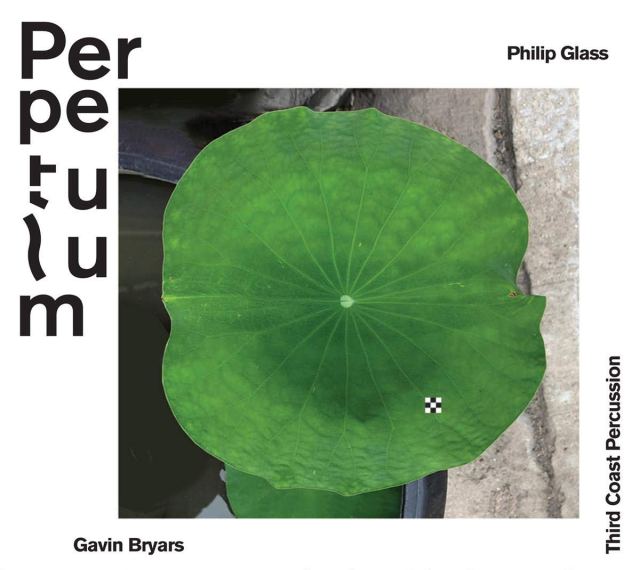
Perpetulum, a Double Album from Third Coast Percussion is a Triumph


perpetulum

Orange Mountain Music OMM 0132

Third Coast Percussion is one of Chicago’s finest musical exports along with groups like Eighth Blackbird and doubtless others with whom I have less familiarity.  Their deservedly Grammy winning album of music by Steve Reich was reviewed here.  All percussion ensembles are somewhat the rage these days judging by the amount of such albums that come my way.  Percussion instruments are common in eastern cultures but only really made its way into western ensembles in a big way in the last 100 years or so largely due to composers like John Cage and Lou Harrison studying music of other cultures and writing new music for both existing and newly invented percussion instruments.

Percussion is like the junk drawer of the orchestra in that any instrument which does not fit into the categories of strings, winds, or brass is handled by the percussionist.  The taxi horns in Gershwin’s American in Paris are a good example.  However what we have here is an ensemble entirely comprised of percussion instruments with some seriously virtuosic players here performing music written for them.

This two CD set from Orange Mountain Music contains five works by five composers.  The first CD is dedicated to the largest work on this release, “Aliens with Extraordinary Abilities” by ensemble member David Skidmore.  It is, at about 35 minutes, the longest piece in this collection and is virtually a symphony for percussion and electronics.  It is in seven movements, each with a cryptic title no doubt related to the musical content.  It is an engaging work of some complexity with fascinating writing for percussion instruments. Multiple close listens will reward you with details not immediately apparent and reveal some of the structure of this large work.

The second CD begins with a shorter work by ensemble member Peter Martin called “Bend”.  It has the characteristics of an orchestral work using largely pitched percussion.  It presents themes, develops them, and has a detectable harmonic structure.  It is a showpiece for the musicians but it does communicate with the listener.

Next up is Philip Glass in his first all percussion work, “Perpetulum” (2018) has four movements and clocks in at about 25 minutes.  This is music by a seasoned composer, not the experimental music of his earlier years (which hooked this listener) but rather a recognizable and comfortably familiar style with some really nice writing for percussion.  Glass has frequently used percussion of various sorts in his works but this is the first thing he has written entirely for percussion ensemble.  It is an audience pleaser and a challenge to the musicians.

This is followed by a work by another member of the group Robert Dillon.  “Ordering-Instincts” (2018) is cast in one movement it is a relatively brief (7min approx) piece which successfully challenges the players and entertains the audience.  It also seems to provide a nice segue to the final cut.

The disc concludes with a major percussion work by British minimalist Gavin Bryars.  “The Other Side of the River” (2018) is a commission by Third Coast Percussion and is a valuable addition to Bryars gentle, pensive oeuvre.  For this listener this piece is the highlight of this collection.  Bryars is at his best in his meditative mood.  Sinking of the Titanic and Farewell to Philosophy come to mind as similarly relaxing and thoughtful.  This is a big piece and well worth the journey of listening.

bryarsOM

Bryars at the Other Minds Festival in San Francisco, 2016 (Creative Commons license by Allan J. Cronin)

This CD set is a massive undertaking and a fine production illustrating the range of compositional interests of Third Coast Percussion as well as their own compositional chops.  It is also a great sounding recording.  Very well done.


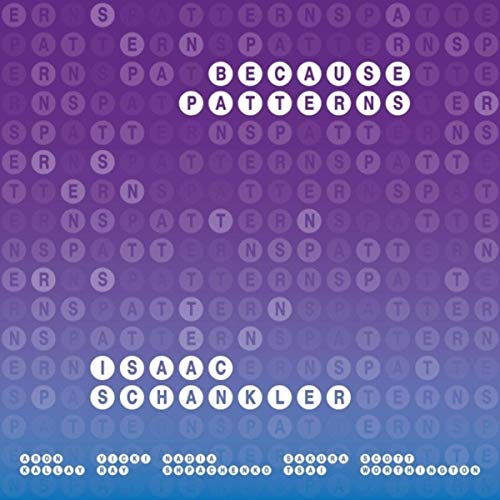
Because Isaac Schankler


schanklerpatterns

aerocade music

Isaac Schankler billed on their own website as “composer, etc.” clearly has a sense of humor but that characterization is as good as any to describe this composer, performer, teacher, writer.  Suffice it to say it is worth your time to check out that web site.

Schankler’s name and music are new to this writer’s eyes/ears bit it is delightful to make the acquaintance of this artist via the present release.  Three electroacoustic works are presented.  Schankler does the electronics and an array of musicians play the acoustic instruments.

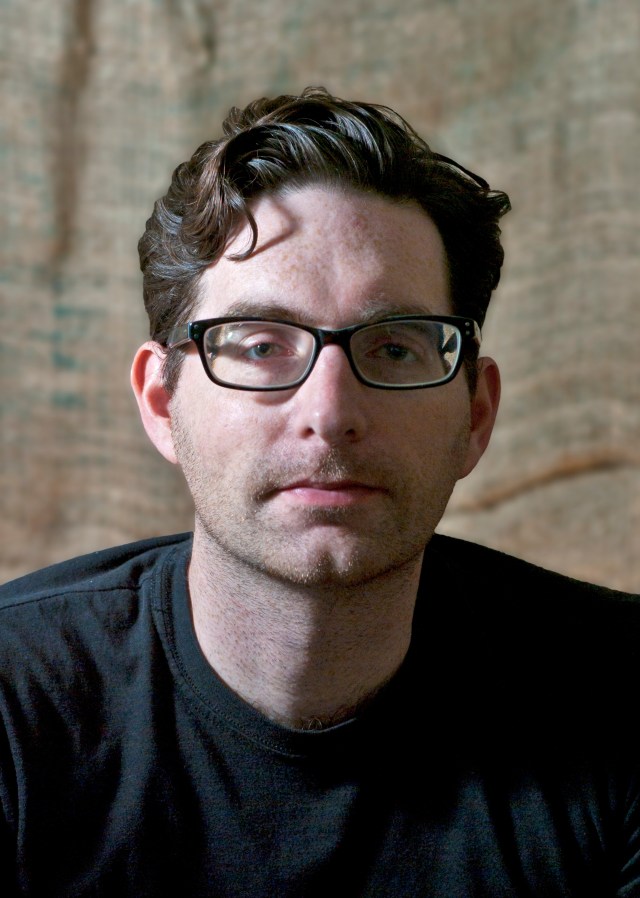
Schankler_headshot

Isaac Schankler (from the composer’s web site)

The combination of acoustic instruments with electronics (fixed and/or interactive) goes back at least to Edgar Varese and has practitioners which include Mario Davidovsky, David Behrman, Milton Babbitt, and a host of others too numerous to discuss within the scope of this review.  The point is that Schankler seems to be a part of these traditions and has developed a personal way to work with this hybrid medium.

One of the problems this writer has experienced while trying to understand and write meaningfully about electronic music (with or without acoustic instruments) is that textbooks on such music seem to end their surveys in about 1990.  Add to that the fact that electronic music, once a category banished to a sort of appendix in the days of the Schwann Catalog, has now acquired multiple meanings.  Electronic music now apparently includes dance music, dark ambient musings reminiscent of Pink Floyd and Tangerine Dream, individual experiments typified by artists like David Lee Myers and Kim Cascone, and the original meaning with work by pioneers like Subotnick, Luening, Babbitt, etc.

This disc would have been listed in that little appendix I mentioned earlier if it had been released in the 70s or so.  It is, in this listener’s mind, classical electronic music.  Perhaps one could dance to it but it seems to be written with the intent of presenting musical ideas and highlighting the musical skills of performers on their acoustic instruments.  This one is best heard with headphones and serious attention.

The first track is Because Patterns/Deep State (2019) is a sort of reworking of two earlier pieces Because Patterns (2015) for prepared piano duo (Ray/Kallay Duo) and The Deep State (2017) for double bass and electronics.  There is an interview on Schankler’s website that discusses the composer’s processes in each piece and the reasons for combining the two into the present form.  The solo parts, such as they are, are performed by Aron Kallay and Vicki Ray on keyboards and Scott Worthington on double bass (curiously the soloists were recorded in different studios).

From a listener’s perspective one of the most striking things was how deeply embedded the solo performers are.  This is like a concerto grosso in which the instruments are more embedded in the texture.  It is a complex piece which demands the listener’s attention but ultimately rewards said listener in a musically satisfying way.  In short, your reviewer has only the faintest grasp of the processes involved but appreciates the end product.  At about 25 minutes this is a commitment but one worth tackling.

Mobile I (2009) is written for violin and electronics (interactive) and is described by the composer as an audio analogue of mobile sculpture.  Think Calder set to music perhaps.  Again regardless of the process the main concern for the listener is whether the result actually entertains. Here, where the soloist (Sakura Tsai) is more at the forefront, it is easier to hear the interactive nature of the music as the gestures of the violin are responded to by the electronics.  It is a form of call and response with the soloist in the lead and the electronics answering.

The third and final track is Future Feelings (2018) commissioned and premiered by Nadia Shpachenko and, according to the composer’s website was the result of experiments seeking pleasing sounds for the composer’s first child.  This is not a lullaby but rather a working out of ideas.  It works as a concert piece as intended but is probably not going to make its way onto a “soothing sounds for babies” CD any time soon.

This digital and vinyl release semis to have precious little in the way of notes to guide the listener but this label aerocade can be forgiven on the strength of their choices in repertoire and quality of recorded sound and the composer’s website is nicely designed and informative. Their release of the Post-Haste Duo was reviewed most favorably in these pages earlier and a quick scan of the label’s website suggests that this label (established by Meerenai Shim , who also did the lovely design of the cover, this is the 11th release of a label that deserves the attention of new music fanciers).  Links are provided for the interested listener, all of which will lead to a better understanding and will serve as a guide to find similarly interesting and creative music.

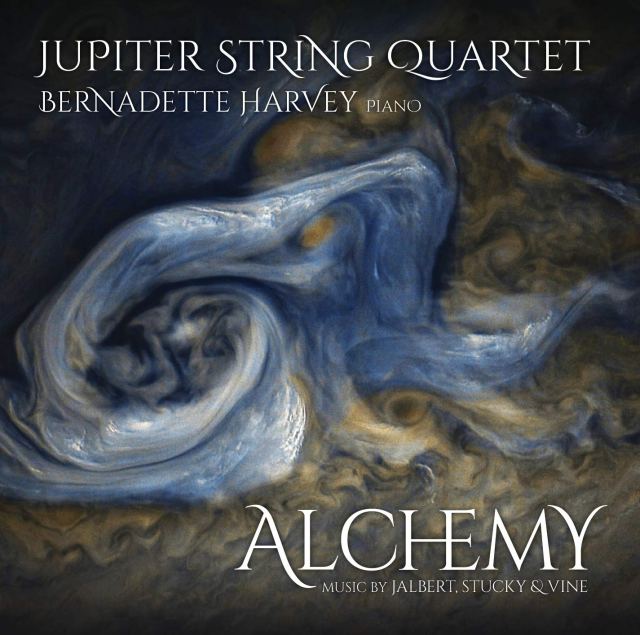
Fantastic New Music for Piano and Strings, The Jupiter Quartet with Bernadette Harvey


alchemy

There is no small irony for this reviewer in the title of this offering.  As soon as it was removed from its packaging I, much as Alice was implored by the comestibles in Wonderland, felt compelled by joyous expectation to consume it with eyes and ears.  And I was not disappointed.

Three composers are represented with one work each (two by Mr. Jalbert) in an album of recent compositions in modern but essentially tonal chamber music for highly skilled musicians. All But one (Secret Alchemy) are world premiere recordings commissioned by the Arizona Friends of Chamber Music and all contribute most handsomely to the piano and strings literature.

The highly skilled musicians are the extraordinary Australian Bernadette Harvey on piano with the Jupiter Quartet (Nelson Lee and Meg Freivogel, violins; Liz Freivogel, viola; and Daniel McDonough, cello).  They play extremely well together despite having to navigate all new and challenging material.  Harvey, in addition to traditional repertoire is a major advocate for living Australian composers.

jalbert

Pierre Jalbert

The album opens with Piano Quintet (2017) by Pierre Jalbert (1967-  ) which draws as much on the romantic tradition (can one hear the ensemble name “piano quintet” without thinking of Schubert, Brahms, and Schumann?) of that ensemble’s configuration as on his more modernist sense of rhythm and harmony.  It is cast in four movements titled, Mannheim Rocket, Kyrie, Scherzo, and Pulse.  This is a major work by a composer new to these ears and apparently very substantial.  This is highly engaging music with romantic leanings perhaps but there is nothing derivative here.  This composer is a voice that deserves an ear or two.

stucky

Steven Stucky

Next up is music by the late lamented Steven Stucky (1949-2016).  While I regret not having gotten to know a lot of his music during his lifetime I find myself enthralled at the power and lyricism of each work I hear (the man was prolific too so I have much listening to catch up on).  This one is no exception, Piano Quartet (2004-5) is in a single movement with multiple sections of varied character.  Anyone who has heard any of Stucky’s music will find this piece both exciting and accessible.

vine

Carl Vine

Carl Vine (1954- ) is a prolific Australian composer (the only non-American composer represented) whose work certainly deserves to be better known outside of his native country.  He does appear to get recognition and respect there and with Fantasia for Piano Quintet (2013) we can see why.  This one movement work is (like the Stucky piece) divided into sections played without pause.  This is another work of both power and virtuosity which holds the listener’s interest and, ultimately, provides a satisfying concert experience.

The program ends with another substantial work from Mr. Jalbert, a piano quintet in all but name.  Secret Alchemy (2012) allows us to hear some earlier chamber music writing by this composer.  Again each movement is given a title but this time they are more like expression markings and less poetic.  They are: Mystical, Agitated, Timeless, and With Great Energy.  Why that’s practically a program note!  And like the piece that opened this disc it indeed has great energy and will engage the listener.

This album exceeded my enthusiastic expectations and I will listen again, probably many times.  Well done.


American Neoromantics: Higdon, Barber, and Harlin


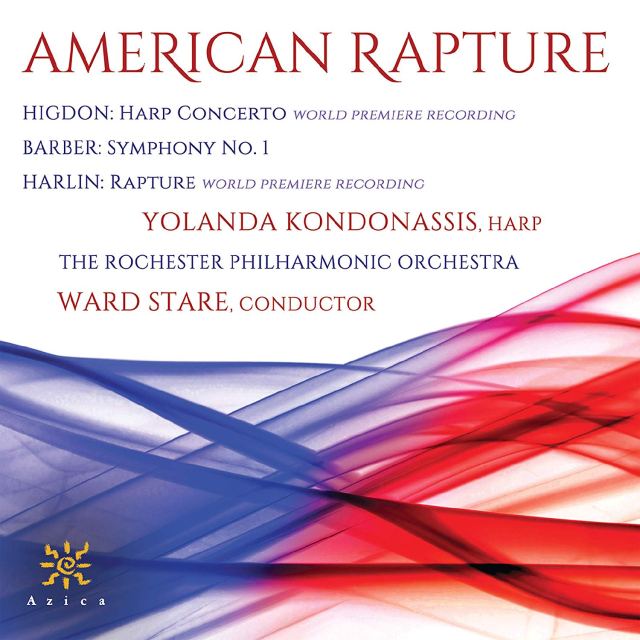
higdonrapture

Two contemporary world premieres paired with Samuel Barber’s masterful First Symphony make this disc a delicious sampling of neoromanticism in American music.

The standout here, and the main reason to buy this disc is the glorious Jennifer Higdon Harp Concerto (2017).  Higdon, the third woman to win a Pulitzer Prize (by my count) is clearly schooled in a wide variety of compositional techniques which she uses judiciously.  She is unabashedly a romantic but her sound is hardly retro.  She, like many well trained and talented composers, uses her many skills and techniques judiciously.  Nothing experimental here, just good writing for both orchestra and soloist.

Higdon’s concerto is cast in four movements and grabs the listener’s interest immediately.  Using her gift for writing melody and effective use of extended harmonies she crafts a truly great concerto for the instrument.  It is bright, playful, and engaging.  Her writing for the harp (and Kondonassis’ seemingly easy grasp of astounding virtuosity and lyricism) work well with the orchestral writing making a very satisfying listening experience.

The soloist, Yolanda Kondonassis, is a familiar name to fans of harp music.  Her many albums demonstrate a range of interests and skills that keep her name in the public eye/ear.  Her recording of the Ginastera concerto was reviewed previously on this blog here.  Listeners are advised to explore her web site for more exciting and listenable music.

The second piece, Samuel Barber‘s First Symphony Op. 9 (1936) is an acknowledged masterpiece of the mid-century American neoromantic tradition.  Barber’s music hearkened back to the romanticism of the late 19th century at a time that also saw the birth of a great deal of post-Schoenberg modernism.  Some of the similarities between Barber’s work and Higdon’s is doubtless the reason for the inclusion of this too little heard masterwork.  It is cast in one movement and makes wonderful use of a large orchestral palette.

This is followed by the second world premiere on the disc by one Patrick Harlin, a name unfamiliar to this reviewer but one with, apparently, a similar aesthetic and some serious skills as a composer/orchestrator.  Rapture (2016-7) certainly shares some of the sonic fingerprint of the previous two pieces and raises the specter of another talented composer emerging into the light of said American Rapture.

The Rochester Philharmonic Orchestra is clearly up to the task as is conductor, Ward Stare who is another rising star you’ll want to keep on your collector’s radar.  His grasp of conducting and insight into this music suggests he will continue to surprise and please audiences.

The recording on Cleveland based Azica records is well recorded and all the music supports repeated listenings where the attractive surface of the music gives way to more detail.  All in all a CD that fans of Jennifer Higdon, Yolanda Kondonassis, and American Romanticism will want to own.


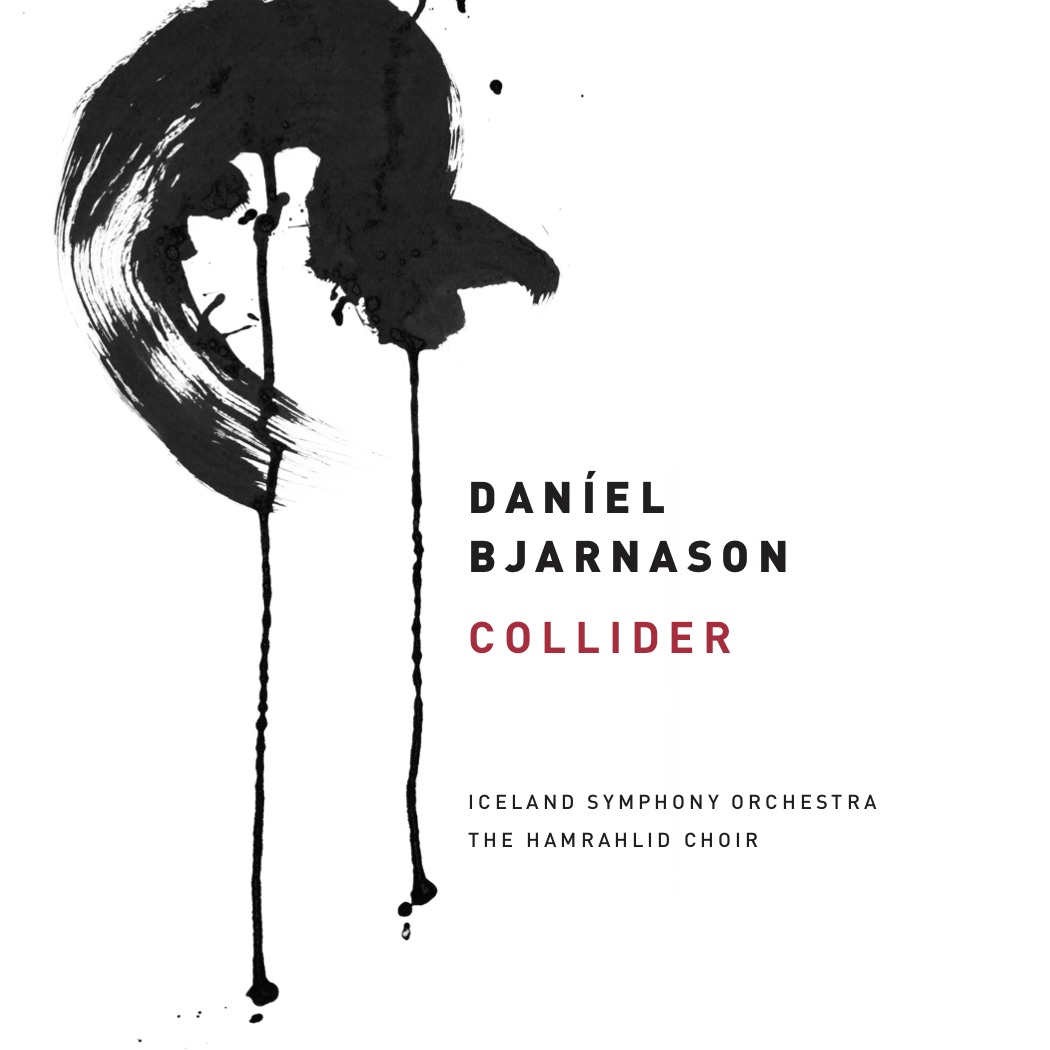
Collider, The Marvelous Music of Daniel Bjarnason


This is the second album I’ve had the pleasure of reviewing by this wonderfully talented composer and conductor from Iceland. The other album which put his name forever into my watch list was Recurrence. Daniel Bjarnason conducted on that recording which features his work as well as that of fellow Icelandic composers.

The present release is also conducted by Bjarnason and features three amazing works by this young composer and conductor. The works include, “Blow Bright” (2013) for orchestra, “The Isle is Full of Noises” (2012) for chorus and orchestra, and the title work, “Collider” (2015).

Blow Bright and Collider are performed by the lucid Icelandic Symphony. They are joined by the Hamrahild Choir for the three movement, Isle Full of Noises. The recording is also listener friendly (with detail that sent this listener to find headphones to hear them).

It is a mark of genius that this composer already has a clearly defined sound all his own. Hearing these left this listener wanting to hear these pieces again and to hear more of this man’s work.

Blow Bright and Collider are significant contributions to the modern orchestral repertoire and Isle Full of Noises is an opportunity to hear Bjarnason’s vocal writing with orchestra. This listener, no surprise was charmed. His facility in melodic invention, judicious use of modern harmonies make for very listener friendly music that challenge gently but always entertain. Classical music is alive and well…at least in Iceland.

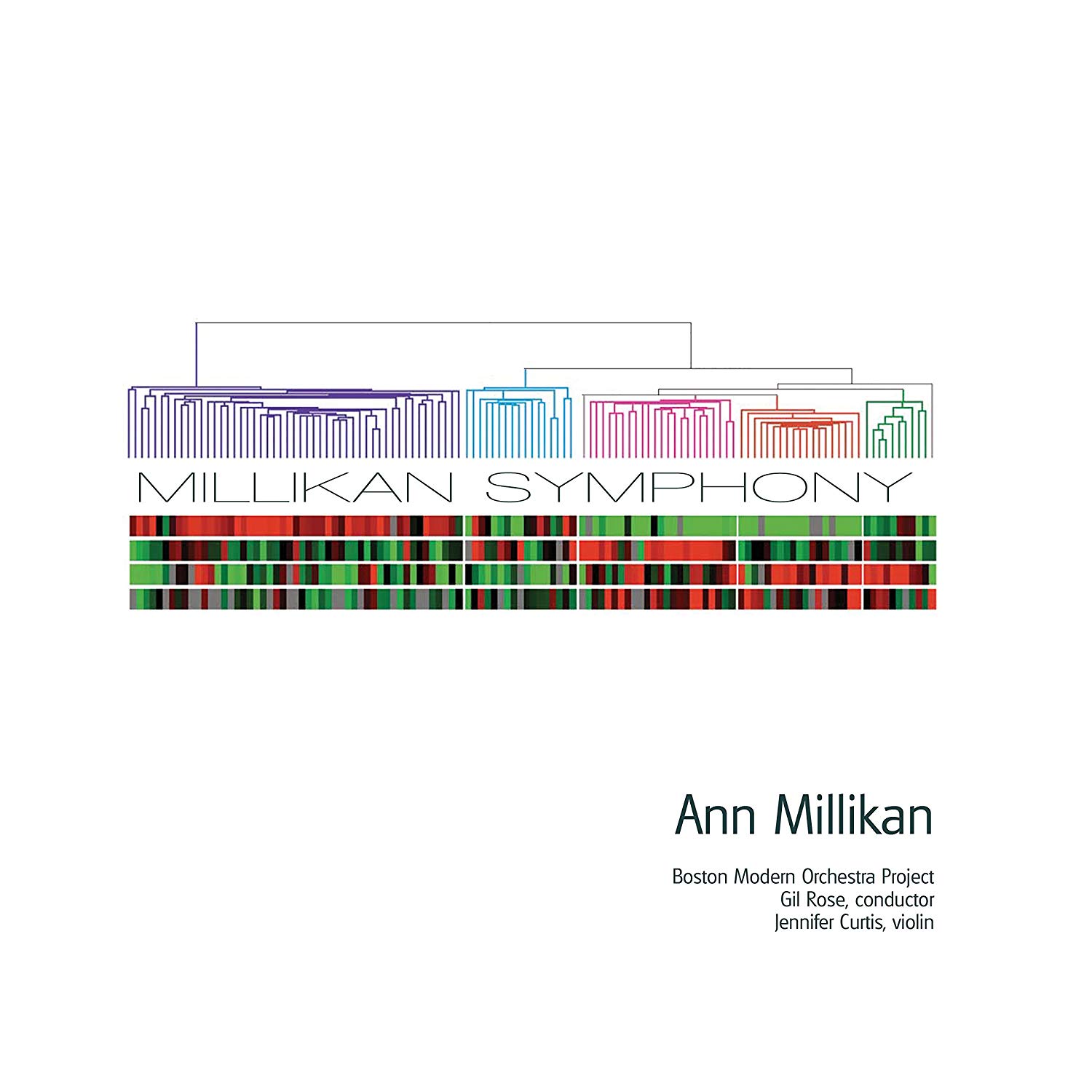
Ann Millikan’s Symphony


millikansym

The combination of Gil Rose and his Boston Modern Orchestra Project alone are reasons to buy this disc.  The process of discovering new music can be an arduous task with few hints along the way.  However certain musical gurus have been very helpful to this writer and one of the finest is Mr. Rose and his orchestra.  His curation and the dedication of these incredible musicians pretty much guarantees a satisfying listening experience. The useful liner notes by Bay Area music maven Sarah Cahill also serve to recommend this disc.

If those accolades are not enough for you let me tell you that this was my first encounter with this composer so I went in with few expectations and no negative prejudices.  What I found was a hugely entertaining work of deep substance which grows on the listener with each run through.

The work is in four movements, each concerned with each focused upon one theme or idea related to the life of Robert Millikan, the composer’s brother. The movements are, “science”, “animals”, “rowing”, and “violin”. Each one describes an aspect of his life and, while elegy is a part of the intent in this music (which it does well), each one stands on its own musically and the work entertains on a purely musical level as well.

That last movement is virtually a violin concerto and seems among the most personal of the four. No doubt there are many personal references but the overall feeling is celebratory, the step just past mourning.

All in all a great listening experience which will send this listener on a quest for more of this composer’s work.

Michala Petri in the 21st Century


amerecorder

OUR Recordings 8.226912

Since her debut in the mid 1970s Michala Petri has proven herself as one of the great masters of the recorder.  The recorder is an instrument which, until the 20th century was pretty much only heard in music written before 1750 or so.  Many previous masters such as David Munrow and Franz Brüggen restricted their playing to early music.  Petri has certainly broken that mold.  She has mastered baroque, renaissance and contemporary music for her instrument as her recent releases demonstrate.  And her skills as a musician have only grown stronger and more convincing.

This disc is her celebration of American music for the recorder.  We hear four 21st century concerti for the recorder.  Composers include Roberto Sierra (1953- ), Steven Stucky (1949-2016), Anthony Newman (1941- ), and (a new name to this reviewer) Sean Hickey (1970- ).  These are fine compositions but they are basically mainstream sort of neo-romantic/neo-classical/neo-baroque works.  These are all finely crafted compositions but nothing here is experimental.  Despite the names all are basically concerti which highlight the interplay between soloist and ensemble.  Therein lies the joy.

The disc begins with Roberto Sierra (1953- ) wrote his “Prelude, Habanera, and Perpetual Motion (2016) as an expansion of an earlier recorder and guitar piece but, obviously, with a great deal of expansion and orchestration.  Despite its colorful title the work is basically a concerto and a fine one at that.  Petri here performs with the Tivoli Copenhagen Philharmonic under Alexander Shelley.  From Sierra’s web page there is a link to a video of the premiere here.  Sierra, born in Puerto Rico, affirms his skills as a composer in this exciting work.

Next up is music of the late Steven Stucky (1949-2016) sadly known almost as much for his recent demise as for his compositions.  However Petri’s performance of his “Etudes” (2000) for recorder and orchestra goes a long way to affirming some of the gravity of the talent we lost and the wonderful legacy he left.  The Danish National Symphony under Lan Shui do a fine job of handling the complex orchestral accompaniment and Petri shines as always.  This concerto is in three movements titled: Scales, Glides, and Arpeggios respectively.

Anthony Newman (1941- ) is a name that must be familiar to classical recording buyers in the late 1970s into the 1980s when Newman’s exciting recordings of Bach dominated record sales.  It is no wonder that he composed an essentially neo-baroque concerto pitting the recorder against an ensemble consisting of a harpsichord (deliciously played by Newman) and a string quartet (in this case the Nordic String Quartet).  Clearly a more suitable sized ensemble that might have been used in the 18th century.  This is the only piece on this album that is actually called a concerto by its composer.  Concerto for recorder, harpsichord, and strings (2016) in four movements (Toccata, Devil’s Dance, Lament, and Furie) shows this performer, musicologist, and composer at the height of his powers in this lovingly crafted work.

Last (and certainly not least as the cliché goes) least is by a composer unfamiliar to this reviewer, Sean Hickey (1970- ) is also the youngest composer here.  His A Pacifying Weapon (2015) is subtitled, “Concerto for Recorder, Winds, Brass, Percussion and Harp” which tells you about the rather gargantuan dimensions of his work.  While not representing a specific “program” the work is the only one on this CD that espouses some political content.  The title reflects the composer’s desire to use this concerto to represent some of his response to “current events”.  The three movements are simply numbered 1, 2, and 3.  I can only begin to imagine the problems of balancing the little recorder against such a huge and loud ensemble but the Royal Danish Academy of Music under conductor Jean Thorel are clearly up to the task.

Hickey originally hails from Detroit and is now based in New York.  A quick perusal of his web page suggests that listeners like your humble reviewer have much to hear from this up and coming young composer.

All these are world premiere recordings which show Michala Petri at the height of her powers.  Indeed she is an international treasure whose instrumental skills and her range of repertory continue to amaze and entertain her audience.  The recording under Lars Hannibal’s direction is, as usual, lucid and very listenable.  Joshua Cheeks liner notes save this writer a great deal of research time and pretty much answered all this listener’s questions.

Happy listening all.  This recording has it going on at many levels.


PUBLIQuartet: Freedom & Faith


publiquartfreedom

Bright Shiny Things BSTC 0126

There are seemingly more string quartets performing these days than ever before and they are fine musicians.  Whether we’re talking about the Kronos Quartet, Arditti Quartet, Pacifica, Telegraph, etc. all contain truly finely trained and virtuosic musicians.  The problem is to distinguish one’s self (or one’s ensemble) in some way.  I’m not going to go into how each of the mentioned string quartets have done this so don’t worry.

My point here is to review this fine disc by yet another new music quartet called PULBIQuartet.  They have chosen, at least in this, their second release, to continue their efforts at “genre bending”, exploring music and transcribing music that is atypical of the standard quartet repertoire.  Like their colleagues they are aiming at a redefinition or perhaps a revitalization of the string quartet genre.  The performers are: Curtis Stewart, Jannina Norpoth, violins; Nick Revel, viola; and Amanda Gookin, cello.

The album at hand, titled “Freedom and Faith” presents music predominantly written by or associated with women.  Get into the Now (2017) by Jessica Meyer is classical in the sense that it uses the standard 2 violins, viola,and cello and is divided into three movements played with short pauses.  Content wise this is a strong piece which requires a great deal of virtuosity and a handful of extended techniques involving percussive use of the bodies of the instruments themselves and even a few spots that require the musicians to vocalize.  All in all a riot of a piece with good humor.  It lasts about 20 minutes and begs to be heard again.  Very entertaining!

The next 9 tracks fit into the PUBLIQuartet’s project called Mind|the|Gap which is at the heart of their efforts to breathe new life into the string quartet and, hopefully, garner some new fans.  All members of the quartet share arrangement and, at times, co-compositional duties.

Tracks 4, 5, and 6 contain transcriptions of sacred vocal music by female composers.  The Medieval Hildegard von Bingen’s, “O ignee Spiritus” is followed by Francesca Caccini’s, “Regina Coeli”, and then Chiara Margarita Cozzolani’s, “O quam suavis est Domine spiritus tuus”.  The vocal originals must be quite lovely but these works seem to retain their sacred ambiance even without the words.  So ends the section which contributes to the “faith” in the title of the album.

Who knew that “A tisket, a tasket…” was by Ella Fitzgerald’s arranger Van Alexander.  The PUBLIs (if you’ll forgive the truncation) do a marvelous and entertaining arrangement of this novelty song.  It provides a sort of comic relief dividing the faith segment of the program to the “freedom” segment.

The next 4 tracks focus on transcriptions of popular music.  These are serious pieces, not the “pop” type songs that are basically feel good or dance tunes but the type of music that is in the shadow of serious social issues.  Who better  than Nina Simone?  These are loving and strikingly original arrangements of Herb Sacker/Nina Simone’s, “Blackbird”, Leslie Bricusse/Anthony Newly’s, “Feelin Good”, Nina Simone/Weldon Irvine’s, “Young Gifted and Black”, and Nina Simone’s powerful antiracist reproach in her, “Mississippi Goddam”.

These transcriptions are done in a free manner with echoes of Stephane Grappelli, Cajun music and, doubtless, references that this reviewer has not grasped.  They are highly entertaining.

The album ends with another string quartet.  This one is by Shelley Washington and it is a powerful piece.  In its relatively short ten minutes or so she manages to create some memorable sound worlds.  There are few program notes that give a clue as to the background and intended meanings of the purely instrumental works (those not derived from vocal music) but one senses political stirrings.

All in all a unique little recital which at least challenges the common notions of this chamber grouping and, frequently, succeeds.


Axel Borup-Jørgensen’s Floating Islands, New Music for Guitar


jorgensen

OUR Recordings 6.220672

OUR recordings (Lars Hannibal, producer) continues its survey of the inexplicably little known Axel Borup-Jørgensen (1924-2012).  I first encountered this composer when I received for review the earlier disc of his percussion music (reviewed here) and later when I received the CD/DVD of his orchestral music (reviewed here).  He belongs to a lineage of Danish composers whose work dominated the Danish music scene of the mid to late twentieth century and just a dip in the water of the twenty first.

The lucid liner notes by my esteemed colleague Joshua Cheek put the composer in context where his reputation lives among his contemporaries Vagn Holmboe (1909-1996), Niels Viggo Bentzon (1919-2000), and his students Per Nørgard (1932- ), Ib Nørholm (1931- ), and Pelle Gudmundsen-Holmgreen (1932-2016).  Indeed these are the names to know if you want to learn about post 1950s classical music in Denmark.

This disc focuses on his guitar music and features the fine young Danish guitarist Frederik Munk Larsen who studied with Erling Moldrup for whom the composer wrote some of his music.  His virtuosity, passion, and commitment to this music are evident in the careful readings of this somewhat diverse music ranging from the Preambula, Op. 72 (1974-76) to the Floating Islands, Op. 169 (2000-2), a series of pieces which, appropriately, float in amongst the other tracks (in non-adjacent tracks).

The recording, as seems to be the standard of this label, is quite excellent and lucid.  This is not a complete recording of the guitar music but a representative selection which will  hopefully lead to another volume of guitar works and a recording of his Guitar Concerto “deja vu”, Op. 99.

There are 19 tracks with most  lasting 5 minutes or less (he is not afraid of brevity when it suits his compositional needs) but the early Preambula, Op. 72 and the Für Gitarre, Op. 86 each take some 15 minutes in performance.  All of the music comes across as carefully crafted and the briefer pieces contain worlds unto themselves as do the longer ones.  No electronics, maybe just a few extended techniques, mostly just good music for the competent guitarist (worthy of note is that the producer, Lars Hannibal is a highly accomplished guitarist himself).

The music is enjoyable but this is also a very important historical document (with excellent documentation) which nicely fills a gap in the historical record of the story of classical music in Denmark.  As a result I will leave it to the listener to peruse the very useful liner notes as they learn of this unique composer’s oeuvre.  And of course enthusiasts of guitar music will be enthralled as well.

Painting With Sound: J.L. Adams’ “Become Desert”


adamsdesert

Cantaloupe

This is the third work in a series which began with Become River (2010).  It remains to be seen if this series will be capped as a trilogy or will go on to further installments but, for this reviewer the very name of John Luther Adams (1953- ) has a strong positive bias.  I have been a fan since I first heard Songbirdsongs (1974-80) in its original Opus One release.  Though I have not followed all of his most recent work I was again drawn in in a big way with his Pulitzer Prize winning Become Ocean (2013).

J.L. Adams is generally speaking a post minimalist composer to the extent that such categories matter.  He is without a doubt the highest profile composer at the moment to focus so much on the natural world and his web site linked above is a fine guide to his recordings and listings of works yet to get such documentation.

Become Desert (2018) is a truly welcome installment in this prolific composer’s oeuvre.  It is a one track CD but one would be at a loss to make any divisions by dividing this recording in tracks.  The work is a coherent whole much in the spirit of his previous work but distinct in its sound world as are all of his pieces (at least that this reviewer has heard).  It is a slowly unfolding work with a large orchestra and chorus used judiciously and softly.  The Seattle Symphony and Chorus under Ludovic Morlot (who also premiered Become Ocean) are at the height of their interpretive powers and the recording is first rate.

The release also contains a DVD featuring some of Adams’ stunning photography along with the music is a nice feature but the music also works well all by itself.  Reviewing this CD will doubtless find me “preaching to the choir” to the established fans of the composer but it will likely help him find and even wider audience.  Much has already been written about this disc so let me just say it is beautiful and, hearing it in your favorite relaxed setting without distraction, is a calming and spiritual experience.

ADDENDUM: I usually publish the text of my reviews on the Amazon website.  Given what I tend to review mine is usually the first and frequently the only review.  So be it.  Though not shocked I was a little surprised to find no reviews as of 6/21/2019 and the invitation link titled, “Be the first to review this item”.  I guess that chorus to whom I imagined I preached might not shop on Amazon.

Guest Blogger Bill Doggett Reporting on the World Premiere of Anthony Davis’ “Central Park Five”


cp5 davis

Today I am pleased to have a guest blogger, Mr. Bill Doggett.  He has appeared in this blog before.  His bio can be found at the end of the article and, while the photos and the opinions are his own (though I’m in agreement) and I’m glad to be able to share his thoughts on attending this important world premiere.

Here we are:

Implicit Bias, Racism , White Supremacy, Forced Confessions, Restorative Justice:1989-2019, The foundational ideas that continue to mark the world of The Central Park Five
Dateline, June 15th, 2019, The Warner Grand Theater, San Pedro California, a restored Art Deco movie palace was the showcase location for the world premiere of Long Beach Opera’s commissioned presentation of Anthony Davis’ The Central Park Five.

cP5

Composite photo of the “Central Park Five”

Presented two weeks after Ava Duvernay Netflix Series “When They See Us” on The Central Park Five, a diverse and large audience was treated to a cutting edge new opera that added a new dimension, with an exceptional new score that enlarged the pallete of iconic operas by the great Anthony Davis.

Renowned for his 1986 landmark opera, X, The Life and Times of Malcolm X , Amistad, the opera about the slave ship rebellion and Tania, the story about the abduction/kidnapping of Patty Hearst and related drama with The Symbionese Liberation Army, Wakonda’s Dream about the plight of American Indians in Nebraska, Anthony Davis’ operas are landmarks of political discourse and exploration of historical and contemporary topics in American history.

Davis’ operas are richly hewn in intricate African polyrhythms, jazz improvisation, electronics and extraordinary vocal writing. In all of his operas, the expressive use of Rhythm advances the unfoldment of the drama in powerful ways.

The music of The Central Park Five expanded upon Davis’ rich compositional palette with intricate ensemble block scoring writing for the voices of the five Principal male singers that was fresh and impactful .
In the pre concert talk, Mr Davis expounded on some of the influences to this idea of block scoring and harmonization vocal writing that is associated with the well known Jazz and Gospel ensemble, Take Six and the sound worlds of Duke Ellington and Billy Strayhorn.

A complex score conducted brilliantly by the renowned Leslie B Dunner with Direction/Production design by Long Beach Opera’s Artistic and General Director, Andreas Mitisek, Davis’ opera provides both a discourse and exploration of the historical and contemporary issues of implicit bias, Institutional Racism in the Criminal Justice System and historic and contemporary issues of the Impact of Racism and ideas of White Supremacy that were deeply embedded in the world of 1989 New York City.

This world of racism and white supremacy is embedded in the opera’s sung and spoken character, The Masque who appears throughout the opera.

Donald Trump who began his political career taking out $85,000 ads in major New York newspapers calling for the death penalty of The Central Park Five also shows up in a role that represents not only the nemesis of the youth but additionally represents a clairvoyance for white nationalist ideas that have empowered his Presidency.

Davis and Wesley’s The Central Park Five Five is indeed an impactful and dynamic opera that addresses all of the issues central to The Black Lives Matter Movement.

Provocative in 1989 and in 2019, the opera explicitly deals with forced confessions, police brutality, disingenuous prosecution without collaborating Evidence, the death penalty and the tragedy of lengthy incarceration sentences for black and brown Americans for crimes not committed.

The five principals who sing the roles of The Central Park Five were brilliant in their portrayals of the intricate vocal writing. They are Derrell Acon{Antron McCray},Nathan Granner{Korey Wise} Orson Van Gay {Raymond Santana} Cedric Berry {Yusef Salaam} and Bernard Holcomb{Kevin Richardson}. They are assisted in comparable brilliance by Babatunde Akinboboye {Matias Reyes-the man who committed the crime}, Lindsay Patterson and Joelle Lamarre, the mothers of Yusef and Antron and Ashley Faatoalia who plays Antron’s father. The roles of Donald Trump, The District Attorney and The Masque are performed by Thomas Segen, Jessica Mamey and Zeffin Quinn Holis.


There are two more performances of this impactful new opera by Anthony Davis and Richard Wesley on
June 22nd and June 23rd. For tickets, visit http://www.longbeachopera.org


About the author, Bill Doggett is a well respected historian, archivist and published specialist in African American Performing Arts History. During 2013, he worked as the marketing agent for Anthony Davis on his new chamber opera, Lear on The Second Floor and promotion for the revival of X, The Life and Times of Malcolm X focused for the 2015 50th anniversary of the assassination of Malcolm X.


(Just a note from the blogmaster):  I wish to thank Mr. Doggett for his wonderful coverage of this important premiere.  I already had a soft spot for Anthony Davis’ work (which I consider a latter day Luigi Nono who held that one can never separate politics from art) but I never imagined that I would be indexing Donald Trump in this blog space and this context but here he is, lol.  Thanks, Bill.

It is also very important to note that Anthony Davis has been commissioned to write an opera by Opera Tulsa on the subject of the Tulsa race massacre of 1919.  It is scheduled for a premiere next year.


From the Simpsons to the Concert Hall,Classical Gems by Danny Elfman


Album Art

Danny Elfman (1953-) has had a varied and successful musical career working in diverse areas.  From his days as lead singer and songwriter for Oingo Boingo, he has cultivated his love of film music into a successful career having scored numerous films and television shows.

Now a great divide seems to exist between composers who score films and composers who compose for the concert hall.  Few have demonstrated the ability to be successful in both arenas.  Erich Wolfgang Korngold is a notable exception as is Aaron Copland.  Both men have succeeded rather famously in both film and classical concert hall music.  In fact John Williams, though known primarily as a film and television composer has written quite a bit for the concert hall as well.

Now here comes Danny Elfman, known best perhaps as the composer of the Simpsons them for the long running animated series.  He has gotten the bug to write for the concert hall and this recording presents two major works.  The first is his violin concerto “11/11)(2017) with soloist Sandy Cameron.  You can read the liner notes about the composer’s obsession with the number 11 or you can relax and enjoy a genuine violin concerto, not a reworking of themes as one might expect from a lesser composer.  The second is a nice addition to the chamber music repertoire, a piano quartet (2017).

The concerto is played by the wonderful Royal Scottish National Orchestra under the direction of the esteemed John Mauceri.  Sandy Cameron is the soloist who handles the concertos four movements flawlessly and does justice to Elfman’s work.  It’s really a beautiful piece.  Only time will tell the work’s eventual place in history but we can certainly enjoy it for what it is, a good and entertaining violin concerto.

The Piano Quartet is played by the Philharmonic Piano Quartet Berlin which consists of Andreas Buschatz, violin ; Matthew Hunter, viola; Knut Weber, cello; and Marcus Groh, piano.  This five movement work would happily grace any chamber music recital.  It is in turn pithy, melodic, humorous, and serious.

This is stronger music than this reviewer had imagined would come from this composer’s pen.  I can’t say, “If you like his film scores you’ll like his music” but there are, perhaps inevitably, snippets of his film music style which work actually quite well.

Wolfgang von Schweinitz’s “Klang”, Gorgeous Postminimalism


LCMS1903

I must confess that Ireland is hardly near the top of my list for countries that are producing interesting contemporary music but this new release will soon have me checking out their Contemporary Music Center to see what else is happening.  Let me be clear, I’m not criticizing Ireland, just lamenting the fact that, like many countries, their contemporary classical music rarely gets to U.S. ears.

As if to magically remedy my wish for a more democratic distribution of said music producer Eamonn Quinn kindly sent me this single track CD containing a work influenced by (among others) the Godfather of minimalism, La Monte Young. He commented to me about the ultimate marketability of a one track CD but his instincts are well placed in this CD recorded February 2019, hot off the presses.   This is my first encounter with the composer, Wolfgang von Schweinitz (1953- ) whose name is now programmed into my surveillance engines as a voice to be followed.  Definitely want to hear more from him.  Born in Hamburg, he now teaches at Cal Arts.  A list of his works can be found here.  (While there you will want to avail yourself of the rest of this great site about just intonation composer at Plainsound)

While I share Mr. Quinn’s concern about the marketability of a single track CD (it is about 45 min), this is an ideal presentation for a work in just intonation by a string trio and the uninterrupted 45 minute interval is integral to the experience of the music.  This work is like the grandchild of La Monte Young’s String Trio (1958).  I am now having fantasies about curating a program of this work paired with its spiritual grandfather.  The single track, just intonation hits at my geeky minimalist heart and I know I’m not alone in that.

The brief but lucid and useful program notes are by the wonderful Paul Griffiths and the recording by Peter Furmanczyk captures the rich overtones well.  The Goeyvaerts String Trio has earned a place in my media alerts now as well.  They perform this work with insight and passion.

Now, past the name dropping and background stuff to the music itself.  If you know the long tones of La Monte Young’s String Trio, which is of similar length, you might hear it as a more melodic version of that.  That is not to say that this work is derivative, it is evolved its predecessor’s DNA, so to speak.  It is postminimalism (or file under “ambient” if you prefer) from that branch of the family tree.

The full title of KLANG” is given as ” PLAINSOUND STRING TRIO KLANG AUF SCHÖN BERG LA MONTE YOUNG…” Op. 39 (1999, rev 2013),  and while the musical references to Schoenberg and Berg are there, the experience is that of an almost romantic tableau of long tones and rich harmonics descended from the Urtext of minimalism that is La Monte Young. The spirit of Morton Feldman appears to reside here as well, maybe even a wisp of Brian Eno.  The kaleidoscopic effect of the just intonation with all the rich harmonic overtones evoke a great deal and probably will provoke different memories for different listeners. It is a maybe even a sort of Verklärte Nacht for the millennium though what is ultimately transformed is the listener themselves.  You can choose your own metaphor, but first you’ll be charmed by the music.

And dontcha have to love that cover graphic?

Project W: The Chicago Sinfonietta Gloriously Features Women Composers (conductor too)


project w 365

Cedille CDR 90000 185

The attention paid to women composers remains much less than it should be but releases like this latest on Cedille features the Chicago Sinfonietta (Chicago’s second professional orchestra established in 1987 and sporting programs distinctly different from that of the Chicago Symphony) are incrementally correcting that error.  Here for your listening pleasure is a disc with five world premieres, all by female composers, and a world class orchestra conducted by a female conductor, Mei-Ann Chen.  (They also boast that on average the Sinfonietta is 47% women.  Is there an orchestra that can match that?).

florence-final

Florence Price 

With the exception of Florence Price (1887-1953) all are living composers on this release.  The others (who were commissioned by the Sinfonietta to write these pieces) include Clarice Assad (1978- ), Jessie Montgomery (1981- ), Reena Esmail (1983- ), and Jennifer Higdon (1962- ).  Montgomery and Esmail are new names to this reviewer.  Assad and Higdon are generally well known and very accomplished.  Higdon is the second woman to receive a Pulitzer Prize in music (the first was Ellen Taafe Zwilich) and Florence Price is enjoying something of a posthumous revival with recent recordings of several of her larger works and the recent discovery of some of her scores long thought lost.

This disc is pretty much representative of Cedille’s mission to record new music and a selection of older music featuring largely Chicago musicians.  This label has done great service in promoting the music of women and other minority groups and has exposed the record buying/listening public to musical gems that otherwise would languish in that minority wasteland of music which remains unperformed due to sociopolitical rather than aesthetic reasons.

m chen

Mei-Ann Chen

This is one of their finest releases.  It is a nice survey of 20/21st century women composers (just a small sampling but an intelligent one) from the early twentieth century to the present.  The works are given definitive readings by a fine ensemble and a clearly accomplished insightful conductor.

pfreeman

The late great Paul Freeman (from Chicago Symphony web site)

The disc opens with music which serves both the theme of presenting women composers and the desire to do honor to the Chicago Sinfonietta’s founding conductor, the late Dr. Paul Freeman.  His advocacy of the music of black composers began with the groundbreaking Columbia release (now Sony) of music by black composers and continued the series on Cedille (African Heritage Symphonic Series: CDR 90000 055, CDR 90000 061, CDR 90000 066 followed by the Coleridge Taylor-Perkinson disc CDR 90000 087).  The disc opens with a set of piano pieces by Ms. Price (Dances in the Canebreaks, 1952) which were orchestrated by no less than the dean of Black American composers, William Grant Still.  These three friendly, light hearted dances will remind listeners of the sort of fare that characterized the jazz inflected classical idioms of the time, a tradition which also gave birth to Rhapsody in Blue.

ClariceAssad_AP2_9091_web

Clarice Assad (from composer’s web site)

Next up is Sin Fronteras (2017) by the Brazilian-American composer Clarice Assad.  She comes from the well known musical family which includes her father, guitarist and composer Sergio Assad.  Her work has a tinge of Aaron Copland and works well as a follow up to the opening track.  She, like Still, seems to have an impressive command of the orchestra which she handles with tremendous skill in this overall light hearted piece.

jessie m

Jessie Montgomery (from the composer’s web site)


Jessie Montgomery (1981- ) is a new name to this reviewer but a look at her well organized web page reveals an astoundingly accomplished young musician.  Her Coincident Dreams (2017) follows in the American traditions of including folk music in her compositions.  Here her material includes non-American folk musics blended into a lucid listenable score that marks her as a musician worth watching.

As with Assad we hear a composer who is comfortable with the sprawling pallet of the modern orchestra where she manages to make the best use of her materials in an entertaining orchestral work.

esmail

Reena Esmail (from composer’s web site)


Reena Esmail (1983- ) is another name new to this reviewer.  She is the only artist here to have two works on this CD.  The first is a traditional Hindustani piece called Charukeshi Bandish in which she sings the vocal part.  Like many of the composers here she draws on her own cultural heritage and has managed to incorporate these traditions into her more (western) classically oriented works.  In fact she does so in the next track with #metoo (2017), a piece in which she expresses both solidarity and rage at the mistreatment of women worldwide.  Here’s some uncomfortable activism for the concert hall whose time is certainly due.

nytphotohigdon

Jennifer Higdon (NYT photo) 

The disc concludes with perhaps the best known living American woman composer, Jennifer Higdon.  In addition to being a recipient of the Pulitzer Prize in music, Higdon is a prolific composer whose work has been heard in concert and opera houses world wide.  Her post-romantic style has made her work popular in concert halls and the depth of her musical invention continues to amaze.  Her five movement “Dance Card” (2017) harkens back to the lighthearted dance music which opened this recording.  But it is tinged with a depth of emotion which reflects not only her personal vision but her solidarity with women world wide, people who would not need a special feature release but for their gender and racial differences which have marginalized them historically.  This release goes a long way to shifting that trend. It’s a gorgeous record.

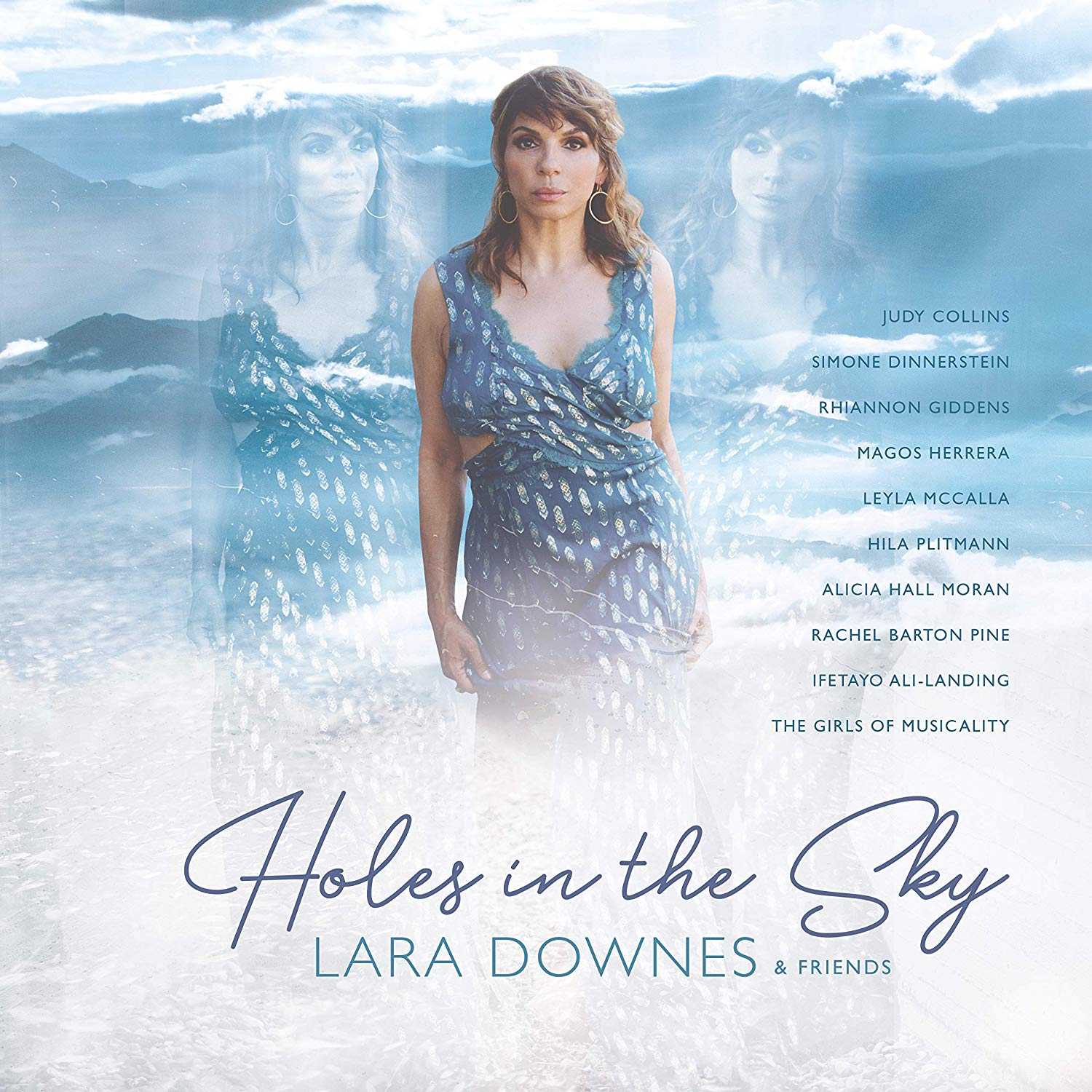
Holes in the Sky, Lara Downes Channels the Collective Artistry of the Feminine


downesholes

Sony/Portrait

Lara Downes has proven herself as a virtuoso pianist in solo, chamber, and with orchestra.  She has demonstrated facility with standard repertoire as well as an intelligent selection of contemporary composers.  In this sort of mid-career place she has begun releasing a more personal kind of album of which this is the third incarnation.  The “series’ to which I refer is the perception of this reviewer, not one defined as such by Ms. Downes but stick with me. Her previous releases have been organized on one level or another on themes just like most album of any stripe.  The difference is a more sociopolitical focus.

One look at the eclectic musical choices here and one sees Downes sharing her spotlight with kindred spirits (composers and performers both) while her themes take on more socially conscious ideas.  The first of these was America Again (2016) which is a beautiful collection of short piano pieces predominantly though not exclusively by black composers.  It is a very personal choice of repertoire reflecting her profound knowledge of the repertoire as well as the neglect of black composers.  The second was Lenny (2018), a tribute to Leonard Bernstein.  It includes a marvelously varied group of guest artists and, much as Lenny did, blurs the line between the “classical” and the “vernacular”.  It was a love song to a cherished artist (this writer included in the cherishing).

She does something similar here in this album whose title is taken, appropriately enough, from Georgia O’Keefe, “I want real things, live people to take hold of, to see, and talk to, music that makes holes in the sky, I want to love as hard as I can.”  In the essay that opens the program booklet Downes speaks briefly of her relationship with women in general and women as composers and as performers.

The album opens with a 1949 piece by Florence Price, a black American composer much of whose whose work has recently been rediscovered and recorded.  Her work was also featured on the America Again album.  This is a mid-century romantic piece for solo piano.

The second track, and the one that hooked this listener big time is this recording of Judy Collins early song, Albatross (1966) which appeared on her album Wildflowers which in turn provided some of the design elements of the album.  The liner notes to the present album also note this connection.

In place of detailed liner notes there is a fascinating conversation between two of the women involved with this album, Lara Downes and Judy Collins.  A lovely black and white portrait is included in the liner notes.  Their discussion centers primarily on the Albatross song but also touches on the nature of political activism in which Downes laments not being active in marches.  Collins tells her (and this writer agrees wholeheartedly) she belongs at the piano.  Indeed her activism, though of a gentler nature, gets ideas out most effectively utilizing her incredible talents as a pianist, historian, and fellow musician.

Rather than go through an analysis of each of these pieces I am simply going to provide a track list.  It appears that this album is designed to be heard and contemplated as a sonic document first and as a research project at a later time (one hopes for more detail at some point because these are interesting pieces).

1. Memory Mist (1949) by Florence Price

2. Albatross (1967) by Judy Collins

3. A Tale of Living Water (2010) by Clarice Assad

4. Dream Variation with Rhiannon Giddens (1959) by Margaret Bonds and Langston     Hughes

5. Ellis Island with Simone Dinnerstein (1981) by Meredith Monk

6. Don’t Explain with Leyla McCalla (1944) by Billie Holiday

7. Willow Weep for Me (1932) by Ann Ronel (arr. by Hyungin Choi)

8. Venus Projection (1990) by Paula Kimper

9. Morning on the Limpopo: Matlou Women (2005) by Paola Prestini

10. Farther from The Heart with Hila Pittman (2016) by Eve Beglarian and Jane Bowles

11. Favorite Color (1965) by Joni Mitchell (arr. by Nora Kroll-Rosenbaum)

12. Noises of Gratitude (2017) by Jennifer Higdon

13. Arroyo, Mi Niña with Mogos Herrera (2018) trad. arr. by Lara Downes

14. Music Pink and Blue (2018) by Elena Ruehr

15. Idyll (1946) by Hazel Scott

16. Blue Piece with Rachel Barton Pine (2010) by Libby Larsen

17. Bloom (2018) by Marika Takeuchi

18. Just for a Thrill with Alicia Hall Moran (1936) by Lil Hardin-Armstrong (arr. by               Hyungin Choi)

19. Agwani (Doves) (2009) by Mary Kouyoumdjian

20. What Lips My Lips Have Kissed (2014) by Georgia Stitt

21. Rainbow (n.d.) by Abbey Lincoln and Melba Liston (arr. by Laura Karpman)

22. All the Pretty Little Horses with Ifetayo Ali-Landing and The Girls of Musicality (Trad. arr. by Lara Downes and Laura Karpman)

In these 22 tracks all the music is by women composers and, most charmingly a selection of women performers who appear as sort of cameos on different tracks.  The music ranges from the mid-twentieth century to the present and embraces a variety of genres (classical, folk, blues, etc.).  The end result is a charming and very intimate document but also one which is somehow gently subversive as it presents the best in musical and performance quality as an acknowledgement of the accomplishments of women in general, (to paraphrase Ms. O’Keefe) making music as hard as they can.


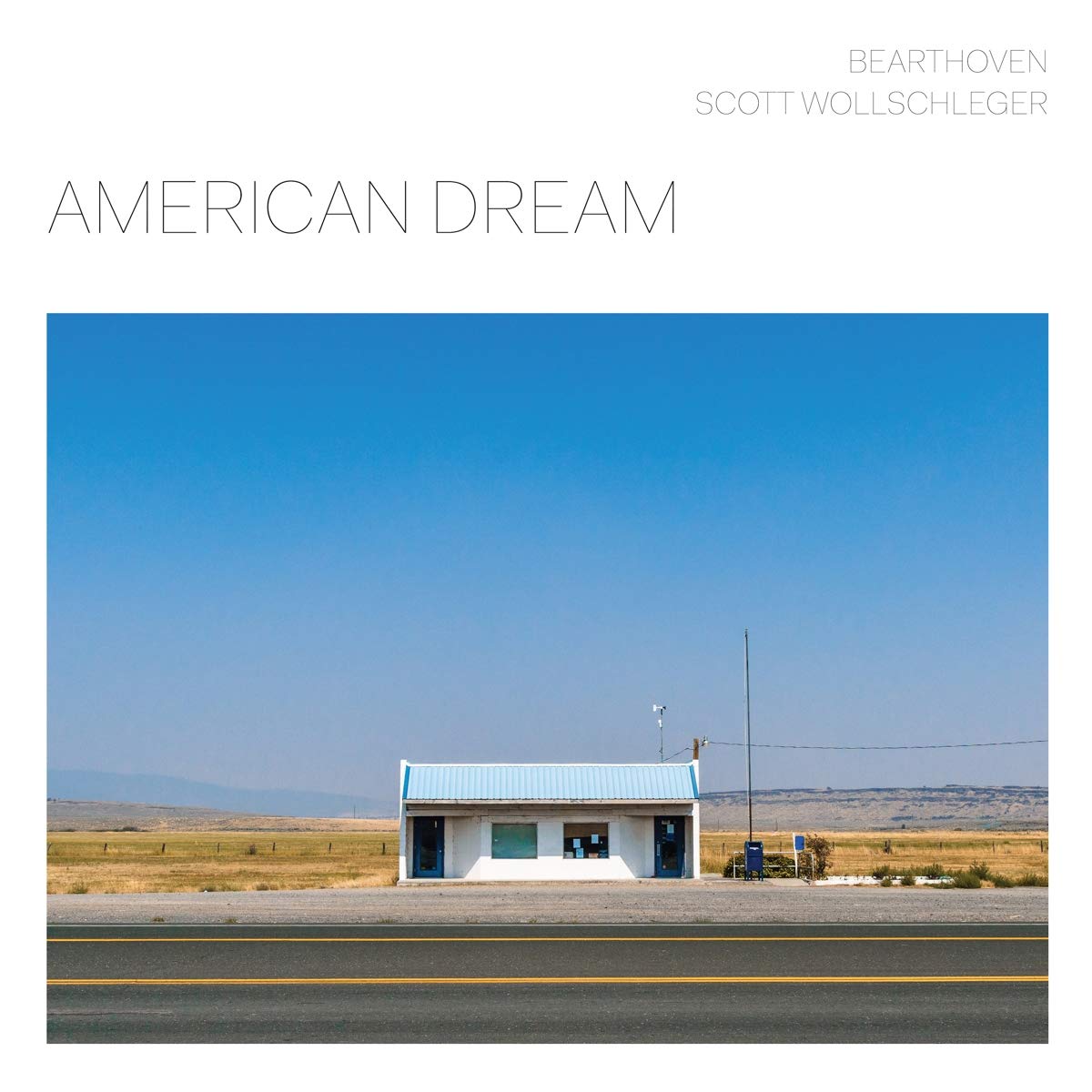
Bearthoven: Post Minimal, Post New York School


wollschlegeramdream

Cantaloupe CA 21145

So many associations here.  Jaime Boddorf‘s lovely photography complements the sparse evocations of the music but this writer immediately flashed on the old Pat Metheny album, “American Garage”.

methenygarage


This is most definitely not a Pat Metheny album but the somewhat spare sound world of Scott Wollschleger is reflected (metaphorically of course) in the cover photo and the others on the inside. In fact the resemblance stops with the visuals. And don’t jump to conclusions about the name, “Bearthoven”. It’s not Beethoven either.

bear2


So what is American Dream and who is “Bearthoven”?


Well, a look at their website suggests we have a classical ensemble spiritually patterned in a way like a prog rock design school dalliance.  Think Talking Heads. For the record, they are (left to right): Matt Evans , percussion; Karl Larson , piano; and Pat Swoboda , bass.  bear1

Well, no, don’t think about Talking Heads or Pat Metheny.  At least for a minute.  And here’s why.

wolls


This is Scott Wollschleger (1980- ), originally from Erie, Pennsylvania, now resides in New York.  The fact that he studied at the Manhattan School with Nils Vigeland suggests an educational provenance which can be traced most directly to Morton Feldman.  But this is not a case of derivation as much as it is of evolution and incorporation of styles inherited from his teachers and his experiences upon which he attempts to improve for better or worse.  Isn’t that the basic way an artist works?

Whether such musings hold any water will wait the test of time while we consider the actual music here.  This reviewer encountered this letter laden composer’s work here.  This previous album, Soft Aberration which was a wider ranging sort of snapshot of the composer’s work made a similar impression.  His use of fragments is seemingly idiosyncratic.  I can’t figure out exactly what he is doing but that is secondary to the fact that I like what he is doing. And a quick look at the track titles on American Garage and then reading Wollshleger’s commentary one sees some philosophical/metaphorical confluences.
His intriguing and evolving compositional style draws the listener in.  Like the Soft Aberration Album (in art design and musical content) this album relies heavily on metaphor.  So it is with the impressions penned by the musicians involved which are included in . And it is oh so consistent with the metaphorical tone of the photos as well.  There is something amazingly integrated here.

Going into details about these pieces is both outside my expertise and certainly above my pay grade but I can tell you these works touched me on an emotional level and, like the best in art, will continue to speak to those who want to hear.  This is highly evocative music which, if you listen patiently, will gently surprise you.


Double, Double: Three Double Concertos


rihmdoppel

Let me begin with a confession.  The Brahms Concerto for Violin, Cello and Orchestra is not my favorite Brahms concerto.  Think about it.  All his other concertos and certainly the symphonies get many live performances.  Not so with this double concerto.  Nonetheless it pretty much has served as THE model for this particular configuration of multiple soloist concerto.  That said we find ourselves confronted by this really delightful Sony release which effectively contains possibly the three finest examples of this genre (though it would be nice to include Lou Harrison’s double concerto).

The disc opens with a single movement concerto by the prolific German composer Wolfgang Rihm (1952- ).  This busy piece seems to be basically post-romantic in its harmonic language and more like a concerto grosso in terms of the more embedded solo materials.  It is a tour de force for both orchestra and soloists.  The classic three movement concerto format is abandoned in favor of one twenty minute allegro which contains a very large and interesting world of musical ideas.  Yes, there are some harsher sounding harmonies but this assertive music brings the listener along with its rush of ideas.

Next is the Brahms Concerto.  Now I am a Brahms fan and have tried to “get” this concerto for many years.  As beautiful as this performance is I still find the first movement way too long and ponderous.  The second movement is pleasant but not as memorable as I wish it were.  But if you make it through those two you are treated to a scherzo-like finale which is one of the finest things the composer wrote.

The disc concludes with another 21st century concerto.  This one is by the venerable John Harbison is an arresting and powerful piece.  Unlike the Rihm and even the Brahms Harbison relies upon a great deal of solo and duo material for the featured soloists with the orchestra participating when it is allowed.  This is a multiple movement piece with many moods.  It is a virtuosic venture for orchestra and soloists.

The performers in this recording, though not familiar names to this reviewer, are clearly world class performers who go fearlessly into new music and have mastered the old.  Jan Vogler is on cello and Mira Wang is on violin.  The orchestra is the Royal Scottish National Orchestra.  They are up to the seemingly considerable challenges under the guidance of Peter Oundjian.  And the recording is lucid and warm.


Mariel Roberts’ Cartography: New Cello Music


This is another of those releases that is functionally a business card if you will. By that I mean that I’m finding a fair amount of solo instrumental discs (some with electronics, like this one, some not) in which the artist demonstrates their skill with their instrument but, more importantly, their familiarity and facility with the segment of the repertoire they embrace.  Actually this is the second such album from this artist, the previous (yet unheard by this listener) having been released in 2012.

Mariel Roberts is one of those New York based musicians whose milieu puts her in contact with the cutting edge (at least in New York) of modern composition.  Roberts has appeared as a soloist and chamber musician across four continents, most notably as a member of the Mivos Quartet, Wet Ink Ensemble, International Contemporary Ensemble (ICE), Bang on a Can All Stars, and Ensemble Signal. Her skills and her talent seem boundless.

Here she features four rather large works for cello, solo, with piano, and/or with electronics.  The composers featured include: George Lewis, Eric Wubbels, David Brynjar Franzson, and a collaborative work she wrote with Cenk Ergun.  Not the usual suspects but a panoply of interesting and creative composers.

Rather than attempt any analysis of the works presented here let me just say that all require a high level of virtuosity. An essential aspect of this virtuosity is whatever coordination is required of the soloist interacting with electronics. The lack of detailed liner notes make it difficult to know the nature of this interaction but one can certainly enjoy the resulting performance even without those details.

This is NOT easy listening by any means but it is a tasty sampling of some truly creative music for the right ears. Multiple listenings will be needed but the listener will be rewarded for their effort.


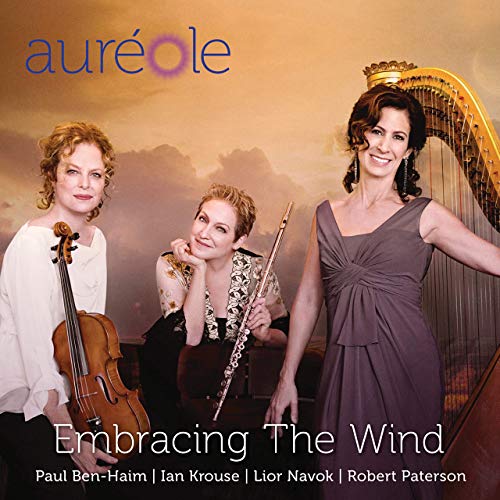
Auréole: Embracing the Wind and the Strings


aureole

American Modern Recordings AMR 1050

Auréole consists of Laura Gilbert, flute; Mary Hammann, viola; and Stacy Shames, harp.  It is an ensemble seemingly based on the instrumentation of Debussy’s justly famed sonata (1916) for that combination of instruments.  It is like the instrumentation of Schoenberg’s Pierrot Lunaire (1912) whose instrumentation (flute, clarinet, violin, piano, and voice and/or percussion) has become a sort of standard grouping and has had much written for it (much more than the flute, viola, and harp combo).

Nevertheless this ia a charming chamber ensemble and they’ve chosen their repertoire well for this recording.  Here are four works which share the instrumentation of the aforementioned Debussy sonata.  They also share a similar musical aesthetic in their basically tonal and romantic style. This ensemble has chosen works dating from therapy twentieth century to the early twenty first. Two are by Israeli composers and two by Americans. 

The album opens with a trio simply entitled, “Chamber Music” (1978) by the late Paul Ben-Haim (1897-1984).  He was born Paul Frankenberger and was born in Germany. He, like many Jewish refugees from the horrors of WWII, settled in what was then Palestine where he became known (for better or worse) as the Israeli Aaron Copland.  His music is overdue for a new reckoning and this is a fine example of his work. This lovely trio is cast in three movements and is bound to please and entertain. 

Next up is Robert Paterson’s (1970- ) “Embracing the Wind” (1999).  Cast in one movement it has a touch of modernism but remains a predominantly post-romantic work which takes its inspiration from the wind and the way it moves objects. It traverses several moods as it spins its tale but remains compelling throughout, a very strong piece of music which fits the general sound and ethic of this program.  And it leaves this listener wanting more.

“Veiled Echoes”(2000) is the second work by an Israeli composer on this disc.  Lior Novak (1971- ) would seem to be a worthy successor to Mr. Ben-Haim.  This three movement trio is a meditation on the composer’s perception of links between mountains, sky, and other nature phenomena. Very enjoyable music.

The album concludes with what is described as a tone poem.  It is based on one of Frederico Garcia Lorca’s (1898-1936) stories, “Thamar y Amnon”. The composer is Ian Krouse (1956- ).  This rather harrowing romance is in a single movement with many moods which evoke the tale.  In a nice touch the story is reproduced in its entirety in both Spanish and English.

This is a beautifully conceptualized and performed disc which introduces music which would compliment the Debussy sonata in spirit as well as instrumentation.  Brava and now tell us of your next project.

A Major New Cello Concerto from Esa-Pekka Salonen


Perhaps this is a stroke of marketing genius or maybe some luck is involved but this recording has success written all over it. Yo-Yo Ma is without a doubt one of the finest musicians of our time. The LA Philharmonic is a world class orchestra with a world class conductor at the helm. And though this is but the first encounter by this reviewer with Salonen’s music this work suggests that his compositional skills are at a similar level. 

There is but one work on this disc, a large and very listenable cello concerto which dates from 2016. While the work is clearly modern in its style overall it leans toward romantic and impressionistic textures. Using his conductor’s mastery of the orchestra Salonen traverses territory that embraces the sound of composers such as Ives, Messiaen, Debussy, Barber, etc. Listeners will find familiar gestures but this work is not at all derivative. Rather it ultimately sounds like a complex but very connected improvisation between the soloist and the orchestra neither of whom have easy tasks (though they all play flawlessly).

The rather brief program booklet is basically a program note by the composer/conductor and it is most lucid. It might have been nice to hear as well from Mr. Ma but that is aminor criticism. This is a gorgeous piece given a characteristically powerful performance and this writer was simply enthralled from beginning to end. Now I guess it’s time to look into more of this man’s music. 

E

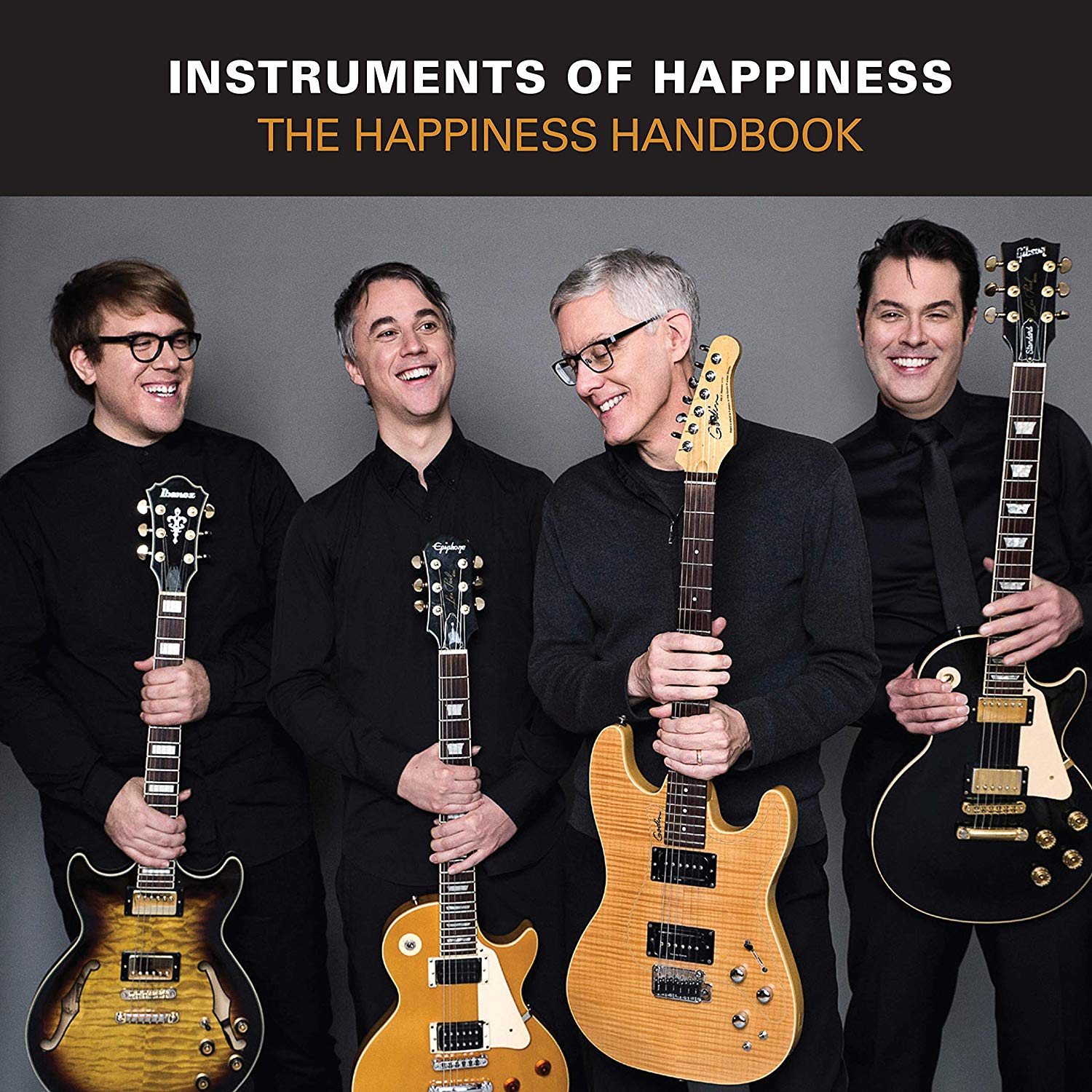
Tim Brady’s Happiness Handbook, massed guitars, massed invention


happinesshandbook

Starkland ST-232

This is, by my count, the third Tim Brady CD released by Starkland.  The other two, Instruments of Happiness and Music for Large Ensemble, represent only a small portion of his output and I highly recommend exploring his other releases.  You can find a listing on his web page here.  Since being introduced to Brady’s work in the Instruments of Happiness album I have purchased and enjoyed several of his earlier CDs.  Initially one necessarily wants to lump Brady in with the massed guitar masters such as Glenn Branca, Jeffrey Lohn, and Rhys Chatham.  That’s a fine starting point but as one listens to Brady’s work it becomes clear that he has his own vision and that vision is shared with like minded artists.  Some of those like minded artists are on this fine CD.

In some ways this is a sequel or a volume two to the Instruments of Happiness CD of 2016.  Despite this being chamber music with only four musicians the nature of electric guitars is to make a bigger sound.  It is always interesting to see how different artists work with a given ensemble configuration and that is the real thrill here.  One track features Brady’s music and the other tracks feature Scott Godin, Jordan Nobles, Maxime McKinley, Gordon Fitzell , and Emily Hall.  All are individual creations commissioned for this quartet.  The liner notes are definitely useful but there is much to be gleaned from the ‘composers’ web sites as well, trust me.

The disc contains six works on 10 tracks and, like the earlier Instruments of Happiness release on Starkland, this is an interesting and revelatory sampling of the marvelous invention of these composers and the amazing range and utility of the electric guitar.  If anyone questions the place of electric guitars in classical music this is a fine example of some of the potential and a teaser for the future as well.  The vision is more like that of a string quartet (another ensemble that has managed to establish itself) seeking innovative composers for some portable music making.

Familiarity with the composers mentioned earlier (Branca, Lohn, Chatham) will provide the listener with a context but the work here is seemingly almost unrelated to their work excepting that they used electric guitars.  This is a new generation of composers to whom, electric guitars were a given, not a new invention and whose use, increasingly ubiquitous in classical music, is simply one of their compositional options.

And now the music.  The album opens with an homage to the late British composer Steve Martland (1959-2013) whose rhythmic, driving music resembles that of Michael Nyman but closer to a rock aesthetic.  Martlandia (2016) by Scott Godin engages the listener (and will likely send him/her in search of Steve Martland CDs) with its long tone meditative beginning that acts like a slow introduction to a symphony of the classical era and then moves into faster quasi-minimalist sections that remind this listener favorably of some of Steve Reich’s work.  This is practically a miniature symphony.  It is an engaging piece and a loving tribute to the late composer.

Equal and Opposite Reaction (2016) is Mr. Brady’s submission to the album.  It also opens with a slow section and then goes into the manic virtuosity that is typical of Brady’s work.  I’m not saying he can’t write a decent slow movement, he can and does, but much of his work moves rather quickly and with a variety of guitar techniques in his expanded palette of sounds.  Like all the works here the harmonic language is largely tonal and the development of thematic material owes much to classical compositional techniques though his rhythmic choices owe something to rock and jazz.

Jordan Nobles’ Deep Field (2016) is a tribute the the iconic Hubble Telescope.  (If you haven’t seen at least one photo from Hubble’s catalog then you may have been in suspended animation for the last 20 years.)  Suffice it to say that the Hubble’s images have inspired a great deal of artists and this is yet another example.  This is one of the more meditative pieces on the album at its opening but, like the other pieces there are several contiguous sections.

Reflets de Francesca Woodman (2017) by Maxime McKinley is another homage.  This time the subject is an American photographer Francesca Stern Woodman (1958-1981) who took her own life in 1981 and left a posthumous legacy.  Aptly this is one of the more somber and disturbing tracks on the album. I’m sorry to say I don’t know her work but this tribute certainly sparks interest.

Going with that melancholy theme is the next track, Gordon Fitzell’s Bomb Crater Garden (2016) is the most avant garde sounding track (as well as the longest at 11:16) and the most exquisitely disturbing in its post apocalyptic vision.  The piece has optional narration and video but the music gives the listener a pretty good idea of what those images and ideas are.  So much for happiness.

Finally we have The Happiness Handbook (2016) by Emily Hall.  Like Brady’s flexibly peopled ensemble of the same name the theme of happiness comes to the fore once again.  As explained in the liner notes the notion of guitars as instruments associated with happiness is the concern.  There are five movements varied in style that make this piece function like a little symphony.  It is a celebration of the plethora of techniques and compositional possibilities of this modern guitar ensemble and will leave the astute listener ultimately in a happy place.


William Susman’s Scatter My Ashes


susmanscatter

I first encountered the composer William Susman (1960- ) when one of his works appeared on a program which included a solo cello and electronics piece by Vivian Fung.  This solo electroacoustic piece, the work I was initially asked to review, was nestled in the middle of an interesting program by the San Jose Chamber Orchestra.  I chose to review the entire concert which was a fascinating selection of new music.  William Susman’s “In a State of Patterns” (2018) struck me immediately as interesting post-minimalist work.

Susman_at_piano

Mr. Susman read my review and rather promptly sent me this 2014 CD on his Belarca label.  It contains four of his works from 1992-2010 and is a fine sampling of his work.  All works are here performed by the Octet Ensemble which includes: Alan Ferber, trombone; Mike Gurfield, trumpet; Melissa Hughes, vocals; Elaine Kwon, piano; Eleonore Oppenheim, double bass; Demetrius Spaneas, saxophone; Greg Zuber, drums and percussion; and William Susman, electric piano.

There are four pieces on 12 tracks.  The disc begins with Camille (2010), a very listenable post-minimal chamber work.  It is followed by a melancholy song cycle, Scatter My Ashes (2009) on poems by the composer’s sister Sue Susman.

The third piece is a wonderful piano concerto.  There are not a lot of convincing concertos in the minimalist genre but this one is a candidate for being a poster child.  It is for piano with chamber ensemble.  Here the composer goes not for the finger busting virtuosity that seems to be the current vogue but rather he evokes a latter day Mozart with more technically modest but highly entertaining music that communicates directly.  Curiously (is this a carry over from the Steve Reich and/or The Philip Glass Ensemble?) he uses a wordless vocal (Hughes) as a part of the instrumental texture.  Elaine Kwon handles the featured keyboard part.  It works very well.

He ends with an arrangement for OCTET of Moving in to an Empty Space (1992, arr 2010), another setting of his sister’s lovely poetry.  Again he evokes the somber but it is more in the nature of exorcising the demons of sadness much like the mission of the poet.


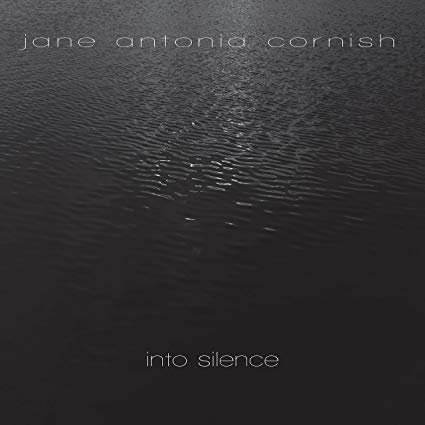
Jane Antonia Cornish, Post Modern Calm


At first listen I thought I might have put an Arvo Part album. The familiar calming sounds of what sounds like “holy minimalism” seemed to be coming at me. But who is this young British composer? Well, let me tell you, you need to pay attention to this one.

While the Arvo Part comparison is apt it only describes a small part of this composer’s range. She does seem to fit some sort of incarnation of “minimalist” by virtue of her use of repetition, silences, etc. At times her music leans sweetly toward the romantic but this is hardly light fare. The music evokes a sort of timelessness and calm but there are moments of tension and sadness as well.

Jane-Antonia-Cornish (1)

From the composer’s web site.

Jane Antonia Cornish (1975- ) is a British composer and, looking at her education and training she appears to come almost out of nowhere. Her music clearly draws on aspects of minimalism but her teachers are not the “usual suspects”. Like a lot of people from her generation she seems to draw on a rather comprehensive training in the ever expanding language of new music and uses what works for her. (Doubtless she is quite capable of writing thorny serial music should she find that useful to her expression.)  She currently lives and works in New York City.  Her web page can be found here.

Cornish is originally from London, England and she studied composition with Dr. Anthony Gilbert at the Royal Northern College of Music, and completed her master’s degree at the Royal College of Music. She is a recipient of the Edward Hecht Composition Prize, the RNCM Composition Prize and the Associated Board Prize for the Most Outstanding Scholar of the Year. Cornish was also made a Major Scholar of the RNCM.  She is also the recipient of a 2005 BAFTA award for her film and television work.

This emerging composer has been quite prolific.  The present album is her third and she has also done film scores.  Her style seems to be influenced by the post minimalist/holy minimalist school but with a touch of melancholy.  Of course it will be necessary to hear more of her work to get a good overall impression but that will be a labor of love.  This is really listenable.

This is chamber music, violin, cellos, piano but what a big and warm sound!  I liked this album immediately and subsequent listenings have failed to diminish my enthusiasm.  This is engaging and substantive music that has enough depth that allows the listener to get past the pretty surface to the complexities and subtleties that lie beneath the surface.

The musicians include: Sæunn Thorsteinsdóttir, Caitlin Sullivan, Claire Bryant, Hamilton Berry, cellos; Anna Elashvili, violin; Vicky Chow, piano.  All are fined dedicated musicians and they seem to be enjoying themselves here.  You would be doing yourself a favor to got to their respective web sites (linked from here) to see the breadth of these fine young musicians’ activities and interests.  

Thank you Innova for the wisdom of recording this composer’s works (Innova has also released her albums Continuum, and Silence).  And thank you for sharing your artistic talents Ms. Cornish.


Jenny Q Chai brings Synaesthesia to CNMAT in Berkeley


choi20190001

All is set up in the diminutive performance space at CNMAT.

Jenny Q. Chai is a graduate of Curtis Institute and the Manhattan School of Music.  She is trained as a pianist but she is in the process of expanding that role somewhat.  Chai is one of an unusual group of people called “synaesthetes”, that is, people who see sounds and hear colors.  Her program tonight is entitled, “Sonorous Brushes”.

I am not a synaesthete and it is most likely that most of the audience was more like me.  The actual prevalence of synaesthesia in which stimulation of one sense (such as sound) simultaneously stimulates another sensory or cognitive pathway (such as color or emotion) is estimated to occur in about 4% of the general population (estimates vary).  This condition is unusual but is not pathological.  The interest or the challenge here is the artist’s attempt to convey her personal synaesthetic perceptions in a way that can be understood by those not similarly wired.

choi20190007

Chai spoke eloquently about her research to the audience.

The program was divided into sections.  In the first Chai performed some mostly conventional repertoire from the early twentieth century namely Debussy, Ravel, Messiaen.  The four Debussy pieces with which Ms. Chai opened this recital (two etudes, “Pour les huits doigts” and “Pour les quartes” and preludes 11 and 12 from book 2) left absolutely  and no doubt as to  and the artist’s virtuosity and interpretive skills.  She then launched into a Ravel homage by one Frederic Durieux followed by Ravel’s Oiseaux Tristes and a  truly athletic Messiaen piece.  Understandably these pieces inspired visual creations by this artist and seemed to be the seed for her ongoing research.

choi20190015

It is curious and somehow very fitting that this musical exploration begin with music that was inspired by the visual.  Impressionism was pretty much paralleled by the music which appears to have been inspired by the visual art, an early argument for synaesthesia.  There is little doubt that many artists (and non-artists) have had this condition for better or worse but it is likely that such unusual perceptions would have been classified as pathological and not the topic of polite conversation back in the 19th century and before.

choi20190008

On this night it would be not merely a topic of conversation but an introduction to research which began with a grant Chai received from the French government for research into synaesthesia and presenting these ideas to a wider audience.  Far from pathology, this could even be seen as a deficit in those who lack this ability.  The key then is to explore synaesthesia as a potential asset.  Of course a complete and detailed explanation was not the goal of the evening.  This was to whet our appetites.

choi20190010

Composer Jarosław Kapuściński explains some of the technology behind his compositions and the visual art that accompanied these performances.


This next part of the program involved the work of Jarosław Kapuściński (Warsaw, 1964-) whose two pieces were slated for the last portion of the program.  He is, since 2016, the chair of the music department at Stanford University and no doubt spends time with CCRMA (Stanford’s equivalent of CNMAT) investigating music, sound and computers.  He spoke of being inspired by a calligrapher who was also well known to Ms. Chai, a Chinese woman and master calligrapher named Shanshan Zhao (the film was done at the Shanghai Conservatory of Music).  While he did not go into great detail the composer basically shared his visual inspirations and spoke a bit about how his composition program “listens” to the performer (see the photo with the two mikes inside the piano below) and responds in some way.  This sounds like another chapter in the book which includes David Behrman’s early computer/performer interactive experiments.  Some 50 years later (this piece, “Calligraphies for Ziqi” is from 2018 and got its US premiere here tonight).  Another generation shows its expertise.

choi20190003

Note the two black microphones inside the piano. No, its not the Russians.

The title, “Calligraphies for Ziqi” (2018) references Ziqi, a man whose listening was so perfect that the musician destroyed his instrument after Ziqi died because he knew he would never find a better listener.  This ancient Chinese story (approx 770-476 BC) is also about the merging of sound and image in its way.  Several calligraphies are displayed in process during the performance with the music reflecting the moods of the Chinese characters being displayed.  Each movement involves a different Chinese character and a different attempt at calligraphy.  There may be extramusical references here but the music does a satisfying job of standing with the visuals and further analysis can be left to musicologists and program annotators.

In addition Kapuściński is no stranger to Asian arts.  He has explored eastern musics and incorporated aspects of them into some of his works.  He is also no stranger to computers and their use in composition.  His appreciation of disparate artistic techniques effectively spanning 5000 years and utilizing them effectively is a mark of genius in this writer’s opinion.  This is a challenging piece for the soloist but it is a sensual journey for the audience.  While the geekier folks (this reviewer definitely included) would like to know much more about the technical aspects of this gorgeous music, suffice it to say that such knowledge is not a prerequisite for enjoying the art.

choi20190012

Chai playing the interactive piano part to the visuals in “Calligraphies for Ziqi” (2018), This was the California premiere.

This was followed by another visual/musical collaboration, Side Effects (2017) also by Kapuściński involves music set to videos by Kacper Kowalski who shoots from a perspective 150 meters directly above his subjects.  Think a latter day Koyaanisqatsi (do I need to footnote that reference?).  Again we see affecting music which captures the composer’s reaction to the visuals.  I didn’t get the sense that there was any computer interaction here, just some good music to some stunning visuals.

choi20190014

Chai playing the music to the visuals in “Side Effects” (2017)

The capacity audience (the room capacity is only 49) was very appreciative and gave a standing ovation which compelled no less than two encores.  Forgive your reviewer for not being able to recall the first but there seemed to be a new magic afoot when this pianist launched into the second, a wonderful rendition of the aria from Bach’s Goldberg Variations.  It was a loving and intense interpretation (no doubt full of colors as well) and it left the audience satisfied as a dessert would cap the climax of a fine meal.  Brava, Ms. Chai.  And thank you Mr. Kapuściński.