The Twiolins: Secret Places


twiolinssecret

Hännsler PHI 7002

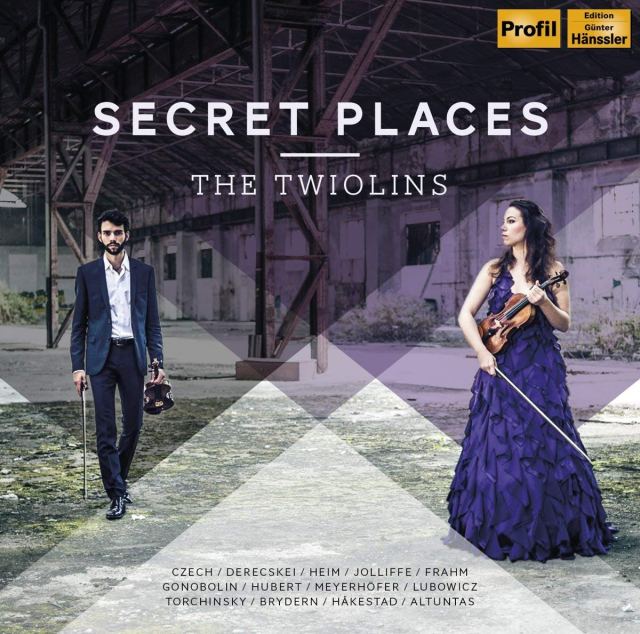
Wow!  What a discovery.  This album was kindly sent to me by a friend, one of his most recent discoveries.  And from the moment I put this in the CD player I was entranced.  Despite the appearance of yet another cute musical duo these are two amazingly talented musicians playing some of the best post-minimal pieces this writer has heard in years.

Twiolins is are violinists with a wide range of interests (their repertoire as reported on their web site is impressive) but with a clear love for post-minimalist music.  In fact they are brother and sister, Marie-Luise Dingler and Christopher Dingler.  Unlike acts that seem to be designed to reach an audience with mediocre pop-inflected classical music Twiolins here presents 13 works by composers completely unfamiliar to this writer but astoundingly fresh and inventive.

My first impression reminded me of the music of the late great violinist and composer Michael Galasso.  There is a remarkable similarity in styles between the composers represented here but all seem to fall basically into a post-minimalist category.  The difference is that this music went right to my head (so to speak) and I found this music invaded my nervous system in the same delightful way that my first encounters with minimalism did.  My linear thinking was impaired and I found myself carried away, willing to follow wherever the music led me.  It was a curious mix of nostalgia and revelation.

There are 13 relatively brief tracks (ranging from 2:13 to 6:46) representing 13 compositions.  Once I put the disc in the CD player I just had to hear the whole thing.  No pause allowed.  There is a consistency of styles with these pieces and the ordering on the disc promotes a nice flow from faster to slower pieces, then faster ones again.  And adding to the basic quality of the compositions is a clear sense that these musicians are able to bring out details in the phrasing of their playing that make these compositions shine in ways that would flatter any composer.

Tracklist:

Rebecca Czech, Germany: Ich glaub´, es gibt Regen

András Derecskei, Hungary: Balkanoid

Benjamin Heim, Australia: Trance No.1

Edmund Jolliffe, UK: Waltz Diabolique

Jens Hubert, Germany: Rock you vs. Ballerina

Johannes Meyerhöfer, Germany: Atem • Licht

Nils Frahm, Germany: Hammers

Aleksander Gonobolin, Ukraine: Metamorphosis

Dawid Lubowicz, Poland: Carpathian

Vladimir Torchinsky, Russia: Eight Strings

Benedikt Brydern, USA: Schillers Nachtflug

Andreas Håkestad, Norway: Three Moods, I

Levent Altuntas, Germany: Chasma^2

This is apparently their third album (their first was released in 2011 and another in 2014).  It was released in late 2017.  I picked these up at Amazon as digital downloads for comparison.  It would appear that these musicians have been carefully cultivating their sound and selecting their repertoire.

Granted there is a slightly populist feel here but none of these composers are known to this reviewer so it’s difficult to say if this is typical of their work.  These are strong, well-wrought pieces that will delight and move the listener.  The term “populist” here is not intended to imply simplicity or lower quality, just a nod to the fact that it will likely have an immediate appeal to listeners.  The composers are a nationally diverse set and doubtless have other compositions of interest in their catalogs.  Listeners can doubtless anticipate more tasty little miniatures as well as (hopefully) selections from their repertoire of concerti and the like.

This is not a mind bending or taxing album but neither is it negligible.  The liner notes give little info about the pieces but that doesn’t really matter because they’re relatively brief and you will either like them or not but this writer is betting on “like”.


Simone Dinnerstein: Bach and Glass


dinnerglass

It has been interesting to watch the progression of Philip Glass’ career.  From his driving amplified ensemble music that so entranced this writer to as near groupie status as he will ever be to the more mainstream orchestral work of his work since at least the 90s the fascination remains at some level.

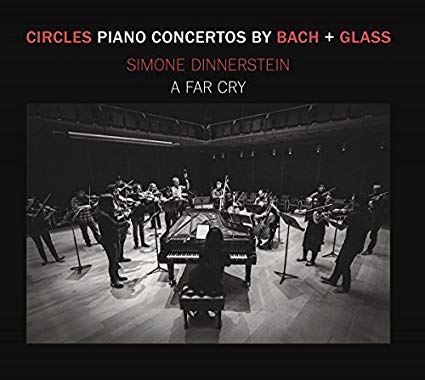
The familiar arpeggios are still to be found along with basically diatonic harmony with occasional polytonal sections.  What is interesting about Glass’ third piano concerto is a sort of chamber romanticism.  A Far Cry is a small chamber orchestra ideally suited to works like the Bach first piano concerto. Though technically originally written for harpsichord pianists have successfully broken the taboo on strict adherence to using the harpsichord and have developed techniques to optimize the sound of the piano (which has very different qualities from a harpsichord).
Simone Dinnerstein is an artist who I first met (albeit virtually) on Facebook.  Her reading of the Goldberg Variations from a few years ago seemed to signal her entrance into the mainstream of performers.  The choice of works on this disc are a sort of characterization of her interests.  She is an accomplished Bach performer with, obviously, an interest in new music.  So pairing her as soloist with A Far Cry whose interests appear to be in a similar range was perfect.

The performance of the Bach G minor piano concerto (No.7) is as delightful as it gets.  Dinnerstein and the ensemble seem work together very well.  These intense little chamber orchestras seem to be proliferating and one could speculate on the economic and political reasons for that but what is more interesting is the commitment and intensity that these small ensembles can bring to music.

The Glass concerto has the feel of a sort of miniature romanticism.  This writer heard it as echoes of Brahms but on a far more intimate scale.  It is difficult to say whether this new work (or for that matter, the other two piano concertos) will become a regular part of the repertory but it is clear that Glass continues to have his champions both in musicians and listeners.

There is nothing groundbreaking here and that is not what is apparently intended.  What we get in this recording is a couple of dedicated and thoroughly enjoyable performances by clearly dedicated musicians.  This is not an original instruments or musicological discoveries type of album.  It is simply good music making.

If you are a fan of Philip Glass and/or Simone Dinnerstein you will want this disc.  But don’t forget to pay attention the this little chamber group.  They are superb and energetic musicians and this reviewer expects to be hearing more from them in the near future.  Maybe we will get a new set of Bach and/or Mozart concertos.  Here’s hoping.

Quince Ensemble: Motherland


quince

New Focus FRC 203

I looked at the rather drab cover.  I had never heard of the Quince Ensemble nor any of the composers featured on this disc.  I looked again at the cover.  Clearly it was labeled with one of those parental advisory warnings which one rarely sees on a classical recording.

My usual practice is to do some research before spinning a given disc but I decided to just put this one in the CD player cold.  I had about an hour’s drive ahead and I decided to just let the disc speak for itself.  But my spidey sense suggested I might be in for a rather dull listen.

So much for my superhero powers.  From the moment the first track played I felt drawn in.  What I heard seemed to be a mixture of Peter Kotik (of Many, Many Women in particular), Meredith Monk, a touch of La Mystere de Voix Bulgare, the west coast group Kitka, and a few others).  That is to say that this disc grabbed my attention and had echoes of a few other contemporary vocal music styles.  What I heard was very compelling, creative, practiced, passionate.

This is mostly an a capella group though they made very effective use of harmonicas as drone material at one point.  Even after reaching my destination (achieved before the disc ended) I couldn’t bring myself to shut it off so I stayed parked and listening til I had heard the entire disc.  Yes, it was THAT compelling.

Complicating the reviewer’s task further is that the disc contains four compositions by four composers whose first appearance on this writer’s radar was from this very disc.  All four are world premiere recordings and all are by women composers.

The Quince Ensemble consists of Liz Pearse (soprano), Kayleigh Butcher (mezzo soprano), Amanda DeBoer Bartlett (soprano), and Carrie Henneman Shaw (soprano).  And this is the fourth album dedicated entirely to this ensemble’s work.  Two previous albums were appearances and collaborations.

The featured composers are (in order of their appearance on this release): Gilda Lyons (1975- ); Laura Steenberge; Cara Haxo (1991- ); and Jennifer Jolley (1981- ).  All appear to be Calfornia based and at the beginnings of what will doubtless be some interesting careers.  I will leave it to the interested reader to look into the details available at these various web sites but, after listening to the music, most listeners will want to know more.

The pieces range from Lyon’s Bone “Needles” coming in at just over 4 minutes to the next two multiple movement pieces and finally Jolley’s “Prisoner of Conscience” which is an homage to the politically active musical group, “Pussy Riot”.  This is the longest and most political piece on the album.

From the initial (and incorrect) assumption that this would be a dull disc to the end of this listening journey I came to see this disc in quite a different light.  The cover now seems friendly and appropriately representative of the album.

Rather than go into a bland or potentially inaccurate analysis of these pieces suffice it to say that this is effective and affecting music by a delightfully talented and energetic ensemble.  If you like vocal music, political music, music by women, or are just looking for something to lift you from your daily malaise give this one a try.  You will be both challenged and entertained.  No doubt this group would be fantastic in a live performance but for now we shall have to make do with this wonderful recording.


Missa Charles Darwin: The Chicken or the Egg?


darwin

This is one unusual disc, not specifically due to the musical content actually but rather its back story.  Gregory W. Brown is a composer with a significant body of work to his credit.  He also happens to be the younger brother of author Dan Brown.  Yes, THAT Dan Brown, of DaVinci Code fame.

Now, at first glance, one notices that the CD states, “as featured in the Novel ORIGIN by Dan Brown.”  This reviewer’s initial assumption was that this music was written subsequent to the novel as a sort of “tie in”.  Well the fact is that the music preceded the 2017 book by some six years and was heard by the author who then incorporated it (initially unbeknownst to the composer) into a chapter of his novel, ORIGIN.

So what we have here is a sort of “tie in” but, more importantly an inspiration in part for the work which now incorporates it.  This reviewer has only read a brief summary of the elder Brown’s novel, enough to understand that one of the themes in the complex web of the story includes characters who are against organized religion.  This Missa Charles Darwin (2011), structured in the classical (or should I say, ecclesiastical) manner but incorporates texts from Charles Darwin’s writings into the conventional Latin texts.

Like his brother Dan, Gregory feels free to incorporate things heretical.  The fight between the Holy Roman Catholic Church and supporters of Darwin’s theories is well known and indeed ongoing.  By incorporating Darwin’s words amongst the ecclesiastical proclamations and adorations of the mass texts Brown creates a sort of philosophical critique to both provoke thought and entertain.

His choice to utilize a vocal quartet and his harmonic choices gives this work the ambiance of medieval and renaissance mass settings.  The younger of the Brown brothers utilizes a mix of past, distant past and present to create a sort of philosophical fiction not entirely unlike the techniques in Dan Brown’s novels.  The music is very listenable and never trivial.  It simultaneously transports the listener to the mystical feeling of an unnamed Cathedral in the 14th or 15th Century as well as to the 19th/early 20th Century science v. religion squabbles that plague us still.

Comment must be made about the beautiful presentation of this recording.  It is a box containing the CD and cards containing both art work and texts.  Included is a nice a photo of the two brothers.

Not having yet read the novel it is difficult to say with certainty what impact the music ultimately has on the experience but, like soundtracks that enhance the experience of a given film, this finely crafted music can only add to the experience.  Of course both novel and music will be able to stand alone on their individual merits.

This writer is given to wonder if further collaborations between these two may happen and the next Robert Langdon story might be heard in an opera house.  Go for it guys!


Osmo Vänskä’s Mahler 6th on BIS


mahler6vanska

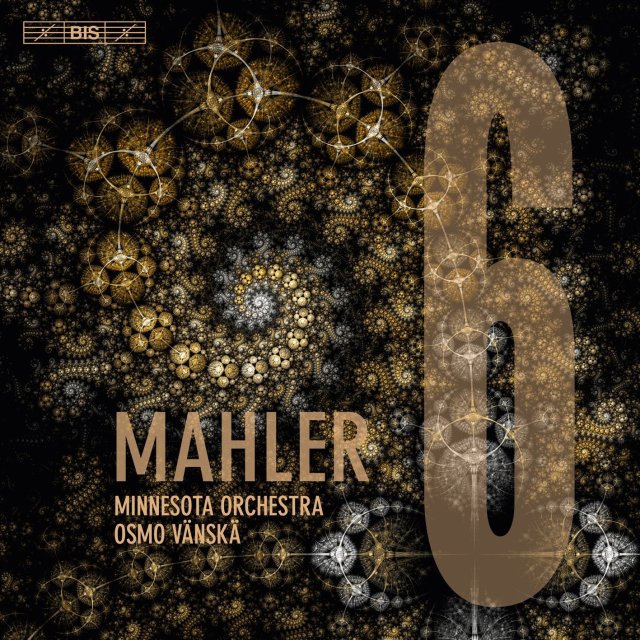
I have heard varying opinions on the conducting skills of Osmo Vänskä.  He is the music director of the Minnesota Orchestra since 2003 and, prior to that, a conductor of the wonderful Lahti Symphony Orchestra.  I very favorably reviewed his Kullervo disc from last year.

The Mahler 6th and, I suppose, with pretty much any Mahler there are many critiques of the music and the performances.  So many complexities with tempo, handling the massive orchestra to bring out one nuance or another, order of movements, etc.  One thing is for certain, no Mahler aficionado will be satisfied with only one recording of each of his works.  There appear to be no definitive recordings agreed upon by all.  By contrast most people seem satisfied with perhaps Herbert von Karajan’s interpretation of the Beethoven Symphonies as being at least a good starting point.

One must recall that Mahler’s music was not well appreciated for a number of years.  Though he gave performances of all his major works interest in them faded rather quickly after his death in 1911.  Performances did occur but critics generally regarded Mahler’s music as dismissable efforts calling it “conductor’s music”.  It wasn’t until Leonard Bernstein began earnestly performing these works that the current cult of Mahler actually took root.

I preface my review with these comments to say that I enjoyed this disc immensely with its gorgeous sonics (as always with BIS).  Vänskä produces a lucid performance which differs from many in tempo choices and such but seems, to this reviewer’s ears, to do justice to this large and masterful work.  In the end the experience is one of a valid performance (he places the slow movement as second) which provides another view of this complex work.  And part of the cult of Mahler, it seems, is the need to own multiple performances.

This may not be the only Mahler Sixth you will want to own but it is definitely worth hearing, preferably on a good sound system.

Indian Raags for Piano made easy


raags easy

Last year I reviewed Mr. Pitts’ How to Play Indian Sitar Raags on a Piano.  It was an enthusiastic review and the book continues to have a valued place on my piano as it opens a whole world of ideas.   Now the author has done a kind and useful service by issuing this simplified version of that work.

In fact this simplified version is more in line with the rather unpracticed keyboard skills of your humble reviewer.  The author chooses 6 raags or ragas which provide a good starting point for similarly humble musicians to begin this approach to Hindustani music.

Hindustani music became pretty much ubiquitous, or at least familiarly cliché in western musical culture largely due to the efforts of Indian musicians such as Ravi Shankar and Alla Rakha.  In fact it is an endlessly fascinating musical system whose logic has much to offer both musicians and composers.

In the past one had to learn traditional Indian instruments to gain much familiarity with these ancient musical systems but Pitts’ book offers an alternative to musicians whose familiarity is limited to the western keyboard.  Purists may denigrate this approach but even if it does not perfectly represent all aspects of Hindustani musical theory at least it provides a manageable entry point for amateur musicians and professionals alike.

Having struggled somewhat with the previous book I was particularly delighted to have these simplified examples which fall nearer to my skills level.  Even if I don’t wind up incorporating this into performance or compositional efforts I have no doubt that the exposure to the actual practice of this music will leave a valuable bit of programming in my neural circuits that will enhance my musical thinking and ability to appreciate other musics.

As with the first book, this too is highly recommended.  Kudos Mr. Pitts!

In the Beginning Was the Word: Other Minds 23


OM202006

Charles Amirkhanian performing one of his spoken word compositions at Other Minds 20 in 2015

Other Minds has been the the darling of composer/producer Charles Amirkhanian since its founding in 1993.  Along with television producer and arts patron Jim Newman he has presided over the 25 years of this renowned festival which has consistently brought the finest new music composers and performers to San Francisco.

There is little doubt that this year’s festival has to be very close to Amirkhanian’s heart.  Words have been central to his career at least since 1969 when he began his work as a producer at KPFA.  In the 23 years he spent there he presented countless hours of musical programming and interviews.  He crossed paths with most of the major stars in contemporary classical music and many stars whose genre may not be captured by the classical label.  A look at his programming choices and interviews from his time there defined new music for the Bay Area and beyond.  After his tenure at KPFA ended in 1992 he continued exploring cutting edge music and musicians bringing them to San Francisco for live performances.

His work as producer and curator has tended to overshadow his work as a composer, sound poet, and spoken word artist.  This year’s OM festival is dedicated to speech, sound poetry, and the spoken word.  It is about both the history and the present state of the art.  In many ways Amirkhanian’s 1975 release “10 + 2: 12 American Text Sound Pieces” on 1750 Arch Records (now on an OM CD 1006-2) can be seen as sort of the starting point for this festival.  This masterful anthology includes works by Charles Amirkhanian (1945- ), Clark Coolidge (1939- ), John Cage (1912-1992), John Giorno (1936- ), Anthony Gnazzo (1936- ), Charles Dodge (1942- ), Robert Ashley (1930-2014), Beth Anderson (1950- ), Brion Gysin (1916-1986), Liam O’Gallagher (1917-2007), and Aram Saroyan (1943- ).


“Word! Thou word that I cannot speak!

At the end of the second (and last completed) act of Arnold Schoenberg’s powerful opera “Moses und Aron” (1932) Moses sings, or actually half speaks and half sings this text lamenting his expressive deficits.  Speech song or, in German, sprechgesang is an invention by Schoenberg in which the singers are asked to find a point between speech and music.  Perhaps this is a good example of some of the artistic thinking going on at about the time when speech music/sound poetry began to take shape.

bio_schwitters_kurt

Kurt Schwitters (1887-1948)

Some of the history of sound poetry is featured in this unprecedented 6 day festival (April 9-14).  Some of the earliest practitioners of this unusual genre include the German artist Kurt Schwitters whose composition Ursonate (1922-32) will be performed in its entirety, a rare event by itself.

Another early gem will be the Spoken Music (1930) by German-American composer Ernst Toch.  This three movement suite has been known for its last movement, the Geographical Fugue.  The other two movements, once thought lost, were discovered in sketches in 2006 and reconstructed by Christopher Caines.  The now complete version will be presented I believe on day 3.

Composer-Ernst-Toch-810

Ernst Toch (1887-1964)


It is beyond the scope of this blog post to tell the history of text sound so I will refer readers to the Other Minds website for further details.  Or you could come to the festival too I suppose.

With due respect given to the past the festival will move on to the present.  San Francisco Beat Poet Michael McClure (1932- ) will make an appearance as will post beat colleagues Anne Waldman (1945- ), Clark Coolidge (yeah the guy from that cool anthology), Aram Saroyan (another guy from the classic text sound disc).

curran20160010

Alvin Curran in conversation last year in Berkeley.

Other Minds alumnus Alvin Curran (1938- ) will be premiering his collaboration with Clark Coolidge entitled, Came Through in the Call Hold.  Curran’s eclectic sensibilities will doubtless result in an interesting composition.  This event alone, at least for this writer, is worth the price of admission.  And this is just the first day!

Other events include workshops, discussions of the history of the art, and even some curious variations on a theme.  Apparently the writer Lawrence Weschler is the grandson of Ernst Toch and has written a variation on the Geographical Fugue called, The Medical Fugue which will be premiered at this festival.

The increasingly ubiquitous pianist Sarah Cahill will be present to perform Virgil Thomson’s unusual but entertaining setting of a Gertrude Stein (a one time Oakland resident) text called Capital, Capitals.  She will accompany the men of the Other Minds Ensemble.  Jaap Blonk will be tasked with performing Schwitters’ Ursonate and, along with Enzo Miranelli will also perform other historical works including some by a couple of Italian Futurists.

Other Minds Administrative Director Randall Wong will end the evening by undertaking a performance of the late great Cathy Berberian’s Stripsody.  That promises to be a wild evening I think.

blonk_75_2500crop

Jaap Blonk (1953- )

Northern Europe, including the Netherlands and the Scandinavian countries will literally have their day.  As it turns out they are doing a great deal of creative work in this increasingly diverse genre of speech music.  Other Minds is at its best in introducing the new and the innovative from wherever Charles’ radar has tracked it down.  Indeed Mr. Amirkhanian and his wife, artist/photographer Carol Law traveled throughout these regions in the early 70s talking with and learning from these diverse artists.  (Amirkhanian’s work, Just was recorded in a Scandinavian studio during one of those trips).

As usual homage will be paid to the past with some recorded classics by Sten Hanson, Åke Hodell, and Lily Greenham.  Some new voices will be introduced including Tone Åse and Sten Sandell.  The Norwegian/Russian-American duo OTTARAS (consisting of visual poet Ottar Ormstad and composer Taras Mashtalir will also perform.   One can fully expect a mind expanding experience which will redefine the possibilities of the art form.

Auspiciously or perhaps dangerously Friday the 13th has been reserved for Bay Area talents.  First up will be the man of the hour, Charles Amirkhanian.  Hearing him do his work live is an uncommon but entirely enjoyable experience.  If that alone weren’t enough we will get to hear the even rarer public collaboration between him and his life partner Carol Law whose photography and collage work deserves wider recognition and will happily get that here.

Amy X Neuberg

Amy X Neuberg.

Trained in both linguistics and music, Amy X Neuberg will be on hand to perform her indescribable electronic cabaret including the world premiere of “Say it like you mean” and other genre bending work.  She is another valued Other Minds alumnus having given numerous performances at the festivals.

Stanford professor Mark Applebaum, another alumnus will present “Three Unlikely Corporate Sponsors” which premiered at Stanford in 2016.  Enzo Miranelli will conclude the evening with his theatrical combination of movement and text in “Fame: What I Want to Say”.

20130218-132303.jpg

Pamela Z

The festival concludes on Saturday April 14th with Jaap Blonk followed by the wonderful San Francisco based Pamela Z who, like Neuberg uses electronics, but creates her own unique sound world.  She too is an alumnus of Other Minds.

Another composer from that great anthology, Beth Anderson, will make an appearance to perform “If I Were a Poet”, “I Can’t Stand It”, and “Ocean Mildew Minds”.

The finale will feature Susan Stone and Sheila Davies Sumner performing excerpts from two works, “House with a View” and “Loose Tongues” both dealing with the lives of working class southern women.

This will be both a feast and a marathon but it promises to be one of the finest Other Minds productions maybe ever.  Come to be entertained, come to be challenged, come to expand your mind.  You’ll never be the same.  See you there.

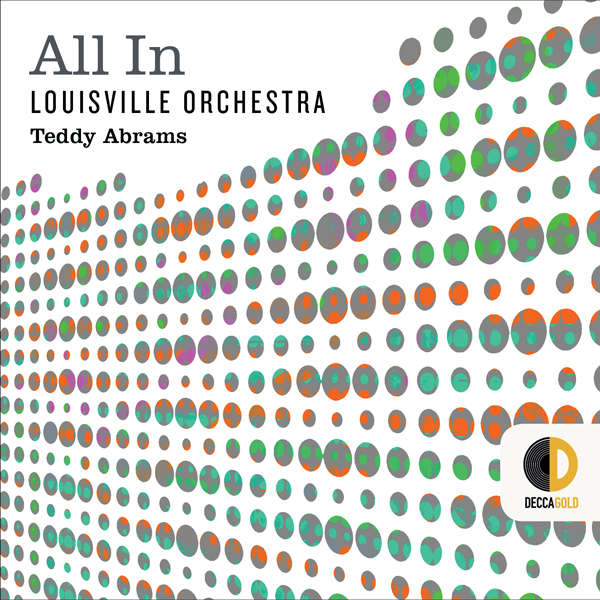
Louisville Orchestra Reboot on CD: All In


Abrams-Louisville-All-In_coverweb

The Louisville Orchestra was established in 1937 and its history has been wonderfully told in a 2010 documentary entitled, Music Makes a City.  Since their founding they released about 150 LPs containing new and interesting music not available anywhere else.  Many of those recordings have become available on the Albany CD label but the orchestra hasn’t released a new recording in about 30 years.

abrams

Teddy Abrams

Along comes new music director, composer, clarinetist Teddy Abrams and now we are graced with a new recording on the Decca Gold label.  Now for a reboot this release is somewhat conservative in it’s musical choices but that’s not to say it isn’t interesing.  This recording, released also in commemoration of the orchestra’s 80th season, reflects a sincere effort to draw younger audiences to the concert hall.

This auspicious release contains as its opening Abrams’ Unified Field, a finely crafted four movement work that channels the late Aaron Copland and his ilk.  It’s style is inflected with elements of jazz and other so called “vernacular” music but it incorporates those styles in much the way that Copland and his contmporaries incorporated folk song as well as jazz/pop rhythms. It is virtually a symphony in its dimensions and is highly entertaining while remaining seriously classical and very finely crafted.  The year of it’s composition is not specified in the notes this writer received but best guess is that it is of recent vintage in this talented composer’s oeuvre.

This is followed, curiously, by three torch songs, one by the able soloist Storm Large, one by Cole Porter, and one by Teddy Abrams.  The stylistic unity of these three songs is striking and Storm Large (who is known for her work with Pink Martini) is a convincing chanteuse.

These are followed by another American masterpiece, the Clarinet Concerto (1948) by Aaron Copland.  Originally written (and subsequently recorded by) Benny Goodman, the concerto is definitely in the repertoire but receives far too few hearings in concert.  This writer had not heard the concerto in many years and was struck both by its quality and by the convincing performance recorded here.  Abrams takes the solo role and the orchestra is conducted with assurance by one Jason Seber.

Abrams’ reading is as convincing and authentic as any and this is a delightful way to close this wonderful recording.  Here’s hoping that this release will be the restart of Louisvilled great recorded legacy and that Abrams tenure as conductor will breath new life into an orchestra which has become a venerable part of America’s cultural history.


Steven Kemper’s Mythical Spaces


mythical

Ravello Records RR 7980

It is this writer’s opinion that the category “electro-acoustic” carries such a wide range of connotations that it is of limited use to a listener.  This album is so characterized and here simply means that both electronics and acoustic instruments are used.  Even the concept of electronic music is difficult since such a designation. Playlists on Spotify and iTunes usually points the listener to a form of pop/dance music if you search for electronic.  Further complicating things (and I think this is at least in part the point here) the electronics here include fixed media (electronics which does what it is programmed to do and does not interact with the performers or simply plays alone) and robotic electronics as well as electronics which interacts with the performer.  You will have to check the composer’s web page for more information on what exactly the “robotic” media are.

This is cutting edge in the sense that it is experimenting with new media in combination with more traditional media (and simple electronics is now “traditional media” having been superseded by the new fangled).  The actual sound of this music seems to inhabit a rather spare sound world akin perhaps to that of late Morton Feldman but with more brevity. These pieces last from 1.5-10 minutes on average and demand some concentration on the part of the listener.  Think maybe a cross between Feldman, Webern and say Subotnick.

Now one could conceivably play this music at a low volume in the manner of so-called “ambient” music. There are not many dynamic changes here to take you away from that sort of reverie.  But that does not really seem to be the composer’s intention. These are concentrated little essays, each seeming to explore the parameters of its context, fixed media, live instruments, robotic media, and combinations of these.

Steven Kemper is a new name to this writer.  His education and wide interests are available on his web site.  While he has an impressive bibliography with cutting edge research interests in music and sound this appears to be his first CD.

There are 15 tracks which comprise 5 works.  Mythical Spaces (2010) is for percussion with fixed media in 5 separate movements.  Breath (2015) is for fixed media alone in one movement.  Lament (2015) is also in one movement and is scored for flute with interactive media.

The longest single movement comprises In Illo Tempore (2012 rev 2017) is scored for saxophone, bassoon, AMI (automated monochord instrument), and CARI (cylindrical aerophone robotic instrument).  It clocks in at 7:48.

Last but not least is The Seven Stars (2012) for amplified prepared piano in 7 movements.

Live performers include Mark Truesdell, percussion; Wayla Chambo, flute; David Wegenlaupt, saxophone, Dana Jessen, bassoon, and Aurie Hsu, prepared piano.

This is music which requires some serious concentration from the listener.  Hearing/seeing this live might provide some additional aspects due to these strange electronic/robotic instruments but the point here seems to be one of an inner voyage which, if you focus you listening energy, transports you into this composer’s imaginary spaces.  Whether you will enjoy this or not is difficult to say but it is certainly worth the effort.


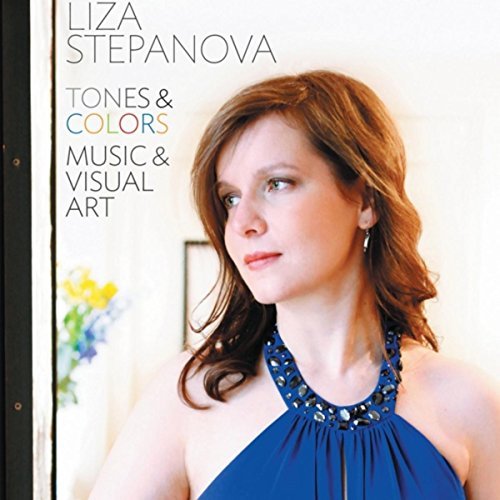
300 Years of Virtuosity, Liza Stepanova’s Tones and Colors


stepanova

Concert Artist Guild CAG 120

This is the solo piano debut of this talented and incredibly virtuosic artist.  This hard working pianist can be heard on a previous CD (After a Dream) with the Lysander Piano Trio.  Her web site can provide a good idea of the range of solo, chamber, and orchestral music in her repertory.

This CD is a good example of creating a brand, a practice which seems to be the current rage especially among artists who specialize in new music.  I have previously commented on the brands of pianists like Sarah Cahill, Kathleen Supové, Nicolas Horvath, and Stephane Ginsburgh to name a few.  All are amazing musicians but each seems to have been able to carve out an identifiable niche which sets them apart from each other and defines their various artistic missions.  Granted these are soft definitions in that they do not preclude them from playing anything they choose but it gives audiences a sort of general idea of what to expect when they do a program.

Liza Stepanova appears to have chose virtuosity as her signature.  She plays what sounds like fingerbreakingly difficult music with both ease and expressiveness.  Here she chooses to basically survey virtuosity from J. S. Bach to György  Ligeti.  In addition she has chosen to pair each composition with an analogous piece of visual art.

The pairing of music and visual art is as old as dirt and has always seemed to have an inherent validity.  Tone poems like Mussorgsky’s Pictures at an Exhibition or Debussy’s Clair de Lune are familiar examples of music as a visual analog.  But music sometimes suggests pictures even if it was not the stated intent of the composer too.  Stepanova covers the visual territory from the representative to the abstract in this entertaining collection.

Perhaps the most interesting aspect of this recording is the pianist’s choice of music.  She does go with the familiar at times such as Debussy’s Goldfish but the majority of this disc contains music that is seldom heard by lesser known composers such as Maurice Ohana (1913-1992), Joaquin Turina (1882-1949), Fanny Hensel (1805-1847), and Lionel Feininger (1871-1956).  There are better known names such as Enrique Granados (1867–1916), Bohuslav Martinú and Leopold Godowsky (1870-1938).  And the most familiar names such as J. S. Bach (1885-1750), Franz Liszt (1811-1886). Claude Debussy (1862-1918), George Crumb (1929- ), and György Ligeti (1923-2006).

There are 13 tracks grouped into 4 visual art themes (A Spanish Room, Nature and Impressionism, Conversations Across Time, and Wagner, Infinity, and an Encore).  The only problem I have here is the photos of the art (which thankfully are included in the little booklet) are necessarily small and really don’t give the consumer the full intended effect.  One would do well to obtain some art books or some larger prints of these to gain the intended effect.

I won’t go into detail about each individual piece.  Suffice it to say that they are all technically challenging and intelligently chosen pieces.  This is a very entertaining program from this emerging artist.

This reviewer is given to speculation as to Stepanova’s next release.  Perhaps Sorabji with some Dada works?  Whatever it is will doubtless be as interesting and entertaining as this disc.  Brava, Ms. Stepanova!


Leegowoon’s First Piece: Korean Post-Modernism?


leegowoon

OGUN Music JEC- 0253

This review was completed by chance on International Women’s Day.  It is not intended to stand in for all that means but I am pleased to present this woman’s work today.

Lee Go Woon is a composer new to this reviewer.  My friend Joshua Cheek has been sending me occasional shipments of some really hard to find releases from the western edge of the Pacific Rim.  There are some amazing gems being released from Korea, China, Japan, etc. that rarely find distribution in the United States and this is one of those discs.

One thing these discs (classical or popular) seem to have in common is a serious attention to art work and album design.  It is enough to start people like me whining about the loss of the 12 x 12 format of the LP which brought about the genre of album art, something I can never stop lamenting I’m afraid.

Well, it’s not just pretty pictures though.  This is a curious disc by young Korean woman who is familiar with traditional Korean classical music and apparently with other genres as well.  Korean classical is less well known to the general public in America than its analogous counterparts in Japan, China, Thailand, India, etc. but it is a fascinating and ancient system of music with its own set of artfully designed instruments.

Cultural appropriation has become a strongly pejorative term these days but what happens if an artist is appropriating their own culture?  What I mean is, for example, the incorporation of traditional Hindustani instruments and idioms in the hybrid pop of Bollywood music or similar such mashups with Chinese or Japanese traditional musics.  These are creative options and, while not necessarily a cherished part of so called “high culture”, are nonetheless acceptable and marketable options.  It is a hybridization or perhaps something like “self appropriative” or simply promoting?

The incorporation of traditional music is akin to the work done by composers like Bela Bartok, Zoltan Kodaly, Aaron Copland, and that whole late 19th and early 20th century fascination with folk and traditional music spurred on by late romantic nationalisms.  The present disc fits roughly in that tradition, just being done in the 21st century and it does not appear to be about nationalism either.

Lee Go Woon’s first piece is basically a song cycle written for voices (one male, one female) and an orchestra comprised of traditional Korean instruments.  It is not the synthesis of east and west that one finds in Toru Takemitsu’s November Steps (1967).  It is not really at all about the west at all.  And it is therein that the real interest lies.

The composer studied piano as a child and later she studied traditional percussion instruments.  She graduated from the Korea National University of Arts in 2012 with a Bachelor’s Degree and attained a Master’s Degree from the same school in 2016.  She received a Gold Medal in the 31st Korean Traditional Music Competition the same year.

Korea has, perhaps more than many countries, had their traditional culture undermined by military occupations, bombings, forced relocations, etc.  The fact that there have been 31 years of competitions attempting to recover some of their precious musical culture is certainly reason for hope and these first compositions by one of their finest new composers is a reason to listen.

Unfortunately the liner notes in that beautiful booklet are mostly in Korean and I haven’t been able to find someone to impose upon for a translation.  But I can tell you that the album has 5 tracks and that the music is quite listenable.  It would be helpful to know the text of the sung portions but the music speaks pretty well for itself.  The recording is lucid and there is quite a bit of definition to bring out the subtleties of the instruments and the performances are wonderful.

Happily this music can be heard via MP3 downloads on Amazon as well as via various streaming services.  Hopefully there will be more to hear as Korea moves on and recovers more of its rich culture and shares it with the world.


The @realAlvin Curran at the Armory


curranfake0005

Alvin Curran performing from his “Fake Book” at the Pacific Film Archive in Berkeley in 2014

Alvin Curran (1938- ) is  one of the finest of that maverick band of composers who came of age in the 1960s as expatriates in Italy.  Along with musicians like Frederic Rzewski, Carol Plantamura, Richard Teitelbaum, and Allan Bryant among others they formed the world’s first live electronic improvisation ensemble, “Music Elletronica Viva” in 1966.  In this time electronic synthesizers were not generally available and most of their equipment was hand made.  All the musicians have since all gone their own very creative ways but in many ways this ensemble has been their touchstone which continues to underlie their work.

Curran told this writer that it was around this time that he began working on a huge series of compositions of (at least initially) an improvisational nature which he collected under the general title of “Fake Book”.  Musicians will be familiar with the term which is roughly analogous to a cheat sheet enabling musicians easy access to many chord progressions, songs, and other pieces at their fingertips to please a wide range of tastes in their audiences.

curranfake0012

Curran’s Fake Book is a huge collection of scores, digital samples (no doubt he began with analog samples) and sketches.  He recently published a hefty selection of this material available on Amazon and is well worth both your time and your money for the insight it provides to this unusual composer.  The composer’s web site is an extremely useful reference but nothing can match hearing and seeing this spirited, kinetic shaman of a performer.  His creativity and sheer joy of music making is infectious and the music he makes is akin to reading diary excerpts, a musical analogy of sorts to the likes of Anais Nin, the famed mega-diarist of a previous generation.

Curran is, at 80, an energetic and endlessly creative musician, a humanist with deep convictions and quite simply an experience not to be missed.  Here is the announcement of this concert which, though this writer is unable to attend, is not to be missed.

Alvin Curran
performs
“The Alvin Curran Fakebook”
on shofar, piano, keyboard, and electronics
at the Veterans Room
Thompson Arts Center at Park Avenue Armory
643 Park Avenue (66th-67th St.)
Wednesday March 14, 2018, at 7.00 pm & 9.00 pm
or call the box office (212) 933-5812 Mon-Fri, 10.00 am-6.00 pm

Lara Downes’ Bernstein Tribute


lenny

Lara Downes is one of the finest pianists working today.  Her virtuosity and interpretive skills are well established.  She is well versed in the standard repertoire of classical piano music but has chosen to blaze her own unique path in her recorded legacy.  Here she pays homage in her own unique manner with help from some interesting fellow musicians.

The album consists of 29 tracks none of which lasts more than 4 minutes.  Many are by Bernstein including a generous selection of his Anniversaries, each dedicated to a particular person. Some were written in celebration, some in memoriam. Time marches on and we now celebrate the 100th anniversary of Lenny’s birth. So, of course, all these tracks are in memoriam now. In addition to the all too seldom heard Anniversaries there are a few song transcriptions and a nice selection of Anniversary like pieces contributed for this album by a delightful selection of composers including John Corigliano, Lukas Foss, Michael Abels, Ned Rorem, Ricky Ian Gordon, Eleanor Sandresky, Shulamit Ran, Stephen Schwartz, Marc Blitzstein, Theo Bleckmann, and Craig Urquhart.

This album is (thankfully) not a greatest hits collection but rather, as it’s subtitle says, an intimate tribute by people who were affected by Bernstein in one way or another. Bernstein cut a wide swath of influence embracing new music, mastering the established western classical canon, and embracing jazz, blues, and musical theater much like Ms. Downes actually.

Most of the album is solo piano where Downes casts a loving and magical spell. A few judiciously chosen tracks feature banjo virtuoso Rhiannon Giddens, baritone Thomas Hampton, and two musicians unknown to this writer, Javier Morales-Martinez and Kevin “K.D.” Olusola.

My first listen to this album was an uninterrupted one while driving South from San Francisco. The impression was one of Bernstein’s multiple voices being present seamlessly in every track. Only later reading the liner notes did I become aware that some tracks were written by others.

This is an intimate celebration in honor of a musician who touched so many lives.  Many of the artists on this recording knew Bernstein to some degree but the point here is that Bernstein’s art is so pervasive that few can say they have not been touched by it to some degree.  This listener was brought to nostalgic tears a few times.

In keeping with Downes’ eclectic style this is an unusual selection of pieces, most by Bernstein but all imbued with his spirit, a combination of classical sensibilities with a real feel for jazz, blues and the American musical theater.  This disc contains most, if not all of Bernstein’s “Anniversaries”, short piano pieces written variously in honor of or in memory of many of his friends.  Other pieces are by contemporaries of Bernstein and some were written for this recording.  Add to that a few interludes such as Thomas Hampson coming in to sing, “A Simple Song” from Bernstein’s “Mass”, K.D. Olusola riffing on the familiar “Something’s Coming” which opens the disc, Javier Morales-Martinez spicing up “Cool” from “West Side Story” with his clarinet and Rhiannon Giddens sounding so pretty on the track of that title.

This is a love fest and it, appropriately, covers generations much as Lenny affected so many generations whether through his wonderful work as a conductor or his classic musicals and operas that are indeed the American grain incarnate.  And Lenny was also a teacher to children and to adults.  From the Young Peoples Concerts to the Harvard Norton Lectures he thought deeply and taught and stimulated ideas.  Generations have been forever changed by him.

The bulk of this recording depends on Lara Downes amazing virtuosity bringing these brief little poems to life most convincingly and almost magically.  She clearly has a real feel for this music.  This is mostly not the familiar Bernstein that everyone knows.  It is a portrait such as listeners familiar with Downes’ work will recognize, eclectic, intelligent, sometimes nostalgic, a little obscure, frequently virtuosic, and ultimately satisfying.  The disc lists the performers as, “Lara Downes and friends” and that is the feeling of not just the performers but also of the composers whose heartfelt contributions fit so well in this eclectic mix.

This disc represents Downes’ debut on Sony and the only thing this writer can say to that is, “What took them so long?”  Brava!  And cheers to Lenny on his 100th.

The Alchemy of Diversity at Sound and Savor


bialys

Freshly baked bialys right out of the oven opened the brunch.

This is another in the continuing account of my encounters with Philip Gelb’s underground vegan salon now called Sound and Savor.  For some twelve years now he has hosted a series of dinners, brunches, and cooking classes.  Many of the multi-course meals also feature some of the finest musicians, many from San Francisco and the east bay.

Today’s brunch started with fresh brewed coffee with a dollop of ginger (vegan) ice cream along with fresh baked bialys with cashew cream, pickled red onions, and “carrot lox”.  So we began with a vegan Jewish theme.  Needless to say these were delicious and the coffee helped waken anyone not ready for this 11AM start.

img_0204

The next course was a similarly delicious borscht (beet soup) with beet pakoras.  And clearly Phil has introduced this traditionally Indian dish which worked remarkably well with that soup.  Again all were hot out of the pot/fryer clearly in our view.

As Phil performed his culinary alchemy in the kitchen we were most attentively served by his assistant for this meal, Letitia, a smiling joy of a woman who seems to have the knowledge and genuine caring of customer service in her blood.  She was equally attentive to all in the crowd of about twenty diners with the usual mix of familiar faces and few new ones.  Indeed the beautifully presented courses came at just the right pace.

img_0205

The main course in this brunch was a Potato-Onion Tortilla, blood orange salad.  And once again the diversity of cultures mixed to truly savory results as the friendly conversations flowed.  At this point even the hungriest would hope for a pause and that’s exactly what happened.

img_0210

With a judicious touch of rearranging Phil prepared a performance space for the three musicians who graced us on this beautiful sunny Oakland day.  Jay Ghandi, bansuri (Indian Flute), Sameer Gupta, tablas (a staple of Hindustani music), and David Boyce, saxophone and bass clarinet (need I say a staple of jazz?).  The alchemy of the food would now find an analogy in this jam session.  Boyce and Gupta had played here about a year ago and Ghandi is a frequent collaborator with both musicians.  All three had played yesterday in San Jose and were scheduled to play in San Francisco at the Red Poppy Art House.  They are touring to promote their recent release A Circle Has No Beginning.  These are just three of the musicians who participated in this crowd sourced disc which is itself worth your attention.

The energy was immediately palpable as seen in this excerpt from one of three pieces they played.

This last excerpt demonstrates the ease of communication between these musicians who blend diverse backgrounds of jazz and Hindustani musics seamlessly into something new and wonderful.  The audience was energized to a level beyond what coffee could do and broke into appreciative applause after each piece.

The brunch ended with a dessert of (again fresh baked) Citrus Semolina Cake and more of that delicious coffee and ice cream.  And, of course, more conversation.

These events have become a regular part of this writer’s recreational time and a real reason to celebrate living in the diverse and creative east bay.  Phil’s judicious blend of cultures in his culinary experiments provide a parallel to his curation of some of the finest musicians with the only purpose in both case to entertain and enlighten.  He achieved both is a big way this day.  Thanks to all who participated.

More Than the Ears Can Hear: Bill Fontana in Conversation


img_0200

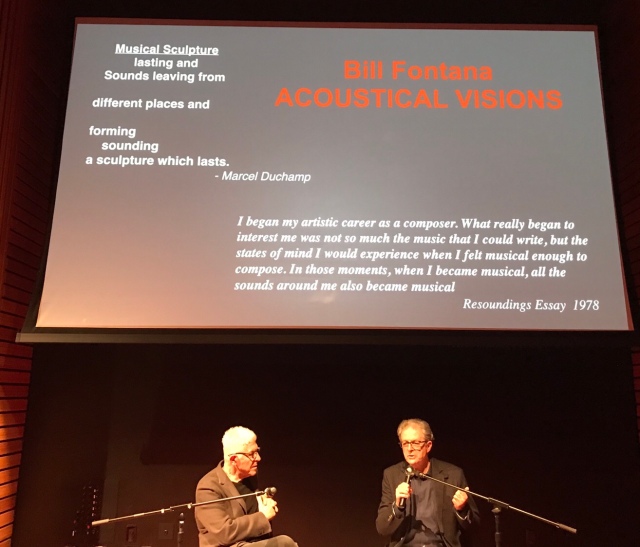
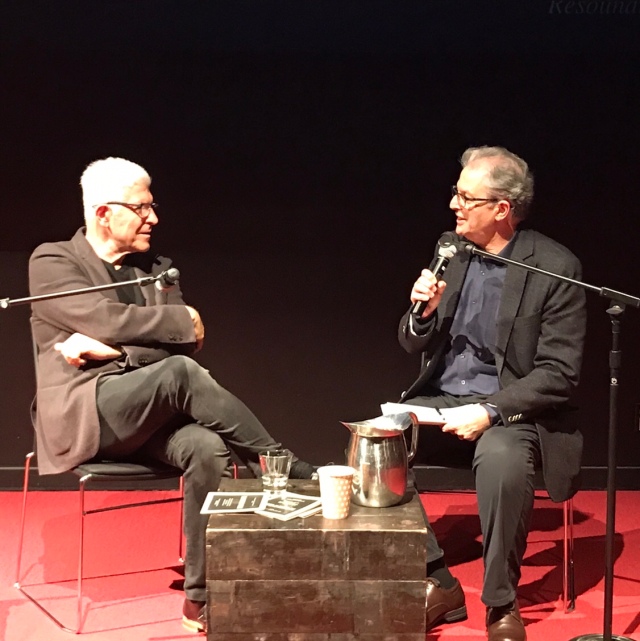
Despite being possessed of a rabid and eclectic interest in all music I had not been aware of Bill Fontana until I found this presentation sponsored by Other Minds and curated by Charles Amirkhanian (whose radar seems to capture just about everything).  This entry into the Nature of Music series last night featured this artist who extends the very meaning of composition and the very reach of our ability to hear.

This series is hosted by the David Brower Center in Berkeley, CA.  The center is a state of the art environmentally friendly building which serves, appropriately, as a center for ecological awareness and hosts various organizations within its walls (including the Berkeley office of Other Minds) whose missions serve various environmental concerns.  The Nature of Music series attempts to address ecological concerns and indeed the featured artists have all demonstrated connections to the environment in various creative ways.

Bill Fontana (1947- ) is a San Francisco resident but his art takes him all over the world.  He presented audio and video excerpts from his installation works in Kyoto, Lisbon, San Francisco, London, and Iceland.  The basic concepts behind his work seem to be the extension of hearing and, to some degree, of seeing.  He uses multiple microphones and transducers to extract sound from objects such as bridges, bells (when not ringing), musical instruments (not playing), etc.  His multi-layered video experiments are at least partly analogous to this.

The first presentation was perhaps the most striking.  Fontana showed a video of an old Zen Temple bell which was just hanging there in a still video recording.  He had attached a sonic transducer to pick up the subtle vibrations of the bell as it reacted to the ambient sounds around it, something it had been doing for its entire existence (though no one knew until this).  He quipped that the monk whose job it was to care for said bell was somewhat anxious about what Fontana was doing.  When the monk heard the sound that this “silent” bell made he was astonished.  What one learns is that there are sounds made which our ears do not hear.

img_0199

Another “not ringing” bell in a New York tower revealed its reactions to its environment sonically and in a still video overlooking Manhattan from the high atop the lonely tower.

One installation involved 8 microphones arranged around San Francisco Bay which transmitted the sounds they captured to an installation of 8 loudspeakers located at Fort Mason.  The effect was of having ears that could hear all of these sounds which were so geographically distant that one pair of ears could not hear them in this way.  This 1982 installation is scheduled to have the recordings of those captured sounds from the original presentation played continuously in a permanent installation at Fort Mason.

Other installations included a bridge and a river in Lisbon and some hydrothermal installations in a couple of places.  What these all had in common was this extension of hearing (and vision) and how this increases one’s awareness of the environment both sonically and visually.  The artist acknowledged a passion for environmentalism and took the time to answer the questions of a medium sized but very engaged audience.

There are things in his work that echo the work of John Cage, Annea Lockwood (who appeared on a previous Nature of Music program), Pauline Oliveros, and any number of drone/noise composers.  But his vision is clearly a unique one and it was revelatory to have been able to hear/see this little exposition.  Fontana is truly a phenomenon whose roots fit comfortably on the west coast but whose vision is global.

It is well worth your time to peruse Fontana’s web site which is full of videos and sound files depicting his unique visions from various locations all over the world.  Fontana seemed a warm and unpretentious figure led all these years and still going with a child-like sense of wonder and a spectacular imagination.  All in all a mind-blowing and entertaining evening.

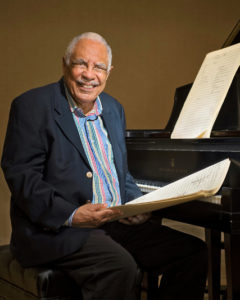
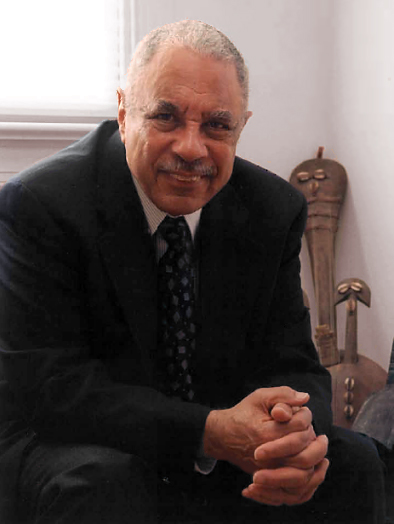
Thomas Jefferson Anderson, II: American Composer Turns 90 This Year


Anderson-TJ-240x300

T. J. Anderson (1928- )

Born in Coatsville, PA August 17, 1928 Thomas Jefferson Anderson, Jr. is an American composer, conductor and teacher.  He earned a B.A. in music from West Virginia State College in 1950  and an M. Ed. in music education from Pennsylvania State University in 1951.  He studied at the esteemed Cincinnati Conservatory of Music in 1954 and earned a Ph. D. in music from the University of Iowa in 1958.  He subsequently also studied with Darius Milhaud at the Aspen School of Music in 1964.

I first encountered his name in the American Music series (Volume V) which came out on Nonesuch records.  His work, Variations on a Theme by M. B. Tolson (1969) was paired with works by Anderson’s contemporaries Milton Babbitt and Richard Wernick.  I later encountered his  Squares (1965) for orchestra on volume 8 of the wonderful Black Composers series (released 1975 on Columbia Records) curated by the late great Paul Freeman.  The same disc contained works by Olly Woodrow Wilson and Talib Rasul Hakim.  (That entire 9 volume set remains available on vinyl in a nice box set through the College Music Society and distributed by Amazon for only $55.00)

Anderson was awarded an appointment as composer in residence with the Atlanta Symphony beginning in 1968 and ending in 1972.  This coincided with the beginning of Robert Shaw’s tenure as conductor.  Shaw’s affinity for contemporary music (including black composers like Anderson and Alvin Singleton).  Anderson prepared a performing version of Scott Joplin’s only extant opera Treemonisha resulting in the first full staging of that 1911 work (premiered by Shaw with the Atlanta Symphony and broadcast via NPR) during this time and premiered several of his own works with the orchestra along with his educational and outreach duties.

His teaching appointments have included Langston University in Oklahoma, Tennessee State University, Morehouse College, Tufts University, the University of Minnesota, California State University, Northwestern University, the University of Michigan, and Ohio State University.  He is as of 2005 a member of the American Academy of Arts and Letters and is the recipient of a long list of honors.  Dr. Anderson is the author of numerous academic publications and is the past chairman (1972-76) of the Black Music Caucus which is now known as the National Association for the Study and Performance of African/American Music (NASPAM).

Sadly his discography is rather limited (discogs lists only five) but there is a wonderful set of download links on the composer’s web site where you can download complete recordings of no fewer than 37 of his works as of the time of this writing.  Trust me this is a cornucopia with recordings from about 1974 to as recently as 2006.  Here’s hoping that his large catalog of compositions can get the attention they deserve in the near future.  His works include solo, chamber, orchestral, concerto, choral, art song, opera and other arrangements and orchestrations.

tj_color

Dr. Anderson lives in Chapel Hill, NC with his family (his son Thomas Jefferson Anderson, III is a poet and professor at Hollins University in Virginia).  He will be turning 90 at the end of this summer.


Linda Twine, A Musician You Should Know


Linda-K-Twine-Image-page-001

Linda Twine

I have found it strange that the few articles I have written (and, full disclosure, I’m a white guy) on black musicians seem to have placed me in the position of being one of apparently a limited number of writers/bloggers who pay attention to the topic.  Happily these articles have gained an audience.  The rather simple piece I wrote on black conductors, a little essay composed in honor of Black History Month, remains by far one of my most read articles.

The vicissitudes of race and racism are such that we need to say, “black lives matter” because even the most cursory examination of statistics shows that they seem to matter far less than lives with other racial identities.  The same is true with music and musicians..  There are organizations dedicated to the promotion of black musicians because they remain far less well represented.

It is in this spirit that I am writing this little sketch to highlight a black musician who does not have a Wikipedia page or even a personal web page that I have been able to find.  You can find her easily with a Google search but you will find some of the same segregation of which I spoke.  One finds her on the “Broadway Black” website which does a fine job of promoting her and her work.  And what fine work it is.

To be fair she is also on the “Internet Broadway Database“, “Playbill“, the “Internet Movie Database“, and one can find her most recent work listed on the “Broadway World” site.  Her cantata, “Changed My Name” can be found on You Tube.  And it is there where, curiously enough, one can find the most comprehensive information on her.  I present it here:

From the Muskogee Phoenix, 11/10/2007, we have this information about Linda Twine:

Twine, a native of Muskogee, OK, graduated from Oklahoma City University in 1966, with a bachelor of arts degree in music. There, she studied piano with the esteemed Dr. Clarence Burg and Professor Nancy Apgar. After graduating from OCU, Twine studied at the Manhattan School of Music in New York, where she earned a master’s degree, and made New York her home. She began her musical career in New York, teaching music in public school by day and accompanying classical and jazz artists at night. At one of these engagements, she was asked if she would like to substitute for the keyboardist of the Tony Award winning Broadway hit, “The Wiz.” Her positive response began a long career in Broadway musicals from keyboard substitute to assistant conductor of Broadway orchestras. In 1981, to conductor when Lena Horne asked her to conduct her one-woman hit, “Lena Horne: The Lady and Her Music.” This garnered Twine the respect of her peers and as a much sought-after Broadway musical conductor. In addition to “The Wiz” and “Lena Horne,” Twine’s Broadway credits include, “Ain’t Misbehavin’,” “Big River” (the score composed by Oklahoman Roger Miller), “Jelly’s Last Jam,” “Frog and Toad,” “Caroline or Change,” “Purlie,” and the current “The Color Purple,” starring Fantasia. Not only a distinguished conductor, Twine is also a composer and arranger. She composed “Changed My Name,” a cantata inspired by slave women Sojourner Truth and Harriet Tubman, and written for two actresses, four soloists, and a chorus. Her popular spiritual arrangements are published by Hinshaw. As a producer, instrumental and vocal arranger, her work can be seen and heard in the books and CDs of the Silver Burdett Publishing company, which are used by many public schools in the United States. Community commitment and involvement have also marked Twine’s outstanding career. She has arranged and composed for the renowned Boys Choir of Harlem, and she served for 14 years as minister of music for St. James Presbyterian Church of New York. Among her many awards and honors is the “Personal Best Award for Achievement and the Pursuit of Excellence,” for her role as a writer and arranger for the Boys Choir of Harlem, her artistic achievements in the world of Musical Theatre, and her concern for humanity. Twine, a proud Oklahoman, is the granddaughter of William Henry Twine, a pioneer lawyer who made a homestead claim in the 1891 Sac and Fox Run, and along with G.W.F. Sawner and E.I. Saddler established the first black law partnership in Oklahoma Territory.

So here, in honor of Black History Month, I wish to present this fine musician whose art deserves the world’s attention.  Take note please.

Marin: An Unknown Danish Master Gets His Due Marvellously


marin

I have made no secret of my passion for the music which has been coming out of the Scandinavian portion of our planet.  My knowledge of these musical traditions is mostly limited to the twentieth century up to the present but what a horn of plenty there is to be had.  There are so many composers that it is forgivable if one of them fails to get worldwide attention and acclaim during their lifetime.  Or is it?

Well if sins of omission that have been committed all can now be forgiven and the memory of Axel Borup-Jørgenson (1924-2012) is likely guaranteed to remain solidly in the history of music of the twentieth century.  The Danes take their music very seriously it seems (check out the You Tube Channel for the Danish National Symphony Orchestra if you don’t believe me) and producer Lars Hannibal and his crew have labored tirelessly to bring this formerly obscure master most deservingly to light in this DVD/CD combo pack featuring some of his finest works.

This truly major release contains a DVD with a gorgeous animated feature synced to the late composer’s swan song big orchestral piece, Marin op. 60 (1963-70) a really beautifully produced documentary (“Axel”) on the composer featuring some of his fellow composers including, Finn Savery, Pelle Gudmunsen-Holmgreen, Bent Sørensen, Sunleif Rasmussen, Per Nørgard, Gert Mortensen, Ib Nørholm, Michala Petri, and producer Lars Hannibal along with family and other musicians and producers.

The animated feature looks like one of the finer entries one might find on Vimeo.  The animation was done by Lùckow Film and works well with the music.  The biographical feature does a spectacular job of placing the composer in context with his Nordic contemporaries and with contemporary music in general.  The people interviewed give about as definitive a description of the man’s work as can be done in a film biography and the intervening or connecting scenes bespeak a high level concept of cinematography that makes this film both compelling and a delight for the eyes as well as the mind.  The concept of the composer’s use of silence as a compositional tool seems to be reflected in these transitional scenes.

The CD consists of seven carefully selected pieces on seven tracks.  The disc opens with the big orchestra piece which was heard behind the animation on the DVD, Marin Op. 60 (1963-70) followed by Music for Percussion and Viola Op. 18 (1955-56), For Cembalo and Orgel Op. 133 (1989), Nachtstuck Op. 181 (1987) (played here by the composer’s daughter, Elisabeth Selin), Winter Pieces Op. 30b (1959) for piano, Pergolato Op. 182 (2011) for treble recorder, and Coast of Sirens Op. 100 (1980-85) for flute, clarinet, violin, cello, guitar, piano, percussion, and multivoice tape.  This is truly a balanced portrait with examples of orchestral, solo instrument, keyboard, chamber and electroacoustic works from 1959-2011, a more than fair sampling of the composer’s output both by genre and by time.

The music seems to move between post-romantic tonality and expressionistic experiments such as one hears in the music of Gyorgy Ligeti.  The music is evocative and very listenable especially if one avails one’s self of the introductory film.  It certainly seemed to tune this reviewer’s ears properly.  It is helped as well by some very fine recordings that capture the subtlety of the composer’s work.

Lars Hannibal is clearly the guiding hand in this project but his genius (he is a fine guitarist as well as a producer) is his ability to engage all these fine musicians, artists, producers, and family in what is one of the most loving portraits this writer has ever seen.  Now that is the way to blast someone out of obscurity forever.

And this is but one entry in a larger project to record the composer’s complete output.  Two previous releases were reviewed on this blog and, presumably there are more to come.  But in the meantime there is much to savor here and one hopes that this will introduce this music into the general repertoire.  I’m sure Axel would be pleased to be placed as he is now among the masters of Danish composers.


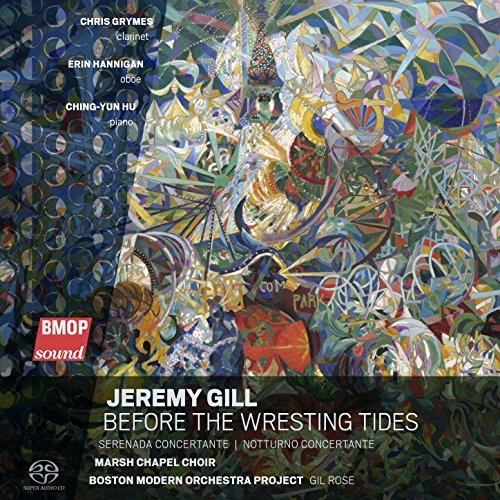
Jeremy Gill: Before the Wresting Tides


gill

BMOP 1055

In this writer’s mind there are two types of releases on the BMOP label. Discs with music or at least composers that have some familiarity to these ears and discs of unfamiliar composers.  This disc fits into the latter category.  Jeremy Gill is a new name to these ears but he is hardly new on the scene with at least 3 or 4 CDs already out devoted mostly to his chamber music.

This disc then will give the listener an idea of how well Gil Rose and his Boston Modern Orchestra Project choose and subsequently perform less familiar new music.  There is a lot of music out there and it takes a special ear to choose wisely such that one can expect a given release to keep its place among the other well chosen music that makes up the BMOP label’s catalog.  It would appear that this was and will remain a wise choice.  Three works are presented in chronological order of their composition.

The first is the title work, Before the Wresting Tides (2012), a choral fantasy setting a poem by American poet Hart Crane (1899-1932).  This was written specifically to function as a companion piece for Beethoven’s rarely performed Choral Fantasy Op. 80 (ca. 1808).  This work shares a similar orchestration and formal plan.  There is an obligatto piano solo written for Gill’s friend and colleague Ching-Yun Hu, a large orchestra, chorus, and vocal solos.  All of this fits into a compact 16 minutes or so.  It is decidedly more modern in orchestration and harmony than Beethoven’s work but it shares a virtuosic piano part, lyrical melodies, and marvelously efficient setting of the text handled beautifully by the Marsh Chapel Choir under Scott Allen Jarrett.  There is a lot going on here but I can’t imagine an audience being anything but entertained by this rather bombastic companion which one hopes will continue to be performed alongside the Beethoven model bringing both works to modern ears.

The second work is titled Serenada Concertante (2013) for oboe and orchestra.  It is sort of an enlarged oboe concerto.  The soloist, Erin Hannigan demonstrates the virtuosic and lyric skills that seem to be endemic to this entire orchestra.  Gill’s writing makes large romantic gestures with plenty of painfully virtuosic opportunities (handled beautifully) for the soloist and the various soli and duettini which occur in the course of this full blown concerto.  The composer’s ability to utilize such a large orchestra yet still produce lucid textures is a mark of genius and, no doubt, one of the reasons that Gill’s music was chosen for this series of recordings.

Our finale is another concerto of sorts, the Notturno Concertante (2014) for clarinet and orchestra.  Again we hear an amazing soloist, Chris Grymes, on clarinet.  Again we hear amazing virtuosity and lyricism played against a large and lucid orchestral fabric.  Very satisfying music for both audience and orchestra.  It is clearly a workout for orchestra, soloist, and conductor but the energies expended produce a very satisfying result.

Whether or not Jeremy Gill winds up being a household name, one of the brightest lights of the 21st century remains to be seen but this is an auspicious release.  This largely romantic sounding composer also seems to have a curiously “American” sound which harkens to the likes of William Schuman, David Diamond, and, well choose your own favorite mid-twentieth century American master after you hear this.  Well done.

Crazy Nigger, Gay Guerrilla, Precious Artist: Julius Eastman Examined


eastman

This essential collection celebrates the life and work of a composer and performer whose unique presence was nearly eroded to nothing but for the work of composer (and co-editor of this volume) Mary Jane Leach who spearheaded an effort to rescue as many scores and recordings as possible after Eastman’s death in 1990 at the age of 49.  The first evidence of this modern archaeological effort came with the release of Unjust Malaise (2005), three CDs which featured some of the recordings that were gathered in that early effort.  In addition it should be noted that Leach continues to maintain a resource page with the most up to date information on Eastman scholarship efforts.

Now, along with Renée Levine Packer (whose wonderful history of the Buffalo New Music Days, “This Life of Sounds” (2010) is not to be missed) we have a lovingly edited collection of essays which comprise a sort of biography as well as an appreciation of this very important American composer.

One look at the acknowledgements reveals the wide scope of individuals with whom Eastman came into contact and whose contributions became so essential to this volume.  The wonderful introductory essay is so very appropriately written by George E. Lewis whose figure itself continues to loom knowledgeably over late twentieth and early twenty first century music.  He takes a characteristically unflinching look at the cultural, historical and socioeconomic factors that contextualize Eastman’s work as well as his untimely demise.  Eastman’s frequent use of politically incorrect titles that challenge a smooth vocal delivery in the most seasoned of broadcasters is here made to seem quite understandable (if not comfortably palatable) within the complex forces that defined Eastman’s milieu.  Lewis embraces Eastman’s talents and makes the prospect of further study of his work tantalizing.  He provides a truly authoritative context which can serve all future work in this area.

There are nine chapters, a chronology and a select bibliography along with photographs and score examples.  The essays that comprise each chapter focus from the macro-view of Packer’s biographical sketch and Leach’s timeline to micro-analyses of some of Eastman’s works and some additional personal perspectives.  One of the most endearing qualities of this volume is the fact that many of the contributors knew and/or worked with Eastman at one time or another.  It is clear that all the contributors were deeply affected by their encounters with Eastman himself and/or with his music and all are rather uniquely suited to be in this volume.

One suspects that Packer’s biographical sketch which opens this volume will henceforth serve as a basic model for all future biographical research.  Whether one finds agreements or not the material is presented in as complete and organized a fashion as can be imagined.  It paints the picture of a prodigy who, for whatever reason, fell into disarray.  Whether there was drug use or symptoms of mental illness will be the debate which will, of course, never be satisfactorily resolved.  What shines through though are tantalizing moments and a plethora of relationships, however brief sometimes, that contribute to all we will ever really know of the enigma of the life of this precious artist.

Some of what follows has the quality of memoir and some leans more toward academic analysis.  All of these essays, timelines, bibliographies, etc. tie this book together as the first most comprehensive effort at trying to understand the man, his music, his milieu, his unusual personality.

These accounts will always be crucial in any future analysis of the enigmatic talent of Julius Eastman.  Though many will attempt to affix labels to his personality variously attributing his quirks to mental or physical illness no one will ever know him the way the people in this book did, as a precious artist whose work was rescued (as much as it could be) from obscurity by his family (both biological and artistic).  He was and is loved in perhaps the only way that he would allow, through his work and his deeds.

This book is a fascinating read which serves to put the artist back into his proper place as the genius he was.  Much remains to be written, performed, analyzed and recorded but this book will always serve as the reference point for what is to come.

The Heresy and the Ecstasy: Brooklyn Raga Massive Does “In C”


brminc

This is heresy.  It is not, strictly speaking, faithful to the 1964 score and it is a sort of cultural appropriation which is actually the very basis of Brooklyn Raga Massive, a sort of latter day “Oregon” (to those who recall that band) which takes on all sorts of music and filters it through the unique lens of this flexibly populated group of musicians whose backgrounds range primarily from Hindustani and Carnatic traditions (though hardly in the most classical sense) but also from western classical and jazz.  Their “heresy” comes from their choices.  The root of heresy is the Greek word, “hairesis” which means choice.  There is a lovely selection of their musical heresies on their You Tube Channel.

No this is not purely heresy and it is certainly not blasphemy.  Quite the opposite actually.  And I would prefer to think of this effort as cultural integration.  The choices made here instead lead to some mighty ecstatic music making which pays honor to Terry Riley who turned 80 in 2015 and provides a unique perspective on this classic work.

“In C” (1964) is without doubt Riley’s best known work by far and the one which pretty much defined what would later become known for better or worse as “minimalism”.  It is an open score meaning that no instruments are specified for performance making this music heretical in nature as well.  In addition there is no conductor’s score as such.  Rather there are 53 melodic cells numbered 1 to 53 and the ensemble is held together by the expression of an 8th note pulse played by at least one of the musicians involved.  The defining reference on the intricacies of this work is composer/musicologist Robert Carl’s masterful book entitled simply, “In C”.  He describes the wide variety of potential choices which can be made in performance and the different results which can be achieved.

There are a great deal of recordings available of this work from the first (released 1968)  on Columbia’s “Music of Our Time” series curated by the insightful David Behrman to versions involving a wide variety of instrumental combinations of varying sizes.  The first “world music” version this writer has heard is the version for mostly percussion instruments by Africa Express titled, “In C Mali” (released in 2014).

Not surprisingly BRM, as they are known, have chosen a largely Hindustani/Carnatic take on this music.  The unprepared listener might easily mistake this for a traditional Indian music recording with the introduction which incorporates a raga scale and adheres to the traditional slow free rhythm improvisation of the introductory “alap” section common to such traditional or classical performances.

The familiar sound of these (largely) South Asian instruments with their rich harmonics sets the tone gently.  This writer has at best a perfunctory working knowledge of these complex and beautiful musical traditions but one must surmise that the choice of Raga Bihag may have some intended meaning.  Indeed such music is by definition integrated into the larger cosmology of Hinduism, the Vedas, the Gita, the Sanskrit language, and, no doubt other references.  This is not discussed in the brief liner notes but is worthy perhaps as a future interview question.

It appears that many of the musical decisions were made by sitarist Neel Murgai though it becomes clear as the performance develops that individual soloists are allowed wonderful improvisational freedoms at various points.  The recording is intelligently divided to let the listener know which set of melodic cells is being expressed at a given time.

The alap gives way to the sound of the tablas which initiate the pulse mentioned earlier.  The structure of this piece produces a range of musical experiences from a sort of didactic beginning to the swirling psychedelic waves of sound which stereotypically define much of the music born in the mid 1960s in this country.  In fact Terry Riley’s deep study of South Asian musics (most famously under vocalist Pandit Pran Nath) did not occur until later in his career.  Nonetheless there seems to have always been some affinity between Riley’s vision and the sort of music whose popularity was driven in the United States most famously by the efforts such as Pandit Ravi Shankar and Ustad Alla Rakha in the 1970s.

What follows is a riot of musical ecstasy involving some inspired improvisational riffs and some stunning vocalizations as well giving us a fascinating take on this music which was written well before these musicians came into the world.  We have a later generation paying homage to the beloved American composer and to the beautiful traditions of their own eclectic ethnic heritage.

The set concludes in this live and lively recording with a traditional fast paced Jhalla, the traditional ending to classical Indian musical performances. This will likely become known as the “Indian” recording of “In C” but it is so much more than that.  It is an homage.  It is a look back from the view of at least a couple of generations of artists.  And it is heresy in the best sense of that word, choices made judiciously to achieve higher artistic goals.  Not all art is heresy and not all heresy is art but the heresies perpetrated here definitely deserve our ears.

The heretics are: Neel Murgai, Sitar and Vocal; Arun Ramamurthy, Violin; Andrew Shantz, Vocal; Josh Geisler, Bansuri; Sameer Gupta, Tabla; Roshni Samlal, Tabla; Eric Fraser, Bansuri; Timothy Hill, vocal; Trina Basu, Violin; Ken Shoji, Violin; Kane Mathis, Oud; Adam Malouf, Cello; Michael Gam, Bass; Lauren Crump, Cajon; David Ellenbogen, Guitar; Max ZT, Hammered Dulcimer; Vin Scialla, Riq and Frame Drum; Aaron Shragge, Dragon Mouth Trumpet.

Namaste, folks.


Sarah Cahill et al: By and for Terry Riley


Sarah Cahill - Eighty Trips Around the Sun- Music by and for Terry Riley - cover.png

Had to save this one for Christmas.  If ever there was an album that conjures more of the positive intents of the Christmas season this one gets my vote.  Imagine celebrating a living acknowledged master artist in a milieu of his actual and artistically extended family.  That may seem an extreme notion to some but this writer is utterly charmed and thrilled to hear this “one of a kind” collection.  Other interpretations will, of course, be valid but none will ever match this one.  It’s like the Carter family of the avant-garde (and I mean that unambiguously with great respect).

Any release by Bay Area pianist Sarah Cahill is reason enough alone to perk up one’s ears but this massive four disc collection of all new recordings in honor of Terry Riley’s 80th birthday (Terry was born in 1935) is a major release of (almost) all of Riley’s music for piano, piano four hands and two pianos.  In addition two of the discs are dedicated to pieces commissioned in honor of Riley.  This set belongs in the collection of anyone interested in mid to late twentieth century music and especially fans of minimalism and the curiously west coast iterations of modernism.

As a listener I have always treated every Terry Riley release as a major event as well and this collection does about as fine a job as one can imagine in paying homage to one of the brightest artistic lights of the Bay Area.  Riley came to prominence (at least historically speaking) with his open score piece, In C (1964).  It is among the earliest examples of the style which, for better or worse, became known as “minimalism”.  Since then he has continued to produce music in pretty much all genres, chamber music, orchestral music, solo music, concerti, etc.

Riley’s style, however, continued to evolve and his later works show diverse influences from his days playing barrel house piano, his interest in progressive jazz, and his studies of Hindustani and Carnatic musics (under the tutelage of Pandit Pran Nath).  Like pretty much every composer of that first wave of “minimalists” Riley has evolved a much deeper and individualized style but, even with the diversity of influences as mentioned, he remains uniquely Terry Riley.

Throughout his career as composer and performer Terry has been a teacher and an advocate of new music.  His enthusiasm and talent has affected all who know him and, I dare say, all who have experienced his work.

This collection ranges over his entire career from the early “Two Pieces” (1958/9) to later solo and four hand compositions on the first two discs.  It is worth noting that Be Kind to One Another (2008/14) was one of the commissions in Sarah Cahill’s wonderful series of anti-war pieces, “A Sweeter Music”.  It then goes on to the homages which, of course, can also be said to be influenced by Riley’s work.

This is not simply a collection of Riley’s piano music.  What we have here is a lively celebration of most of Riley’s music for piano, two pianos and piano four hands from the full spectrum of his career (as the liner notes say a couple of large compositions were not included, most likely a matter of space) along with a touching set of homages by composers related musically and aesthetically to Mr. Riley.  They range from contemporaries to students, artistic descendants to actual family.  It is a multi-generational tribute and a loving artifact that celebrates this artist on a very personal level.

Regina Myers supplies the other two hands in the disc of four hand piano pieces by Riley.  She credits another Bay Area composer/teacher/conductor, the Mills College based Steed Cowart for recommending her for this crucial role.  Such touches add to the sense of this being a Bay Area family project on so many levels.

The interrelationships that comprise this lovely production make it stand distinctly apart from the (no less significant or lovely) homages to fellow minimalists Philip Glass and Steve Reich.  This is a much more personal album which reflects Riley as composer, teacher, inspiration, father, icon and friend.  Anyone who has met Terry or experienced him in performance has experienced a certain warmth like that of a wise and gentle guru.

After the two discs of Riley’s music we are treated to music inspired by another generation of artists and, last, by long time colleague, the late great Pauline Oliveros (1932-2016), another wise and gentle guru who died just about a year before the release of this album.  She and Terry worked together (along with Morton Subotnick, Ramon Sender, Steve Reich, William Maginnis, and Tony Martin) as founders of the San Francisco Tape Music Center which would become the Mills College Center for Contemporary Music (still operating today).  The producers wisely dedicated an entire disc to one of Oliveros’ last compositions, this loving tribute to her friend and colleague. It is now, sadly, a tribute to her memory as well.   Samuel Adams shares the performing duties along with Ms. Cahill on this extended homage.

There is little doubt that the other composers whose music graces this tribute will continue on their unique paths to continued success always acknowledging their connections to Mr. Riley.  Danny Clay is among the less familiar (to this reviewer) names here but his Circle Songs seem to fit quite well to open the first tribute disc.  Gyan Riley is, of course, one of Terry’s children and a fine guitarist and composer  in his own right.  Anyone who has had the pleasure of seeing Gyan and Terry play together cannot miss the close bond personally and musically of these two.  They are a joy to behold.  The affectionate Poppy Infinite is a reference to the elder Riley’s Poppy Nogood’s Phantom Band which was the “B side” of his classic Rainbow in Curved Air.  Samuel Adams is the son of Pulitzer Prize winner John Adams whose early work China Gates was written for and championed by his fellow classmate at the San Francisco Conservatory, Sarah Cahill.  The younger Adams’ contribution here is called Shade Studies.

The eclectic Christine Southworth also seems to embody the (perhaps loosely defined) West Coast style.  Her interests in electronics and world music describe this superficially but her sound is a welcome one here as well.  Keeril Makan earned his PhD. in music at Berkeley which doubtless has left a stamp on his style.  His composition “Before C” makes reference to what is doubtless Terry Riley’s best known work, the oft performed, “In C”.  Elena Ruehr is a composer whose connection is not as clear as some of the others here but her work, “In C too” demonstrates her understanding of and her respect for Riley’s work.  Last on this disc of tributes is Dylan Mattingly.  He is a Berkeley native and can frequently be seen/heard performing in various venues in the Bay Area.  His contribution YEAR demonstrates both his individual style and his connection to the West Coast Style mentioned earlier.

The liner notes by Sarah Cahill are part of the tribute and a good description of the various influences behind the man of the hour, Terry Riley.  Credit is properly given to the artistic influences that inspired Mr. Riley and a brief description of what must have been an intimidating but loving project.  It is likely that there are even more connections involved in this undertaking but that must be left to future musicological and historical research.

The Kronos Quartet has long ago championed Riley’s work for that medium and new versions of his classic, “In C” continue to come on the scene.  One can only hope that the energy embodied here will inspire recordings of some of Riley’s lesser known work with orchestra which richly deserves hearings.  But regardless there is much to celebrate here and best holiday wishes go out to Mr. Riley and his talented progeny.  Happy listening, all.


LA Percussion in High Definition


Having been a bit overwhelmed with a LOT of percussion recordings lately I placed this Los Angeles Percussion Quartet recording a bit further back in my review queue.  My apologies but I did it because I really wanted to give this recording my full attention and then to have something useful to say.

So I listened.  I put this on in my car when making a trip long enough to allow me to hear one of the two discs without interruption.  And I chose a relatively non-distracting drive in which I could actually pay attention to the music without incurring some danger on the road.

Of course the first thing that strikes the listener here is the lucidity of the recording.  Sono Luminus is showing off their signal processing prowess as well as their sensitivity with things like microphone placement and all the things that only great engineers know.

Let me make one thing very clear.  I am not a fan of sonic spectacle for its own sake.  I recall one incarnation of vinyl/analog fetish releases which a friend drooled over but whose content bored me to death.  Fortunately Sono Luminus seems to be steering clear of that sand trap.

This two disc set (well, three if you count the Blu-Ray Audio disc) collects music by largely little known composers (at least to these ears).  But fear not, this is not music that sounds like someone knocked over the stainless steel pot rack at Sur le Table.  Quite the opposite.  This is some intelligent music which compels the listener to stick with each piece and follow its development.  This is apparently the fourth album by LAPQ, the previous three also being Sono Luminus productions.

The first disc begins with the first of two Icelandic composers both of whom were represented on a previously reviewed discDaniel Bjarnason is a conductor and composer and his Qui Tollis, a work of wide dynamic range and a variety of moods from more assertive to more contemplative.  The second work is by the current darling of Icelandic classical music.  I am speaking, of course, of the very talented Anna Thorvaldsdottir.  Her work, Aura, is more consistently contemplative in nature and, like all her work, the listener is rewarded for paying close attention as she weaves magical impressionistic tapestries.

Memory Palace by Brooklyn based Christopher Cerrone piqued serious interest in this listener.  This man would seem to be a composer whose work deserves watching/listening.  This five movement suite for percussion indeed makes for compelling listening as he moves through a variety of moods and isn’t afraid of frank melodic invention during the journey.  This does not strike this reviewer as run of the mill percussion music (not that the preceding two works did either).  Rather this work suggests a distinctive compositional voice worthy of further attention.  Mr. Cerrone’s collection of awards including a Rome Prize and a runner up for a Pulitzer Prize suggests that he will be heard from again soon.

Fear-Release by Ellen Reid is a shorter though no less rewarding journey down yet another compositional path for percussion.  At just short of nine minutes this is a compact movement which relies on a fairly wide dynamic range and strategic use of silences and is a fitting close to the first disc.

The brief, rather poetic, liner notes draw a parallel between the multiplicity of languages found in the Los Angeles area and the multiplicity of musical languages found on this recording.  Indeed these are distinctive voices that extract a wide variety of sound from this percussion quartet.  This reviewer is somehow strongly reminded of Nexus, the Canadian percussion group which dominated the 1990s for a bit.  The similarity is in their enthusiasm and in their musical skills.  LAPQ is a distinct ensemble in its way and is a group that is not shy to be innovative.

I have to say, though, that I could have used a great deal more info and commentary on these compositions.  As one would benefit from multilingual dictionaries in Los Angeles the listener could gain much from learning more about the structure and intentions behind these fascinating compositions.  And, unless I have failed to find them (I looked closely) the liner notes carry lovely photos but fail to name the musicians whose sound was so lovingly preserved.  They are: Matt Cook, Justin DeHart, Nick Terry, and Justin Hills.

The concluding work coming in at almost 40 minutes is divided into tracks but is in fact one large movement.  It is probably the most contemplative work here though it has some pretty assertive moments.  I Hold the Lion’s Paw by Andrew McIntosh is a great show piece for demonstrating the range of these musicians.  Though continuous this piece delves through a variety of moods and uses apparently a wide variety of instruments as well.

Fans of percussion will love this disc as will fans of audio porn (there is something erotic about technology for the ears).  This is not easy listening and though seeking innovation makes no moves toward populism.  This is serious music making.


The Rite Through an Eclectic Spectrum


spring

Composers Concordance com/con 0041

Gene Pritsker strikes again.  In this new work just released on CD he manages to pay homage to Igor Stravinsky in this eclectic parody of The Rite of Spring.  And one can’t possibly miss this as being a reference to Gil Evans orchestrations of Rodrigo in the classic Miles Davis album Sketches of Spain.

This is a parody in the classical sense that it uses melodies from the original to create a different musical context.  This is neither an imitation of Stravinsky nor of the Davis/Evans disc.  It is more like an updating of the Evans/Davis concept with an eclectic mix of musical styles which incorporates jazz and classical elements and is perhaps freer harmonically than the older disc and more angular in its treatment of themes.

Franz Hackl’s prominent trumpet takes on the initial bassoon riff which opens the actual ballet and along with Pritsker’s guitar these two instruments seem to provide a sort of backbone for the later inclusion of Chanda Rule (what a voice!) and the four other musicians.  Everyone gets a chance to shine much like traditional jazz and the listener will likely always be able to identify the section referenced from the original score.  This is not a deconstruction…well, not entirely anyway.

What is very clear is that these musicians are having a lot of fun (and so is the audience from the few moments where you can hear them).  There are 8 discrete tracks all recorded live (which tells you much about the musicians’ confidence in their virtuosity).  This writer can’t get over the impression that much of the inspiration here comes from  1970s musical styles.  Now that is not generally thought of as the high point of musical inspiration in the pop world but here it functions as nostalgic fun.  There is fusion reminiscent of some incarnations of Gong, guitar solos that would be the envy of any hair band guitarist, vocals, scat singing and rap that put this writer in the mind of Earth, Wind, and Fire at various times and perhaps even a touch of Chick Corea as he tried to hang a tapestry of jazz on Alice in Wonderland.

Each of the sections makes reference more or less directly to various sections of the original ballet score and the entire ballet is pretty much represented (or torn apart) depending on your point of view.  This is serious high energy virtuosic jazz by a truly driven and dedicated group consisting of: Gene Pritsker (guitar, rap, DJ), Chanda Rule (voice), Max Pollak (tap dancer, percussion, rap), Franz Hackl (trumpet), Greg Baker (guitar), Philipp Moll (bass), Gernot Bernroider (drums).

This is a very appealing album though all Stravinsky fans might not like it and maybe all jazz fans might not like it.  But those same statements could be made about the Miles Davis/Gil Evans recording reference earlier.

This live recording from the Outreach Music Festival 2014 in Austria was recorded by Sigi Konzett and Andreas Wein with mixing by Wein.  This release is on Composers Concordance Records.  It was set for release on December 8th.  Check it out.  It will rock your world.

Areon Flutes: Thriiive


areon

Innova 955


Multiple similars seems to be a meme in contemporary music.  The notion of using an ensemble of the same or similar instruments is most frequently encountered in teaching situations where music departments have enough students to form trombone ensembles, cello ensembles, etc.  But such combinations had been far less common in the concert hall until fairly recently.

Henry Brant was certainly an outlier when he wrote his Concerto for Flute and Flute Orchestra (1931) but the notion of a large ensemble of similar instruments developed further in the 20th century.  Brazilian composer Heitor Villa-Lobos in his Bachianas Brasilieras Nos. 1 (1930) and 5 (1938) used a cello octet.

It wasn’t until much later in the 20th century that one would encounter Steve Reich’s Counterpoint works beginning with Vermont Counterpoint (1982) for flute solo and multi-tracked flutes, New York Counterpoint (1985) for solo clarinet and multi-tracked clarinets, Electric Counterpoint (1987) for guitar and multi-tracked guitars, and Cello Counterpoint (2003).

Mary Jane Leach, an American composer based in New York also writes for multiples in such works as 4BC (1984) for 4 bass clarinets, Tricky Pan (1999) for solo countertenor and 8 countertenors on tape, Bach’s Set (2007) for solo cello and 8 celli on tape, and Dowland’s Tears (2011) for 10 flutes.

The present disc is another incarnation of the ensemble of similars which is as different in sound as each of the above described sets of music for similar instruments.  Here we have an ensemble of flutes with music written by Elainie Lillios, Cornelius Boots, and Mike Sempert.

Areon Flutes consists of Jill Heinke Moen, Kassey Plaha, and Sasha Launer.  This performing, teaching, commissioning ensemble has been in existence since 2004 and is based in the San Francisco Bay Area.  According to their website: Since 2004, Areon Flutes’ mission has been to make flute chamber music an equal voice in the chamber music world.

This is their third album and their first for Innova Records.  This is a 2016 release so I must acknowledge a bit of a delay in getting this review out but I blame the beauty and complexity of both their mission and the works here represented for a part of that delay.

There are three compositions: Elainie Lillios’ two movement Summer Sketches, Cornelius Boots’ three movement Cthonic Suite, and Mike Sempert’s Uncanny Valley.

This is a stunning disc which redefines the ensemble of similars and helps to carve out a lasting place for the flute ensemble in the classical world.  But even terms like “classical world” might be limiting as a way to describe this album.  It is innovative but not really experimental.  It is beautiful without being simple and it is virtuosic without being pure and empty showmanship.  This is a substantial set of challenging works played with virtuosity and interpretive skill that will leave the listener stunned and unable to write a review (oops, sorry about the excuses again).

But seriously this is entertaining and substantial music making by a wonderful ensemble that serious listeners will want to keep on their radar.