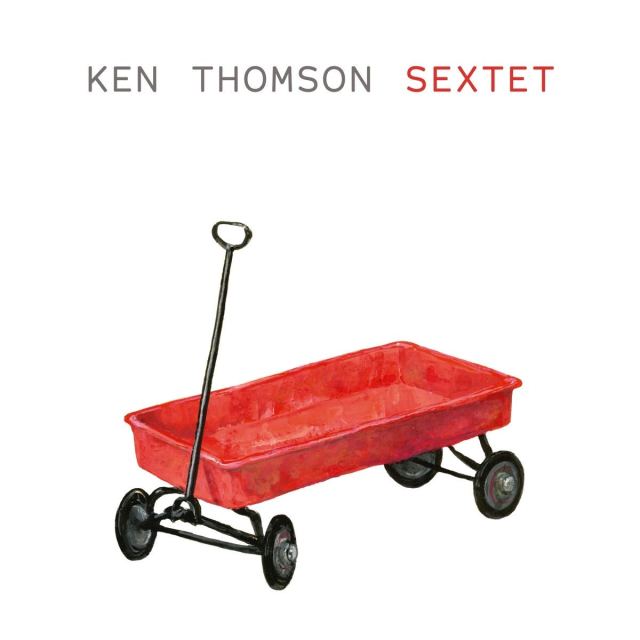
Ken Thomson’s Amazing “Sextet”


thomsonsextet

Panoramic Recordings

First of all this packaging is about twice the size of a normal CD package.  It is lovingly designed by Jason Das and visually suggests a sort of nostalgia for innocence, for childhood perhaps.  The performers are all of that “New York Downtown”/modern music background and this is a set of rigorously trained musicians.    Put them together as a sextet and tap their virtuosity as well as their improvisational abilities and some clever programming and you get this album.

It is an unusual but ultimately very satisfying album.  It starts with (of all things) a transcription of music by the late Hungarian master Gyorgy Ligeti, his Pasacaglia Ungherese (1978) which is originally for harpsichord.   This is hardly a “jazz” piece and one wonders at the choice of this particular work to be the one to make that all important first impression.  The transcription (by Ken Thomson) is quite effective however and very entertaining.  I’m not sure why the it was chosen but it works well here.

This leaves us with the remaining six tracks (all composed by Ken Thomson) which are more clearly in the realm of “jazz” the way most listeners are accustomed to hearing it.  Drums keeping the beat, a recognizable bass line, and improvisational solos over the harmonic progression.  These virtuosos are given a challenge by said composer and the solos which populate these tracks are one of the best things about this release.  Clearly these musicians are comfortable with their virtuosity and they seem to understand jazz.  They got and held this listener’s attention most immediately.

The Ken Thomson Sextet consists of Ken Thomson, composer and alto saxophone; Anna Webber, tenor saxophone; Russ Johnson, trumpet; Alan Ferber, trombone; Adam Armstrong, bass; and Daniel Dor, drums.  Clearly all these folks have a thorough knowledge of jazz performance and can take their audience on a mighty exciting ride.  The solos will stick in your head long after the initial thrill of your first hearing and this is a nicely balanced group functioning almost as a single entity.  Very cool.

This is chamber jazz at its finest.


Celebrating a Great Supreme Court Justice in Song


rbg

Of all the publicity heaped on the Supreme Court of the United States recently this CD definitely stands out as the most unusual but also the most joyous.  Notorious RBG in Song is something of a first, a CD celebrating one of our living Supreme Court Justices.

Ginsburg’s son James is the founder of this wonderful Chicago based recording label and clearly shares in the admiration of this physically diminutive intellectual powerhouse of a justice.  The surprise for this writer is to hear the compositional skills of the wonderful soloist Patrice Michaels (also James Ginsburg’s wife) who has long been a welcome musical performer in Chicago.  She composed The Long View (2017) for this album and the liner notes list even more compositional accomplishments.  The remaining four songs are by Lori Laitman, Vivian Fung, Stacy Garrop, and Derrick Wang.  Wang, the only male composer in this group (a symbolically satisfying fact) also happens to be the composer of an opera “Scalia/Ginsburg” (2012-15) which actually premiered in Washington D. C.  The other man in this recording is the fine accompanist Kuang-Hao Huang.

We learn from the extensive liner notes that this CD is a labor of love involving many people from various orbits around this important American Justice.  The liner notes recount many admiring perspectives on this public figure who so improbably has risen to being a major cultural icon in part by her incisively written dissenting opinions.  She has touched many lives and has thus far lived an amazing life herself.

The lyrics which are tastefully produced in a separate booklet come from a variety of very personal sources all carefully recounted here.  And “personal” is exactly what this album is about.  This is not about politics, it’s about family.  There are quite a few lovely photographs included and the cover art by Tom Bachtell with graphic design by Studio Rubric bring this intimate tribute together most successfully.  This will be a collector’s item some day.

Ultimately this is a recital disc featuring one of the finest sopranos working today featuring her as a composer as well.  It is also an unusually beautiful tribute to a truly great American and, evidenced by the love and admiration here, to a truly beautiful circle of family and friends.  Listen to the music, read the words, and feel the love.  This is a classic.


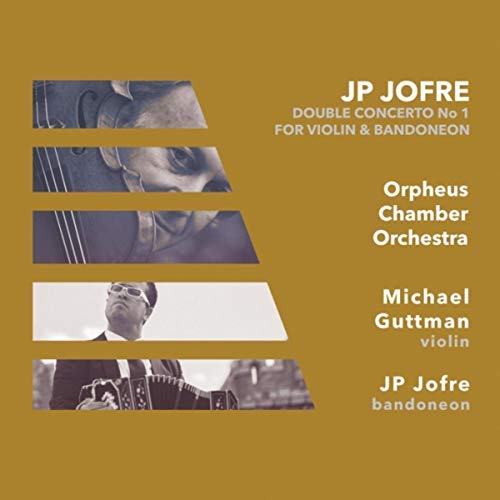
J. P. Jofre Double Concerto


jofredouble

This writer’s first encounter with a bandoneon was the electroacoustic “cybersonic bandoneon” of Gordon Mumma from about 1966.  In fact the instrument has its origins around the beginning of the 20th century.  It is a small accordion-like instrument which relies on the performer operating a bellows while pushing buttons on the instrument which force air past reeds which vibrate at their tuned pitch.  It is a folk instrument in Germany and Argentina where it became best known as the workhorse of the tango bands of the time where it continues to be popular.

It’s appearance in the avant garde with experimentalists such as Mumma did occur but the instrument became best known through the work of Astor Piazzolla (1921-1992) who incorporated tango in much the way Aaron Copland incorporated American folk songs into his classical works.  Despite his popularization of the instrument it remains largely just one of the instruments in local tango bands and the classical world appears to have largely withdrawn its interest since Piazzolla’s passing.

JPJofre

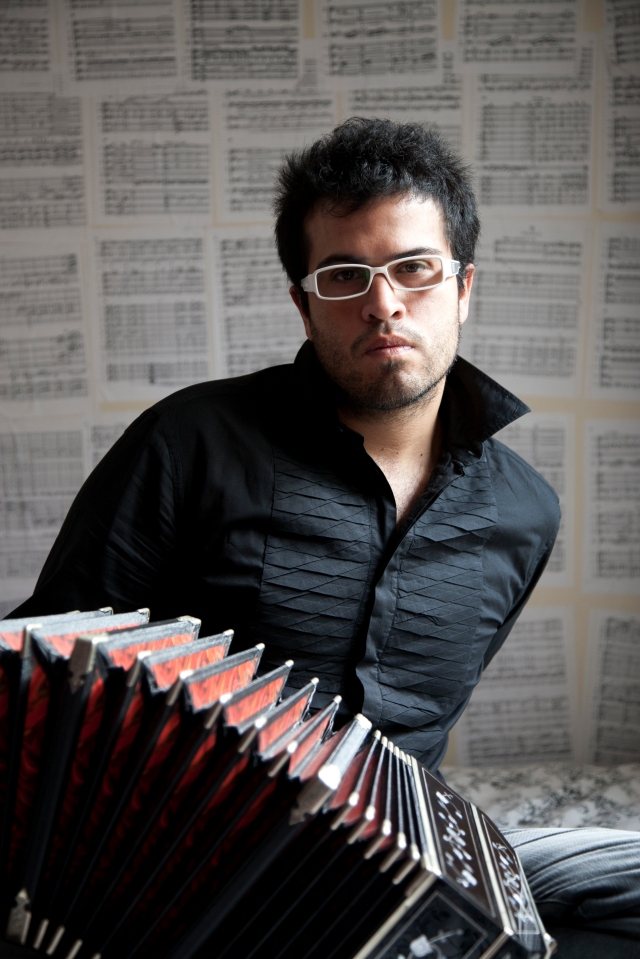
Juan Pablo Jofre (from his web site)

Well along comes native Argentinian Juan Pablo Jofre Romarion (1983- ) who appears to want to change that.  In addition to running his own tango band and promoting the music of his predecessor Piazzolla he now ventures into the classical realm with no less than a double concerto for bandoneon (of course) and violin.

Now this is not the avant garde stylings of the 1960s and 70s such as that typified by Gordon Mumma.  It is also not the sort of experimentation done by Piazzolla as he incorporated his native folk musics into the realm of the classical stage.  Instead we have a classically trained virtuoso bandoneon player forging his own style which is in fact quite listenable and seems to be treading a path of significance that may rival his teachers and mentors.  If you need a category for this disc try neo-romantic or just world music.

It is not difficult to imagine Jofre writing for the instrument of his own virtuosity but he also manages to write a substantial part for the other instrument in this double concerto, a violin.  He engages Belgian classical violinist Michael Guttman to share the stage in this large and substantial composition from 2016-17 and gives him a great deal to do.

Jofre has distinguished himself as one of the important interpreters of tango with his own band and, in particular, the works of Astor Piazzolla.  Now we get to hear the next phase of this emerging artist as he ventures into the world of the classical stage bringing his diminutive folk instrument to the fore.

In this tasty little recording we get to hear two highly skilled soloists and none other than the Orpheus Chamber Orchestra who do justice to Mr. Jofre’s first (and one hopes not the last) concerto for bandoneon and violin with chamber orchestra.  It is difficult to say if Jofre is going to be able to handle large musical forms (like symphonies, opera for example) but he is quite adept at writing for these three to five minute movements which constitute the concerto’s structure.

Jofre is at his best writing for the two solo instruments and some of it is ravishingly beautiful.  All of it is quite listenable and one must surmise that Jofre is a rising star with great talent and that he will continue to write music of this quality and passion.  It would be wonderful to hear more of the possibilities of combining the bandoneon with other classical instruments, maybe a concerto for accordion and bandoneon (of course the possibilities are boundless).  Clearly this is just the beginning for this emerging artist who seems poised to take on the mantle of Argentina’s other great tango composer, Astor Piazzolla both in his compositional and performance skills.

This substantial concerto (which chooses to split the outer movements into two parts) covers five of the six tracks on this disc.  The remaining three tracks are for bandoneon and violin.  These duos provide a glimpse of the powerful and intimate nature of Jofre’s compositional skills.  This is beautiful music and here’s hoping  that this disc will be the start of a mini renaissance of tango, Piazzola, etc.

It may be some time before the bandoneon is a common instrument in classical concert halls (or maybe it will never become common) but there is no doubt that Jofre’s instrument and his music deserve serious attention.  I would stay tuned if I were you.

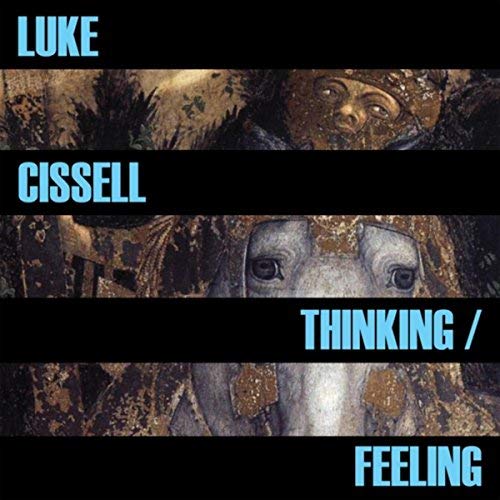
Luke Cissell’s Thinking/Feeling,Gently Defying Genre


cissell

Silver Squid Music

I believe the composer himself sent me this disc.  I was not familiar with this composer/musician prior to receiving this but, a quick search on Amazon revealed several albums by this artist.  Cissell‘s web page validates my initial impression of an artist who will not easily fit in a category.  That is to say that this music wears several hats.

There is nothing experimental or difficult about this CD nor is it exactly pop or easy listening.  It is a rather personal recording.  Indeed the composer plays most of the parts and the concept is entirely his own.  Not having heard Cissell’s other recordings it is difficult to say whether this most recent one is a continuation of a style or a departure.  What is clear is that this music is easy to listen to but difficult to market efficiently.

This entirely self composed and produced album consists of 13 tracks ranging from 2 to 5 minutes or so in length.  The instrumentation consists of mandolin, electric bass, strings, and electronics and all are performed by the composer.  He identifies the track, “Follies” as being most appropriate for classical radio and the track, “Serf Shop” for pop/alternative radio.  It is lovely material with some folk leanings as well as classical leanings.  Cissell has classical training and that comes across in his writing but suffice it to say that his influences are eclectic and wide ranging.  He clearly is well trained in his ability to write effectively for these instruments and hearing this work makes one wonder what his more classically oriented work sounds like.

If this disc has languished for longer than it should have in my “to be reviewed” queue then blame it in part on the reviewer’s organizational strategy but also on the difficulty pigeon holing such a release.  There is little doubt that most who hear this album will find it entertaining but it is not clear how easy it will be for fans to find such a release unless they are searching for this specific composer.

In reviewing “classical” recordings one can rely on the “sounds like” strategy to provide listeners with some idea of what to expect.  That does not seem to work here.  The music is very listenable but it is not strictly classical and not exactly pop so while it is a very good disc I’m not sure how easily it will find an appreciative audience.

This reviewer will pay attention to this composer and looks forward to hearing his more classically oriented work as well.  Kudos, Mr. Cissell.

Douglas Boyce New and Exciting Chamber Music


boyce

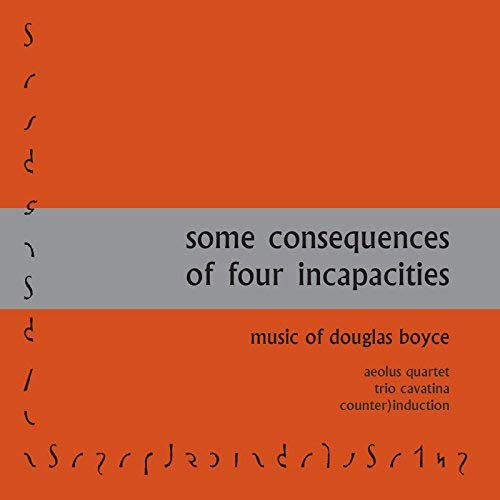
The rather plain cover belies the contents of this album of exciting and powerful chamber music.  This is billed as a “sampler” album and it contains three works by Douglas Boyce (1970- ).  He is a founding member, curator, and composer-in-residence of counter)induction, a composer/performer collective active in the New York region.  He also has experience playing in various punk bands.

Boyce holds a B.A. in Physics and Music from Williams College, an M.M. from the University of Oregon and a Ph.D. from the University of Pennsylvania (1999).  He has studied with George Crumb, James Primosch, Kathryn Alexander, Robert Kyr, Judith Weir, Ladislav Kubik and Robert Suderburg.  He currently serves as Associate Professor of Music at the George Washington University in Washington, DC.

All this gives only the faintest hint of what his music sounds like.  In the three works represented here the listener will notice some influence of Bartok and mid-century modernism.  The first work “102nd and Amsterdam” (2005)  reflects a composer well schooled in writing for string instruments.  This piece is a string trio played by members of the Aeolus Quartet (Rachel Shapiro, violin; Greg Luce, viola; Alan Richardson, cello) and they are given a great deal to do.  This is an energetic piece which engages the listener immediately and doesn’t really let go until the end some 14 plus minutes later.

The writing is virtuosic and the variety of techniques employed in his string writing are engaging and never seem gratuitous (i.e. extended techniques because I can).  Despite multiple glissandi and other string effects the work, like the others on the album, are basically using the tonal language common to most western music.  This is seriously engaging and masterfully developed music.  It hooked this listener immediately.

The second work is Piano Quartet No. 1 (2009).  This is an even more visceral work true to Bartokian esthetics.  In its relatively brief 8 plus minutes the listener is taken on a virtuosic journey by the musicians of counter)induction (Jessica Meyer, viola; Sumire Kudo, cello; Steve Beck, piano)  They are joined by the wonderful Miranda Cuckson who steps out of her soloist role and moves deftly into this chamber group as the finest musicians can do.  Boyce cites influences as diverse as Robert Fripp and King Crimson but the details of that are not necessarily clear to this writer nor is it necessary to the appreciation of the work.  It is a powerful and exciting piece of chamber music.  This work left this listener a bit tired by the end (it is quite a workout) but the same ability to sustain interest and attention which applied to the first work is also present here.

Finally the Trio Cavatina (Harumi Rhodes, violin; Priscilla Lee, cello; leva Jokubaviciute, piano) presents a reading of the four movement “Fortuitous Variations” (2014).  This most recent composition is the big work on this disc.  The underpinnings, if you will, involve philosophical ideas and are elaborated well by the composer on his web site but, like the influences of the previous work, the music stands very well on it’s own.

There are four movements which seem to correspond (at least roughly) to the sonata form commonly used in such works.  Each maintains it’s character as said variations are rolled out and, as in the previous works, sustains interest easily.  This is perhaps a more ponderous work which is less direct than the previous two pieces but this most recent composition no doubt reflects the composer’s development and time will tell what direction his work will take.  There is, however, a sense that the composer has developed a personal style and is cultivating it.  Give a listen.

Most will want to hear these works multiple times.  This reviewer managed to find three separate drives which allowed uninterrupted listening to the entire disc and I know those three won’t be the last.

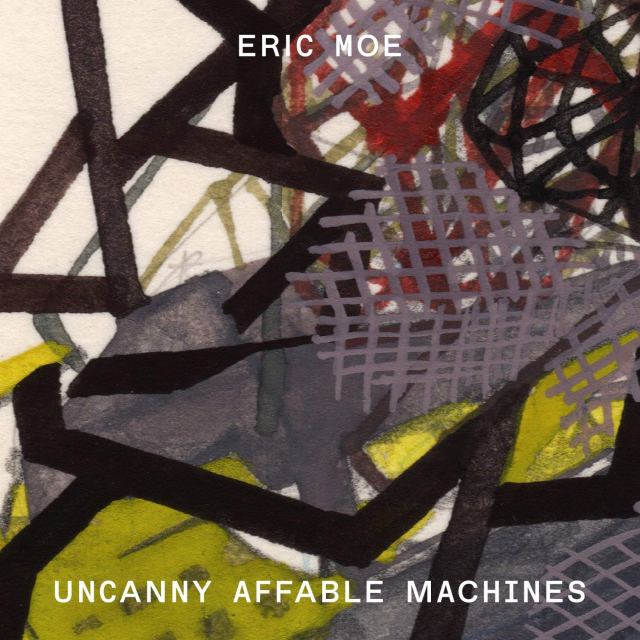
Eric Moe, Uncanny and Affable (and very interesting)


moeuncanny

New Focus FCR 212

Here I sit with an album by a composer with whom I have no familiarity.  Fortunately Eric Moe has a delightfully tenacious public relations department (at least with this particular record label) whose prompts did finally get me listening.  OMG, it says “electroacoustic”.   That could be really bad or obtuse.  Well, I did promise to review it so here goes.

Eric Moe (1954- ) is a composer with a very well organized web page.  A quick glance at that web page informs that this is the 12th or so disc from a man who boasts what looks like a list of over 100 compositions.  Moe is also a performer and participates on this disc.  This graduate of Princeton (A.B., Music) and Berkeley (M.A. and Ph.D., music) teaches at the University of Pittsburgh and is also an active performer of both his and others’ music.

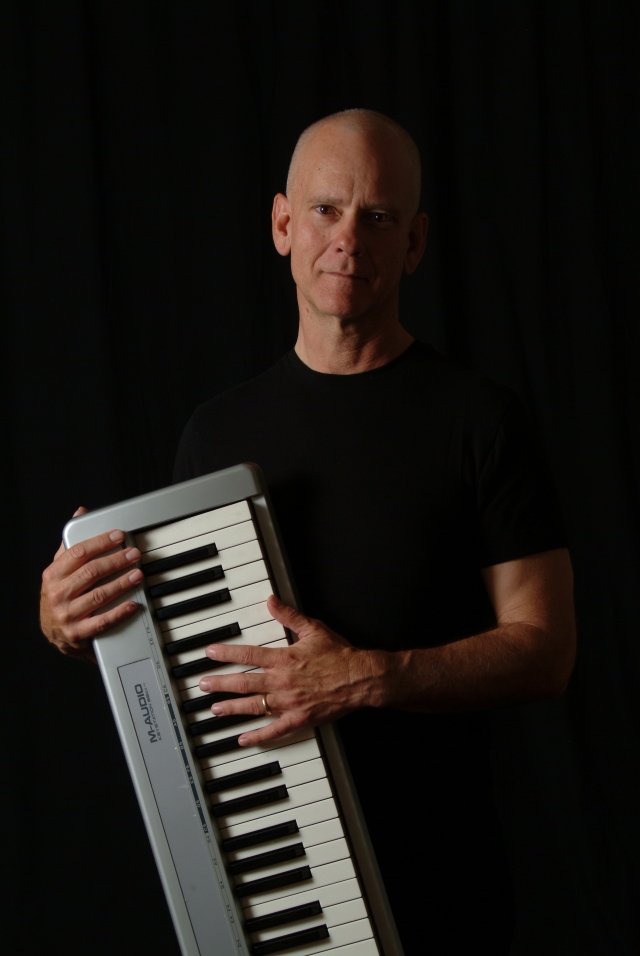
moekeyb

This discs contains 6 composition for solo instrument (mostly with) electronics.  Now that combination has given this writer pause because the genre given the name “electroacoustic” can be a mixed bag.  Sometimes these works can be ponderous or obtuse with meanings obvious to the composer and, hopefully, the performer.

However your reviewer’s neurotic fears were apparently unfounded as the tracks played some truly wonderful compositions.  Each track features a different instrument.  The instruments, in order, include a drum set played by Paul Vaillancourt, a viola played by Ellen Meyer, a solo 19tet keyboard played by Eric Moe, an unbelievably virtuosic pipa played by Yihan Chen, solo piano played by Eric Moe, and flute played by Lindsey Goodman.

Suffice it to say that all the soloists here come with a high level of virtuosity as well as the ability to interact meaningfully with the electronics.  Far from being a nightmare of impenetrable experimental music this is rather a very entertaining set of pieces which tend to avoid the worst cliches of this genre.

Rather than attempting to describe each of these pieces (a task which would likely be more painful to read than write) it is best to simply provide assurances that the combination of this talented composer combined with the more than capable soloists provides a stimulating and interesting listening experience.  These are wonderful performers with great material.

The listener will want to hear each track more than once to get a good idea of what the composer is doing but, fear not, this album is much more adventure than ordeal.  It shows a composer at the height of his powers producing art which stimulates the senses and provides an emotional experience.  While there is clearly intellect behind the creation and performance of these works they tend to speak rather directly to the listener providing a stimulating entertainment that leaves the listener with a shred of hope that classical, even modern classical is far from dead.

Kudos to professor Moe and his collaborators and a nod of thanks to the tenacious publicity folks who would not let this release go quietly into the good night.  You shouldn’t either.

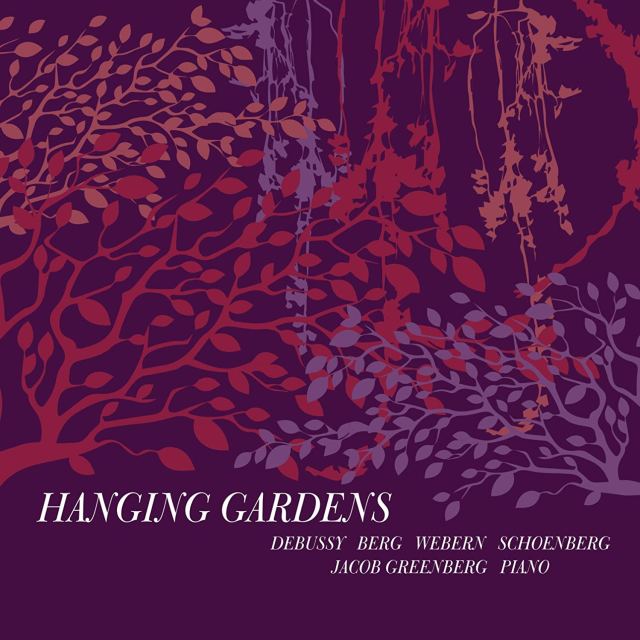
Jacob Greenberg Putting Debussy in Context


hanging

New Focus FCR 192

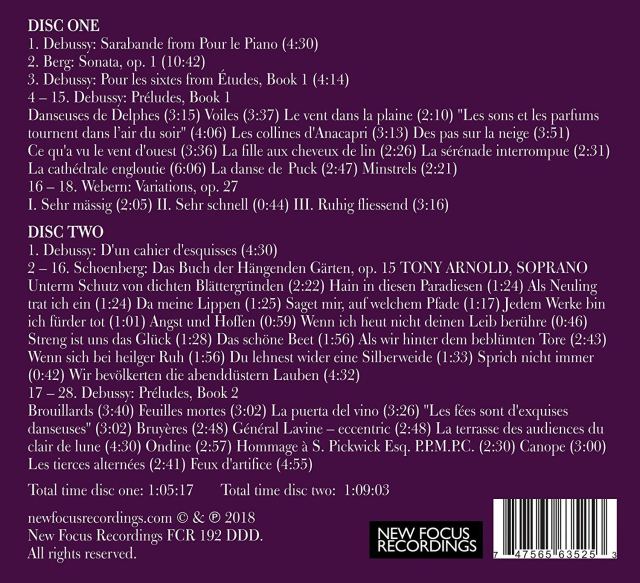
Well it’s been 100 years since Claude Debussy (1862-1918) left the earthly plane and anniversaries are good times for a re-evaluation.  Usually this just means issuing recordings of a given composers works, mostly the composer’s most popular.   Jacob Greenberg has chosen to record Debussy’s Preludes for Piano Books I and II (1909-1913).  But that alone seems a bit pedestrian so he adds in Alban Berg’s (1885-1935) Op. 1 Piano Sonata (1909), Anton Webern’s (1883-1945) masterful Variations for Piano (1936), and Arnold Schoenberg’s (1874-1951) “Book of the Hanging Gardens” Op. 15 (1908-9) as well as a few additional Debussy pieces.  Greenberg is a sort of refugee from the International Contemporary Ensemble.  For this recording he also conscripts the fine soprano (and fellow ICE refugee) Tony Arnold.  These two have already amassed quite a few recordings of repertory from this era.

greenberbdebussy813HMwi-pPL._SL1500_

This mix provides a context for the listener which shows where the Preludes fit historically and demonstrates some of the similarities in sound between these early 20th Century works.  We hear music written between 1908 and 1936 by four composers.  Hearing these works together gives the listener a sense of how some of the best “contemporary” compositions of this brief era sounded.  Indeed there are similarities here and one can see the emerging style which would become known as “expressionism”.  It is clearer how this emerged from Debussy and Ravel’s “impressionism” when you hear related works from the same era.

This reviewer had not been familiar with Schoenberg’s “Book of the Hanging Gardens”.  It is one of the less performed of his works.  These songs have a militantly atonal sound. Vocalist extraordinaire Tony Arnold puts real muscle into her reading of these songs.  The disc is worth acquiring for her performance alone.

In some ways this cycle appears to have been Schoenberg’s “Tristan und Isolde” meaning that he had stretched the limits of tonality and, unlike Wagner, he chose to develop a method which would ensure that there is no tonal center in his music.  He developed his method of 12 tone composition and rolled out his first example of this new method in 1925.

What is striking is that this Schoenberg song cycle dates from pretty much the same time as the Debussy Preludes and Alban Berg’s Piano Sonata.  One gets a sense of some of the tensions involved here.  Try to imagine being in the audience and hearing the wide stylistic differences between these two works and realizing that they are essentially from the same era.  Add in the much later Variations by Webern and one gets a sense of how far music could go, stylistically, based on Schoenberg’s methods.

Obviously the Debussy Preludes are the main focus here and these are acknowledged as classics of the repertoire.  They are most ably performed here but what struck this listener the most was the sound of those preludes in the context of the other pieces here which were part of that same 30 year span.  One can begin to hear perhaps some affinity between the Debussy and the later thornier harmonies and rhythms that typify the expressionistic style which would dominate much of the mid-twentieth century.

This is a fabulously entertaining recording and a sort of music history lesson as well.  Greenberg is a strong and assertive musician with an obvious feel for these pieces.  His choice of repertoire makes this a particularly good choice for the listener who is just beginning to explore this musical era and an eye-opening program for the seasoned listener.  Great set.

Telegraph Quartet Debut: Into the Light


TelegraphQuartet_IntoTheLight_AlbumCoverThis is the debut album for the Telegraph Quartet who are based in the San Francisco Bay Area.  They have chosen some curious works from the quartet repertoire to represent this nascent ensemble, Anton Webern’s Op. 5 Fünf Satze (1909, Benjamin Britten’s Three Divertimenti (1936), and Leon Kirchner’s String Quartet No. 1 (1949).

Webern is, of course well known, but relatively seldom played.  His pithy, brief, pieces belie a complexity which may delight musicologists but his music, for all of it’s craft, is never going to be a crowd pleaser like Haydn or Beethoven.  It appears that The Telegraph folks are putting together a carefully selected intro to their work.  They execute these little masterpieces with care and manage to squeeze the expression out so that the audience can begin to appreciate it.

The Benjamin Britten (1913-1976) Divertimenti were unfamiliar to this listener and, doubtless, will be a pleasant surprise to many.  Britten wrote three string quartets and a few other miscellaneous pieces for quartet.  It is a bit surprising that these little Britten gems have gone with so little notice before now.  These are three brief (though not as brief as the Webern) but engaging little compositions that clearly deserve at least an occasional performance.  The Telegraphs handle these with a powerful almost romantic interpretation.  It’s hard to say not ever having heard any other performance but these are engaging pieces.

Leaving the best for last we get to hear music by Leon Kirchner (1919-2009).  This Pulitzer Prize winning composer (he won for his Third String Quartet from 1967).  Kirchner wrote 4 quartets in total which vary widely in style.  They date from 1949, 1958, 1966, and 2006 (which remains unrecorded…hint, hint).  Kirchner wrote in pretty much all genres and even worked with electronics.  It is time for a new reckoning of his work.

The first quartet is the least heard of the lot and is of a sort of romantic quality.  It is a passionate composition that is influenced by a variety of styles but it precedes his 12 tone compositions.  This quartet seems to have an affinity for romantic gesture and singing melodies and listeners will doubtless want to hear this work multiple times.

Some may recall a Columbia album from the 1970s that recorded Kirchner Schoenbergian second quartet as a “B side” to an album which contained Kirchner’s drama, Lily, based on Saul Bellow’s “The Rain King”.  That disc was almost a Kirchner sampler displaying two major aspects of the composer’s output.

All the works here are bound to please a concert audience and this little collection of works dating a forty year period from 1909 to 1949 are excellent vehicles for this ensemble which sports a lush sound and a feeling for the proper shaping of melodies.

The Telegraph Quartet consists of Joseph Maile and Eric Chin (who apparently share the role of first violin with the other taking the second violin), Pei-Ling Lin, viola, and Jeremiah Shaw cello.  It’s difficult to say how this new quartet will fare but this album suggests that they are already on their way musically and, judging from their choice of repertoire, they are likely to unearth (and probably commission) unheard delights of the quartet repertoire.  Well done!

Josh Modney’s “Engage”, New Music for Violin Solo and Not Solo


modneyengage

New Focus FCR 211

This is an awesome undertaking.  I recall when pop musicians were cautioned that it may be unwise to release a so called “double album” for fear that their inspiration (or talent) may not be up to the task.  Well here comes Josh Modney violinist and Executive Director of the Wet Ink Ensemble , a member of the International Contemporary Ensemble (ICE), and a performer with the Mivos Quartet for eight years.  This 3 CD set is his solo violin debut album.  And what an album it is.  There is no lack of talent, skill, or imagination here.  This is essentially three faces of Josh Modney a sort of sonic CV.

The first disc features four tracks of music by contemporary composers for violin with soprano, piano, and/or electronics.  All four are fairly recent compositions:  Sam Pluta’s “Jem Altieri with a Ring Modulator Circuit (2011), Taylor Brook’s “Vocalise” (2009), Kate Soper’s “Cipher” (2011), and Anthony Braxton’s “Composition No. 22” (1998).All of these are challenging for the musicians and none are easy listening but all demonstrate aspects of Modney’s skills as a musician

The second disc features J. S. Bach’s “Ciacona” or “Chaconne” (1720) from the second violin partita.  But this is not just another performance of this towering masterwork of the solo violin repertoire.  Modney has chosen to perform it in just intonation.  Now how’s that for versatile?

The effect is subtle and may even be lost on some listeners but fanciers of Bach and alternate tunings will likely find this to be anywhere from mildly interesting to revelatory.  It is a fine performance and it is interesting to hear it in just intonation and amazing to know that this performer has this uncommon skill of playing accurately in an alternate tuning on the violin.

Filling out the second disc is a piece by pianist Eric Wubbels, “the children of fire come looking for fire” (2012).  This is a very different piece and I’m not sure why it was paired with the Bach except that it fit the available space.  Wubbels contribution is a sort of electroacoustic collage.

The third (and last) disc is of solo violin compositions by Josh Modney.  Again we move into contemporary and experimental compositions which reflect Modney’s skill with the instrument as well as his insights into it’s potentials.  Again there are no echoes of Bach here but rather more of the experimental/avant garde/free jazz style which dominates this album.  The solo violin repertoire is not huge so it is reasonable to assume that these little gems will find a place there.

This is a lovely production with striking cover art and excellent sound.  If you like cutting edge violin music you will have a wonderful time with these discs.  And if you’re looking for a wildly skilled and imaginative musician check this set out and get ready to be wowed.


A Far Cry: Visions and Variations


farcryvisions

Crier Records CR 1801

This is the latest release by an ensemble whose debut CD was released some nine years ago.  Most recently this ensemble released a fine recording featuring Simone Dinnerstein playing piano concertos by J. S. Bach and Philip Glass.  This recording is focused on the virtuosity of this small string orchestra by focusing on some unusual but highly listenable pieces from the early twentieth century to the present.

The lovely cover art (by Bill Flynn) conjures images that evoke Picasso’s drawings of Igor Stravinsky conducting.  The album evokes a feeling of an early twentieth century salon and makes the most of this rather small ensemble which counts 20 musicians on this release.  The issue here seems to be quality musicianship exploring unusual but very listenable music.

The disc begins with the too little heard Variations on a Theme by Frank Bridge (1937) by Benjamin Britten (1913-1976).  Bridge was one of Britten’s teachers and a fine composer as well.  This is the piece that first brought Britten international recognition but it is not frequently played or recorded as one might expect.   It is a very entertaining set of variations and one can only surmise that this ensemble will likely tackle some of Britten’s other early string orchestra pieces like the Simple Symphony (1934).

After that workout we are treated to another set of variations.  This time by one Ethan Wood, a violinist with the ensemble.  His contribution is a set of variations on the French song, “Ah vous dirais-je, Maman” (better known to some as “Twinkle, Twinkle Little Star”).  This little fantasy is billed as “a folk tale for 18 players based on characters created by W. A. Mozart”.

And, finally, we have a lively transcription of Sergei Prokofiev’s ” Vision Fugitives” Op. 22.  Originally for piano, this string orchestra version is a unique but interesting idea.  The ensemble handles this complex music well and this version provides a perspective on these little miniatures that will produce discussion among fanciers of the original piano versions.

All in all this is basically a pretty conservative program stylistically but the intelligent choices of repertoire and the wonderful execution make this a stand out release with incredible potential that will leave listeners waiting for their next release.

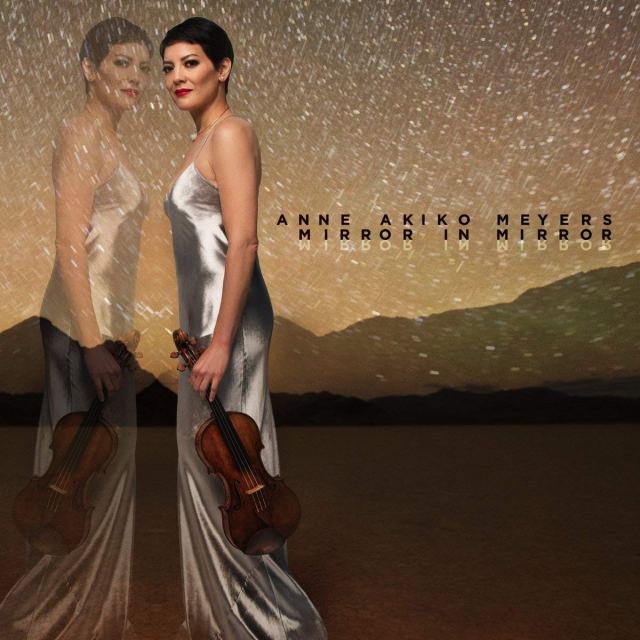
Anne Akiko Meyers’ Romantic Post Minimalism Enthralls


aameyers

Avie AV 2386

Admittedly I am a sucker for nearly all things minimalist and post-minimalist.  Such programming can lead to some potentially dull or cloying experiences.  Not so with this lovely collection of miniatures though.  While minimalists like Glass and Pärt make their appearances the concept here seems to reach for larger goals.  We have a mix of relatively simple chamber compositions along with electroacoustic works, a revelatory take on Ravel’s Tzigane and and arrangement for violin and orchestra of a solemn choral piece by Morten Lauridsen.

This eclecticism seems to flow from the artist’s choices rather than choices imposed by a producer.  In this respect she reminds this reviewer of pianist Lara Downes whose repertoire choices are similarly eclectic but born very personally from the artists’ experiences and preferences.

The opening Philip Glass Metamorphosis Two (1988) is presented in an arrangement by none other than Glass’ long time champion Michael Riesman.  It is followed by two violin and piano pieces by Arvo Pärt, Fratres (1977) and Spiegel im Spiegel (1978).  These lovely works serve to draw the listener in most pleasantly.  Akira Eguchi is the fine pianist who plays on all but tracks 4, 7, and 8.

Next up is a piece of musical archaeology.  Tzigane (1924) was originally written for violin and piano.  It was later orchestrated and it is that version which is best known and probably most recorded.  Well it turns out that Ravel had made a version for a now defunct instrument called a Luthéal which is an instrument invented in the early 20th century (patented 1919).  It’s actually not so much an instrument as an add on.  It modifies the sound of a piano.  The device now exists in museums but that hasn’t stopped innovative producers from utilizing an electroacoustic version.  Elizabeth Pridgen plays the keyboard to which the lutheal is virtually attached.

Apparently this version has been recorded before but this writer encountered it first in this release.  It is a very different sound than the piano or orchestral versions and is a lovely take on the music.  Many may buy the album for this track alone.

This is followed by a charming lullaby written for Meyers’ youngest daughter.  John Corigliano has absorbed only a small bit of the minimalism bug (maybe his 1985 Fantasy on an Ostinato  qualifies) but he is one of our finest living composers and he appears to infuse this violin and piano miniature, Lullaby for Natalie (2010) with a tender romanticism that is both sweet and touching.  In the notes we learn that it did seem to put her daughter to sleep but I doubt it will do that to most listeners.

The next two tracks are works by one Jakub Ciupinski  (1981- ) who also has a stage persona under the name Jakub Ζak under which he performs live electronic music.  This Polish born composer is now based in New York and works with various forms of electronics including a theremin.  Both “Edo Lullaby” (2018) and “Wreck of the Umbria” (2009) come from a similar place musically.  Both use electronics in varying degrees to enhance and accompany the solo violin.  Both are delightful little gems that give a nod to some minimalist roots but stand on their own merit and prompt this listener to keep an eye/ear out for more of this composer’s work.

The concluding piece is an arrangement by the composer Morten Lauridsen (1943-  ).  The performer states she pursued Lauridsen for a new piece and when he finally acquiesced he presented this lovely arrangement of his well known choral piece, “O Magnum Mysterium”.  The arrangement is for string orchestra and violin and orchestra here given its world premiere performance.  It should come as no surprise to new music fanciers that the Philharmonia Orchestra is conducted by none other than Kristjan Järvi, a fine conductor, composer, and avid new music advocate who can always be found near some interesting musical projects.

This album stands out in that the choices of the musical selections and the personal connections between the composers and the soloist are clearly collaborative and  inspired.  This is substance rather than fluff but it may appeal to a wider audience.  This one can be said to have crossover hopes but it does not pander.  This is a wonderful album and will likely prompt listeners who, like this writer, have yet to know this soloist to go and seek more of her recordings and live performances.  Brava!


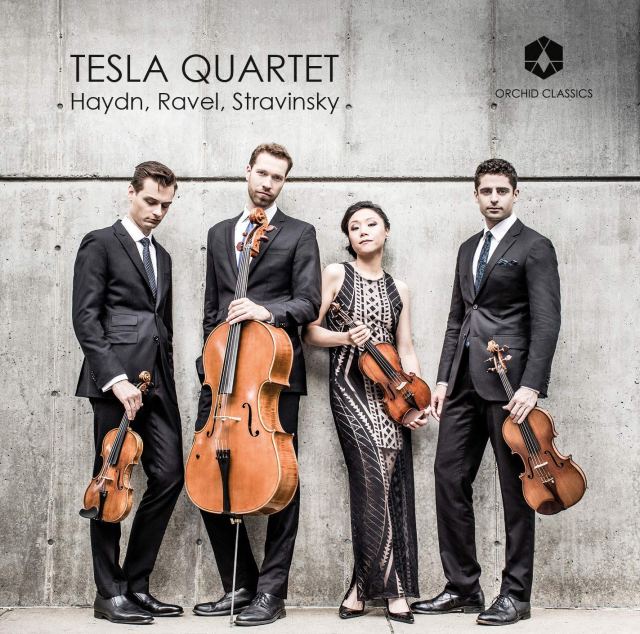
Tesla Quartet Debut Pleases


teslaqr

Most recordings of the wonderful Ravel String Quartet of 1902-3 is most frequently paired with the similarly masterful Debussy String Quartet (1893) or with another of Ravel’s fine chamber works.  Not here though.  For their debut recording this quartet has apparently chosen to demonstrate their skills by programming which spans the 18th to the early 20th century along with a selection of transcriptions of lesser known Ravel pieces.  After ten years playing together they have chosen to lay down some recorded tracks for posterity.

The disc opens with the Ravel Quartet which is handled most ably.  It is ostensibly this quartet that inspired first violin Ross Snyder to dedicate his career to the string quartet.  The bonuses here are transcriptions by first violin, Ross Snyder, of three lesser known Ravel piano pieces.  They are, in order of appearance on the album, the brief Menuet sur la nom d’ Haydn (1909), the more familiar Menuet Antique (1895), and the Menuet in C sharp minor (1904) are heard in transcriptions for string quartet.

By contrast the Teslas have chosen to feature Haydn’s String Quartet in C major Op. 54 No. 2.  It is the first one of the first set of so called “Tost” Quartets written in 1788 and named for a violinist (Johann Tost) of the Esterhazy orchestra.  This is mid-career Haydn who is justly known as the father of the string quartet.

The larger works are punctuated by the short transcriptions.  The Menuet sur le nom d’ Haydn follows the Ravel and leads us neatly to the Haydn.  The Menuet Antique follows next.  It is one of the more ubiquitous compositions of Ravel and listeners familiar with the composer’s work will doubtless recognize it as it appears in the Sonatine and the piano suite (later orchestrated), Le Tombeau de Couperin.

We then get to hear a lesser known masterwork by Igor Stravinsky (1882-1971), his Concertino for String Quartet (1920).  This is early Stravinsky but he clearly thought highly of this piece as he later orchestrated it in 1953 for small ensemble.  It is only about six and a  half minutes long but listeners will be able to discern this as a masterful work by the composer who had already produced his three great ballets, The Firebird, Petrushka and The Rite of Spring.  Nothing that earth shaking here but the hand of the artist can clearly be heard.

The disc ends rather enigmatically perhaps with a transcription of the very brief Menuet in C sharp minor which clocks in at under a minute.  The end result is a tasty little resume of an emerging chamber group that one hopes will bring another interesting perspective on the genre of the string quartet.  This is an auspicious and most listenable debut.

Gourmet Vegan with Solo Bass


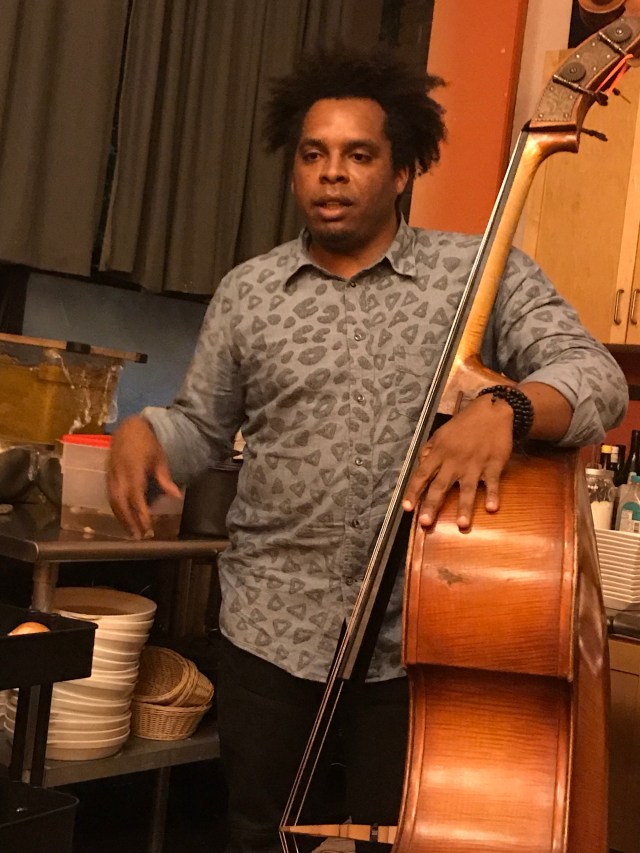
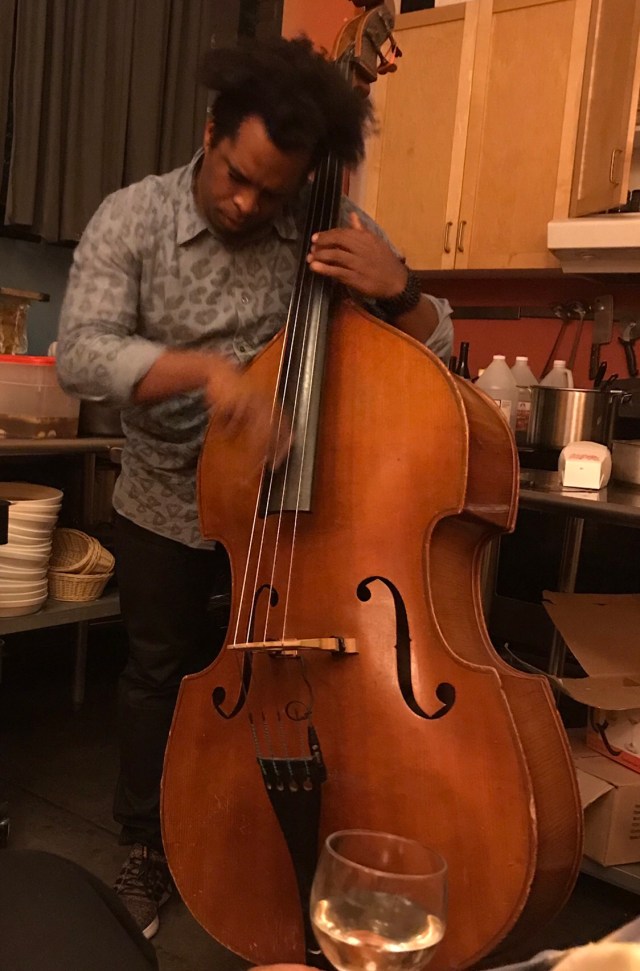
Chef and host Philip Gelb (left) introduces Rashaan Carter

Friday August 17th was one of the last of Mr. Gelb’s famed Masumoto peach dinners incorporating the incredible peak of the harvest peaches into his magical vegan creations.  It is ostensibly among the last of his famed dinner concert series which has now run about 13 years.  Whether the series is ending remains to be seen but the opportunity to partake of Gelb’s culinary art should never be missed and this night we had the opportunity to hear a fine young musician as well.

img_0277

Phil started me with this tasty IPA, perhaps the only item that was not peach related.

img_0278

Dinner for about twenty happy diners began with this delicious corn soup.  Gelb has an eye for artistic presentation.

img_0279

A little peach based salsa added a bit of fire for those of us who enjoy spicy things.

img_0281

And on to the Baiganee (eggplant fritters) with peach kuchela and peach chutney.

img_0283

The main course was Jerk Stewed Tempeh, Rice, and Peas Calaloo.  Unfortunately my eating got a bit ahead of my picture taking but you get the idea.

Peaches are, as I said earlier, from the Masumoto family farm near Fresno where three generations have been producing some of the finest fruit in the state.  The tempeh is also locally sourced from Rhizocali Tempeh of Oakland.  It doesn’t get better than this.

img_0289

The tradition here puts the musician on stage just before dessert.  Rashaan Carter is an American musician from Washington D.C. who now resides in New York.  He was passing through the bay area and Philip Gelb extended an invitation which he graciously accepted.

He began with an improvisation which he had initially done for a dance piece depicting the lynching of a black American woman Laura Nelson and her son in Oklahoma in 1911.  Now this could really bring down the mood of the evening but for the fact that Carter spoke of and subsequently played this piece with such passion that all one could really feel is the tragedy of the act and the heroic expression of what is essentially protest music dedicated to her memory.

img_0290

Rashaan has no small bit of the Blarney.  His running commentary during the performance was as entertaining as that of a stand up comic as he engaged most thoughtfully with the evening’s clearly appreciative audience.

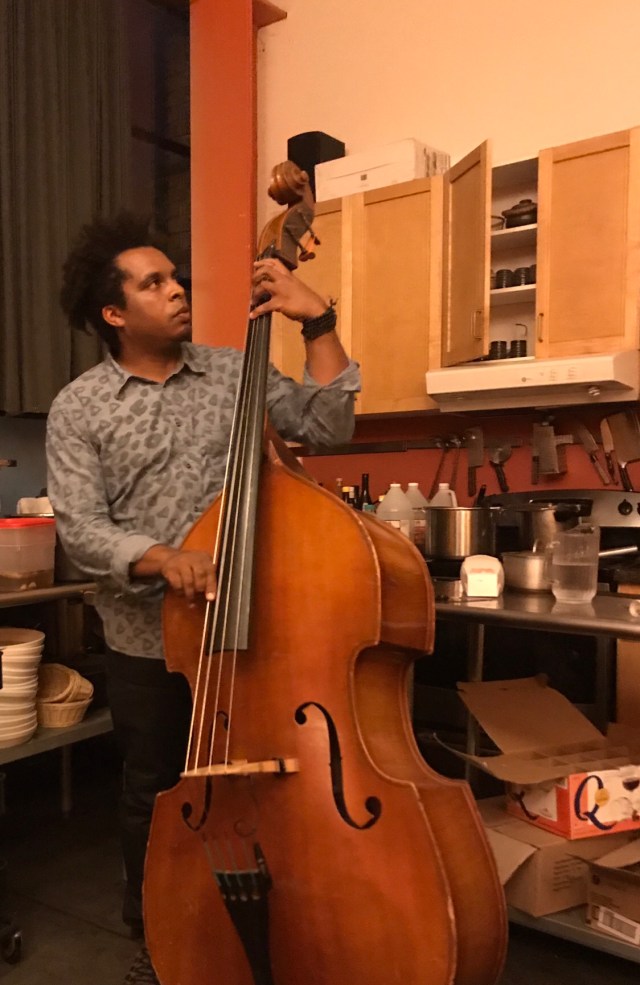
He graced us with what he said was originally intended to be a performance of a Charlie Haden piece but decided he wanted to do his own piece as a sort of homage.  Indeed he captured Haden’s spirit oh so well in another virtuosic and passionate performance.

img_0286

He ended with another sort of tribute, this time to Henry Threadgill.  Again his gift of gab provided just the right segue into the next piece and his familiarity with Threadgill was immediately apparent.  His facility with the acoustic bass produced nearly vocal sounding lines in a performance that did honor to Threadgill and left the evening’s audience very pleased.

We concluded with Blueberry polenta cake with peach ice cream and blueberry raspberry sauce, all vegan, all absolutely delicious.

img_0288

And we will all keep an ear out for Rashaan Carter from this point on.  Bravo!

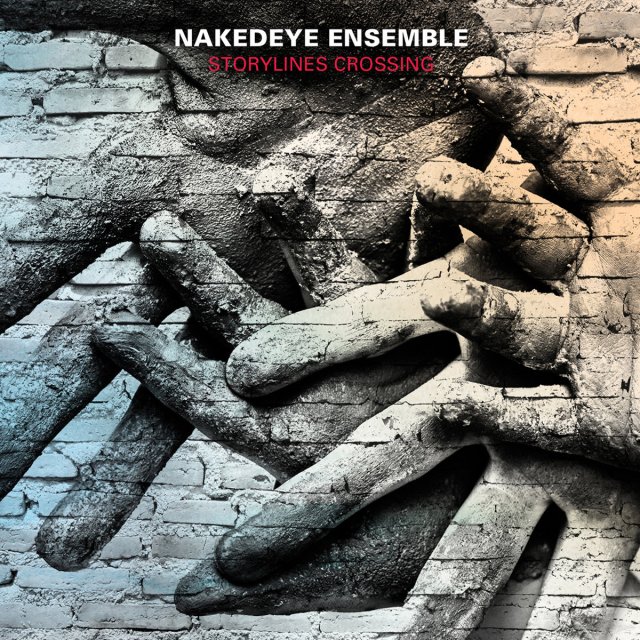
Nakedeye Ensemble: A Fine New Music Group Pays Homage to Past and Future


nakedeye

Starkland

It was only a few days after receiving this CD that I received a visit from a friend similarly interested in new music.  Shortly after that visit I discovered that the CD was missing.  My friend confessed to having taken it immediately when I asked but I already knew why he had taken it and why I might have done the same thing.  After all it’s a Starkland CD and this new performing ensemble have chosen for this, their debut recording, to do an arrangement of one of the finest pieces of political classical music ever.  It is their clever interpretation/homage of Frederic Rzewski’s Coming Together (1971) that provoked my friend’s larceny and laid bare my own moral weakness.  How could anyone resist that? (I told him took keep it and bought myself a new copy).

Nakedeye Ensemble was founded in 2011 with the intent of performing new music.  They were founded in Philadelphia

Curiously, of the six compositions featured on this release, three are “sociopolitical” and the other three I suppose come closer to a category like “absolute music”, the notion that music can be just about music.  While all art is a victim (or product) of its sociopolitical, geographical, and economic context one can at least say that there is a continuum in which some music actually depends on those contexts in a greater degree.  Sociopolitical music is a pet obsession with your humble reviewer.

The disc begins innocently enough with a fine rendition of Sextet (2010) by Jonathan Russell (1979).  This is a pleasant post-minimal work with rock influences and provides a gentle introduction to an apparently carefully constructed playlist designed to demonstrate some of the range of skills possessed by this group.  The influence of Steve Reich is present and functions almost like a framework for the post minimal music that emerges.  Another generation puts its stamp on this genre which is now older than anyone in this ensemble.

With the second track we get to one of those political pieces and to the second oldest composer represented.  Zack Browning‘s Decade of the Dragon (2015) was written to commemorate the 40th anniversary of the end of the Vietnam War and the 50th anniversary of its beginning.  Browning (1957- ) is professor emeritus at the University of Illinois and the director of the Salvatore Martirano Composition Award (Sal was also no stranger to politics).

Decade of the Dragon sounds like a post-modern sort of tone poem, evoking through musical quotation and development of original themes, the composer’s memories of the travesties that permeated those years formative to his development much as they were to your reviewer’s and doubtless many whom I imagine to be an ideal target audience for this music (and all the music on this disc actually).  And there is a sort of painful irony to hearing the artistic expressions of these sad historical events played (very effectively) by an ensemble for whom the events are solely history.

Rusty Banks‘ (1974-  ) “Surface Tensions” (2015) is another playful post-minimalist essay which is not afraid of a little experimentation.  Banks is among the younger composers here but this little sampling of his work suggests we will be hearing much more from his pen.

Randal Woolf  (1959) is a name which will likely be more familiar to listeners as he is a seasoned member of the so called “downtown” musicians.  He applies his considerable compositional skills to a politically infused work, “Punching the Clock” (2015).

There is a dedication and respect communicated by these musicians for their art, the artists whose work they interpret, and for the history that inspired some of them.  Nowhere is this better demonstrated than by the last track, Frederic Rzewski’s Coming Together (1971).

This piece has been done by many ensembles over the years but the only recording other than Rzewski’s original on Opus One records is one by the Hungarian ensemble “Amadinda”.  The text is spoken clearly, dramatically, and effectively and in English, albeit with a charming Hungarian accent.  There are also various lovely and interesting readings to be found on You Tube (including an uncharacteristically hesitant reading by rapper/actor Mos Def) but the arrangement by resident composer Richard Belcastro does a stunning (Am I too old to say “reboot”?) or reworking of the original.

Using different voices, intonations, and inflections this arrangement uses the voices in a sort of pointillistic counterpoint with voices having solos, sometimes answering each other, sometimes together.  Ranging from plain speech to whispers to various different vocal inflections this arrangement sort of democratizes the voices and creates a scenario in which the listener could envision their own voice and struggles.

The music here is great all the way through but the special joy of this release is the discovery of these youthful artists whose insights belie their age and whose technical skills suggest that Nakedeye can now take their place (alongside Eighth Blackbird, ICE,  Alarm Will Sound, Band on a Can All Stars, etc.)  Definitely a group that bears watching/listening.


Duo Noire, Guitar Duo Revisioned


unnamed

New Focus FCR 210

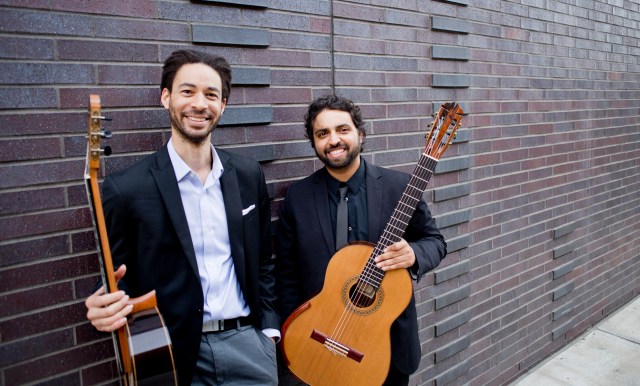
Duo Noire consists of Thomas Flippin and Christopher Mallet.  These guitarists are graduates of the Yale School of Music.  For this, their debut album, they have chosen to feature a program of all women composers.  Add to that the fact that these fine emerging artists are African-American (also the first African American graduates of Yale School of Music) and you have a glorious celebration of gender/cultural diversity as well as some mind blowing compositional efforts ably handled by these visionary musicians.

duonoir

The demographics are necessarily prominent especially in these contentious times when racial and gender discrimination are, sadly, huge and difficult issues that remain largely unresolved.  But the real story here is creative music and musicians.  This duo seems to have a unique sound and are clearly schooled in their instruments to the point that they even seem to be expanding the very possibilities of a guitar duo.  Above all this is an intelligent album.

The composers Clarice Assad (1978- ), Mary Kouyoumdjian (1983- ), Courtney Bryan (1982- ), Golfam Khayam (1983- ), Gity Razaz (1986- ), and Gabriella Smith (1991- ) are mostly unfamiliar names to this writer and, likely, to most listeners.  But don’t let that put you off.  This is a highly inventive set of compositions and these performers are doing the job of discovering these compositional talents.

There on six compositions on this thirteen track CD which has over an hour of music on it and it appears to be a landmark release for identifying new composers contributing to the guitar duo genre.  Guitar duos are not an unusual instrumental grouping but this collection suggests fresh new directions that extend the possibilities of this instrumental configuration.

assad

Clarice Assad

Of course the guitar duo is hardly a new idea.  On the more pop side we have had Les Paul and Mary Ford and on the classical side many listeners will be familiar with Sergio and Odair Assad.  And that brings us to Clarice Assad who is the daughter of Sergio Assad.  Her composition,  Hocus Pocus (2016) is in three movements, each ostensibly describing an aspect of magic.  Clearly Assad is familiar with both traditional and extended techniques of composition for guitar.  This is a sort of impressionistic work which calls upon the musicians to utilize a variety of techniques to evoke moods and images of each of the three movements, Abracadabra!, Shamans, and Klutzy Witches.

kouyoumdjian-headshot-web-quality_orig

Mary Kouyoumdjian


Byblos (2017) by Mary Kouyoumdjian embraces her Persian roots as well as the conflicts which have plagued this area of the world.  Here she is evoking an ancient town in Lebanon.  This is the most extended single movement on the disc and demonstrates the composer’s mastery of form while it challenges the instrumentalists to evoke the ancient and mystical sounds of her classical culture.


bryan

Courtney Bryan

The only African-American composer featured on this recording is Courtney Bryan.  Her “Solo Dei Gloria” (2017) which was commissioned by Duo Noire takes the listener on a sonic journey through the composer’s impression of the inner process of prayer.  That’s a mighty abstract concept and she manages accomplish it with just the two guitars (and, of course, two talented musicians).


The three movement, “Night Triptych” (2017) was also written for Duo Noire and has the honor of being the title track for this truly eclectic and innovative album.  This has more the feel of an abstract musical work than the others featured but one does hear the influences of her ethnic origin (Persian/Iranian).  Despite the more extended nature of this composition this work, like all the works presented here, is a sampling of the composer’s work and the astute listener will have many reasons to seek out more of this young composer’s work.

golfam

Golfam Kayam


Gity_228-1-8x10

Gity Razaz


Four Haikus (2017) was also written for Duo Noire.  This Iranian born composer is rapidly becoming established internationally as an accomplished composer.  Like the previous work these four short movements are of a more abstract nature.  Another sampling that will prompt listeners to seek out more of this emerging composer’s work.

gsmith

Gabriella Smith

Last but not least is the second most extended work here by the youngest of the composers represented.  “Loop the Fractal Hold of Rain” (2017) is another Duo Noire commission.  This is probably the most abstract and modern composition on the disc.

Many works here have at least the suggestion of dealing with politics, conflict, and the impact of such things on individuals.

It is admittedly unusual (though clearly not risky) to program compositions by all women composers.  This is a wonderful collection with performances that are incisive and intriguing enough to leave their listeners wanting more.  This is a group to watch/listen to.


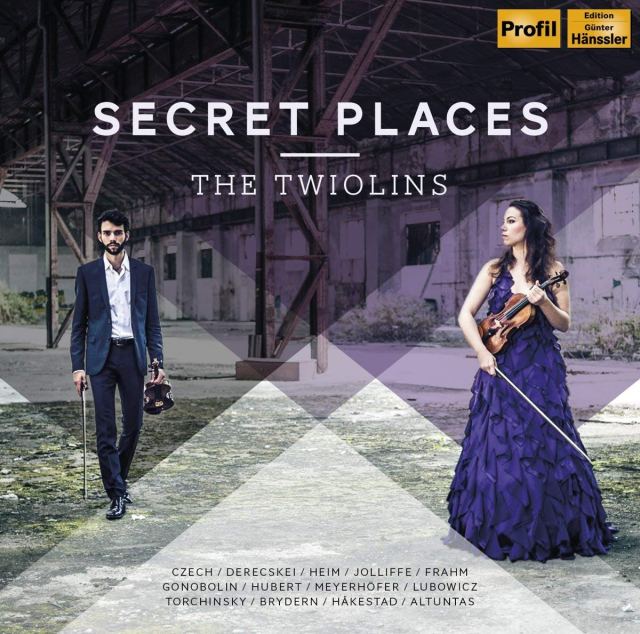
The Twiolins: Secret Places


twiolinssecret

Hännsler PHI 7002

Wow!  What a discovery.  This album was kindly sent to me by a friend, one of his most recent discoveries.  And from the moment I put this in the CD player I was entranced.  Despite the appearance of yet another cute musical duo these are two amazingly talented musicians playing some of the best post-minimal pieces this writer has heard in years.

Twiolins is are violinists with a wide range of interests (their repertoire as reported on their web site is impressive) but with a clear love for post-minimalist music.  In fact they are brother and sister, Marie-Luise Dingler and Christopher Dingler.  Unlike acts that seem to be designed to reach an audience with mediocre pop-inflected classical music Twiolins here presents 13 works by composers completely unfamiliar to this writer but astoundingly fresh and inventive.

My first impression reminded me of the music of the late great violinist and composer Michael Galasso.  There is a remarkable similarity in styles between the composers represented here but all seem to fall basically into a post-minimalist category.  The difference is that this music went right to my head (so to speak) and I found this music invaded my nervous system in the same delightful way that my first encounters with minimalism did.  My linear thinking was impaired and I found myself carried away, willing to follow wherever the music led me.  It was a curious mix of nostalgia and revelation.

There are 13 relatively brief tracks (ranging from 2:13 to 6:46) representing 13 compositions.  Once I put the disc in the CD player I just had to hear the whole thing.  No pause allowed.  There is a consistency of styles with these pieces and the ordering on the disc promotes a nice flow from faster to slower pieces, then faster ones again.  And adding to the basic quality of the compositions is a clear sense that these musicians are able to bring out details in the phrasing of their playing that make these compositions shine in ways that would flatter any composer.

Tracklist:

Rebecca Czech, Germany: Ich glaub´, es gibt Regen

András Derecskei, Hungary: Balkanoid

Benjamin Heim, Australia: Trance No.1

Edmund Jolliffe, UK: Waltz Diabolique

Jens Hubert, Germany: Rock you vs. Ballerina

Johannes Meyerhöfer, Germany: Atem • Licht

Nils Frahm, Germany: Hammers

Aleksander Gonobolin, Ukraine: Metamorphosis

Dawid Lubowicz, Poland: Carpathian

Vladimir Torchinsky, Russia: Eight Strings

Benedikt Brydern, USA: Schillers Nachtflug

Andreas Håkestad, Norway: Three Moods, I

Levent Altuntas, Germany: Chasma^2

This is apparently their third album (their first was released in 2011 and another in 2014).  It was released in late 2017.  I picked these up at Amazon as digital downloads for comparison.  It would appear that these musicians have been carefully cultivating their sound and selecting their repertoire.

Granted there is a slightly populist feel here but none of these composers are known to this reviewer so it’s difficult to say if this is typical of their work.  These are strong, well-wrought pieces that will delight and move the listener.  The term “populist” here is not intended to imply simplicity or lower quality, just a nod to the fact that it will likely have an immediate appeal to listeners.  The composers are a nationally diverse set and doubtless have other compositions of interest in their catalogs.  Listeners can doubtless anticipate more tasty little miniatures as well as (hopefully) selections from their repertoire of concerti and the like.

This is not a mind bending or taxing album but neither is it negligible.  The liner notes give little info about the pieces but that doesn’t really matter because they’re relatively brief and you will either like them or not but this writer is betting on “like”.


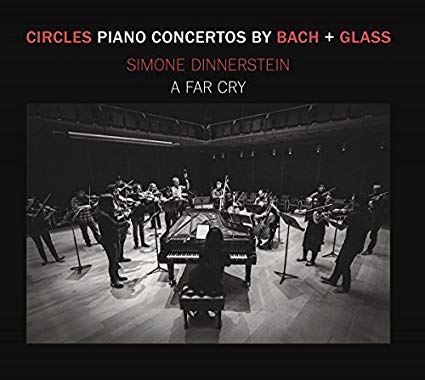
Simone Dinnerstein: Bach and Glass


dinnerglass

It has been interesting to watch the progression of Philip Glass’ career.  From his driving amplified ensemble music that so entranced this writer to as near groupie status as he will ever be to the more mainstream orchestral work of his work since at least the 90s the fascination remains at some level.

The familiar arpeggios are still to be found along with basically diatonic harmony with occasional polytonal sections.  What is interesting about Glass’ third piano concerto is a sort of chamber romanticism.  A Far Cry is a small chamber orchestra ideally suited to works like the Bach first piano concerto. Though technically originally written for harpsichord pianists have successfully broken the taboo on strict adherence to using the harpsichord and have developed techniques to optimize the sound of the piano (which has very different qualities from a harpsichord).

Simone Dinnerstein is an artist who I first met (albeit virtually) on Facebook.  Her reading of the Goldberg Variations from a few years ago seemed to signal her entrance into the mainstream of performers.  The choice of works on this disc are a sort of characterization of her interests.  She is an accomplished Bach performer with, obviously, an interest in new music.  So pairing her as soloist with A Far Cry whose interests appear to be in a similar range was perfect.

The performance of the Bach G minor piano concerto (No.7) is as delightful as it gets.  Dinnerstein and the ensemble seem work together very well.  These intense little chamber orchestras seem to be proliferating and one could speculate on the economic and political reasons for that but what is more interesting is the commitment and intensity that these small ensembles can bring to music.

The Glass concerto has the feel of a sort of miniature romanticism.  This writer heard it as echoes of Brahms but on a far more intimate scale.  It is difficult to say whether this new work (or for that matter, the other two piano concertos) will become a regular part of the repertory but it is clear that Glass continues to have his champions both in musicians and listeners.

There is nothing groundbreaking here and that is not what is apparently intended.  What we get in this recording is a couple of dedicated and thoroughly enjoyable performances by clearly dedicated musicians.  This is not an original instruments or musicological discoveries type of album.  It is simply good music making.

If you are a fan of Philip Glass and/or Simone Dinnerstein you will want this disc.  But don’t forget to pay attention the this little chamber group.  They are superb and energetic musicians and this reviewer expects to be hearing more from them in the near future.  Maybe we will get a new set of Bach and/or Mozart concertos.  Here’s hoping.

Quince Ensemble: Motherland


quince

New Focus FRC 203

I looked at the rather drab cover.  I had never heard of the Quince Ensemble nor any of the composers featured on this disc.  I looked again at the cover.  Clearly it was labeled with one of those parental advisory warnings which one rarely sees on a classical recording.

My usual practice is to do some research before spinning a given disc but I decided to just put this one in the CD player cold.  I had about an hour’s drive ahead and I decided to just let the disc speak for itself.  But my spidey sense suggested I might be in for a rather dull listen.

So much for my superhero powers.  From the moment the first track played I felt drawn in.  What I heard seemed to be a mixture of Peter Kotik (of Many, Many Women in particular), Meredith Monk, a touch of La Mystere de Voix Bulgare, the west coast group Kitka, and a few others).  That is to say that this disc grabbed my attention and had echoes of a few other contemporary vocal music styles.  What I heard was very compelling, creative, practiced, passionate.

This is mostly an a capella group though they made very effective use of harmonicas as drone material at one point.  Even after reaching my destination (achieved before the disc ended) I couldn’t bring myself to shut it off so I stayed parked and listening til I had heard the entire disc.  Yes, it was THAT compelling.

Complicating the reviewer’s task further is that the disc contains four compositions by four composers whose first appearance on this writer’s radar was from this very disc.  All four are world premiere recordings and all are by women composers.

The Quince Ensemble consists of Liz Pearse (soprano), Kayleigh Butcher (mezzo soprano), Amanda DeBoer Bartlett (soprano), and Carrie Henneman Shaw (soprano).  And this is the fourth album dedicated entirely to this ensemble’s work.  Two previous albums were appearances and collaborations.

The featured composers are (in order of their appearance on this release): Gilda Lyons (1975- ); Laura Steenberge; Cara Haxo (1991- ); and Jennifer Jolley (1981- ).  All appear to be Calfornia based and at the beginnings of what will doubtless be some interesting careers.  I will leave it to the interested reader to look into the details available at these various web sites but, after listening to the music, most listeners will want to know more.

The pieces range from Lyon’s Bone “Needles” coming in at just over 4 minutes to the next two multiple movement pieces and finally Jolley’s “Prisoner of Conscience” which is an homage to the politically active musical group, “Pussy Riot”.  This is the longest and most political piece on the album.

From the initial (and incorrect) assumption that this would be a dull disc to the end of this listening journey I came to see this disc in quite a different light.  The cover now seems friendly and appropriately representative of the album.

Rather than go into a bland or potentially inaccurate analysis of these pieces suffice it to say that this is effective and affecting music by a delightfully talented and energetic ensemble.  If you like vocal music, political music, music by women, or are just looking for something to lift you from your daily malaise give this one a try.  You will be both challenged and entertained.  No doubt this group would be fantastic in a live performance but for now we shall have to make do with this wonderful recording.


Missa Charles Darwin: The Chicken or the Egg?


darwin

This is one unusual disc, not specifically due to the musical content actually but rather its back story.  Gregory W. Brown is a composer with a significant body of work to his credit.  He also happens to be the younger brother of author Dan Brown.  Yes, THAT Dan Brown, of DaVinci Code fame.

Now, at first glance, one notices that the CD states, “as featured in the Novel ORIGIN by Dan Brown.”  This reviewer’s initial assumption was that this music was written subsequent to the novel as a sort of “tie in”.  Well the fact is that the music preceded the 2017 book by some six years and was heard by the author who then incorporated it (initially unbeknownst to the composer) into a chapter of his novel, ORIGIN.

So what we have here is a sort of “tie in” but, more importantly an inspiration in part for the work which now incorporates it.  This reviewer has only read a brief summary of the elder Brown’s novel, enough to understand that one of the themes in the complex web of the story includes characters who are against organized religion.  This Missa Charles Darwin (2011), structured in the classical (or should I say, ecclesiastical) manner but incorporates texts from Charles Darwin’s writings into the conventional Latin texts.

Like his brother Dan, Gregory feels free to incorporate things heretical.  The fight between the Holy Roman Catholic Church and supporters of Darwin’s theories is well known and indeed ongoing.  By incorporating Darwin’s words amongst the ecclesiastical proclamations and adorations of the mass texts Brown creates a sort of philosophical critique to both provoke thought and entertain.

His choice to utilize a vocal quartet and his harmonic choices gives this work the ambiance of medieval and renaissance mass settings.  The younger of the Brown brothers utilizes a mix of past, distant past and present to create a sort of philosophical fiction not entirely unlike the techniques in Dan Brown’s novels.  The music is very listenable and never trivial.  It simultaneously transports the listener to the mystical feeling of an unnamed Cathedral in the 14th or 15th Century as well as to the 19th/early 20th Century science v. religion squabbles that plague us still.

Comment must be made about the beautiful presentation of this recording.  It is a box containing the CD and cards containing both art work and texts.  Included is a nice a photo of the two brothers.

Not having yet read the novel it is difficult to say with certainty what impact the music ultimately has on the experience but, like soundtracks that enhance the experience of a given film, this finely crafted music can only add to the experience.  Of course both novel and music will be able to stand alone on their individual merits.

This writer is given to wonder if further collaborations between these two may happen and the next Robert Langdon story might be heard in an opera house.  Go for it guys!


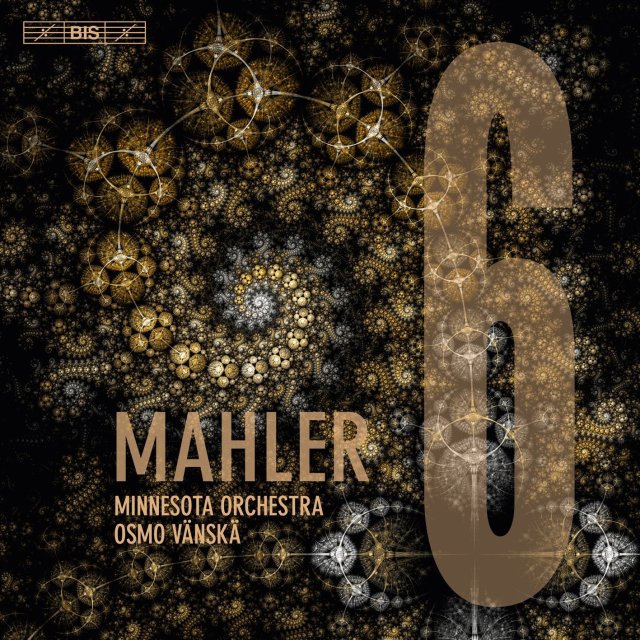
Osmo Vänskä’s Mahler 6th on BIS


mahler6vanska

I have heard varying opinions on the conducting skills of Osmo Vänskä.  He is the music director of the Minnesota Orchestra since 2003 and, prior to that, a conductor of the wonderful Lahti Symphony Orchestra.  I very favorably reviewed his Kullervo disc from last year.

The Mahler 6th and, I suppose, with pretty much any Mahler there are many critiques of the music and the performances.  So many complexities with tempo, handling the massive orchestra to bring out one nuance or another, order of movements, etc.  One thing is for certain, no Mahler aficionado will be satisfied with only one recording of each of his works.  There appear to be no definitive recordings agreed upon by all.  By contrast most people seem satisfied with perhaps Herbert von Karajan’s interpretation of the Beethoven Symphonies as being at least a good starting point.

One must recall that Mahler’s music was not well appreciated for a number of years.  Though he gave performances of all his major works interest in them faded rather quickly after his death in 1911.  Performances did occur but critics generally regarded Mahler’s music as dismissable efforts calling it “conductor’s music”.  It wasn’t until Leonard Bernstein began earnestly performing these works that the current cult of Mahler actually took root.

I preface my review with these comments to say that I enjoyed this disc immensely with its gorgeous sonics (as always with BIS).  Vänskä produces a lucid performance which differs from many in tempo choices and such but seems, to this reviewer’s ears, to do justice to this large and masterful work.  In the end the experience is one of a valid performance (he places the slow movement as second) which provides another view of this complex work.  And part of the cult of Mahler, it seems, is the need to own multiple performances.

This may not be the only Mahler Sixth you will want to own but it is definitely worth hearing, preferably on a good sound system.

Indian Raags for Piano made easy


raags easy

Last year I reviewed Mr. Pitts’ How to Play Indian Sitar Raags on a Piano.  It was an enthusiastic review and the book continues to have a valued place on my piano as it opens a whole world of ideas.   Now the author has done a kind and useful service by issuing this simplified version of that work.

In fact this simplified version is more in line with the rather unpracticed keyboard skills of your humble reviewer.  The author chooses 6 raags or ragas which provide a good starting point for similarly humble musicians to begin this approach to Hindustani music.

Hindustani music became pretty much ubiquitous, or at least familiarly cliché in western musical culture largely due to the efforts of Indian musicians such as Ravi Shankar and Alla Rakha.  In fact it is an endlessly fascinating musical system whose logic has much to offer both musicians and composers.

In the past one had to learn traditional Indian instruments to gain much familiarity with these ancient musical systems but Pitts’ book offers an alternative to musicians whose familiarity is limited to the western keyboard.  Purists may denigrate this approach but even if it does not perfectly represent all aspects of Hindustani musical theory at least it provides a manageable entry point for amateur musicians and professionals alike.

Having struggled somewhat with the previous book I was particularly delighted to have these simplified examples which fall nearer to my skills level.  Even if I don’t wind up incorporating this into performance or compositional efforts I have no doubt that the exposure to the actual practice of this music will leave a valuable bit of programming in my neural circuits that will enhance my musical thinking and ability to appreciate other musics.

As with the first book, this too is highly recommended.  Kudos Mr. Pitts!

In the Beginning Was the Word: Other Minds 23


OM202006

Charles Amirkhanian performing one of his spoken word compositions at Other Minds 20 in 2015

Other Minds has been the the darling of composer/producer Charles Amirkhanian since its founding in 1993.  Along with television producer and arts patron Jim Newman he has presided over the 25 years of this renowned festival which has consistently brought the finest new music composers and performers to San Francisco.

There is little doubt that this year’s festival has to be very close to Amirkhanian’s heart.  Words have been central to his career at least since 1969 when he began his work as a producer at KPFA.  In the 23 years he spent there he presented countless hours of musical programming and interviews.  He crossed paths with most of the major stars in contemporary classical music and many stars whose genre may not be captured by the classical label.  A look at his programming choices and interviews from his time there defined new music for the Bay Area and beyond.  After his tenure at KPFA ended in 1992 he continued exploring cutting edge music and musicians bringing them to San Francisco for live performances.

His work as producer and curator has tended to overshadow his work as a composer, sound poet, and spoken word artist.  This year’s OM festival is dedicated to speech, sound poetry, and the spoken word.  It is about both the history and the present state of the art.  In many ways Amirkhanian’s 1975 release “10 + 2: 12 American Text Sound Pieces” on 1750 Arch Records (now on an OM CD 1006-2) can be seen as sort of the starting point for this festival.  This masterful anthology includes works by Charles Amirkhanian (1945- ), Clark Coolidge (1939- ), John Cage (1912-1992), John Giorno (1936- ), Anthony Gnazzo (1936- ), Charles Dodge (1942- ), Robert Ashley (1930-2014), Beth Anderson (1950- ), Brion Gysin (1916-1986), Liam O’Gallagher (1917-2007), and Aram Saroyan (1943- ).


“Word! Thou word that I cannot speak!

At the end of the second (and last completed) act of Arnold Schoenberg’s powerful opera “Moses und Aron” (1932) Moses sings, or actually half speaks and half sings this text lamenting his expressive deficits.  Speech song or, in German, sprechgesang is an invention by Schoenberg in which the singers are asked to find a point between speech and music.  Perhaps this is a good example of some of the artistic thinking going on at about the time when speech music/sound poetry began to take shape.

bio_schwitters_kurt

Kurt Schwitters (1887-1948)

Some of the history of sound poetry is featured in this unprecedented 6 day festival (April 9-14).  Some of the earliest practitioners of this unusual genre include the German artist Kurt Schwitters whose composition Ursonate (1922-32) will be performed in its entirety, a rare event by itself.

Another early gem will be the Spoken Music (1930) by German-American composer Ernst Toch.  This three movement suite has been known for its last movement, the Geographical Fugue.  The other two movements, once thought lost, were discovered in sketches in 2006 and reconstructed by Christopher Caines.  The now complete version will be presented I believe on day 3.

Composer-Ernst-Toch-810

Ernst Toch (1887-1964)


It is beyond the scope of this blog post to tell the history of text sound so I will refer readers to the Other Minds website for further details.  Or you could come to the festival too I suppose.

With due respect given to the past the festival will move on to the present.  San Francisco Beat Poet Michael McClure (1932- ) will make an appearance as will post beat colleagues Anne Waldman (1945- ), Clark Coolidge (yeah the guy from that cool anthology), Aram Saroyan (another guy from the classic text sound disc).

curran20160010

Alvin Curran in conversation last year in Berkeley.

Other Minds alumnus Alvin Curran (1938- ) will be premiering his collaboration with Clark Coolidge entitled, Came Through in the Call Hold.  Curran’s eclectic sensibilities will doubtless result in an interesting composition.  This event alone, at least for this writer, is worth the price of admission.  And this is just the first day!

Other events include workshops, discussions of the history of the art, and even some curious variations on a theme.  Apparently the writer Lawrence Weschler is the grandson of Ernst Toch and has written a variation on the Geographical Fugue called, The Medical Fugue which will be premiered at this festival.

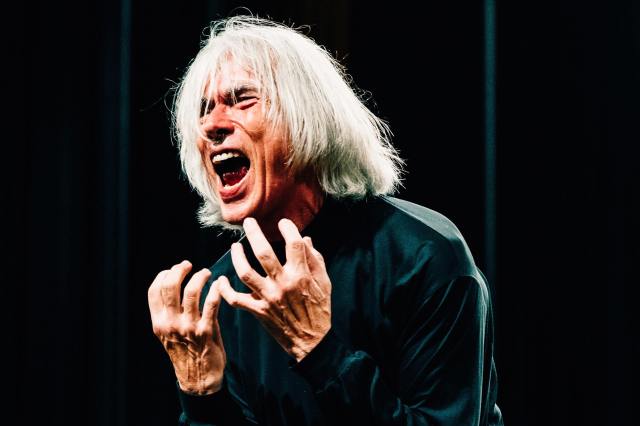
The increasingly ubiquitous pianist Sarah Cahill will be present to perform Virgil Thomson’s unusual but entertaining setting of a Gertrude Stein (a one time Oakland resident) text called Capital, Capitals.  She will accompany the men of the Other Minds Ensemble.  Jaap Blonk will be tasked with performing Schwitters’ Ursonate and, along with Enzo Miranelli will also perform other historical works including some by a couple of Italian Futurists.

Other Minds Administrative Director Randall Wong will end the evening by undertaking a performance of the late great Cathy Berberian’s Stripsody.  That promises to be a wild evening I think.
blonk_75_2500crop

Jaap Blonk (1953- )

Northern Europe, including the Netherlands and the Scandinavian countries will literally have their day.  As it turns out they are doing a great deal of creative work in this increasingly diverse genre of speech music.  Other Minds is at its best in introducing the new and the innovative from wherever Charles’ radar has tracked it down.  Indeed Mr. Amirkhanian and his wife, artist/photographer Carol Law traveled throughout these regions in the early 70s talking with and learning from these diverse artists.  (Amirkhanian’s work, Just was recorded in a Scandinavian studio during one of those trips).

As usual homage will be paid to the past with some recorded classics by Sten Hanson, Åke Hodell, and Lily Greenham.  Some new voices will be introduced including Tone Åse and Sten Sandell.  The Norwegian/Russian-American duo OTTARAS (consisting of visual poet Ottar Ormstad and composer Taras Mashtalir will also perform.   One can fully expect a mind expanding experience which will redefine the possibilities of the art form.

Auspiciously or perhaps dangerously Friday the 13th has been reserved for Bay Area talents.  First up will be the man of the hour, Charles Amirkhanian.  Hearing him do his work live is an uncommon but entirely enjoyable experience.  If that alone weren’t enough we will get to hear the even rarer public collaboration between him and his life partner Carol Law whose photography and collage work deserves wider recognition and will happily get that here.

Amy X Neuberg

Amy X Neuberg.

Trained in both linguistics and music, Amy X Neuberg will be on hand to perform her indescribable electronic cabaret including the world premiere of “Say it like you mean” and other genre bending work.  She is another valued Other Minds alumnus having given numerous performances at the festivals.

Stanford professor Mark Applebaum, another alumnus will present “Three Unlikely Corporate Sponsors” which premiered at Stanford in 2016.  Enzo Miranelli will conclude the evening with his theatrical combination of movement and text in “Fame: What I Want to Say”.

20130218-132303.jpg

Pamela Z

The festival concludes on Saturday April 14th with Jaap Blonk followed by the wonderful San Francisco based Pamela Z who, like Neuberg uses electronics, but creates her own unique sound world.  She too is an alumnus of Other Minds.

Another composer from that great anthology, Beth Anderson, will make an appearance to perform “If I Were a Poet”, “I Can’t Stand It”, and “Ocean Mildew Minds”.

The finale will feature Susan Stone and Sheila Davies Sumner performing excerpts from two works, “House with a View” and “Loose Tongues” both dealing with the lives of working class southern women.

This will be both a feast and a marathon but it promises to be one of the finest Other Minds productions maybe ever.  Come to be entertained, come to be challenged, come to expand your mind.  You’ll never be the same.  See you there.
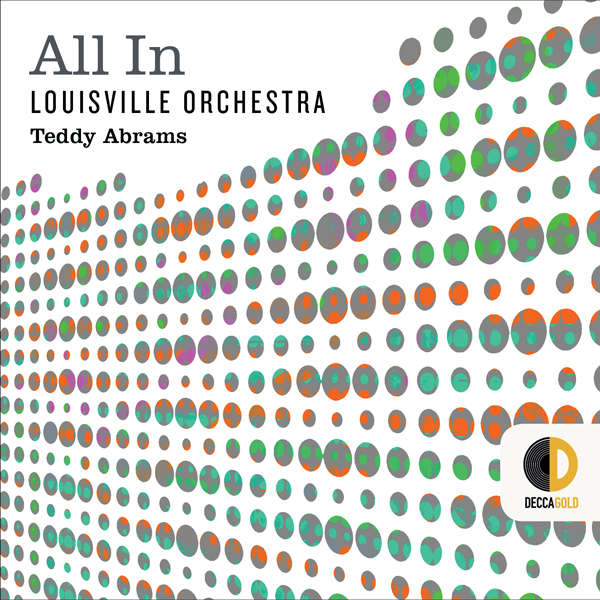
Louisville Orchestra Reboot on CD: All In


Abrams-Louisville-All-In_coverweb

The Louisville Orchestra was established in 1937 and its history has been wonderfully told in a 2010 documentary entitled, Music Makes a City.  Since their founding they released about 150 LPs containing new and interesting music not available anywhere else.  Many of those recordings have become available on the Albany CD label but the orchestra hasn’t released a new recording in about 30 years.

abrams

Teddy Abrams

Along comes new music director, composer, clarinetist Teddy Abrams and now we are graced with a new recording on the Decca Gold label.  Now for a reboot this release is somewhat conservative in it’s musical choices but that’s not to say it isn’t interesing.  This recording, released also in commemoration of the orchestra’s 80th season, reflects a sincere effort to draw younger audiences to the concert hall.

This auspicious release contains as its opening Abrams’ Unified Field, a finely crafted four movement work that channels the late Aaron Copland and his ilk.  It’s style is inflected with elements of jazz and other so called “vernacular” music but it incorporates those styles in much the way that Copland and his contmporaries incorporated folk song as well as jazz/pop rhythms. It is virtually a symphony in its dimensions and is highly entertaining while remaining seriously classical and very finely crafted.  The year of it’s composition is not specified in the notes this writer received but best guess is that it is of recent vintage in this talented composer’s oeuvre.

This is followed, curiously, by three torch songs, one by the able soloist Storm Large, one by Cole Porter, and one by Teddy Abrams.  The stylistic unity of these three songs is striking and Storm Large (who is known for her work with Pink Martini) is a convincing chanteuse.

These are followed by another American masterpiece, the Clarinet Concerto (1948) by Aaron Copland.  Originally written (and subsequently recorded by) Benny Goodman, the concerto is definitely in the repertoire but receives far too few hearings in concert.  This writer had not heard the concerto in many years and was struck both by its quality and by the convincing performance recorded here.  Abrams takes the solo role and the orchestra is conducted with assurance by one Jason Seber.

Abrams’ reading is as convincing and authentic as any and this is a delightful way to close this wonderful recording.  Here’s hoping that this release will be the restart of Louisvilled great recorded legacy and that Abrams tenure as conductor will breath new life into an orchestra which has become a venerable part of America’s cultural history.


Steven Kemper’s Mythical Spaces


mythical

Ravello Records RR 7980

It is this writer’s opinion that the category “electro-acoustic” carries such a wide range of connotations that it is of limited use to a listener.  This album is so characterized and here simply means that both electronics and acoustic instruments are used.  Even the concept of electronic music is difficult since such a designation. Playlists on Spotify and iTunes usually points the listener to a form of pop/dance music if you search for electronic.  Further complicating things (and I think this is at least in part the point here) the electronics here include fixed media (electronics which does what it is programmed to do and does not interact with the performers or simply plays alone) and robotic electronics as well as electronics which interacts with the performer.  You will have to check the composer’s web page for more information on what exactly the “robotic” media are.

This is cutting edge in the sense that it is experimenting with new media in combination with more traditional media (and simple electronics is now “traditional media” having been superseded by the new fangled).  The actual sound of this music seems to inhabit a rather spare sound world akin perhaps to that of late Morton Feldman but with more brevity. These pieces last from 1.5-10 minutes on average and demand some concentration on the part of the listener.  Think maybe a cross between Feldman, Webern and say Subotnick.

Now one could conceivably play this music at a low volume in the manner of so-called “ambient” music. There are not many dynamic changes here to take you away from that sort of reverie.  But that does not really seem to be the composer’s intention. These are concentrated little essays, each seeming to explore the parameters of its context, fixed media, live instruments, robotic media, and combinations of these.

Steven Kemper is a new name to this writer.  His education and wide interests are available on his web site.  While he has an impressive bibliography with cutting edge research interests in music and sound this appears to be his first CD.

There are 15 tracks which comprise 5 works.  Mythical Spaces (2010) is for percussion with fixed media in 5 separate movements.  Breath (2015) is for fixed media alone in one movement.  Lament (2015) is also in one movement and is scored for flute with interactive media.

The longest single movement comprises In Illo Tempore (2012 rev 2017) is scored for saxophone, bassoon, AMI (automated monochord instrument), and CARI (cylindrical aerophone robotic instrument).  It clocks in at 7:48.

Last but not least is The Seven Stars (2012) for amplified prepared piano in 7 movements.

Live performers include Mark Truesdell, percussion; Wayla Chambo, flute; David Wegenlaupt, saxophone, Dana Jessen, bassoon, and Aurie Hsu, prepared piano.

This is music which requires some serious concentration from the listener.  Hearing/seeing this live might provide some additional aspects due to these strange electronic/robotic instruments but the point here seems to be one of an inner voyage which, if you focus you listening energy, transports you into this composer’s imaginary spaces.  Whether you will enjoy this or not is difficult to say but it is certainly worth the effort.


300 Years of Virtuosity, Liza Stepanova’s Tones and Colors


stepanova

Concert Artist Guild CAG 120

This is the solo piano debut of this talented and incredibly virtuosic artist.  This hard working pianist can be heard on a previous CD (After a Dream) with the Lysander Piano Trio.  Her web site can provide a good idea of the range of solo, chamber, and orchestral music in her repertory.

This CD is a good example of creating a brand, a practice which seems to be the current rage especially among artists who specialize in new music.  I have previously commented on the brands of pianists like Sarah Cahill, Kathleen Supové, Nicolas Horvath, and Stephane Ginsburgh to name a few.  All are amazing musicians but each seems to have been able to carve out an identifiable niche which sets them apart from each other and defines their various artistic missions.  Granted these are soft definitions in that they do not preclude them from playing anything they choose but it gives audiences a sort of general idea of what to expect when they do a program.

Liza Stepanova appears to have chose virtuosity as her signature.  She plays what sounds like fingerbreakingly difficult music with both ease and expressiveness.  Here she chooses to basically survey virtuosity from J. S. Bach to György  Ligeti.  In addition she has chosen to pair each composition with an analogous piece of visual art.

The pairing of music and visual art is as old as dirt and has always seemed to have an inherent validity.  Tone poems like Mussorgsky’s Pictures at an Exhibition or Debussy’s Clair de Lune are familiar examples of music as a visual analog.  But music sometimes suggests pictures even if it was not the stated intent of the composer too.  Stepanova covers the visual territory from the representative to the abstract in this entertaining collection.

Perhaps the most interesting aspect of this recording is the pianist’s choice of music.  She does go with the familiar at times such as Debussy’s Goldfish but the majority of this disc contains music that is seldom heard by lesser known composers such as Maurice Ohana (1913-1992), Joaquin Turina (1882-1949), Fanny Hensel (1805-1847), and Lionel Feininger (1871-1956).  There are better known names such as Enrique Granados (1867–1916), Bohuslav Martinú and Leopold Godowsky (1870-1938).  And the most familiar names such as J. S. Bach (1885-1750), Franz Liszt (1811-1886). Claude Debussy (1862-1918), George Crumb (1929- ), and György Ligeti (1923-2006).

There are 13 tracks grouped into 4 visual art themes (A Spanish Room, Nature and Impressionism, Conversations Across Time, and Wagner, Infinity, and an Encore).  The only problem I have here is the photos of the art (which thankfully are included in the little booklet) are necessarily small and really don’t give the consumer the full intended effect.  One would do well to obtain some art books or some larger prints of these to gain the intended effect.

I won’t go into detail about each individual piece.  Suffice it to say that they are all technically challenging and intelligently chosen pieces.  This is a very entertaining program from this emerging artist.

This reviewer is given to speculation as to Stepanova’s next release.  Perhaps Sorabji with some Dada works?  Whatever it is will doubtless be as interesting and entertaining as this disc.  Brava, Ms. Stepanova!