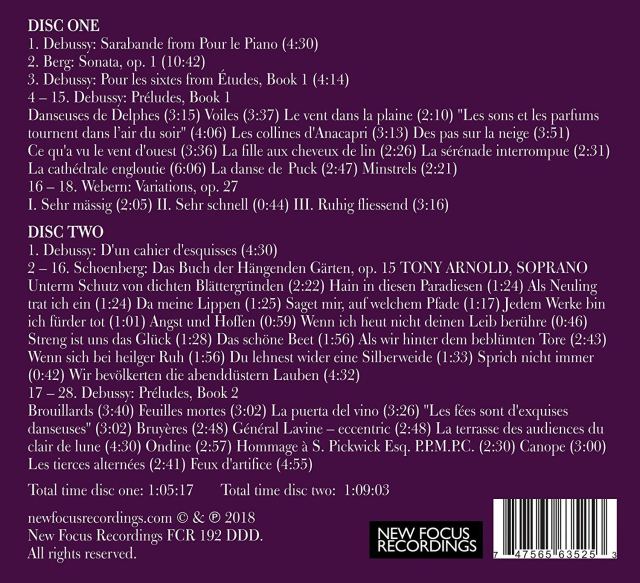
Josh Modney’s “Engage”, New Music for Violin Solo and Not Solo


modneyengage

New Focus FCR 211

This is an awesome undertaking.  I recall when pop musicians were cautioned that it may be unwise to release a so called “double album” for fear that their inspiration (or talent) may not be up to the task.  Well here comes Josh Modney violinist and Executive Director of the Wet Ink Ensemble , a member of the International Contemporary Ensemble (ICE), and a performer with the Mivos Quartet for eight years.  This 3 CD set is his solo violin debut album.  And what an album it is.  There is no lack of talent, skill, or imagination here.  This is essentially three faces of Josh Modney a sort of sonic CV.

The first disc features four tracks of music by contemporary composers for violin with soprano, piano, and/or electronics.  All four are fairly recent compositions:  Sam Pluta’s “Jem Altieri with a Ring Modulator Circuit (2011), Taylor Brook’s “Vocalise” (2009), Kate Soper’s “Cipher” (2011), and Anthony Braxton’s “Composition No. 22” (1998).All of these are challenging for the musicians and none are easy listening but all demonstrate aspects of Modney’s skills as a musician

The second disc features J. S. Bach’s “Ciacona” or “Chaconne” (1720) from the second violin partita.  But this is not just another performance of this towering masterwork of the solo violin repertoire.  Modney has chosen to perform it in just intonation.  Now how’s that for versatile?

The effect is subtle and may even be lost on some listeners but fanciers of Bach and alternate tunings will likely find this to be anywhere from mildly interesting to revelatory.  It is a fine performance and it is interesting to hear it in just intonation and amazing to know that this performer has this uncommon skill of playing accurately in an alternate tuning on the violin.

Filling out the second disc is a piece by pianist Eric Wubbels, “the children of fire come looking for fire” (2012).  This is a very different piece and I’m not sure why it was paired with the Bach except that it fit the available space.  Wubbels contribution is a sort of electroacoustic collage.

The third (and last) disc is of solo violin compositions by Josh Modney.  Again we move into contemporary and experimental compositions which reflect Modney’s skill with the instrument as well as his insights into it’s potentials.  Again there are no echoes of Bach here but rather more of the experimental/avant garde/free jazz style which dominates this album.  The solo violin repertoire is not huge so it is reasonable to assume that these little gems will find a place there.

This is a lovely production with striking cover art and excellent sound.  If you like cutting edge violin music you will have a wonderful time with these discs.  And if you’re looking for a wildly skilled and imaginative musician check this set out and get ready to be wowed.


A Far Cry: Visions and Variations


farcryvisions

Crier Records CR 1801

This is the latest release by an ensemble whose debut CD was released some nine years ago.  Most recently this ensemble released a fine recording featuring Simone Dinnerstein playing piano concertos by J. S. Bach and Philip Glass.  This recording is focused on the virtuosity of this small string orchestra by focusing on some unusual but highly listenable pieces from the early twentieth century to the present.

The lovely cover art (by Bill Flynn) conjures images that evoke Picasso’s drawings of Igor Stravinsky conducting.  The album evokes a feeling of an early twentieth century salon and makes the most of this rather small ensemble which counts 20 musicians on this release.  The issue here seems to be quality musicianship exploring unusual but very listenable music.

The disc begins with the too little heard Variations on a Theme by Frank Bridge (1937) by Benjamin Britten (1913-1976).  Bridge was one of Britten’s teachers and a fine composer as well.  This is the piece that first brought Britten international recognition but it is not frequently played or recorded as one might expect.   It is a very entertaining set of variations and one can only surmise that this ensemble will likely tackle some of Britten’s other early string orchestra pieces like the Simple Symphony (1934).

After that workout we are treated to another set of variations.  This time by one Ethan Wood, a violinist with the ensemble.  His contribution is a set of variations on the French song, “Ah vous dirais-je, Maman” (better known to some as “Twinkle, Twinkle Little Star”).  This little fantasy is billed as “a folk tale for 18 players based on characters created by W. A. Mozart”.

And, finally, we have a lively transcription of Sergei Prokofiev’s ” Vision Fugitives” Op. 22.  Originally for piano, this string orchestra version is a unique but interesting idea.  The ensemble handles this complex music well and this version provides a perspective on these little miniatures that will produce discussion among fanciers of the original piano versions.

All in all this is basically a pretty conservative program stylistically but the intelligent choices of repertoire and the wonderful execution make this a stand out release with incredible potential that will leave listeners waiting for their next release.

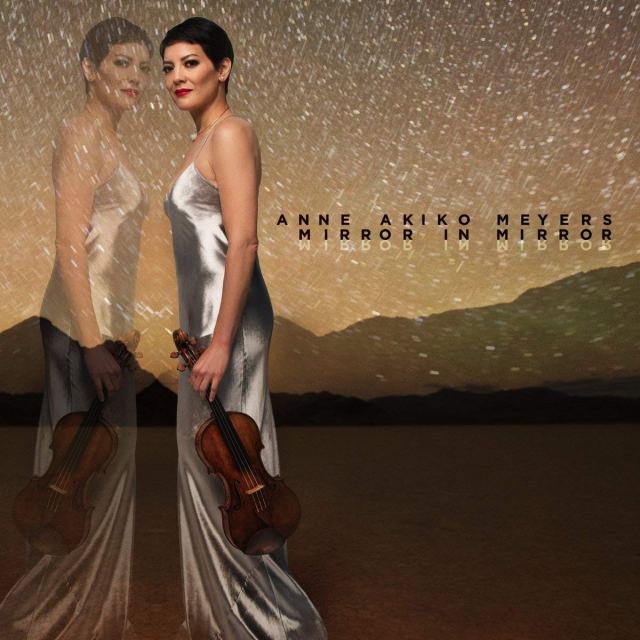
Anne Akiko Meyers’ Romantic Post Minimalism Enthralls


aameyers

Avie AV 2386

Admittedly I am a sucker for nearly all things minimalist and post-minimalist.  Such programming can lead to some potentially dull or cloying experiences.  Not so with this lovely collection of miniatures though.  While minimalists like Glass and Pärt make their appearances the concept here seems to reach for larger goals.  We have a mix of relatively simple chamber compositions along with electroacoustic works, a revelatory take on Ravel’s Tzigane and and arrangement for violin and orchestra of a solemn choral piece by Morten Lauridsen.

This eclecticism seems to flow from the artist’s choices rather than choices imposed by a producer.  In this respect she reminds this reviewer of pianist Lara Downes whose repertoire choices are similarly eclectic but born very personally from the artists’ experiences and preferences.

The opening Philip Glass Metamorphosis Two (1988) is presented in an arrangement by none other than Glass’ long time champion Michael Riesman.  It is followed by two violin and piano pieces by Arvo Pärt, Fratres (1977) and Spiegel im Spiegel (1978).  These lovely works serve to draw the listener in most pleasantly.  Akira Eguchi is the fine pianist who plays on all but tracks 4, 7, and 8.

Next up is a piece of musical archaeology.  Tzigane (1924) was originally written for violin and piano.  It was later orchestrated and it is that version which is best known and probably most recorded.  Well it turns out that Ravel had made a version for a now defunct instrument called a Luthéal which is an instrument invented in the early 20th century (patented 1919).  It’s actually not so much an instrument as an add on.  It modifies the sound of a piano.  The device now exists in museums but that hasn’t stopped innovative producers from utilizing an electroacoustic version.  Elizabeth Pridgen plays the keyboard to which the lutheal is virtually attached.

Apparently this version has been recorded before but this writer encountered it first in this release.  It is a very different sound than the piano or orchestral versions and is a lovely take on the music.  Many may buy the album for this track alone.

This is followed by a charming lullaby written for Meyers’ youngest daughter.  John Corigliano has absorbed only a small bit of the minimalism bug (maybe his 1985 Fantasy on an Ostinato  qualifies) but he is one of our finest living composers and he appears to infuse this violin and piano miniature, Lullaby for Natalie (2010) with a tender romanticism that is both sweet and touching.  In the notes we learn that it did seem to put her daughter to sleep but I doubt it will do that to most listeners.

The next two tracks are works by one Jakub Ciupinski  (1981- ) who also has a stage persona under the name Jakub Ζak under which he performs live electronic music.  This Polish born composer is now based in New York and works with various forms of electronics including a theremin.  Both “Edo Lullaby” (2018) and “Wreck of the Umbria” (2009) come from a similar place musically.  Both use electronics in varying degrees to enhance and accompany the solo violin.  Both are delightful little gems that give a nod to some minimalist roots but stand on their own merit and prompt this listener to keep an eye/ear out for more of this composer’s work.

The concluding piece is an arrangement by the composer Morten Lauridsen (1943-  ).  The performer states she pursued Lauridsen for a new piece and when he finally acquiesced he presented this lovely arrangement of his well known choral piece, “O Magnum Mysterium”.  The arrangement is for string orchestra and violin and orchestra here given its world premiere performance.  It should come as no surprise to new music fanciers that the Philharmonia Orchestra is conducted by none other than Kristjan Järvi, a fine conductor, composer, and avid new music advocate who can always be found near some interesting musical projects.

This album stands out in that the choices of the musical selections and the personal connections between the composers and the soloist are clearly collaborative and  inspired.  This is substance rather than fluff but it may appeal to a wider audience.  This one can be said to have crossover hopes but it does not pander.  This is a wonderful album and will likely prompt listeners who, like this writer, have yet to know this soloist to go and seek more of her recordings and live performances.  Brava!


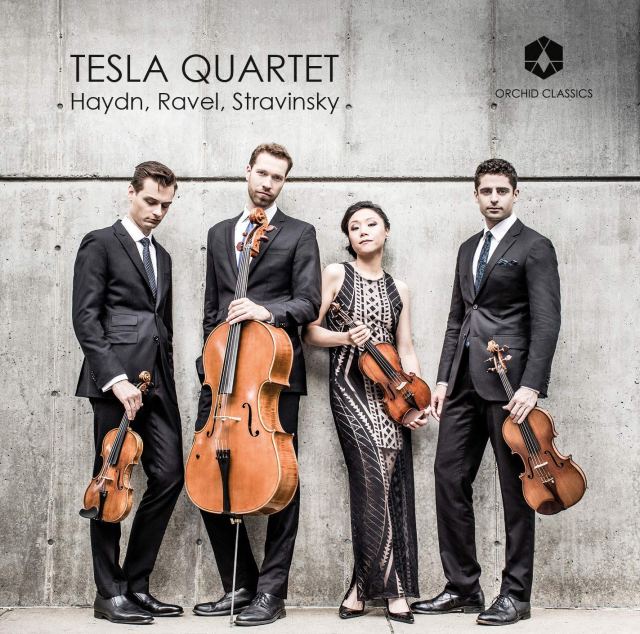
Tesla Quartet Debut Pleases


teslaqr

Most recordings of the wonderful Ravel String Quartet of 1902-3 is most frequently paired with the similarly masterful Debussy String Quartet (1893) or with another of Ravel’s fine chamber works.  Not here though.  For their debut recording this quartet has apparently chosen to demonstrate their skills by programming which spans the 18th to the early 20th century along with a selection of transcriptions of lesser known Ravel pieces.  After ten years playing together they have chosen to lay down some recorded tracks for posterity.

The disc opens with the Ravel Quartet which is handled most ably.  It is ostensibly this quartet that inspired first violin Ross Snyder to dedicate his career to the string quartet.  The bonuses here are transcriptions by first violin, Ross Snyder, of three lesser known Ravel piano pieces.  They are, in order of appearance on the album, the brief Menuet sur la nom d’ Haydn (1909), the more familiar Menuet Antique (1895), and the Menuet in C sharp minor (1904) are heard in transcriptions for string quartet.

By contrast the Teslas have chosen to feature Haydn’s String Quartet in C major Op. 54 No. 2.  It is the first one of the first set of so called “Tost” Quartets written in 1788 and named for a violinist (Johann Tost) of the Esterhazy orchestra.  This is mid-career Haydn who is justly known as the father of the string quartet.

The larger works are punctuated by the short transcriptions.  The Menuet sur le nom d’ Haydn follows the Ravel and leads us neatly to the Haydn.  The Menuet Antique follows next.  It is one of the more ubiquitous compositions of Ravel and listeners familiar with the composer’s work will doubtless recognize it as it appears in the Sonatine and the piano suite (later orchestrated), Le Tombeau de Couperin.

We then get to hear a lesser known masterwork by Igor Stravinsky (1882-1971), his Concertino for String Quartet (1920).  This is early Stravinsky but he clearly thought highly of this piece as he later orchestrated it in 1953 for small ensemble.  It is only about six and a  half minutes long but listeners will be able to discern this as a masterful work by the composer who had already produced his three great ballets, The Firebird, Petrushka and The Rite of Spring.  Nothing that earth shaking here but the hand of the artist can clearly be heard.

The disc ends rather enigmatically perhaps with a transcription of the very brief Menuet in C sharp minor which clocks in at under a minute.  The end result is a tasty little resume of an emerging chamber group that one hopes will bring another interesting perspective on the genre of the string quartet.  This is an auspicious and most listenable debut.

Gourmet Vegan with Solo Bass


Chef and host Philip Gelb (left) introduces Rashaan Carter

Friday August 17th was one of the last of Mr. Gelb’s famed Masumoto peach dinners incorporating the incredible peak of the harvest peaches into his magical vegan creations.  It is ostensibly among the last of his famed dinner concert series which has now run about 13 years.  Whether the series is ending remains to be seen but the opportunity to partake of Gelb’s culinary art should never be missed and this night we had the opportunity to hear a fine young musician as well.

img_0277

Phil started me with this tasty IPA, perhaps the only item that was not peach related.

img_0278

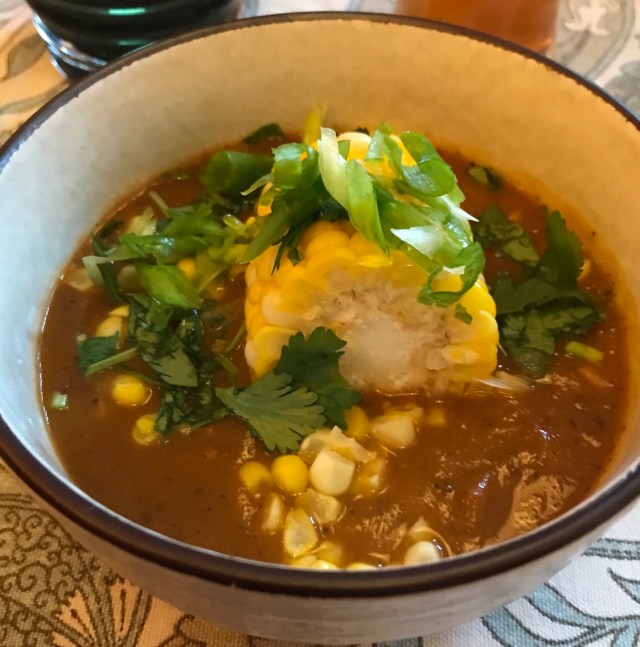
Dinner for about twenty happy diners began with this delicious corn soup.  Gelb has an eye for artistic presentation.

img_0279

A little peach based salsa added a bit of fire for those of us who enjoy spicy things.

img_0281

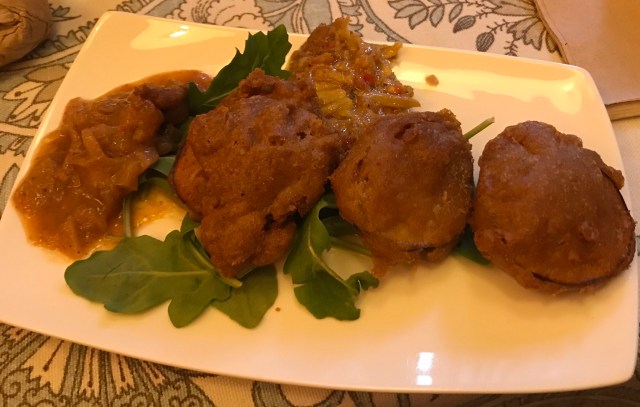
And on to the Baiganee (eggplant fritters) with peach kuchela and peach chutney.

img_0283

The main course was Jerk Stewed Tempeh, Rice, and Peas Calaloo.  Unfortunately my eating got a bit ahead of my picture taking but you get the idea.

Peaches are, as I said earlier, from the Masumoto family farm near Fresno where three generations have been producing some of the finest fruit in the state.  The tempeh is also locally sourced from Rhizocali Tempeh of Oakland.  It doesn’t get better than this.

img_0289

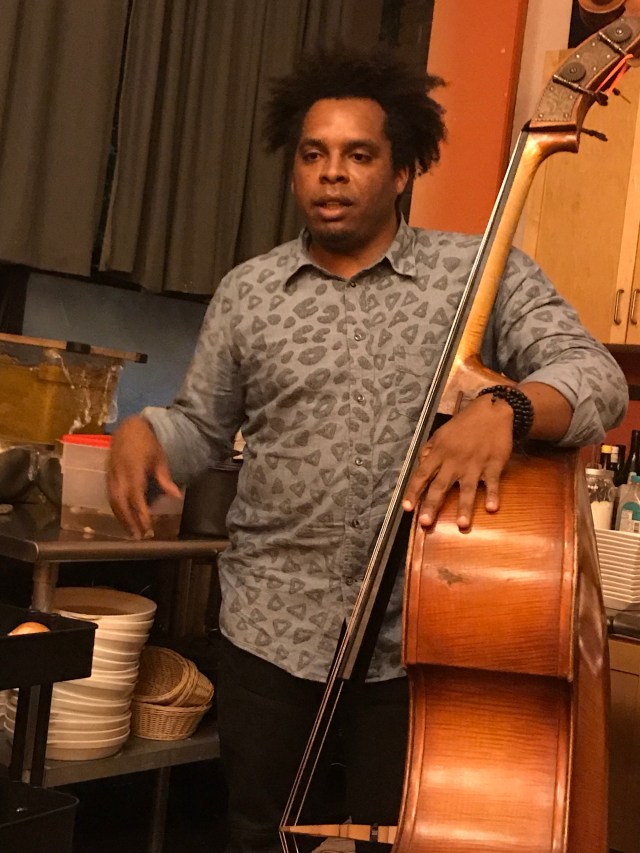
The tradition here puts the musician on stage just before dessert.  Rashaan Carter is an American musician from Washington D.C. who now resides in New York.  He was passing through the bay area and Philip Gelb extended an invitation which he graciously accepted.

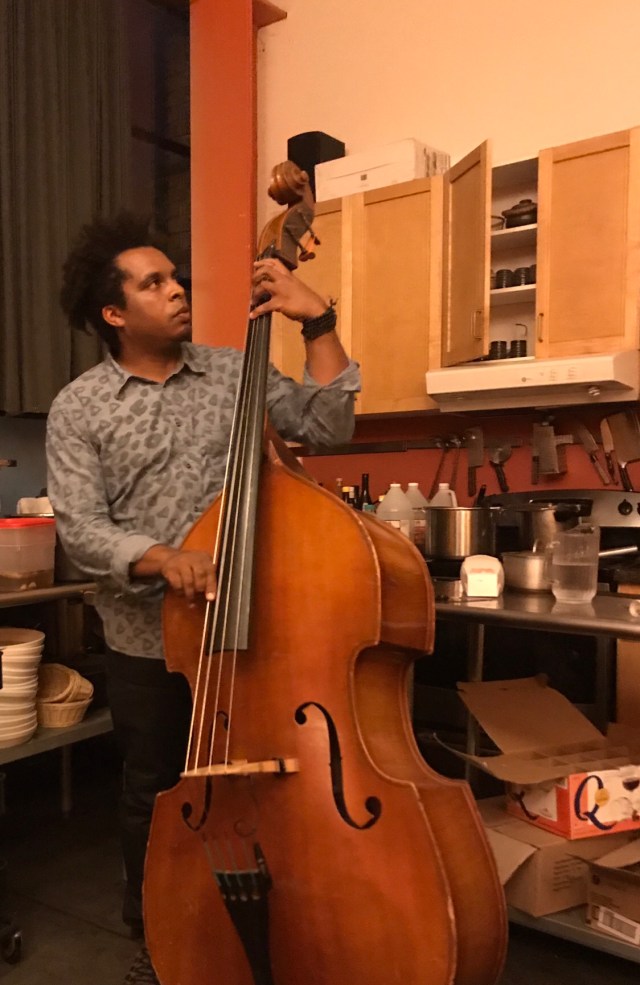
He began with an improvisation which he had initially done for a dance piece depicting the lynching of a black American woman Laura Nelson and her son in Oklahoma in 1911.  Now this could really bring down the mood of the evening but for the fact that Carter spoke of and subsequently played this piece with such passion that all one could really feel is the tragedy of the act and the heroic expression of what is essentially protest music dedicated to her memory.

img_0290

Rashaan has no small bit of the Blarney.  His running commentary during the performance was as entertaining as that of a stand up comic as he engaged most thoughtfully with the evening’s clearly appreciative audience.

He graced us with what he said was originally intended to be a performance of a Charlie Haden piece but decided he wanted to do his own piece as a sort of homage.  Indeed he captured Haden’s spirit oh so well in another virtuosic and passionate performance.

img_0286

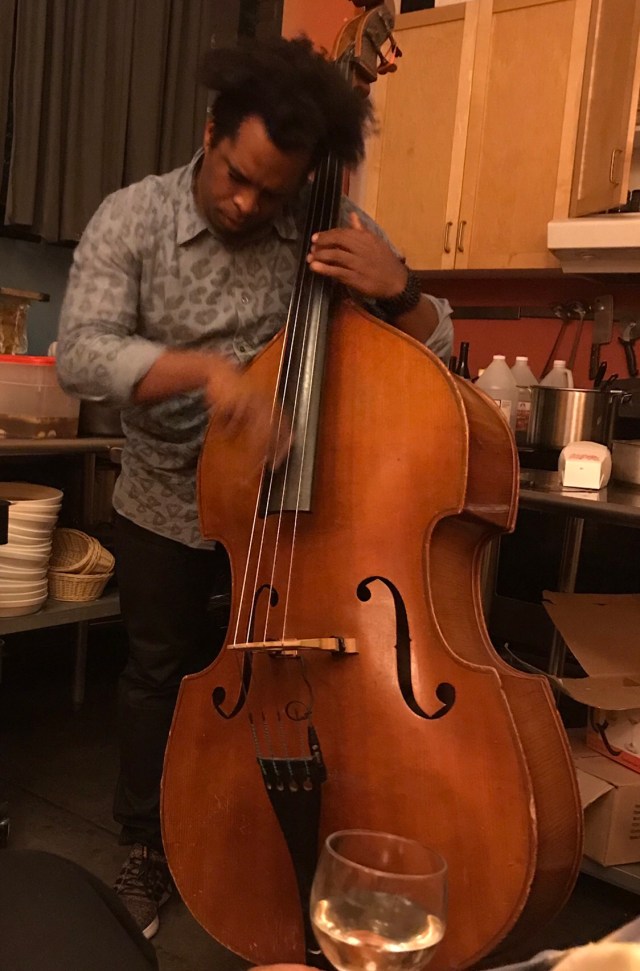
He ended with another sort of tribute, this time to Henry Threadgill.  Again his gift of gab provided just the right segue into the next piece and his familiarity with Threadgill was immediately apparent.  His facility with the acoustic bass produced nearly vocal sounding lines in a performance that did honor to Threadgill and left the evening’s audience very pleased.

We concluded with Blueberry polenta cake with peach ice cream and blueberry raspberry sauce, all vegan, all absolutely delicious.

img_0288

And we will all keep an ear out for Rashaan Carter from this point on.  Bravo!

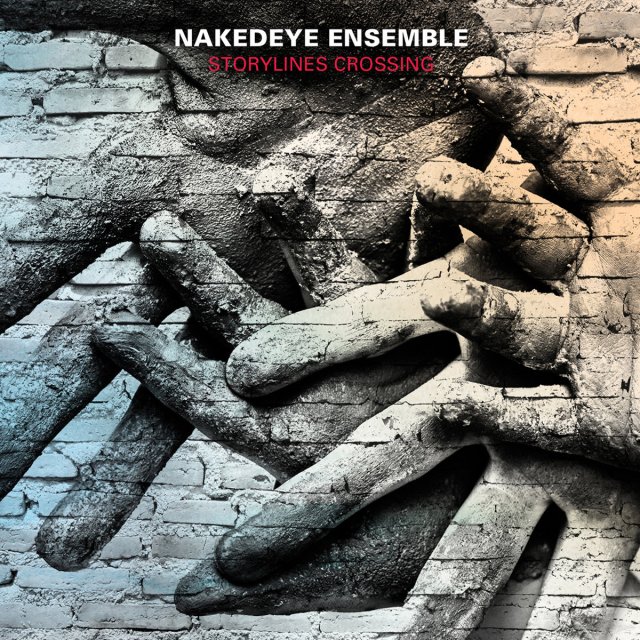
Nakedeye Ensemble: A Fine New Music Group Pays Homage to Past and Future


nakedeye

Starkland

It was only a few days after receiving this CD that I received a visit from a friend similarly interested in new music.  Shortly after that visit I discovered that the CD was missing.  My friend confessed to having taken it immediately when I asked but I already knew why he had taken it and why I might have done the same thing.  After all it’s a Starkland CD and this new performing ensemble have chosen for this, their debut recording, to do an arrangement of one of the finest pieces of political classical music ever.  It is their clever interpretation/homage of Frederic Rzewski’s Coming Together (1971) that provoked my friend’s larceny and laid bare my own moral weakness.  How could anyone resist that? (I told him took keep it and bought myself a new copy).

Nakedeye Ensemble was founded in 2011 with the intent of performing new music.  They were founded in Philadelphia

Curiously, of the six compositions featured on this release, three are “sociopolitical” and the other three I suppose come closer to a category like “absolute music”, the notion that music can be just about music.  While all art is a victim (or product) of its sociopolitical, geographical, and economic context one can at least say that there is a continuum in which some music actually depends on those contexts in a greater degree.  Sociopolitical music is a pet obsession with your humble reviewer.

The disc begins innocently enough with a fine rendition of Sextet (2010) by Jonathan Russell (1979).  This is a pleasant post-minimal work with rock influences and provides a gentle introduction to an apparently carefully constructed playlist designed to demonstrate some of the range of skills possessed by this group.  The influence of Steve Reich is present and functions almost like a framework for the post minimal music that emerges.  Another generation puts its stamp on this genre which is now older than anyone in this ensemble.

With the second track we get to one of those political pieces and to the second oldest composer represented.  Zack Browning‘s Decade of the Dragon (2015) was written to commemorate the 40th anniversary of the end of the Vietnam War and the 50th anniversary of its beginning.  Browning (1957- ) is professor emeritus at the University of Illinois and the director of the Salvatore Martirano Composition Award (Sal was also no stranger to politics).

Decade of the Dragon sounds like a post-modern sort of tone poem, evoking through musical quotation and development of original themes, the composer’s memories of the travesties that permeated those years formative to his development much as they were to your reviewer’s and doubtless many whom I imagine to be an ideal target audience for this music (and all the music on this disc actually).  And there is a sort of painful irony to hearing the artistic expressions of these sad historical events played (very effectively) by an ensemble for whom the events are solely history.

Rusty Banks‘ (1974-  ) “Surface Tensions” (2015) is another playful post-minimalist essay which is not afraid of a little experimentation.  Banks is among the younger composers here but this little sampling of his work suggests we will be hearing much more from his pen.

Randal Woolf  (1959) is a name which will likely be more familiar to listeners as he is a seasoned member of the so called “downtown” musicians.  He applies his considerable compositional skills to a politically infused work, “Punching the Clock” (2015).

There is a dedication and respect communicated by these musicians for their art, the artists whose work they interpret, and for the history that inspired some of them.  Nowhere is this better demonstrated than by the last track, Frederic Rzewski’s Coming Together (1971).

This piece has been done by many ensembles over the years but the only recording other than Rzewski’s original on Opus One records is one by the Hungarian ensemble “Amadinda”.  The text is spoken clearly, dramatically, and effectively and in English, albeit with a charming Hungarian accent.  There are also various lovely and interesting readings to be found on You Tube (including an uncharacteristically hesitant reading by rapper/actor Mos Def) but the arrangement by resident composer Richard Belcastro does a stunning (Am I too old to say “reboot”?) or reworking of the original.

Using different voices, intonations, and inflections this arrangement uses the voices in a sort of pointillistic counterpoint with voices having solos, sometimes answering each other, sometimes together.  Ranging from plain speech to whispers to various different vocal inflections this arrangement sort of democratizes the voices and creates a scenario in which the listener could envision their own voice and struggles.

The music here is great all the way through but the special joy of this release is the discovery of these youthful artists whose insights belie their age and whose technical skills suggest that Nakedeye can now take their place (alongside Eighth Blackbird, ICE,  Alarm Will Sound, Band on a Can All Stars, etc.)  Definitely a group that bears watching/listening.


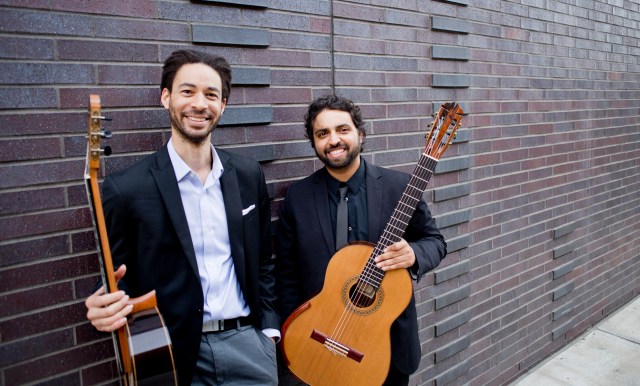
Duo Noire, Guitar Duo Revisioned


unnamed

New Focus FCR 210

Duo Noire consists of Thomas Flippin and Christopher Mallet.  These guitarists are graduates of the Yale School of Music.  For this, their debut album, they have chosen to feature a program of all women composers.  Add to that the fact that these fine emerging artists are African-American (also the first African American graduates of Yale School of Music) and you have a glorious celebration of gender/cultural diversity as well as some mind blowing compositional efforts ably handled by these visionary musicians.

duonoir

The demographics are necessarily prominent especially in these contentious times when racial and gender discrimination are, sadly, huge and difficult issues that remain largely unresolved.  But the real story here is creative music and musicians.  This duo seems to have a unique sound and are clearly schooled in their instruments to the point that they even seem to be expanding the very possibilities of a guitar duo.  Above all this is an intelligent album.

The composers Clarice Assad (1978- ), Mary Kouyoumdjian (1983- ), Courtney Bryan (1982- ), Golfam Khayam (1983- ), Gity Razaz (1986- ), and Gabriella Smith (1991- ) are mostly unfamiliar names to this writer and, likely, to most listeners.  But don’t let that put you off.  This is a highly inventive set of compositions and these performers are doing the job of discovering these compositional talents.

There on six compositions on this thirteen track CD which has over an hour of music on it and it appears to be a landmark release for identifying new composers contributing to the guitar duo genre.  Guitar duos are not an unusual instrumental grouping but this collection suggests fresh new directions that extend the possibilities of this instrumental configuration.

assad

Clarice Assad

Of course the guitar duo is hardly a new idea.  On the more pop side we have had Les Paul and Mary Ford and on the classical side many listeners will be familiar with Sergio and Odair Assad.  And that brings us to Clarice Assad who is the daughter of Sergio Assad.  Her composition,  Hocus Pocus (2016) is in three movements, each ostensibly describing an aspect of magic.  Clearly Assad is familiar with both traditional and extended techniques of composition for guitar.  This is a sort of impressionistic work which calls upon the musicians to utilize a variety of techniques to evoke moods and images of each of the three movements, Abracadabra!, Shamans, and Klutzy Witches.

kouyoumdjian-headshot-web-quality_orig

Mary Kouyoumdjian


Byblos (2017) by Mary Kouyoumdjian embraces her Persian roots as well as the conflicts which have plagued this area of the world.  Here she is evoking an ancient town in Lebanon.  This is the most extended single movement on the disc and demonstrates the composer’s mastery of form while it challenges the instrumentalists to evoke the ancient and mystical sounds of her classical culture.


bryan

Courtney Bryan

The only African-American composer featured on this recording is Courtney Bryan.  Her “Solo Dei Gloria” (2017) which was commissioned by Duo Noire takes the listener on a sonic journey through the composer’s impression of the inner process of prayer.  That’s a mighty abstract concept and she manages accomplish it with just the two guitars (and, of course, two talented musicians).


The three movement, “Night Triptych” (2017) was also written for Duo Noire and has the honor of being the title track for this truly eclectic and innovative album.  This has more the feel of an abstract musical work than the others featured but one does hear the influences of her ethnic origin (Persian/Iranian).  Despite the more extended nature of this composition this work, like all the works presented here, is a sampling of the composer’s work and the astute listener will have many reasons to seek out more of this young composer’s work.

golfam

Golfam Kayam


Gity_228-1-8x10

Gity Razaz


Four Haikus (2017) was also written for Duo Noire.  This Iranian born composer is rapidly becoming established internationally as an accomplished composer.  Like the previous work these four short movements are of a more abstract nature.  Another sampling that will prompt listeners to seek out more of this emerging composer’s work.

gsmith

Gabriella Smith

Last but not least is the second most extended work here by the youngest of the composers represented.  “Loop the Fractal Hold of Rain” (2017) is another Duo Noire commission.  This is probably the most abstract and modern composition on the disc.

Many works here have at least the suggestion of dealing with politics, conflict, and the impact of such things on individuals.

It is admittedly unusual (though clearly not risky) to program compositions by all women composers.  This is a wonderful collection with performances that are incisive and intriguing enough to leave their listeners wanting more.  This is a group to watch/listen to.


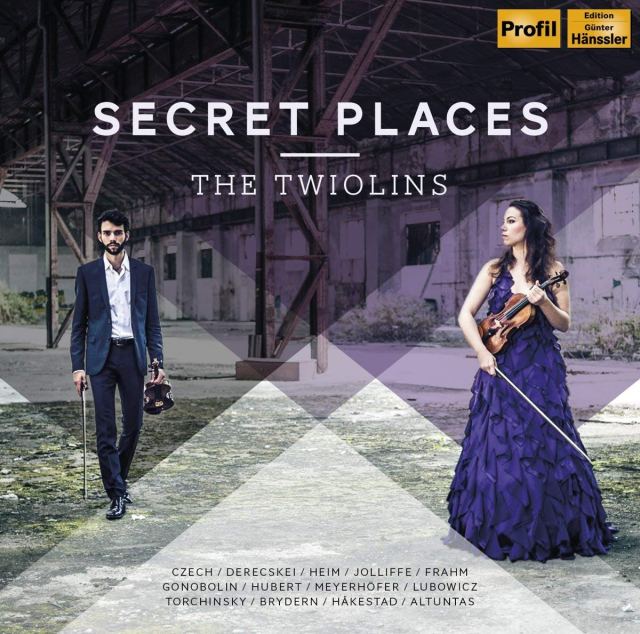
The Twiolins: Secret Places


twiolinssecret

Hännsler PHI 7002

Wow!  What a discovery.  This album was kindly sent to me by a friend, one of his most recent discoveries.  And from the moment I put this in the CD player I was entranced.  Despite the appearance of yet another cute musical duo these are two amazingly talented musicians playing some of the best post-minimal pieces this writer has heard in years.

Twiolins is are violinists with a wide range of interests (their repertoire as reported on their web site is impressive) but with a clear love for post-minimalist music.  In fact they are brother and sister, Marie-Luise Dingler and Christopher Dingler.  Unlike acts that seem to be designed to reach an audience with mediocre pop-inflected classical music Twiolins here presents 13 works by composers completely unfamiliar to this writer but astoundingly fresh and inventive.

My first impression reminded me of the music of the late great violinist and composer Michael Galasso.  There is a remarkable similarity in styles between the composers represented here but all seem to fall basically into a post-minimalist category.  The difference is that this music went right to my head (so to speak) and I found this music invaded my nervous system in the same delightful way that my first encounters with minimalism did.  My linear thinking was impaired and I found myself carried away, willing to follow wherever the music led me.  It was a curious mix of nostalgia and revelation.

There are 13 relatively brief tracks (ranging from 2:13 to 6:46) representing 13 compositions.  Once I put the disc in the CD player I just had to hear the whole thing.  No pause allowed.  There is a consistency of styles with these pieces and the ordering on the disc promotes a nice flow from faster to slower pieces, then faster ones again.  And adding to the basic quality of the compositions is a clear sense that these musicians are able to bring out details in the phrasing of their playing that make these compositions shine in ways that would flatter any composer.

Tracklist:

Rebecca Czech, Germany: Ich glaub´, es gibt Regen

András Derecskei, Hungary: Balkanoid

Benjamin Heim, Australia: Trance No.1

Edmund Jolliffe, UK: Waltz Diabolique

Jens Hubert, Germany: Rock you vs. Ballerina

Johannes Meyerhöfer, Germany: Atem • Licht

Nils Frahm, Germany: Hammers

Aleksander Gonobolin, Ukraine: Metamorphosis

Dawid Lubowicz, Poland: Carpathian

Vladimir Torchinsky, Russia: Eight Strings

Benedikt Brydern, USA: Schillers Nachtflug

Andreas Håkestad, Norway: Three Moods, I

Levent Altuntas, Germany: Chasma^2

This is apparently their third album (their first was released in 2011 and another in 2014).  It was released in late 2017.  I picked these up at Amazon as digital downloads for comparison.  It would appear that these musicians have been carefully cultivating their sound and selecting their repertoire.

Granted there is a slightly populist feel here but none of these composers are known to this reviewer so it’s difficult to say if this is typical of their work.  These are strong, well-wrought pieces that will delight and move the listener.  The term “populist” here is not intended to imply simplicity or lower quality, just a nod to the fact that it will likely have an immediate appeal to listeners.  The composers are a nationally diverse set and doubtless have other compositions of interest in their catalogs.  Listeners can doubtless anticipate more tasty little miniatures as well as (hopefully) selections from their repertoire of concerti and the like.

This is not a mind bending or taxing album but neither is it negligible.  The liner notes give little info about the pieces but that doesn’t really matter because they’re relatively brief and you will either like them or not but this writer is betting on “like”.


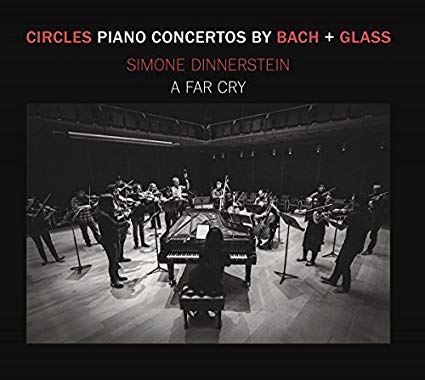
Simone Dinnerstein: Bach and Glass


dinnerglass

It has been interesting to watch the progression of Philip Glass’ career.  From his driving amplified ensemble music that so entranced this writer to as near groupie status as he will ever be to the more mainstream orchestral work of his work since at least the 90s the fascination remains at some level.

The familiar arpeggios are still to be found along with basically diatonic harmony with occasional polytonal sections.  What is interesting about Glass’ third piano concerto is a sort of chamber romanticism.  A Far Cry is a small chamber orchestra ideally suited to works like the Bach first piano concerto. Though technically originally written for harpsichord pianists have successfully broken the taboo on strict adherence to using the harpsichord and have developed techniques to optimize the sound of the piano (which has very different qualities from a harpsichord).

Simone Dinnerstein is an artist who I first met (albeit virtually) on Facebook.  Her reading of the Goldberg Variations from a few years ago seemed to signal her entrance into the mainstream of performers.  The choice of works on this disc are a sort of characterization of her interests.  She is an accomplished Bach performer with, obviously, an interest in new music.  So pairing her as soloist with A Far Cry whose interests appear to be in a similar range was perfect.

The performance of the Bach G minor piano concerto (No.7) is as delightful as it gets.  Dinnerstein and the ensemble seem work together very well.  These intense little chamber orchestras seem to be proliferating and one could speculate on the economic and political reasons for that but what is more interesting is the commitment and intensity that these small ensembles can bring to music.

The Glass concerto has the feel of a sort of miniature romanticism.  This writer heard it as echoes of Brahms but on a far more intimate scale.  It is difficult to say whether this new work (or for that matter, the other two piano concertos) will become a regular part of the repertory but it is clear that Glass continues to have his champions both in musicians and listeners.

There is nothing groundbreaking here and that is not what is apparently intended.  What we get in this recording is a couple of dedicated and thoroughly enjoyable performances by clearly dedicated musicians.  This is not an original instruments or musicological discoveries type of album.  It is simply good music making.

If you are a fan of Philip Glass and/or Simone Dinnerstein you will want this disc.  But don’t forget to pay attention the this little chamber group.  They are superb and energetic musicians and this reviewer expects to be hearing more from them in the near future.  Maybe we will get a new set of Bach and/or Mozart concertos.  Here’s hoping.

Quince Ensemble: Motherland


quince

New Focus FRC 203

I looked at the rather drab cover.  I had never heard of the Quince Ensemble nor any of the composers featured on this disc.  I looked again at the cover.  Clearly it was labeled with one of those parental advisory warnings which one rarely sees on a classical recording.

My usual practice is to do some research before spinning a given disc but I decided to just put this one in the CD player cold.  I had about an hour’s drive ahead and I decided to just let the disc speak for itself.  But my spidey sense suggested I might be in for a rather dull listen.

So much for my superhero powers.  From the moment the first track played I felt drawn in.  What I heard seemed to be a mixture of Peter Kotik (of Many, Many Women in particular), Meredith Monk, a touch of La Mystere de Voix Bulgare, the west coast group Kitka, and a few others).  That is to say that this disc grabbed my attention and had echoes of a few other contemporary vocal music styles.  What I heard was very compelling, creative, practiced, passionate.

This is mostly an a capella group though they made very effective use of harmonicas as drone material at one point.  Even after reaching my destination (achieved before the disc ended) I couldn’t bring myself to shut it off so I stayed parked and listening til I had heard the entire disc.  Yes, it was THAT compelling.

Complicating the reviewer’s task further is that the disc contains four compositions by four composers whose first appearance on this writer’s radar was from this very disc.  All four are world premiere recordings and all are by women composers.

The Quince Ensemble consists of Liz Pearse (soprano), Kayleigh Butcher (mezzo soprano), Amanda DeBoer Bartlett (soprano), and Carrie Henneman Shaw (soprano).  And this is the fourth album dedicated entirely to this ensemble’s work.  Two previous albums were appearances and collaborations.

The featured composers are (in order of their appearance on this release): Gilda Lyons (1975- ); Laura Steenberge; Cara Haxo (1991- ); and Jennifer Jolley (1981- ).  All appear to be Calfornia based and at the beginnings of what will doubtless be some interesting careers.  I will leave it to the interested reader to look into the details available at these various web sites but, after listening to the music, most listeners will want to know more.

The pieces range from Lyon’s Bone “Needles” coming in at just over 4 minutes to the next two multiple movement pieces and finally Jolley’s “Prisoner of Conscience” which is an homage to the politically active musical group, “Pussy Riot”.  This is the longest and most political piece on the album.

From the initial (and incorrect) assumption that this would be a dull disc to the end of this listening journey I came to see this disc in quite a different light.  The cover now seems friendly and appropriately representative of the album.

Rather than go into a bland or potentially inaccurate analysis of these pieces suffice it to say that this is effective and affecting music by a delightfully talented and energetic ensemble.  If you like vocal music, political music, music by women, or are just looking for something to lift you from your daily malaise give this one a try.  You will be both challenged and entertained.  No doubt this group would be fantastic in a live performance but for now we shall have to make do with this wonderful recording.


Other Minds 23: Whereof One Cannot Speak…


“Fragment #3”
speaking is speakingWe repeat
what we speak
and then we are
speaking again and that
speaking is speaking.

TokyoJune sometime, 1976                                                                         Richard Brautigan (1935-1984)
OM230007

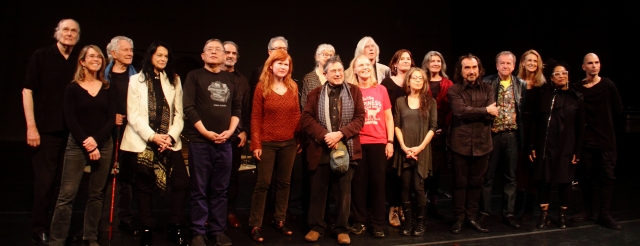
(Left to right: Clark Coolidge, Karen Stackpole, Michael McClure, Anne Waldman, Randall Wong, Aram Saroyan, Sarah Cahill, Charles Amirkhanian, Carol Law, Alvin Curran, Beth Anderson, Jaap Blonk, Tone Åse, Amy X Neuberg, Sheila Davies Sumner, Enzo Minarelli, Ottar Ormstad, Susan Stone, Pamela Z, Taras Mashtalir)

The last statement in Ludwig Wittgenstein’s 1921 Tractatus Logico-Philosophicus (Whereof one cannot speak, thereof one must remain silent) is well known among philosophy students and has taken on the quality of an aphorism or truism.  But the six days of this most recent Other Minds Festival was functionally an effective refutation of this concept.  And the controversy over the awarding of the most recent Pulitzer Prize in music to a rap/hip-hop artist (a species of sound poetry?) which was announced on April 16th, 2 days after the end of this festival of sound poetry seems to reflect the prescience and presence of mind of the Other Minds organization.  Apparently words are “in” even if Wittgenstein and the critics of the Pulitzer Foundation say otherwise.

The Wages of Syntax

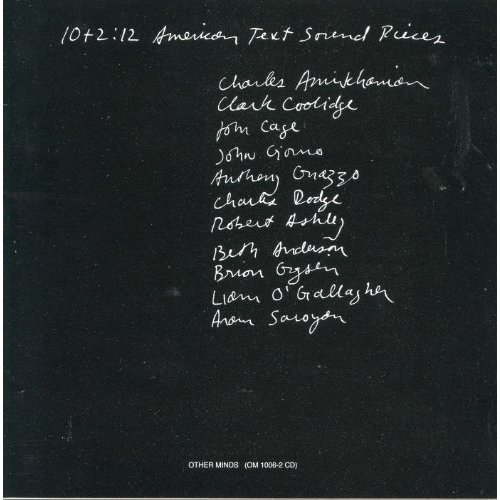
Other Minds 23 (April 9-14, 2018) in many ways began with the release in 1975, of one of the first (and still arguably the finest and still in print) anthologies of a strange, somewhat nebulous species of what can loosely be termed “sound poetry”.  That anthology was called “10+2: 12 American Text Sound Pieces” curated by the man behind this week’s vast expansion on that anthology, Charles Amirkhanian.
american text sound

Amirkhanian and his wife, artist and photographer Carol Law took a long strange trip in the early 1970s.  No, they did not follow the Grateful Dead.  Rather they sought a little known group of artists who walked a line seemingly between poetry and music.  From the Nordic countries to northern Europe, France and Italy they encountered artists who used the voice (though not necessarily language per se) to produce a sonic art form which nearly defies categorization.
1280px-Amirkhanian

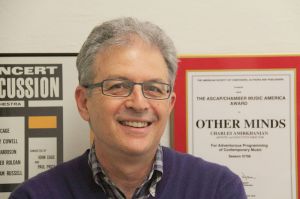
Amirkhanian  in his office

Charles Amirkhanian is himself a composer and percussionist in addition to being a producer and promoter of contemporary music.  As a composer, as it was with his long radio career, his voice has been his main instrument.  His resonant, articulate baritone voice has served him well these years and this festival provided a rare opportunity to see/hear Amirkhanian perform his own work live.

This unprecedented 6 day festival marks the longest in the series of the Other Minds annual music festivals.  As relatively obscure as this art form may seem to the casual observer this series managed to provide historical context, current practices, and a tantalizing look/listen at the future of what is in fact a vast body of work.  The ability of Other Minds to find hidden treasures of sonic art continues to amaze.

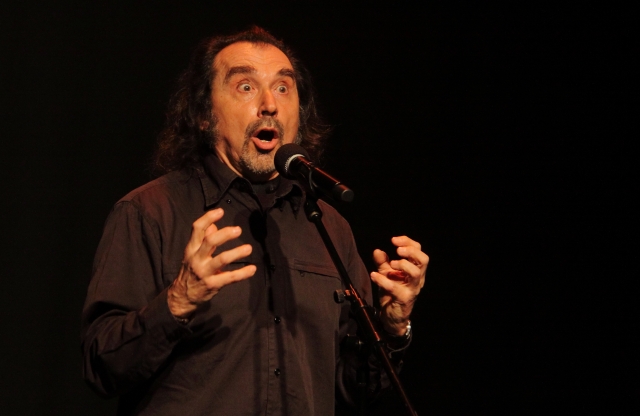
Day one,subtitled, “The Wages of Syntax”, was the gala opening featuring some of the leading artists in the field.  After the obligatory intros the Italian master Enzo Minarelli presented the world premiere of his tribute to Stephane Mallarmé, “Ptyx”.
OM230013

The piece, comprised of phonemes rather than syntactical sounds, was an apt introduction to the weird and wonderful world of sound poetry.  Minarelli was passionate and expressive, a beautiful performance.  Only later in this series would we come to know the depth of scholarship, preparation, and experience that informed this and all his performances.  More on that a bit later.

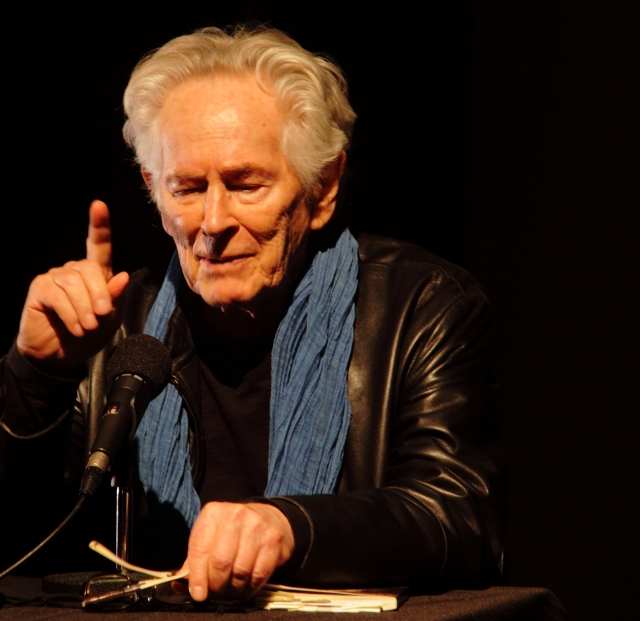
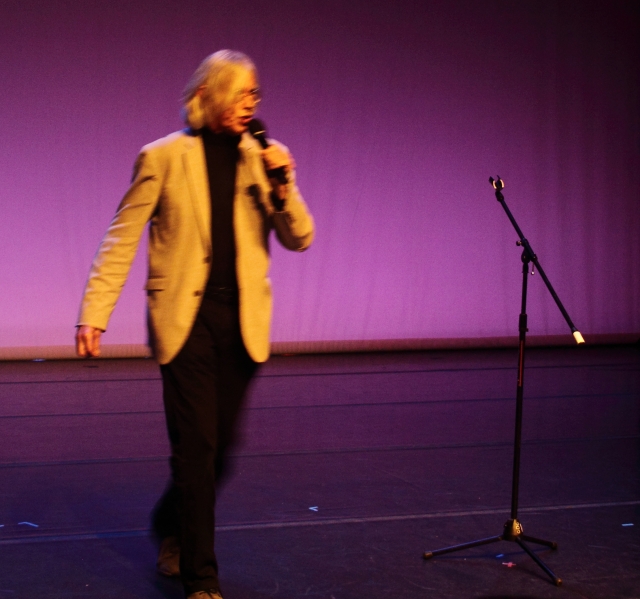
Next up was one of the elder statesmen of San Francisco poets, the wonderful Michael McClure.  At 85 he sported a walking stick (no not really a cane) needed due to a recent fall.  He also required assistance of one of the stage managers to help him to the little chair and desk set up for him.  But none of that mattered once he opened his little bookmarked book of poetry and began to read “Marilyn Monroe Thou Hast Passed the Dark Barrier” and some of his Ghost Tantras from 1962.  His voice was strong, his delivery both certain and witty.  His combinations of words and non-syntactical sounds were delivered with the same joy, humor, and pathos which appears to have inspired them in the first place.  The audience responded very warmly to his ecstatic delivery.
OM230015

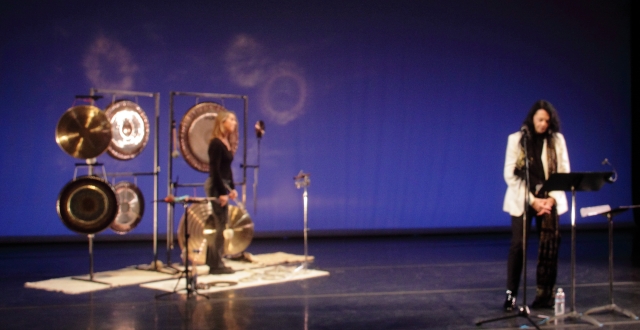
After a bit of stage preparation we were treated to one of the most prominent members of the next generation of American poets that followed Mr. McClure (can I be forgiven for saying beat poets?), Anne Waldman.  She was accompanied (as her texts required) by percussionist Karen Stackpole.  Waldman presented from her “New and Selected Poems”, “Pieces of an Hour (for John Cage)”, excerpts from “Voices Daughter of a Heart Yet to Be Born”, and excerpts from “Trickster Feminism”.  Her characteristically forceful and peripatetic performance carried her between the microphone and Stackpole’s percussion instruments and back again.  It was a charged and sincere performance which clearly charmed (some might say stunned) the audience.

Waldman’s ties to the world of sound poetry go back to her New York roots and her involvement in the St. Mark’s Poetry Project and the Dial-a Poem Poets whose recordings have included her work and that of John Cage, Charles Amirkhanian, Clark Coolidge, and Michael McClure among others.  Small world.
OM230021

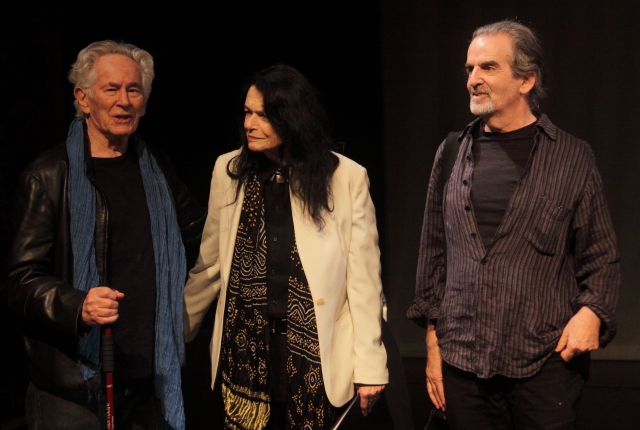
Next up was the venerable Aram Saroyan.  I suppose Saroyan (yes, the son of Pulitzer Prize winner William Saroyan) can be said to be part of the same post beat generation artists as Waldman.  Perhaps best known for his “minimalist poetry” he is also an accomplished biographer (Genesis Angels deserves to be better known IMHO) and literary innovator.  It was Saroyan’s poem “Crickets” (1965) which ended the first side of that anthology mentioned at the beginning of this article.  It was in an infinite loop in the end groove of side one of the LP playing the one word which comprises the poem, “crickets”.  And it was this little gem that he performed on this night….with a twist.  After a few repetitions he invited the audience (many apparently still trying to figure out what was going on) to join…which we did…,at first hesitantly, in unison…and then, in a touch of group inspiration, just like real crickets, not all in unison.  It was a strange sort of call and response that charmed the audience and brought a smile to the poet as well.  And that only brought us to intermission.
OM230004

Michael McClure, Anne Waldman, and Aram Saroyan

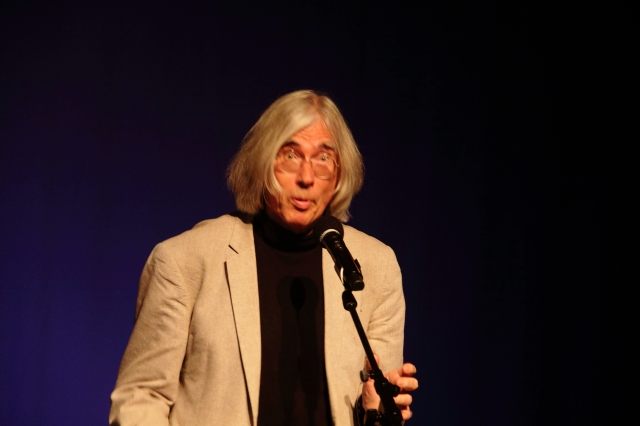
The second half introduced the first of the international stars, Jaap Blonk, the Dutch sound poet and performance artist.  He began with one of his own works, Obbele Boep ‘m Pam (a bebop sound poem).  It was a sound poetry homage to that 1950s species of jazz which inspired the beats, Bebop.  It was a sequence of sounds and words in a made up (by the performer) language intended to imitate the sound of his native Dutch language.

His second performance was of a sound poem from 1916 by the man who coined the term, “phonetic poem”, Hugo Ball (1886-1927).  This poem, based on phonemes common to the Swiss and German languages, was called, “Seepferdchen und Flugfische” (in English “Seahorses and Flying Fish”).  Blonk’s delivery of this turn of the century classic was the first of what would be several such revivals of revered early material of this nascent artistic genre.
OM230026

Jaap Blonk

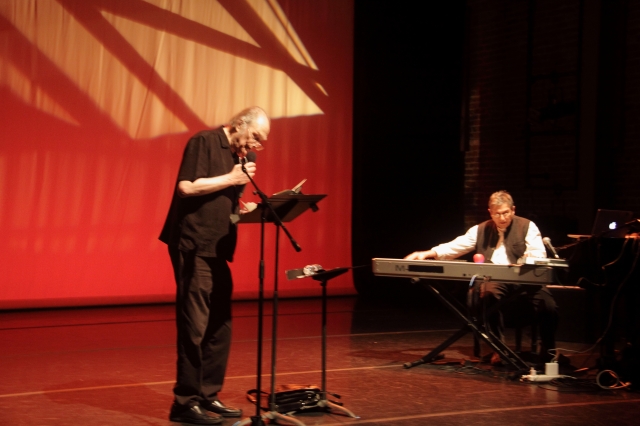
Blonk was followed by the grand finale which returned us to the local roots with poet Clark Coolidge and the ever innovative Alvin Curran.  We learned that the two went to high school together and this was a strange and wonderful reunion with Coolidge reading his manic stream of consciousness poetry accompanied (sort of) by Curran’s musical ministering at both a grand piano and a sampling keyboard in a world premiere collaboration.

Though Curran now lives in Rome (and has for many years) he will always be welcome in the Bay Area where he lived, taught, and performed for many years.  Curran is no stranger to Other Minds either having performed at Other Minds 7 in 2001 and, more recently, at the Nature of Music series.  He is a musician, not a poet but his eclecticism has allowed him to collaborate successfully with a wide variety of artists in a long and varied career which continues to command attention.

The nature of the interactions which characterized this world premiere performance of “Just Out of Nowhere” were not obvious though it is a fair assumption that a degree of improvisation was used and, no doubt, some of the successful confluences on this night were first encountered in rehearsals.  Coolidge’s stream of consciousness rhythmic ramblings were ever present but never overwhelming.  In response, Curran moved back and forth between the grand piano and the sampling keyboard working with serious concentration to provide his musical support for the words.

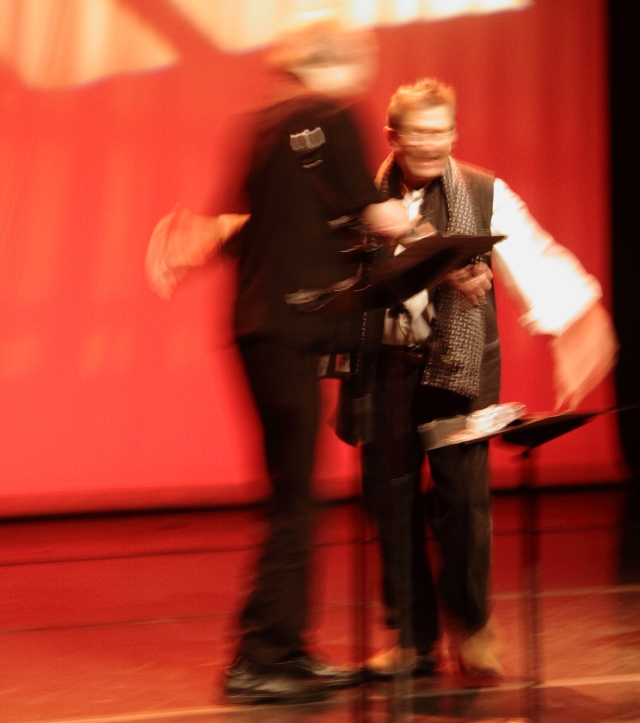
It was an intense performance as inscrutably mind expanding as all that went before.  Curran signaled the end (as has become his performance custom) by blowing the sacred shofar over the undampened piano strings which resonated in kind and faded to silence which, in turn, was held for a moment by the audience as they disengaged from their attention to offer warm and appreciative applause.  It was a striking collaboration and a reunion of two beloved artists.
OM230033

The audience seemed to feel the pure emotion of this performance and the two performers embraced warmly before acknowledging the accolades of the charmed audience.
OM230035

Sadly this writer had to miss the second night of the festival which consisted of a lecture by Enzo Minarelli on the history of sound poetry followed in the evening by a workshop on how to do sound poetry run by Jaap Blonk.  Both were apparently well received and it is my understanding that they will soon be available for streaming on the Other Minds web site.  Definitely gonna check that out.

The second night was given the subtitle, “No Poets Don’t Own Words”.  Even for those who were fortunate enough to have attended this extended Tuesday program it is worth noting that there is a wealth of resources easily available to the interested listener.  The Other Minds website has links to a wealth of archives which include interviews and performances by a variety of artists.  In fact (and this was a creative touch) you get a free CD entitled, “What is sound poetry?”, an archived KPFA radio program when you buy one of the unique t-shirts (designed by none other than Carol Law) from the Other Minds Web Store.  Get this stuff while you can folks.

Also worthy of note (this writer has lost many hours browsing here) is Ubuweb, an online archive of music, texts, films, and sound poetry.  The fact is that these six evenings ultimately could only serve as an introduction to the unusual and entertaining genre.  And those whose appetites have been whetted by this series will want to hear more.

The History Channel
OM230039

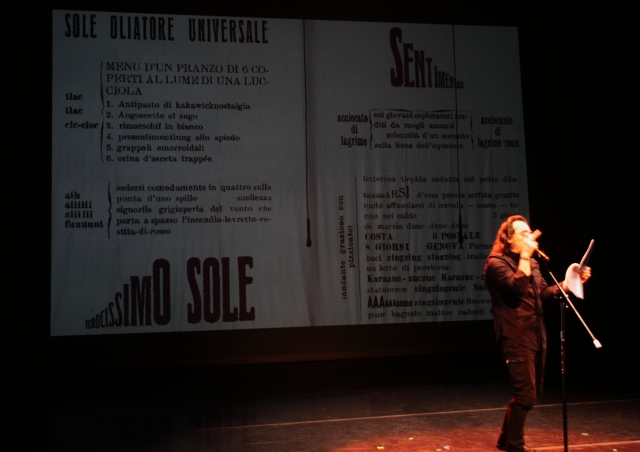
Day 3, April 11th.  The subtitle for this night’s performance was, appropriately, The History Channel.  It was an opportunity to display some of the origins and early foundational masterworks of sound poetry.  Enzo Minarelli displayed his academic skills and interests as he interpreted several classic “scores” (which were projected on the back wall) as the performer brought them to life in what appears to have been as authentic a performance as could be had with this material from the early twentieth century.

Minarelli did readings of: “Dune (parole in libertå)” (1914) and “Zang Tumb Tuuum: Adrianopoli, 1912” (1914) by Filippo Tommaso Marinetti; Fortunato Depero’s “Subway” (1939), “Verbalizzazione astratta di signora” (1927), and “Graticieli” (Skyscrapers, 1929).  He finished with one more by Marinetti, “Savoia” (1917).  In addition to the passion of Minarelli’s performance the look of the score, essentially artistically printed pages of words and phonemes, and the choices made by the performer to interpret those scores itself provided its own sense of drama.  The lighting and projection were simple and effective, supporting the live performance.
OM230042

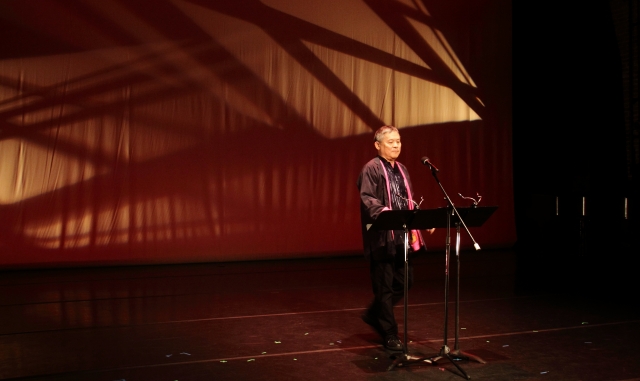
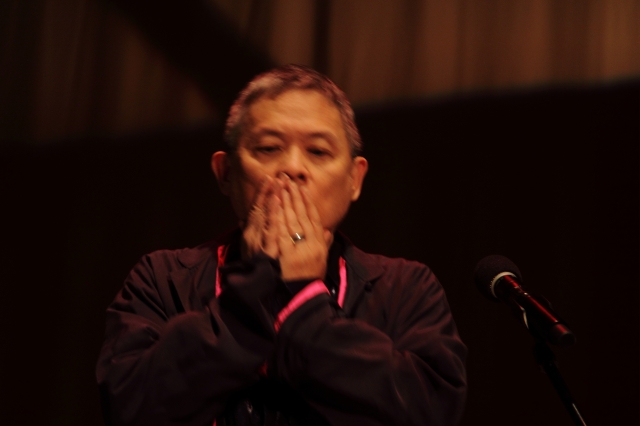
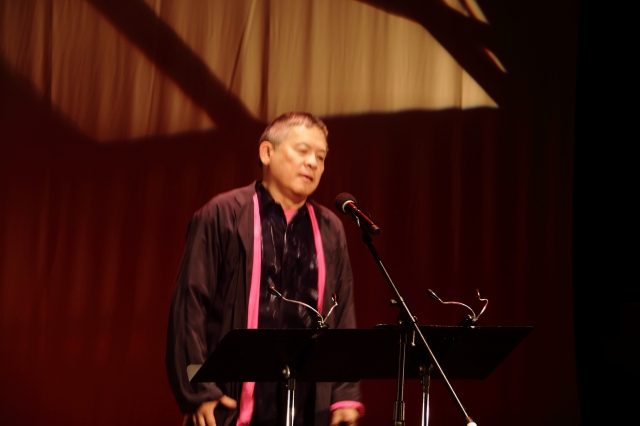
No major stage changes were needed for the next performer, just a little music stand with a microphone and small lights to illuminate the score.  Randall Wong, currently administrative director at Other Minds is an accomplished singer.  He is in fact a male soprano who specializes in baroque vocal scores including opera.  No stranger to new music, Wong has also demonstrated his formidable vocal skills singing with the Meredith Monk Ensemble among others.  It was those extended vocal skills that were called upon this night.

One could hardly have found a more appropriate casting to perform this next item on the program, “Stripsody” (1966) by the deservedly celebrated new music soprano Cathy Berberian.  Similarly to Wong, Berberian’s career took her from baroque opera to a plethora of modern music (Berberian was married for a time to Italian modernist composer Luciano Berio who wrote many a score for her).  What is lesser known is that Berberian wrote some music designed and inspired by her own vocal skills.
OM230045

Stripsody is difficult to describe.

OM230043

It is, in fact, a combination of sounds, specialized vocal utterances, and visual theater and is a sort of homage to comic strips (hence the title).  Utilizing onomatopoetic sounds, imitations of real world sounds and the sheer range of Berberian’s vocal instrument the performer becomes a sort of live comic character.  This piece is demanding but highly entertaining and contains humor and a variety of references.  Never did the audience lose track of the virtuosity involved or the intensity of the performer’s stage presence.  Wong’s performance was at once accurate, virtuosic, and a touching evocation of the memory of Ms. Berberian.
OM230044

It was an immersive experience for both performer and audience witnessing the sounds, the gestures, the facial expressions, the sheer concentration required to convey both the humor and joy of this work.  Wong demonstrated serious stamina and seemed to have enjoyed himself.
OM230047

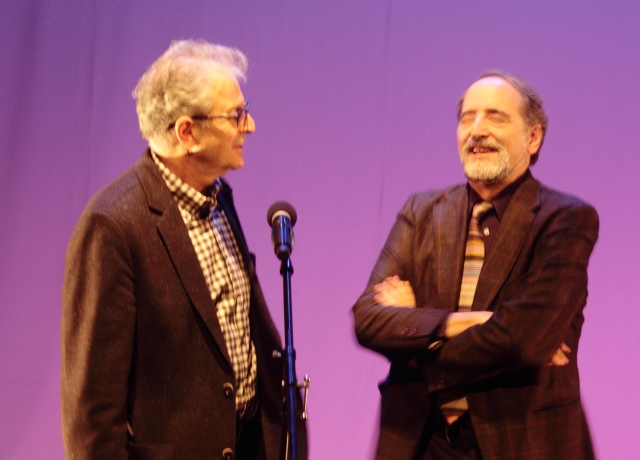
Now what is history without a bit of archaeology added in?  Charles Amirkhanian introduced writer Lawrence Weschler who is (bear with me now) the grandson of the composer Ernst Toch.  Toch is responsible for writing what is perhaps the best known example of the genre represented by OM 23 this year.

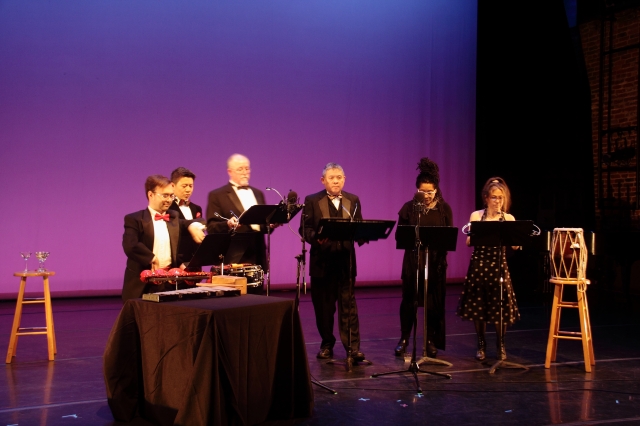
In 1930 he wrote a three part composition entitled, “Gesprochene Musik” (Spoken Music).  Two of the three parts of this composition had long been thought lost.  However choreographer Christopher Caines apparently did a reconstruction for his dance piece, Spoken Music (2006).  Tonight’s performance was the American premiere of substantially what Toch had originally intended way back in 1930.
OM230049

The last of the three pieces, “Geographical Fugue” is by far the best known of Toch’s spoken music (indeed the probably the best known of all his music despite a truly substantial catalog and a Pulitzer Prize, no less).  In addition to the Gesprochene Musik there was a performance of a much later work by Toch which parodies chatter at cocktail parties, “Valse”(1962).

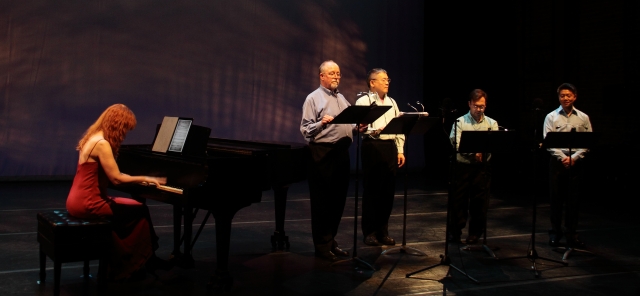
All of these were performed by The Other Minds Ensemble which consists of Kevin Baum, tenor; Randall Wong, tenor (yes, he can handle both soprano and tenor); Joel Chapman, baritone; Sidney Chen, bass, Amy X Neuberg, and Pamela Z.

Fast forward now to 2014  when grandson, executor, and writer Lawrence Weschler came up, on a whim, with a medical text to fit to the original Geographical Fugue.  Tonight we were treated to the world premiere performance of Medical Fugue with the same ensemble.  Weschler’s facility with language allowed him to choose the phonetics which worked as effectively as Toch did in his original. No doubt grandaddy would have been proud.
OM230054

Following intermission Jaap Blonk again took the stage, this time doing a historical performance for which he has become quite well known.  Tonight he performed (from memory, no less) “Ursonate” (1932) by Kurt Schwitters.  This large and complex work in several sections (or movements) utilizes vocal sounds fit together in the manner of classical sonata form in music.  Blonk has been performing this work for many years now and he obviously both knows and loves this piece.  His sincere, kinetic performance brought the audience back to the time frame of those years between the wars most effectively.

Two pieces on tape were next: “La Poinçonneuse, Passe Partot No. 2” (1970) by Bernard Heidsieck (1928-2014) and “If I told him (a completed portrait of Pablo Picasso) (1934) by Gertrude Stein (1874-1946).  Both were presented with the theater darkened and a simple card projected on the back wall of the name of the work and the composer.

The Heidsieck piece is a poignant and bittersweet scenario alleged to be at least partly autobiographical.  The Stein was a poetic portrait of her friend, Pablo Picasso.  It was in Stein’s own unique take on language and left one wondering why Stein’s work is not even better known than it is.
OM230057

And for the finale the Other Minds Ensemble was joined by a frequent guest artist, the justly renowned pianist Sarah Cahill in a seldom performed work by American Composer (and Gertrude Stein collaborator) Virgil Thomson (1896-1989).  “Capital Capitals” (1917-1927) utilizes a Stein text.  Thomson and Stein enjoyed several successful collaborations (including two operas) with Thomson setting Stein’s words to music.

The text, designed with musical analogies in mind, was presented uncensored with a disclaimer in the program.  The text, a bit dated, would not be considered politically correct by today’s standards.  It is a celebration of the ancient capitals of Provence (Aix, Arles, Avignon, and Les Baux).  The music was written ten years after the text and shows the same collaborative affinity demonstrated in the operas.

The ensemble appeared to have a great deal of fun with the punning language and the music such a good fit. The audience clearly agreed.

Scandalnavians

Day 4:  One of the things that has characterized Other Minds concerts over the years is the attempt to include the world outside of the United States.  This year the international artists mostly come from that same territory which Mr. Amirkhanian and Ms. Law traversed on their journey in the early 1970s.  Jaap Blonk, who had already performed in from the Netherlands, Enzo Minarelli, from Italy.  We would on this night also be introduced to Sten Hanson (1936-2013), Ottar Ormstad , Taras Mashtalir , Lily Greenham, Åke Hodell, Sten Sandell, and Tone Åse.

The evening opened with tape presentations of two pieces by Sten Hanson (1936-2013).  Che (1968) and How Are You (1989).  The first was a deconstruction of words of Che Guevara and the second a phonemic deconstruction and electronic manipulation of the three words of the title.
OM230064

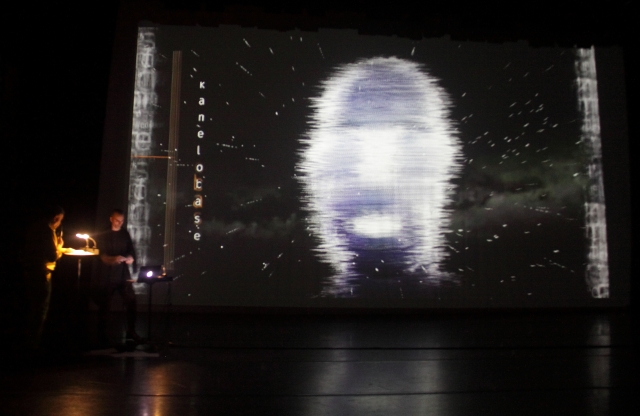
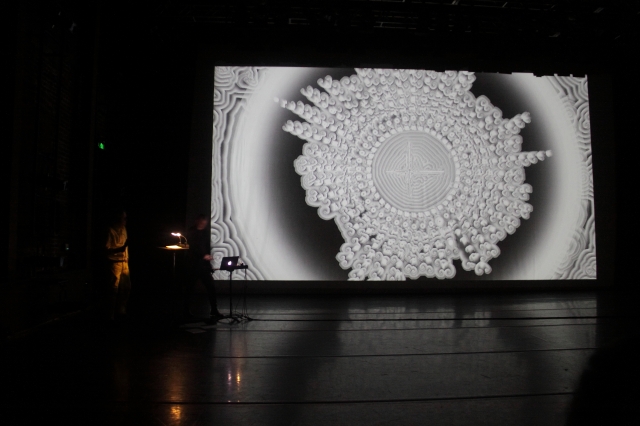
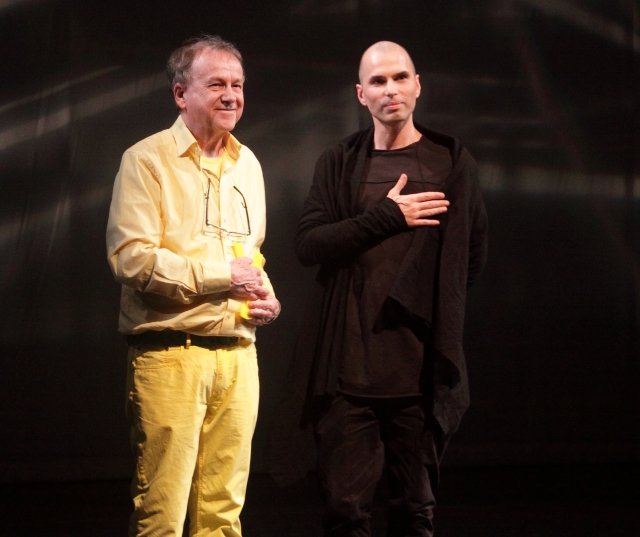
Then, in a significantly darkened hall, we were introduced to the work of Ottaras, a duo consisting of Russian composer Taras Mashtalir and Norwegian poet/artist Ottar Ormstad.  Standing stage left of the projection screen which covered almost the entire back wall Mashtalir worked on his laptop (producing some heavy rumbling that shook the walls and was felt in the listener’s body).  This writer’s first impression was that of some sort of IDM (Intelligent Dance Music) or ambient rave soundtrack.  It accompanied some striking (mostly) black and white images which took center stage on the screen at the back wall.  Slowly, at first imperceptibly, Ormstad wove some vocal sounds into the fabric.  It was the U.S. premiere of a 2018 work entitled, “Concrete”.  It was in four sections (or movements if you will) each separately titled, “Long Rong Song”, “Navn Nome Name”, “Kakaoase”, and “Sol”.
OM230065

The strange swirling images, sometimes with words or parts of words moved across the back screen while the two performers, barely visible, worked with their instruments (computer and voice) to create a soundtrack for the images.  Much like the non-syntactic use of sounds and language, the musical accompaniment was comprised of rather minimalistic utterances orchestrated in a wide range of frequencies with frequent heavy bass sound which provided a tactile component. All in all a rather mystical experience, exactly the cutting edge one looks for when attending an Other Minds production.
OM230067

The performers seemed touched, perhaps even a bit surprised by the very warm response from the audience who seemed to connect rather easily to this unusual and very sensual experience.

The first half of this night’s concert concluded with the presentation of two more tape pieces, Lily Greenham’s “Outsider” (1973) and Åke Hodell’s “Mr. Smith Goes to Rhodesia” (1970).  As in previous tape presentations a static photograph with titles was projected on the back wall in the darkened theater.

The Greenham piece is a solo monodrama in which the speaker (Greenham) is accompanied by an electronic chorus of her own voice.  Hodell’s piece is clearly a protest piece about racial oppression by Ian Smith (Rhodesian Prime Minister 1964-1979) in Rhodesia (now Zimbabwe and Zambia).  It is like the Greenham piece in that it utilizes a chorus but here the chorus is actual children gathered by the artist to speak/echo the lines of the narrative which contrasts the colonial narrative with both Hodell and the children periodically intoning, “Mr. Smith is a murderer.”  The contrast was chilling and the pause for intermission a welcome respite.
OM230071

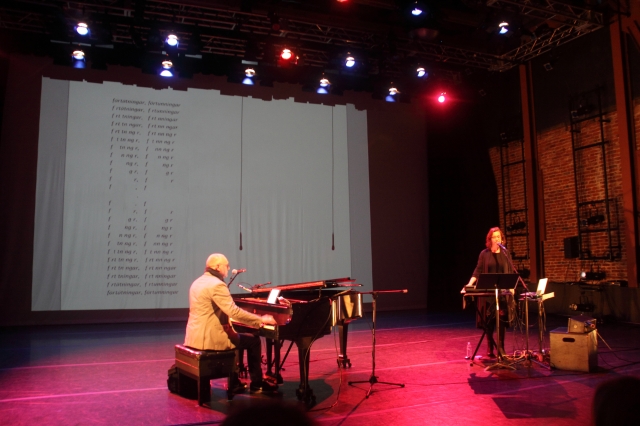
The second half of the program began with a solo performance by Tone Åse, another world premiere.  She performed her work, Ka? (2018) for voice and electronics.  In this piece she works with the sounds of questions, hesitations, and the sound of dubiousness deconstructing words, phrases, sounds and manipulating them vocally and electronically in a piece whose low volume and sparse sounds certainly evoked the intended emotions.

After a brief acknowledgement of the appreciative applause the next performer, Sten Sandell sat down at the keyboard stage left and began the performance of Voices Inside the Language (2018), another world premiere.  Again this experience had a similar sparse, almost minimalist approach.  It was a collaboration that echoed the first night’s Coolidge and Curran performance and presented an entirely different sound world.
OM230073

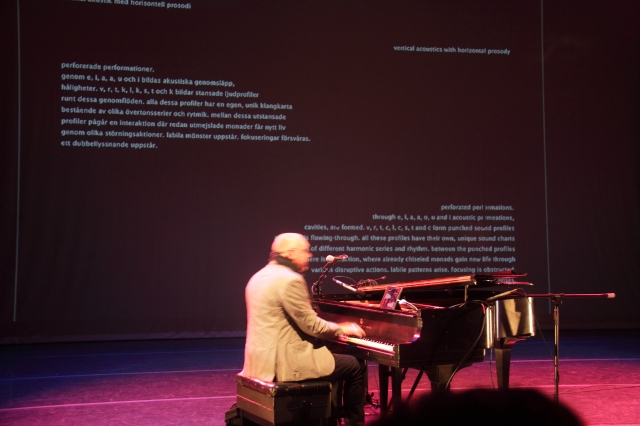
Almost before the audience realized the collaboration was over Åse discreetly left the stage leaving Sandell to perform his work, “vertikalakustik: med horisontell prosodi” (2017).  Here was a near complete deconstruction of language using simply phonemes, individual sounds.  With voice, piano, and projections on the back screen, Sandell delivered his necessarily minimalistic piece.

Both Sandell and Åse briefly acknowledged the applause bringing to an end this most satisfying international segment of the festival.

Good Luck with/for/on/in/at Friday the 13th

Described as an antidote for triskaidekaphobia (fear of the number 13), this evening’s program featured primarily California based artists including Amy X Neuberg, Mark Applebaum, Charles Amirkhanian, Carol Law, and (the one non-Californian) Enzo Minarelli.

The most famous victim of triskaidekaphobia was the Austrian/American composer Arnold Schoenberg (1874-1951).  Curiously for the sake of the present subject matter, Schoenberg invented sprechstimme (speech song), a sort of half sung/half spoken style of performance for many of his vocal scores.  His unfinished opera, Moses und Aron (1932) uses it and ends the second (and last completed) act with Moses singing/speaking the following words: “O Wort, du Wort, das mir fehlt!” (in English: “O word, thou word, that I lack!”)  Indeed the theme in the composer’s libretto is centered in part around Moses’ inability to articulate his ideas.  (Aaron was the man of words, Moses the charismatic leader)  Here, tonight, we were presented with artists who have grappled similarly (as all artists do) with the issue of expression and their unique solutions to the problem.  (By the way the spelling, “Aron” is not a German spelling, it is Schoenberg’s truncation of the name so that the title would not have 13 letters.)  The poor man probably wouldn’t have survived this night.
OM190013

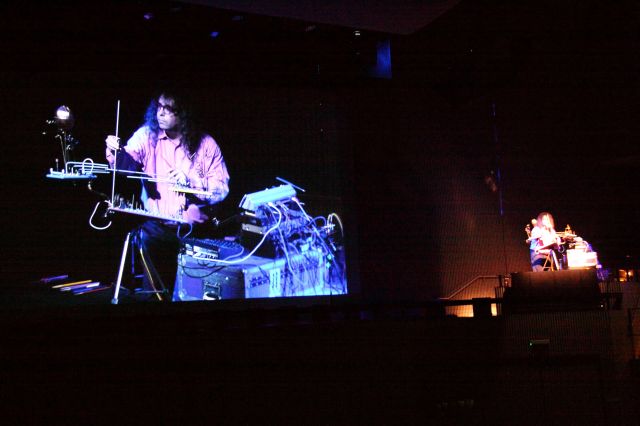
Projection of Applebaum performing with view of the composer/performer stage right as well.

The night opened to a darkened stage with the projection of one of those info/program note cards on the back wall.  The presentation was of a tape piece by Stanford professor (and Other Minds alumnus) Mark Applebaum.  Since the darkened stage and the all too brief bow taken by the composer exceeded the limits of this writer’s photographic skills I offer the above photo of Mr. Applebaum from previous Other Minds program.

The piece at hand on this Friday the 13th was, “Three Unlikely Corporate Sponsorships” (2016) which had it’s premiere at Stanford.  The three sections were entitled, “Nestlé”, “General Motors”, and “Haliburton”.  The mocking and humorous content was such that there was no doubt that the three named corporations were not involved in the creation and funding of this work.  Like some of his predecessors this week Applebaum is prone to political commentary in his music whose sound appeared to take place in a stereo sound field with some antiphonal effects.  Words were used, deconstructed, used again and never once were they used in a complementary fashion.  This is, in its way, a protest piece.

As I said, Applebaum came out only briefly (with a smile on his face) to acknowledge the very amused and appreciative audience.  One senses that protest against corporate greed is hardly an unpopular theme with this self selected audience which greeted this work with obvious satisfaction.
OM230078

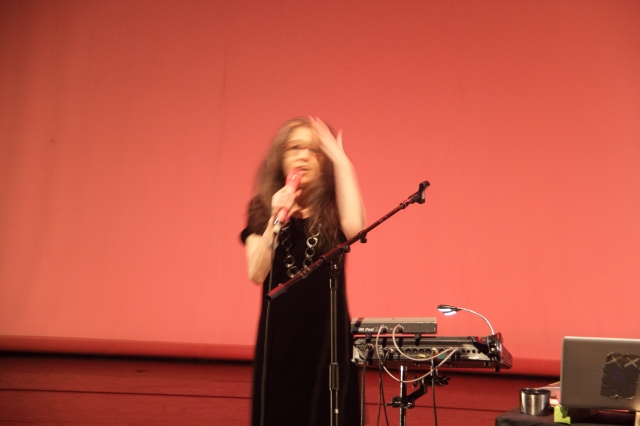
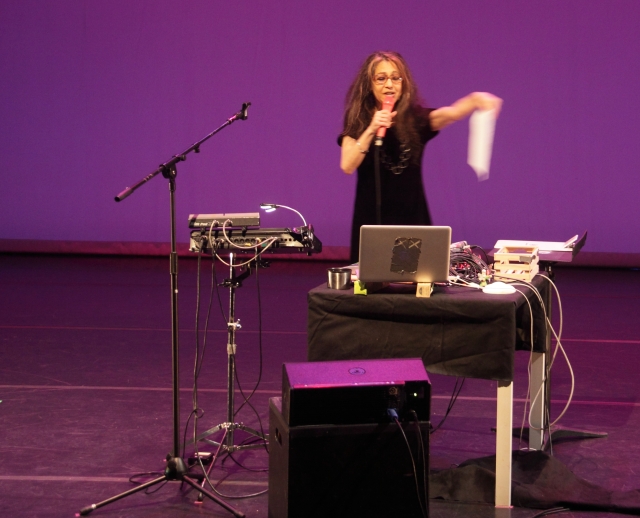
Amy X Neuberg is a well known performer in the Bay Area and is also an alumnus of Other Minds.  Neuberg studied both linguistics and voice (at Oberlin College), and electronic music (at Mills College).  She has a strong well-honed soprano voice and has developed her own unique mix of language and music in compositions that defy easy categorization.

Neuberg graced us with “My Go”, “Christmas Truce: a journal of landlord/tenant situations”, yet another world premiere for this series, “Say it like you mean”, “That’s a great question (A Jerry Hunt Song Drape)”, and, one of her classics, “Life Stepped In”.

Neuberg’s work is a striking and unique combination of linguistic wizardry, cabaret style song writing, probably some rock and pop sensibilities, and the indefinably unique way in which she integrates voice and electronics with a touch of drama at times.  Her work is permeated with humor but also with social critique.  As is always the case (at least in this writer’s experience) her performance was greeted with warmth and appreciation.
OM230080

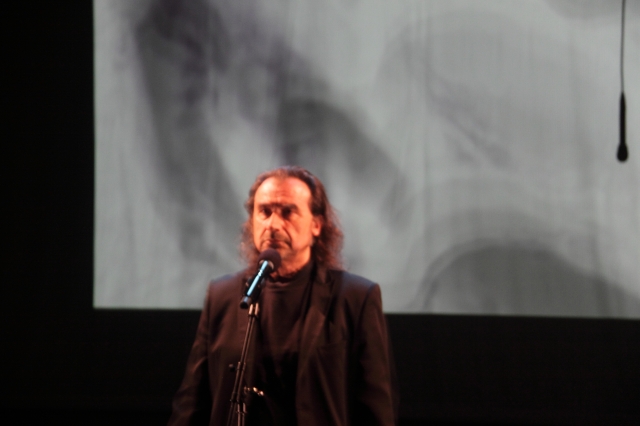
Following intermission we were again treated to the substantial performing skills of Enzo Minarelli who graced us with a generous selection of his own works including, “La grandeur di Ghengis Khan” (The grandeur of Ghengis Khan) comprised of eight vocal tracks and three noise tracks, “Il supere scopo di vita” (Knowledge as the purpose of life) “I nomi delle città come inno nazionale per Sinclair Lewis” (The names of the cities as national anthem to Sinclair Lewis) another multi-track work, and Excerpts from Fama: “Ciò chevoglio dire” (Fame: What I Want to Say): “Affermasi senza chiedere” (To succeed without asking), “Che teme il dolore (use la medicine della religion)” (Those who fear pain fuse the medicine of religion), “Alla ricerca del suono farmacopeo” (Seeking the pharmaceutical sound) and “Poema”.

In addition to their described meanings and verbal content these works were about the beauty of the Italian language and the beauty of the sound of the performer’s voice as well as the accompanying performance.  Minarelli is apparently a performer of high energy.  He performed on five of the six days and attended the last night as well seemingly all in a weeks work.
OM230086

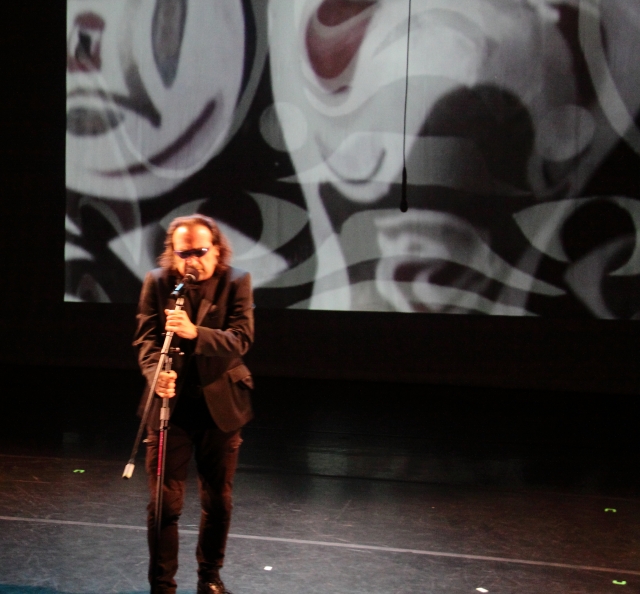
Once again the fairly minimalist lighting strategies were remarkably effective.  Projections on the back wall along with Minarelli’s strong stage presence made for a striking performance of these works.
OM230091

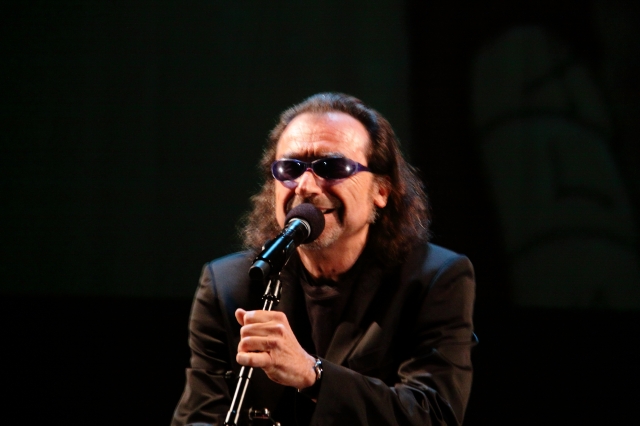
Minarelli was like a poet from a cabaret in some lost Fellini film fraught with intelligence, drama, passion, and humor.
OM230092

Any of the above led the audience in some degree to the notion that what had just transpired would be a tough act to follow.  Certainly this was true for Mr. Minarelli but, rather than a denouement or even a cooling down there was a shift of gears, a transition if you will, to yet another universe of creativity.

We were next presented with a fairly rare experience.  We got to hear Other Minds’ executive and artistic director perform some of his own dalliances with languages and vocal utterances.  Charles Amirkhanian, no longer wearing his jacket but rather a long white shirt, came on stage with this wife and partner, in both life and artistic crimes, Carol Law.  Together they shared some of the inspirations of their (obviously still in progress) long strange trip.
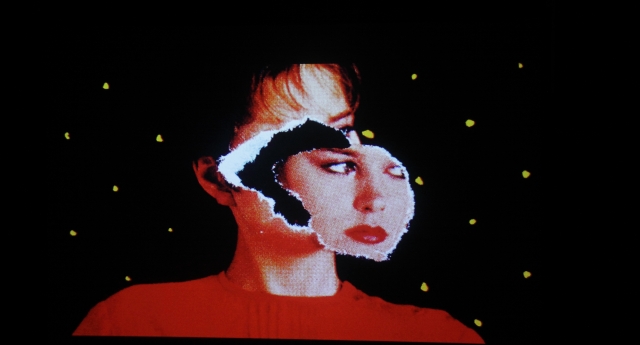
OM230097

In addition to being a photographer, Carol Law is a collage artist and has also been involved in the design of a few of pieces of Other Minds collectibles such as the t-shirts created for this year and several from previous years.  What is a bit lesser known are her collaborative efforts with Charles Amirkhanian.  The above image, for example, demonstrates the striking, slightly disturbing images that characterize the first work on tonight’s program, “History of Collage” (1981).  Carol’s images were accompanied by a live recitation by Charles of a text which is actually about collage but is manipulated by a cut up technique.  Here we saw images and heard the spoken text.  For the next two collaborations Amirkhanian took his microphone and did his recitation in front of the projection screen creating effects not unlike the light shows and projections one might have seen in one of Bill Graham’s productions at the Fillmore Theater some 50 years ago.  That is not to say that the intent or effect was nostalgic or historical, just that it seems to exist in a parallel universe.  The long white shirt thus became a part of the projection screen with Amirkhanian moving dynamically along with the speaking of the disjointed texts.
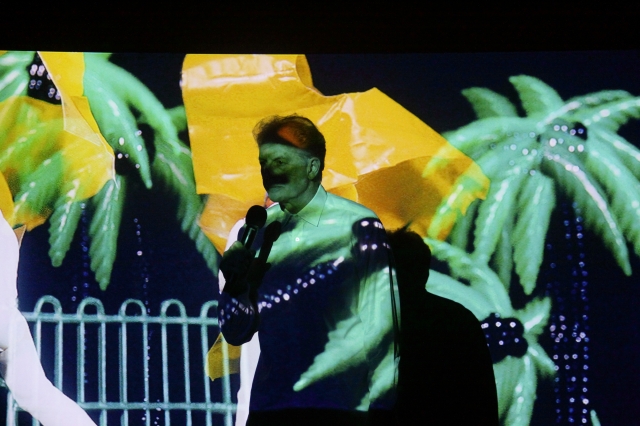
OM230100

The visual imagery was both striking and unique and held this writer, if not the entire audience, in thrall to a powerful sensual onslaught.

Hypothetical Moments (in the intellectual life of Southern California) (1981) is another of these cut up texts, this time an intercutting of Edith Wharton’s, “Glimpses of the Moon” and what Amirkhanian describes as “the gruff drugged-out reportage of a Yankee baseball game”, Ted Berrigan and Harris Schiff’s, “Yo-Yo’s with Money” (Amirkhanian is an avowed baseball fan).  These were spoken over an improvisation done on an out of tune harpsichord modified by an Eventide Harmonizer.
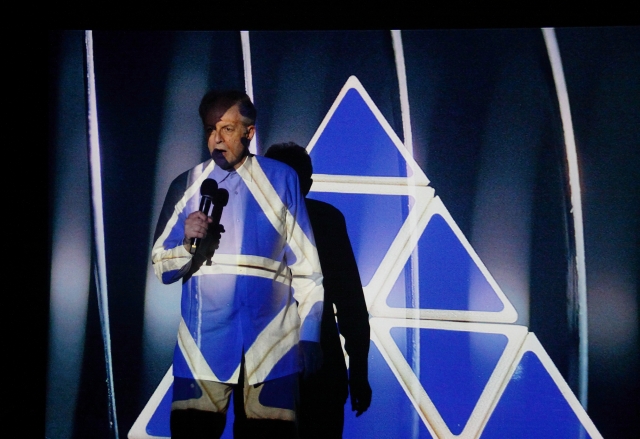
OM230101

The pair stepped on stage together to acknowledge the very appreciative applause.  Indeed this was a rare and precious experience seeing them perform together and, though they did not eclipse the previous artists, they clearly established their parallel universe in the shared multiverse of sound poetry.  These are wonderful performance pieces.

OM230104

So…how do you follow that?  Well, apparently with some solo Amirkhanian.  As noted previously, Charles has been writing and performing his brand of vocal gymnastics since at least 1969.  Two of his works, “Just” (1972), and “Heavy Aspirations” (1973) were included on that anthology mentioned at the beginning of this review.
OM230113

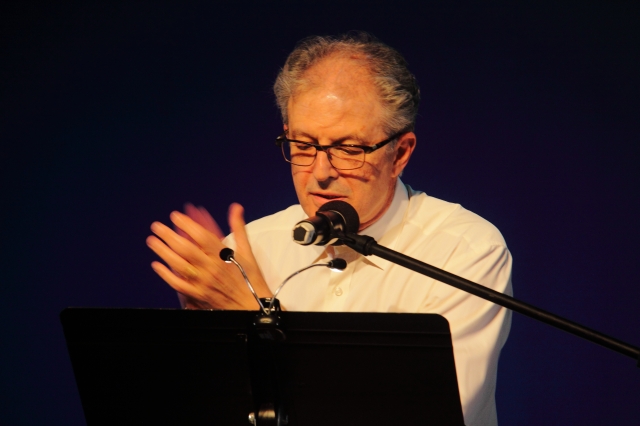
Amirkhanian has taken the stage at least twice before at Other Minds performing his own text sound works.  Tonight he presented, “Maroa” (1981), a sort of homage to a street in his home town of Fresno, “Ka Himeni Hehena” (The Raving Mad Hymn, 1997), a  celebration/deconstruction of the Hawaiian language, “Marathon” (1997), a two voice poem which is like a nostalgic parody of the fundraising which Charles did so many times for KPFA, and, one of this best known works, the gently humorous “Dutiful Ducks” (1977) which involves rhythmic speaking and deconstruction of words on tape to which he reads live and (mostly) in sync.  As with most of what we all heard on these days, live performance IS the point.

INK Conclusion
OM230118

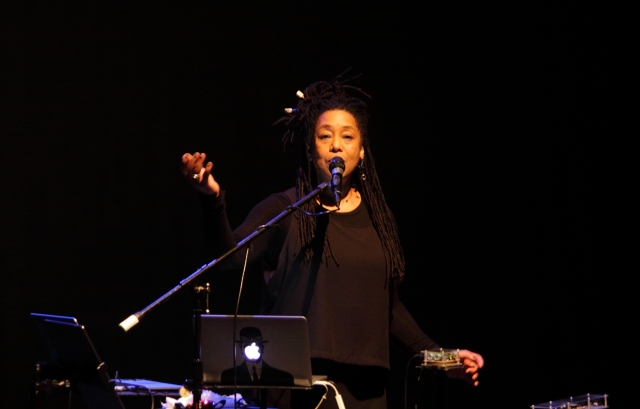
Day 6 featured beloved Bay Area diva (and Other Minds alumnus) Pamela Z.  While one might note that, like Amy X Neuberg, she has a powerful, trained soprano voice and relies on electronics, her results are an entirely different animal.  Some of Z’s specialized proximity controlled electronics are artistic creations themselves and play a part in the theatrical component of her performances.
OM230121

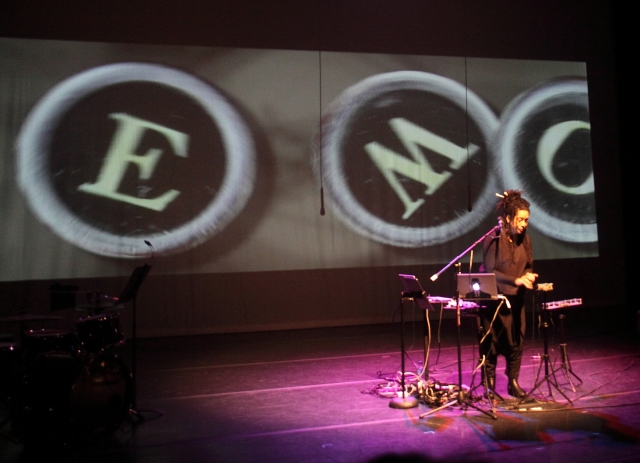
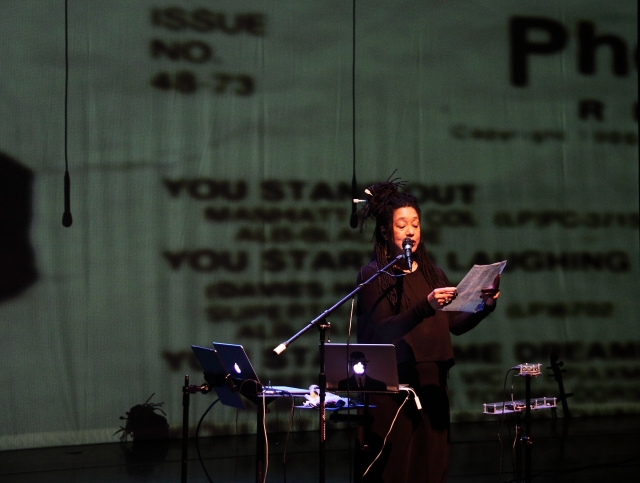
Pamela Z’s performances were enhanced tonight with video and slides such as this projection which supported her performance of Typewriter/Declaratives.

Like Neuberg, Pamela Z does a sort of cabaret style performance.  On this night she graced us with, “Quatre Couches/Flare Stains” (2015), “Typewriter/Declaratives” (2015), “33 Arches” (from a larger work called, Span, 2015), “Pop Titles: You” (1986) and the SF premiere of “Other Rooms” (2018).
OM230123

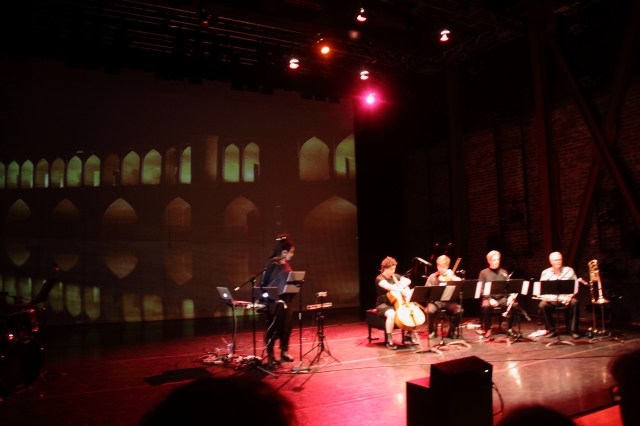
Z’s skills at writing for chamber ensemble were displayed in 33 Arches, a section of a larger work called Span.

Most commonly seen as a soloist with electronics, it was a wonderful opportunity to hear a portion of one of her recent works which involved writing for more conventional instruments in addition to her voice and electronics.  This was done also in conjunction with video.
OM230124

Pamela concluded with a performance of one of her classic works, “Pop Titles ‘You'” (1986) enhanced by the back wall projection of the text source for the work, a page of the now defunct Phonolog report which was commonly found in record stores “back in the day” as they say.  Z worked for a time at Tower Records.

Like Amy X Neuberg, Pamela Z was treated to a warm round of appreciation from this adoring home town Bay Area audience.
OM230128

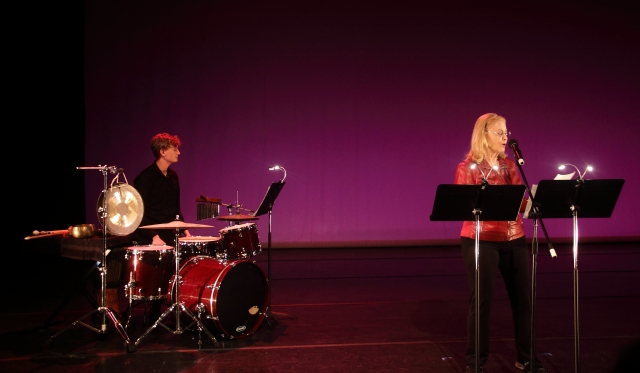
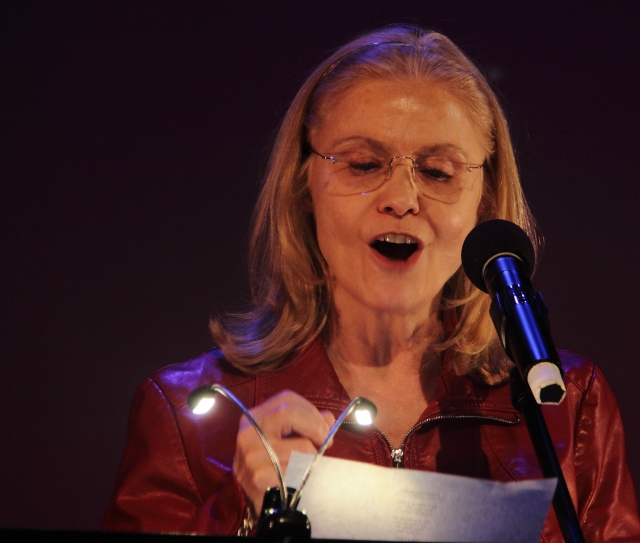
Next came another of the artists who appeared on the 10+2 anthology, Beth Anderson-Harold.  She was accompanied by Other Minds intern and percussionist, Michael Jones.  Beth Anderson, originally from Kentucky, exudes a sort of midwest wholesomeness that belies a complex and assertive artist.  She is now based in New York but has strong roots in the Bay Area having worked with Charles Shere, John Cage, Terry Riley, Robert Ashley, and Larry Austin.

Her performances of “If I Were a Poet” (1975), I Can’t Stand It” (1976), “Crackers and Checkers” (1977), “Country Time” (1981), “Killdeer and Chicory” (2005), “Ocean, Motion, Mildew, Mind” (1979), and “Yes Sir Ree” (1978) were delivered with a powerful energy and enthusiasm.  She seemed almost surprised at the warm reception her performance received.  It was yet another example of the incredible variety that this genre of music embodies.
OM230131

Anderson’s delivery was powerful, ecstatic, and assertive.
OM230133

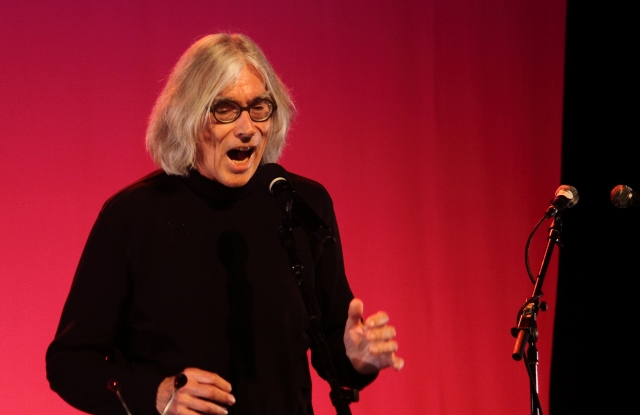
This sixth day of the varieties of sound poetry was brought to a conclusion first with three tape works by fellow KPFA (1990-2005) radio producer Susan Stone.  The works presented were, “Couch” (from House with a View, 1989), “Ruby” (from House with a View, 1993), and “Loose Tongues” (1990).  All are basically Stone’s personal take on radio theater which she describes as, “Cinema in the Head”.  Stone took an all too brief bow to acknowledge the applause.
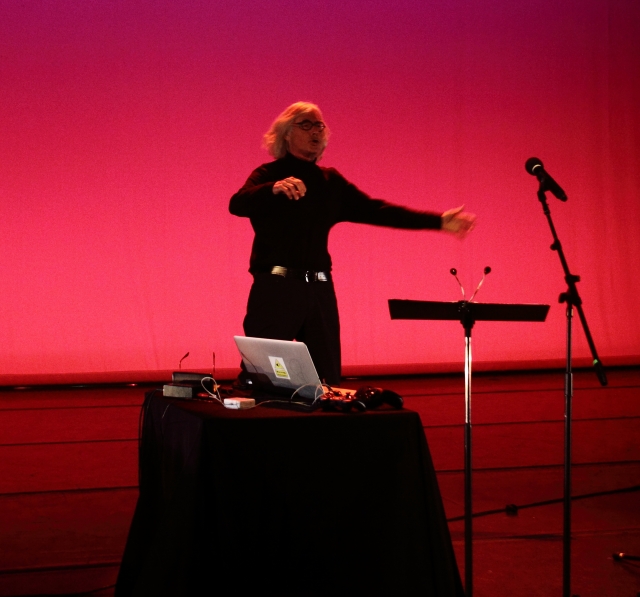
OM230135

Though the audience’s attention seemed not yet to have flagged we were given an infusion of energy from the seemingly always energetic Jaap Blonk.  He presented six of his works to conclude the evening, “Dr. Voxoid’s Next Move”, “Onderland” (Underland, excerpts), “Rhotic (Phonetic Study #1, about the R), “Muzikaret (Music Made of Rubber)”, “Cheek-a-Synth (Solo for Cheek Synthesizer)”, and “Hommage à A.A. (for Antonin Artaud).
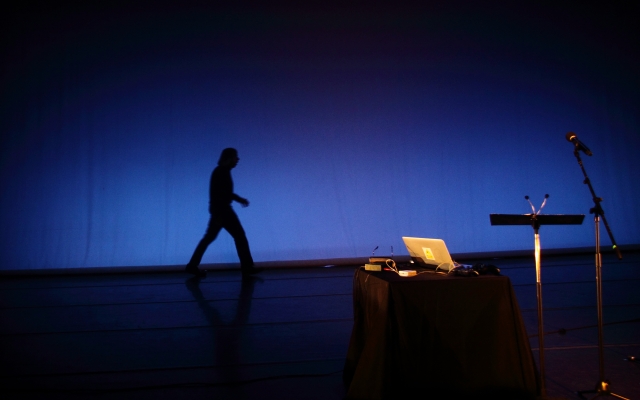
OM230137

Blonk’s seemingly boundless energy took him around the stage at times.

Blonk did a lovely thing to cap off this mind bending week (almost) of performances.  He engaged the audience in a call and response improvisation.  As these things generally go he began with fairly simple sounds and progressed to longer and more complex sound groupings which challenged the audiences attention and repetition skills, a task they/we performed with great joy and amusement.
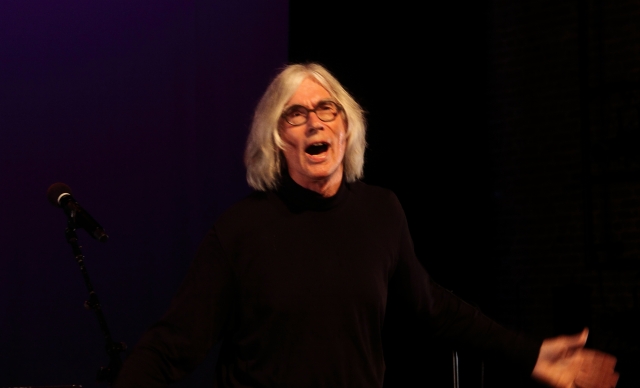
OM230142

Blonk leading the call and response performance with the audience which concluded the series.

Twenty performers, four of whom had appeared on that wonderful anthology, kept the ODC Theater packed to near capacity on all six nights.  That alone is a feat.  What cannot be satisfactorily communicated in a mere article is the energy and focus of both the performers and the enraptured audience whose attention never seemed to flag as they/we were lead down unfamiliar paths to little heard universes of ideas and sounds.

This expanded festival also included one of the most spectacular program books this writer has ever seen from Other Minds.  Mark Abramson did the eye popping graphic design which featured no fewer than four different covers and very useful texts and photographs documenting the works performed and their history.  The t-shirts were another of Carol Law’s successful designs.  These may be highly collectible and, as of this writing, are still available through the Other Minds website.

In an promotional article entitled, “Other Minds 23: In the Beginning was the Word” I obviously used a biblical quotation (John 1: 1 for those interested).  In fact the only religious thing going on here was the spiritual magic of astoundingly talented performers, and a mighty unusual gathering of Other Minds in terms of the enthusiastic audience.  But I would be remiss if I did not take note of the fact that this fabulous marathon was done in six days.  I’m guessing we all rested on the seventh.
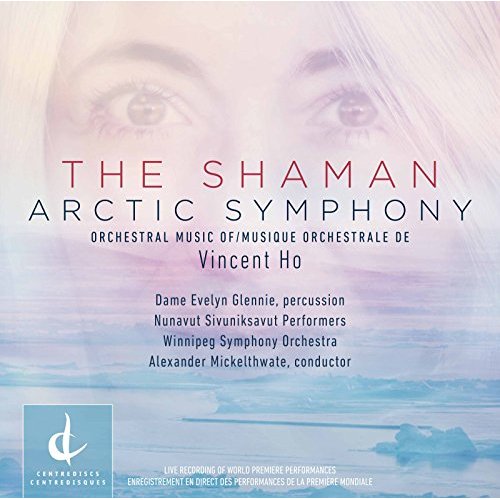
The Shaman: Spectacular New Canadian Orchestral Music


vho

I don’t know what it is about political borders and the arts but there must be some kind of walls up that prevent musical immigration from Canada, Mexico, Central and South America, etc.  In short there is a strong Eurocentric/American flavor to the classical music distributed here.


One of the issues with which the large colonial countries such as the United States and Canada grappled was the tendency for all their composers to sound like second rate European composers.  With the dawn of the 20th Century there was the obligatory attention to folksong but that is also arguably Eurocentric…not bad, mind you, just leaving out the Native Americans or, using the elegant Canadian term, First Peoples.

Eventually both the U.S. and Canada began to pay attention to indigenous traditions of the peoples they had conquered.  One suspects that an appreciation of the social and spiritual traditions of indigenous peoples also encouraged a different view of the very landscapes.  In Canada the composer most closely associated with the post Eurocentric traditions would have to be Raymond Murray Schafer whose incorporation of the vast landscapes of his country embraced it musically and dramatically in a way that no one had previously.

So along comes this disc from composer Vincent Ho (1975- ) born in Ottawa, Ontario, Canada.  He was educated variously at Canada’s Royal Conservatory of Music, a Bachelor of Music from the University of Calgary, an MM from the University of Toronto, and a DMA from the University of Southern California.  His mentors have included Allan Bell, David Eagle, Christos Hatzis, Walter Buczynski, and Stephen Hartke. In 1997, he was awarded a scholarship to attend the Schola Cantorum Summer Composition Program in Paris, where he received further training in analysis, composition, counterpoint, and harmony, supervised by David Diamond, Philip Lasser, and Narcis Bonet.

Vince8

Vincent Ho


Impressive credentials for sure but this album demonstrates the very impressive work of a composer who would seem to be poised to take on the mantle of the next generation of artists working to create music that represents the entire country in this generation.  This is a man with formidable skills in writing for large ensembles.  No doubt his facility with writing music allows him to create convincingly for any size ensemble.  A quick look at the composer’s catalog of works inspired the mini polemic with which this review begins.  How can so much wonderful music go unnoticed south of the border here in the U.S.?  (End rant.)

Finally to the disc at hand.  This is a beautifully recorded live concert of two major works by Mr. Ho, “The Shaman” (2011) and Arctic Symphony (2010).  Both are for large orchestra and inhabit a very listenable realm melodically and harmonically.  That is NOT to say that these are ordinary or simple works.  In fact they clearly embody the work of a well trained and thoughtful artist.  This is exciting music and the audience response at the end of each work was highly approving.

Your reviewer heard the Carnegie Hall broadcast of The Shaman and jumped at the opportunity to review this disc.  Dame Evelyn Glennie is reason enough to pay attention.  This (essentially) Concerto for Percussion was written for her and she is ostensibly the shaman of the work’s title.  Her performance is simply spellbinding.  The piece has three numbered movements and an interlude.  I will leave it to the program note readers to plumb the additional depths of meaning embodied in the concerto but I will tell you that if you are not enthralled by the “fire dance” finale you may very well be dead.

The Arctic Symphony is another animal.  It is a programmatic work inspired by the composer’s experience on a research vessel, the Amundsen, exploring various arctic regions and describing the different areas of research being done.  There are environmental themes here for sure and also an incorporation of Inuit songs transcribed by the composer and sonic evocations of various aspects of the composer’s experience of the journey (wind, silence, the strange sounds of uncertain causes that one apparently hears in these nether regions.  The five movements fit pretty comfortably into the basic classical forms that comprise symphonies.  There are chorales, variations, a nice scherzo in the Amundsen (3rd movement).  It is, like the concerto, a very entertaining and exciting piece.

The Winnipeg Symphony and it’s talented conductor, Alexander Mickelthwate must be mentioned for their skill at holding this complex music together.  In both works they provided readings that were both accurate and stimulating.  One can’t imagine any audience failing to enjoy this music.

One can’t help but wonder about the confluences between the work of Mr. Ho and that of John Luther Adams.  Both deal with arctic landscapes and both express environmental concerns.  Well I invite listeners to do their part in eliminating the weird musical apartheid that appears to exist by buying this album.  It is excellent.

Missa Charles Darwin: The Chicken or the Egg?


darwin

This is one unusual disc, not specifically due to the musical content actually but rather its back story.  Gregory W. Brown is a composer with a significant body of work to his credit.  He also happens to be the younger brother of author Dan Brown.  Yes, THAT Dan Brown, of DaVinci Code fame.

Now, at first glance, one notices that the CD states, “as featured in the Novel ORIGIN by Dan Brown.”  This reviewer’s initial assumption was that this music was written subsequent to the novel as a sort of “tie in”.  Well the fact is that the music preceded the 2017 book by some six years and was heard by the author who then incorporated it (initially unbeknownst to the composer) into a chapter of his novel, ORIGIN.

So what we have here is a sort of “tie in” but, more importantly an inspiration in part for the work which now incorporates it.  This reviewer has only read a brief summary of the elder Brown’s novel, enough to understand that one of the themes in the complex web of the story includes characters who are against organized religion.  This Missa Charles Darwin (2011), structured in the classical (or should I say, ecclesiastical) manner but incorporates texts from Charles Darwin’s writings into the conventional Latin texts.

Like his brother Dan, Gregory feels free to incorporate things heretical.  The fight between the Holy Roman Catholic Church and supporters of Darwin’s theories is well known and indeed ongoing.  By incorporating Darwin’s words amongst the ecclesiastical proclamations and adorations of the mass texts Brown creates a sort of philosophical critique to both provoke thought and entertain.

His choice to utilize a vocal quartet and his harmonic choices gives this work the ambiance of medieval and renaissance mass settings.  The younger of the Brown brothers utilizes a mix of past, distant past and present to create a sort of philosophical fiction not entirely unlike the techniques in Dan Brown’s novels.  The music is very listenable and never trivial.  It simultaneously transports the listener to the mystical feeling of an unnamed Cathedral in the 14th or 15th Century as well as to the 19th/early 20th Century science v. religion squabbles that plague us still.

Comment must be made about the beautiful presentation of this recording.  It is a box containing the CD and cards containing both art work and texts.  Included is a nice a photo of the two brothers.

Not having yet read the novel it is difficult to say with certainty what impact the music ultimately has on the experience but, like soundtracks that enhance the experience of a given film, this finely crafted music can only add to the experience.  Of course both novel and music will be able to stand alone on their individual merits.

This writer is given to wonder if further collaborations between these two may happen and the next Robert Langdon story might be heard in an opera house.  Go for it guys!


Osmo Vänskä’s Mahler 6th on BIS


mahler6vanska

I have heard varying opinions on the conducting skills of Osmo Vänskä.  He is the music director of the Minnesota Orchestra since 2003 and, prior to that, a conductor of the wonderful Lahti Symphony Orchestra.  I very favorably reviewed his Kullervo disc from last year.

The Mahler 6th and, I suppose, with pretty much any Mahler there are many critiques of the music and the performances.  So many complexities with tempo, handling the massive orchestra to bring out one nuance or another, order of movements, etc.  One thing is for certain, no Mahler aficionado will be satisfied with only one recording of each of his works.  There appear to be no definitive recordings agreed upon by all.  By contrast most people seem satisfied with perhaps Herbert von Karajan’s interpretation of the Beethoven Symphonies as being at least a good starting point.

One must recall that Mahler’s music was not well appreciated for a number of years.  Though he gave performances of all his major works interest in them faded rather quickly after his death in 1911.  Performances did occur but critics generally regarded Mahler’s music as dismissable efforts calling it “conductor’s music”.  It wasn’t until Leonard Bernstein began earnestly performing these works that the current cult of Mahler actually took root.

I preface my review with these comments to say that I enjoyed this disc immensely with its gorgeous sonics (as always with BIS).  Vänskä produces a lucid performance which differs from many in tempo choices and such but seems, to this reviewer’s ears, to do justice to this large and masterful work.  In the end the experience is one of a valid performance (he places the slow movement as second) which provides another view of this complex work.  And part of the cult of Mahler, it seems, is the need to own multiple performances.

This may not be the only Mahler Sixth you will want to own but it is definitely worth hearing, preferably on a good sound system.

Indian Raags for Piano made easy


raags easy

Last year I reviewed Mr. Pitts’ How to Play Indian Sitar Raags on a Piano.  It was an enthusiastic review and the book continues to have a valued place on my piano as it opens a whole world of ideas.   Now the author has done a kind and useful service by issuing this simplified version of that work.

In fact this simplified version is more in line with the rather unpracticed keyboard skills of your humble reviewer.  The author chooses 6 raags or ragas which provide a good starting point for similarly humble musicians to begin this approach to Hindustani music.

Hindustani music became pretty much ubiquitous, or at least familiarly cliché in western musical culture largely due to the efforts of Indian musicians such as Ravi Shankar and Alla Rakha.  In fact it is an endlessly fascinating musical system whose logic has much to offer both musicians and composers.

In the past one had to learn traditional Indian instruments to gain much familiarity with these ancient musical systems but Pitts’ book offers an alternative to musicians whose familiarity is limited to the western keyboard.  Purists may denigrate this approach but even if it does not perfectly represent all aspects of Hindustani musical theory at least it provides a manageable entry point for amateur musicians and professionals alike.

Having struggled somewhat with the previous book I was particularly delighted to have these simplified examples which fall nearer to my skills level.  Even if I don’t wind up incorporating this into performance or compositional efforts I have no doubt that the exposure to the actual practice of this music will leave a valuable bit of programming in my neural circuits that will enhance my musical thinking and ability to appreciate other musics.

As with the first book, this too is highly recommended.  Kudos Mr. Pitts!

In the Beginning Was the Word: Other Minds 23


OM202006

Charles Amirkhanian performing one of his spoken word compositions at Other Minds 20 in 2015

Other Minds has been the the darling of composer/producer Charles Amirkhanian since its founding in 1993.  Along with television producer and arts patron Jim Newman he has presided over the 25 years of this renowned festival which has consistently brought the finest new music composers and performers to San Francisco.

There is little doubt that this year’s festival has to be very close to Amirkhanian’s heart.  Words have been central to his career at least since 1969 when he began his work as a producer at KPFA.  In the 23 years he spent there he presented countless hours of musical programming and interviews.  He crossed paths with most of the major stars in contemporary classical music and many stars whose genre may not be captured by the classical label.  A look at his programming choices and interviews from his time there defined new music for the Bay Area and beyond.  After his tenure at KPFA ended in 1992 he continued exploring cutting edge music and musicians bringing them to San Francisco for live performances.

His work as producer and curator has tended to overshadow his work as a composer, sound poet, and spoken word artist.  This year’s OM festival is dedicated to speech, sound poetry, and the spoken word.  It is about both the history and the present state of the art.  In many ways Amirkhanian’s 1975 release “10 + 2: 12 American Text Sound Pieces” on 1750 Arch Records (now on an OM CD 1006-2) can be seen as sort of the starting point for this festival.  This masterful anthology includes works by Charles Amirkhanian (1945- ), Clark Coolidge (1939- ), John Cage (1912-1992), John Giorno (1936- ), Anthony Gnazzo (1936- ), Charles Dodge (1942- ), Robert Ashley (1930-2014), Beth Anderson (1950- ), Brion Gysin (1916-1986), Liam O’Gallagher (1917-2007), and Aram Saroyan (1943- ).


“Word! Thou word that I cannot speak!

At the end of the second (and last completed) act of Arnold Schoenberg’s powerful opera “Moses und Aron” (1932) Moses sings, or actually half speaks and half sings this text lamenting his expressive deficits.  Speech song or, in German, sprechgesang is an invention by Schoenberg in which the singers are asked to find a point between speech and music.  Perhaps this is a good example of some of the artistic thinking going on at about the time when speech music/sound poetry began to take shape.

bio_schwitters_kurt

Kurt Schwitters (1887-1948)

Some of the history of sound poetry is featured in this unprecedented 6 day festival (April 9-14).  Some of the earliest practitioners of this unusual genre include the German artist Kurt Schwitters whose composition Ursonate (1922-32) will be performed in its entirety, a rare event by itself.

Another early gem will be the Spoken Music (1930) by German-American composer Ernst Toch.  This three movement suite has been known for its last movement, the Geographical Fugue.  The other two movements, once thought lost, were discovered in sketches in 2006 and reconstructed by Christopher Caines.  The now complete version will be presented I believe on day 3.

Composer-Ernst-Toch-810

Ernst Toch (1887-1964)


It is beyond the scope of this blog post to tell the history of text sound so I will refer readers to the Other Minds website for further details.  Or you could come to the festival too I suppose.

With due respect given to the past the festival will move on to the present.  San Francisco Beat Poet Michael McClure (1932- ) will make an appearance as will post beat colleagues Anne Waldman (1945- ), Clark Coolidge (yeah the guy from that cool anthology), Aram Saroyan (another guy from the classic text sound disc).

curran20160010

Alvin Curran in conversation last year in Berkeley.

Other Minds alumnus Alvin Curran (1938- ) will be premiering his collaboration with Clark Coolidge entitled, Came Through in the Call Hold.  Curran’s eclectic sensibilities will doubtless result in an interesting composition.  This event alone, at least for this writer, is worth the price of admission.  And this is just the first day!

Other events include workshops, discussions of the history of the art, and even some curious variations on a theme.  Apparently the writer Lawrence Weschler is the grandson of Ernst Toch and has written a variation on the Geographical Fugue called, The Medical Fugue which will be premiered at this festival.

The increasingly ubiquitous pianist Sarah Cahill will be present to perform Virgil Thomson’s unusual but entertaining setting of a Gertrude Stein (a one time Oakland resident) text called Capital, Capitals.  She will accompany the men of the Other Minds Ensemble.  Jaap Blonk will be tasked with performing Schwitters’ Ursonate and, along with Enzo Miranelli will also perform other historical works including some by a couple of Italian Futurists.

Other Minds Administrative Director Randall Wong will end the evening by undertaking a performance of the late great Cathy Berberian’s Stripsody.  That promises to be a wild evening I think.

blonk_75_2500crop

Jaap Blonk (1953- )

Northern Europe, including the Netherlands and the Scandinavian countries will literally have their day.  As it turns out they are doing a great deal of creative work in this increasingly diverse genre of speech music.  Other Minds is at its best in introducing the new and the innovative from wherever Charles’ radar has tracked it down.  Indeed Mr. Amirkhanian and his wife, artist/photographer Carol Law traveled throughout these regions in the early 70s talking with and learning from these diverse artists.  (Amirkhanian’s work, Just was recorded in a Scandinavian studio during one of those trips).

As usual homage will be paid to the past with some recorded classics by Sten Hanson, Åke Hodell, and Lily Greenham.  Some new voices will be introduced including Tone Åse and Sten Sandell.  The Norwegian/Russian-American duo OTTARAS (consisting of visual poet Ottar Ormstad and composer Taras Mashtalir will also perform.   One can fully expect a mind expanding experience which will redefine the possibilities of the art form.

Auspiciously or perhaps dangerously Friday the 13th has been reserved for Bay Area talents.  First up will be the man of the hour, Charles Amirkhanian.  Hearing him do his work live is an uncommon but entirely enjoyable experience.  If that alone weren’t enough we will get to hear the even rarer public collaboration between him and his life partner Carol Law whose photography and collage work deserves wider recognition and will happily get that here.

Amy X Neuberg

Amy X Neuberg.

Trained in both linguistics and music, Amy X Neuberg will be on hand to perform her indescribable electronic cabaret including the world premiere of “Say it like you mean” and other genre bending work.  She is another valued Other Minds alumnus having given numerous performances at the festivals.

Stanford professor Mark Applebaum, another alumnus will present “Three Unlikely Corporate Sponsors” which premiered at Stanford in 2016.  Enzo Miranelli will conclude the evening with his theatrical combination of movement and text in “Fame: What I Want to Say”.

20130218-132303.jpg

Pamela Z

The festival concludes on Saturday April 14th with Jaap Blonk followed by the wonderful San Francisco based Pamela Z who, like Neuberg uses electronics, but creates her own unique sound world.  She too is an alumnus of Other Minds.

Another composer from that great anthology, Beth Anderson, will make an appearance to perform “If I Were a Poet”, “I Can’t Stand It”, and “Ocean Mildew Minds”.

The finale will feature Susan Stone and Sheila Davies Sumner performing excerpts from two works, “House with a View” and “Loose Tongues” both dealing with the lives of working class southern women.

This will be both a feast and a marathon but it promises to be one of the finest Other Minds productions maybe ever.  Come to be entertained, come to be challenged, come to expand your mind.  You’ll never be the same.  See you there.

No Ordinary Romance: San Jose Chamber Orchestra Plays Dvorak, Musgrave, Fung, Shatin, and Susman


Fung0002

The Concert Hall at the Le Petit Trianon Theater in San Jose

It was a pleasant spring day in San Jose where, in this modest hall, there was to be a concert of mostly contemporary music with one exception.  The concert was billed as “A Touch of Tech” due to its use in some pieces of electronics and, in one case, slide projections.  However the overall sense of the experience left this writer with a strong sense of the romantic, hence the title of this review.

Barbara Day Turner

Conductor Barbara Day Turner (from the SJCO web site)

The concert was to be led by the San Jose Chamber Orchestra‘s music director and regular conductor Barbara Day Turner.  A quick look at the orchestra’s web site or the repertoire of tonight’s conductor will dazzle and intrigue any fan of new music.  This modest ensemble of approximately 20 musicians (give or take) consists of professional musicians who clearly take their work seriously.  No spoilers here in saying that they turned in some seriously powerful and polished performances.

This writer was initially asked to review this performance on behalf of the management agents of composer Vivian Fung (1975- ), a Canadian-American composer whose star is rising rapidly.  In preparation for the evening’s performance it was wonderful to find some of her work on You Tube.  It was a rewarding experience to hear some of her range of compositions.  The featured composition of hers for this evening was Humanoid (2017) for cello and electronics.  It was third in the programming sequence for the evening.
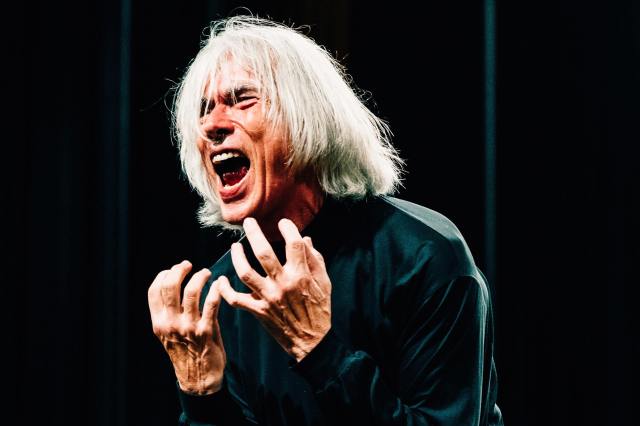
VFHeadshote

Vivian Fung (from her web site)

First up though was a composition which initially seemed anachronistic in context.  It was Dvorak’s Silent Woods (1833) for cello and orchestra in a transcription for cello and strings by Kerry Lewis.  This piece of unabashed high romanticism in fact seemed to contextualize what was to follow.  The soloist Coleman Itzkoff gave a wonderful display of his romantic chops in his interpretation of this somewhat lesser known bon bon of Dvorak’s.  The audience responded most appreciatively to a lush and lovely performance.

Thea+Robed

Thea Musgrave (from her website)

Second up was Green (2008-16) by Scottish-American composer Thea Musgrave (1928- ).  This work was being played in honor of her 90th year.  Mr. Musgrave was reportedly unable attend this evening, not due to infirmity but rather to industry.  She is reportedly hard at work adding to her already prolific catalog of works.  (This version was a string orchestra version prepared by Martyn Brabbins.)  Nonetheless her presence was strongly felt in this recent ecologically themed piece for string orchestra (sans electronics).  The tonalities in the work seemed to almost be echoes from the first work.  Despite a few string effects, pizzicati, glissandi, there was an overall feeling of romantic gestures here in a discursive development that included a disturbing motif from the double basses and rather romantic and lyrical responses from solo violin and viola embedded in the lush orchestral textures (it is astonishing to hear what a master composer can do with a small string orchestra).  The conductor and ensemble displayed an intensity of concentration which resulted in a really spectacular performance which was very much appreciated by the audience.  (Curious side note:  I later learned that an elderly gentleman who sat in front of me and listened with obvious concentration and appreciation throughout the program was in fact a relative of Ms. Musgrave so, at least by that proxy she was there in yet another capacity.)

Fung0004

Coleman Itzkoff playing Vivian Fung’s Humanoid

The stage was then set for the west coast premiere of Vivian Fung’s Humanoid for cello and electronics.  Here I had the advantage of being able to speak with the evening’s engineer (and electronic co-conspirator) Tom Johnson.  This gentleman advised me of his roles in the three pieces which involved technology.   Apparently the Fung piece required the most attention and coordination involving a click track.  The Shatin piece basically played the electronics in parallel to the orchestra with the coordination largely left (presumably) to the conductor.  And the last piece involved projections whose synchronization were not as minutely critical as the other two pieces.  Said gentleman was also the recording engineer for this concert.

For this writer the term “electroacoustic” indicates that one should approach such a work with caution.  Indeed the success of the integration of electronics and acoustic instruments varies a great deal.  Perhaps the best known of such efforts are the pioneering “Synchronisms” of Mario Davidovsky in which various instruments are paired with an electronic track.  And these days one must ask if the electronics interacts with or alters the sound of the acoustic instrument or if it exists in parallel.  Electroacoustic music has been and remains a huge compositional challenge and no small challenge for the listener.

In the case of Fung’s piece the electronics exist in parallel but carefully synchronized (the soloist does listen to a click track) to the cello score.  No alteration of the cello’s sound is done by anyone other than the cellist.  So we are then hearing basically a duo between two musical streams, one live, the other on a digital stream of largely concrete sounds and, at one point, a drum kit.  Such technical issues can be tiring but the sound of the music was not.  According to the composer the piece is in three parts.  The cello and the electronics are both equally present in all.  In fact the cello seems to be creating sounds that are analogous to the electronic sounds at times and the cellist is given a lot of large romantic sounding gestures which in many ways were not entirely different emotionally than the gestures of the Dvorak.  Fung’s work seems, appropriately here in Silicon Valley, to be challenging the human vs. the machine, an increasingly intriguing dichotomy.

It was clearly a challenging piece for the cellist requiring a plethora of techniques and a great deal of virtuosity.  Itzkoff handled his role with stern concentration and demonstrated a strong command of both his instrument and the score.  He was rewarded with a standing ovation and two curtain calls for his efforts which he gratefully accepted.  The program notes indicated that this was Fung’s first major foray into the use of electronics and one hopes not the last.

Shatin_-By-MaryNobleOurs_hi-res1

Judith Shatin (from her web site)

Following intermission was the premiere performance of the work of another established citizen of American music.  It was Judith Shatin‘s Ice Becomes Water (2018) commissioned by Barbara Day Turner and the San Jose Chamber Orchestra and is dedicated to them.  Shatin is a sound artist as well as a composer meaning that she has mastered the incorporation of a variety of sounds into her compositional palette.  In this case she utilized sound samples gathered by glaciologist Oscar Glowacki.

This piece continued the basically pastoral/ecological themes suggested by the earlier works.  Again too there was lyricism though the sound images here were, appropriately, colder and more stark than those in some of the other compositions.  In fact this composition seemed to have some affinities to the sound world of Musgrave’s work at times but perhaps a bit harsher.  What sustained interest here, in addition to the sonic inventiveness of the string writing, was the seamless integration of the sounds into the overall texture.  Here the electronics seemed to augment Penderecki like sound mass effects and gave way to gentler clicking sounds (or were they pizzicati?).  It was another very intense but very satisfying musical experience for this writer and, by the sound of the applause, the rest of the audience as well.  Happily Shatin was there to enjoy the success of this performance and the appreciation of her artistry.

WilliamSusman_x2

William Susman (photo from his website)

To end the program there was a multimedia work by William Susman (1960- ) The work of this composer is new to this reviewer’s ears but not apparently to the music world at large.  A quick perusal of Susman’s web page reveals a prolific composer who maintains a busy schedule of composing and performing (including a performance of his recent opera, Fordlandia at the Forth Worth Opera Frontiers Showcase) coming up in May.

The work was a piece entitled, In a State of Patterns (2018) which received its premiere on this night.  The work is a series of six movements which are designed to respond (or maybe create musical analogs) to 6 art works created by Santa Clara University mathematician Frank Farris (1955- ).

Farris

Frank Farris (from the Santa Clara website)

The movements (performed without pause) are: 1. California, the Golden State, 2. The Sierra Nevada, 3. At Home in San Jose, 4. Sierra Tree Death, 5. Spiral Vortex, and 6. The Stars Come Out to Comfort Us.

The photos and mathematical abstractions were projected stage left and more or less synced to the music.  This writer is not well schooled in mathematics but the appearance of the images were reminiscent of those never ending fractal drawings which eternally reproduce themselves.  Farris apparently extracts the images and colors from photographs.  Now whether the music creates successful analogies is probably more relevant to the level of satisfaction that each of the artists feels with their work but the effect in performance was quite satisfying.  One can safely say (I think) that the music and the art work both have sufficient merit to stand successfully on their own but the combination was at least intriguing.

Susman’s music draws on some very pleasant minimalist type structures that nonetheless managed to take on almost Wagnerian grandiosity at times.  Again the combination of ecology and a sort of high romanticism combined to create a very successful and enjoyable work.  The abrupt ending reminiscent of the ensemble performances of Philip Glass provided a stunning coda waking the audience from the beautiful dreams evoked by the six movements.  Again we witnessed a powerful and dedicated premiere performance of a wonderful piece of music which appeared to leave the audience quite satisfied. Susman was there to take a much deserved bow.

This was some brilliant programming and excellent musicianship. What an evening!!!


Louisville Orchestra Reboot on CD: All In


Abrams-Louisville-All-In_coverweb

The Louisville Orchestra was established in 1937 and its history has been wonderfully told in a 2010 documentary entitled, Music Makes a City.  Since their founding they released about 150 LPs containing new and interesting music not available anywhere else.  Many of those recordings have become available on the Albany CD label but the orchestra hasn’t released a new recording in about 30 years.

abrams

Teddy Abrams

Along comes new music director, composer, clarinetist Teddy Abrams and now we are graced with a new recording on the Decca Gold label.  Now for a reboot this release is somewhat conservative in it’s musical choices but that’s not to say it isn’t interesing.  This recording, released also in commemoration of the orchestra’s 80th season, reflects a sincere effort to draw younger audiences to the concert hall.

This auspicious release contains as its opening Abrams’ Unified Field, a finely crafted four movement work that channels the late Aaron Copland and his ilk.  It’s style is inflected with elements of jazz and other so called “vernacular” music but it incorporates those styles in much the way that Copland and his contmporaries incorporated folk song as well as jazz/pop rhythms. It is virtually a symphony in its dimensions and is highly entertaining while remaining seriously classical and very finely crafted.  The year of it’s composition is not specified in the notes this writer received but best guess is that it is of recent vintage in this talented composer’s oeuvre.

This is followed, curiously, by three torch songs, one by the able soloist Storm Large, one by Cole Porter, and one by Teddy Abrams.  The stylistic unity of these three songs is striking and Storm Large (who is known for her work with Pink Martini) is a convincing chanteuse.

These are followed by another American masterpiece, the Clarinet Concerto (1948) by Aaron Copland.  Originally written (and subsequently recorded by) Benny Goodman, the concerto is definitely in the repertoire but receives far too few hearings in concert.  This writer had not heard the concerto in many years and was struck both by its quality and by the convincing performance recorded here.  Abrams takes the solo role and the orchestra is conducted with assurance by one Jason Seber.

Abrams’ reading is as convincing and authentic as any and this is a delightful way to close this wonderful recording.  Here’s hoping that this release will be the restart of Louisvilled great recorded legacy and that Abrams tenure as conductor will breath new life into an orchestra which has become a venerable part of America’s cultural history.


Steven Kemper’s Mythical Spaces


mythical

Ravello Records RR 7980

It is this writer’s opinion that the category “electro-acoustic” carries such a wide range of connotations that it is of limited use to a listener.  This album is so characterized and here simply means that both electronics and acoustic instruments are used.  Even the concept of electronic music is difficult since such a designation. Playlists on Spotify and iTunes usually points the listener to a form of pop/dance music if you search for electronic.  Further complicating things (and I think this is at least in part the point here) the electronics here include fixed media (electronics which does what it is programmed to do and does not interact with the performers or simply plays alone) and robotic electronics as well as electronics which interacts with the performer.  You will have to check the composer’s web page for more information on what exactly the “robotic” media are.

This is cutting edge in the sense that it is experimenting with new media in combination with more traditional media (and simple electronics is now “traditional media” having been superseded by the new fangled).  The actual sound of this music seems to inhabit a rather spare sound world akin perhaps to that of late Morton Feldman but with more brevity. These pieces last from 1.5-10 minutes on average and demand some concentration on the part of the listener.  Think maybe a cross between Feldman, Webern and say Subotnick.

Now one could conceivably play this music at a low volume in the manner of so-called “ambient” music. There are not many dynamic changes here to take you away from that sort of reverie.  But that does not really seem to be the composer’s intention. These are concentrated little essays, each seeming to explore the parameters of its context, fixed media, live instruments, robotic media, and combinations of these.

Steven Kemper is a new name to this writer.  His education and wide interests are available on his web site.  While he has an impressive bibliography with cutting edge research interests in music and sound this appears to be his first CD.

There are 15 tracks which comprise 5 works.  Mythical Spaces (2010) is for percussion with fixed media in 5 separate movements.  Breath (2015) is for fixed media alone in one movement.  Lament (2015) is also in one movement and is scored for flute with interactive media.

The longest single movement comprises In Illo Tempore (2012 rev 2017) is scored for saxophone, bassoon, AMI (automated monochord instrument), and CARI (cylindrical aerophone robotic instrument).  It clocks in at 7:48.

Last but not least is The Seven Stars (2012) for amplified prepared piano in 7 movements.

Live performers include Mark Truesdell, percussion; Wayla Chambo, flute; David Wegenlaupt, saxophone, Dana Jessen, bassoon, and Aurie Hsu, prepared piano.

This is music which requires some serious concentration from the listener.  Hearing/seeing this live might provide some additional aspects due to these strange electronic/robotic instruments but the point here seems to be one of an inner voyage which, if you focus you listening energy, transports you into this composer’s imaginary spaces.  Whether you will enjoy this or not is difficult to say but it is certainly worth the effort.


300 Years of Virtuosity, Liza Stepanova’s Tones and Colors


stepanova

Concert Artist Guild CAG 120

This is the solo piano debut of this talented and incredibly virtuosic artist.  This hard working pianist can be heard on a previous CD (After a Dream) with the Lysander Piano Trio.  Her web site can provide a good idea of the range of solo, chamber, and orchestral music in her repertory.

This CD is a good example of creating a brand, a practice which seems to be the current rage especially among artists who specialize in new music.  I have previously commented on the brands of pianists like Sarah Cahill, Kathleen Supové, Nicolas Horvath, and Stephane Ginsburgh to name a few.  All are amazing musicians but each seems to have been able to carve out an identifiable niche which sets them apart from each other and defines their various artistic missions.  Granted these are soft definitions in that they do not preclude them from playing anything they choose but it gives audiences a sort of general idea of what to expect when they do a program.

Liza Stepanova appears to have chose virtuosity as her signature.  She plays what sounds like fingerbreakingly difficult music with both ease and expressiveness.  Here she chooses to basically survey virtuosity from J. S. Bach to György  Ligeti.  In addition she has chosen to pair each composition with an analogous piece of visual art.

The pairing of music and visual art is as old as dirt and has always seemed to have an inherent validity.  Tone poems like Mussorgsky’s Pictures at an Exhibition or Debussy’s Clair de Lune are familiar examples of music as a visual analog.  But music sometimes suggests pictures even if it was not the stated intent of the composer too.  Stepanova covers the visual territory from the representative to the abstract in this entertaining collection.

Perhaps the most interesting aspect of this recording is the pianist’s choice of music.  She does go with the familiar at times such as Debussy’s Goldfish but the majority of this disc contains music that is seldom heard by lesser known composers such as Maurice Ohana (1913-1992), Joaquin Turina (1882-1949), Fanny Hensel (1805-1847), and Lionel Feininger (1871-1956).  There are better known names such as Enrique Granados (1867–1916), Bohuslav Martinú and Leopold Godowsky (1870-1938).  And the most familiar names such as J. S. Bach (1885-1750), Franz Liszt (1811-1886). Claude Debussy (1862-1918), George Crumb (1929- ), and György Ligeti (1923-2006).

There are 13 tracks grouped into 4 visual art themes (A Spanish Room, Nature and Impressionism, Conversations Across Time, and Wagner, Infinity, and an Encore).  The only problem I have here is the photos of the art (which thankfully are included in the little booklet) are necessarily small and really don’t give the consumer the full intended effect.  One would do well to obtain some art books or some larger prints of these to gain the intended effect.

I won’t go into detail about each individual piece.  Suffice it to say that they are all technically challenging and intelligently chosen pieces.  This is a very entertaining program from this emerging artist.

This reviewer is given to speculation as to Stepanova’s next release.  Perhaps Sorabji with some Dada works?  Whatever it is will doubtless be as interesting and entertaining as this disc.  Brava, Ms. Stepanova!


Leegowoon’s First Piece: Korean Post-Modernism?


leegowoon

OGUN Music JEC- 0253

This review was completed by chance on International Women’s Day.  It is not intended to stand in for all that means but I am pleased to present this woman’s work today.

Lee Go Woon is a composer new to this reviewer.  My friend Joshua Cheek has been sending me occasional shipments of some really hard to find releases from the western edge of the Pacific Rim.  There are some amazing gems being released from Korea, China, Japan, etc. that rarely find distribution in the United States and this is one of those discs.

One thing these discs (classical or popular) seem to have in common is a serious attention to art work and album design.  It is enough to start people like me whining about the loss of the 12 x 12 format of the LP which brought about the genre of album art, something I can never stop lamenting I’m afraid.

Well, it’s not just pretty pictures though.  This is a curious disc by young Korean woman who is familiar with traditional Korean classical music and apparently with other genres as well.  Korean classical is less well known to the general public in America than its analogous counterparts in Japan, China, Thailand, India, etc. but it is a fascinating and ancient system of music with its own set of artfully designed instruments.

Cultural appropriation has become a strongly pejorative term these days but what happens if an artist is appropriating their own culture?  What I mean is, for example, the incorporation of traditional Hindustani instruments and idioms in the hybrid pop of Bollywood music or similar such mashups with Chinese or Japanese traditional musics.  These are creative options and, while not necessarily a cherished part of so called “high culture”, are nonetheless acceptable and marketable options.  It is a hybridization or perhaps something like “self appropriative” or simply promoting?

The incorporation of traditional music is akin to the work done by composers like Bela Bartok, Zoltan Kodaly, Aaron Copland, and that whole late 19th and early 20th century fascination with folk and traditional music spurred on by late romantic nationalisms.  The present disc fits roughly in that tradition, just being done in the 21st century and it does not appear to be about nationalism either.

Lee Go Woon’s first piece is basically a song cycle written for voices (one male, one female) and an orchestra comprised of traditional Korean instruments.  It is not the synthesis of east and west that one finds in Toru Takemitsu’s November Steps (1967).  It is not really at all about the west at all.  And it is therein that the real interest lies.

The composer studied piano as a child and later she studied traditional percussion instruments.  She graduated from the Korea National University of Arts in 2012 with a Bachelor’s Degree and attained a Master’s Degree from the same school in 2016.  She received a Gold Medal in the 31st Korean Traditional Music Competition the same year.

Korea has, perhaps more than many countries, had their traditional culture undermined by military occupations, bombings, forced relocations, etc.  The fact that there have been 31 years of competitions attempting to recover some of their precious musical culture is certainly reason for hope and these first compositions by one of their finest new composers is a reason to listen.

Unfortunately the liner notes in that beautiful booklet are mostly in Korean and I haven’t been able to find someone to impose upon for a translation.  But I can tell you that the album has 5 tracks and that the music is quite listenable.  It would be helpful to know the text of the sung portions but the music speaks pretty well for itself.  The recording is lucid and there is quite a bit of definition to bring out the subtleties of the instruments and the performances are wonderful.

Happily this music can be heard via MP3 downloads on Amazon as well as via various streaming services.  Hopefully there will be more to hear as Korea moves on and recovers more of its rich culture and shares it with the world.


The @realAlvin Curran at the Armory


curranfake0005

Alvin Curran performing from his “Fake Book” at the Pacific Film Archive in Berkeley in 2014

Alvin Curran (1938- ) is  one of the finest of that maverick band of composers who came of age in the 1960s as expatriates in Italy.  Along with musicians like Frederic Rzewski, Carol Plantamura, Richard Teitelbaum, and Allan Bryant among others they formed the world’s first live electronic improvisation ensemble, “Music Elletronica Viva” in 1966.  In this time electronic synthesizers were not generally available and most of their equipment was hand made.  All the musicians have since all gone their own very creative ways but in many ways this ensemble has been their touchstone which continues to underlie their work.

Curran told this writer that it was around this time that he began working on a huge series of compositions of (at least initially) an improvisational nature which he collected under the general title of “Fake Book”.  Musicians will be familiar with the term which is roughly analogous to a cheat sheet enabling musicians easy access to many chord progressions, songs, and other pieces at their fingertips to please a wide range of tastes in their audiences.

curranfake0012

Curran’s Fake Book is a huge collection of scores, digital samples (no doubt he began with analog samples) and sketches.  He recently published a hefty selection of this material available on Amazon and is well worth both your time and your money for the insight it provides to this unusual composer.  The composer’s web site is an extremely useful reference but nothing can match hearing and seeing this spirited, kinetic shaman of a performer.  His creativity and sheer joy of music making is infectious and the music he makes is akin to reading diary excerpts, a musical analogy of sorts to the likes of Anais Nin, the famed mega-diarist of a previous generation.

Curran is, at 80, an energetic and endlessly creative musician, a humanist with deep convictions and quite simply an experience not to be missed.  Here is the announcement of this concert which, though this writer is unable to attend, is not to be missed.

Alvin Curran
performs
“The Alvin Curran Fakebook”
on shofar, piano, keyboard, and electronics
at the Veterans Room
Thompson Arts Center at Park Avenue Armory
643 Park Avenue (66th-67th St.)
Wednesday March 14, 2018, at 7.00 pm & 9.00 pm
or call the box office (212) 933-5812 Mon-Fri, 10.00 am-6.00 pm

Lara Downes’ Bernstein Tribute


lenny

Lara Downes is one of the finest pianists working today.  Her virtuosity and interpretive skills are well established.  She is well versed in the standard repertoire of classical piano music but has chosen to blaze her own unique path in her recorded legacy.  Here she pays homage in her own unique manner with help from some interesting fellow musicians.

The album consists of 29 tracks none of which lasts more than 4 minutes.  Many are by Bernstein including a generous selection of his Anniversaries, each dedicated to a particular person. Some were written in celebration, some in memoriam. Time marches on and we now celebrate the 100th anniversary of Lenny’s birth. So, of course, all these tracks are in memoriam now. In addition to the all too seldom heard Anniversaries there are a few song transcriptions and a nice selection of Anniversary like pieces contributed for this album by a delightful selection of composers including John Corigliano, Lukas Foss, Michael Abels, Ned Rorem, Ricky Ian Gordon, Eleanor Sandresky, Shulamit Ran, Stephen Schwartz, Marc Blitzstein, Theo Bleckmann, and Craig Urquhart.

This album is (thankfully) not a greatest hits collection but rather, as it’s subtitle says, an intimate tribute by people who were affected by Bernstein in one way or another. Bernstein cut a wide swath of influence embracing new music, mastering the established western classical canon, and embracing jazz, blues, and musical theater much like Ms. Downes actually.

Most of the album is solo piano where Downes casts a loving and magical spell. A few judiciously chosen tracks feature banjo virtuoso Rhiannon Giddens, baritone Thomas Hampton, and two musicians unknown to this writer, Javier Morales-Martinez and Kevin “K.D.” Olusola.

My first listen to this album was an uninterrupted one while driving South from San Francisco. The impression was one of Bernstein’s multiple voices being present seamlessly in every track. Only later reading the liner notes did I become aware that some tracks were written by others.

This is an intimate celebration in honor of a musician who touched so many lives.  Many of the artists on this recording knew Bernstein to some degree but the point here is that Bernstein’s art is so pervasive that few can say they have not been touched by it to some degree.  This listener was brought to nostalgic tears a few times.

In keeping with Downes’ eclectic style this is an unusual selection of pieces, most by Bernstein but all imbued with his spirit, a combination of classical sensibilities with a real feel for jazz, blues and the American musical theater.  This disc contains most, if not all of Bernstein’s “Anniversaries”, short piano pieces written variously in honor of or in memory of many of his friends.  Other pieces are by contemporaries of Bernstein and some were written for this recording.  Add to that a few interludes such as Thomas Hampson coming in to sing, “A Simple Song” from Bernstein’s “Mass”, K.D. Olusola riffing on the familiar “Something’s Coming” which opens the disc, Javier Morales-Martinez spicing up “Cool” from “West Side Story” with his clarinet and Rhiannon Giddens sounding so pretty on the track of that title.

This is a love fest and it, appropriately, covers generations much as Lenny affected so many generations whether through his wonderful work as a conductor or his classic musicals and operas that are indeed the American grain incarnate.  And Lenny was also a teacher to children and to adults.  From the Young Peoples Concerts to the Harvard Norton Lectures he thought deeply and taught and stimulated ideas.  Generations have been forever changed by him.

The bulk of this recording depends on Lara Downes amazing virtuosity bringing these brief little poems to life most convincingly and almost magically.  She clearly has a real feel for this music.  This is mostly not the familiar Bernstein that everyone knows.  It is a portrait such as listeners familiar with Downes’ work will recognize, eclectic, intelligent, sometimes nostalgic, a little obscure, frequently virtuosic, and ultimately satisfying.  The disc lists the performers as, “Lara Downes and friends” and that is the feeling of not just the performers but also of the composers whose heartfelt contributions fit so well in this eclectic mix.

This disc represents Downes’ debut on Sony and the only thing this writer can say to that is, “What took them so long?”  Brava!  And cheers to Lenny on his 100th.

The Alchemy of Diversity at Sound and Savor


bialys

Freshly baked bialys right out of the oven opened the brunch.

This is another in the continuing account of my encounters with Philip Gelb’s underground vegan salon now called Sound and Savor.  For some twelve years now he has hosted a series of dinners, brunches, and cooking classes.  Many of the multi-course meals also feature some of the finest musicians, many from San Francisco and the east bay.

Today’s brunch started with fresh brewed coffee with a dollop of ginger (vegan) ice cream along with fresh baked bialys with cashew cream, pickled red onions, and “carrot lox”.  So we began with a vegan Jewish theme.  Needless to say these were delicious and the coffee helped waken anyone not ready for this 11AM start.

img_0204

The next course was a similarly delicious borscht (beet soup) with beet pakoras.  And clearly Phil has introduced this traditionally Indian dish which worked remarkably well with that soup.  Again all were hot out of the pot/fryer clearly in our view.

As Phil performed his culinary alchemy in the kitchen we were most attentively served by his assistant for this meal, Letitia, a smiling joy of a woman who seems to have the knowledge and genuine caring of customer service in her blood.  She was equally attentive to all in the crowd of about twenty diners with the usual mix of familiar faces and few new ones.  Indeed the beautifully presented courses came at just the right pace.

img_0205

The main course in this brunch was a Potato-Onion Tortilla, blood orange salad.  And once again the diversity of cultures mixed to truly savory results as the friendly conversations flowed.  At this point even the hungriest would hope for a pause and that’s exactly what happened.

img_0210

With a judicious touch of rearranging Phil prepared a performance space for the three musicians who graced us on this beautiful sunny Oakland day.  Jay Ghandi, bansuri (Indian Flute), Sameer Gupta, tablas (a staple of Hindustani music), and David Boyce, saxophone and bass clarinet (need I say a staple of jazz?).  The alchemy of the food would now find an analogy in this jam session.  Boyce and Gupta had played here about a year ago and Ghandi is a frequent collaborator with both musicians.  All three had played yesterday in San Jose and were scheduled to play in San Francisco at the Red Poppy Art House.  They are touring to promote their recent release A Circle Has No Beginning.  These are just three of the musicians who participated in this crowd sourced disc which is itself worth your attention.

The energy was immediately palpable as seen in this excerpt from one of three pieces they played.

This last excerpt demonstrates the ease of communication between these musicians who blend diverse backgrounds of jazz and Hindustani musics seamlessly into something new and wonderful.  The audience was energized to a level beyond what coffee could do and broke into appreciative applause after each piece.

The brunch ended with a dessert of (again fresh baked) Citrus Semolina Cake and more of that delicious coffee and ice cream.  And, of course, more conversation.

These events have become a regular part of this writer’s recreational time and a real reason to celebrate living in the diverse and creative east bay.  Phil’s judicious blend of cultures in his culinary experiments provide a parallel to his curation of some of the finest musicians with the only purpose in both case to entertain and enlighten.  He achieved both is a big way this day.  Thanks to all who participated.

More Than the Ears Can Hear: Bill Fontana in Conversation


img_0200

Despite being possessed of a rabid and eclectic interest in all music I had not been aware of Bill Fontana until I found this presentation sponsored by Other Minds and curated by Charles Amirkhanian (whose radar seems to capture just about everything).  This entry into the Nature of Music series last night featured this artist who extends the very meaning of composition and the very reach of our ability to hear.

This series is hosted by the David Brower Center in Berkeley, CA.  The center is a state of the art environmentally friendly building which serves, appropriately, as a center for ecological awareness and hosts various organizations within its walls (including the Berkeley office of Other Minds) whose missions serve various environmental concerns.  The Nature of Music series attempts to address ecological concerns and indeed the featured artists have all demonstrated connections to the environment in various creative ways.

Bill Fontana (1947- ) is a San Francisco resident but his art takes him all over the world.  He presented audio and video excerpts from his installation works in Kyoto, Lisbon, San Francisco, London, and Iceland.  The basic concepts behind his work seem to be the extension of hearing and, to some degree, of seeing.  He uses multiple microphones and transducers to extract sound from objects such as bridges, bells (when not ringing), musical instruments (not playing), etc.  His multi-layered video experiments are at least partly analogous to this.

The first presentation was perhaps the most striking.  Fontana showed a video of an old Zen Temple bell which was just hanging there in a still video recording.  He had attached a sonic transducer to pick up the subtle vibrations of the bell as it reacted to the ambient sounds around it, something it had been doing for its entire existence (though no one knew until this).  He quipped that the monk whose job it was to care for said bell was somewhat anxious about what Fontana was doing.  When the monk heard the sound that this “silent” bell made he was astonished.  What one learns is that there are sounds made which our ears do not hear.

img_0199

Another “not ringing” bell in a New York tower revealed its reactions to its environment sonically and in a still video overlooking Manhattan from the high atop the lonely tower.

One installation involved 8 microphones arranged around San Francisco Bay which transmitted the sounds they captured to an installation of 8 loudspeakers located at Fort Mason.  The effect was of having ears that could hear all of these sounds which were so geographically distant that one pair of ears could not hear them in this way.  This 1982 installation is scheduled to have the recordings of those captured sounds from the original presentation played continuously in a permanent installation at Fort Mason.

Other installations included a bridge and a river in Lisbon and some hydrothermal installations in a couple of places.  What these all had in common was this extension of hearing (and vision) and how this increases one’s awareness of the environment both sonically and visually.  The artist acknowledged a passion for environmentalism and took the time to answer the questions of a medium sized but very engaged audience.

There are things in his work that echo the work of John Cage, Annea Lockwood (who appeared on a previous Nature of Music program), Pauline Oliveros, and any number of drone/noise composers.  But his vision is clearly a unique one and it was revelatory to have been able to hear/see this little exposition.  Fontana is truly a phenomenon whose roots fit comfortably on the west coast but whose vision is global.

It is well worth your time to peruse Fontana’s web site which is full of videos and sound files depicting his unique visions from various locations all over the world.  Fontana seemed a warm and unpretentious figure led all these years and still going with a child-like sense of wonder and a spectacular imagination.  All in all a mind-blowing and entertaining evening.