The Elegant Icelandic Pianist and the Woman with Blurry Hands: Òlafsson and Wang Duo Pianos in Santa Barbara


Vinkingur Òlafsson
Yuja Wang

Program 
Berio:Wasserklavier
Schubert: Fantasia in F minor for Four Hands
Cage:Experiences No. 1
Nancarrow (arr. Thomas Adès): Study No. 6
John Adams:Hallelujah Junction
Arvo Pärt:Hymn to a Great City
Rachmaninoff:Symphonic Dances

From the very beginning this concert defied convention in so many ways. The Granada Theater hosted a sold out crowd for these two distinctly different rock stars. The two pianos were arranged so that the artists were sitting next to each other, Wang was seated slightly upstage and stage right while Òlafsson was stage left and a bit downstage (the conventional staging for two piano concerts has the pianists facing each other and equally center stage). Also noted was Wang using the iPad score reader whilst Òlafsson had a page turner for the hard copy paper score.

On the surface these two artists have distinctly different personas. Both are possessed of a high level of technical skill along with interpretive abilities that communicate with their audiences. But the juxtaposition of these two pianists is a pairing that had this listener wonder if they could occupy the same space. Òlafsson the contemplative man in the dapper blue suit and the introspective facade contrasted just a bit with Wang’s more extroverted showmanship. And Wang’s fashionable but characteristically flashy outfit (which was even “flashier” after intermission).

The concert began with a brief and generally lesser known piece by the great Italian composer, Luciano Berio (1925-2003), his Wasserklavier (1965). This short, contemplative work functioned as an appetizer as the duo segued directly to Franz Schubert’s (1797-1828) gorgeous Fantasy in F minor (1828). This work originally written for one piano, four hands, was played here on two pianos. The work, written in the year of Schubert’s death is of symphonic dimension. The duo played rather uptempo but delivered a very convincing performance.

After acknowledging applause they gave us a sort of brief palate cleanser, John Cage’s (1918-1997) Experiences No. 1 (1945-8), a work for two pianos. The soft and sparse texture segued to Thomas Adès arrangement of Conlon Nancarrow’s Player Piano Study No. 6 (ca. 1962). This study, one of about 50 studies, sounds gentle and bluesy but belies the actual rhythmic complexities which characterize all the studies. This team handled the complexities most deftly.

This was followed by another work of symphonic dimension, that of John Adams’ (1960- ) Hallelujah Junction (1996). It was this writer’s first hearing of the work and it was a charming and engaging post minimalist work that challenged the virtuosity of the artists and gave ample evidence of how well they performed together. The rousing ovation then took us to intermission.

(Photo by David Bazemore, all rights reserved)

The second half included Wang in a more revealing outfit more characteristic of much of the publicity photos I’ve lately seen of her. But most important is the artist’s virtuosity and interpretive power. She is a force of nature. Òlafsson is just a gentler expression that managed to link most successfully with his upstage partner on this night.

They began with Arvo Pärt’s (1955- ) Hymn to a Great City (1984-2004). This ca. 3 minute work (the city of greatness is not named) was a soft meditative work, perhaps echoing the Berio work which opened the concert.

It led without pause into Rachmaninoff’s (1873-1943) Symphonic Dances (1940) I had only been familiar with the lovely version for large orchestra (apparently written concurrently with the orchestral version) so it took a bit to grasp the intricacies that suggest that this music was written for two skilled pianists. Òlafsson and Wang traded moments to shine in this truly symphonic work but it worked very successfully with these two artists in their respective driver’s seats.

A standing ovation brought the two back to the stage where they sat next to each other for a rendition of Schubert’s bouncy Marche Militaire. A second encore two dances, by Dvorák and Brahms, eased into a calmer Brahms’ familiar Waltz in A-flat Major capped off a truly fine concert, not a union of opposites but rather a collaboration of genius.

Mahler and Klezmer in Santa Barbara Featuring Clarinetist David Krakauer


Santa Barbara conductor Nir Kabaretti (photo copyright David Bazemore)

It was the day before Passover and all through the lovely acoustics of the Granada Theater, nostalgia was afoot. It came in the form of a Mozart Overture, a Mahler Symphony, and some new music for clarinet, the klezmer clarinet of David Krakauer. (N.B. Klezmer is a style of playing common to the Ashkenazi Jewish communities of Eastern Europe and Russia).

Maestro Kabaretti’s thoughtfully crafted program featured the integration on non-western vernacular (folk) musics into the western classical idiom. The incorporation of an age’s popular music into the newly written concert music of that era is a time honored tradition in music history.

Today’s concert would feature Wolfgang Amadeus Mozart’s imitation of the exotic music (to Viennese audiences) of Turkish Janissary music in the overture to his opera, “The Abduction from the Seraglio”. The plot consists of a story that involves a Turkish Pasha who has kidnapped the lover of the leading man. (Spoiler: He rescues her).

There was a personal nostalgia in that the first opera recording I bought was the budget LP of the Josef Krips conducted performance of that opera. The overture quotes some of the music of the opera and sets the exotic locale with the imitation of Turkish music.

The relative exoticism of Turkish music was imitated by Mozart in his 5th Violin Concerto, subtitled “Turkish”, as well. Listeners may recall the imitation of Turkish martial music in the finale of Beethoven’s 9th Symphony (just after the cherub stands before God). Mozart’s inclusion of piccolo, triangle, big drum, and cymbals (rarely seen in classical era orchestras) typify the European imitation of this ethnic music.

Mozart’s overture works well as a standalone piece and Kabaretti’s Santa Barbarans stimulated at least this listener’s sense of nostalgia in a beautifully crafted reading of this music. From the familiar opening notes this overture this listener was transported to nostalgic reverie and simultaneously enthralled by the energetic reading of the work. It was a delightful balance of both nostalgia and an opportunity to somehow hear this work anew.

Clarinetist David Krakauer (c)Linus Lintner Fotografie

What followed that delightful overture brought featured performer David Krakauer to the stage for a performance of a new (2018) concerto for klezmer clarinet. But before that, we were treated to what Krakauer described as “an arrangement” of a classic klezmer wedding tune. The affably chatty Krakauer is apparently possessed of a genuine humility here because this was virtually a mini concerto for clarinet and string orchestra whose style had some resemblance to the Mahler Symphony programmed post intermission.

Krakauer is a seriously accomplished musician, composer, musicologist, and teacher. His technical and interpretive skills are of Olympian dimension and his ability to relate to fellow musicians and the audience were a joy to behold. Readers of this blog might recall an earlier review of yet another klezmer concerto also championed by Krakauer. You can read that blog entry here.

The youngest music by the youngest composer on the program was next. Wlad Marhulets (1986- ) is a Polish born and educated composer. His name had been unfamiliar to me but a quick look at his website and a few listens on YouTube revealed this man to be a marvelously skilled and creative composer. Put this man’s name on your listener’s radar.

Doubtless our soloist had some input on the performance of this concerto but Marhulets appears to have an in depth understanding of klezmer performance along with a solid grounding in western classical music and a marvelously nuanced skill at orchestration. This is a substantial concerto and a great addition to the repertory.

Like the Mahler Symphony which would follow in the second half of the concert, Mr. Marhulets demonstrated a range of compositional skills. He can evoke humor, terror, nostalgia, joy. He handles a large orchestra augmented by an electric bass guitar and a drum kit. And he has a subtle but effective sense of orchestral color. The soloist, who has a lot to do, winds in and out of passages that pit his clarinet variously against the full orchestra and in duet pairings, sometimes fleetingly, that suggest images of pub, dance hall, and street concerts. All of these the natural milieu of Klezmer music.

The concerto began loudly, raucously, and assertively. The soloist navigated the complex rhythms and subtle balances of texture as only a master musician can do. Kabaretti and his fine orchestra were clearly up to the significant challenges of this music and clearly enjoyed their labors.

The loud, declarative, opening gave way to a lovely and lyrical slow movement followed by a long and engaging cadenza, sometimes punctuated briefly at times by the orchestra. It then led into a really fun (though hardly trite) finale.

Following a richly deserved standing ovation, Krakauer and the orchestra gifted the audience with an encore. Echoes of klezmer in the many moods evoked by this afternoon’s music making left this listener reflecting on the chaos in our world here, in this beautiful hall, in this beautiful city, on the eve of Passover. I fancy that there is a gentle activism here, one in which the sharing of the beauty of a culture’s esteemed artists (composers and performers) acts as a proud display of some of the best that that culture has to offer. The quality of the music and the music making can’t fix the world’s problems but they can give us hope and joy. Great art elevates the soul. At least that’s what this reviewer felt.

The intermission was needed to replenish listeners’ emotional reserves for the second half. No doubt the musicians needed to recharge as well.

The Mahler First Symphony (1888) triggers more personal nostalgia for two reasons. One, my first Mahler purchase was the Bruno Walter reading of this and the ninth symphony. Second, I will forever associate that first movement depicting dawn in its opening. Astute listeners may recognize television and film composer Alexander Courage’s appropriation of this music in his now iconic theme for the original Star Trek series (which debuted in 1964 when your humble reviewer was 9 years old). I would encounter Mahler some years later.

It is difficult over 100 years after the symphony’s premiere to understand how radical this music seemed to players and listeners. Its Budapest premiere has been described as a disaster mediated by uncooperative musicians in the orchestra and an unsympathetic audience. After his death in 1911, Mahler’s compositional star rose to new heights when the late, great Leonard Bernstein championed his work during his long and fruitful career, even reintroducing Mahler’s music to the Vienna of its beginnings. This is the Vienna where Maestro Kabaretti was trained. And he gets this music deeply.

To be fair, this piece presents many challenges for players and conductors but, when it is well done, it thrills audiences. Maestro Kabaretti and his Santa Barbarans delivered as fine a performance of this symphony that this reviewer has heard. It was positively thrilling and, unlike the musicians who played in the disastrous premiere, the Santa Barbara Symphony clearly enjoyed their hard work and respected their leader.

This was a thrilling and invigorating concert experience. The hometown orchestra put in a world class performance and our esteemed soloist was matched in his expertise by their skills. The nearly full house was most obviously pleased as was this reviewer.

Homage by Heresies, Maya Beiser’s Insightful Homage to the Urtext of Minimalism, Terry Riley’s “In C”


Islandia Music

It is the duty of performers to infuse their performance with their nuances of interpretive skills until they (and, hopefully, composer and audience) are satisfied that they are doing justice to the music. When the music at hand challenges established norms and expectations that task becomes quite large. One need only look at the plethora of performances of Terry Riley’s seminal “In C” to realize that the nature and structure of this piece invites, by design as it were, experimentation with instrumentation and experimentation with the music itself which consists of 51 short notated cells.

This is the whole score

The original release in 1968 has been followed by at least 40 recordings reflecting choices made related to tempo, instrumentation, etc. In an earlier review of the “In C” version by Brooklyn Raga Massive, I addressed the inherently heretical nature of this music in light of the etymology of the term “heresy” (derived from “hairesis”, the Greek word for decision or choice). And this music demands intelligent choices.

This 1964 composition has been definitively analyzed in Robert Carl’s fine volume, “Terry Riley’s in C” so interested readers should seek out this book for definitive analytical detail. My main point here is that the musics elicits the making of choices much more so than the traditional western classical notated score. And the present release says nearly as much about the performer/producer, as it does about the composer. It is Maya Beiser’s expertise on her instrument, certainly. It is her experience performing at the center of the new music performance scene to have a definitive grasp of the pluralities that are the nature of new music. And, finally, it is her daring to make choices that threaten to make her not merely a performer but virtually a co-composer. All that with managing to flatter the composer and engage adventurous listeners. She did something similar in her Philip Glass album. She even did it with her recording of the Bach cello suites. Now that’s heresy at its best.

There can never be a definitive recording of this work. That is a huge part of this music’s charms as well as its importance as a challenge to the very nature of western classical music. The music itself is heretical.

Not all listeners may appreciate this significantly new, innovative, and very personal performance but the composer shared an appreciative blurb on the album’s back cover and the reviews this writer has seen have been unanimously positive.

Beiser’s use of harmonics and, indeed, quite a few of her instrument’s extended capabilities (pizzicati, harmonics, etc) all conspire to her revisioning of this music. On top of that she even uses her own voice and employs two percussionists to round out her orchestration of the work.

The percussion accentuates the ritual nature of the music. The harmonics and multiphonics place this version in the spectral realm of new music and even suggested to this listener the Phil Spector “wall of sound”, another hallmark of some ritual musics.

It is an album that invites repeated hearings to grasp the subtleties and insights of this interpretation. Beiser here, even at her most transgressive, is not seeking to supplant other interpretations, rather she simply shows the power of this landmark work to inspire another generation of talented performers (and enlightened listeners, for that matter) to experience the enduring cultural significance of this masterpiece. Brava, Maya! And sincere thanks, Terry.

It’s a “Gotta Have” recording.

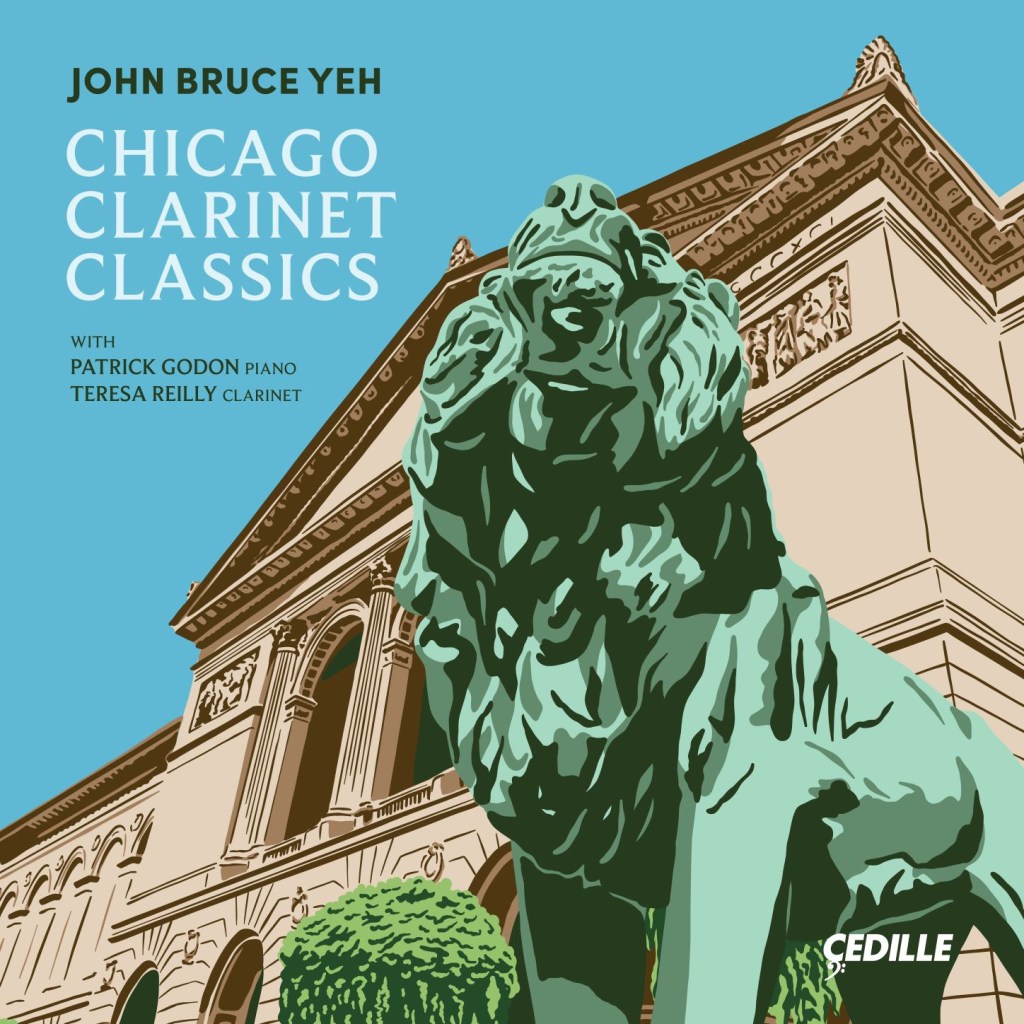
John Bruce Yeh: Chicago Clarinet Classics


Cedille CDR 90000 218

Professor Yeh has been assistant principal clarinet with the Chicago Symphony since 1977 when he was just 19. As a former Chicagoan I can recall that Yeh’s hiring seems to have marked a change in the more traditional image of an orchestral musician. In addition to being an inspiration to aspiring musicians of Asian heritage his media presence also drew interest from both listeners of Asian Heritage but also young listeners (I turned 21 when he was hired and was pleased to find an artist who communicated to me and my age group).

In addition to his duties with the CSO, he has actively supported music and music making in his adopted home town. It is his support for local composers that he showcases here. This disc features music by Alexander Tcherepnin (1899-1977), Stacy Garrop (1969- ), Leo Sowerby (1895-1968), Shulamit Ran (1949- ), Teresa Reilly (1976- ), and Robert Muczinski (1929-2010).

Alexander Tcherepnin, whose father Nikolai was a student of Rimsky-Korsakov, and whose sons, Serge and Ivan, along with grandsons Sergei and Stephan are all highly accomplished composers comprise a multigenerational artistic dynasty of sorts. Russian born Alexander taught in Chicago thus qualifying him for inclusion in Cedille recordings’ mission to promote artists with a “second city” connection. He is well represented in recordings but is less present in the concert hall these days. His brief Sonata in one movement for clarinet and piano (1939) takes the first track on this fine chamber music release. It is a deservedly popular recital piece with a style that sounds a bit like Shostakovich, one of his contemporaries.

Stacy Garrop is a favorite of this reviewer. Her work has been reviewed elsewhere in this blog. She is a freelance composer of immense talent and skill. Her work is featured on at least 12 Cedille albums as well as other labels. Phoenix Rising (2016-18) was originally for alto saxophone (subsequent versions were made for flute and for violin) is presented here in a world premiere transcription for clarinet. As with all her music, Garrop shows herself to be a master of color and texture. She uses both traditional and extended techniques to achieve her compositional visions. These can be challenging for performers but the end result is always worth the effort. Garrop derives inspiration, as she frequently does, from world mythology. Here, of course, the familiar Phoenix bird that lives some 500 years and rises again from the ashes of its funeral pyre.

Leo Sowerby, long associated with Chicago as an organist, composer, and teacher, is represented here by his 1944 clarinet sonata (here in its world premiere recording). Written in the year which saw him win the Pulitzer Prize for music (for Canticle of the Sun), this sonata takes on near symphonic dimensions in its four movements. Sowerby is generally well represented on recordings (8 discs on Cedille alone). His lyrical writing is expressive and accessible and it is perhaps just a matter of time before someone orchestrates this work to present it as a concerto. At just a bit under 30 minutes, it is the largest work on this release.

Shulamit Ran, Israeli/American composer and pianist, student of the great Ralph Shapey, 1991 Pulitzer Prize winner (for her 1989-90 Symphony), Andrew MacLeish Distinguished Service Professor Emerita at the University of Chicago is represented on this recording by her Spirit for solo clarinet (2017). The work is dedicated to the composer’s friend, clarinetist Laura Flax (1952-2017). This is its world premiere recording. Ran’s music has gotten some recordings but her large and substantial orchestral works like the Symphony and a fine Concerto for Orchestra remain unavailable on recordings (even more egregious is the general lack of representation of her mentor, Ralph Shapey’s music). This solo clarinet work is a testament to her compositional talents. Here’s hoping we get to hear more.

Teresa Reilly is a clarinetist, composer, and life partner of Mr. Yeh. The Forgiveness Train (2020) is described as, in part, a response to the COVID epidemic (Yeh notes that much of this album is similarly inspired). The three movement work is essentially a sonata with a loosely poetical program. It is a lyrical work with nods to minimalism and jazz. This is the world premiere recording.

The disc concludes with the four movement Time Pieces for clarinet and piano (1983). This work (the second longest on the disc) is, like the Sowerby piece, substantially a concerto that waits an orchestrator for the piano part. Robert Muczinski, Chicago born composer studied under Alexander Tcherepnin whose music opens this release. The Opus 43 work was commissioned and premiered by former CSO principal clarinet Mitchell Lurie with Muczinski at the piano.

Mr. Yeh is, as always, a joy to hear. He is most ably supported by pianist Patrick Godon on piano (tracks 1, 4-7, and 12-15) and, of course by (more properly with) Teresa Reilly (tracks 9-11). This release, from the Art Institute depicted in (Chicago artist) Steve Shanabruch’s distinctive cover art to the composers represented, is pure Chicago in the best ways.

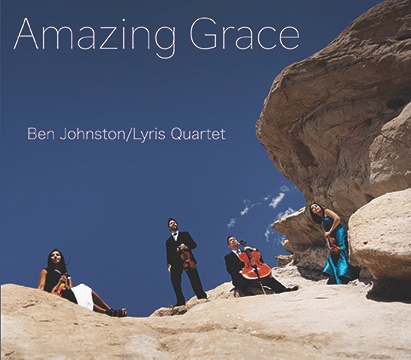
The Young Person’s Guide to Ben Johnston


Microfest MF 23

I’m guessing that my title has its origins in the Benjamin Britten piece, “The Young Person’s Guide to the Orchestra”. That phrasing has been used by the likes of Phill Niblock and King Crimson to title retrospective compilation discs. While the disc under consideration here is not, strictly speaking, a retrospective it is a fine representation of the chamber music of the late great Ben Johnston (1926-2019).

Johnston, a former associate of Harry Partch (Johnston played in Partch’s ensemble) was a composer in his own right. His ten string quartets are a landmark of the genre. Two of those quartets are featured here played by the Lyris Quartet (Nos. 4 and 9) along with what is apparently his last composition, “Ashokan Farewell” (1999) scored for an octet in which the Lyris is augmented with flute, clarinet, bassoon, and double bass.

Like so many composers before him, Johnston was fond of incorporating folk tunes into his compositions. The composer’s fourth quartet (included here) from 1973, which incorporates “Amazing Grace”, is likely his best known work. Despite its incredible complexity (nicely summarized in Kyle Gann’s lucid liner notes) this set of variations keeps that familiar tune near the surface and effectively make for music that is friendly to the audience, easy on the ears. It’s single movement clocks in at just under 12 minutes, the piece ends long before listeners have time to worry about that complexity.

Not all of the quartets incorporate familiar tunes but they explore various aspects of just intonation tunings. The ninth quartet (1987) is about twice the length of the fourth and is set in the familiar four movements that characterize the majority of the classical string quartet literature. The use of the classical format along with Johnston’s masterful writing also make this slightly odd sounding work just familiar enough that few listeners will find unpleasant. In fact the work is a joy to experience though very difficult to play.

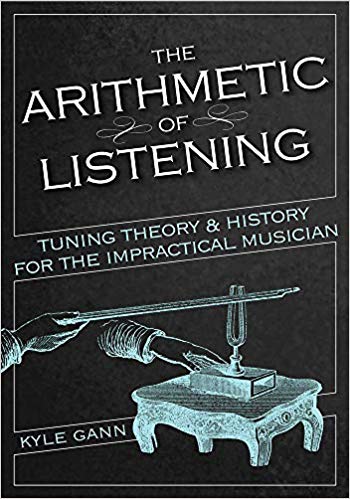
Listeners may want to seek out Mr. Gann’s very readable work on microtonal tuning systems, “The Arithmetic of Listening” available. Your humble reviewer is working through this text and finding it useful in understanding microtonality.

The final work (both the last on the disc and the last in the composer’s ouevre) is a delightful set of variations on a tune called “Ashokan Farewell”, a pretty folk like melody that pervades the Ken Burns Civil War documentary. I say “folk like” because the time was written by Jay Ungar and Molly Mason. Johnston mistakenly believed it to be a folk song in the public domain and, seeing its possibilities for his compositional aspirations, simply used it. Like the fourth quartet it is a set of variations in a single movement of similar length. This is the world premiere recording.

Musicians include Alyssa Park, violin; Shalini Vijayan, violin; Luke Maurer, viola; Timothy Loo, cello; Sara Andon, flute; James Sullivan, clarinet; Scott Worthington, double bass.

In researching this review I discovered that the tune actually has lyrics (also under copyright) and they are presented below:

The sun is sinking low in the sky above Ashokan
The pines and the willows know soon we will part
There’s a whisper in the wind of promises unspoken
And a love that will always remain in my heart

My thoughts will return to the sound of your laughter
The magic of moving as one
And a time we’ll remember long ever after
The moonlight and music and dancing are done

Will we climb the hills once more?
Will we walk the woods together?
Will I feel you holding me close once again?
Will every song we’ve sung stay with us forever?
Will you dance in my dreams or my arms until then?

Under the moon the mountains lie sleeping
Over the lake the stars shine
They wonder if you and I will be keeping
The magic and music, or leave them behind.

Ben Johnston

Those lyrics make for a fond farewell to a true musical genius who gave us both magic and music. Grab this lovely disc and honor his memory.

Evan Ziporyn: Bang on a Pop


Attempts to meld pop, jazz, and classical music are abundant but many, like some of the poorly done string quartet transcriptions (there are a few good ones but most are guaranteed to offend pop and classical audiences alike). But this set of chamber group incorporations of essentially “pop” music is among the most engaging and convincing.

Here the truly fabulous Reed player, composer, conductor, and Bang on a Can member Evan Ziporyn takes listeners on a journey which, to this listener, are a modern equivalent of Aaron Copland’s “Old American Songs” and, for that matter, Luciano Berio’s “Folksongs”. It is a personal selection with (sometimes) quirky but ultimately convincing transcriptions which rise to the level of full blown compositions that function as an homage to the chosen songs.

Actually these “chamber transcriptions” are for multiple clarinets, all played by Maestro Ziporyn. Doubtless many will hear echoes of Steve Reich’s multitracked instrument pieces in his “counterpoint” series. In that sense this is also a set of pieces that does homage to Reich’s work as well.

Tracks
01 UNCLE ALBERT/ADMIRAL HALSEY (5:05)
(Wings) Paul & Linda McCartney
02 RIDE CAPTAIN RIDE (5:07)
(Blues Image) Mike Pinera, Frank Konte
03 WOODSTOCK (5:32)
(Joni Mitchell) Joni Mitchell
04 ALONG COMES MARY (3:00)
(The Association) Tandyn Almer
05 WOODSTOCK IMPROVISATION/VILLANOVA JUNCTION (6:42) 06 SHINING STAR (2:17)
(Earth Wind & Fire) P. Bailey, L. Dunn, V. White, M. White, S. Burke
07 THAT’S THE WAY OF THE WORLD (5:56)
(Earth Wind & Fire) C.Stepney, V. White, M. White
08 PORTRAIT OF TRACY (2:23)
(Jaco Pastorius) Jaco Pastorius
09 I LIVE ABOVE THE HOBBY SHOP (3:43)
(McFabulous) Benjamin McFadden
10 DEADBEAT CLUB (4:12)
(B-52s) C. Wilson, F. Schneider, K. Strickland, K. Pierson
11 STRAWBERRY LETTER #23 (5:24)
(Brothers Johnson) Shuggie Otis
12 YOUR GOLD TEETH II (4:03)
(Steely Dan) Walter Becker & Donald Fagen

Ziporyn, born in 1959, played in Reich’s ensemble and that sound world is a surprisingly effective one for Ziporyn to share the pop music of his era. Certainly this music can benefit from musicological analysis but it speaks clearly and entertainingly as well to the casual listener. It is helpful but not absolutely necessary that listeners know the music upon which these pieces are based but this may have significant nostalgia for those who do.

Mr. Ziporyn’s familiarity with a wide variety of music ranging from avant garde classical to jazz and pop along with his composer’s acumen of form combine to make this one of, at least for this writer, most convincing and satisfying efforts to appropriate (or perhaps more like simply incorporate) some familiar pop standards. This is a marvelously entertaining album.

Everything You Wanted to Know About Javanese Gamelan But Were Afraid to Ask: John Pitts’ “Extreme Heterophony”


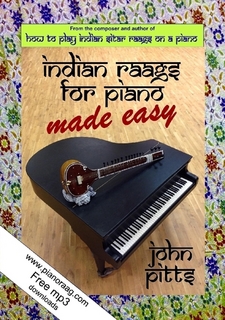
This is John Pitts‘ second incursion into adapting non-western music for the conventional piano. In doing so he follows a long tradition of fascination with non-western musics by western composers. Listeners will likely be familiar with Beethoven or Mozart who imitated Turkish music to add an exotic dimension to their compositions (Beethoven with his Turkish March sequence in the finale of the 9th Symphony; Mozart imitating Turkish music to add the exotic sound to enhance the geographic setting of his opera, The Abduction from the Seraglio). This fascination gained traction over the years as the great romantics such as Rimsky-Korsakov, Stravinsky, Debussy (whose encounter with gamelan music at the Paris World Fair was formative), and their successors took on similarly exotic interests in their music.

Serious study of non-western music with attention to tunings and rhythms is virtually unknown in the western canon before the twentieth century. Colin McPhee, the Canadian-American composer did his landmark study of Balinese Gamelan music in the 1920s and 1930s (some of which is influenced Benjamin Britten’s ballet, The Prince of the Pagodas) which was the first of a series of such explorations done subsequently by the likes of Lou Harrison, Terry Riley, La Monte Young, Alan Hovhaness, David Fanshawe, and others of Balinese, Javanese, Chinese, Japanese, Korean, and other cultures. Unlike their forebears, this new generation studied tunings, instrument construction, rhythmic construction, performance practice, compositional methods, etc. instead of basically just fitting the music to the mold of the western paradigm.

The present volume is, as mentioned, the second such effort by British composer/musicologist John Pitts. His first effort detailed suggestions for playing Hindustani Ragas (raags in the British spelling) and was reviewed here on this blog. In that study, as in this one, Pitts takes the fixed tuning of the piano that is familiar to western ears as a given, without getting into the complex issues of tuning (that is a subject unto itself). Neither Hindustani Ragas nor Javanese composition can be played on pianos tuned to the current western standard of twelve tone equal temperament but there are riches to be had in understanding compositional techniques other than tuning and harmony. Pitts uses the piano as a starting point from which to learn about music of other cultures. This appears to have grown out of his own efforts as a western trained musician trying to learn what techniques can be incorporated into the creative processes of western music. Many of the author’s compositions appear to be in part the product of lessons learned from his study of various musical systems including gamelan (Javanese and Balinese), Hindustani raga, and balafon music from Burkina Faso.

For the present volume Pitts consulted with western gamelan masters including Jody Diamond and other members of the international gamelan community. He did his homework well and one of the strengths of this book is in its remarkably lucid exposition of javanese music in a way that is understandable by anyone with a reasonable grasp of western music theory. Here is where the use of the piano serves as a springboard from which one might grasp this musical system in part via the differences in the two. It is this pedagogical aspect to which I refer in my parody in the title of this article. As one with a largely self driven learning of music this volume presents an opportunity to expand my knowledge of gamelan music. It is a friendly approach which makes me no longer “afraid to ask” or afraid to learn.

In the space of approximately 50 pages the author provides a marvelous distillation of the essentials of gamelan music including terminology, descriptions of the various traditional instruments commonly used, and, most crucially, descriptions of some of the processes of composition, melody, and performance practice. There seems to be more data here than one would reasonably expect to fit in those pages. It is a concise reference which many listeners and musicians will want to keep close at hand. These pages alone are worth the price of the book.

What follows is about seventy pages of transcriptions by the author of a traditional javanese composition playable by one or more pianists. Don’t get me wrong, this doesn’t simplify the learning of these processes. Rather it clarifies the material so that these concepts are learnable by motivated individuals. The transcriptions are the musical description, if you will, of the processes outlined in the preceding chapters. These are basically teaching etudes in lucidly engraved western notation. Even if the reader lacks sufficient skill at the keyboard (as is the case with your humble reviewer) to actually play these works, the illustration of the concepts described verbally can be understood more completely when one sees them in western notation.

As a listener to a wide variety of music I personally find it useful to be able to learn about music which had previously been just a bit out of reach due to my perception of its impenetrable nature and the lack of easily accessible guides such as this. While it has taken me a while to grasp some of the concepts so as to be able to write a reasonably coherent review of the book I’m gaining insights that are aiding my understanding of gamelan music. The book requires some work to understand largely due to the unusual nature of this music but grasping more as I continue to read and re-read, I find it both compelling and rewarding.

Mr. Pitts concludes with a comprehensive and insightful description of his justification of using the ubiquitous piano as his starting point. He compares it briefly with the common nineteenth century practice of imitating various asian musics with western instruments as noted at the beginning of this review and goes on to enumerate other benefits to be had by using the piano as a learning tool in the study of this music. The book concludes with a very useful bibliography and links to internet resources for those who want to go further in gamelan studies. Far from the dreaded “cultural appropriation”, Pitts’ work is more of a respectful anthropological exploration which acknowledges the value of this music and looks to learn from it. That is celebration and it is invaluable.

NOT your typical organist, Cameron Carpenter: J.S. Bach and Howard Hanson transcriptions show his genius


My review of Carpenter’s Sony Classical release Flash with Substance, Cameron Carpenter Takes on Rachmaninoff and Poulenc, in which he played his transcription for Organ and Orchestra of Rachmaninoff’s beautiful Paganini Rhapsody paired with his exciting rendition of the always welcome Poulenc Organ Concerto. It’s kind of a gutsy move to perform the Rachmaninoff with an organ instead of a piano, bordering on sacrilege for some. Given that programming though, the choices for this recording are a little less surprising as both further stretch the notion of what an organist is actually able to play and demonstrate the sheer breadth of this composer/performer’s musical vision.

Here’s the track list for his Decca Gold debut. Take a good look and meet me at the end of this list:

Tracklist

J.S. Bach – The Goldberg Variations, BWV 988 (1741)

  • Aria
  • Variatio 1. a 1 Clav.
  • Variatio 2. a 1 Clav.
  • Variatio 3. Canone all’Unisono. a 1 Clav.
  • Variatio 4. a 1 Clav.
  • Variatio 5. a 1 ô vero 2 Clav.
  • Variatio 6. Canone alla Seconda. a 1 Clav.
  • Variatio 7. a 1 ô vero 2 Clav. al tempo di Giga
  • Variatio 8. a 2 Clav.
  • Variatio 9. Canone alla Terza. a 1 Clav.
  • Variatio 10. Fughetta. a 1 Clav.
  • Variatio 11. a 2 Clav.
  • Variatio 12. a 1 Clav. Canone alla Quarta in moto contrario
  • Variatio 13. a 2 Clav.
  • Variatio 14. a 2 Clav.
  • Variatio 15. Canone alla Quinta. a 1 Clav.: Andante
  • Variatio 16. Ouverture. a 1 Clav.
  • Variatio 17. a 2 Clav.
  • Variatio 18. Canone alla Sesta. a 1 Clav.
  • Variatio 19. a 1 Clav.
  • Variatio 20. a 2 Clav.
  • Variatio 21. Canone alla Settima
  • Variatio 22. a 1 Clav. alla breve
  • Variatio 23. a 2 Clav.
  • Variatio 24. Canone all’Ottava. a 1 Clav.
  • Variatio 25. a 2 Clav.: Adagio
  • Variatio 26. a 2 Clav.
  • Variatio 27. Canone alla Nona. a 2 Clav.
  • Variatio 28. a 2 Clav.
  • Variatio 29. a 1 ô vero 2 Clav.
  • Variatio 30. a 1 Clav. Quodlibet
  • Aria da Capo

Howard Hanson (arr. Carpenter) – Symphony No. 2 in D-flat Major, Opus 30 “Romantic” (1930)

  1. Adagio
  2. Andante con tenerezza
  3. Allegro con brio

Yup, the Bach Goldberg variations played on the organ followed by Carpenter’s transcription of Howard Hanson’s (1896-1981) lovely Second Symphony, subtitled, “Romantic” (Trivia: the finale of this work is played over the end credits on the Ridley Scott film, Alien). But I’m willing to wager that neither Hanson aficionados (always among my faves) nor fans of Alien ever imagined hearing this piece played on an organ. But it works.

And that is Carpenter’s genius, or a portion of his genius. He is a man with a mission. He is a virtuoso of the highest order, he is a showman such that earns him a membership in my “glam classical” category, and he is a scholar with wide ranging tastes whose choices have challenged and charmed this humble listener and doubtless many others. My God, the man had a digital portable touring organ custom built for him! It is the instrument upon which he recorded this and the previously referenced disc.

He has antecedents such as Virgil Fox and Anthony Newman, musicians who eschew the stoic musician stereotype (nothing wrong with stoic, either) and engage the audience in their more theatrical manners. And it is the delicate balance between the musicianship and the stage presence that is worth the audience’s time. By my count this is his 8th album released. Check out his web page for more.

Watch any of his YouTube videos where his stage presence is as engaging as his virtuosity. Sure, he plays the “standard repertoire” authoritatively. His Bach is as engaging as his genial manner. This is one exciting composer/performer and it is a joy to watch him develop his brand. All sorts of ideas chase themselves in my mind when I ponder what he’ll do next. But I’d rather be surprised.

Ravel and Bartok Go Electric


Sono Luminus SLE-70028

While this album is not likely to cause as much of a stir as Bob Dylan did when he went electric in 1965 at the Newport Folk Festival it is revelatory in its own way. Of course Ravel and Bartok did not write for even acoustic guitar but they, like all western classical musicians, were very familiar with the art of transcription. Functional electric instruments wouldn’t come into use until the late 1940s. But the art of transcription (essentially a synonym for “Covers” as used in pop music) can be applied to any instrument and, at its best, transcription brings out perspectives in the music that were not obvious in its original incarnation. That is what is achieved here.

There are no liner notes but it appears that these musicians have done the transcribing themselves. And their backgrounds include having played guitar with the likes of Chris Cornell, Natalie Merchant, Rufus Wainwright, Joan Baez, Patti Smith, Ian Hunter, and others. Their facility with their guitar playing comes from (the more traditional role of the guitar) in rock/pop genres and here they apply this knowledge to playing classical repertoire which they came to love. Why can’t they have both?

A more pedestrian choice of repertoire for a debut might have been Bach inventions or Scarlatti sonatas (which worked remarkably well for Wendy Carlos) but these guys made what, on first look, seems very unusual choices. Ravel’s Mother Goose Suite (hardly that composer’s best known work) and 6 (of the 44) duos for violins by Bela Bartok (among the composer’s least known compositions). So I approached this release with a great deal of skepticism.

Well, the sounds they create, recorded so lucidly too, instantly won me over. This is a spectacular release and makes a very enjoyable listening experience. Their transcriptions provided a perspective that sent this listener back to the original compositions for another listen. I had a minimal familiarity with the Ravel and even less familiarity with the Bartok but the sheer energy of their performances combined with a real feel for the jazz roots that underlie the Ravel as well as a curious set of sounds chosen for the Hungarian folk derived Bartok effectively recasts these pieces in a very different perspective.

Like Bob Dylan, they thrust the modern electric guitar center stage and provide what will be for some, a jarring or disturbing experience. Purists may find these transcriptions sacrilegious but I suspect that many will be charmed and (perhaps their endgame) may find electric guitars to be anywhere from acceptable to revelatory as instruments which can do justice in the classical world.

Electric guitars are now pretty common in folk as well as rock and blues. Dylan gets significant credit for this and these guys seem to be aiming at a similar goal, that of bringing electric guitars into legitimacy in the performance of classical music. Whether this eventually happens remains to be seen but this is a mighty well conceived and executed effort and, in the end, it is a very fine piece of sonic art. Kudos to Jack Petruzzelli and Cameron Greider as well as to Sono Luminus.

Dennis Weijers: Skill and Nostalgia in an Auspicious Debut Album


I feel as though this artist is a personal discovery for me. Whilst surfing You Tube I found a series of his videos which greatly appealed to me and I contacted him via email. I learned that he was about to release his debut as a solo artist. The logistics of sending CDs by mail “across the pond” as the saying goes are fraught with financial and logistical hurdles so I was glad to find that he was releasing via Bandcamp, a music vendor and streaming service whose business model appeals more to me every day. This album is also available on Amazon music and probably other streaming sites as well.

Let me first issue a disclaimer, to wit: that I am an unreformed and unashamed Glass groupie whose live performances with his ensemble will doubtless comfort me well into my waning years. Those memories echo in my head even now.

Dennis Weijers describes himself on his web page as follows:

“Dennis Weijers is a Dutch musician and composer. He followed a traditional education at the conservatories of Rotterdam and Enschede, and got in touch with experimental electroacoustic music after moving to Berlin. Dennis started to merge his accordion with electronics.
Dennis works with a variety of instruments and gear (from accordions and modular synths up to a 1948 wire recorder, tape machines and more curiosities). In 2018 he did a concert series in which he performed the complete version of Philip Glass’ Glassworks. In 2021, his debut album Accordion + Modular Synthesizer was released.”

The present disc is apparently one of those “crowd sourced” deals which allows public funding for a given project not easily funded otherwise. I missed this project but I will be on board for his next release. So I delved into his online presence and found a young highly skilled man whose primary instrument is the accordion and whose interests take his composing and transcribing skills into the electroacoustic and sound installation realms. His choice of accordion as primary instrument puts him in the company of other innovators such as Pauline Oliveros, Guy Klucevsek, William Schimmel, Miloš Katanić, and others to whom I apologize for not naming here. Do click on his You Tube link (provided above) to get an idea of his creative foci. They include a excerpts from a couple of sound installation works as well as a bit of Terry Riley’s “Rainbow in Curved Air”.

Dennis Weijers in his studio

But let’s get to the album at hand. This recently release contains a complete performance of Philip Glass’ “Glassworks” arranged for accordion and electronics. This could have been done purely as a recording but it seems clear that Weijers is enamored of live performance so these arrangements can be done live (which is apparently how he developed them).

The “Opening” begins with apparently with a brief section with (apparently to these ears) a lo fi/hi pass filter which sounds like a glitch and shortly morphs into a full spectrum sound for the rest of the performance. In fact compositional notions like glitch, sampling, looping, etc. appear strategically in other movements but I will leave that to the listener to discover. Don’t get me wrong, this is not a recomposition but rather a recasting in which the artist provides a context and uses a few effects judiciously providing a personal touch much as a painter signs a painting.

This faithful, loving rendition segues into the second movement, called “Floe”. For those who have heard Glass’ ensemble do this live (as I did in 1980) you will likely feel nostalgia. The experience is one of a good transcription of a familiar piece and the nostalgia likely comes from the life memories attached to that first hearing.

The third movement, “Islands” is a glorious minimalist slow movement which serves as much to relax the listener as it does to provide a significant contrast in anticipation of the next movement.

Movement 4, “Rubric” is a manic masterpiece which I recall playing so much that I wore out those grooves on my vinyl copy. Weijers really shows his interpretive musical chops here. He makes the piece rock and his rhythmic sensibility suggest a fondness and familiarity with jazz.

Movement 5, “Facades” is one of Glass’ early hits and, as I recall, was liked even by folks who didn’t like his other music. My recollection is that this piece had originally been written for the Godfrey Reggio film, “Koyaanisqatsi” but not used. Like any good composer does it was repurposed into the present multi-movement work. This movement triggers sadness with my nostalgia as I recall reveling in the beautiful playing of the now late Jon Gibson.

“Closing” is basically a reworking, an orchestration of the “Opening” section which kind of opens the door to inviting transcriptions. It is a full orchestration of what had been a solo piano piece at the beginning. Weijers seals the deal on nostalgia when he ends this movement by reintroducing that high pass filter and adding a little vinyl groove scratches at the fade out. That brought a bit of a tear to my eye.

I don’t know Weijers age but I doubt that he was even a twinkle in his parents’ eyes at the time I saw those performances but he has clearly absorbed this music this music completely and shows a deep love and affinity for it. It is a mark, perhaps of genius, that he frames his performance of the complete work with the lo fi/glitch at the opening and vinyl crackles at the end. It was a reminder to this age denying listener that this was indeed long ago. (Over 40 years).

The major work on this album is the following track. It is the performance (excerpted on You Tube) which first gave me that delightful twinge I feel when I believe I have discovered something new and meaningful. It was a performance of a too little known work by Steve Reich (Variations for Winds, Strings, and Keyboards, 1979), another minimalist composer who was a frequent visitor to my turntable. The work, roughly contemporary with Glassworks, was only recorded once by the San Francisco Symphony under Edo De Waart, is an overlooked masterpiece.

It’s impossible to miss the Dutch connections with Glass (whose 1979 opera “Satyagraha” was commissioned by the city of Rotterdam) and the only recorded performance of Reich’s Variations performed by the prominent Dutch conductor Edo de Waart. Well now comes Mr. Weijers delivers a beautiful transcription and spectacular performance which very well might raise this work out of its languished state. At the very least this is a tribute to Reich.

It is wonderful to hear this Reich piece again. I have never heard it live and, as far as I know, Reich never attempted to recast it in a new orchestration (as he did with the “Octet” orchestrated and played more commonly now as “Eight Lines”). The point is that we have a younger generation encountering, appreciating, and celebrating what is now “old school” minimalism. Whether you are encountering these pieces for the first time or basking in the nostalgia of rediscovery through creative and dedicated new performances this is a truly auspicious debut of a musician who has given new life to music which clearly has endured and will likely continue to endure into further generations. Bravo, Mr. Weijers.

As if this weren’t enough the curious collector gets two extra bonus tracks if you download via Bandcamp. They are two brief pieces that provide a peek at Weijers’ other musical efforts. The first is a beautiful meditative tribute to minimalism, a gentle elegiac piece for accordion and electronics. The second, a collaboration with Koen Dijkman, a musician who appears on other releases along with Weijers. This piece has a more prog rock/improv feel.

If old school minimalism appeals to you or contemporary accordion, you will want to hear this album. But regardless I’m willing to bet that you will be hearing more from this wonderful artist. And I bristle with anticipation.

Modern Tuning Scholarship, Authentic Bach Performance: Daniel Lippel’s “Aufs Lautenwerk”


New Focus FCR 920

This album works so very well on many levels. It is a great example of the state of the art in tuning scholarship, a lovely recording of a fine instrument, and a deeply engaging example of authentic and thoughtful performance practice. From the moment I first heard this CD I was entranced by the very musical experience. There is as much to appreciate in the depth and accuracy of the scholarship involved as there is in the deeply committed and learned performance. This recording is “definitive” in that it represents state of the art tuning theory, instrument making, and baroque performance practice.

Readers of this blog know that I rarely review music written before 1950 but this is a rather special case of contemporary scholarship that, in its way, occupies both the old and the new. It is Bach in the context of the modern scholar providing a unique insight for the modern listener. And, having reviewed much of Mr. Lippel’s work with contemporary music this journey to the past provides a useful perspective on the artist’s range.

This is NOT the complete Bach music for guitar (the modern guitar did not exist in Bach’s time). This is NOT the complete Bach music for lute played on guitar. Rather this is the complete Bach music for “Lautenwerk“, a curious instrument which was a cross between a lute and a harpsichord. While there have been reconstructions of this unusual instrument there are no known extant instruments from Bach’s time. The instrument featured gut strings (rather than metal) which produced a softer sound. The strings were plucked by quills controlled by a keyboard in the manner of a harpsichord and pretty much anyone who played keyboard could play this instrument.

This is a performance on a guitar tuned to the “well tempered” tuning which inspired Bach’s definitive masterpiece, “The Well Tempered Clavier” which demonstrated the utility of the well tempered tuning system (Andreas Werckmeister’s to be specific). This differs considerably from equal temperament tuning which permeates most of the music we commonly hear in western classical traditions. While the technicalities of tuning are well beyond the scope of this review (more information is available at http://www.MicroFestRecords.com and in any number of learned theses on tuning) the critical fact is that this recording provides, as much as possible, the experience of hearing this music on an instrument tuned in the manner which Bach and his contemporaries used. This is about as close as one could come to hearing what Bach’s audiences heard.

All this attention to tuning scholarship, authentic instrument building, and authentic performance practice place this album in the lineage of similarly definitive recordings by the likes of Noah Greenberg and the New York Pro Musica along with artists such as David Munrow, Julian Bream, Alfred Deller, and their successors. The scholarship here draws on the work of scholars whose lineage includes Harry Partch and Ben Johnston. The liner notes are written by one of the living royalty of microtonal scholars, John Schneider (himself a guitarist and composer who is in the process of recording definitive editions of all of Harry Partch’s work). Also mentioned is the assertion by another living royalty of tuning scholarship, the composer/scholar Kyle Gann who suggests that, “hearing performances of Bach’s Well Tempered Clavier in modern equal temperament is like viewing Rembrandt’s work through wax paper”. The analogy is apt and the value of this recording is the “removal of the wax paper” (so to say), allowing the listener to hear something much closer to the composer’s original intent.

Of course a standard guitar cannot play these tunings so the artist turned to German luthier (guitar builder) Walter Vogt whose invention, The Fine Tunable Fretboard, graces the beautiful instrument seen on the album cover. This is the instrument we hear in this recording. It is tuned to Johann Kirnberger’s keyboard well tempered tuning system.

And now to the artist. Daniel Lippel is a guitarist, producer, and new music advocate. Though he did release a Bach on guitar recording in 2007 the majority of his work on recordings has been dominated by music composed after 1950 and actually mostly after 2000. Hearing his affinity for baroque performance practice is indeed a revelation by itself. Lippel whose virtuosity and facility with new music is well known demonstrates his facility with baroque performance turning in a ravishingly beautiful recording of this music.

There are three works on this disc, the 6 movement Suite in E minor BWV 996, the four movement Suite in C minor BWV 997, and the Prelude, Fuga, and Allegro BWV 998. The performances are candy for the ears and food for the soul. This is a level of excellence that has this writer hoping for more.

Monk and the Memories


Cantaloupe CA21153

Like many innovative young artists in New York City in the early 60s Meredith Monk had to train musicians to work with her unusual vocal methods. Her first album, Key (1971), was the first time her vocal art began to be dispersed outside the intimate, neo-bohemian loft space where the album was recorded. After graduating from Sarah Lawrence College in 1964 Monk moved to Manhattan where she and many other young, creative experimental musicians populated what became known as the “downtown scene” or SOHO. Many musicians worked with her over the years including composer/cellist Robert Een, Pianist Anthony De Mare both of whom incorporated their extended vocal techniques learned in the loft of the master herself.

Bang on a Can was formed from a very similar aesthetic (that of providing an alternative to the “uptown scene” which generally refers to the “establishment” or “mainstream” of classical music epitomized by Julliard and Lincoln Center. Founded in 1987, Bang on a Can and their subsequent touring group, Bang on a Can All Stars (begun in 1992) can be said to be another generation’s effort to achieve what Monk and the many musicians who followed such as Philip Glass, Steve Reich, LaMonte Young, among many others whose musical vision stood in contrast to the established uptown, more academic leanings.

It was Bang on a Can’s transcription of Brian Eno’s famous studio produced album (no live musicians), “Music for Airports” that demonstrated their ability to revision some of the work of their forebears and bring it into the concert hall. This is pretty much what we see here in this loving collaboration/tribute to one of New York’s finest composer/performers from the early downtown/SOHO era.

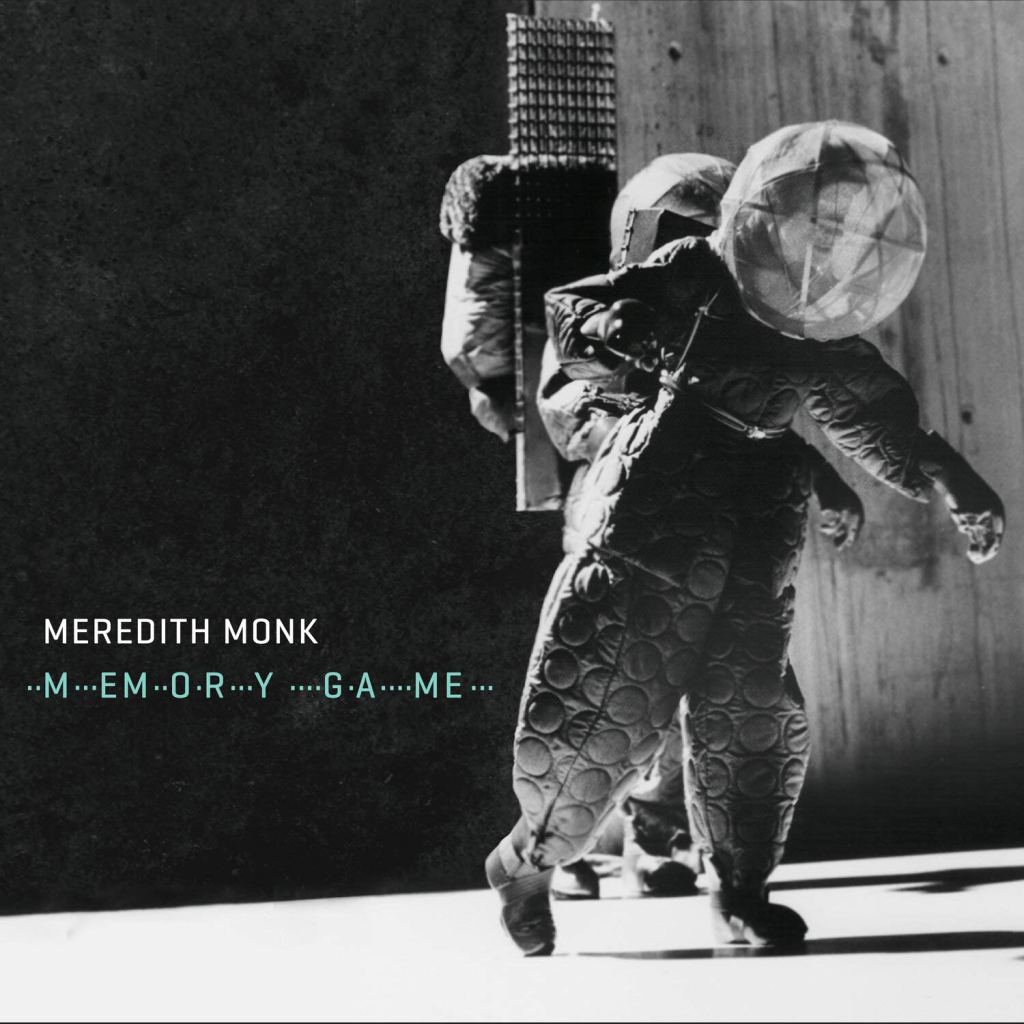
Monk began her artistic life as a dancer and dance/choreography remains an essential part of her artistic vision. 2014-2015 marks the 50th anniversary of Meredith Monk as a performer. “–M—EM–O-R—Y —-G-A—-ME—” (2020) is a wonderful production which sits somewhere between a “greatest hits” record and that of another generation’s reverent celebration of a unique artist. Bang on a Can shares the duties of transcription and performing with Monk and her ensemble. Most of Monk’s work involves (generally) one to five musicians (playing minimalist style music) onstage but here we see an expansion into a larger ensemble not unlike her collaborations which resulted in one of her largest works, the masterful “Atlas” (1993) produced by the Houston Opera. (Would that a new recording of Atlas may eventually come from such a collaboration).

back cover

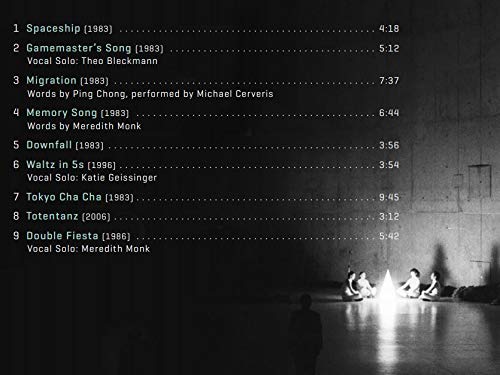
So what we have here is a combination of transcription, performance, but most importantly a respectful sharing out of a mutual educational experience between Monk’s ensemble and that of BOC. There are nine tracks comprising nine distinct compositions from Monk’s oeuvre. BOC composers provided transcriptions of “Spaceship” (Michael Gordon), “Memory Song” (Julia Wolfe), “Downfall” (Ken Thomson), “Totentanz” and “Double Fiesta” (David Lang). The other tracks appear in transcriptions by members of Monk’s ensemble: “Gamemaster’s Song” and “Migration” (Monk), “Waltz in 5s” (Monk and Sniffin), and “Tokyo Cha Cha” (Sniffin).

Monk’s ensemble in this recording consists of Meredith Monk, Theo Bleckmann, Katie Geissinger, Allison Sniffin, and guest artist Michael Cerveris. The Bang on a Can All Stars include Ashley Bathgate, cello and voice; Robert Black, electric and acoustic bass; Vicky Chow, piano, keyboard, and melodica; David Cossin, percussion; Mark Stewart, electric guitar, banjo, and voice; and Ken Thomson, clarinets and saxophones. The expansion of the ensemble adds favorably to the sound (as it did in Atlas) and the transcriptions enhance the music (as was the case in “Music for Airports”).

The 2012 collaboration produced by Monk’s House Foundation deserves mention here because it is a crowd sourced two CD production of covers by a variety of artists paying homage to Monk’s work. It is not clear if this release had any influence over the Memory Game album but it does speak to the influence of the artist.

The House Foundation for the Arts
ASIN : B00A1JCY1I

Fans of Meredith Monk and her various music/dance/theater works will find a comforting familiarity in these performances of music which, at one time were the leading edge of the new and experimental, now become familiar and, more importantly, embraced by another generation who clearly took the time to look, listen, and understand the work of this now acknowledged American Master. Those unfamiliar will find this a great introduction to Monk’s legacy.

Though chosen from a variety of compositions which date from 1983 to 2006, this selection comes together in a satisfying unity. The very tasteful album design is itself an homage to the look of Monk’s ECM recordings (under Manfred Eicher’s direction) who released the majority of her work. Kudos to the production team of David Cossin and Rob Friedman whose work here is among the finest of Bang on a Can Allstars’ recordings and a very satisfying addition to Monk’s discography. The little liner notes booklet includes an essay by the composer as well as a copy of the lyrics to “Migration” and “Memory Song”, just enough to inform and not overwhelm the casual listener. This is one fantastic release.

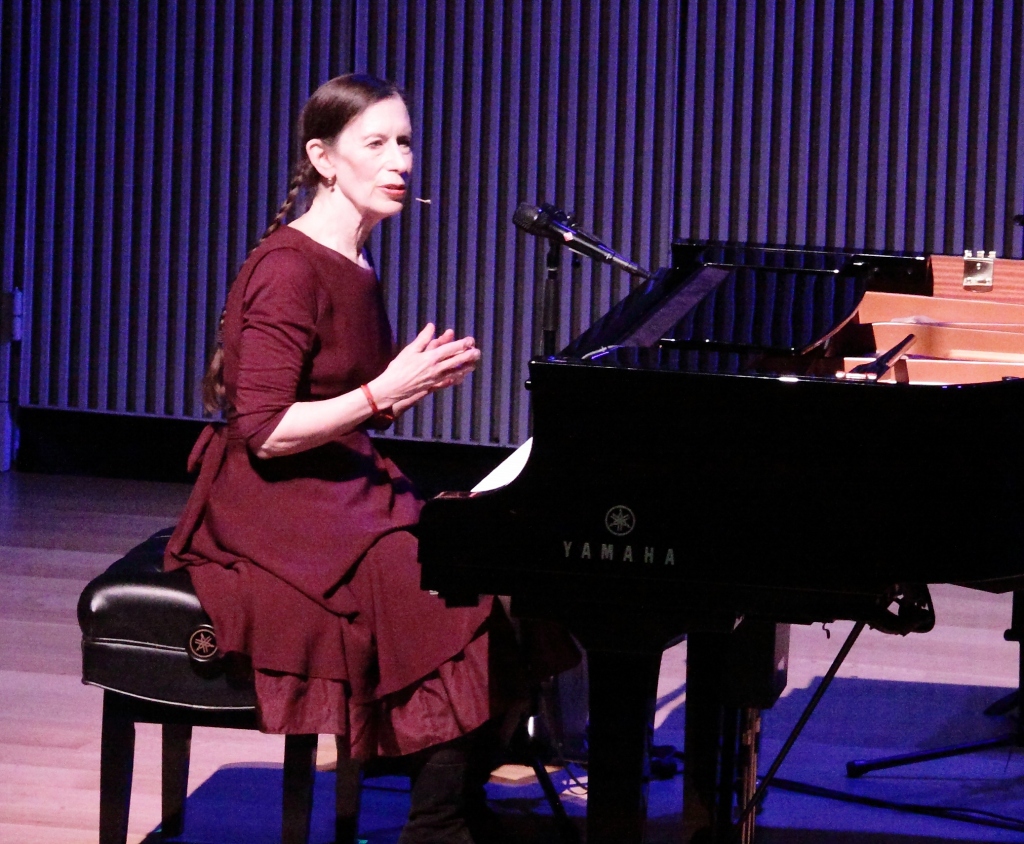
Meredith Monk performing her signature Gotham Lullaby in San Francisco, 2016 Other Minds

“Dreams of a New Day”, a Landmark Recording Project from Cedille


Cedille CDR 90000 200

I have always made my admiration clear regarding Chicago based Cedille Records. They release quality recordings of unusual but intelligent choices of repertoire. This recording continues that formula but here achieves what is likely to be seen as a landmark anthology (or at least sampling) of Art Song by Black Composers. It speaks on many levels, as poetry, as music, as a collaboration between an incredible baritone, an amazing pianist, in a beautifully recorded and produced album. I was left throughout with the feeling that this is a loving collaboration. It is an integrated collaboration between many people who worked well together. It is a beautiful document and a timely one.

Baritone Will Liverman, the young rising star baritone who is slated to perform at The Met in the world premiere of Terence Blanchard’s “Fire Shut Up in My Bones” scheduled for fall of 2021 is clearly at the heart of this production. His intelligent choice of repertoire is both pleasing and revelatory. (the poetry of the song texts are published in one of two booklets that come with this CD). And Liverman’s voice is an admirable instrument that he wields with power and nuance. His commission of fellow rising musical star, composer Shawn Okpebholo whose “Two Black Churches” receives its world premiere recording. The pianist who manages to navigate significant demands with confidence and artistry, is Paul Sanchez, an excellent pianist, composer, and a fine collaborator.

The beautifully packaged CD (you gotta buy the CD) consists of 19 tracks representing 8 composers. The recording is billed as “Songs by Black Composers” but one can hardly miss the justly sad or angry tone of the texts and this was recorded July 22-24 of 2020 at the height of the COVID-19 pandemic and amidst social unrest over the epidemic of modern day lynchings. (2020 was also the year that Anthony Davis won the Pulitzer Prize for his protest opera, “The Central Park Five”) The moving rendition (“put together”, as Liverman quips in the liner notes) of Richard Farina’s 1964 song is played and sung by Liverman connecting this release with the tradition of protest music of another era. The struggle continues.

Before discussing the music I must supply a disclaimer of sorts. My working knowledge of art song in general is fairly limited and my knowledge of black art songs even more so. I know none of this music and have only in the last year or so came to know of the work of Shawn Okpebholo. I had read about the historical significance of Henry “Harry” Thacker Burleigh and Margaret Bonds but have heard little of their music.

In about 61 minutes listeners are given a survey, a sampling of art song by black composers ranging from Burleigh (who studied with Antonin Dvorak) to Okpebholo whose compositional talents continue to get much deserved recognition. It is a learned sampling of a huge repertory that deserves attention.

The opening song is I Dream a World (2017) by Damien Sneed (1979- ). This setting of the Langston Hughes (1901-1967) poem strikes a somber but cautiously optimistic note. It is followed by “Five Songs of Laurence Hope” (1915) by Henry “Harry” Thacker Burleigh (1866-1949). The name Laurence Hope is the pseudonym of Adela Florence Nicolson (1865-1904), a British poet who spent much of her life in British India where she developed an interest in the culture of the land. Fascination with the literature and culture of India was strongly in evidence in the early twentieth century. These five songs are reminiscent of Debussy and the impressionists and is but a small sampling of Burleigh’s art song output.

Harrison Leslie Adams’ (1932- ) setting of his own lyrics in “Amazing Grace” is yet another iteration of the abolitionist song. Margaret Allison Bonds (1913-1972) is represented by her “Three Dream Portraits” (1959), a song cycle on Langston Hughes poems. Bonds’ style put this listener in the mind of Copland’s Dickinson Songs though notably darker. This cycle is contemporary with the height of the Civil Rights Movement.

Next is “Riding to Town” (1943) by Thomas Kerr (1915-1988) who chose to reach back to the late nineteenth/early twentieth century poet Paul Laurence Dunbar (1872-1906) for his text. Dunbar was for the 19th century what Langston Hughes would be for the early to mid twentieth century.

“Two Black Churches” (2017) is the work commissioned by Liverman for this recording. It is a setting of two poems and one of the musical highlights here. The first, “Ballad of Birmingham” to a text by Dudley Randall (1914-2000) is a contemporary reaction to the 1963 bombing of the 16th Street Baptist Church in Birmingham which killed four little girls. The second song, “The Rain” to a text by the Poet laureate of Charleston, poet and musician Marcus Amaker (1976- ). It is about the Charleston Church shooting of 2015 at Emmanuel African Methodist Episcopal in which a lone gunman killed nine people. Okpebholo is modernist but accessible and these settings are among the most devastating and powerful statements on this recording.

“Mortal Storm” Op. 29 (1969) is a song cycle by one Robert Owens (1925-2017). It is a powerful cycle set to Langston Hughes poems. Owens left the United States in 1968-9 in response to the racial violence and moved to Europe where he had studied music under the GI Bill from 1946-1957. Owens died in Munich having never returned to the land of his birth. This work deserves to be better known and thanks is due to Liverman and his associates for bringing this sad masterpiece to contemporary listeners.

The album concludes with Mr. Liverman’s arrangement of “Birmingham Sunday”, a 1964 song by writer and composer Richard Farina (1937-1966). Liverman plays and sings on this final track which is an homage to a previous generation of song writers and protestors as well as a reminder that that generation’s work in Civil Rights is hardly complete. The song was notably used by Spike Lee in his elegiac film, “Four Little Girls” (1997).

The lucid and detailed program notes by Dr. Louise Toppin are a welcome addition to this production and help to provide a context. The design by Bark Design ties this little gem together. This one has Grammy and “collector’s item” written all over it.

Patricia Kopatchinskaja and Jay Campbell in Santa Barbara


img_0826

Shot of the stage of Hahn Hall at Santa Barbara’s historic Music Academy of the West (Photo by author)

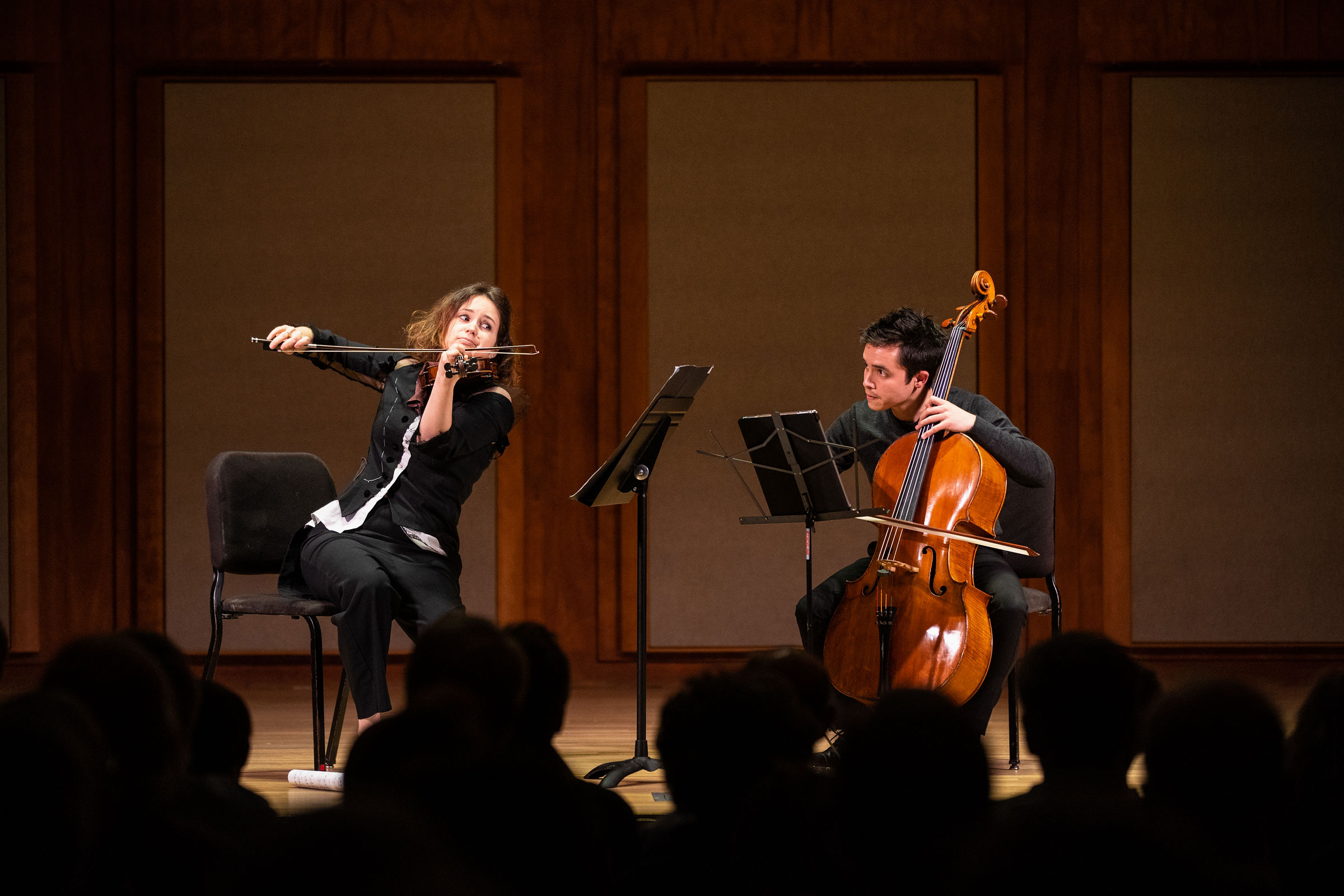
The beautiful and acoustically excellent Hahn Hall at the Music Academy of the West in Santa Barbara was the venue for a powerful chamber music concert on Saturday, January 25th.  The not too common combination of violin and cello played respectively by violinist extraordinaire Patricia Kopatchinskaja and the equally matched musicianship of cellist Jay Campbell delighted a near full house with a carefully chosen set of pieces from the 642 CE to the present.  Who knew that there was so much music for this combination of instruments and that it would be so marvelously engaging?

kopacampbellMA

Patricia Kopatchinskaja and Jay Campbell in Massachusetts (Photo from Patricia’s web site)

This concert was part of the UC Santa Barbara’s always excellent Arts and Lectures series.  Kopatchinskaja was clearly the big name on the marquee for this event but Campbell was clearly a match both in skill and enthusiasm for this night’s event.

A slight change in the program was announced at the beginning which, if this reviewer heard correctly placed a piece originally slated for the second half of the program in the number two slot on the first half.

The concert opened with an anonymous “Alleluia” from a collection of works only recently (the past 50 years or so) deciphered by scholars.  The slow melismatic voice lines transcribed here for these string instruments was played with the sort of approximate intonation common to so called “period performances” which attempt to provide as much as possible some sense of how the music may have sounded in its time.  It was a slow piece rich in harmonics and reverent in execution.

The next piece, a clearly modern piece from the look of the oversized score on the music stand, was (again if this reviewer heard this correctly) by Hungarian composer Márton Illés (1975- ).  It was the world premiere of “Én-kör III”, a piece that brought us nearly 1500 years forward and evoked the modernist sound world of Darmstadt and the sort of modernism that dominated the 1950s in Europe.  It was a challenging piece for both listeners and players involving special techniques of playing that doubtless made for a fascinating looking score.  On sheer virtuosity and powerful performance alone the piece was well received.  It is complex music that doubtless benefits from repeated hearings and this premiere suggests that that will be the case.  The interested listener would do well to explore the web site of this fascinating composer whose name and music was new to this writer’s ears.

Next up, music by another modernist composer, the German, Jörg Widmann (1973- ).  Two selections (numbers 21 and 24) from his 24 duos for violin and cello (2008) were also of the Darmstadt style modernism mentioned earlier.  The Valse Bavaroise (Bavarian Waltz) had echoes of the 19th century Viennese traditions while the Toccatina all’inglese which followed it was a finger busting virtuosic showpiece, another audience pleaser actually.

Then, as if to cleanse our aural pallets the duo played Orlando Gibbons’ (1583-1625) Fantasia a 2, No. 4 for two “viols”.  As in the opening piece these are transcriptions since the violin and cello as we know them today did not exist.  This little instrumental miniature was a charming and relaxing interlude.

The final piece on the first half of this concert was the too seldom heard Sonata for Violin and Cello (1920) by French composer Maurice Ravel (1875-1937).  This again set the mood to virtuosic modernism.  Even people in the audience familiar with Ravel’s better known works were astounded at the modern sound.  According to the program notes this work was written in the shadow of both the death of his esteemed fellow French luminary Claude Debussy (1862-1918) and the end of the First World War (also 1918).  Indeed there were angry dissonances to be heard but this four movement sonata remains an astounding work and this performance was a powerful and forceful reading conveying the respect that this masterpiece deserves.  It is filled with both jazz influences as well as gypsy music (no doubt dear to the Moldovan born Kopatchinskaja).  And were it not for the visual cues that only two instruments were actually playing one might guess that there were certainly more.  At this point we all needed an intermission just to breathe.

The second half of the concert consisted of (with one exception) music from the region of Kopatchinskaja’s birth.  The Romanian born Iannis Xenakis (1922-2001) produced a great deal of music in the high modernism and experimental traditions but the work which opened the second half of this concert was an early work “Dhipli Zyia” (1951) which sounded much like the work of (also Romanian born) Hungarian composer Bela Bartok (1881-1945) with whom Xenakis had familiarity and, apparently, affection.

The program continued without the punctuation of applause into the 14th century with a work by the French composer Guillaume de Machaut (ca.1300-1377), his Ballade 4.  This is apparently originally a vocal work and was played in transcription for tonight’s soloists.

Again without the transition signal of applause the duo launched into another work which, like the Xenakis, is atypical of his largely modernist oeuvre.  György Ligeti (1923-2006) is perhaps best know for his music’s (unapproved) inclusion in Stanley Kubrick’s 2001: A Space Odyssey (1968).  The work played on this night was “Hommage à Hilding Rosenberg” (1982).  Hilding Rosenberg (1892-1985) was among the earliest Swedish modernist composers and this work was written on the occasion of his 90th birthday.  The piece echoed Ligeti’s affection for the aforementioned Bela Bartok and folk tunes predominated this brief but lovely score.

The duo launched with little pause into a piece by Bartok’s contemporary Zoltán Kodály (1882-1967).  His “Duo for Violin and Cello” Op. 7 (1914) sounded almost like a model for the later Ravel piece heard at the conclusion of the first half of the concert.  This three movement work is unusual in this composer’s catalog in that it is more aggressively modern than much of his more folk inflected pieces (Bartok and Kodaly were early pioneers in ethnomusicology and they collected and recorded a great deal of folk music from the region of Hungary, Romania, etc.)  It was a fantastic finale which garnered the artists an enthusiastic standing ovation.  The smiling and obviously satisfied performers received the traditional bouquets of flowers and returned for a brief little piece (didn’t catch the name) which was a little token of thanks to the equally satisfied and smiling audience.

My 2019 in the Arts


Dempster2

The amazing Stuart Dempster at a house 2015 house concert at Philip Gelb’s Sound and Savor.  

In many ways this has been a year of reckoning.  I kept my promise to myself to double down on writing this blog and have already reached more viewers than any previous year.  I am now averaging a little more than 1000 hits a month from (at last count) 192 countries and have written 74 pieces (compared to 48 last year).  I need to keep this up just to be able to stay in touch with similarly minded folks (thanks to all my readers).  Add to that the fact that a piece of music I wrote 15 years ago was tracked down by the enterprising Thorson and Thurber Duo.  They will provide me with my very first public performance this coming July in Denmark.  Please stop by if you can.  After having lost all my scores (since 1975) in a fire and subsequently the rest of my work on a stolen digital hard drive I had pretty much let go of that aspect of my life but now…well, maybe not.

Well one of my tasks (little nudges via email have been steadily coming in) is to create a year end “best of” list.  Keep in mind that my personal list is tempered by the fact that I have a day job which at times impinges on my ability to do much else such as my ability to attend concerts.  However I am pleased to say that I did get to 2 of the three Other Minds concerts this past year.  The first one featured all the music for string quartet and string trio by Ivan Wyschnegradsky (1893-1979).  The second one featured music by the same composer written for four pianos (with two tuned a quarter tone down).  Both of these concerts exceeded my expectations and brought to light an amazing cache of music which really deserves a wider audience.  These are major musical highlights for this listener this year.

OM 240010

The Arditti Quartet acknowledging the applause at the Wyschnegradsky Concert.

Read the blog reviews for details but I must say that Other Minds continues to be a artistic and musical treasure.  Under the leadership of composer/producer/broadcaster Charles Amirkhanian (who turns 75 in January) the organization is about to produce their 25th anniversary concert with a 4 day series beginning in April, 2020.  For my money its one of the reasons to be in the Bay Area if you love new music.  He is scheduled for a live interview on the actual day of his birthday, January 19th as a guest on his own series, The Nature of Music.  This series of live interviews (sometimes with performance material) with composers and sound artists he has hosted since 2016.

OM230102

Amirkhanian performing at OM 23 (2018)

Next I will share with you my most obvious metric, how many views my various blog posts got.  I have decided to share all those which received more than 100 views.

The winner for 2019 is:

Linda-K-Twine-Image-page-001

Linda Twine (unknown copyright)

Linda Twine, a Musician You Should Know

A rather brief post written and published in February, 2018 for Black History Month.  It was entirely based on internet research and it got 59 views that year.  As of this writing in 2019 it has been seen 592 times.  I have no idea why this “went viral” as they say.  I just hope it serves only to her benefit.  Amazing musician.

fa2

Fatu Duo

Charming little album of lesser known romantic violin and piano pieces played by a husband and wife duo.  This self produced album seems to have had little distribution but for some reason people are enjoying reading about it.  I only hope that the exposure will boost their sales.  This is a fun album.

The Three Black Countertenors

I’m guessing this is one of my “viral” posts.  I wrote it in 2014 and it continues to get escalating hits, 180 this year.  The title pretty much says it all.  First time three black countertenors appeared on the same stage.

choi20190008

Jenny Q Chai

This concert was an all too brief presentation of some very interesting work.  Quite a pianist too.  File this artist’s name in your “pay attention” category.

kanchelisun

Heavenly Violin and Piano Music by Giya Kancheli 

Giya Kancheli (1935-2019), one of the artists we lost this year (I refuse to do that list).  If you don’t know his work you should. He wrote I think 7 Symphonies and various concertos, film scores, and other works.  He was sort of elected to the “Holy Minimalists” category but that only describes a portion of the man’s work.  Very pretty album actually.

schanklerpatterns

Because Isaac Schankler

This composer new to me, works with electronics, and maintains an entertaining presence on Twitter.  Frankly, I’m not sure exactly what to make of this music except to say I keep coming back to it.  Very leading edge material.


LCMS1903

Wolfgang von Schweinitz’s “Klang”

A very different music from that of Schankler listed just above.  But another recording to which I find myself returning.  Thanks to Mr. Eamonn Quinn for turning me on to this one.

breath

A New Voice for the Accordion

I pretty sure that Gene Pritsker can shoulder at least part of the blame for connecting me with this great new musician  The accordion has come a long way and this guy leads it gently forward.


cd cover

Bernstein’s Age of Anxiety in a new recording

Loved this one.  I had only listened to this work three or four times and probably not with adequate attention.  Hearing this performance was revelatory.  It’s a great work deserving of a place in the standard repertoire/


Black Classical Conductors

Written in 2013, just an occasional piece about black conductors for Black History Month.  It’s now been read over 2000 times.  It is my most read article.  It’s embarrassingly incomplete and in need of a great deal of recent history but that’s a whole ‘nother project.

blueviolet

Blue Violet Records

Blue Violet Duo

So glad this disc got a little exposure.  Its gorgeous.  This disc of jazz influenced classical Americana unearths some real musical gems.


boots1

Shakuhachi Ecstasy 

OK, I meet this guy at a vegan underground restaurant (whose proprietor is noted Shakuhachi player, Philip Gelb).  A little casual conversation, a few vegan courses (Phil can seriously cook), and whaddya know?  About a month or so later he sends me this gorgeous self produced set of him playing shakuhachi…but the upshot is that this is the distillation of the artist’s sensibilities filtering his very personal take on the world via his instrument.  It has collectible written all over it and that is as much due to the music itself as to the integrated graphics and packaging.  You really have to see and hear this trilogy.  It got over 100 hits.  Thanks to Cornelius Boots and Philip Gelb (musical and culinary concierge).

boots4

That’s it.  Everything else (300 plus articles total with 74 from this year) got less than 100 views.


Personal Favorites

It was a great year for recordings and I listened to more than I did last year.  Some may have noticed some experimentation with writing style and length of review here.  The problem is that the very nature of my interest is the new and unknown so I have to do the research and have to share at least some of that to hopefully provide some context to potential consumers that will ignite the idea, “gotta check that out” without then boring them to death.

For this last section I will provide the reader with a list in reverse order of the publication of my reviews of CD and streaming releases that prompt this listener to seek out another listen and hopefully draw birds of a feather to listen as well.


Keep yer ears peeled.  This young accordion virtuoso is an artist to watch.  This was also one of my most read review articles.  This guy is making the future of the instrument.  Stay tuned.


bartonblues

This artist continues to draw my attention in wonderful ways.  Her scope of repertoire ranges hundreds of years and she brings heretofore unknown or lesser known gems to a grateful listening audience.  Blues Dialogues is a fine example.  It is also reflective of the larger vision of the Chicago based Cedille label.

jensen

I found myself really taken by this solo debut album by American Contemporary Ensemble (ACME) director Clarice Jensen.  In particular her collaboration with La Monte Young student Michael Harrison puts this solo cello (with electronics) debut in a class all its own, This independent release is worth your time.

img_2017

This album of string chamber music arrangements of Mahler is utterly charming.  No Time for Chamber Music is a seriously conceived and played homage.

horvatdiedtrying

Canadian composer Frank Horvat’s major string quartet opus is a modern classic of political classical music.  It is a tribute to 35 Thai activists who lost their lives in the execution of their work.  His method of translating their names into a purely musical language has created a haunting and beautiful musical work which is a monument to human rights.

donut

Donut Robot is a playful but seriously executed album.  The kitschy cover art belies a really entertaining set of short pieces commissioned for this duet of saxophone and bassoon.  Really wonderful album.

beauty

It has been my contention that anything released on the Starkland label requires the intelligent listener’s attention.  This release is a fine example which supports that contention.  Unlike most such releases this one was performed and recorded in Lithuania by the composer.  Leave it to the new music bloodhound, producer Tom Steenland to find it.  In Search of Lost Beauty is a major new work by a composer who deserves our attention.

img_2088

My favorite big label release.  This new Cello Concerto from conductor/composer Esa-Peka Salonen restores my faith that all the great music has been written and that all new music is only getting attention from independent labels.  Granted, Sony is mostly mainstream and “safe” but banking on the superstar talent of soloist Yo-Yo Ma they have done great service to new music with this release.  Not easy listening but deeply substantive.

project w 365

This release typifies the best of Chicago based Cedille records’ vision. Under the guidance of producer James Ginsburg, this local label blazes important paths in the documentation of great music.  “W” is a disc of classical orchestra pieces written by women and conducted by the newly appointed woman conductor, Mei-Ann Chen.  She succeeds the late great Paul Freeman who founded Chicago’s great “second orchestra”, the Chicago Sinfonietta.  Ginsburg taps into Chicago’s progressive political spirit (I guess its still there) to promote quality music, far beyond the old philosophy of “dead white men” as the only acceptable arbiters of culture.  Bravo to Mr Ginsburg who launched Cedille Records 30 years ago while he was a student at the University of Chicago.

adamsdesert

Become Desert will forever be in my memory as the disc that finally got me hooked on John Luther Adams.  Yes, I had been aware of his work and even purchased and listened to albums like Dream in White on White and Songbirdsongs.  I heard the broadcast of the premiere of the Pulitzer Prize winning Become Ocean.  I liked his music, but this recording was a quantum change experience that leads me to seek out (eventually) pretty much anything he has done.  Gorgeous music beautifully performed and recorded.

publiquartfreedom

OK, I’m a sucker for political classical.  But Freedom and Faith just does such a great job of advancing progressive political ideas in both social and musical ways.  This is a clever reimagining of the performance possibilities of the string quartet and a showcase for music in support of progressive political ideas.

amerecorder

Michala Petri is the reigning virtuoso on the recorder.  Combine that with the always substantial production chops of Lars Hannibal and American Recorder Concertos becomes a landmark recording.  Very listenable and substantive music.
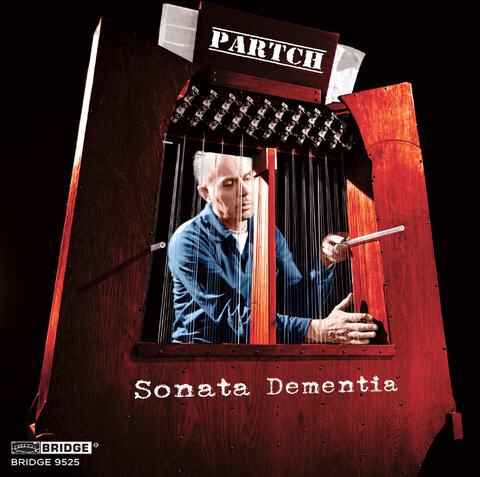
img_0564

I have admired and sought the music of Harry Partch since I first heard that excerpt from Castor and Pollux on the little 7 inch promotional LP that came packaged with my copy of Switched on Bach.  Now this third volume in the encyclopedic survey of the composer’s work on Bridge Records not only documents but updates, clarifies and, in this case, unearths a previously unknown work by the master.  Sonata Dementia is a profoundly important entry into the late composer’s discography.  I owe PARTCH director, the composer/guitarist John Schneider a sort of apology.  I had the pleasure of interviewing him about this album and the planned future recordings of Partch’s music but that has not yet been completed.  You will see it in 2020 well before the elections.

The aforementioned Shakuhachi Trilogy is a revelatory collection which continues to occupy my thoughts and my CD player.

img_2011

Gil Rose, David Krakauer, klezmer and the inventive compositional talent of Mathew Rosenblum have made this album a personal favorite.  Lament/Witches Sabbath is a must hear album.

isbinpacqr

Another Cedille disc makes the cut here, Souvenirs of Spain and Italy.  The only actual Chicago connection is that the fine Pacifica Quartet had been in residence at the University of Chicago.  But what a fine disc this is!  The musicianship and scholarship are astounding.  Guitar soloist Sharon Isbin celebrates the 30th anniversary of her founding the department of guitar studies at Julliard, a feat that stands in parallel with the 30th anniversary of the founding of Cedille records.  This great disc resurrects a major chamber work by Mario Castelnuovo-Tedesco and presents a definitive program of chamber music for guitar and string quartet.  This one has Grammy written all over it.

duyundino

This New Focus recording was my personal introduction to the music of Du Yun and I’m still reeling.  What substance!  What force! Dinosaur Scar is quite an experience.

eyetoivory

Another Starkland release, this album of music by the great new music pianist is a personal vision of the pianist and the creators of this forward looking repertoire.  Eye to Ivory is a release containing music by several composers and championed most ably by Kathleen Supové.

kohlimit

Chicago born Jennifer Koh is one of the finest and most forward looking performers working today.  Limitless is a collaboration between a curious but fascinating bunch of composers who have written music that demands and receives serious collaboration from this open minded ambassador for good music no matter how new it is.  And Cedille scores another must hear.

Many recordings remain to be reviewed and some will bleed over into the new year so don’t imagine for a second that this list is comprehensive.  It is just a personal list I wished to share. Happy listening and reading to all.

Channeling Casals’ Bach: Amit Peled


peled

It was in 1936 that the famed Catalan cellist and composer Pablo Casals performed and recorded the now familiar Bach Cello Suites.  Long thought to be intellectual and technical exercises not intended for public performance these works languished for nearly 200 years on manuscript alone.  Casals pretty much single handedly has made these masterworks a staple of the cellists repertory.  Since Casals there have been numerous readings of these works and no sign of any flagging interest.

It is difficult to imagine any really new perspectives on these works and, aside from Kim Kashkashian’s wonderful transcriptions for viola, one gets basically the musician’s take on the music.  So here comes the Israeli cellist Amit Peled who, since 2004 has had the honor (and attendant responsibilities) of playing Casals’ own cello, a 1730 Gofriller personally loaned to him by Casals’ widow.  So in this first volume (second one not out yet as far as I can tell) is the first time Bach’s masterful Cello Suites have been sung by this instrument since it was in Casals’ hands.

What we have here is a sensitive and committed performance that many will want to hear perhaps as “channeling Casals” but ultimately we have a gorgeous performance by a fine musician channeling his own talents and sensitivities to produce a quite viable performance (are those gut strings I hear?).  Perhaps there are nostalgic aspects here as well but whatever your preference, be it channeling, nostalgia, or simply a great performance of these masterpieces you will find all these here.  Can’t wait for volume II.

Janoska Ensemble: Revolution


janoskarev

Deutsche Grammaphon 60257 725 9326

Not your typical Deutsche Grammaphon release, this disc is of a genre in which classical musicians toy with pop music arrangements (in this case two violins, piano, and bass) as well as a few showpieces.  Such novelties when done carelessly (evidence the plethora of string quartet arrangements of rock music) it can be tedious but with clever arrangements and energetic musicians they can be marvelously entertaining.  This disc is in the latter category.

This traverses some of the territory of the late great Yehudi Menuhin and his collaborations with the likes of Stephane Grappelli among others.  This spirit of exploring the fun side of classical music (so to say) is very much present here.  The virtuosity of the selections by Fritz Kreisler and Henryk Wieniawski  are contrasted with virtuosity of variations written and arranged by the Janoskas.  Add a cello and I’d love to hear these guys do the Schubert Trout Quintet.  They rock in their way.

Here are the track names:

The Marriage of Figaro (Mozart)

Yesterday (Lennon and McCartney)

Praeludium and Allegro in the style of G. Pugnani (Kreisler)

Hello Prince! (Roman Janoska)

Air (Bach)

Len’s Dance (Frantisek Janowska)

Melodie (Tchaikovsky)

Night and Day (Porter)

Penny Lane (Lennon and McCartney)

Variations on an Original Theme (Wieniawski)

Let it Be (Lennon and McCartney)

The ensemble consists of Ondrej Janoska, violin; Roman Janoska, violin; Frantisek Janoska, piano; and Julius Darvas, double bass.  Nothing truly “revolutionary” here except for the title but fun and entertainment certainly are.


Holes in the Sky, Lara Downes Channels the Collective Artistry of the Feminine


downesholes

Sony/Portrait

Lara Downes has proven herself as a virtuoso pianist in solo, chamber, and with orchestra.  She has demonstrated facility with standard repertoire as well as an intelligent selection of contemporary composers.  In this sort of mid-career place she has begun releasing a more personal kind of album of which this is the third incarnation.  The “series’ to which I refer is the perception of this reviewer, not one defined as such by Ms. Downes but stick with me. Her previous releases have been organized on one level or another on themes just like most album of any stripe.  The difference is a more sociopolitical focus.

One look at the eclectic musical choices here and one sees Downes sharing her spotlight with kindred spirits (composers and performers both) while her themes take on more socially conscious ideas.  The first of these was America Again (2016) which is a beautiful collection of short piano pieces predominantly though not exclusively by black composers.  It is a very personal choice of repertoire reflecting her profound knowledge of the repertoire as well as the neglect of black composers.  The second was Lenny (2018), a tribute to Leonard Bernstein.  It includes a marvelously varied group of guest artists and, much as Lenny did, blurs the line between the “classical” and the “vernacular”.  It was a love song to a cherished artist (this writer included in the cherishing).

She does something similar here in this album whose title is taken, appropriately enough, from Georgia O’Keefe, “I want real things, live people to take hold of, to see, and talk to, music that makes holes in the sky, I want to love as hard as I can.”  In the essay that opens the program booklet Downes speaks briefly of her relationship with women in general and women as composers and as performers.

The album opens with a 1949 piece by Florence Price, a black American composer much of whose whose work has recently been rediscovered and recorded.  Her work was also featured on the America Again album.  This is a mid-century romantic piece for solo piano.

The second track, and the one that hooked this listener big time is this recording of Judy Collins early song, Albatross (1966) which appeared on her album Wildflowers which in turn provided some of the design elements of the album.  The liner notes to the present album also note this connection.

In place of detailed liner notes there is a fascinating conversation between two of the women involved with this album, Lara Downes and Judy Collins.  A lovely black and white portrait is included in the liner notes.  Their discussion centers primarily on the Albatross song but also touches on the nature of political activism in which Downes laments not being active in marches.  Collins tells her (and this writer agrees wholeheartedly) she belongs at the piano.  Indeed her activism, though of a gentler nature, gets ideas out most effectively utilizing her incredible talents as a pianist, historian, and fellow musician.

Rather than go through an analysis of each of these pieces I am simply going to provide a track list.  It appears that this album is designed to be heard and contemplated as a sonic document first and as a research project at a later time (one hopes for more detail at some point because these are interesting pieces).

1. Memory Mist (1949) by Florence Price

2. Albatross (1967) by Judy Collins

3. A Tale of Living Water (2010) by Clarice Assad

4. Dream Variation with Rhiannon Giddens (1959) by Margaret Bonds and Langston     Hughes

5. Ellis Island with Simone Dinnerstein (1981) by Meredith Monk

6. Don’t Explain with Leyla McCalla (1944) by Billie Holiday

7. Willow Weep for Me (1932) by Ann Ronel (arr. by Hyungin Choi)

8. Venus Projection (1990) by Paula Kimper

9. Morning on the Limpopo: Matlou Women (2005) by Paola Prestini

10. Farther from The Heart with Hila Pittman (2016) by Eve Beglarian and Jane Bowles

11. Favorite Color (1965) by Joni Mitchell (arr. by Nora Kroll-Rosenbaum)

12. Noises of Gratitude (2017) by Jennifer Higdon

13. Arroyo, Mi Niña with Mogos Herrera (2018) trad. arr. by Lara Downes

14. Music Pink and Blue (2018) by Elena Ruehr

15. Idyll (1946) by Hazel Scott

16. Blue Piece with Rachel Barton Pine (2010) by Libby Larsen

17. Bloom (2018) by Marika Takeuchi

18. Just for a Thrill with Alicia Hall Moran (1936) by Lil Hardin-Armstrong (arr. by               Hyungin Choi)

19. Agwani (Doves) (2009) by Mary Kouyoumdjian

20. What Lips My Lips Have Kissed (2014) by Georgia Stitt

21. Rainbow (n.d.) by Abbey Lincoln and Melba Liston (arr. by Laura Karpman)

22. All the Pretty Little Horses with Ifetayo Ali-Landing and The Girls of Musicality (Trad. arr. by Lara Downes and Laura Karpman)

In these 22 tracks all the music is by women composers and, most charmingly a selection of women performers who appear as sort of cameos on different tracks.  The music ranges from the mid-twentieth century to the present and embraces a variety of genres (classical, folk, blues, etc.).  The end result is a charming and very intimate document but also one which is somehow gently subversive as it presents the best in musical and performance quality as an acknowledgement of the accomplishments of women in general, (to paraphrase Ms. O’Keefe) making music as hard as they can.


Hee-Young Lim: French Cello Concertos


lim

Sony 80358118425

Normally I don’t review a lot of popular best seller CDs or recordings of music written before 1900 (I like most all music but that I just don’t think I have much useful to say about it) but this one has the happy exception of including a 20th Century work and it is an example of truly thoughtful and creative programming.

This is the major label debut of Korean born cellist Hee-Young Lim.  She is, according to her website, currently professor of cello at Beijing Central Conservatory.  With this disc she demonstrates her facility with the technical aspects of her instrument as well as a gift for interpretation.  In addition she is known as an advocate of new music, hence the inclusion of the Milhaud Cello Concerto.

This is such a delightful disc combining two lesser heard major cello concertos with some tasty filler material.  But the real gem here is the too rarely heard Milhaud concerto of 1936.  Wow, what a great work!

The disc opens with a true classic, the Saint-Saens’ (1835-1921)  Cello Concerto No. 1 of 1872.  This is one of the great concertos for the instrument.  It is not heard with the frequency of say the Dvorak concerto but it is every bit as good and as challenging.  Ms. Lim handles this romantic gem with both ease and grace.

The second offering is a real rarity, the Cello Concerto (1877) of Èdouard Lalo (1823-1892).  It is not clear why this major work gets heard so rarely (Lalo’s work is way overdue for a reappraisal and some recordings).  It is a wonderful romantic era concerto and Lim handles it like the seasoned professional she is.

The highlight of this disc for me personally is the also rarely heard Cello Concerto No. 1 (1934) of Darius Milhaud (1892-1974).  It is one of two such works by the wonderfully prolific composer.  This work is surely recognizable for some modernist features (Lim seems quite comfortable with the more modern idiom here, a mark of a master it would seem).  Maybe a little dissonance here or there but this is basically a post-romantic work with appropriate nods toward some modernism.  The point is that it is an expressive work that deserves a place in the repertory.  Hopefully this recording will contribute to helping this music achieve its deserved place in history.  And of course there’s the eager anticipation of her recording the second Milhaud Concerto for Cello.

The disc ends with two short romantic bonbons, Jacques Offenbach’s “Les Larmes de Jacqueline” and the too rarely heard Meditation from Jules Massenet’s opera “Thais”.

Scott Yoo conducts the always competent London Symphony.  The useful and well written liner notes by James Inverne are so well researched and written I won’t complain about the microscopic typeface.  The sound is handled well by engineer Jin Choi at the iconic Abbey Road Studios in London town.

The multilingual program notes suggest that this disc looks forward to an international reputation for this fine young artist and it looks/sounds like that is what is happening here.  Let us welcome her to the international music community and look excitedly forward to hearing more from her.  Brava! Ms. Lim!

William Susman’s Scatter My Ashes


susmanscatter

I first encountered the composer William Susman (1960- ) when one of his works appeared on a program which included a solo cello and electronics piece by Vivian Fung.  This solo electroacoustic piece, the work I was initially asked to review, was nestled in the middle of an interesting program by the San Jose Chamber Orchestra.  I chose to review the entire concert which was a fascinating selection of new music.  William Susman’s “In a State of Patterns” (2018) struck me immediately as interesting post-minimalist work.

Susman_at_piano

Mr. Susman read my review and rather promptly sent me this 2014 CD on his Belarca label.  It contains four of his works from 1992-2010 and is a fine sampling of his work.  All works are here performed by the Octet Ensemble which includes: Alan Ferber, trombone; Mike Gurfield, trumpet; Melissa Hughes, vocals; Elaine Kwon, piano; Eleonore Oppenheim, double bass; Demetrius Spaneas, saxophone; Greg Zuber, drums and percussion; and William Susman, electric piano.

There are four pieces on 12 tracks.  The disc begins with Camille (2010), a very listenable post-minimal chamber work.  It is followed by a melancholy song cycle, Scatter My Ashes (2009) on poems by the composer’s sister Sue Susman.

The third piece is a wonderful piano concerto.  There are not a lot of convincing concertos in the minimalist genre but this one is a candidate for being a poster child.  It is for piano with chamber ensemble.  Here the composer goes not for the finger busting virtuosity that seems to be the current vogue but rather he evokes a latter day Mozart with more technically modest but highly entertaining music that communicates directly.  Curiously (is this a carry over from the Steve Reich and/or The Philip Glass Ensemble?) he uses a wordless vocal (Hughes) as a part of the instrumental texture.  Elaine Kwon handles the featured keyboard part.  It works very well.

He ends with an arrangement for OCTET of Moving in to an Empty Space (1992, arr 2010), another setting of his sister’s lovely poetry.  Again he evokes the somber but it is more in the nature of exorcising the demons of sadness much like the mission of the poet.


Anne Akiko Meyers’ Romantic Post Minimalism Enthralls


aameyers

Avie AV 2386

Admittedly I am a sucker for nearly all things minimalist and post-minimalist.  Such programming can lead to some potentially dull or cloying experiences.  Not so with this lovely collection of miniatures though.  While minimalists like Glass and Pärt make their appearances the concept here seems to reach for larger goals.  We have a mix of relatively simple chamber compositions along with electroacoustic works, a revelatory take on Ravel’s Tzigane and and arrangement for violin and orchestra of a solemn choral piece by Morten Lauridsen.

This eclecticism seems to flow from the artist’s choices rather than choices imposed by a producer.  In this respect she reminds this reviewer of pianist Lara Downes whose repertoire choices are similarly eclectic but born very personally from the artists’ experiences and preferences.

The opening Philip Glass Metamorphosis Two (1988) is presented in an arrangement by none other than Glass’ long time champion Michael Riesman.  It is followed by two violin and piano pieces by Arvo Pärt, Fratres (1977) and Spiegel im Spiegel (1978).  These lovely works serve to draw the listener in most pleasantly.  Akira Eguchi is the fine pianist who plays on all but tracks 4, 7, and 8.

Next up is a piece of musical archaeology.  Tzigane (1924) was originally written for violin and piano.  It was later orchestrated and it is that version which is best known and probably most recorded.  Well it turns out that Ravel had made a version for a now defunct instrument called a Luthéal which is an instrument invented in the early 20th century (patented 1919).  It’s actually not so much an instrument as an add on.  It modifies the sound of a piano.  The device now exists in museums but that hasn’t stopped innovative producers from utilizing an electroacoustic version.  Elizabeth Pridgen plays the keyboard to which the lutheal is virtually attached.

Apparently this version has been recorded before but this writer encountered it first in this release.  It is a very different sound than the piano or orchestral versions and is a lovely take on the music.  Many may buy the album for this track alone.

This is followed by a charming lullaby written for Meyers’ youngest daughter.  John Corigliano has absorbed only a small bit of the minimalism bug (maybe his 1985 Fantasy on an Ostinato  qualifies) but he is one of our finest living composers and he appears to infuse this violin and piano miniature, Lullaby for Natalie (2010) with a tender romanticism that is both sweet and touching.  In the notes we learn that it did seem to put her daughter to sleep but I doubt it will do that to most listeners.

The next two tracks are works by one Jakub Ciupinski  (1981- ) who also has a stage persona under the name Jakub Ζak under which he performs live electronic music.  This Polish born composer is now based in New York and works with various forms of electronics including a theremin.  Both “Edo Lullaby” (2018) and “Wreck of the Umbria” (2009) come from a similar place musically.  Both use electronics in varying degrees to enhance and accompany the solo violin.  Both are delightful little gems that give a nod to some minimalist roots but stand on their own merit and prompt this listener to keep an eye/ear out for more of this composer’s work.

The concluding piece is an arrangement by the composer Morten Lauridsen (1943-  ).  The performer states she pursued Lauridsen for a new piece and when he finally acquiesced he presented this lovely arrangement of his well known choral piece, “O Magnum Mysterium”.  The arrangement is for string orchestra and violin and orchestra here given its world premiere performance.  It should come as no surprise to new music fanciers that the Philharmonia Orchestra is conducted by none other than Kristjan Järvi, a fine conductor, composer, and avid new music advocate who can always be found near some interesting musical projects.

This album stands out in that the choices of the musical selections and the personal connections between the composers and the soloist are clearly collaborative and  inspired.  This is substance rather than fluff but it may appeal to a wider audience.  This one can be said to have crossover hopes but it does not pander.  This is a wonderful album and will likely prompt listeners who, like this writer, have yet to know this soloist to go and seek more of her recordings and live performances.  Brava!


Tesla Quartet Debut Pleases


teslaqr

Most recordings of the wonderful Ravel String Quartet of 1902-3 is most frequently paired with the similarly masterful Debussy String Quartet (1893) or with another of Ravel’s fine chamber works.  Not here though.  For their debut recording this quartet has apparently chosen to demonstrate their skills by programming which spans the 18th to the early 20th century along with a selection of transcriptions of lesser known Ravel pieces.  After ten years playing together they have chosen to lay down some recorded tracks for posterity.

The disc opens with the Ravel Quartet which is handled most ably.  It is ostensibly this quartet that inspired first violin Ross Snyder to dedicate his career to the string quartet.  The bonuses here are transcriptions by first violin, Ross Snyder, of three lesser known Ravel piano pieces.  They are, in order of appearance on the album, the brief Menuet sur la nom d’ Haydn (1909), the more familiar Menuet Antique (1895), and the Menuet in C sharp minor (1904) are heard in transcriptions for string quartet.

By contrast the Teslas have chosen to feature Haydn’s String Quartet in C major Op. 54 No. 2.  It is the first one of the first set of so called “Tost” Quartets written in 1788 and named for a violinist (Johann Tost) of the Esterhazy orchestra.  This is mid-career Haydn who is justly known as the father of the string quartet.

The larger works are punctuated by the short transcriptions.  The Menuet sur le nom d’ Haydn follows the Ravel and leads us neatly to the Haydn.  The Menuet Antique follows next.  It is one of the more ubiquitous compositions of Ravel and listeners familiar with the composer’s work will doubtless recognize it as it appears in the Sonatine and the piano suite (later orchestrated), Le Tombeau de Couperin.

We then get to hear a lesser known masterwork by Igor Stravinsky (1882-1971), his Concertino for String Quartet (1920).  This is early Stravinsky but he clearly thought highly of this piece as he later orchestrated it in 1953 for small ensemble.  It is only about six and a  half minutes long but listeners will be able to discern this as a masterful work by the composer who had already produced his three great ballets, The Firebird, Petrushka and The Rite of Spring.  Nothing that earth shaking here but the hand of the artist can clearly be heard.

The disc ends rather enigmatically perhaps with a transcription of the very brief Menuet in C sharp minor which clocks in at under a minute.  The end result is a tasty little resume of an emerging chamber group that one hopes will bring another interesting perspective on the genre of the string quartet.  This is an auspicious and most listenable debut.

The Shaman: Spectacular New Canadian Orchestral Music


vho

I don’t know what it is about political borders and the arts but there must be some kind of walls up that prevent musical immigration from Canada, Mexico, Central and South America, etc.  In short there is a strong Eurocentric/American flavor to the classical music distributed here.


One of the issues with which the large colonial countries such as the United States and Canada grappled was the tendency for all their composers to sound like second rate European composers.  With the dawn of the 20th Century there was the obligatory attention to folksong but that is also arguably Eurocentric…not bad, mind you, just leaving out the Native Americans or, using the elegant Canadian term, First Peoples.

Eventually both the U.S. and Canada began to pay attention to indigenous traditions of the peoples they had conquered.  One suspects that an appreciation of the social and spiritual traditions of indigenous peoples also encouraged a different view of the very landscapes.  In Canada the composer most closely associated with the post Eurocentric traditions would have to be Raymond Murray Schafer whose incorporation of the vast landscapes of his country embraced it musically and dramatically in a way that no one had previously.

So along comes this disc from composer Vincent Ho (1975- ) born in Ottawa, Ontario, Canada.  He was educated variously at Canada’s Royal Conservatory of Music, a Bachelor of Music from the University of Calgary, an MM from the University of Toronto, and a DMA from the University of Southern California.  His mentors have included Allan Bell, David Eagle, Christos Hatzis, Walter Buczynski, and Stephen Hartke. In 1997, he was awarded a scholarship to attend the Schola Cantorum Summer Composition Program in Paris, where he received further training in analysis, composition, counterpoint, and harmony, supervised by David Diamond, Philip Lasser, and Narcis Bonet.

Vince8

Vincent Ho


Impressive credentials for sure but this album demonstrates the very impressive work of a composer who would seem to be poised to take on the mantle of the next generation of artists working to create music that represents the entire country in this generation.  This is a man with formidable skills in writing for large ensembles.  No doubt his facility with writing music allows him to create convincingly for any size ensemble.  A quick look at the composer’s catalog of works inspired the mini polemic with which this review begins.  How can so much wonderful music go unnoticed south of the border here in the U.S.?  (End rant.)

Finally to the disc at hand.  This is a beautifully recorded live concert of two major works by Mr. Ho, “The Shaman” (2011) and Arctic Symphony (2010).  Both are for large orchestra and inhabit a very listenable realm melodically and harmonically.  That is NOT to say that these are ordinary or simple works.  In fact they clearly embody the work of a well trained and thoughtful artist.  This is exciting music and the audience response at the end of each work was highly approving.

Your reviewer heard the Carnegie Hall broadcast of The Shaman and jumped at the opportunity to review this disc.  Dame Evelyn Glennie is reason enough to pay attention.  This (essentially) Concerto for Percussion was written for her and she is ostensibly the shaman of the work’s title.  Her performance is simply spellbinding.  The piece has three numbered movements and an interlude.  I will leave it to the program note readers to plumb the additional depths of meaning embodied in the concerto but I will tell you that if you are not enthralled by the “fire dance” finale you may very well be dead.

The Arctic Symphony is another animal.  It is a programmatic work inspired by the composer’s experience on a research vessel, the Amundsen, exploring various arctic regions and describing the different areas of research being done.  There are environmental themes here for sure and also an incorporation of Inuit songs transcribed by the composer and sonic evocations of various aspects of the composer’s experience of the journey (wind, silence, the strange sounds of uncertain causes that one apparently hears in these nether regions.  The five movements fit pretty comfortably into the basic classical forms that comprise symphonies.  There are chorales, variations, a nice scherzo in the Amundsen (3rd movement).  It is, like the concerto, a very entertaining and exciting piece.

The Winnipeg Symphony and it’s talented conductor, Alexander Mickelthwate must be mentioned for their skill at holding this complex music together.  In both works they provided readings that were both accurate and stimulating.  One can’t imagine any audience failing to enjoy this music.

One can’t help but wonder about the confluences between the work of Mr. Ho and that of John Luther Adams.  Both deal with arctic landscapes and both express environmental concerns.  Well I invite listeners to do their part in eliminating the weird musical apartheid that appears to exist by buying this album.  It is excellent.

Indian Raags for Piano made easy


raags easy

Last year I reviewed Mr. Pitts’ How to Play Indian Sitar Raags on a Piano.  It was an enthusiastic review and the book continues to have a valued place on my piano as it opens a whole world of ideas.   Now the author has done a kind and useful service by issuing this simplified version of that work.

In fact this simplified version is more in line with the rather unpracticed keyboard skills of your humble reviewer.  The author chooses 6 raags or ragas which provide a good starting point for similarly humble musicians to begin this approach to Hindustani music.

Hindustani music became pretty much ubiquitous, or at least familiarly cliché in western musical culture largely due to the efforts of Indian musicians such as Ravi Shankar and Alla Rakha.  In fact it is an endlessly fascinating musical system whose logic has much to offer both musicians and composers.

In the past one had to learn traditional Indian instruments to gain much familiarity with these ancient musical systems but Pitts’ book offers an alternative to musicians whose familiarity is limited to the western keyboard.  Purists may denigrate this approach but even if it does not perfectly represent all aspects of Hindustani musical theory at least it provides a manageable entry point for amateur musicians and professionals alike.

Having struggled somewhat with the previous book I was particularly delighted to have these simplified examples which fall nearer to my skills level.  Even if I don’t wind up incorporating this into performance or compositional efforts I have no doubt that the exposure to the actual practice of this music will leave a valuable bit of programming in my neural circuits that will enhance my musical thinking and ability to appreciate other musics.

As with the first book, this too is highly recommended.  Kudos Mr. Pitts!

Nadudim: Ethnic Memories from the Fifth House Ensemble


This is a really pretty album.  It is apparently one of the passions of Cedille to release folk musics from middle eastern and Mediterranean sources.  What distinguishes this release is its thoughtful, tasteful arrangements.  This writer is tempted to compare it to Berio’s Folksongs or Copland’s Old American Songs to capture the ideas behind the creative arrangements done by the four composers involved.  I don’t think this is quite the same undertaking as those works but this album is a serious musical effort by some marvelously talented musicians and is recorded with the lucidity one comes to expect from this unique Chicago based label.

Nedudim is the Hebrew word for wanderings and this is a great title for this album which takes the listener on a journey through the middle east and its musical riches. This is the second album that the Fifth House Ensemble, here joined by Baladino, has released on Cedille and it will leave the listener wanting more.

Various traditional instruments are mixed with classical instruments and gorgeous vocals in this song cycle.  It is a journey which reveals the diverse energies to be found in these local song traditions.  They are entertaining and even infectious in their joy.