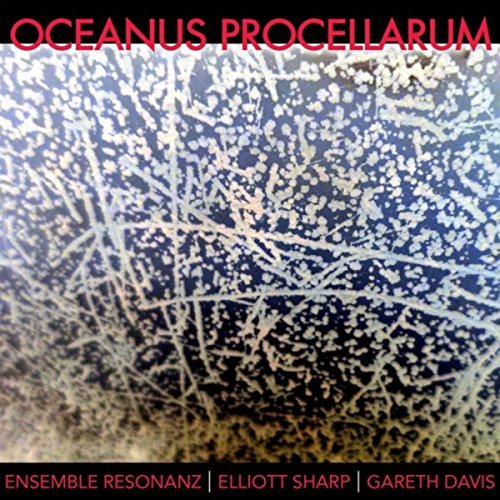
Oceanus Procellarum: Gareth Davis and Elliot Sharp


oceanus

I recall excitedly taking a class in college in the late 70s which dealt with post 1950 composition.  The professor emphasized that the reigning characteristic of this music is “pluralism”, that is to say that anything goes and one gets less useful information from labels like, “classical”, “baroque”, “romantic”, “post-romantic”, “post-modern”, etc.  There is no question that this maxim remains very true and we now are seeing composers well-versed in virtually every technique known to the world of composition.

This album is a fine example of such pluralism.  Seeing names such as Elliott Sharp and Gareth Davis one might expect something of the “free jazz” genre and that would not necessarily be an inaccurate description.  But it would fail to capture the wonderful writing for Ensemble Resonanz by the eclectic (yes, pluralistic too) Elliott Sharp.  As a composer Sharp draws on late twentieth century modern/post-modern compositional techniques along with a fair amount of his own creative innovations gleaned from his own experimentation and, no doubt, from his exposure to the wildly creative milieu of the Downtown New York scene of the 80s and 90s.

The result is like listening to shades of Penderecki and Xenakis as they wrote in the late 1950s though the 70s.  This is far more homage than derivation however and the achievement here is how well the soloists on guitar and bass clarinet fit into the work as a whole.  They fit remarkably well.

This could easily be called “Symphony for Ensemble with Obligatto Guitar and Bass Clarinet” or even Concerto if you like.  The point is that Sharp is an engaging composer whose works are very substantial.  From his beginnings on the New York Downtown scene with its mix of jazz, experimental and classical he has continued to explore and grow as a composer and that is what ultimately makes this release so compelling.

The musicianship here from Ensemble Resonanz, Sharp and Davis is of the first order and there is a certain sense of a tight fit such that, whatever may be improvised here sounds as though it were carefully written into this large orchestral fabric.  This is a powerful piece of music and repeated listenings will doubtless reveal more and more depth.  This is a very engaging piece.

Sharp is clearly evolving and growing as a composer and still hasn’t lost his marvelous collaborative and improvisatorial abilities.  This is a major work and a lovely recording.


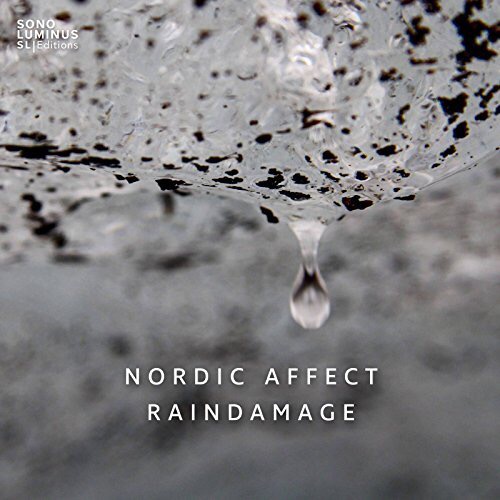
Nordic Affect: Raindamage, Wonderful Music from Iceland


Sono Luminus SLE-70008

Definitely an unusual beginning to this sonorous album of chamber music from the happy, creative place called Iceland.  Some of these tracks are electroacoustic combining some sort of electronic sound producing and/or manipulating components along with the live musical performance.

Nothing familiar here but a lot worth listening to.  This is a collection of recent chamber music from what is apparently some of the finest composers working in Iceland today. And as a Sono Luminus product it is a sound object of the highest order.  It is a beautifully recorded set of pieces that goes a long way to demonstrate the high quality and creativity of both the compositional and performance to be found in this distant corner of the world.

There are six works represented here.  Three are exclusively electronic, one for acoustic instruments with electronics and two are for acoustic instruments alone.  All seem to share the eclecticism of modern composers and, to this writer’s ear, a rather distinct style which seems to come out of the Nordic regions these days.

Iceland has a long and proud musical history and has amassed a large creative classical repertoire in (at least) the 20th and 21st centuries.  Perhaps one can hear the “sounds of the north” in these works or perhaps that is simply the analogous associations of this listener’s mind but there does seem to be some affinity between the lovely cover photograph of melting ice and some of the sounds herein.

At any rate this is fascinating music beautifully performed by Nordic Affect, a more or less fixed ensemble of violin, viola, cello, and harpsichord with occasional electronic supplementation.  Performers include Halla Steinun Stefásdóttir, Violin; Guòrún Hrund Haróardóttir, Viola; Hanna Loftsdóttir, Cello; Guòrún Óskarsdóttir, Harpsichord with Nava Dunkelman on drum in the last track.

The composers Úlfur Hansson, Valgeir Sigurðsson, and Hlynur Aðils Vilmarsson are completely unknown to this writer though it is noted that Hansson studied at Mills College in California, itself quite a hotbed of new music innovation.  No matter, though, these are some amazing composers doing cutting edge work and deserve your attention.

All in all this is one fine disc of chamber music.


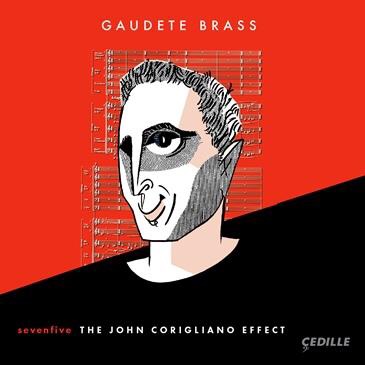
A Brassy 75th Birthday Celebration for John Corigliano


Cedille CDR 90000 169

John Corigliano (1938- ) is one of America’s finest composers.  He is to classical music in New York what Woody Allen is to the movies.  Corigliano is musical royalty.  His father was concertmaster under Leonard Bernstein among others (in fact he apparently worked as assistant to the producer on several of the Young Peoples’ Concerts).  His own accomplishments musically are many including a the very first Grawemeyer Award for his first symphony and a Pulitzer Prize for his second.  One could hardly find another musician as deserving of being honored.

From the very New Yorker style cover art this album affirms this composer’s iconic status.  But the artists here are good Chicago Brass players.  As a native born Chicagoan I have become accustomed to assuming that one can find some of the world’s finest brass players there and this album lays testament to that.  Gaudete Brass is an ensemble that definitely deserves your attention.

This is a fine tribute album featuring mostly world premieres but also some nice transcriptions.  This is effective though not overwhelmingly modern music for brass.  It is intended as and functions very well as entertainment and, from the sound of it, is also fun to play.

The original works are welcome as are the transcriptions of Corigliano’s Gazebo Dances. by the long time Chicago musician/conductor Cliff Colnot.  (One transcription is by the composer).  There are a total of three Corigliano pieces here and 13 by others.  One can only imagine the joy the composer will feel on hearing these tributes and the joy that any number of brass players will experience hearing this fine album.  As usual the Cedille recording is lucid giving a clear sound image of some truly fine musicianship.

The pieces here are good middle of the road compositions which pose challenges on the players but manage to be entertaining and nothing here sounds like an academic exercise.  Rather this disc is about celebration exactly as it purports.  Very enjoyable disc.

Dane Rousay’s Blip


cover

Dane Rousay is a San Antonio based percussionist and this is the first of several planned releases.  This is a solo effort largely with drum kit and perhaps a couple of enhancements or additional percussive hardware.  There are 8 rather brief tracks on this album, all of an experimental nature and all very well recorded.

One small disclaimer:  I generally don’t review download only releases but Mr. Rousay was persistent and kind in his requests for a review.  Another aspect is that there appears to be an increase in this purely digital release format and to ignore that in favor of a demand for a physical product would likely be missing an opportunity to hear some good work.

Despite the brevity there is much for the ear.  The percussion seems to be closely miked and that is apparently the point here.  Each track is like a mini-etude or experiment which will presumably be used as material for other work.  Whether this is jazz, free jazz, new music, classical, etc. is actually beside the point.  The point appears to be the sound itself.

There are no liner notes and little in the way of explanation to be found even on the composer’s web site.  (That’s not necessarily a negative thing either.)  It is not clear if this music is improvised or composed or if there is any predetermined structure and there appears to be no intended connection between each of the tracks.  Most of the work is mallets or sticks of some sort hitting the targeted percussive surface though he does make use of extended techniques such as rubbing the mallets across the surface creating rich harmonics in the manner of the spectralists.

After multiple listens this reviewer is left with the impression of having visited the artist’s studio for a rather personal tour of some of his working ideas.  If you are a percussionist or a fan of percussion music this album will doubtless interest you.  It is not easy listening but it does appear to be a very personal exploration of this artist’s techniques and ideas.

I am looking forward to more from this interesting and seemingly uncompromising artist.


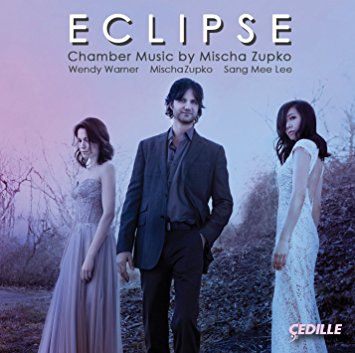
Eclipse of the Son: Mischa Zupko


zupko

Mischa Zupko (1971- ) is a composer, a pianist, and a professor of music at Chicago’s De Paul University.  He is the son of avant garde composer Ramon Zupko (1932- ).  Mischa’s work featured on this Cedille release suggests that the proverbial apple has fallen quite a distance from the family musical tree.  That is neither bad nor good but it is striking.

The elder Zupko’s work, despite its significance, is too little known.  A few recordings exist on the old CRI recordings label and this writer recalls being impressed by them. According to the Chicago Reader article he really didn’t want his son to go into the music business but apparently what is in the blood is in the blood.  A curious note too is that one can find articles on both these composers on Wikipedia but not the English/American one, rather curiously both are to be found on the Dutch Wikipedia site.

The present disc is apparently the first dedicated entirely to this emerging composer’s work (now numbering some 50 pieces).  It is a disc of chamber music and from the first the listener is immediately aware that the younger Zupko is possessed of a sort of retro romantic bent.  Think of the great virtuoso composer/pianists of the 19th century like Franz Liszt and Anton Rubinstein.  He does gratefully acknowledge his father as inspiration but clearly follows a different path.

This music is about passion and virtuosity.  The composer defines this clearly in his liner notes.  The performers Mischa Zupko on piano, Wendy Warner on cello, and Sang Mee Lee on violin demonstrate both passion and virtuosity on this lucid recording.  They play very well together and they all have ample opportunities to show off their respective skills.

There are seven works on ten tracks dating from 2005 to 2015.  The first five tracks consist of “Rising” (violin and piano, 2009), “Fallen” (cello and piano, 2010), “From Twilight” (solo violin, 2015), “Eclipse” (violin and cello, 2014), and, “Nebula” (solo cello, 2015).

There then follows the four movement”Shades of Grey” (2005) for violin and piano.  This is the earliest work on the disc but stylistically it is consistent with the rest of the disc. Zupko certainly develops as a composer but his style seems pretty firmly established.

The last track seems to be the big feature here.  “Love Obsession” (cello, piano, 6 pre-recorded cello tracks; 2013) is perhaps the most adventurous and grand of the works on this recording.  As with the other works on the disc the composer cites various literary influences and inspirations consistent with the apparently romantic ethic which seems to drive his creativity.  And as with the other tracks we hear a tonal romantic idiom filled with passion.

My title for this review is not intended to suggest that the younger Zupko has surpassed his father in any way except perhaps in that his work has, whether by accident, timing, design, or whatever, gotten more attention.  This is not a case of Johann Strauss Jr. and Sr. in jealous competition, this is simply another generation responding to it’s muse and that is worth celebrating.


New Orchestral Music from Rain Worthington


Rain Worthington herself kindly sent this CD to me for review.  There seems to be very little biographical information online about this very interesting composer.  Her current  credentials available on her website are impressive but there is little to be found on her training and influences. (Time to talk to the webmaster I suppose)  This appears to be the first disc dedicated solely to her music and it is an great one.

There are seven tracks representing seven orchestral pieces dating from 2001 to 2012. Like the album title, all are given poetic titles which make no reference to musical structure.  No doubt there are stories behind each of these but there is no information  in the liner notes as to the inspirations or intended meanings of this music.

This reviewer is fond of detailed liner notes but their absence is hardly a hindrance to the appreciation of these little tone poems for various sized orchestras.  There is a remarkable consistency of style here suggesting that this composer has a clearly established voice.  Clearly Worthington is a master of orchestration as she wields complex orchestral pallets where dissonance as well as orchestration contribute to the color in a basically tonal framework.

The music here is about motive and gesture rather than melody per se.  Perhaps that is a “minimalist” method but the impression to this listener suggests influences as diverse as Claude Debussy, Jacob Druckman, Daniel Asia, Toru Takemitsu, and Anton Bruckner. This is beautiful though not “pretty” music with complex emotional content that leans in somber, wistful, sometimes haunting, and even nostalgic directions much as an impressionist painting.

The lovely cover photograph, a time exposure of a night scene with a blurring of stars over a lake, works as a metaphor for the album’s content.

Three orchestras (none of them American) under three different conductors are employed in this very satisfying release.  Multiple listenings will definitely contribute new layers of understanding for the listener.  This listener found that initial impressions of seemingly simple, pretty romantic/impressionistic leanings give way to things deeper and perhaps even disturbing.

One of the conductors, Robert Ian Winstin (1959-2010) was an American composer and conductor (whose compositional efforts deserve some serious review) is at the helm of the Czech Philharmonic Orchestra on two tracks.  Petr Vronsky leads the Moravian Philharmonic Orchestra on four tracks and Ovidiu Marinescu leads the Russian Philharmonic on one track.  It is amazing how well these orchestras handle the challenges here.  These are some excellent musicians.

Kudos to producer Bob Lord for his bold choice in releasing this disc.  Hopefully we will soon be seeing more of this composer’s work in the near future.  My thanks to Ms. Worthington for sending this my way.


Duo Stephanie and Saar: Bach Art of Fugue


duo bach

New Focus Recordings FCR 181

One of Bach’s last works (It is dated 1748) was thought for many years to have been a sort of academic thesis which was not meant for performance.  Even though it has received performances it is problematic in many ways for performers and listeners. it has spawned many different approaches to this score which specifies no instrumentation, no ordering to the separate movements, and leaves it’s last fugue tantalizingly incomplete.

There have been many orchestrations for ensembles ranging from various chamber groupings to full orchestra.  It has been done on harpsichord, organ and piano, organ, string quartet, brass ensemble, saxophone quartet to name a few.  In fact all of these approaches would seem perfectly appropriate and authentic within the context of baroque performance practice.  Undoubtedly we can expect more of this pluralistic approach to come to terms with Bach’s final utterance.

Sometimes the most salient characteristic of a recording of this work is about a new orchestration or some new scholarship, including yet another effort to complete the fugue which Bach left incomplete in the manuscript.  In this two disc recording the motivation seems to be simple clarity.  Duo Stephanie and Saar (pianists Stephanie Ho and Saar Ahuvia) perform the pieces on piano 4 hands, two pianos and solo piano as befits their artistic vision.  They order the pieces by playing the first 12 fugues (or contrapuncti, as Bach refers to them) followed by alternately performing the four canons in between the remaining fugues and ending with the Canon in Augmentation to create a sense of an arch of unity with increasing complexity followed by the comparatively simple postlude of the final canon.  As with many of the recordings Stephanie and Saar choose to leave the last fugue incomplete as Bach left it which is slightly jarring, leaving the sensation of having missed a step in the descent of a staircase but the final canon then does serve to bring the listener down gently.

Not until the minimalist movement would we see such a long focus on a single key (D minor), a potential deal breaker for a lesser composer.  However the lucidity of these performances and recordings allows the listener to focus on the beautiful intricacy of counterpoint that represents one of the pinnacles of western musical art.  Actually I have found that this recording works as well with focused listening as it does as background music where its energy sneaks in to your consciousness in a different but no less exhilarating way.  This is doubtless due to the quality of interpretation.

Nothing flashy here, no overblown musicological perspectives, just strong playing by artists who clearly know and love this music.  The Art of Fugue is not the easiest of Bach’s works to appreciate.  Indeed it took this listener many years and multiple different recordings to finally grasp the depth of the work.  And while it may not have been intended for performance per se this recording does a good job of finding the unity in these contrapuntal etudes which are effectively a summing up of the techniques of the high baroque era.  Stephanie and Saar take us on a wonderful journey, one you will want to take many times.

Michala Petri Goes Brazilian


OUR Recordings 6.220618

Since her debut in 1969 at the tender age of 11 Danish born recorder virtuoso Michala Petri has been one of the finest masters of the recorder.  This ancient instrument, a forerunner of the flute, has existed since the Middle Ages and has amassed a huge repertoire and Petri seems to have demonstrated mastery over all of it and has been an advocate and promoter of new music for her instrument as well.  She has inspired composers to write new works for her and she continues to entertain audiences and has assembled an ever growing discography of startling range and diversity.  Nearly single handed she has managed to honor past repertoire and firmly ensconce this instrument in the 21st century.

In this release, produced by Lars Hannibal (himself a fine guitarist and frequent Petri collaborator) Petri takes on the music of Brazil and, despite the fact that recorders have seldom found their way into the music of this geographic region, she delivers a convincing and hugely entertaining program on this disc.  Along with Marilyn Mazur on percussion and Daniel Murray on guitar the listener is given an entertaining cross section of Brazilian music ranging from the more classically oriented work of Heitor Villa-Lobos (1887-1959) and Ernesto Nazareth (1863-1934) to the smooth jazz/pop sounds of Antonio Carlos Jobim (1925-1994) and Egberto Gismonti (1947- ).  In between are included works by the album’s guitarist Daniel Murray (1981- ) and a few names unfamiliar to this reviewer including Paulo Porto Alegre (1953- ), Paulo Bellinati (1950- ), Hermeto Pascoal (1936- ), and Antonio Ribero (1971- ).

There is a remarkable unity in this Danish production which stems from a meeting between producer Lars Hannibal and Daniel Murray in Vienna in 2014.  Hannibal’s ear found a kindred spirit whose musicality is a good match for that of Petri.  And like a good chef he added the delicate and necessary spice of the tastefully understated (but extraordinary) percussionist Marilyn Mazur to create a unique trio that sounds as though they’ve played together for years.  Here’s hoping that they’ve secretly recorded enough material for a second album.

All the tracks appear to be transcriptions though the transcriber is not named (I’m guessing they’re collaborative).  What’s nice is that there is nothing artificial or uncomfortable about these arrangements.  The overall impression left is that of a skilled ensemble and listeners encountering the original forms of these works might well assume those to be the transcriptions.  So convincing are these performances.

One last thing.  The sound.  This super audio CD release was engineered by Mikkel Nymand and Preben Iwan and the sound is fabulous.  I don’t have a machine that can read the super audio tracks on this hybrid disc but what I can hear is a lucid recording which embraces the subtleties of this unique ensemble.  Enjoy!

Exploding Debussy, Kathleen Supové


New Focus FCR 170

Increasingly it seems that new music performers take on a persona which includes a unique selection of repertoire and frequently a distinctive physical presence.  Kathleen Supové is a fine example.  Her distinctive physical appearance and attire becomes a metaphor for her very personal and intelligent choice of repertoire which sets her apart from her peers.  In addition to unquestioned virtuosity and beautiful interpretive skills her persona takes on an adjectival quality which prompts this reviewer to ponder the “Supovian” experience.


I may live to regret that neologism but the present album is offered as exhibit one (of about 20 albums) attesting to the distinctive choices of music that characterize her work.  This two disc album, The Debussy Effect, is a very modern homage (even sometimes with apologies) to the impressionist master.  Twelve tracks on the two discs feature seven contemporary composers.  Only three tracks are for solo piano.  The rest involve electronic enhancements and or “soundtracks”.

Initially I had hoped to be able to say something useful (if not particularly insightful) to prospective listeners/buyers of this album about each of the pieces here but after several listens I can only reliably say that the material makes for a great and entertaining listening experience.  It harbors complexities that cannot be fairly recounted in such a brief review.  (And this reviewer has a limited knowledge of Debussy as well.)

Here are works by some of the finest of the New York “downtown” music traditions that reflect some amazing and very deep appreciations that will likely change the way you hear Debussy.

Here is the track list:

Disc One

1.  Storefront Diva: a dreamscape by Joan La Barbara

2.  Dr. Gradus vs. Rev. Powell by Matt Marks

3.  Layerings 3 by Eric Kenneth Malcolm Clark

4.  What Remains of a Rembrandt by Randall Woolf

Disc Two

1-4.  Shattered Apparitions of the Western Wind by Annie Gosfield

5-7.  Cakewalking (Sorry Claude) by Daniel Felsenfeld

8. La plus que plus que lente by Jacob Cooper

All are engineered by the wonderful Sheldon Steiger for the New Focus recordings label.

So the take away here is as follows:  If you are a Debussy fan you will want to hear this album.  If you are a Kathleen Supové fan you will want to hear this album.  It is the second reason the seems the most salient here.  I expect to be listening to this many more times.  Enjoy.


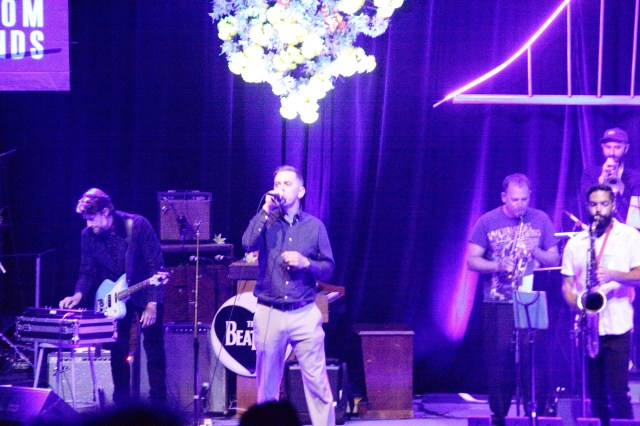
Both Homage and Nostalgia for Sergeant Pepper at the UC Theater


Sgt Pepper20170002

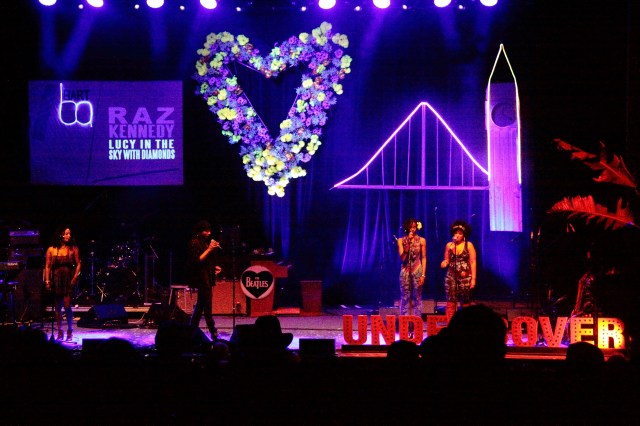
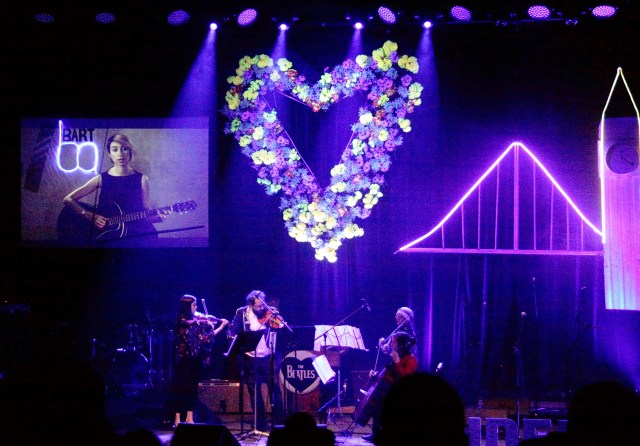
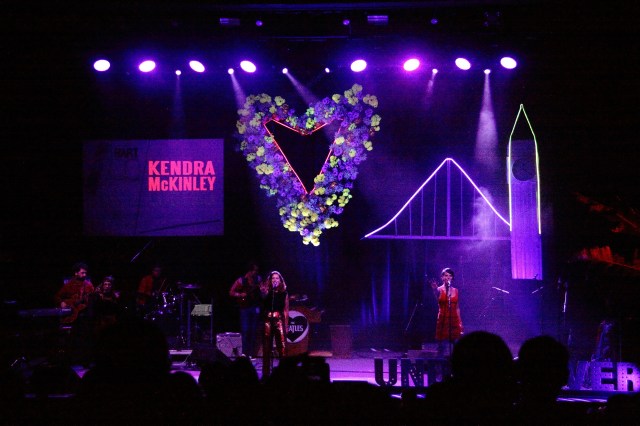
Creative, practical staging and lighting was a unifying factor in this triumph from Undercover Presents.

There was a full house at the UC Theater on this Saturday, June 3rd in Berkeley.  It was the only performance of this homage to the Beatles’ Sergeant Pepper album which was released 50 years ago (actually June 2, 1967).  Most of the performers were not even a twinkle in their parents’ eyes when this landmark of music came on the scene.  The “Summer of Love” was happening in the Bay Area and this album was unquestionably an influence then.  Tonight’s show demonstrated how that influence continues.

The audience was a mix of aging hippies (and non-hippies) and younger hipsters (is it OK to use that term and have no negative connotation?).  Some, no doubt, came for a bit of nostalgia remembering where they were when they first heard the original.  Some came to hear the creativity of local artists meeting such a challenge.

It would have been easy to simply do average covers of the songs and cater only to the nostalgia but Lyz Luke’s Undercover Presents, as usual, aimed higher than that (and hit their mark).  They, under the direction of guest producer Joe Bagale, curated a show of creative interpretations of each of the 13 tracks utilizing some of the finest of the massive talents that call the Bay Area home.  The end result was a true homage from another generation of marvelously diverse artists who put their stamp on the iconic songs without losing any respect for the power of the originals.

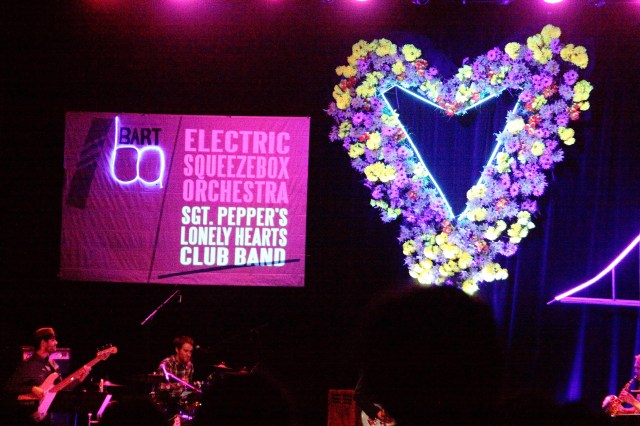
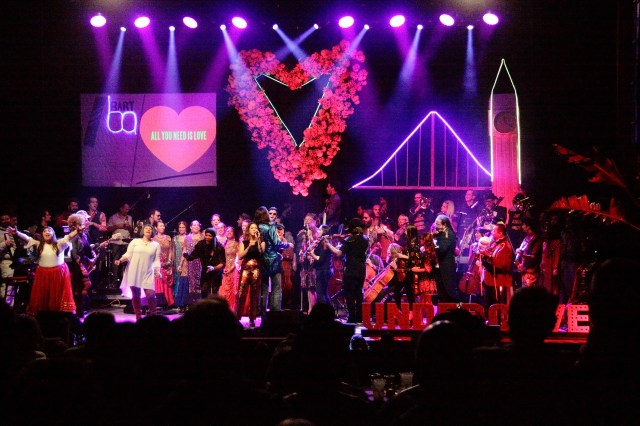
Simple but effective stage design by Bridget Stagnitto was reminiscent of the iconic album cover with creative lighting and functional information integrated into the tableau.  Ryan John and Brendan Dreaper were lead sound engineers.

Sgt Pepper20170008

As is customary for these shows the bands played the tracks in their original order beginning with the Electric Squeezebox Orchestra’s instrumental cover of the opening track.  Principal trombone Rob Ewing’s arrangement captured the essence of that opening and effectively set the stage for what was to follow.

(Correction:  Per Joe Bagale the opening number was arranged by soprano saxophone player Michael Zilber.)

Sgt Pepper20170009

Sgt Pepper20170010

Vocalist Dublin sang a bluesy solo version of “With a Little Help From My Friends”, those friends being the Jazz Mafia Accomplices

Guitarist Jon Monahan takes responsibility for this arrangement which veered just a bit off of nostalgia to deliver a very effective solo vocal version (the original you may recall had that call and answer thing going on) of this, one of the best known tracks on the album.  Though it was not obvious, perhaps there was some homage intended to the late Joe Cocker who first saw the bluesy potential here when he presented his justly famed version at Woodstock in 1969.

Sgt Pepper20170014

Raz Kennedy made effective use of backup singers in his soulful take on “Lucy in the Sky with Diamonds”.  He shared arranging credit with Nick Milo.  The spirit of the Supremes, Gladys Knight (and of course the Pips), and maybe a touch of James Brown seemed to be present in the house and this arrangement got a great review from the audience.  What a voice!

Sgt Pepper20170016

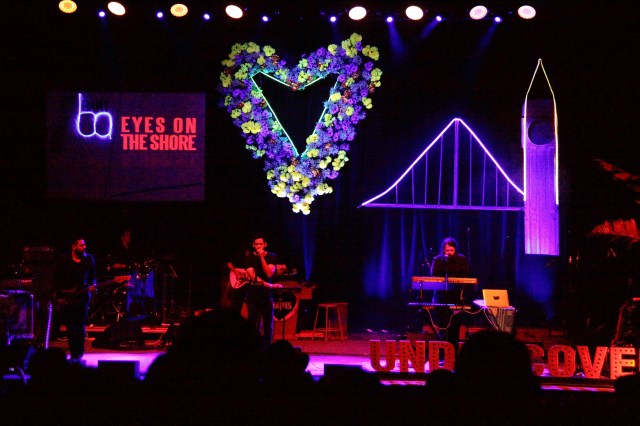
Eyes on the Shore shared arranging credits in their digital synth inflected take on Getting Better.  They went further afield with the material than some and may have briefly lost the pure nostalgia seekers but the arrangement clearly succeeded in pleasing the crowd. One would expect that psychedelia be transformed by the digital world, right?  And so it was.

Sgt Pepper20170018


The Avant Jazz Funk duo of Scott Amendola on percussion and Will Blades on Hammond Organ (how’s that for nostalgia?) and Clavinet turned in a very intense and rich improvisational battle in their purely instrumental version of “Fixing a Hole”.  Sometimes the melody was there and sometimes it was transformed in a musically psychedelic way that went quite a distance from the original.  But the use of the Hammond Organ and Clavinet themselves provided reassurance that they wouldn’t go too far.  The performances were blazingly intense and the whole house felt it.

Sgt Pepper20170022

We again were treated to soul with backup singers as Nino Moschella transformed the innocent ballad of adolescent alienation, “She’s Leaving Home”, into a more darkly hued version that seemed to reflect an understanding of the loss of that innocence that we all must face eventually.  Nothing somber here but clearly a different understanding consistent with the overall mission of having another generation’s way of remembering this material.

Sgt Pepper20170025


South Asian music and philosophy are inextricably linked to the psychedelic sounds of the mid to late 1960s and nowhere is this more obvious than with the Beatles whose study of Transcendental Meditation with their guru Maharishi Mahesh Yogi (born Mahesh Prasad Varma 1918-2008) while George Harrison studied sitar with Pandit Ravi Shankar (1920-2012).

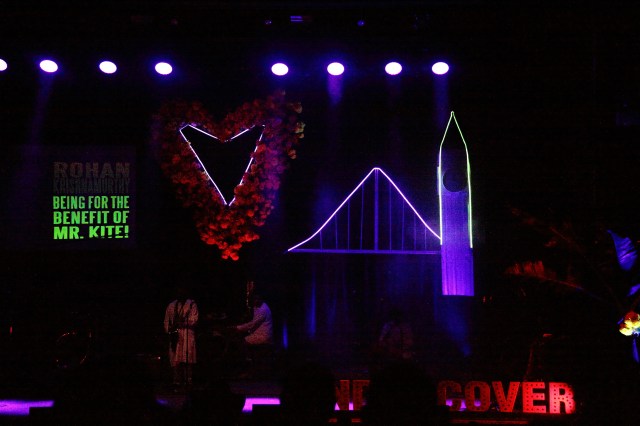
Rohan Krishnamurthy (Mridangam, Hadjira frame drum), Prasant Radakrishnan (saxophone), and Colin Hogan (keyboard) share credits for their creative instrumental arrangement of “For Mr. Kite”.  Eschewing lyrics (which are etched in most of the audience’s minds anyway) they performed a stunningly unique rendition of this familiar song. Interestingly these musicians trace their influences to the southern Indian Carnatic tradition (somewhat different from the Hindustani traditions which influenced the Beatles) adding yet another layer of richness to the evening’s goings on.

Sgt Pepper20170029

Colin Hogan indicts himself yet again in his arrangement of “Within You Without You”, that spacey Hindustani inflected song.  The Hogan Brothers (Steve Hogan, bass; Colin Hogan, accordion; Julian Hogan, drums; Moorea Dickason, vocals; Charlie Gurke, baritone sax) turned in a marvelous world fusion rendition of the tune (lyrics and all) to a hugely appreciative response.

Sgt Pepper20170035

Iranian born Sahba Minikia, steeped in both Iranian and western classical traditions provided a touching arrangement of the classic, “When I’m Sixty Four”.  Featuring Mina Momeni on guitar and vocals (on video) accompanied by the Awesöme Orchestra in a song whose premise looks to the future as far as this evening looked into the past to ponder the endurance of romance.

In retrospect it is almost surprising that the marvelous diversity didn’t generate a presidential tweet of dissatisfaction.  Indeed a woman singing would produce more than a tweet of dissatisfaction in Tehran, birthplace of photographer and singer Momemi who also teaches visual arts in Canada.

Sgt Pepper20170040


Vocalist Kendra McKinley practically turned “Lovely Rita” into a feminist anthem with some retro pop group choreography and background vocals to boot.  The visuals and the energy of the performance practically had the whole house dancing.

Sgt Pepper20170045

Soltrón added Latin percussion and energetic dance to the already electrified atmosphere with their arrangement of the raucous “Good Morning”.  Kendra McKinley could be seen and heard tying in her energy from the previous performance as backup singer here.

Sgt Pepper20170047

Lyz Luke stepped in to introduce the penultimate Sgt Pepper Reprise.

Sgt Pepper20170048

The dancing energy was carried on by the colorful and energetic dancers of Non-Stop Bhangra.  They accompanied Rohan Krishnamurthy and Otis McDonald in Joe Bagale’s rocking arrangement (replete with lyrics) of the reprise of the opening.  It was like a live action version of the studio executed original performance with a stage filled with ecstatic musicians and dancers.

Sgt Pepper20170052

Joe Bagale in his Sgt Pepper duds sings the lyrics hoping we’d enjoyed the show.

Sgt Pepper20170060

The apocalyptic, “A Day in the Life” concluded the mission of homage and nostalgia in a bigger than life tableau of talent and diversity that connected the “there and then” to the “here and now”.  The famous extended last chord crashed in a peak of energetic music making to bring the performances to a close.

Sgt Pepper20170062

The visuals were strongly reminiscent of the iconic album cover.

Sgt Pepper20170065

There was no need to encourage the audience to sing along to the encore of “All You Need is Love”.  Fifty years hence we still need it and if we still don’t have it everywhere at least we had it here this night.


Other Minds 22, Resounding Sacred Tributes from Music to Wheaties


OM22052120170026

Nicole Paiement led a touching performance of Lou Harrison’s La Koro Sutro

Nominally this was a celebration of the life and music of Lou Silver Harrison (1917-2003) but this last concert of Other Minds 22nd year celebrated so much more.
OM22052120170011

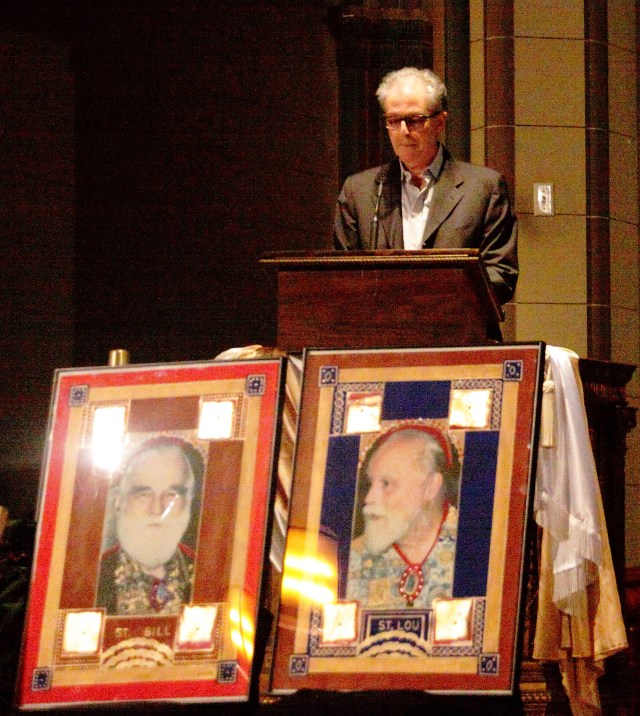
Curator and Other Minds Executive and artistic director introduces the night’s festivities with these artistic icons titled St. Lou and St. Bill (Lou Harrison and his partner, instrument builder Bill Colvig). The portraits were sold by silent auction.

One can’t celebrate the life and music of Lou Harrison without acknowledging his life partner of 30 years, Bill Colvig (1917-2000).  Colvig was the man who designed and built the American Gamelan percussion instruments used in tonight’s performance.  These repurposed industrial materials were inspired by the Indonesian Gamelan which Lou Harrison encountered at the 1939 world’s fair which took place on Treasure Island just a few miles away.  Amirkhanian added another fascinating historical footnote when he informed the audience that Harrison had come to this very church to learn to sing Gregorian Chant some time in the 1930s.

A further and very intimate context was revealed when Amirkhanian took an informal poll of the audience asking who had met and/or worked with Lou Harrison.  By his count he estimated that about 40% of the audience had encountered “St. Lou” (this writer met the magnanimous gentleman in Chicago in the early 1990s).  Indeed many of the musicians had encountered and/or studied with Harrison and the passion reflected in their performances and the audiences response clearly shows why he (and Bill) were elevated tonight to secular sainthood.

The wonderful acoustics of the Basilica easily accommodated Harrison’s dislike of electrical amplification.  Even the solo and small ensemble music was heard as it was intended.
OM22052120170008

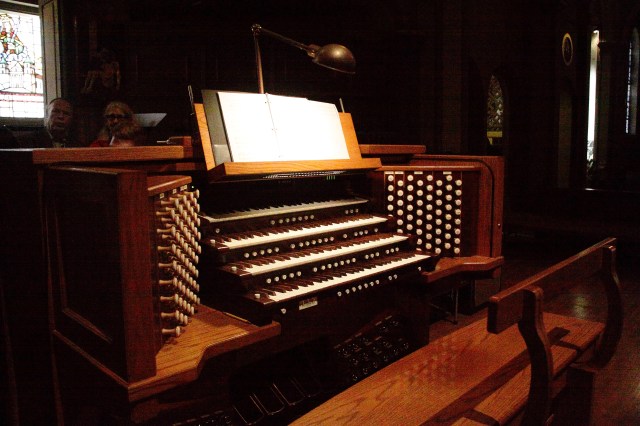
The organ console at the Basilica.

The well attended concert began with an early rather uncharacteristic piece called Praises for Michael the Archangel (1946-7).  It reflected the influence of Arnold Schoenberg, one of Harrison’s teachers (Henry Cowell and K.T.H. Notoprojo were also among his teachers).  Harrison also famously worked with Charles Ives whose Third Symphony he premiered.  He also worked with John Cage and collaborated on at least one composition with him (Double Music).  The angular and dissonant sounds were lovingly interpreted by Jerome Lenk, organist and chorus master at the Basilica.

OM22052120170013

Organist Jerome Lenk acknowledges the audience applause and allows himself just a touch of a satisfied smile for a well wrought performance.

Next was a solo harp piece Threnody for Oliver Daniel (1990).  (Oliver Daniel (1911-1990) was a composer, musicologist, and founder of Composer’s Recording Incorporated.  He was a friend of Harrison’s and a great promoter of new music).
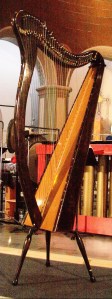
OM22052120170001

The Threnody was performed on this smaller troubador harp in Ptolemy’s soft diatonic tuning.

Meredith Clark played with focused concentration and gave a very moving performance of this brief and beautiful composition.  Harrison was fond of paying homage to his friends through music.

Clark was then joined by cellist Emil Miland for a performance of Suite for Cello and Harp (1948).  Composed just a year after the angular organ piece which opened the program this gentle suite is entirely tonal and very lyrical in its five movements using music repurposed from earlier works.  Clark here used a full sized concert harp.

The artistic connection between these performers clearly added to the intensity of the performance.  Despite the varied sources of the music the suite has a certain unity that, like Bach and indeed many composers, justifies the re-use of material in the creation of a new piece.

This was followed by another organ piece from Mr. Lenk.  This Pedal Sonata (1989) is played solely by the musician’s very busy feet on the pedals alone (no hands on the keyboard).  Listening to the piece it was easy to believe that more than just two agile feet were involved in this challenging and virtuosic composition.  It appeared to be quite a workout but one accomplished with great ease by the performer.

OM22052120170016

Emil Miland and Meredith Clark smiling in response the the applause following their performance.

Following an extended intermission (owing to a dearth of restroom facilities) there was an awards ceremony.  Charles Amirkhanian was awarded the 2017 Champion of New Music Award (tonight’s conductor Nicole Paiement was also a previous awardee).  Presentation of the award was done by American Composer’s Forum President and CEO John Neuchterlein and Forum member, composer Vivian Fung.

Amirkhanian took the time to pay tribute to his mother (who also would have been 100 this year) his father (who passed away in December at the age of 101) and his charming wife of 49 years, Carol Law, who continues her work as a photographer and her participation in Other Minds and related projects.  He also gave thanks to the staff of Other Minds and his former associates at KPFA where Charles served as music director for over 20 years.

OM22052120170019

American Composer’s Forum President John Neuchterlein looks on as composer Vivian Fung presents the prestigious 2017 Champion of New Music Award to a very pleased Charles Amirkhanian.

OM22052120170020

In a touching and humorous move Mr. Neuchterlein advised the audience that Mr. Amirkhanian would be given yet another award tied to Minnesota which is the home of General Mills (yes, the cereal people).  Amirkhanian (who himself has quite a gentle sense of humor) was surprised and charmed to receive a box of Wheaties emblazoned with his image from whence he can now reign in the rarefied group of breakfast champions in addition to his other roles.

OM22052120170022

The breakfast of new music champions.

The second half of the concert began with the co-composed Suite for Violin and American Gamelan (1974).  Co-composer Richard Dee was in the audience for the performance of this work written two years after La Koro Sutro (1972) and incorporating the same gamelan instrument created for that piece.  The substantial violin solo was handled with assurance and expressivity by Shalini Vijayan, herself a major new music advocate.

OM22052120170025

Composer Richard Dee waving thanks for the performance of Suite for Violin and American Gamelan.

At about 30 minutes in performance the multiple movements all but comprised a concerto with challenging roles for both the percussion orchestra led by the amazing William Winant and his percussion ensemble and the soloist.  All were masterfully coordinated by conductor Nicole Paiement.

OM22052120170024

Shalini Vijayan smiles from behind her bouquet acknowledging the thunderous applause following her performance.

In a previous promo blog I had noted that the location of this concert is a designated pilgrimage site, one where the faithful journey as part of a spiritual quest.  Well, having been sidelined by a foot injury for the last 3 1/2 months this amounted to a musico-spiritual pilgrimage for this writer who has not been able to be out to hear music for some time.  The last piece on the concert in particular was a powerful motivation for this personal pilgrimage and I was not disappointed.

The American Gamelan was played by the William Winant percussion group consisting of master percussionist Winant along with Ed Garcia, Jon Meyers, Sean Josey, Henry Wilson, and Sarong Kim.

They were joined by the Resound Choir (Luçik Aprahämian, Music Director), Sacred and Profane (Rebecca Seeman, Music Director), and the Mission Dolores Choir (Jerome Lenk, Music Director).

Meredith Clark joined on concert harp and Mr. Lenk on the small ensemble organ.  All were conducted with both discipline and panache by Nicole Paiement.

This multiple movement work is a setting of the Buddhist Heart Sutra and is done in an Esperanto translation by fellow Esperantist Bruce Kennedy and, though written for the world Esperanto Convention in Portland, Oregon, it was premiered at the University of San Francisco in 1972.  This was the fourth performance in the Bay Area, a fact that reveals the love that this area has had and still has for its beloved citizen Lou Harrison.
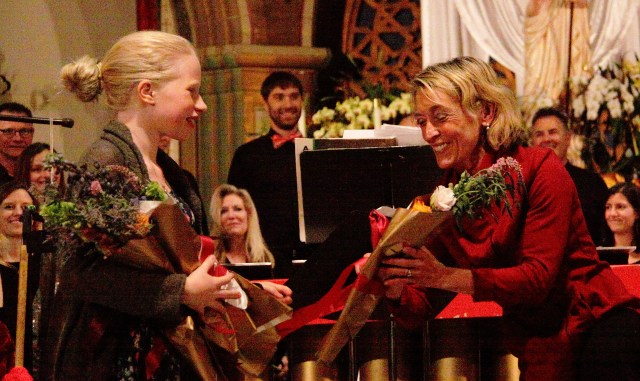
OM22052120170029

Warm smiles proliferated as the bouquets were distributed amid a standing ovation from a very appreciative audience.

In fact this concert can be seen as a affirmation of so many things.  Harrison was a composer, teacher, dancer, calligrapher, Esperantist, conductor, musician, musicologist and early gay rights advocate.  It is a testament to Lou that he has been given a most spectacular birthday celebration which gave credence and appreciation to all aspects of this west coast genius and all his extended family.  It happened 50 years after the fabled Summer of Love and apparently the love continues in its way.

OM22052120170028

A clearly very happy conductor Nicole Paiement’s smile echoes both her feeling and that of the attendees, a wonderful night.
Edgy Saxophone, Ryan Muncy’s “ism”


Tundra

This one wins the prize for the most charming and unusual presentation of a review copy that this writer has ever seen.  I received this rather plain looking slip case and contained therein was a little data card glued to a saxophone reed.  Fortunately I have just enough tech skills to find the little data card slot on my laptop and was able to then burn a CDr.

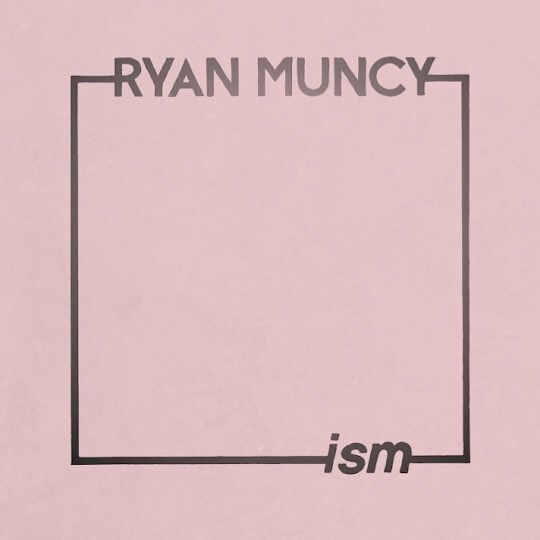
It was well worth the effort.  Ryan Muncy is a saxophone player with the increasingly venerable ICE.  (That is the International Contemporary Ensemble and not the less venerable immigration and customs enforcement by the way.)  He here takes the opportunity to demonstrate his considerable fluency on his instrument.  The deceptively simple cover belies some serious complexity in this release.

Beginning with James Tenney’s too seldom heard Saxony (1978) Muncy decisively lets the listener know that this is a hard core saxophone album with music that demands a level of skills and interpretive ability within the reach of only the finest musicians. Tenney’s piece is a multitracked composition concerned with acoustic phenomena produced by different tunings as do many of his works.  This piece is a species of minimalism, drone, even meditative music.  It’s slow unfolding demands and then rewards patience as it envelops the listener in lovely, trippy sound masses.  At over 20 minutes it is the biggest piece here and alone justifies purchasing this album.

What follows are 5 more tracks of similarly extreme experimental music with various extended techniques albeit on a much smaller scale.  Each is like a little study focusing on one or more extended techniques.  All but one are recent compositions by composers yet unknown to this reviewer.  The last piece is by the late great Lee Hyla (1952-2014) and is from 1979, making it contemporary with the opening Tenney piece.  Muncy demonstrates his facility with tuning, multiphonics and other creative techniques demanded by these composers.

Here is the track list:

James Tenney-Saxony (1978)

Erin Gee-Mouthpiece XXIV (2015)

David Reminick- Gray Faces (2011)

Morgan Krauss- masked by likeness (2014)

Evan Johnson- Largo caligrafico (2012)

Lee Hyla- Pre-Amnesia (1979)

Each of these pieces is seemingly a self contained universe and repeated listenings reveal more than simple experimentalism.

This is a disc for serious saxophone aficianados with an appreciation for free jazz and cutting edge instrumental techniques.  Truly a wonderful release.

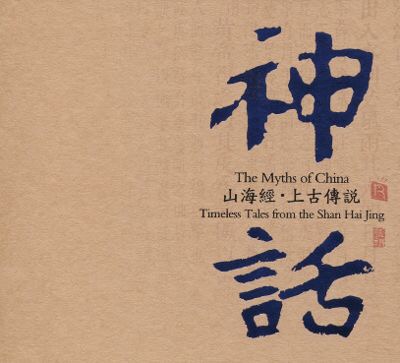
Zhang Zhao’s Myths of China 


Rhymoi RMCD- 1067

The strikingly beautiful look of the physical CD and the packaging are practically an indictment of streaming and digital music formats.  Producer Ye Yunchuan is the founder of Rhymoi, an audiophile label dedicated to contemporary Chinese music.  If this release is any indication it would be wise to pay attention his work.  Besides the excellence of the physical product the quality of the recording will please the ears of the staunchest audiophile.

Zhang Zhao is apparently one of China’s best known living composers (at least in China) and said producer favors us with a truly grand release.  Some of Zhang’s piano works are standard test pieces for conservatory students and this recording reveals his unquestionable mastery of orchestral technique and a mastery of a variety of traditional Chinese instruments as well.  Though biographical specifics are sparse this composer has a growing discography and the present disc demonstrates a highly skilled compositional voice.

This ambitious project is essentially a tone poem or series of tone poems (think Smetana’s Ma Vlast) on stories from a collection of Chinese myths called the Shan Hai Jing (The Classic of Mountains and Seas) a large collection of stories dating from the 4th Century B.C.  I don’t know how well these stories are known in contemporary China but this is a vast and rich culture that has deservedly survived its own sociopolitical dynamics and continues to inspire new artistic endeavors from its rich legacies.  It is no wonder that the composer found inspiration here.

The composer has chosen 11 stories from the big 18 chapter work.  The setting is for large orchestra, chorus, children’s chorus, and at least 21 solo instruments which include both western classical and traditional Chinese instruments.  Such a large and diverse set of instruments poses a challenge by itself but the composer succeeds well due in part to having some of the country’s finest musicians whose mastery of these (to most western ears) obscure instruments is clear.  The orchestral musicians and choruses also demonstrate a high level of skill and commitment.  And the composer succeeds very well in integrating such diverse instruments quite comfortably into the larger mostly western classical fabric.  It is reminiscent of Tan Dun’s large Symphony which incorporated a set of ancient Chinese bells into its texture and similarly pays homage to great traditions.

The 11 sections are beautifully illustrated both by calligraphy and line drawings by Dong Xiaqingqing.   Thankfully there are lucid texts in English by Joshua Cheek and Nicholas Angiers describing the myths and giving some clues to some of the interpretive intentions of the composer’s musical choices.  These greatly enhance the enjoyment for those unfamiliar with this lovely mythology.

The sections are:

1. Pangu Separates Heaven and Earth

2. Yao and Shun Discuss Morality

3. Yu the Great Controls the Floods

4. Chang’ e Flies to the Moon

5. The War on Chiyou

6. The Tears of Xianfei

7. Nuwa Repairs the Sky

8. The Peach Banquet

9. Kuafu Chases the Sun

10. The Goddess of the Luo River

11. Fuxi-Ultumate Harmony

Soloists include:

Qin: Zhao Jiazhen

Erhu: Wang Ying

Guzheng: Chang Jing/Ding Xueer

Pipa: Yu Yuanchun/Dong Xiaolin/Sun Jing

Chinese Harp: Wu Lin

Di/Xiao/Xun: Ding Xiaokui/Li Yue

Ruan: Di Lin/Zhao Yue

Suona: Wang Rongfei/Yao Di/Shang Shuai

Liuquin: Di Yang/Pan Yuechen

Yangquin: Wang YuJue

Hansheng: Shan Chunshen

Lusheng: Yang Shengwen

Khoomei: Li Wenbin

Morin Khuur: Hasibagen

Violin: Zhao Kunyu

Cello: Yang Changying

Brass: Qin Guochen/Zhao Xiu/Jia Hui/Mi Qi

Woodwinds: Cao Lei/Yang Yilin/Xie Hongliang/Ren Biao

Harp: Zhang Xiaoyin

Percussion: Zhang Yangsheng/Tian Wei

Piano: Zhang Zhao

Music Assistant: Li Yongmin

This writer has but a passing familiarity with a few of these traditional instruments but the sonic colors are used to great and sometimes subtle effect.  It is a huge sonic tapestry and the  lush and full sound are the result of the skills of sound engineer Zhang Xiao’an.

It is important to note that this disc does not have an experimental feel but rather utilizes a range of compositional devices whose end result leans toward an easily digestible experience which successfully avoids bland populism while creating a lucid musical experience.  It is music that would doubtless be welcomed in most orchestral programs and contains great depths of invention and descriptive power.  It is grand and perhaps cinematic in scope as are the best works in the tone poem genre.

American Muse, American Master: Steven Stucky on BMOP


BMOP 1050

Steven Stucky (1949-2016) was sadly taken from the world too soon.  But we can rejoice in this wonderful new disc of (mostly) first recordings of some of his wonderful orchestral music and songs.  Boston Modern Orchestra Project adds another entry to their growing discography of must hear American music with this beautiful recording.

Three works are featured, Rhapsodies (2008), American Muse (1999), and Concerto for Orchestra (No. 1, 1987).  Only one, American Muse has been recorded (on Albany Records) before and all are worthy selections from the composer’s ample catalog.

Rhapsodies, the most recent work, is also the shortest at just over 8 minutes.  It was commissioned by the New York Philharmonic and the BBC Symphony and is for large orchestra and sounds as though it could serve as a movement in another Concerto for Orchestra.  Stucky, who was an expert on the music of Witold Lutosławski (1913-1994), was a master orchestrator as was Lutosławski though Stucky’s style is distinctly different reflecting a sort of friendly romantic modernism with serious virtuosity.  This little gem gives the orchestra and, no doubt, the conductor, a run for their money in this virtuosic and highly entertaining little sonic gem.  It was premiered in 2008 under Lorin Maazel.

The Los Angeles Philharmonic commission, American Muse was written with the fine baritone Sanford Sylvan in mind.  It is a four song cycle setting poems by John Berryman, e.e. cummings, A.R. Ammons, and Walt Whitman and was premiered in 1999 under Esa-Pekka Salonen.  Sylvan is a very fine interpreter of American music and first won this reviewer’s heart with his rendition of John Adams’ The Wound Dresser (also a Whitman setting).  One should never miss an opportunity to hear Sylvan’s work.

Again we are treated to Stucky’s acute and subtle sense of orchestration which works with the poetry unobtrusively paralleling the words with the musical accompaniment and seemingly creating its own poetry in sound. Sylvan is in fine voice and seems to be enjoying his performance, a very satisfying experience.

The inclusion of Stucky’s first Concerto for Orchestra which was commissioned by the Philadelphia Orchestra and premiered in 1988 (under Ricardo Muti) will satisfy fans of this composer’s work as it provides an opportunity to hear “the one that got away” so to speak.  It was the runner up for the Pulitzer Prize which he would later win for his Second Concerto for Orchestra (2003) in 2005.

In it’s three movements Stucky is clearly the master of his realm and creates a wonderful listening experience.  His sense of drama and emotion are stunning and serve to underscore the dimension of what the world has lost in his passing.  But it is time to leave sorrow aside and let the music speak and thus provide the composer with a dimension of immortality.

As usual the performance and recording are impeccable and Gil Rose continues to record wonderful music that deserves more frequent hearings and does honor to the memory of a cherished artist.  Now can a recording of Stucky’s 2012 Symphony be far behind?  Let’s hope so.

Grand Celebrations of Finnish Culture


BIS- 9048 SACD

The choice of repertoire, performers, and the quality of their recordings make any BIS records release worthy of attention.  This two disc set is a fine example.  Three major choral/orchestral works which celebrate the justly proud Finnish culture are given very fine performances in this live recording from 2016.

The earliest work, Jean Sibelius’ Kullervo Op. 7 (1892) is one of the less recognized masterpieces by Finland’s best known composer.  Based on the Finnish national epic, The Kalevala, this massive symphony has acquired a bit of its own mythology.  Though several recordings of this work now exist the world world premiere recording by the late Paavo Berglund (1929-2012) from the early 1970s brought this neglected masterpiece to a larger listening audience.  The intelligent liner notes by Andrew Barnett (and Olli Kortekangas) document and dispel the myths that Sibelius suppressed all or portions of this work which was premiered in 1892 yet had to wait until after the composer’s death in 1957 to receive its first twentieth century performance.  

In fact it seems more likely that the large forces required along with programmers’ preference for the composer’s later masterpieces were responsible for the unfortunate neglect of the present work.  It was the more romantically inclined myth of mysterious oppression that greeted Berglund’s triumphant premiere recording and this reviewer recalls being both charmed and intrigued by it.  Whatever the story the music is now a recognized early triumph by its creator and it is given a gorgeous reading by Finnish conductor Osmo Vänskä, (principal conductor of the Minnesota Orchestra which plays powerfully and definitively.

So why a second disc?  Well, Maestro Vänskä saw fit to commission a new work by contemporary Finnish composer Olli Kortekangas to serve as a companion piece to Kullervo and, then include a version with chorus of Sibelius’ best known work, Finlandia.  Together these three works would very satisfyingly fill an entire concert program.

Olli Kortekangas (1955- ) chose poetry by Finnish-American poet Sheila Packa and composed a 7 movement work (three are interludes for orchestra alone) in celebration of the 150th anniversary of modern Finnish migration to the United States.  The work, Migration (2014), is similar in orchestration with its use of male chorus and two soloists backed by a large orchestra.  The composer’s style is a sort of 21st century romantic style with tasteful modern touches.  

The focus of this fine new work is an affirmation of Finnish culture and its impact on the United States.  It seems both fitting and satisfying then that this program conclude with the landmark work of Finnish pride and nationalism, Sibelius’ best known work, Finlandia (1899).  But rather than just another reading of this classic of the concert hall  Vänskä chooses to do a version with chorus.  This was not the composer’s original intent but this version fits remarkably well in the context of this album.  

This is a very enjoyable album, well conceived and executed in every way.  Soloists Lilli Paasikivi and Tommi Hakala sing their roles with skill and passion as does the YL Male Voice Choir.  The applause track at the end of the Finlandia performance echoed the emotional experience of this reviewer and will likely do so for anyone who chooses to avail themselves of this fine example of recording art.

Words Fail and Music Succeeds: Violinist Yevgeny Kutik


Marquis 774718147721

Politics requires words and indeed fails at times but music very much succeeds in this fine recording.  This charming collection organized loosely around songs without words is the third album by this emerging artist.

The music is largely 20th to 21st century (if you count the date of the transcriptions) but the sound and mood of the album ranges from the romanticism of Mendelssohn and Tchaikovsky, the post-romantic Mahler, to the neo-classicism of Prokofiev and a dash of modernism from Messiaen, Gandolfi, Andres, and Auerbach.  No words, no politics, just some really beautiful music.

There are 14 tracks of which the Mendelssohn and the Mahler will be the most familiar to listeners.  What is interesting here is a certain unity in these seemingly disparate works which range over nearly 200 years of compositional invention.  In fact this recital program strongly resembles in spirit the justly popular programs of Jascha Heifetz and his acolytes.  That is to say that this is at heart a romantic recital program sure to please any aficionado of the violin and piano genre.

Two of the tracks, those by Michael Gandolfi and Lera Auerbach are for solo violin.  The unaccompanied violin repertoire best represented by J.S. Bach’s Sonatas and Partitas is a relatively small one and one fraught with difficulties for composers as well as performers.  Fear not though, these pieces are well wrought and represent significant contributions to the solo violin literature.

The Gandolfi (1956- ) Arioso doloroso/Ecstatico (2016) was commissioned by Mr. Kutik and this is the world premiere recording.  The composer utilizes a basically romantic sounding style with clear references to Bach at moments to create a very satisfying piece imbued with depth but eminently listenable.  Gandolfi’s eclectic oeuvre is by itself worthy of further exploration.

Lera Auerbach’s (1973- ) T’Filah (2015) is a reverent (though not excessively somber) prayer written in memory of the victims of the Nazi holocaust.  Auerbach shares some Russian roots with the soloist and this brief composition will leave most listeners wanting to hear more from this fine and prolific composer.

Timo Andrés (1985- ) plays the piano on the eponymous track Words fail (2015), the second of the two works commissioned by Kutik and premiered on this disc.  He is a skilled composer using a wide variety of compositional and instrumental techniques (which he mentions in his liner notes) to create a sort of modern song without words that fits so well in this program.  Andrés is certainly among the rising stars both as composer and performer.

One should definitely pay attention to the fine work of Kutik’s accompanist John Novacek whose precision and interpretive skill so well compliment the soloist.  The art of the accompanist shines very clearly here.

Overall a great recital disc from a soloist from whom we will doubtless continue to hear great things.

Captain Kirk and the Buddha Speak Esperanto: Other Minds 22 Commemmorates Lou Silver Harrison at 100


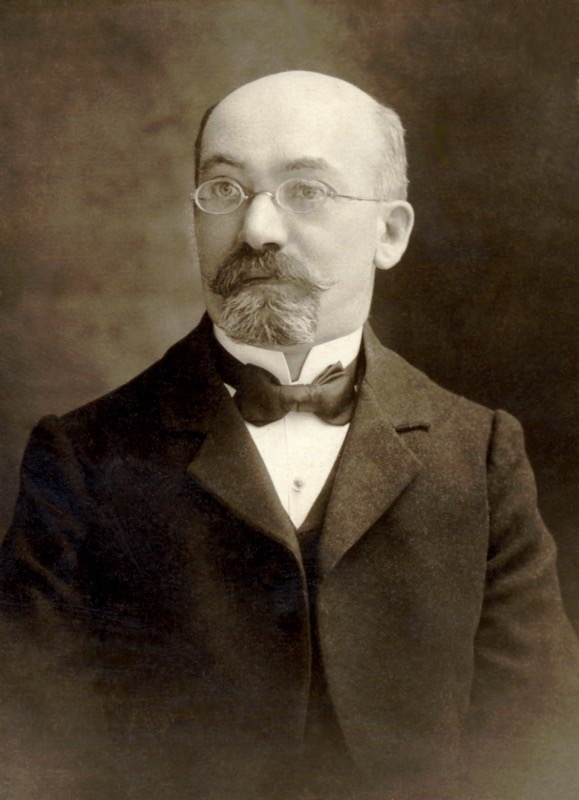
Esperanto is a constructed language brought into being in an 1887 book by a Polish-Jewish doctor by the name of L. L. Zamenhof (1861-1917).  This constructed language was intended in part as an intellectual exercise which might contribute to greater international discourse and perhaps understanding.  He outlined his intentions as follows:

  1. “To render the study of the language so easy as to make its acquisition mere play to the learner.”
  2. “To enable the learner to make direct use of his knowledge with persons of any nationality, whether the language be universally accepted or not; in other words, the language is to be directly a means of international communication.”
  3. “To find some means of overcoming the natural indifference of mankind, and disposing them, in the quickest manner possible, and en masse, to learn and use the proposed language as a living one, and not only in last extremities, and with the key at hand.

Esperanto did gain a great deal of popularity and there are still adherents today (an estimated 2 million people worldwide).  Lou Harrison was one of the users of this language (users are known as “Esperantists”).

L. L. Zamenhof (1859-1917)

In 1966 a horror film, “Incubus”, written and directed by Leslie Stevens (of Outer Limits fame) was released starring the just pre-Star Trek William Shatner.  Once thought lost, this film was restored from a copy found in a French film library.  It was only the second (and apparently last) feature film done entirely in Esperanto (the first being the 1964 French production, “Angoroj” or Agonies).  It was thought that the use of Esperanto would add a mysterious dimension to the production though detractors challenged the actors’ ability to properly pronounce the dialogue.  A link to a Shatner scene is here.  https://www.youtube.com/watch?v=accFmyaOj7o

And if you want to sit through the entire film (definitely a cult film experience) you can find it here: https://www.youtube.com/watch?v=LHUfHj2lTaM

Curiously 1917, the year of Dr. Zamenhof’s death, is also the birth year of Lou Harrison, the principal subject of this essay.  This patriarch of 20th century modernism was a composer, conductor, musicologist, performer, teacher, dancer, calligrapher, and Esperantist.  He used Esperanto to title many of his works and set some Esperanto texts to music.

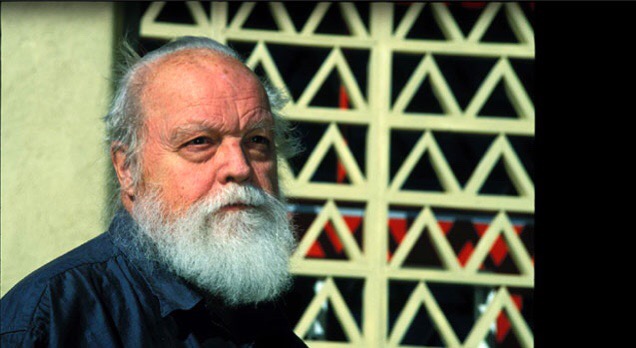
Lou Silver Harrison

And the Buddha Becomes an Esperantist

In his masterful big composition, La Koro Sutro (1972) translated portions of the text of the Buddhist Heart Sutra (into Esperanto) are set for mixed chorus and American Gamelan.  Gamelan is an Indonesian mostly percussion orchestra which Harrison studied extensively following the example of pioneering Canadian ethnomusicologist and composer Colin McPhee (1900-1964).

Gamelan was first introduced to western audiences at the 1889 Paris World’s Fair where composers such as Claude Debussy and Erik Satie heard the instruments and later incorporated some of those sounds in their music.  (That Gamelan now resides in Chicago’s Field Museum of Natural History.) Harrison’s life partner Bill Colvig, an instrument maker, constructed a percussion ensemble which they called the American Gamelan to differentiate it from the traditional Indonesian ensemble.  The American Gamelan, consisting of five percussion instruments (augmented with organ, harp, and chorus) was first used in the cantata La Koro Sutro.

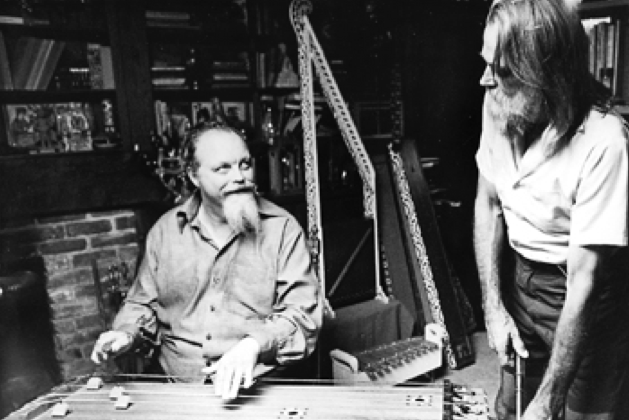
Harriso (left) with Bill Colvig

This composition is very much a synthesis of the composer’s musical and philosophical ideas.  Harrison was an avowed pacifist and the Heart Sutra is a key Buddhist scripture which supports introspection and non-violence.  Here he uses his expertise as an esperantist, his knowledge of Indonesian as well as western classical music to create one of his largest and finest works.

Lou Harrison with Charles Amirkhanian (curator of this concert series) in 1966

It is a testament to Harrison’s influence that this is the fourth performance of La Koro Sutro in the Bay Area.  It was written for an Esperanto conference in Seattle in 1972 with a translation by fellow esperantist Bruce Kennedy and was premiered that same year at Lone Mountain College  in San Francisco (now part of the University of San Francisco).  Additional performances (available on You Tube) were staged in Berkeley in 1973 and again in 2012.  This is truly an American masterpiece as well as a prayer for our times.

The performances will take place in the Mission San Francisco de Asís Basilica, better known as Mission Dolores.  The mission was founded in 1776 and the still active small adobe church next to the Basilica, built in 1791, is the oldest surviving building in San Francisco.  The much larger Basilica next to the adobe church (and the actual location of said concert) was dedicated in 1918.

Interior of the historic Mission Dolores Basilica

For the record, a Basilica is a reference to both architectural and spiritual aspects of any church so designated.  In the Catholic Church a Basilica is a pilgrimage site, a place to which the faithful travel in a spiritual quest.  I don’t believe it is too much of a stretch to view this event as a musico-spiritual pilgrimage open to all ears and minds, and hearts.  You won’t come out speaking Esperanto but you will never forget what you’ve heard.
The program will include:


Threnody for Oliver Daniel for harp (1990) 

Suite for Cello & Harp (1948)

Meredith Clark, harp

Emil Miland, cello

Pedal Sonata for Organ (1987/1989) Praises for Michael the Archangel (1946-47)

Jerome Lenk, organ

Suite for Violin & American Gamelan (1974, composed with Richard Dee) 

Shalini Vijayan, violin

William Winant Percussion Group

La Koro Sutro (The Heart Sutra, 1972)

For large mixed chorus, organ, harp, and American Gamelan

The Mission Dolores Choir, Resound, Jerome Lenk, organ, Meredith Clark, harp, and the William Winant Percussion Group conducted by Nicole Paiement.
Saturday, May 20, 2017- 7:30 p.m. 

Mission Dolores Basilica

3321 16th St.

San Francisco, CA
The very affordable tickets ($12-$20) are available at:

http://om22concerttwo.brownpapertickets.com/

Revido tie. (See you there.)
 

Unheard Piano Trios, Chicago’s Lincoln Trio Finds Neglected Wonders


Cedille 90000 165

The Lincoln Trio is a Chicago based piano trio (founded in 2003) consisting of Desiree Rushtrat, violin; David Cunliffe, cello; and Marta Aznavoorian, piano. Their choice of repertoire is particularly wide ranging and includes basically the entire history of the piano trio including contemporary works.  

The present (already Grammy nominated for chamber music performance) offering, titled “Trios from the Homelands” gives us readings of piano trios by Rebecca Clarke (1886-1979), Arno Babajanian (1921-1983), and Frank Martin (1890-1974).  All are described as being outsiders whose work is little known outside of their native lands of, respectively, England, Armenia, and Switzerland.  

In many ways this recording is representative of the strengths of the Cedille imprint.  Attention to fine local musicians, a unique ear for truly interesting repertoire from a variety of time periods (largely 20th century), and high quality recording.  Whether or not these selections become incorporated into the common performing repertoire for piano trios is secondary to the fact that these selections are eminently listenable and entertaining.  They may very well find a place in many listeners’ playlists.

The first selection by Rebecca Clarke was premiered in 1922 (the oldest piece here) with none other than Dame Myra Hess at the keyboard.  Clarke’s music is hampered by gender prejudice but not by depth or talent.  This is a substantial work which is highly entertaining and contains material that continues to reveal wonders with repeated listenings.  There are three movements and the style is basically tonal, perhaps post romantic.  

Next is the trio by Arno Babajanian.  Most listeners (this reviewer included) have little exposure to Armenian classical composers outside of the Armenian derived works by the fine American composer Alan Hovhaness and perhaps some exposure to the truly wonderful work of Tigran Mansurian, the living ambassador and dean of Armenian composers.  On hearing this substantial Chamber work from 1952 listeners are alerted to the fact that there is much quality music that has seldom been heard outside of a country whose best known attribute at the present moment may rest largely on the 2015 centennial commemoration of the Armenian genocide perpetrated at the hands of the Turks.  

The last piece is by the most familiar composer, Frank Martin.  Though not exactly a household name his oeuvre is the best documented in recordings even if his presence in the performing repertoire is still somewhat limited.  Martin is best known for some of his orchestral and choral music.  This “Trio sur des melodies populaires irlandaises” (1925) is described as a significant early example of the composer’s chamber music and the only work for piano trio.

As with the first two trios this is a substantial work whose three movements provide both technical challenges and very effective musical development.  This is not simply a pastiche of Irish tunes.  It is a very accomplished use of so called “popular” melodies to fashion major piece of chamber music.  

This disc is another fine entry into the Lincoln Trio’s recordings of lesser known repertoire that deserves at least a second hearing if not a promotion to more common live performances.  Their previous releases have included music by Joaquin Turina and a disc of music by women composers.  It would seem they are an ensemble that bears watching/listening.

Lavinia Meijer, New Superstar of the Harp Takes on Philip Glass


This is the ninth CD and the fourth Sony release by harpist Lavinia Meijer (1983- ).  This South Korean born artist was raised and educated in the Netherlands by her adoptive parents.  Her musical talent has earned her Cum Laude Bachelor’s and Master’s degrees in music and she has successfully pursued a career as both a soloist and an orchestral musician.  She appears to have a thorough grounding in both classical and contemporary harp repertoire and a passion for music.

In this double CD she presents her own transcriptions of ten of Philip Glass’ piano etudes and a second disc of music inspired in part by Glass’ style.  The Herculean tasks of transcribing and learning these etudes elicited collaboration with the affable composer and any Glass fan will want to hear her take on these pieces.

Meijer has chosen ten (of the now twenty) piano etudes for this album.  Now the harp is very close to the piano in many ways.  I believe it has basically the same pitch range and it does rely on strings and a sounding board.  However the playing of the instrument and the range of possibilities playable by two trained hands differs quite a bit.  There are problems on transcribing piano music for the harp.  It is not clear that all twenty can ever be successfully transcribed and played on Meijer’s instrument but this reviewer is truly grateful to hear the ten she has done and holds hope for the future that the remaining ten may find their way to a future release.  Her interpretation of these works help to provide the listener with insight to their complexities both technically and in their interpretation.  

The sassy neo-punk haircut on the album cover conjures comparisons in this reviewer’s mind of the hipness in both dress and presentation that characterized the wonderful Kronos Quartet, especially in their early days.   Indeed she does seem to be following a similar trajectory and Sony no doubt has hopes that she will establish a similar marketing niche doing for her instrument what the Kronos did (and continues to do) for the string quartet.  It certainly appears to be a safe bet.

One need only look to the second of the two discs to find Meijer championing some recent works written in contemporary styles that owe something to Glass’ compositional style.  The disc which includes Meijer’s take on portions of Glass’ Koyaanisqatsi score along with compositions by five other composers is definitely a lighter even more pop-inflected experience at times.  That is not to say that this disc is lesser in any way but that it does seem to be reaching perhaps for a younger audience less versed in the classical harp repertoire.  Classical music needs to embrace other genres as the very concept of genre becomes more divisive than useful.  Another Strategy reminiscent of the Kronos.  

Whether or not this album manages to attract a wider audience to the charms of her instrument it does serve to showcase the range of this artist’s technical skills and the delightfully broad reach of her repertoire.  This rapidly rising star seems poised to be writing a bright new chapter in the life of the concert harp, a truly exciting prospect.

Kristjan Järvi Celebrates Steve Reich’s 80th


Kristjan Järvi (1972- ) is the youngest son of justly famed conductor Neeme Järvi.  He is also a frequent collaborator with the talented and ubiquitous Gene Pritsker among others.  This double CD represents a portion of his concerts in celebration of Reich’s 80th birthday.  There are apparently recordings available on the streaming service Medici TV of several other Reich works including the Three Movements for Orchestra (1983) and Desert Music (1986).  All these stemmed from a residency (2013-2014) that Reich enjoyed with the MDR Leipzig Radio Symphony and Chorus.

This 80th birthday tribute gives us yet another opportunity to hear another generation (other than Reich’s) interpreting this music.  For years only Reich and his ensemble had access to his scores but this is not the case with his orchestral and choral works.  Some may still consider Reich to be a difficult or experimental composer and this has limited the programming (and no doubt the commissioning) of music for such larger ensembles.  It is delightful to hear how other musicians respond to and interpret Reich’s music.  

In fact Reich’s music for larger ensembles is definitely worth hearing and hearing in different interpretations.  This set gives us the world premieres of beefed up orchestrations of You Are and Daniel Variations.  This writer looks forward to the orchestral version of Tehillim (1981) as well.  

This handsome two disc set includes the early Clapping Music (1971), Duet (1993), The Four Sections (1987), You Are Variations (2004),  and Daniel Variations (2006).  It is not a greatest hits compilation.  Rather it is a personal survey by a wonderful young musician.  Kristian Järvi is a conductor, composer and new music raconteur who is at the beginnings of a very promising career.  This album is a love song if you will.  Järvi clearly understands and loves this music and the opportunity to record these works, especially perhaps the intimate Clapping Music with the participation of the composer.

The Four Sections is tantamount to being a concerto for orchestra and is among this reviewer’s favorites among Reich’s works.  It has received too few performances and to date only two recordings.  This is the first live recording and gives insight into the amazing competence of both conductor and orchestra.  The 1993 Duet for Two Violins and String Orchestra is Reich’s homage to a musician of a generation preceding his, the wonderful violinist, conductor, and pedagogue, Yehudi Menuhin on his 80th birthday.  Soloists Andreas Hartmann and Waltraut Wachter handle this all too brief piece with skill and insight.  

The second disc contains studio recordings of the large orchestra versions of two very personal works.  These recordings alone are adequate reason to purchase this set.  Reich has gained much from tapping his Jewish heritage (musical, linguistic, and literary) in service of his art.  Both of these pieces feature texts from a variety of sources including the Bible, Hasidic aphorisms, the writings of Ludwig Wittgenstein among others.  In both works the texts determine to some degree the rhythmic choices of the music. 

You Are Variations is a four movement orchestral/choral work which sets a different aphorism in each movement.  It is among the composer’s more personal works and includes quotations from Wittgenstein (the subject of Reich’s undergraduate studies) along with Biblical and Talmudic texts in a beautiful existential meditation.

Daniel Variations is a powerful overtly political work written in response to the tragic murder of journalist Daniel Pearl who was beheaded by extremists in Pakistan in 2002. It is a deeply felt and very pained work which expresses the tragedy and creatively makes a link with the Book of Daniel as well as Pearl’s own words.  Reich is no stranger to political protest on his music and this is among his finest in that genre.

If you don’t know Reich’s music this is not a bad place to start.  If you are already a fan (as I’ve been for years) you will want this set to round out your collection.  

Ross Feller: X/Winds


feller-x-winds

Innova 911


This album is both an auspicious debut and a fine representative sampling of the compositional efforts of Ross Feller.  Feller holds MM and DMA degrees from the University of Illinois Champaign/Urbana, that venerable rural Illinois institution which oversaw some of the most significant early developments in computer technology.  More importantly for the present context it is has been the home of many important composers whose works have incorporated this technology directly or indirectly.  Like similar centers in New York (Columbia-Princeton), Oakland (Mills College), Stanford (CNMAT), Berkeley (CCRMA) among others a distinctive musical thread developed in that rural outpost and it is this provenance that makes this recording of particular interest.  Feller is also an editor at the Computer Music Journal and teaches at Kenyon College.

Ross Feller at the Paul Sacher Stiftung

Feller represents the current state of the art whose ancestry includes the likes of Lejaren Hiller and Salvatore Martirano, both major innovators in both music and technology.  Martirano was one of his teachers and Martirano’s widow, the fine violinist Dorothy Martirano, performs on this recording.  This writer had the pleasure of hearing the Martiranos in concert some years ago and can attest to the astounding quality of the work of this too little known composer.  Judging by the works on this recording Feller appears to be a worthy successor.

Eight works are represented here ranging from solo to acoustic ensemble to electroacoustic works.  The only thing missing is a purely electronic work and one hopes this will occur in a future release.  Composition dates range from 1994 to 2008 though, properly speaking, the 1994 work was revised in 2006.

Triple Threat (1994, rev 2006) is a sort of mini concerto for three soloists (B flat clarinet, trumpet and violin) and an ensemble of nine.  It is a sort of contemporary concerto grosso in that the soloists are more integrated into the overall texture of the piece.  It is a taught, well organized composition whose technical aspects discussed in the composer’s very useful notes are beyond the scope of this review.  What is well within the scope of this review is the fact that this is a marvelously engaging work in a sort of neo-mid century modernism sort of vein.  The technical aspects which will no doubt entertain theorists function in service of the music and are not an end in themselves.

Still Adrift (2013) is the first of three electroacoustic pieces on the disc.  This is an intense and virtuosic essay ably handled by soloist Adam Tendler.  It is obviously a very personal work evidenced both by its intimate focus and the composer’s own liner notes.  One suspects, however, that something is lost without the visuals and immediacy of seeing a live performance.  Nonetheless this piece easily stands on its own sonic merits.

Bypassing the Ogre (2006) is the first of two tracks for soloist without electronics.  This is perhaps the most experimental of the pieces on this disc.  It is essentially an etude focused on the soloist’s (Peter Evans) formidable improvisatory techniques on the trumpet.  It reminds this reviewer at times of the more experimental work of the justly lauded West Coast composer Robert Erickson (1917-1997) whose work also pioneered developments in electroacoustic musics as well.

Disjecta (2006) for percussion ensemble is actually the most extended work here at 14’10”.  It is sort of a catalog of Feller’s experiments with writing for percussion ensemble using playing techniques and naturally occurring (instead of electronically mediated) acoustic phenomena.  The title comes from Samuel Beckett’s term which he applied to a collection of miscellany.  This one requires close ,multiple listenings to grasp the composer’s intent but it appears to point the way to innovations in writing for percussion.

Sfumato (2006) for violin, bass clarinet and electroacoustic sound comes from the same apparently very productive year, 2006, as do three other tracks on this album.  This is the second electroacoustic track here.  As is often the case with electroacoustic compositions it is frequently difficult for the listener to determine whether the sounds heard are acoustic, electronic or some combination of the two without seeing a score or at least seeing the performance.  What is important is the sound and the impact of the music.  Again the music is engaging and satisfying.

Retracing (2009) for violin and electroacoustic sound is related to Still Adrift in that it incorporates gestures as well as textiles and dancers but stands on its sonic merits as a concert piece as well.  This is a very intense essay beautifully handled by Dorothy Martirano.  Even without the visuals there is much to engage the listener.

Glossolalia (2002) is the second of the two unaccompanied solo pieces here.  This one is for cello.  Unlike Bypassing the Ogre this piece seems to have impressionist leanings.  It is certainly filled with a variety of techniques but the end result is a coherent musical narrative.  It is abstract without an obvious narrative so the listener is free to apply their own impressions elicited by this very intense piece.

X/Winds (2008) for symphonic woodwind ensemble is the piece from which the album derives its title.  Here we return to the rich orchestral palette of the opening track.  Feller seems particularly strong in his ability to write meaningful and engaging music for large ensembles.  It left this reviewer wanting more.

These are incredible performances by highly competent and creative musicians of music which is well served by these skills.  Very engaging music very well performed and recorded.  

Oakland Raga Mini With Tempeh


David Boyce, saxophones and Sameer Gupta, tablas at Sound and Savor

Vegan chef and shakuhachi player Philip Gelb’s dinner/concerts have been one of the great joys of the east bay for over ten years now.  Regular readers of this blog will be familiar with my enthusiasm for this series.  Once again Gelb has woven magic in his impeccably creative vegan cuisine and his ability to attract astoundingly talented musicians.


I had to steal this photo from Phil’s Facebook page because I got so caught up in the fine conversation and food that I forgot to take pictures of any of the five courses except for the dessert.


Four wonderful food courses preceded the musical segment of this evening beginning with a hearty soup followed by some deliciously roasted brussel sprouts and the main course of vegan mac and cheese with deep fried tempeh.

Here is the menu:

“Cheesy” broccoli chowder (practically a meal in itself).

Roasted brussel sprouts with scallion ginger oil.  

Southern Fried Tempeh, Macaroni and “cheese” with stewed greens, black eyed peas, Cajun roasted cauliflower, pickled daikon with Meyer lemon and mango chutney (pictured above but must be tasted to be believed, excellent!)

Chocolate waffle bowls withsoursop coconut ice cream, mango ice cream, blood orange marmalade, pineapple sauce and maple walnuts (all vegan and sinfully delicious)
As is customary in these events the musicians played just before dessert was served.  A word about these musicians.  Sameer Gupta , now heading up the wonderfully creative fusion ensemble Brooklyn Raga Massive hails from San Francisco.  David Boyce is originally from New York but is now based in the Bay Area, has appeared on numerous recordings and his band, The Supplicants, can be heard in the Bay Area.  Both are seasoned and extremely creative musicians.

Gupta began first by tuning his four drums (instead of the customary two found in most Hindustani music) and created bell like sounds as well as a rhythmic pulse before Boyce entered with his mellifluous sax.  The music, clearly informed by melodic jazz and by traditional Hindustani elements took off in a high energy duet and became a unique and wonderful music which clearly energized the audience.  The two had played together before though not in this particular configuration.  

Here is a short video sample:


Three improvs were performed, one each with Boyce on soprano sax, tenor sax and bass clarinet.  This unusual duo pairing sounded remarkably comfortable.  They have performed together before and one could sense it in how well they meshed their individual styles.

The audience was understandably enthusiastic and appreciative after each performance.  The combination of these fine musicians, clearly enthused about their music, and the intimate setting of this West Oakland loft made for a powerful experience, among the best this writer has heard in this venue.

Also worthy of mention was the amicable atmosphere with friendly interesting fellow diners, a common experience in this series.  

Gupta and Boyce enjoying the vegan ice cream dessert after their performance.

Missed this one?  There is another dinner concert featuring Mitch Butler on trombone and Howard Wiley on saxophone on Wednesday March 15th.  Menu not yet announced.  I hope you can make it.  

Tickets are at:  https://eventium.io/events/393278541021381/mitch-butler-howard-wiley-dinner-concert-march-15-2017

The Next Chapter of East Meets West, John Pitts’ Raags for Piano


I recall with nostalgia my first hearing of Yehudi Menuhin’s collaboration with Ravi Shankar titled, “East Meets West”.  I was in high school and had not yet heard the exotic sound of the sitar.  Menuhin’s ability to grasp and communicate world music to an audience schooled in the Western European classical traditions is a treasured part of his legacy.

Along comes composer pianist John Pitts (1976- ) who encountered raga scales and Hindustani classical forms during a “gap year” in his musical studies in 1995.  This encounter subsequently spurred him to write the present book, a seemingly obvious idea but one that has not been attempted in quite this way as far as I can determine.  Pitts is a highly skilled pianist and composer.

This book assumes no more than a basic grounding in western classical music and at least a modicum of skill at the keyboard.  With that and the present text the interested reader/player will be brought to a fine introduction to Hindustani scales and forms and have a method by which at least some of these ideas can be applied to the ubiquitous piano thereby providing another perspective.

Of course the microtonal aspects of this music cannot be reproduced on a piano but the basic concepts of the scales and the improvisational methodology will surely enhance the imagination and skills of any interested musician.  The book introduces these concepts in a lucid manner and provides notation and methods enabling one to play a variety of ragas at the keyboard in a fairly short time.

I have lived with this book for several weeks now and find it endlessly fascinating.  Even with my limited keyboard skills I have been able to scratch the surface and begin to explore some of the essence of this ancient musical system.  Very likely this text will do much to enhance the compositional imagination as well as one’s keyboard skills.  Some may recall, for example, that Philip Glass developed his mature compositional style after his encounter with this musical system in his work with the same Ravi Shankar whose mastery inspired Sir Yehudi Menuhin to bring this music to a western audience.

Recordings have made so much world music with its varied scales, rhythmic structures and tuning systems available to a much wider audience but much less has been done to provide interested musicians with a more hands on experience.  This book does much to address this gap.  It does not pretend to be a definitive exposition of this musical system nor does it attempt to create more than a basic pedagogy which will encourage further exploration.  This book is very much a continuation of the interest begun by Menuhin, Glass and their followers.

Bravo, Mr. Pitts!

His very useful and interesting website can be accessed at: http://www.johnpitts.co.uk/

C’mon, There’s at Least Twenty Saints in There: A fine new recording of the Virgil Thomson opera, Four Saints in Three Acts


4s3a

BMOP/sound 1049

This recording is a fine example why I have come to love the work of Gil Rose and his Boston Modern Orchestra Project.  The scope of his musical choices ranges from intelligently selected new music projects by living composers and a fabulous survey of music by older composers that he considers worthy of attention again (and sometimes for the first time).  All BMOP recordings (even those on other labels) are consistently of the highest quality and the performances are definitive.  This series now on the orchestra’s own label is rapidly becoming a sort of canon defining modern music, or at least one vital vision of it.

There appear to be only two other recordings of this masterwork.  The first is a cobbled together mono version released on RCA with the composer conducting most of it and Leopold Stokowski conducting some numbers in this abridged performance.  The second is the very fine 1981 version by the Orchestra of Our Time under the able direction of Joel Thome.

The differences between these recordings is far less important than the fact that we now have three versions of this American operatic masterpiece for our listening enjoyment.  The BMOP recording is up to their usual high standards with wonderful sound and fine interpretation and musicianship.  

This 1934 opera premiered in Hartford, Connecticut and then opened on Broadway (yes, in New York) with an all black cast and ran for a record 48 performances.  Black music pioneer Eva Jessye conducted her choir and the production was directed by a young John Houseman who had just begun to turn his talents to the theater.

The libretto is by Gertrude Stein who later collaborated with Thomson on The Mother of Us All.  Her word play is more about sound than grammar (or mathematics for that matter).  It is in four acts and features more than four saints.  The music is classic Americana with the essences of folk musics and spirituals.

This is a gorgeous and fun piece which deserves to be in the canon of great American operas.  Want to make America great and celebrate Black History Month?  Then grab this recording and sit back for a wonderful listening experience.


When Politics and the Arts Clash, OM 22


Isang Yun (1917-1995)


The relationship between politics and music is complex and varied.  There are many instances of clashes between these two disciplines from the politics of state and church sponsored music to its repression by those same institutions.

After centuries of Catholic church sponsored music a decision was made in 1903 to repress the performance of anything but Gregorian chant and any instruments except for the ubiquitous organ.  The reasons for this decree have been discussed but the end result was less work for musicians.

More recently the Nazi “degenerate art” concepts and the later proscriptions on “formalist music” in Soviet Russia similarly put artists and musicians out of work.  In fact many were jailed or killed.  Shostakovich and Prokofiev were high profile musicians who endured bans on performances of their music based ostensibly on claims that it brought (or potentially brought) harm to the state’s political visions.

Even more recently the blacklist created by Joseph McCarthy and his acolytes perpetrated a similar assault on actors, directors and writers like Dalton Trumbo (recently dramatized in the excellent film Trumbo with Bryan Cranston leading the fine cast).  This sad chapter of history did not completely end until the 1970s and only recently have efforts succeeded in restoring suppressed screen credits to these films.  Many lives were destroyed or irreparably harmed.  One hopes, of course, that such travesties will not be repeated but the recent efforts to eliminate the NEA suggest that such struggles remain with us.

On February 18th Other Minds will present a centennial celebration of two composers’ births.  Lou Harrison certainly expressed some political themes in some of his music but did not incur state sponsored political wrath.  Unfortunately this was not the case with the other honoree of Other Minds’ 22nd season.

In 1967 Korean composer Isang Yun was kidnapped by South Korean intelligence officers and taken to South Korea to face accusations of collaboration with the communist government of North Korea.  He was held for two years and was subjected to interrogation and torture based on information later acknowledged to have been fabricated.  Even so South Korea declined to allow the ailing composer’s request to visit his hometown in 1994.  He died the following year in his adoptive home in Berlin, Germany.

A petition signed by over 200 artists including composers Karlheinz Stockhausen, Hans Werner Henze, Gyorgy Ligeti and conductors Otto Klemperer and Joseph Keilberth among the many was sent to the South Korean government in protest.  A fine recent article by K. J. Noh, Republic of Terror, Republic of Torture puts the incident in larger political context. It is a lesson sadly relevant even now in our politically turbulent times.

The concert will feature works from various points in his career, both before and after the aforementioned incident.  It is a fine opportunity to hear the work of this too little known 20th century master.  Conductor and pianist Dennis Russell Davies knew and worked with both Harrison and Isang.  It is so fitting that he will participate along with his wife, justly famed new music pianist Maki Namekawa, in this tribute to the the late composer.  This can’t right the wrongs but what better way to honor a composer than by performing his music?

The performance is at 7:30 PM at the historic Mission Dolores Basilica at 3321 16th Street
San Francisco, CA 94114.  Tickets available (only $20) at Brown Paper Tickets.