Samuel Barber in Perspective, A New Documentary


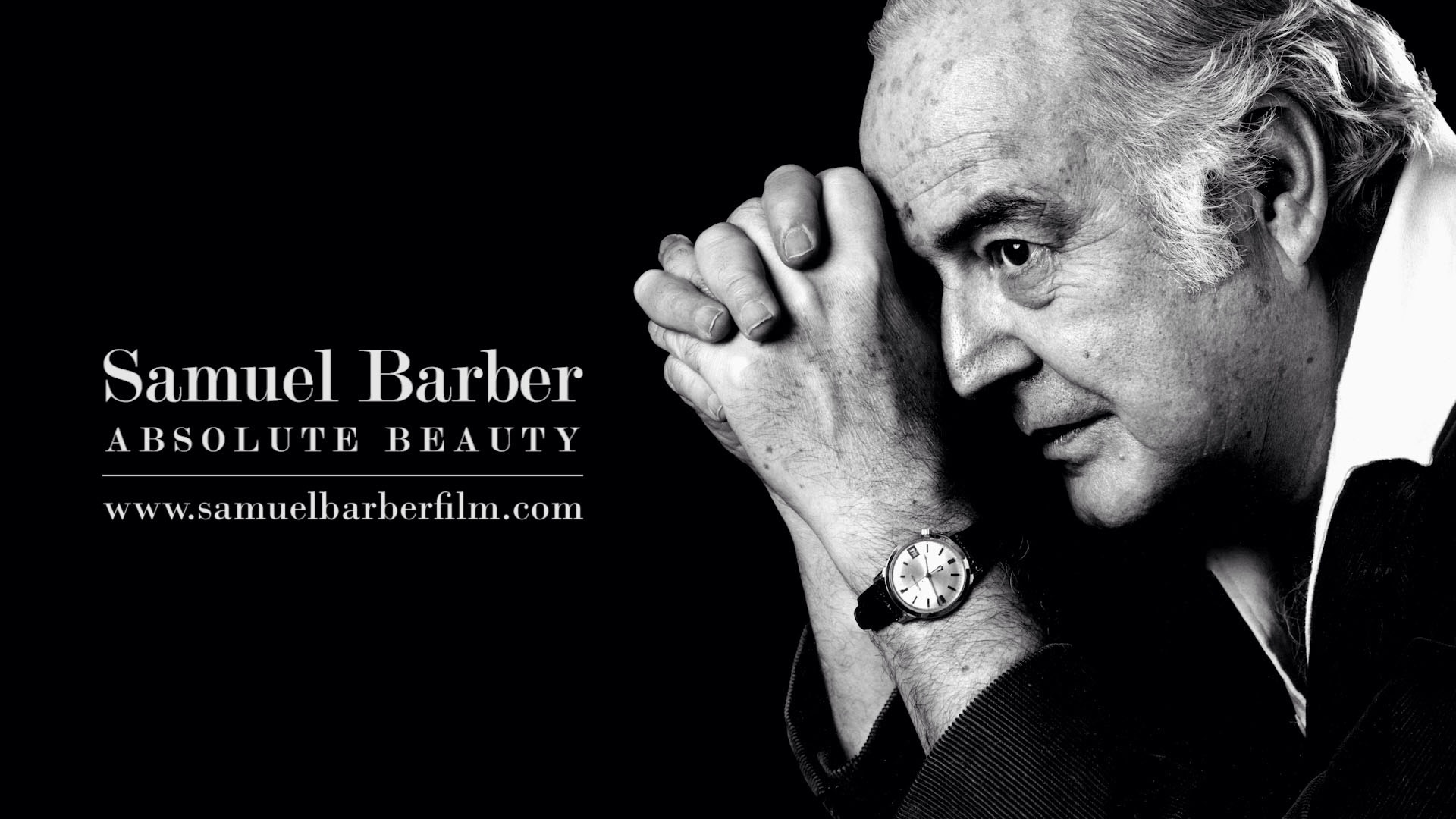
It is surprising that this first ever documentary on American composer Samuel Barber (1910-1981) comes some 36 years after his passing.  This two time Pulitzer Prize winner whose now ubiquitous Adagio for strings was first championed by Arturo Toscanini was much lauded and performed during his lifetime.  His two grand operas (Vanessa and Antony and Cleopatra) were performed at the Metropolitan Opera and his increasingly popular Violin Concerto was first recorded by Isaac Stern with Leonard Bernstein and the New York Philharmonic.

Barber’s music is a personal favorite of this writer.  This mid-century neo-romantic master is gaining greater recognition through an increasing number of performances and recordings so this release would seem to be a timely one.  

Filmmaker H. Paul Moon will be screening an discussing the film ahead of its March 23rd release on disc.  The screening will be at the Jarvis Conservatory at 1711 Main Street in Napa, CA at 7 PM on Friday, February 10. It will be preceded by a performance of the justly famed Adagio for Strings in its original form for string quartet.

The trailer is available for viewing at the website noted above and the site contains further info about rental and purchase.

February 18th, Mark Your Calendars: Other Minds 22, A Must Hear


OMDI1Harrison

Lou Harrison (1917-2003)

The American composer Lou Harrison (1917-2003) and Korean composer Isang Yun (1917-1995) turn 100 this year and Other Minds 22 has a wonderful celebration that is not to be missed.  On February 18th at 7:30 PM in the beautiful, historic Mission Dolores Basilica in San Francisco’s famed Mission District.  This is actually only the first of two concerts which will comprise the Other Minds season 22 which is subtitled, “Pacific Rim Centennials”.  It is curated by Charles Amirkhanian, the reliable arbiter of modern musical tastes in the Bay Area and beyond.  (The second concert, scheduled for May 20, will be an all Lou Harrison concert closer to the composer’s May 14th birthday.)

yun_isang

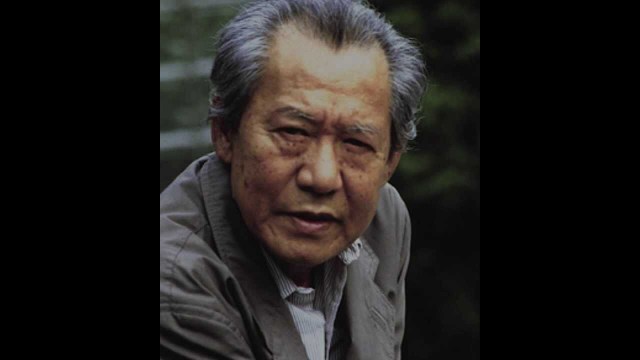
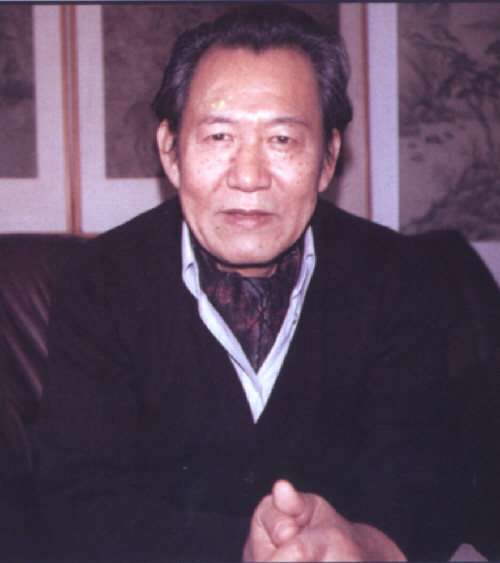
Yun Isang (1917-1995)

Harrison is well known to new music aficionados, especially on the west coast for his compositions as well as his scholarship and teaching.  His extensive catalog contains symphonies, concertos, sonatas and other such traditional classical forms as well as some of the finest of what we now call “world music” featuring instruments from non-western cultures including the Indonesian gamelan.  He is also the man responsible for the preparation and premiere of Charles Ives’ Third Symphony in 1946 which was subsequently awarded a Pulitzer Prize.

Yun is perhaps less of a household name but is known for his many finely crafted compositions in the modern western classical tradition and, later, incorporating instruments and techniques from his native Korea.  He was infamously kidnapped by South Korean intelligence officers in 1967 and taken from his Berlin home to South Korea where he was held and tortured due to allegations (later proven fabricated) of collaboration with North Korea.  Over two hundred composers and other artists signed a petition for his release.  After several years he was returned to his adopted home in Berlin in 1969 where he continued to compose prolifically and teach until his death in 1995.

dennis-russell-davies

                              Dennis Russell Davies (from the American Composers Orchestra site)

This celebratory and memorial concert will feature world renowned artists including Grammy Award winning conductor and pianist Dennis Russell Davies who knew and collaborated with both Harrison and Isang.  Other artists will include pianist Maki Namekawa, violinist Yumi Hwang-Williams, percussionist William Winant (with his percussion group), and the Other Minds Ensemble.

The program is slated to consist of:

Sonata No. 3 for Piano

(1938, Lou Harrison)

Dennis Russell Davies

Kontraste I for Solo Violin

(1987, Isang Yun)

Yumi Hwang-Williams

Gasa, for Violin & Piano

(1963, Isang Yun)

Yumi Hwang-Williams, Dennis Russell Davies

Grand Duo for Violin and Piano (excerpts)

(1988, Lou Harrison)

IIII. Air
II. Stampede

Yumi Hwang-Williams, Dennis Russell Davies

Intermission

Canticle No. 3

(1941, Lou Harrison)

William Winant Percussion Group
Joanna Martin, ocarina
Brian Baumbusch, guitar
Dan Kennedy, Loren Mach, Ben Paysen, William Winant, Nick Woodbury, percussion
Dennis Russell Davies, conductor

Interludium A

(1982, Isang Yun)

Maki Namekawa, piano

Suite for Violin, Piano & Small Orchestra

(1951, Lou Harrison)

I. Overture
II. Elegy
III. First Gamelan
IIII. Aria
V. Second Gamelan
VI. Chorale

Yumi Hwang-Williams, violin
Maki Namekawa, piano
The Other Minds Ensemble:
Joanna Martin and Janet Woodhans, flute
Kyle Bruckman, oboe
Meredith Clark, harp
Evelyn Davis, celesta
Andrew Jamieson, tack piano
Emil Miland and Crystal Pascucci, cello
Scott Padden, bass
William Winant, percussion
Dennis Russell Davies, conductor

Other Minds is also co-sponsoring (with the Berkeley Art Museum/Pacific Film Archive) a screening of the 2015 German television produced film, Isang Yun: In Between North and South Korea on February 19th (4:15PM) at the Pacific Film Archive in Berkeley.  Dennis Russell Davies and composer Charles Boone will also be present to discuss the film.

If you do know these composers you probably already have your tickets but if you don’t know them you owe it to yourself to check out these performances.


Of Mourning and Unity, 2016


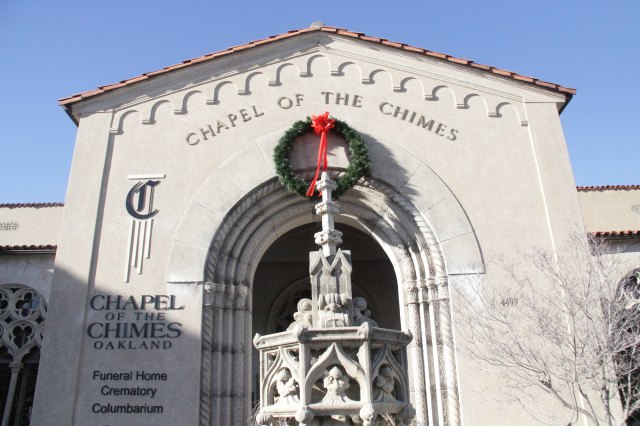
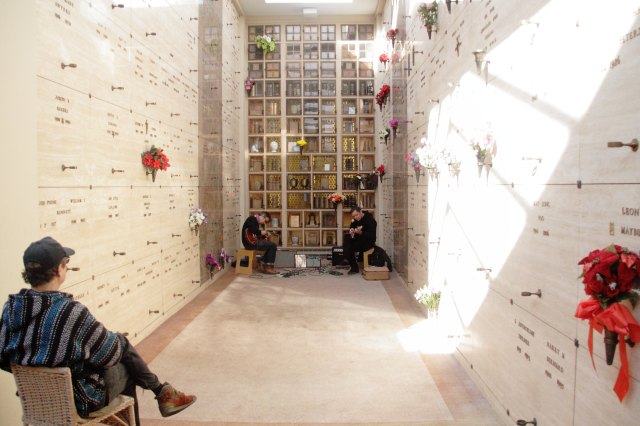
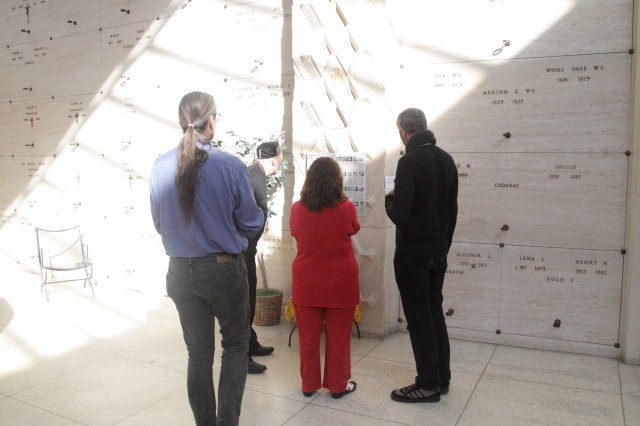
oliverosolstice20160075Every year on June 21st, the Summer Solstice, there is a rather unique concert event in which musicians from the Bay Area and beyond gather in celebratory splendor in the sacred space of the Chapel of the Chimes in Oakland.  The chapel is a columbarium  (a resting place for cremated remains) and a mausoleum.  The space is in part the work of famed California architect Julia Morgan.
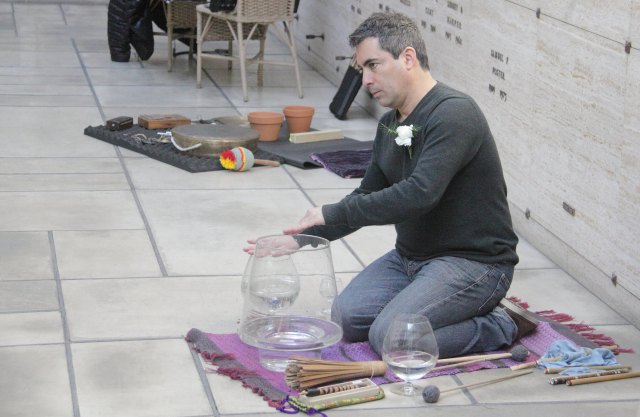
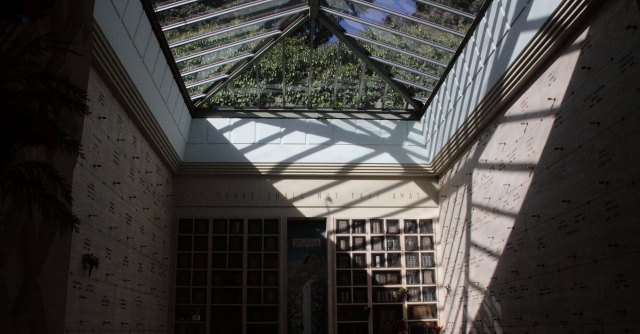
On December 19th Sarah Cahill with New Music Bay Area secured permission to use this space for four hours from 11AM to 3PM.  She invited many musicians who had been involved in one way or another with Pauline Oliveros whose death preceded by a week or two the tragic “Ghost Ship Fire” as it’s become known.  The idea was to pay homage to both this wonderful theorist, composer, performer and teacher and also to pay homage and to mourn the losses of some 36 young artists who will now never realize their ambitions.

What follows here is a simple photo essay of my personal impressions of this event.  The slant of the winter light added a dimension to those beautiful spaces as a large roster of musicians played pieces by and about Pauline Oliveros.  It was a lovely and reverent experience.

oliverosolstice20160003

oliverosolstice20160005

The angle of the winter light adds its dimension.

oliverosolstice20160012

oliverosolstice20160010

oliverosolstice20160019

oliverosolstice20160014

oliverosolstice20160011

oliverosolstice20160021

oliverosolstice20160022

oliverosolstice20160024

oliverosolstice20160025

oliverosolstice20160040

oliverosolstice20160026

oliverosolstice20160044

oliverosolstice20160037

oliverosolstice20160066

oliverosolstice20160063

oliverosolstice20160043

oliverosolstice20160062

oliverosolstice20160035

OM202022

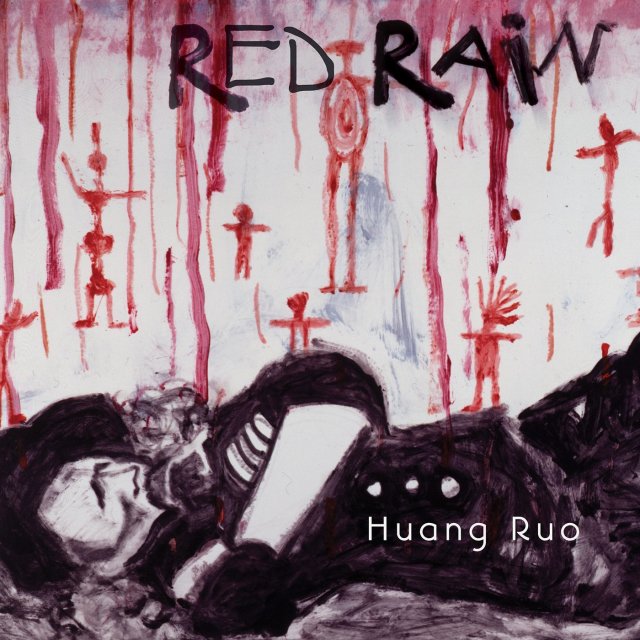
Huang Ruo: Red Rain, a New Generation From the East Makes Itself Known


redrain

This recording grabbed my attention in wonderful ways from the very beginning and didn’t cease to amaze me until it ended.  Huang Ruo (1976- ) is one of the most striking new voices this reviewer has heard in some time.  This Chinese born American composer draws on his ancestral culture, modern culture and synthesizes it with contemporary compositional techniques in new and interesting ways.  He provokes the same sort of excitement in this reviewer that first contact with the music of Bright Sheng and Ge Gan Ru did when they first came into earshot some years ago.

huangruo

Huang Ruo (1976- )

(Perhaps it is due to the rising star nature of this artist but there seems to be relatively little reliable info on him.  His website is apparently not yet complete and even his Theodore Presser page fails to even give dates for his scores.  I’m hoping these glitches get resolved soon because I think this is a composer who deserves serious attention.)

The very first track, Four Fragments (2006?) in the version for cello solo (apparently there is a version for violin solo but it is not clear which came first) is a powerful and virtuosic piece loaded with various pizzicati, glissandi and other effects that perhaps only a score could really tell you with certainty.  What is interesting is the really organic nature of these effects, that is to say that they serve the composition and aren’t simply “golly gee what a virtuoso” type fireworks. The amazing Canadian Korean cellist Soo Bae handles this work beautifully and seemingly with relative ease.  This is the second longest (by about ten seconds) of the pieces on this disc and the music, the performance snagged me immediately.  What a powerful piece!

After that I was prepared for perhaps a let down, something more “ordinary”.  But, no, the next track, the title track, Red Rain (200?) for piano played by the wonderful Emanuele Arciuli is another distinctive statement which seems to mine the riches of the composer’s native culture and place it anew in a contemporary and relevant modern context.  At 10:50 it is a substantial piano work.  Like the cello piece it seems to use some unconventional idioms for the instrument and by that I mean it sounds nothing like Mozart, Beethoven, Debussy or even Boulez or Stockhausen.  It seems infused with an eastern musical flavor no doubt gained from techniques native to non-western traditions.

In another assault to any expectations I might have had the three movements of Shifting Shades have the pianist using a whistle such as your gym coach likely used with the pea inside to create a tremolo.  Here the pianist whistles (and plays some sort of flute, maybe a recorder or shakuhachi? at one point; he also apparently plays directly on the piano strings at times) whilst playing the rapid tremolos and the drones that seem to characterize Huang’s keyboard writing. Stephen Buck is the hard working pianist here.

Buck comes back again for the Tree Without Wind for piano (this time played a bit more conventionally).  This is the longest piece on the disc at 13:57 and rewards the listener’s attention.  It seems to probe mythological depths and was suggested by a Chan Buddhist narrative by Hui Neng.  Tremolos, clusters, drones and melodic fragments take on a symphonic grandeur at times.  There is a wide range of dynamics and tempi as the pianist recounts in sounds the meaning of movement and silence.

Three Pieces for Piano gives names to the short movements.  Prelude: Diffluent, Postlude: Left… and, Interlude: Points and Lines all contain the same techniques as the other piano pieces here (though without any additional instruments this time).  These sound like they might be earlier works and perhaps studies investigating different techniques though they seem fully fleshed out and complete in themselves.  The three movements are varied and the last one is apparently the composer’s only dalliance with twelve tone techniques and is by far the most conventional sounding work here though Huang’s distinctive fingerprint is present.  Once again we hear Stephen Buck navigating the score.

In the last track we get to hear the composer himself at the piano with Arash Amini (a member of the American Modern Ensemble) on cello in Wind Blows…  Like the previous tracks and as indicated in the fine notes by Stephen Buck this piece utilizes specialized effects to produce a unique sonic image.  The piano part is referred to as a “drone” and it is indeed static at least in relation to the part for cello. Unlike the preceding pieces there seems to be less concern about evoking images and more concern for just the sound itself which is described aptly as “meditative”.   In fact it is powerfully lyrical, even “Brahmsian” if I can be forgiven for that comparison.

The brief biography in the overall fascinating liner notes describe the composer as having been influenced by a wide variety of musical styles ranging from traditional Chinese folk musics to Chinese Opera, various western classical traditions including modernists such as Lutoslawski and various “pop” traditions as well.  He studied at the Shanghai Conservatory and he appears to have achieved a fascinating synthesis in what seems to be his mature style.  He is a composer, conductor and vocalist.  His music is unique and beautiful as a Taoist painting but grounded in traditions that embrace perhaps the entire world as filtered through his creative mind. Bravo Innova for bringing this music to light in this fine and interesting CD.

Definitely keep and eye and ear out for this guy.  He has many things to say and interesting ways to say them.

David Toub’s Ataraxia, a unique compositional vision


ataraxia

World Edition 0029

David Toub is a composer whose name is known to perhaps relatively few right now but whose star is clearly rising.  Born on the east coast he studied at Mannes College and at Julliard with Bruce Adolphe and others but his musical education reached maturity when he was studying at the University of Chicago and running the contemporary music programming at the college radio station.  While he had written some twelve tone and freely atonal music it was his encounter with a 1979 WKCR broadcast of Einstein on the Beach that changed his compositional vision.  The musics of Philip Glass, Steve Reich, Terry Riley, and protominimalist Morton Feldman would henceforth infuse his style.

drtoub

David Toub

He is also what I have termed a composer with a day job.  Like Charles Ives (who sold insurance) and Alexander Borodin (who was a chemist, physician and surgeon) he makes his livelihood in the decidedly non-musical world of gynecologic surgery.  Another analog for people like David would have to be William Carlos Williams, a pediatrician whose place in American letters is assured by his poetry and novels.

I personally discovered David’s music via his website where one can find a great deal of his scores and (very helpful) sound files of many of his works.  It is definitely worth your time to browse these scores and sounds if only to get an idea of the scope of the composer’s visions.  By his own admission his music resembles that of Philip Glass, Steve Reich and Morton Feldman but perhaps it is more accurate to say that one may be reminded of these composers since his music is anything but derivative.

Some of his music has been championed by the fabulous Monacan pianist Nicolas Horvath whose You Tube Channel is a feast for new music aficionados.  In fact Horvath’s reading of “for four” (2012) can be heard and seen there.  David also has a You Tube Channel with some live performances that are well worth your time.

Many of David’s scores do fit the more conventional (ca. 20 min) time frame of most concert music but some of his most interesting scores lean toward the extended time frames common to Morton Feldman’s late work (in the liner notes he refers to a recent piano piece which lasts four hours).  These require a bit more concentration and multiple hearings to be able to perceive the compositional unity but, having done that, I can tell you that my time was well spent.

ginsburgh-de-face

Stephane Ginsburgh (from the pianist’s web page)

Stephane Ginsburgh is a Belgian new music pianist whose repertoire traverses some of the work of Morton Feldman as well as Frederic Rzewski and others.  He, along with Alessandra Celetti and Louis Goldstein were the dedicatees of the “quartet for piano”.   Having been already familiar with Toub’s work I was pleased to find that Mr. Ginsburg’s interpretive skills both do justice and provide insight to these scores which on paper (or in a PDF file) are difficult to grasp.  In fact these performances are mesmerizing.

“quartet for piano” (2010) comes in at 46:48 and the second track “for four” (2012) comes in at 22:58 but the timings are ultimately superfluous once the listener allows themselves to be taken by the collaborative adventure of this composer and performer.  I don’t think I can do justice speaking of the structure of this music except to say that, in this listener, it was like listening to the slow ringing changes of Zen Temple bells in a distant dream.  I have had the opportunity to play this CD without distraction a few times and each time found it transporting with the music taking on almost symphonic dimensions despite it’s outward simplicity.

This is a crowd funded effort in which I was a willing participant.  The lovely graphic design is by faberludens utilizing detail from a mysterious photograph by Richard Friedman (long time host of Music from Other Minds) and provides an apt visual metaphor for the music therein.  The conversation between the composer and Udo Moll dominate the liner notes and provide very useful insights to the origins and intents behind the composer’s work.

The sonorous piano is a Bösendorfer 225 and the recording was done by Daniel Léon with mastering by Reinhard Kobialka.  CD production curated by Udo Moll on Maria de Alvear’s World Edition label.  Soon to be available on iTunes and Amazon.

The other supporters named include: Maria de Alvear, Sergio Cervetti, Carson Cooman, Chris Creighton, Kathie Elliott, Paul Epstein, Sue Fischer, Alex Freeman, Richard Friedman, Stephane Ginsburgh, Louie Goldstein, Matthew Greenbaum, Hazem Hallak, Barnabas Helmajer, Christian Hertzog, Robert Kass, Harry Kwan, Steve Layton, Connie Lindenbaum, Richard Malkin, Shadi Mallak, Leah Mayes, Kirk McElhearn, Juhani Nuorvala, Rebecca Pechefsky, Lou Poulain, John Prokop, Simon Rackham, David Reppert, Larry Roche, Larry Rocke, Dave Seidel, Kel Smith, Beth Sussman, Eliyahu Ungar-Sargon, Samuel Vriezen, and Ann Wheeler.  The composer also includes his family, Debbie Bernstein, Arielle Toub and Isaac Toub for their emotional support and (in his typical self-effacing humor) “tolerance” of what he calls his “odd compositional habit”.  As habits go this one appears to be a winner.


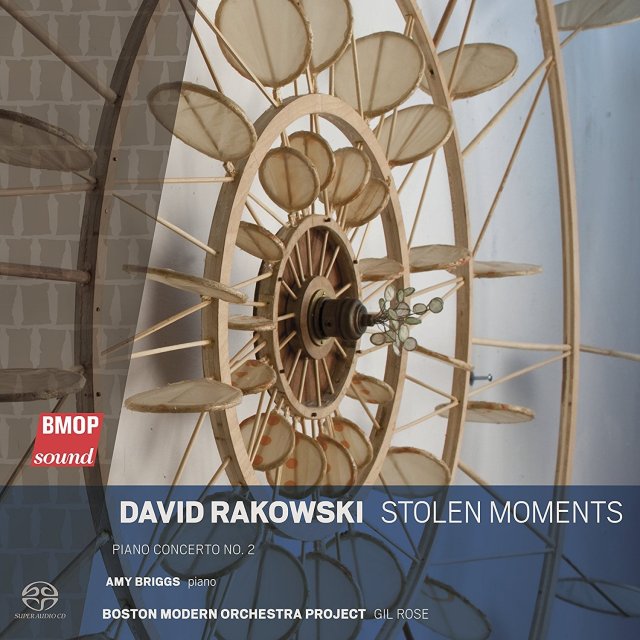
David Rakowski: Stolen Moments, Fabulous New Orchestral Music


rakowski

BMOP 1048

The spirit of jazz and, in particular, that of Duke Ellington and perhaps George Gershwin seem ever present in this recent release from the Boston Modern Orchestra Project.  David Rakowski (1958- ) is a new voice to these ears but clearly a highly developed one well schooled in writing for large orchestra and for piano solo within that context as well.

Two works are presented here, the four movement Stolen Moments (2008/2010) and Piano Concerto No.2 (2011).  Both are large, colorful works in a basically tonal/romantic context but with clear modernist influence.  Nothing experimental here, just sumptuous orchestral writing and a challenging and interesting work for piano and orchestra.  It was only from reading the useful liner notes that I learned Rakowski had been a student of Milton Babbitt (1916-2011), a composer famous for his hard nosed complexity.  In fact Rakowski actually quotes from Babbitt and this music is a tribute to the education received from this man (keep in mind that Babbitt also taught harmony to Stephen Sondheim).

It is as difficult to grasp that Rakowski was taught by Babbitt as it is to believe that, by his own assertion, he knows very little about jazz.  The first work seems to channel the spirits of Duke Ellington and George Gershwin more than Babbitt for sure.  This four movement orchestral suite, in it’s many moods, is melodic, jazzy and engaging in a way that can’t fail to entertain.

briggs

Amy Briggs (image from the artist’s web site)

Amy Briggs has long been a collaborator with Rakowski and is an artist who has successfully made her career exclusively playing contemporary music.  This second of Rakowski’s concertos for this instrument was written for her and she plays it magnificently.  She clearly has a feel for the jazz rhythms and handles the virtuosic writing as though it were second nature.

The concerto ventures into a variety of moods and provides ample opportunities for many BMOP soloists to have their moments.  It is basically a classical three movement structure with multiple subdivisions within each movement.  These large movements come in at nearly 15 minutes each and are practically works unto themselves though they clearly adhere to the same basic vision.  The second movement is dedicated in memory of Rakowski’s teacher Milton Babbitt.  I’m sure he would have approved.

This is in fact the second time that Gil Rose and his massively talented musicians have chosen to survey some of Rakowski’s music.  That alone should be enough to clue listeners in to a potentially good listen.  Rose has been amassing a catalog of music by modern composers whose work deserves attention and, while this is an example of some pretty recent music, Rose and BMOP have done a fine job of giving attention to composers who have been unjustly neglected as well.   They seem to have a fine ear for quality music and this reviewer will listen to anything they choose to record.

As usual with BMOP, the recording is bright and lucid allowing the listener to hear the fantastic details in these big and intricate but entertaining works.  The production is by Gil Rose himself with recording and post-production by Joel Gordon.  Another great volume in the growing BMOP canon.

Ken Thomson’s Restless: a Feast of New Chamber Music


restless-cover-2000x2000

Ken Thomson is one of the rapidly rising stars of the New York music scene and beyond. His involvement with his group Slow/Fast which includes Ken Thomson, Russ Johnson, Nir Felder, Adam Armstrong and Fred Kennedy as well as Bang on a Can and others in the new music/new jazz community demonstrates his level of drive.  Thomson is a saxophone player and a composer.

The present album showcases his talents as a composer and are different than what I had expected from a musician with roots in free jazz and with saxophone as his principal instrument.  This is a set of two suites in the classical manner, a collection of movements. They do not appear to have any direct influence from jazz but rather they are quite clearly in a classical new music vein.

The first, Restless (2014) is a four movement piece for cello and piano.  It could have been called a sonata for all its complexity and development.  It is a lyrical and very listenable piece which is restless at times (though I think the title actually suggests multiple meanings) and loaded with fascinating musical ideas.  The writing for both the cello and the piano are apparently technically challenging but both are handled very well by Ashley Bathgate (cello) and Karl Larson (piano).  This disc is worth the price if only for the fantastic musicianship of these performers.

ashleybathgate-karllarson_photo1_photographer_gabrielgomez

Ashley Bathgate (cellist) and Karl Larson (pianist) (Photo by Gabriel Gomez, all rights reserved)

The three movement suite, Me vs. (2012) is a pianistic tour de force that makes great use of various pianistic effects involving judicious use of the sustain pedal and the creation of after image type effects which allow the harmonics to vibrate on strings not struck by the keys.  Again the nod to a basic three movement classical piano sonata with a complex first movement followed by a lyrical slow movement and a spritely virtuosic finale which resembles a moto perpetuo.

More about the internal dialogue that went on in the composer’s head is available in his commentary but this music doesn’t really require much explanation.  It is pretty clear and very effective music.  This is simply a wonderful recording of some fascinating new music.

Christopher Bailey: Glimmering Webs, New Piano Music


glimwebs

I admit to some trepidation when I received this 2 disc set of piano music by an unfamiliar composer.  Even in the best of circumstances the “double album” concept can be a trying thing even to fans of a given artist.  I think I recall some similar trepidation confronting the newly released Elton John Yellow Brick Road double album.  I invoke some pop sensibility here in part for humor but also because that sensibility is one of the many threads that imbue this rather massive collection of pieces.

bailey2

Christopher Bailey

Christopher Bailey is a freelance composer who holds degrees from Eastman (BA, 1995) and Columbia University (MA, 1997 and PhD, 2002).  This is the eighth disc to contain his music though only the second to be dedicated entirely to his works (and his first double album).

The first disc is a journey of styles ranging from electroacoustic music (like the opening track which resembles the work of Mario Davidovsky at times) to several whose inspiration seems to venture closer to that of Pierre Boulez and ends with a lengthy sort of post minimalist piece appropriately titled, Meditation.  The composer says in his liner notes that this piece is his homage to “ambient music” and in particular, Harold Budd. The second track is a piece which is a sort of deconstruction of a Hall and Oates song, the pop sensibility to which I referred earlier.  And, yes, there is some nod to microtonalism as well.  Can you say eclectic?

The second disc contains the large Piano Sonata and a host of smaller works in various styles ranging from neo-classical to microtonal.

In the rambling liner notes the composer provides useful clues as to the genesis and intent of some of his ideas.  One need not read the notes to appreciate the music but the clarity that they provide was useful to this listener. More notes would have been appreciated though.  The composer’s and the pianists’ web sites are certainly useful but I doubt that the average listener will spend that much time researching these things and is then left with gaps in information and consequently in understanding.

The composition dates here range from 1994 to 2013 and embrace a wide swath of styles all with a strongly virtuosic aspect.  The second disc starts with the brief Prelude-Fantasy on the So-Called Armageddon Chord (2011).  The title is almost longer than the piece and, while it’s a fine work, the placement at the beginning of the disc preceding the major opus of his four movement Piano Sonata (1994/1996/2006) is a bit confusing.

I don’t mean to quibble with such things as track order and such but I was left with a sense of difficulty focusing.  Here is a large collection of music which ranges through pretty much the entire gamut of the last 200 years of music and it is presented en masse.  I think some re-ordering might have been helpful but that is one of the difficulties with multiple disc issues.  I listened numerous times to these discs and find the sheer volume and diversity a bit overwhelming.  It is as though this is too much for a single release.

Bailey says that the sonata is an homage to Stravinsky and those neo-classical elements are certainly clear but this listener hears some ghosts of Charles Ives and the polystylism of Alfred Schnittke as well.  The Sonata seems to be the highlight here.   It is wonderfully complex, kaleidoscopic, loaded with quotation, even grandiose at times, but eminently listenable and it is a highly entertaining piece also because of it’s virtuosity which is ably handled by the performer.

There are apparently three pianists on this recording, Jacob Rhodebeck, Shiau-Uen Ding and Augustus Arnone.  The problem is that it is not clear from the labeling or the notes who plays what.  This is actually a fascinating and engaging collection, well played, but I was surprised to be unable to attribute the various virtuosities to the deserving performers.

The recording, mastered by Silas Brown, is as good as it gets.  Overall quite a collection but one that left me with many questions as well.  Perhaps that was, at least partly, the intent but it is my hope that these ambiguities will not distract the listener and that more releases will be forthcoming.  This is very interesting music deserving of serious attention.


Alberto Ginastera at 100


ginastera

Oberlin Conservatory OC 16-04

Let me start by saying that the only thing wrong with this album is that it is only one CD. Alberto Ginastera (1916-1983) is without doubt one of the finest composers of the twentieth century.  Stylistically he holds much in common with composers like his contemporaries Aaron Copland (with whom he studied), Carlos Chavez, Leonard Bernstein and others who incorporated the spirit if not always the literal music of his homeland’s folk culture into his music.  In additional to these nationalist works he wrote a substantial amount of traditional concert music which touched on the edges of modernistic trends.

He wrote three operas, two ballets. two piano concertos, two cello concertos, a harp concerto, three string quartets, a bevy of piano music and sundry other items.  It is simply not possible to contain a fair representation of his work on a single CD.  Despite that this disc is not a bad retrospective.  It is lovingly played and recorded and if it does not represent the whole of Ginastera’s oeuvre it is a nice sampling.

The disc begins with the wonderful Harp Concerto Op. 25 (1956, rev. 1968).  Though originally commissioned by Edna Phillips (principal harp of the Philadelphia Orchestra) she had retired before she could perform it and it was premiered in 1965 by the amazing Spanish harpist Nicanor Zabaleta.  This three movement work is certainly one of the composer’s finest works and is beautifully played by Yolanda Kondonassis with the Oberlin Orchestra under Raphael Jiménez.  This piece is one of the finest modern harp concertos and is representative of the composer’s international style with perhaps just a taste of modernism.

Next up is the single movement Pampeana Op. 16 (1947) with the great Gil Shaham on violin and his sister Orli Shaham on piano.  This is a sort of window on Ginastera’s earliest nationalist style full of melody and virtuosity.

The next work is the Sonata for Guitar Op. 47 (1976) played by Grammy winning virtuoso Jason Vieaux.  I had not heard this work and my first hearing was indeed a revelation.  This is a major work for guitar and a wonderful sonata in the classical form.  I gave these four tracks a few listens in an attempt to digest some of their beauty and complexity and I will doubtless give them many more listens.  This is a major piece that belongs in the repertory.

And, finally, we move to the earliest utterance here with the Danzas Argentinas Op. 2 (1937) in an exciting and dedicated performance from Orli Shaham.

The sound is wonderful and there are a geekily satisfying set of liner notes which include a useful analysis by James O’Leary, Frederick B. Selch Assistant Professor of Musicology, Oberlin Conservatory of Music.  All in all a beautiful production and a great introduction to Ginastera’s work but please, don’t stop here.  Make sure you get to hear his other work and perhaps the wonderful folks at Oberlin will consider a volume two?

E-Do: Yeominrok, Wonderful Korean Musical Fusion


yeominrok

Pony Canyon PCSD 01023

Call it world music, call it jazz, call it fusion but whatever the description this is an innovative and fascinating musical journey.  Using traditional Korean instruments as well as the usual keyboards, vocals, and drums this group of young musicians crafts a very interesting and beautiful tapestry of sound.

I have long had an interest in and some appreciation of traditional Korean musics and instruments but my knowledge is rather limited.  I am inclined to compare this group to Oregon, the iconic jazz/new age experimental band of the 1970s but unlike Oregon’s more widely cast net we see young musicians embracing their ancient Korean musical heritage as they seek to express themselves and invoke the wisdom of their ancestors.  This album was sent to me as a gift from a friend but I quickly fell in love with it and I had to write a review.

It seems to me that Korea has, more than many countries, been damaged and stunted by the antics that became known as World War II and the Korean War.  As a result this rich and ancient culture was nearly erased in favor of geographic division and political expediency.  It is heartening to find young artists such as these seeking to communicate with if not actually recover some of this rich past.

This band is named after a revered 15th century Korean king and they make liberal use of traditional Korean instruments alongside their drums, keyboards, and vocals.  The album succeeds to some degree in achieving a synthesis (as opposed to a sappy watering down) of traditional music and something like jazz with some rock and pop sensibility.  These are sincere and perceptive artists and if they have not fully succeeded then they have made a significant step toward reviving some of their justly valued history and culture.

In addition to its musical values this is a gorgeously produced album (visually and sonically) and I am sorry to see that only the digital download is available on Amazon.

There are six tracks on the disc and all feature traditional Korean instruments alongside the band’s keyboards, drums and vocals.  There are few vocals but no words as far as I can tell and any program is implied at best.  This is strictly about the music.

The first track, Bird of Oblivion, unfolds like an Indian raga with a meditative slow beginning giving way to a faster section.  It is the most extended work on the disc at 13:51 and it certainly serves to bdraw the listener in.  The remaining tracks range from pop-inflected jazz (track 3) to a little bit of rock .  Throughout the traditional Korean instruments make their presence known but not overwhelmingly.  This album is a pretty successful synthesis of old and new.

E Do consists of:

Kyung-hwa Ryu: chulhyungeum, yanggeum, janggu, kkwaenggwari

Chung Lim: drums, jungju, gong

Min-soo Cho: junggu, Korean drum, Korean fan, percussion

Jung-chul Seo: electronic bass, contrabass

Young-Sup Lee: daegeum, taepyeongso, danso, ocarina

Seung-hwan Yang: keyboards

Tae-young Kim: vocals

Young-goo Lee: daegum

Seek this one out.  And don’t forget to pick up some traditional Korean music as well.  It is well worth your time and, after all, a nod to the fine efforts of this wonderful group.


The Musical Mother of Us All: Pauline Oliveros, a Personal Appreciation


oliverosione

Pauline Oliveros at one of Philip Gelb’s dinner concerts in Oakland.  I published this photo on Pauline’s Wikipedia page.

I woke at about 3PM on the day after Thanksgiving (having worked the previous night shift) and I checked my e-mail and then, on Facebook I learned of the passing of theorist, composer, musician, teacher and all round wonderful human being Pauline Oliveros (1932-2016). She had died peacefully in her sleep on Thanksgiving Day.  Going over the copious posts and comments I was saddened at her passing but oddly comforted by the fact that these posts honoring her are effectively eclipsing the ones on the obnoxious political issues as well as demonstrating the incredible reach of her influence.  Thankfully, Pauline will not have to endure the regressive politics which now dominate our country and, indeed, the world.

I first encountered Pauline’s work, as many did, through the Columbia Odyssey LP curated by none other than David Behrman in his Music of Our Time series.  There are several composers on the disc including Steve Reich (Come Out), Richard Maxfield (Night Music), and Pauline Oliveros (I of IV).  Over the years I collected and listened to most of her recordings Discogs lists 55 recordings but no doubt there are many more and likely a plethora of unreleased material which will grace our ears for years to come.  Like her older contemporary John Cage it is difficult to identify a “masterpiece” and, also like Cage, she didn’t aspire to such notions because she aspired to learn and subsequently teach the art of listening. Her Deep Listening Institute is based in Kingston, New York.


dempster9

Stuart Dempster at another of Philip Gelb’s dinner concerts. Stuart is one of the members of Oliveros’ Deep Listening Band

I was pleased to be able to see one of the incarnations of the Deep Listening Band in Chicago at the Harold Washington Library.  This concert occurred on the night of the famed “Chicago Flood” (1992) in which a construction mishap diverted thousands of gallons of water from the Chicago River into the disused coal delivery railway tunnels which connect most of the downtown buildings.  I brought along a postcard from her album The Well and the Gentle hoping to get her autograph.  It was my first face to face meeting with this icon of new music.  She graciously took the card into her hand and immediately exclaimed with a smile, “Oh, this is from the Well”.  She quipped that next time they would hold their concert in one of the “deep tunnels” which are a part of the Chicago’s massive flood control rainfall overflow system.  I still treasure that autograph and the memory of my first meeting with Pauline.

oliverosione3

Ione (l) doing verbal improvisation while Pauline improvises in parallel on her digital accordion at a memorable dinner concert curated by Philip Gelb.

I can hardly tell you my level of excitement when vegan chef and musician Philip Gelb announced that Pauline with her partner Ione would be appearing at his next dinner concert.  The opportunity for a close encounter with this master was certainly heaven sent. (Pauline later wrote the lovely introduction to Philip’s first vegan cookbook.)

garden20151047

Philip Gelb performing at the June 21, 2015 Garden of Memory Concert at Oakland’s Chapel of the Chimes. This vegan chef and cookbook author plays and teaches shakuhachi and curates a wonderful dinner/concert series at his loft in West Oakland.  Philip also appears on several albums with Pauline and others.

Indeed, as I sat across from Pauline no doubt babbling some starstruck nonsense, I encountered in both her and her partner Ione two warm and unpretentious people.  While I knew I was in the presence of genius I was given to feel very welcome as they both engaged me and the other guests in lively conversation at this spectacular vegan meal.  In the pause just before dessert they gave a wonderful performance with Ione speaking improvised and passionate poetic utterances while Oliveros played her quirky improvisations in parallel on her digital accordion.

OM202021

Pauline Oliveros, Miya Masaoka and Frode Haltli performing Oliveros’ Twins Peeking at Koto (2014) at Other Minds 20 in 2015

I later got to see Pauline as a returning guest composer/performer at Other Minds 20, a series lovingly and painstakingly curated by composer, broadcaster and new music impresario Charles Amirkhanian.  I believe this was her last major bay area appearance.

OM202022

A clearly happy Pauline Oliveros acknowledges the warm applause of the Other Minds 20 audience after her performance at the SF Jazz Center in 2015.

Every year at the Garden of Memory summer solstice concert the open membership Cornelius Cardew Choir performs Oliveros’ Heart Sutra every year.  The verbal score describes how one enters the singing circle and intones basically the note of their choice with one hand over their heart and the other on the back of another singer.  I screwed up my courage to participate in this ritual a few years ago and it is now an essential part of the beginning of my summer.  Pauline has taught me much and no doubt will continue to teach me through her writings and recordings.  For that I am eternally grateful.


Dreaming About Making Revolution: Alvin Curran in Conversation


curran20160007

Charles Amirkhanian (r) and Alvin Curran with the projection screen here showing Curran’s Geologic Conversation.

The David Brower Center in Berkeley, California provided a perfect setting for Other Minds‘ presentation of a conversation with American composer Alvin Curran.  The Brower Center is the new home of the Other Minds organization run by broadcaster, composer and new music impresario Charles Amirkhanian.  It is also home to a range of ecologically conscious organizations and is housed in a building renowned for its ecological efficiency. Curran, whose energy and charm belie his age (he turns 79 in December) is a composer with strong ties to the environment both as a concern and as a compositional element.

After a brief intro Curran provided a capsule overview of his evolution as an artist from his beginnings at Yale studying with Elliott Carter to his epiphanies in Berlin and later Rome (where he has made his home since the early 1960s).   He described his decision to drive with fellow composer Joel Chadabe to Rome saying that they were “dreaming about making revolution”.  There he collaborated with Frederic Rzewski and Richard Teitelbaum (among others) in founding the first live electronic improvisation ensemble, Musica Elettronica Viva (MEV).  This was before the general availability of prepackaged synthesizers.

While he does not eschew more traditional classical music much of his work ventures far outside those models and it was a sampling of some of these ventures that were discussed and displayed in this fascinating interactive discussion.

He began by playing a portions of a video of a piece called Geologic Conversation (2000) which involved a large gaggle of musicians peripatetically led by the unbelievably energetic Curran as they all moved (danced?) on the active volcano, Mount Etna in Sicily. The performance drew a crowd of some 500 people of varying ages who moved with the musicians as they traversed a path across the sometimes volcanically singed locations.  It was by all appearances an ecstatic performance and not without some danger.

curran20160005

Curran’s infectious, almost self deprecating humor charmed the audience who, like this writer, sat in rapt attention stunned by the audacity of the composer’s visions.

I had the opportunity to ask him about his relationship to the work of the Canadian composer R. Murray Schafer whose works seem to echo Curran’s.  “He is more ‘composerly’ than I am” was Curran’s reply  but he did acknowledge some kinship with Schafer’s work.  Indeed Schafer has probably produced more traditional classical concert works than Curran but the parallels of his operas utilizing the sheer vastness of the Canadian landscape are hard to miss.

He next described and played video excerpts of what he calls Living Room Music.  In it he invited various musicians to his apartment in Rome to do “anything they wanted” in exchange for a modest fee and a meal cooked by Curran.  The recorded excerpts of these various performances were later used in a radio sound work for Deutschland Radio.  What is impossible to grasp is how this seemingly banal idea is transformed into a sort of musical tabula rasa which inspired some amazing ideas from the guests he hosted.  His successful facilitation of such seemingly strange, even goofy ideas is a mark of his genius.

Next up was a sort of installation art piece called Gardening with John which involved Curran building a little prefab garden shed (yes, filled with gardening tools) in which he covered the internal walls with quotes from John Cage and played tapes of Cage laughing. The video consisted of an unmoderated conversation between Curran and some of his guests. This installation sat on the grounds of a German museum.  Humor and irony are a part of Curran’s work as much as they are of Cage’s.

Next up was Curran’s own version of Water Music which he calls Maritime Rites. It has been performed in various settings, all on or near water.  This piece involves recordings which Curran made of various maritime sounds across the east coast of the United States as well as notated music to be played by the musicians.

The video he showed was of a performance on the Thames River in London (also the site of the performance of Handel’s Water Music) with the audience gathered on the Millennium Bridge.  Curran and two other musicians played from a barge and members of the London Symphony played on the shore.  The crowd was so large as to suggest that the bridge may be challenged in its ability to accommodate them safely but, thankfully, it did.

curran20160016

Curran’s wild genius is tempered by an affable inclusiveness and an infectious enthusiasm.

Finally, though the audience was clearly prepared to stay much longer, Curran and Amirkhanian discussed, “Oh for the Brass on the Grass”, a work for some 500 band musicians recruited from surrounding German towns.  These amateur musicians ranging in age from 8 to 80 responded enthusiastically to Curran’s manic conducting (apparently banging a couple of pipes) as they traversed a large grassy field.  At one point Curran turned off the sound and laughed at the specter of his own passionate conducting.

curran20160018

As if to remind me that I was in the liberal enclave of Berkeley I spied this graffito in the elevator on the way to retrieve my car. I think Curran would have enjoyed the humor and the critique.

Unfortunately there was not time to delve into the many other aspects of this composer’s work which include some traditional concert works and a generous helping of politically charged work.  But Curran warmly greeted his admirers providing autographs and avid conversation.  All in all a lovely evening with a true master musician of our age.  Can’t wait to see what he will do next.


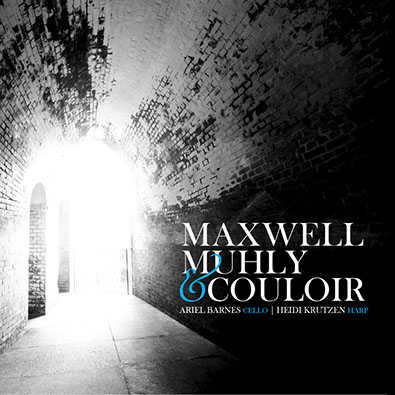
Couloir, a Wonderful New Cello and Harp Duo


couloir

This is an beautiful album.  The main attraction is the world premiere recording of Serere (2012) by James B. Maxwell in two versions separated by a shorter piece by Nico Muhly.  Ravello Records brings us a wonderful Canadian duo, Couloir consisting of Ariel Barnes on cello and Heidi Krutzen on harp.

Maxwell, a Canadian composer, is new to this writer but the present work suggests that there is good reason to pay attention to this artist.  I’m not sure of the wisdom of two versions of the same piece on one disc but it does allow for close comparison.  It is basically an intimate and episodic piece of chamber music which is filled out with some electroacoustic material in the second version.  I don’t mean to sound dismissive because this is an engaging and enjoyable listen and a piece which seems to contain a certain depth and wisdom which suggests a well crafted work.  Both versions are clearly challenging from a technical aspect but all seems to be integrated in service of the music and not simply empty effects.  The second version of course has a fuller sound due to the augmentation of the electronics.  Both versions benefit from multiple listens and I certainly don’t intend to set this disc aside for a bit.

This is actually my first encounter with Nico Muhly’s work.  I have certainly heard of him but I am not familiar with any of his other work so I have nothing against which to compare the present piece except in the context of this disc.  Given that, this briefer piece, Clear Music (2003) is also finely wrought and engaging.  Maryliz Smith plays celeste on this track.  It functions basically as an interlude here but it does help clear the palate (so to speak) without taking the listener too far out of the musical context.

The recording from 2012 in Vancouver, British Columbia is clear and pleasant and the performances are simply wonderful.


Kaviani: Te Deum


kaviani

I am going to start here with some disclaimers:   I tend to like liturgical classical music.  I asked to review this recording.  I really expected to like this piece.  I dislike giving bad reviews.

My readers  will note that, while I may turn a critical eye/ear, I generally don’t give bad reviews.  That being said I can tell you that I had hope for this recording and gave it a fair and close listen.  I am sad to say I was disappointed.

The positives:  great recording, great label, elaborate and competent writing, dedicated and competent performance.

The negatives:  Perhaps it is the composer’s intent to create this retro Beethoven/Berlioz piece for the purpose of making this big recording (an audio DVD is included in Dolby 5.1) but ultimately I find it to be overstated and derivative.  It just tries too hard.

Some listeners may enjoy this big production with its excellently recorded sound but that reminds me of a friend who used to collect “audiophile” recordings and was concerned at times more with sound than content.  If that’s your bag then you will like this disc.

The second piece on the disc is a shorter a capella piece Tout les Matins Du Monde fares somewhat better.  The composer’s skill is evident and better used in this smaller format.  Unfortunately we only get to hear one small scale composition here.

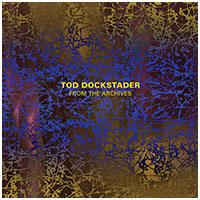
Discovering and Preserving a Legacy: Tod Dockstader: From the Archives


dockarch

Starkland ST-226

I’m gonna go out on a limb here and suggest that this disc is a major and important release.  The history of music includes a fair amount of instances in which a second look at a particular composer who had been neglected yields a rediscovery which places said composer to their proper place in history.  Such was the case with Mendelssohn famously rediscovering Bach and Sir Thomas Beecham championing the works of Hector Berlioz. Conductor Robert Craft brought the work of Anton Webern to a larger audience with his recording of the complete works back in the 1950s and, more recently, Michael Tilson Thomas did a similar favor for the work of Carl Ruggles.  Of course not every musico-archaeological effort yields great results but the present release would appear to be auspiciously positioned to bring delight to listeners as well as place its composer in a more appropriately prominent place in the history books.  Now we are treated to a previously unknown cache of musical treasures from such a master, the digital equivalent of discovering Tut’s tomb.  It is an amazing disc on many levels.

This recording is nearly as much the accomplishment of Starkland Records’ producer Tom Steenland as it is of the composer Tod Dockstader (1932-2015).  Starkland’s  first two releases were CD reissues of the composer’s four Owl Records albums from the mid-1960s. It was the musicological acumen of Steenland whose love for those albums that helped provide motivation for him to found Starkland Records and promote this important electronic composer to proper historical recognition.  Dockstader was, in turn, inspired by the very positive response to those reissues to end his thirty year hiatus and return to composing.  He subsequently released the three volumes of Aerial (2005-6) on Sub Rosa and two collaborations with David Lee Myers (whose thumbprint is to be found on the present recording as well), Pond (2004) and Bijou (2005).

As if all that weren’t quite enough a new chapter dawned shortly after Dockstader died in 2015.  He left behind his archive of tapes and record releases and something more.  Justin Brierly, a radio host, was a fan of Dockstader’s music and wanted to interview him for his show.  He contacted Tom Steenland who was able to put him in touch and he was able to visit and interview the composer on several occasions.  The composer’s daughter, Tina Dockstader Kinard, gave Brierly the computer tower containing work files which had been saved on that hard drive over the years. There were thousands of files in various stages of completion, some just sample files, some duplicates, but many complete or nearly complete compositions that had not been heard since they were created.  Brierly sorted through these and sent some 50 files to Tom Steenland who carefully selected 15 tracks for the present release.

Tod Dockstader was a composer with a day job, that is he worked as a film and sound editor and took advantage of his access to what would have been prohibitively expensive equipment at the time to create his own brand of electronic music.  Sadly Vladimir Ussachevsky denied him access to the Columbia-Princeton Studios back in 1961.

Stylistically he holds much in common with his antecedents Edgar Varese, Pierre Henry, Louis and Bebe Barron, Pierre Schaeffer as well as contemporaries such as Morton Subotnick and Andrew Rudin. His albums from the 1960s of course utilized the tape splicing techniques and analog equipment of the time.  Some of the music from his Eight Electronic Pieces (1961) album was selected (as were some of Andrew Rudin’s electronic compositions) for inclusion in the soundtrack for Frederico Fellini’s Satyricon (1969).

When he returned to composing in the late 1990s studios were digitally driven and computers ruled. He reportedly had little difficulty learning and using computers for his later works. Despite the change from analog to digital media however Dockstader’s style remained extremely consistent, a clear and unique voice in the musical landscape.

Prior to this release it had been thought that his last word musically was the three volume Aerial series of 2005-6.  Now Starkland presents this lovingly selected cache of the composer’s most recent works.  He had effectively stopped composing in 2008 wrestling with the ravages of dementia but did listen and comment at times with Brierly during his visits on some of these files and, fittingly, enjoyed the fruits of his own labors to the very end of his life in 2015.  There’s no doubt more of a story to be told there for sure and here’s hoping that we may soon see a comprehensive biographical and musical assessment of his work.

For the wonderful liner notes Steenland recruited Geeta Dayal,  a San Francisco based writer whose writings on music can be accessed from her website and are well worth your time to investigate.  She comes with quite a pedigree as a writer on the subject of electronic music both old and new.  Her liner notes are both authoritative and good reading.  She would be my vote for a Dockstader biographer.

The exact intentions of the compositional process cannot be determined (Dockstader left no notes about these files) but it seems clear that these are all late period pieces.  They are all dated between 2005 and 2008.  The titles of these pieces were made based in part on the computer file names for the pieces which had not gotten their final naming by the composer.  One can only imagine the labor of love involved in Brierly’s and Steenland’s distillation of these final 15 tracks but the end result is a very satisfying collection consistent in quality to previous releases and a worthy representation of his last works (though this reviewer is given to hopeful wonder that a volume II might emerge in the near future).  At any rate Dockstader’s legacy is now secure and no doubt there will be much research done on his work made easier now by the dedicated sleuthing of these producers.

The first track, Super Choral (2007) contains some collaboration with David Lee Myers as mentioned earlier and it is used with his permission.  I won’t try to describe the rest of these pieces except to say that they seem to be a worthwhile contribution to the art of electronic music, are excellently crafted and eminently listenable.

The liner notes with their studio porn images of Dockstader’s beloved Ampex machines are tastefully mixed with images of the composer and his family.  The mastering was done by the wonderful Silas Brown and is about as good as it gets.  I can’t imagine a more fitting tribute to the composer’s legacy than this and I can’t imagine this not being nominated for a Grammy.  Bravo gentlemen!

Release is scheduled for November 18th.  You can pre-order both the download and the physical disc on Amazon.


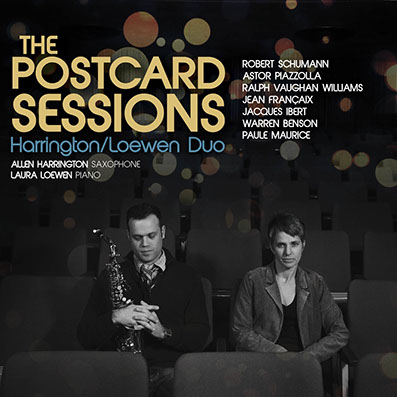
The Postcard Sessions, Saxophone and Piano


harrington loewen cover

Ravello RR 7934


It has always seemed to me that the saxophone has had a difficult time integrating into the mainstream of classical performance.  Since its invention by Adolphe Sax in the mid 19th century this family of instruments has amassed a somewhat limited solo repertoire and has only really made it as an orchestral instrument in the twentieth century.  The subsequent adoption of these instruments at the forefront of jazz and pop has forever changed the perception of this hybrid woodwind/reed/brass instrument which, for those who segregate musical genres, complicates matters even more.

It is the twentieth century that this album represents and it is the classical voice, not jazz or pop which speaks here.  This intelligently chosen set of pieces is like a little tour of the saxophone and piano literature representing some of the best of the early to mid twentieth century repertoire.  If that makes it a niche market then so be it, it is a lovely niche.

Now Robert Schumann (1810-1856), whose work opens this disc, is hardly a twentieth century composer but these transcriptions by Frederick Hemke (long time saxophonist of the Chicago Symphony and a highly respected teacher) are definitely contemporary and work well for saxophone and piano.  Drei Romanzen Op. 94  (1849) are originally for oboe and piano.

Tracks 4 and 11 contain pieces by Astor Piazolla (1921-1992), the Argentinian composer best known for his work with the tango forms.  Here we have two film music excerpts in apparent transcriptions.

There are four other sets of pieces on this recording by Ralph Vaughn Williams (1872-1958), Jean Francaix (1912-1987), Jacques Ibert (1890-1962) and Paule Maurice (1910-1967). The Vaughn Williams Folk Song Suite is originally for cello and piano and is vintage Vaughn Williams at his English folk song best.  The Ibert and the Francaix are suites of the sort of nervous, jazz inflected music that characterized an era between the wars.  Paule Maurice is a new name to this listener and the artists are to be commended for their part in saving her work from obscurity.

The Aeolian Song by Warren Benson (1924-2008) is probably one of the best known (and deservedly so) pieces on this disc.  This is actually the slow movement of a concertino for saxophone and orchestra but has become a sort of recital classic in its incarnation for saxophone and piano.

The Harrington/Loewen Duo are based in Canada and that may be their only flaw.  The curious but annoying lack of attention to the musicians who are our neighbors to the north is certainly mitigated to some degree by this release.  It is a lovely recital and the musicians are both committed and creative.  One hopes for another volume of recital pieces to follow this delightful release.

Lara Downes Making Magic at Noon in San Francisco


cordell0007

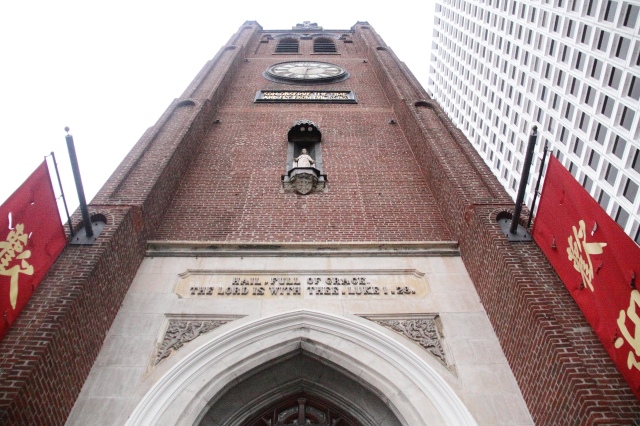
Old St. Mary’s Cathedral in San Francisco

A much needed light rain fell as I ventured out to hear Lara Downes play at the noontime concert series at Old St. Mary’s Cathedral in San Francisco’s Chinatown neighborhood.  I had just recently reviewed this artist’s new CD release (here) and I jumped at the opportunity to hear her live.

The trip from my home in Alameda to this venue, a distance of some 15 miles took me almost two hours.  Construction rules right now.  In the course of the concert Ms. Downes commented that it took her 45 minutes to get there from her hotel in San Francisco (no doubt less than 2 miles).

Being familiar with this trip I managed to arrive at about 12:15PM.  When I arrived I was a bit surprised to find a service in progress so I sat quietly observing this beautiful little church.  Though raised Catholic I haven’t ventured into a church in some years.  The experience did place a sort of spiritual context on my concert experience.

cordell0002

Priest saying mass at Old St. Mary’s Cathedral

The service ended a little after 12:30 and, after some of the congregants left I moved closer to the front.  Technicians moved the piano in place and Ms. Downes was introduced.

cordell0004

Downes intensely focused as she plays Schumann’s Fantasy Pieces

She chose to open with Robert Schumann’s (1810-1856) Op. 12 Fantasy Pieces Nos. 1, 2, 3 and 5 (1837).  I have but a passing knowledge of Schumann’s music.  It is highly virtuosic romanticism. Beautiful melodies, classical harmonies with just a dash of dissonance and a very high level of technical difficulty which characterizes these pieces.  Downes played them with confidence and ease seemingly casting a spell as she did.  She played the set without interruption and received much deserved applause from the somewhat sparse audience of perhaps 50 or so people.

She followed with a selection from her upcoming release America Again, Samuel Coleridge-Taylor’s (1875-1912) setting of the spiritual Deep River Op. 59 No. 10 (1905), one of a set of 24 so-called “Negro Melodies”. Coleridge-Taylor was a black British composer of the late 19th century sometimes referred to as the “African Mahler”.  This setting, very much in the same spirit as the Schumann was pretty much what one might have expected had Schumann encountered black spirituals.  This selection added again to the spiritual dimension.  Deep River is a majestic and celebratory piece which, like the Schumann, was well received.

Downes deviated from the printed program to play another selection from that forthcoming album, Morton Gould’s (1913-1996) American Caprice.  This short piece was a delightful foray into jazz reminding us of Gould’s connections with his contemporaries like Aaron Copland and George Gershwin.  Gould is a composer whose work deserves more attention and this listener is grateful to the artist for bringing this little masterpiece back into the light.

cordell0006

Downes making Rhapsody in Blue sound anew.

In some ways this functioned like a precursor to the next piece on the program, Gershwin’s (1898-1937) Rhapsody in Blue (1924) in the composer’s arrangement for solo piano. Downes, whose speaking was as comfortable and natural as her playing, asked the audience to try to hear this oh so familiar piece with new ears.  Indeed her fluid and dynamic playing put her own stamp on this popular gem and demonstrated again her seasoned virtuosity.  She played the work with passion but also with ease and confidence.

The ample applause and standing ovation brought her back for a wonderful encore.  It was Gershwin again for sure but this time in an amazing arrangement by Nina Simone (1933-2003) whose spirit seemed to be channeled by Downes.  “I loves you Porgy” from Porgy and Bess is featured on her new CD and it brought the afternoon to a very pleasing close.

I took the opportunity to meet and thank Ms. Downes who was, in turn, gracious and pleasant.  I went back out to the ordinary world charmed and invigorated and that is what I had hoped for.


Not Your Momma’s Theremin: Carolina Eyck’s Fantasias for Theremin and String Quartet


eyck-fantasias

Butterscotch BSR-015 featuring cover art by Carolina Eyck

The Theremin, named after its inventor Leon Theremin (1896-1993), is an early electronic instrument which is controlled by the positioning of the performer’s hands in relation to two antennae.  One controls volume, the other pitch.  That’s it, a simple instrument but one which has had a tremendous impact on music and on the subsequent development of more sophisticated electronic instruments.  Perhaps it is best known for the brilliantly chilling effect created by Bernard Hermann’s use of it in his score for The Day the Earth Stood Still (1951).  Its subsequent appearance in the Beach Boys’ Good Vibrations (1966) was a testament to the instrument’s durability.

lydia_termen

Lydia Kavina with Leon Theremin

clara-rockmores-lost-theremin-album

Clara Rockmore on her Bridge Records album

While several people, most notably Clara Rockmore (1911-1998) and Lydia Kavina (1967- ), have performed as soloists with the instrument it seems to have remained a niche phenomenon as a solo instrument.  This release by Carolina Eyck (1987- ) appears to begin a new era (or at least wider niche). Eyck is a gifted composer as well as a virtuoso and she uses a modified instrument, apparently with midi controlling capabilities (she uses an instrument made by Robert Moog of Moog Synthesizer fame). Many composers have also written new works for her Including Kalevi Aho whose Concerto for Theremin and Orchestra has been recorded by its dedicatee.  Lydia Kavina was a protege of Leon Theremin as well as Eyck’s first teacher thus creating an unbroken musical lineage.  This youngest practitioner now leads the way to the next generation of performance and composition for this 1919 invention.

lydia_concert07

Recent photo of Lydia Kavina at a concert

The present release Fantasias for Theremin and String Quartet (2016) is Eyck’s ninth album in eight years.  I have not heard the previous eight albums but after hearing this one I do plan to seek them out.  The works presented here showcase both virtuosity and compositional invention of a high level.  I have enjoyed this album immensely.

600px-carolina_eyck_playing_the_theremin

Carolina Eyck in performance (from Wikipedia)

The six works on this disc have a post-minimal/impressionistic quality and do much to showcase the vocal like qualities of the instrument as well as the extended capabilities of Eyck’s customized personal choice of instrument.  She is accompanied here by the string quartet of the American Contemporary Music Ensemble (ACME) consisting of Caroline Shaw and Ben Russell, violins; Caleb Burhans, viola; and Clarice Jensen, cello.  They play beautifully together.

There is an “essay” by recording engineer Allen Farmelo which goes more into the conceptual context of the recording than the music.  Much is made of this disc being conceived for (vinyl) LP though it has not been issued as such as far as I can tell.  (Correction:  It has been brought to my attention that this recording is available on vinyl) The recording is lucid and listener friendly and the “LP” concept might explain why this disc is shorter than the average CD.  It is, despite its brevity, a lovely production and well worth your time.  Eyck, who also created the beautiful cover art, is an interesting artist at the beginnings of what looks like a great career as both composer and performer.


Delightfully Stepping into the Limelight: Frederic Hand’s Odyssey


hand

Many musicians labor tirelessly sometimes just on the edge of visibility giving their best regardless of whether or not they are publicly recognized outside of a relatively small select audience.  Such is the case with Frederic Hand (1947- ), a guitarist and composer who studied with Julian Bream and who works with a wide variety of musicians and performs as soloist and guest artist in a steady touring schedule.  He is on faculty at SUNY Purchase as well as Bennington and Mannes (where he studied).  Hand is also known for his compositions for film and television but it is his role as official guitarist of the Metropolitan Opera that most seems to inform this album.

As is sometimes my practice I put this CD on in the background whilst tackling other chores.  At first I thought I was hearing some obscure but highly entertaining music by composers unknown to me.  As it turns out all but one composition here are by the artist. This delightful collection of pieces reflect the artist’s deep knowledge of the guitar literature, especially that of the 18th, 19th and early 20 centuries.  They also reflect the musician’s intimate acquaintance with his instrument.

The musical language here is conservative classical/romantic basically, very listenable.  No apologies need be made for this, rather this is the very essence of this album.  Hand’s transcriptions of folk songs and original compositions embody a sort of troubadour spirit. One can visualize him playing in some intimate setting or perhaps onstage as a small part of a huge opera production.  In either scenario the artist succeeds very well in communicating with his audience and that is the point.

I have listened to this album many times over and find it endlessly entertaining.  There are 12 tracks, ten are for solo guitar, one for flute and guitar and one for two guitars.  Only the last, the Dance of the Blessed Spirits, is related to opera and is the only truly non-original composition.  The rest are transcriptions, interpretations of folk songs or original compositions.  Hand has published quite a few compositions.

The first track, Cantiga de Santa Maria is a song transcription that clearly demonstrates the composer’s mastery of the guitar idiom.  It sounds like it is as much fun to play as it is to hear.

Prayer, the second track, is an original composition written initially for two guitars and, by some magic, transcribed for a single guitar.

The next four tracks are transcriptions of Four Sephardic Songs.  As with a previously reviewed recording (here), Hand mines the rich trove of late Renaissance songs of this nearly forgotten Spanish/Jewish culture.

The Water is Wide is the composer’s transcription (with a partly improvised middle section) of a Scottish folk song.

The album’s title track, Odyssey, is another piece for guitar duo.  This time we get to hear the duo version with the assist of guest artist David Leisner.  Written for a guitar festival in Crete, this is one of the albums most substantial and deeply felt works.

Sophia’s Journey is the composer’s tribute to his granddaughter.  It is another example of his ability to write a great piece of music in a very approachable and satisfying compositional medium.

For Julian is the artist’s tribute to his teacher Julian Bream.  It is this reviewer’s favorite track and one which properly pays homage to Hand’s wonderful teacher.

A Psalm of Thanksgiving enlists the services of Jayna Nelson on flute in this lovely meditation on the 100th Psalm.

Finally there is the transcription of Gluck’s Ballet and Dance of the Blessed Spirits.  This popular excerpt from his opera Orfeo ed Euridice (1762) is, in a way, the composer’s tribute to this work and his own role as troubadour of the stage.

All in all a lovely collection that will continue to find its way to my CD player.

Black Notes Matter: Lara Downes’ America Again


laradownes

Sono Luminus DSL-92207

The lovely cover photo for this album by San Francisco born pianist Lara Downes is reminiscent of any number of socially conscious folk/rock stars of the 60s and 70s. It would seem that this is no accident.  This delightful album of short pieces by a wide variety of American composers takes its title from the Langston Hughes (1902-1967) poem, Let America Be America Again (1935).  By so doing the pianist places this interesting selection of short piano pieces firmly in the context of black racial politics and the artistic expression of black America as well as those influenced by this vital vein of American culture (both musical and literary).  It is a graceful and deeply felt effort and I hope that the metaphor of the title of my review is not too tortured a one to reflect that.

This is also a very personal album.  Downes seems to share some deeply felt connections with her materials.  This artist, born to a white mother and a black father, invokes a careful selection of short piano pieces steeped sometimes in jazz and blues but also the political directness (and optimism) which was characteristic of the inter-war years that brought forth the Hughes poem.  There is both sadness and celebration in these virtuosic and technically demanding little gems (most apparently recorded for the first time or at least the first time in a while).  The pianist’s comments on each individual piece are also critical to the understanding of this disc as she shares the impact and meaning that the music has had for her.

There are 21 tracks by 19 composers in all and the selections themselves are quite a feat. They range from the 19th to the 21st centuries and are composed by both men and women of a variety of racial and ethnic backgrounds.  All seem to share the sort of  populist charm befitting the idealized America yearned for in the poem which is to say that they represent a kind of idealized or hopeful nationalism.  Downes is well acquainted with a large variety of American music and recognizes no distinction between classical and so-called “vernacular” traditions.

In fact none of these things are atypical for this artist.  Her previous albums Exiles Cafe (2013) featured music by composers exiled from their homelands, A Billie Holiday Songbook (2015) celebrated the life of this iconic black artist and her American Ballads (2001) demonstrated her deep mastery and affection for populist (but not jingoistic) nationalism.  Her tastefully issue oriented albums define a very individual path and the present album appears to be a very logical and well executed next entry into her discography.

This disc shares a similar heritage to that of Alan Feinberg’s four discs on Argo/Decca entitled, The American Innovator, The American Virtuoso, The American Romantic and Fascinating Rhythm: American Syncopation.  Another notable antecedent is Natalie Hinderas’ groundbreaking two disc set of music by African-American composers.

And now on to the music:

Morton Gould (1913-1996) was a Pulitzer Prize winning composer and conductor with a style informed by his study of jazz and blues in a vein similar to that of Bernstein and Copland.  He is represented here by American Caprice (1940).

Lou Harrison (1917-2003)  was a composer, conductor and teacher.  He was a modernist and an innovator in the promotion of non-western musical cultures.  His New York Waltzes (1944-1994) are three brief essays in that dance form.

The traditional folk song Shenandoah (apparently in the pianist’s transcription) is next.   This tune will be familiar to most listeners as a popular selection by choral groups and the melody is a common metaphor for things American.

Amy Marcy Cheney Beach (1867-1944) was one of the first successful female American composers.  Her “From Blackbird Hills” Op. 83 (1922) is representative of her late romantic style and her incorporation of Native American (Omaha) elements in her music.

Samuel Coleridge-Taylor (1875-1912) is a English composer with Creole roots, a black composer, known as the “African Mahler” in his day.  Deep River (1905) is his setting of this spiritual which also was one of Marian Anderson’s signature pieces.

Dan Visconti (1982- ) was commissioned by the International Beethoven Festival to write his Lonesome Roads Nocturne (2013) for Lara Downes.  It receives its world premiere recording in this collection.

Swiss-American composer and teacher Ernest Bloch (1880-1959) is certainly deserving of more attention.  His At Sea (1922) is used here to represent the sea voyages of the many immigrants (willing and unwilling) whose journey defined in part who they were.

George Gershwin (1898-1937) mastered both the vernacular tradition (as one of the finest song writers of the 20th Century) and the classical tradition in his too few compositions written in his sadly abbreviated life.  His opera Porgy and Bess (1935) is contemporary with the Langston Hughes poem mentioned earlier.  Downes most arrestingly chooses the arrangement of “I loves you, Porgy” by the classically trained iconic singer, musician and civil rights activist Nina Simone (1933-2003).  Quoting from Downes’ notes (Nina Simone expresses what she knew) “…about being a woman, being black and about being strong and powerless all at the same time.”  Indeed one of the most potent lines of the Hughes poem reads, “America was never America to me.”

Angelica Negrón (1981- ) was born in Puerto Rico and  now lives and works in New York. Her Sueno Recurrente (Recurring Dream, 2002) is a lovely little nocturne which is here given its world premiere.

Leonard Bernstein (1918-1990) held credentials as composer, conductor, teacher and ardent civil rights supporter.  His Anniversary for Stephen Sondheim (1988) is one of a series of Anniversary piano pieces he wrote.  Bernstein did much to help modern audiences (including this reviewer) comprehend the vital musicality of jazz and blues. Like Downes, he drew little distinction between popular and classical and celebrated all the music he believed was good.

David Sanford (1963- ) is a trombonist, teacher and composer who works in both classical and jazz idioms.  His work Promise (2009) was written for Downes and this is the world premiere recording.

Howard Hanson (1896-1981) was a conductor, teacher and Pulitzer Prize winning composer (though not at all an advocate of ragtime, jazz or blues).  His brief but lovely piano piece Slumber Song (1915) is a nice discovery and one hopes that it will be taken up by more pianists.

Scott Joplin (1867/68-1917) was discovered largely due to the scholarship and recordings of musicologist Joshua Rifkin (who incidentally did some arrangements for folkie Judy Collins) whose three volumes of piano rags on Nonesuch records introduced this wonderful black composer’s work to a wider audience once again.  Marvin Hamlisch famously incorporated Joplin’s music into his score for the motion picture The Sting (1973).  Downes chooses the Gladiolus Rag (1907) to represent this composer.

Irving Berlin (born Israel Isidore Baline 1888-1989) is another of the greatest song composers this country has produced.  In another characteristically clever choice Downes chooses the arrangement of this hugely optimistic song, “Blue Skies”(1926) by the great jazz pianist Art Tatum (1909-1956).

Florence Price (1887-1953) was a black female composer (the first to have one of her orchestral works programmed by a major symphony orchestra) whose work is only recently getting some much needed exposure.  Her Fantasy Negre (1929) is based on a spiritual, “Sinner, Please Don’t Let This Harvest Pass”.  Price was involved in the New Negro Arts Movement of the Harlem Renaissance and was professionally connected with Langston Hughes among others.

Aaron Copland (1900-1990) is perhaps the most iconic American composer.  Dubbed the “Dean of American Composers” his earliest work has strong jazz influences and his later work created the American romantic/nationalist sound incorporating folk songs and rhythms.  For this recording the artist chose the first of the composer’s Four Piano Blues (1926) which also appeared on her 2001 album of American Ballads.

Edward Kennedy “Duke” Ellington (1899-1974) was a composer and band leader whose sound virtually defined the Harlem Renaissance during his tenure at the famed Cotton Club.  Melancholia (1959) is the piece chosen here, again a nice little discovery.

Roy Harris (1898-1979) was, like Copland, a populist but the Oklahoma born composer studied Native American music as well as American folk songs.  His American Ballads (1946) was included on Downes’ American Ballads album.  Here she includes an unpublished work from a projected (but never finished) American Ballads Volume II.  This piece is a setting of the spiritual, “Lil Boy Named David”.

The album concludes with one of the ultimate hopeful dreamer songs, Harold Arlen’s (1905-1986) Over the Rainbow (1939) from his score for The Wizard of Oz (1939).  The adolescent yearning of Dorothy for something better than her dust bowl farm life touched a chord in many over the years and it is a fitting conclusion to this beautiful and hopeful collection.

As mentioned earlier the insightful liner notes by Lara Downes complement this production and tactfully position its politics.  She shares a personal journey that is as American as the proverbial apple pie.  The album is dedicated to the artist’s ancestors in recognition of their struggles as well as to her children in hopes that dreams for a better future can become their reality.

This beautiful sound of this album is the result of work of Producer Dan Merceruio and Executive Producer Collin J. Rae along with Daniel Shores and David Angell.  The lovely photography is by Rik Keller and as with the previous release Skylark: Crossing Over (reviewed here) the graphic design by Caleb Nei deserves special mention for its ability to truly complement this disc.

It is scheduled for release on October 28, 2016.


A shamanic effort to raise consciousness and further socially progressive ideas.

Traceur, American Music for Clarinet and Piano


traceur

New Focus Recordings FCR-172

This is a nice little program of pieces for clarinet and piano by 20-21st century composers. It might even be a representation of the state of the art for this genre.  All of these pieces are basically tonal and would work well in a recital.

Michael Norsworthy, professor of clarinet at Boston Conservatory at Berklee has an impressive set of credentials in the interpretation and performance and teaching of new music.  This performing academic has quite a list of recordings to his credit.

David Gompper is a composer and pianist with a similarly extensive set of credentials in support of new music (his own and others’).

The disc opens with a six movement suite of short pieces by Robert Beaser (1954- ) called, Souvenirs (2001-2).  Beaser is one of the finest composers of his generation and his tonal style was a hallmark of his work from the very beginnings.  These short, personal sketches are a delightful example of his work.  These pieces were originally written for piccolo and piano and are here presented in the composer’s transcription for clarinet and piano.

The next piece, Black Anemones (1980) is originally for flute and piano and is a sort of modern classic (here is a recent review of the flute and piano version).  The Pulitzer Prize winning Joseph Schwantner (1943- ) is also among the finest composers working today. This transcription for clarinet by Mr. Norsworthy will most certainly guarantee further performances.  This is truly lovely music inspired by poetry of Agueda Pizarro.

Three American Pieces (1944-5) by Lukas Foss (1922-2009) are another sort of classic set of pieces.  These are early compositions in a neo-classical/nationalist style characteristic of this period of Foss’ compositional style.  It is great to have a new recording of these entertaining pieces.  Foss is due for a reckoning I think.

Marti Epstein (1959- ), also a professor at Berklee was represented in an earlier review of a disc (here) dedicated entirely to her gentle music imbued with memories of her upbringing in the great plains of the Midwest.  Nebraska Impromptu (2013) is characteristic of this composer’s gentle but substantial music.  Her website also contains a very interesting occasional blog that is worth your time.

Derek Bermel (1967- ) is here represented by schiZm (1993-4).  Originally for oboe and piano the composer also made this transcription for clarinet and piano.  Bermel describes some of the fascinating techniques that underlie the structure of this two movement piece but the result of those techniques is a very interesting piece of music.

Last but definitely not least is the title track Traceur (2014-5) by composer/pianist David Gompper (1954-).  It is the longest and most complex of the pieces presented and requires the most involvement on the part of the musicians as well as the listener.  I don’t mean to imply that this is difficult music because it isn’t.  It is substantial music whose charms demand close listening, an effort for which one will be rewarded.

This lucid recording was produced by Norsworthy and Gompper (with the assistance of Robert Beaser in the recording of his work).  It was recorded in 2015 with editing and mastering by Patrick Keating.  Very nice disc.  Highly recommended.


Oh, No! Not Another Minimalist! Lubomyr Melnyk, Fastest Fingers in the West, Makes Major Label Debut


I first encountered the music of this undeservedly obscure but unique composer/pianist in the late 1980s with the purchase of a double vinyl album of his “Lund-St. Petri Symphony” a work for solo piano which is stylistically one of the tributaries of minimalism.  Melnyk was born in Germany of Ukrainian descent and now lives and works in Canada.  I began this article for inclusion in my series about minimalist composers (the designation of “minimalist” is imposed by the author and is not necessarily the identity embraced by the artist).  In addition to providing a sketch of the artist I am pleased to be able to review this major label release.

melnyk

Sony

Ilirion marks this composer/pianist’s big label debut and this is a fitting recognition for this long established composer, pianist and teacher.  Lubomyr Melnyk (1948- ) has been performing since the 1970s and has released over 20 albums.  His web site is in need of updating and here’s hoping that this release will help provide the impetus for that and for the greater distribution of this artist’s work.

Below is the description of Melnyk’s music from his web site:

Melnyk’s Continuous Music is based on the principle of a continuous® and unbroken line of sound from the piano — this is created by generating a constant flow of rapid (at times EXTREMELY rapid) notes, usually with the pedal sustained non-stop. The notes can be either in the form of patterns or as broken chords that are spread over the keyboard. To accomplish this requires a special technique, one that usually takes years to master — this technique is the very basis of the meditative and metaphysical® aspects within the music and the art of the piano.
Moreover, in his earlier works, Melnyk devoted much attention to the overtones which the piano generates, but in his more recent works, Melnyk has become more and more involved with the melodic potential of this music.
Melnyk’s earlier music was generally classified as Minimalism®, although Melnyk strongly refutes that term, preferring to call his music MAXIMALism®, since the player has to generate so many, many notes to create these Fourth Dimensions of Sound®.
Because his piano music is so difficult and requires a dedicated re-learning® of the instrument, no other pianists in the world (so far) have tackled his larger works — and so, his recordings are truly collector’s items (both as LP-s and CD-s).
He has however recorded extensively for the CBC in Canada, as well as various European stations. He has performed and given lecture-recitals across Canada and in Europe. 

I’m not sure how useful this explanation will be to listeners but I think it’s important to acknowledge that the composer has attempted to establish a system explaining his work. However one does not need to be deeply familiar with the underlying theory to appreciate the music.  One does not need to understand Schoenberg’s twelve tone theories or Anthony Braxton’s far out ideas to appreciate their music.  One doesn’t even need to understand the basics of western classical harmony to appreciate Mozart, for that matter but such knowledge can contribute to appreciation.  I certainly lay no claim to understanding this man’s music and I am not aware of any musicologists or critics who have written anything analyzing Melnyk’s work but I find his music compelling and worth wider attention.

Rather than attempting a comprehensive review of Melnyk’s output (and risking muddying the field) I am simply going to recommend a couple of discs which I have found particularly interesting and may help put this latest release in useful perspective.  The disc which is intended to provide a sort of exposition of his work is KMH.

kmh

The other disc, and the one which I have admired most, is the Lund St. Petri Symphony.  I bought it as a two disc vinyl album and it does not appear to be easily available now but it is well worth seeking (and maybe Sony will consider re-releasing it).

lund

The present release on Sony contains 5 tracks:

Beyond Romance is the first and longest track on the disc (16:12) and is certainly representative of his work.  The composer’s brief notes describe this work only as a grand romantic piece.  It perhaps has echoes of Liszt but certainly with at least an echo of minimalism.

Solitude No. 1 is a much briefer piece (7:36) and is a live improvisation by the composer recorded in the Netherlands.

Sunset (3:49) is the briefest on the disc and is an impressionistic description of its title.

Cloud No. 81 (16:02) is a far more extended impressionistic essay with more harmonic variety than the other tracks.

The title piece, Ilirion (14:12) is another extended essay more akin to the first track.

These discs range from interesting to enthralling for this reviewer and the limited descriptions contained in this release do little to guide the listener.  So I guess I can only say, “Please listen”.

Tracks 1, 3, and 4 were recorded at Clearlight Studios in Winnipeg, Canada.  Track 2 is a live recording from Tilburg, Netherlands and the last track is described as being an archive recording from also from Tilburg.  All were recorded between 2012 and 2015.

The rather sparse liner notes are by one Charles Bettle who is described as a “long time friend and admirer” of Melnyk’s work.  The even sparser notes on the music are by the composer.  The beautiful photography is by Alexandra Kawka.

It is difficult to say why this artist remains as marginally known but, as I have asserted before, artists from Canada get strangely little notice here and Mr. Melnyk does not appear to be a very good publicist.  I hope that this endorsement by Sony results in more releases and, more importantly, in more good studio recordings of his work.  It is unique and highly recommended to aficionados of piano music and minimalism.

Jennifer Koh, Putting Tchaikovsky in Context


tchaikoh

Cedille CDR 166

Let me start here with a confession:  I have never been a real big fan of the Tchaikovsky Violin Concerto.  However I am a huge fan of Jennifer Koh and of Cedille Records in their intelligent productions which place music like this in a more proper context.  The usual pairings of this concerto with Brahms or Beethoven only seem to highlight the distinct difference in style rather than a context more conducive to the appreciation of the music. Another problem with Tchaikovsky is that his reputation tends to hang on the 1812 Overture, the Violin Concerto, the first Piano Concerto and the last three Symphonies.  He wrote a lot more than that (including ten operas and three string quartets).

Now with that bit of whining out of the way let’s take a look at the recording at hand.  Jennifer Koh is one of the shining lights of contemporary violin soloists and that alone should be sufficient recommendation to listen to any of her recordings or performances. She holds a special place in this reviewer’s heart for her attention and expertise with contemporary music and for having performed the solo violin part in the most recent production of Philip Glass’ Einstein on the Beach.  In costume with a shaggy wig she brought new and highly virtuosic life to that obbligato violin part.

It is her virtuosity and her perspective as one of the more recent generations of artists to wield this classic string instrument that holds the main interest here.  The Tchaikovsky concerto has been the darling of all the great violinists from Heifetz and Kreisler to Milstein and Stern. I suppose that every violinist must confront this work at some point and it is a genuine challenge as well as a showpiece for virtuosity.

The other works on this disc (which are presented chronologically) are the Serenade Melancolique Op. 26 (1875), the Valse-Scherzo Op. 34 (1877) followed by the Concerto Op. 35 (1878) and finally the Souvenir d’un lieu cher Op. 42 (1878, originally for violin and piano orchestrated by Alexander Glazounov and published in 1896).  Hearing this concerto in the context of the composer’s other works for violin and orchestra does more clearly delineate the composer’s process.

In addition to providing a complete accounting of Tchaikovsky’s violin and orchestra music listeners are able to hear the interpretation by this wonderful artist.  Indeed she does truly grasp the grand romantic sweep of the concerto and the more intimate shorter works. Let me say too that if you like the concerto you will also find much delight in the shorter works which frame it on this disc.  Her virtuosity shines and Koh’s ability to handle romantic as well as modern repertoire certainly mark her as a versatile modern master.

Of course one can’t miss the powerful contribution of the orchestra in considering these performances.  The Odense Symphony Orchestra (Denmark) is absolutely stunning in its clarity and drive.  The conductor Alexander Vedernikov is of Russian musical royalty (both his parents were accomplished musicians) and was the conductor of the Bolshoi from 2001-2009.  He is definitely a name to follow and his feel for this music of his homeland is most genuine and exciting.

This truly excellent recording is produced by Grammy winning veteran producer Judith Sherman.  Session engineering is by Viggo Mangor with post-production and editing respectively by Bill Maylone and Jeanne Velonis.  Audiophiles might even want to have this disc for the sound alone.  It’s that good.

In Celebration of a Lost Culture: Sephardic Journey by the Cavatina Duo


cavaduo

Cedille CDR 9000 163

This tasty little disc of world premieres commissioned through grants to Cedille Records in Chicago consists of new works which celebrate the culture of the Sephardim, the Jews of southwestern Europe, primarily Spain.  It both memorializes and resurrects the rich music of this all but lost culture.  In the last few years we have seen a growing interest in this culture through settings of texts in the original Ladino language as well as in the melodies which sprang from their folk traditions.

The Cavatina Duo consists of Eugenia Moliner, flute and Denis Agabagic, guitar.  Moliner is originally from Spain and Agabagic is originally from Yugoslavia (now Bosnia-Herzegovina) and they are husband and wife.  Both have a strong interest in the folk musics of their respective cultures and in exploring other folk music cultures.  Their previous album for Cedille, The Balkan Project, similarly demonstrates their affection and scholarship for the cultures of that region of the world.

Five composers were commissioned for this project: Alan Thomas (1967- ), Joseph V. Williams II (1979- ), Carlos Rafael Rivera (1970- ), David Leisner (1953- ) and Clarice Assad (1978- ).  This is one of those wonderful crowd funded efforts through Kickstarter.

Thomas’ contribution adds a cello (played by David Cunliffe) to the mix for this Trio Sephardi in three movements each of which is based on a traditional Sephardic song.  The piece makes good use of the vocal qualities of the songs quoted and the lyrics seem to exist as a subtext even though they are not sung here.

Isabel by Joseph V. Williams is a sort of homage to Isabel de los Olives y López, a Sephardic woman who lived during the time of the Spanish Inquisition.  She outwardly converted to Catholicism but lived secretly as a Jew.  One can hardly miss the sad irony of this tale of religious intolerance from the 15th century and its relevance for today.  This piece is based on a resistance song which masquerades as a love song, again a metaphor for our times.  It is scored for flute and guitar.

We move again into the realm of the trio, this time with violin (played by Desiree Ruhstrat), for this piece by Carlos Rafael Rivera called, “Plegaria y Canto”.  This is the most extensive single movement amongst all the works on the disc and is a deeply affecting and dramatic piece for which the composer’s notes provide insights.

The last two pieces utilize the forces of the Avalon Quartet for whom this is their second appearance on the Cedille label.  Their first disc, Illuminations, was released last year. They are currently in residence at Northwestern University and Cedille does a great job of promoting the work of talented Chicago area musicians.

Love and Dreams of the Exile is David Leisner‘s poignant contribution.  Its three movements tell an aching tale of love, pain and, ultimately, transcendence.

Clarice Assad is a Brazilian composer too little known in the U.S.  She is indeed related to the famed Assad family of musicians and she clearly has as abundant a talent.  Her Sephardic Suite concludes this program with this three movement essay on love and relationships.

Bill Maylone is the engineer with editing by Jean Velonis and the executive producer is James Ginsburg.  Photography of the Alhambra Palace by Maureen Jameson graces the cover.  Design is by Nancy Bieshcke.

This is music of an oppressed culture and it is tempting to look upon the creative impetus which oppression sometimes seems to provide but the message here is one of sadness and nostalgia but also of hope.  It is perhaps a tribute to the ultimate triumph over said oppression even if it took 500 years.  There is some comfort and healing to be had from the celebration of this lost culture and that is the triumph of this disc.


The Anniversary That (almost) Everyone Missed: Bill Doggett (1916-1996), Wizard of the Hammond Organ


doggettcombo1956

Bill Doggett with his combo (getty images)

William Ballard Doggett, better known as Bill Doggett was born in Philadelphia in 1916 and was introduced to music by his church pianist mother.  He played in a combo while still in high school and went on to work with a plethora of stars in rock, jazz, rhythm and blues amassing a string of hits but, sadly, seems to have barely been noticed on this the 100th anniversary of his birth.  Where is NPR at a time like this?

Well, all is not lost.  Fortunately his nephew and namesake Bill Doggett is doing justice to the memory of this important American musician.  This younger Doggett is an archivist, lecturer, curator, strategic marketer, photographer, filmmaker, and arts advocate (his website is well worth your time).  I am hardly as well prepared to provide more than an overview of this musician’s work but I feel obliged to do my small part in recognizing this man’s work.

doggettposter

Promotional poster for the September 28, 2016 centennial celebration curated by nephew and namesake, Bill Doggett.

Doggett’s list of chart singles:

  • “Be-Baba-Leba” (vocal by Helen Humes) (Philo/Aladdin 106) 1945 (#3 R&B)
  • “Moon Dust” 1953 (#18 R&B)
  • “Early Bird” 1953 (#21 R&B)
  • “No More In Life” 1953 (#20 R&B)
  • “High Heels” 1954 (#15 R&B)
  • “Honky Tonk, Part 1″/”Honky Tonk, Part 2” (King 4950) 1956 (#1(14) R&B/#2(3) Pop)
  • “Slow Walk” (King 5000) 1956 (#4 R&B/#19 Pop)
  • “Ram-Bunk-Shush” (King 5020) 1957 (#4 R&B)
  • “Soft” 1957 (#11 R&B)
  • “Leaps And Bounds, Part 1″/”Leaps And Bounds, Part 2” (King 5101) 1958 (#13 R&B)
  • “Blip Blop” 1958 (#11 R&B)
  • “Hold It!” (King 5149) 1958 (#3 R&B)
  • “Rainbow Riot, Part 1″/”Rainbow Riot, Part 2” (King 5159) 1959 (#15 R&B)
  • “Monster Party” (King 5176) 1959 (#27 R&B)
  • “Yocky Dock, Part 1″/”Yocky Dock, Part 2” (King 5256) 1959 (#30 R&B)
  • “Honky Tonk, Part 2” 1961 (#21 R&B)


  • doggetthonky

    Doggett’s best known work.

While his last chart hit was 1961 his collaborations with  Lucky MillinderFrank FairfaxJimmy Mundythe Ink SpotsLouis JordanJohnny Otis, Wynonie Harris, Ella Fitzgerald, Louis Armstrong, Count Basie,  Lionel HamptonRed Holloway, Clifford Scott, Percy France, David “Bubba” Brooks, Clifford Davis, and Floyd “Candy” Johnson; guitarists Floyd Smith, Billy Butler, Sam Lackey and Pete Mayes; and singers Edwin Starr, Toni Williams and Betty Saint-Clair attest to the scope of his work.  Doggett continued to play and arrange until his death from a heart attack in New York in 1996 at the age of 80.

bill_doggett

Bill Doggett photographed in France in 1980 by Lionel Decoster (from Wikipedia article)

The Hammond Organ is known for being the workhorse of modern classical as well as rock, rhythm and blues and jazz.  It was Bill Doggett who became one of the early masters of this (then new) electronic instrument.  While he was also a highly competent pianist, it was with the Hammond Organ that he had his greatest success. There is little doubt that his playing has influenced subsequent musicians who took on this instrument.

Here’s hoping that astute musicians and producers will take on the task of recognizing the work of the late great Bill Doggett.  Toward that end here, from Wikipedia, is a discography of his work:

10 inch LPs

  • Bill Doggett: His Organ And Combo, Volume 1 King 295-82 (1954)
  • Bill Doggett: His Organ And Combo, Volume 2 King 295-83 (1954)
  • All Time Christmas Favorites King 295-89 (1954)
  • Sentimentally Yours King 295-102 (1955)

12 inch LPs (on King Records)

  • Moon Dust King 395-502 (1956)
  • Hot Doggett King 395-514 (1956)
  • As You Desire Me King 395-523 (1956)
  • Everybody Dance The Honky Tonk King 395-531 (1956)
  • Dame Dreaming With Bill Doggett King 395-532 (1957)
  • A Salute To Ellington King 533 (1957)
  • The Doggett Beat For Dancing Feet King 557 (1957)
  • Candle Glow King 563 (1958)
  • Swingin’ Easy King 582 (1958)
  • Dance Awhile With Doggett King 585 (1958)
  • 12 Songs Of Christmas [reissue of King 295-89 plus 6 additional tracks] King 600 (1958)
  • Hold It! King 609 (1959)
  • High And Wide King 633 (1959)
  • Big City Dance Party King 641 (1959)
  • Bill Doggett On Tour [this is NOT a live album] King 667 (1959)
  • For Reminiscent Lovers, Romantic Songs By Bill Doggett King 706 (1960)
  • Back With More Bill Doggett King 723 (1960)
  • The Many Moods Of Bill Doggett King 778 (1962)
  • Bill Doggett Plays American Songs, Bossa Nova Style King 830 (1963)
  • Impressions King 868 (1963)
  • The Best Of Bill Doggett [compilation] King 908 (1964)
  • Bonanza Of 24 Songs [compilation] King 959 (1966)
  • Take Your Shot King 1041 (1969)
  • Honky Tonk Popcorn King 1078 (1970)
  • The Nearness Of You King 1097 (1970)
  • Ram-Bunk-Shush [compilation] King 1101 (1970)
  • Sentimental Mood [compilation] King 1104 (1970)
  • Soft [compilation] King 1108 (1970)
  • 14 Original Greatest Hits [compilation; reissued as ‘All His Hits’] King-Starday 5009 (1977)
  • Charles Brown: PLEASE COME HOME FOR CHRISTMAS [this vocal album includes 4 instrumental tracks by Bill Doggett] King-Starday 5019 (1978)

12 inch LPs (on other labels)

  • 3,046 People Danced ‘Til 4 A.M. To Bill Doggett [this is a live album] Warner Bros. WS-1404 (1961)
  • The Band With The Beat! Warner Bros. WS-1421 (1961)
  • Bill Doggett Swings Warner Bros. WS-1452 (1962)
  • Rhythm Is My Business (Ella Fitzgerald with Bill Doggett) Verve V6-4056 (1962)
  • Oops! The Swinging Sounds Of Bill Doggett Columbia CL-1814/CS-8614 (1962)
  • Prelude To The Blues Columbia CL-1942/CS-8742 (1962)
  • Finger-Tips Columbia CL-2082/CS-8882 (1963)
  • Wow! ABC-Paramount S-507 (1964)
  • Honky Tonk A-La-Mod! Roulette SR-25330 (1966)
  • The Right Choice After Hours/Ichiban 4112 (1991) Note: this is Bill’s last recorded album of original material; also released on CD.

OK all you producers, have at it.