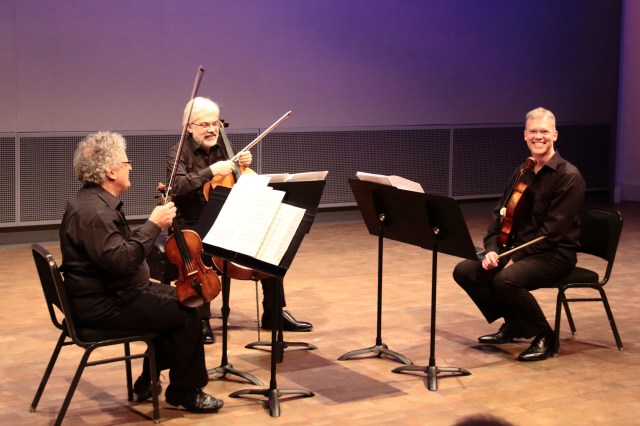
The Jack Quartet Plays Music of Hannah Lash


Hannah Lash‘s name began appearing on my radar about two years ago but this is my first actual encounter with her music.  This recent (2011) Harvard graduate’s star seems to be rising quickly and this is a fine place as any to start to get to know her work.  New Focus Recordings is a label with good instincts regarding new and important music and this one is typical of their collective acumen.

This release features 4 works. One is for harp (Lash’s instrument) with string quartet and the rest are for string quartet alone. I find it difficult to describe Lash’s work concisely. Like many in her generation she seems to have been exposed most comprehensively to a huge range of styles and techniques and she appears to be selecting judiciously among those to apply those techniques by which she can achieve her compositional goals.

The works include the single movement, Frayed followed by Suite: Remembered and Imagined (in 6 short movements), the single movement Pulse-Space, and the three movement Filigree in Textile which features Lash on harp along with the Jack Quartet.  The rather sparse liner notes are by the composer.  They may lack detail as to composition date, commissioner, etc. but they do reflect what the composer’s thought processes were with each piece.  She is clearly more concerned with conveying her metaphorical ideas than the technical aspects of her work.  That is perhaps best left to future musicologists.

Her work is direct, one might even say concise.  Using a basically tonal palette, the composer explores a variety of musical and metamusical ideas.  These are intimate and interesting works that seem very much to the point.  Keep in mind too that this is simply a disc of recent chamber music which gives no idea as to how she handles larger forms.  But from the perspective of this album alone her brevity has an almost Webernian quality (not the thorny harmonies or difficult rhythms, just the brief and direct statements she makes with the music here).

The always wonderful Jack Quartet plays in two different configurations here.  Tracks 1-8 feature Christopher Otto and Ari Streisfeld, violins; John Pickford Richards, viola; and Kevin McFarland, cello.  Tracks 9-11 feature: Austin Wullman and Christopher Otto, violins; John Pickford Richards, viola; Jay Campbell, cello; and Hannah Lash, harp.

As usual with well written new music multiple listens reveal more detail.  The music is both interesting at first listen as well as compelling enough to provoke yet another listen.  Lash is a rising star who deserves the attention of a new music audience who will learn the subtleties of her musical language.  There is great beauty here.

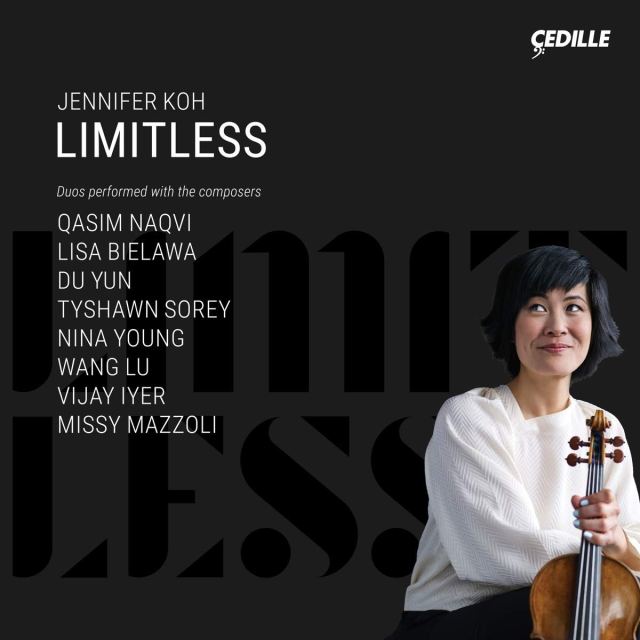
Quantum Koh: Jennifer Koh’s “Limitless”


kohlimit

Cedille 9000 191

Watching the flowering career of this wonderful violinist has been both a joy and a labor.  First, the labor: she is so consumed with projects that it is difficult to keep up sometimes.  Second, the joy:  All her projects and recordings are fascinating in concept and satisfying to the attuned listener’s ear and to her collaborators.

So it is with this marvelous 2 disc set from Cedille Records (now celebrating its 30th anniversary as one of the finest independent classical labels) which consists of duos with composers.  She partners with a variety of up and coming composers in this varied but always interesting collection. These sincere and intimate collaborations exude quantum sparks of creative genius.

Eight composers and nine compositions span two discs demonstrating the Chicago native’s eclectic interests and marvelously collaborative nature. These compositions represent some of the cutting edge nature of her repertory choices as well as the respect earned from these composers.

It begins with The Banquet by Qasim Naqvi who is perhaps best known for his post minimalist acoustic group, Dawn of Midi. Here Naqvi works with a modular synthesizer utilizing that instrument’s quirks to create a sort of drone with minimalistic effects created by his exploitation of those quirks (this could even be classified as a species of glitch). Koh’s part interacts in ways that seem quasi improvisational, doubtless the product of close collaborative efforts.

Next are the lovely Sanctuary Songs by Lisa Bielawa, a fine singer whose solfege singing was for years part of the defining sound of the Philip Glass Ensemble. (Koh masterfully played the solo violin dressed in costume in the title role in the recent revival of Einstein on the Beach.)  She comes to us on this disc as a both composer and singer in this lovely cycle.

Bielawa has developed her own compositional voice and this little song cycle is a fine example. Both voice and violin are given challenging roles in exploring this unusual combination of musical timbres.  Bielawa compositional voice is entirely her own and her gift for it is evident in this and all that this writer has heard.  The work is in three short movements.

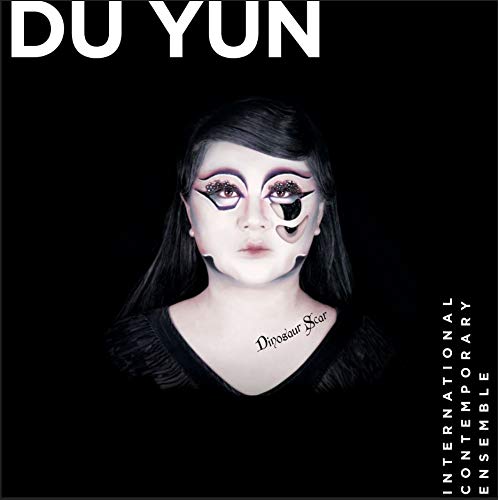
Du Yun, whose astounding work was recently reviewed here is represented by her voice and violin duo, Give me back my fingerprints.  The link on her name will take the curious listener through this composer’s amazing accomplishments but nothing can prepare the listener for the raw energy that characterizes her work.

Rapidly rising star Tyshawn Sorey uses his amazing ear to create this memoriam for one of his mentors, Muhal Richard Abrams. Sorey uses a glockenspiel as a counterpoint to Koh’s violin in this all too brief memorial piece written on the passing of AACM (a gaggle of brilliant musicians whose grouping reminds this writer of France’s “Le Six”, the “Russian Five”, and the early twentieth century “American Five”) founding member, a truly great composer, collaborator, and performer.  The AACM was founded in Chicago.

I had the pleasure of meeting the genial and quick minded Sorey at OM 17.  The link to my blog review is provided for the curious listener.  The concert took place in 2012.  Here is the shortcut to the Other Minds archival page.  Sorey provides no liner notes perhaps because he has succeeded in saying everything he wanted to say in the music (Koh seems quite appropriately tuned in here.

Nina Young‘s Sun Propeller involves the composer on electronics which interact to some degree with the solo acoustic instrument to extend the range of what the audience hears from the violin.  The title refers to the rays of sun one sees when the sun is behind a cloud and the sunbeams radiate out in glorious fashion.  This serves as a metaphor for the process involved in the composition.  But not to worry, the complexity does not hide the beauty of the music itself.

As if all the preceding weren’t enough there is a second disc continuing this collaboration.  First up is another name new to this writer, Wang Lu .  This Chinese American composer uses electronics alongside acoustic instruments in much of her work.  Her digital sampling reflects the eclectic nature of her world comprising everything from Korean pop to Chinese opera and a host of environmental sounds.  This piece also contains an opportunity for the composer to do some free improvisation as well as provide accompaniment to Koh’s violin part.  It is a dizzying and mind manifesting experience.

Next up is Vijay Iyer.  Iyer is perhaps best known as a jazz pianist and, as such, he is a fine example but his south Asian heritage doubtless has had an influence on him musically though that is but one aspect of his work. The American born Iyer, like many of his generation, mine their and our collective heritages as needed for inspiration. The present composition, “Diamond” also draws from his rich cultural background as it refers to the Buddhist Diamond Sutra and utilizes the structure of that religious parable to create the piece.  It is probably the most conventional sounding work here but that tells the listener little given the wide ranging eclecticism.  It is a piece which gives homage to jazz filtered through the experience and the person that is Vijay Iyer and, in this case, shared with the violinist.

The last composer is Missy Mazzoli, an established American composer.  She is represented by two works, “A Thousand Tongues” and (the now Grammy nominated) “Vespers”.  The composer provides accompaniment with piano and electronics.  The first piece has more the ambiance of a pop song though an avant garde one.  The last piece, the Vespers, feels deeper and more haunting.  Both provide more than adequate writing to keep soloist Koh both busy and happy.  

Indeed this album will keep the astute listener happy for its musical content, its progressive interest in new music, its wonderful soloist and beautiful sound.


World Premieres and a Resurrection: Partch Vol. 3 on Bridge Records


Bridge Records is one of those labels whose every release is worth one’s attention. Their series of music of Elliott Carter, George Crumb, et al are definitive. And while this listener has yet to hear the first two volumes of the Harry Partch series this third volume suggests that Bridge continues to maintain a high standard as they do in all the releases that I’ve heard.

Harry Partch (1901-1974), like Philip Glass and Steve Reich would later do, formed his own group of musicians to perform his works. For Glass and Reich they could not find performers who understood and wanted to play their music. For Partch this issue was further complicated by the fact that he needed specially built instruments which musicians had to learn to play to perform the very notes he asked of them.  And keep in mind that Partch managed to do a significant portion of his work during the depression.  He is as important to the history of tonality as Bach, Wagner, and Schoenberg.

I will confess a long term fascination with Partch’s music.  Ever since hearing a snippet of Castor and Pollux on that little 7 inch vinyl sampler that came packaged with my prized copy of Switched on Bach I was hooked.  That little sampler also pointed this (then 13 year old) listener to Berio’s Sinfonia, Nancarrow, Steve Reich, and Terry Riley.  And so it continues.  But it is not just nostalgia that recommends this disc, it is the definitive nature of the scholarship, the intelligence of the production, and the quality of both performances and recordings that make this an essential part of any serious collector of Partch, microtonal music, musicology, and good recordings in general.

With the aforementioned interest/fascination I reached a point where I had pretty much collected and listened to all I could find of Partch’s music.  Certainly everything of his had been recorded, right?  Well ain’t this a welcome kick in an old collector’s slats?  Not only have the folks at Bridge (read John Schneider) found and recorded a heretofore practically known composition but they’ve done it with a brand of reverence, scholarship, and quality of both recording and performances such that this is a collector’s dream and a major contribution to the history of microtonal musics and American music in general.

schneiderUtube

John Schneider from a You Tube screen capture

Let me start with the liner notes by producer John Schneider.  As one who is given to complain about the lack of liner notes I am so pleased to encounter such as these.  They alone are worth the price of the CD and read at times like the adventure they describe, to wit, this recording.  The tasteful and well designed (by one Casey Siu) booklet provides an intelligent guide to the music which enhances the listening experience.  Schneider’s web site also provides a wealth of information and references for further research.  Many would think that these liner notes are comprehensive as they are and there should be no need for anything more…so the link provided to even more info on the web site of the performing group on this disc, PARTCH.   These folks are Grammy winners and they perform on scholarly copies of the original Partch instruments executed by Schneider and his associates.  This release is solidly built from the ground up.

partchredcat

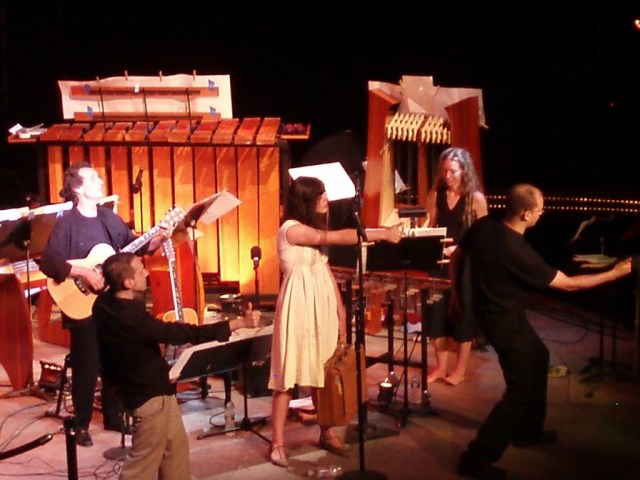
PARTCH performing at RedCat copyright Redcat

PARTCH includes: Erin Barnes (Diamond Marimba, Cymbal, Bass), Alison Bjorkedal (Canons, Kitharas), Matt Cook (Canon, Cloud Chamber Bowls, Spoils of War), Vicki Ray (Canons, Chromelodeon, Surrogate Kithara), John Schneider (Adapted Guitars, Bowls, Canons, Spoils, Surrogate Kithara, Adapted Viols, Voice), Nick Terry (Boo, Hypobass), T.J. Troy (Adapted Guitar II, Bass Marimba, Voice), Alex Wand (Adapted Guitar III, Canons, Surrogate Kithara)

The 21 tracks contain five Partch compositions.  It opens with one of Partch’s more unusual pieces (for him), Ulysses at the Edge of the World (1962).  This piece was written for Chet Baker but Baker never got to play it.  It kind of sits a bit outside of Partch’s work and is his most direct use of the medium of “jazz”.  The piece has been recorded twice before.  For this recording two fine new music/jazz musicians were chosen, saxophonist Ulrich Krieger and trumpet player extraordinaire Daniel Rosenboom.  Excellent choices for this too little performed piece.

Tracks 2-13 contain the Twelve Intrusions (1950) which is basically an accompanied song cycle with instrumental pieces placed at the beginning.  These are great vintage Partch works but do read the liner notes on the evolution of Partch as he was writing these.  They describe some of Partch’s evolution during that time.

Next is another discovery (or restoration if you will).  Partch’s scores exist in various versions for various reasons.  Windsong (1958) was written as a film score for the Madeline Tourtelot film of that name.  It was later reworked into a dance drama (Daphne of the Dunes, 1967).  Here we have a live performance of the entire score which (read them notes) includes things not heard before, not to mention the most lucid sound of this recording.

Now to the putative star of this release, the Sonata Dementia (1950).  It too comes with some nice detective work allowing listeners to hear substantially what Partch intended but neither recorded nor rejected.  There are three movements and let me just say that they are captivating and substantial.  This deserves to be heard again and again.

Now two little bonus tracks (reminiscent in nature but not in content of the sampler I mentioned earlier) add significantly to Partch and his place in music history.  First is a Edison cylinder recording from 1904 of a traditional Isleta Indian chant which Partch, who had been hired to transcribe these songs, later incorporated into his music.  It’s early date and the nature of that old recording method provide a picture of early ethnomusicological work.

partchguit

Photo of Partch with adapted guitar found on web

The second bonus is a real gem.  Again, read the liner notes for more fascinating details.This is an important find, an acetate recording made of Partch performing his Barstow (1941) for an appreciative audience at the Eastman School of Music from November 3, 1942.  This early version (of at least three) for adapted guitar and voice was reconstructed by John Schneider and released on the Just West Coast album of 1993 (Bridge BCD 9041) and later performed so beautifully at Other Minds 14 in 2009.  But I believe that Schneider’s reconstruction predated the discovery of this recording.  Pretty validating to hear this now I would think.

It is this reviewer’s fondest hope that this wonderful Partch project will continue with its definitive survey of Partch’s work.  Bravo!!


Other Minds 24, Concert Three, Reviving the Music of a Forgotten Master


wysschnegradsky4p

Photo: Ebbe Yovino-Smith

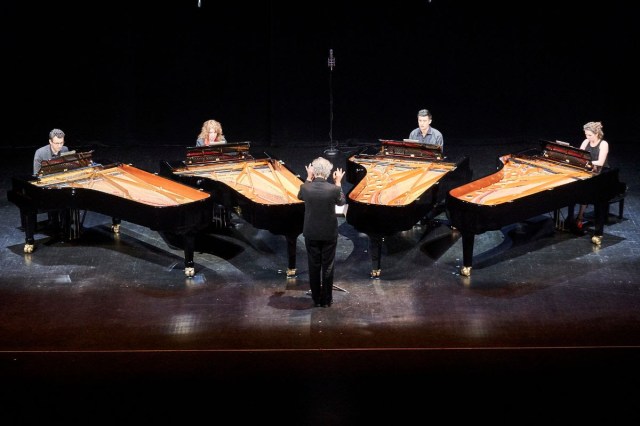
The staging was simple and practical but nonetheless imposing for this third and last OM 24 concert series.  Imagine four Steinway concert grand pianos arranged in a semicircle with a conductor and a music stand at the apex.  The heavy black curtain at the back served to emphasize the instruments and the musicians in a visually standard concert presentation.

jimcallahan

But, and this is significant, pianos 2 and 4 (looking stage left to stage right) had been tuned down 1/4 step.  I had the pleasure of speaking with Jim Callahan of Piedmont Pianos (who provided the instruments for this event).  When I inquired about this he replied quickly and authoritatively, “From stage left to right, pianos 1 and 3 are A 440 (concert pitch) and the others are tuned down 1/4 step.  When there are two pianos the one stage left is concert pitch and the one on the right tuned down.”

If you have any familiarity with the piano keyboard you know that there are black keys and white keys which correspond to the twelve divisions of the octave (from middle C to C) common to most western music.  A quarter tone is half way from the note you hear when you hit a white key and the note you hear if you hit the adjacent black key.  Ivan Wyschnegradsky was not the first person to seek more divisions to create the sound he sought.  1/4 tones are common in some middle eastern cultures but not seen in western music much before the twentieth century.

Ivan Wyschnegradsky (1893-1979) was a Russian born composer who spent much of his creative years in Paris.  It was there that tonight’s producer, Charles Amirkhanian and his wife Carol Law met him and learned of his work.  This concert along with the first OM 24 concert heard in March by the Arditti String Quartet (reviewed here) constitute a lovely revival of this unjustly forgotten composer as well as a personal connection to this “missing link” in music history.

CharlesatOM24

Charles Amirkhanian addressing the small but enthusiastic audience.

While some of this composer’s work uses the conventional western music scales (examples were present in this concert) his extensive work with other tunings necessarily limited performances of his music.  That, along with his rhythmic complexities, limited the amount of performances he would be able to receive.  One hopes that these concerts will spur further interest in his work.

The program booklet, prepared under the direction of Other Minds production director Mark Abramson, contains a wealth of information, knowledge and photographs.  You can download a PDF file of the program here.  It is a gorgeous production loaded with information for further exploration.

One might have expected 1/4 tones to create a very dissonant harmony but the surprise tonight was that the harmonies sounded like an extension of the work of Debussy and the impressionist composers.  Rather than harsh sounds, much of this music comes across like an impressionist painting might sound if it were music.  Tuning is a whole subject unto itself and a good resource can be found in the web pages by another Other Minds alumnus, Kyle Gann.  His extensive information on the subject can be found here.

The concert opened with Cosmos Op. 28 (1939-40, rev. 1945) for 4 pianos.  It is unusual to see a conductor at a multiple piano concert but the logistics of performance required a conductor to guide them through the complexities of rhythm and even the complex use of sustain pedals.  The pianists Sarah Gibson, Thomas Kotcheff, Vicki Ray, and Steven Vanhauwaert were ably led by conductor Donald Crockett.  This was a US premiere.

Overall the music has echoes of Stravinsky, Messiaen, Debussy, and Schoenberg (from his pre 12 tone days).  This large work, according to the program notes, does not have a specific program, rather it is a grand exploration of densities and registers. It does have a cinematic quality that suggests a program.

OM 240005

Martine Joste receives a bouquet as Donald Crockett looks on.

Next on the program was Étude sur le carré Op. 40 (1934, rev. 1960-70) for solo piano (another US premiere).  The French title translates as “Study on the Musical Magic Square”.  It is a reference to the structure of the piece which involves repetitions of melodic sequences analogous to the magic square with words or numbers.  What is important is the musicality of course and Martine Joste played it with passion and intensity providing the audience with a performance that sounds absolutely definitive.  Her amazing technique at the keyboard and her focus on this music truly brought life to this technically difficult piece.

Joste is a master pianist and president of the Association Ivan Wyschnegradsky and has been active in the performance of contemporary music along with the better known classical canon of works.  She would appear in the second half of the program.

If you are exploring the limits of composition with a new technique it makes sense to write some music that will demonstrate that technique.  Much as Bach wrote his Well Tempered Clavier to showcase the (now standard) well tempered tuning.  So Wyschnegradsky composed his 24 Preludes Op. 22a (1934 rev. 1960-70) to demonstrate his ideas.

OM 240002

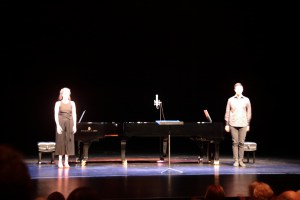
Shot of the two piano stage set up.  Remember the concert pitch instrument is stage left.

It was from this collection that we next heard Preludes Nos. 1, 3, 4, 5, 9, 10, 15, 16, 19, 20, 23, and 24 played by the performing duo Hocket.  As if they are not busy enough as solo pianists (and composers in their own right) Sarah Gibson and Thomas Kotcheff perform as a duo.  The link to their work in that area can provide more information,

OM 240001

Sarah Gibson (l) and Thomas Kotcheff (r) performing as the Hocket Duo

They managed to navigate the complexities of these pieces nimbly, as though they had been playing them all their lives.  It certainly sparked this listener’s curiosity about the remaining preludes which we did not hear on this night.

Again the 1/4 tones sounded strange to western ears at times but never really harsh.

Following intermission the usual OM raffle of various prizes were drawn.  As if the fates intervened the colorful Ivan Wyschnegradsky clock went to master microtonalist John Schneider, another OM alumnus.  This clock is available in the Other Minds Store along with a cache of really interesting CDs, clothing, etc.

The four pianists, Gibson, Kotcheff, Ray, and Vanhauwaert again teamed up for a performance of Étude sur les mouvements rotatoires, Op. 45 (1961, rev. 1963).  This time they performed without a conductor.  Here the magic square becomes a magic octagon, at least metaphorically.  This is another example of using extramusical principles applied to organize music differently.  And again, as in the previous pieces, the harmonies were friendly and actually quite beautiful.

Mme. Joste returned to the stage for a solo performance (and the third US premiere) of Three Pieces for Piano, Op. 38:  Prelude (1957), Elévation (1964), and Solitude (1959).  Again we were treated to virtuosity and a seemingly definitive performance.  The title puts one in the mind of Schoenberg and his voice, along with that of Messiaen, Debussy, et al were present.  What was striking was her energetic and fluid performance which made the notes on the page (Joste performed from traditional paper scores, not the iPads used by the others) come alive in a delightful way.

OM 240006

The stage had to be reconfigured for the final piece, another 4 piano work which took perhaps a minute or two.  Mr. Crockett again led these young and enthusiastic performers in Ainsi parlait Zarathustra, an early work which was originally written for a quarter tone piano played by six hands(such things do exist), a quarter tone harmonium (4 hands), a quarter tone clarinet, string ensemble, and percussion.  This score has been lost but we heard the 4 piano transcription tonight.  It is a sprawling work with four defined sections much like a symphony.  The movements are titled Tempo Giusto, Scherzando, Lento, and Allegro con fuoco.

This piece takes its title from the same Nietszsche novel that inspired Richard Strauss’ tone poem “Also Sprach Zarathustra” or, in English, “Thus Spake Zarathustra”.  Only Wyschnegradsky’s Zarathustra seems more pained and less the romantic hero of Strauss’ 1896 orchestral work.

Wyschnegradsky’s piece is virtually a symphony and, though one can scarcely imagine how the now lost orchestration might have sounded, there was still a grand romantic sweep to it.  With a scherzo worthy of Bruckner the piece was a coherent whole with the last movement recapitulating, if not literally, the spirit of the fire dance that ended the first movement.  This was also a premiere and surely another definitive performance of a true masterpiece.

On this night we witnessed nothing short of a resurrection of the art of a very important 20th century composer.  The audience, like the performers were enthusiastic in their response.

Wolfgang von Schweinitz’s “Klang”, Gorgeous Postminimalism


LCMS1903

I must confess that Ireland is hardly near the top of my list for countries that are producing interesting contemporary music but this new release will soon have me checking out their Contemporary Music Center to see what else is happening.  Let me be clear, I’m not criticizing Ireland, just lamenting the fact that, like many countries, their contemporary classical music rarely gets to U.S. ears.

As if to magically remedy my wish for a more democratic distribution of said music producer Eamonn Quinn kindly sent me this single track CD containing a work influenced by (among others) the Godfather of minimalism, La Monte Young. He commented to me about the ultimate marketability of a one track CD but his instincts are well placed in this CD recorded February 2019, hot off the presses.   This is my first encounter with the composer, Wolfgang von Schweinitz (1953- ) whose name is now programmed into my surveillance engines as a voice to be followed.  Definitely want to hear more from him.  Born in Hamburg, he now teaches at Cal Arts.  A list of his works can be found here.  (While there you will want to avail yourself of the rest of this great site about just intonation composer at Plainsound)

While I share Mr. Quinn’s concern about the marketability of a single track CD (it is about 45 min), this is an ideal presentation for a work in just intonation by a string trio and the uninterrupted 45 minute interval is integral to the experience of the music.  This work is like the grandchild of La Monte Young’s String Trio (1958).  I am now having fantasies about curating a program of this work paired with its spiritual grandfather.  The single track, just intonation hits at my geeky minimalist heart and I know I’m not alone in that.

The brief but lucid and useful program notes are by the wonderful Paul Griffiths and the recording by Peter Furmanczyk captures the rich overtones well.  The Goeyvaerts String Trio has earned a place in my media alerts now as well.  They perform this work with insight and passion.

Now, past the name dropping and background stuff to the music itself.  If you know the long tones of La Monte Young’s String Trio, which is of similar length, you might hear it as a more melodic version of that.  That is not to say that this work is derivative, it is evolved its predecessor’s DNA, so to speak.  It is postminimalism (or file under “ambient” if you prefer) from that branch of the family tree.

The full title of KLANG” is given as ” PLAINSOUND STRING TRIO KLANG AUF SCHÖN BERG LA MONTE YOUNG…” Op. 39 (1999, rev 2013),  and while the musical references to Schoenberg and Berg are there, the experience is that of an almost romantic tableau of long tones and rich harmonics descended from the Urtext of minimalism that is La Monte Young. The spirit of Morton Feldman appears to reside here as well, maybe even a wisp of Brian Eno.  The kaleidoscopic effect of the just intonation with all the rich harmonic overtones evoke a great deal and probably will provoke different memories for different listeners. It is a maybe even a sort of Verklärte Nacht for the millennium though what is ultimately transformed is the listener themselves.  You can choose your own metaphor, but first you’ll be charmed by the music.

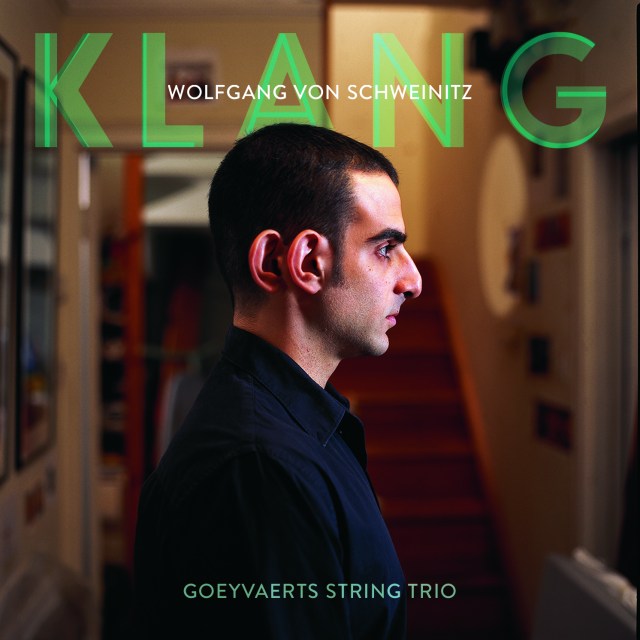
And dontcha have to love that cover graphic?

Mariel Roberts’ Cartography: New Cello Music


This is another of those releases that is functionally a business card if you will. By that I mean that I’m finding a fair amount of solo instrumental discs (some with electronics, like this one, some not) in which the artist demonstrates their skill with their instrument but, more importantly, their familiarity and facility with the segment of the repertoire they embrace.  Actually this is the second such album from this artist, the previous (yet unheard by this listener) having been released in 2012.

Mariel Roberts is one of those New York based musicians whose milieu puts her in contact with the cutting edge (at least in New York) of modern composition.  Roberts has appeared as a soloist and chamber musician across four continents, most notably as a member of the Mivos Quartet, Wet Ink Ensemble, International Contemporary Ensemble (ICE), Bang on a Can All Stars, and Ensemble Signal. Her skills and her talent seem boundless.

Here she features four rather large works for cello, solo, with piano, and/or with electronics.  The composers featured include: George Lewis, Eric Wubbels, David Brynjar Franzson, and a collaborative work she wrote with Cenk Ergun.  Not the usual suspects but a panoply of interesting and creative composers.

Rather than attempt any analysis of the works presented here let me just say that all require a high level of virtuosity. An essential aspect of this virtuosity is whatever coordination is required of the soloist interacting with electronics. The lack of detailed liner notes make it difficult to know the nature of this interaction but one can certainly enjoy the resulting performance even without those details.

This is NOT easy listening by any means but it is a tasty sampling of some truly creative music for the right ears. Multiple listenings will be needed but the listener will be rewarded for their effort.


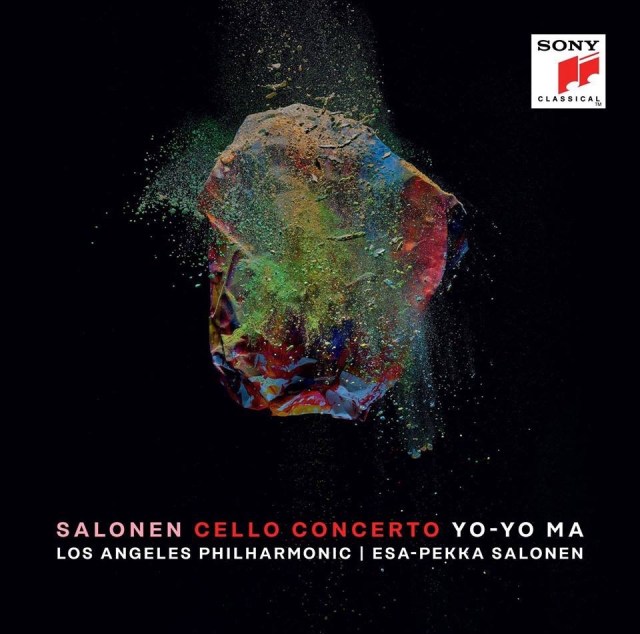
A Major New Cello Concerto from Esa-Pekka Salonen


Perhaps this is a stroke of marketing genius or maybe some luck is involved but this recording has success written all over it. Yo-Yo Ma is without a doubt one of the finest musicians of our time. The LA Philharmonic is a world class orchestra with a world class conductor at the helm. And though this is but the first encounter by this reviewer with Salonen’s music this work suggests that his compositional skills are at a similar level. 

There is but one work on this disc, a large and very listenable cello concerto which dates from 2016. While the work is clearly modern in its style overall it leans toward romantic and impressionistic textures. Using his conductor’s mastery of the orchestra Salonen traverses territory that embraces the sound of composers such as Ives, Messiaen, Debussy, Barber, etc. Listeners will find familiar gestures but this work is not at all derivative. Rather it ultimately sounds like a complex but very connected improvisation between the soloist and the orchestra neither of whom have easy tasks (though they all play flawlessly).

The rather brief program booklet is basically a program note by the composer/conductor and it is most lucid. It might have been nice to hear as well from Mr. Ma but that is aminor criticism. This is a gorgeous piece given a characteristically powerful performance and this writer was simply enthralled from beginning to end. Now I guess it’s time to look into more of this man’s music. 

E

Tim Brady’s Happiness Handbook, massed guitars, massed invention


happinesshandbook

Starkland ST-232

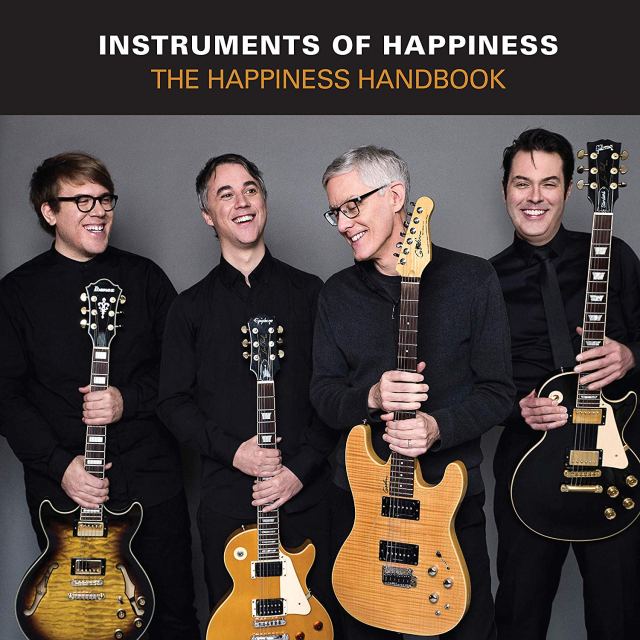
This is, by my count, the third Tim Brady CD released by Starkland.  The other two, Instruments of Happiness and Music for Large Ensemble, represent only a small portion of his output and I highly recommend exploring his other releases.  You can find a listing on his web page here.  Since being introduced to Brady’s work in the Instruments of Happiness album I have purchased and enjoyed several of his earlier CDs.  Initially one necessarily wants to lump Brady in with the massed guitar masters such as Glenn Branca, Jeffrey Lohn, and Rhys Chatham.  That’s a fine starting point but as one listens to Brady’s work it becomes clear that he has his own vision and that vision is shared with like minded artists.  Some of those like minded artists are on this fine CD.

In some ways this is a sequel or a volume two to the Instruments of Happiness CD of 2016.  Despite this being chamber music with only four musicians the nature of electric guitars is to make a bigger sound.  It is always interesting to see how different artists work with a given ensemble configuration and that is the real thrill here.  One track features Brady’s music and the other tracks feature Scott Godin, Jordan Nobles, Maxime McKinley, Gordon Fitzell , and Emily Hall.  All are individual creations commissioned for this quartet.  The liner notes are definitely useful but there is much to be gleaned from the ‘composers’ web sites as well, trust me.

The disc contains six works on 10 tracks and, like the earlier Instruments of Happiness release on Starkland, this is an interesting and revelatory sampling of the marvelous invention of these composers and the amazing range and utility of the electric guitar.  If anyone questions the place of electric guitars in classical music this is a fine example of some of the potential and a teaser for the future as well.  The vision is more like that of a string quartet (another ensemble that has managed to establish itself) seeking innovative composers for some portable music making.

Familiarity with the composers mentioned earlier (Branca, Lohn, Chatham) will provide the listener with a context but the work here is seemingly almost unrelated to their work excepting that they used electric guitars.  This is a new generation of composers to whom, electric guitars were a given, not a new invention and whose use, increasingly ubiquitous in classical music, is simply one of their compositional options.

And now the music.  The album opens with an homage to the late British composer Steve Martland (1959-2013) whose rhythmic, driving music resembles that of Michael Nyman but closer to a rock aesthetic.  Martlandia (2016) by Scott Godin engages the listener (and will likely send him/her in search of Steve Martland CDs) with its long tone meditative beginning that acts like a slow introduction to a symphony of the classical era and then moves into faster quasi-minimalist sections that remind this listener favorably of some of Steve Reich’s work.  This is practically a miniature symphony.  It is an engaging piece and a loving tribute to the late composer.

Equal and Opposite Reaction (2016) is Mr. Brady’s submission to the album.  It also opens with a slow section and then goes into the manic virtuosity that is typical of Brady’s work.  I’m not saying he can’t write a decent slow movement, he can and does, but much of his work moves rather quickly and with a variety of guitar techniques in his expanded palette of sounds.  Like all the works here the harmonic language is largely tonal and the development of thematic material owes much to classical compositional techniques though his rhythmic choices owe something to rock and jazz.

Jordan Nobles’ Deep Field (2016) is a tribute the the iconic Hubble Telescope.  (If you haven’t seen at least one photo from Hubble’s catalog then you may have been in suspended animation for the last 20 years.)  Suffice it to say that the Hubble’s images have inspired a great deal of artists and this is yet another example.  This is one of the more meditative pieces on the album at its opening but, like the other pieces there are several contiguous sections.

Reflets de Francesca Woodman (2017) by Maxime McKinley is another homage.  This time the subject is an American photographer Francesca Stern Woodman (1958-1981) who took her own life in 1981 and left a posthumous legacy.  Aptly this is one of the more somber and disturbing tracks on the album. I’m sorry to say I don’t know her work but this tribute certainly sparks interest.

Going with that melancholy theme is the next track, Gordon Fitzell’s Bomb Crater Garden (2016) is the most avant garde sounding track (as well as the longest at 11:16) and the most exquisitely disturbing in its post apocalyptic vision.  The piece has optional narration and video but the music gives the listener a pretty good idea of what those images and ideas are.  So much for happiness.

Finally we have The Happiness Handbook (2016) by Emily Hall.  Like Brady’s flexibly peopled ensemble of the same name the theme of happiness comes to the fore once again.  As explained in the liner notes the notion of guitars as instruments associated with happiness is the concern.  There are five movements varied in style that make this piece function like a little symphony.  It is a celebration of the plethora of techniques and compositional possibilities of this modern guitar ensemble and will leave the astute listener ultimately in a happy place.


Other Minds 24 Revives the Quartets of Ivan Wyschnegradsky in San Francisco


I admit to some trepidation as I proceeded to the beautiful War Memorial Opera House in downtown San Francisco.  While I had heard of this composer, Ivan Wyschnegradsky (1893-1979), it was only through one work which was contained on a disc with other microtonal works by John Cage and Harry Partch performed variously by Joshua Pierce, Dorothy Jonas, and Johnny Reinhard (among others).  And microtonal music can be tedious in some hands.

OM 240001

This helpful sign in the elevator directed concert goers to the 4th floor recital room known as the Dianne and Tad Taube Atrium Theater

Adding to the sense of obscurity, the concert was in a small chamber music hall on the fourth floor.  Other events ran concurrently on this night.  The hall was nearly filled to its capacity of just under 300 people most of whom I would guess have never heard of this composer.  But they likely had heard of the Arditti Quartet and clearly put their trust in the amazing ear and mind of executive and artistic director Charles Amirkhanian to deliver a satisfying musical experience which he does most reliably.  This concert was no exception.

OM 240003

The stage awaits the performers with that OM logo projected on the floor.

The Arditti Quartet was formed in 1974 and quickly became known as one of the finest interpreters of contemporary string quartet music.  Their repertoire is vast and they do not shy away from technical difficulty or other artistic challenges.  In fact they had recorded the Wyschnegradsky Quartets but, sadly, that recording is out of print.  Even more interesting is the fact that tonight’s performance constitutes U.S. premieres for all the works on this concert except for the Haas Quartet (included at the suggestion of Mr. Arditti to fill out the program).  Another astonishing fact shared by Amirkhanian is that this is the only time that the quartet has been asked to play this music in concert.  There are plans to release those recordings in the near future pending negotiations with record companies.

OM 240006

Amirkhanian reminded the audience to silence those pesky cell phones.

Mention needs to be made of the talents of OM’s graphic designer (and stage manager among other duties), Mark Abramson.  His work on this and last year’s program booklets take things to a new level of excellence.  The program notes by Charles Amirkhanian, Randall Wong, and Blaine Todd are both lucid and comprehensive (a very necessary thing in dealing with new and obscure music).  And the photos of the composer and the performers along with some of the composer’s own art work make this another true collector’s item.  Previous programs were certainly well done but this is a step up.

OM 240010

The Arditti Quartet

I chose to just listen and to read the notes later rather than get caught up in details.  Indeed that was a good choice.  Wyschnegradsky’s approach to the use of microtones seems more focused on the possibilities of extending melodic language than the harmonic and my understanding of complex harmony is admittedly limited anyway.  Of course the harmony is necessarily different than the western models of the 18th and 19th centuries but the music, at least in the hands of such talented interpreter’s such as the Arditti speaks rather directly to the listener.

The music was presented chronologically in order of the years these pieces were composed (String Quartet No.1, 1923-4, rev. 1953-4), (String Quartet No. 2, 1930-1), (String Quartet No. 3, 1945, rev. 1958-9), and (Composition for string quartet, 1960, rev. 1966-70) completed the first half of the program.  There was surprisingly little in the way of dissonance and the quartet played with a palpable intensity and concentration creating very convincing performances.


OM 240019.JPG

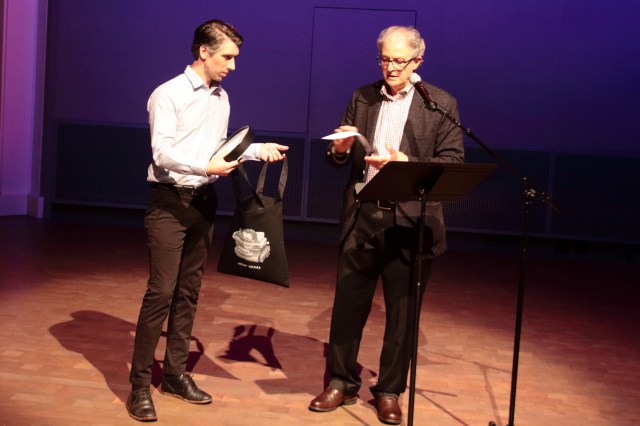
Blaine Todd holds the OM bag (a Carol Law design) as Amirkhanian picks two raffle winners after intermission.

The second half began with Wyschnegradsky’s last composition, a String Trio (1978-9).  Incomplete at the time of his death the trio was revised completed by Claude Ballif.  Again what one hears is not what you might expect from microtonality.  The composer has realized a uniquely effective way to use microtones.  Hearing this survey makes the composer’s vision clear and places him in the company of such as Alois Hába (1893-1973), Harry Partch (1901-1974), and Ben Johnston (1926- ) to name a few.  

OM 240020.JPG

The Arditti Quartet sans second violin Asot Sarkissjian on stage to play the Wyschnegradsky Trio

The revelation for this listener was hearing a good sampling of the composer’s vision and a creative way to use microtones unlike any other composer really.  And it became clear too why Charles chose to revive this unique voice in the musical world.  This is beautiful music.

OM 240021.JPG

As mentioned earlier Mr. Arditti had remarked that the Wyschnegradsky Quartet and Trio music would not quite fill an evening and he suggested they play the Second String Quartet (of about 6 now I believe) by Austrian born composer Georg Friedrich Haas (1953- ).  It was the only work which was not a U.S. premiere.

Arditti’s ear for programming was finely as tuned as ever and this quartet provided a very satisfying finale to the evening filled with wonderful discoveries.  While this particular quartet uses some microtones the style is denser and more dissonant overall than the preceding music.  This is not to say that it was not entertaining, rather it is illustrative of the rich possibilities of microtonal composition.  The Arditti again shows itself to be at the forefront of the finest interpreters of the modern string quartet and clearly Haas is a name worth knowing as well.  Bravo!

OM 240022.JPG

The musicians acknowledge the standing ovation and warm applause

Save the dates June 15 and 16 for the last two concerts in this year’s Other Minds 24 program.

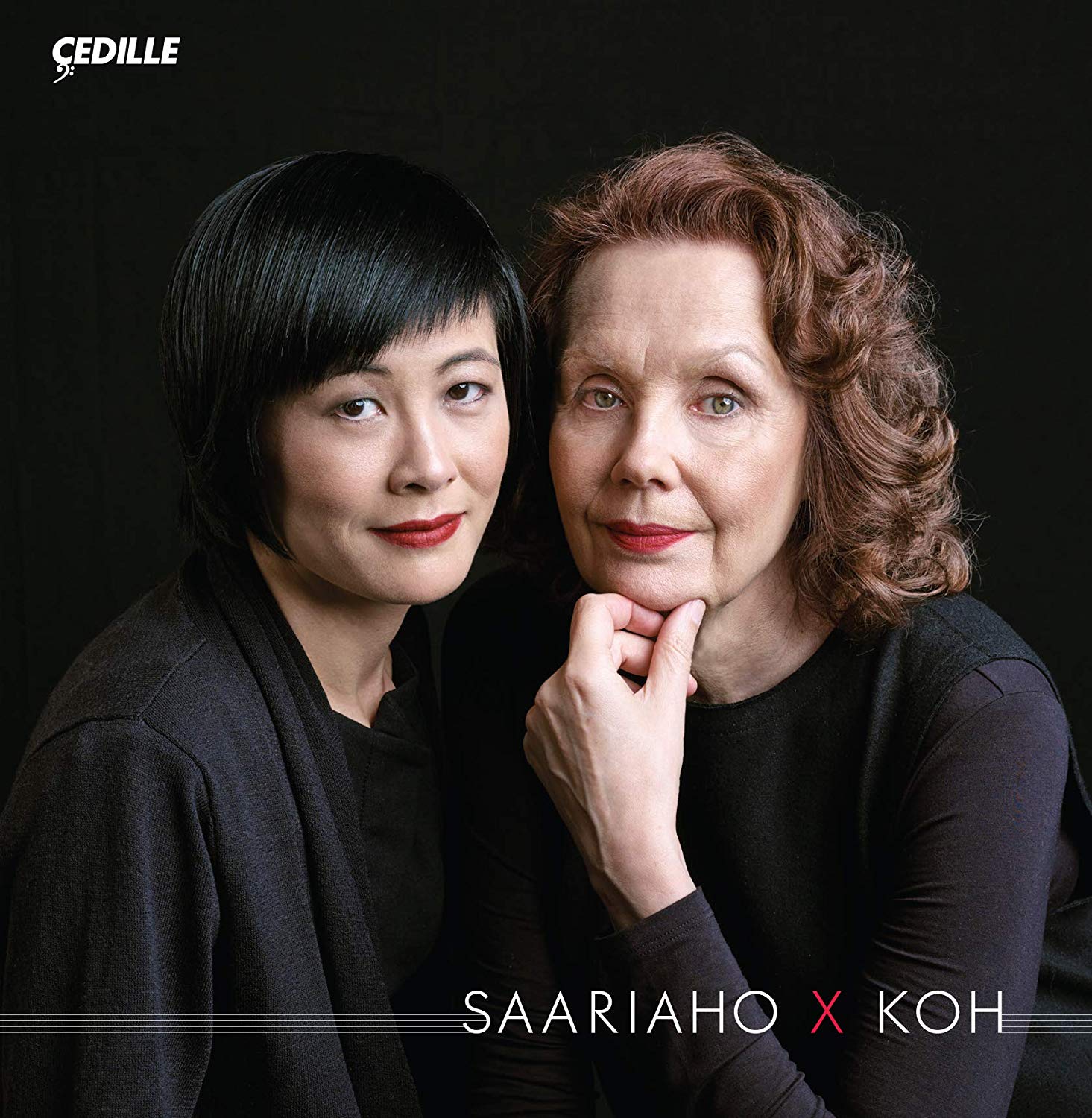
Jennifer Koh and Kaija Saariaho, a Glorious Collaboration


Cedille

The arrestingly beautiful portrait that graces the cover of this album should be enough of  a cover to judge this release favorably. Just the presence of these two women suggests that you’re in for some serious music making. Add to that the fact that this is one of those impeccable Cedille releases and you know that you, the listener, will not be disappointed. Here is another offering for Women’s History Month (even though the disc was released in November, 2018).

Kaija Saariaho (1952- ) is possibly the hottest composer to come out of Finland since Sibelius. Her career has steadily grown and she has written for chamber ensemble, stage, and orchestra. It is somehow satisfying to have this little portrait of her work. (This reviewer’s first encounter with the composer was in 1987 when the Kronos Quartet premiered her Nymphea for string quartet and electronics.) Five works are selected here and, if you don’t know this composer’s work, think Debussy, Takemitsu, and their ilk. No electronics on this disc though. Her work is a unique expression and pretty much listener friendly whether or not she uses electronics.

There are four chamber music pieces and a nice new performance of her masterful violin concerto, “Graal Théâtre”. Saariaho is so prolific such that one can only do a sort of “snapshot” selection of her work on a single CD. A decent retrospective would likely require several more discs.

Jennifer Koh is without doubt one of the finest violinists working today, especially in contemporary music. She even broke ground in one of the coolest blind castings in contemporary performance playing Einstein in Glass’ opera, “Einstein on the Beach”. For those who are unfamiliar the role of Einstein requires a violinist wearing a wig who plays some mighty difficult violin music at different points during the opera. This writer heard her in performance of this role at the revival in Berkeley a few years ago and it is a mark of Koh’s expertise that she made the role her own. Her range (which includes more conventional repertoire like Mozart, Tchaikovsky, etc.) is simply astounding and her technical ability puts her in competition for an ever growing list of commissions and other works she has added to her repertoire.

On this CD we get to hear Koh in the intimate settings of chamber music where the skills of listening to others is so critical as the individual voices weave their parts though the texture. While Saariaho is basically a well trained modernist romanticism and perhaps impressionism still remain a part of her palette. Joining Koh in the chamber pieces are: Nicholas Hodges, piano; Hsin Yun Huang, viola; Wilhelmina Smith, cello; Anssi Karttunen, cello;

Of course the big showpiece here is the violin concerto from 1994. This large scale work is actually as lucid and detailed as her chamber music, albeit with a larger range of sounds. It is a masterful composition and this appears to be the second recording it has received though apparently the first recording of the version with reduced orchestra played by the Curtis 20/21 Ensemble conducted by Conner Gray Covington (another reason to want this album). I wasn’t able to locate the other recording with Gidon Kremer but it is a good sign when you have more than one top soloist recording your work. Brava Ms. Koh and Ms. Saariaho! This is a collaboration blessed by the Gods. Saariaho x Koh = bliss.

Clarice Jensen Solo Debut Album


jensenmiasmah

Miasmah Records MIA041 

Another refugee from one of those new music groups comes forth with a debut album.  This time it is cellist Clarice Jensen who also serves as artistic director of the American Contemporary Music Ensemble (ACME).  And what amazes this listener is the sheer diversity one can find in solo cello recordings.

This recording focuses on the special tunings by La Monte Young student Michael Harrison who has carved his own unique compositional style as well as some interesting work by the late Johan Johannson and by the soloist herself.  

There are 4 tracks: 
bc by Clarice Jensen and Jóhann Jóhannsson
Cello Constellations by Michael Harrison 
For this from that will be filled (a) by Clarice Jensen
For this from that will be filled (b) by Clarice Jensen

While there are consistencies between the sound world of these pieces they have their own identity.  Johansson’s work opens the disc and sets the tone for all that comes after.  This is not simply a cellist with a set of cool effects pedals.  Rather this is a soloist seeking to become one with her instrument (which includes the electronics).

Michael Harrison’s work is heard too infrequently.  The former student of La Monte Young carries on the tradition of exploring new tunings in a manner one might expect of the next generation of this practice.  Harrison (no relation to Lou) creates dream like worlds with the psychological  effects of these tunings and this work is a stunning example.

Jensen plays the two parts of the title track, “For this from that will be fulfilled”.  Multiple generations beyond the kitschy “one man band” novelty concept, Jensen’s playing must be a mesmerizing live experience.  This track was originally designed to accompany visuals by one Jonathan Turner who did the striking photography of the album’s cover.

The review copy lacked liner notes (a personal bugaboo) and the press release and notes on the soloist’s site and that of Bandcamp also tell precious little.  Fortunately this is music which speaks pretty directly and can easily be  enjoyed with no knowledge of whence it came.  Just sit back, relax, and enjoy.  Jensen’s playing is magical.

Jensen in performance (photo from web site)

Rachel Barton Pine: Black and Blue


Cedille CDR 9000 182


Rachel Barton Pine is one of the brightest lights of the solo violin in Chicago and worldwide. Her partnership with Cedille records (also a venerable Chicago based institution) has been both fruitful and revelatory.

In addition to the standard virtuoso repertoire such as Brahms and Beethoven this soloist has demonstrated a passion and a genuine interpretive feel for music by black composers. Were we living in a less racially charged time this focus would be of minor interest. But the fact remains that music by black composers, regardless of the composer’s national origin or the quality of the music, have been seriously neglected.

Indeed this soloist has become a sort of shepherd of the lost and neglected. Her recorded catalog is testament to her achievements in a really wide range of repertoire from the Bach solo violin music to neglected concertos and occasional pieces ranging from the 17th century to the present.

The present disc was an October, 2018 release I am reviewing for Black History Month. And it is a gem. No fewer than 11 composers, 5 of whom are still living. It is both an acknowledgement of some of the classics produced by black composers over the last 100 years and an introduction to new and emerging voices.

The recently deceased David N. Baker (1931-2016) is represented here in the first track, Blues (Deliver My Soul ) and provides a context immediately. The word “blues” is used to refer to the uniquely black musical form which consists of a poetic form in which the first line is repeated. The vocal styles that are the blues are probably the most recognizable aspect of this musical form. But one can’t miss the persistent subtext of the neglect of such fine music as yet another insult to widen the racial divide.

In fact many of these pieces are not, strictly speaking, blues. But that is not the main point here. Pine, along with her quite able accompanist Matthew Hagle, present a beautiful and wide ranging selection which presents some wonderful music and, for those with a conscience, illustrate what can be lost when listening choices are hampered by prejudice.

The Baker piece helps to create a context. It is followed by Coleridge-TaylorPerkinson’s (1932-2004) Blue/s Forms for solo violin. This man’s career alone is worth a book at least. His eclectic and learned musical style found him writing music for movies, television, and the concert hall. He was also versed in jazz and blues and even played drums with Max Roach for a while. These solo violin songs are a beautiful example of the composer’s melodic gifts. One can easily imagine these pieces programmed alongside the Bach solo music.

William Grant Still (1895-1978), truly the dean of black American composers, is next. His Suite for Violin and Piano is happily performed with some frequency and deserves to be recognized as one of the masterpieces by this really still too little known composer. The piece is in three movements, each a representation in music of a painting.

Noel Da Costa (1929-2002) is a new name to this writer. He hails originally from Nigeria but made his career in New York City. His “Set of Dance Tunes for Solo Violin” makes a nice companion to the Perkinson pieces. This is one of the world premieres on the disc. Here’s hoping we get to hear more of this man’s work.

Clarence Cameron White (1880-1960) is another unfamiliar name. His Levee Dance is next. He was one of the lesser known of the group of early twentieth century black composers which included R. Nathaniel Dett, Dorothy Rudd Moore, Florence Price, and Samuel Coleridge-Taylor.

By far the best known name here is Edward Kennedy “Duke” Ellington (1899-1974). One out of eleven here has “household name” status. He is represented by Wendell Logan’s arrangement of, “In a Sentimental Mood”. This is the premiere of this arrangement.

Now to the living black composers. This is a forward looking recording which pays homage to the past but also acknowledges a living tradition. Dolores White (1932- ). Her “Blues Dialogues for Solo Violin” add admirably to the solo violin repertoire.

Belize born Errollyn Warren is next with her brief, “Boogie Woogie”. Warren is a composer with a wide range and, while this is a fun piece, she has composed a wealth of music for various sized ensembles including orchestra. She was the first black composer to be represented at the famed Proms concerts. Wallen was a featured composer at Other Minds in San Francisco.

A slightly longer piece by Billy Childs (1957- ), “Incident a Larpenteur Avenue” gives the listener a taste of the work of this prolific composer. This is a world premiere which was written for the soloist. Childs won a Grammy for his jazz album, “Rebirth” in 2018.

Daniel Bernard Roumain is of Haitian roots and works in New York City where he works with turntables and digital sampling to augment his classical compositions. His work, “Filter for Unaccompanied Violin” is given its world premiere recording here.

Charles S. Brown (1940- ) concludes this amazing recital with, “A Song Without Words”.

This is a rich and rewarding recital which will take the interested listener into wonderful new territories. Listen, read about these composers, enjoy their artistry. This is just a beginning.

Metafagote, Rebekah Heller on Solo Bassoon (mostly)


hellerfagote

For this listener, traversing contemporary music concerts in the 1980s there appeared a trend to modify the traditional look of classical performers. The first striking example I can recall is the venerable Kronos Quartet performing all in tight black leather outfits. And there are performers who have an intentionally different look such as violinist Nigel Kennedy or Kathleen Supove whose look is decidedly unconventional. Focusing on attire could conceivably detract from a musical performance but the previously mentioned performers have in common with the performer on this disc both virtuosity and a distinctly different look which seems integral to their performance delivering decidedly unconventional music.  The photography by Corrie Schneider creates a striking and evocative cover image giving her a sort of superhero ambiance.  Why not?

Rebekah Heller, of course, is also one of the members of the wonderful ICE Ensemble, one of the finest working chamber groups focusing on contemporary music. ICE has in common with groups like Bang on a Can, Alarm Will Sound, ACME, and others the fact that they are populated by some of the finest young musicians who seem to be able to meet any challenge…er, commission thrown at them. In addition many of the musicians in these groups are also interesting composers.  The others have a profound interest in new music that match their skills and passions oh so well.

In Metafagote Rebekah Heller presents 4 works on 4 tracks.  Rand Steiger (1957- ) is a graduate of the Manhattan School of Music and Cal Arts.  Steiger has been at UC San Diego since He is a 2015 Guggenheim Award recipient and though his discography is adequate this writer sees his name, hears his music too infrequently.

Steiger’s work opens this disc with Concatenation (2012) for bassoon and live electronics.  Steiger is skilled in writing for both conventional instruments and for high tech electronics including spatialization, live processing.  Steiger’s work is assertive, pretty much freely atonal, and packs a punch emotionally if memory serves.  There was a vinyl record (this composer is younger than me by one year and I’m guessing still hoards at least a selection of LPs.  The work was Hexadecathlon: “A New Slain Knight” (1984), basically a horn concerto for horn with chamber ensemble.  It burns in my brain still, wonderful 6 minute cadenza at the end too.

Back to Concatenation, it is a sort of all consuming experience, a sound bath if you will.  The timbres achieved with the combination of bassoon with electronics creates some grand, almost orchestral textures.

The second work is by one Jason Eckhardt (1971- ), a name vaguely familiar but his work is new to me,  Eckhardt earned a B.A. from Berklee in 1992 followed by an M.A. (1994) and a D.M.A. (1998).  He has studied with James Dillon, Jonathan Kramer, Milton Babbitt, Brian Ferneyhough, and Karlheinz Stockhausen.  That provenance gives one an idea of what to expect…complexity.  And he dishes that out for solo bassoon.  Heller is up to the challenge in this piece, “Wild Ginger” (2014) from a series of pieces based on native plants in the Catskills.  Again, why not?

The third track contains, “Following” (2014) for solo bassoon from a composer whose inspiration also sometimes comes from plants.  Dai Fujikura (1977- ) is a prolific Japanese composer who also comes from a legacy of complexity having studied with the likes of Boulez, Taketmitsu, and Ligeti.  Fujikura’s music may be complex but his music tends to have a softer edge, more like Takemitsu than Boulez.  Again Heller demonstrates her technical skills that rise to meet the challenges posed here.

Last but not least is a piece as large and encompassing as the Steiger.  Felipe Lara (1979- ) is an accomplished Brazilian composer.  He is represented here  by, “Metafagote” (2015), the most recent of the compositions here.  It is scored for bassoon and 6 pre-recorded tracks.  One is naturally put in the mind of Steve Reich’s counterpoint series for soloist playing against multiple pre-recorded similar instruments.  The piece also can, and has been, performed by a soloist with 6 other bassoonists.

While the Reich notion is not the worst place to start, this piece is anything but minimalist.  Rather it is distinctively modernist.  It is a virtuosic exploration of some fascinating possibilities of the lowly bassoon.  Lara owes more to free jazz at times in this epic, almost a concerto, piece.

I don’t know how many bassoon fanciers are out there but if you like new and experimental music of a virtuosic nature this is a great bet.

My 2018 in the Arts


One of the Theater Organs at House on the Rock, Spring Green, WI, a really fun place to visit.


I’m skeptical about year end lists but I have enough people asking me that it would be impertinent to skip this task. I make no claims to having even listened to enough to make any definitive statements about the “best” but I have my own quirky criteria which I hope at least stirs interest. Here goes.

Let’s start with the most read reviews. Without a doubt the prize here goes to Tim Brady’s “Music for Large Ensemble”. This reviewer was enthralled by this recording by this Canadian musician whose work needs to be better known.

This little gem was sent to me by a producer friend and I liked it immediately. I knew none of these composers but I enjoyed the album tremendously. Don’t let the unusual name “Twiolins” stop you. This is some seriously good music making. It is my sleeper of the year.

Running close behind the Twiolins is the lovely album of post minimalist miniatures by the wonderful Anne Akiko Meyers. Frequently these named soloist albums of miniatures are targeted at a “light music” crowd. Well this isn’t light music but it is quite listenable and entertaining.


The creative programming and dedicated playing made this a popular review to New Music Buff readers. Definitely want to hear more from the Telegraph Quartet.

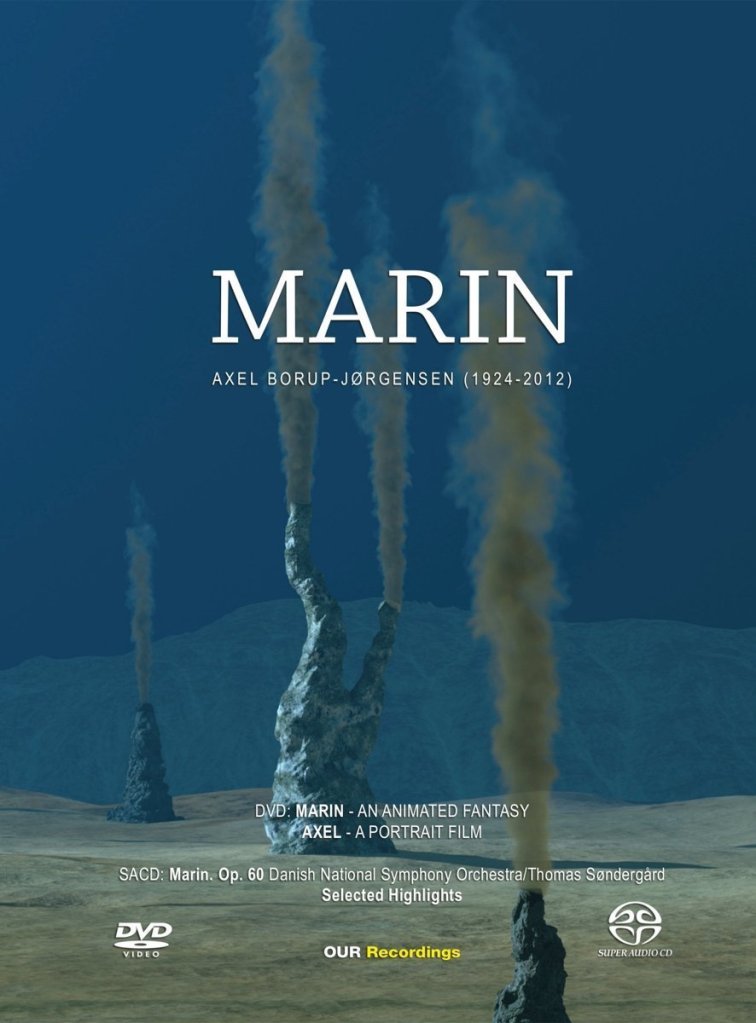
Another disc sent by my friend Joshua. This one is a DVD/CD combo of music by a composer whose existence was only revealed to me a couple of years ago. Marin includes a clever animated video which accompanies the title track.

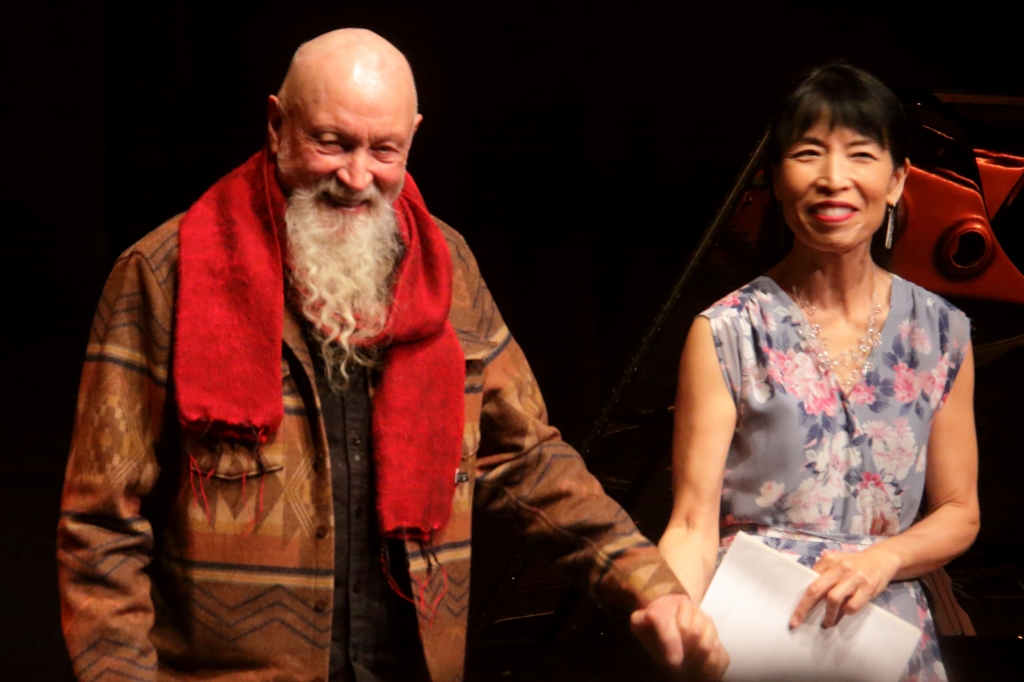
I was fortunate enough to have been able to hear Terry Riley and Gloria Cheng in an all Terry Riley program at the Yerba Buena Center for the Arts. Both were in spectacular form and the audience was quite pleased.

I would be remiss if I didn’t include the fabulous 6 night series of concerts produced by Other Minds. This is why I am a rabid advocate of OM programs. More on that soon with OM 24 coming up.

And lastly I want to tell you about two more composers who are happily on my radar.

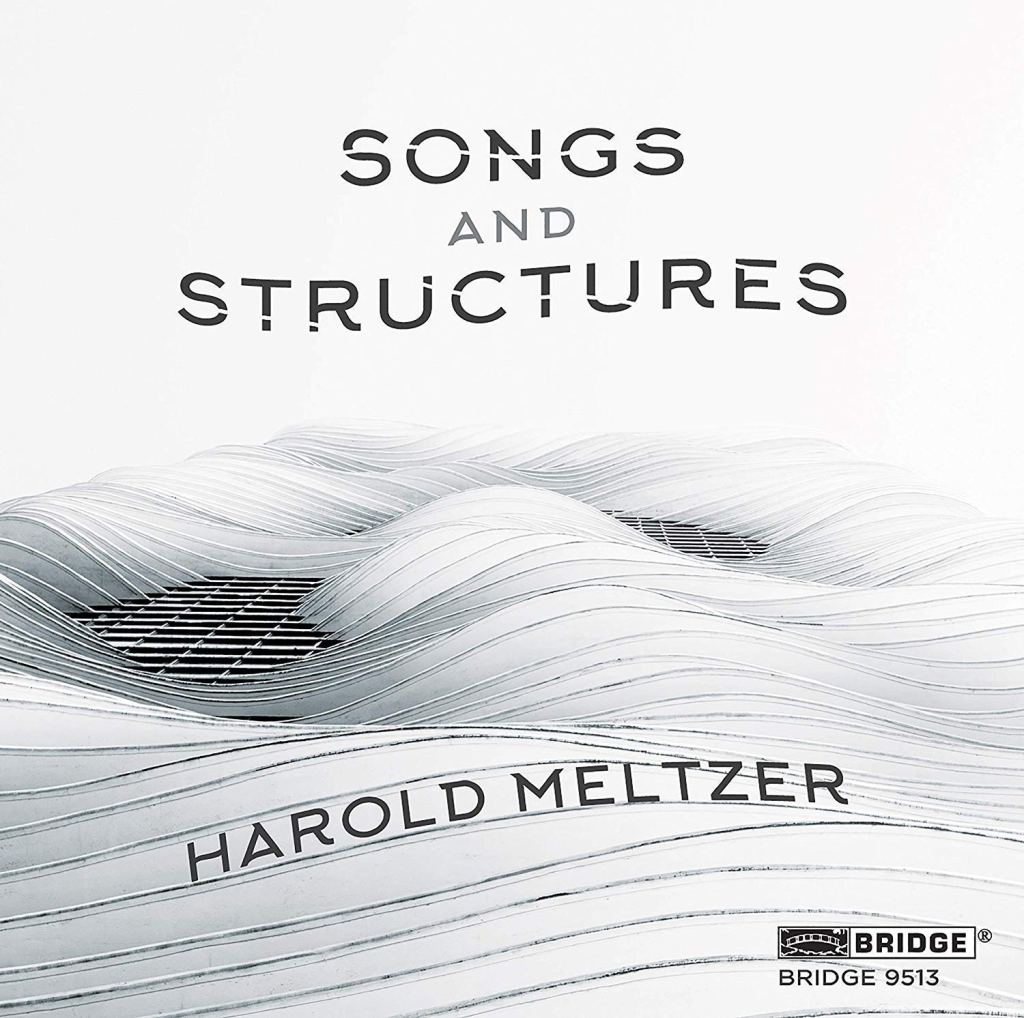
One of the joys of reviewing CDs is the discovery of new artists to follow. Harold Meltzer is now in that group for me. This basically tonal composer has a real feel for writing for the voice and has turned out some seriously interesting chamber music.

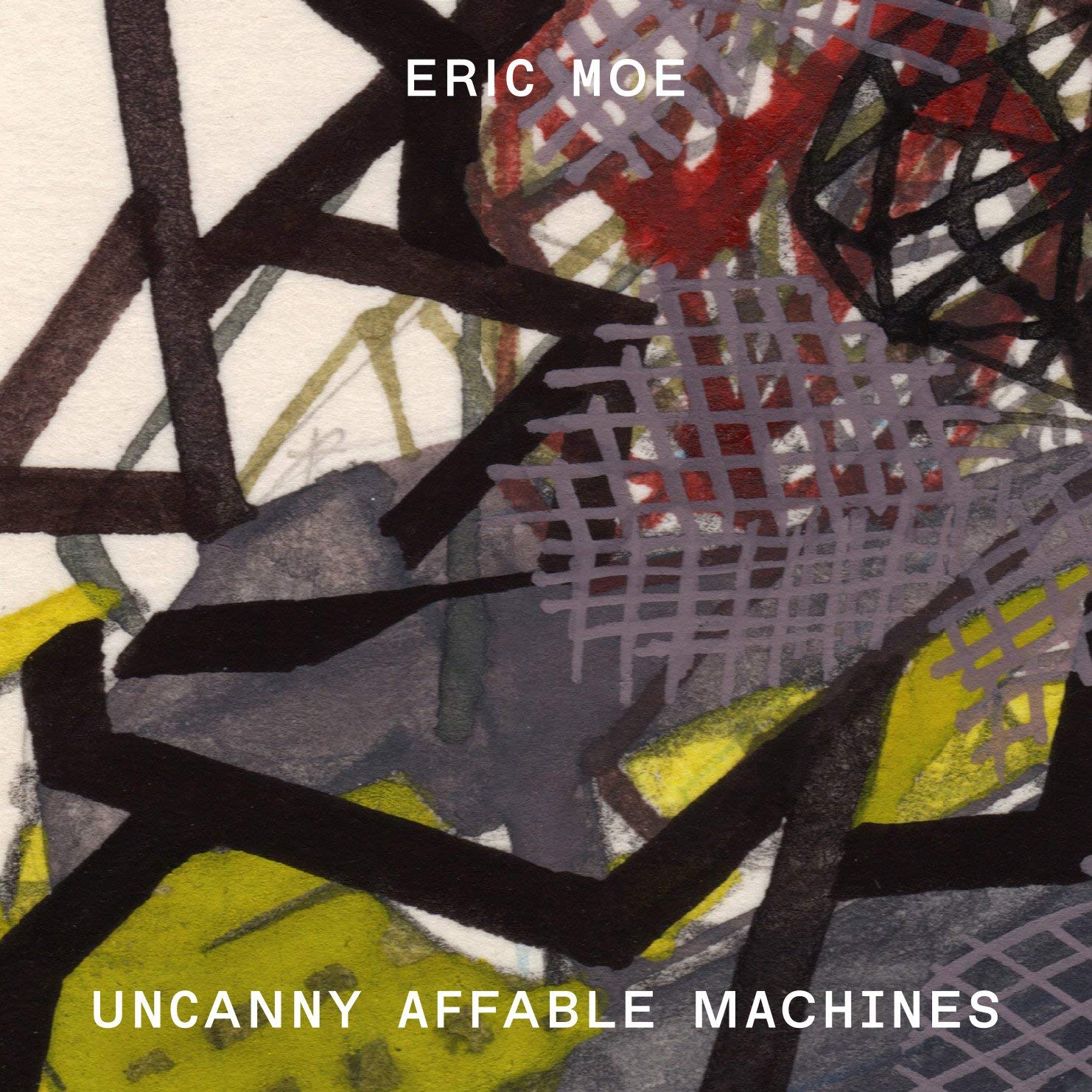
Another composer unknown to these ears. I bristle at the term “electroacoustic” because it sometimes means experimental or bad music. Not so here. Moe is fascinating. Definitely worth your time.

OK, gonna can the objectivity here to say that this is possibly the most underappreciated album I’ve heard this year. Combining a recording of the Debussy Preludes along with Schoenberg’s rarely heard “Hanging Gardens”, Webern’s Variations, and Berg’s Piano Sonata creates a picture of a moment in history when music moved from impressionism to expressionism. Jacob Greenberg is very much up to the task. Buy this one and listen, please. It’s wonderful.

Also beyond objectivity is this fascinating major opus by Kyle Gann. It didn’t get much recognition on my blog but it’s a major work that deserves your attention if you like modern music.

Well this is one of my favorite reviews in terms of the quality of my writing. The work is most wonderful as well. Though this review was actually published on December 31st I’m still including it in my 2018.

This is definitely cheating on my part but after that concert at Yerba Buena I can’t resist making folks aware of this wonderful set on the independent label, “Irritable Hedgehog”. Trust me, if you like Riley, you need this set.

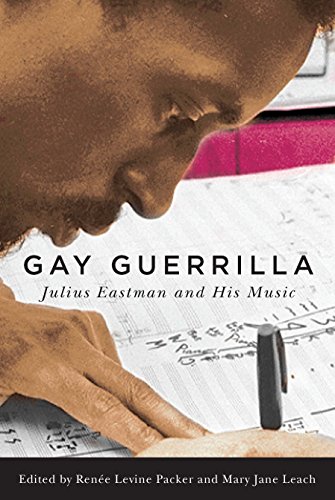
I review relatively few books on this site but by far the most intriguing and important book that has made it across my desk to this blog is Gay Guerilla. The efforts of Mary Jane Leach, Renee Levine Packer, Luciano Chessa, and others are now helping to establish an understanding of this composer who died too young. Here’s looking forward to next year.

I know I have left out a great deal in this quirky year end selection but I hope that I have not offended anyone. Peace and music to all.

A Major Peter Garland Work


garlandlandscape

The Whole Earth Catalog turned 50 this year.  It was in the 1980 edition of this classic publication that this writer stumbled across and embraced a small article which listed, “A Basic 10 Records of American Composers”.  It was written by one Peter Garland and forever influenced most of my subsequent listening choices and purchases.  For the record they are:

The Complete Music of Carl Ruggles (recently released on CD Other Minds OM 1020-21-2)

Piano Music of Henry Cowell (Folkways FM 3349)

Ameriques, Arcana, Ionisation by Edgar Varese (Columbia M 34552)

Peaens, Stars, Granites: Music by Dane Rudhyar and Ruth Crawford Seeger (CRI  S 247)

Ives: Three Places in New England, Copland: Appalachian Spring (Sound 80 DLR 101)

Music of Silvestre Revueltas (RCA)

Conlon Nancarrow: Complete Studies for Player Piano (Other Minds CD 1012-1015-2)

Lou Harrison: Pacifika Rondo and other works (Desto DC 6478)

Harry Partch: Delusion of the Fury (Columbia M2 30576)

John Cage: Three Dances for Two Pianos, Steve Reich: Four Organs (Angel S 36059)

And I start here to illustrate the range of this still too little known composer, musicologist, writer, musician.  Peter Garland (1952- ) doesn’t even have a dedicated website as of this writing and this list helps to put him in a context.  But a quick look at Google, Wikipedia, and Baker’s Biographical Dictionary will confirm that Garland is indeed a prolific composer as well as an accomplished and dedicated musicologist. The list of albums reflect far ranging tastes and interests. That 1980 article serves to reflect how his scholarship reached effectively beyond academia and reached a much wider audience and the same wide embrace is slowly being realized about his musical output.

pgarland

Peter Garland

He studied at Cal Arts with James Tenney and Harold Budd.  He started Soundings Press after attending a workshop with Dick Higgins.  Soundings press published articles by Garland and other musicologists.  Garland has focused on Native American and Latin American indigenous musics and is regarded as an expert in these areas.  Hie own music employs a variety of styles including minimalism and some use of folk melodies but he doesn’t really sound like anyone else.

His compositions almost seem secondary to his academic pursuits and, despite tantalizing descriptions of Garland’s performances in places like EAR magazine his music was hard to come by for some time. There have been a few recordings and, for those who don’t know his work, here is a little discography:

  • 1982 Matachin Dances (EP, Cold Blue)
  • 1986 Peñasco Blanco (Cold Blue, reissued on Nana + Victorio, 1993)
  • 1992 Border Music (¿What Next?, reissued on OO Disc, 2002)
  • 1992 Walk in Beauty (New Albion)
  • 1993 Nana + Victorio (Avant)
  • 2000 The Days Run Away (Tzadik)
  • 2002 Another Sunrise (Mode)
  • 2005 Love Songs (Tzadik)
  • 2008 Three Strange Angels (Tzadik) reissue of Border Music expanded with live recordings
  • 2009 String Quartets (Cold Blue)
  • 2011 Waves Breaking on Rocks (New World)
  • 2015 After the Wars (Cold Blue) EP with Sarah Cahill
  • 2017 The Birthday Party (New World)

Fortunately there are a few record producers who have recognized Garland’s talents.  And it should come as no surprise that these producers are of the independent label variety.  Starkland Records is indeed one of those independents with a reliable nose/ear for good new music and have chosen to record a major opus, The Landscape Scrolls.

This choice embodies much of what is great about Peter Garland.  In this work we get exposed to his scholarship of the stories and symbols of the scrolls as well as some insight to his interest in experimental and unusual instruments.  This is in fact a percussion piece but not the percussion music of your mother’s generation.

Commissioned by and dedicated to percussionist John Lane, The Landscape Scrolls (2010-2011) depicts the 24-hour day cycle in five movements. Garland remarks the work was influenced by Indian ragas, Japanese haiku poetry, and, especially, the famous Landscape Scroll of the Four Seasons by Japan’s 15th century painter Sesshu.

Each of the five movements is a metaphorical monochromatic study, more about resonance and space than melody or harmony: mid-day (Chinese drums); afternoon (rice bowls); after dark (triangles); late (glockenspiel); early morning (tubular bells). Garland notes that, after the fact, he was likely influenced by his fascination with the single-tonal color paintings of Barnett Newman.

John Luther Adams, himself a composer of some significant percussion music lately, provides most of the lucid liner notes.  Clearly Garland is respected by his fellow artists.  This release provides a fine opportunity to get to know this American master through this major opus.  As usual the Starkland production is very well recorded and sounds great.  This one was really done right.


Eric Moe, Uncanny and Affable (and very interesting)


moeuncanny

New Focus FCR 212

Here I sit with an album by a composer with whom I have no familiarity.  Fortunately Eric Moe has a delightfully tenacious public relations department (at least with this particular record label) whose prompts did finally get me listening.  OMG, it says “electroacoustic”.   That could be really bad or obtuse.  Well, I did promise to review it so here goes.

Eric Moe (1954- ) is a composer with a very well organized web page.  A quick glance at that web page informs that this is the 12th or so disc from a man who boasts what looks like a list of over 100 compositions.  Moe is also a performer and participates on this disc.  This graduate of Princeton (A.B., Music) and Berkeley (M.A. and Ph.D., music) teaches at the University of Pittsburgh and is also an active performer of both his and others’ music.

moekeyb

This discs contains 6 composition for solo instrument (mostly with) electronics.  Now that combination has given this writer pause because the genre given the name “electroacoustic” can be a mixed bag.  Sometimes these works can be ponderous or obtuse with meanings obvious to the composer and, hopefully, the performer.

However your reviewer’s neurotic fears were apparently unfounded as the tracks played some truly wonderful compositions.  Each track features a different instrument.  The instruments, in order, include a drum set played by Paul Vaillancourt, a viola played by Ellen Meyer, a solo 19tet keyboard played by Eric Moe, an unbelievably virtuosic pipa played by Yihan Chen, solo piano played by Eric Moe, and flute played by Lindsey Goodman.

Suffice it to say that all the soloists here come with a high level of virtuosity as well as the ability to interact meaningfully with the electronics.  Far from being a nightmare of impenetrable experimental music this is rather a very entertaining set of pieces which tend to avoid the worst cliches of this genre.

Rather than attempting to describe each of these pieces (a task which would likely be more painful to read than write) it is best to simply provide assurances that the combination of this talented composer combined with the more than capable soloists provides a stimulating and interesting listening experience.  These are wonderful performers with great material.

The listener will want to hear each track more than once to get a good idea of what the composer is doing but, fear not, this album is much more adventure than ordeal.  It shows a composer at the height of his powers producing art which stimulates the senses and provides an emotional experience.  While there is clearly intellect behind the creation and performance of these works they tend to speak rather directly to the listener providing a stimulating entertainment that leaves the listener with a shred of hope that classical, even modern classical is far from dead.

Kudos to professor Moe and his collaborators and a nod of thanks to the tenacious publicity folks who would not let this release go quietly into the good night.  You shouldn’t either.

Josh Modney’s “Engage”, New Music for Violin Solo and Not Solo


modneyengage

New Focus FCR 211

This is an awesome undertaking.  I recall when pop musicians were cautioned that it may be unwise to release a so called “double album” for fear that their inspiration (or talent) may not be up to the task.  Well here comes Josh Modney violinist and Executive Director of the Wet Ink Ensemble , a member of the International Contemporary Ensemble (ICE), and a performer with the Mivos Quartet for eight years.  This 3 CD set is his solo violin debut album.  And what an album it is.  There is no lack of talent, skill, or imagination here.  This is essentially three faces of Josh Modney a sort of sonic CV.

The first disc features four tracks of music by contemporary composers for violin with soprano, piano, and/or electronics.  All four are fairly recent compositions:  Sam Pluta’s “Jem Altieri with a Ring Modulator Circuit (2011), Taylor Brook’s “Vocalise” (2009), Kate Soper’s “Cipher” (2011), and Anthony Braxton’s “Composition No. 22” (1998).All of these are challenging for the musicians and none are easy listening but all demonstrate aspects of Modney’s skills as a musician

The second disc features J. S. Bach’s “Ciacona” or “Chaconne” (1720) from the second violin partita.  But this is not just another performance of this towering masterwork of the solo violin repertoire.  Modney has chosen to perform it in just intonation.  Now how’s that for versatile?

The effect is subtle and may even be lost on some listeners but fanciers of Bach and alternate tunings will likely find this to be anywhere from mildly interesting to revelatory.  It is a fine performance and it is interesting to hear it in just intonation and amazing to know that this performer has this uncommon skill of playing accurately in an alternate tuning on the violin.

Filling out the second disc is a piece by pianist Eric Wubbels, “the children of fire come looking for fire” (2012).  This is a very different piece and I’m not sure why it was paired with the Bach except that it fit the available space.  Wubbels contribution is a sort of electroacoustic collage.

The third (and last) disc is of solo violin compositions by Josh Modney.  Again we move into contemporary and experimental compositions which reflect Modney’s skill with the instrument as well as his insights into it’s potentials.  Again there are no echoes of Bach here but rather more of the experimental/avant garde/free jazz style which dominates this album.  The solo violin repertoire is not huge so it is reasonable to assume that these little gems will find a place there.

This is a lovely production with striking cover art and excellent sound.  If you like cutting edge violin music you will have a wonderful time with these discs.  And if you’re looking for a wildly skilled and imaginative musician check this set out and get ready to be wowed.


Duo Noire, Guitar Duo Revisioned


unnamed

New Focus FCR 210

Duo Noire consists of Thomas Flippin and Christopher Mallet.  These guitarists are graduates of the Yale School of Music.  For this, their debut album, they have chosen to feature a program of all women composers.  Add to that the fact that these fine emerging artists are African-American (also the first African American graduates of Yale School of Music) and you have a glorious celebration of gender/cultural diversity as well as some mind blowing compositional efforts ably handled by these visionary musicians.

duonoir

The demographics are necessarily prominent especially in these contentious times when racial and gender discrimination are, sadly, huge and difficult issues that remain largely unresolved.  But the real story here is creative music and musicians.  This duo seems to have a unique sound and are clearly schooled in their instruments to the point that they even seem to be expanding the very possibilities of a guitar duo.  Above all this is an intelligent album.

The composers Clarice Assad (1978- ), Mary Kouyoumdjian (1983- ), Courtney Bryan (1982- ), Golfam Khayam (1983- ), Gity Razaz (1986- ), and Gabriella Smith (1991- ) are mostly unfamiliar names to this writer and, likely, to most listeners.  But don’t let that put you off.  This is a highly inventive set of compositions and these performers are doing the job of discovering these compositional talents.

There on six compositions on this thirteen track CD which has over an hour of music on it and it appears to be a landmark release for identifying new composers contributing to the guitar duo genre.  Guitar duos are not an unusual instrumental grouping but this collection suggests fresh new directions that extend the possibilities of this instrumental configuration.

assad

Clarice Assad

Of course the guitar duo is hardly a new idea.  On the more pop side we have had Les Paul and Mary Ford and on the classical side many listeners will be familiar with Sergio and Odair Assad.  And that brings us to Clarice Assad who is the daughter of Sergio Assad.  Her composition,  Hocus Pocus (2016) is in three movements, each ostensibly describing an aspect of magic.  Clearly Assad is familiar with both traditional and extended techniques of composition for guitar.  This is a sort of impressionistic work which calls upon the musicians to utilize a variety of techniques to evoke moods and images of each of the three movements, Abracadabra!, Shamans, and Klutzy Witches.

kouyoumdjian-headshot-web-quality_orig

Mary Kouyoumdjian


Byblos (2017) by Mary Kouyoumdjian embraces her Persian roots as well as the conflicts which have plagued this area of the world.  Here she is evoking an ancient town in Lebanon.  This is the most extended single movement on the disc and demonstrates the composer’s mastery of form while it challenges the instrumentalists to evoke the ancient and mystical sounds of her classical culture.


bryan

Courtney Bryan

The only African-American composer featured on this recording is Courtney Bryan.  Her “Solo Dei Gloria” (2017) which was commissioned by Duo Noire takes the listener on a sonic journey through the composer’s impression of the inner process of prayer.  That’s a mighty abstract concept and she manages accomplish it with just the two guitars (and, of course, two talented musicians).


The three movement, “Night Triptych” (2017) was also written for Duo Noire and has the honor of being the title track for this truly eclectic and innovative album.  This has more the feel of an abstract musical work than the others featured but one does hear the influences of her ethnic origin (Persian/Iranian).  Despite the more extended nature of this composition this work, like all the works presented here, is a sampling of the composer’s work and the astute listener will have many reasons to seek out more of this young composer’s work.

golfam

Golfam Kayam


Gity_228-1-8x10

Gity Razaz


Four Haikus (2017) was also written for Duo Noire.  This Iranian born composer is rapidly becoming established internationally as an accomplished composer.  Like the previous work these four short movements are of a more abstract nature.  Another sampling that will prompt listeners to seek out more of this emerging composer’s work.

gsmith

Gabriella Smith

Last but not least is the second most extended work here by the youngest of the composers represented.  “Loop the Fractal Hold of Rain” (2017) is another Duo Noire commission.  This is probably the most abstract and modern composition on the disc.

Many works here have at least the suggestion of dealing with politics, conflict, and the impact of such things on individuals.

It is admittedly unusual (though clearly not risky) to program compositions by all women composers.  This is a wonderful collection with performances that are incisive and intriguing enough to leave their listeners wanting more.  This is a group to watch/listen to.


Steven Kemper’s Mythical Spaces


mythical

Ravello Records RR 7980

It is this writer’s opinion that the category “electro-acoustic” carries such a wide range of connotations that it is of limited use to a listener.  This album is so characterized and here simply means that both electronics and acoustic instruments are used.  Even the concept of electronic music is difficult since such a designation. Playlists on Spotify and iTunes usually points the listener to a form of pop/dance music if you search for electronic.  Further complicating things (and I think this is at least in part the point here) the electronics here include fixed media (electronics which does what it is programmed to do and does not interact with the performers or simply plays alone) and robotic electronics as well as electronics which interacts with the performer.  You will have to check the composer’s web page for more information on what exactly the “robotic” media are.

This is cutting edge in the sense that it is experimenting with new media in combination with more traditional media (and simple electronics is now “traditional media” having been superseded by the new fangled).  The actual sound of this music seems to inhabit a rather spare sound world akin perhaps to that of late Morton Feldman but with more brevity. These pieces last from 1.5-10 minutes on average and demand some concentration on the part of the listener.  Think maybe a cross between Feldman, Webern and say Subotnick.

Now one could conceivably play this music at a low volume in the manner of so-called “ambient” music. There are not many dynamic changes here to take you away from that sort of reverie.  But that does not really seem to be the composer’s intention. These are concentrated little essays, each seeming to explore the parameters of its context, fixed media, live instruments, robotic media, and combinations of these.

Steven Kemper is a new name to this writer.  His education and wide interests are available on his web site.  While he has an impressive bibliography with cutting edge research interests in music and sound this appears to be his first CD.

There are 15 tracks which comprise 5 works.  Mythical Spaces (2010) is for percussion with fixed media in 5 separate movements.  Breath (2015) is for fixed media alone in one movement.  Lament (2015) is also in one movement and is scored for flute with interactive media.

The longest single movement comprises In Illo Tempore (2012 rev 2017) is scored for saxophone, bassoon, AMI (automated monochord instrument), and CARI (cylindrical aerophone robotic instrument).  It clocks in at 7:48.

Last but not least is The Seven Stars (2012) for amplified prepared piano in 7 movements.

Live performers include Mark Truesdell, percussion; Wayla Chambo, flute; David Wegenlaupt, saxophone, Dana Jessen, bassoon, and Aurie Hsu, prepared piano.

This is music which requires some serious concentration from the listener.  Hearing/seeing this live might provide some additional aspects due to these strange electronic/robotic instruments but the point here seems to be one of an inner voyage which, if you focus you listening energy, transports you into this composer’s imaginary spaces.  Whether you will enjoy this or not is difficult to say but it is certainly worth the effort.


Crazy Nigger, Gay Guerrilla, Precious Artist: Julius Eastman Examined


eastman

This essential collection celebrates the life and work of a composer and performer whose unique presence was nearly eroded to nothing but for the work of composer (and co-editor of this volume) Mary Jane Leach who spearheaded an effort to rescue as many scores and recordings as possible after Eastman’s death in 1990 at the age of 49.  The first evidence of this modern archaeological effort came with the release of Unjust Malaise (2005), three CDs which featured some of the recordings that were gathered in that early effort.  In addition it should be noted that Leach continues to maintain a resource page with the most up to date information on Eastman scholarship efforts.

Now, along with Renée Levine Packer (whose wonderful history of the Buffalo New Music Days, “This Life of Sounds” (2010) is not to be missed) we have a lovingly edited collection of essays which comprise a sort of biography as well as an appreciation of this very important American composer.

One look at the acknowledgements reveals the wide scope of individuals with whom Eastman came into contact and whose contributions became so essential to this volume.  The wonderful introductory essay is so very appropriately written by George E. Lewis whose figure itself continues to loom knowledgeably over late twentieth and early twenty first century music.  He takes a characteristically unflinching look at the cultural, historical and socioeconomic factors that contextualize Eastman’s work as well as his untimely demise.  Eastman’s frequent use of politically incorrect titles that challenge a smooth vocal delivery in the most seasoned of broadcasters is here made to seem quite understandable (if not comfortably palatable) within the complex forces that defined Eastman’s milieu.  Lewis embraces Eastman’s talents and makes the prospect of further study of his work tantalizing.  He provides a truly authoritative context which can serve all future work in this area.

There are nine chapters, a chronology and a select bibliography along with photographs and score examples.  The essays that comprise each chapter focus from the macro-view of Packer’s biographical sketch and Leach’s timeline to micro-analyses of some of Eastman’s works and some additional personal perspectives.  One of the most endearing qualities of this volume is the fact that many of the contributors knew and/or worked with Eastman at one time or another.  It is clear that all the contributors were deeply affected by their encounters with Eastman himself and/or with his music and all are rather uniquely suited to be in this volume.

One suspects that Packer’s biographical sketch which opens this volume will henceforth serve as a basic model for all future biographical research.  Whether one finds agreements or not the material is presented in as complete and organized a fashion as can be imagined.  It paints the picture of a prodigy who, for whatever reason, fell into disarray.  Whether there was drug use or symptoms of mental illness will be the debate which will, of course, never be satisfactorily resolved.  What shines through though are tantalizing moments and a plethora of relationships, however brief sometimes, that contribute to all we will ever really know of the enigma of the life of this precious artist.

Some of what follows has the quality of memoir and some leans more toward academic analysis.  All of these essays, timelines, bibliographies, etc. tie this book together as the first most comprehensive effort at trying to understand the man, his music, his milieu, his unusual personality.

These accounts will always be crucial in any future analysis of the enigmatic talent of Julius Eastman.  Though many will attempt to affix labels to his personality variously attributing his quirks to mental or physical illness no one will ever know him the way the people in this book did, as a precious artist whose work was rescued (as much as it could be) from obscurity by his family (both biological and artistic).  He was and is loved in perhaps the only way that he would allow, through his work and his deeds.

This book is a fascinating read which serves to put the artist back into his proper place as the genius he was.  Much remains to be written, performed, analyzed and recorded but this book will always serve as the reference point for what is to come.

The Heresy and the Ecstasy: Brooklyn Raga Massive Does “In C”


brminc

This is heresy.  It is not, strictly speaking, faithful to the 1964 score and it is a sort of cultural appropriation which is actually the very basis of Brooklyn Raga Massive, a sort of latter day “Oregon” (to those who recall that band) which takes on all sorts of music and filters it through the unique lens of this flexibly populated group of musicians whose backgrounds range primarily from Hindustani and Carnatic traditions (though hardly in the most classical sense) but also from western classical and jazz.  Their “heresy” comes from their choices.  The root of heresy is the Greek word, “hairesis” which means choice.  There is a lovely selection of their musical heresies on their You Tube Channel.

No this is not purely heresy and it is certainly not blasphemy.  Quite the opposite actually.  And I would prefer to think of this effort as cultural integration.  The choices made here instead lead to some mighty ecstatic music making which pays honor to Terry Riley who turned 80 in 2015 and provides a unique perspective on this classic work.

“In C” (1964) is without doubt Riley’s best known work by far and the one which pretty much defined what would later become known for better or worse as “minimalism”.  It is an open score meaning that no instruments are specified for performance making this music heretical in nature as well.  In addition there is no conductor’s score as such.  Rather there are 53 melodic cells numbered 1 to 53 and the ensemble is held together by the expression of an 8th note pulse played by at least one of the musicians involved.  The defining reference on the intricacies of this work is composer/musicologist Robert Carl’s masterful book entitled simply, “In C”.  He describes the wide variety of potential choices which can be made in performance and the different results which can be achieved.

There are a great deal of recordings available of this work from the first (released 1968)  on Columbia’s “Music of Our Time” series curated by the insightful David Behrman to versions involving a wide variety of instrumental combinations of varying sizes.  The first “world music” version this writer has heard is the version for mostly percussion instruments by Africa Express titled, “In C Mali” (released in 2014).

Not surprisingly BRM, as they are known, have chosen a largely Hindustani/Carnatic take on this music.  The unprepared listener might easily mistake this for a traditional Indian music recording with the introduction which incorporates a raga scale and adheres to the traditional slow free rhythm improvisation of the introductory “alap” section common to such traditional or classical performances.

The familiar sound of these (largely) South Asian instruments with their rich harmonics sets the tone gently.  This writer has at best a perfunctory working knowledge of these complex and beautiful musical traditions but one must surmise that the choice of Raga Bihag may have some intended meaning.  Indeed such music is by definition integrated into the larger cosmology of Hinduism, the Vedas, the Gita, the Sanskrit language, and, no doubt other references.  This is not discussed in the brief liner notes but is worthy perhaps as a future interview question.

It appears that many of the musical decisions were made by sitarist Neel Murgai though it becomes clear as the performance develops that individual soloists are allowed wonderful improvisational freedoms at various points.  The recording is intelligently divided to let the listener know which set of melodic cells is being expressed at a given time.

The alap gives way to the sound of the tablas which initiate the pulse mentioned earlier.  The structure of this piece produces a range of musical experiences from a sort of didactic beginning to the swirling psychedelic waves of sound which stereotypically define much of the music born in the mid 1960s in this country.  In fact Terry Riley’s deep study of South Asian musics (most famously under vocalist Pandit Pran Nath) did not occur until later in his career.  Nonetheless there seems to have always been some affinity between Riley’s vision and the sort of music whose popularity was driven in the United States most famously by the efforts such as Pandit Ravi Shankar and Ustad Alla Rakha in the 1970s.

What follows is a riot of musical ecstasy involving some inspired improvisational riffs and some stunning vocalizations as well giving us a fascinating take on this music which was written well before these musicians came into the world.  We have a later generation paying homage to the beloved American composer and to the beautiful traditions of their own eclectic ethnic heritage.

The set concludes in this live and lively recording with a traditional fast paced Jhalla, the traditional ending to classical Indian musical performances. This will likely become known as the “Indian” recording of “In C” but it is so much more than that.  It is an homage.  It is a look back from the view of at least a couple of generations of artists.  And it is heresy in the best sense of that word, choices made judiciously to achieve higher artistic goals.  Not all art is heresy and not all heresy is art but the heresies perpetrated here definitely deserve our ears.

The heretics are: Neel Murgai, Sitar and Vocal; Arun Ramamurthy, Violin; Andrew Shantz, Vocal; Josh Geisler, Bansuri; Sameer Gupta, Tabla; Roshni Samlal, Tabla; Eric Fraser, Bansuri; Timothy Hill, vocal; Trina Basu, Violin; Ken Shoji, Violin; Kane Mathis, Oud; Adam Malouf, Cello; Michael Gam, Bass; Lauren Crump, Cajon; David Ellenbogen, Guitar; Max ZT, Hammered Dulcimer; Vin Scialla, Riq and Frame Drum; Aaron Shragge, Dragon Mouth Trumpet.

Namaste, folks.


Longleash: Incorporating the Modern


longleash

The strikingly beautiful cover art reminiscent of Magritte is eye catching and make this reviewer nostalgic for the days of the 12×12 format of LP covers.  (Album Artwork: Pink Lady (2015), Scarlett Hooft Graafland, Album Design: Laura Grey).  It is, perhaps by virtue of its nod to modernism, a metaphor for the content of this album as well as being its title.

Longleash is apparently the oh so clever operations name of a CIA project whose goal was to help proliferate American modern art in the cold war era.  These days I guess that would be “weaponizing” art.  And this modern piano trio has (curiously) elected this for their stage name.

Well the content of this album is nowhere near your traditional piano trio and may even seem subversive to some listeners.  Longleash are modernist throughout.  Pala Garcia, violin; John Popham, cello; and Renate Rohlfing, piano self-identify as a group with “traditional instrumentation and a progressive identity.”  Indeed they have chosen a rather young and pretty much unknown group of composers: Francesco Filidei (1973- ) is the oldest of the group followed by Clara Iannotta (1983- ), Juan De Dios Magdaleno (1984- ), Christopher Trapani, and Yukiko Watanabe.

Despite the varied backgrounds these composers seem to share a particular segment of a modern aesthetic.  They seem fond of judicious use of extended instrumental techniques and quasi-minimalist cells but their styles are quite listenable.  They seem to have aspects of pointillism, the occasional terseness of Webern, some rhythmic intricacies and the occasional nod to a melody.  In short they seem schooled in the variety of techniques which rose largely out of the twentieth century but seem beholden to none of them seeking instead to judiciously use their skills to create their own unique sound worlds.

There are five works on eight tracks and none of them can be easily described except to say the the combination of listening with the aid of the liner notes can be helpful.  That is not to say the works cannot stand on their own.  That is a useful experience in itself.

I suppose it might be best to say that these works will likely evoke a variety of reactions from various listeners.  This is the sort of album, at least for this listener, that benefits from a direct concentrated listen without distraction but it is also worth experiencing as background music, letting the experience creep in where it might while you do other things.  And then a read through the liner notes to try to divine the composers’ intents.

I’m not being facetious here.  I think this is a very intriguing album but one which is difficult to characterize in words and one which is beyond this writer’s expertise in terms of any useful analysis.  Also the newness of these voices does not allow one to place these works even within the contextual canon of each individual composer’s work.  We have free floating modernism which, as was thought in the cold war days, may invade one’s intellect in subversive ways.

The review immediately preceding this one, Soft Aberration, features this piano trio on it’s first track.  Now Scott Wollschleger is very closely associated with the Manhattan School of Music.  What is curious here is that Longleash has managed to find the present disparate group of emerging composers with no directly discernible connections to the Manhattan School but with a clear affinity for the same sound world.  It is the luck of the draw that these reviews have appeared in this sequence but the similarities are striking.  So if you like the spare sounds of the New York School (John Cage, Morton Feldman, Earle Brown, Christian Wolff) and their successors in people like Scott Wollschleger, Reiko Futing, and Nils Vigeland (who, along with Pala Garcia provides the useful liner notes) then this will be your cup of tea.  But even if you don’t know these folks you are still in for a fascinating journey of cutting edge ideas by emerging composers.  And even if it is not “weaponized art” subverting your mind to western ideology you can be assured that it is genuine and uplifting work done by some wonderful performers of composers you will likely hear from again very soon.


Scott Wollschleger’s Soft Aberration


wollschlegersoft

New Focus FCR182

The cover and the booklet that come with this CD contain art that is a remarkably fitting metaphor for the music contained herein.  The almost monochromatic images with sometimes barely visible lines defining a space which requires serious concentration to discern effectively at times is very much like the music we hear on the disc.

Scott Wollschleger (1980- ) is an American composer who studied with Nils Vigeland at the Manhattan School of Music.  His work has been compared to that of Morton Feldman and, more generally, to the other members of the so-called New York School.  Vigeland has been active throughout his career performing and recording definitive versions of some of the best of Morton Feldman, John Cage, Earle Brown, and Christian Wolff.  It would appear that these voices and stylistic leanings are very much favored at the Manhattan School of Music.  A previous disc reviewed here with music by head of the composition department Reiko Futing, evokes a similar sound world.

This disc of chamber music contains five works on eight tracks ranging from 1’43” to 14’27” and all require almost as much concentration on the part of the listener as the extended techniques and performance requirements demand of the performers.  The dynamic range is from (generous) silences to forte.

The first track is by the seriously entertaining and odd piano trio called Longleash.  They demonstrate their expertise and concentration as well as their love for this musical genre in their performance of Brontal Symmetry (2015).  Unlike the other pieces here, Brontal Symmetry makes use of ostinati and there is a consistent sound field punctuated with silences.  It is an unusual but ultimately engaging piece.  Longleash consists of Pala Garcia, violin; John Popham, cello; and Renate Rohlfing, piano.

It is followed by the titular and sparse Soft Aberration (2013) for viola and piano played by Anne Lanzilotti, viola and Karl Larson, piano.  Though approximately the same length as the opening work the silences nearly suspend the perception of time and create a sense of sounds suspended in space in a sort of sculptural way.

Bring Something Incomprehensible into this World (2015) is for trumpet and soprano.  The three parts of this work are spread across the disc (tracks 3, 5, and 8) creating an even more spare sense.  It is interesting to play the three movements manually without the interruption of the intended track sequence to get a sense of the piece.  Again we have silences predominating with extended techniques demanded of the performers.  Andy Kozar plays trumpet and the soprano is Corrine Byrne.  The first movement at 6’39” is the longest followed by the second at 3’25” and the last at 1’43”.

America (2013) is a solo cello piece here played by John Popham (of Longleash).  It is a pointillistic mix of silence and extended instrumental techniques which makes reference to an art work by Glenn Ligon.

White Wall (2013) is for string quartet and is played by the Mivos Quartet consisting of Olivia De Prato, violin; Josh Modney, violin; Victor Lowrie, viola; and Mariel Roberts, cello.  This is an amalgam of unfolding processes which seem to be indiosyncratic to the composer.  It is very intimate music in that sense.  The piece is in two substantial movements.

The album concludes with the brief last part of Bring Something Incomprehensible Into This World.  Suffice it to say that there are attempts here to tie in philosophical as well as visual metaphors.  Wollschleger is apparently enamored of the writings of Deleuze, Nietzsche, and Brecht.  Her lies another tie in to the New York School with their love of visual metaphors and philosophy.  This is not an easy listen but it is a serious effort deserving of some attention.  The listener can decide whether the artists have indeed brought something comprehensible into this world…or not.


Coming Out Electric: Trevor Babb’s Warmth


Steve Reich’s masterful Electric Counterpoint (1987) opens this disc.  That work originally written for Pat Metheny  and has become pretty much a classic as well as a fine way to demonstrate a musician’s facility with multi-tracked guitar music.

Trevor Babb is a doctoral student at Yale and this appears to be his first album.  And what an album it is.  The choice of the opening work serves to demonstrate Babb’s ability to interpret, in his own individual manner, a work that has been recorded many times.  It remains a classic and very listenable work which belies the difficulties inherent in its performance.  Babb seems to take a bit more of a legato approach than previous interpretations but is definitely highly effective and this is a wonderful recording of the work.

It also serves to set the tone for the rest of this truly fine solo guitar and electronics debut album.  Electric Counterpoint is the first of 6 total works represented on this disc.  The remaining five selections fit the rubric of this collection in the overall sense but are definitely unique and challenging in their ways.

Paul Kerekes is not a familiar name to this writer and perhaps a new name to many.  His inclusion here introduces many to this composer and places him in the context of this interesting collection.  This young composer is apparently well known in the New York scene and seems to travel in the circles that include some of the most interesting artists currently working.  Trail is a very different piece than the Reich but demonstrates the range of the solo guitar and electronics genre.  This is a gentler, more meditative piece overall and one which piques interest in hearing more.

David Lang is a well known and very welcome name in new music and is here represented by Warmth, a classic Langian post-minimalist work which delights the listener while challenging the performer.

Septet by the late great James Tenney is one of those masterful compositions that is respected as a masterpiece but not often programmed.  This is due at least in part to it’s critical use of alternate tuning.  The effects intended by the composer can only be heard if the performer can play accurately the tuning involved.  It is a wonderful and listener friendly experience typical of the finest of Tenney’s grasp of how to use such tunings in the compositional process.  Babb executes this piece lovingly and this performance will likely help to nudge this work to a more frequent experience in the concert hall.
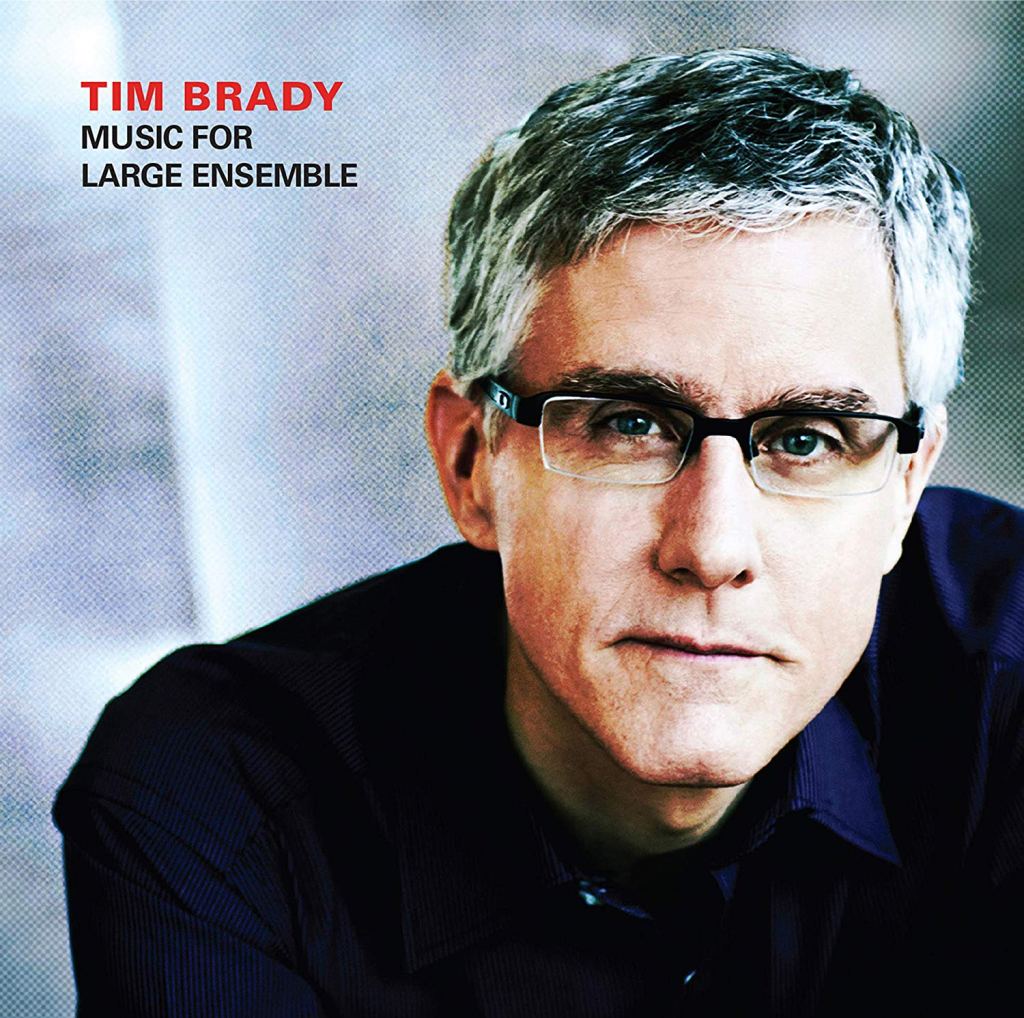
Babb introduces himself as a composer in Grimace, an impressionistic exercise in which he attempts to imitate both the style of Ligeti and evoke the image of a mask seen in an art exhibit.  Long tones and extended techniques predominate in this meditative drone-like work that demonstrates fine technique in both composition and instrumental facility.

The album concludes with Slope 2 by the emerging bass player and composer Carl Testa.   Again Babb introduces a new voice for the listener to explore.  This extended composition, more drone than pattern based, is one that deserves multiple hearings to discern its substance and to demonstrate its position in the larger rubric of this collection.

Babb produces a great debut here and makes a strong case for the genre of electric guitar with supporting electronics as being a viable format for a live concert.  He also seems to be defining that genre much the way that many solo artists are doing these days.  He seems to be constructing a repertoire establishing the classics (Reich, Tenney) and promoting the viability of works that he feels deserve a place in that repertoire.

This is a really delightful album and that extends, at least in this writer’s eye, to the cover design as well.  Again I will bemoan the loss of the 12  inch square format of LPs which could have made more prominent this lovely design by Colin Meyer and Trevor Babb.  Perhaps a 12 inch vinyl release may happen.  But until then the listener can settle most comfortably in the warmth of this truly fine release even in the smaller CD format or even as a digital download.

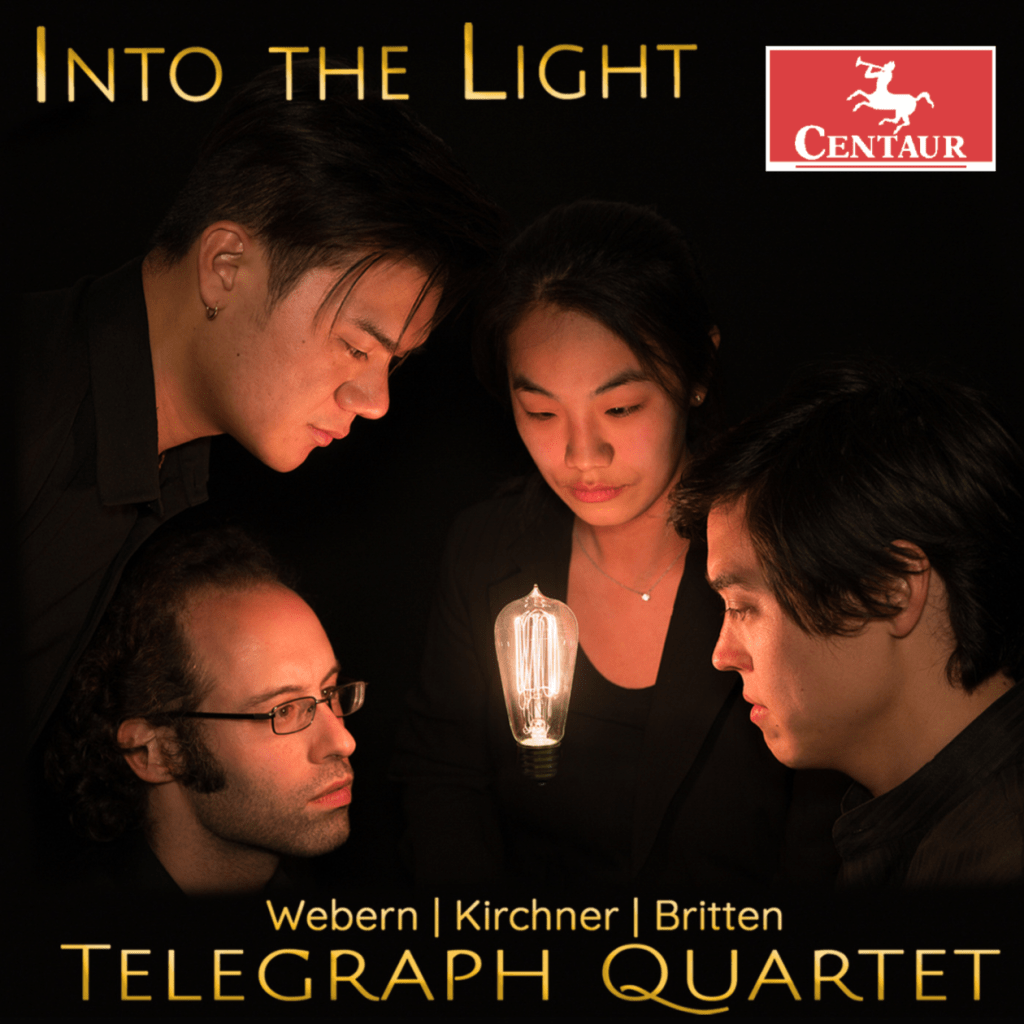
 

Nordic Affect: Raindamage, Wonderful Music from Iceland


Sono Luminus SLE-70008

Definitely an unusual beginning to this sonorous album of chamber music from the happy, creative place called Iceland.  Some of these tracks are electroacoustic combining some sort of electronic sound producing and/or manipulating components along with the live musical performance.

Nothing familiar here but a lot worth listening to.  This is a collection of recent chamber music from what is apparently some of the finest composers working in Iceland today. And as a Sono Luminus product it is a sound object of the highest order.  It is a beautifully recorded set of pieces that goes a long way to demonstrate the high quality and creativity of both the compositional and performance to be found in this distant corner of the world.

There are six works represented here.  Three are exclusively electronic, one for acoustic instruments with electronics and two are for acoustic instruments alone.  All seem to share the eclecticism of modern composers and, to this writer’s ear, a rather distinct style which seems to come out of the Nordic regions these days.

Iceland has a long and proud musical history and has amassed a large creative classical repertoire in (at least) the 20th and 21st centuries.  Perhaps one can hear the “sounds of the north” in these works or perhaps that is simply the analogous associations of this listener’s mind but there does seem to be some affinity between the lovely cover photograph of melting ice and some of the sounds herein.

At any rate this is fascinating music beautifully performed by Nordic Affect, a more or less fixed ensemble of violin, viola, cello, and harpsichord with occasional electronic supplementation.  Performers include Halla Steinun Stefásdóttir, Violin; Guòrún Hrund Haróardóttir, Viola; Hanna Loftsdóttir, Cello; Guòrún Óskarsdóttir, Harpsichord with Nava Dunkelman on drum in the last track.

The composers Úlfur Hansson, Valgeir Sigurðsson, and Hlynur Aðils Vilmarsson are completely unknown to this writer though it is noted that Hansson studied at Mills College in California, itself quite a hotbed of new music innovation.  No matter, though, these are some amazing composers doing cutting edge work and deserve your attention.

All in all this is one fine disc of chamber music.