Terry Riley with a t-shirt displaying the entire score of “In C” (photo from Facebook, copyright unknown)
November 4th, 2024 marks the 60th anniversary of the premiere of Terry Riley’s seminal masterpiece, “In C”. After having completed a variety of respectable compositional efforts, Terry Riley (1935- ) was jolted by the Muse to write this defining work that charted a path very different from that of the western classical mold of the composer’s formal education. It premiered in the very unconventional venue of a house in San Francisco, not in an auditorium designed for concerts. And it’s one of those pieces that now marks the transition from almost purely experimental writing to a style later dubbed “minimalism” (though many composers whose music is subsumed under this title eschew it in varying degrees). And whether you call it minimalism, trance music, drone, etc., the style would come to dominate a huge portion of concert works and recordings.
The score consists of 53 short musical phrases with no specified instrumentation and with no conductor’s score, just parts with a seemingly simple set of instructions. One page is what one might expect of a sketch of a larger work to be, not a complete score but, that’s it, One page with the instruction for the musician to repeat each cell or phrase ad libitum and then move on to the next. It was ostensibly the suggestion of composer/performer Steve Reich to have a pianist play eighth note repetitions of the top two highest octaves on the keyboard. In addition to this “click track” like strategy, the playing of those high “C”s also serves to anchor the tonality much as continuo does in that quasi improvisational baroque practice.
There is simply no finer account and analysis of this music than that of Robert Carl’s “In C”. Robert Carl (1954- ) is a teacher, composer, performer, and musicologist. I do not presume to have as extensive an analysis as he does but I’m interested here in providing a celebratory perspective from where I sit (and have been seated).
This music (as does all art) stands in a context with concurrent and recent events surrounding its conception and performance. Temporally it stands along with other notable compositions from 1964: Witold Lutoslawski- String Quartet, John Coltrane (admittedly one of Riley’s influences)- the albums, “Bessie’s Blues” and “Lonnie’s Lament”, Igor Stravinsky- Elegy for JFK and Variations in Memoriam Aldous Huxley (both men died on November 23rd, 1963), Roger Sessions- Symphony No. 5 and his opera, “Montezuma”, Milton Babbitt- Philomel, Karlheinz Stockhausen- Mixtur, Ben Johnston- Sonata for Microtonal Piano, Luciano Berio- Folksongs (written and premiered at Mills College, the later home of the Tape Music Center where Berio was teaching then), Olivier Messiaen- Et Expecto Ressurectionem Mortuorum, Iannis Xenakis- Eonta, and La Monte Young- (the first iteration of his masterpiece), The Well Tuned Piano.
My little list here is just a sampling of the western classical and jazz works that graced the natal year of “In C”. Admittedly, it is a cornucopia of some more experimental, some less so music that lie in this historical orbit. But, among the works in this list, it is the work of John Coltrane and La Monte Young that shares musical DNA with Riley’s aesthetic in this music. The other works contemporary mentioned represent a sort of “Garden of Forking Paths“ to a panoply of styles very different from the work at hand.
At a time when the style of American pop music had just recently met The Beatles, this work was a sort of coalescence of experiments done by La Monte Young, Steve Reich, and others. “In C” seems to have come out fully formed in its way. It was seemingly influenced by pop, jazz, and blues (whose use of repetition is endemic). 60 years later it is performed frequently and there exists at least 40 or so recordings of the work.
When I began writing this article I realized that Robert Carl’s book on this work fully covers the history and provides a definitive analysis to which I cannot contribute anything additionally useful. I then considered eliciting commentary from musicians and listeners about this music but found little interest because that has been well covered by several previous anniversary essays. So I decided to share a discography and photos of some the recordings I could find that have given me further insights into this touchstone work.
This discography is not comprehensive but my intent here is to celebrate this anniversary with the cover artwork that adorns the ever increasing documenting of this landmark of western art music. I will present what I believe is a representative selection of some 40+ versions.
Your humble author was 8 at the time of this work’s premiere. And my first hearing of ‘In C’ was in 1976 when my local radio station, the great WFMT in Chicago, aired a program curated by Raymond Wilding-White, a composer and professor of music at De Paul University. His task was to present representative works of American music, one for each day of the nation’s bicentennial year. ‘in C’ was one of them.
Since then I have heard many interpretations of this work. The original performance was at 321 Divisadero Street in San Francisco, California on November 4th, 1964. The original performers were: Terry Riley, Steve Reich, Jon Gibson, Pauline Oliveros, Stuart Dempster, Morton Subotnick, Warner Jepson, Tony Martin, William Maginnis, and Ramon Sender (who celebrated his 90th birthday this past week). This venue was the second and last home of the San Francisco Tape Music Center before it relocated and was renamed The Mills College Center for Contemporary Music in 1966 in Oakland.
Here, with brief commentaries, are my favorites. There are at least 38 versions according to the Wikipedia article. Here are my personal favorites in chronological order of release date:
The original Columbia Records release (1968)
If you only have one recording this is probably the one you want. Recorded in 1968, this brought the work effectively to a wide audience via international distribution. The instrumentation (some overdubbed) includes: saxophone, oboe, bassoon, trumpet, clarinet, flute, viola, trombone, vibraphone, marimbaphone.
Riley with the Chinese Film Orchestra (1989)
This important recording was made in China around the time of the Tiananmen Square uprising and the tapes were in effect smuggled out of the country in the aftermath of that incident. It stands as a fascinating document of eastern musicians encountering and interpreting this masterpiece.
The 25th anniversary release on New Albion (1990)
Don’t you just love anniversaries? By the time of this release (1989), this work had been disseminated into wide geographic regions and cultures. This version includes many of the musicians who premiered the work and this “traditional” reading is a loving homage to Riley’s work.
The Bang on a Can release (1998)
The Bang on a Can All Stars are among the finest ambassadors of new music. They have earned the right to put their stamp on any new work they choose and subsequently bring it anew to another generation of listeners.
Prog Rock does homage to Terry Riley (2001)
If you want to hear the wide range of musicians who have chosen to pay homage to this work this is a fine place to start.
The Africa Express release (2015)
Another fine example of the way this work can sound from a Central African perspective. This performance from Mali is absolutely electrifying.
Another fine culturally tinged version (2017)
This album is a personal favorite from the Brooklyn based collective featuring instruments from Hindustani traditions and others alongside western instruments. You can read my enthusiastic review here.
There are probably at least 50 recordings of this work. Some are private, maybe even bootleg versions. Clearly this work continues to become more and more essential and influential piece of music. It is not unlike a musical version of the Iconic monolith from the movie 2001: A Space Odyssey. The anomalous structure was of alien origin and was purported to accelerate the evolution of species who encounter it.
Riley’s work is most .definitely of terrestrial origin (well, San Francisco anyway) but, clearly this work continues to intrigue musicians worldwide and has arguably influenced the development of music itself.
Leonard Bernstein‘s liberal political sympathies are well known. But they were never as clearly presented in his music as they were in his ‘Mass’ from 1971. The work was commissioned for the opening of the Kennedy Center for the Performing Arts in Washington, DC and dedicated to the memory of John F. Kennedy.
In using the structure of the Catholic Mass Bernstein echoes the embrace of Christianity of previous Jewish composers like Schoenberg and Mahler. Mahler embraced Christianity at least partly to get work in the increasingly antisemitic atmosphere of late nineteenth century Europe. Schoenberg’s dalliance with Christianity was more that of an existential crisis as he watched the rise of the Nazi party and their genocidal horrors. Bernstein’s embrace of Christianity seems a combination of homage and disappointment. He knew well the glories of liturgical settings of the traditional texts by the likes of Bach, Haydn, Mozart and Beethoven and had himself made an a capella setting of the mass using music he had originally written for Jean Anouilh’s play, “The Lark”.
He also knew well the suffering and deaths occurring in the protests against the Vietnam war and the struggles of American citizens for equality in the Civil Rights movement as well as the struggles in the war itself and the failure of religious institutions to stem the tide of violence.
Bernstein had dealt with religious themes in his first Symphony from 1942, which set texts from the Biblical “Lamentations of Jeremiah” in the last movement. His Chichester Psalms of 1965 set three Psalms in Hebrew. And, his Third Symphony, “Kaddish” (1963) can be seen as a forerunner to the 1974 “Mass”. His final symphony became a post hoc requiem subsequently dedicated to John F. Kennedy when, just weeks before the premiere, he was assassinated in Dallas. The composer dedicated the work to the late president. He also performed Mahler’s “Resurrection” symphony the day after John F. Kennedy’s assassination presenting it as a peaceful response to the murder.
Bernstein was no stranger to politics and progressive ideas and his activism is central to his life and legacy.
The traditional mass is a ritual of sacrifice which the composer uses to talk about the sacrifices of lives and culture occurring during the ongoing Vietnam war. It laments the ineffectiveness of religion in dealing with sociopolitical crises. The full title of the score at hand is ‘Mass, a piece for singers, players, and dancers’. It was commissioned by Jacqueline Kennedy as the inaugural work for the opening of the newly completed Kennedy Center for the Performing Arts in Washington D.C. The first performance took place at the new Kennedy Center on September 8, 1971.
Richard Nixon had declined to attend ostensibly to not draw focus from Jacqueline Kennedy Onassis but subsequent research has determined that he had been warned by FBI headJ. Edgar Hoover of the possibility of “subversive” texts within the piece. He was apparently referring to the latin texts of the mass. So, for “security” reasons, Nixon stayed home that night.
Well, hello Facebook marketing and crowd sourcing. These got me into my very first set of earbuds. Yes, I’m a latecomer to this ubiquitous accessory that now connects me more intimately with the digital world. Why did it take so long? Am I a Luddite?
While my life is hardly dominated by electronics, I have gradually given in to a number of devices which are now pretty well integrated into my life. Having spent my adolescent years at a time when electronic calculators had first been introduced and personal computers were yet many years into the future, my electronics were limited to a television, a VCR, a cassette deck, a turntable, and a stereo receiver (I could not afford Quadraphonic technology).
But this essay is not just a history of my relationship to technology (not terribly interesting actually). Rather it is the mini love affair I’m having with these lovely earbuds (we used to call them earphones but what’s in a name, right)?
Status Audio Between ANC Earbuds and Charging Case
I have seen the proliferation of earbuds wearing folks for some time now and, when I saw that Facebook ad one day, I decided I was ready. So I ordered them via the posted link and they arrived shortly thereafter.
I’m no expert with audio electronics but I think I know good sound when I hear it. And these beautifully designed crowd funded earbuds delivered incredibly good sound including really dramatic bass response.
The only problem I can report here is the lack of a tether so that, if one bud leaves an ear, it can easily be located. Various such products are available but none that I’ve so far tried have been truly satisfactory. That said, I have stopped using these if I am likely to fall asleep and lose one or both earbuds. And they give me great joy when listening/watching music and other videos on my iPad after lights out. I can listen to my heart’s content without disturbing my partner or our dogs (who found those buds to be potential chew toys).
I do also own a set of Sennheiser 400 HD Pro Headphones which I tend to use when listening to sound editing tasks on my laptop or listening to actual CDs on my little boombox. But these new earbuds are now a part of my treasured audio electronics. I highly recommend them.
You can order them from Status Audio and, full disclosure, I get nothing save the satisfaction of recommending a truly fine bit of audiophile electronics. Happy listening.
Cover of the original vinyl release of “Der Floss der Medusa”
The 1913 riotous premiere of Stravinsky’s “Rite of Spring” is pretty well known in classical music history. Sandwiching the premiere of his masterpiece of modernism between well known conservative chestnuts such as “Les Sylphides” (an orchestration by Alexander Glazunov of piano music by Chopin, 1907-9) which opened the concert along with Carl Maria von Weber’s “Les Spectre de la Rose” (an 1841 Berlioz orchestration of Weber’s 1819 piano piece, “Invitation to the Dance”) and Alexander Borodin’s “Polovtsian Dances” from his opera “Prince Igor” (1887-1890) which were programmed to follow it. Combine these (familiar to audiences) conservative works with the Rite’s original choreography by Vaclav Nijinsky and the subject of pagan ritual that form the scenario played before an audience consisting of elite concert goers seeking a familiar easy experience along with a burgeoning group of bohemian leaning audience members (who loved the Rite’s loud, subversive nature of both music and staging) and you have a formula for conflict. Speculation is that Stravinsky and/or his producers planned this event to create a contrast for his new modernist work but more likely it was a largely a product of its time and of human nature.
Fifty two years later, Hans Werner Henze appears to have had nothing in mind (at least initially) other than the premiere of his new work, “Das Floß der Medusa” (The Raft of the Medusa) on December 9, 1968 in Hamburg’s “Planten und Blomen” Hall. The recording which was later released on DGG LPs had been done sans audience on the previous days, December 4-8th, and preparations were being made for that night’s world premiere performance before an audience.
An article would later run in the German magazine Der Spiegel describing the event. I present the text of that article in my own translation:
Der Spiegel, December 12, 1968
“What is necessary”, says Hans Werner Henze, 42, “are not museums, opera houses and world premieres … What is necessary is the creation of mankind’s greatest work of art: the world revolution.”
Last Monday, Henze’s “Das Floss der Medusa,” an “Oratorio volgare e militare, in due parti” commissioned by the NDR, was to be premiered in Hamburg — instead, there was a revolution in the hall.
The 1060 seats in Hall B by Planten un Blomen were fully occupied, the NDR Symphony Orchestra was already tuning the instruments, on the podium were ready: Edda Moser (soprano), Dietrich Fischer-Dieskau (baritone) and Charles Regnier (speaker) , the North German Radio Choir, the RIAS Chamber Choir and the St. Nikolai Boys’ Choir. The game could begin, and it began — a duo volgare e militare between NDR and SDS.
Because the Berlin SDS friends under Gaston Salvatore, summoned by Henze, didn’t want to do without this premiere of the APO (Außerparlamentarische Opposition) man Henze any more than the socialist students of the Hamburg Music Academy — albeit for different reasons: The Hamburgers cared about Henze’s music as reactionary to expose the Berliners, to bring their Hamburg colleagues to reason and to divert attention to the middle-class audience. Action against Henze, argued the Berlin “Project Group Culture and Revolution,” would only benefit the bourgeois enemy.
Che Guevara (1928-1967)
After three days of palaver, the Hamburg wing was lame. For example, the intention to ask the composer to explain the structures of his music when he played Medusa was abandoned, as was the plan to intervene in the choral singing, and the attempt to expose Henze’s listeners to Henze as culinary Henze consumers.
On Monday evening, Berliners and Hamburgers moved in socialist harmony to Planten un Blomen, the premiere location that Henze claims to have confused with Blohm & Voss. At least that’s how the Berlin SDS had informed the Hamburg SDS.
NDR program director Franz Reinholz, to whom Henze owes the “Medusa” commission, knows otherwise: “Henze,” Reinholz assures, “inspected the hall himself beforehand. He was also informed about the audience.” shipyard workers, it was, the socialist students recognized once again, an audience of “rich bastards.”
Shortly before 8 p.m. the squad was ready for action in Hall B. And before the conductor Henze stepped out of the artist’s room, Che was already in the hall: the agitators had pinned a Che Guevara portrait to the desk; it was intended to remind us of what had been concealed in the program with Henze’s approval: the oratorio is dedicated to the Latin American freedom fighter.
NDR program director Franz Reinholz didn’t appreciate this memento at all – he tore down the poster. He felt that politics and art did not go together.
The students didn’t think so. They put up a new poster and hoisted the red flag, and a team of anarchists, who had come with duck decoys and other hunting instruments, hung a black one next to it. Then the radio hit, the police joined in, the RIAS Chamber Choir began, but not in unison. “Lower the red flag,” demanded one singer, two singers left sobbing: “We are Berliners and have had enough of red flags.” to whose honor they should sing, left the stage and never came back.
The composer, however, was determined to prove his revolutionary sentiment to his comrades for the first time by saying, “The red flag,” said Henze, “it stays.”
While NDR director Gerhard Schröder (SPD), long since in the safe broadcasting van, stopped the live tumult at 8:19 p.m. and radioed his listeners a recording of the dress rehearsal, his deputy, Freiherr von Hammerstein-Equord (CDU), countered in the hall the resistance of the demonstrators banners and placards; A little later, a squad of 25 police officers, visors on combat helmets, broke into the hall. “Nazis!” “Fascists!” shouted the audience. One artist yelled enthusiastically, “Down with the Reds!”
“The police,” Hammerstein explained, “were ready at the request of the NDR, which considered demonstrations possible and had to ensure the safety of its employees, the audience and valuable instruments.”
Ernst Schnabel, librettist
NDR employee Ernst Schnabel, librettist of “Medusa”, felt the precautions thoroughly. Several police officers threw him through a glass door, expedited him with six other delinquents to police headquarters, took his fingerprints, and locked him in cell 7 until midnight. Schnabel to Hammerstein-Equord: “We don’t have breakfast together anymore.”
Meanwhile, Hammerstein kept order in Planten un Blomen. When Henze informed the audience: “The intervention of the police prevented the discussion,” Hammerstein snatched the microphone from his hand. The hands in the stalls responded with rhythmic Ho Chi Minh clapping, and Henze clapped along — three times. Then he disappeared through a back door.
At that time the “raft of the Medusa” was already well advanced in the ether waves — on the usual counter-revolutionary course.
“Wherever”, the “Süddeutsche Zeitung” judged, “the choirs sang, there was the old, floating, iridescent Henze sound, which doesn’t hurt anyone and never becomes distinctive. The orchestra … strangely often reminded of Richard Strauss.”
The music critic Heinrich von Lüttwitz saw “Medusa” as a “tragi-comic absurdity” full of “romantic colours”, with “sometimes clumsy, sometimes fussy recitatives and melodramas”.
Henze biographer Klaus Geitel saw the “raft” in the “ocean of an emotional but overly extended, lyrically colored monotony”.
It may be that, as Henze puts it, this evening “brought him a little further” politically. But the Henze fans in the APO have failed — that’s how the currently most thoroughly analyzing music theorist Heinz-Klaus Metzger, who identifies with the “anti-authoritarian wing of the SDS,” puts it.
‘The APO, Metzger predicts, ‘will only have created meaningful conditions when German musicians no longer refuse to perform under a red or even a black flag, but instead perform a work by Henze. And for strictly musical reasons. Unfortunately, not even Tucholsky’s bon mot applies to this composer: “Because of bad weather, the German revolution took place in music.”
______________________________________
——————————————————–
So it went in 1968. The Oratorio performance was cancelled and the world premiere had to wait until January 29, 1971 when it was performed in Vienna by the ORF Orchestra conducted by Miltiades Carides. The recording of the first performance was achieved prior to the performance with the audience. That recording was released in 1969.
Many more performances followed but one of those performances, in 2001, was attended by a former chorister, Henning Sidow. He was twelve years old at that 1968 non-concert. And the following article on his experiences of that attempted performance was published in Der Spiegel in 2013.
————————————————–
__________________________________
Blaze at the choral-concert. How the “Raft of the Medusa” went down.
He was anxiously awaiting the big performance: when he was twelve, Henning Sidow was supposed to perform on stage with the NDR boys’ choir in Hamburg. And indeed, the live performance of the oratorio was exciting – but for completely unexpected reasons.
The boys’ choir was founded in 1960 as the choir of the North German Radio and has been connected to the main church of St. Nikolai since 1967.
“As a twelve-year-old in 1968, I had only vague ideas about the political and social turmoil of the time. But on December 9th, as a member of the St. Nikolai boys’ choir, they became tangible experiences for me as a result of the unsuccessful premiere of the oratorio “Das Raft der Medusa” by composer Hans Werner Henze in Hall B in Hamburg’s Planten un Blomen Park.
I had been in the boys’ choir for four years, which belonged to the NDR until 1967 and was then taken over by the St. Nikolai parish in Hamburg. We “experienced” boys felt quite up to the task of taking part in Henze’s musically demanding oratorio and also appearing in a world premiere that was to be broadcast live on the radio.
The play tells the tragic story of the French frigate “Medusa”, which ran aground as the only ship in a convoy on the way to Senegal in 1816. Since there were not enough lifeboats for the 400 people on board, the crew built a raft that could accommodate around 150 men, women and children and which was to be pulled ashore by the boats. But the officers fled in the boats, leaving the people on the raft to fend for themselves. On the day of the accidental rescue 13 days later, there were only 15 survivors. The others fell victim to starvation, lack of water or cannibalism.”
Hide and seek in the empty hall
“Our boys’ choir was supposed to portray the children on the raft – first as living, then as dead. A difficult piece with a socially critical background, this “Raft of the Medusa”, we knew that. It meant not only intensive rehearsals, but also many afternoons and evenings of rehearsals. What we didn’t know was that the premiere was never to take place.
The location of the event and the preparations fascinated me. The hall seemed huge to me as a child. Large platforms were set up here for the performance, with countless instruments on them. There were people everywhere: stagehands, technicians, orchestra musicians, choristers and soloists – it was just teeming. Now we guys were added.
We had a lot of waiting time and were able to explore everything. So we crawled under the stage construction, played hide and seek, crawled under the platforms and shimmied over wooden struts until we got too many splinters in our fingers. And right next door there was another hall, several stories high – a gigantic glass box. There was no event taking place at the time, so the hall was yawning and unlit. We strolled through them, hearts in our pants because of the darkness and the eerie acoustics of the room.”
Protest in the concert hall
“Then things got serious, rehearsals began. In my memory, Hans Werner Henze was a small man who was already a bit bald at the time, but incredibly energetic. He radiated a mixture of warmth, ingenious artistry and normality. We boys found him sympathetic, but he had no airs and graces and met everyone completely naturally, friendly and patiently. He treated us as if we were adults, which I found very beneficial. When I was a child, I was used to other well-known personalities whom we had met here and there through our performances to be treated and professionally not taken very seriously.
Henze was excellent at conveying his music to the participants, it was lively, colorful and exciting like the story itself. The dramatic story and the historical background that he and the music told us captivated me even then. Conducting, however, was not his thing, I remember his somewhat awkward gestures. But that’s not so important in a professional ensemble, as long as the right impulses and cues come. In any case, we children liked and admired him and his music.
On December 9, 1968, as far as I can remember, the hall was filled to the last seat with an audience. There was talk of more than 1000 guests. Henze was already at the desk. But just before it started, there was a small crowd in front of the stage. A few protesting students stood directly in front of the podium and hung red flags to the left and right of Henze’s desk. It was not clear whether the master just put up with this or whether it had been agreed with him, as was later speculated. In any case, he didn’t seem to put up much resistance to the activities.”
The situation is escalating
“Shortly thereafter, the audience and the choir became restless. Because one of the choirs, the RIAS Chamber Choir, came from Berlin, the enclosed city. Red flags were literally a red rag for many who lived there. At first I – and I’m sure my fellow boys too – didn’t understand much of what was happening down there. But when voices from the Berlin choir grew louder and louder, refusing to sing under “the red flag”, I understood what it was all about. The adults feared that they and the music would be exploited by demonstrating communist students. In addition, a large portrait of Ché Guevara has now been erected, to which the work is dedicated.
Henze’s efforts to get the performance started were nipped in the bud by the boycott of the Berlin singers. The removal of the communist symbols was demanded louder and louder from the podium, before they would refuse to sing a single note. In the meantime it was getting more and more restless in the auditorium and in front of the stage there were small scuffles between the demonstrators and some spectators who got involved. Negotiations between the choir and the composer were taking place behind the scenes as to the conditions under which the performance could still take place.
We boys watched the whole thing with suspense, since the circumstances had now reversed: the auditorium had become the stage, and we on the podium had a box view of this live cultural scandal. Music was out of the question. In the back of the hall, the doors flew open and police officers in full riot gear marched in. Like a horde of ants, they came down the aisles from several sides to the podium. I don’t remember how many there were, maybe a hundred. They looked particularly martial with their helmets with full visors and the shields they – to protect against what actually: a few students, musicians and false notes? – carried in front of them.”
A dark chapter
“Henze had meanwhile disappeared unnoticed and downstairs young people were having their arms twisted behind their backs in order to be taken away. Among them was Ernst Schnabel, who wrote the text of the play. He was later charged with “resisting the authority of the state”. On the other hand, part of the audience did not like the actions of the police and protested, which did not prevent the state authorities from their plan to convict the “perpetrators” in flagrante delicto.
I can’t remember exactly how long the commotion lasted. In any case, it never came to a performance, and at some point we left the stage disappointed. It was incomprehensible to us children why a few red flags and the likeness of a bearded South American led to such an uproar. For us it was about art, about music. We felt cheated of our work.
The newspapers reported extensively on this event in the following days. Some tabloids insisted on turning it into a real political scandal. To this day it is unclear to me what the state authorities were thinking when they made this appearance. That’s for sure
That she was thin-skinned in those times and liked to overreact on such occasions. The fear that the ideology that prevailed behind the Iron Curtain could also spread to the West was too great.
For Hans Werner Henze, who died in 2012, this scandal is said to have been a dark chapter in his artistic career. Later, it is said, he did not want to be reminded of it.
My own memories of that evening only surfaced again years later: at the much delayed premiere in June 2001 in Hamburg’s Laeiszhalle. After 33 years I experienced “The Raft of the Medusa” a second time. The fact that I was still able to silently speak and sing along to the lyrics and the music showed how much the piece and the story it was based on had impressed me at the time. None of it was lost. I left the performance deeply touched.”
So, here we are some 46 years after the riotous non-premiere of Henze’s fine oratorio/requiem, 111 years since the famed “riots at the Rite”. The Stravinsky has since firmly taken its place in the commonly performed orchestral and ballet repertory. The Henze work, never laying any claim to the seminal and visionary compositional methods that characterize Stravinsky’s landmark work, continues to receive performances and recordings having established itself as a substantial work, and himself as a significant composer with a rich and varied career.
NB: All translations are my own efforts. Historical photos are included under fair use terms.
After agonizing about writing a “best of” blog and publishing it before January 1, I decided to take a pause and enjoy the holidays. So here I look back on my 2023 in the rear view mirror but with memories still pretty fresh.
Regular readers of this blog likely already know of my oft shared opinion of the superfluous nature of “best of” lists and of my acquiescence in producing such on an annual basis. I certainly don’t think of this as a meaningless exercise and I think the process has grown on me. It is a chance to achieve a perspective which would be missed by simply plowing on ahead with the usual flow of reviews and articles. But drawing down that 12 month perspective is an opportunity to evaluate those months, to see where we’ve been and to hopefully get a smidgen of insight into where I/we are likely headed.
My Facebook friends will recognize the representative meme at the head of this article which is one of the more cloying aspects of “AI”, whatever that is. So indulge me for a moment to look at this seemingly new intrusion into the reality we thought we knew. So, what is “AI” and what will it do to us? Ultimately I’m not the one to answer that question but I’d like to throw some ideas to add to the speculation.
First, the choices a composer makes, like the choices of a painter, a writer, etc. are the stuff of the mystery of creation itself. Why “A major”, or why that tuning, or scale, or rhythm, or orchestration, etc? So along comes the notion of removing, or at least distancing, the artist from their creative product. That notion started not with famed proponent John Cage but rather with Johannes Chrysostymous Wolfgang Amadeus Mozart in his K. 516f musical dice game. Voila! Algorithmic composition (actually fairly common practice in the classical era). An early manifestation of “AI”? Perhaps.
Lejaren Hiller (1924-1994) was the first composer to employ electronic data processing in a musical work in his Fourth String Quartet subtitled “Iliac Suite” in 1957. There followed similar experiments with various iterations of electronic creations at music centers worldwide including The University of Illinois at Champaign, Columbia-Princeton, Stanford, The University of California Berkeley and San Diego, The San Francisco Tape Music Center (later subsumed into the Mills College Center for Contemporary Music, IRCAM in Paris, Israel Electronic Music Studio, and counterparts in the Nordic countries, Germany, Belgium, etc. Proto “AI”?
While historically interesting I raise this issue to say that, as far as I can tell, “AI” has not made this writer’s greatest hits list but it is interesting and maybe even useful. With that, my concern for the subject officially goes to the back burner for a later time.
2023 has been a year of great personal changes for the writer of this blog. A job change, a geographical relocation, and many things unrelated to this blog characterized a busy year for New Music Buff. So here in a sort of holiday tradition I present my “Best of 2023” from my little listener’s corner of the world. For the sake of simplicity I present a more or less chronological exposition of my sonic adventures. (N.B. Not one portion of this article made use of “AI”).
I begin with not with my 20 most read posts, a practice that characterized previous iterations of this annual exercise. Instead I am providing my top 20 favorite releases that were reviewed in 2023. Please note a couple of caveats. First, I receive a lot of review requests, more than I can even listen to, much less give a reasonably intelligent review. Albums that I’ve not reviewed should not be assumed to be bad or insignificant and my reviews are personal observations. I really only review albums that interest me anyway. Second, this article is only one reviewer’s opinion and not intended to be definitive or to supersede anyone else’s opinions. Third, this is not the end of my attention to music that was released in 2023. Some releases require more time to give a fair listen and a respectful review. There are more to come in 2024.
First a few stats: 2023 saw the publication of some 45 blog posts on New Music Buff, earning me 9693 views for the year. I rarely get comments on my posts (though I welcome and invite comments both positive and negative). Not bad, I think, for the overall less appreciated musical styles that fuel my desire to write about.
Now, in chronological order (of publication) are my personal favorites as a listener:
Neuma 158
Binaural Beats in the Tudor Rainforeststarted my new year with a bang. Reviewing this disc required me to take a closer look at the astounding work of David Tudor and his unique contributions to new music. This important release is a recording of a work which, by its own concept cannot receive a “definitive” performance. But this recording comes mighty close, involving “binaural” recording utilizing a mobile set of binaural microphones which are worn by the recordist. In addition this recording involved a collaboration with Pauline Oliveros and a group called, “Composers Inside Electronics”. The recording was done during Oliveros’ tenure at UCSD. Rainforest IV is so called because it is the fourth iteration of the instructions that form the original concepts of Tudor’s composition, “Rainforest”. It is an immersive sonic experience heard on headphones but actually not bad even heard on stereo speakers. A rich and wonderful release.
Starkland S-236
From a 1960s electroacoustic to a budding 21st Century composer Kotoka Suzuki released on the reliably interesting and even visionary Starkland label. Next Gen Electroacoustic: Kotoka Suzukiwill introduce the listener to this rising star who doubtless will produce more of her compelling compositions.
Sony 194399434826
Igor Levit is a fine concert pianist whose albums are effectively redefining the way we, as listeners, perceive the western classical oeuvre. Igor Levit: Defining Tristandoes for the various musical pieces inspired by the Tristan legend what Levit did for the concept of the great keyboard variations in which he selected Beethoven’s “Diabelli Variations” and Frederic Rzewski’s “El Pueblo Unido Variations” to join his recording of the Bach “Goldberg Variations” in a 3 disc package placing these three large sets of variations as emblematic of the genre in three different centuries (18th, 19th, and 20th). Levit, by his recorded output, is providing a valuable perspective which may influence repertory choices for years to come.
Levit’s traversal of the Tristan legend here ranges from the second recording of Hans Werner Henze’s too seldom heard “Tristan Preludes” back to works by Wagner (of course) and Liszt. He even slips in his wonderful solo piano transcription of the Adagio of Mahler’s unfinished 10th Symphony into the mix. This is a very compelling Tristan anthology by a deservedly still rising star.
Cantaloupe
This Cantaloupe release by Bang on a Can composer and master clarinetist Evan Ziporyn is both masterful and great fun. Evan Ziporyn: Bang on a Popconsists of transcriptions of “pop” songs for multiple clarinets all played by Ziporyn via his very effective multi-track recordings. The album is very personal and pretty much cliche free with these engaging and insightful transcriptions. It is an homage to the songwriters as well as a showcase for Ziporyn both as composer and as performer.
Microfest MF 23
The Young Person’s Guide to Ben Johnston is an ideal way to introduce listeners to the wonderful world of the late Ben Johnston’s music. Johnston, a student and colleague of Harry Partch shows his compositional skills utilizing non-traditional western tunings in these representative works. Johnston here does for some quasi pop tunes what Evan Ziporyn did with his clarinetist perspective for the tunes on Pop Matters. But Johnston’s pretty, accessible work belies fascinating complexities that don’t actually sound complex to the listener. This disc contains Johnston’s last completed work, “Ashokan Farewell” (which Johnston took to be a public domain folk tune but is in fact a piece written by Jay Ungar). It is paired with the 4th String Quartet (a set of ingenious variations on “Amazing Grace”) from 1982 and the 9th String Quartet of 1997. Profound, lovely to listen to, and a great homage.
DVD OM 4001
This DVD is a major addition to the discography of Charles Amirkhanian’s sound poetry as fine sampling of one aspect of Carol Law’s (Amirkhanian’s life partner) complementary visual art. These collaborations are also important contributions to the visual and performative aspect of these collaborative works. Amirkhanian has been a fine curator and promoter of the work of others but he has rather seldom stepped into the spotlight himself. This quirky genre got some fabulous exposure at the 7 day Other Minds 23 festival in 2018 in which Amirkhanian’s work was presented in the (surprisingly varied) context of sound poetry of the amazing international collection of artists who were hosted at those events. This DVD should be in the collection of anyone interested in new music sound poetry and performance art. It is both entertaining and mind bending featuring a juxtaposition of images and sound reviewed in greater detail in the post “Dyadic Dreams”. But words cannot do justice to these works. You really have to see them.
Cedille CDR 90000 210
Readers of this blog know my fondness for the Chicago based label Cedille and their promotion of Chicago based musicians. This disc stands out in this group’s embrace of non-traditional composers alongside more traditional works. The inclusion of works by DJ composer Jlin and the academy based genre defying duo Flutronics alongside composers like Danny Elfman and Philip Glass demonstrate the wide ranging repertoire of Third Coast Percussion. Much more information can be found in Perspectives: Spectacular World Premiere Recordings from Third Coast Percussionon my blog. This one reimagines the percussion ensemble.
Neuma 176
This disc is a good example of why listeners and collectors should pay attention to the Neuma record label. Philip Blackburn, who had been the very successful curator of Innova records, took over the defunct Neuma label which was founded with the intention of promoting largely electroacoustic music though not exclusively.
Agnese Toniutti‘s New Music Visionis actually a review of two discs by this rising star, a dedicated new music pianist that needs to be on your radar. The other Neuma disc contains Toniutti’s traversal of John Cage’s reluctant masterpiece, “Sonatas and Interludes for prepared piano”.
The disc pictured here is Toniutti’s vision beyond the Cage work. This one focuses on mostly living composers Lucia Dlugoszewski, Tan Dun, Philip Corner, and Toniutti’s herself. Basically, if Toniutti plays it, you should probably at least give a listen.
2023 saw the completion of Bay Area pianist Sarah Cahill’s epic survey of piano music by female composers. Cahill is another (predominantly) new music focused pianist about whom I would also assert that, if she plays it, you should probably give at least one listen.
The End of the Beginning: Sarah Cahill’s “The Future is Female” Trilogy Completedwill tell you all you need to know about this trilogy which encompasses about 300 years of music history and sheds light on some fascinating and substantial music written by women. Most of the works on this trilogy of albums are, in fact, world premieres but, fear not, even the pieces which are not premieres are likely not in your collection. This is a brilliant selection of music that effectively throws down the gauntlet to challenge other artists to explore this repertory. This trilogy is a true landmark and a joy to the ears.
This third volume in the wonderful Catalyst Quartet’s survey of another unjustly neglected group of composers focuses on the music of three black Americans of the twentieth century. Catalyzing Blackness, Volume Three: The Catalyst Quartet plays 20th Century music by Black Americans was nominated (but didn’t win) for a Grammy Award and, happily, I’m told that more volumes are in preparation. Again, this music is a pleasant revelation that does for black composers what Sarah Cahill has done for women composers (N.B. The first volume by the Catalyst Quartet focused on the black female composer Florence Price). And here’s hoping that Coleridge Taylor Perkinson, George Walker and William Grant Still will become household names in the concert hall.
Microfest MF 21
Son of Partch, Carrying on a Traditionis a really wonderful disc which, though I reviewed it in exceedingly positive terms, provoked a strongly negative reaction from the artist. The reaction apparently also provoked enough interest to have made this review one of my most read of 2023.
But, aside from the unfortunate negative reaction, I still maintain that this is a fine release worthy of attention from anyone who likes new music, microtonality, and the music of Harry Partch. Cris Forster is a composer, theoretician, and instrument builder clearly descended from the Partch tradition. His work deserves attention and this disc is a very satisfying experience.
Islandia IMR 011
Steven Schick is a master percussionist and conductor. This release is the first volume of his personal choices of solo percussion repertoire. Solo Percussion Manifesto Volume I: Steven Schick’s “A Hard Rain” is a manifesto of sorts and does for solo percussion music what Sarah Cahill has done for women composers and the Catalyst Quartet is doing for black composers. There are not many recordings of solo percussion music and Maestro Schick essentially presents his favorite works in definitive performances on a label produced by Bang on a Can cellist Maya Beiser. The second volume is in my review queue and, if this first volume is any indication, it will be a landmark survey.
Cedille
Rising Star Seth Parker Woods’ “Difficult Grace” is a Classic in the Making. Here’sanother Grammy nominee that did not win but, this second album by this fine American new music cellist is a winner in my book (er, blog). This is actually the audio of what was developed as a staged performance but the music speaks for itself. Keep an eye/ear out for this rising star who, even now, is storming the new music cello scene in invigorating ways.
Neuma 128
A Reason to Listen: Roger Reynolds’ Latest, “For a Reason”,new recordings on Neuma Records. Here we see Neuma following its original electroacoustic mission with this remarkable set in celebration of Roger Reynolds’s 90th year. This is a lavish 2 CD box set with a beautiful booklet and lucid liner notes. It is a worthy production which showcases recent works by this prolific and important American composer.
Readers of this blog likely are aware of my interest in music that is suppressed and/or neglected so this disc grabbed my attention immediately. Israel does a great job of funding the arts and this can be seen in the proliferation of truly fine performers nurtured by that funding. Less well known are the composers who have flourished in the art healthy politics of this country. Some 50 years of history are represented here. This is but a sampling, albeit finely curated, of several generations of composers displaying a plurality of styles with substantial results. This entertaining disc will whet the appetites of intelligent and curious listeners and, hopefully, bring about more recognition of the world class composers who deserve an audience.
Though this was ostensibly Randall Goosby ’s show, the music making was a wonderfully integrated duo with pianist Zhu Wang, These two fine young musicians shared the virtuosic duties that the music in this concert demands. Both are clearly hard working and dedicated artists. Both have technical and interpretive prowess. And they clearly embody a mutual respect for each other.
Pianist Zhu Wang
The music on the program served to demonstrate the duo’s creative selection of music:
Coleridge-Taylor: Suite for Violin and Piano, op. 3 Brahms: Violin Sonata No. 2 in A Major, op. 100 (“Thun”) Still: Suite for Violin and Piano Price:Two Fantasies Strauss: Violin Sonata in E-flat Major, op. 18
Curiously, due to this reviewer’s lack of familiarity with the violin and piano repertoire and having written some recent reviews of black composers’ music, the only familiar pieces were two of the three pieces by black composers. Now, overall, this is a marvelously chosen set of pieces that reflect the eclecticism and technical skill of both of these musicians.
The classic Paul Freeman conducted set of music by black composers.
The Brahms was perhaps the most familiar to audiences but the other works were equally substantive and worthy of being heard. It is these rather visionary choices that characterizes this duo as fresh and innovative. In addition their obvious knowledge of the music along with their enthusiasm and affection for it conspired to make for a delightful evening and even nudged this reviewer to try to become more familiar with the violin and piano repertory in general.
Samuel Coleridge-Taylor (1875-1912) was a black British composer who has of late had a much needed revival of his music. He was named in honor of the celebrated British poet Samuel Taylor-Coleridge (1772-1834). During his rather brief lifetime, Samuel had been hailed as “the British Mahler but, after his death, his music lay largely fallow until revived by the late, great American black conductor, Paul Freeman (1935-2015). His revelatory series for Columbia records (now Sony) opened listeners’ ears to a fascinating selection of music by black composers internationally.
The Coleridge-Taylor opus 3 Suite for violin and piano (1893) is an early work cast in the high romantic late 19th century style of broad melodies and virtuosic demands. It served as the introduction to an intoxicating evening of (partly) seldom performed works alongside some fairly established works in the repertoire.
The Johannes Brahms (1833-1897) second violin sonata (of three) was written in 1879 and was named “Thun” after the Swiss city where he composed it. The three movements follow the classical fast, slow, fast structure common to this genre.
It is a product of high romanticism and it remains a staple of the repertoire. It, as with most of this composer’s music, is technically challenging for both instrumentalists. It was a fine vehicle to confirm the incredible technical skills of these young artists.
William Grant Still (1895-1978) was one of the finest composers of the early to mid twentieth century. Like Coleridge-Taylor and Florence Price (1887-1953), his music was lauded during his lifetime but was neglected until fairly recently in the aforementioned Black Composers set. These musical choices revealed another aspect of this delightful pair of musicians, that of being essentially musical archeologists uncovering forgotten gems much as Lord Carnarvan’s work availed the world to the marvelous Egyptian art of King Tut’s tomb.
Still’s Suite for Violin and Piano was inspired by three sculptures–Richmond Barthé’s African Dancer, Sargent Johnson’s Mother and Child, and Augusta Savage’s Gamin. Written in 1943, it synthesizes elements of blues, pop, and classical music to create musical description of this ethnically inflected visual art.
Richmond Barthé’s African Dancer
Sargent Claude Johnson’s Mother and Child (ca. 1932)
Augusta Savage’s Gamin
The three movements comprise essentially tone poems based on the visual artwork. It was after the second piece, depicting the Mother and Child sculpture that the spell cast by the duo’s that revealed the “Thrall” of this blog’s title.
Goosby embodies a calm and casual confidence and he let the audience know early on that it is OK to applaud after a single movement if you are so inclined. He has a warmth that put the audience at ease, embracing us in a most genial manner. There is, of course, nothing wrong with musicians who might seem more aloof but Goosby’s warmth was both generous and welcome. However, it became clear that this audience, after hearing that gorgeous second movement so beautifully played, paused in a seemingly hypnotic response to the impassioned performance that captured the beauty of the music. It felt as though we had become collectively and deeply engaged. That is the meaning of “thrall” and that was a beautiful experience that spoke of connections between composer, performers, and audience that represent the pinnacle of the art of chamber music performance. All three movements were wonderfully executed but that moment and the collective reaction was a truly moving experience.
Following a brief intermission we got to hear both of Florence Price’s two Fantasies for Violin and Piano (1933, 1940). Though I’ve become familiar with much of Price’s work (her three surviving symphonies and Goosby’s own reading of her two violin concerti have been released in the last couple of years) I had not heard these fantasies before.
Though written only seven years apart, the works embody distinctively different qualities. Both are certainly “capricious”, embodying a variety of moods, but the second is a bit longer and seemed to reflect the composer’s maturing style. Both works were enjoyable and seemed to please the audience.
This led us to the final work on the program, the Violin and Piano Sonata (1888) by Richard Strauss (1864-1949). Best known for his big orchestral tone poems and his grand operas, this was an early work which has found an audience due to its lyrical and friendly character.
It is cast in three movements, and it was at the end of the slow movement that we again saw/heard a sort of “agreed upon” silence in which the audience seemed to have shared a deep impact from that lovely movement played so passionately. No one applauded as a reverent silence came upon us.
The much busier third movement again presented the virtuosity and broad melodies of high romanticism. And there was applause and, much deserved standing ovations. It was a joy to have heard these talented and hard working musicians in an ecstatic night of chamber music.
It is the duty of performers to infuse their performance with their nuances of interpretive skills until they (and, hopefully, composer and audience) are satisfied that they are doing justice to the music. When the music at hand challenges established norms and expectations that task becomes quite large. One need only look at the plethora of performances of Terry Riley’s seminal “In C” to realize that the nature and structure of this piece invites, by design as it were, experimentation with instrumentation and experimentation with the music itself which consists of 51 short notated cells.
This is the whole score
The original release in 1968 has been followed by at least 40 recordings reflecting choices made related to tempo, instrumentation, etc. In an earlier review of the “In C” version by Brooklyn Raga Massive, I addressed the inherently heretical nature of this music in light of the etymology of the term “heresy” (derived from “hairesis”, the Greek word for decision or choice). And this music demands intelligent choices.
This 1964 composition has been definitively analyzed in Robert Carl’s fine volume, “Terry Riley’s in C” so interested readers should seek out this book for definitive analytical detail. My main point here is that the musics elicits the making of choices much more so than the traditional western classical notated score. And the present release says nearly as much about the performer/producer, as it does about the composer. It is Maya Beiser’s expertise on her instrument, certainly. It is her experience performing at the center of the new music performance scene to have a definitive grasp of the pluralities that are the nature of new music. And, finally, it is her daring to make choices that threaten to make her not merely a performer but virtually a co-composer. All that with managing to flatter the composer and engage adventurous listeners. She did something similar in her Philip Glass album. She even did it with her recording of the Bach cello suites. Now that’s heresy at its best.
There can never be a definitive recording of this work. That is a huge part of this music’s charms as well as its importance as a challenge to the very nature of western classical music. The music itself is heretical.
Not all listeners may appreciate this significantly new, innovative, and very personal performance but the composer shared an appreciative blurb on the album’s back cover and the reviews this writer has seen have been unanimously positive.
Beiser’s use of harmonics and, indeed, quite a few of her instrument’s extended capabilities (pizzicati, harmonics, etc) all conspire to her revisioning of this music. On top of that she even uses her own voice and employs two percussionists to round out her orchestration of the work.
The percussion accentuates the ritual nature of the music. The harmonics and multiphonics place this version in the spectral realm of new music and even suggested to this listener the Phil Spector “wall of sound”, another hallmark of some ritual musics.
It is an album that invites repeated hearings to grasp the subtleties and insights of this interpretation. Beiser here, even at her most transgressive, is not seeking to supplant other interpretations, rather she simply shows the power of this landmark work to inspire another generation of talented performers (and enlightened listeners, for that matter) to experience the enduring cultural significance of this masterpiece. Brava, Maya! And sincere thanks, Terry.
This release appears to be as much about the musician as it is about the music. Ives’ second piano sonata has had numerous recordings since John Kirkpatrick’s landmark recording of 1948. It is a gargantuan work that requires formidable technical skills simply to play it and interpretive skills at a very high level. Here is a recording by an artist who certainly possesses the skill sets required.
Philip Bush
Pianist Philip Bush has spent over twenty years playing, teaching and recording. He is well known in new music circles as a versatile and committed artist very familiar with Charles Ives’ music. Doubtless many have heard his work but his name is far better known among his peers than his listeners. Why? Well despite at least 24 releases his role as accompanist or ensemble member leaves his name recognition to his fellow artists and to fans who read credit listings on those recordings. This writer is reminded of another artist of a previous generation whose skills were unquestioned but his name less known. I’m talking about the wonderful Gerald Moore whose work as an accompanist graced many recordings of the 50s, 60s, and 70s where he worked alongside many different instrumentalists and singers. Moore’s charming album, “The Unashamed Accompanist” (1955) is a good humored tour of the hard work of the accompanist, the unsung hero. I don’t mean to suggest that Mr. Bush is an exact match for this analogy, but this album certainly puts him more in that soloist spotlight than any other he has done.
Despite many recordings of this masterpiece, ostensibly a landmark of American modernist composition, this work has yet to achieve the prominence it deserves in the recital hall. Bush’s performance along with his very clever inclusion of lesser known Ives contemporary, Marion Bauer’s Six Preludes for Piano, Op. 15 (1922) helps to provide context for the listener. Bauer was later the first American to study with Nadia Boulanger whose pedagogy would shape the careers of many of the great composers of the 20th century in many countries. The preludes are apparently included here as representing American music played more commonly in recitals of that time.
Kyle Gann’s perspectives on the Concord
For a thorough summary and perspective on the Concord Sonata I have found Kyle Gann’s recent book on the subject to be illuminating. Ives himself felt the need to “explain himself” when he wrote a little book to be published concurrently with the sonata. Ives’ title for his book “Essays Before a Sonata” provide the inspiration for Gann’s subtitle (Essays After a Sonata). Ives’ near constant revisions add to the difficulties in even determining a final version of the score itself. The composer’s revisions and the partial recordings he did of the work add to the performer’s burden in the performance of the work. There’s even optional parts for flute (included in Bush’s recording played by Jennifer Parker-Harley) and for viola (not in Bush’s recording).
Track listing.
The Bauer preludes are far more conservative musically than the Ives of course but one could argue that nearly everything contemporary with the Concord Sonata sounds conservative by contrast. Bauer’s Op, 15 are relatively early works in her output. She lived and worked another 33 years after these little works which were apparently influenced by French Impressionism. There is no indication that Bauer and Ives ever met or discussed music but her work was the new music more commonly heard than that of the roughly concurrent work of Ives. The use of the stereopticon style slide on the album cover, a current technology of the time, also serves to provide a charming nostalgic reference to an era about to experience many rapid changes historically, technically, and conceptually in which the Concord becomes an American work analogous to The Rite of Spring (1913) as a signpost of the beginning of another era.
Despite the complexities, Bush’s reading of the Concord and the Bauer preludes are eminently listenable. That clarity is ultimately the value of this release. This recording is a wonderful opportunity to hear the artistry of a dedicated artist and academic. It helps make a case for the Concord to be recognized as an important work whose complexities are made clearer with each interpretation. Bravo, Professor Bush!
On the back of the CD case, in the right upper hand corner, like a warning on the back of a medicine bottle, an entreaty:
“Binaural Recording: Please use headphones.”
Even those of you who think they know this masterpiece of experimental electronics by David Tudor (1926-1996) will find here a unique and important collaboration in this production initiated by Pauline Oliveros, then director of the Center for Music Experiment (CME) at UCSD. She invited a group called CIE (Composers Inside Electronics). And the resulting product of that collaboration documented here advances the understanding of this music and will henceforth be an influence on all future performances.
Unfortunately for this writer’s timing, the wealth of information gathered in the course of researching this review, the sheer volume of possibilities in performance and the wider scope of historical and technical elements embraced by this work required a deeper reading and contemplation on my part. In short, it has taken some time for this reviewer to get a grasp of how to express the significance of the deeply substantive work at hand. I simply didn’t know enough about the history of electronic music and the work of this seminal musician.
So now, after some serious study, this is my perspective on this landmark composition and, in particular, the deeper significance of this performance. In short, there will likely be many more performances of this work but this one will always be a standout. Not the ultimate version perhaps, but one of the most memorable.
David Tudor ca. 1950
David Tudor was a pianist who championed contemporary piano music and then began a career as a composer. But he was no ordinary composer. Taking inspiration from the composers whose work he championed, Tudor developed musical ideas with structures that contain indeterminate elements within a larger structure. Such is the case with Rainforest which was first developed in 1968 against a cultural backdrop of the height of the psychedelic sixties and the political “days of rage”, a time of artistic innovation like Allen Kaprow’s “happenings” which expanded the concepts of what constituted art, a time of wild experimentation. His work crossed paths with the San Francisco Tape Music Center (which later became the Mills College New Music Center). Tudor traversed some of the same territory as Donald Buchla, Pauline Oliveros, Maggie Payne, Morton Subotnick, Ramon Sender, as well as many others.
The first iteration of Tudor’s innovative and experimental “Rainforest” was in 1968. It is a testament to Tudor’s creativity to have created a structure that contains the indeterminate sonic events called for in the score (not a formal score but a set of performance instructions) in such a way that the piece evolves with each iteration, each performance. That, rather than the varying sonic content, is the heart of this major work of contemporary sonic art.
First, this is a binaural recording, meaning that it was recorded with a technology intended to deliver the sound directly to headphones of the listener hopefully producing an experience much as would have been experienced by sitting in the audience. Earlier versions of this technology involved, basically, microphones embedded in the ear canals of an anthropomorphic head which is placed in front of the performance as a listener would sit in their seat. However, the present recording recording involved another generation of this technology which is particularly well suited to this music. Here the microphones are worn in the ears of the recordist(s) as they meander through the space in which the piece is being performed. The result is the listener being able to (almost literally) get inside the head of the person wandering within the space and listening to the sounds created, sometimes at a distance, sometimes more closely.
Despite the entreaty that the listener wear headphones when listening to this recording (you really should try that at least once), one can play this recording as one would any other musical recording. It can also be appreciated by playing it on speakers in any space as a sort of sound installation. This piece challenges conventional concepts of music and its audience.
I have attended nearly every OM annual concert series since 2012. But pesky adult responsibilities intervened for the last few years. Having had to miss OM 25 due to my out of town work I resolved to make it to OM 26 now that I am back in California. However circumstances conspired such that I was only able to make one night of this essential new music festival.
Sidewalk Projection in Front of Theater
I do plan to listen to the archived audio and video streams which Other Minds now provides. but nothing can truly take the place of live performances. And, in addition to providing some wonderful sonic ear candy, there is the spectacle of the performances themselves. On top of that, these performances have showcased many wonderful performance spaces such as the The Jewish Community Center, The SF Jazz Center to name a few of them. OM 26 was held at the historic Great Star Theater in San Francisco’s Chinatown neighborhood, a venue known for presenting traditional Chinese Opera (in fact Chinese Opera continues to be on the bill for this charming little performance space).
Lobby entrance.
A heavy fog enveloped the northern end of the city as I approached the venue but the sun greeted me when I reached my destination. According to their website this theater is “Located in San Francisco’s renowned Chinatown, the historic Great Star Theater is a one-of-a-kind venue. Built in 1925, this traditional proscenium stage live theater was originally home to Cantonese Opera and Hong Kong kung-fu movies. Recently under new management and newly renovated and revitalized, it now features a variety of theatrical, musical, circus, and motion pictures for a new generation.”
View of stage
The 438 seat theater was more than adequate to accommodate the small but fervent crowd of Other Minds fans. There were seats to be had but the small audience was a highly appreciative one willing to open themselves to the adventure of new music curated by Charles Amirkhanian who has presided over the new music scene of the Bay Area ever since his tenure as classical music director of radio station KPFA which began in 1969. The Fresno native studied at Mills College, earning an MFA in 1980. While his tenure at KPFA ended in 1992, his involvement in new music productions continued. During that time he recorded interviews with nearly every area composer and musician as well as a panoply of international artists. His gentle, friendly manner along with his mellifluous resonant baritone voice (one that looms large in his sound poetry) has served him well in radio and in his large catalog of interviews. He founded Other Minds in 1992 with television producer (now president emeritus of Other Minds) Jim Newman.
What I Missed
In this 26th incarnation of this iconic series of new music concerts the following were presented on the first concert:
Missing this fabulous first night was a painful experience. Theresa Wong is a fine musician/performer from the Bay Area. Her name, of course, occurs elsewhere in the pages of this blog, She is not to be missed as composer, as cellist, as performer.
Mari Kimura, no stranger to Other Minds fans, is one whose work I do not know. But it is by introduction of stunningly intelligent and skilled artists such as this one that the OM fan can safely put on their collective and individual radar, sure that their/our attention is not misspent.
Pulitzer Prize Winner Raven Chacon is one of those fine artists about whom Other Minds (aka Mr. Amirkhanian) can say “I told you so,” If you studied your emails you will find a link to an OM interview with maestro Chacon. He is a Native American (Navajo Nation) musician whose experiments caught the eye/ear of OM and resulted in an appearance and interview. How wonderful for him to return in his post Pulitzer appearance.
Guillermo Galindo is a respected Bay Area musician, sound designer, conceptual artist, and teacher. He is one you want to keep your ear/eye on. His unique instincts visually and sonically are a good bet in his performances. Paired with Chacon? How can you go wrong?
Third Night
DOMINIC MURCOTT
The Harmonic Canon
KUI DONG
Scattered Ladder
LARS PETTER HAGEN 10 Svendsen Romances, Seven Studies in Sadness, Diabelli Cadenza, Coda
And the grand finale, always the one you go to if you can’t make them all, the third night:
Dominic Murcott (who appears as percussionist/conductor on evening two) is one who, by a glimpse of his online CV, immediately was placed on high listening/reading priority in my links list. It will forever be a “one that got away” story for this absent fan. The bell and the backstory are alone worth the price of the ticket,
Lars Petter Hagen is a new name to this writer, a warning shot across my bow from OM. The Sternberg/Cahill duo here performing this composer’s work are also a guarantee of fine performance,
Kui Dong is another esteemed Bay Area artist whose work has long had a productive affiliation with OM. Any new work or recording of her work is a cause for attention. Her work for the Prism Percussion Duo was doubtless a substantive experience.
There is a link provided for each of the artists for the reader’s convenience. Please do click those links and explore further. I know I certainly will,
What I Did See and Hear
The panel style interviews before each concert are an opportunity to learn from the participants and to enjoy the interview style of Mr. Amirkhanian.
The concert began with the stylings of Hanna Hartman, a Berlin based Swedish composer who favors old and lower tech electronics. In this digital age with access to incredibly complex synthesizers and other sound technology, Hartman (at least here) worked with a Buchla 200 synthesizer and a selection of recorded and live sounds which were processed and created what sounded to my ears like a live performance of a tape composition. Quite a feat.
Hanna Hartman
Standing at a table stage left covered with electronic and non-electronic devices she looked like the host of a cooking show live mixing sounds into a logical flow which were projected in stereo to the audience.
The performance had her draped in multicolored tubes which she used to blow into and create sounds in miked containers of water. She stood actuating materials on her table that might have come from an erector construction set and/or a “Mouse Trap” game (familiar to listeners of a certain age) and which resulted in a veritable barrage of sound which moved from one speaker to another but created an immersive and room dominating flow of sounds.
Hanna Hartman in performance.
It might best be called a sound collage. It seemed to be guided by a program or sequence much as any musical composition. The sounds, sometimes apocalyptic, sometimes more drone like and serene, were engaging. And the curious image of her working with these various materials sometimes seemed indirectly connected to the sounds heard. It was as if the chef’s culinary efforts had taken on a sonic life of their own.
Though baffling at times the audience and this writer were very appreciative as the music revealed its internal logic. We had been introduced to yet another interesting artist by the Other Minds experience.
Joëlle Léandre (left) and Lauren Newton (right).
Then after just a bit of stage arranging Joëlle Léandre and Lauren Newton took the stage for a set of improvisations on double bass and voice. Going from the retro electronics and electroacoustic to good old live analog sound was a contrast.
Lauren Newton speaking in the live stage interview with conductor/composer Dominic Murcott looking on and Joelle Leandre on the right,
These two brought an intense energy to the stage in a sort of cosmic cabaret. Newton is a classically trained singer who now performs (at least on this night) a sort of glossolalia of non linguistic sounds in league with co-improviser Léandre.
Joëlle Léandre is a double bass player with skills sufficient to have had her included in the late conductor/composer Pierre Boulez’ “Ensemble Intercontemporaine”. Boulez was a very demanding and exacting man. Léandre was also influenced by hearing the work of the AACM (American Association of Creative Musicians), a Chicago based group which introduced African musical ideas into modern western performances.
Call it “free jazz”, “new classical”, or whatever you choose. These new sounds and performance styles launched the double bass player to another world and another career as an improvising musician.
Well, these two women brought a wild shared creative energy to the stage. In a set of (if I counted correctly) five separate improvisations they traded with Léandre beginning, then Newton beginning, and clearly demonstrated a comfortable relationship between themselves as performers. The set went from moments of angst to moments of gentle humor to virtually indescribable moments which all shared an intimate connection between the performers as well as the audience.
Léandre compelled a variety of sounds ranging from standard bowed string sounds to ethereal harmonics, percussive sounds, and even her own vocalizations. Newton’s instrument (her voice) seemed to channel a mysterious range of sounds from whispers to glossolalia, to almost words. She and Léandre seemed possessed by dance like movements and hand gestures resembling those of raga singers all of which were a part of a truly engaging performance.
Joelle Léandre and Lauren Newton acknowledging a clearly very happy audience response to their performance.
After that intense experience the audience was allowed a brief intermission to recover and be able to focus on the final performance of the evening. From the electric to the acoustic we moved, perhaps inevitably, to the electroacoustic.
Dominic Murcott, peripatetic conductor/drummer about to lead this major opus by Charles Amirkhanian.
Yes, THAT Charles Amirkhanian, the voice of OM. In addition to his leadership work with the various aspects of OM, he is a much respected composer/sound artist, His astute advocacy of the up and coming voices presented via OM are an enduring legacy. Here is an exciting local premiere performance of a major opus.
Amirkhanian noted his earliest compositional inspirations to have been a result of his experience with being a drummer in the high school marching band. So that kind of gives you a clue as to this unusual orchestration.
Add to that his unique take on sound poetry, his skills with tape manipulation, sound samples, etc. and this multi movement work takes on an epic proportion. I reprint the liner notes below but my personal experience is as follows:
Drummers to the left,
“Ratchet Attach It” (2021)by Charles Amirkhanian is a large multi movement work for eight percussionists and sound samples. It is a piece which succeeds on many levels. The composer’s background (and clearly cherished) experience as a percussionist is the most obvious driving force and framework but the inclusion of his sound art, use of language as both sound and syntax interpolated between and sometimes with the live musicians performance. The electronic interpolations are, whether intended or not, a sort of nod to Edgar Varese’ “Deserts”. Their function within the composition however, are quite different.
There is a characteristic humor which runs through much of Amirkhanian’s work. His gentle defiance of drum cadence structures and doubtless other performance conventions in this work become transformed via caricature, a sort of personal nod to fellow percussionists. They are punctuated with a variety of audio intrusions between and sometimes within movements. These intrusions are autobiographical and nostalgic as they refer or connote respectful homages of fellow artists as noted in the very useful program notes. These are not actually intrusions as much as connecting audio cadences as a sort of mortar for the deconstructing drum cadences that dominate the music’s structure. It takes on a character of ringing changes in bell ringing but that is deconstructed as well,
Drummers to the right,
There are a panoply of examples of the concept of humor in music at work here but as I am not a musicologist I will restrict my examples to the most obvious. In what may also be gentle parody, the conductor, Mr, Murcott, traveled between podium and fellow drummer leading the orchestra as did Mozart and Beethoven, with their instrument close by. Other players did their share of marching around in a visual ballet as they carried various bells that they played before returning to their assigned snare stations. A large bass drum asserted itself from back center in the ensemble, This was a disciplined performance making a strong case for the music. Quite a spectacle and maybe an “audicle” (sound spectacle) as well.
Replete with multiple references to personal and historical events as well as quasi minimalist manipulations of drum cadences in a live action electroacoustic visual and sonic event. It is a remarkably seamless mix of electric and acoustic, a major achievement. Dead serious but with great joy and humor.
Composer Charles Amirkhanian acknowledging the very appreciative applause.
The composer’s notes here add much to the appreciation of this complex work:
I – The U.S. Army Postal Unit at Blandford, Dorset, 1944 When it became apparent during World War II that Hitler’s Germany would take a route through Blandford to attack England, the bar- racks from WWI were re-activated and popu- lated, in large measure, by U.S. Army personnel starting in 1943. The following year, my 29-year- old father Ben, the commander of a unit of men assigned to sort the mail sent from the U.S. to England and Continental Europe, arrived to be- gin work in Dorset. On the weekends, the com- mander had the privilege of driving some of his men around for sightseeing, from Stonehenge, to Piccadilly Square, to Edinburgh. Ben’s enthu- siasm for the people of England, the landscape and its history, is evident in his many letters home to my mother who was about to give birth to me in January 1945.
II – In Praise of the Venerable Piano Roll
The wonders of music made available to many non-performers in the early 20th Century by the invention of the player piano brought an unimag- inable thrill of excitement to so many. Before the days of high-fidelity sound recording, hearing the acoustic sounds of an actual piano, playing note-perfect renditions of classical and popular repertoire in one’s own home, was a profound-
ly mesmerizing experience. Snare drummers everywhere will welcome the chance to honor this signal achievement with a roll of their own. My thanks to Dominic Murcott for suggesting that the percussion repertoire lacked a single piece comprised solely of the sounds of drum rolls.
III – Ticklish Licorice
This movement comprises a quick-time perfor- mance of the novelty piece Flying Moments, by Leo Livens (1896-1990), accompanied by crystalline bell sounds from the percussionists. Livens, in his day, was a renowned British composer of light music. Here the player piano is useful in brightening up the music with a high-speed rendition of this playful music, performed in a studio recording by Rex Lawson with his usu- al nuance and panaache on the Bösendorfer Imperial Grand at Dulwich College in 1994—John Whiting, sound engineer.
IV – Chatteratchet
The sound up close of a concert orchestral ratch- et can be hair-raising. Also, full of bird-chirping- like overtones. I learned this early on by accident while sitting in the enclosed cab of my Volkswa- gen bug and turning the handle of this ear-split- ting instrument. I decided to compose a solo for amplified ratchet, followed by duos, an octet, and other combinations over the years. The act of playing this mechanical instrument somehow relates, for me, to the mechanism of the player piano, with its constant rotating of the paper roll on which music has been encoded. The ratchet came to mind in relation to Spitalfields and the history there of tailoring. My only visit to the neighborhood came some years ago when I visited the offices of my friend Timothy Everest, bespoke tailor. In this quartet for four amplified ratchets, much of the work is devoted to the practice of turning the instrument’s handle con- tinuously, but at the slowest possible speed. The counterpoint between the instruments literally is out of the control of the players due to the nature of the spokes and their response to the turning crank, resulting in an interesting irregularity.
V – Hopper Popper
Numerous different ethnicities produced piano rolls of their own folk and popular music, includ- ing my people, the Armenians. Here is a roll of the love song “Haperpan” (a woman’s name), with its irregular phrase structure, augmented by our percussionists with wire brushes on the snare drum heads. The rhythmic irregularities in the cutting of the roll are especially interesting, if subtle.
VI – Exculpatorium
An excuplatorium (a word I coined) would be a large, highly reverberant room where elder- ly snare drummers (and The Blue Man Group) must go to be absolved of their youthful sins of exhibitionism. As my first original compositions were relatively sedate marching band drum ca- dences, unlike some later more flamboyant and theatrical Fluxus-inspired pieces, I return to my pedestrian roots in this movement.
VII – To the Riled Wrecks
In 1896, the American composer Edward MacDowell (1860-1908) and his wife Marian purchased a lovely rural farm in Peterborough, New Hampshire. MacDowell immediately set about writing a series of short piano pieces he titled Woodland Sketches, Op. 51. One of these, “To a Wild Rose,” heard here, was a favorite of my piano teacher mother Eleanor’s. I’d often request it from her as music to go to sleep to when I was seven and just beginning myself
to study piano. Rex Lawson here performs an 88-note roll of the music on a pianola adjust- ed to a setting for rolls that contain only 65 notes across the width of the roll, with crushing results.
VIII – Dominictrix
This solo for snare drum was composed for my invaluable collaborator in the composition and world premiere of Ratchet Attach It, Dominic Murcott. I incorporate some of his favorite licks— thus, Dominic tricks.
IX – Bum of the Flightlebee
This backwards rendition of the Rimsky-Kor- sakov favorite The Flight of the Bumblebee is played by Rex Lawson by reversing the physical roll on the spindle. This piece is the only one I’ve
discovered that is both interesting and recogniz- able in any of the four possible performances of the paper roll—forward, backward, and each of those with treble to bass reversed.
X – Pedestrian
The most memorable drum cadence ever, in my experience, was written for and played at the funeral of the American President John Fitzgerald Kennedy on November 25, 1963. Its somber use of strictly regular rhythm capped by a dotted figure still haunts me, long after I heard it at the age of eighteen during the day-long event televised nationally from Washington, D.C. Using an additive process of extending the roll figure, and doubling it with the grating sounds of ratchets, resulted in this variation on a most memorable walking tune.
XI – Tyrannus Rex
Three piano rolls played by Rex Lawson com- prise the core of this concluding movement: The Tarantella from Rachmaninoff’s Suite No. 2 for Two Pianos in an arrangement made by the composer, Percy Grainger’s roll of his own Molly on the Shore, and a roll of the popular song from 1933, “Stormy Weather,” by Harold Arlen with lyrics by Ted Koehler, on an 88-note roll played while shifting back and forth between 65- and 88-note settings on the pianola. Percussion em- bellishments orchestrated by Dominic Murcott lend an added spatial dimension.
Performers included:
MEMBERS OF THE OTHER MINDS ENSEMBLE
JEREMY STEINKOLER, DIRECTOR
DOMINIC MURCOTT, CONDUCTOR
ANDREW GRIFFIN ANDREW LEWIS CLAY MELISH ROWAN NYKAMP ERIKA OBA BRIAN RICE DAWN RICHARDSON KEITH TERRY
They played their hearts out. And I’m sure glad I didn’t miss this epic night,
William Robin is a musicologist whose credentials (nicely enumerated on his web site) are more than adequate to the task at hand. This is a socioeconomic and political perspective on the seminal Bang on a Can organization. At its core, Bang on a Can is the foundational work of three people now recognized as major American composers: Julia Wolfe, David Lang, and Michael Gordon, all of whom met as students at Yale University.
Julia Wolfe, image from composer’s web site
This is the (much needed) first book on the history of the collaboration of these composers and how their work helped transform and move ahead the new music scene. First in New York, then nationally, and now internationally these individuals experimented and embraced innovative ideas while navigating the labyrinth of of social, political and economic hurdles involved in the production and promotion of non-pop new music. Therein lies the “agony” referenced in my title. This essential background information makes for some slow going reading but also serves to demonstrate how daunting their task has been.
David Lang, image from composer’s web site
The book documents the early efforts both to define their concepts and to learn the politics of the new music economy. But, painful as they are, these efforts are ultimately instructive for anyone involved in the production of new music. This reader comes away with a new found respect for those who wrangle with the varied and complex elements behind the production of concerts in general, and new music in particular. It is “how the sausage is made” so to speak. And it is a useful perspective for the average listener to better understand the incredible complexity of new music production and promotion.
Michael Gordon, image from the composer’s web site
The book is divided into 7 chapters and an epilogue which focuses not just on the trials and tribulations of the gestation of Bang on a Can but also its context among several other new music initiatives that preceded BOC. Meet the Composer, New Music America, and the New York Philharmonic’s New Horizons Festival loomed large in their time and the “downtown” loft scene which nurtured the likes of Philip Glass, Meredith Monk, Rhys Chatham, etc. contributed to the promotion of new music during their respective eras.
Robin identifies the innovative efforts by BOC in their use of marathon open air concerts to showcase their innovative programming which effectively blurred the lines of genres like jazz, free jazz, classical, pop, rock, etc. But their challenges were essentially the some, the politics of concert production, funding, advertising, etc. They characterized their efforts in contrast to the economically dominant Lincoln Center. The evolution of BOC from its beginnings through the establishment of the Bang on a Can All Stars touring ensemble, the establishment of a record label (Cantaloupe) and their later performances at Lincoln Center, the stodgy institution against which they railed dubbing their music as “downtown” as an alternative to the “uptown” mainstream. There is the beginnings of a history of new music in recordings that remains to be written but the point here is context and the socioeconomic and political motivations involved.
Author William Robin does his work well in this academic tome which is richly annotated and referenced with a bibliography to take the interested reader to a wealth of information on new music and its production. And while this is more about “how the sausage is made” so to speak, it is a necessary exposition which provides both history and context, something to think about the next time you buy a ticket to hear new music. Admittedly its not a pretty picture but it certainly illuminates the side of new music virtually unknown to the average listener.
While this reader had hoped for more information on the music performed (which deserves a book unto itself) this book takes its place alongside Tom Johnson”s “The Voice of New Music”, Kyle Gann’s “Downtown Music”, Renee Levine Packer’s wonderful history of the Buffalo New Music scene, “This Life of Sounds”, Benjamin Piekut’s “Experimentalism Otherwise”, George Lewis’ “A Power Stronger than Itself”, Luciano Chessa’s “Luigi Russolo, Futurist”, and David Bernstein’s “The San Francisco Tape Music Center” (to name a few) as an essential history of new music.
When I learned that you had shuffled off your mortal coil putting an end to a unique and lengthy creative career I was given pause, not because you were the best or my favorite composer (though much of your music is forever a part of my internal soundtrack), but rather because of the timing of when your work entered my life. We never met, I never corresponded with you, and I am not a professional musician/musicologist. I am simply a consumer, audience member who was 14 years old when he first purchased the (thankfully budget priced) recording of Ancient Voices of Children.
The 1971 premiere recording
At a tender time in my life working on the adolescent task of forming an identity I was not enamored of rock and roll, the music of most of my peers. I was a devoted fan of classical music and it was the intelligent programming of Chicago’s WFMT which, as my daily companion, taught me much about classical music old and new. It would be at least four or five years, when I was in college, that I would find others who shared my interests so my incessant listening with liner notes in hand was a solitary experience. But rather than being what one might imagine as a sad and lonely pursuit, I found it thrilling and somehow validating. It felt like a personal discovery and those bold avant-garde sounds combined with the chilling poetry of Lorca resonated deeply with my nascent personality. It was the first modern music to engage me at a time when I had yet to develop an understanding of Schoenberg, yet to encounter Mahler, or have much appreciation for music written before 1900.
Makrokosmos I with score excerpt on cover
It is difficult all these years later to fully recall the thrill of finding this 1974 release in the record bins at Chicago’s iconic Rose Records, a place that became intimately a part of my sense of self with wooden bins in rows that sprawled to a vanishing point. Three floors of browsing ecstasy for my solitary but increasingly confident self. Finding another recording by that composer who touched me so deeply, and one with a portion of the beautiful calligraphy which I learned characterized your work was overwhelmingly compelling. Of course I had to buy it immediately.
Much as I did with that first disc, I listened intensely and repeatedly, again with liner notes close at hand, and that bolstered with what I had learned since studying that first disc. It is a nod to Bartok’s Mikrokosmos, a presumptuous thing to do but the substance of this music is arguably comparable. In addition each of the 12 pieces was named for one of the Zodiac signs, and, a nod to Edward Elgar (who appended initials of friends to each of the “Enigma” variations). I took delight in reading that these pieces were similarly dedicated by appending initials of various people, and that The Phantom Gondolier of Scorpio was the work’s composer and that of Spring-Fire Aries was the performer, David R. Burge. I recall a certain delight when my junior scholar self decoded Crucifixus Capricorn as being fellow composer Ross Lee Finney. I realize now that I don’t know the other references but again I was hooked on the whole concept.
Voice of the Whale on the premiere recording on Columbia Records, 1974
When I heard Vox Balanae (Voice of the Whale) broadcast on WFMT I had already encountered Alan Hovhaness’ use of actual recordings of whale sounds in his orchestral work, “And God Created Great Whales” (1970) and I was stunned at the use of extended instrumental techniques to successfully evoke whale sounds and seagull sounds. It was also my first introduction to your sense of theater, lighting the stage with a blue light, and having the performers wear masks (in addition to asking the musicians to do some unusual things with their instruments and also to use their voices). I’ve since wondered how many musicians rebelled, or at least grumbled, under the weight of those stage directions and then, as now, I am grateful for musicians who aren’t afraid to break boundaries.
Now, this release was on the full priced Columbia label which was out of my budgetary reach. But along comes Rose records with their always delightful “cutout bins” where I would later find this gem at a budget friendly price. It was also a time when a major label took calculated risks releasing truly innovative, experimental music. Indeed Columbia would later introduce me to Terry Riley, Steve Reich, Luciano Berio, Harry Partch, and Conlon Nancarrow and, my gateway drug, Wendy Carlos with Switched on Bach.
Lorca Madrigals 1965-69
I was hitting my stride and using what I had been learning from liner notes and the intelligent broadcast chatter of my beloved WFMT hosts. No surprise then that, when I found this budget album with the names of both George Crumb and Frederico Garcia Lorca, I knew that I was in my milieu. And this album would occupy me nearly as obsessively as the previous ones.
Makrokosmos III
The sheer beauty and distinctive design of the Nonesuch new music releases were my metaphorical dog whistle, so Makrokosmos III practically jumped into my arms at one of my Rose Records junkets. (I was and still am a bit of a completist, that is, if I buy a piece numbered “2”, I would have to find the one marked “1”, and so on). So I was somewhat upset that I had somehow missed Makrokosmos II or, heavens forbid, that no one had bothered to record it. But I easily put that obsession to the side as I became entranced by this new installment of the celestially inspired Makrokosmos series in this larger ensemble work (NB. I did not dabble in any drugs until well into my college days probably 4-5 years distant so I’m reasonably sure that the profundities I experienced were related to the power of the music, though doubtless with some adolescent hormonal effects). For whatever reason this album engulfed me most blissfully.
Robert Miller’s premiere recording of Makrokosmos II
Deus ex machina, I visited Rose records, prowling for more music that resonated with me when I found Robert Miller’s reading of the second Makrokosmos (on Columbia’s budget label, Odyssey) which, with the first Makrokosmos, comprised 24 pieces. I would some years later learn that the Zodiac pieces were in fact an analogy (or homage) to J. S. Bach whose two volumes of preludes and fugues, “The Well Tempered Clavier”, represented all 24 keys of the Western well-tempered scale and are a sort of urtext or manifesto, and which remain towering masterpieces. Now I’m not trying to suggest that Crumb’s work is of similarly immortal status. In fact the comparison is almost of an “apples/oranges” sort. But on the level of innovation in composition that Crumb’s work represents here does suggest strongly to this listener that the this set may do for extended techniques what Bach did for harmony and keyboard playing. (Crumb’s Five Pieces for Piano of 1962, which I did not hear til many years later and it is clear are sort of the “etudes” or “experiments”, if you will that later expanded into larger forms). They are clearly a truly innovative rethinking of what piano music and piano playing can be. They are also a logical successor to John Cage and Marcel Duchamp’s “prepared piano” innovations of a decade or so earlier.
In the decades of the 80s and 90s, I and my concert goin’ pals would make pilgrimages to live performances of Philip Glass, Terry Riley, Steve Reich, AACM, Keith Jarrett, the Arditti Quartet. Chicago Symphony, Civic Orchestra, Contemporary Chamber Players, and, of course, the Kronos Quartet (who I learned were formed shortly after founder and first violin, David Harrington heard Mr. Crumb’s 1970 political/musical masterpiece), “Black Angels”. It was the Kronos, whose beautifully staged and definitively played reading I can still recall (not eidetically complete but I do recall the stage lit from above, one light over each of four music stands with their instruments hung on cables over those desks (which they took down to play after they entered the stage).
After the house lights dimmed, there was a pause which served almost as punctuation, an indicator of a silence which helped get the audience into the mystical space which is deeply embedded in the music by structure, by analogy, by sheer sound, and by the theater. The musicians played standing at their desks (cellist Joan Jenrenaud was afforded a chair, thankfully). References to apocalyptic themes, alchemical symbolism, numerology, extended instrumental techniques, subtexts, epigrams, and striking optics all joined to create a performance that continues to evoke emotional memories. This music, written in protest of the Viet Nam War, also found its way into the score of the hit horror film, “The Exorcist”. Oh, yes, the “Night of the Electric Insects” played by the Electric String Quartet” added no small amount of uneasiness to the film and the music reinforces those emotions curiously well even on its own. The (now ubiquitous) use of amplification gives an “in your face” aspect to the performance of this music. It illuminates what would be barely perceptible extended technique effects and seems to push the music right up to your face and into your ears. Not your typical chamber music experience.
To be fair, while I have continued to follow your music, Mr. Crumb, I have not done so with the same passion as in those early days but I treasure listening to the Pulitzer Prize winning Echoes of Time and the River, Star Child, the early Solo Cello Sonata, and I’m incredibly pleased that David Starobin’s Bridge Records had been collaborating on a complete works edition (still in progress). But my sort of “first love” encounter with your music has been a significant part of making me who I now am and has given me great pleasures to sustain me since those early encounters. I want to thank you for your service to the arts and to let you know that your work has touched me deeply and is forever a part of me, it lives on. Rest in peace, a fan.
My review of Carpenter’s Sony Classical release Flash with Substance, Cameron Carpenter Takes on Rachmaninoff and Poulenc, in which he played his transcription for Organ and Orchestra of Rachmaninoff’s beautiful Paganini Rhapsody paired with his exciting rendition of the always welcome Poulenc Organ Concerto. It’s kind of a gutsy move to perform the Rachmaninoff with an organ instead of a piano, bordering on sacrilege for some. Given that programming though, the choices for this recording are a little less surprising as both further stretch the notion of what an organist is actually able to play and demonstrate the sheer breadth of this composer/performer’s musical vision.
Here’s the track list for his Decca Gold debut. Take a good look and meet me at the end of this list:
Tracklist
J.S. Bach – The Goldberg Variations, BWV 988 (1741)
Aria
Variatio 1. a 1 Clav.
Variatio 2. a 1 Clav.
Variatio 3. Canone all’Unisono. a 1 Clav.
Variatio 4. a 1 Clav.
Variatio 5. a 1 ô vero 2 Clav.
Variatio 6. Canone alla Seconda. a 1 Clav.
Variatio 7. a 1 ô vero 2 Clav. al tempo di Giga
Variatio 8. a 2 Clav.
Variatio 9. Canone alla Terza. a 1 Clav.
Variatio 10. Fughetta. a 1 Clav.
Variatio 11. a 2 Clav.
Variatio 12. a 1 Clav. Canone alla Quarta in moto contrario
Variatio 13. a 2 Clav.
Variatio 14. a 2 Clav.
Variatio 15. Canone alla Quinta. a 1 Clav.: Andante
Variatio 16. Ouverture. a 1 Clav.
Variatio 17. a 2 Clav.
Variatio 18. Canone alla Sesta. a 1 Clav.
Variatio 19. a 1 Clav.
Variatio 20. a 2 Clav.
Variatio 21. Canone alla Settima
Variatio 22. a 1 Clav. alla breve
Variatio 23. a 2 Clav.
Variatio 24. Canone all’Ottava. a 1 Clav.
Variatio 25. a 2 Clav.: Adagio
Variatio 26. a 2 Clav.
Variatio 27. Canone alla Nona. a 2 Clav.
Variatio 28. a 2 Clav.
Variatio 29. a 1 ô vero 2 Clav.
Variatio 30. a 1 Clav. Quodlibet
Aria da Capo
Howard Hanson (arr. Carpenter) – Symphony No. 2 in D-flat Major, Opus 30 “Romantic” (1930)
Adagio
Andante con tenerezza
Allegro con brio
Yup, the Bach Goldberg variations played on the organ followed by Carpenter’s transcription of Howard Hanson’s (1896-1981) lovely Second Symphony, subtitled, “Romantic” (Trivia: the finale of this work is played over the end credits on the Ridley Scott film, Alien). But I’m willing to wager that neither Hanson aficionados (always among my faves) nor fans of Alien ever imagined hearing this piece played on an organ. But it works.
And that is Carpenter’s genius, or a portion of his genius. He is a man with a mission. He is a virtuoso of the highest order, he is a showman such that earns him a membership in my “glam classical” category, and he is a scholar with wide ranging tastes whose choices have challenged and charmed this humble listener and doubtless many others. My God, the man had a digital portable touring organ custom built for him! It is the instrument upon which he recorded this and the previously referenced disc.
He has antecedents such as Virgil Fox and Anthony Newman, musicians who eschew the stoic musician stereotype (nothing wrong with stoic, either) and engage the audience in their more theatrical manners. And it is the delicate balance between the musicianship and the stage presence that is worth the audience’s time. By my count this is his 8th album released. Check out his web page for more.
Watch any of his YouTube videos where his stage presence is as engaging as his virtuosity. Sure, he plays the “standard repertoire” authoritatively. His Bach is as engaging as his genial manner. This is one exciting composer/performer and it is a joy to watch him develop his brand. All sorts of ideas chase themselves in my mind when I ponder what he’ll do next. But I’d rather be surprised.
Were it not for the wishes of some of my valued readers I would not produce such a list. It has no more validity other than, “These are my personal choices”. But there is some joy to be had in contemplating these past 12 months as I have lived them on this blog. So here goes.
My home base is in California, about 90 miles north of Los Angeles though I sometimes travel for work
First I have to tell everyone that March, 2022 will mark the 10th anniversary of this blog, a venture which has been a rich and exciting one. Future blogs will soon include, in addition to album/concert reviews, some articles on subjects which I hope will be of interest to the select group of people who read this material and who share my interest in this music (which I know can be anywhere from difficult to repulsive to many ears). But I have deduced that my readers are my community, a community of kindred spirits freed from the boundaries of geography, a number rather larger than I had imagined was possible and one that I’ve come to cherish. Bravo to all of you out there.
Since February of 2021 I have worked periodically in Washington State, not in a cabin in Mt. Rainier National Park but in Tacoma, just south of Seattle.
COVID 19 has reduced the number of live performances worldwide and I have not attended a live performance since early 2020. But, happily, musicians have continued to produce some amazing work, some of which gets sent to me, and a portion of that gets to be subjected to the analytic scrutiny of my blog.
My lack of attention to any music should never be construed as deprecatory, rather it is simply a matter of limited time to listen. So if I have provided a modicum of understanding or even just alerted someone to something new I am pleased and if ever I have offended, I apologize. All this is my personal celebration of art which has enhanced my spirit and which I want to share with others. Look what Ive found!!!
So, to the task at hand (the “best of” part):
The formula I’ve developed to generate this “favorites retrospective” has been to utilize WordPress’ useful statistics and look at the top viewed posts. From these most visited (and presumably most read) articles I produce a list of ten or so of my greatest hits from there. Please note that there are posts which have had and continue to have a fairly large readership from previous years and they’re not necessarily the ones I might have expected but the stats demand their inclusion here.
Following that I then toss in a few which are my personal faves (please read them) to produce what I hope is a reasonably cogent and readable list. Following my own description of my guiding principles I endeavor to present the perspective of person whose day job and energies are spent in decidedly non-musical efforts but whose interest and passion for new music drives this blog where I share those interests.
As a largely self taught writer (and sometime composer) I qualify my opinions as being those of an educated listener whose allegiances are to what I perceive as pleasing and artistically ideal based on my personal perception of the composer’s/performer’s intent. I am not a voting member for the Grammys and I receive no compensation for favorable reviews. I have the hope/belief that my blogs will ultimately garner a few more listens or performances of art that I hope brings my readers at least some of the joy I feel.
New Music Buff’s Best of 2021
As of this writing I have published 37 blog posts in 2021. COVID, job and personal stressors have resulted in my failing to post at all in December, 2020, January, June, and July of 2021. And only one post in February, 2021. Surprisingly I have managed to get just over 9300 views so far this year (a little more views than last year actually) and it is my plan to publish 4-5 blogs per month going forward into my tenth year.
Me with my listening buddy, Clyde
Not surprisingly, most of my readers are from the United States but I’m pleased to say that I’ve had hits from 192 countries at last count. Thanks to all my readers, apologies to the many countries who didn’t make the cut this year (you’re all welcome to try again in 2022). So, following the United States here are the subsequent top 25 countries who have viewed the blog:
Canada, United Kingdom, Germany, China, France, Netherlands, Spain, Australia, Ireland, India, Italy, Turkey, Nigeria, Japan, Brazil, South Korea, Denmark, Belgium, Sweden, Finland, Russia, Poland, Philippines, Ghana, Norway.
Top Ten Most Read of 2021
The following are the most seen articles of 2021. Some of these are articles whose popularity surprise me as they were written some time ago and are not necessarily, in my opinion, my best work. But readership is readership and I am grateful for that.
Top article, Linda Twine, a Musician You Should Know. Twine is a musician and composer who has worked for some years in New York theater. I chose to profile her and I guess she is well liked because this article from 2018 is one of my top performers. Kudos, Ms. Twine.
Next up is, The Three Black Countertenors, an article suggested by my friend Bill Doggett whose website is a must visit for anyone interested in black classical musicians. This one, from 2014, continues to find readers. It is about the first time three black countertenors appeared on the same stage. Countertenors are themselves a vocal minority when considered in the company of sopranos, baritones, tenors, contraltos, and basses. Being black adds another level of minority in the world of operatic voices so this was indeed historic.
Art and the Reclamation of History is the first of the articles written this year to make the top ten most read. It is about a fabulous album and I hope more people read about it. This Detroit based reed quintet is doing something truly innovative. You really need to hear this.
Centaur CRC 3836
Number four is another from this past year, Kinga Augustyn Tackles the Moderns. This album, kindly sent to me by the artist is worth your time if you like modern music. This young Polish/American violinist has both technique and vision. She is definitely an artist to watch.
Number five is a truly fabulous album from Cedille records, David Schrader Plays Sowerby and Ferko. This double CD just fires on all cylinders, a fine artist, excellent recording, interesting and engaging repertoire, amazing photography, excellent liner notes, and love for all things Chicago. This one is a major classic release.
The Jack Quartet Plays Cenk Ergun was a pleasant surprise to this blogger. The Jack Quartet has chosen wisely in deciding to release this recording of new string quartet music by this young Turkish composer of serious substance. I’m glad that many folks read it.
Number seven on this years hit list among my readers is another album sent directly to me by the artist, one whose work I had reviewed before.
Catherine’s Oboe: Catherine Lee’s New Solo Album, “Alone Together” is among the best of the COVID lockdown inspired releases that flooded the market this year. It is also one of the finest examples of the emerging latest generation of “west coast” composers. Dr. Lee is a master of the oboe and related instruments and she has been nurtured on the artistic ideas/styles that seem to be endemic among composers on the west coast of the United States. She deserves to be heard.
Number Eight is an article from 2014, Classical Protest Music: Hans Werner Henze’s “Essay on Pigs” (Versuch uber Schweine). This 1968 noisy modernist setting of leftist political poetry combines incredible extended vocal techniques with the dissonant modernism of Hans Werner Henze’s work of that era. Also of note is that his use of a Hammond Organ and electric bass guitar was allegedly inspired by his having heard the Rolling Stones. It’s a classic but warn anyone within earshot lest they be terrified.
“Dreams of a New Day”, a Landmark Recording Project from Cedille is a virtual manifesto/survey of art song by black composers. Liverman is an amazing singer and the recording by my favorite Chicago record company is pure beauty. This 2021 release ranks ninth among my most read blogs from the past 12 months.
As it happens there is a three way tie for the number ten spot:
Black Composers Since 1964: Primous Fountain is one of a short series of articles I wrote in 2014. I used the date 1964, 50 years prior to the date of the blog post, because it was the year of the passing of the (still controversial) voting rights act. As a result of this and a few related articles I have found myself on occasion categorized as a sort of de facto expert on black music and musicians. I am no expert there but I have personally discovered a lot of really amazing music by black composers which is way too little known and deserves an audience.
Primous Fountain arrives in Moldova to oversee the performances of his music.
I am pleased to tell you that this too little known composer (and fellow Chicagoan) is being recognized by no less than Michael Tilson Thomas who will conduct an entire program of his works in Miami next year. If my blog has helped in any way then I am pleased but the real honors go, of course, to Mr. Fountain and Mr. Thomas (who first conducted this composer’s music many years ago). Stay tuned.
My “comeback blog”, The Loneliness of the Long Distance Blogger was written to sort of reintroduce myself to the blogosphere and provide some background (excuses?) for my absence. I guess it was a decent read.
And the third contender for my tenth most read of 2021 is, Kenneth Gaburo, the Avant-Garde in the Summer of Love. This is among the first volley of releases on the revived Neuma label with Philip Blackburn at the helm. Blackburn’s instincts guided Innova records to release many wonderful recordings of music rarely on the radar of larger record companies and this first volley was a harbinger of even more wonderful releases to come. Just do a Neuma search and see what I mean.
The Ones That Didn’t Make the Top Ten
I would be negligent and boringly formulaic to simply report on these top ten. This is not a democratic blog after all, lol. So here are my choices for the ones that many of my dear readers may have missed and should definitely check out. It is anything but objective. They are, in no particular order:
Solo Artist Pamela Z releases “a secret code”. This is another Neuma release, one of a truly original and interesting artist who pretty much defies categories but the territory she explores will amaze you.
Lou Harrison: Concerto for Piano with Javanese Gamelan, a very special performance of an underappreciated masterpiece is just unabashedly excellent. It is a recording of a 2017 performance (in honor of the composer’s 100th birthday anniversary) in Cleveland by performers who have had a close relationship with this major American composer. I love the music. I love the performers. It’s a digital only release but you can get a download of the album and the fine liner notes from Bandcamp.
Fixing a Hole to Keep the Music Playing: Starkland brings back Guy Klucevsek’s “Citrus, My Love” is also a digital only release, also available on Bandcamp of an album long out of print but essential to the oeuvre of Guy Klucevsek. Like Philip Blackburn, Tom Steenland (who heads Starkland records) is a musical visionary who has released some of my personal favorite albums. If Tom (or Philip) likes it I will at least give it a listen.
Dennis Weijers: Skill and Nostalgia in an Auspicious Debut Album is a sort of personal discovery for me. This reworking of Philip Glass’ “Glassworks” and Steve Reich’s “Variations for Winds, Strings, and Keyboards” scored for solo accordion and electronics pretty much knocked me over as soon as I heard it. Read the blog to see why but you have to hear this. This is NOT your granddaddy’s accordion.
Vision, Virtuosity, and Interpretive Skill: Igor Levit’s “On DSCH” is an album I just can’t stop listening to. I raved about his earlier set of piano variations by Bach, Beethoven, and the late Frederic Rzewski and I look forward to this man’s musical vision as he expands the concert repertoire with works you probably haven’t heard or at least haven’t heard much. You owe it to yourself to watch this artist.
Black Artists Matter: The Resurrection of the Harlem Arts Festival, 1969 is one of the relatively few times when I write about so called “pop” music. It is wholly unconscionable that these filmed performances from 1969 (many of which predated Woodstock) languished for 50 years in the filmmaker’s basement and were nearly lost. One of the recurring themes in this blog is the lament over unjustly neglected music and this is a glaring example. I was delighted to see that the filmmaker Questlove received an award at the Sundance Festival for his work on this essential documentary of American music.
Less “flashy” but sublimely beautiful is Modern Tuning Scholarship, Authentic Bach Performance: Daniel Lippel’s “Aufs Lautenwerk”. This is a masterpiece of scholarship and a gorgeous recording on a specially made Well-Tempered Guitar played with serious passion and interpretive genius by a man who is essential to the productions of New Focus recordings as well as being a fine musician himself. Read the review or the liner notes for details but just listen. This is another one that I can’t stop listening to.
Unheard Hovhaness, this Sahan Arzruni album really rocked my geeky world. Arzruni, a frequent collaborator with Hovhaness turns in definitive performances of these previously unheard gems from the late American composer. A gorgeous physical production and a lucid recording make this another disc that lives on my “frequently played” shelf.
Only the Lonely, Frank Horvat’s “Music for Self Isolation” is yet another release from this emerging Canadian composer. This is one of my favorite COVID Isolation albums, a unique response to this pandemic from an eminently listenable and endlessly creative composer.
OUR 6.220674
New Music from Faroese Master Sunleif Rasmussen with soloist Michala Petri is an album of world premieres by this master composer from the Faroe Islands. It is also a tribute to the enduring artistry of Michala Petri. I had the honor and pleasure of meeting both of these artists some years ago in San Francisco and anything they do will demand my attention, they’re that good.
Last but not least, as they say, Robert Moran: Points of Departure is another triumph of Philip Blackburn’s curation on Neuma records. I have personally been a fan of Moran’s music since I first heard his work at the Chicago iteration of New Music America in 1982. Blackburn’s service to this composer’s work can be likened to similar service done by David Starobin at Bridge Records (who have embarked on complete works projects with several contemporary composers) and Tom Steenland’s work with Guy Klucevsek and Tod Dockstader at Starkland records. Blackburn had previously released the out of print Argo recordings of Moran’s work and now, at Neuma has released this and a few other new recordings of this major American composer’s work.
My apologies to the albums I’ve reviewed which didn’t make it to this year’s end blog but I have to draw a line somewhere. Peace, health, and music. And thank you for reading.
Laura Kaminsky (1956- ) is a native New Yorker and has plied her trade there for some time. So how does she wind up on a label so intimately dedicated to Chicago music and musicians? Well, the answer is simple, Ursula Oppens. Oppens (a member of the American Academy of Arts and Sciences) is also a New Yorker but her 14 year tenure as Distinguished Professor of Music at Northwestern University (1994-2008) certainly qualifies her as a valued Chicago artist. Realistically she is a highly accomplished and world renowned musician with an admirable history of supporting new music through her many definitive performances and recordings. With the exception of Fantasy, all the music here was commissioned by and/or written for Ursula Oppens, (Reckoning written for Oppens and Lowenthal destined for this recording).
This very welcome disc features three major works: Piano Quintet (2018), Fantasy (2010), and Piano Concerto (2011). as well as Reckoning: Five Miniatures for America (2019), a set of miniatures for piano four hands. As noted on the back cover, all are world premiere recordings. And these are very fine, actually definitive recordings. The Quintet, Fantasy, and Reckoning were all recorded at Brooklyn College, the concerto at Arizona State University. All were produced by the wonderful Judith Sherman and mastering was done by the equally wonderful Bill Maylone.
While Kaminsky works in a largely tonal post-modern idiom, this is not populist music, rather it is music by an accomplished composer who works well within such a medium. Her work is compelling and intriguing as well as entertaining.
Let’s start with the Piano Quintet. This medium is strongly associated with the romantic era. Piano Quintets by the likes of Franz Schubert, Robert Schumann, and Johannes Brahms largely define the genre and there are many lesser known examples which were produced well into the early 20th century. The genre seems to be enjoying a re-emergence and even modernists like Elliott Carter and Iannis Xenakis have penned masterworks in this form.
Kaminsky’s Piano Quintet is very much in the classical/romantic style. It is cast in three movements some of which reflect the variety of influences in her compositional palette. Her compositional skills allow her to evoke pretty much whatever emotion she chooses. Her style shows influences and echoes from classical forms, jazz, pop, minimalism all integrated into a largely tonal/post romantic style which easily engages listeners and manages to be highly expressive. The three movements are generally modeled on classical forms but Kaminsky manages to personalize her wide stylistic gestures and create a work that is celebratory rather than derivative. That said this piece is quite a ride for the listener as well as a significant addition to the repertory.
The Fantasy is a large and challenging work which ventures through a variety of styles and moods. This is a big work whose pianism reminds this writer of Rzewski and his rather Lisztian virtuosity. It might as easily be called, “rhapsody” for its rapid transitions of mood and style. Oppens manages to give form to this complex piece that does not appear to be easily interpreted by any but the best musicians.
The five miniatures that comprise Reckoning are brief but powerful statements written for Oppens and her sometime collaborator, Jerome Lowenthal, another highly skilled artist whose collaboration on a previous Cedille release, the Rzewski “People United” variations. These two are a good match of technical skills as well as interpretive ability.
The concerto is the big work here. Cedille saves the best for last notwithstanding the preceding masterful compositions. Here in a large orchestral piece with piano, Kaminsky demonstrates even more clearly her facility with instrumental colors which she uses to great effect in this grand concerto.
It is a piano concerto very much in the tradition of the classical soloist/orchestra which features the pianistic skills of the soloist. The orchestral “accompaniment”, if one can even call it by that name, derives more from the grand romantic tradition utilizing a large orchestra to which is given the role of coordinating with the pianist. But here the orchestra is given technical challenges nearly equal to the solo piano part. This is as grand as a Brahms concerto with the orchestra given a great deal to do and for the listener to enjoy. In addition to the nearly athletic, fingerbusting piano part, there are delightful passages in the orchestral playing that sort of sneak up on and charm the listener.
Kaminsky’s Piano Concerto was reportedly inspired by visual images of sunlit rivers in New York City and St. Petersburg, Russia. Oppens gave the world premiere with the St. Petersburg Chamber Philharmonic led by its artistic director Jeffery Meyer. On this world-premiere recording, Meyer, who is also director of orchestras at Arizona State University, conducts the ASU Symphony Orchestra and, like Oppens, meets a very challenging task with both grace and insight.
Kaminsky is a solid, disciplined composer who produces music of substance which intelligently engages audiences. This is a fine introduction to her work or a fine addition to an already established collection of her music. Her music was unknown to this writer’s ears before hearing this album and now leaves me wanting to explore more of the work of this fine American composer.
One of the undeniable positive effects of the Black Lives Matter movement is exemplified in this amazing release. The Harlem Arts Festival, which ran from June 29 to August 24, 1969 (on Sundays at 3 PM) featured some profoundly important musicians (only one of whom went on to play at the fabled “Woodstock Festival” which ran from August 15-18, 1969 in Bethel, New York). This festival which was held on six Sundays in the summer of 1969 was documented in about 40 hours of footage which then languished in a basement for some 50 years.
Questlove
Along comes Ahmir Khalib Thompson, known professionally as Questlove, an American musician, songwriter, disc jockey, author, music journalist, and film director. Along with restoring the original footage, Questlove, as director of this auspicious release intercuts contemporary interviews (mostly with people who attended the festival) with carefully chosen performance footage which contextualizes the concert series effectively making this release into a sociological as well as historical document which emphasizes the significance of the festival leaving the viewing audience to contemplate why such important footage had been left to languish in a basement for 50 years.
In fact there had been efforts to capitalize on the popularity of pop concert footage evidenced by Michael Wadleigh’s well documented Woodstock Festival which quickly became a defining document of the era. The fact that production funding was easily obtained for that film (for which the young Martin Scorsese and his frequent collaborator, Thelma Schoonmaker contributed their editing skills)is a matter of record. But the efforts failed and the concert footage of the Harlem Cultural Festival would not be seen until 2021.
A quick look at the lineup for the Harlem Festival (original poster on right) demonstrates the obvious blackness of the performers in direct counterpoint to the equally obvious whiteness of the Woodstock Festival (Quill, Country Joe McDonald, Santana, John Sebastian, Keef Hartley Band, The Incredible String Band, Ravi Shankar, Canned Heat, Mountain, Grateful Dead, Creedence Clearwater Revival, Janis Joplin with The Kozmic Blues Band, Sly and the Family Stone, The Who, Jefferson Airplane, Nicky Hopkins, Joe Cocker and The Grease Band, Country Joe and the Fish, Ten Years After, The Band, Johnny Winter, Edgar Winter, Blood, Sweat & Tears, Crosby, Stills, Nash & Young, Paul Butterfield Blues Band, Sha Na Na, Jimi Hendrix / Gypsy Sun & Rainbows). The only black musicians (ironically in a concert of predominantly blues based rock) at Woodstock were Sly and the Family Stone and Jimi Hendrix. And the audience at each of these festivals pretty much reflected the racial demographic onstage.
Questlove’s effort won “Summer of Soul (…Or, When the Revolution Could Not Be Televised)” both the Grand Jury Prize and an Audience Award at the Sundance Film Festival in 2021. It was released January 28, 2021 (Sundance) and June 25, 2021 (United States) and is currently streaming on Hulu.
Why am I featuring this pop music documentary on this modern classical blog? Well it is a contemporary release of music which has been and continues to be influential in our modern culture. A quick look at some of my previous blogs will reveal reviews of concerts and CDs featuring electric guitars, Hammond Organs, etc. And the repetitive figures and simpler harmonic structures endemic to “rock” have infiltrated the classical realm via minimalism.
Mavis Staples (l) with Mahalia Jackson
We live in an age where the last two Pulitzer Prizes in music went to (very deserving) black composers, Anthony Davis (2020) and Tania Léon (2021). Maestro Davis once shared with me that he seeks inspiration studying the music of James Brown and doubtless there are many more such instances of “pop music” influencing “classical music” which I shall leave for musicologists to explore. But the bottom line is that this film brings to light the fact that there are some 40 hours of amazing concert footage that remains largely unseen and which contains marvelous and significant historical events (the final cut of the film reportedly only uses about 35% of the original film). The moment in which Mahalia Jackson hands the microphone back to Mavis Staples alone is a metaphorical “passing of the torch” from one generation to the next, a truly beautiful moment regardless of one’s race.
It is probably worth noting that the attempt to recreate the success of Woodstock with the December 6, 1969 “Altamont Speedway Free Festival” which was sullied by the tragic death of a concertgoer at the hands of the Hell’s Angels who had been hired to provide security for the event. By contrast, when the New York City Police Department refused to provide security for the Sly and the Family Stone segment of the Harlem Cultural Festival, the Black Panthers were engaged (rather more successfully) to provide security for that event. Read what you will into those facts.
One hopes that the release of Summer of Soul will result in the subsequent release of more of that concert footage from a more innocent (or naive?) time so we may see these fine young musicians near the beginnings of their wonderful careers (well, one could argue that Stevie Wonder was more mid-career at this point). Questlove’s directorial efforts backed by producers David Dinerstein, Robert Fyvolen, and Joseph Patel have brought to light this important cultural event placing it in its proper historical perspective in the development and performance of new music. Festival producer and filmmaker Hal Tulchin documented the six-week festival in 1969 and called the project “Black Woodstock” in hopes of helping the film sell to studios. After everyone turned him down, 40 hours of unseen footage sat in his basement for half a century. Sadly, Tulchin died in 2017.
I haven’t looked to see how many different cuts exist of the Woodstock Film but the 1994 director’s cut clocks in at 224 minutes and the latest CD release contains no fewer than 4 discs. Would that something similar will happen with the yet unseen film of these fine performers. The sort of “cancel culture” that helped keep this film in a basement for 50 years may be seeing its influence wane. Meanwhile there remains joy in both this film and in the anticipation of seeing more of this historic event, a vital part of music history and American history. Bravo Questlove!
I’ve only heard one other Frank Horvat recording, his String Quartet “For Those Who Died Trying“, and homage to slain social justice activists in Thailand. It is cast in some 35 short movements, each based on the name of one of those activists. Horvat’s work is frequently characterized by references to social justice issues.
The present disc contains 32 short pieces named for the musician (or, in a couple of cases, musicians) who play these instrumental soliloquies apparently in a cavernous concert hall, Roy Thomson Hall in Toronto. The little booklet included with this CD contains the texts for the 5 tracks which include singers. The booklet gives a brief description of the project but no further details regarding compositional processes, etc.
Don’t get me wrong. I’m not complaining (as I frequently do) about the lack of details in these liner notes. The music seems to speak for itself, a mix of melancholy and yearning but also with just a dash optimism. Doubtless there are stories behind the compositions and the performances but, listening to the music, this writer found it curiously comforting and even nostalgic.
The cover photo and the nature of the project put this writer in the mind of the Canadian film by Don McKellar, Last Night (1998), a beautiful film (and a personal favorite) about an impending apocalypse and how it affects the various characters. One scene is filmed in what appears to be the same hall in which this project was recorded. The film achieves similar emotional goals of expressing sadness, isolation, and just a little hope.
Dennis Patterson’s engineering captures the apparently deeply felt performances and creates an ambience that seems to enhance the composer’s intent. The photography by Melissa Calixte included in the booklet by graphic designer Lisa Horvat show the large lonely stage of said concert hall. One can imagine the loneliness of playing in such a large space in a context which usually includes an audience. Now, in these plague years, the audience is you, the listener. Just listen and let the music take you within yourself. You won’t be disappointed.
First let me say that the title of this blog and its contents is presented as both apology and explanation. It is an apology for the intervening 12 months during which this blog was on unplanned hiatus. Indeed the ongoing requests for reviews were certainly a factor in getting this venture up and running once again and I am grateful for the persistence of musicians and their representatives. It is also a brief explanation of some of the reasons this has happened. Nothing here should be construed as being a lament or request for assistance of any kind (except for encouraging more readers). This blog post is also intended as an announcement that there is much more to come.
2020 was a year which one which has been a long and strange time for most of us. I took on an extended contract in February, 2020 which required me to move to Tacoma where I pursue my “day job” of working as a registered nurse. My place of employment is a state psychiatric facility and my first few months were consumed with training and other pre-employment hurdles. While I enjoy my work I found the transition to a city far from home and the learning process of dealing with this facility and its clientele impacted me in ways I could not predict. Add to that the overwhelming onset of the Covid 19 pandemic began to eclipse and alter so many things.
Clyde
To ease my transition going approximately 1000 miles from home I brought my little 12 year old Maltese dog, Clyde along for the adventure. This wound up being a most pleasant learning experience about the meaning of “emotional support animal”. He continues to do his job.
As it was most practical, I chose to drive to my new assignment so I packed the car with clothing, a few books, a kindle, a computer, and a small flock of CDs for the drive time. Traveling long distances is a wonderful opportunity to listen to lengthy or multiple pieces of music. Of course this is best appreciated in the long freeway segments between towns that dominated my itinerary.
My listening program consisted of (in no particular order): Ives- Concord Sonata played by Rene Eckhardt, Alvin Curran- Crystal Psalms, the two disc Chicago Blues album by AACM, Charlie Haden- Not in Our Name, several private recordings of music by Primous Fountain, Daniel Bjarnason- Collider, several private recordings of music by David Toub, Peter Maxwell-Davies- Symphony No. 1, Wilfred Josephs- Requiem, and occasional forays to sample the local broadcast spectrum (ew). An eclectic program to be sure, one which benefits from solitude from other homo sapiens. My little companion took the passenger seat and easily accessed the little cup of water in the console, happy regardless of the music selections. It was a satisfying listening experience augmented by some truly eye candy vistas (I did bring my camera but…driving.)
It was jolting to see the post fire-ravaged sections of forest that dotted the landscape in this journey but it remains visually stunning if not in the most beautiful way. It was about 22 hours of leisurely drive time calculated to give me a couple of days to find my residence and figure out my daily driving route. My little companion and I ensconced ourselves in an Extended Stay America hotel arranged by my contract agent.
The planning I had done was pretty good actually. We arrived as I had planned where my companion immediately began his ambassadorial responsibilities by attempting to meet (and charm) all who crossed his path. All signs suggested a smooth transition.
However the unpredictable reared its presence in a variety of forms including licensure delays (not the fault of Washington State), subsequent training delays, a camera in need of repair, a failed hard drive, a rather challenging work environment (this state facility is long term and functions largely as a forensic facility dealing with illness too severe for the jail system), and the onset of the Covid lockdown as well as an actual Covid infection (which I survived with minor consequences and have since been vaccinated). All these did not occur at once but I’m just summarizing. Most of these events could neither be foreseen or prevented but they presented challenges.
One of the most curious effects on my psyche was an extended period of time when I lost my ability to focus on many things other than the job. I had brought a box of CDs for review fully expecting that I would be able to continue my blogging with my readers getting no clue as to the chaos of the writer’s mind. As a Rabbi once told me, “Man plans, God laughs”, a less than comforting chestnut of wisdom which applies as it doubtless will again. So why worry?
Mount Ranier as seen from my hotel window.
My lack of ability to focus manifested in an inability to read for leisure (one can partly blame the toxic writing habits that plague “orientation materials” for numbing my brain) but also in a seemingly selective ability to hold my attention on the musical genres that had been my soundtrack on the trip to get here. I found myself craving jazz and blues and in a serendipitous gesture of fate I was more than pleased to find that my local broadcast options included two NPR stations, one of which (KNKX), plays a masterfully curated selection of jazz and blues most of the day excepting news breaks. That music continues to soothe my soul but I’m happy to say my focus seems to have returned to its accustomed wider spectrum of genres.
From Cahill’s web page.
I lament the fact that I have missed the opportunity to write about the “Year of the Woman” in 2020 during the actual year but the impact of the sundry musical celebrations and creations will continue to resonate and the cause will continue to deserve attention. One of the few new music events which grabbed my resistant attention was the series that Bay Area pianist Sarah Cahill produced on YouTube. The series on women composers features short works (2-8 minutes) played in the artist’s Berkeley home. It is a virtual manifesto collecting a variety of too little known solo piano works by women (here’s hoping there’s an album in the offing). Of course the listener shouldn’t stop with the women composers. Cahill’s site offers of wealth of lesser known male composers interpreted with the same passion.
Linda Twine from Google Images.
I quite reasonably expected a sharp decline in readership given that my last blog post was published on March 7, 2020. There was initially at least a 50% fall off in readership but I was delighted to find that I ended the year with about 9300 hits, only about 4000 less than the previous year. A large part of that readership sought out my articles on black musicians and composers. Now, I focus on new music and just about any music which I think deserves an audience so the inclusion of black musicians is, of course, a given. So it seems particularly apt that I am returning to the blogosphere during black history month. This small portion of my output has driven more than its share of traffic to this site. The article on composer/director/producer Linda Twine was written in 2018 and has gotten well over 1500 views. I hope that means her star continues to rise. Other older articles, some written for Black History Month, also performed remarkably well. Indeed this can certainly be attributed in part to the Black Lives Matter movement and the continuing civil rights struggles in our purportedly “Post-Racial” era.
The blogger with composer Anthony Davis at a house concert in 2018
I was particularly pleased when composer Anthony Davis (whose work I have long admired) was awarded the 2021 Pulitzer Prize for his opera The Central Park Five. Like much of Davis’ work this opera is focused on civil rights issues such as, in this case, the miscarriage of justice against five black men falsely accused of a rape in Central Park. At least I got to say this during Black History Month.
I continue to reside in Tacoma where it is only a twenty minute drive to work. I have become accustomed to my daily duties and have found a surprisingly warm welcome for me and my skill set. I truly enjoy my day job.
We are still firmly in the time of Covid, in the time of serious social unrest, now transitioning with excessive drama to a new president as the world seemingly plunges toward fascism, hate, and economic disaster. But musicians have risen most heroically to the challenges of their art, performers trying to maintain a presence during a time in which live performances are severely restricted for public health reasons. But there are now fascinating concerts online, wonderful new music being released and I need to get back to talking about that.
Charles Amirkhanian interviewed by Kyle Gann at Berkeley’s David Brower Center (Photo by Allan Cronin, Creative Commons license)
A large and sympathetic crowd filled the Goldman Theater in Berkeley’s David Brower Center on this 19th day of 2020, the 75th birthday of composer, broadcaster, producer, new music catalyst Charles Amirkhanian. His is perhaps not a household name except in the households of the legions of composers, musicians, and fans of new music (this writer’s household definitely included). That is a substantial crowd actually and close to 200 of them were in attendance.
It was somehow fitting that this celebration take place in this particular venue. The Brower Center also contains the office from which he administers the wonderful Other Minds organization, the current outlet for his various projects supporting new music including the annual Other Minds concert series.
Joshua Kosman’s respectful article of January 14th served notice to all of this impending event.
Amirkhanian with his ASCAP Award in the background (Photo by Allan Cronin Creative Commons license)
Charles is the executive and artistic director of the Other Minds Music Festival in San Francisco, which he co-founded with Jim Newman in 1992. That festival will mark its 25th incarnation this year. In addition he produces Other Minds Records and maintains a huge archive of interviews and music as well as a weekly radio broadcast on KALW featuring new and interesting music presented by he and his musical confederates.
His stint as music director for KPFA in San Francisco lasted from 1969 to 1992 during which time he also interviewed most (if not all) the significant new music composers and performers of the time. This writer has dubbed him the “Bill Graham” of new music because of the detail and care he always takes in producing concerts, conversations, recordings, and happenings.
His musicological efforts can be seen in his writings and advocacy of the work of George Antheil (for whom he served as executor of the composer’s estate) and Conlon Nancarrow, expatriate American composer who spent much of his creative life in Mexico City. It was in the composer’s studio there that Charles recorded all of the groundbreaking studies for player piano on the composer’s original instruments (a major undertaking). Indeed Charles’ history of advocacy and support of fellow musicians and composers would be a worthy subject for a book on its own. His advocacy is a large part of his legacy as well.
Photo by Ebbe Roe Yovino-Smith (all rights reserved)
The 178 seat Goldman Theater had but a few empty seats. The crowd was a clearly enthusiastic one comprised of artists and supporters of the arts. The evening commenced with an interview by fellow composer and scholar Kyle Gann, himself long associated with Mr. Amirkhanian (since at least 1982). A professor of music at Bard College, Gann came here to the west coast expressly for this interview.
Kyle Gann, composer, scholar, professor of music (Photo by Ebbe Roe Yovino-Smith)
After a brief intro from Blaine Todd, Other Minds’ Associate Director the interview (actually more of a friendly conversation) began with brief discussion of Amirkhanian’s beginnings and subsequent history in music in the Bay Area (and beyond). Just in this casual conversation we met the man whose experiences has had him cross paths with a virtual Who’s Who of the most significant figures in 20th (and now 21st) century music while pursuing his own compositional efforts.
In many, or dare I say, most cases his relationships have been very beneficial to his peers. This was quite evident in a few conversations which this writer had with fellow audience members. One gentleman asserted that Charles has put his advocacy ahead of his own work in favor of supporting new and emerging talents. Another reminisced about how much he had learned of new music as a result of listening to those KPFA shows and how much this meant in his life. His support of this very blog is another example. It came about during the experience of volunteering at the Other Minds office. And one need only look at the histories of many of the composers hosted at the fabulous Other Minds festival to see the subsequent successes attained by the talented individuals invited to perform at those events. Henry Brant’s Pulitzer Prize winning organ concerto, “Ice Field” (2001) was an Other Minds commission. More examples abound.
Amirkhanian’s sound poetry can be found on albums such as Lexical Music (1979, now on OM records 1032-2), Mental Radio (1985, CRI records, reissued on New World Records), Walking Tune (1997, Starkland Records), and his genre defining anthology “10+2: 12 American Text Sound Pieces (1975, OM 1006).
New World Records 80817
There is more to be had in this one man’s work than one evening could hope to contain but this program was also a CD release event of Amirkhanian’s sound collage works, a distinctly different genre from those who may know his language based works. The two CD set on New World Records, “Loudspeakers” is a compendium of four works, Pianola (Pas de mains) (1997–2000; the subtitle is French for “no hands”), Im Frühling (“In Spring”, 1990), Loudspeakers (1990) , a vocal portrait of Morton Feldman, and Son of Metropolis San Francisco (1987/1997). This release serves as a fine birthday present for the composer and his audience illustrating this important aspect of his oeuvre..
Carol Law
At one point Amirkhanian quipped about his “long suffering wife” Carol Law who is a photographer and visual artist whose work includes some fascinating collaborations with Mr. Amirkhanian. The two spent the mid 1960s traveling and meeting sound poets throughout Europe and the Nordic countries. These efforts were very nicely showcased some of his work in the Other Minds 23 concerts. I include one photo from that festival to give some idea of the significance of the collaboration. Law’s affable presence is a part of all these concerts and, far from suffering, she seems to derive much joy and satisfaction from this work.
Amirkhanian performing his sound poetry in conjunction with Carol Law’s surreal slide show in which Amirkhanian becomes a part of the striking images.
Though Charles once remarked in an interview that one cannot really play these sound collages and expect people to listen in a concert hall (these pieces are originally conceived for presentation on radio) that is exactly what he did at this event. We were treated to some or all of the pieces on this important new release including the entire 20 minutes or so Son of Metropolis. And this sympathetic audience ate it like candy. Indeed these sonic landscapes, the experimental Pianola, and the humorous homage to the late Morton Feldman in the titular Loudspeakers were absorbed by hungry ears and met with appreciative applause. It is clear to those with new music ears that this release is a major event.
Other Minds OM-1025-2
In a role reversal consistent with our guest of honor’s reputation for magnanimity a portion of the event was given to listening to an excerpt (the album is over 2 hours long) from Kyle Gann’s masterful Hyperchromatica, a piece written for three computer controlled disklaviers all tuned to a 33 tone octave and produced by Amirkhanian on Other Minds Records. One cannot accurately describe the sound of this music except that it may remind some of a detuned old piano. It is anything but detuned and Gann owes his inspiration in part to the experiments with tuning from predecessors such as La Monte Young and Ben Johnston (among others). Actually he just recently released his own carefully researched tome on the subject of tuning.
Charles signing his CD
Kyle signing his CD
Amirkhanian briefly took the role of interviewer and provided a very useful introduction to this work prior to hearing one of its movements. As with the earlier pieces the audience listened with respectful attention and responded with warm applause. This Other Minds records release was also available before, at intermission, and at the conclusion of the vent with both Charles and Kyle happily autographing and discussing their work. Both the Hyperchromatica disc and this new book are major additions to the world of new music.
And, of course, no birthday is complete without a cake.
Photo by Ebbe Roe Yovino-Smith
Many lingered following the event (which exceeded its two hour original plan) to chat with the kindred spirits and share in the cake, cookies, and fine UBUNTU brand coffee. It is an event that will live in this writer’s memory and doubtless in the many who attended.
The man of the hour toasting his “semisesquicentennial”.
A very Happy Birthday to you, Mr. Amirkhanian. Your vision and efforts have been and continue to be a blessing to the Bay Area and the new music community in general. Salud!!
Hanzhi Wang with her Pigini concert accordion (publicity photo from the internet)
On the first day of February, on a sunny day in Santa Barbara, rising star Hanzhi Wang presented a solo recital in Hahn Hall at the matinee hour of 4PM. Despite the beautiful weather a substantial crowd gathered for this event which was part of the always notable UCSB Arts and Lectures series.
This young performer only recently came to this writer’s musical radar a few months ago. Subsequent research revealed her to be a marvelously accomplished musician. She earned her Bachelor’s degree at the China Central Conservatory of Music in Beijing, and her Master’s degree at the Royal Danish Academy of Music in Copenhagen as a student of Geir Draugsvoll. First Prize Winner of the 2017 Young Concert Artists International Auditions, Ms. Wang’s debut opened the Young Concert Artists Series in New York in The Peter Marino Concert at Zankel Hall at Carnegie Hall, and her Washington, DC debut opened the 40th Anniversary Young Concert Artists Series at the Kennedy Center.
Her interesting and rather eclectic program was artfully designed to showcase her strengths. One of those strengths is certainly her ability to communicate with her audience both is her brief but lovely introductions to her performances using a microphone kept near her seat as well as in her radiant persona which communicates a humility and pleasant affability. Of course the most important communication to be heard on this afternoon would be the musical.
She began with a couple of Bach pieces which, like most of his keyboard music, can be done equally well on harpsichord, piano, and now, accordion. It is here that she showed her virtuosity and interpretive skills which reflected an obvious affection for the material. Though scheduled to perform the famous Chaconne she chose instead to present these shorter, entertaining pieces.
Her Pigini concert accordion echoed the pleats in the skirt of her tasteful outfit well suited to a recitalist performing these essential works of the western musical canon. She followed these with three keyboard sonatas by Domenico Scarlatti (1685-1757)(K. 9, 159, and 146). This writer first encountered these little gems (the composer wrote over 500 of them) in the landmark recording Switched on Bach by Wendy Carlos in the 1970s and they are a delight on any concert program (though not programmed often enough). She handled these challengingly virtuosic works with seeming ease expertly adding dynamics to define these works to create a wonderfully entertaining concert experience.
Wang followed these with three pieces by another late baroque master, French composer Jean-Philippe Rameau (1683-1764). “L’ Egiptienne”, “La Livri”, and “Le Rappel des oiseau”. Her obvious affection for these works have subsequently sent this listener to seek out more of Rameau’s works. These works on the first half of the program were all characterized by her lovely playing, making a strong case for the role of this nineteenth century folk instrument’s role in the playing of classical music.
After a brief intermission Ms. Wang offered a twentieth century work by the late, great Russian composer, Alfred Schnittke (1934-1998). Though not originally for the accordion the composer did utilize this instrument in some of his works. Russian composers at least since Tchaikovsky have utilized the accordion to stunning effect. And this performance was another demonstration of this young musician’s easy virtuosity and insight offering up these brief pieces inspired by Nikolai Gogol’s novel, “Dead Souls”. The music is filled with both humor and passion with echoes of the dead souls (in Schnittke’s trademark “polytsylism”) of prior Russian composers.
The soloist’s clear understanding of the modern idiom was made very clear and one need only look to Wang’s website to see that her repertory ranges across 400 years of the western musical canon. One wonders if there is anything she can’t play well.
Her last scheduled pieces came from the late nineteenth century by a composer which Wang humorously noted eschewed the accordion, Edvard Grieg (1843-1907). The Norwegian nationalist’s famed Holberg Suite (originally for string orchestra) sounded pleasantly familiar on Wang’s instrument.
After an enthusiastic standing ovation Ms. Wang presented three more pieces, two by the late Argentinian Astor Piazzolla (1921-1992) and a piece by German composer and piano virtuoso, Moritz Moszkovsky (1854-1925). These were like gifts to the audience which further demonstrated her facility with the tango inflected Piazzola and the playful, though difficult, pianism of Moszkowski.
This young woman is indeed a rising star who belongs on your radar.
Shot of the stage of Hahn Hall at Santa Barbara’s historic Music Academy of the West (Photo by author)
The beautiful and acoustically excellent Hahn Hall at the Music Academy of the West in Santa Barbara was the venue for a powerful chamber music concert on Saturday, January 25th. The not too common combination of violin and cello played respectively by violinist extraordinaire Patricia Kopatchinskaja and the equally matched musicianship of cellist Jay Campbell delighted a near full house with a carefully chosen set of pieces from the 642 CE to the present. Who knew that there was so much music for this combination of instruments and that it would be so marvelously engaging?
Patricia Kopatchinskaja and Jay Campbell in Massachusetts (Photo from Patricia’s web site)
This concert was part of the UC Santa Barbara’s always excellent Arts and Lectures series. Kopatchinskaja was clearly the big name on the marquee for this event but Campbell was clearly a match both in skill and enthusiasm for this night’s event.
A slight change in the program was announced at the beginning which, if this reviewer heard correctly placed a piece originally slated for the second half of the program in the number two slot on the first half.
The concert opened with an anonymous “Alleluia” from a collection of works only recently (the past 50 years or so) deciphered by scholars. The slow melismatic voice lines transcribed here for these string instruments was played with the sort of approximate intonation common to so called “period performances” which attempt to provide as much as possible some sense of how the music may have sounded in its time. It was a slow piece rich in harmonics and reverent in execution.
The next piece, a clearly modern piece from the look of the oversized score on the music stand, was (again if this reviewer heard this correctly) by Hungarian composer Márton Illés (1975- ). It was the world premiere of “Én-kör III”, a piece that brought us nearly 1500 years forward and evoked the modernist sound world of Darmstadt and the sort of modernism that dominated the 1950s in Europe. It was a challenging piece for both listeners and players involving special techniques of playing that doubtless made for a fascinating looking score. On sheer virtuosity and powerful performance alone the piece was well received. It is complex music that doubtless benefits from repeated hearings and this premiere suggests that that will be the case. The interested listener would do well to explore the web site of this fascinating composer whose name and music was new to this writer’s ears.
Next up, music by another modernist composer, the German, Jörg Widmann (1973- ). Two selections (numbers 21 and 24) from his 24 duos for violin and cello (2008) were also of the Darmstadt style modernism mentioned earlier. The Valse Bavaroise (Bavarian Waltz) had echoes of the 19th century Viennese traditions while the Toccatina all’inglese which followed it was a finger busting virtuosic showpiece, another audience pleaser actually.
Then, as if to cleanse our aural pallets the duo played Orlando Gibbons’ (1583-1625) Fantasia a 2, No. 4 for two “viols”. As in the opening piece these are transcriptions since the violin and cello as we know them today did not exist. This little instrumental miniature was a charming and relaxing interlude.
The final piece on the first half of this concert was the too seldom heard Sonata for Violin and Cello (1920) by French composer Maurice Ravel (1875-1937). This again set the mood to virtuosic modernism. Even people in the audience familiar with Ravel’s better known works were astounded at the modern sound. According to the program notes this work was written in the shadow of both the death of his esteemed fellow French luminary Claude Debussy (1862-1918) and the end of the First World War (also 1918). Indeed there were angry dissonances to be heard but this four movement sonata remains an astounding work and this performance was a powerful and forceful reading conveying the respect that this masterpiece deserves. It is filled with both jazz influences as well as gypsy music (no doubt dear to the Moldovan born Kopatchinskaja). And were it not for the visual cues that only two instruments were actually playing one might guess that there were certainly more. At this point we all needed an intermission just to breathe.
The second half of the concert consisted of (with one exception) music from the region of Kopatchinskaja’s birth. The Romanian born Iannis Xenakis (1922-2001) produced a great deal of music in the high modernism and experimental traditions but the work which opened the second half of this concert was an early work “Dhipli Zyia” (1951) which sounded much like the work of (also Romanian born) Hungarian composer Bela Bartok (1881-1945) with whom Xenakis had familiarity and, apparently, affection.
The program continued without the punctuation of applause into the 14th century with a work by the French composer Guillaume de Machaut (ca.1300-1377), his Ballade 4. This is apparently originally a vocal work and was played in transcription for tonight’s soloists.
Again without the transition signal of applause the duo launched into another work which, like the Xenakis, is atypical of his largely modernist oeuvre. György Ligeti (1923-2006) is perhaps best know for his music’s (unapproved) inclusion in Stanley Kubrick’s 2001: A Space Odyssey (1968). The work played on this night was “Hommage à Hilding Rosenberg” (1982). Hilding Rosenberg (1892-1985) was among the earliest Swedish modernist composers and this work was written on the occasion of his 90th birthday. The piece echoed Ligeti’s affection for the aforementioned Bela Bartok and folk tunes predominated this brief but lovely score.
The duo launched with little pause into a piece by Bartok’s contemporary Zoltán Kodály (1882-1967). His “Duo for Violin and Cello” Op. 7 (1914) sounded almost like a model for the later Ravel piece heard at the conclusion of the first half of the concert. This three movement work is unusual in this composer’s catalog in that it is more aggressively modern than much of his more folk inflected pieces (Bartok and Kodaly were early pioneers in ethnomusicology and they collected and recorded a great deal of folk music from the region of Hungary, Romania, etc.) It was a fantastic finale which garnered the artists an enthusiastic standing ovation. The smiling and obviously satisfied performers received the traditional bouquets of flowers and returned for a brief little piece (didn’t catch the name) which was a little token of thanks to the equally satisfied and smiling audience.
I have little expertise in the area of soundtrack music. It is my opinion that they largely serve as comforting souvenirs almost regardless of their quality.
John Lunn’s score does rise above the ordinary with its quasi post minimalist gentle music for this mini cult film. He is not Prokofiev or Herman but that level is not what is needed to support what is in the end a well written and well acted/directed costume drama.
Lunn does not burden his audience with obtuse or even obvious references to British music (folk or classical). No quotes from Nimrod or Rule Britannia (thank God). Just competent and unobtrusive incidental music for a decent film. Doubtless there will be a few live orchestra performances concurrent with screening the film in a concert setting. Enjoy the memories.
I’m not sure who started the trend of so-called”portrait operas” but they seem to be on the increase. Tech Icon Steve Jobs now has a portrait opera as well as a biopic, numerous documentaries, and at least one good biography. And who better than music techie Mason Bates to write the opera?
So here we have what appears to have been a beautifully staged premiere of said work in a definitive performance by the always innovative Santa Fe Opera. Steve Jobs is an icon of the tech industry and the business world and people want to hear about him even if it is a romanticization.
Bates is ideally suited to the task and this is likely to get multiple performances. Of course a video would be a more ideal document but probably prohibited by cost. This is an eminently listenable work and the enthusiasm of this live audience serves to underscore this reviewer’s personal response to this performance.
There are eight roles (one role is silent), a large orchestra augmented but never overwhelmed by electronics. The electronics also serves in a metaphorical way to paint a sonic picture of this tech hero. It also helps remind us that we are in the 21st century in every way.
The cast includes Kelly Markgraf, Edward Parks, Saha Cooke, Wei Wu, Maria Kaganskaya, Johah Sorenson, Garrett Sorensen, Jessica E. Jones, ensemble soloists (I’m guessing that means, “choir”) consisting of Adelaide Boedecker, Adam Bonanni, Kristen Choi, Thaddeus Ennen, Andrew Maughan, Corrie Stallings, and Tyler Zimmerman with the Santa Fe Opera Orchestra marvelously held together by conductor Michael Christie.
Librettist Mark Campbell has an impressive resume and this is an admirable addition to an already impressive list of dramatic successes. Photos of the production in the wonderful booklet which contains the libretto and background information show some visually a creative production. Computer screen shots of Jobs’ various products serve as background and the staging appears to make a few nods to Philip Glass’ Einstein on the Beach, its obvious progenitor.
Only time will tell the ultimate place this work will occupy historically but we can definitely enjoy this really entertaining piece.
This is the second album I’ve had the pleasure of reviewing by this wonderfully talented composer and conductor from Iceland. The other album which put his name forever into my watch list was Recurrence. Daniel Bjarnason conducted on that recording which features his work as well as that of fellow Icelandic composers.
The present release is also conducted by Bjarnason and features three amazing works by this young composer and conductor. The works include, “Blow Bright” (2013) for orchestra, “The Isle is Full of Noises” (2012) for chorus and orchestra, and the title work, “Collider” (2015).
Blow Bright and Collider are performed by the lucid Icelandic Symphony. They are joined by the Hamrahild Choir for the three movement, Isle Full of Noises. The recording is also listener friendly (with detail that sent this listener to find headphones to hear them).
It is a mark of genius that this composer already has a clearly defined sound all his own. Hearing these left this listener wanting to hear these pieces again and to hear more of this man’s work.
Blow Bright and Collider are significant contributions to the modern orchestral repertoire and Isle Full of Noises is an opportunity to hear Bjarnason’s vocal writing with orchestra. This listener, no surprise was charmed. His facility in melodic invention, judicious use of modern harmonies make for very listener friendly music that challenge gently but always entertain. Classical music is alive and well…at least in Iceland.
I admit to some trepidation as I proceeded to the beautiful War Memorial Opera House in downtown San Francisco. While I had heard of this composer, Ivan Wyschnegradsky (1893-1979), it was only through one work which was contained on a disc with other microtonal works by John Cage and Harry Partch performed variously by Joshua Pierce, Dorothy Jonas, and Johnny Reinhard (among others). And microtonal music can be tedious in some hands.
This helpful sign in the elevator directed concert goers to the 4th floor recital room known as the Dianne and Tad Taube Atrium Theater
Adding to the sense of obscurity, the concert was in a small chamber music hall on the fourth floor. Other events ran concurrently on this night. The hall was nearly filled to its capacity of just under 300 people most of whom I would guess have never heard of this composer. But they likely had heard of the Arditti Quartet and clearly put their trust in the amazing ear and mind of executive and artistic director Charles Amirkhanian to deliver a satisfying musical experience which he does most reliably. This concert was no exception.
The stage awaits the performers with that OM logo projected on the floor.
The Arditti Quartet was formed in 1974 and quickly became known as one of the finest interpreters of contemporary string quartet music. Their repertoire is vast and they do not shy away from technical difficulty or other artistic challenges. In fact they had recorded the Wyschnegradsky Quartets but, sadly, that recording is out of print. Even more interesting is the fact that tonight’s performance constitutes U.S. premieres for all the works on this concert except for the Haas Quartet (included at the suggestion of Mr. Arditti to fill out the program). Another astonishing fact shared by Amirkhanian is that this is the only time that the quartet has been asked to play this music in concert. There are plans to release those recordings in the near future pending negotiations with record companies.
Amirkhanian reminded the audience to silence those pesky cell phones.
Mention needs to be made of the talents of OM’s graphic designer (and stage manager among other duties), Mark Abramson. His work on this and last year’s program booklets take things to a new level of excellence. The program notes by Charles Amirkhanian, Randall Wong, and Blaine Todd are both lucid and comprehensive (a very necessary thing in dealing with new and obscure music). And the photos of the composer and the performers along with some of the composer’s own art work make this another true collector’s item. Previous programs were certainly well done but this is a step up.
The Arditti Quartet
I chose to just listen and to read the notes later rather than get caught up in details. Indeed that was a good choice. Wyschnegradsky’s approach to the use of microtones seems more focused on the possibilities of extending melodic language than the harmonic and my understanding of complex harmony is admittedly limited anyway. Of course the harmony is necessarily different than the western models of the 18th and 19th centuries but the music, at least in the hands of such talented interpreter’s such as the Arditti speaks rather directly to the listener.
The music was presented chronologically in order of the years these pieces were composed (String Quartet No.1, 1923-4, rev. 1953-4), (String Quartet No. 2, 1930-1), (String Quartet No. 3, 1945, rev. 1958-9), and (Composition for string quartet, 1960, rev. 1966-70) completed the first half of the program. There was surprisingly little in the way of dissonance and the quartet played with a palpable intensity and concentration creating very convincing performances.
Blaine Todd holds the OM bag (a Carol Law design) as Amirkhanian picks two raffle winners after intermission.
The second half began with Wyschnegradsky’s last composition, a String Trio (1978-9). Incomplete at the time of his death the trio was revised completed by Claude Ballif. Again what one hears is not what you might expect from microtonality. The composer has realized a uniquely effective way to use microtones. Hearing this survey makes the composer’s vision clear and places him in the company of such as AloisHába (1893-1973), Harry Partch (1901-1974), and Ben Johnston (1926- ) to name a few.
The Arditti Quartet sans second violin Asot Sarkissjian on stage to play the Wyschnegradsky Trio
The revelation for this listener was hearing a good sampling of the composer’s vision and a creative way to use microtones unlike any other composer really. And it became clear too why Charles chose to revive this unique voice in the musical world. This is beautiful music.
As mentioned earlier Mr. Arditti had remarked that the Wyschnegradsky Quartet and Trio music would not quite fill an evening and he suggested they play the Second String Quartet (of about 6 now I believe) by Austrian born composer Georg Friedrich Haas (1953- ). It was the only work which was not a U.S. premiere.
Arditti’s ear for programming was finely as tuned as ever and this quartet provided a very satisfying finale to the evening filled with wonderful discoveries. While this particular quartet uses some microtones the style is denser and more dissonant overall than the preceding music. This is not to say that it was not entertaining, rather it is illustrative of the rich possibilities of microtonal composition. The Arditti again shows itself to be at the forefront of the finest interpreters of the modern string quartet and clearly Haas is a name worth knowing as well. Bravo!
The musicians acknowledge the standing ovation and warm applause
Save the dates June 15 and 16 for the last two concerts in this year’s Other Minds 24 program.


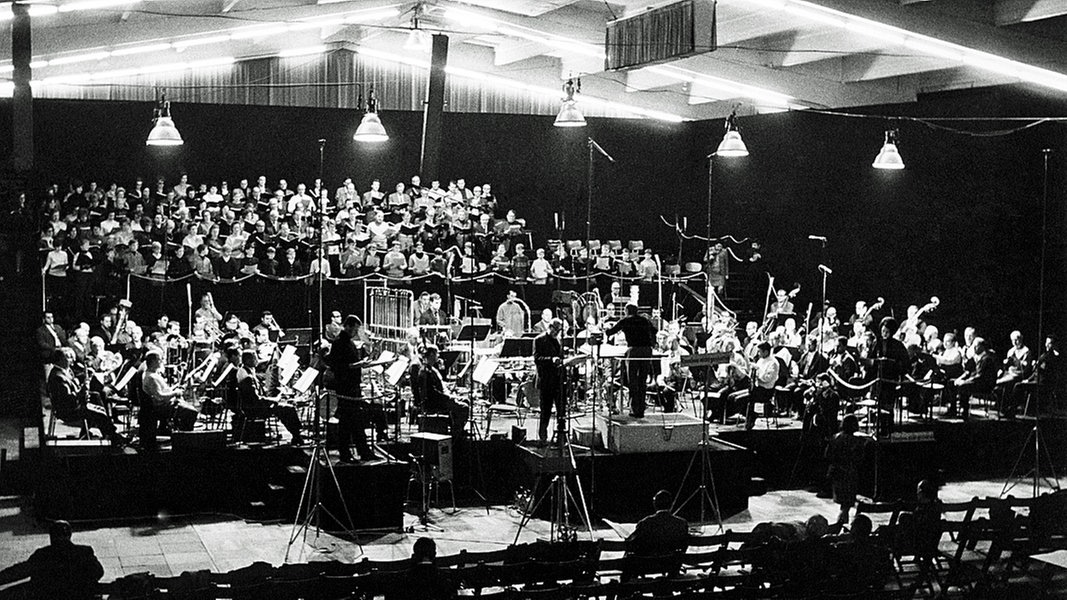
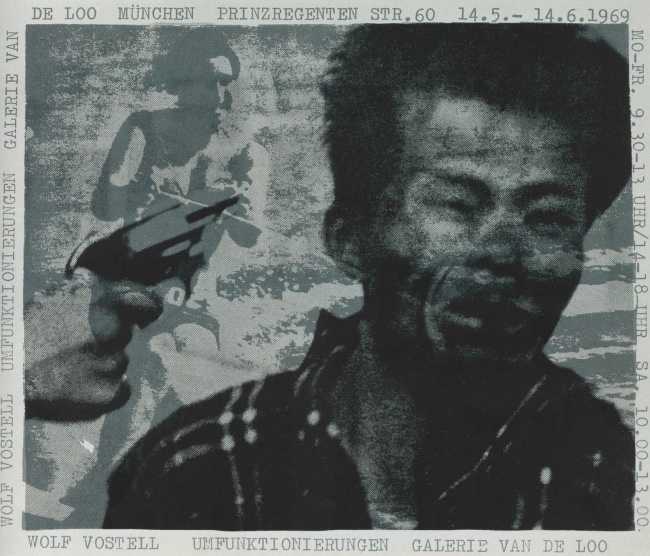
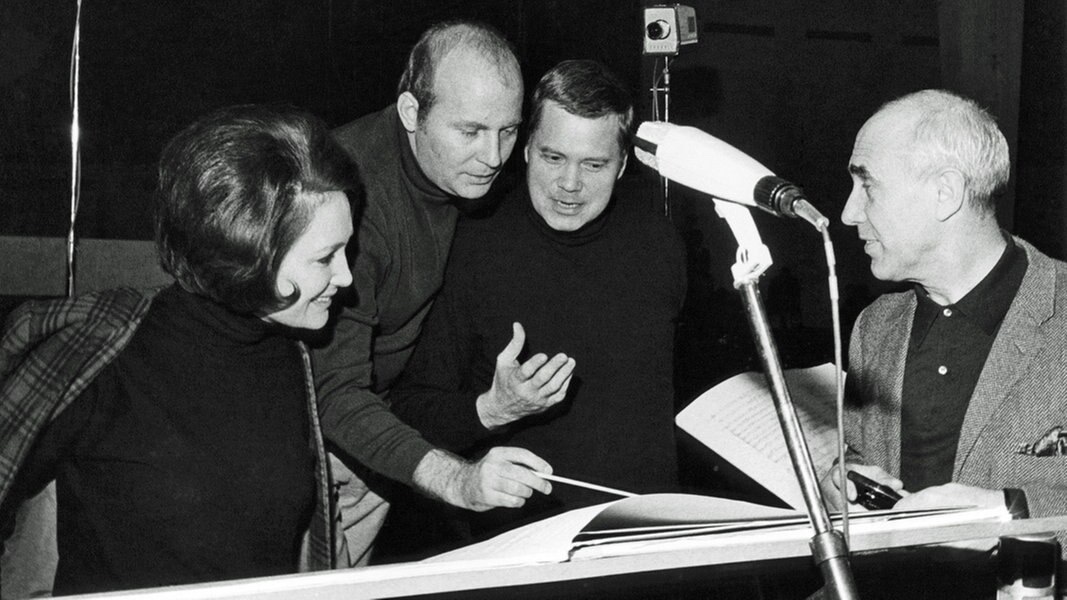
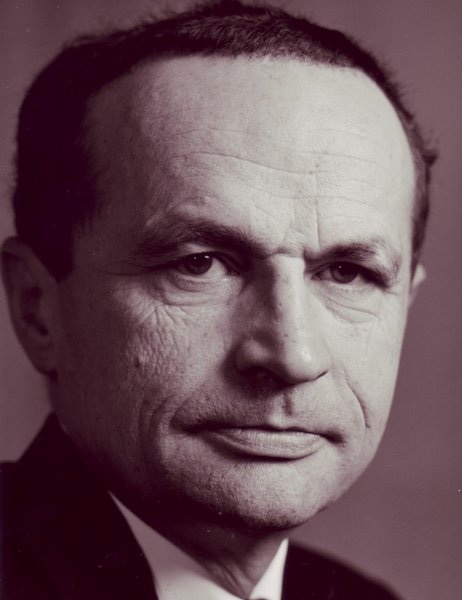


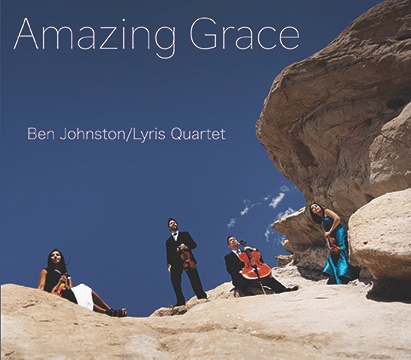


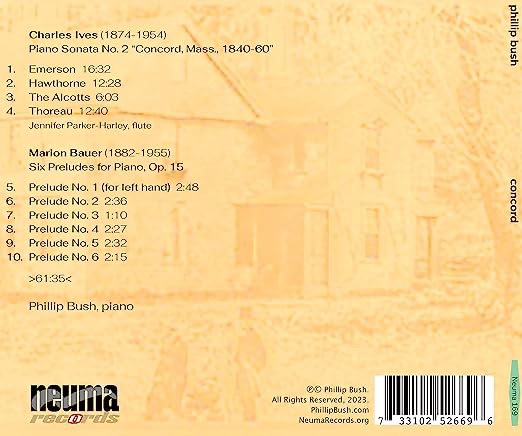


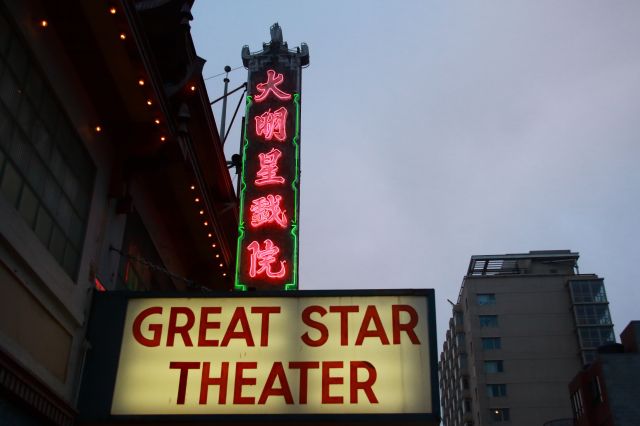
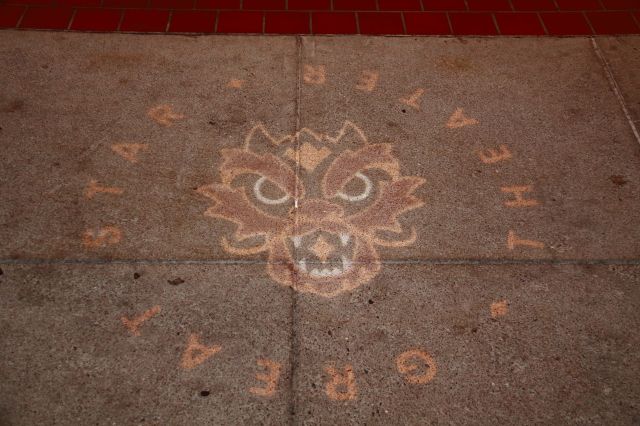
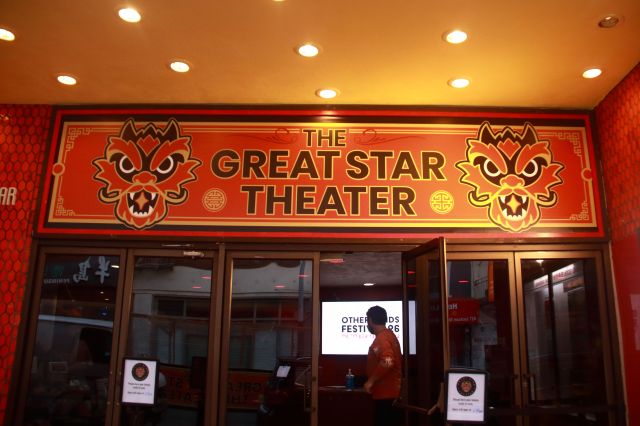
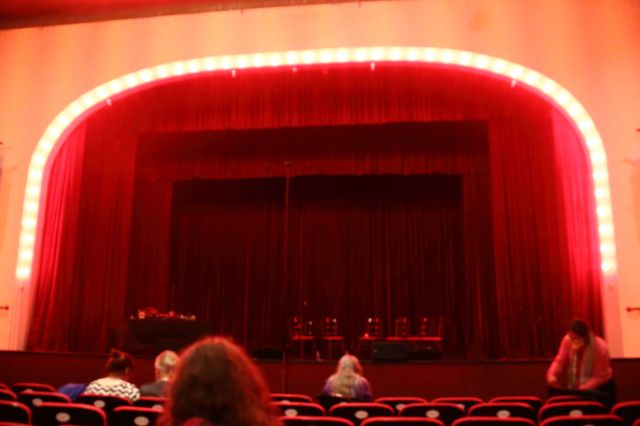
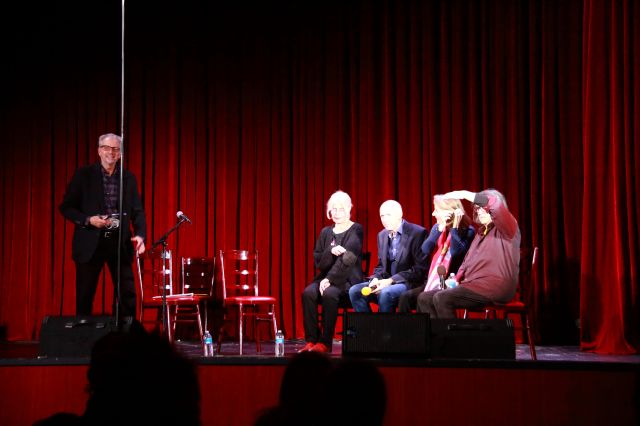
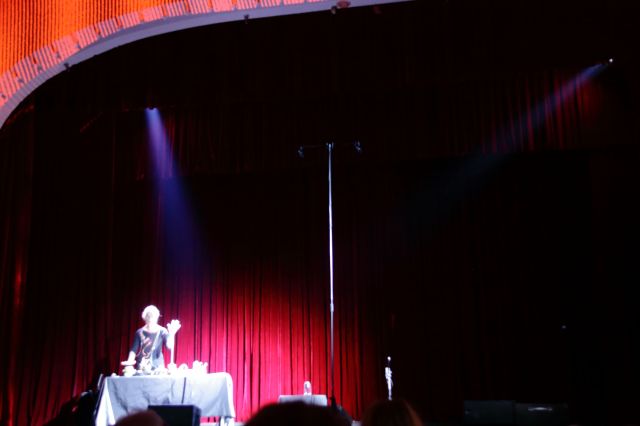
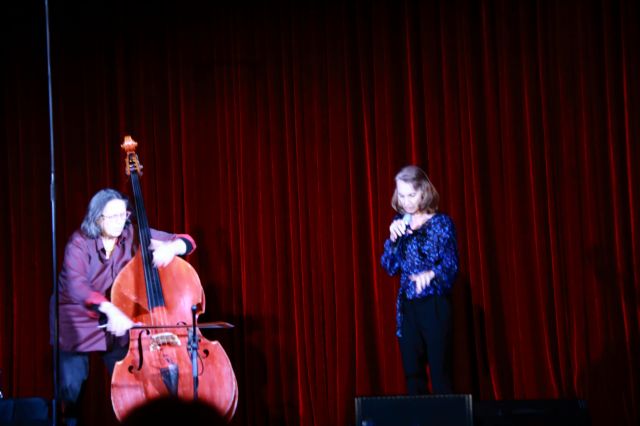
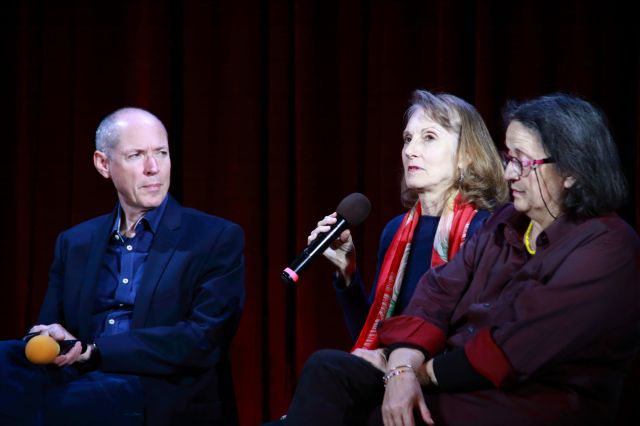
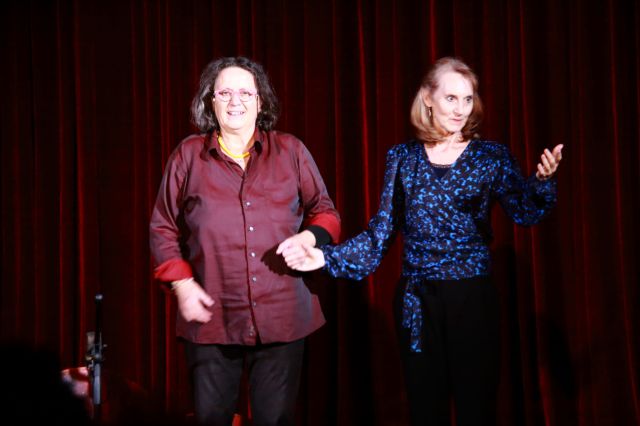
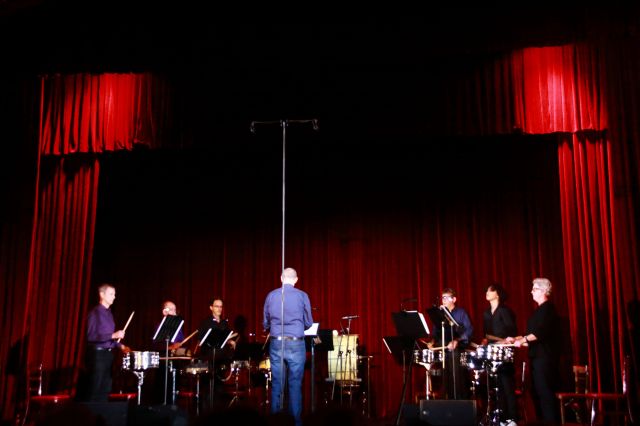
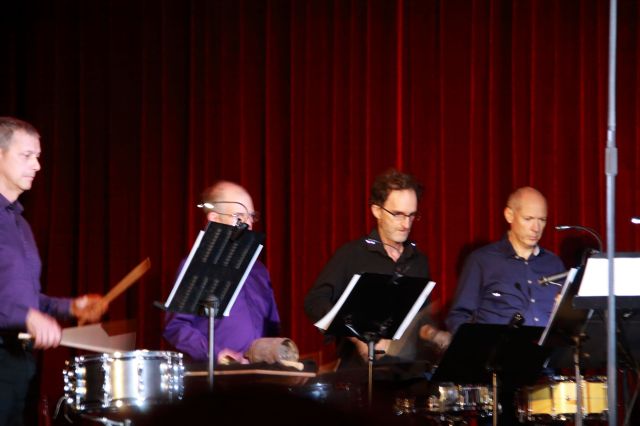
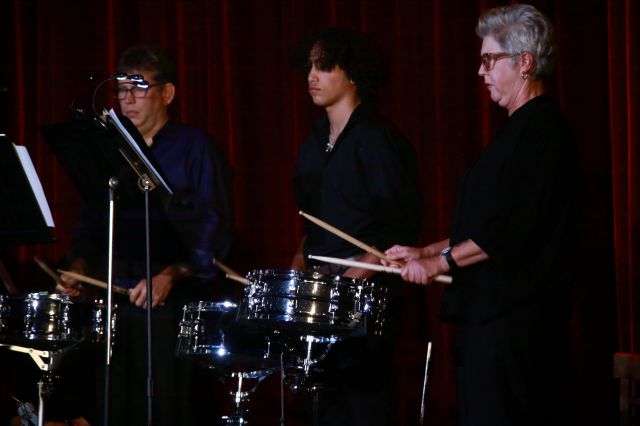
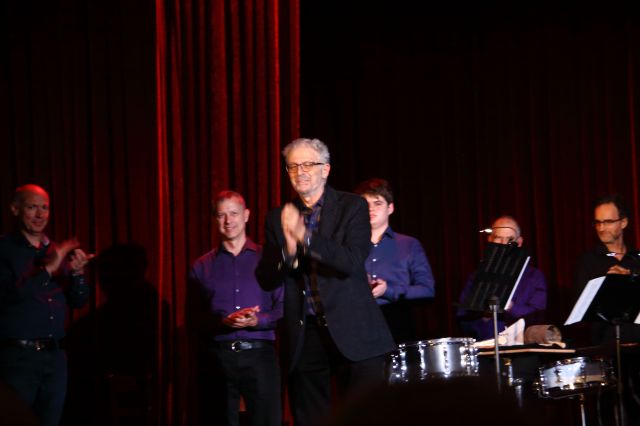






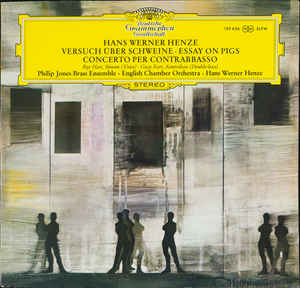

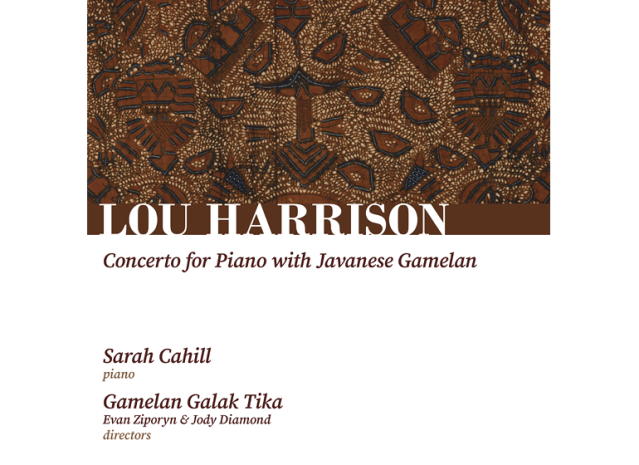
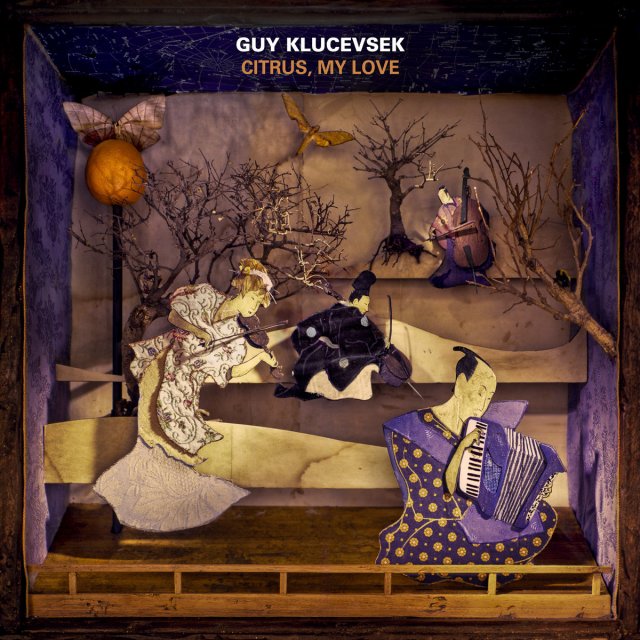

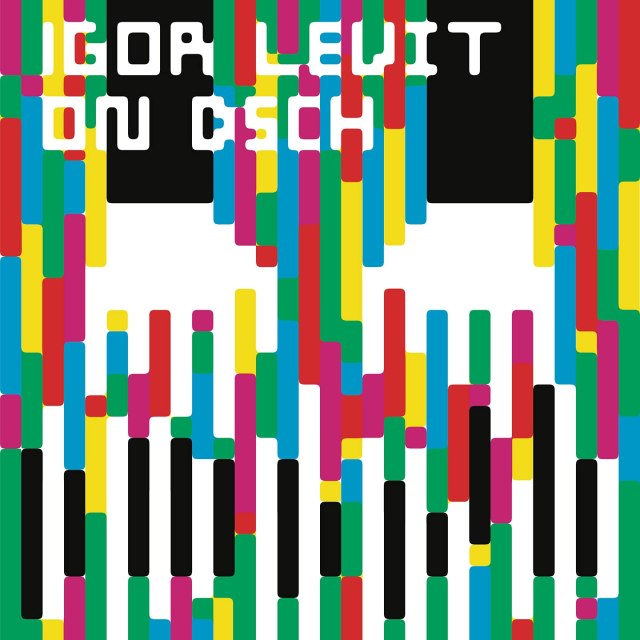
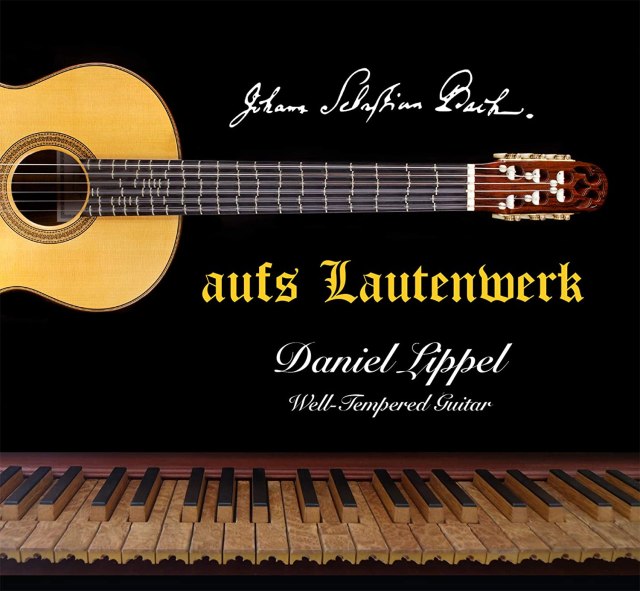
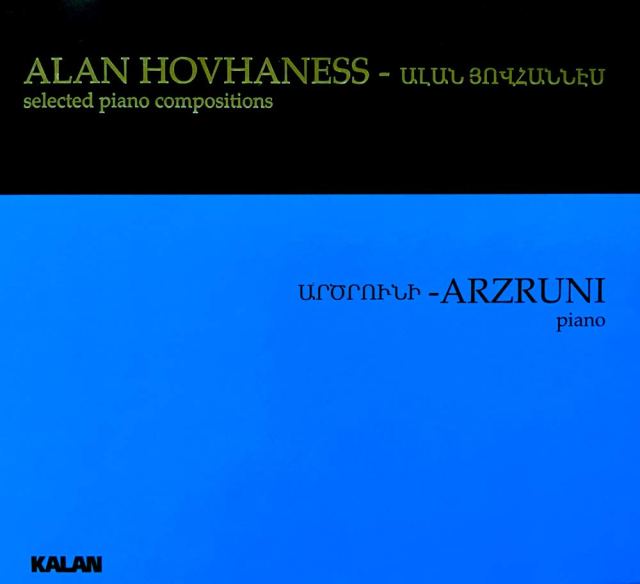
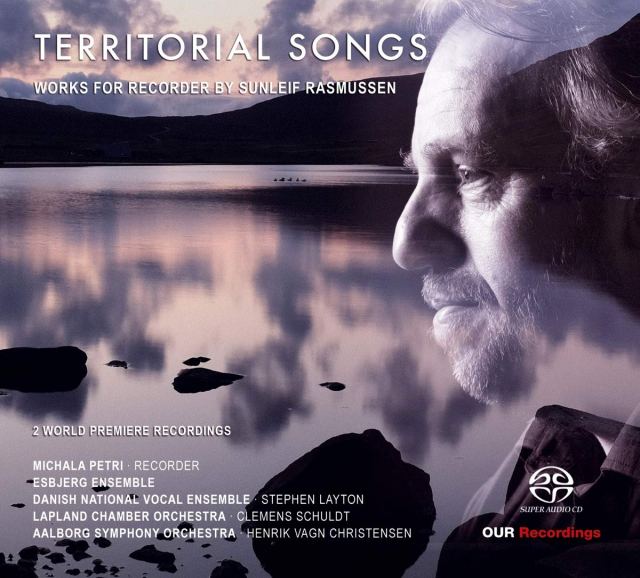
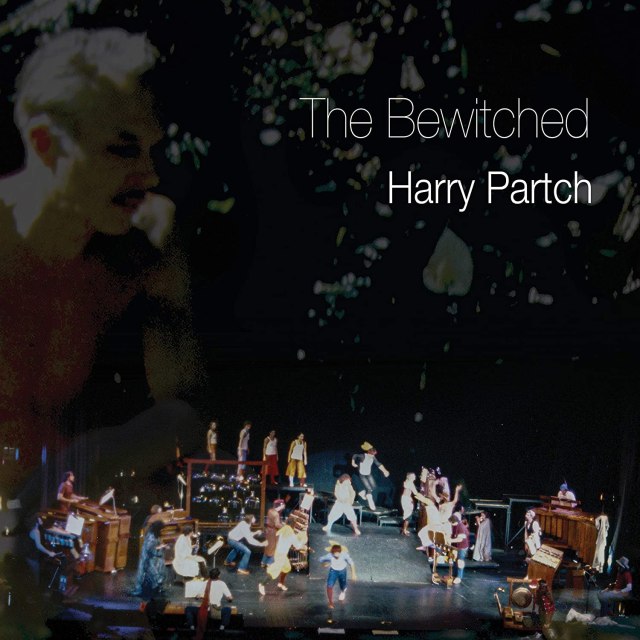
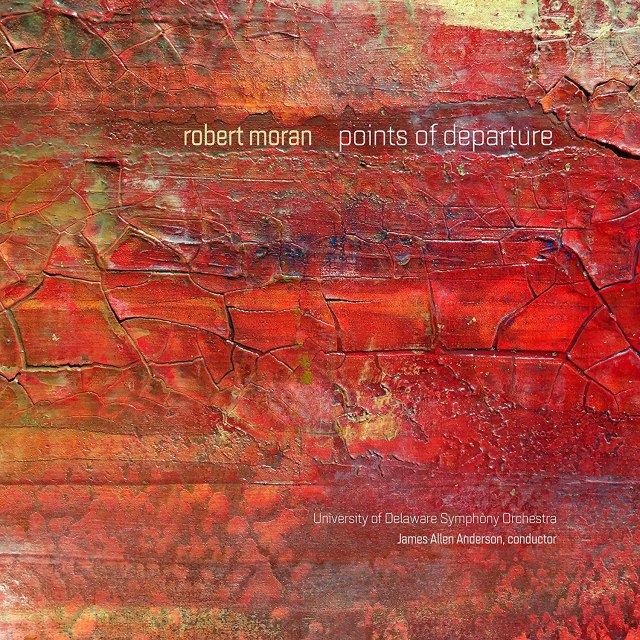

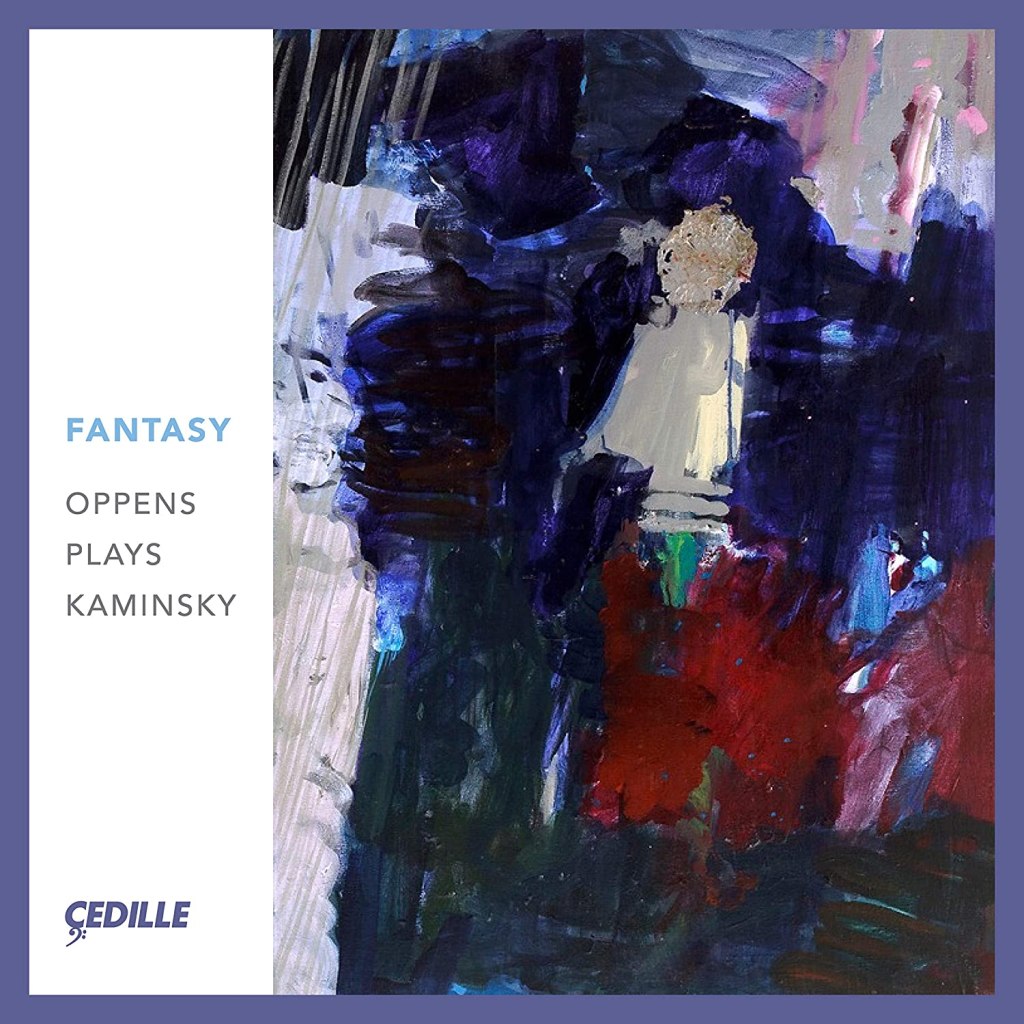





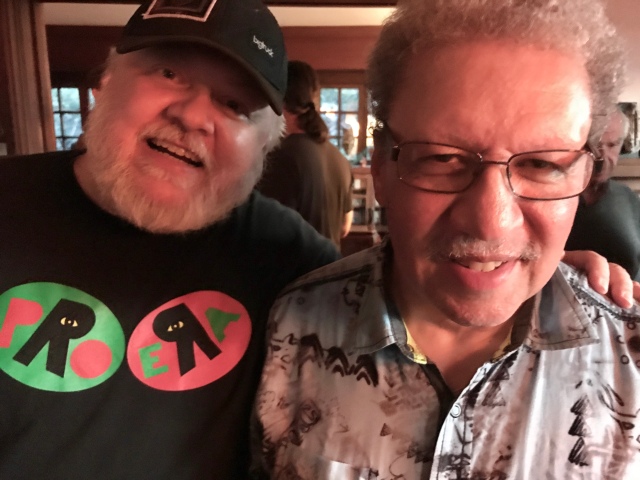
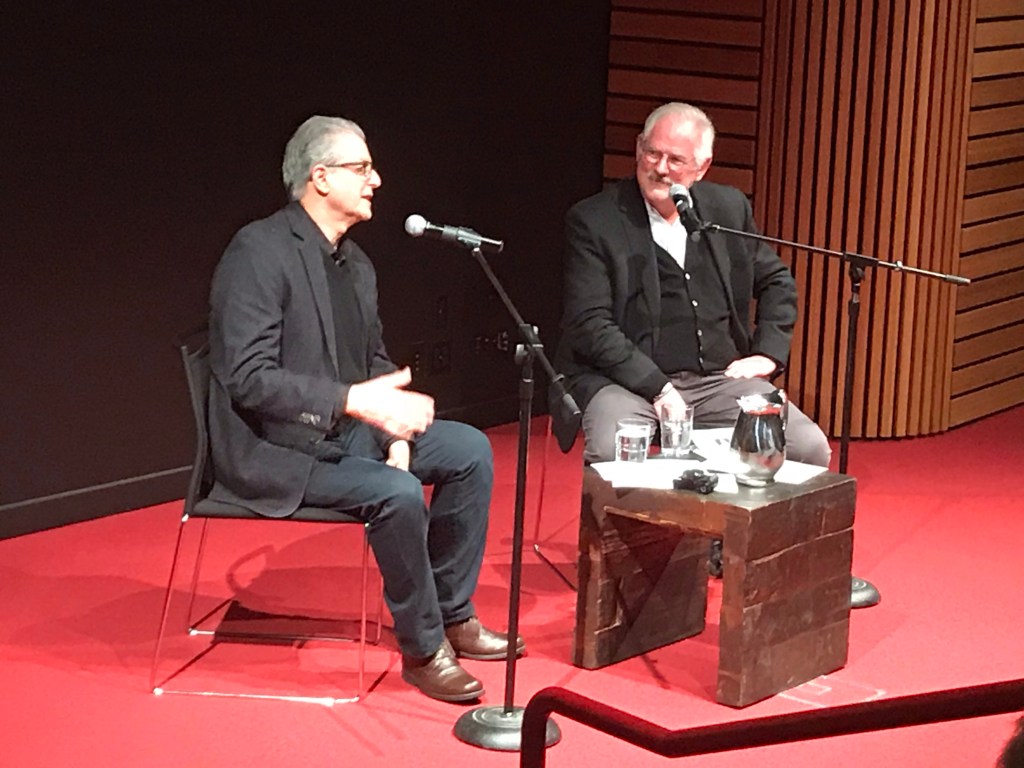

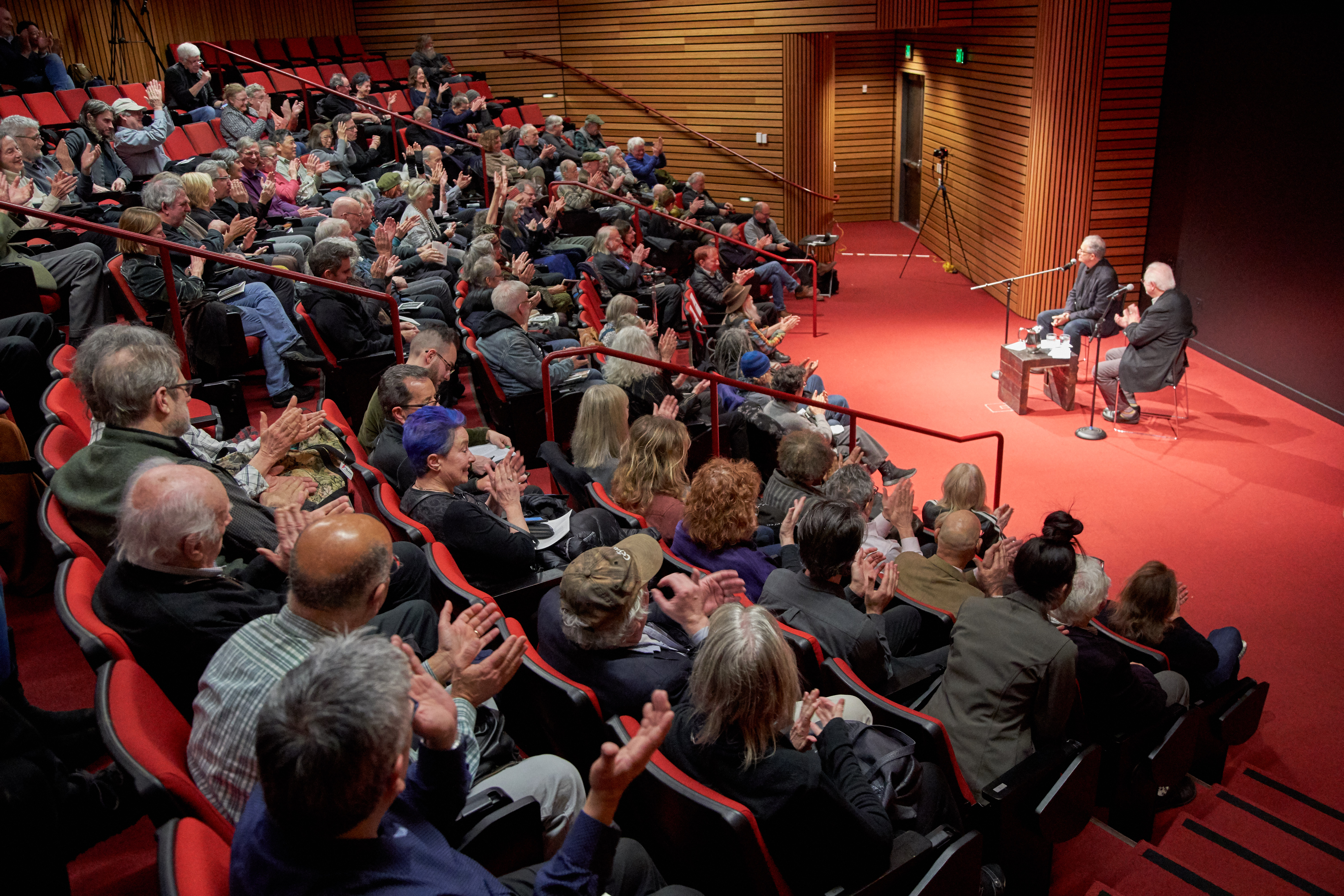
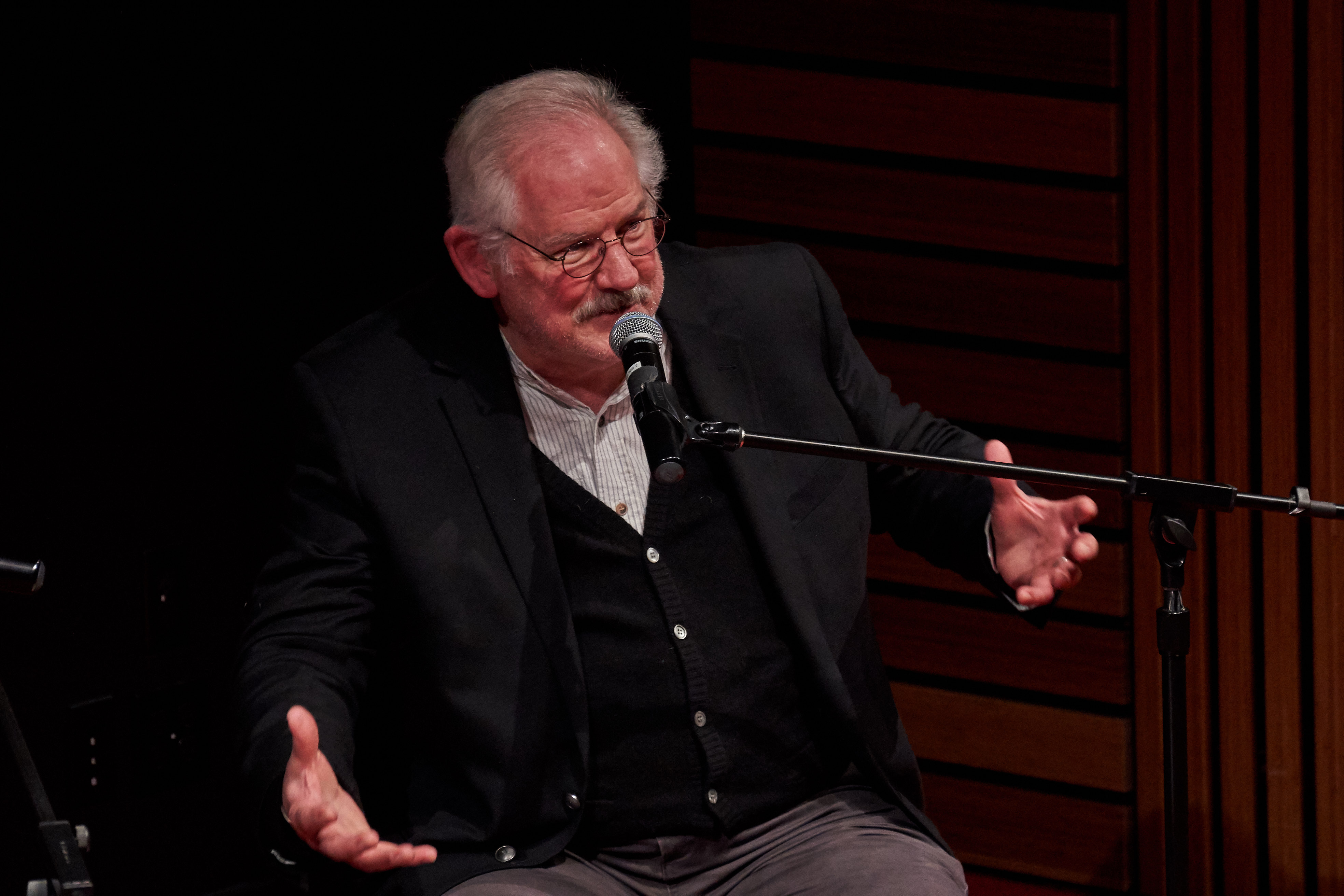
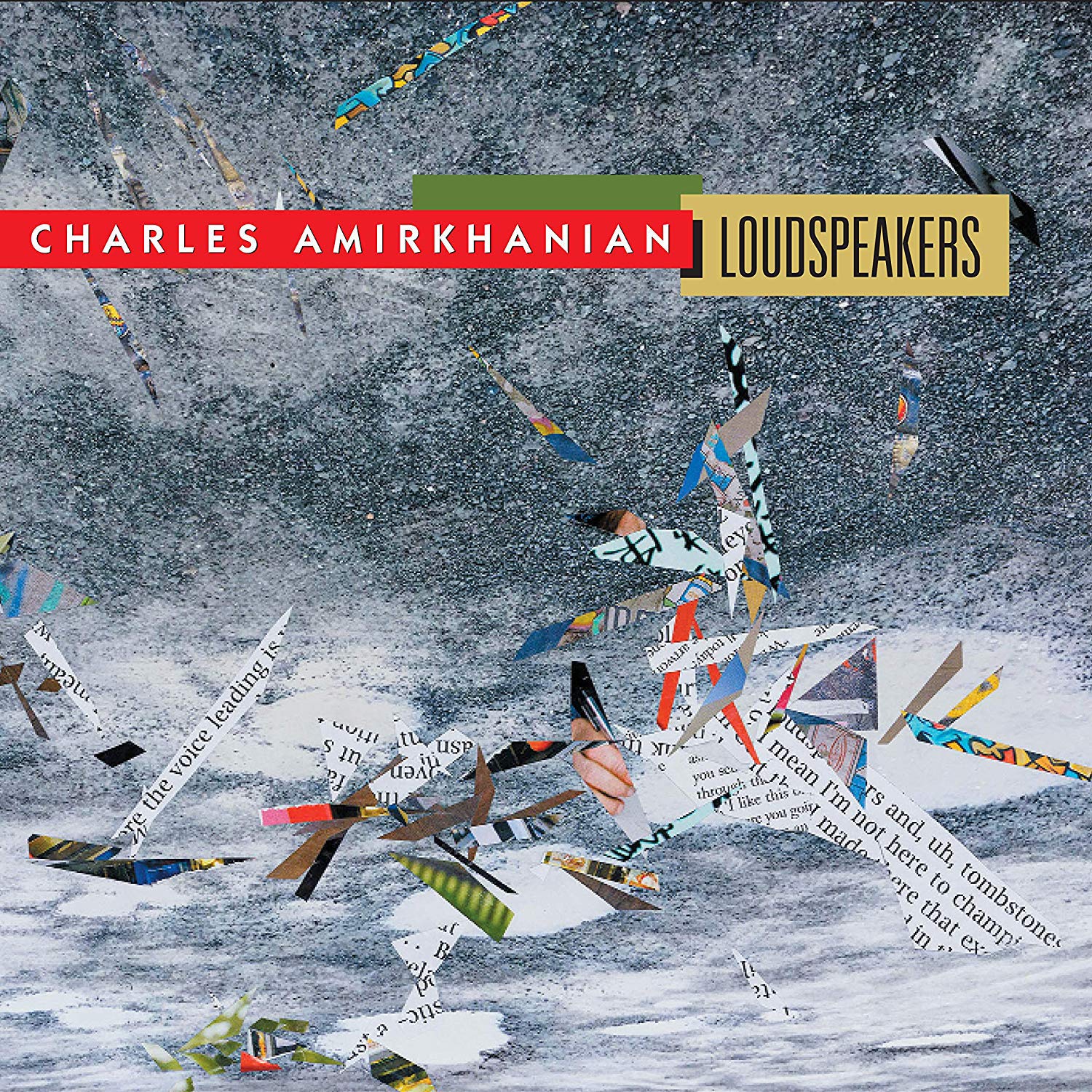


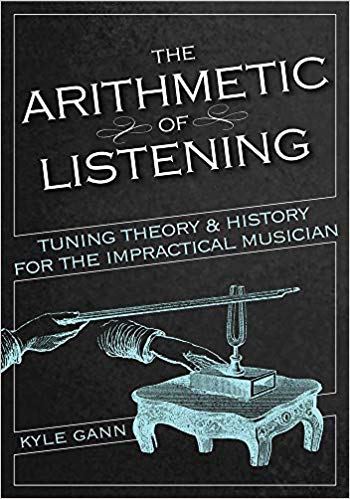




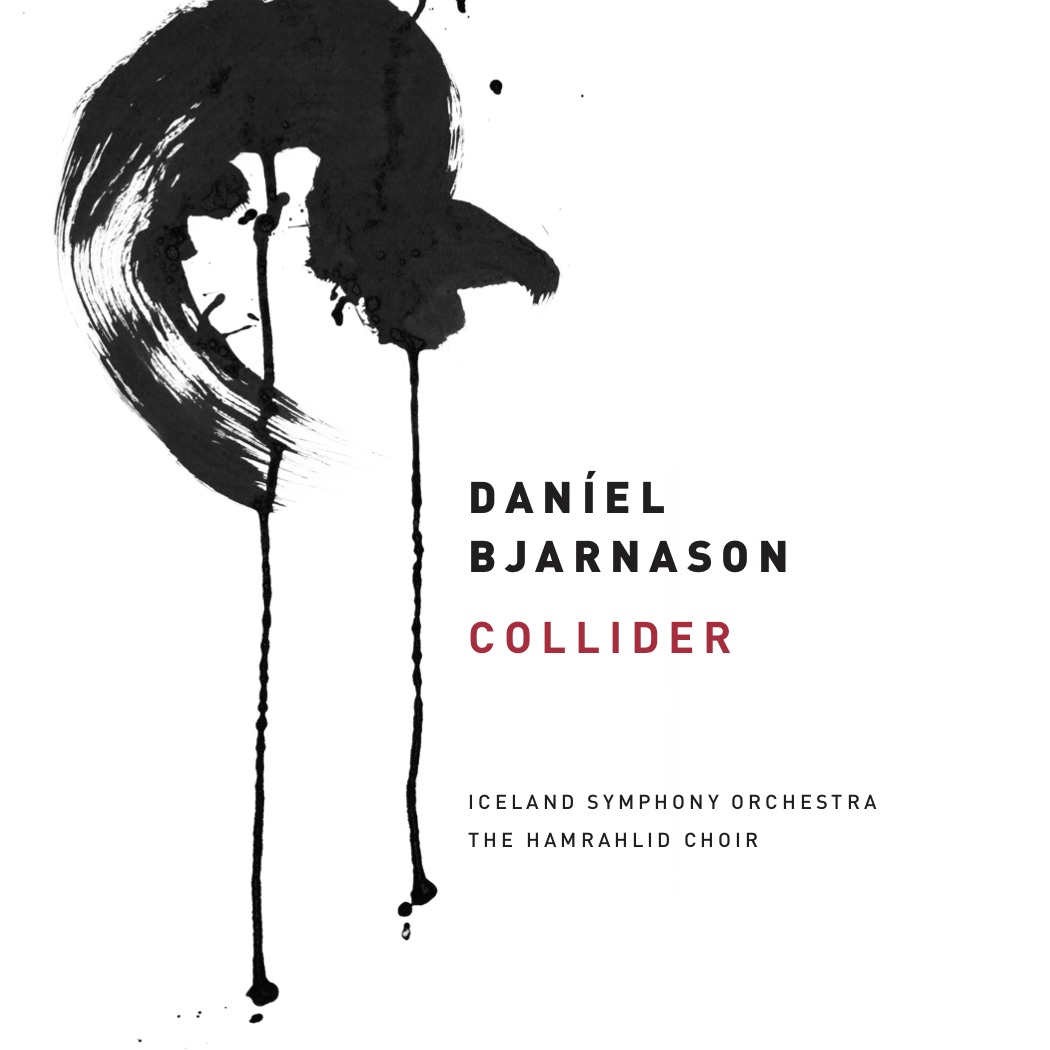


 New Music Buff