The Shostakovich Fourth, the Symphony That Almost Wasn’t


Shostakovich dealt with a great deal of adversity as a result of wars, the revolution, and Stalinism. That is sad but it makes for some really amazing stories. So it is with this symphony.

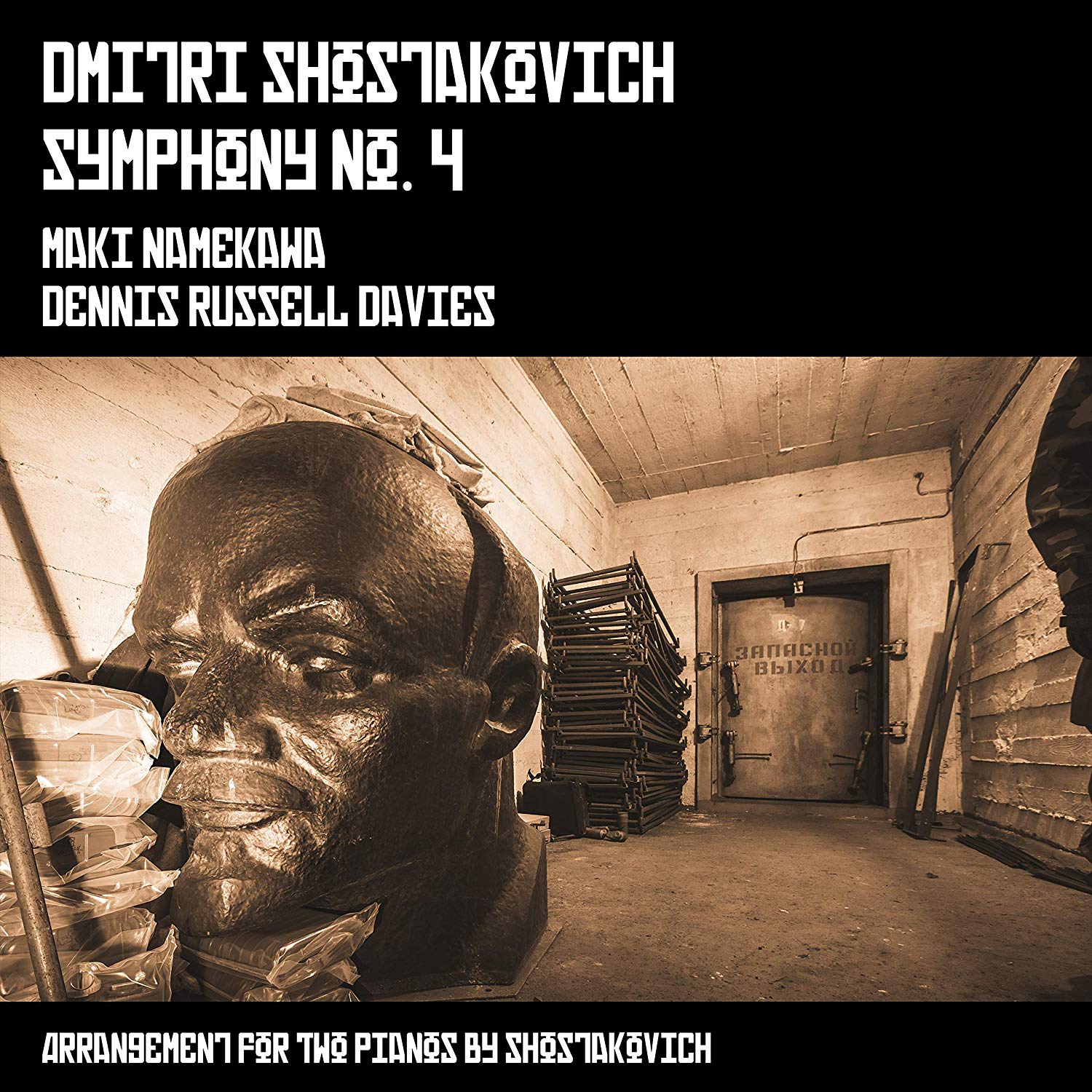
It was composed in 1936 and would mark the entry of more post-romantic elements into the composer’s work which gives it a Mahler-like cast at times. Unfortunately the politics resulted in the composer withdrawing the symphony. During WWII the score was lost and reconstructed from surviving orchestral parts and the present two piano transcription by the composer. The world premiere occurred in 1961 under Kiril Kondrashin.

It is the two piano “reduction” which is featured here. Reduction refers to the transcription of the piece for two pianos but the grand symphonic nature shines through with amazing lucidity. Of course this is as much due to the skill of the transcription but also of the artists. If you have never heard a great transcription this will amaze you.

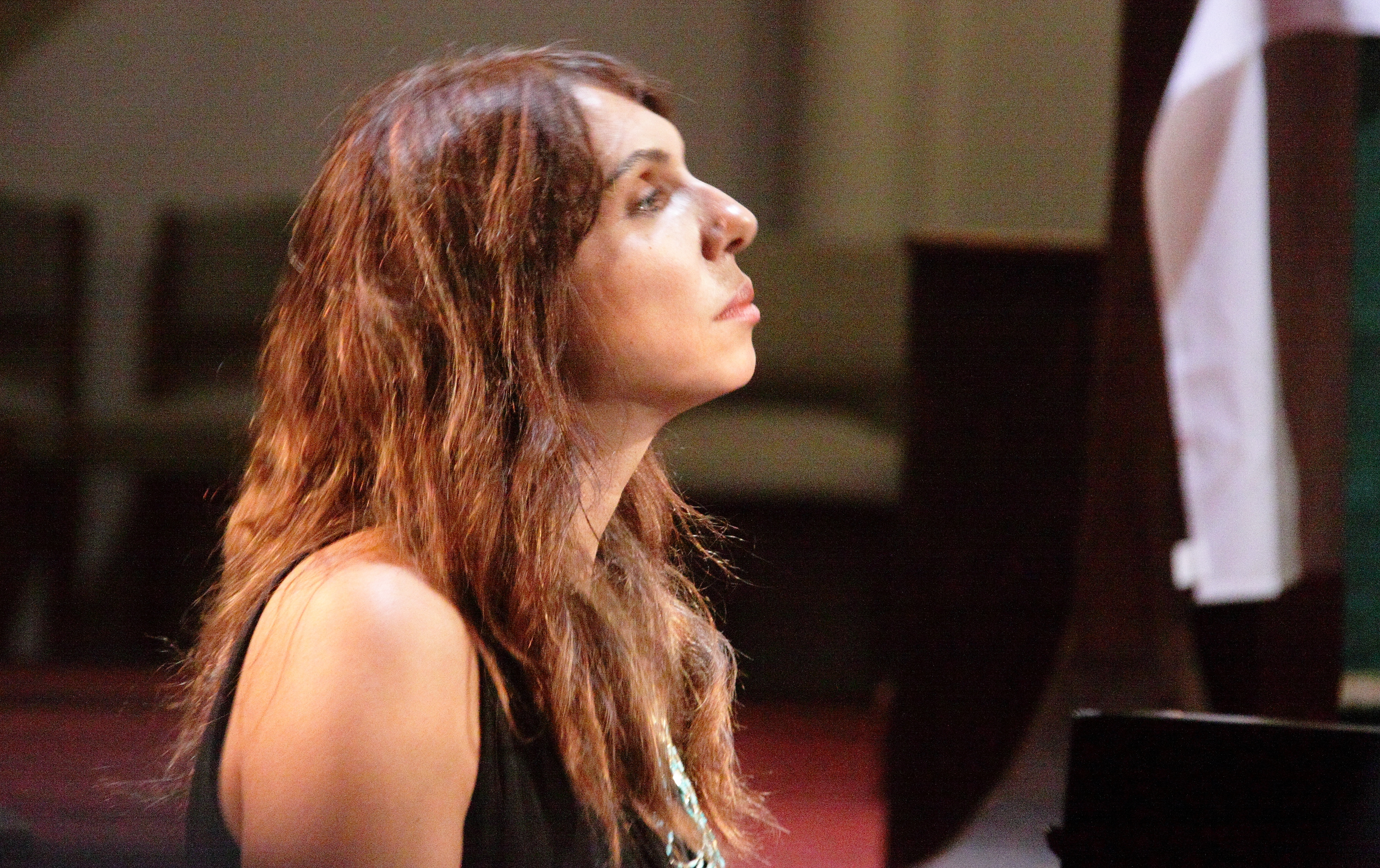
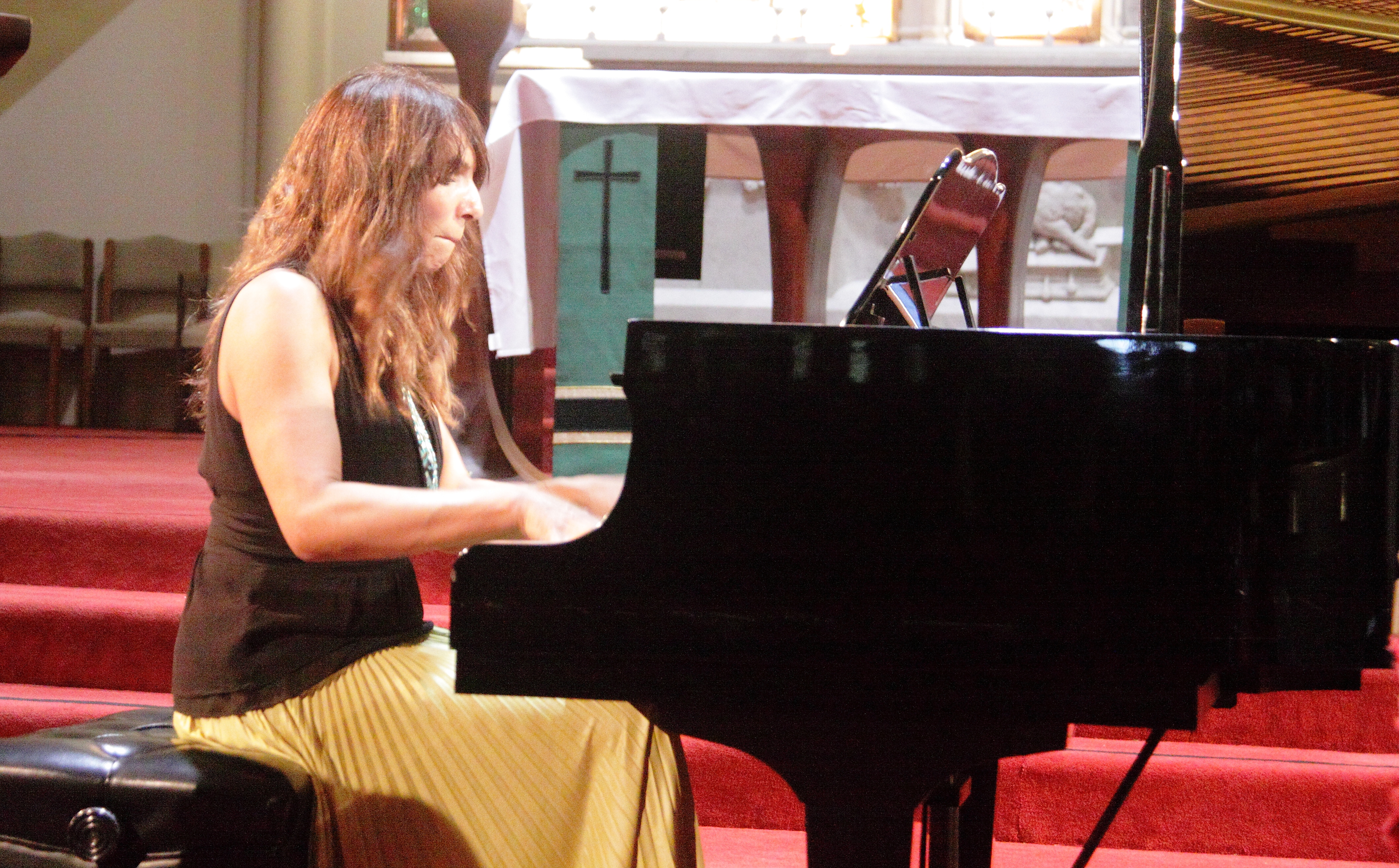
Davies and Namekawa have established quite a name for themselves as a duo piano team. Davies, the long established conductor and his life partner Namekawa, herself a dazzling pianist have collaborated for some time now as a duo and this recording is testament to what they can do. Here they joyfully share their interests and insights on this masterpiece. Even if you have and know the orchestral version you will want to hear this.

There are three movements here. The outer movements are long extended compositions with a small(but amazing) interlude in between. This is not the Shostakovich of the famed 5th symphony. Rather it is a sort of transitional piece between the student work of the first symphony and the social realism of the second and third symphonies. While deeply intelligent the work has no intended program and one could almost pass this off stylistically as a lost Mahler work.

Fear not, though, the composer’s fingerprint is here. After all this is his 4th essay in the symphony genre. Unfortunately a perfect storm of politics conspired to almost destroy this work. Fortunately both this reduction and the reconstruction make the work available. It is especially curious for the Shostakovich enthusiast to listen to this work and imagine the care that must have been taken to avoid being associated with non state-approved music. It’s a good example of how politics places additional meaning on a piece of music that originally had none.

The recordings is lucid and is due for release on February 8th. One added sort of irony. The work is scheduled for its west coast premiere in San Francisco on February 10th.

My 2018 in the Arts


One of the Theater Organs at House on the Rock, Spring Green, WI, a really fun place to visit.


I’m skeptical about year end lists but I have enough people asking me that it would be impertinent to skip this task. I make no claims to having even listened to enough to make any definitive statements about the “best” but I have my own quirky criteria which I hope at least stirs interest. Here goes.

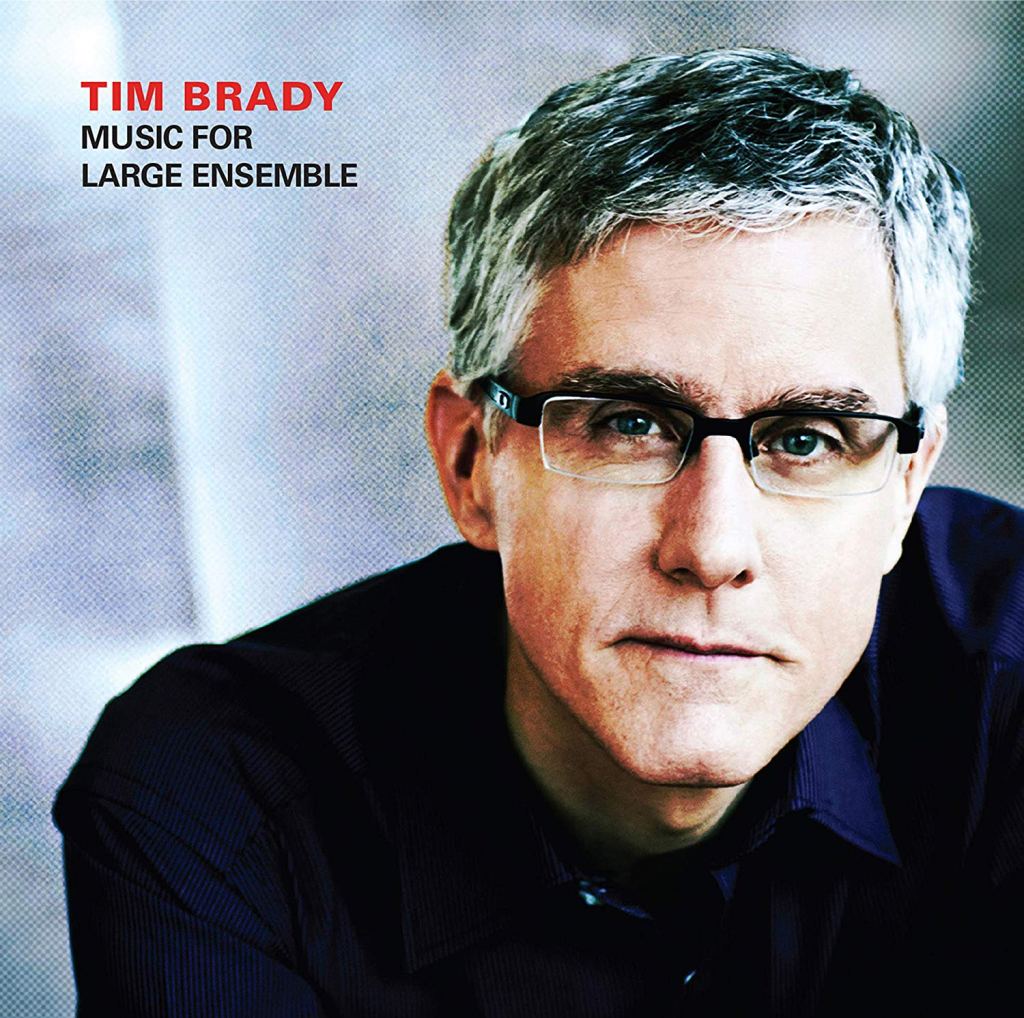
Let’s start with the most read reviews. Without a doubt the prize here goes to Tim Brady’s “Music for Large Ensemble”. This reviewer was enthralled by this recording by this Canadian musician whose work needs to be better known.

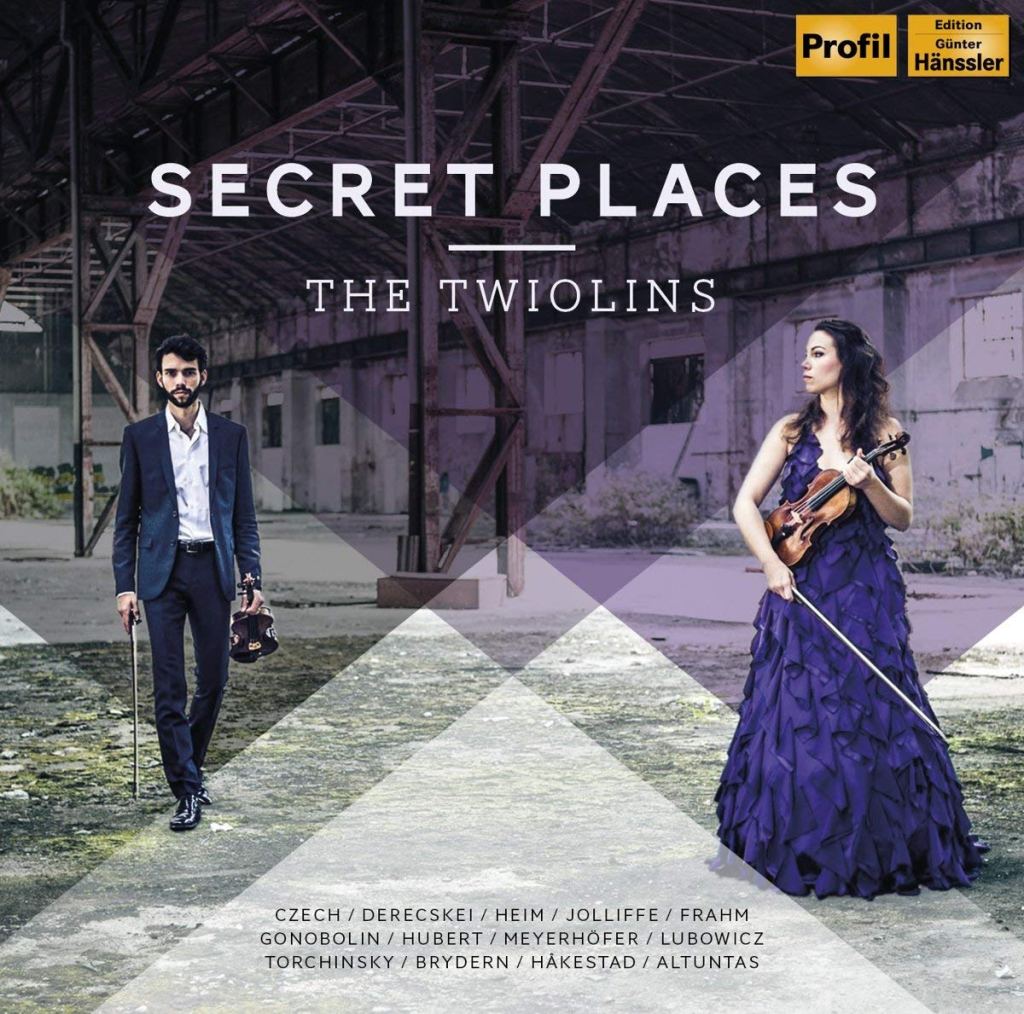
This little gem was sent to me by a producer friend and I liked it immediately. I knew none of these composers but I enjoyed the album tremendously. Don’t let the unusual name “Twiolins” stop you. This is some seriously good music making. It is my sleeper of the year.

Running close behind the Twiolins is the lovely album of post minimalist miniatures by the wonderful Anne Akiko Meyers. Frequently these named soloist albums of miniatures are targeted at a “light music” crowd. Well this isn’t light music but it is quite listenable and entertaining.


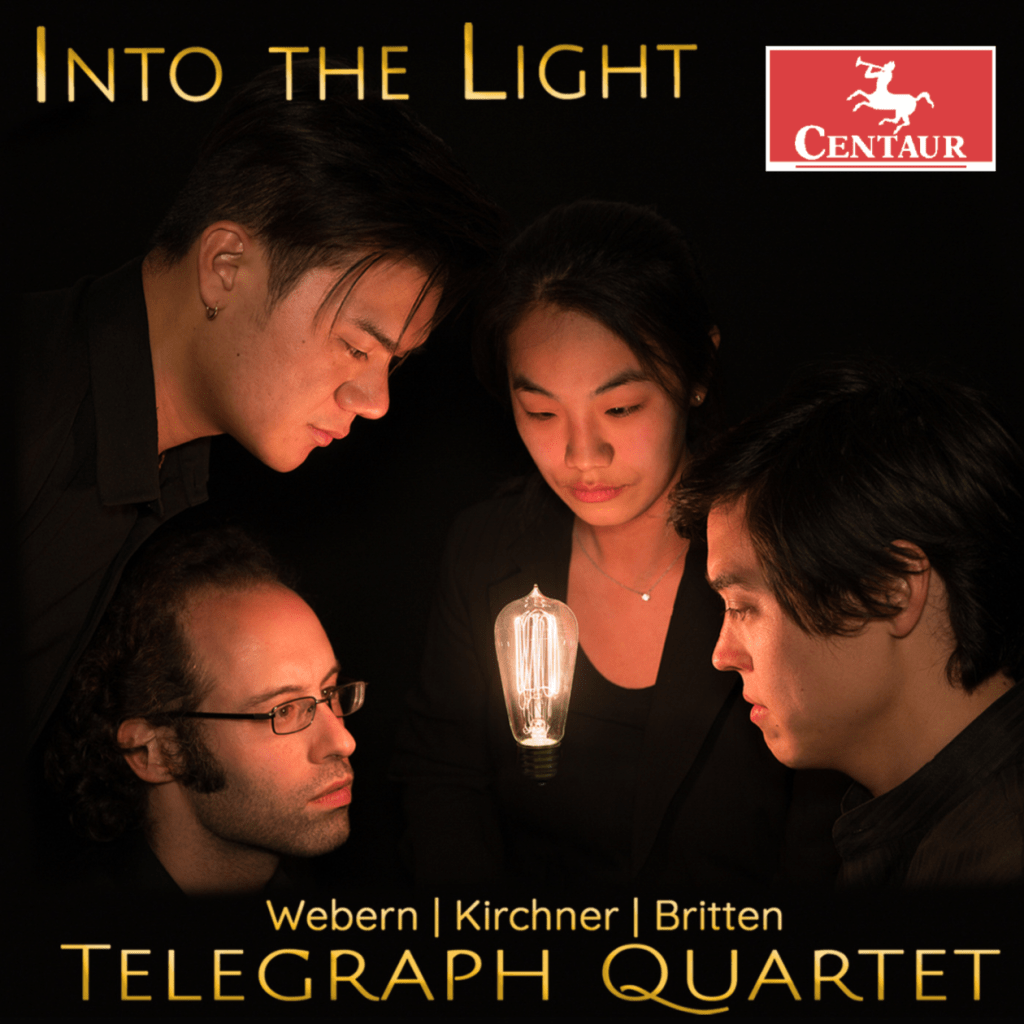
The creative programming and dedicated playing made this a popular review to New Music Buff readers. Definitely want to hear more from the Telegraph Quartet.

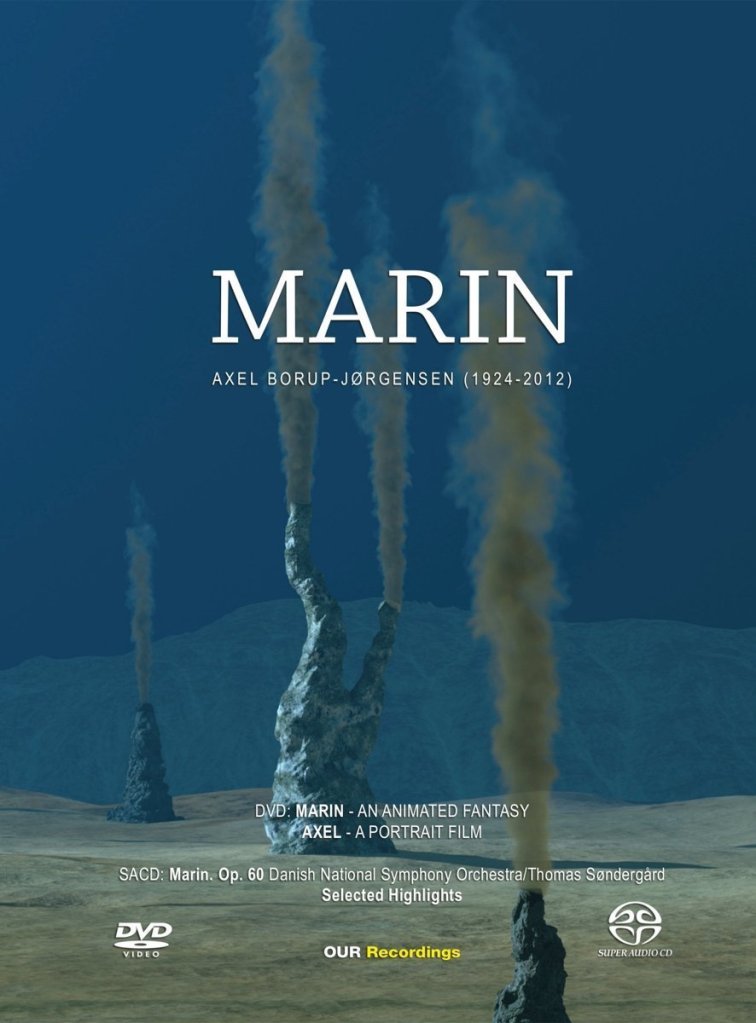
Another disc sent by my friend Joshua. This one is a DVD/CD combo of music by a composer whose existence was only revealed to me a couple of years ago. Marin includes a clever animated video which accompanies the title track.

I was fortunate enough to have been able to hear Terry Riley and Gloria Cheng in an all Terry Riley program at the Yerba Buena Center for the Arts. Both were in spectacular form and the audience was quite pleased.

I would be remiss if I didn’t include the fabulous 6 night series of concerts produced by Other Minds. This is why I am a rabid advocate of OM programs. More on that soon with OM 24 coming up.

And lastly I want to tell you about two more composers who are happily on my radar.

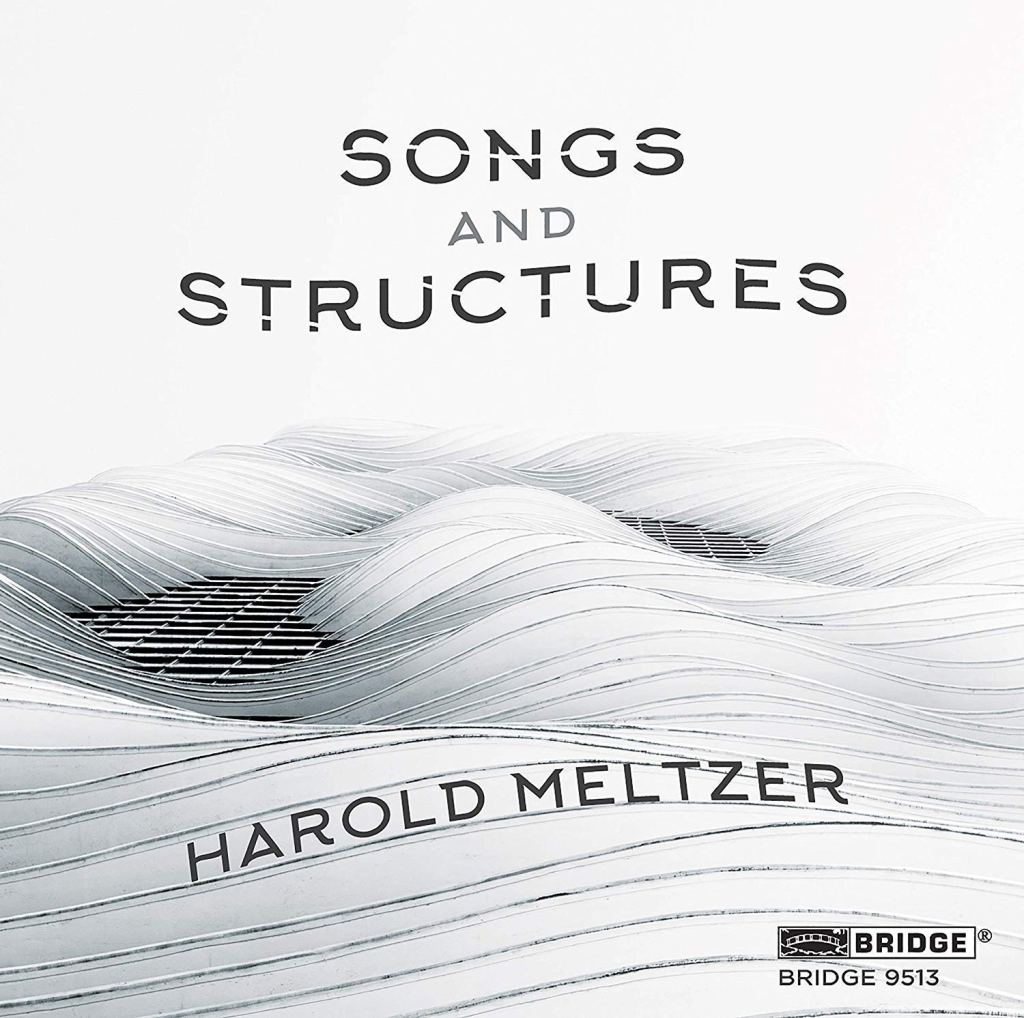
One of the joys of reviewing CDs is the discovery of new artists to follow. Harold Meltzer is now in that group for me. This basically tonal composer has a real feel for writing for the voice and has turned out some seriously interesting chamber music.

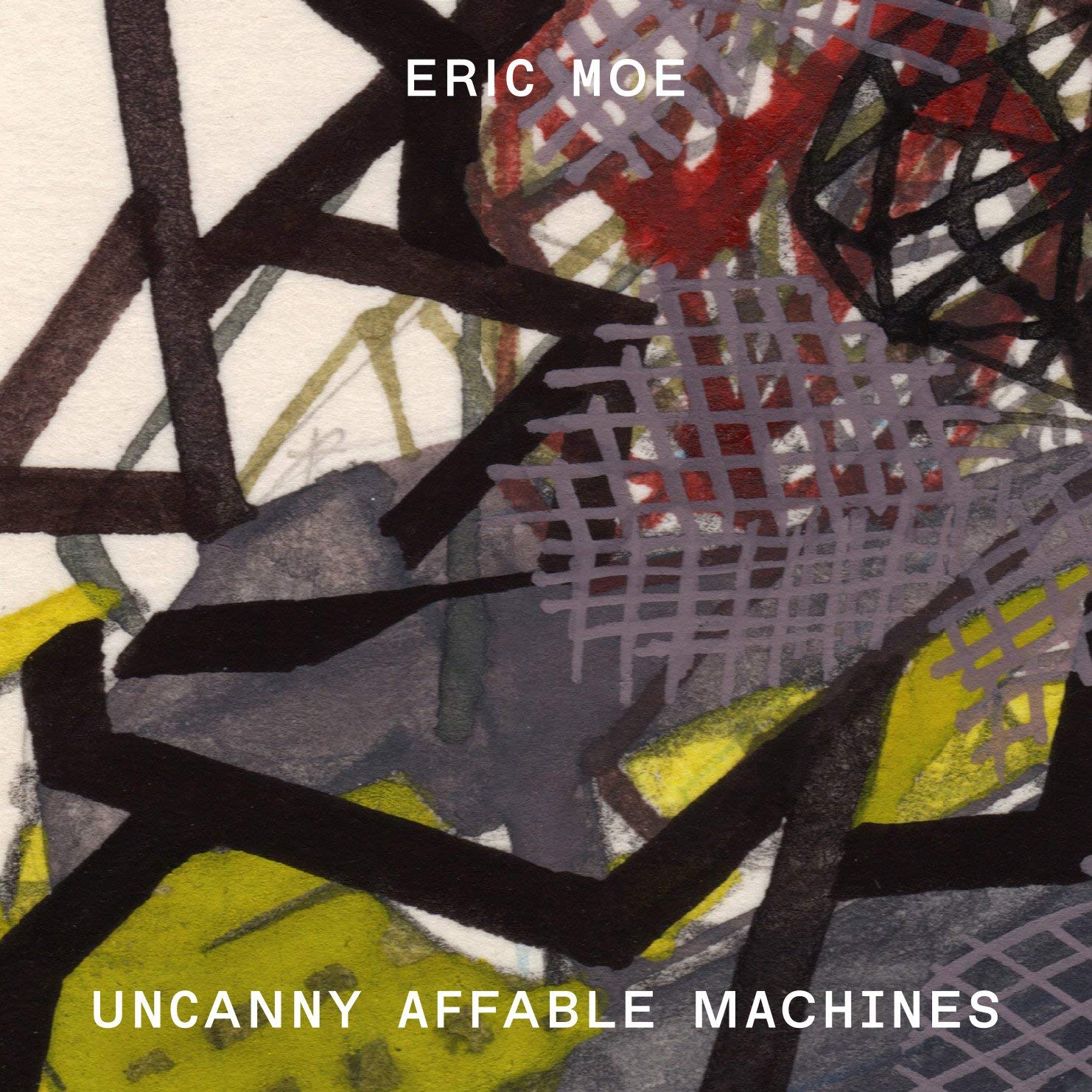
Another composer unknown to these ears. I bristle at the term “electroacoustic” because it sometimes means experimental or bad music. Not so here. Moe is fascinating. Definitely worth your time.

OK, gonna can the objectivity here to say that this is possibly the most underappreciated album I’ve heard this year. Combining a recording of the Debussy Preludes along with Schoenberg’s rarely heard “Hanging Gardens”, Webern’s Variations, and Berg’s Piano Sonata creates a picture of a moment in history when music moved from impressionism to expressionism. Jacob Greenberg is very much up to the task. Buy this one and listen, please. It’s wonderful.

Also beyond objectivity is this fascinating major opus by Kyle Gann. It didn’t get much recognition on my blog but it’s a major work that deserves your attention if you like modern music.

Well this is one of my favorite reviews in terms of the quality of my writing. The work is most wonderful as well. Though this review was actually published on December 31st I’m still including it in my 2018.

This is definitely cheating on my part but after that concert at Yerba Buena I can’t resist making folks aware of this wonderful set on the independent label, “Irritable Hedgehog”. Trust me, if you like Riley, you need this set.

I review relatively few books on this site but by far the most intriguing and important book that has made it across my desk to this blog is Gay Guerilla. The efforts of Mary Jane Leach, Renee Levine Packer, Luciano Chessa, and others are now helping to establish an understanding of this composer who died too young. Here’s looking forward to next year.

I know I have left out a great deal in this quirky year end selection but I hope that I have not offended anyone. Peace and music to all.

Celebrating a Great Supreme Court Justice in Song


rbg

Of all the publicity heaped on the Supreme Court of the United States recently this CD definitely stands out as the most unusual but also the most joyous.  Notorious RBG in Song is something of a first, a CD celebrating one of our living Supreme Court Justices.

Ginsburg’s son James is the founder of this wonderful Chicago based recording label and clearly shares in the admiration of this physically diminutive intellectual powerhouse of a justice.  The surprise for this writer is to hear the compositional skills of the wonderful soloist Patrice Michaels (also James Ginsburg’s wife) who has long been a welcome musical performer in Chicago.  She composed The Long View (2017) for this album and the liner notes list even more compositional accomplishments.  The remaining four songs are by Lori Laitman, Vivian Fung, Stacy Garrop, and Derrick Wang.  Wang, the only male composer in this group (a symbolically satisfying fact) also happens to be the composer of an opera “Scalia/Ginsburg” (2012-15) which actually premiered in Washington D. C.  The other man in this recording is the fine accompanist Kuang-Hao Huang.

We learn from the extensive liner notes that this CD is a labor of love involving many people from various orbits around this important American Justice.  The liner notes recount many admiring perspectives on this public figure who so improbably has risen to being a major cultural icon in part by her incisively written dissenting opinions.  She has touched many lives and has thus far lived an amazing life herself.

The lyrics which are tastefully produced in a separate booklet come from a variety of very personal sources all carefully recounted here.  And “personal” is exactly what this album is about.  This is not about politics, it’s about family.  There are quite a few lovely photographs included and the cover art by Tom Bachtell with graphic design by Studio Rubric bring this intimate tribute together most successfully.  This will be a collector’s item some day.

Ultimately this is a recital disc featuring one of the finest sopranos working today featuring her as a composer as well.  It is also an unusually beautiful tribute to a truly great American and, evidenced by the love and admiration here, to a truly beautiful circle of family and friends.  Listen to the music, read the words, and feel the love.  This is a classic.


Eric Moe, Uncanny and Affable (and very interesting)


moeuncanny

New Focus FCR 212

Here I sit with an album by a composer with whom I have no familiarity.  Fortunately Eric Moe has a delightfully tenacious public relations department (at least with this particular record label) whose prompts did finally get me listening.  OMG, it says “electroacoustic”.   That could be really bad or obtuse.  Well, I did promise to review it so here goes.

Eric Moe (1954- ) is a composer with a very well organized web page.  A quick glance at that web page informs that this is the 12th or so disc from a man who boasts what looks like a list of over 100 compositions.  Moe is also a performer and participates on this disc.  This graduate of Princeton (A.B., Music) and Berkeley (M.A. and Ph.D., music) teaches at the University of Pittsburgh and is also an active performer of both his and others’ music.

moekeyb

This discs contains 6 composition for solo instrument (mostly with) electronics.  Now that combination has given this writer pause because the genre given the name “electroacoustic” can be a mixed bag.  Sometimes these works can be ponderous or obtuse with meanings obvious to the composer and, hopefully, the performer.

However your reviewer’s neurotic fears were apparently unfounded as the tracks played some truly wonderful compositions.  Each track features a different instrument.  The instruments, in order, include a drum set played by Paul Vaillancourt, a viola played by Ellen Meyer, a solo 19tet keyboard played by Eric Moe, an unbelievably virtuosic pipa played by Yihan Chen, solo piano played by Eric Moe, and flute played by Lindsey Goodman.

Suffice it to say that all the soloists here come with a high level of virtuosity as well as the ability to interact meaningfully with the electronics.  Far from being a nightmare of impenetrable experimental music this is rather a very entertaining set of pieces which tend to avoid the worst cliches of this genre.

Rather than attempting to describe each of these pieces (a task which would likely be more painful to read than write) it is best to simply provide assurances that the combination of this talented composer combined with the more than capable soloists provides a stimulating and interesting listening experience.  These are wonderful performers with great material.

The listener will want to hear each track more than once to get a good idea of what the composer is doing but, fear not, this album is much more adventure than ordeal.  It shows a composer at the height of his powers producing art which stimulates the senses and provides an emotional experience.  While there is clearly intellect behind the creation and performance of these works they tend to speak rather directly to the listener providing a stimulating entertainment that leaves the listener with a shred of hope that classical, even modern classical is far from dead.

Kudos to professor Moe and his collaborators and a nod of thanks to the tenacious publicity folks who would not let this release go quietly into the good night.  You shouldn’t either.

Jacob Greenberg Putting Debussy in Context


hanging

New Focus FCR 192

Well it’s been 100 years since Claude Debussy (1862-1918) left the earthly plane and anniversaries are good times for a re-evaluation.  Usually this just means issuing recordings of a given composers works, mostly the composer’s most popular.   Jacob Greenberg has chosen to record Debussy’s Preludes for Piano Books I and II (1909-1913).  But that alone seems a bit pedestrian so he adds in Alban Berg’s (1885-1935) Op. 1 Piano Sonata (1909), Anton Webern’s (1883-1945) masterful Variations for Piano (1936), and Arnold Schoenberg’s (1874-1951) “Book of the Hanging Gardens” Op. 15 (1908-9) as well as a few additional Debussy pieces.  Greenberg is a sort of refugee from the International Contemporary Ensemble.  For this recording he also conscripts the fine soprano (and fellow ICE refugee) Tony Arnold.  These two have already amassed quite a few recordings of repertory from this era.

greenberbdebussy813HMwi-pPL._SL1500_

This mix provides a context for the listener which shows where the Preludes fit historically and demonstrates some of the similarities in sound between these early 20th Century works.  We hear music written between 1908 and 1936 by four composers.  Hearing these works together gives the listener a sense of how some of the best “contemporary” compositions of this brief era sounded.  Indeed there are similarities here and one can see the emerging style which would become known as “expressionism”.  It is clearer how this emerged from Debussy and Ravel’s “impressionism” when you hear related works from the same era.

This reviewer had not been familiar with Schoenberg’s “Book of the Hanging Gardens”.  It is one of the less performed of his works.  These songs have a militantly atonal sound. Vocalist extraordinaire Tony Arnold puts real muscle into her reading of these songs.  The disc is worth acquiring for her performance alone.

In some ways this cycle appears to have been Schoenberg’s “Tristan und Isolde” meaning that he had stretched the limits of tonality and, unlike Wagner, he chose to develop a method which would ensure that there is no tonal center in his music.  He developed his method of 12 tone composition and rolled out his first example of this new method in 1925.

What is striking is that this Schoenberg song cycle dates from pretty much the same time as the Debussy Preludes and Alban Berg’s Piano Sonata.  One gets a sense of some of the tensions involved here.  Try to imagine being in the audience and hearing the wide stylistic differences between these two works and realizing that they are essentially from the same era.  Add in the much later Variations by Webern and one gets a sense of how far music could go, stylistically, based on Schoenberg’s methods.

Obviously the Debussy Preludes are the main focus here and these are acknowledged as classics of the repertoire.  They are most ably performed here but what struck this listener the most was the sound of those preludes in the context of the other pieces here which were part of that same 30 year span.  One can begin to hear perhaps some affinity between the Debussy and the later thornier harmonies and rhythms that typify the expressionistic style which would dominate much of the mid-twentieth century.

This is a fabulously entertaining recording and a sort of music history lesson as well.  Greenberg is a strong and assertive musician with an obvious feel for these pieces.  His choice of repertoire makes this a particularly good choice for the listener who is just beginning to explore this musical era and an eye-opening program for the seasoned listener.  Great set.

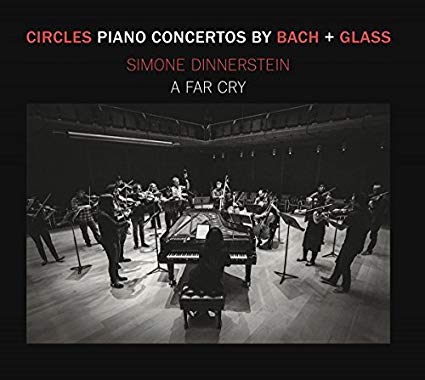
Simone Dinnerstein: Bach and Glass


dinnerglass

It has been interesting to watch the progression of Philip Glass’ career.  From his driving amplified ensemble music that so entranced this writer to as near groupie status as he will ever be to the more mainstream orchestral work of his work since at least the 90s the fascination remains at some level.

The familiar arpeggios are still to be found along with basically diatonic harmony with occasional polytonal sections.  What is interesting about Glass’ third piano concerto is a sort of chamber romanticism.  A Far Cry is a small chamber orchestra ideally suited to works like the Bach first piano concerto. Though technically originally written for harpsichord pianists have successfully broken the taboo on strict adherence to using the harpsichord and have developed techniques to optimize the sound of the piano (which has very different qualities from a harpsichord).

Simone Dinnerstein is an artist who I first met (albeit virtually) on Facebook.  Her reading of the Goldberg Variations from a few years ago seemed to signal her entrance into the mainstream of performers.  The choice of works on this disc are a sort of characterization of her interests.  She is an accomplished Bach performer with, obviously, an interest in new music.  So pairing her as soloist with A Far Cry whose interests appear to be in a similar range was perfect.

The performance of the Bach G minor piano concerto (No.7) is as delightful as it gets.  Dinnerstein and the ensemble seem work together very well.  These intense little chamber orchestras seem to be proliferating and one could speculate on the economic and political reasons for that but what is more interesting is the commitment and intensity that these small ensembles can bring to music.

The Glass concerto has the feel of a sort of miniature romanticism.  This writer heard it as echoes of Brahms but on a far more intimate scale.  It is difficult to say whether this new work (or for that matter, the other two piano concertos) will become a regular part of the repertory but it is clear that Glass continues to have his champions both in musicians and listeners.

There is nothing groundbreaking here and that is not what is apparently intended.  What we get in this recording is a couple of dedicated and thoroughly enjoyable performances by clearly dedicated musicians.  This is not an original instruments or musicological discoveries type of album.  It is simply good music making.

If you are a fan of Philip Glass and/or Simone Dinnerstein you will want this disc.  But don’t forget to pay attention the this little chamber group.  They are superb and energetic musicians and this reviewer expects to be hearing more from them in the near future.  Maybe we will get a new set of Bach and/or Mozart concertos.  Here’s hoping.

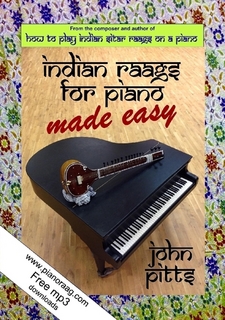
Indian Raags for Piano made easy


raags easy

Last year I reviewed Mr. Pitts’ How to Play Indian Sitar Raags on a Piano.  It was an enthusiastic review and the book continues to have a valued place on my piano as it opens a whole world of ideas.   Now the author has done a kind and useful service by issuing this simplified version of that work.

In fact this simplified version is more in line with the rather unpracticed keyboard skills of your humble reviewer.  The author chooses 6 raags or ragas which provide a good starting point for similarly humble musicians to begin this approach to Hindustani music.

Hindustani music became pretty much ubiquitous, or at least familiarly cliché in western musical culture largely due to the efforts of Indian musicians such as Ravi Shankar and Alla Rakha.  In fact it is an endlessly fascinating musical system whose logic has much to offer both musicians and composers.

In the past one had to learn traditional Indian instruments to gain much familiarity with these ancient musical systems but Pitts’ book offers an alternative to musicians whose familiarity is limited to the western keyboard.  Purists may denigrate this approach but even if it does not perfectly represent all aspects of Hindustani musical theory at least it provides a manageable entry point for amateur musicians and professionals alike.

Having struggled somewhat with the previous book I was particularly delighted to have these simplified examples which fall nearer to my skills level.  Even if I don’t wind up incorporating this into performance or compositional efforts I have no doubt that the exposure to the actual practice of this music will leave a valuable bit of programming in my neural circuits that will enhance my musical thinking and ability to appreciate other musics.

As with the first book, this too is highly recommended.  Kudos Mr. Pitts!

In the Beginning Was the Word: Other Minds 23


OM202006

Charles Amirkhanian performing one of his spoken word compositions at Other Minds 20 in 2015

Other Minds has been the the darling of composer/producer Charles Amirkhanian since its founding in 1993.  Along with television producer and arts patron Jim Newman he has presided over the 25 years of this renowned festival which has consistently brought the finest new music composers and performers to San Francisco.

There is little doubt that this year’s festival has to be very close to Amirkhanian’s heart.  Words have been central to his career at least since 1969 when he began his work as a producer at KPFA.  In the 23 years he spent there he presented countless hours of musical programming and interviews.  He crossed paths with most of the major stars in contemporary classical music and many stars whose genre may not be captured by the classical label.  A look at his programming choices and interviews from his time there defined new music for the Bay Area and beyond.  After his tenure at KPFA ended in 1992 he continued exploring cutting edge music and musicians bringing them to San Francisco for live performances.

His work as producer and curator has tended to overshadow his work as a composer, sound poet, and spoken word artist.  This year’s OM festival is dedicated to speech, sound poetry, and the spoken word.  It is about both the history and the present state of the art.  In many ways Amirkhanian’s 1975 release “10 + 2: 12 American Text Sound Pieces” on 1750 Arch Records (now on an OM CD 1006-2) can be seen as sort of the starting point for this festival.  This masterful anthology includes works by Charles Amirkhanian (1945- ), Clark Coolidge (1939- ), John Cage (1912-1992), John Giorno (1936- ), Anthony Gnazzo (1936- ), Charles Dodge (1942- ), Robert Ashley (1930-2014), Beth Anderson (1950- ), Brion Gysin (1916-1986), Liam O’Gallagher (1917-2007), and Aram Saroyan (1943- ).


“Word! Thou word that I cannot speak!

At the end of the second (and last completed) act of Arnold Schoenberg’s powerful opera “Moses und Aron” (1932) Moses sings, or actually half speaks and half sings this text lamenting his expressive deficits.  Speech song or, in German, sprechgesang is an invention by Schoenberg in which the singers are asked to find a point between speech and music.  Perhaps this is a good example of some of the artistic thinking going on at about the time when speech music/sound poetry began to take shape.

bio_schwitters_kurt

Kurt Schwitters (1887-1948)

Some of the history of sound poetry is featured in this unprecedented 6 day festival (April 9-14).  Some of the earliest practitioners of this unusual genre include the German artist Kurt Schwitters whose composition Ursonate (1922-32) will be performed in its entirety, a rare event by itself.

Another early gem will be the Spoken Music (1930) by German-American composer Ernst Toch.  This three movement suite has been known for its last movement, the Geographical Fugue.  The other two movements, once thought lost, were discovered in sketches in 2006 and reconstructed by Christopher Caines.  The now complete version will be presented I believe on day 3.

Composer-Ernst-Toch-810

Ernst Toch (1887-1964)


It is beyond the scope of this blog post to tell the history of text sound so I will refer readers to the Other Minds website for further details.  Or you could come to the festival too I suppose.

With due respect given to the past the festival will move on to the present.  San Francisco Beat Poet Michael McClure (1932- ) will make an appearance as will post beat colleagues Anne Waldman (1945- ), Clark Coolidge (yeah the guy from that cool anthology), Aram Saroyan (another guy from the classic text sound disc).

curran20160010

Alvin Curran in conversation last year in Berkeley.

Other Minds alumnus Alvin Curran (1938- ) will be premiering his collaboration with Clark Coolidge entitled, Came Through in the Call Hold.  Curran’s eclectic sensibilities will doubtless result in an interesting composition.  This event alone, at least for this writer, is worth the price of admission.  And this is just the first day!

Other events include workshops, discussions of the history of the art, and even some curious variations on a theme.  Apparently the writer Lawrence Weschler is the grandson of Ernst Toch and has written a variation on the Geographical Fugue called, The Medical Fugue which will be premiered at this festival.

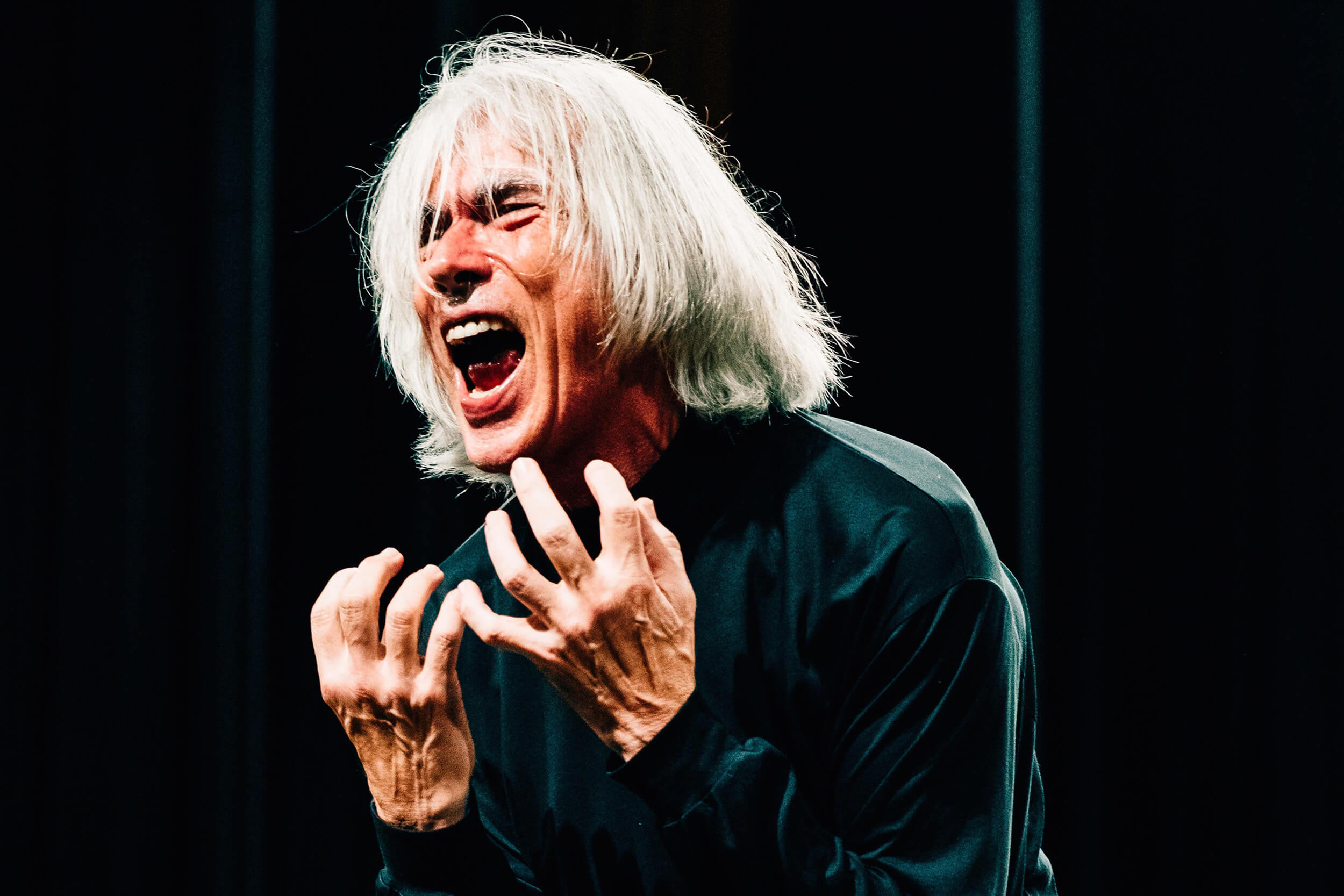
The increasingly ubiquitous pianist Sarah Cahill will be present to perform Virgil Thomson’s unusual but entertaining setting of a Gertrude Stein (a one time Oakland resident) text called Capital, Capitals.  She will accompany the men of the Other Minds Ensemble.  Jaap Blonk will be tasked with performing Schwitters’ Ursonate and, along with Enzo Miranelli will also perform other historical works including some by a couple of Italian Futurists.

Other Minds Administrative Director Randall Wong will end the evening by undertaking a performance of the late great Cathy Berberian’s Stripsody.  That promises to be a wild evening I think.
blonk_75_2500crop

Jaap Blonk (1953- )

Northern Europe, including the Netherlands and the Scandinavian countries will literally have their day.  As it turns out they are doing a great deal of creative work in this increasingly diverse genre of speech music.  Other Minds is at its best in introducing the new and the innovative from wherever Charles’ radar has tracked it down.  Indeed Mr. Amirkhanian and his wife, artist/photographer Carol Law traveled throughout these regions in the early 70s talking with and learning from these diverse artists.  (Amirkhanian’s work, Just was recorded in a Scandinavian studio during one of those trips).

As usual homage will be paid to the past with some recorded classics by Sten Hanson, Åke Hodell, and Lily Greenham.  Some new voices will be introduced including Tone Åse and Sten Sandell.  The Norwegian/Russian-American duo OTTARAS (consisting of visual poet Ottar Ormstad and composer Taras Mashtalir will also perform.   One can fully expect a mind expanding experience which will redefine the possibilities of the art form.

Auspiciously or perhaps dangerously Friday the 13th has been reserved for Bay Area talents.  First up will be the man of the hour, Charles Amirkhanian.  Hearing him do his work live is an uncommon but entirely enjoyable experience.  If that alone weren’t enough we will get to hear the even rarer public collaboration between him and his life partner Carol Law whose photography and collage work deserves wider recognition and will happily get that here.
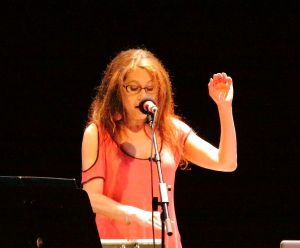
Amy X Neuberg

Amy X Neuberg.

Trained in both linguistics and music, Amy X Neuberg will be on hand to perform her indescribable electronic cabaret including the world premiere of “Say it like you mean” and other genre bending work.  She is another valued Other Minds alumnus having given numerous performances at the festivals.

Stanford professor Mark Applebaum, another alumnus will present “Three Unlikely Corporate Sponsors” which premiered at Stanford in 2016.  Enzo Miranelli will conclude the evening with his theatrical combination of movement and text in “Fame: What I Want to Say”.

20130218-132303.jpg

Pamela Z

The festival concludes on Saturday April 14th with Jaap Blonk followed by the wonderful San Francisco based Pamela Z who, like Neuberg uses electronics, but creates her own unique sound world.  She too is an alumnus of Other Minds.

Another composer from that great anthology, Beth Anderson, will make an appearance to perform “If I Were a Poet”, “I Can’t Stand It”, and “Ocean Mildew Minds”.

The finale will feature Susan Stone and Sheila Davies Sumner performing excerpts from two works, “House with a View” and “Loose Tongues” both dealing with the lives of working class southern women.

This will be both a feast and a marathon but it promises to be one of the finest Other Minds productions maybe ever.  Come to be entertained, come to be challenged, come to expand your mind.  You’ll never be the same.  See you there.
300 Years of Virtuosity, Liza Stepanova’s Tones and Colors


stepanova

Concert Artist Guild CAG 120

This is the solo piano debut of this talented and incredibly virtuosic artist.  This hard working pianist can be heard on a previous CD (After a Dream) with the Lysander Piano Trio.  Her web site can provide a good idea of the range of solo, chamber, and orchestral music in her repertory.

This CD is a good example of creating a brand, a practice which seems to be the current rage especially among artists who specialize in new music.  I have previously commented on the brands of pianists like Sarah Cahill, Kathleen Supové, Nicolas Horvath, and Stephane Ginsburgh to name a few.  All are amazing musicians but each seems to have been able to carve out an identifiable niche which sets them apart from each other and defines their various artistic missions.  Granted these are soft definitions in that they do not preclude them from playing anything they choose but it gives audiences a sort of general idea of what to expect when they do a program.

Liza Stepanova appears to have chose virtuosity as her signature.  She plays what sounds like fingerbreakingly difficult music with both ease and expressiveness.  Here she chooses to basically survey virtuosity from J. S. Bach to György  Ligeti.  In addition she has chosen to pair each composition with an analogous piece of visual art.

The pairing of music and visual art is as old as dirt and has always seemed to have an inherent validity.  Tone poems like Mussorgsky’s Pictures at an Exhibition or Debussy’s Clair de Lune are familiar examples of music as a visual analog.  But music sometimes suggests pictures even if it was not the stated intent of the composer too.  Stepanova covers the visual territory from the representative to the abstract in this entertaining collection.

Perhaps the most interesting aspect of this recording is the pianist’s choice of music.  She does go with the familiar at times such as Debussy’s Goldfish but the majority of this disc contains music that is seldom heard by lesser known composers such as Maurice Ohana (1913-1992), Joaquin Turina (1882-1949), Fanny Hensel (1805-1847), and Lionel Feininger (1871-1956).  There are better known names such as Enrique Granados (1867–1916), Bohuslav Martinú and Leopold Godowsky (1870-1938).  And the most familiar names such as J. S. Bach (1885-1750), Franz Liszt (1811-1886). Claude Debussy (1862-1918), George Crumb (1929- ), and György Ligeti (1923-2006).

There are 13 tracks grouped into 4 visual art themes (A Spanish Room, Nature and Impressionism, Conversations Across Time, and Wagner, Infinity, and an Encore).  The only problem I have here is the photos of the art (which thankfully are included in the little booklet) are necessarily small and really don’t give the consumer the full intended effect.  One would do well to obtain some art books or some larger prints of these to gain the intended effect.

I won’t go into detail about each individual piece.  Suffice it to say that they are all technically challenging and intelligently chosen pieces.  This is a very entertaining program from this emerging artist.

This reviewer is given to speculation as to Stepanova’s next release.  Perhaps Sorabji with some Dada works?  Whatever it is will doubtless be as interesting and entertaining as this disc.  Brava, Ms. Stepanova!


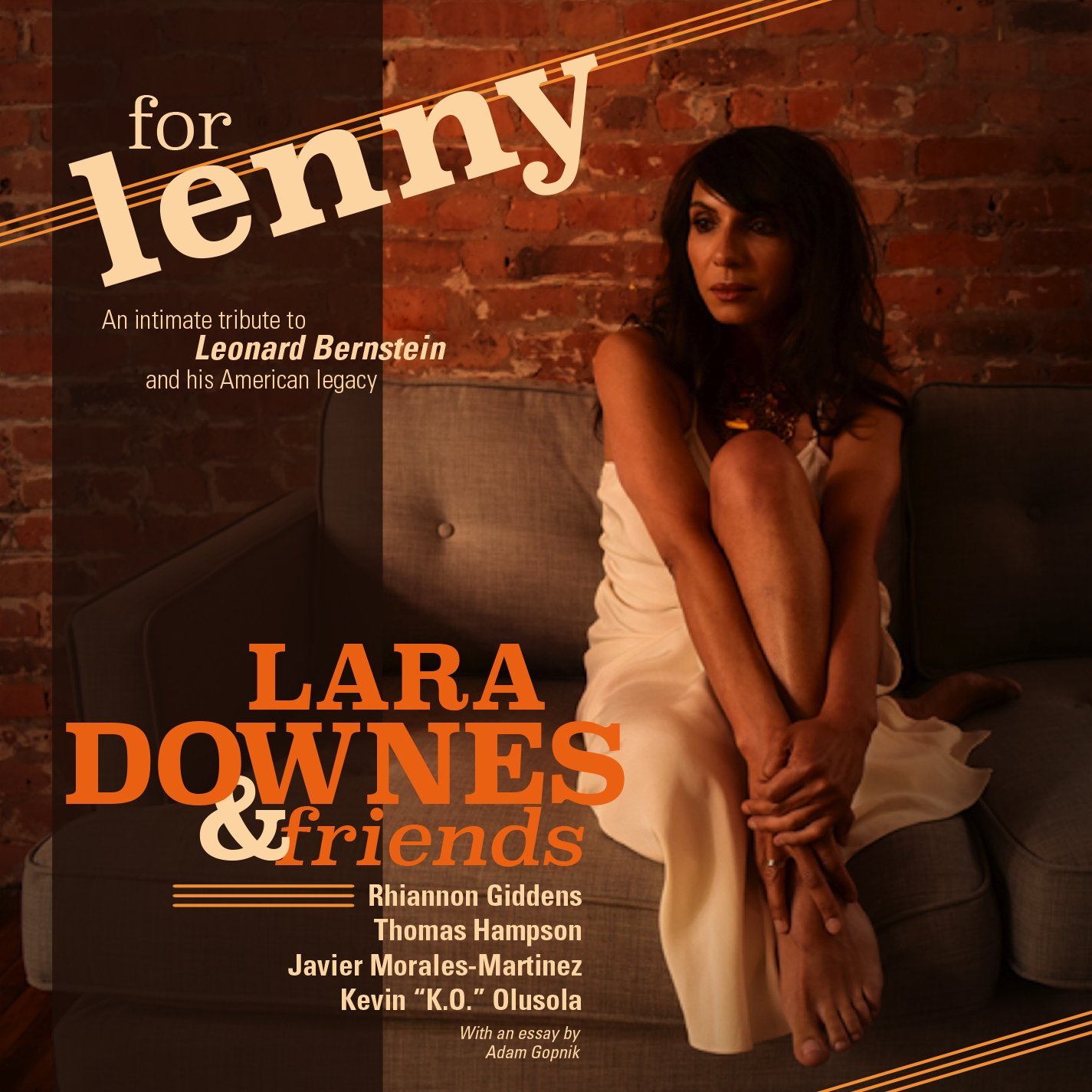
Lara Downes’ Bernstein Tribute


lenny

Lara Downes is one of the finest pianists working today.  Her virtuosity and interpretive skills are well established.  She is well versed in the standard repertoire of classical piano music but has chosen to blaze her own unique path in her recorded legacy.  Here she pays homage in her own unique manner with help from some interesting fellow musicians.

The album consists of 29 tracks none of which lasts more than 4 minutes.  Many are by Bernstein including a generous selection of his Anniversaries, each dedicated to a particular person. Some were written in celebration, some in memoriam. Time marches on and we now celebrate the 100th anniversary of Lenny’s birth. So, of course, all these tracks are in memoriam now. In addition to the all too seldom heard Anniversaries there are a few song transcriptions and a nice selection of Anniversary like pieces contributed for this album by a delightful selection of composers including John Corigliano, Lukas Foss, Michael Abels, Ned Rorem, Ricky Ian Gordon, Eleanor Sandresky, Shulamit Ran, Stephen Schwartz, Marc Blitzstein, Theo Bleckmann, and Craig Urquhart.

This album is (thankfully) not a greatest hits collection but rather, as it’s subtitle says, an intimate tribute by people who were affected by Bernstein in one way or another. Bernstein cut a wide swath of influence embracing new music, mastering the established western classical canon, and embracing jazz, blues, and musical theater much like Ms. Downes actually.

Most of the album is solo piano where Downes casts a loving and magical spell. A few judiciously chosen tracks feature banjo virtuoso Rhiannon Giddens, baritone Thomas Hampton, and two musicians unknown to this writer, Javier Morales-Martinez and Kevin “K.D.” Olusola.

My first listen to this album was an uninterrupted one while driving South from San Francisco. The impression was one of Bernstein’s multiple voices being present seamlessly in every track. Only later reading the liner notes did I become aware that some tracks were written by others.

This is an intimate celebration in honor of a musician who touched so many lives.  Many of the artists on this recording knew Bernstein to some degree but the point here is that Bernstein’s art is so pervasive that few can say they have not been touched by it to some degree.  This listener was brought to nostalgic tears a few times.

In keeping with Downes’ eclectic style this is an unusual selection of pieces, most by Bernstein but all imbued with his spirit, a combination of classical sensibilities with a real feel for jazz, blues and the American musical theater.  This disc contains most, if not all of Bernstein’s “Anniversaries”, short piano pieces written variously in honor of or in memory of many of his friends.  Other pieces are by contemporaries of Bernstein and some were written for this recording.  Add to that a few interludes such as Thomas Hampson coming in to sing, “A Simple Song” from Bernstein’s “Mass”, K.D. Olusola riffing on the familiar “Something’s Coming” which opens the disc, Javier Morales-Martinez spicing up “Cool” from “West Side Story” with his clarinet and Rhiannon Giddens sounding so pretty on the track of that title.

This is a love fest and it, appropriately, covers generations much as Lenny affected so many generations whether through his wonderful work as a conductor or his classic musicals and operas that are indeed the American grain incarnate.  And Lenny was also a teacher to children and to adults.  From the Young Peoples Concerts to the Harvard Norton Lectures he thought deeply and taught and stimulated ideas.  Generations have been forever changed by him.

The bulk of this recording depends on Lara Downes amazing virtuosity bringing these brief little poems to life most convincingly and almost magically.  She clearly has a real feel for this music.  This is mostly not the familiar Bernstein that everyone knows.  It is a portrait such as listeners familiar with Downes’ work will recognize, eclectic, intelligent, sometimes nostalgic, a little obscure, frequently virtuosic, and ultimately satisfying.  The disc lists the performers as, “Lara Downes and friends” and that is the feeling of not just the performers but also of the composers whose heartfelt contributions fit so well in this eclectic mix.

This disc represents Downes’ debut on Sony and the only thing this writer can say to that is, “What took them so long?”  Brava!  And cheers to Lenny on his 100th.

Linda Twine, A Musician You Should Know


Linda-K-Twine-Image-page-001

Linda Twine

I have found it strange that the few articles I have written (and, full disclosure, I’m a white guy) on black musicians seem to have placed me in the position of being one of apparently a limited number of writers/bloggers who pay attention to the topic.  Happily these articles have gained an audience.  The rather simple piece I wrote on black conductors, a little essay composed in honor of Black History Month, remains by far one of my most read articles.

The vicissitudes of race and racism are such that we need to say, “black lives matter” because even the most cursory examination of statistics shows that they seem to matter far less than lives with other racial identities.  The same is true with music and musicians..  There are organizations dedicated to the promotion of black musicians because they remain far less well represented.

It is in this spirit that I am writing this little sketch to highlight a black musician who does not have a Wikipedia page or even a personal web page that I have been able to find.  You can find her easily with a Google search but you will find some of the same segregation of which I spoke.  One finds her on the “Broadway Black” website which does a fine job of promoting her and her work.  And what fine work it is.

To be fair she is also on the “Internet Broadway Database“, “Playbill“, the “Internet Movie Database“, and one can find her most recent work listed on the “Broadway World” site.  Her cantata, “Changed My Name” can be found on You Tube.  And it is there where, curiously enough, one can find the most comprehensive information on her.  I present it here:

From the Muskogee Phoenix, 11/10/2007, we have this information about Linda Twine:

Twine, a native of Muskogee, OK, graduated from Oklahoma City University in 1966, with a bachelor of arts degree in music. There, she studied piano with the esteemed Dr. Clarence Burg and Professor Nancy Apgar. After graduating from OCU, Twine studied at the Manhattan School of Music in New York, where she earned a master’s degree, and made New York her home. She began her musical career in New York, teaching music in public school by day and accompanying classical and jazz artists at night. At one of these engagements, she was asked if she would like to substitute for the keyboardist of the Tony Award winning Broadway hit, “The Wiz.” Her positive response began a long career in Broadway musicals from keyboard substitute to assistant conductor of Broadway orchestras. In 1981, to conductor when Lena Horne asked her to conduct her one-woman hit, “Lena Horne: The Lady and Her Music.” This garnered Twine the respect of her peers and as a much sought-after Broadway musical conductor. In addition to “The Wiz” and “Lena Horne,” Twine’s Broadway credits include, “Ain’t Misbehavin’,” “Big River” (the score composed by Oklahoman Roger Miller), “Jelly’s Last Jam,” “Frog and Toad,” “Caroline or Change,” “Purlie,” and the current “The Color Purple,” starring Fantasia. Not only a distinguished conductor, Twine is also a composer and arranger. She composed “Changed My Name,” a cantata inspired by slave women Sojourner Truth and Harriet Tubman, and written for two actresses, four soloists, and a chorus. Her popular spiritual arrangements are published by Hinshaw. As a producer, instrumental and vocal arranger, her work can be seen and heard in the books and CDs of the Silver Burdett Publishing company, which are used by many public schools in the United States. Community commitment and involvement have also marked Twine’s outstanding career. She has arranged and composed for the renowned Boys Choir of Harlem, and she served for 14 years as minister of music for St. James Presbyterian Church of New York. Among her many awards and honors is the “Personal Best Award for Achievement and the Pursuit of Excellence,” for her role as a writer and arranger for the Boys Choir of Harlem, her artistic achievements in the world of Musical Theatre, and her concern for humanity. Twine, a proud Oklahoman, is the granddaughter of William Henry Twine, a pioneer lawyer who made a homestead claim in the 1891 Sac and Fox Run, and along with G.W.F. Sawner and E.I. Saddler established the first black law partnership in Oklahoma Territory.

So here, in honor of Black History Month, I wish to present this fine musician whose art deserves the world’s attention.  Take note please.

Sarah Cahill et al: By and for Terry Riley


Sarah Cahill - Eighty Trips Around the Sun- Music by and for Terry Riley - cover.png

Had to save this one for Christmas.  If ever there was an album that conjures more of the positive intents of the Christmas season this one gets my vote.  Imagine celebrating a living acknowledged master artist in a milieu of his actual and artistically extended family.  That may seem an extreme notion to some but this writer is utterly charmed and thrilled to hear this “one of a kind” collection.  Other interpretations will, of course, be valid but none will ever match this one.  It’s like the Carter family of the avant-garde (and I mean that unambiguously with great respect).

Any release by Bay Area pianist Sarah Cahill is reason enough alone to perk up one’s ears but this massive four disc collection of all new recordings in honor of Terry Riley’s 80th birthday (Terry was born in 1935) is a major release of (almost) all of Riley’s music for piano, piano four hands and two pianos.  In addition two of the discs are dedicated to pieces commissioned in honor of Riley.  This set belongs in the collection of anyone interested in mid to late twentieth century music and especially fans of minimalism and the curiously west coast iterations of modernism.

As a listener I have always treated every Terry Riley release as a major event as well and this collection does about as fine a job as one can imagine in paying homage to one of the brightest artistic lights of the Bay Area.  Riley came to prominence (at least historically speaking) with his open score piece, In C (1964).  It is among the earliest examples of the style which, for better or worse, became known as “minimalism”.  Since then he has continued to produce music in pretty much all genres, chamber music, orchestral music, solo music, concerti, etc.

Riley’s style, however, continued to evolve and his later works show diverse influences from his days playing barrel house piano, his interest in progressive jazz, and his studies of Hindustani and Carnatic musics (under the tutelage of Pandit Pran Nath).  Like pretty much every composer of that first wave of “minimalists” Riley has evolved a much deeper and individualized style but, even with the diversity of influences as mentioned, he remains uniquely Terry Riley.

Throughout his career as composer and performer Terry has been a teacher and an advocate of new music.  His enthusiasm and talent has affected all who know him and, I dare say, all who have experienced his work.

This collection ranges over his entire career from the early “Two Pieces” (1958/9) to later solo and four hand compositions on the first two discs.  It is worth noting that Be Kind to One Another (2008/14) was one of the commissions in Sarah Cahill’s wonderful series of anti-war pieces, “A Sweeter Music”.  It then goes on to the homages which, of course, can also be said to be influenced by Riley’s work.

This is not simply a collection of Riley’s piano music.  What we have here is a lively celebration of most of Riley’s music for piano, two pianos and piano four hands from the full spectrum of his career (as the liner notes say a couple of large compositions were not included, most likely a matter of space) along with a touching set of homages by composers related musically and aesthetically to Mr. Riley.  They range from contemporaries to students, artistic descendants to actual family.  It is a multi-generational tribute and a loving artifact that celebrates this artist on a very personal level.

Regina Myers supplies the other two hands in the disc of four hand piano pieces by Riley.  She credits another Bay Area composer/teacher/conductor, the Mills College based Steed Cowart for recommending her for this crucial role.  Such touches add to the sense of this being a Bay Area family project on so many levels.

The interrelationships that comprise this lovely production make it stand distinctly apart from the (no less significant or lovely) homages to fellow minimalists Philip Glass and Steve Reich.  This is a much more personal album which reflects Riley as composer, teacher, inspiration, father, icon and friend.  Anyone who has met Terry or experienced him in performance has experienced a certain warmth like that of a wise and gentle guru.

After the two discs of Riley’s music we are treated to music inspired by another generation of artists and, last, by long time colleague, the late great Pauline Oliveros (1932-2016), another wise and gentle guru who died just about a year before the release of this album.  She and Terry worked together (along with Morton Subotnick, Ramon Sender, Steve Reich, William Maginnis, and Tony Martin) as founders of the San Francisco Tape Music Center which would become the Mills College Center for Contemporary Music (still operating today).  The producers wisely dedicated an entire disc to one of Oliveros’ last compositions, this loving tribute to her friend and colleague. It is now, sadly, a tribute to her memory as well.   Samuel Adams shares the performing duties along with Ms. Cahill on this extended homage.

There is little doubt that the other composers whose music graces this tribute will continue on their unique paths to continued success always acknowledging their connections to Mr. Riley.  Danny Clay is among the less familiar (to this reviewer) names here but his Circle Songs seem to fit quite well to open the first tribute disc.  Gyan Riley is, of course, one of Terry’s children and a fine guitarist and composer  in his own right.  Anyone who has had the pleasure of seeing Gyan and Terry play together cannot miss the close bond personally and musically of these two.  They are a joy to behold.  The affectionate Poppy Infinite is a reference to the elder Riley’s Poppy Nogood’s Phantom Band which was the “B side” of his classic Rainbow in Curved Air.  Samuel Adams is the son of Pulitzer Prize winner John Adams whose early work China Gates was written for and championed by his fellow classmate at the San Francisco Conservatory, Sarah Cahill.  The younger Adams’ contribution here is called Shade Studies.

The eclectic Christine Southworth also seems to embody the (perhaps loosely defined) West Coast style.  Her interests in electronics and world music describe this superficially but her sound is a welcome one here as well.  Keeril Makan earned his PhD. in music at Berkeley which doubtless has left a stamp on his style.  His composition “Before C” makes reference to what is doubtless Terry Riley’s best known work, the oft performed, “In C”.  Elena Ruehr is a composer whose connection is not as clear as some of the others here but her work, “In C too” demonstrates her understanding of and her respect for Riley’s work.  Last on this disc of tributes is Dylan Mattingly.  He is a Berkeley native and can frequently be seen/heard performing in various venues in the Bay Area.  His contribution YEAR demonstrates both his individual style and his connection to the West Coast Style mentioned earlier.

The liner notes by Sarah Cahill are part of the tribute and a good description of the various influences behind the man of the hour, Terry Riley.  Credit is properly given to the artistic influences that inspired Mr. Riley and a brief description of what must have been an intimidating but loving project.  It is likely that there are even more connections involved in this undertaking but that must be left to future musicological and historical research.

The Kronos Quartet has long ago championed Riley’s work for that medium and new versions of his classic, “In C” continue to come on the scene.  One can only hope that the energy embodied here will inspire recordings of some of Riley’s lesser known work with orchestra which richly deserves hearings.  But regardless there is much to celebrate here and best holiday wishes go out to Mr. Riley and his talented progeny.  Happy listening, all.


Howard Hersh’s Chamber Music: Dancing at the Pink House


hersh pink

This latest release by Howard Hersh reveals more of his range as a composer.  His previous release focused on one large concerted work for piano and chamber orchestra as well as some virtuosic writing for piano and for harpsichord.  This disc (worth a listen if only for the return engagement of the pianism of Brenda Tom) focuses on some smaller chamber ensembles and a look at the composer’s more impressionistic moods.

This writer is left with the notion that each piece seems to be an intimate telling of a story.  Though the stories are not explicit, each piece has a distinct narrative character.  Mary Rowell handles the multi-track violin parts on Madam’s Tavern (2014).  The piece has an almost symphonic character evoking a variety of styles and meandering most pleasantly through a musical narrative whose details are not as important as the fact that the piece engages very successfully on a purely musical level.  It is written for solo violin with a chorus of some 15 tracks of violin accompanying.

Loop (2006) is a sort of cyclic quasi-minimalist work featuring Jonah Kim on cello, Brenda Tom (gently) on piano, and Patricia Niemi on vibraphone.  It is a dream-like, perhaps even impressionistic piece whose structure and compositional techniques serve the end goal of being a charming aural object.

I Love You Billy Danger (2012) was written for pianist Brenda Tom.  Here she demonstrates her virtuosity and her dramatic and dynamic range in a piece which, though related to Liszt according to the liner notes, seems to evoke the rather Lisztian master Frederic Rzewski as well.  Tom is at her fines with this challenging work and she conveys the narrative well.

Night (2013) seems related to the earlier Loop by virtue of being a percussion piece but also by its gentle evocation of a shimmering musical narrative punctuated with a clarinet part that alternately hides within the percussive sounds and comes wailing out  in jazzy/bluesy moments.  This writer was left with the notion of Gershwin haunting the score (but maybe that is because this review is being written in the Halloween season).  José González Granero is on clarinet, Patricia Niemi on marimba, and Nick Matthiessen on percussion.

Dancing at the Pink House (2006) is a musical narrative for clarinet and piano that Hersh has featured as a teaser on his website.  It was written for Patricia Shands, clarinet and is accompanied by James Winn on piano.  Shands is the owner of said Pink House and she seems to be having a lot of fun with this playful but substantial piece.  Both of these musicians appeared on Hersh’s 2007 CD release, Pony Concerto (Albany Records).

Dancing at the Pink House is a valuable addition to Hersh’s discography and reveals more of his range as a composer.  This is a highly entertaining recording and leaves the listener wanting more.

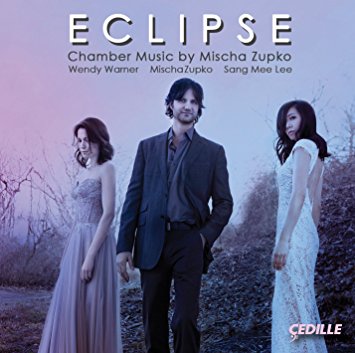
Eclipse of the Son: Mischa Zupko


zupko

Mischa Zupko (1971- ) is a composer, a pianist, and a professor of music at Chicago’s De Paul University.  He is the son of avant garde composer Ramon Zupko (1932- ).  Mischa’s work featured on this Cedille release suggests that the proverbial apple has fallen quite a distance from the family musical tree.  That is neither bad nor good but it is striking.

The elder Zupko’s work, despite its significance, is too little known.  A few recordings exist on the old CRI recordings label and this writer recalls being impressed by them. According to the Chicago Reader article he really didn’t want his son to go into the music business but apparently what is in the blood is in the blood.  A curious note too is that one can find articles on both these composers on Wikipedia but not the English/American one, rather curiously both are to be found on the Dutch Wikipedia site.

The present disc is apparently the first dedicated entirely to this emerging composer’s work (now numbering some 50 pieces).  It is a disc of chamber music and from the first the listener is immediately aware that the younger Zupko is possessed of a sort of retro romantic bent.  Think of the great virtuoso composer/pianists of the 19th century like Franz Liszt and Anton Rubinstein.  He does gratefully acknowledge his father as inspiration but clearly follows a different path.

This music is about passion and virtuosity.  The composer defines this clearly in his liner notes.  The performers Mischa Zupko on piano, Wendy Warner on cello, and Sang Mee Lee on violin demonstrate both passion and virtuosity on this lucid recording.  They play very well together and they all have ample opportunities to show off their respective skills.

There are seven works on ten tracks dating from 2005 to 2015.  The first five tracks consist of “Rising” (violin and piano, 2009), “Fallen” (cello and piano, 2010), “From Twilight” (solo violin, 2015), “Eclipse” (violin and cello, 2014), and, “Nebula” (solo cello, 2015).

There then follows the four movement”Shades of Grey” (2005) for violin and piano.  This is the earliest work on the disc but stylistically it is consistent with the rest of the disc. Zupko certainly develops as a composer but his style seems pretty firmly established.

The last track seems to be the big feature here.  “Love Obsession” (cello, piano, 6 pre-recorded cello tracks; 2013) is perhaps the most adventurous and grand of the works on this recording.  As with the other works on the disc the composer cites various literary influences and inspirations consistent with the apparently romantic ethic which seems to drive his creativity.  And as with the other tracks we hear a tonal romantic idiom filled with passion.

My title for this review is not intended to suggest that the younger Zupko has surpassed his father in any way except perhaps in that his work has, whether by accident, timing, design, or whatever, gotten more attention.  This is not a case of Johann Strauss Jr. and Sr. in jealous competition, this is simply another generation responding to it’s muse and that is worth celebrating.


Exploding Debussy, Kathleen Supové


New Focus FCR 170


Increasingly it seems that new music performers take on a persona which includes a unique selection of repertoire and frequently a distinctive physical presence.  Kathleen Supové is a fine example.  Her distinctive physical appearance and attire becomes a metaphor for her very personal and intelligent choice of repertoire which sets her apart from her peers.  In addition to unquestioned virtuosity and beautiful interpretive skills her persona takes on an adjectival quality which prompts this reviewer to ponder the “Supovian” experience.


I may live to regret that neologism but the present album is offered as exhibit one (of about 20 albums) attesting to the distinctive choices of music that characterize her work.  This two disc album, The Debussy Effect, is a very modern homage (even sometimes with apologies) to the impressionist master.  Twelve tracks on the two discs feature seven contemporary composers.  Only three tracks are for solo piano.  The rest involve electronic enhancements and or “soundtracks”.

Initially I had hoped to be able to say something useful (if not particularly insightful) to prospective listeners/buyers of this album about each of the pieces here but after several listens I can only reliably say that the material makes for a great and entertaining listening experience.  It harbors complexities that cannot be fairly recounted in such a brief review.  (And this reviewer has a limited knowledge of Debussy as well.)

Here are works by some of the finest of the New York “downtown” music traditions that reflect some amazing and very deep appreciations that will likely change the way you hear Debussy.

Here is the track list:

Disc One

1.  Storefront Diva: a dreamscape by Joan La Barbara

2.  Dr. Gradus vs. Rev. Powell by Matt Marks

3.  Layerings 3 by Eric Kenneth Malcolm Clark

4.  What Remains of a Rembrandt by Randall Woolf

Disc Two

1-4.  Shattered Apparitions of the Western Wind by Annie Gosfield

5-7.  Cakewalking (Sorry Claude) by Daniel Felsenfeld

8. La plus que plus que lente by Jacob Cooper

All are engineered by the wonderful Sheldon Steiger for the New Focus recordings label.

So the take away here is as follows:  If you are a Debussy fan you will want to hear this album.  If you are a Kathleen Supové fan you will want to hear this album.  It is the second reason the seems the most salient here.  I expect to be listening to this many more times.  Enjoy.


Of Mourning and Unity, 2016


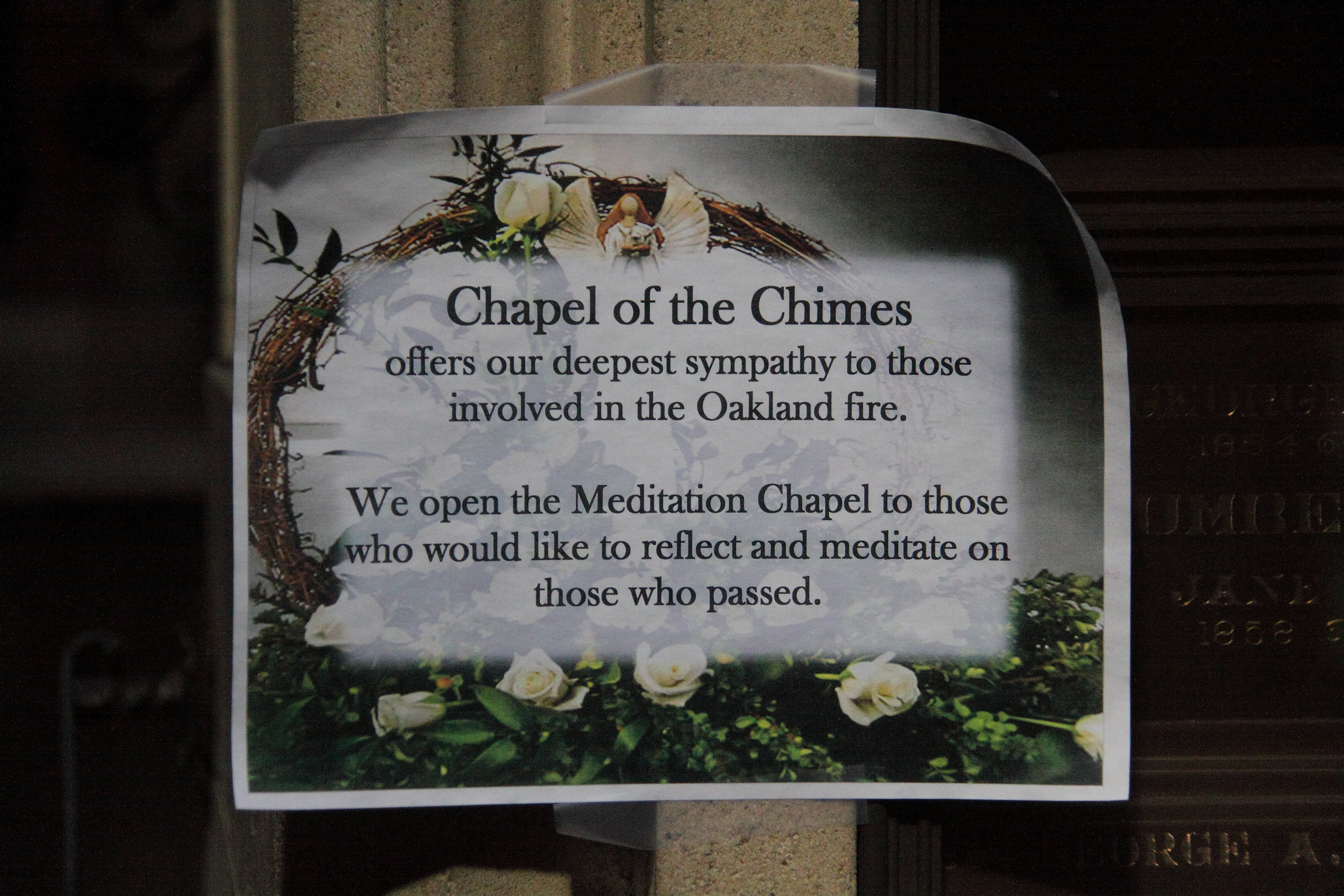
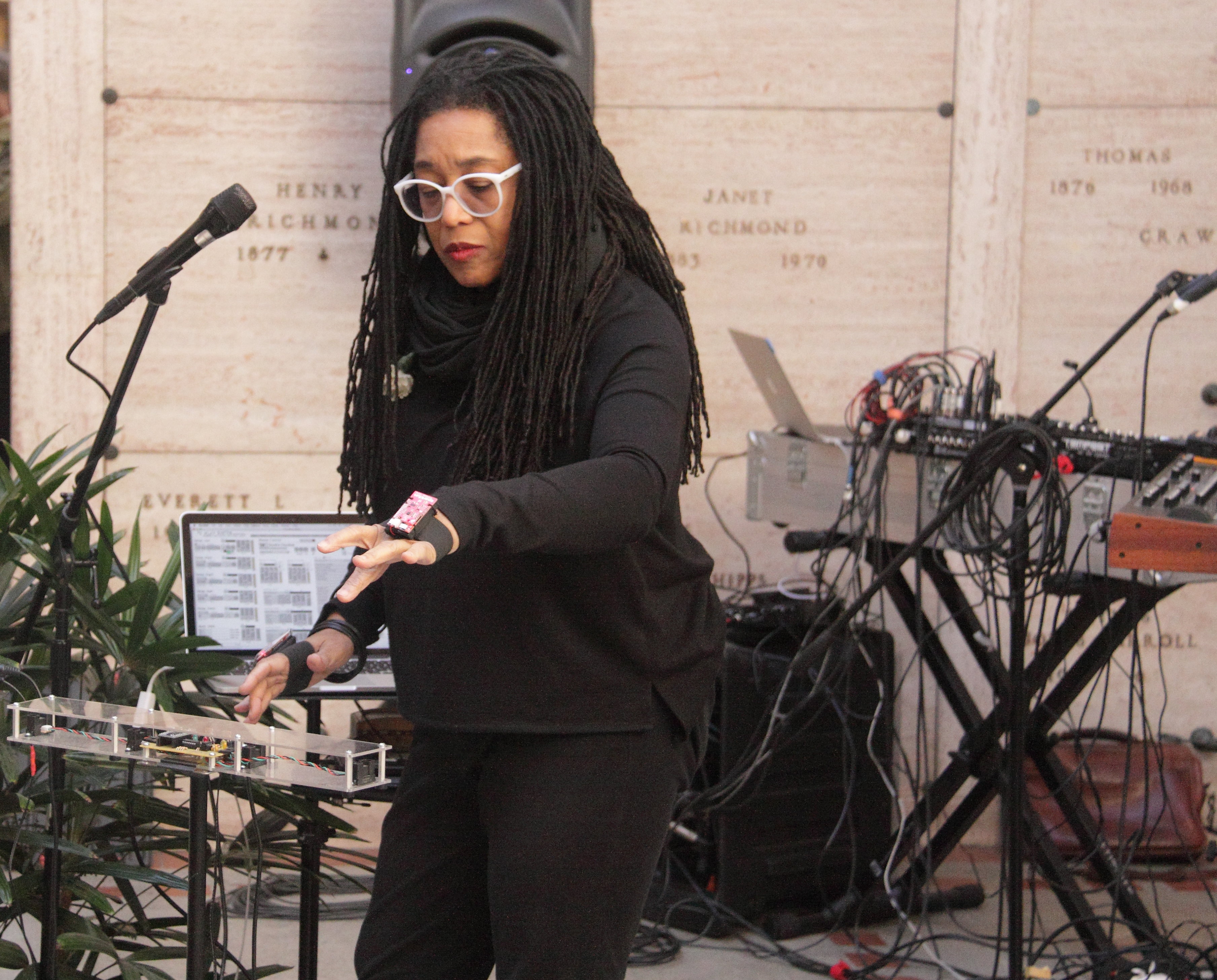
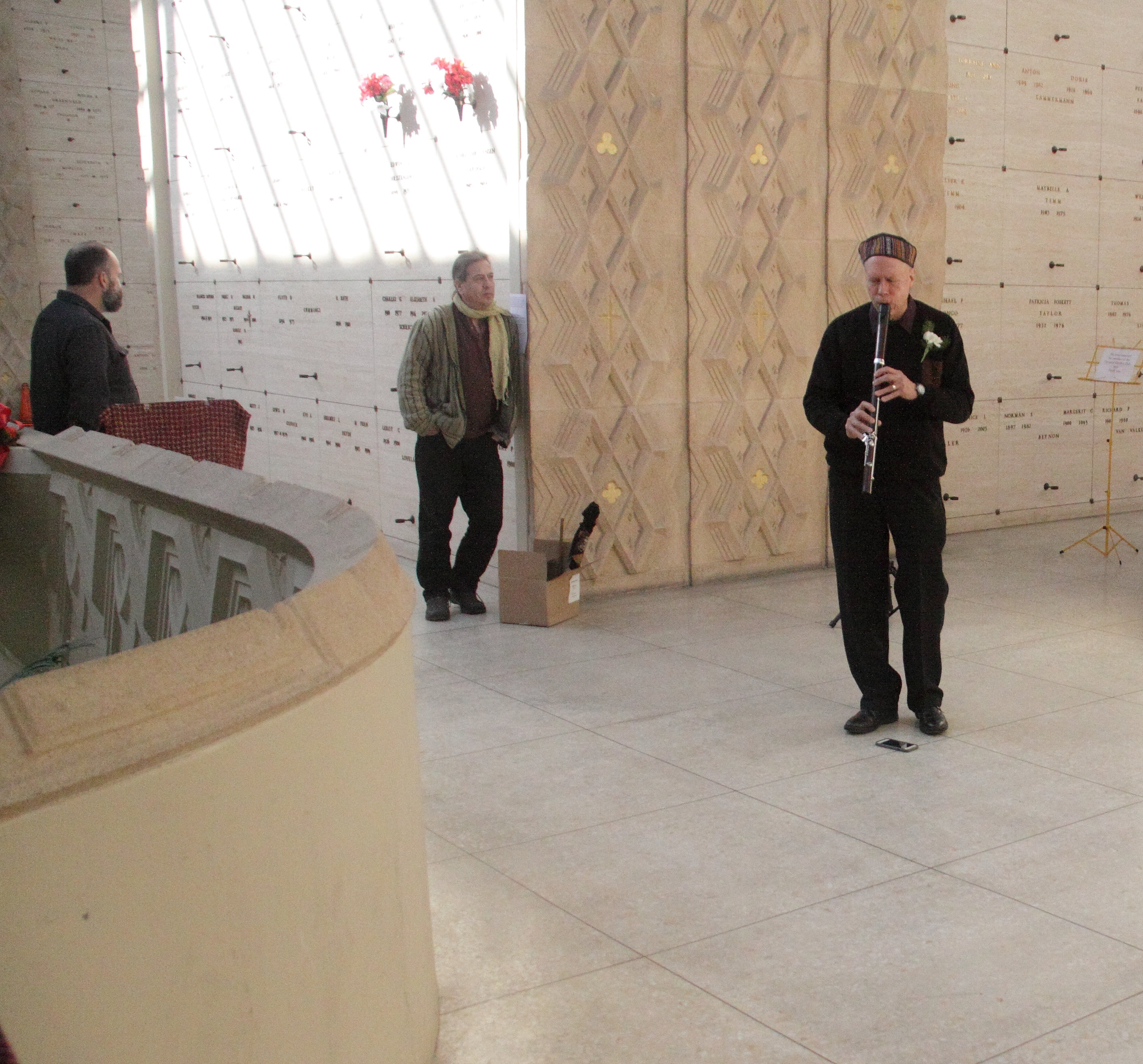
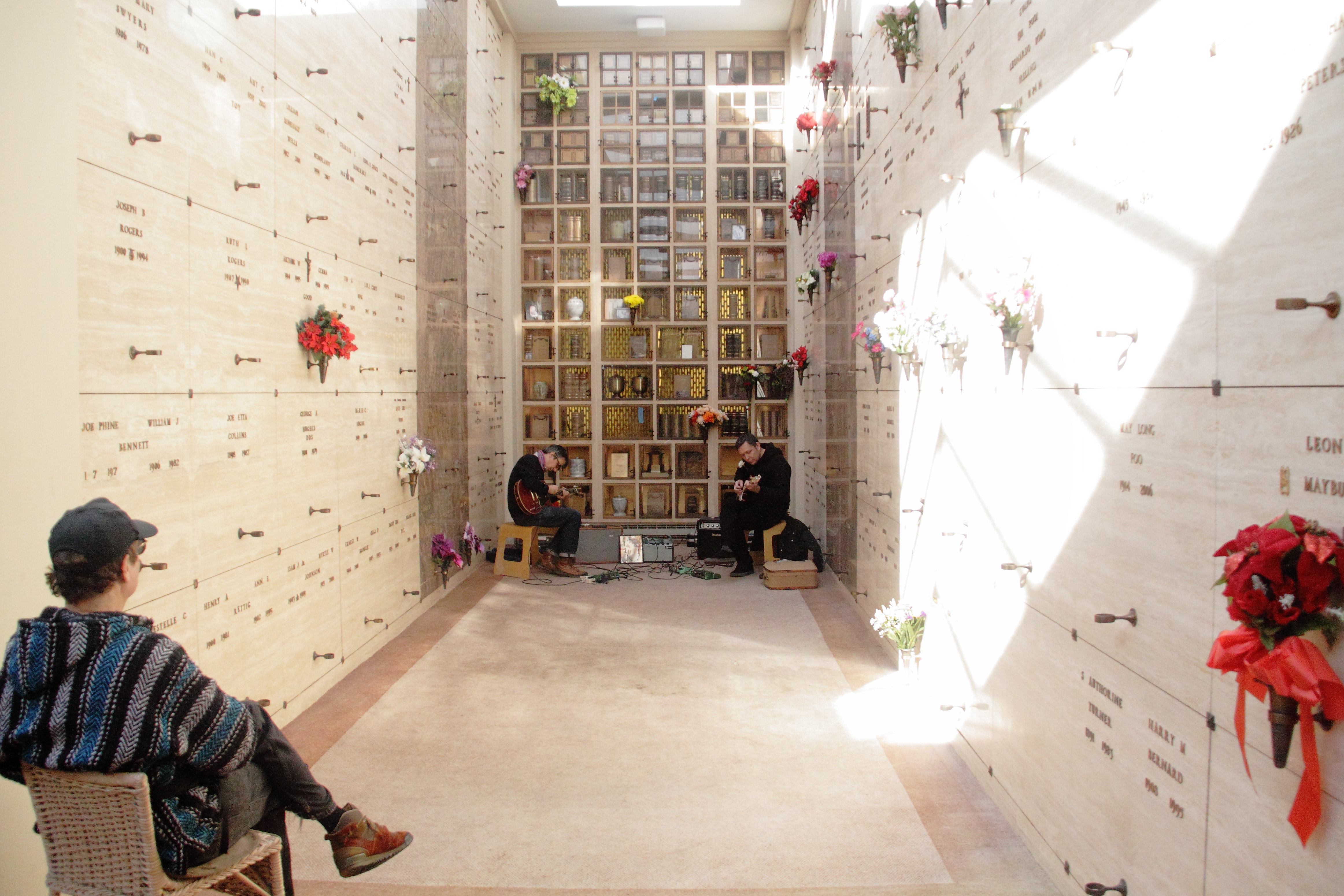
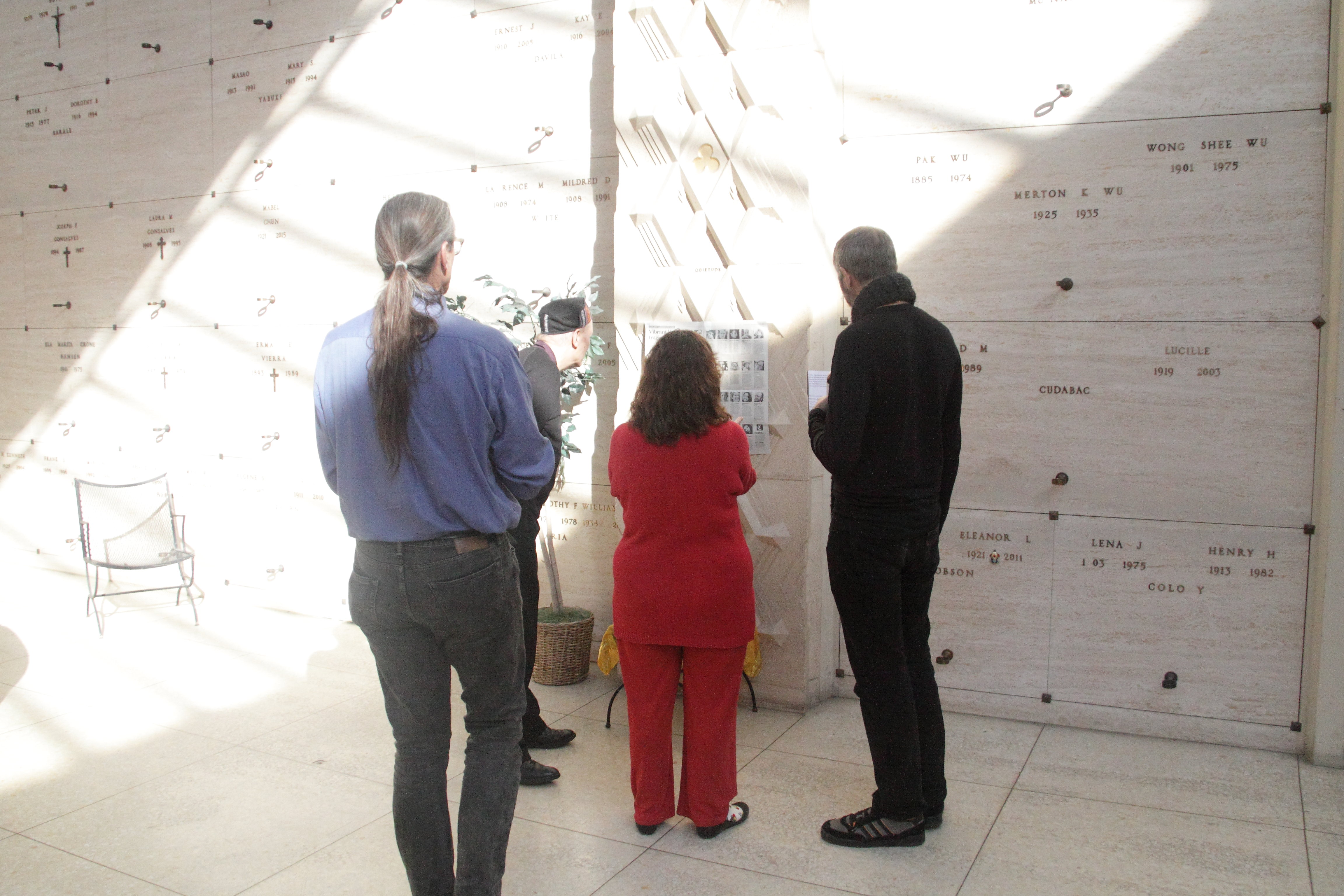
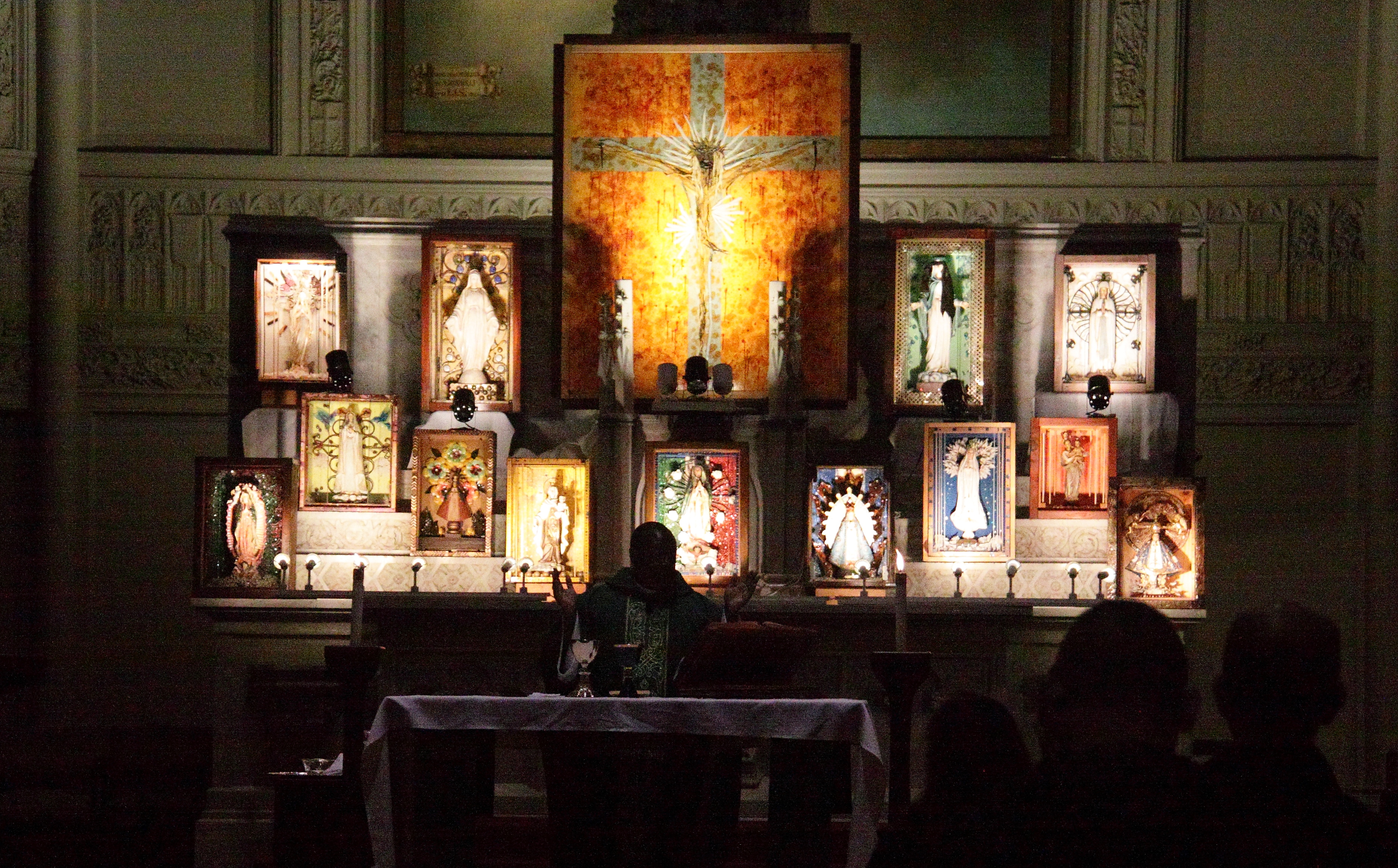
oliverosolstice20160075Every year on June 21st, the Summer Solstice, there is a rather unique concert event in which musicians from the Bay Area and beyond gather in celebratory splendor in the sacred space of the Chapel of the Chimes in Oakland.  The chapel is a columbarium  (a resting place for cremated remains) and a mausoleum.  The space is in part the work of famed California architect Julia Morgan.
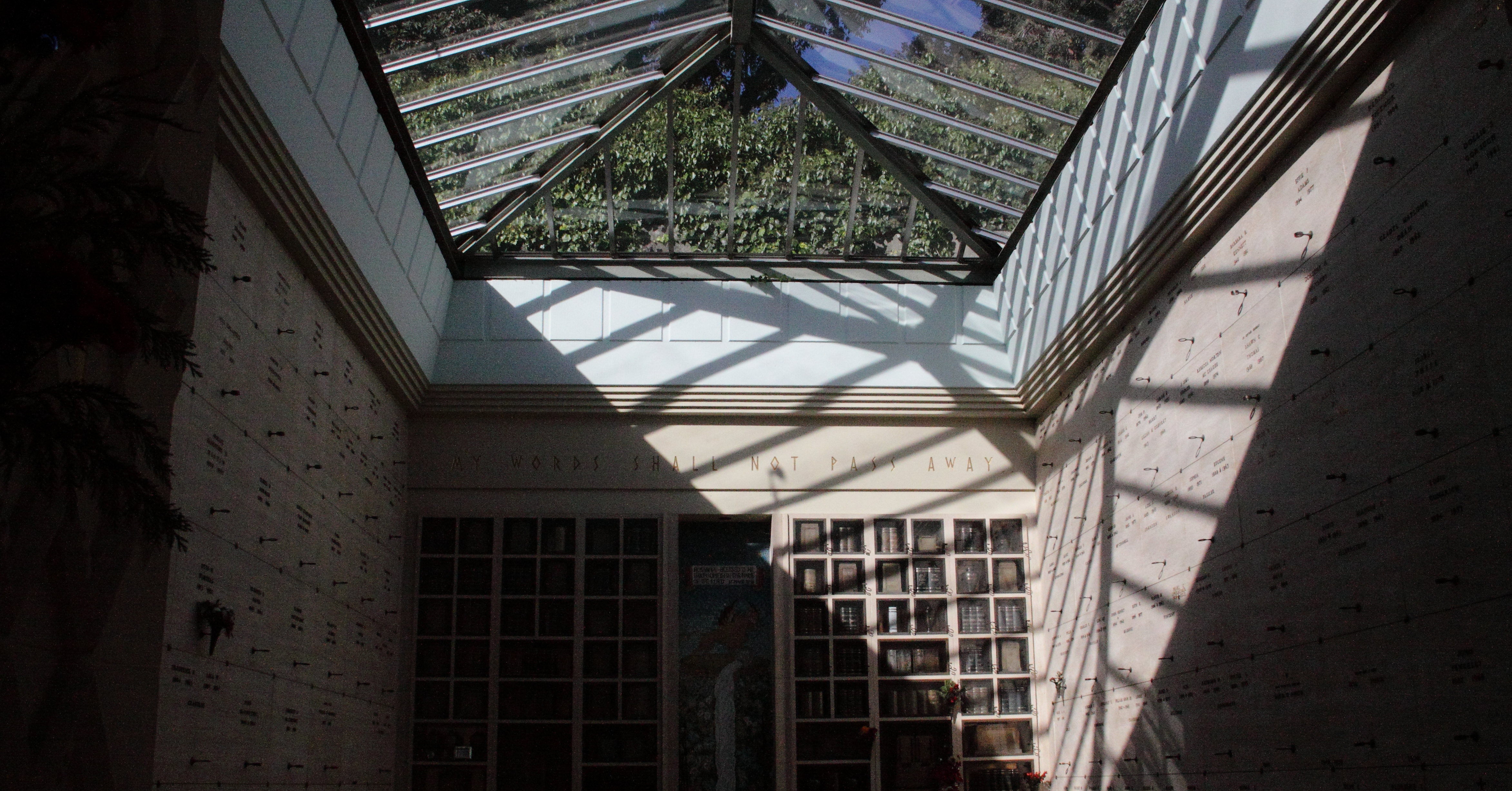
On December 19th Sarah Cahill with New Music Bay Area secured permission to use this space for four hours from 11AM to 3PM.  She invited many musicians who had been involved in one way or another with Pauline Oliveros whose death preceded by a week or two the tragic “Ghost Ship Fire” as it’s become known.  The idea was to pay homage to both this wonderful theorist, composer, performer and teacher and also to pay homage and to mourn the losses of some 36 young artists who will now never realize their ambitions.

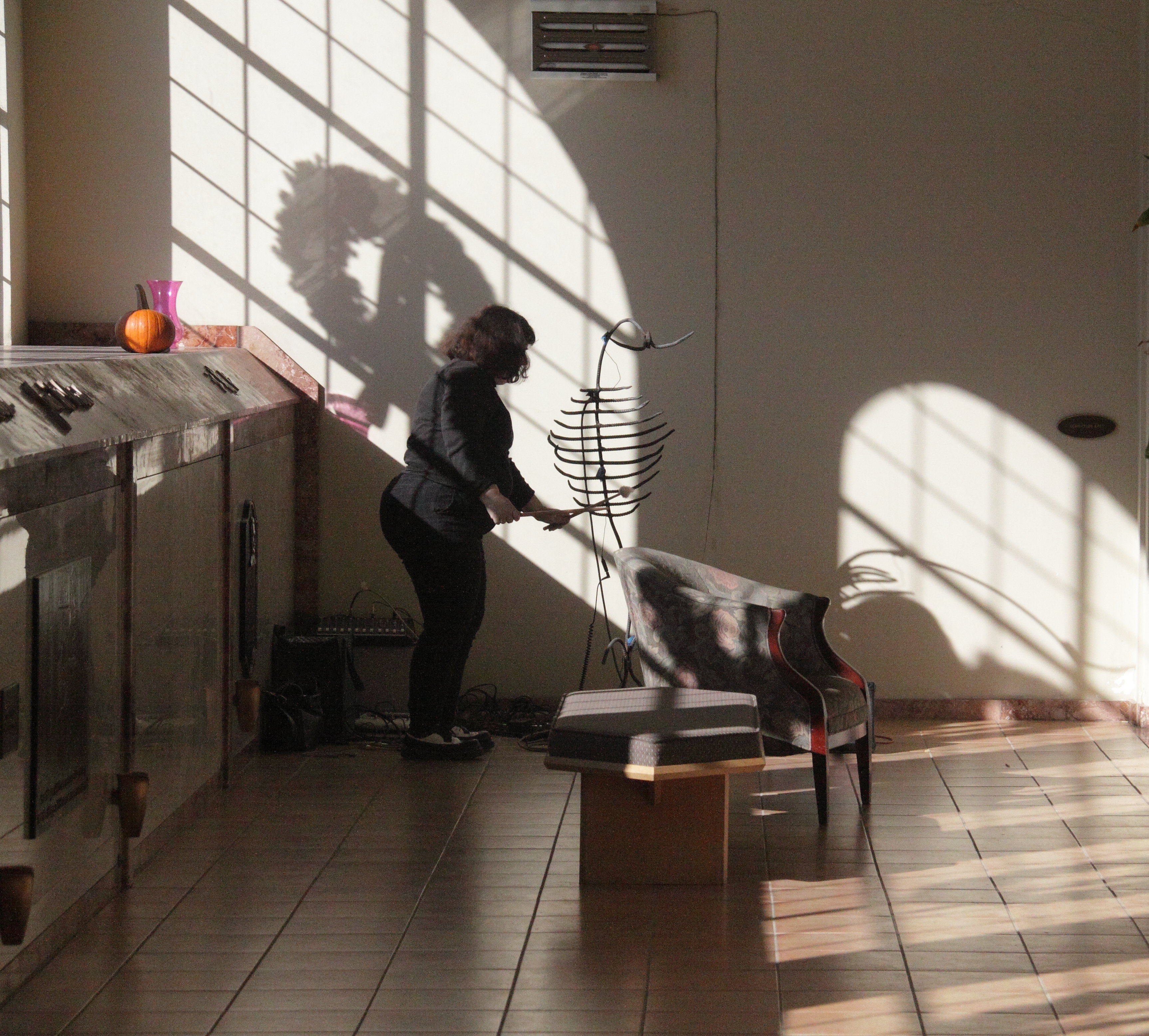
What follows here is a simple photo essay of my personal impressions of this event.  The slant of the winter light added a dimension to those beautiful spaces as a large roster of musicians played pieces by and about Pauline Oliveros.  It was a lovely and reverent experience.

oliverosolstice20160003

oliverosolstice20160005

The angle of the winter light adds its dimension.

oliverosolstice20160012

oliverosolstice20160010

oliverosolstice20160019

oliverosolstice20160014

oliverosolstice20160011

oliverosolstice20160021

oliverosolstice20160022

oliverosolstice20160024

oliverosolstice20160025

oliverosolstice20160040

oliverosolstice20160026

oliverosolstice20160044

oliverosolstice20160037

oliverosolstice20160066

oliverosolstice20160063

oliverosolstice20160043

oliverosolstice20160062

oliverosolstice20160035

OM202022

Huang Ruo: Red Rain, a New Generation From the East Makes Itself Known


redrain

This recording grabbed my attention in wonderful ways from the very beginning and didn’t cease to amaze me until it ended.  Huang Ruo (1976- ) is one of the most striking new voices this reviewer has heard in some time.  This Chinese born American composer draws on his ancestral culture, modern culture and synthesizes it with contemporary compositional techniques in new and interesting ways.  He provokes the same sort of excitement in this reviewer that first contact with the music of Bright Sheng and Ge Gan Ru did when they first came into earshot some years ago.

huangruo

Huang Ruo (1976- )

(Perhaps it is due to the rising star nature of this artist but there seems to be relatively little reliable info on him.  His website is apparently not yet complete and even his Theodore Presser page fails to even give dates for his scores.  I’m hoping these glitches get resolved soon because I think this is a composer who deserves serious attention.)

The very first track, Four Fragments (2006?) in the version for cello solo (apparently there is a version for violin solo but it is not clear which came first) is a powerful and virtuosic piece loaded with various pizzicati, glissandi and other effects that perhaps only a score could really tell you with certainty.  What is interesting is the really organic nature of these effects, that is to say that they serve the composition and aren’t simply “golly gee what a virtuoso” type fireworks. The amazing Canadian Korean cellist Soo Bae handles this work beautifully and seemingly with relative ease.  This is the second longest (by about ten seconds) of the pieces on this disc and the music, the performance snagged me immediately.  What a powerful piece!

After that I was prepared for perhaps a let down, something more “ordinary”.  But, no, the next track, the title track, Red Rain (200?) for piano played by the wonderful Emanuele Arciuli is another distinctive statement which seems to mine the riches of the composer’s native culture and place it anew in a contemporary and relevant modern context.  At 10:50 it is a substantial piano work.  Like the cello piece it seems to use some unconventional idioms for the instrument and by that I mean it sounds nothing like Mozart, Beethoven, Debussy or even Boulez or Stockhausen.  It seems infused with an eastern musical flavor no doubt gained from techniques native to non-western traditions.

In another assault to any expectations I might have had the three movements of Shifting Shades have the pianist using a whistle such as your gym coach likely used with the pea inside to create a tremolo.  Here the pianist whistles (and plays some sort of flute, maybe a recorder or shakuhachi? at one point; he also apparently plays directly on the piano strings at times) whilst playing the rapid tremolos and the drones that seem to characterize Huang’s keyboard writing. Stephen Buck is the hard working pianist here.

Buck comes back again for the Tree Without Wind for piano (this time played a bit more conventionally).  This is the longest piece on the disc at 13:57 and rewards the listener’s attention.  It seems to probe mythological depths and was suggested by a Chan Buddhist narrative by Hui Neng.  Tremolos, clusters, drones and melodic fragments take on a symphonic grandeur at times.  There is a wide range of dynamics and tempi as the pianist recounts in sounds the meaning of movement and silence.

Three Pieces for Piano gives names to the short movements.  Prelude: Diffluent, Postlude: Left… and, Interlude: Points and Lines all contain the same techniques as the other piano pieces here (though without any additional instruments this time).  These sound like they might be earlier works and perhaps studies investigating different techniques though they seem fully fleshed out and complete in themselves.  The three movements are varied and the last one is apparently the composer’s only dalliance with twelve tone techniques and is by far the most conventional sounding work here though Huang’s distinctive fingerprint is present.  Once again we hear Stephen Buck navigating the score.

In the last track we get to hear the composer himself at the piano with Arash Amini (a member of the American Modern Ensemble) on cello in Wind Blows…  Like the previous tracks and as indicated in the fine notes by Stephen Buck this piece utilizes specialized effects to produce a unique sonic image.  The piano part is referred to as a “drone” and it is indeed static at least in relation to the part for cello. Unlike the preceding pieces there seems to be less concern about evoking images and more concern for just the sound itself which is described aptly as “meditative”.   In fact it is powerfully lyrical, even “Brahmsian” if I can be forgiven for that comparison.

The brief biography in the overall fascinating liner notes describe the composer as having been influenced by a wide variety of musical styles ranging from traditional Chinese folk musics to Chinese Opera, various western classical traditions including modernists such as Lutoslawski and various “pop” traditions as well.  He studied at the Shanghai Conservatory and he appears to have achieved a fascinating synthesis in what seems to be his mature style.  He is a composer, conductor and vocalist.  His music is unique and beautiful as a Taoist painting but grounded in traditions that embrace perhaps the entire world as filtered through his creative mind. Bravo Innova for bringing this music to light in this fine and interesting CD.

Definitely keep and eye and ear out for this guy.  He has many things to say and interesting ways to say them.

David Toub’s Ataraxia, a unique compositional vision


ataraxia

World Edition 0029

David Toub is a composer whose name is known to perhaps relatively few right now but whose star is clearly rising.  Born on the east coast he studied at Mannes College and at Julliard with Bruce Adolphe and others but his musical education reached maturity when he was studying at the University of Chicago and running the contemporary music programming at the college radio station.  While he had written some twelve tone and freely atonal music it was his encounter with a 1979 WKCR broadcast of Einstein on the Beach that changed his compositional vision.  The musics of Philip Glass, Steve Reich, Terry Riley, and protominimalist Morton Feldman would henceforth infuse his style.

drtoub

David Toub

He is also what I have termed a composer with a day job.  Like Charles Ives (who sold insurance) and Alexander Borodin (who was a chemist, physician and surgeon) he makes his livelihood in the decidedly non-musical world of gynecologic surgery.  Another analog for people like David would have to be William Carlos Williams, a pediatrician whose place in American letters is assured by his poetry and novels.

I personally discovered David’s music via his website where one can find a great deal of his scores and (very helpful) sound files of many of his works.  It is definitely worth your time to browse these scores and sounds if only to get an idea of the scope of the composer’s visions.  By his own admission his music resembles that of Philip Glass, Steve Reich and Morton Feldman but perhaps it is more accurate to say that one may be reminded of these composers since his music is anything but derivative.

Some of his music has been championed by the fabulous Monacan pianist Nicolas Horvath whose You Tube Channel is a feast for new music aficionados.  In fact Horvath’s reading of “for four” (2012) can be heard and seen there.  David also has a You Tube Channel with some live performances that are well worth your time.

Many of David’s scores do fit the more conventional (ca. 20 min) time frame of most concert music but some of his most interesting scores lean toward the extended time frames common to Morton Feldman’s late work (in the liner notes he refers to a recent piano piece which lasts four hours).  These require a bit more concentration and multiple hearings to be able to perceive the compositional unity but, having done that, I can tell you that my time was well spent.

ginsburgh-de-face

Stephane Ginsburgh (from the pianist’s web page)

Stephane Ginsburgh is a Belgian new music pianist whose repertoire traverses some of the work of Morton Feldman as well as Frederic Rzewski and others.  He, along with Alessandra Celetti and Louis Goldstein were the dedicatees of the “quartet for piano”.   Having been already familiar with Toub’s work I was pleased to find that Mr. Ginsburg’s interpretive skills both do justice and provide insight to these scores which on paper (or in a PDF file) are difficult to grasp.  In fact these performances are mesmerizing.

“quartet for piano” (2010) comes in at 46:48 and the second track “for four” (2012) comes in at 22:58 but the timings are ultimately superfluous once the listener allows themselves to be taken by the collaborative adventure of this composer and performer.  I don’t think I can do justice speaking of the structure of this music except to say that, in this listener, it was like listening to the slow ringing changes of Zen Temple bells in a distant dream.  I have had the opportunity to play this CD without distraction a few times and each time found it transporting with the music taking on almost symphonic dimensions despite it’s outward simplicity.

This is a crowd funded effort in which I was a willing participant.  The lovely graphic design is by faberludens utilizing detail from a mysterious photograph by Richard Friedman (long time host of Music from Other Minds) and provides an apt visual metaphor for the music therein.  The conversation between the composer and Udo Moll dominate the liner notes and provide very useful insights to the origins and intents behind the composer’s work.

The sonorous piano is a Bösendorfer 225 and the recording was done by Daniel Léon with mastering by Reinhard Kobialka.  CD production curated by Udo Moll on Maria de Alvear’s World Edition label.  Soon to be available on iTunes and Amazon.

The other supporters named include: Maria de Alvear, Sergio Cervetti, Carson Cooman, Chris Creighton, Kathie Elliott, Paul Epstein, Sue Fischer, Alex Freeman, Richard Friedman, Stephane Ginsburgh, Louie Goldstein, Matthew Greenbaum, Hazem Hallak, Barnabas Helmajer, Christian Hertzog, Robert Kass, Harry Kwan, Steve Layton, Connie Lindenbaum, Richard Malkin, Shadi Mallak, Leah Mayes, Kirk McElhearn, Juhani Nuorvala, Rebecca Pechefsky, Lou Poulain, John Prokop, Simon Rackham, David Reppert, Larry Roche, Larry Rocke, Dave Seidel, Kel Smith, Beth Sussman, Eliyahu Ungar-Sargon, Samuel Vriezen, and Ann Wheeler.  The composer also includes his family, Debbie Bernstein, Arielle Toub and Isaac Toub for their emotional support and (in his typical self-effacing humor) “tolerance” of what he calls his “odd compositional habit”.  As habits go this one appears to be a winner.


David Rakowski: Stolen Moments, Fabulous New Orchestral Music


rakowski

BMOP 1048

The spirit of jazz and, in particular, that of Duke Ellington and perhaps George Gershwin seem ever present in this recent release from the Boston Modern Orchestra Project.  David Rakowski (1958- ) is a new voice to these ears but clearly a highly developed one well schooled in writing for large orchestra and for piano solo within that context as well.

Two works are presented here, the four movement Stolen Moments (2008/2010) and Piano Concerto No.2 (2011).  Both are large, colorful works in a basically tonal/romantic context but with clear modernist influence.  Nothing experimental here, just sumptuous orchestral writing and a challenging and interesting work for piano and orchestra.  It was only from reading the useful liner notes that I learned Rakowski had been a student of Milton Babbitt (1916-2011), a composer famous for his hard nosed complexity.  In fact Rakowski actually quotes from Babbitt and this music is a tribute to the education received from this man (keep in mind that Babbitt also taught harmony to Stephen Sondheim).

It is as difficult to grasp that Rakowski was taught by Babbitt as it is to believe that, by his own assertion, he knows very little about jazz.  The first work seems to channel the spirits of Duke Ellington and George Gershwin more than Babbitt for sure.  This four movement orchestral suite, in it’s many moods, is melodic, jazzy and engaging in a way that can’t fail to entertain.

briggs

Amy Briggs (image from the artist’s web site)

Amy Briggs has long been a collaborator with Rakowski and is an artist who has successfully made her career exclusively playing contemporary music.  This second of Rakowski’s concertos for this instrument was written for her and she plays it magnificently.  She clearly has a feel for the jazz rhythms and handles the virtuosic writing as though it were second nature.

The concerto ventures into a variety of moods and provides ample opportunities for many BMOP soloists to have their moments.  It is basically a classical three movement structure with multiple subdivisions within each movement.  These large movements come in at nearly 15 minutes each and are practically works unto themselves though they clearly adhere to the same basic vision.  The second movement is dedicated in memory of Rakowski’s teacher Milton Babbitt.  I’m sure he would have approved.

This is in fact the second time that Gil Rose and his massively talented musicians have chosen to survey some of Rakowski’s music.  That alone should be enough to clue listeners in to a potentially good listen.  Rose has been amassing a catalog of music by modern composers whose work deserves attention and, while this is an example of some pretty recent music, Rose and BMOP have done a fine job of giving attention to composers who have been unjustly neglected as well.   They seem to have a fine ear for quality music and this reviewer will listen to anything they choose to record.

As usual with BMOP, the recording is bright and lucid allowing the listener to hear the fantastic details in these big and intricate but entertaining works.  The production is by Gil Rose himself with recording and post-production by Joel Gordon.  Another great volume in the growing BMOP canon.

Ken Thomson’s Restless: a Feast of New Chamber Music


restless-cover-2000x2000

Ken Thomson is one of the rapidly rising stars of the New York music scene and beyond. His involvement with his group Slow/Fast which includes Ken Thomson, Russ Johnson, Nir Felder, Adam Armstrong and Fred Kennedy as well as Bang on a Can and others in the new music/new jazz community demonstrates his level of drive.  Thomson is a saxophone player and a composer.

The present album showcases his talents as a composer and are different than what I had expected from a musician with roots in free jazz and with saxophone as his principal instrument.  This is a set of two suites in the classical manner, a collection of movements. They do not appear to have any direct influence from jazz but rather they are quite clearly in a classical new music vein.

The first, Restless (2014) is a four movement piece for cello and piano.  It could have been called a sonata for all its complexity and development.  It is a lyrical and very listenable piece which is restless at times (though I think the title actually suggests multiple meanings) and loaded with fascinating musical ideas.  The writing for both the cello and the piano are apparently technically challenging but both are handled very well by Ashley Bathgate (cello) and Karl Larson (piano).  This disc is worth the price if only for the fantastic musicianship of these performers.

ashleybathgate-karllarson_photo1_photographer_gabrielgomez

Ashley Bathgate (cellist) and Karl Larson (pianist) (Photo by Gabriel Gomez, all rights reserved)

The three movement suite, Me vs. (2012) is a pianistic tour de force that makes great use of various pianistic effects involving judicious use of the sustain pedal and the creation of after image type effects which allow the harmonics to vibrate on strings not struck by the keys.  Again the nod to a basic three movement classical piano sonata with a complex first movement followed by a lyrical slow movement and a spritely virtuosic finale which resembles a moto perpetuo.

More about the internal dialogue that went on in the composer’s head is available in his commentary but this music doesn’t really require much explanation.  It is pretty clear and very effective music.  This is simply a wonderful recording of some fascinating new music.

Christopher Bailey: Glimmering Webs, New Piano Music


glimwebs

I admit to some trepidation when I received this 2 disc set of piano music by an unfamiliar composer.  Even in the best of circumstances the “double album” concept can be a trying thing even to fans of a given artist.  I think I recall some similar trepidation confronting the newly released Elton John Yellow Brick Road double album.  I invoke some pop sensibility here in part for humor but also because that sensibility is one of the many threads that imbue this rather massive collection of pieces.

bailey2

Christopher Bailey

Christopher Bailey is a freelance composer who holds degrees from Eastman (BA, 1995) and Columbia University (MA, 1997 and PhD, 2002).  This is the eighth disc to contain his music though only the second to be dedicated entirely to his works (and his first double album).

The first disc is a journey of styles ranging from electroacoustic music (like the opening track which resembles the work of Mario Davidovsky at times) to several whose inspiration seems to venture closer to that of Pierre Boulez and ends with a lengthy sort of post minimalist piece appropriately titled, Meditation.  The composer says in his liner notes that this piece is his homage to “ambient music” and in particular, Harold Budd. The second track is a piece which is a sort of deconstruction of a Hall and Oates song, the pop sensibility to which I referred earlier.  And, yes, there is some nod to microtonalism as well.  Can you say eclectic?

The second disc contains the large Piano Sonata and a host of smaller works in various styles ranging from neo-classical to microtonal.

In the rambling liner notes the composer provides useful clues as to the genesis and intent of some of his ideas.  One need not read the notes to appreciate the music but the clarity that they provide was useful to this listener. More notes would have been appreciated though.  The composer’s and the pianists’ web sites are certainly useful but I doubt that the average listener will spend that much time researching these things and is then left with gaps in information and consequently in understanding.

The composition dates here range from 1994 to 2013 and embrace a wide swath of styles all with a strongly virtuosic aspect.  The second disc starts with the brief Prelude-Fantasy on the So-Called Armageddon Chord (2011).  The title is almost longer than the piece and, while it’s a fine work, the placement at the beginning of the disc preceding the major opus of his four movement Piano Sonata (1994/1996/2006) is a bit confusing.

I don’t mean to quibble with such things as track order and such but I was left with a sense of difficulty focusing.  Here is a large collection of music which ranges through pretty much the entire gamut of the last 200 years of music and it is presented en masse.  I think some re-ordering might have been helpful but that is one of the difficulties with multiple disc issues.  I listened numerous times to these discs and find the sheer volume and diversity a bit overwhelming.  It is as though this is too much for a single release.

Bailey says that the sonata is an homage to Stravinsky and those neo-classical elements are certainly clear but this listener hears some ghosts of Charles Ives and the polystylism of Alfred Schnittke as well.  The Sonata seems to be the highlight here.   It is wonderfully complex, kaleidoscopic, loaded with quotation, even grandiose at times, but eminently listenable and it is a highly entertaining piece also because of it’s virtuosity which is ably handled by the performer.

There are apparently three pianists on this recording, Jacob Rhodebeck, Shiau-Uen Ding and Augustus Arnone.  The problem is that it is not clear from the labeling or the notes who plays what.  This is actually a fascinating and engaging collection, well played, but I was surprised to be unable to attribute the various virtuosities to the deserving performers.

The recording, mastered by Silas Brown, is as good as it gets.  Overall quite a collection but one that left me with many questions as well.  Perhaps that was, at least partly, the intent but it is my hope that these ambiguities will not distract the listener and that more releases will be forthcoming.  This is very interesting music deserving of serious attention.


Alberto Ginastera at 100


ginastera

Oberlin Conservatory OC 16-04

Let me start by saying that the only thing wrong with this album is that it is only one CD. Alberto Ginastera (1916-1983) is without doubt one of the finest composers of the twentieth century.  Stylistically he holds much in common with composers like his contemporaries Aaron Copland (with whom he studied), Carlos Chavez, Leonard Bernstein and others who incorporated the spirit if not always the literal music of his homeland’s folk culture into his music.  In additional to these nationalist works he wrote a substantial amount of traditional concert music which touched on the edges of modernistic trends.

He wrote three operas, two ballets. two piano concertos, two cello concertos, a harp concerto, three string quartets, a bevy of piano music and sundry other items.  It is simply not possible to contain a fair representation of his work on a single CD.  Despite that this disc is not a bad retrospective.  It is lovingly played and recorded and if it does not represent the whole of Ginastera’s oeuvre it is a nice sampling.

The disc begins with the wonderful Harp Concerto Op. 25 (1956, rev. 1968).  Though originally commissioned by Edna Phillips (principal harp of the Philadelphia Orchestra) she had retired before she could perform it and it was premiered in 1965 by the amazing Spanish harpist Nicanor Zabaleta.  This three movement work is certainly one of the composer’s finest works and is beautifully played by Yolanda Kondonassis with the Oberlin Orchestra under Raphael Jiménez.  This piece is one of the finest modern harp concertos and is representative of the composer’s international style with perhaps just a taste of modernism.

Next up is the single movement Pampeana Op. 16 (1947) with the great Gil Shaham on violin and his sister Orli Shaham on piano.  This is a sort of window on Ginastera’s earliest nationalist style full of melody and virtuosity.

The next work is the Sonata for Guitar Op. 47 (1976) played by Grammy winning virtuoso Jason Vieaux.  I had not heard this work and my first hearing was indeed a revelation.  This is a major work for guitar and a wonderful sonata in the classical form.  I gave these four tracks a few listens in an attempt to digest some of their beauty and complexity and I will doubtless give them many more listens.  This is a major piece that belongs in the repertory.

And, finally, we move to the earliest utterance here with the Danzas Argentinas Op. 2 (1937) in an exciting and dedicated performance from Orli Shaham.

The sound is wonderful and there are a geekily satisfying set of liner notes which include a useful analysis by James O’Leary, Frederick B. Selch Assistant Professor of Musicology, Oberlin Conservatory of Music.  All in all a beautiful production and a great introduction to Ginastera’s work but please, don’t stop here.  Make sure you get to hear his other work and perhaps the wonderful folks at Oberlin will consider a volume two?

Lara Downes Making Magic at Noon in San Francisco


cordell0007

Old St. Mary’s Cathedral in San Francisco

A much needed light rain fell as I ventured out to hear Lara Downes play at the noontime concert series at Old St. Mary’s Cathedral in San Francisco’s Chinatown neighborhood.  I had just recently reviewed this artist’s new CD release (here) and I jumped at the opportunity to hear her live.

The trip from my home in Alameda to this venue, a distance of some 15 miles took me almost two hours.  Construction rules right now.  In the course of the concert Ms. Downes commented that it took her 45 minutes to get there from her hotel in San Francisco (no doubt less than 2 miles).

Being familiar with this trip I managed to arrive at about 12:15PM.  When I arrived I was a bit surprised to find a service in progress so I sat quietly observing this beautiful little church.  Though raised Catholic I haven’t ventured into a church in some years.  The experience did place a sort of spiritual context on my concert experience.

cordell0002

Priest saying mass at Old St. Mary’s Cathedral

The service ended a little after 12:30 and, after some of the congregants left I moved closer to the front.  Technicians moved the piano in place and Ms. Downes was introduced.

cordell0004

Downes intensely focused as she plays Schumann’s Fantasy Pieces

She chose to open with Robert Schumann’s (1810-1856) Op. 12 Fantasy Pieces Nos. 1, 2, 3 and 5 (1837).  I have but a passing knowledge of Schumann’s music.  It is highly virtuosic romanticism. Beautiful melodies, classical harmonies with just a dash of dissonance and a very high level of technical difficulty which characterizes these pieces.  Downes played them with confidence and ease seemingly casting a spell as she did.  She played the set without interruption and received much deserved applause from the somewhat sparse audience of perhaps 50 or so people.

She followed with a selection from her upcoming release America Again, Samuel Coleridge-Taylor’s (1875-1912) setting of the spiritual Deep River Op. 59 No. 10 (1905), one of a set of 24 so-called “Negro Melodies”. Coleridge-Taylor was a black British composer of the late 19th century sometimes referred to as the “African Mahler”.  This setting, very much in the same spirit as the Schumann was pretty much what one might have expected had Schumann encountered black spirituals.  This selection added again to the spiritual dimension.  Deep River is a majestic and celebratory piece which, like the Schumann, was well received.

Downes deviated from the printed program to play another selection from that forthcoming album, Morton Gould’s (1913-1996) American Caprice.  This short piece was a delightful foray into jazz reminding us of Gould’s connections with his contemporaries like Aaron Copland and George Gershwin.  Gould is a composer whose work deserves more attention and this listener is grateful to the artist for bringing this little masterpiece back into the light.

cordell0006

Downes making Rhapsody in Blue sound anew.

In some ways this functioned like a precursor to the next piece on the program, Gershwin’s (1898-1937) Rhapsody in Blue (1924) in the composer’s arrangement for solo piano. Downes, whose speaking was as comfortable and natural as her playing, asked the audience to try to hear this oh so familiar piece with new ears.  Indeed her fluid and dynamic playing put her own stamp on this popular gem and demonstrated again her seasoned virtuosity.  She played the work with passion but also with ease and confidence.

The ample applause and standing ovation brought her back for a wonderful encore.  It was Gershwin again for sure but this time in an amazing arrangement by Nina Simone (1933-2003) whose spirit seemed to be channeled by Downes.  “I loves you Porgy” from Porgy and Bess is featured on her new CD and it brought the afternoon to a very pleasing close.

I took the opportunity to meet and thank Ms. Downes who was, in turn, gracious and pleasant.  I went back out to the ordinary world charmed and invigorated and that is what I had hoped for.


Traceur, American Music for Clarinet and Piano


traceur

New Focus Recordings FCR-172

This is a nice little program of pieces for clarinet and piano by 20-21st century composers. It might even be a representation of the state of the art for this genre.  All of these pieces are basically tonal and would work well in a recital.

Michael Norsworthy, professor of clarinet at Boston Conservatory at Berklee has an impressive set of credentials in the interpretation and performance and teaching of new music.  This performing academic has quite a list of recordings to his credit.

David Gompper is a composer and pianist with a similarly extensive set of credentials in support of new music (his own and others’).

The disc opens with a six movement suite of short pieces by Robert Beaser (1954- ) called, Souvenirs (2001-2).  Beaser is one of the finest composers of his generation and his tonal style was a hallmark of his work from the very beginnings.  These short, personal sketches are a delightful example of his work.  These pieces were originally written for piccolo and piano and are here presented in the composer’s transcription for clarinet and piano.

The next piece, Black Anemones (1980) is originally for flute and piano and is a sort of modern classic (here is a recent review of the flute and piano version).  The Pulitzer Prize winning Joseph Schwantner (1943- ) is also among the finest composers working today. This transcription for clarinet by Mr. Norsworthy will most certainly guarantee further performances.  This is truly lovely music inspired by poetry of Agueda Pizarro.

Three American Pieces (1944-5) by Lukas Foss (1922-2009) are another sort of classic set of pieces.  These are early compositions in a neo-classical/nationalist style characteristic of this period of Foss’ compositional style.  It is great to have a new recording of these entertaining pieces.  Foss is due for a reckoning I think.

Marti Epstein (1959- ), also a professor at Berklee was represented in an earlier review of a disc (here) dedicated entirely to her gentle music imbued with memories of her upbringing in the great plains of the Midwest.  Nebraska Impromptu (2013) is characteristic of this composer’s gentle but substantial music.  Her website also contains a very interesting occasional blog that is worth your time.

Derek Bermel (1967- ) is here represented by schiZm (1993-4).  Originally for oboe and piano the composer also made this transcription for clarinet and piano.  Bermel describes some of the fascinating techniques that underlie the structure of this two movement piece but the result of those techniques is a very interesting piece of music.

Last but definitely not least is the title track Traceur (2014-5) by composer/pianist David Gompper (1954-).  It is the longest and most complex of the pieces presented and requires the most involvement on the part of the musicians as well as the listener.  I don’t mean to imply that this is difficult music because it isn’t.  It is substantial music whose charms demand close listening, an effort for which one will be rewarded.

This lucid recording was produced by Norsworthy and Gompper (with the assistance of Robert Beaser in the recording of his work).  It was recorded in 2015 with editing and mastering by Patrick Keating.  Very nice disc.  Highly recommended.


The Anniversary That (almost) Everyone Missed: Bill Doggett (1916-1996), Wizard of the Hammond Organ


doggettcombo1956

Bill Doggett with his combo (getty images)

William Ballard Doggett, better known as Bill Doggett was born in Philadelphia in 1916 and was introduced to music by his church pianist mother.  He played in a combo while still in high school and went on to work with a plethora of stars in rock, jazz, rhythm and blues amassing a string of hits but, sadly, seems to have barely been noticed on this the 100th anniversary of his birth.  Where is NPR at a time like this?

Well, all is not lost.  Fortunately his nephew and namesake Bill Doggett is doing justice to the memory of this important American musician.  This younger Doggett is an archivist, lecturer, curator, strategic marketer, photographer, filmmaker, and arts advocate (his website is well worth your time).  I am hardly as well prepared to provide more than an overview of this musician’s work but I feel obliged to do my small part in recognizing this man’s work.
doggettposter

Promotional poster for the September 28, 2016 centennial celebration curated by nephew and namesake, Bill Doggett.

Doggett’s list of chart singles:

  • “Be-Baba-Leba” (vocal by Helen Humes) (Philo/Aladdin 106) 1945 (#3 R&B)
  • “Moon Dust” 1953 (#18 R&B)
  • “Early Bird” 1953 (#21 R&B)
  • “No More In Life” 1953 (#20 R&B)
  • “High Heels” 1954 (#15 R&B)
  • “Honky Tonk, Part 1″/”Honky Tonk, Part 2” (King 4950) 1956 (#1(14) R&B/#2(3) Pop)
  • “Slow Walk” (King 5000) 1956 (#4 R&B/#19 Pop)
  • “Ram-Bunk-Shush” (King 5020) 1957 (#4 R&B)
  • “Soft” 1957 (#11 R&B)
  • “Leaps And Bounds, Part 1″/”Leaps And Bounds, Part 2” (King 5101) 1958 (#13 R&B)
  • “Blip Blop” 1958 (#11 R&B)
  • “Hold It!” (King 5149) 1958 (#3 R&B)
  • “Rainbow Riot, Part 1″/”Rainbow Riot, Part 2” (King 5159) 1959 (#15 R&B)
  • “Monster Party” (King 5176) 1959 (#27 R&B)
  • “Yocky Dock, Part 1″/”Yocky Dock, Part 2” (King 5256) 1959 (#30 R&B)
  • “Honky Tonk, Part 2” 1961 (#21 R&B)


  • doggetthonky

    Doggett’s best known work.

While his last chart hit was 1961 his collaborations with  Lucky MillinderFrank FairfaxJimmy Mundythe Ink SpotsLouis JordanJohnny Otis, Wynonie Harris, Ella Fitzgerald, Louis Armstrong, Count Basie,  Lionel HamptonRed Holloway, Clifford Scott, Percy France, David “Bubba” Brooks, Clifford Davis, and Floyd “Candy” Johnson; guitarists Floyd Smith, Billy Butler, Sam Lackey and Pete Mayes; and singers Edwin Starr, Toni Williams and Betty Saint-Clair attest to the scope of his work.  Doggett continued to play and arrange until his death from a heart attack in New York in 1996 at the age of 80.

bill_doggett

Bill Doggett photographed in France in 1980 by Lionel Decoster (from Wikipedia article)

The Hammond Organ is known for being the workhorse of modern classical as well as rock, rhythm and blues and jazz.  It was Bill Doggett who became one of the early masters of this (then new) electronic instrument.  While he was also a highly competent pianist, it was with the Hammond Organ that he had his greatest success. There is little doubt that his playing has influenced subsequent musicians who took on this instrument.

Here’s hoping that astute musicians and producers will take on the task of recognizing the work of the late great Bill Doggett.  Toward that end here, from Wikipedia, is a discography of his work:

10 inch LPs

  • Bill Doggett: His Organ And Combo, Volume 1 King 295-82 (1954)
  • Bill Doggett: His Organ And Combo, Volume 2 King 295-83 (1954)
  • All Time Christmas Favorites King 295-89 (1954)
  • Sentimentally Yours King 295-102 (1955)

12 inch LPs (on King Records)

  • Moon Dust King 395-502 (1956)
  • Hot Doggett King 395-514 (1956)
  • As You Desire Me King 395-523 (1956)
  • Everybody Dance The Honky Tonk King 395-531 (1956)
  • Dame Dreaming With Bill Doggett King 395-532 (1957)
  • A Salute To Ellington King 533 (1957)
  • The Doggett Beat For Dancing Feet King 557 (1957)
  • Candle Glow King 563 (1958)
  • Swingin’ Easy King 582 (1958)
  • Dance Awhile With Doggett King 585 (1958)
  • 12 Songs Of Christmas [reissue of King 295-89 plus 6 additional tracks] King 600 (1958)
  • Hold It! King 609 (1959)
  • High And Wide King 633 (1959)
  • Big City Dance Party King 641 (1959)
  • Bill Doggett On Tour [this is NOT a live album] King 667 (1959)
  • For Reminiscent Lovers, Romantic Songs By Bill Doggett King 706 (1960)
  • Back With More Bill Doggett King 723 (1960)
  • The Many Moods Of Bill Doggett King 778 (1962)
  • Bill Doggett Plays American Songs, Bossa Nova Style King 830 (1963)
  • Impressions King 868 (1963)
  • The Best Of Bill Doggett [compilation] King 908 (1964)
  • Bonanza Of 24 Songs [compilation] King 959 (1966)
  • Take Your Shot King 1041 (1969)
  • Honky Tonk Popcorn King 1078 (1970)
  • The Nearness Of You King 1097 (1970)
  • Ram-Bunk-Shush [compilation] King 1101 (1970)
  • Sentimental Mood [compilation] King 1104 (1970)
  • Soft [compilation] King 1108 (1970)
  • 14 Original Greatest Hits [compilation; reissued as ‘All His Hits’] King-Starday 5009 (1977)
  • Charles Brown: PLEASE COME HOME FOR CHRISTMAS [this vocal album includes 4 instrumental tracks by Bill Doggett] King-Starday 5019 (1978)

12 inch LPs (on other labels)

  • 3,046 People Danced ‘Til 4 A.M. To Bill Doggett [this is a live album] Warner Bros. WS-1404 (1961)
  • The Band With The Beat! Warner Bros. WS-1421 (1961)
  • Bill Doggett Swings Warner Bros. WS-1452 (1962)
  • Rhythm Is My Business (Ella Fitzgerald with Bill Doggett) Verve V6-4056 (1962)
  • Oops! The Swinging Sounds Of Bill Doggett Columbia CL-1814/CS-8614 (1962)
  • Prelude To The Blues Columbia CL-1942/CS-8742 (1962)
  • Finger-Tips Columbia CL-2082/CS-8882 (1963)
  • Wow! ABC-Paramount S-507 (1964)
  • Honky Tonk A-La-Mod! Roulette SR-25330 (1966)
  • The Right Choice After Hours/Ichiban 4112 (1991) Note: this is Bill’s last recorded album of original material; also released on CD.

OK all you producers, have at it.